19th August 2018: Uji, layovers and finally Ise {Japan, summer 2018}

Uji [宇治] is Kyoto’s li’l brother that nobody has ever heard about and which has a bit of a disproportionate ego. Today I set off to visit this small town, where I had not slept because it was crazy expensive. Armed with an online itinerary I got there and asked for a map at the tourist office – my surprise? One of the main attractions, the Genji Monogatari museum was closed. Because reasons I guess. Hindsight: I should have slept in Kyoto again and left luggage at Kyoto station as I would have to travel through it again.

My general impression of Uji is that it wants to climb the tourist ladder but at the same time, it does not want to carter to the actual tourists. Attractions were in general expensive and a tiny bit unwelcoming, while at the same time the people were nice in a bit of a condescending way. The demeanour of the tourist lady “what are you here to see?” was strange, and the fact that the Genji Monogatari museum, which is the reason why the town is even in the map, being closed, even more so.

My first stop in Uji was Byodo-in [平等院], a beautiful temple complex built around a small lake. Coming into the actual building to watch the paintings had an extra charge so I did not do that. Instead I snooped around the whole complex, museum, and sub-temples.

I continued my walking route skipping the tea house, because even if Uji is known for tea, it was too hot for hot tea. I got to the river, Ujigawa [宇治川], and crossed one of the bridges, the Kisen Kisenbashi [喜撰橋] to get to a small river island called Tachibanajima [橘島].

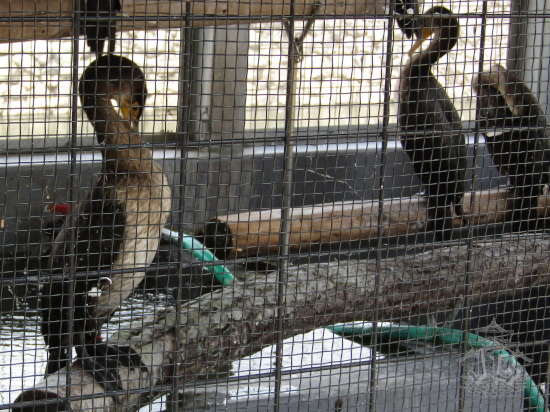
Another thing that is apparently typical in Uji is ukai [鵜飼] or cormorant fishing, which means fishermen use trained cormorants to fish. It was apparently too early in the morning for the cormorant to be out working.

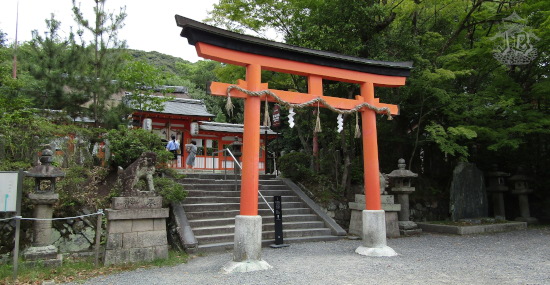
I crossed then another of the rivers, the Asagiribashi [朝霧橋] to get back to main land, where I stopped by Uji Jinja [宇治神社].

Then Ujigami Jinja [宇治上神社], which is basically another building of Uji Jinja but it got separated because the Haiden is a historical monument.

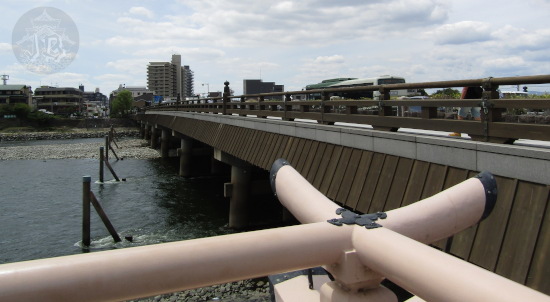
I finished my walk around Uji at yet another bridge, Uji-bashi [宇治橋], famously mentioned in Genji Monogatari. Do you see a pattern here and why I’m so weirded out about closed museum?

After Uji the plan was getting to Ise mid-afternoon, but my Shinkansen was late, which lead to a two-hour layover in Nagoya [名古屋].

That meant that I arrived in Ise [伊勢] in the Mie Prefecture, around 6 pm. I had two options there – walk 45 minutes to the hotel, or wait 45 minutes for a train that would take ten minutes to get at the hotel station, and then walk for 15 minutes. I chose to walk.

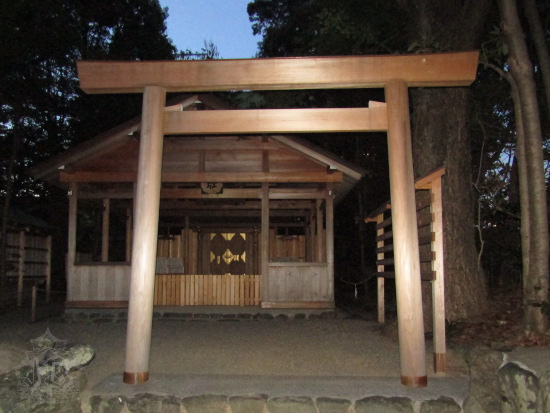
Thus I came across Tsukiyominomiya [月夜見宮] just as the sun started to set. I started to notice here the ‘naked’ torii, which are typical of Ise – it means that they are not painted or made of stone, they are plain wood, usually sakaki, a sacred tree in Shinto.

And Suhara Taisha [須原大社] a bit later (though the two look… creepily similar, don’t they?)

By the time I got to the hotel I was exhausted and hungry, and maybe a bit eeried out because I had had to cross a mostly deserted area over the river as it got dark. Sheesh, was I happy when I started seeing neon again. Bonus point, the hotel had an onsen, which was great for my back (and it was near a combini, so food was also had). The hotel was such a huge complex that they needed to hand out maps so you found your way between the different areas – onsen, reception, restaurant, room!

18th August 2018: Plan Switching. Kyoto → Osaka → Nara {Japan, summer 2018}

On this day I was supposed to hike up a mountain – mount Takao to be precise. But you know what? When I woke up that morning I just did not feel up to it, so I decided to change my plans. In the end when you’re on the JR Pass you can get from Kyoto to Osaka for free. For a change, I actually got to Osaka instead of Shin-Osaka which was convenient. Then I grabbed the underground to get to Osaka Aquarium Kaiyukan [海遊館], which is actually the largest aquarium in the world.

I had been there before, but the previous time I did not get to see the whale sharks as they were ‘quarantined’. How can anyone block a tank which is in the middle of the whole damn thing, I have no idea, but they did. This time I broke even and had a blast. Unfortunately the Aquarium was packed because this was a Saturday morning, and for some reason my back was hurting a lot. I had dropped my luggage off at a coin locker because I thought it would be better. However at some points I could not really walk straight. The weight of the camera bag was too much and I had to sit down. Found a nice place to watch the sharks from, though.

After the Aquarium I went to Kuchu Teien [空中庭園], observatory in the Umeda Sky Building [梅田スカイビル] to have a look at the skyline and to get the stamp for the Japan Towers rally. I got the greatest omg-gaijin face of the trip here (and truth be told, had I known that the stamp was actually held at the reception desk and not the actual observatory, I might have skipped this). In this case the building is an attraction itself. It consists on two towers joined by some passageways and a circular platform at the top, with see-through escalators.

Next the plan was going to Dotombori, stroll down there, and eat some takoyaki before heading off to Nara where I had my hotel for the night. When I got to the station and jumped on the Osaka Loop line, it turned out that I actually was in the train that continues on to Nara… and it was air conditioned and I had a seat…

I found it a sign and decided to just go with the flow and get to Nara [奈良] on that train. Upon arriving there I checked into the hotel and I decided to go to Nara koen [奈良公園], the main Nara park, and see if I could feed a sacred shika [鹿] deer or two. This was close to 5 pm by now so all the temples would be closing anyway. I did feed the deer some shika senbei [鹿煎餅] (deer crackers), and one of the does bit me. Not even the hand that was feeding her, she actually tried to snack on my tummy. Sheesh.

As I was coming back down I had a pretty sunset over Kōfuku-ji [興福寺].

17th August 2018: Gold & Oiran {Japan, summer 2018}

Last year I decided to take a maiko photoshoot and it was fun, so when this year I found something similar, I decided to take the plunge. In this case, it was not a maiko, but an oiran [花魁], high-ranking courtesans with flashier clothes and more expensive kimono and accessories. I timed this to be the day after the Gozan no Okuribi, and my appointment was at 1 pm, although the website advised you to be around half an hour earlier.

I woke up feeling much better than the previous day, and after leaving the hotel the first thing I did was visit Mikane Jinja [御金神社], a small temple that had at some point come under my radar because it has a golden torii. This was, again by luck, very close to my hotel.

Torii gate painted in glittery golden paint

After that I took the underground to go to the Higashiyama / Keage area, where my photo studio was. There are also a few things to see around there, so I got off at Keage Station and the first thing I saw was Nejirimanpo [ねじりまんぽ], a Spiral Brick Tunnel, also called “Twisted tunnel”. I walked across, of course.

Entrance to a tunnel made of bricks. The bricks seem to be built in a spiral, and not straight

Afterwards I found myself at the complex formed by Tosho-gu [東照宮] and Konchi-in [金地院]. Tosho-gu is dedicated to Shogun Tokugawa Ieyasu.

A Buddhist temple with lots of bonsai pines in front of it

I continued into the temple complex and saw Nanzen-ji [南禅寺], a grand temple.

The main building of a Buddhist temple with an incese brazier in front of it

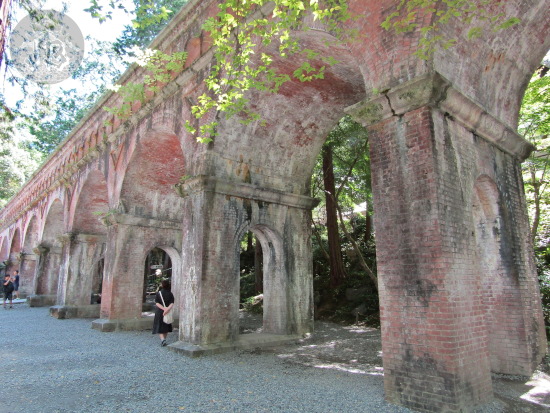
And then I stumbled onto Suirokaku [水路閣], which is, of all things, an aqueduct! Furthermore, it is still in use.

Aqueduct made out of brick

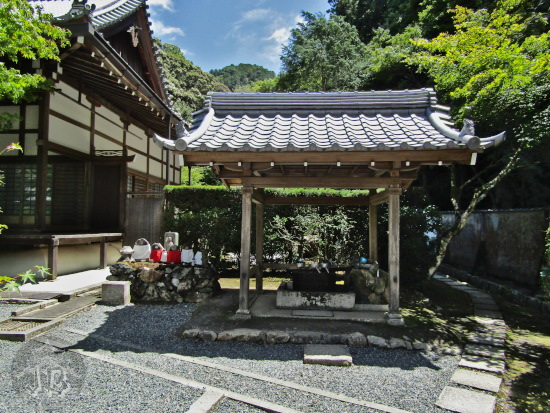
My next stop was Saisho-in [最勝院].

A Shinto purifying fountain

Then it was almost time for my appointment, so I headed towards Studio Esperanto Oiran Taiken [studio-esperanto 花魁體驗], which was pretty much amazing.

Studio Esperanto front shop

While considerably more expensive than the maiko photo shoot, but the truth is, it seems less standardised and way more professional in a way, relaxed in the other… maybe it is the fact that you get to choose more is what makes it unique to you – also I am happy to report that I could do it with my contacts in, so that was way more enjoyable. The whole thing was like a dream – it reminded me a little of the experience you get when you go to Swallowtails, a lot of people are trying their best to make you feel welcome. In this case you choose a kimono and two different covers, called uchikake, which are super heavy because they are embroidered with metal thread.

The first thing I did was to take off my clothes and put on a white “underwear” robe. I could choose a lot of things – make up style, colours, wig, nails, hairstyle to a point, eyelashes… it is very participative. After make-up, you choose the kimono and the obi – which is the real thing, a long one that they tie around you. For the photo shoot itself, you feel like a rock star for real. They put the uchikake on you, they help you with the poses, and they take a lot of pictures for you to choose which ones you want printed into a book -For the plan I bought, 25,000 ¥ you get five printed pictures in a book and can buy the rest of them on a CD (which was 10,000 extra, but in my case, way worth it, as I got 50 pictures) – one day I would love to do the VIP experience, that’d be cool, but I guess I’ll just settle for entertaining repeating a similar plan with the blue background.

Collage of a person in oiran outfit. The kimono is decorated with pine needles embroidered in gold, and cranes. The person is wearing wig with long red hair.

While I was waiting for the pictures to be done, I decided to have a walk around the area. I saw the Biwako Sosui Kinenkan [琵琶湖疏水記念館 ], the Lake Biwa Canal Museum, from the outside.

Fountain with a crane inbetween the flow

I thought I might check out the zoo, but the price made me decide against it, and after turning a corner I found myself, surprisingly, at Heian Jingu [平安神宮 ].

Bridge leading up to a huge torii gate painted vermillion

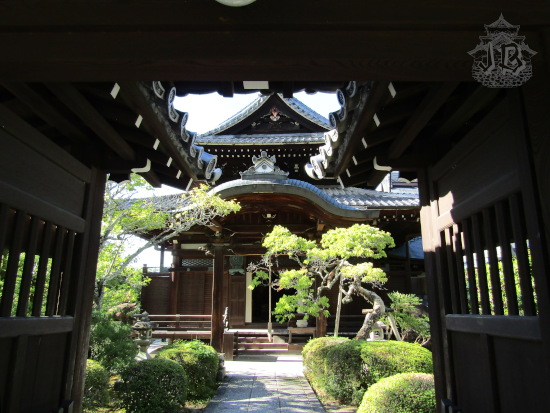
I remembered there was a conbini next to the daitorii, so I went there to have some lunch, and then walked back to the Keage area, to have another look at the temple complex and Jishi-in [慈氏院] (probably. There was some construction going on and this might have been a smaller temple).

A Buddhist temple through the wooden gate

After I had my pictures (and still not quite believing it), I decided to walk down to Gion, as the path would take me down the river.

A shot of the Kyoto canal, with weeping willows hanging over it

I ended up at Yasaka Jinja [八坂神社].

Vermillion gate that marks the entrance to a shrine up a flight of stairs

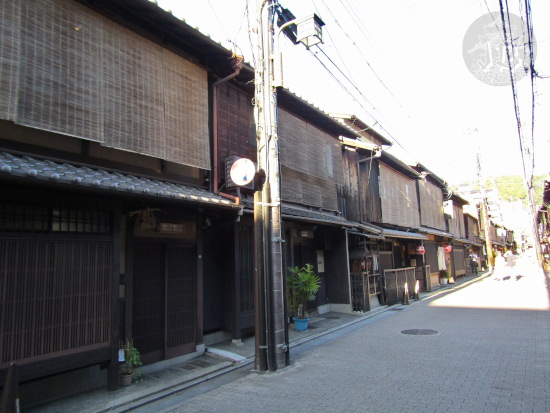
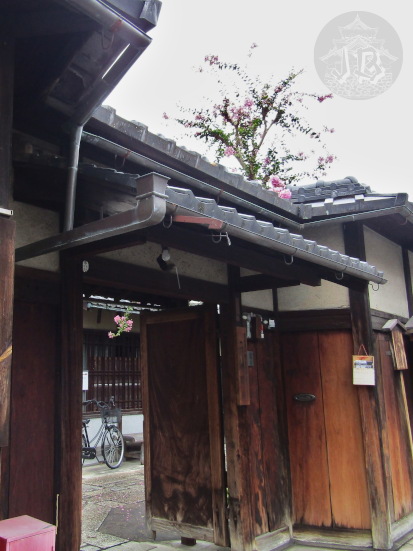
Then I walked into the actual Gion [祇園] area. It was more than crowded, which killed the exploring drive.

Wooden houses in the sun, the wood is dark

And here is when I totally forgot that I wanted to go see Fushimi Inari Taisha by night and went back to the hotel 。゚(゚´Д`゚)゚。. I guess I was a bit more tired than I had previously thought, because I did not remember that until I was getting on a train the following there.

16th August 2018: 五山送り火 (Gozan no Okuribi) {Japan, summer 2018}

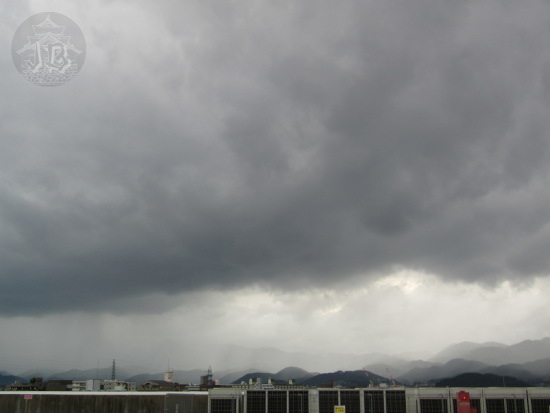
Remember when I mentioned I overdid it on the 15th? I was feeling it today. My head was bugging me and it grew worse along the morning. The weather, showery, was not really helping, even when I took my meds.

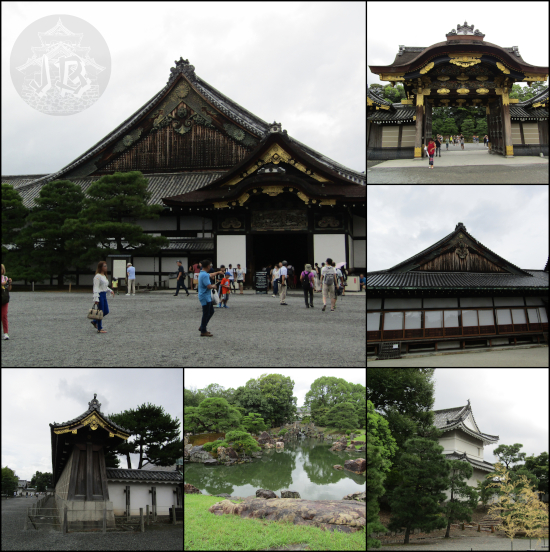
Never the less, I left the hotel in the morning, got some breakfast and walked to Kyoto’s old castle, Nijō-jō [二条城], which was literally two blocks over. This was not planned, as when I booked the hotel I looked for something reasonably-priced reasonably-close to a JR or an underground station – I really, really hate Japan buses, trains for the win.

Anyway, the castle was close, so I decided to drop by as the first time I had been around it was being renovated.

After the castle I walked towards the JR station where I had come from the previous day to stop by Shinsen-en [神泉苑], the remains of a Heian Era garden, which holds a sub-temple to To-ji.

Also I snooped into Nijo Jinja [二条神社], just because there was an indication sending me there.

Then I headed off to Kyoto JR station as there is a tourist information centre. There I wanted to ask where to watch the upcoming Gozan no Okuribi [五山送り火], which is a festivity that closes the Obon festival in Kyoto. The Obon festival honours the deaths of the deceased, which come back to the world and are sent away by the five fires started in four mountains around Kyoto. I wanted to see as many fires as possible, and I had been doing some research online. I wanted to find a good place, which in the end turned out to the rooftop of a local Aeon supermarket, the Aeon Mall Gojo.

After getting the info, I went to Higashi Honganji [東本願寺], a temple close to the station.

I wanted to go find its twin, Nishi Honganji, but I was not feeling well and I really wanted to be fine for the evening’s fires – which were after all the reason why my trip was planned like this, so I could go to see the fires. My headache was growing worse, I think part of the reason was that I was stressing that the mall might not be a good place to watch the fires and whether I could go somewhere else. Thus I got something to eat, and headed back to the hotel for a shower, a nap, and some dinner before I left for the mall.

The nap proved to be a good idea. The fires would be lit at 8 pm, so I stayed in the hotel until a little after 5 pm, when I left so I could be at the mall at 6 pm. This gave me time to relocate to another of the viewing spots if my first choice did not work.

But it did. You know you’re on the right track when you find all the locals all ready a picnic, and the Aeon was just like that. There were hotel employees pointing to the areas where we would see the fires. Out of the five fires we would see three, and part of the other two.

There are five fires in the Gozan no Okuribi [五山送り火], and they are lit from right to left. The first one is shaped 大, it is called Migi Daimonji or just Daimonji [大文字]. It is lit at 8pm. The second one is Myojo [妙法], a Buddhist prayer. Next comes the ship that is supposed to take the souls back to the underworld, called Funagata [舟形]. The fourth is the Hidari Daimonji [左大文字], another 大, and the final one is the Toriigata [鳥居形], shaped like a torii.

Everything was good. I could relax and my headache did not come back, even if we had a mini deluge that had everybody going inside for a few minutes.

When it was done and we went all back outside, we had a great sunset.

Finally everything went dark and the fires started. We saw the Migi Daimonji lit first to our right.

Then the sparks of what could have been the Myojo or the Funagata, nobody was too clear on that. Later we saw the Hidari Daimonji lit, just in front of us.

Finally, we got to see the Toriigata after changing sides of the roof.

All in all, it was a great success!! I was really glad I got to go and see it, especially the first and last fire, because it gave everything a sense of beginning and ending, even if I was quite exhausted to make it back to the station and the hotel.

15th August 2018: Hikone is small and at noon it turns into a pumpkin? Hikone → Kyoto {Japan, summer 2018}

As I had learnt the way to the castle entrance the previous day, first thing in the morning I headed off to Hikone Castle. The walk to the castle is flanked by the Irohamatsu [いろは松], which is a row of special pine trees that were planted there as their roots grow downwards but not sideways.

Hikone castle, Hikone-jō [彦根城], is one of the twelve castles that retain the original keep and one of the five to be a national treasure. The ticket included the castle, the museum, and the Gardens. I was there when they opened so the affluence of people was not to big yet.

Being one of the important ones made two things happen – one, that you have to take your shoes off, and two, that the stairs are crazy. Good thing I was not carrying my backpack – I had left it at the hotel but they told me they could only keep it till noon for whatever reason, so it was a good thing that Hikone is not as big of a town as others. The interior structure of the castle is naked wood, and it feels quite severe.

After the castle I went to the Hikone-jō Hakubutsukan [彦根城博物館], the Castle Museum, as it started drizzling. Normally the castles have the museum inside, but this one was in a nearby tower next to the main gate.

My next destination were the Genkyuen [玄宮園], a traditional garden from where you can spot the castle.

Also within castle grounds was the Kaikoku kinen-kan [開国記念館] (officially translated as Hikone City Museum of History, but it is more as “Memorial Hall”) – unfortunately pics were not allowed except for this Lego Castle.

Finally I checked out Shigakengokoku Jinja [滋賀縣護國神社] under daylight.

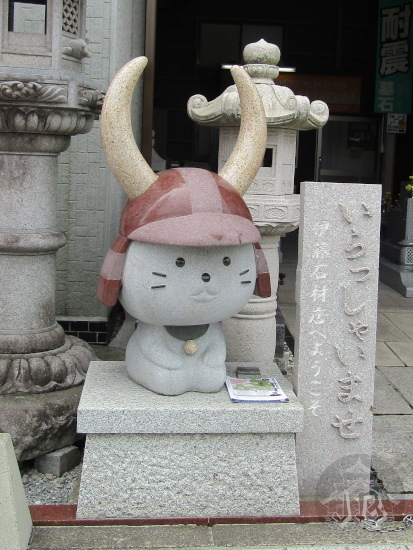
I walked back to the hotel through the main street, where I saw many stone statue shops displaying their work - including the city mascot, Hikonyan [ひこにゃん].

Finally, after picking up my luggage from the hotel I stopped by the Ii Naomasa Ritsuzō [井伊直政立像], the Statue / Monument to Ii Naomasa, who was the original builder of the castle.

I jumped on the Hikone Rapid Express, which was packed, and headed off to my next destination, Kyoto [京都]. As I was earlier than expected, I got a jump-start on sightseeing. This would later proof to be not too much of a good idea – originally I only wanted to do one temple so I did not put my luggage into a coin locker. Looking back, I should have.

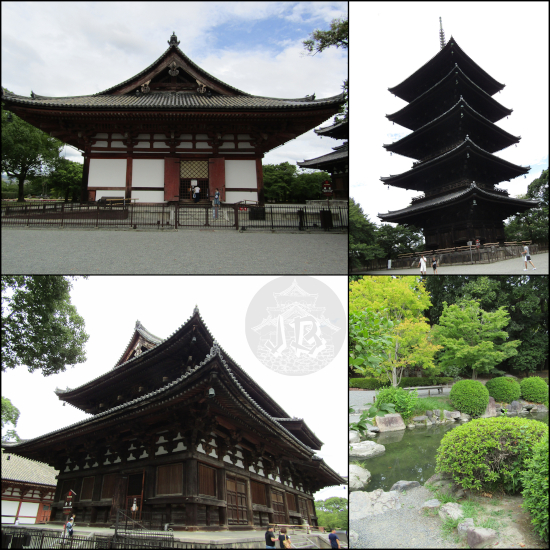
I went to To-ji [東寺], a Buddhist temple whose pagoda had drawn my attention every time I had been in Kyoto before.

Then, as it was quite close, I decided to check out the aquarium, Kyoto Suizokukan [京都水族館].

Finally, I went to Daishōgun Shōten Machi Ichi-jō Yōkai Street [大将軍商店街 一条妖怪ストリート], a shopping area with a lot of yokai and yokai-like mascots. Unfortunately, most everything was closed due to the Obon festivities, which in the end made for an unrewarded extra effort. Here I was trying to pace myself and not doing a good job out of it.

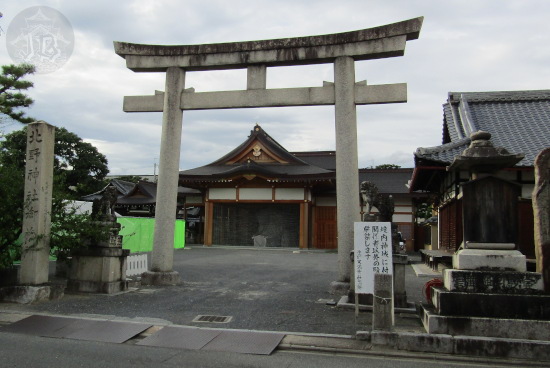
On my way to Yokai street and back I saw Jinja Kitano-Jinja Otabisho [北野神社 御旅所],

Jizo-in [地蔵院 ],

and finally Daishogun Hachi Jinja [大将軍八神社].

Finally I backtracked to the station and headed off to the hotel for some rest. I made a mental list of things that were incredibly close to the hotel and I could do the following day.

14th August 2018: On the road… I mean railway again! Tokyo → Nagahama → Hikone {Japan, summer 2018}

One of the things I did on Saturday in Shinjuku [新宿] before the J concert was activating my JR Pass, and I had a week of travelling in store, so there I went. After getting to Shinagawa and being told that there were no seats to be reserved, I travelled to Maibara on a seat in a very-empty unreserved car (keep in mind, this was the end of the Obon festivals, and lots of people travel around these dates).

In Maibara I left the Shinkansen and jumped onto the local line that headed off to Nagahama [長浜] in Shiga Prefecture. This trip was mostly organised around my need to be in Kyoto on the 16th of August, so when I looked up things to do, Nagahama popped up for having a castle at the shore of Biwa-ko [琵琶湖], Lake Biwa, which is the largest freshwater lake in Japan.

Nagahama Tourist Office at the station provided me with a very handy map that featured a walking route to see the most important areas of the town, which I set to almost immediately.

First, of course I head to the castle, Nagahama-jō [長浜城]. Between the station and the castle there was a cage with monkeys. I did not realise that until one of them popped up staring at my lunch.

Then I walked around the surrounding park and got to the lake front. Biwa-ko is big enough to have waves.

Then I continued on the proposed route to the Nagahama Railway Square, Nagahama Tetsudo Square [長浜鉄道スクエア], and the Railway Museum.

In front of that there was the Keiunkan [慶雲館], a beautiful traditional house and garden.

Then, after deciding to modify the walking route to fit my interests, I headed out to the town centre to find Nagahama Betsuin Daitsū-ji [大通寺], the biggest temple in town (with confusing indications). To get here I passed by the central commercial streets.

Afterwards I decided to go to Hokoku Jinja [豊国神社].

And before heading to the station, the Kaiyodo Figure Museum [海洋堂フィギュアミュージアム] had really caught my attention so I decided to come in.

On my way back to the station I saw the Hideyoshi to Mitsunari deai no zō [秀吉と佐吉 出会いの像], the Statue of (Toyotomi) Hideyoshi and (Ishida), important historical figures in the area.

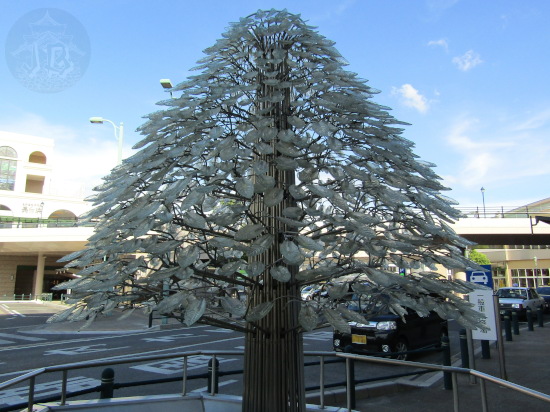
Finally there was the Aqua Tree before I took the train to go to my next destination, Hikone [彦根].

Hikone is twenty minutes by train using via Maibara, so I basically backtracked to Maibara and continued in the opposite direction. At Maibara our train joined another one so it became twice as long in a very interesting process.

Once I arrived in Hikone, I found my hotel and I checked in. However, having heard that sunset at Biwa-ko was really beautiful, I decided to sprint for 35 minutes, and headed off to the lake, racing the sun. I managed to see a beautiful dusk indeed, even if coming back to the hotel was a bit lonely once the lights were out. I had no idea. Yet.

Then I diverted towards Hikone-jō, Hikone-jō [彦根城] to try and catch a glimpse of it at night. Everything was locked down, so this is the best I got, and that’s a lot of zoom.

Finally, just before turning in I walked by Shigakengokoku Jinja [滋賀縣護國神社] and the Mitama Matsuri it was holding.

13th August 2018: Pretty Lights, Strike 2 {Japan, summer 2018}

I had quite a boring morning filing all the insurance and company flights hoping to get the money I had spent on clothes during the time my luggage was lost. Then a storm broke so I took the subway to Nakano Broadway [中野ブロードウェイ] to canvass the shops for a while. After shopping (mostly for my friend C*****, actually) I headed home to drop off the purchases of the day because my back was hurting and I did not want to run around carrying weight.

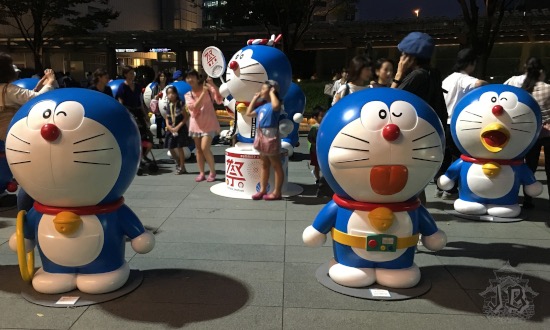
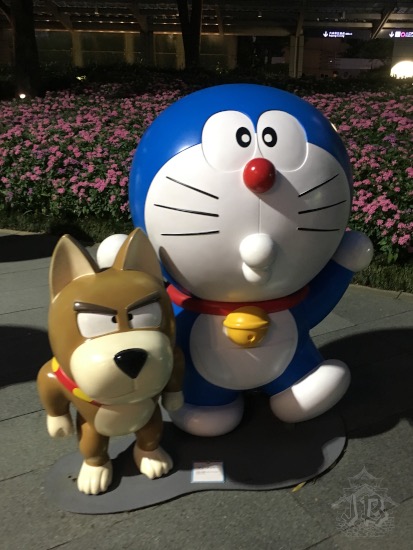
I had arranged to meet D****e in Roppongi [六本木] when she was done with work for two things – one was taking pictures with the dozens of Doraemon [ドラえもん] that were once again colonising Roppongi Hills [六本木ヒルズ].

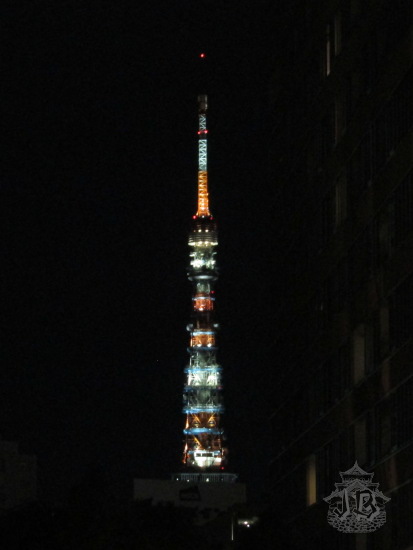
Then we went to Tokyo Midtown [東京ミッドタウン] building, also in Roppongi. We saw Tokyo Tower [東京タワー] on the way.

We had Chinese for dinner and then we walked into the gardens for the event called Midtown Loves Summer which was a show of lights and music, which was the second goal of the evening. Pretty!

12th August 2018: SSGW (Shinjuku Samurai Godzilla Walk) {Japan, summer 2018}

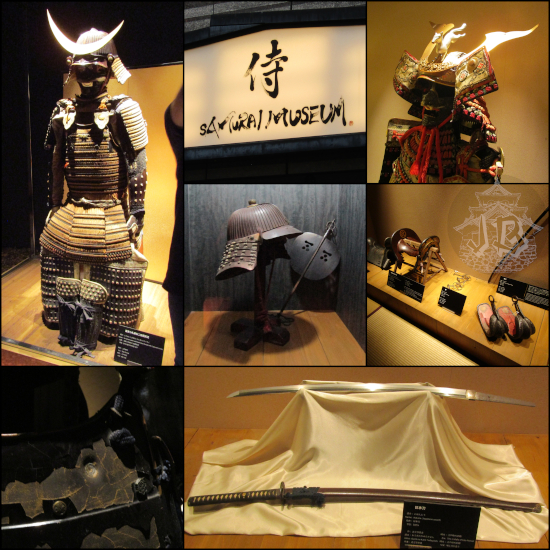
This Saturday afternoon I headed off to Shinjuku [新宿] again. This time I went to the Samurai Museum in Kabuki-cho [歌舞伎町]. It is located roughly ten minutes away from the station’s Kabuki-cho exit, though I had to do some extra walking because I got a bit disoriented from my metro exit to the actual area. I get lost in Shinjuku station a lot, but I think I’m getting the hang of it.

The Samurai Museum has two floors. As you come in, you have the shop to one side and the counter to the other. I was strongly encouraged to take the English-speaking tour that started in 10 minutes, although I did see people on their own without taking the tour – my impression was that they prefer foreigners in tours, but I went with it.

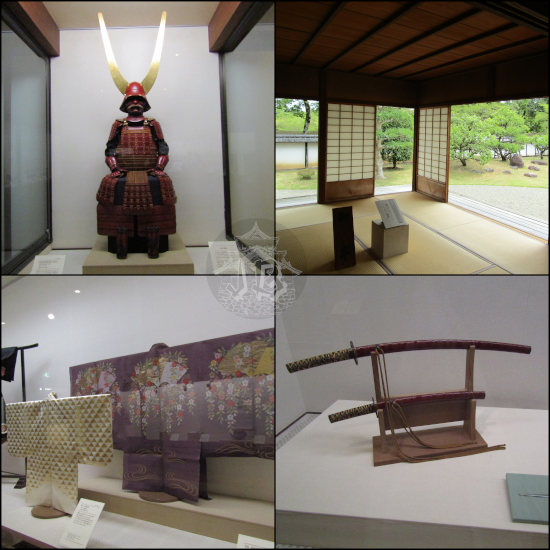
The museum claims that all its pieces are original. It has two floors, the first one has a few armours, one of them with a bullet dent. The second floor, where you have to take yours shoes off, you have several rooms with memorabilia such as helmets, stirrups, saddles and so. There is also one room for sword exhibitions – which take place once an hour in the afternoons – and the chance for you to try on.

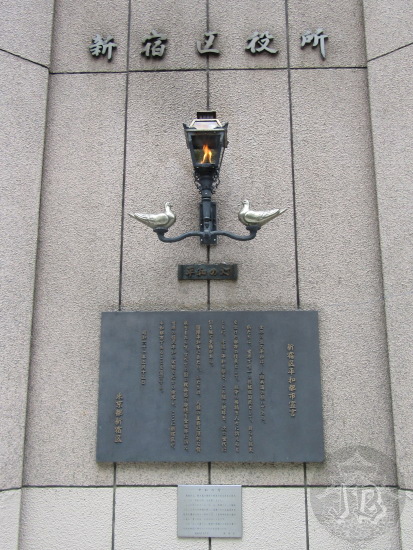
After the museum I grabbed something to eat from a conbini (because I am not known for keeping regular meal times in Japan anyway) and then took a stroll down Shinjuku and Kabuki-cho, ending up at the Peace Memorial.

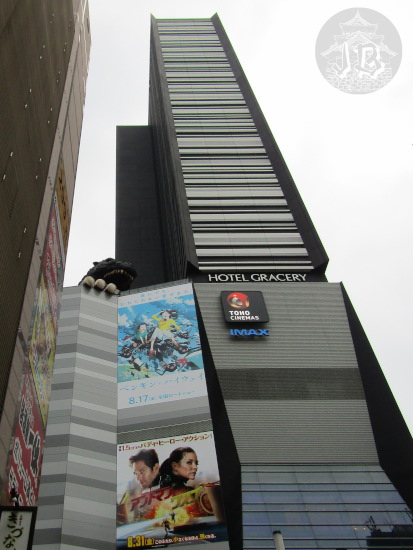
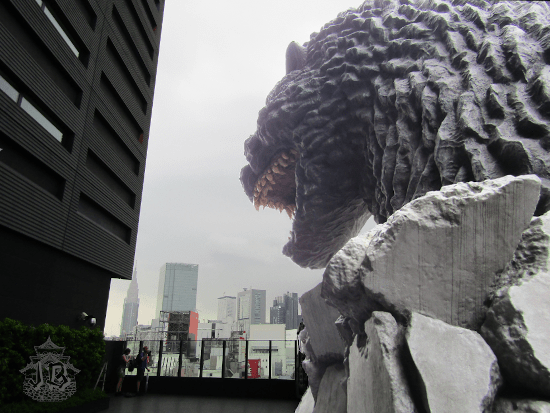
Afterwards I went to the Toho cinema / Hotel Gracery Shinjuku [ホテルグレイスリー新宿] to see the Godzilla [ゴジラ] head. I have been there a few times, and I always try to go to the balcony to get close to the head. In theory, access is restricted to customers from the hotel or the bar, but I had heard that sometimes they open it in general. I am not sure if this was the case, but this time the terrace was open, there were people outside so I applied the old trick of ‘walking into it as if you belonged’. So I finally got up close with Godzilla! It was about time, too.

(Sidenote: The above Godzilla pic is a composite of two I took with different lightings. I’m quite proud of how it turned up.)

Then I met up with D****e at the Tokyo Metropolitan Government Building, Tōkyō Tochō [東京都庁], to watch sunset (ish. Again. Japan weather in summer).

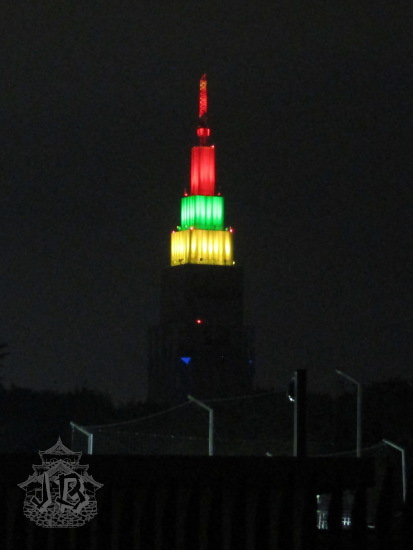
Afterwards went off for a drink and towards Shibuya to snoop around the Tower Records and the Book Off, only to discover that the latter was gone 。゚(゚´Д`゚)゚。. From Shibuya [渋谷], as the evening was nice, we walked down first to Harajuku and later to Yoyogi [代々木] to catch the underground. We saw the illuminated NTT Docomo Yoyogi Building [NTTドコモ代々木ビル] and I took about a gazillion pictures.

And at some point I guess we had dinner. Probably.

11th August 2018: The Luna Sea Connection {Japan, summer 2018}

Luggage arrived around 9 am, and let me tell you I have never been this happy to see my own underwear. I put together all the presents I had brought for people (feeling sorry that I had not been able to take M***chan’s for her the previous night) and headed out, first with D****e to Shinjuku and later to Akasaka, as I was meeting a friend over there for a concert.

Back in April 2018, when I went to the INORAN concert at the Salón del Manga de Alicante, one of the people I met was E**chan, who is coincidentally a Luna Sea fan and studying Spanish.

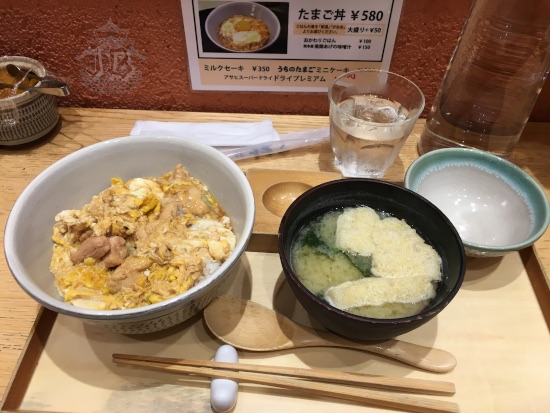
When she heard that I was going to Japan this summer she offered to help me find tickets for the solo concert of her favourite Luna Sea member, the bass J in the Mainabi Blitz Akasaka [マイナビBLITZ赤坂]. I met E**chan at Asakasa station [赤坂駅] for lunch and coffee / tea before the concert. We ended up in a place called Uchi no Tamago Chokubaijo [うちのたまご直売] and ate tamago kake gohan [卵かけごはん], which I had never eaten before and was absolutely yummy (I’ve looked up recipes by now (≧∇≦). I mean, it’s basically raw egg and rice so…).

Lunch. A bowl of miso soup and a bowl of rice with cooked egg on top

After lunch we were talking for a while, and then headed for the concert. I bought some goods (Tshirt) and she was nice enough to wait with me even if she had a much better number since she’s a fanclub member. The concert was super lively and rocky, with almost a mosh pit and all! It was fun, and J was very energetic – one day I will see the whole of Luna Sea together. I got pushed and shoved a little, so even if fun, it turned out a bit exhausting.

After the concert I headed back of to Shinjuku [新宿] to have a shabu-shabu dinner with D****e before we headed back home.

Dinner watching the shabushabu broth until it boils. There are mushrooms, tofu and spinach leaves ready to be cooked

10th August 2018: Pretty Lights, Strike 1 {Japan, summer 2018}

I stayed in bed for most of the morning, and had conbini lunch at home. Mid-morning I received an email informing me that my things had arrived in Haneda and would be delivered the next morning. This confirmed what I suspected, that luggage had stayed in London due to the check-in issues, and left me free for the day, although I would have to fill an insurance claim or two.

Luggageless, and thus cameraless, I did not feel like going out to do tourism, though I did have a couple of places I wanted to visit, so what to do? Obviously the first hunting incursion of the day – first Shinjuku [新宿]’s Closet Child and Pure Sound, and then I headed off to Harajuku [原宿] and the Laforet Building, then I came up Takeshita Dori [竹下通り] where I bought a pair of sunglasses and fell in love with a couple of shoes (until I saw the price. It was an impossible love).

After that, D****e and I met up with M***chan at Meguro [目黒] to go to the Hotel Gajoen Tokyo [ホテル雅叙園東京] and dinner afterwards. Hotel Gajoen is a huge luxury complex in Meguro, with corridors that go on forever, fountains, bridges and jaw-dropping prices. That should give you a clue that dinner was not had there.

The hotel organises cultural events around their one-hundred step ladder, and this summer it was holding the WA NO AKARI × HYAKUDAN KAIDAN Illumination Festival 2018: Wa no Akari, The Aesthetics of Japanese Illumination [和のあかり×百段階段2018 ~日本の色彩、日本のかたち~]. This was an exhibition of interpretation of Japanese art using lights, and it was very beautiful.

Would you like to catch a glimpse of the luxuriousness of the place? These are the lobby toilets:

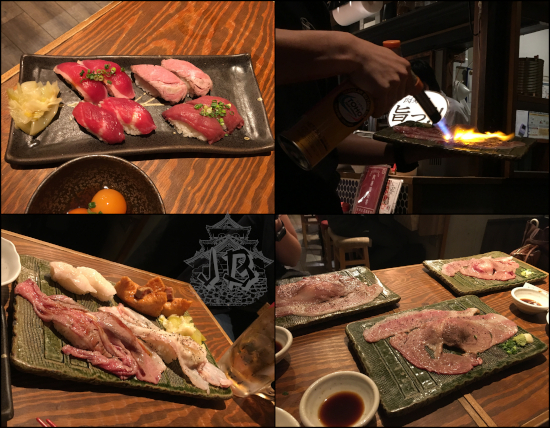
Since obviously we could not afford to have dinner there, we went for nikuzushi [肉寿司], which is basically sushi with meat, raw or cooked, instead of fish to a place called, of all things, Nikuzushi, in Ebisu [恵比寿] (albeit this is apparently a chain, so there are several of them around the city). This was unexpectedly yummy.

Afterwards we did an hour of karaoke and headed home.

8th / 9th August 2018: Not really Murphy, but almost {Japan, summer 2018}

Our story today begins in Barajas airport and the hour-long line for baggage drop off. There are a few details to this trip that might be a bit different from usual, as there is one more factor to take into account. Something that has never flared up on this journal is my chronic pain, which may or may not be fibromyalgia (we go with that for now, because it is never Lupus, and we don’t want to go into the possibility of ALS, not just yet). That makes it difficult to move and to do certain things. The greatest pain I have, or at least the most unmanageable one, is my right wrist, which at the moment warrants a 250€ wristbrace (affectionately known as the exoskeleton) and sometimes a sling.

Even though there are now direct Madrid-Tokyo flights, I booked via London, for a reason – well, actually almost 400 reasons, I’m sure you get my meaning – and direct return flight. Thus I had Iberia and British Airways flights for the leaving trip, and Iberia for the return. Somehow, British Airways told me I was able to buy my seat, but it assigned me one. I think this was because the check in defaulted via Iberia, who keep saying that they have no control over the aircraft British Airways use, so they can’t assign a seat.

So I tried to get a decent seat where I could actually manoeuvre with my wristbrace and my sling, which ended up causing the whole mess. Somehow, after a bunch of calls and emails, my check-in was effective in Iberia, since I had my boarding passes, but somehow not in British Airways – as I was denied entry into London Heathrow intercontinental area until someone punched some stuff on a computer.

Guess what this means? No? Well, it means that I made it to Tokyo Haneda – albeit we were delayed – but my luggage did not. Joy.

(Shout out here to the personnel in Madrid Barajas and London Heathrow for their helpfulness and attentiveness throughout the whole process too, and helping out when I could not move so well).

Anyway, I disembarked in Haneda, and headed off to the luggage belt only to see my name on a small whiteboard. And here we headbutt with the whole Japanese-ness for starters. Superpolite and superineffective ladies wanting me to give them a lot of details on my suitcase while unable or unwilling to answer the simple question of “Is it lost or is it in London?”. They did not know where it was, but they could tell me when it would come via Kuroneko, somehow explaining about the typhoon impacting delivery service. Well, when an airline loses your baggage, they are supposed to explain that you have some rights. For example, the right for them to compensate you for stuff you have to buy. I got none of this. Neither did I get the reference number I was supposed to get nor my receipts, but for some reason I needed to leave them the key – in case customs decided they had to open the suitcase. I tried to prod them about buying things but they would not bulge, they just wanted the paperwork filled and me out of their way.

So guess what?

That meant that I had been awake for roughly 24 hours and now I had to go shopping. For everyday clothes. In Japan. Instead of going to D****e’s place and get a shower, which is what I wanted – and the only thing I could think of was the big Uniqlo in Ikebukuro [池袋]. So Ikebukuro here I come.

Let’s be honest here, for as much as a disaster this could have been – It wasn’t. I had all my money with me, had not packed any, and I did not have pressing stuff that required special clothes. As someone pointed out, if this had happened the year of Gackt’s birthday party I would have died. But it was not really fun, having to spend the first afternoon looking for XL clothes in Uniqlo and Sunshine City. In the end I found enough stuff to survive two or three days and headed off to D****e’s apartment to have my shower, change into new clothes and then get some dinner. And sleep. Cuz sleeping is a thing that should happen.

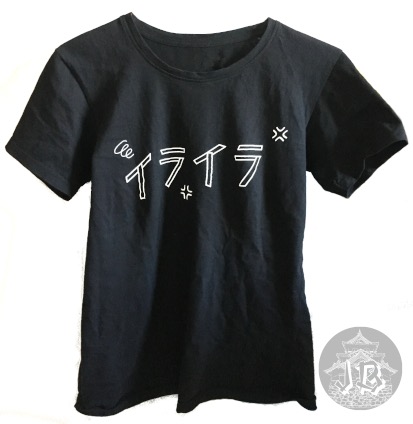
I think one of the T-shirts I bought perfectly illustrates the situation. It states イライラ (ira-ira), which is an expression of annoyance.

28th July – 3rd ‎August ‎2018: The Spanish “Levante”

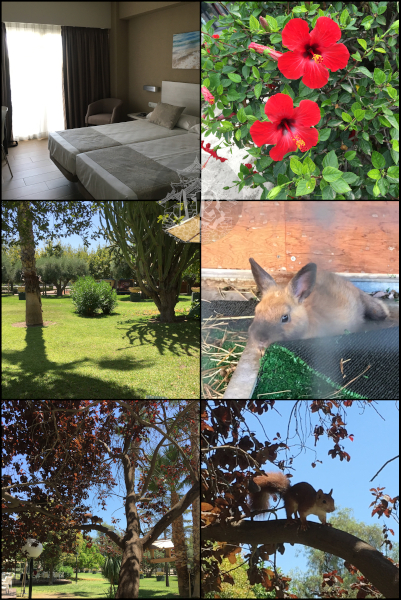
My parents sometimes vacation in this tourist-like complex in a little town called San Juan de Alicante in the east of Spain (the “Levante”). My father uses it as a base for diving trips, and sometimes I tag along to keep my mother company. When we arrived this year we found out that there was a new resident family in the garden – a family of squirrels that had apparently shown up travelling in trees that were going to be planted. The complex management decided to make squirrel-nurturing the local sport. Guests were encouraged to watch out for them, and leave them nuts. Also, there were educational signs about what was safe or unsafe to feed the little critters. I caught sight of them at some point or another.

One of the selling points of the complex – aside, of course, from the swimming pool and the great room service – are the big gardens, with lots of trees and plants, and the rescue bunnies. Now the squirrels came over to complete the scene.

Collage. A hotel room. Red flowers. A garden. A tiny rabbit. A tree and a close-up of that tree focusing on the squirrel on one of the branches.

31st July 2018: Chocolate & Lobster. Not together.

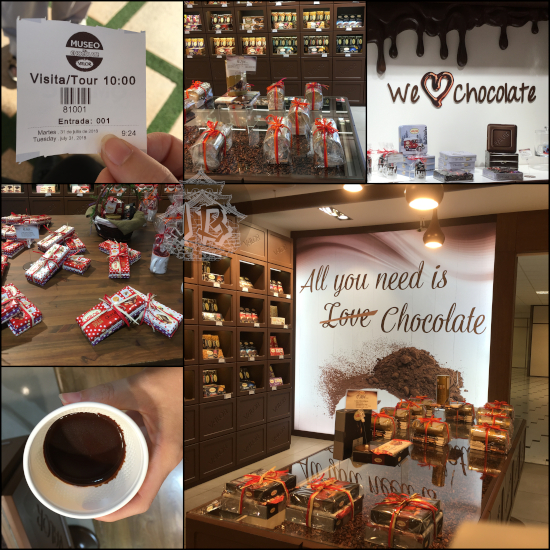
A meagre 20-minute-drive away from this little town stands the village of Villajoyosa, which translates into something akin to “The joyous village”. If you’ve never heard of it, I’ll just have you known that it has a chocolate factory, the Fábrica de Chocolates Valor, and the chocolate museum (and of course the shop). As it is a working factory, the visit is of course guided. We were told that there was usually a long queue, so we were there before 9:30 for the 10:00 visit, and we were quite literally the first to arrive. Once inside, you get to see what they call the museum, with a short video about how they used to and still make the chocolate, and you visit some of the old equipment. Then, there is a short trip around the factory using some hanging planks – when we were there, the production was halted due to pre-Christmas-campaign holidays. So FYI Christmas chocolate is made in August. The visit was done in one hour, and then we splurged in the shop.

Chocolate factory from outside

Inside the chocolate factory shop. A painting on the wall says we heart chocolate, another, in the backfround of several chocolate bars packaged as presents, it says All you need is chocolate, with the word love scratched out

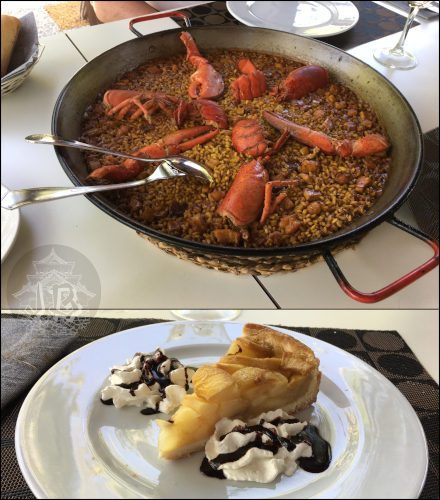
After the visit we went back to the complex, where we had booked a made-to-order lobster “paella” (traditional rice dish) for lunch, and boy was it awesome. I totally sinned with the apple pie afterwards, too.

Collage. Rice pan with lobster pieces, and a piece of apple pie

1st August 2018: Alicante

The day started awesomely with coffee and pancakes, and that alone worked to make me happy.

Pancakes with chocolate syprup, a glass of milk, and a cup of coffee

Besides, twenty minutes in the opposite direction from Villajoyosa we had Alicante. And we could also be lazy and not take the car out, we could just take the bus. We wanted to see the archaeological museum, Museo Arqueológico Provincial MARQ de Alicante, and that was out first stop. However, for some reason a bunch of pictures got lost – and I can only show you this of the library, where pictures were not allowed anyway. It was a… photography accident.

A former chapel, with gothic windows. A glass lamp hangs from the ceiling and there are dark shelves full of books in the foreground

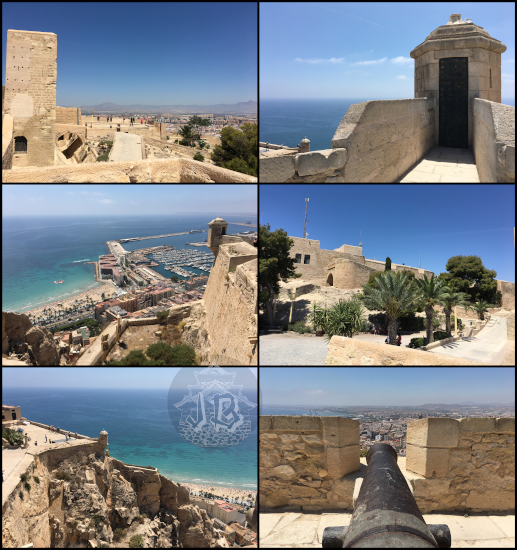
After the museum, we walked around the base of Monte Benacantil, the mount in the middle of Alicante – again, literally – until we were exactly on the opposite side to find the entrance to the Castillo de Santa Bárbara, Santa Bárbara’s castle. The castle is of Arab origin, it may have been built the 8th century. However, there are archaeological remains in the mount dating from prehistoric times. The castle gave the city of Alicante a vantage point towards any kind of threat, whether it originated on land or the ocean. The castle was reconstructed in the 16th century, and later, in the 18th century, it played a part in the war against the French.

Castle ruins and views of the sea underneath. It looks hot.

After this we walked over to have lunch at a restaurant we had read over in the tourist complex magazine, a prime Japanese restaurant called Nigo, which has the best sushi I’ve ever tried outside Japan.

Lunch - Japanese salad, fried chicken, sushi and tuna tartar

After that we headed back to the complex and planned our next move.

2nd August 2018: Valencia Diversion

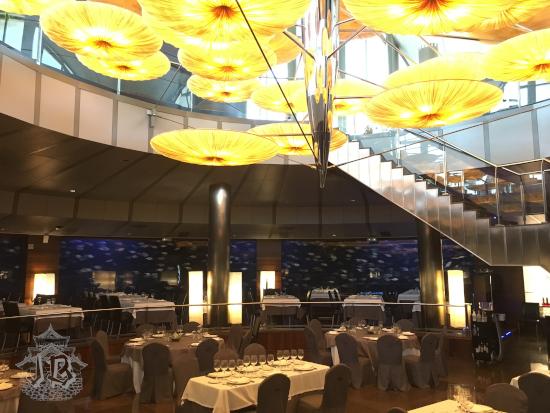
My father was unable to go on his two planned diving outings, so we decided to head home early. However, he was feeling a little disappointed over the cancellation, and I suggested that maybe we could take a detour somewhere else instead. In the end, we decided to book a hotel in Valencia and use the time to visit the Oceanogràfic over there. This is a large aquarium complex. We also reserved a table at the “Submarine Restaurant” and had lunch there.

The aquarium opened in 2003 as part of a big project called “the city of art and science” in Valencia. It has a double layout, over- and underground. The underground area is the big aquariums are built, while the upper enclosures hold most the mammals and the birds.

An empty restaurant surrounded by an aquarium where fish swim

Collage of different marine animals: octopus, sea urchin, anemone, clownfish, surgeon fish, rockfish, seal, jellyfish, seastar, sea dragon, turtle, reef shark

Collage of different animals, and general view of the park. Penguins, crocodiles, seal, pelicans, snipes, ibises, tortoises, carps, crane

Once we were done, we said goodbye to the sharks and hi to the nice sunset. Next morning we drove back home.

Sunset above an unremarkable city skyline

21st & 22nd July 2018: Swan Lake in Madrid (Spain)

21st July: The housefront

This Saturday/Sunday getaway was a birthday present, and I have to admit that I was super excited about it – the main part of the present was a hotel night in Madrid and tickets to watch the (British) Royal Ballet in the Spanish Royal theatre, the Teatro Real. And I mean stall tickets, I was over the moon.

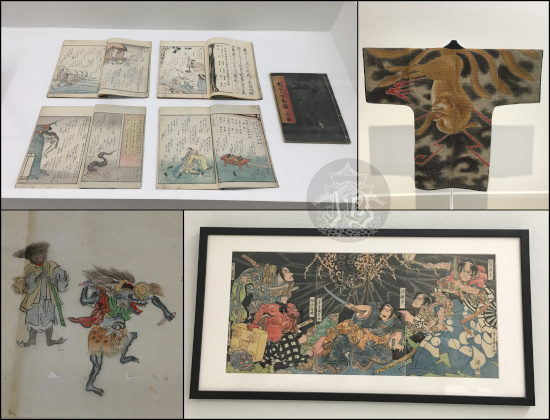
The day started at the Museo de la Real Academia de Bellas Artes de San Fernando, where there was an exhibition about yokai, the Yumoto Koichi Collection (Miyoshi, Hiroshima). It was called Yokai: Iconografía de lo Fantástico (Iconography of the fantastical), and it was rather interesting. It holds a collection of different items related to mythological creatures of Japan, yokai [妖怪] – there are scrolls, woodprints, games, pottery, even clothes and accessories. This was an interesting exhibition, and having seen it would later save me a trip to Miyoshi, allowing me to discover Takehara instead.

Rolls of paper, kimojo jacket and blookwood painting, showing different scenes and beings from Japanese mythology

After the exhibition, we went to the Green Tea Sushi Bar & Cocktail Room, which turned out to have the most overpriced mediocre sushi ever. The place was ridiculously expensive but fortunately we had booked with a special 50% discount, which made it bearable. However, fair is fair, and the tataki was delicious, and the chocolate coulant turned out to be amazing.

Lunch. Sushi boat, sald, tuna tataki, edamame, and an ice cream scoop

The hotel was in the right smack of Madrid, a short walk away from the “royal theatre” Teatro Real and we had tickets for 17:00 – to watch Swan Lake performed by British The Royal Ballet. Before sitting down we took a small exploration walk through the different rooms, including the ball room. I really loved the whole building and in particular the blue room and the ball room.

Royal theatre snippets - the main hall, the stage, the stands. Most curtains are a rich burgundy colour.

Swan Lake happens to be my favourite ballet – I love Tchaikovsky in general, though the stars have always aligned against me watching Sleeping Beauty. In Swan Lake, the evil sorcerer Rothbart turns maidens into a swan during the day, and they turn back to women at night as long as they are near the enchanted lake. The ballet officially opens with Prince Siegfried celebrating his birthday. He receives a crossbow as present, and he is later told by his mother that he needs to choose a bride the next night. As he becomes upset his friend suggest going hunting. In the forest, Siegfried becomes separated from the group and meets Odette, one of the swans. She explains of her predicament, and they eventually fall in love, and Siegfried invites her to the ball in which he needs to choose his bride. The next night, however, Rothbart sends Odette’s magical doppelgänger, to whom Siegfried swears love. Witnessing this in swan-form breaks Odette’s heart. As he realises his mistake, Siegfried makes it back to the lake.

The ending of the ballet changes. Sometimes it is a happy one when the spell is broken. The original ending has both Siegfried and Odette dying together to break the spell. Another alternative is that only Odette dies, but Siegfried manages to kill Rothbart and break the spell – this was the one that the Royal ballet played, and it managed to make me a puddle of happy goo. As Siegfried raises Odette’s inert body over his head, I shuddered all over. It was magnificent.

Snapshot of the credits, Showing Akane Takada as Odette and Odile, William Bracewell as Prince Siegfried, and Thomas Whitehead as Rothbart

The cast after the play taking their bows.

After the performance was over, we had dinner in the Plaza Mayor and then walked towards Puerta del Sol, then back went to the hotel to catch some sleep.

Square Plaza del Sol lit by night

22nd July: The backhouse

On Sunday we went back to the Teatro Real because we had booked one of the visits they offer, the technical one. During this visit you walk through the inner areas of the theatre, and even more interestingly, the upper area.

We saw the main hall, and afterwards we went first onto the backstage, then the backstage, and finally onto the stage where the Swan Lake props still stood, so that was really cool. The visit finished climbing up to the upper area of the theatre to see the views and the theatrical rigging system.

Empty royal theatre, showing the stalls from the stage, the backstage, and the view of the cathedral and the royal palace from the upper windows.

Finally, we had a bite to eat and we headed home for the weekend, and I have to say, I was happy as a skunk.

30th June 2018: Spanish breakfast, Japanese entertainment (Madrid, Spain)

30th June 2018: Spanish breakfast, Japanese entertainment (Madrid, Spain)

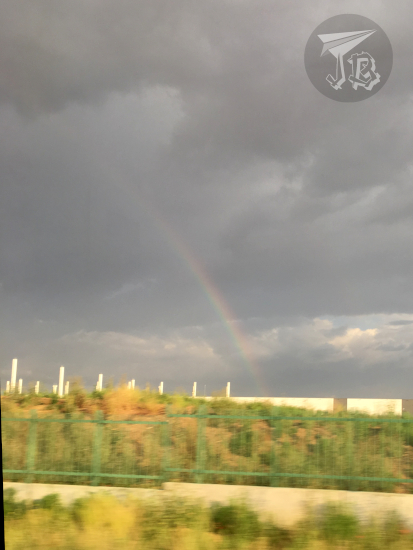
My friend C***** came over to Madrid for one of those crazy crazy things that we do – a crazy Saturday. She took a bus overnight and I went to meet her up for breakfast. The day started with a good omen, because I caught a rainbow around 7:30.

To celebrate that we had met up for the first time in a long while, we went to the most famous chocolaterie in Madrid, Chocolatería San Ginés for chocolate and churros. As her bus arrived in the early morning, I think we were there around 8:30 as I took the first train available.

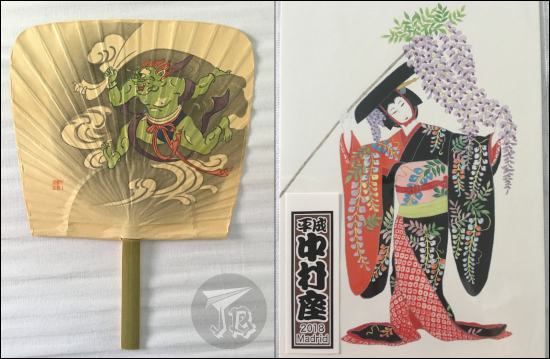
After breakfast, we head over to the area of the theatre, Teatros del Canal, for the main event at noon – a piece of Kabuki [歌舞伎], a piece of classical Japanese dance. In this case we were going to see an adaptation of Fuji Musume and Renjishi. First, we checked out the little market of Japanese craftsmanship and decided that we wanted everything, because of course we did.

Then we walked into the theatre. The company Heisei Nakamuraza was bringing two key pieces in the history of kabuki. The first was Fuji Musume [藤娘] “The Wisteria Lady”. It is a representation of unrequited love, dancing under the wisteria tree that represents femininity, and the pine that represents masculinity. During the dance there are several kimono dances and it is visually stunning. The second piece, Renjishi [検索結果], “The Two Lions”, is a very spectacular dance, in many ways mirrored between two dancers. The first part represents a parent lion-dog and its cub, then there is a small comical interlude and finally the lion dogs come out again in celebration. No pictures allowed of the performance, but have some of the theatre:

The show was over much too quickly, sadly. We went out of the theatre and raided the matsuri / market.

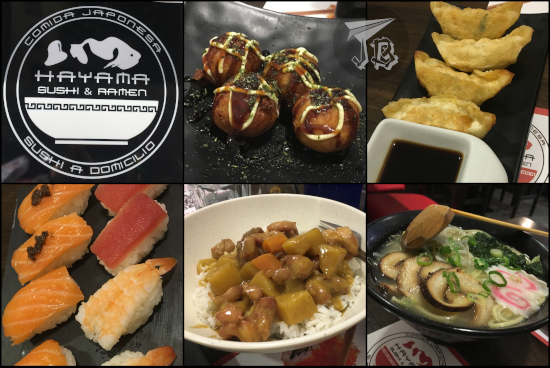
Then we walked a few minutes to the Japanese restaurant Hayama, where we had some sushi, gyoza, takoyaki, curry and ramen to share.

As C***** had an early-evening train to get back (I did mention that this was a crazy escapade specially for her), I tagged along to the station and I saw her off. Awesome way to spend a Saturday, though I wish we could have hung out for longer!

9th & 10th June 2018: Wicked London (England, Great Britain)

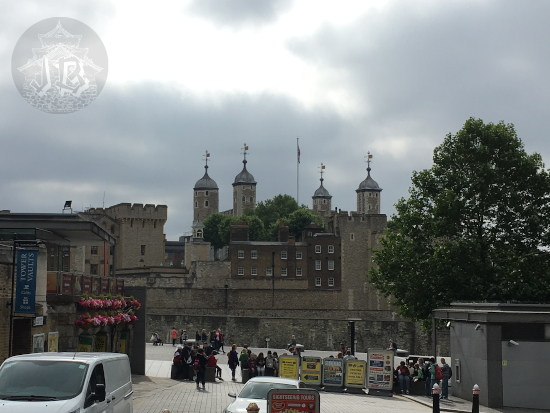
This will be the last work-trip, at least for a while. I might change my mind later, but for now I’m done with them (although there’s an upcoming family trip rather soon…). Again, we flew in early Saturday morning, and we went to walk around the Tower of London and the Tower Bridge.

Then we went to the British Museum. I left them for a couple of hours there and I went to visit some of the lesser-seen galleries.

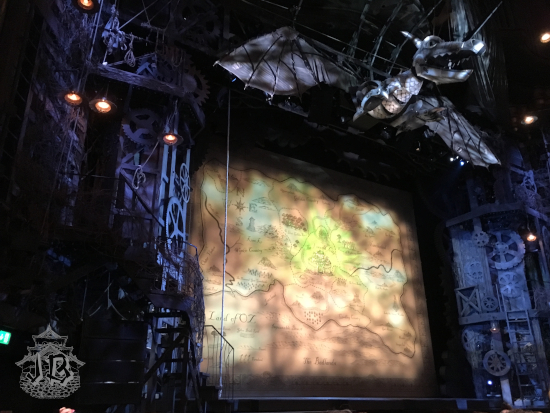
We had booked tickets for the musical “Wicked” in the Apollo Victoria Theatre at 14:30, so we headed over there. Wicked is a parallel story to “The Wizard of Oz”, focusing on the story of the Wicked Witch of the West, who becomes a social outcast due to her tendency to speak her mind and the strength of her magic. I had really wanted to watch this for a long time, so I used this chance and convinced the group to get there. I absolutely loved it ♥.

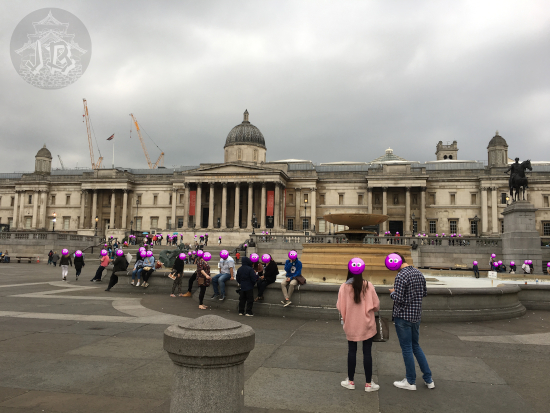
After the show, we dropped our things at the hotel. The group wanted to get some rest, so we stayed there for a while, then got out again. We took the underground towards London central and we were in Trafalgar Square for a while.

Then, we went to Chinatown for dinner.

Later, we walked around Piccadilly Circus, checking out some shops and so. We even stopped for cake.

On Sunday morning we went to Saint James’s Park, where we got to meet the local fauna, especially a very adventurous squirrel.

Then we dropped by Buckingham Palace. Although we did not watch the Guard Change, we did see one of the relief marches.

We walked from there to Westminster, saw the Houses of Parliament and the Big Ben, along the outside of Westminster Abby.

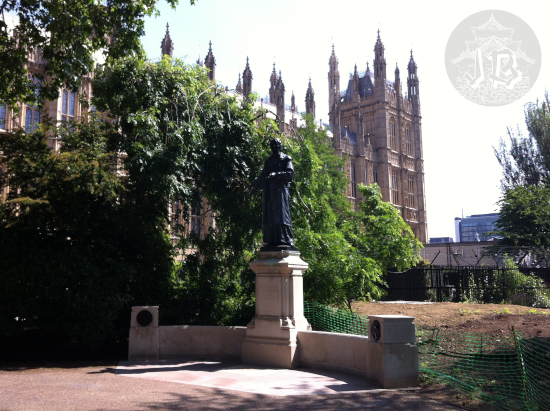
We visited the Monument to Emmeline Pankhurst and stayed for a while in the Victoria Tower Gardens.

As a final visit, we went to the Natural History Museum.

Finally, we headed off to the airport, and the icing of the cake was that we got caught in a controllers’ strike, so we had like a three-hour delay on our flight and it took forever to get home (;¬_¬). All in all, this was a very… strange trip, and without a doubt the highlight was going to see Wicked, which is something I had wanted to do for a long time, and gave me a couple of hours of enjoyment to myself.

7th – 9th April 2018: 8º Salón del Manga y Cultura Japonesa. Alicante (Spain)

This was a crazy, crazy weekend in Alicante that I planned on the go with my friend C*****. It all started when guitarist Inoran, from Luna Sea, was announced as guest in the local “Manga and Japanese Culture Convention” Salón del Manga y Cultura Japonesa de Alicante. She was on the fence as to whether she wanted to come, but after musician Kenichi Yoshida was also announced, she was sold. I had already bought my tickets and booked a room, but it was fine for two people, so we could bunk together.

I finished work on Friday at around 19:00, made a dash for the local train station and jumped onto a commuting train to Madrid, where I took the long-distance train to Alicante. I arrived at around 22:30. C***** came to pick me up at the station, as she had arrived and already checked in. That was good, because she had time to walk around the area, and that would be handy later on.

Saturday, 8th April 2018

The next morning, we went to the bus station. After attaining victory over the ticketing machine, we found the correct bus. We knew we were at the right platform judging by the amount of cosplayers on the benches. The bus driver refused to sell tickets on board, so he sent everybody to battle the ticket machine. The bus set off late, but we eventually made it to IFA the, convention venue. Once we had a schedule, we started planning around it. At the very least, the Saturday plan was:

  • 13:30 – 14:30: Inoran’s presentation (which was supposed to have an autograph session afterwards)
  • 19:00 – 20:00: Inoran’s concert (which actually had the autograph session)
  • Walk around for a little, and check out the traditional area
  • C***** wanted to check out the artists’ alley to find some people she follows online

Inoran (Inoue Kiyonobu [井上 清信]) is one the founders and a guitarists of Luna Sea, one of the big names in the Japanese visual kei scene – now officially turned “alternative rock”. Inoran has also collaborated with different artists in different endeavours such as MAS*S with X Japan’s Hide, Fake? with Oblivion Dust’s Ken Lloyd, among others. Inoran has also established a solid career on his own as a solo artist. Someone (from the producer agency Here comes the Sound) fooled – or bribed with food – him into going to Alicante, Spain. Therefore, we decided to go and see him.

When we entered IFA, we walked around the space to get our bearings. The convention was divided in several areas: the commercial stands, the non-commercial ones (artists’ alley), and a small matsuri [祭り] “festival”, with more traditional decorations and shops. There, we came across artist Mitsuru Nagata, a man who makes the almost impossible way of Japanese calligraphy shōdo [書道] actually look easy. He he also creates sumi-e [水墨画] prints. Sumi-e stands for “ink wash painting”. It is the art of using calligraphy ink in various degrees of dilution with water to produce images. One of the characteristics of sumi-e is that no retouches are allowed, every stroke is definite. It is so difficult that the peak of the art is the ability to create a perfect circle in one precise stroke.

Mitsuru Nagata was born in Kyoto, but he resides in Barcelona these days. He started studying calligraphy when he was six years old and holds a Master Calligraphy degree. He sells his prints online and on different events around Spain, where he travels to promote Japanese culture. His stand at the convention had fantastic paintings.
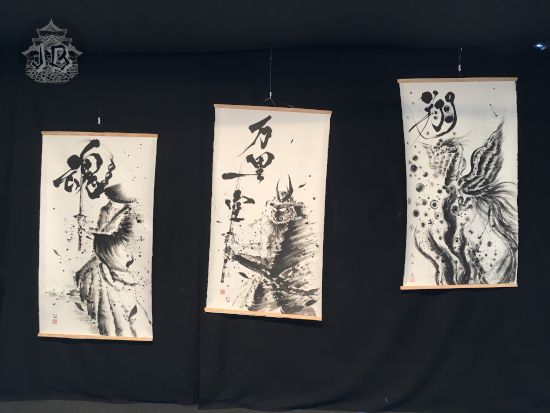
Several hanging rolls of Japanese ink paintings, with samurai and a phoenix

After about an hour of walking around (probably even less) we decided to join the “queue” to enter the small hall where Inoran’s “presentation” was to take place. We got talking to a bunch of people, including a group of Japanese girls, including one, E**chan, who was studying Spanish! I think I met a Japanese version of myself…

According to the description, the presentation was a short introduction of the artist, an explanation of who he was, a summary of his musical career and some videos, followed by an autograph session, and lasted an hour. In the end, it was ten-minute event. There was a tiny summary of Inoran’s career and basically we just got to see him say “hola”, and we watched the MV of his newest song. There was no real “summary of his career” nor signing.
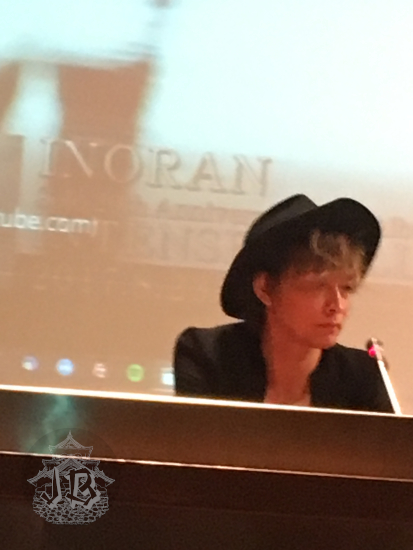
Inoran talking into a microphone

In general, I have to say that the organisation of the event was horrid. Out of the three scheduled signing sessions, only one took place, with no explanation as of why during the whole convention. The following week, it was mentioned that Inoran had requested two signing sessions to be scrapped. Instead of saying that, the autograph sessions just disappeared from the webpage schedule, so early print-outs had them, others did not. It was a bit chaotic.

After the presentation, around 14:00 we… had no plans until the concert at 19:00, so we decided to just… wait at the stage, and believe me, we were not the first to think about it,.We ended up sharing “first row” with a bunch of other Spanish and Japanese fans. We killed time snacking, we watched the cosplay contest, and got all pumped up for the whole thing. I mean, we could sit on the floor, against the barrier, with access to food and water. Best queueing conditions ever. We witnessed the preparation of the stage, including setting an iPad for Inoran to look at his lyrics, guitar checking and so on.

Inoran is the guitarist of Luna Sea, a musician at his core. Truth be told, he is not the best vocalist in the world. Other members of the group were u:zo on bass, Yukio Murata on second guitar and Ryo Yamagata on drums. The concert was really fun (and it elevated the number of members of Luna Sea I have seen to three out of five). I think it’s great when singers try the local language, or at least mangle it. Inoran did so with a very well-rehearsed “¿lo estáis pasando bien?” (are you having fun?). He also had some English prompts such as “scream” and “jump”, but most of what he said was in Japanese. Understandable Japanese at that.
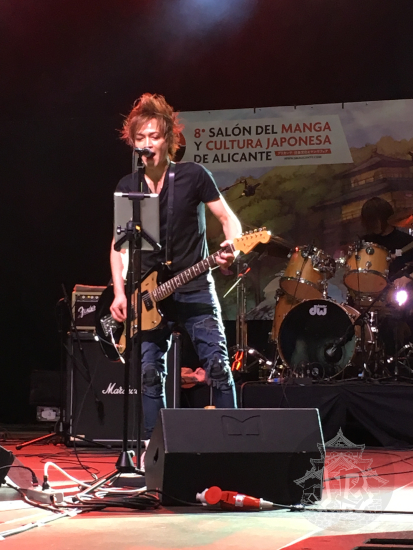
Inoran on the stage, playing guitar and looking at the iPad to remember the lyrics

Setlist:

  1. Come away with me
  2. Get a feeling
  3. Awaking myself
  4. 2 Limes
  5. Beautiful Now
  6. No options
  7. D&B
  8. One Big Blue
  9. Rightway
  10. grace & glory
  11. Tonight
  12. Get Laid

The whole affair was even better than expected. Murata was utterly fun, and even if we had u:zo on the other side of the stage we still got to see a great deal of his. At some point they got the Here comes the Sound (producer) guy up to play some Luna Sea songs. The background noise was so great at that moment that it took me a long while to actually recognise the actual song…

As we had waited at the stage for hours, we had “first row”, against the barrier. A few minutes before the concert, the organisation brought a number of people to sit between the barrier and the stage – volunteers”, “workers” and “VIPs” who did not care at all, to the point that Inoran himself called them out at a point. The official pictures show them playing with their phones and not even looking at the stage. What’s the point of being there if you don’t care? Behind the fans there were the curious onlookers. I do wonder what Inoran found himself thinking about the convention.

The only actual autograph session and M&G happened after the concert. When we formed the queue, we were told (screamed at) that we needed to purchase a postcard for Inoran to sign. This postcard had the cost of 1<e, and it had been printed by the convention from an internet image,it was not even something the artist himself had brought. I told the volunteer that some of us had official material, and he shrugged, saying that only postcards could be signed. I subsequently asked if he could just enquire if Inoran was willing to sign anything else. The volunteer shrugged again with “I don’t speak Japanese” – tough luck, buddy, I do. Badly, but enough to ask for an autograph.

I paid my euro for the postcard and when Inoran reached out for it, I pulled out one of the CDs I had brought, and asked him to sign that instead. There was an uproar from the volunteers, but he had literally zero issues signing my CD. I mean, it was his original material after all (Note to the organisation: you fools, if I pay you the 1€ and don’t use your postcard, you can sell that postcard to someone else who will pay another euro. Seriously). We got selfies (with smile), handshake and signature, so it was all pretty great. At the same time, my friend C***** was recording everything, and Inoran’s staff were laughing in the background. As I was leaving, I asked Inoran to also sign C*****’s CD instead of a postcard too, and he smirked at me. I’m sure that the organisation hated me a lot that evening, as I started a trend.
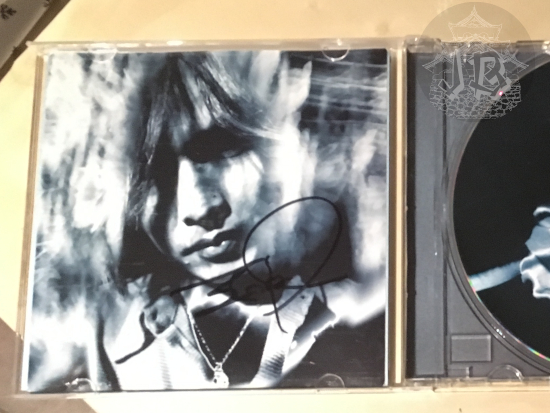
Inoran's autograph

After the autographs, we left the area and walked towards the Matsuri. We bought some sumi-e art from Mitsuru Nagata, and then headed off to the artists’ alley. C***** bought herself a bunch of things (and some pins for me!). We also saw the Mary Poppins cosplayer who we thought should have won the cosplay contest, and we talked to her for a while, and took some pictures – according to the contest rules, she should have won the price, but the organisation chose something more anime-oriented. Finally, we headed off to take a bus downtown and walked towards the hotel.
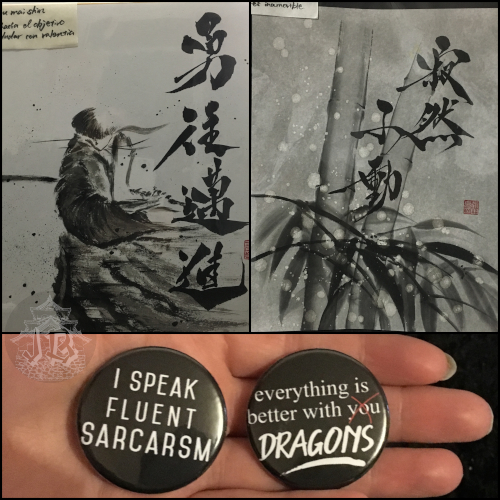
Two Japanese ink drawings. One is a samurai drawing his sword, the other one some bamboo. Also two badges: one reads I speak fluent sarcasm, the other one everything is better with dragons

As we had had a small on-the-go lunch waiting by the stage, we decided to go for a serious dinner. The fun part was that we ended up finding Taberna El Chapeau, the restaurant where Inoran and the band had been the previous night. To be honest, it was very near our hotel, and we checked the menu for kicks and giggles as we were heading for something fast-food. It turned out the place was not expensive at all, so we decided to eat there! We tried the palm-honey eggplant, a mixture of fried seafoods, a mini-burger, and a very sinful brownie for dessert – the lemon sherbet was on the house.
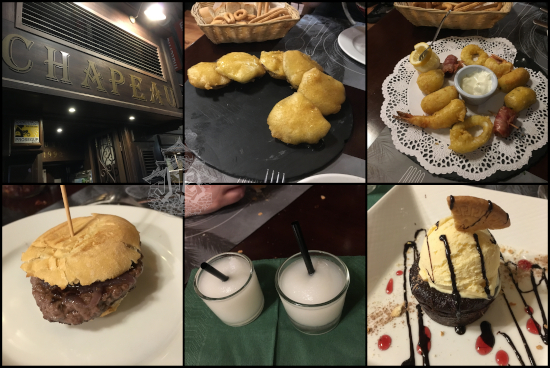
Dinner. Some fried snacks and a mini hamburger, a pair of lemon shots, and an ice cream scoop

Sunday, 9th April 2018

Our must-do schedule for the day included:

  • 12:00 – 13:00: Kenichi Yoshida’s concert (unclear if there would be any signing afterwards. Spoiler: there was.)
  • 13:30 – 14:30: Q&A with Inoran (which was supposed to have a signing session afterwards)

Sunday morning started pretty much the same as Saturday’s had. We took the bus to the convention centre IFA, and walked around. We got to meet with Mitsuru Nagata, and we asked him to take a picture with us in front of his works. Aside from super-talented, he was extremely nice. He was very surprised when he found out that we did not work in the convention and we were so interested in his art – he seemed flattered / embarrassed. Nagata invited us to attend his sumi-e demonstration, but unfortunately it was at the same time as Kenichi Yoshida’s concert. When we told him that, he said that we absolutely had to go and see Yoshida, as the musician is not around as often.

Thus, we went to queue to enter the hall. We actually arranged to queue twice in one go, since Kenichi Yoshida’s concert happened in the same hall as the Q&A with Inoran. We had made some nice acquaintances at the Inoran queue the day before, and they agreed to “save our spots” for Inoran while we went to Yoshida’s concert, as long as we stepped out and took back the place (and did not stay in the hall). We thought it was fair. Besides, the convention rules said that the hall had to empty between acts to prevent people from just hogging the seats, or saving them for friends.

When doors opened for Kenichi Yoshida’s concert, it was clear though, that those rules did not apply to “friends with the organisers”, who could just step out and then jump back, dodging the queue as they had technically “vacated the hall”. When called out, they were indignant. One of them had been asked to translate last minute, so he and all his pals, of course, had immediate priority.

Furthermore, after queueing for couple of hours in order to get a good spot in first or second row, we were not allowed to sit down in the middle (again, saved for VIPs), and sent to the corner just behind cameras and tripods, joy. Thus, we migrated to third row to be in the middle. Fortunately, most press was restricted and we did not have to “enjoy” extra cameras rather than the ones used for the official recording. Before the concert started, we were told that there would be a signing session afterwards, Yoshida would be signing postcards – just like Inoran the evening before – but that there were only twenty of them. We were very annoyed at that because, yet again, C***** and I had brought our own original material.

Kenichi Yoshida had been brought to Spain in a joint project by the Japanese Consulate in Barcelona, the Music museum and the Japan Foundation for a concert and a few activities in Barcelona. Alicante was a welcome bonus. He came along with percussionist Yuki Tsuchida, leader of the band Cross Groove Premium.

Kenichi Yoshida is a skilful tsugaru shamisen interpreter, who debuted in 1999 along his older brother as Yoshida Kyodai (Yoshida Brothers). The shamisen [三味線] is a traditional three-string guitar like instrument from Japan, based on a previous Chinese one. It is played with a pick. The tsugaru shamisen is a particular variant of the regular shamisen, larger and with thicker strings, which is plucked as well as hit with the pick.

The concert was spectacular, as much as the one I had watched in Madrid in 2016. Between songs, Yoshida explained a little bit about himself, his instrument, and some of its history. He gave a few notions about how the shamisen appeared in Japan, evolving from a traditional Chinese instrument that entered the country through Okinawa and it gained popularity as it was moved up north. It changed through time and one of the variants that appeared was the tsugaru shamisen.
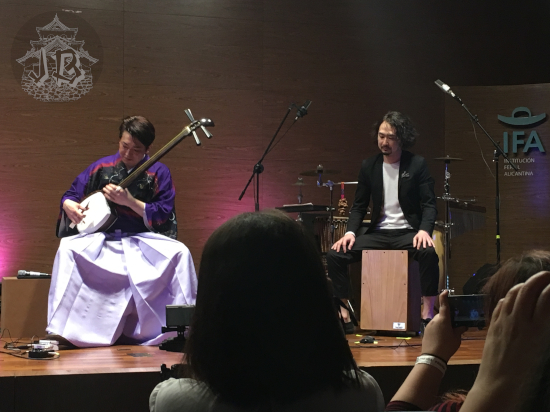
Kenichi Yoshida playing shamisen, with his percussionist on the right

At the end of the concert, as C***** and I thought the postcards would not be enough, we decided to try our luck asking Yoshida directly if he would sign our CDs. And thus, instead of going into “Battle Royale” for the postcards we… took after him. As Yoshida was climbing up the stairs along the drummer and the manager, I caught up with him. I… very respectfully… tried to tell him in Japanese that there were too few postcards and that my friend and I had brought the original CDs, and if he would mind signing those for us. Thinking back,maybe we could have just stood in line without the postcards, but I was not sure they would even allow us to queue.

To my eternal surprise, Yoshida smiled and said yes. The manager ushered me up to the second floor as C***** went to hold the place in the queue, and I got the CDs signed, along with a complimentary sticker. Shaking like a leaf, I went back to the queue. In the end, it turned out that there were enough postcards for all the fans, so we tried again! Yoshida was nice enough to take a picture with us and sign postcards again.
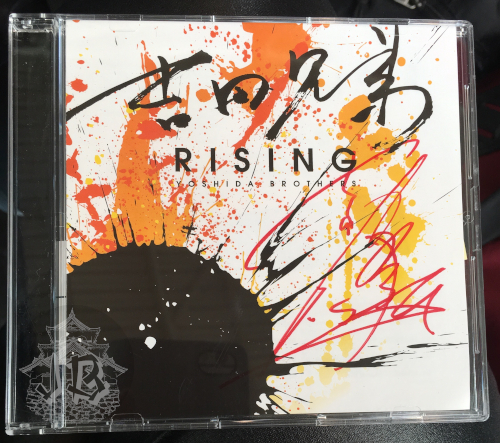
Yoshida's autograph

Then we went to the hall again to see Inoran’s last appearance, the Q&A session, which did not have a signing either. The event was carried out in Spanish, English, and Japanese. After watching the MV, the questions came. They focused on Inoran’s thought on Spain, and whether he knew about how popular he is in Spain. Some fans and “press” asked interesting questions about his career, experience and collaborations with different artists and bands – Hide, Tsuchiya Anna, Luna Sea, Fake? and so on. He was asked how to become “big in Japan” particularly as a musician, and he said “working hard”. And then I lost it when he called us fans “young”. That almost made me roll on the floor laughing.
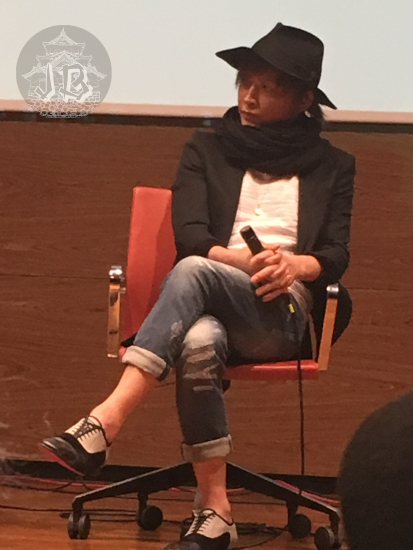
Inoran sitting on a chair with a hat, a scarf, and his jeans rolled up

After the Q&A, Inoran left, and C***** and I headed back towards Alicante. In the bus, I exchanged information with E**chan to stay in contact. C***** and I picked our things up from the hotel and walked to the train station, where he had a super-late lunch.

Burger, fries, and a glass of coke

We had a shared train-ride to Madrid, and we spent most of it in the cafeteria, chatting up. We also got to see a pretty rainbow as it rained on the way. After we made it to Madrid, we separated for the last leg of our journeys, happy to have met up once more for yet another fun adventure.
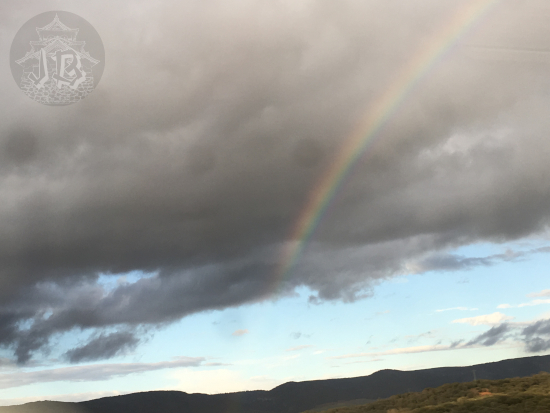
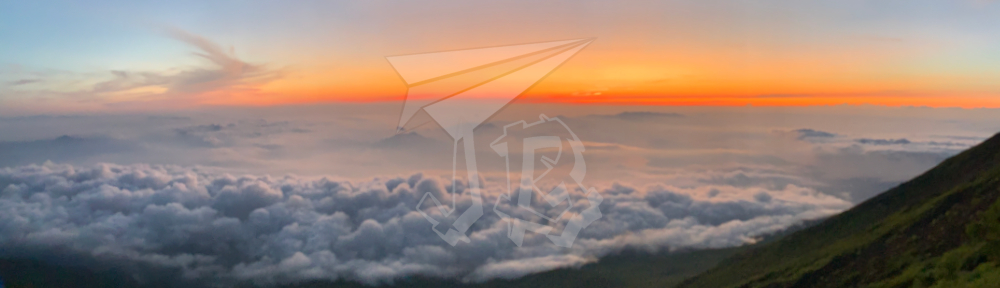
Dark clouds and a rainbow

27th March 2018: Turiasaurus riodevensis {Dinosaurs in Teruel, 2018}

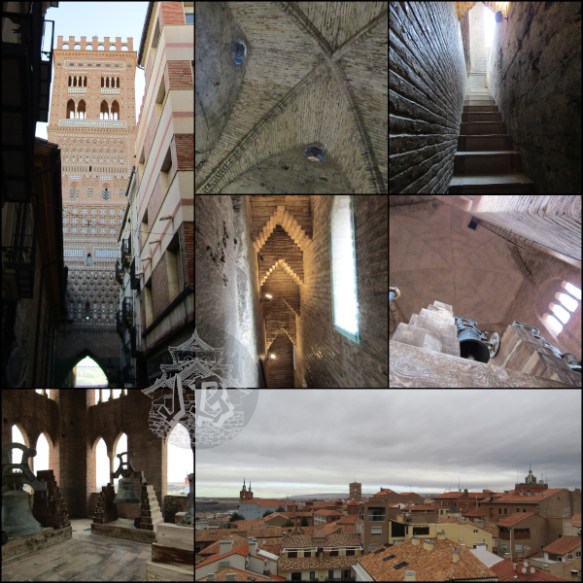
In the morning we walked back to the Torre del Salvador because we had learnt that you could climb it up.

Inner structure of the tower + views of the city

Then we dropped by the Museo de Arte Sacro de Teruel (Christian Art Museum).

Former cloister with a glass roof

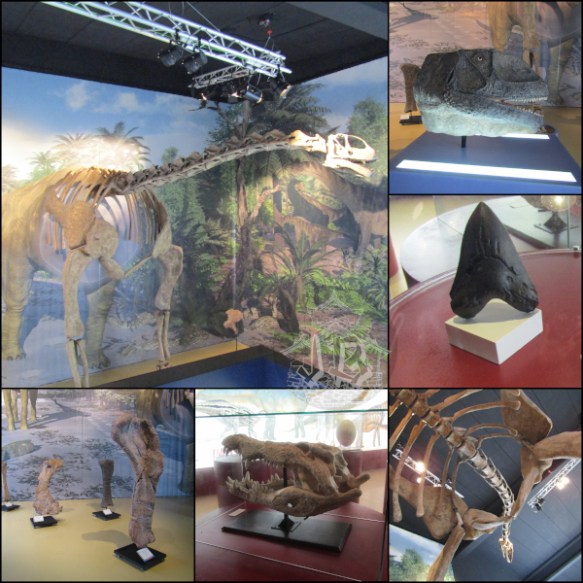
After having lunch we drove off to Riodeva to visit the Dinópolis mini-museum, called Titania. Riodeva is a tiny village in the middle of nowhere, but in the palaeontological site there scientists discovered the biggest European sauropod, the Turiasaurus riodevensis. It is believed that the Turiasaurus, which lived in the Jurassic period, could be almost 40 metres long and just under 50 tonnes.

The guide here was nice, but horribly misinformed, claiming unscientific facts – such as scientists believing that Megalodon still prowls the ocean, and I might have got into a small discussion with her. Don’t get me wrong, aside from being #TeamTRex, I love megs from the bottom of my heart, but there should be a limit on how many urban legends you can claim as true in an educational facility, and that limit is zero.

Turiasaurus fossil pieces + head reproduction; crocodile head; megalodon tooth

Finally we drove back to Teruel and the next day (28th) we were off home first thing in the morning as I had a medical appointment that had come up after the trip was booked.

26th March 2018: Dinosaur bones and Lover mummies {Dinosaurs in Teruel, 2018}

We got to Dinópolis so we could be there when they opened in hopes to ditch the families-with-kids crowds, but to our confusion, we were told that even if the park was open, the palaeontology museum would not be for another hour. Furthermore, the only option to see the museum was with a guided tour. We did not care much about the 3D cinema, but there was literally nothing else we could do until they opened the museum part. We spent the morning in the park. We had to watch the first film, and somehow ended up doing two rides (Viaje en el tiempo & Último Minuto) and a show (the T-rex one), but the big things we cared about were the museum and the so called “Tierra Magna”, where the 1:1 reproduction stand.

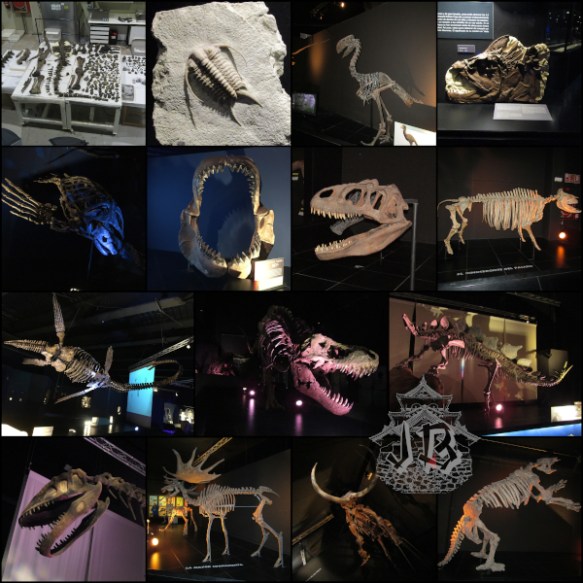
The museum has a direct view to the lab, and while it has very few original and unique exhibits, is really good and informative. The big problem was, in my opinion, that it was only guided-access and those stress me out. Why can’t I just roam to my heart’s content and have to listen to a poorly-trained guide? We somehow managed to ditch the tour when the second and third groups came in and a bunch of people mingled around.
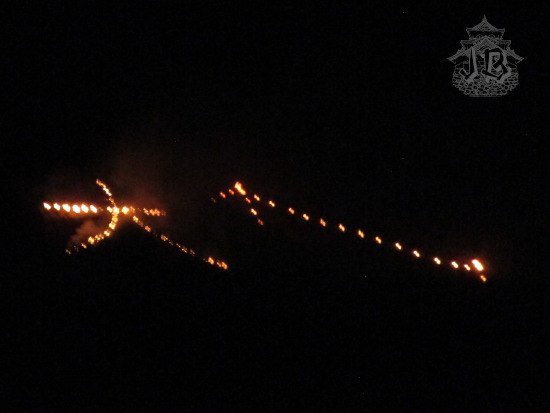
A collage showing different fossils and replicas from Dinopolis

It was cold outside, so we only had a quick stroll around “Tierra Magna”. We had lunch and decided we were done. If I had to rate this, I’d say it is a decent palaeontology museum with a lot of kid-friendly stuff around it – the latter is completely skippable, too, but I guess it brings money.

Life-size reproductions of dinosaurs outside Dinópolis Teruel

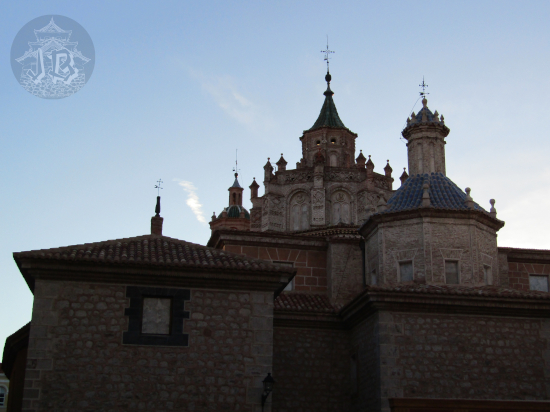
In the afternoon we headed off to see the cathedral, Cathedral of Santa María de Mediavilla, but I did not manage to sneak a picture of the famous wooden ceilings.

Outside view of the Cathedral

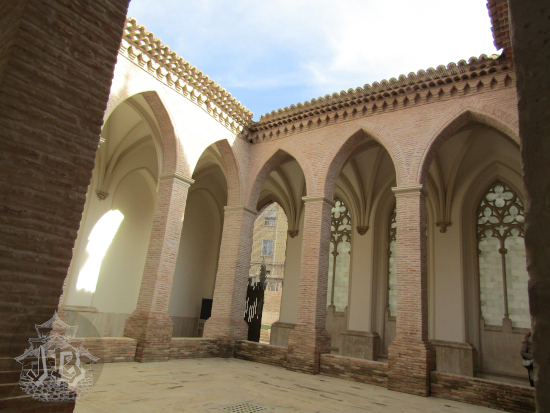
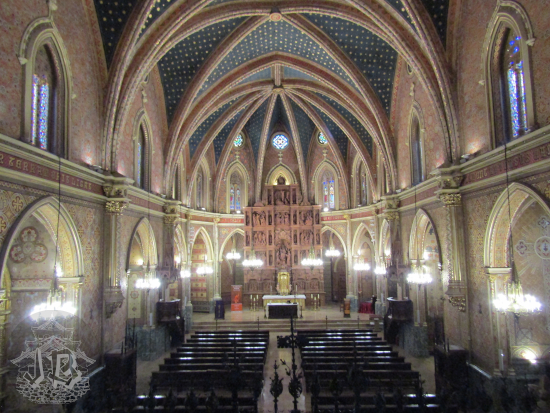
Later, we had a reservation to see the Complex of the Lovers of Teruel, which included the Iglesia de San Pedro (Church of St. Peter), its cloister, and the gardens.

Nave in Saint Peter church

Cloister in Saint Peter Church

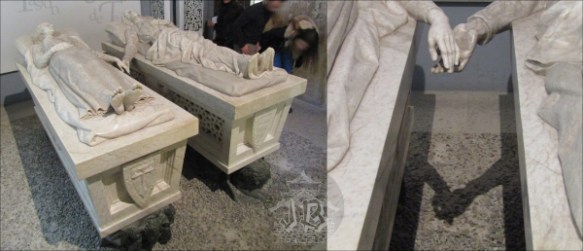
Finally we got to the Mausoleum, el Mausoleo de los Amantes. The story tells that she was a rich heiress and he was a poor man, so he left to gain riches. While he was away, she was given off to another man and married, and when he came back she could not be with him because she was loyal to her husband. He died of a broken heart after she refused him a kiss, and she died after kissing his dead body. The bodies of the lovers were buried together afterwards. The two mummified bodies were found in the church of St. Peter, and they were thought to be the lovers, so the tombs were sculpted – if you crouch, which by the way I didn’t, you can see the mummies through the marble. The tombs were designed so that the lovers’ hands are very close, but they don’t really touch, albeit their shadows superimpose, as if they did.

Mausoleum of the lovers - they lie next to each other, hands reaching for the other one, but only the shadows touch

After this, we walked around town for a while and found the third tower, the Torre del Salvador.

Salvador Tower

We finished the tourist day at the monumental Escalinata de Teruel (the Grand Staircase).

Monumental Staircase

As we walked back to the hotel, we saw a beautiful sunset.

Golden sunset

25th March 2018: Main roads that feel like secondary {Dinosaurs in Teruel, 2018}

We arrived in the Albarracín area after driving for about three hours. Some of the roads were horrid and I was secretly glad my offer to drive had been rejected. We arrived in Albarracín around 11:00 and our first stop was the first Dinópolis mini museum, called the Mar Nummus (Nummus Sea).

As this mountain range used to be sea bead (like 150 million years ago), a bunch of marine fossils can be found in the area. Dozens of ammonites fill up the museum, along with the skull of a Liopleurodon, a marine reptile of the order of the family Pliosauridae, quite obviously a carnivorous one judging by the teeth. As a matter of fact, it was the apex predator of the Middle and Late Jurassic oceans.

Mar Nummus building, featuring a life-size liopleurodon + the skull of the liopleurodon + a lot of ammonite fossils

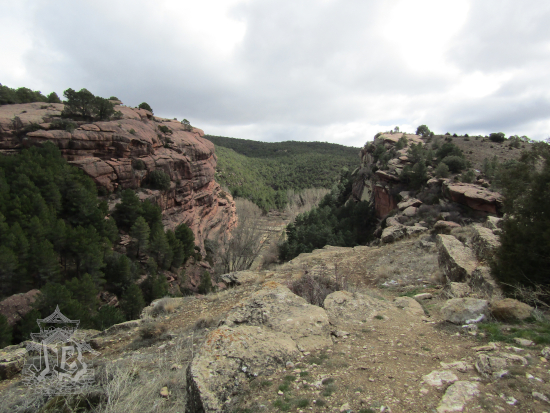
The visit did not take long, and then we moved on to drive to the Mirador de la Escombrera (Slagheap Viewpoint, don’t ask me) to watch the pineforest Pinares de Rodeno. We decided against walking through the forest because the shortest route was a couple of hours already.

Sandstone cliffs + pine trees

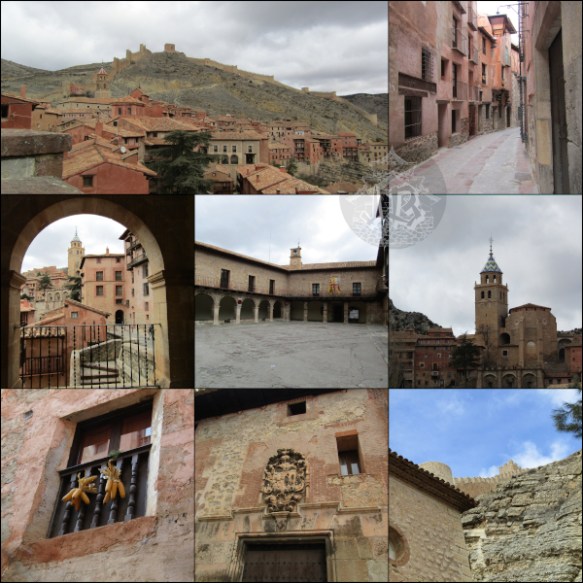
Instead, we drove back to Albarracín and walked throughout the historical centre, a medieval nucleus of streets and houses dedicated to shops and restaurants catering to tourists.

Albarracín, a Medieval city in reddish tones. It is surrounded by a wall

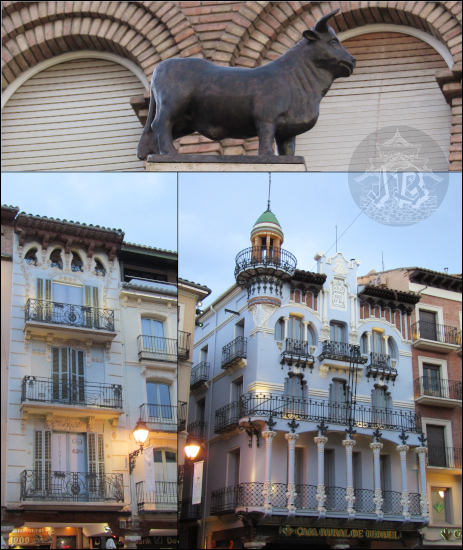
We had lunch, then drove the short 40 minutes to Teruel, where we found our hotel. After dropping our things off, we walked to the centre of the town – which was barely a ten-minute stroll away. Carlos Castel Square is widely known as the “little bull square”, Plaza del Torico.

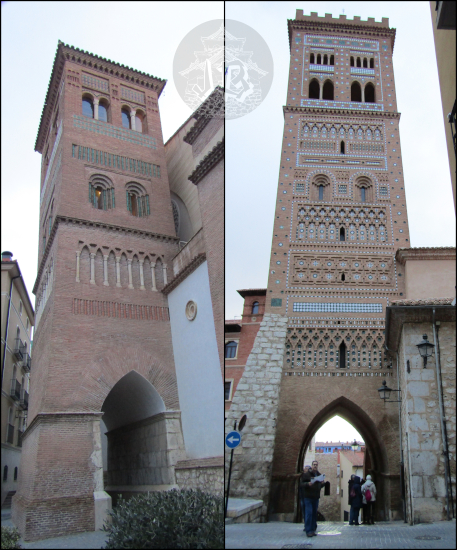
Teruel is known, aside from dinosaurs, from its Mudéjar style buildings, such as the Towers or the Cathedral. Mudéjar style was used by Iberian Christians between the 13th and 15th Century. It incorporates motifs, decorative elements and construction techniques that were common in Muslim Al-Andalus (such as archways, porcelains, bricks, and so on…). On the first day we saw two of the Towers: Torre de San Pedro (left) and Torre de San Martín (right).

Mudéjar Towers

The second architectural characteristic of Teruel are the Modernist houses, built in the 1910s, such as the ones in the Plaza del Torico – Casa La Madrileña (left) and Casa del Torico (right).

Plaza del Torico: a little bull standing on top of a column. Behind it stand two Modernist Houses at dusk

After this we had dinner and we headed back to the hotel.