11th December 2025: Underground and University London {United Kingdom, December 2025}

It was not too much of a chilly London morning. I popped into the underground to go leave my luggage at Liverpool Street station – where there is (you guessed it) a Costa Coffee. Then, I headed towards Baker Street Station, where I had booked guided visit with the Hidden London project, by the London Transport Museum. I arrived with some time, so first I explored the Wonderpass – which is a regular underground pedestrian tunnel which allows to cross the road, and has been “decorated” with facts and details about the history of the area, and turned into a small museum.

A few minutes were enough there, so I spent the rest of my time at The Regent’s Park, one of the Royal Parks in London. Between 1536 and 1541, Henry VIII, now head of the Anglican church, ordered the dissolution of the monasteries. Land that used to belong to Catholic orders went to the crown, and although much was sold to fund the King’s military campaigns, the area that comprises Regent’s Park today was retained as hunting grounds. In the 1810s, it was transformed into a pleasure garden with the blessing of the Prince Regent – who would go on to reign as George IV. Today, it is home to the London Zoo, a rose garden, a lake, several fountains, and even a whole university campus.

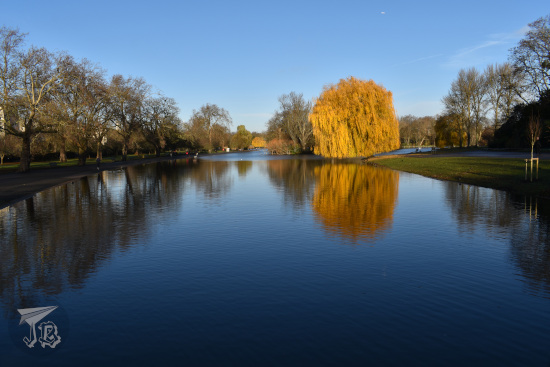
Regent's Park waterfront in the autumn. Trees on the left are bare, trees on the right are golden.

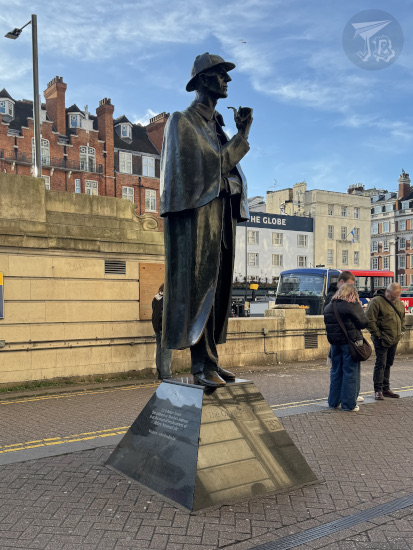
After a while, I headed towards Baker Street Station to await the beginning of my tour. The meeting point was the Sherlock Holmes Statue, which is, ironically, placed in Marylebone Road. The perpendicular road is indeed Baker Street, where the fictional address of the literary detective is – 221B, which today is a museum dedicated to Sir Arthur Conan Doyle’s books, recreating scenes from the stories. The statue was created by John Doubleday and installed in 1999. Arthur Conan Doyle (1859 – 1930) wrote four novels and over 50 short stories featuring the detective. Today the character – possibly the most famous fictional detective ever – is remembered for his uncanny logical deductions, while other personality traits – misogyny or drug addiction – tend to be tip-toed around.

Statue of Sherlock Holmes in front of Baker Street station.

Around 10:20, the people from the London Transport Museum came to check us in. This is one of those kinds of visits for which you need to bring a piece of ID, probably for insurance reasons. I had been wanting to try one of Hidden London tours for a while, despite them being expensive, and in the end I had chosen Baker Street: The World’s First Underground, as it promised to take you “behind the scenes” of the oldest underground station in the world.

Back in 1863, the Metropolitan Railway company had revolutionised transport by deciding to lay their tracks underground. At that time, London was one of the most populated cities in the world, and crossing it took an hour and a half. The project cut down time to 20 minutes. Unfortunately, we are talking about actual steam trains continouslymoving through tunnels, and the coal smoke was not… the healthiest to breathe, one could say.

The tour takes around 90 minutes, but it is set as more grandiose than it actually is. Most of the “hidden spots” are just service corridors full of trash cans and current working equipment. We had two guides and a security guard, and the information was interesting indeed, but there were few places to explore that felt really “hidden” and just like a conference in a couple of closed-off places.

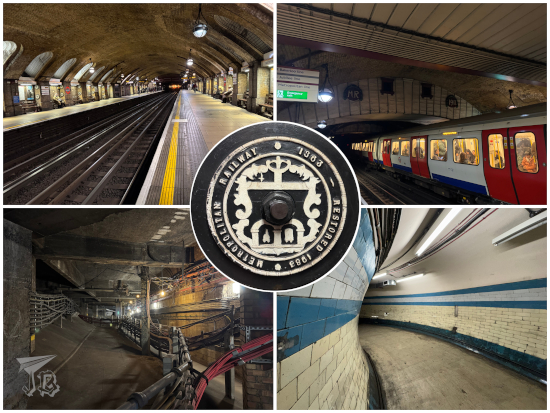
Baker Street Station hidden tour - platforms, and abandoned tunnels.

I did revisit a couple of the publicly-accessible areas after the tour was over to try and get a decent photograph, and then headed off towards Euston to visit a couple of museums belonging to the University College London (UCL), both of which I’ve wanted to see for a while now. However, the last few times I’ve been in town either one or the other was closed – or their opening times did not fit the plans. Today was the day. I first went to the Petrie Museum of Egyptian and Sudanese Archaeology. Though it is a tiny museum, it holds one of the largest archaeological collections in the world, with around 80,000 items.

The core of the collection was donated by writer Amelia Edwards (1831 – 1892), the “godmother of Egyptology”. Edwards toured Egypt in 1873 and 1874, and later, in 1882, she co-founded the Egypt Exploration Fund (now the Egypt Exploration Society), which aimed to support and promote Egyptian cultural heritage. Upon her death, all her Egyptian artefacts, and a hefty sum of money, were donated to the University.

I reached the museum and asked if I could snoop around. I was told no, but I was welcome to visit. Okay, I guess. No harm done. While I love old museums, this one feels way too crammed (and not even in the fascinating way the Sir John Soane’s Museum does). The space is small, so most objects are lounged together in large cases, some with their original labels from the Victorian times, even. It is run by volunteers and possibly all that they custody is in display, which explains why everything is so full.

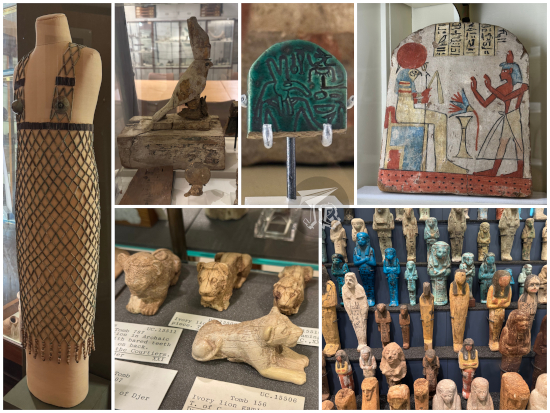
Exhibits at Petri Museum - Egyptian archaeological artefacts: a dress, animal and human statuettes, painted tiles.

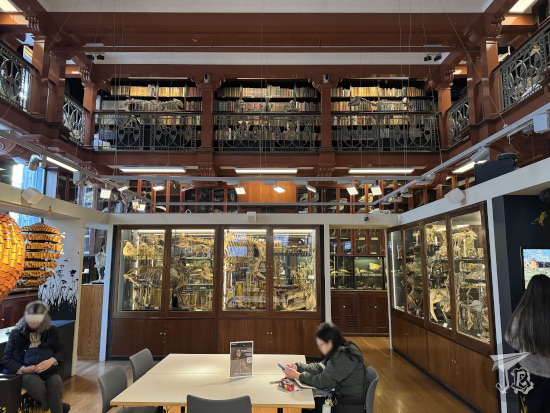
Afterwards, I headed to the Grant Museum of Zoology and Comparative Anatomy, also part of the UCL. Established in 1828 by Robert Edmond Grant, it is one of the oldest natural history collections in the country, originally designed as a teaching collection. It comprises 100,000 specimens in total. There are incredible things on display here. Something that drew my attention was that there were a couple of tutoring sessions going on at the museum… about how to draw creatures and specimens. I did not eavesdrop, but what I overheard was fascinating…

A general view of the Grant Museum of zoology. There are skeletons looking down from the second floor...

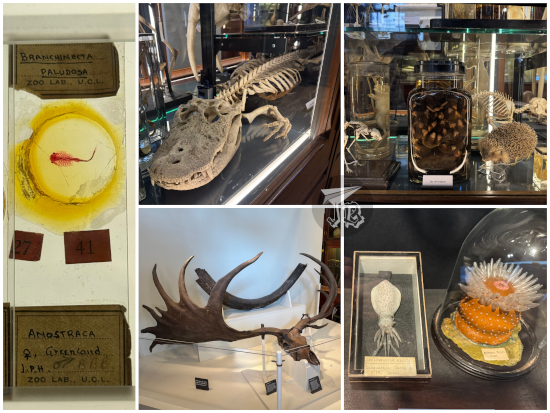
One of the highlights is the so-called Micrarium – almost 2,323 old microscope slides (a tiny fraction of the complete collection, which goes up to 20,000), designed in 2013. There is also a collection of invertebrate glass models that blew my mind away, fossils, skeletons and a wall full of disassembled mouse bones. The museum most infamous exhibit is a jar of moles (Talpa europaea), which hosts 18 of these tiny mammals, male and female, preserved in formaldehyde. When I asked why it was so popular, the volunteer explained that the jar was never catalogued and that it predates any worker of the museum – so no one knows where it came from, and what was it going to be used for. It might have been assembled for a zoology class, or maybe a researcher collected the critters. In any case, there is no record of it, the jar just… exists.

Grant museum of Zoology exhibits: a cocrodile skull, an old microscope slide, giant deer antlers, glass models of anemone and squid, and the (in)famous jar of moles.

Had I not received the email concerning security queue issues in London Stansted, I would have at that point headed for the Monument to the Great Fire of London. However, I have trust issues, so I decided to head to the airport instead. I took the underground to Liverpool Street, and was at the airport around four hours in advance instead of my usual two.

Stansted was packed. There was nowhere to sit, and I’m not talking about actual seats. It was almost impossible to find even a spot on the floor to plop down. I fortunately found a corner where I could stay for about an hour before things started clearing out. I felt a bit miffed because while security had taken a bit longer than usual, it was not the chaos I had feared, so I felt I had wasted my afternoon in London. However, better safe than sorry.

When finally my gate was called, I tried to get to sit down somewhere, but Ryanair made the decision to have the check point just at the end of the stairs, and I found myself stuck in the queue. Most of the waiting was done after check in, and the land crew person opened a cordoned thing to push us through so I ended up – somehow – in front of most of the Priority Queue. That meant I entered the aircraft much earlier than I normally would have. I made the trip back encased between two very tall people who… had trouble squeezing into the seats.

Once I landed, I beat most of my plane to passport control. It was cold when I stepped out and once in the car, the parking lot barrier didn’t want to let me through, and it took several tries to get out. Fortunately, going back and forth repeatedly solved the issue, and I did not have to go find a warden to get it done.

All in all, the trip was a success. I really wish I had stayed a day longer, I would have squeezed many other things in. However, now that my early-morning plane is back, and I have an ETA, I might feel compelled to fly to the UK a couple further times before London introduces a tourist tax. Maybe in summer if the Crystal Palace Trust has finished their renovations of the dinosaurs, or summer for the Jurassic Coast… Or, you know, the minute both the Natural History Museum’s Jurassic Oceans: Monsters of the Deep and the British Museum’s Bayeux Tapestry exhibitions are open.

10th December 2025: Oxford, trains and back to London {United Kingdom, December 2025}

I got up, used the kettle in the room to prepare a quick coffee… and one look at the radiator told me how it worked. I must have been much more tired than I realised the night before… I left my luggage at reception and went back to the streets of Oxford. I basically retraced my route from the previous evening in daylight.

I started off at the Claredon Building, the Bodleian Library and the Bridge of Sighs. Beyond that, I got back to the Radcliffe Camera, University Church of St Mary the Virgin, and the Old Bank Hotel. Down High Street, I walked by All Souls College, the Examination Schools, the Queen’s College, all the way down to Magdalen College.

Up the street again, I reached the Covered Market and turned at Carfax Tower, to St Aldates Church and Christ Church College. Though visiting it was my goal for the morning, I still had some time before the College opened. Thus, I decided to go to Costa Coffee for a proper breakfast, where I had a vanilla latte and a blueberry muffin.

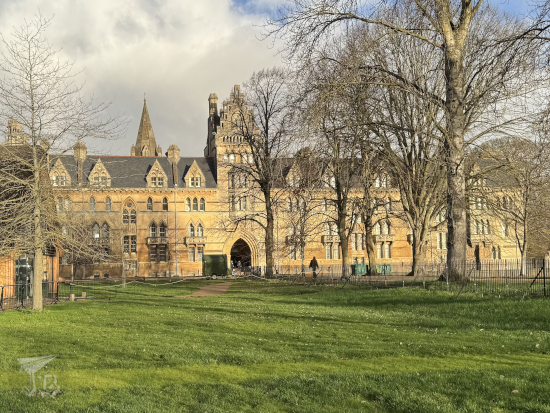
I then headed back to Christ Church College. As it is the largest and most important structure – and also the one that holds the cathedral – it was the college I thought I needed to visit. The visitors’ centre is located in Christ Church Meadow, a floodable grassland open to the public during the day.

I purchased a self-guided visit ticket and went on to explore. Christ Church College (officially The Dean and Chapter of the Cathedral Church of Christ in Oxford of the Foundation of King Henry the Eighth) was founded in 1531 by King Henry VIII, as expected by the name. It was later refounded in 1532, and again in 1546. The second refoundation had a lot to do with the reorganisation of the Church of England, and since then it has been the home of Oxford’s cathedral. Christ Church is a huge complex, mostly in a stunning Gothic and Neo Gothic styles (with some Baroque and Neoclassical add-ons), and the audio guide kept insisting that one should not peer through the windows. Though I think it would have been doable to take the tour the previous day, the cathedral had been closed, and I wanted to see that.

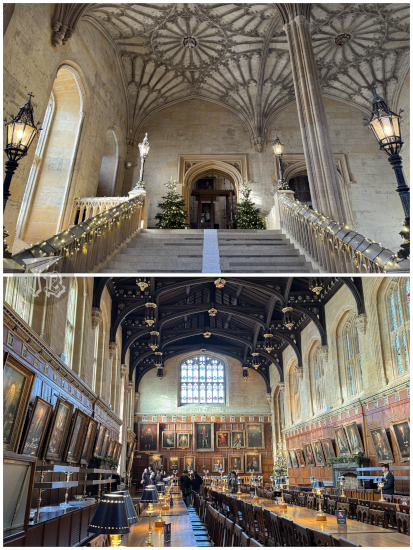
I don’t really think I was ready for how grandiose – I can’t find any other word for it – the whole compound was. The Great Hall caught me by absolute surprise. The staircase which accesses it is magnificent, and the hall is just fascinating. There are fireplaces, pictures of Deans and Professors, long wooden tables and lead windows with different motifs, the most important one being the Alice in Wonderland Window.

The visit begins at Meadow Quad, a 19th-century Gothic Revival building, designed by TN Deane. The particular style is known as Venetian Gothic. During the Victorian period there were several efforts to redefine the significance of Classical ruins and medieval structures, along with a scorn of Baroque. In a typical with-me-or-against-me fashion, two thought currents emerged. On the one hand, Frenchman Eugène Viollet-Le-Duc, who wanted to be more Gothic than the Medievals themselves. His idea was to perfect Gothic buildings using more modern materials and techniques, often making up structures and even whole buildings. Amongst his notable efforts are the restoration of Notre Dame in Paris and the city of Carcassonne (and by his followers, the Olite castle).

On the other hand, Englishman John Ruskin claimed that construction had a life cycle and should be born (be built), then live (be used) and die (collapse). Being a Romantic in the artistic sense of the word, he also idealised Gothic, and his theories inspired more than one Gothic Revival attempt, but he considered them plagiarism and “faux”. Ruskin studied in Oxford, and some of the Neo Gothic buildings there tried to recreate his idealised visions of Gothic – Meadow Quad is one of them (the museum of natural history is another). While Ruskin originally (and vehemently) opposed restoration, to the point that at some point he wrote that it “shattered his soul”, by the end of his life he acknowledged that maybe it was not such a bad idea. Though this is of course a very summarised version of both theories, if I have to take a stand, I’m on Viollet-Le-Duc’s side.

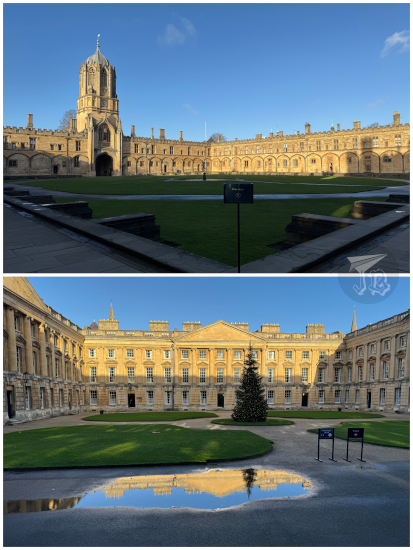
Outer façade of Christ Church College, Oxford, towards the end of the meadow.

The first visit inside the college is Bodley Tower, which features a the monumental Hall Staircase, with an incredibly vaulted ceiling of Medieval design but carved in 17th century. It leads to the Great Hall, the Renaissance mesh room where students and teachers share their meals on long wooden tables (I’ve also learnt that during summer holidays Christ Church turns the students’ rooms into a B&B and you can have breakfast there. Yes, I’m having thoughts). Features of the room include the two chimneys, painted portraits, and stained glass windows.

There is a particularly famous window, called Alice’s window, which honours a former student of the college, one Charles Dodgson, who is more famous than you think. Dodgson’s pen name was Lewis Carroll, and Alice is the one who went to Wonderland and Through the Looking Glass. Carrol was born in 1832, and throughout his life he became a writer, photographer and mathematician. He was tall but scrawny, deaf in one ear, had weak lungs and suffered from a stammer. In 1851, he enrolled to study in Oxford’s Christ Church, where he would go on to work for the rest of his life. It is said, especially in this college, that the main character from Alice’s Adventures in Wonderland (1865) and its sequel Through the Looking-Glass (1871) was based on the Dean’s daughter, Alice Liddell. Another apocryphal story is that the Dodo that appears in the fist book is based on himself – apparently his stammer made it difficult for him to pronounce his own surname, Dodgson, so he referred to himself as a Dodo. It’s difficult to know if this was true…

Main Staircase and Main Hall, where food is served.

Leaving behind the tower, I ventured onto the main yard of the college, Tom Quad (officially the Great Quadrangle), home of the resident pet ducks Tom and Peck. It was originally designed to be a cloister, but the arcade was never finished. In the middle of the quad stood a firefighting water reservoir, now substituted by a decorative fountain with a flying Mercury in bronze. The street and the college are connected by a gate on top of which stands the bell tower known as Tom Tower, whose bell is known as Great Tom. Tom Tower was designed by Christopher Wren around 1680, and Great Tom rang for the first time in 1684. Today, it rings 101 times at 21:00 Oxford time, which is 21:05 GMT, signalling the original curfew time.

The other two quadrants open to visitors are Peck Quad and Canterbury Quad. The former is overlooked by the New Library built in the 18th century in the Renaissance style. The latter gives way to the Picture Gallery. Possibly though, the most impressive element in the complex is Christ Church Cathedral or Cathedral Church of Christ. The building was erected towards the end of the 12th century, but the interior was redesigned, in the Neo Gothic style by Sir George Gilbert Scott.

Quadrants at Christ Church College, Oxford. One is Gothic, the other is Baroque.

The cathedral was re-signified within the context of Henry VIII’s Reformation, which was sparked when the king wanted to have his first (out of six of them) marriage annulled. The original wife, Catherine of Aragon (Catalina de Aragón, daughter of Spain’s Catholic Monarchs) had already married Henry’s older brother, Arthur, who died soon after. Seven years later, she was wedded to Henry VIII, soon after his ascent to the throne, and although she become pregnant six times, only one child, future Queen Mary I, survived past infancy. In order to marry his brother’s widow, Henry needed a special dispensation from the Pope.

However, he was unhappy that Catherine had only reared one daughter, so by the time she was too old to have more children, he sought a personal favour from the Pope – the annulment of the marriage. He claimed to have realised that according to the Bible, said marriage was wrong and the lack of sons was a divine sign. It did not help that by this time, he had fallen in love (or in lust) with Anne Boleyn. The Pope rejected the request, which eventually yielded to Henry VIII’s breaking out with the Catholic Church and creating the Church of England. Henry banished Catherine, and married Anne Boleyn, who later ended up beheaded, accused of “treason” (read: infidelity), while Henry married again – four times.

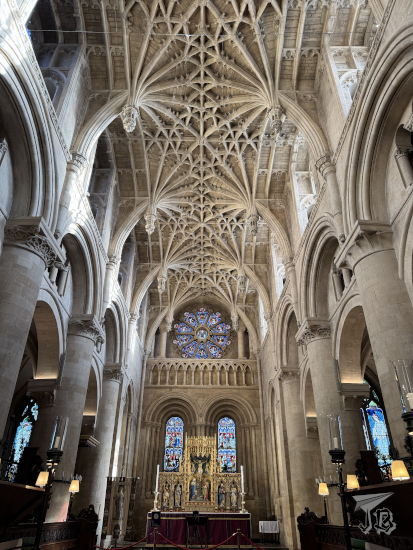
Christ Church Cathedral was originally Catholic, built in the Norman (Romanesque) style during the 11th and 12th centuries. After its conversion to the Anglican rite, the interior of the church was redesigned. It has large stained glass windows and an amazing Neo Gothic ceiling. During the audio guide explanation there was a salute from the Dean, Sarah Foot, welcomed visitors “of any faith, or none” into the cathedral. As the building had originally been designed as an Augustinian monastery during the Catholic period, it features a cloister and a chapter house, the last visitable elements in Christ Church. I turned back in the multimedia guide, bought a trinket at the gift shop, and left the premises.

Interior of the very gothic Christ Church cathedral.

Afterwards, I returned to the hotel to pick up my luggage and head to the station taking a small detour to see the outside of Oxford Castle and Prison and the Castle Mound. There’s no free exploring the castle, you must book a guided tour, so I had decided against it, heading back towards London instead. I wanted to leave on the 12:34 train, which gave me enough time to drop the luggage in my London room, and head out again. Unfortunately, the train was delayed by a “disruptive passenger” and reached Oxford 20 minutes late. I had a booking for the London Museum of Natural History, but I could get another one to guarantee entry if there was a queue, half an hour after the original.

I did not see everything that you can see in Oxford. However, I’ve learnt that day trips are cheaper, because a single and a return ticket have the same price. I did not get to see anything related to JRR Tolkien, nor the Headington Shark, so I might have to eventually come back. I do not regret my planning though, because I had priorities. Off to London I rode, munching on salt-and-vinegar crisps.

I reached Paddington, then changed to the underground to reach Victoria Station. I hate Victoria. I hate it almost as much as I hate Shinjuku Station. It’s bustling and chaotic and I never get my exit right. It was particularly crowded as they had a Christmas installation – a huge plastic “Christmas bauble” which people could enter to have their picture taken. I finally got my bearings and reached the hotel, a few minutes away. Though it was called the Grapevine Hotel, check-in was next door, in the Sheriff Hotel. I had booked a single en-suite with private toilet, and when I got to my second-floor room I found the faucet, the shower, the bed, and a note reading “the toilet is on the first floor”. As in… a whole floor down there was a toilet with a sign reading “Room 15 toilet”. It was incredible surreal, and I had a good laugh about it!

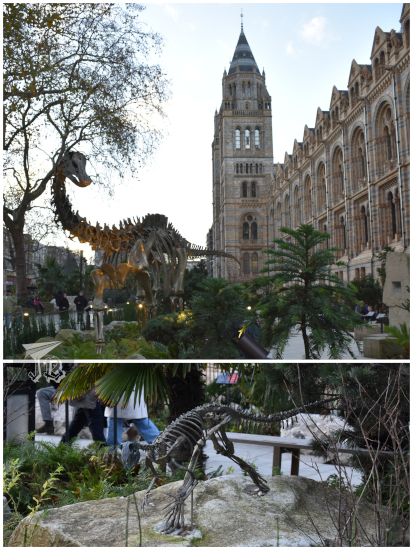
I headed back to Victoria Station (have I mentioned I really hate Victoria?), hopped onto the Tube, and reached South Kensington. It was not too crowded and I could take the tunnel towards London’s Natural History Museum. They have recently reopened their garden, after revamping the area and adding a bunch of details and attractions. Renamed Evolution Garden, its main feature – due to sheer size alone – is Fern the Diplodocus (Diplodocus carnegii). The life-sized specimen is made in bronze and based on Dippy, the Carnegy cast. Before Dippy went on tour in 2021 (again), each bone was scanned so further copies could be made. The museum wanted a new specimen in a lifelike pose and no external support, that would be placed outside, no less. That was why it was decided to build the new display in bronze. However, the resulting skeleton would be too heavy, so they needed to hollow the bones out and keep the skeleton up using internal wiring. The result is a 25-metre long, self-supporting giant that gently sways with wind and withstands both heat and rain.

It almost dwarfs the smaller Hypsilophodon, first discovered in the Isle of Wight – a typical “English dinosaur”. The species lived in the Early Cretaceous, and it was first discovered in 1849, and for a couple of decades it was thought to be a young Iguanodon, until Thomas Henry Huxely proved otherwise. The new species was officially named Hypsilophodon foxii in 1869. It was bipedal, had a beak and teeth, and it is thought to have been a natural runner. It measured up to 2 metres in length, weighed around 20 kilograms.

Outside garden if the Natural Science Museum London showing the diplodocus and Hypsilophodon fossil replicas.

The Garden of Evolution has vegetation in order of appearance – from ferns to other early plants to flowering plants and grasses as one walks through the garden and “advances” in time. There are more small sculptures and art pieces, rocks and ponds, all of them dedicated to recreate evolution and at the same time provide a little nature to the heart of London.

I walked into the building, and my bag was flagged for inspection… ish. It’s just big enough to hold my camera and my wallet, and when the security guard saw that it flopped – the camera was already around my neck – he waved me through. My first stop was the gift shop – there were two things I wanted so I got that out of the way. I was aiming for two Christmas ornaments, but I got a Fern commemorative coin too.

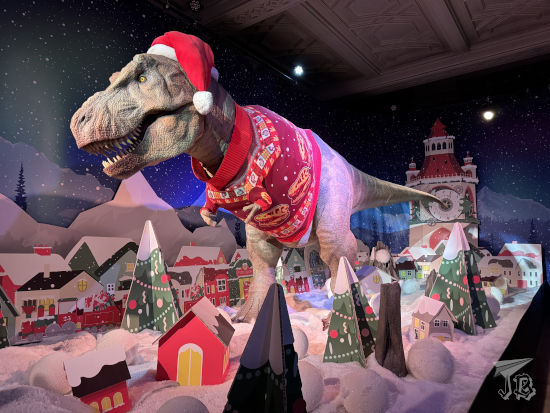
I headed to the dinosaur area. One museum’s traditions is dressing their T. Rex animatronic in a humongous Christmas jumper every year – this year it featured ammonite, theropod prints, stars and a T. Rex skull. It was hilarious. I almost bought myself the human-design version after seeing it.

T Rex animatronic dressed in an ugly Christmas sweater with T Rex skulls.

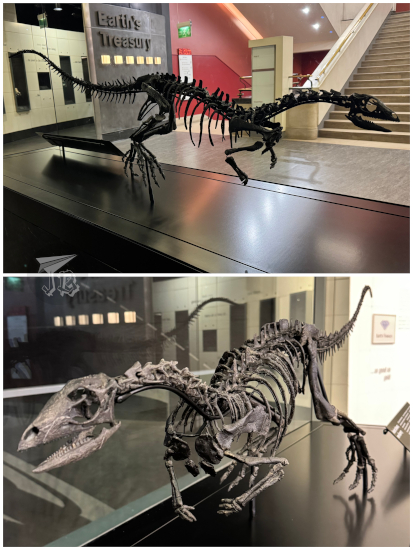
I then went to the birds area to find the museum’s dodo, because after Oxford, everything dodo had to be checked out, of course. Later, I found my way to Sophie, the most complete stegosaurus skeleton. Afterwards, I made my way up because in June, the Museum unveiled a new species, a small herbivore named Enigmacursor mollyborthwickae from the Morrison Formation in the US. It is considered the holotype for the species (the only specimen known, even). Enigmacursor means “mysterious runner” and mollyborthwickae references Molly Lowell Borthwick – she and her husband donated a small fortune so the museum could acquire the unique skeleton, filed NHMUK PV R 39000. It was named in 2025 by Professors Susannah Maidment and Paul Barrett, and put on display. I was very excited to see it for the first time.

Enigmacursor mollyborthwickae, the one and only skeleton of this small theropod dinosaur.

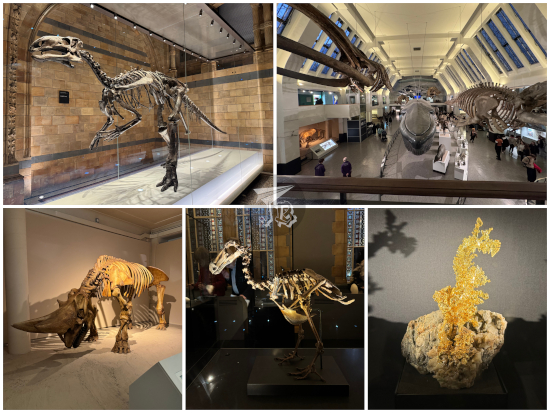
I wandered through other spaces of the museum, including seeing the Treasures in the Cadogan gallery, where the Archaeopteryx is kept, the mineral gallery and The Vault, with all the gems and precious minerals. I also popped into the newly-renovated Hall of Mammals. I left the museum a bit before closing and was a tad disappointed that I could not cross the gardens, as they had closed an hour before the museum itself. I had a couple of hours before the musical, which did not feel like much to go to the centre and snoop around something “Christmassy”. So I headed back towards Victoria, and stayed a little at the bauble decoration, which now had a few ballet dancers inside – characterised as the Nutcracker, but to the music of Swan Lake.

Natural History Museum London exhibits: Maiasaurus skeleton, mammal hall, rhino skeleton, dodo skeleton, gold ore in the shape of a dragon.

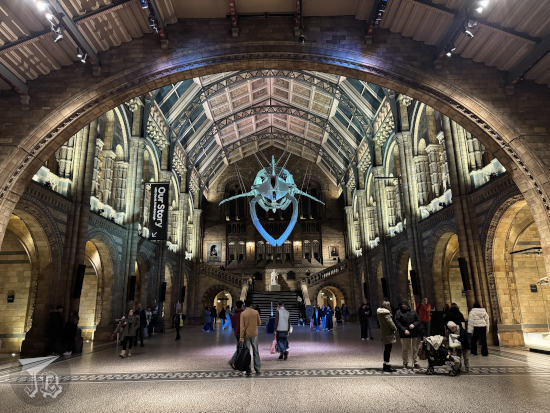
Hintze Hall and Hope the blue whale of the Natural History Museum London from the entrance.

At 18:30 I strolled to Apollo Victoria Theatre. After watching the Spanish version and the first film, it felt right to go back to watch the original Wicked musical once more.

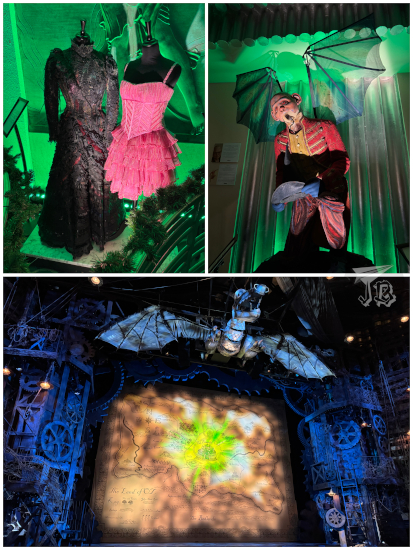
The theatre was displaying a couple of dresses and a sculpture of Chistery the flying monkey. I checked out the upper bar for a change, but everything was packed, so as soon as the sitting area opened, I went to find my seat. Since I was amongst the first people inside, I could take a few decent pictures of the stage. The theatre was rather empty in comparison to what I was expecting, but then I realised that it was the middle of the week, and I had only been to the Apollo Victoria at weekends before. I had booked a seat next to the aisle on row S, and honestly it was a perfect view – the person in front of me was also short, which was fantastic.

Dresses, figures and stage from Wicked in London.

The three main characters were played by Emma Kingston as Elphaba, Zizi Strallen as Glinda and Carl Man as Fiyero. I think Kingston has become my favourite Elphaba to date. Points to Man for keeping the British Ts during his solos, too. However, he did not feel as powerful a character as 2022’s Ryan Reid. I saw a few of Jeff Goldblum’s mannerism on the Wizard (Michael Matus), which… honestly do not work if you’re not Goldblum. Though the cast claims that they have not been influenced by the film, there are times that it just… slips in. Not in a bad way, but… it’s there. I really enjoyed it though, much more than any of the other versions. It feels natural – and not as long as the film(s).

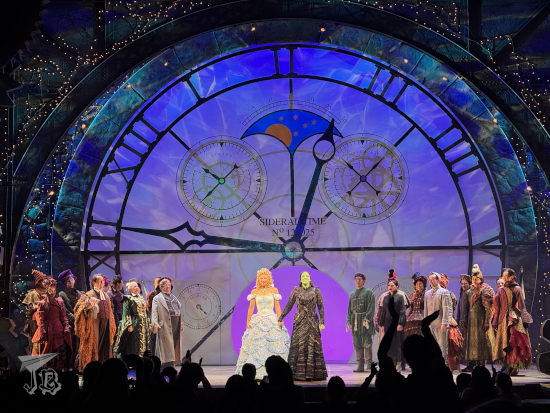
The Cast of London's Wicked after the show.

After the play was over, I stopped by the station so I could buy some dinner (and cut some walking in the cold), and I guess I was hungry because I had all but skipped lunch. Once back at the hotel, I checked in for my flight, and also received an email stating that there was a bit of a chaos at London Stansted airport due to operational issues. That made me decide to head to the airport a couple of hours before I would usually do the following afternoon. It meant sacrificing one of the stops, but it would have sucked to get stuck there due to a long security line. And it’s London. It’s not like I’m not planning to go back already.

The truth is that the hotel had been cheap, and it ended up being quite uncomfortable. On top of the toilet issue, there were no blinds on the window, and it was humid. At least, heating worked, I guess. I did not sleep much, but that gave me time to try and plan my following morning.

9th December 2025: Exploring Oxford {United Kingdom, December 2025}

Nothing ever seems to go right before 4:30 in the morning, right? It turned out that when I reached my usual parking lot at the airport, I had mistakenly booked for another one! Ho boy that was stressful for a few minutes! Fortunately, I could reach the correct parking lot within five more minutes, and found a good spot to drop off the car. Then I did not have to wait for the bus, but could directly walk into the terminal. I might change my usual parking lot to this one, honestly. I like that you can walk and not depend on the bus. The downside is that if you get in or out late, you have to look for one of the 24-hour accesses to the terminal, and those are far and few so you end up walking back and forth a bit.

This whole mishap put me 20 minutes behind schedule, and of course I got a secondary screening at security – random drug / explosive test. Also, can airports decide on policies? Or at least, you know… could the airport agree with itself? Shoes on, shoes off, liquids in, liquids out… In Madrid, it seems to depend on the terminal – and the equipment I guess, if I am being rational. But I really did not feel like waiting for the chemical test to show a negative result.

Passport control went smoothly. When I sat at the boarding gate, I received a reminder that I had to check in with some administrative nonsense (basically proving that I’m still alive) – fun thing to do at 5:00. But that was a fast thing, and soon we had boarded. I had an aisle seat, not exit row. I dozed for most of the flight. Once at London Stansted, getting out took a bit of time because I was really back in the plane, but since I know that airport pretty well, I was able to outrun most of the crowd and barely had to wait at immigration. No one asked about the ETA, but it’s supposed to be linked to the passport, so I guess the system recognises it.

Once in the United Kingdom, I made my customary stop at Costa Coffee, then hopped onto the Stansted Express to get to central London. I changed into the underground, reached Paddington Station… and missed my train by literally a minute, because I could not, for the life of me, figure out how to access the platform! It turns out that Paddington has only one entry point in the middle of all the platforms, but several points of exit. The next train was only 30 minutes later so I just hung around the station for that time.

The first London Paddington station was designed by Isambard Kingdom Brunel and opened in 1854. The original train shed features a glazed roof and wrought iron arches. There is a side shopping centre with a Paddington Bear shop, since the character was named after the area. Since Michaek Bond published the first book in 1958, this Peruvian spectacled bear has become a staple of British children’s literature – and of course, someone managed to heavily cash on that.

Once the train was announced, I got on, and roughly at 11:00, I was finally in the historical centre of Oxford, with the plan to visit the four museums that the local university created to showcase its collections. Since my hotel was on the way, I dropped my luggage off there, and headed out to the first stop – the Oxford University Museum of Natural History, a place that I had wanted to visit when I was a child, just like the Oceanographic Museum of Monaco. To get there, I walked by St Mary Magdalen, an Anglican church in Gothic and Gothic Revival styles, and the Martyrs’ Memorial, designed by Sir George Gilbert Scott to commemorate the burning at the stake of Protestant Bishops Hugh Latimer and Nicholas Ridley and Archbishop Thomas Cranmer.

The Oxford University Museum of Natural History was built between 1855 and 1860, and gathered all the science collections that the university had amassed in different colleges and the Ashmolean Museum, with items that can be traced back to the Tradecant Collection from the 1600. The building itself was mainly designed by Irish architect Benjamin Woodward in a stunning Neo Gothic style. It was originally conceived as both museum and research centre, but as the collection grew, most of the research departments – except entomology – left to newer spaces. Once inside, the museum resembles a cloister, with a central court divided in five aisles by iron pillars that support the glass ceiling, decorated with wrought leaves to evoke trees and plants. Both floors have stone columns supporting pointed arches, and each one is representative of a different British stone, as if it were a research core.

Today, the museum has custody of seven million artefacts, divided in three main collections – Earth (comprising palaeontology and minerals), Life (covering zoology and entomology) and Archive (out of mere mortals’ reach). There are a few incredibly rare and valuable items in either collection. One of them is the only soft tissue of a dodo, an extinct bird.

The dodo (Raphus cucullatus) was a flightless bird from the African island of Mauritius that disappeared in 1662. It was a roundish bird that could measure up to 75 centimetres, and when it was “discovered” in 1598, it had no fear of humans. That made it a very easy prey, which led to its annihilation in just 64 years. Nowadays, it has become a symbol of anthropic extinction, but it used to be just known due to its role in the book Alice’s Adventures in Wonderland by Lewis Carroll, one of the most important books in Victorian literature. Oxford is very proud that the book was written there.

Other elements in the zoology collection are skeletons of elephants and other mammals – the skeleton parade – and dozens of taxidermied birds. The dodo obviously belonged to the bird group, but the preserved tissue is too fragile to be displayed by now. The entomology collection is also impressive, but I’m a bit squirmy about those.

Another item in the Life collection is the so-called Red Lady of Paviland, a partial human skeleton dating back from the Upper Palaeolithic period. The bones were found along with shell beads and carved ivory in a cave known for mammoth remains. They were covered in red ochre, and were originally identified as belonging to a woman from the Roman period (hence the name). They turned out to be from a young man who could have lived as long as as 34,000 years ago, making them the oldest human remains in the United Kingdom, and one of the most ancient ceremonial burials in Europe.
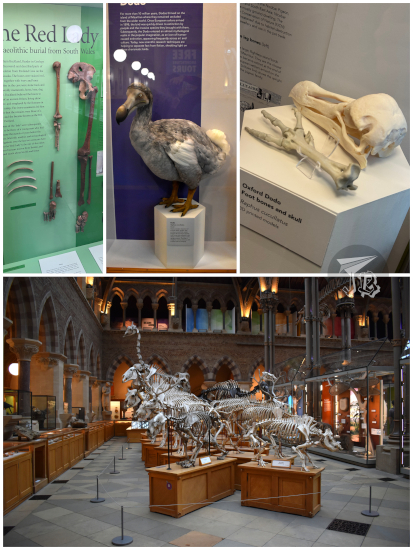
Oxford Museum of Natural History exhibits: reddish human bones from the Red Lady (who turned out to be a man), reconstructed dodo, printouts from the dodo remains the miseum has, a collection of skeletons.

Besides local minerals, the Earth collection hosts over 200 rocks from outer space. One of them is the Nantan meteorite – 4.5 billion years old, and on display for you to touch. And as with every natural history museum, highlights are fossils and, of course, their reproductions. On display there are casts of a Tyrannosaur (Stan), one of the Bernissart iguanodons, an edmontosaur… The ground floor hosts plesiosaurs, ichthyosaurs, dunkleosteus… and a “Wall of Trilobites” with literally dozens of them.

However, the key items in the collections is none of the almost-complete skeletons or fossils on display or archived, but a few dislodged pieces – a leg, a piece of spine and half a jaw. These belong to the species Megalosaurus bucklandii, named by Willian Buckland in 1824 as the holotype of a long-gone massive creature. Megalosaurus was the first dinosaur ever described and named, and it would later get its “interpretation” at London’s Crystal Palace. It was not an accurate one, but it kicked off the first “dinomania” in the Victorian times. Normally, only a cast of the jaw is displayed, but the temporary exhibition Breaking Ground, about the history of palaeontology, had brought them out to be enjoyed by yours truly… I mean everyone. Another fantastic item in this exhibition was an ichthyosaur fossil found by Mary Anning herself – one with remains of its last supper still in its stomach.

As I entered the museum, the first thing I saw were two preserved bears (one of them has since been retired), and the skeleton replicas of iguanodon and tyrannosaur. To the right, the marine reptiles that wrote the history of palaeontology in the UK, and some other dinosaur replicas (edmontosaur, triceratops…). I wanted everything in the gift shop, of course. I had planned to walk the museum in order, but I was unable to, because as soon as I found the stairs, I trotted up to the first floor to find the temporary exhibition Breaking Ground.
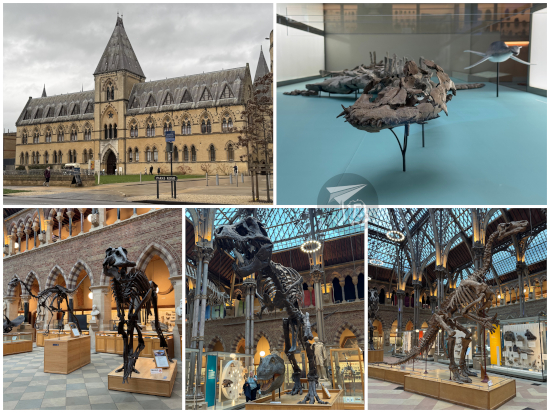
Oxford Museum of Natural History building from the outside, and exhibits: dinosaurs and other fossils.

I ran into a couple of school visits, and at some point I was almost ran over by an overeager tween. One of his classmates tried to excuse him saying “apologies, he’s a bit hyper”. I could understand… I only hide it better, but this was one of those other places that had been in my inner child’s bucket list forever and a day. I was extremely happy to be there, and I’m sure I stayed way longer than normal people do. Selfies with megalosaurus were taken.

Megalosaurus was a Middle Jurassic theropod carnivore which has only been found in the Oxfordshire area (Taynton Limestone Formation). The first remains known to science have been lost, but were described and illustrated at the time. There was a tooth recovered in 1699, and a partial femur. A new batch of bones were discovered in 1815, and they were acquired by Willian Buckland, a geology professor in the University of Oxford. He named the creature “megalosaurus” (large lizard) in 1822, and officially presented his findings in 1824, with illustrations by his wife Mary Ann Mantell. Though Sir Richard Owen would not coin the term “Dinosauria” until 1842, megalosaurus was the first non-avian dinosaur to be formally described and named (though Buckland’s reconstructions would not be accurate in the least). The species would eventually receive the binomial name Megalosaurus bucklandii to honour Buckland.
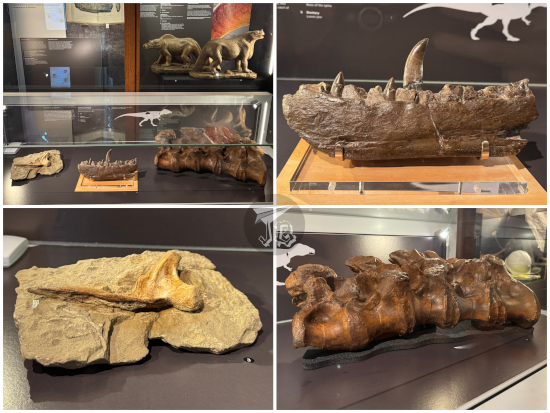
Oxford Museum of Natural History exhibits: pieces of the original megalosaurus fossil.

I went through the exhibition, and emerged on the other side, where I saw the mineral and gem gallery, and what they show you about the dodo – a 3D printed skull and some pictures. Back on the ground floor, I looked at the statues, the skeleton parade, the evolution area… Lots and lots of items.

Towards the back, the Oxford University Museum of Natural History is connected to the Pitt Rivers Museum, the university’s collection of archaeology and anthropology. It was founded in 1884 when private collector August Pitt River exchanged his collection for a post as permanent lecturer in anthropology in the university. The premises reminded me a little of the Sir John Soane’s Museum (but way larger), there was so much stuff to see that my brain could not process everything.

Despite the information clutter, I was extremely impressed, especially by the self-awareness of the museum itself. Panels at the entrance explain the relation between colonialism and the collection itself. Apparently, the museum is carrying out a very serious attempt to get in touch with the cultures that spanned a good part of the items in display in order to return them, amend racist descriptions, remove them from view or challenge them. A notable example was its removal of a collection of shrunken heads, tsantsa, from the Shuar culture. Several cases pointed out how historical labels were offensive (outright calling the cultures inferior or savage) and asked how the viewer would feel if their relatives’ remains were exhibited in museums. I think it made me successfully uncomfortable.
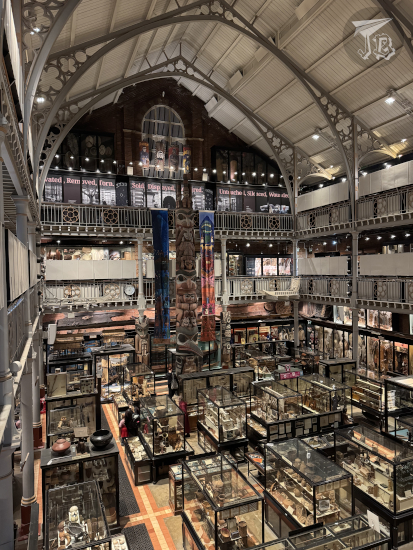
Pitt Rivers museum general view.

However, the coolest thing happened on the third floor, when a random volunteer asked me if I knew what a prehistoric tool was. It was in the middle of a case of hand axes. I owned up that I had no idea, so he explained that it was the tool used to make all the other tools, a stone hammer – which made it the oldest item in the whole museum.

There were still things to do and see, and I had time. I had a second run around the Natural History Museum, just because I could, then I headed towards the History of Science Museum. It is one of the oldest museums in the world that was originally built as such. Unfortunately, most of it was closed due to conservation works. However, the lower floor hosts the highlights, one of them being a small blackboard which feature some equations scribbled in 1931 by no other than visiting professor Albert Einstein. Another of the items is the original penicillin culture that was applied to human clinical trials in 1941 by Howard Florey after Alexander Fleming discovered its antibiotic properties. And probably less dramatic, but utterly impressive, is a 1795 drawing of the moon by John Russell, which looks better than any photography I have ever been able to take.
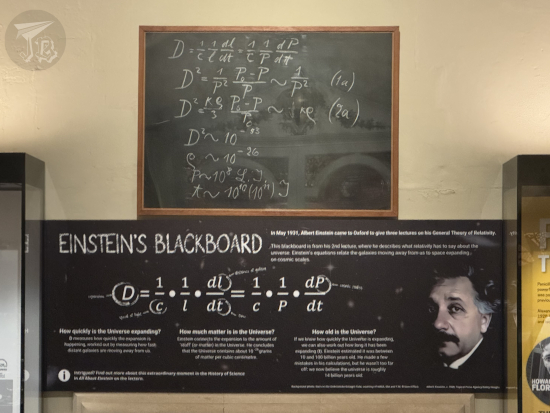
Einstein's blackboard at the History of Science Museum.

I ran into a Christmas market – Christmas in Oxford, which I decided I would visit later on, and headed out to the last of the four museums, the Ashmolean Museum of art and archaeology. Its collections were started as far back as 1683. It is considered Britain’s first public museum, and hosts works spanning half a million years of human history.

On the way, I stopped to buy a drink at a supermarket, and I guess I needed it, because it was gone in… three minutes. I had been getting cramps on my toes, which is usually due to an electrolyte imbalance, so I bought a juice-like thing I like.

The Ashmolean Museum ended up being much larger than either of the other museums, outright huge. It felt similar to Victoria and Albert institution, with a lot of different collections from varying origins. It is much more modern-feeling than the other three, especially since a renovation in 2009.

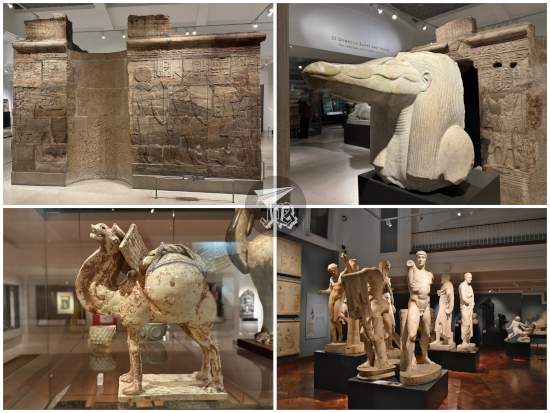
On the ground floor I found Ancient Egypt – I walked past Roman and Greek sculpture first – with a whole sarcophagus complete with mummy case, and even a small temple. I then proceeded to Greece and Cyprus. I came across a staircase and followed it to the area of Conservation, Textiles, Writing, Money and History – Present of the museum, which includes a cabinet of curiosities hosting some of the oldest pieces in the institution, along some which are just… interesting. One of them is an iron lantern from 1605, which is said (probably an urban legend though) to have been used by Guy Fawkes. Fawkes has historically been considered the head of the Gunpowder Plot, in which a number of English Catholics tried to blow up the English Parliament and assassinate King James VI by digging a tunnel underneath and filling it up with barrels of gunpowder. He would have used this lantern inside the dug-up tunnels.
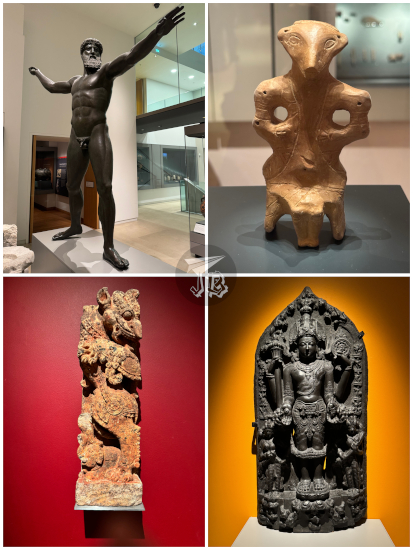
Ashmolean Museum Exhibits -Greek god, vaguely human form, griffon, Hindu deity.

Ashmolean Museum Exhibits - Small Egyptian temple, Sobek the crocodile god, Arabian camel from a tomb, copies of Roman sculptures.

I popped into the shop, where I saw that the restaurant and terrace was open and they were serving “Festive Afternoon Tea”. I had not been able to book it for the Natural History Museum in London, but maybe I could get away with it here. I decided to try my luck, so I climbed to the fourth floor, where the Rooftop Restaurant is. I caused a bit of a ruckus since I popped in without a reservation and solo, but once the waiters got approval, everything went smoothly. I got a seat next to the window and ordered. Afternoon tea consisted on sandwiches, scones and sweets along with a pot of loose-leaf tea.

The mini-sandwiches were: Cucumber and dill cream cheese; Brie and cranberry shallot shell, shallot purée; Roast turkey, sage emulsion, cranberry sauce, rocket; Smoked salmon, dill and horseradish crème fraîche. The scones were homemade, not plain but with cranberry and mixed spice, accompanied by English clotted cream, and Tiptree jam; they were absolutely mind-blowing.

As for sweets, I got Mini Baileys mousse, Tia Maria syrup; a Father-Christmas-shaped gingerbread biscuit; a lovely Mince Pie; and Mini vanilla cheesecake, candied clementine segment. The sweets were extremely so and I did not finish all of them, particularly the mousse.

It was hard to decide which tea I wanted. In the end I went for the in-house Ashmolean Tea, mixed specifically for the museum by local business Team Tea: a malty second flush Assam, combined with single estate Darjeeling and Black Gunpowder from China. They claim that the “Gunpowder” is a call back to the lantern. It was a great choice, and required no sugar or milk – though I drank the milk after all the sweets.
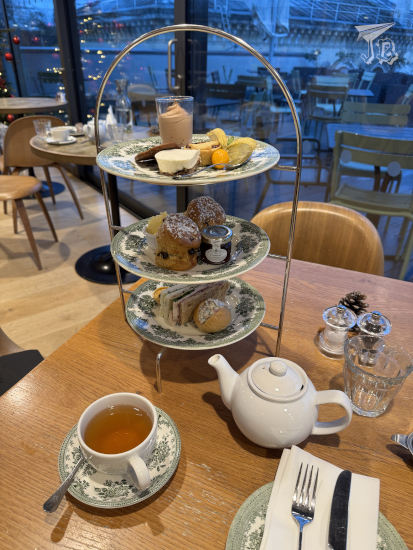
Afternoon tea, on a three-storied tray, along with a cuppa.

Belly full (maybe a bit too full), I went back down to the second floor, where I visited China and Japan, and European and English art rooms, including jewellery. On the first floor I found the Mediterranean World, Islam and Near East, and India. Back on the ground floor there was more China, Rome, and a collection of Classical casts I had missed before. I missed a bit of the collection, displayed at the third floor, because there is no staircase access there – or I did not find those stairs. I left about ten minutes before closing time.

In front of the Ashmolean Museum stands the beautiful Randolph Hotel Oxford, a Hilton property that is way out of my league, but I can admire. Down Broad Street there were tons of small cafés and shops – collectibles, memorabilia, books… It started drizzling a little just as I walked by one of the largest bookshops, so it was a great idea to pop in and snoop. here are two writers that greatly define Oxford’s personality, and both had their dedicated areas – Lewis Carrol and JRR Tolkien, author of The Lord of the Rings, and father of the modern high fantasy genre, I guess. I wanted everything, but I was limited by luggage size. Good thing I can be reasonable at times. But only at times… T

The drizzle cleared, and I was quite at the centre of Oxford. I explored the Christmas in Oxford market, and then the Claredon Building and courtyard, the Bodleian Library and the Bridge of Sighs. I checked whether I could get a ticket for the tours happening the following day, but they were sold out. It was a pity, but I could live with that – there were plenty of things to do.

The Clarendon Building is a Neoclassical structure, originally destined to be the University Press under the design of William Townesend. Today, it is part of the library, founded in 1602 by Sir Thomas Bodley, and it hosts 13 million items in print. Besides the Clarendon, the library is hosted in a number of buildings – I was snooping around the 15th century Duke Humfrey’s Library and the Radcliffe Camera (from the Latin “chamber”, not because there is any kind of camera around). The Bridge of Sighs is officially called Hetford Bridge. It is a sky walk between the new and old wards of Hetford College, actually a relatively new construction, dating from 1914.

I walked past the Radcliffe Camera and the Gothic University Church of St Mary the Virgin. I strolled into High Street with another of the high-class lodgings – the Old Bank Hotel. The sun had already set and it looked – and felt – like it was the middle of the night, but it was not even 17:30, as I had just left the Ashmolean Museum right before closing time at 17:00.
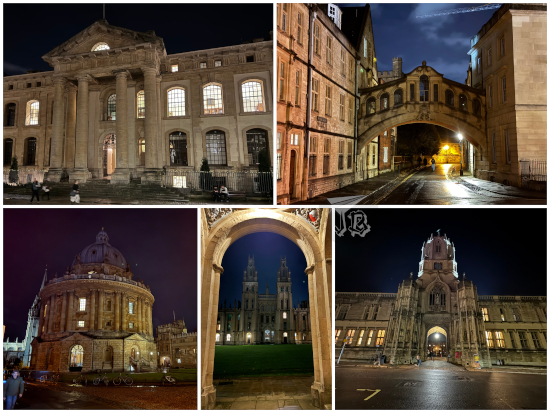
Oxford at night - Library, Bridge of Sighs, Radcliff Camera, Colleges.

I went all the way towards the end of High Street to see the colleges and other university and religious buildings. It’s difficult to actually explain the roles that Colleges have in Oxford. They are technically “residential colleges”, and become both housing and teaching institutions. All university students are members of one of the 36 colleges. The University describes them as “academic communities where students have their tutorials”. The colleges offer courses, and the students combine courses (year or semester-long subjects) until they lead to a degree. Classes are organised by the colleges, and the preferred teaching method is the aforementioned tutorial, a small group of people (one to four) discussing a topic of academic nature, usually related to the week’s work. Examinations and important lectures are conducted by the University as a whole.

The first building I came across along High Street was All Souls College (officially The College of All Souls of the Faithful Departed, of Oxford), established in 1438. From that corner, I saw one historical building after the other. All the students take the exams at the end of term in the Examination Schools, which also serves for lectures. It was erected between 1876 and 1882. A bit further down the road I saw the Queen’s College, which dates back to 1341, and it’s named after Queen Consort Philippa of Hainault, wife and political advisor to Edward III. I finally spotted Magdalen College, founded in 1458 and one of the most important colleges in town, with beautiful Gothic and Neo Gothic architecture.

I backtracked towards the other end of High Street, walked past All Saints’ Church, Lincoln College Library, and found the Covered Market. The structure, designed by John Gwynn, has been in use since it opened in 1774. It has permanent stalls and wooden beams that give it a church-like vaulted ceiling, along with a cast iron ceiling. Most of the shops were closed though, and the market was almost empty.
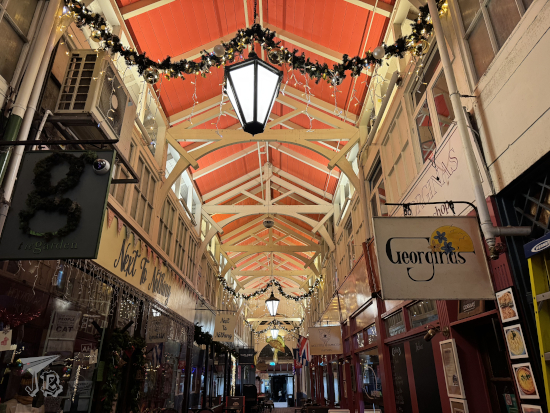
Covered market, a wooden structure.

I reached Carfax Tower, or St Martin’s Tower. It used to belong to a long-gone church built in the 12th century, and technically no building in Oxford may be higher than it. From there, I turned into St Aldate’s street, where the Town Hall stands. Unfortunately, it was under renovation, and mostly covered by construction scaffolding.

I reached Christ Church College, which I planned to visit the following morning. In front of it stands the small Medieval St Aldates Church. I went out a little further until I reached Folly Bridge and Bacon’s Tower over River Thames. The tower is not the original 12th century one, but a sort of revival castle erected in 1849 as a folly – basically a decorative building (hence the name).

I tried to drop by the Christmas Market again to buy a cute bauble, but it turned out that it closed at 18:00, and it was 18:30 by then. I headed back to the hotel and got my room. After a shower, I settled down to make my plans for the following day and watch some TV (without even having to surf for a channel in a language I understood…). I even managed to stay awake long enough not to give myself jet-lag.

However, for the life of me, I could not figure out how to operate the radiator in the room…

9th – 11th December 2025: Oxford & London {United Kingdom, December 2025}

This little trip was supposed to be to Seville, Spain. I had an unexpected and quite-harsh project in October-November and I decided to spend part of the income rewarding myself for going through it. Thus, I traced a good plan, I swear. Three-day trip, placed right after the Spanish December long weekend, destination accessible by public transport, not so cold… It was a perfect plan. And then I went on Ryanair page and saw that my early-morning flight to London-Stansted was back on the rooster. And furthermore… it was comparably cheap.

But I stuck to the plan. Until I saw that the Oxford University Museum of Natural History was running an exhibition and had pulled out some of its heavy-weight artefacts… But what really sealed the deal was that I found a flights + hotels combination that was actually cheaper than trains + hotel in Seville. It really seemed like the universe was coming together to tell me I could and should take this trip. Yes, it was quite close to the Prague trip, but I was quite literally facing four months of downtime afterwards due to a long project coming up.

So the plan became landing in London, heading to Oxford. Once there, I would see the four museums belonging to the University of Oxford. The next day, I would go back to London, because, in the end, it is one of my favourite cities. Spoiler alert though – I did not get to see much Christmas stuff there. Weird.

For London, I booked a time slot at the Natural History Museum, bought a ticket for Wicked and signed up for a tour with the London Museum of Transport. In Oxford, the museums are free, and I did not know how long I would take, so I would improvise after that.

Something that I have been wanting to do for a while was the Afternoon Tea at the Natural History Museum. You get to see the Mary Anning rooms, usually reserved for members, and there are dinosaur-print macarons. Unfortunately, when I tried to book that, it turned out it was for minimum two people, and since they charged up front, I could not trick the system – though I honestly considered booking it and just bring a take-out container and live off the second afternoon tea for the following day. Temptation, but in the end it was way too expensive for just a whim. Fate would give me a hand with that, too, even if the start of the trip was somewhat… bumpy.

Oxford And London Trip Dec'25 Intro.

One of the things I had to do to travel to the UK was getting an ETA (Electronic Travel Authorisation). I am pretty sure I don’t need one, because I have the right to work in the UK, but I decided to go through the process because it felt easier than drawing up all the paperwork and taking it along to prove it at entrance. On the 20th of November, I downloaded the app and followed the instructions – first, I got a security code on my email to start the application. I had to take a photo of my passport, then scan the chip (I did not even know my phone could do that!). Next, the system asked me to “scan my face”, I guess similarly to what the machines do when you enter the UK border, and I had to take a picture with a white background and no shadows – finding that background was the most difficult part. The last step was, obviously, paying for it, and of course the bank app and the ETA one had to be open at the same time on the phone and switching from one to the other was stressful because my banking app sucks.

After payment, the application was sent, and I received an email that it would be checked. This was 16:09. When I came out from work, I had a valid ETA – the email had arrived at 16:18. Yay, I’m not suspicious. The authorisation is valid for two years, and allows for multiple entries. I will have to make good use of that.

Plane tickets, hotel bookings, train schedules and ETA in hand, I was ready for a three-day getaway in England.