22nd and 23rd April 2023: A date with a dinosaur (London, England, Great Britain)

Since I cannot keep my mouth shut, I offered to organise a trip to London with some people from work. Despite prices skyrocketing everywhere and my ridiculously hectic schedule, I managed to secure a weekend when flying would not be stupidly expensive, and an activity I would really be looking forward to – the Natural History Museum was running couple of things I was very interested in. One was an exhibition on a gigantic dinosaur: Titanosaur: Life as the biggest dinosaur. Well, twist my arm – NHM is much closer than the actual Titanosaur home in Argentina. Furthermore, there was a collaboration with Jurassic Park (‘an adventure 63,000,030 years in the making’ is the motto), and coming back to the museum would give me the chance to purchase the rock I wanted the last time I was over and did not get because I was heading out to Stonehenge on the same day.

In the end, only one person took up the offer, and I figured out that well, London is pretty much always a good idea for a weekend – so I figured I’d arrange myself a date with a dinosaur. Unfortunately, it turned that London Marathon was held that weekend. Hotel prices were bloated for the night and we ended up at Earl’s Court because I wanted to stay close to South Kensington and the other person wanted the cheapest place possible. We left on a red-eye flight to London Stansted which took a long time to land – we spent about an hour circling the airport, and eventually the head cabin attendant said that there was bad visibility at the airport, and that the pilot required all electronic devices to be turned off so he could use the autolanding system. I did not like that one bit – after I visited Santiago de Compostela in 2022, I felt that I had got over the bad-visitiblity near-miss when I was a teen. Apparently not, the feeling of uneasiness is still there. We landed over an hour late, but we were on our way on the first Stansted Express a few minutes after getting on it. After reaching Liverpool Street Station at around 9:30, I asked my companion to take us to Guildhall as part of the incentive of the trip was introducing them to international travel. It was not a good idea. Their phone trolled us and tried to take us to Guildhall… in Stratford upon Avon. The Costa at the station was closed, but at least I had got myself a sandwich and a latte before we started walking.

After backtracking, we were in known territory around 10:15. As it turns out, my companion was only interested in “walking the city” and shot down any activities I had proposed – thus, some things I just imposed in order not to feel that I had wasted the whole day away. By 11:00, I had confirmed that our travelling styles were not compatible. After some time at the docks next to the Tower of London, I wanted to enter the Anglican church All Hallows by the Tower. All Hallows is the oldest church in the City of London – founded in 675 CE, it predates the nearby Tower of London. The parish used to take care of a lot of the prisoners executed there. The building withstood the Great Fire of London (1666), but it was severely damaged through The Blitz – the German WWII bombing campaign against the UK throughout 1940 and 1941. The church was rebuilt and reconsecrated in 1975. Its windows are decorated with symbols from the different London guilds and some families.

Collage of a church. The outer building is brick and it has a tower crowned with a greenish metal spire. The inside has huge windows decorated with guild symbols. The small crypt inside is covered in white stone.

Underneath, there are a few chapels and a small Crypt. Most of the crypt is a museum which chiefly holds artefacts from the Roman period – including remains of an old road. There are other historical items from the Saxon and Medieval times, and the 20th century Crow’s Nest of the vessel Quest, in which Sir Ernest Shackleton sailed for Antarctica for the third time, and where he died.

When we were done, we went to Saint Dunstan in the East Church Garden. I was hoping to use this as a relaxing point for a few minutes, but there was work being done on the parterres. We continued towards the River Thames for some views of Tower Bridge, the museum HMS Belfast and The Shard skyscraper.

We walked by the Monument to the Fire of London on our way to the Sky Garden. The Great Fire burnt inside the Roman city wall for four days after breaking out a bakery after midnight on the 2nd of September, 1666. Though the number of victims is (theoretically) small, the fire destroyed over 13,000 houses (15% of the city’s housing), almost a hundred parish churches, governmental buildings, St Paul’s cathedral, and even some of the city gates.

Afterwards, we walked over to Leadenhall Market, a covered shopping street which can be traced back to a 1321 food market, and marks the centre of Roman Londinium (ruins from the Forum and Basilica are buried underneath). It was given to the city in the 15th century, and in the 19th century, the City Architect Sir Horace Jones designed an iron-and-glass arcade. Today, it holds restaurants, wine bars, varied shops and even beauty parlours.

A covered shopping gallery or street, in dark red and beige tones.

Around the market stands a mixture of modern buildings and traditional buildings, mostly small churches. Among the former:

  • The Lloyd’s Building (25 Gresham Street), sometimes called the “Inside-Out building”. It was finished in 1986 and it is consider a great example of Bowellism – an architectural style that maximises inside space by building ducts, lifts, and other structural necessities on the outside. It was designed by Richard Rogers & Partners, and it still maintains the original entrance of the building that stood in its place in 1928 – the East India House.
  • The Leadenhall Building (122 Leadenhall Street), designed by the Rogers Stirk Harbour + Partners. It opened in 2014.
  • The Willis Towers Watson (WTW), designed by Norman Foster, it was finished in 2008.
  • The Scalpel (52-54 Lime Street), which yields to cool reflections along with the WTW, and has a strange sculpture at the entrance – it made me think of several ship wheels fused together. The building was designed by Kohn Pedersen Fox and only completed in 2018.
  • And of course The Gherkin (30 St Mary Axe). It was designed by Foster + Partners and it is the first ecological building ever built in London. It opened in 2004.

The historical buildings we encountered (having survived both the Great Fire of London and the Blitz) include:

  • Saint Andrew Undershaft Church. It dates back from 1147, although it has been rebuilt several times. The current building was erected in 1532.
  • Saint Helen’s Bishopsgate Church, where Shakespeare himself used to worship in the 1590s. The building can be traced back to the mid 12th century, and it was restored during the Victorian period and later during the 20th century.
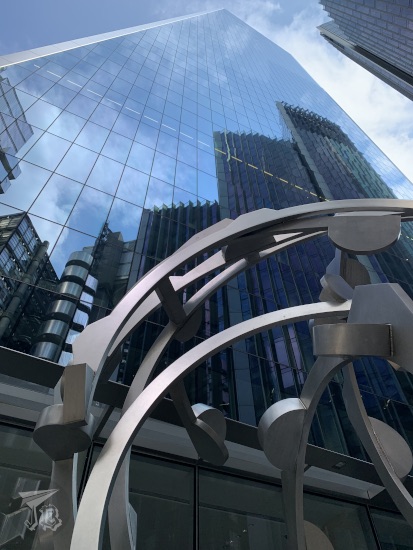
Skyscrapers reflected on the glass that covers yet another huge skyscraper

A small church built in Stone in the background with a huge modern high-rise building behind it

Afterwards, we headed towards Embankment on the Tube. There, I was happy to find a Costa Coffee and get my vanilla latte fix. In the area, we saw the Victoria Embankment Gardens and I wanted to visit Cleopatra’s Needle – half of a pair of obelisks (the other one is in New York), originally made and carved in Heliopolis, what is Cairo today. It has inscriptions from the 18th and 19th Egyptian dynasties (around 1450 BCE). It was presented to the United Kingdom by Sultan Muhammad Ali in 1819, and later transported to London in 1877. Two sphinxes and other decorations were added when the Needle was erected, and the plinth under one of the sphinxes was damaged during London Bombings – it was never restored as a tribute to memory.
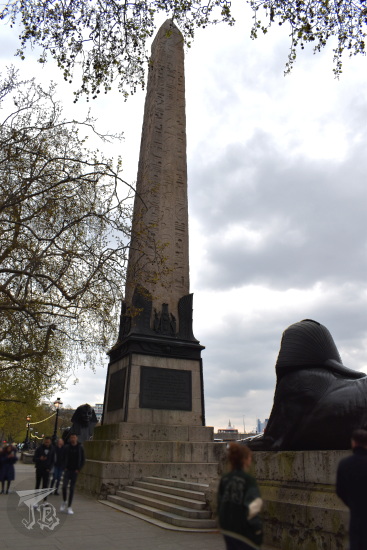
An Egyptian obelisk standing against a cloudy background

We walked over to the Westminster area to see the Palace of Westminster and Elizabeth Tower. There was an environmental protest there, which made it packed, but at the same time diverted traffic, allowing for new views from the middle of the street. On the way, I encountered an adorable pit bull mix I got permission to pet – coffee and dog pets made everything better.

A view of the palace of Westminster, with the Elizabeth tower on the left

We continued off to Saint James’s Park, home to squirrels, geese, swans, pigeons, mallard ducks, robins… all of them extremely used to people and tourists, and rather unconcerned by dogs being walked. We ditched the marathon fencing and reached Buckingham Palace, but by then my companion was beat. Thus, we had to go to the hotel so they could get some rest. The hotel was better than expected for a London 2*. It was nice and warm, although the bathroom was tiny – it was difficult to stand inside and close the door.

Buckingham Palace and some of the animals at Saint James' parks

A couple of hours later, we were off into the evening to see Piccadilly Circus, the entrance to Chinatown, and Leicester Square. Companion was beaten, so they were not sure they would be up for anything the following day – we arranged to touch base at 9:00 for them to evaluate. Once in my room, I had a shower and booked a free time slot for the British Museum the following day, just to avoid the queues. I thought, even if we did not make it, at least we had assured entry if we did, and I could always cancel and release the ticket.
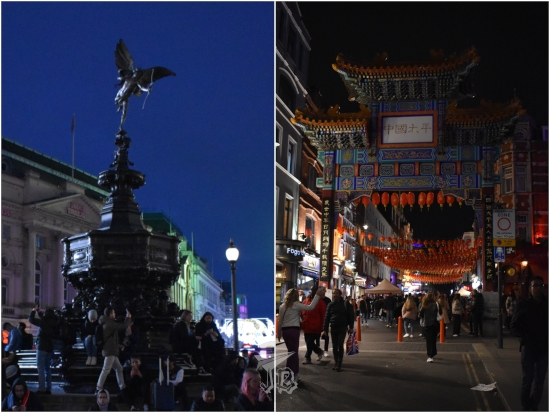
Central London at night - Picadilly Circus' Eros and entrance to Chinatown

The next morning, I left on my own around 8:00 to look for a nearby Costa Coffee for a large vanilla latte breakfast, and I came across Brompton Cemetery. This had not been on my radar, but since I had time, I decided to explore it a little. Brompton Cemetery, formerly West of London and Westminster Cemetery, opened in 1840, and it has belonged to the British Crown since 1852. It is on of the oldest garden cemeteries in Britain and comprises around 35,000 monuments. I wandered for about half an hour before I had to head back.

Brompton cemetery, a 19th century graveyard and garden

We managed to get to to the Natural History Museum on time for my date with a dinosaur just after opening. I had my Titanosaur ticket at 10:15, and left off my companion to wander on their own after agreeing to check with each other around noon. The exhibition Titanosaur: Life as the Biggest Dinosaur brings a cast of Patagotitan mayorum to Europe for the first time, along with a few real fossil bones, of a front leg, some teeth, and an egg.

Patagotitan mayorum is one of the largest known animals to have ever lived. It was a sauropod dinosaur – a tetrapod with extremely long neck and tail. It lived in forest regions during the Late Cretaceous (102 to 95 million years ago) grazing on ferns and tree leaves. The species was discovered in Argentina in 2010, and it’s calculated that it could have been up to 31 metres long and weigh over 50 tonnes. It is widely considered the most complete of the South American dinosaurs. The cast that the Natural History museum brought is considered the holotype, and it was reconstructed from the partial skeletons of six specimens.

Titanosaur skeleton. People walking around don't even reach its knees.

The best thing about the exhibit was being able to actually touch the cast, so I kinda hugged my date, I guess. As far as I know, there are only three casts of titanosaur – the one in Argentina (Museo Paleontológico Egidio Feruglio in Trelew), one in the US (Field Museum, Chicago), named Máximo, and this one.

After I had pranced around the exhibition to my heart’s content, and as it filled up with kids, I moved on to reason number two of this visit having to happen asap in 2023. To celebrate 30 (thirty!) years of the 1993 release of Jurassic Park, the Natural History Museum was running a limited-time-only collaboration pop-up shop – the Jurassic Park 30th Anniversary #NHMxJURASSIC store in which I did not even spend that much! I bought a replica badge and a commemorative coin, both limited, numbered editions. The shop had both Jurassic Park and Jurassic World merchandise, especially toys and T-shirts, and a few props, including a life-size sculpture of Blue the velociraptor.

Jurassic Park pop-up shop, with Blue the velociraptor just hanging out

I then headed to the official museum shop to get myself the rock I had wanted – a piece of aura silicon carbide, a shiny mostly-artificial mineral. I also bought a souvenir guide, just because. They did not have anything from the Titanosaur exhibit there, so I backtracked to the exhibition shop to buy a pin.

Whenever I got to the Natural History Museum, I end up in the dinosaur gallery (well, there was that one time I walked through the whole thing throughout a winter day). This time, however, I decided to wander the upper area of the historical building. I was drawn to the Treasures in the Cadogan gallery. I had not been there since it opened in 2013, and my mind was blown. The collection includes a first edition of Darwin’s On the Origin of Species, and some of the pigeon specimens that he used to develop the theory of evolution. I also got to see the first-ever-found iguanodon teeth (not the replicas), the first fossil ever found of the Archaeopteryx (the link between dinosaurs and birds), and a skeleton and egg of the great auk, the first confirmed victim of anthropogenic extinction (due to human activity). I was very impressed, these were all treasures indeed – no overselling.

Treasures at the Natural History Museum - ancient bird fossil, extinct penguin-like bird, a book, dinosaur teeth. Whale skeleton.

After wandering the second floor for a bit, I ran into my companion and at noon we left towards the British Museum, where I had booked entry for 12:40. I left them to their own devices again and headed off to the Japanese galleries, which had been closed the last couple of times I was in the museum. I was… a bit on the disappointed side, I remembered them being way more impressive from my early 2000s visits.

Japanese Galleries at the British Museum: Samurai Armour, lion dogs pair, articulated metal animals, a standing Buddha.

I visited the Moai, the Elgin Marbles, the Babylonian bulls and the Rosetta Stone, and I headed off to the shop to get myself a treat – retail therapy is a thing. Eventually, we left the museum and managed to get to Liverpool Street to take the Stansted Express to the airport. Security was smooth, not as crammed as other times, and then, as tradition calls, I got myself some sushi at Itsu.

When we boarded the plane, I had been assigned an emergency exit seat. In order to sit there, you need to be able to take responsibility about opening the exit if something happens. I flagged a flight attendant to inform them that I would be physically unable to do so. I had a new seat in 4.5 seconds, and it turned out to be a window seat. We took off a few minutes late, and landed with a delay of almost a quarter of an hour. Nevertheless, after passport control and all, I managed to reached the parking lot payment machines with a few seconds to spare the overstaying fee – all good!

Balance – The marathon barely interfered with the weekend. I had a date with a dinosaur and hugged them. That was awesome. I got limited edition Jurassic Park and Jurassic World merchandise. I found some Kettle Sea Salt and Balsamic Vinegar of Modena crisps at one of the supermarkets. I got two new books, commemorative coins and a shiny rock. I also discovered new places to explore in the future, and had Costa – twice. Unfortunately, we ran out of time for extra visits on Sunday – so I could not fit in either the HMS Belfast or the Jack the Ripper Museum. Furthermore, the Grant Museum of Zoology is closed for renovation, and the Petrie Museum of Egyptian Archaeology does not open on Sundays, so in the end I was not really able to scratch much off my list. Whoops!
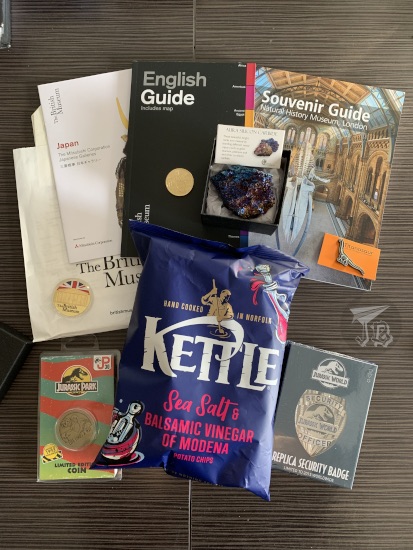
Souvenirs from London: books, crisps, commemorative coins and Jurassic Park merch

26th March 2023: The long way home {Belgium, March 2023}

Instead of returning from Brussels the same way, I had decided to take an earlier plane back home, from Brussels Charleroi instead of Brussels Airport. That way D****e and I could hang out a little longer, too. We had free breakfast at the hotel that day since we had had a bit of an issue with her check in, and the manager had offered that as compensation. It was pouring rain, so we did not do anything before we headed off to the airport, which we did with plenty of time. Brussels Charleroi is serviced by a bus company, and when we got to the stop, a bus was leaving – that was okay, we were aiming for the following one.

We reached the airport around 11:40 and queued up to pass through security, who decided they needed to test my shoes for drugs. It took me forever to be able to pack again after taking the camera and liquids out, but we were inside without issue before 12:30. We sat down for a drink, and then went off to find D****e’s gate. She was inside at the right time, but her flight ended up delayed as she had to fly to France, whose people are striking at the moment.

I found my own gate, and sat down to wait. When it was boarding time, a mob formed, and as it dissipated, I approached – it turns out that my flight was not boarding! Instead of leaving around 15:00, we did not take off till 16:15. During this time there was no estimated take-off time, nor any information. Internet said over two hours, so I decided to venture it to the food court to grab a snack. When I finished, I went to the bathroom and when I came back, the ground crew were getting ready to board us. It went fast, and the return flight was uneventful. We never got any explanation for the delay.

When I landed, the usual exit was blocked, so I had to go all the way back to the next terminal and backtrack. In the end, I was commuting for around nine hours for a 120 minute flight. Talk about efficiency… The best thing though was that with all the excitement and tiredness I did not even notice that Europe had shifted into (out of?) daylight savings time, which usually breaks havoc with my system. All in all, it was a nice weekend, albeit a bit tiresome at points. It’s hard to find water-resistant walking & concert shoes.

25th March 2023: Brussels, Antwerp, and Starset {Belgium, March 2023}

As my companion D****e was caught in the French air controllers’ strike, she did not make it to our hotel until the wee hours of the morning. I let her sleep, and headed out to explore another area of Brussels. My first stop was again Mont des Arts, because it was on the way to Anneessenstoren, remains of the old city walls – which were being renovated, so I could not see a thing.

I had decided not to take the umbrella because the wind made it useless anyway, so I had to take cover a couple of times. I continued off to the Romanesque-evolved-into-Gothic Church of Our Lady of the Chapel Église Notre-Dame-de-la-Chapelle | Onze-Lieve-Vrouw-ter-Kapellekerk. It was closed, but I hung out around the area for a bit. There is a skate park, a Memorial to Pieter Bruegel the Elder (who is buried in the church) and an obelisk Obelisk Kapellekerk sculpture.

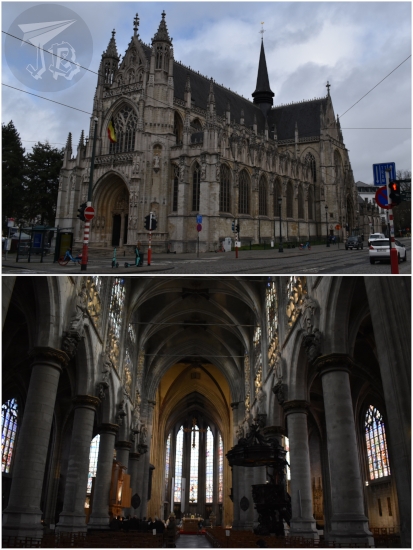
I decided to come back when the church was open, and continued walking towards another church in the area, the Church of Our Blessed Lady of the Sablon Église Notre-Dame du Sablon | Onze-Lieve-Vrouw ter Zavelkerk. It was built in the 15th century, in late Brabantine Gothic. It does not have towers, but a deep portal in the main façade. It is richly decorated inside and out, in light coloured stone from the nearby Gobertange quarry. In the beginning, the church was a parish for the noble and wealthy citizens of the city, but it slowly lost lustre over the centuries. In the late 19th century and beginning of the 20th century, it was “restored” according to the principle of unity of style. The whole building is laden with ogival windows, and the light inside is very beautiful. When I was there, the choir was rehearsing, and there was a “do not visit beyond this point” notice which I abided by.

Gothic church: exterior + nave, flanked with long windows

I went out again, and crossed the street to the garden Square du Petit Sablon | Kleine Zavelsquare , which features statues depicting some of the great humanists of the Belgian 16th centuries, and a fountain in the honour of two noblemen who were executed by the Spanish regime in the same century. The fences are decorated with sculptures that depict the different guilds of the city. It was designed by romantic architect Henri Beyaert in the Flemish no-renaissance style in the 19th century as a flower garden.

I saw the Palace of Justice of Brussels Palais de Justice de Bruxelles, a massive building built between 1866 and 1883 in an eclectic Greco-Roman-inspired style, designed by architect Joseph Poelaert. When it was erected, it was the largest building in the world, and it is currently… being renovated, as part of the ceiling collapsed in 2018.

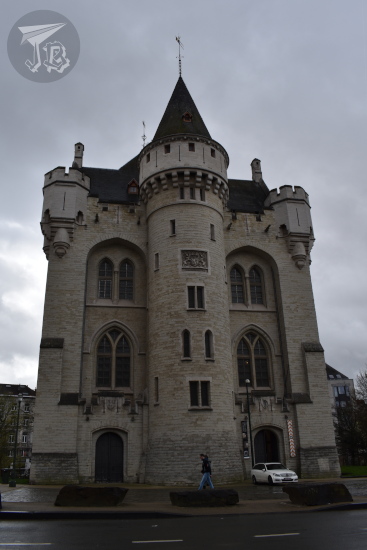
I had to take cover again as another shower hit, but it went away eventually. I walked further until I reached a former medieval city gate Porte de Hal | Hallepoort, which looks like a tiny French château – it was transformed into a a Neogothic castle in the 19th century, by Henri Beyaert. Today it is a museum, but I decided not to go in and head back towards the city centre.

Decorated medieval-like tower

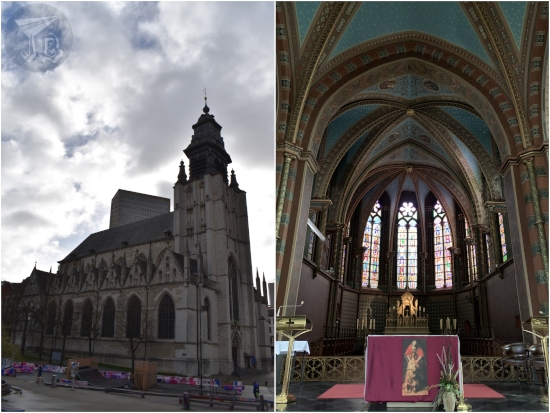
I backtracked towards the Church of Our Lady of the Chapel Église Notre-Dame-de-la-Chapelle | Onze-Lieve-Vrouw-ter-Kapellekerk which had been closed in the morning, and it had fortunately opened. I walked in. The church has an early 13th century Romanesque base, and the building was erected or reconstructed later in Brabantine gothic in the late 13th century. The nave was reconstructed in the 16th century and is Flamboyant Gothic. It leads to a dark-wood painted altar which contrasts with the wide, light nave. All in all, I guess I can say I was a fan of the gothic style in Brussels.

A gothic church with a dark wood altar and altarpiece, with coloured windows behind

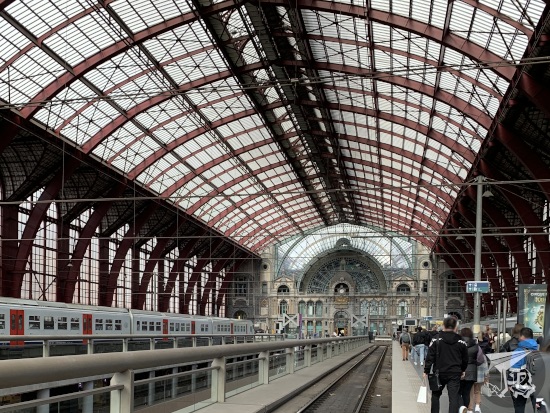
When I was in the church, I received a text from D****e, who had finally woken up. I walked back to meet her and we decided to take the train to Antwerp [Anvers | Antwerpen], where we had plans for the evening. We got off at the central station Antwerpen-Centraal railway station Gare d’Anvers-Central | Station Antwerpen-Centraal. Designed by architect Louis Delacenserie, it was built in eclectic style at the turn of the 20th century. It has two underground levels in modern tunnels, and the original station stands at level +1 (a total of four levels), with an extended train hall in iron and glass designed by the engineer Clément Van Bogaert. The station is sometimes called a “railroad cathedral” with domes, glass windows, an ornate clock, and marble floors.

Antwerp Centraal Station - a red iron tunnel-like structure with a decorated front with a clock at the end

The idea was to look for a place to have lunch near the main square, but the weather did not agree. We ate at a Wagamama chain restaurant instead, to wait out the storm, then headed to see the Bourse of Antwerp Handelsbeurs. It was the first building ever erected with the idea of being a commodity exchange place, but burnt down and was reconstructed in the 19th century by architect Joseph Schadde, who mixed Neogothic and iron architecture elements. The building was abandoned in 1997, but it was later recovered as a cultural and event centre. I absolutely loved it.

The Handelsbeurs inside - lots of gothic details supported by decorated iron beams

We had a look at the Cathedral of Our Lady Onze-Lieve-Vrouwekathedraal, but we were pressed for time and did not want to pay to have to rush through the building (a future visit, maybe), so we just peered inside. The cathedral is included in the Unesco World Heritage Site of “Belfries of Belgium and France”.

The cathedral of Antwerp

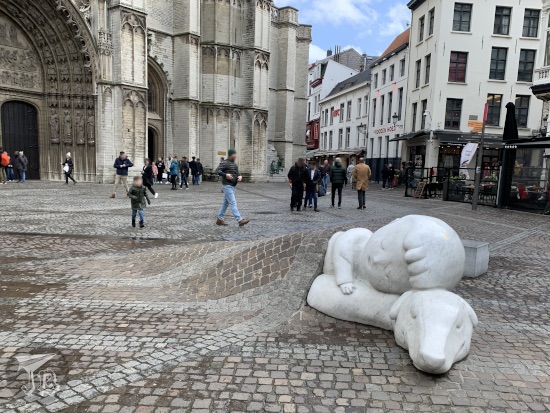
Outside the cathedral there’s a sculpture of a boy and his dog, from a sad novella about an orphan boy who wants to be a painter, and although written by an English author (Marie Louise de la Ramée) it sounds like the Belgian version of “The Little Match-Seller” tale. It’s called the Nello & Patrasche Statue Nello & Patrasche beeld and it was created by Batist Vermeulen.

A sculpture of a boy sleeping on his dog. The bricks on the road seem to tuck them.

Eyeing the weather, we decided to head out to our destination for the evening, the Trix concert hall – though this meant sacrificing seeing the main square, we were happy that we were under cover when it started hailing at around 16:15. On the way, we saw a mouse happily hopping the main streets, some sculptures, including the Monument to Rubens and the entrance to Chinatown. We had purchased VIP tickets to see the American band Starset, who toured with Japanese singer Hyde in 2018.

Starset is an American alternative rock band formed in 2013 by vocalist Dustin Bates. Aside from Bates (lead vocals, keyboards, soundboard, guitar), the core of the band is formed by Ron DeChant (bass, keyboards, backing vocals), Brock Richards (guitars, backing vocals) and Adam Gilbert (drums, percussion). Touring members currently are Siobhán Richards (violin, keyboards), Zuzana Engererova (cello) and Cory Juba (guitar, synth), and I guess they’ve got an honorary member in Ernie (Dustin’s French bulldog, who apparently attends pizza parties with VIPs when the band tours the US). One could say that Starset is a “concept band” revolving around sci-fi – the band’s fictional backstory refers to The Starset Society, who aims to alert the public about a “Message” they obtained from an outer-space signal. The fact that Bates holds a Master’s in electrical engineering and worked for the US Air Force and the International Space University might have something to do with the theme.

Starset released their fourth album, Horizons, in 2021. After Covid, cancellations and rescheduling, the Horizons Tour finally took place. Since we had a VIP ticket, we had early access and we had to be at the venue at 17:00. We got there a bit after 16:00 – and it was a good place with a hall, so we were under cover when it started hailing. In the end, we were not admitted till 17:20-ish, when a nice lady came and took our names to let us in. The first part of the experience was a short acoustic concert with some games and Q&A. For the games, you were given a raffle number, and if it was picked, you got to spin a wheel and maybe get a price – or a hug.

During the acoustic, we stood next to violinist Siobhán, who is not only beautiful, she is also super elegant. Dustin looked a bit like a hobo, to be honest, and he’s taller than I remembered him. We noticed that Ron’s arm was on a sling – apparently he had hurt himself and was unable to play during the tour, but he still tagged along. Afterwards, we had the chance to take a picture with the band, pick up the free goods that we had a right to – a CD and a signed poster. As we did, we moved into the actual concert hall, where we got the last available spot on the first row barrier.

Starset during the accoustic

The supporting artist was Smash into Pieces, a Swedish rock band composed by Chris Adam Hedman Sörbye (vocals), Benjmain Jennebo (guitar), The Apocalypse DJ (drums) and Per Bergquist (guitar). They were very good, and they fit really well with Starset, I thought. They started playing when the hall was full – it has a capacity of about 1100 people, and maybe they started around 19:30.

Setlist:

  1. Wake Up
  2. Glow in the Dark
  3. Big Bang
  4. Let Me Be Your Superhero
  5. Sleepwalking
  6. Running Away from Home
  7. Vanguard
  8. Boomerang

Smash into Pices front men.

This made the event run faster than expected. Starset were scheduled for 21:00 but came out at around 20:20, and the whole thing started with a bang – almost literally. A big curtain was pulled up and then let down when the band was on stage.

Setlist:

  1. Unveiling The Architecture (recording)
  2. Carnivore
  3. Manifest
  4. Echo
  5. Trials
  6. Icarus
  7. Unbecoming
  8. Monster
  9. It Has Begun
  10. Interlude. BMI ad (video recording)
  11. Satellite
  12. Ricochet
  13. Infected
  14. The Breach
  15. Die For You
  16. Devolution
  17. For Whom The Bell Tolls (Metallica Cover)
  18. Earthrise
  19. My Demons
  20. Boomerang

Dustin (vocals) and Brock (guitar; dressed as an astronaut) from Starset in the middle of the concert

My mind was blown because somewhat this setlist comprises all my favourite songs from the band: Carnivore, Monster, Ricochet and My Demons. The concert was full of little visuals and cool ambience tricks – I mean, Brock actually plays in astronaut suit. There was a lot of smoke and the lights were not good, but the concert itself was amazing. I was very grateful for the barrier, I would not have made it standing for the whole event – probably not even half of it. All in all, I had a lot of fun. I love that Dustin sings with his geek glasses, too.

After the concert, we managed to take the 23:09 train back to Brussels and even get a snack on the way – the one previous to the train I had wanted. That was lucky, because the last train was delayed over an hour and a half, and was a slow one.

24th March 2023: Brussels {Belgium, March 2023}

I woke up stupidly early to catch a short red-eye flight that was in the end delayed by the French air controller’s strike. Crossing security at the airport was a bit of an issue – I got stuck behind a class of teens going somewhere, and kudos to the teacher for not losing it when about 50% of the kids were sent back because they had not taken out their tablets / liquids / bottles of water and so on. Once inside, I had to head towards the Schengen area transit lounges, which were considerably fuller than beyond passport control in the early morning.

I landed in Brussels [Bruxelles (French) | Brussel (Dutch)], Belgium [Belgique | België] around 9:00. At the airport arrival lounge, I was welcomed by a rocket taken out from The Adventures of Tintin, and some fake flowering trees. I found the station – I had booked all my tickets online beforehand – and after a short train ride I reached the centre of Brussels. From the train I caught a glimpse of the famous atom-like building, the Atomium. I found my way to the hotel throughout a chaos of construction, and dropped off my luggage. Then, I set off to explore the city, which is called the comic capital of Europe: up to 50 comic character murals are painted on walls around the city, to the point that there is even a route dedicated to seeing them all – the Brussels’ Comic Book Route. I had not walked 200 m from the hotel when I saw my first mural, Le Scorpion.

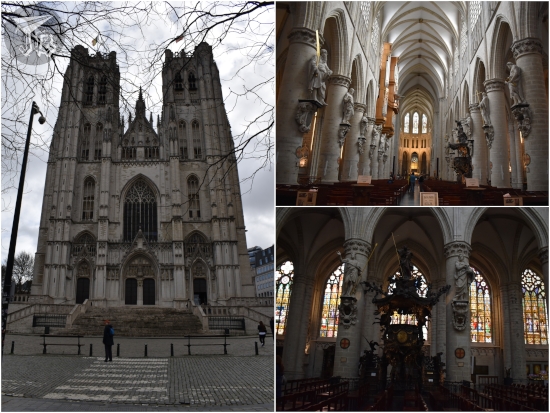
I headed towards the Cathedral of St. Michael and St. Gudula Cathédrale des Saints Michel et Gudule | Kathedraal van Sint-Michiel en Sint-Goedele. The current building was erected in the 13th century in Brabantine Gothic, which is a deviation from the French Gothic style that developed in the Low Countries (Belgium, the Netherlands, and Luxembourg). It features the use of sandstone or limestone in light colours (unfortunately, these materials are very susceptible to erosion), pointed arches, round columns with decorated “cabbage” capitals, and a very clear cruciform floor plan on churches. Unlike the Spanish cathedrals, there is no choir built in-between, so the perspective of the churches built in this style is fantastic.

The cathedral has two symmetrical front towers with tolling bells. It is accessed from the monumental staircase (built in the 18th century) on the western façade, by one of the gates under the bell towers. It does not feature a round or wheel window, but an ogival one. The nave is wide and lit from all the colourful side windows representing biblical scenes. The pulpit on the side is Baroque, carved in dark wood by the sculptor Hendrik Frans Verbrugge. A lot of the sculptures inside the cathedral are also Baroque, as the originals were destroyed by iconoclast movements (Beeldenstorm) in 1566 – this is a feature along most of the monuments I visited. Along with the Chapel Church and Our Lady of the Sablon, the cathedral is considered one of the three traditionally listed gothic churches in the city of Brussels. The organist was rehearsing, along with a cellist and a female singer, which was cool to hear as I explored. Underneath the cathedral, the archaeological site can be accessed to explore the Romanesque origins of the chapel of St. Michael.

The cathedral of Brussels

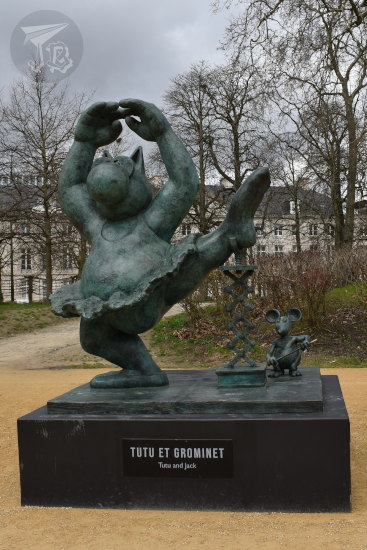
After the cathedral, my path took me through the park Parc de Bruxelles | Warandepark, featuring a pretty kiosk in metalwork and a bunch of trees striving to blossom. Along one of the axes of the park, 22 sculptures have been erected for a temporary exhibition “Le Chat déambule” Expo (9th March – 30th June 2023). They feature Le Chat, an anthropomorphic obese cat from a comic strip created by Belgian artist Philippe Geluck. Le Chat ran from 1983 to 2013, comically tackling everyday situations or presenting absurd conclusions.

An obese, anthropomorfic cat on a tutu raising a leg while a mouse uses a jack to keep the cat's leg up.

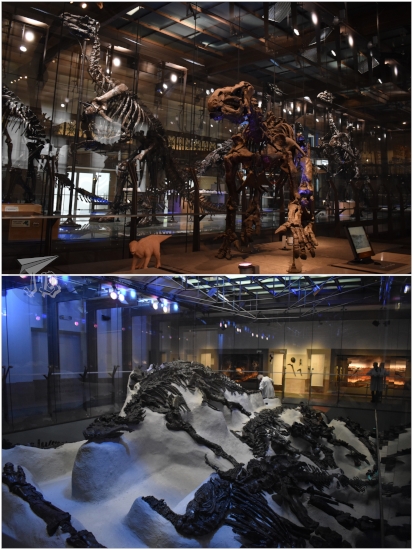
I continued walking for a bit of a long walk that led me past the Royal Palace of Brussels Palais royal de Bruxelles | Koninklijk Paleis van Brussel and the Monument to Leopold II. I went on until I reached something I felt that I could not have missed – the Museum of Natural Sciences of Belgium Muséum des sciences naturelles de Belgique | Museum voor Natuurwetenschappen van België, part of the Royal Belgian Institute of Natural Sciences. This was on my to-visit map long before this little trip came into plan. The museum’s Dinosaur Gallery is the largest room dedicated to dinosaurs in Europe. It holds a replica of Stan the T-rex (the original one was auctioned a while back and bought into private hands for 32 million USD), a piece of the Mont-Dieu meteorite, similar to the one which might have caused the extinction of dinosaurs, along with a bit of the boundary K-T (Cretaceous-Tertiary) or K-Pg (Cretaceous-Palaeogene) – this is a sedimentary layer of black rock with a lot of iridium that separates the “age of reptiles” and the “age of mammals” in the fossil registry.

There is also a room completely dedicated to mosasaur findings, and a lone Allosaurus fossil called Arkhane, which is considered the only discovered specimen of its species. Allosaurus was a Jurassic carnivore and this skeleton, clocking at almost 9 metres long, comes from Wyoming (US) and is 70% complete. However, this was tucked away in a completely different area of the museum. I also saw a Dunkleosteus head. This one was behind glass and I did not find the information to read if it was a cast, so maybe I found an original one?

Fossils at the Belgian Museum of Natural History: dinosaurs, mosasaurs, the Allosaurus Arkhane, and a massive fish head

The most important feature of the Dinosaur Gallery though is the collection of iguanodon fossils – the Bernissart iguanodons. Iguanodon (meaning “iguana tooth”) was the second dinosaur to receive a name. This herbivore lived from the late Jurassic to the early Cretaceous, and it is thought to have been able to on either two or four legs. In 1878, as many as 38 iguanodon fossils were found in the Bernissart coal mine. Nine are displayed in “wrong” standing positions – what was believed at the time to be correct, called the “kangaroo standing” – and nineteen can be seen partly covered in plaster just as they were found in the mine. The standing skeletons are too fragile to be dismantled now – though early palaeopathologists did the best they could, the skeletons contain a lot of pyrite, which disintegrates in contact with air, so they are extremely brittle. Thus, they are exhibited in a protective chamber as historical testimony. These fossils were the most abundant and complete ever found of the species. They unseated the previous English hegemony on iguanodon knowledge at the time, and one of them became the Iguanodon bernissartensis holotype. Today, one of the skeletons stands outside the case, posed in the modern interpretation of how iguanodon would have moved.

Collage: The iguanodons. The upper picture shows a modern interpretation of the iguanodon on four legs standing in front of the older "kangroo posed" reconstructions. On the bottom, the iguanodons as they were found in the mine.

Other exhibits in the museum include a gallery of evolution (which I saw backwards as it was full of high school kids), a mineral collection, a gallery on humans and human evolution, and a biodiversity collection. They have the preserved body of the last captive Tasmanian tiger that lived, and a small ward about the history of the museum and urban flora and fauna.

Collage. The centre is the mascot of the museum. Around it, a tasmanian tiger, a mammoth skeleton, some rocks and taxidermed animals.

I had lunch halfway through the museum visit, and then set off to the centre of the town, undoing my previous way. By now I had got a hold of the construction detours, and I reached the city centre more easily. I walked past Mont des Arts | Kunstberg next to Central Station, with a very fun clock, and eventually reached the central square Grand-Place | Grote Markt. This central square, declared Unesco Heritage site in 1998, is surrounded by monumental buildings dating from the 15th to the 19th century, forming a particularly recognisable unit: the Town Hall Hôtel de Ville | Stadhuis, a Brabantine gothic building with a spire or tower; the Maison du Roi | Broodhuis in Neogothic style; and the so-called guildhalls and private houses, traditionally built buildings, either crammed together and cutely thin, or almost palatial – including the house where Victor Hugo, the writer, used to live in the city.

Grand Place. The buildings are light coloured or grey with a lot of gold decoration

I went down one of the side streets, debating a typical Belgian waffle, but I was not brave enough to try and eat one on my own. I saw the Adventures of Tintin mural (by Belgian cartoonist Hergé) painted on a wall (art by Oreopoulos and Vandegeerde). About five minutes away from the square, one of the corners hosts the fountain known as Manneken Pis, which depicts a naked little boy urinating into the basin. The current fountain features a replica of the boy, the original (sculpted by Jérôme Duquesnoy the Elder) is in the Brussels City Museum. The one on the fountain is often dressed up, and this time round, it was characterised as a construction worker – I can understand why. One of the many legends about the design tells of a young boy who put out an explosive charge fuse by peeing on it.

Collage. Tintin and Captain Haddock climb down some stairs. Manekken Pis fountain boy dressed in yellow reflective clothing.

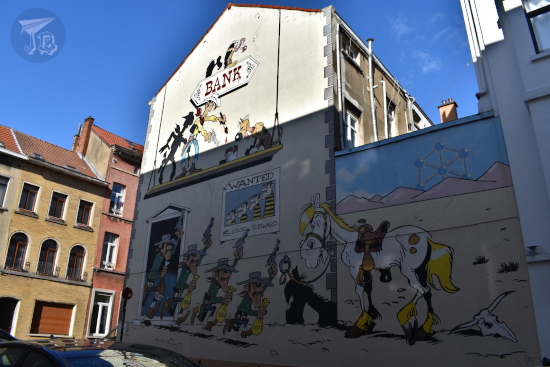
I walked on to find another comic mural I was extremely interested in – actually two, but the Astérix mural (by Goscinny and Uderzo) was covered by construction. After a quarter of an hour I found the Lucky Luke mural (by Belgian cartoonist Morris, painted by Oreopoulos and Vandegeerde). When I was a child, I absolutely loved the Lucky Luke animated series, and especially his white horse Jolly Jumper and dog Rantanplan, so this was a bit of a tribute visit, rather than tackling the whole comic route.

Lucky Luke mural. The Daltons have robbed a bank and Luke prepares to arrest them (again)

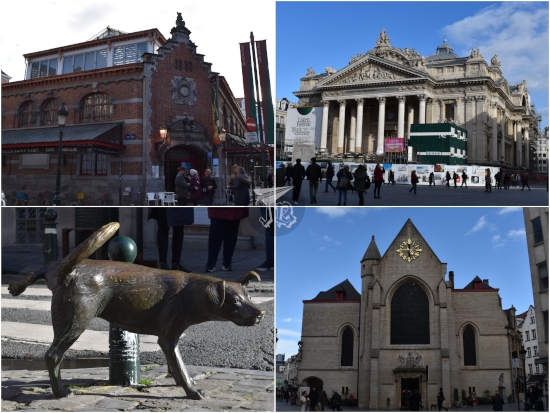
On my way back towards the city centre, I stopped by a number of points of interest – the Baroque church and convent Église Notre Dame aux Riches-Claires; a mural by artist Mr.Doodle called Mr. Doodle Artwork; the late 19th century market Halles Saint-Géry; the 12th century church Église Saint-Nicolas; a “parody” of the Manneken Pis depicting a dog doing the same Zinneke Pis; and the Brussels Stock Exchange Bourse de Bruxelles (under renovation).

Collage showing different buildings in Brussels, and a bronze medium-sized dog peeing on a bollard

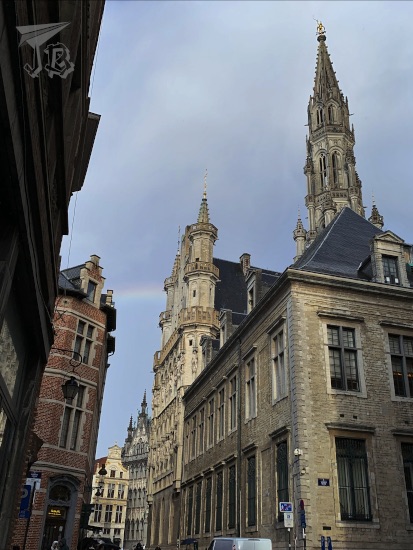
As I was making my way back towards the Grand-Place, the weather, which had been behaving most of the day – there had been some rain while I was inside the museum – took a turn for the worse, and there was a bit of a shower. The problem was not the rain itself, but the wind that made it come sideways. I had packed my umbrella, though it was not too helpful. When rain subsided down, I continued walking, and I got to see a rainbow over the Grand-Place. Great timing!

Rainbow peering through buildings at the end of the street in Brussels

It was only round 18:00 but I decided to go back to the hotel, check in, and get some food and rest. En route, I crossed through the classy shopping gallery Galeries Royales Saint Hubert. At first I had considered grabbing a bite here, but prices made me decide on a supermarket dinner, which was all right. I ate a sandwich and lots of berries.

After checking in, and warning the hotel staff that my companion would arrive late during the night, I got some rest, warmed the room, and when it was dark, I went out to see the illumination on the cathedral Cathédrale des Saints Michel et Gudule | Kathedraal van Sint-Michiel en Sint-Goedele, the square Grand-Place | Grote Markt, the fountain Manneken Pis and the shopping centre Galeries Royales Saint Hubert.

Cathedral and Grand Place at night, illuminated in warm light

I finally returned to the hotel and fumbled a bit with the shower until I found the nice massage mode.

24th – 26th March 2023: Brussels & Antwerp (Belgium) {Belgium, March 2023}

Situated in northwestern Europe, Belgium is part of both the Benelux and the Low Countries (an area historically a bit wider, including parts of France). It is a Constitutional Monarchy, a former colonial country and an early adopter of the Industrial Revolution. The official languages are Dutch, French and German – I mostly heard French – but people switch to English without any issue or problem. The country might be best-known for hosting many European Union institutions – Belgium was one of the founding members of the alliances that gave way to the current UE: the European Coal and Steel Community (1951) and the European Economic Community (1957). Today, Brussels is home to the European Commission, the Council of the European Union and the European Parliament, which was in session; that meant a lot of security and police. Something I noticed was that in general, Belgian people are extremely nice – albeit firm when they need to be. Not just… polite, but nice. It was almost uncanny, I kept expecting people to want something in return.

I took a long weekend out to fo some sightseeing in Brussels, meet my friend D****e, and attend a Starset concert in Antwerp. Even if there were a bunch of unexpected bleeps, most related to weather, most went fine, and I was able to see a bunch of cool things.

12th & 13th February 2023. The Epic Apocalypse Tour in Madrid (Spain)

The year 2020 was going to be so amazing that I actually would have had to choose the things I wanted to do and sacrifice others. It didn’t turn out that great in the end, with lots of rescheduling and cancellations. I was eventually able to budget time and money for one of those rescheduled events – the joint concert by the metal bands Epica and Apocalyptica in their Epic Apocalypse Tour. For a while, however, there was a bit of uncertainty with dates, as they bounced between Sunday 12th and Monday 13th of February, so I needed to juggle work dates in order to make sure I’d be free on Monday. In the end, I was all clear, all the concert-related activities were set for Sunday evening, and I decided to make a two-day trip out of it – I needed to take a hotel for Sunday anyway.

I arrived in Madrid around 9:30 in the morning. I had some time before my first appointment so I walked into one of the large parks of the city Parque del Buen Retiro, which is part of the Unesco World Heritage Site Paisaje de la Luz (Light Landscape), officially called Paseo del Prado y el Buen Retiro, paisaje de las artes y las ciencias, declared in 2021.

Parque del Buen Retiro was built in the 17th century for one of Felipe IV’s palaces, and it was opened in the late 18th century as public park. The park was almost destroyed during the war against Napoleon’s troops in the early 19th century, so most of it has been rebuilt. Aside from the obvious flora, it features sculptures, fountains, buildings… It is home to a lot of birds, and unfortunately a large number of invasive and fearless monk parakeets (Myiopsitta monachus), whose culling has been controversial in recent years. I got to see common blackbirds (Turdus merula), a European green woodpecker (Picus viridis) and a European robin (Erithacus rubecula).

One of the most important features of the park is the sculpture Monumento al Ángel Caído, which represents an angel falling from grace. It was originally designed by Ricardo Bellber, who made it in plaster in 1877. It was later cast in bronze and the original plaster destroyed, and eventually the sculpture was made into a part of a fountain in 1885. Around the area, there is also an ancient water mill, and to my surprise, the almond trees (Prunus amygdalus) had started blossoming.

Retiro Park collage: a pathway with trees and bushes on both sides, ducks, and a robin.

Retiro Park collage: a water mill, blossoming almond trees, and the fallen angel fountain

At 10:15 I had a guided visit to the Real Observatorio de Madrid (ROM), commissioned around 1785 by Carlos III, as an centre to develop and study astronomy, geodesy, geophysics and cartography. The main building is the astronomical observatory, built by Juan de Villanueva in what then was the outskirts of the city. Today, ROM belongs to the National Geographical Institute (IGN), and it is home to the National Astronomical Observatory, the Central Geophysics Observatory, and the data gathering division of the National Volcanic Service, though no measurements are taken there. The main astronomy measurements are carried out in the Centro Astronómico de Yebes, in a town around 80 km north-west of Madrid. The observatory is also part of the Unesco World Heritage Site.

The visit comprises three stops. The first one is the main building, called Edificio Villanueva, which has three rooms – the main rotunda with a Foucault pendulum, the library, with the spot where gravity was first measured in Spain, and the “Time room”, where the sun used to be traced to determine the hour.

ROM collage. A small Neoclassical building, an inner room with a pendulum and telescopes, a telescope and a 19th century library.

The second stop is the Great Telescope, a replica of one that William Herschel built in the 18th century – Hershchel was one of the greatest telescope makers of the time, and is credited with discovering the planet Uranus, two of its moons, and two moons of Saturn. The telescope was destroyed during the war against the French, but later rebuilt thanks to the number of laminates that had been preserved – the original had a focal distance of 7.6 m and a 61-cm diameter mirror (which is displayed in the main building), and Herschel himself considered it the best he ever built.

Herschel grand telescope: a wooden scaffolding structure keeping a huge black tube pointing at the stas

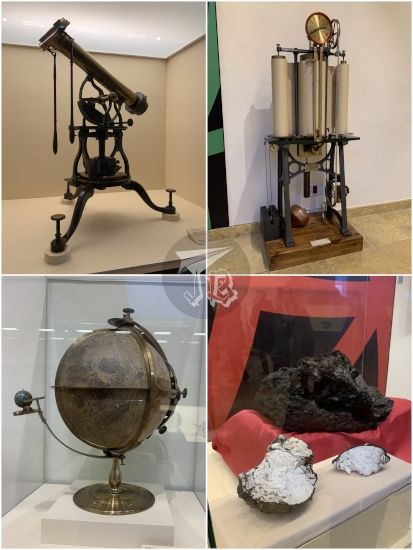
The final stop, the little museum of “Earth and Universe Sciences” has a small collection of ancient instruments used for astronomy, navigation, and geophysics. There are also a couple of seismographs – one of them new, which is up and running – and material retrieved from the volcanic eruptions of El Hierro in 2011 and La Palma in 2021.

Collage. Ancient telescope, old tide measuring device, an old globe, and lava bombs

I had planned for a typical sandwich at an iconic bar afterwards, but I ran into a political demonstration. Thus, I scratched that idea and took the underground westwards. When I was in Egypt, one of the places I visited was Lake Nasser, created by the Aswan High dam. The lake swallowed a lot of villages and monuments, but a few of them, such as Abu Simbel and the Temple of Philae were saved by Unesco. Between 1960 and 1980, a total of 24 monuments were saved, and five out of these were presented as “grants-in-return” to five countries which had offered exceptional technical and financial assistance to the campaign – Germany, Italy, Netherlands, the United States and Spain, the latter being impressive as Spain was in the middle of the dictatorship, and pretty shunned by the international community at the time.

The monument was a small and ruined temple in the now-flooded town of Debod, to which it owns its name Templo de Debod (Temple of Debod). Dedicated to the god Amun, it was built around the location of the First Cataract of the Nile, some 15 km south of Aswan, about 2200 years ago, though the core of the building may have been older. The monument was actually affected by the original dam at the beginning of the 20th century, and it was covered in water for most of the year, which destroyed its colours and damaged the reliefs.

During the Unesco salvage mission, it was dismantled, and eventually granted and taken to Spain, and “freely” reconstructed – a lot of information had been lost, and there were missing blocks. National stone was used to fill in the gaps, and the gates (remains of the pylons) were built in the wrong order, according to some old pictures. The restorers built an air-conditioning system, a wooden roof, and the main hall was closed off with a glass door and window panes. Today, the temple is open to the public at weekends, but unprotected from the Spanish weather – rather different from the Egyptian one – and pollution, it is rapidly deteriorating.

I went inside the temple once when I was a child, and I had a clear memory of it that kept surfacing when I was in Egypt – so I wanted to go back. The entry is free, but capacity is reduced, so I had to queue for almost an hour to enter. I finally matched my memory to reality. The interior of the sanctuary has a small chapel and some carved stones had been taken to a makeshift second floor to display them as a little museum.

A collage of a small Egyptian temple - it has two floating gates that lead up to the main building, which is small with four columns. One picture shows a tiny and dark inside room with an altar.

After the temple, I got lunch on the go, then walked towards the hotel to check in and change clothes. Around 16:15, I set off to La Riviera for the concert. I had a Meet and Greet ticket and had to be there before 17:00. Personnel from the venue were extremely nice, and there was no chaos at all, even if things had been a little disorganised and some fans were lacking M&G confirmation emails. Everything was well-handed and everyone who had paid for an upgrade got through. There were about 30 people to meet and greet Epica and we were ten for Apocalyptica.

Apocalyptica is a Finnish four-man band – Eicca Toppinen, Perttu Kivilaakso, Paavo Lötjönen and Mikko Sirén – founded in 1993. They are “semi-officially” a symphonic metal band, but they’ve ventured into everything from Metallica covers (which was their origin) to pure classical works. They have a very specific style heavily using classical cellos and combining them with modern drums. They currently collaborate with American – self-identified as Cuban in the concert – singer Franky Perez for vocals.

Meeting the four of them was really fun. I got autographs and took the most epic picture I’ve ever taken with a band or artist before. As we were only ten, after it was over, I had time to buy some merchandising and still be the second person to settle on first row – despite having decided that I was going to sit back and relax.

Apocalyptica white and black poster, signed by the four members

General admission started at 18:00, and the crowd was surprisingly tame throughout the whole thing. The venue filled up and the supporting band, Wheel, came up at 18:30. Wheel is a Finnish progressive metal band that consists of James Lascelles (Vocals/Guitar), Santeri Saksala (Drums), Aki ‘Conan’ Virta (Bass) and Jussi Turunen (Lead Guitar).

Wheel Setlist

  1. Hyperion
  2. Blood drinker
  3. Movement
  4. Vultures
  5. Wheel

Wheel playing, each member at his insturment: bass, guitar, singer and drummer

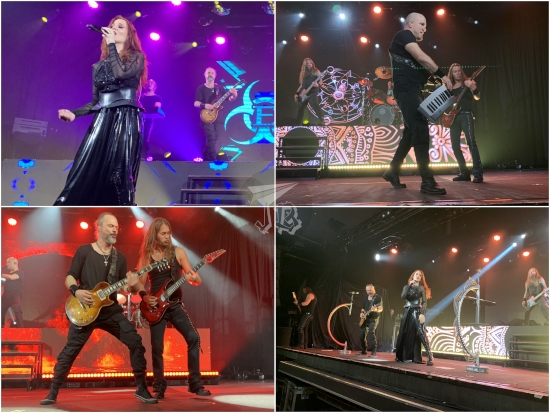
The second band was Epica, which I remember having listening to back when the world was young. They are a Dutch symphonic metal band currently composed by Simone Simons (lead vocals), Mark Jansen (rhythm guitar, vocals), Coen Janssen (keyboards, synthesizer), Ariën van Weesenbeek (drums), Isaac Delahaye (lead guitar) and Rob van der Loo (bass). Simone can go insanely high with her voice, and she has an amazing presence on stage, and the whole band has an immense amount of energy – she also reminded me of a comic character. The keyboardist had a lot of personality too, and he was extremely fun.

Epica Setlist

  1. Abyss of Time – Countdown to Singularity (recording)
  2. The essence of silence
  3. Victims of contingency
  4. Unleashed
  5. The final lullaby
  6. The obsessive devotion
  7. The skeleton key
  8. Rivers
  9. Code of life
  10. Cry for the moon
  11. Beyond the Matrix
  12. Consign to oblivion

Collage of Epica playing, showing different members at their choice of insturment - singer, bassist, guitarist, and keyboardist with a portable keyboard

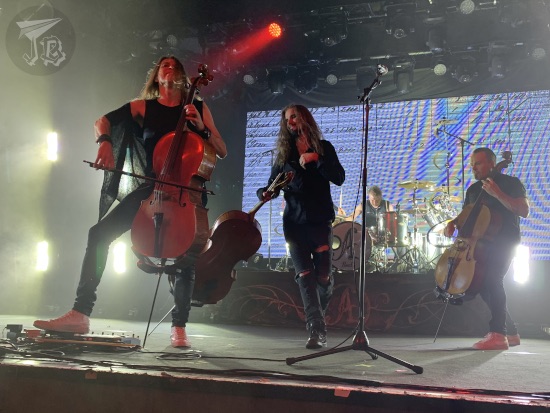
Finally Apocalyptica came on stage, and it was extremely fun. The things those guys do to their classical cellos would make some classical musicians cry, but the sound is super-powerful. We had Franky Perez for vocals, and a very fun moment regarding “listen to our classical music album at home, because we still feel like death metal”. They interacted a lot with the public, and it felt somehow very friendly / warm – yes, I’m talking about metal here. It was really that fantastically weird.

Apocalyptica Setlist

  1. Ashes of the Modern World
  2. Grace
  3. I’m not Jesus
  4. Not strong enough
  5. Rise
  6. En route to mayhem
  7. Shadowmaker
  8. I don’t care
  9. Nothing else matters
  10. Inquisition Symphony
  11. Seek & Destroy
  12. Farewell
  13. In the Hall of the Mountain King

Apocalyptica playing with Franky Perez. Perez is in the foreground, dressed in black. The thee cello-playing members are in the frame, playing. The drums peek behind them, but you can't spot the drummer

Apocalyptica playing at La Riviera. They have classical cellos. Two of the members stand on the sides, playing their cellos. Another one is walking swinging his as if it weighed nothing, The final one is slamming drums in the background.

We finished off just short of 23:00, I bought off some fast food for dinner, and headed back to the hotel to have a shower and get some sleep. I was woken up early in the morning due to the cleaning crew and the garbage mini-vans noises, but I did not leave bed until 9:00, then set off at 9:30. I bought some cold coffee on the way and walked into the former royal palace gardens, now public park Jardines del Campo del Moro.

Though I’d seen the gardens a few times before, this was the first time I actually walked into them. Despite the frost covering everything, I got a nice view of the palace and different fountains and buildings sprinkled throughout the green – Chalet de Corcho, is a small hut with coloured windows; and Chalecito de la Reina a wooden house that is currently closed. I was insanely amused by a little grass-cutting robot.

Jardines del Campo del Moro. Collage. It's winter and most trees are grey and bare. At the end of the walkway stands the Neoclassical Royal Palace. Two smaller buildings - one of them is white with brown beams, reminscing of German architecture; another one is a small kiosk with colourful windows - red, green...

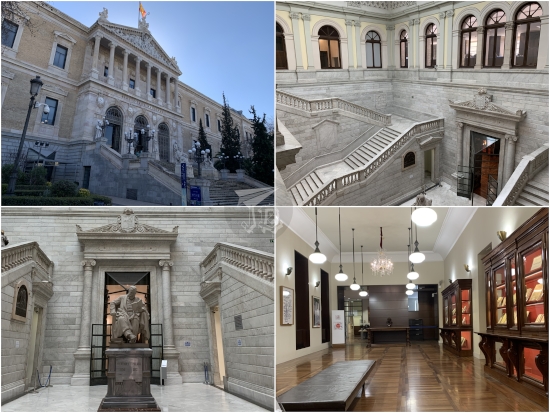
I wandered around for an hour or so, then headed off via underground to the National library of Spain Biblioteca Nacional de España for the absolutely worst guided visit of my life. Like… it’s true that it’s free, but tickets run out within hours of coming out – on the 20th of the month, for the following month. I’d actually been trying to do this since Covid lockdowns ended… It turns out, we did not see any real books, we could not even peer into the reading area, the book and reading museum is closed and the only information we got was… that the guide did not like the Library. We did not get to see anything interesting or that we could not see on our own, and we did not get to learn anything, so this was a huge blunder. Live and learn – but it was one of the few things that was open on a Monday. The library is a huge Neoclassical building with a fantastic marble staircase inside. The doors and gates are protected by intrincate ironwork fences.

Biblioteca Nacional de España. A Neoclassical building in white and grey tones. The exterior has columns and statues of writers. The interior showcases a pair of twin staircases with the statue of one of the most important library directors between both.

I met with family for a quick lunch and then we went for a walk. We had thought about going to one of the terraces to see the cityscape, but it was closed because it was a Monday. We ended up at the Parque del Retiro park again to make some time and walk. We sat in the sun for a while, then went to see the Palacio de Velázquez there. Currently, it’s part of the modern art museum Museo de Arte Reina Sofía, and I did not really care much about the exhibits, but I like the building. Architect Ricardo Velázquez Bosco built it in brick (with ceramic tiles by Daniel Zuloaga) for the Mining Exhibit in 1883, inspired by London’s Crystal Palace, now gone. The interior is pristine white with hints of iron architecture, but the building’s official style is “neorenaissance historicism” whatever that means.

Palacio de Velazquez: A brick building with large windows and tile decoration. The inside is all white with bits of iron architecture.

Velázquez Bosco and Zuloaga also came together when they designed another building I really like, the glass-and-iron greenhouse Palacio de Cristal, which was built to home tropical flora and fauna from the Philippines in an exhibit in 1887. In front of the palace, there’s a small pond home to some cheeky ducks and geese.

Palacio de cristal. A huge greenhouse with a dome, and two wings. A white duck wanders in the foreground. Between the greenhouse and the duck there's a small pond.

Then, we went to have a snack. Trying to find something on the map before the trip, I’d come across a place called La Mejor Tarta de Chocolate del Mundo, which translates to “The best chocolate cake in the world” and that had to be tried! It was really nice, even if the place was pretty small and felt a bit cramped.

A slice of chocolate cake in front of mugs and teapots

We finally took a stroll down towards the sunset, and I took the train back without much of a hitch, then drove home

3rd & 4th February 2023: Final Fantasy Distant Worlds 35th Anniversary – Coral – in Barcelona (Spain)

3rd February 2023: Mummies, fish, and music

Though I would not have minded to become a gamer back in the day, my joint issues discouraged this. Thus, my relation with the Final Fantasy saga is tangential. However, my sibling is a big fan of one of the instalments, and last year I accompanied them to Final Fantasy VII Remake Orchestra World Tour in Barcelona in 2021. Having had more time to prepare for this one, we got VIP tickets, and I planned a two-day outing.

Our arrival in Barcelona happened right on schedule, and we walked from the station to Caixa Forum Barcelona to see the exhibit Momias de Egipto. Redescubriendo seis vidasEgyptian mummies; Rediscovering six lives, in collaboration with the British Museum. I am not sure whether the items are part of the actual collection over there or are in the archives, because I don’t really remember seeing any of the mummies. The Barcelona exhibits focus around six mummies and how they lives could have been before their deaths. Aside from the actual mummies and their sarcophagi or coffins, there are objects that they may have used in life, and images of what the bodies look like inside the wrappings.

It was at the very same time interesting and creepy, everything we can get to know through technology about these poor souls who passed away millennia ago. There was information about their age, illnesses, and objects they had been buried with – god statuettes, jewellery, funerary miniatures… One of the mummies in display was that of a small child with his face painted on the wrapping, that was more than a bit creepy, to be honest.

A collage showing a a mummy and a turquoise wrapping; a sarcophagus; four canope jars; three statuettes: Horus, an ibis, Thoth; close-up of a sarcophagus, with bright colours; a mummy and a plain wooden casket.

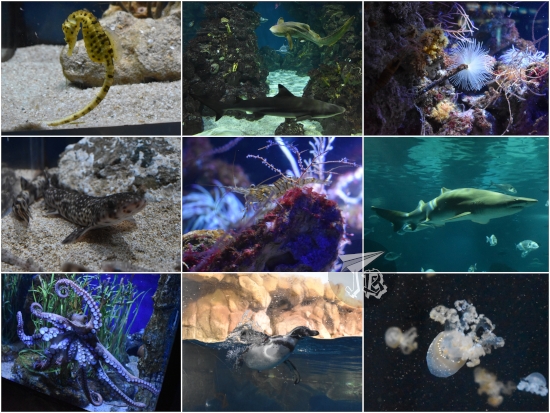
We took the underground towards the waterfront to visit L’Aquàrium de Barcelona, located in the harbour. With more than 11,000 animals and 450 species, it is the largest aquarium dedicated to the Mediterranean Sea. It was inaugurated in 1995 and it holds 35 aquariums, including an oceanarium with capacity for almost four million litres of water (36 metres diameter, five metres high) with two tunnels at the bottom. Species-wise, the aquarium does not have anything out of the ordinary, but the size of the tiger sand sharks is impressive. There are a few sharks, some tropical fish, axolotls, frogs… and a very fun sperm-whale room to keep the jellyfish in darkness.

A collage of the aquarium. Seahorse; swimming sharks; anaemone; baby dogfish shark; tiny crustacean similar to a prawn; sand tiger shark; octopus trying to eat the viewers; penguin showing off; fabulous tiny jellyfish

We grabbed an expensive-but-convenient bite to eat at the aquarium itself during some of the feeding events to make sure the cafeteria was empty. AFter we had finished viewing all the exhibits, we went on towards the hotel, which was well-placed between the auditorium and the shopping centre. Since check in had been so bad when we went to the previous Final Fantasy concert, this time we had booked different accommodation, and it was a total 180 – everyone in the hotel was super friendly, and we had zero issues. We procured some sandwiches for dinner, then got ready for the concert.

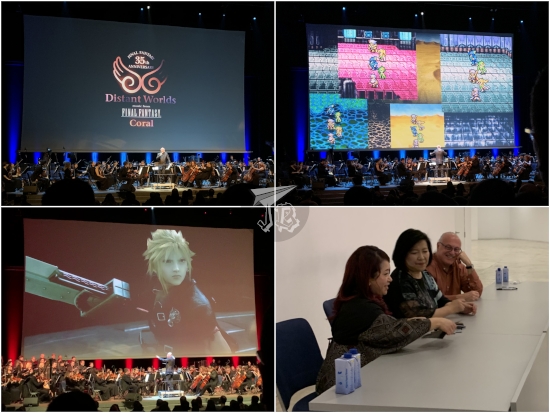
The Final Fantasy Distant Worlds 35th Anniversary – Coral – directed by Arnie Roth is a compilation of the background pieces from all the Final Fantasy games, from the first (1987) to the latest to date not counting the remakes (Final Fantasy XV, 2016). The concert was held at the CCIB – Centre de Convencions Internacional de Barcelona. We had no idea what time doors would open, but I calculated that an hour should be good for queuing for merch and then get to our seats.

By the time we got to the queue, the concert booklet had already been sold out. When we reached the front, my favourite plush toys were also gone. I decided to get the previous year’s CD in order to get it signed later at the meet & greet event that was included in the ticket we had bought. Looking back, maybe I should have asked for the autographs on the tote bag we got for the spending.

The concert had two halves and an encore, and was… strangely not very coral, for something called so. The choir was placed over to one side, and only did three or four songs – they actually did not show up for the whole first half. The set list was accompanied by projected images on the screen and it was super-impessive to see the first 8-bit games at first compared to what the technology of the latest Advent Children (movie from Final Fantasy VII) managed to create.

    First half

  1. Final Fantasy I~III: Medley 2002
  2. Final Fantasy III: Eternal Wind
  3. Final Fantasy IV: The Red Wings ~ Kingdom of Baron
  4. Final Fantasy IV: Main Theme of Final Fantasy IV
  5. Final Fantasy V: Home, Sweet Home ~ Music Box
  6. Final Fantasy V: A New World
  7. Final Fantasy VI: Phantom Forest ~ Phantom Train ~ The Veldt
  8. Final Fantasy VI: Kids Run Through the City
  9. Final Fantasy I~VI: Battle Medley 2022

    Second half

  10. Final Fantasy VIII: Liberi Fatali
  11. Final Fantasy XI: Ragnarok
  12. Final Fantasy XII: Flash of Steel
  13. Final Fantasy VII: Aerith’s Theme
  14. Final Fantasy XIV: Torn from the Heavens
  15. Final Fantasy XV: Apocalypsis Noctis
  16. Final Fantasy IX: Not Alone
  17. Final Fantasy X: 素敵だね [Suteki da ne] (Isn’t it wonderful?)
  18. Final Fantasy Main Theme with Choir ~ The Definitive Orchestral Arrangement ~

    Encore

  19. Final Fantasy X: Zanarkand
  20. Final Fantasy VII: One-Winged Angel

The concert was all right. I did not feel the general chill I had through the previous one. I really liked Liberi Fatali and One-Winged Angel, but I guess I don’t have enough of an emotional connection with most of the games. Aside from the conductor Arnie Roth, we had composer Yoko Shimomura present, and vocalist RIKKI, who is the original singer of 素敵だね in Japanese, and did the live version.

Collage. Three pictures show a classical orchestra with different things projected on the screen behind them - the logo of Distant worlds, several 8-bit screenshots of games, a very realistic depiction of a blond man with a very unrealistic sword. The last picture shows singer RIKKI, composer Yoko Shimomura and conductor Arnie Roth

The M&G was fun, and I got to tell Roth that when I grow up I want to have as much fun as he does at work. They signed autographs and took pictures with people – it was much less stiff than the usual, too. We headed off afterwards for a sandwich, a shower and a good night’s sleep. In general though, not much value for money considering how much more expensive the VIP tickets were, even though the seats were good. Also, the fact that most merchandising sold out showed poor planning.

Collage. The ticket reading the name of the concert, the autographs of the three main artists, and a plush of a Final Fantasy imaginary being, it looks like a white teddy bear with a huge pink nose, a red ball on top of it and cute wings

4th February 2023: Ramen with Friends

We had bed and breakfast at the hotel, and the latter was fantastic. The buffet had both a juice bar and a milk bar – both of which I sampled, of course. I overdid it with the fried egg, I fear, but they were just cooked and it looked just too appetizing not to fall for one. After breakfast, we packed up, vacated the room, and asked the hotel to keep our bags for a couple of hours. We went to the science museum Museu de Ciències Naturals NAT, where we spent a couple of hours. This is the only place where they refused to speak Spanish to us.

The museum is divided in several areas. The first one is “history of the Earth”, where you can see a few interactive exhibits, fossils and reproductions. The second one is the collection of living animals, most of the stuffed, some of them just skeletons. There was another one about fungi – with the edible ones exhibited in tins. Then there was one on plants, and finally rocks and minerals. Not a bad place to spend a couple of hours, but it is just one of those places that takes itself much more seriously than it should, to the point that it felt pretentious. Some items were exhibited over and over again, as if they just wanted to use up the room – I counted at least eight elbaite specimens in different locations, and there were a bunch of reproductions taking up important spaces, you would believe they were originals if not paying lots of attention to the writing, and the blue light made for horrid photographs.

Collage. Four pictures show prehistoric animals in blue light, stuffed animals, a tin of mushrooms along real specimens, a red algae and some shiny rocks.

We transited to Sants train station to drop off my sibling’s bag at the cloakroom there and went on to meet my Barcelona friends E**** and P***o who had offered to take us to eat really-real Japanese ramen. Since I had a feeling that the restaurant would be on the small-ish side, and my sibling’s luggage was a bit oversized since they had cosplayed for the concert, I decided on the Sants detour for convenience.

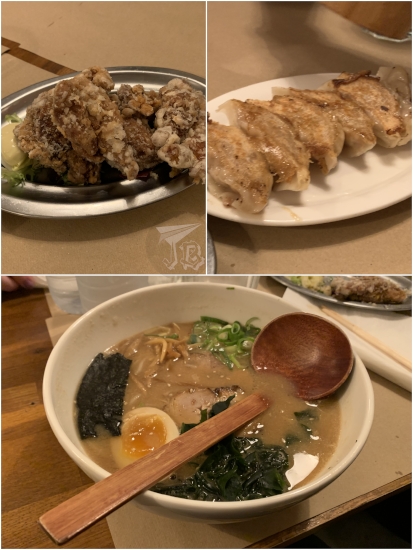
The restaurant is called KOBUTA ramen i més (Kobuta Ramen and More) and I was amused when all of us made the same choice – tonkotsu miso ramen with an extra of half an egg, and water; then we shared some gyoza (dumplings) and karaage (fried chicken). The restaurant is not cheap, but the food makes up for that, it is very authentic Japanese food.

Collage. A dish of breaded fried chicken, some dumplings, and a bowl of ramen, with the ingredients floating - algae, half an egg, noodles, pork meat and spring onion

Though P***o had to leave early, the rest of us headed off towards the bullfighting-ring-turned shopping centre Arenas de Barcelona. There, we climbed up the terrace for views, then sat down for drinks and a long chat. We also popped into the local comic store, since it was convenient, and eventually we headed off to the station.

Collage. Shopping centre las Arenas, a round building that used to be a bullfighting ring, there are two pictures, one by daylight and another one at night, lit up. There's a picture of the views- two clock towers leading to a palace; finally three glasses together showing brightly coloured drinks - yellow, orange and dark pink

The train ride home was surreal. People playing music on their phones, yelling, talking loudly and making the footrests squeak – apparently there had been some kind of sporting event for kids and a lot of families were coming back home. All in all, not a bad couple of days, lots of laughs, I got to see dear friends and eat nice food, and listen to cool music – in the CCIB, not on the train.

12th & 13th November 2022: Santiago de Compostela (Spain)

Here’s a little secret – people don’t like flying on the 13th, even less when it’s a Tuesday. Thus, I came across a bunch of awesome offers for the 13th of December, which unfortunately I could not take up due to work uncertainties. What I could muster was a mini getaway on the weekend of the 12th/13th of November, to the northern Spanish town of Santiago de Compostela. There were a few reasons for this choice – one, cheap flights; two, I’ve recently started considering a route through the so-called Camino de Santiago (St. James’ Way); and three, pandemic shuffled ‘Holy Years’ round so there was a special gate to the cathedral open that I wanted to see. I flew out around noon on Saturday and came back on Sunday night. It was a perfect plan for a decompressing getaway.

Santiago de Compostela is known as one of the most important pilgrimage cities in the world. According to the Christian tradition, the tomb of Apostle James was found in the area in Middle Ages (different sources vary throughout the 9th and 11th century), and the pilgrimage to visit the remains became one of the most important in the Christian faith, alongside Rome and Jerusalem, to the point that the pavement proudly states that “Europe was built on the pilgrimage to Santiago”. While I’m not religious, I have a thing for religious architecture, and as mentioned above I’ve been thinking about the Camino for a while, and visiting the goal felt a good way to start organising how I wanted to look at things.

However, let’s say it wasn’t the most perfect getaway ever. Though the flight was on time, and pretty short, there was turbulence – not something too out of the ordinary, but here’s something you might not know about me. Back in the mid-nineties, I sort of crash-landed in the Santiago airport, so let’s say I was not so invested in a bumpy flight.

As the flight had been very cheap (about 30€), I had decided to splurge a little in the hotel – and I found a not-so-bad offer of half-board at the Parador de Santiago – Hostal Reyes Católicos, downright at the centre of the city. It is located in the old pilgrim hospital, and it is a magnificent building, aside from a five-star hotel. I arrived around 14:00, and the room was not ready – fair enough. I wanted to get there early in order to drop off my luggage, and make sure I could arrange my dinner reservations for a convenient time. One of the reasons I decided to book half-board in the Parador was to guarantee myself a meal late in the evening, as I had booked a walking tour at 20:00, and the main restaurant served dinner till 22:45.

Wide shot of the Parador. It shows a severe building with an ornate gate. The sky is bright blue.

Unfortunately, the check-in staff “had booked me” at 20:30, and they asked if that was okay. I replied it wasn’t, and explained the reason stated above – the staff then said that they could accommodate me at 22:00 at the secondary restaurant, but not at the main one. I answered that then I’d have dinner at 22:00 at the secondary restaurant then, but the staff asked me to check the menu. I stated that it did not matter. I needed my dinner to be at 22:00, and if the main restaurant wasn’t available, it would have to be at the secondary one. The staff asked me to check the menus, and I explained again that I had a tour from 20:00 to 21:30 – I needed dinner at 22:00. I thought that was resolved, and as it was too early to get a room, I picked up my camera, left my backpack in the locker room, and went on my merry way to explore the outdoor “monumental route” within the historical city Ruta Monumental de Intramuros. The old city of Santiago is part of the Unesco Heritage Site Routes of Santiago de Compostela: Camino Francés and Routes of Northern Spain Caminos de Santiago de Compostela: Camino francés y Caminos del Norte de España.

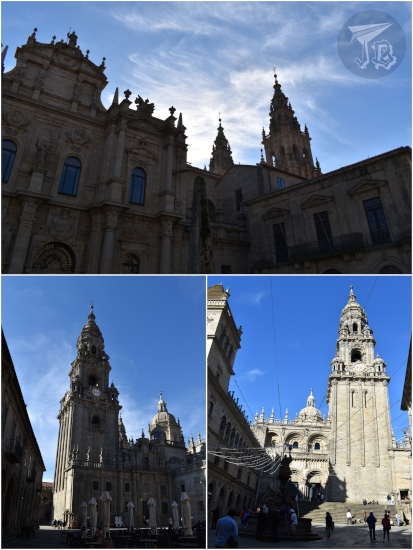
As I had tickets for different activities in the cathedral booked for the previous morning, and the Sunday forecast was rain, I decided to do most of the walking on my first afternoon. I started off in front of the cathedral façade in the square Praza do Obradoiro (the Artisans Square), which hosts the town hall in the former Neoclassical palace Pazo de Raxoi, the Parador itself, and the main – but closed, will get into that later – entrance to the cathedral Santa Apostólica y Metropolitana Iglesia Catedral de Santiago de Compostela, with its Baroque façade called Fachada del Obradoiro.

Baroque façade: two towers and twin set of stairs, fenced away.

I walked around the cathedral, and stopped at all the other squares: Praza da Acibecharía (the Black Amber Workers Square), Praza da Quintana de Vivos (Villa of the Living Square) and Praza das Praterías (the Silversmiths Square).

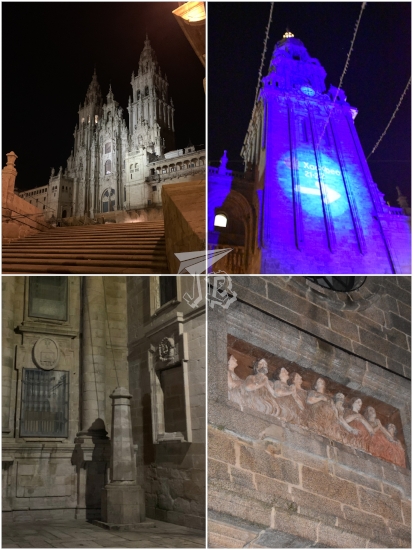
A collage of views of the cathedral of Santiago.

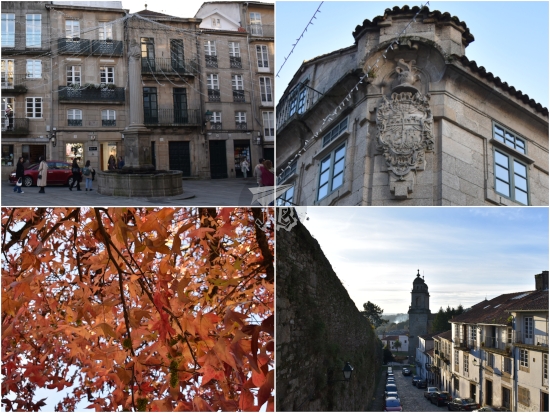
I walked down Rua do Villar, which is the closest to a main street the historical town has. I strolled around the historical centre – there are many interesting buildings and churches, alongside the market. At some point I entered a bakery, but I kinda ran away when I heard the prices they were charging.

Santiago Route.  An archade, a fountain, an ornate corner with a coat of arms carved into it.

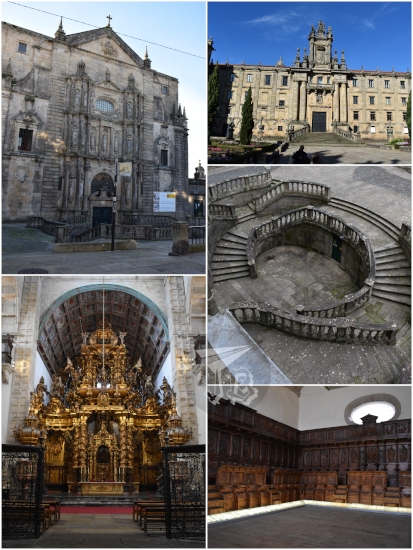
After an hour and a half or so, I found the convent-turned-museum Igrexa e Convento de San Domingos de Bonaval that has become the ethnological museum of the Galician people Museo do Pobo Galego. The museum itself was not too spectacular, but the building itself was fantastic. One of the most amazing things was the triple-helix staircase that joins the different floors on one side, and the remains of the gothic church (where I got to climb the pulpit). To the side there’s the pantheon for illustrious Galicians, including one of the few female historical figures in Spain – poet Rosalía de Castro.

Monastery and museum. The pieces include a humanoid stone idol, some Christian figures in polychromated wood, and two pipes

View of the triple staircase, from above, from below and through the door from one of the sides.

A view of a gothic chapel, showing an empty altar.

This was around 16:30, and even if I was not even a bit hungry, my legs shook a little. Thus, I decided that I needed to find a supermarket to buy a snack – I only had coffee before I left for the airport at 9:00. Before getting to the supermarket though, I walked around the former orchard and graveyard of the convent, now a picnic-friendly park Parque de San Domingos de Bonaval, full of ruins and fountains.

The previous church, from outside, on the right. There's a winter tree in front, and some old niches on the left wall.

I grabbed my snack and went back to the monumental route until I was back at the Praza do Obradoiro. I walked around to see the sunset, and caught a glimpse of the light playing on the façade of the church Igrexa de San Frutuoso, and some nice views from the adjacent park (which turned out to have been another graveyard) Xardín do Cemiterio de San Frutuoso.

Santiago sunset. Upper picture shows the church of Saint Fructuoso, and the lower one a view of the nearby park with the sun setting in the background

It was around 18:00 at that time, so I could finally check in – which I did, only to find out that the staff I had talked to had decided not to book my dinner in the end, which lead to me needing to explain about my tour again to a new staff who told me they couldn’t book me at 22:00 on the secondary restaurant! It had to be at 21:45, but they could notify the restaurant that I would arrive a bit later. I was really not impressed by the whole thing, even less when I apparently needed a bellboy to guide me to my room and carry my backpack– and of course get tipped.

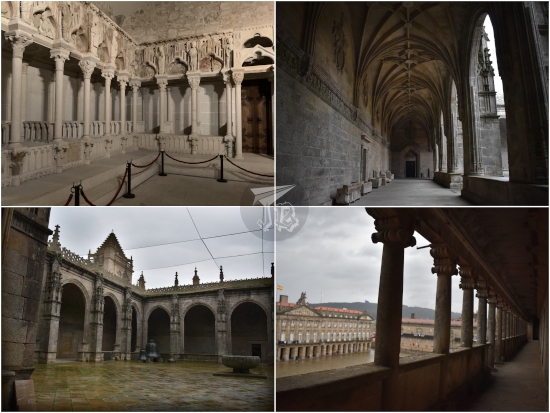
I had my snack and then went on to explore the building. As I did, the sun completely set, so the different lights were cool. The Hostal Reyes Católicos used to be the pilgrims’ hospital. It is a huge rectangle with four interior cloisters named after the four Christian Evangelists, the inner areas having been refurbished into the rooms.

The four gothic cloisters of the Parador. Two have some greenery on them, the other two are just grey and built.

A few minutes before 20:00, I left for my tour. Although I’m not a big fan of tours and group activities, I had had my curiosity piqued by a “theatrical visit” of the historical centre of the town called Meigas Fóra. In the area of Galicia, a meiga is a type of traditional witch, good or bad, depending on what side the person speaking about them is – in this case, the guide being a supposed-meiga, of course they were all neat and nice. The tour was supposed to tell about the different legends and interesting supernatural trivia of the town, but just ended up being a bit watered-down walk around those graveyards-turned-parks I had walked before. The coolest thing was finding the pilgrim’s shadow Sombra del Peregrino, a fun game of light-and-shadows in one of the squares around the cathedral.

A view of the cathedral of Santiago at night, illuminated, on top. On the bottom, a column casts a shadow onto the wall behind it - it seems to be that of a man with a walking cane and a travel hat.

Hilariously though, as we were walking, someone approached me to ask in wonder if on top of taking the tour alone, I was in Santiago all by myself, in total awe of someone travelling on their own. She said that she would never be able to do so – while she took selfies of herself because the people she was “touring” with could not be any less interested…

After the tour I went to have dinner – guess what? At 22:00 h! Let’s say that it was not the greatest experience. The restaurant staff had their hands full with a table of around 20 drunk “pilgrims” who had come all the way from South America and were rightfully celebrating – albeit loudly and a bit obnoxiously (all that pilgrim wine, no doubt) – that they had reached the end of the Way. The rest of the patrons were, including myself, four one-person tables, which made me wonder if they just don’t book one-person tables in the main restaurant after the first shift. The floor staff – basically one working waiter, and one wandering waiter – was overwhelmed by the table, and it took me over an hour to finish my dinner – which was some local octopus (pulpo a feira), a roasted great scallop (Pecten maximus, not only a delicious shellfish, also the symbol of the town and the related pilgrimage, called vieira in Spanish) and a piece of the typical almond pie (tarta de Santiago).

Dinner: pulpo, a scallop and a piece of cake.

Then I went to my room for a nice hot shower and to get some sleep. I was surprised then to find no extra blanket in the wardrobe, though there was an extra pillow. This was around midnight already so I decided not to hit reception for the extra blanket and just cranked up the air-con on and off to stay warm. I slept on and off, too, but it was not too much of a long night.

The next morning I had breakfast and set out for my day at the cathedral, Santa Apostólica y Metropolitana Iglesia Catedral de Santiago de Compostela. Santiago was built around the 7th century legend that the apostle James the Great, Santiago el Mayor, was buried in the area of Galicia, after having reached Spain to convert it into Christianity. In the 9th century, a tomb was discovered among some abandoned Roman ruins, and the local bishop had “the certainty” that it was the Apostle’s tomb. The bishop informed the King, who was the reported first pilgrim, and later ordered that a church should be built to commemorate the finding.

As the number of pilgrims grew, the church became too small, so subsequent temples were erected. The current interior was built between the 11th and the 13th century in a very pure Romanesque style, but the exterior was covered in the 18th century, in a very adorned Baroque style, which is also the style of the altar.

The most important piece of the cathedral is the Portico of Glory Pórtico de la Gloria, the Romanesque entrance to the 12th-century cathedral, with 200 sculptures carved in stone in the three-archway portal. The entrance now is locked away, you have to pay to see it, and photographs are not allowed.

For starters, I climbed up to the roof of the cathedral and the bell tower – not really the bell tower but the “rattle tower”, as the bells chime on the eastern tower, and the rattle is played on the darker, western tower. The roof was restored as recently as 2021, and from there there are some nice views of the town.

The towers of the cathedral from the room, and some aereal shots - one shows the Parador cloisters from above.

Between visits, I went inside the cathedral, where the pilgrims’ mass was about to start. I might have stayed out of curiosity had I been in town for a longer period. Then I visited the portico – since pictures were not allowed, I’ve rescued some 1995 ones from when I were in town as a teen.

Three shots of the  very baroque altar in Santiago - it is heavily decorated and painted gold. On the bottom right, a silver urn, also very ornated, supposedly where the remains of St. James are.

A collage showing several sculpures of the Portico of Glory - Romanesque statues richly coloured and decorated, they look placid

After wandering the cathedral for a bit longer, I made the most out of the last hour of sunshine to head to the park Parque da Alameda to find the spot Miradoiro da Catedral next to a huge centennial eucalyptus tree (Eucalyptus globulus labill) Eucalipto centenario, a 120-year-old specimen, considered one of the oldest eucalyptus trees that was planted in Europe after captain Cook “discovered” Australia and the species was introduced by Fray Rosendo Salvado.

A panoramic view of Santiago, showing the cathedral.

My next stop was the museum of pilgrimages and Santiago Museo de las Peregrinaciones y de Santiago, which was free due to the Covid recovery plan. It features a collection of items related to Saint James Way, and other important pilgrimages of the world, including the Japanese Kumano Kodo [熊野古道], and the Muslim Mecca Pilgrimage Ḥajj [حَجّ]. The upper floors are dedicated to the hagiography of Santiago / James through the Way and in the city.

Museum of Pilgrimages. A collage that shows a wooden statue of Santiago on a white horse, sword raised; other depictions of Santiago as pilgrim; some paper scallops decorated by kids; and a Japanese sacred gate.

Later, even though I should have gone to eat a bite, I headed to the monastery and museum Mosteiro de San Martiño Pinario, religious complex built between the 16th and 17th centuries, though the inner areas and chapels date from the 18th century. Today it’s a cultural centre, and alongside the church, it features a museum with block prints, fossils, an ancient pharmacy… The church has the most baroque Baroque altarpiece I’ve ever seen, and two choirs – one behind the altar, and the other one up on the second floor.

Exterior of the monastery, including the double downward staircase, and a picture of the interior, showing a very Baroque altar painted in gold.

Finally, I stepped into the museum of the cathedral Museo de la Catedral de Santiago de Compostela, which features the entrance to the cloister, library, and the upper galleries, aside from artistic and religious treasures such as the original stone choir, wooden carvings, and tapestries. I was also able to access the upper galleries and look at the rain in the Praza do Obradoiro, and later the crypt.

A collage showing the cloister of the cathedral of Santiago while it rains outside, and the former Romanesque choir, carved in stone.

Romanesque arches and columns built in stone, and a cast ceiling.

After one last visit to the cathedral and its shop, I got myself a last souvenir – a silver and black amber bracelet I had seen upon arrival, and took a taxi back to the airport in order to fly back. All in all, I was not too impressed by the city nor its inhabitant, and I was pretty disappointed in the Parador. I think it has put me off the idea of doing the Camino as much as I thought I wanted to, but not every trip is perfect, I guess, and I hope my memories warm up with time.

A silver and black amber bracelet. The silver is very fine, and the gem is bright black.

Walking distance: around 11.68 km (18659 steps) on Saturday and 10.58 km (16931 steps) on Sunday, not counting airport transits

15th October 2022: The castle in Olite and the cathedral in Tarazona {Aragón & Navarra Oct. 2022}

Today, Olite is not much of an impressive town – but it has a dream castle Palacio Nuevo de Olite. The original fortress is reported to be a first-century Roman building where the Old Palace stands now. The first mention that we have of the old castle dates from the 13th century. In 1388, as Carlos III of Navarra (whose grave we had seen the previous day in Pamplona) starts the process of clearing the area surrounding it, buying houses and so. The official ampliation of the palace started in 1399, and the actual construction of the new castle in 1402. First, the keep was erected, then the surrounding towers, without much planning, giving was a capricious space with staircases, yards, and even a hanging garden. Construction ended in 1420.

When Navarra was annexed to Castille, the decline of the castle started. Later, during one of the several Spain-France wars, soldiers’ distraction caused the first fire in 1794. later, in 1813, the castle was intentionally burnt down in 1813 to avoid that the French made a stronghold out of it. The wood-decorated room were completely destroyed and only the stone walls remained, although barely. The castle was used as makeshift quarry from then on, until in 1902 the modern regional government bought it. In 1925, after considering three proposals, it was decided too restore the castle using Jose Yárnoz Larrosa, who became the main architect. He chose a restoration style known for aiming to make things “as they should have been” – so rather idealistic. And one has to admit that the castle does look pretty cool, even though apparently it does not preserve the original structure too much. Throughout this time, a mulberry tree might have thriven for about 500 years.

The point of this is that the castle is cool. Pretty much fake, but cool.

After having breakfast, I set off for a few pictures. It was not too early in the morning, even, but at least the square was empty and clean, unlike the evening before. I stopped to examine the entrance of the church Iglesia de Santa María la Real. The church dates back from the 13th century, and is famous because of the decoration of its main façade and the sculpture around the portal, though personally, I was more taken by the atrium just in front of the church. While it does obstruct the view of the façade, the architectural ensemble ends up looking super cool – except for the little porch built in the 2015 restoration that… well… might be necessary but does not allow for the best view.

Church Santa María la Real: Gothic façade with an arched atrium in front of it. The portal is decorated with religious figures

I went around the complex formed by the two Medieval castles Palacio Viejo and Palacio Nuevo de Olite, the walls and the old egg-shaped building that used to work as a snow-powered fridge of sorts.

Collage with different sights of the new Olite palace. The walls, archs and merlons are shown, brown-gold colour. Some of the pinnacles have grey slate pinnacles.

We went in. The restoration of the palace is “in style” so you cannot tell what is new from what it is not. The inner area includes access to the towers, the keeps, the so-called King’s gallery, the hanging garden, and the centennial mulberry tree. I climbed about half of the towers and the keep itself, and I have to say it was pretty fun.

Palace of Olite - Gothic archways, one bare, one full of vegetation, and views from the towers, showing the merlons, pinnacles, and the rest of the towers

Palace of Olite - looking from the interior, the structures show vegetation and the pinnacles. The last part of the collage shows the mulberry tree

Unfortunately, when we left the castle, we were not allowed into the church Iglesia de Santa María la Real as there was going to be a wedding – despite being no notice outside but the normal opening times, within which we were. Sometimes I feel tempted to take pictures even when I know it’s not completely okay, in order not to miss opportunities later. Before we left town, we found a nice viewpoint to try to catch site of the whole castle.

Palace of Olite from afar. It looks like a fairytale castle with pinnacles, walls, merlons and flags.

Afterwards, we drove southwards towards Tarazona, back in the region of Aragón. It is not a big town, with but an interesting point to get to know – the cathedral Seo de Nuestra Señora de la Huerta de Tarazona. Built throughout the evolution of Gothic art, between the 13th and the 15th century, it was later enriched in the 16th century with Renaissance decoration and interior, and sprinkled with Mudejar details. The cathedral is in the middle of restoration, and the organ is fenced off. The cloister shows lots of panels on the works being done, too.

Tarazona cathedral - outside. The façade looks weirdly grey, and the belltower is on the right, darker. A close-up of the dome shows its Mudejar influences

Interior of the Cathedal of Tarazona, showing Gothic columns and the Baroque altarpiece. The cloister is modified Gothic with arcs and spikes. A close-up of the Mudejar-style bell tower.

We had lunch after visiting the cathedral, but we did not feel like staying around until the archaeological gardens. Thus, we just took the car back home, even though we might have been better off checking out some more places in town. Lesson learnt then, more planning is required in this kind of escapades…

14th October 2022: Pamplona, the city of the bulls, and Olite {Aragón & Navarra Oct. 2022}

In order to avoid crossing Zaragoza, we tried to go around it. Unfortunately, trying to save up 30 minutes, we ended up wasting an hour at the entrance of the highway, and we reached the city of Pamplona or Iruña. Today, it is the capital of the region of Navarra, which is roughly the size and shape of the old Kingdom of Navarra, which existed roughly between 1162 and 1512, when it was conquered by the Catholic King Fernando.

There had been a slight misunderstanding on who was going to plan the day – I was convinced my father had not wanted me to do it, but when we arrived he turned to me and I was supposed to know. In summer, I had drafted a small itinerary, but as he was supposed to have taken charge, I had not gone further. It turns out, I should have. Fortunately, I still had the map on my phone and the opening schedules on my travel notebook. Unfortunately, I had not really delved into all that the city has to offer and we missed a few interesting thing

Thus, I tried to take charge, but not too much because it’s hard to balance that with my parents. Even if we have travelled together before, I tend to let them do the planning and only insist on some stuff I want to do or see, and that’s how they end up at dinosaur parks (≧▽≦).

We left the car in a parking lot underneath the congress centre and walked towards St. Nicholas Church Iglesia de San Nicolás de Bari Eliza. The first building dates from the 1100s, and it was built along the now-disappeared walls, as a defensive construction at the same time as a religious one. It was demolished and rebuilt location makes the building awkward, and to add insult to injury, we arrived almost at the same time as mass started, so we just took a quick look.

Iglesia de San Nicolás de Bari Eliza - exterior with pointed arcs, and inside, showin the altar

We walked to the next church dedicated to St. Lawrence Iglesia de San Lorenzo, actually associated to the Unesco World Heritage Site Routes of Santiago de Compostela: Camino Francés and Routes of Northern Spain Caminos de Santiago de Compostela: Camino francés y Caminos del Norte de España. The current building is Neoclassic, and the façade was rebuilt at the beginning of the 20th century when the original was damaged during war. On the right of the main nave, a side chapel holds the famous sculpture of St. Fermin, the patron saint of the town. The chapel was built between 1696 and 1717, when the sculpture was placed there. Every 7th of July, the sculpture is taken out in the religious procession. From the 6th of July and for a week, Pamplona celebrates its local festivals, famous around the world for the encierros, or running of the bulls. While there are similar runnings all throughout Spain, the encierro in Pamplona was popularised by Ernest Hemingway, the American novelist, in his work “The Sun also Rises” (1926).

Church of Saint Lawrece - Neoclassical façade and interior, with the sculpture to Saint Fermin, the patron saint, in a red cape and a mithra, surrounded by red and precious metals.

We continued onto main street Calle Mayor, which ends at the main square Casa Consistorial de Pamplona, which opens to the main square Plaza Consistorial. The building was erected between 1951 and 1953, though the project kept the 18th century façade, halfway between late Baroque and Neoclassic.

Pamplona town hall / council hall, with flags hanging from the balcony.

We continued onto the cathedral dedicated to the Virgin Mary Catedral de Santa María la Real de Pamplona. The building is Gothic (French Gothic, actually), with a Neoclassical façade designed by Ventura Rodríguez (who also worked on the Basílica del Pilar in Zaragoza). One of the most interesting things in the cathedral are the paintings on the walls and columns themselves, just non-religious decorative motifs. In front of the altar lie the tombs of King Carlos III of the Kingdom of Navarra, and his wife Leonor of Trastámara (or Castille).

Cathedral of Pamplona, including a close-up of the bright polychromy in red and blue, and the altar, from far away and a close-up. The most distinctive feature are the pointed arched and the very clean masonery.

In the inner area, there is a beautiful cloister, and you can climb into the false ceiling, see the kitchen of the former convent. And, let’s not forget – they have a stamp, because it is one of the “official” starting points of St. James Way, Camino de Santiago, and also part of the Unesco World Herirage Site related to it.

Collage: Cloister in Pamplona cathedral. The gothic ars are pointed and ornate, standing on bright green grass. One of the corners shows a fountain, the other the iner walkways

We stopped for lunch, then we walked by one of the “iconic” points of the bull-running, the corner at one of the streets of the route – Esquina de la Estafeta, and continued on until we reached the bullfighting ring Plaza de Toros de Pamplona, but since we are not big into the culture, we did not enter.

We did stop by the sculpture to the bulls and runners Monumento al Encierro, a huge bronze composition with a number of real-life pieces: nine bulls (six fighting bulls and three guiding bulls) and ten runners.

This bronze sculpture represents several life-sized bulls and runners. The runners are in front of the bulls, and one of them has been trampled.

Finally, we went to have a stroll alongside the walls of the former citadel Ciudadela de Pamplona. Although now it is a park, and only the foundations are left, the Citadel was one of the most important defensive constructions in the Spanish Renaissance, in the shape of a five-pointed star.

Several angles of the Ciudadela of Pamplona park. Not much is seen except for the building foundations, though they stand two or three metres high.

After that, we took the car and drove towards the town of Olite also known as Erriberri , where we were going to sleep. The town was home to the Monarchs of Navarra, and today there are two distinctive buildings – the old palace Palacio Viejo de Olite, where the Parador de Olite stands, and the new palace Palacio Nuevo de Olite. Originally the most extravagant Gothic castle in Europe, it burnt down during the war against the Napoleonic troupes, and was rebuilt in 1937 using the philosophy of bigger, cooler more teeth. We checked in at the Parador and I collected my stamp. From our room, we could see the main structure of the old palace, as we had a very long balcony.

Old palace of Olite. There is a tower on the right and an old Medieval house to the left. The building is made of irregular masonery and the windows are perfectly rectangular.

We went for a walk, and were surprised at how many people there were in the area. We sneaked into the church Iglesia de Santa María la Real, but did not take any pictures as (once again!) mass started. We planned to come back the following morning as it was barely a 30 seconds away from the door of the Parador.

On the left, a modern red-brick house stands on older arcs. The façade sports a protection made of intricate white ironwork.
On the left, a Romanesque church, blocked by construction and a tractor.

We walked around for a little and were not too impressive by the Medieval city centre, but we did find the typical balconies and the Romanesque church of St. Joseph Iglesia de San José.

We were beat, to be honest, it had been a stressful day after a short night’s sleep, so we turned in early after dinner. I did not even think to wander round to see if I could get any cool pictures of the area, because the area was packed and I was exhausted.

13th October 2022: Serrat in Zaragoza {Aragón & Navarra Oct. 2022}

Joan Manuel Serrat was born in Barcelona in 1943. He is a singer, songwriter, composer, actor, writer, poet and musician, whose long career started in 1965. Since then, he has sung first in Catalan, then in Spanish, and finally in both languages. In 1968, he was involved in a Eurovision controversy as there was a strife about singing in Catalan or Spanish, and in the end he was replaced by another artist – who ended up winning.

Throughout Franco’s Dictatorship, Serrat lived an unstable balance between the media veto caused by the Eurovision scandal, the censorship of some of his lyrics, and his growing popularity both in Spain and Latin America. During the 70s, he became a vocal protestor against the Dictatorship, with his songs, actions and words, which ended up with another veto and an exile to Mexico. In a way, he became the symbol of the discontent of the twenty- and thirty-somethings that had grown in the Spanish post–Civil War, who were then wading into adulthood. Serrat’s song Mediterráneo (Mediterranean Sea) has been repeatedly called the best song in the history of Spanish pop music. The album stayed as number 1 in Spain for weeks despite the censorship – since then, he has collected innumerable accolades and homages.

My parents… I don’t think I can call them fans, but they have listened to Joan Manuel Serrat for a long time – as a matter of fact, my father used to translate songs into Spanish for my mother back when they were young, as he spoke Catalan and she did not. But they are not concert people, so I was slightly surprised when back in April my mother commented in passing that, had tickets not been sold out, she would have liked to attend the Madrid concerts of Serrat’s goodbye tour El Vicio de Cantar. Serrat 1965 – 2022 (Singing is a vice. Serrat 1965 – 2022). I put the Internet machinery to work, and I found tickets for Zaragoza on the 13th of October. At that time, my parents asked if I would be interested, and I said yes, as he is indeed one of the most important singer–songwriter of the 20th century in Spain.

Ticket: Serrat, el vicio de cantar

The problems started when I could not get the day off, so that meant driving there as I left work. I could have got away with leaving half an hour earlier to get to the train as they drove off earlier, but they refused, so we ended up getting to Zaragoza around 17:00. Checking into the hotel took 40 minutes due to the slow check-in process, and luckily we were on the third floor. Funnily enough, it seemed that everyone in the hotel was there for the concert, so a lot of older people not used to travelling nor hotels.

The concert was due to start at 21:30 in the local sports centre Pabellón Príncipe Felipe, and there was a delay of about 15 minutes. To be honest, I did not expect it to be such a powerful experience – I mean, we’re talking about a 79-year-old man here, I did not think he would still have such a powerful voice nor presence on stage. There were a lot of songs I did not know, but the ones I had heard before still retained the vitality of records as old as the 80s! The set list was a remix of his most iconic songs in Spanish, with a couple of them in Catalan language:
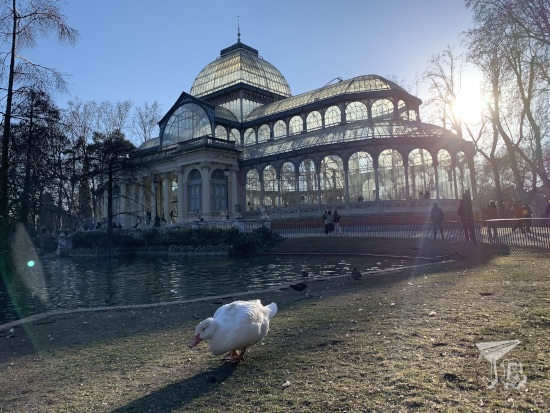
  1. Dale que dale – “Go on and on”.
  2. Mi niñez – “My childhood”.
  3. El carrusel del Furo – “Furo’s carrousel”.
  4. Romance de Curro el Palmo – “The romance of Curro el Palmo”.
  5. Señora – “Lady”.
  6. Lucía
  7. No hago otra cosa que pensar en ti – “I keep thinking about you and nothing else”.
  8. Algo personal – “Something personal”.
  9. Nanas de la cebolla – “Onion lullaby”, with lyrics from a famous Spanish poet who wrote the poem in prison, when his wife wrote to him that there were only bread and onions at home, and she had to breastfeed their baby.
  10. Para la libertad – “For freedom”.
  11. Cançó de bressol / Canción de cuna – “Lullaby”.
  12. Hoy por ti, mañana por mí – “Today it’s you, tomorrow it’s me”.
  13. Tu nombre me sabe a yerba – “Your name tastes like herbs” – grass, actually, but it sounds horrid in English.
  14. Los recuerdos – “Memories”.
  15. Es caprichoso el azar – “Fate is whimsical”.
  16. Hoy puede ser un gran día – “Today can be a great day” – I keep telling myself this.
  17. Pare – “Father”.
  18. Mediterráneo – “Mediterranean Sea”, I can totally understand how this is considered one of the best songs ever in Spanish.
  19. Aquellas pequeñas cosas – “It’s the little things”, started the encore
  20. Cantares – “Songs or Poems”, with lyrics by Antonio Machado, one of the greatest Spanish poets in the Spanish 20th century.
  21. Paraules d’amor – “Words of Love”.
  22. Penélope – though I knew this song, the lyrics were different from the ones I was used to.
  23. Fiesta – “Festival”, a bit of a high-inducing song to finish the concert way past midnight!
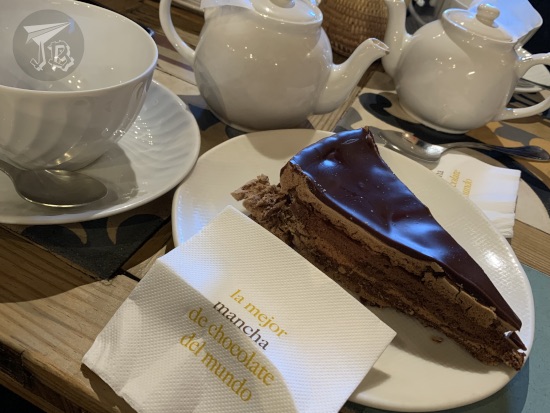
Serat concert: Stage with signature decoration, and two shots of the concert

It was hilarious to see all these sixty- and seventy- year-olds get out from the pavilion and walk to the hotel, all pumped up and way beyond their bedtime. By the time we arrived at the hotel, there was a queue at the lifts! All these exhausted boomers, hyped up and at the same time with no more energy left. That is when we were so happy to be on the third floor and not something like the seventh or eight (≧▽≦). The bed was comfortable but I did not sleep much.

13th August 2022: Smoothness in Chaos {England, August 2022}

As rail strikes rolled out both in London and the rest of England, I was thankful I had found out in advance. The hotel internet was patchy and I would have had trouble booking a coach ticket for the airport. I decided not to try and cram more than I had already on my plate for the day, and stick to my booked tickets and original timing.

I took an underground line to Victoria railway station, from which I went to find out where my airport coach would leave from. After that, I walked from Victoria coach station towards Westminster, stopping at Westminster Cathedral, a rather out-of-place Neo-Byzantine building, which serves as the Catholic cathedral. Designed by John Francis Bentley, it was completed in 1903. It was closed for service, unfortunately.

Westminster Cathedral, a Chrsistian neo-byzantine building: a view of the exterior, in white and red brick, and the open doors showing the inner altar from afar

Due to the strikes and potential issues, Westminster Abbey had rearranged its opening hours, and waived all the “entry times”. So basically it was a bit on the chaotic side, though I arrived for my own timeslot, as I had calculated that would be all right for the tour I had signed up for. The abbey is officially called Collegiate Church of Saint Peter at Westminster. It was a originally a Benedictine abbey, and William the Conqueror, in 1066 made it the “official coronation ceremony” place, and many Royal Weddings have occurred there. It is built in the Gothic style, with Neo-Gothic towers. Furthermore, most British monarchs were buried there, along with a number of personalities that were either earthed there, or had memorials erected – Darwin, Newton, Hawkins, Shakespeare… The Abbey features a 19th-century wooden choir in the middle, and an outer cloister in early Gothic style. It was bustling with people fighting the audio guide and extremely hot though. However, this completed my tour of the Unesco World Heritage Site of “The Palace of Westminster, Westminster Abbey and St Margaret’s Church”

Westminster Abby, a Gothic Protestant Cathedral. Collage showing the towers and main entrance, the inner Norman altar in golden wood, the ceiling in the nave, and the cloister

Before the train strikes and the chaos in English airports, I had booked a 12:15 “Westminster Abbey hidden highlights” tour as my last activity in London before taking the Stansted Express to the airport. The change of plans meant I had to take the 14:00 h coach instead of the 15:00 h train to be at the airport by 16:00, to make sure that I would have plenty of time to go through security. That meant that I unfortunately had to cut the tour short. Event then, I got to see St Margaret’s Church, the old Medieval sacristy, the inner chambers of Samaria and Jerusalem, and got close to coronation chair. Not bad at all, even if I unfortunately had to miss the library to walk back to the station.

A collage showing an archaeological excavation (very professional holes on the ground, some showing a hint of brick foundations); the Coronation Chair and the hanging flag over it; ornate wooden ceilings; and a mythological-themed tapestry hanging from a wall

I have to say that the return was exhausting. Even with one hour difference, I got on the coach for the airport at 14:00 and did not land until 22:00. However, flying out of Stansted always has a good thing – goodbye sushi!

Tray of sushi and sashimi

All in all, this non-weekend weekend was an amazing mental break! Even if the last day did not work as originally organised, I had a heads up in order to prepare my contingency plans. I got to see something that I always wanted to see – and even if Stonehenge was smaller than I thought, it was not disappointing. Also, I checked that entering the UK after Brexit is pretty much the same as before, so I can organise more escapades in the future, because I still need to go to Jurassic Coast…

Walking distance: 11.27 km / 16672 km

12th August 2022: Stones, the reason for the trip. Lots of Stones {England, August 2022}

I was convinced I’d sleep like the dead and set a couple of alarms. Unfortunately, laundry and house service got going at 6:30, and woke me up. At least, the room had a kettle and some instant coffee which, along with one of the sandwiches I had procured the previous day, got me going. I made sure that the camera was charged, put everything I needed into the backpack and strolled off. My hotel was close to Earl’s Court, and I was walking to South Kensington to check out sandwich and coffee shop. And – to my eternal surprise – to queue for a museum! I don’t think I’ve ever seen so many people waiting for a museum to open in my life.

I’m referring to the Natural History Museum, one of my favourite ones. This time, it was a must, so I booked free entry with the special exhibition – “Dippy is Back”. Dippy is the diplodocus cast replica that used to stand in the middle of the museum, the Hintze Hall (where now the whale skeleton hangs). Dippy was the first of its kind to go on display in the world. The original skeleton was discovered in 1898 by railroad workers in an area called Sheep Creek, in Wyoming, USA. At the time, Andrew Carnegie had made a fortune in the American steel industry, and become one of the most important philanthropists in the US and the British Empire. He paid for casts of the bones to be made (some sources also say that he bought the actual skeleton, some that he had sponsored the dig) and sent to museums in Europe and South American. For the first time the public got to see a whole dinosaur skeleton, which was actually named Diplodocus carnegii after Carnegie. Dippy was gifted to the National History Museum in 1905, and was exhibited there until it went “on tour” around the United Kingdom in 2017.

Here is a little trip down memory lane: back in the mid-nineties I was a teenager in London with my English class. We had free time and they wanted to go to Harrods, so… instead I got myself into the Tube to go to the Natural History Museum just to see this dinosaur (I also ditched the group in the British Museum, but that’s another tale). The point was that I was around 14 or 15, bouncing through London by myself, on my way to see this very cool dinosaur! And I did not have to listen to people being rowdy, nor try to keep the peace in group – I was alone (scared out of my skin, true), but I was free by myself. And for me, that was very important, even if I would not come to realise that until recently.

The fossilised skeleton of a diplodocus, seen from the front. Lots of people are trying to take pictures with it

I saw Dippy again in 2011 when I went to London, but I was surprised when he was not there in 2018, shipped around the country in a travelling exhibition. For some reason, knowing that it was there made me really, really want to see it again. Since the pandemic, you need to reserve at ticket at the Natural History Museum, even if it’s free, so I booked mine for 10:00, to be there first thing as they opened – thus the queuing-before-opening.

Originally a gallery of the British Museum, the Natural History Museum was first designed by civil engineer Captain Francis Fowke, and then it was revised by Alfred Waterhouse, who redesigned the façades in a Romanesque-like style, with architectural terracotta tiles to withstand the British weather. These tiles have flora and fauna decoration and reliefs. The building was finished in 1880, and all the material had been moved by 1883. In the 20th century, the museum rebranded itself as a separate entity from the British Museum, and in recent years different areas and expansions have been opened.

Anyhow. The gates opened a little before 10:00 (If I lived in London I would totally be a member and stroll the museum before opening hours), and the queue started moving. There were lines for ticket holders and non-ticket holders, but my ticket was not even checked. Thus, I just moved towards the area where Dippy was and spent a while there. I felt a little emotional, thinking that, in a way, I owe that dinosaur one.

After seeing Dippy, I wandered around the dinosaur gallery for some time, then I went to buy a sandwich and have a coffee and a painkiller, because I had a long day ahead of me and my head was buzzing a little – I needed to get that under control beforehand. At 11:40 I took a coach with a company called Anderson Tours for an organised day trip: Stonehenge Special Access – Evening. Even though I am not too keen on guided tours, I will admit that they can be handy at some particular circumstances. They will never become my preferred choice of travel, in this case, choosing a tour was the best option.

Regarding Stonehenge, if you want to get up close and personal with the stones, you need a VIP ticket, which means you have to be there before they open to the general public, or after they close, and for that you need transportation – either a taxi, or renting a car, and a hotel as close as possible. The Stonehenge VIP ticket is around £50, and I booked my tour for £135, a full-day tour, including coach, Stonehenge at sunset, and two other destinations, with pick up and drop-off near my London hotel. In the end, that was cheaper than a taxi or a rental plus a hotel near the site (I did a lot of maths before deciding to book this). Anderson Tours offers different combinations of “Stonehenge and…”, with places like Bath or Bristol. However, those are easily reachable by train, and I can explore them on my own. Nevertheless, there was a particular trip that interested me – it went along two or three spots that are a bit off the beaten track, and related to the theme – a Neolithic tomb and another stone circle. This particular tour happens only on certain specific Fridays, thus why my “weekend” away was not such a weekend, as I had to make sure I was in London on the 12th.

The first stop of the day was West Kennet Long Barrow. A long barrow is an elongated prehistoric (3800 – 3500 BCE) stone monument that has been linked to the worship of the dead and the ancestors. Sometimes, human remains have been found in them. If one imagines what Great Britain was at that time, the south-east area would be the one with less tree coverage, and therefore the best option for primitive people who had started to settle and use agriculture. The counties of Gloucestershire, Wiltshire, Somerset and Dorset have a lot of chalk-rich soil (the Salisbury Plain), which makes it difficult for tress to root and grow. Thus, it would have been easy for the primitive humans to settle and build their villages and monuments. Today, the whole area is known as Stonehenge and Avebury World Heritage Site, listed by Unesco in 1986, and it includes over 700 prehistoric monuments from the Neolithic and Bronze Age.

Collage: elongated mound of dirt on top. On the borrom, the gate. On the left the protective slabs, standing upright, and on the right, the entrance. It is a construction of vertical walls made from grey slabs and another slab on top. The interior is dark.

West Kennet Long Barrow is situated in the middle of a farm. There is a tiny parking lot to the side of the road, and a fifteen-minute walk to the barrow itself. It is one of the largest built in Britain, and around 50 sets of remains have been identified, along with pottery, beads and other personal items. Around 2000 BCE, it was closed down and barricaded, then discovered in the 19th century and scientifically excavated and restored in 1956. It is private property under the care of British Heritage. Apparently, all these sites have become a point of pilgrimage for neo-pagans, and on this day, there was a bunch of them chanting inside the barrow…

On the opposite side of the road from the barrow stands Silbury Hill, a mound or artificial mountain. It stands 30 metres high, with 160 metres in diameter wide, and it is estimated that half a million tonnes of material (mostly local chalk) were used to build it throughout several generations of humans. It cannot be climbed, due to a collapse a while back, that would have been neat!

View of a small hill and dry grass.

After that, we headed off to the village of Avebury, which hosts the largest Neolithic stone circle, with smaller circles inside. It originally had over 100 stones, and it might have built between 2850 and 2200 BCE. Today there is a village in the area, with a few shops and museums in the centre, and a lot of sheep grazing the area. Around three quarters of the circle is still standing, along the henge (long ditch that used to be built with the stones in Neolithic circles).

We had two and a half hours in Avebury – a bit too much, I would say – to explore the Avebury Stone Circle and Henge and its sheep. The guide told us about ley lines and trees that were supposed to have inspired Tolkien’s Ents from “The Lord of the Rings”, and I needed to ask about the geology of the stones – here I learnt that they are made out of sarsen, like the Stonehenge ones. Sarsen refers to silicified sandstone blocks, common in the area, and it has been proven that the ones used in the megaliths come from Marlborough Downs, some 25 km away (35 km from Stonehenge). Once we were dismissed for our “free time”, I walked along the three fourths of stone circle remaining.

A collage showing different megaliths from the Avebury stone circle. Small pillars mark the spots where the stones have been lost. There are some sheep grazing on dry grass.

There are other places to visit in town, such as a Medieval manor with a dovecote. The stables of the manor are the site of the archaeological museum is hosted, and here I made a mistake. I should have got in, but I wanted to visit the church, and by the time I was done, the museum was closing down. Live and learn. There is also a tiny chapel, and a lot of souvenir and “crystal” shops.

The Church of Saint James dates back to the 1000s, though later centuries saw the addition of many items, such as the aisles and the 15th-century wooden roof. The nave and the chancel are separated by a one-of-a-kind wooden rood / screen with an original 13th century base. There are Saxon windows and a Norman font. It is a fantastic little church.

Gothic church, from the outside. The inside shows a wooden Normand altar, the standard altar, and a carved stone baptismal font

Finally, the time came. At 17:30 we met up on the way to the coach, and then we started off towards the highlight of the day – Stonehenge. Stonehenge was erected between 3000 and 2000 BCE – the primitive human somehow got the sarsen stones into Salisbury plain and planted them so they stood in a circle. They measure up to four metres long, and some of them are arranged in the shape of trilithons – two large vertical stones (posts) support a third one (lintel) which is set horizontally on top of them, with carved studs so the structure fits like a snap. There is a tear-shaped monolith standing a few metres away called “Heel stone”, which marks the entrance.

Some of them are indeed collapsed now and some are covered in lichen – there is a special type of lichen that only grows in three places in the world, and that is one of them. For thousand of years, these stones have remained standing, and the first historical study of them dates from 1666, carried out by an English antiquary, natural philosopher and writer John Aubrey, and has been restored a several times, especially during the 20th century, when they were roped off and a fee charged for entry.

Currently, the stone circle belongs to the Queen of England, and according to the British Ancient Monuments Bill, it cannot be touched or altered in any way that is not to preserve its current status. In 2020, a core taken from the stones during the 1958 restoration was returned. This allowed researchers to analyse the composition and prove that the megaliths are indeed sarsen from the Malborough area.

The rules when you are allowed into the stone are “simple”: do not touch the stones, do not step on the stones, do not hug the stones, do not lick the stones, do not get naked among the stones. Judging by the tone in the guide’s voice, all that has happened before. Apparently, there are a lot of ley-line believers, neopagans and neodruids wanting to “connect” with the earth energy there (there is even a “yoga at sunset group”). In a kind of compromise, they allow you to take off your shoes and socks – which I did not do.

According to archaeologists, Stonehenge was designed in alignment the Winter Solstice sunset. The site was probably a celebration of the end of the worst of the winter before days started getting longer again. Other theories propose that it was originally a burial site that became a place to worship the ancestors.

The great thing about the after-hours tour is that you get to see the sunset around the site. Our timing was 18:45 – 19:45. The guide was nice too, and gave us “permission” to wander around and did not expect to listen to him all the time – don’t tell me twice. I explored and wandered to my heart’s content. We stayed there for about an hour, and it was really cool. I mean, not magical or “I feel the magic of the earth” or anything, but the circle is a fantastic piece of engineering, especially considering it was built five thousand years ago, before writing was even invented. Sometimes, humans are neat.

Stonehenge collage. Two shots of the megaliths standing on dry grass, from the outside; the sun shines between the darkened stones. One shot from the inside of the circle, showing the megaliths circling inwards.

It was over sooner than I would have liked, but about an hour later we were back on the bus after hitting the souvenir shop – where I got a guidebook – and we arrived in London around 22:00. When I got off the bus I just walked to the hotel, had my sandwich. Good thing I had left the window open, too, as it made the temperature slightly more tolerable – I own up though, I slept with the fan on, but… like a rock. Or a stone.

Walking distance: 11.96 km / 18742 steps
Coach distance: 317 km

11th August 2022: 21 hours straight of ups and downs in London {England, August 2022}

The first thing I had to do was waking up for a 6:30 flight – though considering I did not sleep very much that night due to the heat, I’m not sure if that it counts as waking up. The previous day, the airline had sent warning emails about arriving at the airport early – three hours before the flight would have meant being there at 3:30, so… not really. I arrived at the airport around 5:10, and I was at the gate by… 5:20, I’m not even kidding. While I normally do not queue to enter planes – the advantages of backpacks, I just kick them under the seat – I had been assigned seat 1A, which meant I had to put my luggage into the overhead compartment. I had decided to take a small backpack too, because I would be carrying it around for a while, and it would get searched in a couple of places.

Surprisingly, despite Brexit, the Ryanair strikes, airport chaos, and the fact that apparently the automatic passport reader cannot cope with my new look, I made it into the United Kingdom first and straight to London without a glitch. Not only that, I managed to get my Oyster recharged without any problems, and as soon as I had bought some food, I was on my way to the first stop of the day: Crystal Palace Park, for which I got to ride the shiny new underground line, the Elizabeth Line, then the Overground. Even though there are another couple of landmarks (that might warrant a visit when / if the restoration project finally goes through), what interested me in Crystal Palace was a collection of Victorian sculptures – the Crystal Palace Dinosaurs.

Though Ancient Greek already knew about fossils before the current era, it was in the 19th century when it hatched as a “science”, according to some spurred by Darwin’s “On the Origin of Species”. Fossil hunters ran amok, excavating and spoiling the North American badlands. In England itself, Mary Anning kept discovering cool things. There was a sort of a “Dinosaur fever” – the Victorians became fascinated with all things prehistoric. In 1852, a number of extinct animal reconstructions were commissioned to be erected in the gardens of the Crystal Palace, after the World Exhibition. Using the knowledge available at the time, Benjamin Waterhouse Hawkings, a natural history illustrator and sculptor, who did his best according to scientific knowledge at the time.

Not all the animals represented are real dinosaurs, but the nickname stuck. From today’s standards, most of the reproductions are extremely inaccurate, with some exceptions, such as the ichthyosaur (discovered by Mary Anning around 1811), and the plesiosaur (of which Mary Anning also found a skeleton in 1823, and then another in 1830 – I love that woman). Today, the park is organised in several “islands” where you can see the sculptures, though the water was a bit down due to the heatwaves:

  • Amphibians and therapsids: Dicynodon and Labyrinthodon
  • Marine reptiles: Ichthyosaur, Mosasaurus, Plesiosaur and Teleosaurus
  • Dinosaurs and pterosaurs: Hylaeosaurus, Iguanodon, Megalosaurus and Pterosaur
  • Mammals: Palaeotherium, Anoplotherium, Megaloceros and Megatherium

I have been aware of these sculptures for a long time – since I was a child and started liking dinosaurs. However, only recently did I find out that they really existed, and where they were. I arrived at Crystal Palace station a little after ten (making whole travel from the airport about two hours). I walked by a small farm with typical fauna such as… an alpaca, then I ate my sandwich overseeing the first island.

A collage showing differet statues of prehistoric creatures. Some try to be dinosaurs, and they look almost comically wrong, like giant iguanas or chameleons. There is one plesiosaurus looking rather acurate - it has a long neck and flipers. Finally, some mammals: a deer with huge antlers and a tiny horse-looking creature

I walked around for about an hour and then I set on my way back. Though I had planned to have a relaxed day at first, I had to adjust due to cancellations and train strikes. It was around that time that I calculated that I could actually cram my original Thursday and Saturday plans onto Thursday, plus the alternative plans I had made if I tweaked the time a little. So I back-rode for another hour towards the city.

Near Tower Hill stands the Sky Garden, on the 35th floor of the 20 Fenchurch Street building, designed by Rafael Viñoly. Sky Garden is considered the highest garden in London, and a fantastic viewpoint of the city. I almost accidentally came across the option to book a free access ticket for this – while I had not wanted to pay for any morning / early afternoon activities in case my plane was delayed, I figured out that I could book this for free, especially as they go stupidly fast! I made my 12:30 timeslot with a few minutes to spare, but I was let in after a queue, ID check, X rays and metal detection.

The Sky Garden features two terraces full of plants (landscaped by Gillespies), a couple of restaurants and bars, and an “open” gallery which has glass above your head so the feeling of opening dissipates – the glass is stained and scratched. It was one of the “must-do’s” in London I had never visited before, so I thought it would be a good opportunity. Fortunately, they have relaxed the rules on no bottles because of the unusual high temperatures.

After wandering around for a bit, I continued onto Saint Dunstan in the East Church Garden, the ruins of an old Wren church destroyed by The Great Fire of London and destroyed again during the Blitz (World War II bombings). Dating back to the 1100s, it was opened as a public park in 1970. Aside from being a very cute building park I wanted to see for a while, a music video by the band VAMPS was filmed there.

Ruins of a gothic church turned garden, with hanging ivy and bushes overgrowing the walls and windows

As it was lunchtime, the park was bustling with people, so I just had to move on rather quickly, and went back to the underground to get to the area of Westminster. I had originally booked tickets for Saturday (back in May) but then they were cancelled due to “repair work” going on that day (I do wonder if it was a security measure related to the strikes though).

But of course, first I feasted my eyes on the very new Elizabeth Tower clock tower aka Big Ben – though Big Ben is one of the bells in the tower, but nobody really cares about that any more.

Elizabeth Tower, shining gold with the restoration. It almost looks fake. The clock marks Quarter to two.

The Palace of Westminster or Houses of Parliament is the centre of the United Kingdom’s turbulent political life. The current palace was built after the previous one was destroyed by a fire in 1834. The new palace was erected in the Neo-Gothic style, and it was mostly finished by 1860, although it did open to be used in 1835. There was a competition regarding the design, which was won by sir Charles Barry. The Palace of Westminster holds the two chambers where the British government meets – the House of Lords and the House of Commons – alongside the Norman Porch, St. Stephen’s chapel, and the different corridors where the MPs vote or discuss state matters. I’ll forever be amused that “for security reasons, photography is not permitted in these chambers with dozens of cameras for TV broadcasting and Internet streaming”, but alas. The woodwork on the Norman Porch ceiling is fantastic, and some of the decoration choices, such as Churchill’s sculpture are… interesting. It is noteworthy that it is part of the Unesco Heritage Site “Palace of Westminster, Westminster Abbey and St Margaret’s Church”.

Collage: a view of the houses of parliament (London), with the Elizabeth Tower on the left. Two shots of the Norman Hall, a huge ward with an intrincate design of wooden ceiling. A gothic corridor with a wooden door and some coloured glass panels

Afterwards, I just found my way to the hotel – though I had to wander a little to find the nearby supermarket, bugger those never-ending attached-house neighbourhoods, rested for a little and then went to the station to go to the theatre – I wanted some extra time to check out where my airport coach would leave, so I gave myself 45 minutes for a 22-minute trip. It turns out there was train trouble and I was barely on time, taking an alternative route instead of the direct one.

When I realised my flight timing would give a free evening in London, I booked tickets for the Apollo Victoria Theatre to watch the “Wicked”. This musical tells the story of “The Wonderful Wizard of Oz” from the point of view of the witches, and somehow gives the “Wicked Witch from the West”, Elphaba, an amazing personality and backstory that resonates a lot with me. For the same price as the ticket I was eyeing back in the day, I found a VIP upgrade just one seat over, so I was entitled to a drink and “snacks”, an early entry, along with access to the “Ambassador Lounge”, a tiny reception hall with access to a private restroom.

“Wicked” was great. The actress who plays the main character, Elphaba (Lucie Jones) came out a little yelly though in her solos. The duets with the other female singer (Glinda, Helen Woolf) were fantastic, and the male love interest’s (Fiyero, Ryan Reid) song was absolutely great, even though he is a character I have never cared for.

Apollo Victoria Theatre: the inner theatre, showing a dragon and a closed curtain showing a map of Oz. The outer theatre: there is a sign reading Apollo Victoria Wicked, and everything is lit green. The VIP lounge, with a glass of soda, and some chairs. The cast at the end of the show, taking their goodbye bows.

By the time I was out, the trains were running again, and one-to-three-minute delay on a line that runs every five minutes or so, and I was at the hotel by 23:00, absolutely beat. The room was extremely hot, because London is absolutely not ready for heat, so I had a snack in front of the fan, took a shower and then got some sleep – 21 hours on the go were over. Funnily enough, by the time I went to bed, I had that wobbly-world jet-lag feeling I have after my first day in Japan. It must have been the barely sleeping the night before. I fell asleep very fast.

Walking distance: 30.52 km / 46192 steps

11th – 13th August 2022: Non-weekend weekend in England 11th – 13th August 2022: Non-weekend weekend in England {England, August 2022}

When, back in May, I decided to book this trip, I was surely not anticipating the chaos in the European airports this year, nor for sure the England transport strikes. I did not foresee that the Palace of Westminster would suddenly cancel my visit, nor that it would be through my Westminster Abbey reservation that I would be informed of trains cancellations. I did not know that I would have to buy a last-minute bus ticket and miss half of a tour… Lots of things went almost wrong, but in the end, most everything worked out.

25th July 2022: Half a day {Salamanca, July 2022}

Mondays are always tricky because a lot of things close then. We reprised our latte/croissant and visited the Tourist information office that claimed that everything was open – which… was incorrect. My companion wanted to see Iglesia de San Marcos, a Romanesque church which has an interesting circular shape, probably built in the 11th century (that we had found in the book we got from the cathedral).

A Romanesque church. It has a round nave and a short bell tower with two bells.

We saw the local market Mercado Central de Salamanca, designed by the same architect as the Casa Lis. As this is a public building, it was in working order – though funnily enough, all the fishmongers were closed – no fish in Salamanca on Mondays! The building is modernist, with iron structures and colourful windows.

A Modernist building with colourful glass windows

To finish off the morning we went to visit the palace Palacio de la Salina, also a public building so also open. The architect in the project was Rodrigo Gil de Hontañón (who also designed the University building in Alcalá de Henares). It was built in 1538, mainly in Plateresque style, with some Italian elements.

The patio of a Plateresque palace, in gold tones with a lot of decoration on the stonework

Right across the park from the palace there is a lonely Renaissance tower Torre del Clavero. It was a 15th-century defence tower, with a square base that turns octagonal in height.

A

We walked around for a while longer, had lunch, and our train back left around 3:30. It was a rather uneventful trip full of gothic, modernism and iron, which I really enjoyed. I keep trying to get to like guided visits, and I have somehow got fond of climbing up towers.

Walking distance: 11737 steps / 7.31 km

24th July 2022: Up, up and down {Salamanca, July 2022}

After a latte and the best croissant I’ve had in a long time, we went over to see the gothic palace Casa de las Conchas, which was built between 1493 and 1517. The façade is decorated with sandstone-carved shells (concha, in Spanish). The exterior sports ironwork-protected windows, and the interior a patio with artistic arches.

The gothic palace called House of Shells. There are hundreds of them carved on the façade. The inner patio is carved in golden stone, with very thin columns and lots of decoration

It was still early for our visit to Palacio de Monterrey, a 16th-century Renaissance palace inspired in the Italian style of the time, combined with Plateresque decoration, which was heavily imitated later on in the 19th century. The building currently belongs to the House of Alba, probably the most prominent Spanish noble family. The House opened the palace to the public, and the inner area cannot be photograph – it was weird anyway, with some antiques and art pieces, but all of it was… prepared and staged, though the carpets were rolled out of the way. In this case the only option to sneak out a picture was from the tower, as a member of the staff followed us all the time.

Monterrey palace, built in golden-like masonery. The roofs and towers are decorated, and there is a row of windows alongside the upper floor.

Next, just in front the palace, we visited the 17th-century church Iglesia de la Purísima, in Italian Baroque style. Its altarpiece is considered to have one of the best images of the Virgin Mary in her Immaculate Conception advocacy.

A Catholic altar showing the Inmaculate conception in the centre, she is dressed in blue, and standing in front of golden clouds, with angels around her. The back of the altar is built in white stone, and ornate.

Our next spot was the second university of Salamanca, the see of the Universidad Pontificia de Salamanca, a building called La Clerecía. As the original university went secular, the Jesuits built a clerical university. The building, built in Baroque style between the 17th and 18th centuries is composed of a church, a cloister, a patio and a magnificent staircase, forming the complex (read: guided tour) called Vita Ignatii.

Collage: On the left, a very baroque church from the outside, also showing the gold inner altar. On the right, some shots of the upper and lower cloister, the patio is ornate and reddish, the staircase is made completely out of stone.

Then there are two towers that give out really awesome views of the town, named Scala Coeli, the stairs to the Sky.

Views of Salamanca from the above: the dome of the church from the outside, the cathedral, the House of Shells, and the bells.

It was rather hot, so we had some unremarkable lunch and went to the hotel to wait out the blunt of it. It did not really work, and we eventually tried our luck with some more sightseeing. The first stop was the garden known as Huerto de Calixto y Melibea, based on a literature work Tragicomedia de Calisto y Melibea or La Celestina. It is considered the first Renaissance writing in Spanish, and it echoes with Romeo (Calisto or Calixto) and Juliet (Melibea), with an extra character, the old matchmaker Celestina, who is a horrible person trying to break the lovers up to marry Melibea to someone else. Though the writing does not have a firm setting, some say that it is probably Salamanca, where the author attended university. It was nicely shaded and had nice views.

Gate to the gardens, a bust of Celestina (the fictional character), from the cathedral, and some flowers: star-shaped and orange, bell-shaped and red.

Then, we wandered off to see the bridges over the river Río Tormes again: both Puente de Enrique Estevan and Puente Romano. Next to the Roman bridge there is a statue of a verraco (ancient Celtic sculpture) Verraco del Puente Romano, which is supposed to have been there since the 16th century. A bit to the side, there is yet another literary monument, which represents the book El Lazarillo de Tormes, Lazarillo being the word for “guide dog (for the blind)” in Spanish (such an eye-seeing dog). Also written in the 16th century, it is considered another of the peak writings in Spanish, telling the story of a young lad who learns to survive by gathering street-smarts and shedding off any morals he ever had, finally settling in Salamanca with his unfaithful wife: Monumento al Lazarillo de Tormes.

Collage. The historical bridges in Salamanca: the Roman one, made from stone with wide archs, and the iron-architecture one, in greyish-green. Sculptures: Lazarillo with his master, and a prehistoric bull or pig, with a flat head

Then we found a very air-conditioned and interesting place – the automobile museum Museo de la Historia de la Automoción (which reminded me a little of the Megaweb Toyota City Showcase and History Garage in Tokyo). It has a lot of classic cars, and some historical pieces such as vehicles that belonged to dictator Francisco Franco or the writer Camilo José Cela (and air-con).

A collage of some cars: A Rolls-Royce, a Ferrari, a Wolkswagen 600; and a Harley-Davidso

I had then booked myself an evening visit around sunset time, to go up the towers of the cathedral, an experience called Ieronimus, with the hope to see some cool sunset and night views. It makes sense, right? Wrong. I should have realised when it turned out to be a guided visit that most of it would be inside, listening to the guy fanboy his own city – then he started speaking about the Lisbon earthquake and its effects in Salamanca and gave out wrong information. I stopped listening to him at that point. There was a light/music show in the cathedral, and I did get some neat pictures, but honestly? The choir concert in the old cathedral would have been a much better choice, had we known about it.

Views of Salamanca at night, with the gothic architecture highlighted by the illumination. The city looks Romantic and mysterious.

Walking distance: 13017 steps / 8.00 km

23rd July 2022: Plateresque Salamanca {Salamanca, July 2022}

Officially in western Spain, Salamanca stands next to the Tormes river and sports a Unesco World Heritage title for its old town. I was five or six the first time I was there, so it’s not like I remembered anything from it, except memorising excerpts from the book El Estudiante de Salamanca (José de Espronceda), my favourite Spanish Romantic poet.

Salamanca is known due to its university, which is considered one of the best in the teaching of Spanish as a second language, the oldest Spanish university and one of the oldest in Europe, founded in 1218. There are actually two universities, but we shall get to that later.

There is a period in Spanish history referred to as the Gold Century, Siglo de Oro (Not an actual century, the given dates are between 1492 – the year when the Catholic monarchs finished conquering the country, Europeans realised America existed, and the first book on Spanish grammar was published – and 1659 – when the Pyrenees treaty was signed after the war with France). It was throughout this period when Salamanca thrived, especially late-time Gothic styles and early Renaissance ones. Then of course Baroque later on, but you know my stance on Baroque by now I guess… The mixture of late-gothic and Renaissance gave way to a unique style, Plateresque – with a strong Gothic base and a blend of Mudéjar, Flamboyant Gothic, Lombard and Tuscan Renaissance elements and decorations. Plateresque is characterised by heavy decorations sculpted onto the main architecture, especially in the typical fusion of doors and altarpieces. The motifs are plants, animals, shields and medallions… All and all, an impressive style considering we are talking about carving stuff on stone – in the case of Salamanca, a lot of it is sandstone, which gives the old city a golden tone.

We had to take a couple of trains, but and made it to Salamanca around 10:30, and were in the city centre a few minutes later. After dropping the luggage at the hotel – I had been requested the hotel to be near the cathedral and I found one which was literally across the street from one of the flanks. Then again, here’s the thing – Salamanca has not one but two cathedrals: the Old Cathedral Catedral Vieja de Santa María and the New Cathedral Catedral Nueva de la Asunción de la Virgen. Apparently, instead of building over the old one, they decided to keep both, making the historical complex unique in the country.

The New Cathedral was built mainly in Gothic style with later Baroque add-ons, with an ornate Plateresque façade. It was commissioned by king Ferdinand V of Castile, and built between the 16th and 18th century, in the Gothic style, even though this was at time when Gothic was already in decline. However, the town authorities wanted it to “match” the old Romanesque cathedral. A cupola and a choir were added in the Baroque period, and the façades were decorated in the Plateresque way (in a 20th-century restoration, someone thought it would be funny to add an astronaut to the decoration, causing some hoaxes to pop up afterwards). The most important architect who worked in the new cathedral was José de Churriguera, one of the leading Baroque architects / sculptors / urbanists.

A very ornate Gothic cathedral. The entrance has so many carvings that it actually looks organic, if not for the fact that it is made out of golden / reddish stone

The New Cathedral connects to the old Cathedral, which is late Romanesque / early Gothic in style (I know, it’s confusing. Historically, the old cathedral is between Romanesque and Gothic, and the new one between Gothic and Renaissance – and this is the reason why the Gothic makes the two cathedral “match”). It was built between the 12th and 14th centuries. The most impressive thing in the Old Cathedral is the altarpiece, in which the highest-quality paintings were made by the Italian Dello Delli. On the way out, I let myself be tempted by a paper guidebook of the city – which was helpful because we had to remake all of our plans a couple of times.

Interior of a Romanesque church - the nave has very high and severe-seeming columns

Afterwards, we headed off to the main university building Universidad de Salamanca, the first university building. The university was founded by King Alfonso XI in 1218, which makes it the oldest university in the whole Spanish-speaking world. The most important building today is the Escuelas Mayores, the upper school, built between 1411 and 1533. The façade, which looks towards the newly-discovered New World is sculpted in the Plateresque style, with a ton of decoration – and the most famous motif is the frog that stands on top of a skull. The university was built around a cloister for the students of old, and it has the most amazing library I have seen in a long while – selfishly (I’m joking of course) closed to the public. There is also a chapel and the classroom where the Spanish academic Fray Luis de León, who was famously jailed for four years, and picked up his lectures with “as we were saying yesterday”. The cloister has two floors since the 19th century, and in the centre there is a small giant sequoia (which I thought was a simple fir). There are chapels, and halls, and areas where university holds events.

Very ornate entrance to a building. there are two doors (four or five times as tall as a person) and the decoration, all carved in stone, is on top. Three floors of decoration, with columns and shields. A close-up shows a frog on top of a skull.

The problem with Salamanca is that the entries and exits of the building make you have to backtrack a lot (and the horrible street lights), but I love Gothic so I did not mind wandering around anyway. After the Escuelas Mayores, we went to another university building the lesser school or Escuelas Menores. Today, there is a cloister which dates from 1428 with a Baroque upper veranda. In one of the side halls there is a fresco panting that used to be in the library and that was moved over in 1950. The fresco represents a night sky was used in teaching.

Gothic patio and a suck picture of a fresco painting, showing stars and the representation of constellations

We had lunch, then we went to the Dominican monastery Convento de San Esteban and its church. The current monastery dates from 1524-1610, and it was built over the previous one. The façade of the church is considered the best example of Plateresque, and José de Churriguera also worked in the main altarpiece. The monastic building has a portico with Italian loggias, typical of the Renaissance. The cloister is mainly Renaissance with Gothic features, and a small temple in the middle. The ambulatory in the cloister has beautiful Gothic columns and nerves on the ceiling.

A convent, built in ornate gotic style. The covered corridor around the cloister shows pointed arches and rich decorations

Right in front of the monastery stands the Dominican convent Convento de las Dueñas. The building is Baroque, and before being a convent it used to be a palace – which has caused the convent to have some eclectic elements of architecture, such as the Mudéjar arch mosaic or doors. The inner cloister is Plateresque and full of roses and flowers.

A Baroque building. The inner patio is decorated with plants and Moorish-seeming blinded arches

Next, we found the tiny Romanesque church Iglesia de Santo Tomás Cantuariense, where I happily sicced the oh-so-bored guide onto my companion.

Small Romanesque church in reddish-gold stone. It has a tiny bell tower.

After a stop for a cold drink we went to the Art Nouveau and Art Déco Museum Museo de Art Nouveau y Art Déco Casa Lis, which is one of those places that takes itself very seriously and does not allow photographs. I got scolded for having my camera to my side even closed – but I have to admit that I did sneak up a few things with the phone, mostly because I wanted a record of the central hall with the glass ceiling, and the green windows from the inside, more than the decorative details, though some of them were pretty nice. The Lis house was built by Andalusian architect Joaquín de Vargas towards the end of the 19th century for the first owner, Miguel de Lis.

A Modernist building with brightly-coloured glass in the ceiling and walls.

We headed to the main square Plaza Mayor for dinner, and then to see the pretty lights. On the way we found the other university Universidad Pontificia and the palace Casa de las Conchas, which we would visit the following day.

The main square was another of the city landmarks first designed by Alberto Churriguera, and later one of his nephews – it seems that the Churriguera family claimed dibs on doing stuff in Salamanca. The square is fantastic by day but when night fell and the lights were turned on, it was unbelievable. We had some local sausages and cheese for dinner at one of the street tables in the square.

A plate of sausages and cheese, and two views of the Main Square in Salamanca, one in daylight, one at night, and lit up. The square buildings have a lot of windows and arches on the ground floor

Afterwards, I wandered alone for a while, to revisit some of the sights at night, and a couple of new ones.

Salamanca at night. The cathedral is lit and the ornamets almost shine. The Modernist house is lit in green and blue lights.

I headed off to the riverside of Río Tormes, which as any river has bridges. The first one I found is the Puente de Enrique Estevan, commissioned in 1891 in order for the town to be ready for the new cars. It has six iron arches and at night it is lit in bluish light. A few minutes downstream stands the older stone bridge Puente Romano, which according to the legend was built by Hercules – it dates back to the first century, but it has been heavily rebuilt and reconstructed through the years, especially after it was damaged by a flood in the 17th century.

A collage showing an iron bridge, and a stone bridge, both lit in the dark

Finally, around midnight, I went back to the hotel for a shower and sleep.

Walking distance: 17269 steps / 10.76 km