23rd August 2025: Cárcavas de Mingo Negro (Spain)

For all the solo exploring I do, I still second-guess my abilities when something I want to see involves a reported-as-difficult hike. However, I got tired of waiting for people who had expressed interest in tagging along for this small adventure. Thus, when the summer heatwave gave way to more bearable temperatures for a couple of days, I drove to the area. There is a convenient parking lot to leave the car without breaking any laws and since I reached it before 9:00, it was still reasonably empty, even if it was a weekend. I changed into my hiking boots and got on walking.

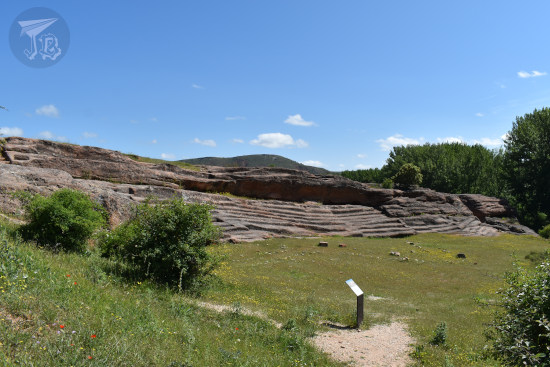
The spot I wanted to reach were the Mingo Negro Gullies Cárcavas de Mingo Negro, in the municipality of Alpedrete de la Sierra, within the nature reserve Parque Natural Sierra Norte de Guadalajara. Gullies are erosive landforms usually created by a combination of running water, especially torrential rains and floods, and small landslides as the sediment collapses. Gullies tend to be devoid of vegetation and generally quite vertical, as they commonly form on steep landscapes, often on sandstone or conglomerate soils. These particular gullies are the remains of an alluvial fan, an accumulation of sediments characteristic of mountain areas in semi-arid climates, which opens as it leaves a confined area, so when you look at it from above, it resembles a fan – hence the name. Gullies are common in badlands as the dry terrain is drained downwards and no vegetation holds it. They are considered to be unstable landscapes.

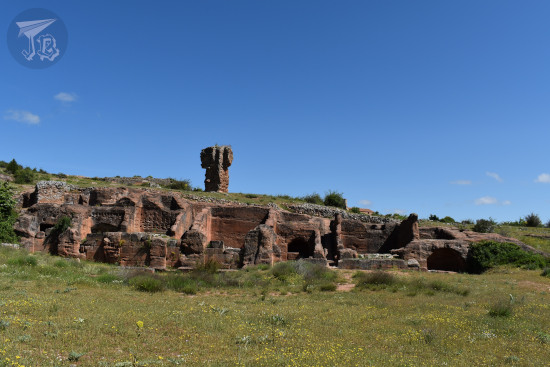
The Mingo Negro Gullies are on the left bank of the River Río Lozoya. A dam Presa del Pontón de la Oliva was built to contain the river in the 19th century, and though it is still standing, it could not be used as a reservoir. There is a kind of road / bridge that crosses the river and leads to the trail. It was rather easy to follow at first, but eventually I reached the steep part. Though there is technically a trail there, somewhere, the ascent is not easy to follow due to poor maintenance and water erosion. Hiking up the 370-metre slope took me about 20 minutes, and it was tiresome for but not as hard as I had pictured. To be fair though, I’ve recently bought a hiking pole and that was helpful. The terrain was a bit unstable and I kept my eyes on the ground, which is why I almost missed the first sight of the gullies (a later visit to the area revealed that I should have already seen them from right out of the parking lot, but the sun was in my eyes).
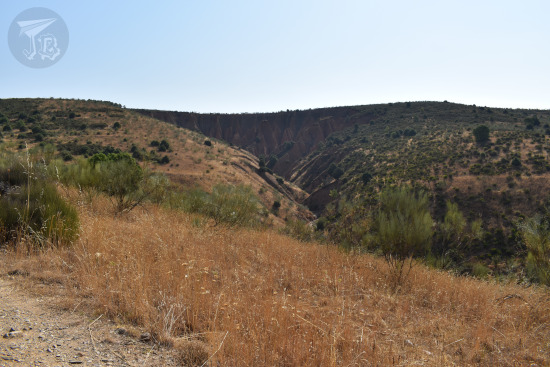
A landscape of reddish gullies in the far background

The trail is not well maintained, so plants are overgrown. If you actually want to see anything of the gullies you have to go past the “do not cross” signage, even at the viewpoints. However, you have to be very careful not to approach the border as the terrain is inherently unstable. While I was coming up, the sun masked the clay-red colour a little, which was a pity.

A landscape of reddish gullies

Though some of the online-sourced routes do so, it is also ill-advised to go into the actual gully, so I just stayed in the upper part along one of the marked trails. I did step beyond a couple of barriers, but made sure to stay a respectable distance from the border. I ventured through some of the secondary paths for pictures on my way down. However, I did not go down to the ravine, as cool as that must be, because there is a risk of collapse.

A landscape of reddish gullies with hills in the background

A landscape of reddish gullies

There are several trails that go to or around the Cárcavas de Mingo Negro, the most common of it circular. However, I did not feel like doing that one, which takes over four hours. I wanted to see the dramatic gullies, so once I was done around that area, I turned back using the same trail I had used to climb up. By that time it was around 11:00, and though I had seen nobody on my way there, now I started meeting people climbing. A family became quite indignant because I was not following the circular trail. Someone else had decided to tackle the hike in flip-flops. Some people are… peculiar.

There is a bar somewhere at the beginning of the route, and there were some buildings indeed. However, it was either closed – or I did not find it. I had thought I would stop for breakfast there, and then head to do something else.

I reached the Presa del Pontón de la Oliva dam again. The structure, in the municipality of Patones, belongs to Madrid’s Water Management system Canal de Isabel II and it is considered local heritage as it was the first dam built in the area. Madrid became the capital of Spain in 1561, and in the 19th century its population was growing fast. Water was obtained through fountains, whose waters came from underground water canals built 400 years prior. From the 18th century onward, architects started studying how to channel water from the nearby rivers into the city. Part of this program yielded to building the dam between 1851 and 1856 with the idea to create a reservoir. The structure is a gravity dam, with a height of almost 30 metres and a width of 72 metres at its longest. Two years after it was built, the rest of the project was completed, and water reached Madrid. However, the location had not been correctly chosen – water filtered through the rock walls to the sides and underneath the ashlar construction – and in 1904 the reservoir was closed down, so water flows freely through a tunnel under the construction.

I heeded the “flood plain, do not enter” warnings, but neither Sunday hikers nor free-range cows did. I remained on the upper area and explored a little of the area called “the balcony”, built alongside the dam to admire the structure. There is another hiking route, Ruta del Agua that starts there, but again, this was not something I wanted to tackle today, as it was my first day out after a long period at home. Had I found the bar open, I would have hiked further (the whole route is about four hours though, so it was probably good I did not).
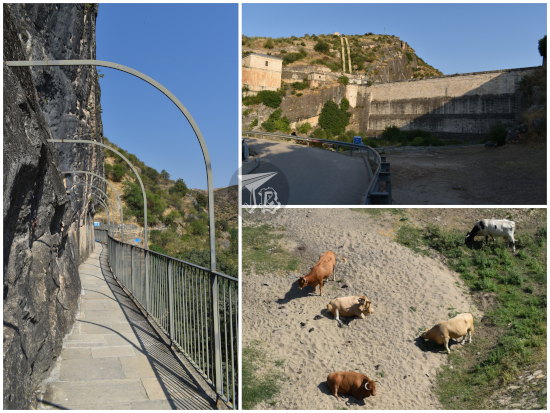
Dam - Pontón de La Oliva with some cows grazing. Since the dam is no longer in use, the area around the dam is dry

In the end, I headed back to the car and drove off. I thought I might stop to see a windmill on the way, but I somehow missed the turn to the hamlet where it stands. I was almost surprised when I saw the road sign for the last village before home. All in all, I saw what I wanted to, and found a nice easy drive with further routes that can be taken and enjoyed in other circumstances. I think I can reasonably squeeze a couple other visits to the area.
29th July 2025: Birds with great PR (Madrid, Spain)

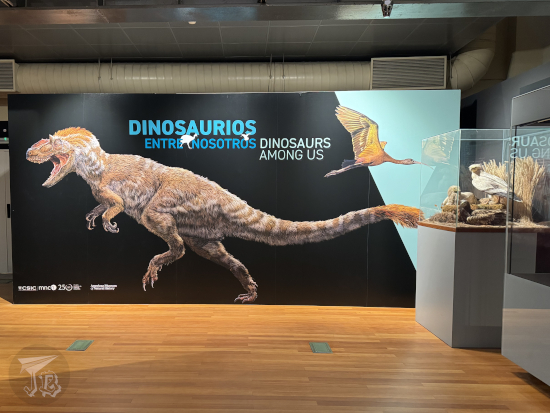
The National Museum of Natural Science Museo Nacional de Ciencias Naturales in Madrid announced that they were having an exhibit called Dinosaurios entre Nosotros / Dinosaurs among us, a collaboration with the American Museum of Natural History (though the original exhibition was apparently called Dinosaurs among us: The ancestry of birds, which feels slightly more accurate).

When I was young, it was believed that dinosaurs came from birds. With the new definition of what a dinosaur is, it turns out that birds are dinosaurs. The key features used to define a dinosaur is that the animal belongs to the clade (natural group) archosauria, and it has hind limbs which are erect underneath the body – as opposed to growing sideways and bent. Currently, two groups of archosauria exist: crocodilians (with bent legs) and birds (with straight legs). I think if you ever look into an emu or a cassowary’s eyes, you’ll understand what a deinonychus’ (the real species of the Jurassic Park velociraptor) prey might have seen.

Dinosaurs among us sign, showing a feathered T-rex

The characteristic that originally defined archosauria was the hinge-like ankle structure. As time went on, protofeathers developed and some animals adopted a straight-legged stance, which is the start of the real dinosaurs – first the ornithischians (triceratops), then the sauropods (patagotitan or diplodocus), and the theropods (tyrannosaurus), the first with a wish bone. Then the forelimb became wing-like (deinonychus), yielding to the Avialae clade, which developed flapping flight. Some scientists declare that all Avialae are already birds. Others claim that birds are the subgroup Aves.

I took the train to Madrid and walked to the museum Museo Nacional de Ciencias Naturales. It took a second to be admitted because their computer system was down, but I was carrying cash, so I could was able to purchase my ticket (I had not bought it in advance because entry is timed, and I did not trust public transport delays). It was around 10:30, still early enough so that the museum was not crowded even during the school holidays. I headed directly to the exhibition, which, mostly through panels, taxidermy, and mounted birds, summarised how dinosaurs behaved similarly to today’s birds – laying eggs, brooding those eggs, protecting the nests… The biology and anatomy of birds and dinosaurs, especially theropods, are very similar.

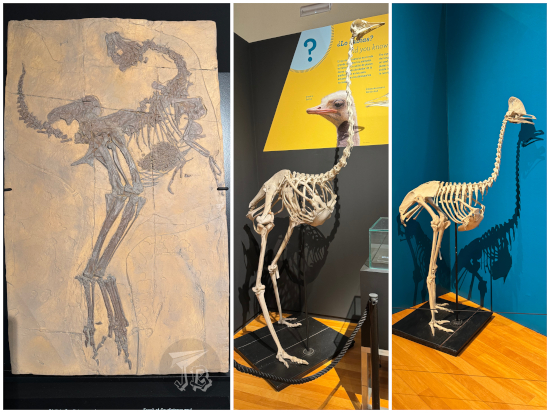
Fossil of Caudipteryx zoui (replica) and skeletons of a cassowary and an ostrich. They all share uncanny similarities, except the fossil is about one metre long and the current birds are larger

There was a very special exhibit – and no, it was not the Tyrannosaurus rex skull they’ve got. It was the original (and only) fossil of Iberomesornis romerali, a holotype from the MUPA, which you cannot photograph at its home, but you can here (just like my photography spree with the Concavenator at MARPA). Iberomesornis was the sparrow of the Early Cretaceous. There was a reconstruction of how it would look in real life (though I’ve read some texts that say it’s an outdated view?).

Iberomesornis romerali fossil and recreation. It was a crossing between a sparrow and a crocodile.

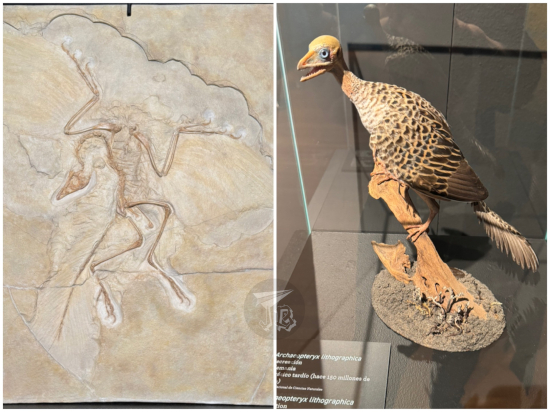
Similarly, there was a model of Archaeopteryx, the first ever-discovered feathered bird-like dinosaur. With only 13 specimens ever found, it was key in palaeontological studies before more avialans were discovered. This one was a replica, I’ve only seen one real slab ever in the London Museum of Natural History (I hope I can see the Berlin one at some point). The model was so ugly, the poor thing, but somewhat endearing.

Archaeopteryx fossil (replica) and life-sized recreation. It looks like a bald nightmare with a beak and teeth.

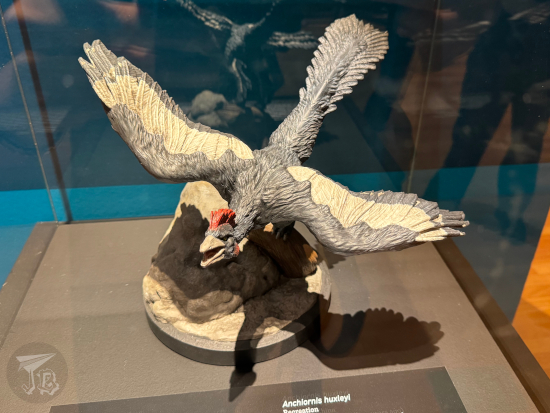
There was also a model of Anchiornis Huxleyi, discovered in China and named after Thomas Henry Huxley, the biologist who in 1869 suggested that maybe birds were related to dinosaurs. He did this comparing the hip of a Megalosaurus and an ostrich (for a while, dinosaurs were classified using “bird hip” and “reptile hip” criteria) amongst other similarities, and of course he used Archaeopteryx as evidence. Unfortunately, the poor guy is more often remembered for being a Darwin fanboy – he was even nicknamed “Darwin’s bulldog”. Palaeontologist Xu Xing described the species in 2009, and chose to call it “Huxley’s almost bird”. It has allowed to rebuild almost completely the colours of dinosaur feathers.

Anchiornis Huxleyi, proof that dinosaurs evolved into birds. Something between a rooster and a lizard

The rest of the exhibition was most… modern birds, sprinkled with children’s disappointed “Where are the dinosaurs?” wonderings. Truth be told, at the end of the exhibit there was a life-sized reconstruction of Velociraptor mongoliensis, the “real” one, not the presented in Jurassic Park, along with the explanation that Michael Crichton found the name cooler than Deinonychus, which is the animal he described in his book.

Taxidermy bird collection

Reconstruction of a Velociraptor mongoliensis, with a crocodilian face, long arms with proto-feathers and powerful claws.

So in the end, the exhibit was a lot of information about birds, hyped up with the buzzword “dinosaur”. Interesting enough but… not really what it was pumped to be. That’s what good PR does, I guess. And erasing half of the exhibition’s original title…

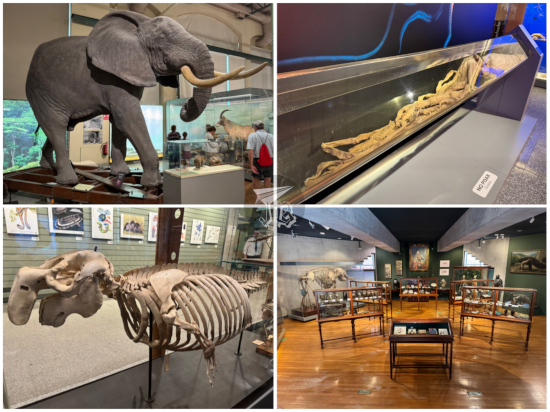
Back to Darwin though, the museum has a bit on him in its gallery of biodiversity – which is just a way to… continue exhibiting the old taxidermy specimens that they already had, some of them… made with more success than others – while some of the works they’ve got are extremely realistic, some others are… horror shows – such as the famous giant panda that the Zoo Aquarium first hosted.

One of the most interesting parts of this museum is the science cabinet Gabinete Científico, which recreates Carlos III’s scientific collection. It shows a glimpse of how science was understood at the time (though the human skeletons it used to host have been quietly removed).

Natural Science Museum Madrid - Diversity collection: elephant, giant squid, manatee skeleton, 19th century cabinet

Recently, the museum became the custodian of Santiago Ramón y Cajal’s legacy, including his Nobel Prize certificate and medals. Ramón y Cajal was a Spanish doctor considered the father of modern neuroscience. In 1888, he discovered how nervous cells work, even before they were called neurons, and that they were separate entities that created the nerves and the brain, explaining how impulses are transmitted through the nervous system. He described characteristics that could only be observed in real life almost a century after he wrote abut them. In 1906, amongst many other awards, he received the Medicine Nobel Prize alongside Camillo Golgi, who designed the methodology to colour cells, a process that allowed many of Ramón y Cajal’s discoveries. The museum exhibits microscopes, drawings, and his original office and library. For some reason, next to the ocean display and the giant squid.

Santiago Ramón y Cajal legacy: reconstruction of his office and Nobel Prize

This was all in the first ward of the museum. The second one is on the other side of the building that it shares with the Industrial Engineering School. To get there, you have to follow the dinosaur footprints, but I took a couple of detours. First, I got a bit distracted trying to figure out the “Mediterranean Forest” garden, but honestly it was too hot to stay there for long. Maybe some other time with better weather.

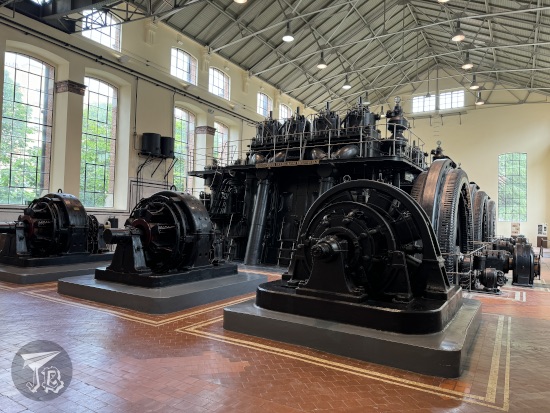
My other stop was at the Engineering School, Escuela Técnica Superior de Ingenieros Industriales (UPM). I had recently discovered that its main hall hosts an 1832 steam engine, built by the company David Napier & Son Limited. The machine was designed to power coin minting, and it was one of the first machines to arrive in Spain, purchased by the Royal Mint. It is not clear in the description if it was designed by James Watt, or just similar to his models, but it seemed a piece of history worth seeing – and the janitor was distracted while I snooped around. The engine was donated to the Engineering School in 1914, when the Mint replaced it.

Watts Machine

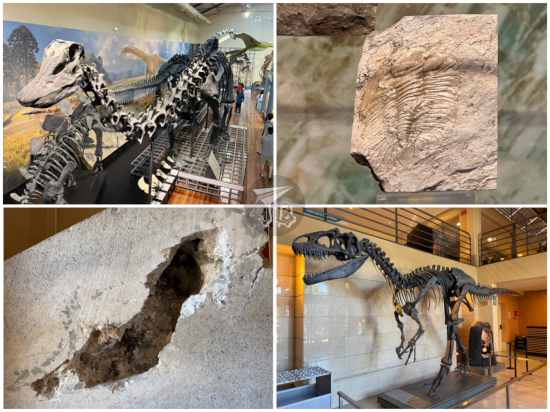
I reached the second building of the science museum Museo Nacional de Ciencias Naturales, which is the palaeontology, geology and anthropology ward. Nothing had changed there that much since my last visit. Here’s a funny story though – they have a replica of a Diplodocus carnegii, of Dippy, exactly the same one that the London Museum of Natural history has – albeit on tour. Why am I so obsessed with the London one, having another replica so close? I think it’s because the “care” the NHM gave it, while in Spain it has just been set against a wall, mixed with all the other dinosaurs from whichever age. It actually took me a while to realise they were the same cast…

The original Dippy fossil was unearthed in 1898, and soon Andrew Carnegie bought it for his new museum in Pittsburgh, hence the name of the species. In 1902, King Edward VII convinced Carnegie to donate the original cast to the NHM while the skeleton was still unmounted (there was no museum to house it yet). In later year, Carnegie would donate a few more casts to other museums in the world, including Madrid, Paris and Vienna.

This time around (call it selective perception, or plain looking out for them) I spotted the trilobites from the Murero palaeontological site, one of whose characteristics are how deformed they are, due to the earth’s internal forces and movement. The museum has a large mineral collection too, but I think it lacks something. Maybe it’s me mentally comparing to other natural history museums in Europe, or even other incredible museums in Madrid itself, such as the Geomineralogical museum nearby. It is missing… loving, in a way. I think the Natural History Museum is a bit of an ugly duckling in the cultural system, because even if it’s considered a “national museum”, it is not part of the national network, so there is something weird going on there.

Natural Science museum Madrid - diplodocus, deformed trilobite from Murero, allosaurus, geode

As I left the museum, it was incredibly hot. It was early for Spanish lunch, but some places had already started opening. I had been looking at an “Asian Market” called Oiko, but then I read that you have to order through a machine (okay) and input your phone number so they call you on WhatsApp when your order is ready, and I get too many spam calls already. I was not planning on giving out my phone number to anyone who does not need it. Even if they had taiyaki desserts.

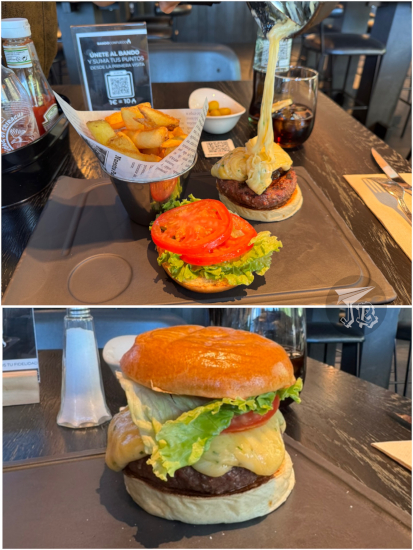
Instead, I found a burger joint called Steakburger, which self-describes as a gourmet burger restaurant, trying to become a franchise. I later realised that they are not 100% upfront with their prices, as the online menu lists one price, but the details shows another – and the desserts don’t even come with prices. It might also be a coding issue, since once you’ve checked the details, the correct price shows everywhere. Also, the machine translation is awful. Anyway, I had seen that they carried a burger with matured Angus and a topping of raclette – red cheddar, Gouda and mozzarella which were poured onto the burger, alongside Batavia lettuce and tomato, La melting cheese madurada. Honestly? It was good but not worth the price. The desserts looked decadent, but the burger was enough for me.

Hamburger being bathed over with melted cheese.

Afterwards, I just headed off to the station to take a train back, and for once I was there when a train was about to arrive. It was just too hot to look for something else to do, and during August a lot of things close at 15:00.

26th July 2025: Gladiators in Alcalá de Henares (Spain)

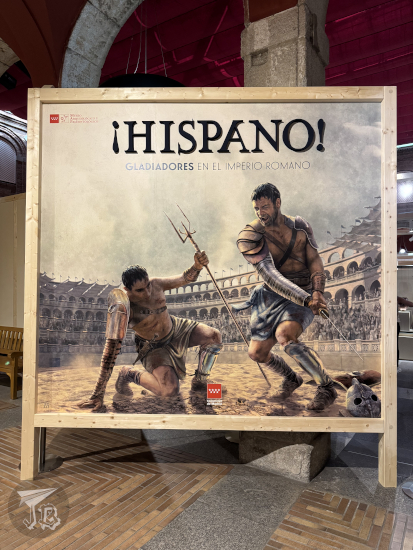
I am weird. Give me an exhibition of things I’ve seen (from the MAN) or I’m planning to eventually see (from the Roman Museum in Mérida), and – even if it is nearby – I won’t feel like coming. Add a thirty-minute historical recreation, limited-time only and I’ll be all in. The archaeological museum Museo Arqueológico y Paleontológico de la Comunidad de Madrid MARPA, in Alcalá de Henares, was running an exhibition on gladiators from Hispania called ¡Hispano! Gladiadores en el Imperio Romano (“Hispanian! Gladiators in the Roman Empire”. I have no clue what the exclamation mark is doing there). It’s not like I was not interested, it was just… not really drawn to it.

Gladiator exhibition poster, showing two Roman fighters in the Colosseum

However, I did hear about the historical recreation just about it was going to end. And you know how I am with “now or never” feelings. The way it was organised made it a bit of a challenge though – tickets were free but handed over at 15:00 for three sessions: 16:00, 17:00 and 18:00, and I had no idea when people would queue or whatever. I arrived at the museum around 13:30, and asked at reception. They told me that people usually started queueing around 14:30, and thus I decided to head there around 14:15 to secure entry.

Meanwhile, I checked the exhibition out. The majority of the pieces were reproductions, but there were a few originals. The most important real artefacts came from the Mérida Roman Museum, which as far as I know is closed at the moment. There was a guided visit going on, and I reasoned that a bunch of those people would also want to see the recreation.

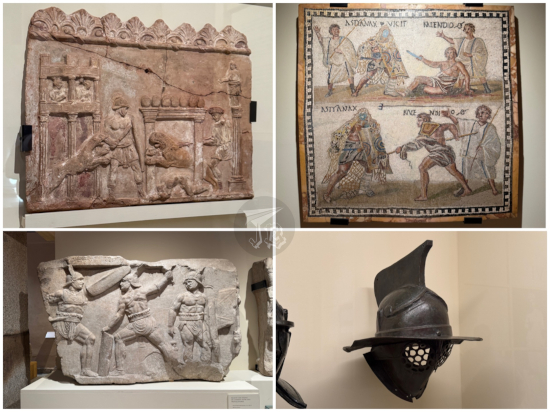
The collection included reliefs, mosaics, and some sculptures. There was also a copy of the Roman Law from the MAN. In glass cases, helmets and weapons – most of them real – were displayed. In the centre there was a round amphitheatre where the recreation would take place. It was a small exhibition.

Exhibits in the Gladiator show: reliefs and a mosaic showing men fighting, and a helmet.

Afterwards, I wandered the rest of the museum for a bit, and around 14:15 I went to queue, displeasing the security guard who said that lining started at 14:30. That was not what I had been told. I offered to move, but he muttered “never mind”. What is with security suddenly going weird when there is queueing involved? I’d never had any kind of problem with the MARPA staff before.

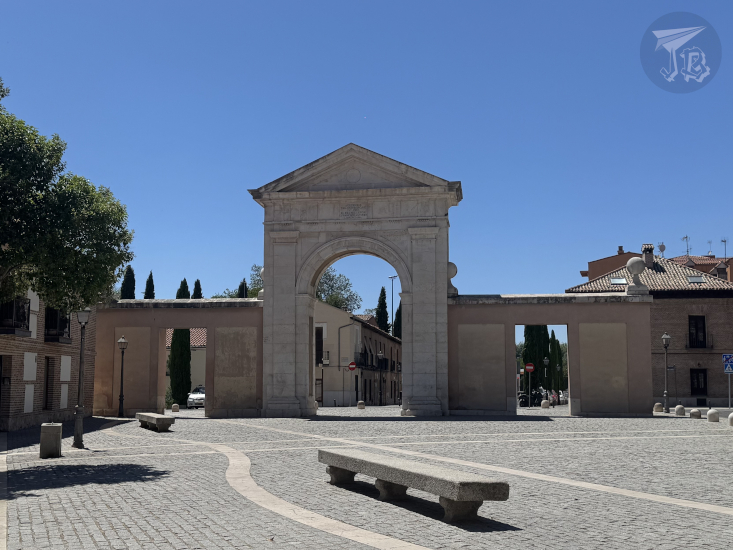
At 14:55, I got my free ticket and headed outside the museum for a quick bite. I had planned to try a typical pastry, but all the patisseries close from 14:00 to 16:00, which was inconvenient. I ended up having yoghurt ice-cream instead. I had never seen the main street Calle Mayor or square Plaza de Cervantes so empty, but I guess that was because of the heat. Afterwards, I walked towards Puerta de Madrid, an 18th-century monumental gate that took the place of the actual wall gate. Coincidentally, the structure shows up in the 1960 gladiator film Spartacus.

Main street in Alcalá de Henares, during summer mid-day. The only shadows is under the covered area behind the columns at the sides

Puerta de Madrid - monumental entrance to Alcalá de Henares

I went back to the museum and we were soon admitted into the “theatre” that doubled as arena. The recreation was carried out by the historical recreation group Antiqva Clio. There were three actors: the lanista, and two gladiators. There was a kid running around too, but he was sort of the mascot, and a lady in plain clothes helping out.

The recreation started introducing the concept of ludus (plural ludi): a gladiatorial school, where the gladiators were housed (kept) and trained. The owner or lanista selected the fighters – slaves, criminals or free men – and assigned them to a category, either heavy-weight or light-weight.

The lanista was the owner of the school. He invested in the gladiators and their training. Gladiators who were slaves or criminals could eventually buy their freedom if they won enough fights. Once the gladiator entered the ludus, they took the “Gladiatorial oath”, which was akin to “we accept to be hit, burnt, chained and killed by the sword”. Which… was not the expected one, right? To get it out of the way from the get-go, apparently the whole Ave Caesar! Morituri te salutant (Hail, Caesar, those who will die salute you), was popularised in the 19th century, and there is only evidence that it was said in real life as Avē Imperātor, moritūrī tē salūtant, once. It was in the year 52 CE on Lake Fucinus (not even a circus), where a group of criminal and prisoners sentenced to death were to fight on a naumachia (mock naval encounter) until there were no survivors.

Anyway, back to what I learnt. After swearing the oath, gladiators chose a fighting name, and got right into the fray. They trained together and became a sort of family, even taking care of each other and their relatives. Gladiators tended to specialise, as there were different classes with styles and weapons, and the ones who fought each others were different from those trained to hunt beasts. Fighters trained with weighed weapons so the fight would seem much smoother on the show. They were well-fed and even a little chubby so there could be wounds and blood without jeopardising their lives too much. As a matter of fact, when a gladiator died, his lanista had the right to monetary compensation for “loss of investment”.

The standard Roman circus games, ludi circenses, were sponsored by an editor, a sort of promoter who paid for everything. He hired the gladiator schools ludi to offer free entertainment to the people around him. The games started with Wild Beast Hunts (a fighter who was trained in this was called a venator or a bestiarii), then came executions, then the gladiatorial fights (munera) happened.

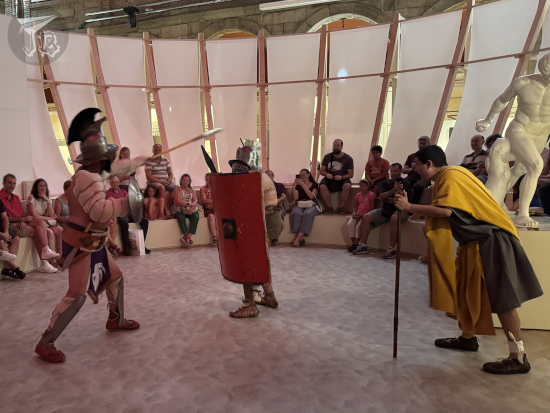
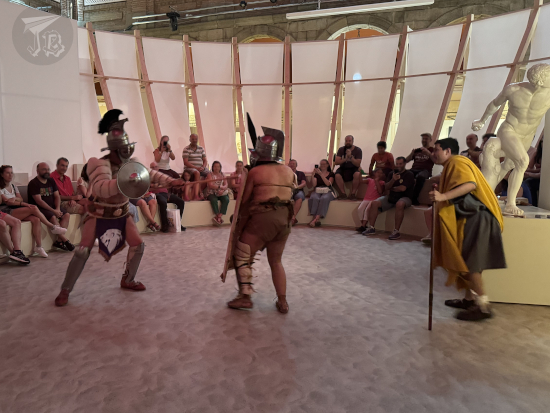
The gladiators who fought each other were paired: a light-weight versus a heavy-weight, and each fight took about ten minutes. There were different classes of gladiators, and we had an example of a murmillo (Leandrus) and a hoplomachus (Pintaius). The murmillo was a heavy weight-gladiator, equipped with a large shield and a sword. He was the defensive party. The hoplomachus was the light-weight and thus the aggressor. He carried a spear and a small shield. In general, one was “too armed to move” and the other one was “not armed enough” to somehow balance their differences. Both wore helmets with bad visibility in order to increase the drama.

Gladiator in fight pose, hiding behind a large shield

Gladiator with a small shield and a spear

There were two more figures in the games, the rudis, sort of a referee, and the lorarius, who made sure the fighters gave everything they could using a whip to motivate them. Though there was a risk that fighters might die during the fights, it was not the common thing. The winner received a laurel crown, a palm, a purple coat, a silver tray, and a bag of money. The loser could be pardoned or killed, but the whole thumbs-up, thumbs-down thing? That is not historically accurate either. If a winner gladiator was ordered to kill a loser who came from the same ludus, he made sure to do it as quickly as possible.

When a gladiator had won 10 fights, he had enough money buy his freedom and leave the life completely, though he could continue fighting and even assume another role in the ludus, such as a trainer or doctor of sorts. There is no historical information about how a fight was refereed, but here they did a first-to-reach-three-hits scheme. The lanista divided us in two groups to cheer for each gladiator, and the one on my side lost. Apparently Antiqva Clio‘s fights are not staged. The members of the recreation group actually train (with non lethal weapons of course) to learn how to fight, and whomever wins has won. No idea, but I felt sorry for the guys, who had to do it again in 30 minutes, and they were exhausted.

Gladiators fighting. The light-weight is launching his spear forward

Gladiators fighting. The light-weight's spear has made contact with the heavy-weight's shield.

Afterwards, we could take pictures with the gladiators – and they let me hold the weapons, since “my mum was not around to grant or deny permission”. In the end, I just headed home. The walk to the car was a bit scorching though… The price you have to pay for an easy parking spot is a ten-minute walk that… gets hard towards the end of July.

But there was a limited-edition activity and I had got to do it. Good job me.

5th July 2025: Cheese, archaeology, pancakes (Madrid, Spain)

I am not completely sure how the conversation came up. My sibling said something about cheese tastings. I mentioned something about knowing about a shop in Madrid which organised them. Next thing I knew, I had been tasked with planning an escapade to try. However, closing on dates is not something my family is fast at doing, so by the time my sibling confirmed, the June date we wanted was sold out and I had to book for July.

The final date was Saturday the 5th of July at 13:00. The evening before, there was an explosion and fire in a factory in an area alongside both the speedway and the railway lines, and that forced me to reevaluate transportation – the warehouse worked with lithium batteries, which burn for a very long time. In the end, I decided to try for an early train, with a plan B to drive to a station halfway and meet my sibling there. While you could see the smoke from the wagon, there was no weird smell or anything and the train ran smoothly for once. Maybe we were five minutes late to Madrid? Funny, when I was warned at the station that there were delays. I had planned an extra activity in case we were early.

There was also Pride to take into account, as it was the main Parade, and that causes a cascade of station closures, including Recoletos, the station we had to go to. That would only be an issue to consider when we had to go back though, since they started at 18:00. We could always get the underground and find our way to Atocha.

We started off at the Museum of the National Library Museo de la Biblioteca Nacional. I had seen the museum already, but I had read that there was a temporal exhibit. However, we were unable to find it – it’s been apparently “temporarily closed”. It worked to pass the time out of the heat though. We were done at 12:30 – a bit too early to directly go to the store, but too late to try to see anything else. We decided to walk towards the shop, and we missed it at first, but we soon backtracked and walked into… a literal fridge.

Formaje (an old-fashioned Spanish word for cheese) is a specialised / delicatessen cheese shop. Created in 2020, it aims to “create community around artisan cheese”. They work with farmers, craftspeople, and traditional cheesemakers to distribute environmentally-conscious cheeses from producers who respect the natural processes, the landscape and of course the product. The store is designed to be a warehouse too, so it is… cold. Good thing I was carrying a jacket.

Formaje Castelló: Shop. A cheese shop full of pieces and whole cheeses

We waited in the shop, trying not to obstruct the customers, and gawked at all the types of cheese in display, all of which could be bought, and tasted beforehand! We saw some regulars who had their thermal bags ready for their shopping and debated getting a cheese subscription, and people wandering in out of curiosity. Around 12:55 a lady came to check us in. I was the closest to her, so I was able to take a picture of the whole set up and find a seat closest to the speaker. I have way too many attention issues not to want to be close to someone who is going to do some explaining I care about.

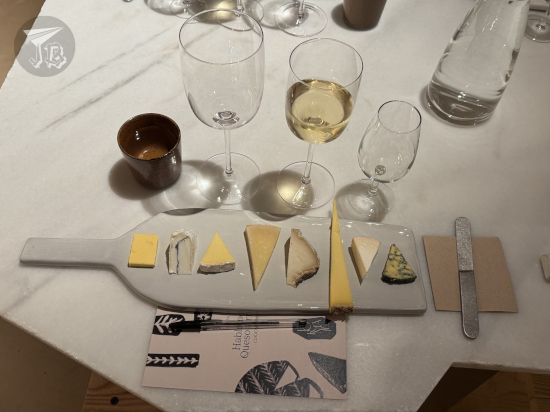
The tasting Cata de Quesos Edición Primavera involved fresh sourdough bread, butter, seven types of cheese, sweet quince paste, red and white wine, and “ice cider”. I am not a fan of alcohol in general, but the ice cider was magnificent. I am not going to gush about how all the cheeses were delicious. Assume I loved them.

Formaje Castelló: Cheese tasting. Long table and a tray full of sourdough bread

To begin with, there was real butter from the farm Airas Moniz in Chantada (Lugo, Spain). Made from the raw milk of Jersey cows grass-fed in the north of Spain, it was fresh, yellow, creamy and salted, and the bread was delicious. The first cheese was Olavidia (from Jaén, Spain), made from goat milk. It had a small layer of smoked wood halfway through. Even if I don’t care much about “the proper order you should eat things in”, I discovered that goat-milk cheese is supposed to be a “soft-tasting” cheese, I have always found it pretty strong. The cheeses were organised from softer to stronger, which apparently is how you should consume them.

The second cheese was a Camembert (protected designation of origin, AOP from its French acronym) from the region of Normandie, France; it was creamy, made from raw cow milk, with a slight moulded rind (with Penicillium camemberti) which protects the inner creaminess.

Then came a Manchego (protected designation of origin, DOP from the Spanish acronym), made with raw sheep milk. It originated in a farm called Finca Valdivieso (Alcázar de San Juan, Ciudad Real). In my opinion this one was the weakest cheese, as I am a fan of older Manchego and this was less than a year old, though still nice.

Number four was a cheese I had not heard about before, Tronchón (from cheesemaker Los Corrales, Almedíjar, Castellón). Tronchón is generally made from raw sheep milk, though sometimes it might be made with goat milk or a mix of both. The one we tried was made from goat milk. The rind is dark and unappealing on sight, but it was nice enough. Despite my ignorance, this cheese is old enough that it was mentioned in Cervantes’ Don Quijote.

Another discovery was the German Blossom Hornkäse. Hornkäse comes from the Bavarian region of Allgäu. The cows that provide the milk are fed with local grass and they don’t have their horns cut (Did you know that a cow’s horns are connected to her throat and they are part of the digestion process?). The cheese is made in wood recipients using only wooden tools. This version comes with a crust of dry flowers which makes it… just amazing.

Sierra Sur was… the icky one. It smelled like literal stable – and not a clean one. It is made with raw goat milk and you have to fight yourself a little bit to take a bite of the rind. It is a seasonal cheese, which I wouldn’t be able to say whether it has gone bad… It did look like it had gone bad… But it was nice enough, if you could ignore the smell. Not something I would buy on my own though.

The last cheese, Savel, came from Chantada – like the butter at the beginning. It is made from raw cow milk, from Jersey cows, injected with Penicillium roqueforti. This was extremely strong, but really good, especially with the bread, and the ice cider called Bizi-Goxo. Though this one brand comes from the north of Spain and is made from Errezile apples, ice cider originally comes from Canada. To produce this particular spirit, the apple is kept through the winter on straw mats, and it does not rot. The resulting drink is stronger and sweeter than a regular cider.

Formaje Castelló: Cheese tasting. Seven small pieces of cheese perfectly aligned on a tray

We spent some time chatting with the lady who had given the explanations, then went on our way. We walked to the archaeological museum Museo Arqueológico Nacional, where they were running two temporal exhibitions. One was a personal-turned-public collection of Egyptian Artifacts called El Egipto de Eduard Toda. Un viaje al coleccionismo del siglo XIX (Eduard Toda’s Egypt: A trip to collecting in the 19th century). Eduard Toda i Güell (1855 – 1941) was the Spanish Vice-Consul in Egypt for a couple of years, during which he amassed a rather impressive collection of artefacts, which he eventually donated to public institutions. The bulk of what he owned is now held in the archaeological museum as part of both the permanent collection and the archives. He had antiques, carbon copies of reliefs, photographies and a hefty number of fakes – apparently, knowing they were so.

Treasures from an Egyptian tomb

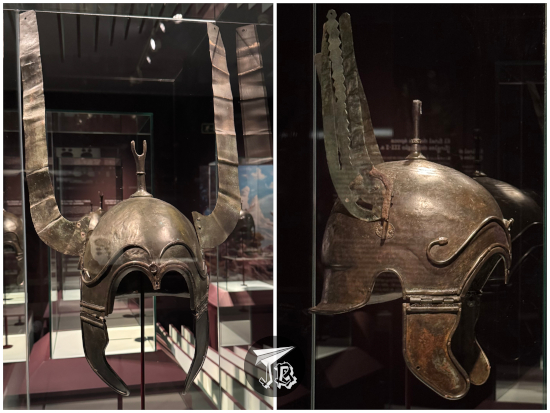
The second temporal exhibition we wanted to see was Alas para la guerra. Aratis y la Celtiberia: Wings for war, Aratis (a town, now an archaeological site) and Celtiberia. This one focuses on the Celtiberian culture and how it warred, using soldier helmets as a storyline. These particular helmets have a convoluted history – it turns out that between the early 1980s and 2013, someone used metal detectors to find artefacts from the ancient town and sell them out. This “gang” found and illegally auctioned up to 6,000 artefacts, including twenty helmets which had been forged between the 5th and 2nd century BCE. The archaeological site of Aratis, now called Aranda del Moncayo, would have been probably the most important Celtiberian site after Numancia if these guys had not systematically destroyed it.

The Aratis helmets are the most complete items of their kind that have ever been found. They were not really used for war, but were part of funerary treasures. Truth be told, Germany sounded the alert at some point around 2008 about the legality of the auctions, but the Spanish government did not stop them. Seven of the helmets were returned to Spain in 2018 thanks to the European buyers who learnt that they had been illegally exported, and 11 more have been located. The seven helmets are deposited now in the Museum of Saragossa, but that one is currently closed due to construction work (scattering some of its collections to be shown elsewhere), so they have been lent to the Archaeological Museum.

Celtiberian helmets with decorations on the sides

The exhibition also holds other weapons, parts of armours, and Celtiberian artefacts such as coins and brooches. I had seen some of the messed up spears in the museum in Tiermes, which makes sense, considering it also held Celtiberian items.

Afterwards, I finally (finally!) managed to find the reproduction of the Altamira Caves Neocueva de Altamira open! It just had not worked any other time I had been in the museum for the last ten years, and I had seen it once when I was really young, and something similar in the museum on site a lifetime ago. It was smaller than the one I remember from both times… And it makes me sad that I will never be able to see the real thing, because there’s a waiting list you can’t even get into any more, and only 50 people per year see the actual cave…

Reproduction of the Altamira Cave, with bisons, horses and bulls painted on the ceiling.

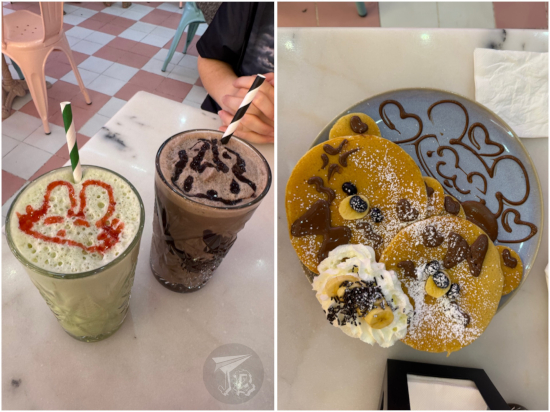
My sibling was not ready to go home just yet, so I thought they might like a stop at Kawaii Café before we turned in. We could take the underground and in under a change and 30 minutes – since I had been there just a couple of days before, I remembered the underground station. I was not sure whether there would be a queue to enter or not, but we were lucky. We alighted at Tirso de Molina and went into the café without problem – it was half empty at the time, around 16:30. They really wanted to order something cute – which is not hard. In the end, they chose teddy-bear-shaped pancakes with chocolate spread Ositos rellenos de Nutella, with chocolate syrup, whipped cream and banana slices. This time I went for a matcha frappé.

Two drinks with cute rabbits drawn on top, and pancakes decorated to look like teddy bears

Afterwards, we walked down to Atocha Station down one of the shopping streets. We made a few stops, and reached the station just before the Pride Parade blocked the streets. There, we settled to wait for a train. On the way back, the factory that had had the accident was still smoking, but the dark cloud seemed weaker. However, I never thought I would have to consider “lithium explosion” in my adventure planning, to be honest…

2nd July 2025: Sabina’s Hello & Goodbye (Madrid, Spain)

Lots of things came together on the 2nd of July. First of all, due to weird work schedules that I had no control over, I had a day off in the middle of the week. Second, I had a doctor appointment in the morning – lucky how I could fit it there. Third, Jurassic World: Rebirth, the new film in the Jurassic Park franchise came out. Finally, back in January, I had bought tickets to watch a concert in the goodbye tour by the singer who composed the soundtrack of my teenage-angst years.

So it was just a stroke a luck that work just happened to give me the day off because of unrelated reasons. It would have been luckier to have the following day off too but what can one do? Actually, I propose an unpaid leave called “I had a concert yesterday and it’s not that I’m tired or sore or anything, but I don’t want to go back to reality just yet, I deserve to bask in post concert ‘the world is okay’ bliss.” Think about it, it’s a great idea.

Since I had the doctor’s appointment, I could not plan a whole day out. Once I was done there, I changed clothes and then drove off to the train. Of course, there were delays, what else is new? Halfway, one of the doors got stuck open and we could not start until that got closed manually. But instead of blocking it, they allowed it to keep opening at subsequent stations – so it got stuck again and again.

I reached Atocha just in time to change trains and get to Sol using the same system without a wait, so in a few minutes later I was out in the heat. The original idea had been a light lunch at Yatai Market, but the air conditioning in Kawaii Café was stronger. I had been to another of their shops before, and the food was all right, so I thought why not? I ordered a strawberry frappé and a “sleepyhead bunny” Conejito Dormilón – a Red Velvet crêpe filled with strawberry compote and decorated with cheese cream and blueberries, along with a vanilla-jello bunny mascot. Adorable and delicious. Quite pink, too, due to all the strawberry…

A collage of pink café and a meal - a strawberry frappe with a cute koala face drawn on it. and a crepe which looks like a bedding with a sleeping rabbit on top

When I finished, I headed towards the nearby Yelmo Cines Ideal to watch Jurassic World: Rebirth, a monster movie with a homage to the Jurassic Park book. I guess the film is better if Scarlett Johansson is your type. The film retcons the whole “Jurassic World” premise: now the dinosaurs are dying (and nobody cares about them any more!) and only surviving on an island near the Equator. It turns out that they somehow hold the key to cure heart disease. And then the palaeontologist says that they need to collect samples from the three biggest dinosaurs: Patagotitan (okay, it’s famous now), Mosasaur and Quetzalcoatlus, both of which have already been featured in previous films and are not dinosaurs. Then there are mutated freaks and a Tyrannosaurus with the head of a xenomorph and some extra arms, because the dinosaurs can’t survive, but the “mutated experiments gone wrong” are alive and well? The best from the film was a scene taken from the book, with a Tyrannosaurus and a raft. Unfortunately, this new Tyrannosaurus was not Rexy. Furthermore, the special effects are… not good. Too much bad CGI makes the creatures less believable than those in the 90s instalments, which is… a huge faux pas.

I am glad I saw it on opening day, though – I was able to avoid most spoilers and went in with an open mind. It was not a good film but I didn’t hate it. I will just probably ignore it exists (until the next film comes out, we all know that). Points for the pro-planet message, but it falls a bit flat when you know that Michael Crichton, the original author, was pretty much anti-science…

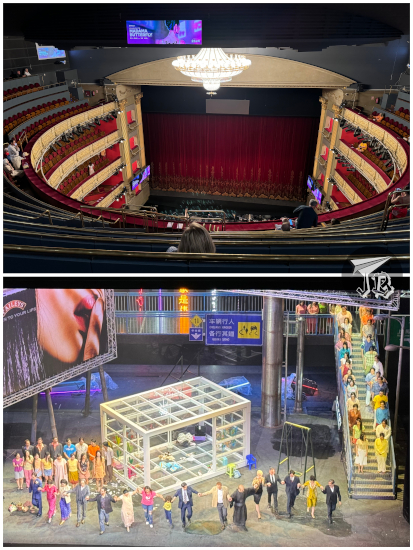
The film was around 133 minutes long, but oh god, the previews were long. Thus, I left the cinema around 19:30. I had to take the underground, and I knew that some stops would be closed due to Pride. However, last year I had learnt that you’re still allowed to transfer even if you cannot enter or exit the station. I used that knowledge to get myself to Movistar Arena Madrid for Joaquín Sabina’s final tour Hola y Adiós (Hello and Goodbye). I am happy I bought the tickets when I first saw them, because most concerts have sold out, and I got quite a good seat considering the event and the venue.

Joaquín Sabina is a Spanish singer and songwriter born in 1949 in Jaén, in the south of Spain. When he finished his studies, his father offered him a present, and he asked for a guitar. Due to his leftist ideas he had to exile himself in London for a few years during Franco’s dictatorship. When he came back, he lived a life of debauchery, mostly in Madrid, and he probably was not the best role model. But between 1994 and 2000, when I was an angtsy teen, his music was important to me, though I eventually moved away from it. When I heard he was retiring (again) early in the year, I thought I wanted to see him at least once, despite the fact I have not consistently listened to his music much in a couple of decades – there are a few hits in my car playlist. And then there is ¿Quién me ha robado el mes de abril?, Who stole the month of April from me?, which hit me very hard during Covid lockdown and I’ve skipped since then, but never had the heart to delete from the playlists.

Security let me in with my tiny water bottle, thankfully, and I found my seat about 45 minutes before the show was due to start, and 15 minutes after doors – it was weird, I had expected a larger crowd, and I had been a bit stressed leaving the cinema 20 minutes later than what I had calculated. I was on the side stalls, on a ninety-nine-euro spot. There is a whole etiquette about concerts with seats, and while I am quite happy to stand up when it is appropriate, and in this case, I decided I would stand up when people in front of me stood up. Pretty easy.

Sabina Hola y Adiós Madrid: empty stage

Setlist:
 Un último vals (One last waltz; recording and MV)
  1. Yo me bajo en Atocha (I’ll alight in Atocha)
  2. Lágrimas de mármol (Marble tears)
  3. Lo niego todo (I deny everything)
  4. Mentiras piadosas (White lies)
  5. Ahora que… (Now that…)
  6. Calle Melancolía (Melancholy Street)
  7. 19 días y 500 noches (19 days and 500 nights)
  8. ¿Quién me ha robado el mes de abril? (Who stole the month of April from me?)
  9. Más de cien mentiras (Over a hundred lies; band intros)
  10. Camas vacías (Empty Beds; vocals: Mara Barros)
  11. Pacto entre caballeros (Pact amongst gentlemen; vocals: Jaime Asúa)
  12. Donde habita el olvido (Where oblivion dwells)
  13. Peces de ciudad (City fish)
  14. Una canción para la Magdalena (A song for Magdalene)
  15. Por el bulevar de los sueños rotos (Through the Broken Dreams Boulevard)
  16. Y sin embargo te quiero (And yet I love you; folk copla song; vocals: Mara Barros) + Y sin embargo (And yet)
  17. Noches de boda (Wedding nights) + Y nos dieron las diez (And the clock struck ten on us)
 Encore:
  18. La canción más hermosa del mundo (The most beautiful song in the world; vocals: Antonio García de Diego)
  19. Tan joven y tan viejo (So young and so old)
  20. Contigo (With you)
  21. Princesa (Princess)
 La canción de los buenos borrachos (The good drunkards’ song; recording)

Well, what can I say? Sabina has got old since I was a teenager. His voice has cracked – after all, he is a smoker – and he has swollen up. But his concert made me feel 30 years younger, and I enjoyed it immensely. I’ll freely admit that I bought the ticket back in January purely out of FOMO. However, I am happy I did. I did not get any of my personal favourites, and I am okay with that. Most of what he sang was part of those times.

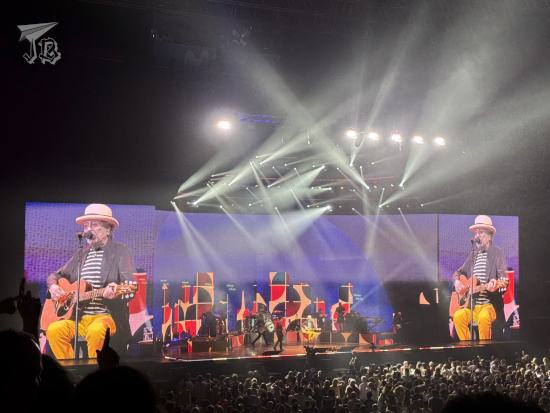
Sabina Hola y Adiós Madrid: musican ensemble

The concert started with Yo me bajo en Atocha (I’ll alight in Atocha), a description and homage to the city of Madrid, which the singer holds particularly dear – despite the fact that he has a bad record with concerts in the city – he once had a panic attack and another time he literally fell of the stage and ended up in hospital. He started sobbing right at the end of the song. Figures.

The venue, of course, cheered and applauded, and stood up to bounce to Lágrimas de mármol (Marble tears), which has too dark lyrics for how… perky the music is, but I guess the message of “survivor, yes, damn it” is what matters. It was during Calle Melancolía (Melancholy Street) when the old guard took over, so Sabina turned the microphone towards the attendees, which did not only sing chorus but brought down the dome with their voices. He was visibly moved.

Good thing that next came 19 días y 500 noches (19 days and 500 nights) a getting-over-a-break-up song during which people can yell, and broke the spell. That made me strong enough for ¿Quién me ha robado el mes de abril? (Who stole the month of April from me?), the first time I’ve actually listened to the song since 2020 – “who stole the month of April from me? I kept it in the drawer where I keep my heart” did not sound so threatening surrounded by hundreds of other people.

Sabina Hola y Adiós Madrid: playing guitar

During Más de cien mentiras (Over a hundred lies), which is a list of all the good things in life and “over a hundred lies that are worth it”, we got the band introductions. Sabina sang himself, and played the guitar for some songs – he stayed sitting down on a tall stool. Safer for him. Antonio García de Diego played guitar, bass, and harmonica; Jaime Asúa Abasolo and Borja Montenegro also played guitar; Josemi Sagaste played sax and non-drums percussions; Pedro Barceló played drums; Laura Gómez Palma played the bass; and Mara Barros did the choruses and had some solo vocals.

Sabina retired to rest for two songs, alleging that it had always been a dream of his to have a song of his sung by a beautiful woman – Camas vacías (Empty Beds), performed by Mara Barros – and by an actual “rocker man” – Pacto entre caballeros (Pact amongst gentlemen) with Jaime Asúa on vocals. Soon after Sabina’s return came a song which holds one of the song lines that has impacted me the most in my whole life: Noches de boda (Wedding nights) hopes that “the end of the world finds you dancing”. I really hope it does.

I guess part of the fun of a concert is that you feel special. Of course that the singer has a speech for every city, and holds each one close to their hearts, or are the best or whatever. But this one did hit differently. I guess my inner child enjoyed it immensely, and even if neither of the songs of the encore did much for me in terms of nostalgia, I was incredibly grateful and happy that I had been able to attend. If it is the last tour indeed, I will have said my hello and goodbye, even if it has been 30 years after the time Joaquín Sabina’s was the only music that played in my room.

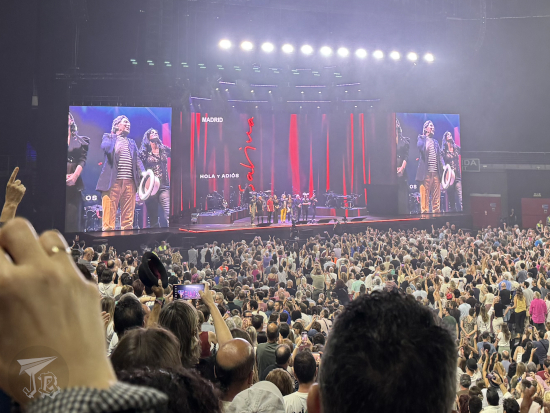
Sabina Hola y Adiós Madrid: waving goodbye to the public

Also, another extremely convenient thing: though I went by train, I had a ride home, as my parents were in town and driving back around the same time. Which was great, considering that a storm was brewing, and that there were many underground and train stations still closed due to Pride…

7th June 2025: Tiermes Archaeological Site (Spain)

For a while it felt that this day trip was cursed or something. Whenever I decided to schedule it, something happened – a family emergency, a weather alert, work hiccups, car trouble, you name it. I finally got everything ready on Friday and hoped for the best on Saturday morning. The weather was all right, family was okay, the car had passed its check, and work was calm for a minute. Off I went!

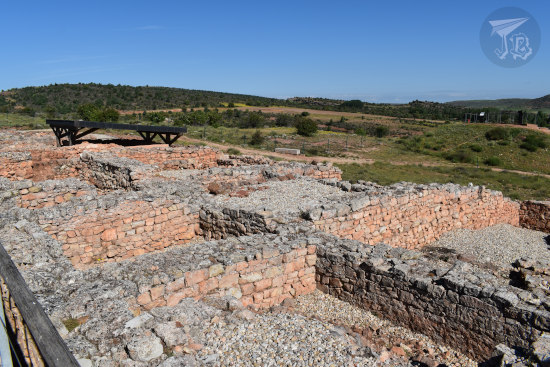
The Tiermes Archaeological Site Yacimiento Arqueológico de Tiermes is located in the municipality of Montejo de Tiermes, in the area of Soria. The ancient city of Tiermes was first inhabited in the Bronze Age. Before the Roman conquest, it was a Celtiberian dwelling, and during Scipio’s campaign around 134 BCE to conquer the Iberian Peninsula, it became an ally to Numancia. After the Roman Empire’s victory, the town was assimilated. In the year 98 BCE, Tiermes became a municipuim with two forums, a theatre, an aqueduct and several houses built to maximise the utility of the rocks of the area. In more recent times, a Romanesque hermit church was built nearby.

The site is located around 1200 metres high, in a sandstone landscape with flats and erosion cliffs. Both Celtiberian and Romans built around and into the rock, to the point that there are several “rock houses” which have been excavated into the mountain, with literal furniture carved out of the stone.

While the Romans made sure to keep the legend of Numancia alive – as it made the victory more glorious – Tiermes was eventually forgotten after it was abandoned, probably when the area ran out of water. The ruins were first excavated in 1960 by Teógenes Ortego and Juan Zozaya. It was however the work of José Luis Argente Oliver, between 1975 and 1988, which really brought out the ruins into the spotlight. There were new findings from 2008 onwards.

The drive was just shy of two hours, and since I left on a Saturday around 8:00, the roads were rather empty. I drove past the reservoir Embalse de Alcorlo, but the parking spot to look at the structure was behind a curve and I missed it. I also passed by the Medieval village Molina de Aragón, which had a festival the following day. I had an idea…

It was not extremely hot, and the drive was easy, even if I did not take the speedway. There was a stretch of the road which was really badly paved, and almost as soon as I drove into Soria it became pristine. I reached the parking area a bit before 10:00 – my Sat-Nav was way more on spot predicting the times than Google Maps. Though some of the roads had a speed limit of 90 kph, there was no way you could do more than 40 kph on them.

There is an area to park next to the hermit church Ermita de Santa María de Tiermes, the newest construction of the site, dating from the 12th century, which has a small cemetery associated to it. The little building looks like a 3D puzzle with its bricks and arches. It has a covered outer area, which indicates that at some point it was ready to receive pilgrims. Unfortunately, the church was closed so I could not snoop inside.

Tiermes: Romanesque Hermit Church in brick with decorated arches

Instead, I set off for the walking route, which starts at the Roman forum. When the Romans took over the city, they transformed it according to their customs, and two forums were built throughout the Julio-Claudian and the Flavian dynasties (27 BCE – 68 CE and 69 – 96 CE). Most of the forum was erected above the ground and now it is gone.

Tiermes: Ruins of the forum; a number of square foundations that would have been shops

The same happened to the House with the Aqueduct Casa del Acueducto, though in this case you can walk into the different rooms – and there are reliefs on some rocks that comprise the basements and foundations of the structure. The original house would have had 35 rooms in different levels, with stairs to move around them. The plinth was made out of the red sandstone that comprises the area and the walls were built with wood.

Tiermes: Ruins of a mansion called Aqueduct House

As Tiermes was partially built into the mountain, it has two levels. The upper one, with the forum and the Aqueduct house, and the lower one, where you can see (and enter) houses carved in the rock. I was on the upper part, heading towards the vertical wall to descend onto the lower area. In order to do so, I had to go down the West Gate of the city Puerta del Oeste, which now is just a small gorge between the levels, with a steep slope.
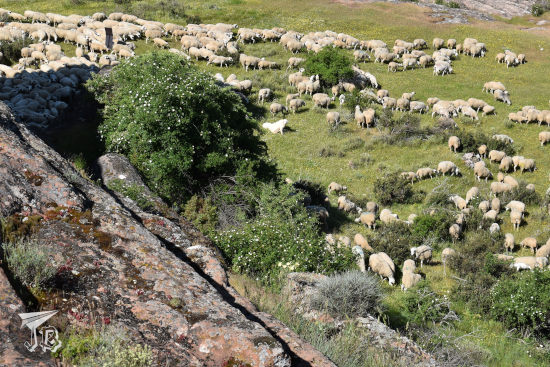
Whilst I was walking towards the Gate, I heard bells, and when I got to the edge of the rocks, I saw that there was a herd of sheep walking underneath, along a shepherd and five huge mastiffs. There was no way I was going to walk near the herd and bother the dogs, so I stayed in the upper part. One of the mastiffs gave out a warning bark, and at first I thought it was directed at me. However, I realised that the dog was barking at a couple of griffon vultures which were circling for any food available, namely if they could snatch a lamb, I guess. And then, one of the vultures decided to circle me instead of the sheep.

Herd of sheep with a giant mastiff guarding it

Griffon vulture gliding for lunch

When the herd was at a safe distance, I went down and crossed the Gate to walk alongside the rock wall, which has houses carved into it. Not only that, there is a whole underground aqueduct Acueducto y Túnel de Tiermes dug into the rock. And you can actually explore its whole length! I went in. It was completely dark except for a couple of ventilation holes, and at the end of it I found myself at the Aqueduct House. I decided to backtrack using the same way in order to continue the route and not miss anything by accident, or because the whole experience was wickedly cool. Take your pick.

Tiermes: Aqueduct and houses carved in the rock

 
From the entrance of the aqueduct, I walked alongside the rock wall and explored the houses built into it – Casa de las Escaleras (The House with Stairs), actual apartment blocks up to seven floors, Casa de las Hornacinas (The House with Shelves) and Sección Rupestre Sur (Southern Area), which was built half into, half onto the rock. Most of these date from or were repurposed during the Roman area, so it is difficult to point the original Celtiberian work.

Tiermes: houses carved in the rock, including staircases

Tiermes: Houses built from the rock outwards

A bit away from the rest of the town stands El Graderío, an area with sitting terraces carved onto the rock that could have been a meeting place or a theatre. Then, I found another of the gates Puerta del Sol, which again gives way to the upper area.

Tiermes: terraces carved into the rock where people could have sat

There was also the reconstruction of the Roman wall, with… a couple of pieces of the original defensive wall, and a lot of new ashlars that looked quite fake, so you could see what was original and what was not. As far as archaeological sites go, though most of what can be seen in the town is Roman, it was cool to see so much standing – especially the aqueduct – considering how little of Numancia exists on site, though the reason is probably the constructions into the rock.

I got back to the car and backtracked a little to the museum Museo Monográfico de Tiermes. The small hall exhibits pieces of pottery and artifacts recovered from the nearby necropolis Necrópolis de Carratiermes – brooches, weapons, and other burial paraphernalia which are indeed Celtiberian. The museum was free since it was a weekend.

Tiermes: Museum. Collage showing swords, spears, ceramics and brooches

On the drive back, my Sat-Nav made a weird noise. It speaks everything except… Well, route changes. It decided to propose a different route, that is what the sound meant. I think it’s a new update or something, because it had not done it before, and it has a couple of items since then. As I could not check it – it was not safe – I missed my turn for the easy secondary road and had to take an alternative route. I ended up in Jadraque.

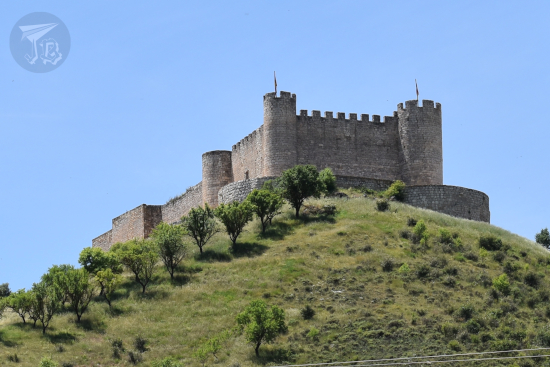
While it is true that the castle Castillo de Jadraque is amongst the places I need to visit at some point, it was high noon. Too hot, even if you can drive nearby, for a castle which is closed for restoration. I’d rather wait till it is reworked. I did stop at a viewpoint for a couple of pictures.

Not long afterwards I found my way to the highway and it was easy to get home from there, though I do prefer the secondary road to all the lorries in the highway. I got home by lunchtime to wait out the heat and have a post-hike lunch.

Jadraque Castle, a Medieval fortress on top of a hill

30th May 2025: Retiro Park, Alice’s sushi & Jurassic World (Madrid, Spain)

I had been on the waiting list to buy tickets for Jurassic World: The Exhibition in Madrid since it accepted sign-ups, so I was able to be amongst the first to buy tickets – albeit a few days later than originally scheduled due to the blackout. Thus, I got tickets for the first session on opening day, at 17:00 on the 30th of May. Exciting! And – almost as important – it guaranteed a spoiler-free experience…

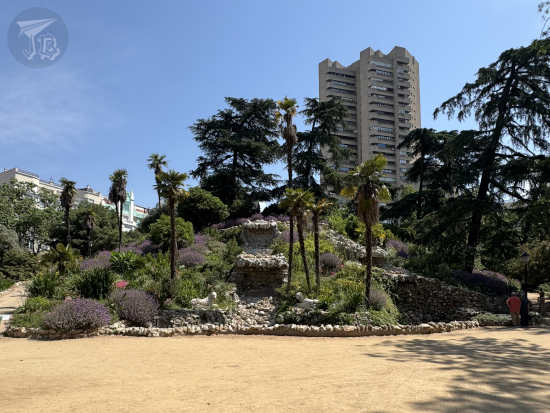
I decided to fill the morning beforehand, and I arranged to meet some relatives at Retiro Park Parque del Retiro north-east corner. There stands one of the Romantic constructions of the park – the artificial mountain known as Montaña de los Gatos. It is a space that can be used as an exhibition venue erected during the 19th century, when follies where all the rage. A folly is a decorative building placed in a garden, usually extravagant or out of context, without a real use save from looking cute for the owner’s amusement.

The artificial mountain is literally a hollow mound covered in flowers, with a waterfall that was turned off, a sad-looking pond with a duck family, and a glass ceiling to illuminate the inside. It was closed so I could not snoop the “archaeological remains” that were found during the recent restoration.

Montaña de Los Gatos in Retiro Park, artificial mound covered in flower

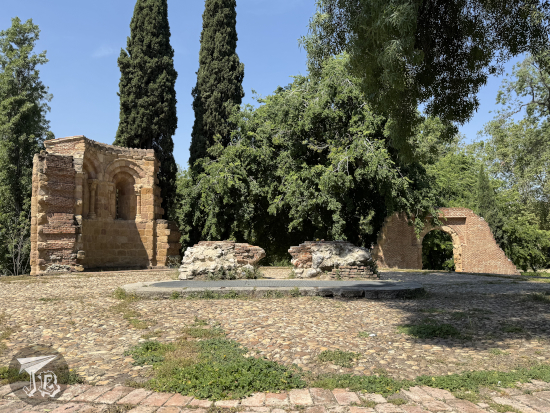
Next to the mountain there is another folly, La Casita del Pescador (Fisherman’s little house). Besides that stand the remains of an old church Ruinas de San Pelayo y San Isidoro. This tiny hermit church was originally erected in Ávila during the mid 1200s. Built in the Romanesque style, it was first dedicated to Pelagius of Córdoba, and then this was changed to Isidore of Seville. During the Spanish confiscation of the Catholic church properties, it was dismantled and eventually rebuilt in Madrid as Romantic decoration in a project directed by Ricardo Velázquez Bosco. It looks weirdly out of place, but rather pretty.

Ruins of the Romanesque church Ruinas de San Pelayo y San Isidoro, in brick

The yearly book fair Feria del Libro de Madrid had started, but as my relatives were late, we could only have a quick walk before we headed off to Wonderland – The Kaiten Lab – , a running sushi restaurant with hot-dish orders on the side, with decoration inspired by Alice in Wonderland, with a twist. According to the restaurant “you step into Alice’s mind, though Alice was a psychiatric patient”. I am not sure how I feel about the mental hospital thing – I think they were just trying to cash on the entrance that was already there when they bought the venue. However, I can state that it’s a pretty mediocre sushi restaurant. With a menu price about 10 € over a Runni sushi, I was expecting something at least as good, not worse. It sells the decoration, and that is the only thing that makes it special.

Wonderland – The Kaiten Lab –. A funky restaurant themed around Alcie in Wonderland which serves sushi

We went somewhere else for dessert, and I had a smoothie. Afterwards we said goodbye and I headed off towards Espacio Ibercaja Delicias for the opening session of Jurassic World: The Exhibition, which was full of parents with children and a bunch of actual fans, some of them being parents too. I was actually the first in line to enter, but they pulled me to the side to wait for a card called “credit photopass”, which was a free perk from having been on the list. Unfortunately, the fact that they did not have that ready put a bunch of families with kids in front of me. I got my photo taken against a green screen and they added digital dinosaurs later.

As we were waiting, the whole “dinosaurs are for kids” thing popped up again. I knew things were not going to be as awesome as expected when one of the “park guides” said that her favourite dinosaur was Mosasaur. Despite what Jurassic World: Rebirth claims, Mosasaurs are not dinosaurs, but marine reptiles, which lived in the Cretaceous period (94 – 66 million years ago).

Like the previous show, the experience starts on the ferry to the island, which then opens to the main gates with a Brachiosaurus peering from overhead. The whole exhibition runs on the story that you’re a VIP visitor to the Jurassic World complex, getting a special tour. A couple of guys and myself stayed a bit behind to take pictures without kids and families, and the “ranger” scolded us because “we were going to miss the explanations” in front of a pachycephalosaurus. At that point I felt that they were herding us like cattle…

The second room is the laboratory, with Mr DNA included. There are reproductions of eggs, amber, and baby parasaurolophus, one of them a puppet brought out for kids to take pictures with. The staff did not seem to keen on catering to anyone older than eight, again…

The following two rooms were the Jurassic World movie velociraptors (Deinonychus, in real fossils): Charlie, Delta and Echo were in their confinements and there was a bit of a “training show” with Blue and Owen Grady.

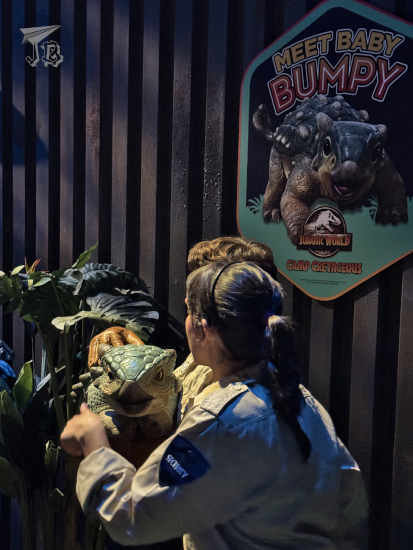
Then there was a bit of a “reprieve” room with fossil replicas and a make-believe excavation, where they brought out a puppet of Bumpy, the baby ankylosaur from Camp Cretaceous. Afterwards came the hybrid Indominus rex jungle, which had a hilarious moment when a kiddo shouted “Hello Indominus, I love you” while the thing was supposedly mangling its food. This was probably the best-made animatronic, it looked a lot like the beast they invented for the movie.

The next room held the Gyrospheres from the Jurassic World film, and a baby velociraptor puppet. This one I could take a picture with after all the kids had had their turn.

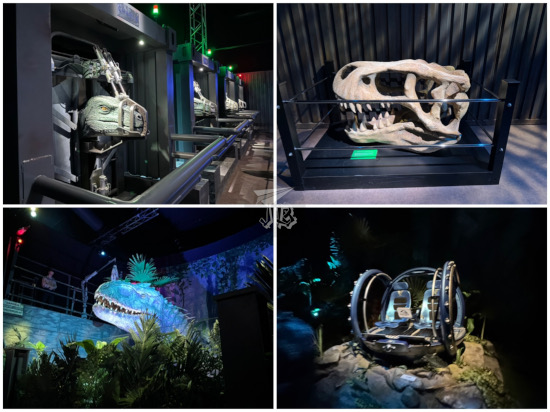
Jurassic World The Exhibition. Gate with a Brachiosaurus peering above: Collage showing the velociraptors, a carnivorous dinosaurs skull, the Indominus rex and a Gyrosphere

Jurassic World The Exhibition Baby Bumpy the ankylosaurus

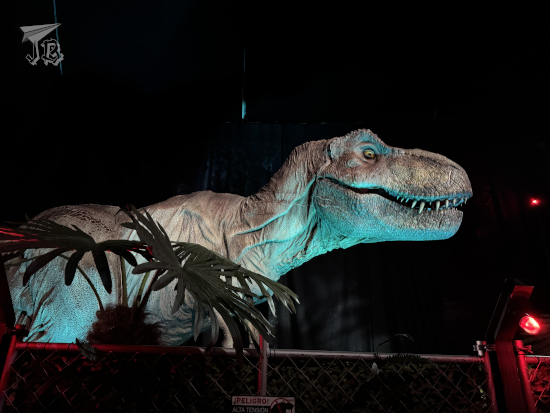
Finally, the last room was Rexy the Tyrannosaur – scars from the first movie and all. In universe, she almost broke containment and almost escaped. There were noises and sparks and roaring, honouring the exhibition’s motto: the closest you’ll ever be to real dinosaurs.

Jurassic World The Exhibition Rexy the T-rex. We know she's the one from the first movie because she has scars down her cheek and neck.

All in all, the dinosaur animatronics were amazing, but the staff had instructions to get everyone in-and-out in one hour, so it felt rushed and, as I said before, herded. And honestly, I am not going to listen to “park rangers” who don’t know their dinosaurs from their reptiles… Which would later be one of my beefs with the upcoming Jurassic World: Rebirth movie anyway…

However, there were dinosaurs, and they felt pretty real, especially the Indominus and Rexy. I missed the mosasaur, though (even if there was a super-cute plush toy in the souvenir shop). All in all, the exhibition was really fun. The animatronics were very lifelike and Bumpy looked exactly like she does in the animation. All in all, it was a good day with ruins, sushi, dinosaurs and geeking out. There’s not much more anyone can ask for…

13th May 2025: Three free niche exhibitions (Madrid, Spain)

I planned a little escapade to Madrid. There was nothing really special going on, it was just going to be a sunny day with no rain forecast and I could go to a museum and have lunch. When I say nothing special was going on, I mean there were a couple of exhibits I wanted to see, but it would have been just as easy to visit them the previous or following day. I just timed it for the best weather forecast of the week.

I had a small work-related thing early in the morning so I ended up leaving the house half an hour later than I would have liked. The trains were around 10 minutes late and the underground was packed, but none of that is news. I reached my first stop, the Museum for the Blind Museo Tiflológico de la ONCE, around 11:30. This museum hosts models or miniatures of famous monuments in Spain and around the world, designed to be seen with one’s hands. That way, people with low or no vision can get an idea of how they are. It is part of the ONCE inclusion program for the blind, and I think it is a brilliant idea.

ONCE stands for Spanish National Organisation of the Blind in the local language, Organización Nacional de Ciegos Españoles. Its history and works are a bit convoluted, but keeping it short, the Organisation was established in 1938 with the goal of providing equal opportunities for the blind and people with visual impairments. One of its main income sources is the lottery known as El Cupón de la ONCE.

While the museum itself is free to enter and very relaxed, when you arrive at the building you have to fill out a questionnaire, for statistical purposes, I guess. I did find it a bit off putting that I was outright asked why I wanted to see the exhibition. Because I’m curious, all right?

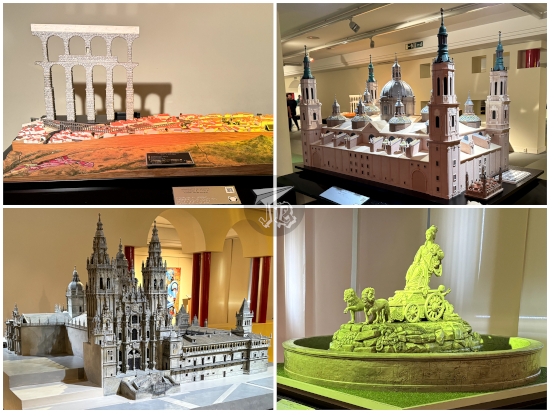
The museum has three distinct sections – one with the reproductions of the monuments, one with works by low vision, blind, or artists with other disabilities, and a historical area. In turn, the monuments are divided in national (Spanish) and international landmarks. The models are faithful to their smallest detail, and just like the Eiffel Tower is made out of metal, the Taj Mahal is made out of marble! Some of the monuments were reproduced in different scales, such as the Alhambra in Granada or the Aqueduct in Segovia. This should give an idea of both scale and detail. However, I don’t think I would ever be able to imagine something like that without being able to see it.
There were lots of sculptures by artists with disabilities, with a disturbing amount of naked ladies, but whatever. I also saw paintings and a homage to Braille that was sort of abstract but was really cool. The historical section hosted a number of items to learn and write Braille through the years, general studying tools such a 3D map of Spain, and a few historical runs of the lottery ran by ONCE. In general, it was a fascinating visit.

Museum for the Blind - national monuments

Museum for the Blind - international monuments

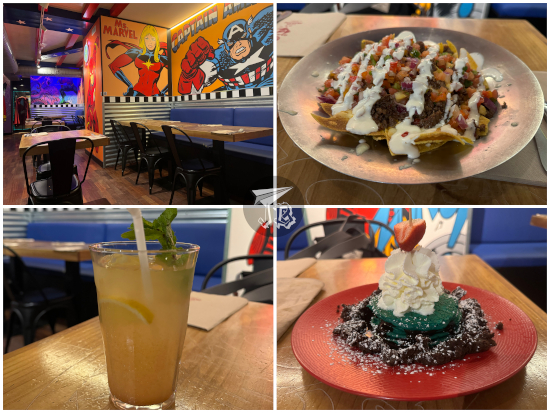
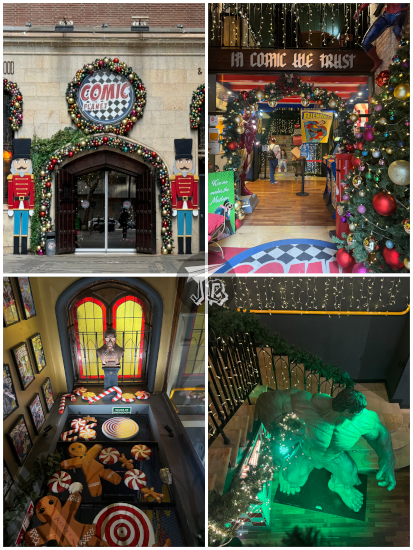
I did some shopping afterwards, and while the sales lady was really nice, she worked rather leisurely- That, and all the pedestrian lights being red on the fifteen-minute walk, put me seven minutes behind for my lunch reservation – and I swear, they phoned me. I was reaching the door of Comic Planet at 13:07 and they were already calling to check I was coming. People wonder why I’m paranoid about reservation times with them… They decided to change my table to “a more private one” to keep me away from a family with toddlers, and I had no problem.

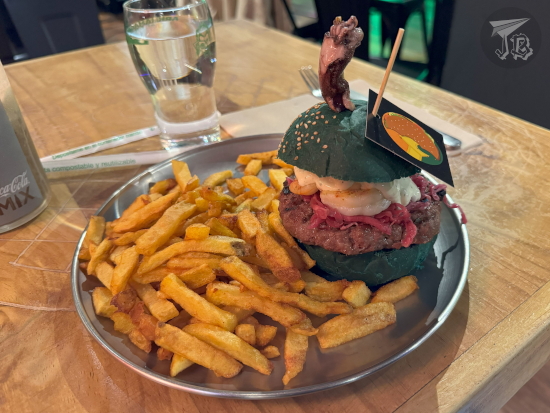
I got to try the last item that I wanted to try from their menu – the Aquaman Burger, which had caused me some morbid fascination when I first read about it– Beef and king prawns? Garlic and pickles mayonnaise? It could be… either really good or really bad, I thought, and I really wanted to check it out. It was all right, I guess. There was much less of a flavour contrast than I expected, so it was most of a normal burger with a bit of an edge. And the edge was that the buns were blue. I also ordered a Vanilla Coke just because I could, and the waiter was nice enough to offer me tap water when I asked for some too. Cool.

Comic Planet Aquaman Burger

After lunch, I took the underground towards Fundación Telefónica which is running an exhibition called “Echoes of the ocean”, Ecos del Océano. I liked the idea better when I did not know that half of it was done using AI. It was – or tried to be – an exhibit centred around cetacean vocalisations. The first room was a mindfulness thingy in which a lady told you to become one with the ocean and then called you fat – “your body enlarges. You’re huge. You’re a humpback whale”. It made me laugh as it broke all the concentration thing. I also cackled when the voice told me that I went “deeeeep” as a sperm whale and met leopard seals there.

Then there were several huge screens with computer-generated graphs that imitated a sea prairie, dolphins and whales. That was the part that was made using AI, and it could have been a CGI or an actual video just as easily. The important part was that the images on the screen moved along the sounds of actual cetacean vocalisations. A room at the end hosted two actual underwater microphones, and headphones to listen to recordings of different creatures – sperm whales, seals, humpback whales – and ice sliding (this is important because for a long time, the sound of ice on the ocean was unidentified and it yielded to a lot of wild explanations / conspirancy theories).

Echoes of the Ocean screens

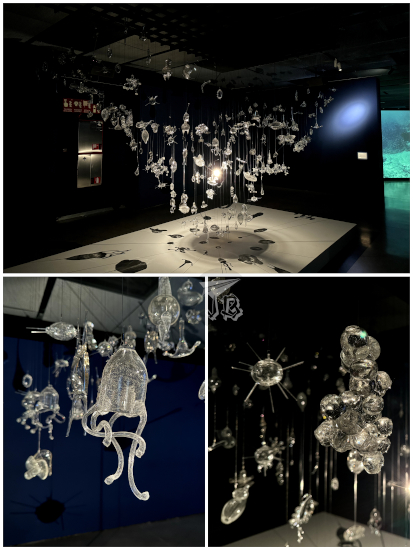
On the way out, there was a sculpture with glass reproductions of different microorganisms that love in the ocean: diatoms, anabaena, coccolithophores, dinoflagellates… Yes, this was totally me geeking out and identifying all the tiny little critters. The final room had to do with some photograph and schematics of a particular blue whale that had been tracked by the organisers.

Echoes of the Ocean plankton

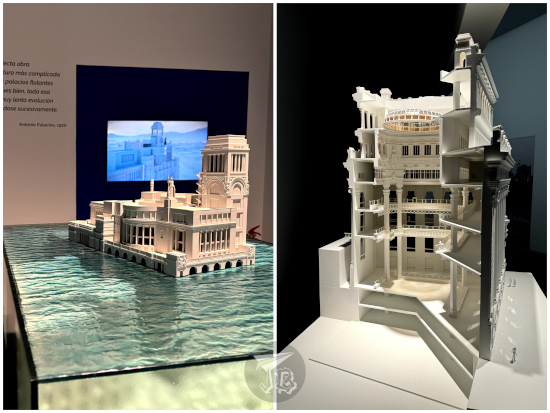
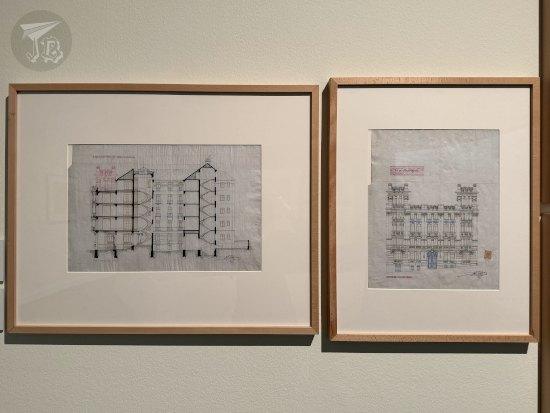
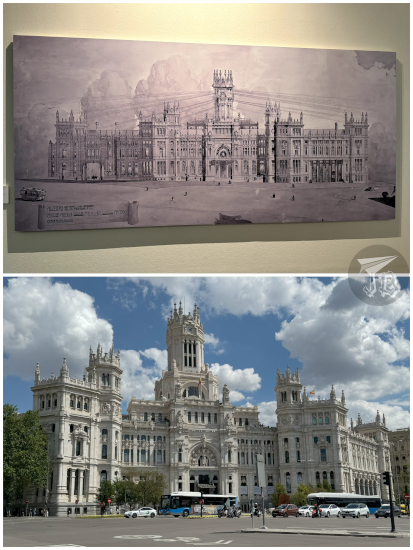
I left the building and headed towards Palacio de Cibeles, which this time, was running an exhibit on its own architect Antonio Palacios. The exhibition is aptly named “An architect’s dream: Madrid as a metropolis” Madrid metrópoli. El sueño de Antonio Palacios. It uses photographs, designs, and models to present the works Palacios projected for Madrid – the ones that were built, the ones that were not, and the ones that have disappeared. It was an interesting collection, and the visit was free! Of course, I wandered the building a little before heading to the train station.

Antonio Palacios exhibit - models of buildings

Antonio Palacios exhibit - framed façade designs

Antonio Palacios exhibit - façade design and photograph of the actual Palacio de Comunicaciones building

On the way, there was a classic book fair Feria del Libro Antiguo y de Ocasión, but everything was way too expensive for me. I guess that in general it was a very budget-friendly day – three free exhibitions – if you do not count tiny shopping spree in-between, and it was around 20 €.

11th April 2025: Extant, extinct and extrastormy (Madrid, Spain)

Since March was extremely rainy, I hoped that April would not be so. No such luck. However, there was a dinosaur exhibit in Madrid that I was keen on seeing, and I wanted to do it before Easter, because it would be packed during the holidays and I could not get there in May due to personal stuff. And since getting to the Casa de Campo area takes so long by train, I looked at combining it with something else around (it’s a four-hour roundtrip from where I am). What other thing was close? Somewhere else I never go because it’s far away by public transport and a nightmare to park around – the local zoo Zoo Aquarium de Madrid. There was after all only a 10% chance of rain…

Spoiler alert: while I was getting drenched (I’m being dramatic, of course. I had an umbrella) in the zoo, and later in the exhibit, the weather app said “partly cloudy” and there was no mention of storms nor rain. But the skies opened. Ask the peafowl…

I took the train and changed to the underground until I got to the Casa de Campo stop. There were not many people around since it was a weekday. There’s a bus that takes you to the zoo, but I found it more efficient to walk, since there is a pedestrian way alongside the road. I reached the zoo a bit after it opened at 11:00, and just as my ticket was getting scanned the first few raindrops fell. At first, it seemed like a small drizzle, but soon it started to rain in earnest. By that time, I had managed to get to the pandas, about 40 metres into the zoo.

I’d been to the Zoo Aquarium de Madrid twice in my life before. The first one I was very small. I have no memory of it, but there is a home video of three-year-old me chasing a peacock and a voice warning “come back, it’s going to bite you!”. The second time I was in third grade, and had my first camera. I remember that I was devastated because the pandas were very far away and I could only take a picture of a distant, tiny, black-and-white blur. That was decades ago, and I had never been back, though I had a recurring dream for years that involved one of the pools there.

The zoo opened in 1972 as an alternative to the “Beast House” or Casa de Fieras that used to be hosted in the Retiro Park, a few sad and crammed-looking cages that must have been horrible for the animals. As every animal park, Zoo Aquarium de Madrid is not free of controversy, especially related to the ethics of keeping great apes and cetaceans in captivity. They used to have dolphins, but those were surrendered and sent away earlier in 2025. Conversely, the zoo participates in over 60 conservation and breeding programs for endangered animals – they have breeding couples of owls, whose chicks are routinely released into the wild, and have succeeded in breeding pandas (they claim to be the most successful institution at breeding panda outside China) and white rhinos. They have non-breeding animals as ambassadors, such as a family of Iberian lynx.

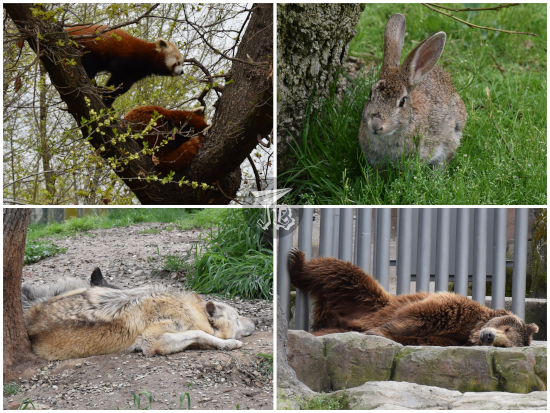
The zoo is vaguely organised per continent – Europe, Australia, Asia, Africa and the Americas, and the home of actual wild animals such as storks and rabbits.

As I went into the zoo, the first thing I spotted was a small lake with flamingoes, pelicans and (squatting) storks. The storks are free to come and go, but they like to be in the zoo because they get free food, I guess. My idea had been to walk a spiral and try to see everything, but I got distracted by “Panda Land”, signalled by a big red gate – after all, they are the main attraction. I thought the pandas might be visible, and they were – much closer than I remembered indeed. I did get to see both the male and the female, who live apart within the same installation. I had time to take a few pictures before it started to rain in earnest. And no, they were not distant, tiny black-and-white blobs this time, and not only because I had borrowed a really good lens for the day. I had to put the camera away when the rain became too heavy.

Zoo Madrid - stork, flamingoes, panda

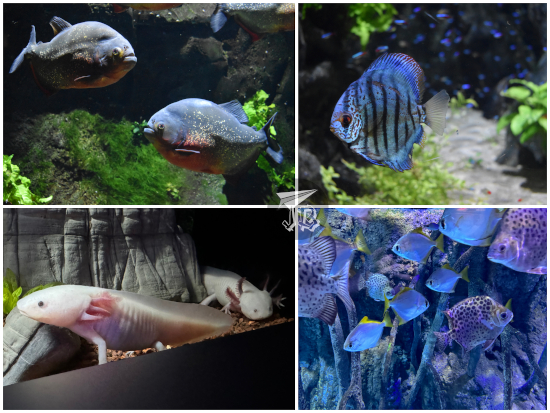
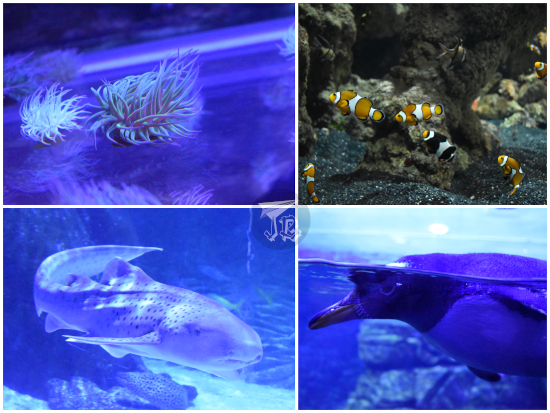
It rained for a couple of hours, and that impacted me a little. I ended up sharing shelter with a band of peafowl, and had to go from covered exhibit to covered exhibit at first. I found the orang-utan territory very sad, and I did not catch a glimpse of any gorilla. In the aquarium, I got stuck with all the school visits, but there were quite a few sharks and big fish in the ocean tank.

Zoo Madrid: peacocks and peahens sheltering from the rain

Zoo Madrid: Sea lion, small blue jellyfish, sharks

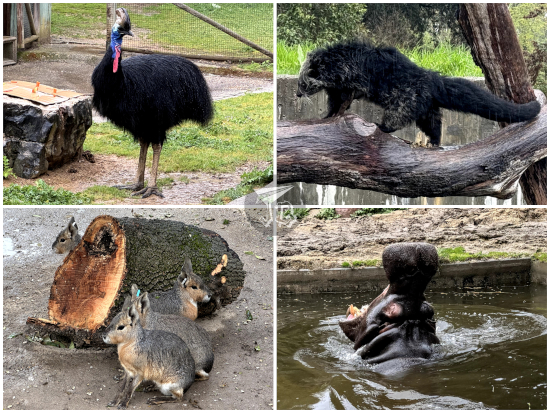
I ambled around the Australian area, where most of the animals were unfazed – especially the cassowary, which by the way is apparently the most dangerous bird in existence, even if I’m way more crept out (and fascinated) by emus. I did not see the koalas, and I walked past a tree which seemed fenced off just because. As rain cleared out, some of the animals started playing around, such as the binturong (Arctictis binturong), a distant relative of civets. At around 13:20, I had reached Africa, and I was in front of the hippos when it stopped raining. Awesome!

Zoo Madrid: Cassowari, binturong, Patagonian mara, and hippo yawning

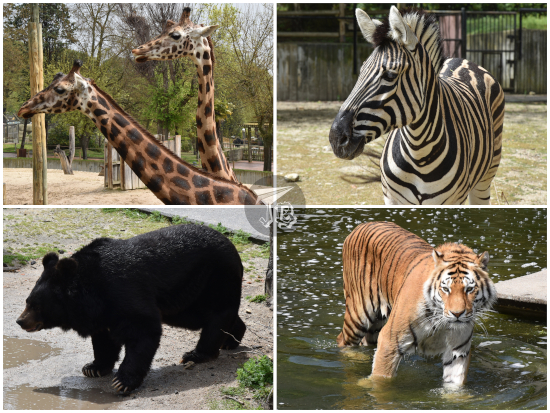
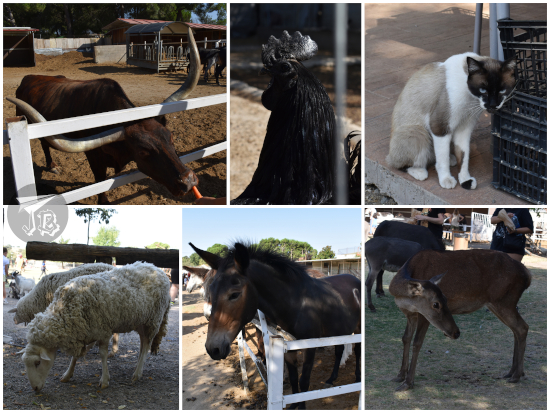
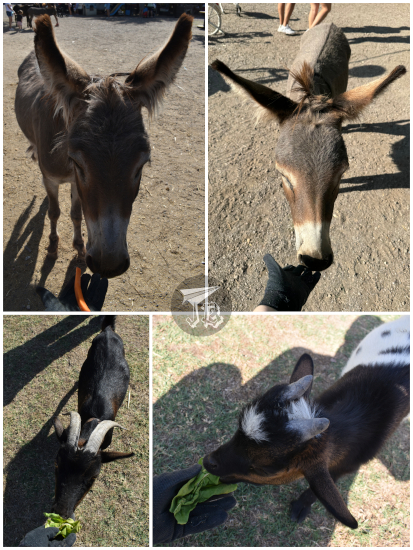
Since I had borrowed a camera lens which is better – but heavier – than mine, I really wanted to try it out. Carrying it around without being able to use the camera due to the rain, at all, would have been a bummer. After the rain stopped, I was able to take quite a few good pictures though. Those included the Siberian tiger (Panthera tigris tigris), and its relative the domestic cat (Felis catus), whom I’m not sure is a resident or a squatter in the “farm” section of the zoo alongside the sheep, goats, and a very large pig.

Zoo Madrid: Jiraffes, zebra, black bear and Siberian tiger

Since I’d been to Emociones al Vuelo a few days earlier, I did not mind the lack of Raptor Flight exhibit due to rain. I did miss the Exotic Birds one, but I caught the Sea Lion exercise (hello, swimming pool from years of recurring dreams). Around 14:30, it had stopped raining, the animals had eaten, and I caught many of them. Unfortunately, most – especially the carnivores – were napping. I did however saw a very active red panda (Ailurus fulgens) around the tree that I previously thought was fenced off for no reason.

Zoo Madrid: Red panda, common rabbit, grey wolves, brown bear

By the time I left, the workers had also dropped off a few Easter Eggs throughout the zoo as the holidays were about to start. At 17:00 I had to be at Escenario Puerta de Ángel to see Saurios, a dinosaur exhibit, which turned out to be a bit of a disappointment. Most of the animatronics I had already seen as “Dino Expo XXL” – I recognised it because of the broken neck on one of the brachiosaurus. The exhibit had a first part with a few skeleton replicas – the coolest thing, as I had never managed to see a complete cast of a Spinosaurus before. Then there was an open area with some life-sized replicas and photo-ops, but it was completely made for kids. There were actors and activities for them, which I guess were extremely fun if you’re younger than five. Yet another “dinosaurs are for kids” activity.
Saurios Madrid - skeleton replicas

Saurios Madrid - models

And then it started storming again. A black cloud, a clap of thunder, and the skies opened. Thus, we all had to hurry to the last section, which was most of what I’d seen in “Dino Expo XXL”. I was really not impressed by the whole thing – remember folks, “for all the family” means “designed for kids”. I guess I would be more gracious had the weather been nice, but… having seen most of the exhibit before for half the price, I was not impressed. Fortunately or unfortunately, there is a Jurassic World Exhibition coming up soon…

Saurios Madrid - models

23rd February 2025: The Annual Medieval Fair (Tendilla, Spain)

For the last few years, the Medieval fair Feria de Mercaderíass de San Matías in Tendilla has started on the 25th (2022), 24th (2023) and the 23rd (2024) of February. So it makes perfect sense that my mind placed 2025’s edition start on the… 14th, right? Since the fair celebrates St. Matthew, and the onomastic is the 13th, I unilaterally decided that the fair must be that weekend. Obviously, I was wrong, and the fair was held from the 21st to the 23rd. Due to the date mishap, I had a visit booked on the 22nd, and I amended my plans to head to the fair on Sunday the 23rd instead of on Saturday as I usually do – that way I could see the Palace, the Botarga Parade and the Fair on the same weekend.

It was a good thing that I decided to go to the Parade instead of trying to make it to the fair on Saturday, because apparently they were blocking cars from entering the village, but not letting them park anywhere close-by which… is a problem. To avoid a similar issue on Sunday, I drove to Tendilla before the fair even opened, so I was there around 8:40. I used the time to climb up the frozen nearby hills to see if there were nice views from above. I also headed into the pine forest, which was covered by a thin layer of frost everywhere. It was pretty.

Tendilla: Landscapes before the fair started

There was a parade scheduled to take place at 11:00, which did not happen until around 13:00 – there was just a trio of musicians going up and down the main street. In the mean time, I wandered up the fair, and stayed around the ox paddock hearing things like “such noble eyes the animal has” from the mouths of city-dwellers. The poor oxen seemed pretty much used to to be stared at, so they just munched on hay with an air of resignation. There were two of them separated from the herd, which would later be yoked to a traditional cart. Looking back, I’m slightly surprised that I did not get any allergy symptom from their straw.

Three musicians in Medieval Clothes

Oxen in the Medieval Fair

I also found the newly-inaugurated statue to honour the fair – a tiny farmer with two donkeys standing atop a column which… was a bit underwhelming, to be honest.

La borriquilla - the little donkey

Around noon, a queue started forming for migas. In the mornings during the fair, some of the villagers prepare this typical dish from the area for all passers-by (queuers-by?) to enjoy. The traditional migas are made from fried breadcrumbs, paprika and meat from pig slaughtering. However, Tendilla is famous for its torreznos (processed pork lard snacks), so these communal migas are served with the local dry treats, and accompanied with a glass of wine to be washed down. I had never queued for them, but some family members saw me when they were almost at the front of the line and I was snuck forward in exchange for some photos. I also got to talk to one of the stand owners, and I discovered about a place called Emociones al Vuelo, a bird-of-prey rescue and training centre which organises activities. I may or may not have decided to pay them a visit.

Communal migas being prepared

We snacked, and then moved around the village. I was in the middle of Main Street Calle Mayor when the parade came through. The troupe had changed this year, and it was not Christian knights and moors, but gypsies and magicians. They brought horses and “wolfdogs” – not actual wolfdogs but wolf-looking domestic dogs. Enough to fool a lot of people. There was supposed to be a tournament, but apparently the gypsies were not up to it. There was no tournament, and after an hour of waiting, the troupe went back to the Main Square Plaza Mayor, did a couple of horse tricks, and started cutting ham to share with the onlookers. It was a bit disappointing, but I least I got to pet the dogs.

Troupe of horse riders dressed as Medieval gypsies

Dogs from the gypsy troupe

I headed to my relatives’ place and we prepared lunch, though I had some leftover migas that had been saved for me from the previous day, and a fried egg on top. Much better than the communal ones, for real.

The last activities for the day were related to the long-suffering oxen. First, two of them were yoked to a traditional hay cart and children were given rides through the fair. The two oxen were led to the cart and then tied to the structure. Something that I had never known was that part of this tie went around their horns and forehead, so the owners placed a small pillow on the animals’ foreheads for them to pull more comfortably. However, to do the tie the knots as strong as it was necessary for them to be, he had to use his foot as leverage on the ox’s head… Once the animals were yoked, the cart started moving. One small child who had apparently been asking about the ride all day long was the first to be helped on the cart – even though some others tried to cut the line! At first, they went up and down the village, but apparently some idiot spooked the poor animals and the owners decided to just move around the main square afterwards.

Oxen being yoked

After six or seven rides, the oxen were untied and let into the paddock. A lorry was brought and the owners created a mini stampede for all the oxen to go into the vehicle. That was wickedly cool.

That was the last activity, so I decided to say goodbye to my relatives soon and drive back through the sunset. Most of the stalls were already closing anyway and there was no way I was going to stay for dinner – because that would mean I’d have to actually eat more that day, which was not the plan.

On the way back I drove into a very weird traffic jam. It did not happen around the bottleneck, but much much earlier, and the bottleneck was clear. I’ve never understood traffic jams anyway…

So all in all, I had a very complete weekend, combining Madrid, Guadalajara and Tendilla, I had relatively good weather, and got to check out most of what I wanted. The only downside? Having to go to my day job on Monday without having caught any rest!

22nd February 2025: Architecture in Madrid, and folklore in Guadalajara (Spain)

By now, reaching Madrid by train without anything remarkable to comment on is actually remarkable all by itself – there were actually no problems for once. I had booked a spot for a visit at noon, but since I don’t trust the rail service, I hopped on a train to be at Atocha Station around 10:00, and for once I was there right on time, maybe even a minute early!

As I walked up the street Paseo del Prado, I passed by the exhibition centre CaixaForum, where the Patagotitan still stands. Since it was still winter, the trees on both sides had little to no leaves, and I could see it from the opposite side. I of course said hi.

Patagotitan skeleton

My first stop was the church Iglesia de San Jerónimo el Real, dedicated to St. Jerome, a late Gothic – early Renaissance building erected between 1502 and 1505. It belonged to a monkhood whose original monastery stood near the river. The stagnant waters caused illnesses among the brethren, who asked the Catholic Monarchs for a new location. The church for the new community was created from brick and masonry, and towers were added in the 17th century. The interior is decorated with two gothic altars to the sides, but no main altarpiece, as the original one has been lost to time. Instead, there is a painting by Rafael Tegeo La última comunión de San Jerónimo – Saint Jerome’s last communion – created in 1829.

Monastery Monasterio de Jerónimos

Afterwards, I headed towards the National Museum of Anthropology Museo Nacional de Antropología, a small museum dedicated to the diversity of cultures in the world, particularly the Americas, Philippines, Africa and the “Far East”, focusing on traditions, culture and religion. It is covered by my national museum card.

At the moment, the museum is running a temporal exhibit on art based on myths, legends, and sacred texts from India, Caminos místicos. Tradiciones vivas del arte de la India – Mystic Paths. Living Traditions of art from India. I was curious about it, but not expecting how much I liked it in the end. The pieces of the exhibit were mostly based on Hinduism (Sanātana Dharma, सनातन धर्म), the oldest religion in the world. According to Hindu tradition, the Supreme Being Brahma exists as themself, but also as the manifestation of the deities Brahma the Creator, Vishnu the Sustainer and Shiva the Destroyer, all of who at the same time have different avatars (avatāra, अवतार) or incarnations. One of the core principles of Hinduism is the concept of cosmic cause-and-effect justice, karma [कर्म]. Another is reincarnation (saṃsāra, संसार), an eternal cycle of life and death until the individual is liberated from it through self realisation or illumination. The religion is based on values like righteousness, truth, love, peace, and ethical conduct, and it is quite open to other beliefs and ethics.

Religious Indian Art pieces

The Museum of Anthropology’s permanent exhibition has a lot of items from the Philippines on the ground floor, probably due to how long(1565–1898) the islands were a Spanish colony. There are clothes, tobacco items, ritual objects, and a small sample of how the local culture was throughout the 1800s. To the back, there is a room dedicated to the religions of Asia and the Middle East – Hinduism, Buddhism and Islam. The first floor is dedicated to Africa, combining a number of traditional exhibits with modern photographs of the traditional people’s way of life – baskets, pottery, leather and wooden objects, ritual masks… The second floor holds items from the Americas, especially from South America. Some of them include a Mexican Día de los Muertos (Day of the Dead) altar, Andean Carnival masks, Sioux-Lakota clothes, Inuit coats…

Religious icons and traditional masks

I remember visiting the museum when I was a child, and then feeling disappointed in it when I returned as an adult. This time around, I found the permanent and temporal exhibitions quite interesting, so it’s a good thing I headed there. It also helped make time until noon, when my next visit was due, to the only Ministry that can be visited – albeit not freely, by appointment and paying a fee – as it is a historical building.

The current Agriculture Ministry is housed in the historical building known as Palacio de Fomento – Palace of Development. Its plans were originally drawn by architect Mariano  Belmás y Estrada, aiming for an Arts and Craftwork School. Later, Eduardo Saavedra y Moragas took over to turn the design into a university. Finally, the project ended in the hands of architect Ricardo Velázquez Bosco, who erected the building between 1893 and 1897 to house the then Ministry of Development.

The Palace is an impressive construction. The original design had three floors, which have now been turned into five. From the outside, the building looks white and orange-brown, but a more focused look reveals decorative tiles by Daniel Zuloaga, who also collaborated with Velázquez Bosco in the ETSIME. The entrance is flanked by two caryatids and roof above there is a sculpture group – Glory and Pegasi La Gloria y los Pegasos, a bronze copy of an original marble by Agustín Querol.

Palacio de Fomento, outside

Once you enter, you find yourself in a huge majestic hall, where we had to check in, since the building is a working Ministry. The email said to be there at 11:45 to go through security. I got there at 11:40 and went in at 11:44. They took my name (they did not care about the ticket) and they put my stuff in the X-ray machine. I had to go through the metal detector and when I asked whether I had to remove my belt, I was just told to put my hand over the buckle… So much for security, I thought, because I did not beep. Then I realised that I must look quite non-threatening as quite a few people were thoroughly searched as they set off the machine.

Beyond the hall where we were checked in, there is an imperial staircase in marble, and a vaulted frescoed ceiling. From there, we visited some offices and meeting rooms, and the portrait gallery – from which the ministers who held office during the Franco dictatorship had been removed. Finally, we visited one of the side inner courtyards, covered in a skylight with some ironwork.

Palacio de Fomento, inside

After the visit was over, the security guards saw us out and locked the doors. I walked around the building, because I had honestly never realised it was square. As the place was next to the Retiro Park, I had been considering looking for some archaeological spot they had opened. However, there were more ideas – Guadalajara was having the Botarga parade, and it was the fair weekend in Tendilla, though, a phone call informed me that traffic was horrid and that it was not a good idea to head there so late in the afternoon.

Eventually, I decided on the Parade. I bought some sandwiches and headed for the train. Though I got rained upon, it cleared up, and at 18:00 I was in Guadalajara to have a look at the traditional Parade of Carnival characters Desfile de Botargas – “creatures” from the whole area which meet up in the capital the Saturday before carnival, despite each character having its own schedule wherever it is rooted. The parade was a bit late, so I could talk the local botarga group – El Manda (the Order-giver), Los Mandaneros (the Order-receivers), and the Botarguilla (Little Botarga) – into posing for me. I watched and took pictures from two spots, but the parade moved really fast because they only had thirty minutes to do the route – last year they took well over an hour for that. I decided I did not want to run for it that much… I have to remember to find myself a vantage point next year, instead of trying to get the beginning of the parade…

Guadalajara Botargas

Heifferette from Riba de Saelices

Botarga Parade 2025

I got “attacked” a few times, and ended up with soot all over my face, but at least I avoided the guy painting people with mustard… The botargas seemed to zoom in on children and cameras, and so did the devils Diablos (from Luzón) and the heiferettes Vaquillas and Vaquillones (Villares de Jadraque, Robledillo de Mohernando, Luzaga, Riba de Saelices). It was fun. One of these days I might have to try to follow the botargas in their own villages…

4th January 2025: Bye Bye, Murderbird. MARPA, Alcalá de Henares (Spain)

While it was great to have the Concavenator fossil (a.k.a. Murderbird in my headspace) in the Dragon Hunters exhibit in Alcalá de Henares close enough to visit at will, the time had come to see it move on. Just in case there was any information I was missing, I decided to book a guided visit to the exhibit. As it was scheduled for 12:00, I decided to look for something to do beforehand, and I found guided visits to the monastery Monasterio de San Bernardo at 10:00. I had seen the building before, as it stands next to the MARPA, I just had never given it much of a thought.

The monastery was established under the patronage of Cardinal Bernardo Sandoval y Rojas around 1620. He bought land cheap because it was near the Moorish quarter. The church was erected in brick with decoration in stone on the outside. The inside has an elliptical dome, and it was heavily damaged in a fire during the Civil War, so it had to be restored – the work on it was a Rehabilitation prize in 2019. Most of the decoration of the church was lost and today walls and roof are just white and gold. The building is attributed to architect Juan Gómez de Mora.

There is a free-standing ciborium in gold, with a number of sculptures of Saints instead of an altarpiece. Behind the altar and ciborium, there are a number of paintings – they were created by Italian artist Angelo Nardi. Nardi was born in the late 16th century, and studied in Venice before moving to Madrid, where he became a Court Painter. His style evolved from late-Renaissance (mannerism) to Baroque, and he is known for his expressive faces. He was friends with Velázquez, and famous for being quite kind, though his style eventually fell out of grace. He painted most of the pictures in the church, although some of them are now out of order as they were moved during the Civil War.

The visit was interesting albeit a little underwhelming. It felt a bit weird to be the only visitor and having the whole thing explained to me – that has only happened once before, in Recópolis. However, that was epic, because I ended up getting the whole archaeological place for myself. The monastery was more of a serious experience – and it did not rain on me. But still it felt… colder. And like being in an exam, the guide kept asking me questions about history, architecture and hagiography.

Monastery of San Bernardo in Alcalá de Henares

I had a bit of time before my following visit, so I decided to run to the Sala Museográfica de la BRIPAC, a tiny museum about the history of the Army’s Parachuting Brigade. The Brigade was created in 1953, and the parachuters participated in combat for the first time in 1957. In its origin, it was established in Alcalá, so there is a historical connection there. The hall hosts uniforms, flags, medals, and reports about the peace missions in the 1990s. I am not much of a fan of Armed Forces museums, but today the BRIPAC is considered a peace corps. The museum opened in February 2023, on the 70th anniversary of the foundation.

BRIPAC exhibit

I still had a bit of time, so I dropped by Plaza Cervantes, which was full with Christmas lights and shoppers at the small market. There were food stalls, a small bookshop, some rock shops… Nothing really caught my eye though.

Plaza de Cervantes Christmas

I finally headed back towards the Archaeology and Palaeontology museum MARPA Museo Arqueológico y Paleontológico de la Comunidad de Madrid. It was one of the last chances to see the exhibition on the history of palaeontology “Dragon Hunters” Cazadores de Dragones with a guided visit, and I figured out that maybe I could learn anything new – despite the fact that I’ve been there a few times and bought the book. We had a nice fun guide who relied a lot on asking questions to her audience. Apparently I was the only one with… some knowledge of… anything she asked – what’s with guides in Alcalá de Henares trying to have you do their job? I felt a bit sorry for her so I answered her questions – with a higher success rate than the ones from the Monastery, to be honest. She did not impress me with the depth of her knowledge, to be honest. She actually looked at me a bit panicky when I asked her t confirm that the T-Rex replica was a cast of the famous Stan.

Cazadores de Dragones entry in the cloister of the MARPA

I stayed back for a bit longer after the visit ended. I’ve ranted on and on about the Concavenator before, both the fossil slab and the actual-size reconstruction. I just loved having both so at hand. When I was young, the scientific community came to the conclusion that “birds descend from dinosaurs” but today it is actually believed that birds are actual dinosaurs. And since the poor beast has such a ridiculous name, I’ve just been calling it “Murderbird” or “Murderchicken”, for kicks and giggles.

There were these two little kids who kept grilling their dad about the skeletons, and the poor man was a bit overwhelmed. I decided to give him a hand with the questions and explained a little. I thought that was it, but the smallest child pointed at the Concavenator and blurted out “can you tell us more things about that one??” He was so eager that I just took the family to see it and told them a few things further. The family was on their merry way in five minutes – four-year-olds only have so much attention span. The kids were happy, the parents were relieved and I got to geek out about dinosaurs with appreciative public. I think the interaction was an all-around win.

Murderbirds: T-rex and Concavenator

At first I had thought that I would be staying in Alcalá for an exotic lunch, but I was not really feeling up to it. With great sadness, I said goodbye to the Concavenator and moved on to drive home.

19th December 2024: Themed visits at Madrid’s Museo Arqueológico Nacional (Spain)

There have been a lot of witches dripping into mainstream pop culture these last couple of months, what with Disney + / Marvel’s Agatha all Along and (half of) the musical Wicked released as a film. So when I read that the National Museum of Archaeology was running a special guided visit to the exhibition “Between Chaos and Cosmos: Nature in Ancient Greece” Entre Caos y Cosmos. Naturaleza en la Antigua Grecia and part of the permanent exhibition called “Nature, Magic and Witchcraft” Naturaleza, magia y brujería I thought “hey, the Heritage people are catching up with the times!” That day there actually were two guided visits, and the second one was centred around the sculpture Il Pugilatore. One was at 12:00, and the other one at 17:00, so they could be combined – hey, they were free, I just had to find something to do in-between.

Thus, I booked both visits and headed out to Madrid. I got to the archaeological museum Museo Arqueológico Nacional with ample time due to my distrust of trains. As I have the museum card, I decided to just walk in and wait for the time safe from the cold and the rain – and since it had just opened, from the crowds too. Though the ticket said to wait at the meeting point, the museum staff directed me somewhere else, and that is where I sat to wait ten minutes before the starting time. Apparently, a bunch of people did not get the information so when the time came we were few… and promptly joined by about half of the group once we had started.

The first visit was “Nature, Magic and Witchcraft” Naturaleza, magia y brujería. It started at the exhibition Entre Caos y Cosmos. Naturaleza en la Antigua Grecia – “Between Chaos and Cosmos. Nature in Ancient Greece”. As we walked in, the staff scanned a ticket and gave it to us.

The guide made a small introduction to Greek mythology with an emphasis on pre-Olympian “Chaos”. He mostly spoke about hybrids, such as satyrs or harpies, psychopomps (creatures that take souls to the afterlife after death), like Echidna, Cerberus, and the sirens. He also seemed to like the deity Achelous a lot. Achelous [Ἀχελώϊος] was the personification of one of the Greek rivers, a son to the Titans Tethys and Oceanus, and father of the sirens. He was able to shape-shift and would often be represented with small horns as he could turn in to a bull.

Regarding witchcraft, there is a small room in the exhibit about it, and the guide pointed out the concept of sisterhood, and some of the small artefacts and glass carafes. He mentioned the figure of Medea as the greatest witch in Greek mythology. That surprised me, because I had never associated her primarily with magic – I knew her from the Jason and the Argonauts myth, in which she originally helped Jason find the Golden Fleece, but she eventually killed the children they had together when Jason dumped her. Glad to know there was more from her than just being a “crazy lady”.

Afterwards, we moved onto the permanent exhibition. Unfortunately, the tickets we had been issued would not work any more because… reasons. Apparently, they could only be scanned once, and they had already been scanned at the exhibition. However, the person guarding the gates would not let us through without having a ticket beep – despite being with a member of the museum. It was solved quite quickly, but it gave off the feeling of everything being very disorganised.

In the permanent exhibition we mostly saw Talayotic and Iberian talismans and jewellery, then we moved onto the Roman area, where he mentioned the laws regulating the Augurs (people predicting the future), and some small curse tablets that the Romans slipped into each other houses when they were vexed – curses. All in all, the visit did not feel very on topic, just a number of objects vaguely connected together by a weak narrative. And witchcraft was the weakest topic, so it seems that the heritage people have not really caught up with the times. Oh, well.

Artefacts from Naturaleza Magia y Brujería MAN

Before I left the archaeological museum, I dropped by the new “archaeological news” room (Sala de Novedades Arqueológicas). Currently, it holds the exhibit Rostros del Turuñuelo. Los relieves de Casas del Turuñuelo. Guareña, Badajoz – a name larger than the exhibit itself: “The Turuñuelo faces. The reliefs from Casas del Turuñuelo, Guareña, Badajoz”. The Turuñuelo, or Casas del Turuñuelo, archaeological site corresponds to the Tartessian culture – a mix of Palaeohispanic and Phoenician traits which flourished in the south and east of modern Spain (and a bit of Portugal) between the 11th and 5th centuries BCE.

The exhibit is a collection of five faces dating from the late period, found within the ruins of a two-storied building. It seems that the building and everything within were destroyed, set on fire, and buried intentionally. It is possible that the faces found belong to sculptures that can be recovered amongst all that material. The faces, discovered in April 2023, are the first and only human representations associated to the Tartessian culture.

The faces from Turuñuelo

After the visit, I went to have lunch. There is this place I have wanted to visit for a while and it has never panned out. I would have actually wanted to have breakfast there, but whatever – this was doable and convenient. Located near the French Institute, it is a crêperie called Prep’ La Crêpe – it would make sense to think they’re French, but in reality they belong to an English franchise. I ordered a basil crêpe classique (melted cheese, mozzarella, tomato, basil and Mediterranean sauce), a Kick-start smoothie (orange, carrot and ginger), and a Belgian (black) chocolate crêpe sucrée for dessert. All in all, it scratched an itch that I had had for a long time, and it was not bad. A bit on the pricey side, I’d say, but what is not expensive these days?

Prep' la Crêpe lunch

Afterwards, I still had a bit of time so I decided to go into the National Library Biblioteca Nacional de España, where they had transformed the book museum into something called “Hell and Marvels” El Infierno y las Maravillas, which runs through the history of printing and knowledge (marvels), then the history of book banning (hell). The exhibition continues with thoughts on how information is preserved, in books and other formats. Finally, the museum is hosting two special exhibits, one around the writer Gonzalo Torrente Ballester Gonzalo Torrente Ballester, la travesía de un creador, and a collection of historical documents belonging a noble family El archivo del Conde de Orgaz. Una ventana a la historia. The archive was really interesting, with a lot of privileges given to the family by successive kings of Spain. The former count was a member of the Friends of the Library, and the exhibition is a homage to him, aside from showing documents dating back from as far as 1220.

Hell and Marvels, National Library

I then went back to the archaeological museum Museo Arqueológico Nacional for the second visit, with another long title Il Pugilatore y la escultura monumental en el Mediterráneo Occidental Antiguo: Cerdeña, Baleares y la Península Ibérica “The Boxer and monumental sculptures in the ancient Western Mediterranean Sea”. The sculpture Il Pugilatore, one of of the Nuragic giants found in the Mont’e Prama archaeological site in Sardinia, Italy. This ambassador giant, who travels the world to introduce people to his culture, is called Manneddu, and he is the statue in best conditions. He would have had a glove in his hand, and a dagger pointing forward, and his chest would have been painted red.

Il Pugilatore

The guide explained that these sculptures – archers, warriors, wrestlers and boxers – were supposed to be armed, but no weapons from either the period or the culture have ever been found. The giants were found, purposely moved and destroyed, in a necropolis for young men. The sculpture also had “little brothers” with the same poses, made in bronze, which have been preserved. That is how the archaeologists know the different weapons and stances they had. The giants are considered the first monumental anthropomorphic sculptures in the coasts of the western Mediterranean Sea, and the only ones in Sardinia.

We also heard about the similarities between the Nuragic towers, which were used for water management and as meeting points, and Talayotic ones in the Balearic Islands. Then, the guide ended up talking about the bronze bull heads that represent Talayotic cultures, and insinuating that they might have been brought from somewhere else…

Talayotic bull heads

The visit ended there. I then wandered around the museum for a little longer, then checked the Christmas market – and a classical merry-go-round similar to what I rode the previous week. Since it was dark already, the lights were on, but it was raining on and off, so the weather was not nice enough to wander around for long. Thus, I headed to the train to get home.

Classic Merry-go-round in a winter night

11th December 2024: CBA, hotpot and lights (Madrid, Spain)

Since I was meeting my sibling for the yearly event of Naturaleza Encendida in Madrid in the evening, I decided get there early and make the most out of the day. As I arrived, I headed to the Círculo de Bellas Artes (literally “Fine Arts Circle”). The CBA is a sort of NGO dedicated to culture and the arts. Its headquarters host many activities such as exhibitions, theatre plays, concerts, lectures… The building was designed by Antonio Palacios, one of my favourite architects. It has seven floors, some of them used for events, others for offices. There is even a small theatre.

The CBA was running an exhibition called “Messenger Species” Especies Mensajeras, by artist Álvaro Soler-Arpa. It is a collection of pieces created from animal bones and items found in dumps. Born in Gerona in 1974, Soler-Arpa is a multifaceted artist who does publicity illustration and creates distressing sculptures using animal bones as its medium to make the viewer to think about waste and pollution. This exhibition of modern art is described as “ecological art for reflection”. I thought that it could be either really good or a holier-than-thou approach, but my curiosity was piqued.

The exhibit collects selected pieces from four series of sculptures: “Toxic Evolution” (Evolución tóxica), “Devastated Nature” (Naturaleza devastada), “Design-methastasis” (Diseño-metástasis) and “Sculptures from the End of the World” (Esculturas del fin del mundo). It was… disturbing, but in a good way. It did not feel preachy. The idea is that nature is affected by the consumerism in current society, but not dying – adapting to it. The imagined futuristic animals are a warning sent through time – nature is resilient and it will survive. Us humans? Maybe not if we do not get any better.

Álvaro Soler-Arpa's Especies Mensajeras

There was another exhibition in the building about the consequences of war, but I decided I could not stomach that one. However, I had the access ticket, so I could take the glass lift to the famous terrace of the building – the one that kicked off a trend of opening terraces in Madrid to watch the skyline while having a drink. It was too cold and too closed to have anything, but I did get a nice view, especially of the Palacio de Telecomunicaciones and the Spanish language Institute Instituto Cervantes, both designed by Antonio Palacios too. The terrace is mostly flat, with a bar and an impressive sculpture of Minerva made in bronze by Juan Luis Vassallo. Minerva – Roman goddess of wisdom and art – is the symbol of the CBA. There is also a smaller and higher structure that looks like it could hold an even better view, but that was closed off.

Skyline from Azotea Círculo Bellas Artes

The CBA building has many cool spaces, such as the ball room (Salón de Baile) or the colonnade room (Sala de Columnas). However, my favourite part of the building are.. the stairs. They are designed as a double staircase with mirrors at the landings, and coloured windows alongside the steps. One of the sides is less bright now, because a building was erected and blocks the sun. I still find the staircase superb, so I hung around there for a while until the security guard gave me a weird look.

Stairs Círculo Bellas Artes

I left the CBA and walked down the street Calle Alcalá and stopped at Galerías Canalejas just to see what kind of decorations they had. It turned out to nutcrackers and elves inside and a huge Christmas tree outside. I still cannot afford anything they sell there.

Chrismas at Galerías Canalejas

I continued down towards the square Plaza de Oriente, where there was a classic merry-go-round – empty and ready to be ridden. Thus, since I have no shame, I went on it. The salesperson was incredibly kind, since I was the only rider – and an adult at that – and yet they directed me to a horse which moved up and down and showed me how to climb on it.

Then, I backtracked to the shop Turrones Casa 1880 in the street Calle Arenal, which hosts a small Museo del Turrón. Turrón is a typical Spanish confectionery eaten mostly at Christmas. It is mainly made out of processed almonds, and 1880 is probably the most famous brand – and it prides itself on the most expensive one. I am not a fan of turrón, to be honest, but it was almost Christmas, and if I was ever going to do it, that was the right time frame. The museum is mostly an audiovisual in a decorated cellar, with a photo-op, but the staff was really nice.

At 14:30 sharp, I met up with my sibling for a restaurant that I’ve been wanting to try for a while 壹锅火锅 Hotpot de Sichuan. Hotpot [火锅, huǒguō] is a Chinese type of stew based on a stock or soup that is kept simmering in the table itself, and you just grab the raw ingredients and dip them in the broth to cook them – imagine a fondue with broth instead of cheese. We ordered a menu for two, a pot with two broths, one mushroom-based and one meat-based. The dips were spring onion, coriander (which was not used, because I hid it), shrimp mince, thin beef slices, tofu stripes, Chinese black mushrooms, cabbage, and rice noodles, along with two sauces – one slightly spicy, and my beloved sesame and peanut sauce. The food was great, but at 15:40, the waiters popped up to tell us that they wanted to close the restaurant, and then stood up next to us until we finished and left. It was more than a bit awkward, so we hurried up to do so. While the food was great, the situation spoilt our experience a little, I think. We were still eating, not slouching around. I am not sure I would want to go back…

Afterwards, my sibling had to do some shopping, so we spent a while going up and down some shops and a department store, before we headed out to Naturaleza Encendida in the park Parque Enrique Tierno Galván. This is a yearly light show organised in Madrid parks – it used to take place in the Botanical Gardens, before it was moved to a larger area. The 2024 edition is titled Naturaleza Encendida: Life.
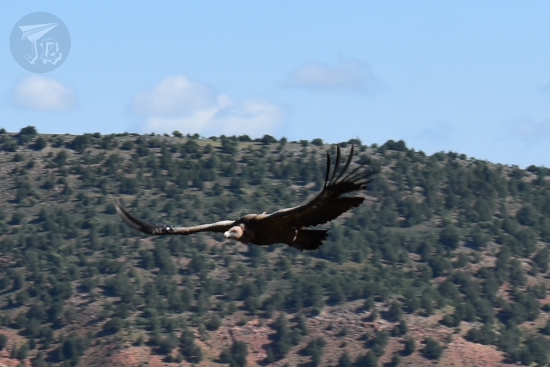
Naturaleza Encendida Life

To be fair, I was a little bit disappointed, as “Life” turned out to have mostly figures reused from the last few events. Though the organisers tried to build a narrative of water, land and air topics, the novelty had worn off. It was not bad, but the show keeps getting more and more expensive every year, with fewer and fewer perks for the VIP tiers. Furthermore, the new larger location does not imply more light sculptures – they’re just spread farther apart so they can fit more people without it feeling crowded, so it simply takes longer to walk it through. This has its advantages and disadvantages – it was good last year when we had to go on a weekend but this time around it just felt… colder. They also tried to give the whole thing an ecologist spin, and this time it did come out preachy… I mean, it is a show of lights, which technically could count as light pollution, without any actual… purpose… but charging you to watch pretty lights.

Naturaleza Encendida Life

Naturaleza Encendida Life

That was the end of the day, and we just headed home afterwards, but aside having to wait for the train for over half an hour, nothing to report on that end.

28th November 2024: Parallel Universes (Madrid, Spain)

Whenever a Marvel film comes out, my parent always comments on how they used to read the comics when they were young – probably they belonged to the first generation of comic readers in this country (and I have to confess over the years I salvaged quite a few “relics” from the attic at the old house). Thus, when the exhibition Marvel: Universe of Superheroes opened, I thought I would bring them along. I booked us tickets on the 28th of November at 10:00 for the event, which was happening in the convention centre IFEMA in Madrid.

By pure chance, my parents received an invitation to Feriarte, a collectionism fair – that is what we thought at that moment. They were not particularly into it, so I asked if I could have the invitation. When I checked it out, I realised that we could visit Feriarte on the same day as Marvel: Universe of Superheroes, since the dates overlapped, and it was also at IFEMA, just a couple of pavilions down. My parent agreed after some coaxing. Finally, I offered to take them to a “fun place” for lunch, and we had a plan.

Marvel has traditionally been one of the most important comic publishing houses in the US. Its key writer / creator was Stan Lee, who came up with some of the most iconic characters in the medium – Spiderman, Thor, Iron Man… It is true that the first superheroes to succeed on the big screen belonged to Marvel’s competition, DC – Christopher Reeve’s Superman in the 1970s and Michael Keaton’s Batman the following decade. However, Marvel kicked off a golden age of cinema superheroes. While DC festered in the darkest, more depressed Batman, Marvel released Iron Man, which took superhero films in a new direction – they turned from fun-for-fans to funny-for-all (of course, purists would never be satisfied, but what are you going to do?). Robert Downing Jr. had a lot to do with this boom, dominating the scene whether the film carried the name of his character – Iron Man – or not. For about a decade, Marvel dominated the blockbuster season, with explosions, one-liners and good-triumphs-over-evil plots. Eventually the bubble burst, as they always do, and things went downhill. However, companies are still willing to milk out any cash cow, and as long as Marvel makes money, it will be producing stuff.

Less known than the film boom is the fact that with the launching of Marvel Studios, the parent company also became a transmedia master. The idea of transmedia is not new, and refers to tying stories in different publishing methods (Hasbro was doing this with GI Joe back in the 80s already). However, Marvel has it down to an art. Samuel L. Jackson was cast as Nick Fury because a comic artist based the revamped character on him, so now Nick Fury statuettes look like Samuel L. Jackson. Since Disney acquired Marvel Studios, the so-called MCU (Marvel Cinematic Universe) is so interwoven with the Disney+ shows that neither can be followed on its own. Funnily enough, this has not washed over to the comics that much, save for the special Alligator Loki that I kept looking for in London earlier in 2024.

Well, one of the many facets of Marvel’s outreach octopus is organising exhibitions. I suspect that they are all the same under different names though. The one which took place in the IFEMA convention centre in Madrid was Marvel: Universe of Superheroes. The exhibition runs through the history of Marvel from its beginning, hailing the works of Stan Lee and running through the influence of the Comics Code Authority (CCA), which censored the content of the media – and made the evolution of American and European comics diverge forever. The pages from that time are mostly lost, so elements like the first issue of a Marvel comic ever, or original Spiderman and Fantastic Four dating back from the 60s are kind of amazing – and belong to private collectors who have lent (or rented out, one guesses) them to the organisers. Most of the exhibition, however, focuses on the MCU, with quite a few costumes and items from the films and Disney+ series. There were life-sized statues, too – or at least to scale for characters like The Thing or Hulk. There was an interactive game where an on-screen you would wear Iron Man’s suit and practice-shoot with it.

We hilariously ran into a preschool day trip, with the teacher completely made things up as she went and kept trying to keep a bunch of rowdy kids in line – without much success.

The first area ran through the history of American comics and Marvel itself, purely as a comic publisher. Then, it moved into the film area, starting with Black Panther, revindicating his status as the first black superhero. Then there was a room on Spiderman, one of the most beloved characters, even if he was almost not made because editors thought a spider-related superhero would not sell. This was probably the last room focusing heavily on comics. Hulk got a small room to share with She-Hulk. Afterwards, the MCU took over, with film memorabilia of Iron Man, Thor and Captain America. The following area was a bit of a mix, with Wandavision, X-Men, Daredevil, Luke Cage, Moon Knight, Ghost Rider… which ended in a very psychedelic room for Doctor Strange. The final room was “Marvel in Space”, with The Marvels (Captain Marvel, Monica Rambeau and Ms. Marvel) and Guardians of the Galaxy. Considering the huge hit that Agatha All Along was, I was surprised not to find any references to it, but then I realised that the exhibition predates the series.
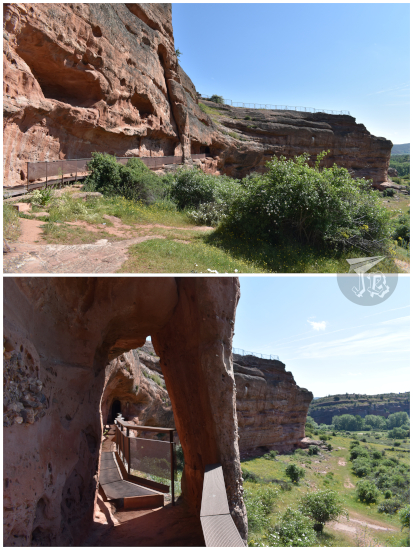
Marvel Universe of Superheroes

Marvel Universe of Superheroes: Black Panther, Spiderman, Iron Man

Marvel Universe of Superheroes: Doctor Strange, Mighty Thor, Groot

I would have wanted a memento, but none of the items in the shop appealed to me. Besides, everything was too expensive, I thought. I had no idea. We left the exhibit and marched into the inner pavilion where Feriarte took place. Feriarte is way more than the collectionism event I had originally thought – it is an antiques and art fair, with items that range from archaeological artefacts to the most modern pieces. Our minds were blown. There were 64 art galleries and archaeology specialists from all over the world carrying prehistoric items, Egyptian mortuary artefacts (including a whole sarcophagus), Grecian sculptures and vases, Japanese samurai armours and weapons, paintings, contemporary art (Miró, Dalí, Chillida, Sorolla…), furniture, jewellery and watches, reproductions of Medieval manuscripts… And I thought that the Marvel shop was expensive! I could have afforded… a tiny Egyptian scarab smaller than the nail on my little finger. I was shocked when I saw the first three paintings by Miró (a surrealist painter from the beginning of the 20th century), but it turns out they sell like doughnuts among the collectors…

There was a “collectionism for beginners” area, with tips to “start collecting with pieces under 5,000 €”. When thinking about private collections, I’ve often gone with Indiana Jones’ line “it belongs in a museum”, but lately, with the attacks on art by climate activists, and the fact that most of Marvel’s memorabilia was recovered from private collectors… I’m not so sure. I might have started changing my mind. Then again, not really, because when the original fossil of Tyrannosaurus rex Stan was auctioned and I was sad it would end up in private hands and I would never seen it – good news, it was sold to a museum, though I’m not sure I’ll ever make it to the soon-to-open Natural History Museum Abu Dhabi. Needless to say, we left Feriarte empty-handed, and very amused that you go through security and X-ray when you go out, not when you go in. A couple of days after, I read that an organised gang had stolen jewels and watches worth 390,000 €…

Feriarte 2024

Feriarte 2024

We retrieved the car, and got lost trying to get to the shopping centre La Vaguada to have lunch at Runni In Market, the first of the Running Sushi franchise I visited (and got lost trying to get there too, so… maybe it’s just difficult). My parent loved the concept. However, I was peeved that the table before us kept getting all the lychee and mochi when the time came for dessert. Mean!

Runni Sushi In Market

We left afterwards to head home, having caught a glimpse of the secret life of superheroes and what kind of décor rich people have in their houses. Parallel universes indeed…

7th November 2024: The Spanish Cultural Heritage Institute (Madrid, Spain)

I know you do not believe me when I say I don’t like guided visits, but they are the only way to do some stuff – such as stepping into the Stonehenge circle, or basically anything managed by the Madrid city hall. The Spanish Cultural Heritage Institute Instituto del Patrimonio Cultural de España IPCE is a governmental organisation whose functions are preservation and conservation of cultural items, research, communication, and safekeeping of the documents in its archive. It can only be visited on certain dates, by appointment, and with a guided visit. I managed to secure a free Thursday visit at noon, so I headed out to Madrid. Surprisingly, neither trains nor underground had issues, so I was over an hour early on site. The IPCE is located in its own building in the area known as “University City” (Ciudad Universitaria), close to the Fine Arts faculty – by design – and the President’s official residence – by chance.

The headquarters building was commissioned in 1965 to architects Fernando Higueras and Antonio Miró. The architects’ original project had to be severely modified, but it became a very different structure. Construction was stalled for years, and the building was not usable until 1985 – when new remodelling was tackled. The building is circular, nicknamed the “Crown of Thorns” (La Corona de Espinas) because at the top there are “spikes” of sorts. Top-view, the structure is divided in 30 sectors, with 56 semi-sectors and four empty ones for the main access staircase and gate. It has four floors and at least one basement. It was built in concrete and glass, with some cork floors, but lacking plaster or any kind of concealment for the structural items. The centre of the building is an open space with a glass dome, and serves as reception. Unlike the original project, this space is covered with a glass vault. The interior has a lot of plants, even three small “gardens” mainly with hanging plants. The building is considered an important cultural asset BIC (Bien de Interés Cultural), and these plants are protected along with the structure.

Spanish Cultural Heritage Institute building

The visit consisted of an introduction to the building and the work which is carried out there. We saw the model of the original project – the only similarity is that it was also vaguely circular. We climbed the stairs to the upper floors to snoop at the rooftop and the “thorns”, and then rode the lifts down to the basements to see some X-rays of paintings and sculptures. Back on the main floor, we were shown into painting restoration workshop – they were working on Maerten de Vos’ Abundance, having repaired the work and erased some extra (puritan) clothing to make the goddess Ceres look less… naked. Finally, we were invited into the library, which is round and has three levels. It has natural light due to its own skylight, a decorative glass dome in the middle of the main open area.
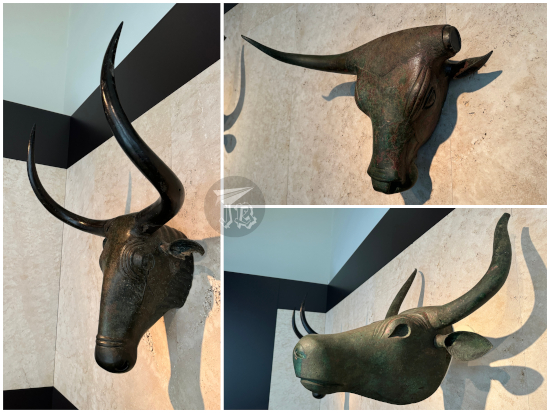
Spanish Cultural Heritage Institute inside

The visit started at noon, and it lasted two hours. Heading out to the centre of Madrid would take around half an hour of walking and underground. Thus, it gave me the opportunity to book a late 15:00 lunch. Since I was lucky with my connections, I was in the Cuzco neighbourhood almost half an hour in advance.

It was the perfect opportunity to go get some groceries at the Chinese supermarket Ibero China Madrid in the street Calle General Margallo. While I needed some items, I was distracted as I walked the “geek” fizzy drink aisle. There is a company called Ocean Bomb which makes sodas – sparking water, yoghurt drinks and bubble milk tea with “creative packaging”. I was aware of them because a friend collects the Sailor Moon ones and we checked for them in London in 2023. Well, now I went and found myself some Saint Seiya sodas – Gemini Saga (grape yoghurt flavour) Aries Mu (apple yoghurt flavour) and Virgo Shaka (peach yoghurt flavour). They were out in 2023, but I had not heard about them, it is the first time I saw them. And of course, I bought them (I have no idea if they are official or not, but the publicity I found afterwards has the Toei stamp on it, so I’m hoping they are).

For lunch, I had a reservation at Comic Planet. Last time I was there, a member of the party was late, so in order to keep the table, we ordered appetizers. They were great, but afterwards there was no stomach-space for dessert. And dammit, I wanted some dessert – particularly, I wanted pancakes. I had been looking at coming back to Comic Planet for a while just to have them, but it never worked out. This was finally my moment. I had a lemonade, some nachos – which were delicious – and I finally got to eat my pancakes – which are green and called Hulkcakes, and come with whipped cream, brownie and shortcake crumbles , and around ¾ of a strawberry. I ended up extremely full, but happy.

Comic Planet lunch

Oh, and I was confused because it was early November but… already Christmas in Comic Planet!

Comic Planet Christmas decoration

I left the restaurant and headed towards the archaeological museum Museo Arqueológico Nacional, which is running a temporal exhibit regarding Nature in Ancient Greece “Between Chaos and Cosmos: Nature in Ancient Greece” Entre Caos y Cosmos. Naturaleza en la Antigua Grecia. It hosts over one hundred pieces of classical Grecian art. Most belong to the museum’s own collection, acquired from the 19th century collector Marquis of Salamanca, and some are national and international loans. Since a large percentage of items were original and not replicas, it was really cool. Then again, I have to admit I have a thing for Grecian vases, especially with mythological motifs.

Entre Caos y Cosmos. Naturaleza en la Antigua Grecia

The exhibition was not big, so later I used my National Museums card Tarjeta de Museos Estatales to go and take a walk around the permanent exhibition. There is a loaned exhibit from the Mont’e Prama archaeological site in Sardinia, Italy. Mont’e Prama was discovered in 1974, unearthing remains from the Nuragic culture (1800 – 700 BC). This Bronze Age civilisation created large sculptures called the Giants if Mont’e Parma (Giganti di Mont’e Prama), depicting wrestlers, archers, warriors and boxers. One of these colossi Il Pugilatore (The Boxer) has been brought to the MAN for display for a few months. Boxers were characterised for having a glove with metal reinforcements on their right hands. Il Pugilatore is the largest sculpture, two metres tall and 300 kilograms heavy – which has been travelling across the world to promote the archaeological site. There was… something imposing about the whole thing, and not even its size. Some kind of… presence there. It made me want to visit Sardinia, to be honest (and it is much, much affordable than Easter Island…), so I guess the promotion… worked?

Il Pugilatore

I took a stroll through the permanent collection afterwards, especially the Iberian and Talayotic areas, because I am fascinated with them these days – and I shall make the most out of my pass for as long as I can. It was getting dark though, and the commute to the IPCE had taken long, so I headed back.

Museo Arqueológico Nacional

20th August 2024: The VIP treatment in Tendilla (Spain)

The catholic church in Tendilla is dedicated to the Assumption of Mary, thus the name Iglesia de la Asunción. It was designed in the 14th century CE, financed with money from the Mendoza family, one of the most important clans at the moment. It was projected as a great work, possibly the biggest church in the area – though Tendilla is a tiny hamlet now, it was an important villa during the Middle Ages, and the counts that ruled the enclave were very invested in it.

Church of the Assumption of Mary in Tendilla

The church was never finished – construction went on and off until the 19th century, when it was finally given up. Only one tower was erected, though two were projected, and this bell tower is separated from the building by a patio. The open area is actually a part of the nave that was not built in the end. The interior was decorated with a Baroque altarpiece, which still stands today.

Though still in use, the church has been gravely affected by time. The façade has greatly deteriorated in the last thirty years or so. The false floors have started collapsing and the roof is in dire need of repairs. The village is working on raising funds for a renovation.

A couple of relatives are very involved in the process, and at some point they offered to show me the inner areas of the church. I accepted, and was given the real VIP tour – they opened the church just for me too!

The temple is mostly Romanesque in style, aside from the Baroque altarpiece. The modern altar has been refurbished in marble. The altarpiece is golden wood, Baroque with columns, paintings and sculptures. To both sides of the altar, there are small rooms, connected to each other underneath the altar stairs. One of them has been transformed into the sacristy, the other one used to be an office, but now it is not in use because the floor is collapsing. Behind the altar, these two rooms give way to spiral staircases that ascend to the upper spaces, called La Gloria – Glory – and El Infierno – Hell – both of them unfortunately very abandoned and covered with pigeon excrement, feathers, rest of nests, and even dead pigeons. We climbed up to the Glory, but the Hell staircase is a bit unstable and crumbly, so we did not get far on that one. I scared the hell out of a pigeon though – it was mutual.

Church of the Assumption of Mary in Tendilla

Church of the Assumption of Mary in Tendilla

I climbed to the choir for a couple of pictures, and then we went up the bell tower together. It was a bit thrilling to do so, because I’ve seen that tower very often, but never gone up. It was all in all really cool – especially being alone and allowed complete freedom of pictures, including lightning and flash.

Afterwards, we went to the family home and had lunch. Later, in the yard, we “hunted” for the local fauna, including wasps, damselflies and wall lizards.

Wall lizard

Damselfly

11th August 2024: A road trip with three stops around Madrid (Spain)

Just like I kept trying to book a visit to the hall at Pacífico, I had been after a Burrolandia timeslot for a while. Burrolandia reservations are free, and the “tickets” are released around 9:00 on Monday mornings. I did not want to go in the middle of the winter as it is an open place, but when the weather became nicer, I was never around to book a spot before they ran out. Nevertheless, the Madrid area gets rather empty in August, so I could finally secure a visit. Once that was taken care of, I found myself facing another issue – after the pandemic, I developed a literal hay-fever, and straw makes me feel rather miserable. I’ve got tablets for that, but I should not drive after taking one.

Thus, I roped my sibling into driving for the day, because they are a fan of everything equine.

The non-profit Burrolandia – “Donkeyland” – is an animal protection organisation. It was founded in 1996 as a sanctuary / rescue for retired donkeys, mules (offspring of a donkey stallion and a horse mare) and hinnies (offspring of a horse stallion and a donkey mare, or jenny). Donkeys (Equus asinus) were domesticated from the African wild ass some 6, 000 years ago. There are millions of donkeys in the world, most of them kept as working animals in developing countries – however, as machinery substituted them, the number of donkeys in Europe plummeted. Burrolandia is involved in maintaining the species and the different Spanish sub-breeds.

The rescue is located at the end of a pretty run-down road in Tres Cantos, a municipality so close to Madrid that it could be a neighbourhood. The venue itself is mostly an open area where the resident animals get to interact with visitors, many of them freely. Besides the donkeys, mules and hinnies that the association has taken in, there are horses, a pony, goats, sheep, pot-bellied pigs, hens, geese, ducks, peafowl, helmeted guinea fowl, a deer doe, an ankole-watusi cow, a few dogs and a cat. Burrolandia is open to the public on Sundays, usually in two two-hour turns, one at 10:00 and the other at 12:30. Visitors can buy a bag of goodies to feed the animals for a nominal price to support the non-profit, get merchandise, or directly donate.

Donkey, goat, hinneys and mules, horse

Cow, black rooster, cat, sheep, hinney, deer

There are fewer visitors in August and it was easier to get tickets and for the day, there was only one long timeslot from 10:00 to 14:00. We arrived a few minutes after opening time, and I was surprised at how high “low demand” actually was. There were maybe twenty to thirty cars already there, with a ton of families with toddlers and kids going nuts about… the dogs, in most cases. Most kids were terrified of donkeys, though they were smaller than I had imagined. I would have expected them to be closer to a horse size, so I think that most of what I grew up considering “donkeys” were mules. Live and learn…

Burrolandia bans bringing food for the animals – both to control what the animals are fed, and as fundraising tool. We bought a bag of veggies, which contained mostly carrot, celery, some lettuce and a piece of dry bread. The donkeys, goats and sheep were all ambling outside, but most the mules, hinnies and horses were in “donkey jail” behind the fences. You could still feed them though, but they are bigger and possibly less docile than the smaller donkeys which roamed free. They were all very acquainted with the brown paper bags with the treats though, which made them very friendly. In general, I was reminded more of the Okunoshima bunnies than the Nara deer, even if one of the mules did get a bite out of my finger, and the baby goats kept trying to climb onto us. My sibling had the great idea to use some of their riding gloves to pet and feed the animals.

Feeding donkeys and goats

We stayed for about an hour and a half, and then moved on to Las Rozas de Madrid, another village in the area known for nothing except for the high-end “open shopping mall”, a street full of outlet brand-fashion boutiques selling discounted items. I had heard on and on how fantastic Las Rozas Village was. There are specific bus tours from Madrid that take tourists to the mall and back.

We parked the car in another shopping centre, Heron City Las Rozas, where we changed clothes and shoes because… we did not trust ourselves with the barn smell. We walked into the Village, and I don’t know what I was expecting, but for sure something with a big more… grandiose I guess. To my surprise, the shops were almost empty (both of produce, and customers) and every second shop was a Scalpers… I have to say I was quite underwhelmed. We did not even find a nice place to grab a bite to eat. Furthermore, I heard at least three other people commenting the same thing – they had heard a lot about the mall and it was disappointed.

Entrance to Las Rozas Village

We ended up having lunch back in Heron City Las Rozas. We found a Japanese chain restaurant named Sumo, a sort of buffet with a flat rate for a number of dishes. Since it was still quite early – and again, August – the place was mostly empty – we had sushi, takoyaki, wakame salad, and some gyoza. As dessert was not included, afterwards we went to Starbucks to have a matcha drink, named after a House of Dragon character for some publicity stunt – Dracarys Matcha Frappuccino. It was a cold matcha latte with white chocolate cream on top, to which I added some vanilla, just because I could, and it was a great idea. I think the matcha with strawberry cream on top was a better combination, but apparently that one was only available in spring. I guess I’ll have to try the standard Matcha Frappuccino at some point.

We went on to our last stop for the day. Xanadú is a shopping mall in Arroyomolinos, home to Atlantis Aquarium Madrid, a smallish oceanarium. Upon entering, you go down some stairs, and the first area are Rivers and Mangroves, with some mudskippers, and cute shiny fish. Actually, the first tank the visitor encounters hosts a shoal of red-bellied piranhas (Pygocentrus nattereri). Of course, there are a few axolotls (Ambystoma mexicanum) too.

Piranhas, discfish, axolotl, mangrove fish

Then come the Mediterranean anemones, jellyfish, starfish… Afterwards are the Tropical Reefs with the usual suspects – who does not try to find Nemo among the clownfish? There are also butterflyfish, surgeonfish, and of course all the corals. The Open Sea area, a typical central tank, has few species of sharks – blacktip sharks, grey reef sharks, bonnetheads, longtail carpet sharks… There are also rays and loggerhead sea turtles. In between the different views of the central tank are the penguins, which were pretty photogenic! The last area had a few small tanks with Coastal Ecosystems – anemones, sea cucumbers and hermit crabs mostly. Staff had put out some glass shells for the latter to move into, which was fun.

Anemones, clownfish, shark and penguins

Atlantis: hermit crab and sharks

The gift shop had a lot of cute souvenirs, and afterwards we walked around the rest of the mall for a while, had a smoothie, and eventually drove off. It was a good day, with lots of cute animals, some of which I even got to pat. Not the sharks, sadly, but I made a lot of donkey friends, even if they only liked me for my vegetables and stale bread.

21st July 2024: From the Sea to the Butterfly (Madrid, Spain)

When planning for the day, the one thing I did not count on was the heat wave. I did take into account problems with trains, but apparently a half-hour delay is a non-issue by now and not worth mentioning. I reached Madrid around 12:30, and I had a reservation at 13:00 for a themed restaurant which had caught my eye when I saw it online. It was honestly a big disappointment, though I refused to let it ruin my day.

The restaurant is called Bestial, and it is ocean-themed. The pictures were awesome, it looked super cool, and I was pretty excited to go there. However, the experience was mediocre at best – I guess solo travellers are not their target audience, and it showed. As I was mainly ignored, I could watch how the restaurant worked. The waiters got the tables mixed up a few times, and they allowed others to take pictures with cocktails that were not theirs – that was weird, and I am pretty sure that against health code. I ordered a lemonade – the best thing – a tuna tartar and a crab bao without coriander, after checking that the coriander could be taken out. The tuna was tasteless, and the bao did have taste… coriander. All in all, I was not impressed by the food, even less by the service. Between the two dishes there were about 35 minutes waiting, and after an hour I just gave up and asked for the check, which was brought in a little book… and dropped halfway, then picked up from the floor… I just paid – the meal was not cheap – and left without dessert. A pity, really, but I really did not care any more.

Restaurante Bestial by Rosi La Loca

It was ridiculously early for my 16:00 visit, but I wanted to try my luck. I had chosen that day because CaixaForum Madrid was running two exhibitions that I wanted to see – Patagonian dinosaurs (which had just opened) and The Science of Pixar (which would end soon). The exhibition centre was booked out, so I could not sneak in before my time slot, but I managed to get my most burning question answered – how on earth were they going to fit a Patagotitan inside CaixaForum? Answer: they did not. They placed it outside, which was a fun surprise!

Patagotitan skeleton in front of CaixaForum Madrid

Since I had about an hour and a half, I decided to trot over to the painting museum Museo del Prado, part of the national network of museums, which I can access with my one-year card. I thought I might be luckier and the queue to enter without a reservation would work better. Indeed, I did not have to wait indeed, and I could have a look at a few of the masterpieces the collection holds (though not take photographs) – Francisco de Goya, Joaquín Sorolla, Diego Velázquez, Esteban Murillo, Fra Angelico, Hieronymus Bosch… Of course, not all the masters, because El Prado is enormous. It is also air-conditioned, and surprisingly, not as full as I half-expected. There was a queue when I came out, so I guess it worked out well!

I walked back to CaixaForum Madrid to see the two exhibitions I had booked. It was a bit before 16:00, but this time I did not ask, and just walked into the first exhibition – “Patagonian Dinosaurs”: Dinosaurios de la Patagonia, which had very little new information, and even fewer actual fossils, but a lot of dinosaur reconstructions. Those were cool. Aside from the Patagotitan mayorum placed outside, there were full skeleton replicas of Herrerasaurus ischigualastensis, Eoabelisaurus mefi, Leonerasaurus taquetrensis, Eoraptor lunensis, Condorraptor currumili, Brachytrachelopan mesai, Amargasaurus cazaui, Tyrannotitan chubutensis, Neuquensaurus australis, Carnotaurus sastrei, Gasparinisaura cincosaltensis and Manidens condorensis. There was also a Giganotosaurus carolinii skull. As for the real thing, a femur, a shoulder plate and a forelimb of Patagotitan, some teeth and vertebrae and a few invertebrates and leaves. It was really cool, and not extremely crowded for a dinosaur exhibit in summer. It was only the third day of the exhibit, so maybe it was not that well publicised yet? Out of the new species I discovered, Amargasaurus was my favourite – with the neck spikes it looked exactly like I would have imagined a dragon.

Patagonian Dinosaurs

Patagotitan front and back legs, along with a huge shoulderblade

The other exhibition that ran at the time was “The Science of Pixar”: La Ciencia de Pixar. It felt like a nerdy companion to Mundo Pixar, focusing on the maths and the process to create a Pixar film. Unfortunately, it was bustling with kids who – understandably – just wanted to smash buttons and make things light up. The exhibition had a lot of cool machines which simulate the different steps of creating a computer-animated film – rigging, modelling, lighting, rendering… The most interesting was an analysis called “What colour is this pixel?” taking into account movement, lights, shadows… It must be amazing to be able to visit the exhibit alone and be able to play with all the computers. I did find one where you get to simulate crowds using shoals of fish (from Finding Nemo) and I played with that for a while. There were also a few life-sized models from several films, miniatures and 3D mini-sculptures.

La Ciencia de Pixar

I left the venue after browsing the shop, and I walked down towards the theatre. It was still early, and I wanted to hit a couple of shops. Actually, I wanted to go to what is commonly known as the Primark flagship shop. The building Edificio Gran Vía 32 was originally erected in the 1920s to host the first department store in Madrid, Almacenes Madrid-París. It was designed by architect Teodoro de Anasagasti and used the most modern technology and materials at the time – reinforced concrete in the avant-garde style. The whole interior is built around an octagonal lightwell with a central staircase, and today the lowest four floors have been turned into the Primark shop, which has fitted screens and lightings while keeping the previous structures and railings. The modernisation project was undertaken by architectural studio RCCyP and it took three years until the shop opened in 2015.

Interior of Edificio Gran Vía 32

I continued off towards the theatre Teatro Real. I had a bit of time and some unspent calorie budget, so I decided to splurge at Starbucks with a whipped-cream Frappe for my pre-show snack. For the same price I had awesome third floor for Carmina Burana, I had a fifth-floor-in-the-back paradise ticket now. However, it was a lone seat with a great view, so I am not going to complain. I was going to watch the opera Madama Butterfly by Italian composer Giacomo Puccini – and sometimes I think that the better the singers are, the worse time I have with this show.

Madama Butterfly Promo

The main character is Cio-cio, a name that when pronounced in Italian sounds similar to 蝶々, [Choucho], butterfly in Japanese. When she is 15 years old, in 1904, Cio-cio marries an American navy man, Pinkerton, who intends to leave her and find a ‘decent’ American wife. Cio-cio is repudiated by her whole family when she converts to Christianity for her marriage. Three years later, she is alone, almost bankrupt, the mother of Pinkerton’s child, and a marriage broker is trying to sell her off to another prospective husband. Pinkerton returns to Japan with his American wife, who agrees to raise the child, but he cannot face Cio-cio because he is a coward. She (spoiler alert) prepares their son to go with him, then commits seppuku.

And even a bigger spoiler alert, I hate Pinkerton. Viscerally. My parents tried to start me into opera way too young to understand plots, I feel, and I did not want to do anything to do with it for a long time. However, at one point I wanted to see Madama Butterfly due to it taking place in Japan – being older helps, and I slowly learnt to appreciate the musical genre. Basically, by hating on Pinkerton.

Apparently, Teatro Real is known for its alternative settings and takes on classical operas. In this case, they let go of the old Japanese cottage in order to use… a modern-ish undisclosed Asian country. There was an overpass with Chinese signage, a billboard with McDonald’s and Bailey’s spoofs in Japanese (that did not make any sense), and the traditional cottage was exchanged for a greenhouse of sorts. There is a scene in the traditional opera in which the characters fill the house with flowers. In this case, they coloured the glass panes with hand paint. It was a great show.

Cast:

  • Cio-Cio-san: Ailyn Pérez
  • Suzuki: Nino Surguladze
  • F.B. Pinkerton: Charles Castronovo
  • Sharpless: Lucas Meachem
  • Goro: Moisés Marín

Artistic team:

  • Musical conductor: Nicola Luisotti
  • Stage direction: Damiano Michieletto
  • Set design: Paolo Fantin

Madama Butterfly Teatro Real

The show finished around 22:20. I walked up Arenal Street towards Sol. While I missed my first train because some people love to take up space while walking slowly, I made it for a good connection at Atocha, and I was actually home before midnight.

30th June 2024: Engines, illusions, history and tea (Madrid, Spain)

Since finding about my tea time outings, my sibling had been wanting to tag along to one. I was asked to organise something for the weekend that involved either Chinese hotpot or afternoon tea in Madrid. The hotpot place was booked out both days, but I found an afternoon tea opening on Sunday the 30th. I am too lazy to move out just for tea, so I organised a bit of a day out.

After an uneventful train ride, our first stop was at noon: Nave de Motores de Pacífico, the former energy centre that fed electricity to the original underground lines. Today, it is not in use and it has become part of the network of museums Museos Metro de Madrid. The warehouse was built by Antonio Palacios between 1922 and 1923 to home the diesel engines, transformers and fuel that single-handedly powered the underground system before the Spanish Civil War. The system was actually in place until 1972.

Warehouse containing the old underground engines

The building was erected in red brick, with white tiles inside, decorated with Palacio’s typical metallic green. The floors are ceramic tiles, and the engines are three monstrous vessel-powering pieces of engineering. These diesel engines created electricity, which then entered the transformers, and was sent to the power lines to feed the trains. At night, the excess was sold to the local street-light network.

Since we were going for afternoon tea to El Jardín de Orfila, where I have been before, I knew lunch was out of the question. However, we needed a snack. I planned that at Yatai Market, an… Asian food court of sorts. A number of stands come together to offer different cuisines and snacks, even full-sized meals. We tried a Chinese bao each and a couple of dim sums. I ordered a hoisin duck bao which was extremely yummy. I will definitely come back to try other stuff.

HotBao Yatai Market Cortezo

Afterwards, we headed off to the so-called Museum of Illusions. This museum is a compendium of optical illusion and installations designed to fool the brain into believing things that are either wrong or just not there: a distorted room so you look big in one corner but small in the other (Ames room), a vortex where you seem unable to walk straight, a rotated room, a room full of mirrors – there were a lot of illusions with mirrors actually – stereograms with hidden images, turntables, holograms…

We had a reservation for 14:00, and I was surprised at how chaotic entry was. I mean, they’ve been running the thing for a while now, someone should have figured out how to do crowd management, but no. Then, there were kids running and screeching all around, but it calmed down after a while. I had really hoped that the museum would be calm and half-empty at lunch time, but it was not so, not by a long shot. It was interesting though, and pretty fun.

Museum of Illusions Madrid

However, the experience was shorter than I had calculated, so I had to improvise an extra stop. Thus, we entered the local history museum Museo de Historia de Madrid, which tells the city’s history since Madrid became the capital of Spain. There are paintings, models, typical costumes, plans, maps, and Playmobil sets depicting of the uprising against the French in 1808. The museum is hosted in a former palace-like building which was actually built as a hospice. To the side stands the original Baroque chapel. It also has a lovely garden with a monumental fountain, which was relocated from its original place for conservation.

Museo de Madrid exhibits

Museo de Madrid - chapel and fountain

We spent some time there and then headed off to the building that now holds the office of the Copyright Owners’ association, a manor known as Palacio de Longoria. It was designed by José Grases Riera and built between 1902 and 1904. It is one of the few actual Art Nouveau buildings in Madrid, possibly the most important one. The façades were made in artificial stone, with sculptures and shapes resembling vegetation. I’ve wanted to visit it for a long time, but it is only open when there is an exhibition, and the stars had never aligned – until this time. There was an exhibition about urban music, and I was not going to let go of the chance to see the monumental staircase and the skylight.
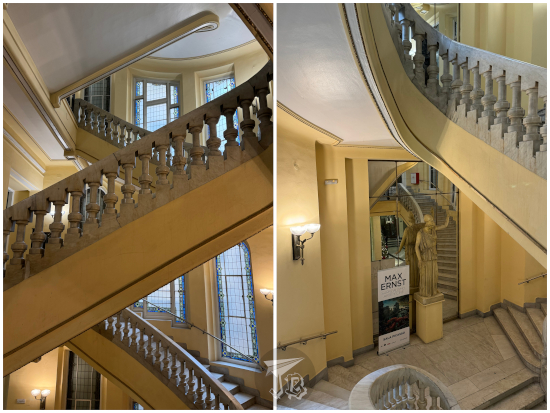
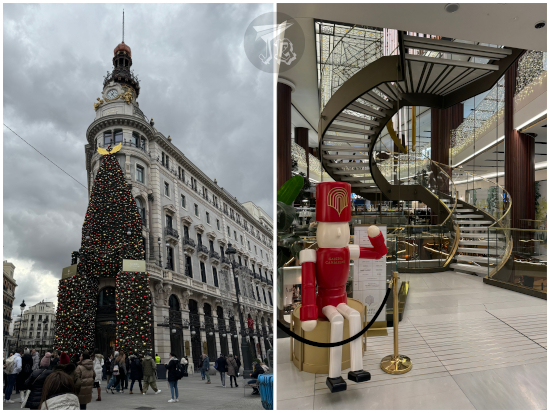
Longoria Palace

We finally set off for afternoon tea at El Jardín de Orfila. Out of the several places I’ve tried afternoon tea in Madrid, this has been my favourite to date. The outside garden is lovely, but mostly, their scones are the best around.

We ordered green tea, and the snacks were finger sandwiches – smoked salmon and cheese cream, classic cucumber and cheese, pastrami – pastries – carrot cake, macarons, lemon curd – and the scones. This time round, I decided to eat the scones after the sandwiches in order not to be full when it was their time. The afternoon was pleasant, but we shared the terrace with another table, and later a loud lady who wanted a smoke. That broke the magic a little, but the tea was fantastic and the scones were great.

El Jardínde Orfila: tea serving for two

Afterwards, we just headed for the train station to get back to our places. Of course we missed the correct one since they run whenever they like. What else is new? But the fun part was being able to pull a fun day out from my sleeve, and it was not stupidly expensive either, so good fun, all in all!