When planning the weekend in Vienna, D****e and I had a discussion. She wanted to be “free” on Sunday in case Hyde did something unexpected, but I didn’t want to spend the day waiting around without anything to do. In the end, we reached an agreement to… go somewhere and back before the singer would even get out of bed. And that is how we found ourselves on the 6:24 train to Semmering, within the Austrian Alps.
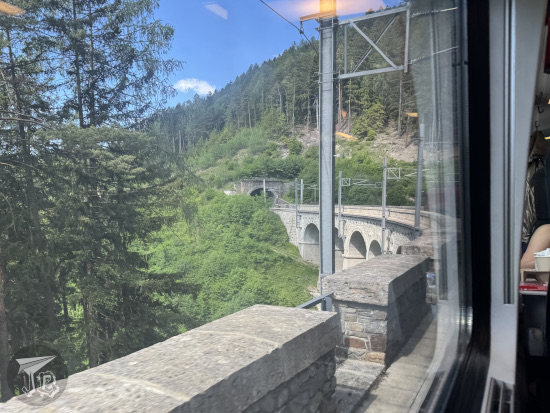
Technically, Semmering is a dignified ski resort, remanent of the time in the 19th century when the sport was all the rage amongst the upper classes, who would take the train to get there. The Semmering Railway Semmeringbahn runs 41 kilometres through the Alps. Built between 1848 and 1854, it is considered one of the greatest feats in early railway engineering, with bridges, viaducts, tunnels, charming mountain stations, reaching over 895 metres above sea level. It was declared World Heritage by UNESCO in 1998 with the name Semmering Railway.
Thus, a big thing about Semmering is the journey itself, not only the destination. Especially because in late spring the mountain village is in the middle of low season and most everything is closed. The idea was to find a window seat on the train to enjoy the trip until we got to the area. Once there, we would wander around for a couple of hours, take in a few views, maybe have breakfast at a fancy café, and finally head back.
The train ride was spectacular once we reached the Alps. This Central Europe mountain range stretches between France and Slovakia (around 10,000 km), and is in part responsible for the continent’s climate. The Alps were formed during the aptly-named Alpine Orogeny that started in the Late Mesozoic, when Africa began pressing against the Eurasian tectonic plate in the north – of course, this took tens of millions of years. Aside from over 80 peaks higher than 4,000 m, there are lakes, glaciers (some of which used to be permanent and not any more) and several of Europe’s most important rivers, along with their tributaries. There is evidence of human presence in the mountain range since the Palaeolithic period, along with prehistoric treading of both man-made and natural ways and paths – passes – to cross them on foot. Semmering is one of them.
The train route was extremely beautiful, both due to the landscape itself and the fourteen engineered tunnels along the tracks. We reached Semmering a bit after 7:30. As no cute café was open, we just went on a short hike. We strolled down the Semmering-Kurort neighbourhood, walked by a modern art garden called Skulpturenpark and finally reached the tree line. Our first stop was the so-called 20-schilling view 20-Schilling-Blick, which overlooks the historic train line (part of it, as the viaduct is currently under construction). The he area was featured in the 20-schilling note, before the euro, hence the name. You can actually take the exact same picture that was printed on the bills using a conveniently-placed box – except for some works going on that has one of the bridges covered in scaffolding.
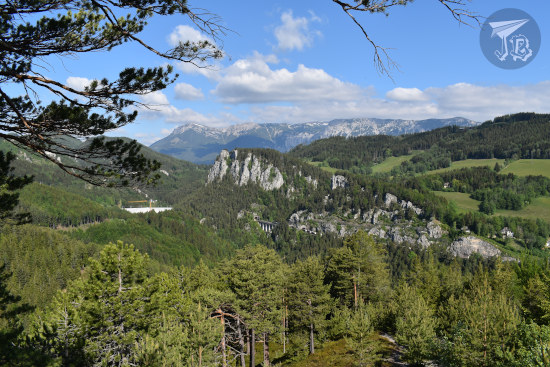
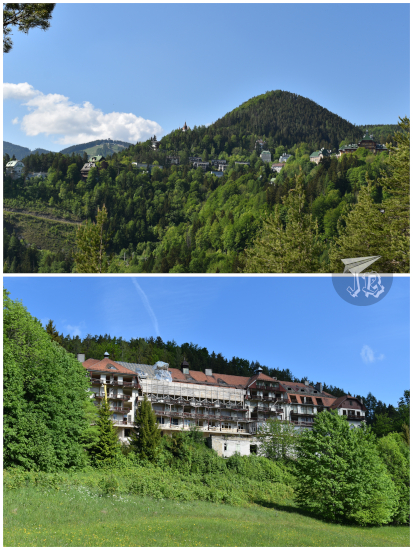
On our walks we found other spots and views, including the observation deck Aussichtsturm auf der Doppelreiterwarte. We walked by the Kurhaus Semmering Hotel, a grand hotel dating back from 1909, which now is closed for renovation so it can be restored to its former glory. We got a bit lost on the way back, because the way we wanted to take was closed down, but made it back to the station with ten minutes to spare. Once back in Vienna, D****e and I had different plans for a few hours.
The train ride back was all right, but upon entering Vienna, we got stranded due to a “firefighting emergency”. We had to find alternative our alternative way to the city centre. It is a good thing that I am paranoid enough that I had chosen my next visit with almost an hour and a half’s margin, so I got there with ample time. I had booked at 13:00 to take a tour of the Spanish Riding School Spanische Hofreitschule. The shop was packed with people so it was hard to see anything, but the tours themselves were rather empty.
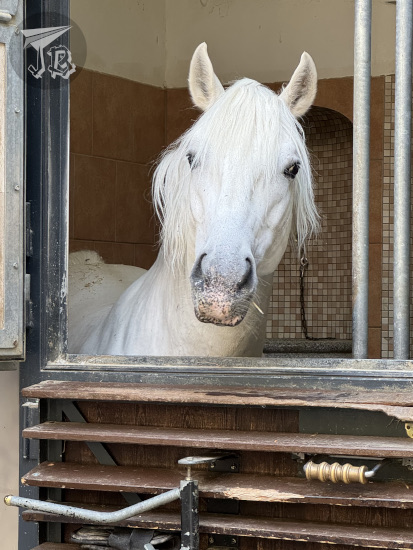
The Spanish Riding School takes its name from the main horse bloodline that was used to create the breed it showcases, the Lipizzaner. Breeding traditions of these animals are considered Intangible Cultural Heritage by UNESCO. Contrary to what is usually thought, the horses are not white, but grey. Their skin is grey, and they are born with a dark coat which turns white in age. The school is one of the “Big Four” riding academies, along the Royal Andalusian School. It focuses on “classical dressage”, and its roots are in military horsemanship, which shows in their performances. The building itself, in the Baroque style, was erected in the 1730s, commissioned to Joseph Emanuel Fischer von Erlach by Emperor Charles VI.
Within the School, we got to visit the summer arena – which has individual “stalls” for each horse to exercise in – the winter arena, the courtyard and the stables. We got to hear how the horses are born and raised in Piber, and that the actual reason why only stallions are used in the work is because the pirouettes, cabriolets and jumps imitate how they behave in the wild. The guide actually said that mares would not understand or care about learning the steps. We also learnt that each horse has two names – the first one is the name of the father and the second is the name of the mother. Pictures were not allowed in the stables, and I am not sure why – maybe so there is no proof where each horse is so nobody can lure them using their names? For the record, 13:00 is not a good time to take a tour, because the horses have just been fed, and you get to see lots of horse butts, but not enough faces.
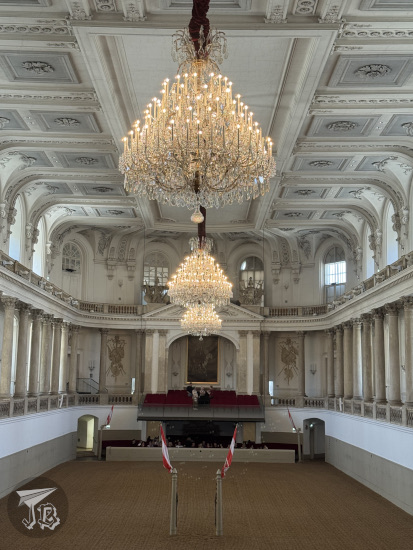
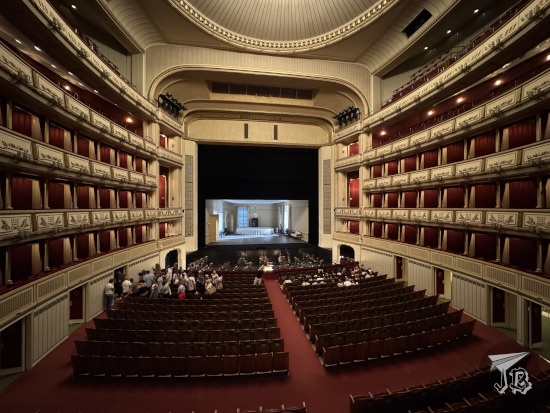
My next tour was at 14:30 at the Vienna State Opera Wiener Staatsoper. That was chaotic. We had to queue outside to be let in and be directed to either buy tickets or get ours checked out. Once inside the hall, there were mobs of people waiting for different language tours. As a matter of fact, an Australian gentleman decided he had to push to the front of the English-speaking group, and was sent back to the end of the line. Once the tour started, the whole thing was surreal. I learnt next to nothing about the place, as the only thing that our guide did was complain about people with money, either from the past or the present. One thing I did realise is that the actual music hall is extremely small – no wonder it fills out so quickly.
The main hall seats around 1,700 people per show. The Renaissance Revival building was erected in the 1860, and there were two architects involved in its construction: August Sicard von Sicardsburg, Eduard van der Nüll, along with contractor Josef Hlávka. At the time, it was considered “not grand enough”. The interior and stage were destroyed during WWII, in a modernised version of the original. Nowadays, it is home to the opera and ballet companies of the city.
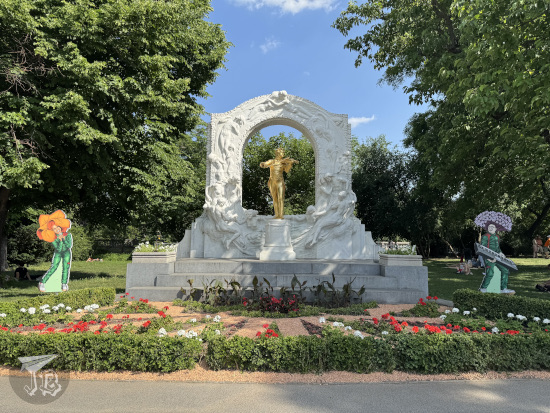
Once done, I walked by the Starbucks to grab a cold drink – cookies-and-cream frappuchino was not the best option – and headed to Stadtpark to meet with D****e again. I stopped by Johann Strauss monument Johann-Strauss-Denkmal, which depicts a golden sculpture of the musician playing his violin.
We did not do much for the rest of the afternoon until we headed off for dinner. On our way, we came across something called the Ankeruhr or Anchor Clock, a mechanical clock built in 1914, commissioned by an insurance company. We did not see it in action, but it looked cool.
Dinner had been booked at the rooftop terrace Organics Sky Garden, and I have to say it was one of the worst dinner experiences of my life, and I’m not too much of a demanding customer. When we arrived, the responsible / managing person apologised because there had been an event and they were a bit overwhelmed. Fine, stuff happens. We get shown to our table and to our surprise, food and drink have different order / payment systems. All right, weird. What sold it, though, was not the bland food or the tasteless drinks – our waiter was drunk. Absolutely wasted. It took her four times to get the card-reader working, and in the end she had to call someone else to charge us.
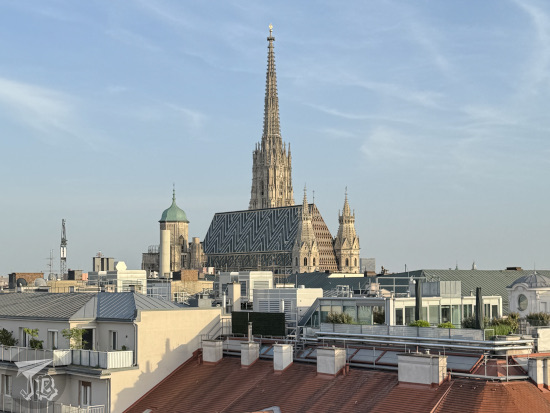
The drink price was ridiculous for something that was mostly tasteless. My Organics Purple Berry drink was not even pale pink. The waiter managed to spill D****e’s Organics Simply Cola and she did not even offer a replacement, but laughed stupidly. The one food I found appealing was the Margherita pizza and that was not even that good. The only good thing about the place were the views of Domkirche St. Stephan (St. Stephen’s Cathedral).
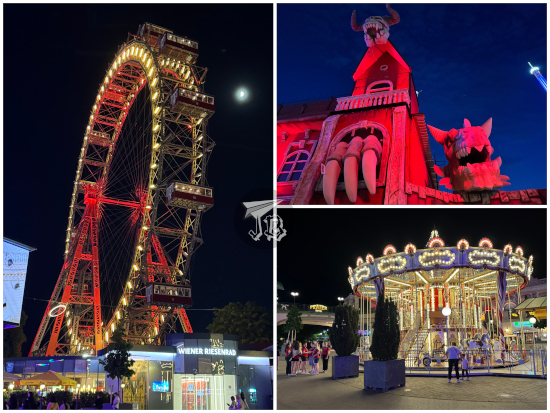
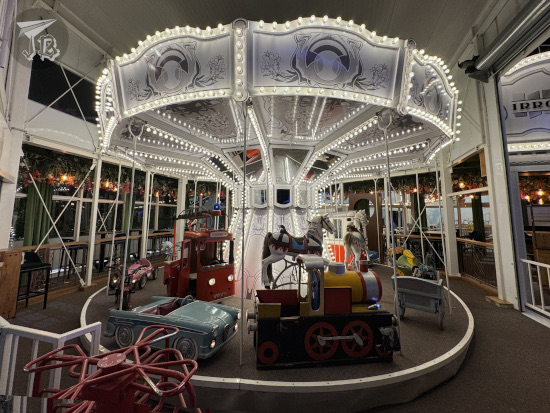
After that experience, we headed off to Prater. The area, originally a hunting ground, was cleared out to set up the 1873 World Exhibition. Today, it is an urban green and an amusement park. Though some of the rides are obviously very modern, some of them were established in 1897, including the Ferris wheel and symbol of the park Wiener Riesenrad. D****e wanted to find the spots where Hyde had taken photographs, and I wanted to see the nostalgia carousel Familie Karussell, because I like merry-go-rounds, the older and more kitsch, the better, I guess. It was palate-cleansing.
And when we eventually made it back to the hotel, I was tired enough that I actually slept through the night.