13th January 2024: Commemoration of Ricardo Velázquez Bosco in Guadalajara (Spain)

In general, I’m not a fan of guided visits, but I’ve learnt to accept that they are sometimes the only way to get access to several monuments. Thus, I signed up for the free* “themed visit” about Ricardo Velázquez Bosco in Guadalajara. The route was organised by the town hall to commemorate the centennial of the architect’s death in 1923 (I know it’s 2024, the activities started in 2023, but they spread through January).

Velázquez Bosco is considered one of the most important architects in the Spanish late-1800s – early-1900s. Among his works are the Spanish Crystal Palace and the Madrid mining school. His style has been called “emphatic eclecticism” and described as eclectic historicism with academicist tendencies – which basically means that he did not like Modernism, and preferred combining historical styles instead.

In Guadalajara, he worked for the most important noblewoman of the period – the Duchess of Sevillano and Countess of La Vega del Pozo, María Diega Desmaissières y Sevillano (Duquesa de Sevillano y Condesa de la Vega del Pozo). The Duchess lived in Madrid, but was connected to Guadalajara through her aunt, Catholic Saint Maria Micaela, founder of the nun order known as Handmaids of the Blessed Sacrament. The Duchess of Sevillano (known in town as “the countess”) had a lot of buildings erected in Guadalajara and around it, most of which are now private property and have a very-limited-to-inexistent visit regime. The town loved its countess since she commissioned (also to Velázquez Bosco) the farming hamlet Poblado de Villaflores – the construction and subsequent agriculture and livestock activities created a lot of work in the area.

To honour her aunt’s charity work, the Duchess ordered Velázquez Bosco to build a school and an asylum, and though she never really lived in Guadalajara, she commissioned him to build her a palace when her Madrid home was expropriated. She never got to live there, as her heart failed in Bordeaux at the age of 64. She was buried in Guadalajara, in a pantheon that she had also ordered the architect to erect for her.

Today, both the asylum and the palace are schools, and cannot really be visited. The pantheon is privately managed by a private foundation Fundación San Diego de Alcalá, which also manages one of the schools, the adjacent gardens, and the church of the former convent.

The first stop of the visit was the pantheon Panteón de la Duquesa de Sevillano. It is a small eclectic building, the inside is a Latin cross, the outside is a homage to the First Romanesque buildings, with neo-Gothic ornamentation. The characteristic purple dome and the interior mosaics are of Byzantine influence. The crypt is a false one, as the pantheon is reached by climbing up a monumental staircase, so when you “go down” to the crypt, you are actually at ground level. The Duchess’ sepulchre, carved in marble by modernist sculpture Ángel García Díaz, represents the funeral procession. We had to pay 1 € in order to visit the pantheon, as there was no agreement between the town hall and the foundation.

Ducchess of Sevillano's pantheon

Ducchess of Sevillano's Pantheon

We then were taken to another of the foundation’s buildings, the school Colegio Niña María Adoratrices. Today is a semi-private Catholic centre run by nuns from the congregation founded by Saint Maria Micaela. The school cannot generally be visited, so I was glad this worked out. The school building was erected in red brick, with a white limestone façade echoing the Renaissance building of the University in Alcalá de Henares. The school used to be a convent, and there is a restricted cloister. Legend has it that the cloister is only open for wedding photographies to brides who studied at the school. It is square, with two stories of neo-Romanesque arches and columns with vegetal decoration. We were also shown the chapel, with neo-Mudéjar panelling on the ceiling, and the monumental staircase.

Adoratrices School Guadalajara: Façade and cloister

Adoratrices School Guadalajara

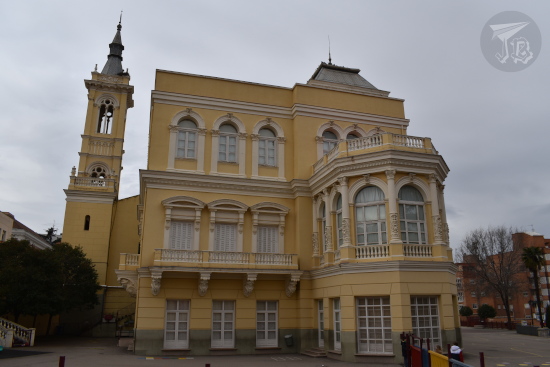
Finally, we walked to what was built as the Duchess’ palace in Guadalajara, Palacio de la Condesa de la Vega del Pozo, today another school, Colegio de los Hermanos Maristas, also Catholic and semi-private, and extremely difficult to visit. We were shown inside and got to see the actual outline of the palace. Inside, we saw the panelling and the ceramic decoration before we reached the inner patio, a mix between Castilian and Andalusian styles.

We then visited the smoking room upstairs, an astonishing ward with ceramic tiles decoration and wooden floors. As a last snoop, we could peek into the balcony, which keeps the original cement-tile (baldosa hidráulica) floor. It was extremely impressive – and one can forgive the horrible pale yellow exterior the palace has been painted. Ricardo Velázquez Bosco was one of architect Antonio Palacios’ teacher, and I had the feeling that Palacios took his ideas for the Fundación San Diego de Alcalá, Panteón de la Duquesa de Sevillano, Colegio Niña María Adoratrices, Colegio de los Hermanos Maristas, Maudes hospital from the walls and floors of this palace.

Maristas school, former Duchess of Sevillano's Palace

Maristas school, former Duchess of Sevillano's Palace inside

The visit took around two hours, and it was free except for the pantheon. Being able to see the inside of both schools was the best, because it is rare that visitors are allowed in either. Thus, I am glad I signed up for this, especially as the weather held – we had a tiny bit of drizzle, but not much, and the clouds kept the cold at bay.

29th December 2023: Parque Mágicas Navidades, Torrejón de Ardoz (Spain)

For the last escapade of the year, I organised an outing with the family. I had thought that after our annual Christmas / New Year’s lunch gathering, the younger squad could go on for a while while older relatives caught a break from us. For a few years, the town of Torrejón de Ardoz has been organising a bigger and bigger “Christmas park” called Magical Christmas Park Parque Mágicas Navidades. During the last decade, the display has grown to be a massive event which runs throughout December to after Epiphany day. It has become so popular that they started charging people from outside town for entry.

The park is huge by any standard. This year there is a small amusement area with winter-themed rides, an ice-skating rink, a Christmas market, a small house for Father Christmas / the Three Wise Men (depending on the date), and several displays: the “Ice Festival”, the “Frozen Mountain” and the “Asian Lantern Festival”. There are smaller decorations sprinkled all over the park

Unless you are a local, entrance is 6€ / person. Once inside, you can buy tickets for the rides and the Ice Festival, but if you get your tickets in advance, it’s a tiny bit cheaper. In our case, I bought an entrance + Ice Festival combo that was 16€ – buying tickets inside would have been 11 €, so we saved one whole euro!

We reached the station by 19:45, and it took just a few minutes to reach the park entrance and go in. We found ourselves in a path with some food stalls, the Christmas house (sold out when I bought the tickets), some light sculptures and a few meninas. I noticed similar statues when I was in Madrid back in December, but I did not pay much attention to them. It turns out that they are part of an art project by artist Antonio Azzato collaborating with other creators and some of the city’s schools, and a pretty big deal – a modern art project. The word menina refers to a young girl from a noble family who enters the court to serve the queen or her children. Probably painter Diego Velazquez’s depiction of them is the most famous, and is the inspiration for Azzato’s figures.

Parque Magicas Navidades Torrejon Access from Train station

Since we had a timeslot to enter the Ice Festival at 20:30, we decided to find that first to make sure we did not miss our entry; once we located it, we would see what to do. On our way, we crossed a literal starry field – sorry, starry forest Bosque de Estrellas. We walked by a giant snowman, a huge teddy bear, Cinderella’s carriage and Father Christmas’ sleigh, all made of lights. Then, we found the Magical Gate Puerta Mágica – this is a huge structure made of thousands of small light bulbs that looks a bit like the façade of a gothic cathedral. Every hour o’clock there is a show, and we had a three-song disco show that we stayed for, as I had just spotted the destination.

Parque Magicas Navidades Torrejon Magical Gate

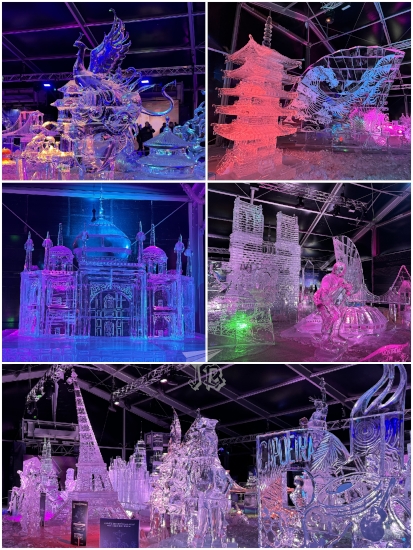
After the show, we headed off to the Ice Festival, a giant tent kept at -6 ºC – we were let in early, it was barely 20:15, so I’m thinking timing is… a suggestion. During the first week of the festival, ten two-person teams compete to build an ice sculpture from 25 ice blocks, according to the theme of the contest. This year, the topic was “freezing up the world”, so each piece tried to represent a city or area. Unfortunately, after almost a month of competition, some pieces were damaged or… slightly melted. Such as the… let’s say the “leaning tower of Paris” a.k.a. the Eiffel Tower. In all seriousness though, there was Las Vegas, Rio, Kyoto, New York, Kuala Lumpur… Did I mention the below-zero temperature? I think I lost sensitivity on my right pinky, and by the time we were out some of my fingertips were actually blue…

Parque Magicas Navidades Torrejon Ice Festival

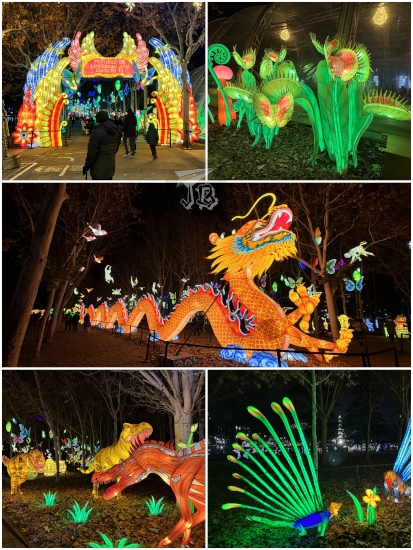
Next, we decided to see the Asian Lantern Festival Festival de las Linternas Asiáticas – a number of figures made out of fabric with light inside, similar to Brilla Zoo, and just as Christmassy, I guess. We actually started on the Second Space, which was dedicated mostly to dinosaurs. There was also a dragon (as 2024 is the Chinese year of the Dragon), some contemporary animals – elephants, flamingoes, lions, red pandas… oh, and lots of Venus flytraps.

Parque Magicas Navidades Torrejon Asian Lanterns 2

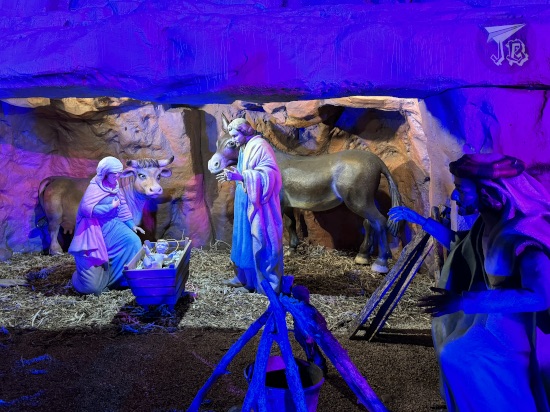
Our following spot was the “Way to Bethlehem” Camino de Belén, which recreates the Biblical story of the Nativity, from Joseph and Mary heading off to the census, to the stable and the adoration by the Three Wise Men. It is described as the largest Nativity in Spain – the figures were actual-size, but not too well made, and the whole thing was a bit creepy. Furthermore, they had the same two songs on a never-ending loop.

Parque Magicas Navidades life-sized Nativity

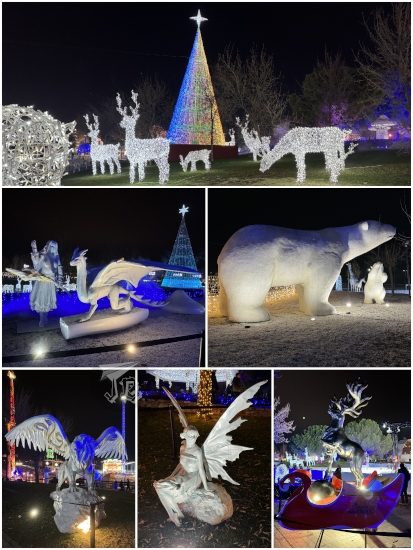
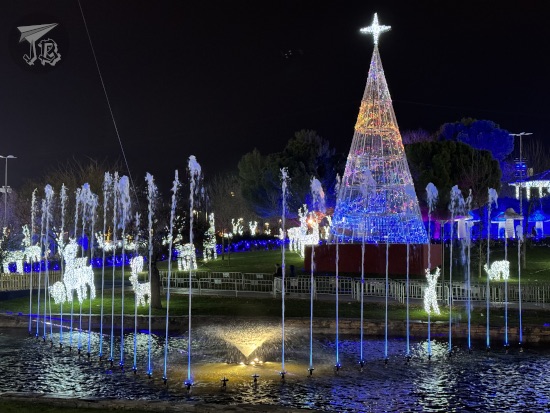
Afterwards, we decided to “climb” the Ice Mountain Montaña Helada, which has a ton of light-reindeers and some white sculptures of creatures of Scandinavian mythology – I think. There were faeries, elves, a winged lion, dragons, horses, a pegasus, trolls… and two very non-mythological polar bears. There was finally a sculpture of a reindeer standing on a sleigh. I’ve recently learnt that a reindeer that keeps its antlers in winter is a pregnant female, so there’s a lot to say about Father Christmas’ sleigh… There is also a light Christmas tree Árbol de Luz in amongst all the reindeer, and you get a glimpse at the ice rink Pista de Hielo, designed by former figure skater Javier Fernández.

Parque Magicas Navidades Torrejon Frozen mountain

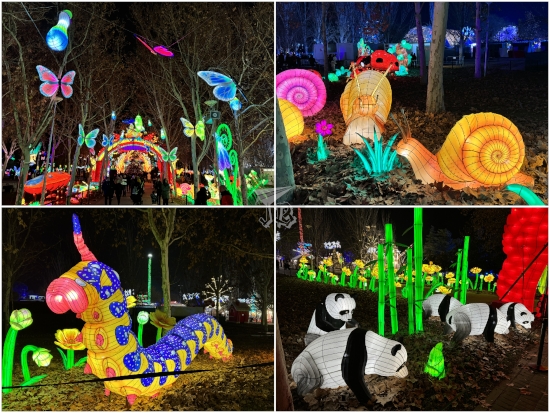
There was a bit of a photocall area and we fooled around there for a few minutes. Next, we went back towards the Asian Lantern Festival Festival de las Linternas Asiáticas, to see the First Space, which we walked backwards, apparently. It was mostly about bugs and creepy-crawlers – even bigger than the Naturaleza Encendida ones. There were ladybugs, a praying mantis, butterflies, bees, a scorpion for some reason, flowers and… pandas. Because something is not Asian if there is not a panda?

Parque Magicas Navidades Torrejon Asian Lanterns 1

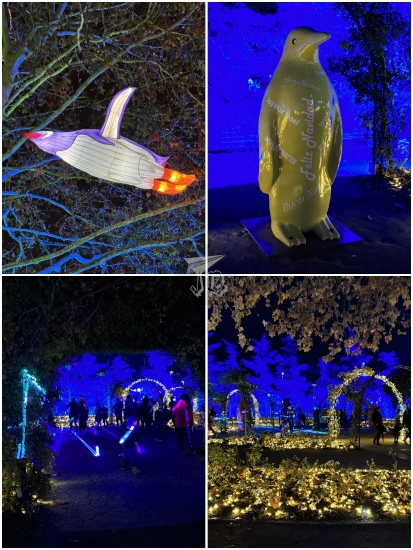
Once we were out of the area, there were some pink and purple flying penguins which gave way to a small garden with a lot of laser lights and other standing penguins, reading “Merry Christmas” in several languages. We headed back towards the train station then, passing by the Christmas market Mercado Navideño and Christmas Village, though it was hard to know when one ended and the other began. We did not go into any of the rides, not even the carousel, because they were extremely expensive… Neither did we try any food, but I am willing to be the prices were on the same range.

Parque Magicas Navidades Torrejon penguins

We walked out of the park, and we saw a train leave as we were approaching the station. We settled to wait for the next one, which – surprise, surprise – was delayed, so although we were at the station before 23:00, we did not make it home until almost half past midnight, despite the ride being just under 35 minutes. However, I think I’m going to start the family tradition of a mini-adventure after the yearly big-family meet-up, we had a lot of fun.

Parque Magicas Navidades Torrejon Light Christmas tree, reindeers and fountain

20th December 2023: Brilla Madrid Zoo (Madrid, Spain)

After an unwarranted amount of stress in the morning, I decided to take a little escapade in the evening to see some lights. The city of Torrejón is known as one of the local “Christmas hubs”, but it was “family day” and tickets were free, so there was no way to get a same-day entrance. I was a bit bummed, because that was convenient to reach by public transport. Instead, I resolved to go to Madrid instead – there was a light show on the topic of animals which had a small same-day discount – with it, I could get the skip the queue “upgrade”, the ticket itself, and the processing fees for the price of a nominal ticket. The downside was that I had to drive there. I booked entrance for the 18:40 timeslot, and left about 17:15, anticipating the traffic jams on my way to the park Parque Juan Carlos I. Traffic on the motorway was rather aggressive and all the exits were jammed. Thus, instead of driving to the main entrance to the park, I decided to drop the car off near one of the side entrances, and walk the last couple of kilometres instead of driving them. When I strolled by the parking lot, I saw that it was full and there were emergency vehicles there – I would have had to go to the inner parking lot, which means walking almost as much, and I saved one merging into the highway and one exit. I don’t mind driving, but I’m not a fan of other drivers.

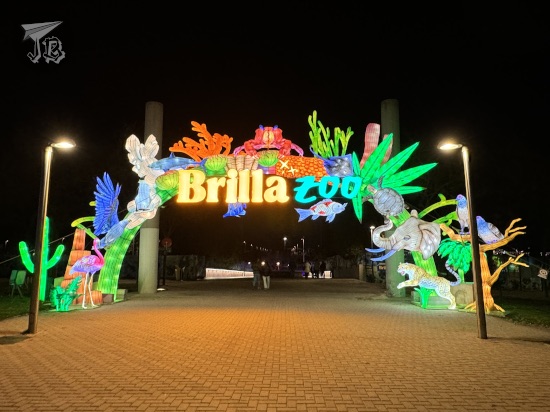
As I walked into the park, I ran into the first sign reading Brilla Madrid Zoo (Madrid Shining Zoo). They had placed signs all along my path – rather convenient. I walked for about 15 minutes and I was at the gate just past the 18:20 timeslot. Since it was a schoolday, and quite cold, it was almost empty and the staff had no problem letting me through. Brilla Madrid Zoo is a project by Brilla Events, who claim that there are over 500 light figures – I did not count – in a path that takes about 1.3 kilometres.

Brilla Madrid Zoo entryway

After the entrance arch, you go down to the actual ticket control. I had bought the skip-the-queue ticket which allowed me to see an “extra” exhibit in a tent, called Pollinators (Polinizadores). The whole Brilla Madrid Zoo exhibit has a “take care of the earth” kind of message, but it gets old really quickly as each “animal” repeats the same few words every couple of minutes. The Pollinators area had giant displays of a hummingbird, a bee, a butterfly, a bloom, and a bat for some reason. There was a screen with “Gaia” addressing the crowd, and it would have been creepy if not for the kiddos running and screaming around.

Brilla Madrid Zoo Giant hummingbird

As I went in, I was greeted by giant giraffe necks, then I moved into the Savannah (Sabana), with lions, leopards, zebras, hyenas, antelopes and elephants. Afterwards, there was the Jungle (Jungla) with gorillas, capybaras, jaguars… From there, after a turn, there was Australia, with echidnas, koalas, dingos, kangaroos.

Brilla Madrid Zoo Giraffes, Jungle, Australia, Whale

The entrance to the Ocean area (Océanos) could be done through a whale. Along the fountains / ponds of the park stood sharks (great whites and hammerheads), lionfish, turtles, clown fish (a.k.a. Nemo), blue tangs (a.k.a Dori), barracudas, koi carps, corals… There were also two real geese who seemed to be enjoying the exhibit too. It was really hard to take straight pictures as there was very little reference outside the actual animal.

Brilla Madrid Zoo Ocean

As I got close to the River areas (Ríos), there were otters and frogs. The coastal biomes were represented by the Swamp (Pantanos) and the Mangroves (Manglares). There were crocodiles, anacondas, Venus flytraps… for the first, and a flock of birds for the latter – flamingoes, pelicans, herons…

Brilla Madrid Zoo Rivers, Mangroves, Swamps

Then there was a bit of an avenue flanked by Flamingoes (Flamencos) to reach the Butterfly zone (Mariposas) and the Peacocks (Pavos reales). After another turn, there was the area dedicated to Nocturnal Animals (Nocturnos), with lemurs, bats, owls, and a wolf howling at the moon, perched on a dolmen.

Brilla Madrid Zoo flamingoes, butterflies, peacocks and wolf

After the dolmen, I found the Reptiles (Reptiles), with more frogs, iguanas, chameleons, a cute Komodo dragon… The path lead to what I guess is China by any other name: the Tiger (Tigre) and Pandas (Pandas). The Extinct Animal section (Extintos) was sad – with a dodo, a Tasmanian tiger, a white rhino, a Yangtze dolphin, a species of emu…

Brilla Madrid Zoo Reptiles, Panda, Tiger, Extinct animals

But then came the fantastical animals: Griffon (Grifo), Dragon (Dragón), Alicorns (Alicornios) – winged unicorns – and a Phoenix (Fénix).

Brilla Madrid Zoo griffon, dragon, alicorn and phoenix

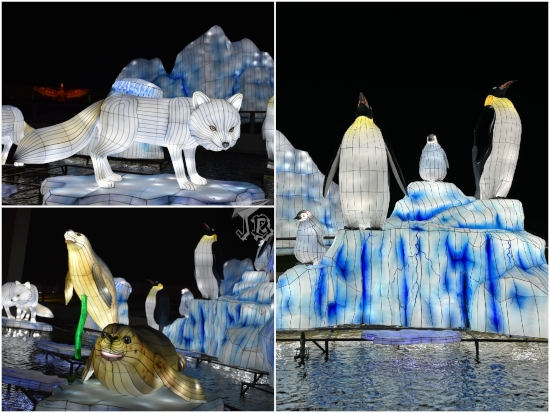
Once outside the area, you find the Ice figures (Hielo), with seals, Arctic foxes and penguins. There was a tent with a souvenir shop and some food stalls, but I did not go inside. I thought I would just walk back through the park before it became too late – and colder.

Brilla Madrid Zoo Ice

I liked Brilla much better than this year’s Naturaleza Encendida, to be honest. It was quite cold though, and a bit windy. I ran into another jam on the way back, this time caused by an accident. I have a theory regarding signals in this country – half of the drivers don’t use them, and out of the ones who do, yet another half think that signalling gives them immediate preference, even when what they are doing is illegal…

2nd December 2023: Iron balconies and croquettes (Madrid, Spain)

I wanted to do a full day in Madrid this weekend, but ticketing did not align, thus I had to organise two half days. So on Saturday morning I set off for an 11:00 visit to Frontón Beti-Jai. A frontón is the court where games of Basque pelota (pelota vasca) are played. The term refers to a number of sports that use a small hard ball which is hit by the players so it bounces off the vertical walls of the court. Depending on the specific variety, the ball can be hit with the hand, a racket, a bat or a type of basket, and it can bounce on one or two walls of the frontón as long as they are at right angles with each other. Basque pelota is mainly played in Spain and France, and it is also popular in some Latin America countries. Though it was originally included in the 1900 Olympics, it has only been played as an exhibition sport and never in competition.

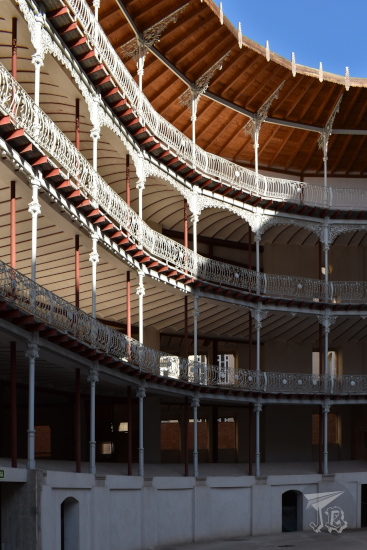
In the 19th century, Basque pelota was a popular and lucrative business in Spain, especially in Madrid. In 1891, businessman José Arana commissioned architect Joaquín Rucoba to build a frontón in Madrid, “similar to but better than” the one in San Sebastián, the original Beti-Jai. The capital’s Beti-Jai (“always party” in Basque) was placed in the district of Chamberí, with construction starting in 1893. The architect designed a white-and-grey outer façade in an eclectic style with Neoclassical reminiscences in order to blend with the mansions in the area at the time, and a red-brick Neomudéjar secondary or side façade. The inner wall that stands behind the main entrance is also Neomudéjar. The playing court is plain concrete, and he whole area is shaped as a half-ellipse. There were long-lost stands on the ground, and three upper stories supported and adorned by cast iron balconies and columns, with a wooden roof on top. The decoration on the balconies is different for each floor.

The frontón opened in 1894 and it hosted games until 1919 – it is said that the crackdown on the betting systems and loan sharks caused Basque pelota to slowly fade out of fashion. Throughout the period and afterwards, it also had some alternative – and creative – uses, among them aeronautical experiments by renown engineer Leonardo Torres Quevedo, car workshop (a few times in different years), motorbike shop, political hotspot, even industrial bakery. The stands were eventually walled off – which protected the ironwork. Though both in the late 1970s and the early 1990s the building was “declared” as protected, the structure was eventually left to rot. The building was bought and restored by the Madrid Town Hall between 2010 and 2019, finally attaining protected status in 2011. It is the largest and oldest frontón standing.

Frontón Beti Jai inner façade and stands

I like cast iron architecture a lot, which is why I signed up for this Pasea Madrid guided visit. We did not get a nice and knowledgeable guide this time, so I mentally checked out. She was not just nervous, she read the whole visit out of a phone, gave some wrong or plain false information, and relied on people “knowing things” and “having visited places”. I wandered around taking pictures and approaching the group periodically trying to fish out any interesting bit of information, until the guide grew tired and kicked us out when most people decided to just stand in the sun, even if there was some time left. People who had been listening to her had barely any time for photographs.

Fronton Beti Jai Stands.

After the frontón, I had a reservation for lunch a restaurant part of a franchise specialising in croquettes, is called Solo de Croquetas Zurbano – a pun between “only croquettes” and “croquettes’ solo”; Zurbano is just the street. It has been a bit of a buzz lately so I was really curious about it. The place was organised in three floors – a bar on the ground floor, a loft-like seating on the first floor and a bigger restaurant-like area in the basement.

Though the Internet said the restaurant opened at 13:00, I was offered a reservation at 12:45, which I took because I did not want to be wandering around in the cold for too long. I was not extremely surprised though when I popped by at the reservation time and it was indeed crossed. I ended up wandering for a while before 13:00 came up and I could sit down. I decided to try a basic “croquette tasting”, which includes six savoury croquettes two sweet ones, and a drink. There are three lists to choose from, and I took the B-set:

  • Rulo de cabra con pimiento caramelizado, goat cheese roller with caramelised red pepper – happy to report the pepper was barely distinguishable, just added some colour to the filling. Very cheesy, cheese is always good.
  • Boletus con trufa, boletus with truffle. Lots of mushroom, little truffle, but okay. I’m not that much of a truffle fan anyway.
  • Provolone con tomate seco y orégano, provolone cheese with dry tomato and oregano. There is never such a thing as too much cheese.
  • Cachopo; a cachopo is a typical dish from the North of Spain that consists on two beef steaks with a filling between them, and everything breaded, which I ate once in Astorga. This one was weird.
  • Cecina con puerro y queso gorgonzola, beef jerky with celery and gorgonzola cheese. Probably my favourite out of the savoury ones.
  • Sobrasada de Mallorca con queso Mahón, sobrassada (cured pork sausage filling) with Mahon cheese. All right.
  • Croqueta de Oreo con chocolate blanco, Oreo and white chocolate. Rather good, which is surprising considering I don’t even like Oreos…
  • Croqueta de Cheesecake con frambuesa , Cheesecake and raspberry. Surprising, to say the least.

Solo de croquetas tasting

All in all it was good. The croquettes were decently sized and had distinctive flavours. The set felt a bit scarce though. Not that I went hungry, but I could have done with another couple of croquettes. I think it is what they are counting on – the tasting is okay, price-wise, considering the novelty (18.50 €), but if you want anything else, the meal will get very expensive very fast. I guess it is noteworthy that all croquettes are gluten-free, and the tasting has a lactose-free set and a vegan set.

I left the restaurant and walked towards the train station. On the way, I was distracted by the small Christmas market, more precisely by the a gorgeous 1900 merry-go-round that had been installed among other attractions. I had a bit of a walk around to check out the stands and then I went to wait for the train – which was, predictably, delayed.

Carousel in Colón Square

26th November 2023: A Bunker and a Greenhouse (Madrid, Spain)

I have been to the park Parque del Capricho in Madrid before, and I was not really impressed. As it is considered a “hidden gem” in town, I expected something… I don’t know… more grand? It has different “attractions” such as a bee hive, a casino, ponds, fountains, statues… quite into the Romantic spirit of the times it was built, but I really did not connect with its design. I have to admit though that when I first visited I did not register the locked-down door with the word “bunker” surrounded by a brick structure next to the palace. It turns out, there is a Civil War bomb refuge 15 metres underneath the grass (I did see a machine gun spot in the grounds of the nearby castle, which was actually installed there to protect the military position). The refuge is a place you can only visit through the town hall’s Pasea Madrid program, as it is usually closed to the public.

The park was built as a recreational garden between 1787 and 1839 at the whim of the 12th Duchess (and Countess) of Osuna, who placed a summer house Palacio de los Duques de Osuna, in the centre of it. It became wildly popular among the high classes at the time – just like walking around cemeteries had become popular in France and England. However, at the turn of the 20th century the park had dwindled in fame. It changed hands, and after the 1929 crash it became all but abandoned. With the advent of the Spanish Civil War, the palace became an orphanage first, and it was later confiscated by the Republican government to be used as military operation centre. General José Miaja was in charge of defending Republican Madrid from the military coupists and moved the emergency command centre from downtown to the so-called Posición Jaca in the outskirts. The park was chosen because it is close to the airport, and it was easy to deploy defence batteries. Some of the most important battles in central Spain were “supervised” from there.

The day started dark and gloomy, so I picked up a thick coat – the webpage also noted that the temperature in the refuge is around 15 ºC. Public transport was just not feasible – round trip would have been about four hours by train – so I took the 40-minute drive and parked in the main avenue, a few minutes away from the park entrance. I had calculated a wide berth of time because I was not sure how easy it would be to park, but I apparently got there before the family weekend-makers. I was early for the 11:00 tour, so I just hung out the park for a little. By the time I walked in, the weather was nice and sunny.

One of the buildings in the park is a miniature farming house that today has an equally-tiny orchard with cabbages, cauliflowers and… a pumpkin patch. I swear, I had never seen a pumpkin patch before, not one so… colourful. I walked around for a little, then waited for the guide to arrive.

Pumpkin patch in El Capricho

The Civil War bunker or refuge Búnker del Capricho was built next to the palace where the command was set, excavated into and down the small hill. It was designed to withstand bombings, and protect its occupants from chemical attacks – people were rightfully freaked out as World War I had yielded to the development of chemical weapons. Building the refuge was commissioned to miners-turned-soldiers, who were able to finish it within the first few months of 1937. In case of an attack, the palace would be evacuated from the doors and windows, the personnel would go down into the refuge and close and lock the doors. Once operational, the refuge could host 200 people for up to two of weeks.

The bunker is dug between 14 and 16 metres into the ground. The walls could withstand most bombs designed at the time, with some of them being over two metres thick. The thirty-metre gallery could be sealed with submarine-like doors – designed by marine engineers – and keep out any toxic gas. There is a ventilation system and different wards on the sides, one of them identifiable as an operating theatre, another as a shower room. The floors are tiled, with different patterns for different rooms – the theory is that the patterns would allow anyone to know where they were even in low visibility conditions. The gallery is tiled too, but in white, and it has round ceilings, also painted white – also in theory, this is to counteract the claustrophobia from being underground; this idea was also applied when the first underground stations were built in Madrid.

Upon entering the bunker, there are two flights of stairs at a ninety-degree angle to each other. Then, there is another right-angle turn to enter the actual refuge. There are two metal doors that could be hermetically shut, now peeled-off and rusty, but which really look like ship or submarine safety doors. This design minimises shock waves and blocks any gas that could be used against the Republican Command. The structure is bigger and wider than I thought it would be.

Underground refuge in el Capricho Park

I guess it is part of the Spanish history, so good enough to see once and then move on – know about history not to repeat it, but do not dwell in it. Which is what I did. Once the guided visit was over, I wandered the park for a little. I found the park miniature fortress, the lake with its black swans, and the small casino. I was hoping for some nice autumn colours like I saw a couple of weeks before in Retiro Park, but there was not much on that front. I however did come across a few bees hard at work.

Black swan feeding

Honey bee on purple flower

I left the El Capricho and went across the avenue to walk into the neighbouring, bigger park Parque Juan Carlos I. I wanted to see the so-called Estufa Fría – just a fancy name to call a greenhouse. The greenhouse did have some pretty autumn colours in the Japanese garden, as the small maples (Acer palmatum) had started turning gold and red. The structure hosts palm trees, ferns, a small “bamboo grove” and an autochthonous forest that was composed of mostly evergreen plants and ivy. I had no idea that the Estufa Fría even existed until a few days before, so I guess I’ll need to keep it on my radar for future springtime visits – I want to see the blooming cherry trees in that park anyway.

Estufa fría or cold greenhouse in Juan Carlos I park

It was not much of an outing, barely a few hours, and I was home for a late lunch. I did not want to stay out long, as that evening I had tickets for the opera.

26th October 2023: Groove& in Guadalajara (Spain)

This was a short-enough trip that I could just fit in within half a day. Not that Guadalajara has many things that interest me, but it is close enough to Madrid that now and then there is a good show or artist coming. This time around, the South Korea Cultural Centre Centro Cultural Coreano, sponsored a small tour by the Korean percussion group Groove&, as part of its Korea Sound Festival. One of the stops was the Centro Ibercaja Guadalajara.

Korea Sound Festival poster

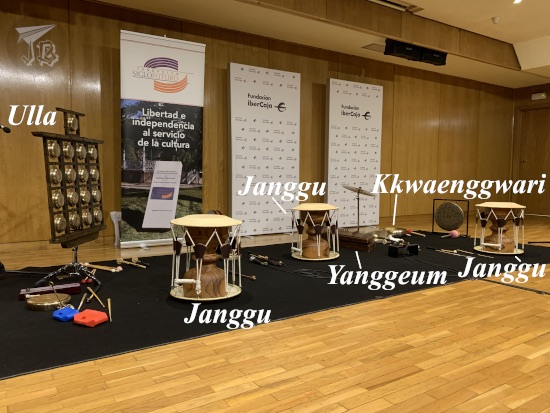
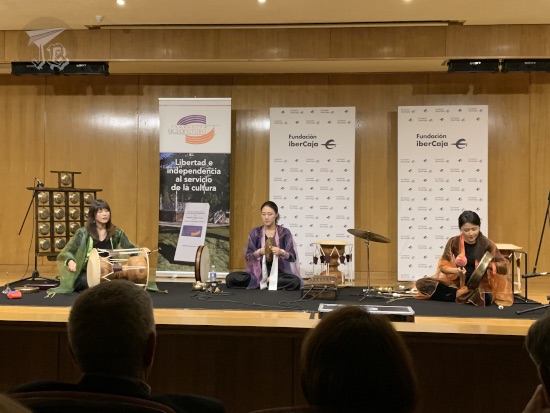
Based in Seoul, Groove& defines itself as a female percussion ensemble team based on traditional music. It is formed by three women: Sang-kyung Lee [이상경], Min-ju Sohn [손민주] and Ha-gyeong Kim [김하경]. All of them play the janggu [장구], which is the most traditional Korean drum – it has two heads (each with a different pitch) made from animal skin and the body is hourglass-shaped.

Sang-kyung Lee also plays the yanggeum [양금], a percussion instrument similar to a hammered dulcimer, but with metal strings which are hit with a bamboo stick to produce the music. Min-ju Sohn plays the ulla [운라], a set of ten small gongs hanging vertically from a wooden frame, the gongs are struck with a small beater. Finally, Ha-gyeong Kim plays the kkwaenggwari [꽹과리] a small brass gong which is held from a string with one hand and struck with a hard stick with the other. There were also cymbals and gongs.

Groove&'s Korean percussion instruments

I arrived at the cultural centre about half an hour before the show. There were a few people waiting, and it was a very weird crowd. Entry was free, and the act was sponsored by a local cultural association, which attracted a number of people who had absolutely no idea about what they were going to see. When doors opened, I found a seat on the third row, behind the authorities and the associates, but rather in the centre. The introduction was a little bit embarrassing though. The person introducing the band could not pronounce their name, and she sneered that “Korea is more than we know from the films and series that are a fad”. Well, of course. I’ve never been to Seoul, but I am rather sure people do not squid-game through life.

The concert lasted for about an hour and it was very interesting. Unfortunately, the venue was extremely small and the metal instruments reverberated a lot. For the first song, Kim walked out dressed in a folk costume and played around the audience, I think in a bit of a recreation of a pungmul [풍물] – a Korean folk music tradition that includes drumming, dancing, and singing, with performers wearing bright colours. Lee did all the talking, and she tried some Spanish along with English. The Korean she spoke was translated into Spanish by someone from the Korean Embassy I think. There were eight songs, a few emcees, during one of which Lee introduced the instruments. This was extremely funny, especially the ulla, as Sohn offered us a rendition of Under the sea from The Little Mermaid.

Groove& playing in Guadalajara

Setlist:

   1. Groove&
   2. Get!
   3. Wave
   4. Chaser
   5. Dodang-gut [도당굿]. Dodang-gut is a shamanic festival / ritual to call the spirits so they bring welfare, and well-being to the village, with a special importance given to female shamans.
   6. Pray
   7. Dusk
   8. Matt-Jang-Gu [맞장구]. This is a word that means agreement or listening to the other person, and also the position of two people playing the janggu drum face-to-face.

The show was extremely energetic considering these three women barely even move from their siting points on the floor. I had a lot of fun, despite the weird public – and the fact that apparently people in Guadalajara just love talking during shows, providing commentary.

Despite the metallic sounds being extremely high and echoing, the drumming was fantastic, you could feel it in your belly, and I really enjoyed it. I had never thought I would end up in a traditional Korean drumming show, but the opportunity presented itself and I took it up. A while back I participated in a Japanese drumming (taiko) workshop, and had a blast. I did not expect this to be similar – different countries and all – but I’m starting to suspect I like folk percussion in general.

20231026 Groove& greeting after the concert in Guadalajara

After the concert, the three drummers met with attendees. They took pictures with people and had some merchandising on sale. I bought a signed CD for 10€, said “thank you” in Korean (literally the only thing I can say that is not a food… and I don’t even like Korean food) and we took a picture together.

Groove& posing in Guadalajara

I headed off after that, just in time to get caught in the rain, because what is a concert without a little adventure?

16th September 2023: Archaeological Site of “Los Casares” (Spain)

I took an almost two-hour drive to the municipality of Riba de Saelices, which involved having to fill up the tank in the middle of nowhere – ouch. It was early in the morning, and once I got off the motorway I saw a bunch of roe deer grazing dawn away. A couple of them got spooked by the noise of the engine and jumped towards the road, and another was uncomfortably close to the asphalt, but I was careful not to run any of them over – of course!

I went past the village and took a turn at an unpaved road, and reached the parking spot of the site, 3.5 km later, around 9:10, which was great for my free 9:30 visit. . My main interest in the archaeological site Conjunto Arqueológico de Los Casares was the cave Cueva de los Casares, which can only be visited by appointment and in small groups. Post Covid recovery plans have made some archaeological sites free until the end of the year, and I wanted to visit before the end of good weather. The cave holds important carvings from the Upper or Median Palaeolithic period. However, the site also comprises the remains of a Muslim village, a defensive tower, and an ancient oven, with the latest findings dating from the 14th century.

I found the parking spot – a clearing at the foothill of the area. The whole place was empty except for a kettle of griffon vultures (Gyps fulvus) circling up above. It was a bit creepy, I’ll be honest, and I joked with myself that maybe the webpage for the archaeological site was just the way the vultures ordered food. From the parking lot I saw a small clearing with tables, and up the hill, a small tower, which I thought was the tower from an old Muslim castle. Since I had some time I decided to climb up and I found the entrance to the cave, with a notice that visits started there. By then it was already 9:30 so I thought maybe my ticket was wrong and the winter timetable had already started so the visit was at 10:00. A bit before 9:40 I saw two cars approaching – yay.

Vultures flying

Archaeological site Los Casares: cave, ruins, and tower

Finally, the guide arrived and she told me that the visitors in the other car had lost their way, so she had had to guide them down the track. We started late as the group also took a while to come up. We stayed at the entrance of the cave for a little as the guide explained about the civilisation that inhabited the area in the Palaeolithic, and a bit about the cave bears that used it as a lair before them.

The cave Cueva de los Casares was inhabited by Neanderthals some 60,000 to 40,000 years ago. The stonework and industry have been classified as the European Mousterian; among objects found inside the cave there are flint points, arrow tips, scrapers, and even pottery. Animal remains, both from predatory events and human consumption have also been recovered. The most important archaeological items found in the cave are the carvings on the walls. Though there are carvings from later periods, some experts think that the cave holds the oldest anthropomorphic carvings in the Iberian peninsula – not carved by Homo sapiens (modern humans) but the previous Homo neandertalensis.

Entrance to the cave Cueva de los Casares

Only the first third of the cave can be visited, and we got to see horses, cattle and the human-like figures. Once you know what you’re looking for, it gets easier to identify the shapes. One characteristic about the human depictions of the period is that humans are represented to have weird heads, though nobody really knows why – possibly animal attributes to represent their qualities. The humanoids are represented alone and in groups, and sometimes they are one above another. There are families, activities – such as diving – and copulation (apparently this is important because the carving in question might be the first ever recorded). It is an interesting experience, though no pictures are allowed inside, there are some on the official page – you don’t get to see half of them anyway. I’m disappointed we were not shown any mammoth carvings either, those are restricted to the expert-only area, but at least I saw something, and it was original.

After the cave, I climbed up the gully to the hilltop and the Berber tower – called Torre atalaya (“Watchtower tower”) – which hangs above the entrance to the cave to look at it. On the way up I also had a good view of the Muslim settlement underneath, Poblado Hispano-musulman. I also looked down the gorge and the valley called Valle de los Milagros, which I may or may not hike in the near future in search for fossils. However, I really did not feel like staying at that point, so I just drove back.

Watchtower Los Casares

Muslim village of Los Casares

Valley Valle de los Milagros from above

9th September 2023: DinoExpo XXL (Guadalajara, Spain)

When I heard that this was going to happen nearby, in Guadalajara, I was mildly excited. I mean, I did not expect a Jurassic World Exhibition level event, more similar to Dino World Expo. Not even.

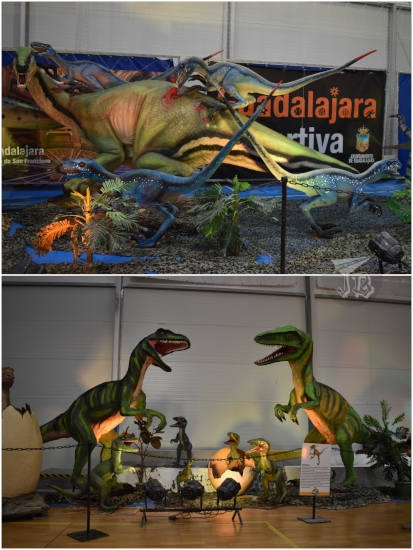
In any case, I decided to attend DinoExpo XXL to have a look. There, I had the pleasure to see a bunch of dinosaur models cramped in an obviously-too-small area, a few fake skeletons and bones, and some “Ice Age” representation. Some of the dinosaurs swayed their tails and necks, and there were roaring sounds. It is obvious that someone agreed to place the exhibit there without thinking it through. The models were extremely close to each other, to the point that a lot of their tails were basically in another one’s snout.

The kids were thrilled though, except the ones who wanted to actually ride the available dinosaurs and their parents told them that it was too expensive – on top of the ticket – for a photo-op. A bigger area would have been more enjoyable, but the way it was crammed in the auxiliary tent took of a lot of its lustre. Not sure about the legality of the Jurassic Park logo either… The models were a bit on the old side – some of them a bit damaged, and others inaccurate, such as a Spinosaur with the old tail, and Nanotyrannus has been deemed a juvenile T-rex for a while now.

Two dinosaurs on jeeps that remind of Jurassic park

DinoExpo XXL general view

A hunt scene and a family scene - with dinosaurs

A model of smallish T-rex and a fossil cast.

I stayed for about forty minutes, then left when the area started crowding up. I really did not feel like doing anything else, so I just drove home.

11th July 2023: Museum of Dreamers in Madrid (Spain)

After I had so much fun in the Balloon Museum, I decided that I also wanted to see the Museum of Dreamers, which is something similar. Furthermore, it Madrid exhibit will close down at the end of July, too.

After I finished French school in Madrid, I headed headed off to the Japanese fusion restaurant Nomo Braganza, part of the Nomo Group. Nomo was established in 2007 under the culinary direction of Japanese chef Naoyuki Haginoya. I have to say that I don’t really trust the Spanish-Japanese fusion too much, but in this case, it really panned out. I met my sibling for a late lunch, because I was curious about the chef’s menu, what in Japanese would be called omakase [お任せ], which means leaving the choice of food to the chef. The menu was was a whooping 12 small-sized courses for 50€ – drinks not included, and considering it was 39 ºC outside, we ended up ordering a few rounds of water.

The menu, which changes periodically, comprised in July 2023:

  • Age Edamame Truffle – fermented edamame beans fried with white truffle scent. I personally prefer my edamame boiled, but the truffle scent was a nice touch.
  • Sukiyaki Croquette – oxtail croquette breaded with panko breadcrumbs. This was surprisingly good – and the actual flavour was strong.
  • Maguro Taco – mini taco of tuna tartar with wasabi and shiso (the “taco” was weirdly… not taco-shaped, more like cracker-shaped). The tuna was really good, albeit the base was a bit strange.
  • Gyu Niku Gyoza – aged beef dumplings with caramelised onion and yuzu, two of them per person. It was all right.
  • Ebi Chili – spicy king prawns and fried egg on kataifi noodles, mixed at the table. When we are talking spicy, it means… really spicy. The prawn bits were sizeable, but this was really something I would not miss should it disappear from the menu.
  • Toro Tartar No Temaki – tuna tartar prepared at the table: raw tuna belly mixed with Japanese onion, turnip, egg yolk, chilli pepper and wasabi on a bed of nori and rice so you can roll it yourself (spoiler: you really can’t). This was probably one of my favourite items – but I guess that after all I am a raw tuna fan.
  • Brie Nigiri – flamed Brie cheese nigiri with honey and walnuts. This was probably the weakest sushi bite, but it was still good.
  • Butter Fish Nigiri – butterfish nigiri with kimchi and chilli peppers. Butterfish is only good raw anyway.
  • Aburi Salmon Nigiri – flamed Norwegian salmon nigiri, with Japanese mayonnaise, salmon roe and onion. I still prefer raw salmon, but the flame was light so it was barely perceptible.
  • Maguro Tataki No Nigiri Trufa Nose – tuna tataki nigiri with soy and black truffle sauce. This was also really good.
  • Gyu Niku No Tataki – aged beef tataki with caramelised mushrooms and miso sauce. The combination of meat and the mushroom was strange, but when taken separately it was all good.
  • Caramel dorayaki – two halves of a dorayaki filled with salty caramel paste. Unexpected, because the menu listed something else, but it is not as if it was bad at all!

Chef's choice menu at Nomo Madrid

My sibling ordered some green tea out of the menu, and in the end, the drinks did not add as much to the price as I expected. Also, I have to give a shout-out to the pickled ginger we got. Really good.

After having lunch, we took a train towards the Museum of Dreamers, which is stands in Espacio Ibercaja Delicias, a place that seems to always look somewhat abandoned, even when it is stupidly hot and sunny. The exhibit was designed by sisters Elena and Giulia Sella, founders of Postology, an agency specialised in “phygigal” experiences. This concept merges the words “physical” and “digital”, allowing for a number of immersive and surreal experiences. The Museum of Dreamers is one of those things that you have to see with an open mind to have some fun. It comprises sixteen interactive installations which are basically photo-ops – after all, the word instagrammable has been officially accepted on dictionaries. I guess it is a new niche that can be exploited, and to be honest, I can get behind that, because some of these activities are hilarious.

Entry is timed, but they do not hold a very strict waiting policy – at least not on a Tuesday at 17:00 and 39 ºC. There were no timed exhibits or performances either. The first installation is a dark room with a starry sky of sorts, designed maybe to isolate the rest of the exhibition from the outside, maybe as a metaphor (100 Dreamers). Then you get to a semi open space that opens to the smaller installations that allow for fun pictures. All through the space there are motivational sentences and “rules” for safety in the different installation.

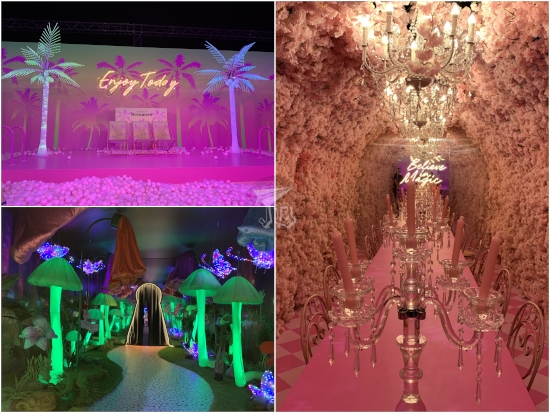
There is some kind of cosmic tube with mirror that was dizzying to walk into (Free your power), a tunnel made of hearts with an encouraging message at the end (Do what you love), an upside down room (Change perspective), an downside down bedroom with a giant plush and fun bed covers (Never stop dreaming), one full of disco lamps (Sparkle more), and a neon staircase flanked by colourful palm trees (Step by Step).

Museum of Dreamers exhibits

Afterwards, there is a ball pit – you know, it’s not like I had ever stepped into one before Friday, and now that’s twice in one week – with a “relaxing island” in the middle (Enjoy Today). In front of that, a tunnel made of fake pink flowers with a long table, set for a tea party (Believe in Magic). That managed to make you think of Alice in Wonderland imprint on your brain. Thus, you are in the right mindset for the following room, full of giant mushrooms and flowers that open up at will – theirs, for sure, not the visitors – whole giant butterflies hang around with their wings made out of lights (Wonder).

Museum of Dreamers exhibits

The final part of the exhibit consists on a second row of booths – a colour wheel, a door that opens to a fantasy scenery, a VR experience (Choose your Way), a stage (The stage is yours), some pink telephones (Your Dreams are Calling you), bright lights commanding you to DREAM (Be Bright)… There were two more rooms, one with a sky background and swings (Sky is not the limit), and the other with punching bags reading FEAR, STRESS, ANXIETY and so on (Never Give Up). I can’t punch, but I can strangle, so I choked the hell out of these last two.

Museum of Dreamers exhibits

That was the end of the escapade. It was a fun half-day out.

7th July 2023: Balloon Museum “Pop Air” in Madrid (Spain)

Part of this summer’s plans involved a three-week French course-and-stay in Montpellier, but I ended up changing my mind – too many hidden costs on top of the already-steep price, and a generalised bad feeling that I could not really define. I decided to take a course in Madrid and use up the evenings to do some exploring in town.

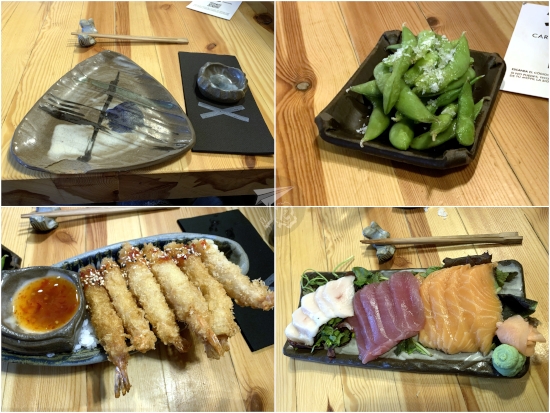
After class, I booked a table at the Chueca shop of the Japanese restaurant chain Sibuya Sushi Bar, which claims to offer a new concept of sushi. Most of what they offer felt pretty normal to me, except some random baos and the desserts. I browsed the website before booking, so when I arrived I had a pretty good idea of what I wanted. Somehow, the waiter did not expect that and was thrown off track. I ordered some ebi furai and a sashimi mix – I have to admit that the size of the sashimi portion did surprise me a little, as I did not expect such a generous serving. Luckily, I had hold on ordering dessert, because the two dishes were more than enough.

Lunch at Sibuya Madrid

There were two temporary exhibits I wanted to check out, and I chose the one that closed down earlier. I checked as I had lunch, and there were tickets available online. I decided to take the underground and buy the tickets in person instead of stressing about making it on time for a particular timeslot. I reached the Balloon Museum on time for the 15:45 entry. The exhibition Pop Air runs from March to July 2023 in the Escenario Puerta del Ángel in Madrid’s Casa de Campo.

Still considered a noon slot, the exhibition was not too crowded at the time I entered, I even had a couple of rooms for myself before I reached a point in which you had to be admitted because the performance was timed. The Ballon Museum‘s Pop Air exhibit is a collection of art pieces that use air and light as their main vehicle.

Artworks:

  • The Goof by Filthy Luker (2021). They are a bunch of “friendly monsters” that observer the world feeding off surprise and happiness. They look… just adorable, as if they were made of giant inflated latex gloves in different colours with huge eyes.
  • Aria, The Breath Immersive Experience by Pepper’s Ghost (2022). A room full of mirrors and digitally-created colourful spheres that spreads to infinite and beyond.
  • Airship Orchestra by Eness (2020). More adorable creatures made out of air, some resembling Japanese peaches, other bunnies, or cacti.
  • Ballon Museum exhibits. The Goof, Aria, Airship orchestra

  • Hypercosmo by Hyperstudio (2021), which is basically a huge ball pit with a show of music and lights.
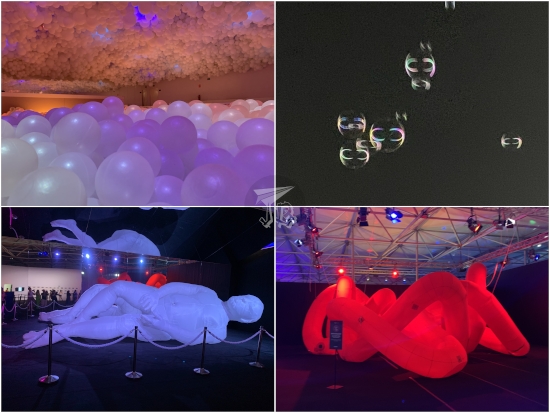
  • A Quiet Storm by Quiet Ensemble (2022). A dark room where cannons shoot bubbles.
  • Silenus by Max Streicher (2002). A giant, breathing… person… sleeping. It’s a bit creepy, to be honest.
  • Knot by Cyril Lancelin (2017). It is an inflatable… knot, literally a 3D knot made out of a tube.
  • Balloon Museum exhibits: Hypercosmo, A quiet storm, Silenis, Knot

  • Polyheadra by Karina Smigla-Bobinski (2022). It is a room full of balloons with small magnets which you can stick to the wall and the ceiling, and even to each other.
  • Never Ending Story by Motorefisico (2021). Music: Gentle Music by Plume (Netlabel). A lot of decorative balls in a small room full of mirrors and light.
  • Tholos by Plastique Fantastique (2022). A giant black ball surrounded by a plastic structure that imitates the archaeological tholos tombs.
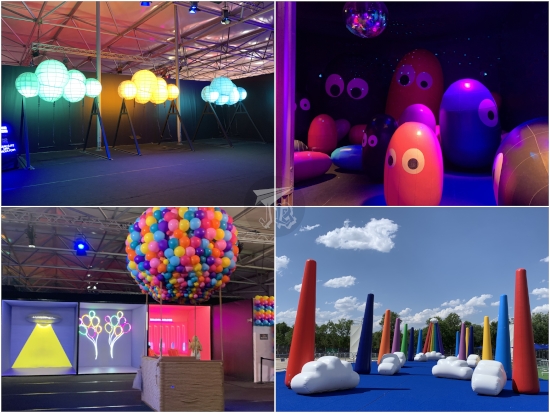
  • Canopy by Pneuhaus & Bike Powered Events (2019). Four palm-tree-like structures that open up and glow if you bike them into life.
  • Balloon Museum Exhibits. Polyheadra, Never ending story, Tholos, Canopy

  • Cloud Swing by Lindsay Glatz with Curious Form (2019). Cute swings held by colourful “clouds” of light.
  • The GINJOS by Rub Kandy (2022). They’re blobs of air with eyes. When I saw them my first impression was “they’re squishy and unstable. I have found my people”. I also found the song hilarious, especially the reference that “GINJOS are not Barbapapa”.
  • Into the Rainbow by Ultravioletto. A VR experience out of which one cannot really take pictures. A white sphere travels through the colours of the rainbow and its symbols – orange candy, yellow rubber duckies, green trees, blue whales, purple… cows(?) and amethyst crystals
  • A number of cute photo booths for picture opportunities, without credit to any particular artist.
  • Parcobaleno by Stefano Rossetti (2020), is a large “inflatable park” for “all the family” (i.e. for kids), which was empty as it was way too hot for any playing.

Ballon Museum exhibits. The swings, the Ginjos, Parcobaleno

All in all, it was a really silly but fun experience. I headed back home afterwards, because even if exploring Casa de Campo is on my list, it was way too hot and I did not have any cold drinks on me. I made an amazing underground-train connection though, which was great because the Casa de Campo stop is pretty far away by public transport – and rather horrible to drive to.

24th June 2023: Abierto por Restauración. La Puerta de Alcalá (Madrid, Spain)

There is a Spanish adage that calls King Carlos III (1716 – 1788) “the best mayor Madrid ever had”. The truth is that when Fernando VI died, his brother, King of Naples and Sicily ascended the Spanish throne. He started a number of reforms in the Spanish capital that today conform the so-called “Way of the Light” – Unesco Heritage Site Paisaje de la Luz since 2021.

Madrid had at the time a surrounding wall for administrative reasons, in order to control trade. The different gates were named according to the main city they lead to. Carlos III decided to remodel one of the gates, the one that lead north-west – first to Alcalá de Henares and then to the rest of Europe. To carry out the task he called for a contest, which was “coincidentally” won by the Court’s architect Francesco Sabatini. It took ten years (from 1769 to 1779) to be completed, in typical Neoclassical style.

Today, this gate is still known as Puerta de Alcalá, and it stands in the central district of Salamanca in Madrid. The wall, however, long gone so the structure remains as a triumph arch more than a gate, in the middle of a roundabout in the Square Plaza de la Independencia.

The gate measures almost 24 metres high, 43 metres wide and 12 metres deep. It was built in solid stone with five arches, and decorated with sculptures depicting the cardinal virtues (Prudence, Justice, Fortitude and Temperance) and allegories of war victories.

Puerta de Alcalá under the protective cover

Restoration studies started in 2022, and the works began in 2023. In March 2023, it was announced that the gate would be “open for restoration” Abierto por Restauración, and that about 6,500 tickets would be offered for guided visits to the monument throughout summer. I had a free morning when the tickets went live and I managed to secure one, despite them being “sold out” in minutes. The Abierto for Restauración project, financed by the Madrid Town Hall, aims to raise awareness of the heritage that Madrid holds.

Though I had originally planned for a day out, I was not feeling too well . Nevertheless, I really did not want to give up the chance and I decided to just head over, attend the visit. and just take the train back home, making it a half-day out.

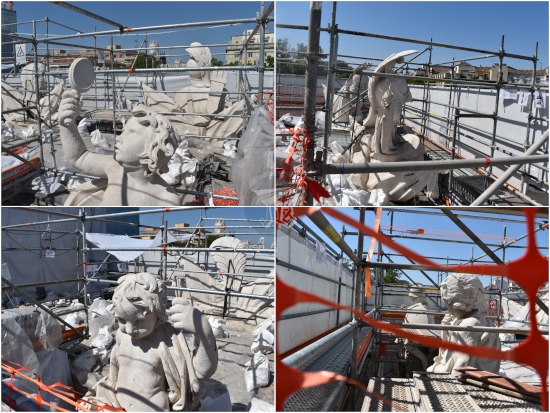
The gate is covered with a huge billboard showing a hyper-realistic photograph, which also hides part of the scaffolding and protective messes that cover the structure. The restoration aims to repair the mistakes of previous attempts at conservation, counteract the effects of pollution and weather, and secure the sculptures at the top of the gate.

We were supposed to meet at 10:45 at the gate of the park on one side of the square, for the 11:00 visit. The guide arrived at 11:00 sharp and started “taking attendance” – since the gate is technically a “construction site” you are insured, and you have to wear a security helmet and all. Then she took us to the base of the gate and told us the history of the construction. The previous group started coming down at 11:00 and we climbed at 11:15. By noon, we were down.

We climbed the inner scaffolding to the top of the gate, where we got to see the work first-hand. Not that there was much to see, because the works cover most everything. There are giant staples that have been taken off the sculptures in order to repair the damage and secure their placement.

Scaffolding supporting the Puerta de Alcalá

The upper platform allowed for snooping along the sculptures there and the views around the gate, along with a bit of the work being done – huge metal supports for the sculptures, filling up cracks, insulation…

Sculptures at the top of Puerta de Alcalá

Views from the top of Puerta de Alcalá

Though the experience was short, and I did not see as much as I hoped, I was lucky to grab a ticket – 6,500 of them, with 13,000 in the waiting list – but it looks like the reforms won’t be over for a while, so it might still be open next summer. It might be an interesting experience to try again and compare the progress.

31st May 2023: Birthday in Madrid (Spain)

I was lucky enough to be able to combine my 2022 birthday with a holiday that happens around the end of May / beginning of June, so I took off to Tenerife. I could not do that this year, but the stars aligned for a half-day in Madrid – actually, what aligned was a lot of website-hopping, to be honest. It all started when we were booking tickets for the visit to the Royal Palace of La Granja. At that time, I discovered that the collection of Stradivarius instruments in the Madrid Royal Palace are brought out so they can be played every now and then. I had to work on the dates of all the upcoming 2023 concerts where they were used, but I managed to secure tickets for a side gig, which also gave access to a usually closed-off area of the Palace anyway.

Conversely, I have been obsessed with a London experience in which you get to have afternoon tea on a 60’s double-decker bus – but unfortunately, it does not take reservations for one. I was browsing the Internet , looking at similar experiences, and I stumbled upn the fact that the Mandarin Oriental Ritz runs afternoon tea in Madrid. They actually claim that their tea is the same as the London Hyde Park Ritz. I signed up for the Fan of M.O program – not that I’m ever going to be able to afford a stay there, but oh well – before making the reservation, and the system asked if there was a special occasion going on. I ticked “birthday”.

Plans thus built, we arrived in Madrid for the 16:00 booking of afternoon tea at the Palm Court restaurant in the Mandarin Oriental Ritz Madrid hotel.

The Mandarin Oriental Ritz Madrid opened in 1910, after King Alfonso XIII decided that Madrid needed a luxury hotel to host European nobility. The king himself became an investor, wanting the city to have lodgings comparable to Paris or London. The building was commissioned to French architect Charles Frédéric Mewes and the construction was directed by Luis de Landecho y Lorenzo Gallego. Surrounded by a metalwork wall, it has 153 rooms and suites, and a wide variety of dining options with different levels of formality.

Through the 20th century, the original Ritz became a piece of history. Its rooms and bars hosted a wide range of personalities – WWI spy Mata Hari, artist Salvador Dalí, writer Ernest Hemingway, scientist Alexander Fleming, and more recent celebrities such as Ava Gardner, Michelle Pfeiffer or Madonna. In 2015, the hotel was acquired by Mandarin Oriental, and in 2018 renovation was tackled. The Covid pandemic delayed its reopening until 2021. Part of the restoration focused on the inner court, with an iron-and-glass ceiling. This is the area where the restaurant Palm Court is located.

When we arrived, they confused my reservation with someone else’s with the same first name – I had to correct the lady, it was a reservation for three not for two. Then they asked if we were celebrating something, to which I replied that it was my birthday – again. As we sat down, the pianist was playing the OST of Aquaman. Cognitive dissonance? Check.

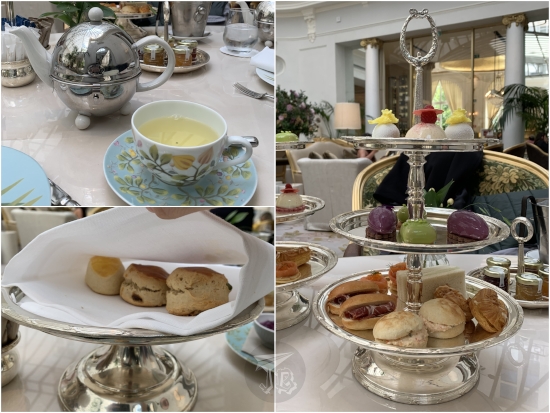
A nice gentleman brought out the tea menu – while the food is fixed, you can choose from a wide variety of tea. I had of course studied the options beforehand, and ordered sencha meicha, because it is one of my favourite teas, even if it is Japanese. I mean, I can get Earl Grey more easily – and affordably.

The booking confusion continued when we got our food – once more they brought out a three-tier tray for two, and when they brought out the third one, they had mistakenly brought out one of the dietary-restriction trays – easy to spot because the sandwiches had different colours. When the correct tray was brought out, the order of the different tiers was incorrect.

The tea itself was delicious. The food included has been designed to Quique Dacosta, mixing the “best afternoon tea tradition” with Spanish confectioneries. The classic mini sandwiches included a cucumber and cheese cream, Spanish ham, potato omelette, seafood and mayonnaise, and a salmon cracker, shaped as a rose. The sweets included chocolate mousses, lilac sponges and citrus pastries.

Afterwards came the scones, which were a bit too small and I was slightly disappointed that the promised clotted cream was merely butter. But the scones – two types of them – were warm and well done. Afterwards, as we were finished, the pianist played the notes to the traditional happy birthday song and I was brought a small mousse with “congrats” written on the plate – though they served it to someone else in the party!

Afternoon Tea: sandwiches, pastries, scones and the actual tea

Felicidades dessert

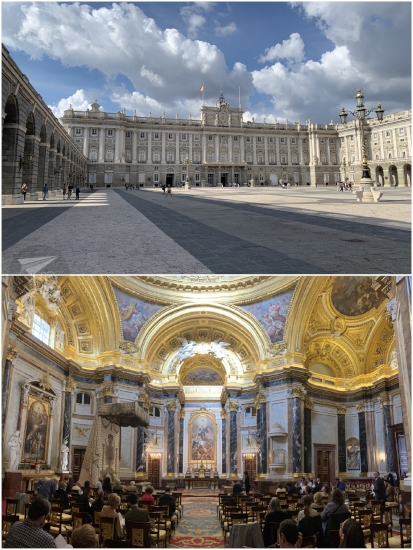
I loved the tea party. However, even if all the staff was extremely nice, it gave me the feeling that they were overwhelmed and nervous – almost improvising – as they made a few mistakes. Afterwards, we walked to the Royal Palace Palacio Real de Madrid. Even if it was an hour to the recital, we were allowed into the courtyard, and not much later into the royal chapel Real Capilla. The recital was called Afectos Amantes (Loving affections), and it mostly comprised music by José de Torres. Torres was the main composer of religious music for the Spanish 17th-century court, though the majority of his music was lost when the original Madrid alcazar burnt down – however, a few pieces were preserved in El Escorial, Salamanca, and Guatemala. There were also a couple of pieces by Händel.

Royal Palace and Chapel

The music was performed by Al Ayre Español, a classically-trained ensemble that focuses on Spanish Baroque Music. Its members are Eduardo López Banzo, (harpsichord, and director); Jacobo Díaz Giráldez (oboe); Alexis Aguado (violin); Kepa Arteche (violin); Aldo Mata (cello); Xisco Aguiló (double bass); Juan Carlos de Mulder (archilaúd and guitar); and finally Maite Beaumont (mezzo-soprano singer).

The program included:

  1. Pasacalles I & II (Passacaglia), Anonymous
  2. Divino Hijo de Adán (Divine Son of Adam), José de Torres
  3. Sonata Op.5 No.4 in G Major, Georg Friedrich Händel
  4. ¡Oh, quien pudiera alcanzar! (Whomever could reach), José de Torres
  5. Sonata Op.5 No.5 in G Minor, Georg Friedrich Händel
  6. Afectos amantes (Loving affections), José de Torres
  7. Grave (Low), José de Torres

Al Ayre Español bowing to the audience after the recital

The recital lasted a bit over an hour and a half. It was something really interesting to do once in your lifetime, and surprisingly not pricey at all. Even if Baroque music is not usually my thing, the event felt very appropriate in the chapel. We did not feel like any more food, so we just headed home, braving the thunderstom on the highway.

27th May 2023: Mammoths and Knights in Madrid (Spain)

I headed off to Madrid to watch the Knights of the Zodiac film, the Hollywood remake of the 80s anime Saint Seiya – I’m not making any excuses (I mean, I still went to the Symphonic Adventure after it got cancelled trice), I just wanted to see it, even if I did not have much faith in it. I wanted to combine it with another activity, and I thought I lucked out when I found that Caixa Forum Madrid was running an exhibition on mammoths – Mamut, el Gigante de la Edad del Hielo (Mammoth, the Ice-Age Giant). I allocated about an hour and a half for the exhibition, which hosted an almost-complete fossilised skeleton and a hyperrealist sculpture “among other pieces”. Truth be told, there was not much else to see.

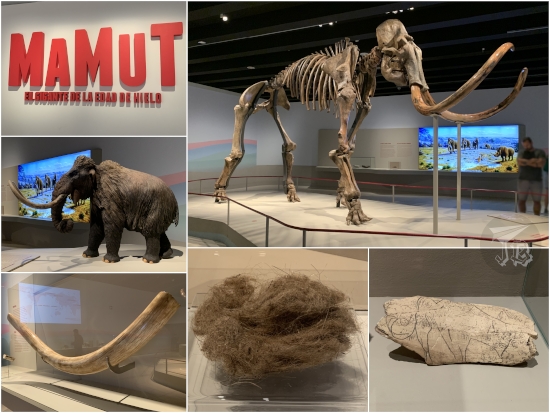
The exhibit has some molars from different species, some fur, a tusk and a few pieces of prehistoric art. There was also an evolutionary timeline and little models comparing the sizes of different mammoth species to the average human size. The pièce de résistance is indeed the complete mammoth skeleton that was the literal centre of the exhibit – hugely-tusked specimen of wholly mammoth (Mammuthus primigenius). It was a truly magnificent piece, but I was a little disappointed by how few pieces were actually on display. It’s not like there is not any material around – there used to be a Mammoth Museum in Barcelona that had actual tusks for sale. I had also seen another one in Muséum des sciences naturelles de Belgique in Belgium a couple of months back, which diminished the awe factor a little.

Mammoth - The Ice Age Giant exhibit featuring the giant skeleton with huge curved tusks, the smaller sculpture, a lone tusk, some hair and a piece of Paleolithic art engraved on the ivory of a tusk.

I was done in a bit over 30 minutes, so I had time to walk to the cinema – there was another exhibition in the same floor, but I had already seen it in Barcelona, and the Museum shop did not have anything interesting. I had planned to walk to the cinema, as public transit was only slightly shorter. The weather was not so nice, and there was a small storm. I did duck into a couple of shops but to be honest I ended up at the cinema 40 minutes before the session started while it poured outside. I found myself a seat to wait – I had got my ticket online the day the release was announced. This was my first time in a cinema since Jurassic World: Fallen Kingdom in 2018, and it was a weird feeling, being so close to strangers again. It was also extremely cold, and the previews were felt eternal.

The reason I sometimes choose Yelmo Cines Ideal is that some of their films are shown in their original language, and I tend to enjoy subs more than the dubbed versions. The Knights of the Zodiac film was… a choice, I guess. It is based on the newest remake – which I have not seen because I’m not a streaming-service person – and it changed a lot of the lore. Except for the main character (Seiya in the original material), all the names had been changed, but I noticed that the subs stuck to the original ones.

Knights of The Zodiac movie poster

It was not a bad film, all things considered. Entertaining, wannabe Marvel-like, tapping a little into mixing the cosmic magic and newer technology that was unimaginable in the 80s when the manga was made. It lacked on the music department though – considering how powerful the anime music is, that was disappointing, though here and there there are a few chords of the original song Pegasus Fantasy. That was cool.

But then again, I was half-expecting a disaster, so anything was an improvement, and the film made itself watchable. Sean Bean’s character died, but considering that in the original material his character is already dead at the end, I guess it could be considered some kind of record…

7th April 2023: Monasterio de Piedra (Nuévalos, Spain)

There are many things to consider when visiting the so-called Monasterio de Piedra, a tourist complex in Nuévalos, in the area of Aragón. One of the most important ones is the weather – as most of the complex is outside. The second is probably people. Just the online bookings are 2,000 tickets in a day – and some more go on sale throughout the day as visitors leave, or it is calculated that they do. A third factor is getting there, because it is literally in the middle of nowhere. This year, Easter break has peaked at an almost 100% occupancy rate since it seems that Covid is dwindling down, and the weather is superb – these facts have implied crazy traffic, too.

I had been mulling the trip for a while, checking weather and traffic warnings, and considering all the driving around that would be take place. I thought that the 7th would be a good date for a day trip – fewer cars out within the break period, and I was busy on the 8th, the other calm day. When I finally decided that the 170-km-each-way drive was going to be worth it and safe as the traffic authority had not updated its warning on the late-afternoon of the 6th of April, there were around 30 left for the 7th, and it was already sold out for the 8th. I got worried about traffic again, decided to leave the tickets for later, and by the time I definitely made up my mind, the day had been sold out!

I was disappointed, but I noticed that some tickets had become available for the 8th when previously there had been none. Thus, I kept checking throughout the evening, and finally around 23:00, I was able to purchase the 2000th ticket for the complex. Good thing that while I was wondering whether to go or not, I had prepared a backpack with whatever I might need, because if I wanted to beat the crowds, I had to leave by 7:30.

I did, and I made it to the complex around 9:10, after driving on almost-empty roads. I had planed to park in the outer lot, but as I reached the area, there were a number of workers directing cars and I ended up in the inner area. All the visitors who were already there – maybe I was the 30th car or so – stepped out of their vehicles commenting “oh, I thought there would not be so many people so early”. I thought the same… I had no idea of what “many people” meant in this place yet.

The Monasterio de Piedra complex has two distinct parts – the historical garden Parque-Jardín Histórico del Monasterio de Piedra and the monastery-turned-hotel. I decided to visit the park first, which would later be proven a good idea.

Río Piedra is mainly a pluvial-regime river (a fancy term to say that its flow depends on rain), also fed by various underground springs. The water has a high concentration of calcium carbonate, which for centuries has been key in creating the landscape that characterises the park, with a large number of waterfalls and caves – calcium carbonate dissolves and precipitates depending on how much water the river carries at any given time. Along the fertile soil from the river banks, the precipitates feed a very green landscape which in turns yields to a rich and varied fauna that lives there.

The park was established as a Romantic garden during the 19th century by Juan Federico Muntadas when he inherited the area. He also built the first Spanish fish farm there to breed river trouts. The garden is organised in two trails, a main one and an “extra” one – I decided to take the main trail, which runs around 5 km. The park prohibits food inside, but it does not really enforce it. I took a bottle of water, and an energy bar just in case, without the intention to eat it unless it was an emergency.

I walked in, got my print-at-home ticket scanned, and I was surprised that a few steps in, someone was holding an owl for people to take pictures with it. At 9:00. That was bizarre – I knew that the park used to hold birds of prey shows, but I thought it was a thing of the past. I got to my first intersection, and a park employee directed me towards the route. I was a bit disoriented for a minute or two, and I later realised that they were flushing the first visitors towards the big bottleneck area in order to try to control people, capacity, and waiting times. In this garden, the amount of people you run into can indeed make or break your experience – and I am happy to say that I made the right choices most of the time. The biggest problem I ran into were families with small children being loud, which was annoying but bearable.

Because of the redirection, I started off at what would have been number 16 on the route – the most famous waterfall, called the “ponytail”, Cascada de la Cola de Caballo. From there, you walk into one of the karstic caves (Gruta Iris) and pass under another waterfall, which even creates a small underground lake. It was cool, but I was really not prepared for how splashy it was! I continued off, I saw the and walked around a backwater called “mirror lake” Lago del Espejo for obvious reasons – it reflects absolutely everything. Although the route is only 5 km, it goes through areas that feel and look completely different, and it feels much, much longer without being tiring.
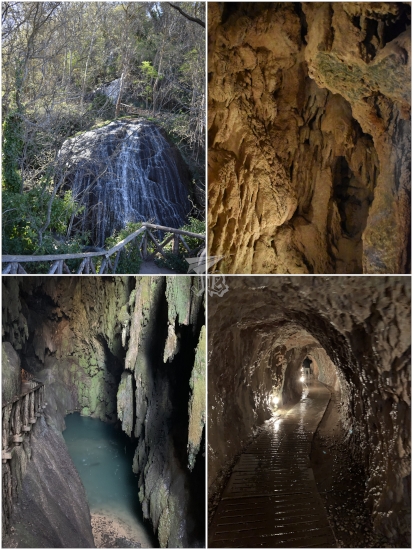
Monasterio de Piedra garden - waterfalls, karstic caves and the underground lake. Everything looks green with the vegetation and reddish with the karst deposits.

A 15-metre waterall, water splashing, flows into a river. The land around it is reddish-grey

A reddish hill perfectly reflects on a lake.

As I “finished” the route, I got to the intersection where the bottleneck is created and I saw all the people waiting – hundreds, probably. That was unexpected, because it had not felt that it was so crowded – it turned out, arriving early had been a great idea. The amount of people waiting was shocking, but understandable as most of the cave passages are only wide enough for one person – now I understood the reviews that claimed hours to see the waterfall and the cave.

I got a bit disoriented at this point – as I said, the route feels long since the landscape is so varied. However, instead of going for the exit, I decided to continue exploring a bit more – that is how I arrived at the lower numbers of the route again – number four, that was a bit more on the crowded side. I did the first part of the route, climbing up the hill slopes to see a dozen or so more waterfalls. Then had to backtrack again, until I finally saw everything that there was to see, even if in a strange order (on the map: sixteen to end, four to fifteen, then three to one. Not confusing at all, I know).

Monasterio de Piedra garden - fountain, and waterfalls and a cave. Everything looks green with the vegetation and reddish with the karst deposits.

Unfortunately, loud people scared most of the wildlife away, so aside from a few fish, there was nothing around in that respect. There were dogs around, but well-trained, so they did not cause a problem. The area is really nice, the waterfalls and caves are beautiful, but I can see how the number of people you visit it with might make it a good or bad experience. I am sure that I would have quit had I needed to wait hours to cross a cave and see one of the waterfalls.

When I left, there was a huge queue to get a picture with the owl. Furthermore, there were several huts with more birds of prey or other animals, and the pictures were sold at the exit. I’m not sure I approve of that, no matter how trained the animals are – there actually used to be exhibitions with the birds of prey, which is not happening these days. After I left the historical garden, I went into the former monastery. Today, most of the building has been turned into a hotel, but part of the historical site can be visited.

The monastery Monasterio de Piedra was established in the 12th century by Cistercian monks sponsored by king Alfonso II of Aragón. The building was erected in the years when Romanesque was turning into Gothic, so it mixes both styles along with some extra Baroque. Between the late 18th century and the early 20th century, the Spanish government carried out several programs to seize and sale property deemed “unproductive” – mostly belonging to religious orders and municipalities. These properties were auctioned to convert them into cash so the government could pay off its debt. The whole process is known as the Spanish confiscation (desamortizaciones).

In the 19th century, Monasterio de Piedra was confiscated. Everything it contained was auctioned in the 1840s and 1850s. In 1843, the buildings were also sold and acquired by the Muntadas family. It was soon afterwards that Juan Federico Muntadas became the owner. He turned the orchards into the now historical garden, and the convent itself into a hotel and… what today would be called a “wellness spa”. He also established the fish farm.

I would have really liked to stay at the hotel, but it’s a bit on the expensive side and there is really nothing else around, so you have to pay for meals on top of the stay. But it would have been cool to wander the monastery building at night. Not being a hotel guest, the ticket includes access to the cloister and the old church. Some rooms around the cloister have been dedicated to host exhibits about regional or historical products and items: carriages, wine, and even chocolate – the monastery was reportedly pioneer in the preparation of chocolate in Spain. The cloister itself has a few chapels, the early-Gothic chapter house with decorated columns and ambience music, and a small garden-like centre. You can also visit a monk’s cell, and there are mannequins spread through the different rooms – startling if you are not paying attention and suddenly see one.

I am not a wine person, so the museum on the topic did not impress me much despite having a bunch of traditional wine-making artefacts. The chocolate exhibit was just a succession of panels with pictures, and thus a bit underwhelming. Within the monastery, what I enjoyed the most was the architecture itself I guess. I loved the cloister and the chapter house most.

I also visited the adjacent ruined church. Like the cloister, it’s early Gothic. It has a Baroque chapel to the side which keeps the wall paintings. Although most of the ceiling is gone, the church still looks pretty – then again we all know that I like the architectural style anyway. It’s nice how the building is somehow ruined but at the same time it’s not, as it has been restored and preserved. However, underneath the altar, there is a small crypt, where a small window has been made to peer at someone’s bones – that was… huh… unnecessary. The nave is now open to the sky and covered with grass, all the figures have gone, and only one of the sides holds a few architectonic remains and capitals.

Inside the monastery - the cloister and the ruined gothic church

I left the inner area and I walked around the outside of the building – what has become the picnic area since you can’t eat inside the garden. Once I left that behind, the area was deserted. I reached the former main square, where the Baroque façade of the monastery still stands. I walked a bit further and found the walls that used to enclose the area, along with a small tower that is called the keep, but it looks more like a defensive tower.
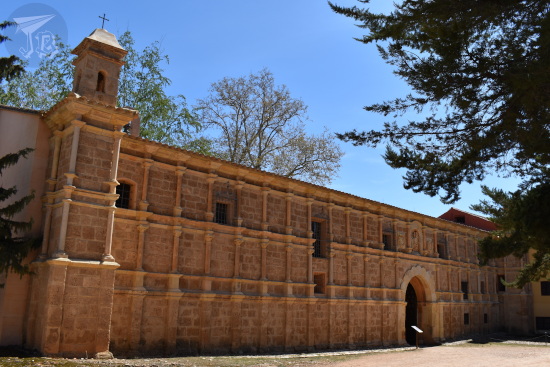
The baroque main entrance to the monastery

Finally, I checked out the gift shop, bought a book and some chocolate. I headed back a bit after 13:00, but instead of driving directly home, I made a stop at a couple of viewpoints over the reservoir Embalse La Tranquera. On the way out, I had crossed several tunnels and seen viewpoints, so since I had time and I was not hungry yet, I decided to snoop around. After a while, I just drove back – though I might just have made a stop for a late fast food lunch, because guilty pleasures happen sometimes. And by 15:00 I was hungry indeed.

A reservoir with turquoise water, nestled in a reddish gorge

5th April 2023: The ghost station of Chamberí (Madrid, Spain)

Perusing the web for something – I can’t even remember what – I came across one of those things that I had discovered a long time ago, then forgotten because life is hectic and so (read: Covid happened). In Madrid, there an underground ghost station, one that has not changed since the 1960s. Well, sort of – it was closed, then restored, and finally turned into a museum. Anyway, somehow accidentally, I ended up securing a free ticket to visit it during Easter break, so there I went. I decided to round up the trip with a fancy lunch in a place I also wanted to visit.

The Madrid underground system Metro de Madrid was the third underground line to open in Europe, after Moscow and London. It ran a little short of 3.5 km, with eight stations, when King Alfonso XIII inaugurated it in October 1919. Subsequent ampliations and renovations of the line were carried out until it reached its current 24 km and 33 stations (plus twelve more lines). The city expanded, its population increased, and underground trains grew with both, going from four to six carriages in the 1960s. The stations were renovated to fit the new, longer trains. Most of them. The ampliations of the stations of Bilbao and Iglesia made it inefficient to do the same with the stop that lay in-between – Chamberí. Thus, this station was locked down – and bricked off – in 1966.

The city forgot about the station’s existence for decades, until in the early 2000s, it was turned into part of the Underground’s museum network Museos de Metro de Madrid or Andén 0. Today, Estación de Chamberí can be visited for free, but only under reservation. Pre-pandemic, I looked into it a few times, and never found a spot, then the whole thing slipped my mind, until I relearnt about it, and lucked out.

I took the train to Madrid and walked from Recoletos to the square where the station was built Plaza de Chamberí. The original entrance has long disappeared, so the underground area is accessed through an ugly metal kiosk and a spiral staircase. However, the original station looks completely different. It was designed by Antonio Palacios (1878 – 1945), a Spanish urbanist and architect with a very recognisable style, whose most important works still stand in Madrid (such as the Círculo de Bellas Artes and Palacio de Comunicaciones). My entry slot was 11:30, and I arrived with plenty of time – trains have been unreliable lately so I gave myself a wide margin. When most of the group had arrived, we went down the modern stairs that yields to the old hall. Characteristic white tiles are laid along the access tunnel that leads to the original ticketing stands and the exit control. The station used to have a skylight, now closed off. The original stairs and maps still stand, along the Metro logo – though everything has been adapted for wheelchair-users.

Ghost Station of Chamberí. Entrance corridor and old ticketing booths

The group comprised 25 people, with a surprising amount of non-Spanish speakers – at least seven, who of course did not care about the guide’s explanation, which was little more than the Wikipedia page (so I guess anyone can take the visit. Print out the wiki and read along). There were families with kids who tried to yell over anything the guide said. Furthermore, underground trains still run through the station, which make for cool pictures, but their six-minute frequency drowns all the given explanations. It was hard to actually get into the “ghost station” mood.

Estación de Chamberí does look really cool though. Unfortunately, glass panels separate the platform from the tracks – they are dirty and get in the way of pictures of the other side of the platform. However, it was interesting to see the old advertisement mosaics – they used to be painted on tiles, and built into the walls themselves, and surrounded by very cool darker slabs with metallic tint. The visit takes about 40 minutes, and on the way out, you get to go through the old ticket gates, which have a very ingenious way of opening – you step on the little platform in front of them, which triggers a latch, and you can push the gate open. Really fun.

Ghost Station of Chamberí. Collage showing details - the name of the station on the old logo, tiles, the platform, and a train coming through

Truth be told, I had booked another free visit before lunch, but I realised I had messed up the location. I cancelled that one before entering the ghost station so the ticket would be available for someone else to use. And thus, I had a bit of time before my lunch reservation at 14:00. Since the weather was nice, I decided to walk to my next spot, and I spent the extra time – and some not-extra money – in one of the big bookshops in the centre of Madrid. At 13:50, I arrived at the back entrance of the hotel Hotel Riu Plaza España. This hotel opened in 2019 in a mid-20th century skyscraper (Edificio España) designed and engineered by brothers Julián and Jose María Otamendi. It is a 26-floor tower which was the highest building in the city at the time of its construction. Situated in the square called Plaza de España, it is close to the Royal Palace and Main Square.

Edificio España - tower like building in reddish and white brick, spanning 26 floors. It is the Riu hotel now.

The hotel has a large terrace on what would be the 27th floor, a rooftop bar and a restaurant or “gastro bar”, whatever the current buzz word means. Entry to the terrace is 10 € (5 € on a weekday), and food is not on the cheap side (everything around that area is stupidly expensive), but I found a deal at their Edén Gastro Bar: one-course lunch + drink + entry to the rooftop terrace for 30€ which allowed me to skip the queue.

I did skip the “ticket-buying” line, but there is only one lift to go to the rooftop, so that queue I had to wait. I ended up reaching the restaurant around 14:10 or 14:15, and snagged a counter-with-a-view seat. I ordered a salmon poké and a drink, and got a few complimentary snacks and breadsticks to complete the meal.

Rooftop picture showing Madrid's Plaza de España and Royal Palace. Blurred in the foreground, lunch

Afterwards, I climbed the stairs to the terrace, officially called 360º Rooftop Bar, on the 27th floor. Music was blaring and there were tons of people drinking overpriced cocktails. The views were cool, sort of a once-in-a-lifetime thing that I don’t think I’d need again. The terrace has a small all-glass balcony that I did not wait the queue for, and a glass platform that would probably impress a bit more if the glass under your feet were clean(er). The terrace was completed by a tacky bull sculpture with metallic-gold testicles.

Madrid rooftop view - low houses with red brick roofs, and in the very background a few highrises

I walked around a couple of times, and then I headed back to the train station after calling it a day. I killed time reading one of the books I had just got, and time flew on the train. It was a nice little outing, but I did mess up with one of the locations, so it could have been more efficient. I guess not every little trip can work flawlessly…

4th January 2023: It’s a trap! (Tendilla, Spain)

It was not really a trap, but a hike. A very unexpected hike, as my family decided that hiking was the best thing to do to get rid of camel-riding soreness. Tendilla is a small village in Spain, dating back from Medieval times. It holds a yearly traditional fair, there are some ruins and historical buildings… It also has a pine forest that was planted in order to control the soil that used to landslide onto the village, and back in the day, a sort of ‘emergency gorge’ was built, in order to channel water in case of a flash flood.

With the years, the pine forest grew. In the 1980s, it was really well-kept, but politics change, and the forest stopped being cleaned and taken care for. These days, the artificial gorge is overgrown with plants and only some dams are seen. Recently, people from the village have tried to create a few hiking routes throughout it, using the fountains and streams that spring as landmarks, called the “Fountain Route” Ruta de las Fuentes. These fountains are old watering holes that were refurbished and some of them re-decorated recently.

The ground was covered with fallen leaves, the sky was bright blue, and the moss was growing – moss takes a long time to grow, so it’s protected. For a while, it was endangered in the area, but now it seems to be doing much better. Unfortunately, both leaves and moss were humid and frosty (literally) – and my shoes were definitely not waterproof.

Collage - a mossy fountain on a leaf-covered ground; a pine forest in dull winter colours; an excavated gorge from the container dam, the gorge is overgrown with green-grey plants

I was very happy when we walked out of the forest and into the trail where the sun was shine. We hiked up to see the brand-new weather vane Veleta, from where we could see the whole village and actually watch sunset, as these days the sun sets early. Then we walked back to the village, not before catching some fallow deer hoof prints, and getting hung on hunting for gypsum crystals, something I used to love when I was a child.

Collage - a pine tree foreest, in golden colours as the setting sun is hitting them, the sky is cleawr blue; a weather pointing southeast

Collage - a fallow's deer hoof print next to a fifty-cent coin for reference- the coin is about half the size of the hoof print; a few gypsum crystals on reddish sandstone

Sunset picture. The sun is sinking behind a low mountain. The mountain gives way to a valley where the village is peeking. On the foreground, there is a capricious-looking grey rock. The sun is a big gold ball flaring on everything

Afterwards, we just sat down to chat and eat leftover Christmas food until it was time to go back home. Not the most exciting thing, one might think, but I had a lot of fun.

20th December 2022: Naturaleza Encendida – Origen (Real Jardín Botánico, Madrid, Spain)

It seems that the Madrid exhibits in the month of December are not being the most successful ones – this time, the weather did not help. After ten day’s worth of rain, it cleared out, but then, on Tuesday, the skies opened yet again. It was raining like there was no tomorrow by the time my train got to Madrid. Boo.

Just after sunset, my sibling and I went to the botanical garden Real Jardín Botánico to see the light show Naturaleza Encendida: Origen (Lit-up Nature: Origins). There had been some issues about the promoter cancelling the activity due to rain with little advance notice, so they decided not to close it. They instead resorted to close parts of the exhibit at random, and herding all the visitors in the same corridors, despite the puddles forming on the uneven ground. After two weeks of rain, something should have been done about it. Moreover, a few of the exhibits were turned off – not sure if just off or high wired. I wish I had some good boots, because I ended up pretty soaked, despite the raincoat and the umbrella. At least I did not ended up in a random puddle.

In 2021, the topic was sea life, and in 2022 the topic is… mushrooms. So there were spores, moulds and… mushrooms. Big mushrooms with lights, or made with small lights, or… just blown with hot air. Lots of mushrooms. The music was a bit creepy though, even if the mushrooms lit up and down with the beat. There is also an exhibit about moulds, with huge screens showing pictures of spores and microorganisms under the microscope.

Most people were antsy and cranky in the rain, and everybody wanted you to move out of the way – in different directions at the same time. A really good thing about it was the cup of hot chocolate that we had booked with the ticket. It was really nice to get in the middle of the cold and rain because it was warm and sweet. We drank it on our way out to the train, and just as we stepped out of the botanical garden… it just stopped raining.

Light display collage: on the upper left, giant red spores; on the lower left a wavy line of lights. On the right, a giant bunch mushrooms illuminated in green from inside the umbrella

Collage of lights display. A mushroom made of little yellow and white lights; a bunch of name mushrooms in red; a hanging mould-like string of lights between two dark trees

All in all, I was not too impressed. I really think that the organisers should have figured out something about the cancellations and the pathways, since they obviously could not do anything about the weather. My favourite display were the “Baymax mushrooms”, even if most of them had lost their illumination, which was actually kind of the point…

A blow-up mushroom made from plastic, looking like it's floating. The  lights inside make it glow green and pink. In the background there is a building gate in red, and a pond between the two.

6th December 2022: Tim Burton’s Labyrinth (Madrid, Spain)

Despite having decided that immersive exhibits were not for me and the fact that I’m not a Tim Burton fan, here I found myself in Madrid to see this one: Tim Burton’s Labyrinth El Laberinto de Tim Burton. Truth be told, I was only there because my sibling asked me to accompany them. I did not find premium tickets for any of the dates either of us was available, but the 6th of December is a national holiday in Spain, and I calculated that if we were there at opening times it might not be too busy, and we would not come across too many kids.

Tim Burton is an American film-maker born in 1958. His first “hit” may have been Stalk of the Celery Monster, which he wrote, directed and animated when he was a student in the California Institute of Arts, in 1979. It presumably earned him a good grade, but more importantly, an animator’s apprenticeship at Disney Animation Studios. With time, he developed a shrill eerie style, with lots of colours and creepy designs that have increased as years have passed, sometimes defined as “gothic fantasy” – I would refer to it as strident and macabre at times, to be honest. His greatest or most famous works include Beetlejuice, Charlie and the Chocolate Factory, Edward Scissorhands, The Nightmare before Christmas, and the first two Batman films.

The exhibition is hosted in a weird place in Madrid, Espacio Ibercaja Delicias, which might look less… abandoned… when it hasn’t been raining for days, I guess. The space consists on a big tent – where we were not going, it might be designed for circuses or so, some kind of bar / cafeteria, and the monster-like building that hosts the exhibit. It is called a labyrinth because out of the thirty-ish wards, you have to go around choosing doors to see different rooms of the exhibit, insomuch that you would need four rounds to see the complete thing. In the end, you choose 15 rooms to see, out of which some are common, and you reach them from whichever previous place you were in. Others are “less common” and you can reach them through several doors, but not all. You enter the labyrinth through a toothy monster’s mouth, then there’s a big button that “decides” on the first room for you.

Collage: exterior of the Labyrinth, which looks like a one-eyed tentacle monster, and the inner entrance monster whose mouth is the curtain you have to cross to enter the different rooms.

In the rooms there are sculptures that represent the characters, some of them with the original clothes that were designed for them (if the film is a live-action), the plain clothes, and on the walls sketches and animations, some original, some “inspired”, and some made specifically for the exhibit. Some rooms are small and rather empty, others are decorated like the movie sets. There are tricks with lights, and some mirrors, but nothing “immersive” about it, and way too many people around considering the size of some rooms.

The idea of a labyrinth is interesting, but I don’t think the price warrants just seeing half of the exhibit, especially considering the big “misses” of not seeing all the The Nightmare before Christmas. We took about 40 – 45 minutes to go through the 15 rooms.

What I am aware we saw included:

  • Beetlejuice
  • Edward Scissorhands
  • Batman and Batman returns
  • Mars attacks!
  • Charlie and the Chocolate Factory
  • Alice in Wonderland or Alice Through the Looking Glass
  • Corpse Bride
  • Frankenweenie
  • Jack from The Nightmare before Christmas

Collage of Tim Burton's characters: Batman's Pengun, Edward Scissorhands, Emily from Corpse Bride

Collage of Tim Burton's characters: Alien from Mars Attack; the clothing from the Chocolatier (I think) in Charlie and the Chocolate factory, surrounded by twirling candy canes; Beetlejuice

Collage of Tim Burton's characters: Jack from The Nightmare before Christmas; The Mad Hatter from Alice in Wonderland, with some giant mushrooms behind; the boy and the dog of Frankenweenie

I think this is an exhibit for die-hard fans that are willing to pay for the premium ticket and see the whole thing twice. What it’s not, and that’s for sure, is for kids.

On both ways, we had some train trouble – delays and technical problems, but nothing too dramatic, and I was home before sunset – but after buying a stack of Christmas candy canes! And my sibling enjoyed, which was the goal anyway.

2nd December 2022: “Tutankhamun Immersive Exhibition” in Madrid (Spain)

In 1922, an archaeologist named Howard Carter discovered the tomb of Pharaoh Tutankhamun in the Valley of the Kings, Egypt. Tutankhamun belonged to the Eighteenth Dynasty. He reigned over Egypt around 1330 BCE, and restored the Ancient Egyptian religion. When he died, he was buried in a smaller-than-expected tomb, probably because his death was sudden and unexpected – for a while, it was hypothesised that he had been murdered, but it seems that he died from a combination of an infection and several previous pathologies (nothing to do with the fact that his parents were brother and sister, I’m sure).

The tomb was robbed and restored twice within a few years of Tutankhamun’s death, but it was eventually buried by alluvium brought by flash floods, and the debris from other tombs being built nearby. Thus, when Carter found it in 1922, it was mostly untouched and unspoilt. The death of Carter’s sponsor George Helbert, five months after visiting the tomb, sparked the rumour about a Curse of the Pharaohs, which has inspired countless works of fiction.

In 2022, Spain is living through a fad of “immersive exhibitions”, heavily based on technology, virtual reality and computer games. I was curious about what it would be about, exactly, so I decided to celebrate the end of work season by hitting the exhibit. I was early as the day before there had been a bit of public transport trouble and you usually have more chances of getting in if you’re early rather than late. Thus, I reached Centro Cultural Matadero in Madrid about half an hour earlier than my ticket read, and I was let in without any issue.

The “immersive exhibit” Tutankamón: La Exposición Inmersiva was devised by MAD, Madrid Artes Digitales, which specialises in digital creation and immersive experiences such a this. The exhibit has been designed in cooperation with the History Channel.

The first bit was a number of panels, explaining the “Egyptmania” that swept the world after the discovery of the mummy, the process of mummification, or life in ancient Egypt. The second held a replica of the inner and outer sarcophagus, along with the mummy, then replicas a few artefacts that had been found in the tomb, including the famous golden mask the pharaoh was buried with.

Three part collage: The upper picture shows the mummy of Tutankhamun suspended from the floor, imitating an open sarcophagus with the lid open on top of that. Bottom left: reproduction of the mortuary mask, in gold and blue, it has the typical Egyptian hair and beard. Lower right: reproductions of small objects found in the grave: estelae and human-like small sculptures.

Afterwards, you go into a huge ward with a projection on all four walls plus the floor, which is very spectacular but does not tell you much about the real history of either Tutankhamun or the tomb, it was just a cool video of flashy images with a narration in first person, showing the interior of the tomb, yes, but mostly vaguely-related imaginary, including some of the Egyptian gods. What it did have, and that was neat, was an original newsreel about the opening of the tomb, including Howard’s voice.

Collage of a 3D projection. Left, from top to bottom, views of Tutankhamun's grave: the outer area, in sandstone with sculptures, and two views of the inner painting an decoration, showing figures and hyeroglyphs. On the right, a projection of lotus flowers blooming and turning into gold, representing the soul of the pharaoh.

A large ward with a projection of a starry sky on the walls. At the front, a view of Tutankhamun's mortuary mask, eyes glowing.

A projection of Tutankhamun's mortuary mask, eyes glowing. Around it, golden writing symbols, maybe hyeroglyphs.

The following area had an augmented reality game, which I won (didn’t get anything though), a photo booth that I skipped and some “I bet you didn’t know” facts – about one third of them were common knowledge, and another third was information from previous panels though.

Finally, there was a room with virtual reality glasses and headphones, but my headphones wouldn’t work – I later realised they were not plugged into anything. This represented – I think – the trip to the Egyptian underworld, as I “started” at Tutankhamun’s tomb, then there were volcanoes, and I ended up in front of Anubis, who weighed a heart against a plume – the Judgement of the Dead.

The VR experience there was the last spot in the exhibition – because I skipped the photo booth – before one went into the shop. In the end, I was there for about an hour and a half, but it almost took me two hours to arrive and an hour and half to come back.

Though I don’t regret the mental break, I have decided that immersive experiences are not for me.

9th October 2022: Atémpora, Sigüenza (Spain)

Sigüenza a Medieval town in the centre of Spain that is currently trying to gain the status of Unesco World Heritage Site. It has a castle, a protected historical centre, and in the heart of it stands the cathedral Catedral de Santa María La Mayor de Sigüenza . The cathedral dates back to 1124, when the original Romanesque building was was erected. The construction finished in 1326 , with remodelling and decoration elapsed several centuries, with different add-ons, until it was “declared” finished after the Spanish Civil War, with later works being just conservation.

Cathedral in Siguenza, a late-Romanesque / early-Gothic building, in a reddish colour. Left: side view, showing the bell tower. Right: façade, with two side towers.

In summer and autumn 2022, there is an exhibition in the cathedral – Atémpora. Sigüenza entre el Poder y la Gloria, which translated to something akin to “Timeless. Sigüenza between Power and Glory”. It displays some of the treasures of the cathedral and the museum, along with a few archaeological devices. We had seen most of the religious artefacts in a previous visit, but the historical chronicle was rather interesting.

The first block, around the cloister, deals with Celtiberian (the Arevaci tribe) and Roman weapons and everyday life. The second block deals with the Goth conquer and the newfound Christianity.

Upper Left: entrance to Atempora, flanked by two angels. Upper right: Celtiberian Daggers. Bottom left: oil lamp looking like a bird. Bottom left: clay bowl.

Interwoven with the exhibition are the treasures of the cathedral, including two collection of Flemish tapestries, one focused on Athena, the other on the story of Romulus and Remus. Another highlight is an Annunciation painting by Domḗnikos Theotokópoulos “El Greco” a Greek artist of the Spanish Renaissance (since he moved to Toledo in his prime). Of course, the cloister is fantastic. There is a tiny gothic altarpiece in one of the chapels that is delicious. The problem? As always, Baroque trends building choirs in the middle of the naves, blocking the view, and overdecorated altarpieces. The wooden ceilings are extremely beautiful where they have been preserved.

Upper left: tapestry collection, hanging from walls. Bottom right: Annunciation by El Greco. Bottom left: decorated wooden ceiling. Bottom right: Cloister of the cathedral.

The three final blocks present different Christian symbols and pieces of art from the Middle Ages onwards, and interestingly enough, a watermill from the old salt marshes. The exhibit makes a particular emphasis on Wilgefortis, a Catholic folk saint which is supposed to be buried in the cathedral, with the silver arch where her body lies brought from the altar. Other pieces include coins, sceptres, and even a few elements from the times when there was a Medieval university in town – one of them being a human skull with “anatomy notes” on it. There are also late Medieval sculptures, most importantly crucified Christ representations and Virgins with the Child, though probably the nicest one is the one which is permanently at the entrance of the cathedral. Next to it, a mill from the nearby salt mines (Salinas de Imón) has been brought – I really want to visit those at some point too, so great reminder.

Altar of St. Wilgefortis on the left. On the right, a coin, a scepter and half of a skull with writings on it.

Top left: Romanesque virging with child. Bottom left: watermill. Right: Crucified Christ with four nails on his hands and feet.

The most important monument, or area, in the Sigüenza cathedral is the chapel called Capilla del Doncel. It holds the tombs of Martín Vázquez de Arce and his parents. The de Arce men participated in the war against Granada Muslims during the 15th century, where the son was killed in an ambush, as the Muslims created a flash flood from the watering system they had to control the waters of River Genil. Though he was already 25 years old, too old to be called a doncel, teenage boy, the name has stuck for centuries. The parents’ tombs are traditional burials, however, the Doncel’s grave is an arcosolium, with the decorative sculpture showing the young man awake and reading a book, rather than lying in death as it is the typical representation.

Chapel of"El Doncel", showing the traditional burials in the foreground, and the Doncel's tomb in the background.

We went to have lunch after the visit, we went to have lunch at La Taberna Seguntina, where we shared some typical cheese, sausage, and roasted pork before we went home.

Typical Siguenza Dishes. Top: sausages and cheese. Bottom: roasted pork leg with potatoes.