11th August 2022: 21 hours straight of ups and downs in London {England, August 2022}

The first thing I had to do was waking up for a 6:30 flight – though considering I did not sleep very much that night due to the heat, I’m not sure if that it counts as waking up. The previous day, the airline had sent warning emails about arriving at the airport early – three hours before the flight would have meant being there at 3:30, so… not really. I arrived at the airport around 5:10, and I was at the gate by… 5:20, I’m not even kidding. While I normally do not queue to enter planes – the advantages of backpacks, I just kick them under the seat – I had been assigned seat 1A, which meant I had to put my luggage into the overhead compartment. I had decided to take a small backpack too, because I would be carrying it around for a while, and it would get searched in a couple of places.

Surprisingly, despite Brexit, the Ryanair strikes, airport chaos, and the fact that apparently the automatic passport reader cannot cope with my new look, I made it into the United Kingdom first and straight to London without a glitch. Not only that, I managed to get my Oyster recharged without any problems, and as soon as I had bought some food, I was on my way to the first stop of the day: Crystal Palace Park, for which I got to ride the shiny new underground line, the Elizabeth Line, then the Overground. Even though there are another couple of landmarks (that might warrant a visit when / if the restoration project finally goes through), what interested me in Crystal Palace was a collection of Victorian sculptures – the Crystal Palace Dinosaurs.

Though Ancient Greek already knew about fossils before the current era, it was in the 19th century when it hatched as a “science”, according to some spurred by Darwin’s “On the Origin of Species”. Fossil hunters ran amok, excavating and spoiling the North American badlands. In England itself, Mary Anning kept discovering cool things. There was a sort of a “Dinosaur fever” – the Victorians became fascinated with all things prehistoric. In 1852, a number of extinct animal reconstructions were commissioned to be erected in the gardens of the Crystal Palace, after the World Exhibition. Using the knowledge available at the time, Benjamin Waterhouse Hawkings, a natural history illustrator and sculptor, who did his best according to scientific knowledge at the time.

Not all the animals represented are real dinosaurs, but the nickname stuck. From today’s standards, most of the reproductions are extremely inaccurate, with some exceptions, such as the ichthyosaur (discovered by Mary Anning around 1811), and the plesiosaur (of which Mary Anning also found a skeleton in 1823, and then another in 1830 – I love that woman). Today, the park is organised in several “islands” where you can see the sculptures, though the water was a bit down due to the heatwaves:

  • Amphibians and therapsids: Dicynodon and Labyrinthodon
  • Marine reptiles: Ichthyosaur, Mosasaurus, Plesiosaur and Teleosaurus
  • Dinosaurs and pterosaurs: Hylaeosaurus, Iguanodon, Megalosaurus and Pterosaur
  • Mammals: Palaeotherium, Anoplotherium, Megaloceros and Megatherium

I have been aware of these sculptures for a long time – since I was a child and started liking dinosaurs. However, only recently did I find out that they really existed, and where they were. I arrived at Crystal Palace station a little after ten (making whole travel from the airport about two hours). I walked by a small farm with typical fauna such as… an alpaca, then I ate my sandwich overseeing the first island.

A collage showing differet statues of prehistoric creatures. Some try to be dinosaurs, and they look almost comically wrong, like giant iguanas or chameleons. There is one plesiosaurus looking rather acurate - it has a long neck and flipers. Finally, some mammals: a deer with huge antlers and a tiny horse-looking creature

I walked around for about an hour and then I set on my way back. Though I had planned to have a relaxed day at first, I had to adjust due to cancellations and train strikes. It was around that time that I calculated that I could actually cram my original Thursday and Saturday plans onto Thursday, plus the alternative plans I had made if I tweaked the time a little. So I back-rode for another hour towards the city.

Near Tower Hill stands the Sky Garden, on the 35th floor of the 20 Fenchurch Street building, designed by Rafael Viñoly. Sky Garden is considered the highest garden in London, and a fantastic viewpoint of the city. I almost accidentally came across the option to book a free access ticket for this – while I had not wanted to pay for any morning / early afternoon activities in case my plane was delayed, I figured out that I could book this for free, especially as they go stupidly fast! I made my 12:30 timeslot with a few minutes to spare, but I was let in after a queue, ID check, X rays and metal detection.

The Sky Garden features two terraces full of plants (landscaped by Gillespies), a couple of restaurants and bars, and an “open” gallery which has glass above your head so the feeling of opening dissipates – the glass is stained and scratched. It was one of the “must-do’s” in London I had never visited before, so I thought it would be a good opportunity. Fortunately, they have relaxed the rules on no bottles because of the unusual high temperatures.

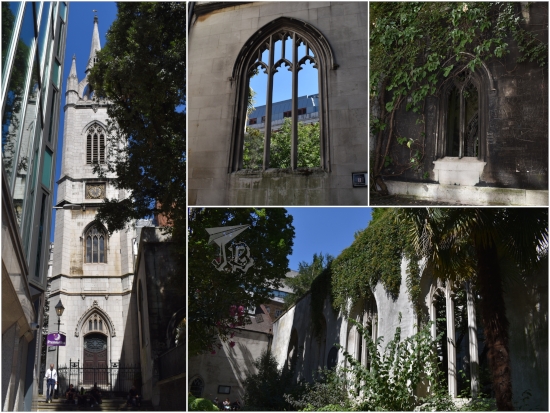
After wandering around for a bit, I continued onto Saint Dunstan in the East Church Garden, the ruins of an old Wren church destroyed by The Great Fire of London and destroyed again during the Blitz (World War II bombings). Dating back to the 1100s, it was opened as a public park in 1970. Aside from being a very cute building park I wanted to see for a while, a music video by the band VAMPS was filmed there.

Ruins of a gothic church turned garden, with hanging ivy and bushes overgrowing the walls and windows

As it was lunchtime, the park was bustling with people, so I just had to move on rather quickly, and went back to the underground to get to the area of Westminster. I had originally booked tickets for Saturday (back in May) but then they were cancelled due to “repair work” going on that day (I do wonder if it was a security measure related to the strikes though).

But of course, first I feasted my eyes on the very new Elizabeth Tower clock tower aka Big Ben – though Big Ben is one of the bells in the tower, but nobody really cares about that any more.

Elizabeth Tower, shining gold with the restoration. It almost looks fake. The clock marks Quarter to two.

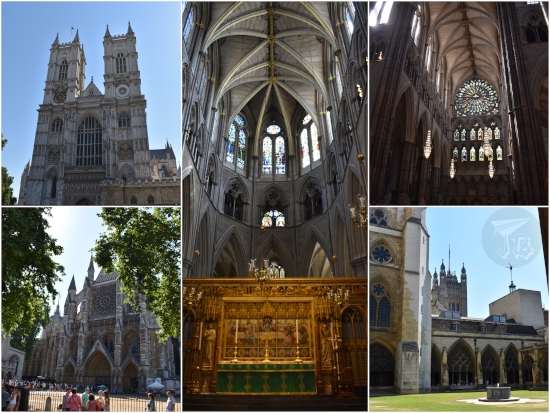
The Palace of Westminster or Houses of Parliament is the centre of the United Kingdom’s turbulent political life. The current palace was built after the previous one was destroyed by a fire in 1834. The new palace was erected in the Neo-Gothic style, and it was mostly finished by 1860, although it did open to be used in 1835. There was a competition regarding the design, which was won by sir Charles Barry. The Palace of Westminster holds the two chambers where the British government meets – the House of Lords and the House of Commons – alongside the Norman Porch, St. Stephen’s chapel, and the different corridors where the MPs vote or discuss state matters. I’ll forever be amused that “for security reasons, photography is not permitted in these chambers with dozens of cameras for TV broadcasting and Internet streaming”, but alas. The woodwork on the Norman Porch ceiling is fantastic, and some of the decoration choices, such as Churchill’s sculpture are… interesting. It is noteworthy that it is part of the Unesco Heritage Site “Palace of Westminster, Westminster Abbey and St Margaret’s Church”.

Collage: a view of the houses of parliament (London), with the Elizabeth Tower on the left. Two shots of the Norman Hall, a huge ward with an intrincate design of wooden ceiling. A gothic corridor with a wooden door and some coloured glass panels

Afterwards, I just found my way to the hotel – though I had to wander a little to find the nearby supermarket, bugger those never-ending attached-house neighbourhoods, rested for a little and then went to the station to go to the theatre – I wanted some extra time to check out where my airport coach would leave, so I gave myself 45 minutes for a 22-minute trip. It turns out there was train trouble and I was barely on time, taking an alternative route instead of the direct one.

When I realised my flight timing would give a free evening in London, I booked tickets for the Apollo Victoria Theatre to watch the “Wicked”. This musical tells the story of “The Wonderful Wizard of Oz” from the point of view of the witches, and somehow gives the “Wicked Witch from the West”, Elphaba, an amazing personality and backstory that resonates a lot with me. For the same price as the ticket I was eyeing back in the day, I found a VIP upgrade just one seat over, so I was entitled to a drink and “snacks”, an early entry, along with access to the “Ambassador Lounge”, a tiny reception hall with access to a private restroom.

“Wicked” was great. The actress who plays the main character, Elphaba (Lucie Jones) came out a little yelly though in her solos. The duets with the other female singer (Glinda, Helen Woolf) were fantastic, and the male love interest’s (Fiyero, Ryan Reid) song was absolutely great, even though he is a character I have never cared for.

Apollo Victoria Theatre: the inner theatre, showing a dragon and a closed curtain showing a map of Oz. The outer theatre: there is a sign reading Apollo Victoria Wicked, and everything is lit green. The VIP lounge, with a glass of soda, and some chairs. The cast at the end of the show, taking their goodbye bows.

By the time I was out, the trains were running again, and one-to-three-minute delay on a line that runs every five minutes or so, and I was at the hotel by 23:00, absolutely beat. The room was extremely hot, because London is absolutely not ready for heat, so I had a snack in front of the fan, took a shower and then got some sleep – 21 hours on the go were over. Funnily enough, by the time I went to bed, I had that wobbly-world jet-lag feeling I have after my first day in Japan. It must have been the barely sleeping the night before. I fell asleep very fast.

Walking distance: 30.52 km / 46192 steps

11th – 13th August 2022: Non-weekend weekend in England 11th – 13th August 2022: Non-weekend weekend in England {England, August 2022}

When, back in May, I decided to book this trip, I was surely not anticipating the chaos in the European airports this year, nor for sure the England transport strikes. I did not foresee that the Palace of Westminster would suddenly cancel my visit, nor that it would be through my Westminster Abbey reservation that I would be informed of trains cancellations. I did not know that I would have to buy a last-minute bus ticket and miss half of a tour… Lots of things went almost wrong, but in the end, most everything worked out.

25th July 2022: Half a day {Salamanca, July 2022}

Mondays are always tricky because a lot of things close then. We reprised our latte/croissant and visited the Tourist information office that claimed that everything was open – which… was incorrect. My companion wanted to see Iglesia de San Marcos, a Romanesque church which has an interesting circular shape, probably built in the 11th century (that we had found in the book we got from the cathedral).

A Romanesque church. It has a round nave and a short bell tower with two bells.

We saw the local market Mercado Central de Salamanca, designed by the same architect as the Casa Lis. As this is a public building, it was in working order – though funnily enough, all the fishmongers were closed – no fish in Salamanca on Mondays! The building is modernist, with iron structures and colourful windows.

A Modernist building with colourful glass windows

To finish off the morning we went to visit the palace Palacio de la Salina, also a public building so also open. The architect in the project was Rodrigo Gil de Hontañón (who also designed the University building in Alcalá de Henares). It was built in 1538, mainly in Plateresque style, with some Italian elements.

The patio of a Plateresque palace, in gold tones with a lot of decoration on the stonework

Right across the park from the palace there is a lonely Renaissance tower Torre del Clavero. It was a 15th-century defence tower, with a square base that turns octagonal in height.

A

We walked around for a while longer, had lunch, and our train back left around 3:30. It was a rather uneventful trip full of gothic, modernism and iron, which I really enjoyed. I keep trying to get to like guided visits, and I have somehow got fond of climbing up towers.

Walking distance: 11737 steps / 7.31 km

24th July 2022: Up, up and down {Salamanca, July 2022}

After a latte and the best croissant I’ve had in a long time, we went over to see the gothic palace Casa de las Conchas, which was built between 1493 and 1517. The façade is decorated with sandstone-carved shells (concha, in Spanish). The exterior sports ironwork-protected windows, and the interior a patio with artistic arches.

The gothic palace called House of Shells. There are hundreds of them carved on the façade. The inner patio is carved in golden stone, with very thin columns and lots of decoration

It was still early for our visit to Palacio de Monterrey, a 16th-century Renaissance palace inspired in the Italian style of the time, combined with Plateresque decoration, which was heavily imitated later on in the 19th century. The building currently belongs to the House of Alba, probably the most prominent Spanish noble family. The House opened the palace to the public, and the inner area cannot be photograph – it was weird anyway, with some antiques and art pieces, but all of it was… prepared and staged, though the carpets were rolled out of the way. In this case the only option to sneak out a picture was from the tower, as a member of the staff followed us all the time.

Monterrey palace, built in golden-like masonery. The roofs and towers are decorated, and there is a row of windows alongside the upper floor.

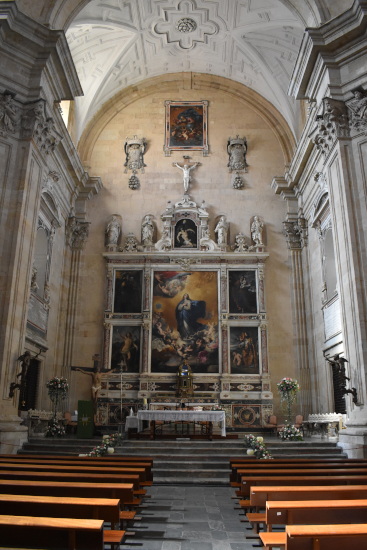
Next, just in front the palace, we visited the 17th-century church Iglesia de la Purísima, in Italian Baroque style. Its altarpiece is considered to have one of the best images of the Virgin Mary in her Immaculate Conception advocacy.

A Catholic altar showing the Inmaculate conception in the centre, she is dressed in blue, and standing in front of golden clouds, with angels around her. The back of the altar is built in white stone, and ornate.

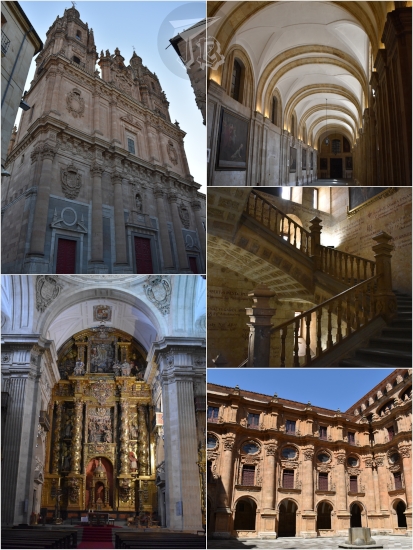
Our next spot was the second university of Salamanca, the see of the Universidad Pontificia de Salamanca, a building called La Clerecía. As the original university went secular, the Jesuits built a clerical university. The building, built in Baroque style between the 17th and 18th centuries is composed of a church, a cloister, a patio and a magnificent staircase, forming the complex (read: guided tour) called Vita Ignatii.

Collage: On the left, a very baroque church from the outside, also showing the gold inner altar. On the right, some shots of the upper and lower cloister, the patio is ornate and reddish, the staircase is made completely out of stone.

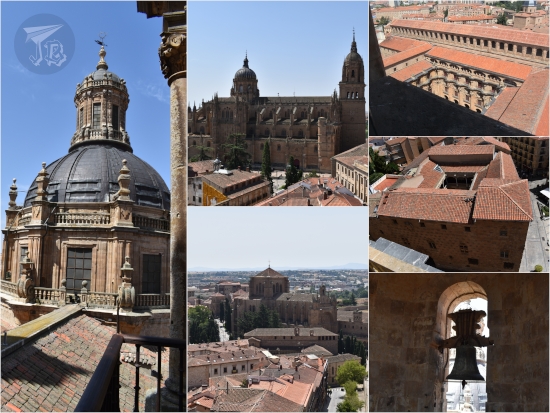
Then there are two towers that give out really awesome views of the town, named Scala Coeli, the stairs to the Sky.

Views of Salamanca from the above: the dome of the church from the outside, the cathedral, the House of Shells, and the bells.

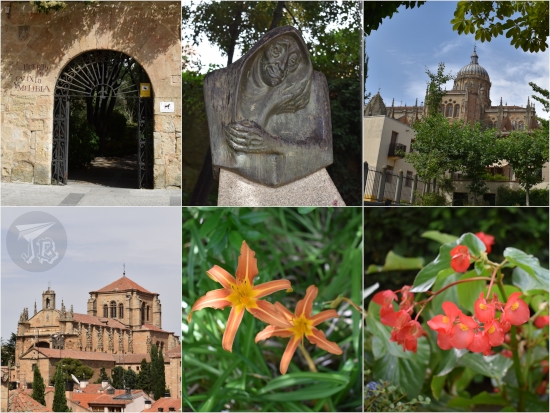
It was rather hot, so we had some unremarkable lunch and went to the hotel to wait out the blunt of it. It did not really work, and we eventually tried our luck with some more sightseeing. The first stop was the garden known as Huerto de Calixto y Melibea, based on a literature work Tragicomedia de Calisto y Melibea or La Celestina. It is considered the first Renaissance writing in Spanish, and it echoes with Romeo (Calisto or Calixto) and Juliet (Melibea), with an extra character, the old matchmaker Celestina, who is a horrible person trying to break the lovers up to marry Melibea to someone else. Though the writing does not have a firm setting, some say that it is probably Salamanca, where the author attended university. It was nicely shaded and had nice views.

Gate to the gardens, a bust of Celestina (the fictional character), from the cathedral, and some flowers: star-shaped and orange, bell-shaped and red.

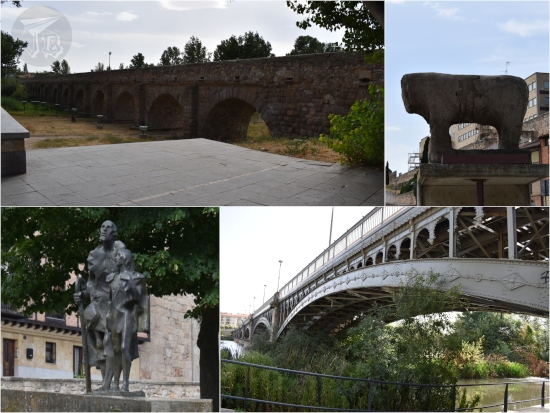
Then, we wandered off to see the bridges over the river Río Tormes again: both Puente de Enrique Estevan and Puente Romano. Next to the Roman bridge there is a statue of a verraco (ancient Celtic sculpture) Verraco del Puente Romano, which is supposed to have been there since the 16th century. A bit to the side, there is yet another literary monument, which represents the book El Lazarillo de Tormes, Lazarillo being the word for “guide dog (for the blind)” in Spanish (such an eye-seeing dog). Also written in the 16th century, it is considered another of the peak writings in Spanish, telling the story of a young lad who learns to survive by gathering street-smarts and shedding off any morals he ever had, finally settling in Salamanca with his unfaithful wife: Monumento al Lazarillo de Tormes.

Collage. The historical bridges in Salamanca: the Roman one, made from stone with wide archs, and the iron-architecture one, in greyish-green. Sculptures: Lazarillo with his master, and a prehistoric bull or pig, with a flat head

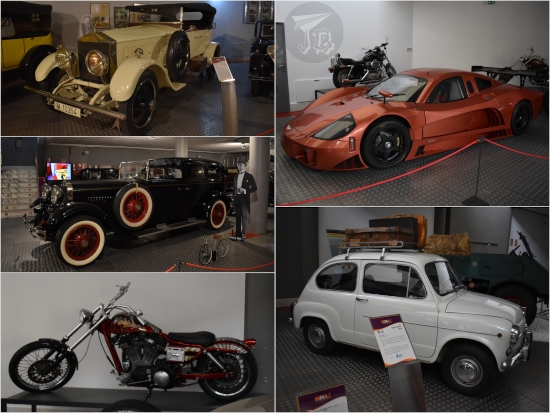
Then we found a very air-conditioned and interesting place – the automobile museum Museo de la Historia de la Automoción (which reminded me a little of the Megaweb Toyota City Showcase and History Garage in Tokyo). It has a lot of classic cars, and some historical pieces such as vehicles that belonged to dictator Francisco Franco or the writer Camilo José Cela (and air-con).

A collage of some cars: A Rolls-Royce, a Ferrari, a Wolkswagen 600; and a Harley-Davidso

I had then booked myself an evening visit around sunset time, to go up the towers of the cathedral, an experience called Ieronimus, with the hope to see some cool sunset and night views. It makes sense, right? Wrong. I should have realised when it turned out to be a guided visit that most of it would be inside, listening to the guy fanboy his own city – then he started speaking about the Lisbon earthquake and its effects in Salamanca and gave out wrong information. I stopped listening to him at that point. There was a light/music show in the cathedral, and I did get some neat pictures, but honestly? The choir concert in the old cathedral would have been a much better choice, had we known about it.

Views of Salamanca at night, with the gothic architecture highlighted by the illumination. The city looks Romantic and mysterious.

Walking distance: 13017 steps / 8.00 km

23rd July 2022: Plateresque Salamanca {Salamanca, July 2022}

Officially in western Spain, Salamanca stands next to the Tormes river and sports a Unesco World Heritage title for its old town. I was five or six the first time I was there, so it’s not like I remembered anything from it, except memorising excerpts from the book El Estudiante de Salamanca (José de Espronceda), my favourite Spanish Romantic poet.

Salamanca is known due to its university, which is considered one of the best in the teaching of Spanish as a second language, the oldest Spanish university and one of the oldest in Europe, founded in 1218. There are actually two universities, but we shall get to that later.

There is a period in Spanish history referred to as the Gold Century, Siglo de Oro (Not an actual century, the given dates are between 1492 – the year when the Catholic monarchs finished conquering the country, Europeans realised America existed, and the first book on Spanish grammar was published – and 1659 – when the Pyrenees treaty was signed after the war with France). It was throughout this period when Salamanca thrived, especially late-time Gothic styles and early Renaissance ones. Then of course Baroque later on, but you know my stance on Baroque by now I guess… The mixture of late-gothic and Renaissance gave way to a unique style, Plateresque – with a strong Gothic base and a blend of Mudéjar, Flamboyant Gothic, Lombard and Tuscan Renaissance elements and decorations. Plateresque is characterised by heavy decorations sculpted onto the main architecture, especially in the typical fusion of doors and altarpieces. The motifs are plants, animals, shields and medallions… All and all, an impressive style considering we are talking about carving stuff on stone – in the case of Salamanca, a lot of it is sandstone, which gives the old city a golden tone.

We had to take a couple of trains, but and made it to Salamanca around 10:30, and were in the city centre a few minutes later. After dropping the luggage at the hotel – I had been requested the hotel to be near the cathedral and I found one which was literally across the street from one of the flanks. Then again, here’s the thing – Salamanca has not one but two cathedrals: the Old Cathedral Catedral Vieja de Santa María and the New Cathedral Catedral Nueva de la Asunción de la Virgen. Apparently, instead of building over the old one, they decided to keep both, making the historical complex unique in the country.

The New Cathedral was built mainly in Gothic style with later Baroque add-ons, with an ornate Plateresque façade. It was commissioned by king Ferdinand V of Castile, and built between the 16th and 18th century, in the Gothic style, even though this was at time when Gothic was already in decline. However, the town authorities wanted it to “match” the old Romanesque cathedral. A cupola and a choir were added in the Baroque period, and the façades were decorated in the Plateresque way (in a 20th-century restoration, someone thought it would be funny to add an astronaut to the decoration, causing some hoaxes to pop up afterwards). The most important architect who worked in the new cathedral was José de Churriguera, one of the leading Baroque architects / sculptors / urbanists.

A very ornate Gothic cathedral. The entrance has so many carvings that it actually looks organic, if not for the fact that it is made out of golden / reddish stone

The New Cathedral connects to the old Cathedral, which is late Romanesque / early Gothic in style (I know, it’s confusing. Historically, the old cathedral is between Romanesque and Gothic, and the new one between Gothic and Renaissance – and this is the reason why the Gothic makes the two cathedral “match”). It was built between the 12th and 14th centuries. The most impressive thing in the Old Cathedral is the altarpiece, in which the highest-quality paintings were made by the Italian Dello Delli. On the way out, I let myself be tempted by a paper guidebook of the city – which was helpful because we had to remake all of our plans a couple of times.

Interior of a Romanesque church - the nave has very high and severe-seeming columns

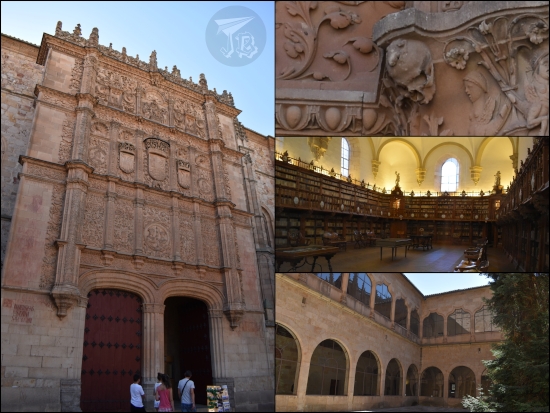
Afterwards, we headed off to the main university building Universidad de Salamanca, the first university building. The university was founded by King Alfonso XI in 1218, which makes it the oldest university in the whole Spanish-speaking world. The most important building today is the Escuelas Mayores, the upper school, built between 1411 and 1533. The façade, which looks towards the newly-discovered New World is sculpted in the Plateresque style, with a ton of decoration – and the most famous motif is the frog that stands on top of a skull. The university was built around a cloister for the students of old, and it has the most amazing library I have seen in a long while – selfishly (I’m joking of course) closed to the public. There is also a chapel and the classroom where the Spanish academic Fray Luis de León, who was famously jailed for four years, and picked up his lectures with “as we were saying yesterday”. The cloister has two floors since the 19th century, and in the centre there is a small giant sequoia (which I thought was a simple fir). There are chapels, and halls, and areas where university holds events.

Very ornate entrance to a building. there are two doors (four or five times as tall as a person) and the decoration, all carved in stone, is on top. Three floors of decoration, with columns and shields. A close-up shows a frog on top of a skull.

The problem with Salamanca is that the entries and exits of the building make you have to backtrack a lot (and the horrible street lights), but I love Gothic so I did not mind wandering around anyway. After the Escuelas Mayores, we went to another university building the lesser school or Escuelas Menores. Today, there is a cloister which dates from 1428 with a Baroque upper veranda. In one of the side halls there is a fresco panting that used to be in the library and that was moved over in 1950. The fresco represents a night sky was used in teaching.

Gothic patio and a suck picture of a fresco painting, showing stars and the representation of constellations

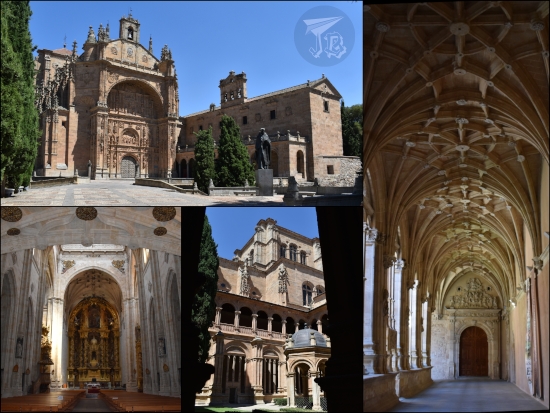
We had lunch, then we went to the Dominican monastery Convento de San Esteban and its church. The current monastery dates from 1524-1610, and it was built over the previous one. The façade of the church is considered the best example of Plateresque, and José de Churriguera also worked in the main altarpiece. The monastic building has a portico with Italian loggias, typical of the Renaissance. The cloister is mainly Renaissance with Gothic features, and a small temple in the middle. The ambulatory in the cloister has beautiful Gothic columns and nerves on the ceiling.

A convent, built in ornate gotic style. The covered corridor around the cloister shows pointed arches and rich decorations

Right in front of the monastery stands the Dominican convent Convento de las Dueñas. The building is Baroque, and before being a convent it used to be a palace – which has caused the convent to have some eclectic elements of architecture, such as the Mudéjar arch mosaic or doors. The inner cloister is Plateresque and full of roses and flowers.

A Baroque building. The inner patio is decorated with plants and Moorish-seeming blinded arches

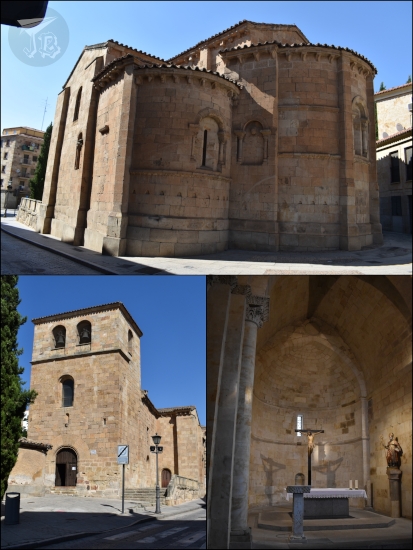
Next, we found the tiny Romanesque church Iglesia de Santo Tomás Cantuariense, where I happily sicced the oh-so-bored guide onto my companion.

Small Romanesque church in reddish-gold stone. It has a tiny bell tower.

After a stop for a cold drink we went to the Art Nouveau and Art Déco Museum Museo de Art Nouveau y Art Déco Casa Lis, which is one of those places that takes itself very seriously and does not allow photographs. I got scolded for having my camera to my side even closed – but I have to admit that I did sneak up a few things with the phone, mostly because I wanted a record of the central hall with the glass ceiling, and the green windows from the inside, more than the decorative details, though some of them were pretty nice. The Lis house was built by Andalusian architect Joaquín de Vargas towards the end of the 19th century for the first owner, Miguel de Lis.

A Modernist building with brightly-coloured glass in the ceiling and walls.

We headed to the main square Plaza Mayor for dinner, and then to see the pretty lights. On the way we found the other university Universidad Pontificia and the palace Casa de las Conchas, which we would visit the following day.

The main square was another of the city landmarks first designed by Alberto Churriguera, and later one of his nephews – it seems that the Churriguera family claimed dibs on doing stuff in Salamanca. The square is fantastic by day but when night fell and the lights were turned on, it was unbelievable. We had some local sausages and cheese for dinner at one of the street tables in the square.

A plate of sausages and cheese, and two views of the Main Square in Salamanca, one in daylight, one at night, and lit up. The square buildings have a lot of windows and arches on the ground floor

Afterwards, I wandered alone for a while, to revisit some of the sights at night, and a couple of new ones.

Salamanca at night. The cathedral is lit and the ornamets almost shine. The Modernist house is lit in green and blue lights.

I headed off to the riverside of Río Tormes, which as any river has bridges. The first one I found is the Puente de Enrique Estevan, commissioned in 1891 in order for the town to be ready for the new cars. It has six iron arches and at night it is lit in bluish light. A few minutes downstream stands the older stone bridge Puente Romano, which according to the legend was built by Hercules – it dates back to the first century, but it has been heavily rebuilt and reconstructed through the years, especially after it was damaged by a flood in the 17th century.

A collage showing an iron bridge, and a stone bridge, both lit in the dark

Finally, around midnight, I went back to the hotel for a shower and sleep.

Walking distance: 17269 steps / 10.76 km

10th July 2022: Reservoirs (Buendía & Entrepeñas, Spain)

I tried going for a hike because I was feeling cooped up, and tried to make the most out of the draught Spain is going through. The centre of Spain is sprinkled with large reservoirs, a lot of them built during Franco’s dictatorship as part of the efforts to get the country to recover from the war. The reservoir Embalse de Buendía is fed by the river Guadiela and it was finished in the year 1958. Before that, there used to be a bathing complex used by the royals, along with a village there. I have wanted to get there for a while, but it is tricky because the trail is reported to be in bad condition. So I decided to walk down the trail Camino de La Isabela to gauge whether my small city car would make it. Thus, think about this as a recognisance mission.

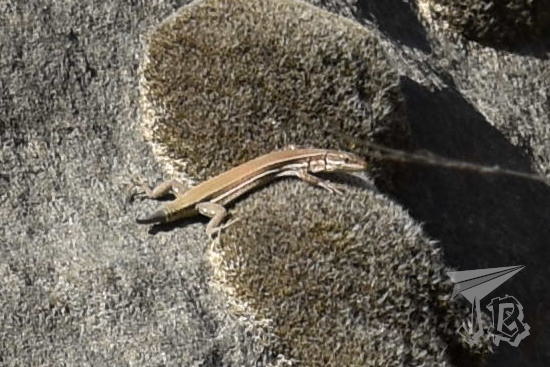
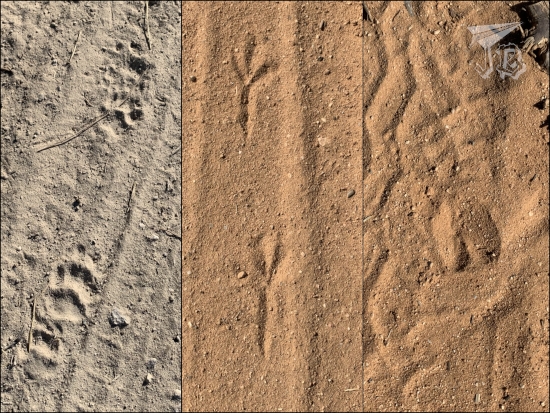
I parked the car at the beginning of the trail around 8:10 in the morning and started walking. I saw a small lizard which had shed off its tail, and some footprints – birds, canid, and I’m pretty sure a deer.

Close-up of a brown lizard which is growing its tail back.

Collage of animal footprints: paws, tallons and hooves

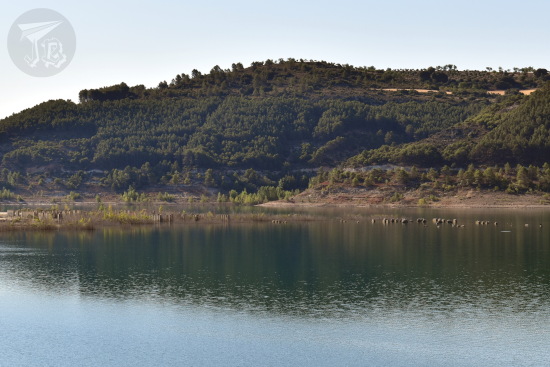
The temperature was nice at that time and I walked for about an hour until I got to the shore of the reservoir, then another 20 minutes or so until I got to see the derelict settlement. The water was still too high so I decided not to walk there.

A view of the reservoir. The sun is shining and there are some green / yellow plants ashore.

The reservoir. On one of the inlets you can guess the ruins, along with some columns that peek over the water.

I just hung out at the shore and found a bunch of dragonflies (I think Trithemis annulata, violet-marked darter (female and male), from a helpful comment on social media). Then I started walking back, because the temperature was rising fast.

A yellow and a red dragonfly.

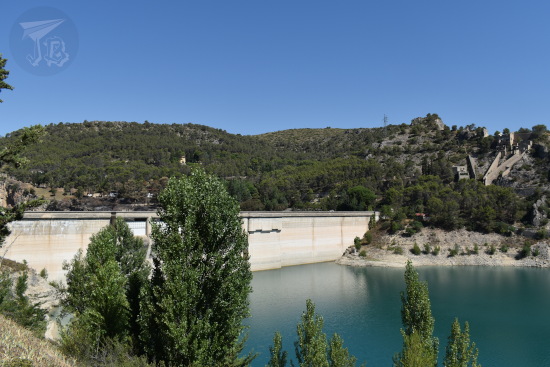
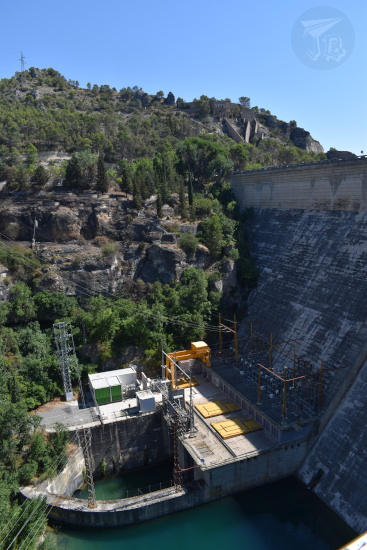
I made it back to the car around 11:00 and drove off towards a second reservoir in the area, Embalse de Entrepeñas. I have driven by more than a few times, and I would always be drawn to a little side road that seemed to overlook the reservoir. It is actually the beginning of a hiking trail, but it was already too hot to keep going. Instead, I peered around the actual dam and hydroelectric station.

A white-grey dam closes the reservoir. There are trees in the foregrond and the water looks almost turquoise.

The electricity power-plant that is fed by the water behind the dam. There are a lot of wires coming out at different heights.

It was too hot to do anything, the beginning of the heat wave, so I just drove off and made a stop to see some friends on the way. I’ll keep an eye on the water level of the reservoir Embalse de Buendía in case I can come back to the area, now that I’ve figured out how far I can reach with the car.

Walking distance: 16846 steps / 11.76 km

27th June 2022: One unexpected Aquarium visit. Zaragoza (Spain)

Because life is strange sometimes, I found myself travelling to Zaragoza in a super-slow train that took three and a half hours (while the high-speed train takes around one hour). It was somewhat of an emergency so we had to leave on Sunday in the late afternoon, and came back on Monday. We booked a hotel next to the station, one that had been built for the Expo 2008, and it goes without saying that the hotel had indeed seen better times.

My company was not required on Monday morning, so I walked towards the area that had been the Expo’08. I crossed river Ebro using the bridge Puente del Tercer Milenio, the longest concrete bow-string bridge in the world, designed by architect Juan José Arenas de Pablo.

Several views of Zaragoza's Millenium Bridge. It is white, arched in form, and the middle is held by a zigzag of wiring.

The north wind was blowing and it was a bit uncomfortable. Furthermore, the area where the Expo used to be was creepy. A lot of it was abandoned and / or fenced off, and even if they had tried to make it a park it just looked derelict and forsaken.

A collage of the parks, buildings and decorations from the former Expo 98. Everything looks derelict, with dry weeds growing where there used to be fountains. Interestingly, no windows are broken.

I looked over at the river Río Ebro. To both sides there were bridges – Pasarela del Voluntariado to the downstream to the left, and Pabellón Puente upstream to the right.

A panoramic from the river bank. There is a bird flying, the sky is blue and there are several clouds

Then I went to the river aquarium Acuario de Zaragoza, which prides itself in being the largest freshwater aquarium in Europe.

The aquarium is divided in five areas or rivers, organised surrounding a central freshwater tank called “World River”, where there are no sharks, but there are several arapaima (Arapaima gigas), one of the largest freshwater species of fish, up to 2 metres long.

Huge Amazonian fish swimming about.

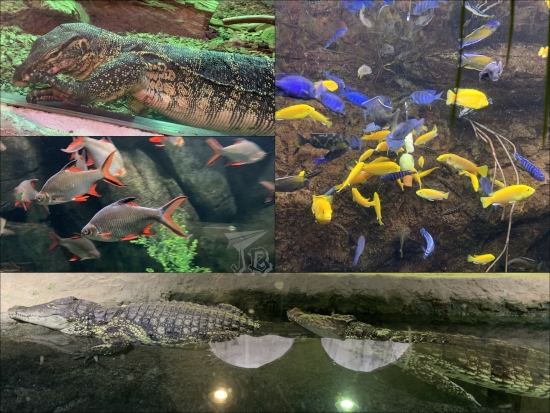
The first river is the Nile (Egypt). It included (obviously) a bunch of fish, a couple of Nile crocodiles (Crocodylus niloticus), a Nile monitor lizard (Varanus niloticus, which had somehow by the way figured out that it lived in an enclosure with a sliding door and… was trying to get it open), a couple of lungfish, perches…

Collage: a Nile monitor lizard, Nile crocodiles chilling, and colourful fish.

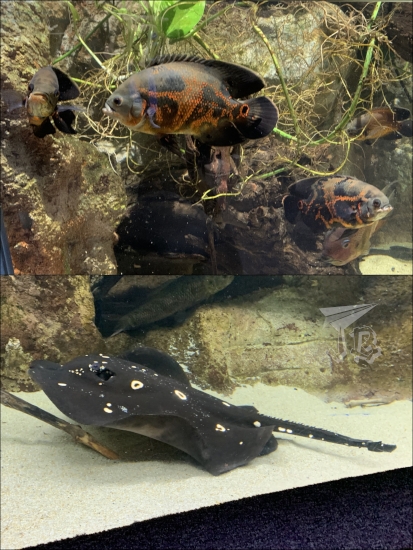
The second river is the Mekong (China), which is known for its giant fish – as a matter of fact, the largest freshwater fish ever was recently found there. There are also an insane amount of catfish – in the river, the aquarium has them under control. The most interesting thing about the Mekong is the freshwater rays.

Collage: Big orange-and-red fish, and a freshwater ray, which is black with white spots. It looks a bit like a pan.

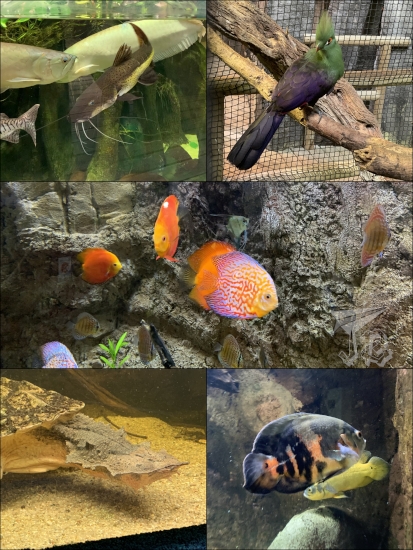
The third river is the Amazon (Brazil), which is the largest river ever, so there are three separate areas – the blackwater-flooded forest or Igapó, the forest itself, and the mangrove. The displays included Knysna turaco (Tauraco corythaix), which is the “only true red and green bird”, green iguana (Iguana iguana), catfish, red-bellied piranha (Pygocentrus nattereri), electric eels (Electrophorus electricus), anaconda (Eunectes notaeus).

Collage: black and white fish with whiskers, a green and blue bird silendly judging the photographer, brightly-coloured fish and something that looks like a rock but it's actually a weird turtle.

Then there is the Darling-Murray river (Australia), which must be saltier than I had expected, because apparently clownfish (Amphiprion ocellaris) and anemone (Entacmaea quadricolor) packs, and seahorses, along Pearl arowanas (Scleropages jardinii), tree frogs (Litoria caerulea), and the supercute (I think it was a) nobbi dragon (Diporiphora nobbi)…

Collage: A lizard, quite unamused; a clown fish hiding behind an anemone

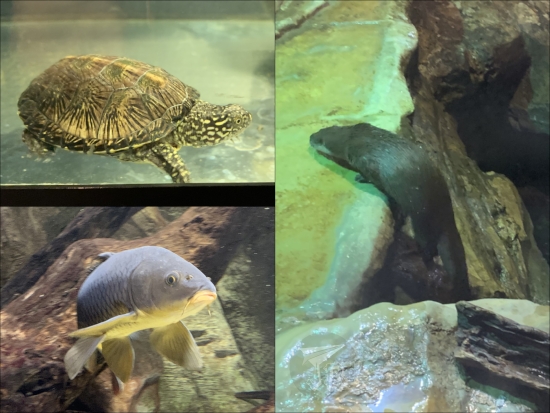
Finally, there’s the Ebro river, the local one. There are the endemic barbs (“barbo de Graells” Luciobarbus graellsii), the local otter (Lutra lutra) and sturgeons (Acipenser sp.).

Collage: a turtle, an edible fish, and a blurry otter that would not stay still for a picture

Throughout the whole run there are hundreds of turtles – the aquarium runs a turtle rescue scheme in order to get abandoned pet turtles out from the rivers, mostly the pond slider (Trachemys scripta).

I saw some of the old Expo’08 mascot, and some people diving in the central tank – I don’t think I’d go into a tank with the arapaima, even if they were swimming near when I was feeding the manatee in Faunia. There were also some animals that had been rescued from illegal trade and donated to the aquarium.

After the aquarium, there was only coming back in yet another train that took over three hours. It was the weirdest trip I have ever taken…

31st May 2022: Anaga {Tenerife, birthday 2022}

I got up on the early side as I had booked breakfast at 8:00. I was surprisingly not hungry, even if I had not finished dinner the previous evening. My plane was a little before 17:00 and I had to return the car at 13:30 (I must have messed up the time, because I was convinced I had chosen 14:30). however, there was still one spot in the island I wanted to check out – the Nature Reserve Parque Rural de Anaga, in the north of the island and about half an hour’s drive away from the airport. This is a mountain area covered in primitive subtropical moist broadleaf forests, called laurisilva canaria. The mountain range is the oldest part of the island of Tenerife.

During the Tertiary Period, the whole Mediterranean area was covered in forests which had wide, dark leaves. They disappeared with the glacial era that started with the Quaternary. The forest has not changed nor evolved with time, so it has remained as it was 40 million years ago. It was preserved in several humid areas due to the wind patterns while the continents dried out and deserts opened. Sometimes, these forests are called laurel forests, as laurel (Laurus novocanariensis) is one of the typical plants. There are other trees as tils (Ocotea foetens), bushes, vines, ferns and mosses.

I drove around two hours to get from the Parador to Anaga, and was lucky to snatch one of the last parking spots. I asked at the visitor’s centre about a route that was not too long and I was recommended a two-hour one, called Bosque de los Enigmas, the Enigma Forest.

The beginning of it was really cool. The tils and the laurels twisted almost magically and I was alone on the path. I saw some birds, though capturing them on camera was hard, possibly a grey wagtail (Motacilla cinerea) and a female blackbird (Turdus merula; which is not really black). Aside from being a nature reserve, Anaga is also a bird protection area.

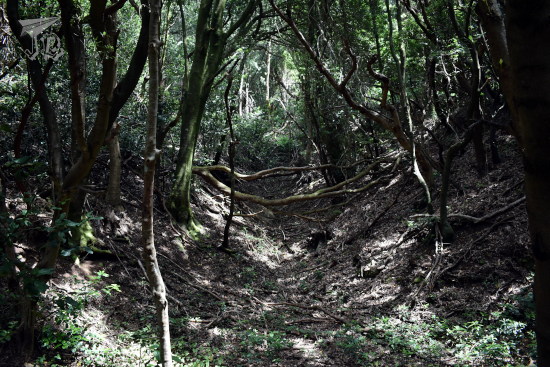
A path into the primitive forest. The trees curve over and around the trail, and everything is dark

A shot up a tree, the trunk is covered in moss

An old waterway or river bed turned into a path. There are walls of dirt to the side, and the roots of the trees are showing

Collage: a grey fluffy bird looking at the camera, and a black one with its back turned, completely ignoring it.

At some point, unfortunately, I lost the trail. I reached the viewpoint Mirador de Zapata going in the wrong direction. Though the weather was very appropriate for an evergreen subtropical forest, this meant that I could either backtrack, or go along the road for a while. I decided on the side of the road as that way I knew how long I would take to reach the parking lot.

A view of the tree tops from above. In the backgrond, partially obscured by the thick fog, there is a village, and the sea is beyond it.

I eventually reached the beginning of the trail again and I had not been run over a car, which was a plus, and before leaving I could look over a second viewpoint Mirador de la Cruz del Carmen, which offers a peek onto the whole massif.

Traces of water runoff paths, which have eroded the soil and torn some trees down

A view of the tree tops from above. In the backgrond, partially obscured by the thick fog, there is a village, and volcanic mountains beyond it.

After this, I drove back to the airport to turn back the car and have some lunch. I had hoped that the smaller airport would be less strict than one of the big hubs, but it turned out they were even more vigilant. So off with the shoes again. We took off at the brink of time, landed at the expected hour… and on the way back home got caught in an hour-long double traffic jam. Ho boy!

All in all, nothing really went according to plan, even if the plans were just a draft. But all in all I had a good time and got to spend some time with myself, which I desperately needed. So yay luckiest unlucky trip ever!

30th May 2022: The Slopes of Mount Teide {Tenerife, birthday 2022}

Due to the amount of near-misses, I had started thinking about this as the luckiest unlucky trip in a long time. Unfortunately, this was the day the luck ran out. As I woke up and turned on the phone I received the notification that the cable-car to go up Mount Teide was closed due to bad weather, which was a bit of a blow. I mean, I was in the middle of the natural park, without anything to do within a couple of hours by car as the hiking trails are closed on Monday mornings as it is then when the mouflon population is controlled – using rifles. I did not want to end up shot.

If you consider that the island Tenerife is one big volcano, Mount Teide is the most famous eruptive fissure. Considering it an independent item, it is a stratovolcano. The cone stands around 7500 metres from the sea floor, with an emerged 3715 m above sea level. Its base is located on a previous crater called Las Cañadas. Mount Teide last erupted in 1909, so it is still considered an active volcano, and it hosts a bunch of towns on its slopes, that might get obliterated in an eruption. Aside from being a National Park, the area is a Unesco World Heritage Site.

Historically, an eruption was reported by Christopher Columbus in 1492. Most recent eruptions happened in 2805, 1798 and 1909. Looking back, Mount Teide formed around 160,000 years ago, after the collapse of Las Cañadas. The last summit eruption happened in the 9th century, which caused the black lava blocks that seem to run down the slopes.

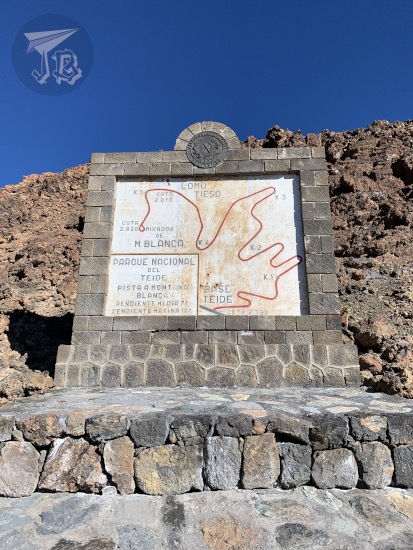
The whole point of my being there was going up the mountain, so I resolved to try and do that. I knew there was little chance I could make it to the top even with the access permission, but I would try. I decided to gamble the track Sendero de Montaña Blanca, which is the most typical one. For this, I had a good breakfast and started walking around 9:45 am. The track runs 8 km and starts at an altitude from 2348 m. If you have the permission, you can access the track Sendero de Telesforo Bravo that peaks the volcano at 3718 metres.

A stone and tile marker, with a map of the trail.

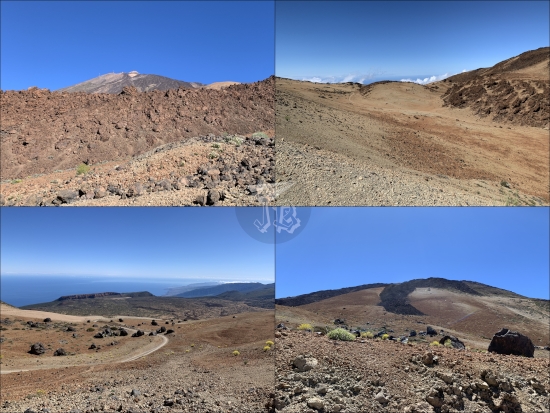
The first part of the morning, I spent on Montaña Blanca. I hiked around 3 km upwards in an hour or so. A park ranger told me that the bad weather was actually strong winds and to be careful. I’d never hiked with wind, so I decided that I would not do anything stupid. As I walked, I went by the accretion balls affectionately called “Teide Eggs” Huevos del Teide.

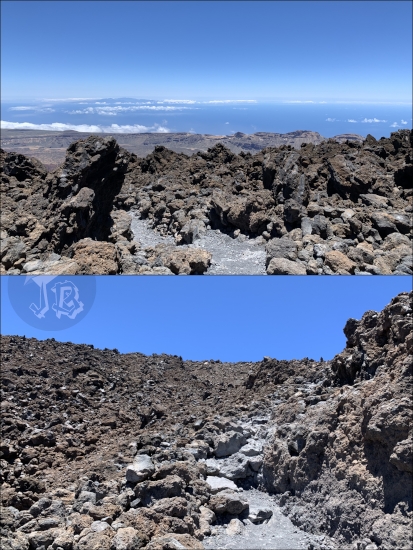
Collage: The Montaña Blanca trail. The landscape is desertic, reddish and brown, and there is barely any vegetation. When turning back, the sea peeks in the distance, and when looking up there are black rocks from an eruption.

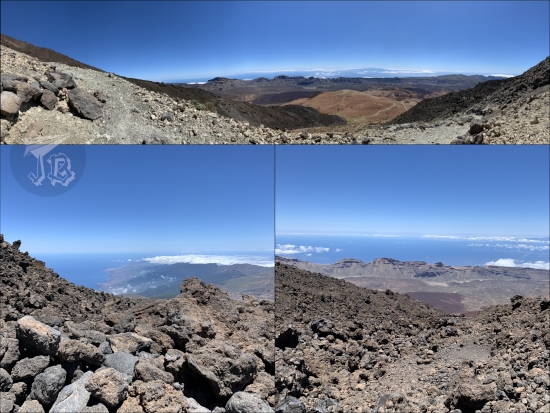
Eventually, I reached the actual foot of Mount Teide, and this is when things got hard – and spectacular. The slope became much steeper and the wind made it hard to move forward. I walked between the two dark petrified lava flows, and could see Montaña Blanca and the Atlantic Ocean beneath.

View from the slope of Teide. Montaña Blanca is underneath, in red-gold. To the sides, the black and dark grey rocks trailing the old lava flows

I reached Refugio de Altavista at 3260 m around 14:00. At this point I was two kilometres away from the next station and 650 m away from the crater. Unfortunately, the elevation was still around 500 m. At this point the wind was very strong and shortly after the refuge I saw an area of the slope I knew I could climb up… but I knew I wouldn’t climb down with such strong wind, not safely. So I realised I had to turn back, even if that meant I wouldn’t see the peak, much less reach it. However, it was the sane thing to do.

Standing in the middle of the two solidified coladas - looking down there are black and grey rocks, and the sea in the horizon. Looking up, only more rocks.

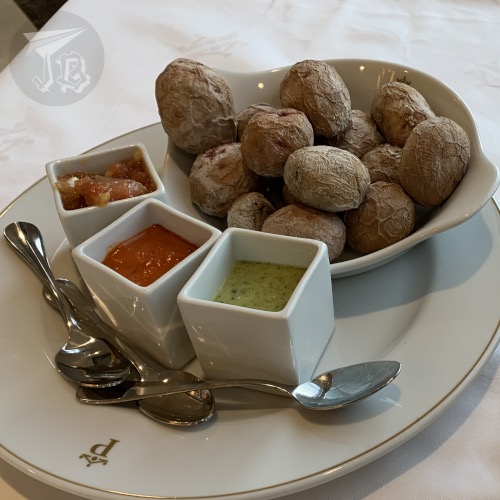
It took me two and a half hours to hike down, and I made it back at the Parador around 17:30. I had a shower and I felt tired, though not as sore as I imagined. For dinner, I tried some local speciality “wrinkled potatoes” papas arrugadas, which are boiled in saltwater, and they are so high-class that can be eaten without being peeled. They come with some dips, a bit too spicy for my taste, but they were delicious.

Small voiled potatoes and three small bowls of sauces. The potatoes are unpeeled and they look wrinkled.

I was a bit bummed that I did not manage to reach the crater, but I think I did a good job, almost 1000 metres up and down. I guess it just meant I had to go back at some point…

29th May 2022: La Orotava, Icod de los Vinos & Parque Nacional del Teide {Tenerife, birthday 2022}

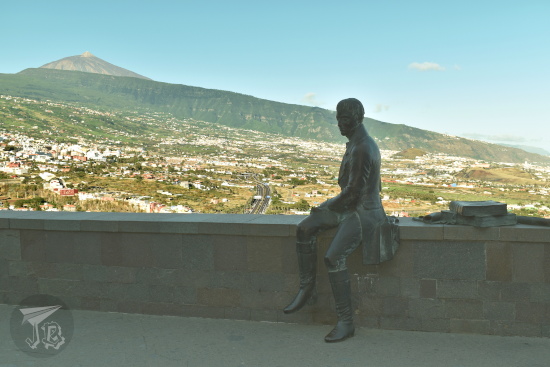
I got up rather early in the morning (especially considering that the Canary Islands are an hour behind my usual time zone) and I was surprised at how many people there were already on the streets of Santa Cruz de Tenerife before 8:30 on a Sunday morning. I drove out of the town and headed north-west, where I came across my first stop – a viewpoint of Mount Teide called Mirador de Humboldt honouring the German explorer from the late 18th century (though I kept thinking that there was a missing penguin opportunity there). The viewpoint overlooks the ocean and Mount Teide, which Humboldt climbed in 1799.

Mount Teide, a volcano, looms in the background. The top is bare and barren, but the slopes look green and fertile, with plantations and some villages. In the foreground, there is a bronze sculpture of Alexander Humbolt, sitting on the low wall of the lookout, and looking to the side.

I continued driving towards La Orotava, the municipality which Mount Teide actually belongs to. After parking the car, I walked towards the historical centre and ended up at the square Plaza de la Constitución, which stands next to the church Iglesia de San Agustín. Mount Teide loomed over the streets, ready to celebrate Pentecost Sunday. And guess what? The main church is called… Parroquia Matriz de Nuestra Señora de la Concepción. The initial hermit church was built in the 15th century, and it was completely rebuilt in the Baroque style throughout the 18th century, though the interior was remade in the 19th century and there was yet another renovation in the 20th century. It is considered the most important building of the Canarian Baroque.

A collage of La Orotava. The buildings are built with white plaster and black volcanic rock. Mount Teide peeks from the background.

The most representative construction in La Orotava is the “house of balconies” Casa de los Balcones. The house was built in the 17th century. The façade shows a front-long balcony on the third floor, and five smaller balconies on the second, all of them made from dark teak wood. The interior holds a museum, but I decided to give that a miss because I reached there at the same time as a very disorganised group of forty or fifty people who were going in at the time.

A colonial house. It is built in white brink. It has three floors. On the ground, there are brown windows. On the first floor, five balconies, with decorated ironwork. On the second floor, a long balcony or gallery in dark wood.

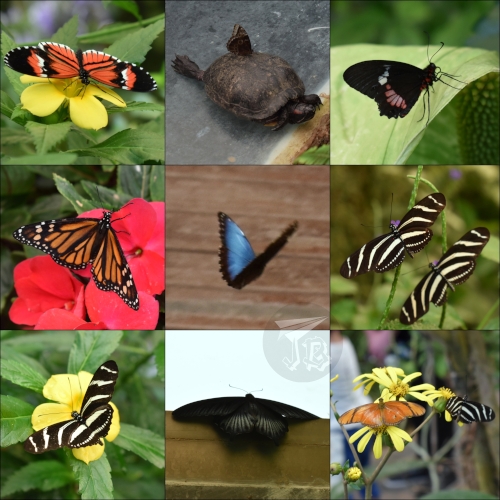
Instead, I went back to the car and drove towards Icod de los Vinos. There, my first stop was the butterfly house Mariposario del Drago, since the ethnographical museum Museo del Guanche is closed.

A collage showing colourful butterflies - red, orange, blue, black, black and white. One of them is chilling on the shell of a turtle, and another one is caught mid-flight. Most are on flowers and plants.

The butterfly house stands next to a botanical park Parque del Drago built around the symbol of the town – and maybe the whole island – the Drago Milenario. This is the largest and oldest specimen of Canary Islands dragon tree or drago (Dracaena draco). Folklore says that it is a thousand years old, hence the name “the thousand-year-old dragon tree”, though in reality, it is probably around 600 years.

The dragon-blood tree. It has a knotted grey trunk and bony branches. Around it there are bright-green palm and laurel trees

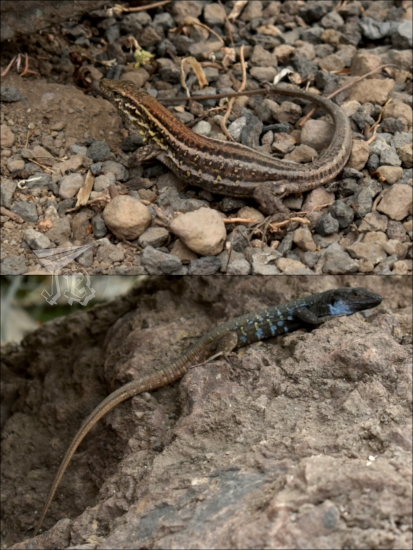
The park, built around the drago, holds local species trying to reproduce the local biotopes with height, there is also a small volcanic cave. It was here where where I managed to catch my first glance at the local fauna – two of the endemic lizards (though not as big as the one I had seen in the museum): lagarto tizón (Gallotia galloti) or tizon lizard, a blue-spotted male and a brown-striped female.

Two lizards. One camouflages on the grey and brown ground. The other on has a brown tail, but the body is black and bright blue

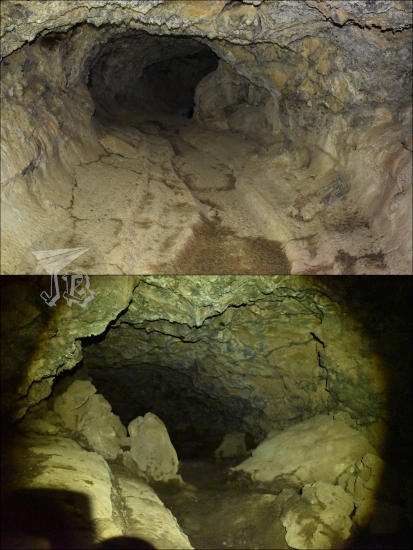
Then I went back to the car to climb up a crazy slope until I reached the visitors’ centre of the lava tube Cueva del viento. A lava tube is a “cave” formed the flowing lava of a volcano. As the outer part solidifies, the inner core continues flowing until it empties the tube. The guided visit is the only way you can enter the tube, so I had reserved that a few weeks earlier.

The visit started with a small introduction in the visitor’s centre, with a lot of “gotcha” questions on the guide’s part. I tried really, really hard not to be a smartarse, but I did sit down on the floor at a point because I did not feel like standing around for twenty minutes. The important information we received was that there were two types of lava that had formed the island of Tenerife: pahoehoe and block lava.

Then we took the centre’s vehicles to the outer area of the cave, where we could see the solidified lava, now turned into stone. Pahoehoe lava is basaltic, it flows slowly, and it is the responsible for creating the tubes. As it flows and solidifies, it creates undulations and wrinkles. On top of it, only small trees and bushes can grow.

Old Pahoehoe lava trails. The rock looks wrinkled or similar to pillows.

Block lava is more acidic, with a higher silica contents, it flows less and creates “blocks” as it solidifies. Pines can be found growing on top.

Pines around an old colada, which seems rocky and broken.

The cave itself was very cool. Unfortunately, there were a couple of families with kids and grandparents, all trying to be braver than the next – and thus acted loud and boisterous. More interesting information – mummified guanche aboriginals had been found in the cave, along with remains of a giant rat and lizard that were the ones reproduced in the Museo de Ciencia y Antropología de Tenerife. It is one of the biggest lava tubes in the world, with up to three levels and maybe 18 km of tunnels, though only a short walk can be had.

Inside the lava tube. It looks alien, like the rock is going to start dripping any second

Back in the parking lot, I had a snack and headed off towards the Parador de las Cañadas del Teide, where I had booked my next couple of nights. On the way, I went through several amazing volcanic landscapes that I could not photograph as I was driving. However, I did stop at several lookouts throughout the Parque Nacional del Teide.

Mirador de Samara.

Pines growing up on the dusty remains of a lava flow. In the background, there are three mountains - three craters of the same volcano

Mirador de las Narices del Teide, which shows the collapse on the mountain during the last known eruption.

A view of the black collapse of lava from the last eruption. Everything is barren, brown and grey, except for a black spillage coming down ominously. The sky is blue in the background, which makes the whole thing look even more bizarre.

Mirador Zapato de la Reina.

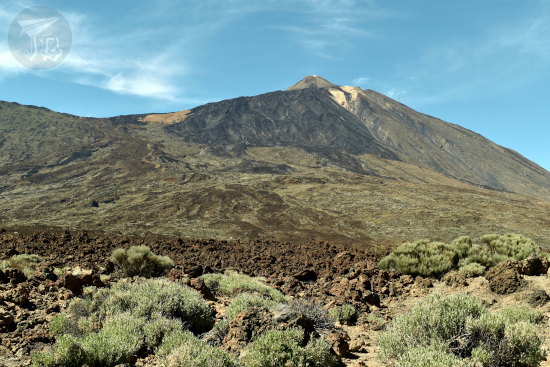
The top of Teide. This is the point where vegetation has become scarce, with low bushes, that creep up the slope. The summit looks naked.

Finally, I arrived in the area of Las Cañadas del Teide or Las Siete Cañadas where the Parador de las Cañadas del Teide stands. I was lucky that the season was good to see the flowering bugloss Echium wildpretii (tajinaste in Spanish), an endemic flora species mostly found on the Teide slopes. After checking in I wandered around the different tracks and paths – Cañada Blanca, Roques de García and Mirador de la Ruleta, which show the different stages of various volcanic eruptions.

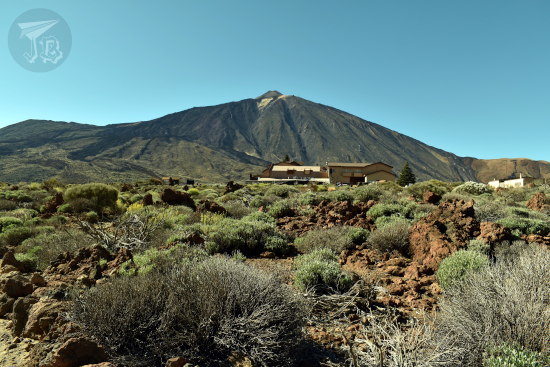
Mount Teide rises in the background. It looks wrinkled due to the different eruptions. At its foot, a low building, looking completely out of place. In the foreground, small bushes in grey and green.

Collage: Different rocks and structures created by lava and erosion, the rocks are reddish or grey, and they have weird shapes. The tajinaste is a tall bush, with tiny red flowers, it stands about 1m above the rest of the plants.

I turned in early, and I had booked my dinner in the Parador both nights I’d be sleeping there, so that was an easy one. The staff made it a little awkward though, even if I was not the only solo traveller around. After dinner, I tried to get some pictures of the night sky, but I was unsuccessful.

28th May 2022: San Cristóbal de la Laguna, Bajamar & Santa Cruz de Tenerife {Tenerife, birthday 2022}

I had a four-day weekend that happened to overlap with my birthday, so I decided to get myself a present and I booked the four days out – I wanted to visit the Spanish island of Tenerife. I seemed to have a streak of luck finding a decent flight, a couple of good hotels and a free permission to visit the peak of Mount Teide, a non-extinct volcano that happens to be the highest peak in Spain. I also decided to rent a car for the first time so I could travel around the island and do different activities in different places.

The plane left on time at 8:15 on Saturday – and I have to say that I love my IKEA travel bag, because it has a huge capacity but the perfect size to place under the seat, therefore I do not need to queue up for boarding to make sure I can stow the carry on. We taxied at the correct time, but when we got to the runway, we stopped. It turned out that one of the sensors was giving a warning of a 400 ºC temperature on one of the wheels. It turned out to be a false alarm, but we ended up with an hour-long delay that ended up cascading.

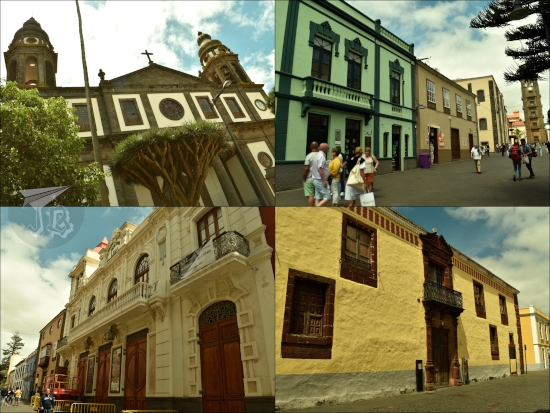
I reached the airport and got my rental – Volkswagen Polo I had to learn how to reverse. Once I was done with that, it was surprisingly easy to get by. I drove off to San Cristobal de la Laguna and went off to visit the historic quarter, which is a Unesco World Heritage site as an example of colonial architecture – Centro Histórico de San Cristobal de la Laguna. Most of the buildings date back to the 15th century, and the design was then copied in different colonial cities in South America. The houses are painted in different colours and most of them sport amazing woodwork in their doors or balconies.

It gave me a pretty distinct “Disneyland” feeling as the pedestrian streets are plagued with cafés, brand shops and bars. It was packed with tourists like myself flocking in guided tours from the tourist office, which seemed to only open to gather groups in order to hold those tours. As the week before my trip had been work-crazy, I had not been able to plan in detail, so my plan was to hit the tourist office, gather information and move on. This did not work out, and on top of that, the cathedral Catedral de Nuestra Señora de los Remedios was already closing down when I arrived – due to the delay. Other interesting but closed buildings included the church Iglesia Matriz de la Concepción, and several palaces including Casa de los Capitanes and the reconstructed Palacio de Salazar.

Typical buildings from Canary Islands. They are colonial in style, with big doors and windows. The façades are painted with different colours.

Typical buildings from Canary Islands. They are colonial in style, with big doors and windows. The façades are painted with different colours. The streets are wide and full of people.

I’m not going to say that I was disappointed, but I was really not digging the atmosphere, so I decided to move on. Instead of following the initial rough plan, I decided to head off to the tiny village of Bajamar to see the “sea pools”. Built in the petrified lava coast, the Piscinas de Bajamar are swimming pools fed by ocean water that keep swimmers safe from the rocks and the waves. I was lucky enough to find a very good and easy parking spot.

I wandered around the promenade Paseo Marítimo de Bajamar, saw the pools, the beach, and the mini lighthouse Faro de Bajamar.

Waves coming into the volcanic beach, which does not have sand but big black blocks of rock.

I moved onto Santa Cruz de Tenerife afterwards, ditched the car and checked into the hotel, then went off to explore. I walked by the market complex La Recova, also called Mercado de Nuestra Señora de África.

A bright orange building. It has a low, wide wall, and in the centre a clock tower

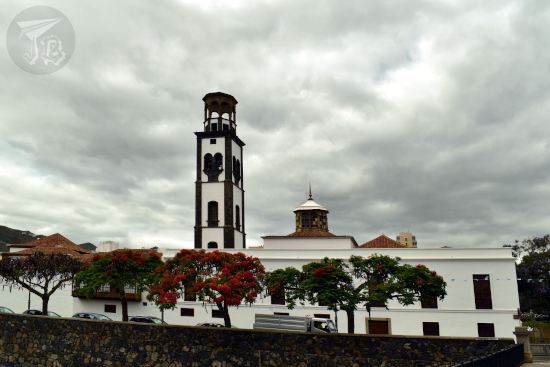
The tower of the church Iglesia Matriz de la Concepción (yes, again, but another one). The church has been repeatedly rebuilt and renamed between the 15th and 18th centuries. The current building is Canarian Baroque / Tuscan style.

A church with a bell tower. The building is white clay with black rock; this style is typical in the area

My first real destination was Plaza de España where the defensive castle Castillo de San Cristóbal used to stand. Now there is a fountain / pond and you can see the foundations of the castle.

Collage. The former site of the castle, now converted into a fountain or lake. On the other side, the castle foundations, and a cannon.

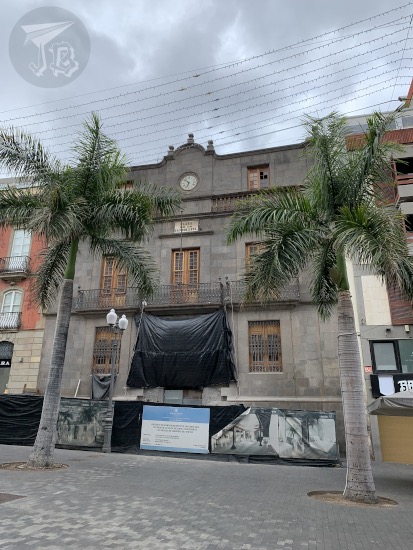
Next, I found another important square, Plaza de la Candelaria, but it was unfortunately under construction.

A grey building with construction work being done on it

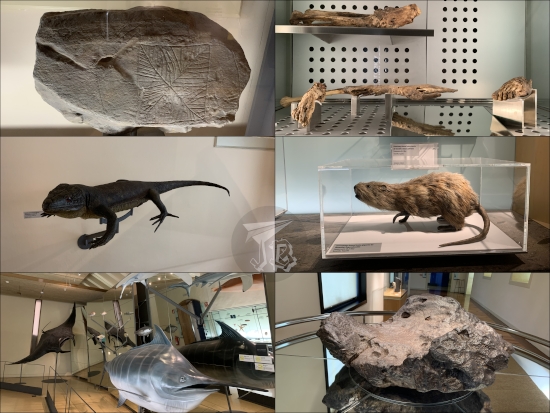
So I moved on to the science and anthropology museum Museo de Ciencia y Antropología de Tenerife. It was rather underwhelming at first, as most of the “exhibit” were photographs. Eventually I reached the “good” stuff, with reconstructions of ancient and extinct animals such as the Tenerife giant rat (Canariomys bravoi) and the Goliath Giant (Gallotia goliath) lizard – we’ll come back to those eventually. There were butterfly collections, reproductions of marine animals, rocks and meteorites. In the archaeology ward there were mummies – that was a little unnerving to be honest, I thought we had learnt a little more respect about the ancient cultures.

Before the Europeans arrived in the Canary Islands in the 15th century, there was a previous civilization in Tenerife, called the guanche. The guanche settled in the island around the 6th century. While it is not clear where they came from it is thought that they came from the north of Africa, as their language was similar to those in the Berber language group. They lived off the cattle and the land, and their economy was clearly based on the goat, which they used for everything – food (meat and dairy), clothing, bone tools, and mummification material.

Collage of the museum: a prehistoric carved rock; preserved giant rat and lizard; models of fish; a meteorite; rests of mummies (a foot and an arm)

After the museum, I walked along the harbour and saw the modern concert hall Auditorio de Tenerife, designed by the famous architect Santiago Calatrava, whose style is easily recognised – even though in recent years he has drawn criticism for going way beyond budget and his building having problems due to “over innovation”.

The auditorium. It looks like the sail of a yacht, all white.

A few steps further stands the tiny fortress Castillo de San Juan Bautista, built between 1641 and 1643, and rebuilt the following century. I would have loved to see the botanical garden, but it closed early – as most things seemed to do.

Small castle surrounded by a moat that fills up in high tide.

I took a small detour to see the former arsenal Casa de la Pólvora, built in masonry in the 18th century. Eventually, I went to the supermarket to buy some dinner and snacks for the upcoming adventures, and called it a day after 14 hours on the go.

Armourine building. It looks like a treasure chest, built in grey rock

13th – 15th May 2022: Paris (France) & Saint Seiya Symphonic Adventure

This has been a weird ride in more ways than one. Back when we did not know what kind of hell was breaking loose in Wuhan, I went to Paris for a couple of concerts with the idea of coming back in a few week’s time. Instead of that, Covid turned the world upside down. Four postponements later, and a stupid amount of money I am not even going to calculate, I finally set off to Paris, France, once more, to watch the Saint Seiya Symphonic Adventure. The concert that was supposed to happen on the 18th of April, 2020 finally took place on the 14th of May, 2022, and the promoter handled the postponements pretty badly, which led to a lot of people returning their tickets at some point.

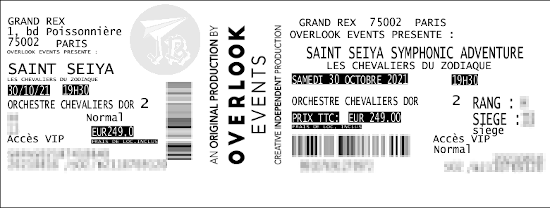
Ticket. Frand Rex 75002 Paris, Overlook Events Presente: Saint Seiya Symphonic Adventure. Les Chevaliers du Zodiaque. Samedi 30 Octobre 2021, 19:30 h. Orchestre Chevaliers Dor. Eur 240,00. Accès VIP. The rest of the information is blurred.

Corny and problematic as it may be, Saint Seiya [聖闘士星矢] was my favourite anime as a child – it was exciting and my parents heavily disapproved of it, the perfect mixture for a pre-teen finding their place in the world. In December 2019, I do not even remember how, I came across the information about the event, described as a fully-immersive live-to-picture symphonic concert with the music from pop-culture […] synchronized to cutting edge video screen, lighting and special sound effects. Similarly to the recent Final Fantasy Remake concert, the idea is an orchestra concert with the original singers for some of the musical pieces, along with projections of the original cartoon. Overlook announced an afternoon and an evening concerts. However, by the time I found out that the event had been planned, tickets had been on sale for a while. I managed to get a fairly decent ticket for the afternoon concert, but and a very bad one for the evening concert as part of Christmas sales (which meant I got both tickets for the price of the normal “good” afternoon ticket). At the time, I was ecstatic, as you may guess, though a tiny bit bummed I had not learnt about the whole thing in time to get some VIP tickets.

Enter Covid-19. One postponement led to another, and then another. At some point in late summer 2021 I entered the ticket page for something, and I could not believe my eyes – someone had returned one of the second-tier VIP tickets, and… I got that one. I seriously could not believe it. One of twelve (with the name of one of twelve characters of the show), it came with goodies, access to the rehearsal, and the autograph session after the show. So I now had a good ticket and a fantastic ticket!

Then the event got postponed again, barely three weeks before. I was… miffed. Eventually though, the promoter got in touch with me and I was assigned a character, I bought plane tickets (again), booked a hotel (again – in this case I booked two, one at the airport and one near the theatre), and… held my breath.

When the Japanese singers arrived in Paris, I realised that it was finally happening. And thus, I booked my airport parking ticket and… held my breath again. Iberia’s check in gave me trouble, but I eventually managed to get my boarding pass (I could check in on the webpage, but only get my boarding pass from the app), and fill in the passenger form to get into France.

The plane left late on Friday evening, and it was a long weekend in Madrid, so I left with time – a lot of time. I learnt two things: one, my planning skills are awesome, and two, my car has run out of air-con gas, as I got caught in a bad traffic jam, and yet somehow I arrived within five minutes of my expected entrance time. The flight to Paris was stupidly uneventful and I was surprised at how nicely the security personnel actually behaved.

Upon arriving in Charles de Gaulle I walked out of the plane into the bus and then to the terminal. There was no kind of health check whatsoever, so I could just walk up to my hotel, which was strangely bustling for it being near midnight.

14th May 2022: Paris & Grand Rex

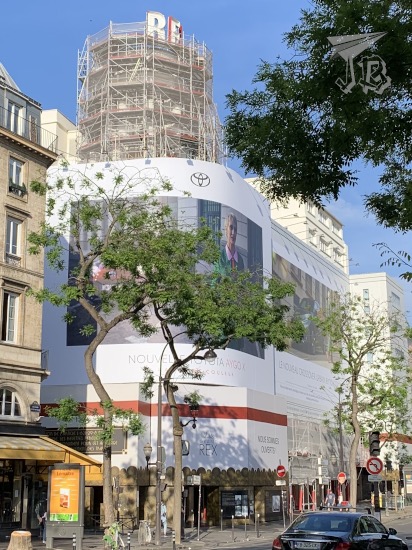
The organisers had sent me an email that I had to be at the Grand Rex theatre at 10 a.m. in order to pick up my goodie bag. It turned out that the email was wrong, and I was not to be there till 11 a.m. The Grand Rex is an art decó building which, like a bunch of things I saw, was under renovation.

Outside the Grand Rex. It is only a huge scaffolding as the façade is being renovated.

Throughout all the waiting for the different sessions I took a few strolls around the area of Grand Boulevards after dropping off my luggage at the hotel. I ambled round and saw two smallish triumph arcs – Porte Saint-Denis and Porte Saint-Martin.

Two monumental gates in the middle of crossroads. The traffic is horrible.

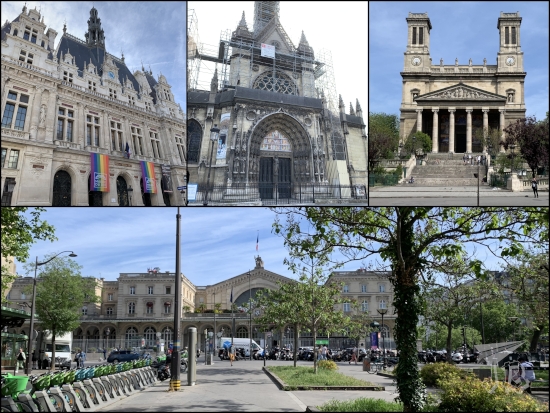
Also around the area are Mairie du 10e arrondissement, a Renaissance Revival public building, Église Saint-Laurent (Church of Saint Lawrence), a gothic chapel which was also under reconstruction, Église Saint-Vincent-de-Paul (Saint-Vincent de Paul Catholic Church). A bit further away stands Gare de l’Est, one of the six large stations in Paris.

Some buildings, including a gothic church, a neoclassical one, and a 19th century train station.

At 11:00, I finally got into the Grand Rex to watch the rehearsal, which lasted about an hour. I had been lucky to find a staff member who spoke English as I was apparently the only non-French-speaker in the VIP group, and he told me that the artists would come to say hello after the rehearsal. He added that as everything would be French and Japanese I’d be lost. I replied that I had better Japanese than French anyway. After the rehearsal we got to wave hello to the two Japanese special guests – popster NoB (Nobuo Yamada) and soprano Kazuko Ishikawa.

The staff member was very proud to point out the “Spanish person who had come from Spain” to the Japanese staff. Nob said “gracias” to which I replied in Japanese – the standard “we are looking forward to the act today”, which I guess threw everybody off a little, and got me an also standard “nihongo joozu” (you are good at Japanese” that the Japanese tell you when you’ve thrown the curveball of talking to them in their language. At this point, I became noticed.

I left the theatre for a while and came back for the first concert, which started late. The venue was rather empty, and during the break a bunch of people tried to parachute into better seats. I saw some other VIPs who had gotten a complimentary seat. As the lights went out the only thing that went through my head was “I can’t believe this is finally happening” again and again and again.

The inside of Grand Rex. The stage is a great arch with the words Saint Seiya Symphonic Adventure projected on a screen

But it was happening. The recital was divided in two acts – the first one aligned with the first arc of the anime, and the second with arcs two and three, what is call the “classical anime” as the final act was not animated up until a couple of decades later.

ACT 1
Opening
Pegasus Fantasy
The Galaxian Wars
Hyoga and Crystal Saint
Silver and Gold Saints
Zodiac Temples Part I
Ikki’s Wrath
Zodiac Temples Part II
Victory of the Heroes
Eien Blue

ACT 2
Saint Sinwa ~Soldier Dream
The Seven God Warriors
The Fury of Asgard
The Odin Sapphires
Yume Tabibito
Poseidon’s Lair

ENCORE: Pegasus Fantasy

Bluntly put, I loved it, but mostly because of nostalgia. The first one was better than the second, but there were issues with the sound, and the microphones, and at times the orchestra complete swallowed the vocals. The conductor was hilariously into it, bouncing in his platform. The harp was fantastic, and the soprano spectacular. NoB, the pop singer… is showing his age, but did a decent job of getting the audience hyped-up.

The orchestra on the stage. Images from the anime are projected on the screen.

Another of the guests was the voice actor who played the main character in the original French anime version, and boy did he bring down the walls. People absolutely loved him. To be honest, I was rather surprised at the audience’s attitude towards the whole thing, with clapping and yelling and – among everything – parachuting to better seats. I wonder whether this last thing is usual or just due to the stalls being rather empty (after all there was “free seating” in the first-floor paradise).

I went to the hotel between the first and second concert to retrieve my things and get some rest, but eventually I got back to the theatre. There were more people this time around, and my seat was undoubtedly better. It was there when I got “adopted” by the high-class VIPs, who had been very amused at my having been “lost” and then surprised at the fact that yes, I could speak some Japanese. Thanks to them I found my way to the signing session and got my programme signed by both NoB and Kazuko Kawashima. I did trip over my Japanese there, but I should have known I don’t do well trying to learn new words just before post-concert signing sessions.

Merchandise included in the VIP ticket: mug, t-shirt, posters and booklet, all with images from the Saint Seiya anime

A close up of the booklet - showing the signatures of the singer and the soprano, and the VIP badge.

15th May 2022: Angels, Unicorns and Organ Music

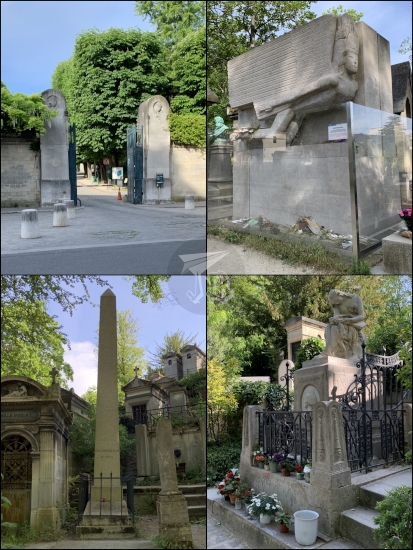
I checked in early in the morning and I fought the Paris Metro system to a) find an entrance where I could buy tickets and b) make the machine work so I could buy those tickets. My first destination was the largest cemetery in Paris – Cimetière du Père-Lachaise. This early 19th century cemetery holds the remains of personalities such as Oscar Wilde, whose grave is protected by a glass wall as it became a fad to put lipstick on and kiss it, which was damaging it; the grave looks like a Babylonian bull or angel. Another grave I wanted to visit was that for Jean-François Champollion – the man who discovered the Rosetta stone, whose tomb looks like an obelisk. And after some wrong turns I also found Frédéric Chopin (minus his preserved heart, which was taken to Poland); this tomb features Euterpe, the muse of music, crying over a broken lyre.

Graves at Père-Lachaise: a flying Babylonian angel (Wilde), an obelisk (Champollion), a muse weeping on her lyre (Chopin).

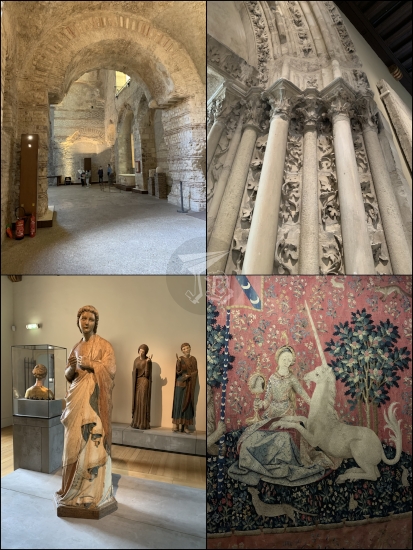
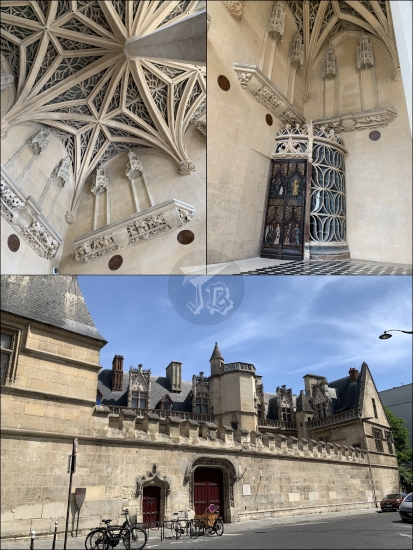
The cemetery was not as well laid-out as I had hoped so after a while wandering around I decided to move on. On Friday I had read that the museum of Medieval History and the old Therms of Paris had been reopened after a long closure. Thus, I decided to skip looking for more “celebrity graves” and headed towards central Paris. The Musée de Cluny – Musée national du Moyen Âge is built in a 1485 “town house” (more like a palace though, usually called a château) that was erected right on the the old Roman Baths that date the city of Paris back into the Roman period. Today it has been refurbished and holds artefacts and artworks from the Upper and Lower Middle Ages that have been brought from over different churches, including Notre Dame and the Sainte-Chapelle.

The most important piece in the museum is a collection of six tapestries, called “The Lady and the Unicorn”, dated from the late 15th / early 16th century. Five of them represent the sentences, and the sixth is a mystery (theories include “love” and “free will” – I’m a fan of the latter). They all feature the same medieval dame in a red background, accompanied by a golden lion and a white unicorn, and they are marvellous.

Collage: The foundations of the manor; an ornate church entryway, carved on the stone; a Virgin Mary statue; the tapestry of the lady petting the unicorn, with plants and a red background

A piece of art in its own right is the chapel of the town house. It was built around the same time of the house in the Flamboyant Gothic style. It contrast with the stark outside of the house, with its sever walls.

The ceiling of the chapel, which looks like a star fractal, and a view of the whole manor

I still had some time, so I decided to head over to the church Église de la Madeleine, a catholic church that looks like a classical temple (believe it or not to hail the Napoleonic army). It is built in the Neoclassical style, and it is enormous. However, it was also being renovated, so the outside was covered in hideous publicity panels.

Church of La Madeleine, it looks like a Greek temple, all columns with a triangular front, and the inside, showing Mary surrounded by the saints and the angels.

Finally, I went back to the hotel to pick up my things and walked back to the station – I did not want to carry my luggage around because I worried it would damage the posters I had got at the concert. I actually arrived and left from different airports, so I had to head to Orly this time. However, RER B joins both airports, so the closest station for arrival, Châtelet–Les Halles, was also the closest to leave. Upon coming out on Saturday I had caught eye of a small gothic church, and as I walked past this time I noticed that there was an open door and people went in and out. It was the church of St. Eustache, Église Saint-Eustache. The structure is Flamboyant Gothic, and the decorations are Renaissance and classical. It has one of the largest organs in France, and I was lucky enough that it was being played when I was there. It felt pretty magical, to be honest.

Top: A gothic church from the outside, with lots of windows. Bottom: the same church inside - high columns look like a forest, and the light filters through all the windows outsde, like water from a fall.

Afterwards, I hopped onto the train and headed for the airport. I got there earlier than expected, too, as I had planned according to some traffic restrictions that did not happen in the end. I debated some food, but everything was so expensive! The return flight was plagued with turbulence, and I got home exhausted and with a migraine, but it was well worth it! Also, travelling through Covid-19 was… weird. While I kept my facemask on most of the time, including the plane rides, the concerts, and whenever I was inside, most people would not – even the still-compulsory places. I was also happy to skip the “health checks” because I swear, the way I was feeling after landing, I don’t know if I had been running a temperature, and that would have been… awkward.

A view of Paris from the plane, also showing the wing

13th March 2022: The outskirts of Madrid (Spain)

I’m usually rather enthusiastic when I visit new places, but if there is a place that I’ve found kind of over-hyped, that has been the park Parque del Capricho, in Madrid. “Capricho”, which means whim or folly – in its architectural meaning of an often extravagant picturesque building erected to suit a fanciful taste, or building erected for decoration, typical of the French and English decorative gardens from the 18th century. The park is located in Madrid, and the only romantic garden that remains in Madrid. It was promoted by the 12th Duchess of Osuna between 1787 and 1839, and became a recreational area for the nobility of the time. Some of the most important gardeners and landscapers of the time worked on its design. It was declared Historical Garden in 1934 and restored in 1999.

So it is a garden, with some plants, some flowers, and a bunch of weird-looking decorative items, that takes itself a bit too seriously. It won’t accept pets and you can’t bring any food inside (it has some cage-looking “lockers” were you can leave your stuff). There is a strict capacity control which does nothing for it not to feel ridiculously crowded on a regular nice-weather Sunday. Maybe it improves in spring / summer, and with fewer people, but I had some stuff to do in the area and that is why I made time to visit today.

It had been raining all week, so I had mostly scrapped my plans. It was a great sunny day though so in the end I decided to get there. Parking the car was ridiculously easy – though the parking spot was maxed out, I found a very easy one in the avenue next to the park – good, it was close as I would not put my sandwich in the crappy-looking lockers and preferred taking it back to the car. Then I walked in, and explored for a couple of hours – and don’t tell anyone, but I ate a piece of candy, just to be rebellious (≧▽≦) (and to make sure I did not sugar crash without any food around, but that does not really make for a good story).

While I of course did not expect everything to be blooming and colourful and green… I hoped that it would have at least maintained through winter. No such luck. A bunch of areas were fenced off, the footpaths were swamped with puddles, and the water in the ponds was not as clean as it should have been. Exploring the 14 hectares took me about an hour and a half, considering that I did go into all the little paths, but all the buildings were closed and / or under constructions. There is a Civil War bunker in the park too, but that is only open through pre-booked guided visit and I did not know I was going to do this 30 minutes before I jumped on the car. The few flowers that had already bloomed included the garden pansies (Viola × wittrockiana, which are after all winter flowers), and the yellow and white daffodils (narcissus, maybe the subspecies jonquil Narcissus jonquilla). There were a couple of black swans (Cygnus atratus) at the main pond, and mallards (Anas platyrhynchos) on every second water body, including fountains.

Pond in the park. There are some flowers and buildings around it, and a black swan sunbathing.

Collage of different park decoration: a bush labyrinth, a fountain, and some decoration reminding of Greek temples.

Afterwards, I took a small detour to see if any of the Japanese cherry trees in the park opposite the street Parque Juan Carlos I had started blossoming. The answer was not at all. But the point was heading to the restored castle Castillo de la Alameda. The castle dates back to the 15th century, though there are older remains underneath, and it is thought that its presence is the one that got all the aristocrats to flock to the area, as it switched from defensive castle to palace.

The remains of the castle feature an irregular moat with lobe-like structures in the corners, and the restored keep, which stands up to the first floor, though it must have been much higher. An interesting characteristic of the castle is that it was built using a kind of mortar made from flint. I have to say it was a nice surprise, free to visit.

A clover-shaped castle ruins, all white. There is not much of the castle left, but the moat is almost intact, though empty

To the side of the castle there is a casemate – a fortified machine gun emplacement from the Spanish Civil War, called Nido de Ametralladoras (Machine gun nest), a semi buried cement block for snipers of sorts to defend the position.

Concrete block that was used as a machine-gun base

Then I moved onto Mejorada del Campo a little town near Madrid that only has one tourist attraction – a… handmade cathedral. Of sorts – Catedral de Justo Gallego .

Justo Gallego was born in 1925. Deeply Catholic, he became a young monk-in-training but had to leave the monastery when he contracted tuberculosis. He made a vow to erect a cathedral to the Virgin Mary in her “Lady of the Pillar” avocation, and he sort of did. Throughout the next 60 years he worked on building the cathedral, using recycled material, and on his own. His work came to fame when a soft-drink company made him the star of an advertising campaign, which made him and his work famous.

The cathedral has 12 towers, a crypt, two cloisters, a baptistery, and the main nave is 20×50 metres, with a 35 metres high dome. Most of it was done by hand, using discarded items such as tubes and bicycle wheels. It is garish and childish in its decoration, but I found it to have some strange allure. The cathedral has drawn the attention of international artists and institutions, and apparently Gallego built it without any blueprints or knowledge of construction. Upon his death, an architectural studio started working on “legalising” the cathedral (from an urbanistic point of view; it is not an official Christian building) and is it is now under management from an NGO. It was just a bizarre thing to see, but interesting since I was in the area (sort of. Construction made the route stupidly long), glad I’ve visited it at least once. I did catch a European white stork (Ciconia ciconia ciconia) coming home to one of the towers.

Cathedral made out of recycled items: pipes, plastic bottles, irons... there is a dome and a nave, in bizarre colours.

A stork approaches one of the towers of the cathedral

I drove off afterwards, and I have to say the weather that day was amazing – just in-between two piss-poor ones, so yay spring escapade.

Walking distance: 11.18 km (16916 steps)

26th February 2022: A Medieval Fair in Tendilla (Spain)

Tendilla is a tiny village in the area of Guadalajara, Spain. It was declared a town – by Medieval standards at least in 1394. About a century later, the County of Tendilla was founded. By that time, the local cattle fair, around the festivity of St. Matthew, was considered one of the best in the Kingdom of Castile, with the Catholic Monarchs bestowing their blessings on the town. Among the most interesting areas are the long covered arcades, and the unfinished church dating back from the 16th century, Iglesia de la Asunción.

The cattle fair was rekindled in the 1990s, and today it is called Feria de Mercaderías de San Matías. The closest weekend to the 24th of February, St. Matthew’s day, a Medieval market is laid along Main Street, with edibles, trinkets and artisan items. The village becomes decorated with flags, pennons showing off real and assumed heraldry items.

This year, I decided to get there as some family members were going to be in the house they own in the village. I arrived at around 10 am, and by that time most the village was already full. I got deviated, but it was not hard to find a parking spot. Unfortunately the weather had not decided to accompany and it was rainy and freezing all day.

The fair stalls had begun to open, but first we made a run for the local grocery stores to grab some ingredients for lunch. The typical thing to eat in this time are migas, which are basically fried breadcrumbs with paprika, pork, garlic and a fried egg on top. We also bought sweets and confectioneries, just because we could.

At noon, we walked along Main Street Calle Mayor. The stalls were already open, and even in the bad weather there were quite a few people. Some were even in costume, dressed in Medieval outfits, as dames, knights or noblemen.

A wide street. There are flags hanging above and from the balconies, and shopping stands on the right. the sky is dark and heavy, as in all the pictures taken

A wide street. There are flags hanging above, and shopping stands on the both sides, selling hand-made jewellry and trinkets.

A Romanesque church with a bell tower. The church is unfinished.

Main square. It has a pole in the middle, and colourful ribbons run from it to the buildings around the square. The floor has been covered in sand, and the houses are decorated with flags. Lots of people walk around.

To the end of the village, a small “farm” had been installed – oxen, horses, cows, goats, donkies, sheep, rabbits, piglets… Due to the ‘health situation’ which for once was not Covid but avian flu, there were no ducks or hens or any kind of bird. You could hold the bunnies, but I really really wanted to hug the huge draft horses.

Farm animals: a donkey, two piglets, cows, rabbits, a sheep trying to eat the camera, a working horse.

Farm animals: goats trying to escape the pen, oxen ignoring the camera, a black-and-white cow wanting pets, and a working horse looking tired.

Someone had not really thought positioning carefully though, and right in front of the farm – and the piglets – stood the food stalls, especially a roaster, whose cooked pork was… suspiciously similar to the piglets in the farm *coughs*.

On the other side of the farm, the locals had started preparing the communal migas – every visitor is entitled to a plate of them, but it was way too cold to queue. Instead of being topped with an egg, though, they are sprinkled with torreznos, pork lard fried and preserved.

A huge barbecue with pork roasting and sausages. The barbeque itself is round, and it's big enough to fit at least a dozen ribcages, ten pork legs, and twenty or thirty sausages.

A person using a shovel to stir a huge pot of breadcrumbs being cooked, and a close up of the severd plate: orange-looking breadcrumbs with dried fried pork lard on top.

On our way back we ran into the horse parade and show, which was held in front of the town hall. The riders of El Duque Espectáulos, dressed in Medieval and Templar costumes, trotted and galloped along the music.

A group of medieval-looking horse riders making their way through the crowds

An older man making a golden horse trot and gallop on command, the horse is photographed mid-hop

Riders in medieval clothing galloping on the Main square

We stopped to buy some torreznos to take home, and we got given the tourist treat – a cloth bag with a huge box of fried pork skin. It is tastier than it sounds, honest!

A tote bag reading Tendi (the rest of the writing is obscured), with a box of torreznos inside

We had lunch at home, and not to show off, but I do think our breadcrumbs looked much better. We made them ourselves, with chorizo meat and eggs sunny side up! They looked so much better than the communal ones, right?!

A plate of migas. The breadcrumbs look golden, and there are pieces of pancetta and chorizo mixed with the bread. On top, there is a fried egg, sunny-side up

Finally, after lunch, we took another stroll, but the weather was miserable, raining and cold – which was so mean because the following day when I had to work it was nice and sunny, and there was a bird of prey exhibit.

Romanesque and Baroque buildings, deserted in the rain. One of them is a tiny hermit church, the other a column, and the third a palace that has seen better times

But all in all I spent a nice time with family and got to pat horses and goats. I guess there are much worse ways to spend a Saturday.

Walked distance: 6.20 km (9866 steps)

18th – 20th February 2022: Extremadura, the not-at-all-wild west of Spain

With everything that keeps going on in the world, my little travel gig seems insignificant. Here it is, anyway, for the sake of completion.

18th February 2022: Jam and Ham

After a crazy crazy period, and within a just-slightly-less-crazy period, we made space for a mini escapade – just under 48 hours, but it was an interesting mental reset. We took the car and drove off to Cáceres after I finished work in the afternoon. The trip should have taken a little over 3 hours and 15 minutes, but we spent about 70 minutes caught in several traffic jams – or just a very long jam with different instalments.

Sunset from the road. The orange light zigzags through the grey and blue clouds

Cáceres is located in the autonomous community of Extremadura, which is famous because of its particular grassland with dwarf trees called a dehesa. The typical animal farmed in the area is the native Black Iberian pig – a traditional breed of the domestic pig (Sus scrofa domesticus). Through breeding with wild boars and millennia of adaptation, the Iberian pig has grown accustomed to eating oak acorns, and thus it has become a key part of the ecosystem. Furthermore, the breed has great tendency to accumulate intra-muscular fat. This means that its meat is delicious, especially as sausage. The most famous treat is the “Black label” (Etiqueta Negra or Dehesa de Extremadura) ham: a pig raised in the dehesa, fed acorns and natural grass, and whose meat has been cured for at least 20 months.

The area of Cáceres is also known for its sheep-milk cheese, Torta del Casar. It is a strong-flavoured creamy cheese that comes from controlled sheep, also raised in the dehesa. The cheese is especially curded with rennet made from cardoon (Cynara cardunculus). Another typical food from the area is the local paprika Pimentón de la Vera, which is made from smoked local red peppers. All three – ham, cheese and paprika – hold European Protected Designation of Origin certificates.

Of course, not everything is food in Cáceres. After we checked into our hotel near the historical centre, we headed off to the Main Square Plaza Mayor de Cáceres, which features the town hall, the former wall gate called Arco de la Estrella (Star Arch), and one of the watch towers Torre de Bujaco.

The medieval square of Caceres by night. It looks like a castle, with arches, battlements. The sky is completely black.

We found a place inside to grab a bite, and we tried the sausages for dinner before turning in – acorn-fed pork ham, loin, chorizo, morcón (similar to chorizo), salchichón, and patatera (pork mixed with potato and paprika in sausage form).

A plate of sausage slices and ham

Walked distance: 1.79 km (2838 steps)

19th February 2022: The Old Town of Cáceres

The Old or Walled Town of Cáceres, Ciudad Vieja de Cáceres was declared a Unesco World Heritage Site in 1986, and it is easy to see why. It is a small knot of streets between the ancient city walls and the gorge where cars can barely drive, sprinkled with Medieval and Renaissance palaces and manors. After finding an open café, we had breakfast, then headed off to explore that. Since it was a bit before 9 am, most everything was closed – but it was also empty, which was good. We crossed the Arco de la Estrella next to the Torre de Bujaco and walked into the walled area.

The medieval square of Caceres by daylight. It looks like a castle, with arches, battlements, and irregular bricks making up the walls.

We walked past the co-cathedral – to which we would come back later and several palaces, and we ended up at a two-level square called Plaza de San Jorge (St. George Square), towered over by the peculiar-looking church Iglesia de San Francisco Javier – note the white-painted towers.

A church with two twin bell towers, both in white. Between them, the body of the church, in grey rock. In order to access it, you have to climb a staircase, which has a small sculpture of St George attacking the dragon

There was a small palace to the left, and while the building was closed off, the gardens Jardines de Doña Cristina de Ulloa were open, albeit as it was early February, still in winter mode but for some berries and roses.

Wintery garden with bare tree. There are also evergreen bushes and trees, stairs, and benches.

We wandered around for a while, the headed off to a visit we had booked in advance – the manor / palace of the Lower Golfines Palacio de los Golfines de Abajo, which has nothing to do with their position in the social scale, but literally the position within the city hill – in the lower part. The family is known to have owned the palace from the time of the Catholic Monarchs, in the 15th century, till the death of the last descendant in 2012. This woman willed all the heirloom to a foundation that today manages the palace. The foundation got the palace renovated and brought some of the furniture from other properties belonging to the family – among them a glass lamp way too big for the room it was set in, and a sofa which was identical to the one that used to be in my great-aunt’s living room… The lower floor holds the recreated rooms – with more or less success and taste – and a smaller area decorated with Medieval paintings which were discovered by accident. The upper floor holds a small ethnography museum and some documents from the family’s library. Unfortunately, the foundation takes itself a little too seriously and won’t allow you to roam freely in the palace or take pictures, except for the inner Castilian patio.

Gothic palace, with an ornate roof and a small cloister or patio.

After the palace, we walked a whole minute and a half for the co-cathedral Santa Iglesia Concatedral de Santa María. It is the oldest church in town, built around the 15th century, in a Romanesque-going-Gothic style. Outside the church, at the base of the tower, there is a sculpture of Saint Peter of Alcántara. Inside, the altarpiece was carved between 1547 and 1551, in unpainted pine and cedar. The tower can be climbed, and I decided that I wanted to do that, despite not being what I usually do. It was empty enough that I felt comfortable doing so, and I was treated to some nice views.

Collage: a gothic church with a bell tower; the inside showing a bare-wood altarpiece; the sea of columns from above, and a view from the belltower, showing another church and the roofs of some low houses.

By the time we went out, the city had already been taken over by walking tours and guided visits. There were so many companies that the guides put stickers on their tourists so they could herd them round. We backtracked to the Baroque church with the white towers Iglesia de San Francisco Javier (also known as Iglesia de la Preciosa Sangre), where there is no worship today. Instead, there is a huge collection of nativities (hundreds of them, literally). In order to visit the nativities you have to go up a perilous metal staircase. Once on the second floor – after having survived the peril – I decided to continue on the relatively safer stone staircase to one of the towers – only one, I did not climb up both of them. The lower floor holds two last nativities, a classical one and a hilarious set up made out of Playmobil, a German company that makes plastic figure toys.

Collage: The interior of a church with a baroque golden altarpiece, and a collection of Nativities.

We moved onto the following manor, to the side of the square, Casa Palacio Becerra, which shows some antique elements, and the house structure.

Inside a Renaissance palace, with a low arch, a glass lamp and a red carpet that try to look eclectic and end up looking bizarre

Later, we walked to Stork Square Plaza de las Cigüeñas. European white storks (Ciconia ciconia ciconia) are typical birds in Extremadura, and one wonders how they have not decided to make food out of them. In the tower stands one of the few towers that has kept its merlons, as the Catholic Monarchs were very into tearing tower tops down when they conquered a site. The adjacent manor, Casa de las Cigüeñas, hosts the military museum Museo de Armas Aula Militar.

A building with a tower. The inside is a museum, and there are some swords, firearms and Moorish decoration

At the end of the square, in yet another palace – two of them, actually – lies the Museo de Cáceres, the local museum. The part in the Casa de Las Veletasis a regular archaeological museum, with the kind of things you would expect – prehistoric, Roman and Celtic remains, more modern artefacts. The other area, Casa de Los Caballos, hosts the modern art gallery.

Gothic building turned into a museum. The pieces shown are funerary stelae, prehistoric animal representations - bulls or pigs - and jewells, a boat, and Roman emblems

However, the palace was erected on top of the local Arab cistern or aljibe. It is the best preserved in Spain and it has been gathering the rainfall water since the 10th century. Pretty impressive piece of engineering if you ask me.

The aljibe: a moorish basement filled with water. The columns sustain horseshoe shaped arches

Afterwards we still had some time to kill until it was time for lunch, so we wandered around the area of the Jewish quarters or Judería, under the watchful gaze of the local Cerberus.

Narrow streets, and a guarding dog looking suspicious

We had lunch in the local Parador de Cáceres, so I of course got my stamp. As a started we ordered the famous local cheese Torta del Casar cheese.

A tray with bread slices and breadsticks, and a cream cheese with spoons to be spread on the bread

In the afternoon we had a look at another church Iglesia de Santiago de los Caballeros. The church of St. James of the Knights was built in the 14th century over an older temple dating back from the 12th century. The altarpiece was carved and coloured by one of the most important sculptors of the Spanish Mannerism, Alonso Berruguete (1490 – 1561). This time I did not climb the tower – which had been happily colonised by a couple of storks.

Gothic church with a golden altarpiece. A stork snoozes on one of the towers.

After a little while, after sunset, I decided to skid around and have a walk through the old city at night. The artificial light made it look eery and romantic in the most… historical sense of the word. I came across some cats begging for food from a bunch of schoolgirls, and one of them very indignant because the girls would not beg it to take the food!

Different buildings of Cáceres at night. The are lit wit strategic lamps to give a mysterious feeling. There is also a white fluffy cat sitting and expecting food

Walked distance: 9.04 km (14766 steps)

20th February 2022: Trujillo & Oropesa (Toledo)

On this day I managed two more Paradores stamps. Trujillo is a town a meagre 30 minutes away from Cáceres. It also has a traditional / Medieval city centre, set around the main Square Plaza Mayor de Trujillo. It was the birthplace of one of the so-called conquerors during the colonisation of South America, Francisco Pizarro, whose equestrian statue, Estatua ecuestre de Francisco Pizarro (by American sculptor Charles Cary Rumsey). Other highlights in main square include the corner balcony in the “Conquest Manor” Palacio de la Conquista.

The large Reinassance square of Trujillo with decorated palaces and a sculpture of Hernan Cortez on his horse

One of the most interesting churches in the area is Iglesia de Santa María la Mayor. Its tower dates back from the 13th century, but was almost completely rebuilt in the 16th century. Inside the richly painted altarpiece was erected around 1490. Apparently, my newly-discovered activity of climbing towers yielded to a new adventure, as for a few minutes I ended up locked down in the bell tower – I guess I’m a Disney Princess now (≧▽≦).

Gothic church with gothic golden altarpiece.

I got an hour and a little to wander round the town, so I climbed up to see the Muslim fortress Alcazaba de Trujillo (also called castle). Built between the 9th and the 12th century, it is a huge building with a defensive wall, an aljibe or cistern, several towers and a Christian chapel.

Moorish castle, from the outside and the inside. The walls and the battlements are amazingly well-preserved. It seems that the castle is built around the natural rocks defending the area

Then I hurried towards the other edge of the city to get my Parador de Trujillo stamp (only cheating slightly. I was there, after all). On my way I happened upon the Torre del Alfiler, with a family of storks happily clattering away the late morning.

Storks on top of a bell tower

I backtracked to the Plaza Mayor and I had twenty minutes before our rendezvous time, so I decked into the church Iglesia de San Martín. Its origins date from the 14th century, but it was not finished till the 16th century – which makes it so that the thick Romanesque walls are mixed with Gothic and Renaissance elements. No tower this time, but the second floor holds a religious museum.

Romanesque turning Gothic church. The inside is plastered in white and the celing above the altar and the nave retains the original decorated stone ceilings

After getting a general idea of the Medieval town of Trujillo, but it being a “working Sunday”, we moved on rather quickly, and drove off until we made it for lunch in Oropesa (Toledo) which also holds a Parador – Parador Museo de Oropesa, the first monumental Parador opened in 1930. That makes three stamps in two days, I’m almost impressed with myself!

Plain building with ornate balconies, and cars parked on a row in front of it.

The Parador is adjoined to the castle Castillo de Oropesa, which was unfortunately closed, but I shall put in on my list of “to re-explore”. It was built by the Arabs during the 12th – 13th century, probably on a former Roman fortress. Today, the Old Castle is joined to the New Palace and both belong to Paradores.

Classical Romanesque castle with towers and turrets. It looks heavily restored.

After that, we drove back home, and as we got a couple of wrong turns, we ended up avoiding the traffic jam we had found on our way to Extremadura, which was convenient!

Walked distance: 5.57 km (8836 steps)

1st January 2022: Barranco de la Hoz & some towns around (Spain)

I found myself socially free on the first so I decided to kick off the year by improvising a hike – and when I arrived at the parking lot I realised I was crazy person #3 to have the same plan. To be honest I kind of went along the flow for half of the day trip, with just a faint idea of what to do.

My first stop was an area in the natural park Parque Natural del Alto Tajo. One of the tributaries, the River Gallo, has eroded a deep valley in the sandstone and calcareous rockbed – Barranco de la Hoz, which translates to something akin to “Gorge Ravine” (though technically it could also be “Sickle Ravine”). The gorge is located in the north of the province of Guadalajara. Two hundred million years ago (Early Triassic period), the area was covered by the same sea that gave way to all the fossils that can be found in Albarracín and reached the muddy areas where dinosaurs left their footprints in Enciso.

When the sea level receded, it left behind different layers of rock, that have been painstakingly excavated by the river Río Gallo for the last two million years or so (Quaternary period). There are conglomerates at the very base of the gorge, and red sandstone, calcite and dolomite in the upper parts. The vertical wall is around 115 metres high. At the base there is also a small hermit church. According to the legend, during the Middle Ages, the Virgin Mary appeared to one of the shepherds in the area – that is the reason why the area is also called Barranco de la Virgen de la Hoz. Next to the sanctuary there is a restaurant / hotel, and a parking lot. Along the river bank there are several tables for picnics and so.

Being the insomniac I am, waking up after the New Year celebration was not excessively hard. As mentioned though, as I was not sure I would be free until the previous evening, I just went along the flow of the day. I drove off and reached the gorge at around 11:00. The the car measured a temperature of -1 ºC. I was wearing five layers anyway so I was all right. Just before reaching the parking area, I had to yield to a sounder of wild boars.

The sanctuary is the starting point of a path of around 400 steps carved and sculpted onto the vertical wall, ascending over 110 metres. The climb was not as hard as I expected, especially as the sun shone on the steps. I reached the mid-viewpoint in less than 15 minutes and sprawled on the stone ground for a little to bask in the sun. As I continued upwards, I encountered a small lizard doing the same sun-basking routine – Iberian wall lizard Podarcis hispanicus (maybe?). I finally reached the top of the gorge and I was the first on the upper viewpoint area for a while. Throughout the hike up, the strata can be clearly seen, along with fossilised ripples, fracture lines and the hints of some folds. The steps and viewpoints are protected by markers and verandas (helpful at points).

Halfway up a reddish sandstone wall. The picture faces the rising sun, and at the bottom of the ravine is the river, with the evergreen trees around.

Close up of a lizard hidden amonng leaves

Although you are technically supposed to stay on the trail, I honestly wanted to explore the upper edge of the gorge, so I went towards the rocky cliffs to the east. I came across marks caused by of boars, and European wildcat (Felis silvestris) paw prints, I also saw some birds of prey (very maybe a golden eagle, Aquila chrysaetos) , but not the right time to see much fauna – probably because around noon people started arriving with dogs. Also, it was stupidly warm for a first of January… Good thing I was using the good-old technique of having a lot of layers and shedding / putting them on as I felt warmer or colder.

A panoramic view of a rabine, with the river at the bottom.

A panoramic view of the top of a ravine, with the cut-off walls dropping from sight

A view of the vertical sandstone walls that create the ravine

A flying bird of prey and some animal tracks: a paw print and removed ground from a boar digging for acorns.

After an hour or so, I made my way downwards and I visited the church now that it was empty and walked into the area where the legend says the Virgin appared.

A hermit church built against / into the vertical wall of the ravine

Then I walked around the river bed for a while. The river bank was covered in frosted leaves, and the water was quite cold. I layered up again…

The wall of the ravine from the riverbank

Ivy and fallen leaves on the ground. The rims are white with frost and ice

At around 13:15 I decided to head over to Molina de Aragón. It was New Year’s Day, so I did not expect anything to be open, so I just wanted to wander round for a while. Though the town is considered one of the coldest places in the area, when I parked it was warm. I found the castle Castillo de Molina and wandered around for a bit. The castle has three distinctive parts – the walled fortress, the lone watchtower Torre de Aragón, and the back area, which was cordoned off, but not walled, Prao de los Judíos. The first Arab castle or alcázar was built the 10th century, over an older Celtiberian hill fort. In the 12th century, it was conquered by the Christians and rebuilt in the Romanesque style. Out of the eight towers that the castle had, four of them have survived, along the ruins of two more.

A rectangular castle with quite a few towers and battlements on top. Around half of it is reconstructed, the rest is in ruins

Afterwards, I took a stroll down the town. There are many churches dating to the Medieval times, most of them Romanesque style, some already showing hints of Gothic: Parroquia de San Felipe, Iglesia de Santa Clara, Iglesia de San Pedro, Iglesia de San Martín, Iglesia de Santa María la Mayor de San Gil. There were also some mansions and palaces.

Buildings in Molina. They all look reddish due to the characteristic rocks used to build them

I tried to locate a bridge I had seen trying to find a parking spot, and it only took a couple of wrong turns to do so. The bridge is Puente Viejo, the old Romanesque bridge, built in the reddish calcites that are characteristic of the area. From there I also peeked onto Monasterio de San Francisco, originally from the 13th Century, though the current building dates from the 18th century.

A reddish stone bridge over the river. It has three arches, but today only the left arch is over the river, the other two are over grass.

A church with an angel on top of the belltower

It was already late afternoon, and I had a couple of options. In the end I decided to head back in order not to drive through the sunset – at this time of the year, the sun’s glare would hit me square in the eyes in the highway. However, on my way towards the gorge, I had driven through a tiny village, Rillo de Gallo, where, for some reason, there is a Modernist-style house, called, more or less formally, El Capricho Rillano (The Folly in Rillo), as a lot of Modernist buildings have the “whim” name in them. It was apparently erected by a builder who apparently liked the aesthetics, without an architect being involved. It was… interesting, though the village was tiny and it was difficult to get into it and find a place to leave the car without blocking a street.

Bizarre modernist house. The construction looks wavy, with snakes and twisted columns. The balcony is held out by gigantic hands.

That was the whole day in the end, I drove back home, and did not have much trouble with sunset. As a whole, I drove around 300 km, and walked just a little over 10 km. And it was way warmer than expected for a first of January! Here’s to hoping that it was a promising start to 2022…

14th December 2021: Navilandia (Guadalajara, Spain)

Back when I visited Torrejón de Ardoz in November, they were already preparing their Christmas display, which is famous in the area. In a smart way to curve attendance though, this year the town hall decided to charge non-locals to enter. Towns around quickly noted this and decided to organise their own magnificent displays, and in the case of Guadalajara, give a hand to the people who live off the carnivals and fairs, as most regional summer festivals have been cancelled for the last two years. They called it Navilandia (Christmasland), the biggest “Christmas Theme Park” in the region.

The “theme park” is divided in several areas. The first one is the palace Palacio del Infantado, its gardens and the adjacent square. The Palace features the same Christmas tree as last year, and the gardens have been decorated with lights, Disney characters, a Zeus sculpture, music and… dinosaurs. I have no idea what dinosaurs have got to do with Christmas, but you won’t hear me complaining about dinosaurs. They are called the magical gardens Jardines Mágicos del Infantado. There is also a small flea market.

A gothic façade with a Christmas Tree made out of green and gold lights in front, along with some more decorations: Felices Fiestas, another tree, a reindeer made out of light

As I walked up Main Street I saw the traditional Playmobil Nativity they always set in one of the shops. However… I’ve never been able to spot the actual Nativity scene here. It is rather cool, though.

A Nativity made out of Playobil figurines, the stable is on the left and a bunch of toys are coming towards it through the desert. There a lots of dromedaries.

The second “Christmas hotspot” is the town hall square Plaza Mayor had a tasteful light decoration, a childish representation of the Three Wise Men, and a very beautiful – and lit up – carousel. I really wanted to ride it, but there were too many toddlers. It would have looked… weird. I need to find out when it closes so I sneak in after the kiddies have gone home (≧▽≦).

A caroussel with bright lights on in a square. Hanging above the square there are lots of lights and stars in gold colours. There are also four Christmas trees

Third spot was half-closed but that is okay. The square Plaza de Santo Domingo hosts another flea market, that was not open – they are setting three rotating markets there, basically one each weekend, and we were between them. There was a big walk-in Christmas tree and the “monumental Nativity” there.

Collage: A Christmas tree made out of eye-shaped lights in blue, purple, red and yellow. A picture of the classical nativity with realistic figures. The Holy Family is illuminated in white - Joseph is placing the Child on a crib that Mary is holding.

The final area extends along the parks Parque de la Concordia and Parque de las Adoratrices. The entrance is flanked by two nutcrackers; it hosts a talking tree, lights, food trucks, yet another flea market, and rides that again… are only Christmassy by name. There is another Nativity, this time an “abstract one”, a cute train and a “Polar Express” ride, some lights and… a “talking tree”, which broke into telling some tales out all of a sudden. Then, there was a bunch of rides, but they looked like your average travelling carnival rides, and I was not going to go onto any of those, so I made my way back. Also, I was strong and did not buy any cotton candy nor similar treats, though I was tempted to get some roasted chestnuts.

Bizarre Christmas decorations and motifs in the park: A giant nutcracker / soldier, an abstract nativity, some gingerbread-house-shaped shops, a Polar Express mini train, and a... something that looks like a tree with a face on the trunk and leaves made from green lights.

It was weird because for the second time in a couple of months I’ve been asked if I’m an actual photographer. True, this time it was a drunk guy who then proceeded to yell fascist slogans. I decided it was the right time to call it an evening and go home for the day…

11th & 12th December 2021: Final Fantasy Remake Orchestra World Tour, Barcelona (Spain)

11th December 2021: El Triángulo Friki

When the tickets for the FINAL FANTASY VII REMAKE Orchestra World Tour first came out, 2020 promised to be an amazing year. True, we all know how that turned out, but the point was that I did not have enough fun funds at that moment. So I just looked at the Barcelona dates, sighed, and never bought tickets because I decided that it was a low-priority event for me. Then, what happened happened and the tour was pushed forward to 2021. By chance, back in summer this year, I saw that it would take place on a Saturday, the 11th of December 2021. My sibling overheard me mulling whether I wanted to try to go or not this time over, since I had not done much on the nerdsphere for a while, and the low priotity was conflagrating with higher priortity and the still lacking fun budget. They didn’t know about this, though, and they proposed we went together. I thought it was a good opportunity for a weekend out, so I did some checking. We found some tickets that had been turned back, in an amazing place, actually – row #5 on the stalls. We booked a hotel and trains, and just went on with our lives.

The train left around 8:00 and arrived in Barcelona short from 11:00 – both of us had been in town before and were looking for an “alternative” plan. I had been checking out different options, and by pure chance, on Thursday, I found out that there is an area in Barcelona called Triángulo Friki, something akin to “the nerd triangle”. It is an area near Arc de Triomph that holds a bunch stores which specialise in comics, manga, figures, merchandising and so on. I thought it could be a fun thing to see, as Japanese stuff a hobby I share to some extent with my sibling.

We took the commuter train to the area (commuter train tickets are complementary with long-distance ones, which helps, as the Barcelona public transport is very expensive) and wandered around a bunch of shops, under the agreement not to spend too much money nor to buy anything that did not fit in our backpacks. We… failed the mission successfully. On the sixth or so shop I got myself a Christmas present that sure as hell did not fit in the backpack.

A collage showing the entrance to a bunch of comic and gaming stores. Most of them have a window showing Funko pops

One of the shops we visited was Tsume Store, in association with Global Freaks. Tsume is a business that 3D-prints statuettes from anime designs, and Global Freaks is a merchandise shop. They have a partnership and Tsume is selling some of its statuettes through Global Freaks – we saw one of them, priced at 1400€. Most of the figures were just for show. On the other hand, Global Freaks had several things we bought (remember the “mission failed successfully” comment? We spent way too much money on stuff that did not fit in the backpacks). Furthermore, they had a reproduction of a motorbike from Akira (アキラ), a famous manga / anime – a cyberpunk action story whose main character, Shōtarō Kaneda, rides it through Neo-Tokyo.

Tsume / Global freaks store in Barcelona. There are different pictures of resine statues of different sizes (and prices), and a reproduction of an anime motorbike.

We walked towards the area where the basilica designed by Gaudí, and consecrated to the Holy Family, Basílica de la Sagrada Família, which had been decorated with a new twelve-point 7.5-metre 5.5-tonne star. As there was a Christmas market around the basilica, I thought that the start was just for Christmas, but it turns out that it is there for good.

A modernist cathedral. It looks a bit like it's melting. It has four towers, plus one with a star, and a triangular façade

We took an underground train to the area where the venue was, and we were there around half an hour before hotel was open to check ins so we decided to have lunch first in the adjoining shopping centre. We ended up at an Udon, a wannabe fancy noodle bar chain. This was our first time getting our Covid passport checked as it’s not necessary where we’re from. The whole process was fast – open the PDF, zoom in, get it read with a device, and a green light with our names on it lit up (eventually I just screenshot the zoomed-in QR). I still felt a little uncomfortable due to the amount of people in the restaurant, so we ate as quick as possible before heading off to the hotel.

A bowl of ramen and a peek of a tempura plate in the background

It was the worst check-in experience ever. First of all, I think it’s stupid to demand a payment deposit on an already-paid booking. Second, they tried to charge me for the room again, we were given one card key for two people which didn’t even work, and we were “upgraded” to a room with a city view (16 € more expensive than our booking), but that only had amenities for one guest. We needed to get off the lift to request another card in order to get to the 21st floor, and we finally got two working cards. Oh, and the hotel was hosting a bunch of teams for some kind of handball championship who thought masks were for lesser beings and got away with it, despite the super-strict Covid-policy the hotel claimed to have, and with the obvious blessings of the clerks, despite other guests’ complaints.

Two views of Barcelona from above, one with daylight, the other one at night. The buildings are apartment blocks, rather regular, and you can guess the long streets that separate the different areas

We stayed in the room, just chatting and taking in the astonishing views (nah, I’m not being sarcastic (≧▽≦).) The FINAL FANTASY VII REMAKE Orchestra World Tour concert was to start at 20:00, but doors were at 18:30. It took place in the convention centre CCIB – Centre de Convencions Internacional de Barcelona, which… actually turned up to be the auditorium of the local Natural Science Museum. That was confusing for a minute.

We were quite literally across the square so we just had to go down. It took just a few minutes to enter, and then we went into the goods queue, because my sibling absolutely needed a chokobo plush. We were in line for about half an hour, as we debated how expensive everything was! They decided that I needed a chokobo too, so I’m the proud owner of a Chokobo Black Mage now.

An adorable chokobo plush with a mage cape sitting on the leaflets we got from the concert.

After we had all our goods, we headed off to our seats – which had been occupied by two different people who had bought row five on the dress floor – but had tried the main floor stands, never mind that a lady told you which door you had to use when you went in, in order to avoid these “mistakes” . I decided that I did not care about causing a scene, so I just grabbed an usher and had her clear our seats. The guy on mine took my flyer too, but I found some more when the concert was over. I’m amused though that someone would buy a ticket on the first floor and then happily stroll down to the fifth row on the stalls – more than double the price.

Let me start by saying that I’m not a video-game player, that’s why this event was originally a low-priority one. When my wrist problems started, I was recommended not to play them any more. But I love video-game graphs and Final Fantasy VII designs more than any. I mean, I own the Advent Children DVD just because it’s pretty. I have to admit though that the concert blew my mind. The stage was full with a complete orchestra indeed, and a choir – the Ensemble Symphony Orchestra & Chorus. At the back of stage there was a screen that projected scenes from the game, both animations and gameplay. In the little emcees by conductor – and producer – Arnie Roth we also got messages from composers and producers from Japan. Furthermore, the composer Hamauzu Masashi was in attendance. We did not get Yosh Morita, from The Prophets, as it was originally announced, but singer Ricardo Afonso did a very decent job out of the power ballad Hollow.

Empty stage with chairs for the orchestra. There is a screen in the background reading Final Fantasy VII Remake Orchestra World Tour in front of a futuristic cityscape

    Part 1

  1. Prelude – Reunion –
  2. Opening medley
  3. Mako Reactor 1
  4. Flowers Blooming in the Church
  5. The Turks’ Theme
  6. Tight rope
  7. Stand up
  8. Words left unheard
  9. Tifa’s Theme – Seventh Heaven –
  10. Those who fight – Battle Medley –

    Part 2

  11. Anxious Heart
  12. Hurry!
  13. Jessie’s Theme
  14. Shinra’s Theme
  15. The Arsenal
  16. Those chosen by the Planet – Fate’s Calling –
  17. Arbiters of Fate – Singularity –
  18. Hollow
  19. Final Fantasy VII Main Theme

    Encore

  20. Aerith’s Theme
  21. One Winged Angel

I loved the Those who fight – Battle Medley –, and I’d say that one of the highlights was the song Hurry Up. Apparently, during a specific part of the game you have to put the rather-uptight main character in a dress and teach him to dance in a night club. I also really liked the choir interventions. The concert ended on a hype – for a second I thought it would end in the slow song, but no, we got the fantastic theme for the bad guy Sephiroth, One-winged angel.

The stage again, this time it is full with the orchestra and the director. The screen shows the main character of the game, Cloud, with blond spiky hair and a ridiculously big sword, holding a bright ball in his hand.

The concert lasted for two hours and a half, including the intermission – in which I got to see (and hug!) friends. After the ending, we tried to go and grab some sushi at the shopping centre, but they were already closing down – so in the end we just got a salad and some chips at McDonald’s and took it to the hotel – then we showered, rearranged luggage and purchases, and went to bed.

12th December 2021: Walk by the ocean

Our original plan after breakfast was to take a walk by the beach, then check out and ride the underground, but we realised that we had a train station about 20 minutes away, and we could get a detour by the seaside and make it a bit longer – and if we took the train, we had a free ride.

When we checked out we got the same person who had checked us in. They still had to charge us for the tourist tax, and I had that ready in cash. They insisted that they had to deduct that from the deposit and give us the change, they could not give us a fifty-buck note. They had to give us the change. With lots of coins. They did not even check the room for damage, so what was even the point of the deposit?

We left the hotel, and walked towards the station. We spent a little time at the beach Platja del Fòrum and the mouth of the river Río Besòs before we reached the station – lots of people walking their dogs, and lots of happy dogs playing on the beach and with the waves. In the background, the former thermal station with three chimneys looming over the sand – Central Tèrmica de Sant Adrià de Besòs. Had we had more time, we would have taken the time to try and get to it, but due to external reasons we had tickets for the noon train and it was already 10:45 – and I am paranoid about schedules.

A sandy beach with a factory building in the background, it has three chimneys made of brick. The waves are coming in gently.

We took the commuter train, then the long distance train. When we arrived, before going home, we made a short stop to have some make-up sushi for the one we could not get the previous night. And some side Chinese dumplings.

Sushi and bao plate

Walking distance Saturday: 9.05 km
Walking distance Sunday: 5.54 km