I’m in no position to deny that I have a thing for any “limited time only” visit, so I won’t. I had seen in the newspaper that the water company Canal de Isabel II had installed some Japanese-inspired manhole covers around Madrid, and I went on their website see if I could find any. While there was no map, I learnt about a bunch of activities that they were carrying out for their 175th anniversary, and one of them was opening the headquarters in the Chamberí district for four guided visits over the weekend. I had walked around that one before and wondered about the locked-away sports fields which always seemed to be empty. As it was a “limited time only” thing, I found a date I could take myself there. Ten days in advance was too early for a good weather forecast, but as the date grew closer, it was clear that I had high chances to get caught in May showers. Joy.
When the Spanish court set permanently in Madrid in the 16th century, it soon became clear that the city lacked something that other European capitals had. London had the Thames, Paris the Seine, Vienna the Danube – rivers with a decent flow of water to sustain the growing population. Madrid had Manzanares, which is barely a stream in comparison. It became a state matter to somehow guarantee a steady supply of drinking water. Hence the Viajes del agua – aqueducts and fountains, and later the dams and waterways from the Lozoya (originally the failed one in Patones, followed by the newer ones).
Canal de Isabel II was the entity created to manage and provide (and of course charge) the city with this water. Barring the short Republican Period, it has always carried the name Queen Isabella II, who occupied the throne when the infrastructures were first inaugurated. The entity’s activities started in 1851, in order to get running and drinking water to Madrid and the court that had settled there. The company went on to work on channels, reservoirs and water tanks in the city and around it – most of the water-related infrastructure in the Community of Madrid is owned and / or managed by them. In the early 2000s, the entity was involved in a corruption scandal, and part of of the revenue was diverted in a face-saving foundation to carry out activities for “the greater good” – exhibitions and cultural events – called Fundación Canal de Isabel II.
The day started having to trust that I would get to Madrid – while the trains were running, they were doing so on alternative route and schedule, and my station had been left in limbo. The train did eventually arrive, and it was actually faster than the usual one. That was a surprise – I had actually booked the visit at noon because I felt I needed to give the commute some extra time. I walked from the station to the headquarters of Canal de Isabel II, where I was expected at 11:45 for “security reasons”. I was there on time, along with a whole bunch of others, and a very tired security guard who kept instructing people to wait for the ticket-checker. It did not help that said person was late, nor that it started raining.
The visit was scheduled as an introductory talk in the auditorium, a walk around the buildings, and a “tap-water tasting truck” (I’m not even kidding). However, we were warned that they might cancel everything outside if it started pouring. That would have been a bit of a bummer. Fortunately, rain was down to a manageable drizzle in the end, and we were able to take the whole tour. The talk was of course a PR one – water supply in Spain is not an open market, but what is called a “strategic monopoly”: each town has its own one supplier and there is no way to choose another. Nevertheless, Canal de Isabel II needs some face washing from time to time, one guesses. They even bragged about their “water recipe” and how Madrid’s sales of bottle water are the lowest in the whole country.
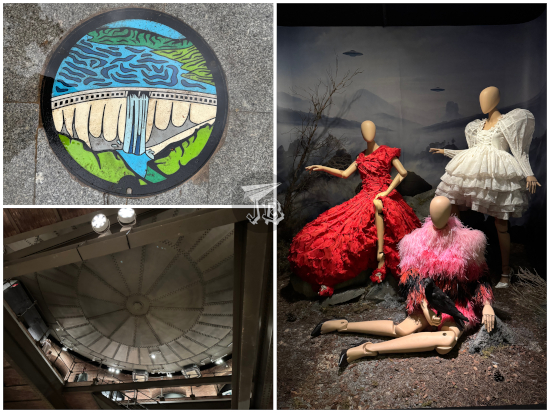
The presenter also told us about how fantastic it was to work for the business, and mentioned 2025’s rainy season and how many of the dams had to be open to let water out. One of them was El Atazar, and the image of water cascading down the structure was turned into a template for the new manholes. It turns out though that novelty manholes are illegal in the city, so Canal de Isabel II can only use them in their own properties.
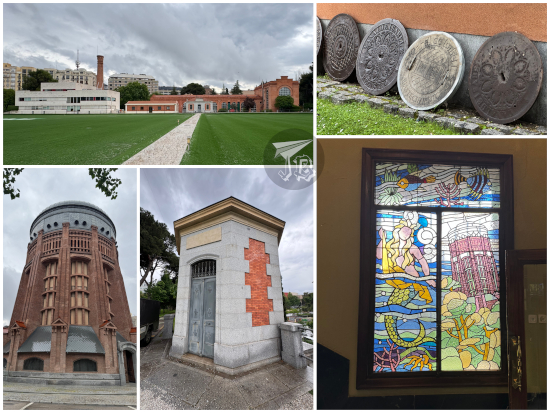
When we came in, they gave us one of those little audio receptors used for guided visits. Since it had stopped raining, or at least the rain was down to a manageable drizzle, we were divided into three groups – according to the colour of the audio thingy – to follow our guides around. First, my group was shown a collection of historical manhole covers resting against a wall. Then, we went to see the elevated tank from the outside. The tank was the third built, and designed to serve “high” neighbourhoods, so it had to be elevated using a brick tower so water flowed down. That required energy to get the water up to the spherical metal tank in the first place. Hence, a water-pumping station was devised. Neither the tank nor the station are used any more, the former having been turned into an exhibition room.
What I had always thought were empty sports fields turned out to be the roof of the major tanks currently in use though, covered in artificial grass, because it looks pretty, I guess. It used to be actual grass, but it’s apparently more hygienic this way. We trotted on the walkways above the tanks, saw the turrets, and were eventually led back inside to see the steel-stained windows with motifs that range from classical to weirdly niche – including the elevated tank itself.
We also saw one of the Japanese-style manhole covers exhibited there. On our way out, it had started drizzling again, but we were still treated to the water sampling. It… tasted like water.
I had a little bit of time before my lunch reservation, so I walked into the former tank, now used by the regional government as an exhibition hall, called Sala Canal de Isabel II. There was one of the novelty manholes there, but it felt a bit ironic that the ground was full of puddles. The hall was running a fashion exhibition, Ana Locking. Nostalgia / Utopía. Ana Locking (born Ana González Rodríguez) is a Spanish fashion designer and artist, active since 1996. I will not lie, and confess that I had never heard of her before. Then again, I am not much into the fashion world. Apparently, the exhibition merges past (nostalgia) and speculative futures (utopia) with pieces of clothing that I can’t see anyone wearing, but the colours were shiny?
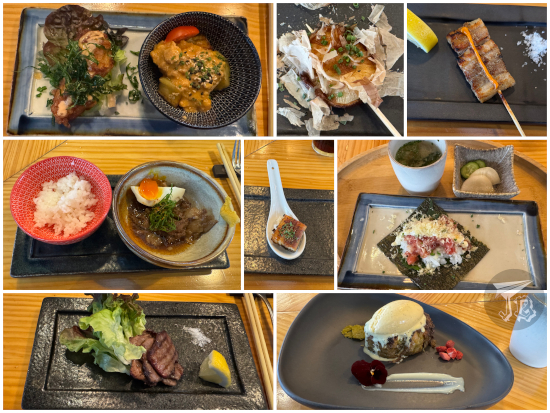
I had booked lunch at a Japanese restaurant called Tori-Key. As an early birthday present to myself I had booked the 60-euro omakase lunch. Omakase [お任せ] is a Japanese way of dining which consists on leaving the menu up to the chef, who decides on what the restaurant can best serve. Here, it was basically a tasting menu with ten dishes. Besides asking me if I was all right with everything, I don’t think it was completely personalised. The owner of the restaurant, Hiroshi Kobayashi, came to Spain in 2004 to study wine and become a sommelier, and ended up opening a non-sushi Japanese restaurant in the capital, with really high-quality ingredients and traditional recipes – with very little fusion except for the proximity ingredients for some of the dishes. The food was excellent, and the menu comprised:
- Edamame salteado – sautéed edamame (枝豆, immature soybeans in their pods).
- Ensalada de Cebolla Fina y Parmesano con katsuobushi – Thin onion salad with Parmesan cheese and katsuobushi (鰹節, flakes of simmered, smoked and fermented skipjack tuna).
- Karaage con salsa de vinagre y soja – Japanese-style fried chicken with vinegar and soy sauce.
- Lengua de vaca con toque de sésamo (a la parrilla) – grilled beef tongue with sesame.
- Carne de Tajima salteado con Setas Japonésa – Tajima wagyu (和牛, Japanese cattle) stew with Japanese mushrooms. Tajima [但馬] is one of the Japanese cattle bloodlines, which comprises most of the Kuroge Washu [黒毛和種] breed, considered the best as its meat is very finely marbled.
- Cucharita de Anguila – bite of grilled eel.
- Kushimon Cerdo Ibérico (sal) – skewer of salted Iberian pork.
- Shitake con Ponzu y katsuobushi – skewer of shiitake mushroom with Ponzu sauce and katsuobushi.
- Picadillo de pollo casero tsukune con huevo a baja temperatura – tsukune (chicken meatball skewer) with low-temperature cooked egg.
- Falso temaki de Atun de Mediterania y Sopa de Miso – tuna tartar on a bit of rice and dry wakame (fake temaki) and miso soup
- Torrija de té verde con helado de vainilla – Spanish variation of French toast soaked in green tea with vanilla ice-cream.
- Complimentary glass of green tea.
Not only was everything delicious, the care and attention from the staff was magnificent, especially considering I was sitting alone and at the bar, and the restaurant was incredibly busy. Only by the end did the shining service fade a little, as I had to ask for the bill twice. While I was at the restaurant there was another spell of hard rain, but when I came out, it was almost sunny again.
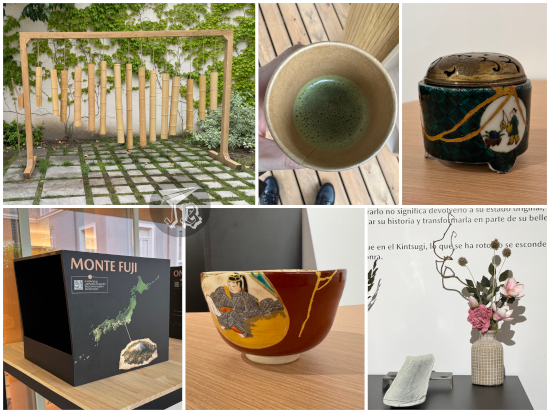
I walked towards the cultural centre Fundación Ortega-Marañón, where the car maker Mazda was carrying out a sort of exhibition / publicity stunt called Mazda House – Un paseo por Japón. El Camino de la Armonía [マツダハウス―日本散歩。調和の]. It was a… weird compendium of “things that make Japan famous” merged with titbits of Japanese philosophy that looked out of the Japan Tourist Organisation play book and mixed with publicity for the cars.
I had a matcha tasting at a booth with a lady boosting that “her preferred matcha was too strong for us novices”. I tasted her matcha. It was not worth the price tag. There were some pictures of plants, and inside activities for kids (such as drawing calligraphy), exhibits of objects repaired with gold (Kintsugi [金継ぎ]), and snippets about how traditional Japanese values inspire the car brand. It was not extremely impressive, but fun (and free) – and, of course “limited time only”.
It had started raining once more, so I headed towards the station, to wait for a train to take me home in the opposite direction I usually take, which was bizarre. I got the end of the platform wrong, too. Weird feeling. As soon as I stepped out off the train, it started storming again. Unfortunately, my light travel umbrella did not survive this last deluge. RIP.

