9th May 2026: Limited time only (Madrid, Spain)

I’m in no position to deny that I have a thing for any “limited time only” visit, so I won’t. I had seen in the newspaper that the water company Canal de Isabel II had installed some Japanese-inspired manhole covers around Madrid, and I went on their website see if I could find any. While there was no map, I learnt about a bunch of activities that they were carrying out for their 175th anniversary, and one of them was opening the headquarters in the Chamberí district for four guided visits over the weekend. I had walked around that one before and wondered about the locked-away sports fields which always seemed to be empty. As it was a “limited time only” thing, I found a date I could take myself there. Ten days in advance was too early for a good weather forecast, but as the date grew closer, it was clear that I had high chances to get caught in May showers. Joy.

When the Spanish court set permanently in Madrid in the 16th century, it soon became clear that the city lacked something that other European capitals had. London had the Thames, Paris the Seine, Vienna the Danube – rivers with a decent flow of water to sustain the growing population. Madrid had Manzanares, which is barely a stream in comparison. It became a state matter to somehow guarantee a steady supply of drinking water. Hence the Viajes del agua – aqueducts and fountains, and later the dams and waterways from the Lozoya (originally the failed one in Patones, followed by the newer ones).

Canal de Isabel II was the entity created to manage and provide (and of course charge) the city with this water. Barring the short Republican Period, it has always carried the name Queen Isabella II, who occupied the throne when the infrastructures were first inaugurated. The entity’s activities started in 1851, in order to get running and drinking water to Madrid and the court that had settled there. The company went on to work on channels, reservoirs and water tanks in the city and around it – most of the water-related infrastructure in the Community of Madrid is owned and / or managed by them. In the early 2000s, the entity was involved in a corruption scandal, and part of of the revenue was diverted in a face-saving foundation to carry out activities for “the greater good” – exhibitions and cultural events – called Fundación Canal de Isabel II.

The day started having to trust that I would get to Madrid – while the trains were running, they were doing so on alternative route and schedule, and my station had been left in limbo. The train did eventually arrive, and it was actually faster than the usual one. That was a surprise – I had actually booked the visit at noon because I felt I needed to give the commute some extra time. I walked from the station to the headquarters of Canal de Isabel II, where I was expected at 11:45 for “security reasons”. I was there on time, along with a whole bunch of others, and a very tired security guard who kept instructing people to wait for the ticket-checker. It did not help that said person was late, nor that it started raining.

The visit was scheduled as an introductory talk in the auditorium, a walk around the buildings, and a “tap-water tasting truck” (I’m not even kidding). However, we were warned that they might cancel everything outside if it started pouring. That would have been a bit of a bummer. Fortunately, rain was down to a manageable drizzle in the end, and we were able to take the whole tour. The talk was of course a PR one – water supply in Spain is not an open market, but what is called a “strategic monopoly”: each town has its own one supplier and there is no way to choose another. Nevertheless, Canal de Isabel II needs some face washing from time to time, one guesses. They even bragged about their “water recipe” and how Madrid’s sales of bottle water are the lowest in the whole country.

The presenter also told us about how fantastic it was to work for the business, and mentioned 2025’s rainy season and how many of the dams had to be open to let water out. One of them was El Atazar, and the image of water cascading down the structure was turned into a template for the new manholes. It turns out though that novelty manholes are illegal in the city, so Canal de Isabel II can only use them in their own properties.

When we came in, they gave us one of those little audio receptors used for guided visits. Since it had stopped raining, or at least the rain was down to a manageable drizzle, we were divided into three groups – according to the colour of the audio thingy – to follow our guides around. First, my group was shown a collection of historical manhole covers resting against a wall. Then, we went to see the elevated tank from the outside. The tank was the third built, and designed to serve “high” neighbourhoods, so it had to be elevated using a brick tower so water flowed down. That required energy to get the water up to the spherical metal tank in the first place. Hence, a water-pumping station was devised. Neither the tank nor the station are used any more, the former having been turned into an exhibition room.

What I had always thought were empty sports fields turned out to be the roof of the major tanks currently in use though, covered in artificial grass, because it looks pretty, I guess. It used to be actual grass, but it’s apparently more hygienic this way. We trotted on the walkways above the tanks, saw the turrets, and were eventually led back inside to see the steel-stained windows with motifs that range from classical to weirdly niche – including the elevated tank itself.

We also saw one of the Japanese-style manhole covers exhibited there. On our way out, it had started drizzling again, but we were still treated to the water sampling. It… tasted like water.
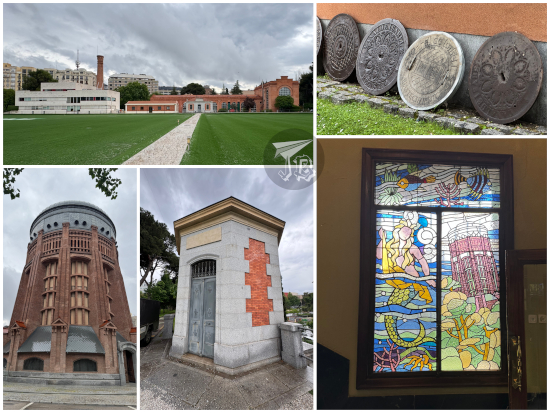
Collage: Inside the Canal de Isabel II HQ: towers, power station, manhole and decorated stained glass window

I had a little bit of time before my lunch reservation, so I walked into the former tank, now used by the regional government as an exhibition hall, called Sala Canal de Isabel II. There was one of the novelty manholes there, but it felt a bit ironic that the ground was full of puddles. The hall was running a fashion exhibition, Ana Locking. Nostalgia / Utopía. Ana Locking (born Ana González Rodríguez) is a Spanish fashion designer and artist, active since 1996. I will not lie, and confess that I had never heard of her before. Then again, I am not much into the fashion world. Apparently, the exhibition merges past (nostalgia) and speculative futures (utopia) with pieces of clothing that I can’t see anyone wearing, but the colours were shiny?
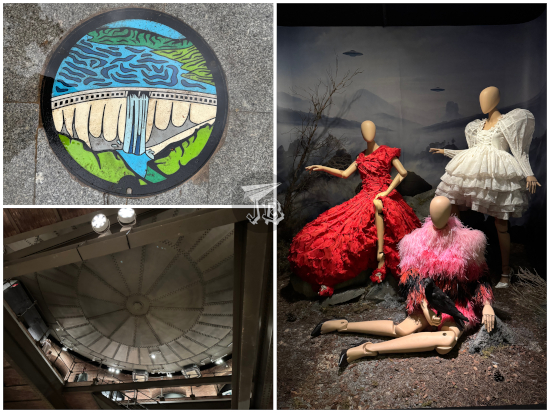
Collage: Manhole with the design of El Atazar dam, view of the spherical tank from underneath, and three frilly dresses

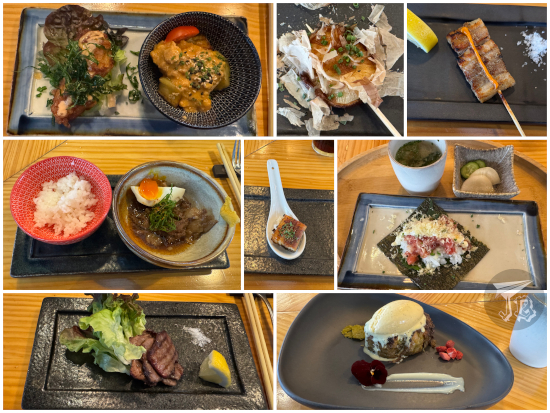
I had booked lunch at a Japanese restaurant called Tori-Key. As an early birthday present to myself I had booked the 60-euro omakase lunch. Omakase [お任せ] is a Japanese way of dining which consists on leaving the menu up to the chef, who decides on what the restaurant can best serve. Here, it was basically a tasting menu with ten dishes. Besides asking me if I was all right with everything, I don’t think it was completely personalised. The owner of the restaurant, Hiroshi Kobayashi, came to Spain in 2004 to study wine and become a sommelier, and ended up opening a non-sushi Japanese restaurant in the capital, with really high-quality ingredients and traditional recipes – with very little fusion except for the proximity ingredients for some of the dishes. The food was excellent, and the menu comprised:

  • Edamame salteado – sautéed edamame (枝豆, immature soybeans in their pods).
  • Ensalada de Cebolla Fina y Parmesano con katsuobushi – Thin onion salad with Parmesan cheese and katsuobushi (鰹節, flakes of simmered, smoked and fermented skipjack tuna).
  • Karaage con salsa de vinagre y soja – Japanese-style fried chicken with vinegar and soy sauce.
  • Lengua de vaca con toque de sésamo (a la parrilla) – grilled beef tongue with sesame.
  • Carne de Tajima salteado con Setas Japonésa – Tajima wagyu (和牛, Japanese cattle) stew with Japanese mushrooms. Tajima [但馬] is one of the Japanese cattle bloodlines, which comprises most of the Kuroge Washu [黒毛和種] breed, considered the best as its meat is very finely marbled.
  • Cucharita de Anguila – bite of grilled eel.
  • Kushimon Cerdo Ibérico (sal) – skewer of salted Iberian pork.
  • Shitake con Ponzu y katsuobushi – skewer of shiitake mushroom with Ponzu sauce and katsuobushi.
  • Picadillo de pollo casero tsukune con huevo a baja temperatura – tsukune (chicken meatball skewer) with low-temperature cooked egg.
  • Falso temaki de Atun de Mediterania y Sopa de Miso – tuna tartar on a bit of rice and dry wakame (fake temaki) and miso soup
  • Torrija de té verde con helado de vainilla – Spanish variation of French toast soaked in green tea with vanilla ice-cream.
  • Complimentary glass of green tea.

Collage showing the foods described in the text

Not only was everything delicious, the care and attention from the staff was magnificent, especially considering I was sitting alone and at the bar, and the restaurant was incredibly busy. Only by the end did the shining service fade a little, as I had to ask for the bill twice. While I was at the restaurant there was another spell of hard rain, but when I came out, it was almost sunny again.

I walked towards the cultural centre Fundación Ortega-Marañón, where the car maker Mazda was carrying out a sort of exhibition / publicity stunt called Mazda House – Un paseo por Japón. El Camino de la Armonía [マツダハウス―日本散歩。調和の]. It was a… weird compendium of “things that make Japan famous” merged with titbits of Japanese philosophy that looked out of the Japan Tourist Organisation play book and mixed with publicity for the cars.

I had a matcha tasting at a booth with a lady boosting that “her preferred matcha was too strong for us novices”. I tasted her matcha. It was not worth the price tag. There were some pictures of plants, and inside activities for kids (such as drawing calligraphy), exhibits of objects repaired with gold (Kintsugi [金継ぎ]), and snippets about how traditional Japanese values inspire the car brand. It was not extremely impressive, but fun (and free) – and, of course “limited time only”.
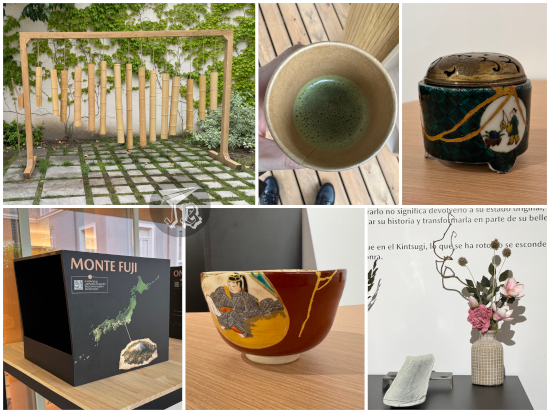
Collage: Mazda House. Xylophon made out of bamboo, green tea glass, flower decorations, objects repaired with glass and a Mount Fuji box

It had started raining once more, so I headed towards the station, to wait for a train to take me home in the opposite direction I usually take, which was bizarre. I got the end of the platform wrong, too. Weird feeling. As soon as I stepped out off the train, it started storming again. Unfortunately, my light travel umbrella did not survive this last deluge. RIP.
22nd November 2025: Expogema & Wicked: For Good (Madrid, Spain)

Wicked: For Good was released on Friday the 21st of November, and this time around I decided not to hit the cinema on opening day as I did for the first part, but to head out on Saturday. That way I could make a day out of it, combining the film with a mineralogy and gemology event. I had to work on Friday morning anyway, so there was no way I could make it to the first session even if I tried. Unfortunately, the weekend coincided with planned railway maintenance – which meant no trains whatsoever.

Getting to Madrid with the train system out (albeit scheduled) was not an odyssey, but close to it. I got to the coach station with 20 minutes to spare, and I had to queue up in a long line. Fortunately, I made it to the bus – good, because I had a timed ticket I had bought online. I learnt later that you can buy a ticket “for the next bus” on site and it’s actually cheaper… There were extra coaches running at the same time to make up for the lack of trains, which makes sense. The train company had arranged coaches of its own, but it charged “train money” for “bus service”. Well over a hundred people had decided, just like me, to take a bus at bus price.

The trip was uneventful with few stops, and I reached the terminus Avenida de América before I had to take the underground to get to Ríos Rosas. That placed me at the ETSIME Escuela Técnica Superior de Ingenieros de Minas y Energía around noon, total peak time. The place was packed with people who had heard about the Expogema event but had no idea what they were getting into – and were therefore “upset” that the event only had “rocks”, and that they were expensive (“lady, I cannot sell you a 400-euro tourmaline for 60 quid” was one of the sentences that echoed in the chambers). I had to take three walks around the fair in order to just see what was on display. I could not afford most of what was being exhibited anyway and for a change, I left without buying anything. I would make up for that on the 2026 Expominerales in the end…

Expogema is the fair dedicated to exhibiting and selling gems and gem-adjacent items such as jewellery. It is organised yearly by the Spanish gemological Institute, Instituto Gemológico Español IGE is a non-profit organisation, created in 1967, as a jewellers’ association. Today it independently certifies and appraises gemstones and jewels, especially diamonds. It works with individual owners, insurance companies, and anyone who is interested in a particular piece. It emits super-complete certificates which describe any gem to boot. Unfortunately, since their analyses are purely physicochemical, the one thing that cannot be certified is the ethical origin of the rocks.

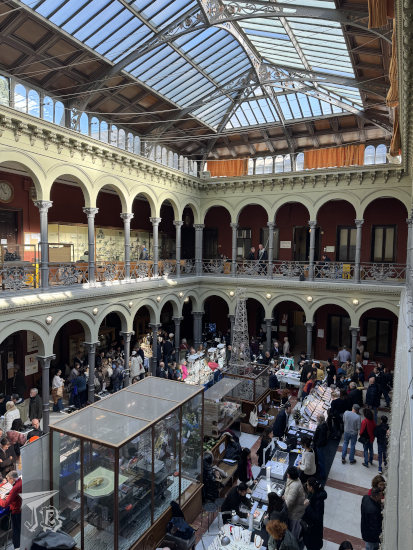
The ETSIME hosts two big fairs a year, Expominerales and Expogema. I missed Expogema last year, because while it’s usually held in late-November or early-December, it happened in September. This year, I wanted to have a look, and I could combine it with other events happening that weekend. Besides, I like the ETSIME, with its little classic museum of mining and geology (Museo Histórico-Minero Don Felipe de Borbón y Grecia) and its eclectic architecture by Ricardo Velázquez Bosco. The building seems to be in perpetual renovation though, but it has a beautiful cloister, which this time around was packed with curious onlookers.

Interior of the ETSIME - two floors of arcades and a glass and iron ceiling.

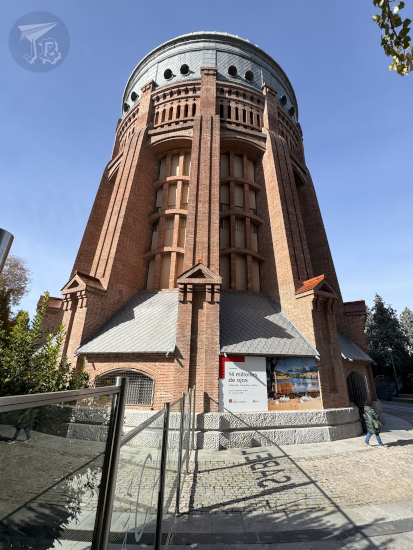
I left the school and walked out towards a former water cistern, now turned into an exhibition hall Sala Canal de Isabel II. The public company Canal de Isabel II manages the water supply in Madrid, which includes the structures around the River Lozoya. In 1858, the first water deposit was inaugurated in Madrid, designed by engineer Juan de Ribera Piferrer. Three more deposits were constructed, even though an accident during the works on the third one caused 30 fatalities and 60 wounded.

This last deposit was not built underground. It was designed by engineer Diego Martín Montalvo and materialised by Luis Moya Idígoras in 1907. It was a tower made out of mostly brick, and with a height of 36 metres. At the top there was a metal sphere which could hold up to 1500 cubic meters of water. It was used until 1952 to store water, then abandoned, and eventually turned into an exhibition hall in 1986.

In the year 2000, maybe as an operation to improve the reputation of the entity, the foundation Fundación Canal was established, to divulge culture, art, environmental knowledge and the importance of water. Legally, a Spanish foundation must serve “general interest” purposes and must be a non-profit. It might have served as a cover-up or money laundry point, considering that during the 2010s, Canal de Isabel II was involved in several monetary scandals and corruption cases.

The former deposit was hosting photography exhibition, a sample of the archives they have, called 14 millones de ojos. Colección, fotografía, público (14 million eyes. Collection, photography, public). It was a great excuse to explore both the building and the adjacent park, though most of the area was closed off as it was the weekend. The exhibition was a bit strange, with images all over the place, but some of them were very cool. It is apparently… a collection of pictures that people have taken of items that have been exhibited in the venue before? I am not completely sure… There was a disturbing amount of portraits of people pretending to be naked though…

Water deposit turned into exhibition venue - high brick tower with a spherical top.

After a walk around the park, I took the underground and headed towards the central district of Madrid. Since I had started a Christmas ornament collection, buying one in Paris and one in Monaco, I decided to try my luck at finding one for Madrid too. The quest was… surprisingly difficult, but I found a bauble in the seventh souvenir shop I checked.

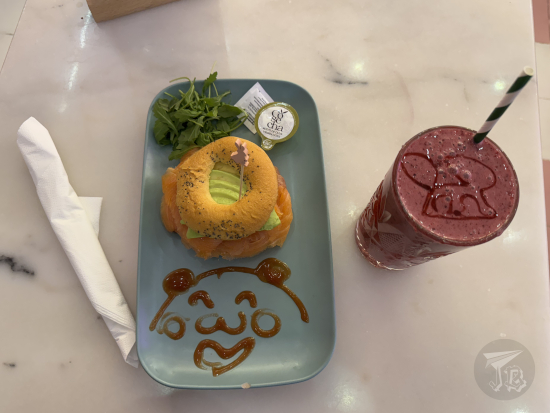
Afterwards, I found a spot at Kawaii Café for a light lunch. Though they were extremely busy, they had a spot for me and given the choice, I actually like their food. Plus, they’ve got discount cards now. I had a smoothie and a salmon bagel which was more than worth its price. Once I was done, I had the time to check out a couple of shops before I headed to Yelmo Cines Ideal to watch Wicked: For Good, the second part of the Wicked film duology, starring Cynthia Erivo and Ariana Grande. I like Ideal because most of the individual cinemas have enough of a slope that I manage to see above the head of the person in the row in front of me.

Bagel and smoothie from Kawaii Café.

I ended up with conflicting feelings about Wicked: For good. On the one hand, the film felt about 45 minutes to an hour too long. There were reprises of scenes and extra focus on interactions – especially the love triangle – that I could have done without. Also, random spotlight on characters that I know, but don’t even remember if they were even featured in the first part, such as Elphaba’s nanny. On the other hand, there was no way the “ham” could have fit into just one film, considering how long the first part was already. Nevertheless, I do have the feeling they wanted to delve a little further into the authoritarian dystopia of Oz, and the character of the Wizard. After all, if you have Jeff Goldblum around, you want to feature him as heavily as you can. Either that, or the film-makers tried to show the power of propaganda in some modern societies. And not-so-subtly aim for an Oscar or two – the first instalment competed on ten categories and took home two statuettes, but the second one was not even nominated once.

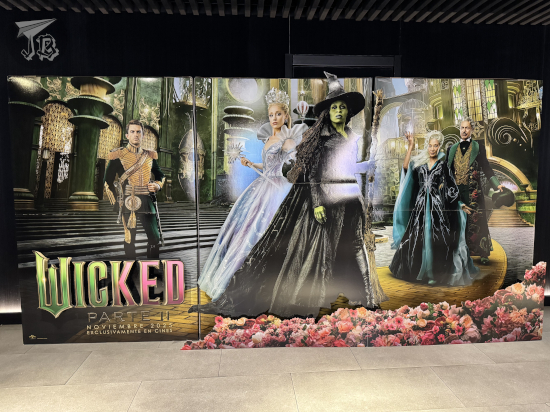
Wicked: For good focuses on the second act of the Wicked musical, based on The Wonderful Wizard of Oz. If the first half tells the story of how Elphaba “becomes” the Wicked Witch of the West, the second focuses on how that affects her. It surprises me though how come people were not anticipating the hit the Wicked film was going to be. When I went in for the first movie, it was just a regular release. This time around, we had a photocall and staff wearing witch hats and handling magic wands.

Wicked photo-op cardboard with all the main characters.

Cynthia Erivo does a good job on Elphaba, but in the end, it’s not that hard to portray her as a sympathetic character, since the watcher is the one privy to all her struggles and goals. However, Ariana Grande delivers a fantastic performance – I had watched the musical thrice at this point (four times now), and it is the first time that the character of Glinda has actually touched me. Grande’s approach gives a depth to the “good witch” that it’s often overlooked. The spotlight on her did not feel as a filler to me, and her voice breaking during I couldn’t be happier is a fantastic touch.

There is something I have realised though – if they decide to turn this into a franchise, I don’t think I’ll follow it. I would not have developed such a big emotional connection with Wicked if my first contact with it had been the films – they are way too long. The musical is just the bare minimum to tug at your heart, no fillers. How I wish I had seen the original New York production though…

The film has a few strokes of genius, mostly homages to the 1939 movie The Wizard of Oz, especially how the character of Dorothy, who is only insinuated, is a carbon copy of Judy Garland’s rendition, down to the dress and hairstyle. Furthermore, the wink to Margaret Hamilton’s cackling laughter and Glinda’s reaction – akin to what new generations would have, being absolutely flabbergasted by it – is hilarious.

Speaking of new and generations. On my right, a group of university students who spent most of the film bawling. On my left, a couple – one of them was a fan, the other one had no idea what was happening, and guessing along the way. Further on that side, a little girl loudly wondering what was going on half of the time. The joys of going to the movies at the weekend.

Upon leaving the cinema, I would have usually walked to the train station, but I had no trains. Thus, I had to go to Puerta del Sol to catch the underground. It was packed. I had not realised that they were turning on the Christmas lights that evening! When I had to change, the crowds in the corridors actually felt dangerous, and I was relieved when I could get to the platform in the opposite direction. That was stressful for a few minutes. I was lucky, though, that the first station was not closed and I could get in.

Once in the Avenida de América hub, I bought a coach ticket to get home – thus learning about the “next bus” tickets. Afterwards, I boarded the first scheduled service, which was on time, direct and ran into no traffic jams. I had been fortunate enough to park near the coach station, so I was home within a little over an hour after boarding. All in all, despite the lack of trains, transportation worked smoothly. I saw everything I wanted to, and I had time to spare, the weather was nice and I saw the film spoiler-free. A rather successful day, I’d say.