2nd January 2023: Lies or oblivion? {Egypt, Winter 2022-2023}

I was awake at 6:40 to be ready for a half-day trip. However, the phone call that the tour guide had promised the day before never came. I was distressed because this gave way to two options. Either the tour guide had lied to me, or someone had forgotten that I existed. Neither was a happy thought. I tried to cheer myself up with a cup of Espresso from the room complimentary bar, and around 8:30 I went to have a quick breakfast. I was not hungry and to be honest quite upset. I had insisted five times about this beforehand.

A bit after 9:00 I tried to call the ground agency, Galaxia Tours, and I texted them through the website. But around 9:20 I said screw it. The hotel had a mini travel agency – I had noticed this because we had made an attempt to go see the light and sound show at Giza on the 30th, which the tour guide had walked around. Instead of telling us “you won’t have the time” he had deflected every question we asked about it.

Had I had more time to organise things, I would have hired the mini-agency to take me back to the Egyptian Museum, the Museum of Egyptian Civilisation, or even the Valley of the Whales. However, since the tour guide had mislead me, I was out of time. Then again, the hotel was not in actual Cairo, but in Giza [الجيزة], and a nominal 20 minutes away from the Giza Plateau and thus the pyramids, so I hired a tour over there. And, believe it or not, I ended up… on a “camel” – actually a dromedary – for a few hours.

I had been resisting doing a dromedary ride of any kind out of concern for animal welfare, especially after seeing how they were treated at the Petra site in Jordan. However, this time it looked like it was the best option to spend my three hours around the pyramids, introducing Moses the dromedary (Camelus dromedarius).

Moses the dromedary kneels looking at the camera over his shoulder. He exudes personality

I checked out at the hotel, left my luggage at reception, and was driven towards the The Pyramids of Giza Archaeological Site [مجمع أهرامات الجيزة]. My driver was a bit creepy, so I tried to keep it light. We arrived at a backstreet next to the Great Sphinx [أبو الهول] entrance, from where I had a great view. This entrance was a bit different from the one we had used on the 31st next to the tourist bus parking lot. Most people using this entrance were Egyptians, and they were thoroughly patted down. Upon entry though, the view was astonishing – the Sphinx, and Pyramid of Khafre standing right behind it, the Pyramid of Khufu [هرم خفرع], the Pyramid of Menkaure, with the Pyramids of the Queens peeking to the side.

A front view of the sphinx, with three pyramids behind it. The pyramids decrease in size from right to left

Riding the dromedary was easier than I thought. The trickiest part was managing his kneeling down and standing back up – I did get a cramp on the very first standing up – but it was mostly a matter of leaning forward and backwards. Through this new walk around the Giza Plateau I got to see the modern cemetery on the left, then we moved onto the archaeological site itself. From this side, I saw the path that joins the Great Sphinx with the Funerary Temple of Khafre and the Pyramid of Khafre. I also got to see the Tomb of Queen Khentkawes I [مقبرة الملکه خنتکاوس] and the Central Field of Mastabas and rock-cut tombs. It was weird, having such a vantage point of view! I got used to the rocking very quickly, so I got a few good pictures.

Two views of the archaeological area of Giza, with pyramids in the background and low, excavated tombs in the foreground.

My guide – and Moses – took me to a a different Panoramic Point of the Pyramids, the picture perfect one, a few metres south of where we had been the previous day – this spot is not reachable from the bus, but I honestly cannot calculate if I would have had the time to get there and back the previous time – it’s hard to estimate distances in the desert, and the pyramids are too big to gauge good references.

A general view of the area of Giza. All the big three pyramids and the small six are visible.

We rode around the Pyramid of Menkaure, and actually passed between two of the Pyramids of the Queens.

A collage showing the approach to the Pyramid of Menkaure. The smaller pyramids of the Queens are in the foreground, and the camera seems to go through them until it focuses on the bigger pyramid.

Then we moved on towards the Pyramid of Khafre. Coming closer was really cool, as I could see the granite blocks that would have made the pyramid smooth back in the day, along with the rest of some columns. Also, two sides of the pyramid are actually somewhat sunk in the ground, with a vertical wall of rock-cut tombs. I know I was paying for it, but being able to walk around the pyramid felt special, and allowed me to feel awed at the size and technology again, considering these were built about 4500 years ago.

The pyramid of Khafre. The top is still smooth as granite blocks have not fallen. At its foot, you can see the granite blocks that have fallen, some aligned next to the pyramid so you can guess how it would be smoothed. Another picture shows the moat like structure around the pyramid - it is the back-wall of some tombs

The Pyramid of Khufu stood to the left, and we continued our ride towards the Central Field of Mastabas and rock-cut tombs and the Tomb of Queen Khentkawes I.

A view of the Great Pyramid from behind.

A number of basement-like structures excavated in the desert. They are the tombs of the nobles and the pyramid builders.

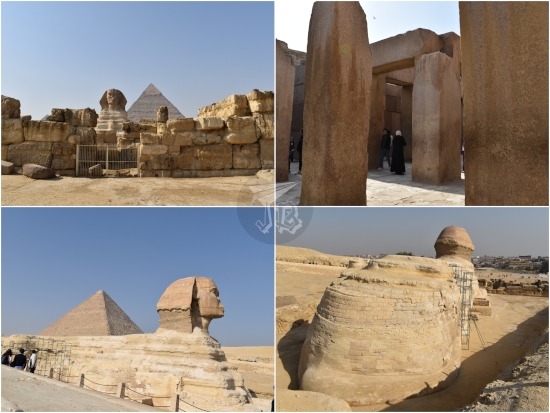
I dismounted again and walked into the Valley Temple of Khafre [معبد الوادي لخفرع]. This time, not running and with fewer people, I got to see the megalithic structures for real. I also could go to see the rump area of the Great Sphinx of Giza.

Collage showing the sphinx with the pyramid of Khafre behind it; the megalithic temple through which you access it; then a lateral view of the sphinx and a view from the rump.

Afterwards, there was an “essence shop” experience, but as I told the lady I would not be buying anything, she dispatched me really fast. My driver got only creepier in the way back, so I tipped him and ran off to the reception of the hotel, where I sat down to wonder whether someone would pick me up from the hotel, or they would forget me like they had for the dray trip. Fortunately, I spotted some people I had seen during the New Year’s Eve party, and it turns out that they had the same pick up. That was good, because handling the transfer for Cairo Airport – and the airport itself – would have been more stress than I was willing to deal with. I actually think I was forgotten indeed, but this family was not – I did approach the representative they pointed out, and made him aware of my existence. Firmly.

At 14:05, we were off on the mini bus towards the airport, and it took a bit over an hour. Meanwhile, they gave me a questionnaire to fill in – I tried not to get personal, nor attack anyone, but I was very sincere about the things that had gone wrong. Being forgotten is not a nice feeling.

We reached the airport past 15:00. There were two security controls for luggage, and one pat down. In the second control, the guards got money to let a group go before me, and the guard actually gestured that money would make things go faster. However, waiting had an interesting consequence… I met the people who went on the day trip, to Saqqara again, and they entered other pyramids there. So there had been another day trip – and again, lied to, or forgotten about?

But I had had my own fun, so I did not let that rile me up. I checked in, dropped my luggage, got my exit visa and settled down to wait – I was now just destined to have to listen to We wish you a Merry Christmas on loop for as long as it took to board. I got myself a cheese sandwich for lunch – this was past 16:00 by now, I was a bit hungry after only a fast breakfast. Cairo Airport is anything but traveller-friendly. Half the shops were closed, but without signs, so they just yelled at you if you walked in. There are no sitting areas next to the gates, just the shops, and I did not want to sit on another floor and rely on their English to know when boarding was ready, so I just walked up and down “a few” times. I was lucky enough to be next to the gate when boarding started – with yet another X-ray control, getting separated by sex, and being frisked. And yet, you have to take off your shoes, but you are allowed water bottles on the plane… Weird.

We finally took off around 19:30 for very uneventful five-hour flight. We got dinner on the way, which was unexpectedly nice, and I had a window seat, extra water, and got to see Cairo goodbye.

An aereal view of a city at night. The streets are lit, and light pollution diffuminates in the background. There is a black line in the middle, north to south - the Nile.

Overall balance: things were left unseen, and maybe one day I’d go back to see the rest of the Valley of the Kings, the Valley of the Queens, and the new Grand Egyptian Museum. Possibly the Valley of the Whales. But I don’t really feel I must come back any time soon. It was the adventure of a lifetime, and I am very grateful I got to live it. I do admit, however, that I dropped by my travel agent’s to make it known that someone had either forgotten me, or lied to me, and that I was not happy – similarly to what I had done with the questionnaire. I don’t know if I’ll ever get a reply, but I have to say the experience has left me not feeling up to trusting anyone with my travelling for a little while. Though I had to admit, my first solo experience with a group was all right… nice people all around, so I’ve been lucky in that department.

29th December 2022: Abu Simbel and Nubia {Egypt, Winter 2022-2023}

Modern eras have brought lots of different needs and technologies, and both become one when we think about harnessing nature. The Aswan dam is one of such examples. There are actually two of them. The Old Aswan Dam was built in the wake of the 20th century (1899 – 1902), and the newer, Aswan High Dam was completed in 1970, creating Lake Nasser. The rationale was securing fresh water for Egypt and stopping the dependence on the Nile floodings; however there have been associated problems – not only environmental such as the habitat of the Nile crocodile and the loss of fertility in the delta; thousands of people were displaced from the to-be-flooded area, and houses and whole villages were swallowed by water. A lot of these villages had their own cultural heritage, which was to disappear forever. Thus started Unesco’s International Campaign to Save the Monuments of Nubia between 1960 and 1980. This effort relocated as many as 24 monuments (one of them, the Temple of Debod, ended up in Madrid, Spain) to safer grounds. The temples of Abu Simbel are probably the star of the rescue efforts.

The Abu Simbel [أبو سمبل] Complex is part of the Unesco World Heritage Site Nubian Monuments from Abu Simbel to Philae. It comprises two buildings – the Great Temple of Ramesses II and the Small Temple of Hathor and Nefertari. Both of them were carved out and into a sandstone cliff on the West Bank of the Nile during the reign of Ramesses II or Ramesses the Great (14th-13th Century BCE, Nineteenth Dynasty of the New Kingdom), considered one of the most powerful Pharaohs in the New Kingdom, who reigned for many years. It was lost to time, and only rediscovered in 1813 and excavated in 1817. The Complex was relocated to higher ground between 1964 and 1968 to prevent its sinking in Lake Nasser. In order to do so, the mountain and the temples were cut into huge blocks and built 65 m higher and 200 m back from the river. The relocation managed to keep the relative position to the sun, but shifted it by one day – the temple was designed so the first ray of sun hit Ramesses’ face in the sanctuary on the 21st of October and February, and now that happens on the 22nd.

At some point one has to wonder what was more impressive – building the complex, or relocating it so you can’t really tell. The mountain itself is hollow in order to reduce the stress on the temple after the move, but wow. Just, wow.

As far as I understand, buses are not supposed to stay longer than a couple of hours in the complex. Our disembark time was 2:30, and even if I went to bed ridiculously early, I did not get much sleep because my cabin was above the motorboat rotors, and my cabin vibrated like hell. Before we left, we had a choice of coffee or tea, and we were given a “picnic” consisting on some sweet bread with… buffet leftovers, a piece of fruit and a small juice – that was traded often.

The trip each way was 3.5 hours, so we wanted more than the 30 minutes the tour guide wanted to give us, and we were there between 6:30 (though we did not enter the site until a bit later) and 9:00. Fine, I own up – I was late coming back and only made it to the bus at 9:08. The tour guide was so not amused by that.

Arriving at the Abu Simbel site, you approach from behind the mountain, and as you surround it, you’re greeted by Lake Nasser [بحيرة ناصر], the reservoir created by the dam. The sun was climbing up slowly when we arrived, still with sunrise colour.

Sunrise over a lake. There is a lonely palm tree on the left

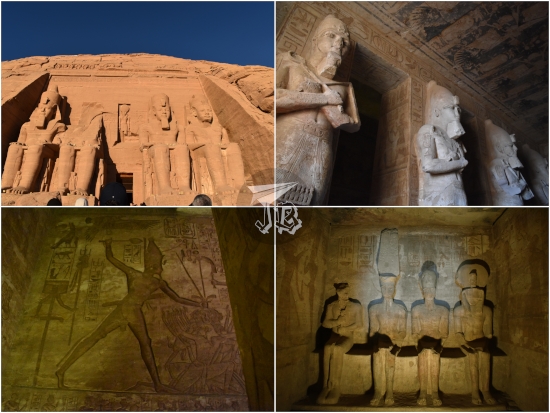
You keep turning and you are greeted by the four colossi that flank the entrance to the Great Temple of Ramesses II. The colossi represent deified Ramesses II, to whom the temple was dedicated along the gods Amun, Ra (in his Ra-Horakhty advocation) and Ptah (creator of the world and patron of craftsmen). The inside features a hypostyle hall with columns carved in the shape of Ramesses colossi, a colonnade hall and the inner sanctuary, where the venerated gods were revered.

Panorama of both Abu Simbel temples: Ramesses II to the left, Nefertari and Hathor to the right. The sky is blue, the monuments are orange-gold, and a lot of people gather at the entrances.

Collage of the Great Temple of Ramesses II: façade with four sitting colossi; inner hall, with colossi against the columns; an carving of Ramesses in a war position; inner sanctuary with the gods and Ramesses sitting, the light hitting their faces.

To the right stands the Temple of Hathor and Nefertari. Here, Queen Nefertari is represented as big as Ramesses and shown with the horns of the goddess Hathor, both signs of her importance (consorts were usually represented knee-high of their kings). The inner area has a hall with rectangular columns carved and painted, and the sanctuary features Hathor as a cow emerging from the mountain rock.

Small Temple of Abu Simbel colllage: Entryway with the colossi; inner hall with the face of Hathor carved into the columns; carving of Nefertari with the goddess' crown; inner sanctuary with the image of a woman with a cow head coming out from the wall, the light hitting her face

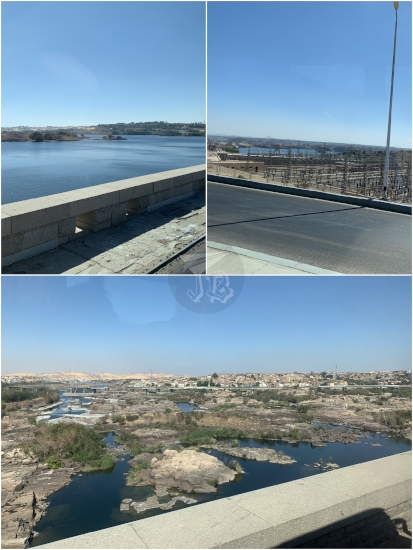
Despite really, really not wanting to leave, I made my way back and ran into two other people from the group. We had to leave through the tourist bazaar and were just slightly late. On the way back, slightly more awake than when we had left, we did not get to see any mirages, but we crossed the old Aswan Low Dam [خزان أسوان]. We had a view of the power plant on one side, and on the other side the First Cataract of the Nile, a series of rapids that have been slowed down by the building of the dam. In ancient times, it was believed that the Nile sprouted here and flowed both north and south. The main part of the cataract is now under the dam, and the remaining rapids have been turned into a nature reserve. There are Ancient Egypt remains and engravings in some ruins on the islands.

Views from the low Aswan Dam: southern side calm waters and power plant; northern side rapids

We were back on board the motorboat at 12:35 for lunch, and met again around 16:15 for a felucca sail on the Nile [نهر النيل] around the Aswan [أسوان] area. Before leaving, I decided to exchange 20 € into Egyptian pounds in order to have some change for the couple of meals we had outside, just in case I needed pounds to buy drinks. For convenience I chose the reception of the motorboat. They short-changed me, twice. First, they used a 23 EGP / 1 € exchange rate, while the official rate is 25 EGP / 1 €. Then, the guy at reception calculated 460 EGP and gave me 450, smirking “I owe you 10 pounds.” Stay tuned for the conclusion of the story.

The felucca sailing had been rescheduled from the following day so it could be tied to the trip through the Nature reserve and the Nubian village (and possibly to accomodate the charter flight times). A felucca [فلوكة ] is a traditional sailing boat, usually with one sail. Feluccas are still used for transportation through and across the Nile, and from ours, we caught some interesting views.

A sailboat docked with a precariously narrow plank to board it

A view of a sailboat on the Nile from another sailboat. The knots and ropes of the boarded felucca are visible in the foreground.

We got to see the Tombs of the Nobles | Qubbet el-Hawa [قبة الهوا] (Dome of the Wind), which I wish we could have visited. The tombs date back from the Old and Middle Kingdom with dignitaries and governors from the Fourth Dynasty to the Roman period buried here. The site is still being excavated, and also part of the Unesco World Heritage Site Nubian Monuments from Abu Simbel to Philae, even if it is neither Nubian nor between them.

A ruined structure perched on a bare mountain or dune. On the left there is a building, and on the right some open façades in stone.

We also sailed by the Mausoleum of Aga Khan [قبر اغاخان] and the family house beneath it. Sultan Muhammad Shah, Aga Khan III, was a religious leader among the Nizari Isma’ilism, a branch of Islam, and he was buried in Aswan after his death in 1957.

A building perched on the top of a mountain. It has a dome and several towers. A similar building stands at its feet, painted white, in the middle of a garden

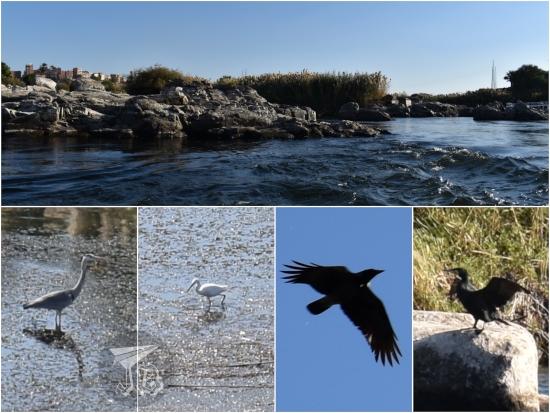
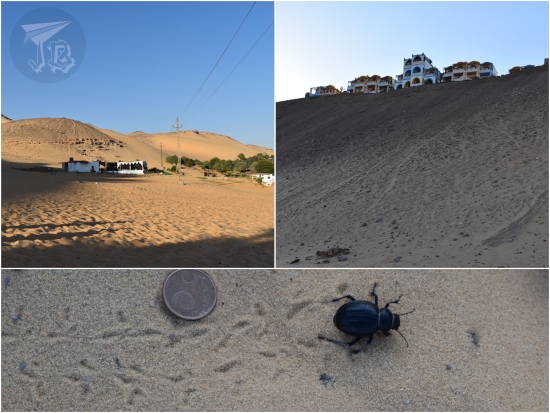
Apparently I missed some dancing as I was taking pictures of the site. Then, the people from the felucca sold us some trinkets, and finally we transferred to a different kind of engine boat, from where we sailed off towards Salouga and Ghazal Nature Reserve [محمية سالوجا وغزال الطبيعية] (the rapids formed by the First Cataract), around Seheyl Island [جزيرة سهيل], and a great sand dune. The Aswan area is famous among birdwatchers for its diversity. We got to see some glossy ibises (Plegadis falcinellus), little egrets (Egretta garzetta), reed cormorant (Microcarbo africanus), maybe an osprey or two (Pandion haliaetus), some corvids and stilts… Up the dune we made port at, we also caught sight of a couple of Egyptian beetles (Scarabaeus sacer).

Collage: a rocky island surrounded by rapidly-running water, and several birds wadding and mid-flight

Collage. Two views of a huge sand dune: the buildings look tiny against it. A picture of a scarab walking on sand and leaving its print. It is a bit biger than a 5cent coin

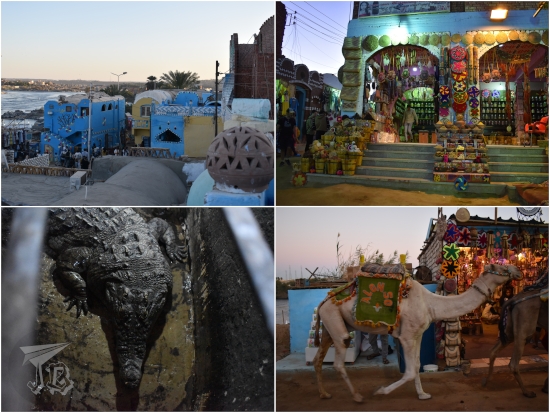
The Nubian village, Gharb Seheyl [غرب سهيل], which is little more than a big bazaar. We were invited to the house of a man who claimed to have been a dancer for the Spanish Teatro Real. We hung out there for an hour or so, and eventually were let off to walk around the village, a succession of shops selling the same trinkets as everywhere else, plus women trying to sell “Nubian dolls”. The house we were at kept live Nile crocodiles (Crocodylus niloticus), and at a lot of places we saw some mounted ones, I guess for tourist’s entertainment, but that did not feel quite right.

Collage of the Nubian village: a view from a rooftop, showing the houses painted in sand and blue colours; a shop with colourful trinkets, flowers, and statuetes; a Nile crocodile staring up; a dromedary passing by a souvenir shop.

After sunset, we sailed off back to the motorboat, without stopping anywhere, even if the whole city was lit. The boats were also shiny with neons and bright colours.

Collage: boats at night, docking and navigating the Nile. Two views of Aswan: lit ruins of the tombs of the Nobles, a mosque and a hotel

At the motorboat, we just had dinner and I went to bed early to catch some sleep. When I arrived at the cabin, I discovered that the staff had taken one of my beds away. I guess they got tired of making both of them as I used both bed covers? I was amused, just like I had been by all the figures they made out of towels (I got swans, a crocodile, and a monkey) though I wish the cleaning had been a bit more… thorough.

25th September 2022: Ruta de las Caras (Buendía, Spain)

As I had a visitor, I proposed a hiking route I had heard about as a silly adventure. The area around the reservoir Pantano de Buendía is home to an… interesting hiking route.

In the early 1990s, a couple of friends called Eulogio Reguillo and Jorge Juan Maldonado, a builder and a pottery maker, got the idea to create a sculpture on the rock. That, which in other circumstances could have be just been considered “defiling nature” became a Land art project – the two “artists” have carved gigantic faces into the sandstone, and the route has become a tourist spot – the Route of the Faces or Ruta de las Caras.

The route has been on my radar for a while (but I’d been feeling lazy about the drive) and I thought it would be a fun bizarre thing we could do together. It did not disappoint. You can do the complete route from the nearby village of Buendía, which is around 9 km, or drive up to the beginning of the route at the edge of the reservoir and hike around 2 km. We decided to do this, as the complete route did not offer much else to do / see.

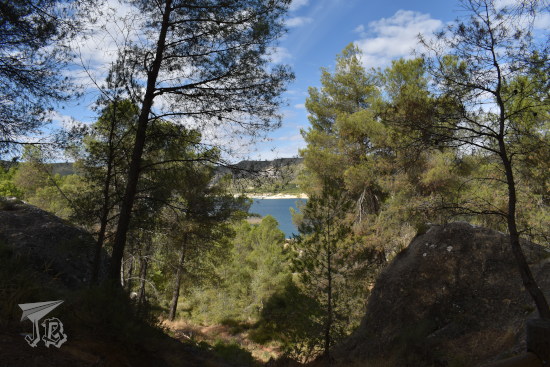
The route features a lot of official and unofficial sculptures, along with graffiti on the rocks. It is circular and runs through a pine forest which makes it suitable for both warm and cold weather – as long as the roads to get to the village are not frozen. Though temperature had plopped down compared to the previous day, it was still mostly over 20 ºC, so nice enough to be out in a sweatshirt.

Pine trees with a bit of water in the background - the reservoir

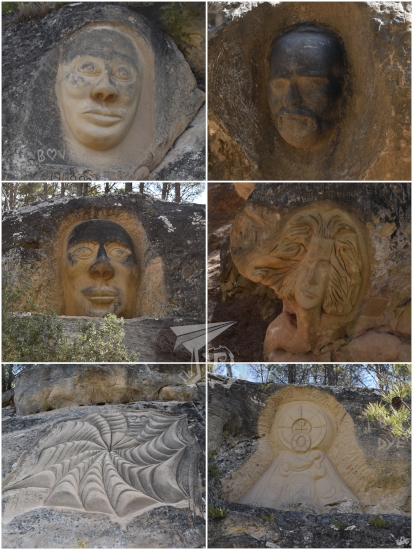
The rock carvings vary in size, style and elaboration. There are some religious motives, such a couple of Christian Virgin Marys, and some figures from Indian (Hindu and Buddhist) inspiration, but the ideas are so all over the place that they probably just let the artists do whatever they felt like. While the first carvings date from the 1990s, the route is still being carved, and we missed one of the faces as it is in a “new” area which is still not signalled. Some of the sculptures we did see include:

  • Moneda de Vida – The Coin of Life
  • Cruz Templaria – Templar Cross
  • Krishna (Hindu deity)
  • Maitreya (future Buddha in Buddhist eschatology)
  • Arjuna (a character in one of the Hindu epics)
  • Espiral del brujo – The Male Witch’s Spiral
  • Chemary (short for the name “José María”, Joseph Mary)
  • Sin nombre – Unnamed (and unfinished)
  • La monja – The nun
  • Chamán – Shamman
  • Beethoven (the composer, yes)
  • Duende de la grieta – Goblin in the Crack
  • Dama del pantano – Lady of the Reservoir
  • Virgen de la flor de Lis – Virgin of the Fleur-de-lis
  • Virgen de las caras – Virgin of the Faces

Different faces and shapes carved in sandstone

Different faces and shapes carved in sandstone

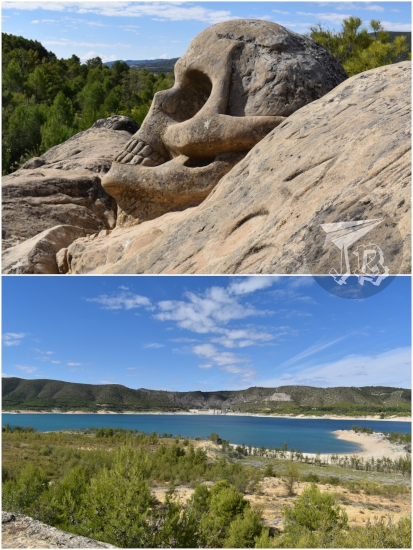
Our favourite was the skull overlooking the reservoir, called De muerte – Deadly – which one could actually climb – noooot absolutely sure it was “legal”, but the rules only said “do not carve or alter the rocks” and the sculptures are coated in a protective liquid. And after all, this started as a random art-vandalism thing.

Large skull carving (top) + the look from the viewpoint - the reservoir is pretty depleted, there is a lot of sand, but also some green trees (bottom)

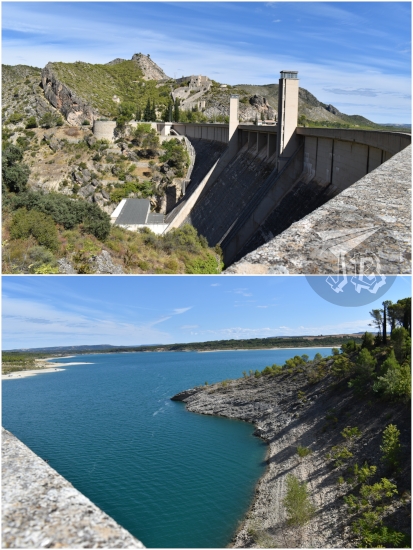
On the way back we stopped at the dam that closes off the Reservoir Presa del Pantano de Buendía, where we played with the echo.

Massive concrete dam, and the water behind it, a rich azure. The water looks cool.

Then, we moved on and once again stopped at the dam in the Entrepeñas reservoir Presa del Pantano de Entrepeñas – and I got the exit wrong again afterwards, exactly like the previous time. We saw a flock of vultures, and as they were circling in search for prey, they were a ‘kettle’.

The silhouette of two vultures circling

To end the day with befor my friend was off to the airport, we headed back and stopped to have lunch at a tiny Mexican place in the shopping centre on our way. And there I discovered that yes, there is such a thing as too much cheese on nachos. In the end, we walked around 4.11 km (6464 steps), so I think we were allowed to deal with the junk-y food.

Nachos + tacos. Everything looks a bit greasy.

13th September 2022: Wadi Rum (and the bus) {Jordan, September 2022}

I had a boiled egg, potato hash-browns and coffee breakfast because my body was craving salt, I guess. Then we set off on the bus, where we ended up spending around seven hours (the 412 km are supposed to be done in 5 hours and a half, but that does not take into account bad traffic). Urgh. Our first stop was a viewpoint over the whole canyon area.

Wadi Musa valley panorama, showing the deep gorge from above

The second stop was a souvenir shop that had probably somehow bribed our guide or driver for it. None of us even bought anything, but we were forced to be there for about half an hour before we could continue to the only organised activity for the day – a two-hour jeep tour throughout the Natural Reserve and Unesco World Heritage Site of Wadi Rum | Wādī Ramm [وادي رم]. It is the largest wadi “valley”, created by alluvial fans and wind deposits, rather than the idea of a river bed. They are often found in deserts.

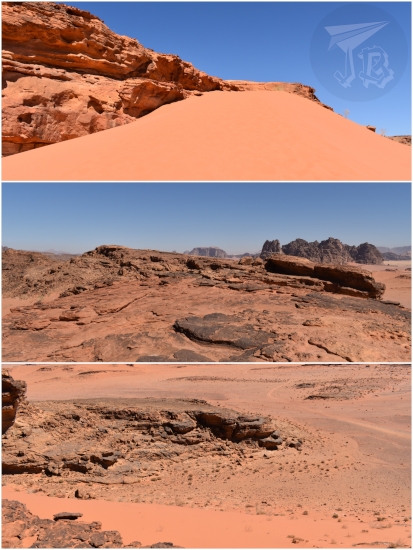
During the tour in Wadi Rum Reserve [محمية وادي رم] we drove through the desert and stopped at some rock formations that had built a gigantic dune. Wadi Rum used to be a granite and sandstone rocky formation. Thousands of years worth of wind eroded the sandstone back to sand, forming and shaping the desert dunes. Huge granite structures still stand, such as the Seven Pillars of Wisdom [عمدة الحكمة السبعة], just at the beginning of the route. One of the stops is the tourist-named Big Red Sand Dune, which you can climb for kicks, giggles and some nice views of the landscape.

Driving into Wadi Rum. The roof of the jeep is visible, along with a rock formation in the background. Between us and the rock formation there is the other jeep, causing a dust cloud

Back of a dune we had to climb, and the rock + sand landscape that could be seen from the top. Wind erosion marks have created soft ridges. The rocks are red-grey and the sand is rose-gold

Then we drove off to see some petroglyphs, and were offered dromedary rides. These petroglyphs, depicting early humans and their cattle – bovines and dromedaries – are the reason for the Heritage status.

A rock wall with some dromedaries in the foreground + a close up of the petroglyphs engraved in the rock, also showing dromedaries (by JBinnacle)

Finally we were shown a Bedouin tent at the feet of the Lawrence Canyon, a beautiful rock formation with faces of Jordan monarchs. Unfortunately, we did not get to see any onyx or fennec foxes, but I did see a small lizard. The Bedouins treated us to a cup of tea, but then we had to tip the driver about 10€…

Lawrence Canyon, a deep cut in the rock filled with sand at the bottom + details of engraved faces and Arab script, a lizard and a bit of tea, along with a traditional Bedouin coffee maker

Afterwards, we started off our trip back northwards back to Amman | ʻAmmān [عَمَّان]. Though the trip is supposed to take about 4 hours, it was way more than that, and we did not arrive at the hotel until way past 18:00. We went through the security checks and ended up learning that we could not travel between floors, so we could not go to the others’ rooms using the lifts, and the stairs were blocked… Well, at least we had… views?

A view of Amman skyline in the dark

After we managed to regroup, we had dinner and decided to try to check in online for the flight next day’s flight – and I was successful. Apparently, the airline only cared about us filling in our Covid certificate to enter Jordan, we were on our own for the way back.

10th July 2022: Reservoirs (Buendía & Entrepeñas, Spain)

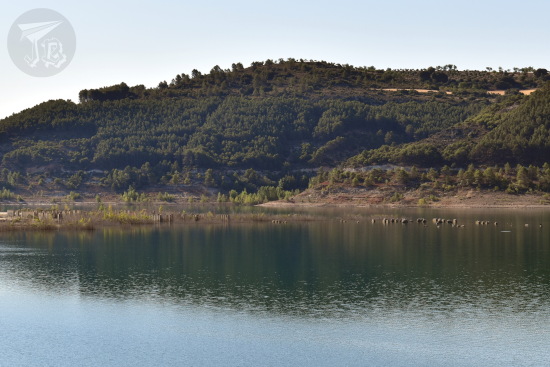
I tried going for a hike because I was feeling cooped up, and tried to make the most out of the draught Spain is going through. The centre of Spain is sprinkled with large reservoirs, a lot of them built during Franco’s dictatorship as part of the efforts to get the country to recover from the war. The reservoir Embalse de Buendía is fed by the river Guadiela and it was finished in the year 1958. Before that, there used to be a bathing complex used by the royals, along with a village there. I have wanted to get there for a while, but it is tricky because the trail is reported to be in bad condition. So I decided to walk down the trail Camino de La Isabela to gauge whether my small city car would make it. Thus, think about this as a recognisance mission.

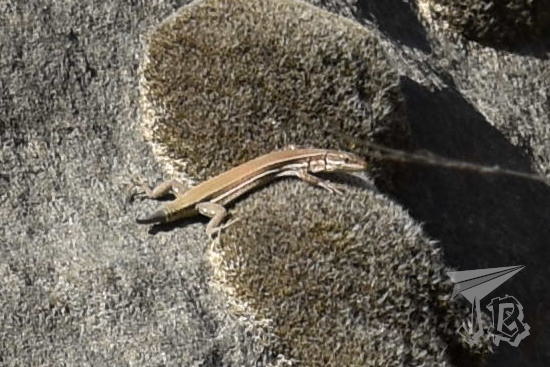
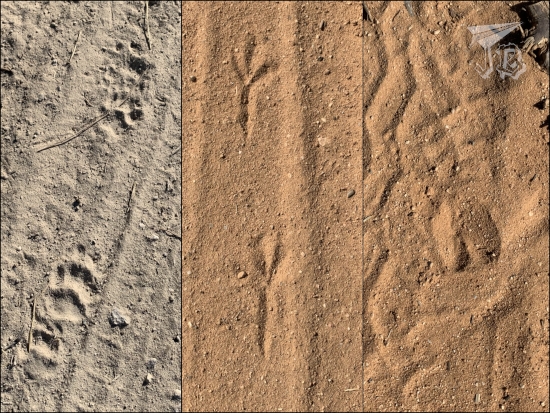
I parked the car at the beginning of the trail around 8:10 in the morning and started walking. I saw a small lizard which had shed off its tail, and some footprints – birds, canid, and I’m pretty sure a deer.

Close-up of a brown lizard which is growing its tail back.

Collage of animal footprints: paws, tallons and hooves

The temperature was nice at that time and I walked for about an hour until I got to the shore of the reservoir, then another 20 minutes or so until I got to see the derelict settlement. The water was still too high so I decided not to walk there.

A view of the reservoir. The sun is shining and there are some green / yellow plants ashore.

The reservoir. On one of the inlets you can guess the ruins, along with some columns that peek over the water.

I just hung out at the shore and found a bunch of dragonflies (I think Trithemis annulata, violet-marked darter (female and male), from a helpful comment on social media). Then I started walking back, because the temperature was rising fast.

A yellow and a red dragonfly.

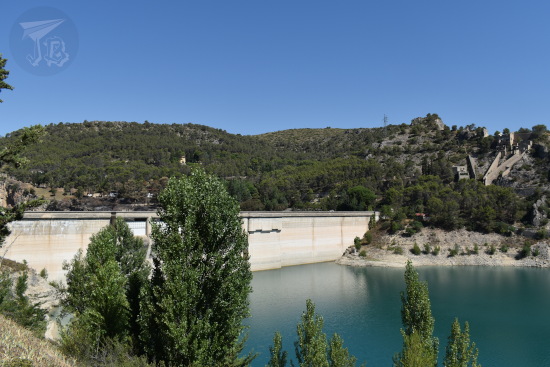
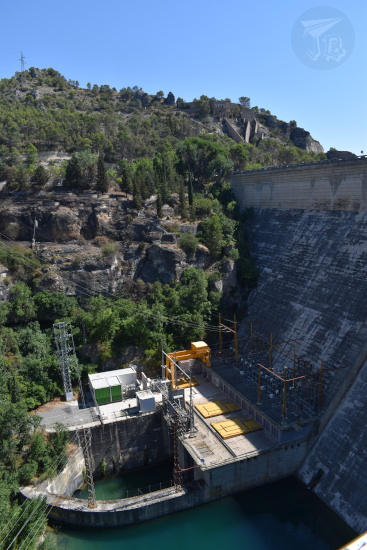
I made it back to the car around 11:00 and drove off towards a second reservoir in the area, Embalse de Entrepeñas. I have driven by more than a few times, and I would always be drawn to a little side road that seemed to overlook the reservoir. It is actually the beginning of a hiking trail, but it was already too hot to keep going. Instead, I peered around the actual dam and hydroelectric station.

A white-grey dam closes the reservoir. There are trees in the foregrond and the water looks almost turquoise.

The electricity power-plant that is fed by the water behind the dam. There are a lot of wires coming out at different heights.

It was too hot to do anything, the beginning of the heat wave, so I just drove off and made a stop to see some friends on the way. I’ll keep an eye on the water level of the reservoir Embalse de Buendía in case I can come back to the area, now that I’ve figured out how far I can reach with the car.

Walking distance: 16846 steps / 11.76 km

27th June 2022: One unexpected Aquarium visit. Zaragoza (Spain)

Because life is strange sometimes, I found myself travelling to Zaragoza in a super-slow train that took three and a half hours (while the high-speed train takes around one hour). It was somewhat of an emergency so we had to leave on Sunday in the late afternoon, and came back on Monday. We booked a hotel next to the station, one that had been built for the Expo 2008, and it goes without saying that the hotel had indeed seen better times.

My company was not required on Monday morning, so I walked towards the area that had been the Expo’08. I crossed river Ebro using the bridge Puente del Tercer Milenio, the longest concrete bow-string bridge in the world, designed by architect Juan José Arenas de Pablo.

Several views of Zaragoza's Millenium Bridge. It is white, arched in form, and the middle is held by a zigzag of wiring.

The north wind was blowing and it was a bit uncomfortable. Furthermore, the area where the Expo used to be was creepy. A lot of it was abandoned and / or fenced off, and even if they had tried to make it a park it just looked derelict and forsaken.

A collage of the parks, buildings and decorations from the former Expo 98. Everything looks derelict, with dry weeds growing where there used to be fountains. Interestingly, no windows are broken.

I looked over at the river Río Ebro. To both sides there were bridges – Pasarela del Voluntariado to the downstream to the left, and Pabellón Puente upstream to the right.

A panoramic from the river bank. There is a bird flying, the sky is blue and there are several clouds

Then I went to the river aquarium Acuario de Zaragoza, which prides itself in being the largest freshwater aquarium in Europe.

The aquarium is divided in five areas or rivers, organised surrounding a central freshwater tank called “World River”, where there are no sharks, but there are several arapaima (Arapaima gigas), one of the largest freshwater species of fish, up to 2 metres long.

Huge Amazonian fish swimming about.

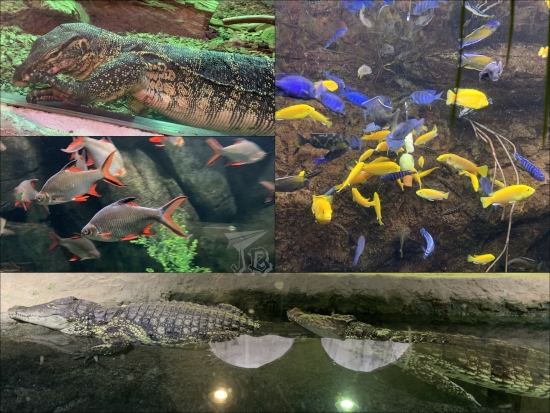
The first river is the Nile (Egypt). It included (obviously) a bunch of fish, a couple of Nile crocodiles (Crocodylus niloticus), a Nile monitor lizard (Varanus niloticus, which had somehow by the way figured out that it lived in an enclosure with a sliding door and… was trying to get it open), a couple of lungfish, perches…

Collage: a Nile monitor lizard, Nile crocodiles chilling, and colourful fish.

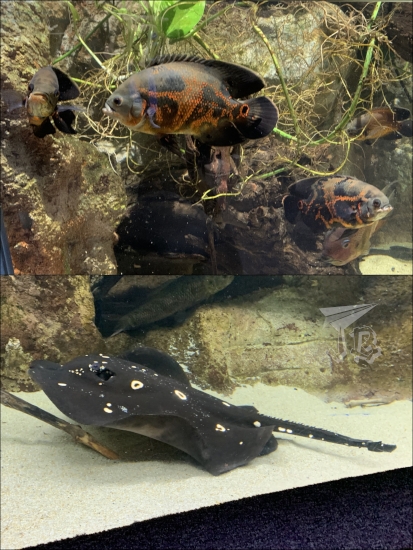
The second river is the Mekong (China), which is known for its giant fish – as a matter of fact, the largest freshwater fish ever was recently found there. There are also an insane amount of catfish – in the river, the aquarium has them under control. The most interesting thing about the Mekong is the freshwater rays.

Collage: Big orange-and-red fish, and a freshwater ray, which is black with white spots. It looks a bit like a pan.

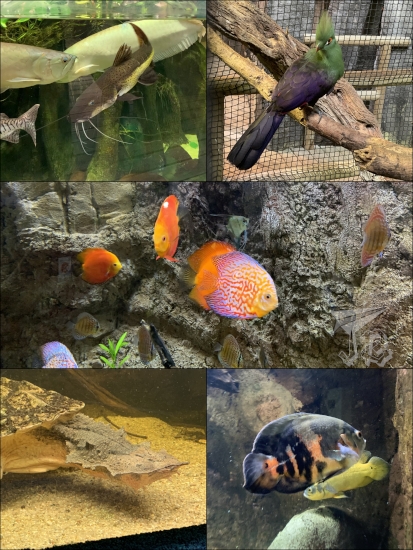
The third river is the Amazon (Brazil), which is the largest river ever, so there are three separate areas – the blackwater-flooded forest or Igapó, the forest itself, and the mangrove. The displays included Knysna turaco (Tauraco corythaix), which is the “only true red and green bird”, green iguana (Iguana iguana), catfish, red-bellied piranha (Pygocentrus nattereri), electric eels (Electrophorus electricus), anaconda (Eunectes notaeus).

Collage: black and white fish with whiskers, a green and blue bird silendly judging the photographer, brightly-coloured fish and something that looks like a rock but it's actually a weird turtle.

Then there is the Darling-Murray river (Australia), which must be saltier than I had expected, because apparently clownfish (Amphiprion ocellaris) and anemone (Entacmaea quadricolor) packs, and seahorses, along Pearl arowanas (Scleropages jardinii), tree frogs (Litoria caerulea), and the supercute (I think it was a) nobbi dragon (Diporiphora nobbi)…

Collage: A lizard, quite unamused; a clown fish hiding behind an anemone

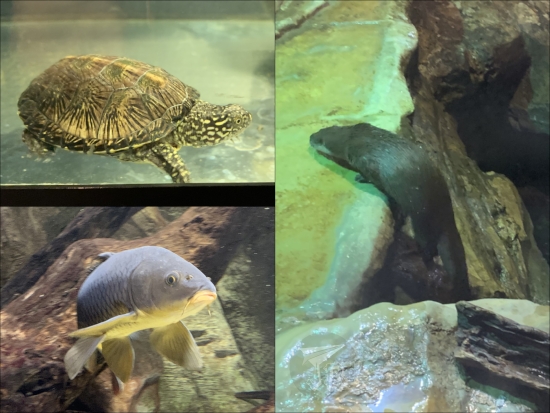
Finally, there’s the Ebro river, the local one. There are the endemic barbs (“barbo de Graells” Luciobarbus graellsii), the local otter (Lutra lutra) and sturgeons (Acipenser sp.).

Collage: a turtle, an edible fish, and a blurry otter that would not stay still for a picture

Throughout the whole run there are hundreds of turtles – the aquarium runs a turtle rescue scheme in order to get abandoned pet turtles out from the rivers, mostly the pond slider (Trachemys scripta).

I saw some of the old Expo’08 mascot, and some people diving in the central tank – I don’t think I’d go into a tank with the arapaima, even if they were swimming near when I was feeding the manatee in Faunia. There were also some animals that had been rescued from illegal trade and donated to the aquarium.

After the aquarium, there was only coming back in yet another train that took over three hours. It was the weirdest trip I have ever taken…

31st May 2022: Anaga {Tenerife, birthday 2022}

I got up on the early side as I had booked breakfast at 8:00. I was surprisingly not hungry, even if I had not finished dinner the previous evening. My plane was a little before 17:00 and I had to return the car at 13:30 (I must have messed up the time, because I was convinced I had chosen 14:30). however, there was still one spot in the island I wanted to check out – the Nature Reserve Parque Rural de Anaga, in the north of the island and about half an hour’s drive away from the airport. This is a mountain area covered in primitive subtropical moist broadleaf forests, called laurisilva canaria. The mountain range is the oldest part of the island of Tenerife.

During the Tertiary Period, the whole Mediterranean area was covered in forests which had wide, dark leaves. They disappeared with the glacial era that started with the Quaternary. The forest has not changed nor evolved with time, so it has remained as it was 40 million years ago. It was preserved in several humid areas due to the wind patterns while the continents dried out and deserts opened. Sometimes, these forests are called laurel forests, as laurel (Laurus novocanariensis) is one of the typical plants. There are other trees as tils (Ocotea foetens), bushes, vines, ferns and mosses.

I drove around two hours to get from the Parador to Anaga, and was lucky to snatch one of the last parking spots. I asked at the visitor’s centre about a route that was not too long and I was recommended a two-hour one, called Bosque de los Enigmas, the Enigma Forest.

The beginning of it was really cool. The tils and the laurels twisted almost magically and I was alone on the path. I saw some birds, though capturing them on camera was hard, possibly a grey wagtail (Motacilla cinerea) and a female blackbird (Turdus merula; which is not really black). Aside from being a nature reserve, Anaga is also a bird protection area.

A path into the primitive forest. The trees curve over and around the trail, and everything is dark

A shot up a tree, the trunk is covered in moss

An old waterway or river bed turned into a path. There are walls of dirt to the side, and the roots of the trees are showing

Collage: a grey fluffy bird looking at the camera, and a black one with its back turned, completely ignoring it.

At some point, unfortunately, I lost the trail. I reached the viewpoint Mirador de Zapata going in the wrong direction. Though the weather was very appropriate for an evergreen subtropical forest, this meant that I could either backtrack, or go along the road for a while. I decided on the side of the road as that way I knew how long I would take to reach the parking lot.

A view of the tree tops from above. In the backgrond, partially obscured by the thick fog, there is a village, and the sea is beyond it.

I eventually reached the beginning of the trail again and I had not been run over a car, which was a plus, and before leaving I could look over a second viewpoint Mirador de la Cruz del Carmen, which offers a peek onto the whole massif.

Traces of water runoff paths, which have eroded the soil and torn some trees down

A view of the tree tops from above. In the backgrond, partially obscured by the thick fog, there is a village, and volcanic mountains beyond it.

After this, I drove back to the airport to turn back the car and have some lunch. I had hoped that the smaller airport would be less strict than one of the big hubs, but it turned out they were even more vigilant. So off with the shoes again. We took off at the brink of time, landed at the expected hour… and on the way back home got caught in an hour-long double traffic jam. Ho boy!

All in all, nothing really went according to plan, even if the plans were just a draft. But all in all I had a good time and got to spend some time with myself, which I desperately needed. So yay luckiest unlucky trip ever!

29th May 2022: La Orotava, Icod de los Vinos & Parque Nacional del Teide {Tenerife, birthday 2022}

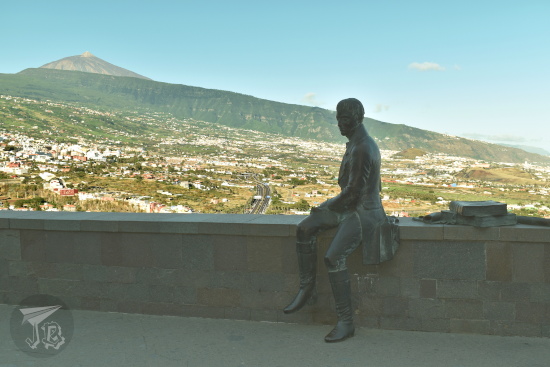
I got up rather early in the morning (especially considering that the Canary Islands are an hour behind my usual time zone) and I was surprised at how many people there were already on the streets of Santa Cruz de Tenerife before 8:30 on a Sunday morning. I drove out of the town and headed north-west, where I came across my first stop – a viewpoint of Mount Teide called Mirador de Humboldt honouring the German explorer from the late 18th century (though I kept thinking that there was a missing penguin opportunity there). The viewpoint overlooks the ocean and Mount Teide, which Humboldt climbed in 1799.

Mount Teide, a volcano, looms in the background. The top is bare and barren, but the slopes look green and fertile, with plantations and some villages. In the foreground, there is a bronze sculpture of Alexander Humbolt, sitting on the low wall of the lookout, and looking to the side.

I continued driving towards La Orotava, the municipality which Mount Teide actually belongs to. After parking the car, I walked towards the historical centre and ended up at the square Plaza de la Constitución, which stands next to the church Iglesia de San Agustín. Mount Teide loomed over the streets, ready to celebrate Pentecost Sunday. And guess what? The main church is called… Parroquia Matriz de Nuestra Señora de la Concepción. The initial hermit church was built in the 15th century, and it was completely rebuilt in the Baroque style throughout the 18th century, though the interior was remade in the 19th century and there was yet another renovation in the 20th century. It is considered the most important building of the Canarian Baroque.

A collage of La Orotava. The buildings are built with white plaster and black volcanic rock. Mount Teide peeks from the background.

The most representative construction in La Orotava is the “house of balconies” Casa de los Balcones. The house was built in the 17th century. The façade shows a front-long balcony on the third floor, and five smaller balconies on the second, all of them made from dark teak wood. The interior holds a museum, but I decided to give that a miss because I reached there at the same time as a very disorganised group of forty or fifty people who were going in at the time.

A colonial house. It is built in white brink. It has three floors. On the ground, there are brown windows. On the first floor, five balconies, with decorated ironwork. On the second floor, a long balcony or gallery in dark wood.

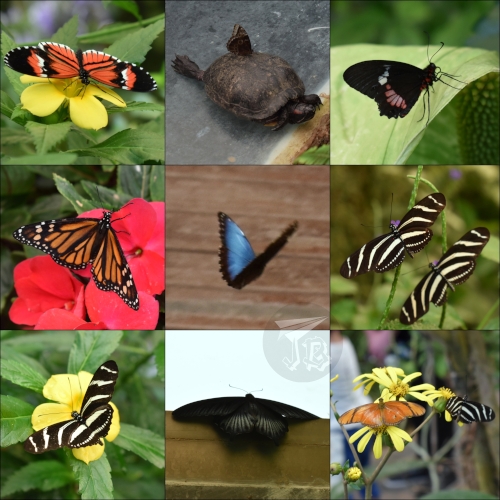
Instead, I went back to the car and drove towards Icod de los Vinos. There, my first stop was the butterfly house Mariposario del Drago, since the ethnographical museum Museo del Guanche is closed.

A collage showing colourful butterflies - red, orange, blue, black, black and white. One of them is chilling on the shell of a turtle, and another one is caught mid-flight. Most are on flowers and plants.

The butterfly house stands next to a botanical park Parque del Drago built around the symbol of the town – and maybe the whole island – the Drago Milenario. This is the largest and oldest specimen of Canary Islands dragon tree or drago (Dracaena draco). Folklore says that it is a thousand years old, hence the name “the thousand-year-old dragon tree”, though in reality, it is probably around 600 years.

The dragon-blood tree. It has a knotted grey trunk and bony branches. Around it there are bright-green palm and laurel trees

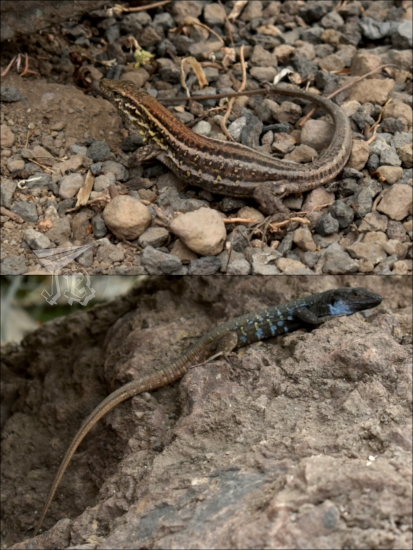
The park, built around the drago, holds local species trying to reproduce the local biotopes with height, there is also a small volcanic cave. It was here where where I managed to catch my first glance at the local fauna – two of the endemic lizards (though not as big as the one I had seen in the museum): lagarto tizón (Gallotia galloti) or tizon lizard, a blue-spotted male and a brown-striped female.

Two lizards. One camouflages on the grey and brown ground. The other on has a brown tail, but the body is black and bright blue

Then I went back to the car to climb up a crazy slope until I reached the visitors’ centre of the lava tube Cueva del viento. A lava tube is a “cave” formed the flowing lava of a volcano. As the outer part solidifies, the inner core continues flowing until it empties the tube. The guided visit is the only way you can enter the tube, so I had reserved that a few weeks earlier.

The visit started with a small introduction in the visitor’s centre, with a lot of “gotcha” questions on the guide’s part. I tried really, really hard not to be a smartarse, but I did sit down on the floor at a point because I did not feel like standing around for twenty minutes. The important information we received was that there were two types of lava that had formed the island of Tenerife: pahoehoe and block lava.

Then we took the centre’s vehicles to the outer area of the cave, where we could see the solidified lava, now turned into stone. Pahoehoe lava is basaltic, it flows slowly, and it is the responsible for creating the tubes. As it flows and solidifies, it creates undulations and wrinkles. On top of it, only small trees and bushes can grow.

Old Pahoehoe lava trails. The rock looks wrinkled or similar to pillows.

Block lava is more acidic, with a higher silica contents, it flows less and creates “blocks” as it solidifies. Pines can be found growing on top.

Pines around an old colada, which seems rocky and broken.

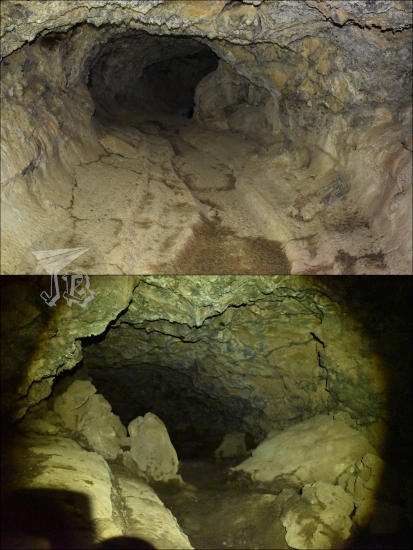
The cave itself was very cool. Unfortunately, there were a couple of families with kids and grandparents, all trying to be braver than the next – and thus acted loud and boisterous. More interesting information – mummified guanche aboriginals had been found in the cave, along with remains of a giant rat and lizard that were the ones reproduced in the Museo de Ciencia y Antropología de Tenerife. It is one of the biggest lava tubes in the world, with up to three levels and maybe 18 km of tunnels, though only a short walk can be had.

Inside the lava tube. It looks alien, like the rock is going to start dripping any second

Back in the parking lot, I had a snack and headed off towards the Parador de las Cañadas del Teide, where I had booked my next couple of nights. On the way, I went through several amazing volcanic landscapes that I could not photograph as I was driving. However, I did stop at several lookouts throughout the Parque Nacional del Teide.

Mirador de Samara.

Pines growing up on the dusty remains of a lava flow. In the background, there are three mountains - three craters of the same volcano

Mirador de las Narices del Teide, which shows the collapse on the mountain during the last known eruption.

A view of the black collapse of lava from the last eruption. Everything is barren, brown and grey, except for a black spillage coming down ominously. The sky is blue in the background, which makes the whole thing look even more bizarre.

Mirador Zapato de la Reina.

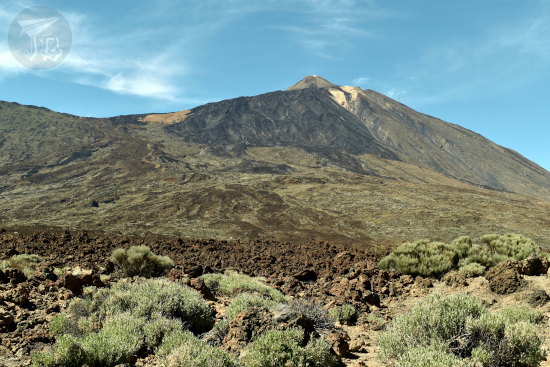
The top of Teide. This is the point where vegetation has become scarce, with low bushes, that creep up the slope. The summit looks naked.

Finally, I arrived in the area of Las Cañadas del Teide or Las Siete Cañadas where the Parador de las Cañadas del Teide stands. I was lucky that the season was good to see the flowering bugloss Echium wildpretii (tajinaste in Spanish), an endemic flora species mostly found on the Teide slopes. After checking in I wandered around the different tracks and paths – Cañada Blanca, Roques de García and Mirador de la Ruleta, which show the different stages of various volcanic eruptions.

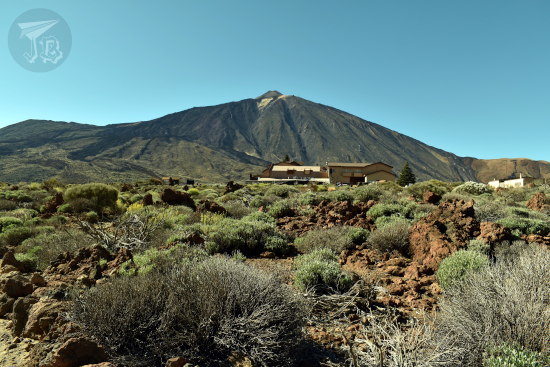
Mount Teide rises in the background. It looks wrinkled due to the different eruptions. At its foot, a low building, looking completely out of place. In the foreground, small bushes in grey and green.

Collage: Different rocks and structures created by lava and erosion, the rocks are reddish or grey, and they have weird shapes. The tajinaste is a tall bush, with tiny red flowers, it stands about 1m above the rest of the plants.

I turned in early, and I had booked my dinner in the Parador both nights I’d be sleeping there, so that was an easy one. The staff made it a little awkward though, even if I was not the only solo traveller around. After dinner, I tried to get some pictures of the night sky, but I was unsuccessful.

13th March 2022: The outskirts of Madrid (Spain)

I’m usually rather enthusiastic when I visit new places, but if there is a place that I’ve found kind of over-hyped, that has been the park Parque del Capricho, in Madrid. “Capricho”, which means whim or folly – in its architectural meaning of an often extravagant picturesque building erected to suit a fanciful taste, or building erected for decoration, typical of the French and English decorative gardens from the 18th century. The park is located in Madrid, and the only romantic garden that remains in Madrid. It was promoted by the 12th Duchess of Osuna between 1787 and 1839, and became a recreational area for the nobility of the time. Some of the most important gardeners and landscapers of the time worked on its design. It was declared Historical Garden in 1934 and restored in 1999.

So it is a garden, with some plants, some flowers, and a bunch of weird-looking decorative items, that takes itself a bit too seriously. It won’t accept pets and you can’t bring any food inside (it has some cage-looking “lockers” were you can leave your stuff). There is a strict capacity control which does nothing for it not to feel ridiculously crowded on a regular nice-weather Sunday. Maybe it improves in spring / summer, and with fewer people, but I had some stuff to do in the area and that is why I made time to visit today.

It had been raining all week, so I had mostly scrapped my plans. It was a great sunny day though so in the end I decided to get there. Parking the car was ridiculously easy – though the parking spot was maxed out, I found a very easy one in the avenue next to the park – good, it was close as I would not put my sandwich in the crappy-looking lockers and preferred taking it back to the car. Then I walked in, and explored for a couple of hours – and don’t tell anyone, but I ate a piece of candy, just to be rebellious (≧▽≦) (and to make sure I did not sugar crash without any food around, but that does not really make for a good story).

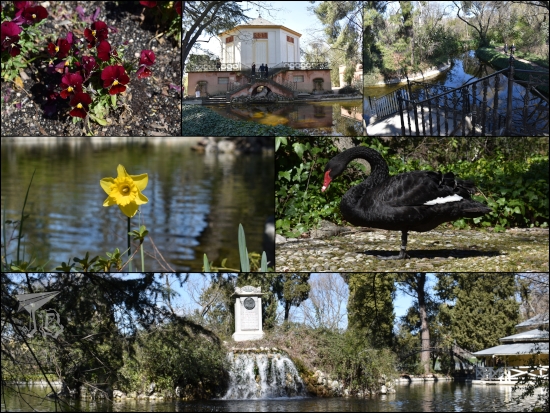
While I of course did not expect everything to be blooming and colourful and green… I hoped that it would have at least maintained through winter. No such luck. A bunch of areas were fenced off, the footpaths were swamped with puddles, and the water in the ponds was not as clean as it should have been. Exploring the 14 hectares took me about an hour and a half, considering that I did go into all the little paths, but all the buildings were closed and / or under constructions. There is a Civil War bunker in the park too, but that is only open through pre-booked guided visit and I did not know I was going to do this 30 minutes before I jumped on the car. The few flowers that had already bloomed included the garden pansies (Viola × wittrockiana, which are after all winter flowers), and the yellow and white daffodils (narcissus, maybe the subspecies jonquil Narcissus jonquilla). There were a couple of black swans (Cygnus atratus) at the main pond, and mallards (Anas platyrhynchos) on every second water body, including fountains.

Pond in the park. There are some flowers and buildings around it, and a black swan sunbathing.

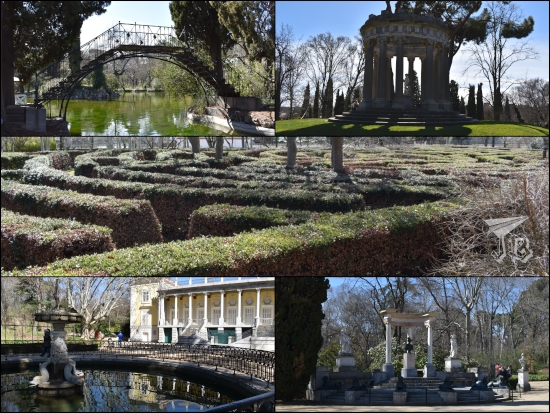
Collage of different park decoration: a bush labyrinth, a fountain, and some decoration reminding of Greek temples.

Afterwards, I took a small detour to see if any of the Japanese cherry trees in the park opposite the street Parque Juan Carlos I had started blossoming. The answer was not at all. But the point was heading to the restored castle Castillo de la Alameda. The castle dates back to the 15th century, though there are older remains underneath, and it is thought that its presence is the one that got all the aristocrats to flock to the area, as it switched from defensive castle to palace.

The remains of the castle feature an irregular moat with lobe-like structures in the corners, and the restored keep, which stands up to the first floor, though it must have been much higher. An interesting characteristic of the castle is that it was built using a kind of mortar made from flint. I have to say it was a nice surprise, free to visit.

A clover-shaped castle ruins, all white. There is not much of the castle left, but the moat is almost intact, though empty

To the side of the castle there is a casemate – a fortified machine gun emplacement from the Spanish Civil War, called Nido de Ametralladoras (Machine gun nest), a semi buried cement block for snipers of sorts to defend the position.

Concrete block that was used as a machine-gun base

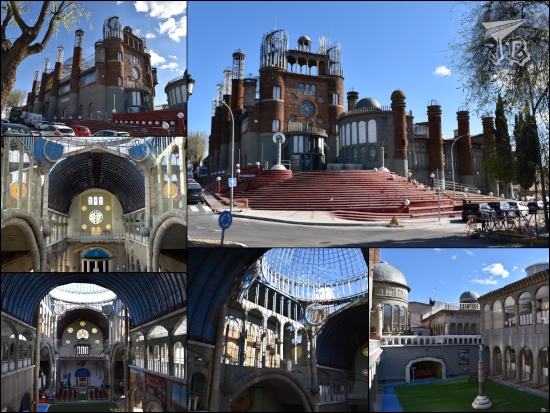
Then I moved onto Mejorada del Campo a little town near Madrid that only has one tourist attraction – a… handmade cathedral. Of sorts – Catedral de Justo Gallego .

Justo Gallego was born in 1925. Deeply Catholic, he became a young monk-in-training but had to leave the monastery when he contracted tuberculosis. He made a vow to erect a cathedral to the Virgin Mary in her “Lady of the Pillar” avocation, and he sort of did. Throughout the next 60 years he worked on building the cathedral, using recycled material, and on his own. His work came to fame when a soft-drink company made him the star of an advertising campaign, which made him and his work famous.

The cathedral has 12 towers, a crypt, two cloisters, a baptistery, and the main nave is 20×50 metres, with a 35 metres high dome. Most of it was done by hand, using discarded items such as tubes and bicycle wheels. It is garish and childish in its decoration, but I found it to have some strange allure. The cathedral has drawn the attention of international artists and institutions, and apparently Gallego built it without any blueprints or knowledge of construction. Upon his death, an architectural studio started working on “legalising” the cathedral (from an urbanistic point of view; it is not an official Christian building) and is it is now under management from an NGO. It was just a bizarre thing to see, but interesting since I was in the area (sort of. Construction made the route stupidly long), glad I’ve visited it at least once. I did catch a European white stork (Ciconia ciconia ciconia) coming home to one of the towers.

Cathedral made out of recycled items: pipes, plastic bottles, irons... there is a dome and a nave, in bizarre colours.

A stork approaches one of the towers of the cathedral

I drove off afterwards, and I have to say the weather that day was amazing – just in-between two piss-poor ones, so yay spring escapade.

Walking distance: 11.18 km (16916 steps)

26th February 2022: A Medieval Fair in Tendilla (Spain)

Tendilla is a tiny village in the area of Guadalajara, Spain. It was declared a town – by Medieval standards at least in 1394. About a century later, the County of Tendilla was founded. By that time, the local cattle fair, around the festivity of St. Matthew, was considered one of the best in the Kingdom of Castile, with the Catholic Monarchs bestowing their blessings on the town. Among the most interesting areas are the long covered arcades, and the unfinished church dating back from the 16th century, Iglesia de la Asunción.

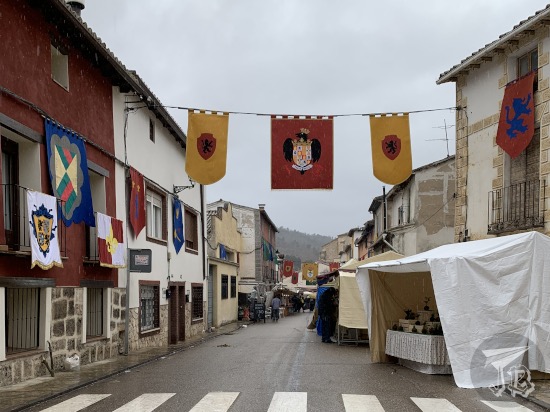
The cattle fair was rekindled in the 1990s, and today it is called Feria de Mercaderías de San Matías. The closest weekend to the 24th of February, St. Matthew’s day, a Medieval market is laid along Main Street, with edibles, trinkets and artisan items. The village becomes decorated with flags, pennons showing off real and assumed heraldry items.

This year, I decided to get there as some family members were going to be in the house they own in the village. I arrived at around 10 am, and by that time most the village was already full. I got deviated, but it was not hard to find a parking spot. Unfortunately the weather had not decided to accompany and it was rainy and freezing all day.

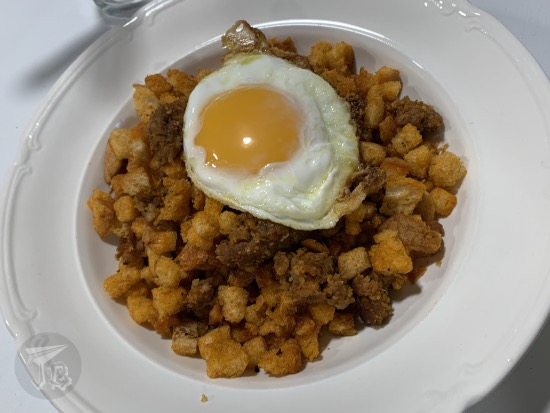
The fair stalls had begun to open, but first we made a run for the local grocery stores to grab some ingredients for lunch. The typical thing to eat in this time are migas, which are basically fried breadcrumbs with paprika, pork, garlic and a fried egg on top. We also bought sweets and confectioneries, just because we could.

At noon, we walked along Main Street Calle Mayor. The stalls were already open, and even in the bad weather there were quite a few people. Some were even in costume, dressed in Medieval outfits, as dames, knights or noblemen.

A wide street. There are flags hanging above and from the balconies, and shopping stands on the right. the sky is dark and heavy, as in all the pictures taken

A wide street. There are flags hanging above, and shopping stands on the both sides, selling hand-made jewellry and trinkets.

A Romanesque church with a bell tower. The church is unfinished.

Main square. It has a pole in the middle, and colourful ribbons run from it to the buildings around the square. The floor has been covered in sand, and the houses are decorated with flags. Lots of people walk around.

To the end of the village, a small “farm” had been installed – oxen, horses, cows, goats, donkies, sheep, rabbits, piglets… Due to the ‘health situation’ which for once was not Covid but avian flu, there were no ducks or hens or any kind of bird. You could hold the bunnies, but I really really wanted to hug the huge draft horses.

Farm animals: a donkey, two piglets, cows, rabbits, a sheep trying to eat the camera, a working horse.

Farm animals: goats trying to escape the pen, oxen ignoring the camera, a black-and-white cow wanting pets, and a working horse looking tired.

Someone had not really thought positioning carefully though, and right in front of the farm – and the piglets – stood the food stalls, especially a roaster, whose cooked pork was… suspiciously similar to the piglets in the farm *coughs*.

On the other side of the farm, the locals had started preparing the communal migas – every visitor is entitled to a plate of them, but it was way too cold to queue. Instead of being topped with an egg, though, they are sprinkled with torreznos, pork lard fried and preserved.

A huge barbecue with pork roasting and sausages. The barbeque itself is round, and it's big enough to fit at least a dozen ribcages, ten pork legs, and twenty or thirty sausages.

A person using a shovel to stir a huge pot of breadcrumbs being cooked, and a close up of the severd plate: orange-looking breadcrumbs with dried fried pork lard on top.

On our way back we ran into the horse parade and show, which was held in front of the town hall. The riders of El Duque Espectáulos, dressed in Medieval and Templar costumes, trotted and galloped along the music.

A group of medieval-looking horse riders making their way through the crowds

An older man making a golden horse trot and gallop on command, the horse is photographed mid-hop

Riders in medieval clothing galloping on the Main square

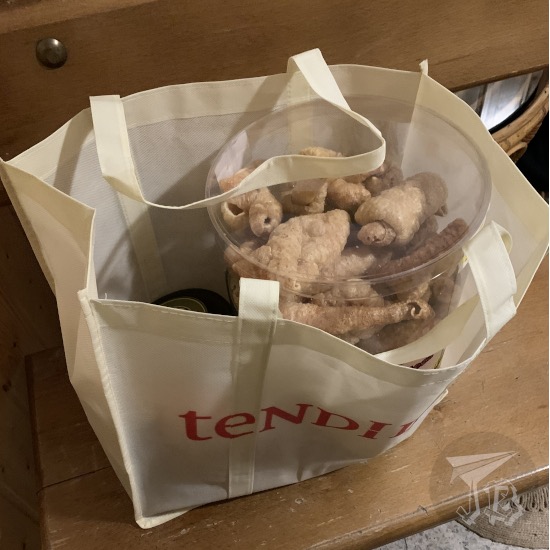
We stopped to buy some torreznos to take home, and we got given the tourist treat – a cloth bag with a huge box of fried pork skin. It is tastier than it sounds, honest!

A tote bag reading Tendi (the rest of the writing is obscured), with a box of torreznos inside

We had lunch at home, and not to show off, but I do think our breadcrumbs looked much better. We made them ourselves, with chorizo meat and eggs sunny side up! They looked so much better than the communal ones, right?!

A plate of migas. The breadcrumbs look golden, and there are pieces of pancetta and chorizo mixed with the bread. On top, there is a fried egg, sunny-side up

Finally, after lunch, we took another stroll, but the weather was miserable, raining and cold – which was so mean because the following day when I had to work it was nice and sunny, and there was a bird of prey exhibit.

Romanesque and Baroque buildings, deserted in the rain. One of them is a tiny hermit church, the other a column, and the third a palace that has seen better times

But all in all I spent a nice time with family and got to pat horses and goats. I guess there are much worse ways to spend a Saturday.

Walked distance: 6.20 km (9866 steps)

1st July 2021: Manatees are Zen (Faunia, Madrid, Spain)

Madrid has two zoos, the traditional one which can be traced back to 1770, and a second one which opened in 2001. They actually belong to the same business group anyway so probably the whole point is just to charge more – and to expand the installations. They operate as independent entities. On the first of July, due to a number of circumstances coming together, I visited Faunia, the newer installation. The standard price for a ticket is around 28€ – but there are plenty of different discounts. I paid 18.90€ for a random Thursday discount that they’ve got.

Though it promotes itself as a “Nature Theme park”, Faunia is little more than a modern standard zoo. Of course, it is much better than the old zoos, and the animals are well-kept, an organisation in ecosystems or areas is not that much of a novelty any more. There are different areas: farm / petting zoo, night, lake, jungle, temperate forest, African forest, Australia…

Komodo dragon (Varanus komodoensis), the largest lizard in the world, endemic to some Indonesian islands. They are venomous.
Tufted capuchin (Sapajus apella), an omnivorous primate from South America.
Red panda (Ailurus fulgens), an animal that is so different from everything else that it has its own family name all by itself. It is native to the Himalayas and the south west of China.
American flamingoes (Phoenicopterus ruber), long-legged wading birds famous for their pink colour that tend to live in flocks.
Ring-tailed lemurs (Lemur catta), a group-forming species endemic to Madagascar. They are attitude-laden and fear-lacking little fellas who love to sunbathe.

Fennec fox (Vulpes zerda): a small fox with large ears which lives in the Sahara and the Sinai Peninsula.
Southern tamandua or lesser anteater (Tamandua tetradactyla), a species of anteater from the forests of South America and the Caribbean, which feeds on ants, termites and bees.
Kangaroo Rat (genus Dipodomys), tiny nocturnal rodents from North America that can jump over two metres
Butterflies – don’t expect me to be able to ID them, but my money is on Antiochus Longwing, a south American small butterfly
Nile crocodile (Crocodylus niloticus), a found in marshes, rivers and lakes in throughout sub-Saharan Africa. They are opportunistic and aggressive predators which ambush their prey in or near the water. And they can gallop. Look that up.

Arapaima (Sudis gigas), a giant fish native to the Amazon. They eat smaller fish, crustaceans, fruits, seeds, insects and any small land animal that they can catch on shore. Furthermore, this is an air-breather. It is a top predator that can become invasive if placed somewhere else.
Redtail catfish (Phractocephalus hemioliopterus), another carnivorous fish from the Amazon. Never trust a catfish, they can literally eat you by accident (or on purpose).
Caiman (family Alligatoridae), reptile predators originating in South America. They are large and aggressive, but they tend to hut fish. Did you know that
Penguins (family Spheniscidae) are a group of aquatic flightless birds. Most live in the Southern Hemisphere, and they feed on krill, fish, squid and so on that they catch underwater. Contrary to the myth, not all penguins live in the cold, a lot of them live in temperate climates.
Coral reef, with clownfish (family Pomacentridae) and sea anemones (order Actiniaria) living in symbiosis.

Meerkat (Suricata suricatta) aka Timon from the Lion King.
Red-necked wallaby (Macropus rufogriseus), similar to but smaller than a kangaroo, and also friendlier. They, of course, originate from Australia. The Faunia webpage says that you can go into the pen and walk among them, but I didn’t try.
Yellow-banded poison dart frog (Dendrobates leucomelas). It is an amphibian which lives in the humid areas in the north of South American. They secrete toxins from their skin. Do not pet, much less lick.
Blue viper of the white-lipped island pit viper (Trimeresurus insularis). Beautiful, venomous, aggressive and feisty, this snake is originary from Indonesian islands.
Gaboon viper (Bitis gabonica), it is really there. It is another venomous snake, and it has the longest fangs among snakes. And yes, it is really there.

White-cheeked turaco (Menelikornis leucotis), originary from forest in the highland regions of Eastern Africa.
Grey crowned crane (Balearica regulorum), a large bird from Sub-Saharan Africa.
Roseate spoonbill (Platalea ajaja), a wading bird from South America, with a very characteristic beak, hence the name
Macaws (genus Ara), endemic to Central and South America. They are “seed predators” which means they destroy the seeds to eat them
Scarlet ibises (Eudocimus ruber), another colourful bird whose original habitat is the coastal areas of South America. They use their long beaks to prove for food in mud or under plants – they eat a lot of small crustaceans, which gives them their particular colour

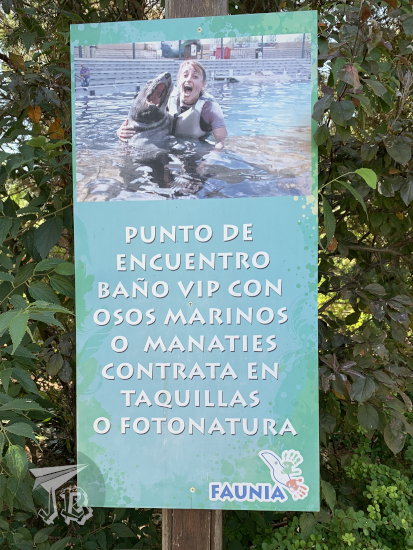
I guess it is worth a visit, but that’s just about it, if you consider it from a shallow point of view – because when you start getting deep into things, everything gets ridiculously expensive. Because the thing that does differentiate Faunia from other zoos is the fact that it offers “hands-on experiences.” Some of these are about 5 or 6€ and include a short talk inside one of the pens – such as “meeting” the pelicans or the penguins.

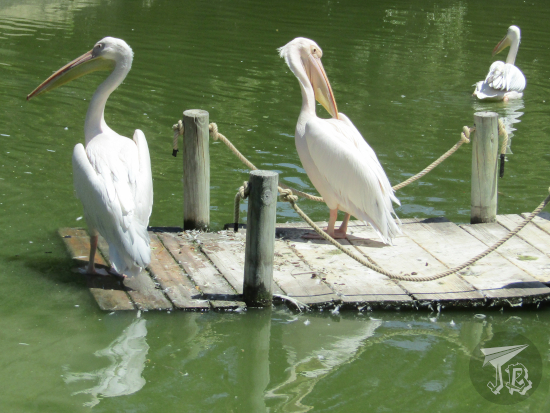
For example, the Pelican interaction consists in walking into the pen and seeing the birds from afar sitting on a bench while one caretaker explains basic biology facts and the other tries to get a pelican to eat trouts for a bit of a close-up “feeling”. Pelicans are large water birds spread all through the world but Antarctica. Their most important characteristic is the large throat pouch under their long beak, that they use to “fish” – they fill their pouch with a billful of water and keep whatever they can digest. Faunia has pink-backed pelicans (Pelecanus rufescens) great white pelicans (Pelecanus onocrotalus)

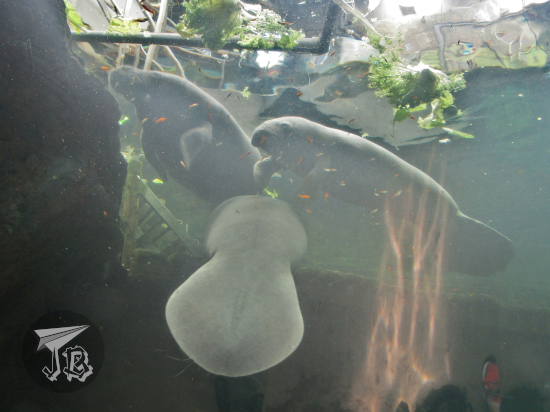
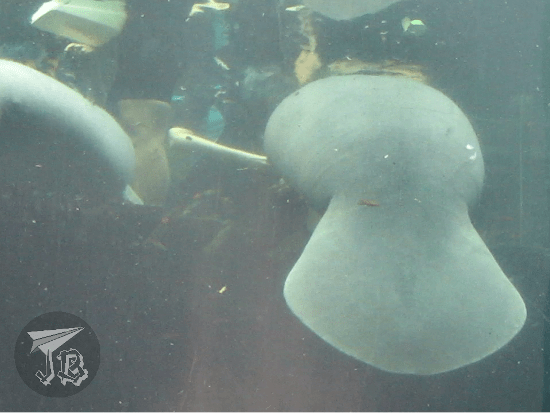
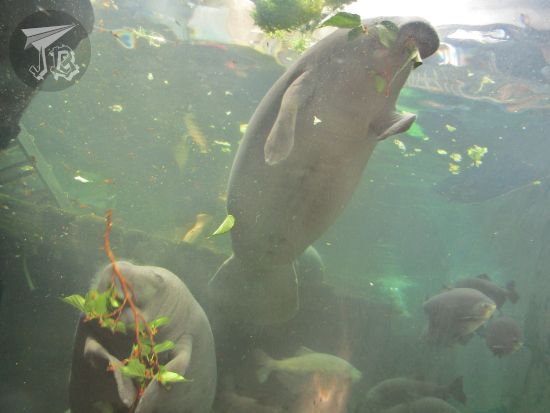
There are however other more expensive interactions, on the range of 40 to 50€, and one of them is the one I did – the interaction with the Manatees. Faunia has three West Indian manatees of the Antillean subspecies (Trichechus manatus manatus). Manatees are aquatic mammals – they breathe air and they spend all of their lives in the water, either salt or freshwater in South America. They don’t have natural predators, so they lack predator-avoidance responses, which makes them very tame and friendly. Unfortunately, they are critically endangered in the wild, mostly due to human-related deaths: hunting, habitat destruction and collision with ships. As they are herbivorous, they eat fresh and saltwater algae and plants, they are sometimes called “sea cows”, and eat plants and algae – males are called bulls, females cows and babies calves. They are sturdy and they can weigh between 400 and 550 kg, measuring up to 3 m in length. They have a long spine with pectoral flippers that have five fingers, but no rear flippers. Their body ends in a paddle-shaped tail. The neck is not visible and the head is stocky. They don’t have ears, their eyes are small and their snout is short, with nostrils that can be closed when they are underwater. They have a prehensile lip that they use to gather food and for social communication and interaction.

And they are adorable.

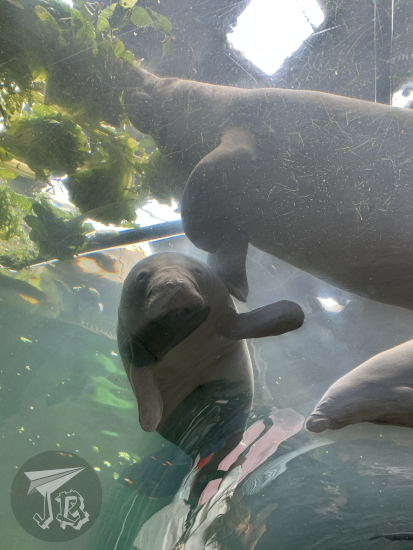
The manatees in Faunia are named Bruno, Fiona and Pelusa (“Dustbunny”), with the latter being the two-year-old daughter of the other two, born in the park. They live in the tank located in “The Jungle” area (La Jungla), sharing their space with catfish, arapaima and pirapitinga (the good-rep fish in the piranha family). For the interaction, you are asked to bring your bathing suit, towel and pool flip-flops. I arrived at the meeting point early and waited eagerly for the staff to come pick me up. Then I was guided into the inner area of the Jungle building, up a metal staircase and I changed into the neoprene suit.

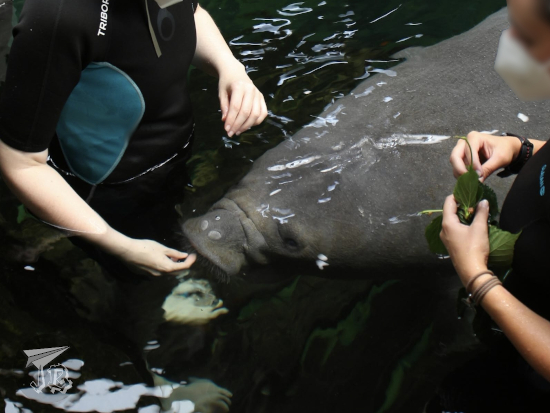
As we waited for the other people to be collected, I saw the manatees swimming around, already anticipating the food. They had mulberry leaves, endives, and banana pieces for treats, and lettuce of different kinds as their main meals. The interaction itself is a kind of training for the animals. The trainers go in with an acoustic signal, and the animals recognise their own names, and each goes to the trainer assigned to them – you also get assigned a trainer so you don’t mess up.

There are two parts of the interaction. First, you get to feed “your” manatee whatever you are given. Normally, there are two people per manatee, but as this was in the middle of the week, even if in summer, we were lucky enough to only be three visitors – which meant your own personal manatee. Mine was Pelusa, the baby, and she was way more interested in the mulberry than the endives. During this part you keep your FFP mask on.

For the second part you “go down” with a snorkelling mask and even if you’re still on the platform you get to feed “whomever comes to you”, seeing the interaction from within the water. To finish up, you give your manatee a small branch for them to eat and play with, and they are released, you change back into your clothes and leave. My interaction took about one hour, and I was lucky enough that I had an “infiltrate” who took pictures from the “underwater tunnel” that crosses the tank. I also bought myself one of the official pictures that the resident photographer takes, because I really, really wanted a good picture.

All in all, it was awesome, and it even felt that the manatees came to wave bye-bye as I left through the tunnel.

As a zoo, as I mentioned, Faunia is a very standard one, with very few things that would make it special if not for the interactions. It could do with some more shades, because just after lunchtime it became really hot. Most food kiosk were closed due to COVID measures, and there were several vending machines. There were a lot of kids doing “urban camp” activities, and I got ran over twice – one of them pretty painfully to be honest.

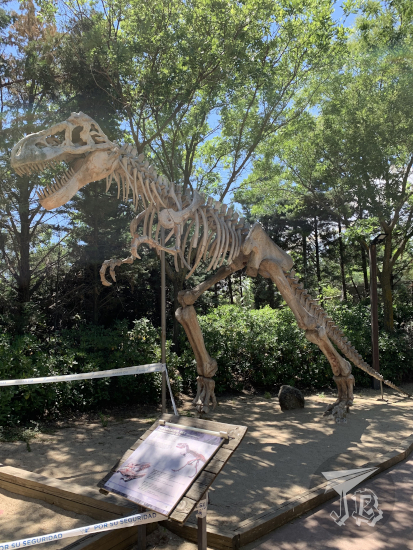
Aside from the animals, there is a roller-coaster, also down due to COVID and a “dinosaur canyon” with dummies and animatronics that have really seen better days.

T-rex skeleton reconstruction

Furthermore, queuing to go in because the VIP entrance is blocked for… no really VIPs as there were none, and waiting forever at the entrance kiosk to get the Experience passes and then for the photos, were a drag. As a conclusion, going once in your lifetime, getting to do an interaction or two might be a good idea, but this is not somewhere I’m dying to come back to – though I am open to explore other parks from the same owner, such as the traditional zoo or the aquarium.

I mean, some of animals, such as this goose, had a very clear opinion about the park, too.

Goose attacking one of the Faunia signs

Walked distance: 12954 steps / 8.06 km

Pricing: Ticket: 18.90€ + Manatee experience 38.90€ + Pelican experience 5€ + Professional picture 11.90€ + digital upgrade (three-month access) 1€ = 75.70€. Way too much to plan another expedition any time soon.
Saved: We parked outside so we saved up the 5.50 € for the parking lot, and we took our own food.

31st July 2019: Journey to the East (2): To the bunnies! {Japan, summer 2019}

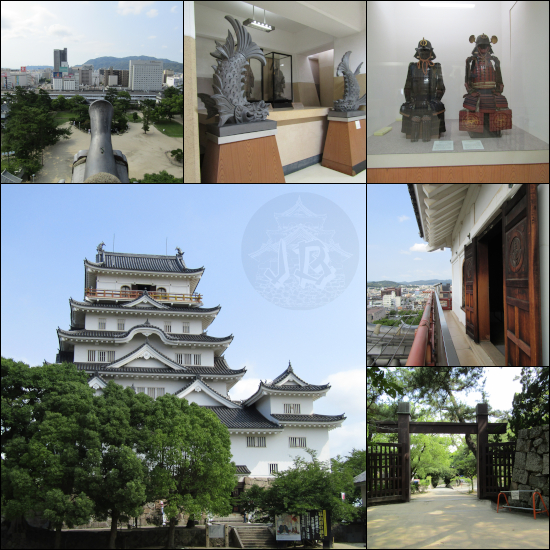
I caught the train early in the morning to get to Fukuyama [福山] (Hiroshima Prefecture), barely 15 minutes away from Okayama by train. I wanted to see the local castle, Fukuyama-jo [福山城], which I had not been able to see the last time I had been around because I was a bubblehead and missed the train that gave me leeway to stop (and it was a Monday and closed). Thus, this time I factored it in.

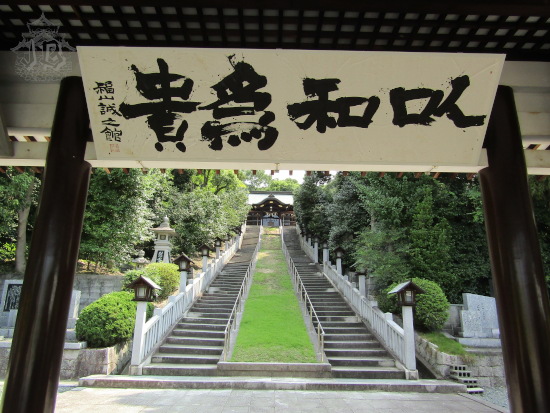
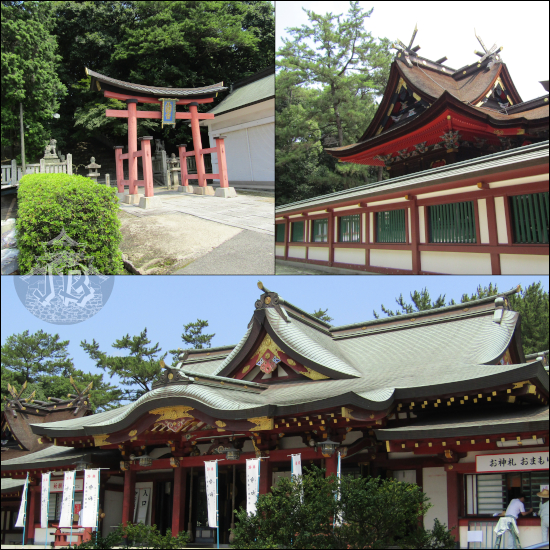
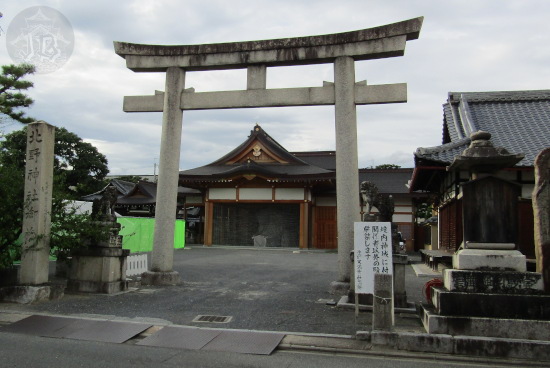
After visiting the castle I found the complex found by Abe Jinja [阿部神社] and Bingo Gokoku Jinja [備後護国神社].

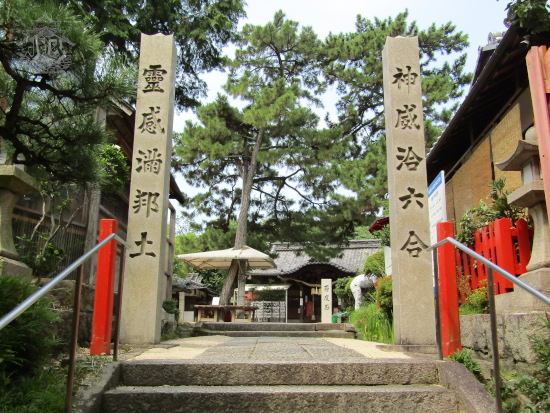
And then Sanzoinari Jinja [三蔵稲荷神社].

These three shrines were located within the same park as the Castle, but my map also pointed out that Fukuyama Hachimangu [福山八幡宮] was not that far away, so I went to find it too.

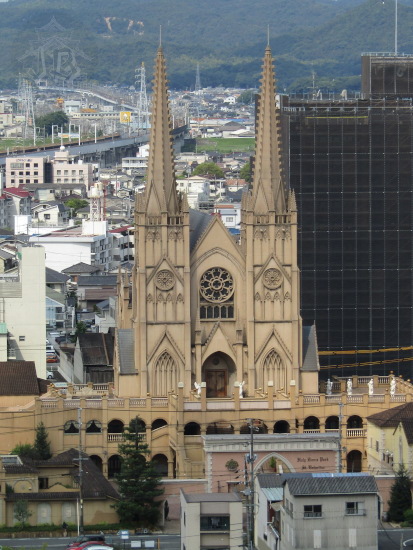
On my way back I diverted because a building had drawn my attention and I wanted to find out what it was – it turned out to be, and I quote the “Holy Zion’s Park St. Valentine” [ホーリーザイオンズパークセントヴァレンタイン]. It was a wedding venue. Live and learn.

As I had some time before the train I wanted to take, I also checked the Fukujyukaikan [福寿会館], which turned out to be a ‘traditional house with a teahouse’, so I did not come in.

After that, I took another train to Mihara where I took the Kure line towards Takehara. However, I stopped halfway, in a small station called Tadanoumi [忠海]. What is there in Tadanoumi? The ferry to Okunoshima.

And what the hell is there in Okunoshima? Bunnies. Hundreds of tame rabbits which you can feed and which will climb on you to demand your food, or climb into your backpack of bag or whatever you’re carrying.

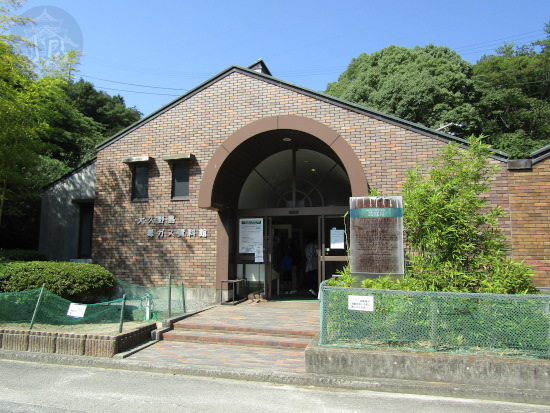
So yes, I went to Okunoshima [大久野島]. I could lie to you and tell you that I was there because of the island (horrific) history, and places like the Poison Gas Museum Ōkunoshima Dokugasu Shiryōkan [大久野島 毒ガス資料館].

Or the magically decaying Okunishima Jinja [大久野島神社].

Or the beautiful scenery.

But bluntly put I was there for the rabbits and bunnies and bunbuns and the fluff and the floppy ears and the straight ears too. Okunoshima is also known as Rabbit Island. After it was abandoned after WWII, apparently a bunch of students released some domestic rabbits and they have colonised the whole island. Now you can go and feed them, although you are encouraged not to grab them or ‘put your fingers near their mouths’. For three hours I pranced around finding bunnies and feeding bunnies.

Then I took the ferry back to Tadanaoumi as the sun started to set.

I continued on the Kure Line to Takehara [竹原市], the city / town Tadanoumi actually belongs to (and I was super lucky because there were disturbances and delays for hours starting the following train). Honestly it was just the nearest hotel I had found – I mean, when I went out the only thing I found to grab a bite to eat was a McDonald’s… and they made my fries to order. I also found out about the town’s unofficial mascot, a character called Momonekosama [ももねこ様], from an anime that is set in Takehara

I had saved up the following day as “buffer day”. I did not know whether to try and get to Kure, or directly back to Nagoya, I thought it would just depend on how tired I was… But the hotel had a little map about how Takehara’s historical district was “Little Kyoto”… I thought maybe that was worth checking out.

Walked distance: 19058 steps, 13.6 km

15th – 17th June 2019: Cologne (Germany) for the Gazette

Getting from Madrid to Cologne [Köln] was stupidly difficult and expensive so in the end I took an early Saturday-morning flight to Frankfurt and then I booked train tickets (an ICE and a suburban train) to the hotel area in Cologne. My plane took off at dawn (literally) and landed at 9:40, so I thought about booking the train at 10:30.

Sunrise from the still-grounded plane

On a whim of distrustfulness, I decided to book the train for 11:00, which was lucky. While we did land on time, it tookan eternity to reach the terminal, and in the end I arrived in the station just past 10:30. Since I had a bit of time, I grabbed a coffee and a bagel for some ridiculous price, but that kept me going until the evening.

Bagel and coffee

The European plain from the train window

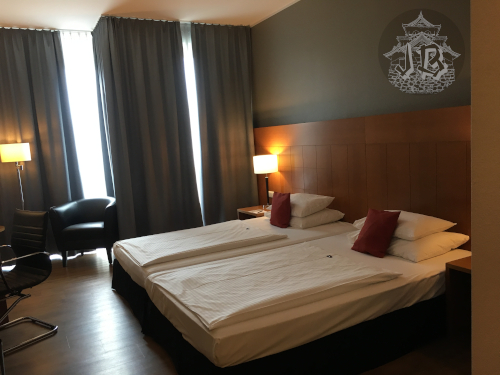
I reached Cologne and went on to the commuter to the venue area, where my hotel was, a short walk away from the station. After checking in, I dropped my things off in an amazing room, and had to do a double take – for a second I was not sure they had given me the right room, because it was way too nice for the price I was paying.

Huge bedroom at the hotel

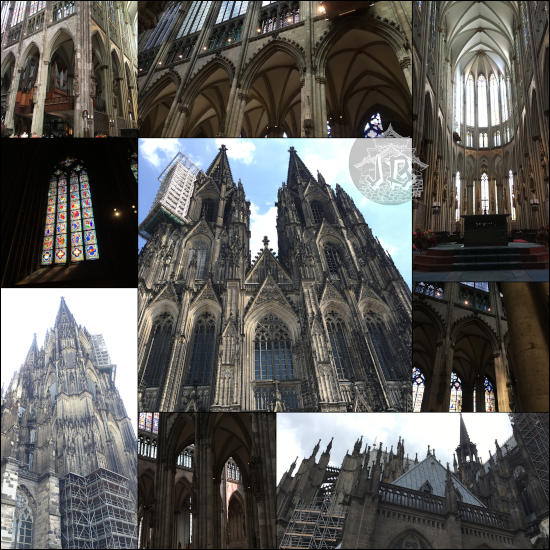
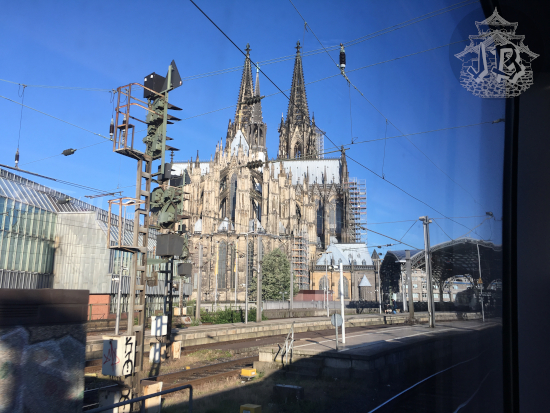
After changing clothes, I grabbed my bottle of water and off I took a train towards the city centre to visit the Cologne Cathedral Kölner Dom –it took a bit to figure out how to validate the train tickets, but I think I did everything legally. The cathedral has been a World Heritage site since 1996. Its construction started in 1248, but was halted in 1473. The building remained unfinished until the 1840s, when work was picked up again, following the original Medieval plans, and the church was finally completed in 1880. While it was badly damaged in WWII, it withstood the bombings and ever since then, it has been in a constant state of small and not-so-small restorations and repairs.

Cologne Dome

From the Cathedral I walked towards Cologne Zoo or Kölner Zoo. Although it had been drizzling before, at that point it was sunny again, and the walk was nice.

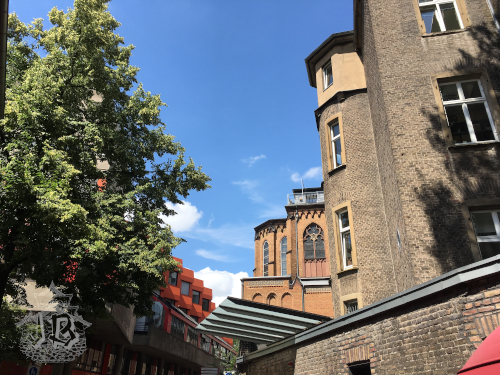
A typical Cologne Street

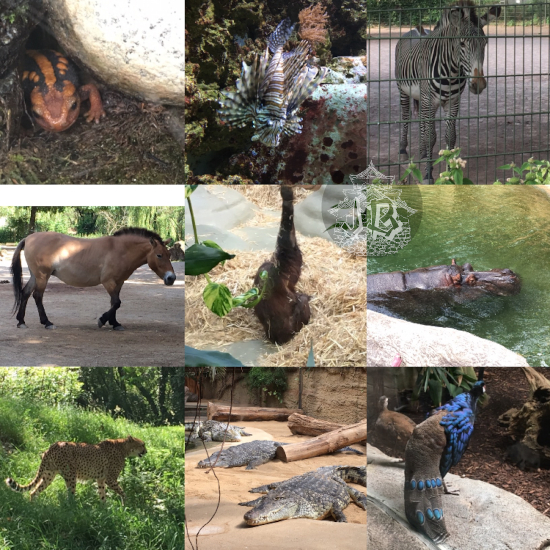
I decided to go to the zoo because it was the only thing that seemed to be open for long enough to mean value for money. The weather had warmed up and the bunnies were roasted coughs. I got to see some animals I had never seen before, such as Przewalski’s horses, snipes, or a grizzly bear. The zoo has a huge enclosure area, a petting zoo with domestic animals (and cheeky cows), an aquarium and a terrarium with both reptiles and creepy-crawlers shudders.

Some of the animals in the zoo

Then, I walked back to the hotel, stopping by the supermarket on my way – and here I discovered my undoing. The triple chocolate cookies which wrecked my trying to eat healthy stroll. I shall try to find them again in my next Germany trip though. However, I have to say that I had learnt from my being stupid for MIYAVI in London and not eating well through the weekend, so I bought snacks to have the following day.

Cookies

I was exhausted, so I think I was out at 22:00, which helped being awake at 7:00 the next morning. Thus, I just headed off for the venue E-Werk, and settled to queue for the concert. Japanese Visual kei (V系) rock band the GazettE [ガゼット (Gazetto)] was formed in 2002 and achieved its current configuration in 2003. It is formed by members: Ruki (ルキ) on lead vocals; Uruha (麗) on lead guitar; Aoi (葵) on an insane amount of support guitars (two on the same song, almost at the same time); Reita (れいた) on bass, keyboards / piano; and Kai (戒) on drums. Though they are signed with Sony Records, they claim to be completely self-produced.

In December 2018, the Gazette announced that they would continue their Japanese Tour abroad as Live Tour 19 THE NINTH: PHASE #04 -99.999-. It originally spanned North and South America, and Europe, and later in April some Asian dates were added. I originally planned to go to Munich (travelling was easier and cheaper), but I could not get VIP tickets, so switched to Cologne instead. General Admission was reasonably priced (45€) with crazy shipping costs (+4.50€, since they were all printed out and pretty). VIP Tickets (300 per concert), included early entry (one hour before GA and two hours before the show), a VIP present, and a handshake with the band for 170€ (+4.50€ in shipping costs), exclusively distributed through ME-shop, which was a pain and not easy at all.

The Gazette World Tour dates

The Cologne concert at E-Werk would be held at 20:00, which placed entry at 19:00 and VIP entry at 18:00. I reached the queue around 8:00. The venue is a repurposed industrial building with a capacity for 2,000 people in a lower-floor arena and a sort of balcony around it which also allows for visibility. There were already staff walking around, and the venue even had portable toilets outside for queuing fans. At that time, there were maybe 60-70 people waiting in three queues – VIP, GA, and something called “regulars” who went in last.

Everything ran smoothly, with the three lines in front of the doors, up until 16:00 when security arrived. They decided to rearrange the queues, and created chaos. Fortunately, since most of the fans were German, and they enjoy order, at least the VIP queue was reorganised neatly and quickly – respecting the arrival numbers. Around 16:30, the VIP tickets were checked and switched for bracelets, and the holders ushered to a secondary waiting area where we were not even allowed to sit down until doors opened around 18:15. Due to this, I had to stand for two hours straight without leaning on anything, my back was killing me. I decided that I either made it to the barrier, or I would head upstairs for a good view. When I came in, I received the VIP present – a banner with the band logo on it– and I was find a first-row spot to the left of the stage, in front of Aoi (guitar). The concert ran about 15 minutes late due to a technical problem with a wire / monitor. Good thing I found a barrier spot indeed.

The concert was very high energy. The music was so loud my ears were still ringing three days later. Most of the setlist was from The Ninth album, which makes sense. My personal favourite live song was The Suicide Circus .

Setlist:

  1. 99.999
  2. Falling
  3. Ninth Odd Smell
  4. Gush
  5. Agony
  6. The Suicide Circus
  7. 虚 蜩 [Utsu Semi]
  8. その声は脆く [Sono Koe wa Moroku]
  9. Babylon’s Taboo
  10. Dogma
  11. Incubus
  12. Ugly
  13. Abhor God
  14. Filth in the Beauty
  15. Inside Beast
  16. Cockroach
  17. Tomorrow Never Dies

I was very impressed by Reita’s stage persona / antics, how he stood on stage and moved. I almost caught a pick that he threw, but by that time my right arm was completely useless as the person behind me kept trying to push me away from the barrier to take my spot. My wrist brace is actually broken due to having to hang on from her shoving. But she was not successful

Aoi was muchbetter than I expected, and at some point he was playing two guitars for the same song, the acoustic and the electric, without any apparent effort – he hung both from his neck and played whichever one he needed. I could not see much of Kai, and Uruha was most of the time too far away. And unfortunately Ruki favoured going to the right, but he has a very powerful body language.

After the concert, the VIPs were pushed– literally – to an area in the back of the venue to wait for the meet and greet in a different room. I got handshake with both hands from all of them, if memory serves me correctly the order was Kai, Uruha, Ruki, Reita and finally Aoi. I told them that it had been very fun, that they had done a good job and none of them batted an eye at my Japanese. They were really nice though, in a high contrast from stage personas.

Afterwards, I just headed off back to the hotel, and directly into the shower, because I was sore all over. Good thing I still had snacks from my supermarket run. I think this was the first time I have actually though “I’m getting too old for this”.

On Monday morning, my paranoia had me early at the station, and that was good because apparently my suburban had been cancelled. Being early, I was lucky enough to be able to catch a completely different one – not sure if legally. I did not get caught if it wasn’t, but I made it to Cologne central station and caught my ICE without any further stress. As the station is located next to the Dome, I was able to say good-bye.

Cologne Dome from the train

As I had a window seat again, I also had quite a few nice views from the plane, and made it home without any issue.

An aerial view of a reservoir with turquoise water

18th August 2018: Plan Switching. Kyoto → Osaka → Nara {Japan, summer 2018}

On this day I was supposed to hike up a mountain – mount Takao to be precise. But you know what? When I woke up that morning I just did not feel up to it, so I decided to change my plans. In the end when you’re on the JR Pass you can get from Kyoto to Osaka for free. For a change, I actually got to Osaka instead of Shin-Osaka which was convenient. Then I grabbed the underground to get to Osaka Aquarium Kaiyukan [海遊館], which is actually the largest aquarium in the world.

I had been there before, but the previous time I did not get to see the whale sharks as they were ‘quarantined’. How can anyone block a tank which is in the middle of the whole damn thing, I have no idea, but they did. This time I broke even and had a blast. Unfortunately the Aquarium was packed because this was a Saturday morning, and for some reason my back was hurting a lot. I had dropped my luggage off at a coin locker because I thought it would be better. However at some points I could not really walk straight. The weight of the camera bag was too much and I had to sit down. Found a nice place to watch the sharks from, though.

After the Aquarium I went to Kuchu Teien [空中庭園], observatory in the Umeda Sky Building [梅田スカイビル] to have a look at the skyline and to get the stamp for the Japan Towers rally. I got the greatest omg-gaijin face of the trip here (and truth be told, had I known that the stamp was actually held at the reception desk and not the actual observatory, I might have skipped this). In this case the building is an attraction itself. It consists on two towers joined by some passageways and a circular platform at the top, with see-through escalators.

Next the plan was going to Dotombori, stroll down there, and eat some takoyaki before heading off to Nara where I had my hotel for the night. When I got to the station and jumped on the Osaka Loop line, it turned out that I actually was in the train that continues on to Nara… and it was air conditioned and I had a seat…

I found it a sign and decided to just go with the flow and get to Nara [奈良] on that train. Upon arriving there I checked into the hotel and I decided to go to Nara koen [奈良公園], the main Nara park, and see if I could feed a sacred shika [鹿] deer or two. This was close to 5 pm by now so all the temples would be closing anyway. I did feed the deer some shika senbei [鹿煎餅] (deer crackers), and one of the does bit me. Not even the hand that was feeding her, she actually tried to snack on my tummy. Sheesh.

As I was coming back down I had a pretty sunset over Kōfuku-ji [興福寺].

15th August 2018: Hikone is small and at noon it turns into a pumpkin? Hikone → Kyoto {Japan, summer 2018}

As I had learnt the way to the castle entrance the previous day, first thing in the morning I headed off to Hikone Castle. The walk to the castle is flanked by the Irohamatsu [いろは松], which is a row of special pine trees that were planted there as their roots grow downwards but not sideways.

Hikone castle, Hikone-jō [彦根城], is one of the twelve castles that retain the original keep and one of the five to be a national treasure. The ticket included the castle, the museum, and the Gardens. I was there when they opened so the affluence of people was not to big yet.

Being one of the important ones made two things happen – one, that you have to take your shoes off, and two, that the stairs are crazy. Good thing I was not carrying my backpack – I had left it at the hotel but they told me they could only keep it till noon for whatever reason, so it was a good thing that Hikone is not as big of a town as others. The interior structure of the castle is naked wood, and it feels quite severe.

After the castle I went to the Hikone-jō Hakubutsukan [彦根城博物館], the Castle Museum, as it started drizzling. Normally the castles have the museum inside, but this one was in a nearby tower next to the main gate.

My next destination were the Genkyuen [玄宮園], a traditional garden from where you can spot the castle.

Also within castle grounds was the Kaikoku kinen-kan [開国記念館] (officially translated as Hikone City Museum of History, but it is more as “Memorial Hall”) – unfortunately pics were not allowed except for this Lego Castle.

Finally I checked out Shigakengokoku Jinja [滋賀縣護國神社] under daylight.

I walked back to the hotel through the main street, where I saw many stone statue shops displaying their work - including the city mascot, Hikonyan [ひこにゃん].

Finally, after picking up my luggage from the hotel I stopped by the Ii Naomasa Ritsuzō [井伊直政立像], the Statue / Monument to Ii Naomasa, who was the original builder of the castle.

I jumped on the Hikone Rapid Express, which was packed, and headed off to my next destination, Kyoto [京都]. As I was earlier than expected, I got a jump-start on sightseeing. This would later proof to be not too much of a good idea – originally I only wanted to do one temple so I did not put my luggage into a coin locker. Looking back, I should have.

I went to To-ji [東寺], a Buddhist temple whose pagoda had drawn my attention every time I had been in Kyoto before.

Then, as it was quite close, I decided to check out the aquarium, Kyoto Suizokukan [京都水族館].

Finally, I went to Daishōgun Shōten Machi Ichi-jō Yōkai Street [大将軍商店街 一条妖怪ストリート], a shopping area with a lot of yokai and yokai-like mascots. Unfortunately, most everything was closed due to the Obon festivities, which in the end made for an unrewarded extra effort. Here I was trying to pace myself and not doing a good job out of it.

On my way to Yokai street and back I saw Jinja Kitano-Jinja Otabisho [北野神社 御旅所],

Jizo-in [地蔵院 ],

and finally Daishogun Hachi Jinja [大将軍八神社].

Finally I backtracked to the station and headed off to the hotel for some rest. I made a mental list of things that were incredibly close to the hotel and I could do the following day.

28th July – 3rd ‎August ‎2018: The Spanish “Levante”

My parents sometimes vacation in this tourist-like complex in a little town called San Juan de Alicante in the east of Spain (the “Levante”). My father uses it as a base for diving trips, and sometimes I tag along to keep my mother company. When we arrived this year we found out that there was a new resident family in the garden – a family of squirrels that had apparently shown up travelling in trees that were going to be planted. The complex management decided to make squirrel-nurturing the local sport. Guests were encouraged to watch out for them, and leave them nuts. Also, there were educational signs about what was safe or unsafe to feed the little critters. I caught sight of them at some point or another.

One of the selling points of the complex – aside, of course, from the swimming pool and the great room service – are the big gardens, with lots of trees and plants, and the rescue bunnies. Now the squirrels came over to complete the scene.

Collage. A hotel room. Red flowers. A garden. A tiny rabbit. A tree and a close-up of that tree focusing on the squirrel on one of the branches.

31st July 2018: Chocolate & Lobster. Not together.

A meagre 20-minute-drive away from this little town stands the village of Villajoyosa, which translates into something akin to “The joyous village”. If you’ve never heard of it, I’ll just have you known that it has a chocolate factory, the Fábrica de Chocolates Valor, and the chocolate museum (and of course the shop). As it is a working factory, the visit is of course guided. We were told that there was usually a long queue, so we were there before 9:30 for the 10:00 visit, and we were quite literally the first to arrive. Once inside, you get to see what they call the museum, with a short video about how they used to and still make the chocolate, and you visit some of the old equipment. Then, there is a short trip around the factory using some hanging planks – when we were there, the production was halted due to pre-Christmas-campaign holidays. So FYI Christmas chocolate is made in August. The visit was done in one hour, and then we splurged in the shop.

Chocolate factory from outside

Inside the chocolate factory shop. A painting on the wall says we heart chocolate, another, in the backfround of several chocolate bars packaged as presents, it says All you need is chocolate, with the word love scratched out

After the visit we went back to the complex, where we had booked a made-to-order lobster “paella” (traditional rice dish) for lunch, and boy was it awesome. I totally sinned with the apple pie afterwards, too.

Collage. Rice pan with lobster pieces, and a piece of apple pie

1st August 2018: Alicante

The day started awesomely with coffee and pancakes, and that alone worked to make me happy.

Pancakes with chocolate syprup, a glass of milk, and a cup of coffee

Besides, twenty minutes in the opposite direction from Villajoyosa we had Alicante. And we could also be lazy and not take the car out, we could just take the bus. We wanted to see the archaeological museum, Museo Arqueológico Provincial MARQ de Alicante, and that was out first stop. However, for some reason a bunch of pictures got lost – and I can only show you this of the library, where pictures were not allowed anyway. It was a… photography accident.

A former chapel, with gothic windows. A glass lamp hangs from the ceiling and there are dark shelves full of books in the foreground

After the museum, we walked around the base of Monte Benacantil, the mount in the middle of Alicante – again, literally – until we were exactly on the opposite side to find the entrance to the Castillo de Santa Bárbara, Santa Bárbara’s castle. The castle is of Arab origin, it may have been built the 8th century. However, there are archaeological remains in the mount dating from prehistoric times. The castle gave the city of Alicante a vantage point towards any kind of threat, whether it originated on land or the ocean. The castle was reconstructed in the 16th century, and later, in the 18th century, it played a part in the war against the French.

Castle ruins and views of the sea underneath. It looks hot.

After this we walked over to have lunch at a restaurant we had read over in the tourist complex magazine, a prime Japanese restaurant called Nigo, which has the best sushi I’ve ever tried outside Japan.

Lunch - Japanese salad, fried chicken, sushi and tuna tartar

After that we headed back to the complex and planned our next move.

2nd August 2018: Valencia Diversion

My father was unable to go on his two planned diving outings, so we decided to head home early. However, he was feeling a little disappointed over the cancellation, and I suggested that maybe we could take a detour somewhere else instead. In the end, we decided to book a hotel in Valencia and use the time to visit the Oceanogràfic over there. This is a large aquarium complex. We also reserved a table at the “Submarine Restaurant” and had lunch there.

The aquarium opened in 2003 as part of a big project called “the city of art and science” in Valencia. It has a double layout, over- and underground. The underground area is the big aquariums are built, while the upper enclosures hold most the mammals and the birds.

An empty restaurant surrounded by an aquarium where fish swim

Collage of different marine animals: octopus, sea urchin, anemone, clownfish, surgeon fish, rockfish, seal, jellyfish, seastar, sea dragon, turtle, reef shark

Collage of different animals, and general view of the park. Penguins, crocodiles, seal, pelicans, snipes, ibises, tortoises, carps, crane

Once we were done, we said goodbye to the sharks and hi to the nice sunset. Next morning we drove back home.

Sunset above an unremarkable city skyline

23rd & 24th June 2018: London Express (England, Great Britain)

I took some family members over to London for the weekend, and they asked me to organise something so they could see a lot of things. We took the red-eye flight so we were downtown London something around 8:30. Our first visit had tickets for 10:00, so first spot was a Costa Coffee for breakfast! (≧▽≦)

Afterwards we saw the Tower Bridge over the Thames.

Then, at the right time, we walked into the Tower of London, where we wandered around visiting all the areas, including the White Tower, the dungeons, the Crown Jewels vault and the raven nests.

Once we were done, we took the underground to the British Museum for a quick visit through the most important collections, along with a few of the less known but interesting things – in the end we saw the Babylonian, Grecian, Egyptian collections, and had a glimpse at a few of the Chinese artefacts and the Hoa Hakananai’a from Easter Island.

We had lunch in-between and then went to the hotel to drop our things off. After that, we took off again and, via underground, we reached Trafalgar Square. We walked towards Piccadilly and on the way we stopped at Legoland and M&Ms shop. Then had dinner in an Angus steakhouse in Leicester square, and to end the day, we had a look at the lit Piccadilly Circus.

We got back to the hotel, and honestly, I had not realised how close to the centre we actually were until I looked out of the window.

The next morning we woke up early and headed off to have breakfast on the go – actually the weather was super nice so we got ourselves some Nero coffee and sandwiches and ate them in front of Westminster’s Abby. As it was Sunday we could not visit the Abby, but we saw the scaffolded Big-Ben, and walked around the Houses of Parliament.

We went to visit the Monument to Emmeline Pankhurst because the youngest person in the group needed to be told about a period in history in which she would not have been as free as she is today.

After that, we crossed over the Thames, then moved on to the London Eye. Half of the group wanting to go up, the other half being not fans of heights, we divided and conquered – two of us went to the London Aquarium while the other three enjoyed their VIP ride in the London Eye. I know you are not surprised I picked the side with the sharks instead of going up.

This guy judged us, very hard:

After our riverbank separation, we regrouped and headed off towards the Natural History Museum where we first saw the Butterfly carp that was installed outside it – they were extremely pretty and beyond friendly, because we were landed on quite often.

When we had finished the walk, we stepped into the Natural History Museum itself to wander through the dinosaur area for a bit, and then around the animal collection.

We decided to head out to the restaurant to have a bite to eat, and as we were walking through the marine invertebrate area (the room with all the crabs and so on), there was a nice lady showing items. And that’s how I ended up holding a megalodon tooth and fanbying like there was no tomorrow. Don’t judge me. Or do so, I don’t care ☆⌒(ゝ。∂)

As they walked into the insect / general creepy-crawler gallery, I walked around the gallery that held “less impressive” fossils, including the ones discovered by Anne Manning. We had lunch in the NHM, then moved on.

A short underground ride later, we were at St James’s Park, where we took a bit of a walk towards Buckingham Palace. As the weather was nice, we got to see a lot of the local fauna, even the local swans.

We hung around for a while as we saw Buckingham Palace, then headed off back towards the airport. Although we had a couple-of-hours delay, we made it home without further complication.

21st January 2018: Zoology at the Zoo (Guadalajara, Spain)

This was just a stroll down the Zoológico Municipal de Guadalajara, the local town zoo. I just thought I could look up some of the animals I came across and see if I learn any interesting facts. It was not as easy as I thought!

Eurasian otter (Lutra lutra): it is a semiaquatic mamal that is fortunately not threatened. It lives near rivers and coasts in Europe and Asia. It mainly eats fish. They are pretty smart and playful, but they are also very territorial, so they usually live alone. They have webbed claws for swimming and catching fish. Mother otters teach the kits to fish by a game of “catch and release” the fish.

Peafowl (Pavo cristatus ): technically “peacock” is the male (colourful) and “peahen” is the female (brown). The male has long tail feathers that he displays when he wants to impress a female or another male. In India, it was used as ‘guardian animal’ as it screams when tigers approach and it can eat young cobra snakes. Now, that’s pretty cool, and here I thought he was just a pretty tail!

Fallow deer (Dama dama): Fallow deer are native to Europe, and have been introduced to many other places. The bucks (males) are very aggressive and competitive during mating season, and they use their horns to fight. The does (females) do not have horns.

Iberian red deer (Cervus elaphus): The imagery of the red deer has been so powerful in the human psyche that some it can be found in paintings dating 40,000 years back. Normally the males and the young create big family groups. Males create smaller groups that cooperate.

Barbary sheep (Ammotragus lervia). Also called arrui, it is an African mountain goat which lives in arid mountains and canyons and graze grass, bushes and lichens. They were artificially introduced in Southern Europe and became a bit of an invasive species. However, the truth is that they look super chill and zen.

European mouflon (Ovis orientalis musimon): It was originally a mountain creature but it moved to the forest when humans started bothering them. They thrive in rocky areas, though. They tend to live in herds with a lead female.

Wild boar (Sus scrofa): This is the omnivore animal by its own right. It can and will eat anything – from fruit to berries to even baby deer (O_O)!. Many old Indo-European cultures considered the boar a symbol of warrior virtues. In Greek mythology, the hero Herakles had to capture a boar as one of his Labours. In the east, it is considered a symbol of determination and even recklessness.

Iberian wolf (Canis lupus signatus): Unfortunately, the Iberian wolf is a vulnerable species and culling is still legal in Spain (•̀ω•́ ). The Iberian wolf is brown-grey and had a characteristic white area around its mouth. They also have black vertical lines along the front legs, and other dark marks on the leg and the tail. They are predators and prefer hunting big animals, especially deer. Wolves are social creatures, they live and hunt in groups.

Something really cool about wolves in general is that when they run, they place their hind legs on the footprint created by the front paw. Talk about coordination. Wolves have a very bad reputation in Spain, but there have not been confirmed attacks on cattle, much less on people, in recent years. Pictograms of the Iberian wolf have been found in archaeological artefacts from the tribes that lived in Spain before the Romans.

Emu (Dromaius novaehollandiae): Yay for another non-threatened animal. Emu originated in Australia, and are the second-biggest bird in existence after the ostrich. They are flightless, and they eat plants, grasses, insect and arthropods, depending the seasonal availability. Because females can lay several clutches of egg in one season after mating with different males, the male takes care of the incubation, and the chick-rearing. According the mythology of some aboriginal tribes of what now is called New South Wales, the sun had been created by throwing an emu egg into the sky.

Eurasian lynx (Lynx lynx): Native of Europe and Asia, it is widely distributed, which lowers its conservation concerns. The Eurasian lynx is mainly a nocturnal predator, and tends to live solitarily as an adult, although hunting areas may overlap for several individuals. They can hunt small animals, but they are known to prefer bigger prey, such as roe deer and common deer. Conversely, they may be hunted by wolves.

Red fox (Vulpes vulpes): The red fox is one of the animals with the widest habitat range in the whole world. It can be found almost everywhere in the northern Hemisphere, including many cities in Europe. It is an invasive species in Australia, where it was introduced in the 19th century. In European mythology it’s considered symbol of deceit. In Asian mythology it has two-faces, some of them are messengers of the gods, some are tricksters and dangerous. Arab folklore considers the fox cowardly and weak. Native American mythology considers it a crafty creature that steals the coyote’s food – in all cultures however, it seems to be intellingent and able to trick other animals or people. Interesting.

Griffon vulture (Gyps fulvus): A scavenger bird of prey, it feeds mostly off the carcasses of dead animals. It tends to live in flocks or colonies and makes nests on rocky walls. Even if they have a bad rep, they are very cool animals.

White stork (Ciconia ciconia): Credited with bringing babies from Paris, storks used to be long-distance migrants, which lived in North Africa in winter and returned to Europe in summer to breed. For the last twenty years or so, the storks have stayed, at least in Spain. They are also famous for making nests on belfries and other man-made structures, and because they are considered a good omen they have rarely been chased away – until the weight of the nest has made belltowers collapse!

Common kestrel (Falco tinnunculus), I think. Feel free to correct me if I’m wrong. The best thing about the small zoo is the work they carry out recovering injured birds of prey. The birds are nursed back to health and if everything works out they are released into the wild. I really hope this little guy can leave soon! ⋛⋋( ‘◇’)⋌⋚

23rd & 24th September 2017: San Sebastián Film Festival (Spain)

23rd September 2017: Let’s go!

Overnight, I headed off to San Sebastián as a Weekend Escapade to the Festival de Cine de San Sebastián International Film Festival that is held over there because they were projecting a Japanese film and the main actor and the director were coming over to present it. The film was “Sandome no Satsujin” [三度目の殺人], the director is Hirozaku Kore-eda and the actor in question was Fukuyama Masaharu, of whom I am a big fan.

I started off at 22:00 on Friday as I had to take a bus to go to Intercambiador de Avenida de América, which is one of the bus hubs in Madrid. My bus to San Sebastián left at 00:30, so in the end I had to wait for almost two hours until I could board. I was dozing for most of the trip so it did not feel too long. I arrived in San Sebastián bus station at around 6:50 in the morning and I had decided that I would go to the so-called Shell Beach, Playa de la Concha, to watch sunrise. I had been told that cafeterias would be open at that time, but not even the one in the bus station was ready.

A beach at night. The sea is calm and it reflects the city lights

My plan of watching a sea sunrise was trumped by the fact that the sea is towards the west, but I still could take a couple of nice pictures.

The sun rising, tinting the sky and the sea blue and orange

Among them were the beach itself, the “skyline” and the Catedral del Buen Pastor (Good Shepherd Cathedral).

A gothic or neogothic church clock tower, spiky with pointy arches

I wandered around, found the theatre where the film was going to be projected and as the sun started warming up, I started feeling less like a homeless dog.

The sun rising along a promenade

I found the local Starbucks at around 9:00 to get some rest, a coffee, and a cookie before I went to the Aquarium, which opened at 10:00. The Aquarium de San Sebastián is a bit more of a museum than anything else. The first part (second floor) is dedicated to the history of ocean commerce, with different types of ships, and rooms focused on the local harbour, companies, traditional boat racing and whaling. This includes an actual right whale skeleton and several sperm whale teeth and some baleens. The second part (first floor) is dedicated to general fishing and the local oceanography society, including machinery and live specimens.

Finally, after all this, you get to the actual aquarium (yay). There are several small tanks and then a big tank with a walk-through tunnels. The inhabitants are pretty standard, with lots of small fish and several magnifying-glass tanks to make the animals look bigger than they are. The third floor hosts the tropical fish including the piranha and the clown fish. All in all it is a nice place, however, it was under construction and some tanks were covered by dark plastic. After that I left the aquarium and I decided to go up Mount Urquil, which hosts a castle and quite nice views of the city and the ocean.

A small building entrance which yields to the aquarium. Collage showing different exhibits inside: a whale skeleton, a seven-grilled shark in alcohol, a trilobites fossil, a shark jaw, a starfish, a shark swimming above through an aquarium tunnel, a lionfish, sarks swimming in the aquarium

I walked by John Malkovich while heading there, but he did not look like he was in the mood (or the clothes) to be recognised, so I did not bug him. Then I started my climb up the mount towards the the local castle, Castillo de La Mota, along the batteries of cannons. The castle has a small history museum, and a look-out balcony, and the top has been transformed into a church, with a giant Christ overlooking. The truth is I was mostly improvising on my visits as the week was hell between work and the death of a family member.

Views from and of the ruins of the castle - the sea, the wall, and the old cannons

After that I had lunch and headed off to the theatre to check out the coming out of people. At this point I planned to wait for the actor and the director to come into the theatre, but for some reason I checked out the schedule, and the name of the actor had been taken out of the presentation! That made me sad for a little while, but I decided that I was okay with it, that it would not be a drama. I had taken my chance, and at least I had gotten some air after all the pain and drama throughout the week. I guess that helped relativise the sadness. I went to a park near the beach to get some sun and enjoy the last days of summer.

A 19th century building with large windows. A banner on the façade reads Festival de San Sebastián 65

A banner for the cinema festival, showing posters for different films. The third murder is on the bottom left

Around 15:00 I returned to the theatre, Teatro Victoria Eugenia to start lining as I wanted a seat close enough to see the subtitles- and I found a place on sixth row which was pretty good. As this was a special people’s vote session, we got a ballot to give our opinions. Then I settled to wait, and eventually at 16:00 the presenter came in, and to my surprise, she announced Kore-eda and Fukuyama. That made me so happy I could have died right there and then, and the best was still to come. Kore-eda told us about the film. Apparently several people consider that he has changed genre, but he told us that he disagrees and that he still tried to make a human drama. However, he thought that we should judge. Then Fukuyama told us that he enjoyed San Sebastián and that they had been having pinchos and that he was happy to have returned. I was shaking so hard I could barely hold the phone as I recorded.

The stage inside the theatre

Director Kore-eda and actor Fukuyama Masaharu on stage

Promo of the film The Third Murder from the Festival Webpage

All this would have made me very happy already, but there is more. “Sandome no Satsujin”, or “The third murder” tells the story of a lawyer whose job is to defend a man accused of murder. As this would be the defendant’s third murder, if found guilty he will be handed the death penalty. The film is a complex story, completely unpredictable – or I was too enthralled to see the ending coming – but when everything fell into place I felt like gawking.

Furthermore, there was more to come – at the end of the film both Kore-eda and Fukuyama had stayed behind. as I was coming out I looked up and told them “otsukaresama deshita”, and both of them bowed and replied “arigatou”. Then we waited for them to come down from the second floor, from where they had taken the ovation. I dropped my vote and rushed through the red carpet. As other people talked to the director I made a beedive towards Fukuyama. It was then or never, and it turned out to be then.

Director Kore-eda and actor Fukuyama Masaharu waving for a picture on the street after the film

I was shaking inside but I managed to tell them that I had been a fan of his since Galileo times and I asked for his autograph. He told me thank you (at some point the interpreter tried to help, but I was busy dying and trying to get my meaning across). He signed my Galileo booklet and I asked him to take a picture with me, to which he also agreed. And thus I fulfilled my wildest dreams (and look horrible in the picture). After Fukuyama had continued on the red carpet I managed to sit down on a curb and I was on the phone with my friend C*****, who prevented me from going completely hysterical in fanby bliss.

After I told her everything, I was pretty dead so I headed off to he hotel (pension) that I had booked for the night, and pretty much giggled and crashed, and uncrashed and giggled some more. At 23:00 I was completely zonked out, not without realising that I had headed to get some rest without grabbing my freebies and some merchandising I wanted from the festival.

Fukuyama Masaharu's autograph on a DVD booklet

24th September 2017: And back

I left the hotel early, around 8:30 to head towards the cinema area and buy the short Festival guide (not the big one for 22€ but the little one for 1.5€) and get the free newspaper. I bought a coffee to go and headed back to the bus station, when my bus was at 10:00. I could not sleep and the Wi-Fi was not working, but I could watch Youtube videos on the seat screen. I managed to get home around 17:00 after a couple of buses, and I was pretty much dead. However, it was totally worth it. I think this is why I was hyper enough to decide to go to Vienna next month…

28th July 2017: Shopping at Ikebukuro {Japan, summer 2017}

This is something I had never thought I would have done, but it was strangely fun – I went shopping along Ikebukuro [池袋]. And not fandom shopping – well, yes, there was fandom shopping, but… It was weird. I was in the Book Off as always that I’m around. I was also in the Sanryo Gift Gate but there was no Yoshikitty to be found.

The original intent was going to the Sunshine City Aquarium [サンシャイン水族館] but when I arrived there was a very long line, so I decided to wander around for a while. I accidentally ran into a T-shirt that I loved and had to buy – full of sciency formulae, and a bag I really liked. I found it a bit expensive, so “decided” not to buy it.

After some conbini lunch I went back to the Aquarium and decided to wait as the line did not seem to be about to be longer than 15 minutes (much better than the 45 before).

The Aquarium was full and it never fails to surprise me how Japanese kids are this wild in aquariums in general- but this time I got pushed around by grannies too! XD I also found a new appreciation for pelicans and ended up with a lot of pelicanbutt pictures.

After the aquarium I headed to the Closet Child on my way to the station and bought a very cool T-shirt from a group I don’t really listen to, but very cool, and 1000¥. And then, because I had not really gotten myself anything too expensive in Closet Child, I gave into temptation and went back for the handbag. Many people have complimented me for it, and I really love it.

Afterwards I met up with B**** for sushi and Starbucks while D****e was in a fancy dinner on a boat, with my camera (yay phone pictures). After I got into the train, I was messaging with D****e and we realised that we were on the same train. What are the chances? Very, very small XD