
From September 2025 to February 2026, I took an online course in the long-distance-learning university, UNED. As it was financed by the European Union, it was free. The name of the program was “Digital Skills for Culture and Creation Professionals” – Competencias Digitales para Profesionales de la Cultura y la Creación and I chose the specialisation “Digital Creation of Cultural and Creative Content” – Creación digital de contenidos culturales y creativos.
I thought it would be nice to have a reference or even a benchmark for JBinnacle. The biggest downside was that they wouldn’t let you work at your own pace, despite the program being online. The tutors wanted a regular schedule and daily connections, especially during the second module. Whenever I spent several days offline, they messaged me demanding I went online. I repeatedly explained that I was taking the course in bursts, but during my November France and Monaco escapade, the tutor wrote every day. Even after I had handed in all the projects necessary to pass the module, I would get messages of “you haven’t been online for X days. Remember this course is free because [Sponsoring European Funds] is paying for it. Let me know if you have problems connecting” – I was offline for a whole week out of four months. I didn’t have issues, but apparently others did – especially those who had trusted the student licences for the software, which ran out a month too early. The forum was plagued with messages by people who were absolutely lost with how things worked – when they worked. Contents did not always do so and if a tutor sent you feedback in the platform, you couldn’t see it.
I chose to focus on social media for my third module and final project, in hopes of developing a strategy. While the tutor was knowledgeable, the general advice was “post often, and make quality content”, but I didn’t get info on how to achieve that. Despite liking technology, the mechanics of the course actually put me off working on the whole thing for a while. Nevertheless, I managed to pass all three modules, so I was invited to the closing ceremony or “graduation” in Madrid. And you know what? I decided to just go, even if it was a stupid decision. I would have to get out of work, drive to the train station and hope for decent connections, about two hours each way. No time to go home and change clothes, so I would have to work in formal(ish) clothes – which of course drew way too many comments.
The ceremony would happen in one of the UNED buildings in Ciudad Universitaria, the Education Building Facultad de Educación. The area is called the “University City” because bunch of faculties are homed there, alongside dorms and other facilities. It is not a convenient area for me to either drive or reach by public transport.
I was able to catch a train twenty minutes ahead of schedule, and my connections went smoothly, so I reached the area around 16:10, which was great. The ceremony was at 18:00 and we had to be there at 17:30. I had a snack, then started walking. Between 18 minutes by bus and 22 on foot, I prefer the latter if the weather is good. Furthermore, I could make a stop on my way.
The botanical garden Real Jardín Botánico Alfonso XIII belongs to one of the University bodies (Universidad Complutense de Madrid), and it’s thus only open during schooldays. It is not really convenient to get to, but since I was around, this was my chance to visit. King Alfonso XII came up with the idea of building Ciudad Universitaria in 1927, including the garden, nestled between the Science and the Pharmacological sciences buildings. It would not be until 1997 that engineer Fernando Gil-Albert created the space, which remained closed until 2001. Nowadays, it is free access.
The garden has a central rotunda that aims to represent a geological calendar from the origin of earth to the current eras (trust me to find the fossil replica in a botanical garden), traversed by one large avenue, and surrounded by a circular path. There are around 1,000 plants, grouped in several collections around three particular “topics”: ethnobotany (plants that are important for people, mainly medicinal ones), gymnosperms (“naked seed plants”, mostly pines in this case), and Mediterranean flora.
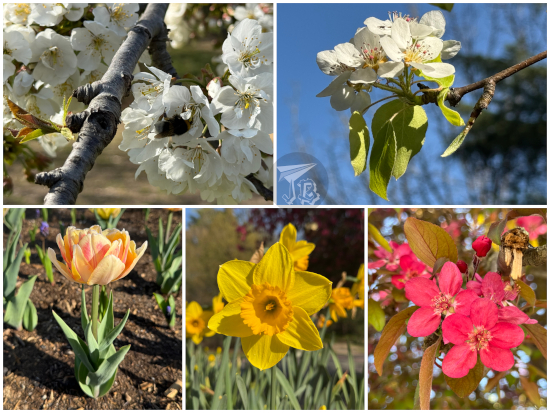
The end of winter had been really rainy, followed by some sudden warm days, so a lot of the flowering plants were in full bloom, which made for really pretty pictures. The collection of ornamental bulbous plants was in full display – especially the narcissuses and tulips. Several trees were doing their best too, such as the almond (Prunus amygdalus) and pear (Pyrus communis) trees, along with the Japanese flowering crabapple (Malus floribunda) – which I had never heard about before.
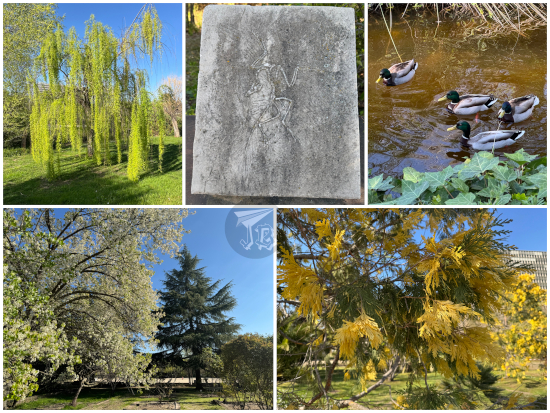
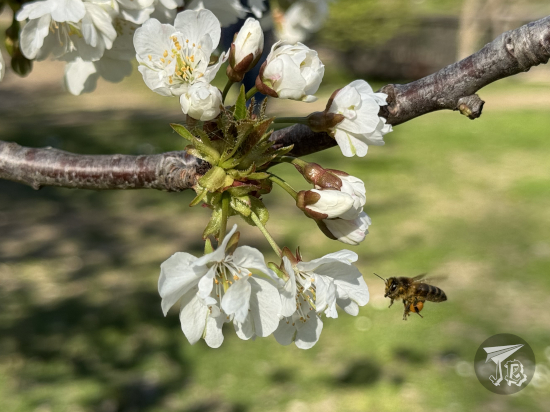
The pollinators were pretty chill, too, gorging themselves in nectar without being bothered by people taking pictures. I found more than a couple of bumblebees, and one particular very hard-working Spanish bee (Apis mellifera iberiensis) who did not mind me taking pictures one bit. She was more cooperative than the bunch of mallard drakes (Anas platyrhynchos) living in the pond, who would not stay still for the pictures – actually I managed to take a photo of one of them in flight… but my phone focused on the trees behind him.
I spent over an hour in the garden, exploring around, and then headed off towards the ceremony. I was there at 17:30 sharp, after a walk following the phone’s directions. Once there, however, I did notice that on my way back I could cut through the parks as there were walkable paths that the maps app did not consider.
Upon arrival, the security guard was unfriendly as hell, annoyed that we were there, apparently. Then, the organiser wanted to call people in one by one, and allowed “companions” to sit on the same rows as the attendees were assigned – which made it for very awkward walks to pick up the diplomas. The worst thing about it though was realising that even through the University network and with my student ID, I could not access the Science website. There were a few articles I wanted to get access to – I eventually figured out the method to do it.
The organisers had been very insistent on punctuality. However, we started late because it turned out that the representative from the Ministry who had to open the ceremony had gotten lost and gone to another building in a completely different district. We could not start without the guest of honour, I guess. After she arrived, we got the typical “pat ourselves on the back” from the her, and the university themselves.
Afterwards came a talk by special guest Ana Beltrán Porcar, an artist whose works centre mostly around the visual and performance arts. She explained her career and work process whilst she drew a hand and a blue bird, using a video presentation, which she timed so at the end, the hand-drawn bird became animated and flew away.
The bunch of people who had decided to attend the ceremony – as the course had been online, there were many who did not sign up, and even some of them who had did not get there – received their diplomas in a bit of a chaotic moment (why were they taking attendance if they were going to call people who had not come?). Then there was more self-back-patting by the course coordinators. Finally, we had a performance by Clara Olóndriz, an indie pop singer who won the 2025 “Best Message in a Pop Song” recognition in the Premios Latinos (Latin Awards, sort of like the Latin Grammys but organised by Spain and Latin America). She sang three songs – Corona de Rey (King’s Crown), Brindis Eterno (Eternal (glass) Toast) and Huracán (Hurricane). While she wouldn’t usually be my cup of tea, she sounded really cool, and her voice was incredibly clear. She seemed like a nice person, too.
Finally, there were official pictures, and I did not stay for the cocktail as there were a few trains to take. I left the university a bit after 19:00 and did not make it home till around 22:00, even if I was quite lucky with transport. There was junk food, and also a long shower before bed, because I had to work the following morning (who organises a graduation on a Tuesday anyway?). No rest for the wicked, but a diploma and some pretty photographs of a botanic garden in spring.

