15th & 16th March 2025: Canterbury (England, UK) for “The Shark Is Broken”

I’ve travelled for – or with the excuse of – concerts (take your pick) and documentaries (at least thrice, even twice for the same one), but this was my first time travelling for a theatre play. Don’t get me wrong, I like theatre – I’ve even squeezed Wicked into a London trip a couple of times – but it had never been a main driving force. Until I stumbled upon the information that The Shark is Broken was heading towards the UK and Ireland. There were no shows in London, and my connection to everywhere else – including Dublin – was not good, especially due to work schedules. However, there was one date which was, if not convenient, at least doableCanterbury, in the county of Kent. Unfortunately, neither the Gods of Trains nor the Gods of Buses were as willing to smile upon me as the Gods of Air Travel.

Once I secured a ticket for the play (£55.00, dead centre of the stalls), a hotel in Canterbury, and the plane ride, I checked out what to see in town. This was back in December 2024. I also booked my parking spot at the airport, and since it was so long out, I could reserve Terminal Parking for just a couple of quids more than long-distance parking. That’s an extra 20 minute snooze! However, as I’d been hearing about train disruptions in England, I decided to wait a little before buying the Stansted-London and London-Canterbury trains. And sure enough, when a couple of weeks before the trip I went to check on the trains, the Stansted Express was indeed not running. There were ticket sales, at normal prices, but the trip would be by bus – taking as long as a bus usually takes. Thus, I decided to buy a coach trip at coach prices instead. That added a couple of hours of travel / waiting to the whole journey. Then, I went on to the South Western Rail website, which claimed that purchasing tickets would be easy. My definition of easy is… different, but, I was able to secure tickets. I was supposed to download the app to use them – but the app cannot be downloaded outside the UK. Fortunately, I was able to download a copy of the tickets from the confirmation email and use those.

When the day came, I left home a bit after 3:00 for my 5:45 flight. It was extremely cold, but at least it was not raining. I had some time at the airport before take-off, but of course everything was closed. It felt a bit weird, knowing it was the last time I could fly to the UK “for free”, considering that all countries are implementing the stupid Visa fees everywhere. We landed in London’s Stansted Airport on time, so I made it to the 08:10 coach I had booked – despite the utter chaos that Stansted coach station has become. The nice 40 minutes by train to London Liverpool turned into an over-two-hour coach obstacle course through London’s construction work.

Since I had been forced to buy a bus ticket, I got a direct one to King’s Cross – St Pancras International, where my train to Canterbury was due to depart. I had calculated for a safe train at 10:40, and I reached the stop around 10:05, which gave me enough time to find the nearest Costa Coffee before I went to Platform 13 to board my train. I chose the carriage poorly, as I ended up in the midst of a boisterous hiking group, but the trip was less than an hour, and I reached Canterbury West at 11:34. This was a bit over an hour later than what I had originally hoped for, due to the train-bus adjustment. Looking back, maybe it had not been necessary to buy that ticket in advance.

The city of Canterbury is a Unesco World Heritage Site in the county of Kent, in the south-east of England. The area has been inhabited since the Lower Palaeolithic, through the Iron Age, and Roman times on. The town saw the first Christian conversions in the British Isles, and the foundations of the cathedral were set in 596. Canterbury survived the Viking raids around the year 1000, but it fell into William the Conqueror’s hands in 1066.

In 1170, Archbishop Thomas Becket was murdered in the cathedral, an event which triggered massive pilgrimages from all the Christian countries. Between 1387 and 1400, author Geoffrey Chaucer wrote The Canterbury Tales, one of the key works in English literature, a fictional compendium of stories told by pilgrims towards the cathedral. During the early Middle Ages, Canterbury became one of the most populated towns in England, until the Black Death decimated its people. In the 16th century, there was an influx of French protestants (Huguenots) who fled mainland Europe to resettle, revitalising the economy and introducing the silk-weaving industry that flourished for over a century.

After the 17th century, things changed. Canterbury became an agricultural hub spot, so the Industrial Revolution only affected it with the construction of railways. The historical centre was damaged during WWII bombings, after which the historical area was pedestrianised and a ring road built around it. Today, Canterbury lives off tourism, retail, and higher education, with a large floating population of university students.

And it was cold that weekend. A climate topsy-turvy seemed to have exchanged the Spanish winter anticyclone and the British rains, so it was storming in Spain and crispy in Britain those days. But at least, it was not raining, which allowed for freedom and seeing a lot of things. Upon leaving the station, my first contact with Medieval Canterbury were the Westgate Towers Museum & Viewpoint, the largest Medieval gateway surviving in the UK. It was erected around 1380 to substitute the Roman ones. Even before that, there were other hits like “the oldest brewer in Britain.”

Westgate tower, former gate to the Medieval city

I reached the pedestrian St. Peter Street, which merges into High Street, the town’s spine. My first real stop was the Cathedral and Metropolitical Church of Christ, Canterbury (Canterbury Cathedral for short). The cathedral is the seat of the Archbishop of Canterbury, the symbolic leader of the Anglican church, and the spiritual leader of the Church of England – whose official residence is actually in London though, for some reason. I wanted to get to the cathedral first just in case it closed at any time for a service, and so I did not pay much attention to the main street for the time being.

The cathedral precinct is accessed by the Christchurch Gate, completed around 1520 in the Tudor Gothic style. It features restored colours on the decoration, restored between 2018 and 2022. In the square in front of it stands the Canterbury War Memorial, to honour the victims of WWI, which was damaged during WWII, along with most the historic area, due to bombings.

The cathedral was established in the year 597 after the arrival of St Augustine to Kent. During its first period of existence, it was a Roman Catholic place of worship. The building burnt down and was completely re-erected towards the end of the 11th century, and a lot of construction and reconstruction went on until the end of the 16th century – around the time of the English Reformation, when the Catholic monasteries were disbanded and the cathedral turned Anglican. Most of it has remained in the 12th-century Gothic style, except the crypt, which is Romanesque. The west front – under conservation work – hosts statues of people who are considered influential in the life of the cathedral and the church of England, from Augustine of Canterbury to Kings and Queens including Elisabeth II. During the Roman Catholic period there was a Benedictine Abby attached to the cathedral. Today, only the cloister and the ruins of the infirmary remain from that time.

I bought my ticket and headed to the entrance of the cathedral. There was a trail, and I decided to follow it. That led me to see the West façade, with the statue of the Saints, Kings and Queens, and then down a corridor towards the cloister, which might have been the most beautiful one I’ve ever seen, with gothic arches and family crests painted on them. After the cloister, I found the herb garden and the water tower, and I got to see the ruins of the infirmary.

I went down to the crypt, and then up to the cathedral. The building already looks big from the outside, but the inside feels huge, with columns and pointed arches soaring up to the ceiling, and paned glass windows letting the light in. I first toured the quire (choir), where the Shrine to Thomas Becket used to be. Thomas Becket (Saint Thomas of Canterbury) was King Henry II’s friend and chancellor when he was appointed Archbishop of Canterbury in 1162. He clashed with the King regarding the rights of the crown and the church, and even if the Pope tried to mediate, in the end Becket was murdered in the atrium of the cathedral in December 1170, which propelled him to martyrdom first and sainthood a couple of years later. His body was hidden for decades until he was buried in a shrine under the quire in 1220. The shrine became a pilgrimage destination in the Middle Ages known as The Pilgrims’ Way, from either Winchester or Southwark Cathedral in London. During the Reformation, in 1538, King Henry VIII ordered the destruction of the shrine and Becket’s remains. Today, there is a candle burning where that shrine stood, and the Pilgrimage is still encouraged by the cathedral.
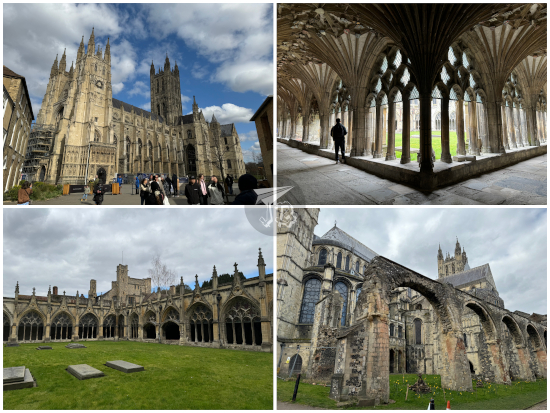
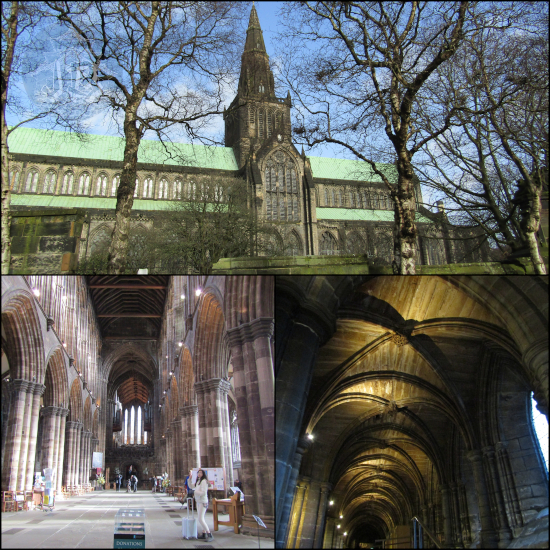
Canterbury cathedral - exterior

Canterbury cathedral - interior

I saw the place of the murder, called the martyrdom, on the way to the main nave, where a concert was being rehearsed. It sounded beautiful, but I could not stay forever, because there were many more things to see in town. Outside the cathedral itself there is a memorial garden and the six-metre sculpture War Horse (named Joey), in honour of all the animals that have died in war.

I had to move on, as it was windy and cold out in the open, and I still had more places to visit. I went on towards the Canterbury Roman Museum. The British are always extremely proud of their Roman ruins, though sometimes these are just a few objects. This time, however, the museum lives up to its hype. Even if the artefacts are not that impressive, it hosts the only in-situ Roman pavement mosaic in the UK. Unfortunately, nobody thought about building an overpass viewing platform…

Roman mosaic on the ground

I then headed back towards the main artery of the historical area, High Street and the local museum, The Beaney House of Art & Knowledge, which also doubles as Tourist Information Centre. I broke the worker’s brain when I asked for advice considering that I’d already seen the cathedral and the Roman Museum. What I actually wanted was an estimate of how long the trail around town would take, and confirmation of opening times. I was not too successful as they gave me some schedules which were not accurate. Anyway, I snooped around the place.

The Beaney House of Art & Knowledge was designed by A.H. Campbell in 1897 in the Tudor Revival style. It is named after James George Beaney, a Canterbury-born medical doctor who left money to the city to create a cultural hub. Today, the house hosts the Tourist Information Centre, an art gallery, an auction gallery, the local library, and a museum with collections about different aspects of the town’s history, including a lot of worldwide items that seemed brought by aristocrat’s Grand Tour.

The Beaney House of Art & Knowledge

I decided to do the walking trail around the town then. Now that I was not bee-lining any more, I could take in the statues, houses and buildings in High Street. The statues include Aphra Behn and Geoffrey Chaucer. Behn was a 17th century writer, one of the first English women to earn her living from her art, and possibly even a spy in the colonies and Antwerp. Along the street, I located my hotel, the Great Stour Canal, the theatre and the restaurant where I wanted to have lunch. I exited the centre through the Westgate Towers again, and ended up in the Westgate Gardens. I had started exploring, but then I got dizzy, and my legs shook a little. I had been on the go for almost 12 hours, on four hours of sleep, so it was time for a break. Thus, I backtracked to the Old Weavers Restaurant. I have to admit that I almost got sidetracked to have an authentic afternoon tea, but I had come across this place during my planning, and I was glad I went.

It is true that British food has a horrible reputation around the world. But honestly, it is not that bad – it’s just not such an important social event as it could be for example in Italy or Greece. Furthermore, there is a theory that most “traditional” recipes diluted away with industrialisation, when people worked too much to bother with cooking – the Industrial Revolution was something so new, nobody really knew how to deal with so many changes. Then, WWII food rationing and post war pre-made foods prevented a whole generation from learning how to cook. And thus, Chicken Tika Masala became the staple of English cuisine. In reality, however, this is not accurate. The British gave us scones, bangers n’ mash, roasts and pies, all of which are delicious.

Pies were what grabbed my attention from the Old Weavers Restaurant menu. The eatery is located next to the canal, in a house which dates from the 1500s, with foundations from the 1200s, and the original interior structure. The building was originally a weaving centre in the 16th century by the Huguenot refugees, which then became a weaving school – hence the name. When the school closed, the restaurant was established. moreover, almost all the “nice” restaurants in the area were offering a 15% discount with theatre tickets too.

The place was warm and a hot meal was a nice break to have. I was seated at a small table on the ground floor and ordered a Chicken, ham & leek pie in a hot skilled with a puff pastry lid, and a side of chips. I like British pies. Conversely, the first recipe of British pie on record was also written by Chaucer in 1381.

Pie and chips

Since I was quite literally outside my hotel, I decided to check in so I could drop my backpack and relieve the weight on my shoulders. I was not carrying much at all, but the hours were getting heavier, I guess. The hotel turned out to be an old refurbished house, with narrow stairs, and my room was on the upper floor. It turned out to be tiny, and weirdly distributed – I had to open the bathroom door in order to take off my coat. But it had a working bathroom, a radiator, and it was warm, so I was all right with it. The price was cheaper than anything I would have found in London and it would save me a lot of stress when I left the theatre. While taking the train back to London was doable, it’s not like I felt like one hour on the train, and then a commute in the Tube in the middle of the night.

I left again, and tried to pick up where I had stopped before lunch – this was my mistake. I should have done my walk clockwise, but I thought I had a bit of time. I had not counted on admission ending up an hour beforehand – but it was all right, and my plan ended at a local supermarket to buy snacks, dinner, and something I wanted to bring back with me. Thus, I went to the Westgate Gardens again, and I took a bit of time with the buildings and the ruins there.
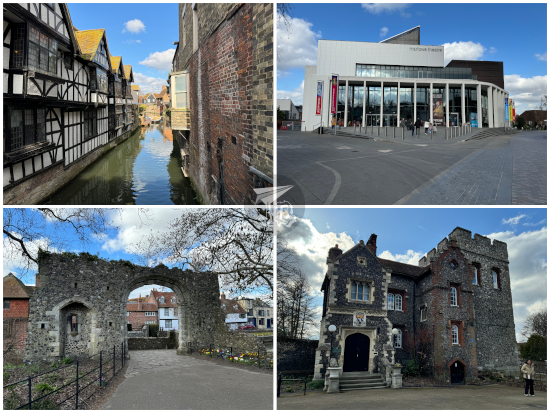
Canterbury - Marlow theatre and Medieval buildings

Canterbury is located on the River Stour, usually known as Great Stour to distinguish it from its tributaries. There are at least three main waterways through town, and even businesses that give boat rides to tourists. The Westgate Gardens are built along the Stour. They host The Guildhall (town hall) and Tower House, a narrow Victorian house built around a bastion of the city walls. I strolled along the riverside, mindful of the mallards and the seagulls who owned the place, until I crossed the Rheims Way Underpass – Canterbury really likes its underpasses, and they’re all right when you get used to them – full of graffiti and contemporary art (graffiti). I eventually veered back towards town, towards an area called Tannery Field and I came across the Canterbury Bull Sculpture, by local artist Steven Portchmouth, an artwork which honours the agricultural and industrial history of the area.

Canterbury Great Stout & Westgate park

I found St. Mildred’s church, an 11th-century stone church with a small graveyard, and totally missed Canterbury Castle for a minute there. I knew it was closed, but it turned out it was completely covered in scaffolding. The castle dates back to 1066, when Canterbury surrendered go William the Conqueror, who proceeded to commission a motte-and-bailey structure, with the motte being what remains today, though underneath the protective scaffolding.

A few minutes away, I got distracted by something which had not been in my plans – Dane John Gardens. Dane John was not a person as I originally thought – the name comes from the corruption of the Norman word for “fortified mound”, donjon, and there is actually a theory that the mound that still stands in the middle of the park is a former defensive motte, though during the Roman times it might have also been a burial mound, on top of which stands the Simmons Memorial – Simmons was the local alderman who built the gardens between 1970 and 1803. The park ends at the reconstructed Roman wall, with rebuilt defensive towers, and it hosts small attractions like fountains, a giant sundial, a Band Stand…

I went along the Canterbury City Walls until I reached ground level again – and then I went underground to cross the wide roads. When I emerged, I finally made my way to St. Augustine’s Abbey. The abbey was originally dedicated to other saints, but it was repurposed after St. Augustine, who had established the cathedral, died. It was a Benedictine monastery from the year 598 on, until the English Reformation forced its dissolution in 1538. Afterwards, it became a royal residence, which was then rented out to noble families. Most of it was eventually dismantled to build new houses, until it was bought in 1844 by a religious Member of Parliament who established a missionary college. During the 20th century, the abbey ruins and the college were separated for classrooms and boarding houses. The British Government took charge of the ruins in 1940, and the abbey is part of the Unesco Heritage Site.
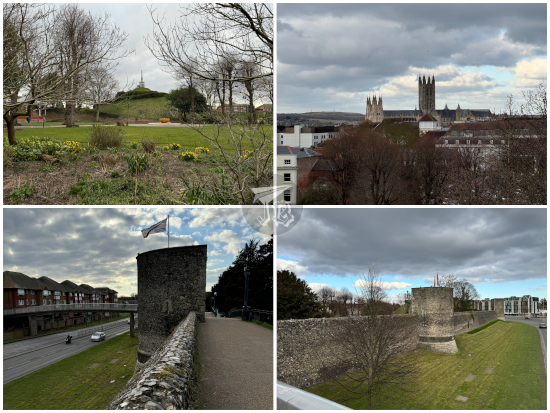
Dane John Gardens and Medieval walls of Canterbury

It was a little past 16:00, and I assume the ticket booth had just closed, though opening times were listed until 17:00 and there were people – a dogs – inside. I first saw the Fyndon Gate, the original gate to the abbey, built in the early 1300s, with two octagonal towers on the side, and a chamber above the entrance arch, which has an overlooking arcade. Though I could not enter the abbey, I was able see to the main ruins through a convenient lookout to the side of the locked-down area.

St Augustine Abbey Canterbury

I saw a signpost regarding the pilgrims’ route that lead me to both Rome and St. Martin’s church. Rome was a little far away to be back on time for the theatre, so I decided to settle for the church, which had been the plan all along anyway, as it was the third key point in the Unesco Heritage Site. The church recognised as the “oldest parish church in use” in the English-speaking world. It was used by Queen Bertha of Kent as her private chapel even before St. Augustine arrived from Rome in 597. Though her husband, Æthelberht of Kent, was originally a Pagan, he allowed her to continue practising her Christian Faith and he himself eventually converted. The building was erected reusing a lot of Roman bricks and tiles, along later stone. It has a small graveyard where many notable families have been laid to rest. The sun was setting, and the wind had calmed down, so it was nice. I did have a moment of slight worry when I glimpsed someone and I heard a bang – I thought maybe they had closed the gate and I would have to jump over the wall. Luckily, it was not.
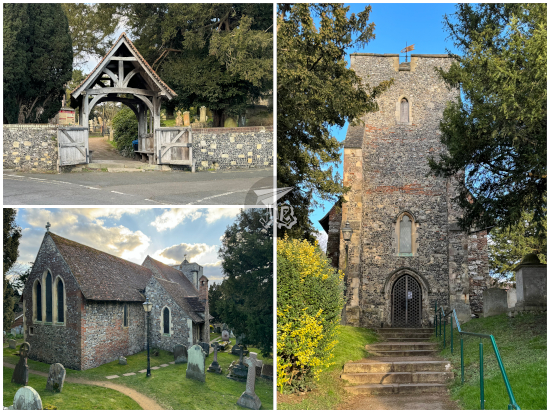
Canterbury St Martin chuch

I headed back towards the centre. In front of the abbey’s Fyndon Gate I found the statues of King Æthelberht and Queen Bertha of Kent. King Æthelberht was eventually considered a saint for his role spreading Christianity among Anglo-Saxons, but his main contributions were more earthly. He created the earliest written Law code in any Germanic Language, and minted the first coins which circulated in Kent.

Still heading downtown, I walked by St. Paul’s church without the Walls, which could’ve been built in Roman times as a cemetery chapel. A bit further along, there was the St. Thomas of Canterbury Roman Catholic Church, the only Catholic church in town, built in the late 1800s in the Gothic Revival Style. Adjacent to the church stands the tower Tower of St. Mary Magdalene, which belonged to Medieval parish that was demolished to build St. Thomas. There is a memorial inside the tower, protected by glass.

Back in the High Street, most shops were closed or closing down, and I did not come across any bookshops, where I would have purchased a copy of Chaucer’s The Canterbury Tales just to have a copy from the town. What I did find was a Sainsbury’s Local supermarket. There, I bought a sandwich for a late supper after the theatre, some Cadbury Eggs, and a can of Bisto Gravy granules. Cadbury Eggs are a confection made of chocolate with a yellow-and-white sugary filling. Gravy is a cooking sauce I can’t recreate to save my life so I enjoy having the ready-to-make at hand, it’s just small granules that you dissolve in boiling water to create the sauce. Neither – I reasoned – should be a problem at the airport.

I went back to the hotel to have an hour or so of rest before I headed out to the theatre. Marlowe Theatre was obviously named after one of the most famous Canterbury locals: Christopher Marlowe, the 16th century playwright, poet, translator, alleged spy and reportedly atheist, whose work is reported to have influenced Shakespeare himself. His plays were extremely successful, and they include The Tragedy of Dido, Queen of Carthage, The Tragedy of Jew of Malta, and the first dramatised version of the Faust legend, The Tragical History of the Life and Death of Doctor Faustus. The Marlowe Memorial, depicting The Muse of Poetry (either Calliope or Erato, one guesses).

There have been at least three “Marlowe Theatres” in Canterbury. The current one was rebuilt from a previous one between 2009 and 2011, as a stainless steel and aluminium building with a colonnade, and at night it glows electric blue, pink and purple. It is not a pretty building on the outside, but the inside is all right. It seats 1,200 spectators, it has a bar and a tiny merchandise stall.

Canterbury cathedral and Marlowe Theatre at night

Before I went into the theatre, where I bought the programme, I headed towards the cathedral to take a few pictures the building at night. On the way back, I must have taken a wrong turn somewhere, because I was disoriented for a minute before I found the bluish glow of the theatre. Back in December, when I booked the tickets, I also got “ticket protection” (insurance, basically), but I was ecstatic that I did not need a refund. I had managed to get there, and I could finally enter the theatre. I did not feel even a bit tired, even if I had been on the go for over 16 hours.

The Shark is Broken is a ninety-five-minute play written by Ian Shaw and Joseph Nixon, based on actor’s Robert Shaw’s diary of filming the 1975 film Jaws, directed by a young Steven Spielberg in 1975. It follows three very different men who try to hunt down (fish down?) a great white shark which has found the perfect feeding ground off Amity Island, a small beach community in Long Island. Jaws is often credited as the first summertime blockbuster, and it went on to win three Academy Awards – Best Original Score for John William’s music, Best Film Editing and Best Sound.

Canterbury Marlowe Theatre - The Shark is Broken

It is a commonplace piece of trivia that working on Jaws was a nightmare for everyone involved, as the mechanical sharks used for filming kept breaking down, which caused delays and going over budget again and again and again. Main actors Roy Scheider (Chief Brody), Robert Shaw (Quint) and Richard Dreyfuss (Hooper) were stuck on the little ship set for days on end while the film crew worked on “Bruce”, the shark. On top of authoring the script, Shaw plays his father. Dan Fredenburgh plays Roy Scheider, and Ashley Margolis plays Richard Dreyfuss. The stage play was originally directed by Guy Masterson in its Broadway run, and Martha Geelan is acting touring director.

The play is a number of connected, sequential scenes depicting different conversations over several days, showing the rising tensions amongst the actors. There are plenty of rather uncensored references to Robert Shaw’s rampant alcoholism, which his son, Ian Shaw, has not tried to hide or dilute. The set is just the ship, and only the three actors are on stage, you only ‘hear’ about the shark off-scene.

Was it a comedy? No. Was it funny at points? Extremely. Did I enjoy it? Immensely. I’ve read reviews saying that it is not worth it unless you are a huge Jaws, which I am. It includes known trivia, obscure facts and several hilarious meta references, including “It’s a thriller, do you think people will be talking about it in 50 years?”, which delivered on the 50th anniversary of the film is hilarious. Another one, referring to how Spielberg bailed on the last day of filming fearing the crowd would dunk him in revenge for all the inconveniences, and his upcoming career, is “Sharks? Aliens? What’s next, dinosaurs?” The scenes were chronological towards the end of filming, until the last one. Another known piece of trivia is that Robert Shaw was extremely drunk trying to do one of his scenes, the so-called “Indianapolis Speech” – and he screwed it up every time until he sobered up and delivered it in one go. The speech is referred to a few times throughout the play, and the very last scene is its re-enactment. It was glorious.

The Marlow Theatre was just a minute away from my hotel, and I could use the back door to get back in. I climbed up to the room and took a shower to warm up. Unfortunately, the bathroom had one of those fixed nozzles and the shower screen was… way too short for it. I might have caused a teeny-tiny flooding – good thing that I had extra towels to contain it. Afterwards, I had my sandwich, and a Cadbury Egg, even if it should have been too late for chocolate. Predator was running on TV, so I watched that while I charged the phone. Finally, I set my alarm and went to sleep, thinking that maybe being able to be on the go for twenty-something hours straight is my superpower.

My train back to London was at 7:24 – I had to miss my breakfast at the hotel, which started at 7:30, but that’s life. Fortunately, there was a kettle with some instant coffee and creamers in the room, along with biscuits. I woke up around 6:15, got ready, and hurried to Canterbury West station not because I was late, but because it was extremely cold. The train was on time and I was back in London St Pancras International just before 8:20. The train ride was uneventful, and once there I crossed over to Kings’ Cross Station to get breakfast from Costa Coffee. Since I was there, I peered over at Harry Potter’s Platform 9⅓, and I discovered that they actually take out the cart when the “attraction” is closed. I knew they charged for pictures, but I did not know that the cart was detachable. Which… I guess makes sense… considering that people would take free pictures with it if it was there. I just thought there would be a screen or something…

Anyway, not my thing. I headed out to explore St Pancras International Station. The original station was constructed in the Gothic Revival style (or Victorian gothic) in the 19th century, opening in 1868. The exterior was made out of dark red bricks, while the interior displays a complex roof in wrought iron and glass. The overall station layout was commissioned to engineers William Henry Barlow and Rowland Mason Ordish, and the adjacent hotel was designed by architect George Gilbert Scott. It is a magnificent building only slightly defiled by the contemporary expansion tracks. St Pancras was all but abandoned around 1960 until the 1990s, with extensive reconstruction, renovation and restoration in the 2000s. In 2007, it became the “international” station as it became terminus for the Eurostar train which covers the route between London and Paris in 2h 16 mins.
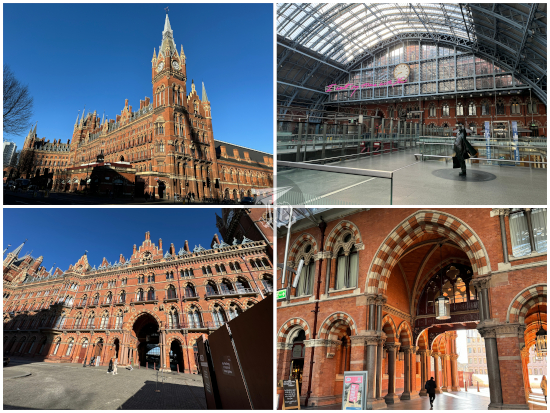
St Pancras international train station

I had to sit down for a few minutes because I made a wrong movement and my back cramped, but it passed soon. I was able to do a little bit of shopping in the station. A lifetime ago, I bought an umbrella in a franchise called Boots, and they had the same style and brand in the shop at the station. Considering that said umbrella served me well between 2012 and 2024, I had decided to buy another one if I ever saw it. I also got a book, because books in the UK are comparatively very cheap.

I found the coach stop, where I had to be at 15 minutes in advance. It was cold and windy, and it felt long. Apparently, the bus before had not come either, so there were a lot of people waiting. However, my ticket and seat were guaranteed. The only problem was, again, that the traffic was horrible due to construction. We took 43 minutes to cover something that should have been done in 10. Despite it all, the coach arrived at London Stansted Airport on time and without issues.

I went straight to security. Stansted is implementing new security protocols, which is great if you don’t get stopped. I got through two times ago, but last time my keyring created a problem – I have since changed that. This time around, the security lady was opening playing-card boxes to check for chemicals (not even kidding) and had to swipe my gravy granules for drugs, or explosives or who-knows-what. When I said “I didn’t even realise that could be a problem” her – rather sheepish – answer was “it isn’t.” Then… why did it get flagged? I’ll never understand airport security.

After 20 minutes waiting at security, I had some sushi at the airport, and bought a Playmobil Royal Guard, because they have always drawn my attention, and I thought that today was the day. Then, it was just waiting. My plane back was at 14:10, landing before 18:00, because I needed to get to a hard week of work on Monday. Part of me wishes I could have stayed until a later flight, but I needed to be reasonable. I did not get emergency exit seats either flight, so there was no issue with the cabin crew. However, when I tried to get my car out of the parking lot, the plate-recognition system would not work, so I had go down all the way back to find a person to talk to – good thing, then, that my plane had not arrived at 23:00.

The truth is, everything would have been more efficient had the Stansted Express been running, but at least I waited to book tickets so I could make the most out of the commuting issues. I did not pay train prices for coach transit, and I did not have to wait much between transportation choices. Furthermore, I could fill the time I had with things to do – and stuff to buy. And the most important thing, I saw The Shark is Broken, along with getting to know a new city.
30th June 2024: Engines, illusions, history and tea (Madrid, Spain)

Since finding about my tea time outings, my sibling had been wanting to tag along to one. I was asked to organise something for the weekend that involved either Chinese hotpot or afternoon tea in Madrid. The hotpot place was booked out both days, but I found an afternoon tea opening on Sunday the 30th. I am too lazy to move out just for tea, so I organised a bit of a day out.

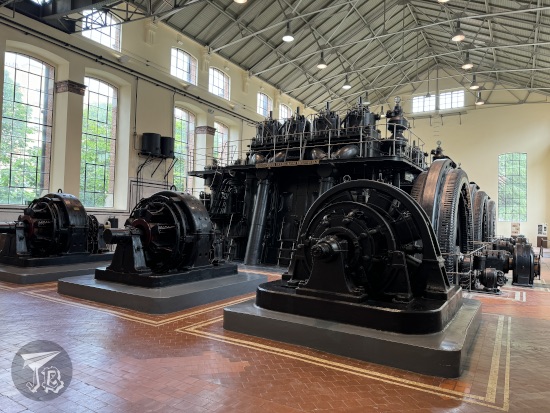
After an uneventful train ride, our first stop was at noon: Nave de Motores de Pacífico, the former energy centre that fed electricity to the original underground lines. Today, it is not in use and it has become part of the network of museums Museos Metro de Madrid. The warehouse was built by Antonio Palacios between 1922 and 1923 to home the diesel engines, transformers and fuel that single-handedly powered the underground system before the Spanish Civil War. The system was actually in place until 1972.

Warehouse containing the old underground engines

The building was erected in red brick, with white tiles inside, decorated with Palacio’s typical metallic green. The floors are ceramic tiles, and the engines are three monstrous vessel-powering pieces of engineering. These diesel engines created electricity, which then entered the transformers, and was sent to the power lines to feed the trains. At night, the excess was sold to the local street-light network.

Since we were going for afternoon tea to El Jardín de Orfila, where I have been before, I knew lunch was out of the question. However, we needed a snack. I planned that at Yatai Market, an… Asian food court of sorts. A number of stands come together to offer different cuisines and snacks, even full-sized meals. We tried a Chinese bao each and a couple of dim sums. I ordered a hoisin duck bao which was extremely yummy. I will definitely come back to try other stuff.

HotBao Yatai Market Cortezo

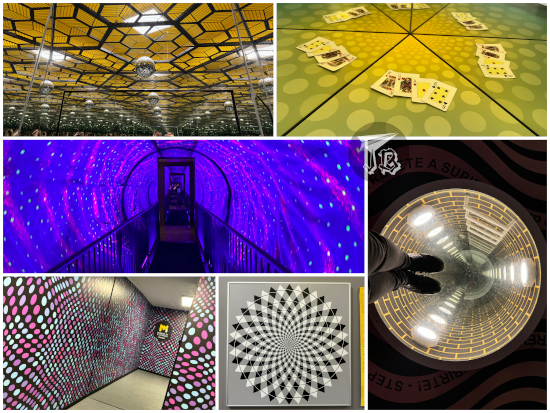
Afterwards, we headed off to the so-called Museum of Illusions. This museum is a compendium of optical illusion and installations designed to fool the brain into believing things that are either wrong or just not there: a distorted room so you look big in one corner but small in the other (Ames room), a vortex where you seem unable to walk straight, a rotated room, a room full of mirrors – there were a lot of illusions with mirrors actually – stereograms with hidden images, turntables, holograms…

We had a reservation for 14:00, and I was surprised at how chaotic entry was. I mean, they’ve been running the thing for a while now, someone should have figured out how to do crowd management, but no. Then, there were kids running and screeching all around, but it calmed down after a while. I had really hoped that the museum would be calm and half-empty at lunch time, but it was not so, not by a long shot. It was interesting though, and pretty fun.

Museum of Illusions Madrid

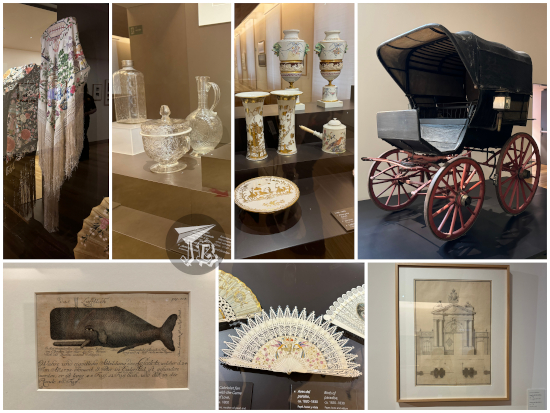
However, the experience was shorter than I had calculated, so I had to improvise an extra stop. Thus, we entered the local history museum Museo de Historia de Madrid, which tells the city’s history since Madrid became the capital of Spain. There are paintings, models, typical costumes, plans, maps, and Playmobil sets depicting of the uprising against the French in 1808. The museum is hosted in a former palace-like building which was actually built as a hospice. To the side stands the original Baroque chapel. It also has a lovely garden with a monumental fountain, which was relocated from its original place for conservation.

Museo de Madrid exhibits

Museo de Madrid - chapel and fountain

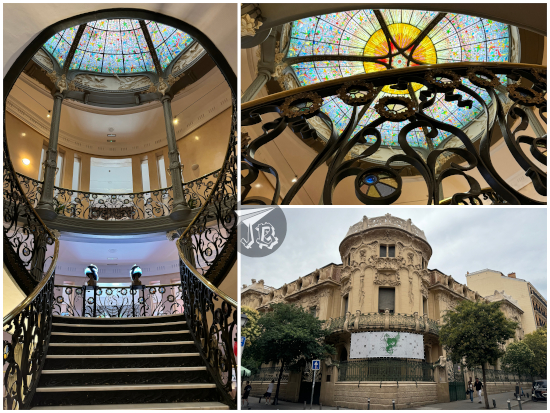
We spent some time there and then headed off to the building that now holds the office of the Copyright Owners’ association, a manor known as Palacio de Longoria. It was designed by José Grases Riera and built between 1902 and 1904. It is one of the few actual Art Nouveau buildings in Madrid, possibly the most important one. The façades were made in artificial stone, with sculptures and shapes resembling vegetation. I’ve wanted to visit it for a long time, but it is only open when there is an exhibition, and the stars had never aligned – until this time. There was an exhibition about urban music, and I was not going to let go of the chance to see the monumental staircase and the skylight.

Longoria Palace

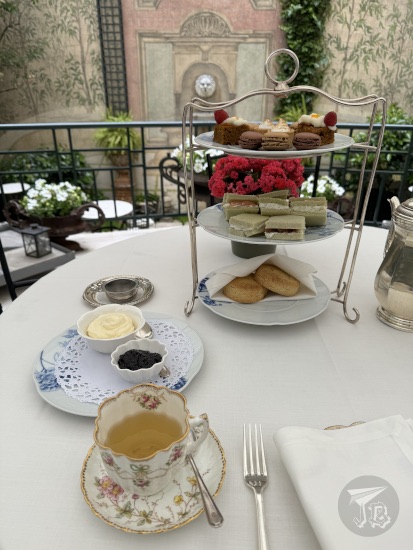
We finally set off for afternoon tea at El Jardín de Orfila. Out of the several places I’ve tried afternoon tea in Madrid, this has been my favourite to date. The outside garden is lovely, but mostly, their scones are the best around.

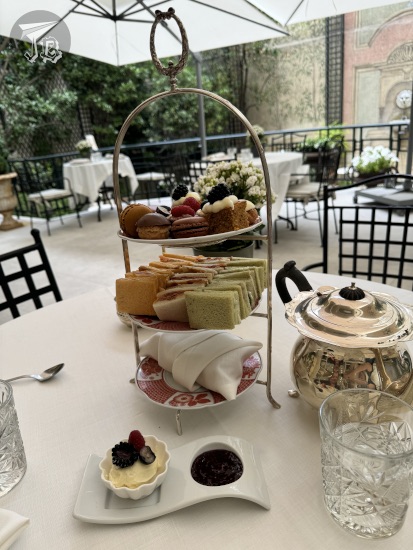
We ordered green tea, and the snacks were finger sandwiches – smoked salmon and cheese cream, classic cucumber and cheese, pastrami – pastries – carrot cake, macarons, lemon curd – and the scones. This time round, I decided to eat the scones after the sandwiches in order not to be full when it was their time. The afternoon was pleasant, but we shared the terrace with another table, and later a loud lady who wanted a smoke. That broke the magic a little, but the tea was fantastic and the scones were great.

El Jardínde Orfila: tea serving for two

Afterwards, we just headed for the train station to get back to our places. Of course we missed the correct one since they run whenever they like. What else is new? But the fun part was being able to pull a fun day out from my sleeve, and it was not stupidly expensive either, so good fun, all in all!

15th June 2024: The Old Naval College, and a mishap {London, England, June 2024}

I am getting weirdly used to 5:00 wake-up calls. I drove to the airport and arrived at the long-stay parking lot just before 6:00, with the exact time to catch the bus at the nearest stop. I might be getting too comfortable with timings – either that, or the flights have started taking off a bit later, because I remember having to leave by 3:45 for the first Ryanair flight a few years back. Anyway, security was nice and smooth, but passport control was maddeningly slow – the shiny brand-new machines the airport has spent a fortune on were not working, and there were only two agents, and three flights leaving around the same time.

We left on time and landed on time too, and since works at London Stansted have been finished, I was fast out of immigration. I considered going to the hotel first thing in the morning in order to make sure the credit card went through – and have time to find an exchange office if it did not. When I was able to buy my usual breakfast in the Costa at the arrival area without an issue, I decided I should be all right. Thus, I just headed off towards the centre, reached Liverpool Street station, and transferred to the TfL system. I got a bit confused at the DLR. London’s railway is divided in the Underground, the Overground and the Docklands Light Railway or DLR, which are mostly automatic trains which involve more transfers than I had expected. I needed to backtrack a station or two before I got to my final destination, the area know as Isle of Dogs in the borough of Tower Hamlets. I’ve recently found out that there is a footpath under River Thames which connects the Isle of Dogs with Greenwich. The footpath, the Greenwich foot tunnel, was built from 1899 onwards, and it opened in 1902. You can literally walk from one bank of the Thames to the other in just a few minutes!

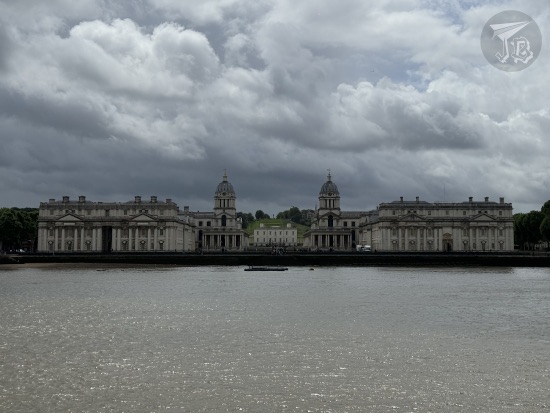
Old Royal Naval College from across River Thames

The tunnel was damaged during World War II, and there is a section which is held together by an inner steel lining. The whole tunnel is lit and either painted or tiled in white, so it does not give off any kind of claustrophobic feeling. Something cool that happened to me was that I could actually feel the water running above me, similarly to how I feel when I’m standing on a bridge and look at the river underneath. That was unexpected. Though there are lifts – the original ones were installed in 1904, but there are new ones from 2012 – I took the stairs.

Greenwich foot tunnel

I stepped out of the tunnel and into Greenwich, next to the Cutty Sark. I have already visited the museum inside the ship. This time around, I was going to try to see the Old Royal Naval College, which has been closed whenever I’ve tried to see it – they film rather often there. This time it was actually open to visitors.

The Old Royal Naval College, today part of the Maritime Greenwich UNESCO World Heritage Site, was originally designed as a veteran home and hospital. The current iteration of the building was designed by Christopher Wren – also responsible for St Paul’s Cathedral. The complex has two complexes or courts, Queen Mary Court on the left from the river, King William Court on the right. William III (reigned 1689 – 1702) and Mary II (reigned 1689 – 1694) were offered the throne as joint monarchs when their predecessor James VII and II was declared unfit because he became a Catholic. The building served as hospital and hospice until 1869; later, in 1873 it became a training academy for the Royal Nay until 1998.

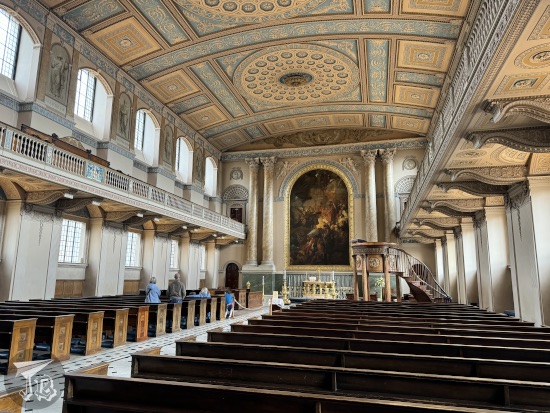
I first went into the Chapel of St Peter & St Paul in Queen Mary Court. It was reconstructed after a fire by James ‘Athenian’ Stuart in the neoclassical style. It has one nave, and a wood ceiling decorated with naval themes. The altar piece was painted by Benjamin West. I found the chapel quite beautiful, it gave off a warm feeling. The security personnel were also very nice.

Old Royal Naval College chapel

Then, I headed off to King William Court, to the pièce de résistance of the building. The Painted Hall is a huge ward decorated with Baroque paintings by Sir James Thornhill. The ceiling and walls are painted to honour the kings and queens who gave their patronage to the “Royal Hospital for Seamen at Greenwich”, depicting them surrounded by mythological and allegoric figures. The art was impressive, and the volunteer who explained it was a former teacher who made the whole tour really informative. While I usually avoid guided visits as much as I can, I found the painting too complex to interpret on my own.

Old Royal Naval College - Painted hall

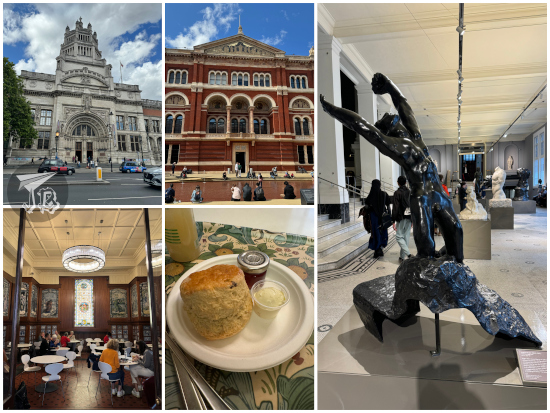
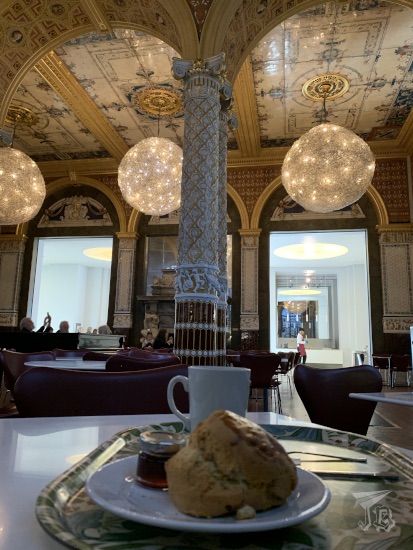
I backtracked through the Greenwich foot tunnel and took the Underground towards the Victoria & Albert Museum. Last time I was over they were running an exhibition I wanted to see… only this time around they had moved to another of their sites. I shrugged it off and decided to have a scone instead – any scone. I mention this because the couple before me wanted two particular scones from the basket. Afterwards, I went to see a gallery within the museum which I missed in 2023, which turned out to have bronze sculptures by French artist Auguste Rodin, considered the initiator of modern sculpture.

Snapshots at the V&A museum

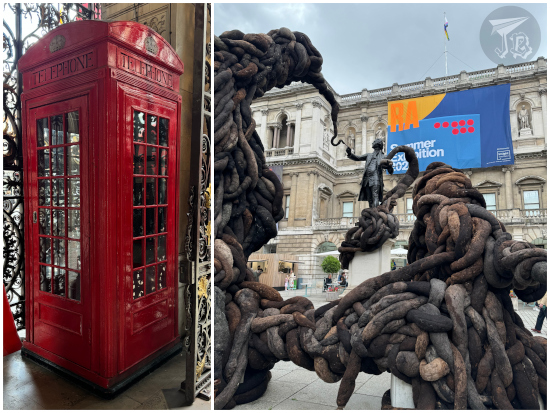
After that, I hopped back onto the Underground and headed off towards the Royal Academy of Arts, located in Burlington House. I was… surprised, to say the least, about the current display in the courtyard, but I was there to see oldest surviving red telephone box – Sir Giles Gilbert-Scott’s original prototype “K2” kiosk, made in wood in 1924.

Burlington house

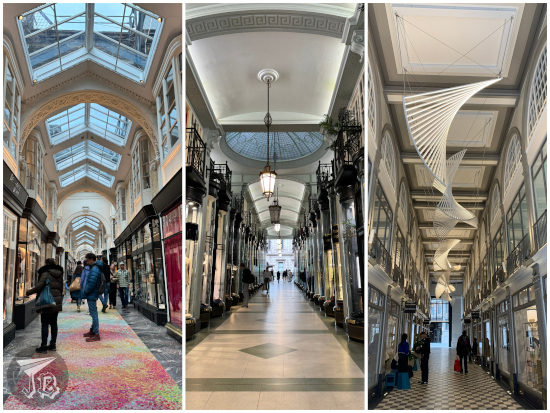
I then snooped around three of the high-class shopping centres along the Oxford Street area, all of them out of my price range, of course – Burlington Arcade, Piccadilly Arcade and Quadrant Arcade. I walked past Piccadilly Circus and Leicester Square, and headed off to Forbidden Planet to check out if they by any chance had a copy of a comic I’ve been looking for (Alligator Loki, if you ever find it, give me a shout?). I did not find the comic but I did see some stuff by Stjepan Šejić in the wild.

High-end London shopping arcades

Finally, I headed off towards the hotel / venue area, I found the venue – just outside the station. I bought some snacks for dinner and breakfast, then headed off to get to my hotel. The credit card thankfully went through and I got my room. I spent the rest of the evening watching films and snacking on salt and vinegar crisps. Truth be told, the weather was not that nice, but most of the rain happened when I was inside the buildings in the Old Royal Navy College. It’s been a long time since I was in London and there was not a heat wave, so I am not going to complain.

14th May 2024: Three Museums and Tea, Madrid (Spain)

On a whim, I put together a plan for Tuesday, as it is currently my free day. I was too lazy to drive, so I decided to catch a train to Madrid. There was a temporary exhibition I wanted to check out, and it was close to several museums and eateries.

My first idea – breakfast at a French crêperie – went bust, because the place was still closed when I arrived in town – I swear, this is like the fourth time I try to have something there, and it just won’t work. Instead, I ended up at a Starbucks for breakfast, before heading out to my first destination – the exhibition The Art of Manga, held in the Architecture Bar Association building Colegio Oficial de Arquitectos de Madrid, COAM. The Art of Manga is a small exhibit that runs through the history of manga – Japanese comics – with a few snippets of what it was and what it has become, especially in Spain.

The entrance was a sort of tunnel with manga sheets hanging from the ceiling. It ended at a traditional scroll with animals acting like people – Chōjū-jinbutsu-giga 鳥獣人物戯画, which translates to “Animal-person Caricatures”. Some people consider that this is the origin of manga (note the “ga” at the end), though if there is one thing that the exhibition makes clear, it’s that nobody knows when manga actually started. Thus, it just runs through all the possible theories and important names. From the Edo Period, there were a few wood prints (ukiyo-e) – which are claimed to be original – among them two by Katsushika Hokusai [葛飾 北斎], The Great Wave off Kanagawa [神奈川沖浪裏, Kanagawa oki nami-ura] and Fine Wind, Clear Morning [凱風快晴, Gaifū kaisei]. Hokusai is another of the supposed starts (“the father”) of manga. There were also a few toba-e [鳥羽絵], similar to the first scrolls – for the first time in the evolution of drawings, there was text alongside the art. Then came the books, where texts dominated – though there were still drawings – and they became extremely popular during the period.

With the end of the isolation of Japan, Western influences – mainly comics – influenced local artists, and “speech bubbles” appeared. In the late 19th and early 20th centuries, Kitazawa Rakuten [北澤 楽天]’s works were published in newspapers. He is (also) considered the father of modern manga, and several of his works are displayed. There are also early 20th-century scrolls, painted in a style similar to toba-e depicting the Tokaido Road, which separated Edo (old Tokyo) and Kyoto, and its checkpoints. There were also kamishibai [紙芝居] cards – kamishibai is a traditional form of theatre involving telling a story using a narrator and different “postcards” with images drawn on it.

In the middle, the exhibit had a rock garden, and a torii gate with a lot of lanterns gave way to the second part – modern manga. Here there were pieces and mementos from famous artists and works – Osamu Tezuka [手塚 治虫], known as “The god of manga”, and one of the driving forces of anime. According to the exhibition, they were showing all of his works. There was a bit about Shigeru Mizuki [水木 しげる], and big international hits like Sailor Moon, Naruto, Dragon Ball and One Piece. After a screen showing a video about a cosplayer – which I did not care much about – there was a section on manga magazines, some of the early manga published in Spain, and a stand where you could get some stamps.

Snaps from The Art of Manga Madrid

Finally, there was a bit on merchandising and figurines. The shop did not even have a catalogue, which I would have bought. All in all, it was all right, smaller than I had expected.

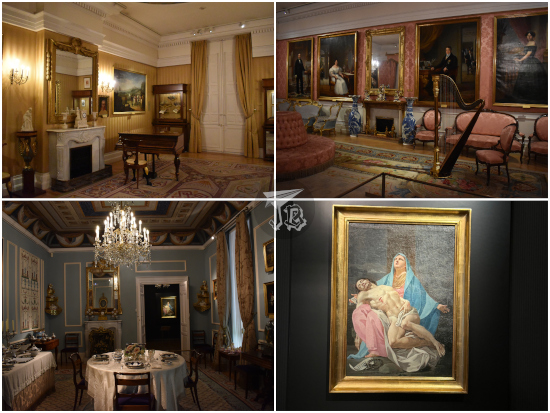
Then, I went to the nearby museum of the Romantic period, where I got a national museums card – I’ve been wanting one for a while, but unfortunately you still have to queue to use it. I had hoped you could just walk into museums with it, but I guess crowd control is a thing since Covid. Anyway. The Romanticism museum, Museo del Romanticismo is a small palatial residence which tries to recreate the ambience and atmosphere of the dwellings of the bourgeois families at the time. It had a lot of nice furniture, similar to the one in Riofrío, but I found it lacked on the landscape paintings I like. The museum is currently exhibiting an early painting by painter Francisco de Goya, a Pietà.

Museo del Romanticismo Madrid

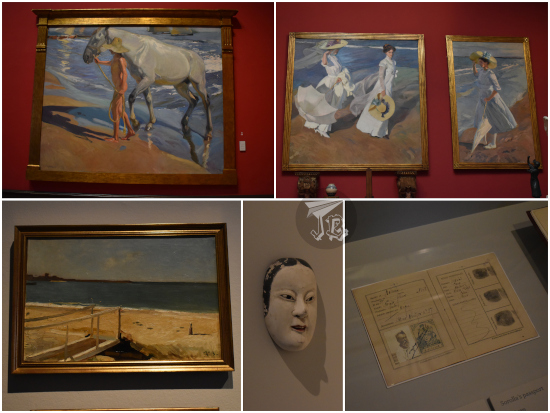
Afterwards, I headed out to line for the Sorolla Museum Museo Sorolla. I had to queue for nearly 40 minutes, but I was finally admitted in. Joaquín Sorolla (1863 – 1923) was a generally-impresionist painter (impressionist, post-impressionist and luminist) from Valencia. The museum was built in the artist’s own house, completed with some of his iconic artworks, including Paseo a orillas del mar, Walk on the Beach, and El baño del caballo, The Horse’s Bath. Sorolla excelled in portraits and landscapes, especially the sea side, and social criticism. He was a master depicting light, water, and the combination of both. He became one of the most important Spanish artists of his time – and probably the most famous. He participated in the Paris Universal Exposition of 1900, and was invited to exhibit his art in New York City.

Furthermore, there was a current exhibition called Sorolla in 100 objetos – Sorolla in one hundred objects – which had just opened to the public. It included personal items the artist collected, – some a bit bizarre–, photographies, his passport, the last painting he worked on, the medal he received from the US president, a photograph of his studio in Italy…

Snaps from Museo Sorolla

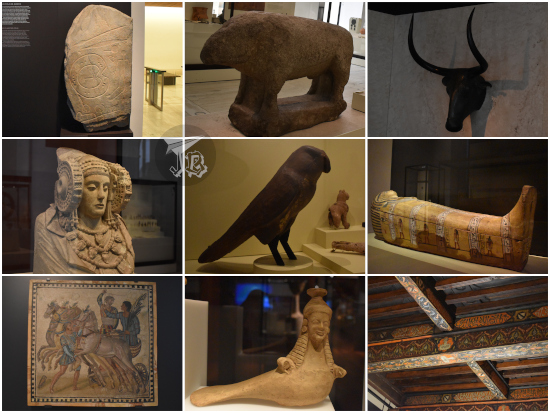
I then went off towards the archaeological museum Museo Arqueológico Nacional. I used to love this museum – when they remodelled it and they made it all modern and aseptic, it lost most of its allure. Of course, I still enjoy it, as the important items are the exhibits, and the museum has a lot of important items from the Celtiberian cultures – Celts and Iberians inhabited Spain before the Roman conquest, which started in the 2nd century BCE. Iberians were prevalent in the east and south of Spain before their arrival. The north and west were populated by the Celts, and there was a vague area in-between whose people have been called Celtiberian. the Talaiotic culture flourished in the Balearic Islands, and it has recently been declared World Heritage. These cultures were eventually assimilate by Romans, but Celts lived on elsewhere. Iberian and Talaiotic cultures, however, diffused with time. Today, there is little known about it, and most is just interpretation from archaeologists, even less about the more ancient tribes that lived in the areas during the Bronze Age.

Among the objects from pre-Roman Spain, there are mysterious steles from the late Prehistory. However, it is the Iberian funerary art which stands out the most – such as the bust called the Lady of Elche, La Dama de Elche, found in the town of the same name, and the full sculpture named the Lady of Baza La Dama de Baza. Both are fantastic, to the point that it was thought they were Hellenic for some time. Other items include bulls – both metal cattle heads with wide eyes, and vaguely-shaped stone sculptures, verracos. I remember going to the museum when I was little, and the importance of these bulls, called “Bulls from Guisando” Toros de Guisando was drilled into my head, to the point that I thought that the ones exhibited there were the only ones – it also made me sad that they were in the museum and not in the field where they had been found. I was petrified when I learnt, years later, that there are a bunch more…

The museum also hosts a nice collection of Moorish art, and what apparently is a special Egyptian exhibit, as Spain worked with Egypt during the 20th century, and got a lot of objects from that excavation from the Egyptians “in the split of the new discoveries”. I am not sure whether that’s accurate, or the story has a lot of make-up on. I had to leave around 16:15, but as this museum is also covered by the national museums card, I can come back any time within the year for free. I skipped most of the Medieval period.

Museo Arqueologico Nacional Madrid

I had a reservation for afternoon tea a few minutes away from the museum, at 16:30 – I might be doing a bit of a rally around all the places in Madrid which have it. This time around, I went to El Jardín de Orfila – and good thing I had decided to only have breakfast and skip lunch and go straight from breakfast to tea. I was seated in a lovely outward area and I chose a delicious green tea with cherry. The food was plenty – finger sandwiches: pastrami, salmon and cucumber and cheese cream; macarons, carrot cake, meringue, and scones, along with clotted cream and berries jam. It has probably been the best afternoon tea I’ve had in Madrid up to date. The scones were a bit under-baked though.

Afternoon tea at El Jardín de Orfila

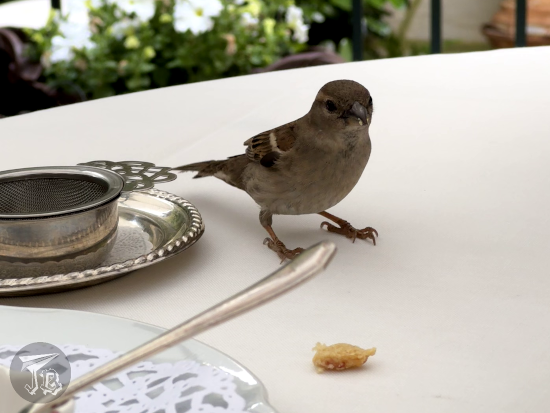
I was alone in the outer area for most of the experience, the waiter checked on me once after bringing my tea. It was actually so calm and quiet that I had a visitor – a little house sparrow (Passer domesticus) was very interested on the remains of my scone, so I shared with her. She was happy after two crumbs, and left – or maybe it was because another couple walked into the area.

Sparrow hopping towards a scone crumb

I left a bit before the two-hour timeslot was up so I could catch a timely train home – and because the couple came in, talking loudly, and kind of broke the spell.

12th – 14th October 2023: Yoshiki Classical World Tour “REQUIEM”, London (England, Great Britain)

This was my third and last trip to London in these five crazy weeks, and it was again to see Yoshiki. Someone once told me that I love Yoshiki because he appeals to both my wild and posh sides – it is partially true, I guess. It has a lot to do with how many of his lyrics resonate with me, more deeply than I am comfortable admitting sometimes.

I don’t think I would have travelled twice so close in time for any other artist. And believe me, organising this trip was a logistics nightmare. In other circumstances I would have flown out the same day of the event, which was Friday the 13th, but I don’t think that airports in the UK have completely recovered from the Covid chaos, and there are still a bunch of issues – just the previous week to my arrival, a good number of flights were cancelled in Gatwick. Second, the 12th is a holiday where I live, and since it was a Thursday, it kickstarted a long weekend. And last but not least, the 12th is also my parent’s birthday, and they were excited for a big celebratory lunch.

Taking all this into account, I tried to coordinate everything the best I could without breaking the bank. I found the last plane leaving on Thursday the 12th, at 21:50. That gave me time to have lunch at my parents’, then drive off past 19:00 – there should not be too much traffic. I booked the parking lot – the shuttle runs every 15 minutes in the evenings. In the worst case scenario, if my flight was cancelled or too delayed, there was space to manoeuvre on Friday morning. The plane was scheduled to arrive in London Gatwick close to midnight, but I was quite sure it would be delayed, and in order to avoid late-night trains and stress, I reserved a hotel next to the airport terminal – I did not have to worry about dinner as my parents make food to feed a small army. For the following night, I found a “boutique hotel” next to the venue. I booked my return flight on Saturday the 14th in order to avoid the end-of-weekend traffic that would concentrate on Sunday.

Great plan. In the end, something happened and the celebration had to be postponed, so I spent the evening watching the clock, and checking and rechecking both the weather forecast and my luggage – finding something to wear that was nice and still weather-appropriate was difficult. I changed my mind regarding footwear about six times.

Around 19:00 on the 12th, I finally drove to the airport. Considering that the forecast was rain both at home and at London, I took boots in the end, but more comfy shoes for driving. I reached the parking lot and airport a bit earlier than expected, and I found a nice covered spot for the car – which I had to check that it was not reserved a few times. As I entered the international terminal, I was disoriented for a second – since I usually take planes before 7:00, I had not seen the shops open for a long time! It turns out there is a Duty Free just after passport control which I had not even realised before, and that threw me off track for a heartbeat or two.

I had some dinner at one of the fast food stands, and as expected, the plane was delayed. Then it needed an engineer. Then it taxied forever. And after almost two hours of delay, the two-hour-and-a-bit flight to Gatwick was cut short – we landed not even ten minutes late, so we flew the route in a little over an hour. I never knew you could step on it so bad on a plane! I went through passport control and found my hotel – just outside the North Terminal, and much closer than I had calculated. Gatwick was also crazy busy even if it was nearly midnight.

I checked in, and I was surprised that even though it was the same chain I had stayed at next to the O2 Academy Islington, the procedure was completely different. But it went without a hitch, and I was in bed within thirty minutes. I even caught some sleep. For some reason they gave me a room with a sofa-bed aside the regular one.

Leaving in the morning was a bit more complicated. After a much-needed caffeine boost at Costa Coffee, I took the inner airport shuttle from the North to the South Terminal, where the train station is. From there, I found my connection to central London. The good thing is that Gatwick trains belong to a regular line, so they do not require a special ticket, you can use the Oyster card, which I did. The shuttle and train went through awful weather, but when I reached London, rain and wind had calmed down a little. I wanted to leave my things at the hotel because of the bad weather and not to go into any museums with the backpack – just in case. The nice person doing my check in was very stressed that I might want my room – it was before 10:00 for a 15:00 hour check-in. I really just wanted them to hold my luggage. After that was successful, my next step was finding a bank that would exchange a handful of old pounds for new ones. In the end, train, underground, hotel and bank took a bit longer than I had expected and I was running a bit behind my self-imposed schedule.

My first stop was Sir John Soane’s Museum. Sir John Soane was a neoclassical architect – he worked in the remodelling of the Palace of Westminster, but his most prominent legacy is his house-museum. He bought a couple of attached houses in the centre of London, and combined them both as an architecture experiment and to host his collection of antiquities, copies, paintings, and pieces of architectural interest. There was a special Act of Parliament to establish the museum while Soane was still alive, stating that after his death the houses should be kept as they were, to avoid his son selling the collection, as some of pieces were / are worth a fortune. For reference, one of the most important artefacts hosted there is the sarcophagus of Egyptian Pharaoh Seti I (Second Dynasty). Adventurer Giovanni Battista Belzoni tried to sell the piece to the British Museum after taking it from the Valley of the Kings in Thebes. The Museum was not willing to pay what today would equate to almost £200,000, but Soane bought it in 1817 to exhibit it in the basement “sepulchral chamber”, where it still stands today.

Entry to the museum is free, but you are requested to purchase the guide for £3, which I did. The first area you visit is the lovely library, and then you step into the real treasure – the area comprised by “the dome”, “the colonnade” and “the corridors”, where literally hundreds of sculptures, friezes, amphorae, decorative pieces… pile up on one another to the point that everything is overwhelming and fantastically chaotic. Wherever you look, there is something else to notice – whether it is Apollo, a copy of the Farnese Hercules, a pegasus… Then you go down to the basement, and both the “catacombs” and the “sepulchral chamber” are equally cluttered – a pair of Chinese guardian lion-dogs, Aphrodite bathing, a Poseidon head, and of course Seti I’s alabaster sarcophagus, encased in glass, which sucks for pictures but protects it in the super-tight space.

Artefacts at Sir Soane Museum

Sarcophagus of Seti I in Sir Soane Museum

Other spaces include the kitchen – which feels strangely empty in comparison– the drawing rooms on the first floor, and the picture room on the ground floor – with some of Canaletto’s Venetian landscapes, and drawings of ancient monuments. All in all, whenever you blinked, you missed a detail. It was almost stressful, but an amazing place to visit.

Afterwards, I met up with fellow Yoshiki fans A****d and A**i, at the British Museum. They were going there first thing, and we had arranged to get together around noon, but I ran a bit late and only reached them around 12:20. Through that time, they went through the must-dos. We met at the Ancient Middle East and saw a few exhibits about the history of money, one on clocks, Roman Britain, the library… They asked me if there was anything I recommended, and we went past the Moai so I could show them one of my favourite sculptures ever – the Bodhisattva Guanyin [觀音 in Chinese], associated with compassion, in the Chinese Art Gallery. Guanyin sits with one leg up in a very relaxed and informal position compared to other Buddhist imagery, and I just adore this wooden representation.

Artefacts in the British Museum

Around 14:00, we went out for lunch. We tried an okonomiyaki place near the British Museum, but it was unfortunately full, and both my friends had had CoCo Curry the previous night. We walked into Chinatown and we found a self-proclaimed izakaya Japanese restaurant called Oita (Soho). I ordered sushi bento for £16.95, which at first felt a bit expensive, but I had forgotten British-sized servings. It was actually very proportionate size-wise, and came with complimentary miso soup. The bento (“boxed lunch”) itself comprised a small salad, seven pieces of assorted raw fish on sushi rice (tuna, salmon, butterfish, mackerel, squid, prawn and octopus – these last two were no raw, actually), four assorted nigiri (tuna, salmon, butterfish, mackerel), three salmon sashimi, two tuna sashimi, three avocado hosomaki, and some garnishing including cucumber, radish and alfalfa, along with pickled ginger and wasabi. It was really good.

Oita Soho sushi bento

The three of us separated after lunch to go to our hotels and get ready. On my way, I bought a sandwich and a bottle of water from a supermarket to have for the night, and decided to take a shower before changing into concert gear. When I reached my hotel, they showed me around, and told me my luggage was in the room – which it was not. I had to come down again to get it, which embarrassed the staff a lot. The room was posh to the max – I even had a bed with a canopy! Apparently, boutique hotels are “small hotels with a personality” that try to “tailor the experience to the customer”. For me, a hotel is just a place to sleep in, so I’m just happy with them being safe and clean. I can do without the personality, the steeper price, and the surprise extra service charge.

I reserved the hotel through Booking, and they got in touch that they wanted payment outside the page. I dislike this, but it is not unheard from. I needed to demand my payment receipt, too, because the page did not generate any. Later, they tried to charge me through Booking again (though in their “defence” this might have been a Booking issue, as it has been hacked). In the end, the image I got from them was that of an overpriced wannabe high-end hotel, but there were too many blunders to consider coming back if I can help it.

At least, the hotel fulfilled the one reason I had chosen it – it was a short walk from the Royal Albert Hall. Considering how badly I felt after the Miyavi concert a couple of weeks before, I was a bit apprehensive this was going to be too much. It was, but not in the worse sense of the word. The recital was emotionally hard on me, as I tend to connect a bit too much with Yoshiki’s music, but fortunately I did not take ill this time around.

I was deeply moved when I attended the first Yoshiki Classical concert in Paris in 2014, but this time my mind was absolutely blown. Back in May, in a moment of fanby weakness, I decided to buy RAH membership (£55) in order to get access to the presale. Despite that, I only managed a sixth-row seat to the side – Arena F – Row 6, Seat 27 (£60). These were sent by post and arrived in physical form in late July. I decided on this delivery method because even if the tickets did not arrive on time, or got lost, I still had the option of “will call” with my ID and the card used for purchase (of course, my bank decided to cancel my cards meanwhile and get me new ones, so I’ve been running around with both working and not-working cards in my wallet for the last couple of months).

Having a RAH account also meant that I was notified about a “Yoshiki meet and greet VIP package” within minutes of its release, which included an exclusive opportunity to meet Yoshiki after the concert in the 1871 Bar, a photo opportunity with Yoshiki, and a piece of merchandise for signing (£150) – I booked it as soon as the email came through, and I think I was the 10th person to buy the upgrade. These tickets were supposed to arrive by post, too, but the venue changed them to e-tickets the week before the show – when I was already antsy about them arriving – “will call” was still an option, but I was restless.

Around 18:15 I left the hotel to walk to the venue to meet A****d and A**i. The Royal Albert Hall is one of the most famous concert venues in the United Kingdom. It was world’s first domed amphitheatre, designed by two civil engineers, Francis Fowke and Henry Y.D. Scott, and inaugurated by Queen Victoria in 1871. The outer structure is built in Fareham Red brick with a mosaic frieze that represents the arts and sciences, and the roof is a glass and wrought-iron dome. It has several halls and a corridor surrounding the amphitheatre, with several bars and other hospitality offerings.

The three of us walked around and found the merch stand, which was a bit underwhelming – two short-sleeve T-shirt models, and a tote bag. I kind of regret not getting the tote now, but I felt I had already spent too much money. A****d was sitting next to me, and A**i just a couple of rows behind. However, upon being shown to the amphitheatre when doors opened around 18:45 for the 19:30 concert, my brain shortcut. Rows 1 to 5 were inexistent. My row 6 ticket was a first row ticket. I was first row for a Yoshiki concert!

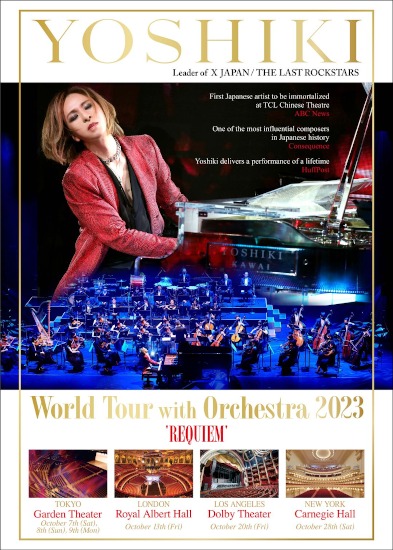
Fine, to the side and with some camera equipment in between, but I was first row for a Yoshiki concert. In particular, for Yoshiki’s Yoshiki Classical 10th Anniversary World Tour with Orchestra 2023 “REQUIEM” on the 13th of October 2023.

Yoshiki Requiem Poster 2023

Most seats had a small booklet, and since mine did not, I decided to “steal” it from a still-empty seat – I’m selfish, sue me. Once my brain settled down enough to take everything in, there were two things I noticed – one, that the grand piano in the centre of the stage was not Yoshiki’s trademark glass piano, and two, that his drum set was there. This was not a huge surprise as he had hinted it during the Q&A in September that he wanted to do something with it. We passed the time looking at people come in, being impressed at how fancy some people dressed, meeting other friends, and taking photographs in front of the stage.

Inside the Royal Albert Hall

The concert / recital was intense. Most of the music played had been composed by Yoshiki himself either for his different collaborations or for X Japan. Vocals were entrusted to pop singer Beverly [ビバリー] and soprano Ai Ichihara [市原 愛]. Special guests St.Vincent and Ellie Goulding sang their own songs. The Royal Philharmonic Concert Orchestra was conducted by Ward Stare. Ballet dancers from Jlee Productions performed on stage during Forever Love and Swan Lake..

Setlist:

Part 1
   1. Amethyst (orchestra alone)
   2. Tears
   3. Angel
   4. Miracle with Ai Ichihara
   5. Forever Love
   6. Kiss the Sky with Beverly
   7. Anniversary
Part 2:
   8. Drum improvisation while the orchestra played Serenade for Strings (by Pyotr Ilyich Tchaikovsky) and Symphony No. 3 (by Henryk Gorecki) and Ai Ichihara on vocals
   9. Say anything
   10. Swan Lake (by Pyotr Ilyich Tchaikovsky)
   11. New York by and with St.Vincent
   12. Love me like you do by and with Ellie Goulding
   13. Red Swan with Beverly
   14. Requiem
   15. Without you
   16. OPUS 13 in A-minor (by Felix Mendelssohn)
   17. Art of Life (second and third movements)
   18. Endless Rain

Although the auditorium opened later than it was supposed to, the concert started almost punctual, a bit past 19:30 – which for Yoshiki is a miracle of ontimeness. He had probably done all his interviews the month before. Director Ward Stare came on stage and the orchestra played Amethyst as warm-up – this is the song that was usually heard at the start X Japan’s concerts, before members came in. Yoshiki walked on stage to play piano from the second song on, Tears. The tour title Requiem comes from the song Yoshiki wrote to honour his mother after she passed – he was understandably devastated, and it made sense to start the show with Tears.

Yoshiki playing piano at Royal Albert Hall

Throughout the concert, he alternated piano-playing and talking – most of the talks we had heard before, but a few were new to me. He told us that when he felt that he had managed a great achievement his mother used to bring him back to earth with questions like “have you eaten?” or “did you sleep?”. He explained that she really praised him when he composed Anniversary for former Emperor Akihito. We also had some promotion of the Under the Sky film, and Yoshiki’s champagne line, along with a recap of him being honoured in LA’s Chinese Theatre. There was also some “thank you to my sponsors” talk, and he might have said “amazing” around a thousand and three times.

The first part went more or less as expected – except for the ballet dancers. I did not think we would get them, but I am not going to complain. I did miss Hero, because I really enjoy listening to that one live, but something had to be taken out to accommodate the songs by the special guests. Some people say that he talks too much, but I think that he’s just trying to catch a breather – both physical and emotional. At one point he spoke about an “X Japan song that we would never really hear”, which was heartbreaking. There is a difference between knowing that there won’t ever be any X Japan ever again, and having it confirmed. Both in September and now, we’ve heard him openly say things that usually went only implied, which I think means that we are in a new stage of his artistic career / life.

Yoshiki Royal Albert Hall with orchestra and ballet dancers

For the second act, he pushed himself even harder with a drum solo to start off. He always smashes the drums as if he were trying to get a confession out of them – it is like he has so much anger inside him and the drums are his only way to release it. In a way, it probably is – he always says that he turned to drumming to deal with his father’s suicide, and that is how he expresses himself. But then he goes back to the piano, and it feels that the keys are crying with him.

The acts with St.Vincent and Ellie Goulding, in my opinion, were more promotional than anything else. Both are well-known and established in their own niches – and Yoshiki likes female singing voices because they can hit high notes better, I think – though I miss Katie Fitzgerald and Ashley Knight, to be honest. St.Vincent was okay, Ellie Goulding left me wondering… what she was doing there. Apparently the pinnacle of her career until now has been composing Love me like you do for the film Fifty shades of grey… And I hate to be that person, but both of them could have chosen way better outfits.

The titular song, Requiem, was extremely poignant. It was the piece Yoshiki wrote to deal with his feelings for his dead mother, in his own words, the means he found to stop crying for her loss. Just like he took to drumming after his father’s death, he took to composing after his mother passed. Later, he explained again how the song Red Swan symbolises standing up through the pain and the blood. The original version of this song is sung by vocalist Hyde, and since he was bringing in people from all around the globe, I would have been extremely happy if he had flown him in for it, and I was hopeful for about one tenth of a heartbeat. Unfortunately, you cannot have everything.

Throughout the recital there were sad moments and happy moments, to thank fans, and to remember those who are gone, moments with ballet dancers and with the torch on the phone on, moments to sing and to laugh, and to feel your heart shrink. In the end, Endless Rain with all the audience was extremely special – it never feels that it is going to be, I keep thinking “this time it’s not going to affect me this much”, but it gets me every time.

Yoshiki talking at the Royal Albert Hall

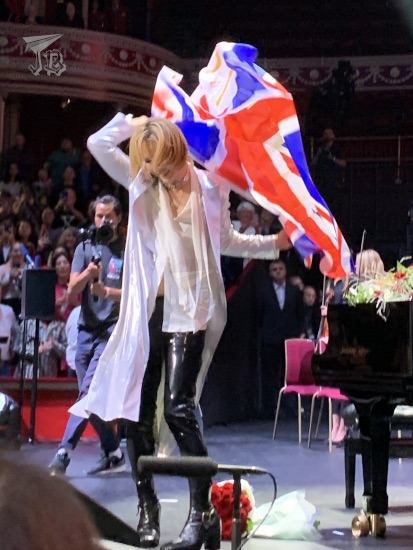
In the end, the show lasted for about three hours, plus a twenty-minute intermission. He thanked the conductor, the orchestra and dancers and the guests, and received lots of flower bouquets. Next to me, A****d managed to give him a Union Jack with a small EU flag sewn into it, which he proudly wore around his shoulders. It’s fun how he is such a huge super star and then he becomes all shy and embarrassed. Or he just… crashes.

Yoshiki with the Union Jack flag, Royal Albert Hall

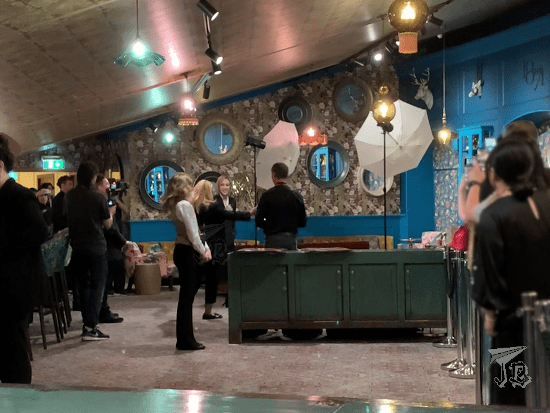
After the concert was over, we said goodbye to A**i and, A****d and I made our way to the 1871 Bar, where the Post Show Meet & Greet Experience was to take place. We went to one of the doors, but of course then we needed to go to the other one. Eventually we got in, and rather quickly – I was the 20th person in the queue, and got to wait inside the bar. It was upholstered in blue, turquoise and green tones, with the most garish decoration I’ve seen in my life, including mirrors, golden wallpaper, bright plastic deer heads (better than real ones but still gaudy), lava lamps… There were about… four or five sofas, and the whole floor was carpeted in reddish and green / grey tones.

I was a bit nervous – waiting to meet an artist is actually the worst moment of queueing, I feel. To be honest, the first time I saw Yoshiki in person in 2017, my brain went 404 on me and I was not able to utter a word, though in Vienna I did a bit better and got a selfie. I was shaking so badly it came out horrible and moved.

As we were waiting, a staff member came to tell us that we could talk to Yoshiki a little, and that they would take our pictures with him and email the link to us. He explained that Yoshiki had just played a three-hour show and that he was bound to be tired – and how amazing he was. We smirked that we knew that already – most of us were not local, after all. Meanwhile, lights were set up, and signed posters brought out.

Yoshiki arriving for the M&G in the 1871 Bar at the Royal Albert Hall

Once he came in, we clapped and then everything went very fast and very slow at the same time. Everyone got to talk to him a little indeed, ask for an autograph or give him a present. Some people conjure amazing gifts for artists, but I never bring anything for them, because I feel it’s imposing and they don’t need any junk I could get them. However, I was clutching my bad selfie print-out, running through my head what to say. It was finally my turn, and then something I could have never prepared for happened – he declared that he was tired and just sat down on the floor. Not one of sofas. Yoshiki, superstar, just plopped down on the garish carpet of the bar at the Royal Albert Hall.

I have no idea how or why but my brain kicked into gear at that point. Before the staff could react in any way, I asked Yoshiki if it was all right to sit down on the carpet with him – I really did not know if he wanted to have his picture taken on the floor. I’m not sure if the staff and the aides knew what to do, but when he said it was all right, I approached and sat – A****d had stayed behind and was able to document the whole thing, apparently I sat in the proper traditional Japanese way for the conversation.

I thanked him for his music, and told him how his lyrics helped me feel better after a bad situation. Then I asked him to sign the “horrible selfie” – I actually said this – from Vienna. He thanked me for coming back, and I said “no, thank you for coming back”. The whole thing was absolutely surreal. There we were, sitting on the carpet of the Royal Albert Hall, surrounded by dumbfounded staff and… sofas. Photographer Andy Paradise took our picture, and what I saw when I looked at the camera was the photographer crouching, the video-camera person kneeling, someone else also crouching down, and a fourth person coming in with a chair (despite… sofas). I said thank you again, and dragged myself away – the guy whose turn it was behind me also sat down on the floor.

A****d and I got our signed posters, while I clutched to my now autographed bad Vienna selfie, and left the venue. Some people asked questions on the way out, and we explained how it went. When we came out, it was cold, so damn cold. My hotel was a block over, so I asked reception to order a taxi for A****d, and we parted ways, hoping to see each other soon.

I went up to my room to take my third shower of the day, and have my snack. I was so overwhelmed, it was hard to sleep. It was also stupidly cold because unbeknownst to me, I had not closed the window well, and there was an open crack. I burrowed under the bed covers, a towel and a bathrobe, and got some rest.

The next morning, I made myself a hot instant coffee to start off the day, but it did not do much to get my blood pressure up. I vacated the room around 9:00 after asking the hotel to keep my luggage – but considering what had happened the previous day, I made sure I had all the important things with me. I had a nice plan for the day, but I decided to discard it last minute because underground disruptions had escalated – it was not worth it to get stressed due to commuting issues having alternative things to do. Seeing the first red phone cabin will have to wait for another time.

It was still extremely cold when I stepped out. First, I went to see the Albert Memorial in Kensington Gardens, and I crossed to Hyde Park. I also found the Monument to Livingstone. I went around the Royal Albert Hall, and a bit before 10:00, I joined the queue to enter the Victoria and Albert Museum. Whenever I am in Kensington, I always get distracted by the Natural History Museum, so I had forfeited the V&A for a while now. Today was the day to finally explore it.

The Albert Memorial

Royal Albert Hall from the outside

Founded in 1852, the V&A is one of the largest museums in the world – it’s actually the largest museum of applied arts, decorative arts and design. It covers 51,000 square metres, with 145 galleries and almost three million individual items in its permanent collection. It is a chaotic museum, and yet, it makes sense. The museum is organised by “themes” such as Buddhism, England Middle Ages, metalwork, porcelain, glass, Baroque sculpture… I tried to see things in some kind of logical order, but it was pretty much impossible. Apparently they tried to rearrange it a while back and they just… gave up, as it would diffuse expert knowledge. I found this very interesting, but since this was my plan B, I did not really have time to plan the visit very thoroughly.

Before diving into the galleries, I headed over to the museum café for a gigantic tea-infused scone with jam and proper clotted cream, and a mug of coffee, and sat down at the Gamble Room. When it opened in 1868, it was the first museum café in the world. It is decorated with tiles imitating the Italian Renaissance majolica tiles, columns, golden ceilings, and weirdly modern lamps. After breakfast, I felt a bit more grounded, though I felt a bit off all day.

Scone and coffee at the Gambler Room in the V&A museum

I roamed around the museum for a few hours, and I know that I missed some important areas. I found it difficult to keep track of where I was and where I wanted to go, but I got a bit of a taste of all. I was very impressed by the Cast Courts, where copies of some of the most iconic pieces of architecture and sculpture are kept. These were made in the 19th century, and represent “the truest spirit of the Victorian museum.”

Artefacts at the Victoria and Albert Museum

On the ground floor, I wandered the Korea, Japan, China and Buddhism galleries, and I came across another depiction of Bodhisattva Guanyin, in the same pose but a completely different artistic style. I saw the largest Middle East and Islamic Art collection in Europe, and the adjacent galleries –South Asia (especially India) and South East Asia had a lot of interesting artefacts, too. The sculpture galleries are tantalising.

Other areas I visited included Medieval and Renaissance, Britain though history, ironwork, metalware, gold, silver, ceramics, glassware, jewellery, stained glass, architecture, and I could have gone on and on. But alas, I had a plane to catch.

Artefacts at the Victoria and Albert Museum

Victoria & Albert Museum

Around 13:00, I left the museum, collected my luggage, and made my way to South Kensington Station amidst the Tube closures of the lines that would take me directly to Victoria. A while back, I had to take a similar alternative route from Earl’s Court due to the wires overheating when I was going to the Apollo Victoria Theatre to watch Wicked. The South Kensington station runs the same Tube lines, so I was able to reach Victoria railroad station at the desired time – even with a line change and more than double stops. I was off towards Gatwick airport on the expected train.

Once there, I went through security without a hitch. I had a snack in the most expensive and unfriendly Wagamama in history – give me Stansted’s Itsu anytime. I wanted something warm because my body gets weird after emotional highs, and I was freezing. I even wondered if I was taking ill again, but no. I was just cold. I did not let either the restaurant nor the chill spoil my mood though, and I might even have had a nap on the plane. By the time I got off, I had warmed up. I cleared passport control, found my shuttle to the parking lot and – aside from the inevitable idiot on the road – there was not even that much traffic, which is good. You know the routine – shower, snack, bed.

I was not ill in the end, just stupidly exhausted. Going back to normal was quite difficult, especially as I still had Sunday free. I did not ever dare look at my phone to see if the photographs were real. A few days later, on the 18th, we received the email with the meet & greet professional photos. I look ridiculously happy, sitting on the carpet ,with a sofa behind me, with who is probably my favourite artist. I feel a bit guilty that I burdened him with my problems – I really hope he forgot quickly. Nevertheless, I am mostly glad that I was able to take these three crazy trips to London without incident. I feel extremely lucky that all three of them worked out, if not flawlessly, without any huge mishap. There is actually another Yoshiki event announced for December, but as much as I would love to go, it is just not in the budget, and I am a bit sad about that. But then I think “I sat with Yoshiki on the carpet of the Royal Albert Hall” and smile.

10th – 12th February 2018: Highlights of Glasgow and Edinburgh (Scotland, Great Britain)

This is another trip that I took with customers. We flew into Edinburgh and took a bus directly to Glasgow, where we arrived at around 9:00 on Saturady morning. We made a stop for breakfast, then we walked to Saint Mungo Cathedral.

Then, of course, I guided them up the Necropolis Hill. The weather was very nice for a chance – because I have the exclusivity of good weather in London, but not in Scotland, which yielded to a nice walk.

We had lunch in my favourite Greek restaurant, and then walked around Glasgow – some of the members of the party wanted to go clothes-shopping so I took the opportunity to get into a bookshop or two. We dropped our things off at the hotel and walked in and out some of the shopping centres in the Central Glasgow area. In the evening, I took them to try Wagamama, a ramen / British fusion food chain. I’m always in for ramen (≧▽≦).

On Sunday morning we took the train to Edinburgh. We visited the Old City and Edinburgh Castle, with some awesome sights (because again, the weather was really good – albeit cold as hell, because, have you seen that snow??) and fumbled around for a while.

We had lunch at the Deacon Brodies Tavern, a traditional a restaurant in Castlehill – mince pie here.

We also took a walk towards the New City – and there was shopping again. In the end we had an amazing cup of chocolate as early dinner before we went back. I was supersuprised they wanted dinner, but I had had enough with that chocolate and just some tea at night. The shop where we had chocolate was called Coro: The chocolate Café, and I have no doubt I would go back to that shop.

Just before we headed back to Glasgow, we came across an art installation in Prince Garden, which had lots of pretty coloured lights.

And when we woke up on Monday to go to the bus station and head off to the airport… it was snowing! Honest to god snow on the streets!

We reached Spain without further incident in the afternoon, and that was another weekend wrapped up.

27th December 2015 – 1st January 2016: Scotland (Great Britain)

A friend and I decided to organise a New Year’s Eve getaway to Scotland, and I used the opportunity to get some stuff and redtape out of the way, so you might notice some chunks of time missing. Furthermore relationship with Scotland is complex and bittersweet, so I’m not sure how this post is going to turn up

The first part of our trip was based in Edinburgh. We arrived rather late in the evening so we just got to Waverly Station and walked to the hotel to get some rest before we started off the adventure.

Edinburgh

Edinburgh is the capital of Scotland, and it is a dark city, but not in a bad way. The dark, moss-covered rock seems designed to absorb any little beam of sunlight and warm the houses. In our first morning we had a walk around Princes Street Garden, where the Scott Monument, a memorial in honour of the writer Sir Walter Scott, stands. There was also a Christmas market standing.

We climbed up Castlehill to visit Edinburgh’s castle, in the Old Town. The castle stands on an extinct volcano and some of the archaeological remains can be traced back to Prehistory! The first castle is thought to have been built around the year 1000 BC, which means the foundations are 3000 years old! The site of the castle includes, among other dependencies, The Royal Scots Dragoon Guards Regimental Museum, National War Museum, the Royal Palace, St. Margaret’s chapel, and a couple of distilleries. Due to its vantage point, also features a great view of all the Edinburgh area.

We walked back down Castlehill and made a stop at The Tron in the City, a former church turned artisan flea market.

My friend is a Hard Rock Café collector, so we went to the George Street area, which was decorated.

After lunch, we walked to Calton Hill, a hill / park area located near the centre and that hosts the Dugald Steward Monument, the National Monument and the Nelson Monument.

Then we met with a local friend to have dinner (bangers and mash!) to The Elephant House, the so-called birthplace of Harry Potter, where JK Rowling went to write the novels.

On our way back we saw some of the illuminated views, most prominently the Christmas market and the Balmoral hotel.

Glasgow

Aside from all the emotional baggage associated with Scotland, I can say that Glasgow is one of my favourite cities in the world. Most of what we did was walking around even if the weather was nasty at points. As we came out from Queen Street Station, our first visiting spot was George Square and the Glasgow City Chambers, and we had lunch in a Greek restaurant that I love over there.

But we quickly moved over towards Saint Mungo’s Cathedral, also known as the High Kirk of Glasgow. It is a 12th century building built in North Europe Gothic style.

Afterwards we walked up the Necropolis, a Victorian graveyard on a hill behind the cathedral. Today it is a great place for a stroll, aside from a place with way too much history for a humble blog post.

We strolled up and down Buchanan Street and the Central Glasgow area a few times – Queen Street, Central Station, the museum of modern art, the Japanese restaurants… We stopped at the HRC again, the Mandela Monument and dropped by St. Enoch’s shopping centre to see the light reindeer and warm up.

We walked to the Glasgow Cross area then, with the Tolbooth Steeple, the clocktower that marks the entrance to the Merchant City.

We came across quite an amount of interesting buildings in the Merchant City, among them St Andrew’s in the Square.

Another of the places we visited was Glasgow Green, which was half flooded due to the storm.

And when the weather became so bad that the sleet was making impossible to stay out on the streets, we visited the Riverside Museum, the Museum of Transport of Glasgow, where we had some delicious scones too.

We tried to see Dumbarton Castle, but it was closed down due to wind and the storm, so in the end we just took a ride there and walked around.

On the 31st we had dinner at a very nice Japanese – with awesome staff. Then we bought some provisions and headed to the B&B.

At night we were surprised by the fireworks so we ran out of the B&B room to find them.

And on the first we were treated to a rather… unimpressive… first sunrise of the year.

When we flew back I had one of the most surreal experiences ever – we had bought a pack of scones for breakfasts and snacks, and somehow it became tangled in my phone wires. Well, turns out that wired-tangled scones look one hell of a lot like bombs on X Ray machines! The poor Scots security guard was first deadly pale, then so relieved that I was not carrying a bomb!