I got up, used the kettle in the room to prepare a quick coffee… and one look at the radiator told me how it worked. I must have been much more tired than I realised the night before… I left my luggage at reception and went back to the streets of Oxford. I basically retraced my route from the previous evening in daylight.
I started off at the Claredon Building, the Bodleian Library and the Bridge of Sighs. Beyond that, I got back to the Radcliffe Camera, University Church of St Mary the Virgin, and the Old Bank Hotel. Down High Street, I walked by All Souls College, the Examination Schools, the Queen’s College, all the way down to Magdalen College.
Up the street again, I reached the Covered Market and turned at Carfax Tower, to St Aldates Church and Christ Church College. Though visiting it was my goal for the morning, I still had some time before the College opened. Thus, I decided to go to Costa Coffee for a proper breakfast, where I had a vanilla latte and a blueberry muffin.
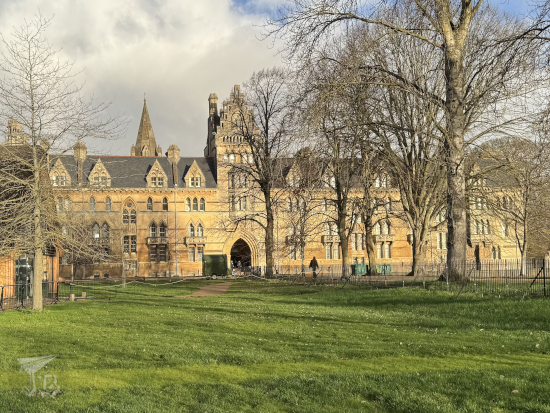
I then headed back to Christ Church College. As it is the largest and most important structure – and also the one that holds the cathedral – it was the college I thought I needed to visit. The visitors’ centre is located in Christ Church Meadow, a floodable grassland open to the public during the day.
I purchased a self-guided visit ticket and went on to explore. Christ Church College (officially The Dean and Chapter of the Cathedral Church of Christ in Oxford of the Foundation of King Henry the Eighth) was founded in 1531 by King Henry VIII, as expected by the name. It was later refounded in 1532, and again in 1546. The second refoundation had a lot to do with the reorganisation of the Church of England, and since then it has been the home of Oxford’s cathedral. Christ Church is a huge complex, mostly in a stunning Gothic and Neo Gothic styles (with some Baroque and Neoclassical add-ons), and the audio guide kept insisting that one should not peer through the windows. Though I think it would have been doable to take the tour the previous day, the cathedral had been closed, and I wanted to see that.
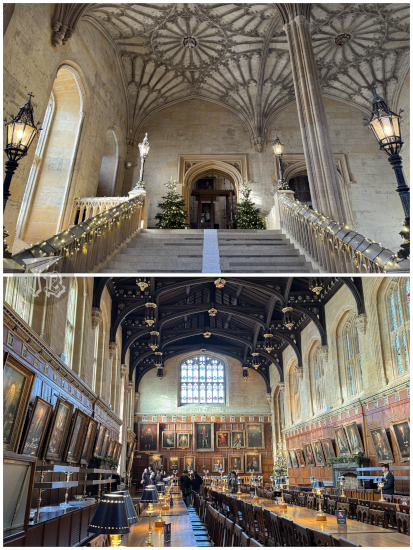
I don’t really think I was ready for how grandiose – I can’t find any other word for it – the whole compound was. The Great Hall caught me by absolute surprise. The staircase which accesses it is magnificent, and the hall is just fascinating. There are fireplaces, pictures of Deans and Professors, long wooden tables and lead windows with different motifs, the most important one being the Alice in Wonderland Window.
The visit begins at Meadow Quad, a 19th-century Gothic Revival building, designed by TN Deane. The particular style is known as Venetian Gothic. During the Victorian period there were several efforts to redefine the significance of Classical ruins and medieval structures, along with a scorn of Baroque. In a typical with-me-or-against-me fashion, two thought currents emerged. On the one hand, Frenchman Eugène Viollet-Le-Duc, who wanted to be more Gothic than the Medievals themselves. His idea was to perfect Gothic buildings using more modern materials and techniques, often making up structures and even whole buildings. Amongst his notable efforts are the restoration of Notre Dame in Paris and the city of Carcassonne (and by his followers, the Olite castle).
On the other hand, Englishman John Ruskin claimed that construction had a life cycle and should be born (be built), then live (be used) and die (collapse). Being a Romantic in the artistic sense of the word, he also idealised Gothic, and his theories inspired more than one Gothic Revival attempt, but he considered them plagiarism and “faux”. Ruskin studied in Oxford, and some of the Neo Gothic buildings there tried to recreate his idealised visions of Gothic – Meadow Quad is one of them (the museum of natural history is another). While Ruskin originally (and vehemently) opposed restoration, to the point that at some point he wrote that it “shattered his soul”, by the end of his life he acknowledged that maybe it was not such a bad idea. Though this is of course a very summarised version of both theories, if I have to take a stand, I’m on Viollet-Le-Duc’s side.
The first visit inside the college is Bodley Tower, which features a the monumental Hall Staircase, with an incredibly vaulted ceiling of Medieval design but carved in 17th century. It leads to the Great Hall, the Renaissance mesh room where students and teachers share their meals on long wooden tables (I’ve also learnt that during summer holidays Christ Church turns the students’ rooms into a B&B and you can have breakfast there. Yes, I’m having thoughts). Features of the room include the two chimneys, painted portraits, and stained glass windows.
There is a particularly famous window, called Alice’s window, which honours a former student of the college, one Charles Dodgson, who is more famous than you think. Dodgson’s pen name was Lewis Carroll, and Alice is the one who went to Wonderland and Through the Looking Glass. Carrol was born in 1832, and throughout his life he became a writer, photographer and mathematician. He was tall but scrawny, deaf in one ear, had weak lungs and suffered from a stammer. In 1851, he enrolled to study in Oxford’s Christ Church, where he would go on to work for the rest of his life. It is said, especially in this college, that the main character from Alice’s Adventures in Wonderland (1865) and its sequel Through the Looking-Glass (1871) was based on the Dean’s daughter, Alice Liddell. Another apocryphal story is that the Dodo that appears in the fist book is based on himself – apparently his stammer made it difficult for him to pronounce his own surname, Dodgson, so he referred to himself as a Dodo. It’s difficult to know if this was true…
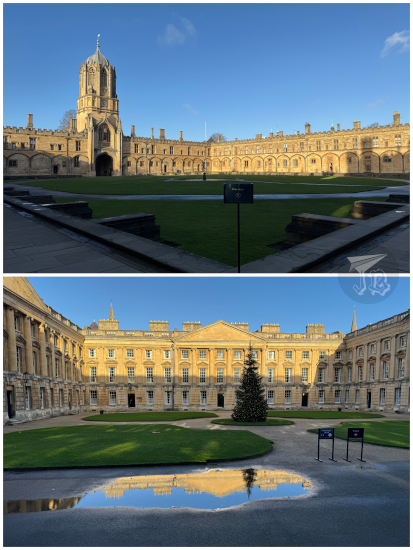
Leaving behind the tower, I ventured onto the main yard of the college, Tom Quad (officially the Great Quadrangle), home of the resident pet ducks Tom and Peck. It was originally designed to be a cloister, but the arcade was never finished. In the middle of the quad stood a firefighting water reservoir, now substituted by a decorative fountain with a flying Mercury in bronze. The street and the college are connected by a gate on top of which stands the bell tower known as Tom Tower, whose bell is known as Great Tom. Tom Tower was designed by Christopher Wren around 1680, and Great Tom rang for the first time in 1684. Today, it rings 101 times at 21:00 Oxford time, which is 21:05 GMT, signalling the original curfew time.
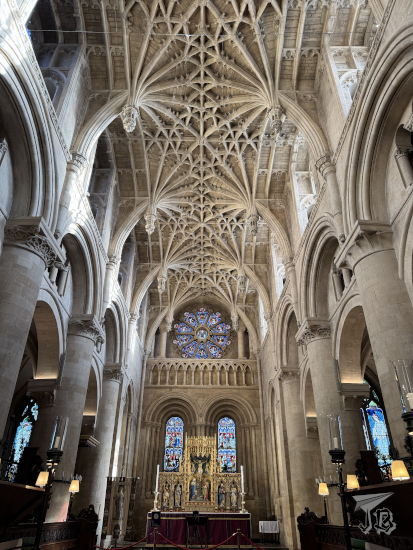
The other two quadrants open to visitors are Peck Quad and Canterbury Quad. The former is overlooked by the New Library built in the 18th century in the Renaissance style. The latter gives way to the Picture Gallery. Possibly though, the most impressive element in the complex is Christ Church Cathedral or Cathedral Church of Christ. The building was erected towards the end of the 12th century, but the interior was redesigned, in the Neo Gothic style by Sir George Gilbert Scott.
The cathedral was re-signified within the context of Henry VIII’s Reformation, which was sparked when the king wanted to have his first (out of six of them) marriage annulled. The original wife, Catherine of Aragon (Catalina de Aragón, daughter of Spain’s Catholic Monarchs) had already married Henry’s older brother, Arthur, who died soon after. Seven years later, she was wedded to Henry VIII, soon after his ascent to the throne, and although she become pregnant six times, only one child, future Queen Mary I, survived past infancy. In order to marry his brother’s widow, Henry needed a special dispensation from the Pope.
However, he was unhappy that Catherine had only reared one daughter, so by the time she was too old to have more children, he sought a personal favour from the Pope – the annulment of the marriage. He claimed to have realised that according to the Bible, said marriage was wrong and the lack of sons was a divine sign. It did not help that by this time, he had fallen in love (or in lust) with Anne Boleyn. The Pope rejected the request, which eventually yielded to Henry VIII’s breaking out with the Catholic Church and creating the Church of England. Henry banished Catherine, and married Anne Boleyn, who later ended up beheaded, accused of “treason” (read: infidelity), while Henry married again – four times.
Christ Church Cathedral was originally Catholic, built in the Norman (Romanesque) style during the 11th and 12th centuries. After its conversion to the Anglican rite, the interior of the church was redesigned. It has large stained glass windows and an amazing Neo Gothic ceiling. During the audio guide explanation there was a salute from the Dean, Sarah Foot, welcomed visitors “of any faith, or none” into the cathedral. As the building had originally been designed as an Augustinian monastery during the Catholic period, it features a cloister and a chapter house, the last visitable elements in Christ Church. I turned back in the multimedia guide, bought a trinket at the gift shop, and left the premises.
Afterwards, I returned to the hotel to pick up my luggage and head to the station taking a small detour to see the outside of Oxford Castle and Prison and the Castle Mound. There’s no free exploring the castle, you must book a guided tour, so I had decided against it, heading back towards London instead. I wanted to leave on the 12:34 train, which gave me enough time to drop the luggage in my London room, and head out again. Unfortunately, the train was delayed by a “disruptive passenger” and reached Oxford 20 minutes late. I had a booking for the London Museum of Natural History, but I could get another one to guarantee entry if there was a queue, half an hour after the original.
I did not see everything that you can see in Oxford. However, I’ve learnt that day trips are cheaper, because a single and a return ticket have the same price. I did not get to see anything related to JRR Tolkien, nor the Headington Shark, so I might have to eventually come back. I do not regret my planning though, because I had priorities. Off to London I rode, munching on salt-and-vinegar crisps.
I reached Paddington, then changed to the underground to reach Victoria Station. I hate Victoria. I hate it almost as much as I hate Shinjuku Station. It’s bustling and chaotic and I never get my exit right. It was particularly crowded as they had a Christmas installation – a huge plastic “Christmas bauble” which people could enter to have their picture taken. I finally got my bearings and reached the hotel, a few minutes away. Though it was called the Grapevine Hotel, check-in was next door, in the Sheriff Hotel. I had booked a single en-suite with private toilet, and when I got to my second-floor room I found the faucet, the shower, the bed, and a note reading “the toilet is on the first floor”. As in… a whole floor down there was a toilet with a sign reading “Room 15 toilet”. It was incredible surreal, and I had a good laugh about it!
I headed back to Victoria Station (have I mentioned I really hate Victoria?), hopped onto the Tube, and reached South Kensington. It was not too crowded and I could take the tunnel towards London’s Natural History Museum. They have recently reopened their garden, after revamping the area and adding a bunch of details and attractions. Renamed Evolution Garden, its main feature – due to sheer size alone – is Fern the Diplodocus (Diplodocus carnegii). The life-sized specimen is made in bronze and based on Dippy, the Carnegy cast. Before Dippy went on tour in 2021 (again), each bone was scanned so further copies could be made. The museum wanted a new specimen in a lifelike pose and no external support, that would be placed outside, no less. That was why it was decided to build the new display in bronze. However, the resulting skeleton would be too heavy, so they needed to hollow the bones out and keep the skeleton up using internal wiring. The result is a 25-metre long, self-supporting giant that gently sways with wind and withstands both heat and rain.
It almost dwarfs the smaller Hypsilophodon, first discovered in the Isle of Wight – a typical “English dinosaur”. The species lived in the Early Cretaceous, and it was first discovered in 1849, and for a couple of decades it was thought to be a young Iguanodon, until Thomas Henry Huxely proved otherwise. The new species was officially named Hypsilophodon foxii in 1869. It was bipedal, had a beak and teeth, and it is thought to have been a natural runner. It measured up to 2 metres in length, weighed around 20 kilograms.
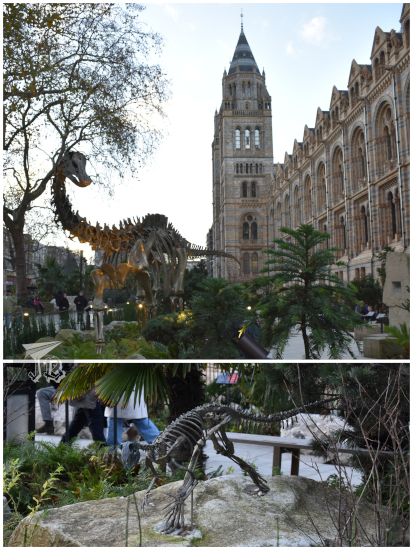
The Garden of Evolution has vegetation in order of appearance – from ferns to other early plants to flowering plants and grasses as one walks through the garden and “advances” in time. There are more small sculptures and art pieces, rocks and ponds, all of them dedicated to recreate evolution and at the same time provide a little nature to the heart of London.
I walked into the building, and my bag was flagged for inspection… ish. It’s just big enough to hold my camera and my wallet, and when the security guard saw that it flopped – the camera was already around my neck – he waved me through. My first stop was the gift shop – there were two things I wanted so I got that out of the way. I was aiming for two Christmas ornaments, but I got a Fern commemorative coin too.
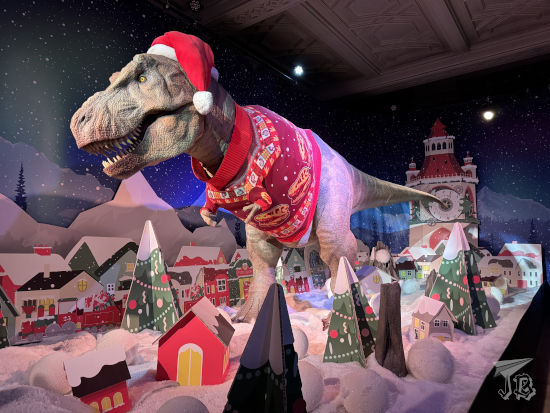
I headed to the dinosaur area. One museum’s traditions is dressing their T. Rex animatronic in a humongous Christmas jumper every year – this year it featured ammonite, theropod prints, stars and a T. Rex skull. It was hilarious. I almost bought myself the human-design version after seeing it.
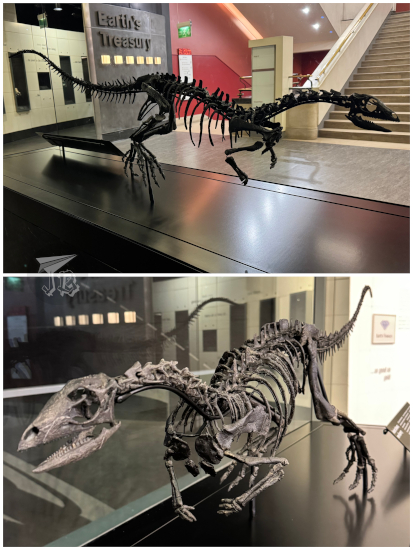
I then went to the birds area to find the museum’s dodo, because after Oxford, everything dodo had to be checked out, of course. Later, I found my way to Sophie, the most complete stegosaurus skeleton. Afterwards, I made my way up because in June, the Museum unveiled a new species, a small herbivore named Enigmacursor mollyborthwickae from the Morrison Formation in the US. It is considered the holotype for the species (the only specimen known, even). Enigmacursor means “mysterious runner” and mollyborthwickae references Molly Lowell Borthwick – she and her husband donated a small fortune so the museum could acquire the unique skeleton, filed NHMUK PV R 39000. It was named in 2025 by Professors Susannah Maidment and Paul Barrett, and put on display. I was very excited to see it for the first time.
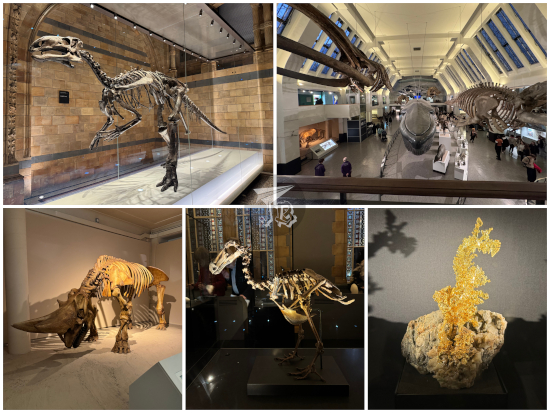
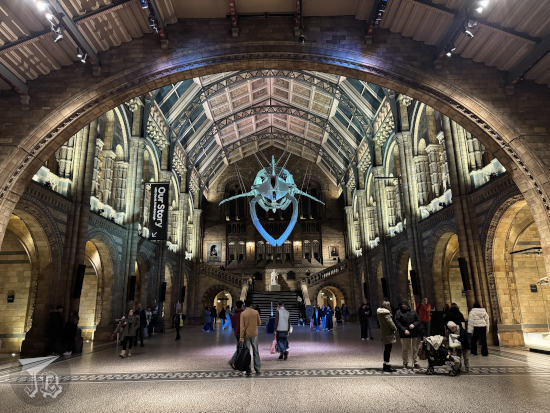
I wandered through other spaces of the museum, including seeing the Treasures in the Cadogan gallery, where the Archaeopteryx is kept, the mineral gallery and The Vault, with all the gems and precious minerals. I also popped into the newly-renovated Hall of Mammals. I left the museum a bit before closing and was a tad disappointed that I could not cross the gardens, as they had closed an hour before the museum itself. I had a couple of hours before the musical, which did not feel like much to go to the centre and snoop around something “Christmassy”. So I headed back towards Victoria, and stayed a little at the bauble decoration, which now had a few ballet dancers inside – characterised as the Nutcracker, but to the music of Swan Lake.
At 18:30 I strolled to Apollo Victoria Theatre. After watching the Spanish version and the first film, it felt right to go back to watch the original Wicked musical once more.
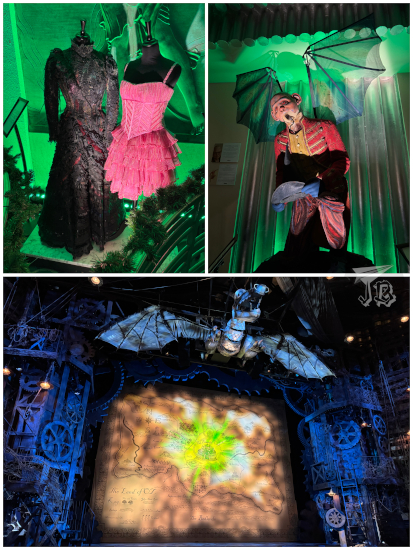
The theatre was displaying a couple of dresses and a sculpture of Chistery the flying monkey. I checked out the upper bar for a change, but everything was packed, so as soon as the sitting area opened, I went to find my seat. Since I was amongst the first people inside, I could take a few decent pictures of the stage. The theatre was rather empty in comparison to what I was expecting, but then I realised that it was the middle of the week, and I had only been to the Apollo Victoria at weekends before. I had booked a seat next to the aisle on row S, and honestly it was a perfect view – the person in front of me was also short, which was fantastic.
The three main characters were played by Emma Kingston as Elphaba, Zizi Strallen as Glinda and Carl Man as Fiyero. I think Kingston has become my favourite Elphaba to date. Points to Man for keeping the British Ts during his solos, too. However, he did not feel as powerful a character as 2022’s Ryan Reid. I saw a few of Jeff Goldblum’s mannerism on the Wizard (Michael Matus), which… honestly do not work if you’re not Goldblum. Though the cast claims that they have not been influenced by the film, there are times that it just… slips in. Not in a bad way, but… it’s there. I really enjoyed it though, much more than any of the other versions. It feels natural – and not as long as the film(s).
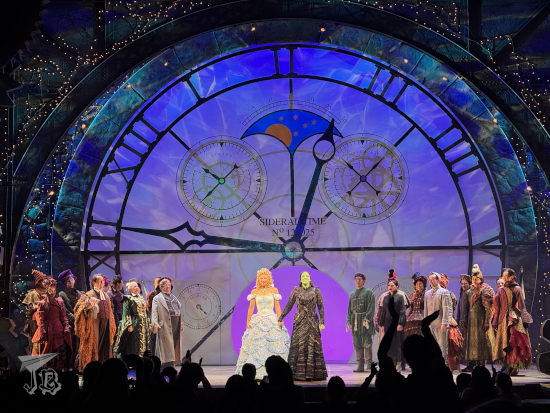
After the play was over, I stopped by the station so I could buy some dinner (and cut some walking in the cold), and I guess I was hungry because I had all but skipped lunch. Once back at the hotel, I checked in for my flight, and also received an email stating that there was a bit of a chaos at London Stansted airport due to operational issues. That made me decide to head to the airport a couple of hours before I would usually do the following afternoon. It meant sacrificing one of the stops, but it would have sucked to get stuck there due to a long security line. And it’s London. It’s not like I’m not planning to go back already.
The truth is that the hotel had been cheap, and it ended up being quite uncomfortable. On top of the toilet issue, there were no blinds on the window, and it was humid. At least, heating worked, I guess. I did not sleep much, but that gave me time to try and plan my following morning.