10th December 2025: Oxford, trains and back to London {United Kingdom, December 2025}

I got up, used the kettle in the room to prepare a quick coffee… and one look at the radiator told me how it worked. I must have been much more tired than I realised the night before… I left my luggage at reception and went back to the streets of Oxford. I basically retraced my route from the previous evening in daylight.

I started off at the Claredon Building, the Bodleian Library and the Bridge of Sighs. Beyond that, I got back to the Radcliffe Camera, University Church of St Mary the Virgin, and the Old Bank Hotel. Down High Street, I walked by All Souls College, the Examination Schools, the Queen’s College, all the way down to Magdalen College.

Up the street again, I reached the Covered Market and turned at Carfax Tower, to St Aldates Church and Christ Church College. Though visiting it was my goal for the morning, I still had some time before the College opened. Thus, I decided to go to Costa Coffee for a proper breakfast, where I had a vanilla latte and a blueberry muffin.

I then headed back to Christ Church College. As it is the largest and most important structure – and also the one that holds the cathedral – it was the college I thought I needed to visit. The visitors’ centre is located in Christ Church Meadow, a floodable grassland open to the public during the day.

I purchased a self-guided visit ticket and went on to explore. Christ Church College (officially The Dean and Chapter of the Cathedral Church of Christ in Oxford of the Foundation of King Henry the Eighth) was founded in 1531 by King Henry VIII, as expected by the name. It was later refounded in 1532, and again in 1546. The second refoundation had a lot to do with the reorganisation of the Church of England, and since then it has been the home of Oxford’s cathedral. Christ Church is a huge complex, mostly in a stunning Gothic and Neo Gothic styles (with some Baroque and Neoclassical add-ons), and the audio guide kept insisting that one should not peer through the windows. Though I think it would have been doable to take the tour the previous day, the cathedral had been closed, and I wanted to see that.

I don’t really think I was ready for how grandiose – I can’t find any other word for it – the whole compound was. The Great Hall caught me by absolute surprise. The staircase which accesses it is magnificent, and the hall is just fascinating. There are fireplaces, pictures of Deans and Professors, long wooden tables and lead windows with different motifs, the most important one being the Alice in Wonderland Window.

The visit begins at Meadow Quad, a 19th-century Gothic Revival building, designed by TN Deane. The particular style is known as Venetian Gothic. During the Victorian period there were several efforts to redefine the significance of Classical ruins and medieval structures, along with a scorn of Baroque. In a typical with-me-or-against-me fashion, two thought currents emerged. On the one hand, Frenchman Eugène Viollet-Le-Duc, who wanted to be more Gothic than the Medievals themselves. His idea was to perfect Gothic buildings using more modern materials and techniques, often making up structures and even whole buildings. Amongst his notable efforts are the restoration of Notre Dame in Paris and the city of Carcassonne (and by his followers, the Olite castle).

On the other hand, Englishman John Ruskin claimed that construction had a life cycle and should be born (be built), then live (be used) and die (collapse). Being a Romantic in the artistic sense of the word, he also idealised Gothic, and his theories inspired more than one Gothic Revival attempt, but he considered them plagiarism and “faux”. Ruskin studied in Oxford, and some of the Neo Gothic buildings there tried to recreate his idealised visions of Gothic – Meadow Quad is one of them (the museum of natural history is another). While Ruskin originally (and vehemently) opposed restoration, to the point that at some point he wrote that it “shattered his soul”, by the end of his life he acknowledged that maybe it was not such a bad idea. Though this is of course a very summarised version of both theories, if I have to take a stand, I’m on Viollet-Le-Duc’s side.
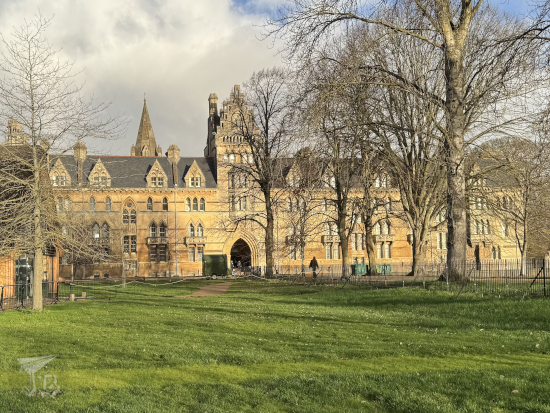
Outer façade of Christ Church College, Oxford, towards the end of the meadow.

The first visit inside the college is Bodley Tower, which features a the monumental Hall Staircase, with an incredibly vaulted ceiling of Medieval design but carved in 17th century. It leads to the Great Hall, the Renaissance mesh room where students and teachers share their meals on long wooden tables (I’ve also learnt that during summer holidays Christ Church turns the students’ rooms into a B&B and you can have breakfast there. Yes, I’m having thoughts). Features of the room include the two chimneys, painted portraits, and stained glass windows.

There is a particularly famous window, called Alice’s window, which honours a former student of the college, one Charles Dodgson, who is more famous than you think. Dodgson’s pen name was Lewis Carroll, and Alice is the one who went to Wonderland and Through the Looking Glass. Carrol was born in 1832, and throughout his life he became a writer, photographer and mathematician. He was tall but scrawny, deaf in one ear, had weak lungs and suffered from a stammer. In 1851, he enrolled to study in Oxford’s Christ Church, where he would go on to work for the rest of his life. It is said, especially in this college, that the main character from Alice’s Adventures in Wonderland (1865) and its sequel Through the Looking-Glass (1871) was based on the Dean’s daughter, Alice Liddell. Another apocryphal story is that the Dodo that appears in the fist book is based on himself – apparently his stammer made it difficult for him to pronounce his own surname, Dodgson, so he referred to himself as a Dodo. It’s difficult to know if this was true…
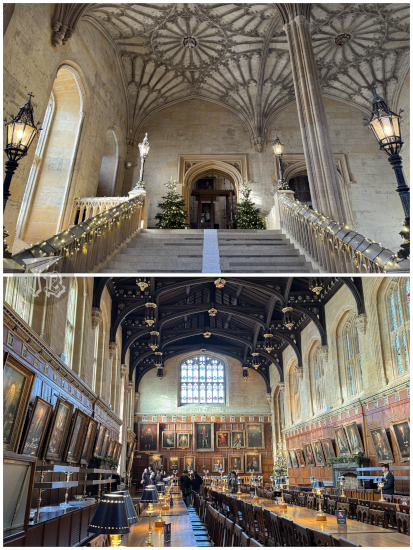
Main Staircase and Main Hall, where food is served.

Leaving behind the tower, I ventured onto the main yard of the college, Tom Quad (officially the Great Quadrangle), home of the resident pet ducks Tom and Peck. It was originally designed to be a cloister, but the arcade was never finished. In the middle of the quad stood a firefighting water reservoir, now substituted by a decorative fountain with a flying Mercury in bronze. The street and the college are connected by a gate on top of which stands the bell tower known as Tom Tower, whose bell is known as Great Tom. Tom Tower was designed by Christopher Wren around 1680, and Great Tom rang for the first time in 1684. Today, it rings 101 times at 21:00 Oxford time, which is 21:05 GMT, signalling the original curfew time.

The other two quadrants open to visitors are Peck Quad and Canterbury Quad. The former is overlooked by the New Library built in the 18th century in the Renaissance style. The latter gives way to the Picture Gallery. Possibly though, the most impressive element in the complex is Christ Church Cathedral or Cathedral Church of Christ. The building was erected towards the end of the 12th century, but the interior was redesigned, in the Neo Gothic style by Sir George Gilbert Scott.
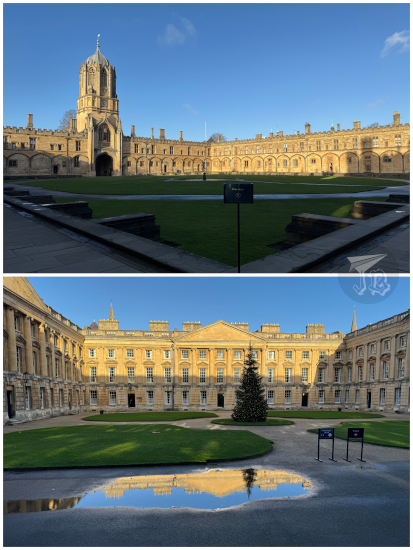
Quadrants at Christ Church College, Oxford. One is Gothic, the other is Baroque.

The cathedral was re-signified within the context of Henry VIII’s Reformation, which was sparked when the king wanted to have his first (out of six of them) marriage annulled. The original wife, Catherine of Aragon (Catalina de Aragón, daughter of Spain’s Catholic Monarchs) had already married Henry’s older brother, Arthur, who died soon after. Seven years later, she was wedded to Henry VIII, soon after his ascent to the throne, and although she become pregnant six times, only one child, future Queen Mary I, survived past infancy. In order to marry his brother’s widow, Henry needed a special dispensation from the Pope.

However, he was unhappy that Catherine had only reared one daughter, so by the time she was too old to have more children, he sought a personal favour from the Pope – the annulment of the marriage. He claimed to have realised that according to the Bible, said marriage was wrong and the lack of sons was a divine sign. It did not help that by this time, he had fallen in love (or in lust) with Anne Boleyn. The Pope rejected the request, which eventually yielded to Henry VIII’s breaking out with the Catholic Church and creating the Church of England. Henry banished Catherine, and married Anne Boleyn, who later ended up beheaded, accused of “treason” (read: infidelity), while Henry married again – four times.

Christ Church Cathedral was originally Catholic, built in the Norman (Romanesque) style during the 11th and 12th centuries. After its conversion to the Anglican rite, the interior of the church was redesigned. It has large stained glass windows and an amazing Neo Gothic ceiling. During the audio guide explanation there was a salute from the Dean, Sarah Foot, welcomed visitors “of any faith, or none” into the cathedral. As the building had originally been designed as an Augustinian monastery during the Catholic period, it features a cloister and a chapter house, the last visitable elements in Christ Church. I turned back in the multimedia guide, bought a trinket at the gift shop, and left the premises.
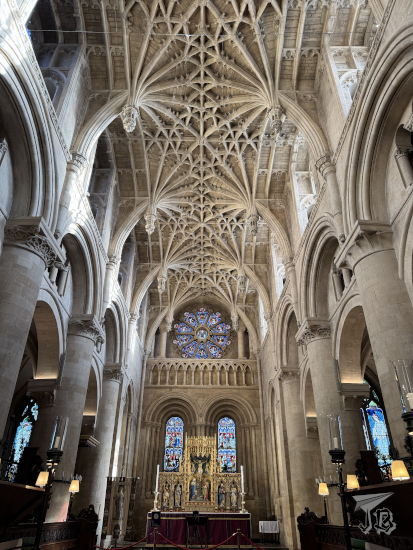
Interior of the very gothic Christ Church cathedral.

Afterwards, I returned to the hotel to pick up my luggage and head to the station taking a small detour to see the outside of Oxford Castle and Prison and the Castle Mound. There’s no free exploring the castle, you must book a guided tour, so I had decided against it, heading back towards London instead. I wanted to leave on the 12:34 train, which gave me enough time to drop the luggage in my London room, and head out again. Unfortunately, the train was delayed by a “disruptive passenger” and reached Oxford 20 minutes late. I had a booking for the London Museum of Natural History, but I could get another one to guarantee entry if there was a queue, half an hour after the original.

I did not see everything that you can see in Oxford. However, I’ve learnt that day trips are cheaper, because a single and a return ticket have the same price. I did not get to see anything related to JRR Tolkien, nor the Headington Shark, so I might have to eventually come back. I do not regret my planning though, because I had priorities. Off to London I rode, munching on salt-and-vinegar crisps.

I reached Paddington, then changed to the underground to reach Victoria Station. I hate Victoria. I hate it almost as much as I hate Shinjuku Station. It’s bustling and chaotic and I never get my exit right. It was particularly crowded as they had a Christmas installation – a huge plastic “Christmas bauble” which people could enter to have their picture taken. I finally got my bearings and reached the hotel, a few minutes away. Though it was called the Grapevine Hotel, check-in was next door, in the Sheriff Hotel. I had booked a single en-suite with private toilet, and when I got to my second-floor room I found the faucet, the shower, the bed, and a note reading “the toilet is on the first floor”. As in… a whole floor down there was a toilet with a sign reading “Room 15 toilet”. It was incredible surreal, and I had a good laugh about it!

I headed back to Victoria Station (have I mentioned I really hate Victoria?), hopped onto the Tube, and reached South Kensington. It was not too crowded and I could take the tunnel towards London’s Natural History Museum. They have recently reopened their garden, after revamping the area and adding a bunch of details and attractions. Renamed Evolution Garden, its main feature – due to sheer size alone – is Fern the Diplodocus (Diplodocus carnegii). The life-sized specimen is made in bronze and based on Dippy, the Carnegy cast. Before Dippy went on tour in 2021 (again), each bone was scanned so further copies could be made. The museum wanted a new specimen in a lifelike pose and no external support, that would be placed outside, no less. That was why it was decided to build the new display in bronze. However, the resulting skeleton would be too heavy, so they needed to hollow the bones out and keep the skeleton up using internal wiring. The result is a 25-metre long, self-supporting giant that gently sways with wind and withstands both heat and rain.

It almost dwarfs the smaller Hypsilophodon, first discovered in the Isle of Wight – a typical “English dinosaur”. The species lived in the Early Cretaceous, and it was first discovered in 1849, and for a couple of decades it was thought to be a young Iguanodon, until Thomas Henry Huxely proved otherwise. The new species was officially named Hypsilophodon foxii in 1869. It was bipedal, had a beak and teeth, and it is thought to have been a natural runner. It measured up to 2 metres in length, weighed around 20 kilograms.
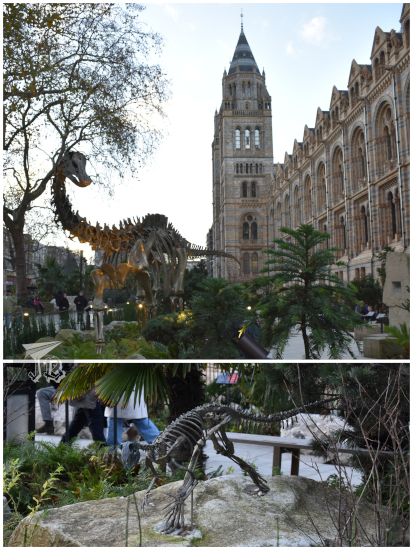
Outside garden if the Natural Science Museum London showing the diplodocus and Hypsilophodon fossil replicas.

The Garden of Evolution has vegetation in order of appearance – from ferns to other early plants to flowering plants and grasses as one walks through the garden and “advances” in time. There are more small sculptures and art pieces, rocks and ponds, all of them dedicated to recreate evolution and at the same time provide a little nature to the heart of London.

I walked into the building, and my bag was flagged for inspection… ish. It’s just big enough to hold my camera and my wallet, and when the security guard saw that it flopped – the camera was already around my neck – he waved me through. My first stop was the gift shop – there were two things I wanted so I got that out of the way. I was aiming for two Christmas ornaments, but I got a Fern commemorative coin too.

I headed to the dinosaur area. One museum’s traditions is dressing their T. Rex animatronic in a humongous Christmas jumper every year – this year it featured ammonite, theropod prints, stars and a T. Rex skull. It was hilarious. I almost bought myself the human-design version after seeing it.

T Rex animatronic dressed in an ugly Christmas sweater with T Rex skulls.

I then went to the birds area to find the museum’s dodo, because after Oxford, everything dodo had to be checked out, of course. Later, I found my way to Sophie, the most complete stegosaurus skeleton. Afterwards, I made my way up because in June, the Museum unveiled a new species, a small herbivore named Enigmacursor mollyborthwickae from the Morrison Formation in the US. It is considered the holotype for the species (the only specimen known, even). Enigmacursor means “mysterious runner” and mollyborthwickae references Molly Lowell Borthwick – she and her husband donated a small fortune so the museum could acquire the unique skeleton, filed NHMUK PV R 39000. It was named in 2025 by Professors Susannah Maidment and Paul Barrett, and put on display. I was very excited to see it for the first time.
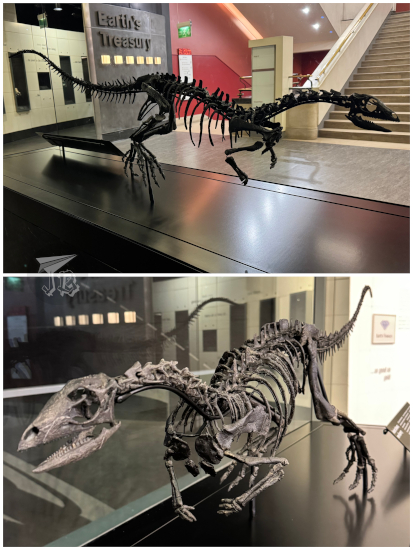
Enigmacursor mollyborthwickae, the one and only skeleton of this small theropod dinosaur.

I wandered through other spaces of the museum, including seeing the Treasures in the Cadogan gallery, where the Archaeopteryx is kept, the mineral gallery and The Vault, with all the gems and precious minerals. I also popped into the newly-renovated Hall of Mammals. I left the museum a bit before closing and was a tad disappointed that I could not cross the gardens, as they had closed an hour before the museum itself. I had a couple of hours before the musical, which did not feel like much to go to the centre and snoop around something “Christmassy”. So I headed back towards Victoria, and stayed a little at the bauble decoration, which now had a few ballet dancers inside – characterised as the Nutcracker, but to the music of Swan Lake.
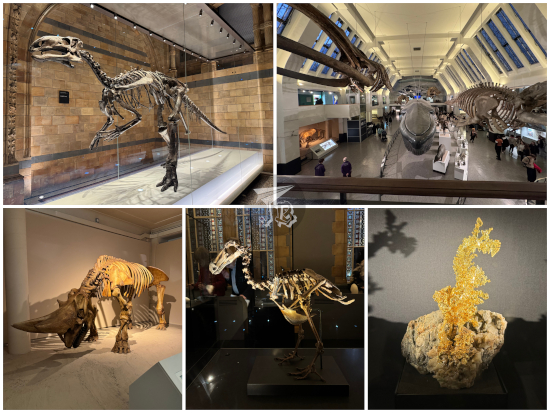
Natural History Museum London exhibits: Maiasaurus skeleton, mammal hall, rhino skeleton, dodo skeleton, gold ore in the shape of a dragon.

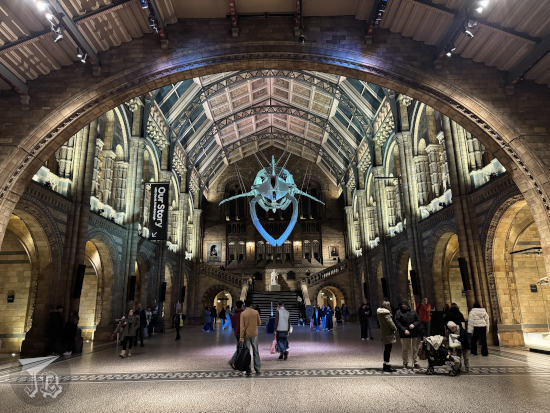
Hintze Hall and Hope the blue whale of the Natural History Museum London from the entrance.

At 18:30 I strolled to Apollo Victoria Theatre. After watching the Spanish version and the first film, it felt right to go back to watch the original Wicked musical once more.

The theatre was displaying a couple of dresses and a sculpture of Chistery the flying monkey. I checked out the upper bar for a change, but everything was packed, so as soon as the sitting area opened, I went to find my seat. Since I was amongst the first people inside, I could take a few decent pictures of the stage. The theatre was rather empty in comparison to what I was expecting, but then I realised that it was the middle of the week, and I had only been to the Apollo Victoria at weekends before. I had booked a seat next to the aisle on row S, and honestly it was a perfect view – the person in front of me was also short, which was fantastic.
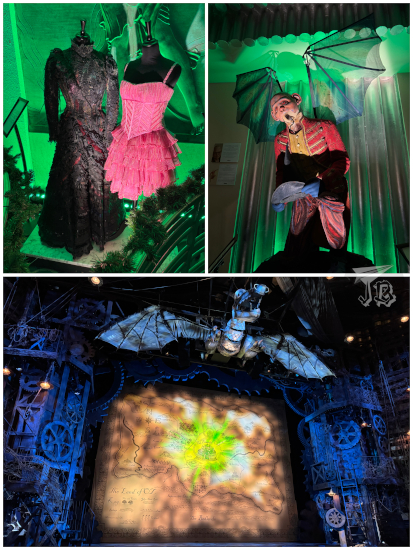
Dresses, figures and stage from Wicked in London.

The three main characters were played by Emma Kingston as Elphaba, Zizi Strallen as Glinda and Carl Man as Fiyero. I think Kingston has become my favourite Elphaba to date. Points to Man for keeping the British Ts during his solos, too. However, he did not feel as powerful a character as 2022’s Ryan Reid. I saw a few of Jeff Goldblum’s mannerism on the Wizard (Michael Matus), which… honestly do not work if you’re not Goldblum. Though the cast claims that they have not been influenced by the film, there are times that it just… slips in. Not in a bad way, but… it’s there. I really enjoyed it though, much more than any of the other versions. It feels natural – and not as long as the film(s).
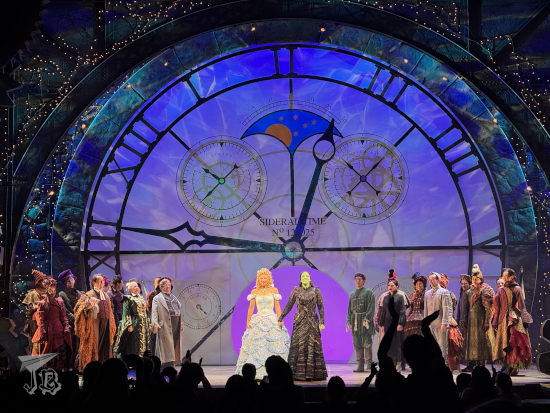
The Cast of London's Wicked after the show.

After the play was over, I stopped by the station so I could buy some dinner (and cut some walking in the cold), and I guess I was hungry because I had all but skipped lunch. Once back at the hotel, I checked in for my flight, and also received an email stating that there was a bit of a chaos at London Stansted airport due to operational issues. That made me decide to head to the airport a couple of hours before I would usually do the following afternoon. It meant sacrificing one of the stops, but it would have sucked to get stuck there due to a long security line. And it’s London. It’s not like I’m not planning to go back already.

The truth is that the hotel had been cheap, and it ended up being quite uncomfortable. On top of the toilet issue, there were no blinds on the window, and it was humid. At least, heating worked, I guess. I did not sleep much, but that gave me time to try and plan my following morning.

15th & 16th March 2025: Canterbury (England, UK) for “The Shark Is Broken”

I’ve travelled for – or with the excuse of – concerts (take your pick) and documentaries (at least thrice, even twice for the same one), but this was my first time travelling for a theatre play. Don’t get me wrong, I like theatre – I’ve even squeezed Wicked into a London trip a couple of times – but it had never been a main driving force. Until I stumbled upon the information that The Shark is Broken was heading towards the UK and Ireland. There were no shows in London, and my connection to everywhere else – including Dublin – was not good, especially due to work schedules. However, there was one date which was, if not convenient, at least doableCanterbury, in the county of Kent. Unfortunately, neither the Gods of Trains nor the Gods of Buses were as willing to smile upon me as the Gods of Air Travel.

Once I secured a ticket for the play (£55.00, dead centre of the stalls), a hotel in Canterbury, and the plane ride, I checked out what to see in town. This was back in December 2024. I also booked my parking spot at the airport, and since it was so long out, I could reserve Terminal Parking for just a couple of quids more than long-distance parking. That’s an extra 20 minute snooze! However, as I’d been hearing about train disruptions in England, I decided to wait a little before buying the Stansted-London and London-Canterbury trains. And sure enough, when a couple of weeks before the trip I went to check on the trains, the Stansted Express was indeed not running. There were ticket sales, at normal prices, but the trip would be by bus – taking as long as a bus usually takes. Thus, I decided to buy a coach trip at coach prices instead. That added a couple of hours of travel / waiting to the whole journey. Then, I went on to the South Western Rail website, which claimed that purchasing tickets would be easy. My definition of easy is… different, but, I was able to secure tickets. I was supposed to download the app to use them – but the app cannot be downloaded outside the UK. Fortunately, I was able to download a copy of the tickets from the confirmation email and use those.

When the day came, I left home a bit after 3:00 for my 5:45 flight. It was extremely cold, but at least it was not raining. I had some time at the airport before take-off, but of course everything was closed. It felt a bit weird, knowing it was the last time I could fly to the UK “for free”, considering that all countries are implementing the stupid Visa fees everywhere. We landed in London’s Stansted Airport on time, so I made it to the 08:10 coach I had booked – despite the utter chaos that Stansted coach station has become. The nice 40 minutes by train to London Liverpool turned into an over-two-hour coach obstacle course through London’s construction work.

Since I had been forced to buy a bus ticket, I got a direct one to King’s Cross – St Pancras International, where my train to Canterbury was due to depart. I had calculated for a safe train at 10:40, and I reached the stop around 10:05, which gave me enough time to find the nearest Costa Coffee before I went to Platform 13 to board my train. I chose the carriage poorly, as I ended up in the midst of a boisterous hiking group, but the trip was less than an hour, and I reached Canterbury West at 11:34. This was a bit over an hour later than what I had originally hoped for, due to the train-bus adjustment. Looking back, maybe it had not been necessary to buy that ticket in advance.

The city of Canterbury is a Unesco World Heritage Site in the county of Kent, in the south-east of England. The area has been inhabited since the Lower Palaeolithic, through the Iron Age, and Roman times on. The town saw the first Christian conversions in the British Isles, and the foundations of the cathedral were set in 596. Canterbury survived the Viking raids around the year 1000, but it fell into William the Conqueror’s hands in 1066.

In 1170, Archbishop Thomas Becket was murdered in the cathedral, an event which triggered massive pilgrimages from all the Christian countries. Between 1387 and 1400, author Geoffrey Chaucer wrote The Canterbury Tales, one of the key works in English literature, a fictional compendium of stories told by pilgrims towards the cathedral. During the early Middle Ages, Canterbury became one of the most populated towns in England, until the Black Death decimated its people. In the 16th century, there was an influx of French protestants (Huguenots) who fled mainland Europe to resettle, revitalising the economy and introducing the silk-weaving industry that flourished for over a century.

After the 17th century, things changed. Canterbury became an agricultural hub spot, so the Industrial Revolution only affected it with the construction of railways. The historical centre was damaged during WWII bombings, after which the historical area was pedestrianised and a ring road built around it. Today, Canterbury lives off tourism, retail, and higher education, with a large floating population of university students.

And it was cold that weekend. A climate topsy-turvy seemed to have exchanged the Spanish winter anticyclone and the British rains, so it was storming in Spain and crispy in Britain those days. But at least, it was not raining, which allowed for freedom and seeing a lot of things. Upon leaving the station, my first contact with Medieval Canterbury were the Westgate Towers Museum & Viewpoint, the largest Medieval gateway surviving in the UK. It was erected around 1380 to substitute the Roman ones. Even before that, there were other hits like “the oldest brewer in Britain.”

Westgate tower, former gate to the Medieval city

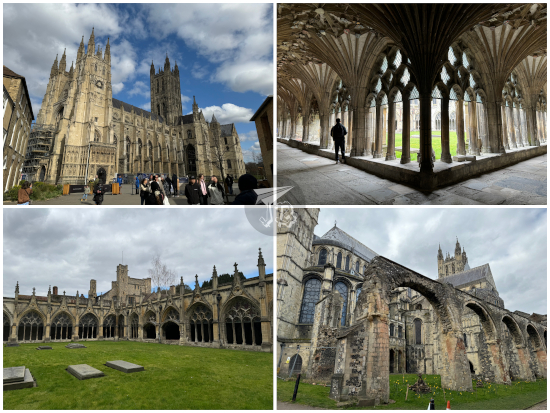
I reached the pedestrian St. Peter Street, which merges into High Street, the town’s spine. My first real stop was the Cathedral and Metropolitical Church of Christ, Canterbury (Canterbury Cathedral for short). The cathedral is the seat of the Archbishop of Canterbury, the symbolic leader of the Anglican church, and the spiritual leader of the Church of England – whose official residence is actually in London though, for some reason. I wanted to get to the cathedral first just in case it closed at any time for a service, and so I did not pay much attention to the main street for the time being.

The cathedral precinct is accessed by the Christchurch Gate, completed around 1520 in the Tudor Gothic style. It features restored colours on the decoration, restored between 2018 and 2022. In the square in front of it stands the Canterbury War Memorial, to honour the victims of WWI, which was damaged during WWII, along with most the historic area, due to bombings.

The cathedral was established in the year 597 after the arrival of St Augustine to Kent. During its first period of existence, it was a Roman Catholic place of worship. The building burnt down and was completely re-erected towards the end of the 11th century, and a lot of construction and reconstruction went on until the end of the 16th century – around the time of the English Reformation, when the Catholic monasteries were disbanded and the cathedral turned Anglican. Most of it has remained in the 12th-century Gothic style, except the crypt, which is Romanesque. The west front – under conservation work – hosts statues of people who are considered influential in the life of the cathedral and the church of England, from Augustine of Canterbury to Kings and Queens including Elisabeth II. During the Roman Catholic period there was a Benedictine Abby attached to the cathedral. Today, only the cloister and the ruins of the infirmary remain from that time.

I bought my ticket and headed to the entrance of the cathedral. There was a trail, and I decided to follow it. That led me to see the West façade, with the statue of the Saints, Kings and Queens, and then down a corridor towards the cloister, which might have been the most beautiful one I’ve ever seen, with gothic arches and family crests painted on them. After the cloister, I found the herb garden and the water tower, and I got to see the ruins of the infirmary.

I went down to the crypt, and then up to the cathedral. The building already looks big from the outside, but the inside feels huge, with columns and pointed arches soaring up to the ceiling, and paned glass windows letting the light in. I first toured the quire (choir), where the Shrine to Thomas Becket used to be. Thomas Becket (Saint Thomas of Canterbury) was King Henry II’s friend and chancellor when he was appointed Archbishop of Canterbury in 1162. He clashed with the King regarding the rights of the crown and the church, and even if the Pope tried to mediate, in the end Becket was murdered in the atrium of the cathedral in December 1170, which propelled him to martyrdom first and sainthood a couple of years later. His body was hidden for decades until he was buried in a shrine under the quire in 1220. The shrine became a pilgrimage destination in the Middle Ages known as The Pilgrims’ Way, from either Winchester or Southwark Cathedral in London. During the Reformation, in 1538, King Henry VIII ordered the destruction of the shrine and Becket’s remains. Today, there is a candle burning where that shrine stood, and the Pilgrimage is still encouraged by the cathedral.

Canterbury cathedral - exterior

Canterbury cathedral - interior

I saw the place of the murder, called the martyrdom, on the way to the main nave, where a concert was being rehearsed. It sounded beautiful, but I could not stay forever, because there were many more things to see in town. Outside the cathedral itself there is a memorial garden and the six-metre sculpture War Horse (named Joey), in honour of all the animals that have died in war.

I had to move on, as it was windy and cold out in the open, and I still had more places to visit. I went on towards the Canterbury Roman Museum. The British are always extremely proud of their Roman ruins, though sometimes these are just a few objects. This time, however, the museum lives up to its hype. Even if the artefacts are not that impressive, it hosts the only in-situ Roman pavement mosaic in the UK. Unfortunately, nobody thought about building an overpass viewing platform…

Roman mosaic on the ground

I then headed back towards the main artery of the historical area, High Street and the local museum, The Beaney House of Art & Knowledge, which also doubles as Tourist Information Centre. I broke the worker’s brain when I asked for advice considering that I’d already seen the cathedral and the Roman Museum. What I actually wanted was an estimate of how long the trail around town would take, and confirmation of opening times. I was not too successful as they gave me some schedules which were not accurate. Anyway, I snooped around the place.

The Beaney House of Art & Knowledge was designed by A.H. Campbell in 1897 in the Tudor Revival style. It is named after James George Beaney, a Canterbury-born medical doctor who left money to the city to create a cultural hub. Today, the house hosts the Tourist Information Centre, an art gallery, an auction gallery, the local library, and a museum with collections about different aspects of the town’s history, including a lot of worldwide items that seemed brought by aristocrat’s Grand Tour.

The Beaney House of Art & Knowledge

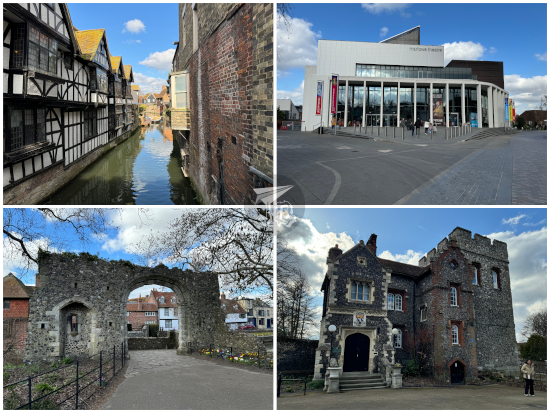
I decided to do the walking trail around the town then. Now that I was not bee-lining any more, I could take in the statues, houses and buildings in High Street. The statues include Aphra Behn and Geoffrey Chaucer. Behn was a 17th century writer, one of the first English women to earn her living from her art, and possibly even a spy in the colonies and Antwerp. Along the street, I located my hotel, the Great Stour Canal, the theatre and the restaurant where I wanted to have lunch. I exited the centre through the Westgate Towers again, and ended up in the Westgate Gardens. I had started exploring, but then I got dizzy, and my legs shook a little. I had been on the go for almost 12 hours, on four hours of sleep, so it was time for a break. Thus, I backtracked to the Old Weavers Restaurant. I have to admit that I almost got sidetracked to have an authentic afternoon tea, but I had come across this place during my planning, and I was glad I went.

It is true that British food has a horrible reputation around the world. But honestly, it is not that bad – it’s just not such an important social event as it could be for example in Italy or Greece. Furthermore, there is a theory that most “traditional” recipes diluted away with industrialisation, when people worked too much to bother with cooking – the Industrial Revolution was something so new, nobody really knew how to deal with so many changes. Then, WWII food rationing and post war pre-made foods prevented a whole generation from learning how to cook. And thus, Chicken Tika Masala became the staple of English cuisine. In reality, however, this is not accurate. The British gave us scones, bangers n’ mash, roasts and pies, all of which are delicious.

Pies were what grabbed my attention from the Old Weavers Restaurant menu. The eatery is located next to the canal, in a house which dates from the 1500s, with foundations from the 1200s, and the original interior structure. The building was originally a weaving centre in the 16th century by the Huguenot refugees, which then became a weaving school – hence the name. When the school closed, the restaurant was established. moreover, almost all the “nice” restaurants in the area were offering a 15% discount with theatre tickets too.

The place was warm and a hot meal was a nice break to have. I was seated at a small table on the ground floor and ordered a Chicken, ham & leek pie in a hot skilled with a puff pastry lid, and a side of chips. I like British pies. Conversely, the first recipe of British pie on record was also written by Chaucer in 1381.

Pie and chips

Since I was quite literally outside my hotel, I decided to check in so I could drop my backpack and relieve the weight on my shoulders. I was not carrying much at all, but the hours were getting heavier, I guess. The hotel turned out to be an old refurbished house, with narrow stairs, and my room was on the upper floor. It turned out to be tiny, and weirdly distributed – I had to open the bathroom door in order to take off my coat. But it had a working bathroom, a radiator, and it was warm, so I was all right with it. The price was cheaper than anything I would have found in London and it would save me a lot of stress when I left the theatre. While taking the train back to London was doable, it’s not like I felt like one hour on the train, and then a commute in the Tube in the middle of the night.

I left again, and tried to pick up where I had stopped before lunch – this was my mistake. I should have done my walk clockwise, but I thought I had a bit of time. I had not counted on admission ending up an hour beforehand – but it was all right, and my plan ended at a local supermarket to buy snacks, dinner, and something I wanted to bring back with me. Thus, I went to the Westgate Gardens again, and I took a bit of time with the buildings and the ruins there.

Canterbury - Marlow theatre and Medieval buildings

Canterbury is located on the River Stour, usually known as Great Stour to distinguish it from its tributaries. There are at least three main waterways through town, and even businesses that give boat rides to tourists. The Westgate Gardens are built along the Stour. They host The Guildhall (town hall) and Tower House, a narrow Victorian house built around a bastion of the city walls. I strolled along the riverside, mindful of the mallards and the seagulls who owned the place, until I crossed the Rheims Way Underpass – Canterbury really likes its underpasses, and they’re all right when you get used to them – full of graffiti and contemporary art (graffiti). I eventually veered back towards town, towards an area called Tannery Field and I came across the Canterbury Bull Sculpture, by local artist Steven Portchmouth, an artwork which honours the agricultural and industrial history of the area.

Canterbury Great Stout & Westgate park

I found St. Mildred’s church, an 11th-century stone church with a small graveyard, and totally missed Canterbury Castle for a minute there. I knew it was closed, but it turned out it was completely covered in scaffolding. The castle dates back to 1066, when Canterbury surrendered go William the Conqueror, who proceeded to commission a motte-and-bailey structure, with the motte being what remains today, though underneath the protective scaffolding.

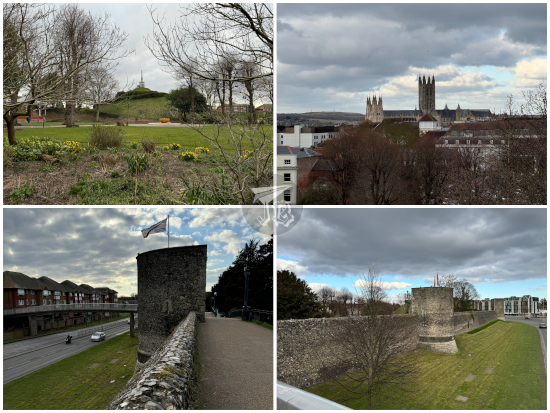
A few minutes away, I got distracted by something which had not been in my plans – Dane John Gardens. Dane John was not a person as I originally thought – the name comes from the corruption of the Norman word for “fortified mound”, donjon, and there is actually a theory that the mound that still stands in the middle of the park is a former defensive motte, though during the Roman times it might have also been a burial mound, on top of which stands the Simmons Memorial – Simmons was the local alderman who built the gardens between 1970 and 1803. The park ends at the reconstructed Roman wall, with rebuilt defensive towers, and it hosts small attractions like fountains, a giant sundial, a Band Stand…

I went along the Canterbury City Walls until I reached ground level again – and then I went underground to cross the wide roads. When I emerged, I finally made my way to St. Augustine’s Abbey. The abbey was originally dedicated to other saints, but it was repurposed after St. Augustine, who had established the cathedral, died. It was a Benedictine monastery from the year 598 on, until the English Reformation forced its dissolution in 1538. Afterwards, it became a royal residence, which was then rented out to noble families. Most of it was eventually dismantled to build new houses, until it was bought in 1844 by a religious Member of Parliament who established a missionary college. During the 20th century, the abbey ruins and the college were separated for classrooms and boarding houses. The British Government took charge of the ruins in 1940, and the abbey is part of the Unesco Heritage Site.

Dane John Gardens and Medieval walls of Canterbury

It was a little past 16:00, and I assume the ticket booth had just closed, though opening times were listed until 17:00 and there were people – a dogs – inside. I first saw the Fyndon Gate, the original gate to the abbey, built in the early 1300s, with two octagonal towers on the side, and a chamber above the entrance arch, which has an overlooking arcade. Though I could not enter the abbey, I was able see to the main ruins through a convenient lookout to the side of the locked-down area.

St Augustine Abbey Canterbury

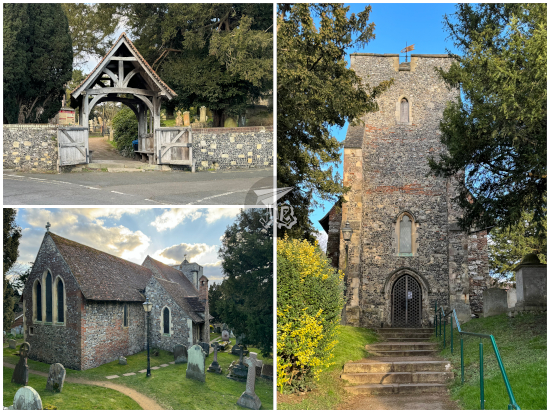
I saw a signpost regarding the pilgrims’ route that lead me to both Rome and St. Martin’s church. Rome was a little far away to be back on time for the theatre, so I decided to settle for the church, which had been the plan all along anyway, as it was the third key point in the Unesco Heritage Site. The church recognised as the “oldest parish church in use” in the English-speaking world. It was used by Queen Bertha of Kent as her private chapel even before St. Augustine arrived from Rome in 597. Though her husband, Æthelberht of Kent, was originally a Pagan, he allowed her to continue practising her Christian Faith and he himself eventually converted. The building was erected reusing a lot of Roman bricks and tiles, along later stone. It has a small graveyard where many notable families have been laid to rest. The sun was setting, and the wind had calmed down, so it was nice. I did have a moment of slight worry when I glimpsed someone and I heard a bang – I thought maybe they had closed the gate and I would have to jump over the wall. Luckily, it was not.

Canterbury St Martin chuch

I headed back towards the centre. In front of the abbey’s Fyndon Gate I found the statues of King Æthelberht and Queen Bertha of Kent. King Æthelberht was eventually considered a saint for his role spreading Christianity among Anglo-Saxons, but his main contributions were more earthly. He created the earliest written Law code in any Germanic Language, and minted the first coins which circulated in Kent.

Still heading downtown, I walked by St. Paul’s church without the Walls, which could’ve been built in Roman times as a cemetery chapel. A bit further along, there was the St. Thomas of Canterbury Roman Catholic Church, the only Catholic church in town, built in the late 1800s in the Gothic Revival Style. Adjacent to the church stands the tower Tower of St. Mary Magdalene, which belonged to Medieval parish that was demolished to build St. Thomas. There is a memorial inside the tower, protected by glass.

Back in the High Street, most shops were closed or closing down, and I did not come across any bookshops, where I would have purchased a copy of Chaucer’s The Canterbury Tales just to have a copy from the town. What I did find was a Sainsbury’s Local supermarket. There, I bought a sandwich for a late supper after the theatre, some Cadbury Eggs, and a can of Bisto Gravy granules. Cadbury Eggs are a confection made of chocolate with a yellow-and-white sugary filling. Gravy is a cooking sauce I can’t recreate to save my life so I enjoy having the ready-to-make at hand, it’s just small granules that you dissolve in boiling water to create the sauce. Neither – I reasoned – should be a problem at the airport.

I went back to the hotel to have an hour or so of rest before I headed out to the theatre. Marlowe Theatre was obviously named after one of the most famous Canterbury locals: Christopher Marlowe, the 16th century playwright, poet, translator, alleged spy and reportedly atheist, whose work is reported to have influenced Shakespeare himself. His plays were extremely successful, and they include The Tragedy of Dido, Queen of Carthage, The Tragedy of Jew of Malta, and the first dramatised version of the Faust legend, The Tragical History of the Life and Death of Doctor Faustus. The Marlowe Memorial, depicting The Muse of Poetry (either Calliope or Erato, one guesses).

There have been at least three “Marlowe Theatres” in Canterbury. The current one was rebuilt from a previous one between 2009 and 2011, as a stainless steel and aluminium building with a colonnade, and at night it glows electric blue, pink and purple. It is not a pretty building on the outside, but the inside is all right. It seats 1,200 spectators, it has a bar and a tiny merchandise stall.

Canterbury cathedral and Marlowe Theatre at night

Before I went into the theatre, where I bought the programme, I headed towards the cathedral to take a few pictures the building at night. On the way back, I must have taken a wrong turn somewhere, because I was disoriented for a minute before I found the bluish glow of the theatre. Back in December, when I booked the tickets, I also got “ticket protection” (insurance, basically), but I was ecstatic that I did not need a refund. I had managed to get there, and I could finally enter the theatre. I did not feel even a bit tired, even if I had been on the go for over 16 hours.

The Shark is Broken is a ninety-five-minute play written by Ian Shaw and Joseph Nixon, based on actor’s Robert Shaw’s diary of filming the 1975 film Jaws, directed by a young Steven Spielberg in 1975. It follows three very different men who try to hunt down (fish down?) a great white shark which has found the perfect feeding ground off Amity Island, a small beach community in Long Island. Jaws is often credited as the first summertime blockbuster, and it went on to win three Academy Awards – Best Original Score for John William’s music, Best Film Editing and Best Sound.

Canterbury Marlowe Theatre - The Shark is Broken

It is a commonplace piece of trivia that working on Jaws was a nightmare for everyone involved, as the mechanical sharks used for filming kept breaking down, which caused delays and going over budget again and again and again. Main actors Roy Scheider (Chief Brody), Robert Shaw (Quint) and Richard Dreyfuss (Hooper) were stuck on the little ship set for days on end while the film crew worked on “Bruce”, the shark. On top of authoring the script, Shaw plays his father. Dan Fredenburgh plays Roy Scheider, and Ashley Margolis plays Richard Dreyfuss. The stage play was originally directed by Guy Masterson in its Broadway run, and Martha Geelan is acting touring director.

The play is a number of connected, sequential scenes depicting different conversations over several days, showing the rising tensions amongst the actors. There are plenty of rather uncensored references to Robert Shaw’s rampant alcoholism, which his son, Ian Shaw, has not tried to hide or dilute. The set is just the ship, and only the three actors are on stage, you only ‘hear’ about the shark off-scene.

Was it a comedy? No. Was it funny at points? Extremely. Did I enjoy it? Immensely. I’ve read reviews saying that it is not worth it unless you are a huge Jaws, which I am. It includes known trivia, obscure facts and several hilarious meta references, including “It’s a thriller, do you think people will be talking about it in 50 years?”, which delivered on the 50th anniversary of the film is hilarious. Another one, referring to how Spielberg bailed on the last day of filming fearing the crowd would dunk him in revenge for all the inconveniences, and his upcoming career, is “Sharks? Aliens? What’s next, dinosaurs?” The scenes were chronological towards the end of filming, until the last one. Another known piece of trivia is that Robert Shaw was extremely drunk trying to do one of his scenes, the so-called “Indianapolis Speech” – and he screwed it up every time until he sobered up and delivered it in one go. The speech is referred to a few times throughout the play, and the very last scene is its re-enactment. It was glorious.

The Marlow Theatre was just a minute away from my hotel, and I could use the back door to get back in. I climbed up to the room and took a shower to warm up. Unfortunately, the bathroom had one of those fixed nozzles and the shower screen was… way too short for it. I might have caused a teeny-tiny flooding – good thing that I had extra towels to contain it. Afterwards, I had my sandwich, and a Cadbury Egg, even if it should have been too late for chocolate. Predator was running on TV, so I watched that while I charged the phone. Finally, I set my alarm and went to sleep, thinking that maybe being able to be on the go for twenty-something hours straight is my superpower.

My train back to London was at 7:24 – I had to miss my breakfast at the hotel, which started at 7:30, but that’s life. Fortunately, there was a kettle with some instant coffee and creamers in the room, along with biscuits. I woke up around 6:15, got ready, and hurried to Canterbury West station not because I was late, but because it was extremely cold. The train was on time and I was back in London St Pancras International just before 8:20. The train ride was uneventful, and once there I crossed over to Kings’ Cross Station to get breakfast from Costa Coffee. Since I was there, I peered over at Harry Potter’s Platform 9⅓, and I discovered that they actually take out the cart when the “attraction” is closed. I knew they charged for pictures, but I did not know that the cart was detachable. Which… I guess makes sense… considering that people would take free pictures with it if it was there. I just thought there would be a screen or something…

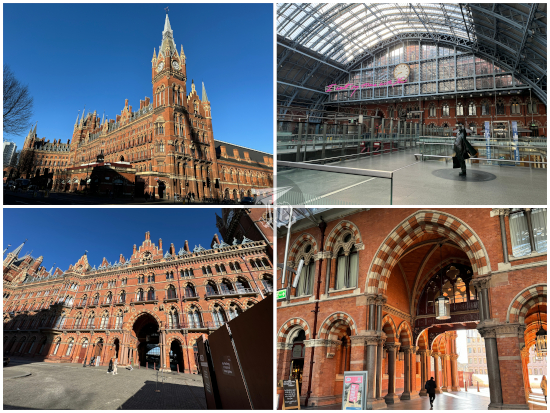
Anyway, not my thing. I headed out to explore St Pancras International Station. The original station was constructed in the Gothic Revival style (or Victorian gothic) in the 19th century, opening in 1868. The exterior was made out of dark red bricks, while the interior displays a complex roof in wrought iron and glass. The overall station layout was commissioned to engineers William Henry Barlow and Rowland Mason Ordish, and the adjacent hotel was designed by architect George Gilbert Scott. It is a magnificent building only slightly defiled by the contemporary expansion tracks. St Pancras was all but abandoned around 1960 until the 1990s, with extensive reconstruction, renovation and restoration in the 2000s. In 2007, it became the “international” station as it became terminus for the Eurostar train which covers the route between London and Paris in 2h 16 mins.

St Pancras international train station

I had to sit down for a few minutes because I made a wrong movement and my back cramped, but it passed soon. I was able to do a little bit of shopping in the station. A lifetime ago, I bought an umbrella in a franchise called Boots, and they had the same style and brand in the shop at the station. Considering that said umbrella served me well between 2012 and 2024, I had decided to buy another one if I ever saw it. I also got a book, because books in the UK are comparatively very cheap.

I found the coach stop, where I had to be at 15 minutes in advance. It was cold and windy, and it felt long. Apparently, the bus before had not come either, so there were a lot of people waiting. However, my ticket and seat were guaranteed. The only problem was, again, that the traffic was horrible due to construction. We took 43 minutes to cover something that should have been done in 10. Despite it all, the coach arrived at London Stansted Airport on time and without issues.

I went straight to security. Stansted is implementing new security protocols, which is great if you don’t get stopped. I got through two times ago, but last time my keyring created a problem – I have since changed that. This time around, the security lady was opening playing-card boxes to check for chemicals (not even kidding) and had to swipe my gravy granules for drugs, or explosives or who-knows-what. When I said “I didn’t even realise that could be a problem” her – rather sheepish – answer was “it isn’t.” Then… why did it get flagged? I’ll never understand airport security.

After 20 minutes waiting at security, I had some sushi at the airport, and bought a Playmobil Royal Guard, because they have always drawn my attention, and I thought that today was the day. Then, it was just waiting. My plane back was at 14:10, landing before 18:00, because I needed to get to a hard week of work on Monday. Part of me wishes I could have stayed until a later flight, but I needed to be reasonable. I did not get emergency exit seats either flight, so there was no issue with the cabin crew. However, when I tried to get my car out of the parking lot, the plate-recognition system would not work, so I had go down all the way back to find a person to talk to – good thing, then, that my plane had not arrived at 23:00.

The truth is, everything would have been more efficient had the Stansted Express been running, but at least I waited to book tickets so I could make the most out of the commuting issues. I did not pay train prices for coach transit, and I did not have to wait much between transportation choices. Furthermore, I could fill the time I had with things to do – and stuff to buy. And the most important thing, I saw The Shark is Broken, along with getting to know a new city.