16th November 2025: Day trip to Monaco {France & Monaco, November 2025}

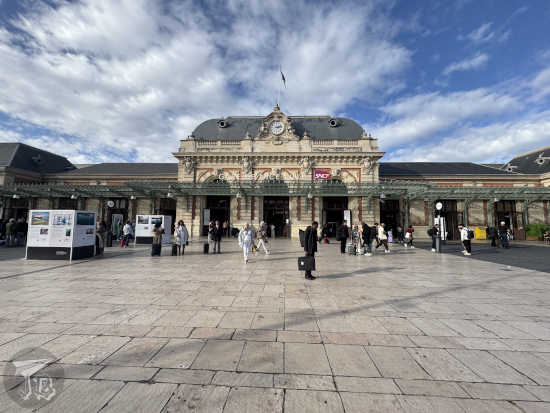
Ready to brave a 100% chance of rain, I woke up, drank my coffee, and left my hotel in Nice to head to the station. At that point, Nice was in weather alert for storms, rain, flooding, waves, winds, and landslides. However, my destination, Monaco – less than a half-hour by train – was chill. It was drizzling when I stepped onto the street, but not enough to even need an umbrella. When I reached the station, I set to fight the ticket machines, which were so confusing that I missed my train while trying to finish the transaction. Fortunately, with a frequency of 30 minutes, it was a train I could afford to miss. I spent the time taking pictures of Gare de Nice-Ville. The station is a typical example of the use of iron as building material at the end of the 19th century. It was designed by architect Louis-Jules Bouchot in the Louis XIII style, inspired by Parisian buildings. Though it originally sat outside the city, now it is right in the middle of it, and it has been in service since 1864.
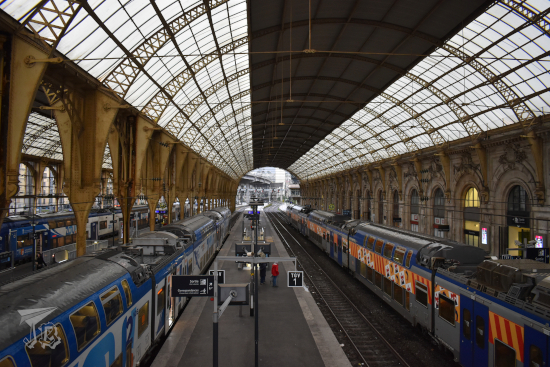
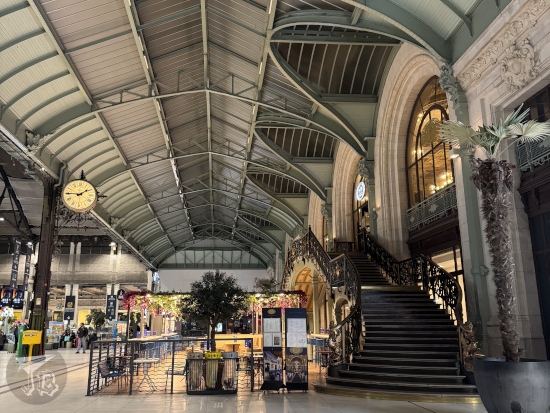
In the train shed of Gare de Nice - glass ceilings and wrought iron beams.

When my train arrived, it was only 20 minutes or so to reach the principality Principauté de Monaco, a city-state that spans little over 2 square kilometres in area – it qualifies as a microstate, and it is the second smallest state in the world, with not even 10,000 nationals. However, almost 38,500 people live there, making it very highly populated – think Malta on steroids.

Monaco has been ruled by the House of Grimaldi since around 1300, when the family conquered the territory. It was annexed by France after the French Revolution, but after the defeat of Napoleon it was given to the Kingdom of Sardinia. When Sardinia became part of Italy in the 19th century, Monaco regained its sovereignty by conceding outer territories to France, with independence being achieved by the Franco-Monégasque Treaty of 1861. At this time, it had become a tourist giant, establishing hotels and a famous casino. Nowadays, the city-state is considered one of the most expensive and wealthiest places in the world – around 30% of its residents are millionaires. It has no personal income-tax and low business taxes, which makes it a tax heaven and money-laundering hub, while still using the euro though it is not part of the European Union – hello there, unexpected Internet roaming charges!

Most of the city is in levels due to the slopes of the French Alps plummeting right into the Mediterranean Sea. Though originally there were different municipalities in the country, today Monaco is basically one big city – with a lot of parks, for sure. In 2015, it literally ran out of space for houses, so it began a project to create “land in the sea”, using concrete blocks as foundation. This is one of the nine administrative wards, the most important – or famous – of them being Monaco-Ville (the technical capital) and Monte Carlo.

Besides tourism and money-laundering, one of the most important industries in Monaco is gambling. The casino Le Grand Casino de Monte Carlo single-handedly makes so much money that it is the reason Monegasques don’t need to pay taxes besides social-insurance ones. Since 1929, the country has held the Monaco Grand Prix on an annual basis, along with other major races, on a “designated” circuit Circuit de Monaco, which is part of the actual town’s streets and roads.

I reached Monte Carlo station half an hour later than intended, but well within my self-impose timetable. I followed the signs to the casino and walked through steep streets lined with manors in the Belle Époque architecture style. After ten minutes or so, with just a few droplets of drizzle in the air, I reached the park Jardins du Casino de Monte Carlo, composed of two different gardens (Jardins des Boulingrins and Jardins de la Petite Afrique), with a beautiful classic merry-go-round within, and some ducks frolicking in puddles. The gardens lead to the Place du Casino and of course the casino itself – Le Grand Casino de Monte Carlo. I am not a gambler, but the architectural interest of the building attracted me, and cultural visits can be carried out in the morning. However, these cannot be booked online, and time was quite limited. Thus, I had chosen to make it my first visit.
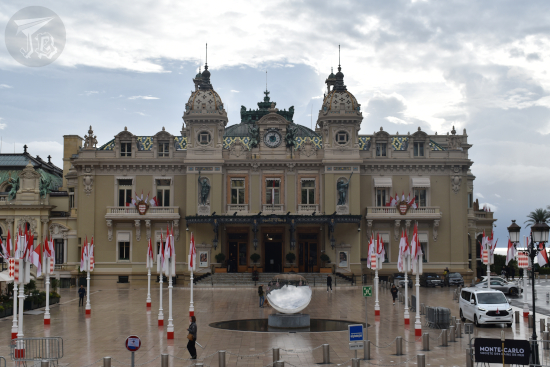
Outside the Casino de Montecarlo.

The two security guards – metal detectors in hand – smiled at me and waved me through. I must not look like a casino risk (which also made me chuckle remembering how I had been so thoroughly checked in the Paris Palaeontology Gallery, maybe they saw me as suspicious for some reason?). When buying my ticket, I understood why you could not book online. When you purchase the cultural visit, you are given the chance to “invest” that money into a voucher for playing slots once the casino opens for actual business. I declined, citing that I was not dressed for that. I later learnt that there is a gaming room for the “rabble” before getting into the actual high-class room – but the cultural visit allows you to snoop almost everywhere.

I was not interested in gambling anyway, so I went on my merry way to do the aforementioned snooping. The casino is owned by a public company controlled by the government and the Grimaldi house, and it is only open to foreigners. It was established in 1863, and the architectural style of the current building is a bit on the eclectic side. Architect Charles Garnier combined elements of Baroque, Renaissance, Belle Époque, some Art Nouveau… to create a luxury environment. Some of the classical games gambled on include poker, craps, blackjack and baccarat, along with different kinds of roulettes. However, the sheer amount of slot machines for different games threw me off. They looked completely out of place in the classical environment. The two halls with only classic games were my favourite, and I saw that some of the tables had a minimum bet in the hundreds of euros.
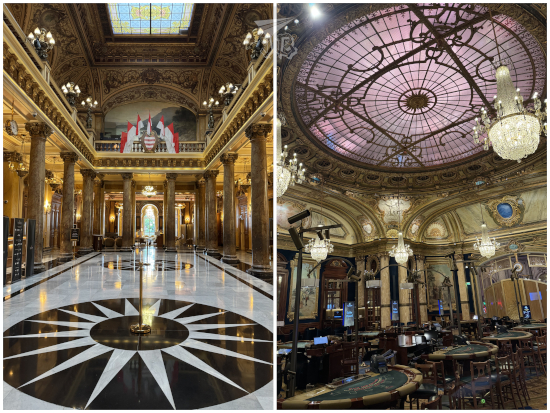
Lavish interior of the Monte Carlo casino - everything is gold and golden!

Not having run into James Bond (the casino was featured in Never Say Never Again and Golden Eye), I left the casino and headed to the real reason I had been wanting to visit Monaco since May 1992. I am not even kidding.

Probably the Universal Expo in Seville in 1992 was my first big trip. I was just a child, so my parents organised everything, but I’m told I behaved like a trooper. One of the pavilions we visited then was the Monaco one, where there was a giant aquarium with an underwater tunnel. I was immediately smitten, and promised myself that one day I would visit Monaco and the Oceanographic Museum there. Today was that day.

The Musée Océanographique de Monaco was the brainchild of Prince Albert I of Grimaldi, who ruled the principality between 1889 and 1922. While he cannot be considered the father of oceanography, one could say that he was one of its main early-adopters. He owned four research vessels, studied ocean currents, and collected biological specimens and soil samples – he did a lot of cool stuff. After his death, the most famous diver in the world, Jacques-Yves Cousteau, became director of the museum between 1957 and 1988.

However, before I entered the building, I had to get there. Adjacent to the Le Grand Casino de Monte Carlo stands the Opéra de Monte Carlo. To the other side, one of the most famous stretches of the racing circuit Circuit de Monaco, the Fairmont Hairpin Curve. I snuck into a hotel terrace for a good picture, but left before any security guard could come to kick me out.

Afterwards, I explored a park with ocean views, where there was a seagull on duty to make noises at tourists. I am glad I entered the park using the entry I did, thus I was not confused by the footprints left there. When I saw “Maradona” and “Pelé” I realised that the park was dedicated to footballers. It makes sense that it is called The Champions Promenade – but if I had used any other entrance, I would have had zero idea who those people were.
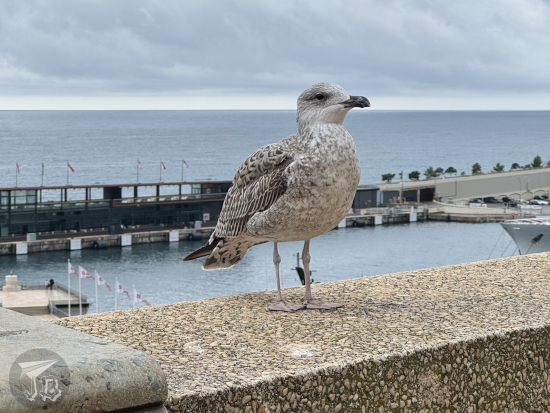
Young seagull standing at the pier.

I walked past the already-getting-ready Christmas market, and walked around, and headed south along the Mediterranean Sea coastline. I strolled past interesting buildings such as the Auditorium Rainier III and some monuments to famous racers – William Grover Monument and Statue de Juan Manuel Fangio. On the other side of the road I spotted the small chapel Église de Sainte-Dévote, the patron-saint of Monaco.

The Quai Albert 1er had been taken over by a funfair, so I could only snoop around the commercial gallery. I finally tackled the ascent to the ward of Monaco-Ville, the highest part of the city, I think. I went up through pretty stairs through a park until I reached the historical Rampe de la Major which, through the Medieval Gate Porte d’entrée au Rocher lead me into the heart of Monaco – Rocher de Monaco, the area known as “The Rock”, in the ward of Monaco-Ville.

There stands the palace, the Old Town, the cathedral and the museum which was my destination. I stopped for some panoramic views and photos of the Monte Carlo area, and them I scurried through the narrow traditional streets, now turned into restaurants and souvenir shops. I stopped to take a couple of photos of the cathedral, since it was not raining yet, and continued on. A few minutes later I was walking up the stairs of the Baroque Revival building, which perches over a cliff – the Musée Océanographique de Monaco.

My inner child squealed. My outer adult might have too. We both headed downstairs to visit the Aquarium first. The central ocean tank hosts turtles, sharks, and tropical fish, while smaller aquariums focus on species from different ocean regions: Mediterranean on one ward, Tropical on the other. It was actually smaller than other aquariums I’ve visited before but there was something special about this one.
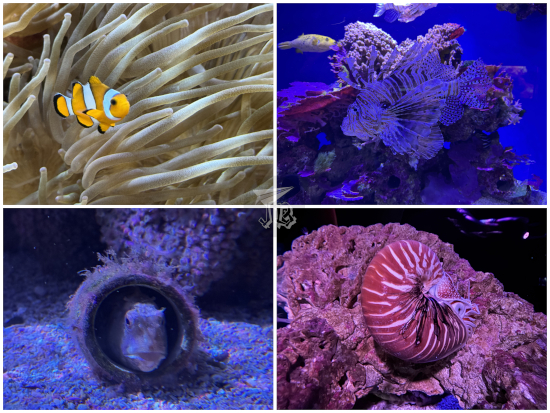
Oceanographic Museum of Monaco aquarium - clownfish, nautilus, scorpion fish and gobid hiding in a pipe.

I then went up to the first floor, which hosts the main exhibit rooms. As I got there, I was greeted by a model of a giant squid, after having some fun with the giant clams decorating the stairs. The central ward of that floor is named Océanomania. It hosts specimens from all the oceans around the world, including a polar bear model and a huge walrus skeleton. Smaller but in no way less cool, there were shells, fish in formaldehyde, and a taxidermied / mummified mermaid. I kid you not. Of course, it’s a souvenir made in Japan using the body of an ape and the tail of a fish, but for a while those were considered the real thing.

In the middle of the room there was a sculpture of a sperm whale breaching. On the right stands the Whale Room Salle de la Bailene, whose ceiling is populated by a few skeletons of cetaceans. There is an immersive temporary exhibition there, Méditerranée 2050 L’Exposition. It is some sort of virtual reality, playing with how a submersible dive would look in 2050 in the Mediterranean if we somehow managed to solve all our problems with pollution immediately. I sat through the English version, and the animation was beautiful.
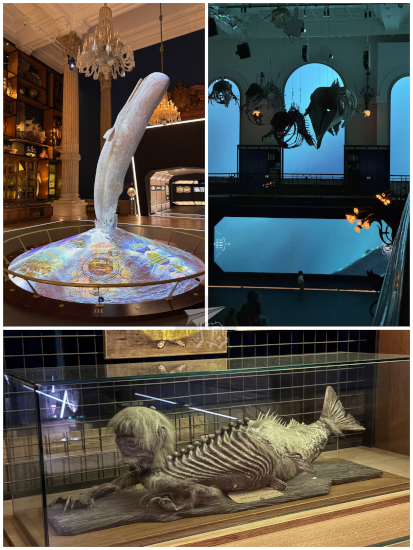
Oceanographic Museum of Monaco exhibits - a sculpture of a breaching sperm whale, cetacean skeletons and a fake mermaid skeleton made from the remains of a monkey and a fish.

Before exploring the left ward Monaco and L’Océan (Monaco and the Ocean), I decided to go up to the Terrace Restaurant and have some lunch. It was underwhelming, but convenient. I was given the worst table – though it was for four people – next to the door (which people forgot to close all the time) and the waiter was pretty unfriendly. But I sat down for 30 minutes, got some warm food into me – faux-fillet sauce au Roquefort (rib eye steak with blue cheese sauce) with chips.

When it was time to leave the restaurant, it was raining hard, and I had to walk across the building actual terrace to get to the door again. I hurried through, protecting the cameras, and got down to see the remaining ward. There stands a replica of a research ship and interactive exhibits of oceanographic instruments, along with the discoveries made by Prince Albert I.

To finish off, I left through the shop. Throughout the museum there are little machines where you can purchase souvenir coins, and I hoped that they also had them in the shop – I did not have enough change for all of them. If they had not had the coins, there was a machine outside, quite literally next to the Yellow Submarine where I would have bought one. Since they had them in the shop I got… all five.

It was still early, and the rain was back to a manageable drizzle, so I wandered the gardens Jardins Saint-Martin, a bit of a botanic garden with views of the ocean, the Musée Océanographique de Monaco, and the harbour Port de Fontvieille.
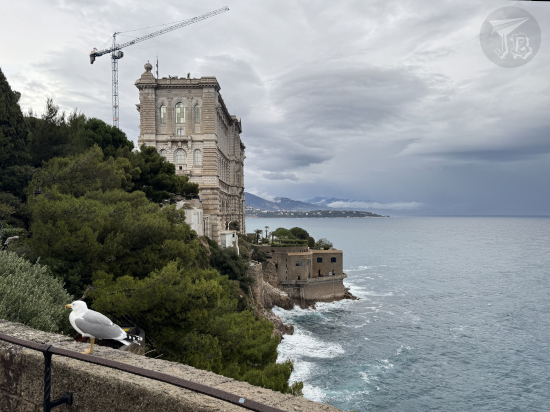
Oceanographic Museum of Monaco standing above the waves, with a seagull in the front of the picture.

The 100% chances of rain were still holding, and it didn’t feel like the weather gods would favour me for much longer. I reached the Cathedral of our Lady Immaculate, a Neo Romanic building which – luckily – had the altar lit up. Actress / Princess Grace Kelly is reportedly buried there, but most of the graves were covered by carpets and I was unable to find hers. What I did find was a commemorative coin machine. By the time I left the building, I had run out of favour from the gods. I pulled my umbrella and marched on towards the Place du Palace, where the Palace Principier, the official residence of the head of state is. The Palace can sometimes be visited but it’s at the moment closed. But do you know what it had? Commemorative coins.
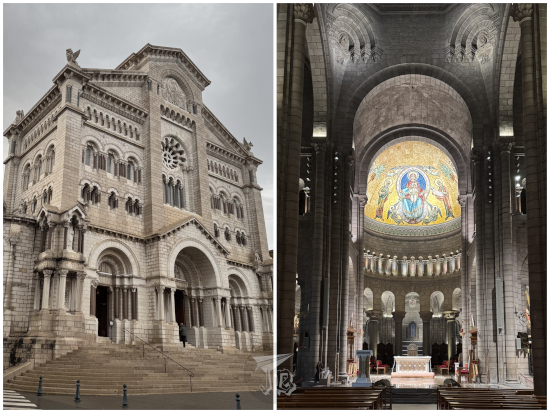
Cathedral of Monaco - neoromanesque building, inside and outside.

One of my (albeit silly) goals for the day had been walking from the south to the north borders of the city-state. Imagine the bragging rights, crossing a country from west to east (I had done that from the station to the ocean border), going from the lowest point (the harbour) to the highest (the Oceanographic Museum terrace), and from south to north. However, it was raining in earnest now, so my umbrella and I headed to the private collections of cars that the Prince owns La Collection Automobiles de S.A.S. le Prince de Monaco. I went down towards Monte Carlo using the same stairs I had used before, which had turned into a bit of a waterfall. I was not far from the car collection, but the straight line was blocked by the funfair I had seen before. I had to stop under a roof to throw my rain poncho on.
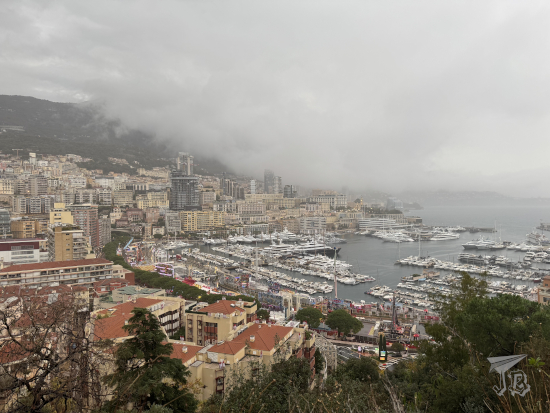
View of Monaco in the middle of a stormcloud, showing the marina and the tall buildings on the coastline.

The Private Cars Collection of HSH Prince of Monaco is quite impressive, containing ancient cars, classical ones, modern machines and quite a few F1 engines. I saw Fords from the first batch of Fords ever built, Rolls Royces, Aston Martins, Ferraris, Lamborghinis… I even inspected the sub-collections of helmets. This time I didn’t buy the commemorative coin, but a casino chip imitation.
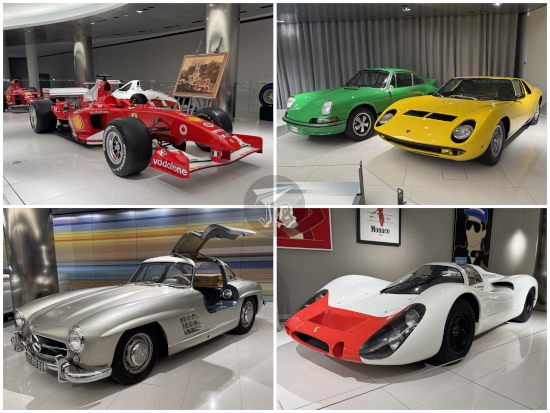
Some cars in the Prince's collection - racing and luxury Ferraris.

I undid my way from the morning. The storm was now pretty bad, and water ran down the streets. I decided to take one last picture of the Casino de Monte Carlo, lit up, and then head back to the station. Of course, when I got there, the rain stopped. However, my shoes were waterlogged, and so were my jeans up to my knees. I decided to head back to Nice anyway, and give up my cross-country endeavour.
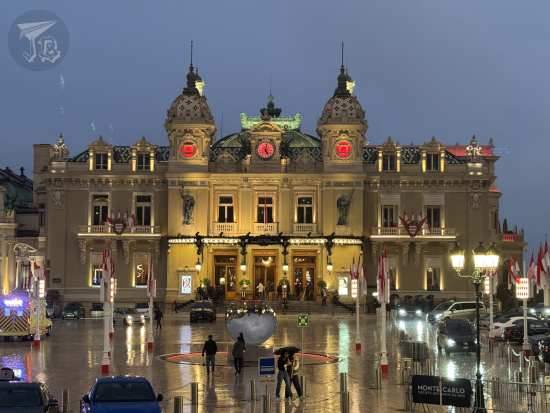
Casino de Montecarlo in the evening while it rains.

Trains were delayed due to rain, but one came shortly after I had reached the platform. On the train, I reflected that my inner child was extremely happy. My inner adult too. My outer adult was pretty drenched. Upon arriving at Gare de Nice-Ville, I stopped at the supermarket for supplies and went back to the room. As soon I reached the hotel, the skies opened again. However the meteorological alert had already passed. I had to talk to reception to get a working remote for my air conditioning machine, because the previous evening had been okay, but today I was going to need some extra heat. I had a shower, changed into my PJs and devised a strategy to dry off my shoes, trousers, and maybe socks, using the hair dryer without overheating the machine. I was mostly successful. Socks had to come back in a separate bag, wetter than merely damp, though.

The shoes were pretty okay (though the inner soles will never be the same), and the trousers fine. Around midnight, I left the former wrapped in a towel and the latter hanging, and went to bed to dream about seahorses.
15th November 2025: The Côte d’Azur {France & Monaco, November 2025}

D****e was leaving Paris about an hour earlier than myself, so I decided to tag along to her station and then backtrack to mine (hey, it was extra friend-time). I’m not good at going back to sleep after waking up, anyway. Thus, we checked out of the hotel together, and I rode with her, then changed platforms towards Paris Gare de Lyon to take my long-distance train. The ride across France was six hours, but it was very cheap, and not much longer than I would take flying from home to my destination.

The current iteration of the Paris Gare de Lyon station was erected following designs of Marius Toudoire around 1900, so it was ready for the World Fair. It features a clock tower and an inner ironwork structure combined with decorative details typical of the Belle Époque design. The station was bustling even early in the morning – I arrived before 7:00 for my 8:21 departure. My ticket said that I would have to leave through hall 3, but there was an announcement from hall 1, where I waited.

Inner platform of Gare de Lyon station.

Since the previous day I had been tired and had not thought to buy food for the day, I had to pay the price of travel-hub lunch. I got myself some cookies, a Coke and a sandwich – chicken in traditional sauce. I also decided to start a Christmas ornament collection, and got myself a shiny Paris bauble. Access to the train opened ten to fifteen minutes before departure, and it was a bit chaotic. My seat was in the low 500s, and for some reason you could not go from one carriage to another (or at least from my carriage to another?) so I’m happy I got the right door on the first try. The train left on time, at 8:21 sharp, and I slept for the first couple of hours. Around 11:00 I was hungry, so I decided to pull out my sandwich… which ended up being “tandoori sauce”, not “traditional sauce”. Take that, caffeine-deprived brain. For a second, I considered not eating it, fearing it would upset my stomach. However, I was hungry enough that I did not really care, and it was not too spicy. I had another nap afterwards again, and before I knew it I had arrived at the Gare de Nice-Ville station in Nice, in the south-east of France, the area known as the Côte d’Azur (Azure Coast) or French Riviera.

Gare de Nice station from outside.

The first hominids may have roamed the area as far as 400,000 years ago. However, the city was founded around the 350 BCE by settlers of Greek origin, naming it after Nike, goddess of victory. There was a nearby Gallic-then-Roman settlement, Cemenelum, which was eventually absorbed by the growing Nice. During many years throughout history, it could be considered that the region was part of Italy in one way or another. In 1860, the territory was given to France, though not all the Niçoises were happy about that. The Italy sympathisers were repressed without much success.

After the annexation to France and the modernisation of the railway network, Nice became popular amongst the English aristocracy, who enjoyed spending winter there. Holiday-makers included Queen Victoria, for whom a full hotel was built, and her son Edward VII. This would eventually lead to the city’s economy boom during the second half of the 20th century, after it was liberated from the WWII occupation.

In 2021, Unesco recognised the uniqueness of Nice declaring it World Heritage as Nice, Winter Resort Town of the Riviera, with emphasis on the winter part. The development of winter resorts was different from the summer ones, creating layer upon layer of new structures. The so-called Belle Époque architecture became popular, but all in all, the layout of the city is quite complex, due to both history (grand hotels near Roman ruins) and geography (beaches and cliffs).

I headed out to the hotel, which was very near the station, dropped off my stuff and went on exploring. The weather was great, so I could forego one of my layers, even. I was starting to understand the “mild winter” reputation. I first headed down the Avenue Jean Médecin, the main commercial artery of the town, until I reached the promenade.

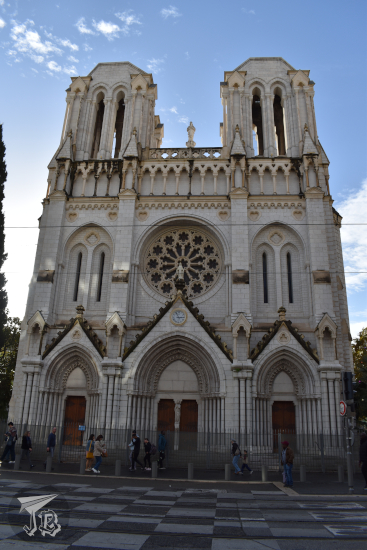
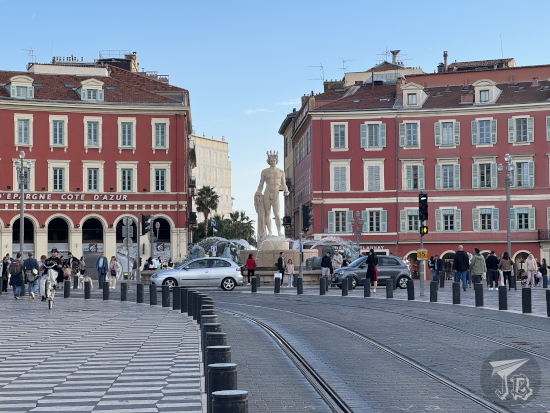
On the way, I stopped at the basilica-church Basilique Notre-Dame de l’Assomption, a Neo Gothic building designed by Charles Lenormand and erected in the 1860s, after the city was incorporated to France, as gothic was (is?) considered a “very French style” (thanks, Viollet-Le-Duc) and more “French architecture” was desired in the city. The building was not open, so I continued down the avenue until I reached the large Place Masséna, the main square of the city. It is surrounded by red buildings of Italian architecture, and a fountain called Fontaine du Soleil, the fountain of the sun, representing the Greek god Apollo.

Neo-gothic basilica.

Place Masena with Italian-architecture building and a monumental fountain.

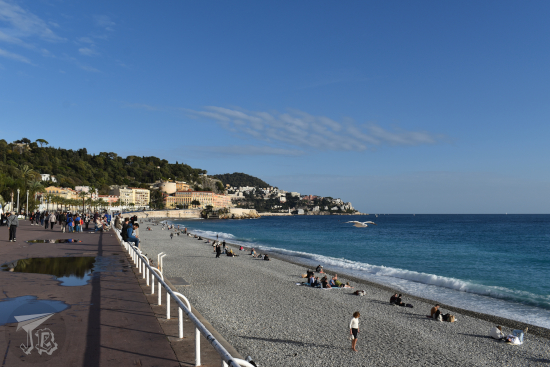
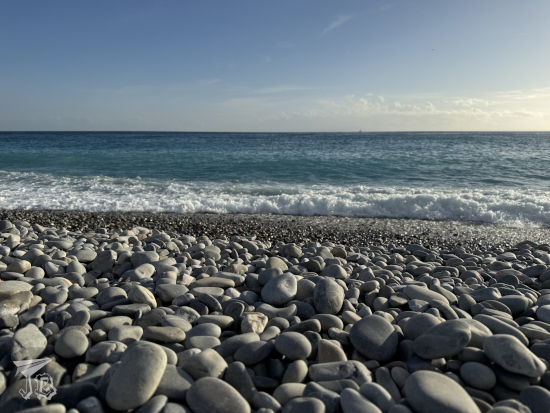
After crossing the Esplanade Georges Pompidou and leaving behind an ugly monument thing Neuf lignes obliques, I found myself at the famous Nice promenade and the Mediterranean Sea. In front of me, a line of private and public beaches made of rounded boulders. On my right, the Promenade des anglais (the Walkway of the English), and on my left the Quai des États-Unis (United States Quay). I turned left, but I could not prevent getting distracted by the beaches. Leaving behind the opera house Opéra de Nice, where nothing was on, I spent some time sitting by the ocean before I continued my way.
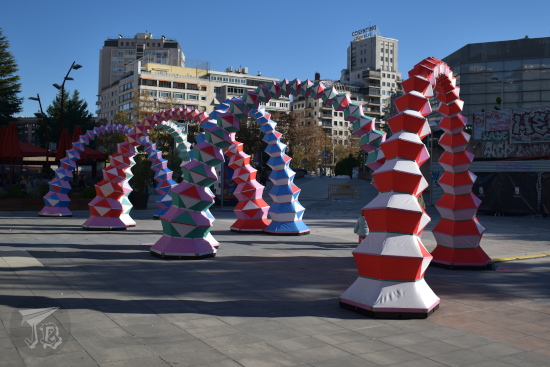
Etats-Unis quai and the beach.

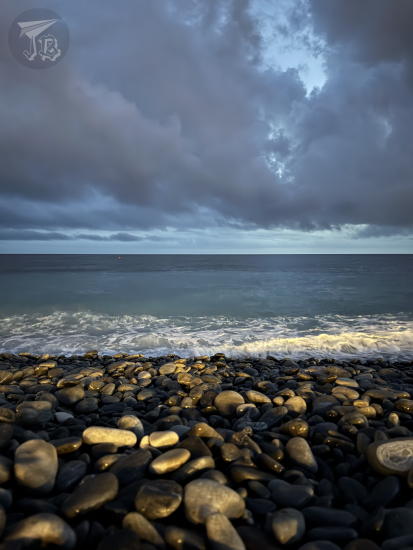
Waves on a pebble-and-stone beach.

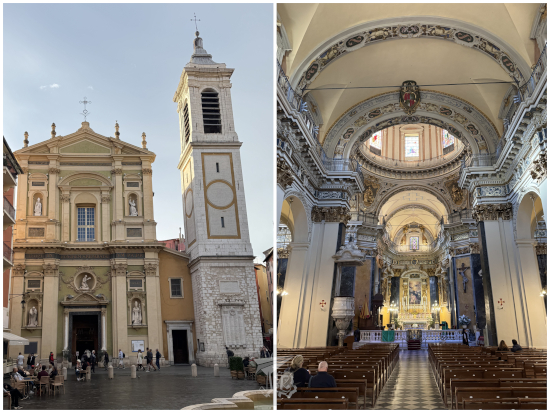
I diverted a little back into the old town to visit the cathedral Cathédrale Sainte-Réparate de Nice – Cathedral of Saint Reparata. Construction started in 1650 in the Baroque style, and it went on for centuries until it was declared complete in 1949. The building has one bell tower and ten lateral chapels. It enshrines the relics of Saint Reparata, which arrived in Nice in 1690.

Catholic cathedral of Nice, a Baroque building.

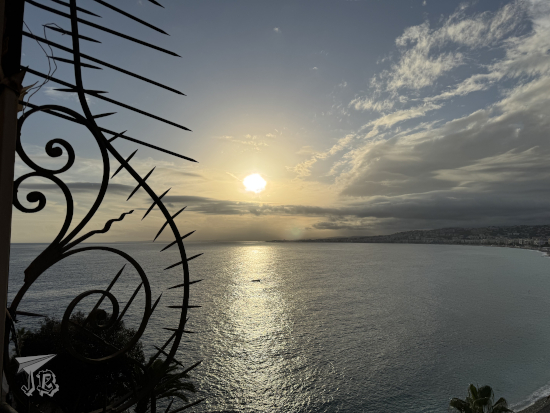
After wandering Old Nice for a bit, I started the climb up the historic park Colline du Château, where the old Nice castle and cathedral stood. Today it offers panoramic views, ruins, playgrounds and… cemeteries for some reason. There is a “free” lift, but someone stood at the entrance, looking very much like they were charging a fee. I wanted to climb up the stairs on foot for the views anyway. Though it was before 16:00, the sky was already in sunset mode.

Sunset over the sea.

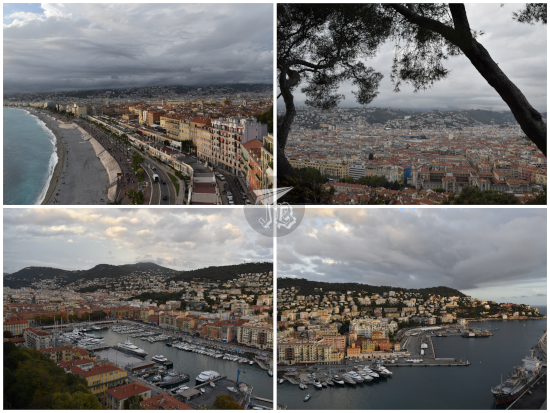
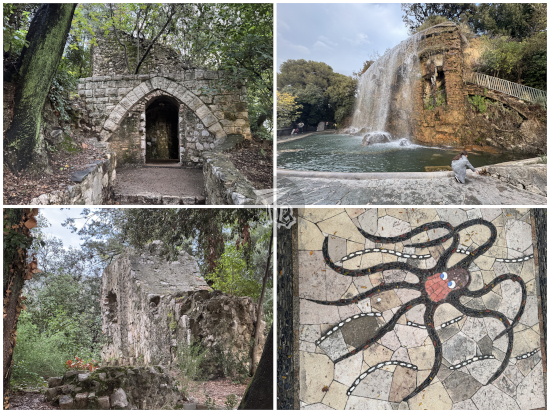
The ascent was not difficult, three or four flights of stairs before I reached the small building that tops the tower Tour Bellanda, the first viewpoint. The structure was originally a medieval defensive structure, but it was destroyed and rebuilt as a place to enjoy the views. I continued on, through the hill / park / historical site. There are several viewpoints towards both sides of the city, along with historical ruins, mosaic decorations, fountains, even the aforementioned cemeteries… All in all I had a lot of fun exploring.

Views of Nice - roofs, coast and ocean.

Collage of the Chateau de Nice: ruins, a waterfall and an octopus-shaped collage.

It had become dark by the time I left the parks, and I somehow ended up re-entering the city down some historical stairs which landed me right into the Medieval quarter again. After going back to the beach for some more wave sounds, I undid my path towards the hotel, taking the exact same route.

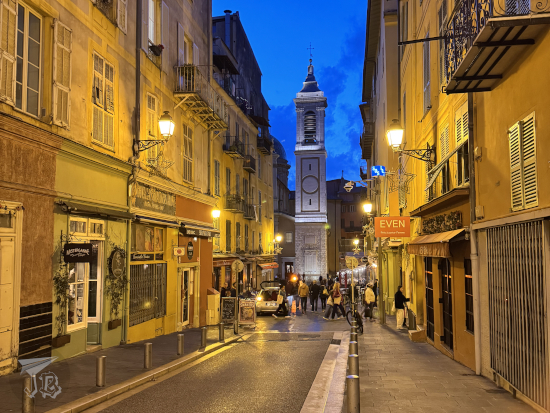
Medieval Nice at night, with the cathedral tower at the end.

Waves on a pebble beach at sunset.

There was a bookshop on the way, and I really wanted to stop and buy a book I knew was out that weekend, but honestly? D****e had brought so many presents for me that it would not have fit into the backpack… What I did buy was dinner and breakfast for the following day at the supermarket in front of the hotel – read: coffee and a sandwich. Oh, and a smoothie because it looked awesome.

I spent the last couple of hours of the evening in the hotel, watching bad creature films on YouTube before I went to bed.

13th November 2025: Notre Dame, twice {France & Monaco, November 2025}

I left the house a little earlier than 6:30, and I reached the parking lot at 7:50, though the theory is a 38-minute drive – the joys of mid-week rush-hour traffic. But I made it, and it was only a few minutes’ wait for the shuttle-bus, so I got to the terminal pretty quickly after that. Security was smooth, boarding went well, and I got to snooze on my 9:45 plane. Pretty good jump, all things considered. We landed at Charles de Gaulle airport a few minutes early, and I was at the train station relatively fast. It was a short walk away, and it looked familiar – I had done it to get to my first-night hotel for the Saint Seiya Symphonic Adventure Weekend. I needed to buy a Navigo transport card too, on top of the price of the ticket, but after wrestling the machine, I just took the RER, and was downtown Paris around 13:00. I stepped out of the underground stop right in front of Cathédrale Notre-Dame de Paris.

Notre-Dame (Our Lady) is the Catholic cathedral of Paris. It was founded in 1163, and its construction spanned about a century. It was repeatedly modified afterwards, with some reconstruction. The building is considered one of the most important examples of the French Gothic architecture, including innovations such as the flying buttresses, rib vault, and the rose window above the gate.

The cathedral was damaged during the French Revolution (1789 – 1799), and converted into a secular “temple of reason” – the Cult of Reason tried to take over Christianity during the period. In 1831, Victor Hugo’s novel The Hunchback of Notre-Dame (original title: Notre-Dame de Paris) was published, and it sparked renewed interest in the building. Around this time, architect Eugène Viollet-le-Duc was promoting gothic as the purest form of architecture, so he took up the refurbishing of the cathedral. He had a vision of restoration which implied “doing what the Medieval Builders would do with modern technology”, an approach that has earned contempt with time. He placed a spire on the roof of the cathedral, despite the original having been lost centuries before.

This spire was later destroyed during a fire in 2019. While the cause of the blaze has not been disclosed, flames ravaged the structure during 15 hours, destroying most of the wooden parts of the cathedral, and damaging the upper walls. The fire broke out around 18:20, and due to problems or mistakes, the firefighting brigade was not notified until almost 19:00. Paris firefighters had trained extensively to prevent a disaster in the building, but the old wood had been burning for 40 minutes when they arrived. Most of the extinction work was carried out within the walls of the building itself – I clearly remember that there were fears that a tower would collapse on the brigade.

Fortunately, the stone structure of the ceiling and walls withstood the blaze, and the building did not cave in. The cathedral holds relics important to Christianity, including the purported Crown of Thrones, and those were taken out for safekeeping. Furthermore, a number of artworks had been removed because there was restoration going on. When I was in the area in February 2020, just before the Covid lockdowns, I was shocked that the site still reeked of smoke.

Though the Catholic church as exclusive and perpetual right to use the building, Notre-Dame belongs to the French Government. It was declared historical monument in 1862, and it has been part of the Unesco Heritage Site Paris, Banks of the Seine since 1991. All these characteristics protected it from “daring” post-fire projects such as modernist windows or alternative spires. The first phase of reconstruction were consolidation projects, to make sure the water had not damaged the stone, building scaffolds which have not been completely taken down yet. Then the debris was taken out, and finally rebuilding work would start in 2021. Though some experts predicted decades of reconstruction, the cathedral safely opened for Advent in 2024, though there are still works going on.

Despite having a timed ticket for peace of mind, I did not need it. There were barriers to optimise a queue, but I only had to walk through. I went to show my backpack to the security guards, and they were extremely nice and laid-back. When I said I was coming from the airport, they waved me through after a quick visual inspection.

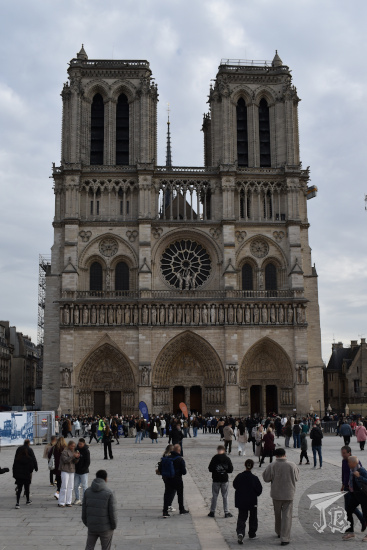
Exterior of Notre Dame.

My feeling when I got inside was “woah, white”. The walls were treated with a special solution that not only removed the soot, also did away with centuries’ worth of patina. The building was packed, so it was hard to wander around and enjoy, but Notre-Dame is one of my favourite pieces of architecture, and I loved being able to walk inside once more. Nevertheless, I preferred the old, greyish interior. To collaborate with the cathedral’s maintenance – or so I tell myself – I bought a commemorative coin. Then I decided I needed the second one (do keep score, this whole thing with the coins was to become a pattern in this trip).

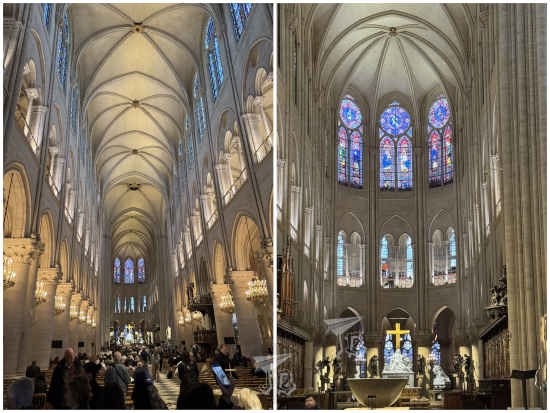
Interior of Notre Dame.

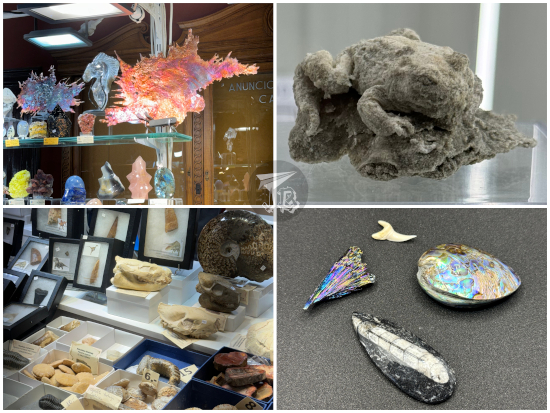
I could see people working on the second floor behind the altar, it was a bit surreal. After I had walked the inside, I went around the building to check out the construction, then moved on along the Seine towards another of my favourite places in Paris, the Gallery of Palaeontology and Comparative Anatomy, Galerie de Paléontologie et d’Anatomie comparée, part of the French National Museum of Natural History, Muséum national d’Histoire naturelle. The gallery is going to be “closed for refurbishing”, which I fear will make it lose its charm, so I really had to visit this time around.

The French National Museum of Natural History was established in 1793. However, the project that would eventually lead to this gallery did not start until the Gallery of Zoology had been inaugurated, in 1889. The building was designed by architect Ferdinand Dutert, with two floors and three levels, alongside a few balconies. It was erected between 1893 and 1898, when it was inaugurated. The structure is stupidly impressive and beautiful – the outside is made of brick and the interior has mainly metal and wood. Most of the second floor is actually a mezzanine, which originally held the collection of anthropology, and now the plant fossils. The first floor holds the palaeontology specimens, and at ground level stands the compared anatomy collection. It is a museum of its time, with that charm that contemporary ones do not hold.

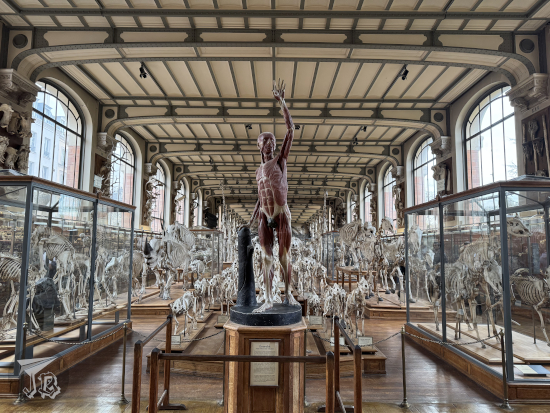
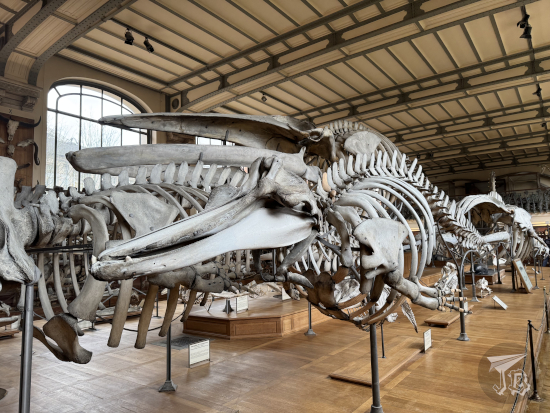
Upon entering, my backpack was thoroughly checked – the guard even made me use my phone to give him light as he went through my stuff before he let me in. I paid my fee and stepped into the ground floor, with its cavalcade of skeletons. As you enter, a human figure greets you, and behind him stand hundreds of mounted skeletons, the Gallery of Comparative Anatomy, following a very specific order – and one day I hope to know enough French to understand. First there are the pinnipeds and land carnivores, then herbivores and after a small separation, the cetacean group. On the cases along the walls, birds and smaller mammals are protected. The the far right corner, there is a small (but creepy) collection of “aberrations”.

Gallery of Paleontology and Comparative Anatomy: model human in front of the skeletons of mammals.

Gallery of Paleontology and Comparative Anatomy: skeletons of modern cetaceans.

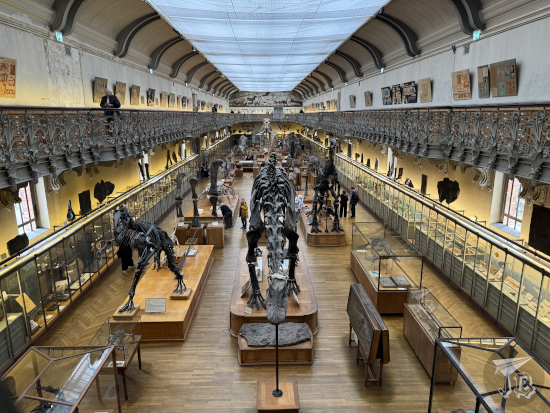
The first floor, which is accessed through a stone staircase, holds the Palaeontology Gallery, with casts of the specimen of diplodocus, a T-Rex, allosaurus, a replica of one of the Bernissart iguanodons, allosaurus, pterosaur, sarcosuchus… On the other side of the ward stands an impressive mammoth, known as Le mammoth de Durfort (the Durfort Mammoth). Discovered in 1869, it is one of the largest of its kind (Mammuthus meridionalis) ever assembled. It has been recently restored, too, so it looks rather impressive. To its side stands the only authentic skeleton of the only woolly mammoth (Mammuthus primigenius) preserved outside Russia.

Gallery of Paleontology and Comparative Anatomy: second floor looking at the dinosaurs and the gallery.

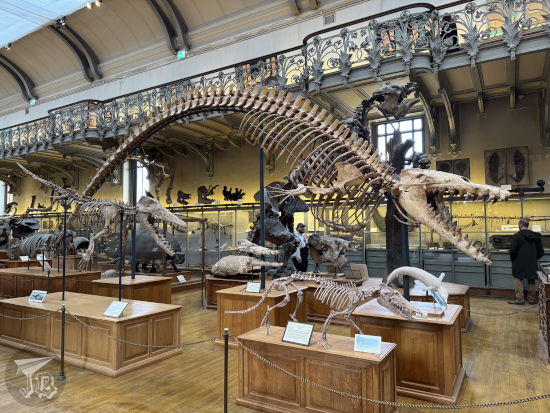
There is also a skeleton of a Cynthiacetus peruvianus, a toothed whale, one of the oldest cetaceans ever discovered. This creature lived around 37 million years ago, in the Late Eocene. The whole gallery is fascinating, if also a bit unsettling, especially the ground floor. I could’ve stayed there for hours, but my friend D****e’s plane had landed a little early and I had promised to meet her at the station.

Gallery of Paleontology and Comparative Anatomy: skeletons of toothed whale, giant sloth and early quadrupedal mammals.

I then ran into a problem in the underground. It turns out that you cannot put a ticket in a Navigo pass that you have used for the airport (at least on the same day), so I had to purchase yet another pass! We managed to meet and headed to the hotel, where we only got one room card because it was strictly not taking it out. They were very upset with me for not speaking French – I can speak a bit of it, and I read it pretty well when it’s simple (so no detailed anatomy explanations) and I’ve got time, but I can’t understand much beyond the super-basics to save my life.

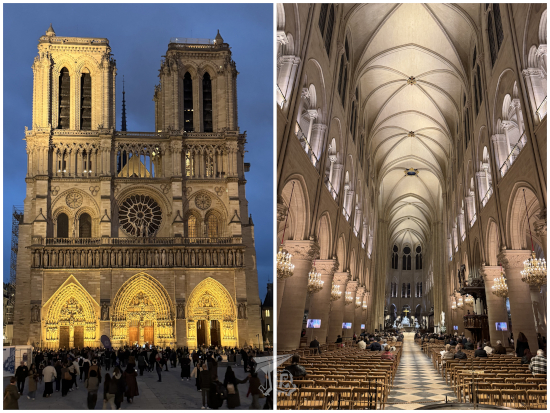
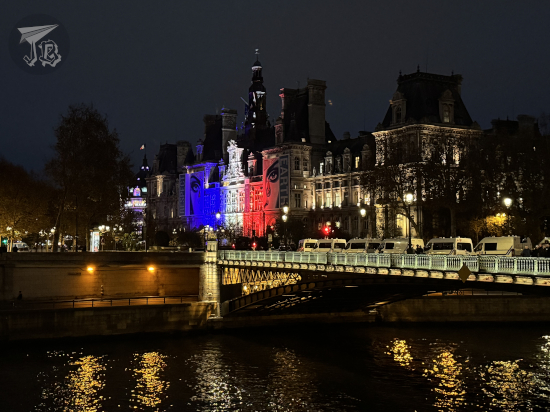
D****e suggested going out for a walk, and we headed off. The street where Le Bataclan was closed off as there was a remembrance ceremony for the victims of the terrorist attacks. We then headed further towards Cathédrale Notre-Dame de Paris (yes, again. No, I did not complain). We were shocked about the number of police officers that were around, but later we learnt that there was another ceremony at the nearby town hall, which was lit in the colours of the French flag, like the Palais de la Cité opposite Notre-Dame. There was again no queue to enter the cathedral, and the building was open late, so we took another tour inside, as it was artificially lit. On top it being Thursday, there was a mass, maybe for the victims of the attack too. The night felt pretty heavy, to be honest.

Notre Dame cathedral, outside and inside, at dusk.

Paris town hall at night with the French flag projected on the façade.

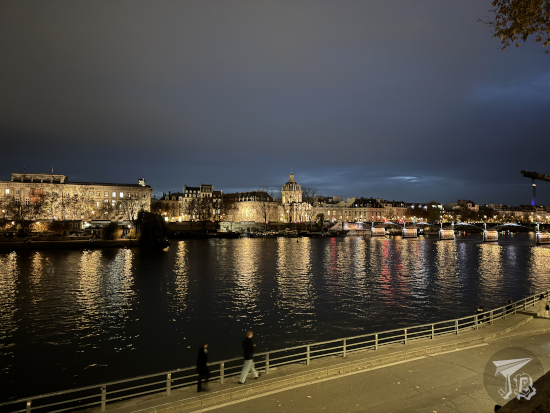
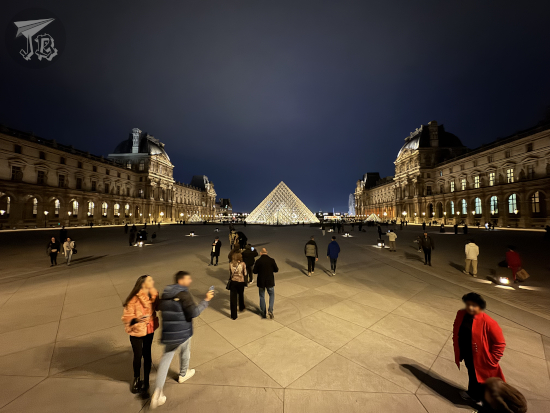
We walked a bit further, strolling along the Seine. We passed by the church Saint-Germain-l’Auxerrois on our way to take silly pictures with the Louvre Pyramid Pyramide du Louvre, the polemic skylight entrance designed by architect I. M. Pei and installed in 1989. Back then, it was incredibly controversial, especially due to how it clashed with the French Renaissance style of the square and buildings around it. I personally think the structure is ugly, but it has been there for most of my life, I can’t remember the Louvre without it.

Paris and the Seine riverbank at night.

Louvre Pyramid at night.

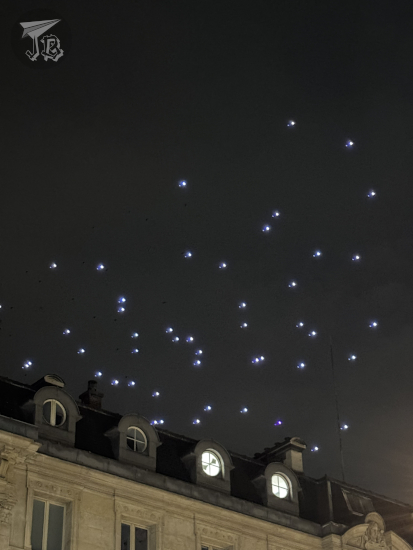
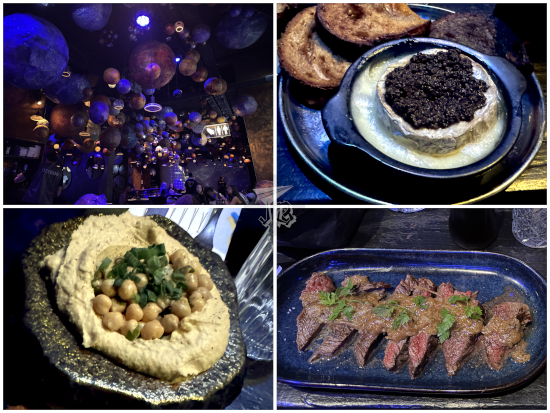
We then headed back towards the hotel area. We walked back by the memorial service at the town hall, they had launched drones up to the sky. For dinner, I had found a fun place called Stellar which reminded me of the rock band Starset, and booked it. I figured that if she was too jet-lagged, we could always cancel, but that way we had a secured spot. Stellar is managed by the group Ephemera, which creates “immersive restaurants”, and this particular place is “set in space”. The light is low, there are planets and stars hanging from the ceiling, and the solar system slowly slides around you in giant screens. It was really cool, and they were happy to help us in English.

Drones in the Paris night sky to commemorte the 13 November 2015 attacks.

Stellar makes a point of telling you where their dishes, recipes and ingredients come from. We chose three items to share: Truffle baked Camembert (from France), Galactic houmous (from the Middle East, but with a Mediterranean twist – olives), and Shallot flank steak (medium-rare, also from France, though the actual meat was Irish) with fries. The houmous was a bit too heavy, but everything was delicious. The decoration was amazing too, and we had a great time as planets and moons floated around us. Once you book, you have a table for 75 minutes, and they were so efficient that it did not even feel short – we were waiting for food for a very short time. We forewent desserts because we were full – even if I had somehow managed to skip lunch. That was not a great idea… I think I’ll try to chase a couple more of the immersive restaurants if / when I come back to Paris.

Food at Stellar in Paris.

We headed back to the hotel for an early night, though I did not sleep that much, if at all, and the night was very short.

12th November 2023: Trains and Parks (Madrid, Spain)

I had booked a visit for 15:30 using Madrid’s program to divulge the Heritage of the city Pasea Madrid (“Walk Madrid”), and I had planned a great day around it. Unfortunately, such plan had me on the best train to get to the demonstrations happening there at noon and therefore it would most likely be “delayed due to uncontrollable circumstances” or worse. Thus, I needed a new plan. Since there was a yellow weather-alert in effect across the parks in the area I wanted to be , I just drew a general list of places I could check out and decided to keep it flexible.

The day did not start off as I had imagined it. I slacked off a bit in the morning and by the time I was ready to leave, it was too too late to catch the original train of the second plan. There was part of me which was really not in it, and I considered just cancelling the visit and staying home. Then again – I reasoned with myself – the visit was sold out every other day, I had been lucky to secure a spot. I did not know whether I would be lucky enough to be free when the next batch of tickets were released, nor if the dates were convenient – if they ever opened again, or as the webpage said, it was a “special occasion” (honestly, I think that they just say it is to hype up the reservations). Thus I set off to catch the next train, still in good time for plan B as it was flexible and I could just kick one stop off if necessary.

Once in Madrid, I headed off to the Railway Museum Museo del Ferrocarril, technically closed that day due to the monthly flea market Mercado de Motores. It turns out that the ground floor of the museum is still open, which allows you to have a look at the main train collection (actual historical trains) and take some cool pictures. For once, I was not the only one with the camera, but one among a bunch – to the point that a few of us ended up queueing for a similar picture at some point.

The Railway Museum is located in what remains of the former terminus of Delicias, which opened in 1880. Designed by French engineer Émile Cachelièvre, it had three distinctive areas – the passenger building, the loading docks, and the customs building. The last train left the station on the 30th July 1969, at 22:15, headed for Badajoz. In 1984, the Railway Museum opened in the passenger building, which kept the former platforms.

Fleamarket at the Railway Museum

I am not sure how crowded the museum is during normal days, but for the market, it was packed. I had secured a free entry reservation, just in case. The main building hosts a number of actual trains which serviced passengers and cargo throughout Spanish history – real locomotives and cars on the tracks they used to travel. Before Covid, one of the cars was used as cafeteria, and another as an Orient-Express-inspired restaurant, neither of which are in active now. Though the side rooms of the ground floor and the upper floors were closed due to the market, I got to see the trains from the outside and admire the building structure.

Railway Museum Madrid

In the outer part of the museum, I found the food court and the former tracks which disappear into the nearby park. To the side stands the miniature train complex Ferrocarril de Las Delicias a layout of tiny trains – a 265-metre long, 127-millimetre wide track, to be exact – where you can travel on equally-scaled trains, with classical tickets and all. My original idea had been riding it, but I found a great spot for photographs and decided not to queue through all the toddlers and their parents. I thought that since I wanted to go back to the museum to see all the rooms, I could do that on a day when the tiny trains were running.

Miniature trains in Delicias

I left the station-turned-museum and walked towards the so-called Pantheon of Spain Panteón de España, a burial site for remarkable Spanish politicians, noblemen and military personalities – formerly known as the “Illustrious Men”. Before mobile phones with a camera were a thing, my school took my class to the crypt, but nowadays only the upper area and the gardens can be visited. The original plan, designed by Fernando Arbós y Tremanti in the Neobyzantine style, comprised a basilica with a bell tower and a cloister. The project began in 1891, but only the tower – now part of a school – and the cloister had been built when construction stopped in 1899 due to astronomical costs. In the cloister, there are funerary monuments to a number of important Spaniards who were exhumed and reburied there, such as Mateo Sagasta, Antonio de los Ríos y Rosas, Anonio Cánovas del Castillo or José Canalejas. Eight tombs and a central monument can be visited in the cloister and the central garden. The entrance is decorated with golden mosaics, and the interior is white calcite and grey slate, with domed rooftops. The central garden had flowering winter roses and a view of the abandoned bell tower.

Pantheon of Spain

I headed out towards Madrid’s main park Parque del Retiro, part of which had been restricted until noon due to predicted strong winds. The weather, however, was fantastic, even warm, which felt weird for such autumn-coloured day – it made the yellow alert issued a little strange. The park was gold, red and orange everywhere, a stark contrast with the green grass and bushes. I reached the crystal palace Palacio de Cristal, which looked extremely cool with the fall tones, though it was packed.

Retiro park in autumn

El Retiro crystal palace

I took a turn towards an area that I had not visited before inside the park. In the 18th century, when the now-public park was the monarch’s garden, the royal gardeners kept complaining that flowers bloomed where they had not planted them, and blamed a magical force living in the park. The Spanish word used is duende, which is a nature creature somewhere in-between a fairy, a spirit and a gnome. The sculpture Duende del Retiro was created by José Noja in 1985 to honour the legend. The duende plays a flute while sitting on a stone hut, which used to be a cage for the bears of the former zoo Casa de Fieras del Retiro, now turned into the garden Jardines de Herrero Palacios. I’m glad no animals live there any more, except some geese and ducks that can fly – or waddle – away any time they want, but considering how much they get fed by passers-by, I doubt they care about doing so.

Duende of Retiro Park

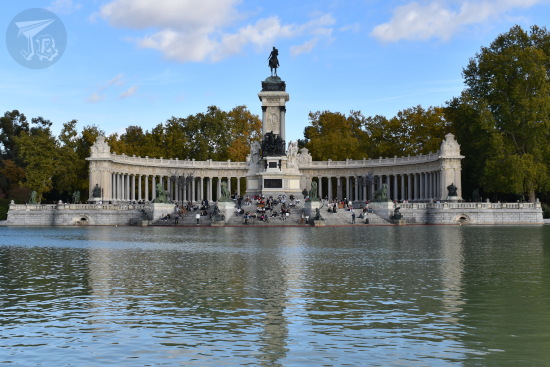
I finally made my way towards the central pond of the park Estanque Grande and the monument to King Alfonso XII Monumento a Alfonso XII, my 15:30 visit. The monument is composed by a colonnade, two lion-gates, four mermaids sitting on different marine animals, and a triumphal column with a sculpture of the king riding a horse on top. The complex measures 30 metres high, 86 metres long and 58 metres wide. The colonnade is public access, and I would not have booked a guided visit for it. However, what made the visit special is that we were granted access to inside the column to climb to the lookout that lies within the top pedestal where the horse stands (97 steps, thankfully on newish metal ones).

Alfonso XII became king of Spain in 1874. He grew up in exile in France until his mother, Queen Isabel II abdicated when he was 17 years old. He reigned for almost eleven years. His first wife, reportedly his one-and-only love, died within a few months of marriage. He married again, and had three children with his second wife, Queen María Cristina, two more with his opera singer lover. He was charismatic and the Spanish loved him, he was called “the bringer of peace”. He died while María Cristina was still pregnant with his son, king-to-be Alfonso XIII, and she became Regent. It would eventually be Alfonso XIII who inaugurated the monument to his father.

The monument was designed by architect José Grases Riera and involved as many as 20 sculptors. Probably the most important one was Mariano Benlliure, who made the horse and the king in bronze – the horse is about seven metres long, and the whole sculpture from the horse’s hooves to the King’s hat, about eight metres high. Grases Riera placed his project on the existing pier of the pond, in order not to cut down any tree from the park, as a pier could always be rebuilt somewhere else. The monument was funded by the public, so it alternates cheaper stone and more expensive bronze, according to how much money there was at nay given moment. The colonnade features shields from the different Spanish regions at the time, and the main column has scenes from the King’s life and allegories to Peace, Industriousness, the Arts… Completion took 20 years from the call for projects in 1902 to the monument inauguration in 1922.

Monument to Alfonso XII across the Great Pond

The lookout is encased in the pedestal where the horse stands. It has windows made of glass to allow a 360-degree view of the park, and I swear I had never even realised it was there. The stairs were not steep and there were cool views from the lookout, especially with the autumn colours, and the sun starting to set. The guide was good – just again impressed by the camera – and explained to us everything that could be seen from there. A relative, however, took the same visit a few days later and, when we compared notes, the information we had been told was rather… different.

Monument to King Alfonso XII - horse and king close up, plus views from the viewpoint

The whole visit took an hour, with 15 minutes at the lookout, and we were out by 16:30. It took me a bit over 25 minutes to reach the station, but the train was late – it was actually at the platform when I got there even if it should have left ten minutes beforehand. I hopped in, and I spent the ride organising the photos on the phone. I am glad I did not cancel the visit and went on with it. I shall remember that for the upcoming one.

23rd July 2022: Plateresque Salamanca {Salamanca, July 2022}

Officially in western Spain, Salamanca stands next to the Tormes river and sports a Unesco World Heritage title for its old town. I was five or six the first time I was there, so it’s not like I remembered anything from it, except memorising excerpts from the book El Estudiante de Salamanca (José de Espronceda), my favourite Spanish Romantic poet.

Salamanca is known due to its university, which is considered one of the best in the teaching of Spanish as a second language, the oldest Spanish university and one of the oldest in Europe, founded in 1218. There are actually two universities, but we shall get to that later.

There is a period in Spanish history referred to as the Gold Century, Siglo de Oro (Not an actual century, the given dates are between 1492 – the year when the Catholic monarchs finished conquering the country, Europeans realised America existed, and the first book on Spanish grammar was published – and 1659 – when the Pyrenees treaty was signed after the war with France). It was throughout this period when Salamanca thrived, especially late-time Gothic styles and early Renaissance ones. Then of course Baroque later on, but you know my stance on Baroque by now I guess… The mixture of late-gothic and Renaissance gave way to a unique style, Plateresque – with a strong Gothic base and a blend of Mudéjar, Flamboyant Gothic, Lombard and Tuscan Renaissance elements and decorations. Plateresque is characterised by heavy decorations sculpted onto the main architecture, especially in the typical fusion of doors and altarpieces. The motifs are plants, animals, shields and medallions… All and all, an impressive style considering we are talking about carving stuff on stone – in the case of Salamanca, a lot of it is sandstone, which gives the old city a golden tone.

We had to take a couple of trains, but and made it to Salamanca around 10:30, and were in the city centre a few minutes later. After dropping the luggage at the hotel – I had been requested the hotel to be near the cathedral and I found one which was literally across the street from one of the flanks. Then again, here’s the thing – Salamanca has not one but two cathedrals: the Old Cathedral Catedral Vieja de Santa María and the New Cathedral Catedral Nueva de la Asunción de la Virgen. Apparently, instead of building over the old one, they decided to keep both, making the historical complex unique in the country.

The New Cathedral was built mainly in Gothic style with later Baroque add-ons, with an ornate Plateresque façade. It was commissioned by king Ferdinand V of Castile, and built between the 16th and 18th century, in the Gothic style, even though this was at time when Gothic was already in decline. However, the town authorities wanted it to “match” the old Romanesque cathedral. A cupola and a choir were added in the Baroque period, and the façades were decorated in the Plateresque way (in a 20th-century restoration, someone thought it would be funny to add an astronaut to the decoration, causing some hoaxes to pop up afterwards). The most important architect who worked in the new cathedral was José de Churriguera, one of the leading Baroque architects / sculptors / urbanists.

A very ornate Gothic cathedral. The entrance has so many carvings that it actually looks organic, if not for the fact that it is made out of golden / reddish stone

The New Cathedral connects to the old Cathedral, which is late Romanesque / early Gothic in style (I know, it’s confusing. Historically, the old cathedral is between Romanesque and Gothic, and the new one between Gothic and Renaissance – and this is the reason why the Gothic makes the two cathedral “match”). It was built between the 12th and 14th centuries. The most impressive thing in the Old Cathedral is the altarpiece, in which the highest-quality paintings were made by the Italian Dello Delli. On the way out, I let myself be tempted by a paper guidebook of the city – which was helpful because we had to remake all of our plans a couple of times.

Interior of a Romanesque church - the nave has very high and severe-seeming columns

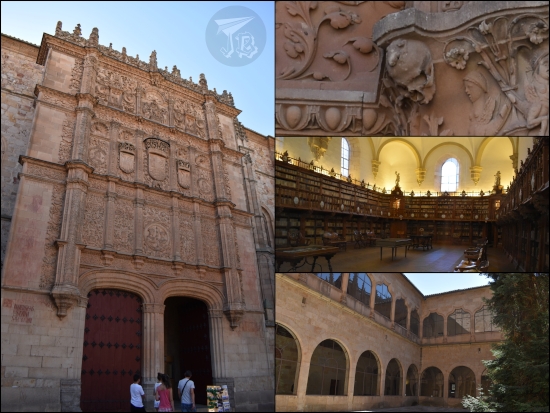
Afterwards, we headed off to the main university building Universidad de Salamanca, the first university building. The university was founded by King Alfonso XI in 1218, which makes it the oldest university in the whole Spanish-speaking world. The most important building today is the Escuelas Mayores, the upper school, built between 1411 and 1533. The façade, which looks towards the newly-discovered New World is sculpted in the Plateresque style, with a ton of decoration – and the most famous motif is the frog that stands on top of a skull. The university was built around a cloister for the students of old, and it has the most amazing library I have seen in a long while – selfishly (I’m joking of course) closed to the public. There is also a chapel and the classroom where the Spanish academic Fray Luis de León, who was famously jailed for four years, and picked up his lectures with “as we were saying yesterday”. The cloister has two floors since the 19th century, and in the centre there is a small giant sequoia (which I thought was a simple fir). There are chapels, and halls, and areas where university holds events.

Very ornate entrance to a building. there are two doors (four or five times as tall as a person) and the decoration, all carved in stone, is on top. Three floors of decoration, with columns and shields. A close-up shows a frog on top of a skull.

The problem with Salamanca is that the entries and exits of the building make you have to backtrack a lot (and the horrible street lights), but I love Gothic so I did not mind wandering around anyway. After the Escuelas Mayores, we went to another university building the lesser school or Escuelas Menores. Today, there is a cloister which dates from 1428 with a Baroque upper veranda. In one of the side halls there is a fresco panting that used to be in the library and that was moved over in 1950. The fresco represents a night sky was used in teaching.

Gothic patio and a suck picture of a fresco painting, showing stars and the representation of constellations

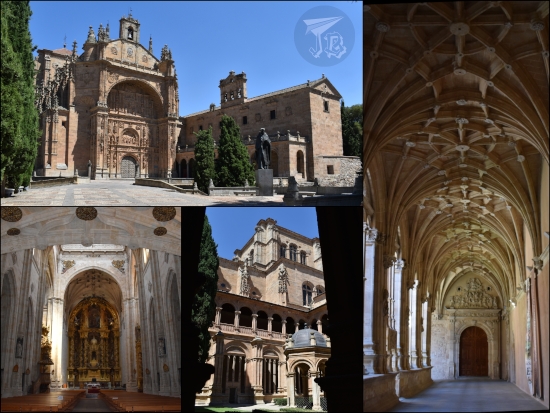
We had lunch, then we went to the Dominican monastery Convento de San Esteban and its church. The current monastery dates from 1524-1610, and it was built over the previous one. The façade of the church is considered the best example of Plateresque, and José de Churriguera also worked in the main altarpiece. The monastic building has a portico with Italian loggias, typical of the Renaissance. The cloister is mainly Renaissance with Gothic features, and a small temple in the middle. The ambulatory in the cloister has beautiful Gothic columns and nerves on the ceiling.

A convent, built in ornate gotic style. The covered corridor around the cloister shows pointed arches and rich decorations

Right in front of the monastery stands the Dominican convent Convento de las Dueñas. The building is Baroque, and before being a convent it used to be a palace – which has caused the convent to have some eclectic elements of architecture, such as the Mudéjar arch mosaic or doors. The inner cloister is Plateresque and full of roses and flowers.

A Baroque building. The inner patio is decorated with plants and Moorish-seeming blinded arches

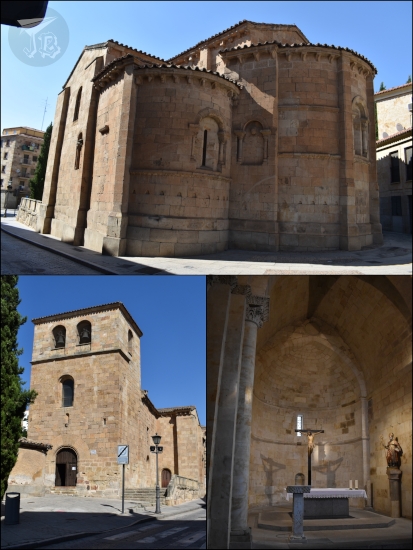
Next, we found the tiny Romanesque church Iglesia de Santo Tomás Cantuariense, where I happily sicced the oh-so-bored guide onto my companion.

Small Romanesque church in reddish-gold stone. It has a tiny bell tower.

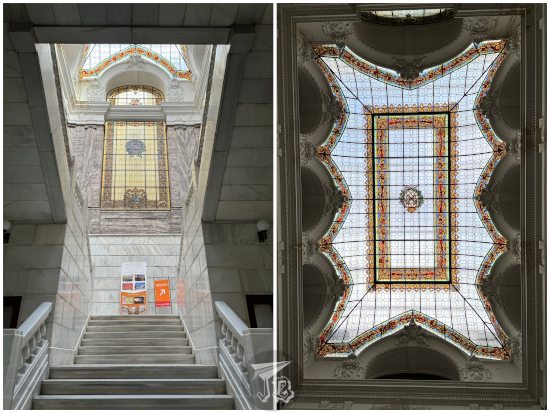
After a stop for a cold drink we went to the Art Nouveau and Art Déco Museum Museo de Art Nouveau y Art Déco Casa Lis, which is one of those places that takes itself very seriously and does not allow photographs. I got scolded for having my camera to my side even closed – but I have to admit that I did sneak up a few things with the phone, mostly because I wanted a record of the central hall with the glass ceiling, and the green windows from the inside, more than the decorative details, though some of them were pretty nice. The Lis house was built by Andalusian architect Joaquín de Vargas towards the end of the 19th century for the first owner, Miguel de Lis.

A Modernist building with brightly-coloured glass in the ceiling and walls.

We headed to the main square Plaza Mayor for dinner, and then to see the pretty lights. On the way we found the other university Universidad Pontificia and the palace Casa de las Conchas, which we would visit the following day.

The main square was another of the city landmarks first designed by Alberto Churriguera, and later one of his nephews – it seems that the Churriguera family claimed dibs on doing stuff in Salamanca. The square is fantastic by day but when night fell and the lights were turned on, it was unbelievable. We had some local sausages and cheese for dinner at one of the street tables in the square.

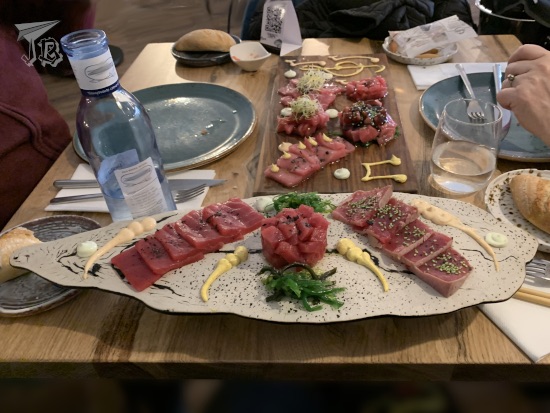
A plate of sausages and cheese, and two views of the Main Square in Salamanca, one in daylight, one at night, and lit up. The square buildings have a lot of windows and arches on the ground floor

Afterwards, I wandered alone for a while, to revisit some of the sights at night, and a couple of new ones.

Salamanca at night. The cathedral is lit and the ornamets almost shine. The Modernist house is lit in green and blue lights.

I headed off to the riverside of Río Tormes, which as any river has bridges. The first one I found is the Puente de Enrique Estevan, commissioned in 1891 in order for the town to be ready for the new cars. It has six iron arches and at night it is lit in bluish light. A few minutes downstream stands the older stone bridge Puente Romano, which according to the legend was built by Hercules – it dates back to the first century, but it has been heavily rebuilt and reconstructed through the years, especially after it was damaged by a flood in the 17th century.

A collage showing an iron bridge, and a stone bridge, both lit in the dark

Finally, around midnight, I went back to the hotel for a shower and sleep.

Walking distance: 17269 steps / 10.76 km

7th – 10th February 2020: Paris (France) for DIR EN GREY & BABYMETAL

I organised a weekend in Paris because two concerts conveniently aligned on Saturday and Sunday, and I had Friday free, as well as Monday morning. It was a great mental break that I needed badly. ETA: There were rumours about a flu from China, and some of the airport workers were wearing masks. We had no idea what was about to hit us…

7th February 2020: Through the Strikes

I had found quite a convenient flight that left at 9:00 on Friday for 35 €, which was a great deal. At first, I did not understand why it was so cheap. It turned out, the plane came from South America and it was on a Madrid stopover – so it was pretty much full already. It was a huge aircraft with on-board entertainment. That came in handy when the pilot informed us that we were going to have to wait something between one and two hours to be able to take off due to the air controllers’ strikes in France. But at least we were flying and I had films to watch.

We took off at about 10:00 and our big plane made the jump in just one hour, as opposed to the 2h10 minutes of estimated travel, which meant we were almost on time! Of course, this did not sit well with the strikers, who had us wait first for the parking spot, and then for the stairs to deplane. I finally managed to leave the airport and get onto the train so I reached downtown Paris around 13:00. I wanted to inspect the damage caused to the cathedral Cathédrale Notre-Dame de Paris by the 2019 fire. My first impression, looking at the main façade and towers, was optimistic, but as I walked round the building, I could see the real damage and reconstruction efforts. Furthermore, it still reeked of burnt wood, probably because they were still pulling out debris. My optimism did not linger long, I’m afraid.

Collage of Notre Dame showing the cranes and scaffoldings in the repairs

As it was sunny, I decided to walk to the Sainte-Chapelle (Holy Chapel) and see its windows in good weather. The Sainte-Chapelle is a small two-level chapel inside the Justice Palace Palais de Justice de Paris in the Île de la Cité, smack in the middle of Paris and not far from Notre Dame – actually, both of them belong to the same Unesco World Heritage Site, Paris, Banks of the Seine. The chapel has a lower early Gothic level, and an upper level with impressive stained-glass windows which I love. As the sun was shining outside, the views were stunning.

Collage. Sainte-Chapelle: outside showing the spire, inside with some colourful windows and pointed arches

Collage of the upper floor of the Sainte-Chapelle. It shows different angles of the long gothic windows, covered in colourful glass

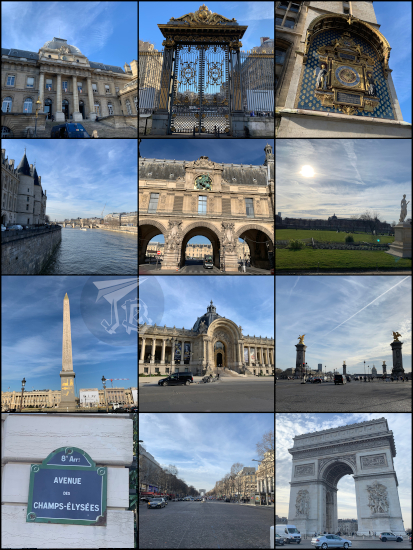
The weather was great – especially considering February in Paris, which is always more to the north than I mentally place it. Unfortunately, the forecast for the following day was quite miserable, and thus I decided to just walk along from the Île de la Cité towards the Arc de Triomphe (some 5 km away). On my way, I walked by the Louvre, Les Tulleries, the Grand Palais, the Petit Palais, the Alexander III Bridge, and into the Avenue des Champs-Élysées – the Banks of the Seine that the Unesco declared World Heritage.

Collage with different landmarks of Paris - the river, neoclassic palaces, Luxor obelisk, Champs-Élysées.

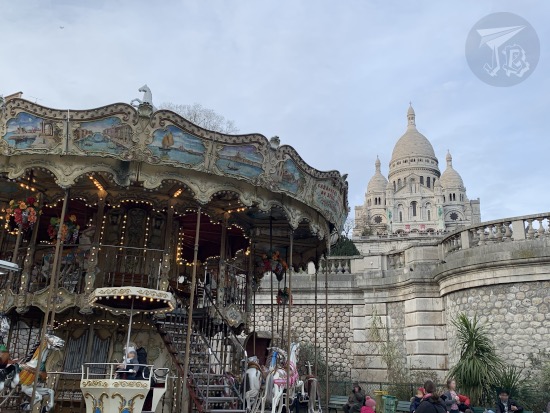
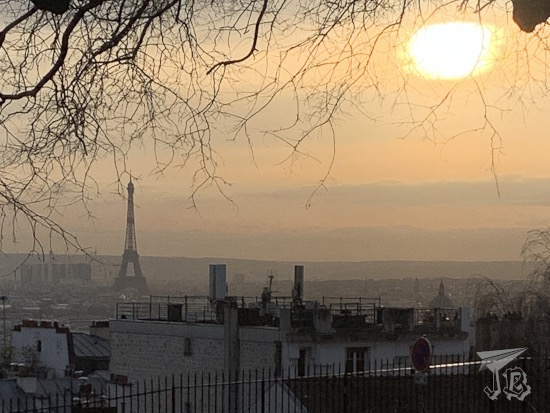
Finally I reached the Arc de Triomphe, which honours the fallen in the French Revolutionary and Napoleonic Wars. It was commissioned by Emperor Napoleon in 1806, and completed in 1836, and you can actually climb it, which I might do some day. From there, I took a train towards Montmartre, where I had booked my hotel. I dropped off my luggage and walked up Square Louise Michel, a sort of urban park which leads up to the church Basilique du Sacré-Cœur (222 steps). There was a pretty carousel Carrousel de Saint-Pierre, and from the square, I could watch the Eiffel Tower Tour Eiffel against the sunset from the lookout Vue de Paris.

A view of the Sacre Coeur with a classical carousel in front of it

A profile of the Eiffel Tower in a blurry sunset in orange tones

I went back to the hotel for a while during twilight. On the way, I bought a snack in a nearby supermarket for dinner as I waited for the evening to get dark and the lights to come up. When it did, I took my last adventure for the day, and walked off to see the Moulin Rouge while I listened to KAMIJO’s song of the same name. It was a few minutes’ walk away from my hotel, and Moulin Rouge [ムーランルージュ] is one of my favourite songs of his. Since the man is obsessed with France, he has a few songs that fit my weekend. Truth be told, I did consider dinner and a show there, it is after all the most famous cabaret in the world. However, it was a bit expensive and I had read quite a few reviews about bad seats if you are alone. I did not want to waste money, and I did not know how tired I would be that evening in the end – and to be brutally honest,I really had not felt like packing fancy clothes for the evening.

The Moulin Rouge cabaret, all lit up in bright red for the night

8th February 2020: Louvre and DIR EN GREY

The weather forecast was accurate, and despite the lovely weather on Friday, Saturday dawned stormy and dark. I decided to go to the Louvre Museum Musée du Louvre, even if I had been there before. It is after all one of the greatest museums in the world.

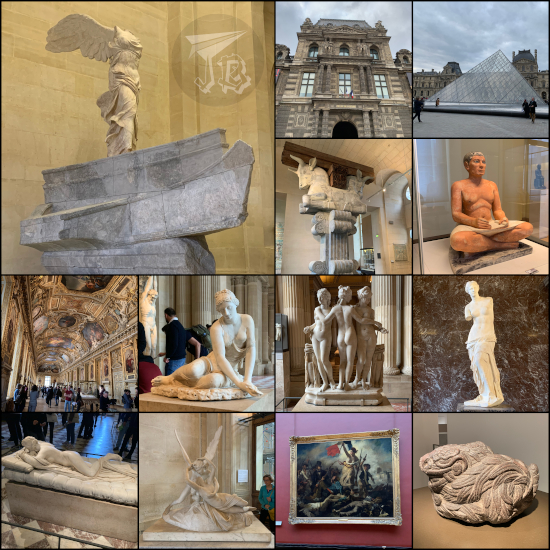
The Louvre holds so many pieces (over 600,000) that it would be impossible to describe them all, but for me, its core is the Winged Victory of Samothrace, a Greek sculpture from the Hellenistic period, around the 2nd century BCE, and my favourite piece of art. The Louvre is a national art museum, which opened in the post-revolutionary France in 1793. It exhibits around 35,000 items – Egyptian antiquities, Sumer and Assyrian pieces, Greek, Etruscan and Roman items, Islamic art, neoclassical and Baroque sculptures, a collection of objets d’art (Decorative arts), paintings, prints, drawings… It is located in the former French Royal Palace of the same name.

A collage with several Louvre pieces of art - Winged Victory, sitting scribe, the three graces, Diane washing her hair, Hermaphroditus sleeping, Psyche and Eros kissing, Liberty guiding the people, Venus de Milo

I wandered there for a few hours and I might have lost my way in the galleries a few times. In the end, I managed to (re)visit all the artefacts and artworks that I wanted. Because there are hundreds of thousands of items, but I must always see the Sitting Scribe, the Borghese Hermaphroditus, Canovas’ Eros and Psyche, and the remains of the Gates of Istar. I had a bit of a headache, so I eventually went back to the hotel to get some rest and prepare for the DIR EN GREY concert and VIP experience in the Élysée Montmartre live house. DIR EN GREY or “Diru” is a Japanese heavy metal band known for its dark themes and scenography that I thought I needed to check at least once (the final verdict was that I don’t need to repeat the experience, but it made for a nice mental break). The band has remained stable since its formation in 1997, and it is composed by Kyo [京] (lead vocals), Kaoru [薫] (rhythm guitar, backing vocals), Die (lead guitar, backing vocals), Shinya (drums) and Toshiya (bass, backing vocals).

A dark stage with a drum set. Letters projected on the screen behind the stage read Dir en Grey Tour 20 This Way to Self-Destruction

Setlist:

    1. 絶縁体 [Zetsuentai]
    2. 人間を被る [Ningen wo Kaburu]
    3. Rubbish Heap
    4. Devote My Life
    5. 軽蔑と始まり [Keibetsu to Hajimari]
    6. Celebrate Empty Howls
    7. 赫 [Aka]
    8. Merciless Cult
    9. Downfall
    10. Values of Madness
    11. 谿壑の欲 [Keigaku no Yoku]
    12. Ranunculus
    13. The World of Mercy
First encore:
    14. Followers
    15. THE DEEPER VILENESS
    16. 詩踏み [Utafumi]
Second encore:
    17. Sustain the untruth

Listing of all the concerts in the Dir en Grey 2020 tour

The concert was the final of DIRU’s 2020 European Tour TOUR20: This way to Self-Destruction. When I walked by the venue on Friday evening, around 18:00, there was a small number of people queueing already. I did not care enough to queue all day, and I had a VIP ticket with early entry, so I just headed to the line about 15:00. When the queues were separated and organised, around 16:30, I was VIP number 42. The weather was miserable, and I could have totally skipped the downpour while waiting, but I was lucky enough to be against the live house and not in the middle of the boulevard, where the General Admittance queue was. Doors opened at 19:30 for GA, and the VIP experience was held beforehand. The VIP queue started getting in around 17:30. As present we got a VIP pass and an “exclusive VIP only merchandise item” which turned out to be a scarf – very appropriate with the weather. The experience itself was a group photo with the band. There were five cushioned chairs for the fans, and the band stood behind. They did not say a word, nor interacted with fans in any way, not even acknowledging a hello or a thank you.

Afterwards, I headed for the hall, and I found an almost-barrier spot in the left area, on the second row. The people in front of me let me grab the barrier between them so I had something to hold on while I waited. The special guest was a DJ, who was more focused on getting recorded by his buddy on the phone than mixing music. The main show started a little after 20:30.

DIR EN GREY’s music is quite powerful, with a heavy focus on strings and drums. They also have a huge flare for theatricality and they enjoy the shock factor as part of the aesthetics. The singer, Kyo, donned a Joker-like make-up appearance, with a fake-suicidal attitude on stage, using the microphone to mimic stabbing his chest, or the wires to hang himself. It became a bit disturbing because it was repeated more than once. The act also felt rather distanced, there was very little interaction with the fans. At some point, a pick flew in my direction and the person behind me actually felt me up to try and find it in the folds of the coat I had tied around my waist. That was probably even creepier than the act.

The guitars and bass were tremendously powerful, and the drumming was amazing. The crowd was extremely loud, and the singer, Kyo, later confessed that he had been pretty exhausted and burnt out from the tour, which maybe explained why the concert felt so distanced. The encores were the probably best part of the concert, the part that felt more real and relaxed. After the concert was over, I headed off to the hotel to catch some sleep. Since I remembered that the area had felt a bit rough when I was there in 2014, this time over I wanted close accommodation so I could get back quickly without needing to use the underground.

9th February 2020: Destroy the Bastille!

Sunday morning was around 2 ºC, and it was windy. I lingered in bed for a while to recover from the previous evening, and then I headed out – I should have brought the merchandise-scarf with me! I saw the Place de la Bastille, where the revolutionary prison used to stand. In the middle of the square stands the “July column” Colonne de Juillet, which commemorates the Revolution of 1830 (which is not the “famous” French Revolution, which happened between 1789 and 1799). A few minutes away, in the Square Henri-Galli, I came across the base of the tower Tour de la Liberté (Freedom Tower), which was unearthed while building the first metro line. There are only a few stones remaining from the foundations, but I’ll take my fun wherever I can – so I stopped and used my music player to find another KAMIJO song, Bastille, just because I could.

Monument to the French Revolution

A few brick stones forming a circle, considered the last remains of the Bastille

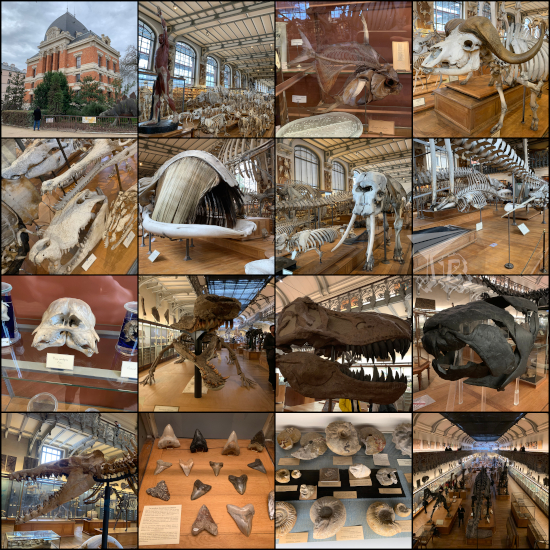
It was too cold to wander, but I had a great plan. I headed off to the science museum Galerie de Paléontologie et d’Anatomie comparée (Palaeontology and Comparative Anatomy Gallery), which was a short walk away. I had read about it and was curious. To be honest, I’m still trying to decide whether it was amazing, or the materials nightmares are made of.

The museum was founded in the 19th century, and it keeps the atmosphere – and the charm – of the old exhibitions. There are stands and wooden cases, and the smell of dust and old paper. The first floor holds a “Cavalcade of Skeletons” – the whole floor is occupied by preserved skeletons of mammals and birds. In the glass cases along the walls, there are taxidermy specimens, preserved animals and dissected specimens. In the far corner, there is “gallery of monsters” with natural oddities. It was enchanting, but at the same time deeply disturbing – especially the male human figure displaying muscles and blood vessels, with a vine leaf on his groin.

The second floor hosts the dinosaurs and other fossils, including a very cool toothed whale, giant crocodiles, a Bernissart iguanodon, a diplodocus, shark teeth… Most of the fossils are either casts or reconstructions – I swear I’ve seen that Irish elk at least three times before. Also, the T-Rex skull was adorably flawed, as it was imagined to be in the 19th century.

The third floor is… ammonite-land. There were cases upon cases of ammonites in different shapes, colours, rocks and materials.

Shots of the museum. Skeletons of animals - fish, oxen, crocodiles, elephants, whale. Fossils: Dinosaurs, fish, toothed whale, shark teeth, snails

After I was done with the museum, I decided it was too cold to wander the neighbouring Botanical Garden. Instead, I headed off to yet another one, the Musée national des arts asiatiques Guimet – the National Museum of Eastern Arts or Museum Guimet, which holds pieces of art from Cambodia, India, China, Japan, Korea and so on. There was a gorgeous dancing Shiva sculpture, collections of religious artefacts, calligraphy, samurai armours, even modern art and clothes inspired by the Far East. It was a really cool museum I had recently found about and was happy to visit.

Different pieces in the museum: Dancing Shiva, sitting Buddha, Calligraphy in the shape of a dragon, elaborate kimono, samurai armour, Indian goddess

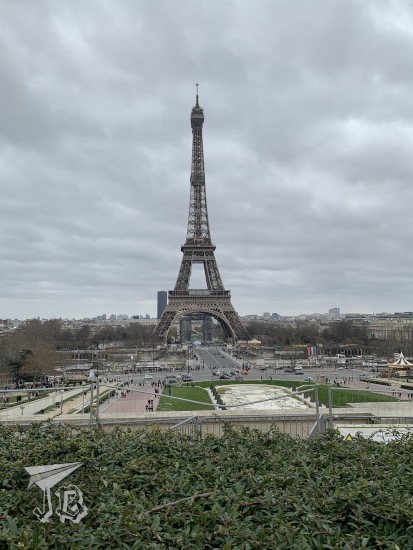
After leaving the museum, I walked towards Trocadero to take the underground. I made a small detour to have a look at the Eiffel Tower Tour Eiffel, and saw a bunch of peddlers playing shell games with tourists. Someone lost about 400 €, I really hope they were in on the game.

The Eiffel Tower in front of a cloudy sky

Since it was too cold to continue walking around to find something to eat, I decided to get take-out, and I headed back to the hotel to get ready for the BABYMETAL concert. I had never listened to them before, but they are a sensation, the basic ticket was not expensive, and two concerts in as many days seemed convenient. They actually played in the same venue as DIR EN GREY on Saturday, so I found out by sheer coincidence on the live house’s website. At that time, I thought “why the hell not?”. Afterwards, they added Madrid to their Europe tour, so if I had known that beforehand, I might have acted differently. BABYMETAL is one of those insanely-profitable Japanese marketing stunts involving cute girls that had never really been in my radar more than in passing.

Notice with the date of Babymetal's concert

BABYMETAL is a product of the “Japanese idol factory”. It was created artificially to fill a market gap. Three girls were chosen to form an act that would mix the idealised cute idea of girl idols with the heavy metal genre. When they debuted in 2010, the term “Kawaii Metal” was coined. One of the girls left in 2018, so there are two main members and and support dancer on rotation. The members are Nakamoto Suzuka, “Su-metal”, the main vocalist, and Kikuchi Moa aka “Moametal” on back-up vocals and screams. The supporting musicians are called the “Kami Band”.

BABYMETAL’s long-awaited European tour is officially called Metal Galaxy World Tour. The VIP tickets sold for around 170€, and did not even entail a M&G, so even if I had had the chance, I would have not even considered them. Despite that, they sold out, along with the show itself.

When I left the hotel at 9:00, the queue had started organising, and the tour buses were already there. I had no intention to queue or try for a barrier. I had decided to sit back and relax, so I reached the venue around 18:45 for the 19:30 concert. There were tons of people waiting to buy merchandise, but I was good. Thus, I just headed to the floor, and found a spot in the back. Since the venue has sort a bit of an arena and some upper stands, there was a wall I could lean against and it was not the end of the room.

The crowd was quite different from DIRU’s, ranging from good ol’ metalheads to families with little girls between five and ten years old with a bizarre range of in-between: people with fox masks, goth and loli dresses, explicit heavy-metal t-shirts (a bunch of those T-shirts were much less kid-friendly than the show… everything you could imagine. I… don’t think most parents knew what they were getting into, and a few of the kids ended up crying.

At 19:30 sharp, the support act started – a German band called SKYND. Their sound was really good, but their lyrics are based on true crime, which makes them a bit on the disturbing side (and very much not kid-friendly). The name of the songs are all serial killers or similar criminals.

Setlist:

    1. Richard Ramirez
    2. Elisa Lam
    3. Katherine Knight
    4. Jim Jones
    5. Tyler Hadley
    6. Gary Heidnik

At 20:30, the BABYMETAL show kicked off with the projection of the Future Metal video as an introduction of sorts. The musical act relied heavily on the Kami Band, and Su-metal carried the weight of the vocals. She spent the whole one-hour concert jumping and dancing while singing, and her voice did not break even once. If she is not lip-synching, she has the most impressive lungs ever. Both she and Moametal encouraged the crowd, making a lot of eye-contact. Su-metal addressed the audience a lot, even – I think – trying French. The concert was non-stop, and it ended up feeling a bit short, but much better than I had expected. The one annoying thing were the daddies putting their babes up on their shoulders in the middle of the floor, when the kids gave clear signs of not caring or were distressed. But it was fun. Not sure I would repeat unless I made it a thing with friends or something, but I enjoyed the act, and had a good time.

Setlist:

    1. DA DA DANCE
    2. Gimme Chocolate!!
    3. Shanti Shanti Shanti
    4. BxMxC
    5. Kagerou
    6. Oh! MAJINAI
    7. メギツネ [Megitsune]
    8. PA PA YA!!
    9. Distortion
    10. KARATE
    11. Headbangeeeeerrrrr!!!!!
    12. Road of Resistance

A group of girls dressed in black dancing in front of a logo that reads Babymetal

I was back at the hotel before 22:00. Thus, I got a good night’s sleep before I left, once again happy that I had taken nearby accommodation.

10th February 2020: No bells of Notre Dame

My plane boarded at 10:00 so I had to leave early for the airport. The weather was rainy again, so I took the underground to Gare du Nord, and then the train to Orly. As I was riding the train, I had a nice view of the Paris at dawn, but the bells of Notre Dame were not tolling, and my inner child was sad about that. Despite issues with the airport security staff, the stupidly-expensive food, and the general unpleasantness of early-morning public transportation, I made it to my plane without actual problems. As it was a big plane again, I settled down to watch Jurassic World during the flight, because I’m a nerd. Going straight into work from the airport was not fun, but it a small price to pay

I only had three days, but this trip was a very welcome getaway, and even if the weather did not help, I got to do a lot of stuff. I had to discard a few plans and improvise due to the weather. However, there is that film quote, “We’ll always have Paris”. After all, I’ll be coming back for the Saint Seiya Symphonic Adventure. ETA: Or so I thought, at the time of writing the article…

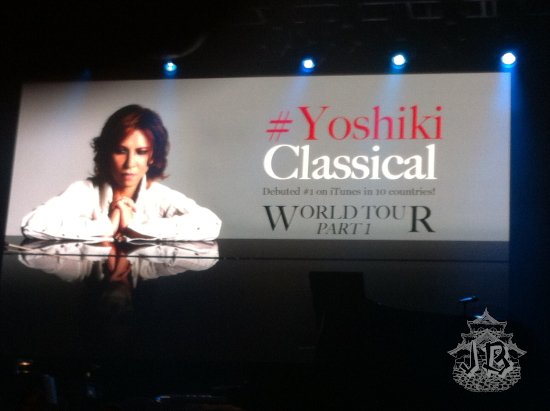
24th – 26th May 2014: Paris (France) for Yoshiki Classical

24th May 2014: Evening in Montmartre

I was going to atted Yoshiki Classical concert in Paris on Sunday, so I made planes with a a friend to meet up with her over the weekedn so we could do some stuff together. We booked a hotel close to the venue, Le Triannon. I arrived in Paris in the evening of Friday the 24th and met my friend direcly at the hotel – the first thing we noticed was that the area was not the safest, but we could still get to the Basilique du Sacré-Cœur to see it lit.

Sacre Coeur, a basilica on top of a mountain, lit in gentle green light at night

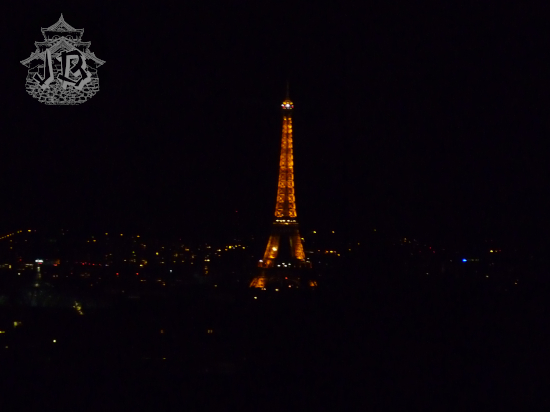
And also to see a nice view of the Eiffel Tower all lit up.

A shot of the Eiffel Tower from afar, lit reddish orange

25th May 2014: Under ground, above ground

On Saturday morning we went to Catacombes de Paris, the Catacombs of Paris. The ancient quarries and mines of Paris became the final resting place of more than six million people. In the late 18th century it was decided to eliminate a good portion of the quickly-overcrowding cemeteries and graveyads of Paris and for a 1786 the bones were carried to the catacombs at night. Today they are consisdered a museum and thus managed as such.

Creepy catacombs of Paris, with thousands of human skulls and other remains

After the catacombs we moved onto the Ille de la Cité, the “island of the city”, an island in the middle of the Seine, to visit Notre-Dame de Paris, our Lady of Paris, a magnificent Gothic cathedral built in between 1160 and 1260. In the 19th century an extensive renovation was carried out, and a few features were added, such as a the gargoyles and a replacement spire for the original one. We climbed the towers and were treated to a really cool Paris view before going inside.

Collage of Notre Dame; the main façade, the gargoyles, the inside of the main navev, and a view of Paris from the top

Leaving Notre Dame, we headed our the Île de la Cité and passed by Saint Germain l’Auzeroix, which mostly dates from the 15th Century and used to be the church for the Louvre inhabitants.

A restored gothic church with an octogonal tower

At the Louvre, by the way, there was a humongous queue, so as both of us had seen it before, we decided to skip going inside.

The Louvre palace from the outside

We passed by the Luxor Obelisk, an Egyptian monument which is over 3000 years old, located in the Place de la Concorde. I’ve always found that name very ironic considering that many people were guillotined there. But hey, the obelisk is cool and all.

A black Egyptian obelisk with golden decoration

We continued walking up the Champs-Élysées until we got to the Arc de Triomphe de l’Étoile (the “Triumphal Arch of the Star”. Okay Paris. Okay.), which is one of the biggest triumphal arcs in the world. It was completed in 1840 and it honours the casualties in the Revolutionary and Napoleonic Wars.

Commemorative gateway or triumphal arch in white stone

From there we took the underground back to the area of the Sacré-Cœur, which we could see at the end of the streets.

Sacre Coeur peering at the end of a street

And to finish the day, we had some Japanese food because why wouldn’t we?

26th May 2014: Bad weather, queue & Yoshiki

On Sunday, we started off back in the Île de la Cité and we walked around Notre Dame on our way as my friend wanted a walk along the Seine.

The back gardens of Notre Dame

We took the underground towards Les Invalides (Hôtel national des Invalides or The National Residence of the Invalids), a complex of buildings erected between the 17th and 18th centuries and that hosts the military museum and some notable graves, among them Napoleon’s.

Les invalides, a neoclassical palace with a golden dome

Afterwards we took the underground to Champ de Mars, the long park where the Eiffel Tower stands. The Tower was built as an entrance to the 1889 World’s Fair exhibition and it was controversial at first (and rather ugly if you ask me, but hey to each their own). Eventually, it became so famous that it was not taken down as originally planned, and to-date it is one of the most visited landmarks of the world.

Eiffel tower in the clouds

Eiffel Tower from underneath, with a tennis ball hanging in from the second floor

As you can see in the pictures, the weather might not have beent he nicest, but we made our best. We walked all through the Chaps to the Trocadero on the other side. There were very few people on the street so I convinced my friend to take a ride in the carrousel over there, because I’m insane like that. Soon after we had left, a group of random people decided to emulate us.

Classical caroussel, looking over the ears of one of the horses

After this, we said goodbye. I headed off to Le Triannon for Yoshiki Classical, and my friend towards the airport as she had work on Monday. Yoshiki is one of the most important figures in Japan’s musical scene. He is the leader of the iconic band X Japan, and also trained in classical music. He wrecked his health when he was young, though, so he is not in the best shape. His recital Yoshiki Classical was meant to be a reimagination of some songs of his career, just him and his piano and some invited artist. I have to admit that it was one of the most beautiful things I’ve ever been to, and I don’t regret attending one bit. Although this was my first concert alone, I didn’t feel strange in any way.

A concert venue with some people waiting

I don’t know what I was expecting, but this surpassed any and everything I could have thought of. Yoshiki is a wonderful human, and he spoke in English during the whole event – he is living in America now, collaborating with people like Stan Lee and Marilyn Manson to do more great stuff. For me, seeing him in person and playing his piano was a heart-bursting experience.

Yoshiki Classical Banner

Although Le Trianon is a seated venue, tickets were not numbered. I arrived at the queue round 17:00 for a 19:30 concert. It was not a good line – French fans seemed to have no sense of personal space, and the person behind the person behind me was invading my space, and I’m not exaggerating.

Conversely, the venue was quite ready for us, entry was well organised and smooth. Theatre staff, speaking in French and Japanese, made sure that ticket holders did not bother the local commerce nor their patrons. Judging by the faces of the sellers around, they were not used to people queuing for the theatre.

Gates opened around 18:45, and I managed a seat on 7th row, in what I thought it would be a good position to actually see Yoshiki’s face as he played. The stage was equipped with the Kawai piano, a synthesiser, and the seats for the strings, along with a standing microphone. I took in the relative positions of everything to chose my seat. The screen showed the Yoshiki Classical World Tour banner, and staff members sold insanely expensive glow sticks.

By 19:50 the audience had started to get nervous,but the members of the press were being shown in to their seats, which meant that the interviews were over. The concert finally started at 20.05, with the entrance of the supporting musicians – three violins, two violas, two cellos. The assistant gave them the tuning note and the video launched behind them. It started with a fragment of the Golden Globes museum interview, where Yoshiki explained the two sides of him, the destructiveness of heavy metal and the peace of classical music. This was illustrated by short clips of X Japan drumming and other activities, such as playing for the Emperor, or Yoshiki Symphonic, all to the music of Miracle.Finally, Yoshiki walked in, sat in front of the Kawai and played the intro of Forever Love.

He did quite a lot of talking between the songs, with a few words in French, but mostly English. He explained that we would have two parts (I used the intermission to go get goods and buy an overpriced bottle of water).Throughout the concert he introduced the strings by name, he remembered all of their names even with effort (and named them Yoshiki Sextet with great mischievousness), and Katie Fitzgerald, the vocalist of his Violet UK project. he himself said that he had too many open fronts and that he had been recording with X Japan forever, but also with Violet UK. He put the blame on himself for being a perfectionist and thus never finding anything finish-worthy. Katie rolled her eyes at him. They seemed to have a good chemistry going on. At the very beginning he told us that he was used to being in the back of concerts, playing drums and that being so close and seeing us made him nervous. He joked that as it was a classical concert he would not stage dive.

As he played the piano the screen behind him projected images, some of them abstract, some of them related to the song, such as roses for Rosa, stills of the Saint Seiya film for Hero, or raindrops for Endless Rain.

He spoke about the history of X Japan and his own – he started playing piano when he was four, the same year he met ToshI. He picked up drums at ten, in Chiba. He reminisced about how he hunted down Pata, Taiji and Hide, ”having to break their bands to get them to come to his band”. Then he spoke of Taiji’s and Hide’s passings, and not talking to ToshI for about ten years. At this point he broke down. It makes one wonder about the kind of pain this man harbours in his soul. You could feel the rage as he pounded into the piano at some points, and yes, I am sure he was crying during the song he dedicated to his father, Taiji and Hide. He said that he had learnt that big venues and stadiums did not really mean anything, but that the support of the fans was what kept him going.

He played an improvisation of Tchaikovsky’s Swan Lake, and a song he had heard on the radio the day before. He confessed that being on tour he lost track of days and places. He was aware of time and space enough to announce that the upcoming October concert in the Madison Square Garden may be the start of a new X Japan tour, but I do not think any of us believed him.

All in all, I knew that he is a great pianist, musician and artist, and after the concert I am completely sure that he is a good person, too. It’s not an act, a persona that he created for the stage. Nobody is that good at feigning pain. He picked up a bunch of presents from the crowd on the first couple of rows himself, be it flowers, plushies, flags, and was thankful for all of them.

Setlist:
1. Miracle (during the video)
2. Forever Love (X Japan)
3. Golden Globe Theme
4. Rosa (Violet UK)
5. Anniversary
[Intermission]
6. Amethyst (Strings only)
7. Swan Lake Improvisation (Tchaikovsky)
8. Hero
9. I.V. (X Japan), fragment
10. Hymne à l’amour (Édith Piaf cover)
11. Without You (X Japan)
12. Kurenai (X Japan), fragment
13. Art of Life (X Japan)
14. Endless Rain (X Japan)

Yoshiki talking to his audience

Yoshiki and Katie Fitzgerald during Hero

After the concert, I went back to the hotel. I would have loved to stay a bit longer, but it was night already and the area did not feel… Nice. In the following morning, Monday the 27th, I just headed for the airport and came back home. It was a very complete weekend!