20th October 2024: Heroes Comic Con & Art Nouveau in Brussels and the Medieval Centre of Bruges {Belgium October 2024}

Just before going to bed to grab a couple of hours’ sleep on the 19th, I did a last check that I had everything ready, and I realised that my parking reservation at the airport had not been processed. It is a good thing that being an Aena member, the price had not gone up outrageously from when I had done it the first time a few months back. I have no idea why it did not work the first time, but I am glad I caught it before I left, because non-reserved parking is three times as much.

I did sleep for a few hours and the alarm clock went off around 3:00 for my 6:20 flight. The drive was uneventful, I found an awesome parking spot, and I had the bus just for myself after a minute of waiting. Security was fast, and it was weird to be in the Schengen side of the terminal for a Ryanair flight. I got on the plane and got some sleep. We landed in Brussels [Bruxelles (French) | Brussel (Dutch)], Belgium [Belgique | België] early, but deplaning took a while. Once outside, I followed the signs for the train and there was one there already. I settled until I got to Brussels Central station, where I bought a coffee, a drink, and a sandwich. I then walked towards the underground station – the coffee was gone even before I was there.

I knew I was in the correct underground line when I started seeing cosplayers and kiddos with superhero merchandise along with their resigned parents. My backpack was not heavy, but I was glad to have a seat both on the train and the underground. I reached the area of Brussels Expo a few minutes before the convention Heroes Comic Con opened for general admission. There was a queue, but instead of getting in line, I walked up to the nearby Atomium.

The Atomium was built as the centrepiece of the Brussels Expo’58. It is credited to architects André Polak and Jean Polak from a project by civil engineer André Waterkeyn. It was designed as a homage to scientific advance, especially nuclear physics, and thus resembles an atom or a molecule. It is 102 metres high, and it comprises nine spheres with a diameter of 18 metres each, joined by tubes and escalators. The Atomium was not designed to survive the Expo it was built for, though. In the mid 2000s, it had to be renovated, and a lot of the original aluminium was replaced by stainless steel.

Brussels Atomium

I contemplated going up the building. However, when I looked at the time, I realised that if I went in, I would be able to get into the first of Misha Collin’s photo shoots. When I decided to buy the tickets, I only bought one picture in the afternoon, because I was not sure what time I would make it to the convention, considering the plane, the train and the underground. But I was there on time so I used my phone to buy an extra ticket for the photo shoot in which Collins would be wearing the outfit from Supernatural’s character Castiel. This also gave me the chance to get the photograph signed during the time between photo shoots. Furthermore, I was still within budget – because I had decided to indulge myself with the money I had originally set aside for a balloon ride in Cappadocia.

I walked into Brussels Expo. The exhibit was huge, but I had a map downloaded on the phone. I was a bit confused when doing my original research, because it turns out that there were actually three conventions going on at the same time – Heroes Comic Con, Made In Asia and Gameforce. However, once there, it was easy to get around. Heroes Comic Con is “a big feast dedicated to pop culture”, so basically a one-size-fits-all big merchandise fair with graphic artists, cosplayers, the whole nine yards, nothing too different from Paris Fan Festival. Heroes Comic Con’s biggest selling point, however, was having invited a number of popular actors – along Misha Collins (real name Dmitri Tippens Krushnic, for the record), other guests were Bob Morley, Eliza Taylor, Ian Somerhalder and Paul Wesley. Some of them… rang a bell. I might even have seen a few of them somewhere – I must have, because I did watch the newer Star Trek. However, I find it great that they had a large following and there were queues for them.

I followed my map towards the photo booths, where they checked my ticket and gave me a bright-coloured chip – they give you a chip per ticket, as you can have two people in one photograph. I was on my own, so no problems there. I actually got two photographs out of the first shoot – so I’ve got three though I paid for two, yay me. I had brought a customised jacket with a pair of angel wings, and the goal was to have them in the photographs, so I would be facing Misha but looking over my shoulder. The first photograph did work out too well, so Misha called me back for a re-shoot. He was very friendly, and much more approachable than my usual Japanese artists. Either that or I was less strung up. The pictures were printed on-site, so I took mine to the autographs area to wait. I had bought an official book beforehand – the lightest thing I had found, to be honest – in case I could not get a photograph signed, but since I this had worked out so well, I had our recent picture – and in the character outfit – to be signed.

Since I had been towards the end of the photograph queue, I did not have to wait long for Misha to come. A staff took my name on a post-it note and attached it to the photograph. When it was your turn, you paid for the autograph (I decided not to get a selfie, because I still had another photograph bought), and I told him about the pure chance I was there. He was “glad I could make it”. As I said, nice and approachable.

By the time I was out of the autograph area it was around 11:40. I decided to wander around. I gravitated towards Made in Asia, and was very strong reminding myself I wanted to keep my luggage light and not pay for any extra. Thus, I managed not to buy anything despite finding a bunch of Saint Seiya merchandise – which I now regret, but that’s FOMO speaking. I had a chuckle or two out of young people complaining about the official good stuff being “too expensive” when I found the shops cheaper than the stands I see in the Spanish counterparts.

Brussels Hero Comic Con

I returned to the photo booth for the second photograph, and I thanked Misha for the chance – I look silly in the picture, but that’s okay. It was great. There was a Q&A with Collins an hour or so later, but I decided to forego that and leave the convention. If I stayed, I would have no time to do anything in Brussels that day. I also wanted to keep on the move because else my body would remember how little slept it had gotten, and I would crash. Thus, I bought an online Art Nouveau pass, and I left the convention.

Brussels’ Art Nouveau Pass is 20 € and it covers entry to three museums, historical places, or exhibitions in a long list, all of them related to – obviously – Art Nouveau. The pass can be value for money even if you only visit two of the “big ones”. Since the pass is valid for nine months, I might be able to use it for a third time in the near future. The original idea was to buy one from the beginning and hit the Comic Museum, the Horta Museum and the Solvay House – things I had not had the time to visit the previous time because in the end I spent a lot of time walking to different spots (read: the Natural History Museum). However, the Solvay House was under renovation, and the Horta Museum was a bit out of the way, so I ended up being flexible

I rode back to Central Station and walked out towards the Cathedral of St. Michael and St. Gudula Cathédrale des Saints Michel et Gudule | Kathedraal van Sint-Michiel en Sint-Goedele, which was beautiful in the flurry of autumn leaves. It was cold, so I hastened towards the Comics Art Museum Musée de la Bande Dessinée | Stripmuseum (Belgian Comic Strip Center). The museum is located in the former textile store Magasins Waucquez, an early 1900s commercial building designed by architect Victor Horta. Horta is considered one of the founders Art Nouveau, with his use of curved forms and use of steel, skylights and open floor plans with abundant decoration.

Brussels cathedral

After the department store closed in the 1970s, the building was listed as a historical site, and it was bought by the Belgian Government to be used in the promotion of comic strips. The museum itself was founded in 1984 as a non-profit, and it opened in 1989. It runs a new permanent exhibition on the history of comics in Belgium and Europe (free from the American Comics Code Authority and censorship – I mention this because I had tickets for a Marvel exhibition the following month, and the CCA had a lot of impact in the development of American comics). The person at reception told me to watch out for a very first-print Tintin which had been recently added to the exhibit. There are items and print issues related to most of the great Belgian comic artists – there were a lot of things I had never even heard about. I found a big lack of Morris’ Lucky Luke though.
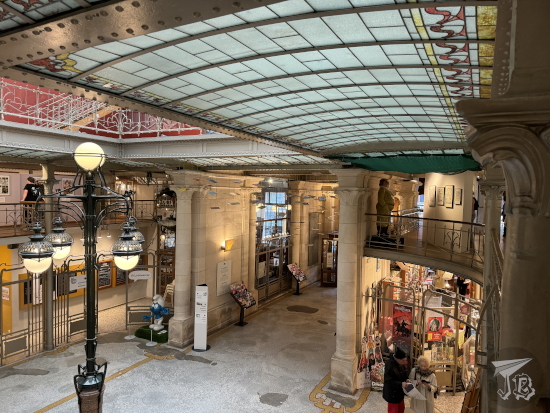
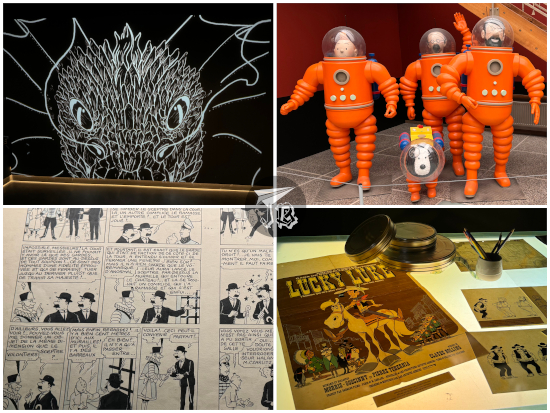
Comics Art Museum Brussels

Comics Art Museum Brussels

Something I had decided to do in this trip was trying the typical foods, so once out of the museum I headed towards the central square Grand-Place | Grote Markt and Manneken Pis, which was not wearing any costume this time around, even if Brussels is still under a lot of construction (when I saw it in 2023, it was wearing a reflective jacket). I remembered that there were a lot of places that sold local street food – I don’t tend to be much of a foodie, especially with street food or fish. I figured out that Belgium could be a safe place to experiment without risking an upset stomach.
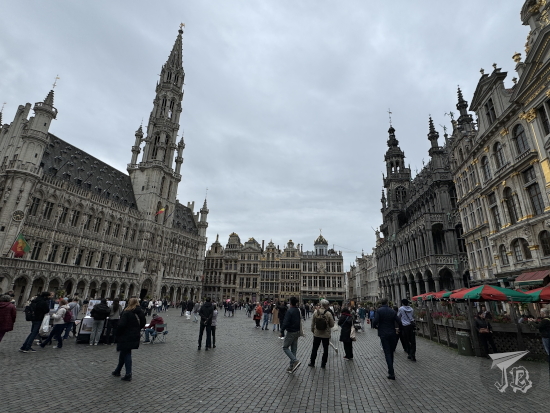
Brussels Grand Place

Manekken Pis

Thus I got some frites, Belgian fries, at a chain called La Friterie. I had seen a few of the establishments with queues outside, so when this one was almost empty, I jumped at the chance. Belgian fries are sourced from local potatoes and cooked in two goes, traditionally in beef fat. I got them with just salt, and they were really good. And warm. That was a great point.

Belgian Frites

It was around 17:00 by this time, and things had started to close down. I headed off towards the station to take a train to Bruges [Bruges | Brugge], in the north west area of West Flanders. The historic city centre is a Unesco World Heritage Site – Historic Centre of Brugge – and it is criss-crossed with canals. The area has been inhabited since Prehistory, but its importance peaked during the Middle Ages, between the 12th and 15th centuries. It became a commercial hub due to its strategic location between Flanders and France, though it later opened to other countries, like the Portuguese. The first stock exchange in the world probably opened there in 1309.

The Medieval architecture and brick Gothic constructions are exceptionally well preserved, including the pattern of streets intertwined with waterways. I was curious about northern Europe canals, which was one of the reasons why I chose the city. The other one was that it is a city to walk and see from the outside, which was great for a Monday morning. Unless it’s raining and about 7 ºC colder than cool – I had prepared for 13 – 17 ºC and drizzle, and got 9 – 13 ºC and rain. Whoops.

I bought some snacks at the station and went down to the platform. The train was late. I knew it was late, and I knew when it was expected, because the board told me. It was refreshing, considering the uncertainty around Madrid’s trains this last couple of years. I had booked a hotel close to the railway station, and I got there around 19:00. It was quite a basic place, with a toilet, and a shower closed off, and a washbasin column in the middle to separate the wet area from the bed area. Functional, and all right. The heating worked and they spoke English, so all good.

I did not rest for long. I ate the snacks, grabbed my umbrella and an extra layer of clothing, and headed out. It was dark outside already, and I hoped to get to see the city centre lit up for the night. My first stop was the Church of Our Lady Onze-Lieve-Vrouwekerk. Mostly built between the 13th and the 15th centuries, it is one of the highest Gothic brick structures in the world.

Our Lady, Bruges

Then I headed towards Saint Salvator’s Cathedral Sint-Salvatorskathedraal, a curious mixture of neo-Romanesque and neo-Gothic, with a bell tower that looks more like a defence tower than anything religious. This tower, however, was the result of a 19th-century modification of the original tower. Of course, both churches were closed at this time, but they would open the next morning.

Bruges cathedral

I continued towards the Market Square Grote Markt, featuring the Gothic Provincial Court Provinciaal Hof, the Historium, and the Belfry of Bruges Belfort van Brugge. The Medieval bell tower is doubly World Heritage – it belongs to the Historical Centre Unesco site, but it is also key in the Unesco Belfries of Belgium and France serial property. And while it is not part of the Manual bell ringing intangible Cultural Heritage, Bruges takes a lot of pride in its carillon and its bell ringing. At the centre of the square stands the statue of Pieter de Coninck and Jan Breydel Pieter de Coninck en Jan Breydel, who participated in the Flemish resistance against the French King in 1302.

Bruges Grotemarkt

I also wanted to explore a large park I had seen on my way. It turned out to be two of them, Poertorenpark and Minnewaterpark – which later I found means “Lake of Love Park” – before it was too late in the evening. There I found the Gunpowder Tower Poertoren – built between 1398 and 1401 by Jan Van Oudenaarde, and used as gunpowder store for almost five centuries. Beyond it, the Lake of Love itself Minnewater, the Lovers’ Bridge Minnewaterbrug, “very romantic” stone bridge. I noticed the part about it being stone. It also yielded to a beautiful night view.

Bruges Love Lake park at night

I did not want to stay out too late. Thus, I crossed the Barge bridge Bargebrug to get back to the busy street area. Bargebrug is a modern construction, barely 20 years old, in bold red curves. On the other side there was a “reception area” in the same style, apparently a sort of bus station, and then there was the main road. Afterwards, I just headed back to the hotel and turned in for the day. I watched some TV, but to be honest, I had woken up before 3:00 am, so I zonked out rather quickly.

Bruges Love Lake park at night

27th & 28th April 2024: Paris & the Fan Festival (France)

27th April 2024: From the Fan Fest to Les Invalides

My grandmother used to say that nothing good happens before sunrise, and to be honest, when the alarm clock rang at 4:40 on Saturday, I was very tempted to believe so. However, there were planes to catch, and red-eye flights are called so for a reason. My sibling and I had tickets for Paris on a 7:25 flight, which required us to be at the airport with enough time to board ± 30 minutes in case we had to get to the Satellite Terminal. Since I started planning with time – back in January – I had booked a parking spot in the actual terminal parking lot, for just a couple quid more than the long-stay one, and I activated a service the airport has so your card is billed automatically when your licence plate is detected, for convenience.

We reached the terminal with plenty of time (± 30 minutes) but recent problems with French air controllers going on strike, I was anything but calm. However, we took off on time and I just huddled off to nap. Arrival in Orly was early, and we did not taxi much, nor need buses. We just stepped off at the gate, and headed towards the Orlyval. We bought a Paris Visit card each, in order to be able to ride the public transport system as much as we needed for the weekend, and hopped on the shuttle. After a couple of transfers and a short walk, we arrived at the exhibition centre Paris Expo Porte de Versailles, where Paris Fan Festival took place.

Paris Fan Festival is a yearly convention that focuses on everything geek / nerd / niche, whatever you want to call it: video games (and retro video games), Star Wars, TV series, Ghostbusters, manga, comics, K-pop, there’s something just for everyone. I think it’s a bit of what Japan Weekend aims to be, but openly. It felt a little like that Funko slogan “Everyone is a fan of something”.

My reason to be there was European comic, actually. Authors (and married couple) Stjepan Šejić and Linda Lukšić Šejić, whom I’ve been following for a few years now, were in attendance. Stjepan Šejić has worked for DC in works such as Aquaman, Harley Quinn, and Suicide Squad, but he has gone independent, focusing on his own content creation. So has Linda Šejić, who started off at Image Comics and currently works on her own web comics. I’m currently buying his works Sunstone, Fine Print and my favourite Death Vigil, and her Blood Stain and Punderworld, the latter based on the Greek myth of Hades and Persephone. I also have the Aquaman hardcover that compiles all of Stjepan’s issues, and the Batman-character self-conclusive Harleen.
Of course, I wore an appropriate “Velocirapture” T-shirt to the event. The goal was to get an issue of each collection signed, and maybe a commission and some merch. In the end, we could only get a commission from Linda – we almost got one from Stjepan too, but things did not work too well on that front. I hope to get one next time they’re reachable – I actually wanted to go and meet him a while back, but I was in the middle of a weekend in Cuenca back in 2017.

Paris Fan Festival: Stjepan Šejić and Linda Lukšić Šejić

My sibling and I wandered through Paris Fan Festival for a few hours. We had something to eat at a Paul’s bakery, which I had discovered in Toulouse, and whose prices were not stupidly inflated by being inside the convention. Unfortunately though, I had followed the instructions of the venue and I was not carrying any water, and just a small backpack. I could’ve completely ignored the rules though, just like… most everybody else did. I did learn a valiable lesson though – when travelling to conventions for people, you buy tickets for both days. Just in case.

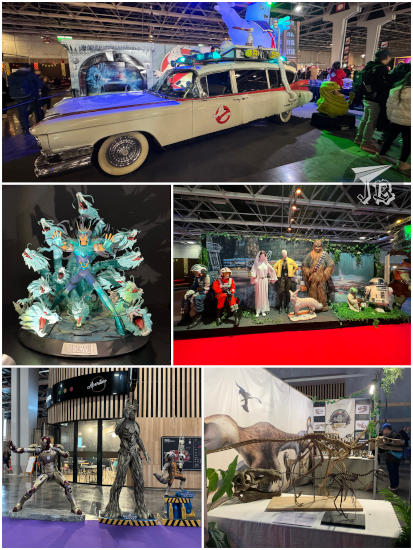
One of the most interesting vendors at Paris Fan Festival was the Lyon Cinema and Miniature Museum Musée Cinéma et Miniature, which had brought many sci-fi props from their permanent exhibition. They had the tip of a pyramid, a hieroglyph stone and a mask from the original Stargate film, ), a compsognathus animatronic, and the velociraptor claws from the Jurassic Park saga (), Loki’s mask from The Mask, a xenomorph head from Alien, suits from one of the older Batman films and Armageddon, prosthetics from X-Men

Samples of the Lyon Cinema and Miniature Museum at the Paris Fan Festival

As every other niche convention, were tons shops with merchandise, books and comics, not all of them legal. They held an exhibit of figures and statuettes. There were also a number of conferences – pity that the one about Jurassic Park was in French, too. Also, I discovered that France has a lot of “replica” culture – there was an actual “Imperial Army” (Star Wars), someone who had customised a car into the Ectomobile from Ghostbusters (2016), even people impersonating Tolkien’s orcs… It goes a little beyond cosplay… Supposedly, there was someone walking around with a dragon, but we did not run into them.

Paris Fan Festival snippets

Eventually, we left the convention to find our way to the hotel and drop the luggage, since comics are heavy, and Paris is on high alert and most places won’t let you through with backpacks. We wasted some time finding the hotel as it was raining cats and dogs – and they were remodelling, so the outer signal was not there. After check-in, we headed out again, and when we reached our next destination, it had literally stopped selling tickets – it was one hour and four minutes to closing time, and the recommended time is one hour and five minutes, so sadly, we could not get in.

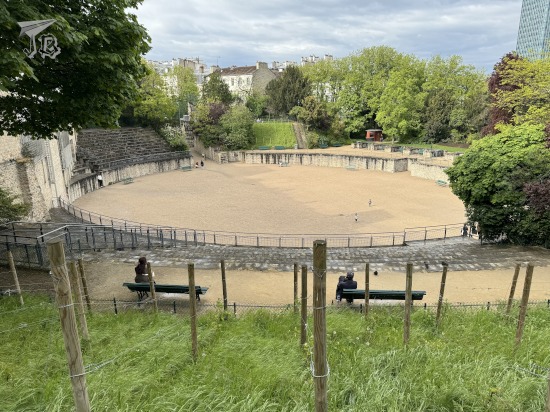
It was a bit disappointing, but we moved on towards Arènes de Lutèce. Lutetia (Lutèce) was the Latin name for Paris when it was part of the Roman Empire, and the amphitheatre is one of the most important remains from that period. Built during the first century CE, it would have seated 15,000 spectators. It was restored and open to the public at the end of the 19th century. Today, it is the centre of a park.

Lutetia Amphitheatre

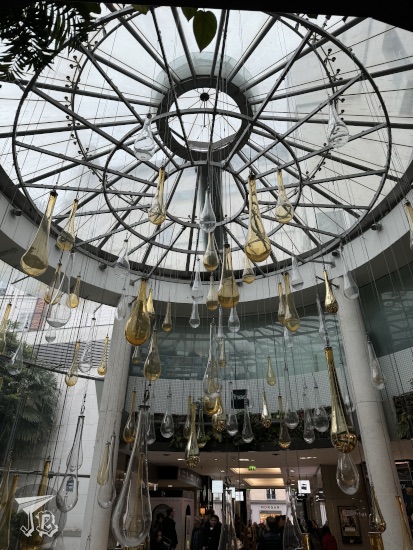
After that, we took the underground towards the high-end department store Galeries Lafayette Paris Haussmann. In 1894, two Parisian businessmen opened a shop that would eventually become the biggest department store chain in Europe. Through the following decades, the businessmen bought buildings around the shop in order to grow their emporium. In 1907, architect Georges Chedanne carried out the first main renovation in the Art Déco style, and Ferdinand Chanut completed it with a Neo-Byzantine dome, built in 1912. Today, the galleries focus heavily on luxury products, and not that we could afford any, but I wanted to see the dome.

When we arrived, we snooped around – it was packed, full with high-end tourists, mostly Asians. The brands selling their products were the most expensive ones – from Chanel to Cartier. As we were admiring the dome, we saw there was a glass walk hanging from the balcony on the htird floor. Of course, we had to investigate. It was around 17:30. We found the end of the queue, and saw that there was a QR to reserve a spot. I was able to book us in for 19:20 – surprising, considering it was the same day, and access is free – maybe it was a language barrier or something? I’m not going to complain.

There was a nearby gallery I also wanted to see, Passage du Havre, a typical Parisian shopping passage. It was less impressive than the Lafayette, but also surprisingly cosy – as my sibling put it “the other guys have Chanel, they’ve got Sephora”. It had some nice decoration and quite a different crowd. Furthermore, we had been up since 4:00, and ate quite early, so when we found a Pret a Manger, we decided to buy dinner there.

Passage Du Havre escalators

We went back to Galeries Lafayette for our “Glasswalk” experience, and it was really, really cool. The staff were also impressively friendly and we enjoyed ourselves immensely for the whole… five minutes of it. I really loved the dome.

Upper floor of the Galerie Lafayette

We finally headed off towards Napoleon’s tomb, the Dôme des Invalides in the complex Hôtel des Invalides. Hôtel des Invalids was originally commissioned by Louis XIV in 1670 as a hospital for disabled soldiers. The church-and-chapel complex was designed by Jules Hardouin-Mansart in several iterations from 1676 on. The complex is considered one of the most iconic examples of the French absolute monarchy Baroque style. When Napoleon’s remains were repatriated in 1840, a state funeral was held, and a mausoleum projected in the crypt under the Dome. Construction of the grave extended until 1861, when the former Emperor was finally entombed there.

We were going to see the light mapping event Aura Invalides, a spin off of sorts from the display in the Notre-Dame Basilica in Montreal (Canada). The show highlights the history, architecture and meaning of the monument through light and orchestral music. The event lasts about 45 minutes, and it comprises three parts: First Movement: Creation, which focuses on the architecture of the monument; Second Movement: Collective Memory, through which you get to wander, seeing different effects in the chapels; and finally Third Movement: Universal Elevation, more spiritual and ethereal.

Projections inside the Invalides church

Les Invalides church by night

Afterwards, we headed towards the hotel to have a shower and sleep.

28th April 2024: No plans, really

After a nice breakfast at our hotel, we tried our luck at the Paris Fan Festival again. We got our drawings from Linda Šejić, but Stjepan Šejić had brought all the wrong markers and was not doing any more commissions. I offered my own pen, just to test the waters, and it was unfortunate that he did not take the bait.

Oh, well. You can’t win all the time. Instead of wallowing in our bad luck, we decided to get going and do something cool. For me that meant the park known as Jardin des Plantes, to visit two sites of the French Natural History Museum Muséum national d’Histoire naturelle. The day had started weirdly, with my underground ticket not working, but my sibling’s doing so. A lady who did not seem to enjoy being stuck at work Sunday morning waved us through without exchanging it. As the ticket was still not working when we left Paris Expo, another employee exchanged it.

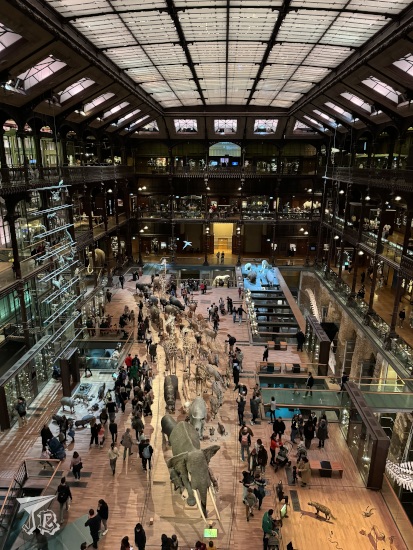
The first site we visited was the Great Gallery of Evolution, Grande Galerie de l’Évolution, the biggest site of the French Natural History Museum. It has four visitable levels – the upper balcony (third floor), focused on “Evolution of life”, the second floor “Impact of man in life”, and the first and ground floors that deal “Diversity of life” (terrestrial on the first, marine on the ground floor). The way it is arranged makes it, in my view, a companion to the Gallery of Compared Anatomy – (which I still like best, to be honest).

The collection finds its core in the disappeared Zoology Gallery, whose building dates back from 1877. Designed by architect Jules André, the interior was a cast-iron structure with a central nave and a skylight. Although the original project was never completed, the Galerie de Zoologie was inaugurated in 1889. It closed down in 1966 for restoration, although works were actually only carried out between 1991 and 1994. During this time, taxidermist also took care of about a thousand animals. Today, the gallery holds a cavalcade of savannah animals on the ground floor, and more conservative vitrines and glass cases on the upper floors. The museum still keeps the 19th century allure and entertaining aura – we did not go into any of the VR experiences, as they were sold out (and, you know, in French), so we did not see the more modern area of the museum.

Great Gallery of Evolution

We started off on the third floor and made our way down to the ground level. There were a ton of taxidermy animals, collections of insects and shells, even a wool one, and some bizarre specimens such as a tiger attacking an elephant with a chair on top… To be honest, though, I think it is more of a regular zoology gallery, just arranged in a surprising way. I found the evolution angle better developed at Brussel’s Natural History Museum. The classical design is extremely cool, though, and it would have given a great feeling had it not for all the free-range kids wildly running around…

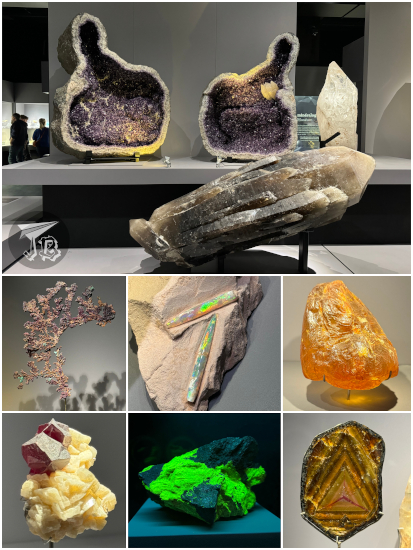
Afterwards, we headed off to the geology and mineralogy gallery, Galerie de Géologie et de Minéralogie, which had a really nice collection of gemstones, crystals and jewellery. And of course, fluorescent rocks which kept my attention for a very long while.

Mineral and geology gallery

It was almost lunchtime and we decided to head out towards a busier area to grab a bite. My Paris Visit ticket was not working again, and I exchanged it yet once more. I went through, but my sibling did not, so they had to wait in queue again to exchange that too. Apparently, I was keeping the tickets too close to my phone – even if it was the one without internet? I deemed my sibling responsible for the tickets from then on.

We stepped out at Palais Royal–Musée du Louvre, hoping there were places to eat, and we were right – there were a bunch of them along the street. The one that grabbed our attention was Café Brasserie Ragueneau, a small eatery close to the Louvre. There, I splurged on a Tartare de boeuf poêlé au foie gras (Pan-fried beef tartare with foie gras) just to be a snob. It was delicious. The foie gras version came slightly cooked, though the raw version would have been fantastic. Our waiters were extremely friendly too, and tolerated my poor French with a smile.

Pan-fried beef tartare with foie gras

After lunch, we walked to the last place on my list for the trip – the church Église Saint-Germain l’Auxerrois de Paris, which mixes elements of Romanesque, Flamboyant Gothic, Rayonnant, and Renaissance styles, though the tower – my favourite – was only added in 1860 as part of Baron Haussmann’s plan to reconstruct the city. The base of the church dates from the 12th century, and during the 14th and 15th centuries it was decorated with a balustrade by Jean Gaussel, multiple sculptures, and gargoyles. The interior is lighter than usual gothic churches, and there is a monumental set of carved wooden seats for the royal family. There are multiple windows with stained glass, although not all of them are the original Medieval ones, since they were destroyed during the French Revolution and replaced in the 19th century.

Church of Saint-Germain l’Auxerrois

The Louvre was not selling same-day tickets, so our idea to spend a couple of hours there went bust. Then, we decided to walk towards Île de la Cité to check on the cathedral’s progress, as it is supposed to reopen this year, when reconstruction from the 2019 fire has been completed. I wanted to check something called Tunnel des Tuileries, but I misunderstood – I thought it crossed underneath the Seine to get to the Isle of France; apparently I mixed it with a pedestrian tunnel under the Thames – it turned out to be a place of modern art, and it did not feel too safe. Thus, we continued under the sun, and reached the flower market Marché aux Fleurs Reine Elizabeth II.

We found out that a sort of stage has been built for visitors to sit in front of Notre Dame, and we saw a lot of people taking pictures of the pictures on the wall, which was a bit weird. We sat for a while, but not long because there was a guy singing really badly at the square.

Notre Dame under reconstruction

We went on and saw the park Square René Viviani, where the oldest tree in Paris stands. Next to the park is the church Église Saint-Julien le Pauvre and close to Église Saint-Séverin. We could not enter any of them, so instead we decided to sit down to have a coffee – in my case a “detox smoothie” because the orange-and-carrot blend reminded me of one in Japan I really like.

We finally set off to collect our things, and this is when I usually say I got home without an incident. Not this time. The public-transport tickets worked fine to get to the airport, we bought dinner and settled to wait. There was nothing much too strange, we were late – forty, forty-five minutes? I’m not sure, but not an obscene amount of time – the crew announced connections over the PA system, I thought that was nice of them. When we landed… I had a moment that I did not know where we were, which is strange, because the terminal is pretty straight forward. It turns out that in order for the travellers who had connections to South America to make it, we had landed at the Satellite Terminal, not the main building! Which meant over thirty minutes of “commute” back to the parking lot… I had taken a leeway of around an hour and a half after landing to get out, but we barely made it!!

A nice weekend to break out the routine, a lot of comics signed, and a lovely piece of artwork were achieved. Unfortunately, I caught a stupid, stupid cold, my first since the whole Covid thing started, and my immune system freaked out. It seems it’s back to facemasks on planes for me.

9th March 2024: Minerals, fossils & trains (Madrid, Spain)

I might not be the most people-person ever, but if there is something that makes conventions extra fun, it is seeing attendees unapologetically geek out about what they love – in the case of Expominerales, that would be… rocks. Of course, this is an over-simplification. Expominerales is held yearly in the mine and energy engineering school Escuela Técnica Superior de Ingenieros de Minas y Energía (ETSIME) in Madrid. The year 2024 marks the 43rd edition of the event, which is considered one of the most important fairs in Spain in the topic of Earth Sciences – minerals, fossils, gems, and meteorites are widely available to the public. Aside from the small historical museum Museo Histórico-Minero Don Felipe de Borbón y Grecia, there were dozens of exhibitors with all kinds of items for sale, ranging from a few euro to several thousands. These year there were a few lectures, too, and coincidentally, the two of them I was most interested in happened on Saturday, one after the other.

I arrived at the ETSIME around 11:00, and I walked around the stands a couple of times. I have to say that I wanted everything, but I set a budget and I was able to stay around it, after shopping and lunch. At noon, I settled to listen to the lectures – one about the rehabilitation of an ancient gypsum mine in a hamlet called Hornillos de Cerrato, in the area of León. The other one versed about the uses of an already-rehabilitated one in the south of Spain, home to a huge geode. Both of them were pretty interesting, though the conference room was freezing. Someone had forgotten to turn on the heater there, it seemed…

Expominerales 2024 at ETSIME

After the two conferences, I had a last round to buy a last thing, so in the end I bought an iron-meteorite pendant, a fossilised shark tooth pendant, a plesiosaur tooth, and a soil sample of the K–T boundary. A plesiosaur was a marine reptile with flippers, a short tail and a long neck. The K–T boundary (now named the Cretaceous–Palaeogene (K–Pg) boundary) is the theoretical layer of iridium-rich black sand that was formed by the meteorite that caused the extinction of non-avian dinosaurs – and basically most life at the time, in one of the great world-wide extinctions in the history of Earth.

Shopping from Expominerales

At 14:30, I had a reservation for lunch at a Japanese franchise called Ramen Shifu. While I had originally been looking forward to trying the ramen (and I got my hopes pumped up when I read that they were Hakata ramen style), the noodles were rather disappointing. Fortunately, the okonomiyaki – Japanese pizza of sorts, made with a base of cabbage and topped with sauce and bonito flakes, was all right. On top of everything, paying was stupidly difficult because they did not have change.

Shifu Ramen ponzano - okonomiyaki and ramen

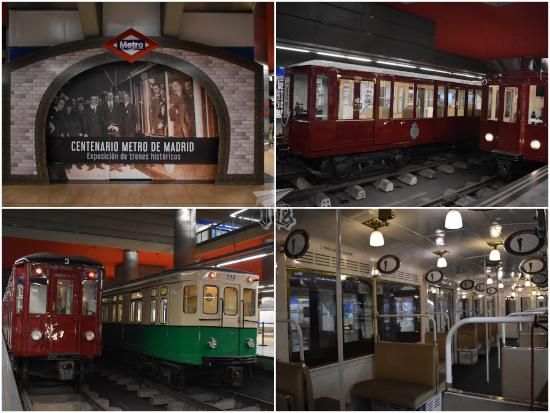
When I came out of the restaurant though, it was raining like crazy. I pulled out my umbrella and hopped towards the closest underground station, as my next destination was inside the metro system – one of the Underground’s museum network Museos de Metro de Madrid the collection of classic trains Estación de Chamartín: Exposición trenes históricos, inside the Chamartín stop. The exhibition displays four historical trains, restored from among the first ones that ran under the city, and some memorabilia. It was a bit underwhelming – more like false advertisement. I hoped I would be able to snoop inside the trains, since that was the photograph that opened the webpage, but unfortunately they were cordoned off. There was however a map with the works by Antonio Palacios in Madrid, which will become handy eventually.

Classical Train Exhibition Madrid

Afterwards, I just headed off towards the train station and got back home.

16th December 2023: A day out of ExpoGema (Madrid, Spain)

Since the mineral expo ExpoMinerales back in February was all cool and fun, I decided to attend its shinier (and unbeknownst to me, way more unaffordable) sibling, the gem expo ExpoGema, and make a day out of it. Thus, I headed out for Madrid on the 9:00 train with temperatures below zero – I was not made for winter. It was not much better when I arrived, but for once the train ride was uneventful, I actually made my connection, and it seems that after a chaotic year, the underground train tunnels are finally open. Everything going smoothly gave me some unexpected 45 minutes to wander around as the square Puerta del Sol slowly became fuller and fuller with people.

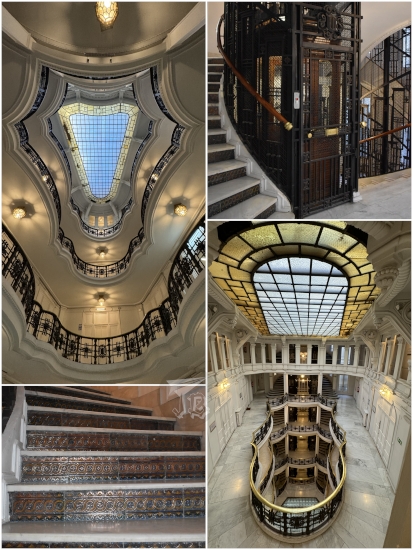
I had booked a guided visit through the company Madrid en Ruta, who has the exclusive concession to show the business centre Casa Comercial Palazuelo. Located in downtown Madrid, it was designed by architect Antonio Palacios. The promoter, Demetrio Palazuelo, bought the lot left behind by a fire, and commissioned the building with the goal of renting it out to shops and professionals – it was thus the first office building in Spain conceived as such, and not repurposed from a manor or an apartment building. Palacios drew inspiration from the Chicago School commercial architecture and used iron to stabilise the building, which allowed him for bright interiors using lots of glass. The office building was erected between 1919 and 1921, and the offices are still rented out today, with the only caveat that the beautiful interior translucent-glass doors have been painted white – to either protect privacy or hide the fact that today the house seems to be almost empty – at least according to the building’s own directory.

The exterior façade could be considered eclectic – the main frame tends to neoclassicism with huge glass windows framed in black iron. The interior tends towards Art Deco and modernism. The offices are distributed around a central indoor patio, with curved balconies that overlook it and lots of lights mainly due to the skylight. There are two classical lifts which are the original ones, in peartree wood. When we went up, I took the stairs, which have white treads, and the riser is made out dark green ceramics. I have seen these in other works by Antonio Palacios.. The interior, with the iron balustrades and its curvy design, was really cool, but I think it is really a pity they painted over the glass.

Interior of Casa Palazuelo

The visit started at 11:00. We spent the first fifteen minutes outside getting context, roughly half an hour inside, and the last twenty minutes on the roof of the building, waiting for the clock of the Puerta del Sol to strike 12:00, then we were ushered out. I really wish we could have wandered the house a little bit, even if we could not go into the offices. The ten euro we paid surely did not feel like we were paying customers, but more like we were sneaking around like unwanted guests – which we probably were anyway.

Puerta del Sol from the roof of Casa Palazuelo

I grabbed a quick snack then and headed off towards the engineering school Escuela Técnica Superior de Ingenieros de Minas y Energía (ETSIME) for the sixth edition of the gem fair ExpoGema. The fair itself was neat, but most everything was way above my budget range. I was there at the typical Spanish lunchtime, there were few people, and most were at the stands. Thus, I had the museum Museo Histórico-Minero Don Felipe de Borbón y Grecia almost completely to myself. I really like old-style museums, and this one has a huge amount of specimens, most of them are minerals, but there are also fossils and a collection of cave bear skulls and bones. I had decided not to book any guided visit or activity as none happened within the couple of hours of lunch downtime.

Geology Museum at Etsime

I bought an ammonite pendant, a small pyrite with almost perfect right angles, and another pendant made with a small meteorite from Campo del Cielo, along with a tiny extra piece. Campo del Cielo is an area in Argentina where four or five thousand years ago an iron meteorite fell. The meteorite shattered upon entering the atmosphere and, when it impacted the surface, the different created up to 26 craters. About 100 short tonnes of a fragmented iron meteorite have been recovered to date, and I now own around four grammes of it – yay me. I did not buy any precious stone though since the pretty shiny rocks were way out of my budget.

Expogema 2023

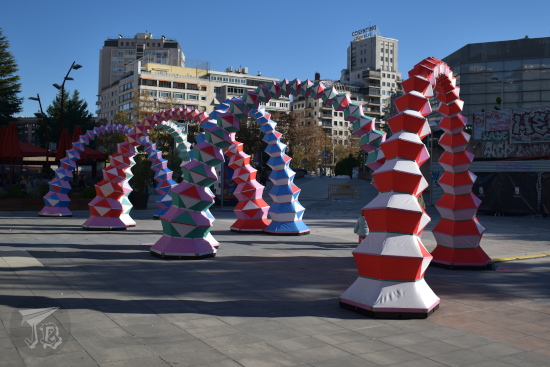
I left the ETSIME and I walked towards the square Plaza Pablo Ruiz Picasso, where there is a temporary art installation called El Regalo (The present) by Amigo&Amigo, a studio specialising in art installations. The artwork comprises a few arches that end in pads that can be stepped on – when they are, music sounds. The day was still bright, so the artwork was not shining, but a bunch of kids jumped on the pads to keep the music playing.

El Regalo artwork

Afterwards, I took a train and headed off towards central Madrid again. I had a reservation for an afternoon tea at NuBel, an “avant-garde gastronomy space” in the modern art museum Museo Reina Sofía. I had been drawn to the place due to the “freshly-baked scones” they advertised.

The experience was beyond disappointing. First, I had to wait to get seated, but then the person who checked me in forgot to notify that I was there – this is what I assume happened, I was literally told that “the kitchen had forgotten about me”. The set menu took 40 minutes to come out, and the scone was cold anyway, so not even freshly-made. I had got a decaf latte that was also cold when the food came.

The menu, 16€ as I don’t drink alcohol, consisted of: two mini-sandwiches – the two of them had been made from the same bread slice, so you can imagine the size, with some kind of mayonnaise filling which was not bad but rather unidentifiable; one shot-sized glass of (pre-made) gazpacho; one scone; a piece of red velvet cake; a piece of carrot cake; one chocolate brownie; a side of cheese cream, butter and jam; and in my case the already-stone cold decaf latte.

Nubel afternoon Tea

The scone was cold – so much for freshly-made, the only thing that had kept me waiting. Furthermore, the cheese cream, albeit nice, did not fit it like at all, so I had to use butter on it. I laughed to myself thinking about “the horror!” while I clutched my metaphorical pearls. The red velvet was probably the best, but in general the cakes were too sweet – good thing the menu included free tap water. Afterwards, I was comped another free decaf as an “apology for the delay”. However, when I tried to pay, more drama ensued. First the card-reading machine was not working, then they could not take cash because they were balancing the register, then they could bring the machine to the table. All in all, I spent almost hour and a half there – about five minutes waiting to be seated, forty minutes waiting for the tea set, and twenty minutes trying to pay. I’m sorry to say I did not tip, nor do I plan to ever come back.

I missed my train due to the paying delay, and I had to wait almost half an hour for another one. I hung out the Christmas market for a bit, and looked at the lights around Puerta de Atocha station. As it was cold, I walked in and went to check out the original train station, now turned botanical garden. I had never stopped to look at the iron ceiling, just at the plants – and the tortoises people used to dump there – but there had been an old photograph during the Casa Palazuelo visit that made me want to look at the building itself, and I recognised that old station in today’s building, with its wrung iron columns. Funny, how you can look at the same old things and recognise them.

11th March 2023: Rocks from the land and fish from the sea (Madrid, Spain)

Back in 2018, when going to Madrid’s Geomineral Museum (Museo Geominero), I stumbled upon an event in the Mining Engineering University – something called Expominerales. At the time, I did not have time to explore it, and only later did I realise what I had missed – an international fair for the trade of minerals, rocks and fossils. I made a mental note to check the event out the following year, but something came up and I completely forgot about the whole thing. In 2020 the pandemic struck, and finally in 2023, almost five years to the day, I went back to this event held in Madrid.

Expominerales is held yearly at the working engineering school Escuela Técnica Superior de Ingenieros de Minas y Energía (ETSIME), which offers the bachelor’s degree in Mining Engineering, and the one in Energy Engineering (whatever this last one is). The first weekend of every month, the school organises a “mineral-world flea market”, and the second weekend of March, it hosts an international mineral, gem and fossil fair, with shopping stands and different workshops and activities. After a few cancellations due to Covid, it returned in 2022 and it’s back to its former glory in 2023 – Expominerales XLII, the 42th edition of the fair.

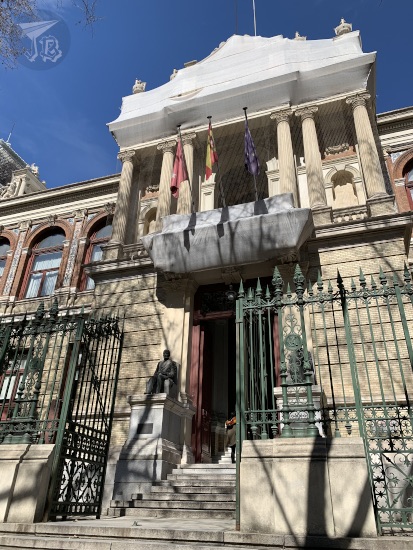
The ETSIME in Madrid. Pink-and-white building from the 19th century, accessible through stairs, with flags hanging over the door

Mining Engineering became a formal education path in Spain in 1777, originally in the town of Almadén, a mercury hub. The school was moved to Madrid in 1835 and a two-building campus was ordered. The historical building in the ETSIME (M1) was designed by architect Ricardo Velázquez Bosco, and decorated by ceramist Daniel Zuloaga between 1884 and 1893. The second building (M2) was damaged during the Civil War, and has suffered several modifications to accommodate classrooms and laboratories. The premises also include a reproduction of a mine, Mina Museo Marcelo Jorissen, however this one is closed for renovation – a lot of that seems to be going on around the university, since part of the decorations of the buildings are also covered.

The M1 historical building has a central cloister with an ironwork colonnade. The building is rectangular, and on the short sides there are two symmetrical wards. One holds the historical mining museum, the other one the historical library. The central cloister is the main area where Expominerales is held, on the ground and first floor. On Saturday, the exhibit opened at 10:00, and we were there a bit later in order to sign up for the first guided visit at 11:00 (3€) – we wanted to take it so we had access to several rooms that would otherwise be closed to us. The idea was being there before families with kids started arriving and the activities became overcrowded – it turned out in the end that most the activities were indeed organised for children, so it did not really make a difference. Furthermore, the visit we feared full only had 6 attendees.

We had one hour before the guided visit that we spent looking at the stands on the ground floor on the M1 building. The guide was a student who might have been partying the previous night, because he sounded a little out of it – forgetting info and words, even things related to his own degree.

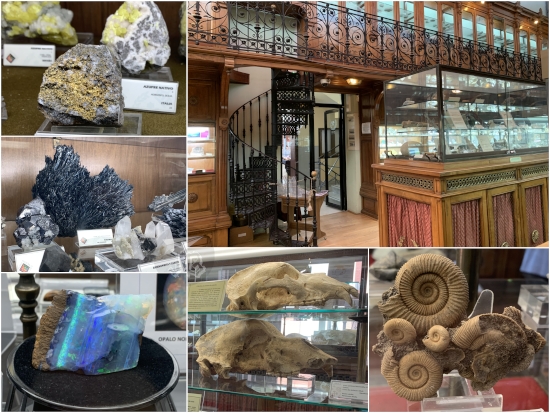
First, we went to see the mineral collection, the origin of the historical museum in the M1 building, Museo Histórico-Minero Don Felipe de Borbón y Grecia. The mineral collection was started in 1831, and throughout the years it was increased with new minerals donated by different institutions. It was later expanded to cover palaeontology and historical artefacts related to mining and other earth sciences. Though a lot of the displays are scattered throughout he building, the original museum dates from the 19th century, and it has four sections: the mineral collection, the fossil collection, the cave bear collection and the mining archaeology section, totalling over 10,000 items.

The historical mining museum at ETSIME Madrid. It is a large ward with cedar wood shelves from floor to ceiling, filled with rocks and fossils. The picture also shows some close-ups of rocks, two cave bear skulls, and a cluster of fossilised snail-like animals

Today, the museum is named after King Felipe VI, who visited the museum in the late 1980s after the university reached out to him to propose the name. The then prince came to visit then, and the name “the king’s stairs” was given to the set of side stairs he used – Escaleras del Rey.

We also visited the small hall where candidates read their theses, a little hall with spectacular ceramic tiles by Zuloaga, and finally the historical library, with obsolete but cool volumes. The library also dates back from the 19th century, with the walls covered in wooden shelves, with a small metal staircase to access the upper balcony. Unfortunately both this one and the one in the museum were cordoned off.

Library in ETSIME. It is a large room with cedar wood shelves from floor to ceiling, and a spiral staircase.

The visit ended at the lecture hall on building M2, one of the few remaining areas of the original design. It is a marble room with wooden benches and decorated windows that represent the original subjects taught to Mining Engineers. After we were left off, we sat down at the cafeteria for a drink.

Lecture hall in ETSIME (Madrid). It's a marble room, rather dark, with smoked windows representing different subjects of the Mining Engineering Degree

We recharged batteries, and then we had a look at the stands on the first floor of the M1 building, alongside the collection of apparatus that they had. Afterwards, we decided to separate in order to do shopping. Expominerales hosted over 30 stands, national and international.

Expominerales. A view of the ETSIME cloister from the second floor, showing different stands and lots of people peering curiously

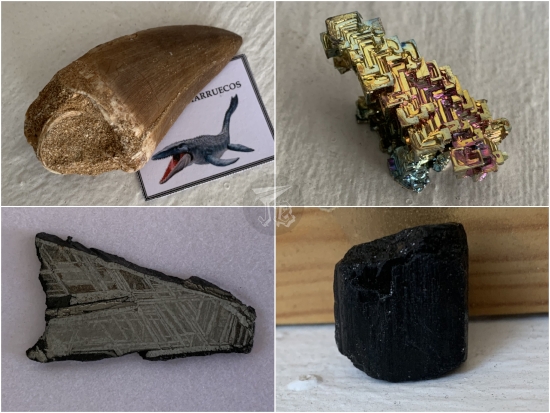
I, being the nerd that I am, got myself a tiny slice of iron meteorite (from Geoterra Minerals), a mosasaur fossilised tooth (from Carlos Hammann, who also had amazing megalodon teeth that I will never be able to afford), a decent-sized of recrystallised bismuth (from Rossell Minerals), and a small piece of black tourmaline (from The MineralShop) – all for 51€.

Collage: a fossilised tooth, a bit of mineral in metallic colours, a slice of meteorite with silver orthogonal markings, and a bit of shiny black rock

When we met again, it was a bit past 13:30. There were too many people by then – families had started arriving, so we decided to leave. We had booked at a nearby restaurant for lunch, and they did not mind accommodating us a little earlier. The restaurant, called DeAtún Ponzano specialises in tuna dishes – particularly Atlantic bluefin tuna (Thunnus thynnus), sustainably caught in the Straight of Gibraltar.

Before overfishing was even a thing, Phoenicians settled in the south-west of Spain somewhere between the 9th and 7th centuries BCE – the city of Cádiz, credited as being the longest-standing city in Europe, may have been the first port. The Phoenicians observed that the bluefin tuna migrated from the Atlantic to the Mediterranean every year around the same dates, and later they came back to the ocean. These guys came up with a very simple technique – that was later developed further by the Romans and perfected in the Islamic period: the almadraba.

An almadraba is a portable but complex net which is lowered for the migration period. The bigger fish are funnelled into a box-like construction, and the smaller ones swim right through it. Once the almadraba is full, a number of fishing boats lift it in a process called levantada (raising). Expert fishermen walk onto the nets, discard any small specimen that might have been trapped, and choose the tuna that will be sold, generally individuals heavier than 200 kg.

Since the fish are selected on a case by case basis, the amount of both the catch and by-catch is small in comparison to other fishing methods. Both the seasonality and craftsmanship of the whole process make it much more sustainable than others – of course, this also causes fewer pieces in the market, which in turn increases the price. Furthermore, all the fish are wild, hand-picked, and only bled out when they are loaded onto the ship. Thus, the quality is extremely high. Another factor that makes almadraba-caught tuna more expensive is the fact that walking onto the levantada is dangerous. Fishermen have been seriously hurt by struggling tuna, as some of the fish might weigh up to 500 kg.

Working almost exclusively high-quality tuna means that DeAtún is not a restaurant on the cheap side of things. I’ve actually traced down their tuna provider and the prices are rather cost-adjusted for almadraba-caught tuna. There’s another thing to consider, too, which is that the Spanish law forces restaurants to freeze fish that is going to be served either raw or quasi-raw, at least for 24 hours at a temperature under -20 ºC – this is done to destroy a fish parasite called Anisakis, which can cause stomach distress and serious allergic reactions. Apparently, the perfect temperature to keep the tuna properties is -60 ºC. So yay Anisakis-safe almadraba-caught tuna all year round (though it’s true that the freezing law makes it impossible to eat fresh tuna raw).

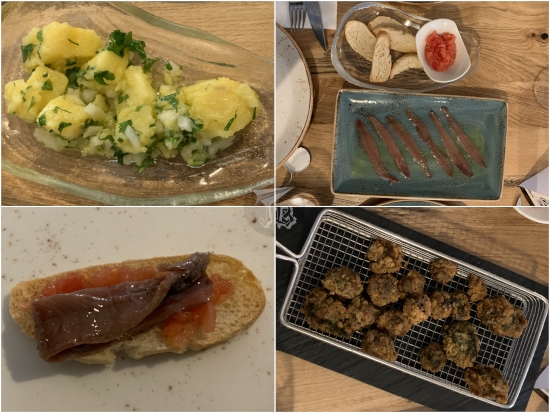
We got a welcome tapa of boiled potatoes with olive oil and herbs (“papas aliñás”), a favourite from southwestern of Spain, the same area where the almadraba tuna are caught. We shared some European anchovies (Engraulis encrasicolus) “anchoas del Cantábrico” with tomato and toasted bread. These anchovies are salted for at least six months, cleaned, and stored in olive oil. They have a strong flavour, and are not everyone’s cup of tea, but I adore them. We also shared a portion of “ortiguillas” (Mediterranean snakelocks sea anemone Anemonia sulcata, battered and fried), also typical of the south-west – I’ve never been much of a fan though.

Lunch at DeAtún. Collage with a potato salad, anchovies and battered seafood balls

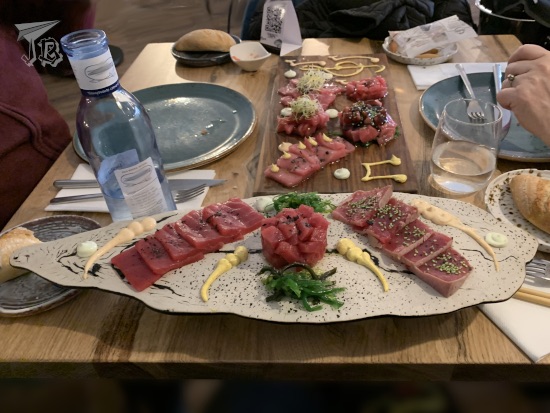
Finally, as my tuna preference is raw, I was wondering whether I wanted sashimi or tartar. In the end, I decided to try a combo (“trio DeAtún”): tuna sashimi (slices), tuna tartar (dice) and tuna tataki (heat-sealed slices), with a side taste of different sauce emulsions – wasabi, kimchi and curry. The tuna cuts used for these preparations (descargamento and tarantelo) would be the otoro or toro Japanese cuts, which are appropriate for raw preparations – technically the best ones, fatty or very fatty meat. I don’t love tataki, thus my original reticence to try this combo, but it was good. My favourite bit was the sashimi though, the tartar was missing a bit of spice.

I was offered chopsticks to eat the dish, and I accepted – easier to handle the fish. That apparently made the maître think that I had been the one choosing the restaurant, because in his words I “seemed to be an expert, chopsticks and all”. That was hilarious – I mean, why offer chopsticks if you don’t expect them to be accepted? For the record, although I booked the table, I did not choose the restaurant – it would have been a little on the “too fancy” side for me. The truth is, there were a bunch of very-elaborated dishes that we decided to give a miss, and we went for the raw tuna.

Lunch at DeAtún. A plate with three tuna cuts. The centre is round, and rose-like, and the sides are extended on a line. The fish is uncooked and it looks dark red. There's a similar dish in the background, with more cuts

Desserts were okay, but not the reason we had chosen this place. The point was eating tuna – raw tuna in my case – and the restaurant delivered. I was however amused by tables around us refusing the raw options even when the chef himself came out to greet them and recommend the dishes (someone over there must have been an acquittance, I don’t really know). Finally, we set back home to compare treasures and plot going back to Expominerales in its 2024 edition – at a time where we can snatch some discounted rocks.

16th February 2019: A day at Japan Weekend (Madrid, Spain)

Having nothing better to do, my sibling and I headed over to IFEMA to spend a few hours in the Japan Weekend convention of “Japanese culture and other stuff”. It took place in Madrid over the weekend, and I had read that there were a couple of Japanese musical numbers that looked interesting.

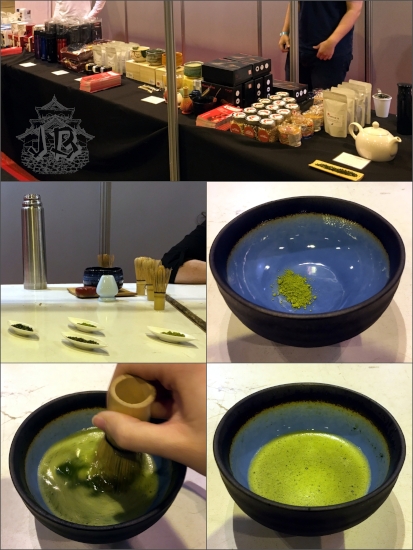
Aside from the two mini-concerts, there was nothing fixed on our schedule. I saw the stand of a teashop called Punto de Té (Tea Point). It looked like a really nice place – judging by the prices. They offered small Japanese matcha “workshops”, and I signed us up for one of them. Matcha [抹茶] is my favourite type of tea, after all – especially freshly made. It comes from the plant Camellia sinensis, which is kept in the shade for the last four ways before harvest so it produces extra theanine and caffeine. The leaves are trimmed, dried and finely ground into a powder.

The workshop was not really a tea ceremony, more like a mock-up, but we were able to whisk our bowl (chawan [茶碗]) of matcha using a real chasen [茶筅], a sort of bamboo brush that is used to dissolve the tea powder in the boiling water until it makes foam – the best part. I am not an expert, but the tea was really good, and my sibling enjoyed the experience. We decided that we would come back to buy some stuff when we were about to leave as we did not want to be carrying around stuff all day. Fortunately for the shop, when we came back the had sold almost everything!

Collage showing how matcha dissolves into water, from powder to whisked to foamy green liquid.

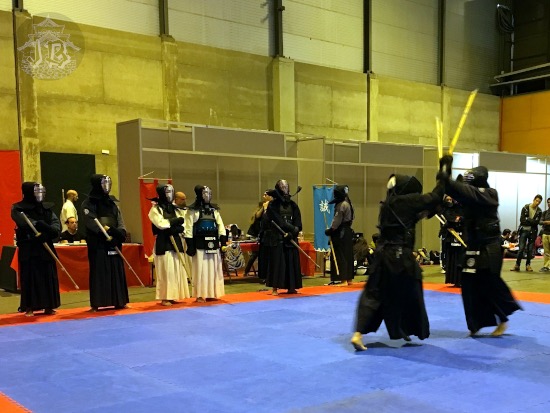
Afterwards, we watched a kendo exhibit for a while. It was not a competition or anything, but those people were living the fights. That was cool. I don’t know one thing about kendo, but they did look like they were having fun, while at the same time taking everything very seriously.

A group of kendo practitioners, showing two of them engaged in a fight.

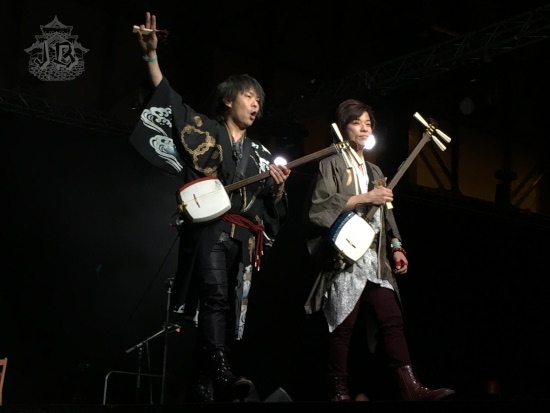
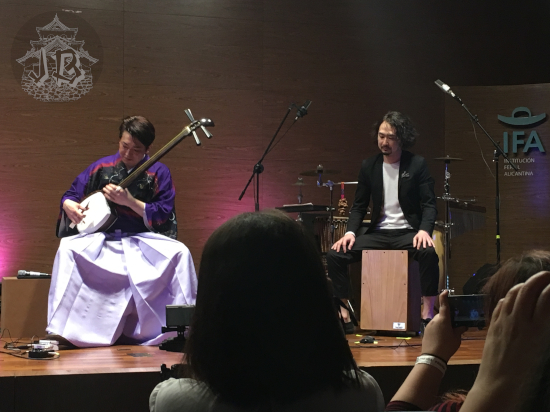
One of the mini-concerts I wanted to watch was that of Kuni-Ken. Older brother Kuniaki and younger brother Kenji play “shamisen rock”, mixing classical sounds with modern tunes. Their instrument of choice is the shamisen [三味線], a three-string guitar or lute played with a pick. It is not the first time I’ve seen shamisen applied to rock or other modern rhythms – Kennichi Yoshida does something similar.

The concert started a bit late and to our astonishment, people wanted to watch sitting down! My sibling and I were on the first row, and we got yelled and poked at until we crouched down. I am getting too old for these events, really. Kuni-Ken came on stage with masks from their Zero to One promotional video. They played a few cover songs, and some original ones. The last song was a cover of City Hunter’s theme Get Wild.

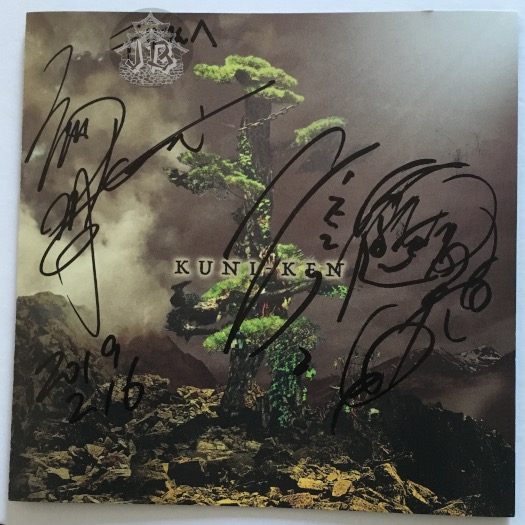
The concert lasted around 30 minutes, and afterwards we headed off to the meet and greet area. Kuni-Ken had a problem as they could not open the suitcase they had brought their merchandise in, and in the end they had to rip it open. We bought some CDs and they were kind enough to sign them – even doodle. They also gave us a sticker and took a photograph with us.

Kuni-Ken waving from stage

Kuni-Ken signed CD

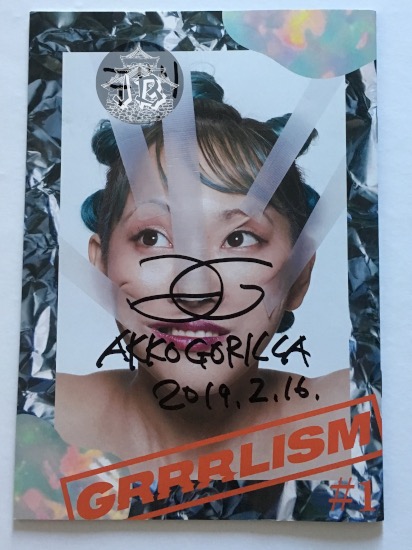
Later, we stopped at Japanese drummer-turned-rapper AKKOGORILLA’s concert, a young woman who tries to defy a stereotypes of how “good girls” – and especially Japanese girls – are supposed to behave. She chose her name during her drumming times because she learnt that gorillas communicate using rhythm. Her songs invoke themes of feminism, LGBT+ and gender ideas.

She has a very particular style and moves as if she had batteries or something. She bounced and jumped on and off stage and never seemed to catch a break. She totally blind-sided the organisation by going into the crowd and pulling people up to dance with her. She was not close to us, but I got some cool pictures.

AKKOGORILLA calls her own style #GRRRLISM. She’s bouncy and vibrant on stage and she invites the listener to bounce along her catchy tunes. She sings a lot in English. The concert was again only 30 minutes though. Her songs included Yoyu and GRRRLISM, in which she clearly expresses “my body, my choice” – because she apparently commits the deadly sin of not shaving, and people seem to have opinions about that.

After the concert, I hoped to get a signed CD – I liked her more than I thought. Unfortunately, she had not brought any music, so we got her Zine signed instead. I also got a photograph.

Akkogorilla singing on stage

Akkogorilla autograph

Before leaving, we went to check the tea shop, but they had sold out everything we wanted. They offered to restock for the next day, but I was coming down with a migraine – the yellow lights at IFEMA are horrible. I also think I’m getting too old and cranky to hang out with the younger crowd though. In the end, I don’t care much about the shops – having credit cards, I don’t need a physical stand at a convention to buy stuff, and I avoid bootleg merchandise… Going to this kind of places for short live music displays… is starting not to cut it.

29th & 30th September 2018: The Pikotaro Affair at Japan Weekend Madrid (Spain)

The “Japanese culture convention” Japan Weekend was held in IFEMA, Madrid, over the weekend. The big problem with conventions tend to be the organisers. At some point they bestow upon themselves an importance they lack, and decide to either micromanage everything, or act as if they were the reason why people visit. It’s amusing looking back, but annoying when you have to deal with them –such as the mini riff-raff at the Salón del Manga de Alicante and INORAN’s autograph. Japan Weekend in Madrid is not an exception to this trend. The event spanned over the whole weekend. I attended both days, and on Saturday I brought my sibling over. The acts and activities we attended were:

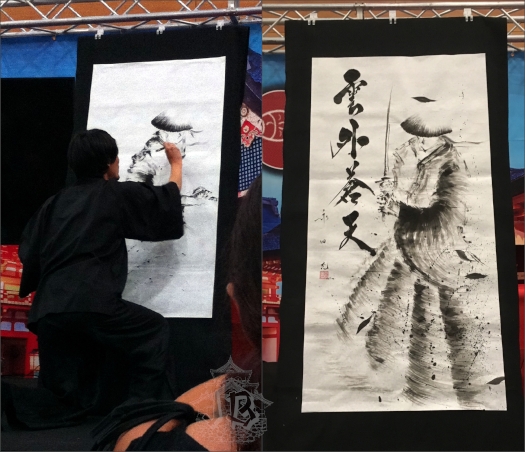
Mitsuru Nagata’s sumi-e show

Mitsuru Nagata is a Japanese-born, Barcelona-living artist who creates pieces of art and calligraphy using traditional Japanese ink techniques of sumi-e [水墨画], “Ink wash painting”. He did a performance and demonstration on both Saturday and Sunday at 11:00. I really like his style, and own a couple of his works..

Ink wash painting of a samurai in attacking pose

Wa–suta: The World Standard Concerts

Wa–suta: The World Standard [わーすた: The World Standard] is girl band formed by five cute bouncy girls who aim to “spread kawaii culture around the world”. Kawaii [可愛い] stands for “cute” or “adorable” in Japanese, but aside from the adjective, the word is also used to define the Japanese “cuteness culture”, very prominent in certain circles – think Hello Kitty or basically anything else Sanryo puts out.

I am not sure that is the aim, but unfortunately kawaii acts tend to attract a not-so-kawaii spectators. Artists are supposed to carter to their fantasies, and be always perfect in appearance and behaviour – singing well is secondary. At the concert, Wa–suta put up a very good effort on being approachable and trying Spanish. They were also very cute, full of energy, and even in synch when they moved – which not all bands can do nor even bother to try. They did a cover of Evangelion’s song Zankoku na Tenshi no Tēze, which I would have preferred that they skipped, but in general they were all right – if girl bands are your thing.

Five girls in short white dresses and cat ears on stage

ITSUKA (Charisma.com) Concerts

ITSUKA (Charisma.com) is a lady-rapper and techno artist with a really powerful presence whom I really liked. Charisma.com was a two-woman “electro-rap” / hip-hop band which went into hiatus early in 2018. ITSUKA continued her career solo, and was invited to the Japan Weekend. She used a computer, a mixing table and her own voice to deliver two very impressive performances. She can rap crazy fast, too, and she has a very strong attitude.

Woman rapping behind a mixing table

Pikotaro Concerts and Meet & Greets

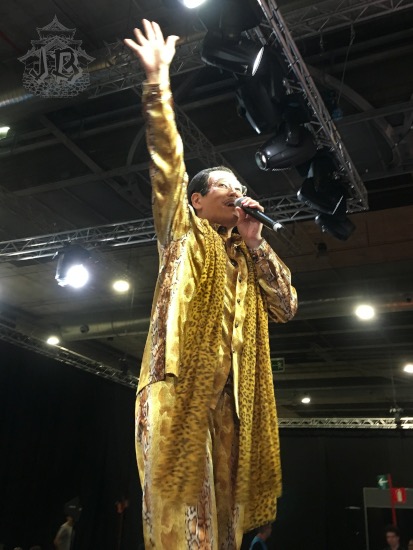
The reason why I wanted to attend this event was the presence of a Japanese comedian Kazuhito Kosaka characterised as his persona Pikotaro [ピコ太郎], a “singer” known for his histrionic personality and a flashy leopard-print clothing. He became famous around the world with Pen-Pineapple-Apple-Pen (PPAP), a silly song which parodies English teaching in Japan. I have heard so much about bad English teaching in the country from my friend B**** that I am actually… not so sure about how much parody and how much “fiction imitating reality” there is.

When I met with my friends E**** and K***** in Barcelona after the Kamijo concert at the beginning of the month, we talked about events and such. They basically dared me to “go to Japan Weekend and troll Pikotaro”. I already had tickets for Saturday, but after that, I decided to actually get myself the Meet & Greet “extra” – for both days.

The concerts were amusing to say the least, and not precisely due to the musical quality. The whole act was hilarious, done with the YouTube videos projected on the screen and the guy jumping and bouncing up and down the stage. At some point there was a blackout, so he started again, taking everything in stride.

There were paper masks handed out, that could (should? must?) be used during the M&G for autographs. There were four or five songs – among them Neo Sunglasses (which I personally found hysterical, as he sings “dark, dark, dark”, all the time until he takes off the sunglasses and grins “bright!”), and Can you see? I’m sushi. He of course sang Pen-pineapple-apple-pen to open and close the act. For the closing song he had prepared a line in Spanish and a “Japan Weekend” version that had people screaming.

There was a Q&A after the Saturday concert. They prepared a table and for him, all star-like, and in the end he just grabbed the chair to sit in front of the table, completely throwing the organisers off. He gave hugs and signed stuff, and he did really look like he was having a lot of fun.

The M&G tickets were 5 € each and I bought them for both days – they included a handshake, an autograph and a picture. Again, it was very fun. On Saturday, I put some sushi badges and pins on my neck scarf so I could quote “can you see? I’m sushi!” at him. He found it hysterical, and signed the cardboard mask for me before we took a photograph.

When I arrived home, I printed that so I could take it on Sunday. I signed one copy for him, and at the M&G, I asked him to dedicate the other one to me. Even if the Japan Weekend staff kept barking around the chaos they had turned the queue into that he would only sign the provided material, he signed whatever you asked of him, with the interpreter’s blessings (who by the way remembers me from other endeavours, so she basically left me to my own devices). Convention staff micromanaging everything again…

Japanese man in a Leopard print suit singing

Pikotaro autograph

Going to the Pikotaro M&Gs meant I missed Wa-suta and ITSUKA’s signatures, but oh, boy, was it worth it for the laughter.

7th – 9th April 2018: 8º Salón del Manga y Cultura Japonesa. Alicante (Spain)

This was a crazy, crazy weekend in Alicante that I planned on the go with my friend C*****. It all started when guitarist Inoran, from Luna Sea, was announced as guest in the local “Manga and Japanese Culture Convention” Salón del Manga y Cultura Japonesa de Alicante. She was on the fence as to whether she wanted to come, but after musician Kenichi Yoshida was also announced, she was sold. I had already bought my tickets and booked a room, but it was fine for two people, so we could bunk together.

I finished work on Friday at around 19:00, made a dash for the local train station and jumped onto a commuting train to Madrid, where I took the long-distance train to Alicante. I arrived at around 22:30. C***** came to pick me up at the station, as she had arrived and already checked in. That was good, because she had time to walk around the area, and that would be handy later on.

Saturday, 8th April 2018

The next morning, we went to the bus station. After attaining victory over the ticketing machine, we found the correct bus. We knew we were at the right platform judging by the amount of cosplayers on the benches. The bus driver refused to sell tickets on board, so he sent everybody to battle the ticket machine. The bus set off late, but we eventually made it to IFA the, convention venue. Once we had a schedule, we started planning around it. At the very least, the Saturday plan was:

  • 13:30 – 14:30: Inoran’s presentation (which was supposed to have an autograph session afterwards)
  • 19:00 – 20:00: Inoran’s concert (which actually had the autograph session)
  • Walk around for a little, and check out the traditional area
  • C***** wanted to check out the artists’ alley to find some people she follows online

Inoran (Inoue Kiyonobu [井上 清信]) is one the founders and a guitarists of Luna Sea, one of the big names in the Japanese visual kei scene – now officially turned “alternative rock”. Inoran has also collaborated with different artists in different endeavours such as MAS*S with X Japan’s Hide, Fake? with Oblivion Dust’s Ken Lloyd, among others. Inoran has also established a solid career on his own as a solo artist. Someone (from the producer agency Here comes the Sound) fooled – or bribed with food – him into going to Alicante, Spain. Therefore, we decided to go and see him.

When we entered IFA, we walked around the space to get our bearings. The convention was divided in several areas: the commercial stands, the non-commercial ones (artists’ alley), and a small matsuri [祭り] “festival”, with more traditional decorations and shops. There, we came across artist Mitsuru Nagata, a man who makes the almost impossible way of Japanese calligraphy shōdo [書道] actually look easy. He he also creates sumi-e [水墨画] prints. Sumi-e stands for “ink wash painting”. It is the art of using calligraphy ink in various degrees of dilution with water to produce images. One of the characteristics of sumi-e is that no retouches are allowed, every stroke is definite. It is so difficult that the peak of the art is the ability to create a perfect circle in one precise stroke.

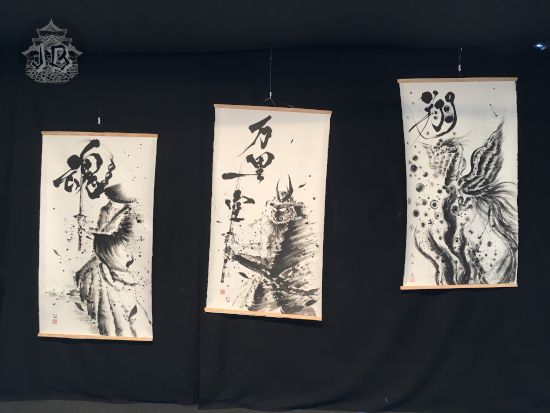
Mitsuru Nagata was born in Kyoto, but he resides in Barcelona these days. He started studying calligraphy when he was six years old and holds a Master Calligraphy degree. He sells his prints online and on different events around Spain, where he travels to promote Japanese culture. His stand at the convention had fantastic paintings.

Several hanging rolls of Japanese ink paintings, with samurai and a phoenix

After about an hour of walking around (probably even less) we decided to join the “queue” to enter the small hall where Inoran’s “presentation” was to take place. We got talking to a bunch of people, including a group of Japanese girls, including one, E**chan, who was studying Spanish! I think I met a Japanese version of myself…

According to the description, the presentation was a short introduction of the artist, an explanation of who he was, a summary of his musical career and some videos, followed by an autograph session, and lasted an hour. In the end, it was ten-minute event. There was a tiny summary of Inoran’s career and basically we just got to see him say “hola”, and we watched the MV of his newest song. There was no real “summary of his career” nor signing.

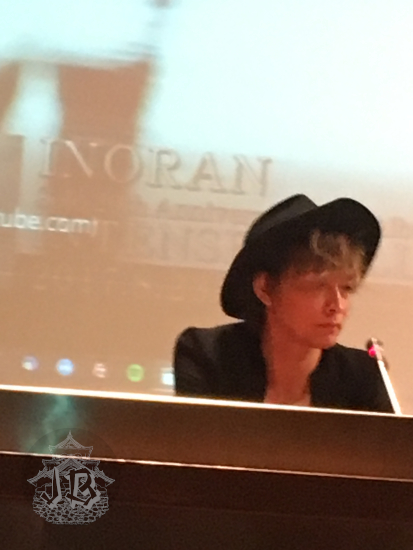
Inoran talking into a microphone

In general, I have to say that the organisation of the event was horrid. Out of the three scheduled signing sessions, only one took place, with no explanation as of why during the whole convention. The following week, it was mentioned that Inoran had requested two signing sessions to be scrapped. Instead of saying that, the autograph sessions just disappeared from the webpage schedule, so early print-outs had them, others did not. It was a bit chaotic.

After the presentation, around 14:00 we… had no plans until the concert at 19:00, so we decided to just… wait at the stage, and believe me, we were not the first to think about it,.We ended up sharing “first row” with a bunch of other Spanish and Japanese fans. We killed time snacking, we watched the cosplay contest, and got all pumped up for the whole thing. I mean, we could sit on the floor, against the barrier, with access to food and water. Best queueing conditions ever. We witnessed the preparation of the stage, including setting an iPad for Inoran to look at his lyrics, guitar checking and so on.

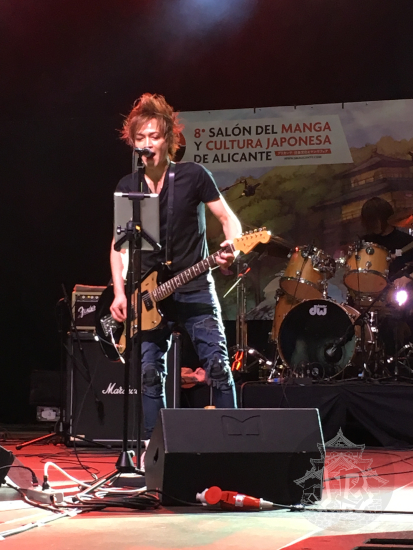
Inoran is the guitarist of Luna Sea, a musician at his core. Truth be told, he is not the best vocalist in the world. Other members of the group were u:zo on bass, Yukio Murata on second guitar and Ryo Yamagata on drums. The concert was really fun (and it elevated the number of members of Luna Sea I have seen to three out of five). I think it’s great when singers try the local language, or at least mangle it. Inoran did so with a very well-rehearsed “¿lo estáis pasando bien?” (are you having fun?). He also had some English prompts such as “scream” and “jump”, but most of what he said was in Japanese. Understandable Japanese at that.

Inoran on the stage, playing guitar and looking at the iPad to remember the lyrics

Setlist:

  1. Come away with me
  2. Get a feeling
  3. Awaking myself
  4. 2 Limes
  5. Beautiful Now
  6. No options
  7. D&B
  8. One Big Blue
  9. Rightway
  10. grace & glory
  11. Tonight
  12. Get Laid

The whole affair was even better than expected. Murata was utterly fun, and even if we had u:zo on the other side of the stage we still got to see a great deal of his. At some point they got the Here comes the Sound (producer) guy up to play some Luna Sea songs. The background noise was so great at that moment that it took me a long while to actually recognise the actual song…

As we had waited at the stage for hours, we had “first row”, against the barrier. A few minutes before the concert, the organisation brought a number of people to sit between the barrier and the stage – volunteers”, “workers” and “VIPs” who did not care at all, to the point that Inoran himself called them out at a point. The official pictures show them playing with their phones and not even looking at the stage. What’s the point of being there if you don’t care? Behind the fans there were the curious onlookers. I do wonder what Inoran found himself thinking about the convention.

The only actual autograph session and M&G happened after the concert. When we formed the queue, we were told (screamed at) that we needed to purchase a postcard for Inoran to sign. This postcard had the cost of 1<e, and it had been printed by the convention from an internet image,it was not even something the artist himself had brought. I told the volunteer that some of us had official material, and he shrugged, saying that only postcards could be signed. I subsequently asked if he could just enquire if Inoran was willing to sign anything else. The volunteer shrugged again with “I don’t speak Japanese” – tough luck, buddy, I do. Badly, but enough to ask for an autograph.

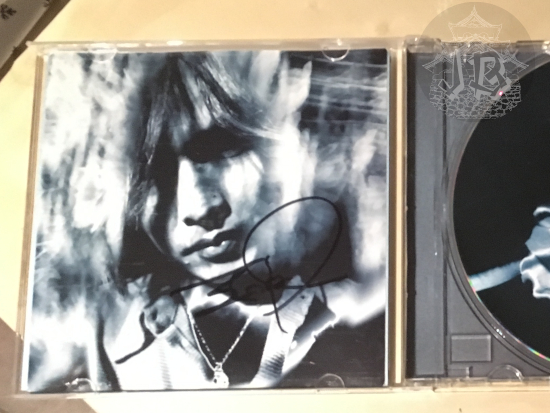
I paid my euro for the postcard and when Inoran reached out for it, I pulled out one of the CDs I had brought, and asked him to sign that instead. There was an uproar from the volunteers, but he had literally zero issues signing my CD. I mean, it was his original material after all (Note to the organisation: you fools, if I pay you the 1€ and don’t use your postcard, you can sell that postcard to someone else who will pay another euro. Seriously). We got selfies (with smile), handshake and signature, so it was all pretty great. At the same time, my friend C***** was recording everything, and Inoran’s staff were laughing in the background. As I was leaving, I asked Inoran to also sign C*****’s CD instead of a postcard too, and he smirked at me. I’m sure that the organisation hated me a lot that evening, as I started a trend.

Inoran's autograph

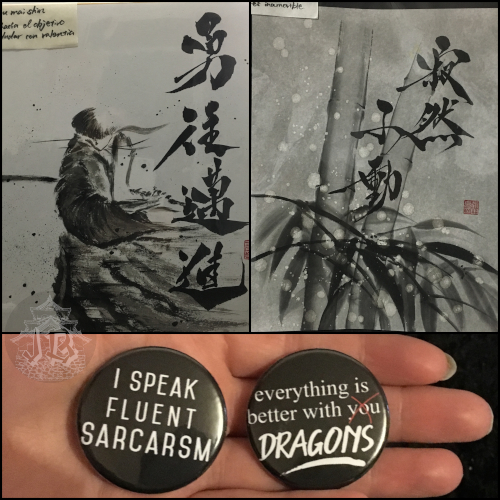
After the autographs, we left the area and walked towards the Matsuri. We bought some sumi-e art from Mitsuru Nagata, and then headed off to the artists’ alley. C***** bought herself a bunch of things (and some pins for me!). We also saw the Mary Poppins cosplayer who we thought should have won the cosplay contest, and we talked to her for a while, and took some pictures – according to the contest rules, she should have won the price, but the organisation chose something more anime-oriented. Finally, we headed off to take a bus downtown and walked towards the hotel.

Two Japanese ink drawings. One is a samurai drawing his sword, the other one some bamboo. Also two badges: one reads I speak fluent sarcasm, the other one everything is better with dragons

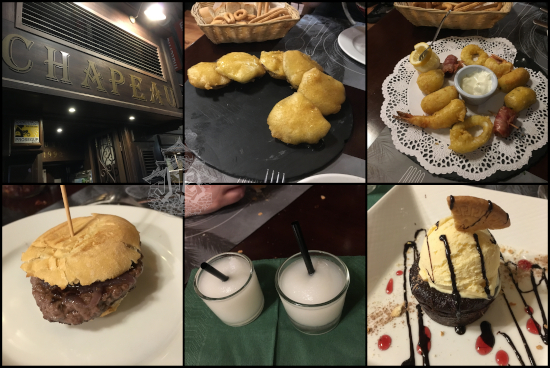
As we had had a small on-the-go lunch waiting by the stage, we decided to go for a serious dinner. The fun part was that we ended up finding Taberna El Chapeau, the restaurant where Inoran and the band had been the previous night. To be honest, it was very near our hotel, and we checked the menu for kicks and giggles as we were heading for something fast-food. It turned out the place was not expensive at all, so we decided to eat there! We tried the palm-honey eggplant, a mixture of fried seafoods, a mini-burger, and a very sinful brownie for dessert – the lemon sherbet was on the house.

Dinner. Some fried snacks and a mini hamburger, a pair of lemon shots, and an ice cream scoop

Sunday, 9th April 2018

Our must-do schedule for the day included:

  • 12:00 – 13:00: Kenichi Yoshida’s concert (unclear if there would be any signing afterwards. Spoiler: there was.)
  • 13:30 – 14:30: Q&A with Inoran (which was supposed to have a signing session afterwards)

Sunday morning started pretty much the same as Saturday’s had. We took the bus to the convention centre IFA, and walked around. We got to meet with Mitsuru Nagata, and we asked him to take a picture with us in front of his works. Aside from super-talented, he was extremely nice. He was very surprised when he found out that we did not work in the convention and we were so interested in his art – he seemed flattered / embarrassed. Nagata invited us to attend his sumi-e demonstration, but unfortunately it was at the same time as Kenichi Yoshida’s concert. When we told him that, he said that we absolutely had to go and see Yoshida, as the musician is not around as often.

Thus, we went to queue to enter the hall. We actually arranged to queue twice in one go, since Kenichi Yoshida’s concert happened in the same hall as the Q&A with Inoran. We had made some nice acquaintances at the Inoran queue the day before, and they agreed to “save our spots” for Inoran while we went to Yoshida’s concert, as long as we stepped out and took back the place (and did not stay in the hall). We thought it was fair. Besides, the convention rules said that the hall had to empty between acts to prevent people from just hogging the seats, or saving them for friends.

When doors opened for Kenichi Yoshida’s concert, it was clear though, that those rules did not apply to “friends with the organisers”, who could just step out and then jump back, dodging the queue as they had technically “vacated the hall”. When called out, they were indignant. One of them had been asked to translate last minute, so he and all his pals, of course, had immediate priority.

Furthermore, after queueing for couple of hours in order to get a good spot in first or second row, we were not allowed to sit down in the middle (again, saved for VIPs), and sent to the corner just behind cameras and tripods, joy. Thus, we migrated to third row to be in the middle. Fortunately, most press was restricted and we did not have to “enjoy” extra cameras rather than the ones used for the official recording. Before the concert started, we were told that there would be a signing session afterwards, Yoshida would be signing postcards – just like Inoran the evening before – but that there were only twenty of them. We were very annoyed at that because, yet again, C***** and I had brought our own original material.

Kenichi Yoshida had been brought to Spain in a joint project by the Japanese Consulate in Barcelona, the Music museum and the Japan Foundation for a concert and a few activities in Barcelona. Alicante was a welcome bonus. He came along with percussionist Yuki Tsuchida, leader of the band Cross Groove Premium.

Kenichi Yoshida is a skilful tsugaru shamisen interpreter, who debuted in 1999 along his older brother as Yoshida Kyodai (Yoshida Brothers). The shamisen [三味線] is a traditional three-string guitar like instrument from Japan, based on a previous Chinese one. It is played with a pick. The tsugaru shamisen is a particular variant of the regular shamisen, larger and with thicker strings, which is plucked as well as hit with the pick.

The concert was spectacular, as much as the one I had watched in Madrid in 2016. Between songs, Yoshida explained a little bit about himself, his instrument, and some of its history. He gave a few notions about how the shamisen appeared in Japan, evolving from a traditional Chinese instrument that entered the country through Okinawa and it gained popularity as it was moved up north. It changed through time and one of the variants that appeared was the tsugaru shamisen.

Kenichi Yoshida playing shamisen, with his percussionist on the right

At the end of the concert, as C***** and I thought the postcards would not be enough, we decided to try our luck asking Yoshida directly if he would sign our CDs. And thus, instead of going into “Battle Royale” for the postcards we… took after him. As Yoshida was climbing up the stairs along the drummer and the manager, I caught up with him. I… very respectfully… tried to tell him in Japanese that there were too few postcards and that my friend and I had brought the original CDs, and if he would mind signing those for us. Thinking back,maybe we could have just stood in line without the postcards, but I was not sure they would even allow us to queue.

To my eternal surprise, Yoshida smiled and said yes. The manager ushered me up to the second floor as C***** went to hold the place in the queue, and I got the CDs signed, along with a complimentary sticker. Shaking like a leaf, I went back to the queue. In the end, it turned out that there were enough postcards for all the fans, so we tried again! Yoshida was nice enough to take a picture with us and sign postcards again.

Yoshida's autograph

Then we went to the hall again to see Inoran’s last appearance, the Q&A session, which did not have a signing either. The event was carried out in Spanish, English, and Japanese. After watching the MV, the questions came. They focused on Inoran’s thought on Spain, and whether he knew about how popular he is in Spain. Some fans and “press” asked interesting questions about his career, experience and collaborations with different artists and bands – Hide, Tsuchiya Anna, Luna Sea, Fake? and so on. He was asked how to become “big in Japan” particularly as a musician, and he said “working hard”. And then I lost it when he called us fans “young”. That almost made me roll on the floor laughing.

Inoran sitting on a chair with a hat, a scarf, and his jeans rolled up

After the Q&A, Inoran left, and C***** and I headed back towards Alicante. In the bus, I exchanged information with E**chan to stay in contact. C***** and I picked our things up from the hotel and walked to the train station, where he had a super-late lunch.

Burger, fries, and a glass of coke

We had a shared train-ride to Madrid, and we spent most of it in the cafeteria, chatting up. We also got to see a pretty rainbow as it rained on the way. After we made it to Madrid, we separated for the last leg of our journeys, happy to have met up once more for yet another fun adventure.

Dark clouds and a rainbow

3rd – 5th July 2015: Japan Expo in Paris (France)

I went back to France rather unexpectedly because VAMPS announced an appearance at Japan Expo, a Japanese Culture convention held in Parc des Expositions de Paris-Nord Villepinte. I flew in on Friday and as I had time, I decided to go to the Louvre museum. I discovered the automatic ticket selling machine, so my queue was unexpectedly short once I was out of the security waiting area. I geeked out to my heart’s content and I reflected on how I had got used to geeking out alone and how comfortable I felt compared to my first time alone in a museum, back in the Dark Ages when I was 14.

Different exhibits of the Louvre: bronze sculptures, Egyptian sarcophagi, sitting scribe, Babylonian bulls, a marble, bathtub, Venus de Milo, Eros and Psyche, Victory of Samothrace

The following day I met up with some friends at the Japan Expo for the VAMPS concert act that had been organised. Japan Expo is one of the biggest European conventions about manga, anime, Japanese culture and everything in between, including concerts, food stalls, merchandising, and so on. The concert in itself was all right – one of the shortest ones I’ve attended, but in the end it was “just” an act in something bigger. I wish they had talked about the Sunday autograph possibilities earlier, though, because I could not attend due to my flight being in the morning.

Vamps promo claiming they were the guests of honour