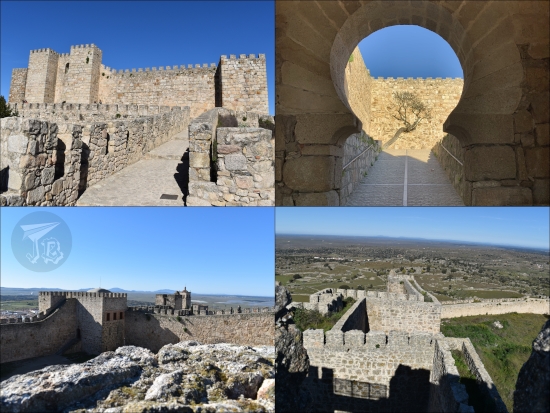
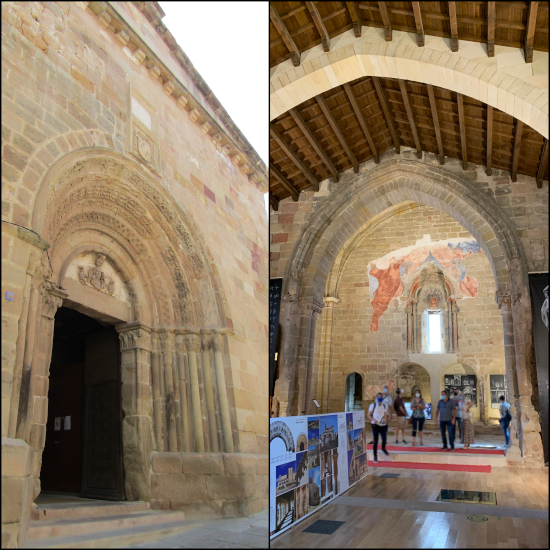
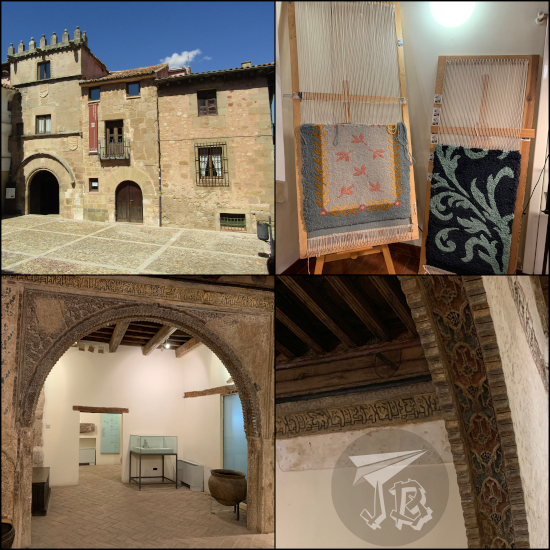
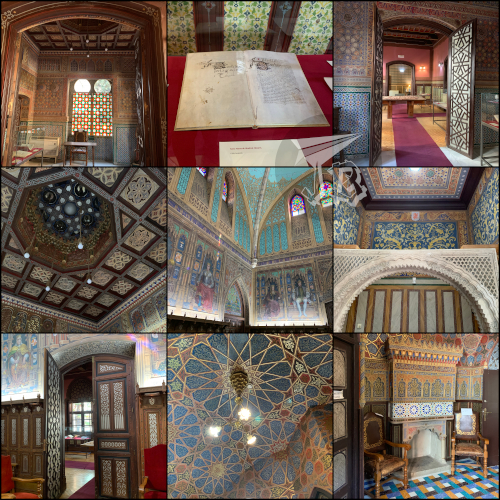
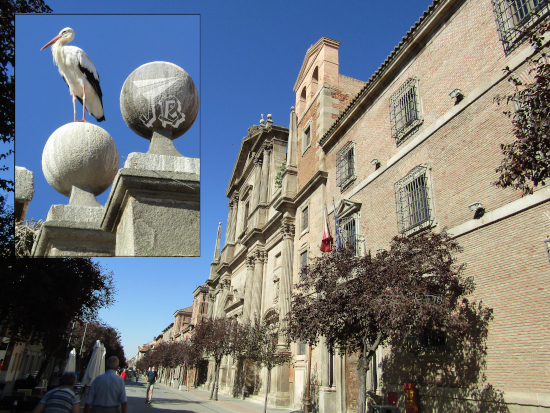
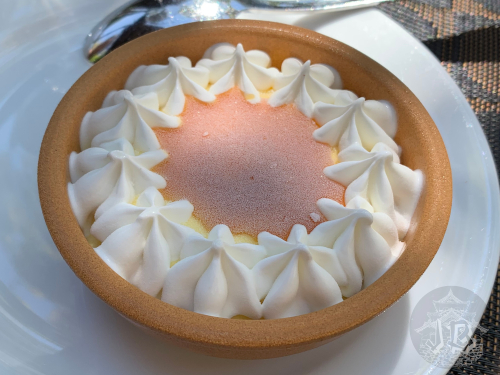
23rd July 2022: Plateresque Salamanca {Salamanca, July 2022}

Officially in western Spain, Salamanca stands next to the Tormes river and sports a Unesco World Heritage title for its old town. I was five or six the first time I was there, so it’s not like I remembered anything from it, except memorising excerpts from the book El Estudiante de Salamanca (José de Espronceda), my favourite Spanish Romantic poet.

Salamanca is known due to its university, which is considered one of the best in the teaching of Spanish as a second language, the oldest Spanish university and one of the oldest in Europe, founded in 1218. There are actually two universities, but we shall get to that later.

There is a period in Spanish history referred to as the Gold Century, Siglo de Oro (Not an actual century, the given dates are between 1492 – the year when the Catholic monarchs finished conquering the country, Europeans realised America existed, and the first book on Spanish grammar was published – and 1659 – when the Pyrenees treaty was signed after the war with France). It was throughout this period when Salamanca thrived, especially late-time Gothic styles and early Renaissance ones. Then of course Baroque later on, but you know my stance on Baroque by now I guess… The mixture of late-gothic and Renaissance gave way to a unique style, Plateresque – with a strong Gothic base and a blend of Mudéjar, Flamboyant Gothic, Lombard and Tuscan Renaissance elements and decorations. Plateresque is characterised by heavy decorations sculpted onto the main architecture, especially in the typical fusion of doors and altarpieces. The motifs are plants, animals, shields and medallions… All and all, an impressive style considering we are talking about carving stuff on stone – in the case of Salamanca, a lot of it is sandstone, which gives the old city a golden tone.

We had to take a couple of trains, but and made it to Salamanca around 10:30, and were in the city centre a few minutes later. After dropping the luggage at the hotel – I had been requested the hotel to be near the cathedral and I found one which was literally across the street from one of the flanks. Then again, here’s the thing – Salamanca has not one but two cathedrals: the Old Cathedral Catedral Vieja de Santa María and the New Cathedral Catedral Nueva de la Asunción de la Virgen. Apparently, instead of building over the old one, they decided to keep both, making the historical complex unique in the country.

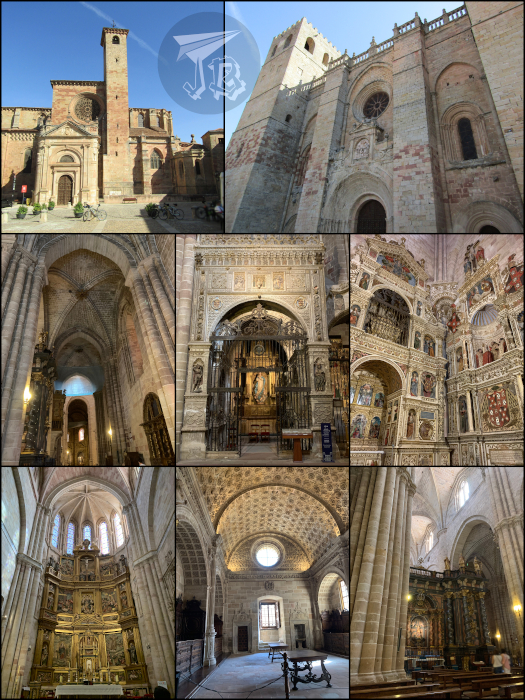
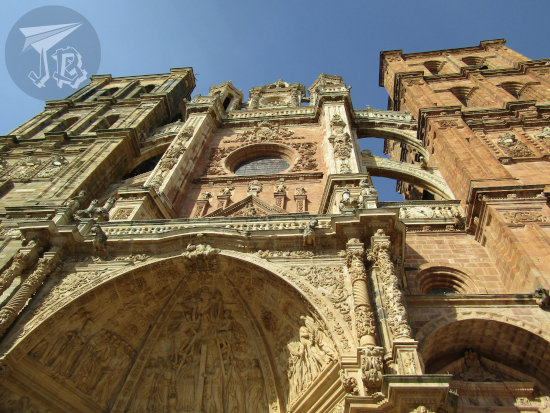
The New Cathedral was built mainly in Gothic style with later Baroque add-ons, with an ornate Plateresque façade. It was commissioned by king Ferdinand V of Castile, and built between the 16th and 18th century, in the Gothic style, even though this was at time when Gothic was already in decline. However, the town authorities wanted it to “match” the old Romanesque cathedral. A cupola and a choir were added in the Baroque period, and the façades were decorated in the Plateresque way (in a 20th-century restoration, someone thought it would be funny to add an astronaut to the decoration, causing some hoaxes to pop up afterwards). The most important architect who worked in the new cathedral was José de Churriguera, one of the leading Baroque architects / sculptors / urbanists.

A very ornate Gothic cathedral. The entrance has so many carvings that it actually looks organic, if not for the fact that it is made out of golden / reddish stone

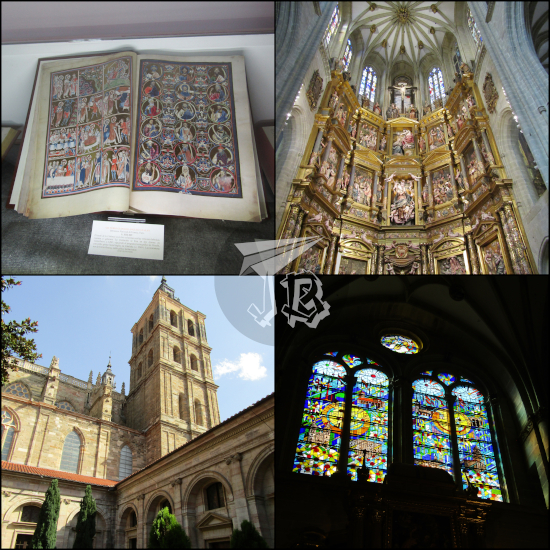
The New Cathedral connects to the old Cathedral, which is late Romanesque / early Gothic in style (I know, it’s confusing. Historically, the old cathedral is between Romanesque and Gothic, and the new one between Gothic and Renaissance – and this is the reason why the Gothic makes the two cathedral “match”). It was built between the 12th and 14th centuries. The most impressive thing in the Old Cathedral is the altarpiece, in which the highest-quality paintings were made by the Italian Dello Delli. On the way out, I let myself be tempted by a paper guidebook of the city – which was helpful because we had to remake all of our plans a couple of times.

Interior of a Romanesque church - the nave has very high and severe-seeming columns

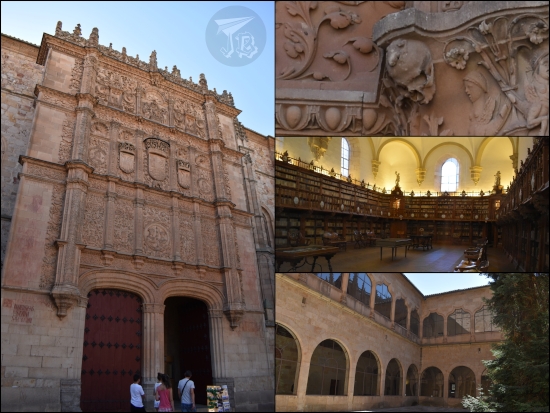
Afterwards, we headed off to the main university building Universidad de Salamanca, the first university building. The university was founded by King Alfonso XI in 1218, which makes it the oldest university in the whole Spanish-speaking world. The most important building today is the Escuelas Mayores, the upper school, built between 1411 and 1533. The façade, which looks towards the newly-discovered New World is sculpted in the Plateresque style, with a ton of decoration – and the most famous motif is the frog that stands on top of a skull. The university was built around a cloister for the students of old, and it has the most amazing library I have seen in a long while – selfishly (I’m joking of course) closed to the public. There is also a chapel and the classroom where the Spanish academic Fray Luis de León, who was famously jailed for four years, and picked up his lectures with “as we were saying yesterday”. The cloister has two floors since the 19th century, and in the centre there is a small giant sequoia (which I thought was a simple fir). There are chapels, and halls, and areas where university holds events.

Very ornate entrance to a building. there are two doors (four or five times as tall as a person) and the decoration, all carved in stone, is on top. Three floors of decoration, with columns and shields. A close-up shows a frog on top of a skull.

The problem with Salamanca is that the entries and exits of the building make you have to backtrack a lot (and the horrible street lights), but I love Gothic so I did not mind wandering around anyway. After the Escuelas Mayores, we went to another university building the lesser school or Escuelas Menores. Today, there is a cloister which dates from 1428 with a Baroque upper veranda. In one of the side halls there is a fresco panting that used to be in the library and that was moved over in 1950. The fresco represents a night sky was used in teaching.

Gothic patio and a suck picture of a fresco painting, showing stars and the representation of constellations

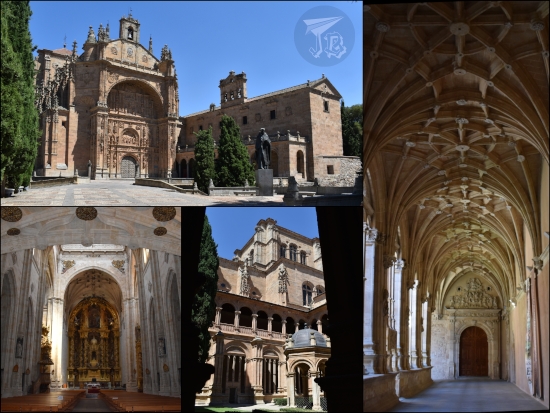
We had lunch, then we went to the Dominican monastery Convento de San Esteban and its church. The current monastery dates from 1524-1610, and it was built over the previous one. The façade of the church is considered the best example of Plateresque, and José de Churriguera also worked in the main altarpiece. The monastic building has a portico with Italian loggias, typical of the Renaissance. The cloister is mainly Renaissance with Gothic features, and a small temple in the middle. The ambulatory in the cloister has beautiful Gothic columns and nerves on the ceiling.

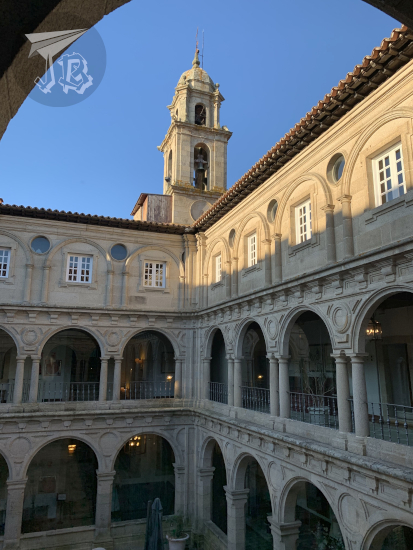
A convent, built in ornate gotic style. The covered corridor around the cloister shows pointed arches and rich decorations

Right in front of the monastery stands the Dominican convent Convento de las Dueñas. The building is Baroque, and before being a convent it used to be a palace – which has caused the convent to have some eclectic elements of architecture, such as the Mudéjar arch mosaic or doors. The inner cloister is Plateresque and full of roses and flowers.

A Baroque building. The inner patio is decorated with plants and Moorish-seeming blinded arches

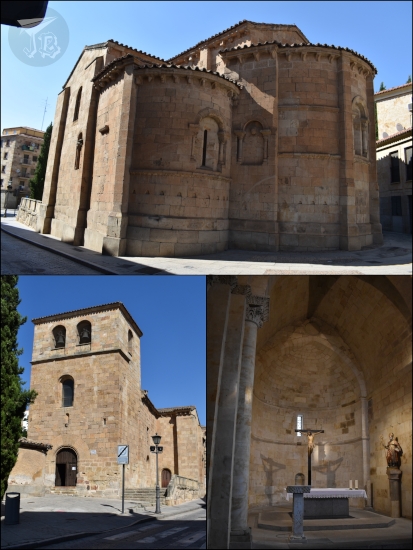
Next, we found the tiny Romanesque church Iglesia de Santo Tomás Cantuariense, where I happily sicced the oh-so-bored guide onto my companion.

Small Romanesque church in reddish-gold stone. It has a tiny bell tower.

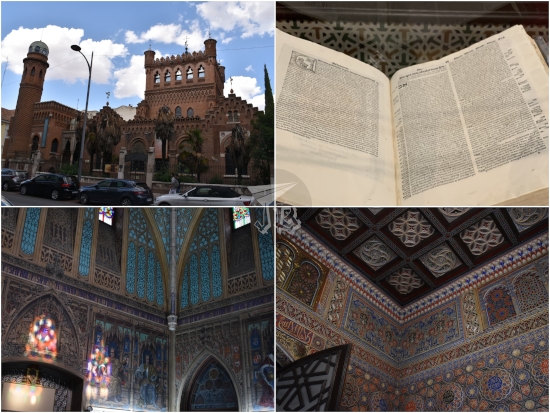
After a stop for a cold drink we went to the Art Nouveau and Art Déco Museum Museo de Art Nouveau y Art Déco Casa Lis, which is one of those places that takes itself very seriously and does not allow photographs. I got scolded for having my camera to my side even closed – but I have to admit that I did sneak up a few things with the phone, mostly because I wanted a record of the central hall with the glass ceiling, and the green windows from the inside, more than the decorative details, though some of them were pretty nice. The Lis house was built by Andalusian architect Joaquín de Vargas towards the end of the 19th century for the first owner, Miguel de Lis.

A Modernist building with brightly-coloured glass in the ceiling and walls.

We headed to the main square Plaza Mayor for dinner, and then to see the pretty lights. On the way we found the other university Universidad Pontificia and the palace Casa de las Conchas, which we would visit the following day.

The main square was another of the city landmarks first designed by Alberto Churriguera, and later one of his nephews – it seems that the Churriguera family claimed dibs on doing stuff in Salamanca. The square is fantastic by day but when night fell and the lights were turned on, it was unbelievable. We had some local sausages and cheese for dinner at one of the street tables in the square.

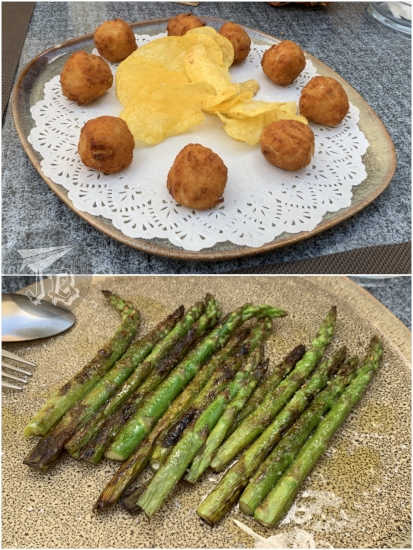
A plate of sausages and cheese, and two views of the Main Square in Salamanca, one in daylight, one at night, and lit up. The square buildings have a lot of windows and arches on the ground floor

Afterwards, I wandered alone for a while, to revisit some of the sights at night, and a couple of new ones.

Salamanca at night. The cathedral is lit and the ornamets almost shine. The Modernist house is lit in green and blue lights.

I headed off to the riverside of Río Tormes, which as any river has bridges. The first one I found is the Puente de Enrique Estevan, commissioned in 1891 in order for the town to be ready for the new cars. It has six iron arches and at night it is lit in bluish light. A few minutes downstream stands the older stone bridge Puente Romano, which according to the legend was built by Hercules – it dates back to the first century, but it has been heavily rebuilt and reconstructed through the years, especially after it was damaged by a flood in the 17th century.

A collage showing an iron bridge, and a stone bridge, both lit in the dark

Finally, around midnight, I went back to the hotel for a shower and sleep.

Walking distance: 17269 steps / 10.76 km

30th May 2022: The Slopes of Mount Teide {Tenerife, birthday 2022}

Due to the amount of near-misses, I had started thinking about this as the luckiest unlucky trip in a long time. Unfortunately, this was the day the luck ran out. As I woke up and turned on the phone I received the notification that the cable-car to go up Mount Teide was closed due to bad weather, which was a bit of a blow. I mean, I was in the middle of the natural park, without anything to do within a couple of hours by car as the hiking trails are closed on Monday mornings as it is then when the mouflon population is controlled – using rifles. I did not want to end up shot.

If you consider that the island Tenerife is one big volcano, Mount Teide is the most famous eruptive fissure. Considering it an independent item, it is a stratovolcano. The cone stands around 7500 metres from the sea floor, with an emerged 3715 m above sea level. Its base is located on a previous crater called Las Cañadas. Mount Teide last erupted in 1909, so it is still considered an active volcano, and it hosts a bunch of towns on its slopes, that might get obliterated in an eruption. Aside from being a National Park, the area is a Unesco World Heritage Site.

Historically, an eruption was reported by Christopher Columbus in 1492. Most recent eruptions happened in 2805, 1798 and 1909. Looking back, Mount Teide formed around 160,000 years ago, after the collapse of Las Cañadas. The last summit eruption happened in the 9th century, which caused the black lava blocks that seem to run down the slopes.

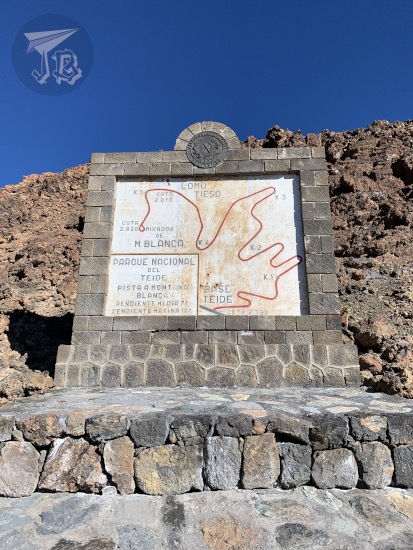
The whole point of my being there was going up the mountain, so I resolved to try and do that. I knew there was little chance I could make it to the top even with the access permission, but I would try. I decided to gamble the track Sendero de Montaña Blanca, which is the most typical one. For this, I had a good breakfast and started walking around 9:45 am. The track runs 8 km and starts at an altitude from 2348 m. If you have the permission, you can access the track Sendero de Telesforo Bravo that peaks the volcano at 3718 metres.

A stone and tile marker, with a map of the trail.

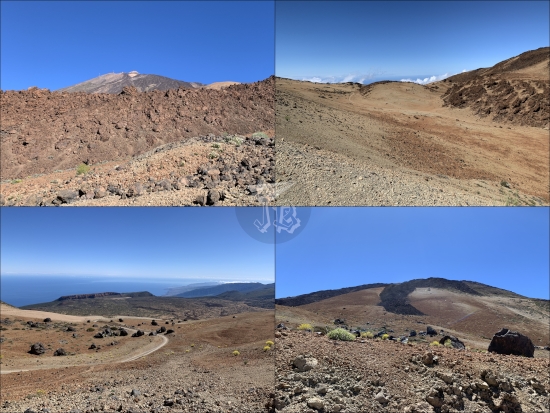
The first part of the morning, I spent on Montaña Blanca. I hiked around 3 km upwards in an hour or so. A park ranger told me that the bad weather was actually strong winds and to be careful. I’d never hiked with wind, so I decided that I would not do anything stupid. As I walked, I went by the accretion balls affectionately called “Teide Eggs” Huevos del Teide.

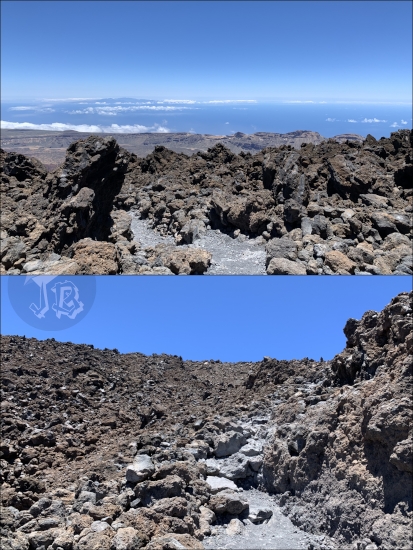
Collage: The Montaña Blanca trail. The landscape is desertic, reddish and brown, and there is barely any vegetation. When turning back, the sea peeks in the distance, and when looking up there are black rocks from an eruption.

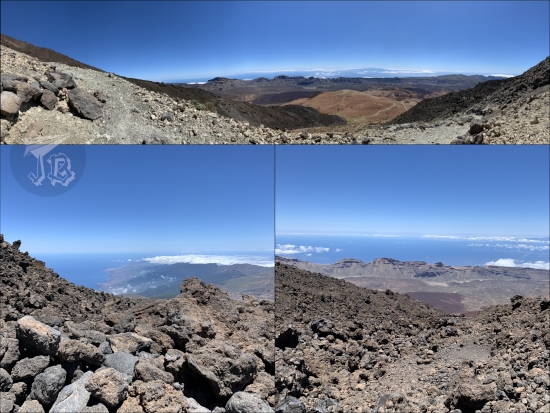
Eventually, I reached the actual foot of Mount Teide, and this is when things got hard – and spectacular. The slope became much steeper and the wind made it hard to move forward. I walked between the two dark petrified lava flows, and could see Montaña Blanca and the Atlantic Ocean beneath.

View from the slope of Teide. Montaña Blanca is underneath, in red-gold. To the sides, the black and dark grey rocks trailing the old lava flows

I reached Refugio de Altavista at 3260 m around 14:00. At this point I was two kilometres away from the next station and 650 m away from the crater. Unfortunately, the elevation was still around 500 m. At this point the wind was very strong and shortly after the refuge I saw an area of the slope I knew I could climb up… but I knew I wouldn’t climb down with such strong wind, not safely. So I realised I had to turn back, even if that meant I wouldn’t see the peak, much less reach it. However, it was the sane thing to do.

Standing in the middle of the two solidified coladas - looking down there are black and grey rocks, and the sea in the horizon. Looking up, only more rocks.

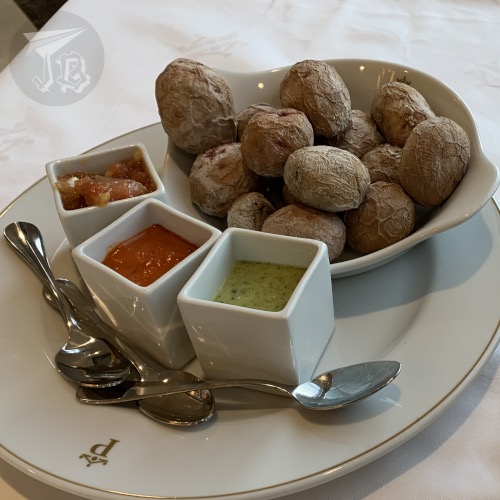
It took me two and a half hours to hike down, and I made it back at the Parador around 17:30. I had a shower and I felt tired, though not as sore as I imagined. For dinner, I tried some local speciality “wrinkled potatoes” papas arrugadas, which are boiled in saltwater, and they are so high-class that can be eaten without being peeled. They come with some dips, a bit too spicy for my taste, but they were delicious.

Small voiled potatoes and three small bowls of sauces. The potatoes are unpeeled and they look wrinkled.

I was a bit bummed that I did not manage to reach the crater, but I think I did a good job, almost 1000 metres up and down. I guess it just meant I had to go back at some point…

26th February 2022: A Medieval Fair in Tendilla (Spain)

Tendilla is a tiny village in the area of Guadalajara, Spain. It was declared a town – by Medieval standards at least in 1394. About a century later, the County of Tendilla was founded. By that time, the local cattle fair, around the festivity of St. Matthew, was considered one of the best in the Kingdom of Castile, with the Catholic Monarchs bestowing their blessings on the town. Among the most interesting areas are the long covered arcades, and the unfinished church dating back from the 16th century, Iglesia de la Asunción.

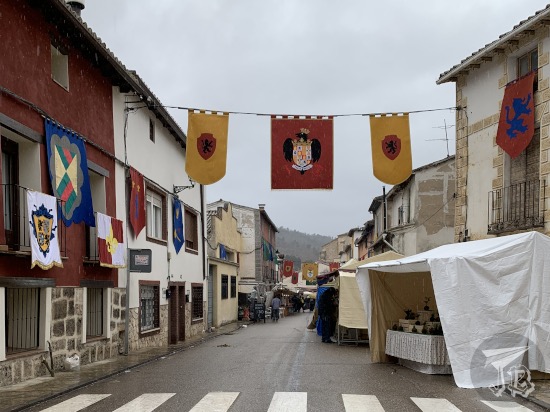
The cattle fair was rekindled in the 1990s, and today it is called Feria de Mercaderías de San Matías. The closest weekend to the 24th of February, St. Matthew’s day, a Medieval market is laid along Main Street, with edibles, trinkets and artisan items. The village becomes decorated with flags, pennons showing off real and assumed heraldry items.

This year, I decided to get there as some family members were going to be in the house they own in the village. I arrived at around 10 am, and by that time most the village was already full. I got deviated, but it was not hard to find a parking spot. Unfortunately the weather had not decided to accompany and it was rainy and freezing all day.

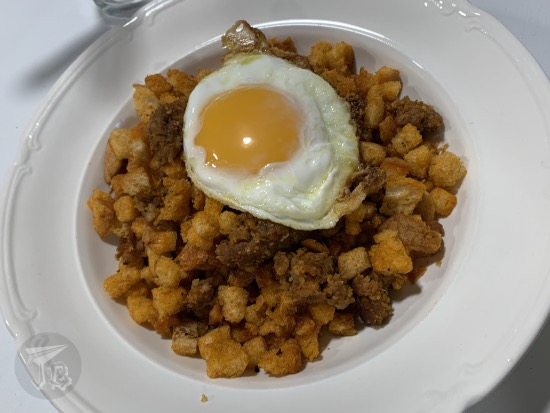
The fair stalls had begun to open, but first we made a run for the local grocery stores to grab some ingredients for lunch. The typical thing to eat in this time are migas, which are basically fried breadcrumbs with paprika, pork, garlic and a fried egg on top. We also bought sweets and confectioneries, just because we could.

At noon, we walked along Main Street Calle Mayor. The stalls were already open, and even in the bad weather there were quite a few people. Some were even in costume, dressed in Medieval outfits, as dames, knights or noblemen.

A wide street. There are flags hanging above and from the balconies, and shopping stands on the right. the sky is dark and heavy, as in all the pictures taken

A wide street. There are flags hanging above, and shopping stands on the both sides, selling hand-made jewellry and trinkets.

A Romanesque church with a bell tower. The church is unfinished.

Main square. It has a pole in the middle, and colourful ribbons run from it to the buildings around the square. The floor has been covered in sand, and the houses are decorated with flags. Lots of people walk around.

To the end of the village, a small “farm” had been installed – oxen, horses, cows, goats, donkies, sheep, rabbits, piglets… Due to the ‘health situation’ which for once was not Covid but avian flu, there were no ducks or hens or any kind of bird. You could hold the bunnies, but I really really wanted to hug the huge draft horses.

Farm animals: a donkey, two piglets, cows, rabbits, a sheep trying to eat the camera, a working horse.

Farm animals: goats trying to escape the pen, oxen ignoring the camera, a black-and-white cow wanting pets, and a working horse looking tired.

Someone had not really thought positioning carefully though, and right in front of the farm – and the piglets – stood the food stalls, especially a roaster, whose cooked pork was… suspiciously similar to the piglets in the farm *coughs*.

On the other side of the farm, the locals had started preparing the communal migas – every visitor is entitled to a plate of them, but it was way too cold to queue. Instead of being topped with an egg, though, they are sprinkled with torreznos, pork lard fried and preserved.

A huge barbecue with pork roasting and sausages. The barbeque itself is round, and it's big enough to fit at least a dozen ribcages, ten pork legs, and twenty or thirty sausages.

A person using a shovel to stir a huge pot of breadcrumbs being cooked, and a close up of the severd plate: orange-looking breadcrumbs with dried fried pork lard on top.

On our way back we ran into the horse parade and show, which was held in front of the town hall. The riders of El Duque Espectáulos, dressed in Medieval and Templar costumes, trotted and galloped along the music.

A group of medieval-looking horse riders making their way through the crowds

An older man making a golden horse trot and gallop on command, the horse is photographed mid-hop

Riders in medieval clothing galloping on the Main square

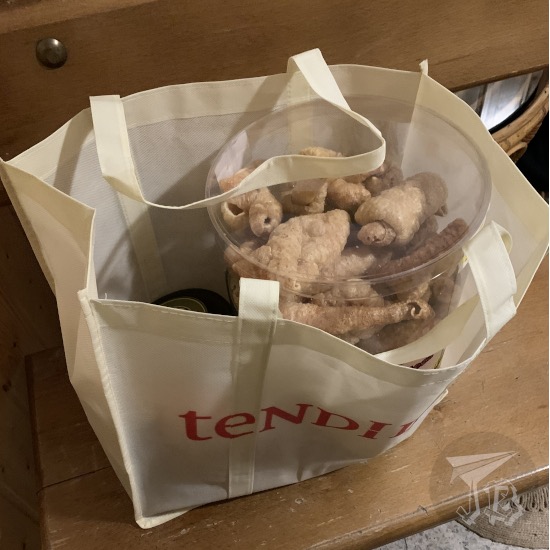
We stopped to buy some torreznos to take home, and we got given the tourist treat – a cloth bag with a huge box of fried pork skin. It is tastier than it sounds, honest!

A tote bag reading Tendi (the rest of the writing is obscured), with a box of torreznos inside

We had lunch at home, and not to show off, but I do think our breadcrumbs looked much better. We made them ourselves, with chorizo meat and eggs sunny side up! They looked so much better than the communal ones, right?!

A plate of migas. The breadcrumbs look golden, and there are pieces of pancetta and chorizo mixed with the bread. On top, there is a fried egg, sunny-side up

Finally, after lunch, we took another stroll, but the weather was miserable, raining and cold – which was so mean because the following day when I had to work it was nice and sunny, and there was a bird of prey exhibit.

Romanesque and Baroque buildings, deserted in the rain. One of them is a tiny hermit church, the other a column, and the third a palace that has seen better times

But all in all I spent a nice time with family and got to pat horses and goats. I guess there are much worse ways to spend a Saturday.

Walked distance: 6.20 km (9866 steps)

18th – 20th February 2022: Extremadura, the not-at-all-wild west of Spain

With everything that keeps going on in the world, my little travel gig seems insignificant. Here it is, anyway, for the sake of completion.

18th February 2022: Jam and Ham

After a crazy crazy period, and within a just-slightly-less-crazy period, we made space for a mini escapade – just under 48 hours, but it was an interesting mental reset. We took the car and drove off to Cáceres after I finished work in the afternoon. The trip should have taken a little over 3 hours and 15 minutes, but we spent about 70 minutes caught in several traffic jams – or just a very long jam with different instalments.

Sunset from the road. The orange light zigzags through the grey and blue clouds

Cáceres is located in the autonomous community of Extremadura, which is famous because of its particular grassland with dwarf trees called a dehesa. The typical animal farmed in the area is the native Black Iberian pig – a traditional breed of the domestic pig (Sus scrofa domesticus). Through breeding with wild boars and millennia of adaptation, the Iberian pig has grown accustomed to eating oak acorns, and thus it has become a key part of the ecosystem. Furthermore, the breed has great tendency to accumulate intra-muscular fat. This means that its meat is delicious, especially as sausage. The most famous treat is the “Black label” (Etiqueta Negra or Dehesa de Extremadura) ham: a pig raised in the dehesa, fed acorns and natural grass, and whose meat has been cured for at least 20 months.

The area of Cáceres is also known for its sheep-milk cheese, Torta del Casar. It is a strong-flavoured creamy cheese that comes from controlled sheep, also raised in the dehesa. The cheese is especially curded with rennet made from cardoon (Cynara cardunculus). Another typical food from the area is the local paprika Pimentón de la Vera, which is made from smoked local red peppers. All three – ham, cheese and paprika – hold European Protected Designation of Origin certificates.

Of course, not everything is food in Cáceres. After we checked into our hotel near the historical centre, we headed off to the Main Square Plaza Mayor de Cáceres, which features the town hall, the former wall gate called Arco de la Estrella (Star Arch), and one of the watch towers Torre de Bujaco.

The medieval square of Caceres by night. It looks like a castle, with arches, battlements. The sky is completely black.

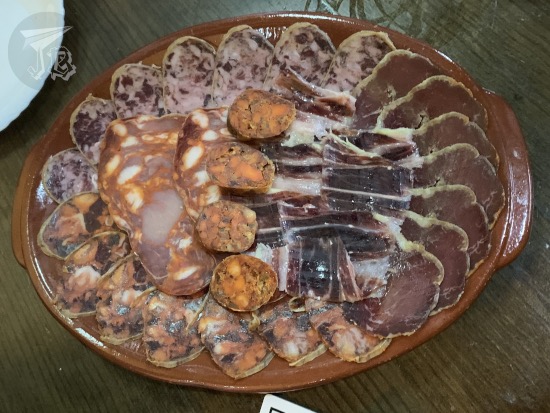
We found a place inside to grab a bite, and we tried the sausages for dinner before turning in – acorn-fed pork ham, loin, chorizo, morcón (similar to chorizo), salchichón, and patatera (pork mixed with potato and paprika in sausage form).

A plate of sausage slices and ham

Walked distance: 1.79 km (2838 steps)

19th February 2022: The Old Town of Cáceres

The Old or Walled Town of Cáceres, Ciudad Vieja de Cáceres was declared a Unesco World Heritage Site in 1986, and it is easy to see why. It is a small knot of streets between the ancient city walls and the gorge where cars can barely drive, sprinkled with Medieval and Renaissance palaces and manors. After finding an open café, we had breakfast, then headed off to explore that. Since it was a bit before 9 am, most everything was closed – but it was also empty, which was good. We crossed the Arco de la Estrella next to the Torre de Bujaco and walked into the walled area.

The medieval square of Caceres by daylight. It looks like a castle, with arches, battlements, and irregular bricks making up the walls.

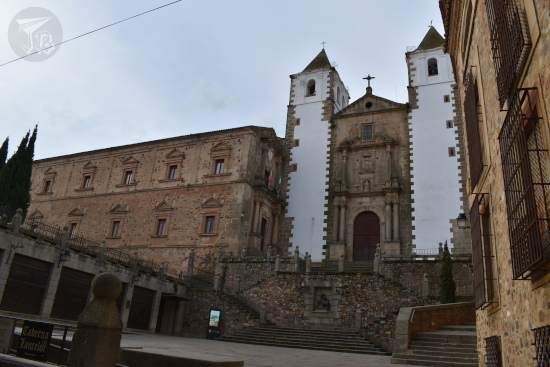
We walked past the co-cathedral – to which we would come back later and several palaces, and we ended up at a two-level square called Plaza de San Jorge (St. George Square), towered over by the peculiar-looking church Iglesia de San Francisco Javier – note the white-painted towers.

A church with two twin bell towers, both in white. Between them, the body of the church, in grey rock. In order to access it, you have to climb a staircase, which has a small sculpture of St George attacking the dragon

There was a small palace to the left, and while the building was closed off, the gardens Jardines de Doña Cristina de Ulloa were open, albeit as it was early February, still in winter mode but for some berries and roses.

Wintery garden with bare tree. There are also evergreen bushes and trees, stairs, and benches.

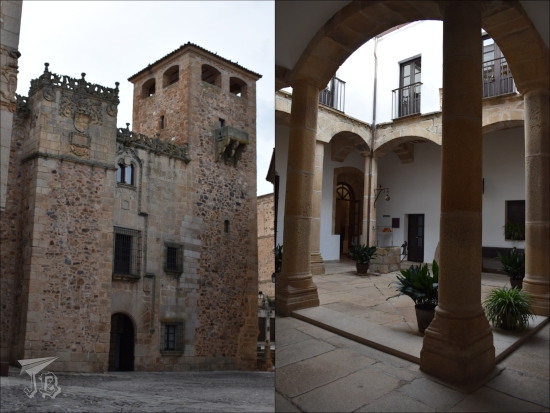
We wandered around for a while, the headed off to a visit we had booked in advance – the manor / palace of the Lower Golfines Palacio de los Golfines de Abajo, which has nothing to do with their position in the social scale, but literally the position within the city hill – in the lower part. The family is known to have owned the palace from the time of the Catholic Monarchs, in the 15th century, till the death of the last descendant in 2012. This woman willed all the heirloom to a foundation that today manages the palace. The foundation got the palace renovated and brought some of the furniture from other properties belonging to the family – among them a glass lamp way too big for the room it was set in, and a sofa which was identical to the one that used to be in my great-aunt’s living room… The lower floor holds the recreated rooms – with more or less success and taste – and a smaller area decorated with Medieval paintings which were discovered by accident. The upper floor holds a small ethnography museum and some documents from the family’s library. Unfortunately, the foundation takes itself a little too seriously and won’t allow you to roam freely in the palace or take pictures, except for the inner Castilian patio.

Gothic palace, with an ornate roof and a small cloister or patio.

After the palace, we walked a whole minute and a half for the co-cathedral Santa Iglesia Concatedral de Santa María. It is the oldest church in town, built around the 15th century, in a Romanesque-going-Gothic style. Outside the church, at the base of the tower, there is a sculpture of Saint Peter of Alcántara. Inside, the altarpiece was carved between 1547 and 1551, in unpainted pine and cedar. The tower can be climbed, and I decided that I wanted to do that, despite not being what I usually do. It was empty enough that I felt comfortable doing so, and I was treated to some nice views.

Collage: a gothic church with a bell tower; the inside showing a bare-wood altarpiece; the sea of columns from above, and a view from the belltower, showing another church and the roofs of some low houses.

By the time we went out, the city had already been taken over by walking tours and guided visits. There were so many companies that the guides put stickers on their tourists so they could herd them round. We backtracked to the Baroque church with the white towers Iglesia de San Francisco Javier (also known as Iglesia de la Preciosa Sangre), where there is no worship today. Instead, there is a huge collection of nativities (hundreds of them, literally). In order to visit the nativities you have to go up a perilous metal staircase. Once on the second floor – after having survived the peril – I decided to continue on the relatively safer stone staircase to one of the towers – only one, I did not climb up both of them. The lower floor holds two last nativities, a classical one and a hilarious set up made out of Playmobil, a German company that makes plastic figure toys.

Collage: The interior of a church with a baroque golden altarpiece, and a collection of Nativities.

We moved onto the following manor, to the side of the square, Casa Palacio Becerra, which shows some antique elements, and the house structure.

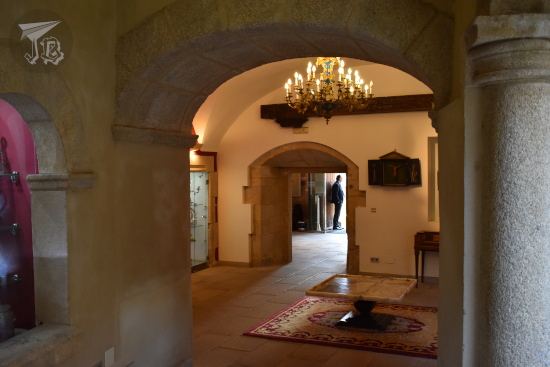
Inside a Renaissance palace, with a low arch, a glass lamp and a red carpet that try to look eclectic and end up looking bizarre

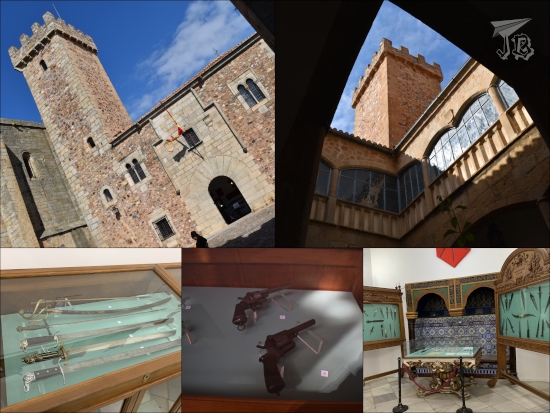
Later, we walked to Stork Square Plaza de las Cigüeñas. European white storks (Ciconia ciconia ciconia) are typical birds in Extremadura, and one wonders how they have not decided to make food out of them. In the tower stands one of the few towers that has kept its merlons, as the Catholic Monarchs were very into tearing tower tops down when they conquered a site. The adjacent manor, Casa de las Cigüeñas, hosts the military museum Museo de Armas Aula Militar.

A building with a tower. The inside is a museum, and there are some swords, firearms and Moorish decoration

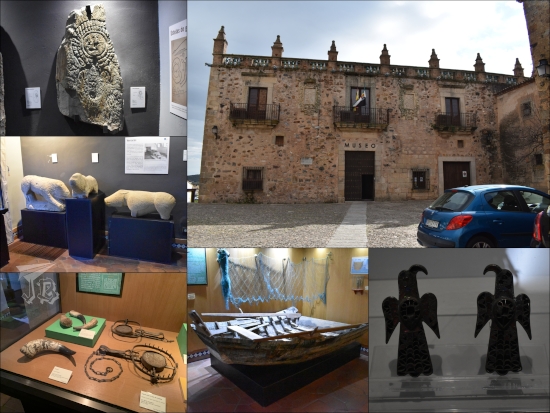
At the end of the square, in yet another palace – two of them, actually – lies the Museo de Cáceres, the local museum. The part in the Casa de Las Veletasis a regular archaeological museum, with the kind of things you would expect – prehistoric, Roman and Celtic remains, more modern artefacts. The other area, Casa de Los Caballos, hosts the modern art gallery.

Gothic building turned into a museum. The pieces shown are funerary stelae, prehistoric animal representations - bulls or pigs - and jewells, a boat, and Roman emblems

However, the palace was erected on top of the local Arab cistern or aljibe. It is the best preserved in Spain and it has been gathering the rainfall water since the 10th century. Pretty impressive piece of engineering if you ask me.

The aljibe: a moorish basement filled with water. The columns sustain horseshoe shaped arches

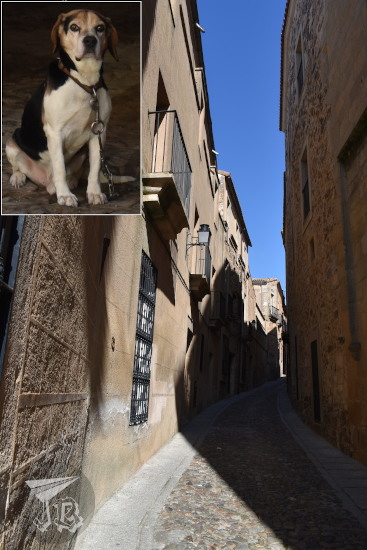
Afterwards we still had some time to kill until it was time for lunch, so we wandered around the area of the Jewish quarters or Judería, under the watchful gaze of the local Cerberus.

Narrow streets, and a guarding dog looking suspicious

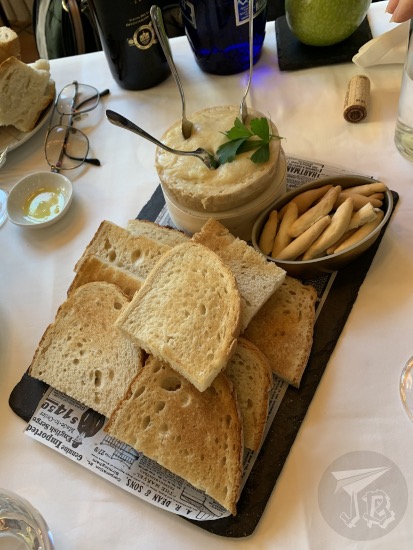
We had lunch in the local Parador de Cáceres, so I of course got my stamp. As a started we ordered the famous local cheese Torta del Casar cheese.

A tray with bread slices and breadsticks, and a cream cheese with spoons to be spread on the bread

In the afternoon we had a look at another church Iglesia de Santiago de los Caballeros. The church of St. James of the Knights was built in the 14th century over an older temple dating back from the 12th century. The altarpiece was carved and coloured by one of the most important sculptors of the Spanish Mannerism, Alonso Berruguete (1490 – 1561). This time I did not climb the tower – which had been happily colonised by a couple of storks.

Gothic church with a golden altarpiece. A stork snoozes on one of the towers.

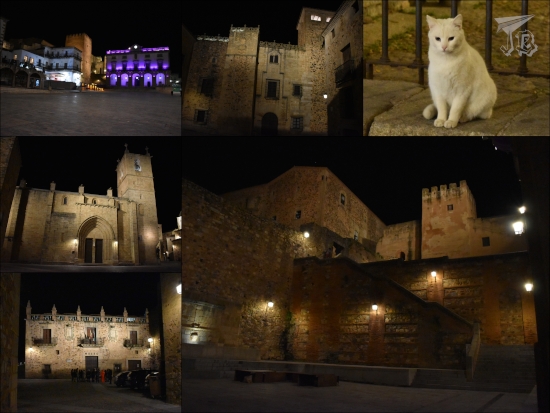
After a little while, after sunset, I decided to skid around and have a walk through the old city at night. The artificial light made it look eery and romantic in the most… historical sense of the word. I came across some cats begging for food from a bunch of schoolgirls, and one of them very indignant because the girls would not beg it to take the food!

Different buildings of Cáceres at night. The are lit wit strategic lamps to give a mysterious feeling. There is also a white fluffy cat sitting and expecting food

Walked distance: 9.04 km (14766 steps)

20th February 2022: Trujillo & Oropesa (Toledo)

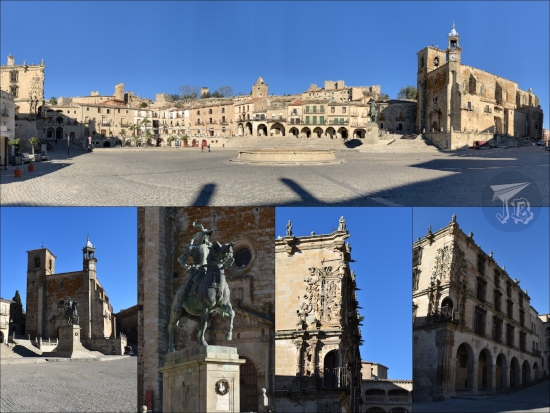
On this day I managed two more Paradores stamps. Trujillo is a town a meagre 30 minutes away from Cáceres. It also has a traditional / Medieval city centre, set around the main Square Plaza Mayor de Trujillo. It was the birthplace of one of the so-called conquerors during the colonisation of South America, Francisco Pizarro, whose equestrian statue, Estatua ecuestre de Francisco Pizarro (by American sculptor Charles Cary Rumsey). Other highlights in main square include the corner balcony in the “Conquest Manor” Palacio de la Conquista.

The large Reinassance square of Trujillo with decorated palaces and a sculpture of Hernan Cortez on his horse

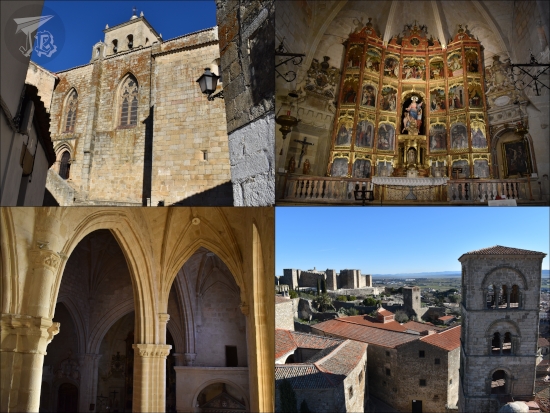
One of the most interesting churches in the area is Iglesia de Santa María la Mayor. Its tower dates back from the 13th century, but was almost completely rebuilt in the 16th century. Inside the richly painted altarpiece was erected around 1490. Apparently, my newly-discovered activity of climbing towers yielded to a new adventure, as for a few minutes I ended up locked down in the bell tower – I guess I’m a Disney Princess now (≧▽≦).

Gothic church with gothic golden altarpiece.

I got an hour and a little to wander round the town, so I climbed up to see the Muslim fortress Alcazaba de Trujillo (also called castle). Built between the 9th and the 12th century, it is a huge building with a defensive wall, an aljibe or cistern, several towers and a Christian chapel.

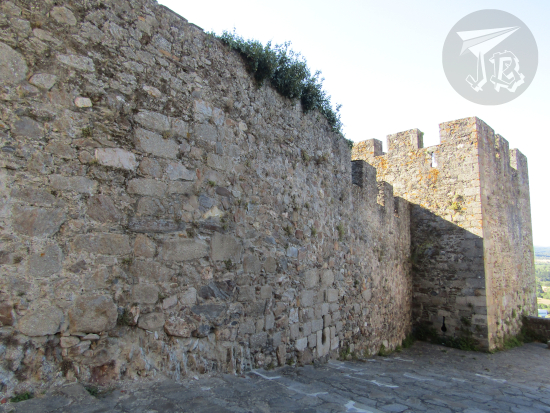
Moorish castle, from the outside and the inside. The walls and the battlements are amazingly well-preserved. It seems that the castle is built around the natural rocks defending the area

Then I hurried towards the other edge of the city to get my Parador de Trujillo stamp (only cheating slightly. I was there, after all). On my way I happened upon the Torre del Alfiler, with a family of storks happily clattering away the late morning.

Storks on top of a bell tower

I backtracked to the Plaza Mayor and I had twenty minutes before our rendezvous time, so I decked into the church Iglesia de San Martín. Its origins date from the 14th century, but it was not finished till the 16th century – which makes it so that the thick Romanesque walls are mixed with Gothic and Renaissance elements. No tower this time, but the second floor holds a religious museum.

Romanesque turning Gothic church. The inside is plastered in white and the celing above the altar and the nave retains the original decorated stone ceilings

After getting a general idea of the Medieval town of Trujillo, but it being a “working Sunday”, we moved on rather quickly, and drove off until we made it for lunch in Oropesa (Toledo) which also holds a Parador – Parador Museo de Oropesa, the first monumental Parador opened in 1930. That makes three stamps in two days, I’m almost impressed with myself!

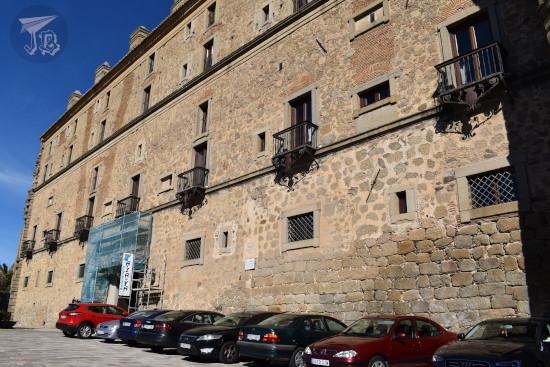
Plain building with ornate balconies, and cars parked on a row in front of it.

The Parador is adjoined to the castle Castillo de Oropesa, which was unfortunately closed, but I shall put in on my list of “to re-explore”. It was built by the Arabs during the 12th – 13th century, probably on a former Roman fortress. Today, the Old Castle is joined to the New Palace and both belong to Paradores.

Classical Romanesque castle with towers and turrets. It looks heavily restored.

After that, we drove back home, and as we got a couple of wrong turns, we ended up avoiding the traffic jam we had found on our way to Extremadura, which was convenient!

Walked distance: 5.57 km (8836 steps)

11th & 12th December 2021: Final Fantasy Remake Orchestra World Tour, Barcelona (Spain)

11th December 2021: El Triángulo Friki

When the tickets for the FINAL FANTASY VII REMAKE Orchestra World Tour first came out, 2020 promised to be an amazing year. True, we all know how that turned out, but the point was that I did not have enough fun funds at that moment. So I just looked at the Barcelona dates, sighed, and never bought tickets because I decided that it was a low-priority event for me. Then, what happened happened and the tour was pushed forward to 2021. By chance, back in summer this year, I saw that it would take place on a Saturday, the 11th of December 2021. My sibling overheard me mulling whether I wanted to try to go or not this time over, since I had not done much on the nerdsphere for a while, and the low priotity was conflagrating with higher priortity and the still lacking fun budget. They didn’t know about this, though, and they proposed we went together. I thought it was a good opportunity for a weekend out, so I did some checking. We found some tickets that had been turned back, in an amazing place, actually – row #5 on the stalls. We booked a hotel and trains, and just went on with our lives.

The train left around 8:00 and arrived in Barcelona short from 11:00 – both of us had been in town before and were looking for an “alternative” plan. I had been checking out different options, and by pure chance, on Thursday, I found out that there is an area in Barcelona called Triángulo Friki, something akin to “the nerd triangle”. It is an area near Arc de Triomph that holds a bunch stores which specialise in comics, manga, figures, merchandising and so on. I thought it could be a fun thing to see, as Japanese stuff a hobby I share to some extent with my sibling.

We took the commuter train to the area (commuter train tickets are complementary with long-distance ones, which helps, as the Barcelona public transport is very expensive) and wandered around a bunch of shops, under the agreement not to spend too much money nor to buy anything that did not fit in our backpacks. We… failed the mission successfully. On the sixth or so shop I got myself a Christmas present that sure as hell did not fit in the backpack.

A collage showing the entrance to a bunch of comic and gaming stores. Most of them have a window showing Funko pops

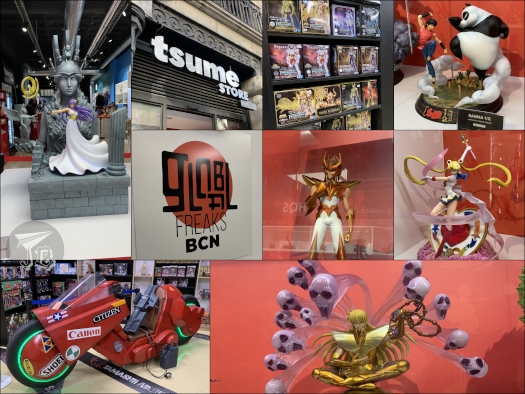
One of the shops we visited was Tsume Store, in association with Global Freaks. Tsume is a business that 3D-prints statuettes from anime designs, and Global Freaks is a merchandise shop. They have a partnership and Tsume is selling some of its statuettes through Global Freaks – we saw one of them, priced at 1400€. Most of the figures were just for show. On the other hand, Global Freaks had several things we bought (remember the “mission failed successfully” comment? We spent way too much money on stuff that did not fit in the backpacks). Furthermore, they had a reproduction of a motorbike from Akira (アキラ), a famous manga / anime – a cyberpunk action story whose main character, Shōtarō Kaneda, rides it through Neo-Tokyo.

Tsume / Global freaks store in Barcelona. There are different pictures of resine statues of different sizes (and prices), and a reproduction of an anime motorbike.

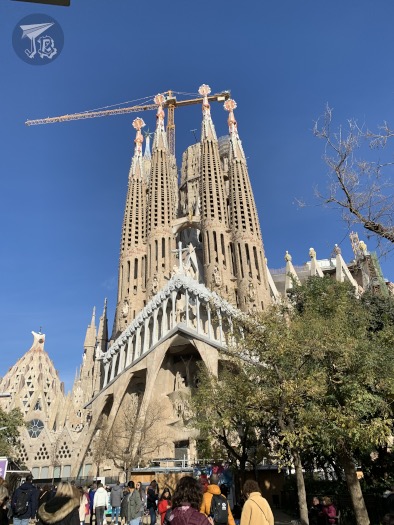
We walked towards the area where the basilica designed by Gaudí, and consecrated to the Holy Family, Basílica de la Sagrada Família, which had been decorated with a new twelve-point 7.5-metre 5.5-tonne star. As there was a Christmas market around the basilica, I thought that the start was just for Christmas, but it turns out that it is there for good.

A modernist cathedral. It looks a bit like it's melting. It has four towers, plus one with a star, and a triangular façade

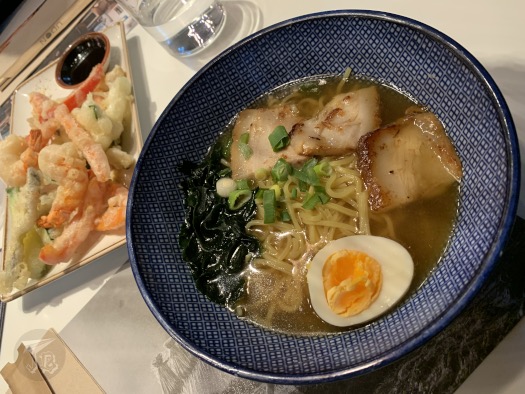
We took an underground train to the area where the venue was, and we were there around half an hour before hotel was open to check ins so we decided to have lunch first in the adjoining shopping centre. We ended up at an Udon, a wannabe fancy noodle bar chain. This was our first time getting our Covid passport checked as it’s not necessary where we’re from. The whole process was fast – open the PDF, zoom in, get it read with a device, and a green light with our names on it lit up (eventually I just screenshot the zoomed-in QR). I still felt a little uncomfortable due to the amount of people in the restaurant, so we ate as quick as possible before heading off to the hotel.

A bowl of ramen and a peek of a tempura plate in the background

It was the worst check-in experience ever. First of all, I think it’s stupid to demand a payment deposit on an already-paid booking. Second, they tried to charge me for the room again, we were given one card key for two people which didn’t even work, and we were “upgraded” to a room with a city view (16 € more expensive than our booking), but that only had amenities for one guest. We needed to get off the lift to request another card in order to get to the 21st floor, and we finally got two working cards. Oh, and the hotel was hosting a bunch of teams for some kind of handball championship who thought masks were for lesser beings and got away with it, despite the super-strict Covid-policy the hotel claimed to have, and with the obvious blessings of the clerks, despite other guests’ complaints.

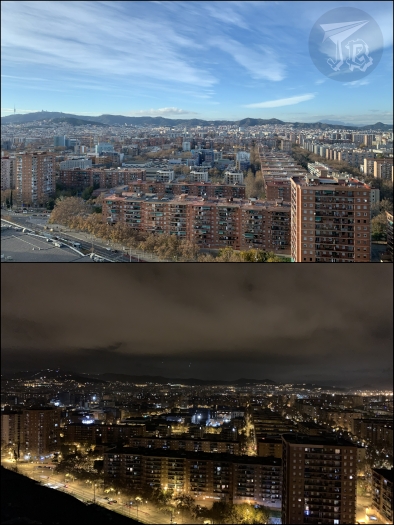
Two views of Barcelona from above, one with daylight, the other one at night. The buildings are apartment blocks, rather regular, and you can guess the long streets that separate the different areas

We stayed in the room, just chatting and taking in the astonishing views (nah, I’m not being sarcastic (≧▽≦).) The FINAL FANTASY VII REMAKE Orchestra World Tour concert was to start at 20:00, but doors were at 18:30. It took place in the convention centre CCIB – Centre de Convencions Internacional de Barcelona, which… actually turned up to be the auditorium of the local Natural Science Museum. That was confusing for a minute.

We were quite literally across the square so we just had to go down. It took just a few minutes to enter, and then we went into the goods queue, because my sibling absolutely needed a chokobo plush. We were in line for about half an hour, as we debated how expensive everything was! They decided that I needed a chokobo too, so I’m the proud owner of a Chokobo Black Mage now.

An adorable chokobo plush with a mage cape sitting on the leaflets we got from the concert.

After we had all our goods, we headed off to our seats – which had been occupied by two different people who had bought row five on the dress floor – but had tried the main floor stands, never mind that a lady told you which door you had to use when you went in, in order to avoid these “mistakes” . I decided that I did not care about causing a scene, so I just grabbed an usher and had her clear our seats. The guy on mine took my flyer too, but I found some more when the concert was over. I’m amused though that someone would buy a ticket on the first floor and then happily stroll down to the fifth row on the stalls – more than double the price.

Let me start by saying that I’m not a video-game player, that’s why this event was originally a low-priority one. When my wrist problems started, I was recommended not to play them any more. But I love video-game graphs and Final Fantasy VII designs more than any. I mean, I own the Advent Children DVD just because it’s pretty. I have to admit though that the concert blew my mind. The stage was full with a complete orchestra indeed, and a choir – the Ensemble Symphony Orchestra & Chorus. At the back of stage there was a screen that projected scenes from the game, both animations and gameplay. In the little emcees by conductor – and producer – Arnie Roth we also got messages from composers and producers from Japan. Furthermore, the composer Hamauzu Masashi was in attendance. We did not get Yosh Morita, from The Prophets, as it was originally announced, but singer Ricardo Afonso did a very decent job out of the power ballad Hollow.

Empty stage with chairs for the orchestra. There is a screen in the background reading Final Fantasy VII Remake Orchestra World Tour in front of a futuristic cityscape

    Part 1

  1. Prelude – Reunion –
  2. Opening medley
  3. Mako Reactor 1
  4. Flowers Blooming in the Church
  5. The Turks’ Theme
  6. Tight rope
  7. Stand up
  8. Words left unheard
  9. Tifa’s Theme – Seventh Heaven –
  10. Those who fight – Battle Medley –

    Part 2

  11. Anxious Heart
  12. Hurry!
  13. Jessie’s Theme
  14. Shinra’s Theme
  15. The Arsenal
  16. Those chosen by the Planet – Fate’s Calling –
  17. Arbiters of Fate – Singularity –
  18. Hollow
  19. Final Fantasy VII Main Theme

    Encore

  20. Aerith’s Theme
  21. One Winged Angel

I loved the Those who fight – Battle Medley –, and I’d say that one of the highlights was the song Hurry Up. Apparently, during a specific part of the game you have to put the rather-uptight main character in a dress and teach him to dance in a night club. I also really liked the choir interventions. The concert ended on a hype – for a second I thought it would end in the slow song, but no, we got the fantastic theme for the bad guy Sephiroth, One-winged angel.

The stage again, this time it is full with the orchestra and the director. The screen shows the main character of the game, Cloud, with blond spiky hair and a ridiculously big sword, holding a bright ball in his hand.

The concert lasted for two hours and a half, including the intermission – in which I got to see (and hug!) friends. After the ending, we tried to go and grab some sushi at the shopping centre, but they were already closing down – so in the end we just got a salad and some chips at McDonald’s and took it to the hotel – then we showered, rearranged luggage and purchases, and went to bed.

12th December 2021: Walk by the ocean

Our original plan after breakfast was to take a walk by the beach, then check out and ride the underground, but we realised that we had a train station about 20 minutes away, and we could get a detour by the seaside and make it a bit longer – and if we took the train, we had a free ride.

When we checked out we got the same person who had checked us in. They still had to charge us for the tourist tax, and I had that ready in cash. They insisted that they had to deduct that from the deposit and give us the change, they could not give us a fifty-buck note. They had to give us the change. With lots of coins. They did not even check the room for damage, so what was even the point of the deposit?

We left the hotel, and walked towards the station. We spent a little time at the beach Platja del Fòrum and the mouth of the river Río Besòs before we reached the station – lots of people walking their dogs, and lots of happy dogs playing on the beach and with the waves. In the background, the former thermal station with three chimneys looming over the sand – Central Tèrmica de Sant Adrià de Besòs. Had we had more time, we would have taken the time to try and get to it, but due to external reasons we had tickets for the noon train and it was already 10:45 – and I am paranoid about schedules.

A sandy beach with a factory building in the background, it has three chimneys made of brick. The waves are coming in gently.

We took the commuter train, then the long distance train. When we arrived, before going home, we made a short stop to have some make-up sushi for the one we could not get the previous night. And some side Chinese dumplings.

Sushi and bao plate

Walking distance Saturday: 9.05 km
Walking distance Sunday: 5.54 km

21st August 2021: Fossil tracks and Roman ruins {Spain, summer 2021}

Enciso is a couple of hours away from Sos del Rey Católico, but to be honest it is barely even on the map. It is a tiny little village in the area of La Rioja that I had not even heard of a year ago. But at some point during this year I became aware of it – and its palaeontological importance as it is the reference point for a dozen or so sites where ichnites have been found. Ichnites or fossil tracks are marks left by dinosaurs and other prehistoric animals on the mud that eventually become fossilised. In this little village in the middle of nowhere there are around 1,400 dinosaur foot tracks. When we were in Albarracín, we saw a bunch of fossils from the time Spain was submerged under the ocean. During the Mesozoic, the area of La Rioja, and the neighbouring Soria (Castilla y León), were somewhat swampy, which lead to a lot of mud. When dinosaurs and other animals moved through the mud, they left trails that sometimes became fossilised.

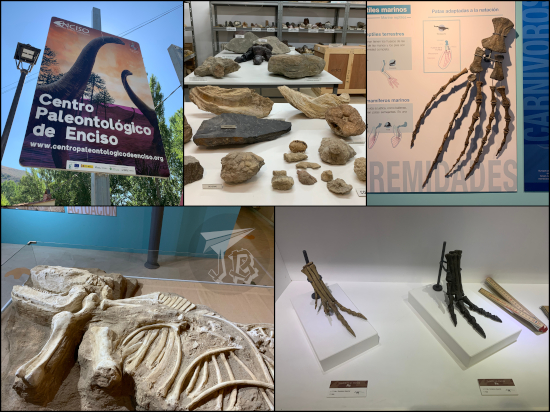
Our first stop in the village was the palaeontological museum Centro Paleontológico de Enciso . This one we could have skipped – it has next to no original pieces, and it basically just has a few infographics and reproductions of different types of dinosaur legs, but we had to start somewhere.

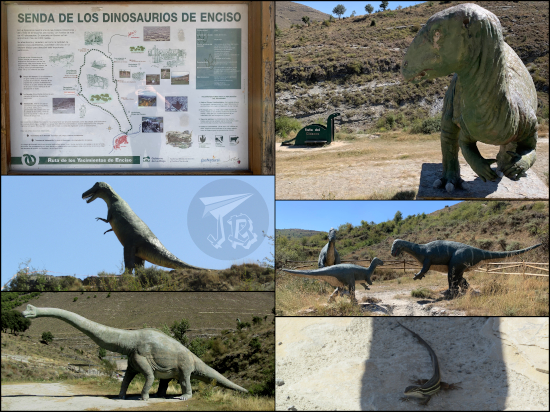
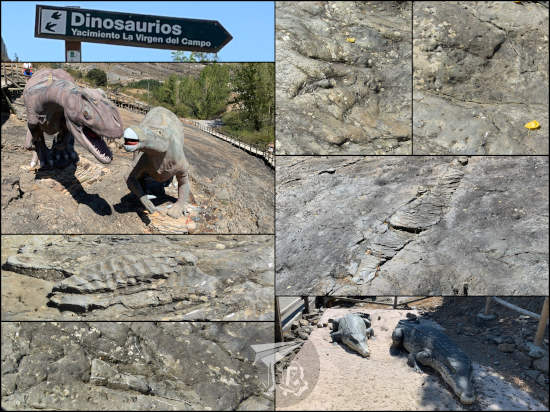
We visited two fossil track sites. The first one was a long strip of rock called Yacimiento de Valdecevillo . In this site, there are tracks of theropods (carnivores with three fingers, usually bipeds that left clawy marks), ornithopods (herbivores with three fingers, also bipeds, that left somewhat more rounded tracks), and sauropods (four-legged dinosaurs with less-defined fingers). Some of the tracks are very easy to identify (especially the ones fenced off), others are chalked on, and sometimes they even cross each other.

Next to the rock formation, a few reproductions have been built, in order to illustrate what dinosaurs roamed the area. A family of iguanodon has been clearly identified. The sauropod looks like a generic brachiosaurus, but it could have been a turiasaurus, even. I have to say though that the carnivore theropod needs a bit of an update – but it looked adorably like those that they drew when I was a kid back in the 80s. Oh, and we also saw a real-life present-day minisaurus (aka lizard, maaaaaaaybe Spanish psammodromus Psammodromus hispanicus).

It was too hot to walk around the trail, so we hopped onto the car and drove off to the other site, Yacimiento de la Virgen del Campo.
In this formation you can “feel” the mud – the rock has ripples (water marks), and here is even a small mud collapse from an earthquake. Here we saw foot tracks again, marks of skin, and even tail trails left by ancient crocodiles. In this site there are indications of a carnivore attacking a herbivore, represented by 1:1 sculptures (maybe a ceratosaurus and an iguanodon).

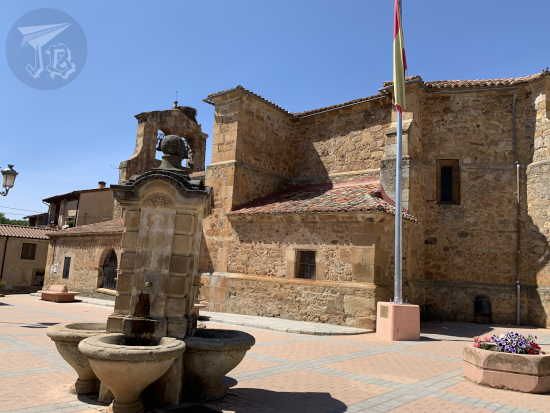
Around 13:00 we got back on the car and drove off to the town of Garray for lunch and a rest near the river…s. Río Tera, a smaller current, joins one of the most important rivers in Spain, Río Duero (Douro River) under the unnamed stone bridge.

We managed to have lunch in one of the few restaurants in town, in front of the municipal fountain and the church of Saint John the Baptist Iglesia San Juan Bautista. After lunch we stayed at the river bank for a while before we moved towards our next stop.

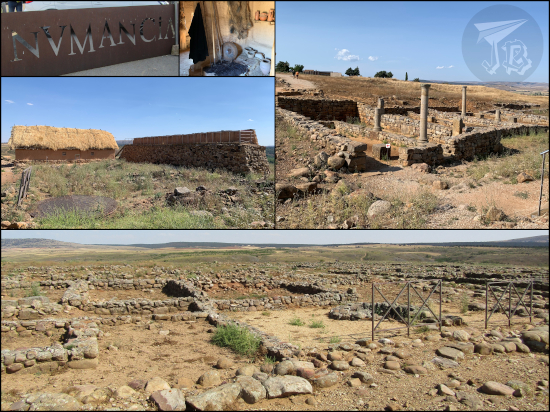
The archaeological site of Numantia Yacimiento arqueológico de Numancia holds the remains of a Roman town, built upon an earlier Celtiberian settlement. The Celtiberian town was the centre of a number of hostilities against the Romans in the second century BCE – the Numantine War, the third of the Celtiberian Wars broke out in 143 BCE. After a decade, the Romans sent one of the heroes of the Third Punic war to suffocate the rebellion. The general cut down all the trees in the area and built a barrier around the settlement, in what has been called the Siege of Numantia, in 133 BCE. The town was completely cut off the rest of the world and after eight months of siege, the inhabitants set the town on fire. Most of them committed suicide in order to avoid being taken as slaves.

After the Roman conquerors levelled the ruins, a new town emerged, and a Roman settlement existed in the area between the first and fourth centuries CE. The last remains date back from the sixth century before the town vanished from existence and memory until it was located in the late 19th century.

Today, the site holds remains and patterns for several houses, and it has a reconstructed Roman house, an Iberian house and two pieces of the wall. The most visual building is a Roman house of the later period which still keeps a couple of columns. Unfortunately, this was 16:30 and the guided visit was long and full of useless and dull information – guess who got a sunburnt, even under an umbrella?

When we were done with Numantia, we decided to skip the complementary exhibition in Garray and drove off towards Soria, where we would be staying the night.

The Parador de Soria, our hotel, is the first modern Parador I’ve stayed in, though it stands on the mountain where the castle used to be, and the views were astonishing (I also almost forgot my stamp!!). We had dinner in the parador, which included some freshly-fried torreznos de Soria. Torreznos are a pork-based snack especially typical in the area. The pork belly is marinated with salt and paprika, cured or smoked, and finally fried – delicious but for sure a “sometimes food”. After dinner, we went to our rooms to compare the day-view with the night-view and admire the moon.

Total driven distance: 196 km. Total walking distance: 6.57 km.

8th – 12th July 2021: Beach weekend (El Campello & Elche, Spain)

The sea is far, far away and due to a number of situations coming together, we rented an apartment near the ocean for a couple of days. Our usual summer destination was not a good option this year due to – as everything that is going less than great these days – to Covid, so we gave a try to the town of El Campello. The town likes boasting itself as a beach paradise-resort, while it’s barely a standard Mediterranean village eaten which boomed along other, bigger resorts such as Benidorm. The apartment was not anything marvellous, but it was extremely close to the ocean – just beyond the waterfront promenade, Paseo Marítimo.

8th July 2021: The arrival

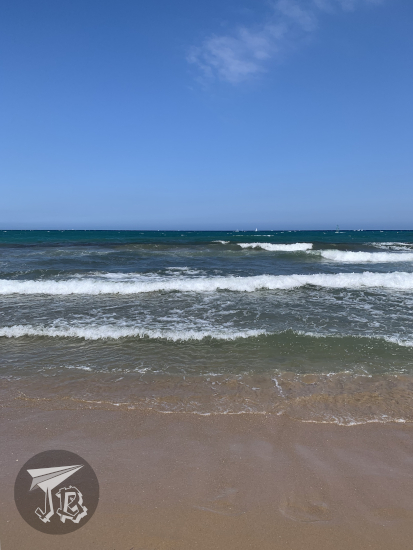
We arrived in El Campello at around 4pm, did a fast sweep of the apartment in order to feel safer Covid-wise and I decided to go for a walk at the beach, jeans and all. There were surprisingly fewer people than expected, and not as hot as I thought it would be – all in all we were pretty lucky, weather-wise.

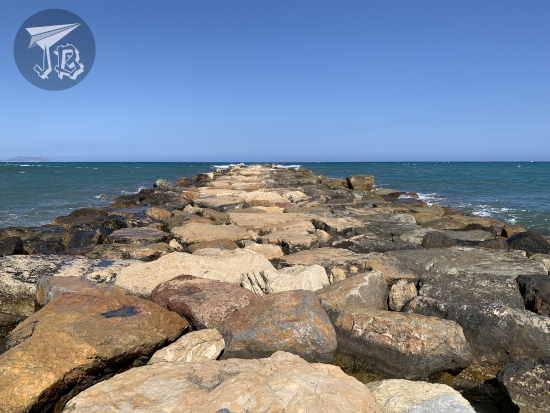
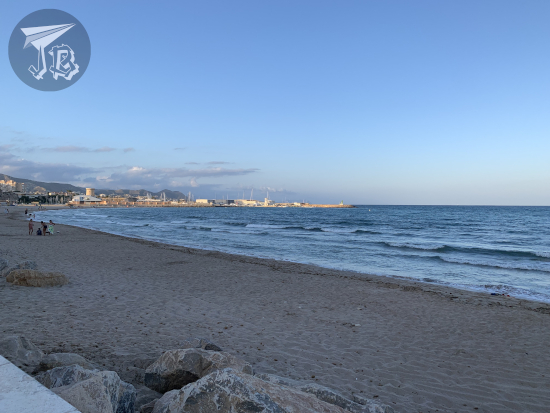
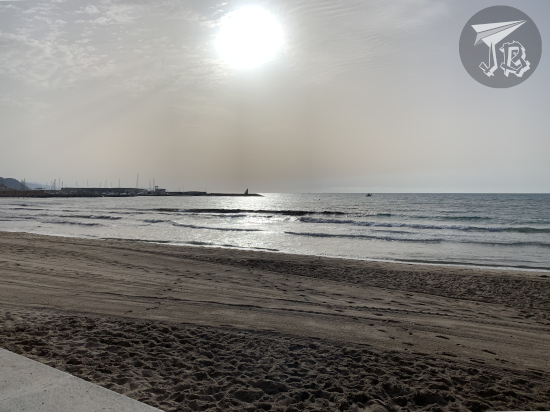
El Campello is built parallel to the coastline. The more traditional area has a small marina Puerto de El Campello to the north, and then a sand beach that extends towards the south divided into Platja de la Illeta and Platja del Carrer de la Mar. Though the beach has a couple of breakwaters, they are for protecting the beach against erosion and not to separate the different areas – the east of Spain has a reputation for building quite close to the beaches. Over the years, that caused the winds and waves to shift and the once amazing and long beaches started being washed away – now all those groins are necessary to keep the sand in place, and are liberally built along the Mediterranean coast.

I climbed on one, of course, more than once – and more than one too (≧▽≦).

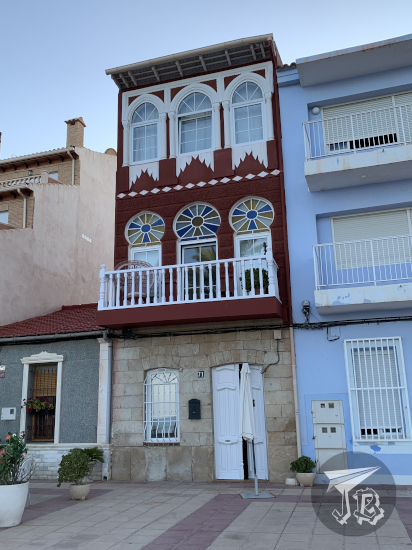
In the evening we walked along the waterfront promenade. While most of it is fronted by restaurants and souvenir shops, I did see this cute little house.

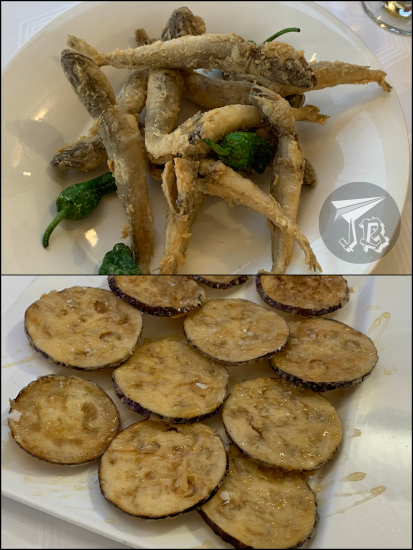
Eventually, we chose a place to have dinner – some fish and the area speciality: honey-soaked aubergine (berenjenas con miel), which is not actually made with honey, but a type of molasses – which actually makes this a vegan dish, as bees are not involved in making the “honey”, what do you know? The first time I tried this I was not too convinced, but if prepared well, this dish is absolutely delicious.

9th July 2021: The lady’s town

Elche is a nearby town a bit inland, and the third most populated in the area. It is famous due to the Iberian sculpture bust found nearby and because of its palm grove. The history of the town can be traced back to the current archaeological site Yacimiento Arqueológico de La Alcudia, whose stratigraphic sequence dates to the Bronze Age. There are ruins and artefacts, mostly from the Iberian and Roman ages, though there are findings until the Islamic era.

In 1897, a young farmer found the bust named La Dama de Elche, the Lady of Elche, which can be seen in Madrid’s archaeological museum Museo Arqueológico Nacional – it is the limestone bust of an Iberian woman, probably with funerary purposes, what was carved around the fourth century BCE. Since that time, a great deal of work has been carried out in the area of La Alcudia, and today is a full-fledged archaeological site with a Roman wall, several Iberian and Roman houses, a Roman temple and an Iberian one, a basilica, and hundreds of sculptorical and clay artefacts.

We visited the site in the morning, hoping to finish the stroll before it became too hot. There are still works carried out in the site, but you can visit and walk around the area – as long as you don’t step on the red ground. There are two museums on site, aside from the outer ruins. In one of them there is a reproduction of the lady, which yields to easier pictures than the glass protection in the National museum. There are also interpretations and reconstructions about what the Lady may have looked like when she had her colours. Unfortunately, reaching the site is hard, and probably not worth the detour unless you’re an expert in archaeology, but it turned out interesting to see.

… Except for the “commemorative site” of where they found the Lady. That was hideous.

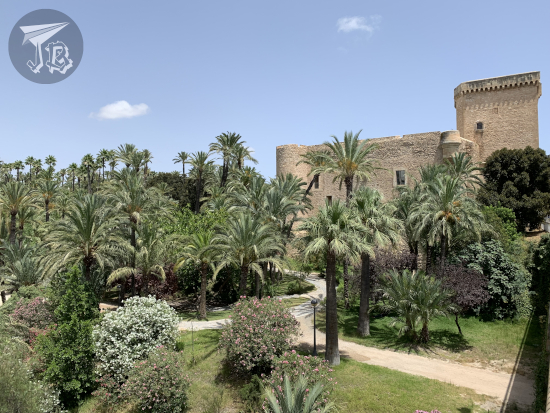
After La Alcudia, we drove off to the town centre to walk around Palmeral de Elche, the biggest palm grove in Europe, with around 200,000 – 300,000 trees, most of the date palm species, Phoenix dactylifera. The palm tree grove originates in the 10th century CE (planted by the Caliphate of Cordoba conquerors), and it has been a Unesco World Heritage Site since the year 2000. The most important palm grove is in the centre of the town (and we missed the dragon that stands on one of the trees 。゚(゚´Д`゚)゚。).

Close to the grove stands the local archaeological museum, Museo Arqueológico y de Historia de Elche, divided between the new building and the old Moorish castle or alcázar, Palacio de Altamira, which drinks from La Alcudia and other findings from the area.

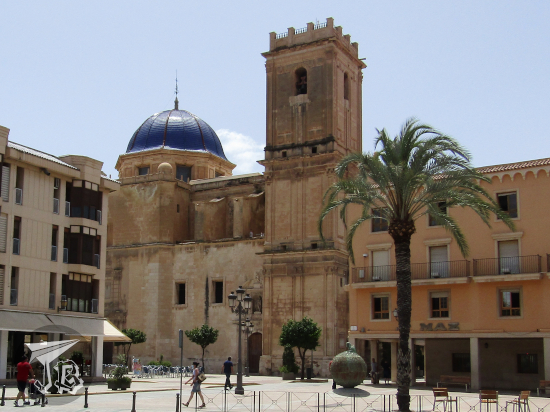
After the museum, we headed off to see the main church Basílica de Santa María, but we had just missed opening times. It stands on the place of the original mosque, and the current building – the third church that has been built – is Baroque. The bold blue dome is typical of the area, found all over the region on towers and churches.

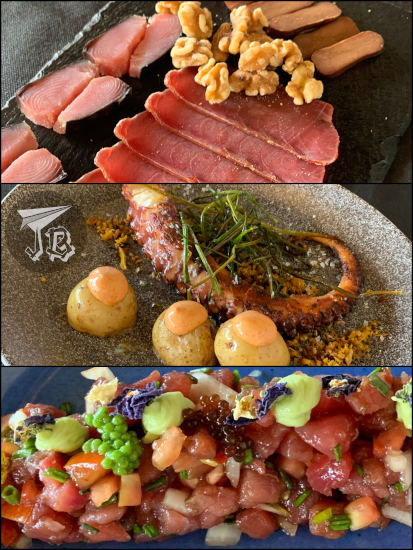
As we could not see the basilica, we just had lunch! After a bit of a banter with an over-friendly waiter we had some fish-based lunch to share – salt-preserved fish bits, grilled octopus and tuna tataki.

On the way back we got to see a different view from the palm grove and the castle and the palm grove – maybe it looked like this in the old Arab times?

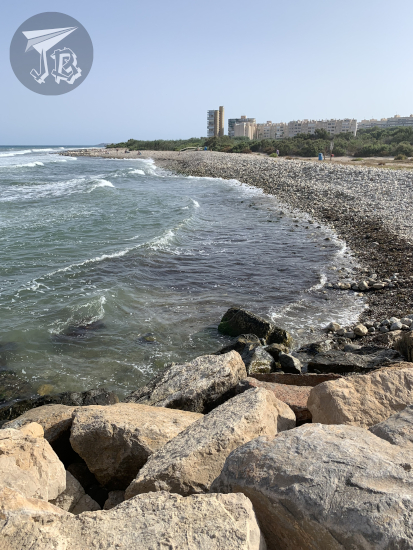
It was too hot to stick around and wait for the museums and church to open up again, so we drove back and after a while I headed back to the beach. This time I reached the end of the sand beach and got to the boulder one at the end of the waterfront promenade.

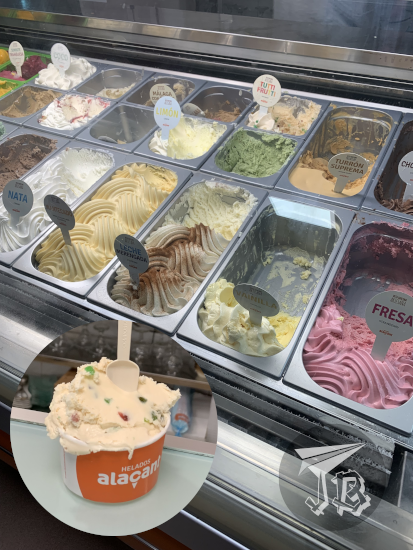
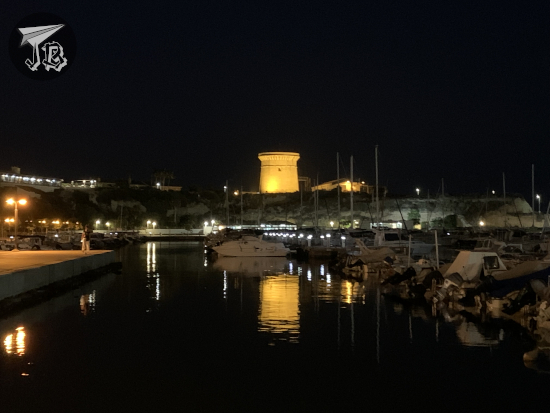
We had a quiet dinner at the apartment, then went out for ice-cream. We ended up walking to the marina, Port d’El Campello and caught sight of the Torre Vigía De La Illeta in the background.

10th July 2021: Not much to report

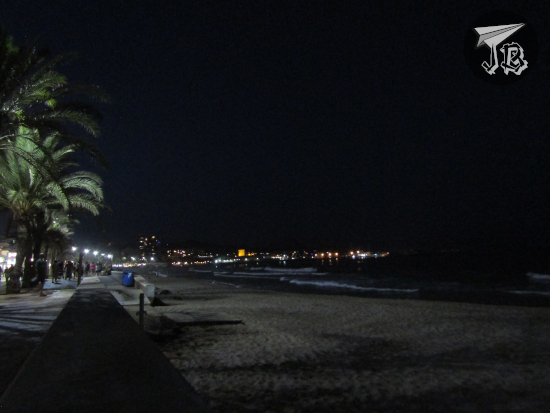
Just some pizza and a night-time walk along the waterfront promenade yielding tries to take artistic pictures without much success.

11th July 2021: The Tower

I woke up with a lovely reaction to the sun – not a sunburn, more like an allergy flare-up (here’s the plausible explanation for that), so we went out rather early for a walk, to then shield from the sun.

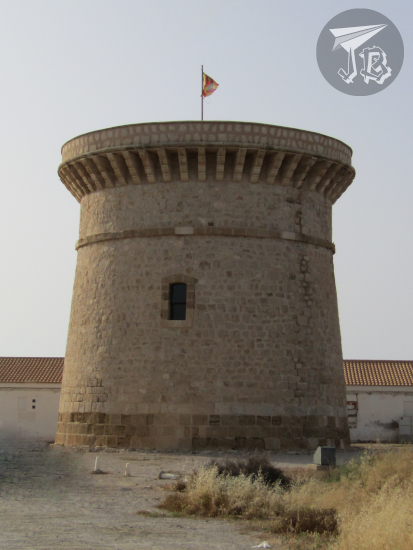
From the Roman times, a number of watchtowers were build along the Mediterranean coast to be on the lookout for pirates. The tower in El Campello, Torre Vigía de la Illeta was built between 1554 and 1557 (and restored in the 1990s), was part of a watch system commissioned by the Viceroy of Valencia at the time. The tower was manned by two infantry and two mounted soldiers – in case a pirate ship was spotted, the former would make smoke signals and the latter would ride to raise alarm in town.

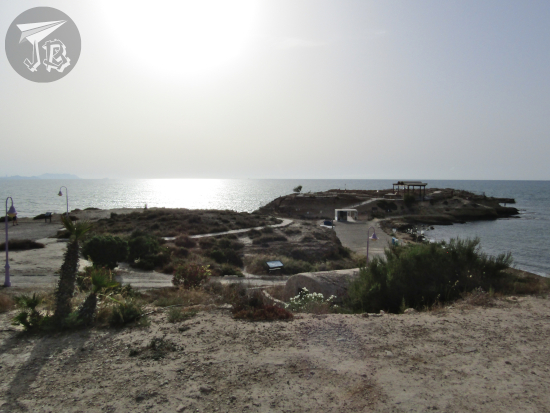
The tower overlooks the marina, the town, and the archaeological site Yacimiento Arqueológico La Illeta dels Banyets, with ruins and artefacts dating from the Iberian and Roman times, but we did not walk to them as it was early in the morning and it was not even open.

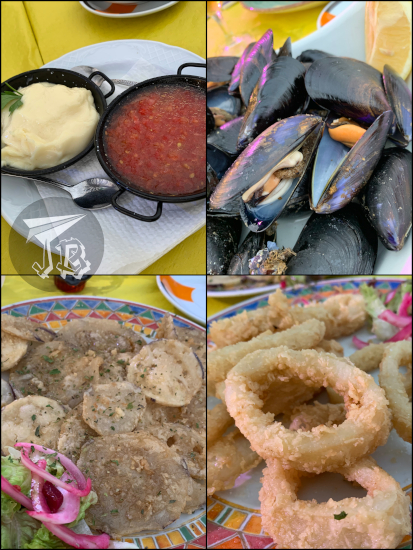
It was hot, so most of the day was spent under the air-con, to later have dinner out – some mussels, more aubergine with honey (not so good this time), and squid rings. But the highlight of the night was the final ice-cream waffle, which is a great, great idea.

And that was it, as we left early in the morning the following day, as soon as we could check out, as the trip is – as mentioned – long.

29th & 30th May 2021: The Walls (and churches) of Ávila (Spain)

There was a little-talked about consequence of the Industrial Revolution in Spain. While it is widely known that it drew a large number of people to the cities and towns, few stop to think of the subsequent steps that had to be adopted. More people in town required housing, and thus a number of projects denominated ensanches or “widenings” were projected and carried out. Even though such a thing makes sense, here lies the problem – in order to enlarge the urban area, many Spanish cities and towns tore down their Roman and Medieval walls, leaving either bare traces or nothing at all.

Legend has it that the town of Ávila lacked the money to demolish the wall. In retrospect, that was a good thing, because today, the walls that surround Ávila, Murallas de Ávila are among the most impressive Europe, some say that even better preserved than Carcassonne (France).

Ávila is a couple of hours away by car, so we drove off on Saturday morning at around 8 am and were there just before 10 am. We entered the city through one of the city wall gates, Puerta del Carmen.

Approach to the walls

We parked (100% ditched the car) at the hotel and checked in – even if it was quite early, they told us that one of the rooms was already prepared and gave us the keys. Unfortunately, it was not, and since the blunder was a Covid-protcol blunder, they upgraded us as an apology. The hotel, Parador de Ávila, belongs to the Spanish network of Paradores, and it is located in a 16th century palace, Palacio de Piedras Albas. We booked late-check-out for the following day, which can be done “for free” booking lunch in the restaurant (which is obviously not free).
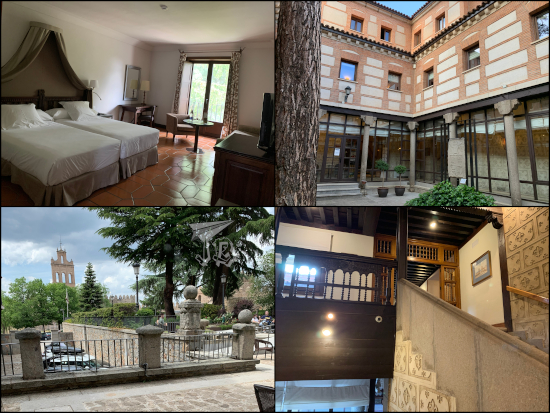
Parador

Our first stop was the tourist office, but not the one that is clearly signalled in the middle of the town – the one that is located outside the wall and you have to turn around and around to find. But we needed it to buy the 48-hour pass to the monuments. Then we stuck around to wait for the nearby church to open, which gave way to observing the wall for the first time.

The Muralla de Ávila has been a Unesco World Heritage site since 1985. The structure is clearly defensive and it was built towards the end of the 11th century, quite probably as extension or reinforcement of a previous one, either Roman or Arab – though the Roman theory is the most credible as some pieces used in the original wall seem to come from a now-lost Roman cemetery, and there are documents about a Roman camp with similar shape. The wall has been restored in several occasions, and after surviving the ensanche risk, it was declared national monument and cleared of attached houses. Today most of the wall belongs to the Spanish government, and it is managed by the town hall, though there are some private parts, such as the ones that are part of the cathedral. The walls close off all the historical centre. They have a perimeter of 2,515 metres, with around 2,500 merlons, almost 90 turrets, and nine gates. Our second gate was Puerta de San Vicente.

Puerta de San Vicente

The first monument we stopped by, as soon as it opened since we were already there, was the basilica church Basílica de San Vicente (officially Basílica de los Santos Hermanos Mártires, Vicente, Sabina y Cristeta, three Christian siblings who were martyred nearby). It is one of the most important Romanesque buildings in the whole country, built between the 12th and the 14th century. It is protected as part of the World Heritage Site declaration. One of its characteristics is the golden rock in which it is built – sandstone-looking granite.

Iglesia de San Vicente

The inside of the basilica is, in the typical way, a mix of more modern styles. The grave of the martyr siblings is Pre-gothic, and the large altarpiece is Baroque. In the crypt there are proto-Christian pieces and a Romanesque Virgin which we did not get to see and which is the patron of the town.

Iglesia de San Vicente

Afterwards we headed off to the cathedral Catedral de Cristo Salvador, which is considered the first gothic cathedral in Spain (something that other people say about Cuenca), with clear French influences. It was designed as a fortress church as its abse dubs as one of the turrets of the city wall.
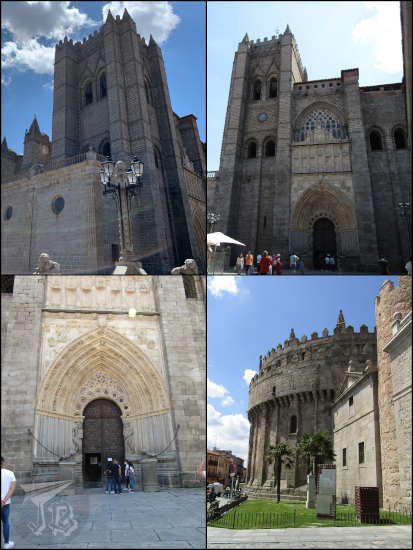
Catedral de Cristo Salvador

In later years, a choir was added, along with a Baroque altarpiece. The walls are also sandstone-looking granite, but some elements inside are limestone and wood.

Catedral de Cristo Salvador

To the side of the cathedral stands the cloister, which holds the grave to the first modern president of Spain, Adolfo Suárez, and the entrance to the cathedral’s museum. It yields to views of the tower and… the storks that squat there.

We headed off towards the Museum of Ávila. First we stopped at the former church Iglesia de Santo Tomé, which today is a warehouse for the museum, but can be visited anyway. When I was young, I studied the statues / sculptures called verracos, built around the 5th century BCE by the Vettones, a Celtic pre-Roman civilisation that faded upon the arrival of the Romans. The verracos are crude statues that represent four-legged animals – bulls, boars or pigs. At the time, I had only heard about a number of them, and was somehow under the impression that there were two or three around. I was quite wrong, apparently they pop up from the snow like daisies or something. In the church-turned-warehouse there were like twenty, one outside, there was one at the hotel garden… so no, apparently they are quite common. Other artefacts in the building include some carriages, Roman sculptures and mosaic, Muslim funerary artefacts and roof boards…
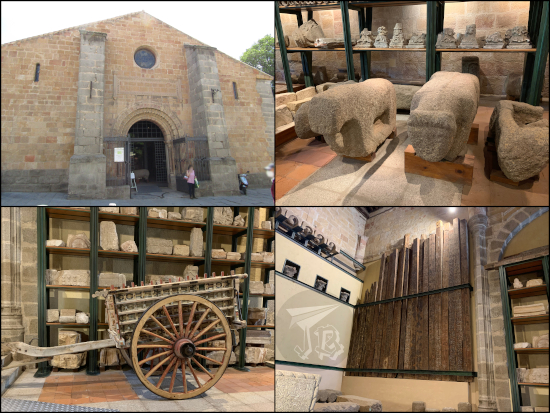
Iglesia de Santo Tomé

Then we moved onto the museum itself, Museo de Ávila, with a beautiful patio and a number of archaeological and ethnological items which represent the history and folklore of the town.

Museo de Ávila

It was almost time for lunch, so we headed off towards the restaurant where we had booked. Before, we made a small stop at an old palace Palacio del Rey Niño, built in the 12th century, today turned into the Post office and the public library, with a patio closed off by the Walls themselves.
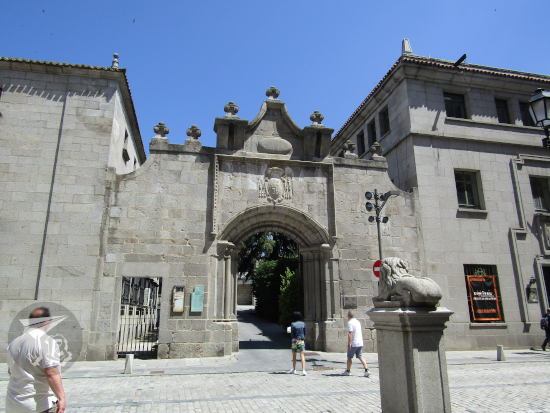
Palacio del Rey Niño

Then we walked by the modern marketplace.

mercado

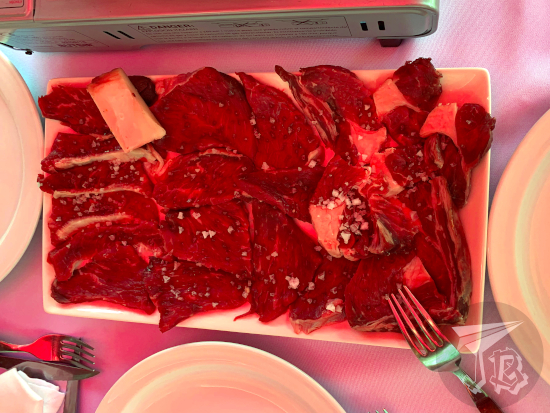
Which happened to be right in front of the restaurant, named La Lumbre. Aside from its walls, Ávila is famous for its cattle, a particular breed called Raza Avileña – Negra Ibérica, and of course the meat the animals produce, especially the matured and grilled meat from older oxen. After the animal has been sacrificed, the meat is matured in a traditional process called “dry maturation” for six weeks before it is grilled. We ordered the rib steak, chuletón to share, along with some grilled vegetables, a “tomato salad” that was a… one-tomato with dressing. And then there were desserts, aside from chocolate cake, we ordered yemas de Ávila – a typical confectionery made with egg yolks, lemon juice, cinnamon, and caster sugar. Lots of typical stuff, as you can see!
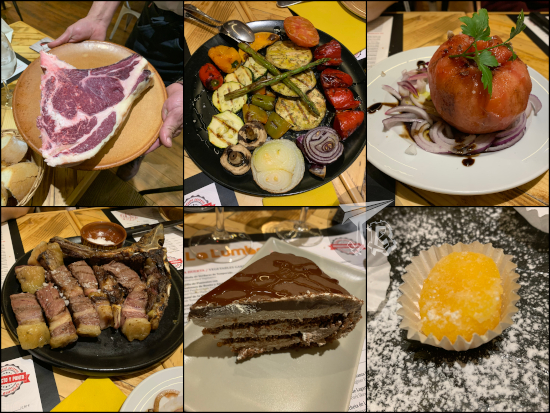
lunch

Our next stop was the main square, called “little market square”, Plaza del Mercado Chico, along with the town hall or Ayuntamiento. The square was rebuilt in the 19th century and is flanked by arcades. The town hall was built in 1862.
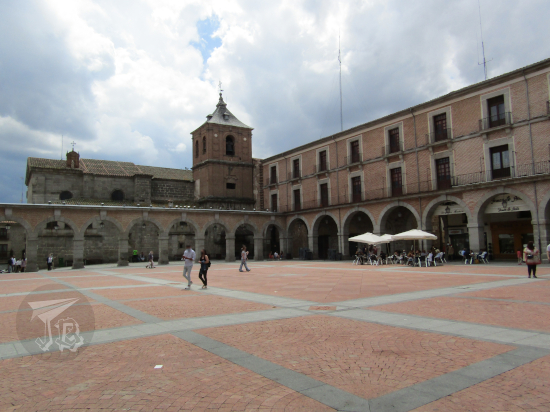
Plaza del Mercado Chico

Plaza del Mercado Chico: Ayuntamiento

After a brief stop at the Parador for some rest, we headed off to find a convent / monastery on the other side of town. On the way we came across some ruins that I assume are the church Iglesia de San Jerónimo, as they sit in the square of the same name.
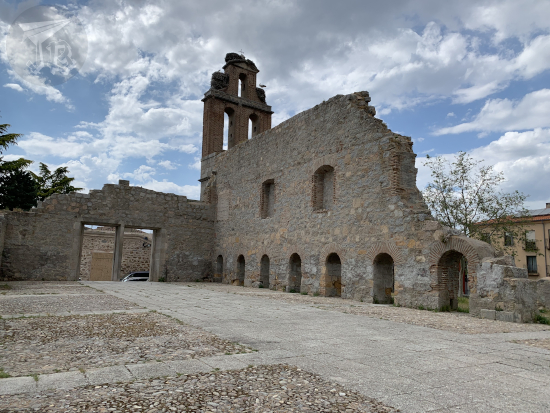
Ruinas de San Jerónimo

We reached the convent Convento de San José, a reconstruction of a previous monastery and church, the first founded by Santa Teresa de Jesús (Saint Teresa of Ávila), a Christian “doctor of the church” and mystic Carmelite nun, known for her ‘raptures’, her reforms, and her literature work. More on her later though. The convent and church were a little… underwhelming, even if is a World Heritage building.

Contento de San José

Then we walked back towards the historical centre, and walked past the church Iglesia de San Pedro, a 13th-century building with a great rose window, but which was closed (reforms).

Iglesia de San Pedro

On the other side of the square, Plaza del Mercado Grande (Big Market Square) stands another of the wall gates, Puerta del Alcázar, and a monument to Saint Teresa Monumento a Santa Teresa: La Palomilla.

Puerta del Alcázar

Next we separated and I went off to climb the walls Murallas de Ávila. Well, to walk on the parapet. Due to Covid, there is only one access, next to the Cathedral and its gate Puerta de la Catedral. The walkable area is around 1.4 km, including walking over some of the gates and up and down more than a few turrets. It allows for some amazing views of the town and its outskirts…

Views from the walls

… but also of the wall itself, both the original walls and the add-ons from later eras (and a magpie).

When I reached the end of the walk, I went down and crossed the bridge gate Puerta del Puente, named that way because it overlooks the bridge over the Adaja river. I could not take a picture of it because the traffic police was checking cars at the roundabout in front of the gate. Thus, I headed off to the pedestrian bridge to cross over towards the tiny hermit popularly known as “the four posts”, Los Cuatro Postes, which yield to an impressive view of the town and its walls.

Cuatro Postes

Views on the wall

Avila and View

I walked back to see the walls from the base. Then I crossed the gate we had driven through in the morning, Puerta del Carmen, and I headed back to the hotel for a drink.
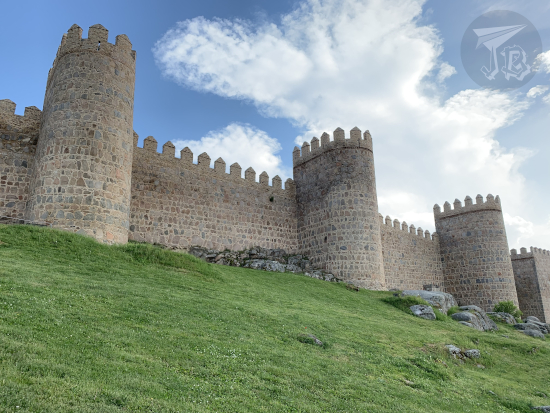
At the feet of the walls

Puerta del Carmen

After a while we headed off for dinner and tried another of the typical dishes in Ávila, patatas revolconas – mashed potatoes with paprika and pork rashers, and waited for the sun to go down so the city lit up.
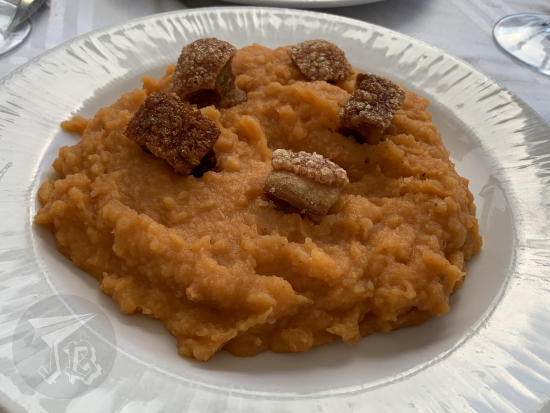
Patatas revolconas

A walk around the town yielded to views of the Iglesia de San Vicente and Puerta de San Vicente, some of the inner streets leading to the town hall Ayuntamiento, the longer area of the Muralla and the Puerta del Carmen.
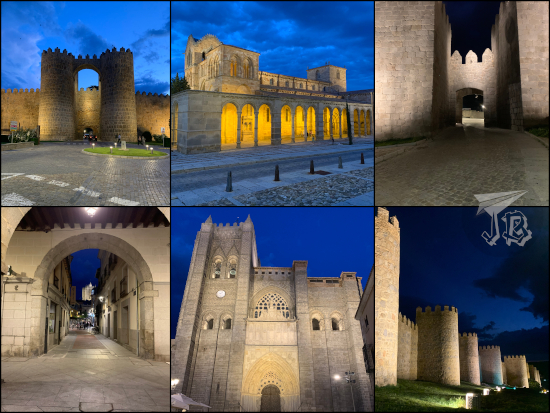
Night view

And then I had a very, very long shower and went to bed.

In the morning, breakfast was had – not a fan of the “we can’t have a buffet so we prepared this and this is what you get” plate, but whatever. I mentioned Santa Teresa before, let’s get into that a bit further. She was a 16th-century nun born near Ávila, canonized in the 17th century, and elevated to doctor of the church in the 20th century. She is conisdered one of the great mystics and religious women in the Roman Catholic church, author of a number of spiritual classics, and the reformer of the Carmelite nun order into the Discalced Carmelites. She founded convents all over Spain and was known for her mystics raptures which may have been messages from God or epileptic attacks. She is one of Ávila’s most important historical figures and wherever you go there are traces of her. In the place where her house stood now there is a convent, a church, a reliquary room and an interpretation museum, with really strange hours on Sundays. We could see the convent / church Convento de Santa Teresa de Jesús / Iglesia de la Santa and the reliquary room where no pictures were allowed Sala de Reliquias between services.

Iglesia de la Santa

On the way, however, I found some interesting ruins – the gate to the former hospital Hospital de Santa Escolástica, and we walked past a bunch of palaces.

Portada de Santa Eulalia

Then we moved onto a long walk to the 16th- century Gothic monastery Real Monasterio de Santo Tomás, which we could see due to lucky timing as there was a First Holy Communion Mass happening and the local little old ladies were not to keen on cultural visits of the church.

The monastery has a church, three cloisters and two adjacent museums. The church has an impressive Gothic altarpiece (by Pedro Berrugete, one of the key painters riding the wave between Gothic and Renaissance arts), and hosts the grave to the Catholic Monarch’s only male son.

Santo Tomás

The three cloisters: Claustro del Noviciado, Claustro del Silencio, and Claustro de los Reyes Católicos (Novitiate, Silence and Catholic Monarchs).
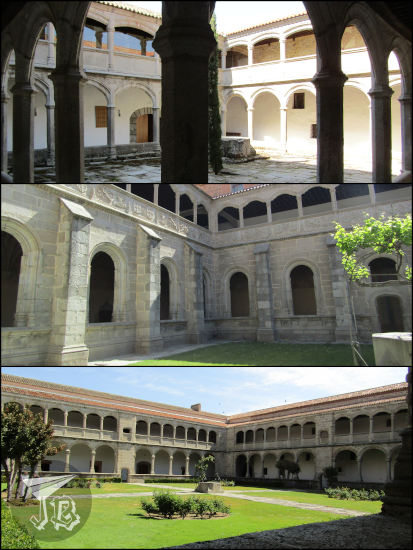
Santo Tomás Cloisters

The Museum of Natural Sciences Museo de Ciencias Naturales, an occupational therapy project could… be better, and sets the expectation bar rather low for the next one.
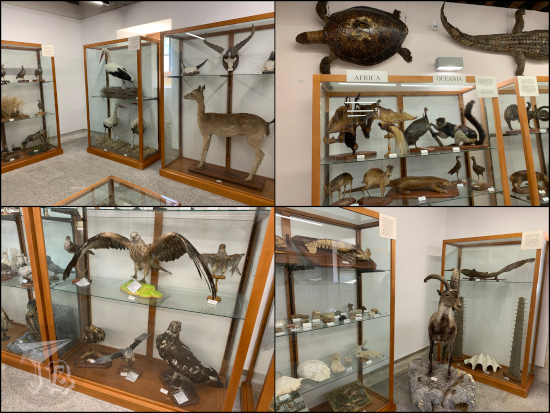
Museo de Ciencias Naturales

However, the Museum of Eastern Arts Museo de Arte Oriental is pretty impressive. It contains pieces and artefacts that the Dominican missioners brought from China, Japan, Vietnam and the Philippines.

Museo de Arte Oriental

And in the end, that was it for the weekend. We walked back, decided to give the museum of Saint Teresa a miss, had a drink, had lunch and went back on our merry way – with a a view of the train tracks over the dam of the reservoir Embalse de Fuentes Claras.
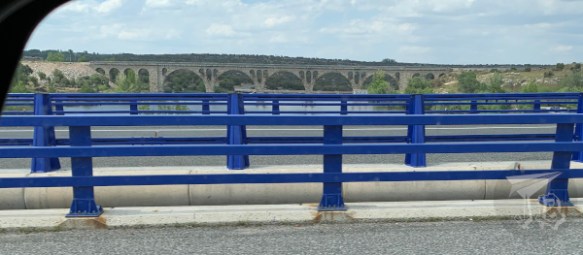
Train tracks over Embalse de Fuentes Claras

Walked distance (Saturday): around 12.5 km
Walked distance (Sunday): around 6 km
Total distance driven (both days): around 340 km

12th September 2020: Sigüenza (Spain)

We took a drive to Sigüenza, in Spain. This medieval town? big village? had a big relevance through the Middle Ages, and the historical centre reflects that. The most prominent point is the castle on top of a hill. The Castillo de los Obispos is a fortress that can be traced to Roman times. However, the actual castle was a Moorish alcazaba. After the Christians took it over in the 12th century, it was remodelled and enlarged. Due to its vantage point, the castle was a key element in different wars and strife, including the Napoleonic invasion and the Civil War, thus resulting pretty damaged. In the late 20th century it was decided to restore it turn it into a Parador with around 50 rooms.

During our planning stage we called and tried to book a restaurant for lunch, and we were told they were not taking them, we had to call on the same day. Of course, when we got there, it was impossible to book – there was a course and the celebration of a communion (seriously, people, learn to say no so others can get organised). Unfortunately, you could not see the interior or even the yard if you had no reservations, so I can only share a picture from the parking lot, where we left the car.

We walked down the main street Calle Mayor, a clobbered slope that ends (well, technically begins) at the town’s main square.

Main Square or Plaza Mayor is home to the Town Hall or Ayuntamiento de Sigüenza, an old palace with a typical Castillian inner yard or patio.

Opposite the town hall stands the cathedral Catedral de Santa María La Mayor de Sigüenza. The Gothic building was built upon a previous Romanesque one and it had some Neoclassical and Baroque additions. Thus, the façade sports Romanesque doors and rose window, and the main body is Gothic. The altar and the choir are awfully Baroque too, and some of the chapels sport Cisneros, Plateresque and Renaissance decorations. All in all, an interesting pout-pourri of architectural and decoration styles.

The most important piece of art of the cathedral, however, is a funerary piece to the right of the altar. It is the sepulchre of Martín Vázquez de Arce “El Doncel” (“The Young Man”). The chapel holds him, his parents and grandparents, but the sculpture on his sepulchre is the most impressive one. The Vázquez de Arce family were vassals of the Mendoza family, the most important family in the area during the Middle Ages. During the war to conquer Al-Andalus, the Vázquez de Arce males followed the Mendoza to the war in Granada, where Martín died in a trap set by the Arabs, which consisted on damming the River Genil to a creek, and then releasing the dam so the water took over the enemies crossing (which… kinda sounds like something out of the Lord of the Rings, doesn’t it? At least, it makes me think of Arwen and Treebeard). The sepulchre, commissioned by Martín’s brother, presents him taking a break during training and reading a book. He even has pupils, so if you could climb up, you’d see what he’s reading!

The cloister is also Gothic, as the previous Romanesque one was torn down. It holds a central garden and a number of side rooms where there is a collection of mythology-themed tapestries. In one of the chapels, there is also a painting by El Greco, a Greek painter rooted in Spain who was one of the key artists during the Spanish Renaissance.

The cathedral ticket also allows a visit to the Diocesan Museum Museo Diocesano, which holds many pieces of religious art, along with a few models of the cathedral in its different construction stages. These days I’m trying to learn some hagiography, which means how to identify religious figures by how they’re presented. Getting there, three out of ten times or so, because half the time they cheat.

After the cathedral we climbed up towards the castle, and we stopped at the former church Iglesia de Santiago, now transformed into a mini-introduction centre for all the “hidden” or “unknown” Romanesque in the area. The church itself had some beautiful paintings, but it was destroyed during the Civil War.

Continuing our way up, we turned a little to see the house where the Vázquez de Arce family used to live, now turned in a museum, Museo Casa del Doncel. There is a little paintings exhibition and a guitar museum, along with some ancient artefacts such as vases or looms. The most interesting part are the Moorish “Mozárabe” decoration. Here is a bit of historic trolling: when the Christian “conquerors” hired Arab craftsmen to do decoration, one of the things the Arabs did was decorate using Quran verses.

Then we saw the outside of the church Iglesia de San Vicente Mártir, Romanesque to boot.

Afterwards, we ended up at the square Plazuela de la Cárcel, where the old gaol jail stood.

Finally, we headed over to the restaurant where we had booked a lunch table, a traditional grill called La Taberna Seguntina where I chose to have a “summer menu” with salmorejo (a thick soup or purée made with tomato, oil, and bread and sprinkled with boiled egg and cured ham) and roasted cochinillo (suckling pig, roasted whole) with potatoes and herbs. For dessert I had a pudding!

And that was it, really – Medieval Sigüenza has nothing else to see. As the façade of the castle was being restored, we did not even take pictures of it as we drove away.

4th September 2020: Alcalá de Henares (Spain)

After looking for a place to park the car for 12 minutes, I left the car and I went off on foot towards the centre with a relative who is living in Alcalá de Henares. The town centre has been a Unesco World Heritage Site since 1998.

Our first stop, at 10:30 almost sharp was the Palacete Laredo, a small palace built in the Neo-Mudéjar style, a type of Moorish Revival architecture. It was designed and built between 1880 and 1884 by the Spanish artist Manuel José de Laredo y Ordoño. After a century in private hands, it passed to the town hall, which allows the university to use it as a museum, showing a collection of ancient documents.

The palace is built in brick, it has two floors and a minaret-like tower. The inside is decorated with coloured-glass window, tiles and paintings. The visible ceilings on the first floor are wooden artesonado (decorative beams joined together). There is also a garden, but it was closed.

Afterwards, we headed off towards the centre. We walked by the church Parroquia de Santa María la Mayor and is inhabitant the stork on photo duty.

We had tickets to see the Corral de Comedias, a theatre built in the site of an ancient “theatrical courtyard”. These were open-air theatres that were common during the late middle ages and exploded in popularity in the 16th century. The Corral in Alcalá de Henares was built in 1601 by Francisco Sánchez, member of the Carpenters Guild. It suffered several changes – the ceiling was built in the 18th century, then it became a cinema, and eventually was “lost” in the 1970s. In the 1980s, it was rediscovered, restored, and finally opened as working theatre in 2003.

Alas, we were too late for the 12:00 visit to the university, so we wandered around the town’s main square Plaza de Cervantes – Alcalá de Henares was Cervantes’ birthplace. Miguel de Cervantes was a 16th century Spanish writer, most renown for his novel “The Ingenious Gentleman Don Quixote of La Mancha”, which many authors consider “the first modern novel” and “the best literary work ever written” (though… I disagree). The square features a bandstand, the statue of Cervantes, and is surrounded by several buildings of importance – the ruins of the church Iglesia de Santa María, the Town Hall and the Círculo de Contribuyentes, former casino, and the Corral de Comedias.

Then we walked down Main Street Calle Mayor, until we got down to the Obispado de Alcalá de Henares, the bishopric, with two towers from the former wall at their sides. That reminds me – we did not visit the cathedral or any religious buildings because they were all closed to tourism.

At 13:00 we took the guided visit to one of the university buildings, the Colegio Mayor de San Ildefonso. The university was established in 1499 by Cardinal Cisneros, an influential Spanish religious and statesman in the time of the Catholic Monarchs. A colegio mayor is basically a dignified “classic” dormitory. The façade was built between 1537 and 1559 in the Plateresque style, an architectural style that developed in Spain between the late Gothic and the early Renaissance. The architect was Rodrigo Gil de Hontañón.

Inside, we saw the cloisters and yards, the gate of honour (from where the successful students left the university), the classroom where the students defended their final thesis, and the chapel, with the tomb of the founding Cardinal (but not his body, which is in the cathedral).

We had a reservation to have lunch at the Parador de Alcalá de Henares, which is a rather modern building and not a historical one, but a stamp was needed (≧▽≦). Lunch was a looong affair because our waiter might not have been the… most efficient. We tried the combos with a little bit of everything to share (entrées and desserts), and some bull tail. Oh and coffee. Yay coffee. (Also, kudos to me for cutting that nut in half.)

After lunch, we walked down the Calle Mayor again and we made a stop at what is supposed to be the house where Cervantes was born, or at least a reconstruction, with a bunch of ancient objects thrown in – the Museo Casa Natal de Cervantes. There was also a photography exhibition. To be honest, it had a great quality-price relation. It was free, and the quality was… lacking. Or maybe I’m old and I have seen most of the stuff they showed in action, and used a few.

We continued on to the regional archaeological museum Museo Arqueológico Regional, located in the old Archiepiscopal palace. That was unexpectedly good, with the fossil record and the old Roman mosaics.

Pending for a future visit to Alcalá de Henares: Roman and Medieval areas, and the religious buildings, as the day finished up doing some necessary and work-related shopping before I drove back home.

Driven distance: Around an hour? I dumped the car as soon as I could and we walked the hell out of the town (≧▽≦)
Walked distance: 14.61 km

8th August 2020: Astorga {Spain, summer 2020}

We left Pontevedra in the morning and we drove off towards Astorga, in León. It should have been an all-motorway trip, except half the motorway was under construction so it took us a while longer than we thought to arrive.

The hotel was… shabby – and I’ve been in “bad” hotels before, but I’d never before been to one where there was food from the previous (?) guests in the mini-fridge, nor one with such… untrained staff.

After checking in, we went to see the cathedral Catedral de Santa María de Astorga and its religious artefacts museum, including some neat codices.

Then we had lunch – and did not die out of trying the local cachopo (huge stuffed and breaded fillet that we shared (≧▽≦).)

After lunch, we went to visit the palace that a bishop had commissioned Gaudí with, the Episcopal Palace of Astorga, or Palacio Episcopal de Astorga, also called Palacio de Gaudí, built within between 1889 and 1913, and obviously Modernist. I’d been wanting to visit this for a while now, so finally!

Later, we went out to buy “souvenirs” – namely local beef jerky cecina and chocolate! Although the chocolate museum was briefly on the plan, we forsook it because it was not significantly different from the one in Villajoyosa. and in the end the final product is what is important (≧▽≦).

Driving distance: 301 km
Walking distance: 5.89 km

7th August 2020: Seafood {Spain, summer 2020}

We headed out for a guided visit around Pontevedra (personally, not a fan, but the downsides of travelling in a group…). These are some of the monuments / places we visited:

Alameda de Pontevedra and Monumento a los Héroes de Puente Sampayo.

Casa Consistorial (Town Hall) and Fiel Constraste sculpture by Ramón Conde.

Casa de Campás (palace house where a local pirate used to live).

Theatre and Liceo.

Plaza del Hospital (square).

Monument to the Parrot Loro Ravachol

Santuario de la Virgen Peregrina, church and fountain.

Plaza de la Herrería (Blacksmiths’ square), along with the convent Convento San Francisco and Wall Gate; Jardines de Casto San Pedro (gardens), with another fountain, and the other squares around: Ourense, Estrella, Casto San Pedro.

Casa de las Caras (House of the Faces).

Plaza de la Leña (Firewood Square), a cruceiro (stone cross) and García Flórez Building.

Iglesia San Bartolomé (St. Bartholomew’s church).

Plaza Verduras (Greengrocers’ Square).

Statue to Valle Inclán, who was an important Spanish writer born in 1866.

Plaza de Teucro (Teucro Square) along with the powerful family shields (Montenegro Family) on the buildings.

Casa Valle Inclán, where the writer used to live, and cruceiro.

Basílica de Santa María la Mayor (basilica).

Ruinas del Monasterio de Santo Domingo (ruined monastery).

After the visit, we headed off to a restaurant called Casa Román for some seafood, which is typical of the area. We had Goose barnacles (Pollicipes pollicipes), which are supposed to be an amazing delicacy of the area – I had never tried them before, not the real thing. Then we ordered velvet crab (Necora puber) and a fried lobster (Homarus gammarus) on a potato bed.

Can you say food coma? Yeah. Me too, because we did nothing else that day except going out for a salad dinner, that turned out to be this:

To be honest we did some walking around beforehand, and came across a couple of bridges over the river Lerez: the modern Puente de las Corrientes and the Medieval Puente del Burgo.

Then we went back to the Ruins of the convent Ruinas de Santo Domingo to see them at night.

Walking distance: 7.20 km

6th August 2020: Monforte → Ourense → Pontevedra {Spain, summer 2020}

We left behind Monforte de Lemos and drove off to Ourense, one of Spain’s thermal cities. Unfortunately most of the thermal water stuff is closed due to Covid and it was 40ºC anyway (≧▽≦). Upon arriving we left the car, and walked to the cathedral Catedral de San Martín de Ourense, an amazing piece of Romanesque / Gothic art with an amazing 13th-century chromatic Portico of Paradise [Pórtico del Paraíso] and a horrible Baroque Chapel of Christ [Capilla del Santo Cristo].

Ourense: Romanesque portico with wooden figures painted in bright colours (by JBinnacle)

We walked past Plaza Mayor or main square.

And we reached the area called As Burgas, where the old Roman baths and fountains of thermal water stand.

Then we took a stroll upwards and found an interesting church – the Iglesia de Santa Eufemia, very, very Baroque and climbed about five hundred stairs.

After arriving at the cloister of Francis, Claustro de San Francisco, we took a walk around and then went back to the car to drive off to Pontevedra.

On our way out we could spot the Roman bridge, Ponte Romana, but could not take any nice pictures due to the railing of the actual bridge we were on.

It did not take long to Pontevedra, where we had lunch, rested for a while, and then took a stroll around the town centre. Oh, and I got stamp number four as we stayed at the Parador de Pontevedra, which is an old city palace. Pontevedra is the town of a thousand squares, or so it feels. The truth is that the following morning we had booked a guided visit, so just a few highlights here.

Santuario de la Virgen Peregrina, a shell-shaped church in the centre of the town:

Plaza de la Herrería (and a few others surrounding it), with a friendly mask-concerned dinosaur (don’t judge, their hands might not be too good for the knot-tying).

We had dinner a splendid dinner: scallops (both zamburiñas and vieiras, or king scallops (Pecten maximus), empanada(pie) and lacón (pork. Not quite ham, but yummy anyway).

Driving distance: 168 km
Walking distance: 6.28 km

5th August 2020: Monforte de Lemos {Spain, summer 2020}

After so many curves, we deserved a calm day, which included some art in Monforte de Lemos . We started off at the river Cabe, crossing the bridge Ponte Vella and the newer iron one.

We had booked to visit the Christian Art Museum in the Clares’ convent Museo de Arte Sacro / Convento de las Clarisas, which features some interesting pieces of art, among them a dead Christ by Gregorio Fernández, and hundreds of reliquaries with supposed remains of Saints.

Then we moved to the Piarists School, the church, and their painting collection Colegiata de Nuestra Señora de la Antigua / Pinacoteca de los Escolapios . The school is built in a Renaissance Herrerian style and the guide constantly tried to one-up San Lorenzo del Escorial.

Then we found a good meat restaurant, Mesón JM for some local beef T-bone that we could prepare ourselves, although I get the nagging feeling they actually short-served us as they never showed us the meat piece. Please excuse the reddish tint of the pictures. It was the parasol and at the time I did not notice (≧▽≦).

After lunch and a break, we took a climb into the old castle keep Torre del Homenaje, and walked around for a little.

We ended the day at the tapas bar La Fábrica for some seafood.

And finished the day with some in-accomodation exploration at the Parador de Monforte de Lemos.

Walked distance: 9.03 km

4th August 2020: Meanders and Curves {Spain, summer 2020}

The area we were visiting that day, called Ribeira Sacra, is sprinkled with Christian monasteries [mosteiros] and churches [Igrexas] in the Romanesque and Gothic styles. These religious sites became commonplace during the Medieval times, along the way that leads up to Santiago de Compostela, an important Christian pilgrimage site. The route is called Camino de Santiago (St. James’ Way).

We started off with a fierce battle against the car’s sat-nav as it refused to take us to our first stop, the church of St. Michael in a tiny hamlet. I managed to trick the navigator and we arrived at the Iglesia de San Miguel de Eiré only a little later than expected. The church is small and it was built in the Romanesque style, which is common the Ribeira Sacra. The church was built in the second half of the 12th century, and has a remarkable archway. Back in the day, it belonged to a monastery.

Afterwards we backtracked to what is probably its successor – another monastery, the Monasterio Cisterciense del Divino Salvador in Ferreira, which was built in three styles – the church is Romanesque (12th century), the main building and the walls are Baroque (18th century) and the inner cloister is Renaissance (16th century). There are also two Romanesque wooden sculptures.

Then we set off towards a salad of curves the heart of the Ribeira Sacra, the area of the River Sil where the water has excavated a deep canyon – well, ish. There was a lot of tectonic activity going on in the area a long time ago that helped the development of the river canyon, the Canón do Sil. It is dammed at the moment, which has made the river depth increase.

We had booked a “cruise” in a “catamaran” that turned out to be a plain-old boat and way too packed for my peace of mind. Fortunately everybody wore masks, we had the N-95 that protect both ways ones, and used a lot of hand sanitiser – my nails are really, really off due to the use and abuse of hand sanitiser. We sailed off the wharf Embarcadoiro do Santo Estevo and the views were pretty nice. Both the narrator and narration not so much, though the bit about the “special” vineyards perched on the canyon walls was interesting.

After a ninety-minute sail, we disembarked and took the car again to drive to the Parador de Santo Estevo to have lunch (cue stamp number three), where I tried the local beef with foie, while the rest went for the octopus.

Then we took a stroll down the Parador, which is an old monastery that has not one but three cloisters, as the Monasterio de Santo Estevo de Ribas de Sil has existed since the tenth century and buildings have been added. Two of the cloisters are Renaissance and the third is Baroque / Gothic.

Finally we stopped over at the church, whose interior is late Romanesque but with a later façade (and a very Baroque altar).

And then we went back to the curves. Lots and lots of curves. The road ran along the canyon, so we stopped over at a couple of viewpoints to observe the canyons – Miradoiro de Cabezoás:

Miradoiro Balcones de Madrid:

Then we continued onto the ruins of another Romanesque Monastery, Mosteiro de Santa Cristina de Ribas de Sil, with some very nice paintings and a very pretty cloister.

Afterwards we drove back up the road and we found another viewpoint Miradoriro Xariñas de Castro (a.k.a. Miradorio A Mirada Maxica) for more views of the canyon.

We continued to the monastery Mosteiro de Santa María de Montederramo, where we had booked at 19:00 but could join the 18:00 visit instead. Shifty, I know, but we were there at 18:04 and… yeah. Not really worth the wait, even though the Gothic church and cloister were neat, even if a bit unkempt.

And as we were finally driving back towards Monforte de Lemos, we came across the castle Castelo de Castro Caldelas, which was actually on the planning for the next day but we thought we would… how to put this… avoid some curve-driving if we took the stop.

All in all: 135 km driving; 6.96 km walking; around 20 km sailing; hundreds of curves.

3rd August 2020: On the road again {Spain, summer 2020}

After having to cancel London and Greece, we decided to try to at least take a few-day’s worth road trip within Spain as some sort of consolation prize. We were, of course, very careful, using a lot of hand-sanitizer and never taking off our face masks except within the car, hotel rooms or when we were eating – strictly so.

We started off just in time so we surrounded Madrid right after rush hour so we did not get caught in any traffic jams. We drove northwards towards Medina del Campo, a town which played an important role in Spanish history, specially around the time of the Catholic Monarchs and their direct descendants. We were there at 11:00 sharp, right at the time when the castle Castillo de La Mota opened to visitors. Mota is the Spanish word for motte, which is a raised area of ground where a castle keep, and a walled courtyard or bailey, are built. They are protected by a ditch and a palisade. These castles are thus called motte-and-bailey castle. In particular, the castle of La Mota is made of red brick, typical to the area, but it is heavily restored today. The visit included the outer building, the yard and the chapel of St. Louise.

We stopped for a quick lunch at the Parador de Puebla de Sanabria. Paradores is a Spanish brand of state-owned hotels and restaurants which have a good reputation all around the country. In our lunch stop, I got my stamp passport because I can find stamp rallies wherever they are (≧▽≦), and Paradores has launched one.

Then, as we were a couple of hours ahead our very informal schedule, we decided to take a small detour and check out the Parque Natural del Lago de Sanabria y alrededores, the natural park that surrounds the biggest natural lake in Spain, Lago de Sanabria. It is also one of the few, if not the only glacier-origin lake in Spain. It was full of people swimming and sunbathing, but the landscape was still beautiful.

After lounging for a while we continued on our way towards Galicia and our destination, Monforte de Lemos. We stayed at the Parador de Monforte de Lemos, situated in the Monastery Monasterio de San Vicente do Pino at the top of a hill. It is part of a monumental compound, along with the former castle Keep and the palace of the former Count’s family, Palacio de los Condes de Lemos . Due to some kind of fluke, my room was doubled as “supreme” and the door came out to the actual cloister of the monastery, which was super-cool! (Also: Stamp number two)

We took a short stroll down the village, and we passed by the small sanctuary to the Virgin Mary’s image Santuario de la Virgen de Monserrat.

Then we saw the walls and the old gates.

Finally, we went back to the hotel to have dinner over there. Our choices included trying a species of scallop I had not tried before, the zamburiña, variegated scallop (Chlamys varia). We also tried the local pie, empanada. For dessert, they had a ‘variety of chocolates’.

The day finished watching the sunset before turning in for the night.

Driving distance: Aprox. 600 km
Walking distance: 5.02 km

26th January 2020: Royal Palace and Norwegian salmon (Madrid, Spain)

A friend was over visiting for the weekend and we headed off to Madrid. It had been raining and the weather the previous evening had been rather miserable. Actually, when we left home it was rather foggy and dark, but upon stepping out the Avenida de América bus station, it had become sunny and not cold at all.

My friend wanted to see the Palacio Real de Madrid, the Royal Palace – we had been playing Madrid Cluedo the day before and she had mentioned that she had never been there. At first, we only wanted to see building. As it was Chinese New Year, the blunt of tourists was somewhere else watching the Parade, and we had a short queue to go inside, so she decided to wait as it was not expensive, either.

You can’t take pictures in most of the palace, but the yard looked really nice and you could see the cathedral from there. We also heard all the bells tolling at noon, which was fun. When you go into the palace you see several rooms, including the throne room and the old sleeping quarters. One of my favourite rooms is the one with the Stradivarius violins and other instruments.
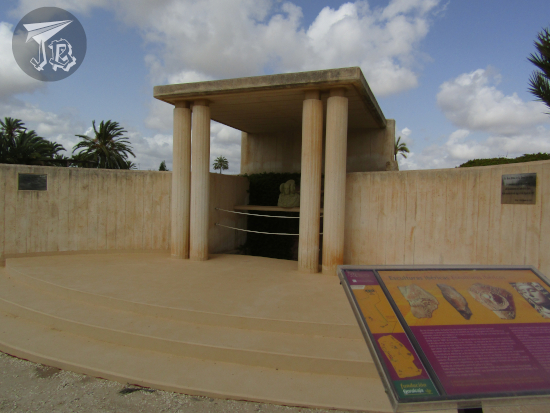
While there aren’t that many pictures taken inside, here is a shot of the cathedral, Catedral de la Almudena .

After visiting the Palacio Real, we went to have lunch. She wanted ham, and I wanted a poke bowl I had seen announced in El Corte Inglés cafeteria, so it was a win-win situation. I had a “Poke bowl de salmón noruego”, Norwegian salmon poke bowl that was amazing – a sushi rice base with avocado, spring onion, purple onion, wakame, a soft-boiled egg and Norgweian salmon marinated with soy sauce, rice vinegar and kimchi.

She declared that she was happy after this, so we called it a day.

22nd – 26th August 2019: Food at San Juan and Alicante

This was a quick three-day trip for my father to have some diving time, and even if I had just landed from Japan I tagged along to make sure that my mother was not alone. I was understandable a little beaten from the big exiting trip, so there was not much that I was up to visiting. However, somehow we had a bit of a gastronomy splurge at the hotel and around.

For example, one day we had some awesome arroz caldoso con bogavante , Spanish rice with lobster for lunch:

For another lunch, I discovered that I could actually eat poke bowls in Spain – behold the Poke bowl de atún rojo de Almadraba , almadraba-caught tuna poke bowl. An almadraba is an ancient Mediterranean fishing technique in which nets are suspended mid-water that lead the fish to a central trap from where they are caught – as a curiosity, let me tell you that somehow orcas in the Strait of Gibraltar have learnt to use the almadraba to fish too! Anyway, the poke bowl had a rice base with avocado, spring onion, red onion, wakame, poached egg, and tuna marinated with sesame oil and soy sauce.

We shared some Spanish ham with that.

And finished the meal with a latte with vanilla ice-cream and a caramel biscuit because… yes, I needed something to prevent me going into a food coma.

We had granizados mid-afternoon – behold my lemon almost shaved-ice.

And one of my desserts was whiskey-cake ice-cream.

Not that much of an exciting trip, but there were some nice things to take from it.

19th & 20th August 2019: Bye-bye for a while, Japan {Japan, summer 2019}

For my last day full day in Japan, I dropped my luggage off at Shinjuku station and met with D****e for lunch to say goodbye for now. I also got to say goodbye to Tokyo Tower [東京タワー] from Roppongi Hills [六本木ヒルズ].

Lunch was a bit sad, but the yakiniku was very yummy. After she had to come back to work I met with B**** for drinks and wandering around for a while in Shinjuku [新宿]. We mostly sat at Wendy’s, talking and drinking… whatever this is…

And then she took me to CocoCurry for goodbye-curry.

Then she came with me to Nippori station to help me carry my luggage to the train. I was so mentally exhausted that I did not even stop for a stamp at Narita Terminal 1. I had booked myself a hotel for the night at the airport because I felt that was the best thing for my mental health at that time, and I am glad I did. It was very handy and the transport to the terminal was very smooth.

I had been worried about my Fuji-climbing stick, but I had been told I could check it in. I bought a suit-cover which I sewed, and had no problems with it – I mean, I saw people checking-in kayaks, for fuck’s sake. My stick was tiny in comparison to that! The flight back was a-okay, unremarkable, mostly.

Walked distance: 19th: 11099 steps / 7.94 km. 20th: 5045 steps / 3.60 km. The displacement was a bit longer though… something around the 11000 km (≧▽≦)

The 2019 trip was a long one, full of awesome experiences that I won’t forget any time soon. I hope to gather experience from what went wrong, but not cling onto the bad feelings. I chose not to write about that, and look for the best in every day. Also, I did not really feel it, but a bunch of Japanese friends told me that my language skills had improved, so that made me happy. Now it’s time to go back to the real world and do adulty things, and start dreaming about the next adventure. また今度ね。

17th August 2019: Oblivion Dust in Ebisu {Japan, summer 2019}

I spent the day at Ebisu [恵比寿], where I got to say hi and meet a lot of known and new people . First, I had arranged a late lunch with my friend with E**chan. Unfortunately, her trains had problems and she was forced to drive to another line station to get from her village outside Tokyo to Ebisu – so in the end it was a very late lunch we had. I spent the time wandering the malls and the Ebisu Skywalk [恵比寿スカイウォーク], which is basically a long corridor without anything to see – the train service was disrupted and we did not know when she would arrive, I did not want to leave the area. She finally made it, and we managed to find some super-nice place in the Ebisu Atre building. By that time, we were starving, and when we caught sight of a traditional restaurant, we went for it. We ordered a katsudon [カツ丼] each, because it looked fantastic – and it was delicious..

Katsudon lunch set: miso soup, a bowl of rice with meat and egg on top, a cup of tea and grated cabbage to share between two people

A scoop of vanilla ice cream and a cup of green tea

Afterwards, we went to the Oblivion Dust’s Gods Of the Wasteland Tour 2019 Gods Of Reborn concert at Ebisu Liquidroom. Oblivion Dust, shortened as “Oburi”, is a three-man Japanese rock band. The current members (none of whom are founding members) are Kentaro “Ken” Lloyd (vocals), Iwaike Kazuhito “K.A.Z” (guitar) and Rikiji Masuda (bass). They usually work with two supporting musicians:Yuji (guitar) andArimatsu / Arly (drums). I’ve often seen both K.A.Z. and with VAMPS.At present, they are touring with guitarist Ryo, as K.A.Z. has broken his hand. Reportedly, he “remains behind the scenes, doing synthesiser work”.

Despite K.A.Z’s broken hand, Oblivion Dust has carried out a sixteen-concert tour during summer, Gods of the Wasteland. There are four different setlists, each played four times:Gods Of Elvis, Gods Of Misery, Gods Of Reborn and Gods Of Butterfly.

Gods of Reborn setlist:

    1. Goodbye
    2. Girlie Boy Imitation #6
    3. Ghost That Bleeds
    4. Sugar Free
    5. Under My Skin
    6. Death Surf
    7. Come Alive
    8. Plastic Wings
    9. Alien
    10. No Medication
    11. Nightcrawler
    12. Crazy
    13. In Motion
    14. Haze
    15. Lolita
    16. Sail Away
    17. Evidence
    18. You

After checking out the merchandise boot, E**chan and I had our numbers called and we went into the floor. We found good spot on the left,, just on the edge of the “mosh pit”, the central area where people jump and dance, and elbow you if you are not careful.

The concert lasted for about two hours, and it was full of energy. Vocalist Ken always amazes me because he does not drink anything, he just grabs bottles of water, dumps the liquid on his head, and then throws them at the crowd.Bassist Rikiji is probably a relative of the Duracell Bunny, and he does not stay still whatsoever. He mimics shooting at people with the neck of his bass, or is busy jumping around. Ryo was all right, but he was… not K.A.Z, which also showed as Ken and Rikiji did have their fun and trolling moments – Ken stole Rikij’s “bass microphone” and and Rikiji just offered him the bass to go with it. Ken also went to “visit” Arimatsu, who was having too much fun to be bothered, and just made some more noise. I mean, Ken seemed to be everywhere at once.

After the concert, everybody was happy-exhausted.I for sure was absolutely drained. E**chan invited me to tag along her and some of her friends for dinner, and we went to a typical izakaya. The food was great, but a bit (all right, a lot) on the expensive side.

The logo of Liquid Room, styled to look like an organic chemistry molecule, with hexagons for Q and Os

Walked distance: No idea, I forgot the watch. But most of what I walked was on the Ebisu Skywalkas I was bored waiting for E**chan since I was early but her train was super-delayed due to the accident (≧▽≦).