5th July 2025: Cheese, archaeology, pancakes (Madrid, Spain)

I am not completely sure how the conversation came up. My sibling said something about cheese tastings. I mentioned something about knowing about a shop in Madrid which organised them. Next thing I knew, I had been tasked with planning an escapade to try. However, closing on dates is not something my family is fast at doing, so by the time my sibling confirmed, the June date we wanted was sold out and I had to book for July.

The final date was Saturday the 5th of July at 13:00. The evening before, there was an explosion and fire in a factory in an area alongside both the speedway and the railway lines, and that forced me to reevaluate transportation – the warehouse worked with lithium batteries, which burn for a very long time. In the end, I decided to try for an early train, with a plan B to drive to a station halfway and meet my sibling there. While you could see the smoke from the wagon, there was no weird smell or anything and the train ran smoothly for once. Maybe we were five minutes late to Madrid? Funny, when I was warned at the station that there were delays. I had planned an extra activity in case we were early.

There was also Pride to take into account, as it was the main Parade, and that causes a cascade of station closures, including Recoletos, the station we had to go to. That would only be an issue to consider when we had to go back though, since they started at 18:00. We could always get the underground and find our way to Atocha.

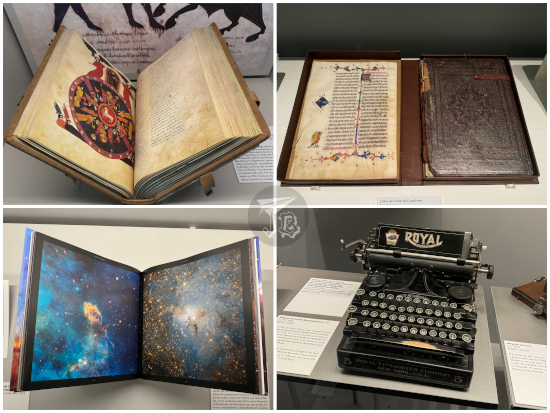
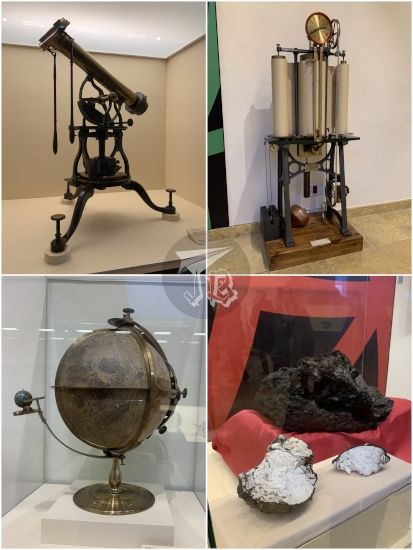
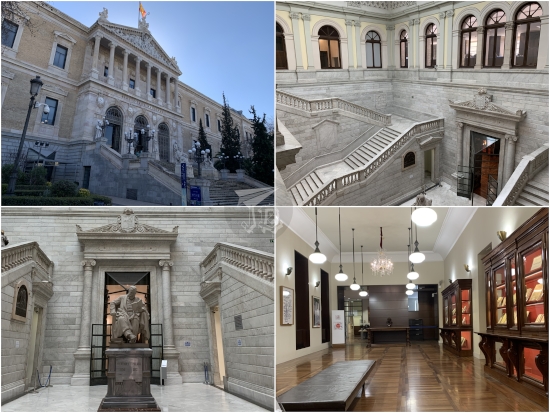
We started off at the Museum of the National Library Museo de la Biblioteca Nacional. I had seen the museum already, but I had read that there was a temporal exhibit. However, we were unable to find it – it’s been apparently “temporarily closed”. It worked to pass the time out of the heat though. We were done at 12:30 – a bit too early to directly go to the store, but too late to try to see anything else. We decided to walk towards the shop, and we missed it at first, but we soon backtracked and walked into… a literal fridge.

Formaje (an old-fashioned Spanish word for cheese) is a specialised / delicatessen cheese shop. Created in 2020, it aims to “create community around artisan cheese”. They work with farmers, craftspeople, and traditional cheesemakers to distribute environmentally-conscious cheeses from producers who respect the natural processes, the landscape and of course the product. The store is designed to be a warehouse too, so it is… cold. Good thing I was carrying a jacket.

Formaje Castelló: Shop. A cheese shop full of pieces and whole cheeses

We waited in the shop, trying not to obstruct the customers, and gawked at all the types of cheese in display, all of which could be bought, and tasted beforehand! We saw some regulars who had their thermal bags ready for their shopping and debated getting a cheese subscription, and people wandering in out of curiosity. Around 12:55 a lady came to check us in. I was the closest to her, so I was able to take a picture of the whole set up and find a seat closest to the speaker. I have way too many attention issues not to want to be close to someone who is going to do some explaining I care about.

The tasting Cata de Quesos Edición Primavera involved fresh sourdough bread, butter, seven types of cheese, sweet quince paste, red and white wine, and “ice cider”. I am not a fan of alcohol in general, but the ice cider was magnificent. I am not going to gush about how all the cheeses were delicious. Assume I loved them.

Formaje Castelló: Cheese tasting. Long table and a tray full of sourdough bread

To begin with, there was real butter from the farm Airas Moniz in Chantada (Lugo, Spain). Made from the raw milk of Jersey cows grass-fed in the north of Spain, it was fresh, yellow, creamy and salted, and the bread was delicious. The first cheese was Olavidia (from Jaén, Spain), made from goat milk. It had a small layer of smoked wood halfway through. Even if I don’t care much about “the proper order you should eat things in”, I discovered that goat-milk cheese is supposed to be a “soft-tasting” cheese, I have always found it pretty strong. The cheeses were organised from softer to stronger, which apparently is how you should consume them.

The second cheese was a Camembert (protected designation of origin, AOP from its French acronym) from the region of Normandie, France; it was creamy, made from raw cow milk, with a slight moulded rind (with Penicillium camemberti) which protects the inner creaminess.

Then came a Manchego (protected designation of origin, DOP from the Spanish acronym), made with raw sheep milk. It originated in a farm called Finca Valdivieso (Alcázar de San Juan, Ciudad Real). In my opinion this one was the weakest cheese, as I am a fan of older Manchego and this was less than a year old, though still nice.

Number four was a cheese I had not heard about before, Tronchón (from cheesemaker Los Corrales, Almedíjar, Castellón). Tronchón is generally made from raw sheep milk, though sometimes it might be made with goat milk or a mix of both. The one we tried was made from goat milk. The rind is dark and unappealing on sight, but it was nice enough. Despite my ignorance, this cheese is old enough that it was mentioned in Cervantes’ Don Quijote.

Another discovery was the German Blossom Hornkäse. Hornkäse comes from the Bavarian region of Allgäu. The cows that provide the milk are fed with local grass and they don’t have their horns cut (Did you know that a cow’s horns are connected to her throat and they are part of the digestion process?). The cheese is made in wood recipients using only wooden tools. This version comes with a crust of dry flowers which makes it… just amazing.

Sierra Sur was… the icky one. It smelled like literal stable – and not a clean one. It is made with raw goat milk and you have to fight yourself a little bit to take a bite of the rind. It is a seasonal cheese, which I wouldn’t be able to say whether it has gone bad… It did look like it had gone bad… But it was nice enough, if you could ignore the smell. Not something I would buy on my own though.

The last cheese, Savel, came from Chantada – like the butter at the beginning. It is made from raw cow milk, from Jersey cows, injected with Penicillium roqueforti. This was extremely strong, but really good, especially with the bread, and the ice cider called Bizi-Goxo. Though this one brand comes from the north of Spain and is made from Errezile apples, ice cider originally comes from Canada. To produce this particular spirit, the apple is kept through the winter on straw mats, and it does not rot. The resulting drink is stronger and sweeter than a regular cider.
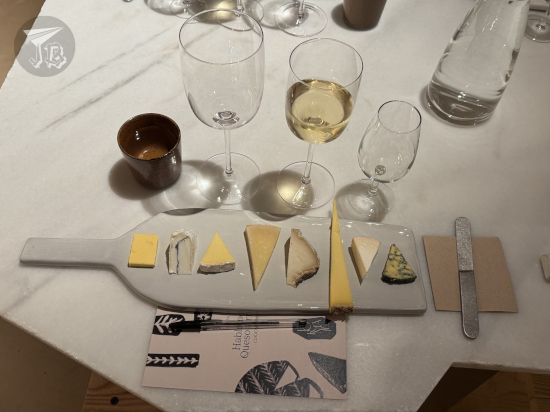
Formaje Castelló: Cheese tasting. Seven small pieces of cheese perfectly aligned on a tray

We spent some time chatting with the lady who had given the explanations, then went on our way. We walked to the archaeological museum Museo Arqueológico Nacional, where they were running two temporal exhibitions. One was a personal-turned-public collection of Egyptian Artifacts called El Egipto de Eduard Toda. Un viaje al coleccionismo del siglo XIX (Eduard Toda’s Egypt: A trip to collecting in the 19th century). Eduard Toda i Güell (1855 – 1941) was the Spanish Vice-Consul in Egypt for a couple of years, during which he amassed a rather impressive collection of artefacts, which he eventually donated to public institutions. The bulk of what he owned is now held in the archaeological museum as part of both the permanent collection and the archives. He had antiques, carbon copies of reliefs, photographies and a hefty number of fakes – apparently, knowing they were so.

Treasures from an Egyptian tomb

The second temporal exhibition we wanted to see was Alas para la guerra. Aratis y la Celtiberia: Wings for war, Aratis (a town, now an archaeological site) and Celtiberia. This one focuses on the Celtiberian culture and how it warred, using soldier helmets as a storyline. These particular helmets have a convoluted history – it turns out that between the early 1980s and 2013, someone used metal detectors to find artefacts from the ancient town and sell them out. This “gang” found and illegally auctioned up to 6,000 artefacts, including twenty helmets which had been forged between the 5th and 2nd century BCE. The archaeological site of Aratis, now called Aranda del Moncayo, would have been probably the most important Celtiberian site after Numancia if these guys had not systematically destroyed it.

The Aratis helmets are the most complete items of their kind that have ever been found. They were not really used for war, but were part of funerary treasures. Truth be told, Germany sounded the alert at some point around 2008 about the legality of the auctions, but the Spanish government did not stop them. Seven of the helmets were returned to Spain in 2018 thanks to the European buyers who learnt that they had been illegally exported, and 11 more have been located. The seven helmets are deposited now in the Museum of Saragossa, but that one is currently closed due to construction work (scattering some of its collections to be shown elsewhere), so they have been lent to the Archaeological Museum.
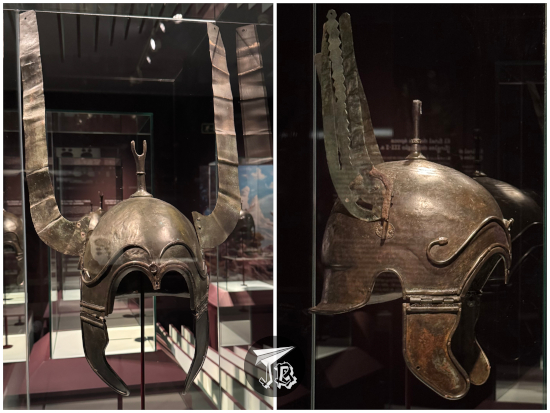
Celtiberian helmets with decorations on the sides

The exhibition also holds other weapons, parts of armours, and Celtiberian artefacts such as coins and brooches. I had seen some of the messed up spears in the museum in Tiermes, which makes sense, considering it also held Celtiberian items.

Afterwards, I finally (finally!) managed to find the reproduction of the Altamira Caves Neocueva de Altamira open! It just had not worked any other time I had been in the museum for the last ten years, and I had seen it once when I was really young, and something similar in the museum on site a lifetime ago. It was smaller than the one I remember from both times… And it makes me sad that I will never be able to see the real thing, because there’s a waiting list you can’t even get into any more, and only 50 people per year see the actual cave…

Reproduction of the Altamira Cave, with bisons, horses and bulls painted on the ceiling.

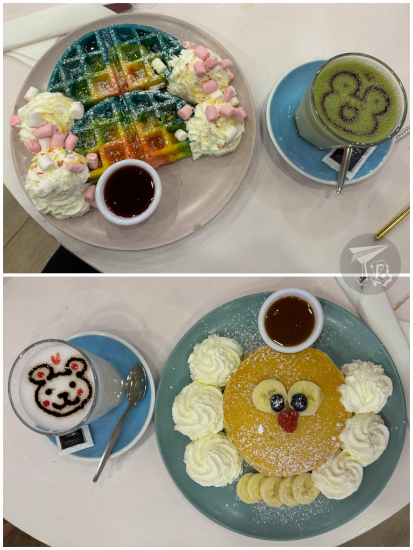
My sibling was not ready to go home just yet, so I thought they might like a stop at Kawaii Café before we turned in. We could take the underground and in under a change and 30 minutes – since I had been there just a couple of days before, I remembered the underground station. I was not sure whether there would be a queue to enter or not, but we were lucky. We alighted at Tirso de Molina and went into the café without problem – it was half empty at the time, around 16:30. They really wanted to order something cute – which is not hard. In the end, they chose teddy-bear-shaped pancakes with chocolate spread Ositos rellenos de Nutella, with chocolate syrup, whipped cream and banana slices. This time I went for a matcha frappé.
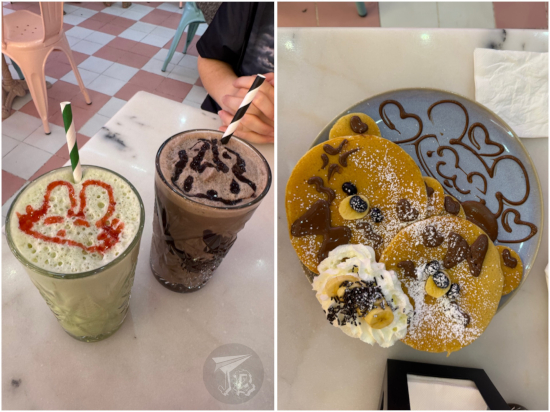
Two drinks with cute rabbits drawn on top, and pancakes decorated to look like teddy bears

Afterwards, we walked down to Atocha Station down one of the shopping streets. We made a few stops, and reached the station just before the Pride Parade blocked the streets. There, we settled to wait for a train. On the way back, the factory that had had the accident was still smoking, but the dark cloud seemed weaker. However, I never thought I would have to consider “lithium explosion” in my adventure planning, to be honest…

2nd July 2025: Sabina’s Hello & Goodbye (Madrid, Spain)

Lots of things came together on the 2nd of July. First of all, due to weird work schedules that I had no control over, I had a day off in the middle of the week. Second, I had a doctor appointment in the morning – lucky how I could fit it there. Third, Jurassic World: Rebirth, the new film in the Jurassic Park franchise came out. Finally, back in January, I had bought tickets to watch a concert in the goodbye tour by the singer who composed the soundtrack of my teenage-angst years.

So it was just a stroke a luck that work just happened to give me the day off because of unrelated reasons. It would have been luckier to have the following day off too but what can one do? Actually, I propose an unpaid leave called “I had a concert yesterday and it’s not that I’m tired or sore or anything, but I don’t want to go back to reality just yet, I deserve to bask in post concert ‘the world is okay’ bliss.” Think about it, it’s a great idea.

Since I had the doctor’s appointment, I could not plan a whole day out. Once I was done there, I changed clothes and then drove off to the train. Of course, there were delays, what else is new? Halfway, one of the doors got stuck open and we could not start until that got closed manually. But instead of blocking it, they allowed it to keep opening at subsequent stations – so it got stuck again and again.

I reached Atocha just in time to change trains and get to Sol using the same system without a wait, so in a few minutes later I was out in the heat. The original idea had been a light lunch at Yatai Market, but the air conditioning in Kawaii Café was stronger. I had been to another of their shops before, and the food was all right, so I thought why not? I ordered a strawberry frappé and a “sleepyhead bunny” Conejito Dormilón – a Red Velvet crêpe filled with strawberry compote and decorated with cheese cream and blueberries, along with a vanilla-jello bunny mascot. Adorable and delicious. Quite pink, too, due to all the strawberry…

A collage of pink café and a meal - a strawberry frappe with a cute koala face drawn on it. and a crepe which looks like a bedding with a sleeping rabbit on top

When I finished, I headed towards the nearby Yelmo Cines Ideal to watch Jurassic World: Rebirth, a monster movie with a homage to the Jurassic Park book. I guess the film is better if Scarlett Johansson is your type. The film retcons the whole “Jurassic World” premise: now the dinosaurs are dying (and nobody cares about them any more!) and only surviving on an island near the Equator. It turns out that they somehow hold the key to cure heart disease. And then the palaeontologist says that they need to collect samples from the three biggest dinosaurs: Patagotitan (okay, it’s famous now), Mosasaur and Quetzalcoatlus, both of which have already been featured in previous films and are not dinosaurs. Then there are mutated freaks and a Tyrannosaurus with the head of a xenomorph and some extra arms, because the dinosaurs can’t survive, but the “mutated experiments gone wrong” are alive and well? The best from the film was a scene taken from the book, with a Tyrannosaurus and a raft. Unfortunately, this new Tyrannosaurus was not Rexy. Furthermore, the special effects are… not good. Too much bad CGI makes the creatures less believable than those in the 90s instalments, which is… a huge faux pas.

I am glad I saw it on opening day, though – I was able to avoid most spoilers and went in with an open mind. It was not a good film but I didn’t hate it. I will just probably ignore it exists (until the next film comes out, we all know that). Points for the pro-planet message, but it falls a bit flat when you know that Michael Crichton, the original author, was pretty much anti-science…

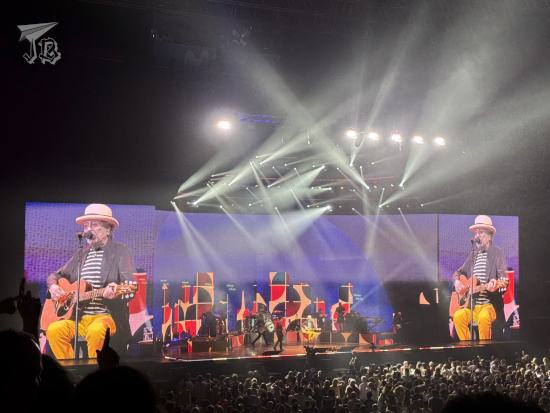
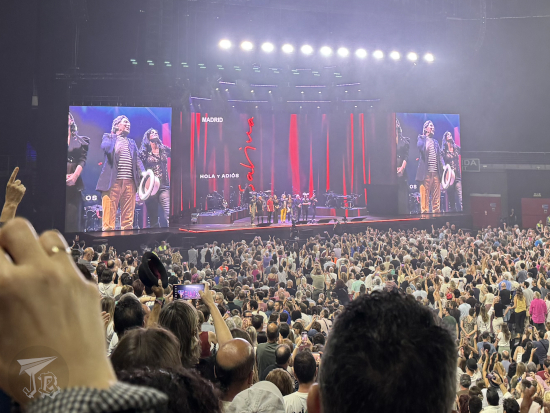
The film was around 133 minutes long, but oh god, the previews were long. Thus, I left the cinema around 19:30. I had to take the underground, and I knew that some stops would be closed due to Pride. However, last year I had learnt that you’re still allowed to transfer even if you cannot enter or exit the station. I used that knowledge to get myself to Movistar Arena Madrid for Joaquín Sabina’s final tour Hola y Adiós (Hello and Goodbye). I am happy I bought the tickets when I first saw them, because most concerts have sold out, and I got quite a good seat considering the event and the venue.

Joaquín Sabina is a Spanish singer and songwriter born in 1949 in Jaén, in the south of Spain. When he finished his studies, his father offered him a present, and he asked for a guitar. Due to his leftist ideas he had to exile himself in London for a few years during Franco’s dictatorship. When he came back, he lived a life of debauchery, mostly in Madrid, and he probably was not the best role model. But between 1994 and 2000, when I was an angtsy teen, his music was important to me, though I eventually moved away from it. When I heard he was retiring (again) early in the year, I thought I wanted to see him at least once, despite the fact I have not consistently listened to his music much in a couple of decades – there are a few hits in my car playlist. And then there is ¿Quién me ha robado el mes de abril?, Who stole the month of April from me?, which hit me very hard during Covid lockdown and I’ve skipped since then, but never had the heart to delete from the playlists.

Security let me in with my tiny water bottle, thankfully, and I found my seat about 45 minutes before the show was due to start, and 15 minutes after doors – it was weird, I had expected a larger crowd, and I had been a bit stressed leaving the cinema 20 minutes later than what I had calculated. I was on the side stalls, on a ninety-nine-euro spot. There is a whole etiquette about concerts with seats, and while I am quite happy to stand up when it is appropriate, and in this case, I decided I would stand up when people in front of me stood up. Pretty easy.

Sabina Hola y Adiós Madrid: empty stage

Setlist:
 Un último vals (One last waltz; recording and MV)
  1. Yo me bajo en Atocha (I’ll alight in Atocha)
  2. Lágrimas de mármol (Marble tears)
  3. Lo niego todo (I deny everything)
  4. Mentiras piadosas (White lies)
  5. Ahora que… (Now that…)
  6. Calle Melancolía (Melancholy Street)
  7. 19 días y 500 noches (19 days and 500 nights)
  8. ¿Quién me ha robado el mes de abril? (Who stole the month of April from me?)
  9. Más de cien mentiras (Over a hundred lies; band intros)
  10. Camas vacías (Empty Beds; vocals: Mara Barros)
  11. Pacto entre caballeros (Pact amongst gentlemen; vocals: Jaime Asúa)
  12. Donde habita el olvido (Where oblivion dwells)
  13. Peces de ciudad (City fish)
  14. Una canción para la Magdalena (A song for Magdalene)
  15. Por el bulevar de los sueños rotos (Through the Broken Dreams Boulevard)
  16. Y sin embargo te quiero (And yet I love you; folk copla song; vocals: Mara Barros) + Y sin embargo (And yet)
  17. Noches de boda (Wedding nights) + Y nos dieron las diez (And the clock struck ten on us)
 Encore:
  18. La canción más hermosa del mundo (The most beautiful song in the world; vocals: Antonio García de Diego)
  19. Tan joven y tan viejo (So young and so old)
  20. Contigo (With you)
  21. Princesa (Princess)
 La canción de los buenos borrachos (The good drunkards’ song; recording)

Well, what can I say? Sabina has got old since I was a teenager. His voice has cracked – after all, he is a smoker – and he has swollen up. But his concert made me feel 30 years younger, and I enjoyed it immensely. I’ll freely admit that I bought the ticket back in January purely out of FOMO. However, I am happy I did. I did not get any of my personal favourites, and I am okay with that. Most of what he sang was part of those times.

Sabina Hola y Adiós Madrid: musican ensemble

The concert started with Yo me bajo en Atocha (I’ll alight in Atocha), a description and homage to the city of Madrid, which the singer holds particularly dear – despite the fact that he has a bad record with concerts in the city – he once had a panic attack and another time he literally fell of the stage and ended up in hospital. He started sobbing right at the end of the song. Figures.

The venue, of course, cheered and applauded, and stood up to bounce to Lágrimas de mármol (Marble tears), which has too dark lyrics for how… perky the music is, but I guess the message of “survivor, yes, damn it” is what matters. It was during Calle Melancolía (Melancholy Street) when the old guard took over, so Sabina turned the microphone towards the attendees, which did not only sing chorus but brought down the dome with their voices. He was visibly moved.

Good thing that next came 19 días y 500 noches (19 days and 500 nights) a getting-over-a-break-up song during which people can yell, and broke the spell. That made me strong enough for ¿Quién me ha robado el mes de abril? (Who stole the month of April from me?), the first time I’ve actually listened to the song since 2020 – “who stole the month of April from me? I kept it in the drawer where I keep my heart” did not sound so threatening surrounded by hundreds of other people.

Sabina Hola y Adiós Madrid: playing guitar

During Más de cien mentiras (Over a hundred lies), which is a list of all the good things in life and “over a hundred lies that are worth it”, we got the band introductions. Sabina sang himself, and played the guitar for some songs – he stayed sitting down on a tall stool. Safer for him. Antonio García de Diego played guitar, bass, and harmonica; Jaime Asúa Abasolo and Borja Montenegro also played guitar; Josemi Sagaste played sax and non-drums percussions; Pedro Barceló played drums; Laura Gómez Palma played the bass; and Mara Barros did the choruses and had some solo vocals.

Sabina retired to rest for two songs, alleging that it had always been a dream of his to have a song of his sung by a beautiful woman – Camas vacías (Empty Beds), performed by Mara Barros – and by an actual “rocker man” – Pacto entre caballeros (Pact amongst gentlemen) with Jaime Asúa on vocals. Soon after Sabina’s return came a song which holds one of the song lines that has impacted me the most in my whole life: Noches de boda (Wedding nights) hopes that “the end of the world finds you dancing”. I really hope it does.

I guess part of the fun of a concert is that you feel special. Of course that the singer has a speech for every city, and holds each one close to their hearts, or are the best or whatever. But this one did hit differently. I guess my inner child enjoyed it immensely, and even if neither of the songs of the encore did much for me in terms of nostalgia, I was incredibly grateful and happy that I had been able to attend. If it is the last tour indeed, I will have said my hello and goodbye, even if it has been 30 years after the time Joaquín Sabina’s was the only music that played in my room.

Sabina Hola y Adiós Madrid: waving goodbye to the public

Also, another extremely convenient thing: though I went by train, I had a ride home, as my parents were in town and driving back around the same time. Which was great, considering that a storm was brewing, and that there were many underground and train stations still closed due to Pride…

19th December 2024: Themed visits at Madrid’s Museo Arqueológico Nacional (Spain)

There have been a lot of witches dripping into mainstream pop culture these last couple of months, what with Disney + / Marvel’s Agatha all Along and (half of) the musical Wicked released as a film. So when I read that the National Museum of Archaeology was running a special guided visit to the exhibition “Between Chaos and Cosmos: Nature in Ancient Greece” Entre Caos y Cosmos. Naturaleza en la Antigua Grecia and part of the permanent exhibition called “Nature, Magic and Witchcraft” Naturaleza, magia y brujería I thought “hey, the Heritage people are catching up with the times!” That day there actually were two guided visits, and the second one was centred around the sculpture Il Pugilatore. One was at 12:00, and the other one at 17:00, so they could be combined – hey, they were free, I just had to find something to do in-between.

Thus, I booked both visits and headed out to Madrid. I got to the archaeological museum Museo Arqueológico Nacional with ample time due to my distrust of trains. As I have the museum card, I decided to just walk in and wait for the time safe from the cold and the rain – and since it had just opened, from the crowds too. Though the ticket said to wait at the meeting point, the museum staff directed me somewhere else, and that is where I sat to wait ten minutes before the starting time. Apparently, a bunch of people did not get the information so when the time came we were few… and promptly joined by about half of the group once we had started.

The first visit was “Nature, Magic and Witchcraft” Naturaleza, magia y brujería. It started at the exhibition Entre Caos y Cosmos. Naturaleza en la Antigua Grecia – “Between Chaos and Cosmos. Nature in Ancient Greece”. As we walked in, the staff scanned a ticket and gave it to us.

The guide made a small introduction to Greek mythology with an emphasis on pre-Olympian “Chaos”. He mostly spoke about hybrids, such as satyrs or harpies, psychopomps (creatures that take souls to the afterlife after death), like Echidna, Cerberus, and the sirens. He also seemed to like the deity Achelous a lot. Achelous [Ἀχελώϊος] was the personification of one of the Greek rivers, a son to the Titans Tethys and Oceanus, and father of the sirens. He was able to shape-shift and would often be represented with small horns as he could turn in to a bull.

Regarding witchcraft, there is a small room in the exhibit about it, and the guide pointed out the concept of sisterhood, and some of the small artefacts and glass carafes. He mentioned the figure of Medea as the greatest witch in Greek mythology. That surprised me, because I had never associated her primarily with magic – I knew her from the Jason and the Argonauts myth, in which she originally helped Jason find the Golden Fleece, but she eventually killed the children they had together when Jason dumped her. Glad to know there was more from her than just being a “crazy lady”.

Afterwards, we moved onto the permanent exhibition. Unfortunately, the tickets we had been issued would not work any more because… reasons. Apparently, they could only be scanned once, and they had already been scanned at the exhibition. However, the person guarding the gates would not let us through without having a ticket beep – despite being with a member of the museum. It was solved quite quickly, but it gave off the feeling of everything being very disorganised.

In the permanent exhibition we mostly saw Talayotic and Iberian talismans and jewellery, then we moved onto the Roman area, where he mentioned the laws regulating the Augurs (people predicting the future), and some small curse tablets that the Romans slipped into each other houses when they were vexed – curses. All in all, the visit did not feel very on topic, just a number of objects vaguely connected together by a weak narrative. And witchcraft was the weakest topic, so it seems that the heritage people have not really caught up with the times. Oh, well.

Artefacts from Naturaleza Magia y Brujería MAN

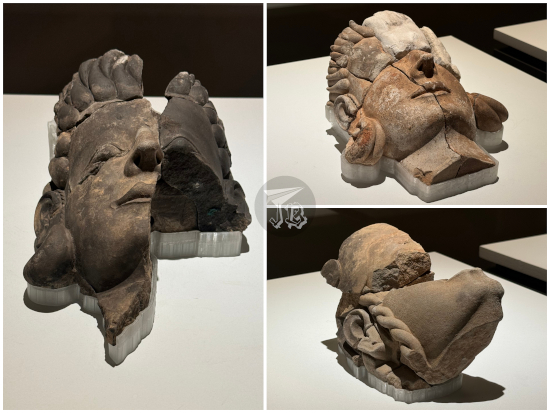
Before I left the archaeological museum, I dropped by the new “archaeological news” room (Sala de Novedades Arqueológicas). Currently, it holds the exhibit Rostros del Turuñuelo. Los relieves de Casas del Turuñuelo. Guareña, Badajoz – a name larger than the exhibit itself: “The Turuñuelo faces. The reliefs from Casas del Turuñuelo, Guareña, Badajoz”. The Turuñuelo, or Casas del Turuñuelo, archaeological site corresponds to the Tartessian culture – a mix of Palaeohispanic and Phoenician traits which flourished in the south and east of modern Spain (and a bit of Portugal) between the 11th and 5th centuries BCE.

The exhibit is a collection of five faces dating from the late period, found within the ruins of a two-storied building. It seems that the building and everything within were destroyed, set on fire, and buried intentionally. It is possible that the faces found belong to sculptures that can be recovered amongst all that material. The faces, discovered in April 2023, are the first and only human representations associated to the Tartessian culture.

The faces from Turuñuelo

After the visit, I went to have lunch. There is this place I have wanted to visit for a while and it has never panned out. I would have actually wanted to have breakfast there, but whatever – this was doable and convenient. Located near the French Institute, it is a crêperie called Prep’ La Crêpe – it would make sense to think they’re French, but in reality they belong to an English franchise. I ordered a basil crêpe classique (melted cheese, mozzarella, tomato, basil and Mediterranean sauce), a Kick-start smoothie (orange, carrot and ginger), and a Belgian (black) chocolate crêpe sucrée for dessert. All in all, it scratched an itch that I had had for a long time, and it was not bad. A bit on the pricey side, I’d say, but what is not expensive these days?

Prep' la Crêpe lunch

Afterwards, I still had a bit of time so I decided to go into the National Library Biblioteca Nacional de España, where they had transformed the book museum into something called “Hell and Marvels” El Infierno y las Maravillas, which runs through the history of printing and knowledge (marvels), then the history of book banning (hell). The exhibition continues with thoughts on how information is preserved, in books and other formats. Finally, the museum is hosting two special exhibits, one around the writer Gonzalo Torrente Ballester Gonzalo Torrente Ballester, la travesía de un creador, and a collection of historical documents belonging a noble family El archivo del Conde de Orgaz. Una ventana a la historia. The archive was really interesting, with a lot of privileges given to the family by successive kings of Spain. The former count was a member of the Friends of the Library, and the exhibition is a homage to him, aside from showing documents dating back from as far as 1220.

Hell and Marvels, National Library

I then went back to the archaeological museum Museo Arqueológico Nacional for the second visit, with another long title Il Pugilatore y la escultura monumental en el Mediterráneo Occidental Antiguo: Cerdeña, Baleares y la Península Ibérica “The Boxer and monumental sculptures in the ancient Western Mediterranean Sea”. The sculpture Il Pugilatore, one of of the Nuragic giants found in the Mont’e Prama archaeological site in Sardinia, Italy. This ambassador giant, who travels the world to introduce people to his culture, is called Manneddu, and he is the statue in best conditions. He would have had a glove in his hand, and a dagger pointing forward, and his chest would have been painted red.

Il Pugilatore

The guide explained that these sculptures – archers, warriors, wrestlers and boxers – were supposed to be armed, but no weapons from either the period or the culture have ever been found. The giants were found, purposely moved and destroyed, in a necropolis for young men. The sculpture also had “little brothers” with the same poses, made in bronze, which have been preserved. That is how the archaeologists know the different weapons and stances they had. The giants are considered the first monumental anthropomorphic sculptures in the coasts of the western Mediterranean Sea, and the only ones in Sardinia.

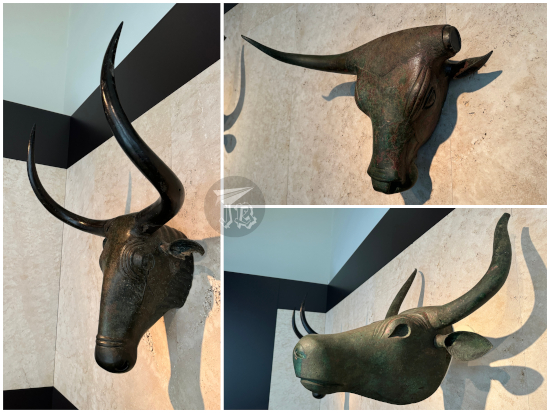
We also heard about the similarities between the Nuragic towers, which were used for water management and as meeting points, and Talayotic ones in the Balearic Islands. Then, the guide ended up talking about the bronze bull heads that represent Talayotic cultures, and insinuating that they might have been brought from somewhere else…

Talayotic bull heads

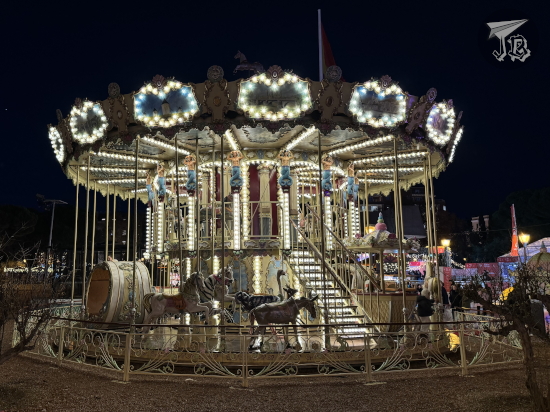
The visit ended there. I then wandered around the museum for a little longer, then checked the Christmas market – and a classical merry-go-round similar to what I rode the previous week. Since it was dark already, the lights were on, but it was raining on and off, so the weather was not nice enough to wander around for long. Thus, I headed to the train to get home.

Classic Merry-go-round in a winter night

18 & 19th November 2024: Apocalyptica Played Metallica in Madrid (Spain), so there I went

Planning for this short getaway started on the 23rd of February, when I bought my ticket for the Apocalyptica Plays Metallica Vol. 2 Tour 2024 stop in La Riviera in Madrid (50.50 €). Almost immediately, I headed off to Apocalyptica’s website to buy the VIP Tour 2024 Upgrade (58,90 €). The upgrade consisted on early access, photograph / meet & greet / autograph session (the important part), VIP lanyard, fabric patch, pin and tote bag. Honestly, all that for barely 100 € was a sweet deal. Back in Antwerp for Starset, someone I was queueing with complained that VIP tickets were too expensive for “a broke uni student”, but for me, meeting with the artist, albeit briefly is usually worth it – early entry is a plus, too, because for some concerts I either find a barrier spot or I just have to go to the back. The bundle was dispatched on the 9th of June (according to the email. Do Finnish post offices open on Sunday?) and it arrived on the 18th.

I originally booked a cheap hotel about half an hour’s walk from the venue. Later, I decided that I preferred the more expensive one less than 10 minutes away, so I changed my booking a week before the concert. I did not book there originally because it required prepayment, and my card was playing up..

On Friday the 4th of November I received an email with instructions for the Meet & Greet, which was to start at 18:30, and I should be there at 18:15. All right, I could do that. It was only a matter of waiting.

On Monday, 17th of November, I took a morning train to head out to Madrid with some leeway for time because I needed to do some small item shopping. I had to dodge some guys trying to get people to sign up for an NGO, but at 11:40 I made it to my first stop of the day – the light museum Museo de la Luz. I had been putting this visit off to go with someone who had expressed interest. However, I also waited for another exhibit and I missed my chance as it turned out to be only temporal. Thus, I decided to head to the Light Museum on my own – it was also one of the few exhibitions open on a Monday morning.

The Light Museum is a modest exhibition with interactive artworks that are mainly made out of lamps, lasers and lights. When you come in, you are given covers for your shoes and a key for a locker – all for free. Then you wait until an attendant takes you in and shows you how to interact with the first artwork “The birdcage” (La Pajarera), a box made out of light and metal that you make change colours with the movement of your arms. Once you know how to “play” with the art, you are left on your own to wander for an hour. At first I thought it would be tight, but the place was small – a bit too small for the price, I thought. I was there for around 40 minutes in total.

There were few people and I was able to check out most of the artwork uninterrupted. The next exhibit is made out of a number of old music festival lights – those that gave a lot of heat from the 90s, which are supposed to be a reference to climate change. Then there is a giant kaleidoscope you can walk in – this one became my favourite. Other rooms or works include a wall of lights that follow you as you move or dance, something with lasers (that I think was broken), some light illusions, a room full of hanging lights, a cube of mirrors and light… At the end there is a wall reading “light museum” in differently coloured lights. When I left, the lady at reception gave me a badge for booking with the official website.

Light Museum Madrid

Light Museum Madrid

I walked out and headed towards the restaurant where I wanted to cheat the system. I crossed the square Puerta del Sol, where they were setting up the Christmas tree – it was about 45% Christmas. On my way, I walked by the underground stop Metro Banco de España which has a tiny door for Little Mouse Pérez – Ratoncito Pérez, the Spanish equivalent to the tooth fairy. I never remember to check it out when I am around, but I made the connection this time.

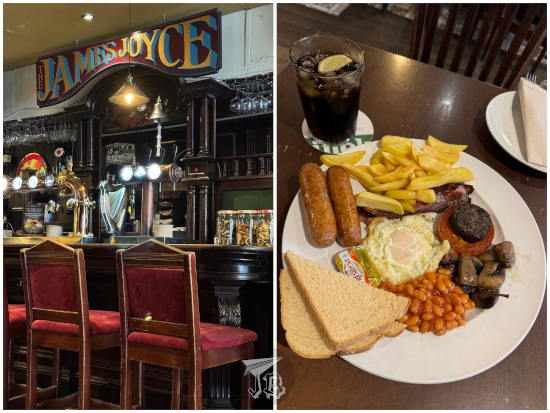
I finally made it to the James Joyce Pub – which is technically a sports bar. I was not there for the TVs though. I had a while back found the place looking up places which served English breakfasts in Madrid. The James Joyce prides itself in being an Irish pub and offers Irish All-Day Breakfast (12.00 €) – two pork sausages, two rashers of bacon, baked beans, fried egg, sautéed mushrooms, grilled tomato, blood pudding, chips, two half-toasts and butter. No, I would not survive that for breakfast, so I ordered it for lunch (and dinner), thus tricking the system indeed. Unfortunately, it was really good and authentic, so now I’ve got to come back for the sausages and the shepherd’s pie, so at least twice.

James Joyce Irish breakfast

After lunch, I headed out towards the park known as Madrid Río. The park runs along the banks of the river Manzanares. It covers 121 hectares, and it was designed after to cover the space emptied when the belt road M-30 was rebuilt as an underground tunnel. The original project was created by a team of architectural studios and landscapers, with strong ecological consideration – aiming to help the area recover from the degradation and pollution caused by years of road traffic. The project was carried out between 2006 and 2012. In 2015, a second project was carried out to “renaturalise” the river, opening the dams to allow the water to flow freely, which in turn caused the recovery of many plant and animal species (to the detriment of… the local rowing team).

There are also bridges that connect both banks of the river. One of them is the one I crossed – just because I could. It is the pedestrian bridge Puente Monumental de Arganzuela, designed by Dominique Perrault. It is a bridge in two parts – one crosses the river, the other overlooks the park and connects to the urban area, and a total length of 278 metres. It is a tube made out of steel and wood that I’ve been wanting to check out for a while.

Arganzuela bridge

Another important bridge is the completely different Puente de Toledo, a baroque bridge built by Pedro de Ribera. It was erected in granite between 1717 and 1732 as the previous ones had been taken down by torrential floods. This one was made to stay, with nine solid arches opened to allow for the river floods. It was… ready for Christmas.

Madrid Río and bridges

It was weirdly warm for a November afternoon, so when I went to my hotel I opened the window while I had a shower. Around 17:00 I headed out to the venue, where there was a small group of people waiting already. La Riviera is a 1,500 people venue, with really good acoustics – and very dedicated staff. The place was originally a cinema, which was turned into a disco, and then into a music venue and nightclub. It is the same place I saw Epica and Apocalyptica in 2023, and I was surprised how many people came for the M&G considering that last year we were… six. We were around 30 this time around.

At first we were chatting in front of the main door, but soon a queue started forming. A little later, the nice security guy (who last year told me “I looked the part of an Apocalyptica fan”) took us to a secondary door, and the queue was properly organised. Surprisingly, bags were not checked – while last year they even took markers from people.

Apocalyptica is a Finnish symphonic metal band. It was formed in 1993 as a tribute to Metallica with a classical touch – playing with cellos. Their debut album Apocalyptica plays Metallica by Four Cellos was released in 1993. They slowly moved from covering other bands in a neoclassical style to their very own repertoire. Today, the members are Eicca Toppinen, Paavo Lötjönen and Perttu Kivilaakso, three classically-trained musicians with a deep love for metal. In 2024, they have gone full circle with the album and tour Apocalyptica Plays Metallica Vol. 2, performing with drummer Mikko Kaakkuriniemi.

Apocalyptica Tour 24/25

We were ushered into a queue for signatures, and afterwards we would go at the end of the line to wait for photographs. I had brought a print-out of the picture from the previous year, and I told them that whenever they came to Madrid, I would come see them. I got a smile for that. It was an awesome photograph, after all. After everyone had their stuff signed we had the photographs. I asked for “a big metal hug” and got trolled instead. Fun times though!

After the photograph, I found a spot at the barrier. Last time I got on the right, this time I went left. Just a little. I did not want to go dead centre in case anyone decided to moshpit, but I might next time as there was no issue – everyone was too entranced for anything like that, I’d say.

The opening act was the Finnish band Arctis, a baby band who has just debuted with their first CD. They were pretty fun, maybe… a bit… too happy bouncy for metal? I’ve read their act described as metal-pop. It might be. I liked them okay, and they were nice.

Setlist:
 1. I’ll Give You Hell
 2. Remedy
 3. Tell Me Why
 4. WWM
 5. Bimbo (Lambretta Cover)
 6. Fire
 7. Frozen Swan
 8. When The Lights Go Out
 9. Theater of Tragedy

Arctis at La Riviera 2024

Arctis at La Riviera 2024

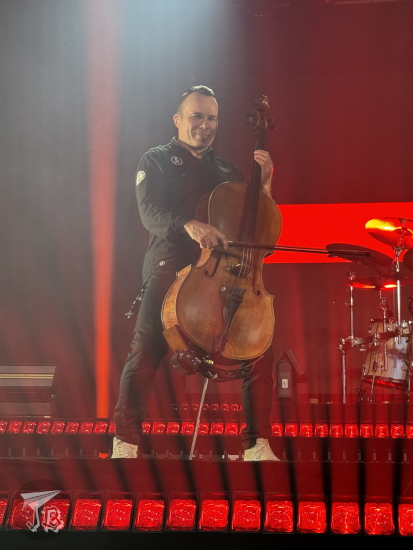
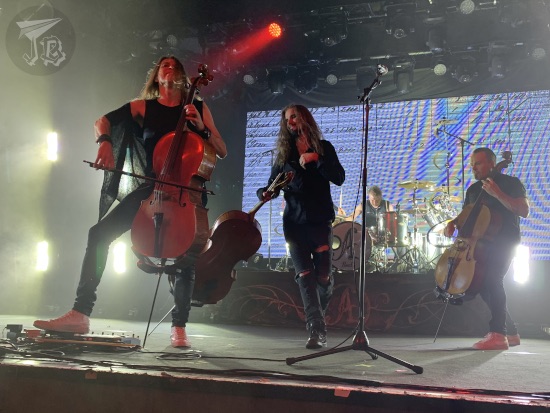
Apocalyptica came on stage at 21:00 sharp, and the live was glorious. All the songs were Metallica covers, from the new album, the first one, or the remastered version of Plays Metallica released in 2016. Despite that, one would not even have to be a Metallica fan to enjoy the concert, because the three men that compose Apocalyptica have an amazing magnetism. Perttu reminds me of the Duracell Bunny, he just did not stop for a second throughout the whole concert, which lasted a good two hours. Paavo seemed to be in his own little world, as he usually does. Eicca is the one doing most of the talking, and he is hilarious when he delivers his puns with a total deadpan voice and face.

Setlist:
 1. Ride the Lightning
 2. Enter Sandman
 3. Creeping Death
 4. For Whom the Bell Tolls
 5. Battery
 6. The Call of Ktulu
 7. St. Anger
 8. The Four Horsemen
 9. Blackened
 10. Master of Puppets
 11. Nothing Else Matters
 12. Seek & Destroy
 13. One

The audience was mostly moved by Nothing Else Matters, I’d say, judging by how they chorused it. Perttu was all in for that. Personally, I found Seek & Destroy and One, particularly, to be extremely powerful. Also, knowing that they dug up the original bass track from deceased Metallica member Cliff Burton for The Call of Ktulu was half-amazing and half-chilling. All in all, it was a fantastic concert, no matter how one looked at it.

Apocalyptica La Riviera 2024

Eicca Toppinen . Apocalyptica La Riviera 2024

Paavo Lötjönen. Apocalyptica La Riviera 2024

Perttu Kivilaakso. Apocalyptica La Riviera 2024

Apocalyptica La Riviera 2024

Afterwards, Arctis was hanging out by the merch. I got their CD, they signed it, we took a photo. It was fun!

I left the venue and I brought an ice-cream and a sports drink for “dinner” of sorts, because I was thirsty. I had both in the hotel room before my shower – the second of the day – and collapsing onto the king-sized bed. I had to wait for the phone to finish charging before I slept though, so I watched a movie before I zonked out.

I woke up on Tuesday, 18th of November and drank my coffee before I set out. It was freezing out there, with frost on the grass, in spite of the warm afternoon the day before. On my way, I found the ancient walls of the city, remains from the old Moorish fortress alcázar, which stand to the side of the Royal Palace and the Almudena cathedral. I walked towards the centre of Madrid – The Sol Christmas tree was about 60% ready – to meet up with my relative for breakfast at a new place called Kawaii Cafe. Inspired by the Japanese kawaii [可愛い]. Kawaii means pretty, childlike, cute, and the Kawaii Cafe has taken the idea to heart, maybe not not in a complete accurate manner though. Everything is pink, full of fluffy and glitter. The food is not only tasty, also pretty. However, the wait staff is dressed as “maids” [マイド], which I tend to associate more to the… hm… more risqué side of hospitality. When food is brought out, you are offered to chant a spell for it to be even tastier.

I found the place existed by chance, and I was instantly smitten by the rainbow waffles, because they were adorable, and very, very rainbow-like. Thus, I ordered them, along a matcha latte. My relative tried the pancakes with a cocoa. She was ecstatic at the quirkiness of the place.

Kawaii Cafe Madrid order

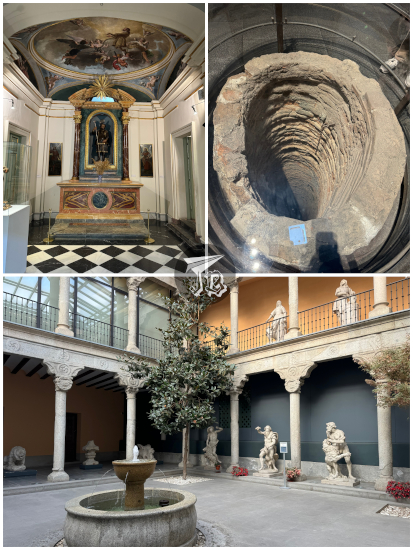
We stayed for well over an hour, and then headed out to one of the local museums Museo de San Isidro – Museum of Saint Isidore the Labourer. Isidore is the patron saint of Madrid. He is credited with several miracles – multiplying wheat and food, having his oxen plough on their own, and rescuing a child from a well making the waters inside rise. According to tradition, the museum is housed where he used to work, and legend has it that the old well is the one he pulled the child from.

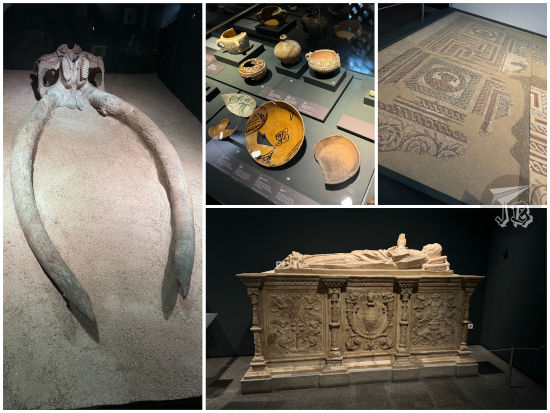
Today the museum hosts some palaeontological and archaeological exhibits, from a mastodon and ancient rhinos to Medieval artefacts, running through the Roman occupation and the Muslim period. The place is a complement to the Museo de Historia de Madrid, or maybe its competition, though I think both belong to the same institution – and both are free. As the building is a historical place, it offers the chance to enjoy its small but beautiful Renaissance courtyard, with sculptures of mythological heroes, and of course St. Isidore and his wife. There is also a tiny Baroque chapel.

San Isidro Museum

San Isidro Museum: chapel, well, and courtyard

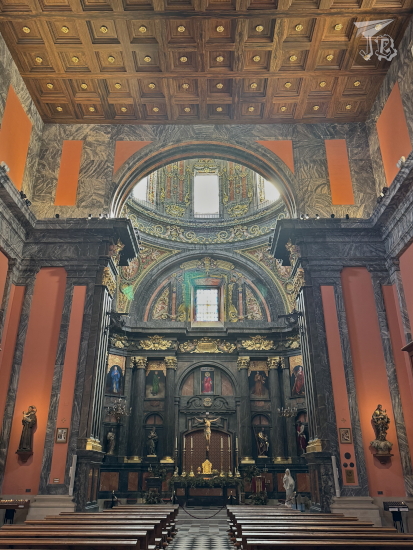
Right next to the museum stands the Baroque church of Saint Andrew the Apostle Iglesia de San Andrés Apóstol , which was getting ready for Christmas. The church is one of the oldest in town, though it was rebuilt after its destruction during the Civil War, and it has been recently restored. It hosts a number of religious sculptures and a painted vault above the altar.

Saint Andrew church Madrid

We took the underground at the station Tirso de Molina, which can still be accessed through the historical entrance hall, which is similar to the one that was closed off in Pacífico. It was beautiful, though of course busier than the museum one. Over the entrance to the platform there is a tile mosaic with the old shield of Madrid, dating back from the original station. It was installed in 1921, and it is the oldest artistic item in the underground network.

Access Hall at undeground station Tirso de Molina

From there we commuted to Nuevos Ministerios, where they had just kick-started the Christmas market. It seemed to be the “brands” market, with Lego, Disney, and so on. There was also a food truck by a famous chef selling basically chicken sandwiches at outrageous prices. I had been vaguely curious but not going to break the bank for a chicken sandwich, especially after such a breakfast!

I took a train from there back home, with no incidents whatsoever (because by now I’m desensitised to trains being late…)

7th November 2024: The Spanish Cultural Heritage Institute (Madrid, Spain)

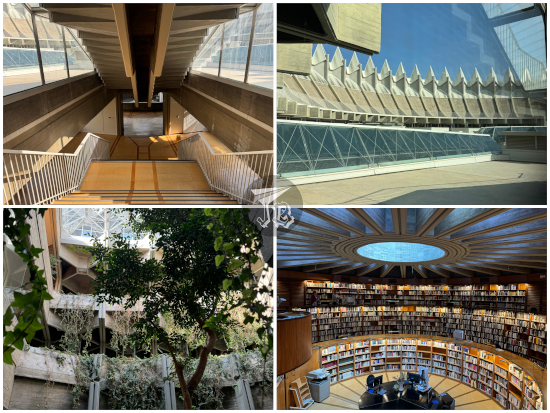
I know you do not believe me when I say I don’t like guided visits, but they are the only way to do some stuff – such as stepping into the Stonehenge circle, or basically anything managed by the Madrid city hall. The Spanish Cultural Heritage Institute Instituto del Patrimonio Cultural de España IPCE is a governmental organisation whose functions are preservation and conservation of cultural items, research, communication, and safekeeping of the documents in its archive. It can only be visited on certain dates, by appointment, and with a guided visit. I managed to secure a free Thursday visit at noon, so I headed out to Madrid. Surprisingly, neither trains nor underground had issues, so I was over an hour early on site. The IPCE is located in its own building in the area known as “University City” (Ciudad Universitaria), close to the Fine Arts faculty – by design – and the President’s official residence – by chance.

The headquarters building was commissioned in 1965 to architects Fernando Higueras and Antonio Miró. The architects’ original project had to be severely modified, but it became a very different structure. Construction was stalled for years, and the building was not usable until 1985 – when new remodelling was tackled. The building is circular, nicknamed the “Crown of Thorns” (La Corona de Espinas) because at the top there are “spikes” of sorts. Top-view, the structure is divided in 30 sectors, with 56 semi-sectors and four empty ones for the main access staircase and gate. It has four floors and at least one basement. It was built in concrete and glass, with some cork floors, but lacking plaster or any kind of concealment for the structural items. The centre of the building is an open space with a glass dome, and serves as reception. Unlike the original project, this space is covered with a glass vault. The interior has a lot of plants, even three small “gardens” mainly with hanging plants. The building is considered an important cultural asset BIC (Bien de Interés Cultural), and these plants are protected along with the structure.

Spanish Cultural Heritage Institute building

The visit consisted of an introduction to the building and the work which is carried out there. We saw the model of the original project – the only similarity is that it was also vaguely circular. We climbed the stairs to the upper floors to snoop at the rooftop and the “thorns”, and then rode the lifts down to the basements to see some X-rays of paintings and sculptures. Back on the main floor, we were shown into painting restoration workshop – they were working on Maerten de Vos’ Abundance, having repaired the work and erased some extra (puritan) clothing to make the goddess Ceres look less… naked. Finally, we were invited into the library, which is round and has three levels. It has natural light due to its own skylight, a decorative glass dome in the middle of the main open area.

Spanish Cultural Heritage Institute inside

The visit started at noon, and it lasted two hours. Heading out to the centre of Madrid would take around half an hour of walking and underground. Thus, it gave me the opportunity to book a late 15:00 lunch. Since I was lucky with my connections, I was in the Cuzco neighbourhood almost half an hour in advance.

It was the perfect opportunity to go get some groceries at the Chinese supermarket Ibero China Madrid in the street Calle General Margallo. While I needed some items, I was distracted as I walked the “geek” fizzy drink aisle. There is a company called Ocean Bomb which makes sodas – sparking water, yoghurt drinks and bubble milk tea with “creative packaging”. I was aware of them because a friend collects the Sailor Moon ones and we checked for them in London in 2023. Well, now I went and found myself some Saint Seiya sodas – Gemini Saga (grape yoghurt flavour) Aries Mu (apple yoghurt flavour) and Virgo Shaka (peach yoghurt flavour). They were out in 2023, but I had not heard about them, it is the first time I saw them. And of course, I bought them (I have no idea if they are official or not, but the publicity I found afterwards has the Toei stamp on it, so I’m hoping they are).

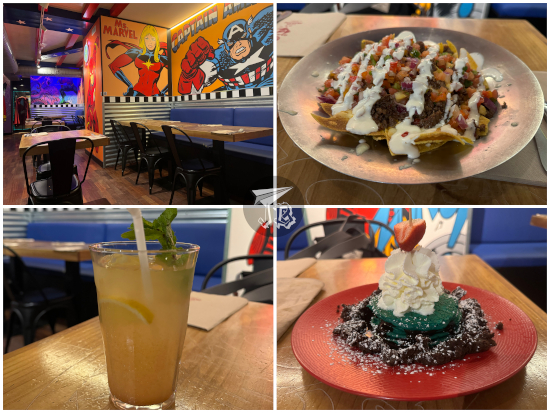
For lunch, I had a reservation at Comic Planet. Last time I was there, a member of the party was late, so in order to keep the table, we ordered appetizers. They were great, but afterwards there was no stomach-space for dessert. And dammit, I wanted some dessert – particularly, I wanted pancakes. I had been looking at coming back to Comic Planet for a while just to have them, but it never worked out. This was finally my moment. I had a lemonade, some nachos – which were delicious – and I finally got to eat my pancakes – which are green and called Hulkcakes, and come with whipped cream, brownie and shortcake crumbles , and around ¾ of a strawberry. I ended up extremely full, but happy.

Comic Planet lunch

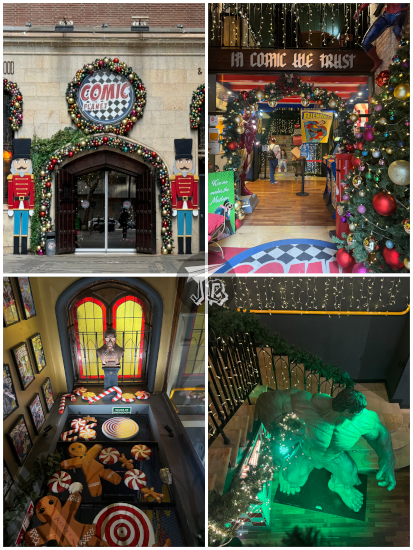
Oh, and I was confused because it was early November but… already Christmas in Comic Planet!

Comic Planet Christmas decoration

I left the restaurant and headed towards the archaeological museum Museo Arqueológico Nacional, which is running a temporal exhibit regarding Nature in Ancient Greece “Between Chaos and Cosmos: Nature in Ancient Greece” Entre Caos y Cosmos. Naturaleza en la Antigua Grecia. It hosts over one hundred pieces of classical Grecian art. Most belong to the museum’s own collection, acquired from the 19th century collector Marquis of Salamanca, and some are national and international loans. Since a large percentage of items were original and not replicas, it was really cool. Then again, I have to admit I have a thing for Grecian vases, especially with mythological motifs.

Entre Caos y Cosmos. Naturaleza en la Antigua Grecia

The exhibition was not big, so later I used my National Museums card Tarjeta de Museos Estatales to go and take a walk around the permanent exhibition. There is a loaned exhibit from the Mont’e Prama archaeological site in Sardinia, Italy. Mont’e Prama was discovered in 1974, unearthing remains from the Nuragic culture (1800 – 700 BC). This Bronze Age civilisation created large sculptures called the Giants if Mont’e Parma (Giganti di Mont’e Prama), depicting wrestlers, archers, warriors and boxers. One of these colossi Il Pugilatore (The Boxer) has been brought to the MAN for display for a few months. Boxers were characterised for having a glove with metal reinforcements on their right hands. Il Pugilatore is the largest sculpture, two metres tall and 300 kilograms heavy – which has been travelling across the world to promote the archaeological site. There was… something imposing about the whole thing, and not even its size. Some kind of… presence there. It made me want to visit Sardinia, to be honest (and it is much, much affordable than Easter Island…), so I guess the promotion… worked?

Il Pugilatore

I took a stroll through the permanent collection afterwards, especially the Iberian and Talayotic areas, because I am fascinated with them these days – and I shall make the most out of my pass for as long as I can. It was getting dark though, and the commute to the IPCE had taken long, so I headed back.

Museo Arqueológico Nacional

14th May 2024: Three Museums and Tea, Madrid (Spain)

On a whim, I put together a plan for Tuesday, as it is currently my free day. I was too lazy to drive, so I decided to catch a train to Madrid. There was a temporary exhibition I wanted to check out, and it was close to several museums and eateries.

My first idea – breakfast at a French crêperie – went bust, because the place was still closed when I arrived in town – I swear, this is like the fourth time I try to have something there, and it just won’t work. Instead, I ended up at a Starbucks for breakfast, before heading out to my first destination – the exhibition The Art of Manga, held in the Architecture Bar Association building Colegio Oficial de Arquitectos de Madrid, COAM. The Art of Manga is a small exhibit that runs through the history of manga – Japanese comics – with a few snippets of what it was and what it has become, especially in Spain.

The entrance was a sort of tunnel with manga sheets hanging from the ceiling. It ended at a traditional scroll with animals acting like people – Chōjū-jinbutsu-giga 鳥獣人物戯画, which translates to “Animal-person Caricatures”. Some people consider that this is the origin of manga (note the “ga” at the end), though if there is one thing that the exhibition makes clear, it’s that nobody knows when manga actually started. Thus, it just runs through all the possible theories and important names. From the Edo Period, there were a few wood prints (ukiyo-e) – which are claimed to be original – among them two by Katsushika Hokusai [葛飾 北斎], The Great Wave off Kanagawa [神奈川沖浪裏, Kanagawa oki nami-ura] and Fine Wind, Clear Morning [凱風快晴, Gaifū kaisei]. Hokusai is another of the supposed starts (“the father”) of manga. There were also a few toba-e [鳥羽絵], similar to the first scrolls – for the first time in the evolution of drawings, there was text alongside the art. Then came the books, where texts dominated – though there were still drawings – and they became extremely popular during the period.

With the end of the isolation of Japan, Western influences – mainly comics – influenced local artists, and “speech bubbles” appeared. In the late 19th and early 20th centuries, Kitazawa Rakuten [北澤 楽天]’s works were published in newspapers. He is (also) considered the father of modern manga, and several of his works are displayed. There are also early 20th-century scrolls, painted in a style similar to toba-e depicting the Tokaido Road, which separated Edo (old Tokyo) and Kyoto, and its checkpoints. There were also kamishibai [紙芝居] cards – kamishibai is a traditional form of theatre involving telling a story using a narrator and different “postcards” with images drawn on it.

In the middle, the exhibit had a rock garden, and a torii gate with a lot of lanterns gave way to the second part – modern manga. Here there were pieces and mementos from famous artists and works – Osamu Tezuka [手塚 治虫], known as “The god of manga”, and one of the driving forces of anime. According to the exhibition, they were showing all of his works. There was a bit about Shigeru Mizuki [水木 しげる], and big international hits like Sailor Moon, Naruto, Dragon Ball and One Piece. After a screen showing a video about a cosplayer – which I did not care much about – there was a section on manga magazines, some of the early manga published in Spain, and a stand where you could get some stamps.

Snaps from The Art of Manga Madrid

Finally, there was a bit on merchandising and figurines. The shop did not even have a catalogue, which I would have bought. All in all, it was all right, smaller than I had expected.

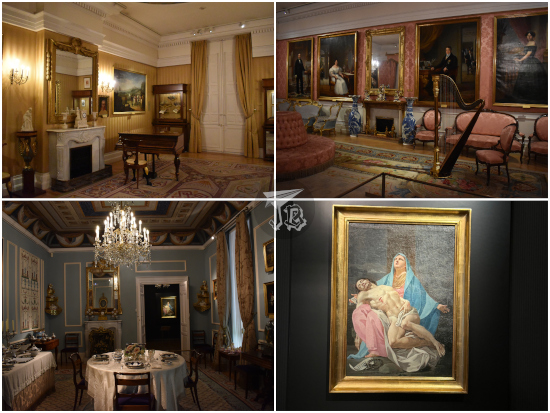
Then, I went to the nearby museum of the Romantic period, where I got a national museums card – I’ve been wanting one for a while, but unfortunately you still have to queue to use it. I had hoped you could just walk into museums with it, but I guess crowd control is a thing since Covid. Anyway. The Romanticism museum, Museo del Romanticismo is a small palatial residence which tries to recreate the ambience and atmosphere of the dwellings of the bourgeois families at the time. It had a lot of nice furniture, similar to the one in Riofrío, but I found it lacked on the landscape paintings I like. The museum is currently exhibiting an early painting by painter Francisco de Goya, a Pietà.

Museo del Romanticismo Madrid

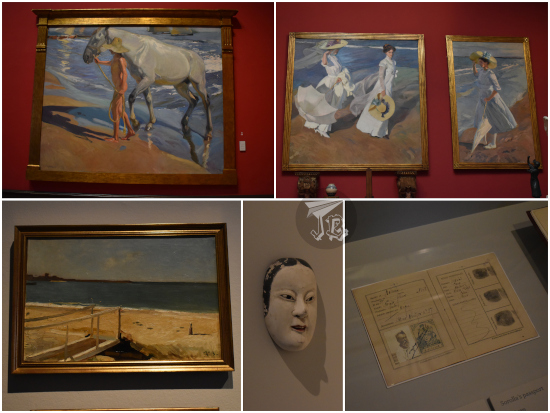
Afterwards, I headed out to line for the Sorolla Museum Museo Sorolla. I had to queue for nearly 40 minutes, but I was finally admitted in. Joaquín Sorolla (1863 – 1923) was a generally-impresionist painter (impressionist, post-impressionist and luminist) from Valencia. The museum was built in the artist’s own house, completed with some of his iconic artworks, including Paseo a orillas del mar, Walk on the Beach, and El baño del caballo, The Horse’s Bath. Sorolla excelled in portraits and landscapes, especially the sea side, and social criticism. He was a master depicting light, water, and the combination of both. He became one of the most important Spanish artists of his time – and probably the most famous. He participated in the Paris Universal Exposition of 1900, and was invited to exhibit his art in New York City.

Furthermore, there was a current exhibition called Sorolla in 100 objetos – Sorolla in one hundred objects – which had just opened to the public. It included personal items the artist collected, – some a bit bizarre–, photographies, his passport, the last painting he worked on, the medal he received from the US president, a photograph of his studio in Italy…

Snaps from Museo Sorolla

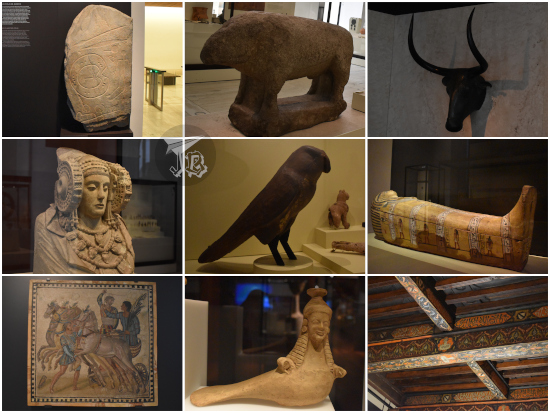
I then went off towards the archaeological museum Museo Arqueológico Nacional. I used to love this museum – when they remodelled it and they made it all modern and aseptic, it lost most of its allure. Of course, I still enjoy it, as the important items are the exhibits, and the museum has a lot of important items from the Celtiberian cultures – Celts and Iberians inhabited Spain before the Roman conquest, which started in the 2nd century BCE. Iberians were prevalent in the east and south of Spain before their arrival. The north and west were populated by the Celts, and there was a vague area in-between whose people have been called Celtiberian. the Talaiotic culture flourished in the Balearic Islands, and it has recently been declared World Heritage. These cultures were eventually assimilate by Romans, but Celts lived on elsewhere. Iberian and Talaiotic cultures, however, diffused with time. Today, there is little known about it, and most is just interpretation from archaeologists, even less about the more ancient tribes that lived in the areas during the Bronze Age.

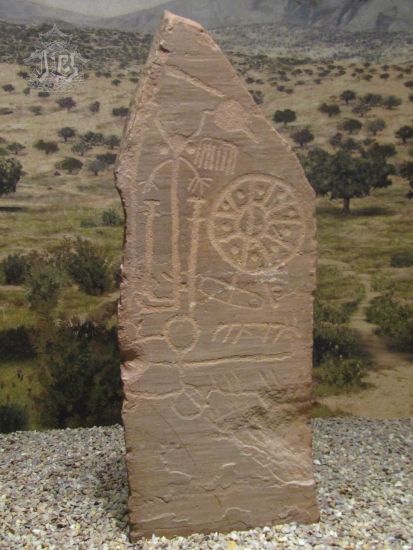
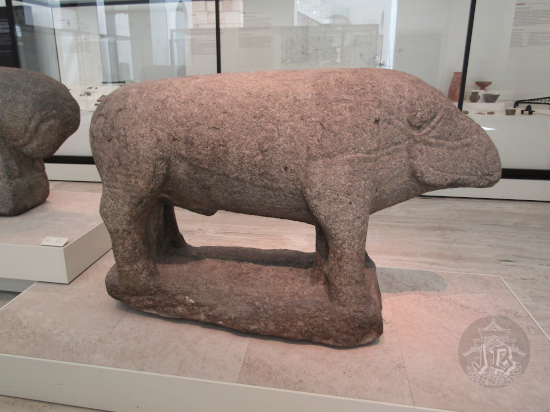
Among the objects from pre-Roman Spain, there are mysterious steles from the late Prehistory. However, it is the Iberian funerary art which stands out the most – such as the bust called the Lady of Elche, La Dama de Elche, found in the town of the same name, and the full sculpture named the Lady of Baza La Dama de Baza. Both are fantastic, to the point that it was thought they were Hellenic for some time. Other items include bulls – both metal cattle heads with wide eyes, and vaguely-shaped stone sculptures, verracos. I remember going to the museum when I was little, and the importance of these bulls, called “Bulls from Guisando” Toros de Guisando was drilled into my head, to the point that I thought that the ones exhibited there were the only ones – it also made me sad that they were in the museum and not in the field where they had been found. I was petrified when I learnt, years later, that there are a bunch more…

The museum also hosts a nice collection of Moorish art, and what apparently is a special Egyptian exhibit, as Spain worked with Egypt during the 20th century, and got a lot of objects from that excavation from the Egyptians “in the split of the new discoveries”. I am not sure whether that’s accurate, or the story has a lot of make-up on. I had to leave around 16:15, but as this museum is also covered by the national museums card, I can come back any time within the year for free. I skipped most of the Medieval period.

Museo Arqueologico Nacional Madrid

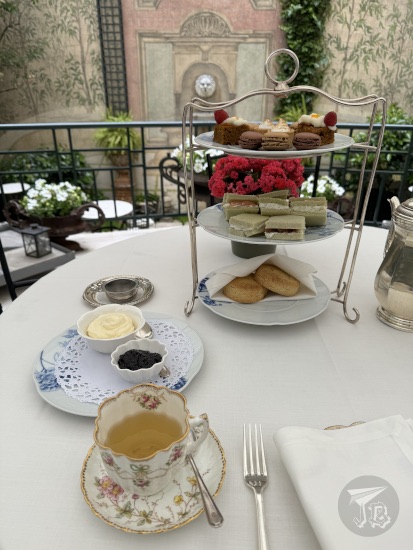
I had a reservation for afternoon tea a few minutes away from the museum, at 16:30 – I might be doing a bit of a rally around all the places in Madrid which have it. This time around, I went to El Jardín de Orfila – and good thing I had decided to only have breakfast and skip lunch and go straight from breakfast to tea. I was seated in a lovely outward area and I chose a delicious green tea with cherry. The food was plenty – finger sandwiches: pastrami, salmon and cucumber and cheese cream; macarons, carrot cake, meringue, and scones, along with clotted cream and berries jam. It has probably been the best afternoon tea I’ve had in Madrid up to date. The scones were a bit under-baked though.

Afternoon tea at El Jardín de Orfila

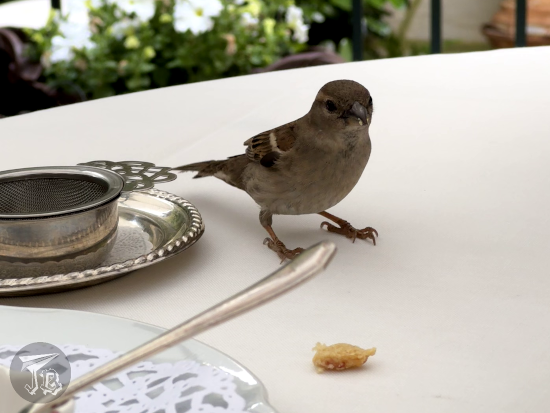
I was alone in the outer area for most of the experience, the waiter checked on me once after bringing my tea. It was actually so calm and quiet that I had a visitor – a little house sparrow (Passer domesticus) was very interested on the remains of my scone, so I shared with her. She was happy after two crumbs, and left – or maybe it was because another couple walked into the area.

Sparrow hopping towards a scone crumb

I left a bit before the two-hour timeslot was up so I could catch a timely train home – and because the couple came in, talking loudly, and kind of broke the spell.

22nd March 2024: Trail of the 1808 Uprising, Comic Planet and Genesis (Madrid, Spain)

Among the activities organised by the Pasea Madrid program (Walk Madrid), there was one about painter Francisco de Goya. Goya was probably the most important painter towards the end of the 18th century. He was born in 1746 and died in 1828, having lived through four Bourbon Kings, the Peninsular War, the postwar and the Bourbon restoration.

Goya started his career in Madrid drawing bucolic cartons to be woven into tapestries. He eventually became popular painting portraits for the aristocracy first, the royal family later, until he was appointed court painter. Sometime along his career he contracted an illness that left him deaf, and his character soured. He started experimenting with other media besides canvas and mural paintings, and started creating prints, which are darker and fantastical. During the Peninsular War against Napoleon’s forces, he created paintings about the uprising, and prints showing the most awful part of human condition during armed conflict – the horrors of war. He did not become any more cheerful after the conflict, depicting famine and illness. His last set of art pieces are called the black paintings, black-and-ocre coloured nightmarish pieces which contrast with the life of his initial bucolic scenes and one of his most famous painted – the naked lady La maja desnuda.

In 1807, Napoleon tricked the Spanish king into abdicating and allowing his troops to march towards Portugal. Instead, the French just… stayed in Spain. Madrid was occupied on the 23rd of March 1808. On the 2nd of May, there was an uprising in town, carried out by plain citizens and a very small percentage of the Spanish soldiers. The rebellion was squashed and the rebels shot to death – where “rebel” meant “everyone caught with a weapon”, and weapons had been stones, knives and even plant pots. While the uprising was unsuccessful, it sparkled the Peninsular War, known in Spanish as the War of Independence. Goya, originally open to the French ideas of Illustration, painted two canvasses about the events. The first was “The charge of the Mamelukes” El dos de mayo de 1808 o La carga de los Mamelucos depicting one of the French units charging Madrid’s people; the second was “The third of May Shootings” El tres de mayo de 1808 o Los fusilamientos del tres de mayo, showing the executions in central Madrid.

After I arrived in Madrid, I started off the day with a Starbucks’ Iced Strawberry Matcha Tea Latte, a new flavour introduced this month. I had plans for a nicer breakfast, but my train was delayed so I had to get something to go, so it was this and a cookie. I really liked the drink, I hope it stays. I grabbed both and went towards the meeting point.

Starbucks' Iced Strawberry Matcha Tea Latte

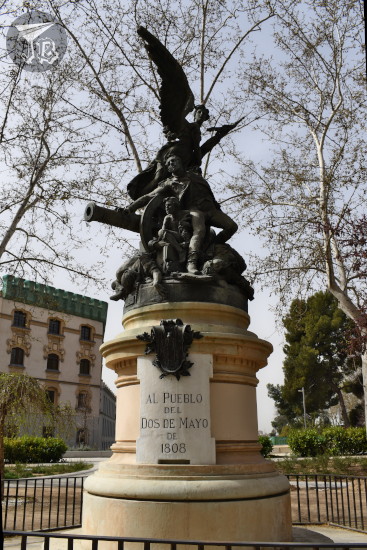
The visit I attended was called “Goya and La Florida” (La Florida being a small hermit church the painter did murals for), but it was more of an exaltation of the May 1808 uprising. We met the guide next to the Royal Palace, where she summarised Goya’s life. Then, we moved on to a placard next to the palace that memorialises the uprising, and she described the event. We continued on towards the area of Príncipe Pío, saw yet another memorial to the uprising Monumento al Pueblo del dos de Mayo de 1808 and the archaeological remains of one of the forts.

Monument to the second of May

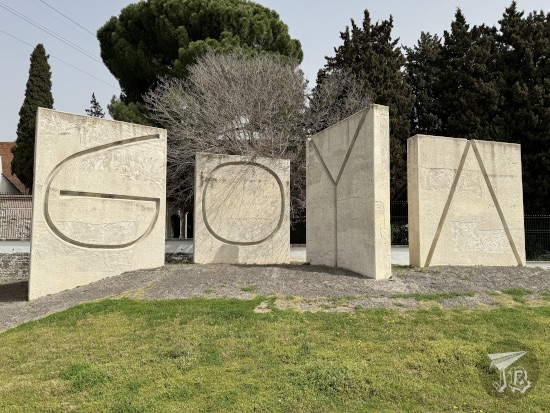
We went up the park Príncipe Pío – next to the Temple of Debod – and the guide explained the military shootings, and read a document. We continued towards the graveyard where the rebels were buried Cementerio de La Florida, next to which stands a monument to Goya Monumento a Goya: four stones, each one with a letter to form the word “Goya.”

Monument to Goya

We finally reached the hermit church Ermita de San Antonio de la Florida, where Goya painted the ceiling frescoes. Over time, they became so degraded that an identical second hermit was built to be used religiously, and the original one kept as a museum and the painter’s pantheon. The ceiling has a dome in which the artist painted St. Anthony’s miracle – as his father had been accused of murder, he resurrected the victim, who could identify the real criminal. The murals are done in al fresco technique, painted on fresh plaster, directly on the walls.

Hermit church of St Anthony

After I left the hermit church, I headed off towards Príncipe Pío station, where I met my relative. There’s this restaurant that I’d been wanting to try for a while, but I needed two other people to tag along in order to get the table I wanted – yes, I wanted a specific table in the restaurant, more on that later. We had a reservation for a late lunch at 15:00, since my guided visit finished at 13:00. We took the underground and alighted at the area of Cuzco, with still some time left.

While checking out how to get to the restaurant, I had came across an Asian supermarket nearby – and that led me to discover Calle General Margallo, a little cluster of Asian supermarkets and stores. We went into Ibero China Madrid and I was happy to buy a bunch of things at a very decent price, mostly Japanese (curry and miso), but I also bought some Filipino Sky Flakes Crackers that I used to get from an acquaintance and had not found for years. Afterwards, we headed to the restaurant.

Comic Planet is an American-food eatery set around the superhero theme – murals on the walls, actual-size figures from DC and Marvel films, and even some prop reproductions. The dishes are “inspired by” superheroes and villains, with a lot of colourful additions.

When making the reservation, I was luckily able to book the table I wanted – and lacking any John Constantine decoration, who is my favourite “almost mainstream” comic character, the table I aimed for was the Aquaman one; I liked Aquaman before Jason Momoa made him officially cool. To be honest, even if I really wanted to check the restaurant out, I was a bit limited on what I could order – way too much coriander. I wanted a burger and a dessert – and a coke chilled with vanilla ice-cream (Coke & Vainilla Ice 1923). Unfortunately, our third party member was almost forty minutes late, so in order to keep the table we needed to exchange desserts for a starter. When the three of us were there, we ordered our mains.

Our starter (for two) was the “Infinity Gauntlet”: cheese sticks wrapped in dough (tequeños) with five sauces – tartar, spicy, mango, BBQ and comic special “cocktail”. The name of the dish refers a weapon created by Thanos, villain in the Marvel comics Avengers, made famous by the films.

My main was a Cat Burger (a reference to Batman’s Catwoman) – a “snobbish” beef patty with caramelised onion, duck foie gras and melted Brie cheese, with regular chips. My relatives ordered a Super Comic Burger (Grilled beef with egg, Oldenburger cheese, fried plantain, guanciale and “kryptonite” – whatever that is. The bread was… blue, and the chips red) and a Hellboy brioche (smoked and spiced pork, natural tomato, Edam cheese, egg, red onion pickled in lime, coriander, mustard and sugar), a reference to Dark Horse Comics’ Hellboy, one of the few creator-owned characters out there.

Comic Planet Madrid Food

One of the greatest things of the restaurant is that you get to hang around and take pictures with and of everything. The restaurant has two floors, and you are free to explore them. Aside from the murals and real-life figures, there are busts of bad guys, and even a homage to one of the most prolific comic-creators in history, Stan Lee. They also have a store with a bunch of merch (surprisingly… no actual… comics).

Comic Planet Madrid decoration

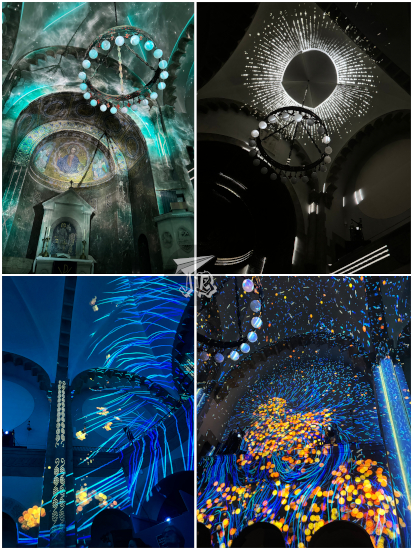
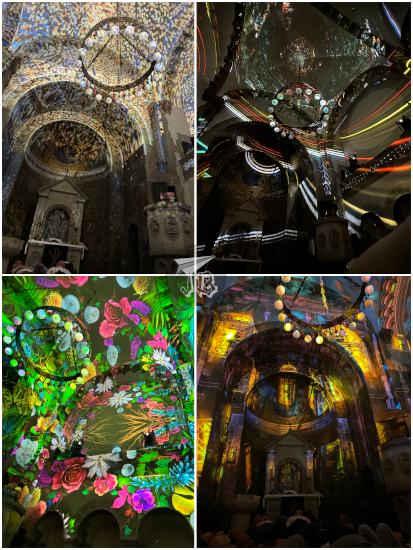
Afterwards, because the weather was nice and the forecast was rain all the following week, we walked down to the Comunidad Evangélica de Habla Alemana – Friedenskirche (German-Speaking Evangelical Community – Church of Peace), who were running a video mapping show in their church, Genesis.

The show follows the first three days described in the Christian Bible’s Book of Genesis, as God creates the earth. On the first day, God separated light from darkness; on the second day, God created Heaven (the sky in some versions), and on the third, he created the lands, seas and vegetation (nature in some translations). The church is a Neoromanesque building with mosaics which helps the otherworldly aura of the experience.

The show, designed by the company Enoarium has five parts: First Day: Light; Second Day: Sky; Third Day, first part: Water and Land; Third Day, second part: Nature; Meditation. When we went in, there were already lights on, a pretty universe-like lighting. There were pouffes to sit / lean on the floors and chairs. I chose a pouffe, thinking that it would be hard to stand up later, but oh well. I had about an hour to get round to it. It was a really good idea, because watching the ceiling was much more comfortable than having to look up.

It was a bit difficult to notice when the one day became the next, because the lights flowed really nicely and one theme faded into another. First, the whole church went dark, and there was a bit of light in the centre of the ceiling that became wider and wider. The white light started mixing with blue, which first was the sky and eventually turned into the sea. Gold / brown bits after a while represented the land, then more blue / purple as more sea, and when it turned green we had reached the creation of vegetation, which exploded in tons of colourful flowers. Eventually, everything dissolved into candles and lamps. The music was nice, too, mostly coral in Latin, I think.

Genesis Madrid stills

Genesis Madrid stills

Afterwards, we separated and I headed off to the train which – what else is new – was stupidly delayed, so I was stuck at the station for almost 40 minutes until my train came. The only good thing was that another in the same general direction came three minutes before, so most people got onto that, and mine was pretty empty.

12th March 2024: A free afternoon – the bullring & Pompeii Exhibition (Madrid, Spain)

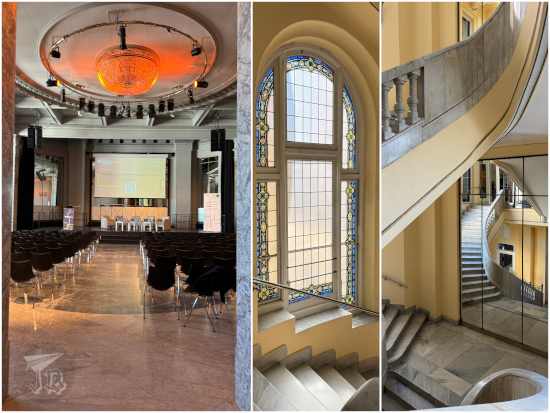
Due to life being weird sometimes, I was summoned to a work-related event in Madrid on the morning of the 12th. The event took place in one of the buildings erected by Antonio Palacios, the cultural centre Círculo de Bellas Artes (CBA). The centre hires out its facilities for conventions, gatherings and theatre plays. In our case, we were there for the presentation of a new product in the Column Hall Sala de Columnas on the fourth floor.

Interior of the Círculo de Bellas Artes

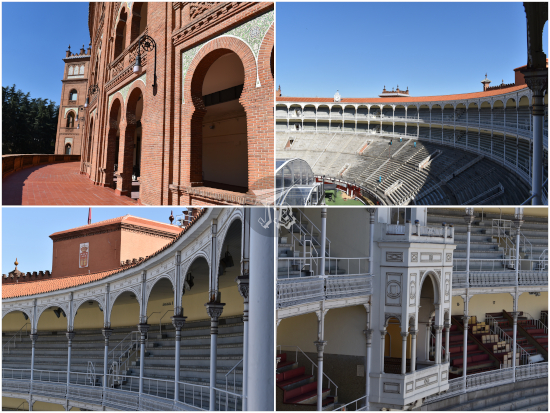
After all the necessary chatting, networking, and a disappointing (and rather questionable) choice of canapés, the event was over at 14:30. I ditched my companion then and headed out to Plaza de Toros de Las Ventas, the local bullring. I am not a bullfighting fan – my personal view is that it is not an art, nor a “fair fight” as it is presented, and I hope we humans evolve to phase it out. And while I would not attend an event, I was curious to get to know the building and its architecture.

Las Ventas bullring, outside

The ring is the largest of its kind in Spain. It was designed by José Espelius in the neo-mudéjar style and erected between 1919 and 1931. The central ring is just over 60 m in diameter, with a metallic structure holding the stands around it, and a façade of reddish brick and porcelain tiles. Aside from bullfighting, it is also used for concerts and other events.

I took a self-guided tour with an audio-guide Las Ventas Tour Experience, because I actually know nothing about bullfighting – I learnt that it actually has “rules”, I thought it was just taunting and hurting the bull. The passes have names, and there is a whole colour code of handkerchiefs – I had no idea. The tour takes you past the “Great Gate” through which bullfighters come out through when they are deemed to have done a great job. Then you climb up to the first floor balconies, and you can even go up to the highest point to have a panoramic view. You see the outside of the Royal Box, the gate through which the dead bull is brought out through, and then you walk down to the ring itself. There you can stand in the areas where the bullfighters and their helpers wait, and peer towards the stables, the closed door to the infirmity and finally the chapel. There are two VR experiences too that I did not care for, so instead of the expected 75 minutes, I took a bit less than an hour to do the whole tour.

Inside the bullring of LasVentas

Afterwards, I was curious to check out an immersive exhibition regarding Pompeii called “the last days of Pompeii” Los Últimos Días de Pompeya in the cultural hub Matadero Madrid. It was designed by Madrid Artes Digitales, the same company which organised the Tutankhamun one. At first I was not overly interested in it, but when I went to Recópolis the guide mentioned an actual VR tour, and I became curious (read: it was totally FOMO in the end).

The exhibit has a couple of replicas of archaeological artefacts, but it’s mostly a digital display. The first time I went to the Madrid Artes Digitales building I thought they had rented the place, but now I saw that they might actually own the warehouse and design the exhibits into it. There is a huge room where they project a sort-of film on the walls, a small circuit that you walk doing different activities, and a sitting VR ward, where you get to see a fictional world in 3D.

Of course, there were replicas of the Pompeii casts, and a copy of the novel The Last Days of Pompeii, written by Edward Bulwer-Lytton, which has inspired the exhibit. The novel, in turn, was sparkled by the painting The Last Day of Pompeii. The projection recreated a few passages from the book, then Mount Vesuvius erupted and you were taken “into” the crater, seeing lava bubbling and lightning bolts. Then one was back in the city as the pyroclastic cloud rolled into the city, along with volcanic bombs falling into buildings.

Last Days of Pompeii exhibition

The circuit was a VR walk-through that took you though a house, both in ruins and reconstructed, as a woman led you through it. Walking with the VR glasses was a new experience, I have to admit, but going through doors was strange. Unfortunately, my set had a finger print in one of the lenses which spoiled the view a little. In the final ward, there was a representation of a circus fight with gladiators and tigers that turned into a naumachia (ship games in the amphitheatre) while Mount Vesuvius erupted in the background. All in all, it was a bit weird, and maybe… a tad on the morbid side, if you ask me.

Afterwards I just headed off, and I was lucky to make it into the train, it was so full! The car emptied out enough to sit down after a few stops, but just wow.

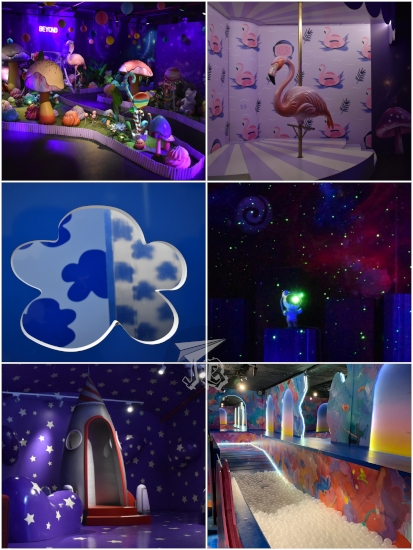
11th July 2023: Museum of Dreamers in Madrid (Spain)

After I had so much fun in the Balloon Museum, I decided that I also wanted to see the Museum of Dreamers, which is something similar. Furthermore, it Madrid exhibit will close down at the end of July, too.

After I finished French school in Madrid, I headed headed off to the Japanese fusion restaurant Nomo Braganza, part of the Nomo Group. Nomo was established in 2007 under the culinary direction of Japanese chef Naoyuki Haginoya. I have to say that I don’t really trust the Spanish-Japanese fusion too much, but in this case, it really panned out. I met my sibling for a late lunch, because I was curious about the chef’s menu, what in Japanese would be called omakase [お任せ], which means leaving the choice of food to the chef. The menu was was a whooping 12 small-sized courses for 50€ – drinks not included, and considering it was 39 ºC outside, we ended up ordering a few rounds of water.

The menu, which changes periodically, comprised in July 2023:

  • Age Edamame Truffle – fermented edamame beans fried with white truffle scent. I personally prefer my edamame boiled, but the truffle scent was a nice touch.
  • Sukiyaki Croquette – oxtail croquette breaded with panko breadcrumbs. This was surprisingly good – and the actual flavour was strong.
  • Maguro Taco – mini taco of tuna tartar with wasabi and shiso (the “taco” was weirdly… not taco-shaped, more like cracker-shaped). The tuna was really good, albeit the base was a bit strange.
  • Gyu Niku Gyoza – aged beef dumplings with caramelised onion and yuzu, two of them per person. It was all right.
  • Ebi Chili – spicy king prawns and fried egg on kataifi noodles, mixed at the table. When we are talking spicy, it means… really spicy. The prawn bits were sizeable, but this was really something I would not miss should it disappear from the menu.
  • Toro Tartar No Temaki – tuna tartar prepared at the table: raw tuna belly mixed with Japanese onion, turnip, egg yolk, chilli pepper and wasabi on a bed of nori and rice so you can roll it yourself (spoiler: you really can’t). This was probably one of my favourite items – but I guess that after all I am a raw tuna fan.
  • Brie Nigiri – flamed Brie cheese nigiri with honey and walnuts. This was probably the weakest sushi bite, but it was still good.
  • Butter Fish Nigiri – butterfish nigiri with kimchi and chilli peppers. Butterfish is only good raw anyway.
  • Aburi Salmon Nigiri – flamed Norwegian salmon nigiri, with Japanese mayonnaise, salmon roe and onion. I still prefer raw salmon, but the flame was light so it was barely perceptible.
  • Maguro Tataki No Nigiri Trufa Nose – tuna tataki nigiri with soy and black truffle sauce. This was also really good.
  • Gyu Niku No Tataki – aged beef tataki with caramelised mushrooms and miso sauce. The combination of meat and the mushroom was strange, but when taken separately it was all good.
  • Caramel dorayaki – two halves of a dorayaki filled with salty caramel paste. Unexpected, because the menu listed something else, but it is not as if it was bad at all!

Chef's choice menu at Nomo Madrid

My sibling ordered some green tea out of the menu, and in the end, the drinks did not add as much to the price as I expected. Also, I have to give a shout-out to the pickled ginger we got. Really good.

After having lunch, we took a train towards the Museum of Dreamers, which is stands in Espacio Ibercaja Delicias, a place that seems to always look somewhat abandoned, even when it is stupidly hot and sunny. The exhibit was designed by sisters Elena and Giulia Sella, founders of Postology, an agency specialised in “phygigal” experiences. This concept merges the words “physical” and “digital”, allowing for a number of immersive and surreal experiences. The Museum of Dreamers is one of those things that you have to see with an open mind to have some fun. It comprises sixteen interactive installations which are basically photo-ops – after all, the word instagrammable has been officially accepted on dictionaries. I guess it is a new niche that can be exploited, and to be honest, I can get behind that, because some of these activities are hilarious.

Entry is timed, but they do not hold a very strict waiting policy – at least not on a Tuesday at 17:00 and 39 ºC. There were no timed exhibits or performances either. The first installation is a dark room with a starry sky of sorts, designed maybe to isolate the rest of the exhibition from the outside, maybe as a metaphor (100 Dreamers). Then you get to a semi open space that opens to the smaller installations that allow for fun pictures. All through the space there are motivational sentences and “rules” for safety in the different installation.

There is some kind of cosmic tube with mirror that was dizzying to walk into (Free your power), a tunnel made of hearts with an encouraging message at the end (Do what you love), an upside down room (Change perspective), an downside down bedroom with a giant plush and fun bed covers (Never stop dreaming), one full of disco lamps (Sparkle more), and a neon staircase flanked by colourful palm trees (Step by Step).

Museum of Dreamers exhibits

Afterwards, there is a ball pit – you know, it’s not like I had ever stepped into one before Friday, and now that’s twice in one week – with a “relaxing island” in the middle (Enjoy Today). In front of that, a tunnel made of fake pink flowers with a long table, set for a tea party (Believe in Magic). That managed to make you think of Alice in Wonderland imprint on your brain. Thus, you are in the right mindset for the following room, full of giant mushrooms and flowers that open up at will – theirs, for sure, not the visitors – whole giant butterflies hang around with their wings made out of lights (Wonder).

Museum of Dreamers exhibits

The final part of the exhibit consists on a second row of booths – a colour wheel, a door that opens to a fantasy scenery, a VR experience (Choose your Way), a stage (The stage is yours), some pink telephones (Your Dreams are Calling you), bright lights commanding you to DREAM (Be Bright)… There were two more rooms, one with a sky background and swings (Sky is not the limit), and the other with punching bags reading FEAR, STRESS, ANXIETY and so on (Never Give Up). I can’t punch, but I can strangle, so I choked the hell out of these last two.

Museum of Dreamers exhibits

That was the end of the escapade. It was a fun half-day out.

7th July 2023: Balloon Museum “Pop Air” in Madrid (Spain)

Part of this summer’s plans involved a three-week French course-and-stay in Montpellier, but I ended up changing my mind – too many hidden costs on top of the already-steep price, and a generalised bad feeling that I could not really define. I decided to take a course in Madrid and use up the evenings to do some exploring in town.

After class, I booked a table at the Chueca shop of the Japanese restaurant chain Sibuya Sushi Bar, which claims to offer a new concept of sushi. Most of what they offer felt pretty normal to me, except some random baos and the desserts. I browsed the website before booking, so when I arrived I had a pretty good idea of what I wanted. Somehow, the waiter did not expect that and was thrown off track. I ordered some ebi furai and a sashimi mix – I have to admit that the size of the sashimi portion did surprise me a little, as I did not expect such a generous serving. Luckily, I had hold on ordering dessert, because the two dishes were more than enough.

Lunch at Sibuya Madrid

There were two temporary exhibits I wanted to check out, and I chose the one that closed down earlier. I checked as I had lunch, and there were tickets available online. I decided to take the underground and buy the tickets in person instead of stressing about making it on time for a particular timeslot. I reached the Balloon Museum on time for the 15:45 entry. The exhibition Pop Air runs from March to July 2023 in the Escenario Puerta del Ángel in Madrid’s Casa de Campo.

Still considered a noon slot, the exhibition was not too crowded at the time I entered, I even had a couple of rooms for myself before I reached a point in which you had to be admitted because the performance was timed. The Ballon Museum‘s Pop Air exhibit is a collection of art pieces that use air and light as their main vehicle.

Artworks:

  • The Goof by Filthy Luker (2021). They are a bunch of “friendly monsters” that observer the world feeding off surprise and happiness. They look… just adorable, as if they were made of giant inflated latex gloves in different colours with huge eyes.
  • Aria, The Breath Immersive Experience by Pepper’s Ghost (2022). A room full of mirrors and digitally-created colourful spheres that spreads to infinite and beyond.
  • Airship Orchestra by Eness (2020). More adorable creatures made out of air, some resembling Japanese peaches, other bunnies, or cacti.
  • Ballon Museum exhibits. The Goof, Aria, Airship orchestra

  • Hypercosmo by Hyperstudio (2021), which is basically a huge ball pit with a show of music and lights.
  • A Quiet Storm by Quiet Ensemble (2022). A dark room where cannons shoot bubbles.
  • Silenus by Max Streicher (2002). A giant, breathing… person… sleeping. It’s a bit creepy, to be honest.
  • Knot by Cyril Lancelin (2017). It is an inflatable… knot, literally a 3D knot made out of a tube.
  • Balloon Museum exhibits: Hypercosmo, A quiet storm, Silenis, Knot

  • Polyheadra by Karina Smigla-Bobinski (2022). It is a room full of balloons with small magnets which you can stick to the wall and the ceiling, and even to each other.
  • Never Ending Story by Motorefisico (2021). Music: Gentle Music by Plume (Netlabel). A lot of decorative balls in a small room full of mirrors and light.
  • Tholos by Plastique Fantastique (2022). A giant black ball surrounded by a plastic structure that imitates the archaeological tholos tombs.
  • Canopy by Pneuhaus & Bike Powered Events (2019). Four palm-tree-like structures that open up and glow if you bike them into life.
  • Balloon Museum Exhibits. Polyheadra, Never ending story, Tholos, Canopy

  • Cloud Swing by Lindsay Glatz with Curious Form (2019). Cute swings held by colourful “clouds” of light.
  • The GINJOS by Rub Kandy (2022). They’re blobs of air with eyes. When I saw them my first impression was “they’re squishy and unstable. I have found my people”. I also found the song hilarious, especially the reference that “GINJOS are not Barbapapa”.
  • Into the Rainbow by Ultravioletto. A VR experience out of which one cannot really take pictures. A white sphere travels through the colours of the rainbow and its symbols – orange candy, yellow rubber duckies, green trees, blue whales, purple… cows(?) and amethyst crystals
  • A number of cute photo booths for picture opportunities, without credit to any particular artist.
  • Parcobaleno by Stefano Rossetti (2020), is a large “inflatable park” for “all the family” (i.e. for kids), which was empty as it was way too hot for any playing.

Ballon Museum exhibits. The swings, the Ginjos, Parcobaleno

All in all, it was a really silly but fun experience. I headed back home afterwards, because even if exploring Casa de Campo is on my list, it was way too hot and I did not have any cold drinks on me. I made an amazing underground-train connection though, which was great because the Casa de Campo stop is pretty far away by public transport – and rather horrible to drive to.

24th June 2023: Abierto por Restauración. La Puerta de Alcalá (Madrid, Spain)

There is a Spanish adage that calls King Carlos III (1716 – 1788) “the best mayor Madrid ever had”. The truth is that when Fernando VI died, his brother, King of Naples and Sicily ascended the Spanish throne. He started a number of reforms in the Spanish capital that today conform the so-called “Way of the Light” – Unesco Heritage Site Paisaje de la Luz since 2021.

Madrid had at the time a surrounding wall for administrative reasons, in order to control trade. The different gates were named according to the main city they lead to. Carlos III decided to remodel one of the gates, the one that lead north-west – first to Alcalá de Henares and then to the rest of Europe. To carry out the task he called for a contest, which was “coincidentally” won by the Court’s architect Francesco Sabatini. It took ten years (from 1769 to 1779) to be completed, in typical Neoclassical style.

Today, this gate is still known as Puerta de Alcalá, and it stands in the central district of Salamanca in Madrid. The wall, however, long gone so the structure remains as a triumph arch more than a gate, in the middle of a roundabout in the Square Plaza de la Independencia.

The gate measures almost 24 metres high, 43 metres wide and 12 metres deep. It was built in solid stone with five arches, and decorated with sculptures depicting the cardinal virtues (Prudence, Justice, Fortitude and Temperance) and allegories of war victories.

Puerta de Alcalá under the protective cover

Restoration studies started in 2022, and the works began in 2023. In March 2023, it was announced that the gate would be “open for restoration” Abierto por Restauración, and that about 6,500 tickets would be offered for guided visits to the monument throughout summer. I had a free morning when the tickets went live and I managed to secure one, despite them being “sold out” in minutes. The Abierto for Restauración project, financed by the Madrid Town Hall, aims to raise awareness of the heritage that Madrid holds.

Though I had originally planned for a day out, I was not feeling too well . Nevertheless, I really did not want to give up the chance and I decided to just head over, attend the visit. and just take the train back home, making it a half-day out.

The gate is covered with a huge billboard showing a hyper-realistic photograph, which also hides part of the scaffolding and protective messes that cover the structure. The restoration aims to repair the mistakes of previous attempts at conservation, counteract the effects of pollution and weather, and secure the sculptures at the top of the gate.

We were supposed to meet at 10:45 at the gate of the park on one side of the square, for the 11:00 visit. The guide arrived at 11:00 sharp and started “taking attendance” – since the gate is technically a “construction site” you are insured, and you have to wear a security helmet and all. Then she took us to the base of the gate and told us the history of the construction. The previous group started coming down at 11:00 and we climbed at 11:15. By noon, we were down.

We climbed the inner scaffolding to the top of the gate, where we got to see the work first-hand. Not that there was much to see, because the works cover most everything. There are giant staples that have been taken off the sculptures in order to repair the damage and secure their placement.

Scaffolding supporting the Puerta de Alcalá

The upper platform allowed for snooping along the sculptures there and the views around the gate, along with a bit of the work being done – huge metal supports for the sculptures, filling up cracks, insulation…

Sculptures at the top of Puerta de Alcalá

Views from the top of Puerta de Alcalá

Though the experience was short, and I did not see as much as I hoped, I was lucky to grab a ticket – 6,500 of them, with 13,000 in the waiting list – but it looks like the reforms won’t be over for a while, so it might still be open next summer. It might be an interesting experience to try again and compare the progress.

15th April 2023: Madrid for Sweet Space Museum (Spain)

My friend D****e and I met for a fast day packed with activities. We reached Madrid at 10:40 and had tickets to visit an interactive museum called Sweet Space. It markets itself as a “colourful experience which mixes sweets and modern art”. I just thought it would be a fun thing to do with a friend that would give into quirky pictures and a couple of hours of giggles. It actually fulfilled both. If you take the place seriously, it’s plainly not worth the visit – modern art in general is questionable at best, and this could be seen like a bit on the childish side – and regular tickets are 18 €. The place’s best-selling point is “get cool pics for your social media”, and we had decided to just be silly about it and enjoy ourselves.

The “museum”, located in the ABC Serrano shopping centre, gives the vibes of an oversized (maybe overpriced) playground, and just like Monasterio de Piedra, the number of people you encounter weighs a hugely in your experience. Although we had an 11:30 ticket, we were lucky enough to be admitted at 11:15 with a family that lost us on the third room, so we had quite a lot of time on our own, until the group that came afterwards caught up. We did take a lot of pictures, to be honest, and missed no opportunity to fool around – which was the mindset we had.

Since the museum’s flagship idea is mixing sweets and modern art, when you enter some of the rooms you are given a treat – a gummy or a piece of chocolate or a tiny bit of ice-cream. You cannot backtrack, so the route gets a bit weird at points – you go up to the second floor on stairs, but down using a slide… The museum has nine different rooms and a few of them are refurbished over time. Unfortunately, I forgot to track down the artists because it was stupidly fun – I mean, at one point I got to ride a carousel-style flamingo. Back in the day in the day, I would have never dared do such a thing, but I guess I’ve changed a little in the last ten years.

  • Room 1: Palm trees with marshmallow trunks (Antonyo Marest). This was a fun way to start the whole thing and set the mood. It is literally a room with tree trunks that look like colourful marshmallows, with leaves on top.
  •  
  • Room 2 (corridor): Flowers in the dark – a dark room with bright plastic flowers. It was pretty, but probably the less surprising room.
  •  
  • Room 3: Mirrors and hanging pink balloons, inspired by Tokyo’s TeamLab. It was hard to take a good picture that did not catch anyone’s reflection!
  •  
  • Room 4 (corridor): Mirrors and neon graffiti (Álvaro Linares) with Star Wars inspired references. This was one of the coolest areas (though I’m not sure how… legal that Darth Vader painting would be). One of the sides had a throne-like chair you could sit on and feel like an evil mastermind.

Collage. Sweet Space museum. Palm trees whose trunks resemble marshmellows, neon-coloured flowers and grafitti, pink balloon-like lamps hanging in a mirror-wall room

  • Room 5: Ice-cream parlour “Töto Ice Cream”, including little kart and refrigerator you can step into, giving off a strong 1950’s aura. A lot of pink, I’d say – I did not dare walk into the fridge (for some reason it gave me the creeps), but D****e did; I “drove” the little kart instead. We took silly pictures there with the installed iPad camera, just for the hell of it.
  •  
  • Room 6: Fairytale landscape (Christian Escribá and Patricia Schmidt), a-la Hansel and Gretel or Alice in Wonderland (though it was officially inspired by Wizard of Oz), with a swing and flamingo that you can ride. When I saw that one online, I really, really hoped that it was not only one of those things that only influencers get to do. I got to ride the flamingo. I don’t know why it drew me so much, maybe it was the pure surrealism of it all, but it made me giddy. The rest of the room was fun too – oversized mushrooms, teddy-bears, and colourful decoration.
  •  
  • Room 7 (upstairs): Sky with clouds (Agatha Ruiz de la Prada) painted and carved into sliding doors, a starry rocket (Ivanna Gautier), a bouncing area, a mural where you could take a 3D video for TikTok, and a “planetarium”, with tiny lamp-robots and tons of stars made from light dots. I liked this last one a lot, too. In order to leave the floor and go back to the lower floor, you have to go down a spiral slide, which I was not a fan of – it was difficult to get into it without putting weight on my bad wrist. However, I managed to go down unscathed.
  •  
  • Room 8 (Misterpiro): It held a ball pit with a “staircase to heaven” (or to nowhere). We did not go into the pit, but we climbed the stairs for pictures too.

Collage - fantasy worlds from Sweet Space museum. Overgrown mushrooms, a flamingo, a cloud, a universe made out of green neon dots with a little robot peering out, a cartoonish rocket in front of a starry background, a colourful ballpit full of white balls.

Finally, we reached the shop, where we purchased the pictures we had taken at the ice parlour (8 € for two magnets with four photographs, the downloadable version, and a gif). We were supposed to get a sweet in each room, and we ended up with three or four gummies, a chocolate, and a tiny scoop of ice cream. My favourite was the skull-shaped sweet&sour gummy we got upstairs, but they did not have it at the shop (though it is advertised online). The whole experience was a bit on the expensive side, but I had a discount that helped knock 10 € off the official price. The recommended time I had seen recommended for the museum was an hour and a half, but even if we took a long time, we were done in about an hour.

I had reserved lunch at 14:30 based on the time I expected us to be in the museum (and the availability of the restaurant), so we had some time to kill. We walked by the open-air museum of modern sculpture Museo de Escultura al Aire Libre de La Castellana, but it did not catch our fancy. Too much modern art in one day?

The place we would invest most of that extra time was the museum of Natural History Museo Nacional de Ciencias Naturales to see some dinosaurs and the gabinete de curiosidades, the 18th and 19th century collection of taxidermy specimens. I’d been there before, and it mostly has replicas (and holy molly, prices have gone up). This time there was an exhibit on the Moon landing, and the gardens had been open. The taxidermy collection is not as good as other museums, but at least it got us out of the heat.

Collage. Dinosaur fossil casts and reconstructions, both carnivores and long-neck herbivores. A flying reptile with some mammooth fossils in the background. Rocks. The old collection dating from the 19th century - a number of glass cases with people looking at them and a painting of king Carlos III overlooking the place.

We left the museum and headed for lunch at one of the franchised establishments of New York Burger, which markets itself as a “gourmet burger” place. It was all right, and the servings were huge. After lunch, we hung around the area known as Nuevos Ministerios, a complex originally designed by Secundino Zuazo Ugalde around 1930. We hung out under the eastern archway for a while.

The archway in Nuevos Ministerios, built in reddish brick and white plaster

Afterwards, we took the train to Alcalá de Henares. We stopped at one of the shopping centres just outside town, Quadernillos, where the comic event Krunch! 2023 was taking place. We did not stay for long as most stands sold bootleg and plagiarised stuff, and I did not find any legit shop, but we had ice cream and D****e did take the chance to do some shopping in the mall before we headed home for the evening.

12th & 13th February 2023. The Epic Apocalypse Tour in Madrid (Spain)

The year 2020 was going to be so amazing that I actually would have had to choose the things I wanted to do and sacrifice others. It didn’t turn out that great in the end, with lots of rescheduling and cancellations. I was eventually able to budget time and money for one of those rescheduled events – the joint concert by the metal bands Epica and Apocalyptica in their Epic Apocalypse Tour. For a while, however, there was a bit of uncertainty with dates, as they bounced between Sunday 12th and Monday 13th of February, so I needed to juggle work dates in order to make sure I’d be free on Monday. In the end, I was all clear, all the concert-related activities were set for Sunday evening, and I decided to make a two-day trip out of it – I needed to take a hotel for Sunday anyway.

I arrived in Madrid around 9:30 in the morning. I had some time before my first appointment so I walked into one of the large parks of the city Parque del Buen Retiro, which is part of the Unesco World Heritage Site Paisaje de la Luz (Light Landscape), officially called Paseo del Prado y el Buen Retiro, paisaje de las artes y las ciencias, declared in 2021.

Parque del Buen Retiro was built in the 17th century for one of Felipe IV’s palaces, and it was opened in the late 18th century as public park. The park was almost destroyed during the war against Napoleon’s troops in the early 19th century, so most of it has been rebuilt. Aside from the obvious flora, it features sculptures, fountains, buildings… It is home to a lot of birds, and unfortunately a large number of invasive and fearless monk parakeets (Myiopsitta monachus), whose culling has been controversial in recent years. I got to see common blackbirds (Turdus merula), a European green woodpecker (Picus viridis) and a European robin (Erithacus rubecula).

One of the most important features of the park is the sculpture Monumento al Ángel Caído, which represents an angel falling from grace. It was originally designed by Ricardo Bellber, who made it in plaster in 1877. It was later cast in bronze and the original plaster destroyed, and eventually the sculpture was made into a part of a fountain in 1885. Around the area, there is also an ancient water mill, and to my surprise, the almond trees (Prunus amygdalus) had started blossoming.

Retiro Park collage: a pathway with trees and bushes on both sides, ducks, and a robin.

Retiro Park collage: a water mill, blossoming almond trees, and the fallen angel fountain

At 10:15 I had a guided visit to the Real Observatorio de Madrid (ROM), commissioned around 1785 by Carlos III, as an centre to develop and study astronomy, geodesy, geophysics and cartography. The main building is the astronomical observatory, built by Juan de Villanueva in what then was the outskirts of the city. Today, ROM belongs to the National Geographical Institute (IGN), and it is home to the National Astronomical Observatory, the Central Geophysics Observatory, and the data gathering division of the National Volcanic Service, though no measurements are taken there. The main astronomy measurements are carried out in the Centro Astronómico de Yebes, in a town around 80 km north-west of Madrid. The observatory is also part of the Unesco World Heritage Site.

The visit comprises three stops. The first one is the main building, called Edificio Villanueva, which has three rooms – the main rotunda with a Foucault pendulum, the library, with the spot where gravity was first measured in Spain, and the “Time room”, where the sun used to be traced to determine the hour.

ROM collage. A small Neoclassical building, an inner room with a pendulum and telescopes, a telescope and a 19th century library.

The second stop is the Great Telescope, a replica of one that William Herschel built in the 18th century – Hershchel was one of the greatest telescope makers of the time, and is credited with discovering the planet Uranus, two of its moons, and two moons of Saturn. The telescope was destroyed during the war against the French, but later rebuilt thanks to the number of laminates that had been preserved – the original had a focal distance of 7.6 m and a 61-cm diameter mirror (which is displayed in the main building), and Herschel himself considered it the best he ever built.

Herschel grand telescope: a wooden scaffolding structure keeping a huge black tube pointing at the stas

The final stop, the little museum of “Earth and Universe Sciences” has a small collection of ancient instruments used for astronomy, navigation, and geophysics. There are also a couple of seismographs – one of them new, which is up and running – and material retrieved from the volcanic eruptions of El Hierro in 2011 and La Palma in 2021.

Collage. Ancient telescope, old tide measuring device, an old globe, and lava bombs

I had planned for a typical sandwich at an iconic bar afterwards, but I ran into a political demonstration. Thus, I scratched that idea and took the underground westwards. When I was in Egypt, one of the places I visited was Lake Nasser, created by the Aswan High dam. The lake swallowed a lot of villages and monuments, but a few of them, such as Abu Simbel and the Temple of Philae were saved by Unesco. Between 1960 and 1980, a total of 24 monuments were saved, and five out of these were presented as “grants-in-return” to five countries which had offered exceptional technical and financial assistance to the campaign – Germany, Italy, Netherlands, the United States and Spain, the latter being impressive as Spain was in the middle of the dictatorship, and pretty shunned by the international community at the time.

The monument was a small and ruined temple in the now-flooded town of Debod, to which it owns its name Templo de Debod (Temple of Debod). Dedicated to the god Amun, it was built around the location of the First Cataract of the Nile, some 15 km south of Aswan, about 2200 years ago, though the core of the building may have been older. The monument was actually affected by the original dam at the beginning of the 20th century, and it was covered in water for most of the year, which destroyed its colours and damaged the reliefs.

During the Unesco salvage mission, it was dismantled, and eventually granted and taken to Spain, and “freely” reconstructed – a lot of information had been lost, and there were missing blocks. National stone was used to fill in the gaps, and the gates (remains of the pylons) were built in the wrong order, according to some old pictures. The restorers built an air-conditioning system, a wooden roof, and the main hall was closed off with a glass door and window panes. Today, the temple is open to the public at weekends, but unprotected from the Spanish weather – rather different from the Egyptian one – and pollution, it is rapidly deteriorating.

I went inside the temple once when I was a child, and I had a clear memory of it that kept surfacing when I was in Egypt – so I wanted to go back. The entry is free, but capacity is reduced, so I had to queue for almost an hour to enter. I finally matched my memory to reality. The interior of the sanctuary has a small chapel and some carved stones had been taken to a makeshift second floor to display them as a little museum.

A collage of a small Egyptian temple - it has two floating gates that lead up to the main building, which is small with four columns. One picture shows a tiny and dark inside room with an altar.

After the temple, I got lunch on the go, then walked towards the hotel to check in and change clothes. Around 16:15, I set off to La Riviera for the concert. I had a Meet and Greet ticket and had to be there before 17:00. Personnel from the venue were extremely nice, and there was no chaos at all, even if things had been a little disorganised and some fans were lacking M&G confirmation emails. Everything was well-handed and everyone who had paid for an upgrade got through. There were about 30 people to meet and greet Epica and we were ten for Apocalyptica.

Apocalyptica is a Finnish four-man band – Eicca Toppinen, Perttu Kivilaakso, Paavo Lötjönen and Mikko Sirén – founded in 1993. They are “semi-officially” a symphonic metal band, but they’ve ventured into everything from Metallica covers (which was their origin) to pure classical works. They have a very specific style heavily using classical cellos and combining them with modern drums. They currently collaborate with American – self-identified as Cuban in the concert – singer Franky Perez for vocals.

Meeting the four of them was really fun. I got autographs and took the most epic picture I’ve ever taken with a band or artist before. As we were only ten, after it was over, I had time to buy some merchandising and still be the second person to settle on first row – despite having decided that I was going to sit back and relax.

Apocalyptica white and black poster, signed by the four members

General admission started at 18:00, and the crowd was surprisingly tame throughout the whole thing. The venue filled up and the supporting band, Wheel, came up at 18:30. Wheel is a Finnish progressive metal band that consists of James Lascelles (Vocals/Guitar), Santeri Saksala (Drums), Aki ‘Conan’ Virta (Bass) and Jussi Turunen (Lead Guitar).

Wheel Setlist

  1. Hyperion
  2. Blood drinker
  3. Movement
  4. Vultures
  5. Wheel

Wheel playing, each member at his insturment: bass, guitar, singer and drummer

The second band was Epica, which I remember having listening to back when the world was young. They are a Dutch symphonic metal band currently composed by Simone Simons (lead vocals), Mark Jansen (rhythm guitar, vocals), Coen Janssen (keyboards, synthesizer), Ariën van Weesenbeek (drums), Isaac Delahaye (lead guitar) and Rob van der Loo (bass). Simone can go insanely high with her voice, and she has an amazing presence on stage, and the whole band has an immense amount of energy – she also reminded me of a comic character. The keyboardist had a lot of personality too, and he was extremely fun.

Epica Setlist

  1. Abyss of Time – Countdown to Singularity (recording)
  2. The essence of silence
  3. Victims of contingency
  4. Unleashed
  5. The final lullaby
  6. The obsessive devotion
  7. The skeleton key
  8. Rivers
  9. Code of life
  10. Cry for the moon
  11. Beyond the Matrix
  12. Consign to oblivion

Collage of Epica playing, showing different members at their choice of insturment - singer, bassist, guitarist, and keyboardist with a portable keyboard

Finally Apocalyptica came on stage, and it was extremely fun. The things those guys do to their classical cellos would make some classical musicians cry, but the sound is super-powerful. We had Franky Perez for vocals, and a very fun moment regarding “listen to our classical music album at home, because we still feel like death metal”. They interacted a lot with the public, and it felt somehow very friendly / warm – yes, I’m talking about metal here. It was really that fantastically weird.

Apocalyptica Setlist

  1. Ashes of the Modern World
  2. Grace
  3. I’m not Jesus
  4. Not strong enough
  5. Rise
  6. En route to mayhem
  7. Shadowmaker
  8. I don’t care
  9. Nothing else matters
  10. Inquisition Symphony
  11. Seek & Destroy
  12. Farewell
  13. In the Hall of the Mountain King

Apocalyptica playing with Franky Perez. Perez is in the foreground, dressed in black. The thee cello-playing members are in the frame, playing. The drums peek behind them, but you can't spot the drummer

Apocalyptica playing at La Riviera. They have classical cellos. Two of the members stand on the sides, playing their cellos. Another one is walking swinging his as if it weighed nothing, The final one is slamming drums in the background.

We finished off just short of 23:00, I bought off some fast food for dinner, and headed back to the hotel to have a shower and get some sleep. I was woken up early in the morning due to the cleaning crew and the garbage mini-vans noises, but I did not leave bed until 9:00, then set off at 9:30. I bought some cold coffee on the way and walked into the former royal palace gardens, now public park Jardines del Campo del Moro.

Though I’d seen the gardens a few times before, this was the first time I actually walked into them. Despite the frost covering everything, I got a nice view of the palace and different fountains and buildings sprinkled throughout the green – Chalet de Corcho, is a small hut with coloured windows; and Chalecito de la Reina a wooden house that is currently closed. I was insanely amused by a little grass-cutting robot.

Jardines del Campo del Moro. Collage. It's winter and most trees are grey and bare. At the end of the walkway stands the Neoclassical Royal Palace. Two smaller buildings - one of them is white with brown beams, reminscing of German architecture; another one is a small kiosk with colourful windows - red, green...

I wandered around for an hour or so, then headed off via underground to the National library of Spain Biblioteca Nacional de España for the absolutely worst guided visit of my life. Like… it’s true that it’s free, but tickets run out within hours of coming out – on the 20th of the month, for the following month. I’d actually been trying to do this since Covid lockdowns ended… It turns out, we did not see any real books, we could not even peer into the reading area, the book and reading museum is closed and the only information we got was… that the guide did not like the Library. We did not get to see anything interesting or that we could not see on our own, and we did not get to learn anything, so this was a huge blunder. Live and learn – but it was one of the few things that was open on a Monday. The library is a huge Neoclassical building with a fantastic marble staircase inside. The doors and gates are protected by intrincate ironwork fences.

Biblioteca Nacional de España. A Neoclassical building in white and grey tones. The exterior has columns and statues of writers. The interior showcases a pair of twin staircases with the statue of one of the most important library directors between both.

I met with family for a quick lunch and then we went for a walk. We had thought about going to one of the terraces to see the cityscape, but it was closed because it was a Monday. We ended up at the Parque del Retiro park again to make some time and walk. We sat in the sun for a while, then went to see the Palacio de Velázquez there. Currently, it’s part of the modern art museum Museo de Arte Reina Sofía, and I did not really care much about the exhibits, but I like the building. Architect Ricardo Velázquez Bosco built it in brick (with ceramic tiles by Daniel Zuloaga) for the Mining Exhibit in 1883, inspired by London’s Crystal Palace, now gone. The interior is pristine white with hints of iron architecture, but the building’s official style is “neorenaissance historicism” whatever that means.

Palacio de Velazquez: A brick building with large windows and tile decoration. The inside is all white with bits of iron architecture.

Velázquez Bosco and Zuloaga also came together when they designed another building I really like, the glass-and-iron greenhouse Palacio de Cristal, which was built to home tropical flora and fauna from the Philippines in an exhibit in 1887. In front of the palace, there’s a small pond home to some cheeky ducks and geese.

Palacio de cristal. A huge greenhouse with a dome, and two wings. A white duck wanders in the foreground. Between the greenhouse and the duck there's a small pond.

Then, we went to have a snack. Trying to find something on the map before the trip, I’d come across a place called La Mejor Tarta de Chocolate del Mundo, which translates to “The best chocolate cake in the world” and that had to be tried! It was really nice, even if the place was pretty small and felt a bit cramped.

A slice of chocolate cake in front of mugs and teapots

We finally took a stroll down towards the sunset, and I took the train back without much of a hitch, then drove home

8th September 2021: Impromptu Madrid Run! (Spain)

This was oh my god so unplanned that I kept improvising throughout the whole day! It all started because a Spanish publisher decided to translate a non-fiction book I’ve loved for ages – Tokyo Vice by Jake Adelstein. The publisher flew the author in for interviews, and I guess I was disappointed that no signing event was organised. I asked the author once and the publisher another time, then shrugged it off when I got no answer. There were some interviews scheduled for him, and a book fair coming up. I guessed it was just not meant to be, but I did feel disappointed.

And then, on the 7th, Mr Adelstein shot me a message that he would sign my book if I could go to Madrid and meet him at one of his breaks. As you can imagine I just… said yes (I could not meet him that very same evening because of travel times, but I could make it on the 8th. And there I went).

It was the first time taking the train since the whole pandemic thing (hell, I had not even been on a train since Paris 2020), and a weekday so I chose the times carefully to hopefully get close to as few people as possible – it worked, as both rides nobody sat next to me.

I arrived in Madrid and transferred easily, then got out at a new station in the area of Gran Vía. The Tokyo Vice book came out that day, so I wanted to go to a big book store that would hopefully have it already. My first stop, FNAC, failed miserably, so I went to La Casa del Libro, where they told me I would find the book in a completely different section where I actually did. But at least I had it in my hands, even if I had apparently not used my credit card for so long, I got the right PIN for the wrong card (≧▽≦).

After I had the book in Spanish – I’ve owned a first edition copy in English since 2010 – I had thought that I should get a small detail for the author as he was making time for me. As he had to continue on his travelling, I decided to do something small and “consumable”, so I came up with buying some typical Madrid candy – violet sweets from La Violeta. I’d never been inside the shop, but it’s an adorable little place dating back to 1915.

It was still early for my appointment at 14:00, so I decided to head towards a square that hosts an Egyptian temple of all things. On the way I made a stop at a Starbucks for a Vanilla Frappucino, I figured out that the amount of calories would get me going and I would not have to eat until I was back – looking back it was a weird thing, but it made sense in my head at the time. I strolled around the park next to the palace Palacio Real.

The way to the temple was completely blocked off due to construction, so I decided to backtrack. I walked up the great avenue in the middle of the city Gran Vía. As I walked around, minding my business and listening to music, I kept remembering a comic by Sarah Sanders, in which she makes fun of how people won’t leave you alone when you’re wearing headphones and, well, minding your own business.

I reached the square with the fountain to the goddess Cybele Fuente de la Cibeles and the related Palace Palacio de Comunicaciones (by Antonio Palacios). The fountain dates back to the 18th century, when king Carlos III revamped a lot of Madrid trying to make it more beautiful and similar to other European capitals.

Carlos III is also responsible for the design of the modern version of one of the former wall gates, called the gate to Alcalá, the nearby town, Puerta de Alcalá. This area was declared Unesco World Heritage Site in summer 2021 as Paisaje de la Luz, so Madrid was in a celebratory mood.

I headed into the park Parque del Retiro, which is also included in the Heritage declaration. The park was initially built in the first half of the 17th century, as part of the royal recreational areas. Carlos III opened it up as public park a hundred years later. Aside from the obvious green areas, the park features fountains, palaces and sculptures. I walked past some of them. First I came across the fountain “of the turtles” Fuente de los Galápagos.

There is also a large pond, aptly called the big pond Estanque Grande del Retiro populated by carps, to whose side stands the monument to Alfonso XII – Monumento a Alfonso XII.

Nearby the pond stands the fountain called the artichoke fountain, Fuente de la alcachofa.

I walked to the fountain that depicts the fall of Lucifer from Heaven, Fuente del Ángel Caído. The fountain itself was built in order to exhibit the sculpture by Ricardo Bellve, who originally created it in plaster. The figure would then be cast in iron for the World Exhibit of 1878 in Paris, and eventually placed in the Retiro.

I strolled back towards one of my favourite points in the park, but that’s because I like iron-and-glass architecture – a little building called Palacio de Cristal, which has a small pond around.

Finally I headed over the little café where I had arranged to meet with Mr Adelstein. He arrived shortly after. He signed my book, but truth be told, I had also brought my first-edition copy, which happens to be full of post-its from the first time I read it. He was happy to sign that one too, and to my eternal mortification… he went over all the notes. I almost died right then and there. We chatted for a little, I gave him the violet candy and he had some umeboshi sweets for me too. I babbled that I was very happy that he had made some time for me, and he told me “but you were so polite on twitter and the publisher said no signatures!” and I kind of died again.

In the end, our meeting was only 15 minutes, but I have not felt so happy in a very long time – that he specifically took time felt amazing. We took pictures and even had a safe mask-hug. Afterwards I headed towards the nearest train station so I could be on my way before the afternoon rush came through, so that was it for the day.

Walking distance: 12.39 km

18th & 19th May 2019: Madrid (Spain) for Jupiter (and fesFE[M]!)

The weekend started extremely early on Saturday, when I took the first bus out to Madrid, and I think I was there around 7:30 to meet my friend C*****. She had been having a rough time and she had asked me to “keep her head off things”. Up until a couple of days before, we did not even know whether she would be able to come to the concert, so I had a whole plan up my sleeve. Unfortunately, a couple of steps backfired slightly. The main event – which we had been planned since the previous December – was Jupiter’s concert for the ZEUS Europe Tour on Sunday the 19th, but we made a whole weekend out of it. I was not actively following Jupiter at the time of the announcement, but C***** and I decided to attend because Madrid is easy and convenient, well-communicated and an opportunity to spend a weekend decompressing somewhere. As the time drew near and we could access more material, the excitement built up – I also managed to find the album they were promoting and it sounded really well, actually.

Her bus arrived earlier on Saturday than mine, and when we met, we decided to have breakfast at the coach station, to catch up and to give shops and so on the time to open up. When it was a reasonable time, we took the underground to drop our luggage at the hotel – the lovely EXE Moncloa. I had selected it because it was near the concert venue, and I hoped that we could hang out the terrace and the swimming pool, which unfortunately did not open until June. After getting rid of the luggage, we rode the underground towards the neighbourhood of Chueca, where I had looked up a bunch of Goth apparel shop which were right up her alley and… did not open at 10:00 as the internet said, but at 12:00.

Fortunately, other shops were already open and we were able to pass the time amicably. We were actually close to the Telefonica building, so I suggested we headed up there for the TeamLab exhibit, which I had already seen, and I thought she might like the digital art.

Teamlab logo and digital art: Waves, butterflies in red and green, and a dripping circle as if it were painted with a brush. All of them are light or bright colours on black.

Afterwards, we moved onto Callao Gourmet Experience for a snack. I wanted to introduce C***** to the Niji Mochi shop, and we also shared a chocolate ice-cream shake.

Mochi and coffee with whipped cream

Afterwards, we were shopping for a little longer before we moved on to have lunch. I had a surprise for her. While I care little to nothing about Korean food, she is a fan of everything Korean. Thus, we hit one of the best Korean restaurants in Madrid, called Seoul. I gave her free reign to order for both of us and we shared, though being honest, the only thing I enjoyed was the green tea at the end.

Lunch: fried dumplings, roasted meat, rice with vegetables, and green tea.

After lunch, we went on and found an underground station. We rode towards the Museo Arqueológico Nacional, National Archaeological Museum, although we had not realised that it was museum day so instead of a quiet exhibition I was used to, we had to deal with a ton of families! On the bright side, it was free, though. The museum, which shares a building with the national library Biblioteca Nacional, was founded in 1867, at a time when creating national museums had become popular among European governments. It was the start of the development of archaeology in Spain. I remembered it from the time I was a kid, dark and with wooden floors, but it was recently renovated with wide spaces and modern interiors.

Exhibits at the archaeological museum: bones from a mastodon, boar statue, lady statue, Neanderthal skull, Roman mosaic of an octopus, Horus statue, Iberian stelae, primitive animal that looks like a boar or a bull carved out of stone, Grecian vase

C***** was tired from spending all night in the bus, so we left the museum and headed back to the hotel to finish our check in process and then catch a break. On the way, we stopped and bought a few snacks for the following day because you always have to be ready for a post-concert low.

We had to look for a place to have dinner, and I found a few interesting places. There were not one, but three Japanese restaurants in the area where we were staying. One of them required queueing and sounded quite self-important, so we were left with two options. We decided to try one in the evening and the next for lunch the following day. Thus, I booked a table at the nearby Naniwa. We had some decent sushi, chicken, and takoyaki… then ordered takoyaki seconds because we had a discount (and I was hungry because I barely picked on lunch).

Dinner: sushi, fried chicken, octopus balls, chicken skewers

The next morning, we headed to the venue Sala Copérnico door around 9:00 and upon seeing nobody queueing yet, we went to have breakfast at a nearby café. Then, we walked around the Moncloa park area, mostly chatting, until we went back to the venue – no queue. And later went back to the venue – no queue. And afterwards, we went back to the venue again, just to find there were still no people in the queue.

Coffee and bread breakfast

In the end we ran into the supporting bands went to have lunch to the second Japanese restaurant in the block, Morikaen. It was around 13:30 as we were heading there, and I said something along the lines of “I feel sorry that they’ll arrive and there’s nobody here to greet them”, and as we turned the corner we almost literally ran into the whole crew coming out of the bus. Talk about timing. They looked tired so we just walked by, but we were rather sure that we had been noticed. On our way to the restaurant, we walked past a family all clad in “Sunday church clothes”, and their small girl wearing aaaall white just stared at us – in rock-goth black clothing – with pure envy in her eyes. Here’s to you, little one. You’ll get there too.

Lunch was all right – tuna tataki, tonkatsu, takoyaki. A bit more expensive than the previous day’s dinner, but we also ordered higher-class ingredients and more complicated dishes.

Lunch. Tuna tataki, rice and chicken, breaded pork, octopus dumplings

Jupiter is a Japanese band who define themselves as “melodic metal band”. It could be said that it is a visual kei symphonic power metal, which means they combine a very particular image (or a bunch of images, the most iconic being Hizaki’s Baroque-inspired dresses) with a subgenre of metal that combines hard drumming, metal guitars, and elements of classical music. On the 22th November 2018, Jupiter announced their new album, a Japanese Tour, and a European Tour, ZEUS Europe Tour. Bassist Rucy left between the announcement and the album release due to creative differences, and I really thought they would cancel the tours, but luckily everything went ahead. The remaining members – guitars Hizaki and Teru, current vocal Kuze, and drummer Daisuke were joined by support bassist Shoyo.

Schedule for the tour

There were two promoters involved for this concert. The local promoter, which in Spain was Madness Live, sold general admission tickets – they have a clean and neat webpage and buying from them is easy; I got ours on the 12th of December. The other, Editions Hikari, was in charge of coordination of the European tour, general information, and ticket upgrades. I think they are one of the worst organisers I have ever come across.

Hikari announced those upgrades in January. There would be VIP experiences, on sale on the 14th of February. Besides that there would be two kinds of upgrades, there was no real information about them until a few days before the sale. The best tickets were called “Venus Premium” (40€ face value + 5€ reservation costs) included autographs + handshake + backstage access before or after the show or soundcheck access (if possible) + photo with 1 member taken by a professional photographer (sent by e-mail later after the tour) + priority access to the merchandise, and there were five per show. The “Venus” upgrade (25€ VIP + 3€ reservation costs) comprised autographs + handshake + priority to the merchandise, there were 20 available per show. Getting the tickets was chaotic, but in the end, C***** managed to buy the two Venus Premium tickets we wanted – luckily. A lot of people did not even find out about the option to upgrade. In the end, the backstage pass / soundcheck was not available for any concert in the tour, and the priority access to the merchandise was impossible in Madrid due to the two independent promoters. Either of the VIP upgrades granted the option to buy an “Instax” (Polarid) photograph with the whole band at extra cost.

Hikari’s Facebook instructions were that Venus and Venus Premium ticket holders had to go to the merch booth – to which they supposedly had priority access – at the beginning of the concert. However, as the access to the actual venue was controlled by the local promoter ticket, there was no way they would access the merch booth with any kind of priority unless the managed to somehow skip the queue. Any kind of communication with Hikari was impossible as “they could not check emails, Facebook messaging, nor reply to comments.” However, they still made posts, and that is how we found that the CDs which Jupiter brought to sell at the merchandise booth were confiscated by customs’ officers before the first concert!

On the 10th of May, we received an email form the local promoter, Madness Live, informing us that the door timing had been changed and they were nice enough to send us the following schedule: Doors at 19:00, VII ARC (German support band) at 19:15; fesFE[M] (Japanese support group) at 20:20; Jupiter at 21:30. There was no information on the upgrades, because they had no clue about those, as Hikari was in charge. The day of the concert thus arrived and we had no actual about that, except for rumours and comments of what had happened in previous concerts. That was why, even if there was no queue, we had decided to stick around Sala Copérnico instead of heading into the city centre.

Eventually, after lunch, I decided that I was too tired to keep going up and down the streets, so around 16:00 we settled at the venue doors until they opened so we could get into the chaos that was the concert. At 16:30, other people arrived, so we got talking – that was how we found out that many people had never even heard about the upgrades. Doors opened around 19:00 – without any kind of priority access to the merchandise, nor separating VIPs and GA. C***** and I decided to divide and conquer – she went to secure a spot on the first row, while myself checked in at the merch booth to get the Instax tickets with the whole band.

That is when I saw the lousy, half sheet of paper taped there saying “Venus and Venus Premium ticket holders, gather at the merchandise booth at 20:00”. That placed the “Venus experience” in the middle of the support act, which meant either having very good friends who saved you the first row spot, or sacrificing it. We decided to give the place up and find somewhere more convenient so we could move about. Without holding spots for the VIPs, this was totally unacceptable in my opinion, especially since there had been no early entry, or priority merchandise. A bunch of people who did not want to buy anything missed out on what they had paid for.

The first support band was VII ARC. They were okay, a bit of stereotypical German heavy metal. I can see how they might appeal to the general metalhead crowd, but it feels that they were chosen because “they dress up sometimes”, and Hikari thought they would fit. It is formed by Kay (vocals), Fū (lead guitar), Bena (guitar, screaming), Grazel (Bass) and Z’ev (drums), and they could probably fit a bit on the “visual” style, but they did not bring any distinctive gear.

VII Arc playing in Madrid

At 20:00, as fesFE[M] prepared to take the stage, the Venus Premium and Venus ticket holders gathered around the merch booth and we were ushered past a barrier, towards the bar. There, we had to wait for about 10 minutes while the second support act started. A Japanese staff lady with little to no English came to “check” the Premium tickets and “sort of explain” to us the whole thing. First the Venus Premium would be shown backstage one by one for the one-on-one photograph – there were four of us, we never knew if the fifth was never sold, they did not come, or they missed the whole experience. Afterwards, we would come out again and joined the regular Venus for the autographs and handshake, then the Polaroid would be taken for the ones who had bought it. We were ushered past a curtain and the backstage door towards the mess room where the remains of the lunch buffet were.

As I entered, I caught sight of Shoyo, the support bassist, who was sitting down on a low mattress in a room to the left, looking bored. I greeted him in Japanese, and he greeted back. C***** turned to see whom I was talking to and her eyes were wide. I asked Shoyo if he felt lonely, he said a little. Another attendee who also spoke Japanese asked for a picture (beating me to it, actually) but he said he was not allowed.

The conversation died out when it was time to go into the private band area for my picture with one of the members. As I walked in, there was Kuze to my left, Daisuke to my right and Teru and Hizaki in front of me, Teru dead centre and Hizaki a little to the right. I was asked whom I wanted my picture with and chose Teru, as I had long ago decided that I would if I could. He smiled and posed with me, then he shook my hand. I have got to learn to look into Japanese musician’s eyes when I talk to them.

We said good-bye to Shoyo on the way out, and almost left, but it was now time for autographs, handshakes and Instax. I pulled out the CDs I had brought for C***** and myself, and I got to shake hands with all four of them and receive the band’s autographs. Since the CDs the band brought had been seized, we might have very well been the only ones in the whole country that produced some official material for signing. Then, we took the Instax and the staff would ask with a thumbs up sign “okay?” to check the picture was good, before we left.

CDs signed by Jupiter members

All in all, the band was very friendly and amazing, but the timing and organisation was horrid. We lost out first row – despite having “priority access”, and we missed half of the fesFE[M] concert. As Copérnico has two levels though, we found a nice spot at the stairs that connect both, and I could lean against the handrail to watch the rest of the act.

fesFE[M] is a relatively new visual kei band where all the members take up “doll” personas. Their career in 2017 and released their first mini-album in May 2019, just in time to come over to Europe for Jupiter’s tour. For each album / season, the band dons a doll theme, and they were currently on the “horror genre” dolls. The members and their doll types are: Lion [リオン], vocal, Distress Coppelia doll (from the namesake ballet, dressed as a bloody bride); Aito [アイト], guitar, Apathetic Prince doll; Zeno P [ゼノP], guitar, Bloodthirsty Child Killer doll; Toru [徹], bass, Emotional Princess doll; Rensa [蓮沙], drums, Psycho Butler doll; and Jun, keyboards, Scalded Dollmaster doll (dressed as a nun because… reasons?).

The first time I heard a song by fesFE[M], I was not extremely impressed – the PV was a bit too creepy. However, they are really good in person, even with the bad sound quality and reverberation in the venue – and the fact that we missed about half of their act. They were really engaging. The whole visual part was amazing, and the coordination was great! Their music was much more powerful live. The band played some songs from their mini-album enseMble autoMata: Doll in blueberry jam [Doll in ブルーベリィジャム], Arachne ni haitoku wo [アラクネに背徳を], Psychological stolen heart, and Freiya [フレイヤ].

Fesfem live in Madrid

The Jupiter concert was as expected, very energetic and fun – it actually went beyond expectations. Our spot was really good in he end, a bit raised, without getting pushed, and we actually watched the concert next to fesFe[M]’s bass Toru. Sometimes he smiled and waved at us, and we waved back without fail.

Kuze, Jupiter’s vocalist held his ground better than I thought he would be able to. I was kind of impressed when I listened to the Jupiter single Theory of Evolution and later to the album Zeus: Legends never die. While we were expecting the guitar and metal power, Kuze’s voice range in the recording was rather wild, and I did not think that he would be able to keep it up live, especially on a final concert after touring both Japan and Europe. He proved me wring, and he held all his notes and his vocal range, just like the recording. He had practised his English a lot and learnt the MCs, but he switched to Japanese quite often, and he spoke too fast for me to get! He did a great job even with songs that had been released in the previous vocalist’s time.

Daisuke was pretty much hidden by his own drums from where we were, but we did see him bounce a couple of times. Hizaki was on the other side of the stage from us, and he looked divine in his Baroque dress. I don’t understand how he can even move in those clothes, much less play guitar or crouch, which he did so a few times in order to interact to first-row fans. A couple of times I did fear for his safety as someone grabbed either him or the guitar. Most of the songs that were played were his. It’s fun to imagine what he would be thinking when writing “die, die, die, go fuck yourself”, when he presents as such a beautiful and innocent lady, but it surely was fun to yell.

And finally, Teru had a blast. He kept twirling around as he played, his stud-leather coat swirling around him. He played with a huge smile on his face all the time and he gave off the vibes that he was having a lot of fun. He also interacted with fans a lot.

Jupiter Live in Madrid

Setlist:

  1. Arcadia
  2. Last Moment
  3. Angel’s wings
  4. Drastic Night
  5. Bring me out
  6. Show Must Go On
  7. No cry no more
  8. The spirit within me
  9. Tears Of The Sun
  10. Memories of you
  11. B.L.A.S.T
  12. Blessing of the Future
  13. Zeus: I. Legends Never Die / II. Conversations with God
  14. Symmetry Breaking [Encore 1]
  15. Theory of Evolution [Encore 2]

While the concerts were a lot of fun, the whole event was stressful due to the abysmal organisation. I actually feel a bit ripped off, because they did not deliver a lot of what they had sold in the upgrades. At least C***** and I are lucky enough that we managed to get our pictures, autographs, and saw the concert from a relatively good place. All in all, Jupiter are amazing, they were super nice, and so were the guys from fesFE[M]. The concert was great, and we don’t regret going for a second.

After the event, waved at Toru for what we thought was the last time. When lights went on, we also saw Rensa, who stopped for us when we told him he had done a good job. C***** and I decided to pool our money together to buy the CDs fesFe[M] had brought – and not got seized. Apparently, it is typical that the entry-level bands hang around merchandise booths after concerts, and we were lucky enough that they agreed to sign the CDs and take a photo with us. Lion was extremely surprised and nice – or acted so. He complimented me on my poor attempt of Japanese and complied with what we requested.

CD signed by Fesfem members

Finally, C***** and I headed back to the hotel, and we went home the next day – fortunately we left from the same bus station so we could maximise our time together.

Hikari took a few days to send out the VIP pictures, but they eventually arrived on the 1st of June. Getting them was also hard, and amateurish – they wanted to put them in a Google Drive link and post that on Facebook. At least we got them to send them via email, citing European Data protection laws at them… I really, really hope to avoid this promoter in the future, but if I do, I’ll be on the lookout in order not to miss anything.

16th September 2016: Some Madrid (Spain) Museums

I woke up one morning, a silly weekday that I did not have to work for some reason and I decided to wander off and take a day trip to Madrid to see some museums, just because I could.

My first stop was the Museo Nacional de Ciencias Naturales, the museum of natural science. The museum is divided into several buildings. The first building holds the “Biodiversity” collection. This includes preserved specimens – in better or worse shape, mostly stuffed, and some skeletons.

Then I walked over to the palaeontology and mineral museum, where at the moment most of the collection is composed of replica, sometimes it feels that you see the same diplodocus or arsinoitherium (two-horned rhino) skull everywhere. Of course, however, I hunted down every megalodon tooth on site and sight.

After this, I walked around the mineral collection and walked down Castellana Avenue until Colón Square, where I had lunch somewhere before I walked around to see the Museo Arqueológico Nacional – National Archaeological Museum. There were a few things that interested me there.

My first goal was to study the Iberian stelæ . Nobody really knows what they are or what their meaning is, but it is thought that they were funerary monuments, maybe of fallen warriors.

An interesting thing to see in this museum is the sculpture of La Dama de Elche, the Lady of Elche, the limestone bust of an Iberian lady dated back to the 4th century BC. It is supposed to be a woman who belonged to the aristocracy that was later revered as a goddess, or maybe a reinterpretation of the Goddess Tanit of Cathage. The back part has an opening, which suggests that it could have been a funerary urn. It was originally polychromated, but it has lost its colours. I really like her expression, and probably due to the Hellenistic influence. I have a thing for Greek sculpture, after all.

A second “lady”, the Dama de Baza (Lady of Baza), stands next to the first. This one still keeps some of its colours. This one is full-body, also carved out of limestone, and it traces back to the fourth century too. This lady seems to have been designed in pure Iberian style, without Hellenistic influences.

The last key pieces of Iberian sculpture in this museum are the verracos – sort-of headless boars, pigs or bulls (depending on the interpretation), but it is commonly accepted that they are symbols of protection of cattle routes. Most of them are… visibly male.

Once I had seen what I really wanted to see I wandered over the rest of the museum, stumbling upon the currency exhibition, which was strangely interesting.

I walked past the Medieval rooms and then I found the Egyptian area, which is humble, but has some interesting things like the X-rays of a mummified falcon. Finally, I checked out the classical Greek area before calling it a day and making it back home.

27th December 2013: The Terracotta Army in Madrid (Spain)

This was a bit of an unplanned event. I had been in Madrid the previous day with a friend and we had seen that the exhibition was going on. Unfortunately, there was a huge queue to go in, so we could not stay. Instead we got tickets on the internet and chose a standard “lunchtime” hour so we were almost alone watching the exhibit. That was awesome. The exhibition was held in the Fernán Gómez Centro Cultural de la Villa underneath Plaza de Colón (Colombus Square) in Madrid.

The Terracotta Army is called the Eighth Wonder of the Ancient World. It was discovered in 1974 close to the city of Xi’an (Shaanxi Province). It is comprised by hundreds of larger-than-life soldier statues built out of terracotta. They are part of the Mausoleum of the First Qin Emperor, the first emperor of China. There are over 8,000 soldiers, 130 chariots with 520 horses, aside from 150 cavalry horses. There are different types of soldiers and they have different ranks. Their function would have been to protect the Emperor from the spirits in the afterlife. Forty thousand bronze weapons have been found among the soldiers. For reference, they were buried with the Emperor around the year 210 BCE!

The Exhibition “Terracotta Army – Guerreros De Xi’an” displays about 150 replicas of the best-preserved soldiers, weapons and chariots, along with different decorative elements and a reproduction of the Pit 1, where the bulk of the warriors were found. It was a very interesting exhibition that made me actually want to travel to China to see the actual Mausoleum for real!

Afterwards we had tickets for the cinema, because “47 Ronin” was running, and the Cines Ideal show non-dubbed films, and basically… there was Akanishi Jin in it. The films has its… merits… somewhere… I mean I loved it but it was pretty bad – I’m not precisely known for liking deep, intellectual films anyway (≧▽≦).

26th December 2013: Japanese Exhibitions & Christmas Lights in Madrid (Spain)

Over the Christmas break, there were many activities related to the celebration of the establishment of diplomacy between Spain and Japan, so-called Año Dual España Japón. We decided to kick off the day going to a Japanese restaurant, my favourite in Madrid, the Nagoya (believe it or not, this is the daily menu).

There was a Calligraphy exhibit in the national library, Biblioteca Nacional. On the way, we also found that there was an exhibition about the Chinese terracotta warriors, but the queue was insane! We decided to try to get tickets online for another day.

We went to Caixa Forum to see a Japonism (19th-century European art influenced by Japanese concepts and aesthetics). Honestly, pictures were forbidden, but I snuck one because I really loved the painting.

We also took a walk to see the Christmas lights. Here’s the Postal Service building, Edificio de Correos.

And a view of Gran Vía, one of the main arteries of Madrid, all lit up.

Flashback to 26th December 2009: Winterday in Madrid (Spain)

  • Palacio Real de Madrid (Royal Palace)
  • Templo de Debod (Egyptian Temple to Debod)
  • Arco de la Victoria (Victory Arc)
  • Palacio de la Moncloa (Palace of La Moncloa)
  • Puerta del Sol (Square Puerta del Sol)
  • Plaza Mayor de Madrid (Main Square)
  • Plaza de Colón (Columbus Square),
  • Puerta de Alcalá (Puerta de Alcalá Arc)
  • Edificio de Correos (Postal Building)
  • Fuente de la Cibeles (Cibeles Fountain)
  • Edificio Metrópolis (Metropolis Building)
  • Gran Vía de Madrid (Gran Vía Avenue)
  • Círculo de Bellas Artes (Fine Arts Club)
  • Estación de Príncipe Pío (Príncipe Pío Station)

Note: This is a flashback post, which means it is just a collage regarding a trip I took before I started the blog in 2012. Tags may be incomplete or slightly off.