30th March 2025: Sant Pau, Verne & a chocobo {FFVII Barcelona 2025}

The Barcelona hotel charged 20 € per day and person or breakfast, and I was not willing to pay for that, and so I told my sibling. They had no option but to accept since they had decided to delegate all planning and credit-card’ing on me. Instead of booking with breakfast, I brought cold latte bottles and snacks – good for taking headache medicine, which I did. After a quick breakfast, we set off. As we left, I asked at reception if they could do something about the air conditioning.

We headed towards the underground. It should have been an easy twenty-five-minute commute, but one of the stations was half-closed. We had to go outside and walk towards the other entrance to change lines, which was strange and consumed a ridiculous amount of time. We had to be at the ticket booth of our booked visit ten minutes before the allotted time, and we barely made it – though they did not seem to care. When I was looking at tickets, I found a combined ticket that saved us 10 € for two iconic buildings in town that I had not visited before. That however implied exchanging vouchers for tickets, thus the extra time.

We reached the former hospital of Saint Paul Sant Pau Recinte Modernista ten minutes after I had anticipated, right at the time we had to be there. Sant Pau is a huge hospital complex erected between 1901 and 1930 by architect Lluís Domènech i Montaner (1849 – 1923). Domènech favoured Modernisme, and is considered one of the most influential architects in shaping it. He designed buildings which balanced functionality and decoration, with lots of mosaics and polychrome. Though the precinct had been a hospital since the Middle Ages, it was completely redeveloped for the early 20th century project. Today, it is half of the Unesco Heritage Site Palau de la Música Catalana and Hospital de Sant Pau, Barcelona.
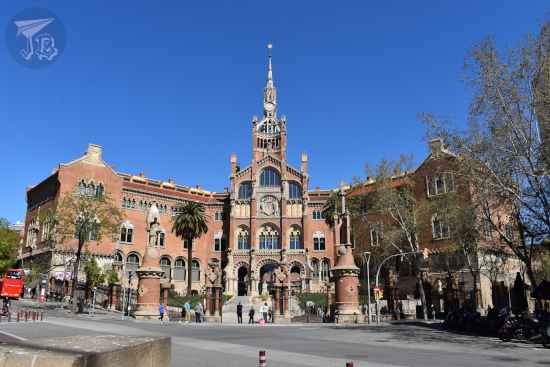
Hospital San Pau from the street

The hospital is considered one of the most important, and largest, complexes in the local Modernisme style. The complex was designed with 26 buildings, 12 of them pavilions for patients, separated by sexes and kind of disease. The pavilions were connected by underground tunnels, leaving space for gardens and open spaces between structures. It was originally conceived to be self-sufficient, closed off to protect the rest of the city.

Hospital San Pau, outside

The buildings are erected in brick, and decorated with ceramics both inside and outside, some of them forming complex mosaics on the roofs and ceilings. After a new hospital was built next to the original one in 2009, the complex was recovered as a museum in 2014. We could visit the pavilions, the tunnels, and the administrative building. The whole enclosure is magnificent, and incredibly large. It took over two hours to see everything we were allowed to visit and I loved every second of it. Well, except the pavilion with political propaganda.

Hospital San Pau, interior

Afterwards, we headed out towards a fun restaurant I had found online – Verne Barcelona, decorated simulating Captain Nemo’s Nautilus from the novel Twenty Thousand Leagues Under the Sea by French writer Jules Verne. We shared a cone of tempura vegetables and I ordered a “Submarine” – a sandwich made from toasted brioche bread – called Turtle, with battered squid, sauce and salsa (I just don’t understand how they are supposed to resemble a submarine…).

Verne Barcelona

We headed back towards the hotel, stopping at a Starbucks for a coffee – a matcha in my case – because I helped my sibling dress up for the concert. We had been carrying the cosplay after all, of course they were going to wear it!

We were in Barcelona to attend the Final Fantasy VII Rebirth Orchestra World Tour, to be held in the CCIB – Centre de Convencions Internacional de Barcelona. Final Fantasy is an expanded video game anthology which set off in 1987. Since then, it has spawned 16 main games and countless spin-offs, media, plushies, and remakes. One of the most famous games is the seventh instalment, Final Fantasy VII, released in 1997. The game is set in a cyberpunk dystopia where energy is obtained by draining the Planet’s life-force. Gameplay follows the adventures of a party which opposes the system, embodied by the electric company Shinra, while at the same time trying to stop the main antagonist – mad soldier Sephiroth – from destroying the Planet itself.

Since 2015, Final Fantasy VII has been under redevelopment into a trilogy using modern graphics. The first game was Final Fantasy VII Remake, released in 2020, whose music had its very own World Tour in 2021. The second instalment, Final Fantasy VII Rebirth came out in 2024, and its music event – Final Fantasy VII Rebirth Orchestra World Tour – began almost immediately, ending precisely with our concert.

We were at the queue already when doors opened, but not early enough, so we needed to line again for the merchandise booth, almost an hour. It was in that queue where something amazing happened. When we attended the previous concert Final Fantasy Distant Worlds 35th Anniversary – Coral –, we were stuck at the merchandise queue for about an hour too and by the time we reached the front, they had ran out of most of the items. That included what I wanted the most – the chocobo plushies. Chocobo are a recurring species in the Final Fantasy franchise, large birds that can be ridden in-game, and in real life be sewn into cutesy toys.

It turned out that in 2023 the last chocobo plush had been bought by the guy who was sitting behind me. I might have made some jokes about stealing it and running away, and he promised to get me one for the next concert. I of course filed that under “one encounter silliness” and forgot all about it.

Well, he did not.

In that queue, two years later, he found me, and he gave me a chocobo plush. He actually found my sibling, who was easier to identify due to the cosplay. I was absolutely flabbergasted. Gobsmacked. Never in a million years would I have expected something like that to happen. Just… figure that everything that went on afterwards was coloured by a feeling of puzzlement and amazement at this stranger’s kindness over a silly plush I wasn’t able to buy two years before.

Chocobo!

We got to the front of the line over an hour later, almost at the time of start. I only wanted a programme, and we were seated around 20:50. I am good at choosing seats, by the way. We were dead centre at a great distance from the stage.

Setlist:
  First part:
  1. The Unknown Journey Continues
  2. FFVII Rebirth Opening
  3. Main Theme of FFVII – Battle Edit
  4. A New Journey Begins: Grasslands / Junon / Mt. Corel
  5. Crossing the Planet: Corel Desert / Gongaga / Nibel
  6. Queen’s Blood
  7. Stamp – Rebirth Medley
  8. Rufus’s Welcoming Ceremony – A New Leader
  9. Costa del Sol – Fun in the Sun
  10. Custom Valkyrie
  11. End of the World Medley
  12. Cosmo Canyon – Sanctum of Planetology
  13. Bare Your Soul
  14. Welcome to the Gold Saucer
  Second part:
  15. Loveless Symphonic Suite – Gift of the Goddess
  16. No Promises to Keep – Loveless Ver.
  17. Galian Beast
  18. J-E-N-O-V-A Lifeclinger
  19. Sephiroth Reborn Symphony
  Encore:
  20. One-Winged Angel – Rebirth Medley
  21. Aerith’s Theme – Return to the Planet Medley

Final Fantasy VII Rebirth orchestra playing

The orchestra was directed by Eric Roth. It was all right, I enjoyed it. However, I don’t think it was as powerful as the first one I saw, but that one was the first post-Covid event so it was emotional in other ways. Then again, I am not a gamer. I just watch gameplays on the Internet… I was a bit disappointed by the arrangement of One-Winged Angel, it felt… too elegant. What I love about the song is the pure chaos it represents, after all.

In attendance was composer Masashi Hamauzu [浜渦 正志 | Hamauzu Masashi]. He started working for Square Enix in 1996 under Nobuo Umematsu, the main composer of Final Fantasy VII music. Hamauzu’s first direct work related to the saga was the Chocobo’s Mysterious Dungeon soundtrack in 1997. He was in charge music for the Final Fantasy VII spin-off Dirge of Cerberus and alongside Mitsuto Suzuki, he has worked in both Final Fantasy VII Remake and Final Fantasy VII Rebirth.

After the concert, we joined the VIP queue for pictures and autographs. Though I had brought the CD from the time before – when I did not get the pamphlet – I was equipped this time. And I even managed the Spanish – English – Japanese cacophony without messing up either of them. That’s a first for me, I think. I got my programme autographed on the setlist page, and then my sibling and myself headed back to the hotel. For 179 €, I keep thinking the VIPs should at least get their own merch queue, or an item to get signed. I guess there are lots of people to get paid…

Eric Roth and Masashi Hamauzu signing autographs

Something that surprises me a lot about this area of Barcelona is that not even the McDonald’s at the shopping centre is open after 23:00, so I always make sure we buy something to snack after the concerts. The room was at least not freezing, though not particularly welcoming either. I had a hot shower, and that finally got rid of my headache, just in time for bed…
30th December 2024: A planned and packed day {Vienna, Silvesterkonzert 2024}

It was a crisp morning in Vienna when we got up. We went down for breakfast and it was not particularly well stocked. The coffee was… weak, so I decided to mix a cappuccino and a black coffee to get me the energy I needed for the day. I tried some local cake, but I did not enjoy it, so I decided to stick to bread and croissants. Thankfully, I did run into the lady from the day before, and her husband, during breakfast, and told her about our plans – that way at least someone in the group would know not to wait for us and we would not delay anyone. Apparently, we were not the only ones who had made their own plans either, as the excursion had been marketed as “optional” and yet it seemed to be “a given”. Even better, we came across the driver from the day before (despite him saying he had nothing to do with the trip), and we could tell him that we were not coming, either. As we stepped out, it was freezing – literally below zero – but sunny during the whole day.

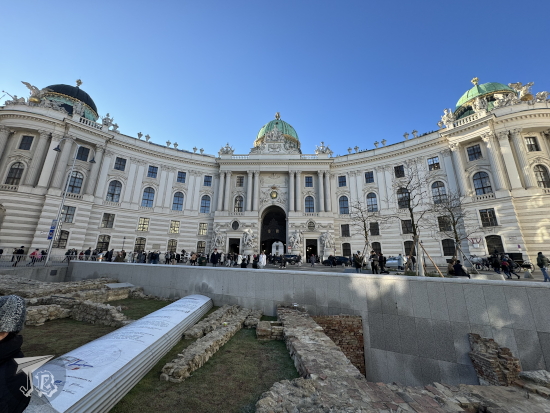
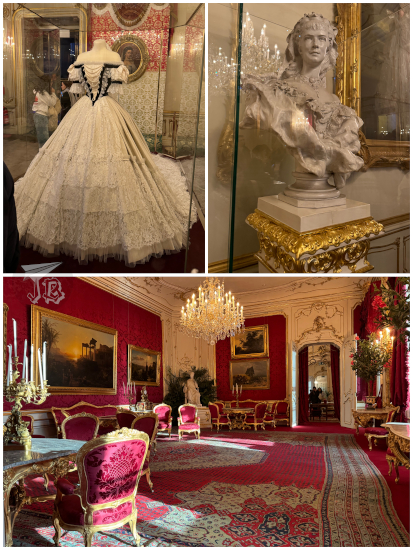
We took the underground at Zieglergasse and headed towards the city centre. I asked my parent to use their phone for GPS and maps in order to keep my battery for as long as I could so I could be taking pictures throughout the day, so they would be guiding. Our first stop was the Hofburg – the former imperial palace – and the Sisi Museum. Empress Elisabeth of Austria (1837 – 1898) was the wife of Emperor Franz Josef I of Austria. She married the Emperor when she was just 16 years old, and was stifled by court life. She spent most of her time travelling and avoiding royal duties. Her perceived eccentricity – today we would call it depression – and assassination in 1898 helped create an image of a romantic heroine in the media that has reached today, especially through actor Romy Shenider’s portrayal in the 1950s.

Hofburg

The museum tells about her life by showing objects, portraits and reproductions of her clothes. Then, you step into the former imperial apartments, which have been refurbished with furniture from the 19th century to make them look real. The audioguide was… corny to say the least, and I kind of skipped most of it because I got bored.

Sisi Museum and Royal Apartments Vienna

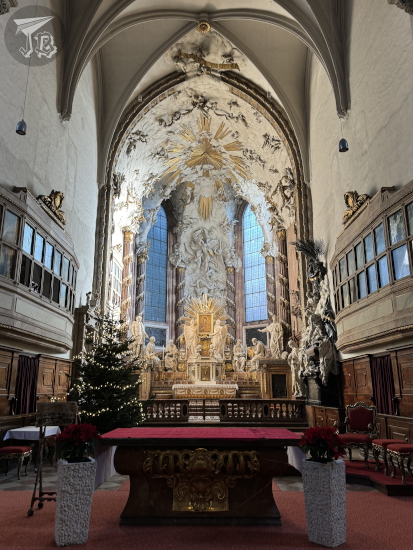
I proposed the church of Saint Michael first, and then the National Library. However, my parent had been intrigued by the church that stood at the exit of the underground. Thus, we headed there. The Wiener Minoritenkirche, Friars Minor Conventual Church, is officially the Italian National Church of Mary of the Snows Italienische Nationalkirche Maria Schnee. The church was erected between 1276 and 1350, and it was one of the first gothic churches in Vienna, following a French pattern. There were many subsequent reforms, including rebuilding the bell tower and the spire again and again – today the bell tower is flat and the spire is gone. The interior altar is Neogothic, by Ferdinand Hohenberg. Since it was still around Christmas time there were Nativities and Christmas trees.

Wiener Minoritenkirche

Afterwards, we headed towards St. Michael’s Church Pfarre St. Michael. It started as a late Romanesque or early Gothic building, maybe in 1221. The following two centuries saw Gothic annexes added. The crypt was built in the 16th century. The organ was built in 1714. The Rococo high altar was sculpted by Karl Georg Merville, and it represents the Fall of the Angels after the War in Heaven, when Lucifer was banished; underneath, there is a Byzantine Virgin Mary from the Cretan school. The outer façade was rebuilt in a classicist style in 1791. Construction officially finished in 1792. The crypt is accessible in a guided tour, but considering it has about 4,000 bodies, some of them mummified and on display, I think I’m happy we did not take it.

Michaelkirche Vienna

I proposed going to the Library again, because it was cold and there would be toilets there. My parent took over guiding with their phone, and my sibling and I got distracted as we passed by the Stallburg, where we caught a glimpse of the Lipizzan horses chilling out.

Instead of reaching the Library, my parent decided that we wanted to see the Augustinian church Augustinerkirche, a mix of 14th century Gothic and 18th century Neogothic. The original church was engulfed by the Hofburg as it expanded, and in 1634 it became the official imperial church. May Habsburg weddings were officiated there, and a chapel to the side, called the Herzgruft (Heart Crypt), contains the hearts of the members of the dynasty, from Ferdinand IV in 1654 to Archduke Franz Karl in 1878.

Augustinerkirche

I did not get to go to the Library, but we walked past the Hotel Astoria, which opened in 1912. it was built in the a late Art nouveau style known as fin de siècle (end-of-century). At the time it opened, the hotel was the latest, with electricity, bathrooms and all!

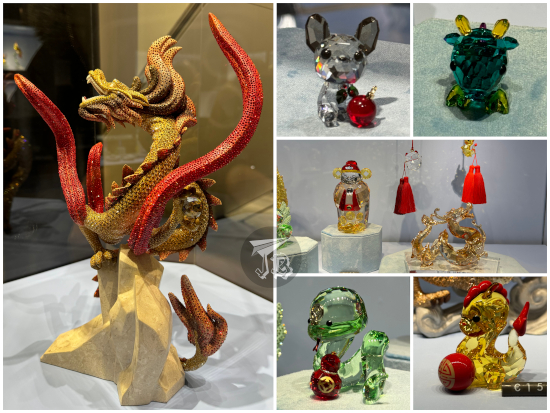
We reached the pedestrian / shopping street Kärntner Straße, the neuralgic centre for Vienna shopping. There we… met the card-not-working lady and her husband again, in what would become a funny number of encounters. We also saw the Swarovski shop. We entered it because we thought it would be warm – and hey, it had a toilet, which was handy, considering we had left the hotel over four hours before. Swarovski is an Austrian glass producer, known for its crystal glass, used in jewellery, decoration, watches, accessories. The company was founded in the late 19th century with the idea of “making a diamond for everyone”. Since then, it has produced thousands of items – from Christmas decorations to sculptures to collectible tiny figurines to whole dresses for the Vienna Opera. The place was halfway between a shop and a museum – and we might have spent a bit more than we had planned there, especially considering we were not planning to spend anything.

Swarovski flagshop Vienna

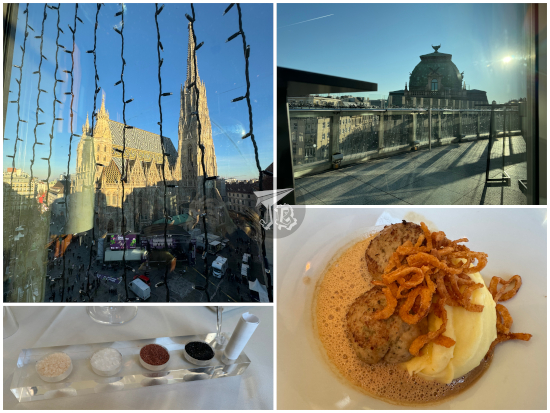
We reached DO & CO Restaurant Stephansplatz, located on the top floor of the post modernist structure Haas House, constructed in 1990. Most of the building is a hotel now. The restaurant has a fun view of the cathedral Domkirche St. Stephan. My parent and I discovered the restaurant because the opening scene of Austrian TV series Kommissar Rex, which ran between 1994 and 2004. It follows the story of German Shepherd Rex, a police dog which is “transferred” to the homicide department after his original handler dies… at the DO & CO terrace. It is such a naïve series, I just love it. Think The A-Team ingenuity with an adorable GSD saving the day every time and stealing sausage rolls as a self-reward. In a later series, Rex would move to Italy, and there is currently a Canadian reboot too…

There were no doggies in DO & CO, but both service and food were superb. They had butter and bread, and small receptacles with different types of salt, and a note on how they should be used. For lunch, I ordered kalbsbutterschnitzel – delicious minced veal butter patties with cream, accompanied with mashed potatoes, fried onion rings and a small leaf salad. For dessert, I had an ice latte that I should not have had, but I saw it pass by and I was smitten. We snuck a number of pictures from the restaurant, too.

DO & CO Vienna

After lunch, we went into St Stephan’s cathedral Domkirche St. Stephan. The building is a mixture of Romanesque and Gothic, and it was initiated around 1137 and completed 1578, and as many as four construction stages can be seen – the first Romanesque towers, the later Romanesque church, the Gothic Choir, and the outer, newest additions. The roof is tiled with as many as 230,000 pieces, one side shows the mosaic of a double-headed eagle, and the other the coat of arms of the city and the country. The bell tower has twelve bells, and the interior hosts as many as 18 altars (plus the ones in chapels). The cathedral was built in limestone, so it looks darker than other churches its size (107 metres long, 70 metres wide and 137 metres high).

The high altar was built in marble by Tobias Pock in the 1640s in the Baroque style. It depicts the stoning of Saint Stephen, church patron and the first Christian martyr. He was stoned to death by the Israelites after a rather inflammatory speech in front of the Sanhedrin, defending Christ’s teaching versus the traditional Jewish ones. According to the Bible, this would have happened a couple of years after Jesus’ death, and before the Roman persecution.

St Stephan’s cathedral

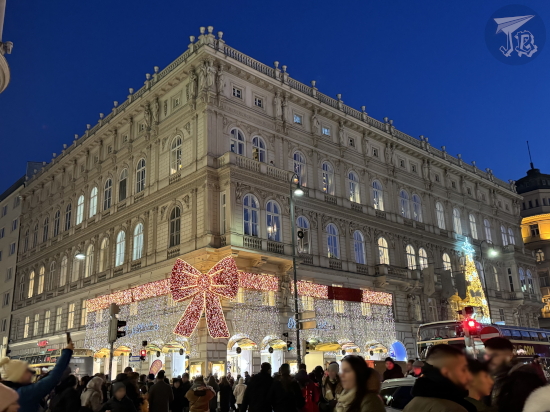
My parents were tired and they decided to head off towards the hotel, while my sibling and myself stayed behind. We wandered around Stephansplatz, Rotenturmstraße, and Kärntner Straße, checking out the Christmas lights and decoration until we reached the Popp & Kretschmer fashion store. They are a luxury women’s clothes firm, which draw tourist crowds during Christmastime to see their huge bow decoration, which makes the whole building look like a present. They call it the Vienna Bow.

Christmas decoration - Vienna Bow

We also looked at the Vienna State Opera Wiener Staatsoper, which was prepared to celebrate the new year, with a neon display saying (in English) “Hello 2025”. It was stupidly cold though, so we might have stayed in an underpass for a few minutes longer than necessary.

Afterwards, we headed towards the Sacher Hotel. The five-star hotel was founded in 1876 by the son of a famous confectioner. When the founder died, his wife, Anna Sacher, became manager. She turned the hotel into one of the most refined in the world, catering exclusively to the aristocracy. This management lead the hotel to bankruptcy, and she had to sell the business to new owners, who restored it to its former glory. The hotel serves “the original Sacher-torte”, a chocolate cake coated with dark chocolate icing, and a thin layer of apricot jam in the middle, served with unsweetened whipped cream. It was reportedly invented by the father of the founder, and the recipe is kept a secret. There are other versions of Sacher-torte, but the hotel is the only one with legal standing to call theirs original.

We had a 17:30 reservation at Café Sacher, in the hotel. Sacher Hotel actually has two cafés. The more modern one faces Kärntner Straße and is called Café Bel Étage. It had a long queue – Christmas is peak season in Vienna, as we were quickly learning – but I had been informed that reservations accessed through a particular door. However, that was not where our reservation was – I swear, I did not see the different name anywhere. The historic Café Sacher had an even longer line, and no special door. I dared ask the doorman at the hotel how to get there, and he gave me a huge grin and said “skip the line, go through the exit”. Boy, that was… awkward. Very, very awkward. I though the people just outside would lynch us!

Staff came to check on us, and since our reservation at the Café Sacher was valid – I made the reservation in July, literally as soon as the spots open – we were shown into one of the small salons. The café has a perfect offer – Sacher Sweet Treat: a perfect slice of original Sacher-torte with whipped cream, a non-alcoholic hot beverage and a bottle of Römerquelle mineral water for 22.5 € (31.5 € with a glass of the in-house champagne, Original Sacher Cuvée). I ordered mine with sencha senpai, Japanese green tea. I enjoyed the cake more than I had thought I would, and the tea was great. The staff was incredibly nice, too. They must have been used to silly tourists.

Sacher & Sachertorte

We left the Café Sacher and headed towards the Spanish Riding School Spanische Hofreitschule. For my sibling, this was a core-memory event, so they insisted we got really, really good seats for the Gala Performance Galavorführung at 19:00, on the parterreloge – the box at ground level. The Gala performance is the longest exhibition the Riding School has, and it lasts 90 minutes, with a break. The horses were gorgeous, and the riders looked very cold, but everything felt strangely… cold. I think I liked the exhibit in Jerez Riding School better.

The Spanish Riding School, considered the oldest horsemanship school in the world, was established during the Habsburg Monarchy in 1565. It is dedicated to the breed and training of Lipizzan horses. Lipizzaners are a breed of riding horses developed during the Habsburg empire. It derives from Arab, Bavarian, Spanish and Neapolitan breeds. They were selectively bred so most of them are grey with white coats – albeit there is always a bay stallion in the Spanish Riding School. The breed itself might be traced to eight stallions in the late 1700s, and it was developed in Slovenia. The horses are considered so precious that they were evacuated during WWI, and “rescued” by the US army during WWII. “Lipizzan horse breeding traditions” has been considered Unesco Intangible Cultural Heritage since 2022.

Once bred, foaled and fledged, the Lippizaners are trained. This is done at the Spanish Riding school. The traditional horse training methods used by the school can be traced back to Ancient Greece, and like many other things, they re-flourished during the Renaissance period in the 16th century. The goal of Classical training was to prepare horses for warfare as part of the calvary. Horses train for six year after they turn four.

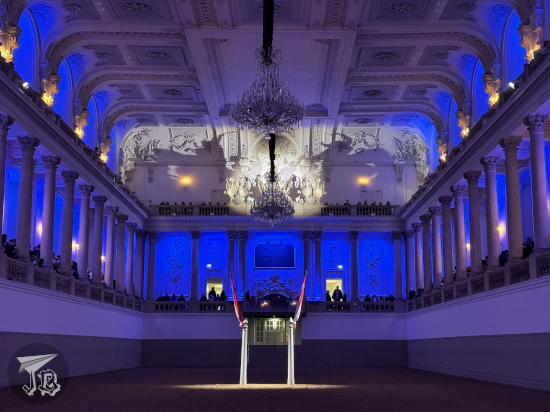
In Vienna, the Lippizaners are housed at the Stallburg, which is technically part of the Hofburg Palace. It is a Renaissance building from around 1560, originally conceived as a residence but that was later converted into the Imperial Stables. The Winter Arena was built in 1735, and has remained unchanged since then – including the chandeliers. The arena is presided by a painted portrait of Emperor Charles VI.

Vienna Riding School - winter Arena

There was something weird in the atmosphere that made it not feel all that… fun. Before every performance, a lady walked to the centre of the arena to introduce the exercises movements in German and English. The performance was pretty though. I tried to sneak a picture or two, but I was unsuccessful – and a bit worried they would kick me out if the venue. There were a total of six different numbers, and the show, including the introductions, was organised as follows:

  1. Alle Gänge und Touren der Hohen Schule – “All Steps and Movements of the High School”: four riders and stallions in individual choreographers, including the one dark stallion in the stable, with classical movements.
  2. Am Langen Zügel “Schools on the Ground: On the Long Rein” – the riders guide the horse from the ground, they are not on top of the horse, with movements such as piaffe and pirouette.
  3. Pas de Deux “Step by Two” – two riders-horses pairs work in tandem, mirroring each other.
  4. Arbeit an der Hand und Schule über der Erde “Working Hand and Airs Above the Ground” – with three main movements: levade, capriole and courbette. Four horses work with their riders on the ground, and two of them with the riders on the saddle, but without stirrups. When horses perform well, they get a sugar treat from the rider.
  5. Am Zügel “Schools on the Ground: Curb Reins” – only one horse and his rider, who only holds two out the four reins in their left hand, and they hold the riding crop upright in their right hand, a commemoration of the military heritage of the horse riding tradition.
  6. Schulquadrille “School Quadrille” (or Das Ballett der weißen Hengste “Ballet of the Eight White Stallions”) – eight horse-rider pairs have to coordinate with each other for a choreography, ending in the Radetzky-Marsch.

When the exhibition came to an end, we tried to go to the toilets. You had to scan your tickets and pay 50 cents. Really. Two hundred quid for the tickets and they charged fifty cents for the toilets, which were filthy on top? A total rip-off.

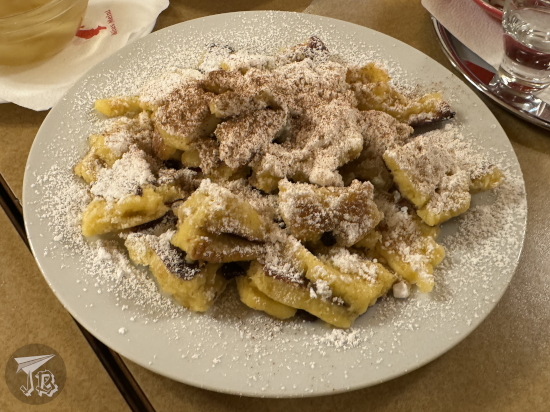
I got my sibling to the hotel, and then I left again to meet up with my friend D****e and her father Fr***, who were also in Vienna for a few days. They were even staying in a hotel close to ours, so it seemed that we had planned it in advance. We spent a couple of hours in a small eatery – Gschamster Diener – where they introduced me to kaiserschmarrn, fluffy shredded pancakes with raisins, powdered sugar and cinnamon.

Kaiserschmarrn

I eventually had to go back to the hotel and my room. There, I spent an hour trying to find a place to book lunch for the following day. After deciding not to plan anything on the 31st, my parents had a change of mind and suddenly I found myself tasked with planning and finding a place for lunch. Most restaurants were either closed or booked off. I was not a happy camper, but in the end I managed to find something… somewhat decent. My sibling suggested the Natural History Museum, the Butterfly House and the Library before lunch. I was absolutely sure that was impossible to cram three things in the morning. We would not even do the entire Natural History Museum, but at least we would be somewhere warm. I resigned myself not to see the Library, had a shower and went to bed.

9th – 11th October 2019: Flash Barcelona (Spain) for Miyavi (and friends)

This was another of those flash trips, and it worked miraculously somehow. Miyavi’s concert was on the 11th, which was a Thursday. It’s not normally something I can do, but I managed to get away from Wednesday at noon to Friday at noon. So I worked on Wednesday morning, and in the late evening I took a train to Barcelona, where I met my friend C***** and we headed out to the hotel, which… turned out to be pretty bad. It was the closest we found in the general area of the venue for a different price but I draw the line at cockroaches, no matter how small they are. The bed was too soft, it was too hot and in the end we were both up at 6:00 to the point that we decided that we could get to the queue already.

Our tickets were VIP so they included a Meet & greet and a picture before the concert, which is one of the most fun I’ve attended lately. However, the road leading to it, and the organisation, was a bit of a chaos – there was a late-announcement of an opening act, the M&G time was changed and nobody really know what time it really was… It added a lot of unnecessary stress, as bad planning usually does. But in the end, Miyavi is an amazing human being and made up for it all. He greeted us when he came in, and when he left, and he gave his best on stage.

Miyavi kneeling on the floor playing guitar. He is wearing white trousers and a sleeveless black t shirt that reads No sleep till Tokyo

The concert was held in Barcelona’s Sala Salamandra as part of Miyavi’s European Tour No Sleep Till Tokyo. Miyavi, whose real name is Ishihara Takamasa [石原 崇雅], was born in 1981, and has been active in the Japanese musical scene since 1999. He started off as the guitarist of the visual rock band Dué le quartz, and went on a solo career after its disbandment. His first album Gagaku was released in October 2002.

Miyavi is known to fans as “the Samurai guitarist”. He has a very particular guitar-playing style, and does not often use picks – he calls this style “finger slapping”. He used to have a very characteristic style, with crazy visuals, piercings, and wildly-coloured hair, but he it tuned after he and his wife Melody had their first child in 2009.

Miyavi can compose, write lyrics, arrange, sing, and rap. However, he considers himself a (samurai) guitarist, and he has collaborated with some top-notch artists and vocalists. Back in 2007 he was part of the “ghost” supergroup S.K.I.N., along with Yoshiki, Gackt and Sugizo. Although the band had an official “debut”, they never got any further than a presentation concert at an American convention. Miyavi has also collaborated with a wide range of artists such as Hyde, Seann Bowe or Samuel L. Jackson on his most recent albums. As of recent years, he has started acting, both in American films (Angelina Jolie’s Unbroken or Maleficent: Mistress of Evil) and Japanese productions (Bleach or Gangoose). He moved to the US with his family in 2014. Aside from his musical work, Miyavi is also known for being a Goodwill ambassador with the United Nations, working against the Refugee Crisis. He regularly participates in events and visits refugee camps to try and help in whatever way he can – usually with his guitar and some footballs.

After three collaboration albums, Miyavi switched from his own company to a larger distributor and announced the release of No Sleep Till Tokyo in July 2019. Soon after, dates were set for a Japan Tour, North-American Tour, Eastern Europe Tour and Europe Tour..

Tickets went on sale on the 28th of June through the venue’s website. There were two types – General admission and VIP, which included early entry, laminated lanyard, Meet & Greet and picture with Miyavi, using your own phone. Though C***** and I were considering either Barcelona or London, we ended up with VIP tickets for Barcelona.

The week before the concert, the Spanish promoter announced a change of schedule and a Spanish support band. In the days leading to the concert, the Meet & Greet also changed times, along with entry and concert start. VIP ticket holders were worried that GA would come in before the pictures were done and they would lose part of the advantage they had paid for, and thus the Meet & Greet was set to after the concert, only to be rescheduled to before the concert again barely 24 hours before.

The day of the concert, the black tour bus arrived around 12:30, and Miyavi came out a little over an hour later. He was nice enough to come greet the fans who were waiting, and asked how to say “hello” in Spanish. He talked to some people for a little longer and shook hands with everyone waiting before walking into the venue.

Doors opened at 18:40. The Meet & Greet consisted on basically that, you could exchange a few words with him and the manager would take the pictures. Afterwards, we got positioned at the barrier for the concert. The support act Suzy & Los Quattro did not fit much into the mood. The lead singer was all right but she screamed too much for my taste. I am sure that she has her audience, especially considering how much underwear she showed. Finally the main event started – Miyavi brought a DJ and a drummer along, but he took all the weight of the music himself. Clad in a two-piece white suit, flashing his tattoos and sweating like there was no tomorrow, he did not stop for a second – good thing he had plenty of ice water to cool down.

As much as his guitar-playing style, Miyavi has a very powerful stage presence, based on being everywhere at the same time – he jumps and stands and stares and plays the guitar, without a stop, without a breather except for his ice-water.

Throughout the concert, he showed off some Spanish – very well practised, to be honest, but mostly spoke English. Through different emcees he talked about coming back to Spain after eight years, and how he knew the word “eight” is “ococho” because it’s his favourite tequila. He mentioned Maleficent: Mistress of Evil, and brought up that he has been shooting films, and how he finally got to play a non villain character – although killing people in films is so much fun. He also talked about his work at the United Nations, and that there were UN representatives and refugees in the venue.

Setlist:

1. Stars
2. Flashback
3. In Crowd
4. Rain Dance
5. No Sleep Till Tokyo
6. Tears on Fire
7. Other side
8. Secrets
9. Guard you
10. Wonderful World
11. Under the same sky
12. Ha!
13. Fire Bird
14. Day 1
Encore:
15. Fragile
16. Señor, Señora, Señorita
17. Long Nights
18. The others
19. What’s my name?

The concert lasted about two hours, in one long act and a short encore. The setlist was a combination of songs from the new album No Sleep Till Tokyo and older albums and singles, . There were very high-energy moments and some heart-wrenching ones. Tears on Fire and Long Nights are excellent pieces of music, but they have a poignant underscore.

Some of the highlights of the night included the rendition of No Sleep Till Tokyo or Under the Same Sky. There was a hilarious moment when some of the crowd asked for Señor, Señora, Señorita and he claimed to have forgotten – then proceeded to google it in order to “sing it if we helped”. Furthermore, The Others was fantastic – but that is one of my favourite songs of his, so I don’t think I’m objective. The final What’s my name with the quip “me llamo Miyavi” in Spanish couldn’t have been more powerful.

After the concert was over, Miyavi came back to stage to high five fans to the very last minute before the venue emptied. Even after a couple of hours, he shook hands with every fan who was waiting on the way to the bus. We waved him goodbye and left, exhausted and happy. My general feeling after this event is that Miyavi is adorable (and huge, I had not realised how much when I saw him in London) and I would love a hug from him. The M&G was over super quickly but he had a smile for everyone and that’s a super nice detail.

We went back to the hotel to catch some sleep and the next morning we met our other friend E****, who had not attended the concert, for breakfast. I took the early afternoon train and I was home for the afternoon-evening shift, so it worked.

Cup of coffee with fern art.

21st & 22nd September 2018: The Vampire Rockstar in Barcelona (Spain)

I first heard about KAMIJO when someone handed me a flyer for his Paris concert when I was there to see Yoshiki Classical, back in 2014. I did not give that much more thought as I obviously don’t live in Paris. However, tickets for KAMIJO’s Sang Project Act III Europe Tour came out around my birthday this year, and I decided to get them as a present for myself – there was a concert in Barcelona, on a Friday. I had a good connection there, it was the weekend, and the tickets were not expensive. Thus, I bought the ticket, the VIP upgrade (early entrance and Meet and Greet) and the memorial photo ticket (individual Polaroid with him), a grand total of 68 €.

KAMIJO is a Japanese “visual kei” singer, both solo and with the band Versailles. Visual kei (V-kei) is musically similar to rock, though sometimes it leans closer to heavy metal. Singers and bands often don a particular style, the “visuals”, usually associated with some kind of fictional backstory (however, most of them tone “the look” down as they become older). KAMIJO has adopted the persona of an 18th-century French vampire which fits both his solo activities and the ones with Versailles. However, the illusion shatters as his French is worse than his English, despite how hard he tries.

Kamijo Sang Europe tour dates and venues

Between getting the tickets in May and the concert in September, I ordered and listened to the album KAMIJO was promoting, Sang. I recognised influences from older V-kei  bands Malice Mizer and Moi dix Moix – both of which have the same vocalist, singer MANA. However, there was something more up-beaty to it that took a couple of listening sessions to fully embrace. In the end, I decided that I liked it pretty well.

Although the original reason why I decided to go to the concert was convenience, the whole thing was a pleasant surprise. I also took the chance to meet with my friends E**** and K*****, who live there. Thus, on the 21st, I took the first train to Barcelona, and I arrived a bit before 10:00. I went over to the queue at Sala Apolo, a venue in the centre of town and I was the sixth person there. I made some nice acquaintances at the queue who held my spot when I ran to the hotel to check in, around 15:00 (with 15 – 20 people at the queue).

Apolo venue façade

As I arrived at the hotel, a man walked in behind me. I did my check-in and the person behind the desk asked me for “the gentleman’s ID too”. I blinked – I had a single room, a reservation for one and he thought we were together? Weird. The guy was actually looking for a hotel for the night without a reservation, and I sure as hell was not going to share my nice, soft bed.

I went back to the queue to wait the evening away. We did not see the tour truck nor the band come in – nor out afterwards – but the venue has an underground car park, so they probably just drove in there VIP doors were scheduled for 18:00, but did not open until around half-past. I think this was one of the nicest queues I’ve ever been in. By the time the venue opened, we had already sorted ourselves into a VIP and a GA line, everything ran very smoothly. However, we were very few – probably not even 300, and most of the tickets had VIP upgrades.

After doors opened, we were shown into the actual hall, the smallest of the three the Apolo has. There was no separation between the actual floor and the low stage – there was no barrier, and we were going to be close. We had to wait in the queue for the Meet & Greet, and after we were done, we would be able to either go to the goods or take our places at the stage.

Once all the VIP ticket holders were inside the hall, KAMIJO appeared to say hi. One by one, we went to him, shook his hand and talked to him for a few seconds. He was very kind and smiled a lot, and he mostly answered “yes” to whatever he was told in any language.

I took on first row, a bit to the left. My spot was kept when I went to buy some merchandise, and we were so few that even when the concert started there was no push (unfortunately, that might mean he will not come back…). The stage was all set, including a perfect glass of water, formal tableware style, he’s above utilitarian water bottles, apparently.

Kamijo Barcelona stage

The fun part was that I was close enough that I had to be careful not to actually hit KAMIJO when he wanted us to reach out to him. The tour story revolves about the Émigré, an innovative energy system that transforms human blood into energy. This system was created by “Louis”, who is over 200 years old, and is exploited by the Count of Saint-Germain during the French Revolution. I am not completely sure how this makes sense, but I’m sure it does for people who have been following him for longer.

The live interweaves narration with recorded and actual songs, building on that outline. At times the instruments and reverberations were a bit too loud. However, most of the concert was okay. After all, this is KAMIJO’s solo project, designed so his voice is the most important thing. There were four of us in the middle of first row who had to wave and cheer with caution or we would literally smack the artist. When he twirled and turned, his velvet coat flew around and we had to be careful he did not hit us on the face with it. I had never been so near a performing artist in my whole life – I could also take a photograph of the setlist.

Setlist:
[Recording] SE あらすじ Scenario narration
  1. Theme of Sang
  2. Nosferatu
  3. Émigré
  [Recording] SE Blood Cast セリフshort narration
  4. Vampire Rock Star
  5. Bastille
  6. Symphony of The Vampire 第五楽章「Sonata」
  7. 闇夜のライオン instrumental
  [Recording] SE Delta with narration
  8. Castrato
  [Recording] SE Ambition
  9 Sang I
  10. Sang II
  [Recording] Intro as narration
  11. Sang III
  [Recording] SE mademoiselle
Encore 1
  12. 私たちは戦う、昨日までの自分と
  MC
  13. Mademoiselle
Encore 2
  [Recording] Emblem narration (guillotine)
  14. Moulin Rouge
  15. 第四楽章「Dying-Table」
  16. Vampire Rock Star

Kamijo Barcelona 2018 setlist

For the first, and I don’t think this will ever repeat, so quite probably the only time in my life, I got to experience a singer singing to me. He reached out during Mademoiselle. And next thing I know, he’s cupping my face, pulling my chin up and looking into my eyes to the verse do you want to be a princess reaching out to me into les affairs d’amour?. I also got a high-five later, and he was gentle when he noticed my wrist brace, while other people told me he was high-fiving hard at that point – or maybe he just brushed me because he miscalculated.

One of the funniest moments of the concert was the MC. Apparently, last time he was in Europe with Versailles, KAMIJO fell and twisted his ankle in the concert before Barcelona. Instead of cancelling, he continued the tour, and sang in Barcelona with crutches spray-painted in gold, or sitting down. This time he was very adamant to tell us “I can sing on my feet! No need for…” and he forgot the word “crutches” and proceeded to mimic those. Then, he hopped all around the stage like a very fabulous kangaroo.

After the show, we had some time at the hall, without being herded or anything, before we lined up for the photograph with the artist. As you reached the head of the queue, they checked your tickets – and kept them – and took your personal stuff. We could shake his hand again and get the Polaroid taken. I reached out for the handshake saying thank you, and he pulled on me so he could wrap his other arm around my waist for the picture. I think because I was just the right size for this, compared to him and his platforms.

A few of us stayed behind for a while after the pictures were done, but we did not see anyone leave. I walked back to the hotel before it got too late, and headed straight for the shower, then the bed. All in all, the concert was extremely – and unexpectedly – fun, even if (or because?) we were few. I really expected him to be much more stuck-up due to the “vampire persona” act. People at the queue were very nice, too.

The following morning, I went out to meet my friends E**** and K*****. We went to an Asian restaurant and ate some really great food, with very good conversation until I had to go back to the station to take a train home.

3rd September 2018: More friends, less tourism {Japan, summer 2018}

I walked towards Nakano [中野] again – realising that Nakano Broadway [中野ブロードウェイ] is in walking distance has been a problem – and the Aoyama Daiso where I got some stupid things, basically fake nails, stickers to put them on and blue mascara.

On my way I reaffirmed the existence of Tōkō-ji [東光寺]:

Then I came across Araiyakushi Baishōin [新井薬師梅照院]:

Once in the Nakano Broadway [中野ブロードウェイ] building I checked out the shops and jumped on the train to meet B**** for sushi (not killed in front of us, thankfully), and drinks and talking. This time we were not at Starbucks spending my voucher, but at Tully’s spending hers. Afterwards we were having a look at the make up shops in Shibuya 109 and Super-Donki. It ended up with me buying some red eyeliner.

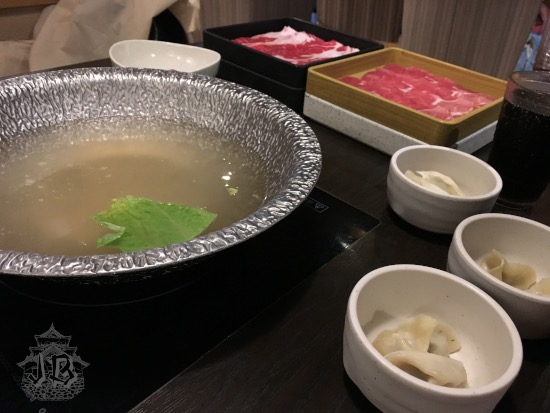
Four our last dinner B****, D****e and I got shabu-shabu. In all honesty, I wanted curry but it has not sat well on my stomach the last few times, so now I’m afraid to try 。゚(゚´Д`゚)゚。 ← most of the tears are because I had to say goodbye to B**** anyway.

31st August 2018: Tokyo Tower Reprise and off to Roppongi {Japan, summer 2018}

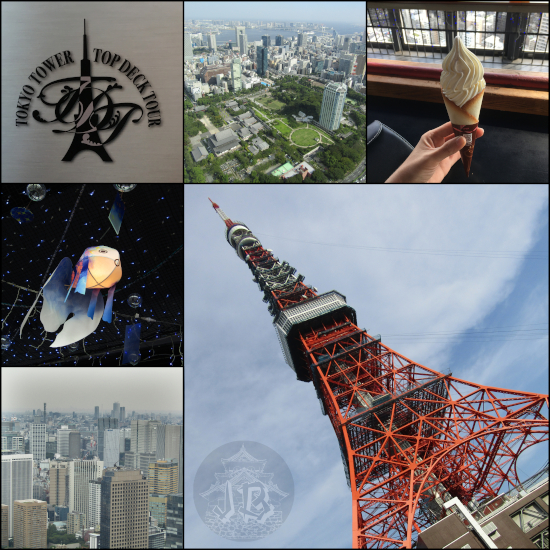
I went to Minato [港] because Tokyo Tower [東京タワー ] is there, and I love Tokyo Tower. My first stop, however, was Shiba Koen [芝公園], to visit a certain tree. However, the park was under construction! Who the hell closes a park for construction?! (O_O)!

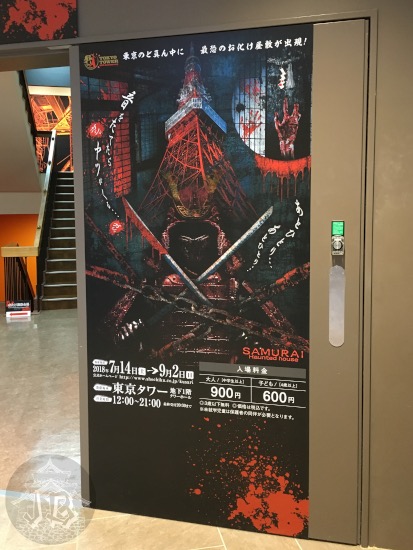
They have reopened the upper observatory in Tokyo Tower so of course I had to come back. It was imperative for my mental health. When I arrived I found out that they were running a “haunted house” on the basement and I decided to give it a go.

The story was of a cursed samurai who has killed 332 people and you’re supposed to be number 333. I had been wanting to try one of those for a while but in the end I did not enjoy it that much – the not seeing down the corridors was too stressful. Maybe with someone else it would have been more fun.

Afterwards I got my ticket for Tokyo Tower [東京タワー ] and the “VIP = Very impressive panorama” from the second observatory. I don’t understand why Tokyo Tower makes me so happy, but it does so more power to it. Oh oh oh and I had awesome(ly expensive) ice cream on the tower!

Afterwards I walked towards Roppongi [六本木], making a stop at the Don Quijote, a macro store that has nothing useful but lots of fun little stuff, with half a mind to buy a traditional red eyeliner or coloured contact lenses. But in the end I was strong and did not waste money (yet (≧∇≦) ).

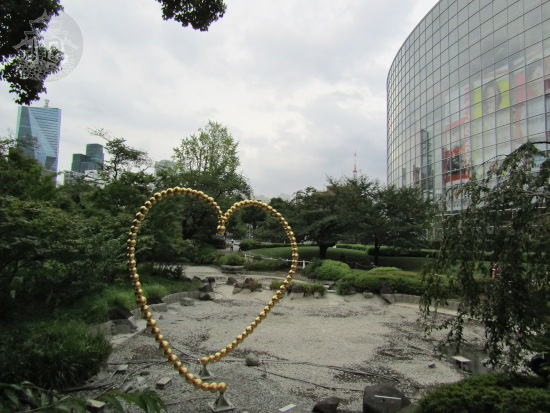
I continued to the gardens Mori Teien [毛利庭園], and I was a tiny bit disappointed that the pond had been emptied!

And I saw that the TV Asahi [テレビ朝日] building was open for visitors, so I went to snoop into that, because of course I did.

Later I met with D****e and M*****san for a shabu-shabu dinner which was out of this world.

28th August 2018: Easy-peasy {Japan, summer 2018}

Having felt so lousy the previous day I decided to take an easy day with friends. I took another Nakano Broadway [中野ブロードウェイ] trip, although I did not find anything interesting – actually I did but I decided to leave buying for later and the next time I came it would be gone. Not the item, the whole shop (≧∇≦).

I met B**** for Chinese food in Shibuya [渋谷], drinks (because we had free Starbucks!) and then I got a haircut! Not that my hair was long but it had started losing shape and it did not look neat. My hair saloon was called Number 76 and it was in Omotesando [表参道].

This was a bit of a weird experience – I got my hair dry-cut, then washed, then styled, and then I got a massage – and B**** treated me to it because she’s awesome and generous ♥

Afterwards we met with D****e and had dinner at a very weird meat place in Shinjuku [新宿] (once again in MyLord because we decided it is very convenient and it has nice places). I mean, this is a salad…

24th August 2018: Friends! {Japan, summer 2018}

In the morning, I went to the Shōbō hakubutsukan [消防博物館] or Fire Museum, in Yotsuya [四谷]. I blame my last binge on Chicago Fire for the curiosity bug to bite on that one. It was strangely interesting, but the helicopter was closed due to wind and rain – also the problem with kid friendly museums is… kids overrunning you and parents cheering for them…
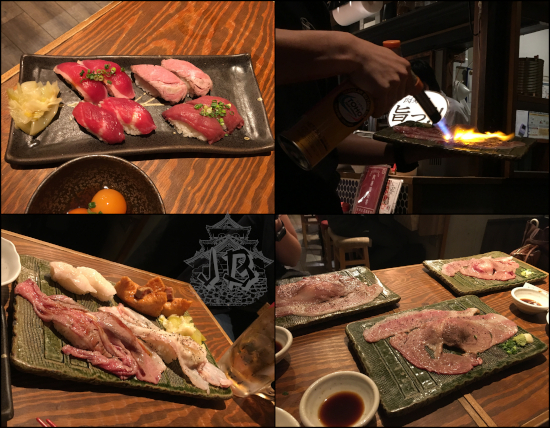
Then I met B**** in Shibuya [渋谷] for sushi, and that was awesome, until we were done. Then we saw the shrimp and fish being beheaded alive in front of us. That was a shock (O_O)! After that we went for ice cream, window shopping, karaoke and dinner in Shinjuku [新宿], in MyLord building next to the station, which was really convenient and surprisingly good (and well-timed on our part). Okonomiyaki! This was my masterpiece!

(Added a lot of katsuomi to it afterwards (≧∇≦) )

11th August 2018: The Luna Sea Connection {Japan, summer 2018}

Luggage arrived around 9 am, and let me tell you I have never been this happy to see my own underwear. I put together all the presents I had brought for people (feeling sorry that I had not been able to take M***chan’s for her the previous night) and headed out, first with D****e to Shinjuku and later to Akasaka, as I was meeting a friend over there for a concert.

Back in April 2018, when I went to the INORAN concert at the Salón del Manga de Alicante, one of the people I met was E**chan, who is coincidentally a Luna Sea fan and studying Spanish.

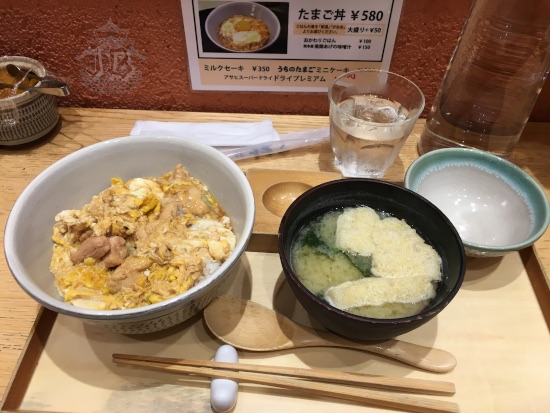
When she heard that I was going to Japan this summer she offered to help me find tickets for the solo concert of her favourite Luna Sea member, the bass J in the Mainabi Blitz Akasaka [マイナビBLITZ赤坂]. I met E**chan at Asakasa station [赤坂駅] for lunch and coffee / tea before the concert. We ended up in a place called Uchi no Tamago Chokubaijo [うちのたまご直売] and ate tamago kake gohan [卵かけごはん], which I had never eaten before and was absolutely yummy (I’ve looked up recipes by now (≧∇≦). I mean, it’s basically raw egg and rice so…).

Lunch. A bowl of miso soup and a bowl of rice with cooked egg on top

After lunch we were talking for a while, and then headed for the concert. I bought some goods (Tshirt) and she was nice enough to wait with me even if she had a much better number since she’s a fanclub member. The concert was super lively and rocky, with almost a mosh pit and all! It was fun, and J was very energetic – one day I will see the whole of Luna Sea together. I got pushed and shoved a little, so even if fun, it turned out a bit exhausting.

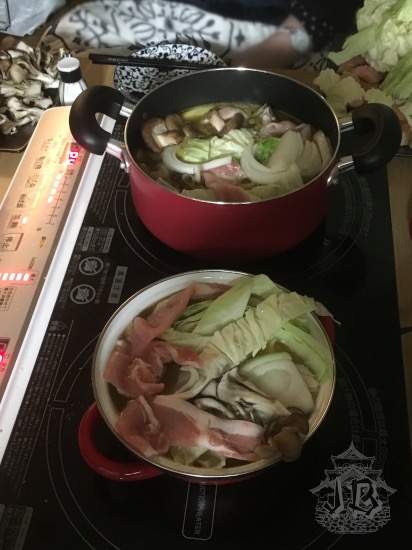
After the concert I headed back of to Shinjuku [新宿] to have a shabu-shabu dinner with D****e before we headed back home.

Dinner watching the shabushabu broth until it boils. There are mushrooms, tofu and spinach leaves ready to be cooked

10th August 2018: Pretty Lights, Strike 1 {Japan, summer 2018}

I stayed in bed for most of the morning, and had conbini lunch at home. Mid-morning I received an email informing me that my things had arrived in Haneda and would be delivered the next morning. This confirmed what I suspected, that luggage had stayed in London due to the check-in issues, and left me free for the day, although I would have to fill an insurance claim or two.

Luggageless, and thus cameraless, I did not feel like going out to do tourism, though I did have a couple of places I wanted to visit, so what to do? Obviously the first hunting incursion of the day – first Shinjuku [新宿]’s Closet Child and Pure Sound, and then I headed off to Harajuku [原宿] and the Laforet Building, then I came up Takeshita Dori [竹下通り] where I bought a pair of sunglasses and fell in love with a couple of shoes (until I saw the price. It was an impossible love).

After that, D****e and I met up with M***chan at Meguro [目黒] to go to the Hotel Gajoen Tokyo [ホテル雅叙園東京] and dinner afterwards. Hotel Gajoen is a huge luxury complex in Meguro, with corridors that go on forever, fountains, bridges and jaw-dropping prices. That should give you a clue that dinner was not had there.

The hotel organises cultural events around their one-hundred step ladder, and this summer it was holding the WA NO AKARI × HYAKUDAN KAIDAN Illumination Festival 2018: Wa no Akari, The Aesthetics of Japanese Illumination [和のあかり×百段階段2018 ~日本の色彩、日本のかたち~]. This was an exhibition of interpretation of Japanese art using lights, and it was very beautiful.

Would you like to catch a glimpse of the luxuriousness of the place? These are the lobby toilets:

Since obviously we could not afford to have dinner there, we went for nikuzushi [肉寿司], which is basically sushi with meat, raw or cooked, instead of fish to a place called, of all things, Nikuzushi, in Ebisu [恵比寿] (albeit this is apparently a chain, so there are several of them around the city). This was unexpectedly yummy.

Afterwards we did an hour of karaoke and headed home.

5th & 6th of November 2016: Barcelona (Spain) for We are X

I was supposed to have travelled to London in March 2016 to see X Japan’s concert, where they were also going to project the We Are X documentary premiere. Unfortunately, that was postponed to 2017 due to PATA’s health issues. I really hope it works out next year. However, the decision was made to start premiering the documentary in different music festivals, and the second I heard that it would be shown at the Beefeater In-Edit festival in Barcelona I got a ticket for it. Furthermore, I actually won two more tickets in a giveaway.

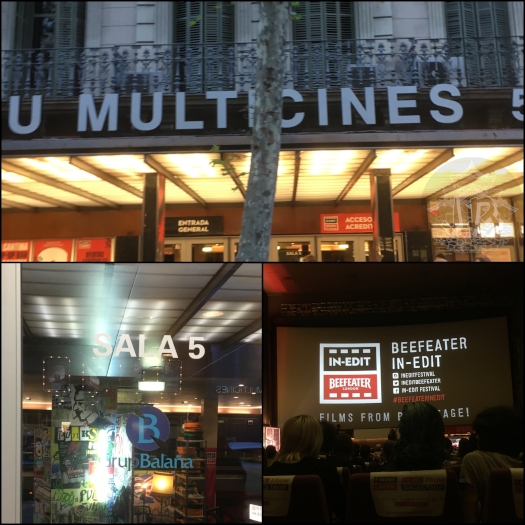
These two tickets I got I gave to a couple-friend of mine who had been so nice as to let me stay over at their place. I took a train around 8 am and was in Barcelona mid-morning. I went directly to their place and we just hung out until it was time to go to the Multicines Sala 5, where the documentary was going to be shown. We were actually the first and, press aside, we were the first ones in. We sat dead in the middle of the cinema and a group that walked in ten minutes later wanted us to move. And sorry, random person, but the answer is not. We were not really a “queue” but we were waiting for a couple of hours, so I was not going to give my chosen “best seat” out of the whole theatre for a group of ten people.

This was a Saturday evening, and there had already been a premier on the 1st of November so there might be more fans there, but in general I was a bit taken down by how few fans there were, most felt like people who had a whole-festival ticket.

The documentary tells the story of X JAPAN, one of my favourite Japanese bands, from the point of view of its founder, drummer and pianist Yoshiki. The band crumbled at the height of its popularity when guitarist Hide died by hanging, and the singer ended up brainwashed by a cult. Everything is told from Yoshiki’s own point of view, which makes the film biased, but still poignant.

After the film we went back to my friends’ place and had dinner. The next morning, they wanted to show me their little orchard in the outskirts, and I was treated to the best paella (Spanish rice) that I have ever had in my life – so awesome I even forgot about taking pictures! It was sad that I had to leave by 8pm, so I was only in Barcelona for about 32 hours, but it was so well worth it.

Collage showing the entrance to Multicines 5 and the Beefeater In-Edit screen before the film started