8th June 2025: Atienza & its Drove of Horses (Spain)

Though today Atienza is a remote village with fewer than 500 inhabitants, during the Middle Ages it was an important fortified villa. It was a strategic site in Castile, close to the frontiers to both Aragon and Muslim-controlled areas.

When Sancho III of Castile died in 1158, his eldest son became Alfonso VIII of Castile, being three years old at the time. It was a time of instability, a civil war broke between the two most important Castilian noble families, and the neighbouring kingdoms took over territories and cities taking advantage of the situation. The young king was hidden in several towns to protect him from “the enemies” by several “allies” – who the loyal guys were depends on the story you read. One of the hiding spots was the villa of Atienza.

The king of León besieged Atienza in order to retrieve Alfonso. In order to get him out of the city, on Pentecost Sunday 1162, the Brotherhood of Muleteers requested permission to hold a short pilgrimage (romería) to the small hermit church outside the walls. The attacking army agreed – religion is weird, I guess – and the muleteers snuck the royal child out of the villa. The fastest riders then galloped for seven days to get the king to safety in Ávila. The scheme worked, and Alfonso lived until 1214.

Nowadays, the Brotherhood of the Holy Trinity Cofradía de la Santísima Trinidad carries out a similar pilgrimage, in traditional clothes, on Pentecost Sunday to “honour their ancestors and their feat”. There are several events: a cavalcade – the romería on horseback – a mass at the hermit church, a communal meal, dancing, and at the end of the day, a joust tournament. The whole festival is called “Drove of Horses of Atienza” Caballada de Atienza. As I was driving past the village on Saturday I thought that maybe my sibling would be interested in dropping by, and could do the driving.

On the way, now that I knew where to park, we could stop for a little while next to the reservoir Embalse de Alcorlo, whose dam was opened back in March so it became part of the reason the river Río Henares had so much water. The reservoir was still pretty full.

Alcorlo Reservoir, bustling with water

It was clear from the get-go that we would only stay for a couple of hours. Since we were improvising, staying for the whole thing, without lunch reservations or a definite plan, in the heat, would not have been a great idea. I just wanted to get the gist of how the festival went and how many people there were. Surprisingly, not as many as I thought. We dropped the car off at the entrance of the village and followed the signs towards the centre. We knew we were going in the right direction when we started seeing horses.

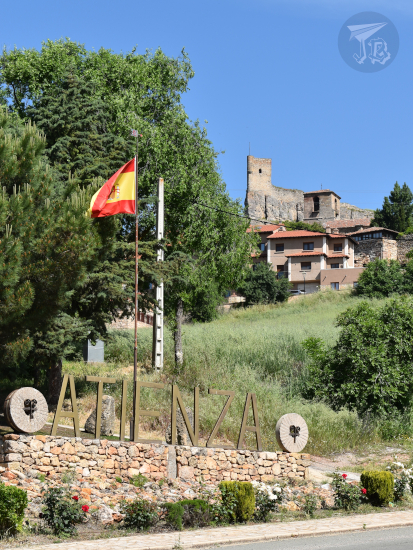
Entrance to the Medieval village of Atienza, with the name of the village, the Spanish flag and a castle in the background.

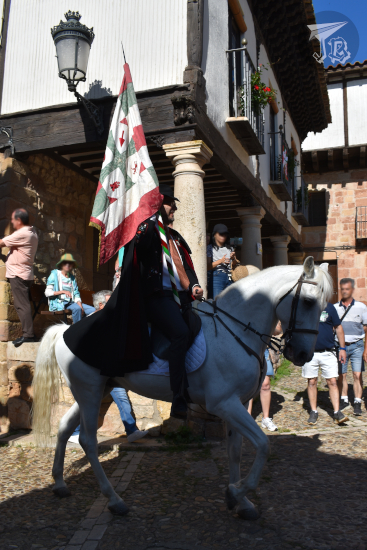
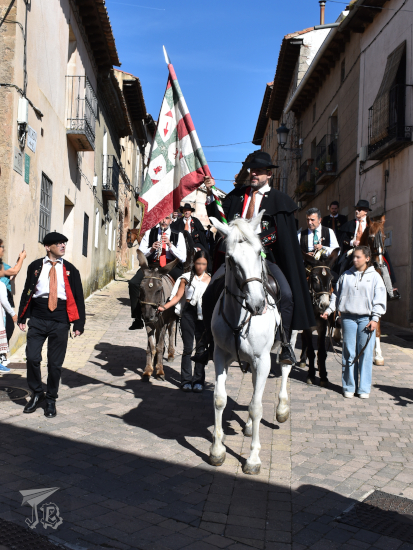
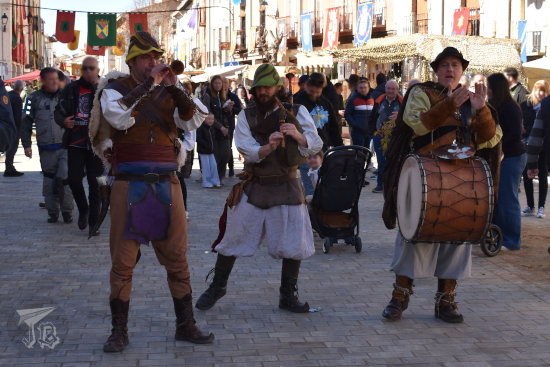
The festival starts at 10:00. The Brotherhood is called into order and they bid to carry the flag and open the pilgrimage behind the musicians. The brothers wear black suits and some are allowed to wear capes – not sure how the horses feel about that. This happens in a narrow street with way too many people and nervous horses. We decided it was safer to stay at the corner rather than trying to approach the scene – we had already witnessed a couple of them getting spooked by oblivious passers-by.

Caballada de Atienza: Horse parade in a Medieval Village. Senior brother carrying the flag

Caballada de Atienza: Horse parade in a Medieval Village. Three riders with to hats and black capes.

Caballada de Atienza: Horse parade in a Medieval Village. Senior brother with the flag, followed by musicians on mules.

Caballada de Atienza: Horse parade in a Medieval Village. Two lines of brothers along a street.

We watched the departure of the pilgrimage, and then jogged to a couple of other places for photos. We decided not to follow the cavalcade to the hermit church, because the return would have been at noon – way too hot. We waved the riders goodbye next to the remains of St. Francis’ convent, the ruins of a Gothic apse Ábside gótico del convento de San Francisco.

After the romería rode off towards the hermit church, we decided to explore the village a little. We went back to the Old Town Casco Antiguo de Atienza to have a look at the local monuments. We crossed the Medieval wall Muralla de Atienza through the arch Arco de la Virgen.

Atienza Medieval Walls

The Main Square is called Plaza del Trigo (Wheat Square), surrounded by traditional architecture, including the old council houses, a covered gallery, and the church of Saint John The Baptist Iglesia de San Juan Bautista. The current church was erected in Renaissance style in 16th century by architect Juan de la Sierra, to serve as substitute as the previous Romanesque parish.

Atienza Main Square: Plaza del Trigo, in severe Castilian architecture

Church of St John the Baptist, with a baroque altarpieceand rebuilt plaster vaults

Next to the church, serving as an exit from the square, stands the arch Arco de Arrebatacapas, the cape-stealing arch. Due to the configuration of the two squares it joins, a wind tunnel forms in the small alley – known to blow away capes or any other unsecured piece of clothing.

Medieval arch in Atienza

From an alleyway we got a good view of the castle – I’ll leave the visit for another time, when all the museums are open, and it is less hot. On the way out, we had a great view of the whole villa before we drove back for Chinese food and cold drinks.

Ruins of the Atienza Castle

23rd February 2025: The Annual Medieval Fair (Tendilla, Spain)

For the last few years, the Medieval fair Feria de Mercaderíass de San Matías in Tendilla has started on the 25th (2022), 24th (2023) and the 23rd (2024) of February. So it makes perfect sense that my mind placed 2025’s edition start on the… 14th, right? Since the fair celebrates St. Matthew, and the onomastic is the 13th, I unilaterally decided that the fair must be that weekend. Obviously, I was wrong, and the fair was held from the 21st to the 23rd. Due to the date mishap, I had a visit booked on the 22nd, and I amended my plans to head to the fair on Sunday the 23rd instead of on Saturday as I usually do – that way I could see the Palace, the Botarga Parade and the Fair on the same weekend.

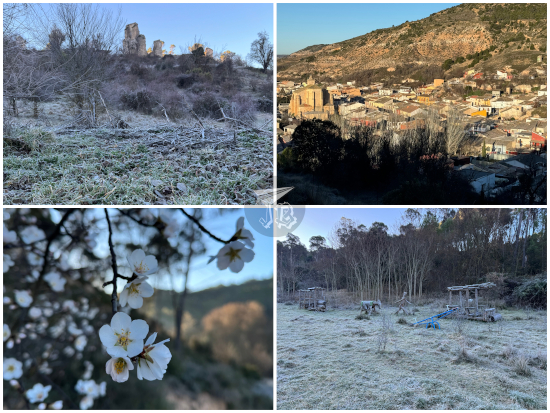
It was a good thing that I decided to go to the Parade instead of trying to make it to the fair on Saturday, because apparently they were blocking cars from entering the village, but not letting them park anywhere close-by which… is a problem. To avoid a similar issue on Sunday, I drove to Tendilla before the fair even opened, so I was there around 8:40. I used the time to climb up the frozen nearby hills to see if there were nice views from above. I also headed into the pine forest, which was covered by a thin layer of frost everywhere. It was pretty.

Tendilla: Landscapes before the fair started

There was a parade scheduled to take place at 11:00, which did not happen until around 13:00 – there was just a trio of musicians going up and down the main street. In the mean time, I wandered up the fair, and stayed around the ox paddock hearing things like “such noble eyes the animal has” from the mouths of city-dwellers. The poor oxen seemed pretty much used to to be stared at, so they just munched on hay with an air of resignation. There were two of them separated from the herd, which would later be yoked to a traditional cart. Looking back, I’m slightly surprised that I did not get any allergy symptom from their straw.

Three musicians in Medieval Clothes

Oxen in the Medieval Fair

I also found the newly-inaugurated statue to honour the fair – a tiny farmer with two donkeys standing atop a column which… was a bit underwhelming, to be honest.

La borriquilla - the little donkey

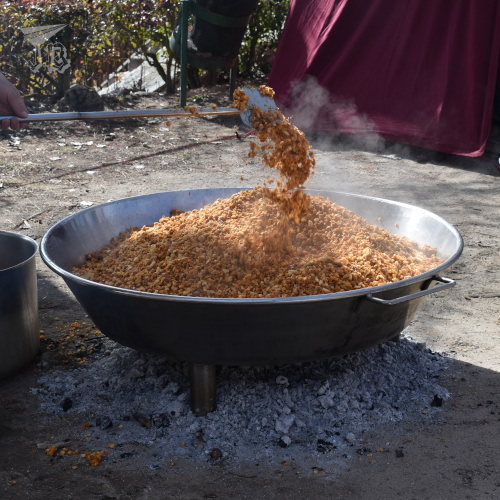
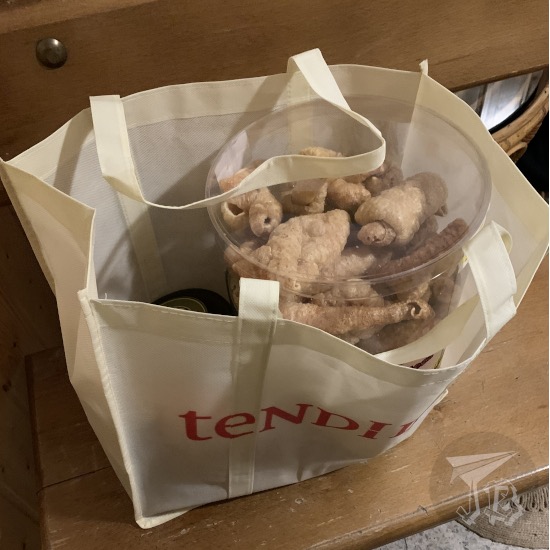
Around noon, a queue started forming for migas. In the mornings during the fair, some of the villagers prepare this typical dish from the area for all passers-by (queuers-by?) to enjoy. The traditional migas are made from fried breadcrumbs, paprika and meat from pig slaughtering. However, Tendilla is famous for its torreznos (processed pork lard snacks), so these communal migas are served with the local dry treats, and accompanied with a glass of wine to be washed down. I had never queued for them, but some family members saw me when they were almost at the front of the line and I was snuck forward in exchange for some photos. I also got to talk to one of the stand owners, and I discovered about a place called Emociones al Vuelo, a bird-of-prey rescue and training centre which organises activities. I may or may not have decided to pay them a visit.

Communal migas being prepared

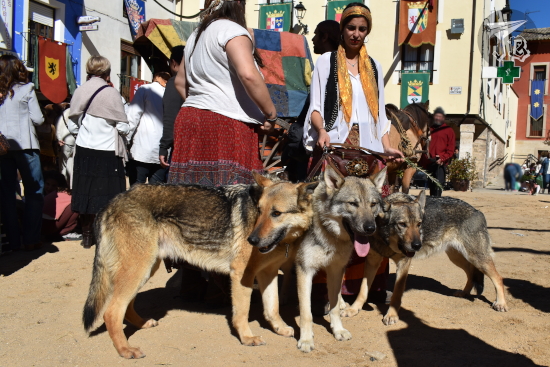
We snacked, and then moved around the village. I was in the middle of Main Street Calle Mayor when the parade came through. The troupe had changed this year, and it was not Christian knights and moors, but gypsies and magicians. They brought horses and “wolfdogs” – not actual wolfdogs but wolf-looking domestic dogs. Enough to fool a lot of people. There was supposed to be a tournament, but apparently the gypsies were not up to it. There was no tournament, and after an hour of waiting, the troupe went back to the Main Square Plaza Mayor, did a couple of horse tricks, and started cutting ham to share with the onlookers. It was a bit disappointing, but I least I got to pet the dogs.

Troupe of horse riders dressed as Medieval gypsies

Dogs from the gypsy troupe

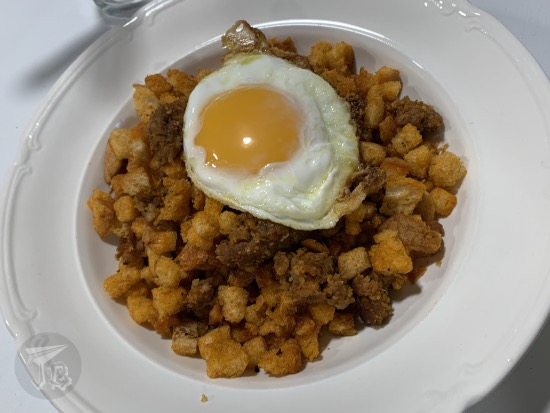
I headed to my relatives’ place and we prepared lunch, though I had some leftover migas that had been saved for me from the previous day, and a fried egg on top. Much better than the communal ones, for real.

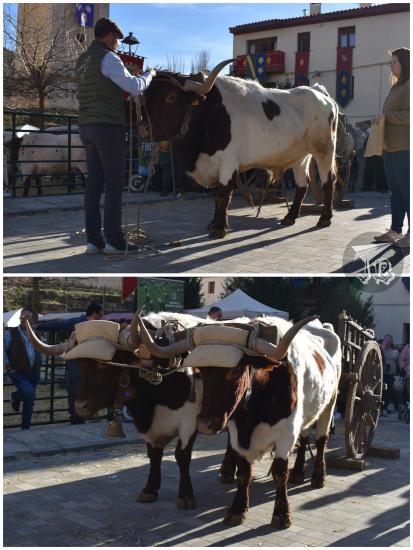
The last activities for the day were related to the long-suffering oxen. First, two of them were yoked to a traditional hay cart and children were given rides through the fair. The two oxen were led to the cart and then tied to the structure. Something that I had never known was that part of this tie went around their horns and forehead, so the owners placed a small pillow on the animals’ foreheads for them to pull more comfortably. However, to do the tie the knots as strong as it was necessary for them to be, he had to use his foot as leverage on the ox’s head… Once the animals were yoked, the cart started moving. One small child who had apparently been asking about the ride all day long was the first to be helped on the cart – even though some others tried to cut the line! At first, they went up and down the village, but apparently some idiot spooked the poor animals and the owners decided to just move around the main square afterwards.

Oxen being yoked

After six or seven rides, the oxen were untied and let into the paddock. A lorry was brought and the owners created a mini stampede for all the oxen to go into the vehicle. That was wickedly cool.

That was the last activity, so I decided to say goodbye to my relatives soon and drive back through the sunset. Most of the stalls were already closing anyway and there was no way I was going to stay for dinner – because that would mean I’d have to actually eat more that day, which was not the plan.

On the way back I drove into a very weird traffic jam. It did not happen around the bottleneck, but much much earlier, and the bottleneck was clear. I’ve never understood traffic jams anyway…

So all in all, I had a very complete weekend, combining Madrid, Guadalajara and Tendilla, I had relatively good weather, and got to check out most of what I wanted. The only downside? Having to go to my day job on Monday without having caught any rest!

30th December 2024: A planned and packed day {Vienna, Silvesterkonzert 2024}

It was a crisp morning in Vienna when we got up. We went down for breakfast and it was not particularly well stocked. The coffee was… weak, so I decided to mix a cappuccino and a black coffee to get me the energy I needed for the day. I tried some local cake, but I did not enjoy it, so I decided to stick to bread and croissants. Thankfully, I did run into the lady from the day before, and her husband, during breakfast, and told her about our plans – that way at least someone in the group would know not to wait for us and we would not delay anyone. Apparently, we were not the only ones who had made their own plans either, as the excursion had been marketed as “optional” and yet it seemed to be “a given”. Even better, we came across the driver from the day before (despite him saying he had nothing to do with the trip), and we could tell him that we were not coming, either. As we stepped out, it was freezing – literally below zero – but sunny during the whole day.

We took the underground at Zieglergasse and headed towards the city centre. I asked my parent to use their phone for GPS and maps in order to keep my battery for as long as I could so I could be taking pictures throughout the day, so they would be guiding. Our first stop was the Hofburg – the former imperial palace – and the Sisi Museum. Empress Elisabeth of Austria (1837 – 1898) was the wife of Emperor Franz Josef I of Austria. She married the Emperor when she was just 16 years old, and was stifled by court life. She spent most of her time travelling and avoiding royal duties. Her perceived eccentricity – today we would call it depression – and assassination in 1898 helped create an image of a romantic heroine in the media that has reached today, especially through actor Romy Shenider’s portrayal in the 1950s.
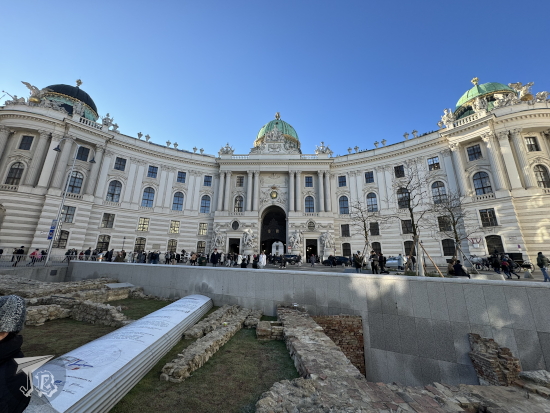
Hofburg

The museum tells about her life by showing objects, portraits and reproductions of her clothes. Then, you step into the former imperial apartments, which have been refurbished with furniture from the 19th century to make them look real. The audioguide was… corny to say the least, and I kind of skipped most of it because I got bored.
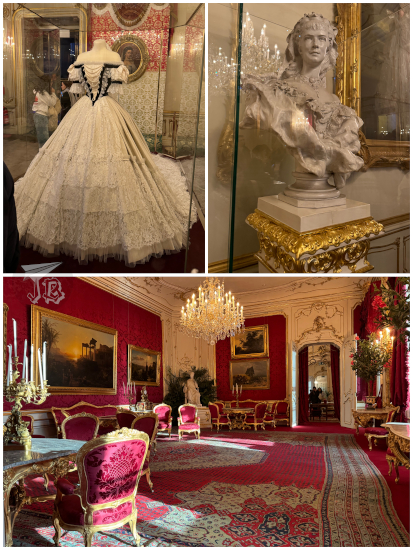
Sisi Museum and Royal Apartments Vienna

I proposed the church of Saint Michael first, and then the National Library. However, my parent had been intrigued by the church that stood at the exit of the underground. Thus, we headed there. The Wiener Minoritenkirche, Friars Minor Conventual Church, is officially the Italian National Church of Mary of the Snows Italienische Nationalkirche Maria Schnee. The church was erected between 1276 and 1350, and it was one of the first gothic churches in Vienna, following a French pattern. There were many subsequent reforms, including rebuilding the bell tower and the spire again and again – today the bell tower is flat and the spire is gone. The interior altar is Neogothic, by Ferdinand Hohenberg. Since it was still around Christmas time there were Nativities and Christmas trees.

Wiener Minoritenkirche

Afterwards, we headed towards St. Michael’s Church Pfarre St. Michael. It started as a late Romanesque or early Gothic building, maybe in 1221. The following two centuries saw Gothic annexes added. The crypt was built in the 16th century. The organ was built in 1714. The Rococo high altar was sculpted by Karl Georg Merville, and it represents the Fall of the Angels after the War in Heaven, when Lucifer was banished; underneath, there is a Byzantine Virgin Mary from the Cretan school. The outer façade was rebuilt in a classicist style in 1791. Construction officially finished in 1792. The crypt is accessible in a guided tour, but considering it has about 4,000 bodies, some of them mummified and on display, I think I’m happy we did not take it.
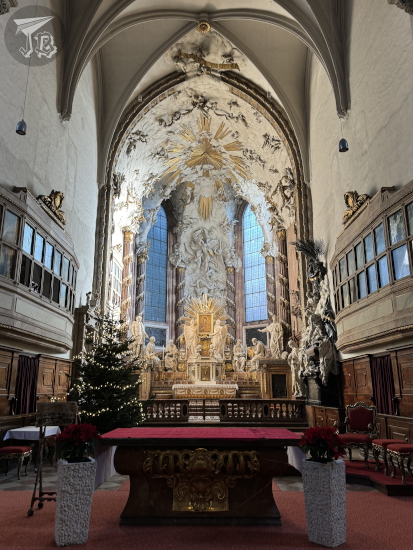
Michaelkirche Vienna

I proposed going to the Library again, because it was cold and there would be toilets there. My parent took over guiding with their phone, and my sibling and I got distracted as we passed by the Stallburg, where we caught a glimpse of the Lipizzan horses chilling out.

Instead of reaching the Library, my parent decided that we wanted to see the Augustinian church Augustinerkirche, a mix of 14th century Gothic and 18th century Neogothic. The original church was engulfed by the Hofburg as it expanded, and in 1634 it became the official imperial church. May Habsburg weddings were officiated there, and a chapel to the side, called the Herzgruft (Heart Crypt), contains the hearts of the members of the dynasty, from Ferdinand IV in 1654 to Archduke Franz Karl in 1878.

Augustinerkirche

I did not get to go to the Library, but we walked past the Hotel Astoria, which opened in 1912. it was built in the a late Art nouveau style known as fin de siècle (end-of-century). At the time it opened, the hotel was the latest, with electricity, bathrooms and all!

We reached the pedestrian / shopping street Kärntner Straße, the neuralgic centre for Vienna shopping. There we… met the card-not-working lady and her husband again, in what would become a funny number of encounters. We also saw the Swarovski shop. We entered it because we thought it would be warm – and hey, it had a toilet, which was handy, considering we had left the hotel over four hours before. Swarovski is an Austrian glass producer, known for its crystal glass, used in jewellery, decoration, watches, accessories. The company was founded in the late 19th century with the idea of “making a diamond for everyone”. Since then, it has produced thousands of items – from Christmas decorations to sculptures to collectible tiny figurines to whole dresses for the Vienna Opera. The place was halfway between a shop and a museum – and we might have spent a bit more than we had planned there, especially considering we were not planning to spend anything.
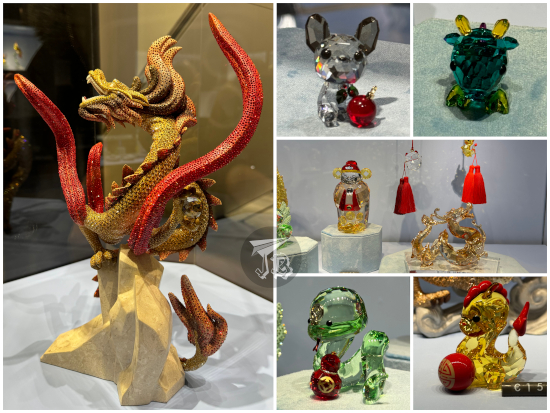
Swarovski flagshop Vienna

We reached DO & CO Restaurant Stephansplatz, located on the top floor of the post modernist structure Haas House, constructed in 1990. Most of the building is a hotel now. The restaurant has a fun view of the cathedral Domkirche St. Stephan. My parent and I discovered the restaurant because the opening scene of Austrian TV series Kommissar Rex, which ran between 1994 and 2004. It follows the story of German Shepherd Rex, a police dog which is “transferred” to the homicide department after his original handler dies… at the DO & CO terrace. It is such a naïve series, I just love it. Think The A-Team ingenuity with an adorable GSD saving the day every time and stealing sausage rolls as a self-reward. In a later series, Rex would move to Italy, and there is currently a Canadian reboot too…

There were no doggies in DO & CO, but both service and food were superb. They had butter and bread, and small receptacles with different types of salt, and a note on how they should be used. For lunch, I ordered kalbsbutterschnitzel – delicious minced veal butter patties with cream, accompanied with mashed potatoes, fried onion rings and a small leaf salad. For dessert, I had an ice latte that I should not have had, but I saw it pass by and I was smitten. We snuck a number of pictures from the restaurant, too.
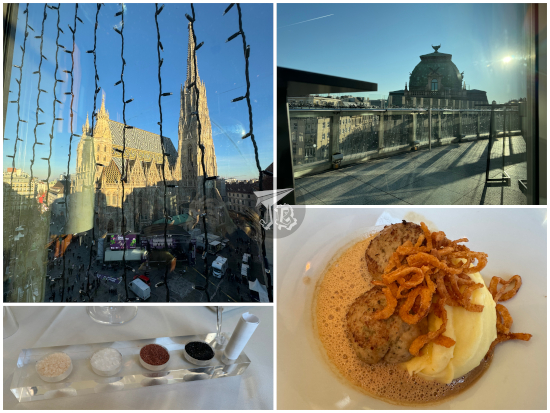
DO & CO Vienna

After lunch, we went into St Stephan’s cathedral Domkirche St. Stephan. The building is a mixture of Romanesque and Gothic, and it was initiated around 1137 and completed 1578, and as many as four construction stages can be seen – the first Romanesque towers, the later Romanesque church, the Gothic Choir, and the outer, newest additions. The roof is tiled with as many as 230,000 pieces, one side shows the mosaic of a double-headed eagle, and the other the coat of arms of the city and the country. The bell tower has twelve bells, and the interior hosts as many as 18 altars (plus the ones in chapels). The cathedral was built in limestone, so it looks darker than other churches its size (107 metres long, 70 metres wide and 137 metres high).

The high altar was built in marble by Tobias Pock in the 1640s in the Baroque style. It depicts the stoning of Saint Stephen, church patron and the first Christian martyr. He was stoned to death by the Israelites after a rather inflammatory speech in front of the Sanhedrin, defending Christ’s teaching versus the traditional Jewish ones. According to the Bible, this would have happened a couple of years after Jesus’ death, and before the Roman persecution.

St Stephan’s cathedral

My parents were tired and they decided to head off towards the hotel, while my sibling and myself stayed behind. We wandered around Stephansplatz, Rotenturmstraße, and Kärntner Straße, checking out the Christmas lights and decoration until we reached the Popp & Kretschmer fashion store. They are a luxury women’s clothes firm, which draw tourist crowds during Christmastime to see their huge bow decoration, which makes the whole building look like a present. They call it the Vienna Bow.
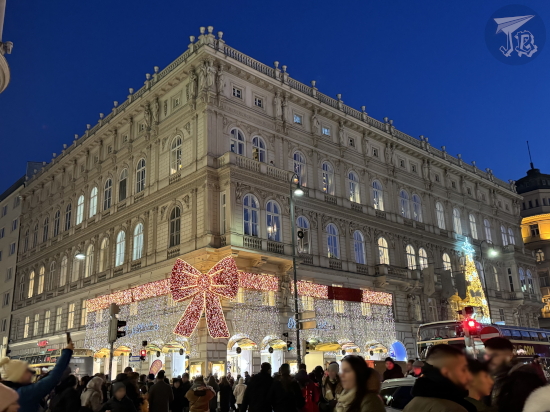
Christmas decoration - Vienna Bow

We also looked at the Vienna State Opera Wiener Staatsoper, which was prepared to celebrate the new year, with a neon display saying (in English) “Hello 2025”. It was stupidly cold though, so we might have stayed in an underpass for a few minutes longer than necessary.

Afterwards, we headed towards the Sacher Hotel. The five-star hotel was founded in 1876 by the son of a famous confectioner. When the founder died, his wife, Anna Sacher, became manager. She turned the hotel into one of the most refined in the world, catering exclusively to the aristocracy. This management lead the hotel to bankruptcy, and she had to sell the business to new owners, who restored it to its former glory. The hotel serves “the original Sacher-torte”, a chocolate cake coated with dark chocolate icing, and a thin layer of apricot jam in the middle, served with unsweetened whipped cream. It was reportedly invented by the father of the founder, and the recipe is kept a secret. There are other versions of Sacher-torte, but the hotel is the only one with legal standing to call theirs original.

We had a 17:30 reservation at Café Sacher, in the hotel. Sacher Hotel actually has two cafés. The more modern one faces Kärntner Straße and is called Café Bel Étage. It had a long queue – Christmas is peak season in Vienna, as we were quickly learning – but I had been informed that reservations accessed through a particular door. However, that was not where our reservation was – I swear, I did not see the different name anywhere. The historic Café Sacher had an even longer line, and no special door. I dared ask the doorman at the hotel how to get there, and he gave me a huge grin and said “skip the line, go through the exit”. Boy, that was… awkward. Very, very awkward. I though the people just outside would lynch us!

Staff came to check on us, and since our reservation at the Café Sacher was valid – I made the reservation in July, literally as soon as the spots open – we were shown into one of the small salons. The café has a perfect offer – Sacher Sweet Treat: a perfect slice of original Sacher-torte with whipped cream, a non-alcoholic hot beverage and a bottle of Römerquelle mineral water for 22.5 € (31.5 € with a glass of the in-house champagne, Original Sacher Cuvée). I ordered mine with sencha senpai, Japanese green tea. I enjoyed the cake more than I had thought I would, and the tea was great. The staff was incredibly nice, too. They must have been used to silly tourists.

Sacher & Sachertorte

We left the Café Sacher and headed towards the Spanish Riding School Spanische Hofreitschule. For my sibling, this was a core-memory event, so they insisted we got really, really good seats for the Gala Performance Galavorführung at 19:00, on the parterreloge – the box at ground level. The Gala performance is the longest exhibition the Riding School has, and it lasts 90 minutes, with a break. The horses were gorgeous, and the riders looked very cold, but everything felt strangely… cold. I think I liked the exhibit in Jerez Riding School better.

The Spanish Riding School, considered the oldest horsemanship school in the world, was established during the Habsburg Monarchy in 1565. It is dedicated to the breed and training of Lipizzan horses. Lipizzaners are a breed of riding horses developed during the Habsburg empire. It derives from Arab, Bavarian, Spanish and Neapolitan breeds. They were selectively bred so most of them are grey with white coats – albeit there is always a bay stallion in the Spanish Riding School. The breed itself might be traced to eight stallions in the late 1700s, and it was developed in Slovenia. The horses are considered so precious that they were evacuated during WWI, and “rescued” by the US army during WWII. “Lipizzan horse breeding traditions” has been considered Unesco Intangible Cultural Heritage since 2022.

Once bred, foaled and fledged, the Lippizaners are trained. This is done at the Spanish Riding school. The traditional horse training methods used by the school can be traced back to Ancient Greece, and like many other things, they re-flourished during the Renaissance period in the 16th century. The goal of Classical training was to prepare horses for warfare as part of the calvary. Horses train for six year after they turn four.

In Vienna, the Lippizaners are housed at the Stallburg, which is technically part of the Hofburg Palace. It is a Renaissance building from around 1560, originally conceived as a residence but that was later converted into the Imperial Stables. The Winter Arena was built in 1735, and has remained unchanged since then – including the chandeliers. The arena is presided by a painted portrait of Emperor Charles VI.
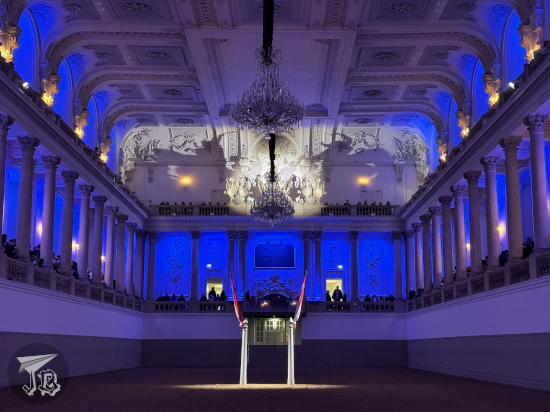
Vienna Riding School - winter Arena

There was something weird in the atmosphere that made it not feel all that… fun. Before every performance, a lady walked to the centre of the arena to introduce the exercises movements in German and English. The performance was pretty though. I tried to sneak a picture or two, but I was unsuccessful – and a bit worried they would kick me out if the venue. There were a total of six different numbers, and the show, including the introductions, was organised as follows:

  1. Alle Gänge und Touren der Hohen Schule – “All Steps and Movements of the High School”: four riders and stallions in individual choreographers, including the one dark stallion in the stable, with classical movements.
  2. Am Langen Zügel “Schools on the Ground: On the Long Rein” – the riders guide the horse from the ground, they are not on top of the horse, with movements such as piaffe and pirouette.
  3. Pas de Deux “Step by Two” – two riders-horses pairs work in tandem, mirroring each other.
  4. Arbeit an der Hand und Schule über der Erde “Working Hand and Airs Above the Ground” – with three main movements: levade, capriole and courbette. Four horses work with their riders on the ground, and two of them with the riders on the saddle, but without stirrups. When horses perform well, they get a sugar treat from the rider.
  5. Am Zügel “Schools on the Ground: Curb Reins” – only one horse and his rider, who only holds two out the four reins in their left hand, and they hold the riding crop upright in their right hand, a commemoration of the military heritage of the horse riding tradition.
  6. Schulquadrille “School Quadrille” (or Das Ballett der weißen Hengste “Ballet of the Eight White Stallions”) – eight horse-rider pairs have to coordinate with each other for a choreography, ending in the Radetzky-Marsch.

When the exhibition came to an end, we tried to go to the toilets. You had to scan your tickets and pay 50 cents. Really. Two hundred quid for the tickets and they charged fifty cents for the toilets, which were filthy on top? A total rip-off.

I got my sibling to the hotel, and then I left again to meet up with my friend D****e and her father Fr***, who were also in Vienna for a few days. They were even staying in a hotel close to ours, so it seemed that we had planned it in advance. We spent a couple of hours in a small eatery – Gschamster Diener – where they introduced me to kaiserschmarrn, fluffy shredded pancakes with raisins, powdered sugar and cinnamon.
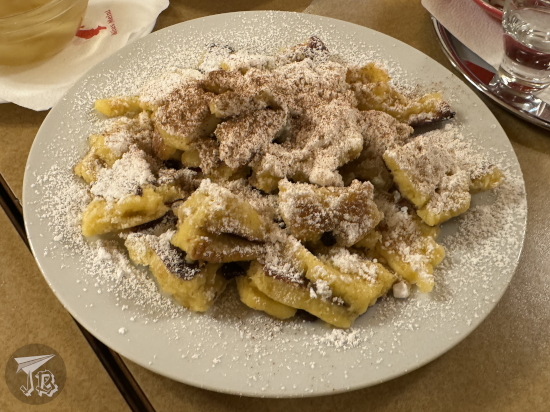
Kaiserschmarrn

I eventually had to go back to the hotel and my room. There, I spent an hour trying to find a place to book lunch for the following day. After deciding not to plan anything on the 31st, my parents had a change of mind and suddenly I found myself tasked with planning and finding a place for lunch. Most restaurants were either closed or booked off. I was not a happy camper, but in the end I managed to find something… somewhat decent. My sibling suggested the Natural History Museum, the Butterfly House and the Library before lunch. I was absolutely sure that was impossible to cram three things in the morning. We would not even do the entire Natural History Museum, but at least we would be somewhere warm. I resigned myself not to see the Library, had a shower and went to bed.

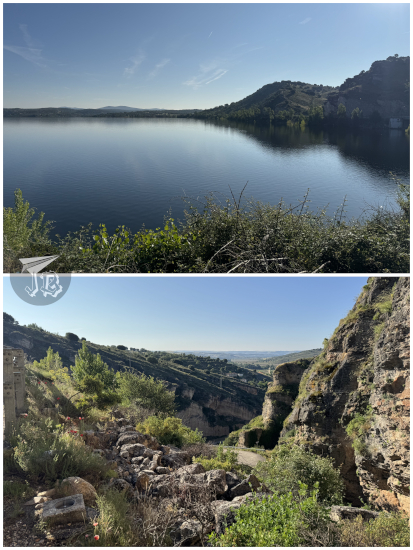
13th September 2024: Cádiz, Jerez, Puerto Real & back to Cádiz {Escapade to Cádiz, September 2024}

After making sure there were no ants in my breakfast – I had stored it in the mini-fridge, and they were all in the trash can with the decoy – I left for an early walk around Cádiz as the sun rose. I went to Puerta de Tierra (the Land Gate), the remains of the walls that closed off the city in the past, which today separates the old and new areas. The original redoubt was erected in the 16th century, embellished in 1756 with a portal, and a tower was added in 1850. In the early 20th century, arches were opened into the wall to allow traffic to come through. There was a temporary installation to commemorate the “Phoenician Week” activities, but it was so garish that I was not even sure whether it was real or a parody of sorts.

Puerta de Tierra Cádiz

Afterwards, I walked to the train station to take the train to the nearby city of Jerez de la Frontera, where my first stop was the fortress-palace Conjunto Monumental del Alcázar. The first remains known of the alcázar date back from the 11th century, though most of what still stands was erected in the Almohad period (12th – 13th centuries). The fortress was repeatedly taken and lost in the war between Moors and Christians until the Catholic Monarchs finally conquered all of Spain. The building was owned by the crown, but it fell into disarray, and in the 18th century a Baroque palace was built.

Alcazar de Jerez de la Frontera - exterior

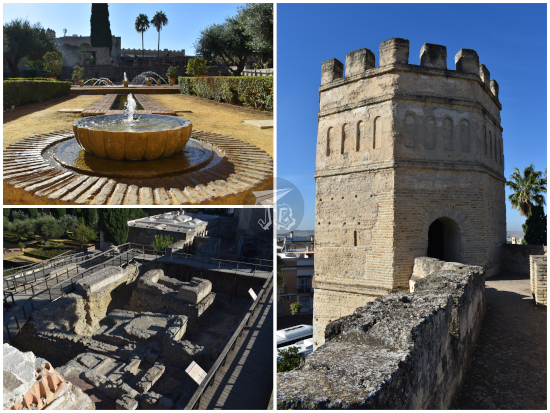
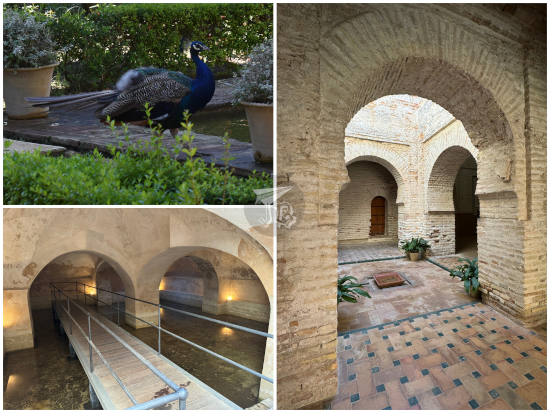
Today, this palace is the only intact construction, and the one I left for last. I moved towards the garden first, which lead to the Arab baths, the octagonal tower, the cistern, the Royal Pavilion, and the walls, with some of the machinery from the Medieval times. The gardens were patrolled by peafowl. On the other side of the complex stand the mosque, an area with a reproduction of ancient oil presses, and the original gates in the walls.

Alcazar de Jerez de la Frontera - cistern and mosque, and peacock

The Baroque palace Palacio de Villavicencio holds a wooden staircase, several rooms with rich decoration including hanging lamps and wall paintings, and a salvaged pharmacy from the 19th century.

Alcazar de Jerez: Palacio de Villavicencio

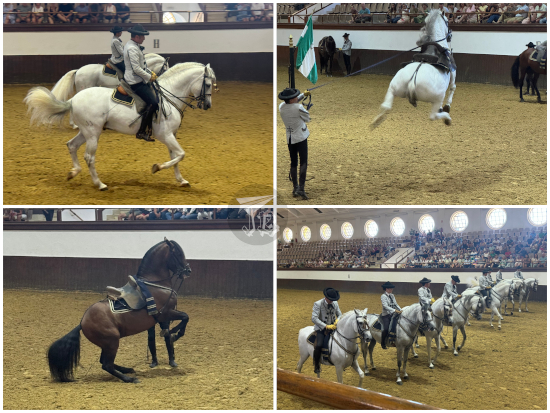
After the alcázar, which took longer than I thought to explore, I headed out to the Royal Andalusian School of Equestrian Art Real Escuela Andaluza del Arte Ecuestre to watch the show Cómo bailan los caballos andaluces (The way Andalusian horses dance), an eight-part show which has been performed since 1973. The exhibition showcases the different types of exercises that the horses are trained for – whether it is with a rider, or a handler on their feet, alone, or coordinating with other horses on the arena. It was a really impressive performance, and the horses were gorgeous.

Setlist of the show:
  1. Cómo se anda en el campo
  2. Al son de la garrocha
  3. Paso a dos
  4. Trabajos en la mano
  5. Fantasía
  6. Saltos de escuela
  7. Riendas largas
  8. Carrusel

Royal Equestrian Art School, Jerez

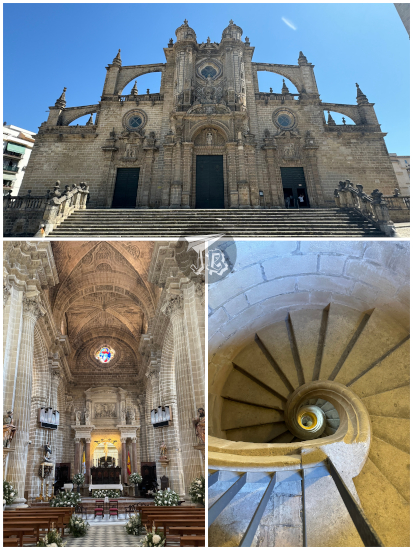
After the show, I hung around for as long as I was allowed to, snooping the horse riding museum and the small palace in the grounds until they closed down and I had to leave. I bought a sandwich and a bottle of water from a supermarket in the way, and went on to the cathedral Catedral de Nuestro Señor San Salvador. The current building was not originally conceived as a cathedral. It was founded in 1778, built between the 17th and 18th centuries, and consecrated as cathedral as recently as 1978. It has a gothic structure, with a Baroque façade and a Neoclassic altarpiece. Behind the altar there is small treasury / museum and a spiral staircase to a secret chapel which is barely the painting of a saint – but the staircase was pretty, it reminded me of the one in the church in Tendilla. I also walked up the tower so I could see the city from above.

Cathedral Jerez de la Frontera

By the time I was on my way back, it was too late to snoop into the farmers’ market Mercado Central Abastos, so I headed directly towards the train station to fight the ticket machine, then headed to Puerto Real. This is a town between Jerez and Cádiz where I used to live. After checking out some places out of nostalgia, I went towards the seaside. It was an eerie feeling, because it had changed very little from what I remembered from almost two decades ago, when I left, and still it was slightly different. I visited the beach Playa de la Cachucha and walked along the promenade Paseo Marítimo until I saw my old university building.

The Andalusian Centre for Marine Studies Centro Superior de Estudios Marinos, CASEM, is a helix-shaped building, originally conceived by Manuel López Vázquez. The building has three “arms” in 120-degree angles, and a glass dome at the centre. It is located in the middle of the natural reserve. However, going there would have made me extremely sad. Thus, I decided to walk back towards the station and take a train back to Cádiz.

Puerto Real: Playa de la Cacucha

Since I had visited the land gates, I also wanted to see the Sea Gate Puerta del Mar, the remains of the entrance to the harbour. Today it is more of a monument than an actual gate, but it is still there.

Cádiz Puerta del Mar

I was able to get there with enough time to head out to the archaeological site Yacimiento Arqueológico Gadir, one of the most important of its kind, since Phoenician settlement remains are far and few. The site, underneath a theatre, has two layers – the original one might date back from the 9th century BCE, with the remains of eight houses, complete with kitchen and oven, and streets. The settlement was destroyed in a fire, which also left two victims, a man and a cat, both of whose remains are exhibited there. The second layer is more recent – a fish processing factory with pools to preserve the product in brine from the Roman domination.

Yacimiento arqueológico de Gadir

Finally, I decided to end the day with a nice dinner. I went to the nearby market Mercado Central de Abastos de Cádiz, which has some eateries that work with local product. However, I did not locate the place I wanted to hit, and ended up distracted by El Viajero del Merkao, a place which advertised bluefin tuna, and offered it in tartar. I combined the tuna tartar with a typical tortillita de camarones, a fried batter made with water, chickpea flour, wheat flour and tiny shrimp, and a not so typical Taco de Cadi, Cadi, a tortillita with guacamole and salsa.

Tortillita de camarones & tuna tartar

I went back to the hotel to have a shower, then I turned in for the night (in a non-ant-infested room now).

11th August 2024: A road trip with three stops around Madrid (Spain)

Just like I kept trying to book a visit to the hall at Pacífico, I had been after a Burrolandia timeslot for a while. Burrolandia reservations are free, and the “tickets” are released around 9:00 on Monday mornings. I did not want to go in the middle of the winter as it is an open place, but when the weather became nicer, I was never around to book a spot before they ran out. Nevertheless, the Madrid area gets rather empty in August, so I could finally secure a visit. Once that was taken care of, I found myself facing another issue – after the pandemic, I developed a literal hay-fever, and straw makes me feel rather miserable. I’ve got tablets for that, but I should not drive after taking one.

Thus, I roped my sibling into driving for the day, because they are a fan of everything equine.

The non-profit Burrolandia – “Donkeyland” – is an animal protection organisation. It was founded in 1996 as a sanctuary / rescue for retired donkeys, mules (offspring of a donkey stallion and a horse mare) and hinnies (offspring of a horse stallion and a donkey mare, or jenny). Donkeys (Equus asinus) were domesticated from the African wild ass some 6, 000 years ago. There are millions of donkeys in the world, most of them kept as working animals in developing countries – however, as machinery substituted them, the number of donkeys in Europe plummeted. Burrolandia is involved in maintaining the species and the different Spanish sub-breeds.

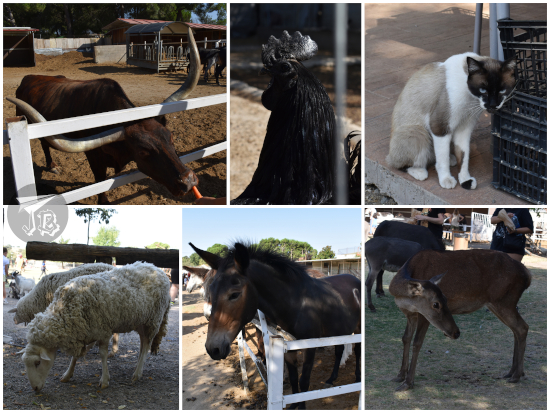
The rescue is located at the end of a pretty run-down road in Tres Cantos, a municipality so close to Madrid that it could be a neighbourhood. The venue itself is mostly an open area where the resident animals get to interact with visitors, many of them freely. Besides the donkeys, mules and hinnies that the association has taken in, there are horses, a pony, goats, sheep, pot-bellied pigs, hens, geese, ducks, peafowl, helmeted guinea fowl, a deer doe, an ankole-watusi cow, a few dogs and a cat. Burrolandia is open to the public on Sundays, usually in two two-hour turns, one at 10:00 and the other at 12:30. Visitors can buy a bag of goodies to feed the animals for a nominal price to support the non-profit, get merchandise, or directly donate.

Donkey, goat, hinneys and mules, horse

Cow, black rooster, cat, sheep, hinney, deer

There are fewer visitors in August and it was easier to get tickets and for the day, there was only one long timeslot from 10:00 to 14:00. We arrived a few minutes after opening time, and I was surprised at how high “low demand” actually was. There were maybe twenty to thirty cars already there, with a ton of families with toddlers and kids going nuts about… the dogs, in most cases. Most kids were terrified of donkeys, though they were smaller than I had imagined. I would have expected them to be closer to a horse size, so I think that most of what I grew up considering “donkeys” were mules. Live and learn…

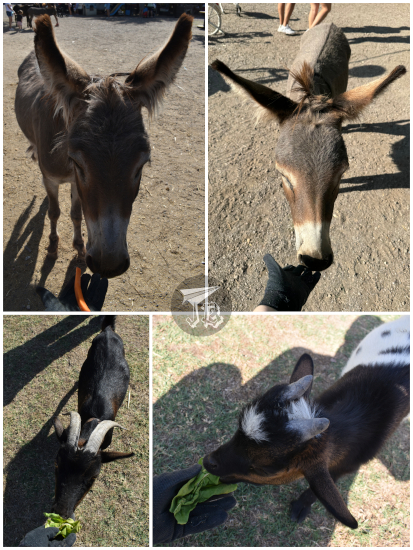
Burrolandia bans bringing food for the animals – both to control what the animals are fed, and as fundraising tool. We bought a bag of veggies, which contained mostly carrot, celery, some lettuce and a piece of dry bread. The donkeys, goats and sheep were all ambling outside, but most the mules, hinnies and horses were in “donkey jail” behind the fences. You could still feed them though, but they are bigger and possibly less docile than the smaller donkeys which roamed free. They were all very acquainted with the brown paper bags with the treats though, which made them very friendly. In general, I was reminded more of the Okunoshima bunnies than the Nara deer, even if one of the mules did get a bite out of my finger, and the baby goats kept trying to climb onto us. My sibling had the great idea to use some of their riding gloves to pet and feed the animals.

Feeding donkeys and goats

We stayed for about an hour and a half, and then moved on to Las Rozas de Madrid, another village in the area known for nothing except for the high-end “open shopping mall”, a street full of outlet brand-fashion boutiques selling discounted items. I had heard on and on how fantastic Las Rozas Village was. There are specific bus tours from Madrid that take tourists to the mall and back.

We parked the car in another shopping centre, Heron City Las Rozas, where we changed clothes and shoes because… we did not trust ourselves with the barn smell. We walked into the Village, and I don’t know what I was expecting, but for sure something with a big more… grandiose I guess. To my surprise, the shops were almost empty (both of produce, and customers) and every second shop was a Scalpers… I have to say I was quite underwhelmed. We did not even find a nice place to grab a bite to eat. Furthermore, I heard at least three other people commenting the same thing – they had heard a lot about the mall and it was disappointed.

Entrance to Las Rozas Village

We ended up having lunch back in Heron City Las Rozas. We found a Japanese chain restaurant named Sumo, a sort of buffet with a flat rate for a number of dishes. Since it was still quite early – and again, August – the place was mostly empty – we had sushi, takoyaki, wakame salad, and some gyoza. As dessert was not included, afterwards we went to Starbucks to have a matcha drink, named after a House of Dragon character for some publicity stunt – Dracarys Matcha Frappuccino. It was a cold matcha latte with white chocolate cream on top, to which I added some vanilla, just because I could, and it was a great idea. I think the matcha with strawberry cream on top was a better combination, but apparently that one was only available in spring. I guess I’ll have to try the standard Matcha Frappuccino at some point.

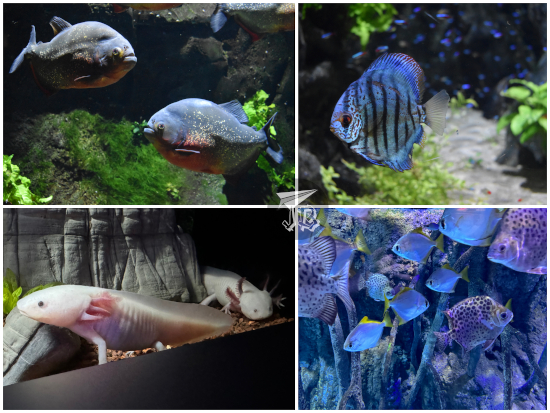
We went on to our last stop for the day. Xanadú is a shopping mall in Arroyomolinos, home to Atlantis Aquarium Madrid, a smallish oceanarium. Upon entering, you go down some stairs, and the first area are Rivers and Mangroves, with some mudskippers, and cute shiny fish. Actually, the first tank the visitor encounters hosts a shoal of red-bellied piranhas (Pygocentrus nattereri). Of course, there are a few axolotls (Ambystoma mexicanum) too.

Piranhas, discfish, axolotl, mangrove fish

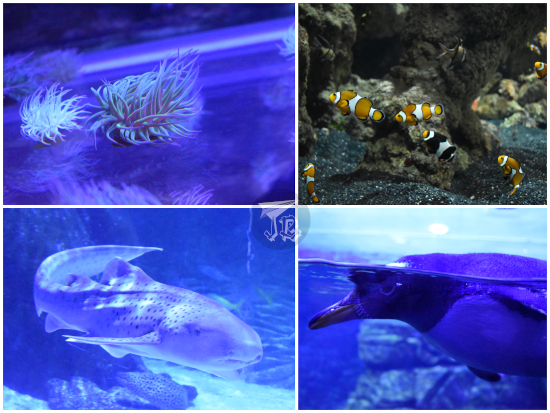
Then come the Mediterranean anemones, jellyfish, starfish… Afterwards are the Tropical Reefs with the usual suspects – who does not try to find Nemo among the clownfish? There are also butterflyfish, surgeonfish, and of course all the corals. The Open Sea area, a typical central tank, has few species of sharks – blacktip sharks, grey reef sharks, bonnetheads, longtail carpet sharks… There are also rays and loggerhead sea turtles. In between the different views of the central tank are the penguins, which were pretty photogenic! The last area had a few small tanks with Coastal Ecosystems – anemones, sea cucumbers and hermit crabs mostly. Staff had put out some glass shells for the latter to move into, which was fun.

Anemones, clownfish, shark and penguins

Atlantis: hermit crab and sharks

The gift shop had a lot of cute souvenirs, and afterwards we walked around the rest of the mall for a while, had a smoothie, and eventually drove off. It was a good day, with lots of cute animals, some of which I even got to pat. Not the sharks, sadly, but I made a lot of donkey friends, even if they only liked me for my vegetables and stale bread.

24th February 2024: Feria de las Mercaderías de San Matías 2024 (Tendilla, Spain)

Going to the Medieval Fair in Tendilla around the festivities of Saint Matthew’s Feria de las Mercaderías de San Matías seems to have become a tradition. Though they close off the village to traffic, I know the area well enough to know where to ditch the car so I can get in and out easily. Since last year, I’ve been driving in early on Saturday, before the scheduled events start so I can help out with the shopping for the day – there’s the tradition of cooking breadcrumbs, migas at my relatives’, and it’s a big meal, so we usually need to get some last-minute stuff.

The weather forecast was miserable – and there was the risk of a huge storm like the previous day, so this year there were fewer stands and visitors. That, in turn, meant I ran into many more acquaintances than usual, as it was harder to blend in…

After getting everything ready, we left the house around 11:30 to walk around the already-set stands and look at the communal migas. There was not much of interest on display. We walked into the women’s association ladies, giving out confectionery items, and we tried those. A bit after noon, the opening parade set off, with musicians, dancers and giant puppets.

Opening parade

Then we found a place at the edge of Main Square Plaza de la Constitución, to watch the equestrian show by the group Caballeros del Alarde, called Privilegio de Juan II de Castilla. It was very similar to the one they did in 2023 – they make sure that the square is covered in sand and prepare two U-shaped courses and they do different activities on the horses, trying to emulate a joust. At the end, they brought out a small hawk – which they called “fat” – so it got used to people. During the show there was a few minutes’ worth of hail, nothing serious. It was chilly all through the day, though.

Stuntment doing horseriding exercises

Afterwards, we went home to make lunch and we happily ate our migas – breadcrumbs seasoned with paprika and fried with garlic and minced chorizo, with a sunny-side-up fried egg on top. Some people like eating them with grapes or orange bits, but I just like them “plain”, so I ate the fruit later.

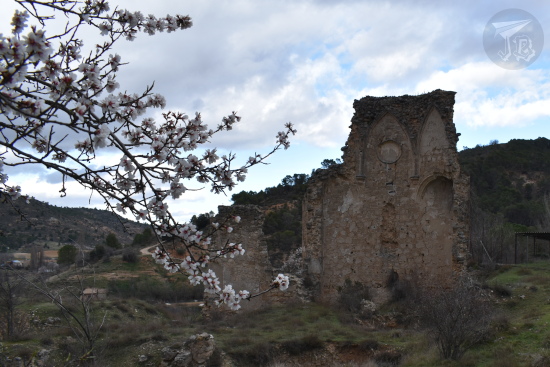
Once fed, family needed to entertain some guests and I made myself scarce. I headed out on my own, and I went to see the animals at the exhibit at Plaza de Vicente Mariño. It was still early and bright, so I decided to climb up to the ruined monastery Monasterio de Santa Ana. As spring was nearly upon the village, the almond trees were in bloom despite the cold, and it was really pretty.

Animals at the farm exhibit - A rabbit, a horse, an ox, a goat, two geese, a pig and a herd of sheep

Saint Anne's Monastery with flowers in the foreground

I went back home and we decided to show up to the “guided visit” that the town hall organised. Right now, this is the only way to see the recreation of a traditional house that has been built in the ethnography museum Museo etnográfico. It made me feel old, because there were a lot of things that I was used to seeing – and using – when I was a kid. However, the guide was… not too good. She even said things like “oh, I’m not rural, I wouldn’t know what that is” about some items.

Afterwards, we tried to find a good spot to watch the parade-show by the cultural group Asociación Gentes de Guadalajara, which started after dusk. They played the funeral parade for the Count of Tendilla Cortejo fúnebre con el catafalco de D. Íñigo López de Mendoza, I Conde de Tendilla. Born in the Mendoza family, one of the most powerful clans during the Castilian Middle Ages, he was a politician and warrior. The Count participated in the power struggle before Isabel I was proclaimed Queen of Castile. He died in 1479, and was originally buried in the monastery Monasterio de Santa Ana. Later, his tomb was relocated to Guadalajara, and eventually destroyed during the Civil War. The whole thing was very solemn, and we ended up catching the parade at three or four points. We even could catch part of it from the balcony at home as they turned to “bury” the Count in the church.

Burial of the Count of Tendilla

We went back to the square Plaza de la Constitución to watch the last show of the day – by now dark night. It was supposed to involve the Knights Templar arriving, and then dancers and jugglers, but apparently the Templars got lost. A lady danced with fire, and there was a scuffle with fire swords, but no knights. That was a bit of a bummer.

Jesters at the Medieval fair

Afterwards, I went to find my car and drive back before all the Sunday drivers finished having their dinner and left. I hoped that would mean fewer idiots on the road. Unfortunately though, I still could not avoid the stereotypical idiot using full-beam headlights behind me. It seems there is always one of those when I drive at night.

21st September 2023: Puy du Fou España (Toledo, Spain)

Puy du Fou is a project which started in France in 1977, when Philippe de Villiers decided to create a show in the ruins of a Renaissance castle in Les Epesses, a village about an hour away from Nantes. Initially, the show, named Cinéscénie was not too successful, but it increased in popularity as spectacular elements with horse riding and sword fighting acrobatics were added. A theme park was built around the show in 1989, and the venture went on to become one of the most popular parks in France, after Disneyland and Parc Astérix. Between 2019 and 2021, the French project was exported to Spain and turned into Puy du Fou España, located in the central city of Toledo, one of Spain’s most historical towns. Toledo is close enough to Madrid that the park can be visited on a day trip from there, and the land around it were probably on the cheap side.

Regardless of the logistics, Puy du Fou España markets itself as a historical theme park. It does not have rides, and instead, it focuses on shows, restaurants and shops. There is a day-ticket and a night-show ticket and we combined both on the same day. We reached the parking lot about twenty or thirty minutes after the park opened and had to walk for about ten minutes until we reached the entrance. We had booked a “fast pass” called Pase Emoción, which guaranteed access to all the shows at specific times, and the walk-throughs without having to queue. We had also reserved lunch, though by the time we bought tickets, the lunch-show was already sold out – we knew we risked this, but the weather had been unpredictable, and we did not want to be caught in a bad storm so we waited until the previous week to decide. While we did have some drizzle during our visit, it mostly found us indoors, so aside from the hassle of putting the camera out and having to pull it out again (and again, and again), it was not a real problem.

Summary of bookings (times three; four tickets per person):

  • Experience 1 day: Park + Night show: Parque + El Sueño de Toledo Ubicación Plata – Entrada 1 día Adulto, 68.00 € (non-weekend, non-high-season price) separated into:
    • Park ticket: Parque 1 día Adulto, 27.20 €.
    • Night show: Espectáculo Nocturno “El Sueño de Toledo” (best seating available), 40.80 €.
  • Fast pass: Pase Emoción, 20.00 €.
  • Lunch: Menú Hospedería de Santiago – Adulto (first course, second course, dessert and drink, saving a couple of bucks from the on-site price): 22.05 €. We decided to book lunch because we thought it would be harder to find a spot, and that for dinner we could grab a sandwich or something. In the end, we had a snack and a drink in the evening, which came up to around 11 € / person, bringing the total spent in the park to 121.05 € (no souvenirs, no extras).

We visited the park on a September Thursday, so we were not expecting many people. The first surprise was the number of buses in the parking lot – yes, there were quite a few people, though not “crowds” as no doubt they have during summer season. We were directed to the private-car parking lot, on the other side of the area and closer to the entrance, but we were “late” enough so that eight double-lines of cars had already been filled. We walked the kinda-long road to the park and picked up our fast passes, which were already prepared on a lanyard, and we were given times for four shows, along with the two others to do “whenever”, which turned out to be walk-throughs.

Thus, according to the bookings and the pass, we had the following schedule and in theory no queues:

  • 12:45, show: A pluma y espada.
  • 14:00, lunch at Hospedería de Santiago.
  • 15:45, show:El Último Cantar.
  • 16:30, show: Cetrería de Reyes.
  • 17:30, show: El misterio de Sorbaces.

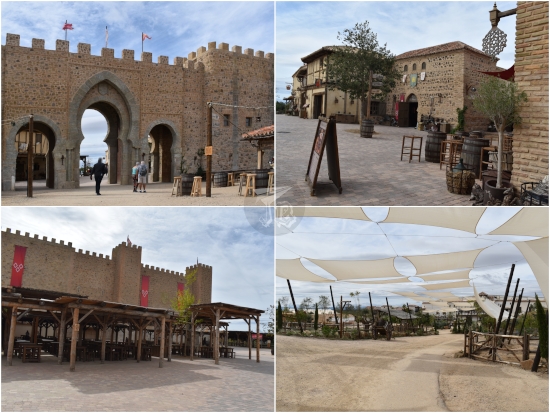
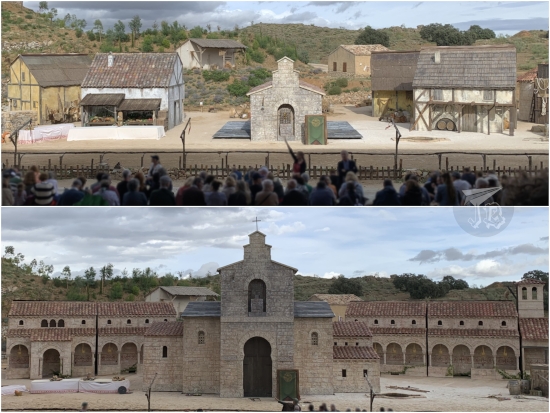
Puy du Fou España Historical Village Puebla Real

The park is organised to look like a Medieval village – castle included – with both Christian and Moor flavours (using the word “Moor” to refer to the different Muslim groups that populated Al-Andalus in the Middle Ages). the different shows are scattered throughout the park and there are small clusters of shops, restaurants or activities. The distances are long and though there is some protection, it would not protect from rain nor sun / heat. There were “watering points” but no fountains at them? I think that’s where people selling water bottles stand in summer. I probably should have done more research on the whole thing, but I was just tagging along someone who really was curious about it and I was happy to let them take over the organisation. Instead of wandering around a little, they decided to go inside the theatre that hosted the first show almost at the time doors opened to let people without the fast pass in. Thus, we waited for about half an hour until the show started.

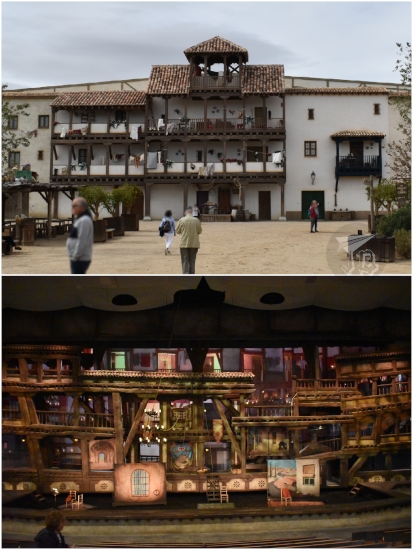
A pluma y espada, “With quill and sword” is an adaptation of one of the French shows, about Musketeers. That makes more sense than the Spanish version – which follows 16th-century playwright Lope de Vega as he tries to foil a conspiracy to kill the king. The stage changes from an open theatre to a prison, to a ship, to the roofs of Toledo as scenes follow one another. After the happy ending, there is a pretty ballet / flamenco dance on the water, along horse riding, which was really cool.

Theatre exterior and stage

We went out and our designated guide got lost, getting us into the complete opposite direction from where he wanted to go. We finally turned around and found our way, though it started raining. We decided to try our luck in the restaurant to see if we could grab lunch early, and we were lucky enough to do so. Actually, we had to be in the restaurant 10 minutes before the reservation, but we had to queue because a bunch of groups before us had issues ordering and understanding how the restaurant worked – never mind that it was easy: flat rate with a choice each from three first courses, three second courses, three desserts, and one drink. Finally, we reached the front of the line and found our table, got our lunch, and sat down.

The food was okay, though value-for-money was a little on the low side (captive audience and all. Though you can take your own food into the park, it might just not a good idea to carry a heavy backpack considering distance and queueing). I had a goat-cheese salad with honey-mustard sauce, a vegetable parmentier – which had pepper instead of the announced mushrooms and upset my stomach for a while – and rice pudding.

In general, the park feels too big, probably with the idea of filling it up as the park generates revenue (though I’m sure that when it’s crowded during summer season it does not feel as empty). My impression that I had was that as long as you were lucky and everything ran smoothly, it would be okay, but anything going wrong could ruin your experience. Just a couple of weeks earlier, the park had to be evacuated due to torrential rains, and people complained about being denied refunds. We would have a little inconvenience later.

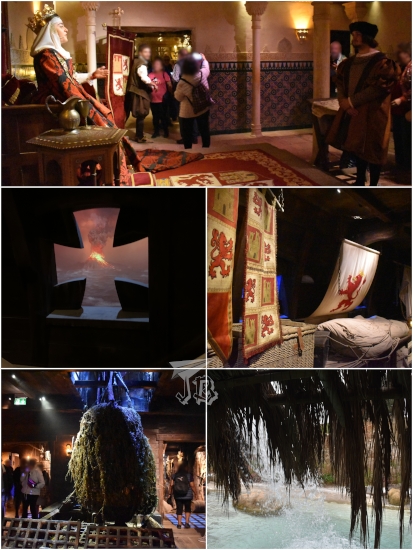
After lunch it had almost cleared, and we headed off to Allende la Mar Océana, “Beyond the Ocean Seas”, which is a walk-through. You “enter” a medieval palace to see Queen Isabel I of Castile (Isabella the Catholic) meeting with Christopher Columbus, as the latter convinces her to fund his expedition to the Indies. Then you get to see different stages of Columbus’ trip with a fictionalised voice diary, with the most important stages: setting sail, navigating near Tenerife, where one of the volcanos had erupted, losing hope in the Sargassum Seas, and finally reaching America – complete with Amerigo Vespucci crying “land ahoy” and walking out to a paradise beach with white sand and palm trees. Some of the areas have live actors interpreting scenes. Not too impressive, and too many people decided to get in the way of my pictures, However, the queen smiled at me.

Puy du Fou España Allende La Mar Océana

We had time to check out the other walk-through De tal palo…. The Spanish expression de tal palo, tal astilla means “like parent like child” or “the apple does not fall far from the tree”, literally “from this stick, that splinter”. The idea is to stop to listen to different generations of the same family which have partaken in key episodes in the history of Spain: the resistance in Numancia against the Romans, Medieval clashes between Christians and Moors, and so on. It was probably the weakest show, but truth be told my companions were not really in the mood for it, and we ended up seeing only two complete tales, and two halves. The rain stopped around this time, too.

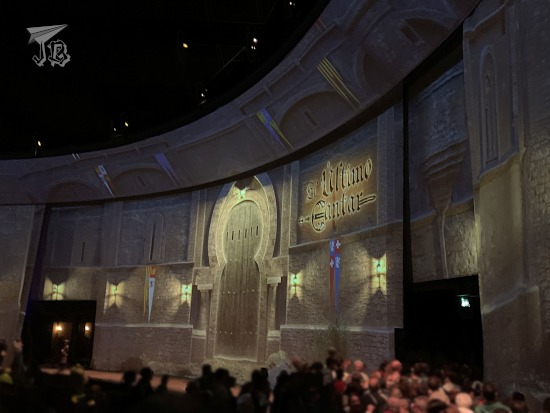
Afterwards, we backtracked to El Último Cantar “The last Song” or “The last Romance” which tells an extremely sanitised story of one of the warlords of Medieval Spain. Rodrigo Díaz de Vivar, El Cid, was a 10th-century mercenary whose life was later composed into a book-long romance. He’s sort of the classical hero of Spain, with an extremely idealised view – imagine, this is the first compulsory book to read in school when you’re around 10. The show was even more romanticised. It was held inside, in a circular stage, and the stands turned to face the different scenes. It had work with horses, and even sort of a just. The problem was that this show finished past 16:15, and we had to be at the exact opposite side of the park before 16:30 (16:25, as they closed the doors). My companions told me to make a run for it, because they knew it was the show I’d be more keen on. I literally ran halfway through the park and made it just before doors closed – the person managing entrance was extremely rude, too.

Puy du Fou España El último cantar stage

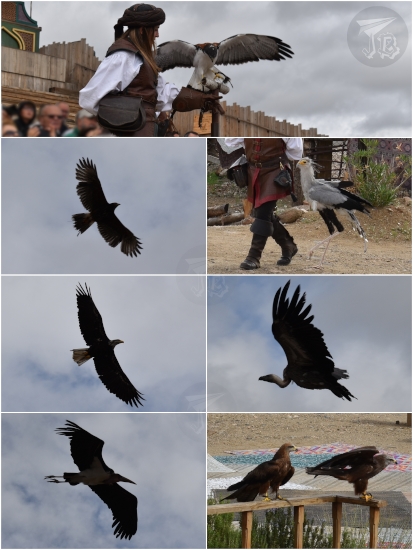
This show was Cetrería de Reyes, “Kings’ falconry”. I did not follow the plot much, to be honest, I was focused on the birds. It is supposed to be an encounter between a Muslim king and a Christian knight during the Middle ages, and they decide to… measure each other up by showing off their birds of prey. There are barn owls, sparrowhawks, caracaras, falcons, eagles and griffin vultures trained to attack on command, fly to specific places, and “hunt” mid-air. More exotic species include a secretary bird (Sagittarius serpentarius) and a marabou stork (Leptoptilos crumenifer) which were cool just for being there. At the end of the show, they let out a lot of the flying birds that flock all over the show. It was really cool.

Puy du Fou España falcorny show

I got to see the whole show since I sprinted. The other two people were lead in later, as most of the fast pass holders did not make it. They were admitted in small groups around one third into the show. It felt like really bad organisation, to sell something that is almost impossible for most of the pass holders. Furthermore, at the end, we were ushered out through different gates, and could not meet up amidst the crowd. We reunited at the final show.

El misterio de Sorbaces, “Mystery in Sorbaces”, tells a fictionalised tale of how the king Recaredo I, the first Visigothic King in Hispania who converted into Roman Christianity in 587. His brother marries a Roman girl in a Christian ceremony, and the festivities include a lot of horse riding acrobatics. Then the goths come to destroy the village, but they are stopped by the “miracle” of a chalice turning a pond into fire. Recaredo converts and the whole stage is turned into a monastery. Besides the horse riding, the background moving and changing, and the fire special effects are the more impressive thing of this show.

Puy du Fou España El Misterio de Sorbaces initial and final stages

We just hung around the park a bit longer for a while after that. The shops were pretty expensive, and though the eagle plushies were adorable, they cost too much money. So were the handwritten scrolls, even though they were fantastic. We grabbed supper in one of the fast food restaurants – a toast and a drink, a bit on the unremarkable side. Finally, we set off towards the outdoor theatre for the night show El Sueño de Toledo, “Toledo Dream”. It was getting cold so people were waiting in the corridors of the theatre, then the staff kicked us out to line, and they created a bit of chaos – despite assigned seating. They wanted guests to be there with an hour’s time, and in the end we had to wait around 50 minutes until the show started, in front of a backdrop of the city of Toledo. We had paid extra for “silver” tickets, and I was very surprised how they were spaces that I found much better, but were not considered “silver”.

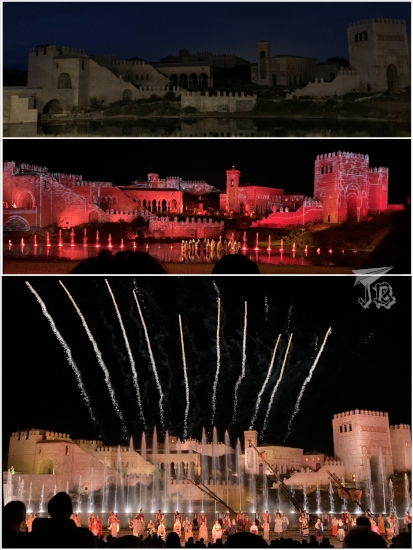
As the sun sets, the story starts with an old water bearer coming in – he represents the memory of Toledo as a metaphor of the history of Spain. He comes and talks to a young lady at the gate of the walled town, and together they reminisce about the key episodes of Spanish and Toledo’s history. The first stage is the Moors leaving town to battle the Christians in Al-Andalus (though Toledo probably existed before as a Roman encampment, it was the Umayyad civilisation who made it great). The Christians attack the town and conquer it, then lose it again. When they once more enter the town, one of the churches has kept a candle burning in front of a walled-off crucifix (famous Toledo legend). The show is presented with lots of light, acrobatics, horse riding, and dancing, even on the shallow water that forms the stage. The sultan’s glass palace comes out of the water, and the cathedral is created with water spurts and light effects.

Time passes. The Catholic monarchs receive Columbus back from America and his ship also emerges from the water. The revolt of the Comuneros comes and goes. Toledo loses its importance and becomes a town of farmers. Then the Napoleonic armies ride in on white horses – the men walk into war and are killed, and the women take over from them. Peace comes, prosperity: the 20th century, the train, the Roaring Twenties – and then the Civil War in the 1930s. The singing girl cries out that her brothers killed each other in battle. In a final dance of hope and healing women dressed with the traditional attire of the different autonomous communities come and dance with her (a bit… dismissive… considering recent events and tensions). Then instead of ending in a happy note, everything goes downhill as the water bearer claims that he is a dream and he’s fading away and the children won’t hear of him and the stories he has to tell, as the whole cast comes to wave goodbye – and it’s about 200 of them, not counting horses, sheep, goats, oxen…

Puy du Fou España night show El Sueño de Toledo

When it was over, we walked back to the parking lot and drove off. It was a bit chaotic and we ended up going in the opposite direction we wanted to – because there was nowhere to turn around until we reached the motorway. We drove to the hotel and crashed in the rooms. If we had been just one floor or two higher, I would have had awesome views of Toledo, but most of it was hidden behind trees.

All in all, the experience was okay – for one time. The price was steep, not even counting petrol and accommodation. I have read online that people go back four or five times, I don’t get the need to do so, even if I know that we missed most of the street shows. We were pretty lucky with the weather, because the park is not prepared for either heat nor heavy rain – and Castille is known for its scorching summers and its temperamental thunderstorms.

The next morning, we had breakfast – hotel was good, but the breakfast there was quite expensive, so I had brought some canned coffee and pastries. We drove back without much traffic, making this a 24-hour-ish adventure. Maybe it would have been cool to try the spa at the hotel, but driving back later would have meant running into the heavy traffic around Madrid at the start of the weekend, and we preferred not to do so.

25th February 2023: Feria de las Mercaderías de San Matías 2023 (Tendilla, Spain)

In 2022, some relatives who spend the weekends there talked me into visiting the Medieval fair in TendillaFeria de las Mercaderías de San Matías. It recovers the tradition of the cattle fair around St. Matthew’s day, and today it is one of the yearly highlights of the village. The historical roots of the municipality as an important villa in Medieval times can be traced to the Second Count of Tendilla, Don Íñigo López de Mendoza (1442 – 1515). He accompanied the Catholic Monarchs in their conquest of Andalusia and was later named “governor” (of sorts) of Granada once it was won for the Kingdom of Castile.

I once more arranged to attend the fair in 2023, and I drove off early in order to secure a decent parking spot as the core of the village gets closed off to traffic. Tendilla is laid out along a former main road, which used to work as a separating axis. Today, traffic has been diverted and circumvents the whole village, and the axis has been renamed as two streets: Calle del General Muñoz y Muñoz from the beginning of the village to the town hall square, Plaza de la Constitución, and Calle del Alférez Agudo to the end of the village and the “former fair square”, today the square Plaza de Vicente Mariño. Along this axis, rows of stands on both sides of the street, selling crafts, trinkets, traditional products and foods, and so on. Tendilla is known for its torreznos, processed pork lard snacks, so there are many of them on offer.

The typical food at the fair is migas, a dish made out of toasted breadcrumbs and several toppings. Traditionally, migas were made from stale bread by semi-nomadic shepherds back when it was common to move livestocks from one area of Spain to the other according to the season (transhumance). The town hall organises a collective cook-out of a simplified version for the attendants, just the fried breadcrumbs with paprika and garlic, topped with the famous torreznos. Though there are endless variations of the dish, the local tradition calls for breadcrumbs, paprika, garlic, and minced pork, topped with a fried egg, and sometimes some fruit.

We were going to prepare our own complete version of the migas, so the first goal was securing some minced chorizo, called picadillo from the butcher’s. We also bought some torreznos for later. Then, we started wandering the village – literally up and down from one square to the other – to see the stands and catch all the events. Although it was rather cold, it was sunny and not windy, quite pleasant once you were wearing enough layers – I had actually brought some extra ones that I did not end up needing.

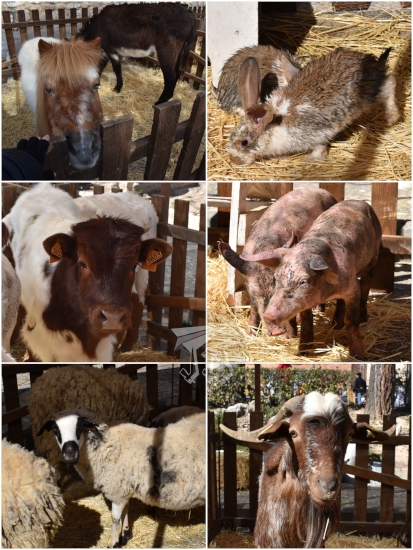
At 11:00 the “farm” opened at Plaza de Vicente Mariño – this is the closest activity related to the origin of the fair, a cattle trade event. There were horses, ponies, donkeys, cows, goats, sheep, piglets, and fowls… I might have remembered a little too late that hay causes an allergic reaction these days. Across the street from the farm stood a huge BBQ grill and some watering holes – I guess that to place the roasting pork just in front of the living piglets is part of the village’s twisted sense of humour. Desensitising kids, or what? One of the funniest things around this area is hearing people squealing at the animals, especially at the piglets – there are a lot of “urban people” in the fairs wanting to “experience country life”, who have never really seen a farm animal in their life and are thoroughly impressed – and end up saying hilarious things.

Farm animals - pony, rabbits, white-and-brown cow, small piglets, sheep, a cheeky goat

At 11:10, we caught the Opening Parade took place, described as musicians, jugglers and knights walking along the streets. It featured a dancer, a small group of musicians, and the members of the horse riding school Caballeros del Alarde.

Collage showing a female dancer followed by three Medieval musicians; two horse riders, one in full armour and the other one dressed as a nobleman from the Middle ages.

After the parade ended at Plaza de Vicente Mariño, we went to check on the communal migas, and say hi to the guys preparing them. They had prepared a bonfire and a huge pot to toast the breadcrumbs, and fought off the cold with beer and wine.

A huge pot with orange breadcrumbs being cooked

There was a second parade at 12:10, this time the official inauguration one. Aside from the musicians, dancers and horse riders, walkers included the authorities, ladies in Medieval clothing, and giants. They walked from the town hall square Plaza de la Constitución to the migas cook-out. With this, the festival officially kicked off.

Parade. Three musicians playing Medieval instruments. Three giant puppet-like giant costumes; men and women dressed as Medieval nobles. A moorish-like kight on a white horse.

I followed the horse riders Caballeros del Alarde back to Plaza de la Constitución where they started practising for their later show. They are part of a horse riding school which carries out several activities, Medieval riding is one of them, along with horse training, archery, and shows in Medieval fairs and markets. For this event in particular, there were six riders – five men and one woman – with two bay and two white horses. One of the bay horses was not in the mood to cooperate though, and got easily spooked.

The show happened from 13:30 to 14:30. It was an exhibition of Medieval horse-riding – while horses galloped through, different different tests carried out – spearing a bale of hay, hitting a metal shield, catching a metal loop with the sword, then cutting off a carrot… There was also a bit of a staged scuffle, swashbuckler-style. The emcee made it sound like the whole show was an exhibit to train for an upcoming jousting contest (in the evening) and the riders would later compete for a pouch full of gold maravedis – Medieval Spanish coins. The show itself was pretty fun and impressive to be honest – the riders had to control the horse in a crowded and small area, full of bystanders and noise, and do the activities with a very high level of success.

Shots from the horse riding exhibit - one of the riders galloping, another spearing the bale of hay, two riders sword-fighting; The female rider, wearing bright blue, with a long spear.

After the horse show, we went home to prepare the traditional version of migas – we fried some minced chorizo, garlic and paprika, then worked the bread on the stove. Finally, we fried the eggs (sunny side up) and the food was ready! Not that we stayed down for long, soon after finishing our late lunch we went out again to find a good spot to watch the jousting at Plaza de la Constitución.

Preparing the migas - frying mincedmeat, then the garlic, then the paprika. Breadcrumbs just poured, still white, then cooked and looking bright orange. Finally, a dish with a sunny-side-up egg on top of the migas.

We walked around the square and realised that there was not really a good spot though because the square was too small and set in a way that anything the riders did, their right hand would be towards the inner area of the square. So whatever they did, the view would be obstructed by flags and décor. And the best viewpoint was actually taken by the sound equipment – which ended up malfunctioning anyway…

Before the tournament started, a sword was brought in as a present to the village. Because the sound was so horrible, I did not completely get the significance of it – it was supposed to have been donated by Queen Isabel of Castile to the village. The program said that there was going to be a forged sword at some point, so I thought it was that one.

A woman parading a Medieval sword, and a group of horsement behind her

This time there were only five riders, apparently one of them had been hurt at a previous exhibition and was not ready for the whole competition. The show itself was all right though – the emcee presented the best rider as a bit (or a lot) of a cheater, and he hyped a lot of “girl power” vibe around the female rider. The riders competed on tests in pairs, again spearing, loop catching and carrot-cutting. The “cheater” won in the end and the maravedis were distributed among attending children, as apparently the coins were not legal Medieval currency but plain old chocolate. They tried to do an archery exhibition too, but the square was too small.

Scenes from the jousting, showing horses and riders as they take the different tests with swords, spears and the to-be-cut carrot.

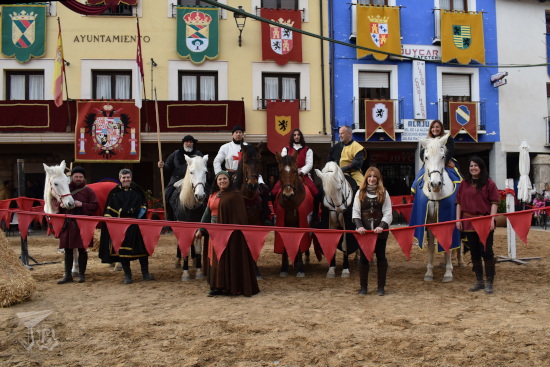
There were much fewer people for this exhibition since it was later in the evening (17:00) and because the evil-looking storm cloud just above our heads. Thus, this time, when the riders offered if someone wanted to take a picture on one of the horses, I got myself up a white Pure Spanish Breed warhorse, which was really cool. Then, the group asked if someone would take a picture of them, and I offered to do so.

All the horse-riding school performers, in character, both on horses and on foot, pose for the picture. They are all dressed in Medieval clothes and smiling.

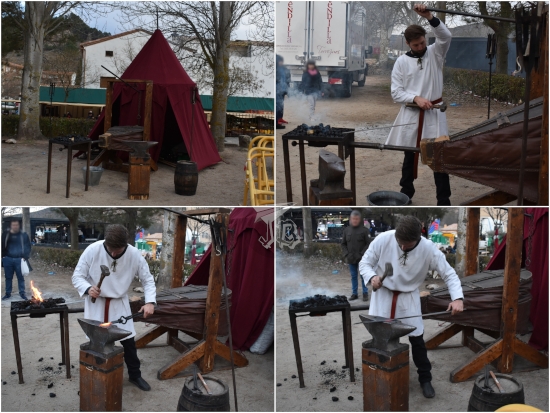
We went to see the campsite afterwards, with different things that could have existed in Medieval times. One of the most interesting things was the forge, with the blacksmith at the ready. I hung out around the smithy for a while and as night fell, the sword started to take shape. I realised later that this was the sword that was going to be forged for the village, and not the one I had seen before the jousting.

A blacksmith hammering down metal to forge a sword and a guard.

I don’t know whatever happened to it, because I eventually moved away to find the final parade, in which a group of villagers dressed up as Moors from Granada, either friends or foes of the Count. The parade was lit with torches, and ended at main square Plaza de la Constitución again. There were also jugglers, fire-dancers, and some more swashbuckling. They also made a queimada, a distilled spirit with “magical powers” flavoured with herbs, cinnamon, sugar, herbs and coffee beans. A spell is usually requires an extra spell as it is prepared. While I would have wanted to try it, I did not dare do so before driving…

Collage of the final parade. A group of people wearing flashy red and gold clothes carrying torches. A woman dancing with fire torches in her hands. A man and a woman fighting with swords on fire. Two men dressed in Medieval attire on war horses.

A bit after 21:00, after roughly 12 hours of “fairing”, I got back on the car to drive home with a basketful of food and good memories to drive home before the temperature went below zero again. Only when I was home I realised I had not even taken my scarf off, and that it still had straw on it from the farm – which quite probably did not help with the allergies.

26th February 2022: A Medieval Fair in Tendilla (Spain)

Tendilla is a tiny village in the area of Guadalajara, Spain. It was declared a town – by Medieval standards at least in 1394. About a century later, the County of Tendilla was founded. By that time, the local cattle fair, around the festivity of St. Matthew, was considered one of the best in the Kingdom of Castile, with the Catholic Monarchs bestowing their blessings on the town. Among the most interesting areas are the long covered arcades, and the unfinished church dating back from the 16th century, Iglesia de la Asunción.

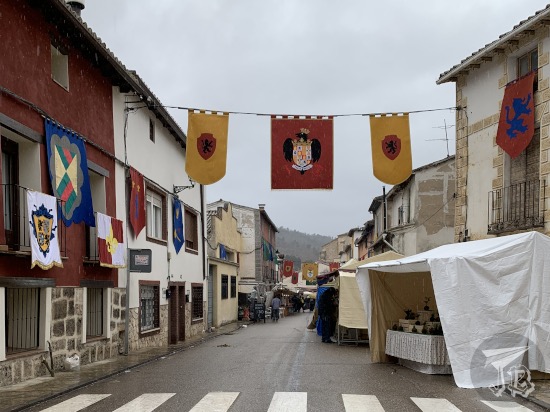
The cattle fair was rekindled in the 1990s, and today it is called Feria de Mercaderías de San Matías. The closest weekend to the 24th of February, St. Matthew’s day, a Medieval market is laid along Main Street, with edibles, trinkets and artisan items. The village becomes decorated with flags, pennons showing off real and assumed heraldry items.

This year, I decided to get there as some family members were going to be in the house they own in the village. I arrived at around 10 am, and by that time most the village was already full. I got deviated, but it was not hard to find a parking spot. Unfortunately the weather had not decided to accompany and it was rainy and freezing all day.

The fair stalls had begun to open, but first we made a run for the local grocery stores to grab some ingredients for lunch. The typical thing to eat in this time are migas, which are basically fried breadcrumbs with paprika, pork, garlic and a fried egg on top. We also bought sweets and confectioneries, just because we could.

At noon, we walked along Main Street Calle Mayor. The stalls were already open, and even in the bad weather there were quite a few people. Some were even in costume, dressed in Medieval outfits, as dames, knights or noblemen.

A wide street. There are flags hanging above and from the balconies, and shopping stands on the right. the sky is dark and heavy, as in all the pictures taken

A wide street. There are flags hanging above, and shopping stands on the both sides, selling hand-made jewellry and trinkets.

A Romanesque church with a bell tower. The church is unfinished.

Main square. It has a pole in the middle, and colourful ribbons run from it to the buildings around the square. The floor has been covered in sand, and the houses are decorated with flags. Lots of people walk around.

To the end of the village, a small “farm” had been installed – oxen, horses, cows, goats, donkies, sheep, rabbits, piglets… Due to the ‘health situation’ which for once was not Covid but avian flu, there were no ducks or hens or any kind of bird. You could hold the bunnies, but I really really wanted to hug the huge draft horses.

Farm animals: a donkey, two piglets, cows, rabbits, a sheep trying to eat the camera, a working horse.

Farm animals: goats trying to escape the pen, oxen ignoring the camera, a black-and-white cow wanting pets, and a working horse looking tired.

Someone had not really thought positioning carefully though, and right in front of the farm – and the piglets – stood the food stalls, especially a roaster, whose cooked pork was… suspiciously similar to the piglets in the farm *coughs*.

On the other side of the farm, the locals had started preparing the communal migas – every visitor is entitled to a plate of them, but it was way too cold to queue. Instead of being topped with an egg, though, they are sprinkled with torreznos, pork lard fried and preserved.

A huge barbecue with pork roasting and sausages. The barbeque itself is round, and it's big enough to fit at least a dozen ribcages, ten pork legs, and twenty or thirty sausages.

A person using a shovel to stir a huge pot of breadcrumbs being cooked, and a close up of the severd plate: orange-looking breadcrumbs with dried fried pork lard on top.

On our way back we ran into the horse parade and show, which was held in front of the town hall. The riders of El Duque Espectáulos, dressed in Medieval and Templar costumes, trotted and galloped along the music.

A group of medieval-looking horse riders making their way through the crowds

An older man making a golden horse trot and gallop on command, the horse is photographed mid-hop

Riders in medieval clothing galloping on the Main square

We stopped to buy some torreznos to take home, and we got given the tourist treat – a cloth bag with a huge box of fried pork skin. It is tastier than it sounds, honest!

A tote bag reading Tendi (the rest of the writing is obscured), with a box of torreznos inside

We had lunch at home, and not to show off, but I do think our breadcrumbs looked much better. We made them ourselves, with chorizo meat and eggs sunny side up! They looked so much better than the communal ones, right?!

A plate of migas. The breadcrumbs look golden, and there are pieces of pancetta and chorizo mixed with the bread. On top, there is a fried egg, sunny-side up

Finally, after lunch, we took another stroll, but the weather was miserable, raining and cold – which was so mean because the following day when I had to work it was nice and sunny, and there was a bird of prey exhibit.

Romanesque and Baroque buildings, deserted in the rain. One of them is a tiny hermit church, the other a column, and the third a palace that has seen better times

But all in all I spent a nice time with family and got to pat horses and goats. I guess there are much worse ways to spend a Saturday.

Walked distance: 6.20 km (9866 steps)