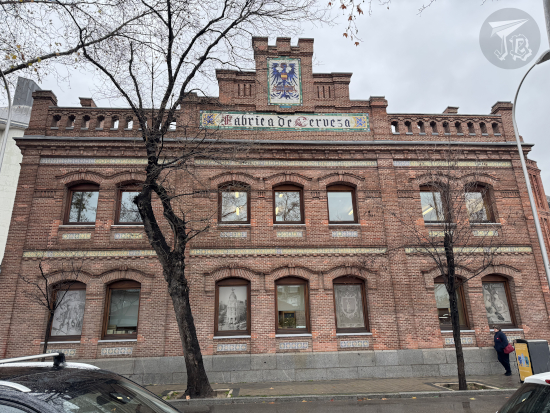
I had arranged to meet my sibling in Madrid for a late lunch when they got off work. Before that, I had a free morning that I could invest in checking out an interesting-sounding exhibition, and as it seemed that the weather was going to give us a small reprieve, I headed out on the train. Upon reaching town, I stepped out of the station and walked towards a former brewery, now turned cultural centre – Complejo Cultural El Águila.
The original brewery was established around 1900 under the commercial name “El Águila” (The Eagle), aiming to become one of the first large-scale beer producers Spain. The location was chosen due to the nearby Delicias station – then an important transportation hub, and the high quality of the water in Madrid – as apparently water is the key ingredient in the making of beer, even more important than the malt. The building was designed by Eugenio Jiménez Corera, in the Neomudejar style. It was expanded between 1915 and 1935 as El Águila managed to take over a quarter of the beer market during the 20th century. In the mid 1980s, production was moved to more modern facilities, when the brand was overtaken by Heineken. At the turn of the century, the factory buildings were repurposed into the Regional Archive, a library, and an exhibition hall.
It was raining when I walked in, and the security guard came towards me, looking annoyed. I said I was there for the toys exhibition and he directed me to the – very visible – signage. I thanked him even though I had seen the information. He came at me. I would have found my way on my own.
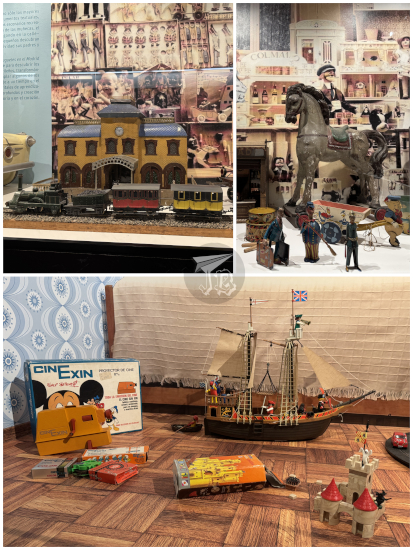
The exhibition ¡Me lo pido! Juguetes en el Madrid de nuestra infancia (I’ll ask for it for myself! Toys in our childhood’s Madrid) is a collection of classic toys, from the beginning of the 20th century to the late 1980s or early 1990s. While during the years after the Civil War toys were an absolute luxury, the 1960s saw Spanish urban society thrive. It became common amongst children to write their letters to the Three Wise Men (or the Three Magi, in Spanish the Wizard-Kings, Reyes Magos) with their gift requests – no Father Christmas then. Kids would also voice (still do) those wishes out loud using the expression ¡Me lo pido!. It’s difficult to translate it, but maybe it could be “I’ll ask for it for myself”. The “myself” is actually key, because it sets some sort of “claim” over the item somehow. It is a sort of spell that seems to ban all the other kids in the friends group from wanting it, or something. I guess that makes sense if you are five…
The Magi are actually figures in the Bible who present offerings to Infant Jesus in Jerusalem. In the Spanish folklore, each has a distinct personality and appearance – they are called Melchor, Gaspar and Baltazar. Melchor is usually characterised as Northern European with a long white beard, bringing gold to Jesus as King – he sort of resembles Santa Claus. Gaspar is supposed to be Persian and sports a gold-brown beard, he presents Baby Jesus with frankincense, symbolising his Godhood. Finally, Baltazar, the dark-skinned Magus, brings myrrh to the mortal man. For a decades, before the black population in Spain grew after the dictatorship, it was an honour for men to paint their faces black in order to portray Baltazar, who is the most popular of the Magi! Nowadays, Baltazar is usually portrayed by an actual black man.
All the items in I’ll ask for it for myself! Toys in our childhood’s Madrid belong to the private collection Colección Quiroga-Montes. They range from extremely high-end, such as the doll Mariquita Pérez and metal reproductions of vehicles, to the more popular like marbles or spinning tops. In the middle, the most famous toys throughout the century – the Meccano, Nancy, Disney stuff – and my absolute favourite, the Lego before Lego, Exin Castillos (which I still use to build castles when I am stressed out). There were also photographs, some chronicling the children outside their houses – staring at toy shop windows – some intimate, after the Magi had done their yearly job.
The whole thing was endearing and I loved every bit, especially the toys dating from my childhood. It was extremely interesting to see how toys changed from metal and wood to plastic all around. However, it was also a bit unsettling to see the rigid divide between “girl presents” and “boy presents” for so long, even more than “inside presents” and “outdoors presents” any more.
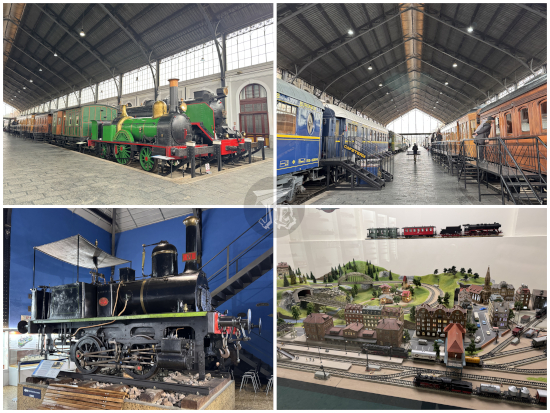
When I finished, I walked outside again. It had been raining hard while I was inside, but now it was cloudy but dry. I mentioned before that the brewery was near Delicias station. Today, the original station is no longer in service, but it has become the railway museum Museo del Ferrocarril, a project that was created to salvage the building. Madrid-Delicias was the first monumental station built in the city. It was however short-lived: inaugurated in 1880, it closed down less than a century later, in 1969. There is a widely-believed rumour that it was designed by Gustave Eiffel, but it was actually Émile Cachelièvre who drew the blueprints. The building was erected in iron, glass, and red and black bricks, maybe trying to echo some Neomudejar touches. During its prime, it was the terminus of trains that went to the west, including Lisbon, Portugal.
In 1984, Delicias became the Railway Museum, and it hosts a number of artefacts including whole tractors – steam, diesel and electrical – and cars, along with smaller rooms dedicated to specific pieces. The main ward, which would have made up the platforms, is occupied by real trains that have long gone out of service. The side rooms host smaller collections, either historical or thematic – such as the clock room, the infrastructure room or the model room. On the upper floors, the largest train model in the country is kept running when there are visitors to snoop around. There were many things to see that were closed off when I was in the museum for the flea market Mercado de Motores (despite no running mini-trains).
I had planned to stay for longer, but it was cold – the gates were open and the wind came through, so in the end, I decided to go wait for my sibling at their underground stop, which would be much warmer. I was lucky enough that I skipped the two downpours of the day though, as I was inside when the heavy rain came – twice.
Once my sibling was done with work, we rode the underground towards Le Chinois. This high-end Chinese restaurant advertises itself with a different name in Chinese [梦香楼 | Mengxianglou]. It claims, in Spanish, to offer a mystic experience that transports patrons to Ancient China. In Chinese, it asserts to seek authenticity before beauty in food, using the best ingredients. Either text sounds a bit pretentious, honestly, quite on par with the decoration. Everything is wooden and there is an actual dragon model running above the dining area.
We ordered a few dishes to share. We started with some dim sum – an assortment of small one-bite dishes, aptly called “Dim Sum Assortment” [点心拼盘]: Sum Siu Mai (猪烧卖; steamed, handmade dumplings with spring onion, charsiu sauce, and quail egg), Xiao Long Bao (黑猪肉灌汤小笼包; bao stuffed with Iberian pork and chicken consommé), Ha Kao (大海水晶虾饺; Steamed dumplings stuffed with tiger prawns and dehydrated bamboo) and Jiao Zi (牛肉饺子; Chinese garlic, sautéed with fresh ginger, carrots, and chives). We also ordered some Soft Shell Crab [椒盐软壳蟹] (crispy, battered, and sautéed with salt and pepper) and Rice Noodles (干炒牛河; Stir-fried noodles with black soy-marinated beef, roasted ginger, wok-fried free-range egg, and seasonal vegetables). I think – I swear none of the noodles description matches the dish we got. For dessert, we shared an selection of chocolates and tea.
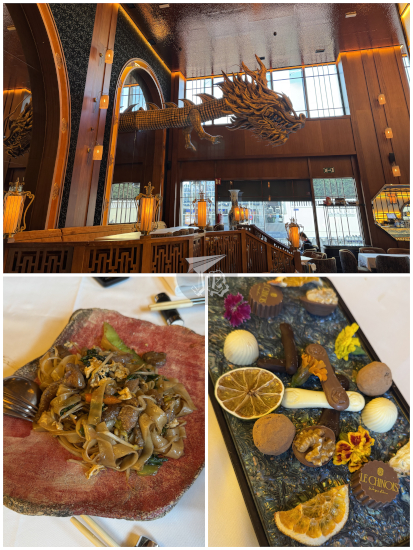
While the food was all right, none of it actually blew my mind. Furthermore, the experience itself did not feel up to par with the pricing, especially considering that the service was not that great. A beer slammed on the ground just next to us and splattered my coat – the staff only noticed when I cleaned it up. We ordered water, but they kept the bottle away and did not refill it as needed. We had to ask for it every time. All in all, way overpriced for “just okay” dishes, so I don’t think I will come back.
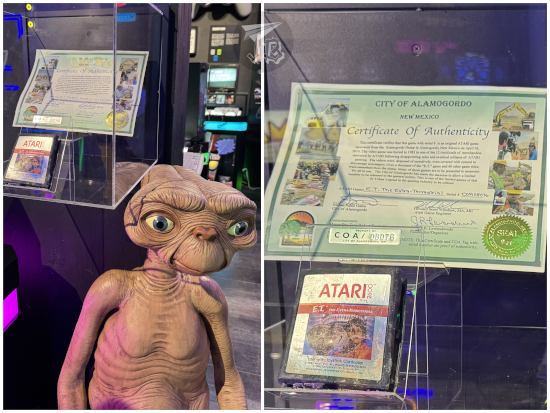
After the restaurant, I had booked a ticket at OXO Museo, the museum of video games. It features old-time games, arcade machines, and even a copy of the Atari ET video game. The game, released in 1982, was a massive failure. Urban legend had it that Atari buried all the unsold copies in the middle of the desert in New Mexico – and for once, the urban legend turned out true! A stash of games was found in Alamogordo, and a bunch of them (not only ET, also Pacman, Space Invaders…) and dug out in 2013. Around 1,300 cartridges were recovered, and one of then is exhibited in the museum.
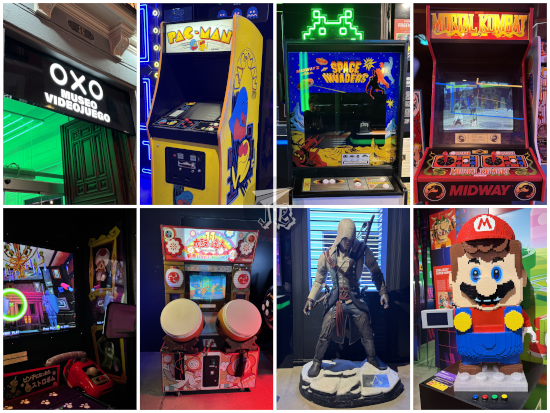
The museum is set up as 100% interactive – you can basically play with any video game in display – form the classics on arcade machines to the more modern Play Stations. There was even a taiko game. Decoration features sculptures and holographic displays. On the upper floor, there is a Lego and Video Games exhibition, where you can participate in creating a huge Sonic mural. It’s a pity that one can only stay in the museum for two hours at a time, there are a lot of things to do! The museum is so much “for all ages and skill levels” that even I managed to win a game or two.
We made the most out of our time there, and then headed off to the train to try to head back home. There were delays, so we took forever, but eventually we made it. And again, I did not get rained on!

