Nothing ever seems to go right before 4:30 in the morning, right? It turned out that when I reached my usual parking lot at the airport, I had mistakenly booked for another one! Ho boy that was stressful for a few minutes! Fortunately, I could reach the correct parking lot within five more minutes, and found a good spot to drop off the car. Then I did not have to wait for the bus, but could directly walk into the terminal. I might change my usual parking lot to this one, honestly. I like that you can walk and not depend on the bus. The downside is that if you get in or out late, you have to look for one of the 24-hour accesses to the terminal, and those are far and few so you end up walking back and forth a bit.
This whole mishap put me 20 minutes behind schedule, and of course I got a secondary screening at security – random drug / explosive test. Also, can airports decide on policies? Or at least, you know… could the airport agree with itself? Shoes on, shoes off, liquids in, liquids out… In Madrid, it seems to depend on the terminal – and the equipment I guess, if I am being rational. But I really did not feel like waiting for the chemical test to show a negative result.
Passport control went smoothly. When I sat at the boarding gate, I received a reminder that I had to check in with some administrative nonsense (basically proving that I’m still alive) – fun thing to do at 5:00. But that was a fast thing, and soon we had boarded. I had an aisle seat, not exit row. I dozed for most of the flight. Once at London Stansted, getting out took a bit of time because I was really back in the plane, but since I know that airport pretty well, I was able to outrun most of the crowd and barely had to wait at immigration. No one asked about the ETA, but it’s supposed to be linked to the passport, so I guess the system recognises it.
Once in the United Kingdom, I made my customary stop at Costa Coffee, then hopped onto the Stansted Express to get to central London. I changed into the underground, reached Paddington Station… and missed my train by literally a minute, because I could not, for the life of me, figure out how to access the platform! It turns out that Paddington has only one entry point in the middle of all the platforms, but several points of exit. The next train was only 30 minutes later so I just hung around the station for that time.
The first London Paddington station was designed by Isambard Kingdom Brunel and opened in 1854. The original train shed features a glazed roof and wrought iron arches. There is a side shopping centre with a Paddington Bear shop, since the character was named after the area. Since Michaek Bond published the first book in 1958, this Peruvian spectacled bear has become a staple of British children’s literature – and of course, someone managed to heavily cash on that.
Once the train was announced, I got on, and roughly at 11:00, I was finally in the historical centre of Oxford, with the plan to visit the four museums that the local university created to showcase its collections. Since my hotel was on the way, I dropped my luggage off there, and headed out to the first stop – the Oxford University Museum of Natural History, a place that I had wanted to visit when I was a child, just like the Oceanographic Museum of Monaco. To get there, I walked by St Mary Magdalen, an Anglican church in Gothic and Gothic Revival styles, and the Martyrs’ Memorial, designed by Sir George Gilbert Scott to commemorate the burning at the stake of Protestant Bishops Hugh Latimer and Nicholas Ridley and Archbishop Thomas Cranmer.
The Oxford University Museum of Natural History was built between 1855 and 1860, and gathered all the science collections that the university had amassed in different colleges and the Ashmolean Museum, with items that can be traced back to the Tradecant Collection from the 1600. The building itself was mainly designed by Irish architect Benjamin Woodward in a stunning Neo Gothic style. It was originally conceived as both museum and research centre, but as the collection grew, most of the research departments – except entomology – left to newer spaces. Once inside, the museum resembles a cloister, with a central court divided in five aisles by iron pillars that support the glass ceiling, decorated with wrought leaves to evoke trees and plants. Both floors have stone columns supporting pointed arches, and each one is representative of a different British stone, as if it were a research core.
Today, the museum has custody of seven million artefacts, divided in three main collections – Earth (comprising palaeontology and minerals), Life (covering zoology and entomology) and Archive (out of mere mortals’ reach). There are a few incredibly rare and valuable items in either collection. One of them is the only soft tissue of a dodo, an extinct bird.
The dodo (Raphus cucullatus) was a flightless bird from the African island of Mauritius that disappeared in 1662. It was a roundish bird that could measure up to 75 centimetres, and when it was “discovered” in 1598, it had no fear of humans. That made it a very easy prey, which led to its annihilation in just 64 years. Nowadays, it has become a symbol of anthropic extinction, but it used to be just known due to its role in the book Alice’s Adventures in Wonderland by Lewis Carroll, one of the most important books in Victorian literature. Oxford is very proud that the book was written there.
Other elements in the zoology collection are skeletons of elephants and other mammals – the skeleton parade – and dozens of taxidermied birds. The dodo obviously belonged to the bird group, but the preserved tissue is too fragile to be displayed by now. The entomology collection is also impressive, but I’m a bit squirmy about those.
Another item in the Life collection is the so-called Red Lady of Paviland, a partial human skeleton dating back from the Upper Palaeolithic period. The bones were found along with shell beads and carved ivory in a cave known for mammoth remains. They were covered in red ochre, and were originally identified as belonging to a woman from the Roman period (hence the name). They turned out to be from a young man who could have lived as long as as 34,000 years ago, making them the oldest human remains in the United Kingdom, and one of the most ancient ceremonial burials in Europe.
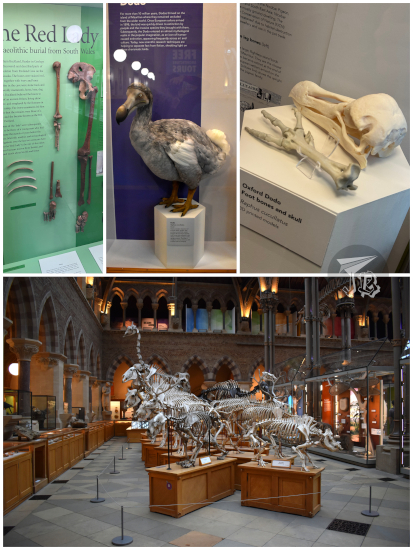
Besides local minerals, the Earth collection hosts over 200 rocks from outer space. One of them is the Nantan meteorite – 4.5 billion years old, and on display for you to touch. And as with every natural history museum, highlights are fossils and, of course, their reproductions. On display there are casts of a Tyrannosaur (Stan), one of the Bernissart iguanodons, an edmontosaur… The ground floor hosts plesiosaurs, ichthyosaurs, dunkleosteus… and a “Wall of Trilobites” with literally dozens of them.
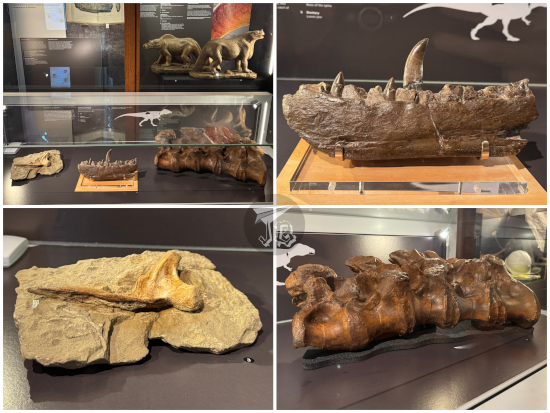
However, the key items in the collections is none of the almost-complete skeletons or fossils on display or archived, but a few dislodged pieces – a leg, a piece of spine and half a jaw. These belong to the species Megalosaurus bucklandii, named by Willian Buckland in 1824 as the holotype of a long-gone massive creature. Megalosaurus was the first dinosaur ever described and named, and it would later get its “interpretation” at London’s Crystal Palace. It was not an accurate one, but it kicked off the first “dinomania” in the Victorian times. Normally, only a cast of the jaw is displayed, but the temporary exhibition Breaking Ground, about the history of palaeontology, had brought them out to be enjoyed by yours truly… I mean everyone. Another fantastic item in this exhibition was an ichthyosaur fossil found by Mary Anning herself – one with remains of its last supper still in its stomach.
As I entered the museum, the first thing I saw were two preserved bears (one of them has since been retired), and the skeleton replicas of iguanodon and tyrannosaur. To the right, the marine reptiles that wrote the history of palaeontology in the UK, and some other dinosaur replicas (edmontosaur, triceratops…). I wanted everything in the gift shop, of course. I had planned to walk the museum in order, but I was unable to, because as soon as I found the stairs, I trotted up to the first floor to find the temporary exhibition Breaking Ground.
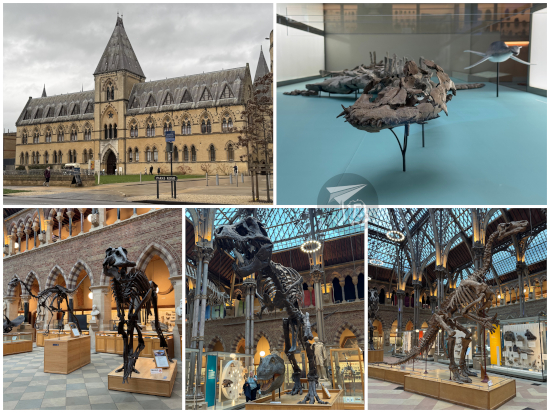
I ran into a couple of school visits, and at some point I was almost ran over by an overeager tween. One of his classmates tried to excuse him saying “apologies, he’s a bit hyper”. I could understand… I only hide it better, but this was one of those other places that had been in my inner child’s bucket list forever and a day. I was extremely happy to be there, and I’m sure I stayed way longer than normal people do. Selfies with megalosaurus were taken.
Megalosaurus was a Middle Jurassic theropod carnivore which has only been found in the Oxfordshire area (Taynton Limestone Formation). The first remains known to science have been lost, but were described and illustrated at the time. There was a tooth recovered in 1699, and a partial femur. A new batch of bones were discovered in 1815, and they were acquired by Willian Buckland, a geology professor in the University of Oxford. He named the creature “megalosaurus” (large lizard) in 1822, and officially presented his findings in 1824, with illustrations by his wife Mary Ann Mantell. Though Sir Richard Owen would not coin the term “Dinosauria” until 1842, megalosaurus was the first non-avian dinosaur to be formally described and named (though Buckland’s reconstructions would not be accurate in the least). The species would eventually receive the binomial name Megalosaurus bucklandii to honour Buckland.
I went through the exhibition, and emerged on the other side, where I saw the mineral and gem gallery, and what they show you about the dodo – a 3D printed skull and some pictures. Back on the ground floor, I looked at the statues, the skeleton parade, the evolution area… Lots and lots of items.
Towards the back, the Oxford University Museum of Natural History is connected to the Pitt Rivers Museum, the university’s collection of archaeology and anthropology. It was founded in 1884 when private collector August Pitt River exchanged his collection for a post as permanent lecturer in anthropology in the university. The premises reminded me a little of the Sir John Soane’s Museum (but way larger), there was so much stuff to see that my brain could not process everything.
Despite the information clutter, I was extremely impressed, especially by the self-awareness of the museum itself. Panels at the entrance explain the relation between colonialism and the collection itself. Apparently, the museum is carrying out a very serious attempt to get in touch with the cultures that spanned a good part of the items in display in order to return them, amend racist descriptions, remove them from view or challenge them. A notable example was its removal of a collection of shrunken heads, tsantsa, from the Shuar culture. Several cases pointed out how historical labels were offensive (outright calling the cultures inferior or savage) and asked how the viewer would feel if their relatives’ remains were exhibited in museums. I think it made me successfully uncomfortable.
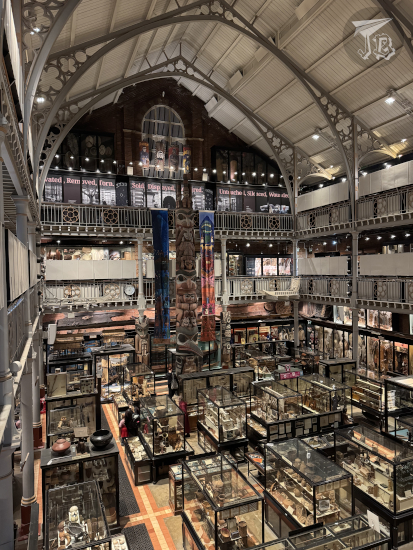
However, the coolest thing happened on the third floor, when a random volunteer asked me if I knew what a prehistoric tool was. It was in the middle of a case of hand axes. I owned up that I had no idea, so he explained that it was the tool used to make all the other tools, a stone hammer – which made it the oldest item in the whole museum.
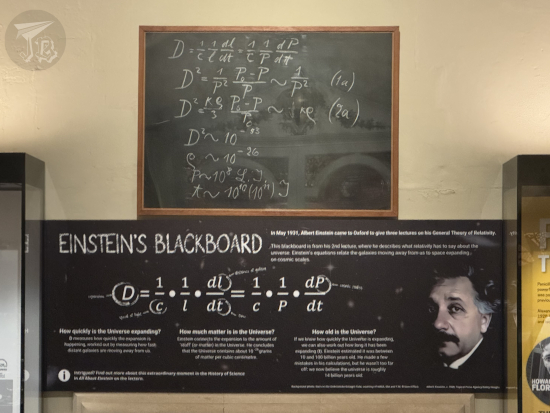
There were still things to do and see, and I had time. I had a second run around the Natural History Museum, just because I could, then I headed towards the History of Science Museum. It is one of the oldest museums in the world that was originally built as such. Unfortunately, most of it was closed due to conservation works. However, the lower floor hosts the highlights, one of them being a small blackboard which feature some equations scribbled in 1931 by no other than visiting professor Albert Einstein. Another of the items is the original penicillin culture that was applied to human clinical trials in 1941 by Howard Florey after Alexander Fleming discovered its antibiotic properties. And probably less dramatic, but utterly impressive, is a 1795 drawing of the moon by John Russell, which looks better than any photography I have ever been able to take.
I ran into a Christmas market – Christmas in Oxford, which I decided I would visit later on, and headed out to the last of the four museums, the Ashmolean Museum of art and archaeology. Its collections were started as far back as 1683. It is considered Britain’s first public museum, and hosts works spanning half a million years of human history.
On the way, I stopped to buy a drink at a supermarket, and I guess I needed it, because it was gone in… three minutes. I had been getting cramps on my toes, which is usually due to an electrolyte imbalance, so I bought a juice-like thing I like.
The Ashmolean Museum ended up being much larger than either of the other museums, outright huge. It felt similar to Victoria and Albert institution, with a lot of different collections from varying origins. It is much more modern-feeling than the other three, especially since a renovation in 2009.
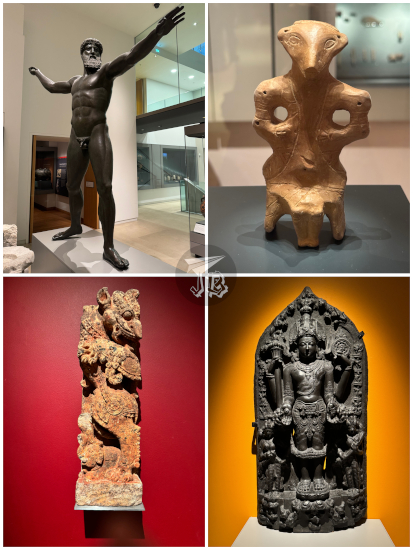
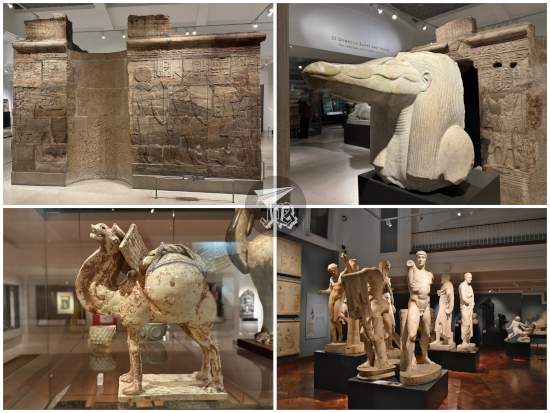
On the ground floor I found Ancient Egypt – I walked past Roman and Greek sculpture first – with a whole sarcophagus complete with mummy case, and even a small temple. I then proceeded to Greece and Cyprus. I came across a staircase and followed it to the area of Conservation, Textiles, Writing, Money and History – Present of the museum, which includes a cabinet of curiosities hosting some of the oldest pieces in the institution, along some which are just… interesting. One of them is an iron lantern from 1605, which is said (probably an urban legend though) to have been used by Guy Fawkes. Fawkes has historically been considered the head of the Gunpowder Plot, in which a number of English Catholics tried to blow up the English Parliament and assassinate King James VI by digging a tunnel underneath and filling it up with barrels of gunpowder. He would have used this lantern inside the dug-up tunnels.
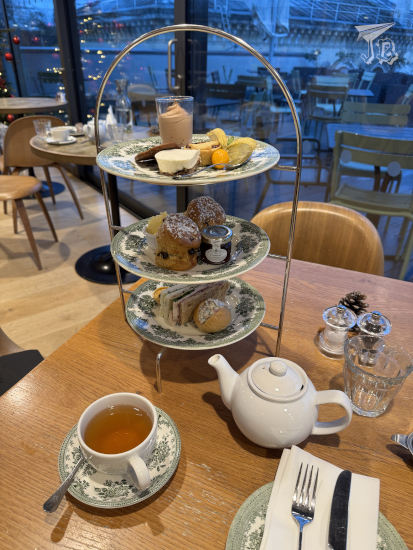
I popped into the shop, where I saw that the restaurant and terrace was open and they were serving “Festive Afternoon Tea”. I had not been able to book it for the Natural History Museum in London, but maybe I could get away with it here. I decided to try my luck, so I climbed to the fourth floor, where the Rooftop Restaurant is. I caused a bit of a ruckus since I popped in without a reservation and solo, but once the waiters got approval, everything went smoothly. I got a seat next to the window and ordered. Afternoon tea consisted on sandwiches, scones and sweets along with a pot of loose-leaf tea.
The mini-sandwiches were: Cucumber and dill cream cheese; Brie and cranberry shallot shell, shallot purée; Roast turkey, sage emulsion, cranberry sauce, rocket; Smoked salmon, dill and horseradish crème fraîche. The scones were homemade, not plain but with cranberry and mixed spice, accompanied by English clotted cream, and Tiptree jam; they were absolutely mind-blowing.
As for sweets, I got Mini Baileys mousse, Tia Maria syrup; a Father-Christmas-shaped gingerbread biscuit; a lovely Mince Pie; and Mini vanilla cheesecake, candied clementine segment. The sweets were extremely so and I did not finish all of them, particularly the mousse.
It was hard to decide which tea I wanted. In the end I went for the in-house Ashmolean Tea, mixed specifically for the museum by local business Team Tea: a malty second flush Assam, combined with single estate Darjeeling and Black Gunpowder from China. They claim that the “Gunpowder” is a call back to the lantern. It was a great choice, and required no sugar or milk – though I drank the milk after all the sweets.
Belly full (maybe a bit too full), I went back down to the second floor, where I visited China and Japan, and European and English art rooms, including jewellery. On the first floor I found the Mediterranean World, Islam and Near East, and India. Back on the ground floor there was more China, Rome, and a collection of Classical casts I had missed before. I missed a bit of the collection, displayed at the third floor, because there is no staircase access there – or I did not find those stairs. I left about ten minutes before closing time.
In front of the Ashmolean Museum stands the beautiful Randolph Hotel Oxford, a Hilton property that is way out of my league, but I can admire. Down Broad Street there were tons of small cafés and shops – collectibles, memorabilia, books… It started drizzling a little just as I walked by one of the largest bookshops, so it was a great idea to pop in and snoop. here are two writers that greatly define Oxford’s personality, and both had their dedicated areas – Lewis Carrol and JRR Tolkien, author of The Lord of the Rings, and father of the modern high fantasy genre, I guess. I wanted everything, but I was limited by luggage size. Good thing I can be reasonable at times. But only at times… T
The drizzle cleared, and I was quite at the centre of Oxford. I explored the Christmas in Oxford market, and then the Claredon Building and courtyard, the Bodleian Library and the Bridge of Sighs. I checked whether I could get a ticket for the tours happening the following day, but they were sold out. It was a pity, but I could live with that – there were plenty of things to do.
The Clarendon Building is a Neoclassical structure, originally destined to be the University Press under the design of William Townesend. Today, it is part of the library, founded in 1602 by Sir Thomas Bodley, and it hosts 13 million items in print. Besides the Clarendon, the library is hosted in a number of buildings – I was snooping around the 15th century Duke Humfrey’s Library and the Radcliffe Camera (from the Latin “chamber”, not because there is any kind of camera around). The Bridge of Sighs is officially called Hetford Bridge. It is a sky walk between the new and old wards of Hetford College, actually a relatively new construction, dating from 1914.
I walked past the Radcliffe Camera and the Gothic University Church of St Mary the Virgin. I strolled into High Street with another of the high-class lodgings – the Old Bank Hotel. The sun had already set and it looked – and felt – like it was the middle of the night, but it was not even 17:30, as I had just left the Ashmolean Museum right before closing time at 17:00.
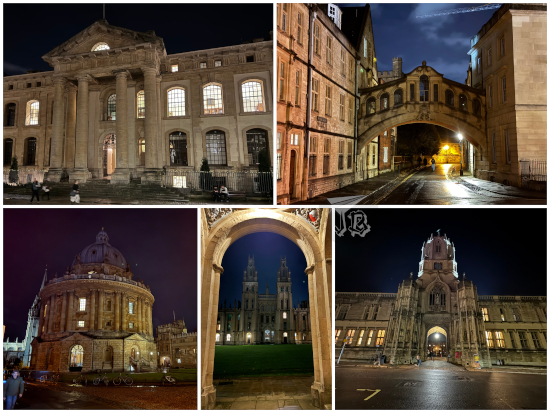
I went all the way towards the end of High Street to see the colleges and other university and religious buildings. It’s difficult to actually explain the roles that Colleges have in Oxford. They are technically “residential colleges”, and become both housing and teaching institutions. All university students are members of one of the 36 colleges. The University describes them as “academic communities where students have their tutorials”. The colleges offer courses, and the students combine courses (year or semester-long subjects) until they lead to a degree. Classes are organised by the colleges, and the preferred teaching method is the aforementioned tutorial, a small group of people (one to four) discussing a topic of academic nature, usually related to the week’s work. Examinations and important lectures are conducted by the University as a whole.
The first building I came across along High Street was All Souls College (officially The College of All Souls of the Faithful Departed, of Oxford), established in 1438. From that corner, I saw one historical building after the other. All the students take the exams at the end of term in the Examination Schools, which also serves for lectures. It was erected between 1876 and 1882. A bit further down the road I saw the Queen’s College, which dates back to 1341, and it’s named after Queen Consort Philippa of Hainault, wife and political advisor to Edward III. I finally spotted Magdalen College, founded in 1458 and one of the most important colleges in town, with beautiful Gothic and Neo Gothic architecture.
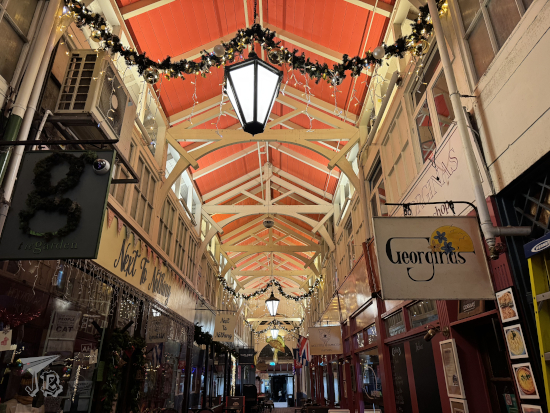
I backtracked towards the other end of High Street, walked past All Saints’ Church, Lincoln College Library, and found the Covered Market. The structure, designed by John Gwynn, has been in use since it opened in 1774. It has permanent stalls and wooden beams that give it a church-like vaulted ceiling, along with a cast iron ceiling. Most of the shops were closed though, and the market was almost empty.
I reached Carfax Tower, or St Martin’s Tower. It used to belong to a long-gone church built in the 12th century, and technically no building in Oxford may be higher than it. From there, I turned into St Aldate’s street, where the Town Hall stands. Unfortunately, it was under renovation, and mostly covered by construction scaffolding.
I reached Christ Church College, which I planned to visit the following morning. In front of it stands the small Medieval St Aldates Church. I went out a little further until I reached Folly Bridge and Bacon’s Tower over River Thames. The tower is not the original 12th century one, but a sort of revival castle erected in 1849 as a folly – basically a decorative building (hence the name).
I tried to drop by the Christmas Market again to buy a cute bauble, but it turned out that it closed at 18:00, and it was 18:30 by then. I headed back to the hotel and got my room. After a shower, I settled down to make my plans for the following day and watch some TV (without even having to surf for a channel in a language I understood…). I even managed to stay awake long enough not to give myself jet-lag.
However, for the life of me, I could not figure out how to operate the radiator in the room…