12th November 2023: Trains and Parks (Madrid, Spain)

I had booked a visit for 15:30 using Madrid’s program to divulge the Heritage of the city Pasea Madrid (“Walk Madrid”), and I had planned a great day around it. Unfortunately, such plan had me on the best train to get to the demonstrations happening there at noon and therefore it would most likely be “delayed due to uncontrollable circumstances” or worse. Thus, I needed a new plan. Since there was a yellow weather-alert in effect across the parks in the area I wanted to be , I just drew a general list of places I could check out and decided to keep it flexible.

The day did not start off as I had imagined it. I slacked off a bit in the morning and by the time I was ready to leave, it was too too late to catch the original train of the second plan. There was part of me which was really not in it, and I considered just cancelling the visit and staying home. Then again – I reasoned with myself – the visit was sold out every other day, I had been lucky to secure a spot. I did not know whether I would be lucky enough to be free when the next batch of tickets were released, nor if the dates were convenient – if they ever opened again, or as the webpage said, it was a “special occasion” (honestly, I think that they just say it is to hype up the reservations). Thus I set off to catch the next train, still in good time for plan B as it was flexible and I could just kick one stop off if necessary.

Once in Madrid, I headed off to the Railway Museum Museo del Ferrocarril, technically closed that day due to the monthly flea market Mercado de Motores. It turns out that the ground floor of the museum is still open, which allows you to have a look at the main train collection (actual historical trains) and take some cool pictures. For once, I was not the only one with the camera, but one among a bunch – to the point that a few of us ended up queueing for a similar picture at some point.

The Railway Museum is located in what remains of the former terminus of Delicias, which opened in 1880. Designed by French engineer Émile Cachelièvre, it had three distinctive areas – the passenger building, the loading docks, and the customs building. The last train left the station on the 30th July 1969, at 22:15, headed for Badajoz. In 1984, the Railway Museum opened in the passenger building, which kept the former platforms.

Fleamarket at the Railway Museum

I am not sure how crowded the museum is during normal days, but for the market, it was packed. I had secured a free entry reservation, just in case. The main building hosts a number of actual trains which serviced passengers and cargo throughout Spanish history – real locomotives and cars on the tracks they used to travel. Before Covid, one of the cars was used as cafeteria, and another as an Orient-Express-inspired restaurant, neither of which are in active now. Though the side rooms of the ground floor and the upper floors were closed due to the market, I got to see the trains from the outside and admire the building structure.

Railway Museum Madrid

In the outer part of the museum, I found the food court and the former tracks which disappear into the nearby park. To the side stands the miniature train complex Ferrocarril de Las Delicias a layout of tiny trains – a 265-metre long, 127-millimetre wide track, to be exact – where you can travel on equally-scaled trains, with classical tickets and all. My original idea had been riding it, but I found a great spot for photographs and decided not to queue through all the toddlers and their parents. I thought that since I wanted to go back to the museum to see all the rooms, I could do that on a day when the tiny trains were running.

Miniature trains in Delicias

I left the station-turned-museum and walked towards the so-called Pantheon of Spain Panteón de España, a burial site for remarkable Spanish politicians, noblemen and military personalities – formerly known as the “Illustrious Men”. Before mobile phones with a camera were a thing, my school took my class to the crypt, but nowadays only the upper area and the gardens can be visited. The original plan, designed by Fernando Arbós y Tremanti in the Neobyzantine style, comprised a basilica with a bell tower and a cloister. The project began in 1891, but only the tower – now part of a school – and the cloister had been built when construction stopped in 1899 due to astronomical costs. In the cloister, there are funerary monuments to a number of important Spaniards who were exhumed and reburied there, such as Mateo Sagasta, Antonio de los Ríos y Rosas, Anonio Cánovas del Castillo or José Canalejas. Eight tombs and a central monument can be visited in the cloister and the central garden. The entrance is decorated with golden mosaics, and the interior is white calcite and grey slate, with domed rooftops. The central garden had flowering winter roses and a view of the abandoned bell tower.

Pantheon of Spain

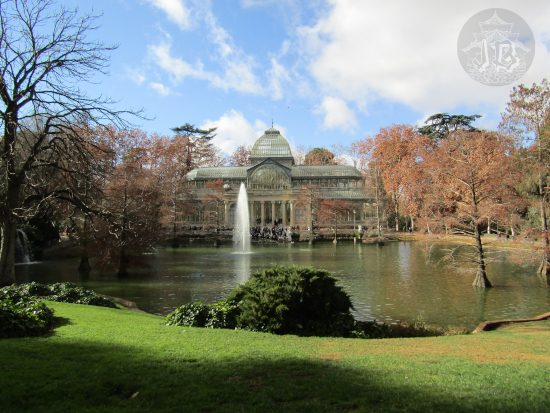
I headed out towards Madrid’s main park Parque del Retiro, part of which had been restricted until noon due to predicted strong winds. The weather, however, was fantastic, even warm, which felt weird for such autumn-coloured day – it made the yellow alert issued a little strange. The park was gold, red and orange everywhere, a stark contrast with the green grass and bushes. I reached the crystal palace Palacio de Cristal, which looked extremely cool with the fall tones, though it was packed.

Retiro park in autumn

El Retiro crystal palace

I took a turn towards an area that I had not visited before inside the park. In the 18th century, when the now-public park was the monarch’s garden, the royal gardeners kept complaining that flowers bloomed where they had not planted them, and blamed a magical force living in the park. The Spanish word used is duende, which is a nature creature somewhere in-between a fairy, a spirit and a gnome. The sculpture Duende del Retiro was created by José Noja in 1985 to honour the legend. The duende plays a flute while sitting on a stone hut, which used to be a cage for the bears of the former zoo Casa de Fieras del Retiro, now turned into the garden Jardines de Herrero Palacios. I’m glad no animals live there any more, except some geese and ducks that can fly – or waddle – away any time they want, but considering how much they get fed by passers-by, I doubt they care about doing so.

Duende of Retiro Park

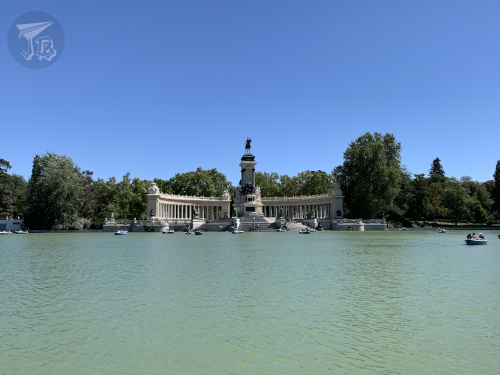
I finally made my way towards the central pond of the park Estanque Grande and the monument to King Alfonso XII Monumento a Alfonso XII, my 15:30 visit. The monument is composed by a colonnade, two lion-gates, four mermaids sitting on different marine animals, and a triumphal column with a sculpture of the king riding a horse on top. The complex measures 30 metres high, 86 metres long and 58 metres wide. The colonnade is public access, and I would not have booked a guided visit for it. However, what made the visit special is that we were granted access to inside the column to climb to the lookout that lies within the top pedestal where the horse stands (97 steps, thankfully on newish metal ones).

Alfonso XII became king of Spain in 1874. He grew up in exile in France until his mother, Queen Isabel II abdicated when he was 17 years old. He reigned for almost eleven years. His first wife, reportedly his one-and-only love, died within a few months of marriage. He married again, and had three children with his second wife, Queen María Cristina, two more with his opera singer lover. He was charismatic and the Spanish loved him, he was called “the bringer of peace”. He died while María Cristina was still pregnant with his son, king-to-be Alfonso XIII, and she became Regent. It would eventually be Alfonso XIII who inaugurated the monument to his father.

The monument was designed by architect José Grases Riera and involved as many as 20 sculptors. Probably the most important one was Mariano Benlliure, who made the horse and the king in bronze – the horse is about seven metres long, and the whole sculpture from the horse’s hooves to the King’s hat, about eight metres high. Grases Riera placed his project on the existing pier of the pond, in order not to cut down any tree from the park, as a pier could always be rebuilt somewhere else. The monument was funded by the public, so it alternates cheaper stone and more expensive bronze, according to how much money there was at nay given moment. The colonnade features shields from the different Spanish regions at the time, and the main column has scenes from the King’s life and allegories to Peace, Industriousness, the Arts… Completion took 20 years from the call for projects in 1902 to the monument inauguration in 1922.
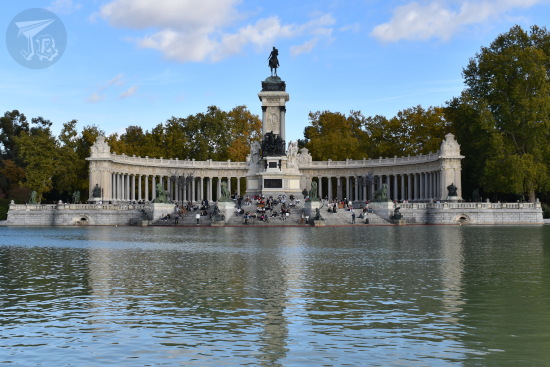
Monument to Alfonso XII across the Great Pond

The lookout is encased in the pedestal where the horse stands. It has windows made of glass to allow a 360-degree view of the park, and I swear I had never even realised it was there. The stairs were not steep and there were cool views from the lookout, especially with the autumn colours, and the sun starting to set. The guide was good – just again impressed by the camera – and explained to us everything that could be seen from there. A relative, however, took the same visit a few days later and, when we compared notes, the information we had been told was rather… different.

Monument to King Alfonso XII - horse and king close up, plus views from the viewpoint

The whole visit took an hour, with 15 minutes at the lookout, and we were out by 16:30. It took me a bit over 25 minutes to reach the station, but the train was late – it was actually at the platform when I got there even if it should have left ten minutes beforehand. I hopped in, and I spent the ride organising the photos on the phone. I am glad I did not cancel the visit and went on with it. I shall remember that for the upcoming one.

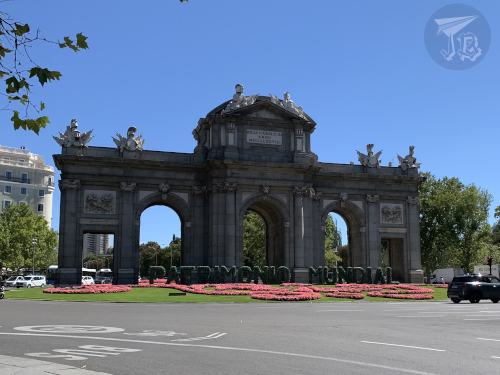
24th June 2023: Abierto por Restauración. La Puerta de Alcalá (Madrid, Spain)

There is a Spanish adage that calls King Carlos III (1716 – 1788) “the best mayor Madrid ever had”. The truth is that when Fernando VI died, his brother, King of Naples and Sicily ascended the Spanish throne. He started a number of reforms in the Spanish capital that today conform the so-called “Way of the Light” – Unesco Heritage Site Paisaje de la Luz since 2021.

Madrid had at the time a surrounding wall for administrative reasons, in order to control trade. The different gates were named according to the main city they lead to. Carlos III decided to remodel one of the gates, the one that lead north-west – first to Alcalá de Henares and then to the rest of Europe. To carry out the task he called for a contest, which was “coincidentally” won by the Court’s architect Francesco Sabatini. It took ten years (from 1769 to 1779) to be completed, in typical Neoclassical style.

Today, this gate is still known as Puerta de Alcalá, and it stands in the central district of Salamanca in Madrid. The wall, however, long gone so the structure remains as a triumph arch more than a gate, in the middle of a roundabout in the Square Plaza de la Independencia.

The gate measures almost 24 metres high, 43 metres wide and 12 metres deep. It was built in solid stone with five arches, and decorated with sculptures depicting the cardinal virtues (Prudence, Justice, Fortitude and Temperance) and allegories of war victories.

Puerta de Alcalá under the protective cover

Restoration studies started in 2022, and the works began in 2023. In March 2023, it was announced that the gate would be “open for restoration” Abierto por Restauración, and that about 6,500 tickets would be offered for guided visits to the monument throughout summer. I had a free morning when the tickets went live and I managed to secure one, despite them being “sold out” in minutes. The Abierto for Restauración project, financed by the Madrid Town Hall, aims to raise awareness of the heritage that Madrid holds.

Though I had originally planned for a day out, I was not feeling too well . Nevertheless, I really did not want to give up the chance and I decided to just head over, attend the visit. and just take the train back home, making it a half-day out.

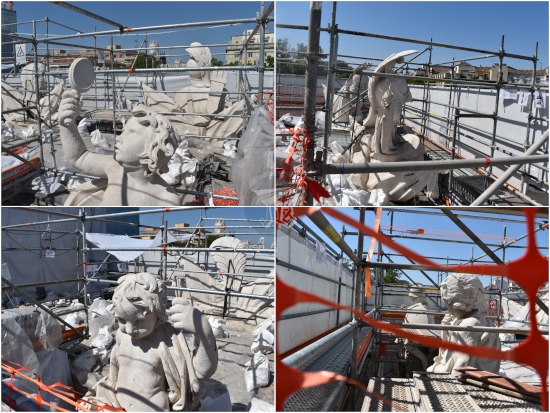
The gate is covered with a huge billboard showing a hyper-realistic photograph, which also hides part of the scaffolding and protective messes that cover the structure. The restoration aims to repair the mistakes of previous attempts at conservation, counteract the effects of pollution and weather, and secure the sculptures at the top of the gate.

We were supposed to meet at 10:45 at the gate of the park on one side of the square, for the 11:00 visit. The guide arrived at 11:00 sharp and started “taking attendance” – since the gate is technically a “construction site” you are insured, and you have to wear a security helmet and all. Then she took us to the base of the gate and told us the history of the construction. The previous group started coming down at 11:00 and we climbed at 11:15. By noon, we were down.

We climbed the inner scaffolding to the top of the gate, where we got to see the work first-hand. Not that there was much to see, because the works cover most everything. There are giant staples that have been taken off the sculptures in order to repair the damage and secure their placement.

Scaffolding supporting the Puerta de Alcalá

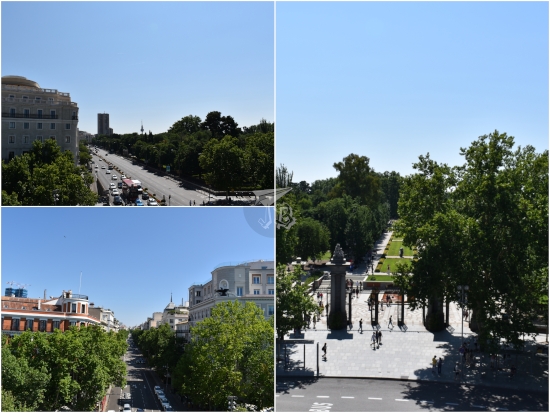
The upper platform allowed for snooping along the sculptures there and the views around the gate, along with a bit of the work being done – huge metal supports for the sculptures, filling up cracks, insulation…

Sculptures at the top of Puerta de Alcalá

Views from the top of Puerta de Alcalá

Though the experience was short, and I did not see as much as I hoped, I was lucky to grab a ticket – 6,500 of them, with 13,000 in the waiting list – but it looks like the reforms won’t be over for a while, so it might still be open next summer. It might be an interesting experience to try again and compare the progress.

12th & 13th February 2023. The Epic Apocalypse Tour in Madrid (Spain)

The year 2020 was going to be so amazing that I actually would have had to choose the things I wanted to do and sacrifice others. It didn’t turn out that great in the end, with lots of rescheduling and cancellations. I was eventually able to budget time and money for one of those rescheduled events – the joint concert by the metal bands Epica and Apocalyptica in their Epic Apocalypse Tour. For a while, however, there was a bit of uncertainty with dates, as they bounced between Sunday 12th and Monday 13th of February, so I needed to juggle work dates in order to make sure I’d be free on Monday. In the end, I was all clear, all the concert-related activities were set for Sunday evening, and I decided to make a two-day trip out of it – I needed to take a hotel for Sunday anyway.

I arrived in Madrid around 9:30 in the morning. I had some time before my first appointment so I walked into one of the large parks of the city Parque del Buen Retiro, which is part of the Unesco World Heritage Site Paisaje de la Luz (Light Landscape), officially called Paseo del Prado y el Buen Retiro, paisaje de las artes y las ciencias, declared in 2021.

Parque del Buen Retiro was built in the 17th century for one of Felipe IV’s palaces, and it was opened in the late 18th century as public park. The park was almost destroyed during the war against Napoleon’s troops in the early 19th century, so most of it has been rebuilt. Aside from the obvious flora, it features sculptures, fountains, buildings… It is home to a lot of birds, and unfortunately a large number of invasive and fearless monk parakeets (Myiopsitta monachus), whose culling has been controversial in recent years. I got to see common blackbirds (Turdus merula), a European green woodpecker (Picus viridis) and a European robin (Erithacus rubecula).

One of the most important features of the park is the sculpture Monumento al Ángel Caído, which represents an angel falling from grace. It was originally designed by Ricardo Bellber, who made it in plaster in 1877. It was later cast in bronze and the original plaster destroyed, and eventually the sculpture was made into a part of a fountain in 1885. Around the area, there is also an ancient water mill, and to my surprise, the almond trees (Prunus amygdalus) had started blossoming.

Retiro Park collage: a pathway with trees and bushes on both sides, ducks, and a robin.

Retiro Park collage: a water mill, blossoming almond trees, and the fallen angel fountain

At 10:15 I had a guided visit to the Real Observatorio de Madrid (ROM), commissioned around 1785 by Carlos III, as an centre to develop and study astronomy, geodesy, geophysics and cartography. The main building is the astronomical observatory, built by Juan de Villanueva in what then was the outskirts of the city. Today, ROM belongs to the National Geographical Institute (IGN), and it is home to the National Astronomical Observatory, the Central Geophysics Observatory, and the data gathering division of the National Volcanic Service, though no measurements are taken there. The main astronomy measurements are carried out in the Centro Astronómico de Yebes, in a town around 80 km north-west of Madrid. The observatory is also part of the Unesco World Heritage Site.

The visit comprises three stops. The first one is the main building, called Edificio Villanueva, which has three rooms – the main rotunda with a Foucault pendulum, the library, with the spot where gravity was first measured in Spain, and the “Time room”, where the sun used to be traced to determine the hour.

ROM collage. A small Neoclassical building, an inner room with a pendulum and telescopes, a telescope and a 19th century library.

The second stop is the Great Telescope, a replica of one that William Herschel built in the 18th century – Hershchel was one of the greatest telescope makers of the time, and is credited with discovering the planet Uranus, two of its moons, and two moons of Saturn. The telescope was destroyed during the war against the French, but later rebuilt thanks to the number of laminates that had been preserved – the original had a focal distance of 7.6 m and a 61-cm diameter mirror (which is displayed in the main building), and Herschel himself considered it the best he ever built.

Herschel grand telescope: a wooden scaffolding structure keeping a huge black tube pointing at the stas

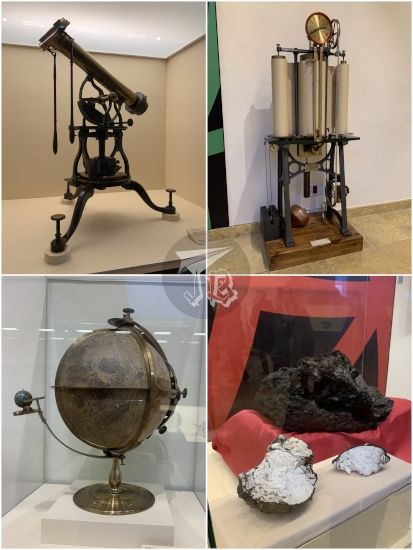
The final stop, the little museum of “Earth and Universe Sciences” has a small collection of ancient instruments used for astronomy, navigation, and geophysics. There are also a couple of seismographs – one of them new, which is up and running – and material retrieved from the volcanic eruptions of El Hierro in 2011 and La Palma in 2021.

Collage. Ancient telescope, old tide measuring device, an old globe, and lava bombs

I had planned for a typical sandwich at an iconic bar afterwards, but I ran into a political demonstration. Thus, I scratched that idea and took the underground westwards. When I was in Egypt, one of the places I visited was Lake Nasser, created by the Aswan High dam. The lake swallowed a lot of villages and monuments, but a few of them, such as Abu Simbel and the Temple of Philae were saved by Unesco. Between 1960 and 1980, a total of 24 monuments were saved, and five out of these were presented as “grants-in-return” to five countries which had offered exceptional technical and financial assistance to the campaign – Germany, Italy, Netherlands, the United States and Spain, the latter being impressive as Spain was in the middle of the dictatorship, and pretty shunned by the international community at the time.

The monument was a small and ruined temple in the now-flooded town of Debod, to which it owns its name Templo de Debod (Temple of Debod). Dedicated to the god Amun, it was built around the location of the First Cataract of the Nile, some 15 km south of Aswan, about 2200 years ago, though the core of the building may have been older. The monument was actually affected by the original dam at the beginning of the 20th century, and it was covered in water for most of the year, which destroyed its colours and damaged the reliefs.

During the Unesco salvage mission, it was dismantled, and eventually granted and taken to Spain, and “freely” reconstructed – a lot of information had been lost, and there were missing blocks. National stone was used to fill in the gaps, and the gates (remains of the pylons) were built in the wrong order, according to some old pictures. The restorers built an air-conditioning system, a wooden roof, and the main hall was closed off with a glass door and window panes. Today, the temple is open to the public at weekends, but unprotected from the Spanish weather – rather different from the Egyptian one – and pollution, it is rapidly deteriorating.

I went inside the temple once when I was a child, and I had a clear memory of it that kept surfacing when I was in Egypt – so I wanted to go back. The entry is free, but capacity is reduced, so I had to queue for almost an hour to enter. I finally matched my memory to reality. The interior of the sanctuary has a small chapel and some carved stones had been taken to a makeshift second floor to display them as a little museum.

A collage of a small Egyptian temple - it has two floating gates that lead up to the main building, which is small with four columns. One picture shows a tiny and dark inside room with an altar.

After the temple, I got lunch on the go, then walked towards the hotel to check in and change clothes. Around 16:15, I set off to La Riviera for the concert. I had a Meet and Greet ticket and had to be there before 17:00. Personnel from the venue were extremely nice, and there was no chaos at all, even if things had been a little disorganised and some fans were lacking M&G confirmation emails. Everything was well-handed and everyone who had paid for an upgrade got through. There were about 30 people to meet and greet Epica and we were ten for Apocalyptica.

Apocalyptica is a Finnish four-man band – Eicca Toppinen, Perttu Kivilaakso, Paavo Lötjönen and Mikko Sirén – founded in 1993. They are “semi-officially” a symphonic metal band, but they’ve ventured into everything from Metallica covers (which was their origin) to pure classical works. They have a very specific style heavily using classical cellos and combining them with modern drums. They currently collaborate with American – self-identified as Cuban in the concert – singer Franky Perez for vocals.

Meeting the four of them was really fun. I got autographs and took the most epic picture I’ve ever taken with a band or artist before. As we were only ten, after it was over, I had time to buy some merchandising and still be the second person to settle on first row – despite having decided that I was going to sit back and relax.

Apocalyptica white and black poster, signed by the four members

General admission started at 18:00, and the crowd was surprisingly tame throughout the whole thing. The venue filled up and the supporting band, Wheel, came up at 18:30. Wheel is a Finnish progressive metal band that consists of James Lascelles (Vocals/Guitar), Santeri Saksala (Drums), Aki ‘Conan’ Virta (Bass) and Jussi Turunen (Lead Guitar).

Wheel Setlist

  1. Hyperion
  2. Blood drinker
  3. Movement
  4. Vultures
  5. Wheel

Wheel playing, each member at his insturment: bass, guitar, singer and drummer

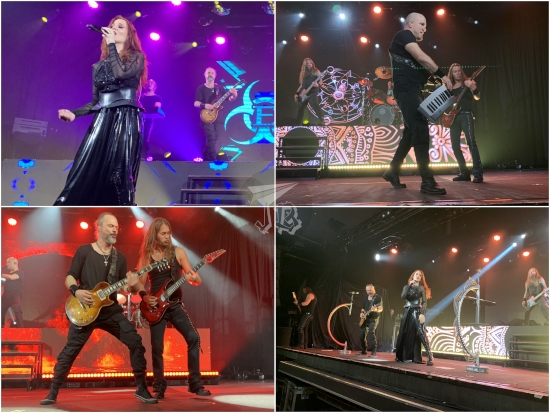
The second band was Epica, which I remember having listening to back when the world was young. They are a Dutch symphonic metal band currently composed by Simone Simons (lead vocals), Mark Jansen (rhythm guitar, vocals), Coen Janssen (keyboards, synthesizer), Ariën van Weesenbeek (drums), Isaac Delahaye (lead guitar) and Rob van der Loo (bass). Simone can go insanely high with her voice, and she has an amazing presence on stage, and the whole band has an immense amount of energy – she also reminded me of a comic character. The keyboardist had a lot of personality too, and he was extremely fun.

Epica Setlist

  1. Abyss of Time – Countdown to Singularity (recording)
  2. The essence of silence
  3. Victims of contingency
  4. Unleashed
  5. The final lullaby
  6. The obsessive devotion
  7. The skeleton key
  8. Rivers
  9. Code of life
  10. Cry for the moon
  11. Beyond the Matrix
  12. Consign to oblivion

Collage of Epica playing, showing different members at their choice of insturment - singer, bassist, guitarist, and keyboardist with a portable keyboard

Finally Apocalyptica came on stage, and it was extremely fun. The things those guys do to their classical cellos would make some classical musicians cry, but the sound is super-powerful. We had Franky Perez for vocals, and a very fun moment regarding “listen to our classical music album at home, because we still feel like death metal”. They interacted a lot with the public, and it felt somehow very friendly / warm – yes, I’m talking about metal here. It was really that fantastically weird.

Apocalyptica Setlist

  1. Ashes of the Modern World
  2. Grace
  3. I’m not Jesus
  4. Not strong enough
  5. Rise
  6. En route to mayhem
  7. Shadowmaker
  8. I don’t care
  9. Nothing else matters
  10. Inquisition Symphony
  11. Seek & Destroy
  12. Farewell
  13. In the Hall of the Mountain King

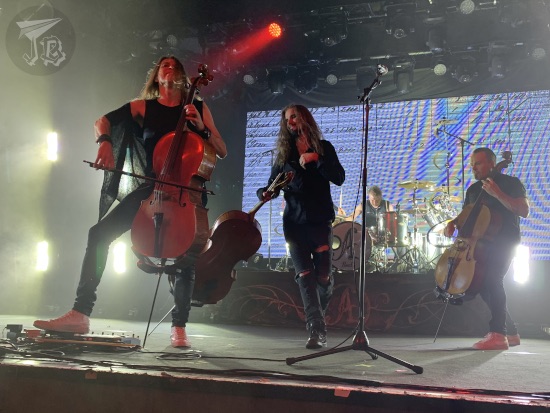
Apocalyptica playing with Franky Perez. Perez is in the foreground, dressed in black. The thee cello-playing members are in the frame, playing. The drums peek behind them, but you can't spot the drummer

Apocalyptica playing at La Riviera. They have classical cellos. Two of the members stand on the sides, playing their cellos. Another one is walking swinging his as if it weighed nothing, The final one is slamming drums in the background.

We finished off just short of 23:00, I bought off some fast food for dinner, and headed back to the hotel to have a shower and get some sleep. I was woken up early in the morning due to the cleaning crew and the garbage mini-vans noises, but I did not leave bed until 9:00, then set off at 9:30. I bought some cold coffee on the way and walked into the former royal palace gardens, now public park Jardines del Campo del Moro.

Though I’d seen the gardens a few times before, this was the first time I actually walked into them. Despite the frost covering everything, I got a nice view of the palace and different fountains and buildings sprinkled throughout the green – Chalet de Corcho, is a small hut with coloured windows; and Chalecito de la Reina a wooden house that is currently closed. I was insanely amused by a little grass-cutting robot.

Jardines del Campo del Moro. Collage. It's winter and most trees are grey and bare. At the end of the walkway stands the Neoclassical Royal Palace. Two smaller buildings - one of them is white with brown beams, reminscing of German architecture; another one is a small kiosk with colourful windows - red, green...

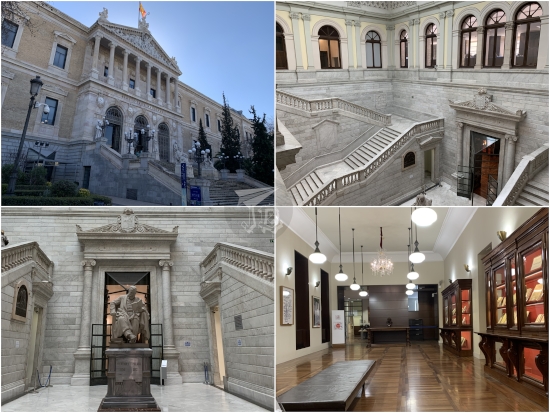
I wandered around for an hour or so, then headed off via underground to the National library of Spain Biblioteca Nacional de España for the absolutely worst guided visit of my life. Like… it’s true that it’s free, but tickets run out within hours of coming out – on the 20th of the month, for the following month. I’d actually been trying to do this since Covid lockdowns ended… It turns out, we did not see any real books, we could not even peer into the reading area, the book and reading museum is closed and the only information we got was… that the guide did not like the Library. We did not get to see anything interesting or that we could not see on our own, and we did not get to learn anything, so this was a huge blunder. Live and learn – but it was one of the few things that was open on a Monday. The library is a huge Neoclassical building with a fantastic marble staircase inside. The doors and gates are protected by intrincate ironwork fences.

Biblioteca Nacional de España. A Neoclassical building in white and grey tones. The exterior has columns and statues of writers. The interior showcases a pair of twin staircases with the statue of one of the most important library directors between both.

I met with family for a quick lunch and then we went for a walk. We had thought about going to one of the terraces to see the cityscape, but it was closed because it was a Monday. We ended up at the Parque del Retiro park again to make some time and walk. We sat in the sun for a while, then went to see the Palacio de Velázquez there. Currently, it’s part of the modern art museum Museo de Arte Reina Sofía, and I did not really care much about the exhibits, but I like the building. Architect Ricardo Velázquez Bosco built it in brick (with ceramic tiles by Daniel Zuloaga) for the Mining Exhibit in 1883, inspired by London’s Crystal Palace, now gone. The interior is pristine white with hints of iron architecture, but the building’s official style is “neorenaissance historicism” whatever that means.

Palacio de Velazquez: A brick building with large windows and tile decoration. The inside is all white with bits of iron architecture.

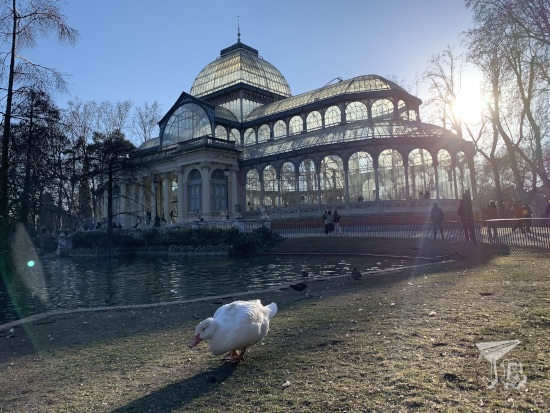
Velázquez Bosco and Zuloaga also came together when they designed another building I really like, the glass-and-iron greenhouse Palacio de Cristal, which was built to home tropical flora and fauna from the Philippines in an exhibit in 1887. In front of the palace, there’s a small pond home to some cheeky ducks and geese.

Palacio de cristal. A huge greenhouse with a dome, and two wings. A white duck wanders in the foreground. Between the greenhouse and the duck there's a small pond.

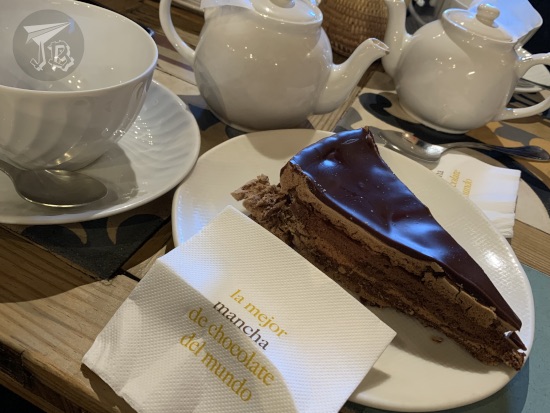
Then, we went to have a snack. Trying to find something on the map before the trip, I’d come across a place called La Mejor Tarta de Chocolate del Mundo, which translates to “The best chocolate cake in the world” and that had to be tried! It was really nice, even if the place was pretty small and felt a bit cramped.

A slice of chocolate cake in front of mugs and teapots

We finally took a stroll down towards the sunset, and I took the train back without much of a hitch, then drove home

8th September 2021: Impromptu Madrid Run! (Spain)

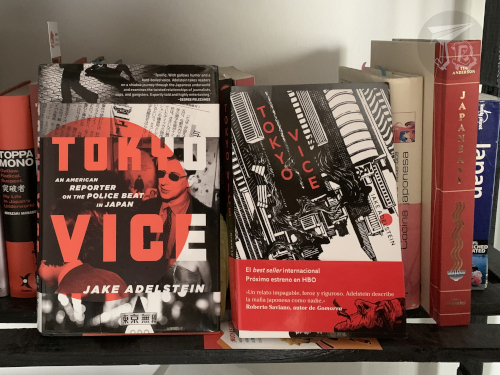
This was oh my god so unplanned that I kept improvising throughout the whole day! It all started because a Spanish publisher decided to translate a non-fiction book I’ve loved for ages – Tokyo Vice by Jake Adelstein. The publisher flew the author in for interviews, and I guess I was disappointed that no signing event was organised. I asked the author once and the publisher another time, then shrugged it off when I got no answer. There were some interviews scheduled for him, and a book fair coming up. I guessed it was just not meant to be, but I did feel disappointed.

And then, on the 7th, Mr Adelstein shot me a message that he would sign my book if I could go to Madrid and meet him at one of his breaks. As you can imagine I just… said yes (I could not meet him that very same evening because of travel times, but I could make it on the 8th. And there I went).

It was the first time taking the train since the whole pandemic thing (hell, I had not even been on a train since Paris 2020), and a weekday so I chose the times carefully to hopefully get close to as few people as possible – it worked, as both rides nobody sat next to me.

I arrived in Madrid and transferred easily, then got out at a new station in the area of Gran Vía. The Tokyo Vice book came out that day, so I wanted to go to a big book store that would hopefully have it already. My first stop, FNAC, failed miserably, so I went to La Casa del Libro, where they told me I would find the book in a completely different section where I actually did. But at least I had it in my hands, even if I had apparently not used my credit card for so long, I got the right PIN for the wrong card (≧▽≦).

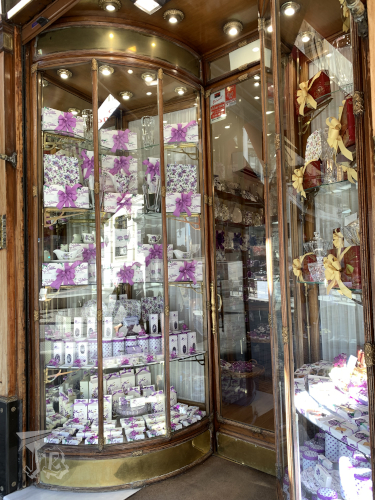
After I had the book in Spanish – I’ve owned a first edition copy in English since 2010 – I had thought that I should get a small detail for the author as he was making time for me. As he had to continue on his travelling, I decided to do something small and “consumable”, so I came up with buying some typical Madrid candy – violet sweets from La Violeta. I’d never been inside the shop, but it’s an adorable little place dating back to 1915.

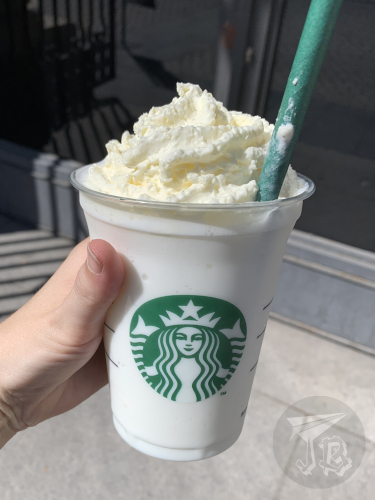
It was still early for my appointment at 14:00, so I decided to head towards a square that hosts an Egyptian temple of all things. On the way I made a stop at a Starbucks for a Vanilla Frappucino, I figured out that the amount of calories would get me going and I would not have to eat until I was back – looking back it was a weird thing, but it made sense in my head at the time. I strolled around the park next to the palace Palacio Real.

The way to the temple was completely blocked off due to construction, so I decided to backtrack. I walked up the great avenue in the middle of the city Gran Vía. As I walked around, minding my business and listening to music, I kept remembering a comic by Sarah Sanders, in which she makes fun of how people won’t leave you alone when you’re wearing headphones and, well, minding your own business.

I reached the square with the fountain to the goddess Cybele Fuente de la Cibeles and the related Palace Palacio de Comunicaciones (by Antonio Palacios). The fountain dates back to the 18th century, when king Carlos III revamped a lot of Madrid trying to make it more beautiful and similar to other European capitals.

Carlos III is also responsible for the design of the modern version of one of the former wall gates, called the gate to Alcalá, the nearby town, Puerta de Alcalá. This area was declared Unesco World Heritage Site in summer 2021 as Paisaje de la Luz, so Madrid was in a celebratory mood.

I headed into the park Parque del Retiro, which is also included in the Heritage declaration. The park was initially built in the first half of the 17th century, as part of the royal recreational areas. Carlos III opened it up as public park a hundred years later. Aside from the obvious green areas, the park features fountains, palaces and sculptures. I walked past some of them. First I came across the fountain “of the turtles” Fuente de los Galápagos.

There is also a large pond, aptly called the big pond Estanque Grande del Retiro populated by carps, to whose side stands the monument to Alfonso XII – Monumento a Alfonso XII.

Nearby the pond stands the fountain called the artichoke fountain, Fuente de la alcachofa.

I walked to the fountain that depicts the fall of Lucifer from Heaven, Fuente del Ángel Caído. The fountain itself was built in order to exhibit the sculpture by Ricardo Bellve, who originally created it in plaster. The figure would then be cast in iron for the World Exhibit of 1878 in Paris, and eventually placed in the Retiro.

I strolled back towards one of my favourite points in the park, but that’s because I like iron-and-glass architecture – a little building called Palacio de Cristal, which has a small pond around.

Finally I headed over the little café where I had arranged to meet with Mr Adelstein. He arrived shortly after. He signed my book, but truth be told, I had also brought my first-edition copy, which happens to be full of post-its from the first time I read it. He was happy to sign that one too, and to my eternal mortification… he went over all the notes. I almost died right then and there. We chatted for a little, I gave him the violet candy and he had some umeboshi sweets for me too. I babbled that I was very happy that he had made some time for me, and he told me “but you were so polite on twitter and the publisher said no signatures!” and I kind of died again.

In the end, our meeting was only 15 minutes, but I have not felt so happy in a very long time – that he specifically took time felt amazing. We took pictures and even had a safe mask-hug. Afterwards I headed towards the nearest train station so I could be on my way before the afternoon rush came through, so that was it for the day.

Walking distance: 12.39 km

2nd January 2016: Palacio de Cristal (Madrid, Spain)

Right after landing back from Scotland there was a couple of things I needed to get going in Madrid. That afternoon I took up the chance and went to see the Palacio de Cristal, or Glass Palace, in the Parque del Buen Retiro (Park of the Good Rest, sort of). The building is a Victorian, iron-cast structure which is currently dedicated to exhibitions. It is a satellite building of the Reina Sofia Museum of Modern Art. It featured an exhibit by the Vietnamese artist Danh Vō – with a hanging Christ and fossilised bones?

And then we found out that there is indeed a parakeet invasion in the Retiro…