9th March 2025: Expominerales 2025, the other half of the weekend’s plans (Madrid, Spain)

Since I had to be in Madrid to watch the fantastic concert by the Wiener Sängerknaben, the plan had been to attend the yearly Expominerales mineral fair in the Mine and Energy Engineering School Escuela Técnica Superior de Ingenieros de Minas y Energía (ETSIME) that same day. However, the fair closes on Saturdays between 14:00 and 16:00 for a lunch break, so since the weather was so horrid, I decided not to wait. On Sunday, the weather forecast was slightly less miserable, and in the end I was lucky with only some gentle rain as I walked between the train station and the Engineering School, nothing like the sleet deluge the previous day.
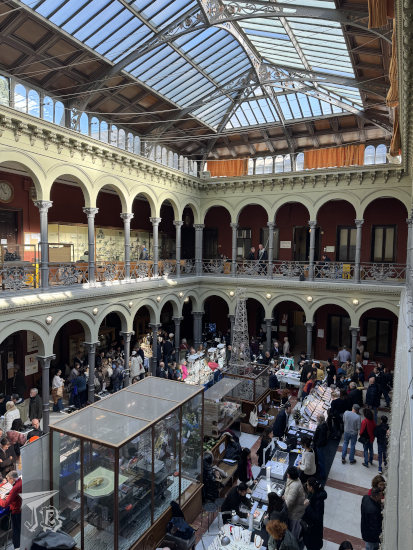
Expominerales fills the ETSIME with stalls selling minerals, fossils and crystals offered by reputable sellers. Here I’ve seen the biggest megalodon teeth in my life, held a plesiosaur vertebra – which I regret not buying when I had the chance – and discovered that moldavite exists – and which I regret not buying when I had the chance… do you spot a pattern here? I did not break it anyway, because in the end I cannot afford most of what is sold, and I already own most of what I can…
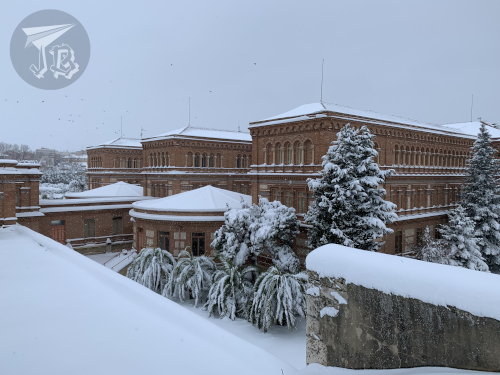
Overlook of ETSIME during Expominerales

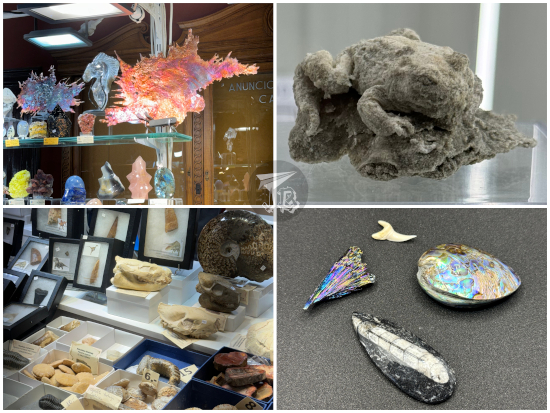
I arrived at the School shortly after the exhibit opened around 10:00, and the area was still pretty empty. There were fewer stands than the previous years I’ve been there, and the moldavite stand was not there. Actually, there were very few meteorite-related stands this time around. I did see amazing modern-times frog fossils from Owens Lake. Owens Lake is called Patsiata in the Mono Native American language. In 1913, the lake dried out when the water from the Owens River was redirected and with years it has become a deadly salt flat, a source of alkali sand storms with a side of carcinogen materials. One of the minerals found in Owens Lake is trona, a crystal formed by the precipitation of sodium carbonate, making it a type of evaporite. In 2023, an atmospheric river caused floods in California, filling the lake up for the first time in over a century. The floods damaged infrastructure and created a surge of floodwater to the lake, which eroded surfaces and dragged a lot of small hibernating animals towards the lake, where they were killed instantly. Their soft tissues were quickly replaced by trona salt before the bodies even decomposed, creating a perfect cast of the poor critters. There were two on display at Expominerales and they were creepy!

Something else that caught my eye (and was actually within my doable price range) was a polished abalone shell. The Korean abalone (Haliotis discus) has been used for centuries in the art of najeonchilgi [나전칠기], which refers to decorating items with mother of pearl. The abalone can be polished in full, creating a whole iridescent body of nacre. These mollusks used to be collected by haenyeo [해녀], traditional female divers from the Jeju province, but most of them are farmed for food today. A small polished abalone came home with me.

Items from Expominerales

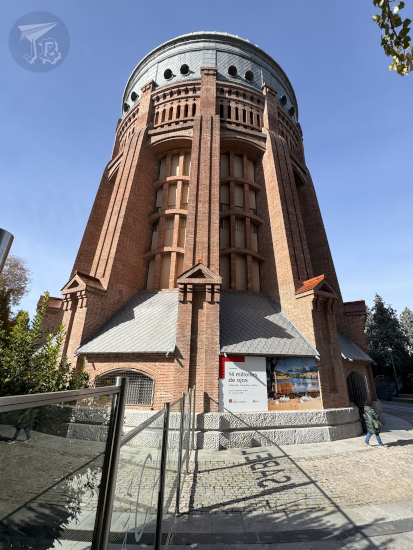
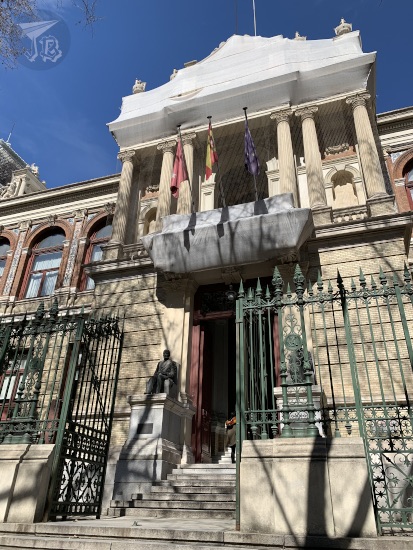
The School opens its classic museum during the exhibit, and I always enjoy visiting it. However, after wandering around for a bit (and spending some money), I moved onto what basically is the next building over to the ETSIME, the Spanish Mining and Geology Institute IGME – Instituto Geológico y Minero de España, which hosts the Geomineral Museum Museo Geominero. The original design of the building was conceived by Francisco Javier de Luque, and work started in 1921. Though a congress was held there in 1925, construction went on until 1941. The building has not been extensively restored, but it presents deviations from the original plans, and even from subsequent ones.

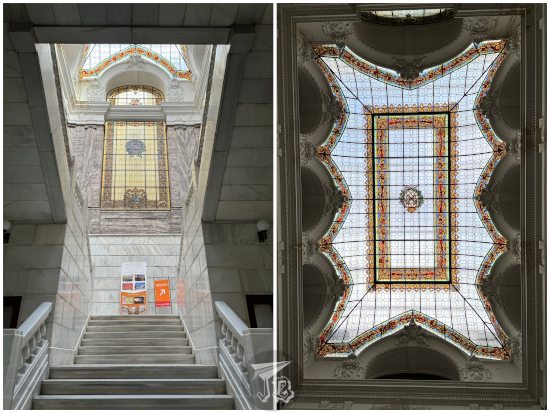
The museum is hosted in the former hall, and to get there, first you have to go through a very bored security guard – who first asked if I was sure I wanted to be there. Once inside the building, one goes up the main staircase towards the gallery underneath a glass-and-iron skylight with the logo of the Mining Institute. It was designed by Luque himself and created by the Madrid workshop La Veneciana, a glassware shop dating from 1876 and which, under a different name, still exists today.

Entrance staircase to the Geomineralogical museum

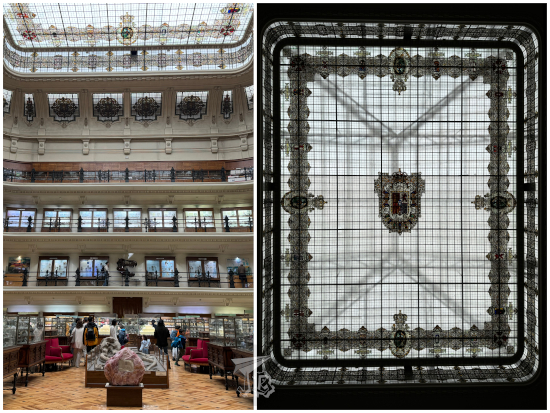
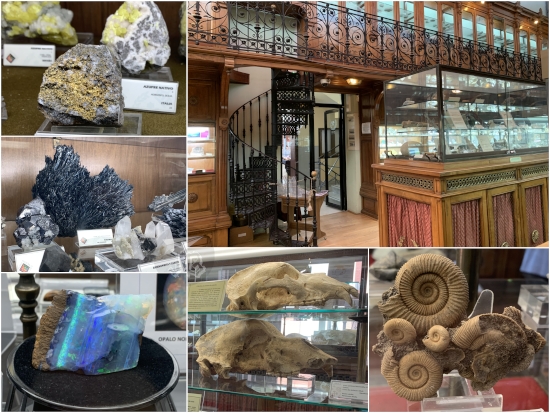
The museum is an open area, located underneath another incredible skylight. The displays are hosted in wooden cabinets in the main floor. The upper balconies can be accessed through spiral staircases and are protected by metalwork railings. One of the details I absolutely adore are the glassworks displaying geological sample cores of different surveys. I’ve never seen the library, but I was once part of a group which was allowed to play with some of the “lesser value” items they have as part of a training session, and that was super fun. The museum is probably one of my favourite spots in town.

The Geomineralogical Museum

From the architecture point of view, I like the building and the skylights. However, there are way more things to love in the museum, such as the wooden cabinets, full with samples of minerals, fossils and meteorites. The museum’s collection are divided into “Mineralogy and Petrology”, “Flora and Invertebrate fossils from Spain”, “Vertebrate fossils from Spain”, “Foreign fossils”, “Systematic invertebrate palaeontology”, “Micro-palaeontology”, “Fossil resin”, “Fossil tracks”, “Stromatolites”, and the “special exhibits”. One of these is a complete cavern bear (Ursus spelaeus), another one is an Ibex (Capra ibex). The last two have honour spots, with their own display.

When you come into the museum, one of the first things that you see, in front of the door, up on the first-floor balcony, is the cast of the most complete Tyrannosaurus rex skull ever found – Stan. Specimen BHI 3033, Stan, was found in 1987 and excavated in 1992, in South Dakota’s Hell Creek Formation. Stan lived around 65 million years ago, in the Cretaceous period. We know he fought for his life more than once – his ribs were broken and healed, two vertebrae were fused together, and he suffered a bite to his snout. Stan remains one of the most complete skeletons ever found, and probably the most-often cast. The skeleton made mainstream news when it was auctioned at Christie’s in New York due to money disputes among partners of the original owner-firm, Black Hills Institute. An anonymous buyer paid $31.8 million for it in October 2020. In 2022 it was disclosed that the Department of Culture and Tourism of Abu Dhabi had bought Stan for their projected new Natural History Museum.

On the ground floor there is a mastodon fossil Anancus arvernensis found in the 1990s. These animals related to modern elephants lived throughout the Miocene and went extinct in the Early Pliocene (two million years ago). The could have been around the size of a modern African bush elephants, but their tusks were mostly straight. They would have lived in steppe with dry and warm climate, but close to water. The fossilised bones were recovered are dated around 3.2 million years ago, and were dug from the Las Higueruelas site between 1948 and 1991.

Exhibits at the Museo Geominero

After I wandered the museum for a while, I left towards my train which was delayed… 43 minutes. Fortunately, so were the ones that had to pass before, so I ended catching one in the right direction after only a twenty-minute wait. And then I got junk food, because some days have to end in junk food…

22nd February 2025: Architecture in Madrid, and folklore in Guadalajara (Spain)

By now, reaching Madrid by train without anything remarkable to comment on is actually remarkable all by itself – there were actually no problems for once. I had booked a spot for a visit at noon, but since I don’t trust the rail service, I hopped on a train to be at Atocha Station around 10:00, and for once I was there right on time, maybe even a minute early!

As I walked up the street Paseo del Prado, I passed by the exhibition centre CaixaForum, where the Patagotitan still stands. Since it was still winter, the trees on both sides had little to no leaves, and I could see it from the opposite side. I of course said hi.

Patagotitan skeleton

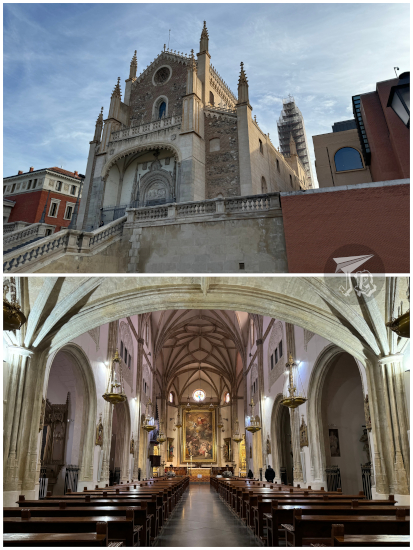
My first stop was the church Iglesia de San Jerónimo el Real, dedicated to St. Jerome, a late Gothic – early Renaissance building erected between 1502 and 1505. It belonged to a monkhood whose original monastery stood near the river. The stagnant waters caused illnesses among the brethren, who asked the Catholic Monarchs for a new location. The church for the new community was created from brick and masonry, and towers were added in the 17th century. The interior is decorated with two gothic altars to the sides, but no main altarpiece, as the original one has been lost to time. Instead, there is a painting by Rafael Tegeo La última comunión de San Jerónimo – Saint Jerome’s last communion – created in 1829.

Monastery Monasterio de Jerónimos

Afterwards, I headed towards the National Museum of Anthropology Museo Nacional de Antropología, a small museum dedicated to the diversity of cultures in the world, particularly the Americas, Philippines, Africa and the “Far East”, focusing on traditions, culture and religion. It is covered by my national museum card.

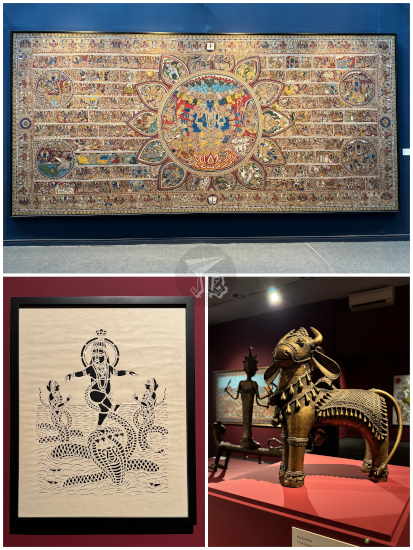
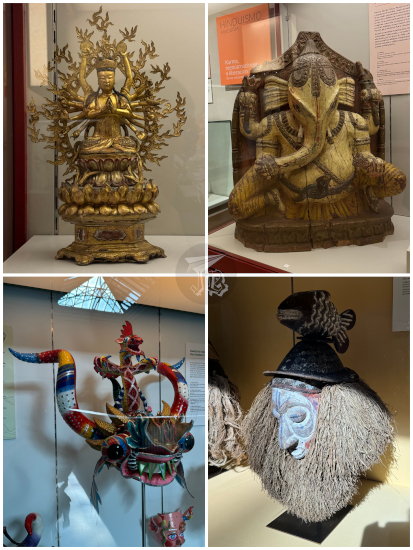
At the moment, the museum is running a temporal exhibit on art based on myths, legends, and sacred texts from India, Caminos místicos. Tradiciones vivas del arte de la India – Mystic Paths. Living Traditions of art from India. I was curious about it, but not expecting how much I liked it in the end. The pieces of the exhibit were mostly based on Hinduism (Sanātana Dharma, सनातन धर्म), the oldest religion in the world. According to Hindu tradition, the Supreme Being Brahma exists as themself, but also as the manifestation of the deities Brahma the Creator, Vishnu the Sustainer and Shiva the Destroyer, all of who at the same time have different avatars (avatāra, अवतार) or incarnations. One of the core principles of Hinduism is the concept of cosmic cause-and-effect justice, karma [कर्म]. Another is reincarnation (saṃsāra, संसार), an eternal cycle of life and death until the individual is liberated from it through self realisation or illumination. The religion is based on values like righteousness, truth, love, peace, and ethical conduct, and it is quite open to other beliefs and ethics.

Religious Indian Art pieces

The Museum of Anthropology’s permanent exhibition has a lot of items from the Philippines on the ground floor, probably due to how long(1565–1898) the islands were a Spanish colony. There are clothes, tobacco items, ritual objects, and a small sample of how the local culture was throughout the 1800s. To the back, there is a room dedicated to the religions of Asia and the Middle East – Hinduism, Buddhism and Islam. The first floor is dedicated to Africa, combining a number of traditional exhibits with modern photographs of the traditional people’s way of life – baskets, pottery, leather and wooden objects, ritual masks… The second floor holds items from the Americas, especially from South America. Some of them include a Mexican Día de los Muertos (Day of the Dead) altar, Andean Carnival masks, Sioux-Lakota clothes, Inuit coats…

Religious icons and traditional masks

I remember visiting the museum when I was a child, and then feeling disappointed in it when I returned as an adult. This time around, I found the permanent and temporal exhibitions quite interesting, so it’s a good thing I headed there. It also helped make time until noon, when my next visit was due, to the only Ministry that can be visited – albeit not freely, by appointment and paying a fee – as it is a historical building.

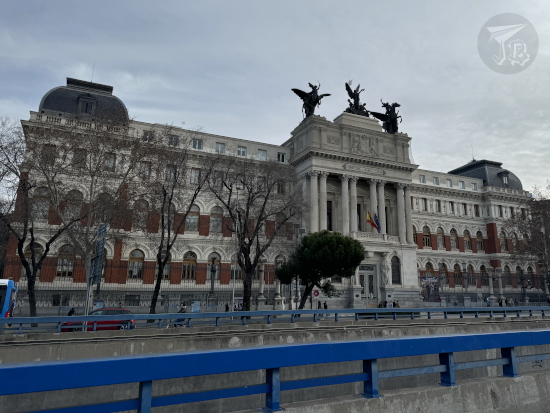
The current Agriculture Ministry is housed in the historical building known as Palacio de Fomento – Palace of Development. Its plans were originally drawn by architect Mariano  Belmás y Estrada, aiming for an Arts and Craftwork School. Later, Eduardo Saavedra y Moragas took over to turn the design into a university. Finally, the project ended in the hands of architect Ricardo Velázquez Bosco, who erected the building between 1893 and 1897 to house the then Ministry of Development.

The Palace is an impressive construction. The original design had three floors, which have now been turned into five. From the outside, the building looks white and orange-brown, but a more focused look reveals decorative tiles by Daniel Zuloaga, who also collaborated with Velázquez Bosco in the ETSIME. The entrance is flanked by two caryatids and roof above there is a sculpture group – Glory and Pegasi La Gloria y los Pegasos, a bronze copy of an original marble by Agustín Querol.

Palacio de Fomento, outside

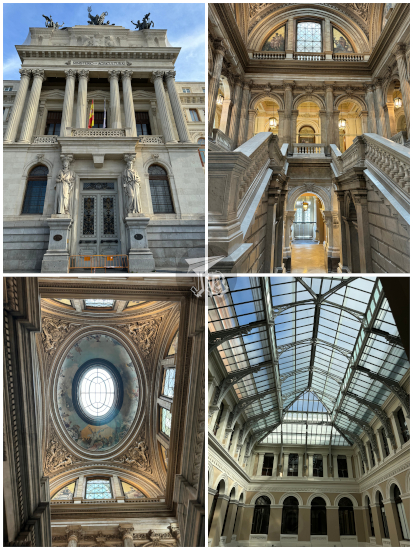
Once you enter, you find yourself in a huge majestic hall, where we had to check in, since the building is a working Ministry. The email said to be there at 11:45 to go through security. I got there at 11:40 and went in at 11:44. They took my name (they did not care about the ticket) and they put my stuff in the X-ray machine. I had to go through the metal detector and when I asked whether I had to remove my belt, I was just told to put my hand over the buckle… So much for security, I thought, because I did not beep. Then I realised that I must look quite non-threatening as quite a few people were thoroughly searched as they set off the machine.

Beyond the hall where we were checked in, there is an imperial staircase in marble, and a vaulted frescoed ceiling. From there, we visited some offices and meeting rooms, and the portrait gallery – from which the ministers who held office during the Franco dictatorship had been removed. Finally, we visited one of the side inner courtyards, covered in a skylight with some ironwork.

Palacio de Fomento, inside

After the visit was over, the security guards saw us out and locked the doors. I walked around the building, because I had honestly never realised it was square. As the place was next to the Retiro Park, I had been considering looking for some archaeological spot they had opened. However, there were more ideas – Guadalajara was having the Botarga parade, and it was the fair weekend in Tendilla, though, a phone call informed me that traffic was horrid and that it was not a good idea to head there so late in the afternoon.

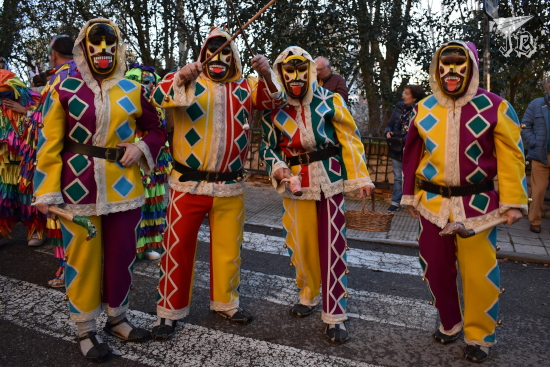
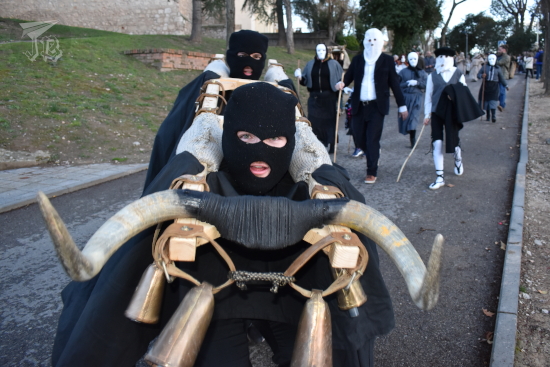
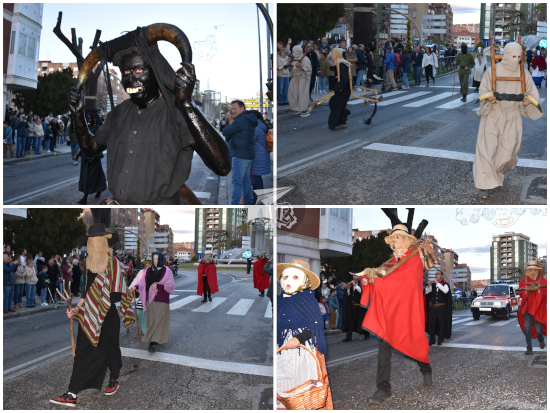
Eventually, I decided on the Parade. I bought some sandwiches and headed for the train. Though I got rained upon, it cleared up, and at 18:00 I was in Guadalajara to have a look at the traditional Parade of Carnival characters Desfile de Botargas – “creatures” from the whole area which meet up in the capital the Saturday before carnival, despite each character having its own schedule wherever it is rooted. The parade was a bit late, so I could talk the local botarga group – El Manda (the Order-giver), Los Mandaneros (the Order-receivers), and the Botarguilla (Little Botarga) – into posing for me. I watched and took pictures from two spots, but the parade moved really fast because they only had thirty minutes to do the route – last year they took well over an hour for that. I decided I did not want to run for it that much… I have to remember to find myself a vantage point next year, instead of trying to get the beginning of the parade…

Guadalajara Botargas

Heifferette from Riba de Saelices

Botarga Parade 2025

I got “attacked” a few times, and ended up with soot all over my face, but at least I avoided the guy painting people with mustard… The botargas seemed to zoom in on children and cameras, and so did the devils Diablos (from Luzón) and the heiferettes Vaquillas and Vaquillones (Villares de Jadraque, Robledillo de Mohernando, Luzaga, Riba de Saelices). It was fun. One of these days I might have to try to follow the botargas in their own villages…

9th March 2024: Minerals, fossils & trains (Madrid, Spain)

I might not be the most people-person ever, but if there is something that makes conventions extra fun, it is seeing attendees unapologetically geek out about what they love – in the case of Expominerales, that would be… rocks. Of course, this is an over-simplification. Expominerales is held yearly in the mine and energy engineering school Escuela Técnica Superior de Ingenieros de Minas y Energía (ETSIME) in Madrid. The year 2024 marks the 43rd edition of the event, which is considered one of the most important fairs in Spain in the topic of Earth Sciences – minerals, fossils, gems, and meteorites are widely available to the public. Aside from the small historical museum Museo Histórico-Minero Don Felipe de Borbón y Grecia, there were dozens of exhibitors with all kinds of items for sale, ranging from a few euro to several thousands. These year there were a few lectures, too, and coincidentally, the two of them I was most interested in happened on Saturday, one after the other.

I arrived at the ETSIME around 11:00, and I walked around the stands a couple of times. I have to say that I wanted everything, but I set a budget and I was able to stay around it, after shopping and lunch. At noon, I settled to listen to the lectures – one about the rehabilitation of an ancient gypsum mine in a hamlet called Hornillos de Cerrato, in the area of León. The other one versed about the uses of an already-rehabilitated one in the south of Spain, home to a huge geode. Both of them were pretty interesting, though the conference room was freezing. Someone had forgotten to turn on the heater there, it seemed…

Expominerales 2024 at ETSIME

After the two conferences, I had a last round to buy a last thing, so in the end I bought an iron-meteorite pendant, a fossilised shark tooth pendant, a plesiosaur tooth, and a soil sample of the K–T boundary. A plesiosaur was a marine reptile with flippers, a short tail and a long neck. The K–T boundary (now named the Cretaceous–Palaeogene (K–Pg) boundary) is the theoretical layer of iridium-rich black sand that was formed by the meteorite that caused the extinction of non-avian dinosaurs – and basically most life at the time, in one of the great world-wide extinctions in the history of Earth.

Shopping from Expominerales

At 14:30, I had a reservation for lunch at a Japanese franchise called Ramen Shifu. While I had originally been looking forward to trying the ramen (and I got my hopes pumped up when I read that they were Hakata ramen style), the noodles were rather disappointing. Fortunately, the okonomiyaki – Japanese pizza of sorts, made with a base of cabbage and topped with sauce and bonito flakes, was all right. On top of everything, paying was stupidly difficult because they did not have change.

Shifu Ramen ponzano - okonomiyaki and ramen

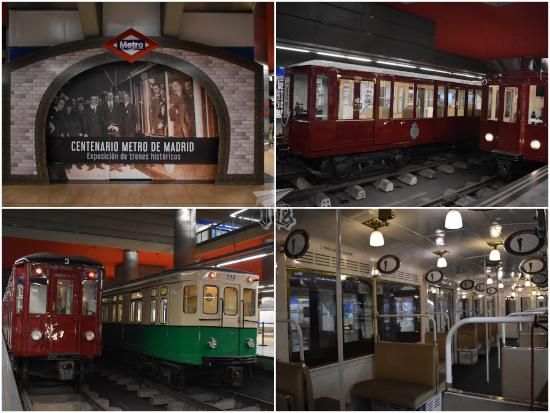
When I came out of the restaurant though, it was raining like crazy. I pulled out my umbrella and hopped towards the closest underground station, as my next destination was inside the metro system – one of the Underground’s museum network Museos de Metro de Madrid the collection of classic trains Estación de Chamartín: Exposición trenes históricos, inside the Chamartín stop. The exhibition displays four historical trains, restored from among the first ones that ran under the city, and some memorabilia. It was a bit underwhelming – more like false advertisement. I hoped I would be able to snoop inside the trains, since that was the photograph that opened the webpage, but unfortunately they were cordoned off. There was however a map with the works by Antonio Palacios in Madrid, which will become handy eventually.

Classical Train Exhibition Madrid

Afterwards, I just headed off towards the train station and got back home.

13th January 2024: Commemoration of Ricardo Velázquez Bosco in Guadalajara (Spain)

In general, I’m not a fan of guided visits, but I’ve learnt to accept that they are sometimes the only way to get access to several monuments. Thus, I signed up for the free* “themed visit” about Ricardo Velázquez Bosco in Guadalajara. The route was organised by the town hall to commemorate the centennial of the architect’s death in 1923 (I know it’s 2024, the activities started in 2023, but they spread through January).

Velázquez Bosco is considered one of the most important architects in the Spanish late-1800s – early-1900s. Among his works are the Spanish Crystal Palace and the Madrid mining school. His style has been called “emphatic eclecticism” and described as eclectic historicism with academicist tendencies – which basically means that he did not like Modernism, and preferred combining historical styles instead.

In Guadalajara, he worked for the most important noblewoman of the period – the Duchess of Sevillano and Countess of La Vega del Pozo, María Diega Desmaissières y Sevillano (Duquesa de Sevillano y Condesa de la Vega del Pozo). The Duchess lived in Madrid, but was connected to Guadalajara through her aunt, Catholic Saint Maria Micaela, founder of the nun order known as Handmaids of the Blessed Sacrament. The Duchess of Sevillano (known in town as “the countess”) had a lot of buildings erected in Guadalajara and around it, most of which are now private property and have a very-limited-to-inexistent visit regime. The town loved its countess since she commissioned (also to Velázquez Bosco) the farming hamlet Poblado de Villaflores – the construction and subsequent agriculture and livestock activities created a lot of work in the area.

To honour her aunt’s charity work, the Duchess ordered Velázquez Bosco to build a school and an asylum, and though she never really lived in Guadalajara, she commissioned him to build her a palace when her Madrid home was expropriated. She never got to live there, as her heart failed in Bordeaux at the age of 64. She was buried in Guadalajara, in a pantheon that she had also ordered the architect to erect for her.

Today, both the asylum and the palace are schools, and cannot really be visited. The pantheon is privately managed by a private foundation Fundación San Diego de Alcalá, which also manages one of the schools, the adjacent gardens, and the church of the former convent.

The first stop of the visit was the pantheon Panteón de la Duquesa de Sevillano. It is a small eclectic building, the inside is a Latin cross, the outside is a homage to the First Romanesque buildings, with neo-Gothic ornamentation. The characteristic purple dome and the interior mosaics are of Byzantine influence. The crypt is a false one, as the pantheon is reached by climbing up a monumental staircase, so when you “go down” to the crypt, you are actually at ground level. The Duchess’ sepulchre, carved in marble by modernist sculpture Ángel García Díaz, represents the funeral procession. We had to pay 1 € in order to visit the pantheon, as there was no agreement between the town hall and the foundation.

Ducchess of Sevillano's pantheon

Ducchess of Sevillano's Pantheon

We then were taken to another of the foundation’s buildings, the school Colegio Niña María Adoratrices. Today is a semi-private Catholic centre run by nuns from the congregation founded by Saint Maria Micaela. The school cannot generally be visited, so I was glad this worked out. The school building was erected in red brick, with a white limestone façade echoing the Renaissance building of the University in Alcalá de Henares. The school used to be a convent, and there is a restricted cloister. Legend has it that the cloister is only open for wedding photographies to brides who studied at the school. It is square, with two stories of neo-Romanesque arches and columns with vegetal decoration. We were also shown the chapel, with neo-Mudéjar panelling on the ceiling, and the monumental staircase.

Adoratrices School Guadalajara: Façade and cloister

Adoratrices School Guadalajara

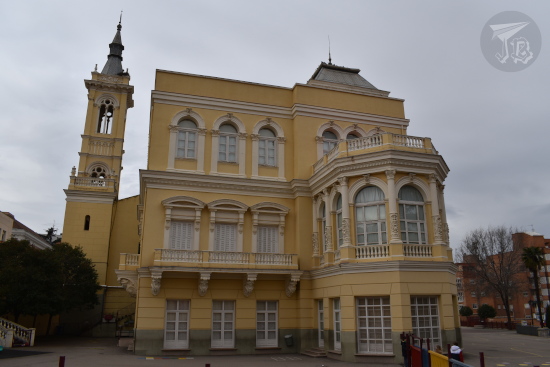
Finally, we walked to what was built as the Duchess’ palace in Guadalajara, Palacio de la Condesa de la Vega del Pozo, today another school, Colegio de los Hermanos Maristas, also Catholic and semi-private, and extremely difficult to visit. We were shown inside and got to see the actual outline of the palace. Inside, we saw the panelling and the ceramic decoration before we reached the inner patio, a mix between Castilian and Andalusian styles.

We then visited the smoking room upstairs, an astonishing ward with ceramic tiles decoration and wooden floors. As a last snoop, we could peek into the balcony, which keeps the original cement-tile (baldosa hidráulica) floor. It was extremely impressive – and one can forgive the horrible pale yellow exterior the palace has been painted. Ricardo Velázquez Bosco was one of architect Antonio Palacios’ teacher, and I had the feeling that Palacios took his ideas for the Fundación San Diego de Alcalá, Panteón de la Duquesa de Sevillano, Colegio Niña María Adoratrices, Colegio de los Hermanos Maristas, Maudes hospital from the walls and floors of this palace.

Maristas school, former Duchess of Sevillano's Palace

Maristas school, former Duchess of Sevillano's Palace inside

The visit took around two hours, and it was free except for the pantheon. Being able to see the inside of both schools was the best, because it is rare that visitors are allowed in either. Thus, I am glad I signed up for this, especially as the weather held – we had a tiny bit of drizzle, but not much, and the clouds kept the cold at bay.

16th December 2023: A day out of ExpoGema (Madrid, Spain)

Since the mineral expo ExpoMinerales back in February was all cool and fun, I decided to attend its shinier (and unbeknownst to me, way more unaffordable) sibling, the gem expo ExpoGema, and make a day out of it. Thus, I headed out for Madrid on the 9:00 train with temperatures below zero – I was not made for winter. It was not much better when I arrived, but for once the train ride was uneventful, I actually made my connection, and it seems that after a chaotic year, the underground train tunnels are finally open. Everything going smoothly gave me some unexpected 45 minutes to wander around as the square Puerta del Sol slowly became fuller and fuller with people.

I had booked a guided visit through the company Madrid en Ruta, who has the exclusive concession to show the business centre Casa Comercial Palazuelo. Located in downtown Madrid, it was designed by architect Antonio Palacios. The promoter, Demetrio Palazuelo, bought the lot left behind by a fire, and commissioned the building with the goal of renting it out to shops and professionals – it was thus the first office building in Spain conceived as such, and not repurposed from a manor or an apartment building. Palacios drew inspiration from the Chicago School commercial architecture and used iron to stabilise the building, which allowed him for bright interiors using lots of glass. The office building was erected between 1919 and 1921, and the offices are still rented out today, with the only caveat that the beautiful interior translucent-glass doors have been painted white – to either protect privacy or hide the fact that today the house seems to be almost empty – at least according to the building’s own directory.

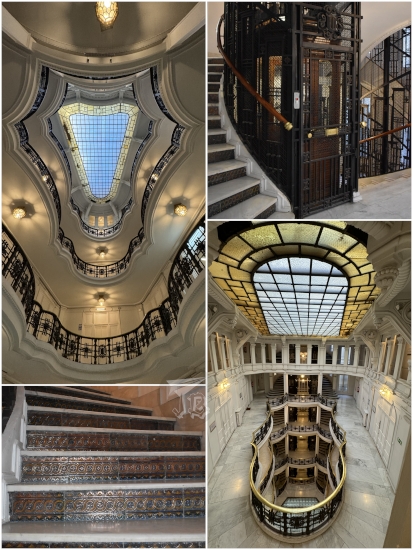
The exterior façade could be considered eclectic – the main frame tends to neoclassicism with huge glass windows framed in black iron. The interior tends towards Art Deco and modernism. The offices are distributed around a central indoor patio, with curved balconies that overlook it and lots of lights mainly due to the skylight. There are two classical lifts which are the original ones, in peartree wood. When we went up, I took the stairs, which have white treads, and the riser is made out dark green ceramics. I have seen these in other works by Antonio Palacios.. The interior, with the iron balustrades and its curvy design, was really cool, but I think it is really a pity they painted over the glass.

Interior of Casa Palazuelo

The visit started at 11:00. We spent the first fifteen minutes outside getting context, roughly half an hour inside, and the last twenty minutes on the roof of the building, waiting for the clock of the Puerta del Sol to strike 12:00, then we were ushered out. I really wish we could have wandered the house a little bit, even if we could not go into the offices. The ten euro we paid surely did not feel like we were paying customers, but more like we were sneaking around like unwanted guests – which we probably were anyway.

Puerta del Sol from the roof of Casa Palazuelo

I grabbed a quick snack then and headed off towards the engineering school Escuela Técnica Superior de Ingenieros de Minas y Energía (ETSIME) for the sixth edition of the gem fair ExpoGema. The fair itself was neat, but most everything was way above my budget range. I was there at the typical Spanish lunchtime, there were few people, and most were at the stands. Thus, I had the museum Museo Histórico-Minero Don Felipe de Borbón y Grecia almost completely to myself. I really like old-style museums, and this one has a huge amount of specimens, most of them are minerals, but there are also fossils and a collection of cave bear skulls and bones. I had decided not to book any guided visit or activity as none happened within the couple of hours of lunch downtime.

Geology Museum at Etsime

I bought an ammonite pendant, a small pyrite with almost perfect right angles, and another pendant made with a small meteorite from Campo del Cielo, along with a tiny extra piece. Campo del Cielo is an area in Argentina where four or five thousand years ago an iron meteorite fell. The meteorite shattered upon entering the atmosphere and, when it impacted the surface, the different created up to 26 craters. About 100 short tonnes of a fragmented iron meteorite have been recovered to date, and I now own around four grammes of it – yay me. I did not buy any precious stone though since the pretty shiny rocks were way out of my budget.

Expogema 2023

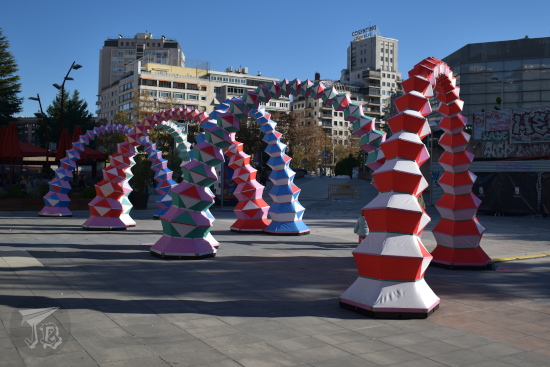
I left the ETSIME and I walked towards the square Plaza Pablo Ruiz Picasso, where there is a temporary art installation called El Regalo (The present) by Amigo&Amigo, a studio specialising in art installations. The artwork comprises a few arches that end in pads that can be stepped on – when they are, music sounds. The day was still bright, so the artwork was not shining, but a bunch of kids jumped on the pads to keep the music playing.

El Regalo artwork

Afterwards, I took a train and headed off towards central Madrid again. I had a reservation for an afternoon tea at NuBel, an “avant-garde gastronomy space” in the modern art museum Museo Reina Sofía. I had been drawn to the place due to the “freshly-baked scones” they advertised.

The experience was beyond disappointing. First, I had to wait to get seated, but then the person who checked me in forgot to notify that I was there – this is what I assume happened, I was literally told that “the kitchen had forgotten about me”. The set menu took 40 minutes to come out, and the scone was cold anyway, so not even freshly-made. I had got a decaf latte that was also cold when the food came.

The menu, 16€ as I don’t drink alcohol, consisted of: two mini-sandwiches – the two of them had been made from the same bread slice, so you can imagine the size, with some kind of mayonnaise filling which was not bad but rather unidentifiable; one shot-sized glass of (pre-made) gazpacho; one scone; a piece of red velvet cake; a piece of carrot cake; one chocolate brownie; a side of cheese cream, butter and jam; and in my case the already-stone cold decaf latte.

Nubel afternoon Tea

The scone was cold – so much for freshly-made, the only thing that had kept me waiting. Furthermore, the cheese cream, albeit nice, did not fit it like at all, so I had to use butter on it. I laughed to myself thinking about “the horror!” while I clutched my metaphorical pearls. The red velvet was probably the best, but in general the cakes were too sweet – good thing the menu included free tap water. Afterwards, I was comped another free decaf as an “apology for the delay”. However, when I tried to pay, more drama ensued. First the card-reading machine was not working, then they could not take cash because they were balancing the register, then they could bring the machine to the table. All in all, I spent almost hour and a half there – about five minutes waiting to be seated, forty minutes waiting for the tea set, and twenty minutes trying to pay. I’m sorry to say I did not tip, nor do I plan to ever come back.

I missed my train due to the paying delay, and I had to wait almost half an hour for another one. I hung out the Christmas market for a bit, and looked at the lights around Puerta de Atocha station. As it was cold, I walked in and went to check out the original train station, now turned botanical garden. I had never stopped to look at the iron ceiling, just at the plants – and the tortoises people used to dump there – but there had been an old photograph during the Casa Palazuelo visit that made me want to look at the building itself, and I recognised that old station in today’s building, with its wrung iron columns. Funny, how you can look at the same old things and recognise them.

11th March 2023: Rocks from the land and fish from the sea (Madrid, Spain)

Back in 2018, when going to Madrid’s Geomineral Museum (Museo Geominero), I stumbled upon an event in the Mining Engineering University – something called Expominerales. At the time, I did not have time to explore it, and only later did I realise what I had missed – an international fair for the trade of minerals, rocks and fossils. I made a mental note to check the event out the following year, but something came up and I completely forgot about the whole thing. In 2020 the pandemic struck, and finally in 2023, almost five years to the day, I went back to this event held in Madrid.

Expominerales is held yearly at the working engineering school Escuela Técnica Superior de Ingenieros de Minas y Energía (ETSIME), which offers the bachelor’s degree in Mining Engineering, and the one in Energy Engineering (whatever this last one is). The first weekend of every month, the school organises a “mineral-world flea market”, and the second weekend of March, it hosts an international mineral, gem and fossil fair, with shopping stands and different workshops and activities. After a few cancellations due to Covid, it returned in 2022 and it’s back to its former glory in 2023 – Expominerales XLII, the 42th edition of the fair.

The ETSIME in Madrid. Pink-and-white building from the 19th century, accessible through stairs, with flags hanging over the door

Mining Engineering became a formal education path in Spain in 1777, originally in the town of Almadén, a mercury hub. The school was moved to Madrid in 1835 and a two-building campus was ordered. The historical building in the ETSIME (M1) was designed by architect Ricardo Velázquez Bosco, and decorated by ceramist Daniel Zuloaga between 1884 and 1893. The second building (M2) was damaged during the Civil War, and has suffered several modifications to accommodate classrooms and laboratories. The premises also include a reproduction of a mine, Mina Museo Marcelo Jorissen, however this one is closed for renovation – a lot of that seems to be going on around the university, since part of the decorations of the buildings are also covered.

The M1 historical building has a central cloister with an ironwork colonnade. The building is rectangular, and on the short sides there are two symmetrical wards. One holds the historical mining museum, the other one the historical library. The central cloister is the main area where Expominerales is held, on the ground and first floor. On Saturday, the exhibit opened at 10:00, and we were there a bit later in order to sign up for the first guided visit at 11:00 (3€) – we wanted to take it so we had access to several rooms that would otherwise be closed to us. The idea was being there before families with kids started arriving and the activities became overcrowded – it turned out in the end that most the activities were indeed organised for children, so it did not really make a difference. Furthermore, the visit we feared full only had 6 attendees.

We had one hour before the guided visit that we spent looking at the stands on the ground floor on the M1 building. The guide was a student who might have been partying the previous night, because he sounded a little out of it – forgetting info and words, even things related to his own degree.

First, we went to see the mineral collection, the origin of the historical museum in the M1 building, Museo Histórico-Minero Don Felipe de Borbón y Grecia. The mineral collection was started in 1831, and throughout the years it was increased with new minerals donated by different institutions. It was later expanded to cover palaeontology and historical artefacts related to mining and other earth sciences. Though a lot of the displays are scattered throughout he building, the original museum dates from the 19th century, and it has four sections: the mineral collection, the fossil collection, the cave bear collection and the mining archaeology section, totalling over 10,000 items.

The historical mining museum at ETSIME Madrid. It is a large ward with cedar wood shelves from floor to ceiling, filled with rocks and fossils. The picture also shows some close-ups of rocks, two cave bear skulls, and a cluster of fossilised snail-like animals

Today, the museum is named after King Felipe VI, who visited the museum in the late 1980s after the university reached out to him to propose the name. The then prince came to visit then, and the name “the king’s stairs” was given to the set of side stairs he used – Escaleras del Rey.

We also visited the small hall where candidates read their theses, a little hall with spectacular ceramic tiles by Zuloaga, and finally the historical library, with obsolete but cool volumes. The library also dates back from the 19th century, with the walls covered in wooden shelves, with a small metal staircase to access the upper balcony. Unfortunately both this one and the one in the museum were cordoned off.

Library in ETSIME. It is a large room with cedar wood shelves from floor to ceiling, and a spiral staircase.

The visit ended at the lecture hall on building M2, one of the few remaining areas of the original design. It is a marble room with wooden benches and decorated windows that represent the original subjects taught to Mining Engineers. After we were left off, we sat down at the cafeteria for a drink.

Lecture hall in ETSIME (Madrid). It's a marble room, rather dark, with smoked windows representing different subjects of the Mining Engineering Degree

We recharged batteries, and then we had a look at the stands on the first floor of the M1 building, alongside the collection of apparatus that they had. Afterwards, we decided to separate in order to do shopping. Expominerales hosted over 30 stands, national and international.

Expominerales. A view of the ETSIME cloister from the second floor, showing different stands and lots of people peering curiously

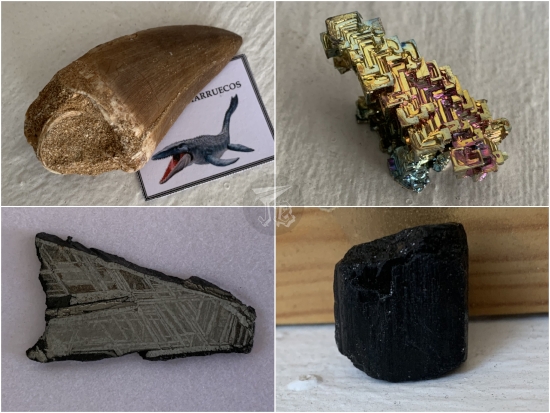
I, being the nerd that I am, got myself a tiny slice of iron meteorite (from Geoterra Minerals), a mosasaur fossilised tooth (from Carlos Hammann, who also had amazing megalodon teeth that I will never be able to afford), a decent-sized of recrystallised bismuth (from Rossell Minerals), and a small piece of black tourmaline (from The MineralShop) – all for 51€.

Collage: a fossilised tooth, a bit of mineral in metallic colours, a slice of meteorite with silver orthogonal markings, and a bit of shiny black rock

When we met again, it was a bit past 13:30. There were too many people by then – families had started arriving, so we decided to leave. We had booked at a nearby restaurant for lunch, and they did not mind accommodating us a little earlier. The restaurant, called DeAtún Ponzano specialises in tuna dishes – particularly Atlantic bluefin tuna (Thunnus thynnus), sustainably caught in the Straight of Gibraltar.

Before overfishing was even a thing, Phoenicians settled in the south-west of Spain somewhere between the 9th and 7th centuries BCE – the city of Cádiz, credited as being the longest-standing city in Europe, may have been the first port. The Phoenicians observed that the bluefin tuna migrated from the Atlantic to the Mediterranean every year around the same dates, and later they came back to the ocean. These guys came up with a very simple technique – that was later developed further by the Romans and perfected in the Islamic period: the almadraba.

An almadraba is a portable but complex net which is lowered for the migration period. The bigger fish are funnelled into a box-like construction, and the smaller ones swim right through it. Once the almadraba is full, a number of fishing boats lift it in a process called levantada (raising). Expert fishermen walk onto the nets, discard any small specimen that might have been trapped, and choose the tuna that will be sold, generally individuals heavier than 200 kg.

Since the fish are selected on a case by case basis, the amount of both the catch and by-catch is small in comparison to other fishing methods. Both the seasonality and craftsmanship of the whole process make it much more sustainable than others – of course, this also causes fewer pieces in the market, which in turn increases the price. Furthermore, all the fish are wild, hand-picked, and only bled out when they are loaded onto the ship. Thus, the quality is extremely high. Another factor that makes almadraba-caught tuna more expensive is the fact that walking onto the levantada is dangerous. Fishermen have been seriously hurt by struggling tuna, as some of the fish might weigh up to 500 kg.

Working almost exclusively high-quality tuna means that DeAtún is not a restaurant on the cheap side of things. I’ve actually traced down their tuna provider and the prices are rather cost-adjusted for almadraba-caught tuna. There’s another thing to consider, too, which is that the Spanish law forces restaurants to freeze fish that is going to be served either raw or quasi-raw, at least for 24 hours at a temperature under -20 ºC – this is done to destroy a fish parasite called Anisakis, which can cause stomach distress and serious allergic reactions. Apparently, the perfect temperature to keep the tuna properties is -60 ºC. So yay Anisakis-safe almadraba-caught tuna all year round (though it’s true that the freezing law makes it impossible to eat fresh tuna raw).

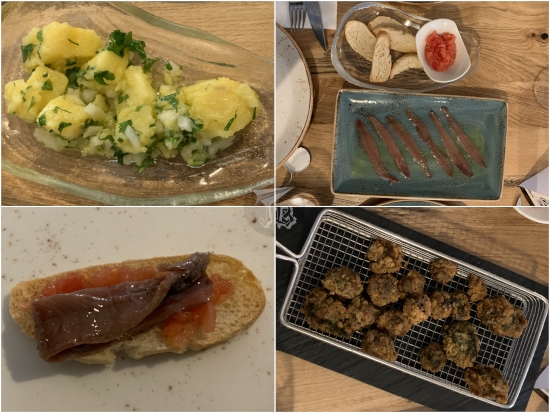
We got a welcome tapa of boiled potatoes with olive oil and herbs (“papas aliñás”), a favourite from southwestern of Spain, the same area where the almadraba tuna are caught. We shared some European anchovies (Engraulis encrasicolus) “anchoas del Cantábrico” with tomato and toasted bread. These anchovies are salted for at least six months, cleaned, and stored in olive oil. They have a strong flavour, and are not everyone’s cup of tea, but I adore them. We also shared a portion of “ortiguillas” (Mediterranean snakelocks sea anemone Anemonia sulcata, battered and fried), also typical of the south-west – I’ve never been much of a fan though.

Lunch at DeAtún. Collage with a potato salad, anchovies and battered seafood balls

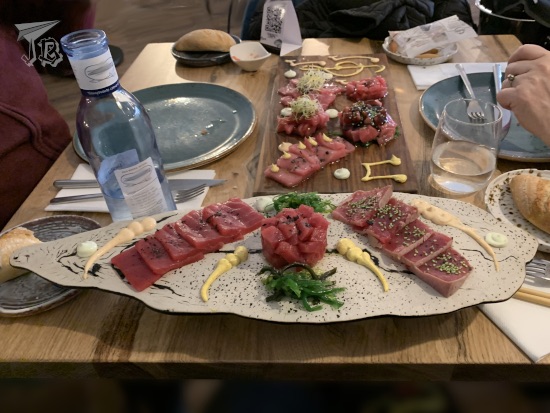
Finally, as my tuna preference is raw, I was wondering whether I wanted sashimi or tartar. In the end, I decided to try a combo (“trio DeAtún”): tuna sashimi (slices), tuna tartar (dice) and tuna tataki (heat-sealed slices), with a side taste of different sauce emulsions – wasabi, kimchi and curry. The tuna cuts used for these preparations (descargamento and tarantelo) would be the otoro or toro Japanese cuts, which are appropriate for raw preparations – technically the best ones, fatty or very fatty meat. I don’t love tataki, thus my original reticence to try this combo, but it was good. My favourite bit was the sashimi though, the tartar was missing a bit of spice.

I was offered chopsticks to eat the dish, and I accepted – easier to handle the fish. That apparently made the maître think that I had been the one choosing the restaurant, because in his words I “seemed to be an expert, chopsticks and all”. That was hilarious – I mean, why offer chopsticks if you don’t expect them to be accepted? For the record, although I booked the table, I did not choose the restaurant – it would have been a little on the “too fancy” side for me. The truth is, there were a bunch of very-elaborated dishes that we decided to give a miss, and we went for the raw tuna.

Lunch at DeAtún. A plate with three tuna cuts. The centre is round, and rose-like, and the sides are extended on a line. The fish is uncooked and it looks dark red. There's a similar dish in the background, with more cuts

Desserts were okay, but not the reason we had chosen this place. The point was eating tuna – raw tuna in my case – and the restaurant delivered. I was however amused by tables around us refusing the raw options even when the chef himself came out to greet them and recommend the dishes (someone over there must have been an acquittance, I don’t really know). Finally, we set back home to compare treasures and plot going back to Expominerales in its 2024 edition – at a time where we can snatch some discounted rocks.

12th & 13th February 2023. The Epic Apocalypse Tour in Madrid (Spain)

The year 2020 was going to be so amazing that I actually would have had to choose the things I wanted to do and sacrifice others. It didn’t turn out that great in the end, with lots of rescheduling and cancellations. I was eventually able to budget time and money for one of those rescheduled events – the joint concert by the metal bands Epica and Apocalyptica in their Epic Apocalypse Tour. For a while, however, there was a bit of uncertainty with dates, as they bounced between Sunday 12th and Monday 13th of February, so I needed to juggle work dates in order to make sure I’d be free on Monday. In the end, I was all clear, all the concert-related activities were set for Sunday evening, and I decided to make a two-day trip out of it – I needed to take a hotel for Sunday anyway.

I arrived in Madrid around 9:30 in the morning. I had some time before my first appointment so I walked into one of the large parks of the city Parque del Buen Retiro, which is part of the Unesco World Heritage Site Paisaje de la Luz (Light Landscape), officially called Paseo del Prado y el Buen Retiro, paisaje de las artes y las ciencias, declared in 2021.

Parque del Buen Retiro was built in the 17th century for one of Felipe IV’s palaces, and it was opened in the late 18th century as public park. The park was almost destroyed during the war against Napoleon’s troops in the early 19th century, so most of it has been rebuilt. Aside from the obvious flora, it features sculptures, fountains, buildings… It is home to a lot of birds, and unfortunately a large number of invasive and fearless monk parakeets (Myiopsitta monachus), whose culling has been controversial in recent years. I got to see common blackbirds (Turdus merula), a European green woodpecker (Picus viridis) and a European robin (Erithacus rubecula).

One of the most important features of the park is the sculpture Monumento al Ángel Caído, which represents an angel falling from grace. It was originally designed by Ricardo Bellber, who made it in plaster in 1877. It was later cast in bronze and the original plaster destroyed, and eventually the sculpture was made into a part of a fountain in 1885. Around the area, there is also an ancient water mill, and to my surprise, the almond trees (Prunus amygdalus) had started blossoming.

Retiro Park collage: a pathway with trees and bushes on both sides, ducks, and a robin.

Retiro Park collage: a water mill, blossoming almond trees, and the fallen angel fountain

At 10:15 I had a guided visit to the Real Observatorio de Madrid (ROM), commissioned around 1785 by Carlos III, as an centre to develop and study astronomy, geodesy, geophysics and cartography. The main building is the astronomical observatory, built by Juan de Villanueva in what then was the outskirts of the city. Today, ROM belongs to the National Geographical Institute (IGN), and it is home to the National Astronomical Observatory, the Central Geophysics Observatory, and the data gathering division of the National Volcanic Service, though no measurements are taken there. The main astronomy measurements are carried out in the Centro Astronómico de Yebes, in a town around 80 km north-west of Madrid. The observatory is also part of the Unesco World Heritage Site.

The visit comprises three stops. The first one is the main building, called Edificio Villanueva, which has three rooms – the main rotunda with a Foucault pendulum, the library, with the spot where gravity was first measured in Spain, and the “Time room”, where the sun used to be traced to determine the hour.

ROM collage. A small Neoclassical building, an inner room with a pendulum and telescopes, a telescope and a 19th century library.

The second stop is the Great Telescope, a replica of one that William Herschel built in the 18th century – Hershchel was one of the greatest telescope makers of the time, and is credited with discovering the planet Uranus, two of its moons, and two moons of Saturn. The telescope was destroyed during the war against the French, but later rebuilt thanks to the number of laminates that had been preserved – the original had a focal distance of 7.6 m and a 61-cm diameter mirror (which is displayed in the main building), and Herschel himself considered it the best he ever built.

Herschel grand telescope: a wooden scaffolding structure keeping a huge black tube pointing at the stas

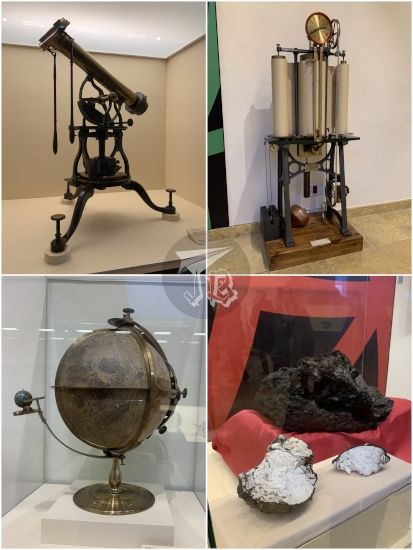
The final stop, the little museum of “Earth and Universe Sciences” has a small collection of ancient instruments used for astronomy, navigation, and geophysics. There are also a couple of seismographs – one of them new, which is up and running – and material retrieved from the volcanic eruptions of El Hierro in 2011 and La Palma in 2021.

Collage. Ancient telescope, old tide measuring device, an old globe, and lava bombs

I had planned for a typical sandwich at an iconic bar afterwards, but I ran into a political demonstration. Thus, I scratched that idea and took the underground westwards. When I was in Egypt, one of the places I visited was Lake Nasser, created by the Aswan High dam. The lake swallowed a lot of villages and monuments, but a few of them, such as Abu Simbel and the Temple of Philae were saved by Unesco. Between 1960 and 1980, a total of 24 monuments were saved, and five out of these were presented as “grants-in-return” to five countries which had offered exceptional technical and financial assistance to the campaign – Germany, Italy, Netherlands, the United States and Spain, the latter being impressive as Spain was in the middle of the dictatorship, and pretty shunned by the international community at the time.

The monument was a small and ruined temple in the now-flooded town of Debod, to which it owns its name Templo de Debod (Temple of Debod). Dedicated to the god Amun, it was built around the location of the First Cataract of the Nile, some 15 km south of Aswan, about 2200 years ago, though the core of the building may have been older. The monument was actually affected by the original dam at the beginning of the 20th century, and it was covered in water for most of the year, which destroyed its colours and damaged the reliefs.

During the Unesco salvage mission, it was dismantled, and eventually granted and taken to Spain, and “freely” reconstructed – a lot of information had been lost, and there were missing blocks. National stone was used to fill in the gaps, and the gates (remains of the pylons) were built in the wrong order, according to some old pictures. The restorers built an air-conditioning system, a wooden roof, and the main hall was closed off with a glass door and window panes. Today, the temple is open to the public at weekends, but unprotected from the Spanish weather – rather different from the Egyptian one – and pollution, it is rapidly deteriorating.

I went inside the temple once when I was a child, and I had a clear memory of it that kept surfacing when I was in Egypt – so I wanted to go back. The entry is free, but capacity is reduced, so I had to queue for almost an hour to enter. I finally matched my memory to reality. The interior of the sanctuary has a small chapel and some carved stones had been taken to a makeshift second floor to display them as a little museum.

A collage of a small Egyptian temple - it has two floating gates that lead up to the main building, which is small with four columns. One picture shows a tiny and dark inside room with an altar.

After the temple, I got lunch on the go, then walked towards the hotel to check in and change clothes. Around 16:15, I set off to La Riviera for the concert. I had a Meet and Greet ticket and had to be there before 17:00. Personnel from the venue were extremely nice, and there was no chaos at all, even if things had been a little disorganised and some fans were lacking M&G confirmation emails. Everything was well-handed and everyone who had paid for an upgrade got through. There were about 30 people to meet and greet Epica and we were ten for Apocalyptica.

Apocalyptica is a Finnish four-man band – Eicca Toppinen, Perttu Kivilaakso, Paavo Lötjönen and Mikko Sirén – founded in 1993. They are “semi-officially” a symphonic metal band, but they’ve ventured into everything from Metallica covers (which was their origin) to pure classical works. They have a very specific style heavily using classical cellos and combining them with modern drums. They currently collaborate with American – self-identified as Cuban in the concert – singer Franky Perez for vocals.

Meeting the four of them was really fun. I got autographs and took the most epic picture I’ve ever taken with a band or artist before. As we were only ten, after it was over, I had time to buy some merchandising and still be the second person to settle on first row – despite having decided that I was going to sit back and relax.

Apocalyptica white and black poster, signed by the four members

General admission started at 18:00, and the crowd was surprisingly tame throughout the whole thing. The venue filled up and the supporting band, Wheel, came up at 18:30. Wheel is a Finnish progressive metal band that consists of James Lascelles (Vocals/Guitar), Santeri Saksala (Drums), Aki ‘Conan’ Virta (Bass) and Jussi Turunen (Lead Guitar).

Wheel Setlist

  1. Hyperion
  2. Blood drinker
  3. Movement
  4. Vultures
  5. Wheel

Wheel playing, each member at his insturment: bass, guitar, singer and drummer

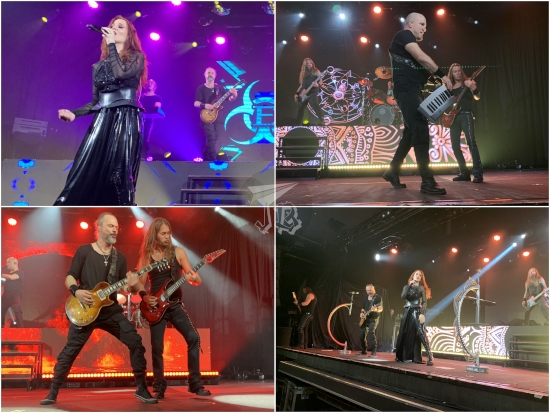
The second band was Epica, which I remember having listening to back when the world was young. They are a Dutch symphonic metal band currently composed by Simone Simons (lead vocals), Mark Jansen (rhythm guitar, vocals), Coen Janssen (keyboards, synthesizer), Ariën van Weesenbeek (drums), Isaac Delahaye (lead guitar) and Rob van der Loo (bass). Simone can go insanely high with her voice, and she has an amazing presence on stage, and the whole band has an immense amount of energy – she also reminded me of a comic character. The keyboardist had a lot of personality too, and he was extremely fun.

Epica Setlist

  1. Abyss of Time – Countdown to Singularity (recording)
  2. The essence of silence
  3. Victims of contingency
  4. Unleashed
  5. The final lullaby
  6. The obsessive devotion
  7. The skeleton key
  8. Rivers
  9. Code of life
  10. Cry for the moon
  11. Beyond the Matrix
  12. Consign to oblivion

Collage of Epica playing, showing different members at their choice of insturment - singer, bassist, guitarist, and keyboardist with a portable keyboard

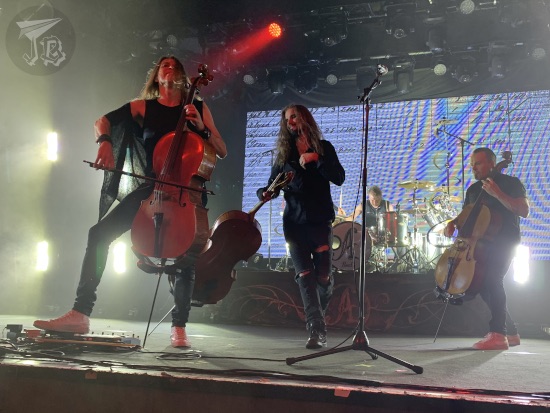
Finally Apocalyptica came on stage, and it was extremely fun. The things those guys do to their classical cellos would make some classical musicians cry, but the sound is super-powerful. We had Franky Perez for vocals, and a very fun moment regarding “listen to our classical music album at home, because we still feel like death metal”. They interacted a lot with the public, and it felt somehow very friendly / warm – yes, I’m talking about metal here. It was really that fantastically weird.

Apocalyptica Setlist

  1. Ashes of the Modern World
  2. Grace
  3. I’m not Jesus
  4. Not strong enough
  5. Rise
  6. En route to mayhem
  7. Shadowmaker
  8. I don’t care
  9. Nothing else matters
  10. Inquisition Symphony
  11. Seek & Destroy
  12. Farewell
  13. In the Hall of the Mountain King

Apocalyptica playing with Franky Perez. Perez is in the foreground, dressed in black. The thee cello-playing members are in the frame, playing. The drums peek behind them, but you can't spot the drummer

Apocalyptica playing at La Riviera. They have classical cellos. Two of the members stand on the sides, playing their cellos. Another one is walking swinging his as if it weighed nothing, The final one is slamming drums in the background.

We finished off just short of 23:00, I bought off some fast food for dinner, and headed back to the hotel to have a shower and get some sleep. I was woken up early in the morning due to the cleaning crew and the garbage mini-vans noises, but I did not leave bed until 9:00, then set off at 9:30. I bought some cold coffee on the way and walked into the former royal palace gardens, now public park Jardines del Campo del Moro.

Though I’d seen the gardens a few times before, this was the first time I actually walked into them. Despite the frost covering everything, I got a nice view of the palace and different fountains and buildings sprinkled throughout the green – Chalet de Corcho, is a small hut with coloured windows; and Chalecito de la Reina a wooden house that is currently closed. I was insanely amused by a little grass-cutting robot.

Jardines del Campo del Moro. Collage. It's winter and most trees are grey and bare. At the end of the walkway stands the Neoclassical Royal Palace. Two smaller buildings - one of them is white with brown beams, reminscing of German architecture; another one is a small kiosk with colourful windows - red, green...

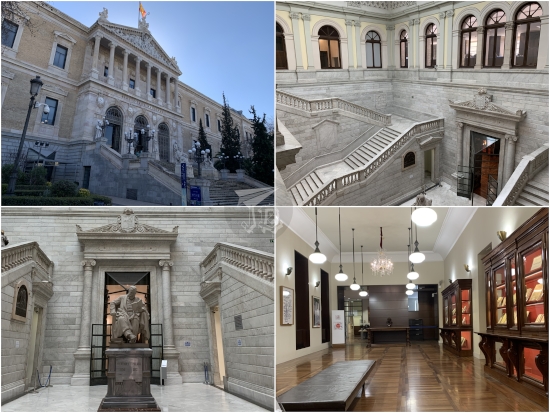
I wandered around for an hour or so, then headed off via underground to the National library of Spain Biblioteca Nacional de España for the absolutely worst guided visit of my life. Like… it’s true that it’s free, but tickets run out within hours of coming out – on the 20th of the month, for the following month. I’d actually been trying to do this since Covid lockdowns ended… It turns out, we did not see any real books, we could not even peer into the reading area, the book and reading museum is closed and the only information we got was… that the guide did not like the Library. We did not get to see anything interesting or that we could not see on our own, and we did not get to learn anything, so this was a huge blunder. Live and learn – but it was one of the few things that was open on a Monday. The library is a huge Neoclassical building with a fantastic marble staircase inside. The doors and gates are protected by intrincate ironwork fences.

Biblioteca Nacional de España. A Neoclassical building in white and grey tones. The exterior has columns and statues of writers. The interior showcases a pair of twin staircases with the statue of one of the most important library directors between both.

I met with family for a quick lunch and then we went for a walk. We had thought about going to one of the terraces to see the cityscape, but it was closed because it was a Monday. We ended up at the Parque del Retiro park again to make some time and walk. We sat in the sun for a while, then went to see the Palacio de Velázquez there. Currently, it’s part of the modern art museum Museo de Arte Reina Sofía, and I did not really care much about the exhibits, but I like the building. Architect Ricardo Velázquez Bosco built it in brick (with ceramic tiles by Daniel Zuloaga) for the Mining Exhibit in 1883, inspired by London’s Crystal Palace, now gone. The interior is pristine white with hints of iron architecture, but the building’s official style is “neorenaissance historicism” whatever that means.

Palacio de Velazquez: A brick building with large windows and tile decoration. The inside is all white with bits of iron architecture.

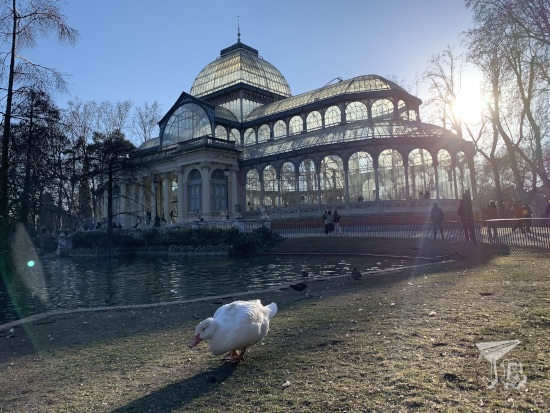
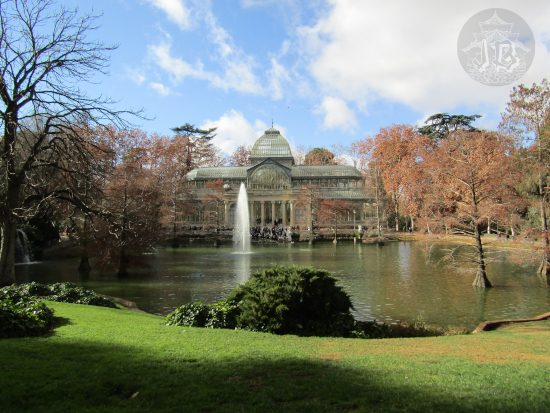
Velázquez Bosco and Zuloaga also came together when they designed another building I really like, the glass-and-iron greenhouse Palacio de Cristal, which was built to home tropical flora and fauna from the Philippines in an exhibit in 1887. In front of the palace, there’s a small pond home to some cheeky ducks and geese.

Palacio de cristal. A huge greenhouse with a dome, and two wings. A white duck wanders in the foreground. Between the greenhouse and the duck there's a small pond.

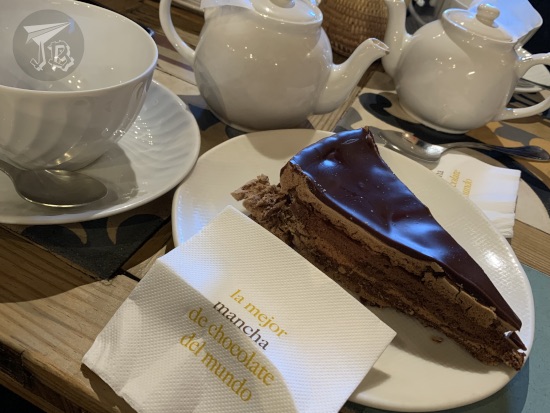
Then, we went to have a snack. Trying to find something on the map before the trip, I’d come across a place called La Mejor Tarta de Chocolate del Mundo, which translates to “The best chocolate cake in the world” and that had to be tried! It was really nice, even if the place was pretty small and felt a bit cramped.

A slice of chocolate cake in front of mugs and teapots

We finally took a stroll down towards the sunset, and I took the train back without much of a hitch, then drove home

13th October 2021: Poblado de Villaflores (Spain)

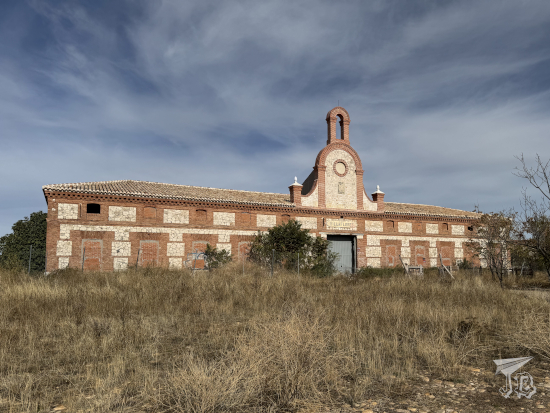
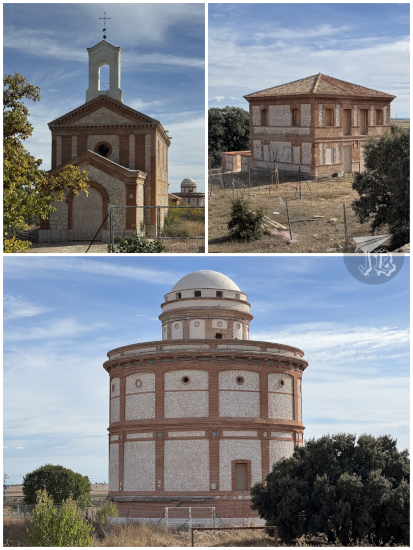
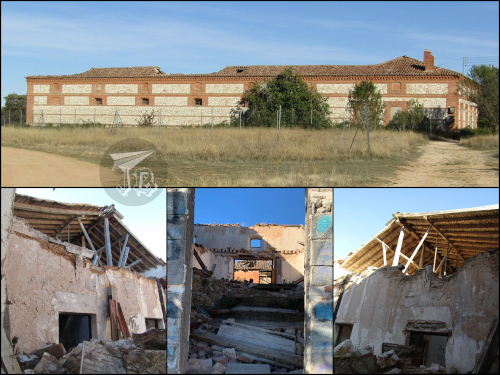
Poblado de Villaflores (Settlement of Villaflores) is a long-abandoned farm settlement was erected between 1886 and 1887. In 1882, María Diega Desmaissières y Sevillano, countess of Vega del Pozo and duchess of Sevillano (among other titles) came to own the land where the village now stands. She was known for her philanthropy and ordering several buildings be built. The settlement was one of these – the duchess commissioned architect Ricardo Velázquez Bosco to design a ‘rural colony’. The buildings were erected in limestone masonry and exposed brick, and the most important items in the settlement were the main hamlet, a dovecote, four several-family houses and a hermit church. There is confusing information on whether it has been declared an “interesting” or talks of the the declaration were finally archived.

I have driven by the settlement several times, but at one point I made up my mind to visit, even if the area has been in decline for years – as a matter of fact, a clock tower that used to be part of the hamlet collapsed in 2016, and the first alarms had been rung as early as 1980. Since then, most of the buildings have had the entrances either boarded up or walled, and the collapsed areas seem to unstable to come in explore. I wish I had decided to visit earlier, when real urbex was doable, but oh well.

The actual entrance to the area – which is paved – has been fenced off since at least 2011, despite the different announcements about recovering and restoring the settlement. However, next to the settlement there is an official cattle way (Cañada real ), used to guide the herds from winter to summer pastures (the practice of transhumance). This was a common practice in the Middle Ages, but it died away with time, and today most of them have been turned into hiking trails. The key thing is that as they cross roads, there are big clearings where you can park, and that is the way to go in this particular case. The area is named Cañada Real de las Matas (Área Recreativa Francisco Rodríguez).

At the edge of the holm oak (Quercus rotundifolia) forest, Chaparral de Villaflores someone installed a children recreational area and some tables and benches, maybe mid-1990s, and called it a park Parque del Sotillo. While the tables are still in use – judging by the rubbish around it – the swings and other elements have been plundered.

As I approached the hamlet, antigua casa de labranza, I saw the chicken wire fences but most of them were actually open and torn down, so I guess I just decided to wing it. The hamlet was open but I decided not to enter it, just in case I broke an ankle or something. This is the building that lost the clock tower, and the only one whose property is private – it belongs to a real estate company which at some point planned to develop the area, but backed out for some reason.

I went on to the church, which used to be consecrated to Saint Didacus of Alcalá – antigua ermita de San Diego de Alcalá.

I deviated towards the mill, then backtracked to the houses, crossing the actual road that is blocked. It is weird, seeing roundabouts in such a dilapidated place (≧▽≦). As I was exploring the houses, I heard shots and saw ducks try to fly away, so the cars I had come across, which I expected to belong to people looking for mushrooms ended up belonging to hunters.

That made me a bit apprehensive, but I was finally close to the most attention-grabbing building of the whole settlement – the dovecote, called La Tabalta in Spanish. It has two floors and it could home ten thousand doves – which were kept for recreative hunting in the 1880s.

I did not try to enter the winery because it was too dilapidated, nor the more modern barn, but this was a fun little visit that thankfully did not end up with me getting shot! I might try to visit this again in winter when there is less vegetation. Though since it is in the middle of nowhere the wind will be freezing…

Walking distance: 4.48 km

8th September 2021: Impromptu Madrid Run! (Spain)

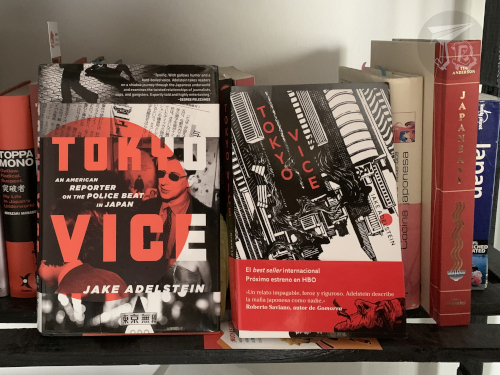
This was oh my god so unplanned that I kept improvising throughout the whole day! It all started because a Spanish publisher decided to translate a non-fiction book I’ve loved for ages – Tokyo Vice by Jake Adelstein. The publisher flew the author in for interviews, and I guess I was disappointed that no signing event was organised. I asked the author once and the publisher another time, then shrugged it off when I got no answer. There were some interviews scheduled for him, and a book fair coming up. I guessed it was just not meant to be, but I did feel disappointed.

And then, on the 7th, Mr Adelstein shot me a message that he would sign my book if I could go to Madrid and meet him at one of his breaks. As you can imagine I just… said yes (I could not meet him that very same evening because of travel times, but I could make it on the 8th. And there I went).

It was the first time taking the train since the whole pandemic thing (hell, I had not even been on a train since Paris 2020), and a weekday so I chose the times carefully to hopefully get close to as few people as possible – it worked, as both rides nobody sat next to me.

I arrived in Madrid and transferred easily, then got out at a new station in the area of Gran Vía. The Tokyo Vice book came out that day, so I wanted to go to a big book store that would hopefully have it already. My first stop, FNAC, failed miserably, so I went to La Casa del Libro, where they told me I would find the book in a completely different section where I actually did. But at least I had it in my hands, even if I had apparently not used my credit card for so long, I got the right PIN for the wrong card (≧▽≦).

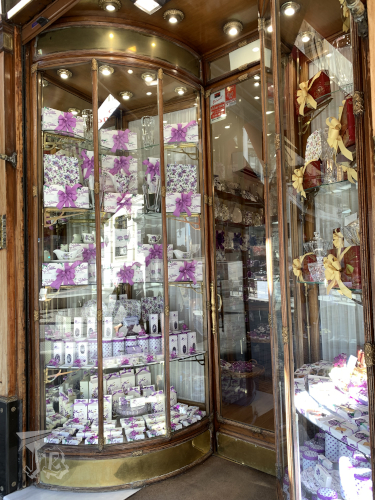
After I had the book in Spanish – I’ve owned a first edition copy in English since 2010 – I had thought that I should get a small detail for the author as he was making time for me. As he had to continue on his travelling, I decided to do something small and “consumable”, so I came up with buying some typical Madrid candy – violet sweets from La Violeta. I’d never been inside the shop, but it’s an adorable little place dating back to 1915.

It was still early for my appointment at 14:00, so I decided to head towards a square that hosts an Egyptian temple of all things. On the way I made a stop at a Starbucks for a Vanilla Frappucino, I figured out that the amount of calories would get me going and I would not have to eat until I was back – looking back it was a weird thing, but it made sense in my head at the time. I strolled around the park next to the palace Palacio Real.

The way to the temple was completely blocked off due to construction, so I decided to backtrack. I walked up the great avenue in the middle of the city Gran Vía. As I walked around, minding my business and listening to music, I kept remembering a comic by Sarah Sanders, in which she makes fun of how people won’t leave you alone when you’re wearing headphones and, well, minding your own business.

I reached the square with the fountain to the goddess Cybele Fuente de la Cibeles and the related Palace Palacio de Comunicaciones (by Antonio Palacios). The fountain dates back to the 18th century, when king Carlos III revamped a lot of Madrid trying to make it more beautiful and similar to other European capitals.

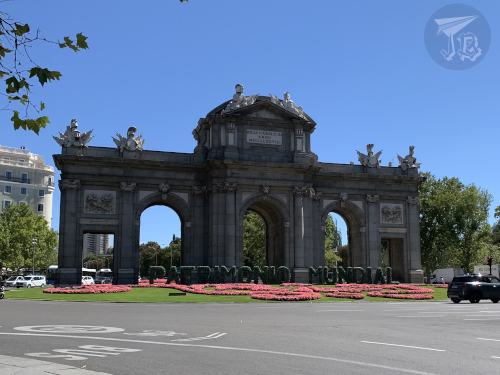
Carlos III is also responsible for the design of the modern version of one of the former wall gates, called the gate to Alcalá, the nearby town, Puerta de Alcalá. This area was declared Unesco World Heritage Site in summer 2021 as Paisaje de la Luz, so Madrid was in a celebratory mood.

I headed into the park Parque del Retiro, which is also included in the Heritage declaration. The park was initially built in the first half of the 17th century, as part of the royal recreational areas. Carlos III opened it up as public park a hundred years later. Aside from the obvious green areas, the park features fountains, palaces and sculptures. I walked past some of them. First I came across the fountain “of the turtles” Fuente de los Galápagos.

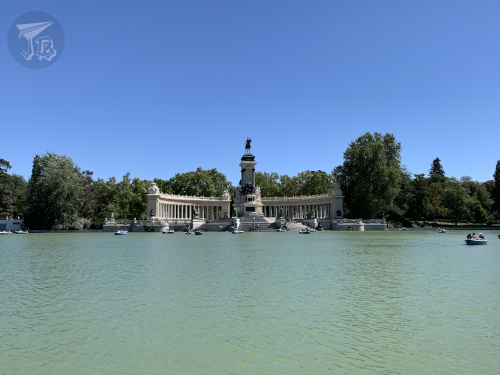
There is also a large pond, aptly called the big pond Estanque Grande del Retiro populated by carps, to whose side stands the monument to Alfonso XII – Monumento a Alfonso XII.

Nearby the pond stands the fountain called the artichoke fountain, Fuente de la alcachofa.

I walked to the fountain that depicts the fall of Lucifer from Heaven, Fuente del Ángel Caído. The fountain itself was built in order to exhibit the sculpture by Ricardo Bellve, who originally created it in plaster. The figure would then be cast in iron for the World Exhibit of 1878 in Paris, and eventually placed in the Retiro.

I strolled back towards one of my favourite points in the park, but that’s because I like iron-and-glass architecture – a little building called Palacio de Cristal, which has a small pond around.

Finally I headed over the little café where I had arranged to meet with Mr Adelstein. He arrived shortly after. He signed my book, but truth be told, I had also brought my first-edition copy, which happens to be full of post-its from the first time I read it. He was happy to sign that one too, and to my eternal mortification… he went over all the notes. I almost died right then and there. We chatted for a little, I gave him the violet candy and he had some umeboshi sweets for me too. I babbled that I was very happy that he had made some time for me, and he told me “but you were so polite on twitter and the publisher said no signatures!” and I kind of died again.

In the end, our meeting was only 15 minutes, but I have not felt so happy in a very long time – that he specifically took time felt amazing. We took pictures and even had a safe mask-hug. Afterwards I headed towards the nearest train station so I could be on my way before the afternoon rush came through, so that was it for the day.

Walking distance: 12.39 km

8th & 9th January 2021: Guadalajara & Filomena (Spain)

Since 2017, Spain (alongside Portugal and France) has taken up the custom of naming bad storms, and this season we are up to ‘F’, the 6th bad storm. In this case, the storm, named Filomena, entered Spain from the south west and collided with a polar air mass that happened to be coming from the north. The result – snow. Lot’s of it, with low temperatures and snow-heights not seen in a very long time. Some call it “the snowfall of a lifetime”.

As Covid-19 has made travelling impossible – or at least pretty unsafe / irresponsible (choose your pick), plans have been pushed back again, and plain cancelled. While truth be told I still hold tickets for the Saint Seiya event in Paris in late May, I have no hope I will be able to attend. Even if the Covid crisis fades away, there’s the extra issue of the economic blow 2020 caused.

Anyway, back to Filomena – it brought something that is rarely seen in these parts. Snow. Lots of it. So before everything went to hell, I just decided to ignore the stay at home recommendation and took a couple of walks around Guadalajara for a rare sight – the monuments covered with snow. Furthermore, as the snow is expected to freeze into ice plates, I had to go out when the snow was still fresh.

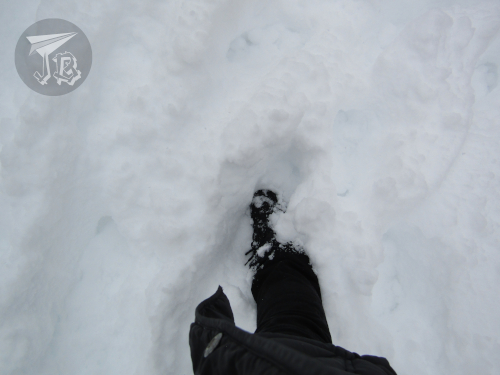
I took two different walks. On the eight of January, Friday, as soon as I got out of wok I put on my snow boots (perks from the time living in Scotland) and winter coat, then threw my raincoat over it – it was a tricky movement, but I managed not to dislocate my shoulder doing so. By this time there was a coverage of a few centimetres, and I decided to head out to the outer area of town where I could sneakily take my mask off if my glasses fogged too much, which I had to do when I crossed the road, because there’s no actual crossing.

There was a surprising amount of people around! Fortunately I was able to keep my distance, especially at the times when I tried to breathe – even if I went out with the smaller glasses, at points I had to take them and the mask off to be able to breathe and see anything.

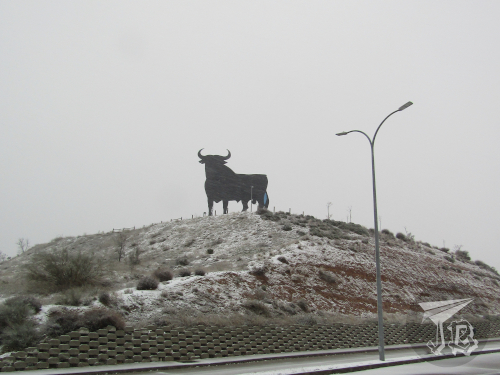
I walked up to the Toro de Osborne a winery-billboard-turned-item-of-cultural-and-visual-interest which as you can see is shaped as a bull – representing the species used in bred for bullfighting, because the Osborne winery is located in an area also famous for the livestock. It is made of metal and measures around 14 metres high, one of the 91 that remain around Spain. It stands in an area that was supposed to become urbanised but never did, so it has several unfinished alleys and corners. There has been a statue there since 1975, called El Abrazo, (The Hug), which has always reminded me of a decomposing DNA strand. It was erected by Francisco Sobrino, the most famous sculptor from the town.

I went back right before sundown, and the roads were already difficult. It continued snowing throughout the night, and when I woke up on Saturday morning, no cars could run, there were no buses, trains had been stopped and some trees had collapsed under the weight of the strongest snowfall in decades. But… temptation won. I only wanted to peek around the corner a little, but then I decided that as there was a good chance I would run into people, I could not cheat on mask policy – so I put my contacts on. That warranted for a longer walk as those are disposable, and… not cheap (≧▽≦).

First I walked down the Avenida del Ejército, one of the main arteries in town, which had already been somewhat cleaned of snow, which was good, because… well, there was a bit more of a cover than the day before

I reached the park built after the ancient Arab structure, Parque de la Huerta de San Antonio. To the left stands one of the towers of the old walls, Torreón de Alvar Fáñez.

I saw the snowed Palacio del Infantado. This palace was built in the late Renaissance style, designed by Juan Guas and commissioned by the Marquis of Santillana. Although the main construction happened between 1480 and 1497 but has been reformed in several occasions, even recently as it was turned from public library into monument and museum. Infantado is a name related to the concepts of infante or infanta, which are the Spanish terms that designate the children of monarchs who are not the direct heirs (so no the crown prince or princess). The most important feature is the main façade built with sand-coloured rocks and diamond protuberances as decoration. It was suspected to have suffered from aluminosis concrete a couple of years back, but after a small political struggle, it the palace was deemed healthy again. Magic, I guess.

Up the central street of the old town, I took a small detour to check the Iglesia de Santiago Apóstol to the left. The church, built in bricks, used to belong to a now-gone convent.

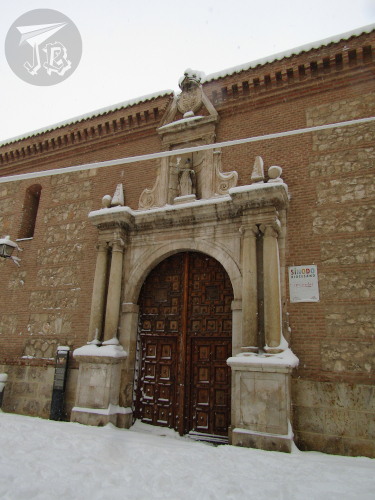
In front of the church stands the convent-turned-palace-turned-high-school Convento de la Piedad / Palacio de Antonio de Mendoza. The convent-palace represents the start of the Renaissance influence in Spain, especially the former grand entrance.

At the end of the street stands the main square and Ayuntamiento, the town hall, and main square, where the street turns into the main street, Calle Mayor. The town hall, built at the beginning of the 20th century, sports an interesting bell tower in iron.

The square Plaza del Jardinillo (square of the little garden) where the Baroque church Iglesia de San Nicolás el Real stands. You can’t really recognise him under all the snow, but there is a Neptune standing in the middle of the fountain in the square.

Main Street continues until the square Plaza de Santo Domingo. The square is half park-like, half built, and one of the trees that died in the park area was carved into a book-stash sculpture.

On the other side of the road stands another church, Iglesia de San Ginés, built in the 17th century with two towers and a Romanesque-looking entrance.

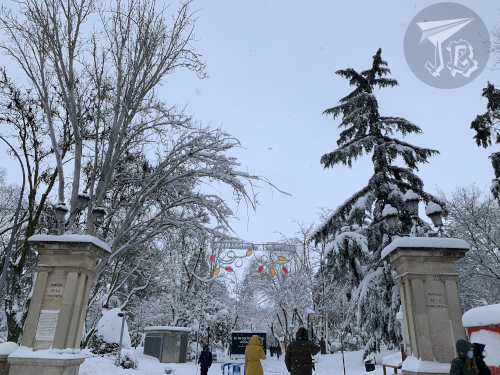
The police tape around the main town park, Parque de la Concordia, had been partially taken down and I interpreted (wrongly) by the sheer number of people inside that it was allowed to walk in. Only when I reached the other side I realised that the park was considered unsafe, and of course I did not risk any other trespassing. The park dates to mid-19th century, and hosts a gazebo-like structure built in brick and iron by Francisco Checa in 1915.

I went on to the Paseo de San Roque, only on the street area, as the more park-like one was taped off. This is one of the most diverse parks in town, and some say that it could / should have been considered a botanical garden.

I walked alongside, peeked into the park Parque de las Adoratrices, but it was packed, so I continued on. Although this park is rather recent, opened in 2009, the walls and fences were built a century earlier. The town festival used to be celebrated here, but it was moved away to the outskirts as the town grew.

At the end of the street stands the chapel Ermita de San Roque , which originally was outside the town when it was built in the 17th century, in the typical brick of the area.

I walked around the walled area of the Colegio de las Adoratrices, with some really cool views of the pantheon that stands there, Panteón de la Duquesa de Sevillano, the school building and the church Iglesia de Santa María Micaela. This whole area used to belong to the Duchess, who commissioned the architectural complex in the 19th century. The pantheon is a particular example of the eclectic architecture, with a purple dome. The church is a mixture of different styles, out of which maybe neo-Gothic would be the most prominent one.

The street I wanted to go along next was a) taped off and b) waaaay too steep for a safe climb-up, so I decided to turn towards another of the important squares in town, Plaza de Bejanque. You can guess the old fortress Fuerte de San Francisco behind it, but it was also full of people, so I walked fast.

One of the features of the square is the old gate from the walls, Puerta de Bejanque, one of the access gates through the 14th century wall. This used to be part of a house that was built around it, and it was unearthed, so to speak, in the 90s.

I went down towards the co-cathedral Concatedral de Santa María. Originally built in the 13th century, this catholic church has been redesigned and rebuilt in several styles. It is best characterised by the horse-shoe arches in the main façade.

And sneaked up towards the chapel Capilla de Luis de Lucena, a small and compact chapel built like a tiny fortress that used to be an oratory part of a larger church.

I walked past the old palatial house Palacio de la Cotilla, a palatial house from the 15th century.

The convent Convento de las Carmelitas de San José. This convent, where cloistered nuns still live (tradition says that couples that are going to marry should bring them eggs for sun on the day of the wedding) was built in 1625, and the inside is decorated in the Baroque style.

And finally reached the lookout over the park built within the old torrent, Parque del Barranco del Alamín.

I finally saw the former church Iglesia de los Remedios. Today it is used as the grand hall for the nearby university, but it was originally a Renaissance temple, with three characteristic arches guarding the entrance.

And turned back towards the Palacio del Infantado from the square Plaza de España.

It had started snowing more heavily by then and my legs were getting tired. The sloshy snow on the roads had become frozen so it was slippery, and when I was walking on the actual snow, it was up to my mid-shins, so I was feeling the strain in my legs and my back. Thus, I decided to go back home and not to return in the afternoon again because the trees had lost more and more branches under the weight of the snow. The temperature going down also meant that the snow was going to freeze and it would be more slippery as it became ice…

I mean, this is the tree that used to stand in front of my balcony… So better safe than sorry. But all in all, the snowfall of a lifetime in these latitudes!

2nd January 2016: Palacio de Cristal (Madrid, Spain)

Right after landing back from Scotland there was a couple of things I needed to get going in Madrid. That afternoon I took up the chance and went to see the Palacio de Cristal, or Glass Palace, in the Parque del Buen Retiro (Park of the Good Rest, sort of). The building is a Victorian, iron-cast structure which is currently dedicated to exhibitions. It is a satellite building of the Reina Sofia Museum of Modern Art. It featured an exhibit by the Vietnamese artist Danh Vō – with a hanging Christ and fossilised bones?

And then we found out that there is indeed a parakeet invasion in the Retiro…