17th July 2025: Hands on in the lab! {Dinosaur Eggs Loarre & Zaragoza, July 2025}

I got up around 7:30 and got dressed. I finished packing and before breakfast I took my luggage to the car, as I was leaving Loarre in the evening and I had to clear the room. Since I was outside, and the sky was clear, I went to explore the village a little more. There were some fountains and older farmhouses – one of them had been transformed into the rural hotel which never replied to my query. Some buildings had decorated their windows with cute homemade mascots.

Old Loarre Townhall, turned hotel (this is where I stayed)

Walk around Loarre: rhino mural, fountain, old house, wash house

At 8:30 I went back to the Hospedería de Loarre for breakfast. Since there was nobody at reception, I asked the lady at the restaurant what to do with the key when I left the room. I had my coffee(s) and toast, grabbed what I needed for the day, dropped off the key, and headed to the museum-lab for the third day of the course Técnicas de restauración en paleontología a través de la preparación de los huevos de dinosaurio de Loarre: Palaeontological Restoration Techniques through the preparation of Loarre dinosaur eggs. Today was the day when we would work hard at the laboratory.

The Restoration Lab in Loarre

Once again we got divided in three groups. One group opened a cast jacket using a radial saw – no way I was going to try and operate heavy machinery. Opening the jacket is the first step to study what it has been protecting, now that it is safe in the lab. The cast is removed in layers, and the rock is processed so the matrix (everything which is not actual fossil) is removed from around the eggs. Afterwards, there are two jobs. One is going through the discarded matrix / sediment for any and every interesting thing that can be found. The second is cleaning up the fossilised egg or eggs from any extra sediment to reveal their actual shape and colour.

I started with the cleaning crew (again). Under Ester Díaz Berenguer’s guidance, we worked on chemically removing sediment from a fossilised egg using alcohol diluted in water and brushes. It was a slow but very Zen work – wax-on-wax-off kind of thing. The others in my group sounded a bit frustrated with the task, but I guess it’s because they were younger people and more impatient? I know that I did not finish cleaning one shell fragment after an hour, but I was just… aware that fossil prep was a slow process?
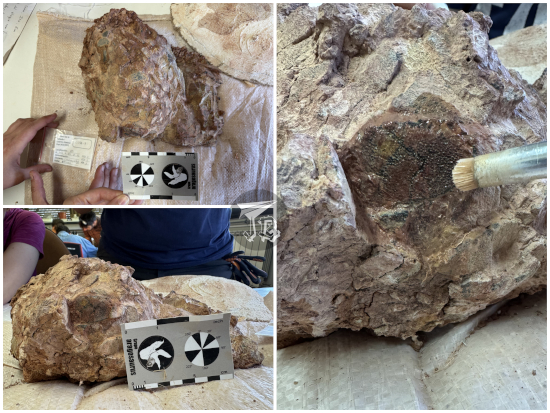
Chemical clean up of fossil egg using a brush

My second activity was also cleaning, but this time mechanically, using an air pen to remove as much of the remaining matrix as possible without damaging the general structure. This step would actually happen before chemical clean-up. The air pencil is a pneumatic tool so you really don’t have to press against the rock, to see the sediment peel away. It’s even more Zen than the chemical clean up – unless you’re working on a fragile bit. The important thing is to always clean away from the shells. I worked on that for another hour or so, and I even got to use some gluing materials to make sure a crack did not cause a problem – that was the bit that was more stressful, worrying I might damage the fossil.
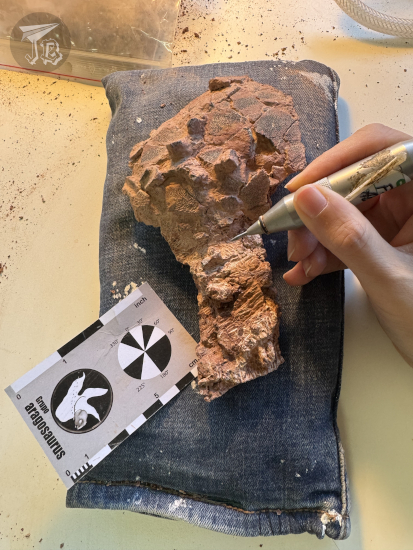
Mechanical cleaning of fossils using an air pen

We had a short break which I used to go to the car to organise the car boot – I had thrown all my things there, but a classmate had asked me to drive him to Saragossa, and I had to adjust for his luggage to fit too. Then my group moved onto studying the removed matrix from a jacket, under the direction of Manuel Pérez Pueyo. This consists on checking bags upon bags of broken rock bits to find anything that could be an eggshell. Though the main find of the Santa Marina site are the sauropod eggs, there are eggs belonging to other species – crocodilians and theropods. You weigh some sediment, spread it on a tray and move it around until you’ve taken out anything that can be useful to science. You have a microscope handy in case you need it. I am proud to report that during my three rounds, I did not miss anything key (before you discard your sediments, you call an expert to recheck). I did not find anything out of the ordinary, but I pulled out a couple dozen egg shell fragments.

Sediment being checked for loose egg shells

At the end of the morning, I snooped around what they were doing on the opened cast jacket, and someone was using the air pen on it, trying to locate the eggs. The jackets are opened upside down, so there’s a bit of detective work to find the fossils again. In order to protect the eggs, the casts are made big enough to protect them from any saw, so casts may be huge (and of course heavy). Thus, a lot of cleaning work is required at the lab, which translates in an insane amount of time. The palaeontologists must find an equilibrium amongst protection, weight, and lab-work when deciding on the size of the cast.

Upside down cast jacket that has just been opened. The job is cleaning out all the sediment around the eggs.

For lunch, all of us went to Casa Lobarre, the village restaurant, I think a concession from the town hall, as it is in the same building. The inside is decorated with reproductions of Romanesque frescoes and painted to look like a castle, as it was used as the set in a film some time ago (Kingdom of Heaven, 2005 I think. Don’t quote me on it). They offered a set menu with the choice of a (hearty) starter, a main course, and a dessert, drinks included. It was a big lunch! I ordered stuffed courgette and assorted grilled meats. The food was quite all right, especially for the price, and the desserts were handmade.

Afterwards, we had two lectures. One was given by Manuel Pérez Pueyo, who explained to us the hard science data of the Garum facies, which could be the key to understanding the last dinosaurs surviving in Europe. He also talked about the K-Pg limit and dinosaur extinction. He also made a comparison between the little Santa Marina site with the American Hell Creek formation – as the presentation said… size matters. That’s why there have been so many dinosaurs found there, compared to the more humble sites in Spain.

The final lecturer was José Ignacio Canudo Sanagustín, the director of the University of Saragossa’s Natural Science Museum Museo de Ciencias Naturales de la Universidad de Zaragoza. He explained how a museum works (I was reminded me of the visit to the inner works of the geomineralogical museum in Madrid), and the museum-lab status. The Saragossa Museum, as an institution, is the custodian of the Loarre fossilised eggs, even if they stay in the Laboratorio Paleontológico de Loarre. This is not unique to this village, as there are several similar schemes in place all throughout Aragón, known as “satellite sites” or “remote halls”.

Canudo also talked about counterfeit fossils – a reason why I only buy my fossils during Expominerales or Expogema, I don’t trust random vendors. Then, he moved onto the topic of the Museum itself – how it works, what kind of items they hold, how they came into the museum, and a little pride-flex, that they are home to a whooping 319 holotypes (the specimen that is used to describe a species), mostly from the Aragón region. The museum only exhibits a tiny proportion of the treasures that are deposited there for their protection and research.

Towards the end of the evening, we hopped onto the vans yet again to head to the middle of nowhere for some amazing views of the castle. No, really. We were headed to another “palaeontological site”. It turns out that a few years ago, a farmer was ploughing his land and found a few slabs of rock which he discarded to the side. These slabs held footprints from hornless rhinoceros from maybe 15 – 10 million years ago. The slabs are haphazardly stacked with the footsteps on the underside, which is great for conservation. Also, the way is so unkempt that nobody would get there to damage them for kicks and giggles, which is good too. We had to waddle through thistles and dry plants about hip-height to get there, then climb up the rocks so all of us could get a look. Afterwards, we found a shaded spot to talk – and the professors brought cold drinks (and chocolate) again for the hike. They were crazy prepared.

Loarre castle

Here’s the thing with the rhino footsteps – scientifically, they’re out of place, so they have lost a good part of their intrinsic / purely scientific value. But legally, they must be protected and conserved. So, what to do with them? It would be expensive to move them, and once they were transported, where would they end up? Neither the lab nor the museum were willing to take them on… Each of the coordinators told us about pros and cons of different actions. In the end, what we were brought to realise was the big discrepancy between what must be done (considering the law), what should be done (considering the science) and what can be done (considering the money). The museum-lab has an idea or two about what to do with them, and I wish they succeed. I really hope the rhino footsteps become well-known some day. That way I can boast I knew them before they became famous…
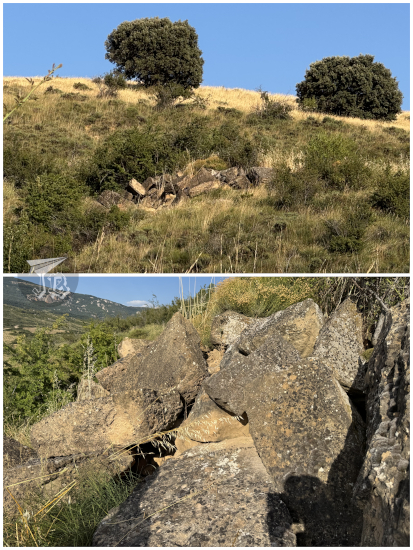
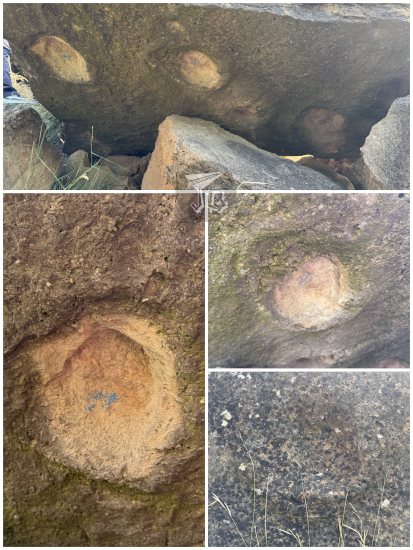
Slabs of rock in the middle of a hill.

Ancient rhinoceros footsteps

Technically, the day was over then, but the coordinators asked for our help with some stuff – getting the jacket we had extracted from Santa Marina into the lab, and moving one of the display cases to change the exhibit inside. We happily complied with both, being the first to see the new display in the museum. Are we special or what?

New exhibit in Loarre, which has exchanged a jacket for two prepared eggs

Afterwards, my classmate and I set off towards Saragossa Zaragoza. We arranged that I would drive him to my hotel and he would get a taxi from there. The drive from Loarre to outer Zaragoza takes about an hour, but once you get into the city itself, all bets are off. Furthermore, Google Maps had given me some strange instructions to enter Saragossa, but fortunately, traffic was light, as I had predicted / hoped. The hardest part getting to the hotel parking lot – I had to go to the hotel first (and find a parking spot for that) to check in, and get the key to the parking lot, then drive there. Of course, the only place I could drop off the car near the hotel was a one-way street in the opposite direction from what I needed, with no convenient turns allowed. In the end, it took 20 minutes to be able to leave the car, but it was really the most convenient option. Zaragoza is really not made for visitors to park in the streets, even if the hotel was far from the centre. It was the closest to the university as I had been able to find so the next day was nice and easy.

It was insanely hot, sticky hot, and I needed some dinner. I found a nearby fast food place and headed back to the hotel room with take-out. I finally had a long shower – this was a bit of a theme during this trip, wasn’t it? The room was small and a bit claustrophobic (honestly, it reminded me a little of a prison cell), and the air-conditioning machine was right above the bed, so it was a bit tricky to find the correct temperature / fan combination. I was tired, but stupidly alert, so it took a while to fall asleep.
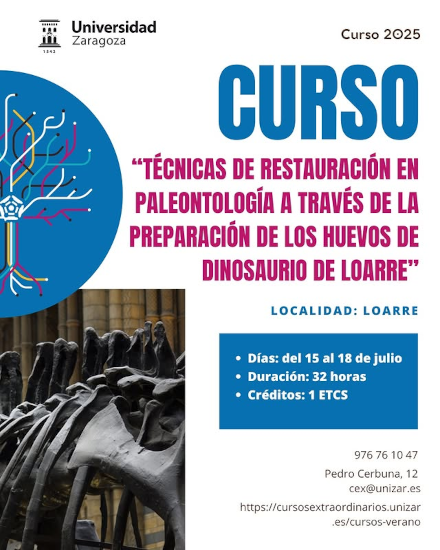
Palaeontological Restoration Techniques through the preparation of Loarre dinosaur eggs

16th July 2025: Santa Marina Palaeontological Site {Dinosaur Eggs Loarre & Zaragoza, July 2025}

In our second morning in the Loarre course Técnicas de restauración en paleontología a través de la preparación de los huevos de dinosaurio de Loarre: Palaeontological Restoration Techniques through the preparation of Loarre dinosaur eggs, we met at 9:00 in the museum-lab Laboratorio Paleontológico de Loarre. The first thing we did was pick up our PPE – glasses, earplugs, facemask and work gloves. For the day we would be cared for by Miguel Moreno Azanza, Lope Ezquerro Ruiz, Ester Díaz Berenguer, Manuel Pérez Pueyo and Laura De Jorge i Aranda.

Miguel Moreno Azanza and Lope Ezquerro Ruiz are the course coordinators. The former is holds a PhD in Geology and is a Postdoctoral fellow in the Saragossa university Universidad de Zaragoza. He is the egg expert and the leader of the works in Loarre. Ezquerro Ruiz is now a Lecturer at another University, Universidad Complutense (Madrid), but he has not lost contact with the dino-egg world. He is the expert sedimentologist, described as an “all-terrain geologist”. Ester Díaz Berenguer did her doctorate about ancient manatees, once dug a sauropod skeleton all by herself, and is the Natural History collection curator in the Natural Science Museum of the University in Saragossa. Manuel Pérez Pueyo holds a postdoctoral position in the university Universidad del País Vasco and is currently away in Romania, studying the same kinds of sediments the Loarre eggs are found in – he is the K-Pg Limit expert. And finally, Laura De Jorge i Aranda is the de facto boss – she is the main restorer and conservation expert in the lab, so what she says, goes. If she ever stays still for long enough to finish saying it, because she must be related to the Duracell bunny…

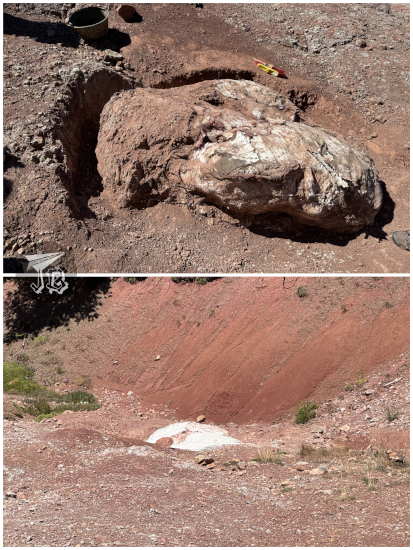
We hopped onto the vans, and drove / bounced off towards the actual palaeontological site: Yacimiento de Santa Marina, the outcrop where the eggs were first found. Around 6 km away from the village, the area of the site is around 500 square metres, and eggs could be found from the surface (originally, those have been excavated now) to almost 2 m deep. It is mainly comprised of red clays hardened into actual rock, whose age is disputed between around 70 and 66 million years ago. Fragments of egg shells can be found on the surface, easy to tell apart. While the clays are mainly reddish, the egg shells are dark grey / blue, three millimetres wide, clearly rounded and with clearly-visible pores on the outer surface. And no, finding one of the dozens of them that we saw never got old. They have found six or seven groups of eggs there, so the upcoming steps are extracting them and working out if the groups are actual nests or just casual accumulations due to transport or other causes.

Yacimiento de Santa Marina - red hard unforgiving rock full of dinosaur eggs if you dig hard enough

There were three jobs to do around the site – cleaning up an area where eggs had already been found to check for more, repairing a cast jacket which had been damaged, and extracting a cast jacket which was ready to be transported to the laboratory. I started with the clean-up team. There, we used the “small” equipment (cleaning brushes, paintbrushes, and screwdrivers) to remove sediment and small rocks trying to see if there were more eggs around or underneath the one that had been removed. It was a definite maybe.

A spot in the ground where an egg was found. It has to be cleaned (swept) to check if there are more eggs or eggshells

The professors had brought Coke, Aquarius and pastries for breakfast at the mountain hut next to the hermit church Ermita de Santa Marina, which lends its name to the site, and thus we had a break around noon – the museum-lab team had brought us snacks and drinks. Afterwards, my group moved onto recasting a jacket which protects what could be a whole nest inside. The whole thing is massive and thus heavy, so difficult to move. While the logistics for that are being taken care of, the cast jacket protects the fossils inside, and the whole thing is kept buried to prevent weathering.

In Spanish, the cast jackets are called momias, mummies, as they are wrapped in gauze or similar before. Unfortunately, that degrades with time and weather. In order to protect the fossils, three of us applied a layer of cellulose (read: wet toilet paper) first, while the other two made burlap stripes that would go between the cellulose and the plaster. Later, another group would make and apply the new cast, and the following day the professors came back the next day to rebury it for extra protection.

Giant cast protecting fossil eggs before and after getting some TLC and new plaster

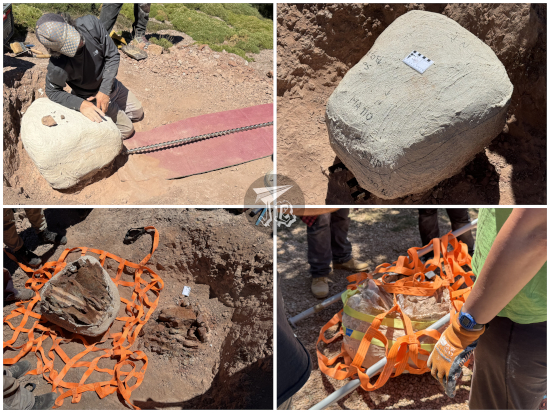
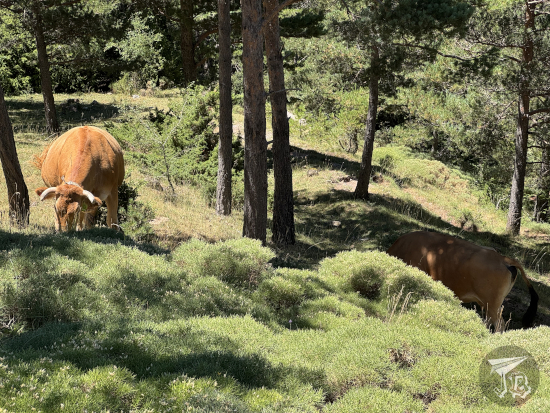
My group’s final job was breaking a plaster cast off the ground. As we worked on the other two spots, the other groups had taken a hydraulic hammer and a giant drill to the rock surrounding the cast to get it ready for extraction.. I got to work on the drill – while one of my peers pushed the tool into the rock, I was in charge of keeping the drill bit steady. Afterwards, I could hammer one of the stone-splitting wedges into the holes we had drilled, and a group-mate hammered in the other two. The cast was labelled and extra information was written on it: level, north, which side was up. After that, the whole thing was torn off the stand (by sheer blunt force, aka someone pushing it) and rolled onto a net that had to be hauled up the outcrop and then into the van, all that under the incredulous look of a herd of free-range cows which grazed nearby.

Jacket cast of a fossil being broken off the ground with a giant drill, and then transported using a net.

Two cows grazing

The strongest people around loaded the cast and carried it out, then put it in the van. They needed someone to take pictures of the process and I volunteered for that. By then, it was way past 14:30, which meant we were too late to have lunch in Loarre, where apparently it is only served between 14:00 and 15:00. Calls were (sort of desperately) made to find somewhere which would feed our large group lunch. We ended up in the restaurant at the campsite Camping de Loarre, which happily let us have some food there. They offered stuff to share, but we preferred to have individual plates. I think we all wanted something we really… wanted, so we just chose from the main dish options.

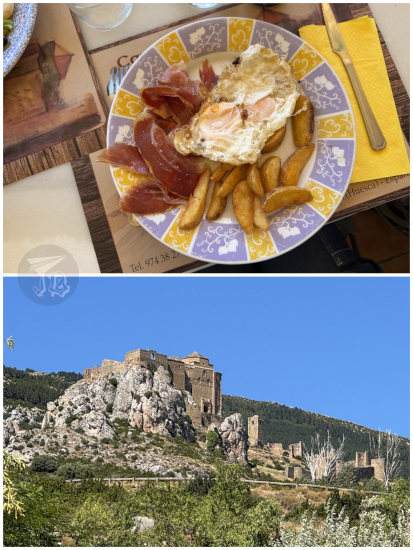
I ordered fried eggs with ham and chips. While I prefer my eggs runny, they were adequate. Since I had drunk a Coke for breakfast, I had an isotonic drink instead, and some of the communal water. As I was finishing, I overheard that they had ice cream inside… watermelon ice cream. It was exactly what I needed for dessert. While I was paying, the waiter asked something about whom to charge for the water, so I took care of that. It was still cheaper than buying all the soda and snacks the professors ended up providing.

Camping de Loarre: eggs with ham and a view of the castle

After lunch, we headed back towards the village, where we had a lecture by Laura De Jorge i Aranda on the theory of fossil restoration, conservation and preservation. One of the most important things she mentioned was documentation – as we had seen with the cast we had broken off. Once in the laboratory, the plaster is opened, the sediment classified for later study, the eggs cleaned mechanically and chemically, and any crack sealed with special glue. Every step of the way is documented. Finally, the fossils have to be packed for transport or preservation, and the sediment must be combed for anything of interest it might be hosting, such as loose egg shells (from either titanosaurs, crocodilians or theropods).

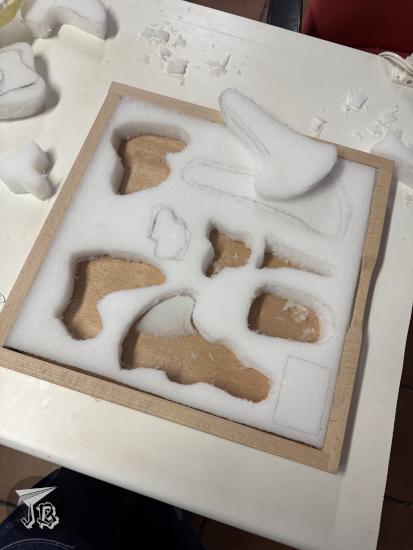
We moved then to the museum-lab to apply what we had just learnt in our first hands-on visit to the restoration laboratory. We were provided with a bunch of fossils (newly-discovered spinosaurid bones, so new that they are unpublished and thus cannot be shown) and Ester Díaz Berenguer guided us to make fossil beds with polyethylene covered with tissue. These were to go into fireproof drawers for conservation in the Natural Science Museum in Saragossa. The fossils are laid out on the polyethylene, traced, and the bed is carved for them with scalpels and cutters – remembering to also carve spaces for fingertips, so picking up the item is easier in the future.

A tray with cuts to fit the different fossil bones that we cannot show for scientific reasons, so it just looks like we cut a bunch of holes with weird shapes

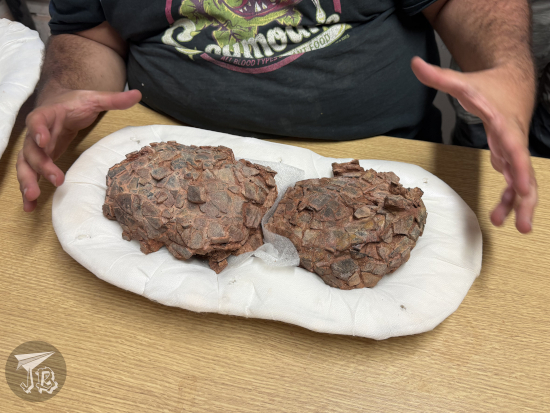
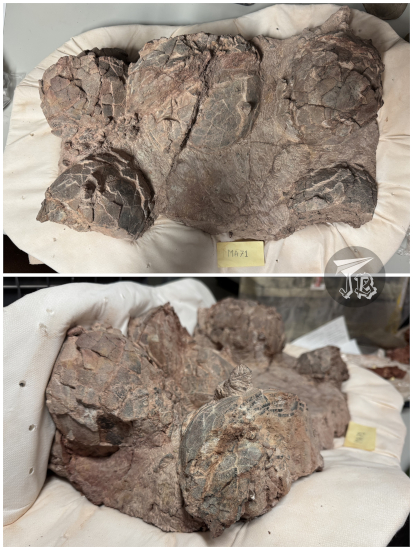
After that, Miguel Moreno Azanza showed us some of the prepared eggs. One of the specimens was a couple of eggs stored together (one of them might have a baby inside!). These were found in another site, Collado de la Tallada, which apparently is “easier to dig in”, but we were playing level pro in Santa Marina. Another was a group of five eggs together, which could have been a nest. They are criss-crossed by mini-faults. We were able to snoop around other eggs, as the professors chuckled something like “Don’t worry, you’ll work on them tomorrow”.

Two titanosaur sauropod eggs in a case. They look about as big as the palaeontologist's hands each. They are deformed and broken but have a vague egg shape.

When I signed up for the course, I expected that the “practice” would be standing there while an expert did something. Maybe we would all get one egg shell to touch and share amongst us. That would have been really cool already. But by now I had dug, protected, drilled, pushed, and held fossils. I was ecstatic. The course had blown up my mind already, and there were still two and a half days left.

A titanosaur sauropod egg nest with five or six eggs, deformed and cracked by the passing of time.

I went back to the hotel Hospedería de Loarre to shower, have a snack, and pack all my things as I had to clear the room the following morning. I also studied off the route to get to Saragossa in the evening after the course. During the planning stage, I had considered whether I wanted to go to Saragossa on Friday morning before the lessons or Thursday evening after them, and in the end I decided to drive on Thursday.

On the one hand, it meant driving after the whole day of class, probably tired, and around dusk. On the other hand, it allowed me to do the drive without a time limit constraint, park directly at the hotel, and it might mean less traffic. Furthermore, sunset was at 21:00, and it should be bright enough for a bit still after class. In the end, I decided in the end that it would be less stressful. Thus, Wednesday was my last night in Loarre.

Palaeontological Restoration Techniques through the preparation of Loarre dinosaur eggs

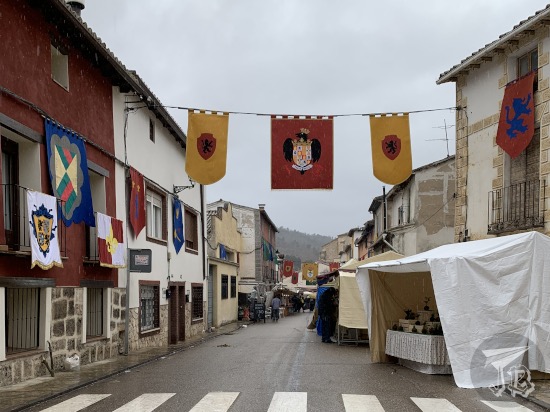
23rd February 2025: The Annual Medieval Fair (Tendilla, Spain)

For the last few years, the Medieval fair Feria de Mercaderíass de San Matías in Tendilla has started on the 25th (2022), 24th (2023) and the 23rd (2024) of February. So it makes perfect sense that my mind placed 2025’s edition start on the… 14th, right? Since the fair celebrates St. Matthew, and the onomastic is the 13th, I unilaterally decided that the fair must be that weekend. Obviously, I was wrong, and the fair was held from the 21st to the 23rd. Due to the date mishap, I had a visit booked on the 22nd, and I amended my plans to head to the fair on Sunday the 23rd instead of on Saturday as I usually do – that way I could see the Palace, the Botarga Parade and the Fair on the same weekend.

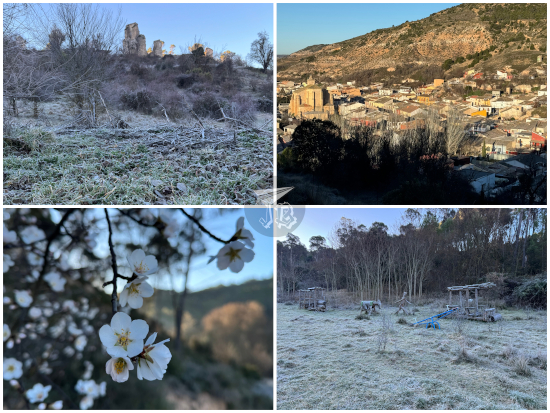
It was a good thing that I decided to go to the Parade instead of trying to make it to the fair on Saturday, because apparently they were blocking cars from entering the village, but not letting them park anywhere close-by which… is a problem. To avoid a similar issue on Sunday, I drove to Tendilla before the fair even opened, so I was there around 8:40. I used the time to climb up the frozen nearby hills to see if there were nice views from above. I also headed into the pine forest, which was covered by a thin layer of frost everywhere. It was pretty.

Tendilla: Landscapes before the fair started

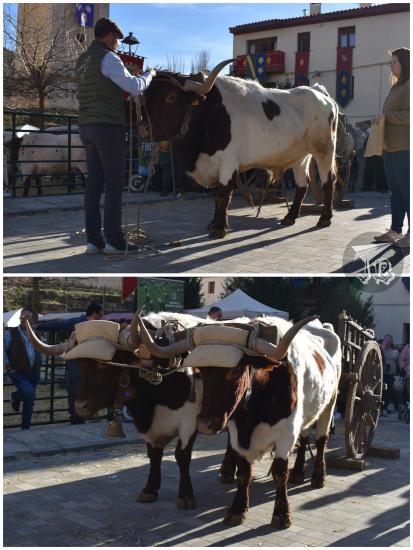
There was a parade scheduled to take place at 11:00, which did not happen until around 13:00 – there was just a trio of musicians going up and down the main street. In the mean time, I wandered up the fair, and stayed around the ox paddock hearing things like “such noble eyes the animal has” from the mouths of city-dwellers. The poor oxen seemed pretty much used to to be stared at, so they just munched on hay with an air of resignation. There were two of them separated from the herd, which would later be yoked to a traditional cart. Looking back, I’m slightly surprised that I did not get any allergy symptom from their straw.

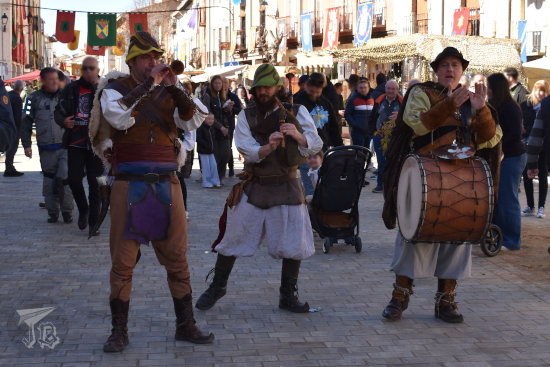
Three musicians in Medieval Clothes

Oxen in the Medieval Fair

I also found the newly-inaugurated statue to honour the fair – a tiny farmer with two donkeys standing atop a column which… was a bit underwhelming, to be honest.

La borriquilla - the little donkey

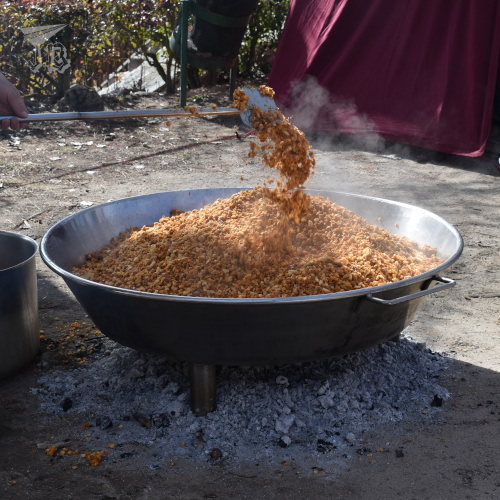
Around noon, a queue started forming for migas. In the mornings during the fair, some of the villagers prepare this typical dish from the area for all passers-by (queuers-by?) to enjoy. The traditional migas are made from fried breadcrumbs, paprika and meat from pig slaughtering. However, Tendilla is famous for its torreznos (processed pork lard snacks), so these communal migas are served with the local dry treats, and accompanied with a glass of wine to be washed down. I had never queued for them, but some family members saw me when they were almost at the front of the line and I was snuck forward in exchange for some photos. I also got to talk to one of the stand owners, and I discovered about a place called Emociones al Vuelo, a bird-of-prey rescue and training centre which organises activities. I may or may not have decided to pay them a visit.

Communal migas being prepared

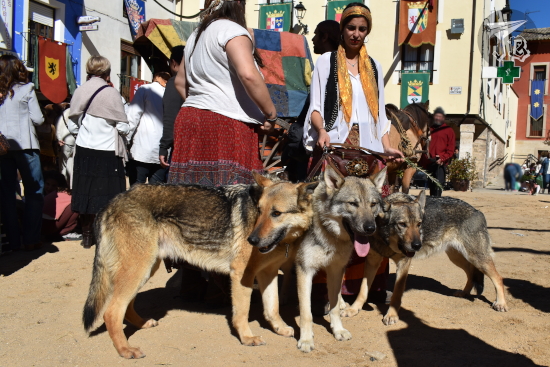
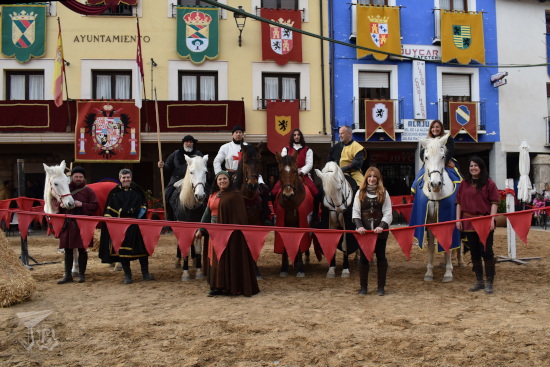
We snacked, and then moved around the village. I was in the middle of Main Street Calle Mayor when the parade came through. The troupe had changed this year, and it was not Christian knights and moors, but gypsies and magicians. They brought horses and “wolfdogs” – not actual wolfdogs but wolf-looking domestic dogs. Enough to fool a lot of people. There was supposed to be a tournament, but apparently the gypsies were not up to it. There was no tournament, and after an hour of waiting, the troupe went back to the Main Square Plaza Mayor, did a couple of horse tricks, and started cutting ham to share with the onlookers. It was a bit disappointing, but I least I got to pet the dogs.

Troupe of horse riders dressed as Medieval gypsies

Dogs from the gypsy troupe

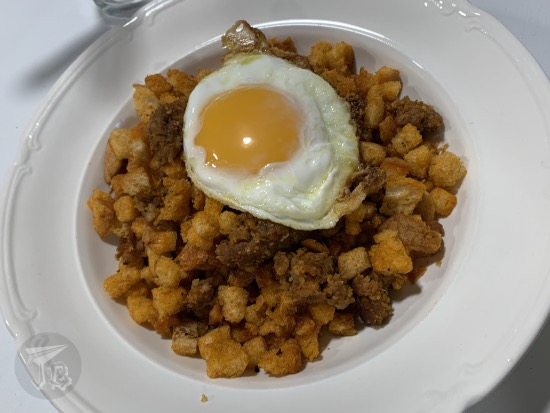
I headed to my relatives’ place and we prepared lunch, though I had some leftover migas that had been saved for me from the previous day, and a fried egg on top. Much better than the communal ones, for real.

The last activities for the day were related to the long-suffering oxen. First, two of them were yoked to a traditional hay cart and children were given rides through the fair. The two oxen were led to the cart and then tied to the structure. Something that I had never known was that part of this tie went around their horns and forehead, so the owners placed a small pillow on the animals’ foreheads for them to pull more comfortably. However, to do the tie the knots as strong as it was necessary for them to be, he had to use his foot as leverage on the ox’s head… Once the animals were yoked, the cart started moving. One small child who had apparently been asking about the ride all day long was the first to be helped on the cart – even though some others tried to cut the line! At first, they went up and down the village, but apparently some idiot spooked the poor animals and the owners decided to just move around the main square afterwards.

Oxen being yoked

After six or seven rides, the oxen were untied and let into the paddock. A lorry was brought and the owners created a mini stampede for all the oxen to go into the vehicle. That was wickedly cool.

That was the last activity, so I decided to say goodbye to my relatives soon and drive back through the sunset. Most of the stalls were already closing anyway and there was no way I was going to stay for dinner – because that would mean I’d have to actually eat more that day, which was not the plan.

On the way back I drove into a very weird traffic jam. It did not happen around the bottleneck, but much much earlier, and the bottleneck was clear. I’ve never understood traffic jams anyway…

So all in all, I had a very complete weekend, combining Madrid, Guadalajara and Tendilla, I had relatively good weather, and got to check out most of what I wanted. The only downside? Having to go to my day job on Monday without having caught any rest!

11th December 2024: CBA, hotpot and lights (Madrid, Spain)

Since I was meeting my sibling for the yearly event of Naturaleza Encendida in Madrid in the evening, I decided get there early and make the most out of the day. As I arrived, I headed to the Círculo de Bellas Artes (literally “Fine Arts Circle”). The CBA is a sort of NGO dedicated to culture and the arts. Its headquarters host many activities such as exhibitions, theatre plays, concerts, lectures… The building was designed by Antonio Palacios, one of my favourite architects. It has seven floors, some of them used for events, others for offices. There is even a small theatre.

The CBA was running an exhibition called “Messenger Species” Especies Mensajeras, by artist Álvaro Soler-Arpa. It is a collection of pieces created from animal bones and items found in dumps. Born in Gerona in 1974, Soler-Arpa is a multifaceted artist who does publicity illustration and creates distressing sculptures using animal bones as its medium to make the viewer to think about waste and pollution. This exhibition of modern art is described as “ecological art for reflection”. I thought that it could be either really good or a holier-than-thou approach, but my curiosity was piqued.

The exhibit collects selected pieces from four series of sculptures: “Toxic Evolution” (Evolución tóxica), “Devastated Nature” (Naturaleza devastada), “Design-methastasis” (Diseño-metástasis) and “Sculptures from the End of the World” (Esculturas del fin del mundo). It was… disturbing, but in a good way. It did not feel preachy. The idea is that nature is affected by the consumerism in current society, but not dying – adapting to it. The imagined futuristic animals are a warning sent through time – nature is resilient and it will survive. Us humans? Maybe not if we do not get any better.

Álvaro Soler-Arpa's Especies Mensajeras

There was another exhibition in the building about the consequences of war, but I decided I could not stomach that one. However, I had the access ticket, so I could take the glass lift to the famous terrace of the building – the one that kicked off a trend of opening terraces in Madrid to watch the skyline while having a drink. It was too cold and too closed to have anything, but I did get a nice view, especially of the Palacio de Telecomunicaciones and the Spanish language Institute Instituto Cervantes, both designed by Antonio Palacios too. The terrace is mostly flat, with a bar and an impressive sculpture of Minerva made in bronze by Juan Luis Vassallo. Minerva – Roman goddess of wisdom and art – is the symbol of the CBA. There is also a smaller and higher structure that looks like it could hold an even better view, but that was closed off.

Skyline from Azotea Círculo Bellas Artes

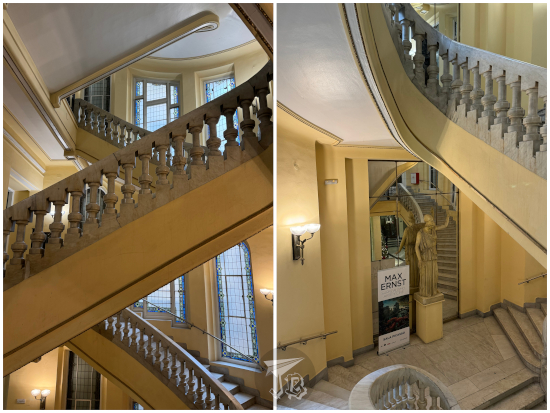
The CBA building has many cool spaces, such as the ball room (Salón de Baile) or the colonnade room (Sala de Columnas). However, my favourite part of the building are.. the stairs. They are designed as a double staircase with mirrors at the landings, and coloured windows alongside the steps. One of the sides is less bright now, because a building was erected and blocks the sun. I still find the staircase superb, so I hung around there for a while until the security guard gave me a weird look.

Stairs Círculo Bellas Artes

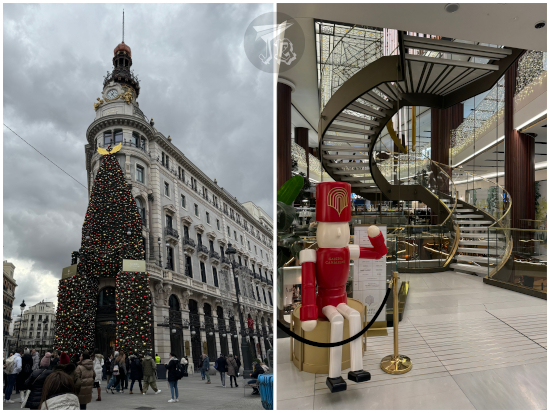
I left the CBA and walked down the street Calle Alcalá and stopped at Galerías Canalejas just to see what kind of decorations they had. It turned out to nutcrackers and elves inside and a huge Christmas tree outside. I still cannot afford anything they sell there.

Chrismas at Galerías Canalejas

I continued down towards the square Plaza de Oriente, where there was a classic merry-go-round – empty and ready to be ridden. Thus, since I have no shame, I went on it. The salesperson was incredibly kind, since I was the only rider – and an adult at that – and yet they directed me to a horse which moved up and down and showed me how to climb on it.

Then, I backtracked to the shop Turrones Casa 1880 in the street Calle Arenal, which hosts a small Museo del Turrón. Turrón is a typical Spanish confectionery eaten mostly at Christmas. It is mainly made out of processed almonds, and 1880 is probably the most famous brand – and it prides itself on the most expensive one. I am not a fan of turrón, to be honest, but it was almost Christmas, and if I was ever going to do it, that was the right time frame. The museum is mostly an audiovisual in a decorated cellar, with a photo-op, but the staff was really nice.

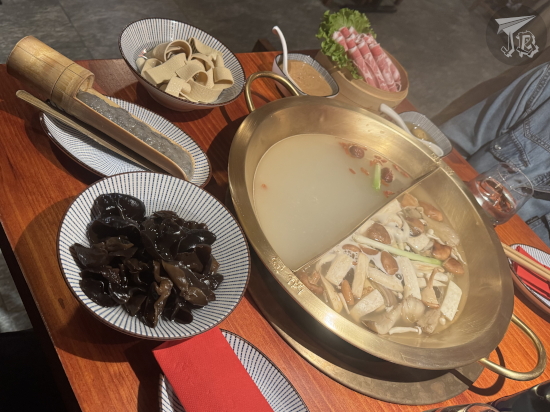
At 14:30 sharp, I met up with my sibling for a restaurant that I’ve been wanting to try for a while 壹锅火锅 Hotpot de Sichuan. Hotpot [火锅, huǒguō] is a Chinese type of stew based on a stock or soup that is kept simmering in the table itself, and you just grab the raw ingredients and dip them in the broth to cook them – imagine a fondue with broth instead of cheese. We ordered a menu for two, a pot with two broths, one mushroom-based and one meat-based. The dips were spring onion, coriander (which was not used, because I hid it), shrimp mince, thin beef slices, tofu stripes, Chinese black mushrooms, cabbage, and rice noodles, along with two sauces – one slightly spicy, and my beloved sesame and peanut sauce. The food was great, but at 15:40, the waiters popped up to tell us that they wanted to close the restaurant, and then stood up next to us until we finished and left. It was more than a bit awkward, so we hurried up to do so. While the food was great, the situation spoilt our experience a little, I think. We were still eating, not slouching around. I am not sure I would want to go back…

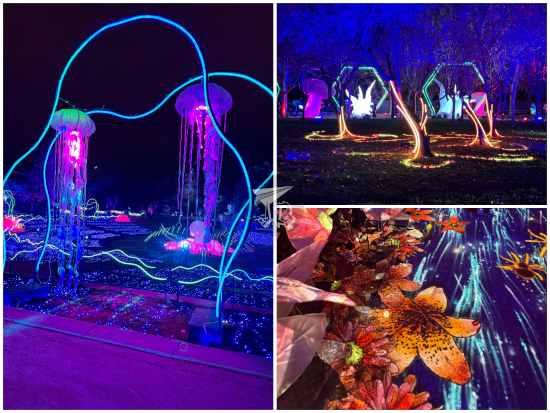
Afterwards, my sibling had to do some shopping, so we spent a while going up and down some shops and a department store, before we headed out to Naturaleza Encendida in the park Parque Enrique Tierno Galván. This is a yearly light show organised in Madrid parks – it used to take place in the Botanical Gardens, before it was moved to a larger area. The 2024 edition is titled Naturaleza Encendida: Life.

Naturaleza Encendida Life

To be fair, I was a little bit disappointed, as “Life” turned out to have mostly figures reused from the last few events. Though the organisers tried to build a narrative of water, land and air topics, the novelty had worn off. It was not bad, but the show keeps getting more and more expensive every year, with fewer and fewer perks for the VIP tiers. Furthermore, the new larger location does not imply more light sculptures – they’re just spread farther apart so they can fit more people without it feeling crowded, so it simply takes longer to walk it through. This has its advantages and disadvantages – it was good last year when we had to go on a weekend but this time around it just felt… colder. They also tried to give the whole thing an ecologist spin, and this time it did come out preachy… I mean, it is a show of lights, which technically could count as light pollution, without any actual… purpose… but charging you to watch pretty lights.

Naturaleza Encendida Life

Naturaleza Encendida Life

That was the end of the day, and we just headed home afterwards, but aside having to wait for the train for over half an hour, nothing to report on that end.

14th September 2024: The long way back {Escapade to Cádiz, September 2024}

I woke up before dawn and took a train out of Cádiz to El Puerto de Santa María to spend a few hours with a friend. We had breakfastand caught up, and I headed back to Cádiz around noon for food and my train back.

I returned to the area where the market Mercado Central de Abastos de Cádiz stands, and found a place for lunch Cervecería Boquerón Barbudo for puntillitas fritas, which is a dish of battered and fried squid, and one last tortillita de camarones before heading back home.

Tortillita de camarones and puntillitas

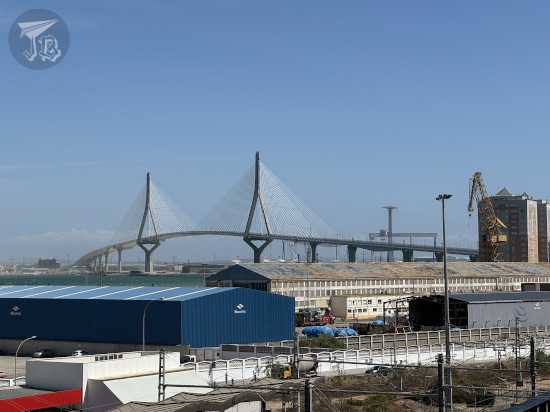
I had some time to kill before the train, and I thought about walking back towards the beach, but there was a strong wind coming from the west – nothing unusual, this wind even has a name, Poniente. Instead, I headed towards the harbour. I wanted to reach a specific quay to take pictures, but it was too hot and I was carrying the backpack. I ended up turning towards the city at the last pedestrian crossing in sight. I climbed up the stairs to the station and went out the other side. There, I found a lookout above the harbour and the bridge Puente de la Constitución de 1812, a cable-stayed bridge which joins Cádiz and Puerto Real which was built between 2007 and 2017. It measures just above 3 km, with 37 pillars, and there is actually a removable part in order to let ships of unlimited size to go through. As what I actually wanted was to get a sight out of said bridge, it worked well.

Constitution bridge Cádiz

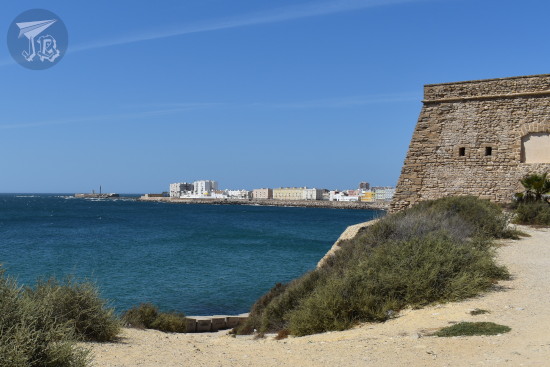
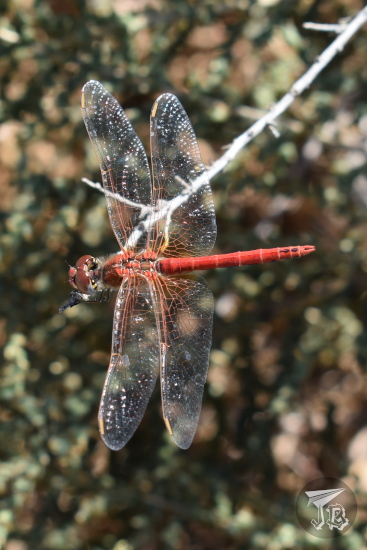
I walked towards Puerta de Tierra once more, to look at the temporary monument to the Phoenician gods – still garish. I walked alongside the wall until I reached the sea front promenade Paseo Marítimo, from where I could see the castle Castillo de San Sebastián and the bridges that lead to it. There was also a (tiny) swarm of damselflies which seemed to pose for pictures.

Puerta de Tierra (Semana Fenicia)

San Esteban Castle

Damselfly

I finally headed off towards the station to take a string of trains in the opposite direction I had done on Wednesday. First, I took the medium-distance train towards Seville, where I had an hour or so. I bought a sandwich and a soda to go (at exuberant prices, of course), and an ice-cream (at McDonald’s, with a regular price) while I waited. Then, the AVE took me to Madrid, which I reached a few minutes early, even. I hurried towards the commuter train system, hoping to catch a good connection, but – surprise, surprise – it did not let me in.

I had to go queue for help, and an employee let me through, assuring me that the system would let me out. Not trusting that, upon arrival I asked a security guard what I should do, and he said that the gate would be open if my pass did not work. To no one’s astonishment by now, the pass did not work, and the gate was closed. And of course, there was no Renfe employee to man the exits at nearly 23:00. I called for assistance on the inter-phone, and after a minute of ringing without an answer, I gave up and scurried after someone as they went out. Because, really, it was absolutely ridiculous.

All in all, it was a good trip. Cádiz was still an open chapter in my life, and I had always been worried that I would be overwhelmed by sadness if / when I returned to the area. Fortunately, that was not the case, and I was able to enjoy the escapade, along with getting my paperwork. However, the stupid commuter train thing was frustrating. Because Renfe, if the combined ticket works, why doesn’t it work? And if it doesn’t work, why are we told it works? Confusing, isn’t it? I had the same feeling.

13th September 2024: Cádiz, Jerez, Puerto Real & back to Cádiz {Escapade to Cádiz, September 2024}

After making sure there were no ants in my breakfast – I had stored it in the mini-fridge, and they were all in the trash can with the decoy – I left for an early walk around Cádiz as the sun rose. I went to Puerta de Tierra (the Land Gate), the remains of the walls that closed off the city in the past, which today separates the old and new areas. The original redoubt was erected in the 16th century, embellished in 1756 with a portal, and a tower was added in 1850. In the early 20th century, arches were opened into the wall to allow traffic to come through. There was a temporary installation to commemorate the “Phoenician Week” activities, but it was so garish that I was not even sure whether it was real or a parody of sorts.

Puerta de Tierra Cádiz

Afterwards, I walked to the train station to take the train to the nearby city of Jerez de la Frontera, where my first stop was the fortress-palace Conjunto Monumental del Alcázar. The first remains known of the alcázar date back from the 11th century, though most of what still stands was erected in the Almohad period (12th – 13th centuries). The fortress was repeatedly taken and lost in the war between Moors and Christians until the Catholic Monarchs finally conquered all of Spain. The building was owned by the crown, but it fell into disarray, and in the 18th century a Baroque palace was built.

Alcazar de Jerez de la Frontera - exterior

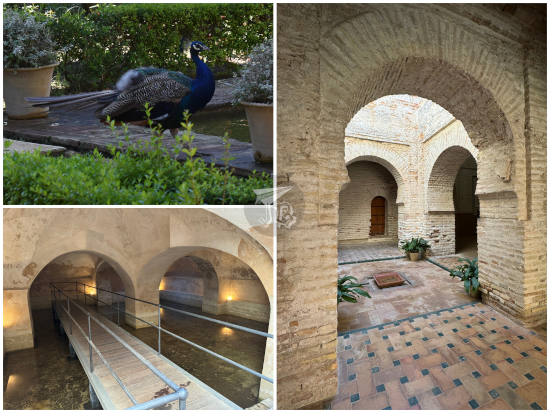
Today, this palace is the only intact construction, and the one I left for last. I moved towards the garden first, which lead to the Arab baths, the octagonal tower, the cistern, the Royal Pavilion, and the walls, with some of the machinery from the Medieval times. The gardens were patrolled by peafowl. On the other side of the complex stand the mosque, an area with a reproduction of ancient oil presses, and the original gates in the walls.

Alcazar de Jerez de la Frontera - cistern and mosque, and peacock

The Baroque palace Palacio de Villavicencio holds a wooden staircase, several rooms with rich decoration including hanging lamps and wall paintings, and a salvaged pharmacy from the 19th century.

Alcazar de Jerez: Palacio de Villavicencio

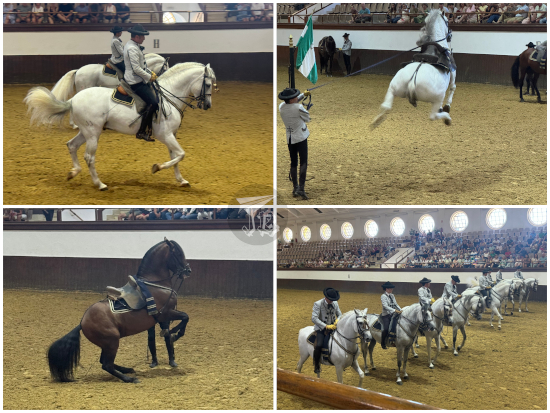
After the alcázar, which took longer than I thought to explore, I headed out to the Royal Andalusian School of Equestrian Art Real Escuela Andaluza del Arte Ecuestre to watch the show Cómo bailan los caballos andaluces (The way Andalusian horses dance), an eight-part show which has been performed since 1973. The exhibition showcases the different types of exercises that the horses are trained for – whether it is with a rider, or a handler on their feet, alone, or coordinating with other horses on the arena. It was a really impressive performance, and the horses were gorgeous.

Setlist of the show:
  1. Cómo se anda en el campo
  2. Al son de la garrocha
  3. Paso a dos
  4. Trabajos en la mano
  5. Fantasía
  6. Saltos de escuela
  7. Riendas largas
  8. Carrusel

Royal Equestrian Art School, Jerez

After the show, I hung around for as long as I was allowed to, snooping the horse riding museum and the small palace in the grounds until they closed down and I had to leave. I bought a sandwich and a bottle of water from a supermarket in the way, and went on to the cathedral Catedral de Nuestro Señor San Salvador. The current building was not originally conceived as a cathedral. It was founded in 1778, built between the 17th and 18th centuries, and consecrated as cathedral as recently as 1978. It has a gothic structure, with a Baroque façade and a Neoclassic altarpiece. Behind the altar there is small treasury / museum and a spiral staircase to a secret chapel which is barely the painting of a saint – but the staircase was pretty, it reminded me of the one in the church in Tendilla. I also walked up the tower so I could see the city from above.

Cathedral Jerez de la Frontera

By the time I was on my way back, it was too late to snoop into the farmers’ market Mercado Central Abastos, so I headed directly towards the train station to fight the ticket machine, then headed to Puerto Real. This is a town between Jerez and Cádiz where I used to live. After checking out some places out of nostalgia, I went towards the seaside. It was an eerie feeling, because it had changed very little from what I remembered from almost two decades ago, when I left, and still it was slightly different. I visited the beach Playa de la Cachucha and walked along the promenade Paseo Marítimo until I saw my old university building.

The Andalusian Centre for Marine Studies Centro Superior de Estudios Marinos, CASEM, is a helix-shaped building, originally conceived by Manuel López Vázquez. The building has three “arms” in 120-degree angles, and a glass dome at the centre. It is located in the middle of the natural reserve. However, going there would have made me extremely sad. Thus, I decided to walk back towards the station and take a train back to Cádiz.

Puerto Real: Playa de la Cacucha

Since I had visited the land gates, I also wanted to see the Sea Gate Puerta del Mar, the remains of the entrance to the harbour. Today it is more of a monument than an actual gate, but it is still there.

Cádiz Puerta del Mar

I was able to get there with enough time to head out to the archaeological site Yacimiento Arqueológico Gadir, one of the most important of its kind, since Phoenician settlement remains are far and few. The site, underneath a theatre, has two layers – the original one might date back from the 9th century BCE, with the remains of eight houses, complete with kitchen and oven, and streets. The settlement was destroyed in a fire, which also left two victims, a man and a cat, both of whose remains are exhibited there. The second layer is more recent – a fish processing factory with pools to preserve the product in brine from the Roman domination.

Yacimiento arqueológico de Gadir

Finally, I decided to end the day with a nice dinner. I went to the nearby market Mercado Central de Abastos de Cádiz, which has some eateries that work with local product. However, I did not locate the place I wanted to hit, and ended up distracted by El Viajero del Merkao, a place which advertised bluefin tuna, and offered it in tartar. I combined the tuna tartar with a typical tortillita de camarones, a fried batter made with water, chickpea flour, wheat flour and tiny shrimp, and a not so typical Taco de Cadi, Cadi, a tortillita with guacamole and salsa.

Tortillita de camarones & tuna tartar

I went back to the hotel to have a shower, then I turned in for the night (in a non-ant-infested room now).

12th September 2024: Cádiz {Escapade to Cádiz, September 2024}

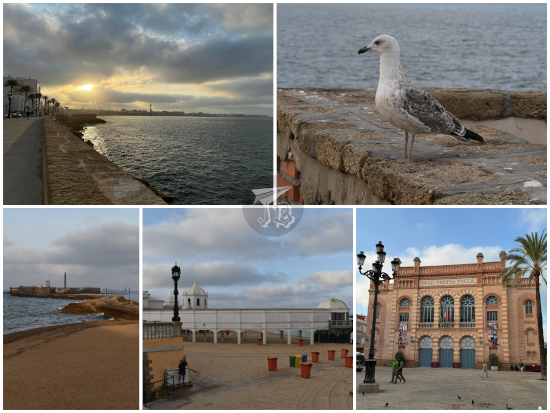
My paperwork-related appointment was at 9:30 in Cádiz itself, and I got up around 7:30. I left the hotel, but unfortunately the café where I had expected to have breakfast was closed. Thus, I instead headed out towards the promenade Paseo del Vendaval to see the ocean again. I turned to my right, in the opposite direction from the previous night, and I walked towards the central beach in town – Playa de la Caleta, a mostly-rocky area with tidal ponds and a long bridge called Puente del Hierro which leads to an old castle Castillo de San Esteban. I chased a few birds on the way for photographs. They were not at all cooperative.

I reached the former bathhouse Balneario de Nuestra Señora de la Palma y del Real, built in 1926 from an original design by Enrique García Cañas with one main access and two corridors that form a semicircle towards the ocean, and end in domes. It was build directly onto the beach, in reinforced concrete, with a style gravitating among Art noveau, eastern historicism and local decoration with azulejo tiles. It was abandoned in the 1970s, but restored for administrative use in the 1990s.

I ventured away from the ocean into the narrow streets of Cádiz downtown until I got to the town’s theatre Gran Teatro Falla, in the Neomudejar style. It was built between 1884 and 1905, on and off due to lack of funds, after a design by Adolfo Morales de los Ríos and Adolfo del Castillo Escribano. The theatre is one of the key spots during Carnival festivities. The Cádiz Carnival is one of oldest and most famous in Spain, known for its groups of people who parade the town in costume to sing simple songs that make fun of every- and anything, normally current affairs – coros, cuartetos, comparsas and chirigotas. The great Carnival contest is celebrated in the theatre, and prizes are awarded in each of the categories. The carnival brings in about 400,000 visitors each year. I tried to get to visit the theatre, but I did not manage to do so.

Paseo del Vendaval & Gran Teatro Falla Cádiz

Around 09:15 I decided to try my luck with the paperwork issue, even if it was early for my appointment, and I was successful. Since it was an important document, I ran back to the hotel to drop it there, and then headed off to the square Plaza de La Mina, where the local museum Museo de Cádiz stands.

It is said that Cádiz is the oldest Western city, founded around the 9th century BCE. Mythologically, it is associated with Hercules’ Columns and the city of Tarsis. The oldest archaeological remains date back to the 7th century BCE. The now-peninsula was originally a small archipelago where the Phoenicians settled down as it was a strategic point for commerce and mining of copper and tin, naming the settlement Gadir. It was later conquered by Carthaginians, whose march to Rome led by Hannibal started there. When Carthage lost the war, the city was taken over by Romans and became Gades in the 2nd century BCE.

As the Roman Empire declined, the city was invaded by the Visigoths, then the Byzantine Empire, and again by the Visigoths. In the year 710 CE, it was the first stronghold to fall to the Moorish conquest of Spain. After the Christians took it over again, it became a key point in commerce with the American territories.

In 1755, Cádiz was damaged by a three-wave tsunami caused by the so-called “Lisbon Earthquake”, 8.5 degrees in the Richter scale. In 1812, during the Napoleonic Wars, the Spanish patriots wrote the first Spanish Constitution, and throughout the 19th century, it was key in the numerous wars and battles through the return of Alfonso VII, the Republic and the Restoration of the Monarchy periods. However, during the 20th century, the city decayed suffering from lack of infrastructures, and rampant unemployment. Thus, it is happy to focus on tourism and the money it brings.

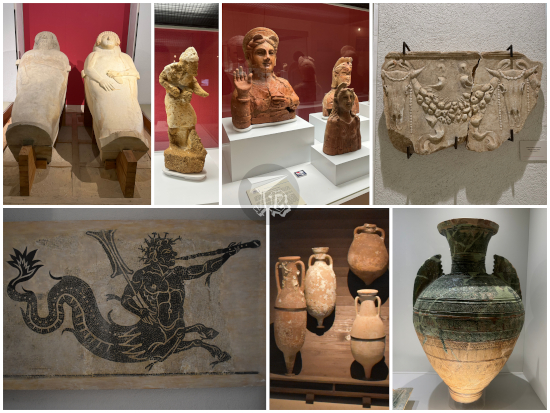
The Museo de Cádiz tries to follow this trail of history, but only the archaeological floor was open. The most important artefacts date from the Phoenician, Roman and Moorish periods. Of particular interest are two Phoenician sarcophagi which were found in completely different areas, but are presented as a couple of sorts, and a complete dowry. From Roman times, they exhibit a few dozen amphorae, sculptures and columns. Finally, the remains from the Moorish domination are quite colourful in comparison with everything else. The second floor of the museum was closed, so I was done earlier than expected.

Cádiz Museum

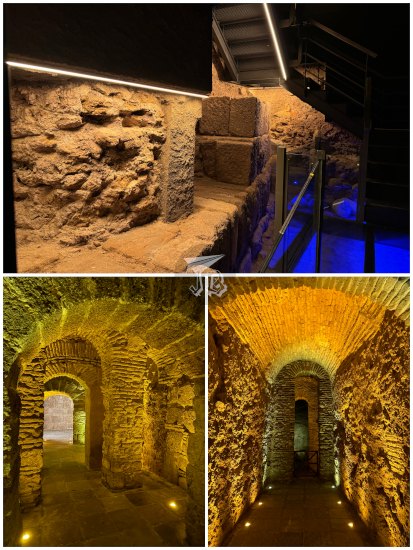
Thus, I decided to push my luck a little and try to get to the archaeological site called Cueva del Pájaro Azul for the 10:30 visit in English. The place is a former flamenco tavern built within the repurposed dry docks of the Phoenician Gadir. Most of the structure has been covered in brick and barely the original shape can be traced back, enough to calculate that the dry docks served war ships. While building new stairs, they did find part of the original Phoenician harbour though, the most important remain that survives. The tavern itself might be considered of minimal historical importance as it was a considerable cultural hub in the 1960s.

Archaeological site Cueva del Pájaro Azul

To keep in the mood, I decided to visit the archaeological site Yacimiento Arqueológico de Gadir, making a stop for a coffee first. Unfortunately, the site was closed that day. Thus, I decided to check out the Roman Theatre Teatro Romano de Cádiz – it might feel a little back and forth, but distances in central Cádiz are small and I wanted to prioritise Phoenician remains (I said I lived in the area, but all these archaeological remains are newly discovered). The theatre is the second largest one in what was Hispania, and dates from the 1st century BCE. It could host up to 10,000 people, and the stage, stands and the vomitorium (corridor underneath the seats) can be visited. There is an extra room with miniatures of the different stages of the history of the theatre.

Roman Theatre Cádiz

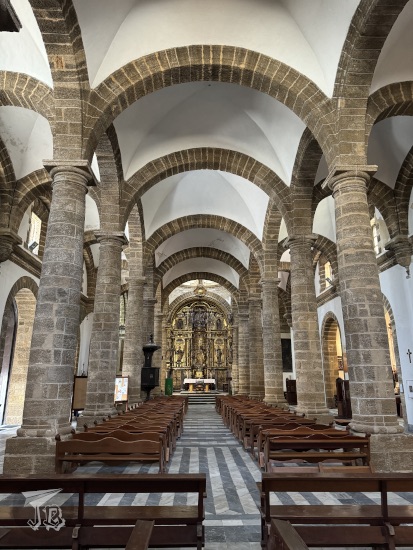
I left behind something called “The Elf’s Alley” Callejón del Duende, the narrowest street in town, now closed off. Very near both the alley and the theatre, I found the old cathedral Catedral Vieja de Cádiz officially Parroquia de Santa Cruz. This was the original cathedral of the town, commissioned by king Alfonso X around 1262. The original building was destroyed during the scuffles between the Spanish and the English at the end of the 16th century, and a new one was erected a few years later in a mixture of the Renaissance and the Baroque styles.

Former cathedral of Cádiz

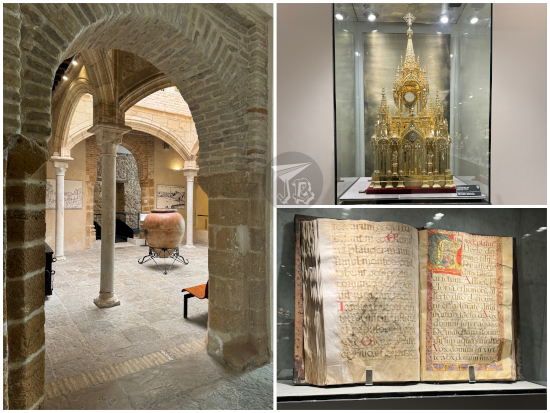
Next to the old cathedral stands the museum of the cathedral Casa de la Contaduría. The museum comprises a number of rooms disseminated in a conglomerate of buildings dating back from the 16th century – including the tower of the old cathedral and a Mudejar courtyard. The museum holds – obviously – religious items: paintings, sculptures, mass paraphernalia, codexes…

Cathedral Museum Cádiz

Afterwards, I crossed the city centre all over again, and reached the park Parque Genovés, a sort of botanical garden and the largest park in the old town. It has a small lake with a waterfall and a man-made cave with a lookout of the town and the ocean.

Park Parque Genovés in Cádiz

Then, I had booked lunch in the café of the Parador de Cádiz – Hotel Atlántico, a cute not-so-little place called La Tacita del Atlántico. I had set my heart on a grilled urchin dish – erizo de mar relleno y gratinado con huevos de arenque ahumado which I combined with a salmorejo (a creamy soup with a base of tomato and bread, garnished with ham and hard boiled eggs), though the dish had a local twist salmorejo cordobés, huevo y mojama. The urchins were delicious, but the salmorejo was lacking. I liked the idea of exchanging the ham for salt-cured tuna (mojama), but overall I found the food overpriced and the service mediocre. On my way out, I stopped by reception to get my stamp for the Red de Paradores rally.

Lunch at La Tacita del Atlántico

I stayed at Parque Genovés for a bit after lunch, then headed out towards the “new” cathedral Catedral de la Santa Cruz. The cathedral was built between 1722 and 1838, in a mixture of styles – Baroque, Rococo and Neoclassicism. It was erected in an assortment of materials, from noble marble to the humble local piedra ostionera, a sedimentary rock with a high concentration of seashells (biocalcarenite). The interior has three naves, and a Latin cross floor plan, over whose crossing there is a has dome, covered by golden tiles on the outside. The main altar is neoclassical.

Underneath the cathedral stands the crypt, and one of the towers can be ascended, leading to a great view of the town. The tower has very few stairs, most of the way is done on a ramp. Unfortunately, though, the cathedral is in rather poor state, and a net is cast under the ceiling to prevent debris from falling. I also climbed the tower since it was included in my combo ticket.

Cathedral of the Holy Cross in Cádiz

View of Cádiz from the cathedral tower

Behind the cathedral, I found myself back at the promenade Paseo del Vendaval, and I walked towards the beach Playa de la Caleta. In historical times, it was the natural port for Phoenician, Carthaginian and Roman shops, now it is a small-ish beach in the heart of the city. It is located between two of the castles of the old city, and its most characteristic structure is the bath house I saw in the morning.

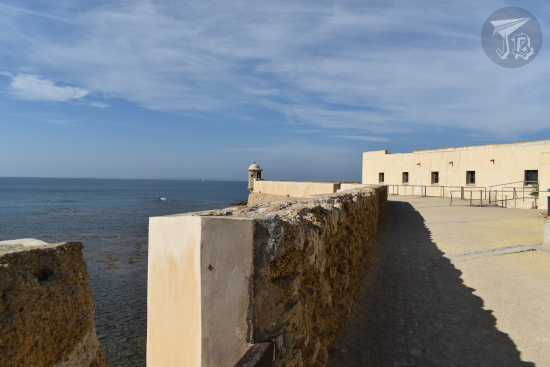
The beach has a sand area where most people sunbathe, but there is a long bridge separated in two sections – one directly built upon rock, Puente de Hierro and the other with arches to let the water flow through, Puente Canal. At the end of the half-kilometre of bridges, stand the ruins of the castle Castillo de San Sebastián, which today includes a working lighthouse, and an archaeological site. The first structure in the ancient island dates back from 1457, and the castle itself was built in 1706. Though it was warm and sunny, I walked the bridges and around the castle walls.

La Caleta Beach Cádiz & San Sebastián Castle

Upon my “return to mainland”, I passed by the bath house again and I reached a second castle, Castillo de Santa Catalina. The outpost, in the shape of a five-point star, was built towards the end of the 16th century to defend the city form sea warfare. In later years, a church and a sacristy were added, and from the 18th century onwards it was used as a prison. Today, it mostly hosts cultural or cinema-related events.

Santa Catalina Castle, Cádiz

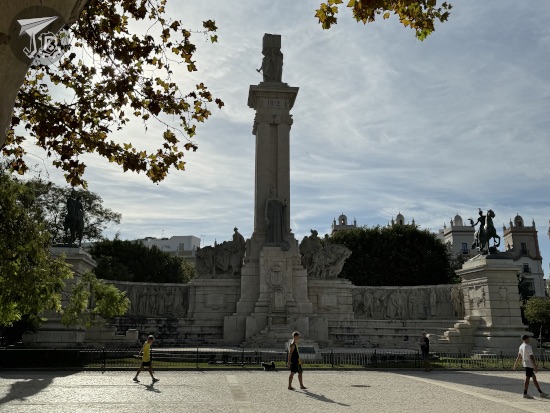
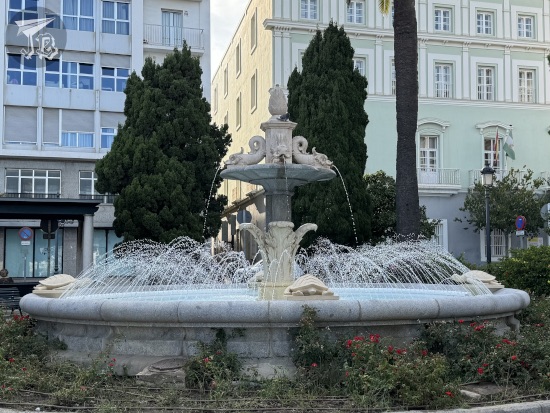
I continued on my walk around the city, left behind a knee cramp, the Parador de Cádiz and Parque Genovés until I reached the bulwark Baluarte de la Candelaria and the park Jardines Clara Campoamor. From there, I went on towards a second bulwark and the remains of the city walls Baluarte y Murallas de San Carlos. The bulwark was built towards the end of the 18th century to protect the harbour. Not far from there stands the square Plaza de España with the monument to the 1812 Constitution Monumento a la Constitución de 1812, the political response to the Napoleonic invasion. A bit further away stands the fountain Fuente de la Plaza de las Tortugas, with lots of cute turtles as decoration.

San Carlos Bulwark and Walls Cádiz

Monument to the 1812 Constitution Cádiz

Turtle fountain in Cádiz

At this time I decided to get an early dinner around 18:30, so I bought some fast food to take to the hotel. That is when the ant invasion started. It was something I was not expecting – one or two bugs is workable, but this was a whole nest out for my fries. It was not nice. I decoyed them into bathroom and decided to have the room cleaned the next morning.

I set off again about 20:15 to look for a place to watch the sunset at the beach Playa de la Caleta, which did not disappoint, and I sat there until the sun disappeared beyond the water line. Luckily, I made it today, as it would be ridiculously windy the following day.

Sunset at La Caleta, Cádiz

I then found the street Calle the la Virgen de la Palma, at whose end stands the small church Parroquia de Nuestra Señora de la Palma. It was built in the 18th century and it hosts a sculpture of the Virgin Mary credited with stopping the waters during the 1755 tsunami. In the street, there is a signal marking the highest water point, but there were so many restaurants and people that it was impossible to find it!

Sculpture of the Virgin Mary

I went back to the hotel afterwards to have some sleep – I was beat. I did manage to make a stop at a supermarket to buy coffee and pastries for breakfast the following morning though. Because one late latte per trip is enough.

22nd June 2024: Roman ruins in the Cuenca region (Spain)

This was actually the second try for this road trip. We (read: my parents) chickened out the first time because there was a slight storm chance. Since they were organising the day, I did not complain either time. I just stayed home when it was cancelled, and happily tagged along when it was carried out.

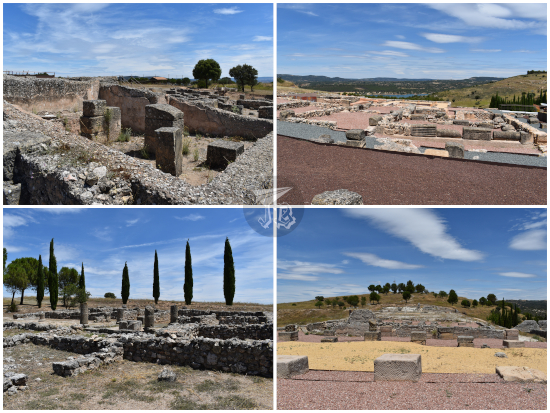
My parent’s curiosity was piqued upon learning that a bunch of archaeological sites were free until the end of 2024. I might have been responsible for that information, but to be honest I thought nothing of it at first. They randomly asked if I knew Recópolis, and I mentioned having visited it as it was free for the year. Thus, on the 22nd of June – a few weeks later, and on the second try – with a forecast temperature at noon of 31 °C and sunny, we set off around 7:30 towards the Roman villa Villa Romana de Noheda. The villa belongs to the hamlet Villar de Domingo García, and it was discovered in agricultural land by sheer chance, as it often happens. The complex was a farm and noble residence in use between the 1st century BCE and the 4th century CE, but it had been abandoned by the 6th. While most of the villa is gone, and not even half-excavated, the floor of the main house has been dug-up. It is covered by what is said to be the largest figurative Roman mosaic in the world, and it can only be visited with a guided tour.

The mosaic would have been in the room used to receive guests, the atrium. Right in front of the main door, the mosaic tells the story of Pelops and Hippodamia. In this mythological tale, the oracle told King Oenomaus that he would be killed by his son-in-law. Thus, whenever a suitor came to ask for his daughter Hippodamia’s hand in marriage, he would challenge them to a chariot race. If they lost, they would die – this happened 18 times until Pelops came along and Hippodamia fell in love with him. For his race, Pelops received a chariot drawn by winged horses from the god Poseidon. He then offered Oenomaus’ charioteer, Myrtilus, half of the kingdom, and a night with the princess, in exchange for his help to win the challenge. Myrtilus sabotaged Oenomaus’ chariot, and the king was killed during the race. When Myrtilus tried to collect, Pelops threw him off a cliff, and before dying, Myrtilus cursed the couple’s lineage. Several of their descendants were protagonists in myths of disgrace, madness and war – such as Agamemnon, Menelaus and Orestes.

Noheda mosaic

In the middle of the room there would have been a fountain or a pool, and the mosaic surrounding it has water fauna motifs. To the sides, there are representations of male and female actors of charades. On the final side there’s a double mosaic, meaning there was a refurbishing project and a new layer of tiles was laid over a previous one, both showing different geometrical designs. There is also a parade of gods and goddesses, and the representation of the myth of Paris. Paris was chosen to judge who among the goddesses Hera, Aphrodite or Athena was the most beautiful by giving her the Apple of Discord. Each goddess promised him a reward, and he chose Aphrodite, who offered him the most beautiful mortal woman: Helen of Sparta, King Menelaus’s wife. Paris and Helen ran away, Menelaus tried to recover his wife, and the whole episode lead to the Trojan War – Menelaus was one of Pelops and Hippodamia’s descendants, so one could say that Myrtilus’ curse was at work, and the mosaic was in continuity.

Noheda Mosaic

The villa really has nothing to see besides the mosaic, so we moved on. The trip to the next spot should have been around 20 minutes, but I do not know whether we got lost, or the Sat-Nav really, really overestimated the quality of the roads. Almost an hour later, we finally made it to Ercávica, a former Roman city in the tiny municipality of Cañaveruelas that overlooks the reservoir Pantano de Buendía. It clicked then that I had been thinking about getting there before but eventually dropped it in favour of other plans.

Before the tour through the ruins, we were shown a cave where a hermit-abbot, Donato ‘The African’, lived and died, and some graves excavated in the rock. The abbot lived in the 6th century, and after he died, his followers wanted to be buried around him. He actually managed to build a monastery, but everything is gone – and excavations cannot be carried out as it is in private property.

Ercavica cemetery

The Roman city of Ercávica was built around the year 179 BCE, as a new settlement after the Romans defeated the Celtiberian tribes in the area. The new dwellers were granted citizenship of the Empire, which made the city grow as neighbouring towns were abandoned and people moved there. The city reached its greatest splendour during the 1st and 2nd centuries CE, but it declined after the 3rd until it was abandoned in the 5th century CE.

There is not much left of the city but its foundations, a few centimetres of wall above ground, and some of the underground structures, such as cisterns and a small sauna – where a number of bats had made its home. The guided visit took about two hours, from noon to 14:00. It was hot and sunny, and besides the layout of the town, there was not much to appreciate – or did I get too picky after Pompeii? There were some remains of painting left, which was cool until the guide said they were printed reproductions glued on top the real ones. Bummer.

Snapshots of Ercávica ruins

There is what they call a volumetric reconstruction of one of the houses, to give you an idea of how big it would have been, and a lot of walking around up and down the hill. There are also some good views of the reservoir. Nice seeing the whole thing at least once, but I would not put it on my to-repeat-when-possible list. I could have done without the sunburn though.

Buendía Reservoir from Ercavica forum

However, my parent had planned the road trip this way because it could be combined with lunch in a famous restaurant, Casa Goyo in the village of Alcocer. It is not a particularly good place, but it has made a name for itself by serving enormous portions. The most famous dish is the sanjacobo – a type of schnitzel cordon bleu with two fillets of pork wrapped around slices of cheese and Spanish ham, then breaded and fried. It is actually better than it sounds. Casa Goyo’s sanjacobo is 2.5 kg of meat. Quite a lot. I tried to tell my parent that combining it with a salad was too much, but they did not want to listen – which in the end it meant that I came back home with about half of the sanjacobo to consume at a later time. Unfortunately, that meant cutting the time to explore Alcocer short – to none. It was probably too hot anyway.

Sanjacobo at Casa Goyo

All in all, three experiences unlocked that I don’t think I ever need to repeat again. The best one was the mosaic, but I do not think Ercávica was worth the heat nor the roads. Nevertheless, I am glad that I could see both Roman ruins at least once. I however stand behind the idea that the cloudy day would have been better…

24th February 2024: Feria de las Mercaderías de San Matías 2024 (Tendilla, Spain)

Going to the Medieval Fair in Tendilla around the festivities of Saint Matthew’s Feria de las Mercaderías de San Matías seems to have become a tradition. Though they close off the village to traffic, I know the area well enough to know where to ditch the car so I can get in and out easily. Since last year, I’ve been driving in early on Saturday, before the scheduled events start so I can help out with the shopping for the day – there’s the tradition of cooking breadcrumbs, migas at my relatives’, and it’s a big meal, so we usually need to get some last-minute stuff.

The weather forecast was miserable – and there was the risk of a huge storm like the previous day, so this year there were fewer stands and visitors. That, in turn, meant I ran into many more acquaintances than usual, as it was harder to blend in…

After getting everything ready, we left the house around 11:30 to walk around the already-set stands and look at the communal migas. There was not much of interest on display. We walked into the women’s association ladies, giving out confectionery items, and we tried those. A bit after noon, the opening parade set off, with musicians, dancers and giant puppets.

Opening parade

Then we found a place at the edge of Main Square Plaza de la Constitución, to watch the equestrian show by the group Caballeros del Alarde, called Privilegio de Juan II de Castilla. It was very similar to the one they did in 2023 – they make sure that the square is covered in sand and prepare two U-shaped courses and they do different activities on the horses, trying to emulate a joust. At the end, they brought out a small hawk – which they called “fat” – so it got used to people. During the show there was a few minutes’ worth of hail, nothing serious. It was chilly all through the day, though.

Stuntment doing horseriding exercises

Afterwards, we went home to make lunch and we happily ate our migas – breadcrumbs seasoned with paprika and fried with garlic and minced chorizo, with a sunny-side-up fried egg on top. Some people like eating them with grapes or orange bits, but I just like them “plain”, so I ate the fruit later.

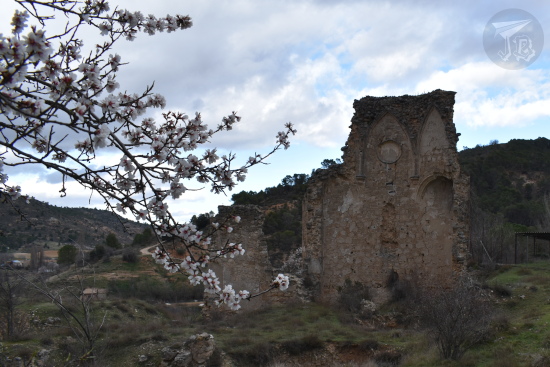
Once fed, family needed to entertain some guests and I made myself scarce. I headed out on my own, and I went to see the animals at the exhibit at Plaza de Vicente Mariño. It was still early and bright, so I decided to climb up to the ruined monastery Monasterio de Santa Ana. As spring was nearly upon the village, the almond trees were in bloom despite the cold, and it was really pretty.

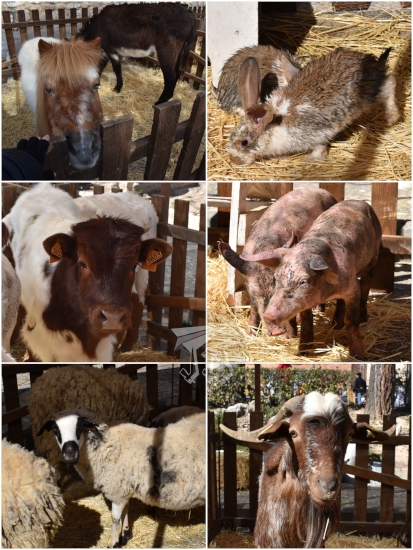
Animals at the farm exhibit - A rabbit, a horse, an ox, a goat, two geese, a pig and a herd of sheep

Saint Anne's Monastery with flowers in the foreground

I went back home and we decided to show up to the “guided visit” that the town hall organised. Right now, this is the only way to see the recreation of a traditional house that has been built in the ethnography museum Museo etnográfico. It made me feel old, because there were a lot of things that I was used to seeing – and using – when I was a kid. However, the guide was… not too good. She even said things like “oh, I’m not rural, I wouldn’t know what that is” about some items.

Afterwards, we tried to find a good spot to watch the parade-show by the cultural group Asociación Gentes de Guadalajara, which started after dusk. They played the funeral parade for the Count of Tendilla Cortejo fúnebre con el catafalco de D. Íñigo López de Mendoza, I Conde de Tendilla. Born in the Mendoza family, one of the most powerful clans during the Castilian Middle Ages, he was a politician and warrior. The Count participated in the power struggle before Isabel I was proclaimed Queen of Castile. He died in 1479, and was originally buried in the monastery Monasterio de Santa Ana. Later, his tomb was relocated to Guadalajara, and eventually destroyed during the Civil War. The whole thing was very solemn, and we ended up catching the parade at three or four points. We even could catch part of it from the balcony at home as they turned to “bury” the Count in the church.

Burial of the Count of Tendilla

We went back to the square Plaza de la Constitución to watch the last show of the day – by now dark night. It was supposed to involve the Knights Templar arriving, and then dancers and jugglers, but apparently the Templars got lost. A lady danced with fire, and there was a scuffle with fire swords, but no knights. That was a bit of a bummer.

Jesters at the Medieval fair

Afterwards, I went to find my car and drive back before all the Sunday drivers finished having their dinner and left. I hoped that would mean fewer idiots on the road. Unfortunately though, I still could not avoid the stereotypical idiot using full-beam headlights behind me. It seems there is always one of those when I drive at night.

23rd October 2023: Happiness Museum and a former hospital, Madrid (Spain)

At the beginning of the year, I found out about an old hospital building turned office building that looked pretty interesting to visit in Madrid had opened up. It is a governmental office, so the visits are guided and supervised. Unfortunately, I was working an afternoon shift and they only run the visits on Mondays at 16:00. I signed up for the waiting list hoping for a summer visit, but they don’t run them in July and August. The September and early October visits did not work out either because I was in London. I finally managed a spot for the visit on the 16th of October, which was rescheduled for the 23rd. It’s not hardcore work season yet, so I was easy to rearrange meetings to have the day off.

Of course, it was a Monday, and Mondays are not Madrid’s best day, especially when the weather is not nice – most things are closed, and even though there are many neat parks, they usually close in the event of storms or winds. However, I almost accidentally discovered something potentially-fun and open, and I made plans with my sibling and nibling, who had a free morning.

I took a train with an hour’s berth of time, but then, because what else is new, there were train issues, and we were all delayed. I was stuck on my line for almost 40 minutes, and decided to walk instead of taking the connection, and they were waiting at their station for almost 30. If you are wondering why I keep taking the train, it is because during 2023 I can get a four-month unlimited pass for 10€, which beats any other transportation mode.

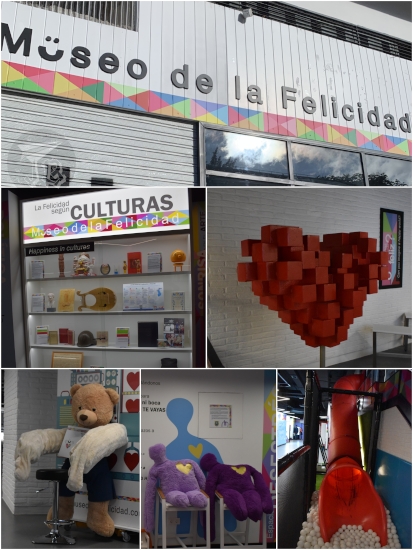
In the end, we luckily made it on time to a new photo-op place, which calls itself the Museum of Happiness Museo de la Felicidad MüF, with a little happy face on the u. It is a two-storey… silly-fun kind of place. Out of all the “instagrammable” places I’ve visited, I think this has been the weakest, as there were actually few things to actually do (too many touchscreens), and it kind of looked a bit… plain. Probably because it was Monday morning and there was no animation. I mean, it was fun, don’t get me wrong.

The first thing you see when you come in are two individual trampolines and a slide that ends in a ball pit. As I can’t jump, I skipped the trampoline. There is a small exhibition on lucky symbols, and another on things that make people happy. There is a small soundproof capsule where you are coached on how to laugh – weird – and a “team good people” that you can stand behind for a picture (the message being “kindness brings happiness”). As I was taking a photograph of my nibling, someone – who had just seen me show my ticket – decided I was the official museum photographer. I turned her down as nicely as I could. It was a day with a lot of comments about my camera.

The MüF has some screens and a VR experience, a “magic” trick on a screen, a big heart made of blocks and a hugging machine – apparently made to comfort autistic kids who benefit from deep pressure, but can’t deal with actual people hugging them. To go down from the second floor back to the first one, you can use the slide into the ball pit or the plain old stairs. That slide is steeper than it looks…

The basement has a few more things that you can touch, a ward with headphones and uppy songs, and the abrazadores (huggers), big plushies that are apparently designed to simulate hugs and grow people’s confidence. They were fuzzy and warm, but I am not sure how they can improve your mental health… There are a few confidence boosters, and a “five-senses happiness booth” where you get to eat chocolate, which is always good. In the end there were lots of silly giggling, because in the end that is why you go to places like that. There is also a “closet of truth” which you should not spoil for other people and helps you discover who is the most important person in your life.

Happiness Museum Madrid

After the museum we headed off for an early lunch. Despite being 300 km from the nearest port in the Mediterranean Sea, one of Madrid’s most famous meals is the calamari sandwich – bocadillo de calamares. A lot has been speculated about how this came to happen, though no one is really sure how the sandwich made its way into the local gastronomy throughout the 20th century. The squid is cut in rings, battered, and served within a small loaf of rustic bread similar to a baguette (pan de barra), an interesting combination at the very least.

The most famous joint to eat a calamari sandwich is Bar El Brillante. It might not be the best, and it quite surely is not the friendliest, but it is the iconic place for it, which actually makes it a tourist spot. The bar was established in the 1950s and it is a family company, the current owner being the third generation. They do not care much about customer loyalty as their business is based on the “novelty” and the “being a must do in Madrid” since the 90s – or maybe they’re just nice to regulars? I for one I’m open to try thebocadillo de calamares again, but not the place. The staff was unhelpful and took forever to clear the tables, which led to a lot of… hm… “birdwatching” as pigeons and sparrows helped themselves to leftovers.

Calamari Sandwich at El Brillante

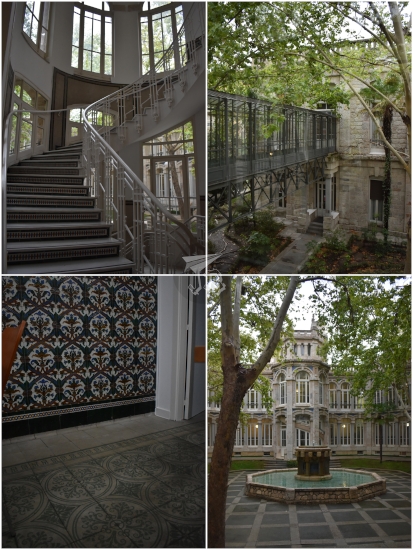
We separated after lunch and ice-cream, and I continued alone towards the Chamberí district, which at the beginning of the 20th century was the outskirts of Madrid. There, philanthropist Dolores Romero Arano commissioned architect Antonio Palacios to build a hospital for labourers: Hospital de Jornaleros, known today as Hospital de Maudes. During that time, it was typical that a hospital had a “target patient”. In this case, it was male workers from the newly industrialised city who were not infectious or incurable – sort of a trauma unit, early-20th-century style. They took in labourers that could be cured, nursed them back to health, and released in “perfect working conditions”. Considering, of course, that the hospital opened in 1916.

For the building, Antonio Palacios chose a cross layout with a hall on one side and a church on the opposite one and two smaller buildings to complete the symmetry. He used Francisco Zuloaga’s ceramics for decoration until money ran out, and aimed for lots of light and open spaces. There are two types of decorative ceramics on the outside: water drops which imitate waves, and broken tile mosaics (Trencadís, a technique favoured by Antoni Gaudí). Palacios even built lifts of sorts to take patients to the roofs of the wards. The hospital worked for its intended purpose until the Civil War broke out and it became a military one. It was eventually abandoned and derelict during the following years until it was bought and restored by the local government in the late 20th century.

All this was explained to us during a 45 minute talk for an hour-and-a-half visit, as we stood in the hallway – which is actually in the basement floor. I arrived about 15:50 for the 16:00 visit, gave my name and ID and sat to wait. We had to go through metal detector and X-ray before the visit started – there is a volunteer guide from a retiree association and an actual worker to chaperone (governmental workers do not work afternoons in summer, which explained then why there had not been visits during that period as I had hoped for). Once the “introduction” was over, we finally got to see what I wanted to see – the building itself. Unfortunately, as the guide prattled on and on inside, it had started raining, so we could not go out to the patio, nor barely see the outside. That was disappointing – I mean, I’m all in for introductions and historical contexts but this is my problem with guided visits, it is just too much talking and too little visiting.

As we walked into the inside of the building, we were pointed out to the ceramics on the walls. Then, the tunnel that connected the hospital with the morgue – which was one of the outer minor buildings. We went up using one of the decorative stairs and we finally arrived at the ground floor of the crossing point of the wards. The centre of the structure is the octagonal patio with the fountain in the middle. As people saw me taking photographs with the camera – I had asked for permission beforehand – they decided I was either a journalist or the official photographer. It got annoying at the fourth or fifth time I was asked or someone made a comment / joke about me photographing them. Which I was very careful not to, even if they keep walking into my field of view.

Maudes Laborers Hospital exterior

The main material of the building is white limestone, which both contributes to the building’s luminosity and it’s common in Palacio’s design. His likings are also shown in the green colour of the interior tiles, which are very similar to the ones in the ghost station of Chamberí. The tiles all along the corridors are decorated and some of them feature heraldic symbols. We got to snoop around the cafeteria, one of the few areas that still features the original floor, since most of the flooring was too damaged to be restored.

The central area surrounding the patio is also octagonal, full of ground-to-ceiling windows. From one side of the corridor to the other and through the patio you can even seethe main staircase that we used to access the second floor behind the windows. Once on the second floor, we crossed the metal bridge that separates the main building from one of the accessory constructions, where the external consultation rooms used to be. Finally, we went downstairs again, walked around the patio and crossed over to the former operating theatres (the above-ground area of the morgue), which are now being transformed into an exhibition room.

Maudes Laborers Hospital interior

By the time the visit was over, it was raining heavily, but I still had the time to visit the in-hospital church Santa María del Silencio, Our Lady of Silence, which is the parish of the Madrid deaf and hard-of-hearing community. Lots of the architecture details are Modernist in style, including the iron fence and coloured glass ceiling.

Altarpiece in Our Lady of Silence

It was still raining cats and dogs when I left, so I forsook the idea of walking around the building to take pictures of the main hospital entrance, I just crossed the street to head to the train station. After aquaplaning on the square to get in, I had to wait about 50 minutes for a train, as the morning breakdown was still causing delays. And of course, when the train came it had already stopped raining.

Maudes Laborers Hospital and Our Lady of Silence from the outside

It was a nice day out, with great company and lots of laughs. Food was okay, the hospital building was amazing, the guide not so much. And the weather… very… autumn-ly.

11th July 2023: Museum of Dreamers in Madrid (Spain)

After I had so much fun in the Balloon Museum, I decided that I also wanted to see the Museum of Dreamers, which is something similar. Furthermore, it Madrid exhibit will close down at the end of July, too.

After I finished French school in Madrid, I headed headed off to the Japanese fusion restaurant Nomo Braganza, part of the Nomo Group. Nomo was established in 2007 under the culinary direction of Japanese chef Naoyuki Haginoya. I have to say that I don’t really trust the Spanish-Japanese fusion too much, but in this case, it really panned out. I met my sibling for a late lunch, because I was curious about the chef’s menu, what in Japanese would be called omakase [お任せ], which means leaving the choice of food to the chef. The menu was was a whooping 12 small-sized courses for 50€ – drinks not included, and considering it was 39 ºC outside, we ended up ordering a few rounds of water.

The menu, which changes periodically, comprised in July 2023:

  • Age Edamame Truffle – fermented edamame beans fried with white truffle scent. I personally prefer my edamame boiled, but the truffle scent was a nice touch.
  • Sukiyaki Croquette – oxtail croquette breaded with panko breadcrumbs. This was surprisingly good – and the actual flavour was strong.
  • Maguro Taco – mini taco of tuna tartar with wasabi and shiso (the “taco” was weirdly… not taco-shaped, more like cracker-shaped). The tuna was really good, albeit the base was a bit strange.
  • Gyu Niku Gyoza – aged beef dumplings with caramelised onion and yuzu, two of them per person. It was all right.
  • Ebi Chili – spicy king prawns and fried egg on kataifi noodles, mixed at the table. When we are talking spicy, it means… really spicy. The prawn bits were sizeable, but this was really something I would not miss should it disappear from the menu.
  • Toro Tartar No Temaki – tuna tartar prepared at the table: raw tuna belly mixed with Japanese onion, turnip, egg yolk, chilli pepper and wasabi on a bed of nori and rice so you can roll it yourself (spoiler: you really can’t). This was probably one of my favourite items – but I guess that after all I am a raw tuna fan.
  • Brie Nigiri – flamed Brie cheese nigiri with honey and walnuts. This was probably the weakest sushi bite, but it was still good.
  • Butter Fish Nigiri – butterfish nigiri with kimchi and chilli peppers. Butterfish is only good raw anyway.
  • Aburi Salmon Nigiri – flamed Norwegian salmon nigiri, with Japanese mayonnaise, salmon roe and onion. I still prefer raw salmon, but the flame was light so it was barely perceptible.
  • Maguro Tataki No Nigiri Trufa Nose – tuna tataki nigiri with soy and black truffle sauce. This was also really good.
  • Gyu Niku No Tataki – aged beef tataki with caramelised mushrooms and miso sauce. The combination of meat and the mushroom was strange, but when taken separately it was all good.
  • Caramel dorayaki – two halves of a dorayaki filled with salty caramel paste. Unexpected, because the menu listed something else, but it is not as if it was bad at all!

Chef's choice menu at Nomo Madrid

My sibling ordered some green tea out of the menu, and in the end, the drinks did not add as much to the price as I expected. Also, I have to give a shout-out to the pickled ginger we got. Really good.

After having lunch, we took a train towards the Museum of Dreamers, which is stands in Espacio Ibercaja Delicias, a place that seems to always look somewhat abandoned, even when it is stupidly hot and sunny. The exhibit was designed by sisters Elena and Giulia Sella, founders of Postology, an agency specialised in “phygigal” experiences. This concept merges the words “physical” and “digital”, allowing for a number of immersive and surreal experiences. The Museum of Dreamers is one of those things that you have to see with an open mind to have some fun. It comprises sixteen interactive installations which are basically photo-ops – after all, the word instagrammable has been officially accepted on dictionaries. I guess it is a new niche that can be exploited, and to be honest, I can get behind that, because some of these activities are hilarious.

Entry is timed, but they do not hold a very strict waiting policy – at least not on a Tuesday at 17:00 and 39 ºC. There were no timed exhibits or performances either. The first installation is a dark room with a starry sky of sorts, designed maybe to isolate the rest of the exhibition from the outside, maybe as a metaphor (100 Dreamers). Then you get to a semi open space that opens to the smaller installations that allow for fun pictures. All through the space there are motivational sentences and “rules” for safety in the different installation.

There is some kind of cosmic tube with mirror that was dizzying to walk into (Free your power), a tunnel made of hearts with an encouraging message at the end (Do what you love), an upside down room (Change perspective), an downside down bedroom with a giant plush and fun bed covers (Never stop dreaming), one full of disco lamps (Sparkle more), and a neon staircase flanked by colourful palm trees (Step by Step).

Museum of Dreamers exhibits

Afterwards, there is a ball pit – you know, it’s not like I had ever stepped into one before Friday, and now that’s twice in one week – with a “relaxing island” in the middle (Enjoy Today). In front of that, a tunnel made of fake pink flowers with a long table, set for a tea party (Believe in Magic). That managed to make you think of Alice in Wonderland imprint on your brain. Thus, you are in the right mindset for the following room, full of giant mushrooms and flowers that open up at will – theirs, for sure, not the visitors – whole giant butterflies hang around with their wings made out of lights (Wonder).

Museum of Dreamers exhibits

The final part of the exhibit consists on a second row of booths – a colour wheel, a door that opens to a fantasy scenery, a VR experience (Choose your Way), a stage (The stage is yours), some pink telephones (Your Dreams are Calling you), bright lights commanding you to DREAM (Be Bright)… There were two more rooms, one with a sky background and swings (Sky is not the limit), and the other with punching bags reading FEAR, STRESS, ANXIETY and so on (Never Give Up). I can’t punch, but I can strangle, so I choked the hell out of these last two.

Museum of Dreamers exhibits

That was the end of the escapade. It was a fun half-day out.

8th June 2023: Tordesillas & Zamora {WNW Spain, with a splash of Portugal, June 2023}

Tordesillas used to be one of the Spanish Crown’s strongholds throughout the Middle Ages, starting around 1340 when Alfonso XI ordered the construction of a palace. In 1494, the Spanish and Portuguese monarchs signed a Treaty which divided the lands “discovered” by Columbus among them – of course, this Treaty was largely ignored by any other European powers which wanted to explore America, and never acknowledged by any indigenous people. In 1519, the town was part of the rebellion against Carlos I, naming his mother – and daughter of the Catholic Monarchs – Juana as queen, despite the rumours that she was insane. After the defeat of the revolts – and beheading of the instigators – the town lost importance.

We left early in the morning to try and ditch the traffic, but we were not successful – driving around Madrid, we ran into a couple of jams traffic caused only in part by the intermittent storms, which made the beginning of the road trip stressful. Thankfully, we parked at the outskirts of Tordesillas and the sun was shining again, as we had to cross the village on foot. Our first stopover was the Main Square Plaza Mayor. In the Castilian Main Square fashion, it is actually square in shape, with the main buildings supported by columns, where cafés and shops stand today. The current plaza dates back from the 16th century, and has been painted in a questionable bright mustard colour.

Main Square in Tordesillas

In the end, most of the history in Tordesillas is linked to Alfonso XI’s palace, known today as the Convent of Saint Clare Convento de Santa Clara, which stands a few minutes’ walk from the square. It was home, and later prison, to royal women, both loved and unwanted ones. It became a convent of the Order of Saint Clare in 1363, and the nuns living there were tasked with praying for the health and salvation of the Royal Family. Today, it is managed by the Spanish National Heritage Foundation Patrimonio Nacional. It can only be visited under supervision – seriously, aside from the guide, you get a security guard following you around – and photography is forbidden in all the interior areas.

The castle-convent was built throughout the 13th to 18th centuries. The oldest part of the building is a chapel dating from the 11th century, and the bulk of the construction was carried out in the 14th century. The monarchs employed Mudejar builders, a fact that yielded to multifoil arches, ceramic decorations, and Quran verses (officially “decorative nonsense”) in some of the chapels and the façade of the building.

Inside the palace there is a Baroque cloister and the gothic church, with a wooden ceiling painted gold and the emblem dragons of Carlos I’s shield. Truth be told, the church had been pretty much hyped up on me, so I found it a bit underwhelming.

Santa Clara convenent in Tordesillas

The party separated for a bit so I could explore on my own for a while. I got to the stone bridge over the River Douro Río Duero, just called “the bridge” el Puente, right at whose ends stands a monument to the fighting bull Toro de Tordesillas. The associated bullfighting festivity was one of the oldest in Spain until it was vetoed by the regional government – the fighting bull was set loose in the meadow, chased by horsemen and lanced to death. Today, the festivity is controversial and it’s trying to find its place in the midst of new sensitivities.

Tordesillas

I climbed up the medieval wall Muralla de Tordesillas to the park where the monument to Queen Juana Monumento a la Reina Juana I de Castilla stands, in front of the museum dedicated to the Treaty Casas del Tratado, and the church Iglesia de San Antolín.

Monuments in Tordesillas

We walked back to the car to drive off to the next spot in the route, and Tordesillas became the first spot where we spotted birds of prey during this trip, maybe a golden eagle Aquila chresaetos. Or, you know. Anything else.

Eagle

We drove off towards the municipality of Zamora, a Medieval town and villa by the Douro, known for its Romanesque churches. We reached the Parador de Zamora in the middle of a horrible downpour that was over as quickly as it had started. The Parador hotel is a former noble family’s Renaissance palace, with a military style and a middle patio with a glass-window gallery

Parador in Zamora

We had a late lunch and walked to the manor Palacio de los Momos, near the Main Square Plaza Mayor, home to a church Iglesia de San Juan de Puerta Nueva which has a sculpture representing two figures of the local Holy Week celebrations Monumento al Merlú. Other buildings include the old and new town halls Ayuntamiento Viejo and Nueva Casa Consistorial, and blocks of colonnaded buildings.

Buildings in Zamora

The first Romanesque building we came across was the church Iglesia de Santa María Magdalena, which contrary to many other places has got rid of the Baroque add-ons, and stands severe and naked in its stony glory. It is considered one of the most important and pure Romanesque constructions in Europe, sparsely decorated save for the tomb to the side.

Church of Saint Mary

From a side stop I overlooked the river Río Duero and the medieval bridge Puente de Piedra.

Zamora Medieval Bridge

We continued off to the cathedral Catedral del Salvador de Zamora. It is considered the first cathedral in the “Douro Romanesque” style. After the original cathedral was destroyed during the Muslim conquest of Spain, the reconstruction began around 1151. It must have been finished towards the beginning of the 13th century. The building has two particularities – the thick tower, and the umbrella dome, in a style that travelled from Byzantium to the Islamic architecture and reached Spain with the Nasrid artists. The inside holds a cloister and two small museum – one of religious art and the other of archaeology.

Zamora Cathedral

Afterwards, we visited the ruined castle Castillo de Zamora – a purely-defensive Romanesque fortress built around the 11th century. The castle has a moat, and you can wander up the walls and defensive towers. The interior is ruined, but the ancient structure can be guessed by the arches and different walls that would have separated the fortress’ halls.

Castle in Zamora

Finally, we explored a few more religious Romanesque buildings: Iglesia de San Pedro y San Ildefonso, Convento de Clarisas El Tránsito and Iglesia de San Cipriano. From the viewpoint next to this last church, we got to see a stork nest with a baby chick in it.

Zamora churches

Stork nest

We had dinner at a restaurant called El Horno, a traditional places that offers tablas – wooden trays full of treats to share. We shared a serving of tabla de fiambres – Iberian sausages (ham, loin, chorizo…) and cheese on a bed of crisps.

Zamora at night

4th April 2023: La Granja and Riofrío (Spain)

King Felipe V of Spain was born Philippe, Duke of Anjou, in France. He was appointed successor to the throne by his great-uncle Carlos II, who died childless. He was never very interested in being a monarch, or at least King of Spain, which he became in 1700. Around 1718, he fell in love with a hunting area and decided to buy it. Today, this area has become the municipality of Real Sitio de San Ildenfonso (Spain), the Royal Site of Saint Ildephonse. He ordered a palace be built “without disturbing what was already built”. The result was the palace known as Palacio de La Granja de San Ildefonso (The Farm at San Ildefonso), in honour of the hermit church and farm that were there when the King bought the hunting grounds.

Legend has it that the palace is extremely uneven because the King ordered that no parts of the church were demolished, so the walls were built around the old construction – however, it is such a massive building that seeing the irregularities from the inside is hard. The palace, built between 1721 and 1724, was commissioned to Spanish architect Teodoro Ardemans. Later, the garden façade was remodelled by Italians Filippo Juvarra and Giambattista Sacchetti. A fire destroyed part of the building in the 20th century and a lot of the paintings were lost. The gardens – the most famours feature of the site – were designed by Frenchman René Carlier in 1721 and finished by Étienne Boutelou when the former died in 1722.

Today, the palace is managed by the Spanish Heritage Network Patrimonio Nacional – which means that photography is not permitted inside. It is technically one of the royal residences, so of course you have to go through security and X-rays and whatnot. We headed there on what was technically a working day before Easter break, so we were not sure how much traffic we would find, or how many visitors there would be. Thus, we had booked our tickets online for 11:00, anticipating a two-hour-and-a-half drive. In the end, we were in front of the palace around 10:15 and were able to enter at 10:30. Before that, we saw some impressive trees, including a sequoia, which I don’t think I had ever seen before.

Baroque Palace of La Granja peering behind a few large trees

The palace is Baroque, showing the likings of the time in which it was built. A monumental staircase gives access to the first ward, rebuilt after the fire into an area to display part of the royal tapestry collection – Museo de Tapices. The oldest tapestries date from the 16th century, before the Spanish tapestry school was founded. Tapestries are not my favourite form of art, but these were pretty impressive. A collection of nine pieces allegorise some of the virtues, mixing classical mythology with Christianity and historical figures.

The interior of the palace displays the private rooms of the monarchs, on the first floor, and the different ballrooms and social rooms on the ground floor. The private areas are decorated with paintings, and the public ones try to emulate the Palace of Versailles (France). They are furnished with marble and mirrors, and decorated with sculptures and statues.

La Granja: Dizzingly-decorated large hall in golden and white marble, with large open wooden doors

The ground floor opens to the well-known gardens Jardines de La Granja. These are considered the best “French gardens” in Spain. They cover almost twenty thousand square metres. Sprinkled throughout paths, hedges, parterres and trees, there are 21 fountains, most inspired by characters taken from classic mythology. The fountains are made out of lead, painted in bronze colour, and even if built 300 years ago, they still work and are indeed turned on during the summer season, fed from local reservoirs. They were not running during our visit – except for one dragon which leaked a bit. Spring seemed not to have arrived in the gardens yet, and it looked strangely like autumn.

La Granja: Italaian façade of the pakace from the top of the waterfall fountain, which was turned off. A number of bronze statues representing mythology characters line the waterfall

From the top of one of the fountains, called “the waterfall” Fuente de la Cascada Nueva, there is a good view of the Italian façade of the palace. Other fountains include “The Fame” Fuente de la Fama and “Diana’s bath” Fuente de los Baños de Diana. One of the most complex fountains is Fuente de las Ocho Calles (Fountain of the Eight Streets), a complex of eight fountains in a sort of “square” created by the intersection of eight garden paths. The fountains were built to only run when the King approached them, and today they are turned on in a rolling schedule, and very rarely all at the same time. This is to take care of the pipe system, still the original one, and because some of them need a lot of water to function.

La Granja, outside. Two large fountains crammed with bronze figures representing mythological beings. Both are turned off.

After we were done with the palace, we continued off to what I found the highlight of the day, the Royal Factory of Glass and Crystal of La Granja Real Fábrica de Cristales de La Granja. It was also established by Felipe V in 1727, and even today people use the old techniques to make glass items there! Even though it is called a “factory”, the process is completely artisan. The place also doubles as a museum to explain the how glass is (and was) made, exhibiting different traditional instruments. Of course, it has a shop. However, the coolest thing is that you can visit the furnace workshop to see how glass is blown, and the decoration workshop to see the engraving process. We hung around the furnace area and the experts can make a whole goblet in three minutes and a half, from incandescent blob to ready-to-engrave product.

Glass museum: diferent machines used to process glass in the 20th century, and a reproduction of the original glass furnace

Workers at the Glass factory: making and engraving a glass

After the factory, we headed towards the Parador de La Granja, a mix of a modern and historical building where we were to have lunch. We shared some cured beef cecina de León, and I tried the local speciality judiones de La Granja, a hearty bean-and-pork stew.

Collage of the inner patio of the Parador building + lunch: dried meat and a bean stew

When we finished lunch, we took the car to the secondary palace in the area, called Palacio Real de Riofrío, a hunting pavilion also managed by Patrimonio Nacional (though apparently, pictures are okay here, which is cool). The building is surrounded by 600 hectares of forest and hunting grounds. It was originally commissioned by Felipe V’s wife Isabel de Farnesio, who actually never got to live there since when she became “queen mother”, her son Carlos III had her move to Madrid.

We drove past the forest, where some storks were happily wandering around. The SatNav flipped on us because it could not find the correct gate, but we managed to make it on time to spend an hour or so there. Also, the entrance was weird – it is actually closed, and there is a guard inside. If we had not arrived just as another car was exiting, we would have thought it was closed and left.
Baroque palace of Riofrío. It's large and pink, with lots of archeways

The palace is also Baroque, and the areas which can be visited include some bedrooms, dining rooms, and the areas where the servants waited to be called. The palace has been organised as a Romantic museum Museo Alfonsino, that honours King Alfonso XII, who mourned his first wife there. It was actually decorated by his father, King Consort Francisco, Isabel II’s husband, and later “enriched” with paintings from other Royal Sites. The most interesting item was the billiard room, because it actually felt rather unexpected.

Another area of the palace has been transformed into a “hunting museum” Museo de la Caza, to honour the fact that these were the King’s hunting grounds. It mostly hosts taxidermy representations and a collection of pelts and skulls. To be honest, some exhibits were a bit unsettling.

Collage showing the inside of Riofrío: the hyper-decorated rooms, the staircase and taxidermy of local deer

As we left, the SatNav warned us of a 40-minute jam on the way back, so we forgave its previous flop. The warning allowed us to take a detour to avoid it – we had to pay the toll but it shaved off almost an hour.

11th March 2023: Rocks from the land and fish from the sea (Madrid, Spain)

Back in 2018, when going to Madrid’s Geomineral Museum (Museo Geominero), I stumbled upon an event in the Mining Engineering University – something called Expominerales. At the time, I did not have time to explore it, and only later did I realise what I had missed – an international fair for the trade of minerals, rocks and fossils. I made a mental note to check the event out the following year, but something came up and I completely forgot about the whole thing. In 2020 the pandemic struck, and finally in 2023, almost five years to the day, I went back to this event held in Madrid.

Expominerales is held yearly at the working engineering school Escuela Técnica Superior de Ingenieros de Minas y Energía (ETSIME), which offers the bachelor’s degree in Mining Engineering, and the one in Energy Engineering (whatever this last one is). The first weekend of every month, the school organises a “mineral-world flea market”, and the second weekend of March, it hosts an international mineral, gem and fossil fair, with shopping stands and different workshops and activities. After a few cancellations due to Covid, it returned in 2022 and it’s back to its former glory in 2023 – Expominerales XLII, the 42th edition of the fair.

The ETSIME in Madrid. Pink-and-white building from the 19th century, accessible through stairs, with flags hanging over the door

Mining Engineering became a formal education path in Spain in 1777, originally in the town of Almadén, a mercury hub. The school was moved to Madrid in 1835 and a two-building campus was ordered. The historical building in the ETSIME (M1) was designed by architect Ricardo Velázquez Bosco, and decorated by ceramist Daniel Zuloaga between 1884 and 1893. The second building (M2) was damaged during the Civil War, and has suffered several modifications to accommodate classrooms and laboratories. The premises also include a reproduction of a mine, Mina Museo Marcelo Jorissen, however this one is closed for renovation – a lot of that seems to be going on around the university, since part of the decorations of the buildings are also covered.

The M1 historical building has a central cloister with an ironwork colonnade. The building is rectangular, and on the short sides there are two symmetrical wards. One holds the historical mining museum, the other one the historical library. The central cloister is the main area where Expominerales is held, on the ground and first floor. On Saturday, the exhibit opened at 10:00, and we were there a bit later in order to sign up for the first guided visit at 11:00 (3€) – we wanted to take it so we had access to several rooms that would otherwise be closed to us. The idea was being there before families with kids started arriving and the activities became overcrowded – it turned out in the end that most the activities were indeed organised for children, so it did not really make a difference. Furthermore, the visit we feared full only had 6 attendees.

We had one hour before the guided visit that we spent looking at the stands on the ground floor on the M1 building. The guide was a student who might have been partying the previous night, because he sounded a little out of it – forgetting info and words, even things related to his own degree.

First, we went to see the mineral collection, the origin of the historical museum in the M1 building, Museo Histórico-Minero Don Felipe de Borbón y Grecia. The mineral collection was started in 1831, and throughout the years it was increased with new minerals donated by different institutions. It was later expanded to cover palaeontology and historical artefacts related to mining and other earth sciences. Though a lot of the displays are scattered throughout he building, the original museum dates from the 19th century, and it has four sections: the mineral collection, the fossil collection, the cave bear collection and the mining archaeology section, totalling over 10,000 items.

The historical mining museum at ETSIME Madrid. It is a large ward with cedar wood shelves from floor to ceiling, filled with rocks and fossils. The picture also shows some close-ups of rocks, two cave bear skulls, and a cluster of fossilised snail-like animals

Today, the museum is named after King Felipe VI, who visited the museum in the late 1980s after the university reached out to him to propose the name. The then prince came to visit then, and the name “the king’s stairs” was given to the set of side stairs he used – Escaleras del Rey.

We also visited the small hall where candidates read their theses, a little hall with spectacular ceramic tiles by Zuloaga, and finally the historical library, with obsolete but cool volumes. The library also dates back from the 19th century, with the walls covered in wooden shelves, with a small metal staircase to access the upper balcony. Unfortunately both this one and the one in the museum were cordoned off.

Library in ETSIME. It is a large room with cedar wood shelves from floor to ceiling, and a spiral staircase.

The visit ended at the lecture hall on building M2, one of the few remaining areas of the original design. It is a marble room with wooden benches and decorated windows that represent the original subjects taught to Mining Engineers. After we were left off, we sat down at the cafeteria for a drink.

Lecture hall in ETSIME (Madrid). It's a marble room, rather dark, with smoked windows representing different subjects of the Mining Engineering Degree

We recharged batteries, and then we had a look at the stands on the first floor of the M1 building, alongside the collection of apparatus that they had. Afterwards, we decided to separate in order to do shopping. Expominerales hosted over 30 stands, national and international.

Expominerales. A view of the ETSIME cloister from the second floor, showing different stands and lots of people peering curiously

I, being the nerd that I am, got myself a tiny slice of iron meteorite (from Geoterra Minerals), a mosasaur fossilised tooth (from Carlos Hammann, who also had amazing megalodon teeth that I will never be able to afford), a decent-sized of recrystallised bismuth (from Rossell Minerals), and a small piece of black tourmaline (from The MineralShop) – all for 51€.

Collage: a fossilised tooth, a bit of mineral in metallic colours, a slice of meteorite with silver orthogonal markings, and a bit of shiny black rock

When we met again, it was a bit past 13:30. There were too many people by then – families had started arriving, so we decided to leave. We had booked at a nearby restaurant for lunch, and they did not mind accommodating us a little earlier. The restaurant, called DeAtún Ponzano specialises in tuna dishes – particularly Atlantic bluefin tuna (Thunnus thynnus), sustainably caught in the Straight of Gibraltar.

Before overfishing was even a thing, Phoenicians settled in the south-west of Spain somewhere between the 9th and 7th centuries BCE – the city of Cádiz, credited as being the longest-standing city in Europe, may have been the first port. The Phoenicians observed that the bluefin tuna migrated from the Atlantic to the Mediterranean every year around the same dates, and later they came back to the ocean. These guys came up with a very simple technique – that was later developed further by the Romans and perfected in the Islamic period: the almadraba.

An almadraba is a portable but complex net which is lowered for the migration period. The bigger fish are funnelled into a box-like construction, and the smaller ones swim right through it. Once the almadraba is full, a number of fishing boats lift it in a process called levantada (raising). Expert fishermen walk onto the nets, discard any small specimen that might have been trapped, and choose the tuna that will be sold, generally individuals heavier than 200 kg.

Since the fish are selected on a case by case basis, the amount of both the catch and by-catch is small in comparison to other fishing methods. Both the seasonality and craftsmanship of the whole process make it much more sustainable than others – of course, this also causes fewer pieces in the market, which in turn increases the price. Furthermore, all the fish are wild, hand-picked, and only bled out when they are loaded onto the ship. Thus, the quality is extremely high. Another factor that makes almadraba-caught tuna more expensive is the fact that walking onto the levantada is dangerous. Fishermen have been seriously hurt by struggling tuna, as some of the fish might weigh up to 500 kg.

Working almost exclusively high-quality tuna means that DeAtún is not a restaurant on the cheap side of things. I’ve actually traced down their tuna provider and the prices are rather cost-adjusted for almadraba-caught tuna. There’s another thing to consider, too, which is that the Spanish law forces restaurants to freeze fish that is going to be served either raw or quasi-raw, at least for 24 hours at a temperature under -20 ºC – this is done to destroy a fish parasite called Anisakis, which can cause stomach distress and serious allergic reactions. Apparently, the perfect temperature to keep the tuna properties is -60 ºC. So yay Anisakis-safe almadraba-caught tuna all year round (though it’s true that the freezing law makes it impossible to eat fresh tuna raw).

We got a welcome tapa of boiled potatoes with olive oil and herbs (“papas aliñás”), a favourite from southwestern of Spain, the same area where the almadraba tuna are caught. We shared some European anchovies (Engraulis encrasicolus) “anchoas del Cantábrico” with tomato and toasted bread. These anchovies are salted for at least six months, cleaned, and stored in olive oil. They have a strong flavour, and are not everyone’s cup of tea, but I adore them. We also shared a portion of “ortiguillas” (Mediterranean snakelocks sea anemone Anemonia sulcata, battered and fried), also typical of the south-west – I’ve never been much of a fan though.

Lunch at DeAtún. Collage with a potato salad, anchovies and battered seafood balls

Finally, as my tuna preference is raw, I was wondering whether I wanted sashimi or tartar. In the end, I decided to try a combo (“trio DeAtún”): tuna sashimi (slices), tuna tartar (dice) and tuna tataki (heat-sealed slices), with a side taste of different sauce emulsions – wasabi, kimchi and curry. The tuna cuts used for these preparations (descargamento and tarantelo) would be the otoro or toro Japanese cuts, which are appropriate for raw preparations – technically the best ones, fatty or very fatty meat. I don’t love tataki, thus my original reticence to try this combo, but it was good. My favourite bit was the sashimi though, the tartar was missing a bit of spice.

I was offered chopsticks to eat the dish, and I accepted – easier to handle the fish. That apparently made the maître think that I had been the one choosing the restaurant, because in his words I “seemed to be an expert, chopsticks and all”. That was hilarious – I mean, why offer chopsticks if you don’t expect them to be accepted? For the record, although I booked the table, I did not choose the restaurant – it would have been a little on the “too fancy” side for me. The truth is, there were a bunch of very-elaborated dishes that we decided to give a miss, and we went for the raw tuna.

Lunch at DeAtún. A plate with three tuna cuts. The centre is round, and rose-like, and the sides are extended on a line. The fish is uncooked and it looks dark red. There's a similar dish in the background, with more cuts

Desserts were okay, but not the reason we had chosen this place. The point was eating tuna – raw tuna in my case – and the restaurant delivered. I was however amused by tables around us refusing the raw options even when the chef himself came out to greet them and recommend the dishes (someone over there must have been an acquittance, I don’t really know). Finally, we set back home to compare treasures and plot going back to Expominerales in its 2024 edition – at a time where we can snatch some discounted rocks.

25th February 2023: Feria de las Mercaderías de San Matías 2023 (Tendilla, Spain)

In 2022, some relatives who spend the weekends there talked me into visiting the Medieval fair in TendillaFeria de las Mercaderías de San Matías. It recovers the tradition of the cattle fair around St. Matthew’s day, and today it is one of the yearly highlights of the village. The historical roots of the municipality as an important villa in Medieval times can be traced to the Second Count of Tendilla, Don Íñigo López de Mendoza (1442 – 1515). He accompanied the Catholic Monarchs in their conquest of Andalusia and was later named “governor” (of sorts) of Granada once it was won for the Kingdom of Castile.

I once more arranged to attend the fair in 2023, and I drove off early in order to secure a decent parking spot as the core of the village gets closed off to traffic. Tendilla is laid out along a former main road, which used to work as a separating axis. Today, traffic has been diverted and circumvents the whole village, and the axis has been renamed as two streets: Calle del General Muñoz y Muñoz from the beginning of the village to the town hall square, Plaza de la Constitución, and Calle del Alférez Agudo to the end of the village and the “former fair square”, today the square Plaza de Vicente Mariño. Along this axis, rows of stands on both sides of the street, selling crafts, trinkets, traditional products and foods, and so on. Tendilla is known for its torreznos, processed pork lard snacks, so there are many of them on offer.

The typical food at the fair is migas, a dish made out of toasted breadcrumbs and several toppings. Traditionally, migas were made from stale bread by semi-nomadic shepherds back when it was common to move livestocks from one area of Spain to the other according to the season (transhumance). The town hall organises a collective cook-out of a simplified version for the attendants, just the fried breadcrumbs with paprika and garlic, topped with the famous torreznos. Though there are endless variations of the dish, the local tradition calls for breadcrumbs, paprika, garlic, and minced pork, topped with a fried egg, and sometimes some fruit.

We were going to prepare our own complete version of the migas, so the first goal was securing some minced chorizo, called picadillo from the butcher’s. We also bought some torreznos for later. Then, we started wandering the village – literally up and down from one square to the other – to see the stands and catch all the events. Although it was rather cold, it was sunny and not windy, quite pleasant once you were wearing enough layers – I had actually brought some extra ones that I did not end up needing.

At 11:00 the “farm” opened at Plaza de Vicente Mariño – this is the closest activity related to the origin of the fair, a cattle trade event. There were horses, ponies, donkeys, cows, goats, sheep, piglets, and fowls… I might have remembered a little too late that hay causes an allergic reaction these days. Across the street from the farm stood a huge BBQ grill and some watering holes – I guess that to place the roasting pork just in front of the living piglets is part of the village’s twisted sense of humour. Desensitising kids, or what? One of the funniest things around this area is hearing people squealing at the animals, especially at the piglets – there are a lot of “urban people” in the fairs wanting to “experience country life”, who have never really seen a farm animal in their life and are thoroughly impressed – and end up saying hilarious things.

Farm animals - pony, rabbits, white-and-brown cow, small piglets, sheep, a cheeky goat

At 11:10, we caught the Opening Parade took place, described as musicians, jugglers and knights walking along the streets. It featured a dancer, a small group of musicians, and the members of the horse riding school Caballeros del Alarde.

Collage showing a female dancer followed by three Medieval musicians; two horse riders, one in full armour and the other one dressed as a nobleman from the Middle ages.

After the parade ended at Plaza de Vicente Mariño, we went to check on the communal migas, and say hi to the guys preparing them. They had prepared a bonfire and a huge pot to toast the breadcrumbs, and fought off the cold with beer and wine.

A huge pot with orange breadcrumbs being cooked

There was a second parade at 12:10, this time the official inauguration one. Aside from the musicians, dancers and horse riders, walkers included the authorities, ladies in Medieval clothing, and giants. They walked from the town hall square Plaza de la Constitución to the migas cook-out. With this, the festival officially kicked off.

Parade. Three musicians playing Medieval instruments. Three giant puppet-like giant costumes; men and women dressed as Medieval nobles. A moorish-like kight on a white horse.

I followed the horse riders Caballeros del Alarde back to Plaza de la Constitución where they started practising for their later show. They are part of a horse riding school which carries out several activities, Medieval riding is one of them, along with horse training, archery, and shows in Medieval fairs and markets. For this event in particular, there were six riders – five men and one woman – with two bay and two white horses. One of the bay horses was not in the mood to cooperate though, and got easily spooked.

The show happened from 13:30 to 14:30. It was an exhibition of Medieval horse-riding – while horses galloped through, different different tests carried out – spearing a bale of hay, hitting a metal shield, catching a metal loop with the sword, then cutting off a carrot… There was also a bit of a staged scuffle, swashbuckler-style. The emcee made it sound like the whole show was an exhibit to train for an upcoming jousting contest (in the evening) and the riders would later compete for a pouch full of gold maravedis – Medieval Spanish coins. The show itself was pretty fun and impressive to be honest – the riders had to control the horse in a crowded and small area, full of bystanders and noise, and do the activities with a very high level of success.

Shots from the horse riding exhibit - one of the riders galloping, another spearing the bale of hay, two riders sword-fighting; The female rider, wearing bright blue, with a long spear.

After the horse show, we went home to prepare the traditional version of migas – we fried some minced chorizo, garlic and paprika, then worked the bread on the stove. Finally, we fried the eggs (sunny side up) and the food was ready! Not that we stayed down for long, soon after finishing our late lunch we went out again to find a good spot to watch the jousting at Plaza de la Constitución.

Preparing the migas - frying mincedmeat, then the garlic, then the paprika. Breadcrumbs just poured, still white, then cooked and looking bright orange. Finally, a dish with a sunny-side-up egg on top of the migas.

We walked around the square and realised that there was not really a good spot though because the square was too small and set in a way that anything the riders did, their right hand would be towards the inner area of the square. So whatever they did, the view would be obstructed by flags and décor. And the best viewpoint was actually taken by the sound equipment – which ended up malfunctioning anyway…

Before the tournament started, a sword was brought in as a present to the village. Because the sound was so horrible, I did not completely get the significance of it – it was supposed to have been donated by Queen Isabel of Castile to the village. The program said that there was going to be a forged sword at some point, so I thought it was that one.

A woman parading a Medieval sword, and a group of horsement behind her

This time there were only five riders, apparently one of them had been hurt at a previous exhibition and was not ready for the whole competition. The show itself was all right though – the emcee presented the best rider as a bit (or a lot) of a cheater, and he hyped a lot of “girl power” vibe around the female rider. The riders competed on tests in pairs, again spearing, loop catching and carrot-cutting. The “cheater” won in the end and the maravedis were distributed among attending children, as apparently the coins were not legal Medieval currency but plain old chocolate. They tried to do an archery exhibition too, but the square was too small.

Scenes from the jousting, showing horses and riders as they take the different tests with swords, spears and the to-be-cut carrot.

There were much fewer people for this exhibition since it was later in the evening (17:00) and because the evil-looking storm cloud just above our heads. Thus, this time, when the riders offered if someone wanted to take a picture on one of the horses, I got myself up a white Pure Spanish Breed warhorse, which was really cool. Then, the group asked if someone would take a picture of them, and I offered to do so.

All the horse-riding school performers, in character, both on horses and on foot, pose for the picture. They are all dressed in Medieval clothes and smiling.

We went to see the campsite afterwards, with different things that could have existed in Medieval times. One of the most interesting things was the forge, with the blacksmith at the ready. I hung out around the smithy for a while and as night fell, the sword started to take shape. I realised later that this was the sword that was going to be forged for the village, and not the one I had seen before the jousting.

A blacksmith hammering down metal to forge a sword and a guard.

I don’t know whatever happened to it, because I eventually moved away to find the final parade, in which a group of villagers dressed up as Moors from Granada, either friends or foes of the Count. The parade was lit with torches, and ended at main square Plaza de la Constitución again. There were also jugglers, fire-dancers, and some more swashbuckling. They also made a queimada, a distilled spirit with “magical powers” flavoured with herbs, cinnamon, sugar, herbs and coffee beans. A spell is usually requires an extra spell as it is prepared. While I would have wanted to try it, I did not dare do so before driving…

Collage of the final parade. A group of people wearing flashy red and gold clothes carrying torches. A woman dancing with fire torches in her hands. A man and a woman fighting with swords on fire. Two men dressed in Medieval attire on war horses.

A bit after 21:00, after roughly 12 hours of “fairing”, I got back on the car to drive home with a basketful of food and good memories to drive home before the temperature went below zero again. Only when I was home I realised I had not even taken my scarf off, and that it still had straw on it from the farm – which quite probably did not help with the allergies.

12th & 13th November 2022: Santiago de Compostela (Spain)

Here’s a little secret – people don’t like flying on the 13th, even less when it’s a Tuesday. Thus, I came across a bunch of awesome offers for the 13th of December, which unfortunately I could not take up due to work uncertainties. What I could muster was a mini getaway on the weekend of the 12th/13th of November, to the northern Spanish town of Santiago de Compostela. There were a few reasons for this choice – one, cheap flights; two, I’ve recently started considering a route through the so-called Camino de Santiago (St. James’ Way); and three, pandemic shuffled ‘Holy Years’ round so there was a special gate to the cathedral open that I wanted to see. I flew out around noon on Saturday and came back on Sunday night. It was a perfect plan for a decompressing getaway.

Santiago de Compostela is known as one of the most important pilgrimage cities in the world. According to the Christian tradition, the tomb of Apostle James was found in the area in Middle Ages (different sources vary throughout the 9th and 11th century), and the pilgrimage to visit the remains became one of the most important in the Christian faith, alongside Rome and Jerusalem, to the point that the pavement proudly states that “Europe was built on the pilgrimage to Santiago”. While I’m not religious, I have a thing for religious architecture, and as mentioned above I’ve been thinking about the Camino for a while, and visiting the goal felt a good way to start organising how I wanted to look at things.

However, let’s say it wasn’t the most perfect getaway ever. Though the flight was on time, and pretty short, there was turbulence – not something too out of the ordinary, but here’s something you might not know about me. Back in the mid-nineties, I sort of crash-landed in the Santiago airport, so let’s say I was not so invested in a bumpy flight.

As the flight had been very cheap (about 30€), I had decided to splurge a little in the hotel – and I found a not-so-bad offer of half-board at the Parador de Santiago – Hostal Reyes Católicos, downright at the centre of the city. It is located in the old pilgrim hospital, and it is a magnificent building, aside from a five-star hotel. I arrived around 14:00, and the room was not ready – fair enough. I wanted to get there early in order to drop off my luggage, and make sure I could arrange my dinner reservations for a convenient time. One of the reasons I decided to book half-board in the Parador was to guarantee myself a meal late in the evening, as I had booked a walking tour at 20:00, and the main restaurant served dinner till 22:45.

Wide shot of the Parador. It shows a severe building with an ornate gate. The sky is bright blue.

Unfortunately, the check-in staff “had booked me” at 20:30, and they asked if that was okay. I replied it wasn’t, and explained the reason stated above – the staff then said that they could accommodate me at 22:00 at the secondary restaurant, but not at the main one. I answered that then I’d have dinner at 22:00 at the secondary restaurant then, but the staff asked me to check the menu. I stated that it did not matter. I needed my dinner to be at 22:00, and if the main restaurant wasn’t available, it would have to be at the secondary one. The staff asked me to check the menus, and I explained again that I had a tour from 20:00 to 21:30 – I needed dinner at 22:00. I thought that was resolved, and as it was too early to get a room, I picked up my camera, left my backpack in the locker room, and went on my merry way to explore the outdoor “monumental route” within the historical city Ruta Monumental de Intramuros. The old city of Santiago is part of the Unesco Heritage Site Routes of Santiago de Compostela: Camino Francés and Routes of Northern Spain Caminos de Santiago de Compostela: Camino francés y Caminos del Norte de España.

As I had tickets for different activities in the cathedral booked for the previous morning, and the Sunday forecast was rain, I decided to do most of the walking on my first afternoon. I started off in front of the cathedral façade in the square Praza do Obradoiro (the Artisans Square), which hosts the town hall in the former Neoclassical palace Pazo de Raxoi, the Parador itself, and the main – but closed, will get into that later – entrance to the cathedral Santa Apostólica y Metropolitana Iglesia Catedral de Santiago de Compostela, with its Baroque façade called Fachada del Obradoiro.

Baroque façade: two towers and twin set of stairs, fenced away.

I walked around the cathedral, and stopped at all the other squares: Praza da Acibecharía (the Black Amber Workers Square), Praza da Quintana de Vivos (Villa of the Living Square) and Praza das Praterías (the Silversmiths Square).

A collage of views of the cathedral of Santiago.

I walked down Rua do Villar, which is the closest to a main street the historical town has. I strolled around the historical centre – there are many interesting buildings and churches, alongside the market. At some point I entered a bakery, but I kinda ran away when I heard the prices they were charging.

Santiago Route.  An archade, a fountain, an ornate corner with a coat of arms carved into it.

After an hour and a half or so, I found the convent-turned-museum Igrexa e Convento de San Domingos de Bonaval that has become the ethnological museum of the Galician people Museo do Pobo Galego. The museum itself was not too spectacular, but the building itself was fantastic. One of the most amazing things was the triple-helix staircase that joins the different floors on one side, and the remains of the gothic church (where I got to climb the pulpit). To the side there’s the pantheon for illustrious Galicians, including one of the few female historical figures in Spain – poet Rosalía de Castro.

Monastery and museum. The pieces include a humanoid stone idol, some Christian figures in polychromated wood, and two pipes

View of the triple staircase, from above, from below and through the door from one of the sides.

A view of a gothic chapel, showing an empty altar.

This was around 16:30, and even if I was not even a bit hungry, my legs shook a little. Thus, I decided that I needed to find a supermarket to buy a snack – I only had coffee before I left for the airport at 9:00. Before getting to the supermarket though, I walked around the former orchard and graveyard of the convent, now a picnic-friendly park Parque de San Domingos de Bonaval, full of ruins and fountains.

The previous church, from outside, on the right. There's a winter tree in front, and some old niches on the left wall.

I grabbed my snack and went back to the monumental route until I was back at the Praza do Obradoiro. I walked around to see the sunset, and caught a glimpse of the light playing on the façade of the church Igrexa de San Frutuoso, and some nice views from the adjacent park (which turned out to have been another graveyard) Xardín do Cemiterio de San Frutuoso.

Santiago sunset. Upper picture shows the church of Saint Fructuoso, and the lower one a view of the nearby park with the sun setting in the background

It was around 18:00 at that time, so I could finally check in – which I did, only to find out that the staff I had talked to had decided not to book my dinner in the end, which lead to me needing to explain about my tour again to a new staff who told me they couldn’t book me at 22:00 on the secondary restaurant! It had to be at 21:45, but they could notify the restaurant that I would arrive a bit later. I was really not impressed by the whole thing, even less when I apparently needed a bellboy to guide me to my room and carry my backpack– and of course get tipped.

I had my snack and then went on to explore the building. As I did, the sun completely set, so the different lights were cool. The Hostal Reyes Católicos used to be the pilgrims’ hospital. It is a huge rectangle with four interior cloisters named after the four Christian Evangelists, the inner areas having been refurbished into the rooms.

The four gothic cloisters of the Parador. Two have some greenery on them, the other two are just grey and built.

A few minutes before 20:00, I left for my tour. Although I’m not a big fan of tours and group activities, I had had my curiosity piqued by a “theatrical visit” of the historical centre of the town called Meigas Fóra. In the area of Galicia, a meiga is a type of traditional witch, good or bad, depending on what side the person speaking about them is – in this case, the guide being a supposed-meiga, of course they were all neat and nice. The tour was supposed to tell about the different legends and interesting supernatural trivia of the town, but just ended up being a bit watered-down walk around those graveyards-turned-parks I had walked before. The coolest thing was finding the pilgrim’s shadow Sombra del Peregrino, a fun game of light-and-shadows in one of the squares around the cathedral.

A view of the cathedral of Santiago at night, illuminated, on top. On the bottom, a column casts a shadow onto the wall behind it - it seems to be that of a man with a walking cane and a travel hat.

Hilariously though, as we were walking, someone approached me to ask in wonder if on top of taking the tour alone, I was in Santiago all by myself, in total awe of someone travelling on their own. She said that she would never be able to do so – while she took selfies of herself because the people she was “touring” with could not be any less interested…

After the tour I went to have dinner – guess what? At 22:00 h! Let’s say that it was not the greatest experience. The restaurant staff had their hands full with a table of around 20 drunk “pilgrims” who had come all the way from South America and were rightfully celebrating – albeit loudly and a bit obnoxiously (all that pilgrim wine, no doubt) – that they had reached the end of the Way. The rest of the patrons were, including myself, four one-person tables, which made me wonder if they just don’t book one-person tables in the main restaurant after the first shift. The floor staff – basically one working waiter, and one wandering waiter – was overwhelmed by the table, and it took me over an hour to finish my dinner – which was some local octopus (pulpo a feira), a roasted great scallop (Pecten maximus, not only a delicious shellfish, also the symbol of the town and the related pilgrimage, called vieira in Spanish) and a piece of the typical almond pie (tarta de Santiago).

Dinner: pulpo, a scallop and a piece of cake.

Then I went to my room for a nice hot shower and to get some sleep. I was surprised then to find no extra blanket in the wardrobe, though there was an extra pillow. This was around midnight already so I decided not to hit reception for the extra blanket and just cranked up the air-con on and off to stay warm. I slept on and off, too, but it was not too much of a long night.
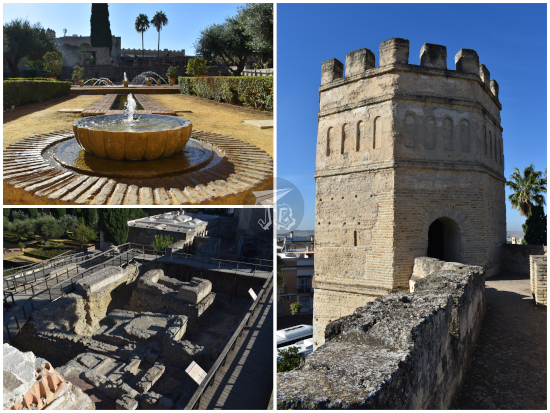
The next morning I had breakfast and set out for my day at the cathedral, Santa Apostólica y Metropolitana Iglesia Catedral de Santiago de Compostela. Santiago was built around the 7th century legend that the apostle James the Great, Santiago el Mayor, was buried in the area of Galicia, after having reached Spain to convert it into Christianity. In the 9th century, a tomb was discovered among some abandoned Roman ruins, and the local bishop had “the certainty” that it was the Apostle’s tomb. The bishop informed the King, who was the reported first pilgrim, and later ordered that a church should be built to commemorate the finding.

As the number of pilgrims grew, the church became too small, so subsequent temples were erected. The current interior was built between the 11th and the 13th century in a very pure Romanesque style, but the exterior was covered in the 18th century, in a very adorned Baroque style, which is also the style of the altar.

The most important piece of the cathedral is the Portico of Glory Pórtico de la Gloria, the Romanesque entrance to the 12th-century cathedral, with 200 sculptures carved in stone in the three-archway portal. The entrance now is locked away, you have to pay to see it, and photographs are not allowed.

For starters, I climbed up to the roof of the cathedral and the bell tower – not really the bell tower but the “rattle tower”, as the bells chime on the eastern tower, and the rattle is played on the darker, western tower. The roof was restored as recently as 2021, and from there there are some nice views of the town.

The towers of the cathedral from the room, and some aereal shots - one shows the Parador cloisters from above.

Between visits, I went inside the cathedral, where the pilgrims’ mass was about to start. I might have stayed out of curiosity had I been in town for a longer period. Then I visited the portico – since pictures were not allowed, I’ve rescued some 1995 ones from when I were in town as a teen.

Three shots of the  very baroque altar in Santiago - it is heavily decorated and painted gold. On the bottom right, a silver urn, also very ornated, supposedly where the remains of St. James are.

A collage showing several sculpures of the Portico of Glory - Romanesque statues richly coloured and decorated, they look placid

After wandering the cathedral for a bit longer, I made the most out of the last hour of sunshine to head to the park Parque da Alameda to find the spot Miradoiro da Catedral next to a huge centennial eucalyptus tree (Eucalyptus globulus labill) Eucalipto centenario, a 120-year-old specimen, considered one of the oldest eucalyptus trees that was planted in Europe after captain Cook “discovered” Australia and the species was introduced by Fray Rosendo Salvado.

A panoramic view of Santiago, showing the cathedral.

My next stop was the museum of pilgrimages and Santiago Museo de las Peregrinaciones y de Santiago, which was free due to the Covid recovery plan. It features a collection of items related to Saint James Way, and other important pilgrimages of the world, including the Japanese Kumano Kodo [熊野古道], and the Muslim Mecca Pilgrimage Ḥajj [حَجّ]. The upper floors are dedicated to the hagiography of Santiago / James through the Way and in the city.

Museum of Pilgrimages. A collage that shows a wooden statue of Santiago on a white horse, sword raised; other depictions of Santiago as pilgrim; some paper scallops decorated by kids; and a Japanese sacred gate.

Later, even though I should have gone to eat a bite, I headed to the monastery and museum Mosteiro de San Martiño Pinario, religious complex built between the 16th and 17th centuries, though the inner areas and chapels date from the 18th century. Today it’s a cultural centre, and alongside the church, it features a museum with block prints, fossils, an ancient pharmacy… The church has the most baroque Baroque altarpiece I’ve ever seen, and two choirs – one behind the altar, and the other one up on the second floor.

Exterior of the monastery, including the double downward staircase, and a picture of the interior, showing a very Baroque altar painted in gold.

Finally, I stepped into the museum of the cathedral Museo de la Catedral de Santiago de Compostela, which features the entrance to the cloister, library, and the upper galleries, aside from artistic and religious treasures such as the original stone choir, wooden carvings, and tapestries. I was also able to access the upper galleries and look at the rain in the Praza do Obradoiro, and later the crypt.

A collage showing the cloister of the cathedral of Santiago while it rains outside, and the former Romanesque choir, carved in stone.

Romanesque arches and columns built in stone, and a cast ceiling.

After one last visit to the cathedral and its shop, I got myself a last souvenir – a silver and black amber bracelet I had seen upon arrival, and took a taxi back to the airport in order to fly back. All in all, I was not too impressed by the city nor its inhabitant, and I was pretty disappointed in the Parador. I think it has put me off the idea of doing the Camino as much as I thought I wanted to, but not every trip is perfect, I guess, and I hope my memories warm up with time.

A silver and black amber bracelet. The silver is very fine, and the gem is bright black.

Walking distance: around 11.68 km (18659 steps) on Saturday and 10.58 km (16931 steps) on Sunday, not counting airport transits

9th October 2022: Atémpora, Sigüenza (Spain)

Sigüenza a Medieval town in the centre of Spain that is currently trying to gain the status of Unesco World Heritage Site. It has a castle, a protected historical centre, and in the heart of it stands the cathedral Catedral de Santa María La Mayor de Sigüenza . The cathedral dates back to 1124, when the original Romanesque building was was erected. The construction finished in 1326 , with remodelling and decoration elapsed several centuries, with different add-ons, until it was “declared” finished after the Spanish Civil War, with later works being just conservation.

Cathedral in Siguenza, a late-Romanesque / early-Gothic building, in a reddish colour. Left: side view, showing the bell tower. Right: façade, with two side towers.

In summer and autumn 2022, there is an exhibition in the cathedral – Atémpora. Sigüenza entre el Poder y la Gloria, which translated to something akin to “Timeless. Sigüenza between Power and Glory”. It displays some of the treasures of the cathedral and the museum, along with a few archaeological devices. We had seen most of the religious artefacts in a previous visit, but the historical chronicle was rather interesting.

The first block, around the cloister, deals with Celtiberian (the Arevaci tribe) and Roman weapons and everyday life. The second block deals with the Goth conquer and the newfound Christianity.

Upper Left: entrance to Atempora, flanked by two angels. Upper right: Celtiberian Daggers. Bottom left: oil lamp looking like a bird. Bottom left: clay bowl.

Interwoven with the exhibition are the treasures of the cathedral, including two collection of Flemish tapestries, one focused on Athena, the other on the story of Romulus and Remus. Another highlight is an Annunciation painting by Domḗnikos Theotokópoulos “El Greco” a Greek artist of the Spanish Renaissance (since he moved to Toledo in his prime). Of course, the cloister is fantastic. There is a tiny gothic altarpiece in one of the chapels that is delicious. The problem? As always, Baroque trends building choirs in the middle of the naves, blocking the view, and overdecorated altarpieces. The wooden ceilings are extremely beautiful where they have been preserved.

Upper left: tapestry collection, hanging from walls. Bottom right: Annunciation by El Greco. Bottom left: decorated wooden ceiling. Bottom right: Cloister of the cathedral.

The three final blocks present different Christian symbols and pieces of art from the Middle Ages onwards, and interestingly enough, a watermill from the old salt marshes. The exhibit makes a particular emphasis on Wilgefortis, a Catholic folk saint which is supposed to be buried in the cathedral, with the silver arch where her body lies brought from the altar. Other pieces include coins, sceptres, and even a few elements from the times when there was a Medieval university in town – one of them being a human skull with “anatomy notes” on it. There are also late Medieval sculptures, most importantly crucified Christ representations and Virgins with the Child, though probably the nicest one is the one which is permanently at the entrance of the cathedral. Next to it, a mill from the nearby salt mines (Salinas de Imón) has been brought – I really want to visit those at some point too, so great reminder.

Altar of St. Wilgefortis on the left. On the right, a coin, a scepter and half of a skull with writings on it.

Top left: Romanesque virging with child. Bottom left: watermill. Right: Crucified Christ with four nails on his hands and feet.

The most important monument, or area, in the Sigüenza cathedral is the chapel called Capilla del Doncel. It holds the tombs of Martín Vázquez de Arce and his parents. The de Arce men participated in the war against Granada Muslims during the 15th century, where the son was killed in an ambush, as the Muslims created a flash flood from the watering system they had to control the waters of River Genil. Though he was already 25 years old, too old to be called a doncel, teenage boy, the name has stuck for centuries. The parents’ tombs are traditional burials, however, the Doncel’s grave is an arcosolium, with the decorative sculpture showing the young man awake and reading a book, rather than lying in death as it is the typical representation.

Chapel of"El Doncel", showing the traditional burials in the foreground, and the Doncel's tomb in the background.

We went to have lunch after the visit, we went to have lunch at La Taberna Seguntina, where we shared some typical cheese, sausage, and roasted pork before we went home.

Typical Siguenza Dishes. Top: sausages and cheese. Bottom: roasted pork leg with potatoes.

24th September 2022: Manzanares el Real & Alcalá de Henares (Spain)

My friend, whom I had not seen since January 2020 as the pandemic kept us apart, dropped by for a visit as she was in the area. Since the weather forecasting had not been promising, I had not booked anything, but given her a bunch of options to do. She was particularly taken by the castle in Manzanares El Real, a town in the Madrid area, so we drove there.

The palace-castle Castillo Nuevo de Manzanares El Real was built in the late 15th century as a replacement of the previous one by the House of Mendoza. The noble family was given control over the area the previous century, and after a hundred years living in the older castle, the new one was commissioned to Juan Guas, who designed the building in a on a Romanesque-Mudejar style. It was built in granite stone, with Isabelline Gothic decoration, mixing defensive / military, palatial and religious architecture. It was inhabited for about a century before it was abandoned. The castle was declared a Cultural Monument in 1931, and it has undergone several restorations. In 1961, it was used as shooting location for Charlton Heston and Sophia Loren’s “El Cid” film.

Considered one of the best-preserved castles in the Madrid area, the building it has four towers, six floors, and a central patio. It holds a collection of tapestries, and most of it can be walked. Unfortunately, the towers cannot be climbed, but you can walk around the walls, both in the terraced gallery and outside. It was a bit overpriced, but well-worth the visit.

Collage showing the castle. It is reddish with hard corners and rounded towers. The decoration is white and ornate.

We made a pause for lunch and tried the best wild asparagus (Asparagus acutifolius) that I have had in ages – just grilled with salt and lemon. We had some croquettes too.

Plate of perfectly-round croquettes and some crisps in the middle + plate of roasted green wild asparagus

As we had walked into the village for lunch, we only had to walk a little further to find the ruins of the original castle Castillo Viejo de Manzanares el Real. At the moment, only the foundations can be seen, though it is similar to the new one. The archaeological excavation started in the year 2022, but nothing much is known of it, except this one was an actual military fortress that predates the new castle. From there, the views of the new castle and the local church make a nice skyline of sorts.

Foundations of the old castle. Not much is seen, there is a sign reading "Old Castle Archaeological Excavation"

View of Manzanares el Real, showing modern roofs, the church tower, and the castle in the furthest background

It was still early in the afternoon, so I suggested stopping by Alcalá de Henares. I wanted to make a stop at a shop to check for something, but after a quick visit to the shopping centre, we moved on to what is, in my opinion, one of the most interesting buildings in town – the small palace house Palacete Laredo. Built in the Neo-Mudejar style, it is a bizarre combination of mosaics, moorish-like decorations, and vibrantly-coloured windows that somehow work, somehow. Though only about half of the building can be visited, I just find it bizarrely alluring. My friend loved it. Furthermore, the building has a few Complutensian Polyglot Bibles in display – the first polyglot edition of the Christian Holy book, published in the 16th century under the patronage of the Cardinal Cisneros, a key figure in local history.

Palacete Laredo: exterior and interior decorations + close up of the open bible, in Latin and Hebrew

We continued on, and walked round the city. We saw two back-to-back weddings at the cathedral Santa e Insigne Catedral-Magistral de los Santos Justo y Pastor – that meant we could not snoop into the cathedral, but we did see one of the brides arrive in a Rolls Royce.

Finally, we dropped by the archaeological museum Museo Arqueológico Regional, which has opened a very interesting new palaeontology ward – holding reproductions and real fossils of animals that used to live in the Madrid area, with a few coming from the palaeontological site of Cerro de los Batallones – most interestingly a Tetralophodon longirostris and a Machairodus aphanistus sabretooth cat.

Skeletons and skulls: mastodon, giant prehistoric giraffe that looks similar to a humongous goat, and sabretooth cat

We did a little more shopping afterwards, and eventually we drove off into the sunset… and the traffic. We ended up walking for 12.47 km (19078 steps), and driving for a good three hours, though M40 was so busy it actually felt like much much longer.

30th May 2022: The Slopes of Mount Teide {Tenerife, birthday 2022}

Due to the amount of near-misses, I had started thinking about this as the luckiest unlucky trip in a long time. Unfortunately, this was the day the luck ran out. As I woke up and turned on the phone I received the notification that the cable-car to go up Mount Teide was closed due to bad weather, which was a bit of a blow. I mean, I was in the middle of the natural park, without anything to do within a couple of hours by car as the hiking trails are closed on Monday mornings as it is then when the mouflon population is controlled – using rifles. I did not want to end up shot.

If you consider that the island Tenerife is one big volcano, Mount Teide is the most famous eruptive fissure. Considering it an independent item, it is a stratovolcano. The cone stands around 7500 metres from the sea floor, with an emerged 3715 m above sea level. Its base is located on a previous crater called Las Cañadas. Mount Teide last erupted in 1909, so it is still considered an active volcano, and it hosts a bunch of towns on its slopes, that might get obliterated in an eruption. Aside from being a National Park, the area is a Unesco World Heritage Site.

Historically, an eruption was reported by Christopher Columbus in 1492. Most recent eruptions happened in 2805, 1798 and 1909. Looking back, Mount Teide formed around 160,000 years ago, after the collapse of Las Cañadas. The last summit eruption happened in the 9th century, which caused the black lava blocks that seem to run down the slopes.

The whole point of my being there was going up the mountain, so I resolved to try and do that. I knew there was little chance I could make it to the top even with the access permission, but I would try. I decided to gamble the track Sendero de Montaña Blanca, which is the most typical one. For this, I had a good breakfast and started walking around 9:45 am. The track runs 8 km and starts at an altitude from 2348 m. If you have the permission, you can access the track Sendero de Telesforo Bravo that peaks the volcano at 3718 metres.

A stone and tile marker, with a map of the trail.

The first part of the morning, I spent on Montaña Blanca. I hiked around 3 km upwards in an hour or so. A park ranger told me that the bad weather was actually strong winds and to be careful. I’d never hiked with wind, so I decided that I would not do anything stupid. As I walked, I went by the accretion balls affectionately called “Teide Eggs” Huevos del Teide.

Collage: The Montaña Blanca trail. The landscape is desertic, reddish and brown, and there is barely any vegetation. When turning back, the sea peeks in the distance, and when looking up there are black rocks from an eruption.

Eventually, I reached the actual foot of Mount Teide, and this is when things got hard – and spectacular. The slope became much steeper and the wind made it hard to move forward. I walked between the two dark petrified lava flows, and could see Montaña Blanca and the Atlantic Ocean beneath.

View from the slope of Teide. Montaña Blanca is underneath, in red-gold. To the sides, the black and dark grey rocks trailing the old lava flows

I reached Refugio de Altavista at 3260 m around 14:00. At this point I was two kilometres away from the next station and 650 m away from the crater. Unfortunately, the elevation was still around 500 m. At this point the wind was very strong and shortly after the refuge I saw an area of the slope I knew I could climb up… but I knew I wouldn’t climb down with such strong wind, not safely. So I realised I had to turn back, even if that meant I wouldn’t see the peak, much less reach it. However, it was the sane thing to do.

Standing in the middle of the two solidified coladas - looking down there are black and grey rocks, and the sea in the horizon. Looking up, only more rocks.

It took me two and a half hours to hike down, and I made it back at the Parador around 17:30. I had a shower and I felt tired, though not as sore as I imagined. For dinner, I tried some local speciality “wrinkled potatoes” papas arrugadas, which are boiled in saltwater, and they are so high-class that can be eaten without being peeled. They come with some dips, a bit too spicy for my taste, but they were delicious.

Small voiled potatoes and three small bowls of sauces. The potatoes are unpeeled and they look wrinkled.

I was a bit bummed that I did not manage to reach the crater, but I think I did a good job, almost 1000 metres up and down. I guess it just meant I had to go back at some point…

26th February 2022: A Medieval Fair in Tendilla (Spain)

Tendilla is a tiny village in the area of Guadalajara, Spain. It was declared a town – by Medieval standards at least in 1394. About a century later, the County of Tendilla was founded. By that time, the local cattle fair, around the festivity of St. Matthew, was considered one of the best in the Kingdom of Castile, with the Catholic Monarchs bestowing their blessings on the town. Among the most interesting areas are the long covered arcades, and the unfinished church dating back from the 16th century, Iglesia de la Asunción.

The cattle fair was rekindled in the 1990s, and today it is called Feria de Mercaderías de San Matías. The closest weekend to the 24th of February, St. Matthew’s day, a Medieval market is laid along Main Street, with edibles, trinkets and artisan items. The village becomes decorated with flags, pennons showing off real and assumed heraldry items.

This year, I decided to get there as some family members were going to be in the house they own in the village. I arrived at around 10 am, and by that time most the village was already full. I got deviated, but it was not hard to find a parking spot. Unfortunately the weather had not decided to accompany and it was rainy and freezing all day.

The fair stalls had begun to open, but first we made a run for the local grocery stores to grab some ingredients for lunch. The typical thing to eat in this time are migas, which are basically fried breadcrumbs with paprika, pork, garlic and a fried egg on top. We also bought sweets and confectioneries, just because we could.
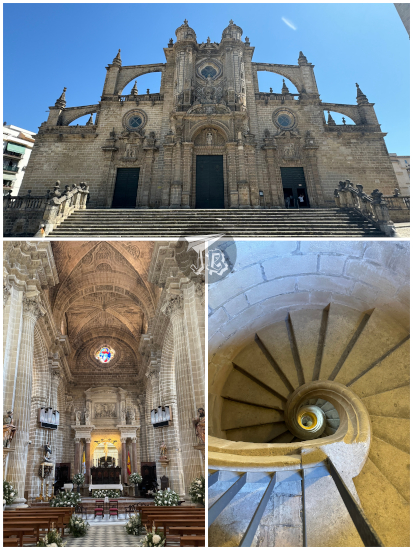
At noon, we walked along Main Street Calle Mayor. The stalls were already open, and even in the bad weather there were quite a few people. Some were even in costume, dressed in Medieval outfits, as dames, knights or noblemen.

A wide street. There are flags hanging above and from the balconies, and shopping stands on the right. the sky is dark and heavy, as in all the pictures taken

A wide street. There are flags hanging above, and shopping stands on the both sides, selling hand-made jewellry and trinkets.

A Romanesque church with a bell tower. The church is unfinished.

Main square. It has a pole in the middle, and colourful ribbons run from it to the buildings around the square. The floor has been covered in sand, and the houses are decorated with flags. Lots of people walk around.

To the end of the village, a small “farm” had been installed – oxen, horses, cows, goats, donkies, sheep, rabbits, piglets… Due to the ‘health situation’ which for once was not Covid but avian flu, there were no ducks or hens or any kind of bird. You could hold the bunnies, but I really really wanted to hug the huge draft horses.

Farm animals: a donkey, two piglets, cows, rabbits, a sheep trying to eat the camera, a working horse.

Farm animals: goats trying to escape the pen, oxen ignoring the camera, a black-and-white cow wanting pets, and a working horse looking tired.

Someone had not really thought positioning carefully though, and right in front of the farm – and the piglets – stood the food stalls, especially a roaster, whose cooked pork was… suspiciously similar to the piglets in the farm *coughs*.

On the other side of the farm, the locals had started preparing the communal migas – every visitor is entitled to a plate of them, but it was way too cold to queue. Instead of being topped with an egg, though, they are sprinkled with torreznos, pork lard fried and preserved.

A huge barbecue with pork roasting and sausages. The barbeque itself is round, and it's big enough to fit at least a dozen ribcages, ten pork legs, and twenty or thirty sausages.

A person using a shovel to stir a huge pot of breadcrumbs being cooked, and a close up of the severd plate: orange-looking breadcrumbs with dried fried pork lard on top.

On our way back we ran into the horse parade and show, which was held in front of the town hall. The riders of El Duque Espectáulos, dressed in Medieval and Templar costumes, trotted and galloped along the music.

A group of medieval-looking horse riders making their way through the crowds

An older man making a golden horse trot and gallop on command, the horse is photographed mid-hop

Riders in medieval clothing galloping on the Main square

We stopped to buy some torreznos to take home, and we got given the tourist treat – a cloth bag with a huge box of fried pork skin. It is tastier than it sounds, honest!

A tote bag reading Tendi (the rest of the writing is obscured), with a box of torreznos inside

We had lunch at home, and not to show off, but I do think our breadcrumbs looked much better. We made them ourselves, with chorizo meat and eggs sunny side up! They looked so much better than the communal ones, right?!

A plate of migas. The breadcrumbs look golden, and there are pieces of pancetta and chorizo mixed with the bread. On top, there is a fried egg, sunny-side up

Finally, after lunch, we took another stroll, but the weather was miserable, raining and cold – which was so mean because the following day when I had to work it was nice and sunny, and there was a bird of prey exhibit.

Romanesque and Baroque buildings, deserted in the rain. One of them is a tiny hermit church, the other a column, and the third a palace that has seen better times

But all in all I spent a nice time with family and got to pat horses and goats. I guess there are much worse ways to spend a Saturday.

Walked distance: 6.20 km (9866 steps)