16th October 2024: San Francisco Ballet’s Swan Lake at Teatro Real (Madrid, Spain)

While heavy metal and hard rock concerts are my form of meditation, there is something magical about ballet in general and Swan Lake in particular. Also, in my defence, I’ve loved Swan Lake since before I first saw Yoshiki play part of it on piano. Swan Lake is a three-act ballet written by Pyotr Ilyich Tchaikovsky in 1876. The story is widely known – Evil sorcerer Von Rothbart curses princess Odette to live as a swan during the day and only return to her human self at night. Nearby, prince Siegfried is trying to avoid all his obligations, and goes hunting. The two meet and fall in love, and Siegfried invites Odette to a ball where he will propose and both will live happily ever after since obviously love is stronger than black magic. Except, at the ball Von Rothbart shows up with another lady, Odile, the black swan, who seduces Siegfried, and he proposes to her, thinking she is Odette. Drama ensues. Siegfried realises that he has the wrong girl, and runs to the lake where he first met Odette.

Now, depending on the version, after Siegfried and Rothbart fight, the ending can go several ways, and I’ve seen a few. There is a standard happy ending – true love conquers all, Von Rothbart is defeated, and Siegfried and Odette get their happily ever after. In another version, Odette commits suicide as Siegfried’s mistake has made the curse unbreakable. Another option is that she dies of heartbreak. Her death yields to a very epic ending image of Siegfried lifting Odette’s body into the air, and Von Rothbart is defeated by Siegfried’s grief and true love. Finally, there is the option of both Odette and Siegfried dying, and the power of their loving sacrifice defeats Von Rothbart. Note how the evil sorcerer “loses” every time. However, in the original script – which I’ve actually never seen on stage – both Siegfried and Odette drown in the lake and Von Rothbart sort of wins. I’ve always found that interesting. 

Anyway, I really enjoy watching Swan Lake and trying to anticipate which ending the choreographer has chosen. I have to admit that I’m personally partial to the ending where Odette dies of heartbreak, because while I love the ballet – and the black swan – Siegfried is an idiot and with this ending he gets to live with the knowledge that he proposed to the wrong girl.

Back in March I read that the San Francisco Ballet was taking their version of Swan Lake to Madrid. I asked my parents if they wanted to tag along and since I had not received an answer by August, I checked for tickets. Whilst Teatro Real tends to be a bit on the expensive side, it is rather easy to find an unoccupied single seat in a good location just searching a bit. I could not really afford floor seats but there was a very nice single seat on the first row of the third floor that I soon got my clutches on.

I had planned to take the train to Madrid to be there around 16:00. I wanted to go see an exhibition in the manor Palacio de Longoria, since that is the only way to enter it and last time I could not climb any of the stairs to get a good look at the skylight. Unfortunately, there were issues with the previous train, which got stuck in Atocha. My own train could not enter the station, and we were just a few metres away. It is illegal to walk on the tracks, so the train driver, of course, would not open the doors. We were stopped there for over an hour. I was sitting in the first carriage, and some people lost their nerves – they started banging on the driver’s door, and one of them even grabbed the emergency hammer and tried to break the glass on the doors. Thus, I decided to just get off the train when we finally reached Atocha and walk towards the theatre.
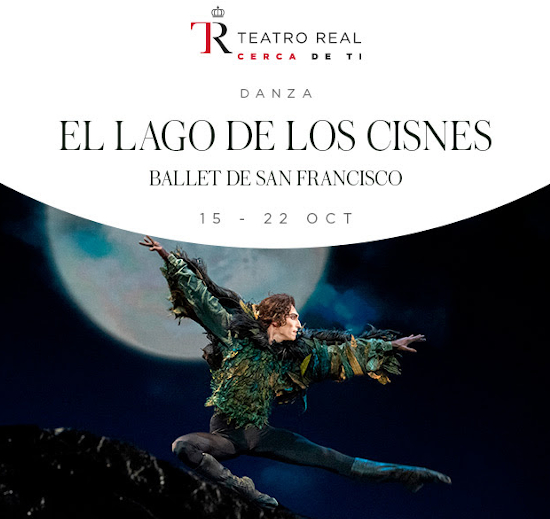
Swan Lake promo

I had arranged to meet with a friend for a quick coffee around 18:00 near the theatre. There is a Starbucks within the same building, and it is easy to find a sitting space. At 19:15, we said goodbyes and I entered the theatre Teatro Real and found my seat. What I was not able to find was a brochure.

San Francisco Ballet artists:
  Orchestra director: Martin West
  Odette / Odile: Wona Park
  Prince Siegfried: Wei Wang
  Von Rothbart: Jakub Groot
  Choreography: Helgi Tomasson
  Artistic Director: Tamara Rojo

The show was fantastic. Wei Wang as Siegfried had a lot of weight in the first act – sometimes a lot of his work is given to another character. In this ballet, the ballerina dances two different roles, which sometimes feel like three – First-act Odette, who is nice and falling in love with Siegfried, Odile in the second act, the Black Swan seductress, and the Last-act Odette, who is dying… Wona Park did a fantastic job with her body language in order to show both Odette and Odile.

The corps de ballet was so numerous that I actually don’t think I’ve ever seen so many swans on stage. The set-up was beautiful and the coordination was incredible. At some point there were 32 swan-dancers there. It was fantastic, and I enjoyed every second of it. The ballet lasted 2 hours 40 minutes with a twenty-five minute intermission.

During the break, I went off to find a brochure – not because I did not know the plot, but because I wanted the names of the artists. I thought that one day I needed to try the intermission dinner at Teatro Real, but since they have the “to share” dishes, I don’t think they’ll take bookings for one.

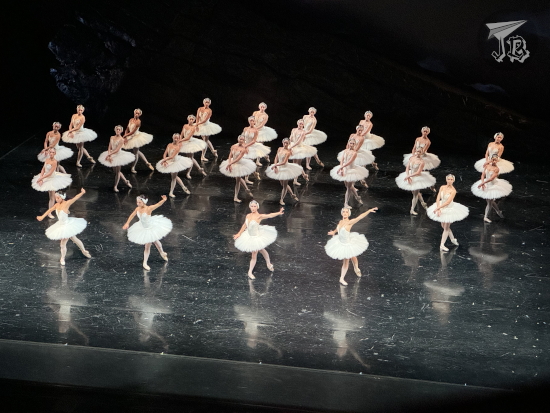
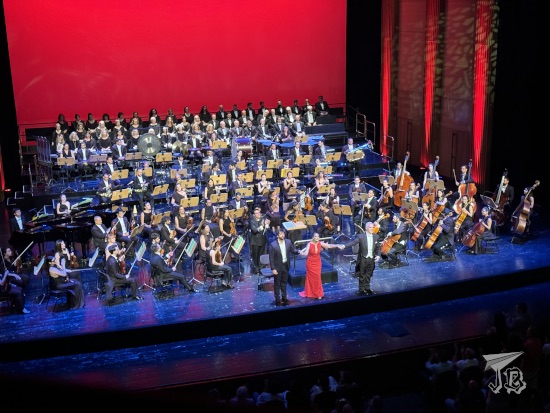
Main dancers accepting the ovation

Swan dancers accepting the ovation

Dancers accepting the ovation and musical director accepting the ovation

The show was over before 22:00, and the waters had calmed down on the train front. They were still running late, but there were no aggressively frustrated passengers on the platform nor the train. I made it home just before midnight.
21st July 2024: From the Sea to the Butterfly (Madrid, Spain)

When planning for the day, the one thing I did not count on was the heat wave. I did take into account problems with trains, but apparently a half-hour delay is a non-issue by now and not worth mentioning. I reached Madrid around 12:30, and I had a reservation at 13:00 for a themed restaurant which had caught my eye when I saw it online. It was honestly a big disappointment, though I refused to let it ruin my day.

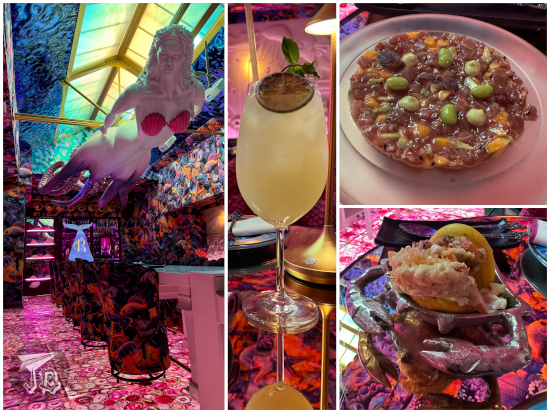
The restaurant is called Bestial, and it is ocean-themed. The pictures were awesome, it looked super cool, and I was pretty excited to go there. However, the experience was mediocre at best – I guess solo travellers are not their target audience, and it showed. As I was mainly ignored, I could watch how the restaurant worked. The waiters got the tables mixed up a few times, and they allowed others to take pictures with cocktails that were not theirs – that was weird, and I am pretty sure that against health code. I ordered a lemonade – the best thing – a tuna tartar and a crab bao without coriander, after checking that the coriander could be taken out. The tuna was tasteless, and the bao did have taste… coriander. All in all, I was not impressed by the food, even less by the service. Between the two dishes there were about 35 minutes waiting, and after an hour I just gave up and asked for the check, which was brought in a little book… and dropped halfway, then picked up from the floor… I just paid – the meal was not cheap – and left without dessert. A pity, really, but I really did not care any more.

Restaurante Bestial by Rosi La Loca

It was ridiculously early for my 16:00 visit, but I wanted to try my luck. I had chosen that day because CaixaForum Madrid was running two exhibitions that I wanted to see – Patagonian dinosaurs (which had just opened) and The Science of Pixar (which would end soon). The exhibition centre was booked out, so I could not sneak in before my time slot, but I managed to get my most burning question answered – how on earth were they going to fit a Patagotitan inside CaixaForum? Answer: they did not. They placed it outside, which was a fun surprise!

Patagotitan skeleton in front of CaixaForum Madrid

Since I had about an hour and a half, I decided to trot over to the painting museum Museo del Prado, part of the national network of museums, which I can access with my one-year card. I thought I might be luckier and the queue to enter without a reservation would work better. Indeed, I did not have to wait indeed, and I could have a look at a few of the masterpieces the collection holds (though not take photographs) – Francisco de Goya, Joaquín Sorolla, Diego Velázquez, Esteban Murillo, Fra Angelico, Hieronymus Bosch… Of course, not all the masters, because El Prado is enormous. It is also air-conditioned, and surprisingly, not as full as I half-expected. There was a queue when I came out, so I guess it worked out well!

I walked back to CaixaForum Madrid to see the two exhibitions I had booked. It was a bit before 16:00, but this time I did not ask, and just walked into the first exhibition – “Patagonian Dinosaurs”: Dinosaurios de la Patagonia, which had very little new information, and even fewer actual fossils, but a lot of dinosaur reconstructions. Those were cool. Aside from the Patagotitan mayorum placed outside, there were full skeleton replicas of Herrerasaurus ischigualastensis, Eoabelisaurus mefi, Leonerasaurus taquetrensis, Eoraptor lunensis, Condorraptor currumili, Brachytrachelopan mesai, Amargasaurus cazaui, Tyrannotitan chubutensis, Neuquensaurus australis, Carnotaurus sastrei, Gasparinisaura cincosaltensis and Manidens condorensis. There was also a Giganotosaurus carolinii skull. As for the real thing, a femur, a shoulder plate and a forelimb of Patagotitan, some teeth and vertebrae and a few invertebrates and leaves. It was really cool, and not extremely crowded for a dinosaur exhibit in summer. It was only the third day of the exhibit, so maybe it was not that well publicised yet? Out of the new species I discovered, Amargasaurus was my favourite – with the neck spikes it looked exactly like I would have imagined a dragon.

Patagonian Dinosaurs

Patagotitan front and back legs, along with a huge shoulderblade

The other exhibition that ran at the time was “The Science of Pixar”: La Ciencia de Pixar. It felt like a nerdy companion to Mundo Pixar, focusing on the maths and the process to create a Pixar film. Unfortunately, it was bustling with kids who – understandably – just wanted to smash buttons and make things light up. The exhibition had a lot of cool machines which simulate the different steps of creating a computer-animated film – rigging, modelling, lighting, rendering… The most interesting was an analysis called “What colour is this pixel?” taking into account movement, lights, shadows… It must be amazing to be able to visit the exhibit alone and be able to play with all the computers. I did find one where you get to simulate crowds using shoals of fish (from Finding Nemo) and I played with that for a while. There were also a few life-sized models from several films, miniatures and 3D mini-sculptures.

La Ciencia de Pixar

I left the venue after browsing the shop, and I walked down towards the theatre. It was still early, and I wanted to hit a couple of shops. Actually, I wanted to go to what is commonly known as the Primark flagship shop. The building Edificio Gran Vía 32 was originally erected in the 1920s to host the first department store in Madrid, Almacenes Madrid-París. It was designed by architect Teodoro de Anasagasti and used the most modern technology and materials at the time – reinforced concrete in the avant-garde style. The whole interior is built around an octagonal lightwell with a central staircase, and today the lowest four floors have been turned into the Primark shop, which has fitted screens and lightings while keeping the previous structures and railings. The modernisation project was undertaken by architectural studio RCCyP and it took three years until the shop opened in 2015.

Interior of Edificio Gran Vía 32

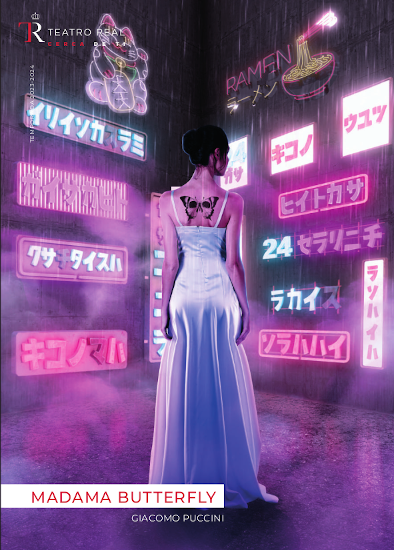
I continued off towards the theatre Teatro Real. I had a bit of time and some unspent calorie budget, so I decided to splurge at Starbucks with a whipped-cream Frappe for my pre-show snack. For the same price I had awesome third floor for Carmina Burana, I had a fifth-floor-in-the-back paradise ticket now. However, it was a lone seat with a great view, so I am not going to complain. I was going to watch the opera Madama Butterfly by Italian composer Giacomo Puccini – and sometimes I think that the better the singers are, the worse time I have with this show.

Madama Butterfly Promo

The main character is Cio-cio, a name that when pronounced in Italian sounds similar to 蝶々, [Choucho], butterfly in Japanese. When she is 15 years old, in 1904, Cio-cio marries an American navy man, Pinkerton, who intends to leave her and find a ‘decent’ American wife. Cio-cio is repudiated by her whole family when she converts to Christianity for her marriage. Three years later, she is alone, almost bankrupt, the mother of Pinkerton’s child, and a marriage broker is trying to sell her off to another prospective husband. Pinkerton returns to Japan with his American wife, who agrees to raise the child, but he cannot face Cio-cio because he is a coward. She (spoiler alert) prepares their son to go with him, then commits seppuku.

And even a bigger spoiler alert, I hate Pinkerton. Viscerally. My parents tried to start me into opera way too young to understand plots, I feel, and I did not want to do anything to do with it for a long time. However, at one point I wanted to see Madama Butterfly due to it taking place in Japan – being older helps, and I slowly learnt to appreciate the musical genre. Basically, by hating on Pinkerton.

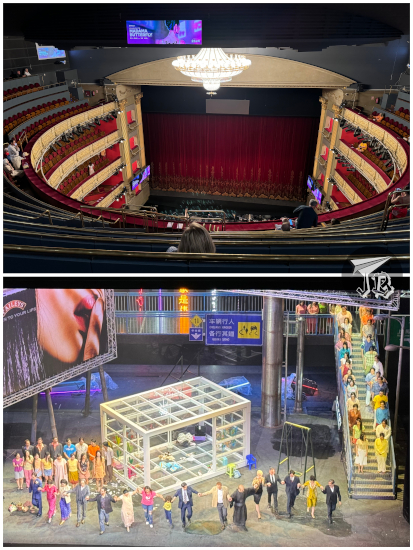
Apparently, Teatro Real is known for its alternative settings and takes on classical operas. In this case, they let go of the old Japanese cottage in order to use… a modern-ish undisclosed Asian country. There was an overpass with Chinese signage, a billboard with McDonald’s and Bailey’s spoofs in Japanese (that did not make any sense), and the traditional cottage was exchanged for a greenhouse of sorts. There is a scene in the traditional opera in which the characters fill the house with flowers. In this case, they coloured the glass panes with hand paint. It was a great show.

Cast:

  • Cio-Cio-san: Ailyn Pérez
  • Suzuki: Nino Surguladze
  • F.B. Pinkerton: Charles Castronovo
  • Sharpless: Lucas Meachem
  • Goro: Moisés Marín

Artistic team:

  • Musical conductor: Nicola Luisotti
  • Stage direction: Damiano Michieletto
  • Set design: Paolo Fantin

Madama Butterfly Teatro Real

The show finished around 22:20. I walked up Arenal Street towards Sol. While I missed my first train because some people love to take up space while walking slowly, I made it for a good connection at Atocha, and I was actually home before midnight.

6th July 2024: O fortuna! (Madrid, Spain)

A couple of days before going to London to see Kamijo, I found out that a local music non-profit was staging Carmina Burana by Carl Orff in Madrid. Buying tickets (for that, and the upcoming opera Madama Butterfly) broke havoc with my credit cards, but everything was eventually fixed – I think. It had me stressed at the beginning of that trip, but it seems to be finally fixed. Again. I did have to miss Swan Lake in London because the credit cards would not go through.

Anyway, I had my ticket and though I would have loved to spend the day out, I was too ridiculously tired to take a whole day of sightseeing. Furthermore, the place I wanted to have lunch out was not taking reservations since they broadcast sports, and there was some big match or another. Yes, I want to go somewhere that defines itself as a sports bar, but that’s a story for another day (like the time I thought I could go to a sports bar during the Olympics because “Oh, well, there’s nothing sporty going on, right?”).

I thus decided to head off with a small pre-show plan, which turned out to be a great idea. When I alighted from the train station, the streets were clear for the Pride parade – I do not think I have ever seen the area surrounding Estación de Atocha so empty. I walked towards the theatre Teatro Real, but my first stop was the underground station of Opera, home to one of the Underground museums Museos de Metro de Madrid. Unlike the others, this is only tangentially related to the underground system itself – it is an archaeological museum, hosting an ancient fountain, part of an aqueduct, and the remains of a sewer.

King Felipe II made Madrid the capital of Spain in 1561, and aside of some brief periods of strife, it remains so to the present day. That has implied a lot of changes through history – among them, the destruction of the city walls, and the construction of an aqueduct to provide the city with water. When the court moved there, the villa of Madrid was little more than a village whose population skyrocketed in a couple of years. The new city needed services as it grew.

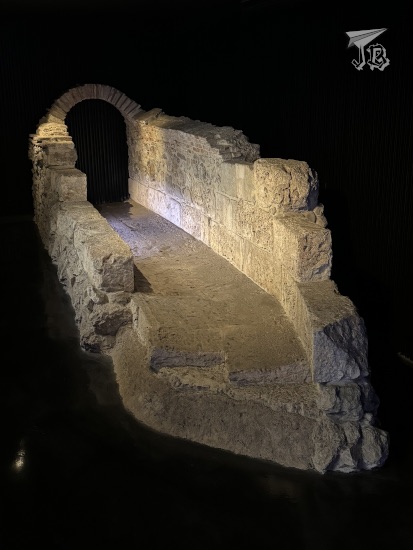
One of these was the fountain called Caños del Peral (literally something like “Peartree faucets”). The fountain was 34 metres long and it channelled water from the stream that ran down what is now Arenal Street. It was built in local limestone, had six faucets, and it probably was the largest fountain in the area where it was built in the late 1500s – the outskirts. Ironically, today it is quite close to the centre of the city, even the middle of Spain, the so-called “Zero Kilometre” in the square Puerta del Sol.

Fountain Caños del Peral

The fountain was destroyed during the reign of José I (Joseph Bonaparte, Napoleon’s brother, who was installed as king of Spain between 1808 and 1813). Caños del Peral, along with the buildings around the square, were demolished and used to fill the gorge that until then had separated Madrid in two. And in that filled gorge it was discovered in the early 2000s during works to refurbish the underground station of Ópera. Further works uncovered the sewer from the same period, a structure that channelled black waters away from the drinking streams for sanitation.

Sewer at el Arenal

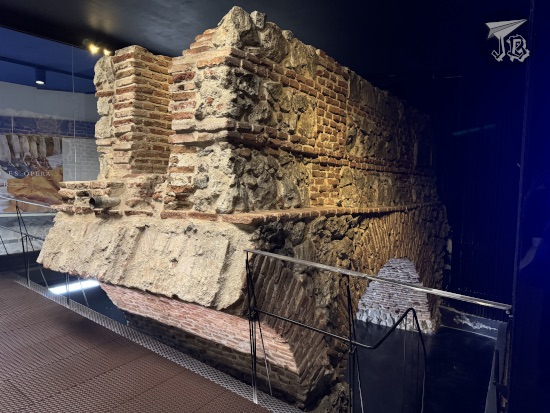
The aqueduct Viaje de Amaniel was built around 1615 century to bring clean water to the Royal Palace, and with time it also supplied other properties. The infrastructure was heavily remodelled in the 18th century, after the Royal Palace was rebuilt into its current form after the fire that destroyed the original alcázar.

Section: Viaje de Amaniel

As I was coming out from the little museum and the underground system, I noticed a display reading that the underground / train station that I needed after the show was closed “until end of service”. Which was good to know beforehand, since I had time to replan my route – the trains were a mess in the evening due to Pride, and a few stations being closed off for crowd control. I grabbed a snack at the local Starbucks and headed into the theatre.

The Royal Opera of Madrid Teatro Real opened in 1850. It was originally designed by José Manuel González-Valcárcel, though it has been widely renovated, with the latest iteration dating from 1997. It is considered the most important venue for performing and musical arts in Spain – despite having been closed for decades at a time. Curiously, the theatre has the shape of a coffin – at first, I really thought that was my imagination, but apparently it is not only real but intentional.

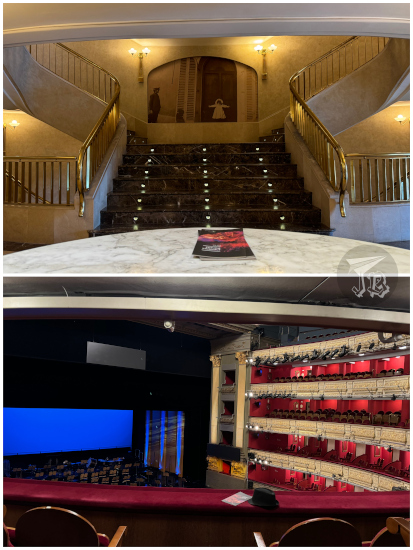
Teatro Real: stairs and interior

I had found really good tickets, first floor next to the Royal Booth – for the same price, I would later get a fifth / sixth floor ticket for Madama Butterfly. The repertory had been put together by Fundación Excelentia, a non-profit foundation dedicated to promote and divulge lyrical heritage and musical values.

Carmina Burana Promo

Programme:
  First part:
  1. Beethoven: Egmont. Overture: Sostenuto, ma non troppo – Allegro
  2. Beethoven: Symphony No. 8 in F major, Op. 93
  Second Part:
  3. Carl Orff: Carmina Burana

The show was conducted by Juan Pablo Valencia and interpreted by the orchestra Orquesta Clásica Santa Cecilia, the choir Sociedad Coral Excelentia de Madrid, soprano Rocío Martínez, baritone Manuel Mas and countertenor David Miranda.

Ludwig van Beethoven (1770? – 1827) is considered one of the most important figures in Western music. Born in Germany, his works bridged the classical and romantic periods in classical music. His works are amongst the most performed in the world, even though he began losing his hearing halfway through his career. He composed Egmont around 1810 for a full symphonic orchestra, and Symphony No. 8 in F major, Op. 93 in 1812. The Symphony has four movements: Allegro vivace e con brio (F major), Allegretto scherzando (B flat major), Tempo di menuetto (F major), and Allegro vivace (F major). I am not the biggest Beethoven fan, to be honest, but it was good. The conductor had a great time.

My main reason to be there was the second part of the show: Carmina Burana (Officially Carmina Burana: Cantiones profanae cantoribus et choris cantandae comitantibus instrumentis atque imaginibus magicis which translates from Latin as “Songs of Beuern: Secular songs for singers and choruses to be sung together with instruments and magical images”, quite a mouthful). German author Carl Orff (1895 – 1982) composed the cantata between 1935 and 1936. Most of the lyrics are in Latin, though there is a bit of old German and even old French. The cantata has 25 movements based on 24 Medieval poems, with the first and last movements being the same: O fortuna, which happens to be one of my favourite choir pieces ever. There is one instrumental-only piece, and all the others have vocals – for choir, soprano, baritone and countertenor.

The twenty-five movements are organised in sections, which are officially five, but divided as:

  • Fortuna Imperatrix Mundi (Fortune, empress of the world): 1. O fortuna (Oh, fortune), as I mentioned, I love this choir; 2. Fortune plango vulnera (Regret for the wounds of fortune).
  • I. Primo vere (In spring): 3. Veris leta facies (The joyous face of Spring); 4. Omnia Sol temperat (All the things are warmed by the sun); 5. Ecce gratum (Behold the welcome)
  • Uf dem anger (In the meadow): 6. Tanz (Dance), the only instrumental movement in the cantata; 7. Floret silva nobilis (The noble woods bloom); 8. Chramer, gip die varwe mir (Monger, give me a coloured paint); 9a Reie (Round dance); 9b Swaz hie gat umbe (Those who dance around); 9c Chume, chum, geselle min (Come my dear companion); 9d: Swaz hie gat umbe reprise; 10. Were diu werlt alle min (If the whole world were mine)
  • II. In taberna (In the tavern): 11. Estuans interius (Seething internally); 12. Olim lacus colueram (I once swam in lakes) – this is the piece the countertenor sang, and I am not completely sure the guy was drunk, or playing drunk. 13. Ego sum abbas (I am the abbot); 14. In taberna quando sumus (When we are in the tavern)
  • III. Cour d’amour: 15. Amor volat undique (Love flies everywhere) I have to admit that I did not love the soprano, who sang for the first time at this piece – she sang well, but too low, it was difficult to hear her at times; 16. Dies, nox et omnia (Day, night and everything); 17. Stetit puella (There stood a girl); 18. Circa mea pectora (Inside my chest). 19. Si puer cum puellula (If a boy with a girl). 20. Veni, veni, venias (Come, come, please come) – these are the same lyrics that Final Fantasy VII’s theme for Sephiroth, One-Winged Angel has, and looking at the translation, now I understand why it was never intended to be the psychotic mass-murderer theme… 21. In trutina (On the scales); 22. Tempus est iocundum (Time to jest); 23. Dulcissime (Sweetest lad)
  • Blanziflor et Helena (Blancheflour and Helen); this refers to the romance story of Blancheflour and to Helen of Troy. 24. Ave formosissima (Hail to the loveliest)
  • Fortuna Imperatrix Mundi: 25. O fortuna (Oh, fortune)

All in all, it was a great experience, and I had a privileged seat. I really enjoyed the show, as it was expected from something at the Teatro Real. The gentleman next to me slept through the first part and hummed along the second, which was weird. The soprano’s voice was too faint and she tended to sing towards the other side of the theatre, making it hard to hear her, but the baritone was good. The choir was fantastic, and the percussion musicians had a perfectly choreographed exchange of positions to play all the small parts which was really amusing to watch. Especially one who hugged the gong to quiet down the reverberations.

Artists after the Carmina Burana Show

When I came out the theatre, I headed off towards the underground system and reached the train station, which took over 20 minutes – normally, I would have just walked to Sol and take the first train there to connect faster, and stay within the same system. As Sol was closed, this was not an option. When I arrived at Atocha, the platform was almost overflowing as the trains were running with long delays. I think I took a train that should have passed through around 22:30… at 23:00. I was not sure everyone would fit in the train, to be honest. Good thing that they announced a second one for a few minutes later. I made it home past midnight, took a shower and crashed because it was hot – Spain in July. What else is new?

21st & 22nd July 2018: Swan Lake in Madrid (Spain)

21st July: The housefront

This Saturday/Sunday getaway was a birthday present, and I have to admit that I was super excited about it – the main part of the present was a hotel night in Madrid and tickets to watch the (British) Royal Ballet in the Spanish Royal theatre, the Teatro Real. And I mean stall tickets, I was over the moon.

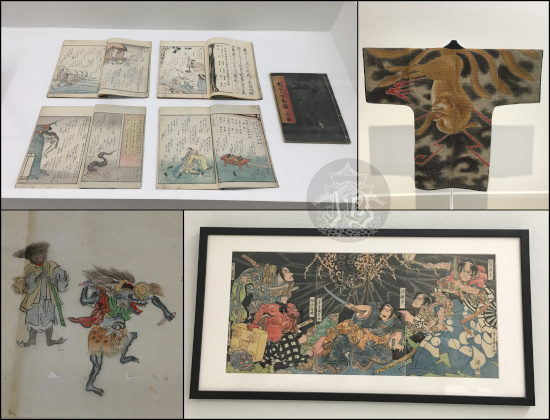
The day started at the Museo de la Real Academia de Bellas Artes de San Fernando, where there was an exhibition about yokai, the Yumoto Koichi Collection (Miyoshi, Hiroshima). It was called Yokai: Iconografía de lo Fantástico (Iconography of the fantastical), and it was rather interesting. It holds a collection of different items related to mythological creatures of Japan, yokai [妖怪] – there are scrolls, woodprints, games, pottery, even clothes and accessories. This was an interesting exhibition, and having seen it would later save me a trip to Miyoshi, allowing me to discover Takehara instead.

Rolls of paper, kimojo jacket and blookwood painting, showing different scenes and beings from Japanese mythology

After the exhibition, we went to the Green Tea Sushi Bar & Cocktail Room, which turned out to have the most overpriced mediocre sushi ever. The place was ridiculously expensive but fortunately we had booked with a special 50% discount, which made it bearable. However, fair is fair, and the tataki was delicious, and the chocolate coulant turned out to be amazing.

Lunch. Sushi boat, sald, tuna tataki, edamame, and an ice cream scoop

The hotel was in the right smack of Madrid, a short walk away from the “royal theatre” Teatro Real and we had tickets for 17:00 – to watch Swan Lake performed by British The Royal Ballet. Before sitting down we took a small exploration walk through the different rooms, including the ball room. I really loved the whole building and in particular the blue room and the ball room.

Royal theatre snippets - the main hall, the stage, the stands. Most curtains are a rich burgundy colour.

Swan Lake happens to be my favourite ballet – I love Tchaikovsky in general, though the stars have always aligned against me watching Sleeping Beauty. In Swan Lake, the evil sorcerer Rothbart turns maidens into a swan during the day, and they turn back to women at night as long as they are near the enchanted lake. The ballet officially opens with Prince Siegfried celebrating his birthday. He receives a crossbow as present, and he is later told by his mother that he needs to choose a bride the next night. As he becomes upset his friend suggest going hunting. In the forest, Siegfried becomes separated from the group and meets Odette, one of the swans. She explains of her predicament, and they eventually fall in love, and Siegfried invites her to the ball in which he needs to choose his bride. The next night, however, Rothbart sends Odette’s magical doppelgänger, to whom Siegfried swears love. Witnessing this in swan-form breaks Odette’s heart. As he realises his mistake, Siegfried makes it back to the lake.

The ending of the ballet changes. Sometimes it is a happy one when the spell is broken. The original ending has both Siegfried and Odette dying together to break the spell. Another alternative is that only Odette dies, but Siegfried manages to kill Rothbart and break the spell – this was the one that the Royal ballet played, and it managed to make me a puddle of happy goo. As Siegfried raises Odette’s inert body over his head, I shuddered all over. It was magnificent.

Snapshot of the credits, Showing Akane Takada as Odette and Odile, William Bracewell as Prince Siegfried, and Thomas Whitehead as Rothbart

The cast after the play taking their bows.

After the performance was over, we had dinner in the Plaza Mayor and then walked towards Puerta del Sol, then back went to the hotel to catch some sleep.

Square Plaza del Sol lit by night

22nd July: The backhouse

On Sunday we went back to the Teatro Real because we had booked one of the visits they offer, the technical one. During this visit you walk through the inner areas of the theatre, and even more interestingly, the upper area.

We saw the main hall, and afterwards we went first onto the backstage, then the backstage, and finally onto the stage where the Swan Lake props still stood, so that was really cool. The visit finished climbing up to the upper area of the theatre to see the views and the theatrical rigging system.

Empty royal theatre, showing the stalls from the stage, the backstage, and the view of the cathedral and the royal palace from the upper windows.

Finally, we had a bite to eat and we headed home for the weekend, and I have to say, I was happy as a skunk.