7th November 2024: The Spanish Cultural Heritage Institute (Madrid, Spain)

I know you do not believe me when I say I don’t like guided visits, but they are the only way to do some stuff – such as stepping into the Stonehenge circle, or basically anything managed by the Madrid city hall. The Spanish Cultural Heritage Institute Instituto del Patrimonio Cultural de España IPCE is a governmental organisation whose functions are preservation and conservation of cultural items, research, communication, and safekeeping of the documents in its archive. It can only be visited on certain dates, by appointment, and with a guided visit. I managed to secure a free Thursday visit at noon, so I headed out to Madrid. Surprisingly, neither trains nor underground had issues, so I was over an hour early on site. The IPCE is located in its own building in the area known as “University City” (Ciudad Universitaria), close to the Fine Arts faculty – by design – and the President’s official residence – by chance.

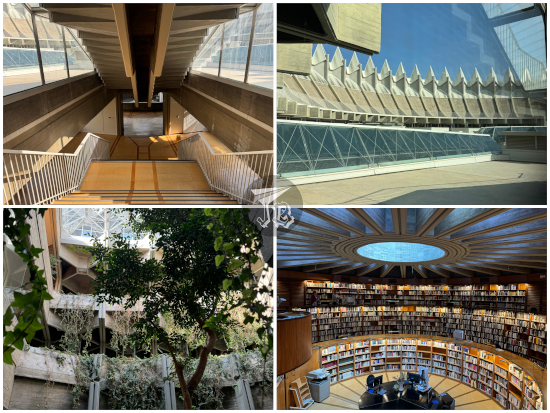
The headquarters building was commissioned in 1965 to architects Fernando Higueras and Antonio Miró. The architects’ original project had to be severely modified, but it became a very different structure. Construction was stalled for years, and the building was not usable until 1985 – when new remodelling was tackled. The building is circular, nicknamed the “Crown of Thorns” (La Corona de Espinas) because at the top there are “spikes” of sorts. Top-view, the structure is divided in 30 sectors, with 56 semi-sectors and four empty ones for the main access staircase and gate. It has four floors and at least one basement. It was built in concrete and glass, with some cork floors, but lacking plaster or any kind of concealment for the structural items. The centre of the building is an open space with a glass dome, and serves as reception. Unlike the original project, this space is covered with a glass vault. The interior has a lot of plants, even three small “gardens” mainly with hanging plants. The building is considered an important cultural asset BIC (Bien de Interés Cultural), and these plants are protected along with the structure.

Spanish Cultural Heritage Institute building

The visit consisted of an introduction to the building and the work which is carried out there. We saw the model of the original project – the only similarity is that it was also vaguely circular. We climbed the stairs to the upper floors to snoop at the rooftop and the “thorns”, and then rode the lifts down to the basements to see some X-rays of paintings and sculptures. Back on the main floor, we were shown into painting restoration workshop – they were working on Maerten de Vos’ Abundance, having repaired the work and erased some extra (puritan) clothing to make the goddess Ceres look less… naked. Finally, we were invited into the library, which is round and has three levels. It has natural light due to its own skylight, a decorative glass dome in the middle of the main open area.

Spanish Cultural Heritage Institute inside

The visit started at noon, and it lasted two hours. Heading out to the centre of Madrid would take around half an hour of walking and underground. Thus, it gave me the opportunity to book a late 15:00 lunch. Since I was lucky with my connections, I was in the Cuzco neighbourhood almost half an hour in advance.

It was the perfect opportunity to go get some groceries at the Chinese supermarket Ibero China Madrid in the street Calle General Margallo. While I needed some items, I was distracted as I walked the “geek” fizzy drink aisle. There is a company called Ocean Bomb which makes sodas – sparking water, yoghurt drinks and bubble milk tea with “creative packaging”. I was aware of them because a friend collects the Sailor Moon ones and we checked for them in London in 2023. Well, now I went and found myself some Saint Seiya sodas – Gemini Saga (grape yoghurt flavour) Aries Mu (apple yoghurt flavour) and Virgo Shaka (peach yoghurt flavour). They were out in 2023, but I had not heard about them, it is the first time I saw them. And of course, I bought them (I have no idea if they are official or not, but the publicity I found afterwards has the Toei stamp on it, so I’m hoping they are).

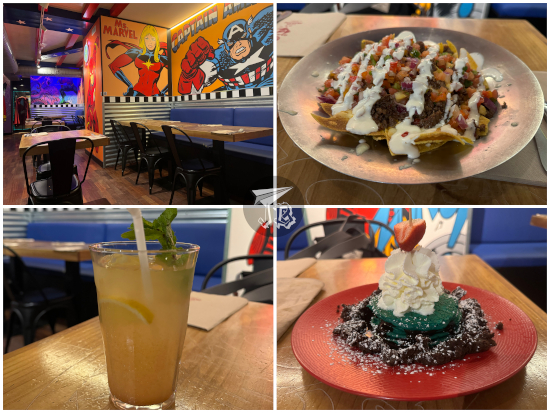
For lunch, I had a reservation at Comic Planet. Last time I was there, a member of the party was late, so in order to keep the table, we ordered appetizers. They were great, but afterwards there was no stomach-space for dessert. And dammit, I wanted some dessert – particularly, I wanted pancakes. I had been looking at coming back to Comic Planet for a while just to have them, but it never worked out. This was finally my moment. I had a lemonade, some nachos – which were delicious – and I finally got to eat my pancakes – which are green and called Hulkcakes, and come with whipped cream, brownie and shortcake crumbles , and around ¾ of a strawberry. I ended up extremely full, but happy.

Comic Planet lunch

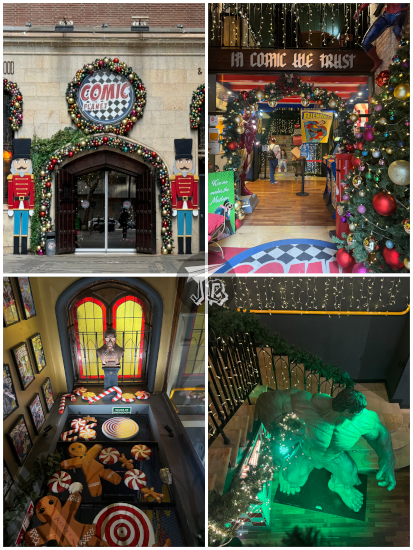
Oh, and I was confused because it was early November but… already Christmas in Comic Planet!

Comic Planet Christmas decoration

I left the restaurant and headed towards the archaeological museum Museo Arqueológico Nacional, which is running a temporal exhibit regarding Nature in Ancient Greece “Between Chaos and Cosmos: Nature in Ancient Greece” Entre Caos y Cosmos. Naturaleza en la Antigua Grecia. It hosts over one hundred pieces of classical Grecian art. Most belong to the museum’s own collection, acquired from the 19th century collector Marquis of Salamanca, and some are national and international loans. Since a large percentage of items were original and not replicas, it was really cool. Then again, I have to admit I have a thing for Grecian vases, especially with mythological motifs.

Entre Caos y Cosmos. Naturaleza en la Antigua Grecia

The exhibition was not big, so later I used my National Museums card Tarjeta de Museos Estatales to go and take a walk around the permanent exhibition. There is a loaned exhibit from the Mont’e Prama archaeological site in Sardinia, Italy. Mont’e Prama was discovered in 1974, unearthing remains from the Nuragic culture (1800 – 700 BC). This Bronze Age civilisation created large sculptures called the Giants if Mont’e Parma (Giganti di Mont’e Prama), depicting wrestlers, archers, warriors and boxers. One of these colossi Il Pugilatore (The Boxer) has been brought to the MAN for display for a few months. Boxers were characterised for having a glove with metal reinforcements on their right hands. Il Pugilatore is the largest sculpture, two metres tall and 300 kilograms heavy – which has been travelling across the world to promote the archaeological site. There was… something imposing about the whole thing, and not even its size. Some kind of… presence there. It made me want to visit Sardinia, to be honest (and it is much, much affordable than Easter Island…), so I guess the promotion… worked?

Il Pugilatore

I took a stroll through the permanent collection afterwards, especially the Iberian and Talayotic areas, because I am fascinated with them these days – and I shall make the most out of my pass for as long as I can. It was getting dark though, and the commute to the IPCE had taken long, so I headed back.

Museo Arqueológico Nacional

27th July 2024: Staying inside in Madrid’s heat (Spain)

I was so excited when I found tickets for the historical hall at Pacífico station that I did not stop to think I had booked for late July, at 16:00, in Madrid. The heat wave was an extra, but even without it, the Spanish central plateau is not precisely known for its mild summers. However, the hall only opens once a month, and not every month, and I had never been able to find a ticket on a weekend I could go, so honestly – when I saw these tickets, I did not think about the weather, just… that I could come.

The day came, and Madrid had a heat alert. It was around 37 ºC, and I thought I would stay inside, and just head out for the visit. Unfortunately, since trains are being horrible, I needed to take one with at least an hour’s berth to make sure I reached the underground station Estación de Pacífico. When I arrived, I looked around to finally realise that the hall was at the actual platform, warded off by a very modern nondescript door. I had brought a book to pass the time, because I knew I would either have a lot of time, or I would be stressed because the train was late. I found a bench and settled down to wait somewhere I could keep an eye on the door. Visitors are not directly admitted into the hall, but they are cleared at ticket control on the other side of the platform, then go back all the way to the entrance. In our case, we waited for a bit, and the guide decided to head through the platform right as a train arrived, so everything was full. Spanish logic.

The former hall Vestíbulo de Pacífico is part of the network of Underground museums Museos de Metro de Madrid. Until it was walled off in 1966, it was the entrance to the station Estación de Pacífico, built in 1923 when the underground Line 1 was extended towards the south-west. The passengers climbed down a now-disappeared staircase and crossed the hall, which still had natural light. On the other side, there was some sort of metallic bridge with another set of stairs to access the platforms.

The station used to be part of a huge complex owned by Metro, which also comprised offices, control rooms, and the warehouse that housed the engines that created energy for the trains to run on. At the time, it was an unpopulated area, so land was cheaper. Today, most everything has been replaced by apartment buildings and only the station and the nearby Nave de Motores remain.

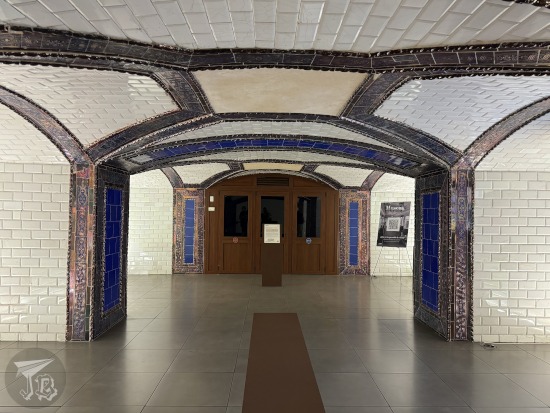
The whole complex was designed by architect Antonio Palacios, and the hall was built in white tiles with blue decoration – a homage to the Pacific Ocean, which gives the station its name. The hall is tiny by today’s standards, barely 119 square metres. It has three vaults that used to have skylights for the sun to light up the hall – now those are closed off as the street above them is busy. The station was renovated in the 60s so it could accommodate the longer trains, new accesses were built, and the hall closed down. That renovation was the same that made the station Estación de Chamberí close, and apparently another hall that has been uncovered in Ventas.

The hall was bricked away for almost half a century, until restoration work started in 2007. It took ten years, as budget was low and the process was labour intense – 60% of the hall had to be rebuilt. However, the final product is really good, you can see the newer tiles if you look for them, but the whole thing feels extremely well preserved. Even the staircase, which was built to access the hall after the iron bridge was destroyed, feels time-appropriate. A replica of the original doors was put up.

Pacífico Booking Hall

And right when I have seen all the five Underground museums that require appointment… I find out there is a passport of them – Pasaporte de Pasaporte de los Museos de Metro. Just my luck! Then again, maybe Metro will take these articles as proof of visit and backstamp me for them?

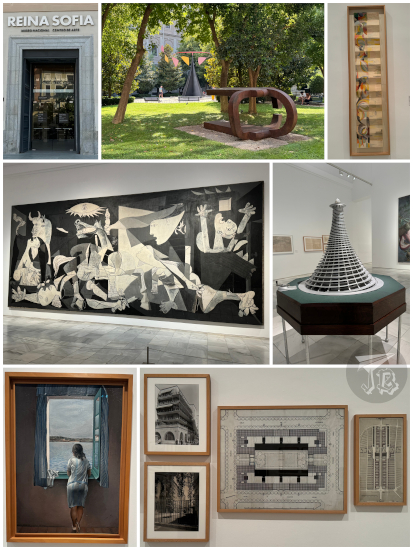
The visit took about one hour, then I rode the underground back towards Atocha, and bypassed it to the next station. I had decided to try my luck with the queue at modern art museum Museo Nacional Centro de Arte Reina Sofía, part of the national network of museums covered by my card. To be honest, I do not enjoy modern art that much, so I have been putting off this one visit. However, the museum holds a piece by Pablo Picasso that has become quite socially loaded – Picasso’s Guernica, which I have always thought I ought to see at least once.

Pablo Picasso (1881 – 1973) is considered one of the most important artists of the 20th century. He was co-inventor of collage, co-founder of Cubism, and inventor of the assemblage (basically, collage in 3D). He painted, sculpted, and made prints, ceramics and theatre sets. I have never connected much, if at all, with the kind of art he was making. I do not really understand the limits he broke, nor whatever he wanted to express. That is why I wanted to see this artwork in particular – to try to understand.

Arguably Picasso’s most famous painting is Guernica (1937). During the Spanish Civil War, German planes bombed the Basque town of Guernica, in the north of Spain, to aid the Nationalist army. The town was destroyed, and up to 300 people lost their lives – the raid opened the northern front for Franco to reach Bilbao. British reporter George Steer wrote a scoop on the event after he witnessed the destruction, and his reports made waves internationally. Picasso, who lived in France at the time, had been commissioned a piece of artwork for the Paris World’s Fair by the Republicans (at the time the rightful government of Spain). Upon reading the news, he scrapped his original idea and painted the Guernica instead.

The painting is one of the most important artworks that the museum has. It is a huge piece, in black and white, showing the carnage. As most men were out in the battleground, the majority of victims were women and children – along with a dead soldier, a horse and a bull, most of the figures in the pairing represent women and horror. I honestly find the description of the painting more chilly that the artwork itself.

One kind of feels that the museum itself as built as a huge sarcophagus for the Guernica, and other pieces are there just to fill up the space. A sculpture by Eduardo Chillida is exhibited in the gardens. There is also a space about architecture, with blueprints and photographs, including artwork by Le Corbusier. Other artists whose work is shown include Salvador Dalí, Joan Miró, Alexander Calder… Actually, I enjoyed the museum more than I thought, as I expected only abstract art that I would not understand. I enjoyed the blueprints and photographs of buildings, and the actual building too.

Exhibits at Museum Reina Sofía

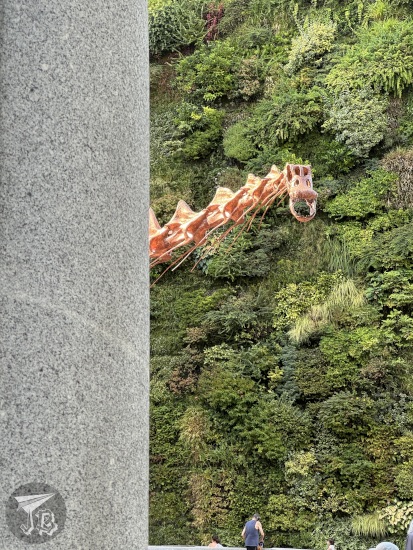
I then headed up Paseo del Prado to find one of the local cultural centres. I was ridiculously amused when I reached the corner where CaixaForum stands. I was on my phone, and when I looked up, I saw the Patagotitan “looking” at me. It gave me a laugh.

Patagotiatan at Caixaforum

The cultural centre Serrería Belga is running a Japan-themed exhibit, divided in parts:

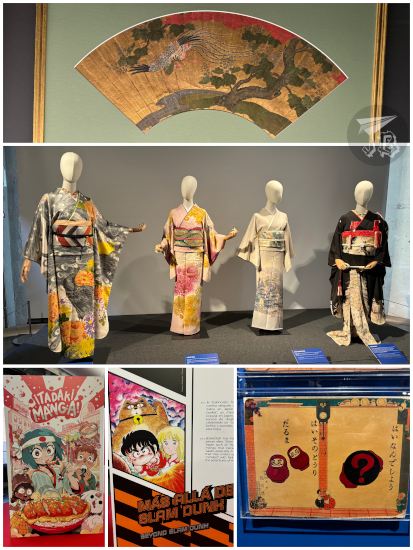
  • Kinpaku. Naturaleza, poder e imaginación en el arte japonés (Kinpaku: Nature, power and imagination in Japanese art): Kinpaku [金箔] refers to gold leaf artwork, often used in decoration in classical Japanese culture. A private collector has lent their items to exhibit – windscreens and fans, all painted in gold, so they can be enjoyed by everyone.
  • Kimono, identidad cambiante: un siglo a pie de calle (Kimono, changing identities: a century on the streets): Kimono [着物] is the traditional Japanese clothing – one that unlike many others is still common wear. There were twenty of these, including accessories.
  • Expokon: A series of panels discussing different hits in sports manga and derivatives.
  • Japan International Manga Award: Panels drawn by the Spanish artists who have won the awards in different years.
  • Kamishibai: Kamishibai [紙芝居] is (was) a form of Japanese street theatre using a small paper theatre with pictures to tell the stories. There were several sets of stories, some classical, some more modern.
  • Manga Kids Academy: A few panels showing Japanese school life through manga and anime.
  • Itadakimanga!: A series of panels showing different foods popular in manga and anime.
  • Gêmu: cultura visual y videojuego japonés (Gēmu: visual culture and Japanese video games): Some items regarding video games, and even a few arcade machines for playing.

Japanese exhibits at Serrería Belga

The exhibits were part of Madrid’s summer cultural program, which has named Japan “Guest Country”. They were a few cute little exhibits, and they were free too, so a good way to complete half a day trip. I headed back to the station afterwards, to wait for whichever train came, and I was lucky enough that one was there in a couple of minutes – I even found a good seat on my way back.

And I have finally seen the hall at Pacífico, which has been a goal since April 2023. Now I just have to figure out a way to obtain the passport and have it stamped…

30th June 2024: Engines, illusions, history and tea (Madrid, Spain)

Since finding about my tea time outings, my sibling had been wanting to tag along to one. I was asked to organise something for the weekend that involved either Chinese hotpot or afternoon tea in Madrid. The hotpot place was booked out both days, but I found an afternoon tea opening on Sunday the 30th. I am too lazy to move out just for tea, so I organised a bit of a day out.

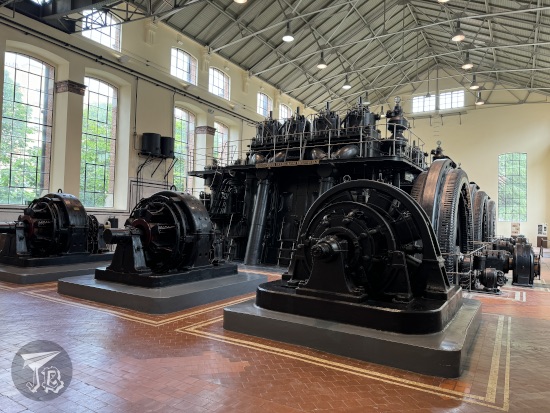
After an uneventful train ride, our first stop was at noon: Nave de Motores de Pacífico, the former energy centre that fed electricity to the original underground lines. Today, it is not in use and it has become part of the network of museums Museos Metro de Madrid. The warehouse was built by Antonio Palacios between 1922 and 1923 to home the diesel engines, transformers and fuel that single-handedly powered the underground system before the Spanish Civil War. The system was actually in place until 1972.

Warehouse containing the old underground engines

The building was erected in red brick, with white tiles inside, decorated with Palacio’s typical metallic green. The floors are ceramic tiles, and the engines are three monstrous vessel-powering pieces of engineering. These diesel engines created electricity, which then entered the transformers, and was sent to the power lines to feed the trains. At night, the excess was sold to the local street-light network.

Since we were going for afternoon tea to El Jardín de Orfila, where I have been before, I knew lunch was out of the question. However, we needed a snack. I planned that at Yatai Market, an… Asian food court of sorts. A number of stands come together to offer different cuisines and snacks, even full-sized meals. We tried a Chinese bao each and a couple of dim sums. I ordered a hoisin duck bao which was extremely yummy. I will definitely come back to try other stuff.

HotBao Yatai Market Cortezo

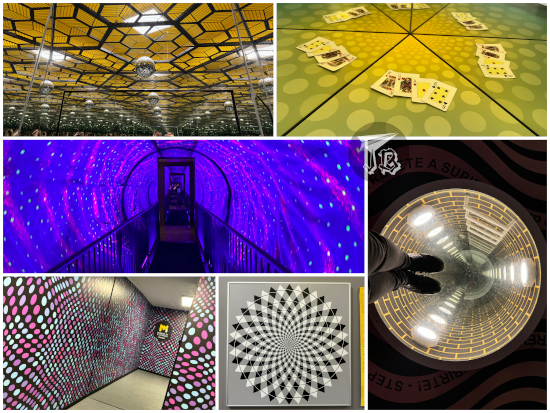
Afterwards, we headed off to the so-called Museum of Illusions. This museum is a compendium of optical illusion and installations designed to fool the brain into believing things that are either wrong or just not there: a distorted room so you look big in one corner but small in the other (Ames room), a vortex where you seem unable to walk straight, a rotated room, a room full of mirrors – there were a lot of illusions with mirrors actually – stereograms with hidden images, turntables, holograms…

We had a reservation for 14:00, and I was surprised at how chaotic entry was. I mean, they’ve been running the thing for a while now, someone should have figured out how to do crowd management, but no. Then, there were kids running and screeching all around, but it calmed down after a while. I had really hoped that the museum would be calm and half-empty at lunch time, but it was not so, not by a long shot. It was interesting though, and pretty fun.

Museum of Illusions Madrid

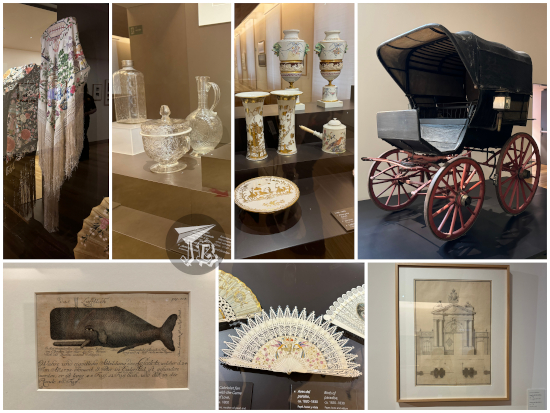
However, the experience was shorter than I had calculated, so I had to improvise an extra stop. Thus, we entered the local history museum Museo de Historia de Madrid, which tells the city’s history since Madrid became the capital of Spain. There are paintings, models, typical costumes, plans, maps, and Playmobil sets depicting of the uprising against the French in 1808. The museum is hosted in a former palace-like building which was actually built as a hospice. To the side stands the original Baroque chapel. It also has a lovely garden with a monumental fountain, which was relocated from its original place for conservation.

Museo de Madrid exhibits

Museo de Madrid - chapel and fountain

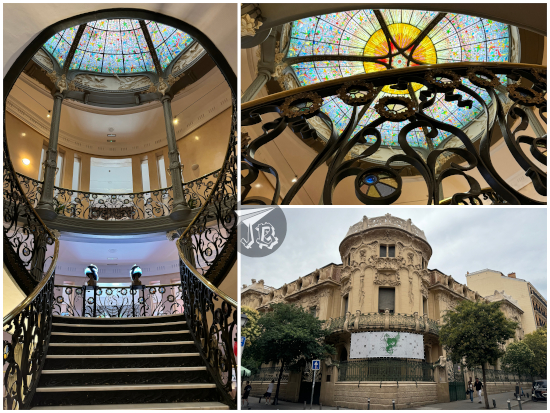
We spent some time there and then headed off to the building that now holds the office of the Copyright Owners’ association, a manor known as Palacio de Longoria. It was designed by José Grases Riera and built between 1902 and 1904. It is one of the few actual Art Nouveau buildings in Madrid, possibly the most important one. The façades were made in artificial stone, with sculptures and shapes resembling vegetation. I’ve wanted to visit it for a long time, but it is only open when there is an exhibition, and the stars had never aligned – until this time. There was an exhibition about urban music, and I was not going to let go of the chance to see the monumental staircase and the skylight.

Longoria Palace

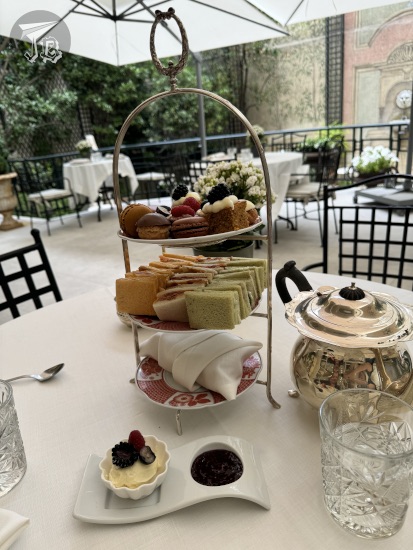
We finally set off for afternoon tea at El Jardín de Orfila. Out of the several places I’ve tried afternoon tea in Madrid, this has been my favourite to date. The outside garden is lovely, but mostly, their scones are the best around.

We ordered green tea, and the snacks were finger sandwiches – smoked salmon and cheese cream, classic cucumber and cheese, pastrami – pastries – carrot cake, macarons, lemon curd – and the scones. This time round, I decided to eat the scones after the sandwiches in order not to be full when it was their time. The afternoon was pleasant, but we shared the terrace with another table, and later a loud lady who wanted a smoke. That broke the magic a little, but the tea was fantastic and the scones were great.

El Jardínde Orfila: tea serving for two

Afterwards, we just headed for the train station to get back to our places. Of course we missed the correct one since they run whenever they like. What else is new? But the fun part was being able to pull a fun day out from my sleeve, and it was not stupidly expensive either, so good fun, all in all!

28th May 2024: Architecture and a niche restaurant (Madrid, Spain)

I was talking to an acquaintance whose child likes superheroes – so does the acquaintance, actually – about Comic Planet. After exchanging experiences, they mentioned that their spouse also enjoyed another thematic restaurant, and I decided that it could be a fun thing to do – and since they don’t take reservations for one, I roped my sibling into tagging along. And of course, since we were braving the horribly-working trains, I felt we should fill the day out. We could not leave early in the morning as I would have liked because I had this stupid bureaucracy appointment I had to get out of the way first.

We arrived in Madrid around 12:30, and our first stop was the Casa de Correos, an iconic building in the middle of the square Puerta del Sol. I did not even know you could just visit that building, nor that they ran exhibitions. It was a cool opportunity to check it out. Furthermore, the exhibition was actually something that I was quite keen on – the architect Antonio Palacios, commemorating the 150th anniversary of his birth. The exhibition, called “the Metro architect” Antonio Palacios, el arquitecto de Metro, is part of the network of museums managed by the underground company Metro. It consists mostly of photographs, a few of them by photographer Luis Lladó, an original model of Palacio’s project to renovate Puerta del Sol, and a modern model of a now-lost station, including lifts. It was a bit underwhelming, but still worth it – and free, so it was good either way.

Exhibition Antonio Palacios El Arquitecto de Metro

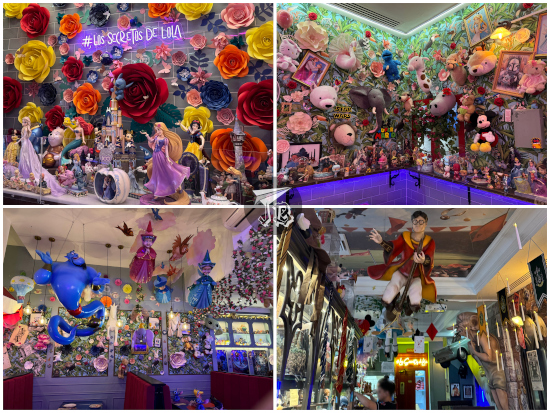
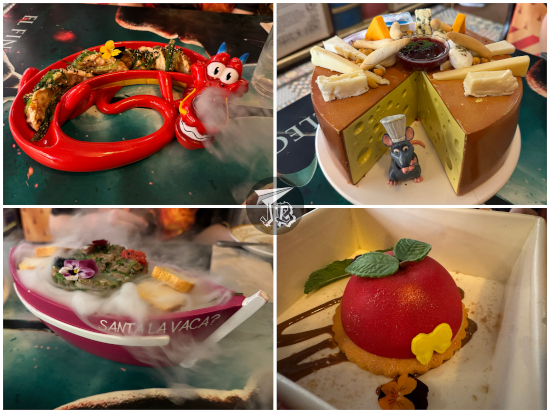
Afterwards, we headed out to the restaurant for our 13:30 reservation. The place is called Los Secretos de Lola (Lola’s Secrets ). It used to be just another bistro-grill in a street full of them, but some time after the pandemic, it reinvented itself. The restaurant has slowly turned into a Mecca of childhood mementos – Disney princesses, teddy bears, Harry Potter, Funko Pops… and crazy fun references like a Möet&Chandon spray to clean the tables. A lot of the food comes in a special piece of dishware – most of it Disney, but I can’t tell whether it’s actually licenced or a bunch of knock-offs. It was hilarious anyway. Though I am not much of a Disney person (my sibling is), my favourite film of theirs would be Mulan, and I just about lost it laughing when I checked the menu beforehand – I saw that they served gyoza in a Mushu-like dish, and decided we needed to order that. I was open to negotiation about anything else, really, but not the gyoza. The pasta in the Lady and the Tramp dish was also hysterical, but I could do without.

We reached the restaurant on point, and the owner directed us inside. We got a really cute Stitch table, but my sibling was not comfortable on high chairs, so we were accommodated at a Harry Potter one. We shared the non-negotiable teriyaki prawn-and-vegetable gyoza with wakame and bean sprouts, served on a Mushu-plate: Gyozas de gambas y vegetables al teriyaki, a plate of cheese Tabla de quesos variados (Blue cheese, Havarti, Mimolette, Emmental, Basilio, butter and breadsticks, on a Ratatouille’s Remy plate, which I had also found adorable) and a bluefin tuna tartar Tartar De Atún Rojo (on a little boat – I asked for no mango, and it was honoured; this was probably the weakest dish though). Finally, I tricked my sibling into a dessert called “Snowhite magic apple” Manzana Encantada Blanca Nieves: red chocolate capsule with white Kinder and a heart of caramel sauce, which came in an adorable “present box”.

Decoration: Los Secretos de Lola

Food Los Secretos de Lola

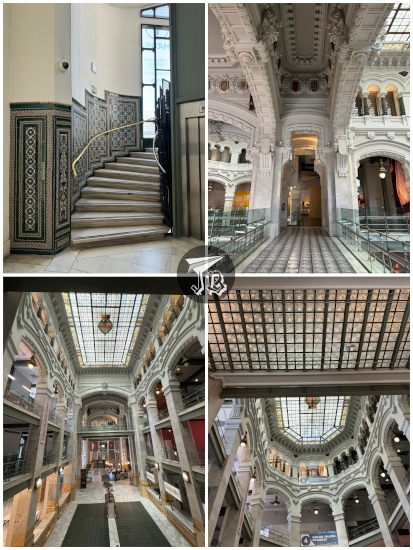
The food was good, and I really like themed restaurants, I guess, even if they are not “my” theme. We did not stay for the two hours, I think we were on our way after an hour and a half – and when we asked for the check, it came in a Frozen music box. Then, we left towards Palacio de Cibeles, the old “communication palace” of Madrid, designed by Antonio Palacios and Joaquín Otamendi, and erected between 1907 and 1919. It is considered one of the first and most important Modernist buildings in Spain, constructed in biocalcarenite, with three stained-glass skylights, catwalks on the third floor, and a magnificent lookout on the rooftop. Part of the building is being used by the town hall, the other by the public entity CentroCentro, which runs cultural activities in the open spaces – mostly conferences and exhibitions.

Palacio de Cibeles

We arrived a bit before 16:00. Since we had a ticket for one of the exhibitions at 17:30, we checked whether we could find a ticket for the rooftop. We found available slots at 16:30, which was great. Before the viewpoint access, we had time to wander around. Most of the free exhibitions were of modern art, and not that interesting, and I was more focused on the building itself. There is one dedicated to the World Heritage site Paisaje de la Luz, explaining why the area deserves its UNESCO place.

We found the staircase to one of the towers and we used it to move it through the different floors. It is a spiral staircase around the lift, with Palacios’ typical green tiles similar to the ones he used at Maudes hospital and Chamberí station. The catwalks were paved with glass tiles, and it was quite impressive above all. I loved the building, but after all, Palacios is one of my favourite architects, so it was to be expected.

Inside Palacio de Cibeles

Then, we went up to the rooftop, where we could have a view of all of Madrid around us, most interestingly one of the main arteries of the city – Gran Vía. The weather was great, maybe a bit too bright. The turns were 30 minutes, but we were done in about half the time, after taking two walks around the middle tower.

Lookout on the rooftop of Palacio Cibeles

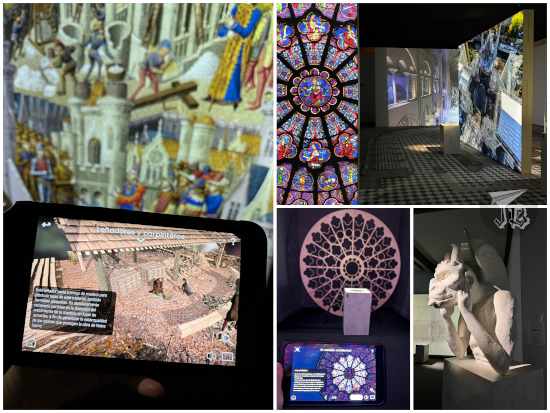
We went down and sat for a little before we headed down to the basement to see “Notre-Dame of Paris: The Augmented Exhibition” Notre-Dame de Paris: l’Exposition Augmentée. It was only 3€, so I was not expecting much, but it actually blew my mind.

The experience was created by the company Histovery, which specialises in “virtual exhibitions” through an interactive tablet called “HistoPad”. The Public Entity in Charge of the Conservation and Restoration of Notre-Dame de Paris cooperates with the event, and the beauty company l’Oreal is a sponsor. The exhibition (which is simultaneously running in several parts of the world) follows the history of the Parisian cathedral Notre-Dame de Paris – it starts with the 2019 fire, which is a bit heart-wrenching, and then it covers a few key moments in the history of the cathedral, using a mixture of written information, videographs and a “treasure hunt” where you have to find pieces of a puzzle hidden within the virtual information. This is done using the tablet to scan 21 “time portals” that take you to a particular point in history.

Around 1160. The Dream of a Builder. At that time, Bishop Maurice de Sully came up with the idea to build a new, better, cathedral in Paris. The previous one was a smaller, Romanesque building, but the goal was a larger, architecturally impressive building. In this room (the second, actually, but the first chronologically), you find out about the “treasure hunt” – you need to find a number of hidden “light spots” to build a “stained glass window”.

Around 1180. The Gothic choir. This makes a small overview of the kinds of workers that helped in the construction, the kinds of stones, building materials – quarries, forests. I was extremely disappointed at this point when I came across a dog in the virtual quarry, but the program did not let you pet it.

1241. The Holy Relics: Louis IX, the future Saint Louis, bought the Crown of Thrones in Jerusalem and brought it to Paris. There was a great procession into Notre-Dame, where the relics were to be kept. Here there’s a spectacular recreation of the gates with the original polychrome sculptures and decoration.

1645. The Royal Promise: Widowed Queen of France explained to her son, future Louis XIV, that he was to renovate the choir of the cathedral and build a new altar, dedicated to the virgin Mary. This was the original splendour of Notre-Dame, before the French revolution broke out – the church was one of the targets of the revolutionaries, and a lot of the art was damaged and / or destroyed.

1804. The Imperial Coronation. After the French Revolution, Napoleon crowned himself “Emperor”, but a very “equal and revolutionary” Emperor. He held a ceremony for himself in Notre-Dame, with the presence of the Pope and everyone who was anyone in the totally equal new society.

1857. The Spire. Enter Viollet-Le-Duc, a major architect and restorer in France’s 19th century, whose theories influenced countless others. He revalorised gothic style in the country, managing to turn it into a “national style”. The man had the goal to restore and create buildings in “the gothic style that would have been if the Medieval workers had had the technology he had access to”. Historians have not been kind to him, accusing him of “inventing” stuff instead of “restoring” but kudos to him, he managed to make a lot of buildings survive to our time. In Notre-Dame, he is responsible for putting back a lot of the sculptures that were destroyed during the French Revolution. He also built the spire that famously collapsed in the 2019 fire.

2019-2021 (first and last rooms). A description of the restoration works that have been happening in and outside the cathedral since the fire, with special attention to the Paris firefighters who worked the incident. There is a very interesting part about safely removing debris and the original scaffolding, and the fact that there was a lot of lead in the cathedral that the workers had to be safe around. They also homage the “vertical workers” who had to remove collapsed pieces from the ground… hanging from ropes.

Notre-Dame the Augmented Exhibition

We completed the stained-glass window and signed up to get a diploma. The fun part is that most of the exhibition was not really… even physical. There were a few posters, a reproduction of one of the chimaeras, some small models… Nevertheless, it was extremely interesting – possibly the best “virtual exhibition” I’ve seen to date. The length of the experience is said to be 60-90 minutes… we stayed from 17:30 to 19:45, much longer than I had anticipated! Thus, we had to forfeit the last plan of the day to go back to the train system – which of course was experimenting delays. It took forever to get home. Because what else is new?

Time-traveller diploma after completing the treasure hunt in Notre-Dame the Augmented Exhibition

12th March 2024: A free afternoon – the bullring & Pompeii Exhibition (Madrid, Spain)

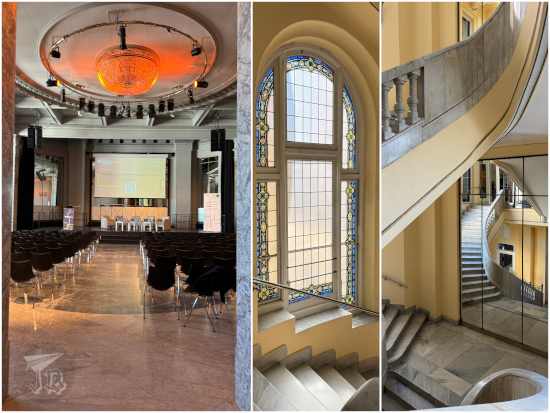
Due to life being weird sometimes, I was summoned to a work-related event in Madrid on the morning of the 12th. The event took place in one of the buildings erected by Antonio Palacios, the cultural centre Círculo de Bellas Artes (CBA). The centre hires out its facilities for conventions, gatherings and theatre plays. In our case, we were there for the presentation of a new product in the Column Hall Sala de Columnas on the fourth floor.

Interior of the Círculo de Bellas Artes

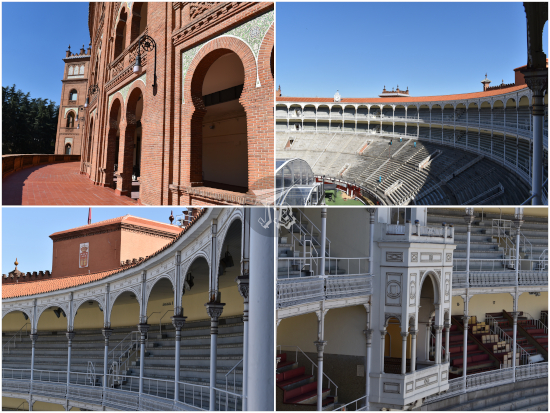
After all the necessary chatting, networking, and a disappointing (and rather questionable) choice of canapés, the event was over at 14:30. I ditched my companion then and headed out to Plaza de Toros de Las Ventas, the local bullring. I am not a bullfighting fan – my personal view is that it is not an art, nor a “fair fight” as it is presented, and I hope we humans evolve to phase it out. And while I would not attend an event, I was curious to get to know the building and its architecture.

Las Ventas bullring, outside

The ring is the largest of its kind in Spain. It was designed by José Espelius in the neo-mudéjar style and erected between 1919 and 1931. The central ring is just over 60 m in diameter, with a metallic structure holding the stands around it, and a façade of reddish brick and porcelain tiles. Aside from bullfighting, it is also used for concerts and other events.

I took a self-guided tour with an audio-guide Las Ventas Tour Experience, because I actually know nothing about bullfighting – I learnt that it actually has “rules”, I thought it was just taunting and hurting the bull. The passes have names, and there is a whole colour code of handkerchiefs – I had no idea. The tour takes you past the “Great Gate” through which bullfighters come out through when they are deemed to have done a great job. Then you climb up to the first floor balconies, and you can even go up to the highest point to have a panoramic view. You see the outside of the Royal Box, the gate through which the dead bull is brought out through, and then you walk down to the ring itself. There you can stand in the areas where the bullfighters and their helpers wait, and peer towards the stables, the closed door to the infirmity and finally the chapel. There are two VR experiences too that I did not care for, so instead of the expected 75 minutes, I took a bit less than an hour to do the whole tour.

Inside the bullring of LasVentas

Afterwards, I was curious to check out an immersive exhibition regarding Pompeii called “the last days of Pompeii” Los Últimos Días de Pompeya in the cultural hub Matadero Madrid. It was designed by Madrid Artes Digitales, the same company which organised the Tutankhamun one. At first I was not overly interested in it, but when I went to Recópolis the guide mentioned an actual VR tour, and I became curious (read: it was totally FOMO in the end).

The exhibit has a couple of replicas of archaeological artefacts, but it’s mostly a digital display. The first time I went to the Madrid Artes Digitales building I thought they had rented the place, but now I saw that they might actually own the warehouse and design the exhibits into it. There is a huge room where they project a sort-of film on the walls, a small circuit that you walk doing different activities, and a sitting VR ward, where you get to see a fictional world in 3D.

Of course, there were replicas of the Pompeii casts, and a copy of the novel The Last Days of Pompeii, written by Edward Bulwer-Lytton, which has inspired the exhibit. The novel, in turn, was sparkled by the painting The Last Day of Pompeii. The projection recreated a few passages from the book, then Mount Vesuvius erupted and you were taken “into” the crater, seeing lava bubbling and lightning bolts. Then one was back in the city as the pyroclastic cloud rolled into the city, along with volcanic bombs falling into buildings.

Last Days of Pompeii exhibition

The circuit was a VR walk-through that took you though a house, both in ruins and reconstructed, as a woman led you through it. Walking with the VR glasses was a new experience, I have to admit, but going through doors was strange. Unfortunately, my set had a finger print in one of the lenses which spoiled the view a little. In the final ward, there was a representation of a circus fight with gladiators and tigers that turned into a naumachia (ship games in the amphitheatre) while Mount Vesuvius erupted in the background. All in all, it was a bit weird, and maybe… a tad on the morbid side, if you ask me.

Afterwards I just headed off, and I was lucky to make it into the train, it was so full! The car emptied out enough to sit down after a few stops, but just wow.

9th March 2024: Minerals, fossils & trains (Madrid, Spain)

I might not be the most people-person ever, but if there is something that makes conventions extra fun, it is seeing attendees unapologetically geek out about what they love – in the case of Expominerales, that would be… rocks. Of course, this is an over-simplification. Expominerales is held yearly in the mine and energy engineering school Escuela Técnica Superior de Ingenieros de Minas y Energía (ETSIME) in Madrid. The year 2024 marks the 43rd edition of the event, which is considered one of the most important fairs in Spain in the topic of Earth Sciences – minerals, fossils, gems, and meteorites are widely available to the public. Aside from the small historical museum Museo Histórico-Minero Don Felipe de Borbón y Grecia, there were dozens of exhibitors with all kinds of items for sale, ranging from a few euro to several thousands. These year there were a few lectures, too, and coincidentally, the two of them I was most interested in happened on Saturday, one after the other.

I arrived at the ETSIME around 11:00, and I walked around the stands a couple of times. I have to say that I wanted everything, but I set a budget and I was able to stay around it, after shopping and lunch. At noon, I settled to listen to the lectures – one about the rehabilitation of an ancient gypsum mine in a hamlet called Hornillos de Cerrato, in the area of León. The other one versed about the uses of an already-rehabilitated one in the south of Spain, home to a huge geode. Both of them were pretty interesting, though the conference room was freezing. Someone had forgotten to turn on the heater there, it seemed…

Expominerales 2024 at ETSIME

After the two conferences, I had a last round to buy a last thing, so in the end I bought an iron-meteorite pendant, a fossilised shark tooth pendant, a plesiosaur tooth, and a soil sample of the K–T boundary. A plesiosaur was a marine reptile with flippers, a short tail and a long neck. The K–T boundary (now named the Cretaceous–Palaeogene (K–Pg) boundary) is the theoretical layer of iridium-rich black sand that was formed by the meteorite that caused the extinction of non-avian dinosaurs – and basically most life at the time, in one of the great world-wide extinctions in the history of Earth.

Shopping from Expominerales

At 14:30, I had a reservation for lunch at a Japanese franchise called Ramen Shifu. While I had originally been looking forward to trying the ramen (and I got my hopes pumped up when I read that they were Hakata ramen style), the noodles were rather disappointing. Fortunately, the okonomiyaki – Japanese pizza of sorts, made with a base of cabbage and topped with sauce and bonito flakes, was all right. On top of everything, paying was stupidly difficult because they did not have change.

Shifu Ramen ponzano - okonomiyaki and ramen

When I came out of the restaurant though, it was raining like crazy. I pulled out my umbrella and hopped towards the closest underground station, as my next destination was inside the metro system – one of the Underground’s museum network Museos de Metro de Madrid the collection of classic trains Estación de Chamartín: Exposición trenes históricos, inside the Chamartín stop. The exhibition displays four historical trains, restored from among the first ones that ran under the city, and some memorabilia. It was a bit underwhelming – more like false advertisement. I hoped I would be able to snoop inside the trains, since that was the photograph that opened the webpage, but unfortunately they were cordoned off. There was however a map with the works by Antonio Palacios in Madrid, which will become handy eventually.

Classical Train Exhibition Madrid

Afterwards, I just headed off towards the train station and got back home.

12th & 13th February 2023. The Epic Apocalypse Tour in Madrid (Spain)

The year 2020 was going to be so amazing that I actually would have had to choose the things I wanted to do and sacrifice others. It didn’t turn out that great in the end, with lots of rescheduling and cancellations. I was eventually able to budget time and money for one of those rescheduled events – the joint concert by the metal bands Epica and Apocalyptica in their Epic Apocalypse Tour. For a while, however, there was a bit of uncertainty with dates, as they bounced between Sunday 12th and Monday 13th of February, so I needed to juggle work dates in order to make sure I’d be free on Monday. In the end, I was all clear, all the concert-related activities were set for Sunday evening, and I decided to make a two-day trip out of it – I needed to take a hotel for Sunday anyway.

I arrived in Madrid around 9:30 in the morning. I had some time before my first appointment so I walked into one of the large parks of the city Parque del Buen Retiro, which is part of the Unesco World Heritage Site Paisaje de la Luz (Light Landscape), officially called Paseo del Prado y el Buen Retiro, paisaje de las artes y las ciencias, declared in 2021.

Parque del Buen Retiro was built in the 17th century for one of Felipe IV’s palaces, and it was opened in the late 18th century as public park. The park was almost destroyed during the war against Napoleon’s troops in the early 19th century, so most of it has been rebuilt. Aside from the obvious flora, it features sculptures, fountains, buildings… It is home to a lot of birds, and unfortunately a large number of invasive and fearless monk parakeets (Myiopsitta monachus), whose culling has been controversial in recent years. I got to see common blackbirds (Turdus merula), a European green woodpecker (Picus viridis) and a European robin (Erithacus rubecula).

One of the most important features of the park is the sculpture Monumento al Ángel Caído, which represents an angel falling from grace. It was originally designed by Ricardo Bellber, who made it in plaster in 1877. It was later cast in bronze and the original plaster destroyed, and eventually the sculpture was made into a part of a fountain in 1885. Around the area, there is also an ancient water mill, and to my surprise, the almond trees (Prunus amygdalus) had started blossoming.

Retiro Park collage: a pathway with trees and bushes on both sides, ducks, and a robin.

Retiro Park collage: a water mill, blossoming almond trees, and the fallen angel fountain

At 10:15 I had a guided visit to the Real Observatorio de Madrid (ROM), commissioned around 1785 by Carlos III, as an centre to develop and study astronomy, geodesy, geophysics and cartography. The main building is the astronomical observatory, built by Juan de Villanueva in what then was the outskirts of the city. Today, ROM belongs to the National Geographical Institute (IGN), and it is home to the National Astronomical Observatory, the Central Geophysics Observatory, and the data gathering division of the National Volcanic Service, though no measurements are taken there. The main astronomy measurements are carried out in the Centro Astronómico de Yebes, in a town around 80 km north-west of Madrid. The observatory is also part of the Unesco World Heritage Site.

The visit comprises three stops. The first one is the main building, called Edificio Villanueva, which has three rooms – the main rotunda with a Foucault pendulum, the library, with the spot where gravity was first measured in Spain, and the “Time room”, where the sun used to be traced to determine the hour.

ROM collage. A small Neoclassical building, an inner room with a pendulum and telescopes, a telescope and a 19th century library.

The second stop is the Great Telescope, a replica of one that William Herschel built in the 18th century – Hershchel was one of the greatest telescope makers of the time, and is credited with discovering the planet Uranus, two of its moons, and two moons of Saturn. The telescope was destroyed during the war against the French, but later rebuilt thanks to the number of laminates that had been preserved – the original had a focal distance of 7.6 m and a 61-cm diameter mirror (which is displayed in the main building), and Herschel himself considered it the best he ever built.

Herschel grand telescope: a wooden scaffolding structure keeping a huge black tube pointing at the stas

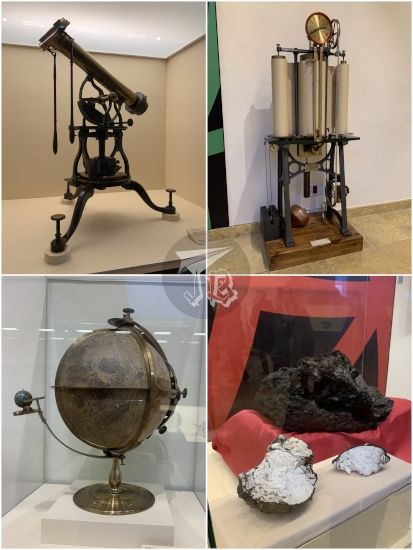
The final stop, the little museum of “Earth and Universe Sciences” has a small collection of ancient instruments used for astronomy, navigation, and geophysics. There are also a couple of seismographs – one of them new, which is up and running – and material retrieved from the volcanic eruptions of El Hierro in 2011 and La Palma in 2021.

Collage. Ancient telescope, old tide measuring device, an old globe, and lava bombs

I had planned for a typical sandwich at an iconic bar afterwards, but I ran into a political demonstration. Thus, I scratched that idea and took the underground westwards. When I was in Egypt, one of the places I visited was Lake Nasser, created by the Aswan High dam. The lake swallowed a lot of villages and monuments, but a few of them, such as Abu Simbel and the Temple of Philae were saved by Unesco. Between 1960 and 1980, a total of 24 monuments were saved, and five out of these were presented as “grants-in-return” to five countries which had offered exceptional technical and financial assistance to the campaign – Germany, Italy, Netherlands, the United States and Spain, the latter being impressive as Spain was in the middle of the dictatorship, and pretty shunned by the international community at the time.

The monument was a small and ruined temple in the now-flooded town of Debod, to which it owns its name Templo de Debod (Temple of Debod). Dedicated to the god Amun, it was built around the location of the First Cataract of the Nile, some 15 km south of Aswan, about 2200 years ago, though the core of the building may have been older. The monument was actually affected by the original dam at the beginning of the 20th century, and it was covered in water for most of the year, which destroyed its colours and damaged the reliefs.

During the Unesco salvage mission, it was dismantled, and eventually granted and taken to Spain, and “freely” reconstructed – a lot of information had been lost, and there were missing blocks. National stone was used to fill in the gaps, and the gates (remains of the pylons) were built in the wrong order, according to some old pictures. The restorers built an air-conditioning system, a wooden roof, and the main hall was closed off with a glass door and window panes. Today, the temple is open to the public at weekends, but unprotected from the Spanish weather – rather different from the Egyptian one – and pollution, it is rapidly deteriorating.

I went inside the temple once when I was a child, and I had a clear memory of it that kept surfacing when I was in Egypt – so I wanted to go back. The entry is free, but capacity is reduced, so I had to queue for almost an hour to enter. I finally matched my memory to reality. The interior of the sanctuary has a small chapel and some carved stones had been taken to a makeshift second floor to display them as a little museum.

A collage of a small Egyptian temple - it has two floating gates that lead up to the main building, which is small with four columns. One picture shows a tiny and dark inside room with an altar.

After the temple, I got lunch on the go, then walked towards the hotel to check in and change clothes. Around 16:15, I set off to La Riviera for the concert. I had a Meet and Greet ticket and had to be there before 17:00. Personnel from the venue were extremely nice, and there was no chaos at all, even if things had been a little disorganised and some fans were lacking M&G confirmation emails. Everything was well-handed and everyone who had paid for an upgrade got through. There were about 30 people to meet and greet Epica and we were ten for Apocalyptica.

Apocalyptica is a Finnish four-man band – Eicca Toppinen, Perttu Kivilaakso, Paavo Lötjönen and Mikko Sirén – founded in 1993. They are “semi-officially” a symphonic metal band, but they’ve ventured into everything from Metallica covers (which was their origin) to pure classical works. They have a very specific style heavily using classical cellos and combining them with modern drums. They currently collaborate with American – self-identified as Cuban in the concert – singer Franky Perez for vocals.

Meeting the four of them was really fun. I got autographs and took the most epic picture I’ve ever taken with a band or artist before. As we were only ten, after it was over, I had time to buy some merchandising and still be the second person to settle on first row – despite having decided that I was going to sit back and relax.

Apocalyptica white and black poster, signed by the four members

General admission started at 18:00, and the crowd was surprisingly tame throughout the whole thing. The venue filled up and the supporting band, Wheel, came up at 18:30. Wheel is a Finnish progressive metal band that consists of James Lascelles (Vocals/Guitar), Santeri Saksala (Drums), Aki ‘Conan’ Virta (Bass) and Jussi Turunen (Lead Guitar).

Wheel Setlist

  1. Hyperion
  2. Blood drinker
  3. Movement
  4. Vultures
  5. Wheel

Wheel playing, each member at his insturment: bass, guitar, singer and drummer

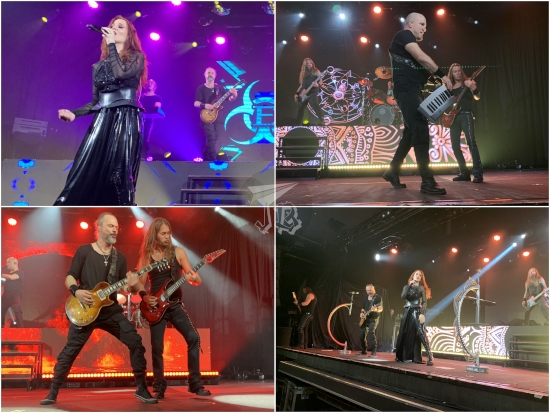
The second band was Epica, which I remember having listening to back when the world was young. They are a Dutch symphonic metal band currently composed by Simone Simons (lead vocals), Mark Jansen (rhythm guitar, vocals), Coen Janssen (keyboards, synthesizer), Ariën van Weesenbeek (drums), Isaac Delahaye (lead guitar) and Rob van der Loo (bass). Simone can go insanely high with her voice, and she has an amazing presence on stage, and the whole band has an immense amount of energy – she also reminded me of a comic character. The keyboardist had a lot of personality too, and he was extremely fun.

Epica Setlist

  1. Abyss of Time – Countdown to Singularity (recording)
  2. The essence of silence
  3. Victims of contingency
  4. Unleashed
  5. The final lullaby
  6. The obsessive devotion
  7. The skeleton key
  8. Rivers
  9. Code of life
  10. Cry for the moon
  11. Beyond the Matrix
  12. Consign to oblivion

Collage of Epica playing, showing different members at their choice of insturment - singer, bassist, guitarist, and keyboardist with a portable keyboard

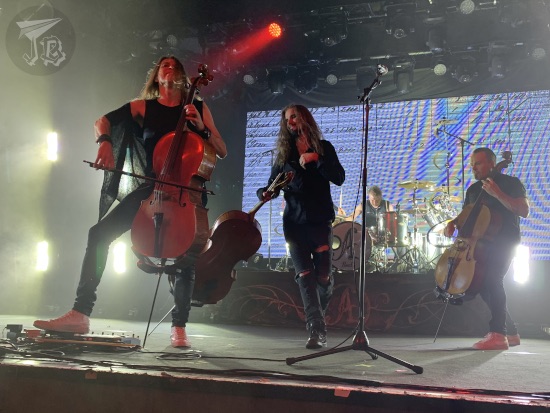
Finally Apocalyptica came on stage, and it was extremely fun. The things those guys do to their classical cellos would make some classical musicians cry, but the sound is super-powerful. We had Franky Perez for vocals, and a very fun moment regarding “listen to our classical music album at home, because we still feel like death metal”. They interacted a lot with the public, and it felt somehow very friendly / warm – yes, I’m talking about metal here. It was really that fantastically weird.

Apocalyptica Setlist

  1. Ashes of the Modern World
  2. Grace
  3. I’m not Jesus
  4. Not strong enough
  5. Rise
  6. En route to mayhem
  7. Shadowmaker
  8. I don’t care
  9. Nothing else matters
  10. Inquisition Symphony
  11. Seek & Destroy
  12. Farewell
  13. In the Hall of the Mountain King

Apocalyptica playing with Franky Perez. Perez is in the foreground, dressed in black. The thee cello-playing members are in the frame, playing. The drums peek behind them, but you can't spot the drummer

Apocalyptica playing at La Riviera. They have classical cellos. Two of the members stand on the sides, playing their cellos. Another one is walking swinging his as if it weighed nothing, The final one is slamming drums in the background.

We finished off just short of 23:00, I bought off some fast food for dinner, and headed back to the hotel to have a shower and get some sleep. I was woken up early in the morning due to the cleaning crew and the garbage mini-vans noises, but I did not leave bed until 9:00, then set off at 9:30. I bought some cold coffee on the way and walked into the former royal palace gardens, now public park Jardines del Campo del Moro.

Though I’d seen the gardens a few times before, this was the first time I actually walked into them. Despite the frost covering everything, I got a nice view of the palace and different fountains and buildings sprinkled throughout the green – Chalet de Corcho, is a small hut with coloured windows; and Chalecito de la Reina a wooden house that is currently closed. I was insanely amused by a little grass-cutting robot.

Jardines del Campo del Moro. Collage. It's winter and most trees are grey and bare. At the end of the walkway stands the Neoclassical Royal Palace. Two smaller buildings - one of them is white with brown beams, reminscing of German architecture; another one is a small kiosk with colourful windows - red, green...

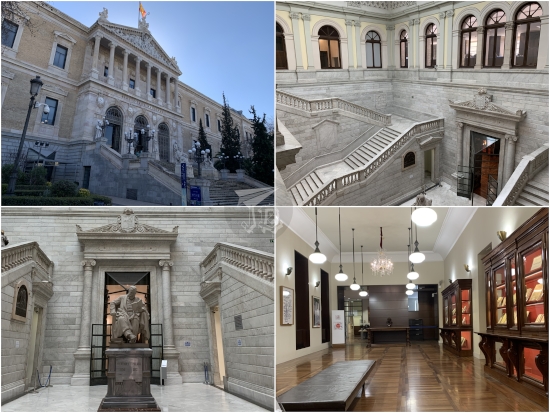
I wandered around for an hour or so, then headed off via underground to the National library of Spain Biblioteca Nacional de España for the absolutely worst guided visit of my life. Like… it’s true that it’s free, but tickets run out within hours of coming out – on the 20th of the month, for the following month. I’d actually been trying to do this since Covid lockdowns ended… It turns out, we did not see any real books, we could not even peer into the reading area, the book and reading museum is closed and the only information we got was… that the guide did not like the Library. We did not get to see anything interesting or that we could not see on our own, and we did not get to learn anything, so this was a huge blunder. Live and learn – but it was one of the few things that was open on a Monday. The library is a huge Neoclassical building with a fantastic marble staircase inside. The doors and gates are protected by intrincate ironwork fences.

Biblioteca Nacional de España. A Neoclassical building in white and grey tones. The exterior has columns and statues of writers. The interior showcases a pair of twin staircases with the statue of one of the most important library directors between both.

I met with family for a quick lunch and then we went for a walk. We had thought about going to one of the terraces to see the cityscape, but it was closed because it was a Monday. We ended up at the Parque del Retiro park again to make some time and walk. We sat in the sun for a while, then went to see the Palacio de Velázquez there. Currently, it’s part of the modern art museum Museo de Arte Reina Sofía, and I did not really care much about the exhibits, but I like the building. Architect Ricardo Velázquez Bosco built it in brick (with ceramic tiles by Daniel Zuloaga) for the Mining Exhibit in 1883, inspired by London’s Crystal Palace, now gone. The interior is pristine white with hints of iron architecture, but the building’s official style is “neorenaissance historicism” whatever that means.

Palacio de Velazquez: A brick building with large windows and tile decoration. The inside is all white with bits of iron architecture.

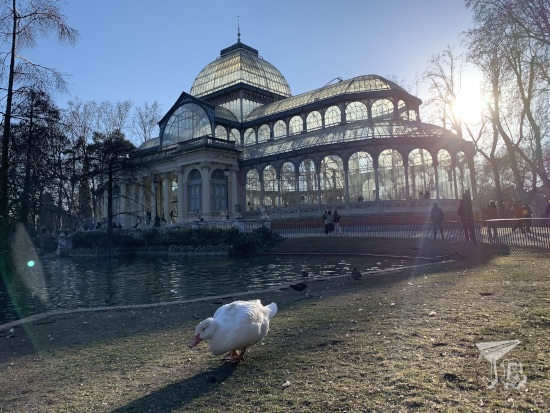
Velázquez Bosco and Zuloaga also came together when they designed another building I really like, the glass-and-iron greenhouse Palacio de Cristal, which was built to home tropical flora and fauna from the Philippines in an exhibit in 1887. In front of the palace, there’s a small pond home to some cheeky ducks and geese.

Palacio de cristal. A huge greenhouse with a dome, and two wings. A white duck wanders in the foreground. Between the greenhouse and the duck there's a small pond.

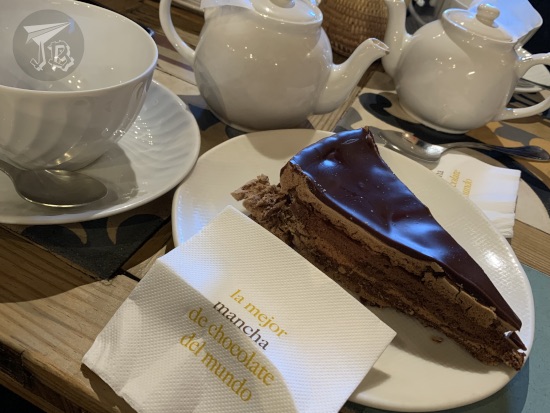
Then, we went to have a snack. Trying to find something on the map before the trip, I’d come across a place called La Mejor Tarta de Chocolate del Mundo, which translates to “The best chocolate cake in the world” and that had to be tried! It was really nice, even if the place was pretty small and felt a bit cramped.

A slice of chocolate cake in front of mugs and teapots

We finally took a stroll down towards the sunset, and I took the train back without much of a hitch, then drove home

24th July 2022: Up, up and down {Salamanca, July 2022}

After a latte and the best croissant I’ve had in a long time, we went over to see the gothic palace Casa de las Conchas, which was built between 1493 and 1517. The façade is decorated with sandstone-carved shells (concha, in Spanish). The exterior sports ironwork-protected windows, and the interior a patio with artistic arches.

The gothic palace called House of Shells. There are hundreds of them carved on the façade. The inner patio is carved in golden stone, with very thin columns and lots of decoration

It was still early for our visit to Palacio de Monterrey, a 16th-century Renaissance palace inspired in the Italian style of the time, combined with Plateresque decoration, which was heavily imitated later on in the 19th century. The building currently belongs to the House of Alba, probably the most prominent Spanish noble family. The House opened the palace to the public, and the inner area cannot be photograph – it was weird anyway, with some antiques and art pieces, but all of it was… prepared and staged, though the carpets were rolled out of the way. In this case the only option to sneak out a picture was from the tower, as a member of the staff followed us all the time.

Monterrey palace, built in golden-like masonery. The roofs and towers are decorated, and there is a row of windows alongside the upper floor.

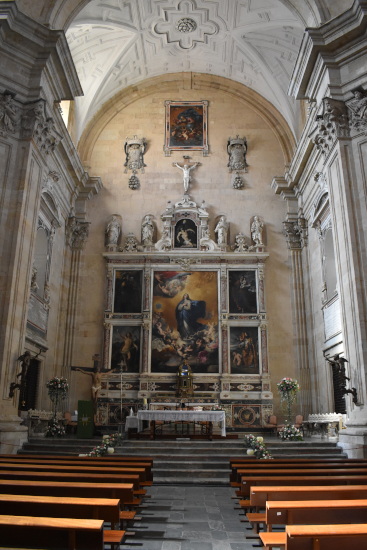
Next, just in front the palace, we visited the 17th-century church Iglesia de la Purísima, in Italian Baroque style. Its altarpiece is considered to have one of the best images of the Virgin Mary in her Immaculate Conception advocacy.

A Catholic altar showing the Inmaculate conception in the centre, she is dressed in blue, and standing in front of golden clouds, with angels around her. The back of the altar is built in white stone, and ornate.

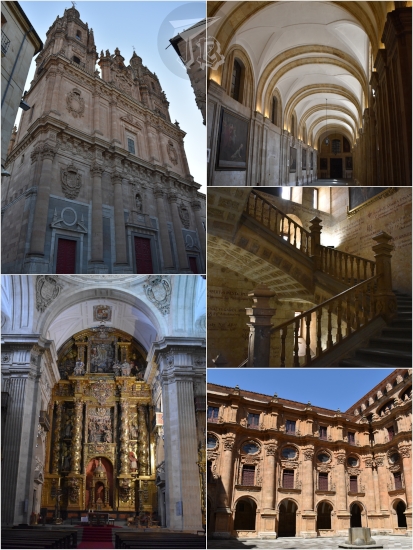
Our next spot was the second university of Salamanca, the see of the Universidad Pontificia de Salamanca, a building called La Clerecía. As the original university went secular, the Jesuits built a clerical university. The building, built in Baroque style between the 17th and 18th centuries is composed of a church, a cloister, a patio and a magnificent staircase, forming the complex (read: guided tour) called Vita Ignatii.

Collage: On the left, a very baroque church from the outside, also showing the gold inner altar. On the right, some shots of the upper and lower cloister, the patio is ornate and reddish, the staircase is made completely out of stone.

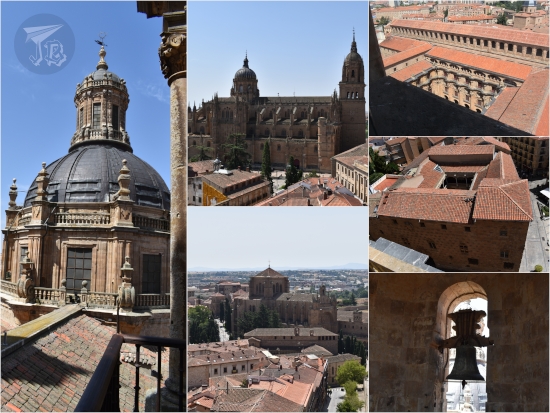
Then there are two towers that give out really awesome views of the town, named Scala Coeli, the stairs to the Sky.

Views of Salamanca from the above: the dome of the church from the outside, the cathedral, the House of Shells, and the bells.

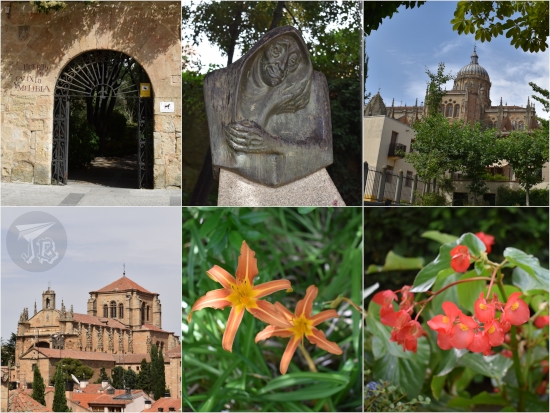
It was rather hot, so we had some unremarkable lunch and went to the hotel to wait out the blunt of it. It did not really work, and we eventually tried our luck with some more sightseeing. The first stop was the garden known as Huerto de Calixto y Melibea, based on a literature work Tragicomedia de Calisto y Melibea or La Celestina. It is considered the first Renaissance writing in Spanish, and it echoes with Romeo (Calisto or Calixto) and Juliet (Melibea), with an extra character, the old matchmaker Celestina, who is a horrible person trying to break the lovers up to marry Melibea to someone else. Though the writing does not have a firm setting, some say that it is probably Salamanca, where the author attended university. It was nicely shaded and had nice views.

Gate to the gardens, a bust of Celestina (the fictional character), from the cathedral, and some flowers: star-shaped and orange, bell-shaped and red.

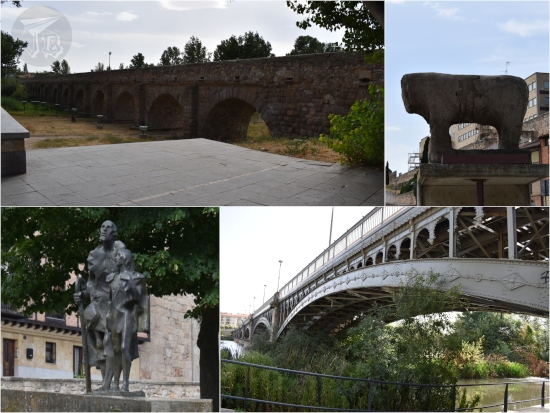
Then, we wandered off to see the bridges over the river Río Tormes again: both Puente de Enrique Estevan and Puente Romano. Next to the Roman bridge there is a statue of a verraco (ancient Celtic sculpture) Verraco del Puente Romano, which is supposed to have been there since the 16th century. A bit to the side, there is yet another literary monument, which represents the book El Lazarillo de Tormes, Lazarillo being the word for “guide dog (for the blind)” in Spanish (such an eye-seeing dog). Also written in the 16th century, it is considered another of the peak writings in Spanish, telling the story of a young lad who learns to survive by gathering street-smarts and shedding off any morals he ever had, finally settling in Salamanca with his unfaithful wife: Monumento al Lazarillo de Tormes.

Collage. The historical bridges in Salamanca: the Roman one, made from stone with wide archs, and the iron-architecture one, in greyish-green. Sculptures: Lazarillo with his master, and a prehistoric bull or pig, with a flat head

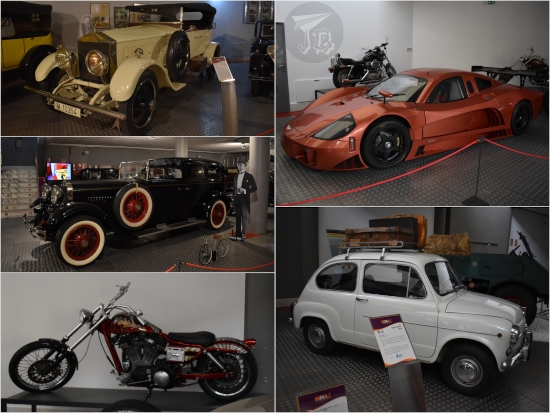
Then we found a very air-conditioned and interesting place – the automobile museum Museo de la Historia de la Automoción (which reminded me a little of the Megaweb Toyota City Showcase and History Garage in Tokyo). It has a lot of classic cars, and some historical pieces such as vehicles that belonged to dictator Francisco Franco or the writer Camilo José Cela (and air-con).

A collage of some cars: A Rolls-Royce, a Ferrari, a Wolkswagen 600; and a Harley-Davidso

I had then booked myself an evening visit around sunset time, to go up the towers of the cathedral, an experience called Ieronimus, with the hope to see some cool sunset and night views. It makes sense, right? Wrong. I should have realised when it turned out to be a guided visit that most of it would be inside, listening to the guy fanboy his own city – then he started speaking about the Lisbon earthquake and its effects in Salamanca and gave out wrong information. I stopped listening to him at that point. There was a light/music show in the cathedral, and I did get some neat pictures, but honestly? The choir concert in the old cathedral would have been a much better choice, had we known about it.

Views of Salamanca at night, with the gothic architecture highlighted by the illumination. The city looks Romantic and mysterious.

Walking distance: 13017 steps / 8.00 km

18th & 19th May 2019: Madrid (Spain) for Jupiter (and fesFE[M]!)

The weekend started extremely early on Saturday, when I took the first bus out to Madrid, and I think I was there around 7:30 to meet my friend C*****. She had been having a rough time and she had asked me to “keep her head off things”. Up until a couple of days before, we did not even know whether she would be able to come to the concert, so I had a whole plan up my sleeve. Unfortunately, a couple of steps backfired slightly. The main event – which we had been planned since the previous December – was Jupiter’s concert for the ZEUS Europe Tour on Sunday the 19th, but we made a whole weekend out of it. I was not actively following Jupiter at the time of the announcement, but C***** and I decided to attend because Madrid is easy and convenient, well-communicated and an opportunity to spend a weekend decompressing somewhere. As the time drew near and we could access more material, the excitement built up – I also managed to find the album they were promoting and it sounded really well, actually.

Her bus arrived earlier on Saturday than mine, and when we met, we decided to have breakfast at the coach station, to catch up and to give shops and so on the time to open up. When it was a reasonable time, we took the underground to drop our luggage at the hotel – the lovely EXE Moncloa. I had selected it because it was near the concert venue, and I hoped that we could hang out the terrace and the swimming pool, which unfortunately did not open until June. After getting rid of the luggage, we rode the underground towards the neighbourhood of Chueca, where I had looked up a bunch of Goth apparel shop which were right up her alley and… did not open at 10:00 as the internet said, but at 12:00.

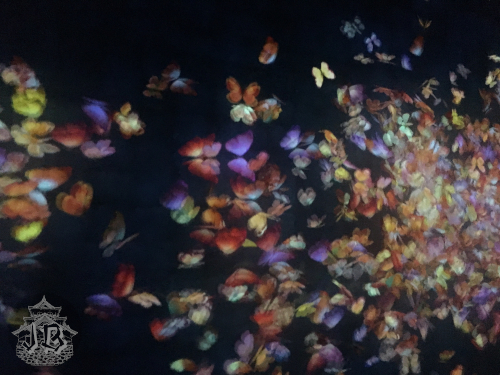
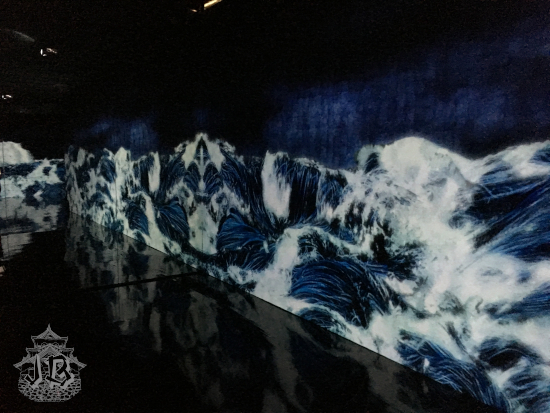
Fortunately, other shops were already open and we were able to pass the time amicably. We were actually close to the Telefonica building, so I suggested we headed up there for the TeamLab exhibit, which I had already seen, and I thought she might like the digital art.

Teamlab logo and digital art: Waves, butterflies in red and green, and a dripping circle as if it were painted with a brush. All of them are light or bright colours on black.

Afterwards, we moved onto Callao Gourmet Experience for a snack. I wanted to introduce C***** to the Niji Mochi shop, and we also shared a chocolate ice-cream shake.

Mochi and coffee with whipped cream

Afterwards, we were shopping for a little longer before we moved on to have lunch. I had a surprise for her. While I care little to nothing about Korean food, she is a fan of everything Korean. Thus, we hit one of the best Korean restaurants in Madrid, called Seoul. I gave her free reign to order for both of us and we shared, though being honest, the only thing I enjoyed was the green tea at the end.
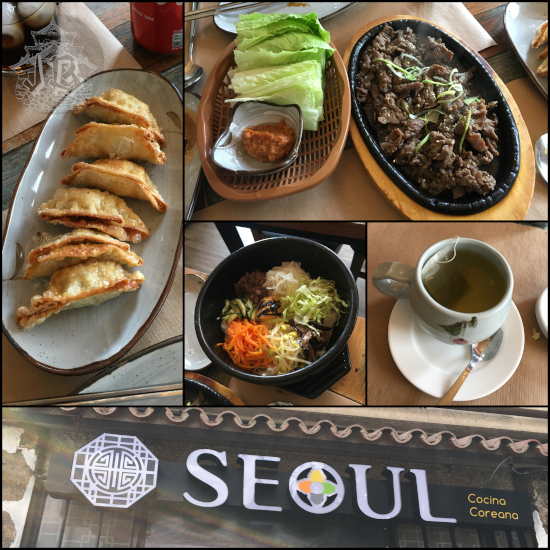
Lunch: fried dumplings, roasted meat, rice with vegetables, and green tea.

After lunch, we went on and found an underground station. We rode towards the Museo Arqueológico Nacional, National Archaeological Museum, although we had not realised that it was museum day so instead of a quiet exhibition I was used to, we had to deal with a ton of families! On the bright side, it was free, though. The museum, which shares a building with the national library Biblioteca Nacional, was founded in 1867, at a time when creating national museums had become popular among European governments. It was the start of the development of archaeology in Spain. I remembered it from the time I was a kid, dark and with wooden floors, but it was recently renovated with wide spaces and modern interiors.

Exhibits at the archaeological museum: bones from a mastodon, boar statue, lady statue, Neanderthal skull, Roman mosaic of an octopus, Horus statue, Iberian stelae, primitive animal that looks like a boar or a bull carved out of stone, Grecian vase

C***** was tired from spending all night in the bus, so we left the museum and headed back to the hotel to finish our check in process and then catch a break. On the way, we stopped and bought a few snacks for the following day because you always have to be ready for a post-concert low.

We had to look for a place to have dinner, and I found a few interesting places. There were not one, but three Japanese restaurants in the area where we were staying. One of them required queueing and sounded quite self-important, so we were left with two options. We decided to try one in the evening and the next for lunch the following day. Thus, I booked a table at the nearby Naniwa. We had some decent sushi, chicken, and takoyaki… then ordered takoyaki seconds because we had a discount (and I was hungry because I barely picked on lunch).

Dinner: sushi, fried chicken, octopus balls, chicken skewers

The next morning, we headed to the venue Sala Copérnico door around 9:00 and upon seeing nobody queueing yet, we went to have breakfast at a nearby café. Then, we walked around the Moncloa park area, mostly chatting, until we went back to the venue – no queue. And later went back to the venue – no queue. And afterwards, we went back to the venue again, just to find there were still no people in the queue.

Coffee and bread breakfast

In the end we ran into the supporting bands went to have lunch to the second Japanese restaurant in the block, Morikaen. It was around 13:30 as we were heading there, and I said something along the lines of “I feel sorry that they’ll arrive and there’s nobody here to greet them”, and as we turned the corner we almost literally ran into the whole crew coming out of the bus. Talk about timing. They looked tired so we just walked by, but we were rather sure that we had been noticed. On our way to the restaurant, we walked past a family all clad in “Sunday church clothes”, and their small girl wearing aaaall white just stared at us – in rock-goth black clothing – with pure envy in her eyes. Here’s to you, little one. You’ll get there too.

Lunch was all right – tuna tataki, tonkatsu, takoyaki. A bit more expensive than the previous day’s dinner, but we also ordered higher-class ingredients and more complicated dishes.
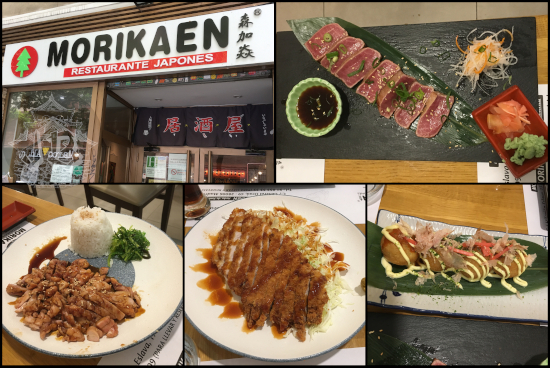
Lunch. Tuna tataki, rice and chicken, breaded pork, octopus dumplings

Jupiter is a Japanese band who define themselves as “melodic metal band”. It could be said that it is a visual kei symphonic power metal, which means they combine a very particular image (or a bunch of images, the most iconic being Hizaki’s Baroque-inspired dresses) with a subgenre of metal that combines hard drumming, metal guitars, and elements of classical music. On the 22th November 2018, Jupiter announced their new album, a Japanese Tour, and a European Tour, ZEUS Europe Tour. Bassist Rucy left between the announcement and the album release due to creative differences, and I really thought they would cancel the tours, but luckily everything went ahead. The remaining members – guitars Hizaki and Teru, current vocal Kuze, and drummer Daisuke were joined by support bassist Shoyo.

Schedule for the tour

There were two promoters involved for this concert. The local promoter, which in Spain was Madness Live, sold general admission tickets – they have a clean and neat webpage and buying from them is easy; I got ours on the 12th of December. The other, Editions Hikari, was in charge of coordination of the European tour, general information, and ticket upgrades. I think they are one of the worst organisers I have ever come across.

Hikari announced those upgrades in January. There would be VIP experiences, on sale on the 14th of February. Besides that there would be two kinds of upgrades, there was no real information about them until a few days before the sale. The best tickets were called “Venus Premium” (40€ face value + 5€ reservation costs) included autographs + handshake + backstage access before or after the show or soundcheck access (if possible) + photo with 1 member taken by a professional photographer (sent by e-mail later after the tour) + priority access to the merchandise, and there were five per show. The “Venus” upgrade (25€ VIP + 3€ reservation costs) comprised autographs + handshake + priority to the merchandise, there were 20 available per show. Getting the tickets was chaotic, but in the end, C***** managed to buy the two Venus Premium tickets we wanted – luckily. A lot of people did not even find out about the option to upgrade. In the end, the backstage pass / soundcheck was not available for any concert in the tour, and the priority access to the merchandise was impossible in Madrid due to the two independent promoters. Either of the VIP upgrades granted the option to buy an “Instax” (Polarid) photograph with the whole band at extra cost.

Hikari’s Facebook instructions were that Venus and Venus Premium ticket holders had to go to the merch booth – to which they supposedly had priority access – at the beginning of the concert. However, as the access to the actual venue was controlled by the local promoter ticket, there was no way they would access the merch booth with any kind of priority unless the managed to somehow skip the queue. Any kind of communication with Hikari was impossible as “they could not check emails, Facebook messaging, nor reply to comments.” However, they still made posts, and that is how we found that the CDs which Jupiter brought to sell at the merchandise booth were confiscated by customs’ officers before the first concert!

On the 10th of May, we received an email form the local promoter, Madness Live, informing us that the door timing had been changed and they were nice enough to send us the following schedule: Doors at 19:00, VII ARC (German support band) at 19:15; fesFE[M] (Japanese support group) at 20:20; Jupiter at 21:30. There was no information on the upgrades, because they had no clue about those, as Hikari was in charge. The day of the concert thus arrived and we had no actual about that, except for rumours and comments of what had happened in previous concerts. That was why, even if there was no queue, we had decided to stick around Sala Copérnico instead of heading into the city centre.

Eventually, after lunch, I decided that I was too tired to keep going up and down the streets, so around 16:00 we settled at the venue doors until they opened so we could get into the chaos that was the concert. At 16:30, other people arrived, so we got talking – that was how we found out that many people had never even heard about the upgrades. Doors opened around 19:00 – without any kind of priority access to the merchandise, nor separating VIPs and GA. C***** and I decided to divide and conquer – she went to secure a spot on the first row, while myself checked in at the merch booth to get the Instax tickets with the whole band.

That is when I saw the lousy, half sheet of paper taped there saying “Venus and Venus Premium ticket holders, gather at the merchandise booth at 20:00”. That placed the “Venus experience” in the middle of the support act, which meant either having very good friends who saved you the first row spot, or sacrificing it. We decided to give the place up and find somewhere more convenient so we could move about. Without holding spots for the VIPs, this was totally unacceptable in my opinion, especially since there had been no early entry, or priority merchandise. A bunch of people who did not want to buy anything missed out on what they had paid for.

The first support band was VII ARC. They were okay, a bit of stereotypical German heavy metal. I can see how they might appeal to the general metalhead crowd, but it feels that they were chosen because “they dress up sometimes”, and Hikari thought they would fit. It is formed by Kay (vocals), Fū (lead guitar), Bena (guitar, screaming), Grazel (Bass) and Z’ev (drums), and they could probably fit a bit on the “visual” style, but they did not bring any distinctive gear.
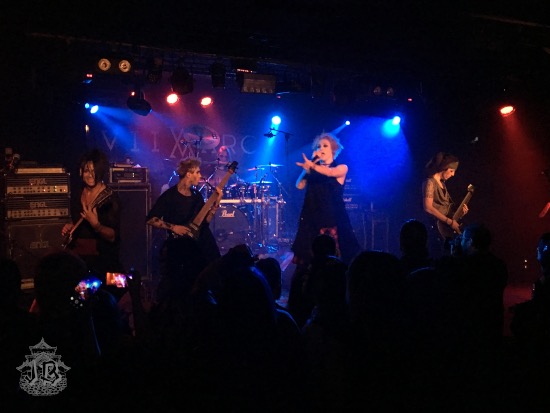
VII Arc playing in Madrid

At 20:00, as fesFE[M] prepared to take the stage, the Venus Premium and Venus ticket holders gathered around the merch booth and we were ushered past a barrier, towards the bar. There, we had to wait for about 10 minutes while the second support act started. A Japanese staff lady with little to no English came to “check” the Premium tickets and “sort of explain” to us the whole thing. First the Venus Premium would be shown backstage one by one for the one-on-one photograph – there were four of us, we never knew if the fifth was never sold, they did not come, or they missed the whole experience. Afterwards, we would come out again and joined the regular Venus for the autographs and handshake, then the Polaroid would be taken for the ones who had bought it. We were ushered past a curtain and the backstage door towards the mess room where the remains of the lunch buffet were.

As I entered, I caught sight of Shoyo, the support bassist, who was sitting down on a low mattress in a room to the left, looking bored. I greeted him in Japanese, and he greeted back. C***** turned to see whom I was talking to and her eyes were wide. I asked Shoyo if he felt lonely, he said a little. Another attendee who also spoke Japanese asked for a picture (beating me to it, actually) but he said he was not allowed.

The conversation died out when it was time to go into the private band area for my picture with one of the members. As I walked in, there was Kuze to my left, Daisuke to my right and Teru and Hizaki in front of me, Teru dead centre and Hizaki a little to the right. I was asked whom I wanted my picture with and chose Teru, as I had long ago decided that I would if I could. He smiled and posed with me, then he shook my hand. I have got to learn to look into Japanese musician’s eyes when I talk to them.

We said good-bye to Shoyo on the way out, and almost left, but it was now time for autographs, handshakes and Instax. I pulled out the CDs I had brought for C***** and myself, and I got to shake hands with all four of them and receive the band’s autographs. Since the CDs the band brought had been seized, we might have very well been the only ones in the whole country that produced some official material for signing. Then, we took the Instax and the staff would ask with a thumbs up sign “okay?” to check the picture was good, before we left.

CDs signed by Jupiter members

All in all, the band was very friendly and amazing, but the timing and organisation was horrid. We lost out first row – despite having “priority access”, and we missed half of the fesFE[M] concert. As Copérnico has two levels though, we found a nice spot at the stairs that connect both, and I could lean against the handrail to watch the rest of the act.

fesFE[M] is a relatively new visual kei band where all the members take up “doll” personas. Their career in 2017 and released their first mini-album in May 2019, just in time to come over to Europe for Jupiter’s tour. For each album / season, the band dons a doll theme, and they were currently on the “horror genre” dolls. The members and their doll types are: Lion [リオン], vocal, Distress Coppelia doll (from the namesake ballet, dressed as a bloody bride); Aito [アイト], guitar, Apathetic Prince doll; Zeno P [ゼノP], guitar, Bloodthirsty Child Killer doll; Toru [徹], bass, Emotional Princess doll; Rensa [蓮沙], drums, Psycho Butler doll; and Jun, keyboards, Scalded Dollmaster doll (dressed as a nun because… reasons?).

The first time I heard a song by fesFE[M], I was not extremely impressed – the PV was a bit too creepy. However, they are really good in person, even with the bad sound quality and reverberation in the venue – and the fact that we missed about half of their act. They were really engaging. The whole visual part was amazing, and the coordination was great! Their music was much more powerful live. The band played some songs from their mini-album enseMble autoMata: Doll in blueberry jam [Doll in ブルーベリィジャム], Arachne ni haitoku wo [アラクネに背徳を], Psychological stolen heart, and Freiya [フレイヤ].
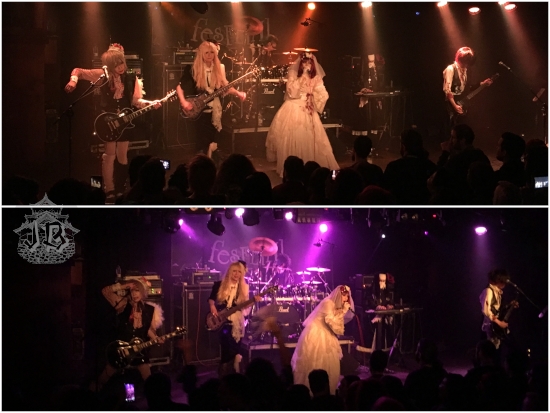
Fesfem live in Madrid

The Jupiter concert was as expected, very energetic and fun – it actually went beyond expectations. Our spot was really good in he end, a bit raised, without getting pushed, and we actually watched the concert next to fesFe[M]’s bass Toru. Sometimes he smiled and waved at us, and we waved back without fail.

Kuze, Jupiter’s vocalist held his ground better than I thought he would be able to. I was kind of impressed when I listened to the Jupiter single Theory of Evolution and later to the album Zeus: Legends never die. While we were expecting the guitar and metal power, Kuze’s voice range in the recording was rather wild, and I did not think that he would be able to keep it up live, especially on a final concert after touring both Japan and Europe. He proved me wring, and he held all his notes and his vocal range, just like the recording. He had practised his English a lot and learnt the MCs, but he switched to Japanese quite often, and he spoke too fast for me to get! He did a great job even with songs that had been released in the previous vocalist’s time.

Daisuke was pretty much hidden by his own drums from where we were, but we did see him bounce a couple of times. Hizaki was on the other side of the stage from us, and he looked divine in his Baroque dress. I don’t understand how he can even move in those clothes, much less play guitar or crouch, which he did so a few times in order to interact to first-row fans. A couple of times I did fear for his safety as someone grabbed either him or the guitar. Most of the songs that were played were his. It’s fun to imagine what he would be thinking when writing “die, die, die, go fuck yourself”, when he presents as such a beautiful and innocent lady, but it surely was fun to yell.

And finally, Teru had a blast. He kept twirling around as he played, his stud-leather coat swirling around him. He played with a huge smile on his face all the time and he gave off the vibes that he was having a lot of fun. He also interacted with fans a lot.
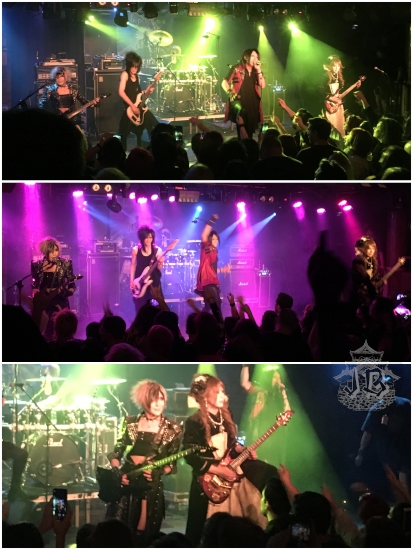
Jupiter Live in Madrid

Setlist:

  1. Arcadia
  2. Last Moment
  3. Angel’s wings
  4. Drastic Night
  5. Bring me out
  6. Show Must Go On
  7. No cry no more
  8. The spirit within me
  9. Tears Of The Sun
  10. Memories of you
  11. B.L.A.S.T
  12. Blessing of the Future
  13. Zeus: I. Legends Never Die / II. Conversations with God
  14. Symmetry Breaking [Encore 1]
  15. Theory of Evolution [Encore 2]

While the concerts were a lot of fun, the whole event was stressful due to the abysmal organisation. I actually feel a bit ripped off, because they did not deliver a lot of what they had sold in the upgrades. At least C***** and I are lucky enough that we managed to get our pictures, autographs, and saw the concert from a relatively good place. All in all, Jupiter are amazing, they were super nice, and so were the guys from fesFE[M]. The concert was great, and we don’t regret going for a second.

After the event, waved at Toru for what we thought was the last time. When lights went on, we also saw Rensa, who stopped for us when we told him he had done a good job. C***** and I decided to pool our money together to buy the CDs fesFe[M] had brought – and not got seized. Apparently, it is typical that the entry-level bands hang around merchandise booths after concerts, and we were lucky enough that they agreed to sign the CDs and take a photo with us. Lion was extremely surprised and nice – or acted so. He complimented me on my poor attempt of Japanese and complied with what we requested.

CD signed by Fesfem members

Finally, C***** and I headed back to the hotel, and we went home the next day – fortunately we left from the same bus station so we could maximise our time together.

Hikari took a few days to send out the VIP pictures, but they eventually arrived on the 1st of June. Getting them was also hard, and amateurish – they wanted to put them in a Google Drive link and post that on Facebook. At least we got them to send them via email, citing European Data protection laws at them… I really, really hope to avoid this promoter in the future, but if I do, I’ll be on the lookout in order not to miss anything.

4th May 2019: Museo Naval & TeamLab in Madrid (Spain)

There were a couple of exhibitions in Madrid that I wanted to see, and my mother decided to tag along. We took a train and walked to the Museo Naval, the Navy museum, which was being renovated – so the permanent connection was not being shown. In the end, that turned out to be awesomely lucky because it allowed us to see the marble staircase and stained glass of the classical building, which is very rarely shown.

The exhibition that I wanted to see was related to the trips to Asia, mostly China, Japan and Philippines, and it was interesting for 3€. one of these days I would like to come back to see the whole museum when the renovations are over. It’s on the bucket list, I swear. One of these… I’m not sure, months, because I’d been saying I want to go to the Museo Naval for years.

After seeing the “Asia in the Naval Museum” exhibit and the ceiling, we walked towards the Telefónica Building. There, there was an Exhibition by TeamLab, the museum of virtual art from Tokyo! I really want to see it.
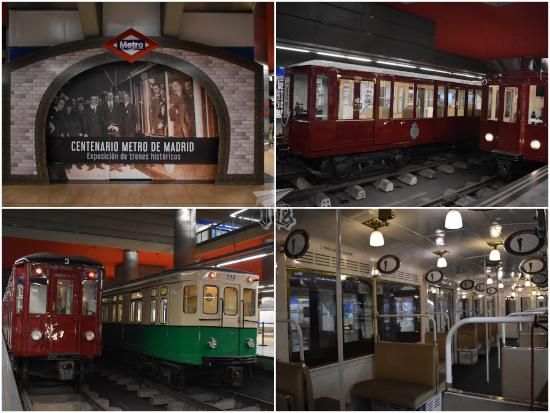
There were three exhibits:

  • Flutter of Butterflies, Born from Hands (2019), a magical wall where you can rest your hands for butterflies to come up.

  • Black Waves: Lost, Immersed and Reborn (2016), an amazing scenery of breaking waves.

  • Enso – Cold Light (2017), a self-tracing enso (perfect circle traced with one stroke in calligraphy).

I was very happy to see this, and then we walked around the “Evolution of phones” exhibition- however, I apparently have not taken pictures of that one. I think it was too nostalgic, because god did it make me feel old (≧▽≦).

Before we returned home, we had lunch at a De María restaurant – an Argentinean meat-grill where we got a glass of rose champagne to go. Another place I want to return! However, this time I did not take pictures because the atmosphere did not feel adequate to do so.

4th September 2018: また今度 with a red rose petal (HYDE LIVE 2018, Strike 3) {Japan, summer 2018}

First thing in the morning, after D****e left for work, I got packed (hoping that my suitcase did not get lost again). Later, I went to Odaiba [お台場] on my own as she was working. It was my last HYDE live for the season, and my last day in Japan, too. It was windy and it rained on and off, but it was not bad especially considering that there was a super typhoon in Osaka that had slammed a ship against a bridge and cut down communications to the airport… I mean, compared to that I won’t even complain that my hairdo went to hell because woah there. I just had to not worry about my own flight a few hours later.

I checked out the Venus Fort to check if there were any new goods, but as there were not, I moved on. There are two exhibit rooms about cars in the area. One deals with newer and racing cars – MegaWeb Toyota City Showcase [メガウェブ トヨタ シティ ショウケース].

A collage with some cool and futuristic-looking car. The logo reads MegaWeb Toyota City Showcase

The other one is quite the opposite, and focuses on classic and historical cars – History Garage [ヒストリーガレージ].

History Garage classic cars.

It was at this time 12:55, so I hurried to the giant Gundam that stands in front of the Diver City. I wanted to check whether it moved at 13:00 and I was lucky. It changed its helmet and all (≧∇≦).

Gundam robot looking up to the sky. it is white and taller than the two-story shopping centre behind it.

After that, I went to eat get some food. The food court in the shopping centre was not too busy as it was a weekday, so I decided to sit down and have some ramen. I really love the way they prepare eggs for ramen, so I wanted ramen with egg. Unfortunately, could not read the super long name of the ramen to save my life, so I just asked for it using the number. The girl just turned to the kitchen and ordered ‘tamago’ (egg), which was pretty frustrating.

Ramen bowl with algae, chasuu (pork), spring onions and noodles

Once I had eaten, I went to see the waves, because even if the typhoon was making its effect known, and I am still fascinated by hot storms. Odaiba is, in the end, an artificial island in the middle of the bay, so it makes strange patterns sometimes.

A cargo harbour with unsettled sea

And I got a drink at Starbucks.

Starbucks plastic cup. It says thank you and it has a smiley face and a heart

I joined the people wait for HYDE to come in, waved hi at him, and thought that he did not look too awake. Afterwards, I decided that I had not spent enough in this trip (sarcasm). Thus, I went to buy something else: since I liked HYDE’s opening act STARSET, I wanted to get their CD and M&G experience, which included a handshake and an autograph. I felt that they had done an awesome job and deserved the credit and the cheering.

Once D****e made it, we went inside. By now, I had figured out what I had found amiss on Saturday and Sunday regarding HYDE’s live 2018 and made peace with it. Or maybe it was just my last day, and I really wanted to enjoy myself. I found a good spot in Zepp Tokyo – one thing I really like about going to converts there is that they keep the barriers up to separate the areas of the floor. That allows me to lean onto something and I don’t need to stay back to have something to hold on to, so I can get rather close even when I’m tired or sore. This time it was even better – since I was closer than usually, I managed to find a petal from one of the roses HYDE threw as goodbye at the end.

STARSET’s setlist:
1. Frequency
2. Carnivore
3. Gravity Of You
4. Telescope
5. Monster feat. HYDE
6. Ricochet
7. Bringing It Down
8. My Demons

HYDE’s setlist:
1. Fake Divine
2. After light
4. Out
5. Set in Stone
6. Don’t hold back
7. Zipang
8. Who’s gonna save us
9. 監獄ロック [Kangoku Rock]
10. Rise or Die
11. Lion
12. Two Face
13. Devil’s side
14. Midnight Celebration II
(pause)
15. Kiss of Death
16. Ahead
17. Rise up
18. Ordinary World (Duran Duran cover)

After HYDE’s concert was over, I put my rose petal away, and I found my way towards the STARSET M&G. They were were extremely nice. We were around ten people, and they paid attention to each of us and they shook our hands (whoops, I forgot to take my wristband off). They were pretty patient and nice to everybody. Even after they left the venue, they were willing to sign items for people who had not purchased their merchandise (even though 3,500 ¥ for CD and signature is almost a gift).

Zepp Tokyo Venue from above

Starset CD with the band's autographs

A red rose petal

Finally we got home and D****e helped me so I got my trains sorted out to go to the airport the following day.

Night view of Tokyo, with Tokyo Tower lit up

2nd September 2018: HYDE LIVE 2018 @ Odaiba, Strike 2, and Pretty Lights, Strike 3 {Japan, summer 2018}

It was raining that morning when D****e and I walked out and headed towards Shin-Okubo [新大久]. The weather actually turned so bad for a while that around halfway, we just walked under a bridge to wait the worst of the downpour out. By the time we arrived at our destination, though, it had cleared out. We were walking to Kaichū Inari Jinja [皆中稲荷神社], also called Minna Ataru no Inari.

Entrance to a Shinto sanctuary through a back alley, and main altar

The shrine is dedicated to the kami [神] Inari [大稲荷], one of the most important deities of the Shinto mythology, the kami of fertility, rice, tea, sake, agriculture, and worldly success. Inari is said to use foxes as messengers. Shrines dedicated to Inari often have a lot of torii gates, usually offered by business in search of that success, and stone fox guardians. The most famous Inari Shrine is Fushimi Inari Taisha in Kyoto.

The legend surrounding Kaichū Inari Jinja tells that after the introduction of firearms in Japan during the Edo Period, a battalion was stationed near the shrine. The captain could not shoot well, no matter how much he trained. The deity Inari appeared to him in a dream, and after he went to the shrine to say thank you, he became a great shooter. Not only him, all of the battalion went to the shrine and they became good shooters. Both “Minna Ataru” and “Kaichū” translate as “hit all the targets” and at the same time “everybody hits”. Kaichū Inari Jinja became “the Inari shrine of everybody hits the target”, Minna Ataru no Inari Jinja. The news spread, and eventually people from the whole country started visiting so their wishes came true. The shrine’s relation with firearms was constant until it was burnt down in WWII.

Nowadays, Japan does not have firearms, but people still want to hit… for concerts! And thus Kaichū Inari has become the fan-shrine, where people go to pray to hit for lotteries for concerts and events!

I’m not even kidding. Kaichū Inari Jinja is also known as “the fan shrine”. In Japan, you do not queue for concerts. Instead, your ticket has a number printed on it, and you enter when it is called. However, there are different series of numbers. The best tickets are offered within the artists’ fanclubs, and if there are more requests than tickets, these are assigned lottery-style. Fanclubs also have lotteries for other privileges such as attending trips and exclusive events, VIP meet&greets or special merchandise – when I belonged to Gackt’s fanclub I hit for fanclub tickets for the Last Visual Live and his birthday dinner. People want to “hit” for these tickets, and somehow Minna Ataru no Inari became the shrine to go to pray for that. Fans go to the shrine to offer a prayer, then they write what they want in volition tablets called ema [絵馬], which are then hung in the shrine premises. Much nicer “hits” that the ones which kill people.
An offering wall with tons of votive wooden tablets

Close up of the votive offerings with names of bands on then

After visiting the shrine, we headed off to Odaiba [お台場] again, to meet with N***chan for lunch. We made a short visit to the Unicorn Gundam beforehand, but it was not moving.

Gundam robot statue. It is white and taller than the two-story shopping centre behind it. People can walk under its legs

Then we went to have lunch at an “Osaka delicatessen” restaurant at the Venus Fort. I ordered Takoyaki (buried in katsuomi (≧∇≦)) and kani koroke (octopus dumplings with bonito flakes, and crab dumplings). Yummy! Apparently other people’s orders were not as great though…

Dish of octopus dumplings that cannot be seen because there are a lot of bonito flakes on top

Afterwards, we headed to Zepp Tokyo for the second concert of HYDE’s Live 2018 concert, again with STARSET. Impressions were similar to the previous day. I really enjoyed STARSET, who played the same songs, and I again had mixed feelings about HYDE’s – not bad but… could have been better. I had not figured out my problem with the disconnected act yet.

Setlist:
1. Fake Divine
2. After light
4. Out
5. Set in Stone
6. Don’t hold back
7. Zipang
8. Who’s gonna save us
9. 監獄ロック [Kangoku Rock]
10. Rise or Die
11. Another Moment
12. Two Face
13. Devil’s side
14. Midnight Celebration II
(pause)
15. Kiss of Death
16. Ahead
17. Rise up
18. Ordinary World (Duran Duran cover)

Hyde's tour truck reading his name

After the concert we had tickets to visit the MORI Building DIGITAL ART MUSEUM EPSON teamLab ★ Borderless. This is a pretty much interactive museum that relies on technology and light to create art – or at least pretty things for you to play with. D****e, N***chan and I were very lucky that it was open late, so we could go after the concert. There were few people there and we could be silly around it. Part of the museum was closed because some TV station was there doing interviews though, and even then it was worth the visit.

Most of what you see in the Digital Art Museum are light projections. You’re encouraged to interact with them, even create some of them that they will project for you. We saw a butterfly and flower area, pink elephants, kangaroo, waves…

I enjoyed a couple of the exhibits particularly – one of them was a light water fall, in a room that had kanji shadows on the walls. If you touched them, they turned into what they represented. I also liked the whales made of light and how peacefully they moved and floated. There were some other interactive exhibits that were very fun, like the… egg-balloons thingies which you could prance through or make float.

Collage of Mori interactive and light art – a walking elephant made of projected lights, it's pink with white flowers. Many rays of white light coming from everywhere in the dark. Waves. Giant purple-pink balloons. Flowers projected on the walls – sunflowers, daisies in different colours

Dancing whale with flowers, projected with light

Afterwards we had some dinner and left for home.

12th August 2018: SSGW (Shinjuku Samurai Godzilla Walk) {Japan, summer 2018}

This Saturday afternoon I headed off to Shinjuku [新宿] again. This time I went to the Samurai Museum in Kabuki-cho [歌舞伎町]. It is located roughly ten minutes away from the station’s Kabuki-cho exit, though I had to do some extra walking because I got a bit disoriented from my metro exit to the actual area. I get lost in Shinjuku station a lot, but I think I’m getting the hang of it.

The Samurai Museum has two floors. As you come in, you have the shop to one side and the counter to the other. I was strongly encouraged to take the English-speaking tour that started in 10 minutes, although I did see people on their own without taking the tour – my impression was that they prefer foreigners in tours, but I went with it.

The museum claims that all its pieces are original. It has two floors, the first one has a few armours, one of them with a bullet dent. The second floor, where you have to take yours shoes off, you have several rooms with memorabilia such as helmets, stirrups, saddles and so. There is also one room for sword exhibitions – which take place once an hour in the afternoons – and the chance for you to try on.

After the museum I grabbed something to eat from a conbini (because I am not known for keeping regular meal times in Japan anyway) and then took a stroll down Shinjuku and Kabuki-cho, ending up at the Peace Memorial.

Afterwards I went to the Toho cinema / Hotel Gracery Shinjuku [ホテルグレイスリー新宿] to see the Godzilla [ゴジラ] head. I have been there a few times, and I always try to go to the balcony to get close to the head. In theory, access is restricted to customers from the hotel or the bar, but I had heard that sometimes they open it in general. I am not sure if this was the case, but this time the terrace was open, there were people outside so I applied the old trick of ‘walking into it as if you belonged’. So I finally got up close with Godzilla! It was about time, too.

(Sidenote: The above Godzilla pic is a composite of two I took with different lightings. I’m quite proud of how it turned up.)

Then I met up with D****e at the Tokyo Metropolitan Government Building, Tōkyō Tochō [東京都庁], to watch sunset (ish. Again. Japan weather in summer).

Afterwards went off for a drink and towards Shibuya to snoop around the Tower Records and the Book Off, only to discover that the latter was gone 。゚(゚´Д`゚)゚。. From Shibuya [渋谷], as the evening was nice, we walked down first to Harajuku and later to Yoyogi [代々木] to catch the underground. We saw the illuminated NTT Docomo Yoyogi Building [NTTドコモ代々木ビル] and I took about a gazillion pictures.

And at some point I guess we had dinner. Probably.

6th & 7th May 2017: Cuenca (Spain)

If I ever go missing, especially with my car, don’t go around looking for me in Cuenca . I would have a nervous breakdown trying to drive through the streets and slopes. I’m not sure what time we arrived, maybe mid-morning. We had a reservation to have lunch at the Parador. However, to get there we had to drive up a horrible, horrible hill with a terrible paving and park too close to the cliff so #no.

Cuenca is considered a World Heritage City. It has a classical, mostly Medieval area, and a normal / standard area surrounding that. The inner cluster is virtually carless as the streets are narrow and steep. It is perched on the Huécar Gorge and as you can see, a vertical rock wall.

We had some time before we had to go for lunch, so the first thing we did was go have a look at the Casas Colgadas, the hanging houses that overlook the Huécar Gorge. Inside there is a contemporary art museum that I visited once already so there was no incentive to look again – you know, the kind of abstract art that showcases a plus-symbol and you’re supposed to interpret.

We had lunch at the Parador de Cuenca. A Parador is a high-end state-owned hotel usually with a good restaurant. More often than not, a Parador is located in a renovated historical building. This one is a former monastery, and the restaurant is located, if I remember correctly, where the original dining room would have been.

Main dishes were forgettable (and not photogenic) but the curd or “cuajada” for dessert was to die for – and it came with a lot of extra goodies.

In order to get to the town centre you have to cross the scary, scary bridge aka the Puente de San Pablo, St Paul’s Bridge, over the gorge, but I survived – without a freak-out (≧▽≦) and you might be aware that I am not a fan of heights.

We had lunch, then moved (over the scary scary bridge) on to see the Museo de las Ciencias de Castilla la Mancha, the Science Museum of Castilla La Mancha – unfortunately the dinosaur area was closed, so we “only” got to see the super steampunk clock and the energy wards, and the tornado simulator, along to some kind of reproduction of the International Space Station.

After the museum we walked a little around the town. We went to the cathedral, Catedral de Santa María y San Julián de Cuenca, but it was closed due to some religious service or another. I mean… that’s its main purpose I guess? (≧▽≦)

Then we found the Torre de Mangana, Mangana Tower, a clock tower dating from the Sixteenth Century. From underneath the tower there is quite an impressive sight of the area surrounding the city.

We went back to the car and we had a drive around the city. Cuenca is located in the middle of a karst area. Karst is a type of landscape formed by the dissolution of soluble rocks e.g. limestone or gypsum. You can see how the rock seems to be “molten” among all the pines.

We reached the Castillo and Murallas (castle and walls) on the other side of town but we had to drive back due to the streets being cut for the same religious event we had run into before.

Thus, on our way back, we drove at the bottom of the Huécar Gorge and headed back to the hotel.

This was about six or seven in the evening, and we did not go out again because we were way outside town. We had dinner in the hotel and called it a day eventually. I ordered the kids’ menu because everything else was too fancy and abundant.

The next morning we woke up early to visit the Ciudad Encantada / Enchanted City. This is another karst topography which has somehow become very famous. Some of the rocks have interesting forms, and have been given names. It is a sort of geological park formed by rain falling on the rocks and dissolving them for millions of years. The original rocks were a mix of of limestone and dolomite in different proportions, which ended up dissolving in different shapes.

After walking around for a couple of hours we went on our return trip.

24th – 27th March 2016: Easter in Barcelona (Spain)

I think this has been the first time I’ve been to Barcelona without a concert. However, one of the first times I did take a long touristing tour, so this time round my friend and I took it rather chilly – in the literal sense. As we were there there was a drop in temperature and I had to run to get myself a long-sleeved T-shirt.

24th March: Gaudí afternoon

Through different means and from different origins, my friend and myself arrived in Barcelona at around the same time mid-afternoon. We met at the station and dropped our things off at the hotel, then we took the underground towards Monte del Carmelo, Carmel Hill, where Parc Güell, the Güell Park, stands. The park, which was supposed to be a urban area originally, was designed by Antonio Gaudí. It became a Unesco World Heritage Site in 1984.

Visiting some areas of the park is charged, but the whole park is accessible starting in the late evening. We decided to climb up first and then visit the paid-but-free area. Thus we got to the summit of Carmel Hill and saw the Turó de les tres creus, the Three-Cross hill, that offers a great view of the city, including the Tibidabo area with the Cathedral and the amusement park.

We went down and we walked into the architectural area. Although there is no artificial lighting in the area, as the sun went down we were treated to a bit of a magical area, also away from the tourist crowds.

We had dinner at Arenas de Barcelona, the old bullfighting ring now turned shopping and dining centre, then we went up to the roof for some night views.

25th March: Gaudí morning & Gaudí night

We woke up and had breakfast – coffee inception!!

Then we headed off to see the Casa Batlló, the Batlló house, one of Gaudí’s Modernist masterpieces. It is also called the “house of bones”, and it’s kind of wobbly and organic. The roof is designed to look like the back of a dragon. An interesting detail is that the building was not really erected on Gaudí’s orders – it was a renovation of a previously-existing building.

After the house, we went to the harbour area. We hung out for a while (with a stop to buy an extra T-shirt because it was cold), had lunch and eventually purchased tickets for the Museu Marítim, the Maritime Museum, located in the former Royal Shipyard.

The sun was setting when we came out, and we headed towards the Basílica de la Sagrada Família, the church of the Holy Family, also designed by Gaudí. Both of us had already seen it, so we were happy to see it from the outside. When they finish it, I would like to come back though.

26th March: No Gaudí!

We had a walk around the Gothic Neighbourhood of Barcelona, and we made a stop at the Iglesia de La Purísima Concepción, the church of the Conception to visit the cloister.

We saw the cathedral Cathedral of the Holy Cross and Saint Eulalia, Catedral de la Santa Creu i Santa Eulàlia.

We also walked under the Bisbe Bridge, Pont del Bisbe, in the street of the same name.

We had lunch in a Japanese restaurant, then walked around the Port area for a while.

As we had visited the Maritime Museum the previous day, we had a free pass to the sailboat Santa Eulàlia.

We ended the day in the L’Aquàrium Barcelona, the local aquarium.

After that, we backtracked to our hotel. The following morning, on the 27th, we met up with another friend who had a free while for breakfast and then everybody went home.

2nd April 2015 (Maundy Thursday): Here Be (rust) Dragons {France, Easter 2015}

We spent the day in Toulouse for several reasons – I had been doing a lot of driving and I did not feel like moving, among them. However, we were not going to stay at home all day, so mid-morning we headed off to one of Toulouse parks, the Jardin Compans Caffarelli, which features some sculptures such as a dragon made out of metal scrapes.

And also, there is an area landscaped as a Japanese garden, the Jardin Japonais.

Then we took the tram and went to the The Aeroscopia museum because my friend was interested in planes, and we got to see a bunch of aircraft both modern and classical designs.

15th August 2014: And then there was shiny {Japan, summer 2014}

I like Ueno Kōen [上野公園], the main park in Ueno [上野] just because I do, and off I went again, maybe for the fourth or sixth time. In Ueno station we had awesome ramen at a franchise called Ichiran where you buy a basic ramen card from a machine, and are then given a card (English version was available) to mark off what you’d like on it and how. It was delicious (The bits that are missing on the picture are pork slices and spiciness level). There are different styles of ramen, and this one is Hakata ramen from the Fukuoka Prefecture.

After that we took a stroll down Ueno and ended up at the Tōkyō Kokuritsu Hakubutsukan [東京国立博物館], Tokyo National Museum, which holds many important pieces of historic art:

Leaving Ueno, I headed towards the Minato [港] ward as there were a few things I wanted to do. One of them was visiting a special corner of Shiba Koen [芝公園], and then I wanted to go to Tokyo Tower [東京タワー].

Within Tokyo Tower I visited Tokyo Tower Suizokukan [東京タワー水族館], the little aquarium at the bottom. It did not host sharks, sadly, but quite a few interesting species, among them catfish, one of them seemed very intent on trying to eat me.

There was also this fun sclupture thingy of scaled Tokyo Tower and Godzilla.

I climbed up the main observatory (well, did not climb, took the elevator) to watch the sunset, grab a bite to eat and take lots of pictures. You should appreciate Mount Fuji Fuji-san [富士山] with its summer cap in one of them. Once the sun is down, Tokyo Tower is lit, inside, and out.

I love Tokyo Tower, and going up to the observatory always makes my Tokyo trips feel more complete! I got myself an omamori and a model I have to build, if I eventually find it in the luggage chaos!

28th June 2013: Odaiba {Japan, summer 2013}

Odaiba [お台場] is big and quite empty actually, which can give off a bit of an eerie feeling after bee-hive-like Tokyo. It however has beach (as in duh, it is an island, albeit an artificial one) and some awesome sights, found after Google Maps trolled me sending me on a scenic route ¬.¬

Rainbow bridge over Tokyo bay. It is white, not rainbowy at all

After the Marine Science Museum seemed to be 90% closed, I headed off to the Miraikan [日本科学未来館] (National Museum of Emerging Science and Innovation), which was unfortunately a bit disappointing. Works well for the regular peer (and awesome for kids) but when you are a bit knowledgeable in science, it comes… short. Lots of English, though, so that was at least good.

A massive amount of screens bundled together in a sphere. They show the earth with clouds and atmospheric currents moving around it

This is what I liked the most about the exhibition, a little corner on abyssal ocean info, including a bit of a hydrothermal vent and some colourless abyssal crabs:

An irregular rock that happens to be a bit of hydrothermal vent

A white crab in the dark

I headed to the Diver City Mall for VAMPS 2013 Live concert which was to be held in the the Zepp Diver City later in the evening. I queued for about an hour to buy some goods, and when that was done, I walked around. The shopping centre has an 1:1 Gundam reproduction near its main entrance, which I did not know about:

Zepp Diver City logo

Gundam robot, almost as tall as the two-story building behind it. It's mostly white, with red, blue, and yellow chest

The concert was really fun, as VAMPS concerts tend to be. There were rocky-fast songs and some ballads, even some nostalgic ones from the time Hyde was working solo. I enjoyed second half best, but all in all it was a good, fun concert, even if a painful one, as my right hip did not approve of the day’s effort. After the concert we went off the long way home, which involved several train changes drenched in sweat. Ew XD.

17th July 2012: The Sword and the Vampire {Japan, summer 2012}

After a failed shopping trip to Shibuya [渋谷] and Ikebukuro [池袋] looking for an adaptor for D****e’s WiMax who fell victim of the Sakaki clumsiness, on the 17th I visited the Japan Sword Museum / Tōken hakubutsukan [刀剣博物館], where they’ve got the tightest security ever. Pictures were not allowed and there was a security guy checking on you and a bunch of cameras following your every move. Impossible to sneak them ^^”

Notice with the name of the The Japanese Sword Museum

Afterwards I took a rest in preparation of what was to come in the evening. Since I was feeling kind of down I decided to head off to Shibuya’s Book Off for a self-spoiling or twenty before going to pick up D****e at her workplace with a change of clothes.

We took the Yurikamome Line to Odaiba [お台場] and the Zepp Tokyo where we were attending VAMPS live concert “Beast at the Beach”. It was a very cool thing to go over the Rainbow Bridge [レインボーブリッジ], another of CLAMP Tokyo landmarks.

Rainbow bridge, which is white, extending over Tokyo Bay

The inside of Rainbow Bridge from the front of the train that crosses it

VAMPS’ vocalist, Hyde, is one of my favourite Japanese singers, and I went to see him with his “main” band in London back in April. Thus, this was the second time for me seeing Hyde in half a year, which is fun because not long ago I thought I’d never manage to see him XD

Although VAMPS is Hyde’s second(ary) band, but that does not mean he is any less energetic or enthusiastic about it. The music is fast and catchy, and Hyde had a blast during the lives. That man was born to be on stage, I swear. However – he is too short! Really, people, give him a higher spotlight! We want to see him!

We really patted his ego last night, and there were some very funny moments when he messed up his emcee. He climbed up onto the second floor for a few minutes and slammed his guitar there, having one hell of a blast. I was surprised that K.A.Z., the other main, barely got any attention at all, which is strange considering that he is good at what he does and rather easy on the eyes. The light effects were awesome, starting by the clock projected on the curtains waiting to signal the kick off at 6:66 pm (19h 06mins) to which there was countdown, of course. Sound quality was much better than any of the European concerts I’ve attended. Hyde had a blast, I did too and all was good with the world. Oh, and we toasted to Frank’s happy birthday with… water XD Expensive water though!!

Entrance to the venue from above. Lots of people are waiting, a lot of them with pink shirts

It was all in all a very fun concert, with powerful songs balanced with well-placed ballads that made the mix work really well. The only downside was my aching feet, and a big-headed girl in front of me XD.

Vamps Tshirt and concert booklet showing their logo, an open mouth with pointy upper fangs

A bottle with a lanyard to hang it around your neck

Afterwards there was purikura and very sore feet and a couple of cramps, but it was so. Damn. Worth. It. And I didn’t feel nearly as sore as after the LARUKU con in London.

Now, where the hell is Hyde’s lamb, people?

4th July 2012: Multitasking Day {Japan, summer 2012}

4th of July is the USA’s Independence Day, and Gackt’s brithday and Akanishi Jin’s birthday and Massu’s birthday, so I renamed it multitasking day.

The day started with getting on the public transport and into the Yamanote Line towards Ueno Kōen [上野公園], Ueno Park, obviously in the Ueno [上野] area. In case anyone has missed this, I am a big CLAMP fan, and the Tokyo Babylon / X arch has a very important plot device in Ueno Park – it is the place where the Sakurazukamori can be found.

The Sakurazukamori is a cursed sakura (cherry) tree which grows on the human blood the Sakurazuka mystic assassin clan feeds them, the blood of their victims. Unfortunately, I was unable to locate the Sakurazukamori, but I was creepily amused to notice how many crows there were in the area. However with that many people around, I think Seishirou would have trouble hiding his kills in there XD I was wandering around for about an hour and a half.

A path in the middle of a park. Bright green trees close over it

Thus started my torii obsesion, looking at the entrance of Hanazono Inari Jinja [花園稲荷神社]. Torii [鳥居] are symbolic gates that separate holy grounds in Shinto – they are made out of stone or wood, in this case they tend to be painted bright orange or vermillion. They usually have two columns and two horizontal boards on top, the upper one is a bit curved upwards, and there is a plaque showing the name of the shrine. They sometimes have some writing on the back of the columns.

The entrance of a shrine, with a row of torii heading down some stairs

There are a lot of Museums in Ueno Park, and I chose the Tōkyō Kokuritsu Hakubutsukan [東京国立博物館], Tokyo National Museum, for a visit when the heat became too much. Yesterday it was supposed to thunderstorm, so I decided to go walk the park first and go to the Museum if / when it rained. In the end I went into the Museum when it did not rain XD. It was a tadbit too hot to wander around…

The Tokyo National Museum of Art is focused on Japanese culture and art (there’s a Western Museum of Art not that far away, also in Ueno) and the Tokyo Metropolitan Museum of Art in the next corner.

The entrance of the National Museum of Art, a light grey building with a brick roof

I am not going to bluff and tell you how I appreciated the sliding doors art of the china art. I did, but let me be honest. The katana collections are the ones that made me flail:

A katana

After I was done with the Museum I needed to hunt down some food. I had two options, stay in Ueno and give a try to the Metropolitan or go somewhere else. In the end I decided to head off to the station, get food there and get into the Yamanote line [山手線] again until Hamamatsuchō [浜松町] where I sat on a park to eat my onigiri and get some rest. After that, I visited the San’en-zan Zōjō-ji [三縁山増上寺] Chief Temple of Jodo-Buddhist, which kind of was in my way.

A vermillion Buddhist temple which you need to access going up the stairs. A few people come and go

A wooden Buddhist temple building

Very, very pretty. But the actual reason I was in the area was the metallic structure you can guess to the right in the first picture. This is the area where Tokyo Tower [東京タワー]. Insert a huge fangirl squeal here. Aloud. just after coming out the station, when the tower was barely visible against the sky. Of course, however, I could not stay away XD.

As I mentioned before, there was supposed to be bad weather, so originally I did not have plans to climb it up yesterday but… I did anyway because there was good weather. I had decided to only go up to the main observatory (150 m high), but in the end I found myself asking for the special observatory combo ticket, which lets you go to the special observatory 250 m high (total height of tower is 333 m).

A view of Tokyo Tower from the ground. It is not a good picture, a bit burnt, but it shows the whole tower from afar

Tokyo Tower - a picture from the base upwards

Lots of CLAMP manga have important stuff happening in Tokyo Tower: in Tokyo Babylon, Subaru banishes a restless spirit, in X Kamui and Fuuma fight there as it is one of the Tokyo kekkai, in Clamp Gakuen Noboru wants to celebrate his birthday party there and in Magic Knight Rayearth, the three main characters meet there. Though let me tell you, I don’t know how three classrooms fit in here so they see each other when Emmeraude calls upon them:

A view of the observatory of Tokyo Tower

Yes, I took pictures inside the observatory, I took pictures from the view too, of course. Note Tokyo Bay and Rainbow Bridge, another of the kekkai.

Tokyo buildings from above, with a huge park in the foreground

Tokyo highrises

Tokyo Bay inlet and buildings around it

I even looked down

A glass floor shows the view of the streets below and Tokyo Tower structure underneath.

The day ended with a quick visit to Ebisu [ヱビス] Place (where MatsuJun gets stood up in Hana Yori Dango), a quick once-over Shibuya, katsukare for dinner and then falling kinda dead.

A square. A covered gallery is int he background

I made friends with a Shiba Inu who wanted petting and totally pwned jet lag. I also was misled into trying a horribly ocha (tea) drink that Tackey promoted on TV, which was… horrid. Lesson learnt. We don’t trust Tackey on drinks…

A bottle of tea soda