11th October 2024: Istanbul Airport {Türkiye, October 2024}

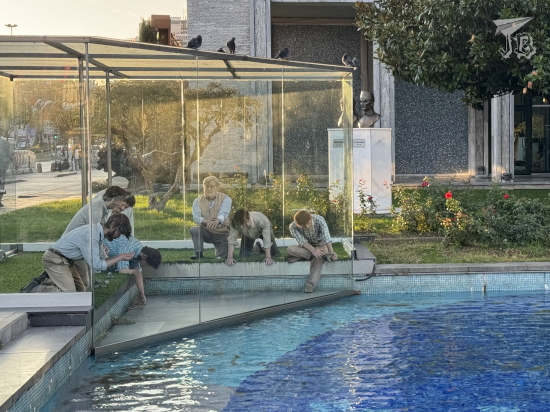
Since I had woken up early the previous day, I had also woken up early today, and I was caffeinated and ready about one hour before pick-up time. Considering that they were picking me up at 8:30 for a 13:45 flight, I decided to go for a walk in Istanbul | İstanbul before I got stuck at the airport. The Aqueduct of Valens was close to my hotel, and to get there I had to walk in front of the building of the Istanbul Metropolitan Municipality T.C. İstanbul Büyükşehir Belediyesi Başkanlığı. In the town hall yard there is a fountain with a glass case and several figures inside, reaching for the water. It is the July 15 Sarachane Monument Saraçhane 15 Temmuz Anıtı, which recreates a picture taken on the 15th of July 2016 during a coup attempt. It is supposed to represent a group of civilians Muslim men performing ritual ablution before facing off the rebel military forces at the call of President Erdogan. I was not sure if taking pictures of it was a security risk, but there were no guards around…

July 15 Sarachane Monument

I continued on towards Bozdoğan Kemeri (Aqueduct of the Grey Falcon), the part of the Aqueduct of Valens Valens Su Kemeri that can be driven and walked underneath. I stepped through the arches, and then turned towards Sarachane Park Saraçhane Parkı, which was empty except for a few cats and hooded crows (Corvus cornix) which expected me too feed them…

Aqueduct of Valens

cats and crows from istanbul

I went back to the hotel, gathered my things and came down to reception – both my driver and I were there at the same time, around 8:20. I guess we managed to avoid all traffic jams, because we reached the airport about 9:30. Upon entering the terminal, there was a first security control which X-rayed all the luggage, then I could access the check-in counters. I had done my check in online, but I printed my boarding pass in the kiosks anyway, and dropped off my luggage. The employee at check-in, holding my passport and boarding pass in her hand, asked me if I had a boarding pass. Obviously, she was not having the best of days, either.

I then went to passport control to clear immigration, which took about half an hour, and then the standard airport security check, which was fast because I found a “no need to take your electronics out” queue. Everything was extremely expensive in the airport. I did buy a bottle of water, but the prices put me off an ice cream, so I munched on some crisps that I had not eaten for dinner the previous night and I had packed exactly for this.

Truth is that Istanbul airport has a museum, but entrance was 13 € (note, not Turkish lira – 13 €). And at that point I decided that I was done feeling like a cash cow and introducing euro into the economy. I spent my remaining lira in the duty free shop, and found a copy of The Little Prince in Turkish for my and my parent’s collection.

We boarded around 13:00, and the process was not as efficient as the way in, but it was easy. We got lunch on the plane – happy to report I have finally internalised that pasta on planes tends to have peppers in the sauce and that upsets my stomach, too. I watched a movie and a half, and spent the rest of the time with one I had watched before as I would not have time to finish it.

Landing was smooth, but it took 61 minutes exactly from touchdown to getting out of the arrivals lounge, what with waiting for the luggage and so. And that was the end of the trip.

Maybe the bad project I mentioned at the beginning of the report was cursed, and thus the circuit was doomed, but it has been honestly one of the most disappointing trips I’ve taken – rushed, with bad information, and horrible customer service. I complained to my travel agent, who was horrified. It has really, really put me off anything organised for a while, and left me with a bad taste in my mouth. Of course, there have been good times, and awesome places, so it was not a complete disaster. Just not what I wanted, or what I thought I was buying when I chose it.

Would I come back to make up for it? I don’t know. As I was writing, I did wish I could go back to Cappadocia and Pamukkale to satisfy the geology nerd in me. Istanbul was not a city that made me feel particularly welcome, so I could skip that. Maybe in 20 years or so, if Türkiye is still a somewhat laic place, I might consider it. But the world is big, and there are many other places to explore… And the Turkish guide kept complaining that “all the good stuff was taken to Germany” so… that might be an option.

26th November 2023: A Bunker and a Greenhouse (Madrid, Spain)

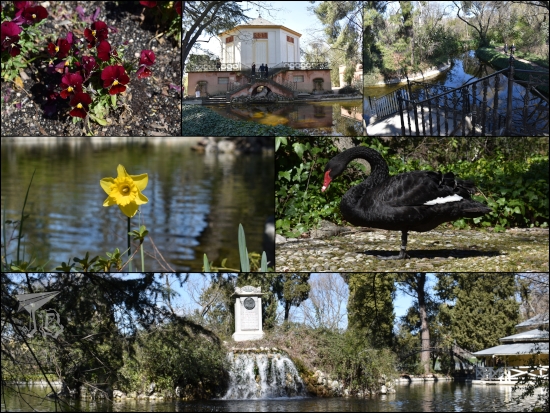
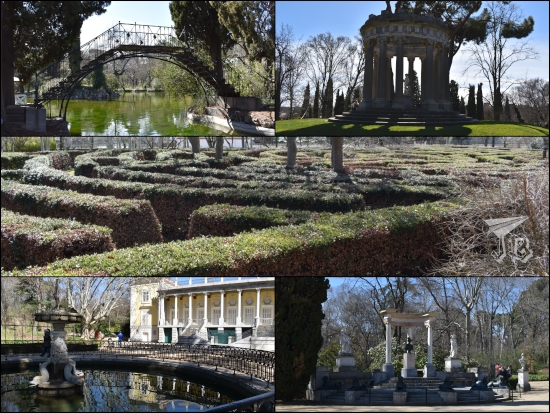
I have been to the park Parque del Capricho in Madrid before, and I was not really impressed. As it is considered a “hidden gem” in town, I expected something… I don’t know… more grand? It has different “attractions” such as a bee hive, a casino, ponds, fountains, statues… quite into the Romantic spirit of the times it was built, but I really did not connect with its design. I have to admit though that when I first visited I did not register the locked-down door with the word “bunker” surrounded by a brick structure next to the palace. It turns out, there is a Civil War bomb refuge 15 metres underneath the grass (I did see a machine gun spot in the grounds of the nearby castle, which was actually installed there to protect the military position). The refuge is a place you can only visit through the town hall’s Pasea Madrid program, as it is usually closed to the public.

The park was built as a recreational garden between 1787 and 1839 at the whim of the 12th Duchess (and Countess) of Osuna, who placed a summer house Palacio de los Duques de Osuna, in the centre of it. It became wildly popular among the high classes at the time – just like walking around cemeteries had become popular in France and England. However, at the turn of the 20th century the park had dwindled in fame. It changed hands, and after the 1929 crash it became all but abandoned. With the advent of the Spanish Civil War, the palace became an orphanage first, and it was later confiscated by the Republican government to be used as military operation centre. General José Miaja was in charge of defending Republican Madrid from the military coupists and moved the emergency command centre from downtown to the so-called Posición Jaca in the outskirts. The park was chosen because it is close to the airport, and it was easy to deploy defence batteries. Some of the most important battles in central Spain were “supervised” from there.

The day started dark and gloomy, so I picked up a thick coat – the webpage also noted that the temperature in the refuge is around 15 ºC. Public transport was just not feasible – round trip would have been about four hours by train – so I took the 40-minute drive and parked in the main avenue, a few minutes away from the park entrance. I had calculated a wide berth of time because I was not sure how easy it would be to park, but I apparently got there before the family weekend-makers. I was early for the 11:00 tour, so I just hung out the park for a little. By the time I walked in, the weather was nice and sunny.

One of the buildings in the park is a miniature farming house that today has an equally-tiny orchard with cabbages, cauliflowers and… a pumpkin patch. I swear, I had never seen a pumpkin patch before, not one so… colourful. I walked around for a little, then waited for the guide to arrive.

Pumpkin patch in El Capricho

The Civil War bunker or refuge Búnker del Capricho was built next to the palace where the command was set, excavated into and down the small hill. It was designed to withstand bombings, and protect its occupants from chemical attacks – people were rightfully freaked out as World War I had yielded to the development of chemical weapons. Building the refuge was commissioned to miners-turned-soldiers, who were able to finish it within the first few months of 1937. In case of an attack, the palace would be evacuated from the doors and windows, the personnel would go down into the refuge and close and lock the doors. Once operational, the refuge could host 200 people for up to two of weeks.

The bunker is dug between 14 and 16 metres into the ground. The walls could withstand most bombs designed at the time, with some of them being over two metres thick. The thirty-metre gallery could be sealed with submarine-like doors – designed by marine engineers – and keep out any toxic gas. There is a ventilation system and different wards on the sides, one of them identifiable as an operating theatre, another as a shower room. The floors are tiled, with different patterns for different rooms – the theory is that the patterns would allow anyone to know where they were even in low visibility conditions. The gallery is tiled too, but in white, and it has round ceilings, also painted white – also in theory, this is to counteract the claustrophobia from being underground; this idea was also applied when the first underground stations were built in Madrid.

Upon entering the bunker, there are two flights of stairs at a ninety-degree angle to each other. Then, there is another right-angle turn to enter the actual refuge. There are two metal doors that could be hermetically shut, now peeled-off and rusty, but which really look like ship or submarine safety doors. This design minimises shock waves and blocks any gas that could be used against the Republican Command. The structure is bigger and wider than I thought it would be.

Underground refuge in el Capricho Park

I guess it is part of the Spanish history, so good enough to see once and then move on – know about history not to repeat it, but do not dwell in it. Which is what I did. Once the guided visit was over, I wandered the park for a little. I found the park miniature fortress, the lake with its black swans, and the small casino. I was hoping for some nice autumn colours like I saw a couple of weeks before in Retiro Park, but there was not much on that front. I however did come across a few bees hard at work.

Black swan feeding

Honey bee on purple flower

I left the El Capricho and went across the avenue to walk into the neighbouring, bigger park Parque Juan Carlos I. I wanted to see the so-called Estufa Fría – just a fancy name to call a greenhouse. The greenhouse did have some pretty autumn colours in the Japanese garden, as the small maples (Acer palmatum) had started turning gold and red. The structure hosts palm trees, ferns, a small “bamboo grove” and an autochthonous forest that was composed of mostly evergreen plants and ivy. I had no idea that the Estufa Fría even existed until a few days before, so I guess I’ll need to keep it on my radar for future springtime visits – I want to see the blooming cherry trees in that park anyway.

Estufa fría or cold greenhouse in Juan Carlos I park

It was not much of an outing, barely a few hours, and I was home for a late lunch. I did not want to stay out long, as that evening I had tickets for the opera.

12th November 2023: Trains and Parks (Madrid, Spain)

I had booked a visit for 15:30 using Madrid’s program to divulge the Heritage of the city Pasea Madrid (“Walk Madrid”), and I had planned a great day around it. Unfortunately, such plan had me on the best train to get to the demonstrations happening there at noon and therefore it would most likely be “delayed due to uncontrollable circumstances” or worse. Thus, I needed a new plan. Since there was a yellow weather-alert in effect across the parks in the area I wanted to be , I just drew a general list of places I could check out and decided to keep it flexible.

The day did not start off as I had imagined it. I slacked off a bit in the morning and by the time I was ready to leave, it was too too late to catch the original train of the second plan. There was part of me which was really not in it, and I considered just cancelling the visit and staying home. Then again – I reasoned with myself – the visit was sold out every other day, I had been lucky to secure a spot. I did not know whether I would be lucky enough to be free when the next batch of tickets were released, nor if the dates were convenient – if they ever opened again, or as the webpage said, it was a “special occasion” (honestly, I think that they just say it is to hype up the reservations). Thus I set off to catch the next train, still in good time for plan B as it was flexible and I could just kick one stop off if necessary.

Once in Madrid, I headed off to the Railway Museum Museo del Ferrocarril, technically closed that day due to the monthly flea market Mercado de Motores. It turns out that the ground floor of the museum is still open, which allows you to have a look at the main train collection (actual historical trains) and take some cool pictures. For once, I was not the only one with the camera, but one among a bunch – to the point that a few of us ended up queueing for a similar picture at some point.

The Railway Museum is located in what remains of the former terminus of Delicias, which opened in 1880. Designed by French engineer Émile Cachelièvre, it had three distinctive areas – the passenger building, the loading docks, and the customs building. The last train left the station on the 30th July 1969, at 22:15, headed for Badajoz. In 1984, the Railway Museum opened in the passenger building, which kept the former platforms.

Fleamarket at the Railway Museum

I am not sure how crowded the museum is during normal days, but for the market, it was packed. I had secured a free entry reservation, just in case. The main building hosts a number of actual trains which serviced passengers and cargo throughout Spanish history – real locomotives and cars on the tracks they used to travel. Before Covid, one of the cars was used as cafeteria, and another as an Orient-Express-inspired restaurant, neither of which are in active now. Though the side rooms of the ground floor and the upper floors were closed due to the market, I got to see the trains from the outside and admire the building structure.

Railway Museum Madrid

In the outer part of the museum, I found the food court and the former tracks which disappear into the nearby park. To the side stands the miniature train complex Ferrocarril de Las Delicias a layout of tiny trains – a 265-metre long, 127-millimetre wide track, to be exact – where you can travel on equally-scaled trains, with classical tickets and all. My original idea had been riding it, but I found a great spot for photographs and decided not to queue through all the toddlers and their parents. I thought that since I wanted to go back to the museum to see all the rooms, I could do that on a day when the tiny trains were running.

Miniature trains in Delicias

I left the station-turned-museum and walked towards the so-called Pantheon of Spain Panteón de España, a burial site for remarkable Spanish politicians, noblemen and military personalities – formerly known as the “Illustrious Men”. Before mobile phones with a camera were a thing, my school took my class to the crypt, but nowadays only the upper area and the gardens can be visited. The original plan, designed by Fernando Arbós y Tremanti in the Neobyzantine style, comprised a basilica with a bell tower and a cloister. The project began in 1891, but only the tower – now part of a school – and the cloister had been built when construction stopped in 1899 due to astronomical costs. In the cloister, there are funerary monuments to a number of important Spaniards who were exhumed and reburied there, such as Mateo Sagasta, Antonio de los Ríos y Rosas, Anonio Cánovas del Castillo or José Canalejas. Eight tombs and a central monument can be visited in the cloister and the central garden. The entrance is decorated with golden mosaics, and the interior is white calcite and grey slate, with domed rooftops. The central garden had flowering winter roses and a view of the abandoned bell tower.

Pantheon of Spain

I headed out towards Madrid’s main park Parque del Retiro, part of which had been restricted until noon due to predicted strong winds. The weather, however, was fantastic, even warm, which felt weird for such autumn-coloured day – it made the yellow alert issued a little strange. The park was gold, red and orange everywhere, a stark contrast with the green grass and bushes. I reached the crystal palace Palacio de Cristal, which looked extremely cool with the fall tones, though it was packed.

Retiro park in autumn

El Retiro crystal palace

I took a turn towards an area that I had not visited before inside the park. In the 18th century, when the now-public park was the monarch’s garden, the royal gardeners kept complaining that flowers bloomed where they had not planted them, and blamed a magical force living in the park. The Spanish word used is duende, which is a nature creature somewhere in-between a fairy, a spirit and a gnome. The sculpture Duende del Retiro was created by José Noja in 1985 to honour the legend. The duende plays a flute while sitting on a stone hut, which used to be a cage for the bears of the former zoo Casa de Fieras del Retiro, now turned into the garden Jardines de Herrero Palacios. I’m glad no animals live there any more, except some geese and ducks that can fly – or waddle – away any time they want, but considering how much they get fed by passers-by, I doubt they care about doing so.

Duende of Retiro Park

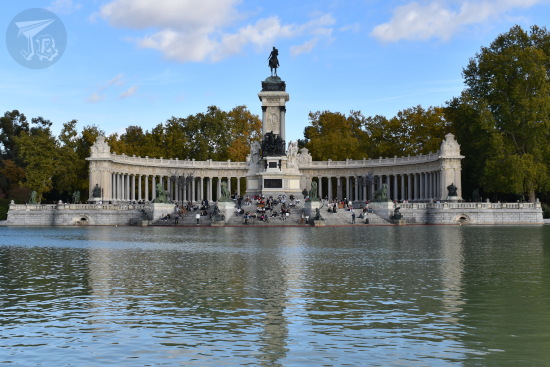
I finally made my way towards the central pond of the park Estanque Grande and the monument to King Alfonso XII Monumento a Alfonso XII, my 15:30 visit. The monument is composed by a colonnade, two lion-gates, four mermaids sitting on different marine animals, and a triumphal column with a sculpture of the king riding a horse on top. The complex measures 30 metres high, 86 metres long and 58 metres wide. The colonnade is public access, and I would not have booked a guided visit for it. However, what made the visit special is that we were granted access to inside the column to climb to the lookout that lies within the top pedestal where the horse stands (97 steps, thankfully on newish metal ones).

Alfonso XII became king of Spain in 1874. He grew up in exile in France until his mother, Queen Isabel II abdicated when he was 17 years old. He reigned for almost eleven years. His first wife, reportedly his one-and-only love, died within a few months of marriage. He married again, and had three children with his second wife, Queen María Cristina, two more with his opera singer lover. He was charismatic and the Spanish loved him, he was called “the bringer of peace”. He died while María Cristina was still pregnant with his son, king-to-be Alfonso XIII, and she became Regent. It would eventually be Alfonso XIII who inaugurated the monument to his father.

The monument was designed by architect José Grases Riera and involved as many as 20 sculptors. Probably the most important one was Mariano Benlliure, who made the horse and the king in bronze – the horse is about seven metres long, and the whole sculpture from the horse’s hooves to the King’s hat, about eight metres high. Grases Riera placed his project on the existing pier of the pond, in order not to cut down any tree from the park, as a pier could always be rebuilt somewhere else. The monument was funded by the public, so it alternates cheaper stone and more expensive bronze, according to how much money there was at nay given moment. The colonnade features shields from the different Spanish regions at the time, and the main column has scenes from the King’s life and allegories to Peace, Industriousness, the Arts… Completion took 20 years from the call for projects in 1902 to the monument inauguration in 1922.

Monument to Alfonso XII across the Great Pond

The lookout is encased in the pedestal where the horse stands. It has windows made of glass to allow a 360-degree view of the park, and I swear I had never even realised it was there. The stairs were not steep and there were cool views from the lookout, especially with the autumn colours, and the sun starting to set. The guide was good – just again impressed by the camera – and explained to us everything that could be seen from there. A relative, however, took the same visit a few days later and, when we compared notes, the information we had been told was rather… different.

Monument to King Alfonso XII - horse and king close up, plus views from the viewpoint

The whole visit took an hour, with 15 minutes at the lookout, and we were out by 16:30. It took me a bit over 25 minutes to reach the station, but the train was late – it was actually at the platform when I got there even if it should have left ten minutes beforehand. I hopped in, and I spent the ride organising the photos on the phone. I am glad I did not cancel the visit and went on with it. I shall remember that for the upcoming one.

7th November 2023: A Jurassic amount of Lego (Madrid, Spain)

The fact that I like dinosaurs would come to no one’s surprise by now. To be honest, the older I turn, the more I think of them in the mind frame of the xkcd comic “Grownups”. Dinosaurs are silly fun, and it’s not like I’ve got a few million dollars lying around to buy a whole T-Rex skeleton anyway. What I do have is a silly knack to find things to do that are related to them – selective perception, if you wish. On this occasion, I heard that Madrid would be hosting the European Premiere of Jurassic World Exhibition by Brickman.

It is widely known that Jurassic Park and Jurassic World are part of a widely successful franchise. However, what or who is Brickman? In order to answer that question, we need to find out what a LEGO Certified Professional is: a person whose business model is working with LEGO blocks, making stuff for publicity, for example, and they are so good at it that they actually become LEGO-affiliates. The Brickman is a team of people who are led by Australian LPC Ryan ‘The Brickman’ McNaught – basically, they get paid to play with LEGO all day, and are commissioned things to build (which I think is awesome, in case you had any doubt). The Brickman Team have under their collective belt six exhibitions touring the world, and some of the largest and more detailed LEGO models ever built.

I came across the Jurassic World LEGO exhibition by pure chance, but once I knew about it, I worked on timing. The exhibition kicked off on the 30th of September and it will be there until the 14th of January – and it turned out that Tuesdays are cheaper. I bought a ticket for the opening timeslot at 11:00, and planned my day. I had to go to Madrid’s IFEMA Espacio 5.1, where I had already seen The Dino World Expo. It took 25 minutes to drive there and 35 to find a parking spot at the end of the world, then walk to the venue. Only when I was right by IFEMA, I saw that the paid parking lot was open – it is usually not when I am at IFEMA. Since it was a schoolday, I hoped to see the exhibition without many people – and kids – around so I could have fun with pictures.

As the name hints, the whole exhibition is based around LEGO-built Jurassic World items and scenes. Most of the rooms have brick buckets for you to put together whatever you want, freely or with instructions / missions. I did not build anything, but I had a lot of fun, once I managed to get in. When I arrived at 11:05, the ticket reader was not working, but the person at the door let people in anyway. He even offered to take your picture with the doors to Isla Nublar, which are already made from LEGO and actually really open. They recreate the gates shown in the first Jurassic Park films, but they read “Jurassic World” instead. Once inside, I asked a staff member if they had any stamps for the LEGO passport, and she had absolutely no clue what I was talking about – I think she thought I was weird, but oh well. The first room has “smaller” exhibits in comparison with others. There is a working monorail, a few aircraft and a life-sized 3D map of the island. It was weird to hear the Spanish dub from the films when a lot of the screens were still in English.

Jurassic World by Brickman entrance

The second room has a DNA strand and an amber collection site, and a shelf with lots of “hybrid” creatures. Some of them were cool, others just made me giggle – you were encouraged to build your own hybrid. The third room was “baby dinosaurs” under a huge brachiosaurus (171,150 bricks; apparently is one of the largest models in the world). There were some hatching eggs, too. In this room there were bigger LEGO bricks for the youngest kids to play and build stuff with.

Jurassic World by Brickman - LEGO baby dinosaurs

Then came a sort of control room – where visitors can track the escaped dinosaurs while some flying reptiles lurk from the ceiling, somehow recreating the alert in the first Jurassic World instalment. After that, there is a set up of the JW velociraptors, Blue and Delta having escaped and Echo and Charlie still in their pens. I had seen a LEGO Blue before, for the Jurassic World: Fallen Kingdom promotion in the Natural History Museum in London, but this one was much cooler, and scaled 1:1 to the film – 58,227 bricks.

Jurassic World by Brickman - LEGO Velociraptors

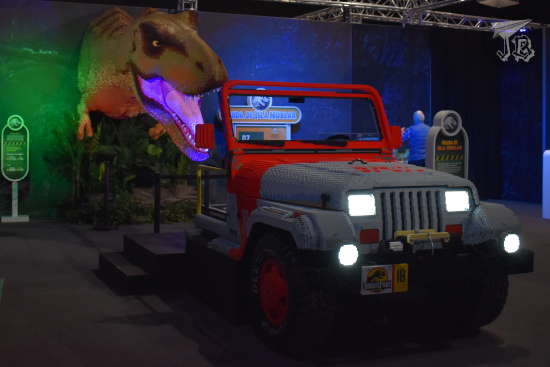
Despite all the promotion and toys she gets, Blue is probably not the fan-favourite dinosaur from the films. She is not mine for sure – that would be Rexy, the T-Rex. And after a mural of the mosasaur (number two on my list) hunting down a great white shark, Rexy finally comes into view, in one of her most glorious scenes from the original Jurassic Park: chasing the Jeep after Dr Sattler and Muldoon have just rescued Ian Malcolm. The Jeep was built using 227,098 bricks (which makes it even more complex than the brachiosaurus), and Rexy 128,763. One thing I noticed was that they had changed the jeep’s number, from 10 to 18, I’m guessing there is some inside joke there. They even recreated her reflection on the rear-view mirrors, which was pretty neat.

Jurassic World by Brickman - LEGO jeep being chased by the T-rex

The exhibit was fun for the discounted price, but the shop was crazy expensive. When I finished, I walked back to the parking spot. I had to walk through part of the park Parque Juan Carlos I. In the middle of the so-called Southern Pond Estanque Sur there is a hideous sculpture made of wrought iron, which is called “Walk between two trees” Paseo entre dos árboles by sculptor Jorge Castillo . As I was staring at it trying to figure out what it meant (and even after reading up on the symbolism, I don’t get it), I approached the edge of the water. A flock of mallard ducks swam over to see if I had any food, and I noticed something that was neither a duck nor a goose – a great cormorant (Phalacrocorax carbo). I had never seen cormorants in Madrid before. Seagulls, yes, but not cormorants, and I actually saw three of them.

Juan Carlos I Park, Southern Pond

I headed off for lunch at La Vaguada, a shopping centre not far away from IFEMA, though the Sat-Nav went weird and I took forever. I actually had a couple of things to do in that area, not least of all drop by the LEGO Store La Vaguada to actually get a small stamp – or three – for the rally. I mean, I had already been to the exhibition, I was going to be there, I had taken the LEGO passport just in case…

La Vaguada LEGO shop

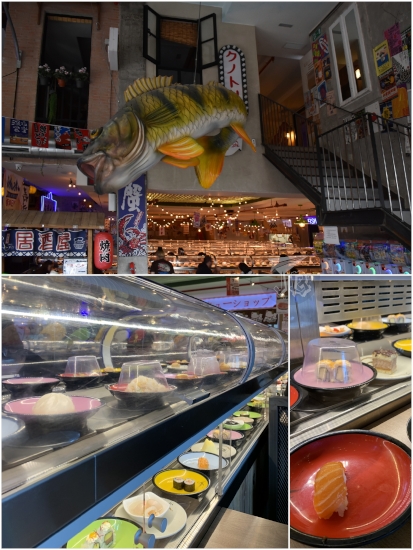
Serious things taken care of, I looked for the restaurant Running Sushi In Market, a call-back to a kaizensushi – small-plates of sushi on a conveyor belt – in an all-you-can-eat business model part of a franchise. It is more of an “Asian” place than a sushi restaurant and you have a range of recipes, from actual sushi to baos, skewers, noodles, dumplings, sausages… You are given a table for one hour to eat as much as you want, and pay a fixed rate plus drinks. It was not bad at all, though for the cheap price, tuna was too much to ask for. The decoration is extremely kitsch, but they had absolutely no problem giving me a five-people table for myself, and I stayed about 25 minutes, plus some pictures. But I forgot to sign up for the loyalty program…

Running Sushi In Market restaurant

The shopping centre has a ticketless parking lot that you can use for free for two hours, and when you are going to pay you just have to type your licence plate. I was there for 1 hour and 58 minutes in the end, so I did not have to pay anything, which was great. Then, unfortunately, I ran into a huge traffic jam, as it was get-out-of-work time, and there had been an accident on the motorway. Even though, I made it home before tea-time. However, I did not eat anything else that day. I might have overdone it with the last small dish of lichee fruit…

10th June 2023: La Alberca & Plasencia {WNW Spain, with a splash of Portugal, June 2023}

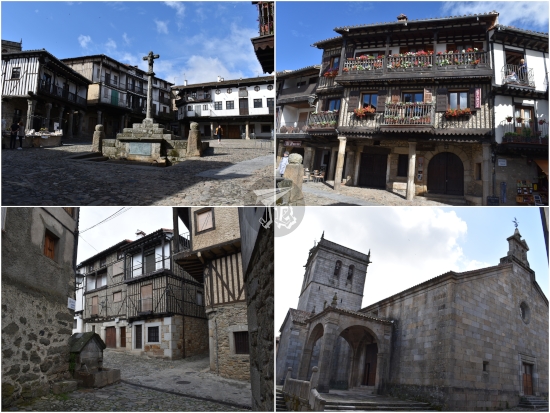
We left off the castle to have breakfast at the village of La Alberca, a municipality known for two things. The first one is the timber framing of its houses. The buildings have a stony ground floor and a lime-white second floor with the post-and-beam style in dark wood.

La Alberca

The second one is the tradition of the whole village raising a piglet together. The swine is freed mid-June (we missed it by a couple of days) and everybody in the village keeps track of it – feeding and sheltering the animal – until it is auctioned for charity when the time for slaughter draws near, in January. There is a sculpture as homage to the animal in the middle of the church square, yielding to what I’d say is the most iconic sight. However, the amount of butcher and delicatessen shops makes the whole thing a little… weird.

Monument La Alberca pig

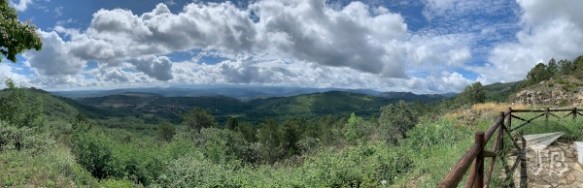
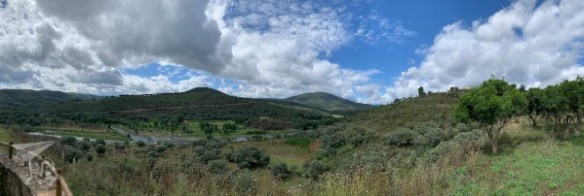
We drove through the natural area of Sierra de Francia, and stopped over at the viewpoint Mirador del Madroñal. From there we could see the abundant vegetation – oaks, chestnuts, and vine-fields. A bit further, we reached a second viewpoint Mirador Las Juntas.

Viewpoint Mirador del Madroño

Viewpoint Mirador de las Juntas

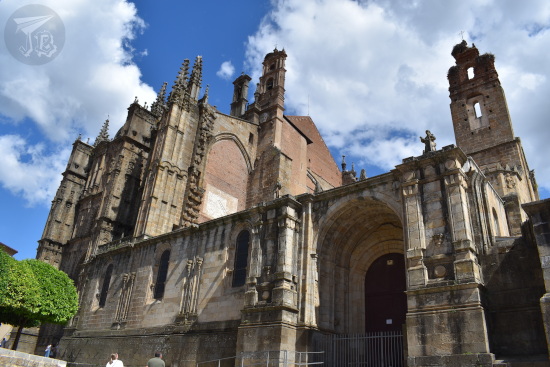
Our road was closed, so we had to take a detour, but we eventually reached Plasencia with a lot of big plans. Unfortunately, when we arrived at the Parador de Plasencia, built in the former convent Convento de Santo Domingo, we learnt that the town was in the middle of the local festival. Such thing meant outdoor bars and music – almost rave-like, and most monuments being closed. It had never even crossed our minds that we might run into such a thing, and it was a bit of a bummer that not even the cathedral Catedral de Plasencia was open.

Former convent turned Parador in Plasencia

Cathedral in Plasencia

We walked around for a while, and eventually we found the walls and their mini-museum Centro de Interpretación de la Ciudad Medieval de Plasencia. They reminded me of the wall in Ávila, but in a much-smaller scale.

Buildings in Plasencia

Wall in Plasencia

Plasencia

Plasencia is also a bird-protection area and nestling zone of the lesser kestrel (Falco naumanni), so that is what I guess we got to see (but it could totally have been an eagle…). We had lunch and dinner at the Parador as it was the least busy place, and they took forever both times. We did not feel like going out to check out the town in the evening considering how busy everything was even in the afternoon. Probably it was the first full-blown post-COVID festival, but it was a tad disappointing for me.

Krestel

8th June 2023: Tordesillas & Zamora {WNW Spain, with a splash of Portugal, June 2023}

Tordesillas used to be one of the Spanish Crown’s strongholds throughout the Middle Ages, starting around 1340 when Alfonso XI ordered the construction of a palace. In 1494, the Spanish and Portuguese monarchs signed a Treaty which divided the lands “discovered” by Columbus among them – of course, this Treaty was largely ignored by any other European powers which wanted to explore America, and never acknowledged by any indigenous people. In 1519, the town was part of the rebellion against Carlos I, naming his mother – and daughter of the Catholic Monarchs – Juana as queen, despite the rumours that she was insane. After the defeat of the revolts – and beheading of the instigators – the town lost importance.

We left early in the morning to try and ditch the traffic, but we were not successful – driving around Madrid, we ran into a couple of jams traffic caused only in part by the intermittent storms, which made the beginning of the road trip stressful. Thankfully, we parked at the outskirts of Tordesillas and the sun was shining again, as we had to cross the village on foot. Our first stopover was the Main Square Plaza Mayor. In the Castilian Main Square fashion, it is actually square in shape, with the main buildings supported by columns, where cafés and shops stand today. The current plaza dates back from the 16th century, and has been painted in a questionable bright mustard colour.

Main Square in Tordesillas

In the end, most of the history in Tordesillas is linked to Alfonso XI’s palace, known today as the Convent of Saint Clare Convento de Santa Clara, which stands a few minutes’ walk from the square. It was home, and later prison, to royal women, both loved and unwanted ones. It became a convent of the Order of Saint Clare in 1363, and the nuns living there were tasked with praying for the health and salvation of the Royal Family. Today, it is managed by the Spanish National Heritage Foundation Patrimonio Nacional. It can only be visited under supervision – seriously, aside from the guide, you get a security guard following you around – and photography is forbidden in all the interior areas.

The castle-convent was built throughout the 13th to 18th centuries. The oldest part of the building is a chapel dating from the 11th century, and the bulk of the construction was carried out in the 14th century. The monarchs employed Mudejar builders, a fact that yielded to multifoil arches, ceramic decorations, and Quran verses (officially “decorative nonsense”) in some of the chapels and the façade of the building.

Inside the palace there is a Baroque cloister and the gothic church, with a wooden ceiling painted gold and the emblem dragons of Carlos I’s shield. Truth be told, the church had been pretty much hyped up on me, so I found it a bit underwhelming.

Santa Clara convenent in Tordesillas

The party separated for a bit so I could explore on my own for a while. I got to the stone bridge over the River Douro Río Duero, just called “the bridge” el Puente, right at whose ends stands a monument to the fighting bull Toro de Tordesillas. The associated bullfighting festivity was one of the oldest in Spain until it was vetoed by the regional government – the fighting bull was set loose in the meadow, chased by horsemen and lanced to death. Today, the festivity is controversial and it’s trying to find its place in the midst of new sensitivities.

Tordesillas

I climbed up the medieval wall Muralla de Tordesillas to the park where the monument to Queen Juana Monumento a la Reina Juana I de Castilla stands, in front of the museum dedicated to the Treaty Casas del Tratado, and the church Iglesia de San Antolín.

Monuments in Tordesillas

We walked back to the car to drive off to the next spot in the route, and Tordesillas became the first spot where we spotted birds of prey during this trip, maybe a golden eagle Aquila chresaetos. Or, you know. Anything else.

Eagle

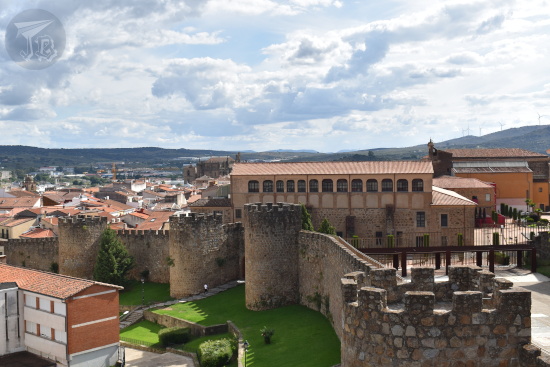
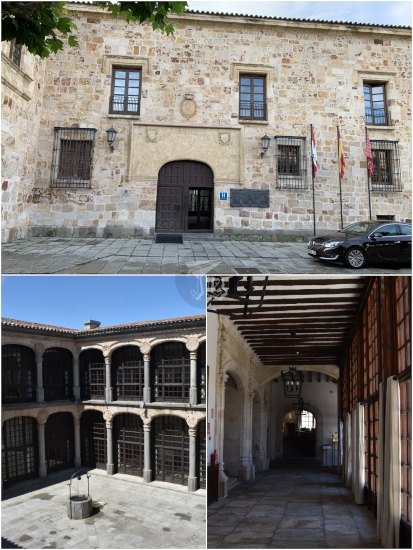
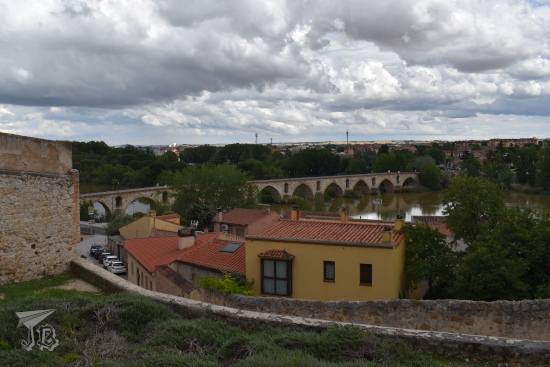
We drove off towards the municipality of Zamora, a Medieval town and villa by the Douro, known for its Romanesque churches. We reached the Parador de Zamora in the middle of a horrible downpour that was over as quickly as it had started. The Parador hotel is a former noble family’s Renaissance palace, with a military style and a middle patio with a glass-window gallery

Parador in Zamora

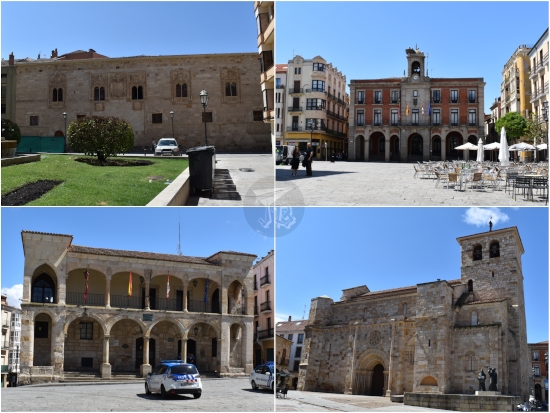
We had a late lunch and walked to the manor Palacio de los Momos, near the Main Square Plaza Mayor, home to a church Iglesia de San Juan de Puerta Nueva which has a sculpture representing two figures of the local Holy Week celebrations Monumento al Merlú. Other buildings include the old and new town halls Ayuntamiento Viejo and Nueva Casa Consistorial, and blocks of colonnaded buildings.

Buildings in Zamora

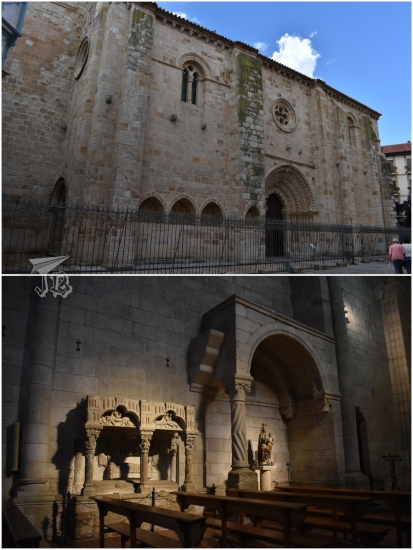
The first Romanesque building we came across was the church Iglesia de Santa María Magdalena, which contrary to many other places has got rid of the Baroque add-ons, and stands severe and naked in its stony glory. It is considered one of the most important and pure Romanesque constructions in Europe, sparsely decorated save for the tomb to the side.

Church of Saint Mary

From a side stop I overlooked the river Río Duero and the medieval bridge Puente de Piedra.

Zamora Medieval Bridge

We continued off to the cathedral Catedral del Salvador de Zamora. It is considered the first cathedral in the “Douro Romanesque” style. After the original cathedral was destroyed during the Muslim conquest of Spain, the reconstruction began around 1151. It must have been finished towards the beginning of the 13th century. The building has two particularities – the thick tower, and the umbrella dome, in a style that travelled from Byzantium to the Islamic architecture and reached Spain with the Nasrid artists. The inside holds a cloister and two small museum – one of religious art and the other of archaeology.

Zamora Cathedral

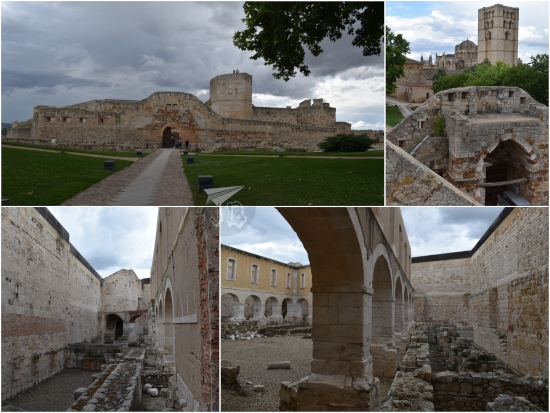
Afterwards, we visited the ruined castle Castillo de Zamora – a purely-defensive Romanesque fortress built around the 11th century. The castle has a moat, and you can wander up the walls and defensive towers. The interior is ruined, but the ancient structure can be guessed by the arches and different walls that would have separated the fortress’ halls.

Castle in Zamora

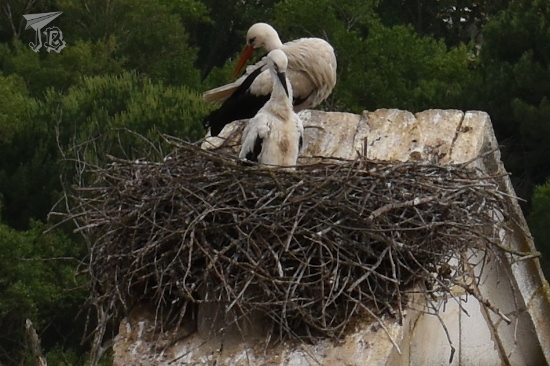
Finally, we explored a few more religious Romanesque buildings: Iglesia de San Pedro y San Ildefonso, Convento de Clarisas El Tránsito and Iglesia de San Cipriano. From the viewpoint next to this last church, we got to see a stork nest with a baby chick in it.

Zamora churches

Stork nest

We had dinner at a restaurant called El Horno, a traditional places that offers tablas – wooden trays full of treats to share. We shared a serving of tabla de fiambres – Iberian sausages (ham, loin, chorizo…) and cheese on a bed of crisps.

Zamora at night

22nd and 23rd April 2023: A date with a dinosaur (London, England, Great Britain)

Since I cannot keep my mouth shut, I offered to organise a trip to London with some people from work. Despite prices skyrocketing everywhere and my ridiculously hectic schedule, I managed to secure a weekend when flying would not be stupidly expensive, and an activity I would really be looking forward to – the Natural History Museum was running couple of things I was very interested in. One was an exhibition on a gigantic dinosaur: Titanosaur: Life as the biggest dinosaur. Well, twist my arm – NHM is much closer than the actual Titanosaur home in Argentina. Furthermore, there was a collaboration with Jurassic Park (‘an adventure 63,000,030 years in the making’ is the motto), and coming back to the museum would give me the chance to purchase the rock I wanted the last time I was over and did not get because I was heading out to Stonehenge on the same day.

In the end, only one person took up the offer, and I figured out that well, London is pretty much always a good idea for a weekend – so I figured I’d arrange myself a date with a dinosaur. Unfortunately, it turned that London Marathon was held that weekend. Hotel prices were bloated for the night and we ended up at Earl’s Court because I wanted to stay close to South Kensington and the other person wanted the cheapest place possible. We left on a red-eye flight to London Stansted which took a long time to land – we spent about an hour circling the airport, and eventually the head cabin attendant said that there was bad visibility at the airport, and that the pilot required all electronic devices to be turned off so he could use the autolanding system. I did not like that one bit – after I visited Santiago de Compostela in 2022, I felt that I had got over the bad-visitiblity near-miss when I was a teen. Apparently not, the feeling of uneasiness is still there. We landed over an hour late, but we were on our way on the first Stansted Express a few minutes after getting on it. After reaching Liverpool Street Station at around 9:30, I asked my companion to take us to Guildhall as part of the incentive of the trip was introducing them to international travel. It was not a good idea. Their phone trolled us and tried to take us to Guildhall… in Stratford upon Avon. The Costa at the station was closed, but at least I had got myself a sandwich and a latte before we started walking.

After backtracking, we were in known territory around 10:15. As it turns out, my companion was only interested in “walking the city” and shot down any activities I had proposed – thus, some things I just imposed in order not to feel that I had wasted the whole day away. By 11:00, I had confirmed that our travelling styles were not compatible. After some time at the docks next to the Tower of London, I wanted to enter the Anglican church All Hallows by the Tower. All Hallows is the oldest church in the City of London – founded in 675 CE, it predates the nearby Tower of London. The parish used to take care of a lot of the prisoners executed there. The building withstood the Great Fire of London (1666), but it was severely damaged through The Blitz – the German WWII bombing campaign against the UK throughout 1940 and 1941. The church was rebuilt and reconsecrated in 1975. Its windows are decorated with symbols from the different London guilds and some families.

Collage of a church. The outer building is brick and it has a tower crowned with a greenish metal spire. The inside has huge windows decorated with guild symbols. The small crypt inside is covered in white stone.

Underneath, there are a few chapels and a small Crypt. Most of the crypt is a museum which chiefly holds artefacts from the Roman period – including remains of an old road. There are other historical items from the Saxon and Medieval times, and the 20th century Crow’s Nest of the vessel Quest, in which Sir Ernest Shackleton sailed for Antarctica for the third time, and where he died.

When we were done, we went to Saint Dunstan in the East Church Garden. I was hoping to use this as a relaxing point for a few minutes, but there was work being done on the parterres. We continued towards the River Thames for some views of Tower Bridge, the museum HMS Belfast and The Shard skyscraper.

We walked by the Monument to the Fire of London on our way to the Sky Garden. The Great Fire burnt inside the Roman city wall for four days after breaking out a bakery after midnight on the 2nd of September, 1666. Though the number of victims is (theoretically) small, the fire destroyed over 13,000 houses (15% of the city’s housing), almost a hundred parish churches, governmental buildings, St Paul’s cathedral, and even some of the city gates.

Afterwards, we walked over to Leadenhall Market, a covered shopping street which can be traced back to a 1321 food market, and marks the centre of Roman Londinium (ruins from the Forum and Basilica are buried underneath). It was given to the city in the 15th century, and in the 19th century, the City Architect Sir Horace Jones designed an iron-and-glass arcade. Today, it holds restaurants, wine bars, varied shops and even beauty parlours.

A covered shopping gallery or street, in dark red and beige tones.

Around the market stands a mixture of modern buildings and traditional buildings, mostly small churches. Among the former:

  • The Lloyd’s Building (25 Gresham Street), sometimes called the “Inside-Out building”. It was finished in 1986 and it is consider a great example of Bowellism – an architectural style that maximises inside space by building ducts, lifts, and other structural necessities on the outside. It was designed by Richard Rogers & Partners, and it still maintains the original entrance of the building that stood in its place in 1928 – the East India House.
  • The Leadenhall Building (122 Leadenhall Street), designed by the Rogers Stirk Harbour + Partners. It opened in 2014.
  • The Willis Towers Watson (WTW), designed by Norman Foster, it was finished in 2008.
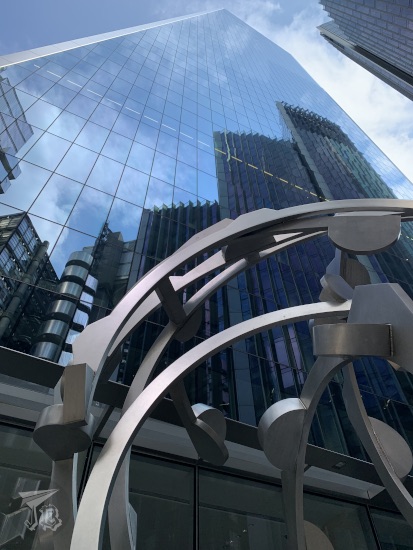
  • The Scalpel (52-54 Lime Street), which yields to cool reflections along with the WTW, and has a strange sculpture at the entrance – it made me think of several ship wheels fused together. The building was designed by Kohn Pedersen Fox and only completed in 2018.
  • And of course The Gherkin (30 St Mary Axe). It was designed by Foster + Partners and it is the first ecological building ever built in London. It opened in 2004.

The historical buildings we encountered (having survived both the Great Fire of London and the Blitz) include:

  • Saint Andrew Undershaft Church. It dates back from 1147, although it has been rebuilt several times. The current building was erected in 1532.
  • Saint Helen’s Bishopsgate Church, where Shakespeare himself used to worship in the 1590s. The building can be traced back to the mid 12th century, and it was restored during the Victorian period and later during the 20th century.

Skyscrapers reflected on the glass that covers yet another huge skyscraper

A small church built in Stone in the background with a huge modern high-rise building behind it

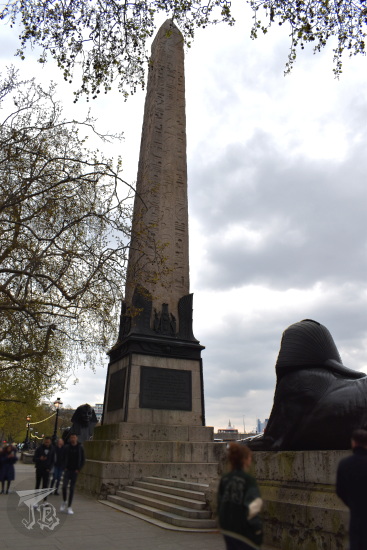
Afterwards, we headed towards Embankment on the Tube. There, I was happy to find a Costa Coffee and get my vanilla latte fix. In the area, we saw the Victoria Embankment Gardens and I wanted to visit Cleopatra’s Needle – half of a pair of obelisks (the other one is in New York), originally made and carved in Heliopolis, what is Cairo today. It has inscriptions from the 18th and 19th Egyptian dynasties (around 1450 BCE). It was presented to the United Kingdom by Sultan Muhammad Ali in 1819, and later transported to London in 1877. Two sphinxes and other decorations were added when the Needle was erected, and the plinth under one of the sphinxes was damaged during London Bombings – it was never restored as a tribute to memory.

An Egyptian obelisk standing against a cloudy background

We walked over to the Westminster area to see the Palace of Westminster and Elizabeth Tower. There was an environmental protest there, which made it packed, but at the same time diverted traffic, allowing for new views from the middle of the street. On the way, I encountered an adorable pit bull mix I got permission to pet – coffee and dog pets made everything better.

A view of the palace of Westminster, with the Elizabeth tower on the left

We continued off to Saint James’s Park, home to squirrels, geese, swans, pigeons, mallard ducks, robins… all of them extremely used to people and tourists, and rather unconcerned by dogs being walked. We ditched the marathon fencing and reached Buckingham Palace, but by then my companion was beat. Thus, we had to go to the hotel so they could get some rest. The hotel was better than expected for a London 2*. It was nice and warm, although the bathroom was tiny – it was difficult to stand inside and close the door.

Buckingham Palace and some of the animals at Saint James' parks

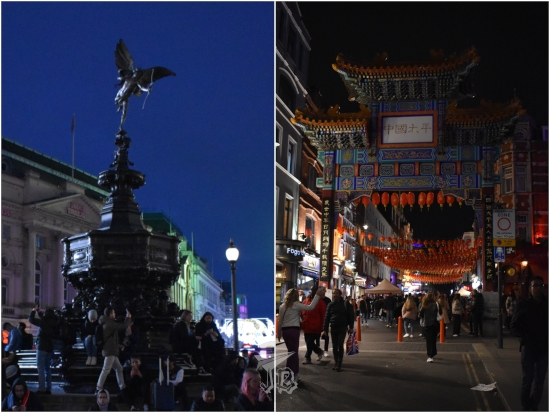
A couple of hours later, we were off into the evening to see Piccadilly Circus, the entrance to Chinatown, and Leicester Square. Companion was beaten, so they were not sure they would be up for anything the following day – we arranged to touch base at 9:00 for them to evaluate. Once in my room, I had a shower and booked a free time slot for the British Museum the following day, just to avoid the queues. I thought, even if we did not make it, at least we had assured entry if we did, and I could always cancel and release the ticket.

Central London at night - Picadilly Circus' Eros and entrance to Chinatown

The next morning, I left on my own around 8:00 to look for a nearby Costa Coffee for a large vanilla latte breakfast, and I came across Brompton Cemetery. This had not been on my radar, but since I had time, I decided to explore it a little. Brompton Cemetery, formerly West of London and Westminster Cemetery, opened in 1840, and it has belonged to the British Crown since 1852. It is on of the oldest garden cemeteries in Britain and comprises around 35,000 monuments. I wandered for about half an hour before I had to head back.

Brompton cemetery, a 19th century graveyard and garden

We managed to get to to the Natural History Museum on time for my date with a dinosaur just after opening. I had my Titanosaur ticket at 10:15, and left off my companion to wander on their own after agreeing to check with each other around noon. The exhibition Titanosaur: Life as the Biggest Dinosaur brings a cast of Patagotitan mayorum to Europe for the first time, along with a few real fossil bones, of a front leg, some teeth, and an egg.

Patagotitan mayorum is one of the largest known animals to have ever lived. It was a sauropod dinosaur – a tetrapod with extremely long neck and tail. It lived in forest regions during the Late Cretaceous (102 to 95 million years ago) grazing on ferns and tree leaves. The species was discovered in Argentina in 2010, and it’s calculated that it could have been up to 31 metres long and weigh over 50 tonnes. It is widely considered the most complete of the South American dinosaurs. The cast that the Natural History museum brought is considered the holotype, and it was reconstructed from the partial skeletons of six specimens.

Titanosaur skeleton. People walking around don't even reach its knees.

The best thing about the exhibit was being able to actually touch the cast, so I kinda hugged my date, I guess. As far as I know, there are only three casts of titanosaur – the one in Argentina (Museo Paleontológico Egidio Feruglio in Trelew), one in the US (Field Museum, Chicago), named Máximo, and this one.

After I had pranced around the exhibition to my heart’s content, and as it filled up with kids, I moved on to reason number two of this visit having to happen asap in 2023. To celebrate 30 (thirty!) years of the 1993 release of Jurassic Park, the Natural History Museum was running a limited-time-only collaboration pop-up shop – the Jurassic Park 30th Anniversary #NHMxJURASSIC store in which I did not even spend that much! I bought a replica badge and a commemorative coin, both limited, numbered editions. The shop had both Jurassic Park and Jurassic World merchandise, especially toys and T-shirts, and a few props, including a life-size sculpture of Blue the velociraptor.

Jurassic Park pop-up shop, with Blue the velociraptor just hanging out

I then headed to the official museum shop to get myself the rock I had wanted – a piece of aura silicon carbide, a shiny mostly-artificial mineral. I also bought a souvenir guide, just because. They did not have anything from the Titanosaur exhibit there, so I backtracked to the exhibition shop to buy a pin.

Whenever I got to the Natural History Museum, I end up in the dinosaur gallery (well, there was that one time I walked through the whole thing throughout a winter day). This time, however, I decided to wander the upper area of the historical building. I was drawn to the Treasures in the Cadogan gallery. I had not been there since it opened in 2013, and my mind was blown. The collection includes a first edition of Darwin’s On the Origin of Species, and some of the pigeon specimens that he used to develop the theory of evolution. I also got to see the first-ever-found iguanodon teeth (not the replicas), the first fossil ever found of the Archaeopteryx (the link between dinosaurs and birds), and a skeleton and egg of the great auk, the first confirmed victim of anthropogenic extinction (due to human activity). I was very impressed, these were all treasures indeed – no overselling.

Treasures at the Natural History Museum - ancient bird fossil, extinct penguin-like bird, a book, dinosaur teeth. Whale skeleton.

After wandering the second floor for a bit, I ran into my companion and at noon we left towards the British Museum, where I had booked entry for 12:40. I left them to their own devices again and headed off to the Japanese galleries, which had been closed the last couple of times I was in the museum. I was… a bit on the disappointed side, I remembered them being way more impressive from my early 2000s visits.

Japanese Galleries at the British Museum: Samurai Armour, lion dogs pair, articulated metal animals, a standing Buddha.

I visited the Moai, the Elgin Marbles, the Babylonian bulls and the Rosetta Stone, and I headed off to the shop to get myself a treat – retail therapy is a thing. Eventually, we left the museum and managed to get to Liverpool Street to take the Stansted Express to the airport. Security was smooth, not as crammed as other times, and then, as tradition calls, I got myself some sushi at Itsu.

When we boarded the plane, I had been assigned an emergency exit seat. In order to sit there, you need to be able to take responsibility about opening the exit if something happens. I flagged a flight attendant to inform them that I would be physically unable to do so. I had a new seat in 4.5 seconds, and it turned out to be a window seat. We took off a few minutes late, and landed with a delay of almost a quarter of an hour. Nevertheless, after passport control and all, I managed to reached the parking lot payment machines with a few seconds to spare the overstaying fee – all good!

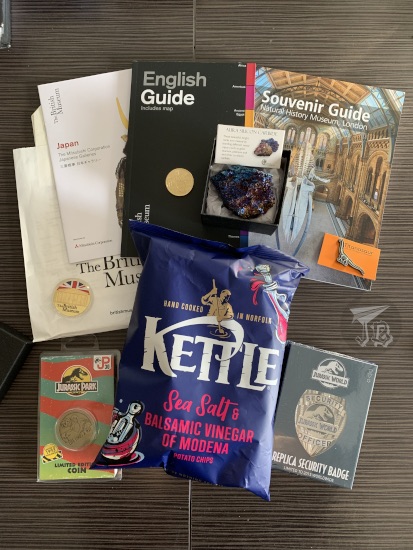
Balance – The marathon barely interfered with the weekend. I had a date with a dinosaur and hugged them. That was awesome. I got limited edition Jurassic Park and Jurassic World merchandise. I found some Kettle Sea Salt and Balsamic Vinegar of Modena crisps at one of the supermarkets. I got two new books, commemorative coins and a shiny rock. I also discovered new places to explore in the future, and had Costa – twice. Unfortunately, we ran out of time for extra visits on Sunday – so I could not fit in either the HMS Belfast or the Jack the Ripper Museum. Furthermore, the Grant Museum of Zoology is closed for renovation, and the Petrie Museum of Egyptian Archaeology does not open on Sundays, so in the end I was not really able to scratch much off my list. Whoops!

Souvenirs from London: books, crisps, commemorative coins and Jurassic Park merch

12th & 13th February 2023. The Epic Apocalypse Tour in Madrid (Spain)

The year 2020 was going to be so amazing that I actually would have had to choose the things I wanted to do and sacrifice others. It didn’t turn out that great in the end, with lots of rescheduling and cancellations. I was eventually able to budget time and money for one of those rescheduled events – the joint concert by the metal bands Epica and Apocalyptica in their Epic Apocalypse Tour. For a while, however, there was a bit of uncertainty with dates, as they bounced between Sunday 12th and Monday 13th of February, so I needed to juggle work dates in order to make sure I’d be free on Monday. In the end, I was all clear, all the concert-related activities were set for Sunday evening, and I decided to make a two-day trip out of it – I needed to take a hotel for Sunday anyway.

I arrived in Madrid around 9:30 in the morning. I had some time before my first appointment so I walked into one of the large parks of the city Parque del Buen Retiro, which is part of the Unesco World Heritage Site Paisaje de la Luz (Light Landscape), officially called Paseo del Prado y el Buen Retiro, paisaje de las artes y las ciencias, declared in 2021.

Parque del Buen Retiro was built in the 17th century for one of Felipe IV’s palaces, and it was opened in the late 18th century as public park. The park was almost destroyed during the war against Napoleon’s troops in the early 19th century, so most of it has been rebuilt. Aside from the obvious flora, it features sculptures, fountains, buildings… It is home to a lot of birds, and unfortunately a large number of invasive and fearless monk parakeets (Myiopsitta monachus), whose culling has been controversial in recent years. I got to see common blackbirds (Turdus merula), a European green woodpecker (Picus viridis) and a European robin (Erithacus rubecula).

One of the most important features of the park is the sculpture Monumento al Ángel Caído, which represents an angel falling from grace. It was originally designed by Ricardo Bellber, who made it in plaster in 1877. It was later cast in bronze and the original plaster destroyed, and eventually the sculpture was made into a part of a fountain in 1885. Around the area, there is also an ancient water mill, and to my surprise, the almond trees (Prunus amygdalus) had started blossoming.

Retiro Park collage: a pathway with trees and bushes on both sides, ducks, and a robin.

Retiro Park collage: a water mill, blossoming almond trees, and the fallen angel fountain

At 10:15 I had a guided visit to the Real Observatorio de Madrid (ROM), commissioned around 1785 by Carlos III, as an centre to develop and study astronomy, geodesy, geophysics and cartography. The main building is the astronomical observatory, built by Juan de Villanueva in what then was the outskirts of the city. Today, ROM belongs to the National Geographical Institute (IGN), and it is home to the National Astronomical Observatory, the Central Geophysics Observatory, and the data gathering division of the National Volcanic Service, though no measurements are taken there. The main astronomy measurements are carried out in the Centro Astronómico de Yebes, in a town around 80 km north-west of Madrid. The observatory is also part of the Unesco World Heritage Site.

The visit comprises three stops. The first one is the main building, called Edificio Villanueva, which has three rooms – the main rotunda with a Foucault pendulum, the library, with the spot where gravity was first measured in Spain, and the “Time room”, where the sun used to be traced to determine the hour.

ROM collage. A small Neoclassical building, an inner room with a pendulum and telescopes, a telescope and a 19th century library.

The second stop is the Great Telescope, a replica of one that William Herschel built in the 18th century – Hershchel was one of the greatest telescope makers of the time, and is credited with discovering the planet Uranus, two of its moons, and two moons of Saturn. The telescope was destroyed during the war against the French, but later rebuilt thanks to the number of laminates that had been preserved – the original had a focal distance of 7.6 m and a 61-cm diameter mirror (which is displayed in the main building), and Herschel himself considered it the best he ever built.

Herschel grand telescope: a wooden scaffolding structure keeping a huge black tube pointing at the stas

The final stop, the little museum of “Earth and Universe Sciences” has a small collection of ancient instruments used for astronomy, navigation, and geophysics. There are also a couple of seismographs – one of them new, which is up and running – and material retrieved from the volcanic eruptions of El Hierro in 2011 and La Palma in 2021.
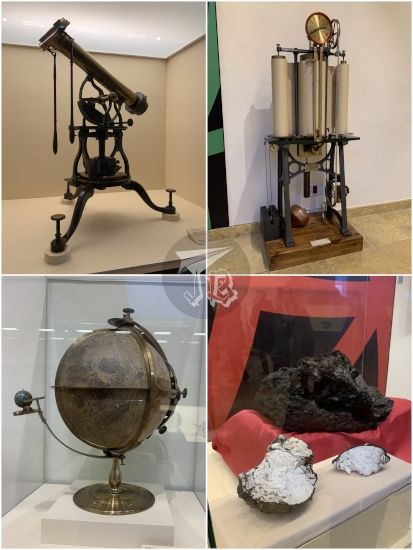
Collage. Ancient telescope, old tide measuring device, an old globe, and lava bombs

I had planned for a typical sandwich at an iconic bar afterwards, but I ran into a political demonstration. Thus, I scratched that idea and took the underground westwards. When I was in Egypt, one of the places I visited was Lake Nasser, created by the Aswan High dam. The lake swallowed a lot of villages and monuments, but a few of them, such as Abu Simbel and the Temple of Philae were saved by Unesco. Between 1960 and 1980, a total of 24 monuments were saved, and five out of these were presented as “grants-in-return” to five countries which had offered exceptional technical and financial assistance to the campaign – Germany, Italy, Netherlands, the United States and Spain, the latter being impressive as Spain was in the middle of the dictatorship, and pretty shunned by the international community at the time.

The monument was a small and ruined temple in the now-flooded town of Debod, to which it owns its name Templo de Debod (Temple of Debod). Dedicated to the god Amun, it was built around the location of the First Cataract of the Nile, some 15 km south of Aswan, about 2200 years ago, though the core of the building may have been older. The monument was actually affected by the original dam at the beginning of the 20th century, and it was covered in water for most of the year, which destroyed its colours and damaged the reliefs.

During the Unesco salvage mission, it was dismantled, and eventually granted and taken to Spain, and “freely” reconstructed – a lot of information had been lost, and there were missing blocks. National stone was used to fill in the gaps, and the gates (remains of the pylons) were built in the wrong order, according to some old pictures. The restorers built an air-conditioning system, a wooden roof, and the main hall was closed off with a glass door and window panes. Today, the temple is open to the public at weekends, but unprotected from the Spanish weather – rather different from the Egyptian one – and pollution, it is rapidly deteriorating.

I went inside the temple once when I was a child, and I had a clear memory of it that kept surfacing when I was in Egypt – so I wanted to go back. The entry is free, but capacity is reduced, so I had to queue for almost an hour to enter. I finally matched my memory to reality. The interior of the sanctuary has a small chapel and some carved stones had been taken to a makeshift second floor to display them as a little museum.

A collage of a small Egyptian temple - it has two floating gates that lead up to the main building, which is small with four columns. One picture shows a tiny and dark inside room with an altar.

After the temple, I got lunch on the go, then walked towards the hotel to check in and change clothes. Around 16:15, I set off to La Riviera for the concert. I had a Meet and Greet ticket and had to be there before 17:00. Personnel from the venue were extremely nice, and there was no chaos at all, even if things had been a little disorganised and some fans were lacking M&G confirmation emails. Everything was well-handed and everyone who had paid for an upgrade got through. There were about 30 people to meet and greet Epica and we were ten for Apocalyptica.

Apocalyptica is a Finnish four-man band – Eicca Toppinen, Perttu Kivilaakso, Paavo Lötjönen and Mikko Sirén – founded in 1993. They are “semi-officially” a symphonic metal band, but they’ve ventured into everything from Metallica covers (which was their origin) to pure classical works. They have a very specific style heavily using classical cellos and combining them with modern drums. They currently collaborate with American – self-identified as Cuban in the concert – singer Franky Perez for vocals.

Meeting the four of them was really fun. I got autographs and took the most epic picture I’ve ever taken with a band or artist before. As we were only ten, after it was over, I had time to buy some merchandising and still be the second person to settle on first row – despite having decided that I was going to sit back and relax.

Apocalyptica white and black poster, signed by the four members

General admission started at 18:00, and the crowd was surprisingly tame throughout the whole thing. The venue filled up and the supporting band, Wheel, came up at 18:30. Wheel is a Finnish progressive metal band that consists of James Lascelles (Vocals/Guitar), Santeri Saksala (Drums), Aki ‘Conan’ Virta (Bass) and Jussi Turunen (Lead Guitar).

Wheel Setlist

  1. Hyperion
  2. Blood drinker
  3. Movement
  4. Vultures
  5. Wheel

Wheel playing, each member at his insturment: bass, guitar, singer and drummer

The second band was Epica, which I remember having listening to back when the world was young. They are a Dutch symphonic metal band currently composed by Simone Simons (lead vocals), Mark Jansen (rhythm guitar, vocals), Coen Janssen (keyboards, synthesizer), Ariën van Weesenbeek (drums), Isaac Delahaye (lead guitar) and Rob van der Loo (bass). Simone can go insanely high with her voice, and she has an amazing presence on stage, and the whole band has an immense amount of energy – she also reminded me of a comic character. The keyboardist had a lot of personality too, and he was extremely fun.

Epica Setlist

  1. Abyss of Time – Countdown to Singularity (recording)
  2. The essence of silence
  3. Victims of contingency
  4. Unleashed
  5. The final lullaby
  6. The obsessive devotion
  7. The skeleton key
  8. Rivers
  9. Code of life
  10. Cry for the moon
  11. Beyond the Matrix
  12. Consign to oblivion

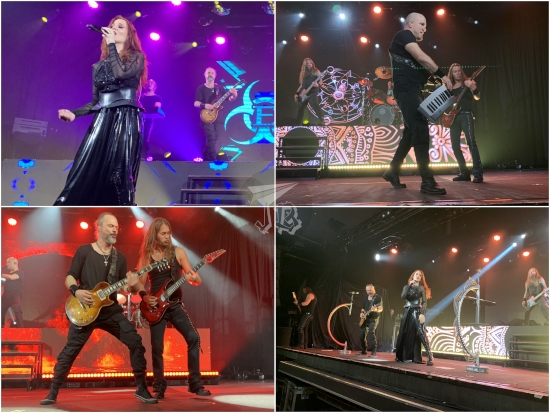
Collage of Epica playing, showing different members at their choice of insturment - singer, bassist, guitarist, and keyboardist with a portable keyboard

Finally Apocalyptica came on stage, and it was extremely fun. The things those guys do to their classical cellos would make some classical musicians cry, but the sound is super-powerful. We had Franky Perez for vocals, and a very fun moment regarding “listen to our classical music album at home, because we still feel like death metal”. They interacted a lot with the public, and it felt somehow very friendly / warm – yes, I’m talking about metal here. It was really that fantastically weird.

Apocalyptica Setlist

  1. Ashes of the Modern World
  2. Grace
  3. I’m not Jesus
  4. Not strong enough
  5. Rise
  6. En route to mayhem
  7. Shadowmaker
  8. I don’t care
  9. Nothing else matters
  10. Inquisition Symphony
  11. Seek & Destroy
  12. Farewell
  13. In the Hall of the Mountain King

Apocalyptica playing with Franky Perez. Perez is in the foreground, dressed in black. The thee cello-playing members are in the frame, playing. The drums peek behind them, but you can't spot the drummer

Apocalyptica playing at La Riviera. They have classical cellos. Two of the members stand on the sides, playing their cellos. Another one is walking swinging his as if it weighed nothing, The final one is slamming drums in the background.

We finished off just short of 23:00, I bought off some fast food for dinner, and headed back to the hotel to have a shower and get some sleep. I was woken up early in the morning due to the cleaning crew and the garbage mini-vans noises, but I did not leave bed until 9:00, then set off at 9:30. I bought some cold coffee on the way and walked into the former royal palace gardens, now public park Jardines del Campo del Moro.

Though I’d seen the gardens a few times before, this was the first time I actually walked into them. Despite the frost covering everything, I got a nice view of the palace and different fountains and buildings sprinkled throughout the green – Chalet de Corcho, is a small hut with coloured windows; and Chalecito de la Reina a wooden house that is currently closed. I was insanely amused by a little grass-cutting robot.

Jardines del Campo del Moro. Collage. It's winter and most trees are grey and bare. At the end of the walkway stands the Neoclassical Royal Palace. Two smaller buildings - one of them is white with brown beams, reminscing of German architecture; another one is a small kiosk with colourful windows - red, green...

I wandered around for an hour or so, then headed off via underground to the National library of Spain Biblioteca Nacional de España for the absolutely worst guided visit of my life. Like… it’s true that it’s free, but tickets run out within hours of coming out – on the 20th of the month, for the following month. I’d actually been trying to do this since Covid lockdowns ended… It turns out, we did not see any real books, we could not even peer into the reading area, the book and reading museum is closed and the only information we got was… that the guide did not like the Library. We did not get to see anything interesting or that we could not see on our own, and we did not get to learn anything, so this was a huge blunder. Live and learn – but it was one of the few things that was open on a Monday. The library is a huge Neoclassical building with a fantastic marble staircase inside. The doors and gates are protected by intrincate ironwork fences.
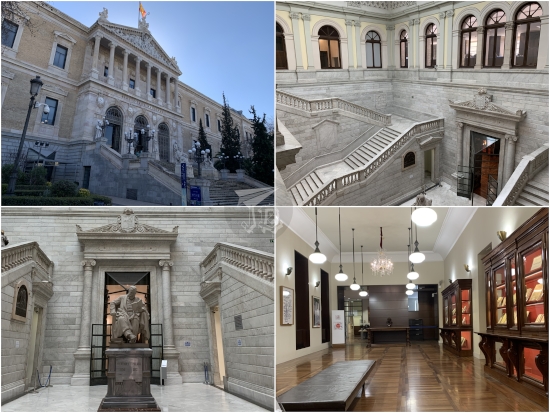
Biblioteca Nacional de España. A Neoclassical building in white and grey tones. The exterior has columns and statues of writers. The interior showcases a pair of twin staircases with the statue of one of the most important library directors between both.

I met with family for a quick lunch and then we went for a walk. We had thought about going to one of the terraces to see the cityscape, but it was closed because it was a Monday. We ended up at the Parque del Retiro park again to make some time and walk. We sat in the sun for a while, then went to see the Palacio de Velázquez there. Currently, it’s part of the modern art museum Museo de Arte Reina Sofía, and I did not really care much about the exhibits, but I like the building. Architect Ricardo Velázquez Bosco built it in brick (with ceramic tiles by Daniel Zuloaga) for the Mining Exhibit in 1883, inspired by London’s Crystal Palace, now gone. The interior is pristine white with hints of iron architecture, but the building’s official style is “neorenaissance historicism” whatever that means.

Palacio de Velazquez: A brick building with large windows and tile decoration. The inside is all white with bits of iron architecture.

Velázquez Bosco and Zuloaga also came together when they designed another building I really like, the glass-and-iron greenhouse Palacio de Cristal, which was built to home tropical flora and fauna from the Philippines in an exhibit in 1887. In front of the palace, there’s a small pond home to some cheeky ducks and geese.
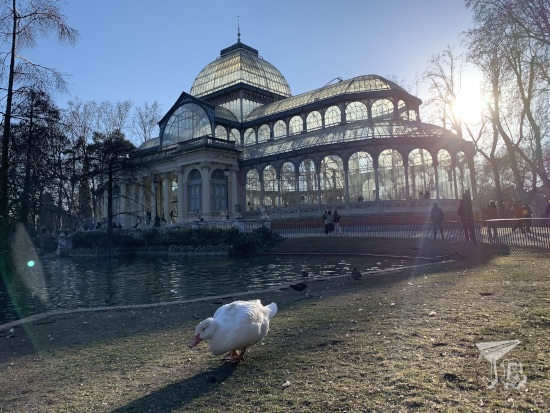
Palacio de cristal. A huge greenhouse with a dome, and two wings. A white duck wanders in the foreground. Between the greenhouse and the duck there's a small pond.

Then, we went to have a snack. Trying to find something on the map before the trip, I’d come across a place called La Mejor Tarta de Chocolate del Mundo, which translates to “The best chocolate cake in the world” and that had to be tried! It was really nice, even if the place was pretty small and felt a bit cramped.
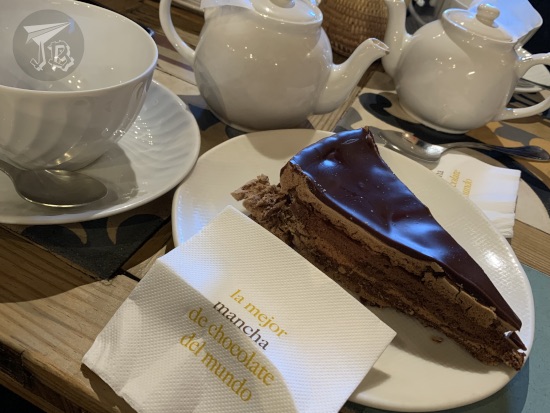
A slice of chocolate cake in front of mugs and teapots

We finally took a stroll down towards the sunset, and I took the train back without much of a hitch, then drove home

11th August 2022: 21 hours straight of ups and downs in London {England, August 2022}

The first thing I had to do was waking up for a 6:30 flight – though considering I did not sleep very much that night due to the heat, I’m not sure if that it counts as waking up. The previous day, the airline had sent warning emails about arriving at the airport early – three hours before the flight would have meant being there at 3:30, so… not really. I arrived at the airport around 5:10, and I was at the gate by… 5:20, I’m not even kidding. While I normally do not queue to enter planes – the advantages of backpacks, I just kick them under the seat – I had been assigned seat 1A, which meant I had to put my luggage into the overhead compartment. I had decided to take a small backpack too, because I would be carrying it around for a while, and it would get searched in a couple of places.

Surprisingly, despite Brexit, the Ryanair strikes, airport chaos, and the fact that apparently the automatic passport reader cannot cope with my new look, I made it into the United Kingdom first and straight to London without a glitch. Not only that, I managed to get my Oyster recharged without any problems, and as soon as I had bought some food, I was on my way to the first stop of the day: Crystal Palace Park, for which I got to ride the shiny new underground line, the Elizabeth Line, then the Overground. Even though there are another couple of landmarks (that might warrant a visit when / if the restoration project finally goes through), what interested me in Crystal Palace was a collection of Victorian sculptures – the Crystal Palace Dinosaurs.

Though Ancient Greek already knew about fossils before the current era, it was in the 19th century when it hatched as a “science”, according to some spurred by Darwin’s “On the Origin of Species”. Fossil hunters ran amok, excavating and spoiling the North American badlands. In England itself, Mary Anning kept discovering cool things. There was a sort of a “Dinosaur fever” – the Victorians became fascinated with all things prehistoric. In 1852, a number of extinct animal reconstructions were commissioned to be erected in the gardens of the Crystal Palace, after the World Exhibition. Using the knowledge available at the time, Benjamin Waterhouse Hawkings, a natural history illustrator and sculptor, who did his best according to scientific knowledge at the time.

Not all the animals represented are real dinosaurs, but the nickname stuck. From today’s standards, most of the reproductions are extremely inaccurate, with some exceptions, such as the ichthyosaur (discovered by Mary Anning around 1811), and the plesiosaur (of which Mary Anning also found a skeleton in 1823, and then another in 1830 – I love that woman). Today, the park is organised in several “islands” where you can see the sculptures, though the water was a bit down due to the heatwaves:

  • Amphibians and therapsids: Dicynodon and Labyrinthodon
  • Marine reptiles: Ichthyosaur, Mosasaurus, Plesiosaur and Teleosaurus
  • Dinosaurs and pterosaurs: Hylaeosaurus, Iguanodon, Megalosaurus and Pterosaur
  • Mammals: Palaeotherium, Anoplotherium, Megaloceros and Megatherium

I have been aware of these sculptures for a long time – since I was a child and started liking dinosaurs. However, only recently did I find out that they really existed, and where they were. I arrived at Crystal Palace station a little after ten (making whole travel from the airport about two hours). I walked by a small farm with typical fauna such as… an alpaca, then I ate my sandwich overseeing the first island.

A collage showing differet statues of prehistoric creatures. Some try to be dinosaurs, and they look almost comically wrong, like giant iguanas or chameleons. There is one plesiosaurus looking rather acurate - it has a long neck and flipers. Finally, some mammals: a deer with huge antlers and a tiny horse-looking creature

I walked around for about an hour and then I set on my way back. Though I had planned to have a relaxed day at first, I had to adjust due to cancellations and train strikes. It was around that time that I calculated that I could actually cram my original Thursday and Saturday plans onto Thursday, plus the alternative plans I had made if I tweaked the time a little. So I back-rode for another hour towards the city.

Near Tower Hill stands the Sky Garden, on the 35th floor of the 20 Fenchurch Street building, designed by Rafael Viñoly. Sky Garden is considered the highest garden in London, and a fantastic viewpoint of the city. I almost accidentally came across the option to book a free access ticket for this – while I had not wanted to pay for any morning / early afternoon activities in case my plane was delayed, I figured out that I could book this for free, especially as they go stupidly fast! I made my 12:30 timeslot with a few minutes to spare, but I was let in after a queue, ID check, X rays and metal detection.

The Sky Garden features two terraces full of plants (landscaped by Gillespies), a couple of restaurants and bars, and an “open” gallery which has glass above your head so the feeling of opening dissipates – the glass is stained and scratched. It was one of the “must-do’s” in London I had never visited before, so I thought it would be a good opportunity. Fortunately, they have relaxed the rules on no bottles because of the unusual high temperatures.

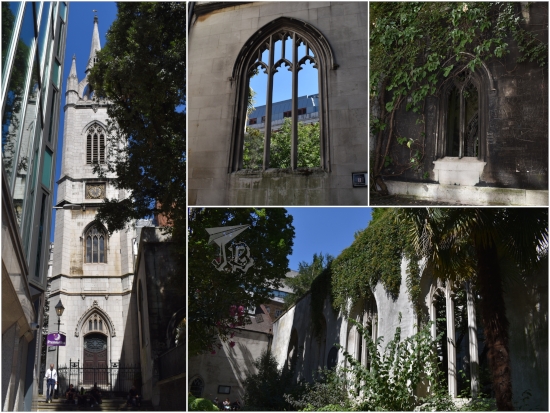
After wandering around for a bit, I continued onto Saint Dunstan in the East Church Garden, the ruins of an old Wren church destroyed by The Great Fire of London and destroyed again during the Blitz (World War II bombings). Dating back to the 1100s, it was opened as a public park in 1970. Aside from being a very cute building park I wanted to see for a while, a music video by the band VAMPS was filmed there.

Ruins of a gothic church turned garden, with hanging ivy and bushes overgrowing the walls and windows

As it was lunchtime, the park was bustling with people, so I just had to move on rather quickly, and went back to the underground to get to the area of Westminster. I had originally booked tickets for Saturday (back in May) but then they were cancelled due to “repair work” going on that day (I do wonder if it was a security measure related to the strikes though).

But of course, first I feasted my eyes on the very new Elizabeth Tower clock tower aka Big Ben – though Big Ben is one of the bells in the tower, but nobody really cares about that any more.

Elizabeth Tower, shining gold with the restoration. It almost looks fake. The clock marks Quarter to two.

The Palace of Westminster or Houses of Parliament is the centre of the United Kingdom’s turbulent political life. The current palace was built after the previous one was destroyed by a fire in 1834. The new palace was erected in the Neo-Gothic style, and it was mostly finished by 1860, although it did open to be used in 1835. There was a competition regarding the design, which was won by sir Charles Barry. The Palace of Westminster holds the two chambers where the British government meets – the House of Lords and the House of Commons – alongside the Norman Porch, St. Stephen’s chapel, and the different corridors where the MPs vote or discuss state matters. I’ll forever be amused that “for security reasons, photography is not permitted in these chambers with dozens of cameras for TV broadcasting and Internet streaming”, but alas. The woodwork on the Norman Porch ceiling is fantastic, and some of the decoration choices, such as Churchill’s sculpture are… interesting. It is noteworthy that it is part of the Unesco Heritage Site “Palace of Westminster, Westminster Abbey and St Margaret’s Church”.

Collage: a view of the houses of parliament (London), with the Elizabeth Tower on the left. Two shots of the Norman Hall, a huge ward with an intrincate design of wooden ceiling. A gothic corridor with a wooden door and some coloured glass panels

Afterwards, I just found my way to the hotel – though I had to wander a little to find the nearby supermarket, bugger those never-ending attached-house neighbourhoods, rested for a little and then went to the station to go to the theatre – I wanted some extra time to check out where my airport coach would leave, so I gave myself 45 minutes for a 22-minute trip. It turns out there was train trouble and I was barely on time, taking an alternative route instead of the direct one.

When I realised my flight timing would give a free evening in London, I booked tickets for the Apollo Victoria Theatre to watch the “Wicked”. This musical tells the story of “The Wonderful Wizard of Oz” from the point of view of the witches, and somehow gives the “Wicked Witch from the West”, Elphaba, an amazing personality and backstory that resonates a lot with me. For the same price as the ticket I was eyeing back in the day, I found a VIP upgrade just one seat over, so I was entitled to a drink and “snacks”, an early entry, along with access to the “Ambassador Lounge”, a tiny reception hall with access to a private restroom.

“Wicked” was great. The actress who plays the main character, Elphaba (Lucie Jones) came out a little yelly though in her solos. The duets with the other female singer (Glinda, Helen Woolf) were fantastic, and the male love interest’s (Fiyero, Ryan Reid) song was absolutely great, even though he is a character I have never cared for.

Apollo Victoria Theatre: the inner theatre, showing a dragon and a closed curtain showing a map of Oz. The outer theatre: there is a sign reading Apollo Victoria Wicked, and everything is lit green. The VIP lounge, with a glass of soda, and some chairs. The cast at the end of the show, taking their goodbye bows.

By the time I was out, the trains were running again, and one-to-three-minute delay on a line that runs every five minutes or so, and I was at the hotel by 23:00, absolutely beat. The room was extremely hot, because London is absolutely not ready for heat, so I had a snack in front of the fan, took a shower and then got some sleep – 21 hours on the go were over. Funnily enough, by the time I went to bed, I had that wobbly-world jet-lag feeling I have after my first day in Japan. It must have been the barely sleeping the night before. I fell asleep very fast.

Walking distance: 30.52 km / 46192 steps

13th March 2022: The outskirts of Madrid (Spain)

I’m usually rather enthusiastic when I visit new places, but if there is a place that I’ve found kind of over-hyped, that has been the park Parque del Capricho, in Madrid. “Capricho”, which means whim or folly – in its architectural meaning of an often extravagant picturesque building erected to suit a fanciful taste, or building erected for decoration, typical of the French and English decorative gardens from the 18th century. The park is located in Madrid, and the only romantic garden that remains in Madrid. It was promoted by the 12th Duchess of Osuna between 1787 and 1839, and became a recreational area for the nobility of the time. Some of the most important gardeners and landscapers of the time worked on its design. It was declared Historical Garden in 1934 and restored in 1999.

So it is a garden, with some plants, some flowers, and a bunch of weird-looking decorative items, that takes itself a bit too seriously. It won’t accept pets and you can’t bring any food inside (it has some cage-looking “lockers” were you can leave your stuff). There is a strict capacity control which does nothing for it not to feel ridiculously crowded on a regular nice-weather Sunday. Maybe it improves in spring / summer, and with fewer people, but I had some stuff to do in the area and that is why I made time to visit today.

It had been raining all week, so I had mostly scrapped my plans. It was a great sunny day though so in the end I decided to get there. Parking the car was ridiculously easy – though the parking spot was maxed out, I found a very easy one in the avenue next to the park – good, it was close as I would not put my sandwich in the crappy-looking lockers and preferred taking it back to the car. Then I walked in, and explored for a couple of hours – and don’t tell anyone, but I ate a piece of candy, just to be rebellious (≧▽≦) (and to make sure I did not sugar crash without any food around, but that does not really make for a good story).

While I of course did not expect everything to be blooming and colourful and green… I hoped that it would have at least maintained through winter. No such luck. A bunch of areas were fenced off, the footpaths were swamped with puddles, and the water in the ponds was not as clean as it should have been. Exploring the 14 hectares took me about an hour and a half, considering that I did go into all the little paths, but all the buildings were closed and / or under constructions. There is a Civil War bunker in the park too, but that is only open through pre-booked guided visit and I did not know I was going to do this 30 minutes before I jumped on the car. The few flowers that had already bloomed included the garden pansies (Viola × wittrockiana, which are after all winter flowers), and the yellow and white daffodils (narcissus, maybe the subspecies jonquil Narcissus jonquilla). There were a couple of black swans (Cygnus atratus) at the main pond, and mallards (Anas platyrhynchos) on every second water body, including fountains.

Pond in the park. There are some flowers and buildings around it, and a black swan sunbathing.

Collage of different park decoration: a bush labyrinth, a fountain, and some decoration reminding of Greek temples.

Afterwards, I took a small detour to see if any of the Japanese cherry trees in the park opposite the street Parque Juan Carlos I had started blossoming. The answer was not at all. But the point was heading to the restored castle Castillo de la Alameda. The castle dates back to the 15th century, though there are older remains underneath, and it is thought that its presence is the one that got all the aristocrats to flock to the area, as it switched from defensive castle to palace.

The remains of the castle feature an irregular moat with lobe-like structures in the corners, and the restored keep, which stands up to the first floor, though it must have been much higher. An interesting characteristic of the castle is that it was built using a kind of mortar made from flint. I have to say it was a nice surprise, free to visit.

A clover-shaped castle ruins, all white. There is not much of the castle left, but the moat is almost intact, though empty

To the side of the castle there is a casemate – a fortified machine gun emplacement from the Spanish Civil War, called Nido de Ametralladoras (Machine gun nest), a semi buried cement block for snipers of sorts to defend the position.

Concrete block that was used as a machine-gun base

Then I moved onto Mejorada del Campo a little town near Madrid that only has one tourist attraction – a… handmade cathedral. Of sorts – Catedral de Justo Gallego .

Justo Gallego was born in 1925. Deeply Catholic, he became a young monk-in-training but had to leave the monastery when he contracted tuberculosis. He made a vow to erect a cathedral to the Virgin Mary in her “Lady of the Pillar” avocation, and he sort of did. Throughout the next 60 years he worked on building the cathedral, using recycled material, and on his own. His work came to fame when a soft-drink company made him the star of an advertising campaign, which made him and his work famous.

The cathedral has 12 towers, a crypt, two cloisters, a baptistery, and the main nave is 20×50 metres, with a 35 metres high dome. Most of it was done by hand, using discarded items such as tubes and bicycle wheels. It is garish and childish in its decoration, but I found it to have some strange allure. The cathedral has drawn the attention of international artists and institutions, and apparently Gallego built it without any blueprints or knowledge of construction. Upon his death, an architectural studio started working on “legalising” the cathedral (from an urbanistic point of view; it is not an official Christian building) and is it is now under management from an NGO. It was just a bizarre thing to see, but interesting since I was in the area (sort of. Construction made the route stupidly long), glad I’ve visited it at least once. I did catch a European white stork (Ciconia ciconia ciconia) coming home to one of the towers.
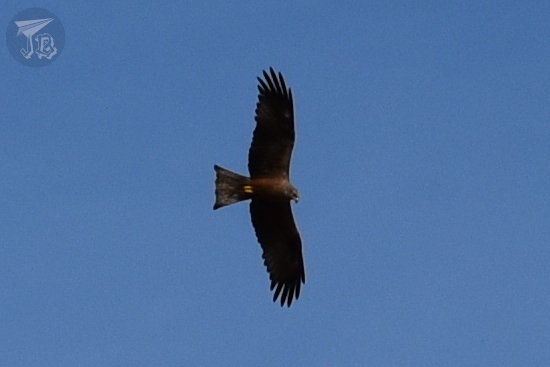
Cathedral made out of recycled items: pipes, plastic bottles, irons... there is a dome and a nave, in bizarre colours.

A stork approaches one of the towers of the cathedral

I drove off afterwards, and I have to say the weather that day was amazing – just in-between two piss-poor ones, so yay spring escapade.

Walking distance: 11.18 km (16916 steps)

18th August 2018: Plan Switching. Kyoto → Osaka → Nara {Japan, summer 2018}

On this day I was supposed to hike up a mountain – mount Takao to be precise. But you know what? When I woke up that morning I just did not feel up to it, so I decided to change my plans. In the end when you’re on the JR Pass you can get from Kyoto to Osaka for free. For a change, I actually got to Osaka instead of Shin-Osaka which was convenient. Then I grabbed the underground to get to Osaka Aquarium Kaiyukan [海遊館], which is actually the largest aquarium in the world.

I had been there before, but the previous time I did not get to see the whale sharks as they were ‘quarantined’. How can anyone block a tank which is in the middle of the whole damn thing, I have no idea, but they did. This time I broke even and had a blast. Unfortunately the Aquarium was packed because this was a Saturday morning, and for some reason my back was hurting a lot. I had dropped my luggage off at a coin locker because I thought it would be better. However at some points I could not really walk straight. The weight of the camera bag was too much and I had to sit down. Found a nice place to watch the sharks from, though.

After the Aquarium I went to Kuchu Teien [空中庭園], observatory in the Umeda Sky Building [梅田スカイビル] to have a look at the skyline and to get the stamp for the Japan Towers rally. I got the greatest omg-gaijin face of the trip here (and truth be told, had I known that the stamp was actually held at the reception desk and not the actual observatory, I might have skipped this). In this case the building is an attraction itself. It consists on two towers joined by some passageways and a circular platform at the top, with see-through escalators.

Next the plan was going to Dotombori, stroll down there, and eat some takoyaki before heading off to Nara where I had my hotel for the night. When I got to the station and jumped on the Osaka Loop line, it turned out that I actually was in the train that continues on to Nara… and it was air conditioned and I had a seat…

I found it a sign and decided to just go with the flow and get to Nara [奈良] on that train. Upon arriving there I checked into the hotel and I decided to go to Nara koen [奈良公園], the main Nara park, and see if I could feed a sacred shika [鹿] deer or two. This was close to 5 pm by now so all the temples would be closing anyway. I did feed the deer some shika senbei [鹿煎餅] (deer crackers), and one of the does bit me. Not even the hand that was feeding her, she actually tried to snack on my tummy. Sheesh.

As I was coming back down I had a pretty sunset over Kōfuku-ji [興福寺].

28th July – 3rd ‎August ‎2018: The Spanish “Levante”

My parents sometimes vacation in this tourist-like complex in a little town called San Juan de Alicante in the east of Spain (the “Levante”). My father uses it as a base for diving trips, and sometimes I tag along to keep my mother company. When we arrived this year we found out that there was a new resident family in the garden – a family of squirrels that had apparently shown up travelling in trees that were going to be planted. The complex management decided to make squirrel-nurturing the local sport. Guests were encouraged to watch out for them, and leave them nuts. Also, there were educational signs about what was safe or unsafe to feed the little critters. I caught sight of them at some point or another.

One of the selling points of the complex – aside, of course, from the swimming pool and the great room service – are the big gardens, with lots of trees and plants, and the rescue bunnies. Now the squirrels came over to complete the scene.

Collage. A hotel room. Red flowers. A garden. A tiny rabbit. A tree and a close-up of that tree focusing on the squirrel on one of the branches.

31st July 2018: Chocolate & Lobster. Not together.

A meagre 20-minute-drive away from this little town stands the village of Villajoyosa, which translates into something akin to “The joyous village”. If you’ve never heard of it, I’ll just have you known that it has a chocolate factory, the Fábrica de Chocolates Valor, and the chocolate museum (and of course the shop). As it is a working factory, the visit is of course guided. We were told that there was usually a long queue, so we were there before 9:30 for the 10:00 visit, and we were quite literally the first to arrive. Once inside, you get to see what they call the museum, with a short video about how they used to and still make the chocolate, and you visit some of the old equipment. Then, there is a short trip around the factory using some hanging planks – when we were there, the production was halted due to pre-Christmas-campaign holidays. So FYI Christmas chocolate is made in August. The visit was done in one hour, and then we splurged in the shop.

Chocolate factory from outside

Inside the chocolate factory shop. A painting on the wall says we heart chocolate, another, in the backfround of several chocolate bars packaged as presents, it says All you need is chocolate, with the word love scratched out

After the visit we went back to the complex, where we had booked a made-to-order lobster “paella” (traditional rice dish) for lunch, and boy was it awesome. I totally sinned with the apple pie afterwards, too.

Collage. Rice pan with lobster pieces, and a piece of apple pie

1st August 2018: Alicante

The day started awesomely with coffee and pancakes, and that alone worked to make me happy.

Pancakes with chocolate syprup, a glass of milk, and a cup of coffee

Besides, twenty minutes in the opposite direction from Villajoyosa we had Alicante. And we could also be lazy and not take the car out, we could just take the bus. We wanted to see the archaeological museum, Museo Arqueológico Provincial MARQ de Alicante, and that was out first stop. However, for some reason a bunch of pictures got lost – and I can only show you this of the library, where pictures were not allowed anyway. It was a… photography accident.

A former chapel, with gothic windows. A glass lamp hangs from the ceiling and there are dark shelves full of books in the foreground

After the museum, we walked around the base of Monte Benacantil, the mount in the middle of Alicante – again, literally – until we were exactly on the opposite side to find the entrance to the Castillo de Santa Bárbara, Santa Bárbara’s castle. The castle is of Arab origin, it may have been built the 8th century. However, there are archaeological remains in the mount dating from prehistoric times. The castle gave the city of Alicante a vantage point towards any kind of threat, whether it originated on land or the ocean. The castle was reconstructed in the 16th century, and later, in the 18th century, it played a part in the war against the French.

Castle ruins and views of the sea underneath. It looks hot.

After this we walked over to have lunch at a restaurant we had read over in the tourist complex magazine, a prime Japanese restaurant called Nigo, which has the best sushi I’ve ever tried outside Japan.

Lunch - Japanese salad, fried chicken, sushi and tuna tartar

After that we headed back to the complex and planned our next move.

2nd August 2018: Valencia Diversion

My father was unable to go on his two planned diving outings, so we decided to head home early. However, he was feeling a little disappointed over the cancellation, and I suggested that maybe we could take a detour somewhere else instead. In the end, we decided to book a hotel in Valencia and use the time to visit the Oceanogràfic over there. This is a large aquarium complex. We also reserved a table at the “Submarine Restaurant” and had lunch there.
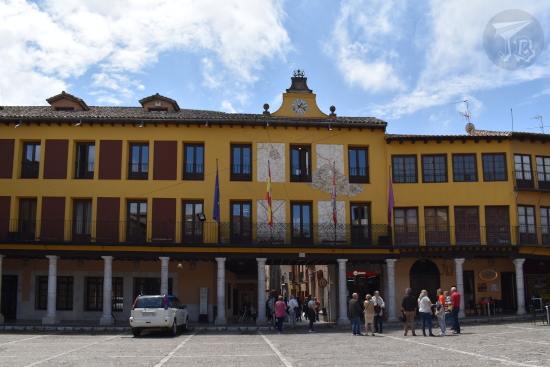
The aquarium opened in 2003 as part of a big project called “the city of art and science” in Valencia. It has a double layout, over- and underground. The underground area is the big aquariums are built, while the upper enclosures hold most the mammals and the birds.

An empty restaurant surrounded by an aquarium where fish swim

Collage of different marine animals: octopus, sea urchin, anemone, clownfish, surgeon fish, rockfish, seal, jellyfish, seastar, sea dragon, turtle, reef shark

Collage of different animals, and general view of the park. Penguins, crocodiles, seal, pelicans, snipes, ibises, tortoises, carps, crane

Once we were done, we said goodbye to the sharks and hi to the nice sunset. Next morning we drove back home.

Sunset above an unremarkable city skyline

6th January 2017: Miyajima (in eleven hours) {Japan, winter 16/17}

I was, quite literally, out from sun to sun on this day, and then when it was night I came back for more. Miyajima [宮島] is a small island in Hiroshima Bay, famous for the ‘floating torii gate’, the o-torii [大鳥居], belonging to the Itsukushima Jinja [厳島神社]. About 17 metres high, it is planted on the beach in front of the shrine, and you can walk up to it in low tide. In high tide you see it in the middle of the water. The o-torii’s upper part is around 22 metres long and hollow. It is not nailed or glued, but is weighted down by fist-sized rocks stored in the hollow area. The pillars are solid.

And to the o-torii I headed off literally at dawn, after getting a warm coffee from a vending machine. The first few minutes cough half an cough hour cough were spent around the torii as it was low tide and you could walk up to it.

After I managed to peel myself off the o-torii, I headed off to the shrine it actually belongs, Itsukushima Shrine, which is the main shrine of the island. The shrine has a famous noh stage and when the tide rises it also becomes ‘floating’. It is the biggest shrine in the area. Itsukushima Shrine is dedicated to Ichikishima-hime, Tagitsu-hime and Tagori-hime, known as the Munakata goddesses, are the deities of the ocean, traffic safety, fortune and accomplishment.

After Itsukushima shrine I ducked some deer, which abound, and are always hungry for maps and so on, and I walked down the breakwater to a little shrine named Kiyomori Jinja [清盛神社].
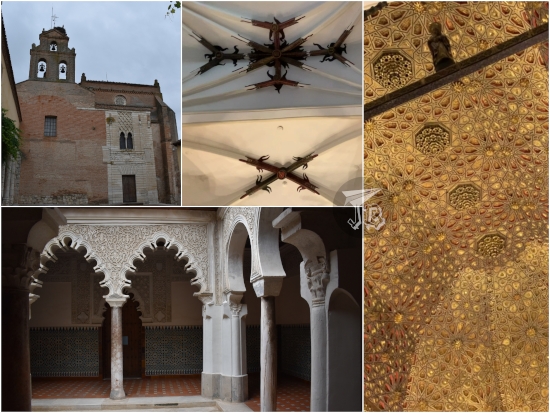
On my way back, I stepped on the grounds of the Buddhist temple of Daigan-ji [大願寺]. It was here where I realised that there were little stamps to be collected in the island, which is always a plus.

Then I got to Itsukushima Jinja Takaramono-kan [嚴島神社 寶物館], the shrine’s Treasure Hall, where they have a few treasures and old scrolls, armours and so on. Among them they have the ‘Story of Heike’ as well as several of the Heike family Buddhist Sutras. However, no pictures allowed. I continued on my way to the Tahoto [多宝塔] three-story Pagoda (also belonging to Itsukushima Shrine), which has a characteristic shape: it is square on the lower level and has a round shape on the upper level

From there I got to Daishoin [大聖院], another of the big Buddhist temples in the area, where I decided against hiking up mount Misen (2.7 km to the summit). The temple has a few up and downs, and it was here where I ate my karepan breakfast, around 9.30 – 10 am, I am not exactly sure. I do remember that my camera battery was already down one bar out of three.

Then I headed down and then up again to another of the low hills to the Senjokaku [千畳閣] pavillion and the Pagoda of Toyokuni Jinja [豊国神社] and the five story pagoda next to the main building. Toyokuni Jinja was supposed to be a library of Buddhist sutras – however, it did not get finished (although that has its own shuin for some reason (・□・;))

At that point it was barely half-morning I wondered whether to head downtown to Hiroshima, because high tide was only at 3 pm, and I really wanted to see the half-submerged torii, but I did not really know what to do. And no idea what got into me, but at that point I changed my mind and decided to go up Misen [弥山], the “island mount”. I actually decided to take the Miyajima Ropeway [宮島ロープウェー]. I crossed Momijidani Koen [紅葉谷公園], which is full of deer, and probably amazing when it is in full red, and took the ropeway from the park to Kayadani Station [榧谷駅] first and to Shishiiwa Station [獅子岩駅] then, about half an hour away from the summit. From there I took a few pictures and then decided to make my way up.

At that point I was not really thinking about getting to the summit (535 above sea level, and we’re talking 0 to 535 metres for real), but to Misen Hondo [弥山本堂] which is the temple where the ‘eternal flame’ was originally lit by a meditating Buddhist monk hundreds of years ago. The Peace Flame from Hiroshima was lit from here. There were two secondary halls, Sankido [三鬼堂] and Dainichido [大日堂].

But after Misen Hondo, I was ‘so’ close to the summit that it would be a pity not to finish the deed. That way, I could go up one route and down another one in order to see more things. On my way up and from the summit the sights were impressive, although it was a bit tiring. And a bit means a lot…

I think that at some point I considered using the ropeway down but time-wise it was going to be the same and walking down could be cheaper and would get me to see more stuff, such as Miyama Jinja [御山神社]. And I did not break my neck on the long hour and a half of hike-down, either. A greater plus.
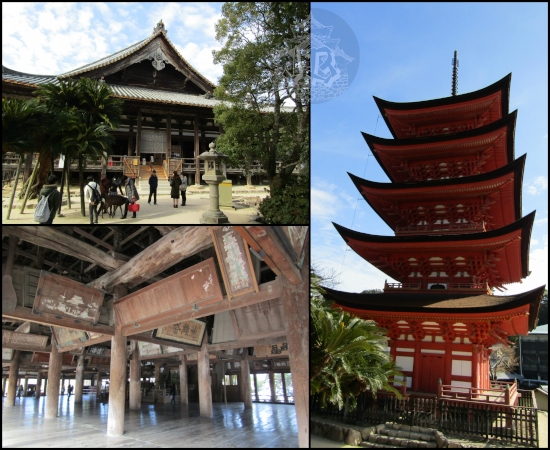
All right, what time do you think I made it down? Not even 3 pm just yet, but as I had seen from halfway down the mountain, the tide was already up. Therefore I was able to see the floating o-torii, which was a high moment for me. The problem was that I was almost running out of battery in my camera already, and there was sunset to come! On my way around the bay I ate a very overpriced yakitori, but I was hungry and since Miyajima is ‘World Heritage’ it really does not have convenient stores.

And thus, when I went towards the aquarium, Miyajima Suizokukan [宮島水族館]. I decided to take all my pictures with the phone over there to save camera battery for the sunset pictures. That it was awfully cold at that moment had nothing to do with my decision, of course and walking into K.A.Z. absolutely never ever crossed my mind either.

After the aquarium I was distracted by Omoto Jinja [大元神社], which was full of deer. Praying, I’m sure. There were baby deer too, being bullied cute but for some reason (probably lack of battery) the pictures did not come out.

Then I headed back to the o-torii area to watch it in the sunset and took pictures until I had no more battery on any device.

Once batteries were dead and the sun was too low, so I headed back to my ryokan to recharge – in every sense of the way, as it was after 5.30 pm. On my way back I bought a local speciality – ‘fishcake’ which in my case was shrimp because I did not dare try the oysters. It was yummy. Before going to the hotel, I got myself some groceries to recharge my own batteries and have dinner later.

I spent some time resting, charging all the devices and writing down notes on everything I had been doing during the day, and then, at around 9 pm I came back out again to take pictures of the shrines and o-torii at night.

After that, dinner, shower, bed, and early check-out the following day in order to head down to Hiroshima, after very intense 11 hours running up and down Miyajima. Take that, nine hours in Kyoto.

25th August 2015: Arashiyama & Nara {Japan, summer 2015}

Today was a delayed day, actually, as I apparently took over the plans I made last year when VAMPS had the secret live and I skipped back to Tokyo to attend to it. Then again, as I had changed plans from yesterday to today, everything came a little jumbled.

After a nice chat with the Tourism Office lady – in broken Japanese, as I did my best, the fist thing I set off to do was visit the Arashiyama bamboo grove in Arashiyama Chikurin no Shōkei [嵐山 竹林の小径], which is a nice little town adjacent to Kyoto (yep, not a neighbourhood. A town all on its own. That’s Japanese urban planning for you). I had been wanting to visit the area for a while now, and finally made it there. After a nice detour – because taking the wrong turn in Japan always yields to something interesting (then again, people, placing sings of ‘bamboo grove this way’ right behind the map is not helpful, Japan) – and a couple of temples I ended up where I wanted to be, and boy was it impressive.

In the middle of the bamboo grove we find Nonomiya Jinja [野宮神社], a nice little shrine which was at the time overridden by Chinese tourists (that happens, apparently, when you visit a shrine dedicated to marriage).

After a couple of hours wandering the bamboo grove I head back to Kyoto station and once again took the Nara line, only this time I would not be stopping in Inari as I have done before, but took the express to Nara [奈良] itself, which was something else that had been on my list for a while.

Yet another nice Tourism office lady, and way too many Spanish tourists later, I was on my way towards Nara Kōen [奈良公園], Nara Park, where my first impression was one of the things that makes Nara famous… deer. Hundreds of ‘wild’ deer which chase after tourists to get shika senbei (deer crackers) and eat maps when said crackers are not available. Very cute, very… adamant XD

But not my main visiting goal, never mind the creepy American dude who wanted to take a picture of me with them. My goal was visiting the to visit Todai-ji [東大寺] temple, and Daibutsu [大仏] (Giant Buddha) it hosts. Todai-ji did not disappoint me at all. It is a very solemn, very special temple and I enjoyed it.

I wandered around the Nara complex for a while and visited Kofuku-ji [興福寺] on my way back. They have a very famous Ashura sculpture, and a thousand-arm Buddha statue, but no pictures allowed, so I can only show you the exterior.

After some dinner on my way back, I headed off for Kyoto and the hotel which I was to leave the next day to head off to Kobe.