25th August 2015: Arashiyama & Nara {Japan, summer 2015}

Today was a delayed day, actually, as I apparently took over the plans I made last year when VAMPS had the secret live and I skipped back to Tokyo to attend to it. Then again, as I had changed plans from yesterday to today, everything came a little jumbled.

After a nice chat with the Tourism Office lady – in broken Japanese, as I did my best, the fist thing I set off to do was visit the Arashiyama bamboo grove in Arashiyama Chikurin no Shōkei [嵐山 竹林の小径], which is a nice little town adjacent to Kyoto (yep, not a neighbourhood. A town all on its own. That’s Japanese urban planning for you). I had been wanting to visit the area for a while now, and finally made it there. After a nice detour – because taking the wrong turn in Japan always yields to something interesting (then again, people, placing sings of ‘bamboo grove this way’ right behind the map is not helpful, Japan) – and a couple of temples I ended up where I wanted to be, and boy was it impressive.

In the middle of the bamboo grove we find Nonomiya Jinja [野宮神社], a nice little shrine which was at the time overridden by Chinese tourists (that happens, apparently, when you visit a shrine dedicated to marriage).

After a couple of hours wandering the bamboo grove I head back to Kyoto station and once again took the Nara line, only this time I would not be stopping in Inari as I have done before, but took the express to Nara [奈良] itself, which was something else that had been on my list for a while.

Yet another nice Tourism office lady, and way too many Spanish tourists later, I was on my way towards Nara Kōen [奈良公園], Nara Park, where my first impression was one of the things that makes Nara famous… deer. Hundreds of ‘wild’ deer which chase after tourists to get shika senbei (deer crackers) and eat maps when said crackers are not available. Very cute, very… adamant XD

But not my main visiting goal, never mind the creepy American dude who wanted to take a picture of me with them. My goal was visiting the to visit Todai-ji [東大寺] temple, and Daibutsu [大仏] (Giant Buddha) it hosts. Todai-ji did not disappoint me at all. It is a very solemn, very special temple and I enjoyed it.

I wandered around the Nara complex for a while and visited Kofuku-ji [興福寺] on my way back. They have a very famous Ashura sculpture, and a thousand-arm Buddha statue, but no pictures allowed, so I can only show you the exterior.

After some dinner on my way back, I headed off for Kyoto and the hotel which I was to leave the next day to head off to Kobe.

3rd – 5th July 2015: Japan Expo in Paris (France)

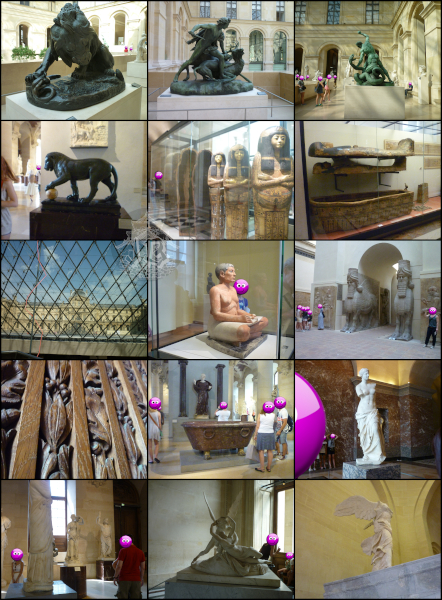
I went back to France rather unexpectedly because VAMPS announced an appearance at Japan Expo, a Japanese Culture convention held in Parc des Expositions de Paris-Nord Villepinte. I flew in on Friday and as I had time, I decided to go to the Louvre museum. I discovered the automatic ticket selling machine, so my queue was unexpectedly short once I was out of the security waiting area. I geeked out to my heart’s content and I reflected on how I had got used to geeking out alone and how comfortable I felt compared to my first time alone in a museum, back in the Dark Ages when I was 14.

Different exhibits of the Louvre: bronze sculptures, Egyptian sarcophagi, sitting scribe, Babylonian bulls, a marble, bathtub, Venus de Milo, Eros and Psyche, Victory of Samothrace

The following day I met up with some friends at the Japan Expo for the VAMPS concert act that had been organised. Japan Expo is one of the biggest European conventions about manga, anime, Japanese culture and everything in between, including concerts, food stalls, merchandising, and so on. The concert in itself was all right – one of the shortest ones I’ve attended, but in the end it was “just” an act in something bigger. I wish they had talked about the Sunday autograph possibilities earlier, though, because I could not attend due to my flight being in the morning.

Vamps promo claiming they were the guests of honour

3rd April 2015 (Good Friday): Carcassonne {France, Easter 2015}

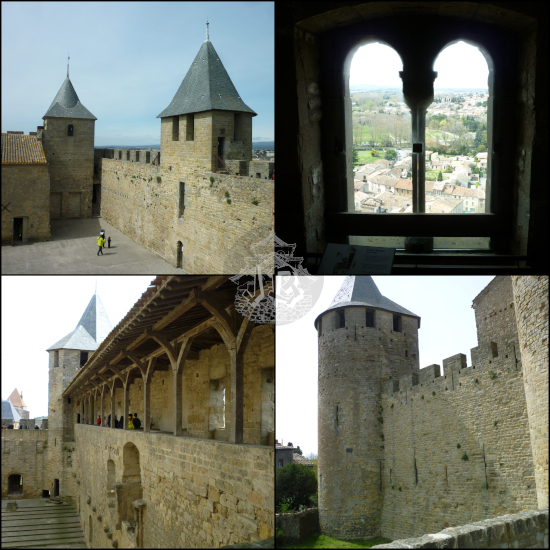
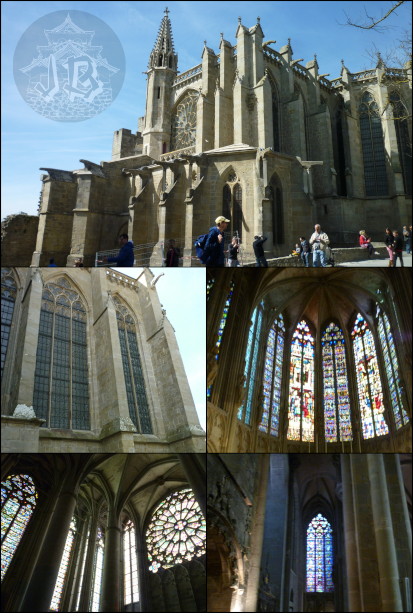
For my final day we went to visit the nearby town of Carcassonne, which is famous for having a medieval fortified citadel, the Cité de Carcassonne , which can be traced back 2,500 years, to the Gallo-Roman period. It’s been a Unesco Heritage Site since 1997.

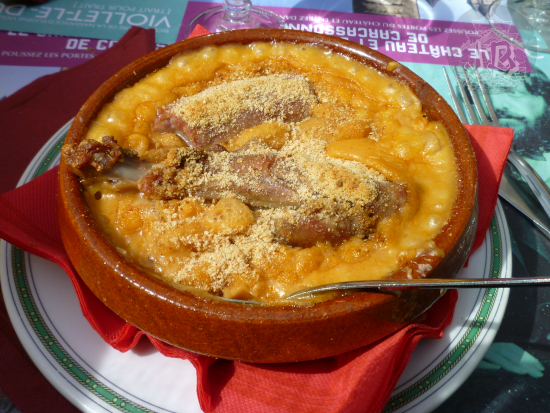
We wandered around the citadel for a few hours, and we had lunch, the famous (so I was told, I had no idea at the moment) cassoulet, made with white beans, duck confit, sausages, pork and mutton, served in a cassole. I remember this as super heavy but I have this obsession to eat everything I’m served, so I finished it – maybe I shouldn’t have.

Placed we visited included the Château Comtal, the Counts’ Castle, dating from the 12th century…

… the walls…

… The former cathedral of Carcassone, the Basilica of Saints Nazarius and Celsus

The Église Saint-Nazaire, the church of Saint Nazaire…

… the Porte Narbonnaise, one of the castle gates…

… and the Cimetière de la Cité, the graveyard.

After that, we headed back to the train station and back to Toulouse as the following day I was flying back home, and France said goodbye with a neat sunset.

31st March 2015 (Holy Tuesday): Driving through Medieval Towns and Salt Marshes {France, Easter 2015}

In the morning we set off towards the north of France through the provinces of Brittany and Normandy. There were not that many cars on the road so that was good, because the car was a scale up from what we wanted, and I had to get used to driving a bigger car than I am used to. And I’m bloody short so using a higher car was… a challenge. After a couple of hours we had to take a break because my leg was cramping.
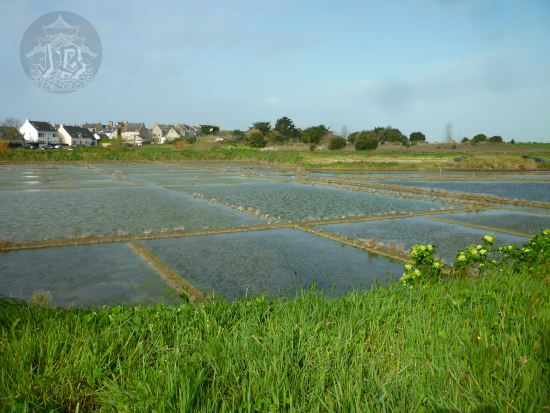
Eventually we got to Gérande, which is a Medieval fortified town dating from the Wars of Succession. We walked around for a while and had breakfast, and saw a lot of speciality shops, among them lots selling salt. Here’s the La porte Saint-Michel, the main gate.

But, why salt in the shops, you may ask? Because Gérande has been famous for its salt marshes since the 19th century. And of course we made a stop to visit the Salt Marshes of Gérande. Did I mention “of course”?

Our destination for the day was Le Mont-Saint-Michel, the mount of Saint Michael (Unesco World Heritage Site). It is a tidal island in the area of Normandy in France, at the mouth of the Coueson river. It features a medieval town and a Christian Abbey and a monastery. The main buildings tend to be Romanesque and Gothic, and the atmosphere is really cool – you might have noticed that I’m a bit of Gothic-style fan by now.

It was chilly and windy, and to be honest I found Mont-Saint-Michel to be slightly disappointing. The construction and exploitation of the tourism side, with building a parking lot and so on blew up the tidal system a couple of decades ago and the island is no longer such. They’re working now to try to restore everything back to how it was, but at the same time they are keeping a bridge, although that one should work for allowing the tides to move through. It was overcrowded, but we managed to have a good stroll.

After visiting Mont-Saint-Michel, we headed off to find our B&B at a small village about an hour away. I took a long, long, hot, hot shower and we ate some snacks for dinner.

19th August 2014: Change of plans {Japan, summer 2014}

My day in Kansai was yet another carefully laid out plan, only darkened by a 90% chance of rain in Nara, where I was going to head out in the afternoon. Morning in Fushimi Inari Taisha, afternoon in Nara, maybe heading to Osaka in the evening to eat takoyaki in Namba. However, just before heading off I checked my emails only to find one by D****e telling me about an even which was going to happen in Tokyo that evening – a VAMPS’ secret live.

Hyde had been mentioning a ‘secret’ with a number code which turned out to be the event that was being organised, timing up with the release of VAMPS’ latest single. Having discarded trying for their interviews in Osaka on the 21st. It was a tough decision, because it meant losing one hotel night – coming back to Kyoto would be a rough 5 hours the day before, and that night would be impossible.

In the end, knowing that whatever I chose I would be missing out on something I really wanted to do, I decided to go with what could not be repeated – the VAMPS concert.

That still left me morning and eawrly afternoon in Kyoto [京都], so I dashed towards Fushimi Inari Taisha [伏見稲荷大社]. I was rather amused to find that some torii were under repair. I spent two hours in the Inari Forest and Mountain, but once again I did not make it to the top – it was just too hot. I did walk along some forgotten paths and was alone for a good 40 minutes or so, which was amazing. One day I have to try this either at dawn or in winter.

The Senbontorii - a row of hundreds of torii one after the other creating a sort of tunnel. Also, the main building of Fushimi Inari behind the giant vermillion torii

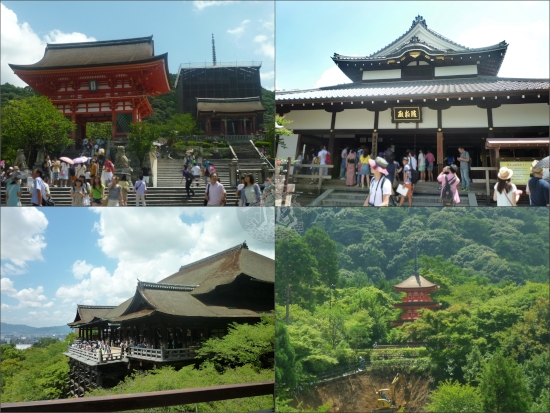
Before heading back to Tokyo I wanted to do something else, so I headed up to Kiyomizudera [清水寺], the Temple of Pure water, which was sadly being renovated. Never the less, I could come in and see most of the gardens and Pagoda and stand on the balcony. There were dozens of wind-bells and despite the rumble of people it was magical.

The main entrance to the temple, and a view of the main building from the side, where you can see that it hangs from the mountain.

After that I went back to the hotel, showered, changed and headed off to Odaiba [お台場] to the VAMPS Mezamashi Secret live, an event that the band had organised to introduce two new songs. It turned out to be a seven-song mini concert, and the first time I ever listened to what became one of my favourite VAMPS’ songs, The Jolly Roger.

The Mezamashi secret live stage. It shows the band's promo picture and the time, 19:40. The stage is lit in red, and there are flags with the band's logo, a Jolly Roger.

24th – 26th May 2014: Paris (France) for Yoshiki Classical

24th May 2014: Evening in Montmartre

I was going to atted Yoshiki Classical concert in Paris on Sunday, so I made planes with a a friend to meet up with her over the weekedn so we could do some stuff together. We booked a hotel close to the venue, Le Triannon. I arrived in Paris in the evening of Friday the 24th and met my friend direcly at the hotel – the first thing we noticed was that the area was not the safest, but we could still get to the Basilique du Sacré-Cœur to see it lit.

Sacre Coeur, a basilica on top of a mountain, lit in gentle green light at night

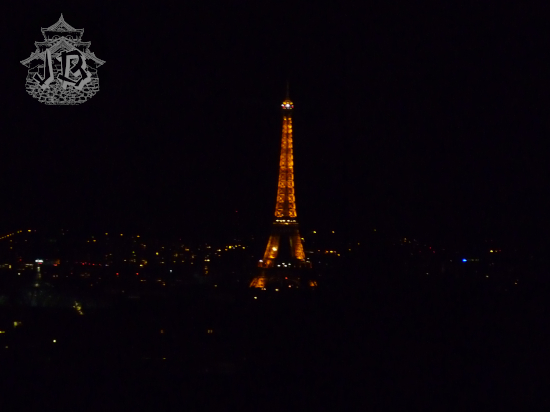
And also to see a nice view of the Eiffel Tower all lit up.

A shot of the Eiffel Tower from afar, lit reddish orange

25th May 2014: Under ground, above ground

On Saturday morning we went to Catacombes de Paris, the Catacombs of Paris. The ancient quarries and mines of Paris became the final resting place of more than six million people. In the late 18th century it was decided to eliminate a good portion of the quickly-overcrowding cemeteries and graveyads of Paris and for a 1786 the bones were carried to the catacombs at night. Today they are consisdered a museum and thus managed as such.

Creepy catacombs of Paris, with thousands of human skulls and other remains

After the catacombs we moved onto the Ille de la Cité, the “island of the city”, an island in the middle of the Seine, to visit Notre-Dame de Paris, our Lady of Paris, a magnificent Gothic cathedral built in between 1160 and 1260. In the 19th century an extensive renovation was carried out, and a few features were added, such as a the gargoyles and a replacement spire for the original one. We climbed the towers and were treated to a really cool Paris view before going inside.

Collage of Notre Dame; the main façade, the gargoyles, the inside of the main navev, and a view of Paris from the top

Leaving Notre Dame, we headed our the Île de la Cité and passed by Saint Germain l’Auzeroix, which mostly dates from the 15th Century and used to be the church for the Louvre inhabitants.

A restored gothic church with an octogonal tower

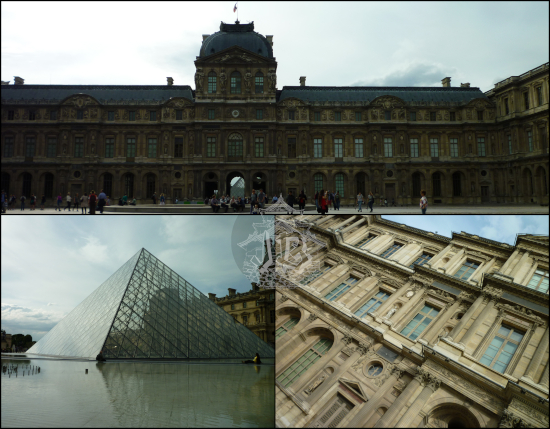
At the Louvre, by the way, there was a humongous queue, so as both of us had seen it before, we decided to skip going inside.

The Louvre palace from the outside

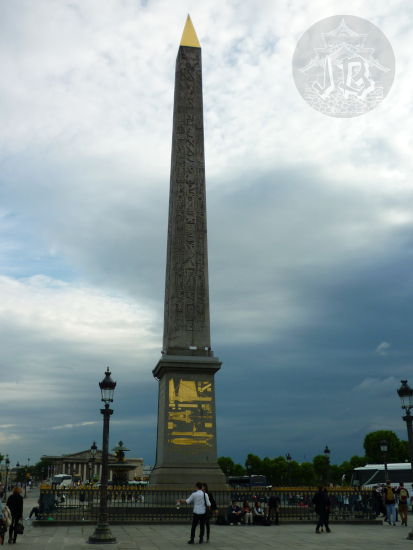
We passed by the Luxor Obelisk, an Egyptian monument which is over 3000 years old, located in the Place de la Concorde. I’ve always found that name very ironic considering that many people were guillotined there. But hey, the obelisk is cool and all.

A black Egyptian obelisk with golden decoration

We continued walking up the Champs-Élysées until we got to the Arc de Triomphe de l’Étoile (the “Triumphal Arch of the Star”. Okay Paris. Okay.), which is one of the biggest triumphal arcs in the world. It was completed in 1840 and it honours the casualties in the Revolutionary and Napoleonic Wars.

Commemorative gateway or triumphal arch in white stone

From there we took the underground back to the area of the Sacré-Cœur, which we could see at the end of the streets.

Sacre Coeur peering at the end of a street

And to finish the day, we had some Japanese food because why wouldn’t we?

26th May 2014: Bad weather, queue & Yoshiki

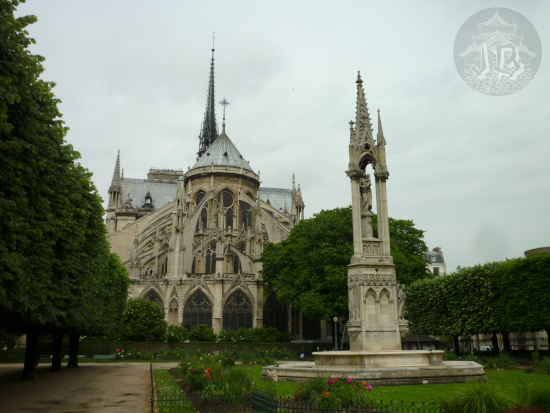
On Sunday, we started off back in the Île de la Cité and we walked around Notre Dame on our way as my friend wanted a walk along the Seine.

The back gardens of Notre Dame

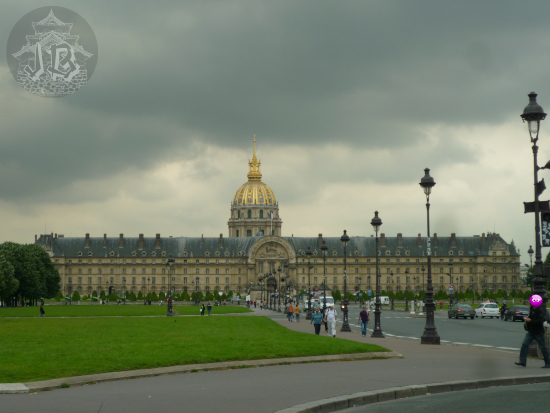
We took the underground towards Les Invalides (Hôtel national des Invalides or The National Residence of the Invalids), a complex of buildings erected between the 17th and 18th centuries and that hosts the military museum and some notable graves, among them Napoleon’s.

Les invalides, a neoclassical palace with a golden dome

Afterwards we took the underground to Champ de Mars, the long park where the Eiffel Tower stands. The Tower was built as an entrance to the 1889 World’s Fair exhibition and it was controversial at first (and rather ugly if you ask me, but hey to each their own). Eventually, it became so famous that it was not taken down as originally planned, and to-date it is one of the most visited landmarks of the world.

Eiffel tower in the clouds

Eiffel Tower from underneath, with a tennis ball hanging in from the second floor

As you can see in the pictures, the weather might not have beent he nicest, but we made our best. We walked all through the Chaps to the Trocadero on the other side. There were very few people on the street so I convinced my friend to take a ride in the carrousel over there, because I’m insane like that. Soon after we had left, a group of random people decided to emulate us.

Classical caroussel, looking over the ears of one of the horses

After this, we said goodbye. I headed off to Le Triannon for Yoshiki Classical, and my friend towards the airport as she had work on Monday. Yoshiki is one of the most important figures in Japan’s musical scene. He is the leader of the iconic band X Japan, and also trained in classical music. He wrecked his health when he was young, though, so he is not in the best shape. His recital Yoshiki Classical was meant to be a reimagination of some songs of his career, just him and his piano and some invited artist. I have to admit that it was one of the most beautiful things I’ve ever been to, and I don’t regret attending one bit. Although this was my first concert alone, I didn’t feel strange in any way.

A concert venue with some people waiting

I don’t know what I was expecting, but this surpassed any and everything I could have thought of. Yoshiki is a wonderful human, and he spoke in English during the whole event – he is living in America now, collaborating with people like Stan Lee and Marilyn Manson to do more great stuff. For me, seeing him in person and playing his piano was a heart-bursting experience.

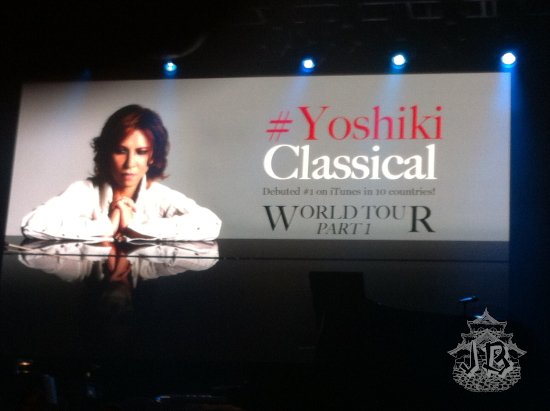
Yoshiki Classical Banner

Although Le Trianon is a seated venue, tickets were not numbered. I arrived at the queue round 17:00 for a 19:30 concert. It was not a good line – French fans seemed to have no sense of personal space, and the person behind the person behind me was invading my space, and I’m not exaggerating.

Conversely, the venue was quite ready for us, entry was well organised and smooth. Theatre staff, speaking in French and Japanese, made sure that ticket holders did not bother the local commerce nor their patrons. Judging by the faces of the sellers around, they were not used to people queuing for the theatre.

Gates opened around 18:45, and I managed a seat on 7th row, in what I thought it would be a good position to actually see Yoshiki’s face as he played. The stage was equipped with the Kawai piano, a synthesiser, and the seats for the strings, along with a standing microphone. I took in the relative positions of everything to chose my seat. The screen showed the Yoshiki Classical World Tour banner, and staff members sold insanely expensive glow sticks.

By 19:50 the audience had started to get nervous,but the members of the press were being shown in to their seats, which meant that the interviews were over. The concert finally started at 20.05, with the entrance of the supporting musicians – three violins, two violas, two cellos. The assistant gave them the tuning note and the video launched behind them. It started with a fragment of the Golden Globes museum interview, where Yoshiki explained the two sides of him, the destructiveness of heavy metal and the peace of classical music. This was illustrated by short clips of X Japan drumming and other activities, such as playing for the Emperor, or Yoshiki Symphonic, all to the music of Miracle.Finally, Yoshiki walked in, sat in front of the Kawai and played the intro of Forever Love.

He did quite a lot of talking between the songs, with a few words in French, but mostly English. He explained that we would have two parts (I used the intermission to go get goods and buy an overpriced bottle of water).Throughout the concert he introduced the strings by name, he remembered all of their names even with effort (and named them Yoshiki Sextet with great mischievousness), and Katie Fitzgerald, the vocalist of his Violet UK project. he himself said that he had too many open fronts and that he had been recording with X Japan forever, but also with Violet UK. He put the blame on himself for being a perfectionist and thus never finding anything finish-worthy. Katie rolled her eyes at him. They seemed to have a good chemistry going on. At the very beginning he told us that he was used to being in the back of concerts, playing drums and that being so close and seeing us made him nervous. He joked that as it was a classical concert he would not stage dive.

As he played the piano the screen behind him projected images, some of them abstract, some of them related to the song, such as roses for Rosa, stills of the Saint Seiya film for Hero, or raindrops for Endless Rain.

He spoke about the history of X Japan and his own – he started playing piano when he was four, the same year he met ToshI. He picked up drums at ten, in Chiba. He reminisced about how he hunted down Pata, Taiji and Hide, ”having to break their bands to get them to come to his band”. Then he spoke of Taiji’s and Hide’s passings, and not talking to ToshI for about ten years. At this point he broke down. It makes one wonder about the kind of pain this man harbours in his soul. You could feel the rage as he pounded into the piano at some points, and yes, I am sure he was crying during the song he dedicated to his father, Taiji and Hide. He said that he had learnt that big venues and stadiums did not really mean anything, but that the support of the fans was what kept him going.

He played an improvisation of Tchaikovsky’s Swan Lake, and a song he had heard on the radio the day before. He confessed that being on tour he lost track of days and places. He was aware of time and space enough to announce that the upcoming October concert in the Madison Square Garden may be the start of a new X Japan tour, but I do not think any of us believed him.

All in all, I knew that he is a great pianist, musician and artist, and after the concert I am completely sure that he is a good person, too. It’s not an act, a persona that he created for the stage. Nobody is that good at feigning pain. He picked up a bunch of presents from the crowd on the first couple of rows himself, be it flowers, plushies, flags, and was thankful for all of them.

Setlist:
1. Miracle (during the video)
2. Forever Love (X Japan)
3. Golden Globe Theme
4. Rosa (Violet UK)
5. Anniversary
[Intermission]
6. Amethyst (Strings only)
7. Swan Lake Improvisation (Tchaikovsky)
8. Hero
9. I.V. (X Japan), fragment
10. Hymne à l’amour (Édith Piaf cover)
11. Without You (X Japan)
12. Kurenai (X Japan), fragment
13. Art of Life (X Japan)
14. Endless Rain (X Japan)

Yoshiki talking to his audience

Yoshiki and Katie Fitzgerald during Hero

After the concert, I went back to the hotel. I would have loved to stay a bit longer, but it was night already and the area did not feel… Nice. In the following morning, Monday the 27th, I just headed for the airport and came back home. It was a very complete weekend!

28th & 29th March 2014: London (England, Great Britain) for VAMPS

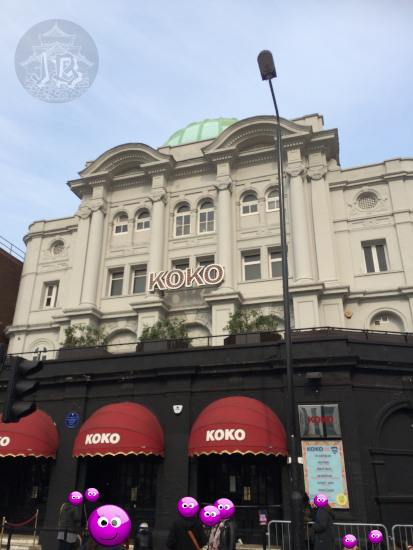
A friend convinced me to attend this VAMPS concert in London by paying for the VIP upgrade in advance. I took a red-eye flight on Saturday morning to Gatwick and went directly to Camden, where the venue, Koko live house, stood.

The venue, a neoclassical building with a marking reading Koko

Aside from the run to the hotel, I spent most of the day in the queue, which was rewarded when I got an autograph from HYDE himself on the Sex Blood Rock ‘n’ Roll album.

Hyde's autograph on the Sex Blood Rock n' Roll CD

It was probably due to the high of the autograph, but this is one of the best concerts that I’ve ever attended, with lots of amazing songs, and I had a great time. I did not freeze during the Meet and Greet, and I shook hands with both members, mumbled something along the lines of “thanks for the autograph” to Hyde and “thanks for the pick” to K.A.Z, referring to the one I got in Barcelona. Then I bounced off the evening with most of the songs:
  1. Devil side
  2. Redrum
  3. The past
  4. Secret in my heart
  5. Replay
  6. Dolly
  7. Sweet Dreams
  8. Life on Mars?
  9. Hunting II
  10. World’s end
  11. Angel trip
  12. Trouble
  13. Midnight celebration
  14. Revolution II
  15. Memories
  16. Love addict
  17. Sex Blood Rock N’ Roll

The venue at night

The next morning my friend went off to the airport first thing in the morning. I was not travelling back till the evening, so I took the chance to… Well, first things first, I took the chance to get myself to a Costa Coffee and get a vanilla latte.

A Costa coffee dispossable glass

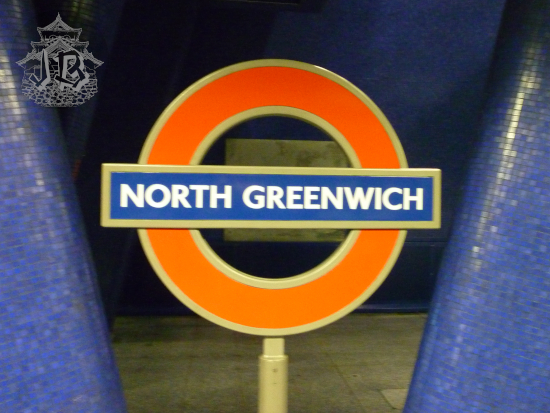
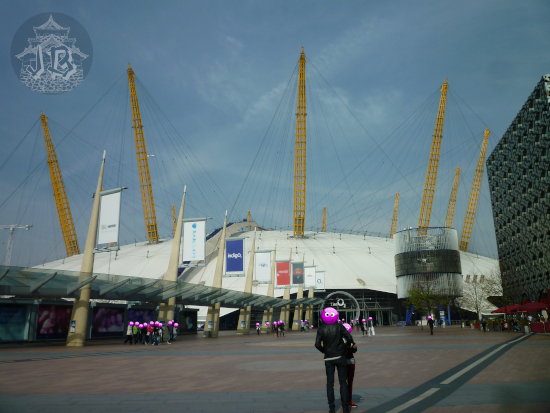
Then I took the underground towards the end of the world, or more precisely the end of the Jubilee line – to North Greenwich. I took the O2 Arena exit, to say hi the IndigO2, where I had been once back in 2012 to attend the L’Arc~en~Ciel World Tour, the first and only time I’ve ever seen them.

North Greenwich undergrond station

The O2, a huge tent with crane-looking structures that reminds one of a giant hedgehog

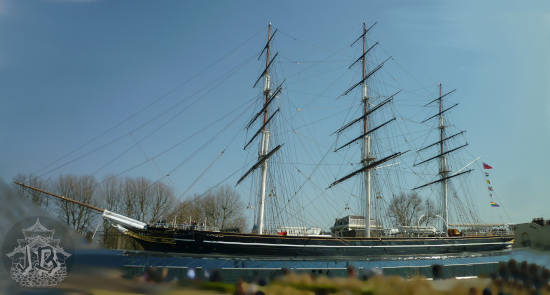
I left the O2 Arena behind, and walked about 20 minutes towards the Cutty Sark, a tea clipper built in Dumbarton in 1869. It took eight trips to China to trade for tea and other items. Its history involved mutinee, murder, trampling of cargo and travels to Asia and Australia. In the 1880s it was considered one of the fastest ships if not the fastest sailing the ocean.

A landed sailboat

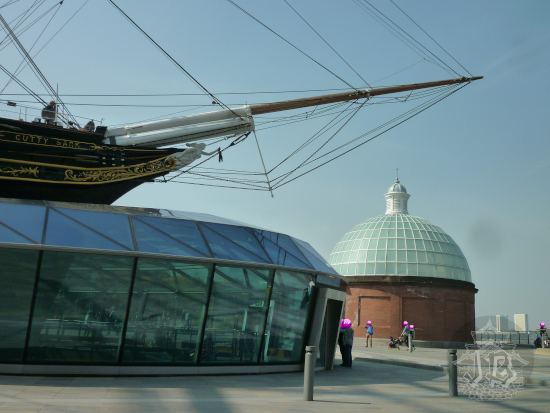
The Cutty Sark’s figurehead is the witch Nannie Dee, created by Robert Burns – in the poem a man falls in… love or lust… with a witch during a coven meeting that he’s spying, and the witch chases him away, getting away with the tail of his horse, that you can see in her hand.

Close up of the ship. It is perched on a glass structure that gives away tot he museum

The steam engines made sail-ships obsolete, but the Cutty Sark was active until the 1950s, when it was rammed by another ship on the Thames. In 1954 it was moved to a custom-dock in Greenwich to become a museum.

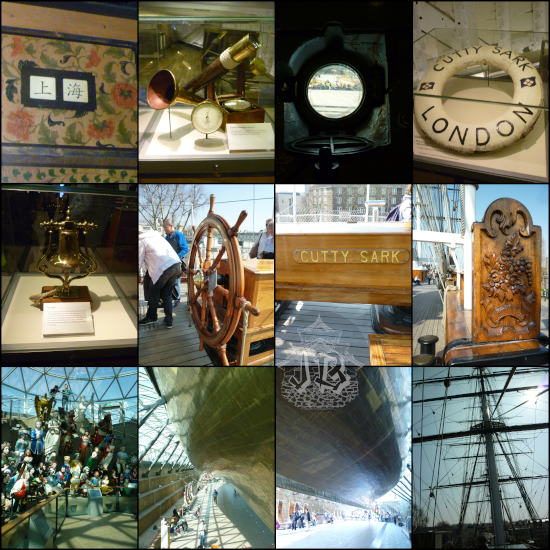
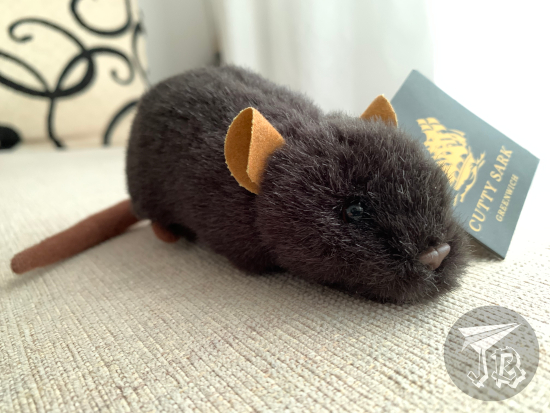
I wanted to see the exhibition inside, which turned out out be about Chinese tea and the history of the ship, which was not unexpected. I bought a pet-rat souvenir plush because I found it adorable. In 2007 it was ravaged by a fire, and extensive rebuilding works were undertaken, which included building a new support of glass and steel that would also become the new visitor centre when the museum reopened in 2012 (when I was there in 2012 it was not yet open. I guess this was an itch I had to scratch).

Different objects in the Cutty Sark museum - tea boxes, sailing instruments, the steering wheel, marionettes, one of the original floaters

A small black rat plush with the Cutty Sark tag

Oh, and by the way… here’s the binnacle!

An actual binnacle compass

I walked back towards the underground and by the Thames riverbank.

Thames and riverbank

There stands the Old Royal Naval College, a Unesco World Heritage site build between 1696 and 1712 – it was originally conceived as a hospital and it became the Royal Naval College in 1873.

Naval college. A symmetric Neoclassical building, with columns and a green lawn

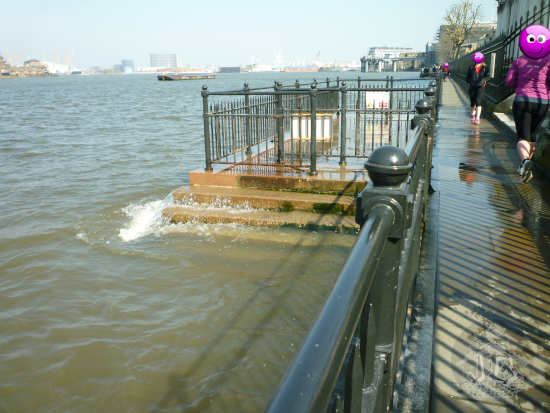
Continuing on the riverbank, you can see the floodgates in the background.

Small waves at the walk near the river

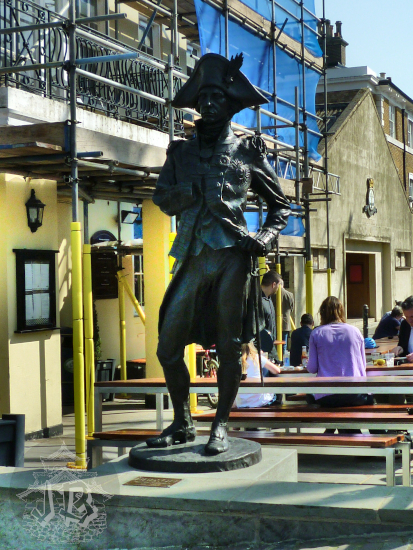
I paid my respect to Admiral Lord Nelson Statue and went on.

A sculpture of Nelson, with his right hand

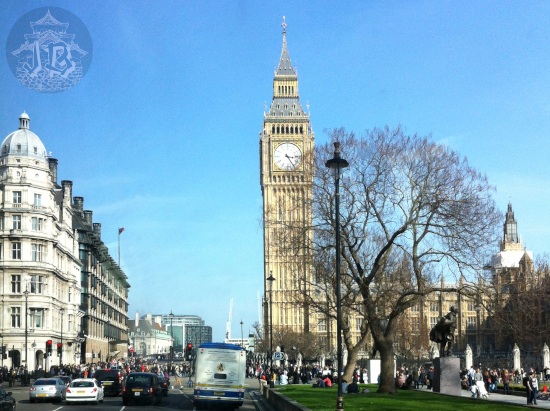
I had to take a bus at Victoria Coach Station to go to the airport, and I got a very nice tour of the city, with the Big Ben and Houses of Parliament

The Big Ben or Elizabeth Tower

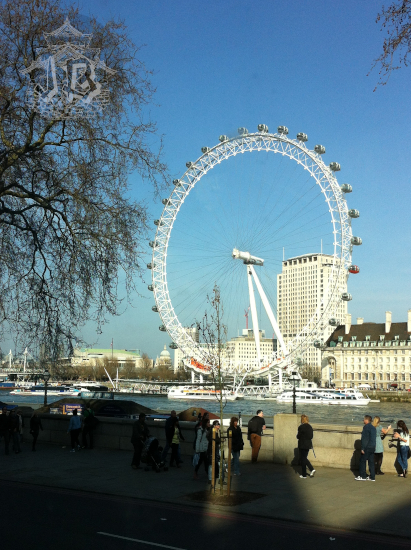
… the London Eye

The London Eye, a giant ferris wheel

… and the Tower of London.

The Medieval Fortress Tower of London

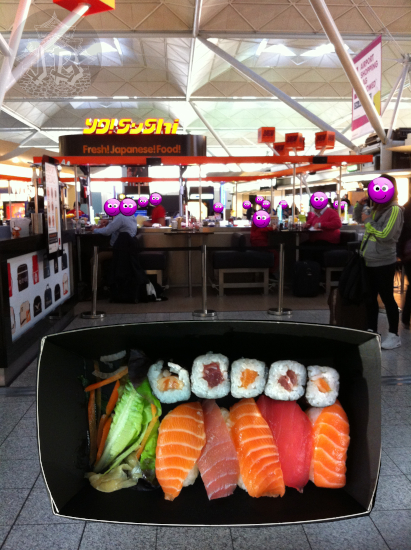
Once at the airport, I had some Yo!Sushi dinner – not the best, but hey I take sushi wherever I can find it because yay sushi.

Sushi dinner

30th December 2013 – 1st January 2014: New Year’s in Toledo (Spain)

30th December 2013: Arrival in Toledo

We took an early train to get to Madrid, and transferred to the high-speed line (AVE) to get to Toledo – the ride from Madrid was barely half an hour. Toledo is known as “the city of the three cultures” as during the Middle Ages, Christians, Muslims and Jews managed to live in peace there, and make it prosper. Today it is a tourist hub in the centre of Spain.

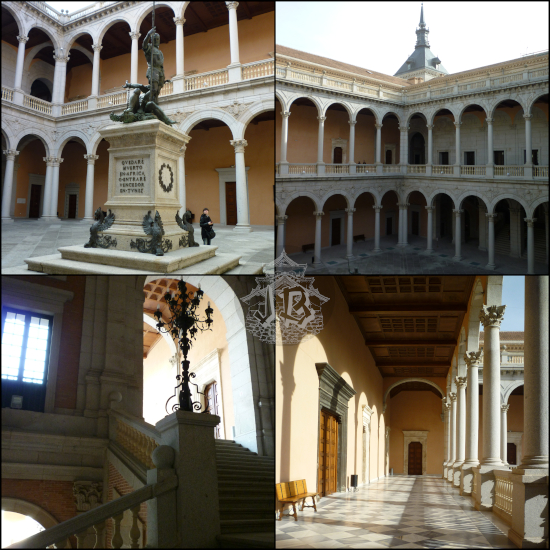
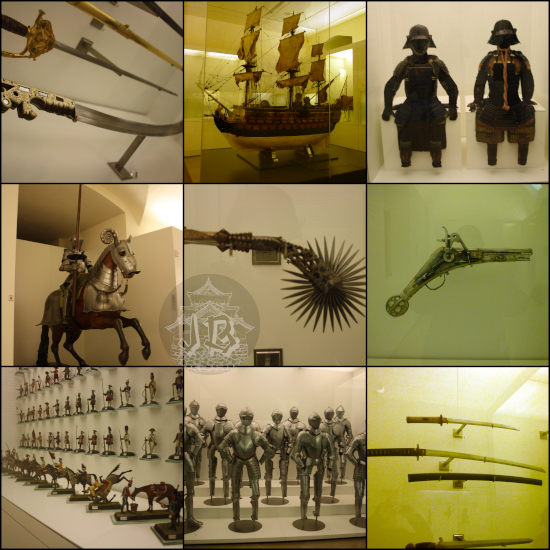
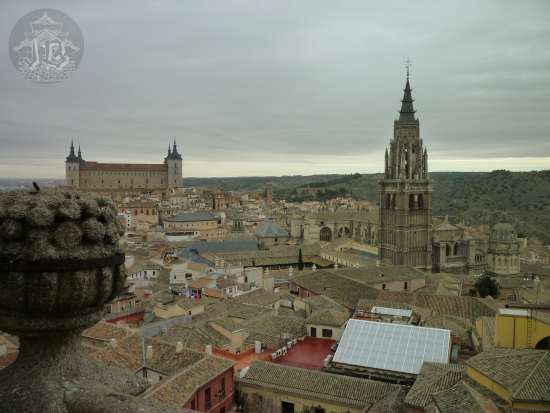
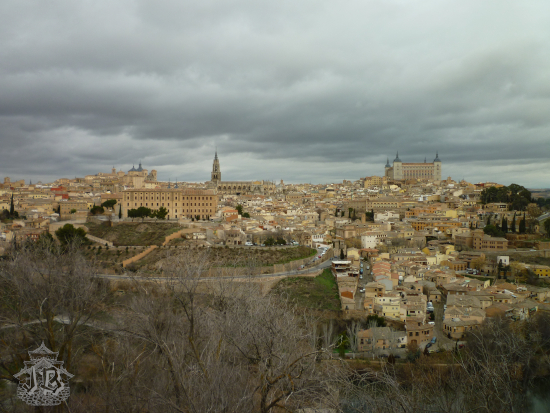
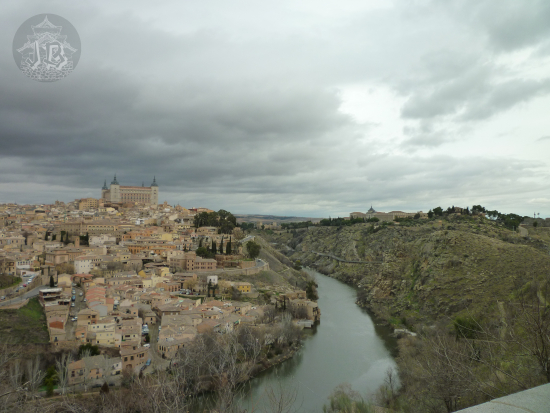
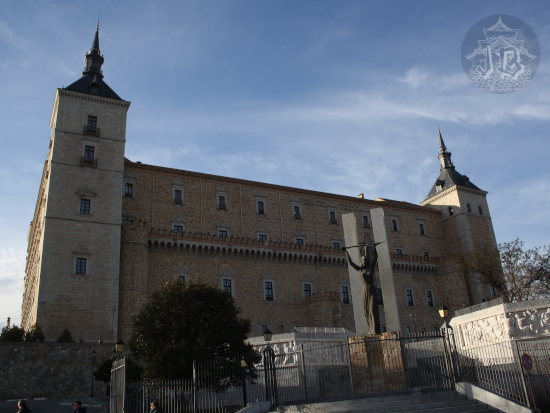
The first thing that we did was head off to the Alcázar (Muslim castle) – although it was originally built by Romans in the third century, its current look is owed to the restoration carried out in the 1540s. However, it had to be restored after the Spanish Civil War. The Siege of the Alcázar was one of the most symbolic victories on the Nationalist band. The Alcázar was under siege during the whole summer by Republicans trying to take it over, but in the end, Nationalist reinforcements arrived, chasing the Republicans away. Today, the Alcázar is an important cultural building (where the bullet holes can still be found) and hosts the Museum of the Army, Museo del Ejército.

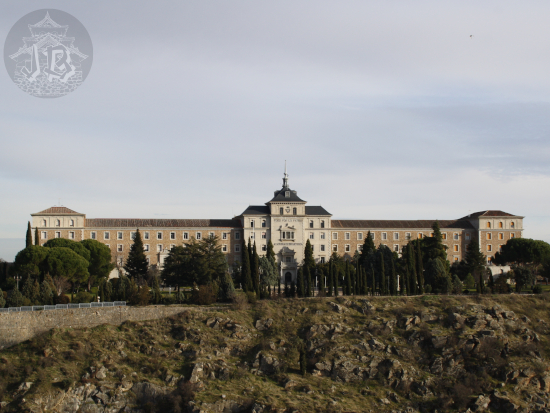
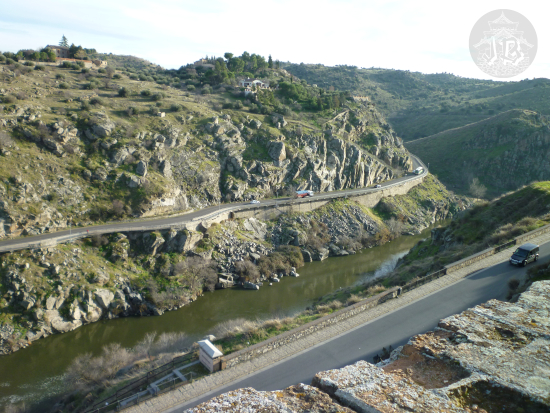
From the vantage point of the Alcázar, we could see the Academia de Infantería (Toledo Infantry Academy), built in the 20th century in imitation of the Renaissance and Herrerian style.

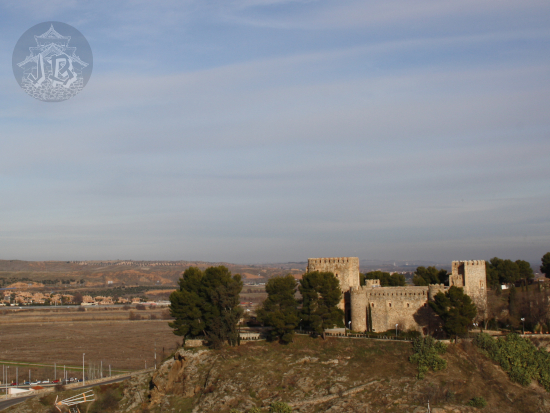
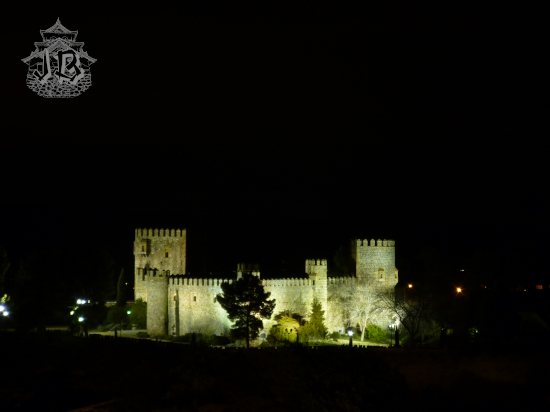
We also saw the Castillo de San Servando, the Castle of San Servando, a fortified Knights Templar enclave. Fine, it started off as a regular monastery, but it was later given to the Knights Templar in order to protect the city.

Both buildings are on the other side of the Río Tajo, the Tagus river, the longest river in Spain.

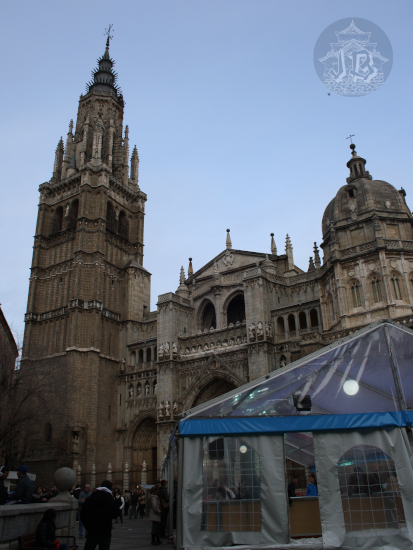
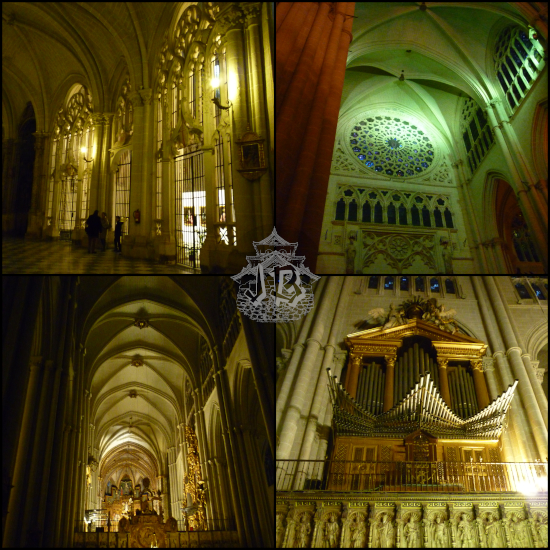
After having lunch and checking into the hotel, we visited the cathedral Catedral Primada Santa María de Toledo (Primate Cathedral of Saint Mary of Toledo). The cathedral, built in Gothic Style, was erected mainly throughout the 13th century, even if it was only finished in the 15th century. It sports two asymmetric towers, well, one tower and a small Mozarabic chapel in place of the other one.

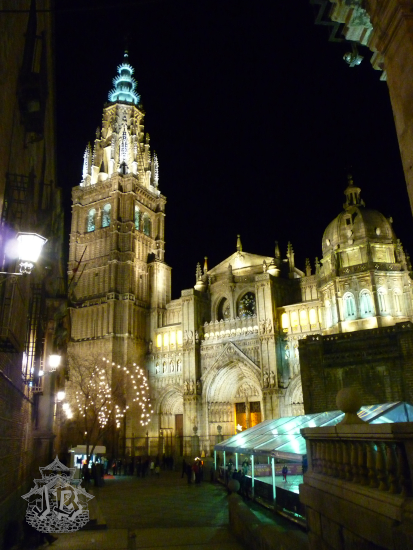
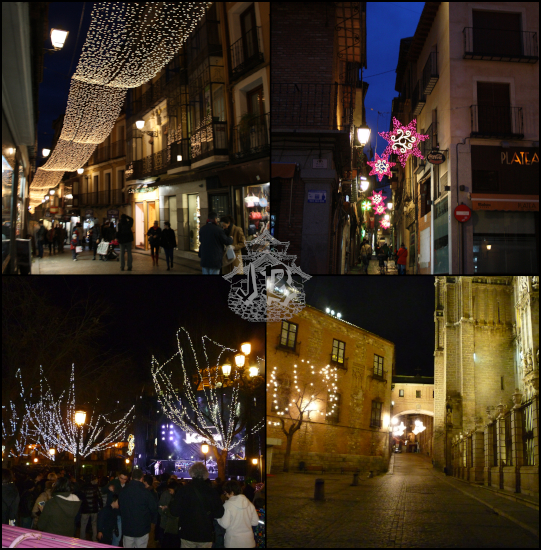
By the time we came out of the cathedral, night had fallen – truth is that we missed a little on the pretty windows due to it being darkish outside already. Nevertheless, this treated us to some nice night views. First of all, of course, the cathedral itself…

The Alcázar once again…

… and the Castle of San Servando.
We then walked through the Plaza de Zocodover, one of the city squares, where the old Muslim for cattle and horses was. The current layout was set in the 16th century after it burnt down in a fire.
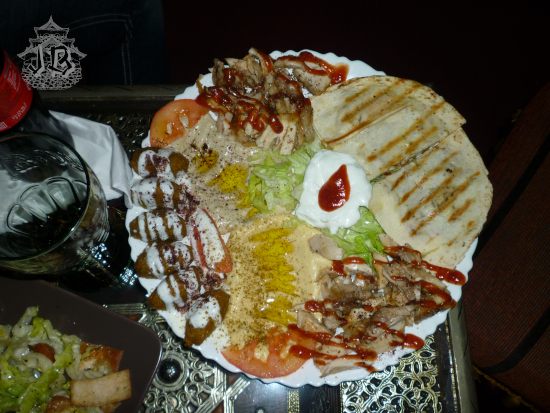
We walked around the old town for a while until we found a place to have dinner, a Middle-East restaurant called La Casa de Damasco, one of the few times I’ve had real food from this area. I have to say I really enjoyed it.

31st December 2013: Churches and Birds

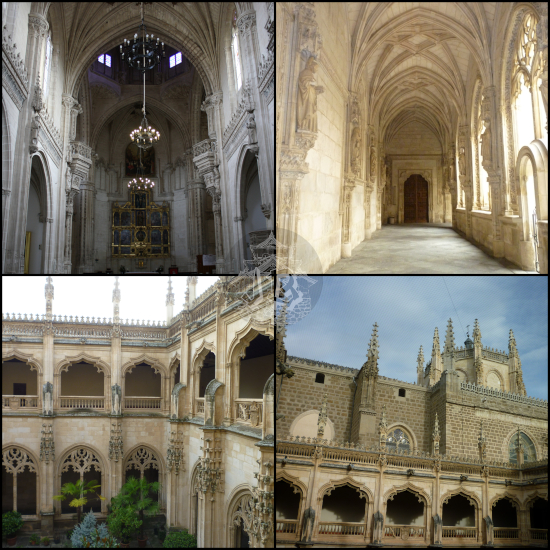
We started off the day at the Monasterio de San Juan de los Reyes (Monastery of Saint John of the Monarchs) is an Isabelline style Franciscan monastery. It was founded by the Catholic Monarchs to celebrate the birth of their son along with their victory in the Battle of Toro, in the late 15th century. It has a beautiful Gothic cloister.

Our next stop was one of those things that breaks my brain, a Christian Mosque, Mezquita del Cristo de la Luz. It was built in the year 999 as Bab-al-Mardum mosque, but it was turned into a Christian Church in 1085. I’m torn between rolling my eyes at Religions needing to assert dominance and being grateful the Mosque was preserved for us to visit.

Close to the Mosque stands one of the gates of the old walls, the Puerta del Sol, the Sun Gate, of the city walls.

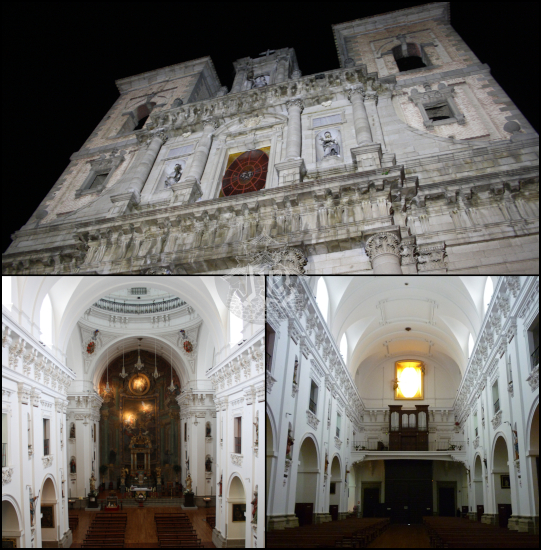
Our next stop the Iglesia Jesuita de San Ildefonso, a church dedicated to Saint Ildefonsus, the patron saint of the city. Construction started in the early 17th century and ended in the mid 18th century, in the Baroque style.

From the upper towers of the church, there was a great view of Toledo.

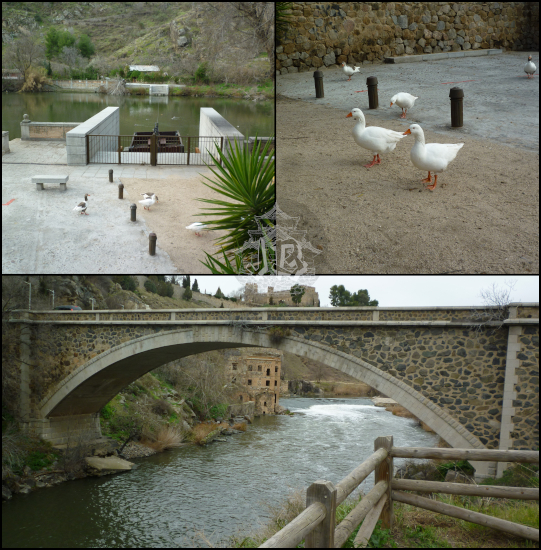
We decided to walk down towards the river, Río Tajo, where we met a flock of geese (which I’m happy to report had not lost their heads to any kind of stupid animal-hurting tradition).

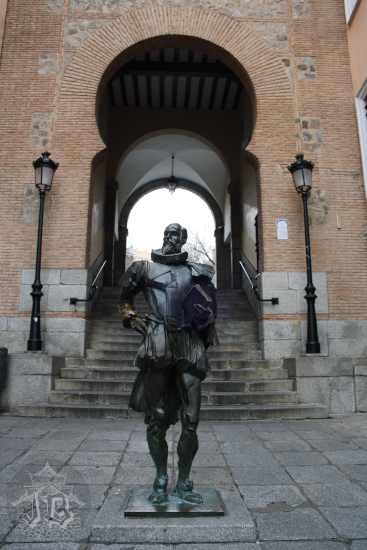
As we continued, we walked past a sculpture to Miguel de Cervantes, Estatua de Miguel de Cervantes, the author of the acclaimed “Don Quijote” book. The statue is placed beyond the Arco de la Sangre , the Blood Archway, that leads into the Zocodover Square.

As darkness rose, we had dinner in a Chinese restaurant. While we did, the lights turned on, and the city got ready to welcome the New Year with fireworks.

1st January 2014: Views of Toledo

We slept in, and after an early lunch (Chinese, again, as we were feeling decadent), we booked a ride in the “tourist train” that took us to see some of the most amazing views of the Medieval Town from the vantage points on the other side of the Río Tajo.

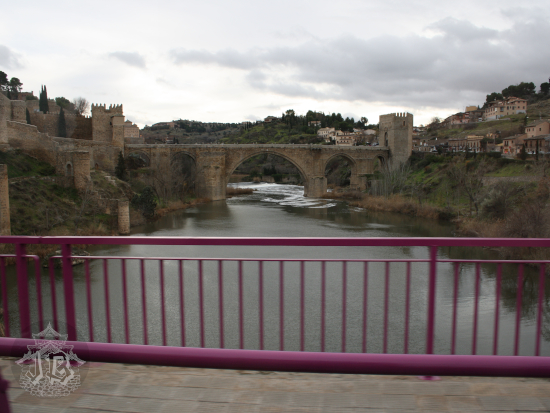
On the way back we saw the Puente de Alcántara, a Roman arch bridge built upon the foundation of the city after the Celtic settlement was taken over.

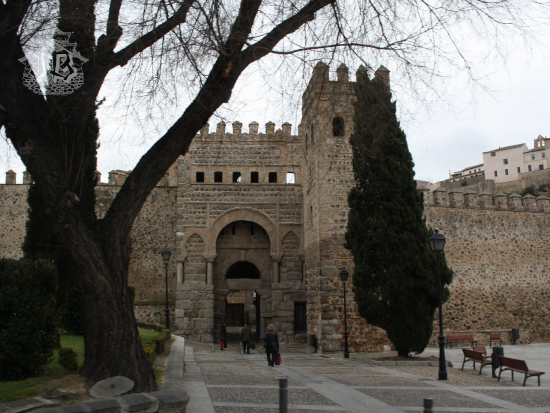
The ride ended up on the other side of the city than the one we had been favouring, so we just walked round the walls that fortify the city, the Murallas de Toledo, which are of Muslim origin over Roman foundations. King Alfonso VI is credited with finishing off the walls, and he named one of the gates after him: Puerta de Alfonso VI.

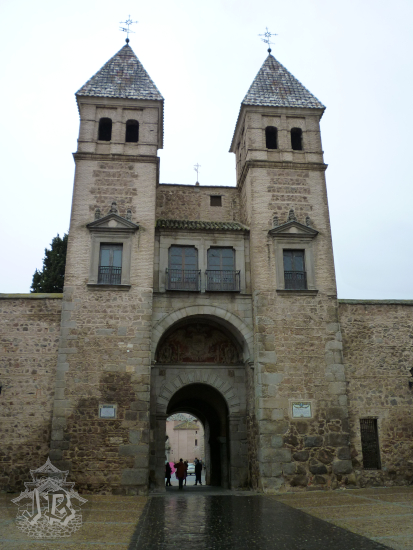
Another of the gates is the Puerta de Bisagra, the last of the monuments we visited before we headed back home the following morning.

One of the creepiest moments in this trip was realising that our key could open a room which was not ours – we got off on the wrong floor and we went down the corridor to the room door, and opened it. It was not our room. We were very quite put off by this, and it turns out that we had a master key. Finding this was a little freaky, and we tried to complain to the hotel. Furthermore, they wanted to charge us for keeping our luggage for a few hours.

Oh, and I caught a cold during our 31st at night escapade. Because of course I did.

27th & 28th July 2013: Segovia (Spain)

27th July 2013: Echoes of a Roman Past

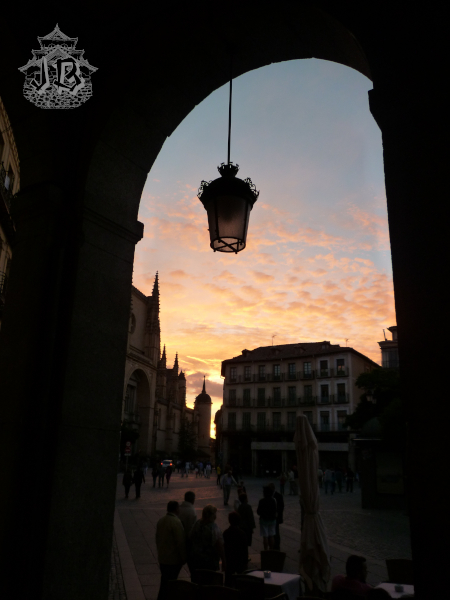
We took the train early on Saturday and arrived in Segovia in mid-morning. Segovia is a Spanish city of the Inner Plateau, located in the autonomous community of Castilla León. It has gained fame because of its many monuments and landmarks, the main being the Roma aqueduct in almost perfect condition, the cathedral and the castle (which may have served to inspire certain mouse-company for the Cinderella Castle). The city centre has been a world Heritage site from 1985 and the aqueduct received the title of International Historic Civil Engineering Landmark in 1999.

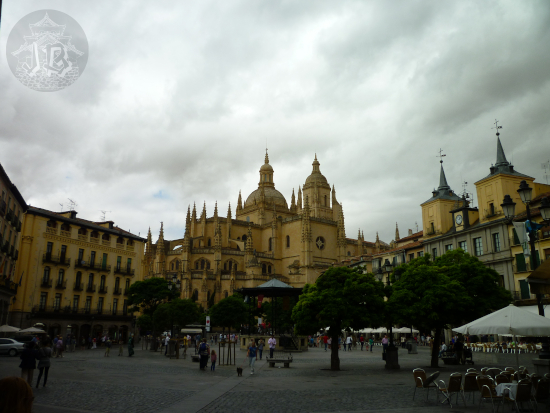
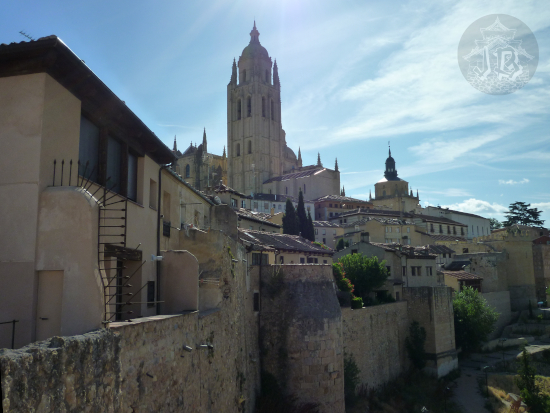
We checked into the hotel, which was dead in the centre of the Main Square and then we visited the Catedral de la Virgen María, the cathedral. The building was constructed between 1525 and 1577 in a late Gothic style that had already phased out in the rest of Europe. We saw the cloister, the chapels and the apse.

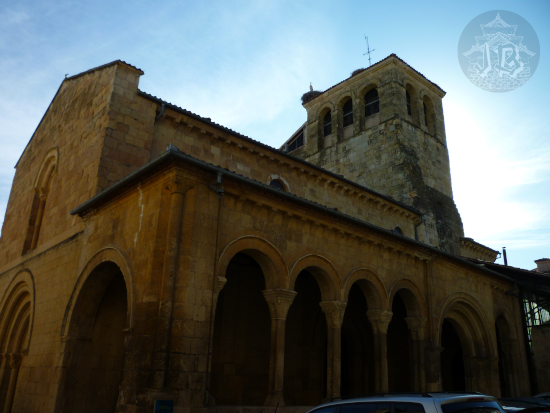
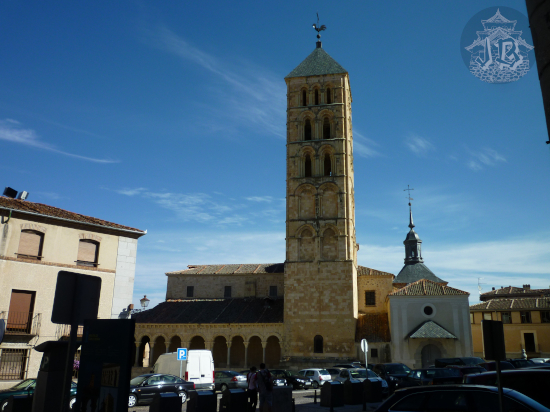
Then we moved onto the Iglesia de San Martín, St Martin’s church, built in the 12th century in the Romanesque style, with a Romanesque-Mudejar tower bell.

We then took a walk around the city centre, and we came across the Palacio de Cascales, a 15th century palace that belonged to the Alpuente Count.

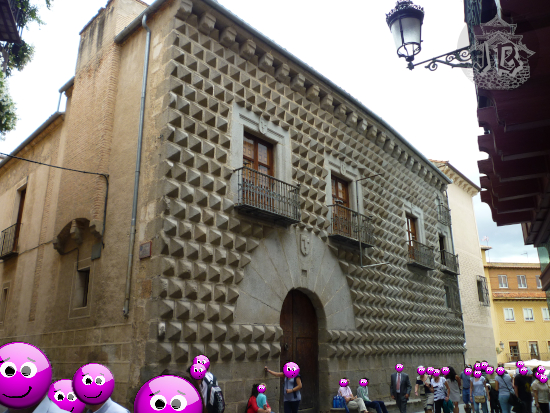
We passed by the Casa de los Picos, the “House of Peaks”, also built in the 15th century.

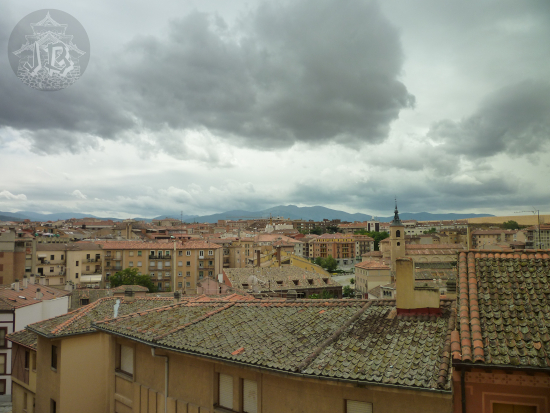
We somehow ended having these nice views of the rooftops of the city, too.

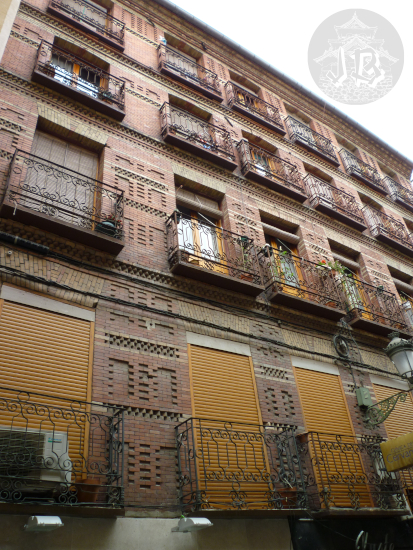
And passed by a very interesting house.

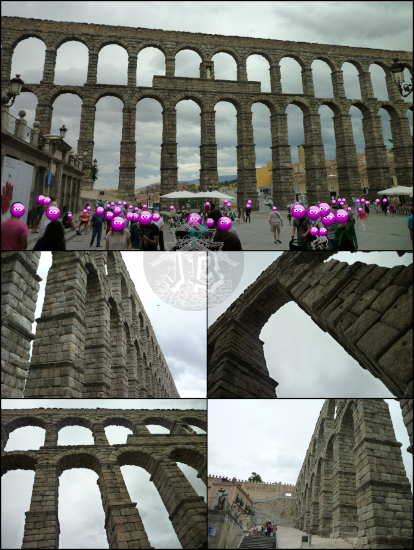
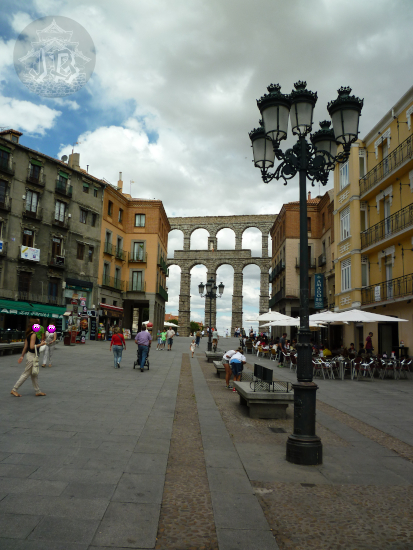
We finally got to the main event, the Aqueducto, the aqueduct. An aqueduct is a “water bridge”, a construction designed to carry water from one side of a valley or a ravine to the other. The Aqueducto was built by the Romans in the late first or early second century. It once transported water from the Frio River into the city, and it ran for a whooping 15 kilometres. It is one of the best preserved aqueducts in the world, as it was reconstructed several times through history, and it was working to get water to the city up to the 19th century.

We passed by the Casa de Ejercicios del Seminario one of the buildings of the Seminary.

We reached the Main Square, the Plaza Mayor again.

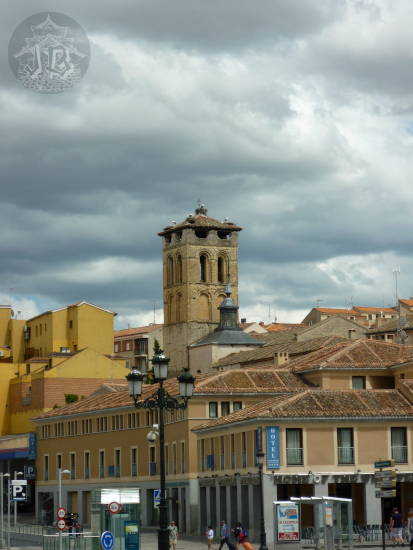
And saw the Romanesque Iglesia de San Andrés, St Andrew’s church, with a particularly nice bell tower.

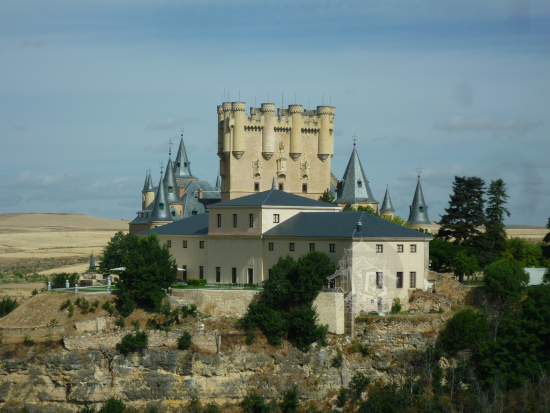
After this we decided to take a break and have the typical pork meat lunch. Then we moved on towards the Alcázar. An alcázar is a type of castle or fortress built during the Muslim rule in Spain and Portugal. The Alcázar of Segovia has been through several redesigns and renovations, but it is a pretty impressive building. The current form was reached during the reign of King Alfonso VIII, so it dates from the 13th century, but it was retweaked by several kings and queens after that. It was the royal residency until the Spanish court moved to Madrid in 1561.

On the way we could see some views and the Iglesia de la Vera Cruz, the True Cross Church.

The Alcázar is quite an impressive building, in Herrerian style, with impressive towers. Part of it is a history museum the other part is a military museum.

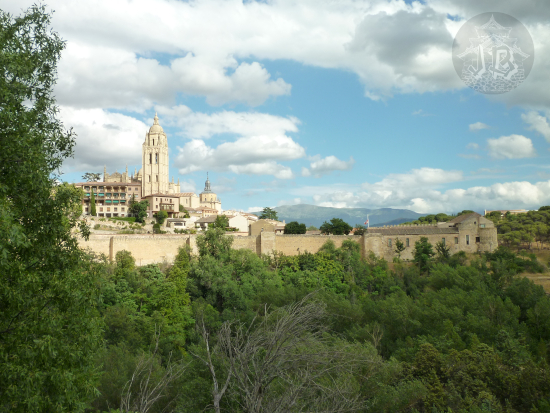
It also offers nice views of the cathedral from the other side.

We walked back to the city centre and along the aqueduct again.

This trip was in July, and scorching hot back home, so we had not considered much of a temperature change. Unfortunately, Segovia in the late afternoon became more than chilly and we had to walk into a random shop to buy a thin jacket, then headed off to the Plaza Mayor.

Funnily, when we were having dinner there, someone warned us that the shop assistant had left the alarm tag on my jacket! That was amusing. We called it a day heading off to the hotel, and being duly impressed by the illumination put in place for the cathedral.

28th July 2013: Churches while the city sleeps

On Sunday morning, most everything was closed, so we took a strolling tor if the Medieval area, and saw a bunch of churches from the tenth and eleventh centuries:

Iglesia de la Trinidad (Trinity Church).

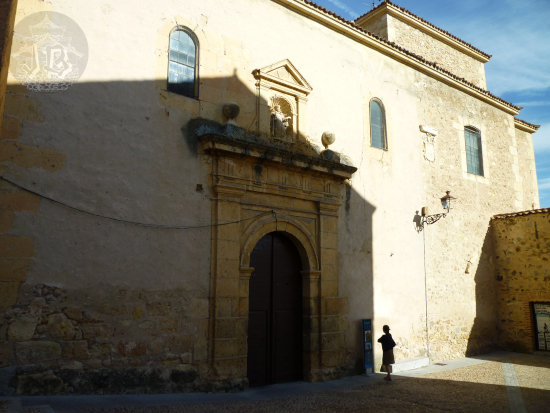
Convento de las Carmelitas Descalzas (Barefoot Carmelite Monastery).

Iglesia de San Nicolas (St. Nicholas’ Church)

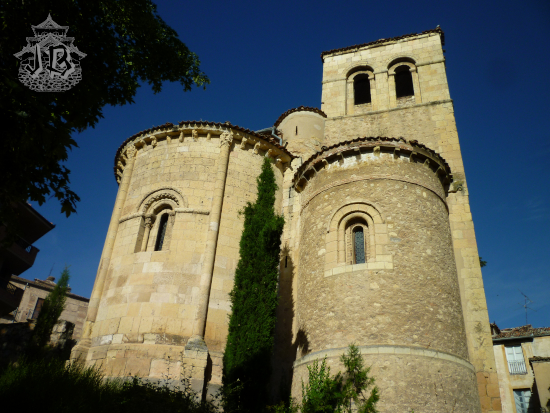
Iglesia de San Quirce (St. Quirce’s Church)

Iglesia de San Esteban (St. Stephen’s Church)

We also had yet a different view of the Cathedral.

And we could see the Alcázar in all its glory.

Then we returned to the city centre, where we caught a glimpse of the Iglesia de los Santos Justo y Pastor (St. Just and St. Pastor’s Church).

We had lunch and said one last good-bye to the Aqueduct before we headed back to the train station.

11th July 2012: Kyoto in 9.5 hours: Mission Impossible {Japan, summer 2012}

My express visit to Kyoto [京都] on the 11th was fueled by a jump into a rabbit hole – the first time I drank canned coffee. It would not be the last, definitely.

A can of Georgia Café au Lait

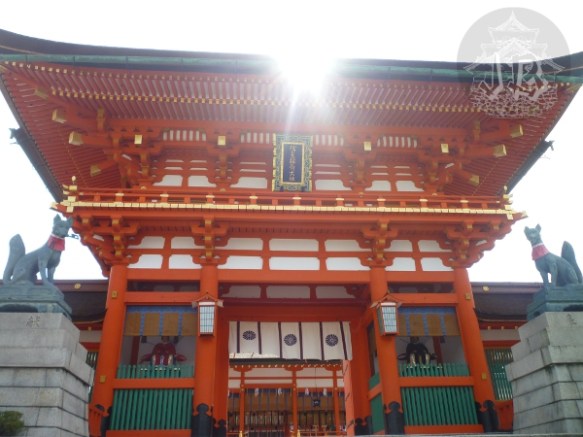
I started off with Fushimi Inari Taisha [伏見稲荷大社] and is dedicated to Inari, the God of Rice, whose messengers are considered to be the foxes or kitsune [狐]. It is a temple with a gazillion plus one torii, since in early Japan Inari was seen as the patron of business. Thus each of the torii is donated by a Japanese business. Sorry for the sun reflection, this was the best picture of the main building I could take:

A shrine building, in powerful orange. The sun is shining at the rim of the roof, and there are two sculptures of foxes sitting on the sides.

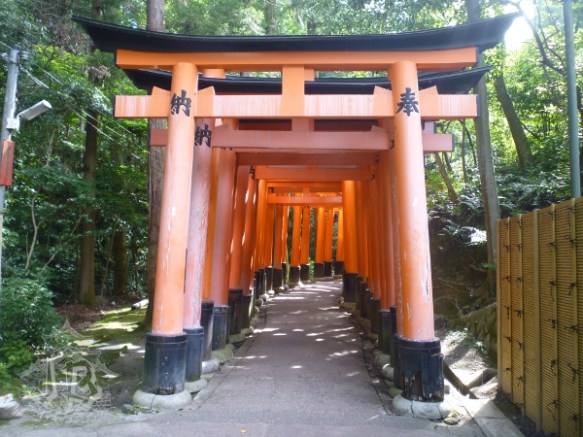
A line of torii (have I mentioned that I looove torii?) the Senbon Torii [千本鳥居], or line of a thousand torii:

A torii in the foreground. Beyond it, so many others that you cannot tell them apart. All of them are orange, but the outermost ones have been burnt by the sun and are less bright

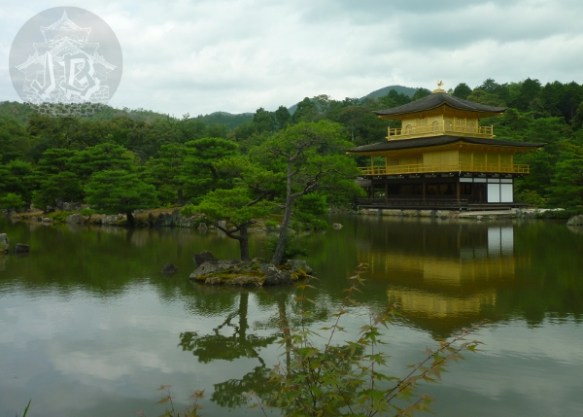
After Inari, I crossed the whole of Kyoto via bus and train and visited the Kinkaku-ji [金閣寺], the Temple of the Golden Pavilion. While I went to visit it because it was a must-see I found it amazing, and liked it more than I wanted to admit.

A pond with a pine tree at the centre. To the side, a three-story pavillion that looks similar to a pagoda. The first floor is built in wood and plaster, the upper ones have been covered in gold

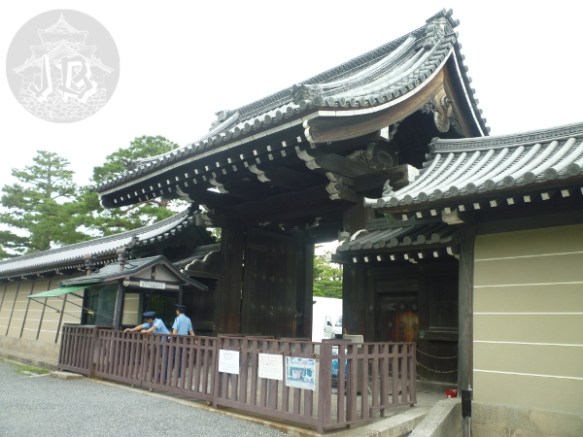
Bus again, towards the Imperial Palace, Kyōto-gosho [京都御所], of which you see… the outer wall and the cops that guard the door XD

The entrance to the Imperial palace - a gate through the walls. Two police officers in blue are chatting at the fence

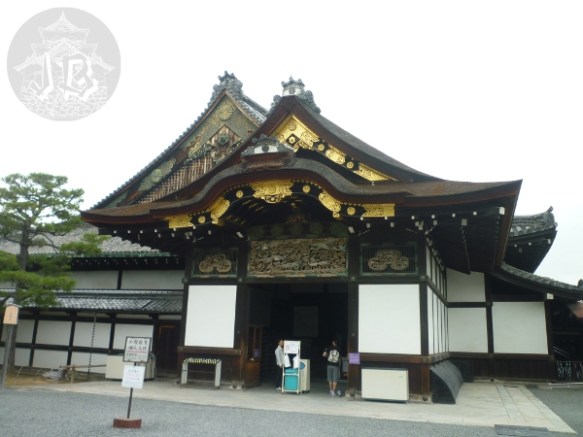
And a thirty-minute walk after that, I found myself entering the castle Nijō Jō [二条城]. Can you feel the rush? XD

The main building to the old castle. Is is built in dark wood with gold ornaments and carved details showing animals and plants, painted in bright colours

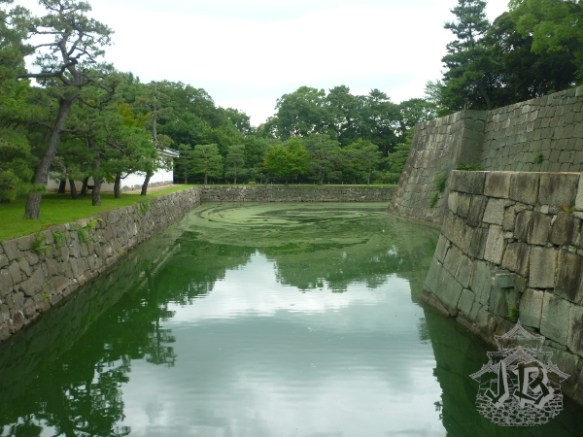
A view of the moat. The water is green.

Two buses later I was in Chion-in [知恩院] which was being repaired, so you can only see park entrance gate, which technically might belong to a nearby temple. I mean… there are too many temples to keep track of them! (Edit: after a bit of processing, that’s actually the entrance to the Yasaka Jinja [八坂神社] complex.)

A bright orange and white building at the top of some some stone stairs.

And going down those stairs to the left there was… Gion [祇園], the traditional geisha district. Found no geisha though D:

Traditional Japanese houses in dark wood, burnt by the sun. The entrance has a paper lanter and a menu

Finally, after another temple or twenty, or among them, I managed to sneak into Kennin-ji [建仁寺] just before it closed to see the twin dragons:

A ceiling painting of two dragons. The background is dark and the dragons are coloured in light shades, gold, white and red

By then I was so dead that I headed back to the station and was catatonic for the Shinkansen ride to Tokyo. This is not by far all I saw, but I lost track of the names for a bit. By the end of the day I was exhausted, but this is the gist of what I did that day. I would need more time to sort out the pictures, and I am trying to keep you guys generally updated, not write a thesis on ancient Japan XD (ETA 2017: Wow, that frame of mind changed a lot)

7th July 2012: Nikkō {Japan, summer 2012}

Nikkō [日光市] is about 140 km north of Tokyo, a couple of hours train ride. While the town itself might not seem much, close to it there is lies the Shrines and Temples of Nikkō Unesco World Heritage Site, and here we headed off on Saturday.

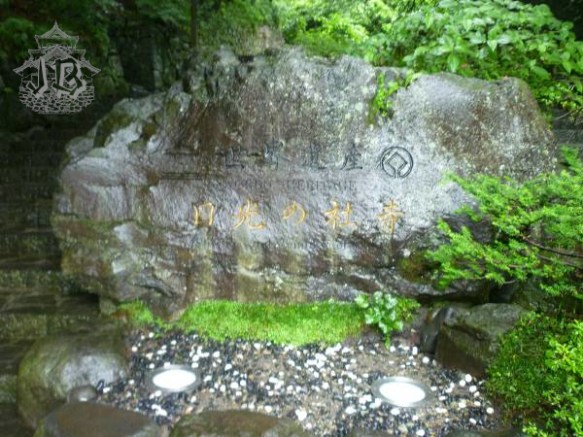
The area holds a whooping 103 buildings or structures, though the natural setting around them is also considered heritage. The buildings belong to two Shinto shrines: Futarasan Jinja [二荒山神社] and Tōshō-gū [東照宮], and one Buddhist temple Rinnō-ji [輪王寺]. Nine of the structures are designated National Treasures of Japan while the remaining 94 are Important Cultural Properties. Unesco listed the site as World Heritage in 1999.

A rock reading World Heritage Shrines and Temples of Nikko in English and Japanese

As you might be able to tell, it was raining. Like magic. Like hell. Cats and dogs. And then some.

Highlights include the Three wise monkeys, “see no evil, speak no evil, hear no evil”:

Wooden carvings of three monkeys: one is covering its ears, another is covering its mouth and the other is covering its eyes

The mausoleum of Tokugawa Ieyasu:

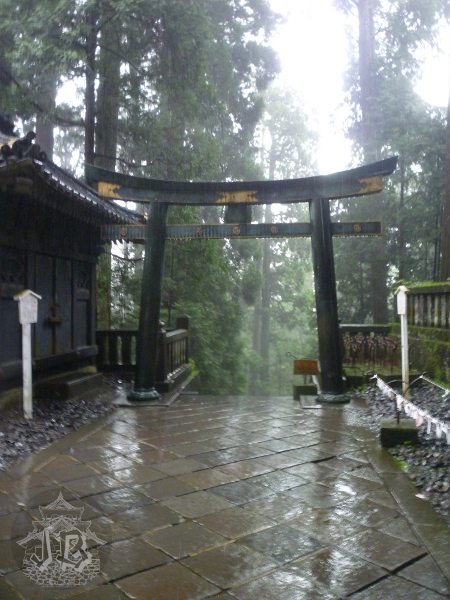
A torii in black and gold. It's raining

A small one-story pagoda, the mausoleum itself

A five-storey pagoda (gojūnōto) belonging to Tōshō-gū:

A five-story pagoda, in red, green and gold. It's still raining.

The inner buildings of Furata-san Jinja:

Dark wood buildings decorated in green and gold. It's still raining

The entrance to Tōshō-gū:

Shrine entrance. The entrance is completely golden. It's still raining

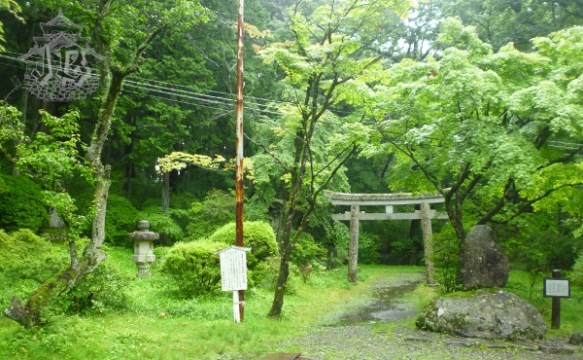
However, since I would not be me without finding (and falling in love with) something obscure and creepy, have a small shrine to the side of the road nobody was paying attention to:

A forlorne stone torii forgotten in the middle of the forest

Did I mention it was raining? Because it was. All the damn day XD

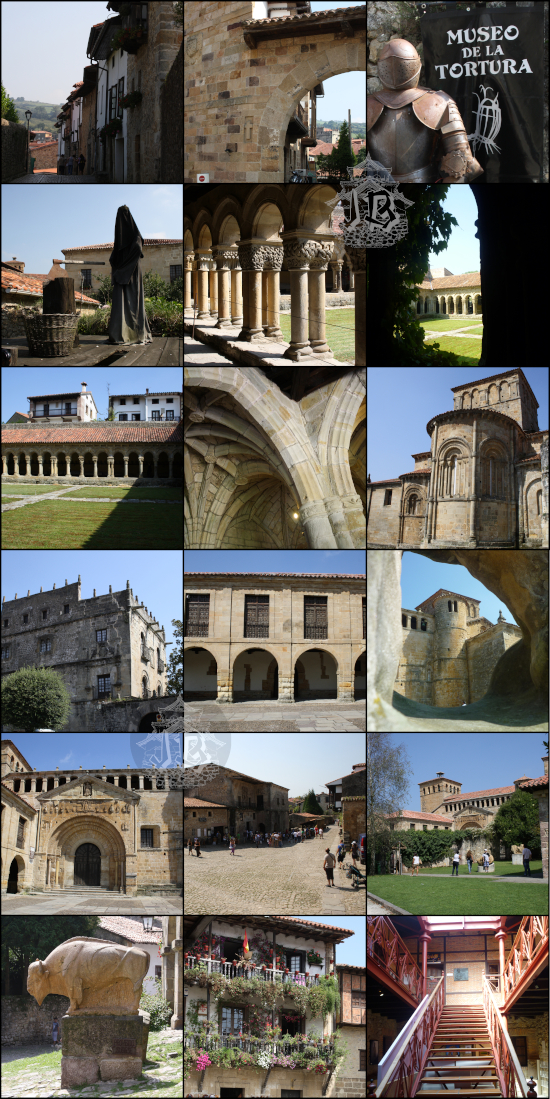
Flashback to 13th August 2011: Altamira & Santillana del Mar (Spain)

Altamira Caves Museum

Santillana del Mar

  • Museo de la Tortura (Torture Museum)
  • Plaza Mayor de Ramón y Pelayo (Main Square)
  • Iglesia de la Colegiata (Colegiate Church)

Note: This is a flashback post, which means it is just a collage regarding a trip I took before I started the blog in 2012. Tags may be incomplete or slightly off.

Flashback to 28th December 2010 – 2nd January 2011: New Year’s in London

  • Hyde Park
  • Piccadilly Circus
  • Sherlock Holmes Museum
  • London Eye
  • Houses of Parliament
  • Big Ben
  • River Thames
  • Tower Bridge
  • Tower of London
  • St Paul’s Cathedral
  • Globe Theatre
  • London Aquarium
  • British Museum
  • London Natural History Museum
  • Buckingham Palace

Note: This is a flashback post, which means it is just a collage regarding a trip I took before I started the blog in 2012. Tags may be incomplete or slightly off.

Flashback to 11th – 14th August 2010: Granada & the Alhambra

  • Catedral de la Encarnación de Granada (Cathedral of the Incarnation)
  • Alhambra de Granada (Granada Muslim fortress)
  • Jardines de la Alhambra (Fortress Gardens)

Note: This is a flashback post, which means it is just a collage regarding a trip I took before I started the blog in 2012. Tags may be incomplete or slightly off.

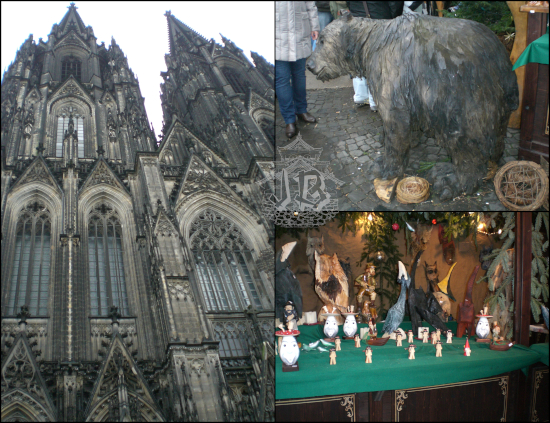
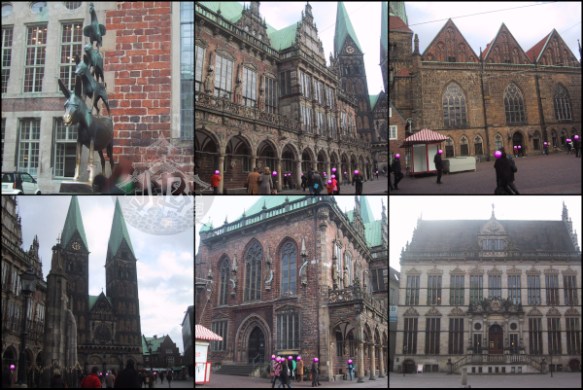
Flashback to 2nd – 4th March 2007: Bremen (Germany)

  • Bremen Marktplatz (Market square)
  • Die Stadtmusikanten (Town Musicians)
  • St. Petri Dom zu Bremen (Cathedral of St. Peter of Bremen)

Note: This is a flashback post, which means it is just a collage regarding a trip I took before I started the blog in 2012. Tags may be incomplete or slightly off.