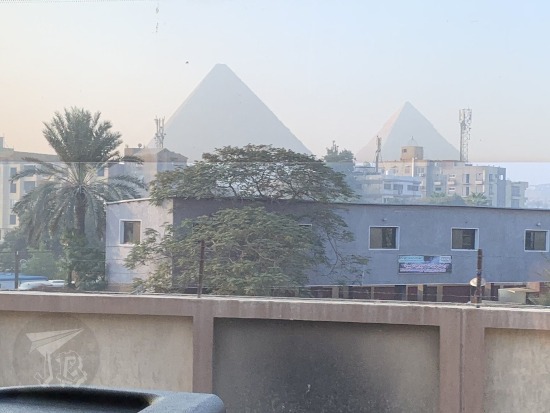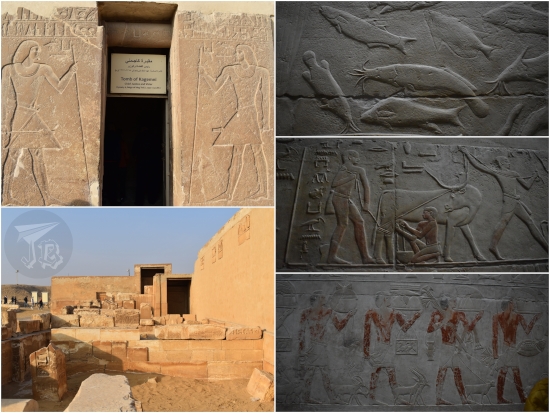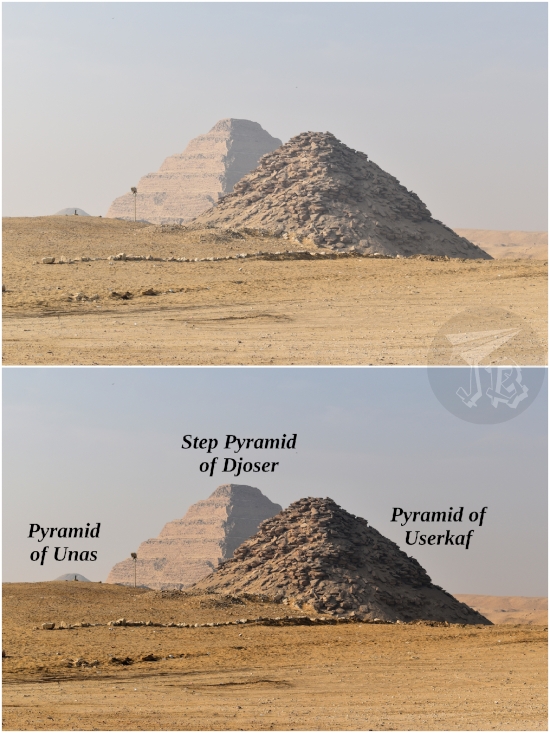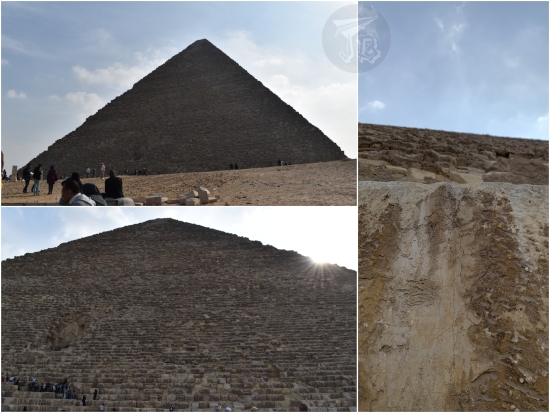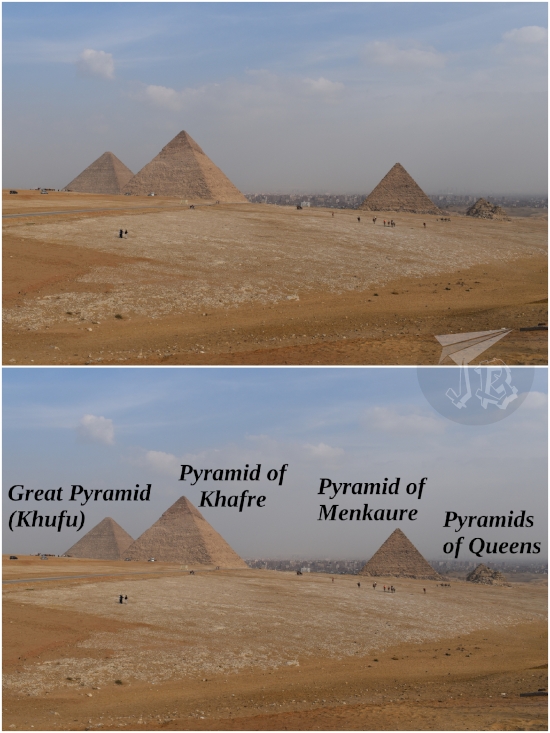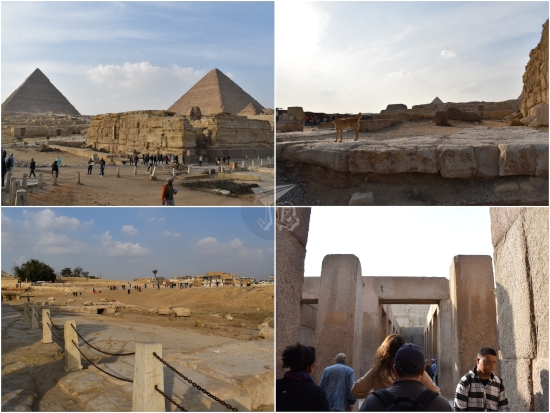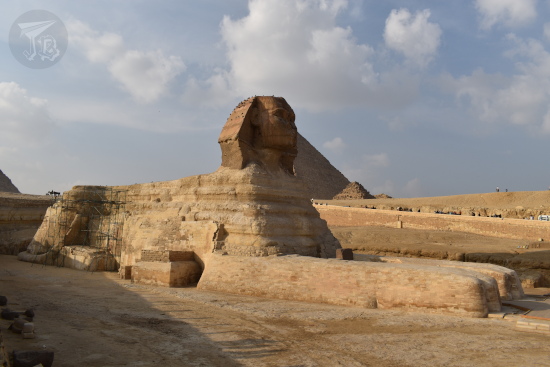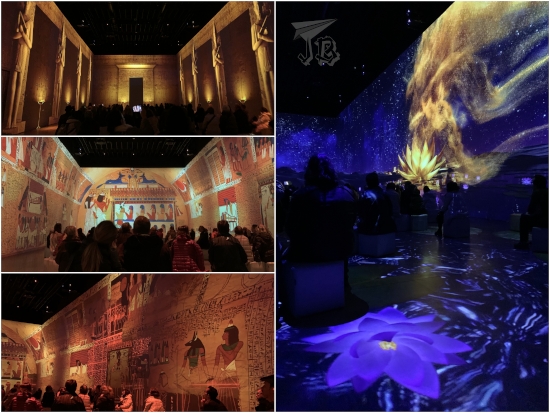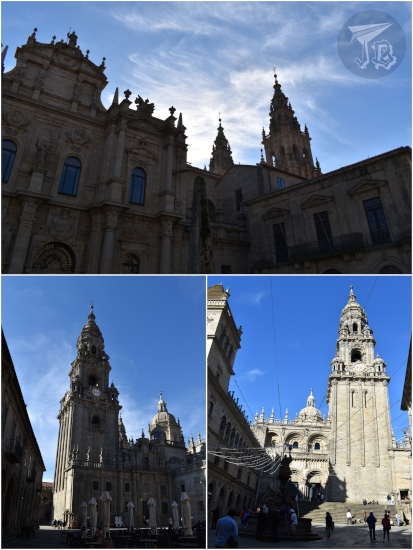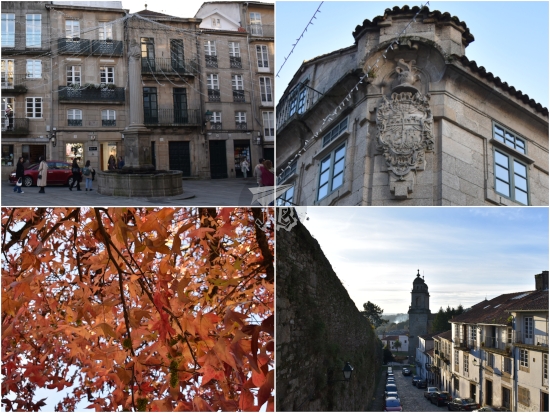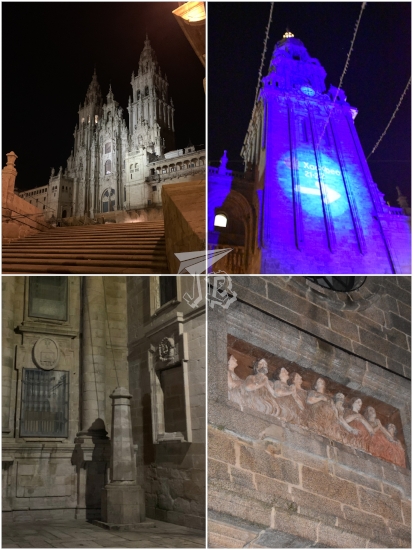
26th December 2022 – 2nd January 2023: Egypt | Miṣr [مصر]

Egypt 26th December 2022 – 2nd January 2023 written with a pyramid and the sphynx as background


I suppose I am not really qualified to talk about “once-in-a-lifetime trips” considering how I came back from Japan 2012 craving for more, and before Covid hit, I managed to go back several times. For a long time, Egypt has been a destination in the back of my mind, one that I thought was too unattainable on my own, both financially and because I’m weird and single and all.

The stars aligned, in a very weird way I guess, and I made the – maybe self-caring, maybe selfish decision – to seize the moment and take the chance. And thus, with the help of Father Christmas, I went to the cradle of civilisation. The trip was booked through Viajes El Corte Inglés and its tour operator Tourmundial in Spain, and implemented through Galaxia Tours in Egypt. From the beginning to the end, the trip was good, really good, in spite all the issues that could have clouded its development. However, and even if I did not see everything I wanted to, there is no crazy urge to come back.

In a way, I felt a bit like a cashcow, in another like someone a bit on the immoral side. The good thing about the local agency is that at least some of the money we paid stayed in the country. I know that at a couple of times I let myself be “scammed” and paid more than I had to, and other times I put my foot down. All in all, I feel it was a good trip, I scratched a lot from my bucket list, and I geeked out, climbed the inside of a pyramid, and saw Abu Simbel. The level of “achievement unlocked” feeling is unbelievable.

The package consisted of several parts: an arrival day (26th December), three days on a motorboat on the Nile (27th – 29th December) with daytrips and excursions to visit different sights, a transition day (30th December) with a visit and the flight to Cairo, two days in Cairo and its surrounding area (31st December and 1st January), and a final return day (2nd January).

20th November 2022: Naturaleza Encendida – Origen (Real Jardín Botánico, Madrid, Spain)

It seems that the Madrid exhibits in the month of December are not being the most successful ones – this time, the weather did not help. After ten day’s worth of rain, it cleared out, but then, on Tuesday, the skies opened yet again. It was raining like there was no tomorrow by the time my train got to Madrid. Boo.

Just after sunset, my sibling and I went to the botanical garden Real Jardín Botánico to see the light show Naturaleza Encendida: Origen (Lit-up Nature: Origins). There had been some issues about the promoter cancelling the activity due to rain with little advance notice, so they decided not to close it. They instead resorted to close parts of the exhibit at random, and herding all the visitors in the same corridors, despite the puddles forming on the uneven ground. After two weeks of rain, something should have been done about it. Moreover, a few of the exhibits were turned off – not sure if just off or high wired. I wish I had some good boots, because I ended up pretty soaked, despite the raincoat and the umbrella. At least I did not ended up in a random puddle.

In 2021, the topic was sea life, and in 2022 the topic is… mushrooms. So there were spores, moulds and… mushrooms. Big mushrooms with lights, or made with small lights, or… just blown with hot air. Lots of mushrooms. The music was a bit creepy though, even if the mushrooms lit up and down with the beat. There is also an exhibit about moulds, with huge screens showing pictures of spores and microorganisms under the microscope.

Most people were antsy and cranky in the rain, and everybody wanted you to move out of the way – in different directions at the same time. A really good thing about it was the cup of hot chocolate that we had booked with the ticket. It was really nice to get in the middle of the cold and rain because it was warm and sweet. We drank it on our way out to the train, and just as we stepped out of the botanical garden… it just stopped raining.

Light display collage: on the upper left, giant red spores; on the lower left a wavy line of lights. On the right, a giant bunch mushrooms illuminated in green from inside the umbrella

Collage of lights display. A mushroom made of little yellow and white lights; a bunch of name mushrooms in red; a hanging mould-like string of lights between two dark trees

All in all, I was not too impressed. I really think that the organisers should have figured out something about the cancellations and the pathways, since they obviously could not do anything about the weather. My favourite display were the “Baymax mushrooms”, even if most of them had lost their illumination, which was actually kind of the point…

A blow-up mushroom made from plastic, looking like it's floating. The  lights inside make it glow green and pink. In the background there is a building gate in red, and a pond between the two.

6th December 2022: Tim Burton’s Labyrinth (Madrid, Spain)

Despite having decided that immersive exhibits were not for me and the fact that I’m not a Tim Burton fan, here I found myself in Madrid to see this one: Tim Burton’s Labyrinth El Laberinto de Tim Burton. Truth be told, I was only there because my sibling asked me to accompany them. I did not find premium tickets for any of the dates either of us was available, but the 6th of December is a national holiday in Spain, and I calculated that if we were there at opening times it might not be too busy, and we would not come across too many kids.

Tim Burton is an American film-maker born in 1958. His first “hit” may have been Stalk of the Celery Monster, which he wrote, directed and animated when he was a student in the California Institute of Arts, in 1979. It presumably earned him a good grade, but more importantly, an animator’s apprenticeship at Disney Animation Studios. With time, he developed a shrill eerie style, with lots of colours and creepy designs that have increased as years have passed, sometimes defined as “gothic fantasy” – I would refer to it as strident and macabre at times, to be honest. His greatest or most famous works include Beetlejuice, Charlie and the Chocolate Factory, Edward Scissorhands, The Nightmare before Christmas, and the first two Batman films.

The exhibition is hosted in a weird place in Madrid, Espacio Ibercaja Delicias, which might look less… abandoned… when it hasn’t been raining for days, I guess. The space consists on a big tent – where we were not going, it might be designed for circuses or so, some kind of bar / cafeteria, and the monster-like building that hosts the exhibit. It is called a labyrinth because out of the thirty-ish wards, you have to go around choosing doors to see different rooms of the exhibit, insomuch that you would need four rounds to see the complete thing. In the end, you choose 15 rooms to see, out of which some are common, and you reach them from whichever previous place you were in. Others are “less common” and you can reach them through several doors, but not all. You enter the labyrinth through a toothy monster’s mouth, then there’s a big button that “decides” on the first room for you.

Collage: exterior of the Labyrinth, which looks like a one-eyed tentacle monster, and the inner entrance monster whose mouth is the curtain you have to cross to enter the different rooms.

In the rooms there are sculptures that represent the characters, some of them with the original clothes that were designed for them (if the film is a live-action), the plain clothes, and on the walls sketches and animations, some original, some “inspired”, and some made specifically for the exhibit. Some rooms are small and rather empty, others are decorated like the movie sets. There are tricks with lights, and some mirrors, but nothing “immersive” about it, and way too many people around considering the size of some rooms.

The idea of a labyrinth is interesting, but I don’t think the price warrants just seeing half of the exhibit, especially considering the big “misses” of not seeing all the The Nightmare before Christmas. We took about 40 – 45 minutes to go through the 15 rooms.

What I am aware we saw included:

  • Beetlejuice
  • Edward Scissorhands
  • Batman and Batman returns
  • Mars attacks!
  • Charlie and the Chocolate Factory
  • Alice in Wonderland or Alice Through the Looking Glass
  • Corpse Bride
  • Frankenweenie
  • Jack from The Nightmare before Christmas

Collage of Tim Burton's characters: Batman's Pengun, Edward Scissorhands, Emily from Corpse Bride

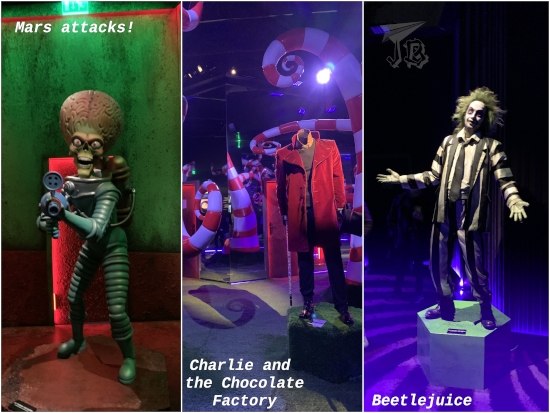
Collage of Tim Burton's characters: Alien from Mars Attack; the clothing from the Chocolatier (I think) in Charlie and the Chocolate factory, surrounded by twirling candy canes; Beetlejuice

Collage of Tim Burton's characters: Jack from The Nightmare before Christmas; The Mad Hatter from Alice in Wonderland, with some giant mushrooms behind; the boy and the dog of Frankenweenie

I think this is an exhibit for die-hard fans that are willing to pay for the premium ticket and see the whole thing twice. What it’s not, and that’s for sure, is for kids.

On both ways, we had some train trouble – delays and technical problems, but nothing too dramatic, and I was home before sunset – but after buying a stack of Christmas candy canes! And my sibling enjoyed, which was the goal anyway.

2nd December 2022: “Tutankhamun Immersive Exhibition” in Madrid (Spain)

In 1922, an archaeologist named Howard Carter discovered the tomb of Pharaoh Tutankhamun in the Valley of the Kings, Egypt. Tutankhamun belonged to the Eighteenth Dynasty. He reigned over Egypt around 1330 BCE, and restored the Ancient Egyptian religion. When he died, he was buried in a smaller-than-expected tomb, probably because his death was sudden and unexpected – for a while, it was hypothesised that he had been murdered, but it seems that he died from a combination of an infection and several previous pathologies (nothing to do with the fact that his parents were brother and sister, I’m sure).

The tomb was robbed and restored twice within a few years of Tutankhamun’s death, but it was eventually buried by alluvium brought by flash floods, and the debris from other tombs being built nearby. Thus, when Carter found it in 1922, it was mostly untouched and unspoilt. The death of Carter’s sponsor George Helbert, five months after visiting the tomb, sparked the rumour about a Curse of the Pharaohs, which has inspired countless works of fiction.

In 2022, Spain is living through a fad of “immersive exhibitions”, heavily based on technology, virtual reality and computer games. I was curious about what it would be about, exactly, so I decided to celebrate the end of work season by hitting the exhibit. I was early as the day before there had been a bit of public transport trouble and you usually have more chances of getting in if you’re early rather than late. Thus, I reached Centro Cultural Matadero in Madrid about half an hour earlier than my ticket read, and I was let in without any issue.

The “immersive exhibit” Tutankamón: La Exposición Inmersiva was devised by MAD, Madrid Artes Digitales, which specialises in digital creation and immersive experiences such a this. The exhibit has been designed in cooperation with the History Channel.

The first bit was a number of panels, explaining the “Egyptmania” that swept the world after the discovery of the mummy, the process of mummification, or life in ancient Egypt. The second held a replica of the inner and outer sarcophagus, along with the mummy, then replicas a few artefacts that had been found in the tomb, including the famous golden mask the pharaoh was buried with.

Three part collage: The upper picture shows the mummy of Tutankhamun suspended from the floor, imitating an open sarcophagus with the lid open on top of that. Bottom left: reproduction of the mortuary mask, in gold and blue, it has the typical Egyptian hair and beard. Lower right: reproductions of small objects found in the grave: estelae and human-like small sculptures.

Afterwards, you go into a huge ward with a projection on all four walls plus the floor, which is very spectacular but does not tell you much about the real history of either Tutankhamun or the tomb, it was just a cool video of flashy images with a narration in first person, showing the interior of the tomb, yes, but mostly vaguely-related imaginary, including some of the Egyptian gods. What it did have, and that was neat, was an original newsreel about the opening of the tomb, including Howard’s voice.

Collage of a 3D projection. Left, from top to bottom, views of Tutankhamun's grave: the outer area, in sandstone with sculptures, and two views of the inner painting an decoration, showing figures and hyeroglyphs. On the right, a projection of lotus flowers blooming and turning into gold, representing the soul of the pharaoh.

A large ward with a projection of a starry sky on the walls. At the front, a view of Tutankhamun's mortuary mask, eyes glowing.

A projection of Tutankhamun's mortuary mask, eyes glowing. Around it, golden writing symbols, maybe hyeroglyphs.

The following area had an augmented reality game, which I won (didn’t get anything though), a photo booth that I skipped and some “I bet you didn’t know” facts – about one third of them were common knowledge, and another third was information from previous panels though.

Finally, there was a room with virtual reality glasses and headphones, but my headphones wouldn’t work – I later realised they were not plugged into anything. This represented – I think – the trip to the Egyptian underworld, as I “started” at Tutankhamun’s tomb, then there were volcanoes, and I ended up in front of Anubis, who weighed a heart against a plume – the Judgement of the Dead.

The VR experience there was the last spot in the exhibition – because I skipped the photo booth – before one went into the shop. In the end, I was there for about an hour and a half, but it almost took me two hours to arrive and an hour and half to come back.

Though I don’t regret the mental break, I have decided that immersive experiences are not for me.

12th & 13th November 2022: Santiago de Compostela (Spain)

Here’s a little secret – people don’t like flying on the 13th, even less when it’s a Tuesday. Thus, I came across a bunch of awesome offers for the 13th of December, which unfortunately I could not take up due to work uncertainties. What I could muster was a mini getaway on the weekend of the 12th/13th of November, to the northern Spanish town of Santiago de Compostela. There were a few reasons for this choice – one, cheap flights; two, I’ve recently started considering a route through the so-called Camino de Santiago (St. James’ Way); and three, pandemic shuffled ‘Holy Years’ round so there was a special gate to the cathedral open that I wanted to see. I flew out around noon on Saturday and came back on Sunday night. It was a perfect plan for a decompressing getaway.

Santiago de Compostela is known as one of the most important pilgrimage cities in the world. According to the Christian tradition, the tomb of Apostle James was found in the area in Middle Ages (different sources vary throughout the 9th and 11th century), and the pilgrimage to visit the remains became one of the most important in the Christian faith, alongside Rome and Jerusalem, to the point that the pavement proudly states that “Europe was built on the pilgrimage to Santiago”. While I’m not religious, I have a thing for religious architecture, and as mentioned above I’ve been thinking about the Camino for a while, and visiting the goal felt a good way to start organising how I wanted to look at things.

However, let’s say it wasn’t the most perfect getaway ever. Though the flight was on time, and pretty short, there was turbulence – not something too out of the ordinary, but here’s something you might not know about me. Back in the mid-nineties, I sort of crash-landed in the Santiago airport, so let’s say I was not so invested in a bumpy flight.

As the flight had been very cheap (about 30€), I had decided to splurge a little in the hotel – and I found a not-so-bad offer of half-board at the Parador de Santiago – Hostal Reyes Católicos, downright at the centre of the city. It is located in the old pilgrim hospital, and it is a magnificent building, aside from a five-star hotel. I arrived around 14:00, and the room was not ready – fair enough. I wanted to get there early in order to drop off my luggage, and make sure I could arrange my dinner reservations for a convenient time. One of the reasons I decided to book half-board in the Parador was to guarantee myself a meal late in the evening, as I had booked a walking tour at 20:00, and the main restaurant served dinner till 22:45.

Wide shot of the Parador. It shows a severe building with an ornate gate. The sky is bright blue.

Unfortunately, the check-in staff “had booked me” at 20:30, and they asked if that was okay. I replied it wasn’t, and explained the reason stated above – the staff then said that they could accommodate me at 22:00 at the secondary restaurant, but not at the main one. I answered that then I’d have dinner at 22:00 at the secondary restaurant then, but the staff asked me to check the menu. I stated that it did not matter. I needed my dinner to be at 22:00, and if the main restaurant wasn’t available, it would have to be at the secondary one. The staff asked me to check the menus, and I explained again that I had a tour from 20:00 to 21:30 – I needed dinner at 22:00. I thought that was resolved, and as it was too early to get a room, I picked up my camera, left my backpack in the locker room, and went on my merry way to explore the outdoor “monumental route” within the historical city Ruta Monumental de Intramuros. The old city of Santiago is part of the Unesco Heritage Site Routes of Santiago de Compostela: Camino Francés and Routes of Northern Spain Caminos de Santiago de Compostela: Camino francés y Caminos del Norte de España.

As I had tickets for different activities in the cathedral booked for the previous morning, and the Sunday forecast was rain, I decided to do most of the walking on my first afternoon. I started off in front of the cathedral façade in the square Praza do Obradoiro (the Artisans Square), which hosts the town hall in the former Neoclassical palace Pazo de Raxoi, the Parador itself, and the main – but closed, will get into that later – entrance to the cathedral Santa Apostólica y Metropolitana Iglesia Catedral de Santiago de Compostela, with its Baroque façade called Fachada del Obradoiro.

Baroque façade: two towers and twin set of stairs, fenced away.

I walked around the cathedral, and stopped at all the other squares: Praza da Acibecharía (the Black Amber Workers Square), Praza da Quintana de Vivos (Villa of the Living Square) and Praza das Praterías (the Silversmiths Square).

A collage of views of the cathedral of Santiago.

I walked down Rua do Villar, which is the closest to a main street the historical town has. I strolled around the historical centre – there are many interesting buildings and churches, alongside the market. At some point I entered a bakery, but I kinda ran away when I heard the prices they were charging.

Santiago Route.  An archade, a fountain, an ornate corner with a coat of arms carved into it.

After an hour and a half or so, I found the convent-turned-museum Igrexa e Convento de San Domingos de Bonaval that has become the ethnological museum of the Galician people Museo do Pobo Galego. The museum itself was not too spectacular, but the building itself was fantastic. One of the most amazing things was the triple-helix staircase that joins the different floors on one side, and the remains of the gothic church (where I got to climb the pulpit). To the side there’s the pantheon for illustrious Galicians, including one of the few female historical figures in Spain – poet Rosalía de Castro.

Monastery and museum. The pieces include a humanoid stone idol, some Christian figures in polychromated wood, and two pipes

View of the triple staircase, from above, from below and through the door from one of the sides.

A view of a gothic chapel, showing an empty altar.

This was around 16:30, and even if I was not even a bit hungry, my legs shook a little. Thus, I decided that I needed to find a supermarket to buy a snack – I only had coffee before I left for the airport at 9:00. Before getting to the supermarket though, I walked around the former orchard and graveyard of the convent, now a picnic-friendly park Parque de San Domingos de Bonaval, full of ruins and fountains.

The previous church, from outside, on the right. There's a winter tree in front, and some old niches on the left wall.

I grabbed my snack and went back to the monumental route until I was back at the Praza do Obradoiro. I walked around to see the sunset, and caught a glimpse of the light playing on the façade of the church Igrexa de San Frutuoso, and some nice views from the adjacent park (which turned out to have been another graveyard) Xardín do Cemiterio de San Frutuoso.

Santiago sunset. Upper picture shows the church of Saint Fructuoso, and the lower one a view of the nearby park with the sun setting in the background

It was around 18:00 at that time, so I could finally check in – which I did, only to find out that the staff I had talked to had decided not to book my dinner in the end, which lead to me needing to explain about my tour again to a new staff who told me they couldn’t book me at 22:00 on the secondary restaurant! It had to be at 21:45, but they could notify the restaurant that I would arrive a bit later. I was really not impressed by the whole thing, even less when I apparently needed a bellboy to guide me to my room and carry my backpack– and of course get tipped.

I had my snack and then went on to explore the building. As I did, the sun completely set, so the different lights were cool. The Hostal Reyes Católicos used to be the pilgrims’ hospital. It is a huge rectangle with four interior cloisters named after the four Christian Evangelists, the inner areas having been refurbished into the rooms.

The four gothic cloisters of the Parador. Two have some greenery on them, the other two are just grey and built.

A few minutes before 20:00, I left for my tour. Although I’m not a big fan of tours and group activities, I had had my curiosity piqued by a “theatrical visit” of the historical centre of the town called Meigas Fóra. In the area of Galicia, a meiga is a type of traditional witch, good or bad, depending on what side the person speaking about them is – in this case, the guide being a supposed-meiga, of course they were all neat and nice. The tour was supposed to tell about the different legends and interesting supernatural trivia of the town, but just ended up being a bit watered-down walk around those graveyards-turned-parks I had walked before. The coolest thing was finding the pilgrim’s shadow Sombra del Peregrino, a fun game of light-and-shadows in one of the squares around the cathedral.

A view of the cathedral of Santiago at night, illuminated, on top. On the bottom, a column casts a shadow onto the wall behind it - it seems to be that of a man with a walking cane and a travel hat.

Hilariously though, as we were walking, someone approached me to ask in wonder if on top of taking the tour alone, I was in Santiago all by myself, in total awe of someone travelling on their own. She said that she would never be able to do so – while she took selfies of herself because the people she was “touring” with could not be any less interested…

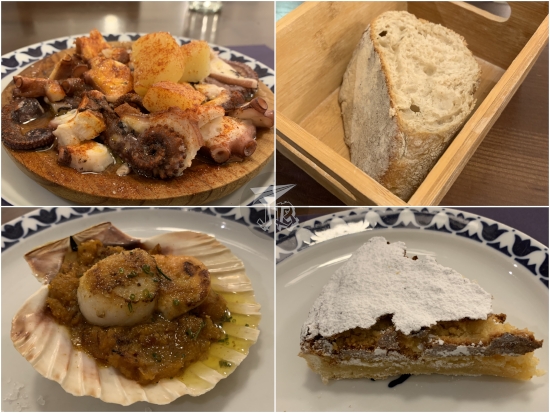
After the tour I went to have dinner – guess what? At 22:00 h! Let’s say that it was not the greatest experience. The restaurant staff had their hands full with a table of around 20 drunk “pilgrims” who had come all the way from South America and were rightfully celebrating – albeit loudly and a bit obnoxiously (all that pilgrim wine, no doubt) – that they had reached the end of the Way. The rest of the patrons were, including myself, four one-person tables, which made me wonder if they just don’t book one-person tables in the main restaurant after the first shift. The floor staff – basically one working waiter, and one wandering waiter – was overwhelmed by the table, and it took me over an hour to finish my dinner – which was some local octopus (pulpo a feira), a roasted great scallop (Pecten maximus, not only a delicious shellfish, also the symbol of the town and the related pilgrimage, called vieira in Spanish) and a piece of the typical almond pie (tarta de Santiago).

Dinner: pulpo, a scallop and a piece of cake.

Then I went to my room for a nice hot shower and to get some sleep. I was surprised then to find no extra blanket in the wardrobe, though there was an extra pillow. This was around midnight already so I decided not to hit reception for the extra blanket and just cranked up the air-con on and off to stay warm. I slept on and off, too, but it was not too much of a long night.

The next morning I had breakfast and set out for my day at the cathedral, Santa Apostólica y Metropolitana Iglesia Catedral de Santiago de Compostela. Santiago was built around the 7th century legend that the apostle James the Great, Santiago el Mayor, was buried in the area of Galicia, after having reached Spain to convert it into Christianity. In the 9th century, a tomb was discovered among some abandoned Roman ruins, and the local bishop had “the certainty” that it was the Apostle’s tomb. The bishop informed the King, who was the reported first pilgrim, and later ordered that a church should be built to commemorate the finding.

As the number of pilgrims grew, the church became too small, so subsequent temples were erected. The current interior was built between the 11th and the 13th century in a very pure Romanesque style, but the exterior was covered in the 18th century, in a very adorned Baroque style, which is also the style of the altar.

The most important piece of the cathedral is the Portico of Glory Pórtico de la Gloria, the Romanesque entrance to the 12th-century cathedral, with 200 sculptures carved in stone in the three-archway portal. The entrance now is locked away, you have to pay to see it, and photographs are not allowed.

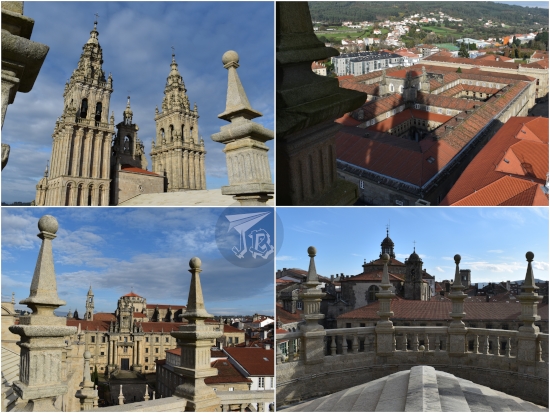
For starters, I climbed up to the roof of the cathedral and the bell tower – not really the bell tower but the “rattle tower”, as the bells chime on the eastern tower, and the rattle is played on the darker, western tower. The roof was restored as recently as 2021, and from there there are some nice views of the town.

The towers of the cathedral from the room, and some aereal shots - one shows the Parador cloisters from above.

Between visits, I went inside the cathedral, where the pilgrims’ mass was about to start. I might have stayed out of curiosity had I been in town for a longer period. Then I visited the portico – since pictures were not allowed, I’ve rescued some 1995 ones from when I were in town as a teen.

Three shots of the  very baroque altar in Santiago - it is heavily decorated and painted gold. On the bottom right, a silver urn, also very ornated, supposedly where the remains of St. James are.

A collage showing several sculpures of the Portico of Glory - Romanesque statues richly coloured and decorated, they look placid

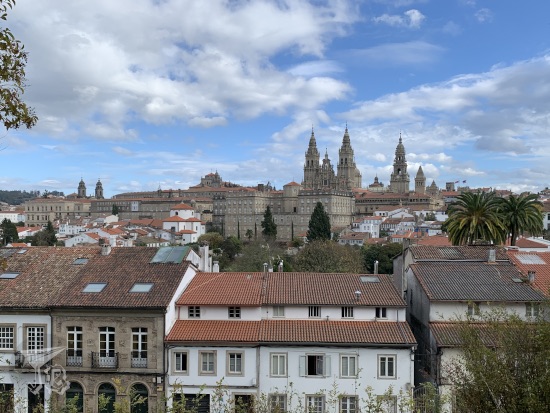
After wandering the cathedral for a bit longer, I made the most out of the last hour of sunshine to head to the park Parque da Alameda to find the spot Miradoiro da Catedral next to a huge centennial eucalyptus tree (Eucalyptus globulus labill) Eucalipto centenario, a 120-year-old specimen, considered one of the oldest eucalyptus trees that was planted in Europe after captain Cook “discovered” Australia and the species was introduced by Fray Rosendo Salvado.

A panoramic view of Santiago, showing the cathedral.

My next stop was the museum of pilgrimages and Santiago Museo de las Peregrinaciones y de Santiago, which was free due to the Covid recovery plan. It features a collection of items related to Saint James Way, and other important pilgrimages of the world, including the Japanese Kumano Kodo [熊野古道], and the Muslim Mecca Pilgrimage Ḥajj [حَجّ]. The upper floors are dedicated to the hagiography of Santiago / James through the Way and in the city.

Museum of Pilgrimages. A collage that shows a wooden statue of Santiago on a white horse, sword raised; other depictions of Santiago as pilgrim; some paper scallops decorated by kids; and a Japanese sacred gate.

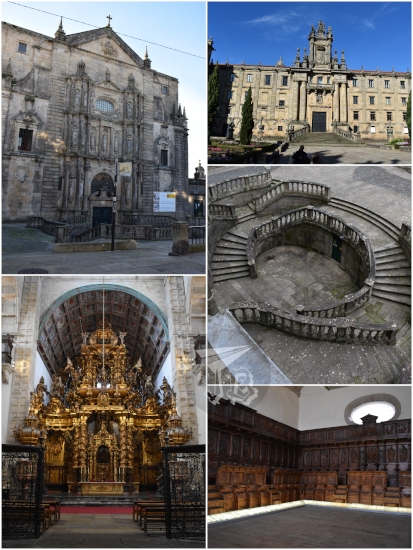
Later, even though I should have gone to eat a bite, I headed to the monastery and museum Mosteiro de San Martiño Pinario, religious complex built between the 16th and 17th centuries, though the inner areas and chapels date from the 18th century. Today it’s a cultural centre, and alongside the church, it features a museum with block prints, fossils, an ancient pharmacy… The church has the most baroque Baroque altarpiece I’ve ever seen, and two choirs – one behind the altar, and the other one up on the second floor.

Exterior of the monastery, including the double downward staircase, and a picture of the interior, showing a very Baroque altar painted in gold.

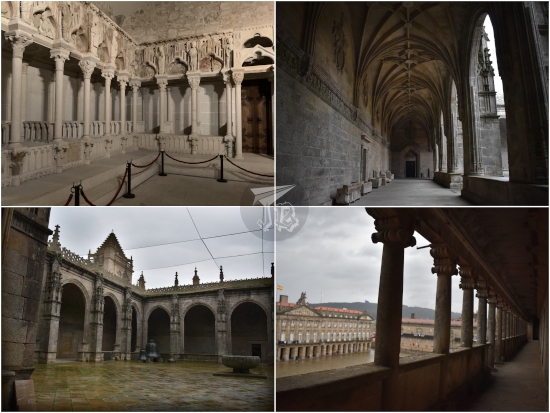
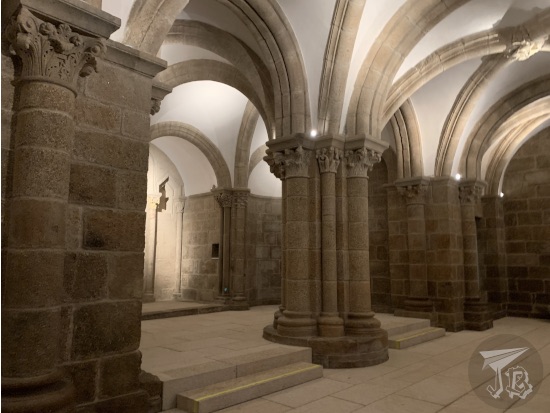
Finally, I stepped into the museum of the cathedral Museo de la Catedral de Santiago de Compostela, which features the entrance to the cloister, library, and the upper galleries, aside from artistic and religious treasures such as the original stone choir, wooden carvings, and tapestries. I was also able to access the upper galleries and look at the rain in the Praza do Obradoiro, and later the crypt.

A collage showing the cloister of the cathedral of Santiago while it rains outside, and the former Romanesque choir, carved in stone.

Romanesque arches and columns built in stone, and a cast ceiling.

After one last visit to the cathedral and its shop, I got myself a last souvenir – a silver and black amber bracelet I had seen upon arrival, and took a taxi back to the airport in order to fly back. All in all, I was not too impressed by the city nor its inhabitant, and I was pretty disappointed in the Parador. I think it has put me off the idea of doing the Camino as much as I thought I wanted to, but not every trip is perfect, I guess, and I hope my memories warm up with time.

A silver and black amber bracelet. The silver is very fine, and the gem is bright black.

Walking distance: around 11.68 km (18659 steps) on Saturday and 10.58 km (16931 steps) on Sunday, not counting airport transits

15th October 2022: The castle in Olite and the cathedral in Tarazona {Aragón & Navarra Oct. 2022}

Today, Olite is not much of an impressive town – but it has a dream castle Palacio Nuevo de Olite. The original fortress is reported to be a first-century Roman building where the Old Palace stands now. The first mention that we have of the old castle dates from the 13th century. In 1388, as Carlos III of Navarra (whose grave we had seen the previous day in Pamplona) starts the process of clearing the area surrounding it, buying houses and so. The official ampliation of the palace started in 1399, and the actual construction of the new castle in 1402. First, the keep was erected, then the surrounding towers, without much planning, giving was a capricious space with staircases, yards, and even a hanging garden. Construction ended in 1420.

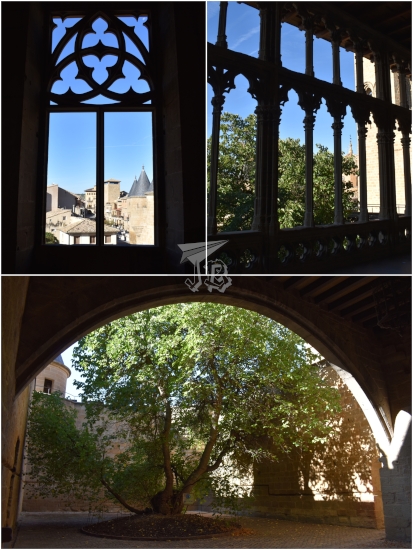
When Navarra was annexed to Castille, the decline of the castle started. Later, during one of the several Spain-France wars, soldiers’ distraction caused the first fire in 1794. later, in 1813, the castle was intentionally burnt down in 1813 to avoid that the French made a stronghold out of it. The wood-decorated room were completely destroyed and only the stone walls remained, although barely. The castle was used as makeshift quarry from then on, until in 1902 the modern regional government bought it. In 1925, after considering three proposals, it was decided too restore the castle using Jose Yárnoz Larrosa, who became the main architect. He chose a restoration style known for aiming to make things “as they should have been” – so rather idealistic. And one has to admit that the castle does look pretty cool, even though apparently it does not preserve the original structure too much. Throughout this time, a mulberry tree might have thriven for about 500 years.

The point of this is that the castle is cool. Pretty much fake, but cool.

After having breakfast, I set off for a few pictures. It was not too early in the morning, even, but at least the square was empty and clean, unlike the evening before. I stopped to examine the entrance of the church Iglesia de Santa María la Real. The church dates back from the 13th century, and is famous because of the decoration of its main façade and the sculpture around the portal, though personally, I was more taken by the atrium just in front of the church. While it does obstruct the view of the façade, the architectural ensemble ends up looking super cool – except for the little porch built in the 2015 restoration that… well… might be necessary but does not allow for the best view.

Church Santa María la Real: Gothic façade with an arched atrium in front of it. The portal is decorated with religious figures

I went around the complex formed by the two Medieval castles Palacio Viejo and Palacio Nuevo de Olite, the walls and the old egg-shaped building that used to work as a snow-powered fridge of sorts.

Collage with different sights of the new Olite palace. The walls, archs and merlons are shown, brown-gold colour. Some of the pinnacles have grey slate pinnacles.

We went in. The restoration of the palace is “in style” so you cannot tell what is new from what it is not. The inner area includes access to the towers, the keeps, the so-called King’s gallery, the hanging garden, and the centennial mulberry tree. I climbed about half of the towers and the keep itself, and I have to say it was pretty fun.

Palace of Olite - Gothic archways, one bare, one full of vegetation, and views from the towers, showing the merlons, pinnacles, and the rest of the towers

Palace of Olite - looking from the interior, the structures show vegetation and the pinnacles. The last part of the collage shows the mulberry tree

Unfortunately, when we left the castle, we were not allowed into the church Iglesia de Santa María la Real as there was going to be a wedding – despite being no notice outside but the normal opening times, within which we were. Sometimes I feel tempted to take pictures even when I know it’s not completely okay, in order not to miss opportunities later. Before we left town, we found a nice viewpoint to try to catch site of the whole castle.

Palace of Olite from afar. It looks like a fairytale castle with pinnacles, walls, merlons and flags.

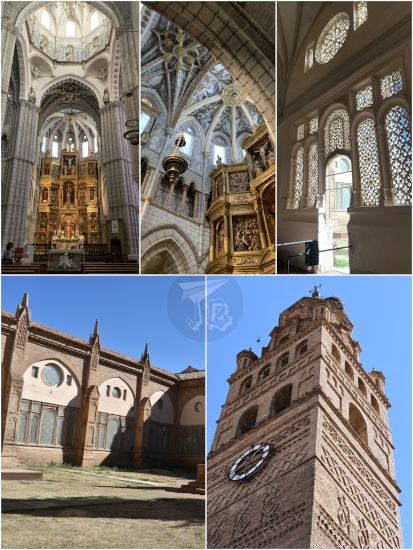
Afterwards, we drove southwards towards Tarazona, back in the region of Aragón. It is not a big town, with but an interesting point to get to know – the cathedral Seo de Nuestra Señora de la Huerta de Tarazona. Built throughout the evolution of Gothic art, between the 13th and the 15th century, it was later enriched in the 16th century with Renaissance decoration and interior, and sprinkled with Mudejar details. The cathedral is in the middle of restoration, and the organ is fenced off. The cloister shows lots of panels on the works being done, too.

Tarazona cathedral - outside. The façade looks weirdly grey, and the belltower is on the right, darker. A close-up of the dome shows its Mudejar influences

Interior of the Cathedal of Tarazona, showing Gothic columns and the Baroque altarpiece. The cloister is modified Gothic with arcs and spikes. A close-up of the Mudejar-style bell tower.

We had lunch after visiting the cathedral, but we did not feel like staying around until the archaeological gardens. Thus, we just took the car back home, even though we might have been better off checking out some more places in town. Lesson learnt then, more planning is required in this kind of escapades…

14th October 2022: Pamplona, the city of the bulls, and Olite {Aragón & Navarra Oct. 2022}

In order to avoid crossing Zaragoza, we tried to go around it. Unfortunately, trying to save up 30 minutes, we ended up wasting an hour at the entrance of the highway, and we reached the city of Pamplona or Iruña. Today, it is the capital of the region of Navarra, which is roughly the size and shape of the old Kingdom of Navarra, which existed roughly between 1162 and 1512, when it was conquered by the Catholic King Fernando.

There had been a slight misunderstanding on who was going to plan the day – I was convinced my father had not wanted me to do it, but when we arrived he turned to me and I was supposed to know. In summer, I had drafted a small itinerary, but as he was supposed to have taken charge, I had not gone further. It turns out, I should have. Fortunately, I still had the map on my phone and the opening schedules on my travel notebook. Unfortunately, I had not really delved into all that the city has to offer and we missed a few interesting thing

Thus, I tried to take charge, but not too much because it’s hard to balance that with my parents. Even if we have travelled together before, I tend to let them do the planning and only insist on some stuff I want to do or see, and that’s how they end up at dinosaur parks (≧▽≦).

We left the car in a parking lot underneath the congress centre and walked towards St. Nicholas Church Iglesia de San Nicolás de Bari Eliza. The first building dates from the 1100s, and it was built along the now-disappeared walls, as a defensive construction at the same time as a religious one. It was demolished and rebuilt location makes the building awkward, and to add insult to injury, we arrived almost at the same time as mass started, so we just took a quick look.

Iglesia de San Nicolás de Bari Eliza - exterior with pointed arcs, and inside, showin the altar

We walked to the next church dedicated to St. Lawrence Iglesia de San Lorenzo, actually associated to the Unesco World Heritage Site Routes of Santiago de Compostela: Camino Francés and Routes of Northern Spain Caminos de Santiago de Compostela: Camino francés y Caminos del Norte de España. The current building is Neoclassic, and the façade was rebuilt at the beginning of the 20th century when the original was damaged during war. On the right of the main nave, a side chapel holds the famous sculpture of St. Fermin, the patron saint of the town. The chapel was built between 1696 and 1717, when the sculpture was placed there. Every 7th of July, the sculpture is taken out in the religious procession. From the 6th of July and for a week, Pamplona celebrates its local festivals, famous around the world for the encierros, or running of the bulls. While there are similar runnings all throughout Spain, the encierro in Pamplona was popularised by Ernest Hemingway, the American novelist, in his work “The Sun also Rises” (1926).

Church of Saint Lawrece - Neoclassical façade and interior, with the sculpture to Saint Fermin, the patron saint, in a red cape and a mithra, surrounded by red and precious metals.

We continued onto main street Calle Mayor, which ends at the main square Casa Consistorial de Pamplona, which opens to the main square Plaza Consistorial. The building was erected between 1951 and 1953, though the project kept the 18th century façade, halfway between late Baroque and Neoclassic.

Pamplona town hall / council hall, with flags hanging from the balcony.

We continued onto the cathedral dedicated to the Virgin Mary Catedral de Santa María la Real de Pamplona. The building is Gothic (French Gothic, actually), with a Neoclassical façade designed by Ventura Rodríguez (who also worked on the Basílica del Pilar in Zaragoza). One of the most interesting things in the cathedral are the paintings on the walls and columns themselves, just non-religious decorative motifs. In front of the altar lie the tombs of King Carlos III of the Kingdom of Navarra, and his wife Leonor of Trastámara (or Castille).

Cathedral of Pamplona, including a close-up of the bright polychromy in red and blue, and the altar, from far away and a close-up. The most distinctive feature are the pointed arched and the very clean masonery.

In the inner area, there is a beautiful cloister, and you can climb into the false ceiling, see the kitchen of the former convent. And, let’s not forget – they have a stamp, because it is one of the “official” starting points of St. James Way, Camino de Santiago, and also part of the Unesco World Herirage Site related to it.

Collage: Cloister in Pamplona cathedral. The gothic ars are pointed and ornate, standing on bright green grass. One of the corners shows a fountain, the other the iner walkways

We stopped for lunch, then we walked by one of the “iconic” points of the bull-running, the corner at one of the streets of the route – Esquina de la Estafeta, and continued on until we reached the bullfighting ring Plaza de Toros de Pamplona, but since we are not big into the culture, we did not enter.

We did stop by the sculpture to the bulls and runners Monumento al Encierro, a huge bronze composition with a number of real-life pieces: nine bulls (six fighting bulls and three guiding bulls) and ten runners.

This bronze sculpture represents several life-sized bulls and runners. The runners are in front of the bulls, and one of them has been trampled.

Finally, we went to have a stroll alongside the walls of the former citadel Ciudadela de Pamplona. Although now it is a park, and only the foundations are left, the Citadel was one of the most important defensive constructions in the Spanish Renaissance, in the shape of a five-pointed star.

Several angles of the Ciudadela of Pamplona park. Not much is seen except for the building foundations, though they stand two or three metres high.

After that, we took the car and drove towards the town of Olite also known as Erriberri , where we were going to sleep. The town was home to the Monarchs of Navarra, and today there are two distinctive buildings – the old palace Palacio Viejo de Olite, where the Parador de Olite stands, and the new palace Palacio Nuevo de Olite. Originally the most extravagant Gothic castle in Europe, it burnt down during the war against the Napoleonic troupes, and was rebuilt in 1937 using the philosophy of bigger, cooler more teeth. We checked in at the Parador and I collected my stamp. From our room, we could see the main structure of the old palace, as we had a very long balcony.

Old palace of Olite. There is a tower on the right and an old Medieval house to the left. The building is made of irregular masonery and the windows are perfectly rectangular.

We went for a walk, and were surprised at how many people there were in the area. We sneaked into the church Iglesia de Santa María la Real, but did not take any pictures as (once again!) mass started. We planned to come back the following morning as it was barely a 30 seconds away from the door of the Parador.

On the left, a modern red-brick house stands on older arcs. The façade sports a protection made of intricate white ironwork.
On the left, a Romanesque church, blocked by construction and a tractor.

We walked around for a little and were not too impressive by the Medieval city centre, but we did find the typical balconies and the Romanesque church of St. Joseph Iglesia de San José.

We were beat, to be honest, it had been a stressful day after a short night’s sleep, so we turned in early after dinner. I did not even think to wander round to see if I could get any cool pictures of the area, because the area was packed and I was exhausted.

13th October 2022: Serrat in Zaragoza {Aragón & Navarra Oct. 2022}

Joan Manuel Serrat was born in Barcelona in 1943. He is a singer, songwriter, composer, actor, writer, poet and musician, whose long career started in 1965. Since then, he has sung first in Catalan, then in Spanish, and finally in both languages. In 1968, he was involved in a Eurovision controversy as there was a strife about singing in Catalan or Spanish, and in the end he was replaced by another artist – who ended up winning.

Throughout Franco’s Dictatorship, Serrat lived an unstable balance between the media veto caused by the Eurovision scandal, the censorship of some of his lyrics, and his growing popularity both in Spain and Latin America. During the 70s, he became a vocal protestor against the Dictatorship, with his songs, actions and words, which ended up with another veto and an exile to Mexico. In a way, he became the symbol of the discontent of the twenty- and thirty-somethings that had grown in the Spanish post–Civil War, who were then wading into adulthood. Serrat’s song Mediterráneo (Mediterranean Sea) has been repeatedly called the best song in the history of Spanish pop music. The album stayed as number 1 in Spain for weeks despite the censorship – since then, he has collected innumerable accolades and homages.

My parents… I don’t think I can call them fans, but they have listened to Joan Manuel Serrat for a long time – as a matter of fact, my father used to translate songs into Spanish for my mother back when they were young, as he spoke Catalan and she did not. But they are not concert people, so I was slightly surprised when back in April my mother commented in passing that, had tickets not been sold out, she would have liked to attend the Madrid concerts of Serrat’s goodbye tour El Vicio de Cantar. Serrat 1965 – 2022 (Singing is a vice. Serrat 1965 – 2022). I put the Internet machinery to work, and I found tickets for Zaragoza on the 13th of October. At that time, my parents asked if I would be interested, and I said yes, as he is indeed one of the most important singer–songwriter of the 20th century in Spain.

Ticket: Serrat, el vicio de cantar

The problems started when I could not get the day off, so that meant driving there as I left work. I could have got away with leaving half an hour earlier to get to the train as they drove off earlier, but they refused, so we ended up getting to Zaragoza around 17:00. Checking into the hotel took 40 minutes due to the slow check-in process, and luckily we were on the third floor. Funnily enough, it seemed that everyone in the hotel was there for the concert, so a lot of older people not used to travelling nor hotels.

The concert was due to start at 21:30 in the local sports centre Pabellón Príncipe Felipe, and there was a delay of about 15 minutes. To be honest, I did not expect it to be such a powerful experience – I mean, we’re talking about a 79-year-old man here, I did not think he would still have such a powerful voice nor presence on stage. There were a lot of songs I did not know, but the ones I had heard before still retained the vitality of records as old as the 80s! The set list was a remix of his most iconic songs in Spanish, with a couple of them in Catalan language:

  1. Dale que dale – “Go on and on”.
  2. Mi niñez – “My childhood”.
  3. El carrusel del Furo – “Furo’s carrousel”.
  4. Romance de Curro el Palmo – “The romance of Curro el Palmo”.
  5. Señora – “Lady”.
  6. Lucía
  7. No hago otra cosa que pensar en ti – “I keep thinking about you and nothing else”.
  8. Algo personal – “Something personal”.
  9. Nanas de la cebolla – “Onion lullaby”, with lyrics from a famous Spanish poet who wrote the poem in prison, when his wife wrote to him that there were only bread and onions at home, and she had to breastfeed their baby.
  10. Para la libertad – “For freedom”.
  11. Cançó de bressol / Canción de cuna – “Lullaby”.
  12. Hoy por ti, mañana por mí – “Today it’s you, tomorrow it’s me”.
  13. Tu nombre me sabe a yerba – “Your name tastes like herbs” – grass, actually, but it sounds horrid in English.
  14. Los recuerdos – “Memories”.
  15. Es caprichoso el azar – “Fate is whimsical”.
  16. Hoy puede ser un gran día – “Today can be a great day” – I keep telling myself this.
  17. Pare – “Father”.
  18. Mediterráneo – “Mediterranean Sea”, I can totally understand how this is considered one of the best songs ever in Spanish.
  19. Aquellas pequeñas cosas – “It’s the little things”, started the encore
  20. Cantares – “Songs or Poems”, with lyrics by Antonio Machado, one of the greatest Spanish poets in the Spanish 20th century.
  21. Paraules d’amor – “Words of Love”.
  22. Penélope – though I knew this song, the lyrics were different from the ones I was used to.
  23. Fiesta – “Festival”, a bit of a high-inducing song to finish the concert way past midnight!

Serat concert: Stage with signature decoration, and two shots of the concert

It was hilarious to see all these sixty- and seventy- year-olds get out from the pavilion and walk to the hotel, all pumped up and way beyond their bedtime. By the time we arrived at the hotel, there was a queue at the lifts! All these exhausted boomers, hyped up and at the same time with no more energy left. That is when we were so happy to be on the third floor and not something like the seventh or eight (≧▽≦). The bed was comfortable but I did not sleep much.

9th October 2022: Atémpora, Sigüenza (Spain)

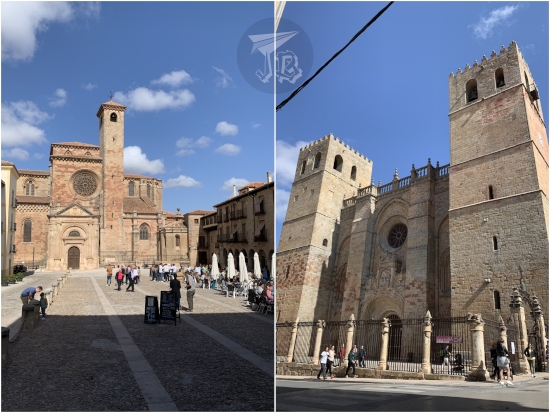
Sigüenza a Medieval town in the centre of Spain that is currently trying to gain the status of Unesco World Heritage Site. It has a castle, a protected historical centre, and in the heart of it stands the cathedral Catedral de Santa María La Mayor de Sigüenza . The cathedral dates back to 1124, when the original Romanesque building was was erected. The construction finished in 1326 , with remodelling and decoration elapsed several centuries, with different add-ons, until it was “declared” finished after the Spanish Civil War, with later works being just conservation.

Cathedral in Siguenza, a late-Romanesque / early-Gothic building, in a reddish colour. Left: side view, showing the bell tower. Right: façade, with two side towers.

In summer and autumn 2022, there is an exhibition in the cathedral – Atémpora. Sigüenza entre el Poder y la Gloria, which translated to something akin to “Timeless. Sigüenza between Power and Glory”. It displays some of the treasures of the cathedral and the museum, along with a few archaeological devices. We had seen most of the religious artefacts in a previous visit, but the historical chronicle was rather interesting.

The first block, around the cloister, deals with Celtiberian (the Arevaci tribe) and Roman weapons and everyday life. The second block deals with the Goth conquer and the newfound Christianity.

Upper Left: entrance to Atempora, flanked by two angels. Upper right: Celtiberian Daggers. Bottom left: oil lamp looking like a bird. Bottom left: clay bowl.

Interwoven with the exhibition are the treasures of the cathedral, including two collection of Flemish tapestries, one focused on Athena, the other on the story of Romulus and Remus. Another highlight is an Annunciation painting by Domḗnikos Theotokópoulos “El Greco” a Greek artist of the Spanish Renaissance (since he moved to Toledo in his prime). Of course, the cloister is fantastic. There is a tiny gothic altarpiece in one of the chapels that is delicious. The problem? As always, Baroque trends building choirs in the middle of the naves, blocking the view, and overdecorated altarpieces. The wooden ceilings are extremely beautiful where they have been preserved.

Upper left: tapestry collection, hanging from walls. Bottom right: Annunciation by El Greco. Bottom left: decorated wooden ceiling. Bottom right: Cloister of the cathedral.

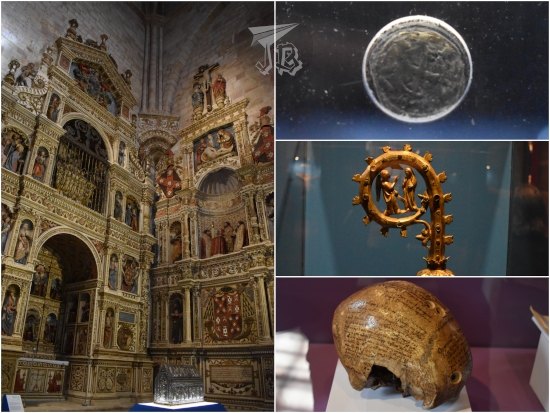
The three final blocks present different Christian symbols and pieces of art from the Middle Ages onwards, and interestingly enough, a watermill from the old salt marshes. The exhibit makes a particular emphasis on Wilgefortis, a Catholic folk saint which is supposed to be buried in the cathedral, with the silver arch where her body lies brought from the altar. Other pieces include coins, sceptres, and even a few elements from the times when there was a Medieval university in town – one of them being a human skull with “anatomy notes” on it. There are also late Medieval sculptures, most importantly crucified Christ representations and Virgins with the Child, though probably the nicest one is the one which is permanently at the entrance of the cathedral. Next to it, a mill from the nearby salt mines (Salinas de Imón) has been brought – I really want to visit those at some point too, so great reminder.

Altar of St. Wilgefortis on the left. On the right, a coin, a scepter and half of a skull with writings on it.

Top left: Romanesque virging with child. Bottom left: watermill. Right: Crucified Christ with four nails on his hands and feet.

The most important monument, or area, in the Sigüenza cathedral is the chapel called Capilla del Doncel. It holds the tombs of Martín Vázquez de Arce and his parents. The de Arce men participated in the war against Granada Muslims during the 15th century, where the son was killed in an ambush, as the Muslims created a flash flood from the watering system they had to control the waters of River Genil. Though he was already 25 years old, too old to be called a doncel, teenage boy, the name has stuck for centuries. The parents’ tombs are traditional burials, however, the Doncel’s grave is an arcosolium, with the decorative sculpture showing the young man awake and reading a book, rather than lying in death as it is the typical representation.

Chapel of"El Doncel", showing the traditional burials in the foreground, and the Doncel's tomb in the background.

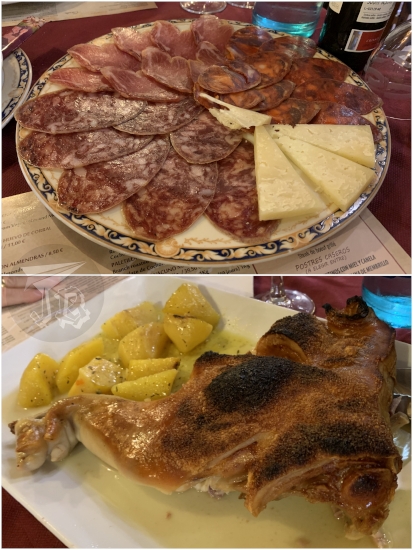
We went to have lunch after the visit, we went to have lunch at La Taberna Seguntina, where we shared some typical cheese, sausage, and roasted pork before we went home.

Typical Siguenza Dishes. Top: sausages and cheese. Bottom: roasted pork leg with potatoes.

25th September 2022: Ruta de las Caras (Buendía, Spain)

As I had a visitor, I proposed a hiking route I had heard about as a silly adventure. The area around the reservoir Pantano de Buendía is home to an… interesting hiking route.

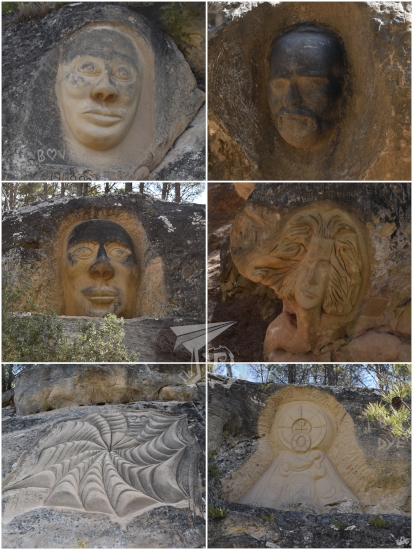
In the early 1990s, a couple of friends called Eulogio Reguillo and Jorge Juan Maldonado, a builder and a pottery maker, got the idea to create a sculpture on the rock. That, which in other circumstances could have be just been considered “defiling nature” became a Land art project – the two “artists” have carved gigantic faces into the sandstone, and the route has become a tourist spot – the Route of the Faces or Ruta de las Caras.

The route has been on my radar for a while (but I’d been feeling lazy about the drive) and I thought it would be a fun bizarre thing we could do together. It did not disappoint. You can do the complete route from the nearby village of Buendía, which is around 9 km, or drive up to the beginning of the route at the edge of the reservoir and hike around 2 km. We decided to do this, as the complete route did not offer much else to do / see.

The route features a lot of official and unofficial sculptures, along with graffiti on the rocks. It is circular and runs through a pine forest which makes it suitable for both warm and cold weather – as long as the roads to get to the village are not frozen. Though temperature had plopped down compared to the previous day, it was still mostly over 20 ºC, so nice enough to be out in a sweatshirt.

Pine trees with a bit of water in the background - the reservoir

The rock carvings vary in size, style and elaboration. There are some religious motives, such a couple of Christian Virgin Marys, and some figures from Indian (Hindu and Buddhist) inspiration, but the ideas are so all over the place that they probably just let the artists do whatever they felt like. While the first carvings date from the 1990s, the route is still being carved, and we missed one of the faces as it is in a “new” area which is still not signalled. Some of the sculptures we did see include:

  • Moneda de Vida – The Coin of Life
  • Cruz Templaria – Templar Cross
  • Krishna (Hindu deity)
  • Maitreya (future Buddha in Buddhist eschatology)
  • Arjuna (a character in one of the Hindu epics)
  • Espiral del brujo – The Male Witch’s Spiral
  • Chemary (short for the name “José María”, Joseph Mary)
  • Sin nombre – Unnamed (and unfinished)
  • La monja – The nun
  • Chamán – Shamman
  • Beethoven (the composer, yes)
  • Duende de la grieta – Goblin in the Crack
  • Dama del pantano – Lady of the Reservoir
  • Virgen de la flor de Lis – Virgin of the Fleur-de-lis
  • Virgen de las caras – Virgin of the Faces

Different faces and shapes carved in sandstone

Different faces and shapes carved in sandstone

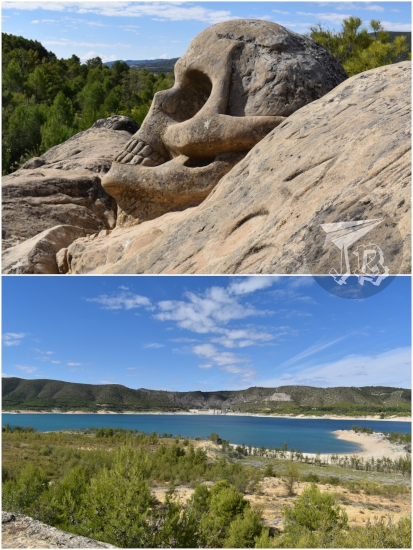
Our favourite was the skull overlooking the reservoir, called De muerte – Deadly – which one could actually climb – noooot absolutely sure it was “legal”, but the rules only said “do not carve or alter the rocks” and the sculptures are coated in a protective liquid. And after all, this started as a random art-vandalism thing.

Large skull carving (top) + the look from the viewpoint - the reservoir is pretty depleted, there is a lot of sand, but also some green trees (bottom)

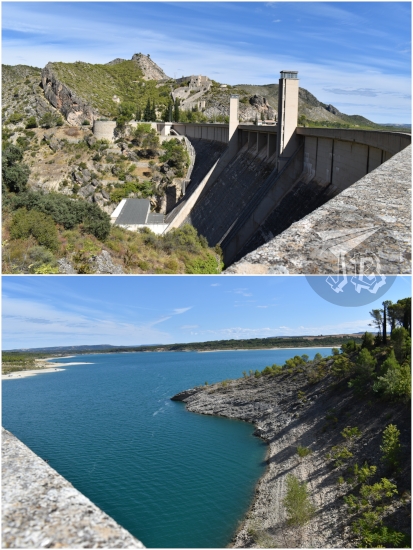
On the way back we stopped at the dam that closes off the Reservoir Presa del Pantano de Buendía, where we played with the echo.

Massive concrete dam, and the water behind it, a rich azure. The water looks cool.

Then, we moved on and once again stopped at the dam in the Entrepeñas reservoir Presa del Pantano de Entrepeñas – and I got the exit wrong again afterwards, exactly like the previous time. We saw a flock of vultures, and as they were circling in search for prey, they were a ‘kettle’.

The silhouette of two vultures circling

To end the day with befor my friend was off to the airport, we headed back and stopped to have lunch at a tiny Mexican place in the shopping centre on our way. And there I discovered that yes, there is such a thing as too much cheese on nachos. In the end, we walked around 4.11 km (6464 steps), so I think we were allowed to deal with the junk-y food.

Nachos + tacos. Everything looks a bit greasy.

24th September 2022: Manzanares el Real & Alcalá de Henares (Spain)

My friend, whom I had not seen since January 2020 as the pandemic kept us apart, dropped by for a visit as she was in the area. Since the weather forecasting had not been promising, I had not booked anything, but given her a bunch of options to do. She was particularly taken by the castle in Manzanares El Real, a town in the Madrid area, so we drove there.

The palace-castle Castillo Nuevo de Manzanares El Real was built in the late 15th century as a replacement of the previous one by the House of Mendoza. The noble family was given control over the area the previous century, and after a hundred years living in the older castle, the new one was commissioned to Juan Guas, who designed the building in a on a Romanesque-Mudejar style. It was built in granite stone, with Isabelline Gothic decoration, mixing defensive / military, palatial and religious architecture. It was inhabited for about a century before it was abandoned. The castle was declared a Cultural Monument in 1931, and it has undergone several restorations. In 1961, it was used as shooting location for Charlton Heston and Sophia Loren’s “El Cid” film.

Considered one of the best-preserved castles in the Madrid area, the building it has four towers, six floors, and a central patio. It holds a collection of tapestries, and most of it can be walked. Unfortunately, the towers cannot be climbed, but you can walk around the walls, both in the terraced gallery and outside. It was a bit overpriced, but well-worth the visit.

Collage showing the castle. It is reddish with hard corners and rounded towers. The decoration is white and ornate.

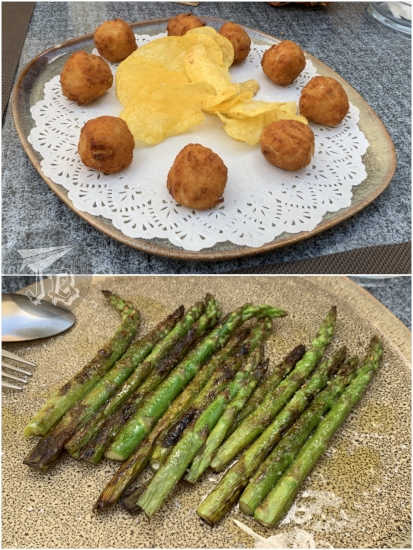
We made a pause for lunch and tried the best wild asparagus (Asparagus acutifolius) that I have had in ages – just grilled with salt and lemon. We had some croquettes too.

Plate of perfectly-round croquettes and some crisps in the middle + plate of roasted green wild asparagus

As we had walked into the village for lunch, we only had to walk a little further to find the ruins of the original castle Castillo Viejo de Manzanares el Real. At the moment, only the foundations can be seen, though it is similar to the new one. The archaeological excavation started in the year 2022, but nothing much is known of it, except this one was an actual military fortress that predates the new castle. From there, the views of the new castle and the local church make a nice skyline of sorts.

Foundations of the old castle. Not much is seen, there is a sign reading "Old Castle Archaeological Excavation"

View of Manzanares el Real, showing modern roofs, the church tower, and the castle in the furthest background

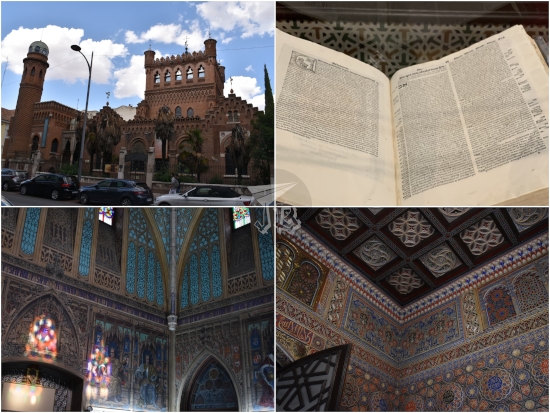
It was still early in the afternoon, so I suggested stopping by Alcalá de Henares. I wanted to make a stop at a shop to check for something, but after a quick visit to the shopping centre, we moved on to what is, in my opinion, one of the most interesting buildings in town – the small palace house Palacete Laredo. Built in the Neo-Mudejar style, it is a bizarre combination of mosaics, moorish-like decorations, and vibrantly-coloured windows that somehow work, somehow. Though only about half of the building can be visited, I just find it bizarrely alluring. My friend loved it. Furthermore, the building has a few Complutensian Polyglot Bibles in display – the first polyglot edition of the Christian Holy book, published in the 16th century under the patronage of the Cardinal Cisneros, a key figure in local history.

Palacete Laredo: exterior and interior decorations + close up of the open bible, in Latin and Hebrew

We continued on, and walked round the city. We saw two back-to-back weddings at the cathedral Santa e Insigne Catedral-Magistral de los Santos Justo y Pastor – that meant we could not snoop into the cathedral, but we did see one of the brides arrive in a Rolls Royce.

Finally, we dropped by the archaeological museum Museo Arqueológico Regional, which has opened a very interesting new palaeontology ward – holding reproductions and real fossils of animals that used to live in the Madrid area, with a few coming from the palaeontological site of Cerro de los Batallones – most interestingly a Tetralophodon longirostris and a Machairodus aphanistus sabretooth cat.

Skeletons and skulls: mastodon, giant prehistoric giraffe that looks similar to a humongous goat, and sabretooth cat

We did a little more shopping afterwards, and eventually we drove off into the sunset… and the traffic. We ended up walking for 12.47 km (19078 steps), and driving for a good three hours, though M40 was so busy it actually felt like much much longer.

14th September 2022: Leaving is also tough {Jordan, September 2022}

We were picked up at 7:00 for our 10:55 flight out of Queen Alia International Airport, not by the guide any more, but by a random driver who dropped us off about 8:00. At the airport, a liaison came to pick us up. He took us through a pre-check before we could even walk into the airport. He walked us to check in and when I told him we had already done so, I might have broken his brain. He placed us on a special line and took our passports so we… got paper boarding passes.

Then he took us to the security area and left us there. We went through the automatic gates with the boarding pass, then through passport control, where we got the exit stamp. Finally, we got through standard airport security that swabbed my camera for explosives. The whole thing took about half an hour because even if there were many steps, there were few people in the airport. We found the gate and settled down to wait.

Passport page showing entry (10th September) and exit (14th September) stamps for Jordan, along with a "Group Tourist Visa" stamp (by JBinnacle)

And boy, apparently there had been overbooking in the flight, so checking in early saved us a lot of stress! We had paid to sit together, so I politely declined exchanging seats when I was asked, and my neighbour did not take it well…

We had a snack during the trip again, but I think that the meal and the drinks should have been a bit more separated, that would have made the trip more comfortable. We were supposed to take a little over five hours; however, had we found a landing slot, we would have made the whole trip in just over four. Upon landing, our passports were checked at the plane exit, then at normal immigration, then there was Covid vaccination status… and we made it back home after 12 hours on the go.

All in all, this has been an interesting experience, but we did not see a lot of the “important” sites, even in Petra. However, I do not think that I need to come back to Jordan. Even though it is the most westernised of the Arab states, child labour, animal abuse, hassling, peddling, distrust, and the tipping culture have been a put off. Furthermore, I plan to avoid the trip’s organiser as much I can in the future, because I did not like the way this panned out – especially the rearranging, the hours (early enough to be uncomfortable, too late to beat the crowds) and the “forced shopping times”, which I am told is typical in Middle Eastern countries. I swear, this has made me rethink Egypt…

13th September 2022: Wadi Rum (and the bus) {Jordan, September 2022}

I had a boiled egg, potato hash-browns and coffee breakfast because my body was craving salt, I guess. Then we set off on the bus, where we ended up spending around seven hours (the 412 km are supposed to be done in 5 hours and a half, but that does not take into account bad traffic). Urgh. Our first stop was a viewpoint over the whole canyon area.

Wadi Musa valley panorama, showing the deep gorge from above

The second stop was a souvenir shop that had probably somehow bribed our guide or driver for it. None of us even bought anything, but we were forced to be there for about half an hour before we could continue to the only organised activity for the day – a two-hour jeep tour throughout the Natural Reserve and Unesco World Heritage Site of Wadi Rum | Wādī Ramm [وادي رم]. It is the largest wadi “valley”, created by alluvial fans and wind deposits, rather than the idea of a river bed. They are often found in deserts.

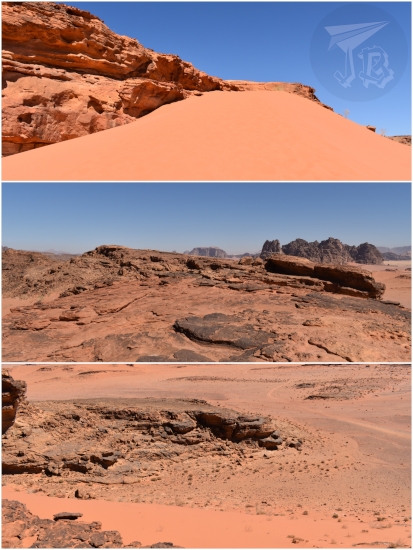
During the tour in Wadi Rum Reserve [محمية وادي رم] we drove through the desert and stopped at some rock formations that had built a gigantic dune. Wadi Rum used to be a granite and sandstone rocky formation. Thousands of years worth of wind eroded the sandstone back to sand, forming and shaping the desert dunes. Huge granite structures still stand, such as the Seven Pillars of Wisdom [عمدة الحكمة السبعة], just at the beginning of the route. One of the stops is the tourist-named Big Red Sand Dune, which you can climb for kicks, giggles and some nice views of the landscape.

Driving into Wadi Rum. The roof of the jeep is visible, along with a rock formation in the background. Between us and the rock formation there is the other jeep, causing a dust cloud

Back of a dune we had to climb, and the rock + sand landscape that could be seen from the top. Wind erosion marks have created soft ridges. The rocks are red-grey and the sand is rose-gold

Then we drove off to see some petroglyphs, and were offered dromedary rides. These petroglyphs, depicting early humans and their cattle – bovines and dromedaries – are the reason for the Heritage status.

A rock wall with some dromedaries in the foreground + a close up of the petroglyphs engraved in the rock, also showing dromedaries (by JBinnacle)

Finally we were shown a Bedouin tent at the feet of the Lawrence Canyon, a beautiful rock formation with faces of Jordan monarchs. Unfortunately, we did not get to see any onyx or fennec foxes, but I did see a small lizard. The Bedouins treated us to a cup of tea, but then we had to tip the driver about 10€…

Lawrence Canyon, a deep cut in the rock filled with sand at the bottom + details of engraved faces and Arab script, a lizard and a bit of tea, along with a traditional Bedouin coffee maker

Afterwards, we started off our trip back northwards back to Amman | ʻAmmān [عَمَّان]. Though the trip is supposed to take about 4 hours, it was way more than that, and we did not arrive at the hotel until way past 18:00. We went through the security checks and ended up learning that we could not travel between floors, so we could not go to the others’ rooms using the lifts, and the stairs were blocked… Well, at least we had… views?

A view of Amman skyline in the dark

After we managed to regroup, we had dinner and decided to try to check in online for the flight next day’s flight – and I was successful. Apparently, the airline only cared about us filling in our Covid certificate to enter Jordan, we were on our own for the way back.

12th September 2022: Petra {Jordan, September 2022}

Petra | Al-Batrāʾ [ٱلْبَتْرَاء] is without doubt the crown jewel of Jordan. It was the capital of the Nabataean Kingdom, and a strategic point in the middle of the trading routes. Nabataeans were one of the nomadic Bedouin tribes in the Arabian Desert that eventually settled and established the capital of their kingdom around the 2nd century BCE. Soon, Petra became a major trading hub and flourished as the Nabataeans were extremely skilful in harvesting rainwater and agriculture in the barren deserts. The Nabataeans also became very good at carving the sandstone of the canyon where they built their city. They lived in caves in the rock and created intricate façades in the sandstone of the mountains surrounding the site.

Eventually, water dried out and Petra fell, becoming a lost city, a tale told by crusaders when they returned home. In 1812, Swiss traveller Johann Ludwig Burckhardt “discovered” Petra for the Europeans, and excavations and archaeological expeditions took place throughout the 20th century. At this time, a Bedouin tribe, the Bidouls lived in the area, and in 1985 they were resettled in a nearby village built by the Jordan government before the site was designated a Unesco World Heritage Site.

As part of the concessions made for the Bidouls, they were given sole rights to the exploitation of the archaeological site, and their traditional customs were declared Unesco Intangible Cultural Heritage. Unfortunately, these traditions have devolved today into blatant child labour, peddling, and animal abuse. Barefoot children run after tourists to sell trinkets, women handle myriad of stands illegally selling rocks and fake archaeological artefacts along with imitation jewellery, cosmetics, decoration and so on, and men offer the services of thirsty and sad-looking donkeys, dromedaries and horses to move round the area. And while I can understand choosing to ride an animal in the long distances and heat, I saw a poor dromedary covered in red graffiti made by tourists that made me want to scream at people.

In 1989, Petra was featured as the lost city of Alexandretta in Indiana Jones and the Last Crusade, something that is considered the start of the Western tourism in the area. The film features the entry canyon, the Siq, and the Treasury as the Temple of the Holy Grail, possibly inspired by the crusade references from the Middle Ages. Aside from being a Unesco World Heritage Site, Petra is one of the New Seven Wonders of the World, and a geoarcheological protected area.

We were picked up at 8:00 and driven to the visitor centre. We had been warned beforehand to say no to anyone trying to rent / sell us anything as long as we were with the guide, who insisted on “taking care” of us for a couple of hours until he gave us free time until 18:00.

As you leave the visitor centre behind, there is about a kilometre and a half of barren desert. To the right of the trails stand the Djinn Blocks [أنصاب الجن], so named because the wind makes a sound around them (a djinn is an invisible spirit, sometimes called a genie, from the pre-Arabian mythology that was later incorporated into Islamic theology). On the other side of the path stands the Obelisk Tomb [مدفن المسلات].

Petra: Djinn Blocks and Obelisk Tombs (by JBinnacle)

The following area is the canyon Al-Siq [السيق], another kilometre and a half’s worth of walking between two fantastic rock walls. The Siq is an opened fault that was subsequently eroded by wind and running water. It was used as the caravan entry to Petra, and the lower area shows rests of Roman roadway, and the water canalisation built by the Nabataean. There are also some sculptures, both religious (baetyli) and non religious, such as a merchant with their dromedary. Some of the side fractures have brick dams to protect the main route.

Petra: Different views of the Al-Siq, including the waterways  (by JBinnacle)

At the end of the Siq stands The Treasury | Al-Khazneh [الخزنة], the most famous building in town, built in the 1st century BCE, probably as the Mausoleum of Nabataean King Aretas IV. Older tribes of Bedouins thought there was a Pharaoh’s treasure in the upper urn, so they tried to shoot it down throughout the 19th century. I had wanted to go up to the view point, but the locals made sure that you could not do it on your own so you were forced to tip them and support their submerged economy – thus, I decided against it in the end.

Petra: first view of the Treasury through the Siq, and main façade (by JBinnacle)

The canyon opens to the right and you move onto The Street of Façades, flanked by Nabataean tombs. As the canyon opens, to the left stands the Nabataean amphitheatre [المدرج النبطي ] and to the right, the Tomb of ‘Unayshu carved into the rock.

Petra: Different façades, Nabataean amphitheatre, and Palace Tomb (by JBinnacle)

Once in the open, turning back you can see the Royal Tombs, from left to right Palace Tomb, Corinthian Tomb, Silk Tomb and Urn Tomb. To the right there are the remains of a Byzantine church that we did not climb to.

Petra: overview of the Royal Tombs carved into the mountainside (by JBinnacle)

The Colonnaded Street holds the Temenos Gate, the Great Temple [المعبد الكبير] on the left and the Temple of the Winged Lions [معبد الأسود المجنحة]. It ends on the Qasr al-Bint [قصر البنت], the only building in the traditional sense that it is still standing after thousands of years of erosion and earthquakes.

Petra: Colonnade street, Great Temple, and ruins of the gates and the only standing building (by JBinnacle)

Here we made a stop at the restaurant / bar to have a drink and gather a little strength before we took on the 850 upwards steps on the Ad-Deir Trail. The hike was a bit difficult due to the uneven steps and the donkeys constantly going up and down, carrying tourists. The views of the canyon were spectacular, and at the end of the hike stands the largest stone-carved building in Petra, The Monastery | Ad Deir [الدير]. It is 47 m high and 48 m wide, built in classical Nabataean style – an interesting detail is that the columns are purely decorative, and not at all functional. I enjoyed the hike, but apparently my family did not.

Petra: Different views of the Monastery Trail, up and down. The lower pictures shows and overview of the whole valley, 800 steps down (by JBinnacle)

Petra: Façade of the Monastery, a building carved ito the mountain side in reddish sandstone (by JBinnacle)

After the Monastery, we made our way down, leisurely, and stopped at the places the guide had told us about. We decided not to hike up any more sites and just strolled back to the visitor centre. From there, we stepped into The Petra Museum [متحف البتراء], where we could see some of the found artefacts and decorations up close and protected from erosion.

Petra: Overview of the Museum, pieces of the Nabataean piping, chapitels, teselae and a reconstruction of a Nabataean man's head (by JBinnacle)

We finished around 17:30, so we just set to wait for the bus at whatever shadow we could. Having read a lot of bad reviews about Petra by Night, I decided that 9.5 hours / 15 km (24326 steps) in the site had been enough and I did not need to walk the Siq again illuminated by candles. Yay me getting over my FOMO. We had some dinner in the hotel – and what I really regretted was not packing my bathing suit, because I would have loved a soak in the swimming pool.

11th September 2022: Roman, Byzantine and Nabataean archaeology {Jordan, September 2022}

The alarm clock went off at 6 am as we left at 7 for the initial leg of the tour, the city of Amman | ʻAmmān [عَمَّان]. The first thing we learnt was that traffic rules are little more than guidelines in Jordan – cars jumping lanes, honking at will, and driving whereever they could physically fit. The tour had 14 people in it, so we had a minibus. At least we had some presence / weight going on for us in that crazy traffic… so that was a good thing about the tour.

Around 8:00 we arrived at the Amman Citadel | Jabal Al-Qal’a [جبل القلعة] – and here is where my heart sank. The guide made clear that we had to be with him at all times unless he gave us “free time”. Unfortunately, he rushed us through, and he was droning, boring, and embodied everything I dislike about guided tours. And here I thought I had made my peace with them back at Stonehenge…

The most important remains in the Citadel are the Roman Temple of Hercules [معبد هرقل] and the remains of the colossal statue (2nd century CE), and the Umayyad Palace | Al-Qaṣr al-Umawī [القصر الأموي] (7th century CE). In the mid-20th century, the Jordan Archaeological Museum [متحف الآثار الأردني] was built within the Citadel. The museum is tiny, but it holds artefacts from all the historical eras the country has lived through.

Amman Citadel: Temple of Hercules and Palace

Amman archaeological museum: roman sculptures and trinkets, sarcophages, estelae

After the Citadel, we drove downhill to the Amman Roman Theatre [المدرج الروماني في الاردن] and Odeon [مسرح الأوديون], both of them are structures dating from the Roman period, 2nd century CE. Both are extremely well preserved, and still in use. There are also two tiny museums – the Folklore Museum and the Jordanian Museum of Popular Traditions.

Amman Roman theatre, from the outside

Amman Odeon, from the upper seats

We got back on the bus and started our trip south. After an hour or so we reached Mount Nebo | Jabal Nībū [جَبَل نِيبُو]. According to the Bible, this was the place from where Moses laid eyes on “Promised Land” and died. Today, it belongs to the Franciscan Order. At the top stands the Memorial Church of Moses [كنيسة موسى جبل نيبو], which holds the archaeological remains of a Byzantine Basilica. A few astonishing mosaics can be seen inside. Next to the church stands the Brazen Serpent Monument (Nehushtan), and on the other side there is an olive tree orchard, with a tree planted by Catholic Pope John Paul II. From the viewpoint you can emulate Moses and look upon Promised Land, but the day was hazy and I only caught sight of the Dead Sea – a bit sad we did not get to got there, to be honest.
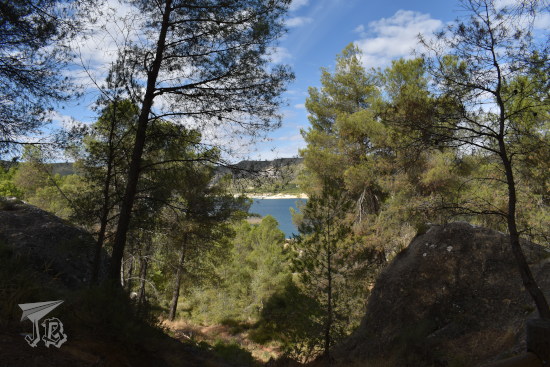
A collage: Mount Nebo mosaic showing men and animals, and Greek Writing. A panorama of the Dead Sea. The olive tree planted by the Pope

We drove forward to Madaba [مادبا] to see the Map of Madaba mosaic, dating from the 6th century CE and preserved on the floor of the Greek Orthodox Basilica of Saint George. It is a representation of the Middle East, essentially the Holy Land and Jerusalem. The mosaic was rediscovered in 1884, but the lack of preservation damaged part of it, until the Germans took over conservation in 1965.

Madaba Mosaic, showing Jerusalem

We continued our trip and made a stop for lunch at a restaurant / tourist shop in the three-hour ride southwards. The whole morning was rushed because the guide wanted to fit Little Petra | Siq al-Barid [سيق البريد] that afternoon, instead of Wednesday. It is part of the Unesco World Heritage Site of Petra and the Petra Archaeological Park. Little Petra was probably a suburb of Petra. The Nabataean built their desert cities by carving the buildings into the sandstone that made out the walls of the canyons, sometimes carving fantastic façades from top to bottom. One of the most interesting things in Petra are the frescoes found in the Painted Biclinium (dining room), depicting vines, flowers, and other leaves. Other constructions include water cisterns, the real secret of the Nabataean success flourishing in the desert, and the Triclinium. The city was built in the 1st century CE, “found” in 1906 by Père Abel, and excavated by Diana Kirkbride and Brian Byrd in the late 20th century.

Little Petra collage: Entrance canyon, triclinium, Nabataean paintings and stairs carved on the rock

Finally, we drove off to our hotel. The manager told us that we were the only group with an arranged dinner at the hotel that night, and he asked us to arrange a dining time for “salad and barbecue”. The salad turned out to be an assemble of Arab snacks and a plateful of barbecue lamb and chicken. Just wow.

Assorted Jordanian "salads" and a plate of barbecued lamb

In the end, we drove for around 300 km and about five hours, and walked about 6.5 km (10711 steps).

10th September 2022: Arriving is tough {Jordan, September 2022}

Officially named the Hashemite Kingdom of Jordan | Al-Mamlakah al-’Urdunniyyah Al-Hāshimiy [ٱلْمَمْلَكَةُ ٱلْأُرْدُنِيَّةُ ٱلْهَاشِمِيَّةُ], Jordan | Al-ʾUrdunn [ٱلْأُرْدُن] is located in the Middle East. It has limits with the Dead Sea, Israel / Palestine Syria, Iraq, Saudi Arabia, and it has a tiny connection to the Red Sea in the south. Due to its location, it is a semi-arid country, with relatively little rainfall, especially the further away from the Mediterranean. Today, it is an Arab nation, but it has been inhabited from the Palaeolithic – it has been Egyptian, Moabite, Assyrian, Babylonian, Persian, Roman, Nabataean and finally Islamic. In recent times, Jordan belonged to the Ottoman Empire, Britain, and it became independent in 1946, being a Parliamentary Monarchy that gives great power to the King (currently Abdullah II). Even though Jordan was left largely unscathed during the Arab Spring (2011), making it one of the most stable countries in the area, it was hit by terrorism in 2005. Al-Qaeda bombed three hotel lobbies, which crippled the tourism industry, which is one of the most important in Jordan.

It is probably the Nabataean period the one that has left the most unique cultural assets, and tourist sites. The Nabataean were nomadic Arabs that setted down and mastered the art of stone carving, creating the city of Petra as their capital. Petra is a Unesco World Heritage Site and one of the New Seven Wonders of the World, and possibly the most visited place in the country.

As of September 2022, in order to enter Jordan, you need to fill in a document declaring that if you get Covid you or your insurance will pay for any health cost, including hospitalisation or isolation / quarantine. That meant that unfortunately we could not check in online for the flight, as the air line – Royal Jordanian in this instance – had to check that declaration before issuing the boarding passes. That required being at the airport with a three hour margin, maybe a bit more. That made the whole thing a bit extra tiring (total travel time must have been about 12 hours). Fortunately, it went smoothly, we boarded without issues and took off on time.

The flight to Queen Alia International Airport in Amman | ʻAmmān [عَمَّان], the capital of Jordan, took about 4h30min (and plane food has not got any better since 2019). We landed late in the evening, and that was when the stress started off. There was a tourist guide / mediator / whatever waiting for us, with the name of the group my parents had booked for the trip. He gave us instructions which ended up being… “hand over your passport to this policeman and wait by luggage retrieval for your stamped passport, that I shall bring”. Okay, that was creepy, and I was more than a bit on the uncomfortable side until I had mine back.

Then we had about an hour bus ride and we reached the Amman hotel by midnight. The hotel X-rayed our luggage and bags as an anti-terrorism measure, and checked us in… weirdly. Apparently the tour operator had given names and reserved rooms but… there were no rooms associated to the names so my parents and my sibling and I ended up on different floors. Oh and even if dinner was included, they had already closed the kitchen so they gave us boxed dinner with sandwiches and salads. Fortunately though, they also gave us water and some complimentary bottles, which was handy. I wish I could tell you that I slept by the dead, but I was to wound up to do more than snooze a little.

10th – 14th September 2022: Jordan | Al-ʾUrdunn [ٱلْأُرْدُن]

Jordan, 10th - 14th September 2022


A few years ago my parents took a trip to Jordan, which ended in one of them repatriated to the hospital due to a medical emergency the day before visiting Petra. In 2022, as Covid wound down for a bit during the summer months, they stated that they would like to return in order to get over the bad memories, and gather the courage to travel internationally again. I joked that they should take me along for “bodyguard services”. They decided to do so, and invited my sibling along. This is I guess our whole-family trip since… 2000. And since it was what my parents wanted, they called the shots, purchasing a packaged tour to Jordan | Al-ʾUrdunn [ٱلْأُرْدُن]. While these are not much of my thing, it is true that they might be the best – and possibly safest – way to visit the country; our particular tour had positive and negative aspects to it, as it often happens in life.

Our tour included hotels, transportation, tickets to the attractions, breakfasts and dinners – without drinks. We had to pay for lunches and any other drink, and these were usually programmed into the trip, leaving us without many options anyway.

13th August 2022: Smoothness in Chaos {England, August 2022}

As rail strikes rolled out both in London and the rest of England, I was thankful I had found out in advance. The hotel internet was patchy and I would have had trouble booking a coach ticket for the airport. I decided not to try and cram more than I had already on my plate for the day, and stick to my booked tickets and original timing.

I took an underground line to Victoria railway station, from which I went to find out where my airport coach would leave from. After that, I walked from Victoria coach station towards Westminster, stopping at Westminster Cathedral, a rather out-of-place Neo-Byzantine building, which serves as the Catholic cathedral. Designed by John Francis Bentley, it was completed in 1903. It was closed for service, unfortunately.

Westminster Cathedral, a Chrsistian neo-byzantine building: a view of the exterior, in white and red brick, and the open doors showing the inner altar from afar

Due to the strikes and potential issues, Westminster Abbey had rearranged its opening hours, and waived all the “entry times”. So basically it was a bit on the chaotic side, though I arrived for my own timeslot, as I had calculated that would be all right for the tour I had signed up for. The abbey is officially called Collegiate Church of Saint Peter at Westminster. It was a originally a Benedictine abbey, and William the Conqueror, in 1066 made it the “official coronation ceremony” place, and many Royal Weddings have occurred there. It is built in the Gothic style, with Neo-Gothic towers. Furthermore, most British monarchs were buried there, along with a number of personalities that were either earthed there, or had memorials erected – Darwin, Newton, Hawkins, Shakespeare… The Abbey features a 19th-century wooden choir in the middle, and an outer cloister in early Gothic style. It was bustling with people fighting the audio guide and extremely hot though. However, this completed my tour of the Unesco World Heritage Site of “The Palace of Westminster, Westminster Abbey and St Margaret’s Church”

Westminster Abby, a Gothic Protestant Cathedral. Collage showing the towers and main entrance, the inner Norman altar in golden wood, the ceiling in the nave, and the cloister

Before the train strikes and the chaos in English airports, I had booked a 12:15 “Westminster Abbey hidden highlights” tour as my last activity in London before taking the Stansted Express to the airport. The change of plans meant I had to take the 14:00 h coach instead of the 15:00 h train to be at the airport by 16:00, to make sure that I would have plenty of time to go through security. That meant that I unfortunately had to cut the tour short. Event then, I got to see St Margaret’s Church, the old Medieval sacristy, the inner chambers of Samaria and Jerusalem, and got close to coronation chair. Not bad at all, even if I unfortunately had to miss the library to walk back to the station.

A collage showing an archaeological excavation (very professional holes on the ground, some showing a hint of brick foundations); the Coronation Chair and the hanging flag over it; ornate wooden ceilings; and a mythological-themed tapestry hanging from a wall

I have to say that the return was exhausting. Even with one hour difference, I got on the coach for the airport at 14:00 and did not land until 22:00. However, flying out of Stansted always has a good thing – goodbye sushi!

Tray of sushi and sashimi

All in all, this non-weekend weekend was an amazing mental break! Even if the last day did not work as originally organised, I had a heads up in order to prepare my contingency plans. I got to see something that I always wanted to see – and even if Stonehenge was smaller than I thought, it was not disappointing. Also, I checked that entering the UK after Brexit is pretty much the same as before, so I can organise more escapades in the future, because I still need to go to Jurassic Coast…

Walking distance: 11.27 km / 16672 km

12th August 2022: Stones, the reason for the trip. Lots of Stones {England, August 2022}

I was convinced I’d sleep like the dead and set a couple of alarms. Unfortunately, laundry and house service got going at 6:30, and woke me up. At least, the room had a kettle and some instant coffee which, along with one of the sandwiches I had procured the previous day, got me going. I made sure that the camera was charged, put everything I needed into the backpack and strolled off. My hotel was close to Earl’s Court, and I was walking to South Kensington to check out sandwich and coffee shop. And – to my eternal surprise – to queue for a museum! I don’t think I’ve ever seen so many people waiting for a museum to open in my life.

I’m referring to the Natural History Museum, one of my favourite ones. This time, it was a must, so I booked free entry with the special exhibition – “Dippy is Back”. Dippy is the diplodocus cast replica that used to stand in the middle of the museum, the Hintze Hall (where now the whale skeleton hangs). Dippy was the first of its kind to go on display in the world. The original skeleton was discovered in 1898 by railroad workers in an area called Sheep Creek, in Wyoming, USA. At the time, Andrew Carnegie had made a fortune in the American steel industry, and become one of the most important philanthropists in the US and the British Empire. He paid for casts of the bones to be made (some sources also say that he bought the actual skeleton, some that he had sponsored the dig) and sent to museums in Europe and South American. For the first time the public got to see a whole dinosaur skeleton, which was actually named Diplodocus carnegii after Carnegie. Dippy was gifted to the National History Museum in 1905, and was exhibited there until it went “on tour” around the United Kingdom in 2017.

Here is a little trip down memory lane: back in the mid-nineties I was a teenager in London with my English class. We had free time and they wanted to go to Harrods, so… instead I got myself into the Tube to go to the Natural History Museum just to see this dinosaur (I also ditched the group in the British Museum, but that’s another tale). The point was that I was around 14 or 15, bouncing through London by myself, on my way to see this very cool dinosaur! And I did not have to listen to people being rowdy, nor try to keep the peace in group – I was alone (scared out of my skin, true), but I was free by myself. And for me, that was very important, even if I would not come to realise that until recently.

The fossilised skeleton of a diplodocus, seen from the front. Lots of people are trying to take pictures with it

I saw Dippy again in 2011 when I went to London, but I was surprised when he was not there in 2018, shipped around the country in a travelling exhibition. For some reason, knowing that it was there made me really, really want to see it again. Since the pandemic, you need to reserve at ticket at the Natural History Museum, even if it’s free, so I booked mine for 10:00, to be there first thing as they opened – thus the queuing-before-opening.

Originally a gallery of the British Museum, the Natural History Museum was first designed by civil engineer Captain Francis Fowke, and then it was revised by Alfred Waterhouse, who redesigned the façades in a Romanesque-like style, with architectural terracotta tiles to withstand the British weather. These tiles have flora and fauna decoration and reliefs. The building was finished in 1880, and all the material had been moved by 1883. In the 20th century, the museum rebranded itself as a separate entity from the British Museum, and in recent years different areas and expansions have been opened.

Anyhow. The gates opened a little before 10:00 (If I lived in London I would totally be a member and stroll the museum before opening hours), and the queue started moving. There were lines for ticket holders and non-ticket holders, but my ticket was not even checked. Thus, I just moved towards the area where Dippy was and spent a while there. I felt a little emotional, thinking that, in a way, I owe that dinosaur one.

After seeing Dippy, I wandered around the dinosaur gallery for some time, then I went to buy a sandwich and have a coffee and a painkiller, because I had a long day ahead of me and my head was buzzing a little – I needed to get that under control beforehand. At 11:40 I took a coach with a company called Anderson Tours for an organised day trip: Stonehenge Special Access – Evening. Even though I am not too keen on guided tours, I will admit that they can be handy at some particular circumstances. They will never become my preferred choice of travel, in this case, choosing a tour was the best option.

Regarding Stonehenge, if you want to get up close and personal with the stones, you need a VIP ticket, which means you have to be there before they open to the general public, or after they close, and for that you need transportation – either a taxi, or renting a car, and a hotel as close as possible. The Stonehenge VIP ticket is around £50, and I booked my tour for £135, a full-day tour, including coach, Stonehenge at sunset, and two other destinations, with pick up and drop-off near my London hotel. In the end, that was cheaper than a taxi or a rental plus a hotel near the site (I did a lot of maths before deciding to book this). Anderson Tours offers different combinations of “Stonehenge and…”, with places like Bath or Bristol. However, those are easily reachable by train, and I can explore them on my own. Nevertheless, there was a particular trip that interested me – it went along two or three spots that are a bit off the beaten track, and related to the theme – a Neolithic tomb and another stone circle. This particular tour happens only on certain specific Fridays, thus why my “weekend” away was not such a weekend, as I had to make sure I was in London on the 12th.

The first stop of the day was West Kennet Long Barrow. A long barrow is an elongated prehistoric (3800 – 3500 BCE) stone monument that has been linked to the worship of the dead and the ancestors. Sometimes, human remains have been found in them. If one imagines what Great Britain was at that time, the south-east area would be the one with less tree coverage, and therefore the best option for primitive people who had started to settle and use agriculture. The counties of Gloucestershire, Wiltshire, Somerset and Dorset have a lot of chalk-rich soil (the Salisbury Plain), which makes it difficult for tress to root and grow. Thus, it would have been easy for the primitive humans to settle and build their villages and monuments. Today, the whole area is known as Stonehenge and Avebury World Heritage Site, listed by Unesco in 1986, and it includes over 700 prehistoric monuments from the Neolithic and Bronze Age.

Collage: elongated mound of dirt on top. On the borrom, the gate. On the left the protective slabs, standing upright, and on the right, the entrance. It is a construction of vertical walls made from grey slabs and another slab on top. The interior is dark.

West Kennet Long Barrow is situated in the middle of a farm. There is a tiny parking lot to the side of the road, and a fifteen-minute walk to the barrow itself. It is one of the largest built in Britain, and around 50 sets of remains have been identified, along with pottery, beads and other personal items. Around 2000 BCE, it was closed down and barricaded, then discovered in the 19th century and scientifically excavated and restored in 1956. It is private property under the care of British Heritage. Apparently, all these sites have become a point of pilgrimage for neo-pagans, and on this day, there was a bunch of them chanting inside the barrow…

On the opposite side of the road from the barrow stands Silbury Hill, a mound or artificial mountain. It stands 30 metres high, with 160 metres in diameter wide, and it is estimated that half a million tonnes of material (mostly local chalk) were used to build it throughout several generations of humans. It cannot be climbed, due to a collapse a while back, that would have been neat!

View of a small hill and dry grass.

After that, we headed off to the village of Avebury, which hosts the largest Neolithic stone circle, with smaller circles inside. It originally had over 100 stones, and it might have built between 2850 and 2200 BCE. Today there is a village in the area, with a few shops and museums in the centre, and a lot of sheep grazing the area. Around three quarters of the circle is still standing, along the henge (long ditch that used to be built with the stones in Neolithic circles).

We had two and a half hours in Avebury – a bit too much, I would say – to explore the Avebury Stone Circle and Henge and its sheep. The guide told us about ley lines and trees that were supposed to have inspired Tolkien’s Ents from “The Lord of the Rings”, and I needed to ask about the geology of the stones – here I learnt that they are made out of sarsen, like the Stonehenge ones. Sarsen refers to silicified sandstone blocks, common in the area, and it has been proven that the ones used in the megaliths come from Marlborough Downs, some 25 km away (35 km from Stonehenge). Once we were dismissed for our “free time”, I walked along the three fourths of stone circle remaining.

A collage showing different megaliths from the Avebury stone circle. Small pillars mark the spots where the stones have been lost. There are some sheep grazing on dry grass.

There are other places to visit in town, such as a Medieval manor with a dovecote. The stables of the manor are the site of the archaeological museum is hosted, and here I made a mistake. I should have got in, but I wanted to visit the church, and by the time I was done, the museum was closing down. Live and learn. There is also a tiny chapel, and a lot of souvenir and “crystal” shops.

The Church of Saint James dates back to the 1000s, though later centuries saw the addition of many items, such as the aisles and the 15th-century wooden roof. The nave and the chancel are separated by a one-of-a-kind wooden rood / screen with an original 13th century base. There are Saxon windows and a Norman font. It is a fantastic little church.

Gothic church, from the outside. The inside shows a wooden Normand altar, the standard altar, and a carved stone baptismal font

Finally, the time came. At 17:30 we met up on the way to the coach, and then we started off towards the highlight of the day – Stonehenge. Stonehenge was erected between 3000 and 2000 BCE – the primitive human somehow got the sarsen stones into Salisbury plain and planted them so they stood in a circle. They measure up to four metres long, and some of them are arranged in the shape of trilithons – two large vertical stones (posts) support a third one (lintel) which is set horizontally on top of them, with carved studs so the structure fits like a snap. There is a tear-shaped monolith standing a few metres away called “Heel stone”, which marks the entrance.

Some of them are indeed collapsed now and some are covered in lichen – there is a special type of lichen that only grows in three places in the world, and that is one of them. For thousand of years, these stones have remained standing, and the first historical study of them dates from 1666, carried out by an English antiquary, natural philosopher and writer John Aubrey, and has been restored a several times, especially during the 20th century, when they were roped off and a fee charged for entry.

Currently, the stone circle belongs to the Queen of England, and according to the British Ancient Monuments Bill, it cannot be touched or altered in any way that is not to preserve its current status. In 2020, a core taken from the stones during the 1958 restoration was returned. This allowed researchers to analyse the composition and prove that the megaliths are indeed sarsen from the Malborough area.

The rules when you are allowed into the stone are “simple”: do not touch the stones, do not step on the stones, do not hug the stones, do not lick the stones, do not get naked among the stones. Judging by the tone in the guide’s voice, all that has happened before. Apparently, there are a lot of ley-line believers, neopagans and neodruids wanting to “connect” with the earth energy there (there is even a “yoga at sunset group”). In a kind of compromise, they allow you to take off your shoes and socks – which I did not do.

According to archaeologists, Stonehenge was designed in alignment the Winter Solstice sunset. The site was probably a celebration of the end of the worst of the winter before days started getting longer again. Other theories propose that it was originally a burial site that became a place to worship the ancestors.

The great thing about the after-hours tour is that you get to see the sunset around the site. Our timing was 18:45 – 19:45. The guide was nice too, and gave us “permission” to wander around and did not expect to listen to him all the time – don’t tell me twice. I explored and wandered to my heart’s content. We stayed there for about an hour, and it was really cool. I mean, not magical or “I feel the magic of the earth” or anything, but the circle is a fantastic piece of engineering, especially considering it was built five thousand years ago, before writing was even invented. Sometimes, humans are neat.

Stonehenge collage. Two shots of the megaliths standing on dry grass, from the outside; the sun shines between the darkened stones. One shot from the inside of the circle, showing the megaliths circling inwards.

It was over sooner than I would have liked, but about an hour later we were back on the bus after hitting the souvenir shop – where I got a guidebook – and we arrived in London around 22:00. When I got off the bus I just walked to the hotel, had my sandwich. Good thing I had left the window open, too, as it made the temperature slightly more tolerable – I own up though, I slept with the fan on, but… like a rock. Or a stone.

Walking distance: 11.96 km / 18742 steps
Coach distance: 317 km