8th February 2025: La Cúpula – “Opera & Brunch”, Hotel Palace (Madrid, Spain)

When I have a “big oh” birthday, I go climb a volcano, when my sibling does, we go for high-end brunch. Not that I am going to complain, at all – I get to tag along. The day, however, could have started better. We left 30 minutes behind schedule, then we ran into a traffic jam in the highway and finally, when we reached Madrid, we could not access the parking lot we had planned because not all the street closures had been published on the town hall’s website. We managed to find a different place to drop off the car, fortunately, but none of us was really wearing walking shoes…

Everything got better when we reached The Palace Hotel, officially The Palace, a Luxury Collection Hotel, Madrid, colloquially El Palace. This five-star hotel was established in 1912. It is both a Spanish Cultural Asset (BIC) and part of the Unesco Heritage Site Paseo del Prado and Buen Retiro, a landscape of Arts and Sciences. The Palace is recognised as the first luxury hotel built in Spain, erected as an early 20th response to the new ways of travelling and King Alfonso XIII’s efforts to modernise Spain, which had previously been considered an “exotic and a bit dangerous” country to travel. The building was designed by architect Leon Eduard Ferrés i Puig in the Beaux-Arts style, one of the multiple “neo” fads from the 19th century, drawing from French Neoclassicism, Renaissance and Baroque whilst at the same time using new building materials – reinforced concrete, iron, steel and glass (another grand example of this style is the Casino in Monte-Carlo).

Historically, The Palace Hotel has hosted national and international names of renown – Spanish artists such as Picasso, Dalí and Lorca, composers like Igor Stravinsky and Richard Strauss, scientist Marie Curie, and showbiz personalities including Josephine Baker, Rita Hayworth and Ava Gardner. Today, El Palace is part of one of the Marriott brands, and after an integral renovation between 2023 and 2025, it comprises 470 rooms and 51 suites across 6,000 square metres on six floors. It is also home to several gastronomic spots: a high-end Chinese restaurant (China Taste by El Bund), a cocktail bar (27 Club) and a flexible restaurant and bar – La Cúpula, so called because it sits in a rotunda underneath the iconic stained glass dome (cúpula in Spanish) and skylight that has become the “heart of the hotel”.

There are also several works of art scattered around the hotel, and just past the lobby, I almost walked into one I was not expecting at all – “The Palace Dino”, El Dino del Palace, a sculpture by Lázaro Rosa-Violán depicting… a spinosaurid dinosaur. The piece is a scaled-down marble skeleton of an outdated interpretation of Spinosaurus aegyptiacus (Cretaceous period) with a thick tail and a bony crest. I say “outdated” because Spinosaurus was discovered in the early 1910s and for a while, it was described as bipedal theropod. Two skeletons were recovered in Egypt but kept in Nazi Germany and destroyed during WWI, so nobody could study them further. Later, in the 21st century, a proposed neotype was unearthed, this time in Morocco. Subsequent discoveries hinted that the animal was actually both quadrupedal and semi aquatic. In 2005, a Spanish spinosaurid was discovered in La Rioja area and named Riojavenatrix lacustris (Lake huntress from La Rioja) – I may have worked on a fossilised piece of bone of this animal in Loarre. I was really surprised to find any dinosaur connection in such a place, but I have exactly zero problems with it.
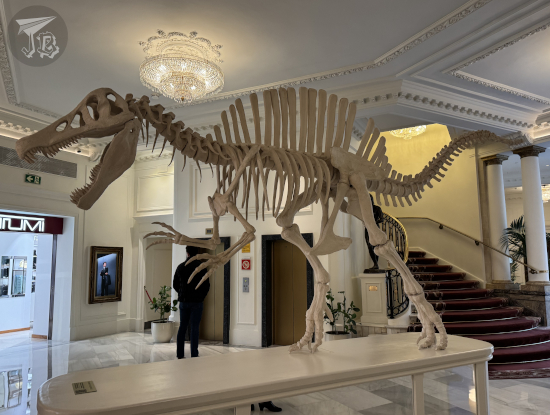
simplified skeleton of a dinosaur with a sort-of-sail

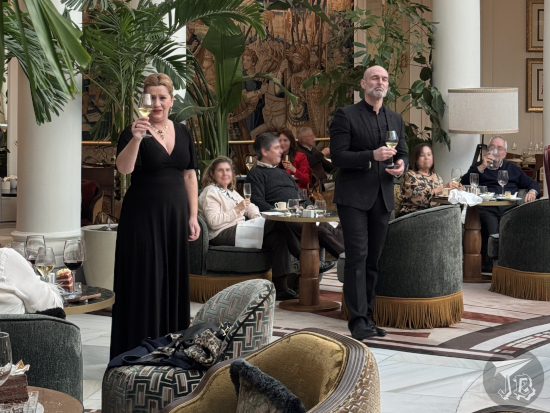
Dinosaur hype aside, every Sunday afternoon between 13:30 and 16:30, La Cúpula offers an event called Opera & brunch, with a self-service buffet and professional opera singers popping up to delight the attendees with several arias by famous maestros. The crowd was extremely diverse – from middle-aged couples to families with children to solo-diners. When I grow up, I want to be like the lady sitting on her own at the next table, whom both waiters and singers stopped to greet and welcome.
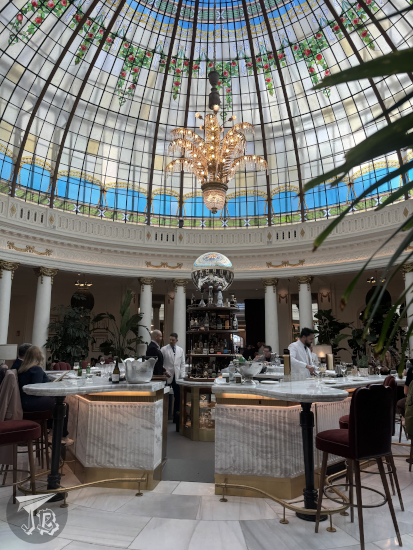
Bar in the centre of a rotunda, covered by a skylight

For now, however, I don’t think I can afford the price tag, which might be steep for some pockets – but as I said, milestone birthday. We had chosen the Deluxe Opera & Brunch, which is 125 € per person. There is a more expensive option which includes a lot more alcohol. Despite its given name, the affair is not really a brunch, but a full-blown lunch.

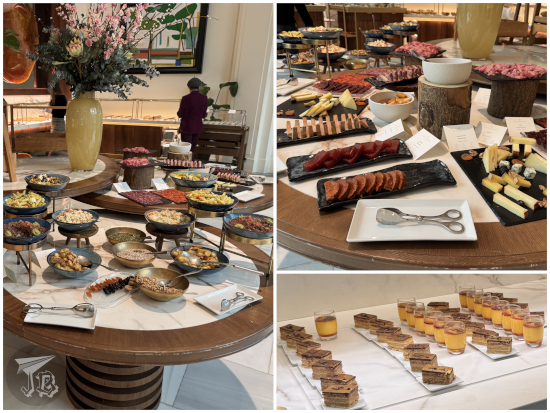
Waiters serve sparkling wine (cava) and water, and they focus more on the wine than the water, which is slightly inconvenient for a non-alcohol-drinker like myself. Food is organised in a buffet-corner, divided in three spaces. The first one is the “self-service area”: artisan cheeses, Iberian sausages – including a hand-cut ham leg (100% acorn-fed Iberian breed) – baked goods, seafood and raw bar, with lobster and oysters, salad bar and a “hot buffet” with roasted suckling pig and side dishes of potatoes, peppers and chickpeas. In another area stood the live cooking stations, manned by people serving the food: roasted sea bass, beef Wellington and a rice station (paella); an egg station was advertised, but it was not there – hence not a brunch: no option of eggs Benedict. Finally, there was a desserts table with mini cakes, pies, tartelettes, verrines, chocolates, and macarons. I learnt the names of so many desserts that day…
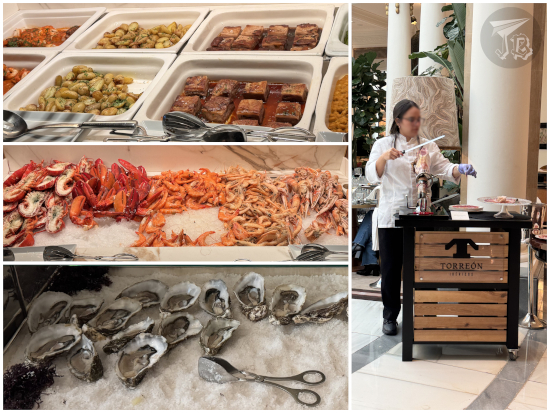
Lady cutting a cured pork leg, and several stations of a buffet, including cooked meat, seafood and oysters

Cold meats and cheese, salad, and dessert stations in a buffet

The music program included a pianist, a soprano and a tenor, and we had a little sheet of paper with the setlist:
 Non ti scordar di me (Don’t forget me) by Ernesto de Curtis (1935).
 Ebben? Ne andrò lontana (Well, then? I’ll go far away) from La Wally by Alfredo Catalani (1892).
 Musica Proibita (Forbidden Music) by Stanislao Gastaldon (1881).
 Io son l’umile ancella (I am the humble servant of the creative spirit) from Adriana Lecouvreur by Francesco Cilea (1902).
 Eri tu (It’s you) from Un ballo in maschera by Giuseppe Verdi (1859).
 Il bacio (The Kiss) by Luigi Arditi (1860).
 Mattinata (Morning) by Ruggero Leoncavallo (1904).
 Die lustige Witwe Waltz (Waltz of the Merry Widow) by Franz Lehár (1861).
 Amapola (Poppy) by Joseph Lacalle (1920).
 O sole mio (Oh my sunshine) by Eduardo Di Capua (1989).
 Granada by Agustín Lara (1932).
 Nessun dorma (Let no one sleep) from Turandot by Giacomo Puccini (1926).
 Brindisi (Toast or Driking Song) from La Traviata by Giuseppe Verdi (1853).
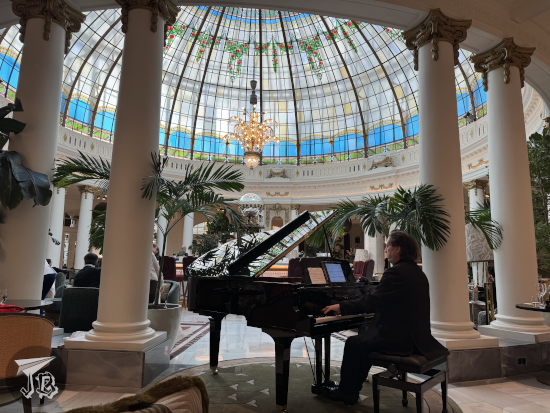
Man playing a grand piano

Tenor and soprano singing The Toast from La Traviatta. The soprano is saluting the camera with her glass

The singers and the pianist were excellent. The only complaint I could have is that we were seated right behind the piano, and the artists were on the other side, so their voices did not carry that well, but once the soprano came to sing to us and that was great. I moved at some point so I could hear them better, too (and take pictures). The food was abundant and quite good – I even tried an oyster for the first time. Truth be told, I would have liked to taste a bit of each dish – everything looked delicious – but there was just too much! The sitting and bar area looked beautiful, and there was even a bit of a Chinese New Year decoration (since China Taste is doing a special menu to celebrate). I particularly loved the skylight dome above the bar, created by artisans Casa Maumejean.
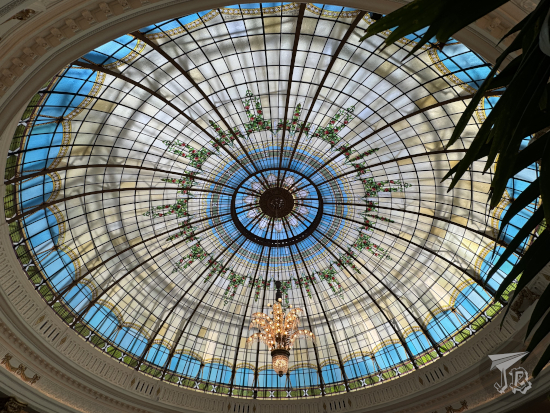
Skylight with a hanging lamp

It was a great event that we could have complemented with something else nearby – the Naval Museum, or the Palace of Cibeles. However, my parents had been so stressed by the drive that they did not want to stay over. Besides, we had eaten a lot. The most reasonable course of events was heading home for a food coma, after deciding that maybe – just maybe – Sunday mornings were not the best to drive around Madrid.
4th April 2023: La Granja and Riofrío (Spain)

King Felipe V of Spain was born Philippe, Duke of Anjou, in France. He was appointed successor to the throne by his great-uncle Carlos II, who died childless. He was never very interested in being a monarch, or at least King of Spain, which he became in 1700. Around 1718, he fell in love with a hunting area and decided to buy it. Today, this area has become the municipality of Real Sitio de San Ildenfonso (Spain), the Royal Site of Saint Ildephonse. He ordered a palace be built “without disturbing what was already built”. The result was the palace known as Palacio de La Granja de San Ildefonso (The Farm at San Ildefonso), in honour of the hermit church and farm that were there when the King bought the hunting grounds.

Legend has it that the palace is extremely uneven because the King ordered that no parts of the church were demolished, so the walls were built around the old construction – however, it is such a massive building that seeing the irregularities from the inside is hard. The palace, built between 1721 and 1724, was commissioned to Spanish architect Teodoro Ardemans. Later, the garden façade was remodelled by Italians Filippo Juvarra and Giambattista Sacchetti. A fire destroyed part of the building in the 20th century and a lot of the paintings were lost. The gardens – the most famours feature of the site – were designed by Frenchman René Carlier in 1721 and finished by Étienne Boutelou when the former died in 1722.

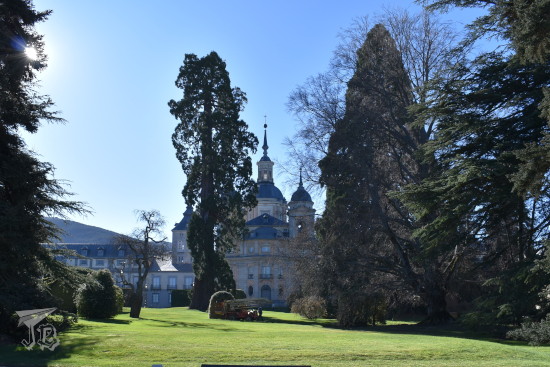
Today, the palace is managed by the Spanish Heritage Network Patrimonio Nacional – which means that photography is not permitted inside. It is technically one of the royal residences, so of course you have to go through security and X-rays and whatnot. We headed there on what was technically a working day before Easter break, so we were not sure how much traffic we would find, or how many visitors there would be. Thus, we had booked our tickets online for 11:00, anticipating a two-hour-and-a-half drive. In the end, we were in front of the palace around 10:15 and were able to enter at 10:30. Before that, we saw some impressive trees, including a sequoia, which I don’t think I had ever seen before.

Baroque Palace of La Granja peering behind a few large trees

The palace is Baroque, showing the likings of the time in which it was built. A monumental staircase gives access to the first ward, rebuilt after the fire into an area to display part of the royal tapestry collection – Museo de Tapices. The oldest tapestries date from the 16th century, before the Spanish tapestry school was founded. Tapestries are not my favourite form of art, but these were pretty impressive. A collection of nine pieces allegorise some of the virtues, mixing classical mythology with Christianity and historical figures.

The interior of the palace displays the private rooms of the monarchs, on the first floor, and the different ballrooms and social rooms on the ground floor. The private areas are decorated with paintings, and the public ones try to emulate the Palace of Versailles (France). They are furnished with marble and mirrors, and decorated with sculptures and statues.

La Granja: Dizzingly-decorated large hall in golden and white marble, with large open wooden doors

The ground floor opens to the well-known gardens Jardines de La Granja. These are considered the best “French gardens” in Spain. They cover almost twenty thousand square metres. Sprinkled throughout paths, hedges, parterres and trees, there are 21 fountains, most inspired by characters taken from classic mythology. The fountains are made out of lead, painted in bronze colour, and even if built 300 years ago, they still work and are indeed turned on during the summer season, fed from local reservoirs. They were not running during our visit – except for one dragon which leaked a bit. Spring seemed not to have arrived in the gardens yet, and it looked strangely like autumn.

La Granja: Italaian façade of the pakace from the top of the waterfall fountain, which was turned off. A number of bronze statues representing mythology characters line the waterfall

From the top of one of the fountains, called “the waterfall” Fuente de la Cascada Nueva, there is a good view of the Italian façade of the palace. Other fountains include “The Fame” Fuente de la Fama and “Diana’s bath” Fuente de los Baños de Diana. One of the most complex fountains is Fuente de las Ocho Calles (Fountain of the Eight Streets), a complex of eight fountains in a sort of “square” created by the intersection of eight garden paths. The fountains were built to only run when the King approached them, and today they are turned on in a rolling schedule, and very rarely all at the same time. This is to take care of the pipe system, still the original one, and because some of them need a lot of water to function.

La Granja, outside. Two large fountains crammed with bronze figures representing mythological beings. Both are turned off.

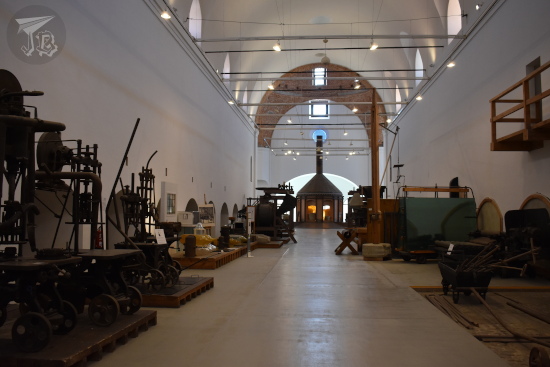
After we were done with the palace, we continued off to what I found the highlight of the day, the Royal Factory of Glass and Crystal of La Granja Real Fábrica de Cristales de La Granja. It was also established by Felipe V in 1727, and even today people use the old techniques to make glass items there! Even though it is called a “factory”, the process is completely artisan. The place also doubles as a museum to explain the how glass is (and was) made, exhibiting different traditional instruments. Of course, it has a shop. However, the coolest thing is that you can visit the furnace workshop to see how glass is blown, and the decoration workshop to see the engraving process. We hung around the furnace area and the experts can make a whole goblet in three minutes and a half, from incandescent blob to ready-to-engrave product.

Glass museum: diferent machines used to process glass in the 20th century, and a reproduction of the original glass furnace

Workers at the Glass factory: making and engraving a glass

After the factory, we headed towards the Parador de La Granja, a mix of a modern and historical building where we were to have lunch. We shared some cured beef cecina de León, and I tried the local speciality judiones de La Granja, a hearty bean-and-pork stew.

Collage of the inner patio of the Parador building + lunch: dried meat and a bean stew

When we finished lunch, we took the car to the secondary palace in the area, called Palacio Real de Riofrío, a hunting pavilion also managed by Patrimonio Nacional (though apparently, pictures are okay here, which is cool). The building is surrounded by 600 hectares of forest and hunting grounds. It was originally commissioned by Felipe V’s wife Isabel de Farnesio, who actually never got to live there since when she became “queen mother”, her son Carlos III had her move to Madrid.

We drove past the forest, where some storks were happily wandering around. The SatNav flipped on us because it could not find the correct gate, but we managed to make it on time to spend an hour or so there. Also, the entrance was weird – it is actually closed, and there is a guard inside. If we had not arrived just as another car was exiting, we would have thought it was closed and left.
Baroque palace of Riofrío. It's large and pink, with lots of archeways

The palace is also Baroque, and the areas which can be visited include some bedrooms, dining rooms, and the areas where the servants waited to be called. The palace has been organised as a Romantic museum Museo Alfonsino, that honours King Alfonso XII, who mourned his first wife there. It was actually decorated by his father, King Consort Francisco, Isabel II’s husband, and later “enriched” with paintings from other Royal Sites. The most interesting item was the billiard room, because it actually felt rather unexpected.

Another area of the palace has been transformed into a “hunting museum” Museo de la Caza, to honour the fact that these were the King’s hunting grounds. It mostly hosts taxidermy representations and a collection of pelts and skulls. To be honest, some exhibits were a bit unsettling.

Collage showing the inside of Riofrío: the hyper-decorated rooms, the staircase and taxidermy of local deer

As we left, the SatNav warned us of a 40-minute jam on the way back, so we forgave its previous flop. The warning allowed us to take a detour to avoid it – we had to pay the toll but it shaved off almost an hour.