21st October 2024: Bruges & Antwerp {Belgium October 2024}

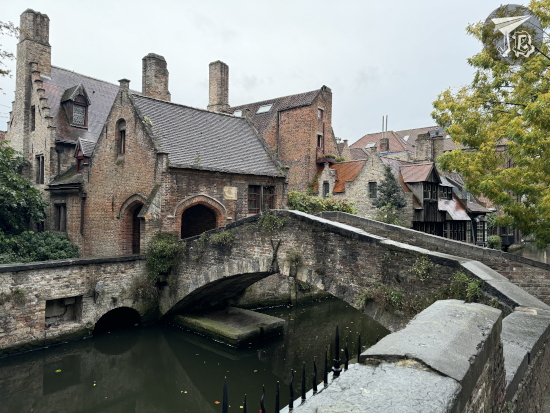
It was raining in Bruges [Bruges | Brugge] when I woke up, but it was supposed to stop by the time the monuments started opening. I asked reception to take care of my bag and I left around 9:30. I thought I would retrace my steps from the previous day, but when I got to the Church of Our Lady, it was not open yet, thus I took a small detour and explored its surroundings. I walked around the area taking in the scenery, and crossed Boniface Bridge Bonifaciusbrug, one of the iconic bridges overlooking traditional wooden and brick houses which face the canal. In front of the church stands the hospital-turned-museum Apotheek Sint-Janshospitaal. It was closed because it was a Monday, but the building was pretty.

Bonifacebridge

The Church of Our Lady Onze-Lieve-Vrouwekerk opened at 10:00 and I wanted to at least see the free area. The church is famous for having a statue by Michelangelo, but that was in the museum area, which I did not visit. The church also displayed original frescos and a small Via Crucis.

Church of our Lady Bruges

I then walked towards the city centre and Saint Salvator’s Cathedral Sint-Salvatorskathedraal. The cathedral is made mainly out of brick, along with tuff and limestone. The oldest bricks date from the 14th century, made outside the city and brought via the waterways. It was not originally built as a cathedral, but took over the role when the actual one one was destroyed in the 18th century. Instead of rebuilding it, the city made Saint Salvator the next cathedral in the 19th century. Unfortunately, shortly afterwards, there was a fire and the roof collapsed. English architect Robert Chantrell was in charge of the restoration, and he chose to build the neo-Romanesque tower that looks something like a Lego set. Later, a peak was added to the tower which makes it even more… Lego-like.

Saint Salvator Cathedral Bruges

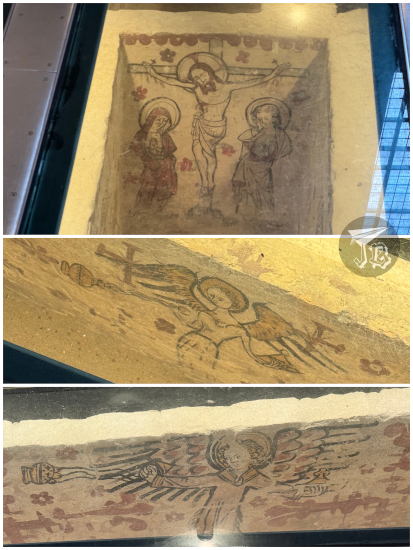
The cathedral has an organ originally built in the 18th century, and has been expanded thrice since then. The altar is surrounded by Flemish tapestries. Underneath the nave, there is a crypt where you can see the oldest bricks and a number of 14th century tombs, decorated with paintings in the fresco technique. They feature angels, Jesus, the Virgin Mary and Saint John. There is a small building adjacent to the cathedral with a closed off cloister which holds the treasure, full of works of art.

Saint Salvator Cathedral 14th century tombs

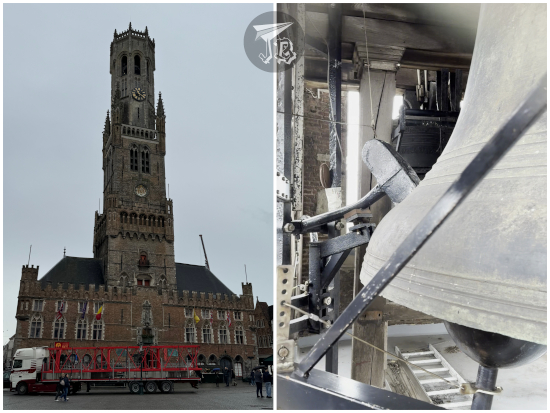
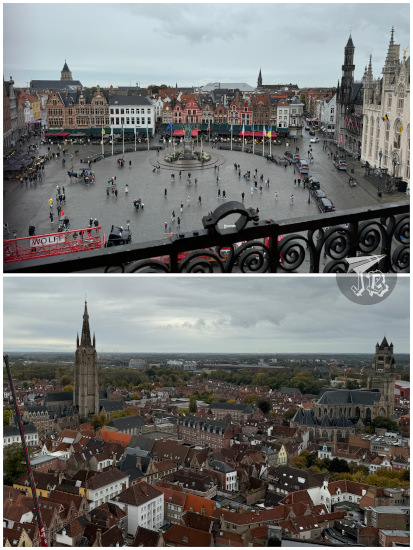
Afterwards, I headed off back towards Market Square Grote Markt. It was raining on and off, so I decided that maybe I could check out the Belfry of Bruges Belfort van Brugge – it turns out that the museum is… climbing the belfry. The belfry was originally built in 1240, though it burnt down and it was rebuilt forty years later. It has an octagonal end cap which was added in the late 1480s. After a few built and destroyed wooden spires, a stone neo-Gothic parapet was added in 1822. The tower is 83 meters high (366 steps, yes, I counted, I got 364) and contains a carillon with 23 bells (27 tons, no, I did not weigh them), and a total of 47 bells. Believe it or not, I was up there when the carillon stroke noon. That was awfully cool. There were also great views of the city.

Bruges Belfry

Bruges from the Belfry

There was a clearing in the clouds and very low chance of rain for the next hour or so, and thus I decided to find one of the official providers of boat tours on the canals. These are sanctioned by the town hall and all of them have the same price and the same route, so any one would do. The one I found first was De Meulemeester Boat Tours Rondvaarten De Meulemeester. The tour departed and arrived from Dock no. 5 (Wollestraat 34). We sailed to Jan van Eyckplein (Jan van Eyck Square) and the edge of the Lake of Love Minnewater. On the way we did not only see the most important monuments facing the water, we also came across Bruges’ famous swans. In the 15th century, keeping swans was a symbol of status, and they were added to the city as part of its image as a flourishing trade point. Today they’re still maintained by the city, which has actually taken them off from the canals for quarantines before. There were quite a few tours going on at the same time, and the boat captains seemed to know each other – or at least have enough familiarity for some banter.

The canals of Bruges

After the boat ride, I found the Gothic Bruges city hall Stadhuis van Brugge, one of the oldest city halls in the historical region. It was built in a late Gothic style between 1376 and 1421, but it has been modified and renewed a few times – and since at this time I had decided that Bruges was a city to come back on a non-Monday, I decided to leave it for the next time, hoping that Antwerp would have better weather – a bit less cold at least.

Next to the town hall stands the Basilica of the Holy Blood Basiliek van het Heilig Bloed, which is supposed to hold a Relic of the Blood of Jesus Christ. I only visited the Romanesque chapel underneath, because I had just seen two huge groups of people go in.

It was then around 13:45, and I had decided to take the 14:25 train to Antwerp to try and make it to the last entry to Chocolate Nation. At the station, however, I decided to get a Belgian waffle with dark chocolate and strawberries. The waffle shop was out of strawberries, so I got a berry mix instead. That killed all my appetite, to be honest, but it was delightful. I even got a little Belgian flag on it – and good thing that I did not order whipped cream, because it was so filling that I was not able to eat anything else throughout the whole day. I regret nothing.

Belgian waffle

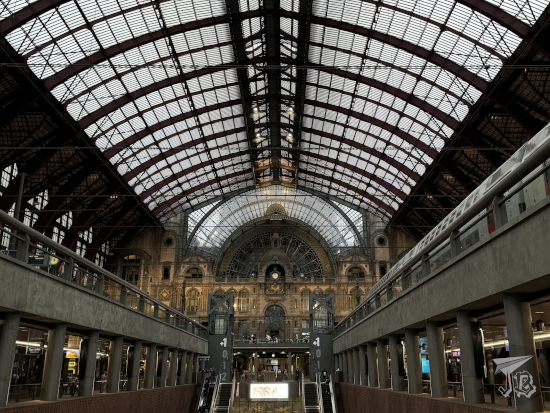
The train was on time and off I went to Antwerp [Anvers | Antwerpen]. I reached the stunning Antwerpen-Centraal railway station Gare d’Anvers-Central | Station Antwerpen-Centraal. The weather was not much nicer than in Bruges though, and it was still raining. I dropped my luggage off at the hotel, and went back to the station to take some pictures – I like hotels near travel hubs. Afterwards, I headed off to Chinatown / Van Wesenbekestraat, but the only interesting thing there was the pagoda gate.

Antwerp Central station

I headed towards the historical centre and stopped by the Cathedral Cathedral of Our Lady Onze-Lieve-Vrouwekathedraal, which belongs to the Unesco World Heritage Site Belfries of Belgium and France. It is credited to architects Jan Appelmans and his son Pieter Appelmans. Both of them are honoured in a metal monument within the wall of the cathedral, which was erected in the Gothic style. The cathedral was never completed to its original concept, and only one of the two projected towers was ever finished. The church was damaged in several scuffles with time – as recently as WWI – and it was completely restored between 1965 and 1993. It had already closed, but I was counting on that.

Antwerp cathedral by day

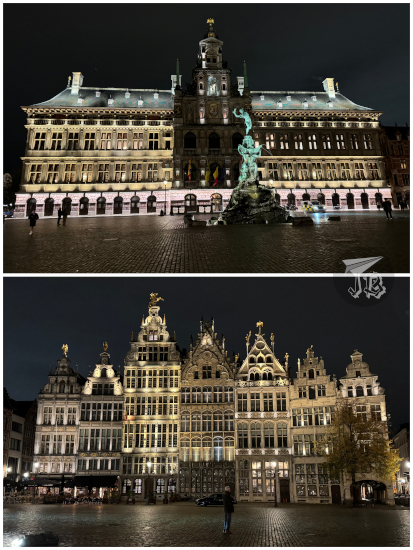
I continued off to Main Square Grote Markt, which was almost empty due to the weather. There stands the Antwerp City Hall Stadhuis Antwerpen, a few guild houses, and Brabo Fountain Brabofontein, which represents a legend – a giant who cut off the hands of boatmen received the same fate by hero Silvius Brabo.

Antwerp Grote Markt by day

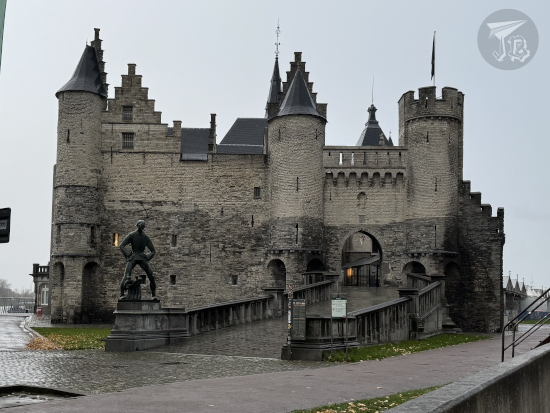
Then, I continued off towards the edge of river Scheldt, on whose banks Het Steen, a Medieval fortress dating back to the early 13th century. It is what one could call the Antwerp Castle from Wagner’s’ operas, and it was built as a way to control the river. It is currently used as a visitor centre.

Het Steen

It was getting dark already and none of the monuments were lit, so I decided to get back, as it was raining rather hard. The second I saw reached the station though, the illumination was turned on. I decided to go to the hotel and wait the rain out, as it was supposed to clear out in about an hour. It did, so I retraced all my steps back towards the Cathedral of Our Lady Onze-Lieve-Vrouwekathedraal and the Main Square Grote Markt. I even reachedHet Steen, but it was not lit.

Antwerp cathedral by night

Antwerp Grote Markt by night

Though it was cold, it had fortunately stopped raining for the time being, and I could take my walk leisurely. I turned in for the day afterwards.

11th February 2024: The Parade of the Wood Dragon (Madrid, Spain)

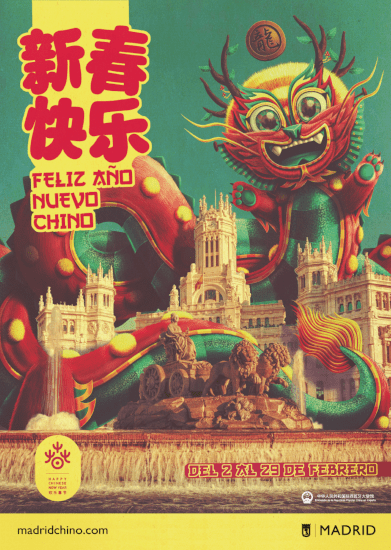
Chinese New Year started on the 10th of February of the Gregorian (solar) calendar. Many East Asian countries follow a lunisolar calendar, in which the New Year falls on the second new moon after the winter solstice. In China, it is usually referred to as the Spring Festival, and outside it as Lunar New Year. For a while now, the Chinese diaspora in Madrid has been celebrating with a parade in the District of Usera, the so-called “Madrid Chinatown”, which will eventually have traditional gates and panda decorations in order to try to be developed as a tourist area. Since the parade was on a Sunday, I decided that I would attend.

The equivalent to 2024 is the Year of the Wood Dragon. The Chinese calendar uses a combination of twelve animals that conform the Zodiac (rat, ox, tiger, rabbit, dragon, snake, horse, goat, monkey, rooster, dog and pig) and the five elements of Feng Shui (wood, fire, earth, metal and water) to name the years. The dragon represents prosperity, authority and good fortune. The Wood Dragon brings abundance and improvident, so it seems to be a promising year!

Announcement of the Chinese New Year festival in Madrid

After keeping an eye on the ever-changing weather and rain predictions, I decided to bite the bullet and go, whatever happened. The parade was due to start at noon, and rain was to come a couple of hours later. I packed an umbrella, a waterproof bag inside my backpack, and my all-you-can-travel train pass. I picked up my sibling on the way.

We reached the district of Usera a bit after 11:00, with plenty of time until the start of the parade at noon. We found a street barrier and set positions, ready to wait out the cold until the parade started. I had read that it would last about three hours, but I thought that meant in total – since the first person went out at the beginning of the parade until the last person reached the end. I had never been to Usera before so I had no idea how long the streets were. In the end, the parade took about an hour and forty-five minutes to pass in front of the point where we were. There are a lot of Chinese associations! I do not really know if they were all based in Madrid, or if the Chinese diaspora of all of Spain had congregated for the occasion. And not only Chinese people marched – a lot of Spanish and Latin Americans did to.

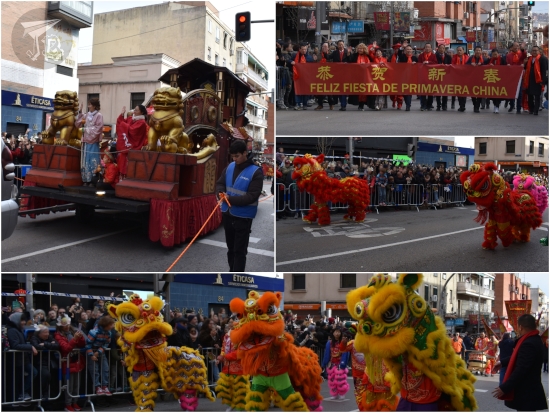
The event was called Great Parade of the Chinese New Year of the Dragon Gran Pasacalle “Año Nuevo Chino Del Dragón”. It opened with a locomotive which “pulled” everyone behind it. There were people dressed as lions, others moving huge dragon puppets, dancers, musicians, martial artists, people in traditional clothing, acrobats, walkers on stilts… women, children, men, everyone seemed to be invited to the party. Each group got their introduction with a red banner, and lots of people carried either Chinese or Spanish flags. Some people handed out “dragon masks” for kids, and quite literally ignoring all the adults wanting one (I might have rescued one from the floor at the end of the parade). People in the parade waved and cheered Xīn nián kuài lè and Feliz Año Nuevo, “happy new year” in Chinese and Spanish. There were some drummers too, but most of the music came from portable little devices. An older lady kept telling everyone to hurry up.

Chinese New Year Parade Usera 2024

About half an hour in, my memory card ran out of space. I had been aware of that being a risk for a while, so I was carrying an extra one, which unfortunately was not compatible – I have no idea why. Luckily, I could use the phone for more pictures. The worst thing about the event was the presence of the “media” – I can understand the ones who were working / recording / interviewing. However, there were also a bunch of accredited people who were just in the way, chatting on their phones or doing nothing in the way of the parade – and of pictures.

Parade of the Chinese New Year 2024

All in all, it was spectacular. I loved the lions and the dragons, and I had to wonder how many dragons come out on a non-dragon year parade. Furthermore, everyone seemed to have such a good time!

Chinese New Year Parade Usera 2024

At the end of the parade there were a few South American organisations who also participated, probably because even if Usera seems to have many Chinese businesses, there are a few Peruvian and Bolivian restaurants. They seemed more Carnival-like anyway.

Chinese New Year Parade Usera 2024

After the parade had finished walking in front of us, we went to try to check the food trucks and the market at the end point of the parade. Unfortunately, everyone seemed to have had the same idea, and it was packed.

Instead, we found our way back to the underground and went off towards the centre. There we had a snack at one of the big malls, where I also bought a new SD card. I asked the assistant if the card would be compatible with my camera, he had to get another assistant, who had a bit of a waiting list. This second assistant said that my camera would not take a 128 GB card. I showed her the 128 GB card I had been using. She then asked to see the card which was not compatible. I showed her that one too. She said that it was not compatible because of the adaptors, but I pointed out that the cards had the same shape. Then she said that it was not compatible because “TDKs are too slow”. The card is a Philips. Anyway, she offered to let me try the new card to check it was compatible before buying it, which guarantees it works. I bought two, just in case.

Afterwards, we headed off to the shopping gallery Galería Canalejas. This is the new luxury shopping hub in town. The complex occupies almost a whole block, having joined as many as seven historical buildings into the same project – a Four Seasons hotel (the first in Spain), a parking lot, some private residences and the shopping gallery.

The original central building was commissioned by an American insurance company and built in 1887 by the architect José Grases Riera, who designed it in. The construction homed the Insurer’s headquarters, private residences, the former casino, and small shops on the street front. It was called Palacio de la Equitativa, uniting the word “Palace” with an approximate translation of the name of the insurer. In the 20th century, the building was bought by a bank company – and Spanish banks merged, re-merged, disappeared, until finally the building was sold to a private investor in 2012. The Neo-Renaissance and Neo-Baroque façade was carefully restored, along with the Art Decó stained-glass window on the ceiling. Also, under the direction of the architectural firm Estudio Lamela, some of the bank safes were recovered for decoration. The first shop in the gallery opened in 2020, and it seems that the Madrid tourism board started promoting the complex in 2023, following a strategy to drag “luxury vacation-makers” into town.

The gallery has three floors. The basement has been used for the food court. The ground and second floor hold a lot of security guards, since there are shops like Cartier, Louis Vuitton or Valentino… There is a café on the ground floor, amongst all the luxury shops. Behind it there is a staircase that connects all three floors (aside from the escalators on the sides).

The café Galería Canalejas Café offered afternoon tea, and I was even willing to try it despite the lack of scones. But it was cold and drizzling, and I had just discovered that they had afternoon tea the day before. We sat down and ordered.

Afternoon Tea at Galería Canalejas Café Madrid

The set included:

  • Café o té Coffee or tea. I chose a Japanese sencha, which was brought quite earlier than the snacks. It was really good, albeit a bit weak. I own up I had finished it almost completely by the time the food came out. I really think they should add some water to the mix.
  • Savoury snacks:
    • Mini sándwich chicken coronation. Coronation Chicken mini-sandwich in a salty waffer, made with a salty waffer.
    • Mini sándwich de mortadela trufada y queso Coloummier. Coloummier cheese and truffled sausage mini-sandwich, also in a salty waffer. I think they forgot the cheese in mine…
    • Quiché de espinacas y salmón. Salmon and spinach quiche with wasabi mayonnaise. This was the best, in my opinion.
    • Crep de hummus con vegetales. Hummus and vegetables crêpe. They actually forgot to bring this one out and did so later on.
  • Sweet snacks:
    • Bizcocho Valentía. A quite-heavy brioche with honey and lemon. It was nice, but I could have used a smaller size.
    • Mini churros con vainilla y chocolate. Tiny churros with vanilla and chocolate. The vanilla was actually whipped cream, but the powdered-sugar on the churros and the bitter chocolate made it a good combination.
  • Petit fours: We got three of these, but I have no idea which ones. According to the publicity, you chose them yourself, but they brought them on their own. They were tiny biscuits that felt really nice to finish off the tea.
    • Bombón Canalejas
    • Diamant Madagascar
    • Florentin aux amandes
    • Noisettine
    • Trufa de turrón

All in all, it felt a little wannabe pretentious, but the staff was extra nice, and allowed us to stay there for as long as we wanted. We left when I noticed that the turn over was slow and a queue had started forming. We snooped up and down the gallery for a while before we headed off. And of course, I totally missed my train connection – what else is new?

12th – 14th October 2023: Yoshiki Classical World Tour “REQUIEM”, London (England, Great Britain)

This was my third and last trip to London in these five crazy weeks, and it was again to see Yoshiki. Someone once told me that I love Yoshiki because he appeals to both my wild and posh sides – it is partially true, I guess. It has a lot to do with how many of his lyrics resonate with me, more deeply than I am comfortable admitting sometimes.

I don’t think I would have travelled twice so close in time for any other artist. And believe me, organising this trip was a logistics nightmare. In other circumstances I would have flown out the same day of the event, which was Friday the 13th, but I don’t think that airports in the UK have completely recovered from the Covid chaos, and there are still a bunch of issues – just the previous week to my arrival, a good number of flights were cancelled in Gatwick. Second, the 12th is a holiday where I live, and since it was a Thursday, it kickstarted a long weekend. And last but not least, the 12th is also my parent’s birthday, and they were excited for a big celebratory lunch.

Taking all this into account, I tried to coordinate everything the best I could without breaking the bank. I found the last plane leaving on Thursday the 12th, at 21:50. That gave me time to have lunch at my parents’, then drive off past 19:00 – there should not be too much traffic. I booked the parking lot – the shuttle runs every 15 minutes in the evenings. In the worst case scenario, if my flight was cancelled or too delayed, there was space to manoeuvre on Friday morning. The plane was scheduled to arrive in London Gatwick close to midnight, but I was quite sure it would be delayed, and in order to avoid late-night trains and stress, I reserved a hotel next to the airport terminal – I did not have to worry about dinner as my parents make food to feed a small army. For the following night, I found a “boutique hotel” next to the venue. I booked my return flight on Saturday the 14th in order to avoid the end-of-weekend traffic that would concentrate on Sunday.

Great plan. In the end, something happened and the celebration had to be postponed, so I spent the evening watching the clock, and checking and rechecking both the weather forecast and my luggage – finding something to wear that was nice and still weather-appropriate was difficult. I changed my mind regarding footwear about six times.

Around 19:00 on the 12th, I finally drove to the airport. Considering that the forecast was rain both at home and at London, I took boots in the end, but more comfy shoes for driving. I reached the parking lot and airport a bit earlier than expected, and I found a nice covered spot for the car – which I had to check that it was not reserved a few times. As I entered the international terminal, I was disoriented for a second – since I usually take planes before 7:00, I had not seen the shops open for a long time! It turns out there is a Duty Free just after passport control which I had not even realised before, and that threw me off track for a heartbeat or two.

I had some dinner at one of the fast food stands, and as expected, the plane was delayed. Then it needed an engineer. Then it taxied forever. And after almost two hours of delay, the two-hour-and-a-bit flight to Gatwick was cut short – we landed not even ten minutes late, so we flew the route in a little over an hour. I never knew you could step on it so bad on a plane! I went through passport control and found my hotel – just outside the North Terminal, and much closer than I had calculated. Gatwick was also crazy busy even if it was nearly midnight.

I checked in, and I was surprised that even though it was the same chain I had stayed at next to the O2 Academy Islington, the procedure was completely different. But it went without a hitch, and I was in bed within thirty minutes. I even caught some sleep. For some reason they gave me a room with a sofa-bed aside the regular one.

Leaving in the morning was a bit more complicated. After a much-needed caffeine boost at Costa Coffee, I took the inner airport shuttle from the North to the South Terminal, where the train station is. From there, I found my connection to central London. The good thing is that Gatwick trains belong to a regular line, so they do not require a special ticket, you can use the Oyster card, which I did. The shuttle and train went through awful weather, but when I reached London, rain and wind had calmed down a little. I wanted to leave my things at the hotel because of the bad weather and not to go into any museums with the backpack – just in case. The nice person doing my check in was very stressed that I might want my room – it was before 10:00 for a 15:00 hour check-in. I really just wanted them to hold my luggage. After that was successful, my next step was finding a bank that would exchange a handful of old pounds for new ones. In the end, train, underground, hotel and bank took a bit longer than I had expected and I was running a bit behind my self-imposed schedule.

My first stop was Sir John Soane’s Museum. Sir John Soane was a neoclassical architect – he worked in the remodelling of the Palace of Westminster, but his most prominent legacy is his house-museum. He bought a couple of attached houses in the centre of London, and combined them both as an architecture experiment and to host his collection of antiquities, copies, paintings, and pieces of architectural interest. There was a special Act of Parliament to establish the museum while Soane was still alive, stating that after his death the houses should be kept as they were, to avoid his son selling the collection, as some of pieces were / are worth a fortune. For reference, one of the most important artefacts hosted there is the sarcophagus of Egyptian Pharaoh Seti I (Second Dynasty). Adventurer Giovanni Battista Belzoni tried to sell the piece to the British Museum after taking it from the Valley of the Kings in Thebes. The Museum was not willing to pay what today would equate to almost £200,000, but Soane bought it in 1817 to exhibit it in the basement “sepulchral chamber”, where it still stands today.

Entry to the museum is free, but you are requested to purchase the guide for £3, which I did. The first area you visit is the lovely library, and then you step into the real treasure – the area comprised by “the dome”, “the colonnade” and “the corridors”, where literally hundreds of sculptures, friezes, amphorae, decorative pieces… pile up on one another to the point that everything is overwhelming and fantastically chaotic. Wherever you look, there is something else to notice – whether it is Apollo, a copy of the Farnese Hercules, a pegasus… Then you go down to the basement, and both the “catacombs” and the “sepulchral chamber” are equally cluttered – a pair of Chinese guardian lion-dogs, Aphrodite bathing, a Poseidon head, and of course Seti I’s alabaster sarcophagus, encased in glass, which sucks for pictures but protects it in the super-tight space.

Artefacts at Sir Soane Museum

Sarcophagus of Seti I in Sir Soane Museum

Other spaces include the kitchen – which feels strangely empty in comparison– the drawing rooms on the first floor, and the picture room on the ground floor – with some of Canaletto’s Venetian landscapes, and drawings of ancient monuments. All in all, whenever you blinked, you missed a detail. It was almost stressful, but an amazing place to visit.

Afterwards, I met up with fellow Yoshiki fans A****d and A**i, at the British Museum. They were going there first thing, and we had arranged to get together around noon, but I ran a bit late and only reached them around 12:20. Through that time, they went through the must-dos. We met at the Ancient Middle East and saw a few exhibits about the history of money, one on clocks, Roman Britain, the library… They asked me if there was anything I recommended, and we went past the Moai so I could show them one of my favourite sculptures ever – the Bodhisattva Guanyin [觀音 in Chinese], associated with compassion, in the Chinese Art Gallery. Guanyin sits with one leg up in a very relaxed and informal position compared to other Buddhist imagery, and I just adore this wooden representation.

Artefacts in the British Museum

Around 14:00, we went out for lunch. We tried an okonomiyaki place near the British Museum, but it was unfortunately full, and both my friends had had CoCo Curry the previous night. We walked into Chinatown and we found a self-proclaimed izakaya Japanese restaurant called Oita (Soho). I ordered sushi bento for £16.95, which at first felt a bit expensive, but I had forgotten British-sized servings. It was actually very proportionate size-wise, and came with complimentary miso soup. The bento (“boxed lunch”) itself comprised a small salad, seven pieces of assorted raw fish on sushi rice (tuna, salmon, butterfish, mackerel, squid, prawn and octopus – these last two were no raw, actually), four assorted nigiri (tuna, salmon, butterfish, mackerel), three salmon sashimi, two tuna sashimi, three avocado hosomaki, and some garnishing including cucumber, radish and alfalfa, along with pickled ginger and wasabi. It was really good.

Oita Soho sushi bento

The three of us separated after lunch to go to our hotels and get ready. On my way, I bought a sandwich and a bottle of water from a supermarket to have for the night, and decided to take a shower before changing into concert gear. When I reached my hotel, they showed me around, and told me my luggage was in the room – which it was not. I had to come down again to get it, which embarrassed the staff a lot. The room was posh to the max – I even had a bed with a canopy! Apparently, boutique hotels are “small hotels with a personality” that try to “tailor the experience to the customer”. For me, a hotel is just a place to sleep in, so I’m just happy with them being safe and clean. I can do without the personality, the steeper price, and the surprise extra service charge.

I reserved the hotel through Booking, and they got in touch that they wanted payment outside the page. I dislike this, but it is not unheard from. I needed to demand my payment receipt, too, because the page did not generate any. Later, they tried to charge me through Booking again (though in their “defence” this might have been a Booking issue, as it has been hacked). In the end, the image I got from them was that of an overpriced wannabe high-end hotel, but there were too many blunders to consider coming back if I can help it.

At least, the hotel fulfilled the one reason I had chosen it – it was a short walk from the Royal Albert Hall. Considering how badly I felt after the Miyavi concert a couple of weeks before, I was a bit apprehensive this was going to be too much. It was, but not in the worse sense of the word. The recital was emotionally hard on me, as I tend to connect a bit too much with Yoshiki’s music, but fortunately I did not take ill this time around.

I was deeply moved when I attended the first Yoshiki Classical concert in Paris in 2014, but this time my mind was absolutely blown. Back in May, in a moment of fanby weakness, I decided to buy RAH membership (£55) in order to get access to the presale. Despite that, I only managed a sixth-row seat to the side – Arena F – Row 6, Seat 27 (£60). These were sent by post and arrived in physical form in late July. I decided on this delivery method because even if the tickets did not arrive on time, or got lost, I still had the option of “will call” with my ID and the card used for purchase (of course, my bank decided to cancel my cards meanwhile and get me new ones, so I’ve been running around with both working and not-working cards in my wallet for the last couple of months).

Having a RAH account also meant that I was notified about a “Yoshiki meet and greet VIP package” within minutes of its release, which included an exclusive opportunity to meet Yoshiki after the concert in the 1871 Bar, a photo opportunity with Yoshiki, and a piece of merchandise for signing (£150) – I booked it as soon as the email came through, and I think I was the 10th person to buy the upgrade. These tickets were supposed to arrive by post, too, but the venue changed them to e-tickets the week before the show – when I was already antsy about them arriving – “will call” was still an option, but I was restless.

Around 18:15 I left the hotel to walk to the venue to meet A****d and A**i. The Royal Albert Hall is one of the most famous concert venues in the United Kingdom. It was world’s first domed amphitheatre, designed by two civil engineers, Francis Fowke and Henry Y.D. Scott, and inaugurated by Queen Victoria in 1871. The outer structure is built in Fareham Red brick with a mosaic frieze that represents the arts and sciences, and the roof is a glass and wrought-iron dome. It has several halls and a corridor surrounding the amphitheatre, with several bars and other hospitality offerings.

The three of us walked around and found the merch stand, which was a bit underwhelming – two short-sleeve T-shirt models, and a tote bag. I kind of regret not getting the tote now, but I felt I had already spent too much money. A****d was sitting next to me, and A**i just a couple of rows behind. However, upon being shown to the amphitheatre when doors opened around 18:45 for the 19:30 concert, my brain shortcut. Rows 1 to 5 were inexistent. My row 6 ticket was a first row ticket. I was first row for a Yoshiki concert!

Fine, to the side and with some camera equipment in between, but I was first row for a Yoshiki concert. In particular, for Yoshiki’s Yoshiki Classical 10th Anniversary World Tour with Orchestra 2023 “REQUIEM” on the 13th of October 2023.
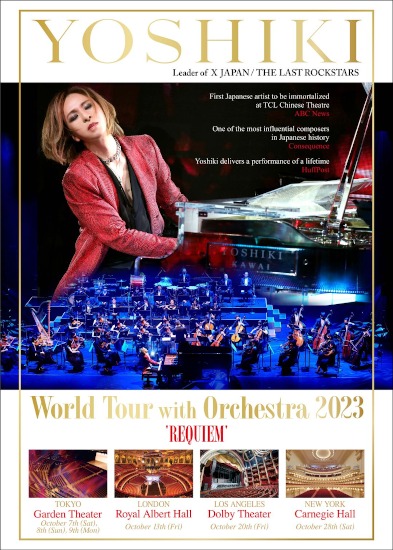
Yoshiki Requiem Poster 2023

Most seats had a small booklet, and since mine did not, I decided to “steal” it from a still-empty seat – I’m selfish, sue me. Once my brain settled down enough to take everything in, there were two things I noticed – one, that the grand piano in the centre of the stage was not Yoshiki’s trademark glass piano, and two, that his drum set was there. This was not a huge surprise as he had hinted it during the Q&A in September that he wanted to do something with it. We passed the time looking at people come in, being impressed at how fancy some people dressed, meeting other friends, and taking photographs in front of the stage.

Inside the Royal Albert Hall

The concert / recital was intense. Most of the music played had been composed by Yoshiki himself either for his different collaborations or for X Japan. Vocals were entrusted to pop singer Beverly [ビバリー] and soprano Ai Ichihara [市原 愛]. Special guests St.Vincent and Ellie Goulding sang their own songs. The Royal Philharmonic Concert Orchestra was conducted by Ward Stare. Ballet dancers from Jlee Productions performed on stage during Forever Love and Swan Lake..

Setlist:

Part 1
   1. Amethyst (orchestra alone)
   2. Tears
   3. Angel
   4. Miracle with Ai Ichihara
   5. Forever Love
   6. Kiss the Sky with Beverly
   7. Anniversary
Part 2:
   8. Drum improvisation while the orchestra played Serenade for Strings (by Pyotr Ilyich Tchaikovsky) and Symphony No. 3 (by Henryk Gorecki) and Ai Ichihara on vocals
   9. Say anything
   10. Swan Lake (by Pyotr Ilyich Tchaikovsky)
   11. New York by and with St.Vincent
   12. Love me like you do by and with Ellie Goulding
   13. Red Swan with Beverly
   14. Requiem
   15. Without you
   16. OPUS 13 in A-minor (by Felix Mendelssohn)
   17. Art of Life (second and third movements)
   18. Endless Rain

Although the auditorium opened later than it was supposed to, the concert started almost punctual, a bit past 19:30 – which for Yoshiki is a miracle of ontimeness. He had probably done all his interviews the month before. Director Ward Stare came on stage and the orchestra played Amethyst as warm-up – this is the song that was usually heard at the start X Japan’s concerts, before members came in. Yoshiki walked on stage to play piano from the second song on, Tears. The tour title Requiem comes from the song Yoshiki wrote to honour his mother after she passed – he was understandably devastated, and it made sense to start the show with Tears.

Yoshiki playing piano at Royal Albert Hall

Throughout the concert, he alternated piano-playing and talking – most of the talks we had heard before, but a few were new to me. He told us that when he felt that he had managed a great achievement his mother used to bring him back to earth with questions like “have you eaten?” or “did you sleep?”. He explained that she really praised him when he composed Anniversary for former Emperor Akihito. We also had some promotion of the Under the Sky film, and Yoshiki’s champagne line, along with a recap of him being honoured in LA’s Chinese Theatre. There was also some “thank you to my sponsors” talk, and he might have said “amazing” around a thousand and three times.

The first part went more or less as expected – except for the ballet dancers. I did not think we would get them, but I am not going to complain. I did miss Hero, because I really enjoy listening to that one live, but something had to be taken out to accommodate the songs by the special guests. Some people say that he talks too much, but I think that he’s just trying to catch a breather – both physical and emotional. At one point he spoke about an “X Japan song that we would never really hear”, which was heartbreaking. There is a difference between knowing that there won’t ever be any X Japan ever again, and having it confirmed. Both in September and now, we’ve heard him openly say things that usually went only implied, which I think means that we are in a new stage of his artistic career / life.

Yoshiki Royal Albert Hall with orchestra and ballet dancers

For the second act, he pushed himself even harder with a drum solo to start off. He always smashes the drums as if he were trying to get a confession out of them – it is like he has so much anger inside him and the drums are his only way to release it. In a way, it probably is – he always says that he turned to drumming to deal with his father’s suicide, and that is how he expresses himself. But then he goes back to the piano, and it feels that the keys are crying with him.

The acts with St.Vincent and Ellie Goulding, in my opinion, were more promotional than anything else. Both are well-known and established in their own niches – and Yoshiki likes female singing voices because they can hit high notes better, I think – though I miss Katie Fitzgerald and Ashley Knight, to be honest. St.Vincent was okay, Ellie Goulding left me wondering… what she was doing there. Apparently the pinnacle of her career until now has been composing Love me like you do for the film Fifty shades of grey… And I hate to be that person, but both of them could have chosen way better outfits.

The titular song, Requiem, was extremely poignant. It was the piece Yoshiki wrote to deal with his feelings for his dead mother, in his own words, the means he found to stop crying for her loss. Just like he took to drumming after his father’s death, he took to composing after his mother passed. Later, he explained again how the song Red Swan symbolises standing up through the pain and the blood. The original version of this song is sung by vocalist Hyde, and since he was bringing in people from all around the globe, I would have been extremely happy if he had flown him in for it, and I was hopeful for about one tenth of a heartbeat. Unfortunately, you cannot have everything.

Throughout the recital there were sad moments and happy moments, to thank fans, and to remember those who are gone, moments with ballet dancers and with the torch on the phone on, moments to sing and to laugh, and to feel your heart shrink. In the end, Endless Rain with all the audience was extremely special – it never feels that it is going to be, I keep thinking “this time it’s not going to affect me this much”, but it gets me every time.

Yoshiki talking at the Royal Albert Hall

In the end, the show lasted for about three hours, plus a twenty-minute intermission. He thanked the conductor, the orchestra and dancers and the guests, and received lots of flower bouquets. Next to me, A****d managed to give him a Union Jack with a small EU flag sewn into it, which he proudly wore around his shoulders. It’s fun how he is such a huge super star and then he becomes all shy and embarrassed. Or he just… crashes.
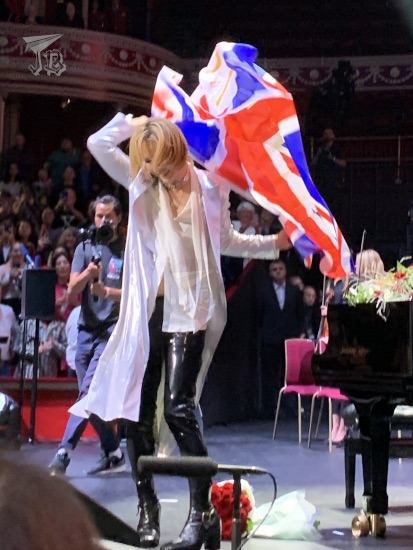
Yoshiki with the Union Jack flag, Royal Albert Hall

After the concert was over, we said goodbye to A**i and, A****d and I made our way to the 1871 Bar, where the Post Show Meet & Greet Experience was to take place. We went to one of the doors, but of course then we needed to go to the other one. Eventually we got in, and rather quickly – I was the 20th person in the queue, and got to wait inside the bar. It was upholstered in blue, turquoise and green tones, with the most garish decoration I’ve seen in my life, including mirrors, golden wallpaper, bright plastic deer heads (better than real ones but still gaudy), lava lamps… There were about… four or five sofas, and the whole floor was carpeted in reddish and green / grey tones.

I was a bit nervous – waiting to meet an artist is actually the worst moment of queueing, I feel. To be honest, the first time I saw Yoshiki in person in 2017, my brain went 404 on me and I was not able to utter a word, though in Vienna I did a bit better and got a selfie. I was shaking so badly it came out horrible and moved.

As we were waiting, a staff member came to tell us that we could talk to Yoshiki a little, and that they would take our pictures with him and email the link to us. He explained that Yoshiki had just played a three-hour show and that he was bound to be tired – and how amazing he was. We smirked that we knew that already – most of us were not local, after all. Meanwhile, lights were set up, and signed posters brought out.
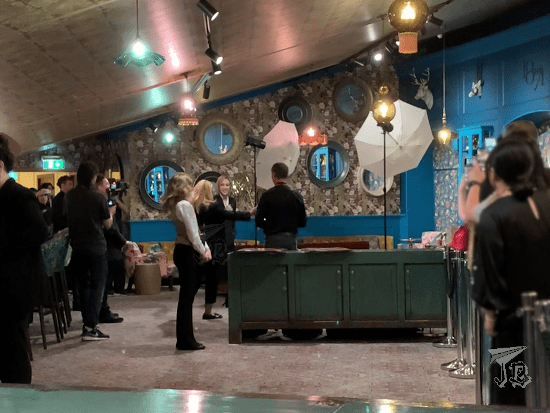
Yoshiki arriving for the M&G in the 1871 Bar at the Royal Albert Hall

Once he came in, we clapped and then everything went very fast and very slow at the same time. Everyone got to talk to him a little indeed, ask for an autograph or give him a present. Some people conjure amazing gifts for artists, but I never bring anything for them, because I feel it’s imposing and they don’t need any junk I could get them. However, I was clutching my bad selfie print-out, running through my head what to say. It was finally my turn, and then something I could have never prepared for happened – he declared that he was tired and just sat down on the floor. Not one of sofas. Yoshiki, superstar, just plopped down on the garish carpet of the bar at the Royal Albert Hall.

I have no idea how or why but my brain kicked into gear at that point. Before the staff could react in any way, I asked Yoshiki if it was all right to sit down on the carpet with him – I really did not know if he wanted to have his picture taken on the floor. I’m not sure if the staff and the aides knew what to do, but when he said it was all right, I approached and sat – A****d had stayed behind and was able to document the whole thing, apparently I sat in the proper traditional Japanese way for the conversation.

I thanked him for his music, and told him how his lyrics helped me feel better after a bad situation. Then I asked him to sign the “horrible selfie” – I actually said this – from Vienna. He thanked me for coming back, and I said “no, thank you for coming back”. The whole thing was absolutely surreal. There we were, sitting on the carpet of the Royal Albert Hall, surrounded by dumbfounded staff and… sofas. Photographer Andy Paradise took our picture, and what I saw when I looked at the camera was the photographer crouching, the video-camera person kneeling, someone else also crouching down, and a fourth person coming in with a chair (despite… sofas). I said thank you again, and dragged myself away – the guy whose turn it was behind me also sat down on the floor.

A****d and I got our signed posters, while I clutched to my now autographed bad Vienna selfie, and left the venue. Some people asked questions on the way out, and we explained how it went. When we came out, it was cold, so damn cold. My hotel was a block over, so I asked reception to order a taxi for A****d, and we parted ways, hoping to see each other soon.

I went up to my room to take my third shower of the day, and have my snack. I was so overwhelmed, it was hard to sleep. It was also stupidly cold because unbeknownst to me, I had not closed the window well, and there was an open crack. I burrowed under the bed covers, a towel and a bathrobe, and got some rest.

The next morning, I made myself a hot instant coffee to start off the day, but it did not do much to get my blood pressure up. I vacated the room around 9:00 after asking the hotel to keep my luggage – but considering what had happened the previous day, I made sure I had all the important things with me. I had a nice plan for the day, but I decided to discard it last minute because underground disruptions had escalated – it was not worth it to get stressed due to commuting issues having alternative things to do. Seeing the first red phone cabin will have to wait for another time.

It was still extremely cold when I stepped out. First, I went to see the Albert Memorial in Kensington Gardens, and I crossed to Hyde Park. I also found the Monument to Livingstone. I went around the Royal Albert Hall, and a bit before 10:00, I joined the queue to enter the Victoria and Albert Museum. Whenever I am in Kensington, I always get distracted by the Natural History Museum, so I had forfeited the V&A for a while now. Today was the day to finally explore it.

The Albert Memorial

Royal Albert Hall from the outside

Founded in 1852, the V&A is one of the largest museums in the world – it’s actually the largest museum of applied arts, decorative arts and design. It covers 51,000 square metres, with 145 galleries and almost three million individual items in its permanent collection. It is a chaotic museum, and yet, it makes sense. The museum is organised by “themes” such as Buddhism, England Middle Ages, metalwork, porcelain, glass, Baroque sculpture… I tried to see things in some kind of logical order, but it was pretty much impossible. Apparently they tried to rearrange it a while back and they just… gave up, as it would diffuse expert knowledge. I found this very interesting, but since this was my plan B, I did not really have time to plan the visit very thoroughly.

Before diving into the galleries, I headed over to the museum café for a gigantic tea-infused scone with jam and proper clotted cream, and a mug of coffee, and sat down at the Gamble Room. When it opened in 1868, it was the first museum café in the world. It is decorated with tiles imitating the Italian Renaissance majolica tiles, columns, golden ceilings, and weirdly modern lamps. After breakfast, I felt a bit more grounded, though I felt a bit off all day.
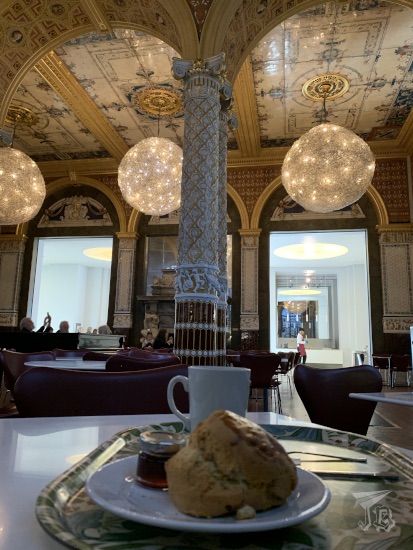
Scone and coffee at the Gambler Room in the V&A museum

I roamed around the museum for a few hours, and I know that I missed some important areas. I found it difficult to keep track of where I was and where I wanted to go, but I got a bit of a taste of all. I was very impressed by the Cast Courts, where copies of some of the most iconic pieces of architecture and sculpture are kept. These were made in the 19th century, and represent “the truest spirit of the Victorian museum.”

Artefacts at the Victoria and Albert Museum

On the ground floor, I wandered the Korea, Japan, China and Buddhism galleries, and I came across another depiction of Bodhisattva Guanyin, in the same pose but a completely different artistic style. I saw the largest Middle East and Islamic Art collection in Europe, and the adjacent galleries –South Asia (especially India) and South East Asia had a lot of interesting artefacts, too. The sculpture galleries are tantalising.

Other areas I visited included Medieval and Renaissance, Britain though history, ironwork, metalware, gold, silver, ceramics, glassware, jewellery, stained glass, architecture, and I could have gone on and on. But alas, I had a plane to catch.

Artefacts at the Victoria and Albert Museum

Victoria & Albert Museum

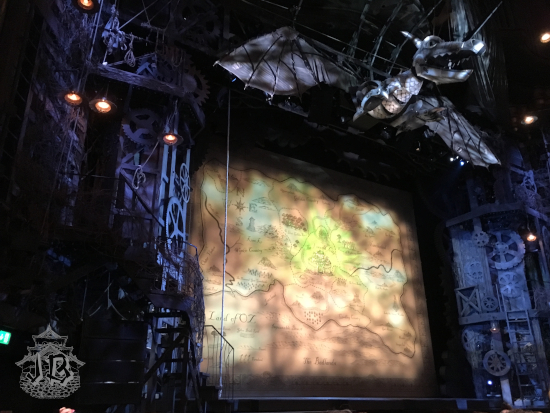
Around 13:00, I left the museum, collected my luggage, and made my way to South Kensington Station amidst the Tube closures of the lines that would take me directly to Victoria. A while back, I had to take a similar alternative route from Earl’s Court due to the wires overheating when I was going to the Apollo Victoria Theatre to watch Wicked. The South Kensington station runs the same Tube lines, so I was able to reach Victoria railroad station at the desired time – even with a line change and more than double stops. I was off towards Gatwick airport on the expected train.

Once there, I went through security without a hitch. I had a snack in the most expensive and unfriendly Wagamama in history – give me Stansted’s Itsu anytime. I wanted something warm because my body gets weird after emotional highs, and I was freezing. I even wondered if I was taking ill again, but no. I was just cold. I did not let either the restaurant nor the chill spoil my mood though, and I might even have had a nap on the plane. By the time I got off, I had warmed up. I cleared passport control, found my shuttle to the parking lot and – aside from the inevitable idiot on the road – there was not even that much traffic, which is good. You know the routine – shower, snack, bed.

I was not ill in the end, just stupidly exhausted. Going back to normal was quite difficult, especially as I still had Sunday free. I did not ever dare look at my phone to see if the photographs were real. A few days later, on the 18th, we received the email with the meet & greet professional photos. I look ridiculously happy, sitting on the carpet ,with a sofa behind me, with who is probably my favourite artist. I feel a bit guilty that I burdened him with my problems – I really hope he forgot quickly. Nevertheless, I am mostly glad that I was able to take these three crazy trips to London without incident. I feel extremely lucky that all three of them worked out, if not flawlessly, without any huge mishap. There is actually another Yoshiki event announced for December, but as much as I would love to go, it is just not in the budget, and I am a bit sad about that. But then I think “I sat with Yoshiki on the carpet of the Royal Albert Hall” and smile.

11th & 12th September 2023: 23h 45min in London (England) for Yoshiki’s “Under the Sky”

Considering that Japanese musician Yoshiki recently got his hand- and footprints enshrined at the TCL Chinese Theatre in Hollywood, I guess he’s not one of my obscure artists any more. Yoshiki is a Japanese drummer and classically-trained pianist who, alongside vocalist ToshI, founded the band X Japan in 1982. They started as a heavy metal band, and eventually shifted over towards progressive rock. Their flashy looks probably gave way to what is now called Visual Kei (V-kei) [V系], though they had dropped them in the mid 1990s, before they disbanded when vocalist ToshI left the band basically to join a cult. In 2007, X Japan reunited.

Yoshiki, born Hayashi Yoshiki [林 佳樹], is considered one of the most influential Japanese artists of all times. Aside from a musician, he is also a songwriter, composer, producer, and fashion designer. He collaborated with Stan Lee for a special four-issue comic collection called Blood Red Dragon, and with international musicians and bands such as Bono (U2), Roger Taylor and Brian May (Queen), KISS, and Sarah Brightman. He composed the theme of the 2013 Golden Globe Awards, worked on the soundtrack of Saw IV, and has composed music for anime such as Saint Seiya and Attack on Titan. Within Japan, aside from tons of collaborations and solo works, he became “mainstream” when he played a concert to honour former Emperor Akihito upon the tenth anniversary of his enthronement in 1999. He also has a Hello Kitty line named and modelled after him, Yoshikitty. And I’ve been using one of his songs as my alarm clock since roughly 2010 (since 2015 it is Born to be free).

Back in 2017, Yoshiki hosted a Q&A in several cities throughout the world, including Vienna (Austria) for special showings of his documentary film on X Japan. The documentary should have premiered in the scheduled March 2016 concert, but when that was postponed, the film went on to be shown at different events festival. When I went to Vienna, I had already travelled to see it in X Japan concert in London and the Beefeater In-Edit festival in Barcelona (and owned the blu-ray).

In 2020, as the Covid-pandemic lockdowns eased up, Yoshiki organised an online concert on a bunch of rooftops, connecting with different artists and having others over, to celebrate his birthday on the 20th of November . Now, he has made a documentary out of the event, called Yoshiki: Under the Sky, which has “premiered” four times, the third of them in London on 11th September 2023. As the London announcement only came mid-August, it was a challenge to get everything running, but I managed to find doable flights and a hotel near the venue. I was able to buy a second-row seat for the cinema, which was pretty good too.

On the 11th of September, trying not to reflect too much on the date, I left the house around 5:00, and right as I merged into the motorway, it started pouring. There was more traffic than usual because the plane was an hour later, but I managed to make it to the airport a bit before the time I had booked to enter the parking lot – yay accuracy. I went through security and passport control without issues, and had to walk to the end of the terminal for my flight, which was also uneventful. Upon landing at London Stansted Airport, we had to wait for a bus because the escalators were broken or something, but I was outside around 9:30. I bought breakfast at Costa Coffee, and settled to wait for a friend I had met in Vienna, A****d. Her flight was due half an hour after mine, so we had decided to hang out for the day. She agreed to tag along to the Natural History Museum – I wanted to go back to the the Jurassic Park 30th Anniversary #NHMxJURASSIC store before it closes down at the end of the month. I really really wanted the rubber ducky cosplaying as a velociraptor, but I feared that if I got that one, I would end wanting to collect rubber duckies… I bought get a limited-edition “opening weekend ticket”, which had been out of my budget on my previous visit, and a titanosaur coin that I had not seen when I visited the exhibit.

A****d had never been to the museum, so we took a tour of the highlights – dinosaurs (of course) and other fossils, the “journey inside the earth” (escalator that goes into the inner core of the planet), the historical building, and Cadogan gallery… Unfortunately, the hall of mammals had recently closed for renovations, so we could not visit that one.

Natural History Museum London

Afterwards, we took the underground and got off at Leicester Square to have a late lunch in Chinatown. We found a little place for lunch. I ordered some rice and duck, which was nice but the duck had a lot of shattered bones. We looked for a place she had known that sold ice cream taiyaki, but sadly we did not find it.

London Chinatown

We located the cinema where the film was showing, Odeon London Covent Garden, but there was nothing going on yet, there was not even a poster announcing the film. After taking pictures, we continued down the block to snoop around the Forbidden Planet London Megastore, one of the biggest comic, manga and related merchandise shops in the world. Luckily, they had few things I wanted badly, and the ones they did were stupidly expensive, so I was able to get away with all my money, yay me!

A****d had decided that she would go back to the airport after the film, but I had taken a hotel a few minutes away from the cinema, right in front of the university and a few minutes away from the British Museum. I dropped by to check in, then we backtracked to Leicester Square as the museum was already closing for the day at 17:00. As we walked by the cinema, they were setting a poster for Under the Sky outside.

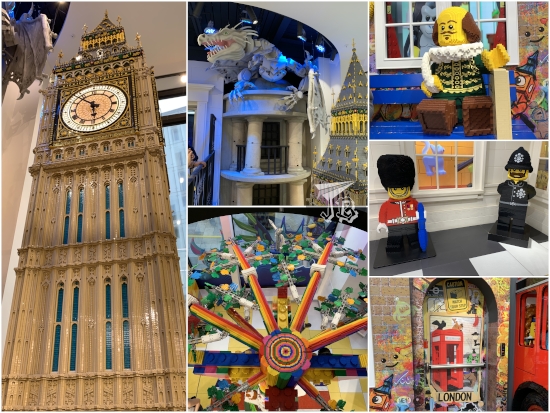
We decided to do something a bit silly and headed off to the The LEGO Store Leicester Square, two stories dedicated to selling LEGOs, either in sets, or just blocks. There are also different decorations – for photo-ops – made with oversized blocks, which include Shakespeare in the park, a Bobby, a Buckingham palace guard, a whole Aston-Martin with a Bond sculpture – you can actually go into the car – and lots and lots of Harry Potter. It was a bit disconcerting that they were already displaying Christmas sets!

Lego Shop London

Then, we crossed the street for the M&M’S Store London, which has four floors. The ground one has a recreation of the Beatles crossing Abbey Road, with M&M’S. There was a logo asking “which M&M’S colour are you?” which I thought was a little silly, until I found the orange M&M’S section, whose motto seems to be “I’m scared of what might happen if I relax”. I connected immediately. Next time over I should totally buy a mug or something. Also, there was no Christmas decoration yet, as they were preparing for Halloween. Oh, and they were looking for staff, offering “London liveable wages”.

M&Ms Shop London

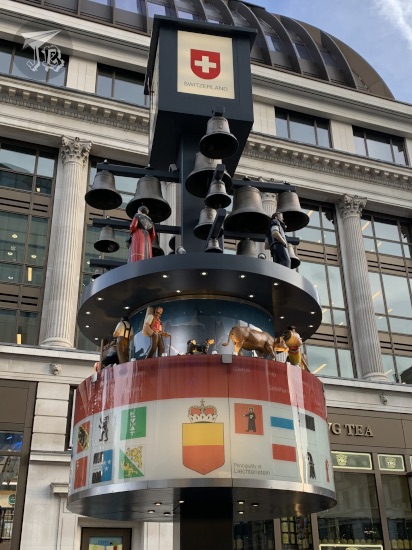
We came out and it was 18:00, the Swiss glockenspiel at Leicester Square was chiming. The glockenspiel is a Swiss-themed clock which was built in the 1960s as part of the Swiss Centre, a ploy to drag rich British tourists to the country. The centre failed, and the clock was taken away, but it was eventually restored to the area in 2011. I could have sworn it was playing Poncelli’s Dance of the Hours?

Swiss Clock Leicester Square

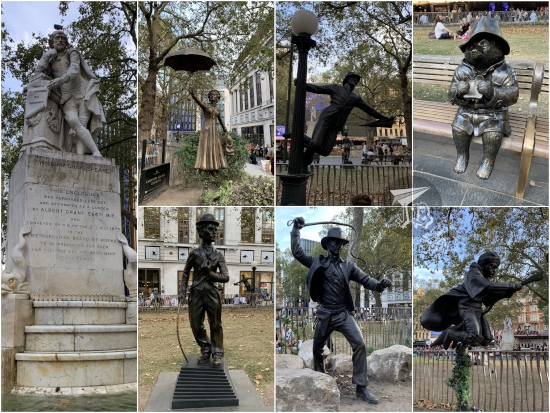
Leicester Square is built around a sculpture of Willian Shakespeare, and the gardens around him hold a number of statues dedicated to cinema, Scenes in the Square. We spotted Mary Poppins, Don Lockwood (Gene Kelly’s character in Singin’ in the Rain), Charles Chaplin, Paddington Bear, Harry Potter, and an Indiana Jones which is supposed to be temporary. Apparently, there are a few more I should be checking out for, but that’s okay because I’ll be coming back to Chinatown eventually, and it’s just a few blocks away.

Statues of cinema figures in Leicester Square + Willian Shakespeare

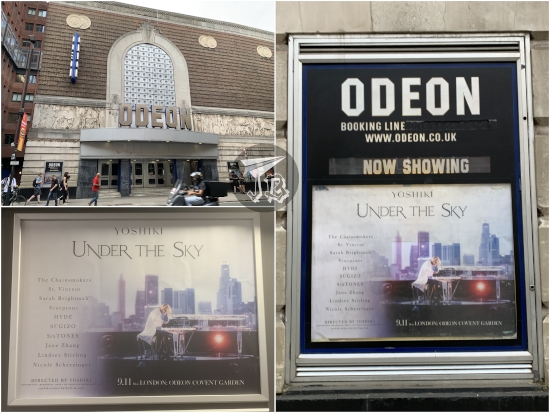
We headed back towards the Odeon London Covent Garden cinema, and we reached there around 18:20. Another poster had been put up, and some fans were already waiting. We met another friend of hers, M**, who told us she had found a sitting area inside, so we sat and chatted away for about an hour. The staff was extremely friendly and did not peep a word of complain, even if we did not buy anything.

Yoshiki Under The Sky at Odeon Covent Garden London

Finally, we were allowed into Screen 2 and found our seats. I lost count of how many people tried to get away with ignoring the seating numbers. Nobody did. I had a second-row seat, pretty centred. The film was introduced by some film producer who explained what we were going to see as if we had just accidentally wandered into the cinema.

There was supposed to be a trailer for Yoshiki’s upcoming concert in October, which was not shown. We had a few in-house adverts before the documentary started. Through the film, Yoshiki talked a little about the power of music, and how he had come together with all these great musicians to create a world-class event, very Covid-compliant. All the songs featured were either composed by Yoshiki himself, or had been arranged by him in some way. Perched on an LA rooftop, he mostly played piano, but occasionally he donned the drums.

The narrating thread of the whole film is life. Yoshiki was a sickly child, and his father committed suicide when he was ten years old, so he grew up with the idea of death deeply ingrained in his brain. As the film goes on, he speaks about how music can bring people together, and how it is important to find the strength to go on. Halfway through the film, he talks about recently losing his mother and how he cried for days. At some point a voice is introduced. It is a regular John Doe who once reached out to Yoshiki on Twitter as his dying wife had just entered palliative care. The man asked for some encouragement for her, and he got it, from Yoshiki and a lot of the fans, until she passed away. There was a heart-wrenching Zoom call with the man, who spoke about how overwhelmed he was by all the support he received. Unfortunately, she passed away.

The documentary runs for an hour and a half, and it’s a mixture of the Yoshiki’s thoughts, the performances alongside different artists, each in their corner (or rooftop) of the world, and a bit of conversation with them, or a making-of. I was familiar with most of the featured musicians, but not all.

Sarah Brightman: Miracle. Sarah Brightman has had an extremely long career and is an excellent soprano – my first memory of her dates back to the 1992 Olympics. She collaborated with Yoshiki on Miracle in 2018. I was really sorry I was not able to go to any of her performances back then.

Jane Zhang: Hero. The original version of Hero was sung by Katie Fitzgerald for the soundtrack of Saint Seiya: Legend of Sanctuary. Though Saint Seiya was my favourite anime as a kid, I had wandered away from it. The song featured in the film actually made me want to go to see it, and eventually dragged me back into the world. Zhang did a good job, but I personally prefer Fitzgerald’s version.

SixTONES: Imitation Rain. As a music producer, Yoshiki must have realised a bit ago that the Japanese boy-band panorama was dire. For long years, the boy-idol company Johnny’s Entertaining (JE) had dominated the business, with bands as SMAP or Arashi. However, an extremely protectionist policy and the open secret that the director had sexually abused some of the boys, lead to the company losing power. I have no doubt that this is why Yoshiki decided to create and produce a boy-band, and thus looked for the six young men that comprise SixTONES. Having followed some of JE’s bands back in the day, I can see how they would tap into the niche (serious flashbacks to KAT-TUN circa 2005, to be honest).

Scorpions: Wind Of Change. Formed in 1965, Scorpions paved the way for a great deal of the big names in 1980s hard rock such as Guns N’Roses, Mötley Crüe, Helloween, Megadeth… And Yoshiki is a little fanboy of theirs, of course.

Sugizo: La Venus. Sugizo is one of X Japan’s members, who took over guitar duties after they reunited. While the band was separated, original guitarist Hide died in “mysterious circumstances” – either accidentally or by suicide. For a long time, Yoshiki claimed that Hide’s death was an accident, and on this film he for the first time acknowledges otherwise. Thus, Hide was the second person in Yoshiki’s circle to take his own life. Sugizo, who also plays violin and is a member of an insane number of bands, including LunaSea, is credited by Yoshiki as the reason X Japan could come back together, which made him very embarrassed. They played a rendition of La Venus without lyrics, with Sugizo on violin.

Hyde: Red Swan. Hyde is without a doubt one of the best rock vocalists in Japan. He was originally the voice of L’Arc~en~Ciel, when they were still a thing. He worked alone for a few years, then he and KAZ founded VAMPS, and finally he went solo again. Red Swan was a collaboration between Yoshiki and Hyde for the anime Attack on Titan!, released as “Yoshiki feat. Hyde”. Yoshiki explained how the red swan represents rising even covered in blood. After this collaboration, there was a second single, released as “Hyde feat. Yoshiki” with the song Zipang, in English and Japanese, which I personally find even more powerful. The significance of Red Swan in Under the Sky comes from how many versions there are on YouTube, especially as anime songs tend to be translated. Thus, it ties in with the concept of coming together through music.

St. Vincent: New York. St. Vincent is known for her clear voice and her complex arrangements, with lots of instruments playing a part. She is considered one of the best guitarist in the 21st century. Yoshiki arranged her song New York for piano and vocals, which made it extremely powerful. All LA artists were invited to sing on Yoshiki’s rooftop, as it would have reduced the logistics involved.

Nicole Scherzinger: I’ll be your love. Scherzinger was the lead singer of the Pussycat Dolls between 2003 and 2009, but before that she had already performed with Yoshiki with this very same song.

The Chainsmokers: Closer. They are an American electronic DJ pair: Alex Pall and Drew Taggart, whom I honestly know nothing about other than they do electronic remixes. They have some supporting musicians.

Lindsey Stirling: Forever Love. She is a violinist who performs and dances at the same time. I had never heard of her either, but she did feel the music. Regarding her, Yoshiki said that she made him realise that not all songs need lyrics and vocals. She did a great job.

Yoshiki and fans: Endless Rain. In a way, Endless Rain is the emotional ballad that keeps showing up in anything X Japan related – and breaking people’s hearts. A while back, there was a request on social media for fans to send recordings of themselves singing the song, which were used for the film. Hearing a Ukrainian girl singing “endless rain lets me forget all of the pain, all of the sadness” was soul-wrenching. Once more Yoshiki circled back to the idea of music bringing music together, along with living, just keep living.

Yoshiki Q&A in London, 11th September 2023

The Q&A afterwards was awkward. The guy who carried it out – Toby Amies – had done his homework but it was not a Q&A, it was an interview by someone who had just learnt about Yoshiki, and was curious, so he had a ton of questions, most of them absolutely unoriginal, such as hey, I’ve just discovered V-kei, explain that to me! Or “do you prefer piano or drums?” which we hear every time – I could swear that Yoshiki was a bit annoyed at that one. The only input that the audience had, before Yoshiki was even in, was “are the Last Rockstars coming to Europe?” (we know the answer to that: never) and “When is the next X Japan album coming out?” (we know the answer to that, too: also never), but when the interviewer got around to ask those, he messed them up! At some point Yoshiki explained the meaning of the title “Under the Sky” – basically, we’re not in Heaven yet, we are underneath. As he was leaving, he was kind enough to sign autographs and take pictures with fans.

After the film, we took a bunch of selfies with other fans in front of the poster(s), then moved on. I went back to my hotel for a shower and a few hours’ rest. The bathroom was tiny but hot water did its job, and I could not find the cereal bar I had packed for dinner. The bed was extremely soft, and the carpet smelt strongly as England is in the middle of yet another heatwave, and my nose clogged – I need to remember to start packing my allergy pills. I did not sleep much if at all, and I ended up leaving the hotel before 5:00. I had to decide between breakfast at London Liverpool station or catching the Stansted Express at 5:25. I decided to go for the train and have breakfast at the Stansted Costa, so I boarded, found a seat, and settled down for a travel nap.

Ten minutes away from the airport, as we left Harlow Town, the second-to-last stop, there was an announcement. We were informed that the train would terminate at Bishop’s Stortford, the last stop before Stansted Airport. There were technical issues at the terminus platform, and the train could not reach it. Passengers should vacate the train at at Bishop’s Stortford and ask the platform staff for instructions. The instructions were that we had to fend for ourselves to reach the airport as there was no alternative transportation provided. It was chaos for a second, with everybody scrambling for buses, taxies and so. I was near a young woman who was going to Uber and had some extra seats. She asked if anyone wanted to tag along and I said yes. She said it would be free because her company would reimburse her, so I was lucky on that account, and I arrived at the airport a bit after 6:30. I waved my Uber-companions good-bye and headed to Costa Coffee for breakfast, feeling relieved that I had decided against waiting for the 5:40 train in London Liverpool.

After a sandwich and a vanilla latte, I passed security, where I had to go through secondary screening because… no idea. There was like no metal on me whatsoever. Then the scanner complained about me having something in my pocket – my damn handkerchief! Seriously, now. This has happened a few times. Where do people keep their hankies / tissues if not a pocket??

A****d had not yet departed when I was through, so we could hang out for a little longer – it’s fun that we had only met in person for a few hours in 2017 and we hit off so well. We even had gates in the same area of the airport, so it was cool. This is the first time that I have done the “going to the airport early in the morning” in London, but to be honest there was a 100 € difference between that flight and the next up, since the whole thing was announced and happened so fast. I asked for a refund from the Stansted Express, and now I’m wondering whether to cancel the train for my next trip to London as they’re threatening with strikes on those days… (ETA: I received a full refund, and there was no major incident during the following trip).

The trip back was uneventful except the road was stupidly full when I drove off the parking lot. I napped most of the plane ride, and I had a Coke before 9:00. Talk about living wildly, especially considering how all this happened in 32 hours, and I was in London for less than 24! My only regret was not taking the camera, but I was trying to pack extra-light this time around.

22nd and 23rd April 2023: A date with a dinosaur (London, England, Great Britain)

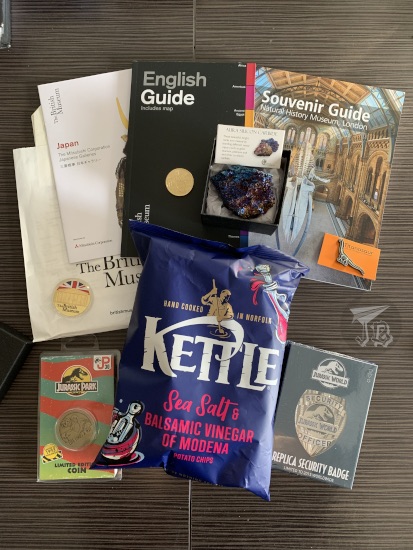
Since I cannot keep my mouth shut, I offered to organise a trip to London with some people from work. Despite prices skyrocketing everywhere and my ridiculously hectic schedule, I managed to secure a weekend when flying would not be stupidly expensive, and an activity I would really be looking forward to – the Natural History Museum was running couple of things I was very interested in. One was an exhibition on a gigantic dinosaur: Titanosaur: Life as the biggest dinosaur. Well, twist my arm – NHM is much closer than the actual Titanosaur home in Argentina. Furthermore, there was a collaboration with Jurassic Park (‘an adventure 63,000,030 years in the making’ is the motto), and coming back to the museum would give me the chance to purchase the rock I wanted the last time I was over and did not get because I was heading out to Stonehenge on the same day.

In the end, only one person took up the offer, and I figured out that well, London is pretty much always a good idea for a weekend – so I figured I’d arrange myself a date with a dinosaur. Unfortunately, it turned that London Marathon was held that weekend. Hotel prices were bloated for the night and we ended up at Earl’s Court because I wanted to stay close to South Kensington and the other person wanted the cheapest place possible. We left on a red-eye flight to London Stansted which took a long time to land – we spent about an hour circling the airport, and eventually the head cabin attendant said that there was bad visibility at the airport, and that the pilot required all electronic devices to be turned off so he could use the autolanding system. I did not like that one bit – after I visited Santiago de Compostela in 2022, I felt that I had got over the bad-visitiblity near-miss when I was a teen. Apparently not, the feeling of uneasiness is still there. We landed over an hour late, but we were on our way on the first Stansted Express a few minutes after getting on it. After reaching Liverpool Street Station at around 9:30, I asked my companion to take us to Guildhall as part of the incentive of the trip was introducing them to international travel. It was not a good idea. Their phone trolled us and tried to take us to Guildhall… in Stratford upon Avon. The Costa at the station was closed, but at least I had got myself a sandwich and a latte before we started walking.

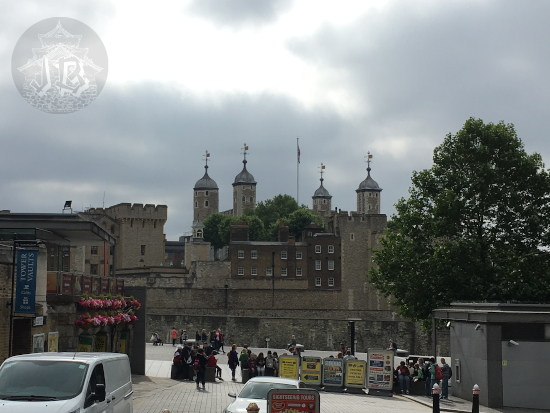
After backtracking, we were in known territory around 10:15. As it turns out, my companion was only interested in “walking the city” and shot down any activities I had proposed – thus, some things I just imposed in order not to feel that I had wasted the whole day away. By 11:00, I had confirmed that our travelling styles were not compatible. After some time at the docks next to the Tower of London, I wanted to enter the Anglican church All Hallows by the Tower. All Hallows is the oldest church in the City of London – founded in 675 CE, it predates the nearby Tower of London. The parish used to take care of a lot of the prisoners executed there. The building withstood the Great Fire of London (1666), but it was severely damaged through The Blitz – the German WWII bombing campaign against the UK throughout 1940 and 1941. The church was rebuilt and reconsecrated in 1975. Its windows are decorated with symbols from the different London guilds and some families.

Collage of a church. The outer building is brick and it has a tower crowned with a greenish metal spire. The inside has huge windows decorated with guild symbols. The small crypt inside is covered in white stone.

Underneath, there are a few chapels and a small Crypt. Most of the crypt is a museum which chiefly holds artefacts from the Roman period – including remains of an old road. There are other historical items from the Saxon and Medieval times, and the 20th century Crow’s Nest of the vessel Quest, in which Sir Ernest Shackleton sailed for Antarctica for the third time, and where he died.

When we were done, we went to Saint Dunstan in the East Church Garden. I was hoping to use this as a relaxing point for a few minutes, but there was work being done on the parterres. We continued towards the River Thames for some views of Tower Bridge, the museum HMS Belfast and The Shard skyscraper.

We walked by the Monument to the Fire of London on our way to the Sky Garden. The Great Fire burnt inside the Roman city wall for four days after breaking out a bakery after midnight on the 2nd of September, 1666. Though the number of victims is (theoretically) small, the fire destroyed over 13,000 houses (15% of the city’s housing), almost a hundred parish churches, governmental buildings, St Paul’s cathedral, and even some of the city gates.

Afterwards, we walked over to Leadenhall Market, a covered shopping street which can be traced back to a 1321 food market, and marks the centre of Roman Londinium (ruins from the Forum and Basilica are buried underneath). It was given to the city in the 15th century, and in the 19th century, the City Architect Sir Horace Jones designed an iron-and-glass arcade. Today, it holds restaurants, wine bars, varied shops and even beauty parlours.

A covered shopping gallery or street, in dark red and beige tones.

Around the market stands a mixture of modern buildings and traditional buildings, mostly small churches. Among the former:

  • The Lloyd’s Building (25 Gresham Street), sometimes called the “Inside-Out building”. It was finished in 1986 and it is consider a great example of Bowellism – an architectural style that maximises inside space by building ducts, lifts, and other structural necessities on the outside. It was designed by Richard Rogers & Partners, and it still maintains the original entrance of the building that stood in its place in 1928 – the East India House.
  • The Leadenhall Building (122 Leadenhall Street), designed by the Rogers Stirk Harbour + Partners. It opened in 2014.
  • The Willis Towers Watson (WTW), designed by Norman Foster, it was finished in 2008.
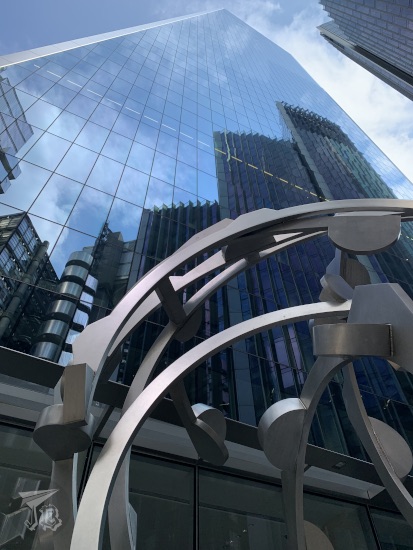
  • The Scalpel (52-54 Lime Street), which yields to cool reflections along with the WTW, and has a strange sculpture at the entrance – it made me think of several ship wheels fused together. The building was designed by Kohn Pedersen Fox and only completed in 2018.
  • And of course The Gherkin (30 St Mary Axe). It was designed by Foster + Partners and it is the first ecological building ever built in London. It opened in 2004.

The historical buildings we encountered (having survived both the Great Fire of London and the Blitz) include:

  • Saint Andrew Undershaft Church. It dates back from 1147, although it has been rebuilt several times. The current building was erected in 1532.
  • Saint Helen’s Bishopsgate Church, where Shakespeare himself used to worship in the 1590s. The building can be traced back to the mid 12th century, and it was restored during the Victorian period and later during the 20th century.

Skyscrapers reflected on the glass that covers yet another huge skyscraper

A small church built in Stone in the background with a huge modern high-rise building behind it

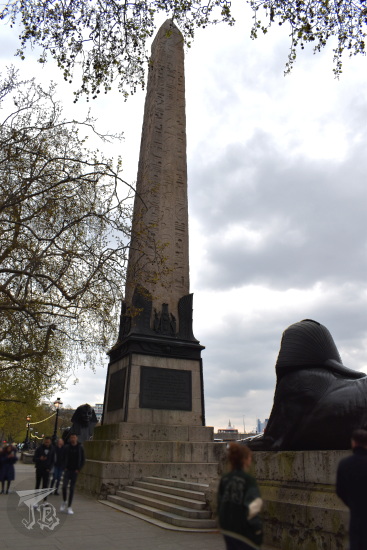
Afterwards, we headed towards Embankment on the Tube. There, I was happy to find a Costa Coffee and get my vanilla latte fix. In the area, we saw the Victoria Embankment Gardens and I wanted to visit Cleopatra’s Needle – half of a pair of obelisks (the other one is in New York), originally made and carved in Heliopolis, what is Cairo today. It has inscriptions from the 18th and 19th Egyptian dynasties (around 1450 BCE). It was presented to the United Kingdom by Sultan Muhammad Ali in 1819, and later transported to London in 1877. Two sphinxes and other decorations were added when the Needle was erected, and the plinth under one of the sphinxes was damaged during London Bombings – it was never restored as a tribute to memory.

An Egyptian obelisk standing against a cloudy background

We walked over to the Westminster area to see the Palace of Westminster and Elizabeth Tower. There was an environmental protest there, which made it packed, but at the same time diverted traffic, allowing for new views from the middle of the street. On the way, I encountered an adorable pit bull mix I got permission to pet – coffee and dog pets made everything better.

A view of the palace of Westminster, with the Elizabeth tower on the left

We continued off to Saint James’s Park, home to squirrels, geese, swans, pigeons, mallard ducks, robins… all of them extremely used to people and tourists, and rather unconcerned by dogs being walked. We ditched the marathon fencing and reached Buckingham Palace, but by then my companion was beat. Thus, we had to go to the hotel so they could get some rest. The hotel was better than expected for a London 2*. It was nice and warm, although the bathroom was tiny – it was difficult to stand inside and close the door.

Buckingham Palace and some of the animals at Saint James' parks

A couple of hours later, we were off into the evening to see Piccadilly Circus, the entrance to Chinatown, and Leicester Square. Companion was beaten, so they were not sure they would be up for anything the following day – we arranged to touch base at 9:00 for them to evaluate. Once in my room, I had a shower and booked a free time slot for the British Museum the following day, just to avoid the queues. I thought, even if we did not make it, at least we had assured entry if we did, and I could always cancel and release the ticket.

Central London at night - Picadilly Circus' Eros and entrance to Chinatown

The next morning, I left on my own around 8:00 to look for a nearby Costa Coffee for a large vanilla latte breakfast, and I came across Brompton Cemetery. This had not been on my radar, but since I had time, I decided to explore it a little. Brompton Cemetery, formerly West of London and Westminster Cemetery, opened in 1840, and it has belonged to the British Crown since 1852. It is on of the oldest garden cemeteries in Britain and comprises around 35,000 monuments. I wandered for about half an hour before I had to head back.

Brompton cemetery, a 19th century graveyard and garden

We managed to get to to the Natural History Museum on time for my date with a dinosaur just after opening. I had my Titanosaur ticket at 10:15, and left off my companion to wander on their own after agreeing to check with each other around noon. The exhibition Titanosaur: Life as the Biggest Dinosaur brings a cast of Patagotitan mayorum to Europe for the first time, along with a few real fossil bones, of a front leg, some teeth, and an egg.

Patagotitan mayorum is one of the largest known animals to have ever lived. It was a sauropod dinosaur – a tetrapod with extremely long neck and tail. It lived in forest regions during the Late Cretaceous (102 to 95 million years ago) grazing on ferns and tree leaves. The species was discovered in Argentina in 2010, and it’s calculated that it could have been up to 31 metres long and weigh over 50 tonnes. It is widely considered the most complete of the South American dinosaurs. The cast that the Natural History museum brought is considered the holotype, and it was reconstructed from the partial skeletons of six specimens.

Titanosaur skeleton. People walking around don't even reach its knees.

The best thing about the exhibit was being able to actually touch the cast, so I kinda hugged my date, I guess. As far as I know, there are only three casts of titanosaur – the one in Argentina (Museo Paleontológico Egidio Feruglio in Trelew), one in the US (Field Museum, Chicago), named Máximo, and this one.

After I had pranced around the exhibition to my heart’s content, and as it filled up with kids, I moved on to reason number two of this visit having to happen asap in 2023. To celebrate 30 (thirty!) years of the 1993 release of Jurassic Park, the Natural History Museum was running a limited-time-only collaboration pop-up shop – the Jurassic Park 30th Anniversary #NHMxJURASSIC store in which I did not even spend that much! I bought a replica badge and a commemorative coin, both limited, numbered editions. The shop had both Jurassic Park and Jurassic World merchandise, especially toys and T-shirts, and a few props, including a life-size sculpture of Blue the velociraptor.

Jurassic Park pop-up shop, with Blue the velociraptor just hanging out

I then headed to the official museum shop to get myself the rock I had wanted – a piece of aura silicon carbide, a shiny mostly-artificial mineral. I also bought a souvenir guide, just because. They did not have anything from the Titanosaur exhibit there, so I backtracked to the exhibition shop to buy a pin.

Whenever I got to the Natural History Museum, I end up in the dinosaur gallery (well, there was that one time I walked through the whole thing throughout a winter day). This time, however, I decided to wander the upper area of the historical building. I was drawn to the Treasures in the Cadogan gallery. I had not been there since it opened in 2013, and my mind was blown. The collection includes a first edition of Darwin’s On the Origin of Species, and some of the pigeon specimens that he used to develop the theory of evolution. I also got to see the first-ever-found iguanodon teeth (not the replicas), the first fossil ever found of the Archaeopteryx (the link between dinosaurs and birds), and a skeleton and egg of the great auk, the first confirmed victim of anthropogenic extinction (due to human activity). I was very impressed, these were all treasures indeed – no overselling.

Treasures at the Natural History Museum - ancient bird fossil, extinct penguin-like bird, a book, dinosaur teeth. Whale skeleton.

After wandering the second floor for a bit, I ran into my companion and at noon we left towards the British Museum, where I had booked entry for 12:40. I left them to their own devices again and headed off to the Japanese galleries, which had been closed the last couple of times I was in the museum. I was… a bit on the disappointed side, I remembered them being way more impressive from my early 2000s visits.

Japanese Galleries at the British Museum: Samurai Armour, lion dogs pair, articulated metal animals, a standing Buddha.

I visited the Moai, the Elgin Marbles, the Babylonian bulls and the Rosetta Stone, and I headed off to the shop to get myself a treat – retail therapy is a thing. Eventually, we left the museum and managed to get to Liverpool Street to take the Stansted Express to the airport. Security was smooth, not as crammed as other times, and then, as tradition calls, I got myself some sushi at Itsu.

When we boarded the plane, I had been assigned an emergency exit seat. In order to sit there, you need to be able to take responsibility about opening the exit if something happens. I flagged a flight attendant to inform them that I would be physically unable to do so. I had a new seat in 4.5 seconds, and it turned out to be a window seat. We took off a few minutes late, and landed with a delay of almost a quarter of an hour. Nevertheless, after passport control and all, I managed to reached the parking lot payment machines with a few seconds to spare the overstaying fee – all good!

Balance – The marathon barely interfered with the weekend. I had a date with a dinosaur and hugged them. That was awesome. I got limited edition Jurassic Park and Jurassic World merchandise. I found some Kettle Sea Salt and Balsamic Vinegar of Modena crisps at one of the supermarkets. I got two new books, commemorative coins and a shiny rock. I also discovered new places to explore in the future, and had Costa – twice. Unfortunately, we ran out of time for extra visits on Sunday – so I could not fit in either the HMS Belfast or the Jack the Ripper Museum. Furthermore, the Grant Museum of Zoology is closed for renovation, and the Petrie Museum of Egyptian Archaeology does not open on Sundays, so in the end I was not really able to scratch much off my list. Whoops!

Souvenirs from London: books, crisps, commemorative coins and Jurassic Park merch

9th & 10th June 2018: Wicked London (England, Great Britain)

This will be the last work-trip, at least for a while. I might change my mind later, but for now I’m done with them (although there’s an upcoming family trip rather soon…). Again, we flew in early Saturday morning, and we went to walk around the Tower of London and the Tower Bridge.

Then we went to the British Museum. I left them for a couple of hours there and I went to visit some of the lesser-seen galleries.

We had booked tickets for the musical “Wicked” in the Apollo Victoria Theatre at 14:30, so we headed over there. Wicked is a parallel story to “The Wizard of Oz”, focusing on the story of the Wicked Witch of the West, who becomes a social outcast due to her tendency to speak her mind and the strength of her magic. I had really wanted to watch this for a long time, so I used this chance and convinced the group to get there. I absolutely loved it ♥.

After the show, we dropped our things at the hotel. The group wanted to get some rest, so we stayed there for a while, then got out again. We took the underground towards London central and we were in Trafalgar Square for a while.
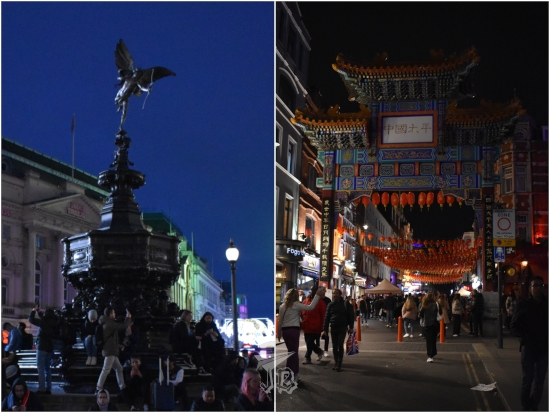
Then, we went to Chinatown for dinner.

Later, we walked around Piccadilly Circus, checking out some shops and so. We even stopped for cake.

On Sunday morning we went to Saint James’s Park, where we got to meet the local fauna, especially a very adventurous squirrel.

Then we dropped by Buckingham Palace. Although we did not watch the Guard Change, we did see one of the relief marches.

We walked from there to Westminster, saw the Houses of Parliament and the Big Ben, along the outside of Westminster Abby.

We visited the Monument to Emmeline Pankhurst and stayed for a while in the Victoria Tower Gardens.

As a final visit, we went to the Natural History Museum.

Finally, we headed off to the airport, and the icing of the cake was that we got caught in a controllers’ strike, so we had like a three-hour delay on our flight and it took forever to get home (;¬_¬). All in all, this was a very… strange trip, and without a doubt the highlight was going to see Wicked, which is something I had wanted to do for a long time, and gave me a couple of hours of enjoyment to myself.

30th July 2017: Tokyo → Yokosuka → Sarushima → Yokosuka → Yokohama → Tokyo {Japan, summer 2017}

We ended up in Yokosuka [横須賀] because D****e wanted to go to a music and book shop called Yajima Record Honten [ヤジマレコード本店], which was sadly closing the following day. The first thing that we did when we arrived, however, was lunch (because we had not gotten up early and we had spent a couple of hours on trains). Yokosuka is known for being an American army base, so it prides itself on being “Americanised”, and the typical dish seems to be hamburgers. This is the avocado burger I ordered.

After this we walked a block north and found Yajima. The key aspect of this shop was that it had a bunch of posters and signatures from old promos from a bunch of J-rockers. It was a bit of a magical place and it is very sad that it is closed now. I took the chance to buy an unopened, brand new copy of Hyde’s Shallow Sleep single, and we took pictures of a bunch of the promos that were still up, some of them twenty or thirty years old.

Afterwards we walked to the pier to catch a ferry to see Sarushima [猿島], which hosts a few old timer army bases and wartime ruins, aside from some very nice ocean views. It would have been nice if we had managed fewer people around, but alas, we all came by ferry so we all arrived at the same time. Sarushima is the only natural island in Tokyo Bay, and geologically it seems to be a continuation of Futtsu cape on the opposite side of the Bay. Although the name means “Monkey Island” there is no monkey there except in a legend that says that a white monkey guided Saint Nichiren through the fog in Tokyo Bay to the safety of the Island. Sarushima is a World Heritage National Historic Site.

Afterwards we went back to Yokosuka Pier and boarded the Mikasa [三笠] warship which was used as flagship in the Russo-Japanese war (and sank after the war because she blew up. Figures). It is now a naval museum where you can VR the battle. I got VR-obliterated. There is a reason why I did not pursue a military career.

Afterwards we diverted our way to go to Yokohama [横浜] and get nikuman for dinner in Chinatown. We sat on a park bench and ate nikuman and drank bubble tea. Afterwards we walked down by the harbour and through Yamashita Koen [山下公園] and looked at the sunset/night skyline. Finally we caught a train back home.
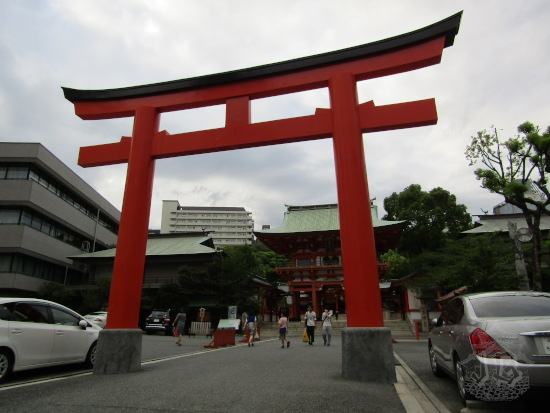
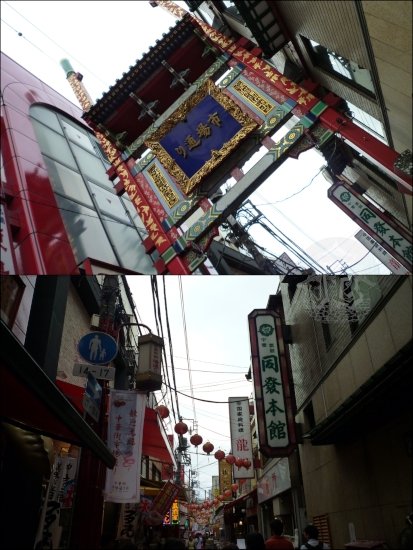
19th July 2017: Nagasaki – the perseverance of nature and the pride of man {Japan, summer 2017}

My Nagasaki [長崎] day was the worst weather I’ve ever experienced in Japan. There was a storm mid-morning which caused the atmosphere to become so heavy with water vapour that even breathing was difficult.

I started the day getting a tram pass and a map, and I first set on my way to see the Heiwa Koen [平和公園] or Peace Park, in order to be done with the ‘heavy feelings’ and then do other more relaxing stuff. I saw the Peace Fountain and the Peace Statue and snooped around Urakami cathedral outskirts, but it was being cleaned / renovated, so I did not walk closer. Then I looked at the Hypocentre of the Atomic Bomb. It made my heart heavy, thinking about what humans can do to each other.

After the Peace park I really wanted to see the one-legged torii of Sanno Jinja (山王神社), located less than a kilometre away from the blast site (the problem was that following the Nagasaki tourist map and signs, I had to take a huge detour). The shrine was destroyed in the blast, but the second torii did not completely collapse. The right leg and half the front remained standing, albeit, albeit rotated 30º. The torii still stands and now Sanno Jinja hosts the kami of two camphor trees that were scorched in the blast, but they survived and are now covered in leaves.

After that I took the tram towards Chinzei Taisha / Suwa Shrine [鎮西大社 / 諏訪神社] and as I was getting to the tram stop, the storm broke. It was not the rain as much as the asphyxiating heat what made it hard to breathe, even much more to climb up the stairs to the shrine.

After that, once the clouds had lifted and I had drunk a whole bottle of coke in pretty much one go, I headed off to an area called Teramachi [寺町] where two prominent temples stand. The first is Kofuku-ji [興福寺].

The second is Sofuku-ji [崇福寺]. Both of them are Chinese origin temples that at the moment feel more like tourist attractions than actual temples (entrance fee and all).

As I had taken down such a detour for Sanno Jinja and underestimated the distance between Kofuku-ji and Sofuku-ji I was running a little behind schedule, so I decided to change my original plans. First, I made a brief stop by Megane Bashi [眼鏡橋] (the Spectacles Bridge) over the Nakashima River, which is the oldest stone arch bridge in Japan, built by the same Zen master who established Kofuku-ji.

After this, even if I was a step away from Chinatown, I took the tram to the Nagasaki Koushibyou / Chuugoku Rekishi Hakubutsukan [長崎孔子廟 / 中国歴代博物館], aka Confucius Shrine and Historical Museum of China, because I wanted to be there before it closed. That was really and quite unexpectedly cool.

Again due to timing, I backtracked to Dejima [出島]. This is / was a small artificial island in Nagasaki bay established in 1634. This served as the opening of Japan to the Western world through trading with Dutch merchants. The recent renovations have restored the buildings in the island and established a museum to show how the Westerners lived. One of the things that grabbed my attention was the skeleton of a cow which had apparently been used to grow vaccinations. And there was a stamp rally, which only added to the fun. As a matter of fact I have to say that most of Nagasaki was more interesting and fun than I had expected, especially after the Peace Park and the heavy heart it caused.

I finally could backtrack to Nagasaki Chinatown (Chuokagai [中華街]) in Shinchi Machi.

After Chinatown I walked up to the Former Chinese Settlement, or Tojin Yakishi [唐人屋敷], where I saw Dojin-do [土神堂], Fukken Kaikan Hall (main gateway and Tenko-do) [福建會館], and Kannon-do [観音堂] which are remaining Shinto shrines in the area. Tojin Yakishi is the area where the Chinese merchants were confined, much like Dejima was for westerners.

To end up the day I wandered around the Seaside Park, Nagasaki Mizube No Mori Kōen [長崎水辺の森公園] and backtracked to the station to head off to my next destination. All in all, I got the feeling that unlike Hiroshima, Nagasaki is trying to move on from the bombing and cultivate everything that it has to offer.

11th & 12th June 2017: Highlights of London (England, Great Britain)

As part of my day job, I took a group of customers on a trip to London. Not the best decision in my life, but one that I would repeat a couple of times before I had enough. This was a short getaway – we took off on a red-eye flight on Saturday and we came back on Sunday evening.

Our first stop was The Tower of London, officially called “Her Majesty’s Royal Palace and Fortress of the Tower of London”. The main Tower, “White Tower”, was built in the 11th century, and additions to it were made up to the 1400s. It was designated Unesco World Heritage Site in 1998. The Tower holds an armoury, some treasure, documentation offices, a few shops and the Crown Jewels of England. And, according to the legend, quite a few ghosts.

After the Tower, we took a moment to see the Tower Bridge.

We had a hotel basically at the end of the world, and we decided to go to drop our things off before we continued on the visit. We saw the Wellington Arc in Hyde Park on the way to the royal palace.

Then we fooled around Buckingham Palace.

Finally we went to Chinatown to have dinner…

… and rounded up the day at Piccadilly Circus.

The next morning we headed off to the British Museum. We had breakfast outside because of course it was one of those times when it’s all warm in London. Waffles = ♥

The British Museum was established in 1753, and opened to the public, in its current location, in 1759. It focuses on human history and art, having branched the natural history items to the Museum of Natural History and all the documentation to the British Library. The museum holds the awe-inducing number of 150 million of artefacts from dozens of cultures of the world, both ancient and modern, with amazing Grecian and Egyptian collections (albeit having disputed ownership…)

Inside the British Museum we separated. I left them to have a walk around the most important areas and I walked into my favourite spots (although the Japanese galleries were still closed. I also got a ticket to see the Hokusai – beyond the Great Wave exhibition, which presents a number of Hokusai’s works organised in series or topics. One is waves, and it shows how Hokusai experimented with textures, shapes, swirls and foam until he found the “perfect” wave – his most famous work, the Great Wave. There is a series on people, another one on mythology, and another one on himself and his family.

After I was done and we had met up again, I helped them found some stuff that they had not seen but still wanted to. Then, we headed off to the Westminster area to see the Big Ben, and although there was some scaffolding already visible, we managed to see the whole thing.

Finally, we headed off to the airport to get back home.

1st January 2017: Hatsumode {Japan, winter 16/17}

Hatsumode [初詣] is the Japanese custom of visiting a shrine or temple within the first three days of the year. Some people – like we did – actually wait the New Year to roll in the temple grounds. After the 108 (fast!) gongs that signal the entrance of the New Year, you are allowed into the shrine grounds to say the first prayer of the year in Hie Jinja [日枝神社].

After the prayer you can buy good luck charms, arrows which are ammunition for the kami to protect you (or something alike), enjoy some sacred sake, get your shuin, and once you’re outside, buy food and drinks. In my case I got some fresh takoyaki and ate them alone because apparently they’re stinky 。゚( ゚^∀^゚)゚。

Then we headed off home, and I got up at 8 am to have 12 grapes with Spanish TV as it has been my custom all my life. Then I went back to bed.

In the evening I headed off to Minato [港] to see Tokyo Tower [東京タワー]. Zojo-ji [増上寺] and Shiba Kōen [芝公園] were packed with Hatsumode parishioners and I had never seen such a line to go up Tokyo Tower. Thus I did not climb up, but I did take pictures of all the illumination around.

Afterwards I met with D****e and K***n. to go to Yokohama [横浜], to have dinner in Yokohama Chinatown, as Chinese people have their own New Year, they would be open to business as usual. It was my first time in Chinatown at night, too, so it was interesting seeing places like Kanteibyō / Kuan Ti Miao Temple [関帝廟 / 中華会館] in a new light.

On our way back we tried to see Shiodome [汐留]’s Winter Illuminations but they were off. We’re not completely sure of why…

26th August 2015: Kobe – the calm before the storm {Japan, summer 2015}

Before setting off to Kobe, there was one stop in Kyoto I had to make: Kyoto [京都]’s Seimei Jinja [晴明神社] which enshrines the soul of Abe no Seimei, reportedly the most powerful onmyōji Japan has had. He lived in the mid Heian Kyo as was the main actor in the union of the Shinto church and the state. He has been widely used in fiction as his figure seems to be half historical – half fictional anyway (Note to self: you’re still missing the Osaka Seimei Jinja). The shrine is built where he lived in Kyoto, quite close to the Imperial Palace itself. I am quite happy I got to go there alone, because the level of fanbying I achieved in that place might be embarrassing ^^”

After taking pictures to my heart’s content – getting the shrine’s seal, an omamori, and getting a free sticker because I was a foreigner, I went back to the station and took a Shinkansen to Kobe [神戸]. Kobe is one of the most important ports in Japan, and in 1995 was hit by a major earthquake which displaced areas of the city up to 6m to the sides. It is quite a new town, and it was very calm for what was about to happen. The next day, the most important yakuza gang in the country, based in Kobe, was about to split into different syndicates.

I wandered Kobe for a while, saw the clock flower and the eternal flame to commemorate the deaths from the quake and eventually made my way back to the harbour and Meriken Park. A part of it has been left as a memorial, never to forget the destruction caused – the Memorial in Meriken Park [メリケンパーク]. The Meriken Park Earthquake Memorial is eerie somehow.

After seeing the memorial, I could already scout the Kobe Port Tower. I got a combined ticket to see the Tower and the adjoined museum – Maritime Museum and Kawasaki Museum. From the Tower I got quite a good view of the whole city and the harbour. It is quite humbling to think about that nature did to the city, and what could happen again any time. No pictures allowed in the Maritime Museum though, so I just bring you some pictures from the top of the tower.

After Kobe Tower, I made a stop in Sannomiya Jinja [三宮神社].

Then I headed off to have a look at the local Chinatown and the local shopping street/gallery – Motomachi Shopping street [神戸元町商店街].

Chinatown had mostly food stalls, and I was not hungry – and I have already tried Kobe beef and know that I can’t afford the real good stuff, so after wandering around for a bit, I decided to head off to Ikuta Jinja [生田神社], the most important shrine in downtown Kobe, and quite in the lovey-dovey date couply future prayer. Not for me, but very very beautiful shrine.

And then I headed to check in the hotel and start a bit of a train nightmare that I won’t write about in hopes to forget eventually. Thus tomorrow we shall start with the arrival in Sendai.

12th August 2014: Yokohama & friends {Japan, summer 2014}

We headed off to Yokohama [横浜] to visit Chinatown.

Our goal was an early lunch and then a division of forces – either temples or Panda shops. I was on Team Temple, as nobody will be surprised to hear – Kwan Tai [関帝廟] and Kanteibyō / Kuan Ti Miao [関帝廟 / 中華会館].

Then we walked around the seaside park, Yamashita Koen [山下公園] and looked at the bay.

After a visit to (yet another) Book Off stop, we headed back to Tokyo [東京], where we had arranged to meet a few Japanese friends in Shibuya [渋谷].

The first plan of the afternoon was meeting at Hachiko’s sculpture in Shibuya, because that is what you do when you meet in Shibuya. Then we headed to Bic Camera to check out the special promo that they had running on the 4K audiovisual set. The promo featured the trailer of the L’Arc~en~Ciel’s concert at the National Stadium earlier in 2014, which will be released in October.

One of our friends had to work that afternoon, but as this was the only day we could see the three of them before they went home for Obon, we decided to surprise her and drop by the cafe she works at to keep her company. This was the day when I discover that Japanese people actually flop on the floor when they are surprised, for real.

The Mr. Happy cafe is located in Shibuya and is something akin a non-profit which is affiliated to a children’s character. We had amazing milk shakes and mini smiling sponge cakes (lemon and caramel) and took pictures of them, of course. As we were leaving, our friend presented us with a mini box of berry sponge cakes per person! They were very kawaii and delicious, too.

For dinner we went for yakiniku again, although this time it was something quite more posh / expensive. We ate a lot, but I felt that there was too much smoke to be completely comfortable there.

16th July 2012: Umi no Hi! {Japan, summer 2012}

Monday 16th was the third Monday of June, and thus Umi no Hi [海の日], The Day of the Ocean, and it started great – the sky was super clear. That means we were able to see Mount Fuji, Fuji-san [富士山]! I had not seen him since I was here, not even on my way to Osaka because it was cloudy. It is difficult to see Fuji in Summer, so I was really happy to catch him.

The summit of Mount Fuji peering up through the clouds at the end of a downhill street under construction

The morning, however, was to be spent in Yokohama [横浜]. The first stop was Chinatown, where I got to meet an old ‘friend’ of mine, whom I had been craving to see for a long time, in one of the temples. But that is its own story. (Basically: I got to see a dragon sculpture I loved).

The entrance to Chinatown - an ellaborate gate with Chinese characters, decorated in bright colours - red, blue, gold, green...

In Chinatown we visited Kwan Tai Temple [関帝廟]

An ellaborate temple with guarding dragons on top, over a flight of stairs. The colours are very bright, but the stairs are white.

And Kanteibyō / Kuan Ti Miao Temple [関帝廟 / 中華会館].

An ellaborate temple entrance, with lots of peaks and lanterns behind it

We had lunch in one of the many Chinese restaurants in the area.

Chinese food - rice, dumplings, soup, pickles

Afterwards we moved to the Port of Yokohama to see waves!! the famous skyline and the Yokohama Bay Bridge, along with lots of pretty ships which were open to visit in celebration of Umi no Hi.

Stairs that disappear into the ocean

Yokohama skyline

By 5pm, however, we were back in Tokyo because we had tickets to the theatre, more particularly GACKT’s Butai “MOON SAGA ~Yoshitsune Hiden~” at the Akasaka ACT Theater.

Being guionised by CLAMP, I expected a high body count [Spoilers from here] but I was surprised. The play is prepared as part of the whole Moon Saga project, so it does not focus in GACKT, who has surprisingly little stage time playing Yoshitsune. The play has all the elements of a CLAMP story – tragic love, honour debt, child with preternatural power, a few deaths, a character who randomly changes sides but in his heart he still belongs to the original side, main character forced to kill a friend, lots of angst… The butai tells the story of a group of fighters as they embark themselves in a war against the evil mononoke who are destroying Japan. Yoshitsune’s character himself is a half-oni or has an oni inside him, something along.

As I said, GACKT did not have much screen time, and to be completely honest, his spotlight was completely stolen by Saotome Taichi, a barely legal actor who plays Kage (Shadow), one of the good mononoke and who has a beautiful CLAMPian on-stage death.

Yoshinaga, one of the original companions, loses the love of his life, changes sides and tries to kill Yoshitsune, awakening the demon in him. GACKT flies through the stage during the fight and in the end Demon-Yoshitsune kills his old friend. The curtains fall soon after GACKT desperately cries over Yoshinaga’s body. Very sad. Very CLAMP.

The actors come back onstage, they are ovationed. The curtains fall again, the lights remain off. The curtains are drawn, and we are back to the beginning, the companions are alive and well, has it all been a dream? A foreshadow? Is this the companions’ destiny? But no, they are not companions… they are family…

Moon Saga board, showing singer and actor Gackt staring upwards, his eyes are red

[End Spoilers] It seems that when GACKT talks of the Moon Saga project, it means that you need to know all the pieces of the puzzle to understand the story. Each of the pieces seems to be part of a great jigsaw that will come together to form something absolutely amazing.

Well played, GACKT, well played. Now shut up and take my money, because this is going to be EPIC.

After the play, we had some curry at CocoCurry House.

A pork cutlet, breaded, with curry sauce and rice around it