19th December 2024: Themed visits at Madrid’s Museo Arqueológico Nacional (Spain)

There have been a lot of witches dripping into mainstream pop culture these last couple of months, what with Disney + / Marvel’s Agatha all Along and (half of) the musical Wicked released as a film. So when I read that the National Museum of Archaeology was running a special guided visit to the exhibition “Between Chaos and Cosmos: Nature in Ancient Greece” Entre Caos y Cosmos. Naturaleza en la Antigua Grecia and part of the permanent exhibition called “Nature, Magic and Witchcraft” Naturaleza, magia y brujería I thought “hey, the Heritage people are catching up with the times!” That day there actually were two guided visits, and the second one was centred around the sculpture Il Pugilatore. One was at 12:00, and the other one at 17:00, so they could be combined – hey, they were free, I just had to find something to do in-between.

Thus, I booked both visits and headed out to Madrid. I got to the archaeological museum Museo Arqueológico Nacional with ample time due to my distrust of trains. As I have the museum card, I decided to just walk in and wait for the time safe from the cold and the rain – and since it had just opened, from the crowds too. Though the ticket said to wait at the meeting point, the museum staff directed me somewhere else, and that is where I sat to wait ten minutes before the starting time. Apparently, a bunch of people did not get the information so when the time came we were few… and promptly joined by about half of the group once we had started.

The first visit was “Nature, Magic and Witchcraft” Naturaleza, magia y brujería. It started at the exhibition Entre Caos y Cosmos. Naturaleza en la Antigua Grecia – “Between Chaos and Cosmos. Nature in Ancient Greece”. As we walked in, the staff scanned a ticket and gave it to us.

The guide made a small introduction to Greek mythology with an emphasis on pre-Olympian “Chaos”. He mostly spoke about hybrids, such as satyrs or harpies, psychopomps (creatures that take souls to the afterlife after death), like Echidna, Cerberus, and the sirens. He also seemed to like the deity Achelous a lot. Achelous [Ἀχελώϊος] was the personification of one of the Greek rivers, a son to the Titans Tethys and Oceanus, and father of the sirens. He was able to shape-shift and would often be represented with small horns as he could turn in to a bull.

Regarding witchcraft, there is a small room in the exhibit about it, and the guide pointed out the concept of sisterhood, and some of the small artefacts and glass carafes. He mentioned the figure of Medea as the greatest witch in Greek mythology. That surprised me, because I had never associated her primarily with magic – I knew her from the Jason and the Argonauts myth, in which she originally helped Jason find the Golden Fleece, but she eventually killed the children they had together when Jason dumped her. Glad to know there was more from her than just being a “crazy lady”.

Afterwards, we moved onto the permanent exhibition. Unfortunately, the tickets we had been issued would not work any more because… reasons. Apparently, they could only be scanned once, and they had already been scanned at the exhibition. However, the person guarding the gates would not let us through without having a ticket beep – despite being with a member of the museum. It was solved quite quickly, but it gave off the feeling of everything being very disorganised.

In the permanent exhibition we mostly saw Talayotic and Iberian talismans and jewellery, then we moved onto the Roman area, where he mentioned the laws regulating the Augurs (people predicting the future), and some small curse tablets that the Romans slipped into each other houses when they were vexed – curses. All in all, the visit did not feel very on topic, just a number of objects vaguely connected together by a weak narrative. And witchcraft was the weakest topic, so it seems that the heritage people have not really caught up with the times. Oh, well.

Artefacts from Naturaleza Magia y Brujería MAN

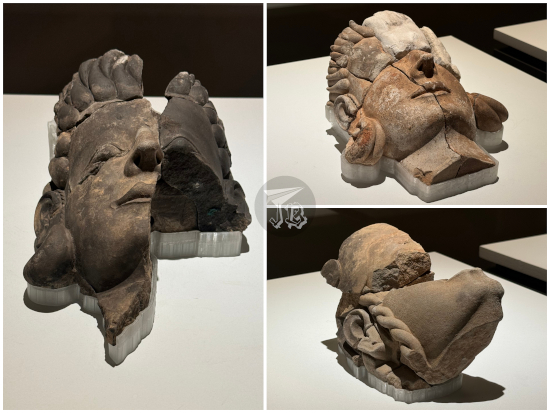
Before I left the archaeological museum, I dropped by the new “archaeological news” room (Sala de Novedades Arqueológicas). Currently, it holds the exhibit Rostros del Turuñuelo. Los relieves de Casas del Turuñuelo. Guareña, Badajoz – a name larger than the exhibit itself: “The Turuñuelo faces. The reliefs from Casas del Turuñuelo, Guareña, Badajoz”. The Turuñuelo, or Casas del Turuñuelo, archaeological site corresponds to the Tartessian culture – a mix of Palaeohispanic and Phoenician traits which flourished in the south and east of modern Spain (and a bit of Portugal) between the 11th and 5th centuries BCE.

The exhibit is a collection of five faces dating from the late period, found within the ruins of a two-storied building. It seems that the building and everything within were destroyed, set on fire, and buried intentionally. It is possible that the faces found belong to sculptures that can be recovered amongst all that material. The faces, discovered in April 2023, are the first and only human representations associated to the Tartessian culture.

The faces from Turuñuelo

After the visit, I went to have lunch. There is this place I have wanted to visit for a while and it has never panned out. I would have actually wanted to have breakfast there, but whatever – this was doable and convenient. Located near the French Institute, it is a crêperie called Prep’ La Crêpe – it would make sense to think they’re French, but in reality they belong to an English franchise. I ordered a basil crêpe classique (melted cheese, mozzarella, tomato, basil and Mediterranean sauce), a Kick-start smoothie (orange, carrot and ginger), and a Belgian (black) chocolate crêpe sucrée for dessert. All in all, it scratched an itch that I had had for a long time, and it was not bad. A bit on the pricey side, I’d say, but what is not expensive these days?

Prep' la Crêpe lunch

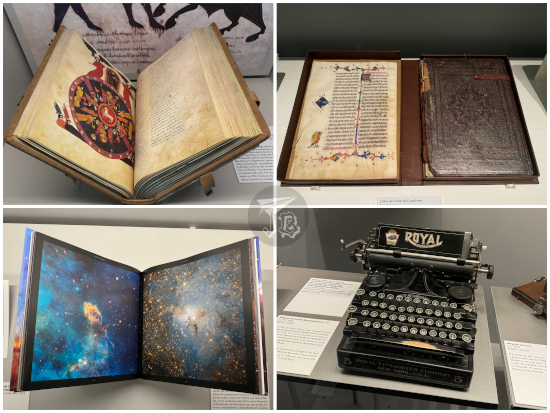
Afterwards, I still had a bit of time so I decided to go into the National Library Biblioteca Nacional de España, where they had transformed the book museum into something called “Hell and Marvels” El Infierno y las Maravillas, which runs through the history of printing and knowledge (marvels), then the history of book banning (hell). The exhibition continues with thoughts on how information is preserved, in books and other formats. Finally, the museum is hosting two special exhibits, one around the writer Gonzalo Torrente Ballester Gonzalo Torrente Ballester, la travesía de un creador, and a collection of historical documents belonging a noble family El archivo del Conde de Orgaz. Una ventana a la historia. The archive was really interesting, with a lot of privileges given to the family by successive kings of Spain. The former count was a member of the Friends of the Library, and the exhibition is a homage to him, aside from showing documents dating back from as far as 1220.

Hell and Marvels, National Library

I then went back to the archaeological museum Museo Arqueológico Nacional for the second visit, with another long title Il Pugilatore y la escultura monumental en el Mediterráneo Occidental Antiguo: Cerdeña, Baleares y la Península Ibérica “The Boxer and monumental sculptures in the ancient Western Mediterranean Sea”. The sculpture Il Pugilatore, one of of the Nuragic giants found in the Mont’e Prama archaeological site in Sardinia, Italy. This ambassador giant, who travels the world to introduce people to his culture, is called Manneddu, and he is the statue in best conditions. He would have had a glove in his hand, and a dagger pointing forward, and his chest would have been painted red.

Il Pugilatore

The guide explained that these sculptures – archers, warriors, wrestlers and boxers – were supposed to be armed, but no weapons from either the period or the culture have ever been found. The giants were found, purposely moved and destroyed, in a necropolis for young men. The sculpture also had “little brothers” with the same poses, made in bronze, which have been preserved. That is how the archaeologists know the different weapons and stances they had. The giants are considered the first monumental anthropomorphic sculptures in the coasts of the western Mediterranean Sea, and the only ones in Sardinia.

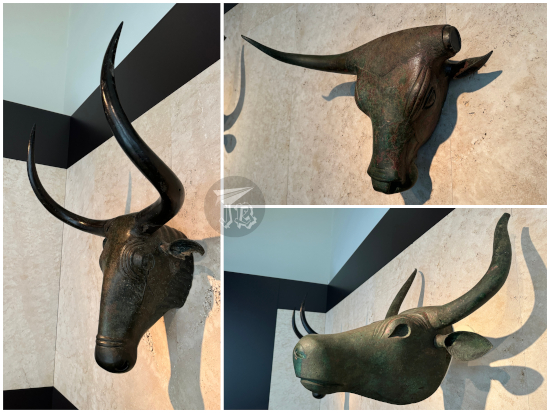
We also heard about the similarities between the Nuragic towers, which were used for water management and as meeting points, and Talayotic ones in the Balearic Islands. Then, the guide ended up talking about the bronze bull heads that represent Talayotic cultures, and insinuating that they might have been brought from somewhere else…

Talayotic bull heads

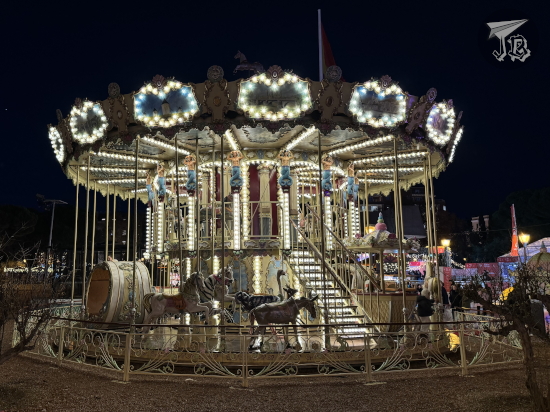
The visit ended there. I then wandered around the museum for a little longer, then checked the Christmas market – and a classical merry-go-round similar to what I rode the previous week. Since it was dark already, the lights were on, but it was raining on and off, so the weather was not nice enough to wander around for long. Thus, I headed to the train to get home.

Classic Merry-go-round in a winter night

11th December 2024: CBA, hotpot and lights (Madrid, Spain)

Since I was meeting my sibling for the yearly event of Naturaleza Encendida in Madrid in the evening, I decided get there early and make the most out of the day. As I arrived, I headed to the Círculo de Bellas Artes (literally “Fine Arts Circle”). The CBA is a sort of NGO dedicated to culture and the arts. Its headquarters host many activities such as exhibitions, theatre plays, concerts, lectures… The building was designed by Antonio Palacios, one of my favourite architects. It has seven floors, some of them used for events, others for offices. There is even a small theatre.

The CBA was running an exhibition called “Messenger Species” Especies Mensajeras, by artist Álvaro Soler-Arpa. It is a collection of pieces created from animal bones and items found in dumps. Born in Gerona in 1974, Soler-Arpa is a multifaceted artist who does publicity illustration and creates distressing sculptures using animal bones as its medium to make the viewer to think about waste and pollution. This exhibition of modern art is described as “ecological art for reflection”. I thought that it could be either really good or a holier-than-thou approach, but my curiosity was piqued.

The exhibit collects selected pieces from four series of sculptures: “Toxic Evolution” (Evolución tóxica), “Devastated Nature” (Naturaleza devastada), “Design-methastasis” (Diseño-metástasis) and “Sculptures from the End of the World” (Esculturas del fin del mundo). It was… disturbing, but in a good way. It did not feel preachy. The idea is that nature is affected by the consumerism in current society, but not dying – adapting to it. The imagined futuristic animals are a warning sent through time – nature is resilient and it will survive. Us humans? Maybe not if we do not get any better.

Álvaro Soler-Arpa's Especies Mensajeras

There was another exhibition in the building about the consequences of war, but I decided I could not stomach that one. However, I had the access ticket, so I could take the glass lift to the famous terrace of the building – the one that kicked off a trend of opening terraces in Madrid to watch the skyline while having a drink. It was too cold and too closed to have anything, but I did get a nice view, especially of the Palacio de Telecomunicaciones and the Spanish language Institute Instituto Cervantes, both designed by Antonio Palacios too. The terrace is mostly flat, with a bar and an impressive sculpture of Minerva made in bronze by Juan Luis Vassallo. Minerva – Roman goddess of wisdom and art – is the symbol of the CBA. There is also a smaller and higher structure that looks like it could hold an even better view, but that was closed off.

Skyline from Azotea Círculo Bellas Artes

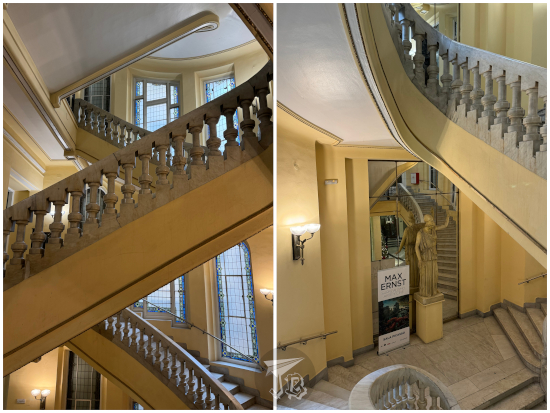
The CBA building has many cool spaces, such as the ball room (Salón de Baile) or the colonnade room (Sala de Columnas). However, my favourite part of the building are.. the stairs. They are designed as a double staircase with mirrors at the landings, and coloured windows alongside the steps. One of the sides is less bright now, because a building was erected and blocks the sun. I still find the staircase superb, so I hung around there for a while until the security guard gave me a weird look.

Stairs Círculo Bellas Artes

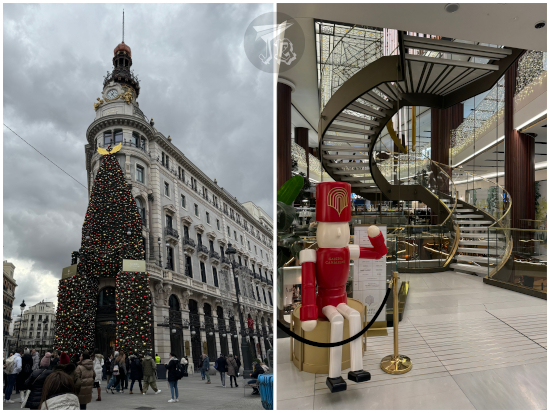
I left the CBA and walked down the street Calle Alcalá and stopped at Galerías Canalejas just to see what kind of decorations they had. It turned out to nutcrackers and elves inside and a huge Christmas tree outside. I still cannot afford anything they sell there.

Chrismas at Galerías Canalejas

I continued down towards the square Plaza de Oriente, where there was a classic merry-go-round – empty and ready to be ridden. Thus, since I have no shame, I went on it. The salesperson was incredibly kind, since I was the only rider – and an adult at that – and yet they directed me to a horse which moved up and down and showed me how to climb on it.

Then, I backtracked to the shop Turrones Casa 1880 in the street Calle Arenal, which hosts a small Museo del Turrón. Turrón is a typical Spanish confectionery eaten mostly at Christmas. It is mainly made out of processed almonds, and 1880 is probably the most famous brand – and it prides itself on the most expensive one. I am not a fan of turrón, to be honest, but it was almost Christmas, and if I was ever going to do it, that was the right time frame. The museum is mostly an audiovisual in a decorated cellar, with a photo-op, but the staff was really nice.

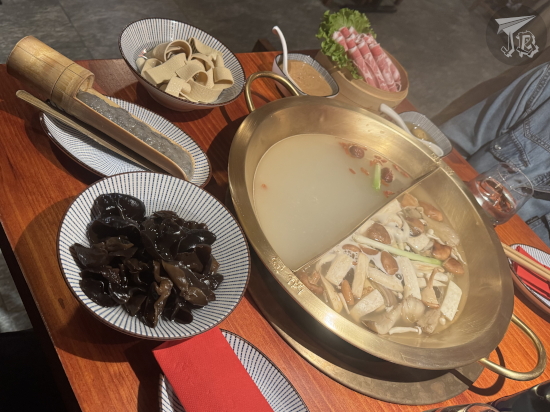
At 14:30 sharp, I met up with my sibling for a restaurant that I’ve been wanting to try for a while 壹锅火锅 Hotpot de Sichuan. Hotpot [火锅, huǒguō] is a Chinese type of stew based on a stock or soup that is kept simmering in the table itself, and you just grab the raw ingredients and dip them in the broth to cook them – imagine a fondue with broth instead of cheese. We ordered a menu for two, a pot with two broths, one mushroom-based and one meat-based. The dips were spring onion, coriander (which was not used, because I hid it), shrimp mince, thin beef slices, tofu stripes, Chinese black mushrooms, cabbage, and rice noodles, along with two sauces – one slightly spicy, and my beloved sesame and peanut sauce. The food was great, but at 15:40, the waiters popped up to tell us that they wanted to close the restaurant, and then stood up next to us until we finished and left. It was more than a bit awkward, so we hurried up to do so. While the food was great, the situation spoilt our experience a little, I think. We were still eating, not slouching around. I am not sure I would want to go back…

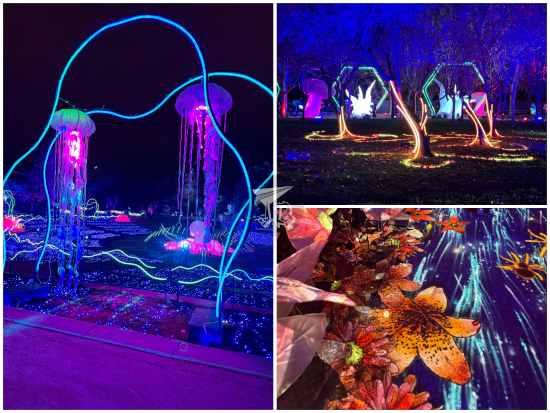
Afterwards, my sibling had to do some shopping, so we spent a while going up and down some shops and a department store, before we headed out to Naturaleza Encendida in the park Parque Enrique Tierno Galván. This is a yearly light show organised in Madrid parks – it used to take place in the Botanical Gardens, before it was moved to a larger area. The 2024 edition is titled Naturaleza Encendida: Life.

Naturaleza Encendida Life

To be fair, I was a little bit disappointed, as “Life” turned out to have mostly figures reused from the last few events. Though the organisers tried to build a narrative of water, land and air topics, the novelty had worn off. It was not bad, but the show keeps getting more and more expensive every year, with fewer and fewer perks for the VIP tiers. Furthermore, the new larger location does not imply more light sculptures – they’re just spread farther apart so they can fit more people without it feeling crowded, so it simply takes longer to walk it through. This has its advantages and disadvantages – it was good last year when we had to go on a weekend but this time around it just felt… colder. They also tried to give the whole thing an ecologist spin, and this time it did come out preachy… I mean, it is a show of lights, which technically could count as light pollution, without any actual… purpose… but charging you to watch pretty lights.

Naturaleza Encendida Life

Naturaleza Encendida Life

That was the end of the day, and we just headed home afterwards, but aside having to wait for the train for over half an hour, nothing to report on that end.

2nd December 2023: Iron balconies and croquettes (Madrid, Spain)

I wanted to do a full day in Madrid this weekend, but ticketing did not align, thus I had to organise two half days. So on Saturday morning I set off for an 11:00 visit to Frontón Beti-Jai. A frontón is the court where games of Basque pelota (pelota vasca) are played. The term refers to a number of sports that use a small hard ball which is hit by the players so it bounces off the vertical walls of the court. Depending on the specific variety, the ball can be hit with the hand, a racket, a bat or a type of basket, and it can bounce on one or two walls of the frontón as long as they are at right angles with each other. Basque pelota is mainly played in Spain and France, and it is also popular in some Latin America countries. Though it was originally included in the 1900 Olympics, it has only been played as an exhibition sport and never in competition.

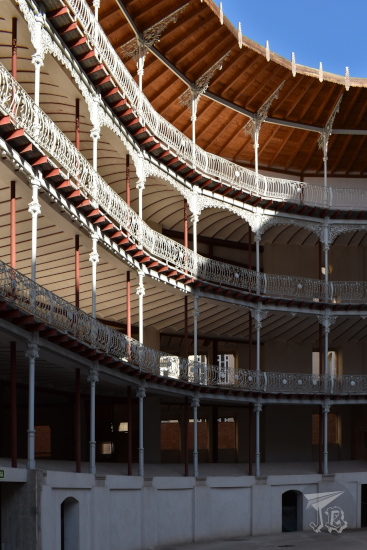
In the 19th century, Basque pelota was a popular and lucrative business in Spain, especially in Madrid. In 1891, businessman José Arana commissioned architect Joaquín Rucoba to build a frontón in Madrid, “similar to but better than” the one in San Sebastián, the original Beti-Jai. The capital’s Beti-Jai (“always party” in Basque) was placed in the district of Chamberí, witch construction starting in 1893. The architect designed a white-and-grey outer façade in an eclectic style with Neoclassical reminiscences in order to blend with the mansions in the area at the time, and a red-brick Neomudéjar secondary or side façade. The inner wall that stands behind the main entrance is also Neomudéjar. The playing court is plain concrete, and he whole area is shaped as a half-ellipse. There were long-lost stands on the ground, and three upper stories supported and adorned by cast iron balconies and columns, with a wooden roof on top. The decoration on the balconies is different for each floor.

The frontón opened in 1894 and it hosted games until 1919 – it is said that the crackdown on the betting systems and loan sharks caused Basque pelota to slowly fade out of fashion. Throughout the period and afterwards, it also had some alternative – and creative – uses, among them aeronautical experiments by renown engineer Leonardo Torres Quevedo, car workshop (a few times in different years), motorbike shop, political hotspot, even industrial bakery. The stands were eventually walled off – which protected the ironwork. Though both in the late 1970s and the early 1990s the building was “declared” as protected, the structure was eventually left to rot. The building was bought and restored by the Madrid Town Hall between 2010 and 2019, finally attaining protected status in 2011. It is the largest and oldest frontón standing.

Frontón Beti Jai inner façade and stands

I like cast iron architecture a lot, which is why I signed up for this Pasea Madrid guided visit. We did not get a nice and knowledgeable guide this time, so I mentally checked out. She was not just nervous, she read the whole visit out of a phone, gave some wrong or plain false information, and relied on people “knowing things” and “having visited places”. I wandered around taking pictures and approaching the group periodically trying to fish out any interesting bit of information, until the guide grew tired and kicked us out when most people decided to just stand in the sun, even if there was some time left. People who had been listening to her had barely any time for photographs.

Fronton Beti Jai Stands.

After the frontón, I had a reservation for lunch a restaurant part of a franchise specialising in croquettes, is called Solo de Croquetas Zurbano – a pun between “only croquettes” and “croquettes’ solo”; Zurbano is just the street. It has been a bit of a buzz lately so I was really curious about it. The place was organised in three floors – a bar on the ground floor, a loft-like seating on the first floor and a bigger restaurant-like area in the basement.

Though the Internet said the restaurant opened at 13:00, I was offered a reservation at 12:45, which I took because I did not want to be wandering around in the cold for too long. I was not extremely surprised though when I popped by at the reservation time and it was indeed crossed. I ended up wandering for a while before 13:00 came up and I could sit down. I decided to try a basic “croquette tasting”, which includes six savoury croquettes two sweet ones, and a drink. There are three lists to choose from, and I took the B-set:

  • Rulo de cabra con pimiento caramelizado, goat cheese roller with caramelised red pepper – happy to report the pepper was barely distinguishable, just added some colour to the filling. Very cheesy, cheese is always good.
  • Boletus con trufa, boletus with truffle. Lots of mushroom, little truffle, but okay. I’m not that much of a truffle fan anyway.
  • Provolone con tomate seco y orégano, provolone cheese with dry tomato and oregano. There is never such a thing as too much cheese.
  • Cachopo; a cachopo is a typical dish from the North of Spain that consists on two beef steaks with a filling between them, and everything breaded, which I ate once in Astorga. This one was weird.
  • Cecina con puerro y queso gorgonzola, beef jerky with celery and gorgonzola cheese. Probably my favourite out of the savoury ones.
  • Sobrasada de Mallorca con queso Mahón, sobrassada (cured pork sausage filling) with Mahon cheese. All right.
  • Croqueta de Oreo con chocolate blanco, Oreo and white chocolate. Rather good, which is surprising considering I don’t even like Oreos…
  • Croqueta de Cheesecake con frambuesa , Cheesecake and raspberry. Surprising, to say the least.

Solo de croquetas tasting

All in all it was good. The croquettes were decently sized and had distinctive flavours. The set felt a bit scarce though. Not that I went hungry, but I could have done with another couple of croquettes. I think it is what they are counting on – the tasting is okay, price-wise, considering the novelty (18.50 €), but if you want anything else, the meal will get very expensive very fast. I guess it is noteworthy that all croquettes are gluten-free, and the tasting has a lactose-free set and a vegan set.

I left the restaurant and walked towards the train station. On the way, I was distracted by the small Christmas market, more precisely by the a gorgeous 1900 merry-go-round that had been installed among other attractions. I had a bit of a walk around to check out the stands and then I went to wait for the train – which was, predictably, delayed.

Carousel in Colón Square

14th December 2021: Navilandia (Guadalajara, Spain)

Back when I visited Torrejón de Ardoz in November, they were already preparing their Christmas display, which is famous in the area. In a smart way to curve attendance though, this year the town hall decided to charge non-locals to enter. Towns around quickly noted this and decided to organise their own magnificent displays, and in the case of Guadalajara, give a hand to the people who live off the carnivals and fairs, as most regional summer festivals have been cancelled for the last two years. They called it Navilandia (Christmasland), the biggest “Christmas Theme Park” in the region.

The “theme park” is divided in several areas. The first one is the palace Palacio del Infantado, its gardens and the adjacent square. The Palace features the same Christmas tree as last year, and the gardens have been decorated with lights, Disney characters, a Zeus sculpture, music and… dinosaurs. I have no idea what dinosaurs have got to do with Christmas, but you won’t hear me complaining about dinosaurs. They are called the magical gardens Jardines Mágicos del Infantado. There is also a small flea market.

A gothic façade with a Christmas Tree made out of green and gold lights in front, along with some more decorations: Felices Fiestas, another tree, a reindeer made out of light

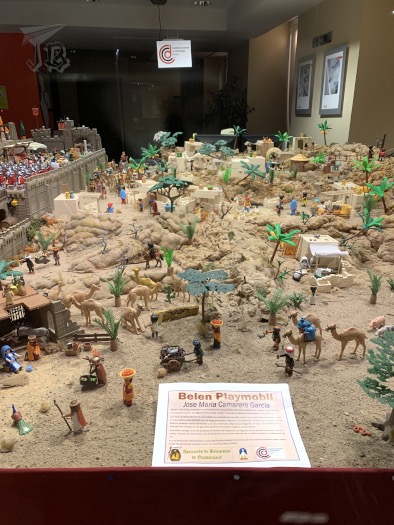
As I walked up Main Street I saw the traditional Playmobil Nativity they always set in one of the shops. However… I’ve never been able to spot the actual Nativity scene here. It is rather cool, though.

A Nativity made out of Playobil figurines, the stable is on the left and a bunch of toys are coming towards it through the desert. There a lots of dromedaries.

The second “Christmas hotspot” is the town hall square Plaza Mayor had a tasteful light decoration, a childish representation of the Three Wise Men, and a very beautiful – and lit up – carousel. I really wanted to ride it, but there were too many toddlers. It would have looked… weird. I need to find out when it closes so I sneak in after the kiddies have gone home (≧▽≦).

A caroussel with bright lights on in a square. Hanging above the square there are lots of lights and stars in gold colours. There are also four Christmas trees

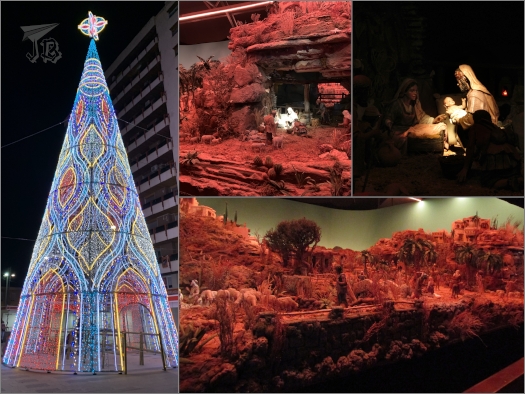
Third spot was half-closed but that is okay. The square Plaza de Santo Domingo hosts another flea market, that was not open – they are setting three rotating markets there, basically one each weekend, and we were between them. There was a big walk-in Christmas tree and the “monumental Nativity” there.

Collage: A Christmas tree made out of eye-shaped lights in blue, purple, red and yellow. A picture of the classical nativity with realistic figures. The Holy Family is illuminated in white - Joseph is placing the Child on a crib that Mary is holding.

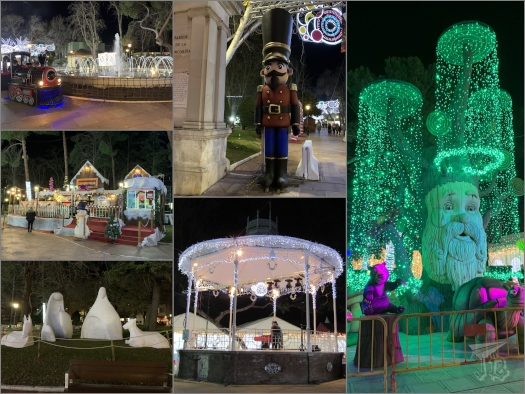
The final area extends along the parks Parque de la Concordia and Parque de las Adoratrices. The entrance is flanked by two nutcrackers; it hosts a talking tree, lights, food trucks, yet another flea market, and rides that again… are only Christmassy by name. There is another Nativity, this time an “abstract one”, a cute train and a “Polar Express” ride, some lights and… a “talking tree”, which broke into telling some tales out all of a sudden. Then, there was a bunch of rides, but they looked like your average travelling carnival rides, and I was not going to go onto any of those, so I made my way back. Also, I was strong and did not buy any cotton candy nor similar treats, though I was tempted to get some roasted chestnuts.

Bizarre Christmas decorations and motifs in the park: A giant nutcracker / soldier, an abstract nativity, some gingerbread-house-shaped shops, a Polar Express mini train, and a... something that looks like a tree with a face on the trunk and leaves made from green lights.

It was weird because for the second time in a couple of months I’ve been asked if I’m an actual photographer. True, this time it was a drunk guy who then proceeded to yell fascist slogans. I decided it was the right time to call it an evening and go home for the day…

7th – 10th February 2020: Paris (France) for DIR EN GREY & BABYMETAL

I organised a weekend in Paris because two concerts conveniently aligned on Saturday and Sunday, and I had Friday free, as well as Monday morning. It was a great mental break that I needed badly. ETA: There were rumours about a flu from China, and some of the airport workers were wearing masks. We had no idea what was about to hit us…

7th February 2020: Through the Strikes

I had found quite a convenient flight that left at 9:00 on Friday for 35 €, which was a great deal. At first, I did not understand why it was so cheap. It turned out, the plane came from South America and it was on a Madrid stopover – so it was pretty much full already. It was a huge aircraft with on-board entertainment. That came in handy when the pilot informed us that we were going to have to wait something between one and two hours to be able to take off due to the air controllers’ strikes in France. But at least we were flying and I had films to watch.

We took off at about 10:00 and our big plane made the jump in just one hour, as opposed to the 2h10 minutes of estimated travel, which meant we were almost on time! Of course, this did not sit well with the strikers, who had us wait first for the parking spot, and then for the stairs to deplane. I finally managed to leave the airport and get onto the train so I reached downtown Paris around 13:00. I wanted to inspect the damage caused to the cathedral Cathédrale Notre-Dame de Paris by the 2019 fire. My first impression, looking at the main façade and towers, was optimistic, but as I walked round the building, I could see the real damage and reconstruction efforts. Furthermore, it still reeked of burnt wood, probably because they were still pulling out debris. My optimism did not linger long, I’m afraid.

Collage of Notre Dame showing the cranes and scaffoldings in the repairs

As it was sunny, I decided to walk to the Sainte-Chapelle (Holy Chapel) and see its windows in good weather. The Sainte-Chapelle is a small two-level chapel inside the Justice Palace Palais de Justice de Paris in the Île de la Cité, smack in the middle of Paris and not far from Notre Dame – actually, both of them belong to the same Unesco World Heritage Site, Paris, Banks of the Seine. The chapel has a lower early Gothic level, and an upper level with impressive stained-glass windows which I love. As the sun was shining outside, the views were stunning.

Collage. Sainte-Chapelle: outside showing the spire, inside with some colourful windows and pointed arches

Collage of the upper floor of the Sainte-Chapelle. It shows different angles of the long gothic windows, covered in colourful glass

The weather was great – especially considering February in Paris, which is always more to the north than I mentally place it. Unfortunately, the forecast for the following day was quite miserable, and thus I decided to just walk along from the Île de la Cité towards the Arc de Triomphe (some 5 km away). On my way, I walked by the Louvre, Les Tulleries, the Grand Palais, the Petit Palais, the Alexander III Bridge, and into the Avenue des Champs-Élysées – the Banks of the Seine that the Unesco declared World Heritage.
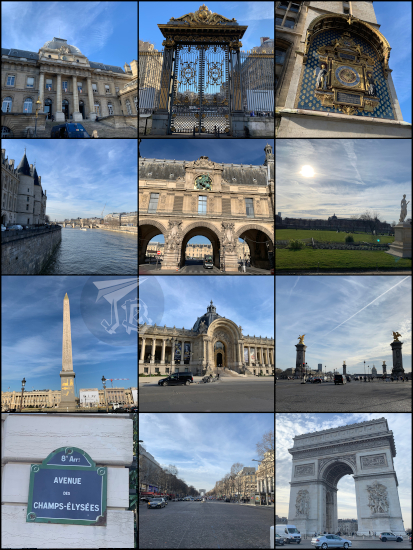
Collage with different landmarks of Paris - the river, neoclassic palaces, Luxor obelisk, Champs-Élysées.

Finally I reached the Arc de Triomphe, which honours the fallen in the French Revolutionary and Napoleonic Wars. It was commissioned by Emperor Napoleon in 1806, and completed in 1836, and you can actually climb it, which I might do some day. From there, I took a train towards Montmartre, where I had booked my hotel. I dropped off my luggage and walked up Square Louise Michel, a sort of urban park which leads up to the church Basilique du Sacré-Cœur (222 steps). There was a pretty carousel Carrousel de Saint-Pierre, and from the square, I could watch the Eiffel Tower Tour Eiffel against the sunset from the lookout Vue de Paris.
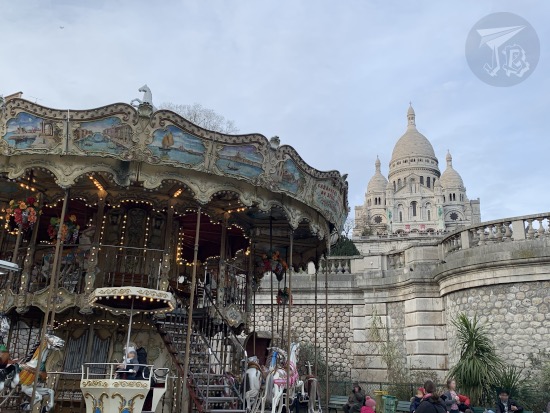
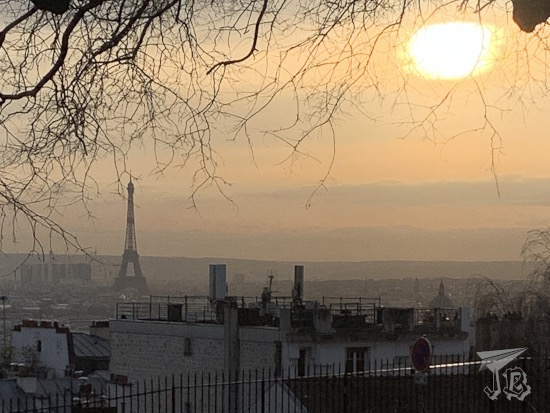
A view of the Sacre Coeur with a classical carousel in front of it

A profile of the Eiffel Tower in a blurry sunset in orange tones

I went back to the hotel for a while during twilight. On the way, I bought a snack in a nearby supermarket for dinner as I waited for the evening to get dark and the lights to come up. When it did, I took my last adventure for the day, and walked off to see the Moulin Rouge while I listened to KAMIJO’s song of the same name. It was a few minutes’ walk away from my hotel, and Moulin Rouge [ムーランルージュ] is one of my favourite songs of his. Since the man is obsessed with France, he has a few songs that fit my weekend. Truth be told, I did consider dinner and a show there, it is after all the most famous cabaret in the world. However, it was a bit expensive and I had read quite a few reviews about bad seats if you are alone. I did not want to waste money, and I did not know how tired I would be that evening in the end – and to be brutally honest,I really had not felt like packing fancy clothes for the evening.

The Moulin Rouge cabaret, all lit up in bright red for the night

8th February 2020: Louvre and DIR EN GREY

The weather forecast was accurate, and despite the lovely weather on Friday, Saturday dawned stormy and dark. I decided to go to the Louvre Museum Musée du Louvre, even if I had been there before. It is after all one of the greatest museums in the world.

The Louvre holds so many pieces (over 600,000) that it would be impossible to describe them all, but for me, its core is the Winged Victory of Samothrace, a Greek sculpture from the Hellenistic period, around the 2nd century BCE, and my favourite piece of art. The Louvre is a national art museum, which opened in the post-revolutionary France in 1793. It exhibits around 35,000 items – Egyptian antiquities, Sumer and Assyrian pieces, Greek, Etruscan and Roman items, Islamic art, neoclassical and Baroque sculptures, a collection of objets d’art (Decorative arts), paintings, prints, drawings… It is located in the former French Royal Palace of the same name.
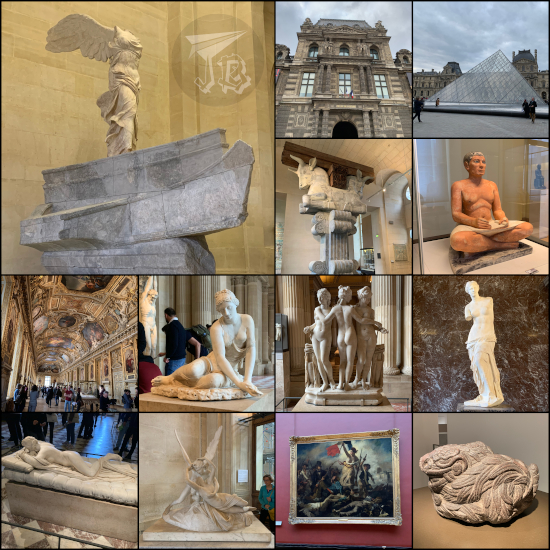
A collage with several Louvre pieces of art - Winged Victory, sitting scribe, the three graces, Diane washing her hair, Hermaphroditus sleeping, Psyche and Eros kissing, Liberty guiding the people, Venus de Milo

I wandered there for a few hours and I might have lost my way in the galleries a few times. In the end, I managed to (re)visit all the artefacts and artworks that I wanted. Because there are hundreds of thousands of items, but I must always see the Sitting Scribe, the Borghese Hermaphroditus, Canovas’ Eros and Psyche, and the remains of the Gates of Istar. I had a bit of a headache, so I eventually went back to the hotel to get some rest and prepare for the DIR EN GREY concert and VIP experience in the Élysée Montmartre live house. DIR EN GREY or “Diru” is a Japanese heavy metal band known for its dark themes and scenography that I thought I needed to check at least once (the final verdict was that I don’t need to repeat the experience, but it made for a nice mental break). The band has remained stable since its formation in 1997, and it is composed by Kyo [京] (lead vocals), Kaoru [薫] (rhythm guitar, backing vocals), Die (lead guitar, backing vocals), Shinya (drums) and Toshiya (bass, backing vocals).

A dark stage with a drum set. Letters projected on the screen behind the stage read Dir en Grey Tour 20 This Way to Self-Destruction

Setlist:

    1. 絶縁体 [Zetsuentai]
    2. 人間を被る [Ningen wo Kaburu]
    3. Rubbish Heap
    4. Devote My Life
    5. 軽蔑と始まり [Keibetsu to Hajimari]
    6. Celebrate Empty Howls
    7. 赫 [Aka]
    8. Merciless Cult
    9. Downfall
    10. Values of Madness
    11. 谿壑の欲 [Keigaku no Yoku]
    12. Ranunculus
    13. The World of Mercy
First encore:
    14. Followers
    15. THE DEEPER VILENESS
    16. 詩踏み [Utafumi]
Second encore:
    17. Sustain the untruth

Listing of all the concerts in the Dir en Grey 2020 tour

The concert was the final of DIRU’s 2020 European Tour TOUR20: This way to Self-Destruction. When I walked by the venue on Friday evening, around 18:00, there was a small number of people queueing already. I did not care enough to queue all day, and I had a VIP ticket with early entry, so I just headed to the line about 15:00. When the queues were separated and organised, around 16:30, I was VIP number 42. The weather was miserable, and I could have totally skipped the downpour while waiting, but I was lucky enough to be against the live house and not in the middle of the boulevard, where the General Admittance queue was. Doors opened at 19:30 for GA, and the VIP experience was held beforehand. The VIP queue started getting in around 17:30. As present we got a VIP pass and an “exclusive VIP only merchandise item” which turned out to be a scarf – very appropriate with the weather. The experience itself was a group photo with the band. There were five cushioned chairs for the fans, and the band stood behind. They did not say a word, nor interacted with fans in any way, not even acknowledging a hello or a thank you.

Afterwards, I headed for the hall, and I found an almost-barrier spot in the left area, on the second row. The people in front of me let me grab the barrier between them so I had something to hold on while I waited. The special guest was a DJ, who was more focused on getting recorded by his buddy on the phone than mixing music. The main show started a little after 20:30.

DIR EN GREY’s music is quite powerful, with a heavy focus on strings and drums. They also have a huge flare for theatricality and they enjoy the shock factor as part of the aesthetics. The singer, Kyo, donned a Joker-like make-up appearance, with a fake-suicidal attitude on stage, using the microphone to mimic stabbing his chest, or the wires to hang himself. It became a bit disturbing because it was repeated more than once. The act also felt rather distanced, there was very little interaction with the fans. At some point, a pick flew in my direction and the person behind me actually felt me up to try and find it in the folds of the coat I had tied around my waist. That was probably even creepier than the act.

The guitars and bass were tremendously powerful, and the drumming was amazing. The crowd was extremely loud, and the singer, Kyo, later confessed that he had been pretty exhausted and burnt out from the tour, which maybe explained why the concert felt so distanced. The encores were the probably best part of the concert, the part that felt more real and relaxed. After the concert was over, I headed off to the hotel to catch some sleep. Since I remembered that the area had felt a bit rough when I was there in 2014, this time over I wanted close accommodation so I could get back quickly without needing to use the underground.

9th February 2020: Destroy the Bastille!

Sunday morning was around 2 ºC, and it was windy. I lingered in bed for a while to recover from the previous evening, and then I headed out – I should have brought the merchandise-scarf with me! I saw the Place de la Bastille, where the revolutionary prison used to stand. In the middle of the square stands the “July column” Colonne de Juillet, which commemorates the Revolution of 1830 (which is not the “famous” French Revolution, which happened between 1789 and 1799). A few minutes away, in the Square Henri-Galli, I came across the base of the tower Tour de la Liberté (Freedom Tower), which was unearthed while building the first metro line. There are only a few stones remaining from the foundations, but I’ll take my fun wherever I can – so I stopped and used my music player to find another KAMIJO song, Bastille, just because I could.

Monument to the French Revolution

A few brick stones forming a circle, considered the last remains of the Bastille

It was too cold to wander, but I had a great plan. I headed off to the science museum Galerie de Paléontologie et d’Anatomie comparée (Palaeontology and Comparative Anatomy Gallery), which was a short walk away. I had read about it and was curious. To be honest, I’m still trying to decide whether it was amazing, or the materials nightmares are made of.

The museum was founded in the 19th century, and it keeps the atmosphere – and the charm – of the old exhibitions. There are stands and wooden cases, and the smell of dust and old paper. The first floor holds a “Cavalcade of Skeletons” – the whole floor is occupied by preserved skeletons of mammals and birds. In the glass cases along the walls, there are taxidermy specimens, preserved animals and dissected specimens. In the far corner, there is “gallery of monsters” with natural oddities. It was enchanting, but at the same time deeply disturbing – especially the male human figure displaying muscles and blood vessels, with a vine leaf on his groin.

The second floor hosts the dinosaurs and other fossils, including a very cool toothed whale, giant crocodiles, a Bernissart iguanodon, a diplodocus, shark teeth… Most of the fossils are either casts or reconstructions – I swear I’ve seen that Irish elk at least three times before. Also, the T-Rex skull was adorably flawed, as it was imagined to be in the 19th century.

The third floor is… ammonite-land. There were cases upon cases of ammonites in different shapes, colours, rocks and materials.
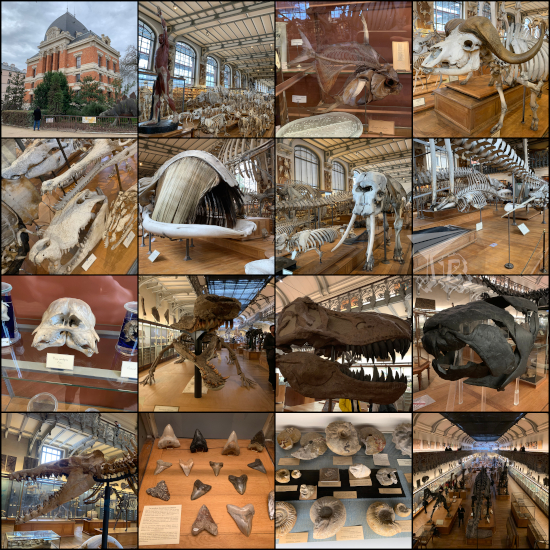
Shots of the museum. Skeletons of animals - fish, oxen, crocodiles, elephants, whale. Fossils: Dinosaurs, fish, toothed whale, shark teeth, snails

After I was done with the museum, I decided it was too cold to wander the neighbouring Botanical Garden. Instead, I headed off to yet another one, the Musée national des arts asiatiques Guimet – the National Museum of Eastern Arts or Museum Guimet, which holds pieces of art from Cambodia, India, China, Japan, Korea and so on. There was a gorgeous dancing Shiva sculpture, collections of religious artefacts, calligraphy, samurai armours, even modern art and clothes inspired by the Far East. It was a really cool museum I had recently found about and was happy to visit.

Different pieces in the museum: Dancing Shiva, sitting Buddha, Calligraphy in the shape of a dragon, elaborate kimono, samurai armour, Indian goddess

After leaving the museum, I walked towards Trocadero to take the underground. I made a small detour to have a look at the Eiffel Tower Tour Eiffel, and saw a bunch of peddlers playing shell games with tourists. Someone lost about 400 €, I really hope they were in on the game.
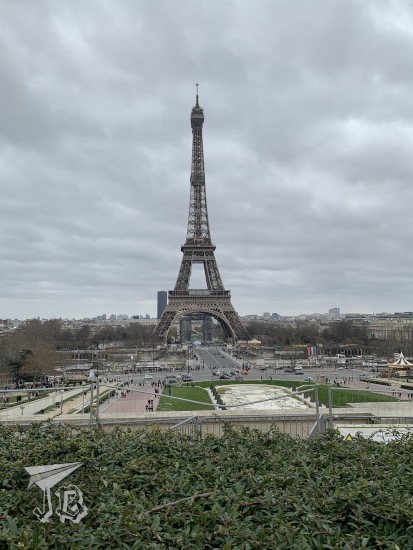
The Eiffel Tower in front of a cloudy sky

Since it was too cold to continue walking around to find something to eat, I decided to get take-out, and I headed back to the hotel to get ready for the BABYMETAL concert. I had never listened to them before, but they are a sensation, the basic ticket was not expensive, and two concerts in as many days seemed convenient. They actually played in the same venue as DIR EN GREY on Saturday, so I found out by sheer coincidence on the live house’s website. At that time, I thought “why the hell not?”. Afterwards, they added Madrid to their Europe tour, so if I had known that beforehand, I might have acted differently. BABYMETAL is one of those insanely-profitable Japanese marketing stunts involving cute girls that had never really been in my radar more than in passing.

Notice with the date of Babymetal's concert

BABYMETAL is a product of the “Japanese idol factory”. It was created artificially to fill a market gap. Three girls were chosen to form an act that would mix the idealised cute idea of girl idols with the heavy metal genre. When they debuted in 2010, the term “Kawaii Metal” was coined. One of the girls left in 2018, so there are two main members and and support dancer on rotation. The members are Nakamoto Suzuka, “Su-metal”, the main vocalist, and Kikuchi Moa aka “Moametal” on back-up vocals and screams. The supporting musicians are called the “Kami Band”.

BABYMETAL’s long-awaited European tour is officially called Metal Galaxy World Tour. The VIP tickets sold for around 170€, and did not even entail a M&G, so even if I had had the chance, I would have not even considered them. Despite that, they sold out, along with the show itself.

When I left the hotel at 9:00, the queue had started organising, and the tour buses were already there. I had no intention to queue or try for a barrier. I had decided to sit back and relax, so I reached the venue around 18:45 for the 19:30 concert. There were tons of people waiting to buy merchandise, but I was good. Thus, I just headed to the floor, and found a spot in the back. Since the venue has sort a bit of an arena and some upper stands, there was a wall I could lean against and it was not the end of the room.

The crowd was quite different from DIRU’s, ranging from good ol’ metalheads to families with little girls between five and ten years old with a bizarre range of in-between: people with fox masks, goth and loli dresses, explicit heavy-metal t-shirts (a bunch of those T-shirts were much less kid-friendly than the show… everything you could imagine. I… don’t think most parents knew what they were getting into, and a few of the kids ended up crying.

At 19:30 sharp, the support act started – a German band called SKYND. Their sound was really good, but their lyrics are based on true crime, which makes them a bit on the disturbing side (and very much not kid-friendly). The name of the songs are all serial killers or similar criminals.

Setlist:

    1. Richard Ramirez
    2. Elisa Lam
    3. Katherine Knight
    4. Jim Jones
    5. Tyler Hadley
    6. Gary Heidnik

At 20:30, the BABYMETAL show kicked off with the projection of the Future Metal video as an introduction of sorts. The musical act relied heavily on the Kami Band, and Su-metal carried the weight of the vocals. She spent the whole one-hour concert jumping and dancing while singing, and her voice did not break even once. If she is not lip-synching, she has the most impressive lungs ever. Both she and Moametal encouraged the crowd, making a lot of eye-contact. Su-metal addressed the audience a lot, even – I think – trying French. The concert was non-stop, and it ended up feeling a bit short, but much better than I had expected. The one annoying thing were the daddies putting their babes up on their shoulders in the middle of the floor, when the kids gave clear signs of not caring or were distressed. But it was fun. Not sure I would repeat unless I made it a thing with friends or something, but I enjoyed the act, and had a good time.

Setlist:

    1. DA DA DANCE
    2. Gimme Chocolate!!
    3. Shanti Shanti Shanti
    4. BxMxC
    5. Kagerou
    6. Oh! MAJINAI
    7. メギツネ [Megitsune]
    8. PA PA YA!!
    9. Distortion
    10. KARATE
    11. Headbangeeeeerrrrr!!!!!
    12. Road of Resistance

A group of girls dressed in black dancing in front of a logo that reads Babymetal

I was back at the hotel before 22:00. Thus, I got a good night’s sleep before I left, once again happy that I had taken nearby accommodation.

10th February 2020: No bells of Notre Dame

My plane boarded at 10:00 so I had to leave early for the airport. The weather was rainy again, so I took the underground to Gare du Nord, and then the train to Orly. As I was riding the train, I had a nice view of the Paris at dawn, but the bells of Notre Dame were not tolling, and my inner child was sad about that. Despite issues with the airport security staff, the stupidly-expensive food, and the general unpleasantness of early-morning public transportation, I made it to my plane without actual problems. As it was a big plane again, I settled down to watch Jurassic World during the flight, because I’m a nerd. Going straight into work from the airport was not fun, but it a small price to pay

I only had three days, but this trip was a very welcome getaway, and even if the weather did not help, I got to do a lot of stuff. I had to discard a few plans and improvise due to the weather. However, there is that film quote, “We’ll always have Paris”. After all, I’ll be coming back for the Saint Seiya Symphonic Adventure. ETA: Or so I thought, at the time of writing the article…
28th January 2018: Amusement Park in Madrid (Spain)

I had a friend over for the weekend and she wanted to “do something” so I got thinking. She is adcenturous, so I thought that the Madrid amusement park could be a good idea. The Parque de Atracciones de Madrid was established in 1969. I’ve never been much of a rides person, for two reasons. One, it is one of those things that you take up when you’re young, and when I was young my parents were rather opposed to funfairs and rides and so on (with good reason, to be honest, but that’s another story). Two, I tend to be worried that random rides are going to trigger my headaches, especially when I have to take my glasses off.

For this trip, I decided to wear my contacts, so I actually got to go on a few of the rides. I was mostly happy staying back and letting my friend do the roller coasters though.

I was all good with the ride called “The Jungle”, which turned out not only to have animals, but… different cultural approaches.

I enjoyed the “Zeppelin”, and the sights…

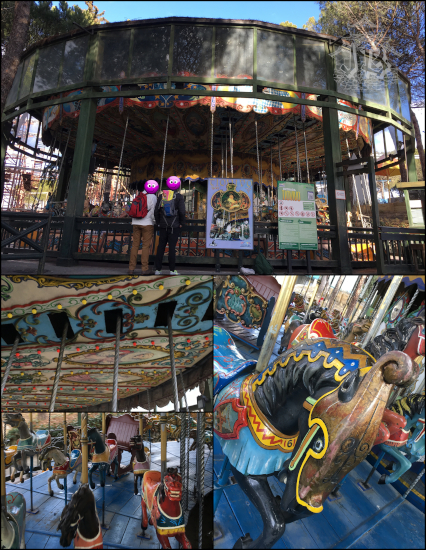
And, of course, I rode the carousel “Tiovivo”. Several times to be honest.

It was low season, so the price was much cheaper than normally. Unfortunately, it also meant that a few of the rides were closed. Then again, I wouldn’t have wanted to go onto anything with water in January…