18 & 19th November 2024: Apocalyptica Played Metallica in Madrid (Spain), so there I went

Planning for this short getaway started on the 23rd of February, when I bought my ticket for the Apocalyptica Plays Metallica Vol. 2 Tour 2024 stop in La Riviera in Madrid (50.50 €). Almost immediately, I headed off to Apocalyptica’s website to buy the VIP Tour 2024 Upgrade (58,90 €). The upgrade consisted on early access, photograph / meet & greet / autograph session (the important part), VIP lanyard, fabric patch, pin and tote bag. Honestly, all that for barely 100 € was a sweet deal. Back in Antwerp for Starset, someone I was queueing with complained that VIP tickets were too expensive for “a broke uni student”, but for me, meeting with the artist, albeit briefly is usually worth it – early entry is a plus, too, because for some concerts I either find a barrier spot or I just have to go to the back. The bundle was dispatched on the 9th of June (according to the email. Do Finnish post offices open on Sunday?) and it arrived on the 18th.

I originally booked a cheap hotel about half an hour’s walk from the venue. Later, I decided that I preferred the more expensive one less than 10 minutes away, so I changed my booking a week before the concert. I did not book there originally because it required prepayment, and my card was playing up..

On Friday the 4th of November I received an email with instructions for the Meet & Greet, which was to start at 18:30, and I should be there at 18:15. All right, I could do that. It was only a matter of waiting.

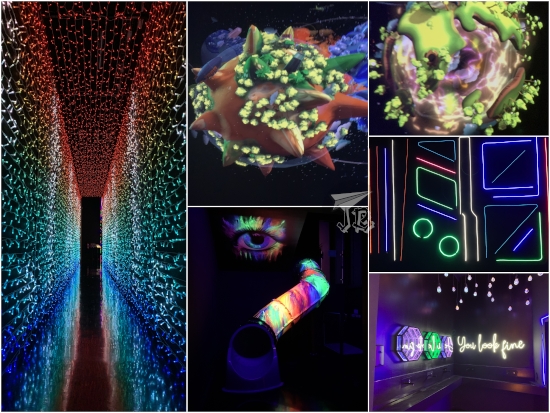
On Monday, 17th of November, I took a morning train to head out to Madrid with some leeway for time because I needed to do some small item shopping. I had to dodge some guys trying to get people to sign up for an NGO, but at 11:40 I made it to my first stop of the day – the light museum Museo de la Luz. I had been putting this visit off to go with someone who had expressed interest. However, I also waited for another exhibit and I missed my chance as it turned out to be only temporal. Thus, I decided to head to the Light Museum on my own – it was also one of the few exhibitions open on a Monday morning.

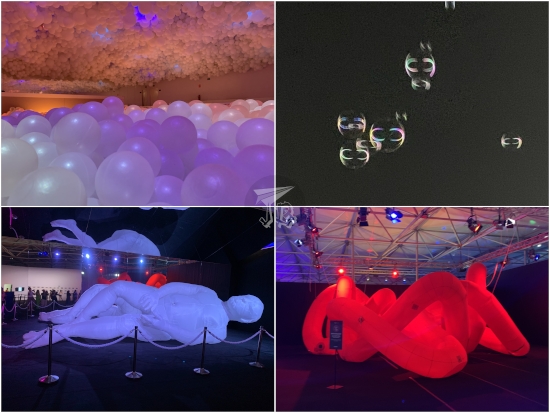
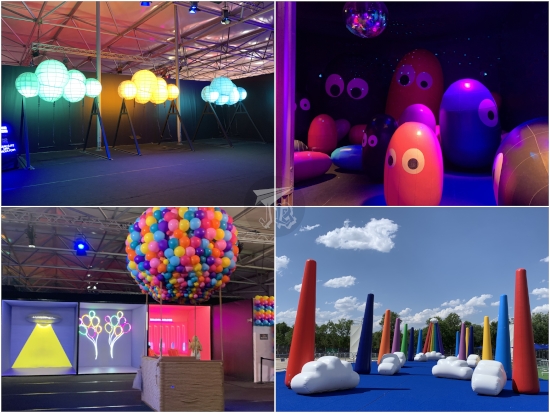
The Light Museum is a modest exhibition with interactive artworks that are mainly made out of lamps, lasers and lights. When you come in, you are given covers for your shoes and a key for a locker – all for free. Then you wait until an attendant takes you in and shows you how to interact with the first artwork “The birdcage” (La Pajarera), a box made out of light and metal that you make change colours with the movement of your arms. Once you know how to “play” with the art, you are left on your own to wander for an hour. At first I thought it would be tight, but the place was small – a bit too small for the price, I thought. I was there for around 40 minutes in total.

There were few people and I was able to check out most of the artwork uninterrupted. The next exhibit is made out of a number of old music festival lights – those that gave a lot of heat from the 90s, which are supposed to be a reference to climate change. Then there is a giant kaleidoscope you can walk in – this one became my favourite. Other rooms or works include a wall of lights that follow you as you move or dance, something with lasers (that I think was broken), some light illusions, a room full of hanging lights, a cube of mirrors and light… At the end there is a wall reading “light museum” in differently coloured lights. When I left, the lady at reception gave me a badge for booking with the official website.


Light Museum Madrid

Light Museum Madrid

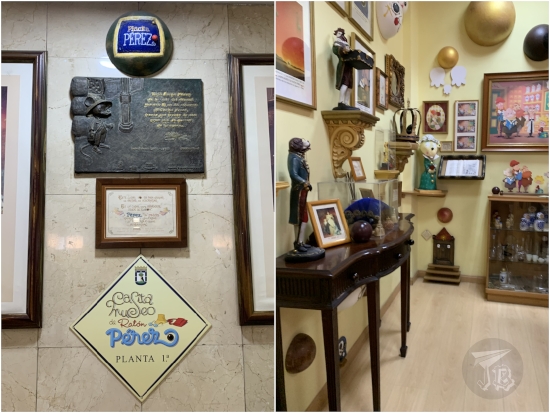
I walked out and headed towards the restaurant where I wanted to cheat the system. I crossed the square Puerta del Sol, where they were setting up the Christmas tree – it was about 45% Christmas. On my way, I walked by the underground stop Metro Banco de España which has a tiny door for Little Mouse Pérez – Ratoncito Pérez, the Spanish equivalent to the tooth fairy. I never remember to check it out when I am around, but I made the connection this time.

I finally made it to the James Joyce Pub – which is technically a sports bar. I was not there for the TVs though. I had a while back found the place looking up places which served English breakfasts in Madrid. The James Joyce prides itself in being an Irish pub and offers Irish All-Day Breakfast (12.00 €) – two pork sausages, two rashers of bacon, baked beans, fried egg, sautéed mushrooms, grilled tomato, blood pudding, chips, two half-toasts and butter. No, I would not survive that for breakfast, so I ordered it for lunch (and dinner), thus tricking the system indeed. Unfortunately, it was really good and authentic, so now I’ve got to come back for the sausages and the shepherd’s pie, so at least twice.
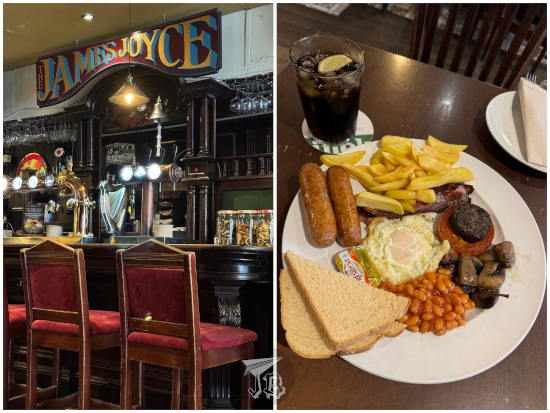
James Joyce Irish breakfast

After lunch, I headed out towards the park known as Madrid Río. The park runs along the banks of the river Manzanares. It covers 121 hectares, and it was designed after to cover the space emptied when the belt road M-30 was rebuilt as an underground tunnel. The original project was created by a team of architectural studios and landscapers, with strong ecological consideration – aiming to help the area recover from the degradation and pollution caused by years of road traffic. The project was carried out between 2006 and 2012. In 2015, a second project was carried out to “renaturalise” the river, opening the dams to allow the water to flow freely, which in turn caused the recovery of many plant and animal species (to the detriment of… the local rowing team).

There are also bridges that connect both banks of the river. One of them is the one I crossed – just because I could. It is the pedestrian bridge Puente Monumental de Arganzuela, designed by Dominique Perrault. It is a bridge in two parts – one crosses the river, the other overlooks the park and connects to the urban area, and a total length of 278 metres. It is a tube made out of steel and wood that I’ve been wanting to check out for a while.

Arganzuela bridge

Another important bridge is the completely different Puente de Toledo, a baroque bridge built by Pedro de Ribera. It was erected in granite between 1717 and 1732 as the previous ones had been taken down by torrential floods. This one was made to stay, with nine solid arches opened to allow for the river floods. It was… ready for Christmas.

Madrid Río and bridges

It was weirdly warm for a November afternoon, so when I went to my hotel I opened the window while I had a shower. Around 17:00 I headed out to the venue, where there was a small group of people waiting already. La Riviera is a 1,500 people venue, with really good acoustics – and very dedicated staff. The place was originally a cinema, which was turned into a disco, and then into a music venue and nightclub. It is the same place I saw Epica and Apocalyptica in 2023, and I was surprised how many people came for the M&G considering that last year we were… six. We were around 30 this time around.

At first we were chatting in front of the main door, but soon a queue started forming. A little later, the nice security guy (who last year told me “I looked the part of an Apocalyptica fan”) took us to a secondary door, and the queue was properly organised. Surprisingly, bags were not checked – while last year they even took markers from people.

Apocalyptica is a Finnish symphonic metal band. It was formed in 1993 as a tribute to Metallica with a classical touch – playing with cellos. Their debut album Apocalyptica plays Metallica by Four Cellos was released in 1993. They slowly moved from covering other bands in a neoclassical style to their very own repertoire. Today, the members are Eicca Toppinen, Paavo Lötjönen and Perttu Kivilaakso, three classically-trained musicians with a deep love for metal. In 2024, they have gone full circle with the album and tour Apocalyptica Plays Metallica Vol. 2, performing with drummer Mikko Kaakkuriniemi.

Apocalyptica Tour 24/25

We were ushered into a queue for signatures, and afterwards we would go at the end of the line to wait for photographs. I had brought a print-out of the picture from the previous year, and I told them that whenever they came to Madrid, I would come see them. I got a smile for that. It was an awesome photograph, after all. After everyone had their stuff signed we had the photographs. I asked for “a big metal hug” and got trolled instead. Fun times though!

After the photograph, I found a spot at the barrier. Last time I got on the right, this time I went left. Just a little. I did not want to go dead centre in case anyone decided to moshpit, but I might next time as there was no issue – everyone was too entranced for anything like that, I’d say.

The opening act was the Finnish band Arctis, a baby band who has just debuted with their first CD. They were pretty fun, maybe… a bit… too happy bouncy for metal? I’ve read their act described as metal-pop. It might be. I liked them okay, and they were nice.

Setlist:
 1. I’ll Give You Hell
 2. Remedy
 3. Tell Me Why
 4. WWM
 5. Bimbo (Lambretta Cover)
 6. Fire
 7. Frozen Swan
 8. When The Lights Go Out
 9. Theater of Tragedy

Arctis at La Riviera 2024

Arctis at La Riviera 2024

Apocalyptica came on stage at 21:00 sharp, and the live was glorious. All the songs were Metallica covers, from the new album, the first one, or the remastered version of Plays Metallica released in 2016. Despite that, one would not even have to be a Metallica fan to enjoy the concert, because the three men that compose Apocalyptica have an amazing magnetism. Perttu reminds me of the Duracell Bunny, he just did not stop for a second throughout the whole concert, which lasted a good two hours. Paavo seemed to be in his own little world, as he usually does. Eicca is the one doing most of the talking, and he is hilarious when he delivers his puns with a total deadpan voice and face.

Setlist:
 1. Ride the Lightning
 2. Enter Sandman
 3. Creeping Death
 4. For Whom the Bell Tolls
 5. Battery
 6. The Call of Ktulu
 7. St. Anger
 8. The Four Horsemen
 9. Blackened
 10. Master of Puppets
 11. Nothing Else Matters
 12. Seek & Destroy
 13. One

The audience was mostly moved by Nothing Else Matters, I’d say, judging by how they chorused it. Perttu was all in for that. Personally, I found Seek & Destroy and One, particularly, to be extremely powerful. Also, knowing that they dug up the original bass track from deceased Metallica member Cliff Burton for The Call of Ktulu was half-amazing and half-chilling. All in all, it was a fantastic concert, no matter how one looked at it.

Apocalyptica La Riviera 2024

Eicca Toppinen . Apocalyptica La Riviera 2024

Paavo Lötjönen. Apocalyptica La Riviera 2024

Perttu Kivilaakso. Apocalyptica La Riviera 2024

Apocalyptica La Riviera 2024

Afterwards, Arctis was hanging out by the merch. I got their CD, they signed it, we took a photo. It was fun!

I left the venue and I brought an ice-cream and a sports drink for “dinner” of sorts, because I was thirsty. I had both in the hotel room before my shower – the second of the day – and collapsing onto the king-sized bed. I had to wait for the phone to finish charging before I slept though, so I watched a movie before I zonked out.

I woke up on Tuesday, 18th of November and drank my coffee before I set out. It was freezing out there, with frost on the grass, in spite of the warm afternoon the day before. On my way, I found the ancient walls of the city, remains from the old Moorish fortress alcázar, which stand to the side of the Royal Palace and the Almudena cathedral. I walked towards the centre of Madrid – The Sol Christmas tree was about 60% ready – to meet up with my relative for breakfast at a new place called Kawaii Cafe. Inspired by the Japanese kawaii [可愛い]. Kawaii means pretty, childlike, cute, and the Kawaii Cafe has taken the idea to heart, maybe not not in a complete accurate manner though. Everything is pink, full of fluffy and glitter. The food is not only tasty, also pretty. However, the wait staff is dressed as “maids” [マイド], which I tend to associate more to the… hm… more risqué side of hospitality. When food is brought out, you are offered to chant a spell for it to be even tastier.

I found the place existed by chance, and I was instantly smitten by the rainbow waffles, because they were adorable, and very, very rainbow-like. Thus, I ordered them, along a matcha latte. My relative tried the pancakes with a cocoa. She was ecstatic at the quirkiness of the place.
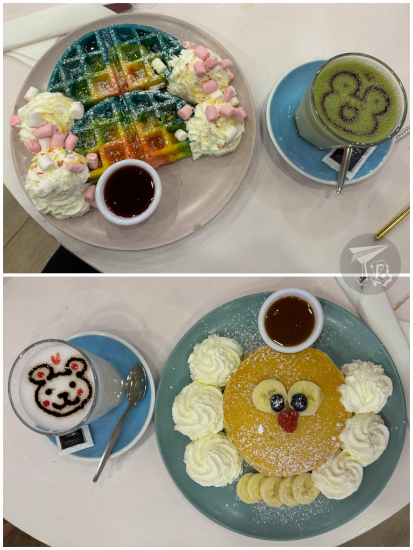
Kawaii Cafe Madrid order

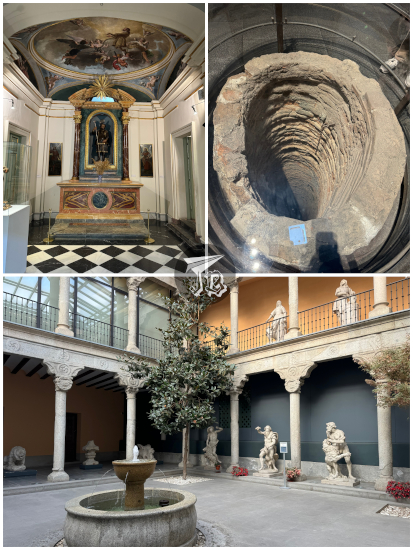
We stayed for well over an hour, and then headed out to one of the local museums Museo de San Isidro – Museum of Saint Isidore the Labourer. Isidore is the patron saint of Madrid. He is credited with several miracles – multiplying wheat and food, having his oxen plough on their own, and rescuing a child from a well making the waters inside rise. According to tradition, the museum is housed where he used to work, and legend has it that the old well is the one he pulled the child from.

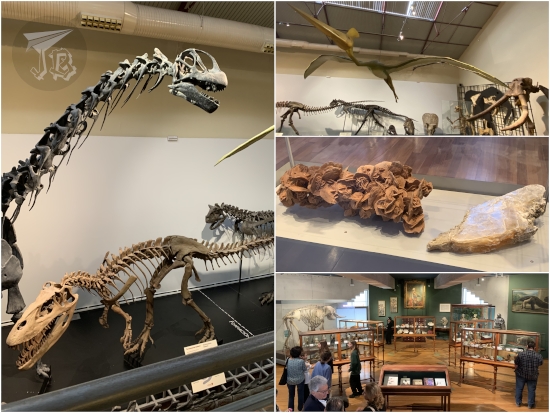
Today the museum hosts some palaeontological and archaeological exhibits, from a mastodon and ancient rhinos to Medieval artefacts, running through the Roman occupation and the Muslim period. The place is a complement to the Museo de Historia de Madrid, or maybe its competition, though I think both belong to the same institution – and both are free. As the building is a historical place, it offers the chance to enjoy its small but beautiful Renaissance courtyard, with sculptures of mythological heroes, and of course St. Isidore and his wife. There is also a tiny Baroque chapel.
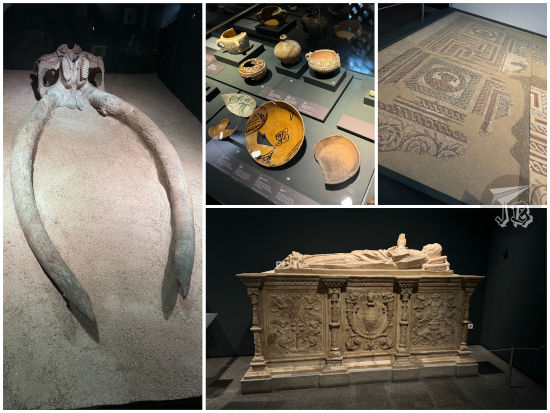
San Isidro Museum

San Isidro Museum: chapel, well, and courtyard

Right next to the museum stands the Baroque church of Saint Andrew the Apostle Iglesia de San Andrés Apóstol , which was getting ready for Christmas. The church is one of the oldest in town, though it was rebuilt after its destruction during the Civil War, and it has been recently restored. It hosts a number of religious sculptures and a painted vault above the altar.
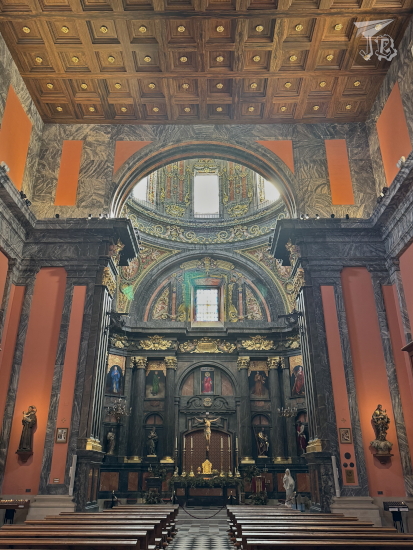
Saint Andrew church Madrid

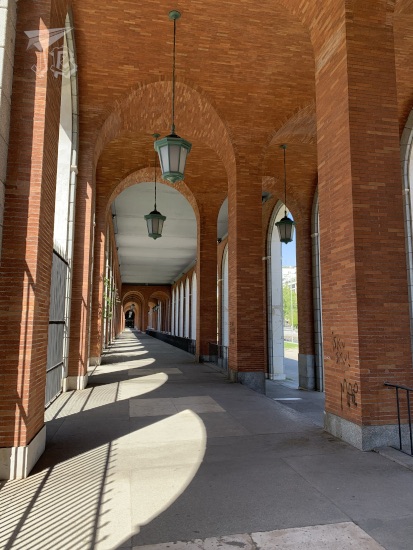
We took the underground at the station Tirso de Molina, which can still be accessed through the historical entrance hall, which is similar to the one that was closed off in Pacífico. It was beautiful, though of course busier than the museum one. Over the entrance to the platform there is a tile mosaic with the old shield of Madrid, dating back from the original station. It was installed in 1921, and it is the oldest artistic item in the underground network.

Access Hall at undeground station Tirso de Molina

From there we commuted to Nuevos Ministerios, where they had just kick-started the Christmas market. It seemed to be the “brands” market, with Lego, Disney, and so on. There was also a food truck by a famous chef selling basically chicken sandwiches at outrageous prices. I had been vaguely curious but not going to break the bank for a chicken sandwich, especially after such a breakfast!

I took a train from there back home, with no incidents whatsoever (because by now I’m desensitised to trains being late…)
30th June 2024: Engines, illusions, history and tea (Madrid, Spain)
Since finding about my tea time outings, my sibling had been wanting to tag along to one. I was asked to organise something for the weekend that involved either Chinese hotpot or afternoon tea in Madrid. The hotpot place was booked out both days, but I found an afternoon tea opening on Sunday the 30th. I am too lazy to move out just for tea, so I organised a bit of a day out.

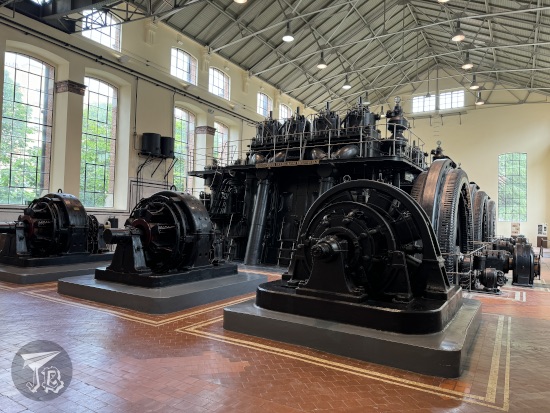
After an uneventful train ride, our first stop was at noon: Nave de Motores de Pacífico, the former energy centre that fed electricity to the original underground lines. Today, it is not in use and it has become part of the network of museums Museos Metro de Madrid. The warehouse was built by Antonio Palacios between 1922 and 1923 to home the diesel engines, transformers and fuel that single-handedly powered the underground system before the Spanish Civil War. The system was actually in place until 1972.

Warehouse containing the old underground engines

The building was erected in red brick, with white tiles inside, decorated with Palacio’s typical metallic green. The floors are ceramic tiles, and the engines are three monstrous vessel-powering pieces of engineering. These diesel engines created electricity, which then entered the transformers, and was sent to the power lines to feed the trains. At night, the excess was sold to the local street-light network.

Since we were going for afternoon tea to El Jardín de Orfila, where I have been before, I knew lunch was out of the question. However, we needed a snack. I planned that at Yatai Market, an… Asian food court of sorts. A number of stands come together to offer different cuisines and snacks, even full-sized meals. We tried a Chinese bao each and a couple of dim sums. I ordered a hoisin duck bao which was extremely yummy. I will definitely come back to try other stuff.

HotBao Yatai Market Cortezo

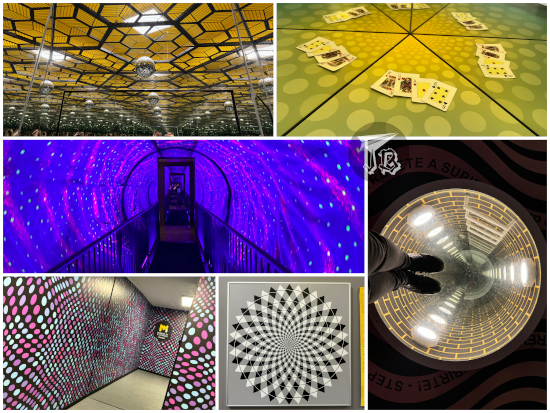
Afterwards, we headed off to the so-called Museum of Illusions. This museum is a compendium of optical illusion and installations designed to fool the brain into believing things that are either wrong or just not there: a distorted room so you look big in one corner but small in the other (Ames room), a vortex where you seem unable to walk straight, a rotated room, a room full of mirrors – there were a lot of illusions with mirrors actually – stereograms with hidden images, turntables, holograms…

We had a reservation for 14:00, and I was surprised at how chaotic entry was. I mean, they’ve been running the thing for a while now, someone should have figured out how to do crowd management, but no. Then, there were kids running and screeching all around, but it calmed down after a while. I had really hoped that the museum would be calm and half-empty at lunch time, but it was not so, not by a long shot. It was interesting though, and pretty fun.

Museum of Illusions Madrid

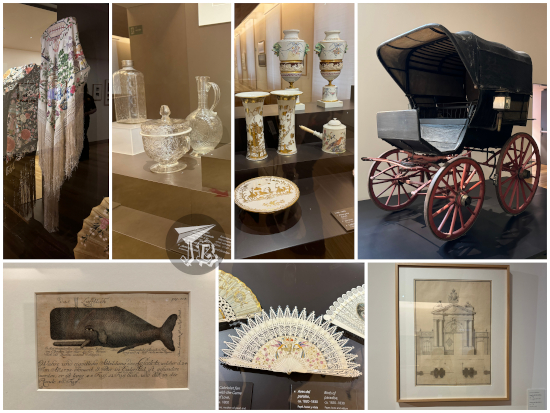
However, the experience was shorter than I had calculated, so I had to improvise an extra stop. Thus, we entered the local history museum Museo de Historia de Madrid, which tells the city’s history since Madrid became the capital of Spain. There are paintings, models, typical costumes, plans, maps, and Playmobil sets depicting of the uprising against the French in 1808. The museum is hosted in a former palace-like building which was actually built as a hospice. To the side stands the original Baroque chapel. It also has a lovely garden with a monumental fountain, which was relocated from its original place for conservation.

Museo de Madrid exhibits

Museo de Madrid - chapel and fountain

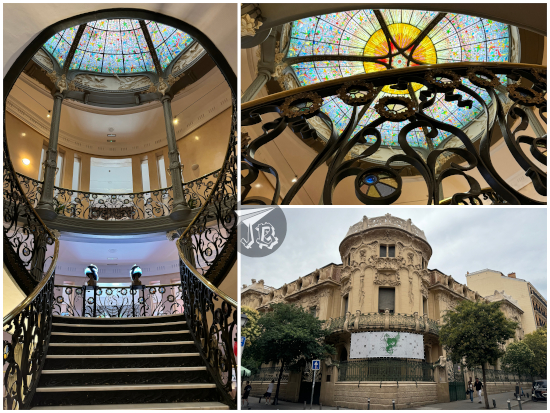
We spent some time there and then headed off to the building that now holds the office of the Copyright Owners’ association, a manor known as Palacio de Longoria. It was designed by José Grases Riera and built between 1902 and 1904. It is one of the few actual Art Nouveau buildings in Madrid, possibly the most important one. The façades were made in artificial stone, with sculptures and shapes resembling vegetation. I’ve wanted to visit it for a long time, but it is only open when there is an exhibition, and the stars had never aligned – until this time. There was an exhibition about urban music, and I was not going to let go of the chance to see the monumental staircase and the skylight.

Longoria Palace

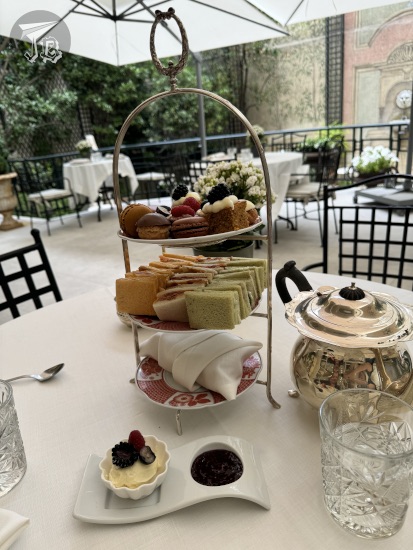
We finally set off for afternoon tea at El Jardín de Orfila. Out of the several places I’ve tried afternoon tea in Madrid, this has been my favourite to date. The outside garden is lovely, but mostly, their scones are the best around.

We ordered green tea, and the snacks were finger sandwiches – smoked salmon and cheese cream, classic cucumber and cheese, pastrami – pastries – carrot cake, macarons, lemon curd – and the scones. This time round, I decided to eat the scones after the sandwiches in order not to be full when it was their time. The afternoon was pleasant, but we shared the terrace with another table, and later a loud lady who wanted a smoke. That broke the magic a little, but the tea was fantastic and the scones were great.

El Jardínde Orfila: tea serving for two

Afterwards, we just headed for the train station to get back to our places. Of course we missed the correct one since they run whenever they like. What else is new? But the fun part was being able to pull a fun day out from my sleeve, and it was not stupidly expensive either, so good fun, all in all!

20th March 2024: Mundo Pixar (Madrid, Spain)

Due to some kind of weird… extended family thing, we ended up with some vouchers for Pixar World Spain Mundo Pixar, happening in IFEMA in Madrid. It would have been a pity to waste all of the tickets, so there we went, on a Wednesday morning, to at least redeem a couple of them. This immersive exhibit comprises several rooms with life-sized scenarios and characters based on Pixar films.

Mundo Pixar Madrid - outside

Pixar is an American animation studio which started off as part of the Lucasfilm computer division back in 1979. For over a decade, the group collaborated with graphic design and CGIas a third-party, until it was properly founded as an independent company in 1986. Pixar collaborated with Disney creating computer animations, and kept developing the technology, until it was finally able to pitch its first feature film to Disney – Toy Story, which was also the first-ever completely computer-animated film. Released for the 1995 Christmas season, it was a world-wide hit. Pixar became part of Disney in 2006.

The studio’s films have received 23 Academy Awards, eleven times for Best Animated Feature (a category added in 2001). One of the characteristics of Pixar films is their layering – though they are marketed as children’s entertainment, they tend to have a deeper, more adult-oriented subtext that… kids don’t even grasp. Something weird is that despite its successes, Pixar always seems on the brink of bankruptcy…

We had tickets for 11:00, and thought we had plenty of time until we got caught in a huge traffic jam due to a fair in another part of IFEMA. We had over 45 minutes of leeway, and ended up taking half an hour just to be able to get into the parking lot from the roundabout 650 metres away. That was wild.

We finally got into the queue around 10:50, and it took a while to get in. Mundo Pixar is organised in a U-shaped circuit, so that you can get round to the shop before or after seeing the exhibit. For a weekday, it was packed – not only by families, a bunch of random friend groups and tourists, too. Interesting.

We accessed through a tunnel to the first space, which is a bit of a self-promotion video mixed with the rules of the game – mostly, the one that people seemed unable to follow: do not touch. The immersive experience takes you to recreated scenarios from several films by the studio, to the slightest detail. The rooms are supposed to have different smells, but we only perceived a few. And of course, people kept touching.

Rooms 1 & 2: Up. This films tells the story of an old widower who goes on a last “adventure” to Paradise Falls, where his late wife would have loved to live. To do this he… floats his house away with thousands of balloons. He meets kid Russel and dog Dug. The rooms include a view of the whole house, and one of the interior. The living room is a perfect reconstruction of the one in the film, down to the pictures and the armchairs where Ellie and Carl sit, and the device Carl builds to steer the house while it flies.

Room 3: Monsters Inc.. This is a take on a widespread childhood obsession, the monster in the closet. In another dimension, energy is powered by the screams of frightened children from our world – thus, monsters sneak into kids’ rooms using magic doors to their wardrobes. Sully and Mike are the top-scary team until they run into a toddler who turns their lives upside down. The room has different bits from the film, including the scream factory doors and the two main characters waving awkwardly, recreating a scene where Mike and Sully are made to pose for a picture – I kinda expected them to move.

Pixar World Spain: Entrance, Up, Monster Inc.

Room 4: Toy Story. A bunch of toys which / who become sentient when they are not being played with get a new companion, who does not know he’s actually a toy. Enter a house-move, a bully neighbour, and a nasty dog. Chaos (and a trio of sequels) ensues. The fun part of this room is that it’s built so you see the room from one of the toys’ perspective, everything is high up, and the toys themselves are scaled.

Room 5: Elemental. This is a coming-of-age romantic comedy which focuses on overcoming differences. You walk into a train car with the two characters – a water element and a fire element, awkwardly sitting next to each other.

Room 6: Inside Out. In this coming-of-age comedy-drama, every person (and cat) has five basic feelings: Joy, Sadness, Anger, Disgust and Fear. They control a person’s life using a big console, and they collect “core memories” to help with their job. A young girl’s Joy and Sadness must learn to work together to overcome moving to another city. The room shows a perfect life-size reproduction of Sadness and Joy at the console and all the core memories.

Room 7: Ratatouille. This films follows the adventures and misadventures of the rat Remy, struggling to become a chef – to do this he hides in the hat of a young man and “guides” his cooking. The title is a pun between the word rat and a French recipe. The room is a huge kitchen, and you see Remy cooking inside a huge chef hat.

Pixar World Spain: Toy Story, Elemental, Inside Out, Ratatouille

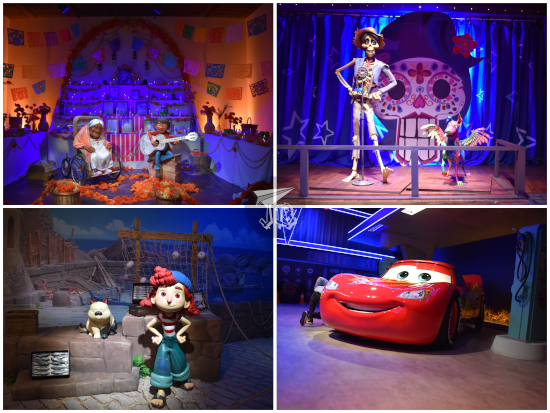
Room 8 & 9: Coco. Set around Mexico’s Day of the Dead (Día de los Muertos), this film sees a young boy, Miguel, explore his family roots and his love of music. The first room shows Miguel and his grandmother, and the second area holds skeleton Héctor, a dead musician who accompanies Miguel in his adventures.

Room 10: Luca. This film tells the story of two sea-monster children (Luca and Alberto) and a human child (Giulia), and deals with friendship and acceptance in the Italian Riviera in 1959. The room hosts the size-appropriate children, with Giulia – and her cat – getting the most prominent set.

Room 11: Cars. The film is set in a world populated only by anthropomorphic vehicles. Arrogant young racing car Lightning McQueen learns about humility, sportsmanship and friendship. There was a nice staff member taking pictures of visitors in this room, with the film’s main character.

Pixar World Spain: Coco, Luca and Cars

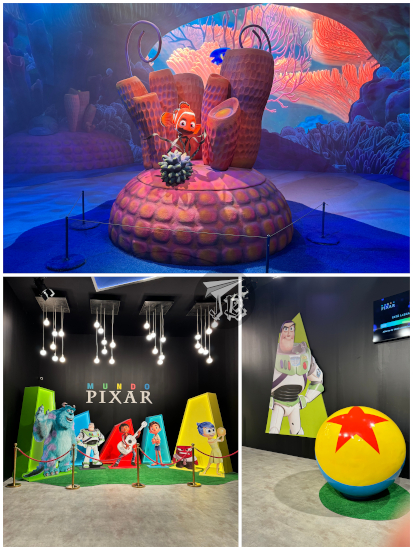
Room 12: Finding Nemo. Nemo is a little clownfish, the only survivor from a barracuda attack in which his overprotective father, Marlin, lost his wife and all their other fertilised eggs. When Nemo gets “fished”, Marlin embarks on a crazy journey to find him, meeting amnesic surgeon fish Dory, wannabe-vegetarian shark Bruce, and surfer turtle Crush. To be honest, finding Nemo in this room was easy. He was in the middle of it, surrounded by marine mist, with jellyfish and the rest of the characters on a screen behind him. I was severely disappointed there was no Bruce whatsoever in the room.

This was the last room; afterwards there was the shop, and a small photocall with a giant Luxo (a yellow bouncing ball with a blue band and a red star), back at the beginning. I am not sure this area actually counted as a room, because we were told there were thirteen rooms? No clue.

Pixar World Spain: Finding Nemo, photocall, Pixar ball

Fortunately, when we left, the traffic jam had dissipated. Unfortunately, I had to go work in the evening, which did not feel great. I obviously enjoyed the rooms dedicated of films I had watched (and liked) more than the others – I personally find the first ten minutes of Up heart-wrenching, but Finding Nemo was my favourite (both as a film and a room). I still uphold my protests about shark discrimination though!

3rd December 2023: Sushi, I“k”ons, Goddesses and Light Bugs (Madrid, Spain)

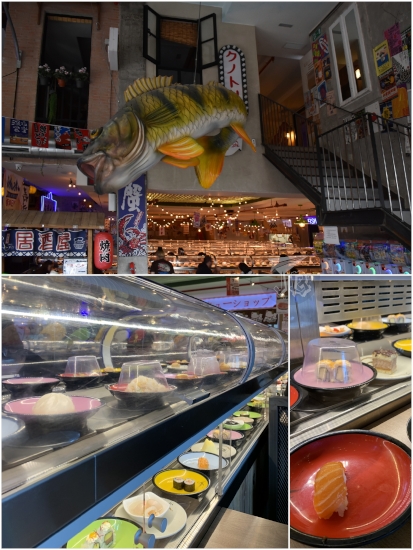
I had evening plans in Madrid with my sibling, and they wanted to have lunch in town and make a day trip out of it. Since I had previously ascertained that the Running Sushi franchise was all right and fun, I proposed to check out another of the locations. They agreed and I had booked a 13:00 slot at Running Sushi in Akihabara, near Plaza de España. It was even more fun than the one I had checked out before, with Godzilla, Taito Station signs, Pacman, neon, anime graffiti in the toilets, and Japanese music playing. From the outside, the restaurant is shaped like a train carriage, and the sliding doors relay the same message they do when Tokyo JR stops at the station at Akihabara. In general, Running Sushi Akihabara offered the same food as the In Market restaurant, but this time there was tuna. I don’t know if it is because of the location, or because it was a weekend – and thus more expensive. Reservation was a great idea, because though I had no problem booking for 13:00, there were plenty other people with and without bookings, and when 14:00 – standard Spain lunch time – approached, the place became almost crowded. We stayed for the whole hour since we had a late start due to missing chopsticks and napkins, and I own up that the last takoyaki might have been excessive. This time, I remembered to ask for the membership card – you get a reward if you visit all the restaurants in the holding, something I’m considering to aim for.

Running Sushi Akihabara

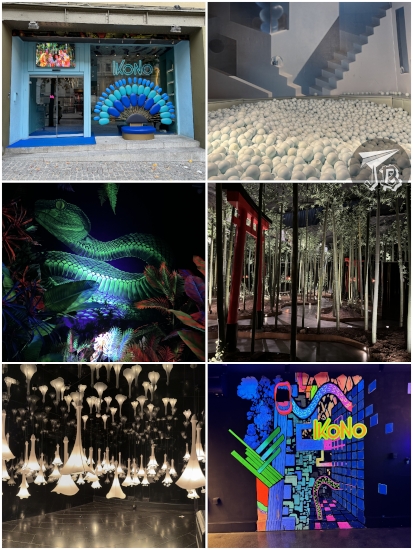
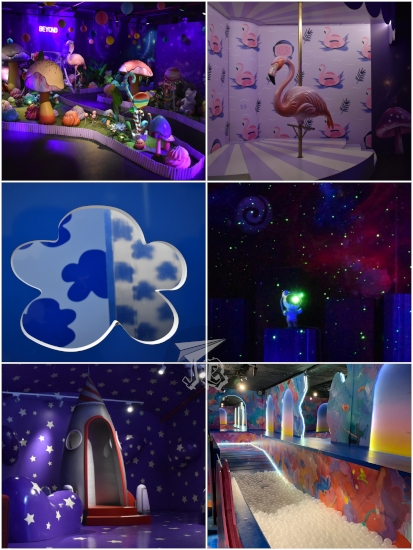
After lunch, we had a 14:50 ticket for a place called IKONO. I have to say I’m warming up more and more to these Instagrammable places – I’ve recently read one of them described as a “fun house” and I think it’s a more than accurate idea. I like them because they’re silly places for, quite literally, kicks and giggles. According to themselves, IKONO was born as a leisure option alternative to “restaurants, shopping and clubbing” for young people – I disagree with the “young people” take though. Out of the permanent establishments of its kind in Madrid, it is probably my favourite.

The IKONO mood kicks off even before you go in, with a peacock-like armchair just outside the main entrance. Spread over three floors, the venue has 15 different experiences / things to do. Once your tickets have been checked, the first “door” you go through is a thick wall of foil fringe curtains in a gradient of shiny colours,which felt like going through the Stargate! (I know, I know, niche comment). All through the place, there is bouncy music playing.

Once you have crossed the curtain – I somehow ended up in a weird inner space instead of where I was supposed to reach, but that’s just me – the first room is a ball pit, and a deep one at that. It was quite hard to move there. There are quite fewer rules than in other ball pits too – you can jump in, and throw balls up. Once you manage to drag yourself out of the ball pit, you get to go upstairs, what I’ve mentally named the “paper floor”. It has three rooms – the landing one has a pretty origami tree and some wings for you to take pictures with. There is a “psychedelic” ward with black-and-white décor and a blue-and-pink confetti cannon. The third one is a dark “jungle scenery” with glow-in-the dark colourings and paintings that I really loved – the frogs were adorable, and the serpent god quite impressive.

Back on the ground floor, the following room is a Japanese-style bamboo forest with wooden lanterns and a torii [鳥居], the traditional entryway to a Shinto shrine. As you may imagine, this was my favourite area. The room walls are covered in mirror, so it looks like a long path, that ends in the following room, a “bamboo forest” which a felt a little underwhelming in comparison. According to the website, the idea of IKONO cemented while visiting the Japanese Arashiyama bamboo grove, and these two rooms are a homage to that place.

Then we walked downstairs, to the “lights area”, with a few more rooms, including some hanging bellflower-shaped lamps, and another with lights made with marbles that went on and off to the music, some modern art inspired by The Last Supper, and a cube of infinite light dots. Back upstairs, there were a couple more panels for photo-ops, and a small souvenir shop. The staff offered a small present if we left a Google review, so we did. Oh, and they had a cloak option for coats, which was amazing.

IKONO Madrid highlights

We walked outside towards our following spot Caixa Forum Madrid, where there are two exhibitions at the moment. The one I really wanted to see was Veneradas y Temidas: el poder femenino en el arte y las creencias, “Worshipped and Feared: Feminine power in art and beliefs”, an exhibit on the female presence in the religion and spirituality of different cultures. The other one was Horizonte y Límite: Visiones del Paisaje. Colección de Arte contemporáneo, “Horizon and Limits: Views / visions of Landscape. Collection of Contemporary Art”, which I had not read about beforehand – because I am biased.

Veneradas y Temidas: el poder femenino en el arte y las creencias is a British Museum’s touring exhibition, Feminine power: the divine to the demonic (which I feel is a more appropriate name, but that’s just me and my problem with translations). It is a collection of artefacts (most of them not exhibited anywhere else) originating from different cultures, trying to convey the “female spiritual power”, though it also has snippets of erotism and homosexuality. One of the most important and impressive pieces include a copy of the Campo Iemini Venus, a “modest Venus”, halfway though covering herself – a copy of the Capitoline Venus, it was found in an Italian Roman villa in 1792. Aphrodite / Venus was the Greek / Roman goddess of Goddess of beauty, love, lust, passion, pleasure, and sexuality. Other Ancient Greece and Rome pieces include Hecate / Trivia (goddess of boundaries, crossroads, ghosts, magic, necromancy, transitions, and the New Moon), Athena / Minerva (Goddess of handicraft, warfare, and wisdom) or Eros / Cupid (God of desire, love, lust, and sex). There are several pieces of pottery, both red and black, depicting different scenes of various… degrees of erotism.

Halfway between Athena and Aphrodite, the goddess Ishtar, Queen of Heaven, and goddess of love and sexuality was worshipped in Mesopotamia (modern Iraq). Though according to the mythology, she had many lovers and was responsible for creation, she was not considered a “mother goddess”, and one of her advocations is the goddess of war.

The Divine to the Demonic: Greece and Mesopotamia

The first thing we saw from Asia were three masks. There was Taraka [Tāṭakā], a Hindu spirit, whose rage upon the murder of her husband turned her turned into a man-eating ogre (ogress?). From Bali, there was Rangda, the demon queen, antagonist of the forces of good, leader of an army of evil witches, and child-eater. From Japan there was a hannya [般若], the jealous vengeful spirit of a scorned woman.

Also from Hinduism, there is a creepily fantastic (or fantastically creepy?) devotional icon (murti [मूर्ति]) of Kali [काली], goddess of death, doomsday and time. The sculpture is the advocation Dakshina Kali – depicted with four arms, a scimitar, a collar made of heads of her slain enemies, and Shiva at her feet. The murti represents a passage in which Kali goes on a rampage after fighting demons, having lost control, and her consort Shiva throws himself at her feet hoping to calm her down.

Theatre masks and Indian Goddess Kali

Among the Egyptian representations, there was Sekhmet, the warrior goddess, represented as a lioness, who was also the goddess of medicine and one of the sun deities. There were also Bastet, who started off similar to Sekhmet but became more of a protector figure, represented as a cat. There were also references to the cosmic goddess Nut, who symbolises the sky, stars, astronomy, the universe, and mothers.

From China, there was a gorgeous Guanyin [觀音] as the Goddess of Compassion, a very different style from the one I had seen in either the British Museum and the Victoria and Albert Museum. There was also a Shiva porcelain which was astonishing.

Egyptian Sekhmet and Chinese Guaiying

From Meso- and South America, there was a beautiful sandstone of Toci, the “mother of the gods” who is depicted with bare breasts and her hands on her belly. There was also a statue of a Mexican cihuateotl. The cihuateteo were spirits of women who died in childbirth, and received the same honours as the warriors who died in combat. There were other references, such as the Hawai’ian goddess of the sea Na-maka-o-Kaha’i, talismans of sex and love (because the Victorians were a bunch of perverts), references to the Mesopotamian demon Lamashtu, Egyptian protection sculptures, funerary steles… and some modern art kind of thing, like a lady sitting down with a ball python slithering on her because… yeah? I really enjoyed the exhibition, though I have to admit I ignored the interactive art a little, to focus on the mythological aspect.

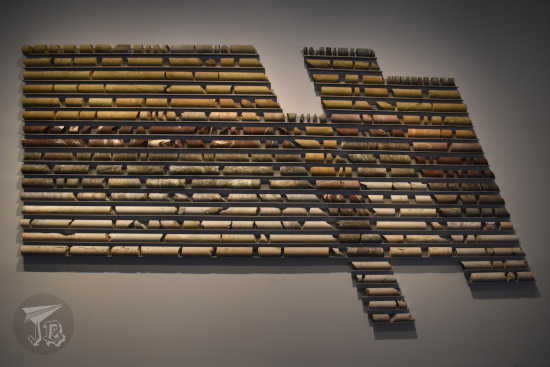
Afterwards, we visited the contemporary art exhibition Horizonte y Límite, which focuses on different… I’m not sure because I know squat about contemporary art (see above comment about the lady and the snake). There were paintings, imaginary photographs, a piece made from different geological cores representing a fault, a panel with postcards, a glass box filled with smoke to represent climate change… Pleasant, but not really my thing. Except the geology cores, they were cool.

Art piece fromthe exhibition Horizonte y Límite: Visiones del Paisaje

After seeing both exhibitions, we headed off towards our next stop. We took a break and sat down for a while to have a great banana-and-strawberry smoothie of all things. Then we walked towards the park Parque Enrique Tierno Galván, where we had tickets for the light show Naturaleza Encendida: Insectos “Lit-up nature: Insects”. The Naturaleza Encendida show used to take place in the Botanical Garden, which is smaller. This year, it has been relocated this year for “reasons unknown” and it feels a bit too long and almost unconnected. All that without taking into account that the idea of a larger-than-me butterfly and giant spiders is a bit creepy to be honest. We had premium tickets which gave us access to the enclosure at any time between 18:00 and 19:00 without queueing, and decided to arrive there around 18:30 as it would already be dark. We had also ordered a cute “magic lantern” – a bunch of sparkling LED filaments – for the giggles.

After an entrance of archways and carpets of light, there is a swarm of dragonflies as a centrepiece. You walk around it, and enter the zig-zagging path. Along the route, you encounter butterflies of different kinds, a line of hard-working ants, bees, grasshoppers, more bees, mosquitoes and flies, more bees, eggs, more grasshoppers, disco balls, larvae (I think? If I had to hazard a guess I’d call them anemones), beetles, ladybugs, spiders and a row of differently-coloured Christmas trees. There were “light corridors” in-between, hive-like hexagons projected onto the trees, and lots of artificial smoke. There are supposed to be some praying mantises somewhere but… I did not see those?

Naturaleza Encendida Insectos figures

All in all, Naturaleza Encendida: Insectos felt too spread out, as if trying to justify the bigger space. Though we had a premium ticket, there was no special premium-only area, and the only benefit was having an hour to go in, without having to queue – which is already enough in my books. I think you really have to be into the topic – we came across a lady who was very freaked out and mostly running so she could get away from the bugs. I have been to three editions of Naturaleza Encendida, and the only one I really enjoyed was the sea-creatures one, Explorium. I thought that the bad weather last year had damped the experience – literally – but I’m going to stop holding my hopes high.

Finally, we headed back to the train station. My morning train had had a five-minute delay, which by the early evening had progressed to the upper 40s. Joy. I’m hoping that when free ticketing is over, service will improve, but I’m not holding my hopes too high…

7th November 2023: A Jurassic amount of Lego (Madrid, Spain)

The fact that I like dinosaurs would come to no one’s surprise by now. To be honest, the older I turn, the more I think of them in the mind frame of the xkcd comic “Grownups”. Dinosaurs are silly fun, and it’s not like I’ve got a few million dollars lying around to buy a whole T-Rex skeleton anyway. What I do have is a silly knack to find things to do that are related to them – selective perception, if you wish. On this occasion, I heard that Madrid would be hosting the European Premiere of Jurassic World Exhibition by Brickman.

It is widely known that Jurassic Park and Jurassic World are part of a widely successful franchise. However, what or who is Brickman? In order to answer that question, we need to find out what a LEGO Certified Professional is: a person whose business model is working with LEGO blocks, making stuff for publicity, for example, and they are so good at it that they actually become LEGO-affiliates. The Brickman is a team of people who are led by Australian LPC Ryan ‘The Brickman’ McNaught – basically, they get paid to play with LEGO all day, and are commissioned things to build (which I think is awesome, in case you had any doubt). The Brickman Team have under their collective belt six exhibitions touring the world, and some of the largest and more detailed LEGO models ever built.

I came across the Jurassic World LEGO exhibition by pure chance, but once I knew about it, I worked on timing. The exhibition kicked off on the 30th of September and it will be there until the 14th of January – and it turned out that Tuesdays are cheaper. I bought a ticket for the opening timeslot at 11:00, and planned my day. I had to go to Madrid’s IFEMA Espacio 5.1, where I had already seen The Dino World Expo. It took 25 minutes to drive there and 35 to find a parking spot at the end of the world, then walk to the venue. Only when I was right by IFEMA, I saw that the paid parking lot was open – it is usually not when I am at IFEMA. Since it was a schoolday, I hoped to see the exhibition without many people – and kids – around so I could have fun with pictures.

As the name hints, the whole exhibition is based around LEGO-built Jurassic World items and scenes. Most of the rooms have brick buckets for you to put together whatever you want, freely or with instructions / missions. I did not build anything, but I had a lot of fun, once I managed to get in. When I arrived at 11:05, the ticket reader was not working, but the person at the door let people in anyway. He even offered to take your picture with the doors to Isla Nublar, which are already made from LEGO and actually really open. They recreate the gates shown in the first Jurassic Park films, but they read “Jurassic World” instead. Once inside, I asked a staff member if they had any stamps for the LEGO passport, and she had absolutely no clue what I was talking about – I think she thought I was weird, but oh well. The first room has “smaller” exhibits in comparison with others. There is a working monorail, a few aircraft and a life-sized 3D map of the island. It was weird to hear the Spanish dub from the films when a lot of the screens were still in English.

Jurassic World by Brickman entrance

The second room has a DNA strand and an amber collection site, and a shelf with lots of “hybrid” creatures. Some of them were cool, others just made me giggle – you were encouraged to build your own hybrid. The third room was “baby dinosaurs” under a huge brachiosaurus (171,150 bricks; apparently is one of the largest models in the world). There were some hatching eggs, too. In this room there were bigger LEGO bricks for the youngest kids to play and build stuff with.

Jurassic World by Brickman - LEGO baby dinosaurs

Then came a sort of control room – where visitors can track the escaped dinosaurs while some flying reptiles lurk from the ceiling, somehow recreating the alert in the first Jurassic World instalment. After that, there is a set up of the JW velociraptors, Blue and Delta having escaped and Echo and Charlie still in their pens. I had seen a LEGO Blue before, for the Jurassic World: Fallen Kingdom promotion in the Natural History Museum in London, but this one was much cooler, and scaled 1:1 to the film – 58,227 bricks.

Jurassic World by Brickman - LEGO Velociraptors

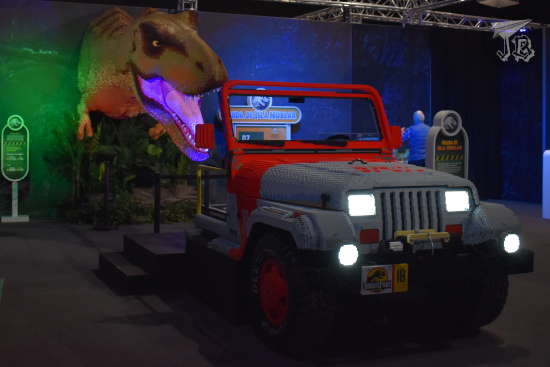
Despite all the promotion and toys she gets, Blue is probably not the fan-favourite dinosaur from the films. She is not mine for sure – that would be Rexy, the T-Rex. And after a mural of the mosasaur (number two on my list) hunting down a great white shark, Rexy finally comes into view, in one of her most glorious scenes from the original Jurassic Park: chasing the Jeep after Dr Sattler and Muldoon have just rescued Ian Malcolm. The Jeep was built using 227,098 bricks (which makes it even more complex than the brachiosaurus), and Rexy 128,763. One thing I noticed was that they had changed the jeep’s number, from 10 to 18, I’m guessing there is some inside joke there. They even recreated her reflection on the rear-view mirrors, which was pretty neat.

Jurassic World by Brickman - LEGO jeep being chased by the T-rex

The exhibit was fun for the discounted price, but the shop was crazy expensive. When I finished, I walked back to the parking spot. I had to walk through part of the park Parque Juan Carlos I. In the middle of the so-called Southern Pond Estanque Sur there is a hideous sculpture made of wrought iron, which is called “Walk between two trees” Paseo entre dos árboles by sculptor Jorge Castillo . As I was staring at it trying to figure out what it meant (and even after reading up on the symbolism, I don’t get it), I approached the edge of the water. A flock of mallard ducks swam over to see if I had any food, and I noticed something that was neither a duck nor a goose – a great cormorant (Phalacrocorax carbo). I had never seen cormorants in Madrid before. Seagulls, yes, but not cormorants, and I actually saw three of them.

Juan Carlos I Park, Southern Pond

I headed off for lunch at La Vaguada, a shopping centre not far away from IFEMA, though the Sat-Nav went weird and I took forever. I actually had a couple of things to do in that area, not least of all drop by the LEGO Store La Vaguada to actually get a small stamp – or three – for the rally. I mean, I had already been to the exhibition, I was going to be there, I had taken the LEGO passport just in case…

La Vaguada LEGO shop

Serious things taken care of, I looked for the restaurant Running Sushi In Market, a call-back to a kaizensushi – small-plates of sushi on a conveyor belt – in an all-you-can-eat business model part of a franchise. It is more of an “Asian” place than a sushi restaurant and you have a range of recipes, from actual sushi to baos, skewers, noodles, dumplings, sausages… You are given a table for one hour to eat as much as you want, and pay a fixed rate plus drinks. It was not bad at all, though for the cheap price, tuna was too much to ask for. The decoration is extremely kitsch, but they had absolutely no problem giving me a five-people table for myself, and I stayed about 25 minutes, plus some pictures. But I forgot to sign up for the loyalty program…

Running Sushi In Market restaurant

The shopping centre has a ticketless parking lot that you can use for free for two hours, and when you are going to pay you just have to type your licence plate. I was there for 1 hour and 58 minutes in the end, so I did not have to pay anything, which was great. Then, unfortunately, I ran into a huge traffic jam, as it was get-out-of-work time, and there had been an accident on the motorway. Even though, I made it home before tea-time. However, I did not eat anything else that day. I might have overdone it with the last small dish of lichee fruit…

23rd October 2023: Happiness Museum and a former hospital, Madrid (Spain)

At the beginning of the year, I found out about an old hospital building turned office building that looked pretty interesting to visit in Madrid had opened up. It is a governmental office, so the visits are guided and supervised. Unfortunately, I was working an afternoon shift and they only run the visits on Mondays at 16:00. I signed up for the waiting list hoping for a summer visit, but they don’t run them in July and August. The September and early October visits did not work out either because I was in London. I finally managed a spot for the visit on the 16th of October, which was rescheduled for the 23rd. It’s not hardcore work season yet, so I was easy to rearrange meetings to have the day off.

Of course, it was a Monday, and Mondays are not Madrid’s best day, especially when the weather is not nice – most things are closed, and even though there are many neat parks, they usually close in the event of storms or winds. However, I almost accidentally discovered something potentially-fun and open, and I made plans with my sibling and nibling, who had a free morning.

I took a train with an hour’s berth of time, but then, because what else is new, there were train issues, and we were all delayed. I was stuck on my line for almost 40 minutes, and decided to walk instead of taking the connection, and they were waiting at their station for almost 30. If you are wondering why I keep taking the train, it is because during 2023 I can get a four-month unlimited pass for 10€, which beats any other transportation mode.

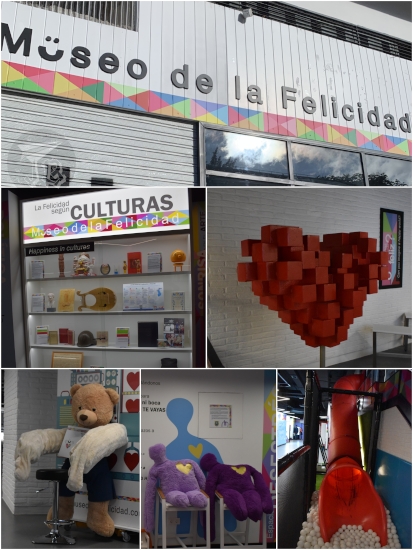
In the end, we luckily made it on time to a new photo-op place, which calls itself the Museum of Happiness Museo de la Felicidad MüF, with a little happy face on the u. It is a two-storey… silly-fun kind of place. Out of all the “instagrammable” places I’ve visited, I think this has been the weakest, as there were actually few things to actually do (too many touchscreens), and it kind of looked a bit… plain. Probably because it was Monday morning and there was no animation. I mean, it was fun, don’t get me wrong.

The first thing you see when you come in are two individual trampolines and a slide that ends in a ball pit. As I can’t jump, I skipped the trampoline. There is a small exhibition on lucky symbols, and another on things that make people happy. There is a small soundproof capsule where you are coached on how to laugh – weird – and a “team good people” that you can stand behind for a picture (the message being “kindness brings happiness”). As I was taking a photograph of my nibling, someone – who had just seen me show my ticket – decided I was the official museum photographer. I turned her down as nicely as I could. It was a day with a lot of comments about my camera.

The MüF has some screens and a VR experience, a “magic” trick on a screen, a big heart made of blocks and a hugging machine – apparently made to comfort autistic kids who benefit from deep pressure, but can’t deal with actual people hugging them. To go down from the second floor back to the first one, you can use the slide into the ball pit or the plain old stairs. That slide is steeper than it looks…

The basement has a few more things that you can touch, a ward with headphones and uppy songs, and the abrazadores (huggers), big plushies that are apparently designed to simulate hugs and grow people’s confidence. They were fuzzy and warm, but I am not sure how they can improve your mental health… There are a few confidence boosters, and a “five-senses happiness booth” where you get to eat chocolate, which is always good. In the end there were lots of silly giggling, because in the end that is why you go to places like that. There is also a “closet of truth” which you should not spoil for other people and helps you discover who is the most important person in your life.

Happiness Museum Madrid

After the museum we headed off for an early lunch. Despite being 300 km from the nearest port in the Mediterranean Sea, one of Madrid’s most famous meals is the calamari sandwich – bocadillo de calamares. A lot has been speculated about how this came to happen, though no one is really sure how the sandwich made its way into the local gastronomy throughout the 20th century. The squid is cut in rings, battered, and served within a small loaf of rustic bread similar to a baguette (pan de barra), an interesting combination at the very least.

The most famous joint to eat a calamari sandwich is Bar El Brillante. It might not be the best, and it quite surely is not the friendliest, but it is the iconic place for it, which actually makes it a tourist spot. The bar was established in the 1950s and it is a family company, the current owner being the third generation. They do not care much about customer loyalty as their business is based on the “novelty” and the “being a must do in Madrid” since the 90s – or maybe they’re just nice to regulars? I for one I’m open to try thebocadillo de calamares again, but not the place. The staff was unhelpful and took forever to clear the tables, which led to a lot of… hm… “birdwatching” as pigeons and sparrows helped themselves to leftovers.

Calamari Sandwich at El Brillante

We separated after lunch and ice-cream, and I continued alone towards the Chamberí district, which at the beginning of the 20th century was the outskirts of Madrid. There, philanthropist Dolores Romero Arano commissioned architect Antonio Palacios to build a hospital for labourers: Hospital de Jornaleros, known today as Hospital de Maudes. During that time, it was typical that a hospital had a “target patient”. In this case, it was male workers from the newly industrialised city who were not infectious or incurable – sort of a trauma unit, early-20th-century style. They took in labourers that could be cured, nursed them back to health, and released in “perfect working conditions”. Considering, of course, that the hospital opened in 1916.

For the building, Antonio Palacios chose a cross layout with a hall on one side and a church on the opposite one and two smaller buildings to complete the symmetry. He used Francisco Zuloaga’s ceramics for decoration until money ran out, and aimed for lots of light and open spaces. There are two types of decorative ceramics on the outside: water drops which imitate waves, and broken tile mosaics (Trencadís, a technique favoured by Antoni Gaudí). Palacios even built lifts of sorts to take patients to the roofs of the wards. The hospital worked for its intended purpose until the Civil War broke out and it became a military one. It was eventually abandoned and derelict during the following years until it was bought and restored by the local government in the late 20th century.

All this was explained to us during a 45 minute talk for an hour-and-a-half visit, as we stood in the hallway – which is actually in the basement floor. I arrived about 15:50 for the 16:00 visit, gave my name and ID and sat to wait. We had to go through metal detector and X-ray before the visit started – there is a volunteer guide from a retiree association and an actual worker to chaperone (governmental workers do not work afternoons in summer, which explained then why there had not been visits during that period as I had hoped for). Once the “introduction” was over, we finally got to see what I wanted to see – the building itself. Unfortunately, as the guide prattled on and on inside, it had started raining, so we could not go out to the patio, nor barely see the outside. That was disappointing – I mean, I’m all in for introductions and historical contexts but this is my problem with guided visits, it is just too much talking and too little visiting.

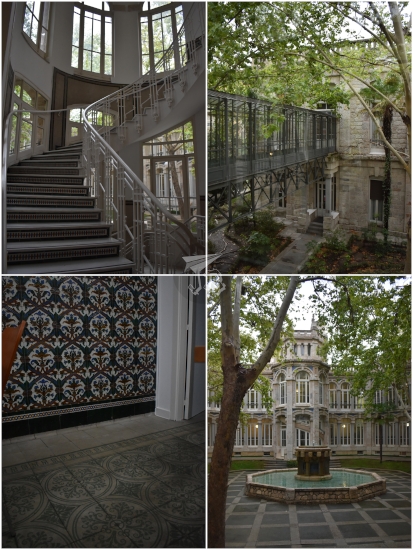
As we walked into the inside of the building, we were pointed out to the ceramics on the walls. Then, the tunnel that connected the hospital with the morgue – which was one of the outer minor buildings. We went up using one of the decorative stairs and we finally arrived at the ground floor of the crossing point of the wards. The centre of the structure is the octagonal patio with the fountain in the middle. As people saw me taking photographs with the camera – I had asked for permission beforehand – they decided I was either a journalist or the official photographer. It got annoying at the fourth or fifth time I was asked or someone made a comment / joke about me photographing them. Which I was very careful not to, even if they keep walking into my field of view.

Maudes Laborers Hospital exterior

The main material of the building is white limestone, which both contributes to the building’s luminosity and it’s common in Palacio’s design. His likings are also shown in the green colour of the interior tiles, which are very similar to the ones in the ghost station of Chamberí. The tiles all along the corridors are decorated and some of them feature heraldic symbols. We got to snoop around the cafeteria, one of the few areas that still features the original floor, since most of the flooring was too damaged to be restored.

The central area surrounding the patio is also octagonal, full of ground-to-ceiling windows. From one side of the corridor to the other and through the patio you can even seethe main staircase that we used to access the second floor behind the windows. Once on the second floor, we crossed the metal bridge that separates the main building from one of the accessory constructions, where the external consultation rooms used to be. Finally, we went downstairs again, walked around the patio and crossed over to the former operating theatres (the above-ground area of the morgue), which are now being transformed into an exhibition room.

Maudes Laborers Hospital interior

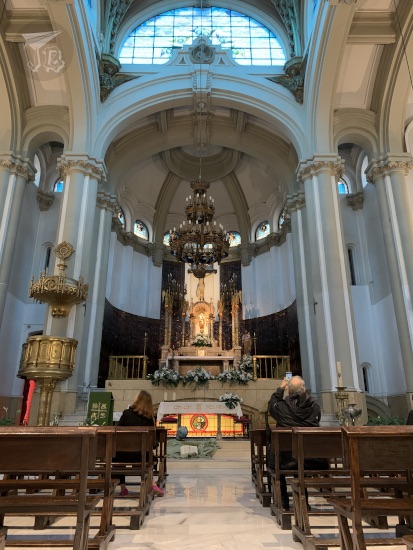
By the time the visit was over, it was raining heavily, but I still had the time to visit the in-hospital church Santa María del Silencio, Our Lady of Silence, which is the parish of the Madrid deaf and hard-of-hearing community. Lots of the architecture details are Modernist in style, including the iron fence and coloured glass ceiling.

Altarpiece in Our Lady of Silence

It was still raining cats and dogs when I left, so I forsook the idea of walking around the building to take pictures of the main hospital entrance, I just crossed the street to head to the train station. After aquaplaning on the square to get in, I had to wait about 50 minutes for a train, as the morning breakdown was still causing delays. And of course, when the train came it had already stopped raining.

Maudes Laborers Hospital and Our Lady of Silence from the outside

It was a nice day out, with great company and lots of laughs. Food was okay, the hospital building was amazing, the guide not so much. And the weather… very… autumn-ly.

11th & 12th September 2023: 23h 45min in London (England) for Yoshiki’s “Under the Sky”

Considering that Japanese musician Yoshiki recently got his hand- and footprints enshrined at the TCL Chinese Theatre in Hollywood, I guess he’s not one of my obscure artists any more. Yoshiki is a Japanese drummer and classically-trained pianist who, alongside vocalist ToshI, founded the band X Japan in 1982. They started as a heavy metal band, and eventually shifted over towards progressive rock. Their flashy looks probably gave way to what is now called Visual Kei (V-kei) [V系], though they had dropped them in the mid 1990s, before they disbanded when vocalist ToshI left the band basically to join a cult. In 2007, X Japan reunited.

Yoshiki, born Hayashi Yoshiki [林 佳樹], is considered one of the most influential Japanese artists of all times. Aside from a musician, he is also a songwriter, composer, producer, and fashion designer. He collaborated with Stan Lee for a special four-issue comic collection called Blood Red Dragon, and with international musicians and bands such as Bono (U2), Roger Taylor and Brian May (Queen), KISS, and Sarah Brightman. He composed the theme of the 2013 Golden Globe Awards, worked on the soundtrack of Saw IV, and has composed music for anime such as Saint Seiya and Attack on Titan. Within Japan, aside from tons of collaborations and solo works, he became “mainstream” when he played a concert to honour former Emperor Akihito upon the tenth anniversary of his enthronement in 1999. He also has a Hello Kitty line named and modelled after him, Yoshikitty. And I’ve been using one of his songs as my alarm clock since roughly 2010 (since 2015 it is Born to be free).

Back in 2017, Yoshiki hosted a Q&A in several cities throughout the world, including Vienna (Austria) for special showings of his documentary film on X Japan. The documentary should have premiered in the scheduled March 2016 concert, but when that was postponed, the film went on to be shown at different events festival. When I went to Vienna, I had already travelled to see it in X Japan concert in London and the Beefeater In-Edit festival in Barcelona (and owned the blu-ray).

In 2020, as the Covid-pandemic lockdowns eased up, Yoshiki organised an online concert on a bunch of rooftops, connecting with different artists and having others over, to celebrate his birthday on the 20th of November . Now, he has made a documentary out of the event, called Yoshiki: Under the Sky, which has “premiered” four times, the third of them in London on 11th September 2023. As the London announcement only came mid-August, it was a challenge to get everything running, but I managed to find doable flights and a hotel near the venue. I was able to buy a second-row seat for the cinema, which was pretty good too.

On the 11th of September, trying not to reflect too much on the date, I left the house around 5:00, and right as I merged into the motorway, it started pouring. There was more traffic than usual because the plane was an hour later, but I managed to make it to the airport a bit before the time I had booked to enter the parking lot – yay accuracy. I went through security and passport control without issues, and had to walk to the end of the terminal for my flight, which was also uneventful. Upon landing at London Stansted Airport, we had to wait for a bus because the escalators were broken or something, but I was outside around 9:30. I bought breakfast at Costa Coffee, and settled to wait for a friend I had met in Vienna, A****d. Her flight was due half an hour after mine, so we had decided to hang out for the day. She agreed to tag along to the Natural History Museum – I wanted to go back to the the Jurassic Park 30th Anniversary #NHMxJURASSIC store before it closes down at the end of the month. I really really wanted the rubber ducky cosplaying as a velociraptor, but I feared that if I got that one, I would end wanting to collect rubber duckies… I bought get a limited-edition “opening weekend ticket”, which had been out of my budget on my previous visit, and a titanosaur coin that I had not seen when I visited the exhibit.

A****d had never been to the museum, so we took a tour of the highlights – dinosaurs (of course) and other fossils, the “journey inside the earth” (escalator that goes into the inner core of the planet), the historical building, and Cadogan gallery… Unfortunately, the hall of mammals had recently closed for renovations, so we could not visit that one.

Natural History Museum London

Afterwards, we took the underground and got off at Leicester Square to have a late lunch in Chinatown. We found a little place for lunch. I ordered some rice and duck, which was nice but the duck had a lot of shattered bones. We looked for a place she had known that sold ice cream taiyaki, but sadly we did not find it.

London Chinatown

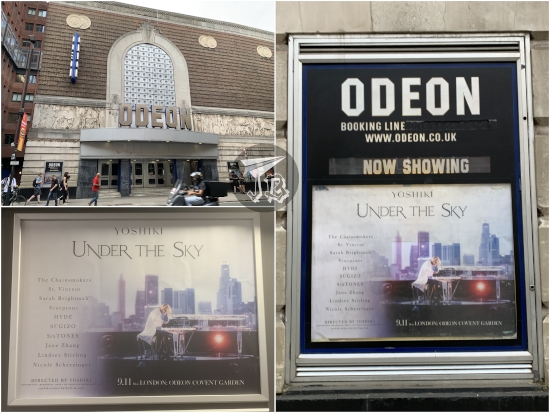
We located the cinema where the film was showing, Odeon London Covent Garden, but there was nothing going on yet, there was not even a poster announcing the film. After taking pictures, we continued down the block to snoop around the Forbidden Planet London Megastore, one of the biggest comic, manga and related merchandise shops in the world. Luckily, they had few things I wanted badly, and the ones they did were stupidly expensive, so I was able to get away with all my money, yay me!

A****d had decided that she would go back to the airport after the film, but I had taken a hotel a few minutes away from the cinema, right in front of the university and a few minutes away from the British Museum. I dropped by to check in, then we backtracked to Leicester Square as the museum was already closing for the day at 17:00. As we walked by the cinema, they were setting a poster for Under the Sky outside.

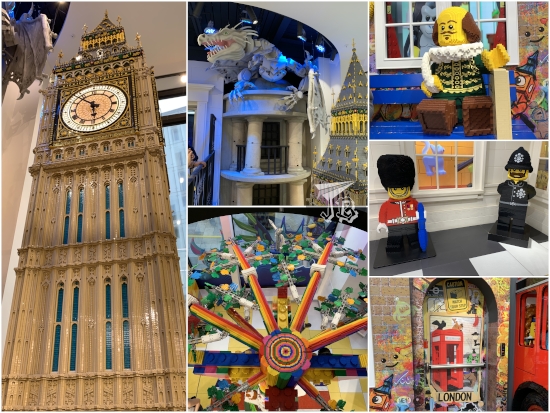
We decided to do something a bit silly and headed off to the The LEGO Store Leicester Square, two stories dedicated to selling LEGOs, either in sets, or just blocks. There are also different decorations – for photo-ops – made with oversized blocks, which include Shakespeare in the park, a Bobby, a Buckingham palace guard, a whole Aston-Martin with a Bond sculpture – you can actually go into the car – and lots and lots of Harry Potter. It was a bit disconcerting that they were already displaying Christmas sets!

Lego Shop London

Then, we crossed the street for the M&M’S Store London, which has four floors. The ground one has a recreation of the Beatles crossing Abbey Road, with M&M’S. There was a logo asking “which M&M’S colour are you?” which I thought was a little silly, until I found the orange M&M’S section, whose motto seems to be “I’m scared of what might happen if I relax”. I connected immediately. Next time over I should totally buy a mug or something. Also, there was no Christmas decoration yet, as they were preparing for Halloween. Oh, and they were looking for staff, offering “London liveable wages”.

M&Ms Shop London

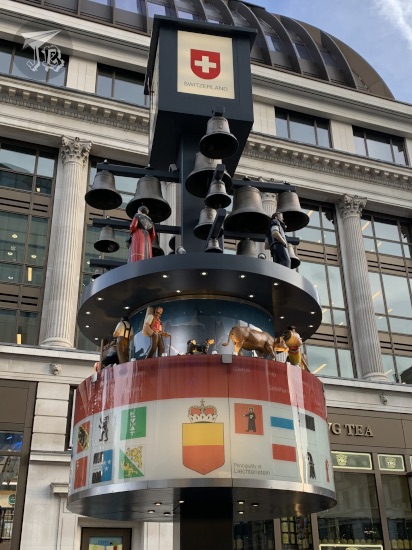
We came out and it was 18:00, the Swiss glockenspiel at Leicester Square was chiming. The glockenspiel is a Swiss-themed clock which was built in the 1960s as part of the Swiss Centre, a ploy to drag rich British tourists to the country. The centre failed, and the clock was taken away, but it was eventually restored to the area in 2011. I could have sworn it was playing Poncelli’s Dance of the Hours?

Swiss Clock Leicester Square

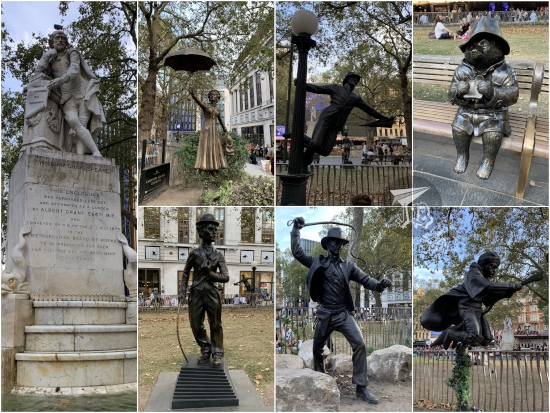
Leicester Square is built around a sculpture of Willian Shakespeare, and the gardens around him hold a number of statues dedicated to cinema, Scenes in the Square. We spotted Mary Poppins, Don Lockwood (Gene Kelly’s character in Singin’ in the Rain), Charles Chaplin, Paddington Bear, Harry Potter, and an Indiana Jones which is supposed to be temporary. Apparently, there are a few more I should be checking out for, but that’s okay because I’ll be coming back to Chinatown eventually, and it’s just a few blocks away.

Statues of cinema figures in Leicester Square + Willian Shakespeare

We headed back towards the Odeon London Covent Garden cinema, and we reached there around 18:20. Another poster had been put up, and some fans were already waiting. We met another friend of hers, M**, who told us she had found a sitting area inside, so we sat and chatted away for about an hour. The staff was extremely friendly and did not peep a word of complain, even if we did not buy anything.

Yoshiki Under The Sky at Odeon Covent Garden London

Finally, we were allowed into Screen 2 and found our seats. I lost count of how many people tried to get away with ignoring the seating numbers. Nobody did. I had a second-row seat, pretty centred. The film was introduced by some film producer who explained what we were going to see as if we had just accidentally wandered into the cinema.

There was supposed to be a trailer for Yoshiki’s upcoming concert in October, which was not shown. We had a few in-house adverts before the documentary started. Through the film, Yoshiki talked a little about the power of music, and how he had come together with all these great musicians to create a world-class event, very Covid-compliant. All the songs featured were either composed by Yoshiki himself, or had been arranged by him in some way. Perched on an LA rooftop, he mostly played piano, but occasionally he donned the drums.

The narrating thread of the whole film is life. Yoshiki was a sickly child, and his father committed suicide when he was ten years old, so he grew up with the idea of death deeply ingrained in his brain. As the film goes on, he speaks about how music can bring people together, and how it is important to find the strength to go on. Halfway through the film, he talks about recently losing his mother and how he cried for days. At some point a voice is introduced. It is a regular John Doe who once reached out to Yoshiki on Twitter as his dying wife had just entered palliative care. The man asked for some encouragement for her, and he got it, from Yoshiki and a lot of the fans, until she passed away. There was a heart-wrenching Zoom call with the man, who spoke about how overwhelmed he was by all the support he received. Unfortunately, she passed away.

The documentary runs for an hour and a half, and it’s a mixture of the Yoshiki’s thoughts, the performances alongside different artists, each in their corner (or rooftop) of the world, and a bit of conversation with them, or a making-of. I was familiar with most of the featured musicians, but not all.

Sarah Brightman: Miracle. Sarah Brightman has had an extremely long career and is an excellent soprano – my first memory of her dates back to the 1992 Olympics. She collaborated with Yoshiki on Miracle in 2018. I was really sorry I was not able to go to any of her performances back then.

Jane Zhang: Hero. The original version of Hero was sung by Katie Fitzgerald for the soundtrack of Saint Seiya: Legend of Sanctuary. Though Saint Seiya was my favourite anime as a kid, I had wandered away from it. The song featured in the film actually made me want to go to see it, and eventually dragged me back into the world. Zhang did a good job, but I personally prefer Fitzgerald’s version.

SixTONES: Imitation Rain. As a music producer, Yoshiki must have realised a bit ago that the Japanese boy-band panorama was dire. For long years, the boy-idol company Johnny’s Entertaining (JE) had dominated the business, with bands as SMAP or Arashi. However, an extremely protectionist policy and the open secret that the director had sexually abused some of the boys, lead to the company losing power. I have no doubt that this is why Yoshiki decided to create and produce a boy-band, and thus looked for the six young men that comprise SixTONES. Having followed some of JE’s bands back in the day, I can see how they would tap into the niche (serious flashbacks to KAT-TUN circa 2005, to be honest).

Scorpions: Wind Of Change. Formed in 1965, Scorpions paved the way for a great deal of the big names in 1980s hard rock such as Guns N’Roses, Mötley Crüe, Helloween, Megadeth… And Yoshiki is a little fanboy of theirs, of course.

Sugizo: La Venus. Sugizo is one of X Japan’s members, who took over guitar duties after they reunited. While the band was separated, original guitarist Hide died in “mysterious circumstances” – either accidentally or by suicide. For a long time, Yoshiki claimed that Hide’s death was an accident, and on this film he for the first time acknowledges otherwise. Thus, Hide was the second person in Yoshiki’s circle to take his own life. Sugizo, who also plays violin and is a member of an insane number of bands, including LunaSea, is credited by Yoshiki as the reason X Japan could come back together, which made him very embarrassed. They played a rendition of La Venus without lyrics, with Sugizo on violin.

Hyde: Red Swan. Hyde is without a doubt one of the best rock vocalists in Japan. He was originally the voice of L’Arc~en~Ciel, when they were still a thing. He worked alone for a few years, then he and KAZ founded VAMPS, and finally he went solo again. Red Swan was a collaboration between Yoshiki and Hyde for the anime Attack on Titan!, released as “Yoshiki feat. Hyde”. Yoshiki explained how the red swan represents rising even covered in blood. After this collaboration, there was a second single, released as “Hyde feat. Yoshiki” with the song Zipang, in English and Japanese, which I personally find even more powerful. The significance of Red Swan in Under the Sky comes from how many versions there are on YouTube, especially as anime songs tend to be translated. Thus, it ties in with the concept of coming together through music.

St. Vincent: New York. St. Vincent is known for her clear voice and her complex arrangements, with lots of instruments playing a part. She is considered one of the best guitarist in the 21st century. Yoshiki arranged her song New York for piano and vocals, which made it extremely powerful. All LA artists were invited to sing on Yoshiki’s rooftop, as it would have reduced the logistics involved.

Nicole Scherzinger: I’ll be your love. Scherzinger was the lead singer of the Pussycat Dolls between 2003 and 2009, but before that she had already performed with Yoshiki with this very same song.

The Chainsmokers: Closer. They are an American electronic DJ pair: Alex Pall and Drew Taggart, whom I honestly know nothing about other than they do electronic remixes. They have some supporting musicians.

Lindsey Stirling: Forever Love. She is a violinist who performs and dances at the same time. I had never heard of her either, but she did feel the music. Regarding her, Yoshiki said that she made him realise that not all songs need lyrics and vocals. She did a great job.

Yoshiki and fans: Endless Rain. In a way, Endless Rain is the emotional ballad that keeps showing up in anything X Japan related – and breaking people’s hearts. A while back, there was a request on social media for fans to send recordings of themselves singing the song, which were used for the film. Hearing a Ukrainian girl singing “endless rain lets me forget all of the pain, all of the sadness” was soul-wrenching. Once more Yoshiki circled back to the idea of music bringing music together, along with living, just keep living.

Yoshiki Q&A in London, 11th September 2023

The Q&A afterwards was awkward. The guy who carried it out – Toby Amies – had done his homework but it was not a Q&A, it was an interview by someone who had just learnt about Yoshiki, and was curious, so he had a ton of questions, most of them absolutely unoriginal, such as hey, I’ve just discovered V-kei, explain that to me! Or “do you prefer piano or drums?” which we hear every time – I could swear that Yoshiki was a bit annoyed at that one. The only input that the audience had, before Yoshiki was even in, was “are the Last Rockstars coming to Europe?” (we know the answer to that: never) and “When is the next X Japan album coming out?” (we know the answer to that, too: also never), but when the interviewer got around to ask those, he messed them up! At some point Yoshiki explained the meaning of the title “Under the Sky” – basically, we’re not in Heaven yet, we are underneath. As he was leaving, he was kind enough to sign autographs and take pictures with fans.

After the film, we took a bunch of selfies with other fans in front of the poster(s), then moved on. I went back to my hotel for a shower and a few hours’ rest. The bathroom was tiny but hot water did its job, and I could not find the cereal bar I had packed for dinner. The bed was extremely soft, and the carpet smelt strongly as England is in the middle of yet another heatwave, and my nose clogged – I need to remember to start packing my allergy pills. I did not sleep much if at all, and I ended up leaving the hotel before 5:00. I had to decide between breakfast at London Liverpool station or catching the Stansted Express at 5:25. I decided to go for the train and have breakfast at the Stansted Costa, so I boarded, found a seat, and settled down for a travel nap.

Ten minutes away from the airport, as we left Harlow Town, the second-to-last stop, there was an announcement. We were informed that the train would terminate at Bishop’s Stortford, the last stop before Stansted Airport. There were technical issues at the terminus platform, and the train could not reach it. Passengers should vacate the train at at Bishop’s Stortford and ask the platform staff for instructions. The instructions were that we had to fend for ourselves to reach the airport as there was no alternative transportation provided. It was chaos for a second, with everybody scrambling for buses, taxies and so. I was near a young woman who was going to Uber and had some extra seats. She asked if anyone wanted to tag along and I said yes. She said it would be free because her company would reimburse her, so I was lucky on that account, and I arrived at the airport a bit after 6:30. I waved my Uber-companions good-bye and headed to Costa Coffee for breakfast, feeling relieved that I had decided against waiting for the 5:40 train in London Liverpool.

After a sandwich and a vanilla latte, I passed security, where I had to go through secondary screening because… no idea. There was like no metal on me whatsoever. Then the scanner complained about me having something in my pocket – my damn handkerchief! Seriously, now. This has happened a few times. Where do people keep their hankies / tissues if not a pocket??

A****d had not yet departed when I was through, so we could hang out for a little longer – it’s fun that we had only met in person for a few hours in 2017 and we hit off so well. We even had gates in the same area of the airport, so it was cool. This is the first time that I have done the “going to the airport early in the morning” in London, but to be honest there was a 100 € difference between that flight and the next up, since the whole thing was announced and happened so fast. I asked for a refund from the Stansted Express, and now I’m wondering whether to cancel the train for my next trip to London as they’re threatening with strikes on those days… (ETA: I received a full refund, and there was no major incident during the following trip).

The trip back was uneventful except the road was stupidly full when I drove off the parking lot. I napped most of the plane ride, and I had a Coke before 9:00. Talk about living wildly, especially considering how all this happened in 32 hours, and I was in London for less than 24! My only regret was not taking the camera, but I was trying to pack extra-light this time around.

5th August 2023: Prints, Sharks, Mice and Neon (Madrid, Spain)

I won’t say that the Southern Italy trip was a bad one, but due to the planning blunder, the heatwave and the general not-so-relaxing atmosphere, I kind of needed a low-stakes day out. And what can be lower-stakes than a silly giant shark film? I got myself a ticket to watch Meg 2: The Trench at noon – I’ve found out that my non-dubbed cinema has started doing matinée shows at a reduced price – and planned my day in Madrid around that.

I took the train and arrived in Madrid on time for my ideal connection. Unfortunately the local public transport is chaotic this summer, with both the train system and the underground going through construction, outages and closed stations. As fortunately the city was between heat waves, I decided to walk for 20 minutes instead of waiting for 17 for a train that might or might not come to take me to where I wanted to go.

My first stop was Imprenta Municipal – Artes del Libro, a local free museum dedicated to the history of book printing and binding. The exhibition is hosted in a dedicated building with two levels. The ground floor focuses on the invention and development of the print, both for text and images, and the art of binding and decorating books. There are printing “machines” from the 16th century on, for copying books and texts, and the whole thing gives off a retro feeling – a video actually shows how the machines work even today.

Collage Imprenta Municipal Artes del Libro

The second floor held an exhibition about “Asian Writings” Trazos de Oriente: imágenes, objetos y caligrafías de Asia. It hosts Arabic documents, Mongolian drawings, Chinese writing instruments and Myanma and Hindu praying books, along with items like ex libris and schoolbooks. All very cool.

Exhibition about writing in Asia

I had a little bit of time before the film, so I got a snack, then headed to the nearby Yelmo Cines Ideal to watch my film. Something I’ve learnt is that matinées attract a weird crowd – when I went to watch Jurassic World: Fallen Kingdom, I sat next to someone who narrated the whole film, and this time there was a lady who would tut whenever any of the sharks was on screen. I read the Meg: a novel of deep terror by Steve Alten a lifetime ago, and I enjoyed its albeit-very-liberal adaptation to film, especially because it did have a self-parody tone. It was fun because it was implausible, and it knew it was so. The second and current film, Meg 2: The Trench, has tried to become more of an action-like blockbuster and it takes itself way too seriously in my opinion. But there are three giant prehistoric sharks on screen at times, and I’m simple in that regard. Bigger and more teeth, I’m all for that.

The film finished around 14:00. I was not hungry, so I just grabbed myself a drink at Starbucks. I had a ticket at 15:00 at the Nomad Museo Inmersivo (and it was bad timing I guess, because just a couple of days later they opened a new exhibit). When I first read about it, the idea reminded me of Mori TeamLab Museum, since the art is all digital. The museum is staged in two floors. The lower one hosts the immersive projection ward and the shop. The upper one hosts the entrance and the “activities”. I thought that I’d ask if I could come in early, and they had absolutely no problem with that, so I entered around 14:35.

As you climb down the stairs, you have a very cool corridor with mirrors and lights that lead to the projection area. I had a ticket with entrance and “iris picture”, so an employee took me to get that one (I guess because the photographer was about to go on a break). We had to try a couple of times as it was hard to force my eyelid open under the bright light of the flash. The photographer was very patient with me and we were done in a few minutes.

Interactive Museum Nomad access corridor

I found my way back to the beginning – the museum is surprisingly small. The immersive projection is shown on the four walls and the floor. The projection I watched was called Utopia 1.0, where millions of digital blocks work as a tridimensional Lego set that sort of “build” a surreal world with dragons, deer, sculptures, whales, high rises, dinosaurs… The whole thing takes around 20 minutes and you can watch sprawled on the floor, or sitting up on a pouf – I chose this last option as it allowed me to turn around.

Interative Museum Nomad: Utopia projection

Following the projection, I went upstairs to do the activities. There’s a virtual reality experience where you get to travel the cosmos and see a lot of “space cetaceans”. I wonder why digital artists are so keen on whales… Another of the activities consists on “painting” planets with a giant brush as they float on a wall, and when you colour them all, you get to see penguins on a rocket or something… I did not catch it well because a bunch of kids burst in and took over. On another wall, there is a bunch of neons that you can play with using an app that you download on your phone, and blast music so they pulsate with that. Finally, the nice attendant is at the ready to take your picture at some stairs photo call (I think it is the glorified emergency exit), and you can go back down using a spiral slide.

There is finally a last corridor with lights and you end up at the shop, where you can start all over again, as there is no limit about how long you can stay in the museum. I really liked the first corridor, so I went back there for a while. Then I walked into the projection area again just in time to watch the dinosaurs roam once more. A fun detail is that even the toilets are “in character” with neon and messages.

Interactive Museum Nomad exhibits

On my way out, I bought myself a shark glass at the shop. There was also a very fun pufferfish cocktail glass, but I thought it would be awful to clean after use – not that the shark one is going to be much easier though… I left and headed off to a place I’ve always tangentially felt curious about, even if I’m not really the target public for it – it’s called Casita-Museo del Ratón Pérez.

Ratón Pérez or Mouse Pérez (also called Ratoncito Pérez, Little Mouse Pérez) is the equivalent of the Tooth Fairy in Spanish-speaking tradition. In 1894, writer Luis Coloma was commissioned with writing a tale for the future King Alfonso XIII, who had lost his first tooth. This tale penned the folklore mouse into print. According to the story, Mouse Pérez lived in central Madrid, in a biscuit box in the patisserie Prast, situated in number 8 of Madrid’s Calle Arenal. The town hall installed a plaque to commemorate the place and when the shopping centre in that building became almost empty, someone came up with the idea of building a “museum-house” dedicated to the mouse.

Museum-House of Mouse Pérez

The kids had a blast for sure, the visit is a forty-minute activity 100% dedicated to them . The guide has them running round looking for stuff and going into small doors. I snooped around and found it an interesting business model – though it falters when you pay a bit of attention to detail: books like 1984 or anatomy guides may very well be interesting, but a bit out of place in a children’s museum. At the end of the visit, the guided asked me what I was doing there and I told him I… wanted to see what the fuss was about, what kind of things they did in such “alternative” museums. We chatted away for a bit before I left.

To end the day, I did some shopping and I headed back home – the trains were delayed, but I eventually made it home and had a pizza dinner, because I suck at staying fed on day trips. Truth be told, I wanted to step by a famous bar to eat a calamari sandwich, but it… was complicated, with lots of signage on where to stand and wait to be seated, but there was nobody around, so in the end I decided I did not care enough for the calamari. Some other day – I’ve been saying that for months now though…

11th July 2023: Museum of Dreamers in Madrid (Spain)

After I had so much fun in the Balloon Museum, I decided that I also wanted to see the Museum of Dreamers, which is something similar. Furthermore, it Madrid exhibit will close down at the end of July, too.

After I finished French school in Madrid, I headed headed off to the Japanese fusion restaurant Nomo Braganza, part of the Nomo Group. Nomo was established in 2007 under the culinary direction of Japanese chef Naoyuki Haginoya. I have to say that I don’t really trust the Spanish-Japanese fusion too much, but in this case, it really panned out. I met my sibling for a late lunch, because I was curious about the chef’s menu, what in Japanese would be called omakase [お任せ], which means leaving the choice of food to the chef. The menu was was a whooping 12 small-sized courses for 50€ – drinks not included, and considering it was 39 ºC outside, we ended up ordering a few rounds of water.

The menu, which changes periodically, comprised in July 2023:

  • Age Edamame Truffle – fermented edamame beans fried with white truffle scent. I personally prefer my edamame boiled, but the truffle scent was a nice touch.
  • Sukiyaki Croquette – oxtail croquette breaded with panko breadcrumbs. This was surprisingly good – and the actual flavour was strong.
  • Maguro Taco – mini taco of tuna tartar with wasabi and shiso (the “taco” was weirdly… not taco-shaped, more like cracker-shaped). The tuna was really good, albeit the base was a bit strange.
  • Gyu Niku Gyoza – aged beef dumplings with caramelised onion and yuzu, two of them per person. It was all right.
  • Ebi Chili – spicy king prawns and fried egg on kataifi noodles, mixed at the table. When we are talking spicy, it means… really spicy. The prawn bits were sizeable, but this was really something I would not miss should it disappear from the menu.
  • Toro Tartar No Temaki – tuna tartar prepared at the table: raw tuna belly mixed with Japanese onion, turnip, egg yolk, chilli pepper and wasabi on a bed of nori and rice so you can roll it yourself (spoiler: you really can’t). This was probably one of my favourite items – but I guess that after all I am a raw tuna fan.
  • Brie Nigiri – flamed Brie cheese nigiri with honey and walnuts. This was probably the weakest sushi bite, but it was still good.
  • Butter Fish Nigiri – butterfish nigiri with kimchi and chilli peppers. Butterfish is only good raw anyway.
  • Aburi Salmon Nigiri – flamed Norwegian salmon nigiri, with Japanese mayonnaise, salmon roe and onion. I still prefer raw salmon, but the flame was light so it was barely perceptible.
  • Maguro Tataki No Nigiri Trufa Nose – tuna tataki nigiri with soy and black truffle sauce. This was also really good.
  • Gyu Niku No Tataki – aged beef tataki with caramelised mushrooms and miso sauce. The combination of meat and the mushroom was strange, but when taken separately it was all good.
  • Caramel dorayaki – two halves of a dorayaki filled with salty caramel paste. Unexpected, because the menu listed something else, but it is not as if it was bad at all!

Chef's choice menu at Nomo Madrid

My sibling ordered some green tea out of the menu, and in the end, the drinks did not add as much to the price as I expected. Also, I have to give a shout-out to the pickled ginger we got. Really good.

After having lunch, we took a train towards the Museum of Dreamers, which is stands in Espacio Ibercaja Delicias, a place that seems to always look somewhat abandoned, even when it is stupidly hot and sunny. The exhibit was designed by sisters Elena and Giulia Sella, founders of Postology, an agency specialised in “phygigal” experiences. This concept merges the words “physical” and “digital”, allowing for a number of immersive and surreal experiences. The Museum of Dreamers is one of those things that you have to see with an open mind to have some fun. It comprises sixteen interactive installations which are basically photo-ops – after all, the word instagrammable has been officially accepted on dictionaries. I guess it is a new niche that can be exploited, and to be honest, I can get behind that, because some of these activities are hilarious.

Entry is timed, but they do not hold a very strict waiting policy – at least not on a Tuesday at 17:00 and 39 ºC. There were no timed exhibits or performances either. The first installation is a dark room with a starry sky of sorts, designed maybe to isolate the rest of the exhibition from the outside, maybe as a metaphor (100 Dreamers). Then you get to a semi open space that opens to the smaller installations that allow for fun pictures. All through the space there are motivational sentences and “rules” for safety in the different installation.

There is some kind of cosmic tube with mirror that was dizzying to walk into (Free your power), a tunnel made of hearts with an encouraging message at the end (Do what you love), an upside down room (Change perspective), an downside down bedroom with a giant plush and fun bed covers (Never stop dreaming), one full of disco lamps (Sparkle more), and a neon staircase flanked by colourful palm trees (Step by Step).

Museum of Dreamers exhibits

Afterwards, there is a ball pit – you know, it’s not like I had ever stepped into one before Friday, and now that’s twice in one week – with a “relaxing island” in the middle (Enjoy Today). In front of that, a tunnel made of fake pink flowers with a long table, set for a tea party (Believe in Magic). That managed to make you think of Alice in Wonderland imprint on your brain. Thus, you are in the right mindset for the following room, full of giant mushrooms and flowers that open up at will – theirs, for sure, not the visitors – whole giant butterflies hang around with their wings made out of lights (Wonder).

Museum of Dreamers exhibits

The final part of the exhibit consists on a second row of booths – a colour wheel, a door that opens to a fantasy scenery, a VR experience (Choose your Way), a stage (The stage is yours), some pink telephones (Your Dreams are Calling you), bright lights commanding you to DREAM (Be Bright)… There were two more rooms, one with a sky background and swings (Sky is not the limit), and the other with punching bags reading FEAR, STRESS, ANXIETY and so on (Never Give Up). I can’t punch, but I can strangle, so I choked the hell out of these last two.

Museum of Dreamers exhibits

That was the end of the escapade. It was a fun half-day out.

7th July 2023: Balloon Museum “Pop Air” in Madrid (Spain)

Part of this summer’s plans involved a three-week French course-and-stay in Montpellier, but I ended up changing my mind – too many hidden costs on top of the already-steep price, and a generalised bad feeling that I could not really define. I decided to take a course in Madrid and use up the evenings to do some exploring in town.

After class, I booked a table at the Chueca shop of the Japanese restaurant chain Sibuya Sushi Bar, which claims to offer a new concept of sushi. Most of what they offer felt pretty normal to me, except some random baos and the desserts. I browsed the website before booking, so when I arrived I had a pretty good idea of what I wanted. Somehow, the waiter did not expect that and was thrown off track. I ordered some ebi furai and a sashimi mix – I have to admit that the size of the sashimi portion did surprise me a little, as I did not expect such a generous serving. Luckily, I had hold on ordering dessert, because the two dishes were more than enough.

Lunch at Sibuya Madrid

There were two temporary exhibits I wanted to check out, and I chose the one that closed down earlier. I checked as I had lunch, and there were tickets available online. I decided to take the underground and buy the tickets in person instead of stressing about making it on time for a particular timeslot. I reached the Balloon Museum on time for the 15:45 entry. The exhibition Pop Air runs from March to July 2023 in the Escenario Puerta del Ángel in Madrid’s Casa de Campo.

Still considered a noon slot, the exhibition was not too crowded at the time I entered, I even had a couple of rooms for myself before I reached a point in which you had to be admitted because the performance was timed. The Ballon Museum‘s Pop Air exhibit is a collection of art pieces that use air and light as their main vehicle.

Artworks:

  • The Goof by Filthy Luker (2021). They are a bunch of “friendly monsters” that observer the world feeding off surprise and happiness. They look… just adorable, as if they were made of giant inflated latex gloves in different colours with huge eyes.
  • Aria, The Breath Immersive Experience by Pepper’s Ghost (2022). A room full of mirrors and digitally-created colourful spheres that spreads to infinite and beyond.
  • Airship Orchestra by Eness (2020). More adorable creatures made out of air, some resembling Japanese peaches, other bunnies, or cacti.
  • Ballon Museum exhibits. The Goof, Aria, Airship orchestra

  • Hypercosmo by Hyperstudio (2021), which is basically a huge ball pit with a show of music and lights.
  • A Quiet Storm by Quiet Ensemble (2022). A dark room where cannons shoot bubbles.
  • Silenus by Max Streicher (2002). A giant, breathing… person… sleeping. It’s a bit creepy, to be honest.
  • Knot by Cyril Lancelin (2017). It is an inflatable… knot, literally a 3D knot made out of a tube.
  • Balloon Museum exhibits: Hypercosmo, A quiet storm, Silenis, Knot

  • Polyheadra by Karina Smigla-Bobinski (2022). It is a room full of balloons with small magnets which you can stick to the wall and the ceiling, and even to each other.
  • Never Ending Story by Motorefisico (2021). Music: Gentle Music by Plume (Netlabel). A lot of decorative balls in a small room full of mirrors and light.
  • Tholos by Plastique Fantastique (2022). A giant black ball surrounded by a plastic structure that imitates the archaeological tholos tombs.
  • Canopy by Pneuhaus & Bike Powered Events (2019). Four palm-tree-like structures that open up and glow if you bike them into life.
  • Balloon Museum Exhibits. Polyheadra, Never ending story, Tholos, Canopy

  • Cloud Swing by Lindsay Glatz with Curious Form (2019). Cute swings held by colourful “clouds” of light.
  • The GINJOS by Rub Kandy (2022). They’re blobs of air with eyes. When I saw them my first impression was “they’re squishy and unstable. I have found my people”. I also found the song hilarious, especially the reference that “GINJOS are not Barbapapa”.
  • Into the Rainbow by Ultravioletto. A VR experience out of which one cannot really take pictures. A white sphere travels through the colours of the rainbow and its symbols – orange candy, yellow rubber duckies, green trees, blue whales, purple… cows(?) and amethyst crystals
  • A number of cute photo booths for picture opportunities, without credit to any particular artist.
  • Parcobaleno by Stefano Rossetti (2020), is a large “inflatable park” for “all the family” (i.e. for kids), which was empty as it was way too hot for any playing.

Ballon Museum exhibits. The swings, the Ginjos, Parcobaleno

All in all, it was a really silly but fun experience. I headed back home afterwards, because even if exploring Casa de Campo is on my list, it was way too hot and I did not have any cold drinks on me. I made an amazing underground-train connection though, which was great because the Casa de Campo stop is pretty far away by public transport – and rather horrible to drive to.

15th April 2023: Madrid for Sweet Space Museum (Spain)

My friend D****e and I met for a fast day packed with activities. We reached Madrid at 10:40 and had tickets to visit an interactive museum called Sweet Space. It markets itself as a “colourful experience which mixes sweets and modern art”. I just thought it would be a fun thing to do with a friend that would give into quirky pictures and a couple of hours of giggles. It actually fulfilled both. If you take the place seriously, it’s plainly not worth the visit – modern art in general is questionable at best, and this could be seen like a bit on the childish side – and regular tickets are 18 €. The place’s best-selling point is “get cool pics for your social media”, and we had decided to just be silly about it and enjoy ourselves.

The “museum”, located in the ABC Serrano shopping centre, gives the vibes of an oversized (maybe overpriced) playground, and just like Monasterio de Piedra, the number of people you encounter weighs a hugely in your experience. Although we had an 11:30 ticket, we were lucky enough to be admitted at 11:15 with a family that lost us on the third room, so we had quite a lot of time on our own, until the group that came afterwards caught up. We did take a lot of pictures, to be honest, and missed no opportunity to fool around – which was the mindset we had.

Since the museum’s flagship idea is mixing sweets and modern art, when you enter some of the rooms you are given a treat – a gummy or a piece of chocolate or a tiny bit of ice-cream. You cannot backtrack, so the route gets a bit weird at points – you go up to the second floor on stairs, but down using a slide… The museum has nine different rooms and a few of them are refurbished over time. Unfortunately, I forgot to track down the artists because it was stupidly fun – I mean, at one point I got to ride a carousel-style flamingo. Back in the day in the day, I would have never dared do such a thing, but I guess I’ve changed a little in the last ten years.

  • Room 1: Palm trees with marshmallow trunks (Antonyo Marest). This was a fun way to start the whole thing and set the mood. It is literally a room with tree trunks that look like colourful marshmallows, with leaves on top.
  •  
  • Room 2 (corridor): Flowers in the dark – a dark room with bright plastic flowers. It was pretty, but probably the less surprising room.
  •  
  • Room 3: Mirrors and hanging pink balloons, inspired by Tokyo’s TeamLab. It was hard to take a good picture that did not catch anyone’s reflection!
  •  
  • Room 4 (corridor): Mirrors and neon graffiti (Álvaro Linares) with Star Wars inspired references. This was one of the coolest areas (though I’m not sure how… legal that Darth Vader painting would be). One of the sides had a throne-like chair you could sit on and feel like an evil mastermind.

Collage. Sweet Space museum. Palm trees whose trunks resemble marshmellows, neon-coloured flowers and grafitti, pink balloon-like lamps hanging in a mirror-wall room

  • Room 5: Ice-cream parlour “Töto Ice Cream”, including little kart and refrigerator you can step into, giving off a strong 1950’s aura. A lot of pink, I’d say – I did not dare walk into the fridge (for some reason it gave me the creeps), but D****e did; I “drove” the little kart instead. We took silly pictures there with the installed iPad camera, just for the hell of it.
  •  
  • Room 6: Fairytale landscape (Christian Escribá and Patricia Schmidt), a-la Hansel and Gretel or Alice in Wonderland (though it was officially inspired by Wizard of Oz), with a swing and flamingo that you can ride. When I saw that one online, I really, really hoped that it was not only one of those things that only influencers get to do. I got to ride the flamingo. I don’t know why it drew me so much, maybe it was the pure surrealism of it all, but it made me giddy. The rest of the room was fun too – oversized mushrooms, teddy-bears, and colourful decoration.
  •  
  • Room 7 (upstairs): Sky with clouds (Agatha Ruiz de la Prada) painted and carved into sliding doors, a starry rocket (Ivanna Gautier), a bouncing area, a mural where you could take a 3D video for TikTok, and a “planetarium”, with tiny lamp-robots and tons of stars made from light dots. I liked this last one a lot, too. In order to leave the floor and go back to the lower floor, you have to go down a spiral slide, which I was not a fan of – it was difficult to get into it without putting weight on my bad wrist. However, I managed to go down unscathed.
  •  
  • Room 8 (Misterpiro): It held a ball pit with a “staircase to heaven” (or to nowhere). We did not go into the pit, but we climbed the stairs for pictures too.

Collage - fantasy worlds from Sweet Space museum. Overgrown mushrooms, a flamingo, a cloud, a universe made out of green neon dots with a little robot peering out, a cartoonish rocket in front of a starry background, a colourful ballpit full of white balls.

Finally, we reached the shop, where we purchased the pictures we had taken at the ice parlour (8 € for two magnets with four photographs, the downloadable version, and a gif). We were supposed to get a sweet in each room, and we ended up with three or four gummies, a chocolate, and a tiny scoop of ice cream. My favourite was the skull-shaped sweet&sour gummy we got upstairs, but they did not have it at the shop (though it is advertised online). The whole experience was a bit on the expensive side, but I had a discount that helped knock 10 € off the official price. The recommended time I had seen recommended for the museum was an hour and a half, but even if we took a long time, we were done in about an hour.

I had reserved lunch at 14:30 based on the time I expected us to be in the museum (and the availability of the restaurant), so we had some time to kill. We walked by the open-air museum of modern sculpture Museo de Escultura al Aire Libre de La Castellana, but it did not catch our fancy. Too much modern art in one day?

The place we would invest most of that extra time was the museum of Natural History Museo Nacional de Ciencias Naturales to see some dinosaurs and the gabinete de curiosidades, the 18th and 19th century collection of taxidermy specimens. I’d been there before, and it mostly has replicas (and holy molly, prices have gone up). This time there was an exhibit on the Moon landing, and the gardens had been open. The taxidermy collection is not as good as other museums, but at least it got us out of the heat.

Collage. Dinosaur fossil casts and reconstructions, both carnivores and long-neck herbivores. A flying reptile with some mammooth fossils in the background. Rocks. The old collection dating from the 19th century - a number of glass cases with people looking at them and a painting of king Carlos III overlooking the place.

We left the museum and headed for lunch at one of the franchised establishments of New York Burger, which markets itself as a “gourmet burger” place. It was all right, and the servings were huge. After lunch, we hung around the area known as Nuevos Ministerios, a complex originally designed by Secundino Zuazo Ugalde around 1930. We hung out under the eastern archway for a while.

The archway in Nuevos Ministerios, built in reddish brick and white plaster

Afterwards, we took the train to Alcalá de Henares. We stopped at one of the shopping centres just outside town, Quadernillos, where the comic event Krunch! 2023 was taking place. We did not stay for long as most stands sold bootleg and plagiarised stuff, and I did not find any legit shop, but we had ice cream and D****e did take the chance to do some shopping in the mall before we headed home for the evening.