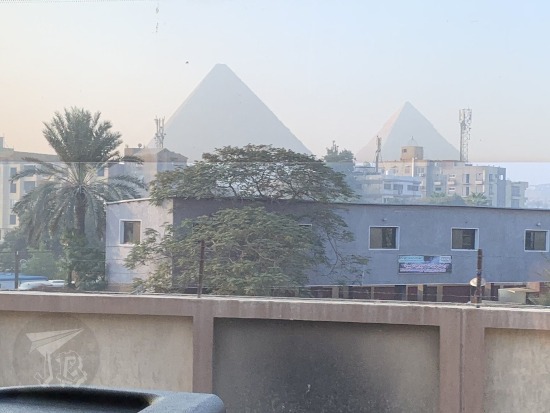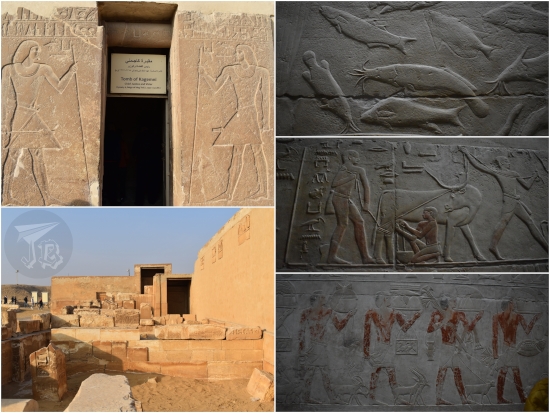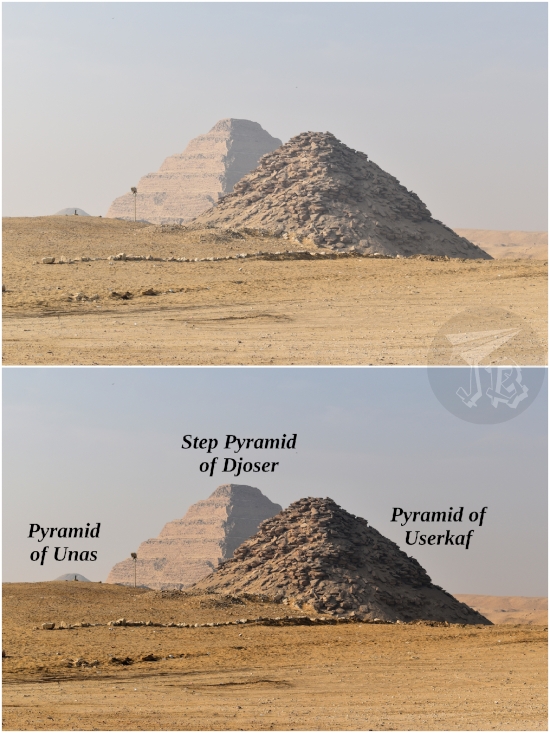
30th December 2022: Philae and the Aswan – Cairo jump {Egypt, Winter 2022-2023}

Belonging to the city of Aswan [أسوان], the Philae Temple [فيلة] complex is currently part of the Unesco World Heritage Site Nubian Monuments from Abu Simbel to Philae. When the first Aswan Dam was built in 1902, the monument became semi-submerged, and it would have completely disappeared after the completion of the High Dam. Between 1972 and 1980, through the International Campaign to Save the Monuments of Nubia, it was dismantled and reconstructed over at Agilika Island, 20 m higher.

The main feature in Philae is the Temple of Isis. Isis was the major goddess from the Old Kingdom to the Roman period. Isis was the spouse of Osiris, and is considered a mother and protector goddess, divine mother to the pharaoh, and mourner of her husband. In the Osiris myth, after he was killed and dismembered by Seth, Isis looked up and down Egypt to gather all the pieces. After she did, she breathed upon him to resurrect him, they conceived Horus (there are more or less gory versions of this), and Osiris went back to the Underworld, where he became lord of the Afterlife. Isis was the longest-revered goddess of the Ancient Egyptian religion – her cult survived in Philae until 550 CE, when Christians took over, defacing the gods and carving the Coptic cross all around.

I left for breakfast having vacated the room, suitcase ready at the open door, and hoped for the best. I settled my drink tab, which rounded up to 235 EGP; however, with the same smirk I had been given the previous day, I reminded the person at reception that they owed me ten pounds. The debt was honoured and I left with a giggle – yes, it was not that much money and I could have let it slip, but nope. Not this time. After that, our luggage was loaded onto the bus (luckily) and we drove off to a tourist dock to board the boat to Agilika island, which we reached after a few minutes. We landed and climbed up towards the archaeological site.

The Temple of Isis holds the general structure of an Ancient Egyptian Temple, with a pylon, a court, a hall and finally the inner sanctuary of Isis. An obelisk stands before the pylon, in the outer court that has been preserved.

Collage. View of the outer wall of Philae, with the colonnade and the pylon; entrance to the sanctuary, richly engraved with deities and hyerogyphs; a cat sitting in front of the columns.

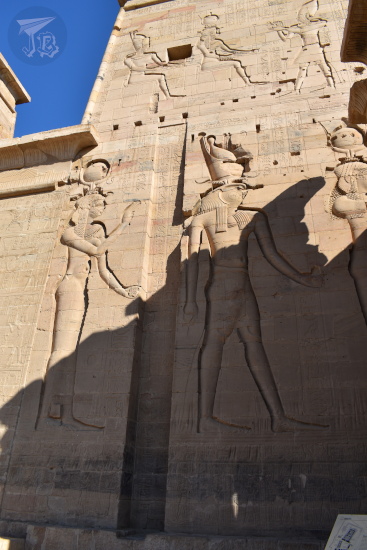
When looking carefully at the pylon, it shows the different water marks from the time the temple was submerged – at two different levels, depending on whether it was flood season or dry season. During the rescue, a cofferdam was built around the original constructions to dry the area out. Then, between 1977 and 1980, the whole complex was dismantled into 40,000 blocks, moved and rebuilt. The old position can still be spotted 500 m away, marked by the remains of the metal anchors for the cranes.

Close up of the pylon showing carvings of Hathor and Horus. Two water lines can be appreciated above and below them

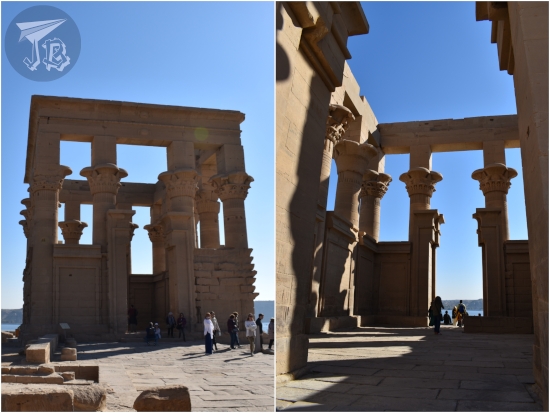
Another structure in the island is the unfinished Kiosk of Trajan. I even managed to be alone in there for a heartbeat.

A cube-like structure built from columns, with the river behind them.

The final building is the Temple of Hathor, Horus’ wife.

Collage. A ruined building with derelict walls and a few standing columns - from land and from the river.

Next in the plan was shopping (joy -.-“) and we went to an essence shop. The lady claimed that Egyptian essences were the base of many brand-famous perfumes. I have no idea, but I was irked by the rigid sex separation of scents, and I developed a rash from one of the testers… While some people in the group shopped, someone else found the adjacent papyrus shop, and a small number of us went to snoop there.

After being spared a second shop – this one for spices – we were shuttled to the airport to take our charter to Cairo. It was a surreal experience through which I was patted down twice. The airport segregated by sex because you got the pat down even if you cleared the metal detector, which was weird. Also, it turned out that we had an extra suitcase in the bus! Creepy!

Our tour guide did not fly with us. When we landed in Cairo [أسوان], we were taken to the hotel by another representative, who assigned rooms and called our names in the bus, before we even arrived, but did not hand the cards until we were there and had handed in our passports for check-in. It was of course too late to try and go to the Pyramids light show – seriously, everything would have been so much easier with a “sorry, no time”, especially considering the crazy Cairo traffic. At this point we were already planning to try it on our own – I had found out that the hotel had a mini travel’s agent that we could use.

A traffic jam heading to the Cairo airport traffic control. The green neon on top reads Welcome to Cairo

We met up for planning – and paying for the Night Cairo Walk, which was to take place the following day – and I sat down to catch up on everything that had happened in the days when I had been internet-less (have I mentioned that it was not such a bad experience?).

The whole trip was a New Year’s special and came with an optional 190 € dinner that I had not booked because… no. I had packed some cereal and chocolate bars just in case, and it turned out that only one couple out of our eighteen-people group had reserved it. There had been a tiny riff-raff when I asked my travel agent about dinner that day, and she received an email about the “Gala Dinner” being compulsory (demanding the extra money), and I asked her to reply that nope, I would not be attending.

Well, that night we were told that the local agency was treating us to the dinner – my theory? The restaurant they had agreed for the Night Walk would not take us for New Year’s Eve, the walk would be impossible due to people celebrating. Thus, they found themselves in a tough spot – so they used the spare from the overpriced optional trips to pay for it. Then, the night walk was bumped to the first of January. Looking back, I believe that they had completely overlooked the NYE factor.

Also, the hotel not only had free Wi-Fi, it also had complimentary water in the rooms, and free mineral water during dinner. And a bed that did not vibrate. It was a good night’s sleep. But before that I took a shower so long and so hotm, that I almost glowed in the dark afterwards.

29th December 2022: Abu Simbel and Nubia {Egypt, Winter 2022-2023}

Modern eras have brought lots of different needs and technologies, and both become one when we think about harnessing nature. The Aswan dam is one of such examples. There are actually two of them. The Old Aswan Dam was built in the wake of the 20th century (1899 – 1902), and the newer, Aswan High Dam was completed in 1970, creating Lake Nasser. The rationale was securing fresh water for Egypt and stopping the dependence on the Nile floodings; however there have been associated problems – not only environmental such as the habitat of the Nile crocodile and the loss of fertility in the delta; thousands of people were displaced from the to-be-flooded area, and houses and whole villages were swallowed by water. A lot of these villages had their own cultural heritage, which was to disappear forever. Thus started Unesco’s International Campaign to Save the Monuments of Nubia between 1960 and 1980. This effort relocated as many as 24 monuments (one of them, the Temple of Debod, ended up in Madrid, Spain) to safer grounds. The temples of Abu Simbel are probably the star of the rescue efforts.

The Abu Simbel [أبو سمبل] Complex is part of the Unesco World Heritage Site Nubian Monuments from Abu Simbel to Philae. It comprises two buildings – the Great Temple of Ramesses II and the Small Temple of Hathor and Nefertari. Both of them were carved out and into a sandstone cliff on the West Bank of the Nile during the reign of Ramesses II or Ramesses the Great (14th-13th Century BCE, Nineteenth Dynasty of the New Kingdom), considered one of the most powerful Pharaohs in the New Kingdom, who reigned for many years. It was lost to time, and only rediscovered in 1813 and excavated in 1817. The Complex was relocated to higher ground between 1964 and 1968 to prevent its sinking in Lake Nasser. In order to do so, the mountain and the temples were cut into huge blocks and built 65 m higher and 200 m back from the river. The relocation managed to keep the relative position to the sun, but shifted it by one day – the temple was designed so the first ray of sun hit Ramesses’ face in the sanctuary on the 21st of October and February, and now that happens on the 22nd.

At some point one has to wonder what was more impressive – building the complex, or relocating it so you can’t really tell. The mountain itself is hollow in order to reduce the stress on the temple after the move, but wow. Just, wow.

As far as I understand, buses are not supposed to stay longer than a couple of hours in the complex. Our disembark time was 2:30, and even if I went to bed ridiculously early, I did not get much sleep because my cabin was above the motorboat rotors, and my cabin vibrated like hell. Before we left, we had a choice of coffee or tea, and we were given a “picnic” consisting on some sweet bread with… buffet leftovers, a piece of fruit and a small juice – that was traded often.

The trip each way was 3.5 hours, so we wanted more than the 30 minutes the tour guide wanted to give us, and we were there between 6:30 (though we did not enter the site until a bit later) and 9:00. Fine, I own up – I was late coming back and only made it to the bus at 9:08. The tour guide was so not amused by that.

Arriving at the Abu Simbel site, you approach from behind the mountain, and as you surround it, you’re greeted by Lake Nasser [بحيرة ناصر], the reservoir created by the dam. The sun was climbing up slowly when we arrived, still with sunrise colour.

Sunrise over a lake. There is a lonely palm tree on the left

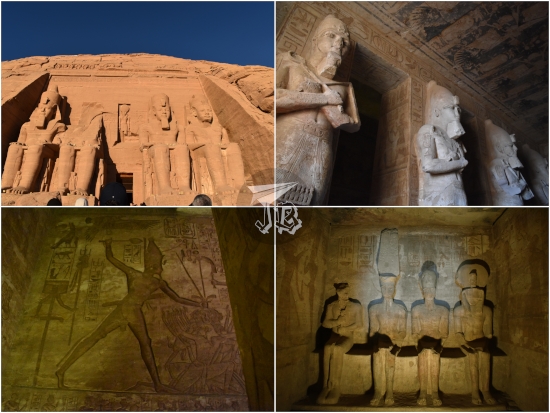
You keep turning and you are greeted by the four colossi that flank the entrance to the Great Temple of Ramesses II. The colossi represent deified Ramesses II, to whom the temple was dedicated along the gods Amun, Ra (in his Ra-Horakhty advocation) and Ptah (creator of the world and patron of craftsmen). The inside features a hypostyle hall with columns carved in the shape of Ramesses colossi, a colonnade hall and the inner sanctuary, where the venerated gods were revered.

Panorama of both Abu Simbel temples: Ramesses II to the left, Nefertari and Hathor to the right. The sky is blue, the monuments are orange-gold, and a lot of people gather at the entrances.

Collage of the Great Temple of Ramesses II: façade with four sitting colossi; inner hall, with colossi against the columns; an carving of Ramesses in a war position; inner sanctuary with the gods and Ramesses sitting, the light hitting their faces.

To the right stands the Temple of Hathor and Nefertari. Here, Queen Nefertari is represented as big as Ramesses and shown with the horns of the goddess Hathor, both signs of her importance (consorts were usually represented knee-high of their kings). The inner area has a hall with rectangular columns carved and painted, and the sanctuary features Hathor as a cow emerging from the mountain rock.

Small Temple of Abu Simbel colllage: Entryway with the colossi; inner hall with the face of Hathor carved into the columns; carving of Nefertari with the goddess' crown; inner sanctuary with the image of a woman with a cow head coming out from the wall, the light hitting her face

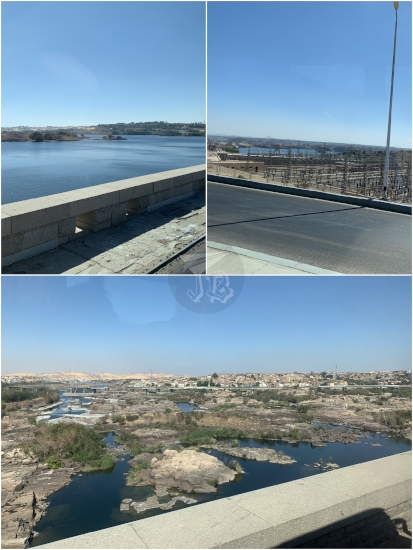
Despite really, really not wanting to leave, I made my way back and ran into two other people from the group. We had to leave through the tourist bazaar and were just slightly late. On the way back, slightly more awake than when we had left, we did not get to see any mirages, but we crossed the old Aswan Low Dam [خزان أسوان]. We had a view of the power plant on one side, and on the other side the First Cataract of the Nile, a series of rapids that have been slowed down by the building of the dam. In ancient times, it was believed that the Nile sprouted here and flowed both north and south. The main part of the cataract is now under the dam, and the remaining rapids have been turned into a nature reserve. There are Ancient Egypt remains and engravings in some ruins on the islands.

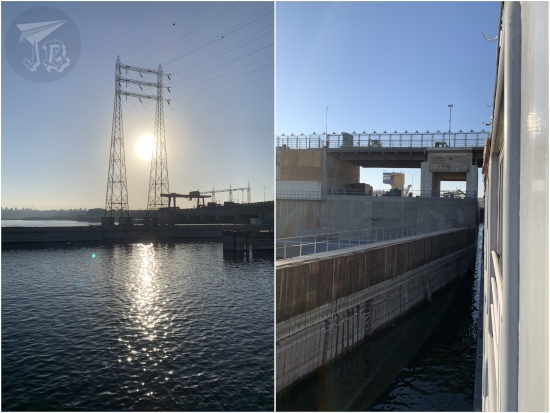
Views from the low Aswan Dam: southern side calm waters and power plant; northern side rapids

We were back on board the motorboat at 12:35 for lunch, and met again around 16:15 for a felucca sail on the Nile [نهر النيل] around the Aswan [أسوان] area. Before leaving, I decided to exchange 20 € into Egyptian pounds in order to have some change for the couple of meals we had outside, just in case I needed pounds to buy drinks. For convenience I chose the reception of the motorboat. They short-changed me, twice. First, they used a 23 EGP / 1 € exchange rate, while the official rate is 25 EGP / 1 €. Then, the guy at reception calculated 460 EGP and gave me 450, smirking “I owe you 10 pounds.” Stay tuned for the conclusion of the story.

The felucca sailing had been rescheduled from the following day so it could be tied to the trip through the Nature reserve and the Nubian village (and possibly to accomodate the charter flight times). A felucca [فلوكة ] is a traditional sailing boat, usually with one sail. Feluccas are still used for transportation through and across the Nile, and from ours, we caught some interesting views.

A sailboat docked with a precariously narrow plank to board it

A view of a sailboat on the Nile from another sailboat. The knots and ropes of the boarded felucca are visible in the foreground.

We got to see the Tombs of the Nobles | Qubbet el-Hawa [قبة الهوا] (Dome of the Wind), which I wish we could have visited. The tombs date back from the Old and Middle Kingdom with dignitaries and governors from the Fourth Dynasty to the Roman period buried here. The site is still being excavated, and also part of the Unesco World Heritage Site Nubian Monuments from Abu Simbel to Philae, even if it is neither Nubian nor between them.

A ruined structure perched on a bare mountain or dune. On the left there is a building, and on the right some open façades in stone.

We also sailed by the Mausoleum of Aga Khan [قبر اغاخان] and the family house beneath it. Sultan Muhammad Shah, Aga Khan III, was a religious leader among the Nizari Isma’ilism, a branch of Islam, and he was buried in Aswan after his death in 1957.

A building perched on the top of a mountain. It has a dome and several towers. A similar building stands at its feet, painted white, in the middle of a garden

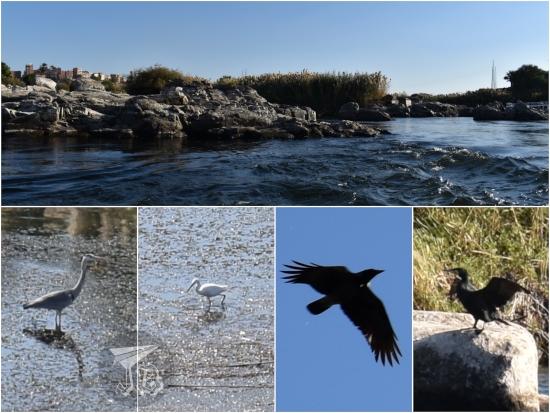
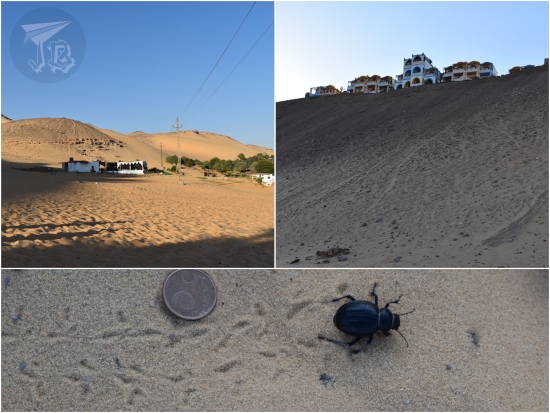
Apparently I missed some dancing as I was taking pictures of the site. Then, the people from the felucca sold us some trinkets, and finally we transferred to a different kind of engine boat, from where we sailed off towards Salouga and Ghazal Nature Reserve [محمية سالوجا وغزال الطبيعية] (the rapids formed by the First Cataract), around Seheyl Island [جزيرة سهيل], and a great sand dune. The Aswan area is famous among birdwatchers for its diversity. We got to see some glossy ibises (Plegadis falcinellus), little egrets (Egretta garzetta), reed cormorant (Microcarbo africanus), maybe an osprey or two (Pandion haliaetus), some corvids and stilts… Up the dune we made port at, we also caught sight of a couple of Egyptian beetles (Scarabaeus sacer).

Collage: a rocky island surrounded by rapidly-running water, and several birds wadding and mid-flight

Collage. Two views of a huge sand dune: the buildings look tiny against it. A picture of a scarab walking on sand and leaving its print. It is a bit biger than a 5cent coin

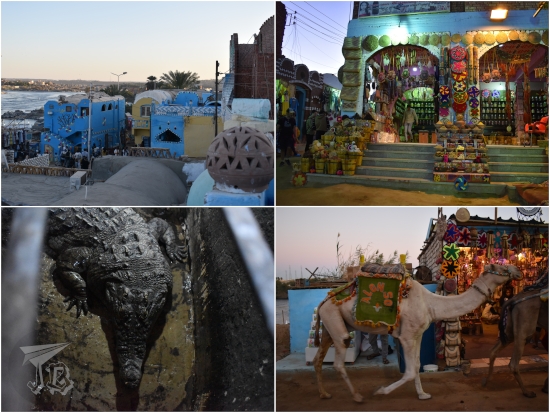
The Nubian village, Gharb Seheyl [غرب سهيل], which is little more than a big bazaar. We were invited to the house of a man who claimed to have been a dancer for the Spanish Teatro Real. We hung out there for an hour or so, and eventually were let off to walk around the village, a succession of shops selling the same trinkets as everywhere else, plus women trying to sell “Nubian dolls”. The house we were at kept live Nile crocodiles (Crocodylus niloticus), and at a lot of places we saw some mounted ones, I guess for tourist’s entertainment, but that did not feel quite right.

Collage of the Nubian village: a view from a rooftop, showing the houses painted in sand and blue colours; a shop with colourful trinkets, flowers, and statuetes; a Nile crocodile staring up; a dromedary passing by a souvenir shop.

After sunset, we sailed off back to the motorboat, without stopping anywhere, even if the whole city was lit. The boats were also shiny with neons and bright colours.

Collage: boats at night, docking and navigating the Nile. Two views of Aswan: lit ruins of the tombs of the Nobles, a mosque and a hotel

At the motorboat, we just had dinner and I went to bed early to catch some sleep. When I arrived at the cabin, I discovered that the staff had taken one of my beds away. I guess they got tired of making both of them as I used both bed covers? I was amused, just like I had been by all the figures they made out of towels (I got swans, a crocodile, and a monkey) though I wish the cleaning had been a bit more… thorough.

28th December 2022: A winning change {Egypt, Winter 2022-2023}

When the Aswan Dams were built, the natural flow of the Nile was altered, and a number of floodgates were built. In order to travel south towards Aswan, we had to cross one of those floodgates, the Floodgate at Esna. I was up watching sunrise when we started moving – as we were in line for a very long time in order to do so, our itinerary had to be altered – as we only crossed the dam at 7:40 instead, and would not have made it to our second stop before it closed. So instead of seeing the Temple of Kom Ombo, dedicated to Sobek and Haroeris / Horus, we would stop at Esna. This was truly off-schedule, as we actually witnessed the guide purchasing the tickets on spot, while he usually had them ready beforehand. I do think, however, this was a good change.

Collage: Sun rising behind the floodgate at Esna. The motorboat entering the floodfate: a mass of white iron coming close to a cement wall on water

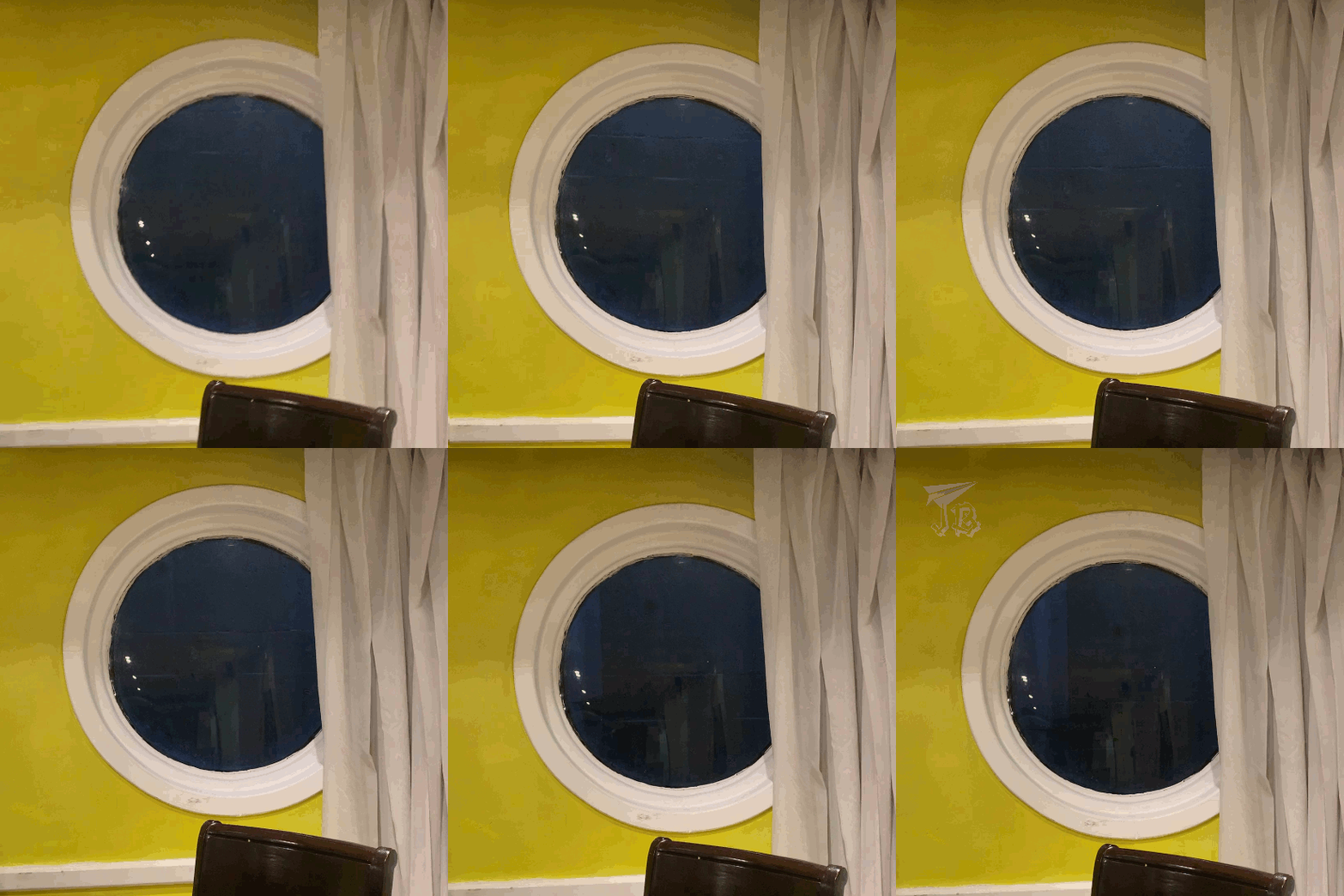
Animation of the porthole just above water, showing how the ship moves up and forward at the same time

We made port at Esna [إسنا], at a quay within walking distance of the Temple of Khnum [معبد إسنا], the ram-headed god who created life. This temple was started by Ptolemy VI Philometor (2nd century BCE, Ptolemaic or Graeco-Roman period). Today, only the first hall has been excavated, as most of the temple is buried under the sand – and the houses! In order to access the vestibule, you have to climb down stairs into a nine-metre pitch. As the temple was buried in sand for centuries, it has kept its polychromy, and the columns are richly decorated. It was a beautiful temple, but it seems that unearthing the rest is going to be hard, if not impossible (though they managed to relocate everyone who lived on top of the Avenue of Sphinxes in Luxor, so who knows?)

Collage. A temple stands in a deep pit of sand. It is rectangular in shape, and the façade shows six columns to each side of the gate, all complete and opening in a compound capital. The other two images show the columns inside: they are decorated with reliefs and painted in bright colours (golds, greens, blues...)

We went back on board and continued off until Edfu [إدفو ], where we visited the most completely preserved Egyptian temple ever – the Temple of Horus [معبد إدفو] (3rd century BCE, Ptolemaic or Graeco-Roman period). It was one of the most impressive sights I’d ever seen (and there were more to come anyway). Horus, the god with the falcon head, was the son of Isis (primordial goddess of Magic and protecting mother) and Osiris (God of Death, fertility and resurrection). Osiris was betrayed by his brother Seth (god of chaos and confusion), killed and dismembered, with his body parts spread throughout Egypt. Horus avenged him and became the ruling god, with the Pharaoh being his representative on earth, giving Pharaohs a direct connection as figurative “children of the gods”.

The temple was also buried by sand, and that is how it has survived relatively intact, with all the outer walls surrounding the main temple structure. The pylon gates are flanked by falcon statues, and the columns still keep their colouring. We got to see a reproduction of the wooden boat that was used to bring the god out in procession, the original is in Paris’ Louvre museum these days. Here I found a “secret passage” to the side which was really cool to explore (albeit not really secret, just empty of other tourists (≧▽≦).)

The temple of Edfu, collage: The pylon; the main hall from the outside with six columns and a huge entrygate flanked by falcon statues; the inside columns, blackened by smoke; and a boat-like structure with a falcon statuette from the inner sanctuary.

After we were back on board, we were summoned to the sun deck to ‘discuss’ the following day/s, and offered some extra outings. We tried to negotiate an outing to see the light show at Giza, but the tour guide refused to organise it (turns out, we would not have the time, but he did not want to tell us that for some weird reason); I also tried to arrange a morning trip for myself on the 2nd, unsuccessfully (more on that later). Instead, he sold us a trip to a Nubian village, sailing through the Nile nature reserve, and a night walk through Cairo with dinner. Oh, and informed us that wake-up call for Abu-Simbel the following day was… 2:00.

27th December 2022: Early start and late delays {Egypt, Winter 2022-2023}

Not that 5:00 is a nice hour for anything, but it’s definitely a nicer hour to get up than to take a plane. Leaving was scheduled for 6:00 (with sail-off at 14:00), and I would not have minded had it been earlier to be honest. However, given that most of my group had arrived at midnight, there might have been a riot…

Breakfast was not too well stocked, but there was coffee and eggs for energy through the morning as we were going to be out from 6:00 to 14:00 – a full eight hours. We started late because the tour guide was late… not a good sign. The group had 18 people plus him, and he really did not sound either enthusiastic nor particularly knowledgeable to be blunt. We had a coach booked for us and we set off to visit the main elements in the city of Luxor [الأقصر] and its surroundings, the Unesco World Heritage Site Ancient Thebes with its Necropolis. We started towards the West Bank of the Nile, the bank of the dead, where the ruins of the Necropolis are.

Our first stop was Medinet Habu [مدينة هابو] a Pharaonic complex, whose most important building is the Mortuary Temple of Ramesses III. It was the last monument built in the area, during the pharaoh’s reign (12th century BCE, Twentieth Dynasty of the New Kingdom). The basic structure of an Ancient Egyptian or Pharaonic temple is the pylon – court – hall. The pylon is a massive wall separated in two parts in which a narrow passage acts as gate. The court is a colonnade, and the hall is the area where the sacred spots can be found, covered and darker.

In the case of the Mortuary Temple of Ramesses III, the complex is surrounded by a mud brick wall with an extra pylon. The temple is decorated with carvings that depict the pharaoh as a great warrior smiting all his enemies. The structure used to be connected to the Nile to the point that there was a so-called Nilometre. In Ancient Egypt, taxation was determined by how high the Nile floods were – or were not.

Collage of the Mortuary temple of Ramesses III: The pylon, the columns, a bare gate and one decorated with rows of hieroglyphs

After the temple, we continued off to the Valley of the Kings | Wādī al-Mulūk [وادي الملوك]. Between the 16th and 11th centuries BCE, after the pyramids had been proven easy to find and pillage, the pharaohs from the Eighteenth to the Twentieth dynasties were laid to rest here. The tombs are excavated into the rock and here was where Howard Carter found Tutankhamun’s grave in 1922. The ticket grants admission to three “standard” tombs, and the most emblematic ones require a separate fee. Our guide pressed us not to buy a ticket for Tutankhamun, and did not even mention other tickets – at this point I decided that I had to read beforehand about what we were going to do the following days in order to be prepared for his attitude.

A scorching valley opening to both sides with grey-white hills going up. Everything looks sandy and dusty,

The first grave we visited was the Tomb of Ramesses IV (KV2) (12th century BCE, Twentieth Dynasty of the New Kingdom). It consists of a long and richly-decorated corridor that ends in a mortuary chamber where the sarcophagus still stands. It has been open to visits from antiquity.

Tomb: a long corridor with painted and carved hieroglyphs. In the background stands a bare sarcophagus in pink granite

The second tomb was the Tomb of Ramesses IX (KV6) (12th century BCE, Twentieth Dynasty of the New Kingdom), which was unfinished at the time of his death. The entrance corridor is wide, with the walls covered with glass. In this case, the burial chamber was unreachable.

Tomb collage: a long corridor decorated with hieroglyphs and a close up of a painted boat taking the deceased to the underworld. The corridor ends in stairs that go down towards the mortuary chamber

Our final grave was the Tomb of Ramesses III (KV11), whose temple we had seen before. The interesting thing about this tomb was that it ran into another one as it was being built, so the corridor actually has corners before reaching the empty burial chamber.

Tomb collage. Details of the different engravings and hieroglyphs. The burial chamber has thick columns and it has a downwards slope. The columns are decorated with further hieroglyphs and images of the gods

After the Valley of the Kings, we headed back to the Eastern Bank and made a stop at the Colossi of Memnon [تمثالا ممنون]. Each of the four statues was carved from one huge block of rock, and they signal the entrance to the funerary temple of Amenhotep III (14th century BCE, Eighteenth Dynasty of the New Kingdom). The temple is currently being excavated, and it would have been the largest in the West Bank.

The four colossi. There are two in the foreground, sitting down. They don't have faces. Two others can be guessed in the background, though one is just a block of rock

Afterwards, we got stuck for a stupid amount of time at an “artisan stonework” shop – a tourist trap to buy souvenirs. Boy, was I miffed, especially when this took out time from temples in Luxor. The first stop in the Eastern bank the was Karnak Temples Complex [الكرنك]. Karnak is a succession of temples, pylons and chapels that started around 2000 BCE, during the reign of Senusret I (20th century BCE, Twelfth Dynasty of the Middle Kingdom) and continued for 2000 further years, with more Pharaohs adding their own structures. The most impressive area in Karnak is the Hypostyle Hall, open to the sky now with a number of columns ending on an open papyrus capital. Other features are the obelisks of Hatshepsut, one standing, the other fallen.

The complex was dedicated to the Theban triad: the god Amun, the goddess Mut (the “mother” goddess with the head of a vulture) and their son Khonsu (god of the moon). Amun was the creator of the universe, and later his cult was merged with that of Ra, the god of sun and light, thus the appearance of the god Amun-Ra, to whom the main temple was dedicated. The huge complex expands right and left, but unfortunately we had little time to explore due to time constraints.

Karnak complex: the entrance pylon, the columns in the hall, decorated with scenes from Ancient Egypt's daily life, and an Obelisk

We moved on to Luxor Temple and the Avenue of Sphinxes, also called Rams Road [طريق الكباش]. The Avenue joined Karnak and Luxor, and was flanked by ram-faced sphinxes all along its three kilometres – though the four best preserved ones were taken to Cairo to create a monument in one of the squares. The avenue has actually been walkable since 2021, and you can go from one temple to the other on foot.

A long line of sphinxes with human faces and lion paws

Luxor Temple [معبد الأقصر ] was dedicated to the rejuvenation of the monarchy, and many pharaohs were crowned there. It was founded around 1400 BCE, and throughout the centuries has come to host a mosque. In front of it, stands an obelisk, whose twin is in Paris. Behind the obelisk stands the pylon, the court, the colonnade, and a final court before the sanctuary chamber.

Luxor temple: The pylon with an obelisk in front, two sitting colossi and two parallel rows of columns from the hall

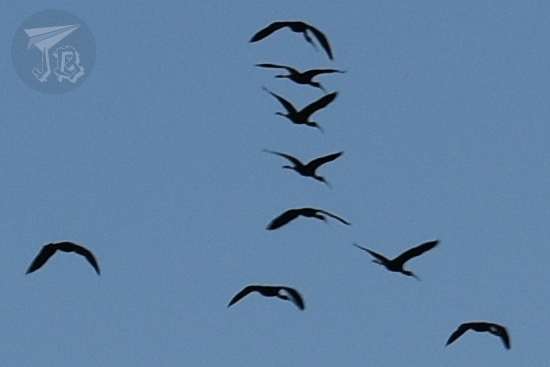
We were back on the boat just a few minutes after 14:00 for lunch, and then I found my way to the sun deck to see the sail off… which did not happen till 16:00! All that running through the temples for… nothing. I was not pleased, but I refused to get angry. Instead, I read up on what was to come, did some bird watching – I caught a flock of ibises – and watched the sunset.

A flock of birds flying against a bright blue sky. The curved-down beak suggests that they're ibises

Sunset over the nile. The sky is orange, the suni s almost white, and there is a trail of light on the water

In the late evening we reached the floodgate at Esna, which we should have crossed around dinnertime. We got stuck waiting for our turn behind a large LNG ship and a lot of other motorboats. In the middle of nowhere, I was able to see the stars very clearly, and that was pretty.

26th December 2022: Timing, timing {Egypt, Winter 2022-2023}

Since Madrid is a horribly busy airport, apparently 5:00 is the right time to schedule a charter – and take off late anyway. The paperwork insisted on arriving at the airport with a three hour’s margin, and I did precisely that, reaching Terminal one at 2:06. I was slightly worried that the charter would not be shown on the screen, but it was there, literally the first flight. A number of tour operators had come together to charter around 200 people to Luxor, and as it was not a regular flight, there was no way to obtain boarding passes online.

I had to queue for about an hour in order to get my pass, and just as I was leaving the check-in counter, I heard that 90 people had been checked in, and the line was about even longer than when I had joined. There were three check-in counters and the process was really slow – there were problems with the conveyor belt for starters, then people would not have their passports ready or had weight issues with their luggage. I… handed over my passport, put my suitcase up, received my pass, and was out in less than two minutes… So I have no idea what all the issues were…

Security was also pretty fast even if I got stuck behind a family who didn’t take their electronics out, tried to get big liquids in, and couldn’t get their boarding passes sorted out to go through passport control. I found my gate and I sat down to snooze. We were the only plane leaving from the airport, and we were late by 20 minutes…

I slept for a couple of hours until we got breakfast, then slept again until we landed in Luxor | Al-ʾuqṣur [الأقصر ]. As my visa had a already been processed, I got a sticker and filled in the immigration card. Then I went through immigration, picked up my bag, and we were waived through customs. It was a bit of a chaos as different guys yelled up the names of different operators until we found our groups. A guide told me I’d be riding the bus with him as I was the only one heading for the motorboat “M/S Opera”, I’d be getting off first in 15-20 minutes.

Egypt Visa Stamp on a passport. It marks Luxor as point of entry and Cairo as point of exit

Luxor is located on the east bank of the Nile, covering part of the ancient site of Thebes, which comprised an area for the living (eastern bank of the river) and another for the dead (western bank, the current necropolis). Thebes was the capital of Egypt during the Middle Kingdom and the New Kingdom, and today the site of Ancient Thebes with its Necropolis is recognised as Unesco World Heritage Site. The bus drove off and we got to see Karnak [الكرنك], the Avenue of Sphinxes and the Temple of Luxor [معبد الأقصر]. The guide laid out the plans for his group to have lunch and then go off to visit both the temples of Karnak and Luxor to make the most of the time in the city. I thought this was a fantastic idea (I’d be sorely disappointed later when I realised I was not part of those plans).

Temple of Luxor from the bus

About 40 minutes later, way out of the city, the guide informed me that the bus driver had been unable to find my boat, but that he would drive me there now. They were leaving because they had reached their pier. Thus, I was driven back to Luxor, alone in the bus, to a shady alley that eventually got to my motorboat. I was worried that I was keeping the rest of my group back… It turned out that the 17 other people from my group arrived at night! I was not alone on the motorboat, of course, but my tour guide said I should “just relax”.

I entertained the idea of going out to explore, but I’d heard a few horror stories about travelling Egypt alone, and the dock was in a bit of (read: very) shady place; besides, I was pretty much out. It was colder than I expected (apparently, I managed to arrive through a cold wave in Egypt, go figure), so I divided my time between the sun deck and the cabin, reading and dozing off from time to time. Though my cabin didn’t have views, the sun deck had some nice ones of the West Bank of the Nile, where the tombs of the most powerful pharaohs are. The motorboat looked right out of a Mummy film if not for the fact that it was in colour. However it looked charmingly garish – though the cabin was a bit chilly, and the heating wouldn’t work. Since I had two beds, I planned to use both covers to stay warm.

A collage of the motorboat: From the outside, it looks like two train carriages welded together. The inside is full of carpets and decorated wood. The sun deck has a swimming pool and some hammocks.

At some point during the evening I looked up and saw that the light had shifted, so I climbed up to the sun deck and caught some amazing sunset views over River Nile [نهر النيل].

Sun setting over water

To be honest, by 20:00 I just wished dinner time would come and I could grab a bite to eat, a bottle of water, and then take a shower and go sleep for real. I tried to buy Wi-Fi access, the receptionist understood me, but decided to play dumb, so I decided to forgo that altogether. Furthermore, I was growing antsy because I wanted to know the plan for the following day – for waking up purposes – and where I could exchange some money for tips and so on.

I caught the tour guide at dinner and at least managed to secure a time to leave the following day, which was the most important thing. I was not too keen on him by this point – I think he was just miffed he had to start working 12 hours earlier just for one person, and not bothering to hide it, so communicating with him was hard, since he did not seem to have straight answers to my questions – well, at least I knew what time to get going. After dinner, I went to the sun deck again. I was not going to get to see Karnak lit up for the evening, but at least I saw the West Bank.

26th December 2022 – 2nd January 2023: Egypt | Miṣr [مصر]

Egypt 26th December 2022 – 2nd January 2023 written with a pyramid and the sphynx as background


I suppose I am not really qualified to talk about “once-in-a-lifetime trips” considering how I came back from Japan 2012 craving for more, and before Covid hit, I managed to go back several times. For a long time, Egypt has been a destination in the back of my mind, one that I thought was too unattainable on my own, both financially and because I’m weird and single and all.

The stars aligned, in a very weird way I guess, and I made the – maybe self-caring, maybe selfish decision – to seize the moment and take the chance. And thus, with the help of Father Christmas, I went to the cradle of civilisation. The trip was booked through Viajes El Corte Inglés and its tour operator Tourmundial in Spain, and implemented through Galaxia Tours in Egypt. From the beginning to the end, the trip was good, really good, in spite all the issues that could have clouded its development. However, and even if I did not see everything I wanted to, there is no crazy urge to come back.

In a way, I felt a bit like a cashcow, in another like someone a bit on the immoral side. The good thing about the local agency is that at least some of the money we paid stayed in the country. I know that at a couple of times I let myself be “scammed” and paid more than I had to, and other times I put my foot down. All in all, I feel it was a good trip, I scratched a lot from my bucket list, and I geeked out, climbed the inside of a pyramid, and saw Abu Simbel. The level of “achievement unlocked” feeling is unbelievable.

The package consisted of several parts: an arrival day (26th December), three days on a motorboat on the Nile (27th – 29th December) with daytrips and excursions to visit different sights, a transition day (30th December) with a visit and the flight to Cairo, two days in Cairo and its surrounding area (31st December and 1st January), and a final return day (2nd January).

14th September 2022: Leaving is also tough {Jordan, September 2022}

We were picked up at 7:00 for our 10:55 flight out of Queen Alia International Airport, not by the guide any more, but by a random driver who dropped us off about 8:00. At the airport, a liaison came to pick us up. He took us through a pre-check before we could even walk into the airport. He walked us to check in and when I told him we had already done so, I might have broken his brain. He placed us on a special line and took our passports so we… got paper boarding passes.

Then he took us to the security area and left us there. We went through the automatic gates with the boarding pass, then through passport control, where we got the exit stamp. Finally, we got through standard airport security that swabbed my camera for explosives. The whole thing took about half an hour because even if there were many steps, there were few people in the airport. We found the gate and settled down to wait.

Passport page showing entry (10th September) and exit (14th September) stamps for Jordan, along with a "Group Tourist Visa" stamp (by JBinnacle)

And boy, apparently there had been overbooking in the flight, so checking in early saved us a lot of stress! We had paid to sit together, so I politely declined exchanging seats when I was asked, and my neighbour did not take it well…

We had a snack during the trip again, but I think that the meal and the drinks should have been a bit more separated, that would have made the trip more comfortable. We were supposed to take a little over five hours; however, had we found a landing slot, we would have made the whole trip in just over four. Upon landing, our passports were checked at the plane exit, then at normal immigration, then there was Covid vaccination status… and we made it back home after 12 hours on the go.

All in all, this has been an interesting experience, but we did not see a lot of the “important” sites, even in Petra. However, I do not think that I need to come back to Jordan. Even though it is the most westernised of the Arab states, child labour, animal abuse, hassling, peddling, distrust, and the tipping culture have been a put off. Furthermore, I plan to avoid the trip’s organiser as much I can in the future, because I did not like the way this panned out – especially the rearranging, the hours (early enough to be uncomfortable, too late to beat the crowds) and the “forced shopping times”, which I am told is typical in Middle Eastern countries. I swear, this has made me rethink Egypt…

13th September 2022: Wadi Rum (and the bus) {Jordan, September 2022}

I had a boiled egg, potato hash-browns and coffee breakfast because my body was craving salt, I guess. Then we set off on the bus, where we ended up spending around seven hours (the 412 km are supposed to be done in 5 hours and a half, but that does not take into account bad traffic). Urgh. Our first stop was a viewpoint over the whole canyon area.

Wadi Musa valley panorama, showing the deep gorge from above

The second stop was a souvenir shop that had probably somehow bribed our guide or driver for it. None of us even bought anything, but we were forced to be there for about half an hour before we could continue to the only organised activity for the day – a two-hour jeep tour throughout the Natural Reserve and Unesco World Heritage Site of Wadi Rum | Wādī Ramm [وادي رم]. It is the largest wadi “valley”, created by alluvial fans and wind deposits, rather than the idea of a river bed. They are often found in deserts.

During the tour in Wadi Rum Reserve [محمية وادي رم] we drove through the desert and stopped at some rock formations that had built a gigantic dune. Wadi Rum used to be a granite and sandstone rocky formation. Thousands of years worth of wind eroded the sandstone back to sand, forming and shaping the desert dunes. Huge granite structures still stand, such as the Seven Pillars of Wisdom [عمدة الحكمة السبعة], just at the beginning of the route. One of the stops is the tourist-named Big Red Sand Dune, which you can climb for kicks, giggles and some nice views of the landscape.

Driving into Wadi Rum. The roof of the jeep is visible, along with a rock formation in the background. Between us and the rock formation there is the other jeep, causing a dust cloud

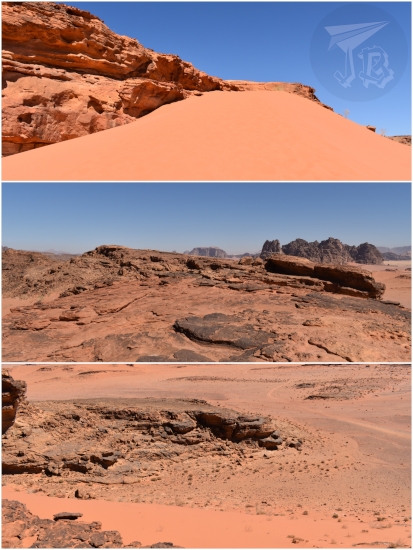
Back of a dune we had to climb, and the rock + sand landscape that could be seen from the top. Wind erosion marks have created soft ridges. The rocks are red-grey and the sand is rose-gold

Then we drove off to see some petroglyphs, and were offered dromedary rides. These petroglyphs, depicting early humans and their cattle – bovines and dromedaries – are the reason for the Heritage status.

A rock wall with some dromedaries in the foreground + a close up of the petroglyphs engraved in the rock, also showing dromedaries (by JBinnacle)

Finally we were shown a Bedouin tent at the feet of the Lawrence Canyon, a beautiful rock formation with faces of Jordan monarchs. Unfortunately, we did not get to see any onyx or fennec foxes, but I did see a small lizard. The Bedouins treated us to a cup of tea, but then we had to tip the driver about 10€…

Lawrence Canyon, a deep cut in the rock filled with sand at the bottom + details of engraved faces and Arab script, a lizard and a bit of tea, along with a traditional Bedouin coffee maker

Afterwards, we started off our trip back northwards back to Amman | ʻAmmān [عَمَّان]. Though the trip is supposed to take about 4 hours, it was way more than that, and we did not arrive at the hotel until way past 18:00. We went through the security checks and ended up learning that we could not travel between floors, so we could not go to the others’ rooms using the lifts, and the stairs were blocked… Well, at least we had… views?

A view of Amman skyline in the dark

After we managed to regroup, we had dinner and decided to try to check in online for the flight next day’s flight – and I was successful. Apparently, the airline only cared about us filling in our Covid certificate to enter Jordan, we were on our own for the way back.

12th September 2022: Petra {Jordan, September 2022}

Petra | Al-Batrāʾ [ٱلْبَتْرَاء] is without doubt the crown jewel of Jordan. It was the capital of the Nabataean Kingdom, and a strategic point in the middle of the trading routes. Nabataeans were one of the nomadic Bedouin tribes in the Arabian Desert that eventually settled and established the capital of their kingdom around the 2nd century BCE. Soon, Petra became a major trading hub and flourished as the Nabataeans were extremely skilful in harvesting rainwater and agriculture in the barren deserts. The Nabataeans also became very good at carving the sandstone of the canyon where they built their city. They lived in caves in the rock and created intricate façades in the sandstone of the mountains surrounding the site.

Eventually, water dried out and Petra fell, becoming a lost city, a tale told by crusaders when they returned home. In 1812, Swiss traveller Johann Ludwig Burckhardt “discovered” Petra for the Europeans, and excavations and archaeological expeditions took place throughout the 20th century. At this time, a Bedouin tribe, the Bidouls lived in the area, and in 1985 they were resettled in a nearby village built by the Jordan government before the site was designated a Unesco World Heritage Site.

As part of the concessions made for the Bidouls, they were given sole rights to the exploitation of the archaeological site, and their traditional customs were declared Unesco Intangible Cultural Heritage. Unfortunately, these traditions have devolved today into blatant child labour, peddling, and animal abuse. Barefoot children run after tourists to sell trinkets, women handle myriad of stands illegally selling rocks and fake archaeological artefacts along with imitation jewellery, cosmetics, decoration and so on, and men offer the services of thirsty and sad-looking donkeys, dromedaries and horses to move round the area. And while I can understand choosing to ride an animal in the long distances and heat, I saw a poor dromedary covered in red graffiti made by tourists that made me want to scream at people.

In 1989, Petra was featured as the lost city of Alexandretta in Indiana Jones and the Last Crusade, something that is considered the start of the Western tourism in the area. The film features the entry canyon, the Siq, and the Treasury as the Temple of the Holy Grail, possibly inspired by the crusade references from the Middle Ages. Aside from being a Unesco World Heritage Site, Petra is one of the New Seven Wonders of the World, and a geoarcheological protected area.

We were picked up at 8:00 and driven to the visitor centre. We had been warned beforehand to say no to anyone trying to rent / sell us anything as long as we were with the guide, who insisted on “taking care” of us for a couple of hours until he gave us free time until 18:00.

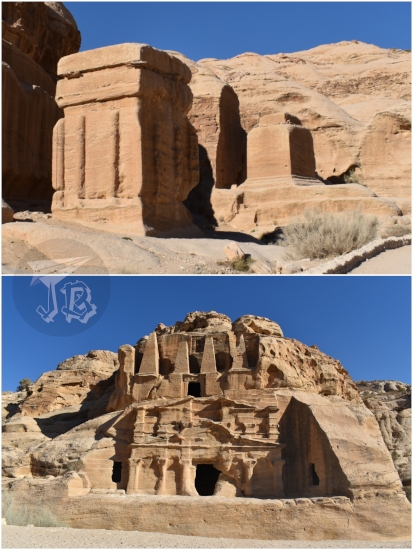
As you leave the visitor centre behind, there is about a kilometre and a half of barren desert. To the right of the trails stand the Djinn Blocks [أنصاب الجن], so named because the wind makes a sound around them (a djinn is an invisible spirit, sometimes called a genie, from the pre-Arabian mythology that was later incorporated into Islamic theology). On the other side of the path stands the Obelisk Tomb [مدفن المسلات].

Petra: Djinn Blocks and Obelisk Tombs (by JBinnacle)

The following area is the canyon Al-Siq [السيق], another kilometre and a half’s worth of walking between two fantastic rock walls. The Siq is an opened fault that was subsequently eroded by wind and running water. It was used as the caravan entry to Petra, and the lower area shows rests of Roman roadway, and the water canalisation built by the Nabataean. There are also some sculptures, both religious (baetyli) and non religious, such as a merchant with their dromedary. Some of the side fractures have brick dams to protect the main route.

Petra: Different views of the Al-Siq, including the waterways  (by JBinnacle)

At the end of the Siq stands The Treasury | Al-Khazneh [الخزنة], the most famous building in town, built in the 1st century BCE, probably as the Mausoleum of Nabataean King Aretas IV. Older tribes of Bedouins thought there was a Pharaoh’s treasure in the upper urn, so they tried to shoot it down throughout the 19th century. I had wanted to go up to the view point, but the locals made sure that you could not do it on your own so you were forced to tip them and support their submerged economy – thus, I decided against it in the end.

Petra: first view of the Treasury through the Siq, and main façade (by JBinnacle)

The canyon opens to the right and you move onto The Street of Façades, flanked by Nabataean tombs. As the canyon opens, to the left stands the Nabataean amphitheatre [المدرج النبطي ] and to the right, the Tomb of ‘Unayshu carved into the rock.

Petra: Different façades, Nabataean amphitheatre, and Palace Tomb (by JBinnacle)

Once in the open, turning back you can see the Royal Tombs, from left to right Palace Tomb, Corinthian Tomb, Silk Tomb and Urn Tomb. To the right there are the remains of a Byzantine church that we did not climb to.

Petra: overview of the Royal Tombs carved into the mountainside (by JBinnacle)

The Colonnaded Street holds the Temenos Gate, the Great Temple [المعبد الكبير] on the left and the Temple of the Winged Lions [معبد الأسود المجنحة]. It ends on the Qasr al-Bint [قصر البنت], the only building in the traditional sense that it is still standing after thousands of years of erosion and earthquakes.

Petra: Colonnade street, Great Temple, and ruins of the gates and the only standing building (by JBinnacle)

Here we made a stop at the restaurant / bar to have a drink and gather a little strength before we took on the 850 upwards steps on the Ad-Deir Trail. The hike was a bit difficult due to the uneven steps and the donkeys constantly going up and down, carrying tourists. The views of the canyon were spectacular, and at the end of the hike stands the largest stone-carved building in Petra, The Monastery | Ad Deir [الدير]. It is 47 m high and 48 m wide, built in classical Nabataean style – an interesting detail is that the columns are purely decorative, and not at all functional. I enjoyed the hike, but apparently my family did not.

Petra: Different views of the Monastery Trail, up and down. The lower pictures shows and overview of the whole valley, 800 steps down (by JBinnacle)

Petra: Façade of the Monastery, a building carved ito the mountain side in reddish sandstone (by JBinnacle)

After the Monastery, we made our way down, leisurely, and stopped at the places the guide had told us about. We decided not to hike up any more sites and just strolled back to the visitor centre. From there, we stepped into The Petra Museum [متحف البتراء], where we could see some of the found artefacts and decorations up close and protected from erosion.

Petra: Overview of the Museum, pieces of the Nabataean piping, chapitels, teselae and a reconstruction of a Nabataean man's head (by JBinnacle)

We finished around 17:30, so we just set to wait for the bus at whatever shadow we could. Having read a lot of bad reviews about Petra by Night, I decided that 9.5 hours / 15 km (24326 steps) in the site had been enough and I did not need to walk the Siq again illuminated by candles. Yay me getting over my FOMO. We had some dinner in the hotel – and what I really regretted was not packing my bathing suit, because I would have loved a soak in the swimming pool.

11th September 2022: Roman, Byzantine and Nabataean archaeology {Jordan, September 2022}

The alarm clock went off at 6 am as we left at 7 for the initial leg of the tour, the city of Amman | ʻAmmān [عَمَّان]. The first thing we learnt was that traffic rules are little more than guidelines in Jordan – cars jumping lanes, honking at will, and driving whereever they could physically fit. The tour had 14 people in it, so we had a minibus. At least we had some presence / weight going on for us in that crazy traffic… so that was a good thing about the tour.
Around 8:00 we arrived at the Amman Citadel | Jabal Al-Qal’a [جبل القلعة] – and here is where my heart sank. The guide made clear that we had to be with him at all times unless he gave us “free time”. Unfortunately, he rushed us through, and he was droning, boring, and embodied everything I dislike about guided tours. And here I thought I had made my peace with them back at Stonehenge…

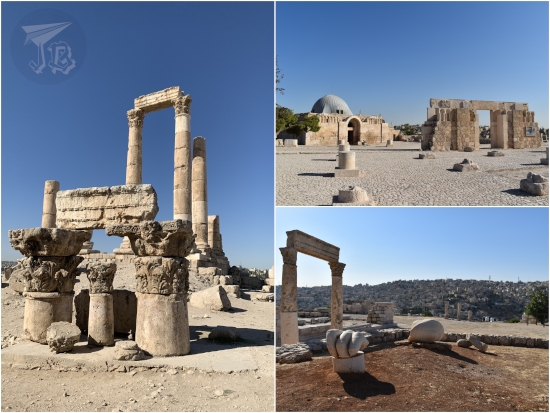
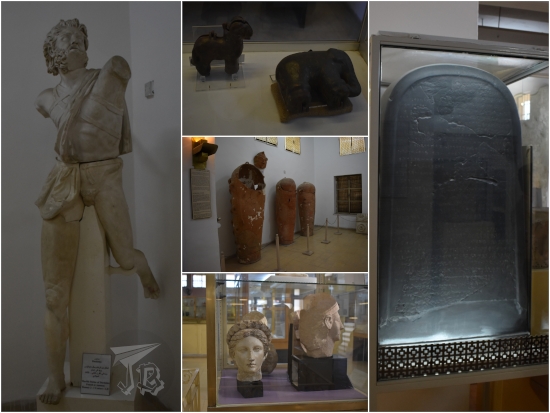
The most important remains in the Citadel are the Roman Temple of Hercules [معبد هرقل] and the remains of the colossal statue (2nd century CE), and the Umayyad Palace | Al-Qaṣr al-Umawī [القصر الأموي] (7th century CE). In the mid-20th century, the Jordan Archaeological Museum [متحف الآثار الأردني] was built within the Citadel. The museum is tiny, but it holds artefacts from all the historical eras the country has lived through.

Amman Citadel: Temple of Hercules and Palace

Amman archaeological museum: roman sculptures and trinkets, sarcophages, estelae

After the Citadel, we drove downhill to the Amman Roman Theatre [المدرج الروماني في الاردن] and Odeon [مسرح الأوديون], both of them are structures dating from the Roman period, 2nd century CE. Both are extremely well preserved, and still in use. There are also two tiny museums – the Folklore Museum and the Jordanian Museum of Popular Traditions.

Amman Roman theatre, from the outside

Amman Odeon, from the upper seats

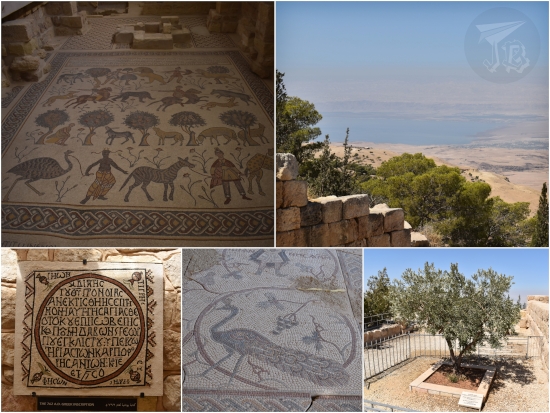
We got back on the bus and started our trip south. After an hour or so we reached Mount Nebo | Jabal Nībū [جَبَل نِيبُو]. According to the Bible, this was the place from where Moses laid eyes on “Promised Land” and died. Today, it belongs to the Franciscan Order. At the top stands the Memorial Church of Moses [كنيسة موسى جبل نيبو], which holds the archaeological remains of a Byzantine Basilica. A few astonishing mosaics can be seen inside. Next to the church stands the Brazen Serpent Monument (Nehushtan), and on the other side there is an olive tree orchard, with a tree planted by Catholic Pope John Paul II. From the viewpoint you can emulate Moses and look upon Promised Land, but the day was hazy and I only caught sight of the Dead Sea – a bit sad we did not get to got there, to be honest.

A collage: Mount Nebo mosaic showing men and animals, and Greek Writing. A panorama of the Dead Sea. The olive tree planted by the Pope

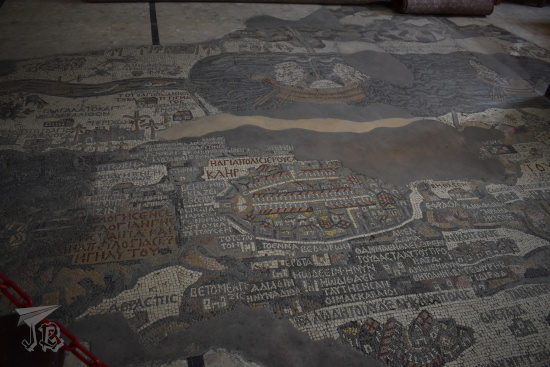
We drove forward to Madaba [مادبا] to see the Map of Madaba mosaic, dating from the 6th century CE and preserved on the floor of the Greek Orthodox Basilica of Saint George. It is a representation of the Middle East, essentially the Holy Land and Jerusalem. The mosaic was rediscovered in 1884, but the lack of preservation damaged part of it, until the Germans took over conservation in 1965.

Madaba Mosaic, showing Jerusalem

We continued our trip and made a stop for lunch at a restaurant / tourist shop in the three-hour ride southwards. The whole morning was rushed because the guide wanted to fit Little Petra | Siq al-Barid [سيق البريد] that afternoon, instead of Wednesday. It is part of the Unesco World Heritage Site of Petra and the Petra Archaeological Park. Little Petra was probably a suburb of Petra. The Nabataean built their desert cities by carving the buildings into the sandstone that made out the walls of the canyons, sometimes carving fantastic façades from top to bottom. One of the most interesting things in Petra are the frescoes found in the Painted Biclinium (dining room), depicting vines, flowers, and other leaves. Other constructions include water cisterns, the real secret of the Nabataean success flourishing in the desert, and the Triclinium. The city was built in the 1st century CE, “found” in 1906 by Père Abel, and excavated by Diana Kirkbride and Brian Byrd in the late 20th century.

Little Petra collage: Entrance canyon, triclinium, Nabataean paintings and stairs carved on the rock

Finally, we drove off to our hotel. The manager told us that we were the only group with an arranged dinner at the hotel that night, and he asked us to arrange a dining time for “salad and barbecue”. The salad turned out to be an assemble of Arab snacks and a plateful of barbecue lamb and chicken. Just wow.

Assorted Jordanian "salads" and a plate of barbecued lamb

In the end, we drove for around 300 km and about five hours, and walked about 6.5 km (10711 steps).

10th September 2022: Arriving is tough {Jordan, September 2022}

Officially named the Hashemite Kingdom of Jordan | Al-Mamlakah al-’Urdunniyyah Al-Hāshimiy [ٱلْمَمْلَكَةُ ٱلْأُرْدُنِيَّةُ ٱلْهَاشِمِيَّةُ], Jordan | Al-ʾUrdunn [ٱلْأُرْدُن] is located in the Middle East. It has limits with the Dead Sea, Israel / Palestine Syria, Iraq, Saudi Arabia, and it has a tiny connection to the Red Sea in the south. Due to its location, it is a semi-arid country, with relatively little rainfall, especially the further away from the Mediterranean. Today, it is an Arab nation, but it has been inhabited from the Palaeolithic – it has been Egyptian, Moabite, Assyrian, Babylonian, Persian, Roman, Nabataean and finally Islamic. In recent times, Jordan belonged to the Ottoman Empire, Britain, and it became independent in 1946, being a Parliamentary Monarchy that gives great power to the King (currently Abdullah II). Even though Jordan was left largely unscathed during the Arab Spring (2011), making it one of the most stable countries in the area, it was hit by terrorism in 2005. Al-Qaeda bombed three hotel lobbies, which crippled the tourism industry, which is one of the most important in Jordan.

It is probably the Nabataean period the one that has left the most unique cultural assets, and tourist sites. The Nabataean were nomadic Arabs that setted down and mastered the art of stone carving, creating the city of Petra as their capital. Petra is a Unesco World Heritage Site and one of the New Seven Wonders of the World, and possibly the most visited place in the country.

As of September 2022, in order to enter Jordan, you need to fill in a document declaring that if you get Covid you or your insurance will pay for any health cost, including hospitalisation or isolation / quarantine. That meant that unfortunately we could not check in online for the flight, as the air line – Royal Jordanian in this instance – had to check that declaration before issuing the boarding passes. That required being at the airport with a three hour margin, maybe a bit more. That made the whole thing a bit extra tiring (total travel time must have been about 12 hours). Fortunately, it went smoothly, we boarded without issues and took off on time.

The flight to Queen Alia International Airport in Amman | ʻAmmān [عَمَّان], the capital of Jordan, took about 4h30min (and plane food has not got any better since 2019). We landed late in the evening, and that was when the stress started off. There was a tourist guide / mediator / whatever waiting for us, with the name of the group my parents had booked for the trip. He gave us instructions which ended up being… “hand over your passport to this policeman and wait by luggage retrieval for your stamped passport, that I shall bring”. Okay, that was creepy, and I was more than a bit on the uncomfortable side until I had mine back.

Then we had about an hour bus ride and we reached the Amman hotel by midnight. The hotel X-rayed our luggage and bags as an anti-terrorism measure, and checked us in… weirdly. Apparently the tour operator had given names and reserved rooms but… there were no rooms associated to the names so my parents and my sibling and I ended up on different floors. Oh and even if dinner was included, they had already closed the kitchen so they gave us boxed dinner with sandwiches and salads. Fortunately though, they also gave us water and some complimentary bottles, which was handy. I wish I could tell you that I slept by the dead, but I was to wound up to do more than snooze a little.

10th – 14th September 2022: Jordan | Al-ʾUrdunn [ٱلْأُرْدُن]

Jordan, 10th - 14th September 2022


A few years ago my parents took a trip to Jordan, which ended in one of them repatriated to the hospital due to a medical emergency the day before visiting Petra. In 2022, as Covid wound down for a bit during the summer months, they stated that they would like to return in order to get over the bad memories, and gather the courage to travel internationally again. I joked that they should take me along for “bodyguard services”. They decided to do so, and invited my sibling along. This is I guess our whole-family trip since… 2000. And since it was what my parents wanted, they called the shots, purchasing a packaged tour to Jordan | Al-ʾUrdunn [ٱلْأُرْدُن]. While these are not much of my thing, it is true that they might be the best – and possibly safest – way to visit the country; our particular tour had positive and negative aspects to it, as it often happens in life.

Our tour included hotels, transportation, tickets to the attractions, breakfasts and dinners – without drinks. We had to pay for lunches and any other drink, and these were usually programmed into the trip, leaving us without many options anyway.

12th August 2022: Stones, the reason for the trip. Lots of Stones {England, August 2022}

I was convinced I’d sleep like the dead and set a couple of alarms. Unfortunately, laundry and house service got going at 6:30, and woke me up. At least, the room had a kettle and some instant coffee which, along with one of the sandwiches I had procured the previous day, got me going. I made sure that the camera was charged, put everything I needed into the backpack and strolled off. My hotel was close to Earl’s Court, and I was walking to South Kensington to check out sandwich and coffee shop. And – to my eternal surprise – to queue for a museum! I don’t think I’ve ever seen so many people waiting for a museum to open in my life.

I’m referring to the Natural History Museum, one of my favourite ones. This time, it was a must, so I booked free entry with the special exhibition – “Dippy is Back”. Dippy is the diplodocus cast replica that used to stand in the middle of the museum, the Hintze Hall (where now the whale skeleton hangs). Dippy was the first of its kind to go on display in the world. The original skeleton was discovered in 1898 by railroad workers in an area called Sheep Creek, in Wyoming, USA. At the time, Andrew Carnegie had made a fortune in the American steel industry, and become one of the most important philanthropists in the US and the British Empire. He paid for casts of the bones to be made (some sources also say that he bought the actual skeleton, some that he had sponsored the dig) and sent to museums in Europe and South American. For the first time the public got to see a whole dinosaur skeleton, which was actually named Diplodocus carnegii after Carnegie. Dippy was gifted to the National History Museum in 1905, and was exhibited there until it went “on tour” around the United Kingdom in 2017.

Here is a little trip down memory lane: back in the mid-nineties I was a teenager in London with my English class. We had free time and they wanted to go to Harrods, so… instead I got myself into the Tube to go to the Natural History Museum just to see this dinosaur (I also ditched the group in the British Museum, but that’s another tale). The point was that I was around 14 or 15, bouncing through London by myself, on my way to see this very cool dinosaur! And I did not have to listen to people being rowdy, nor try to keep the peace in group – I was alone (scared out of my skin, true), but I was free by myself. And for me, that was very important, even if I would not come to realise that until recently.

The fossilised skeleton of a diplodocus, seen from the front. Lots of people are trying to take pictures with it

I saw Dippy again in 2011 when I went to London, but I was surprised when he was not there in 2018, shipped around the country in a travelling exhibition. For some reason, knowing that it was there made me really, really want to see it again. Since the pandemic, you need to reserve at ticket at the Natural History Museum, even if it’s free, so I booked mine for 10:00, to be there first thing as they opened – thus the queuing-before-opening.

Originally a gallery of the British Museum, the Natural History Museum was first designed by civil engineer Captain Francis Fowke, and then it was revised by Alfred Waterhouse, who redesigned the façades in a Romanesque-like style, with architectural terracotta tiles to withstand the British weather. These tiles have flora and fauna decoration and reliefs. The building was finished in 1880, and all the material had been moved by 1883. In the 20th century, the museum rebranded itself as a separate entity from the British Museum, and in recent years different areas and expansions have been opened.

Anyhow. The gates opened a little before 10:00 (If I lived in London I would totally be a member and stroll the museum before opening hours), and the queue started moving. There were lines for ticket holders and non-ticket holders, but my ticket was not even checked. Thus, I just moved towards the area where Dippy was and spent a while there. I felt a little emotional, thinking that, in a way, I owe that dinosaur one.

After seeing Dippy, I wandered around the dinosaur gallery for some time, then I went to buy a sandwich and have a coffee and a painkiller, because I had a long day ahead of me and my head was buzzing a little – I needed to get that under control beforehand. At 11:40 I took a coach with a company called Anderson Tours for an organised day trip: Stonehenge Special Access – Evening. Even though I am not too keen on guided tours, I will admit that they can be handy at some particular circumstances. They will never become my preferred choice of travel, in this case, choosing a tour was the best option.

Regarding Stonehenge, if you want to get up close and personal with the stones, you need a VIP ticket, which means you have to be there before they open to the general public, or after they close, and for that you need transportation – either a taxi, or renting a car, and a hotel as close as possible. The Stonehenge VIP ticket is around £50, and I booked my tour for £135, a full-day tour, including coach, Stonehenge at sunset, and two other destinations, with pick up and drop-off near my London hotel. In the end, that was cheaper than a taxi or a rental plus a hotel near the site (I did a lot of maths before deciding to book this). Anderson Tours offers different combinations of “Stonehenge and…”, with places like Bath or Bristol. However, those are easily reachable by train, and I can explore them on my own. Nevertheless, there was a particular trip that interested me – it went along two or three spots that are a bit off the beaten track, and related to the theme – a Neolithic tomb and another stone circle. This particular tour happens only on certain specific Fridays, thus why my “weekend” away was not such a weekend, as I had to make sure I was in London on the 12th.

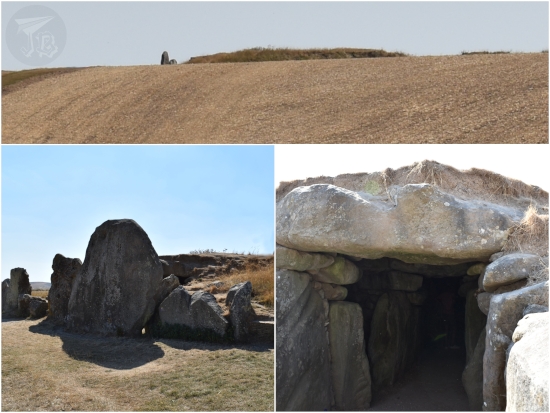
The first stop of the day was West Kennet Long Barrow. A long barrow is an elongated prehistoric (3800 – 3500 BCE) stone monument that has been linked to the worship of the dead and the ancestors. Sometimes, human remains have been found in them. If one imagines what Great Britain was at that time, the south-east area would be the one with less tree coverage, and therefore the best option for primitive people who had started to settle and use agriculture. The counties of Gloucestershire, Wiltshire, Somerset and Dorset have a lot of chalk-rich soil (the Salisbury Plain), which makes it difficult for tress to root and grow. Thus, it would have been easy for the primitive humans to settle and build their villages and monuments. Today, the whole area is known as Stonehenge and Avebury World Heritage Site, listed by Unesco in 1986, and it includes over 700 prehistoric monuments from the Neolithic and Bronze Age.

Collage: elongated mound of dirt on top. On the borrom, the gate. On the left the protective slabs, standing upright, and on the right, the entrance. It is a construction of vertical walls made from grey slabs and another slab on top. The interior is dark.

West Kennet Long Barrow is situated in the middle of a farm. There is a tiny parking lot to the side of the road, and a fifteen-minute walk to the barrow itself. It is one of the largest built in Britain, and around 50 sets of remains have been identified, along with pottery, beads and other personal items. Around 2000 BCE, it was closed down and barricaded, then discovered in the 19th century and scientifically excavated and restored in 1956. It is private property under the care of British Heritage. Apparently, all these sites have become a point of pilgrimage for neo-pagans, and on this day, there was a bunch of them chanting inside the barrow…

On the opposite side of the road from the barrow stands Silbury Hill, a mound or artificial mountain. It stands 30 metres high, with 160 metres in diameter wide, and it is estimated that half a million tonnes of material (mostly local chalk) were used to build it throughout several generations of humans. It cannot be climbed, due to a collapse a while back, that would have been neat!

View of a small hill and dry grass.

After that, we headed off to the village of Avebury, which hosts the largest Neolithic stone circle, with smaller circles inside. It originally had over 100 stones, and it might have built between 2850 and 2200 BCE. Today there is a village in the area, with a few shops and museums in the centre, and a lot of sheep grazing the area. Around three quarters of the circle is still standing, along the henge (long ditch that used to be built with the stones in Neolithic circles).

We had two and a half hours in Avebury – a bit too much, I would say – to explore the Avebury Stone Circle and Henge and its sheep. The guide told us about ley lines and trees that were supposed to have inspired Tolkien’s Ents from “The Lord of the Rings”, and I needed to ask about the geology of the stones – here I learnt that they are made out of sarsen, like the Stonehenge ones. Sarsen refers to silicified sandstone blocks, common in the area, and it has been proven that the ones used in the megaliths come from Marlborough Downs, some 25 km away (35 km from Stonehenge). Once we were dismissed for our “free time”, I walked along the three fourths of stone circle remaining.

A collage showing different megaliths from the Avebury stone circle. Small pillars mark the spots where the stones have been lost. There are some sheep grazing on dry grass.

There are other places to visit in town, such as a Medieval manor with a dovecote. The stables of the manor are the site of the archaeological museum is hosted, and here I made a mistake. I should have got in, but I wanted to visit the church, and by the time I was done, the museum was closing down. Live and learn. There is also a tiny chapel, and a lot of souvenir and “crystal” shops.

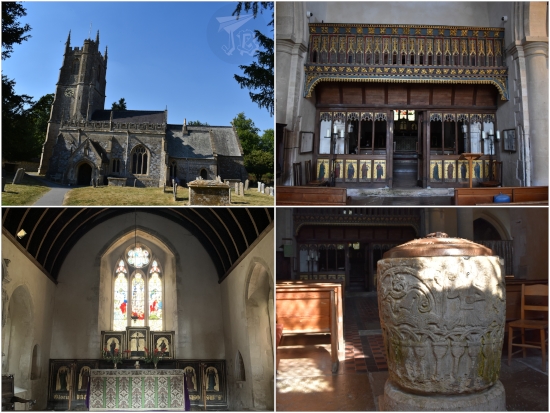
The Church of Saint James dates back to the 1000s, though later centuries saw the addition of many items, such as the aisles and the 15th-century wooden roof. The nave and the chancel are separated by a one-of-a-kind wooden rood / screen with an original 13th century base. There are Saxon windows and a Norman font. It is a fantastic little church.

Gothic church, from the outside. The inside shows a wooden Normand altar, the standard altar, and a carved stone baptismal font

Finally, the time came. At 17:30 we met up on the way to the coach, and then we started off towards the highlight of the day – Stonehenge. Stonehenge was erected between 3000 and 2000 BCE – the primitive human somehow got the sarsen stones into Salisbury plain and planted them so they stood in a circle. They measure up to four metres long, and some of them are arranged in the shape of trilithons – two large vertical stones (posts) support a third one (lintel) which is set horizontally on top of them, with carved studs so the structure fits like a snap. There is a tear-shaped monolith standing a few metres away called “Heel stone”, which marks the entrance.

Some of them are indeed collapsed now and some are covered in lichen – there is a special type of lichen that only grows in three places in the world, and that is one of them. For thousand of years, these stones have remained standing, and the first historical study of them dates from 1666, carried out by an English antiquary, natural philosopher and writer John Aubrey, and has been restored a several times, especially during the 20th century, when they were roped off and a fee charged for entry.

Currently, the stone circle belongs to the Queen of England, and according to the British Ancient Monuments Bill, it cannot be touched or altered in any way that is not to preserve its current status. In 2020, a core taken from the stones during the 1958 restoration was returned. This allowed researchers to analyse the composition and prove that the megaliths are indeed sarsen from the Malborough area.

The rules when you are allowed into the stone are “simple”: do not touch the stones, do not step on the stones, do not hug the stones, do not lick the stones, do not get naked among the stones. Judging by the tone in the guide’s voice, all that has happened before. Apparently, there are a lot of ley-line believers, neopagans and neodruids wanting to “connect” with the earth energy there (there is even a “yoga at sunset group”). In a kind of compromise, they allow you to take off your shoes and socks – which I did not do.

According to archaeologists, Stonehenge was designed in alignment the Winter Solstice sunset. The site was probably a celebration of the end of the worst of the winter before days started getting longer again. Other theories propose that it was originally a burial site that became a place to worship the ancestors.

The great thing about the after-hours tour is that you get to see the sunset around the site. Our timing was 18:45 – 19:45. The guide was nice too, and gave us “permission” to wander around and did not expect to listen to him all the time – don’t tell me twice. I explored and wandered to my heart’s content. We stayed there for about an hour, and it was really cool. I mean, not magical or “I feel the magic of the earth” or anything, but the circle is a fantastic piece of engineering, especially considering it was built five thousand years ago, before writing was even invented. Sometimes, humans are neat.

Stonehenge collage. Two shots of the megaliths standing on dry grass, from the outside; the sun shines between the darkened stones. One shot from the inside of the circle, showing the megaliths circling inwards.

It was over sooner than I would have liked, but about an hour later we were back on the bus after hitting the souvenir shop – where I got a guidebook – and we arrived in London around 22:00. When I got off the bus I just walked to the hotel, had my sandwich. Good thing I had left the window open, too, as it made the temperature slightly more tolerable – I own up though, I slept with the fan on, but… like a rock. Or a stone.

Walking distance: 11.96 km / 18742 steps
Coach distance: 317 km

7th May 2013: The inner works of the Geomineral Museum in Madrid (Spain)

Due to work reasons I ended up in the Museo Geominero, the Geomineral Museum, in Madrid. The Museo Geominero is a rather anachronical place – it displays a great mineral and fossil-replica collection in an early 20th-century building. The inner area is used for research and hides all the high tech. However, they work with really old and cool geological elements.

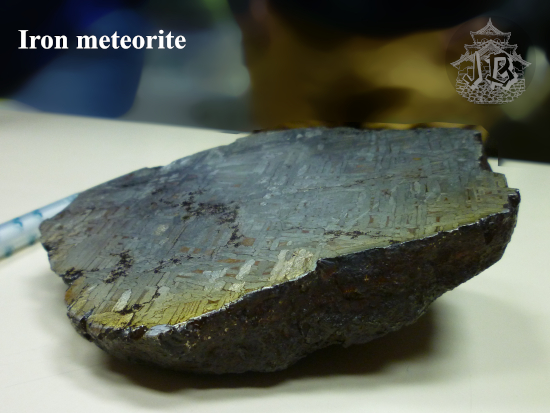
This was the firs time in my life I ever held a meteorite – just imagine, this thing floated around space, and I got to hold it. It was heavier than I would have ever imagined. You can see the zig-zags on the surface, those are magnetic markings because the main component of this space rock is iron.

There was a session going on about identifying fossils, and this is what I came up with:

Out of the bunch, I also got to play with the ammonite…

… counted the corals…

… and I petted the trilobite…

As you can see, I snuck quite a few pictures. It did not work so well during the museum walkthrough, so I guess I will just have to come back for the main exhibit some other time (≧▽≦).

9th January 2013: Inside the Zoology Lab in the University of Alcalá de Henares (Spain)

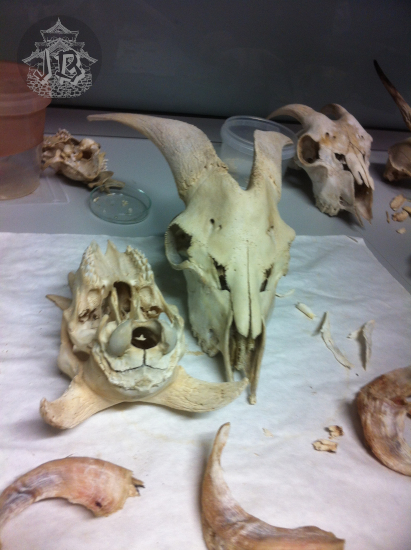
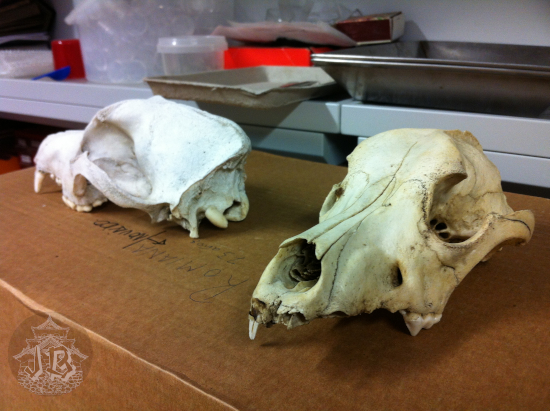
The biology building in the University of Alcalá de Henares has a small collection of Zoology and Anthropology specimens. For a number of reasons, I was invited to see it, even if it is usually only opened to researchers. Taking pictures in the Gallery Collection was not allowed, but it was all right in the laboratory where they prepare and preserve the bones. Or I was sneaky. Take your pick ☆⌒(ゝ。∂)