1st January 2025: The Return {Vienna, Silvesterkonzert 2024}

We got up for breakfast at around 7:30, but the cafeteria wasn’t open yet, so I had to (gasp) pack before I had coffee. That was not fun. The breakfast room opened around 8:05, and I could finally have my caffeine fix. We had been discussing all three days about the automatic pancake machine in there, so I decided to try it. Basically, you waved at it, and it made the pancakes. They were not the most delicious thing ever, but there was Nutella to go with them…

Pancake making machine

As we were already packed, there was not much left to do after breakfast. We went up to the room to collect the luggage and back down to reception. We had a transfer arranged at 9:00 and we were ready with a few minutes to spare. Check-out was fast, and off we went towards the airport, after saying goodbye to the nice Spanish lady with the card issue. I’m not sure if it had snowed outside Vienna or what we saw on the trees was hoarfrost, but everything was white once we got onto the motorway. I totally missed whatever our driver was saying because I was trying to take pictures of the landscape – but he talked a lot.

Trees covered in white ice and snow

When we reached the airport, the check-in counters were not open yet. We were flying with Iberia, which does not have a permanent crew there, the counters did not even have the lights on. It took them longer to open the counter than to actually check us in, and the worker was confused because we were only checking in three suitcases even if we were four people. The poor lady looked absolutely exhausted – maybe she had stayed up late.

Security was “collapsed with a crowd” and they told us to go through the kids gates – I don’t think I have seen any “collapsed” security so empty… But we made it through okay. We found our gate at literally one end of the airport, and left our things with one of my parents while we scattered off to look for lunch. The flight was at noon, so we had to buy something either at the airport, or on the plane. I found myself a chicken sandwich that looked rather nice. I would later learn the word for “spicy mayo” in German… Good thing I got a Coke to go with it. I also bought a “no kangaroos in Austria” magnet because I did buy a tote bag last time I was around, but I can’t seem to find it.

Airport in winter weather

The flight back took off on time at 12:20. It was uneventful, we just landed at 4S instead of 4. We knew this was going to happen this time, so we had counted on it – in the end, that was the reason I managed to convince my family to have lunch on the plane. We did not get out of the airport up until 16:00, what with picking up the luggage and all. I think I made it home around 19:00, and boy was I beat. I love my family, but travelling with them can be a bit too much…

31st December 2024: A clumsy morning yielded to an unbelievable evening {Vienna, Silvesterkonzert 2024}

When we walked out of the rooms to go down and have breakfast, my parent’s alarmed face made me worried. They informed my sibling and myself that “it had snowed”. That was spooky for a second – until I ran to the window and saw that the “snow” was just a very thin layer of scattered white powder. It was safe to go out, even with my senior parents. We had breakfast and we got ready to go out.

Snow in Vienna

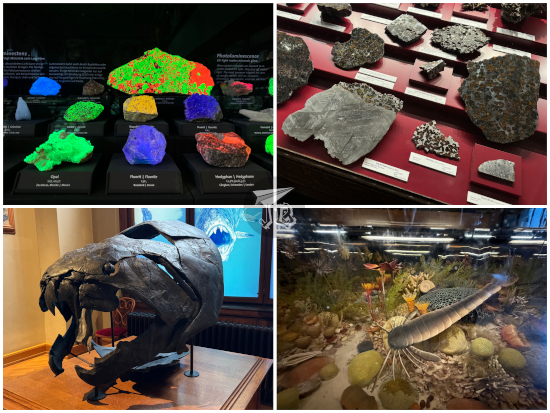
At some point, my family “caught” that I like Natural History museums, so they really, really thought I wanted to go to Vienna’s Natural History Museum – Naturhistorisches Museum Wien, and just wouldn’t listen to “No need, I’ve been there already, Their reasoning is that I had mentioned it before, which I actually had, to inform them that the Venus von Willendorf was there. That is where we ended up, and I was happy to oblige – the museum has rocks, meteorites, fossils and dinosaur animatronics. All right up my alley.

The museum’s oldest collection 250 years. In 1750, the Holy Roman Emperor Francis I bought what at the time was the largest collection of natural history objects at the time – around 30,000 objects. That same decade, the Emperor founded the Schönbrunn Zoo and the botanical garden, and he ordered the first scientific exhibition to be held. Upon his death, the collections were donated to the state, and the first museum according to the Enlightenment principles was founded – and soon expanded.

The museum building was also commissioned by the Emperor. It was designed by architects Gottfried Semper and Carl Hasenauer, with an identical exterior to the nearby Museum of Fine Arts. Works began in 1871, and the institution officially opened in 1889. Though it was indeed originally designed as a museum, it feels more like a repurposed palace, with decorated ceilings and monumental staircases. It has 39 halls with almost 9,000 square metres of exhibits, still keeping the 19th century outline. We just did halls 1 to 13: mineralogy, petrography, meteorites, palaeontology and prehistory galleries, including the Venus von Willendorf. The 11-centimetre figurine was made in limestone around back to 30,000 years ago. It is a nude woman of large proportions, and even if she does not have a face, she is mostly anatomically correct and has plaited hair.

My family was fascinated by the collections, and I guess I felt a teeny bit smug about that – considering how much fun they poke at me because natural history museums are very high on my priorities when I visit a new place (see: my first time in Brussels).

Natural History Museum Vienna

Natural History Museum Vienna

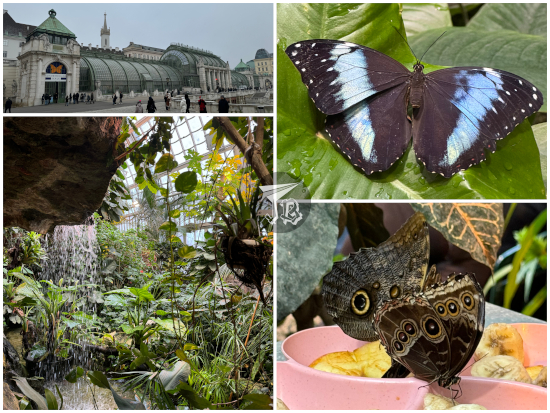
We left the museum after a couple of hours, around noon. We did not stay at the Silvestermarket at the square, but headed out towards the Imperial Butterfly House Schmetterlinghaus. It comprises half of an Art Nouveau greenhouse turned tropical botanical garden and butterfly zoo of sorts. I really love the iron-and-glass architecture of the building – and I would have loved to have had lunch in the brasserie that fills the other half of the greenhouse. The building was designed by architect Friedrich Ohmann and erected in 1901 as part of the Hofburg Palace and is, next to the Burggarten palace.

Most of the butterflies we saw, if not all, were forest giant owls Caligo eurilochus, very large butterflies originating from the Americas – they can live from Mexico to the Amazon basin. They have marks like big eyes in its back wings (hence the commmon name), and the inner wings are blue. They are pretty, and they seem to like fruit, as they gathered around the feeders to snack on it. The sad part is that they only live around 24 days.

Schmetterlinghaus

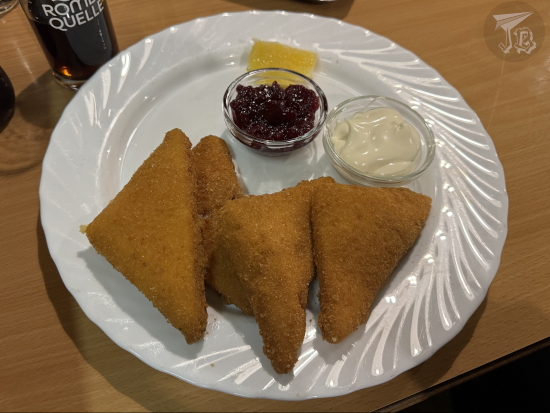
We then headed to the restaurant Centimeter, near the Rathouse (town hall) to have lunch. It is a place that has a lot of things measured – you can order sausages by the metre. I was somehow was not feeling hungry, so I decided to get Gebackener Emmentaler mit Sauce Tartare und Preiselbeeren, breaded and baked Emmental cheese with tartare sauce and cranberries. After lunch, we expected the Silvestermarket next to the Rathaus to be open, as it was one of the places to be for New Year’s Eve. We were wrong! That was a bummer, because in hindsight we could have cancelled the reservation and just stayed at the market in front of the Natural History Museum. That was a bummer, but at least we were warm.

Gebackener Emmentaler

We headed back towards the hotel, and we stopped by the supermarket next door to buy something for dinner. I grabbed myself some pre-emptive sushi, because I was pretty sure that my family was not going to find what they wanted – basically stuff like they would get at home. After half an hour of going back and forth, they decided to settle down with sandwiches and more sushi. We also picked up some chocolate thingies that would end up being more coconut than anything else. Not that I have anything against coconut, but I do not appreciate it replacing chocolate unannounced.

We took the groceries to the hotel, and had a bit of downtime before got ready for the main event. During that time, I went on the online airline webpage to make sure that the travel agent at El Corte Inglés had checked us in. The check-in was done, but someone had made a typo on my parent’s email address so we had not received the boarding passes. I retrieved them and downloaded onto my phone to distribute later.

A bit past 18:00, we left for the Wiener Musikverein, the Viennese Music Association, home to the Vienna Philharmonic Wiener Philharmoniker, where we would attend the 2024 Silvesterkonzert. It was a bit strange to head to such an event using the underground, but that was the most efficient means of transport, to be honest. We ran into the Spanish lady and her husband again – and that was great because that way we could take pictures of each other without having to get a stranger to do so.

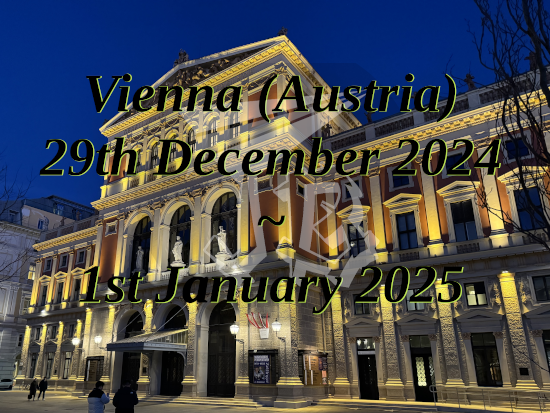
Vienna Musikverein

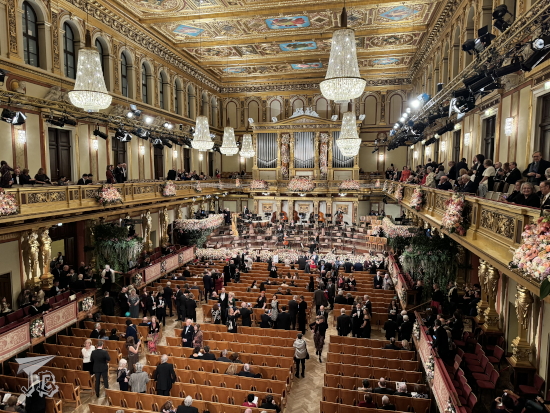
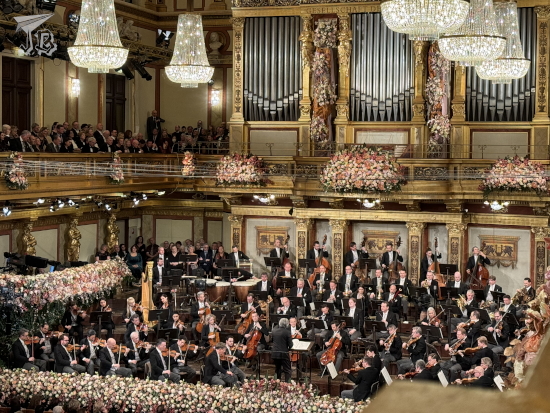
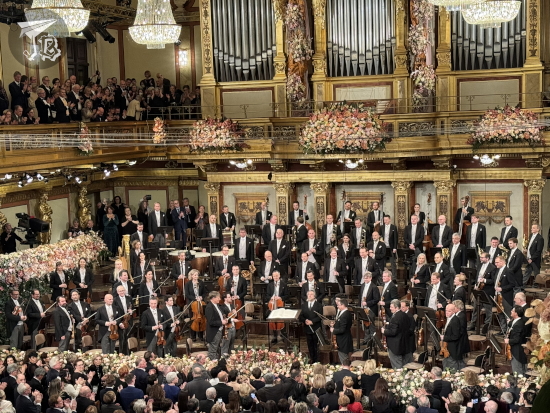
The Musikverein was designed to resemble an Ancient Greek Temple in a Neoclassical style, following plans by architect Theophil Hansen. The building was inaugurated in 1870, and it has a small decorated entrance, very underwhelming staircases, a small chamber music hall, and the main music hall, the Großer Musikvereinssaal or Golden Hall. Walking in there was… surreal. It’s a hall I’d seen so often on TV, and it actually felt… I don’t know, a bit… pale. Less bright than on the screen. Maybe it was that the flowers were white and pink, so they did not pop. And it’s not like I know anything about flowers, anyway. I was just happy they were artificial enough not to trigger my allergies, it would have been awkward to sneeze all throughout the concert…

Vienna Musikverein Golden Hall

Though the “New Year Concert” is the one that everyone knows, there are actually three concerts with the same set list – the Preview Voraufführung on the 30th, the Silvesterconcert Silvesterkonzert on the 31st, and the New Year’s Concert Neujahrskonzert on the 1st. I honestly would have thought that it would be full of wealthy people and they would be all cool as cucumbers, but it turns out, a whole bunch of us were just excited noobs taking pictures of every and anything. My family’s seats were on the second floor balcony. I just couldn’t believe everything that was going around around me, nor where I was. I bought the programme, because I really wanted something physical from the soirée, aside from the ticket.

The Vienna Philharmonic was founded in 1842. It is formed by the best musicians from the Vienna State Opera. It is actually run by the musicians themselves. Every year, a conductor is chosen to direct the concerts, and for the 2025, it was Italian Riccardo Muti. Maestro Muti was born in Naples in 1941, and studied in the Classical Lyceum. He proceeded to move onto studying Piano, then Composition and Conducting. He began his career in 1968 as the music director of the opera festival Maggio Musical Fiorentino. He conducted the New Year’s Concert in Vienna in 1993, 1997, 2000, 2004 and 2018 before this year. In 2011, the Philharmonic awarded him Honorary Membership. He is also a bit of a troll.

The concert had two parts, including the encore:

First part:
  1. Johann Strauß I. Freiheits-Marsch, op. 226 – Freedom March
  2. Josef Strauß Dorfschwalben aus Österreich. Walzer, op. 164 – Village Swallows from Austria, waltz
  3. Johann Strauß II. Demolirer-Polka. Polka française, op. 269 – Demolition Men’s Polka, French Polka
  4. Johann Strauß II. Lagunen-Walzer, op. 411 – Of friends, Waltz
  5. Eduard Strauß Luftig und duftig. Polka schnell, op. 206 – Airy and fragrant, fast Polka

Second part:
  6. Johann Strauß II. Ouvertüre zur Operette “Der Zigeunerbaron” – Overture to the operetta “The Gypsy Baron”
  7. Johann Strauß II. Accelerationen. Walzer, op. 234 – The Acceleration, Waltz
  8. Josef Hellmesberger (Sohn) Fidele Brüder. Marsch aus der Operette “Das Veilchenmädl” – Fidel brothers. March from the operetta “The violet girl”
  9. Constanze Geiger Ferdinandus-Walzer, op. 10 [Arr. W. Dörner] Ferdinandus, Waltz
  10. Johann Strauß II. Entweder – oder! Polka schnell, op. 403 – Either … or! Fast Polka
  11. Josef Strauß Transactionen. Walzer, op. 184 – Transaction, Waltz
  12. Johann Strauß II. Annen-Polka, op. 117 – Polka Ana
  13. Johann Strauß II. Tritsch-Tratsch. Polka schnell, op. 214 – Chit-chat, fast Polka
  14. Johann Strauß II. Wein, Weib und Gesang. Walzer, op. 333 – Wine, Woman, and Song

Encore:
  15. Johann Strauß II. Die Bajadere, Polka schnell, Op. 351 – The Bajadere, fast Polka
  16. Neujahrsgruß (New Year’s Address)
  17. Johann Strauß II. An der schönen blauen Donau, Walzer, Op. 314 – The Blue Danube
  18. Johann Strauß I. Radetzky-Marsch, Op. 228 – Radetzky March

Vienna Silvesterkonzert 2024

Honestly, what can I say? It’s nothing and everything like what you watch on TV. The music was fantastic, but somehow it felt like the conductor did not do much, the orchestra did whatever they wanted, not in a bad way. They knew exactly what to do and just did it. I know next to nothing regarding classical music, but they made it feel absolutely effortless. I am not sure how much work they do on their own and how much they do with the conductor, but I can tell had Riccardo Muti a blast. At some point, when he was coming in and out, he knocked over some of the viola or bassoon’s music sheets all over – he was very apologetic about it. Also, although neither photographs or videos are not permitted (mine are totally… sneaky, you see), one of the ladies in the first row was shamelessly filming, and he winked and waved at her. Furthermore, he would just… jump during some of the polkas, which is a feat considering the man is 83 years old.

The concert always ends with Strauß’s Radetzky-Marsch, and the public is invited to clap along. Muti completely had the concertgoers in his pocket, controlling them (us) with a finger and a look. It was amazing to watch. All in all, he was absolutely… not careless but carefree. It was great to see, somewhat magical in a way.

Vienna Silvesterkonzert 2024

The concert felt much much shorter than the two and a half hours it lasted. We went down to the first floor for pictures during the intermission, and we were not the only ones. However, I think we kind of… snuck past the intern or something, not sure we were supposed to be allowed on that floor. People were having champagne but I only cared about seeing everything. I might be a bit… weird. I make no apologies. I really loved the experience. They say it is a once-in-a-lifetime experience, but to be honest, I would just try the lottery every year from now on. I mean, I now have the right clothing for it…

After the concert, we went back to the hotel where we had our dinner. To be completely fair, there was a part of me that would have totally wanted to go out to watch fireworks and Vienna’s way to celebrate the New Year – and then be an absolute wuss, freeze my butt off and need to come back to the hotel. But the grass is always greener on the other side of the fence, and since I did not get to see it… It must have been the most interesting thing ever! It’s okay though, because I got to see the concert, and it was already my once in a lifetime most interesting thing ever… But it took me hours to get to sleep, so maybe I could have explored some, because in the end I’m greedy and I want it all.

30th December 2024: A planned and packed day {Vienna, Silvesterkonzert 2024}

It was a crisp morning in Vienna when we got up. We went down for breakfast and it was not particularly well stocked. The coffee was… weak, so I decided to mix a cappuccino and a black coffee to get me the energy I needed for the day. I tried some local cake, but I did not enjoy it, so I decided to stick to bread and croissants. Thankfully, I did run into the lady from the day before, and her husband, during breakfast, and told her about our plans – that way at least someone in the group would know not to wait for us and we would not delay anyone. Apparently, we were not the only ones who had made their own plans either, as the excursion had been marketed as “optional” and yet it seemed to be “a given”. Even better, we came across the driver from the day before (despite him saying he had nothing to do with the trip), and we could tell him that we were not coming, either. As we stepped out, it was freezing – literally below zero – but sunny during the whole day.

We took the underground at Zieglergasse and headed towards the city centre. I asked my parent to use their phone for GPS and maps in order to keep my battery for as long as I could so I could be taking pictures throughout the day, so they would be guiding. Our first stop was the Hofburg – the former imperial palace – and the Sisi Museum. Empress Elisabeth of Austria (1837 – 1898) was the wife of Emperor Franz Josef I of Austria. She married the Emperor when she was just 16 years old, and was stifled by court life. She spent most of her time travelling and avoiding royal duties. Her perceived eccentricity – today we would call it depression – and assassination in 1898 helped create an image of a romantic heroine in the media that has reached today, especially through actor Romy Shenider’s portrayal in the 1950s.
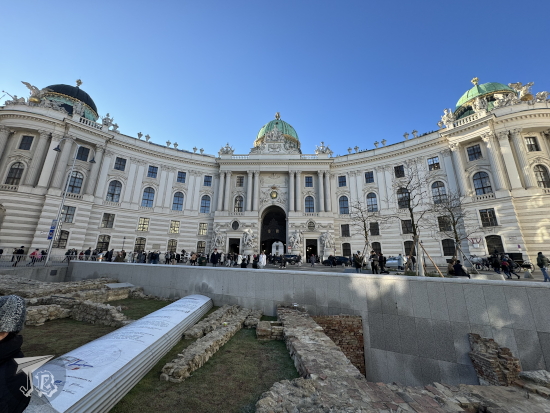
Hofburg

The museum tells about her life by showing objects, portraits and reproductions of her clothes. Then, you step into the former imperial apartments, which have been refurbished with furniture from the 19th century to make them look real. The audioguide was… corny to say the least, and I kind of skipped most of it because I got bored.
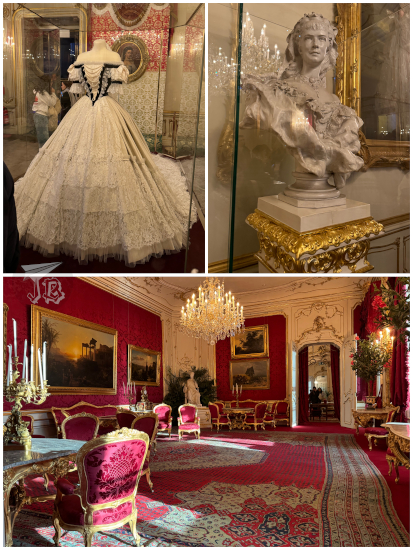
Sisi Museum and Royal Apartments Vienna

I proposed the church of Saint Michael first, and then the National Library. However, my parent had been intrigued by the church that stood at the exit of the underground. Thus, we headed there. The Wiener Minoritenkirche, Friars Minor Conventual Church, is officially the Italian National Church of Mary of the Snows Italienische Nationalkirche Maria Schnee. The church was erected between 1276 and 1350, and it was one of the first gothic churches in Vienna, following a French pattern. There were many subsequent reforms, including rebuilding the bell tower and the spire again and again – today the bell tower is flat and the spire is gone. The interior altar is Neogothic, by Ferdinand Hohenberg. Since it was still around Christmas time there were Nativities and Christmas trees.

Wiener Minoritenkirche

Afterwards, we headed towards St. Michael’s Church Pfarre St. Michael. It started as a late Romanesque or early Gothic building, maybe in 1221. The following two centuries saw Gothic annexes added. The crypt was built in the 16th century. The organ was built in 1714. The Rococo high altar was sculpted by Karl Georg Merville, and it represents the Fall of the Angels after the War in Heaven, when Lucifer was banished; underneath, there is a Byzantine Virgin Mary from the Cretan school. The outer façade was rebuilt in a classicist style in 1791. Construction officially finished in 1792. The crypt is accessible in a guided tour, but considering it has about 4,000 bodies, some of them mummified and on display, I think I’m happy we did not take it.
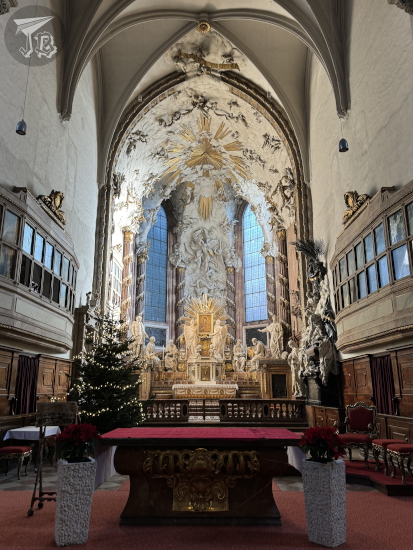
Michaelkirche Vienna

I proposed going to the Library again, because it was cold and there would be toilets there. My parent took over guiding with their phone, and my sibling and I got distracted as we passed by the Stallburg, where we caught a glimpse of the Lipizzan horses chilling out.

Instead of reaching the Library, my parent decided that we wanted to see the Augustinian church Augustinerkirche, a mix of 14th century Gothic and 18th century Neogothic. The original church was engulfed by the Hofburg as it expanded, and in 1634 it became the official imperial church. May Habsburg weddings were officiated there, and a chapel to the side, called the Herzgruft (Heart Crypt), contains the hearts of the members of the dynasty, from Ferdinand IV in 1654 to Archduke Franz Karl in 1878.

Augustinerkirche

I did not get to go to the Library, but we walked past the Hotel Astoria, which opened in 1912. it was built in the a late Art nouveau style known as fin de siècle (end-of-century). At the time it opened, the hotel was the latest, with electricity, bathrooms and all!

We reached the pedestrian / shopping street Kärntner Straße, the neuralgic centre for Vienna shopping. There we… met the card-not-working lady and her husband again, in what would become a funny number of encounters. We also saw the Swarovski shop. We entered it because we thought it would be warm – and hey, it had a toilet, which was handy, considering we had left the hotel over four hours before. Swarovski is an Austrian glass producer, known for its crystal glass, used in jewellery, decoration, watches, accessories. The company was founded in the late 19th century with the idea of “making a diamond for everyone”. Since then, it has produced thousands of items – from Christmas decorations to sculptures to collectible tiny figurines to whole dresses for the Vienna Opera. The place was halfway between a shop and a museum – and we might have spent a bit more than we had planned there, especially considering we were not planning to spend anything.
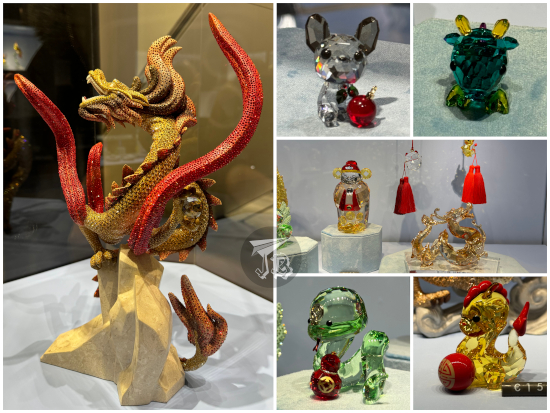
Swarovski flagshop Vienna

We reached DO & CO Restaurant Stephansplatz, located on the top floor of the post modernist structure Haas House, constructed in 1990. Most of the building is a hotel now. The restaurant has a fun view of the cathedral Domkirche St. Stephan. My parent and I discovered the restaurant because the opening scene of Austrian TV series Kommissar Rex, which ran between 1994 and 2004. It follows the story of German Shepherd Rex, a police dog which is “transferred” to the homicide department after his original handler dies… at the DO & CO terrace. It is such a naïve series, I just love it. Think The A-Team ingenuity with an adorable GSD saving the day every time and stealing sausage rolls as a self-reward. In a later series, Rex would move to Italy, and there is currently a Canadian reboot too…

There were no doggies in DO & CO, but both service and food were superb. They had butter and bread, and small receptacles with different types of salt, and a note on how they should be used. For lunch, I ordered kalbsbutterschnitzel – delicious minced veal butter patties with cream, accompanied with mashed potatoes, fried onion rings and a small leaf salad. For dessert, I had an ice latte that I should not have had, but I saw it pass by and I was smitten. We snuck a number of pictures from the restaurant, too.
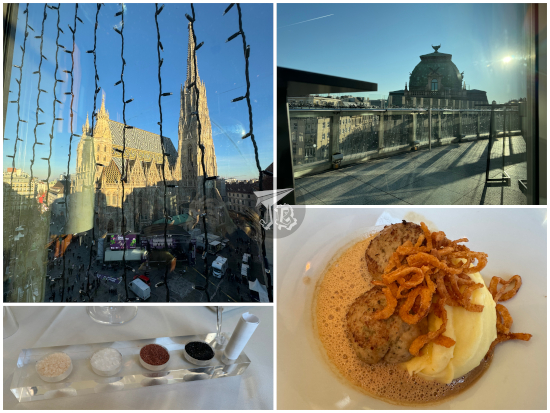
DO & CO Vienna

After lunch, we went into St Stephan’s cathedral Domkirche St. Stephan. The building is a mixture of Romanesque and Gothic, and it was initiated around 1137 and completed 1578, and as many as four construction stages can be seen – the first Romanesque towers, the later Romanesque church, the Gothic Choir, and the outer, newest additions. The roof is tiled with as many as 230,000 pieces, one side shows the mosaic of a double-headed eagle, and the other the coat of arms of the city and the country. The bell tower has twelve bells, and the interior hosts as many as 18 altars (plus the ones in chapels). The cathedral was built in limestone, so it looks darker than other churches its size (107 metres long, 70 metres wide and 137 metres high).

The high altar was built in marble by Tobias Pock in the 1640s in the Baroque style. It depicts the stoning of Saint Stephen, church patron and the first Christian martyr. He was stoned to death by the Israelites after a rather inflammatory speech in front of the Sanhedrin, defending Christ’s teaching versus the traditional Jewish ones. According to the Bible, this would have happened a couple of years after Jesus’ death, and before the Roman persecution.

St Stephan’s cathedral

My parents were tired and they decided to head off towards the hotel, while my sibling and myself stayed behind. We wandered around Stephansplatz, Rotenturmstraße, and Kärntner Straße, checking out the Christmas lights and decoration until we reached the Popp & Kretschmer fashion store. They are a luxury women’s clothes firm, which draw tourist crowds during Christmastime to see their huge bow decoration, which makes the whole building look like a present. They call it the Vienna Bow.
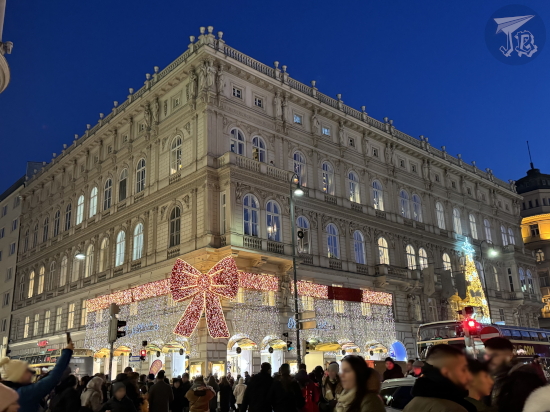
Christmas decoration - Vienna Bow

We also looked at the Vienna State Opera Wiener Staatsoper, which was prepared to celebrate the new year, with a neon display saying (in English) “Hello 2025”. It was stupidly cold though, so we might have stayed in an underpass for a few minutes longer than necessary.

Afterwards, we headed towards the Sacher Hotel. The five-star hotel was founded in 1876 by the son of a famous confectioner. When the founder died, his wife, Anna Sacher, became manager. She turned the hotel into one of the most refined in the world, catering exclusively to the aristocracy. This management lead the hotel to bankruptcy, and she had to sell the business to new owners, who restored it to its former glory. The hotel serves “the original Sacher-torte”, a chocolate cake coated with dark chocolate icing, and a thin layer of apricot jam in the middle, served with unsweetened whipped cream. It was reportedly invented by the father of the founder, and the recipe is kept a secret. There are other versions of Sacher-torte, but the hotel is the only one with legal standing to call theirs original.

We had a 17:30 reservation at Café Sacher, in the hotel. Sacher Hotel actually has two cafés. The more modern one faces Kärntner Straße and is called Café Bel Étage. It had a long queue – Christmas is peak season in Vienna, as we were quickly learning – but I had been informed that reservations accessed through a particular door. However, that was not where our reservation was – I swear, I did not see the different name anywhere. The historic Café Sacher had an even longer line, and no special door. I dared ask the doorman at the hotel how to get there, and he gave me a huge grin and said “skip the line, go through the exit”. Boy, that was… awkward. Very, very awkward. I though the people just outside would lynch us!

Staff came to check on us, and since our reservation at the Café Sacher was valid – I made the reservation in July, literally as soon as the spots open – we were shown into one of the small salons. The café has a perfect offer – Sacher Sweet Treat: a perfect slice of original Sacher-torte with whipped cream, a non-alcoholic hot beverage and a bottle of Römerquelle mineral water for 22.5 € (31.5 € with a glass of the in-house champagne, Original Sacher Cuvée). I ordered mine with sencha senpai, Japanese green tea. I enjoyed the cake more than I had thought I would, and the tea was great. The staff was incredibly nice, too. They must have been used to silly tourists.

Sacher & Sachertorte

We left the Café Sacher and headed towards the Spanish Riding School Spanische Hofreitschule. For my sibling, this was a core-memory event, so they insisted we got really, really good seats for the Gala Performance Galavorführung at 19:00, on the parterreloge – the box at ground level. The Gala performance is the longest exhibition the Riding School has, and it lasts 90 minutes, with a break. The horses were gorgeous, and the riders looked very cold, but everything felt strangely… cold. I think I liked the exhibit in Jerez Riding School better.

The Spanish Riding School, considered the oldest horsemanship school in the world, was established during the Habsburg Monarchy in 1565. It is dedicated to the breed and training of Lipizzan horses. Lipizzaners are a breed of riding horses developed during the Habsburg empire. It derives from Arab, Bavarian, Spanish and Neapolitan breeds. They were selectively bred so most of them are grey with white coats – albeit there is always a bay stallion in the Spanish Riding School. The breed itself might be traced to eight stallions in the late 1700s, and it was developed in Slovenia. The horses are considered so precious that they were evacuated during WWI, and “rescued” by the US army during WWII. “Lipizzan horse breeding traditions” has been considered Unesco Intangible Cultural Heritage since 2022.

Once bred, foaled and fledged, the Lippizaners are trained. This is done at the Spanish Riding school. The traditional horse training methods used by the school can be traced back to Ancient Greece, and like many other things, they re-flourished during the Renaissance period in the 16th century. The goal of Classical training was to prepare horses for warfare as part of the calvary. Horses train for six year after they turn four.

In Vienna, the Lippizaners are housed at the Stallburg, which is technically part of the Hofburg Palace. It is a Renaissance building from around 1560, originally conceived as a residence but that was later converted into the Imperial Stables. The Winter Arena was built in 1735, and has remained unchanged since then – including the chandeliers. The arena is presided by a painted portrait of Emperor Charles VI.
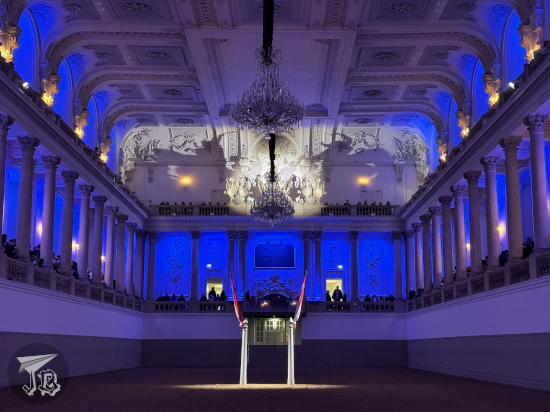
Vienna Riding School - winter Arena

There was something weird in the atmosphere that made it not feel all that… fun. Before every performance, a lady walked to the centre of the arena to introduce the exercises movements in German and English. The performance was pretty though. I tried to sneak a picture or two, but I was unsuccessful – and a bit worried they would kick me out if the venue. There were a total of six different numbers, and the show, including the introductions, was organised as follows:

  1. Alle Gänge und Touren der Hohen Schule – “All Steps and Movements of the High School”: four riders and stallions in individual choreographers, including the one dark stallion in the stable, with classical movements.
  2. Am Langen Zügel “Schools on the Ground: On the Long Rein” – the riders guide the horse from the ground, they are not on top of the horse, with movements such as piaffe and pirouette.
  3. Pas de Deux “Step by Two” – two riders-horses pairs work in tandem, mirroring each other.
  4. Arbeit an der Hand und Schule über der Erde “Working Hand and Airs Above the Ground” – with three main movements: levade, capriole and courbette. Four horses work with their riders on the ground, and two of them with the riders on the saddle, but without stirrups. When horses perform well, they get a sugar treat from the rider.
  5. Am Zügel “Schools on the Ground: Curb Reins” – only one horse and his rider, who only holds two out the four reins in their left hand, and they hold the riding crop upright in their right hand, a commemoration of the military heritage of the horse riding tradition.
  6. Schulquadrille “School Quadrille” (or Das Ballett der weißen Hengste “Ballet of the Eight White Stallions”) – eight horse-rider pairs have to coordinate with each other for a choreography, ending in the Radetzky-Marsch.

When the exhibition came to an end, we tried to go to the toilets. You had to scan your tickets and pay 50 cents. Really. Two hundred quid for the tickets and they charged fifty cents for the toilets, which were filthy on top? A total rip-off.

I got my sibling to the hotel, and then I left again to meet up with my friend D****e and her father Fr***, who were also in Vienna for a few days. They were even staying in a hotel close to ours, so it seemed that we had planned it in advance. We spent a couple of hours in a small eatery – Gschamster Diener – where they introduced me to kaiserschmarrn, fluffy shredded pancakes with raisins, powdered sugar and cinnamon.
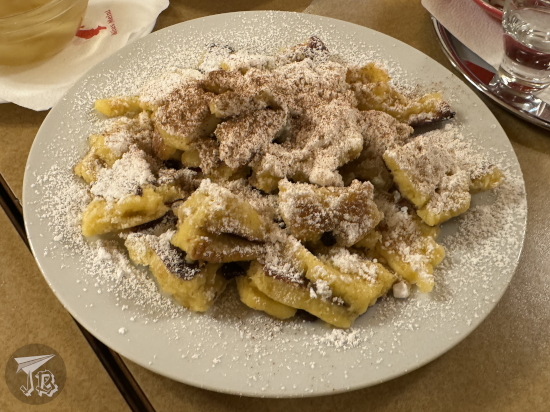
Kaiserschmarrn

I eventually had to go back to the hotel and my room. There, I spent an hour trying to find a place to book lunch for the following day. After deciding not to plan anything on the 31st, my parents had a change of mind and suddenly I found myself tasked with planning and finding a place for lunch. Most restaurants were either closed or booked off. I was not a happy camper, but in the end I managed to find something… somewhat decent. My sibling suggested the Natural History Museum, the Butterfly House and the Library before lunch. I was absolutely sure that was impossible to cram three things in the morning. We would not even do the entire Natural History Museum, but at least we would be somewhere warm. I resigned myself not to see the Library, had a shower and went to bed.

29th December 2024: Arrival, Karlskirche & Prater {Vienna, Silvesterkonzert 2024}

With our plane boarding at 8:10, we aimed to be at the airport around 6:30, which was a successful endeavour. We had our boarding passes but we needed to drop off some luggage. As we needed formal wear, neither of us could just make do with a simple backpack or trolley. We had decided to bring a carry on each, and two large suitcases – one per room – for coats, jackets, dresses and so on. The travel agency had checked us in the day before, and we had separate seats, but that was not important since it is just a short trip early in the morning.

Once in the terminal, it turned out that Iberia did not have a drop-off counter as my parent was expecting, so we had to queue with the people who needed to check in, including non-Schengen and intercontinental travellers. We decided that two of us would line while the other two could sit down and wait for us. We stepped into the cordoned area, and suddenly… one of the attendants directed half of the queue out and into another area of check-in counters. All in all, it took us around 35 minutes to drop the luggage off. Not efficient, Iberia. Not efficient.

Luggage successfully checked in, we went past security, found our gate, and sat down for breakfast. We went to the gate early, and queued to be the first in our group because… I’m not even sure why, but it was too early in the morning to fight. I napped about half of the journey, and also took pictures of the landscape from above. Once we left Spain behind, the mountaintops were covered in snow, and the valleys in fog. This was a clue of how cold it would be when we landed in Vienna. We had a maximum temperature of around +3ºC throughout the trip.

From the plane window Flight Madrid - Vienna

We disembarked and made our way to baggage claim, where our suitcases were among the first few to come up, which is always a great feeling. Afterwards, we went out and found the people responsible for picking us up – the representatives from Blaguss DMC, the local agency which manages Viajes El Corte Inglés and Tourmundial in Austria and Hungary. First, they handed us our our hotel voucher, schedule, and tickets!! Upon opening the envelope to check that everything was correct, we found out schedule with a Vienna tour the following day that my parents swear they had never heard about – the truth is that it appears in the documentation as optional. The driver in charge of taking us to the hotel was… a character. My biggest regret though is that I did not run for a Costa Coffee while we were waiting for the other travellers to come out, but I only saw the sign when he had started moving.

We arrived at the hotel Elaya Hotel Vienna City West around 13:00. It was a four-star hotel that felt like it had dropped at least one and a half, and it was not any of the ones listed in the original documentation. There was neither a bar nor a restaurant, and the staff was not exactly friendly. I know it’s not nice to work during the holidays, but come on. I don’t think requesting two keys for a two-people room was that outrageous. At first, neither card worked to open my door, but after trying three times each card, both sides, I managed to get it open. And more importantly, though the warm option of the air-conditioning did not work, I figured out how to turn on the radiators.

The hotel room was… sad. It had a little terrace overlooking the interior yard, and two windows – the blinds were unmoveable on one and broken on the other. We unpacked, got freshened up, and went back down to find a place to grab a bite to eat. I approached reception to ask for a recommendation, and there was a Spanish lady trying to get the check-in attendant to help her with her card – she seemed to have the same problem I had had. She had no English at all, so I tried to help her out. The attendant just huffed and left to check the room herself, and I guess she managed to get the card working. When she came back, I asked for any restaurants around, and she pointed us up the street. We found a Greek place seemed okay, and that is where we ended up – at restaurant Mythos, which had very friendly staff, and decent food.

Afterwards, I would have gone towards the city centre. However, my parents needed a break and wanted to move as a group. Thus, I stayed in the room – we did not leave the hotel until 16:30, and by that time it was already getting dark. We walked to the underground stop Pilgramgasse. It was supposed to be just ten minutes away, but was a bit longer, I think we took a wrong turn.

The Pilgramgasse station dates back to the original 1899 Valley line, before electricity and all. The entrance was cast in iron, and it looked very cool. There, we bought seventy-two-hour tickets, which are awesome because you only have to validate them once, and then you can use all the transportation options in the city for 72 hours. The price of the pass was 17.10 €, so not that expensive – one trip is 2.20 €, so aside from the convenience, it is value for money if you plan more than seven trips. Though we did take more than that, the best thing is just being able to waltz down to the platforms without having to validate each time. It was also great that the frequency of the underground service was 8 minutes at the longest, and that was on Sunday evening!

We used the underground to find our stop next to Musikverein Wien (Vienna Music Society), where the concert would take place on the 31st. This was to gauge the time to get to the station and the underground system. Once we familiarised ourselves with the transport though, we realised that there was a better route. It included a change, but the station was much closer to the hotel, and the total time was around the same if you accounted for walking times. The Musikverein stands next to Karlsplatz, so once there we just had to cross the street to find ourselves in front of the church Rektoratskirche St. Karl Borromäus or Karlskirche, dedicated to Saint Charles Borromeo.

The cathedral was originally designed in 1713 by Johann Bernhard Fischer von Erlach. When he died, his son took over directing construction and altered some of the plans. Though the building is Baroque, it displays a mixture of elements – the dome, a Greek temple portico façade, monumental columns based on Rome’s Trajan Columns… The altarpiece was erected by Ferdinand Maximilian Brokoff after the elder Fischer’s design. It portrays the Assumption of Saint Charles Borromeo, the nominal saint, into Heaven. There were Christmas trees on both sides of the altar, which I found strange – I had always thought that the Christian church was not a fan of them.

Karlskirche Vienna

The dome is frescoed with a scene featuring Charles Borromeo, the Virgin Mary, and the Cardinal Virtues, by Johann Michael Rottmayr. Hanging from it, there was a modern art installation by artist Cerith Wyn Evans called Forms through folds (ascending)…. This sculpture is part of the Karlskirche Contemporary Arts Program, started in 2018. That was… weird, and really out of place amongst the Baroque frescoes.

We climbed to the upper levels. The first floor hosts a choir model and the organ, built between 1739 and 1847. Technically you can also access the treasury, but it was locked away. We continued up and stepped into the terrace, which yields to a bit… underwhelming… panoramic view of Karlsplatz and the city. Vienna is a great city, but the Karlskirche is not really looking at the scenery from above.

We should have tried the Vienna Museum next to the church then, but instead took the underground to the classical amusement park Prater, where we had dinner reservations a couple of hours later. Originally a hunting ground, Prater was the area where the 1873 World Exhibition was held. Some of the current buildings were erected at that time. In 1897, the first rides, attractions and puppet theatres were established – including the Ferris wheel Wiener Riesenrad, which is the current symbol of the park. Prater was severely damaged throughout World War II, due to bombings, trenches and fire, but it was eventually reconstructed using records from local artists who had drawn or photographed the area in all its glory. Nowadays, it is considered an actual park, which just happens to have rides on it, and part of it is protected as “green land”. The actual amusement park is called Wurstelprater. There are tons of attractions, rides, snack stalls, and there were even some musical activities going on.

Viena: Prater

But of course, it was Vienna, in a late December evening. It was late and cold. And dinner reservation was hours away. We almost decided to give it up and go back to the hotel, but we found somewhere to have a drink and warm up instead. Finally, we made our way to the Rollercoaster Restaurant, the place where we had – thankfully – reserved in November. It was packed. There were around 50 people waiting to come in, and most of them did not have a booking, and were turned away – there was even a group of people checking every 15 minutes if there was an opening. We took ten minutes to get to the front of the mob to finally get our table, but we were sat around 20:15. I was so happy I had pushed for the reservation! It made me further convinced that anything in the city centre or near a tourist spot might need a reservation, which in turn made me worried about the 31st “winging it” decision.

The Rollercoaster Restaurant works with a system of rails that hang from the ceiling and connect the kitchen to the different tables. The food is prepared by human chefs and distributed by two huge robotic arms. Once placed on the rails, it rolls and slides and gets to the right table – much like suitcases inside an airport distribution system. We were also on time for one of the robot shows, where they turn off all the lights and play music while the robot arms “dance”, and it was surreally fun. One of my parents was horrified, because they are more on the traditional side of things, but the rest of us had a lot of fun! The food was all right, too. I ordered baked schnitzel fingers served with potato salad, Gebackene Schnitzel mit Erdäpfelsalat, and we shared some baked Emmental with cranberry sauce Gebackener Emmentaler mit Preiselbeeren. I kind of wanted some apple strudel, but my portion was good enough, so I decided not to get any.

Vienna Rollercoaster Restaurant

We left around 21:30, and headed back to the hotel using the underground system. This time, we came out at a stop much closer to the hotel, Zieglergasse, which was neither pretty nor classical, but nearby and functional. Afterwards, there was just a shower and bed. I could not sleep right away though, because my mind was latching onto the group trip the following day. My parent had decided that we would just not show up – we had tried to warn the representative, but the driver said it was not his responsibility. I kept thinking that if we were not there, everyone else would wait for us and that was not a nice thing to do. It did not feel right. Maybe I’d meet the lady with the key problem, I thought, and warn her that we would not be tagging along. Hopefully.

Yes, I know. I worry too much.

29th December 2024 – 1st January 2015: New Year in Vienna (Austria | Österreich) {Vienna, Silvesterkonzert 2024}

The year 2024 marked a jubilee in my family, and my parents had always talked about doing something crazy when it came. And the time came and we did something crazy. This trip did not go as I would have planned, and in general I would have done quite a few things differently, had I been on my own. However, it was not a “real” trip, it was a family celebration. A complicated one, at that. My parents are both in their 70s and they cannot keep up with a schedule I would plan. Furthermore, they had been in Vienna more than once before, while my sibling had never visited, and I was there in 2017. Thus, a lot of balancing and compromises were needed. I would have made different choices, but after all this was my parents’ celebration, and they had insisted on paying for everything. I think that gave them the right to choose and veto.

We actually started preparation on the 1st of January 2024, almost a whole year in advance. That’s when we started looking at companies to make the trip – and attend the concert. The one everybody watches on TV on New Year’s Day. That concert. In Vienna. At the beginning of February, we signed up for the ticket draw lottery – though, as expected, we did not hit. Chances were extremely slim, but higher than zero.

At that time, we had narrowed possibilities down to two online companies that could get us there. At the end of February, we decided to ask in the travel agency my parents prefer, Viajes El Corte Inglés. There was indeed a trip option, but apparently the tickets for the concert were obscenely expensive, so my parents decided that we should settle down for the second best – the Silvesterkonzert on the 31st, which has the same setlist and musicians. When they say the concert is a once in a lifetime experience, let me tell you that it is.

Around June we had a family meeting to try and make some plans. My sibling stated they wanted to do two things – visit the Spanish Riding School Spanische Hofreitschule, and eat Sacher-torte at Café Sacher. One of my parents had said, half in jest, that they wanted to go to the restaurant where the old TV series Kommissar Rex kicks off – I found the restaurant for them, it was the DO & CO Vienna. My other parent wanted to go one of the palaces. Unfortunately, they kept confusing the Schönbrunn Palace, the Belvedere and the Hofburg. I never got to know which one it was. Neither parent cared about the Sacher nor the Spanish Riding School, though. Thus, I negotiated that we could have one evening separated so my sibling and I could do those things. It was reluctantly accepted on some parts, gladly on others.

Once confirmation had arrived in April, I had set alarms all around on the dates we could start booking for the different events and activities, so we could start moving after things were decided. We ran into a bit of an impasse, because one of my parents wanted to book everything in advance, but they also wanted me to take care of things – those things are not compatible at the same time. My other parent wanted to let everything flow and improvise – not the greatest idea for peak season. I booked the Spanish Riding School on the 23rd of June, and for the Sacher Café on the 3rd of July. My parent booked DO & CO in September and I managed to convince him to book a funny restaurant he wanted to try in November.

We made a general plan for the 29th, full plans for the 30th, and it was decided that we would improvise on the 31st. I did not find this too wise, but I went along with it, because I felt that it was not my trip So even if I wish we had been in another hotel, and or I had bought a little good-luck piggy in a Silvestermarket, or that I had been at the Stephansplatz for the New Year fireworks, it was all right. I would have made some different choices that would have made the whole thing less stressful, though. But it was all right.

11th October 2024: Istanbul Airport {Türkiye, October 2024}

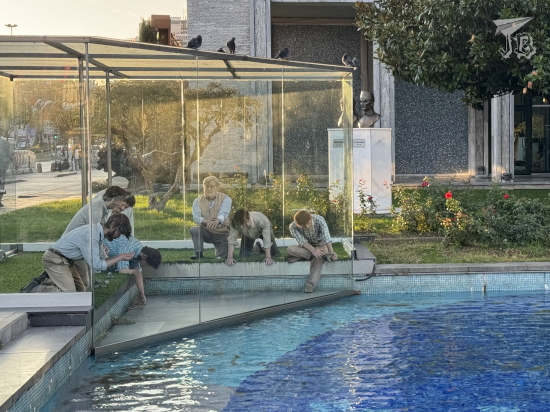
Since I had woken up early the previous day, I had also woken up early today, and I was caffeinated and ready about one hour before pick-up time. Considering that they were picking me up at 8:30 for a 13:45 flight, I decided to go for a walk in Istanbul | İstanbul before I got stuck at the airport. The Aqueduct of Valens was close to my hotel, and to get there I had to walk in front of the building of the Istanbul Metropolitan Municipality T.C. İstanbul Büyükşehir Belediyesi Başkanlığı. In the town hall yard there is a fountain with a glass case and several figures inside, reaching for the water. It is the July 15 Sarachane Monument Saraçhane 15 Temmuz Anıtı, which recreates a picture taken on the 15th of July 2016 during a coup attempt. It is supposed to represent a group of civilians Muslim men performing ritual ablution before facing off the rebel military forces at the call of President Erdogan. I was not sure if taking pictures of it was a security risk, but there were no guards around…

July 15 Sarachane Monument

I continued on towards Bozdoğan Kemeri (Aqueduct of the Grey Falcon), the part of the Aqueduct of Valens Valens Su Kemeri that can be driven and walked underneath. I stepped through the arches, and then turned towards Sarachane Park Saraçhane Parkı, which was empty except for a few cats and hooded crows (Corvus cornix) which expected me too feed them…

Aqueduct of Valens

cats and crows from istanbul

I went back to the hotel, gathered my things and came down to reception – both my driver and I were there at the same time, around 8:20. I guess we managed to avoid all traffic jams, because we reached the airport about 9:30. Upon entering the terminal, there was a first security control which X-rayed all the luggage, then I could access the check-in counters. I had done my check in online, but I printed my boarding pass in the kiosks anyway, and dropped off my luggage. The employee at check-in, holding my passport and boarding pass in her hand, asked me if I had a boarding pass. Obviously, she was not having the best of days, either.

I then went to passport control to clear immigration, which took about half an hour, and then the standard airport security check, which was fast because I found a “no need to take your electronics out” queue. Everything was extremely expensive in the airport. I did buy a bottle of water, but the prices put me off an ice cream, so I munched on some crisps that I had not eaten for dinner the previous night and I had packed exactly for this.

Truth is that Istanbul airport has a museum, but entrance was 13 € (note, not Turkish lira – 13 €). And at that point I decided that I was done feeling like a cash cow and introducing euro into the economy. I spent my remaining lira in the duty free shop, and found a copy of The Little Prince in Turkish for my and my parent’s collection.

We boarded around 13:00, and the process was not as efficient as the way in, but it was easy. We got lunch on the plane – happy to report I have finally internalised that pasta on planes tends to have peppers in the sauce and that upsets my stomach, too. I watched a movie and a half, and spent the rest of the time with one I had watched before as I would not have time to finish it.

Landing was smooth, but it took 61 minutes exactly from touchdown to getting out of the arrivals lounge, what with waiting for the luggage and so. And that was the end of the trip.

Maybe the bad project I mentioned at the beginning of the report was cursed, and thus the circuit was doomed, but it has been honestly one of the most disappointing trips I’ve taken – rushed, with bad information, and horrible customer service. I complained to my travel agent, who was horrified. It has really, really put me off anything organised for a while, and left me with a bad taste in my mouth. Of course, there have been good times, and awesome places, so it was not a complete disaster. Just not what I wanted, or what I thought I was buying when I chose it.

Would I come back to make up for it? I don’t know. As I was writing, I did wish I could go back to Cappadocia and Pamukkale to satisfy the geology nerd in me. Istanbul was not a city that made me feel particularly welcome, so I could skip that. Maybe in 20 years or so, if Türkiye is still a somewhat laic place, I might consider it. But the world is big, and there are many other places to explore… And the Turkish guide kept complaining that “all the good stuff was taken to Germany” so… that might be an option.

10th October 2024: The Trojan Horse & Bursa {Türkiye, October 2024}

We had to leave by 5:30 to go see the Trojan Horse. The reason why I had chosen this particular circuit was because it included “Troy”. The only thing I got to see of Troy was the Truva Heykeli Trojan Statue, – the horse which was used by Warner’s Bros to film the movie Troy in 2004. Not a damn ruin, not a damn rock, let alone be near the archaeological site. Damn it, did I choose the circuit badly or what? I do wonder what people thought of us taking structures of the stupid thing at 6:40 in the morning. As we drove north, we saw the Galipoli Peninsula, place of a huge battle between the Ottoman Empire and New Zealand and Australia regiments belonging as part of the British troups.

Çanakkale Trojan horse

We continued towards the city of Bursa, the first capital of the Ottoman Empire, and another of the World Heritage Sites – Bursa and Cumalıkızık: the Birth of the Ottoman Empire. It started off as a settlement around 5,200 BCE, which evolved into a Greek city. Under the Byzantine reign, it was a city known for its garrisons and its silk manufacturing centre. It is considered the origin of the Ottoman Empire, and throughout the period, it flourished through its local silk production. Following the foundation of modern Türkiye, it became an industrial city.

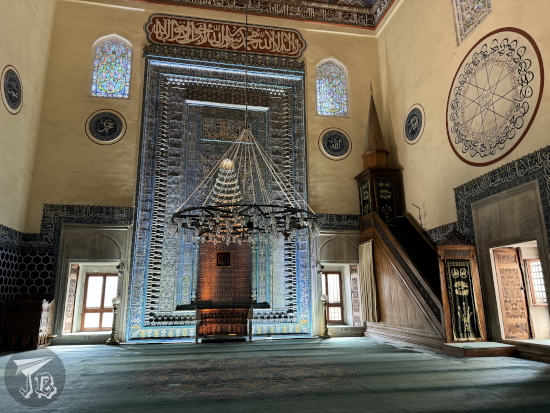
Our first stop was the Grand Mosque of Bursa Bursa Ulu Cami. Its first stone was set in 1399 an important building in the early Ottoman architecture as it found its own style. It is a rectangular building with a fountain from the 19th century at the centre – originally this area was open but it is now closed with glass, forming a skylight. It has two minarets. The interior is mostly white, but at the same time, quite decorated with calligraphy, medallions and vegetal themes.

Interior of the Great Mosque Bursa

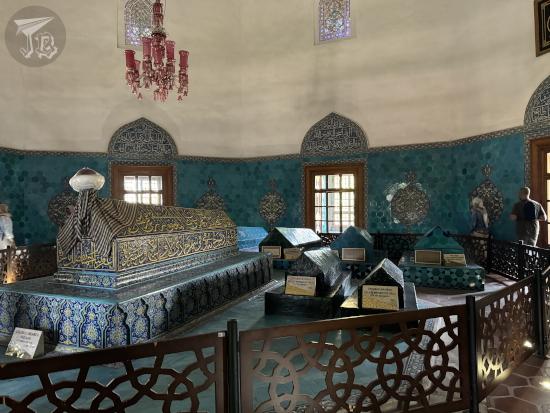
Then we drove to the Green Mosque Yeşil Camii complex. It was commissioned in 1412 by Sultan Mehmed I Çelebi, who is buried in the adjacent Green Tomb Yeşil Türbe – along with his children and their caretakers. Both the mosque and the mausoleum have beautiful decoration in blue-green tiles with gold inserts, which create the motifs and calligraphic inscriptions.

Mihrab of the Green Mosque Bursa

Bursa Green Tomb

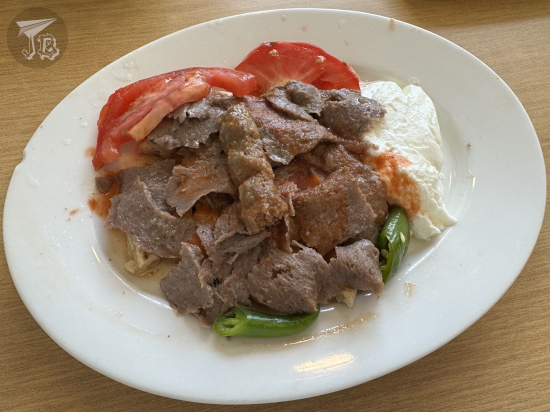
Next to the mosque stands a building which calls itself a Silk House, but is just a huge souvenir shop, nothing even close to the actual Silk Bazaar. Afterwards, we went for lunch, lentil soup and a traditional Bursa kebap İskender kebap, making this another sort-of actual Turkish meal. It uses meat cooked on a vertical rotisserie (döner kebap) on pita bread, with tomato sauce, yoghurt and sheep’s milk butter – which was poured at the table. Dessert was a honey pastry.

İskender kebap

Then we continued off back to Istanbul | İstanbul. We got there around 16:00 and I was considering maybe heading out to a church-turned-mosque to see some of the most important museums but… at that point it felt more like a self-imposed obligation that something I really wanted to do because I would enjoy it? It was more of a feeling of “you should do it because you are not going to come back to this country”. But the truth was that I really did not want to do it. I was disappointed in the whole trip experience, and in a way, I did not… I don’t know… care anymore? No balloon over Cappadocia, not enough time for Pamukkale travertines, no Troy. Whatever.

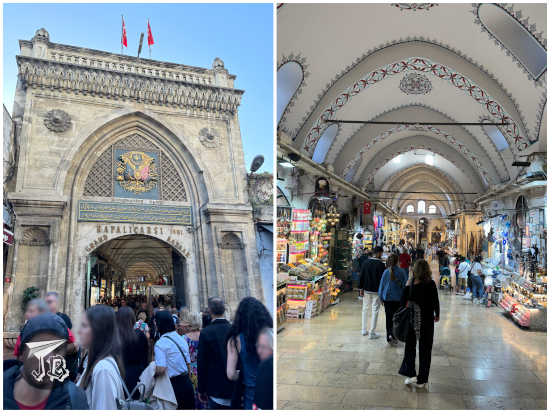
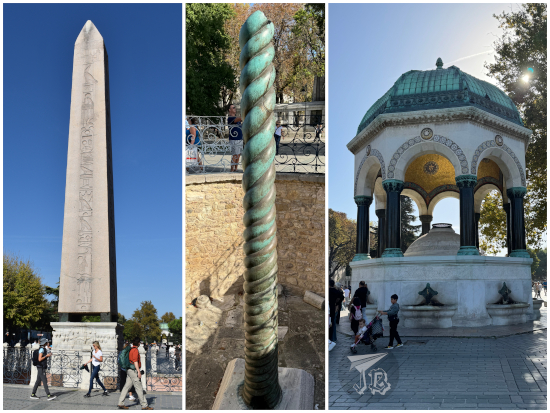
The nice group from the trip invited me to hang out with them for a walk. Together, we walked to the Grand Bazaar Kapalı Çarşı. Then we continued towards Sultanahmet Square Sultanahmet Meydanı, from where we crossed Gülhane Park Gülhane Parkı until we reached the coastline İBB Sarayburnu Parkı, the point in which the Golden Horn and Bosphorous Strait come together. On our way back, we stopped around Sultanahmet Square Sultanahmet Meydanı to take some pictures.

Gülhane Park at night

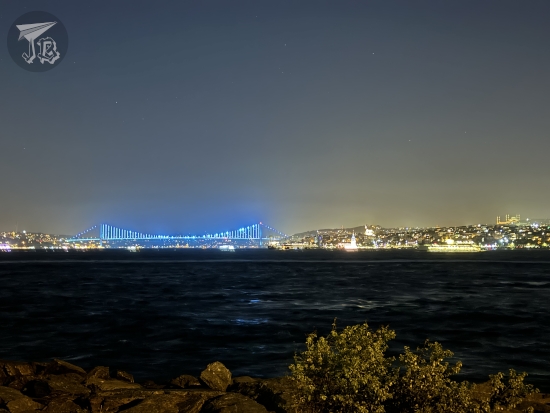
Bosphorous at night

Sultanahmed square at night

Finally, I headed back to my hotel – Hotel Bi·setun, the same as the first two nights – to order dinner, have a shower and get ready for the return trip.

9th October 2024: The Asclepieion & the beach {Türkiye, October 2024}

We left around 8:00 towards Pergamon Ancient City Pergamon Antik Kenti, another of Türkiye’s World Heritage sites – Pergamon and its Multi-Layered Cultural Landscape, still in the city of Izmir | İzmir (in Türkiye, “city” and “province” are interchangeable, apparently). The origin of the city dates back to the 8th century BCE – though there were legends about a mythological foundation by the son of Heracles. Pergamon flourished and became the capital of its own kingdom, until it eventually fell in Roman’s hands. The most important archaeological area is the acropolis – though the Great Altar, which is currently located in the Pergamon Museum of Berlin, in Germany. I had had a tired / silly moment the night before and packed the camera battery charger with the battery still in it, and I almost had a heart attack when the camera would not work. Fortunately, it made a lot of sense after I opened the battery receptacle.

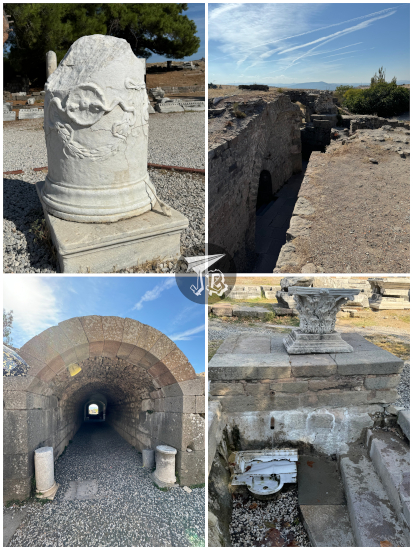
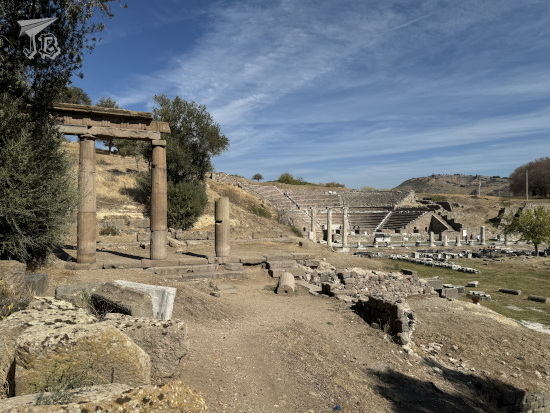
We did not get to go to the Upper or Lower Acropolis, but we could see the theatre, one of the steepest theatres in the world – built in the 3rd century BCE with capacity for about 10,000 people. We stayed down at the foot of the acropolis, in the Sanctuary of Asclepius Asclepieion [Ἀσκληπιεῖον] – a healing temple dedicated to the demigod Asclepius, the demigod who learnt the art of medicine from the centaur Chiron and became the first doctor in “history”.

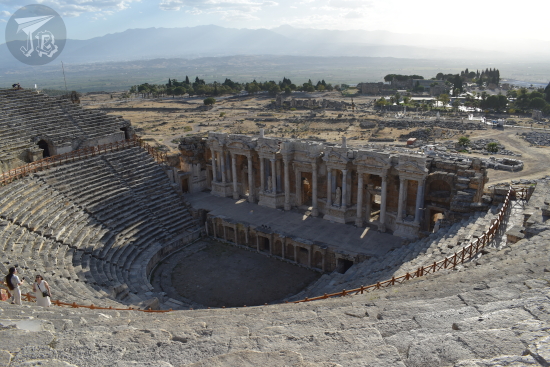
The Asclepieion worked with a holistic approach to patient care, giving thought to tranquillity, water, and activities such an art and theatre performances. The theatre is one of the best-preserved structures in the Asclepieion of Pergamon, though there are many others – such as 70 metre long cryptoporticus a tunnel that connected the baths, sacred pools – with a healthy population of frogs and tortoises – and fountains. I also found a lizard chilling out – or baking out, considering the temperature (remember, I had packed for… autumn, not for almost 30 ºC at noon every day…). Some famous ruins include

Pergamon Asclepieion ruins

Pergamon Asclepieion tortoises and lizard

Pergamon Asclepieion theatre

I wandered around for as long as I could, but again here was no time to explore everything – though this time I came pretty close. We left at around 12:30. This was the only visit we had on the day, as we were directly driven to the hotel in Çanakkale. On the way, we saw the Red Basilica Kızıl Avlu just before leaving Izmir, and glimpsed the island of Lesbos from the bus.

Iris Hotel was in the middle of a residential area – to the point that the bus barely passed through some of the streets. There was nothing interesting around to see in kilometres, so to… compensate, I guess, the hotel had a small mini zoo of deer and fowl.

Sunset at Çanakkale beach

Behind the hotel there was a private beach with a stunning sunset, but nothing around to explore or do. Çanakkale is located to the west of Türkiye, at the end of the Dardanelles Çanakkale Boğazı, the natural straight that joins the Aegean Sea with the Sea of Marmara, just south of Istanbul. The sea was warm, but I only got in up to my knees. At night, I watched a monster movie in Turkish. That… was an experience.

8th October 2024: Ephesus {Türkiye, October 2024}

It is not paranoia if they are really after you. And I am paranoid enough not to set a foot onto a bus before I make sure my suitcase is on board with me. So, guess who had to wrangle their suitcase down the stairs, since the hotel staff did not do it? Yep, I did. At least down is easier than up. Anyway, we were our merry way by 9:00, and continued until noon, when we were ushered into a “typical fur-working centre” which was… I don’t know how describe it, to be honest. But neither typical nor traditional are words I would use.

First, we were taken into a room with a catwalk and given notepaper to write down the numbers of items we liked. For about an hour, four or five models showed off anything but typical leather items, a lot of them reversible. Then, we stepped into the shop. I touched some of the items – they were extremely thin and weightless, which was weird. The prices were extremely high, too, even taking into account “the 70% discount because we were special”. I am happy to report I was at no point approached by any salesperson – again, maybe I do not look targetable to Turkish people?

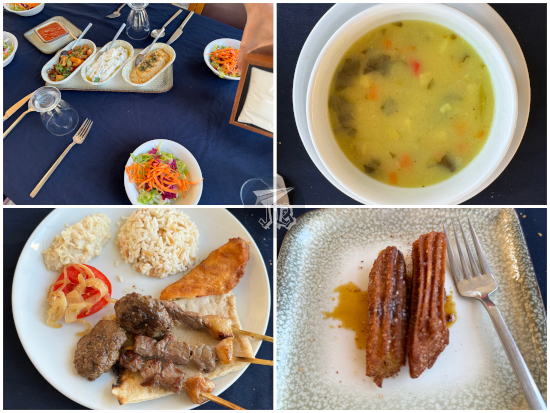
Lunch was okay, it had some nice dips and a soup, then another sad-meat main dish – albeit with your very own pita bread! Dessert was the only one I liked – a churros family treat called tulumba.

Lunch at Ephesus

Afterwards, we continued onto our way to Ephesus, which belongs to the current settlement of Izmir | İzmir, and is an archaeological site considered World Heritage. Coincidently, it was more than warm. It was scorching. We were there for two hours and a half, from 14:30 to 17:00. Again, leaving way before closing time to reach the hotel around 17:30, and yet this was the archaeological site where we spent the longest!

Ephesus was a city in ancient Greece – which back then included several areas of what is now Türkiye. Ephesus was founded around the 10th century BCE, and it became home to one of the Wonders of the Ancient World, the Temple of Artemis, which was built around 550 BCE. It was controlled by the Romans between 129 BCE and 395 CE, and during this period, it became an important site in Christianity starting the year 50 CE or so – with the apostle Paul of Tarsus living there, and reportedly being home of “the seven churches of the Apocalypse”. The city suffered attacks from the Goths, and was damaged by earthquakes before being finally abandoned in the 15th century.

Some of the ruins in Ephesus, including Trajan's fountain and the entrance to the therms

Though the temple of Artemis was off-site and it has been destroyed, many monuments from different periods still stand or have been restored. There are two theatres, a small odeon, and a larger one – with the large one being probably the greatest in the ancient world, seating 25,00 people. There were two agoras, one for commercial meetings and the other one for business. During the Roman times, the Gate of August was built to honour the Emperor.

Since the temple is long gone, the most important building remaining is the Library of Celsus, rebuilt from the pieces left. Tiberius Julius Celsus Polemaeanus was one of the Ancient Greek governors of Roman Asia, who paid for the library himself around the year 125 CE, and is actually buried underneath. The library once held up to 12,000 scrolls in 180 square metres.

Celsus library Ephesus

Ephesus theatre

The guide kept hurrying us up, saying that he had a surprise for us – which turned out to be an immersive show about the history of the city, and after that we had to leave. The film was okay, but I would have much preferred to have more time to wander and see the real thing. The only item that was real – I hope, though it was probably a copy – was the final statue of Artemis.

Statue of Artemis Ephesus

We left afterwards. We did not get to stop by the place where the temple used to stand. We did not see one of the most famous sites outside the city either – the so-called house of the Virgin Mary because, according to the guide, “it was a recycled myth”, it was probably the house of Artemis’ priestesses. Which in my view made it even more interesting, but oh well…

Ephesus Hitit Hotel had an outdoor swimming pool that I dipped into, but it was too cold to stay for a long time. I also tried to go out of the hotel to find something to see, but the street did not seem safe. To the point that our bus driver actually saw me going out and came to ask me if I was all right…

7th October 2024: Pamukkale {Türkiye, October 2024}

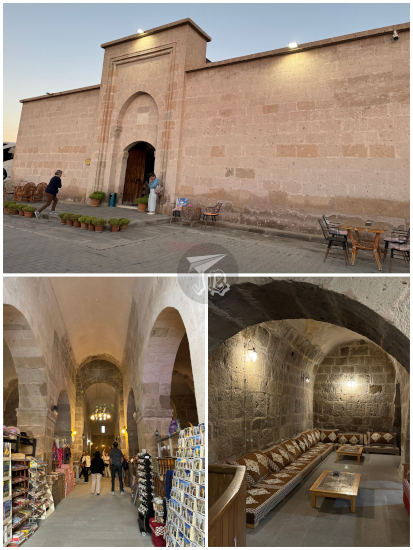
Upset as I was, it took a long time to fall asleep, and I nearly had a heart attack when the hotel’s automatic wake-up call made the landline ring at 4:20 – half an hour before my alarm clock was set. We left around 5:40, and it was cold at that time, though it would get really hot during the day. Around sunrise, we reached our first destination – a caravanserai (kervansaray in Turkish, کاروانسرای, kārvānsarāy], in original Persian). Between the 2nd century BCE and the 15th century CE, Europe and China were communicated through the Silk Road, a network of trade routes frequented by caravans. Caravanserai were roadside inns built alongside those trade routes. They were fortified inns which protected the traders from bandits and weather, providing food and water. In Turkish, they are also called han.

Öresin Han (also called Tepesi Delik Han, “the han with a hole on the roof”) is a restored caravanserai / han. It was built in 1188, according to a plate that was recovered during restoration. The works lasted between 2007 and 2010, saving the building from literal ruins (and the aforementioned hole on the roof). Nowadays, it is a shop and inn for tourists. It has thick walls and a vaulted interior to withstand the weather and possible attacks.

Cansaverai

We continued on the road for hours until an early lunch at noon, then drove to the World Heritage Site Hierapolis-Pamukkale, a combination of historical site and geothermal activity. First and foremost, there is the travertine formation. Travertine is a sedimentary rock made out of calcium carbonate which precipitates from fresh water – basically, the material stalactites are made of. Sometimes, in thermal areas, they deposit in cascade form with lakes and waterfalls.

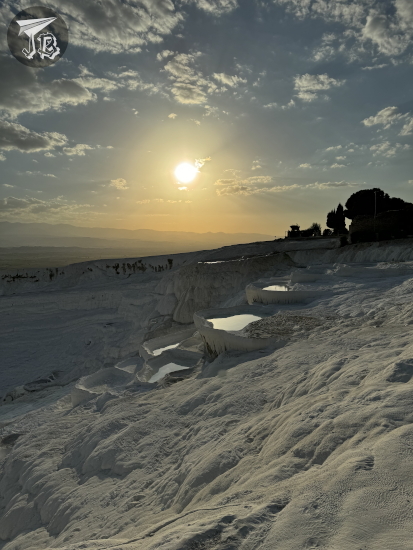
The Pamukkale travertine formation Pamukkale travertenlerinde is a terrace formation around 2,700 metres long, 600 metres wide and 160 metres high. The local thermal water oozes onto the surface at a temperature between 35 and 100 ºC and saturated with calcium carbonate. At the surface, carbon dioxide degasses and the calcium carbonate precipitates into a gel that will crystallise into travertine. Unfortunately, the waterfalls have been mostly drained now to feed pools at the hotels.

Even from the Classical era, the travertines have attracted visitors to the point that a thermal spa was founded around the 2nd century BCE, which eventually became the town of Hierapolis. In the year 133 BCE, Hierapolis was incorporated into the Roman Empire.

We had some time to wander around the place, but way too short to actually see even a quarter of what was on display, which was frustrating – but this would again happen at every archaeological site. Along one of the nice ladies from my group, I saw the Roman baths, then basilica, now museum, which contains the smaller items unearthed – sculptures, friezes, sarcophagi. We then climbed up to the Temple of Apollo Apolion and the Temple of Pluto Ploutonion – which are closed off as the cave underneath them emits asphyxiant carbon dioxide due to the geothermal processes.

Hierapolis museum

Hierapolis theatre

There is also a swimming pool on site, and after hiking up to the theatre it might have even been inviting, if not for the fact that you could actually step onto an area of the travertines to experience them first-hand. I of course took the chance, and was surprised at how… non smelly it was, used to sulphur thermal waters in Japan.

Pamukkale travertines

Travertines Pamukkale

I did not understand why we had to leave so early, because then we just ended up at another hotel with nothing around – thinking back, I have reached the conclusion that the guide was overworked, and he kept a schedule of going to sleep early and getting up early too, that is why we were at all the hotels at 18:00 at the latest; not an excuse, but an explanation. We were at Colossae Thermal & Spa Hotel around that time. The hotel did not have a lift, and most of our rooms were on the first floor. The hotel staff brought the luggage up, and we were reassured it would be taken down again the following morning. I… had a feeling it would not.

In accordance to the thermal and spring water reputation of the region, the hotel had a thermal centre. It comprised a swimming pool, a warm pool and a jacuzzi inside. Outside, there was an actual thermal water / mud pool – which was great for relaxing, but at 33 ºC, I could not stay for long (and I tried not to feel guilty as I knew the water is deviated from the travertines). By this time in the trip, too, I had inserted myself into a group of nice people, and made acquaintances with a nice couple, which was good because it’s always useful to have someone telling you that you’re about to get into the shower with your glasses on…

6th October 2024: Cappadocia {Türkiye, October 2024}

I had made a thing out of two coffees for breakfast, and today was no exception. The whole group was now in the hotel so we were ready to go see the sights. The bus had barely hit the road when our guide gave us a huge grin and decalred “I’m the first Turkish face you meet during this trip. Trust me. We’re going on the balloon is too expensive, so we’re not gonna do it here. We’re going to do it somewhere else”.

I was crushed at these words. Had he said this the previous day, I would have arranged to go onto the balloon on my own – today. Now, with a 5:00 departure time the following day, it was impossible. I don’t have words to write how I felt – devastated, cheated, furious. The option to ride a balloon in Cappadocia was in the documentation, and I had budgeted for it. And this guy had plain and simply… robbed me from it, because he did not want to wake up early after picking the other half of the group from the airport. Looking back, I should have tried to do it myself, hiring the flight on the hotel for today – and knowing that does not make it any better, because I could not do this one activity, which was important for me, not because of the weather or any actual problem. Just because the guide did not want to do his job. I did try to get him to reconsider, but he was like “no can do”.

Thus, I reached the conclusion that the travel agency, Oxin Travel and the guide himself sucked. Through the day (and the rest of the trip), I would build evidence on this – such as hearing explanations that did not make sense, or just contradicted what was written on the panels. I’m surprised it did not cross my mind to leave the trip at that time, because I was seething and heartbroken. In the past, I have tried to leave unsavoury experiences out of JBinnacle, but this would not be an honest trip report without all the emotions that coursed through me during that day – and to be honest, this was just the beginning of the problems. I wrote an email to the distributor that very same day, told the guide, and have complained formally to my travel agent. I have no hope for any solution, but at least I made it known that I was not happy with the services provided. And this trip was not cheap, at all.

I had to try to get over the disappointment in order to at least see what I could of the region. It was hard, I felt a cloud over my head ruining the mood. I almost did not care about anything else, but I knew I had to make do with what I had, or let my whole trip be ruined. Thus, I tried to get myself into the right mindframe to enjoy the World Heritage Site Göreme National Park and the Rock Sites of Cappadocia as much as I could.

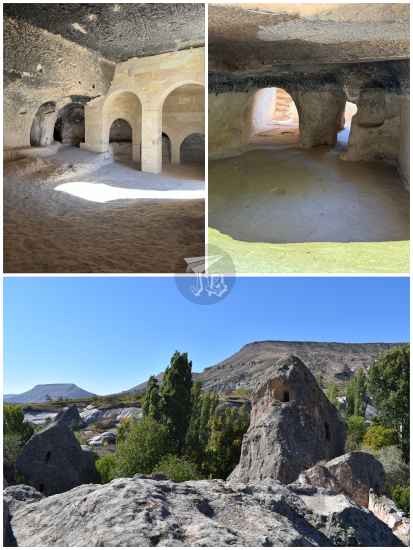
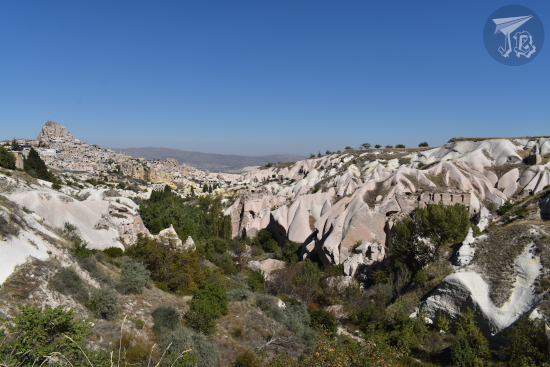
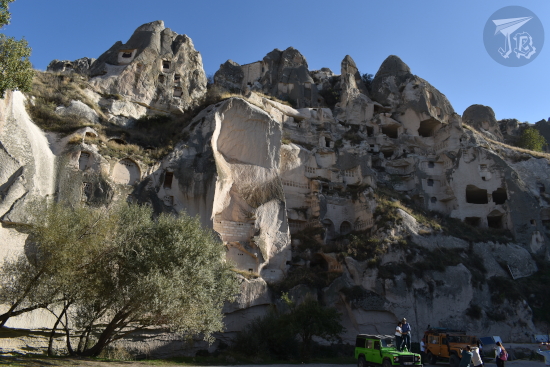
Around 9:00, we reached Christian Keşlik Monastery Keşlik Manastırı outside the town of Ürgüp, which is a cave monastery. Human history in Cappadocia is tied to its geology. Tuff is easy to carve, and a lot of civilisations have made their dwellings into the earth instead of on it. First, it was the cavemen, and much, much later the Christians. The first buildings from the monastery date back from the 3rd century CE. Between the 1st and the end of the 4th centuries CE, Christianity spread through the Roman Empire, coming into conflict with the established religion, which deified the Emperor. As Christianity forbade idolatry, their refusal to adore the Emperor as a god made them a target of persecution, accused of treason. In some Roma cities, the Christians took to the catacombs. In Cappadocia, they dug cave monasteries.

Within the tuff structures, ancient Christians created all the items that one would find in a regular monastery – a church, two actually, St. Michael and St. Stephen, a refectory, a winery, dwellings, a baptistery created from a sacred spring… The monks could perform their rituals and protect themselves from any possible attack. It was a functioning Orthodox church well into the 20th century.

The most important cave-building in the rock is the Church of Saint Michael. Its ceilings are decorated with black backgrounds and colourful figures, although many were damaged by iconoclast movements. There were also tomb-like structures where the monks meditated. Underneath the church, there is a baptistery, and next to it the refectory, with a long table and seats carved out of rock. Outside, you can wander around the dwellings, halfway between caves and houses, which served as rooms for the monks.

Keslik Monastery Church of St Michael

Keslik Monastery - chambers inside the rock and panoramic

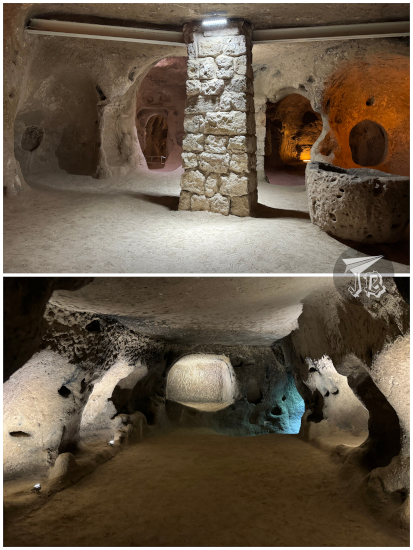
Afterwards, we headed out to the Underground City of Mazi Mazı Yeraltı Şehri, known in the past as Mataza. There are between 150 and 200 known “underground cities” in Cappadocia. They were initially carved between the 8th and 7th century BCE by the tribes which dwelt in the area. Turf is easy to carve and there is no water in the soil, which made it easy for the tribes to dig “caves” under their houses. These caves became “rooms” which ended up connected to one another through tunnels. As time passed, the cities became more and more complex, with decoy tunnels and booby-traps that the locals could use to hide, safeguard their resources, and protect themselves from raids.

The cities were layered, and the levels were used for different activities – upper floors were for stables, underneath which stood the wineries and ovens… They had wells and ventilation systems that could not be tampered with by the enemies, and even a communication system to talk to people who were in other rooms. Mazi itself had eight stories, four different concealed entrances, and rounded rocks that could be used to close off the corridors. About 6,000 people could survive in its tunnels for up to a month. We did not have much time to explore as we had to move as a group, but it looked really cool.

Mazi subterranean city

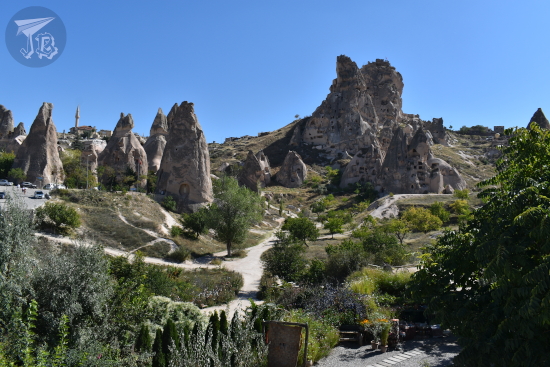
We went back onto the bus to head to Guvercinlik Vadisi, Pigeon valley – so called because the geological formations were excavated into dovecotes, since pigeons were used for food and their droppings as fertiliser. As we had 20 minutes there, I could hike down into the valley for a bit and even step into one of the dovecotes. Since it has become a tourist spot, locals have decorated trees with Turkish amulets – evil eye charms – to create photo spots they can request a tip if you get your picture taken there.

Cappadocia Guvercinlik valley

Back on the bus, the guide “graciously” and “secretly” stopped at Üçhisar, a town which has turned a lot of its fairy chimneys into hotels and cafeterias. It is dominated by Üçhisar Kalesi, Üçhisar “castle”, the only natural castle in the world, built in a tuff hill.

Natural castle of Uchisar Cappadocia

Then we were taken for lunch, a rather nondescript buffet which ran out cacik (Turkish tzatziki) way too fast, and afterwards to a “jewellery atelier”. The rocks they showed us were pretty, but the jewellery was rather tacky – and their star product? A pendant made of the local semi-precious stone sultanite inside a balloon, so we were not amused. I was not the only one angry about the whole debacle.

During the bus ride the guide had pitched several optional activities, and I decided to take a so-called jeep safari, run by locals, which takes you in a kind of luxury jeep up and close with the geology of the area. I got that one because it was external and better than nothing, but I did not sign up for the “traditional Turkish night of alcohol and dancing” – I don’t drink alcohol and I was not in the mood for dancing.

The jeep safari drivers picked us up from the jewellery shop around 16:00, whilst the rest of the group went back to the hotel. I felt so cheated – six hours in Cappadocia to go back to the hotel at 16:00 is disgraceful. But then again, I was not in my best disposition. Good that I still had the chance to drive right into the heart of the valleys, at least.

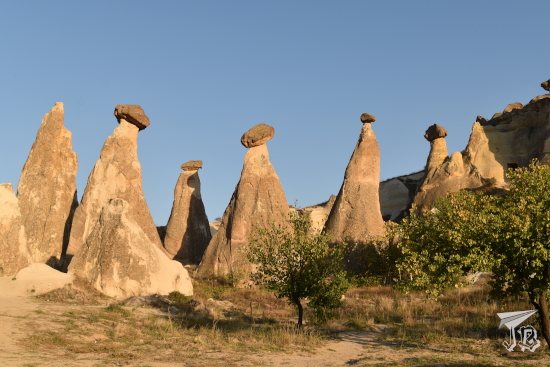
It was a pity that the drivers spoke zero English or Spanish, because it made it impossible to determine where exactly he was taking us. However, we got close to the rock-houses, saw the valleys, the castle, and finally, finally, finally got close to a fairy chimney! We even caught a glimpse of one of the volcanoes responsible for the landscape. It was hard having to go back to the hotel at sunset, but I had a lot of fun – I shared the car with a couple, and the poor lady was terrified by the driver’s antics. I was honestly more worried about the times on the road than the bouncing through the trails.

Cavemen dwellings in Cappadocia

Cappadocia volcanic valley

Cappadocia volcanic valley

Cappadocia Fairy Chimmneys

However, back in Suhan Cappadocia Hotel & Spa before 18:00 made the sadness hit – and no internet in the rooms did not help for any kind of distraction. I tried to walk around the village to try to see something, but I did not find a way, and it was getting dark. I packed for the next day as we were leaving the area. After dinner, I wrote to the travel agents’ in Spain to complain, with zero hope for a solution as it was a Sunday, but I wanted it out of my system. I spent a really bad night, and it was stupidly short because I could not fall asleep…

5th October 2024: From Istanbul To Cappadocia {Türkiye, October 2024}

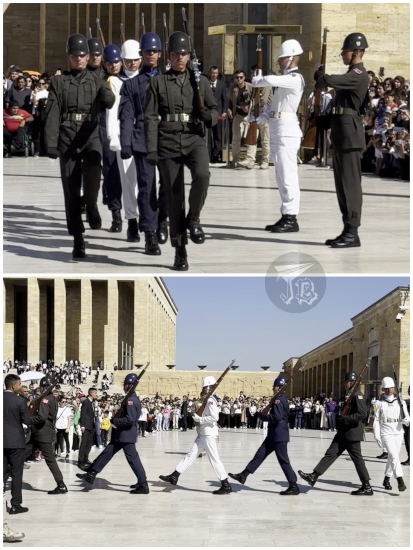
The alarm clock went off at 5:40 and I was ready for pick up in 15 minutes. The guide had changed my pick-up time from 6:25 to 6:00, but apparently was the only one who had been informed about the rescheduling. The travellers in the rest of the hotels in the area had no idea, which made it absolutely pointless because we had to wait for them anyway.. For this leg of the trip we were 16 people, and the description of the day said we would “visit the Atatürk mausoleum in Ankara and see the Salt Lake” on our way to Cappadocia. A quick calculation yields to about 733 km of trip from Istambul to Avanos.

We left Istanbul and went on the road. We took a couple of breaks on the way, and around 12:30 we reached Mustafa Kemal Atatürk’s mausoleum Anıtkabir in Ankara. Mustafa Kemal Atatürk is often called “the founding father of modern Türkiye”, and served as the first president of the Republic, between 1923 and 1938. The Ottoman Empire had participated in World War I, and after its defeat, the Allied powers wanted to divide the country among themselves. Atatürk spearheaded the Turkish War of Independence, and upon victory, he abolished the Sultanate and proclaimed the Turkish Republic. He made a lot of changes – primary education became free and compulsory, the Latin alphabet replaced the Ottoman writing, women obtained equal rights, the country became secular and started industrialisation, the language was strengthened, and surnames were adopted.

Upon Atatürk’s death, it was decided to build a mausoleum in Ankara – Anıtkabir. There was a design competition which was won by Emin Onat and Orhan Arda, though modifications were added later on. It is a massive complex with a courtyard, stairs, the tomb hall, and exhibition rooms. The theoretical entrance to the area is an avenue lined with lions and trees, though due to security, you enter from the opposite side. The Hall of Honour holds a symbolic sarcophagus, and the actual tom is located 12 metres underneath. On the corners, there are small ethnographic exhibits. The whole complex is made out of reinforced concrete and is decorated with marble, travertine, reliefs, frescoes, carvings… Everything looks golden. Around 13:15, we saw the changing of the guard in the ceremonial courtyard.

Mausoleum of Mustafa Kemal Atatürk

Change of the guard at theMausoleum of Mustafa Kemal Atatürk

Then we headed off for lunch, a bowl of lentil soup and a plate of flattened “meatballs” and rice, and continued on our way. Around 17:00 we “saw” the Salt Lake indeed – we guessed its existence from a service station a few kilometres away. We reached the Suhan Cappadocia Hotel & Spa in Avanos, in the region of Cappadocia. We would be using that as base for two days. One of the things to do in Cappadocia is seeing sunrise from above. However, since the group was not complete, the guide did not offer the possibility for sunrise the next day, he just gave us the Wi-Fi password (which only worked in the lobby), and the dinner / breakfast / day trip for the morning, and left.

Riding a balloon in Cappadocia is the thing to do. It allows you to see the structures called “fairy chimneys” from above as the sun rises, and since the landscape is so unique, I was really excited. Geologically, Cappadocia is a very interesting place – some thirty million years ago, volcanoes Erciyes, Hasan and Melendiz erupted repeatedly. Over thousands of years, ash rained on the ground, creating an elevated plateau of around 17,671 square kilometres. The ash hardened into tuff (a porous rock that I have seen in Neapolitan architecture) before it was covered by a layer of basalt. Both types of rock weathered, but tuff erodes faster than the upper basalt – creating sort of mushroom-like rock formations. As you can imagine, being the geology geek I am, visiting all these was one of the things I was looking forward the most. I had even put aside a budget “just for the balloon”, as it can get quite expensive, and I wanted to remain reasonable.

I dropped off the luggage and decided to go get something to eat before I hopped into the shower – else I would not get any food at all. Dinner was a buffet, and it was overrun. The food was weird… there was a huge dessert buffet, and a lot of breads, but nothing that really grabbed my attention but a few dollops of cacik (Turkish tzatziki). Back in the room, I tried to find a TV channel with something I could understand – and was not related to Israel bombing or being bombed. I did not even find the BBC…

4th October 2024: Istanbul, day 2 – Bosphorus Istanbul (plus, again) {Türkiye, October 2024}

It was warm in Istanbul | İstanbul when the sounds of the town woke me up. Since I was up early, I decided to find the Bozdoğan Kemeri (Aqueduct of the Grey Falcon), part of the Aqueduct of Valens Valens Su Kemeri. It was built using brick and stone in the 4th century in order to bring water to Constantinople. Construction started under the reign of Constantine II and finished during the reign of Valens, and the structure was in use under the Ottoman period. The Bozdoğan Kemeri bridge is 971 metres long, and its maximum height is around 30 metres. Today, it stands over a busy road, with cars running underneath.

I went back to the hotel for pick-up, which today happened on time. I had signed up to the other day trip offered to me at the airport Estambul Bósforo (55 €). My hopes were not too high, but at least I met with the nice ladies from the day before. This time around, the group was bigger, so everything was a bit more chaotic. Our first stop was Süleymaniye Mosque Süleymaniye Camii, an Ottoman imperial mosque commissioned by Suleiman the Magnificent to his imperial architect Mimar Sinan around 1550. The mosque has four minarets with a total of ten balconies. The interior is decorated with medallions, writings, geometrical decorations, and beautiful stained-glass windows. Outside, there is a cemetery with the mausoleum of Sultan Suleiman and his wife Roxelana.

Süleymaniye Mosque

After the mosque complex, the bus headed out towards the Asian side of Istanbul for a panoramic viewpoint up Çamlica Hill Çamlıca Tepesi, which implied getting stuck in traffic for a long time again and driving past a lot of interesting buildings – visiting any of those would have been a better use of our time.

View of Istanbul from Çamlica Hill

We went back to the bus for the boat ride, which despite being advertised as a Bosphorus trip, was only up and down the Golden Horn Altın Boynuz for about an hour. At first, I tried to pay attention to the guide as he explained things, but I got bored pretty quickly. This was not a good sign, considering this one guide was the one who was to take me onto the tour around the country…

Bosphoros boat ride

For lunch, we had been asked to choose either bream or chicken. I had ordered the chicken because I had a feeling I could not trust a random restaurant in Istanbul… I was right. The bream turned out to be sea bass. Again, food was nothing remarkable. Then, we walked towards the New Mosque Yeni Cami, which was the next visit, but we did not get to go into that one for reasons that escape me. Instead, we were taken into the Spice Bazaar or Egyptian Bazaar Mısır Çarşısı, for a demonstration inside a particular shop. I do wonder how many and how much commissions go into decisions like that.

New Mosque Istanbul

Egyptian bazaar Istanbul

This was the end of the day trip, around 17:00, since the guide had once again stated that “your hotels are close, no need for the bus”. I said goodbye to the nice ladies, and headed out towards the Grand Bazaar Kapalı Çarşı, described as a “network of indoor souks and market streets”. It is actually one of the oldest and largest covered markets in the world, and it has thousands of shops – literally. It dates back from 1455, just after the Fall of Constantinople into the hands of the Ottomans. It was an interesting structure, but I only found trinkets and souvenirs, and it was packed with people.

Grand Bazaar

Thus, after crossing out the Grand Bazaar from the list, I headed towards the university İstanbul Üniversitesi, my reference for the metro stop Veznecıler. From there, I could take a train towards Taksim Square Taksim Meydanı, the gateway to Independence Avenue İstiklal Caddesi, on the other side of the Golden Horn but still in the European side. The area is a tourist hub with shops, fast food places, and ice cream vendors who play around before they serve you the ice cream cones. One of the highlights of the avenue is the “nostalgic tramway” İstanbul nostaljik tramvayı, a revival or heritage tramline with tiny cars, built from memories and photographies. It is not a novelty thing for tourists, but an actual working system that goes up and down the avenue, line T2. I was happy to be able to see it, the car was packed – mostly by tourists though…

Taksim square

At the end of İstiklal Caddesi, stands Galata Tower Galata Kulesi, a former watchtower, now a museum with an observation deck. The origin of the tower dates back from 1204 though the original tower was destroyed and rebuilt in the Romanesque style in 1350. At that point, it was the highest building in the city. At the moment, it is almost 63 metres high, with nine floors, and a renewed roof.

Nostalgic tram and Galata Tower

Afterwards, I caught the underground at the nearest stop – though I was a little bit tempted by the nostalgic tram – and I headed back to the hotel. I settled the bill for the water bottles I had bought and went up to my room, where I decided to order the same dinner as the evening before – kebap and yoghurt. I then had a shower and packed, because pick-up was at 6:00 the next morning. Good thing that I had found a vending machine in the underground system that sold canned coffee, even if it was “almond flavoured”.

3rd October 2024: Istanbul, day 1 – Classical Istanbul (plus) {Türkiye, October 2024}

I spent the day in Istanbul | İstanbul, probably the most important city in Türkiye, and certainly the largest, but not the capital. It was founded as Byzantium in the 7th century BCE, straddling the Bosphorus Strait, which is considered the boundary between Europe and Asia. In 330 CE, Roman Emperor Constantine renamed the city into Constantinople after himself, and made it the capital of his domains. The so-called Fall of Constantinople in 1453 started the Ottoman Caliphate – sometimes called the Ottoman Empire. The empire survived until it joined World War I and was subsequently defeated – Istanbul was the capital during most of that time, until the Turkish Independence War, when Mustafa Kemal Atatürk made Ankara the capital.

Istanbul is probably the only city in the world which stands between two continents, separated by the Bosphorus strait and the Golden Horn – an estuary flowing into the strait. To the west of the Bosphorus is Europe, and to the east Asia. The European area south of the Golden Horn is called the historic peninsula.

Istanbul has claimed its rightful place in history as a key step of the Silk Road and the spread of Christianity during Roman times. The historic peninsula is a Unesco Heritage Site, the Historic Areas of Istanbul, which the day trip I had hired, called “Classical Istanbul” Estambul Clásica (50 €) was supposed to cover.

I woke up around 7:00 and went down for breakfast. Coffee was… unexpectedly dull, considering the fame of Turkish coffee – and I had two cups to kickstart my brain. The scrambled eggs were particularly good, but the bread so-so. At 8:20, ten minutes before pick-up time, I was ready and waiting at reception. At 9:10 I wrote to the person who had picked me up from the airport, who had told me to text her with any question, and at 9:15 they showed up – there was apparently “a lot of traffic”, and we were stuck in it for a while. I spent the time checking out the ruins of Constantinople’s ancient walls Bizans Surları, which are also part of the Unesco Heritage Site.

The group comprised around 30 people, and the bus headed towards an area called Pierre Loti Tepesi, Pierre Loti Hill, and reached there around 10:00. This is a viewpoint above the Golden Horn Altın Boynuz, with a viewing terrace, a café and the Eyüp Cemetery Eyüp Mezarlığı. We were told we’d visit the cemetery later, and were given twenty minutes to take in the views. Afterwards, we hiked (considering the speed, “marched”) down the hill through the cemetery, and saw several tombstones from the Ottoman period, but there was no visit whatsoever.

Istambul from Pierre Loti hill

We hopped back onto the bus to drive towards the quarter called Fener, which we were told was “movie neighbourhood”. We were going to visit the Venerable Patriarchal Church of Saint George, the Orthodox cathedral of Istanbul Aziz George Katedrali, which closed down as we arrived for “an unknown length of time” because the Patriarch was coming out. Instead of letting us amble through the neighbourhood before the church, the guide insisted on us waiting for about 20 minutes before we all came into the church, and he gave a couple of explanations, and gave us free time to check out the church and the neighbourhood.

The church of St George was one of the few places with “real” security. We got through a lot of places with metal detectors and such with guards who would not even care, but the ones that did were ridiculously strict in contrast. The truth is that with the rise of Turkish nationalism, a lot of the church’s flock were deported, so the church and Patriarch are mostly symbolic and a pilgrimage point, and it has even been attacked by terrorists at times. The church itself used to be the centre of the quarter, which was historically the Greek quarter, even after the Ottoman Turks had taken over former Constantinople. Though the church existed previously, it became the seat of the Ecumenical Patriarchate of Constantinople since the early 1600s. It has been damaged and rebuilt several times, the latest as recently as 1991. It has three naves and aisles, with a rich iconostasis (decorated screen that separates the altar from the nave) in golden wood.

Church of St George Istanbul

After the cathedral, I wandered the quarter of Fener on my own for as long as was given us as free time. I found a colourful set of stairs Renkli Merdivenler, which led to nowhere but area pretty. The whole area was a hill, and I climbed up to try to catch a view of a very interesting building – the private school Phanar Roman Orthodox Lyceum Özel Fener Rum Lisesi. The building was designed in an eclectic style by Greek architect Konstantinos Dimadis, and built around 1882, though the school itself dates back from 1597. I also saw a film crew on a break in one of the streets.

Roman Orthodox Lyceum

Once we were called back to the bus, we headed out for lunch. The entrées looked good, actually Turkish, including hummus, rolled paçanga böreği, dolma (stuffed vine leaves), cacik (Turkish tzatziki). The main was rather unremarkable, and something that I could have easily had in either Jordan or Egypt – a sad-looking plate with eight fries, two slices of cucumber, one slice of tomato, a mouthful of rice, and some chicken and lamb. Dessert were the ubiquitous Turkish delights, which are extremely sweet and I’m not a big fan of. Looking back, however, this was one of the most Turkish meals I ended up having, besides kebaps. During lunch, I made acquaintances with some nice ladies who promised to make sure I was not left behind – which has been a bit of a worry of mine when I’m in a guided tour since my last day in Egypt.

Turkish meal

Around 14:00 we walked towards the area known as Sultanahmet Square Sultanahmet Meydanı, the neuralgic centre of historic Istanbul. There, the first stop of the afternoon was Sultanahmet Camii, the Sultan Ahmed Mosque colloquially known as the Blue Mosque. It was built between 1609 and 1617, during the Ottoman era. Designed by architect Sedefkar Mehmed Agha, it was the last great mosque built in the Classical Ottoman style, and combines Byzantine details and Islamic architecture. It has a central dome (43 metres high) with four semi domes and six minarets. The interior is decorated with tiles and mostly blue decoration, hence the name – though honestly I mostly felt it was… golden. The mosque has windows which originally had coloured glass, and are now modern, and it has chandeliers hung from the ceiling, with some of the lamps being ostrich eggs, a typical feature in Turkish mosques. One of the minarets was being restored.

Blue mosque

The mosque stands next to the square, which is long and narrow – it is actually built on the former Hippodrome of Constantinople Hipodrom, the centre of the city during the Byzantine period. Upon the founding of Constantinople, both Constantine and his successor Theodosius the Great brought works of art into the area. Today, there stands the Serpent Column Yılanlı Sütun, an ancient bronze column representing a hydra, whose heads are now missing (part of one is now in the nearby Archaeology Museum). Another monument of the square is the Egyptian Obelisk of Theodosius Dikilitaş, originally erected for Pharaoh Thutmose III (1479 – 1425 BCE, 18th century) in Karnak. It stands on a Roman pedestal from the time it was transported to Constantinople around the year 390 CE. The final construction in the square is the German Fountain Alman Çeşmesi (The Kaiser Wilhelm Fountain), a neo-Byzantine fountain that was constructed to commemorate the visit of German Emperor Wilhem II to Istanbul. It has eight sides, with marble columns and an inside covered with golden mosaics.

Monuments at Istanbul hyppodrome

The official day trip ended there – though they were supposed to take us to the Grand Bazaar. However, the extended tour (25 € extra) included visiting the Orthodox church-turned-mosque-turned-museum-turned-mosque Ayasofya-i Kebir Cami-i Şerifi Hagia Sophia Grand Mosque. The current structure was commissioned by the Byzantine Emperor Justinian I to be the Christian cathedral of Constantinople as the Church of God’s Holy Wisdom, designed by Greek geometers Isidore of Miletus and Anthemius of Tralles. At the time it was built, it was the largest interior open space in the world.

It has a central dome with rises 55.6 metres from the ground and a diameter of around 31 metres. After the fall of Constantinople in 1453 it was converted into a mosque. In 1935, the new Turkish Republic turned it into a museum, but in 2020 the controversial decision to turn it back into mosque was made. With the first transformation into a mosque, minarets were erected and the Byzantine mosaics on the ceilings were covered or destroyed. They were recovered for the museum period, and now they are hidden away. While originally the mosque was going to be “open for all”, now the ground floor, covered with a carpet, is only for praying Muslims, and tourists have to pay to access the second floor and see the Christian mosaics. From the second floor, you can see the mosaics, and are close to the domes, which allows you to see the questionable state of conservation. The dome is fantastic, and there are mosaics of the archangels there. On the way out, there is another mosaic depicting the Virgin Mary with the child, and Constantine and Justinian giving them presents – Istanbul itself and Hagia Sophia. The walls however, are in dire need of restorations.

Hagia Sophia Istanbul

The day trip ended after an introduction to the building, and I wandered around for a while, seeing everything I was allowed to before I stepped out. At that point it was 16:50. I had the option of walking, as recommended, to the Grand Bazaar, but I decided that I had better things to do. I rushed towards the palace-turned-museum Topkapı Palace Topkapı Sarayı. Construction of the complex was ordered just after the fall of Constantinople by Sultan Mehmed the Conqueror overlooking the Golden Horn. Closed-off by walls, it has several buildings and palaces, some of which hold exhibitions. The palace closes at 18:30, and the ticket booths at 17:00. I was able to buy a ticket at 16:57 because I am very motivated, and I even saw most of the key areas of the palace in those 90 minutes. Though the recommended visit time is four to five hours, at least I felt accomplished – I wished I had prepared better for it, but I thought that I was standing next to the palace, and even if it was expensive I could return the next day if I felt I wanted to see more.

The first courtyard is free for everyone to see, and that is where the ticket booths are. I hurried towards the second courtyard, where I was able to see the Ottoman Empire Imperial Council, the Treasury, the Arms collection, the Gate of Felicity, the Chamber of the Sacred Relics, the Harem, the Baghdad kiosk, the Grand Kiosk, and even the panoramic view of Marmara Sea, among other smaller buildings – and of course, the feral cats. I did miss the porcelain and miniature collection, but I felt rather accomplished for the 90 minutes I had.

Topkapi palace Istanbul

Topkapi palace

I left the palace among the last visitors, as they closed the gates behind us. I had two options now – head back to the hotel and try to see the Grand Bazaar, or explore around for a while. To be fair, the area looked rather full and with a bunch of tourists looking more like a target than myself. That happened a lot during this trip, fortunately. I was not considered “targetable”.

Most visitable monuments had closed or were about to at this point. However, I knew that the Basilica Cistern would reopen an hour later, so I decided to wander around and try to get to the promenade along Kennedy street Kennedy Caddesi, which allowed me for nice views of Bosphorus Strait İstanbul Boğazı, the Golden Horn Altın Boynuz and Galata Bridge Galata Köprüsü.

Golden Horn at night

I went back towards the city centre through Gülhane Park Gülhane Parkı. At this point it was dark, so the fountains were on, and they looked very fun, all lit up.

I reached the queue to enter the Basilica Cistern Yerebatan Sarnıcı (Subterranean Palace). The ancient cistern has a normal opening schedule, and an evening schedule, which is a bit more expensive, with live music. But it worked for me. The cistern was built in the 6th century with the goal of providing water to the Great Palace of Constantinople, which stood where the Blue Mosque is now. It is an underground chamber with 336 columns that are up to 9 metres high, and it can hold up to 80,000 cubic metres of water. The columns seem to be recycled from ruined buildings, and at least one of them is carved with an upside-down Medusa face on the base. Today there is very little water, and there are modern art installations, and there are cool changing lights that give it a very interesting look and feel.

Basilica Cistern Istanbul

By the time I left, I kind of regretted having signed up for the second day trip, because I had been rather more efficient on my own, but again, I had not done much planning for the city. I went back to the hotel and I ordered food using the online room service. This time I decided on a kebap chicken wrap and a Turkish yoghurt, which was delicious. I had a shower and went off to bed.
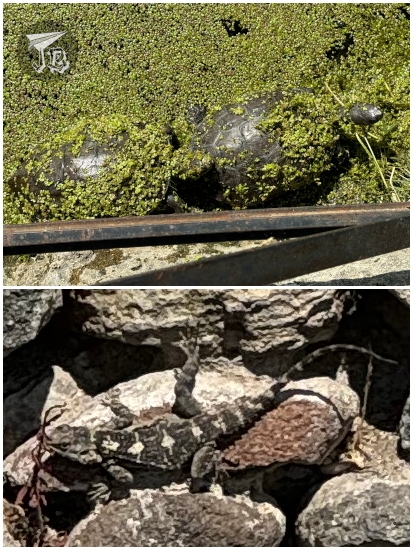
Kebap and yoghurt

2nd October 2024: MAD → IST {Türkiye, October 2024}

I had a Turkish Airlines flight at 12:00, and a strong recommendation to get to the airport three hours in advance. Back in July 2024, the outage of Microsoft systems caused chaos at the airport, and apparently the system has not completely recovered. Thus, my travel agent insisted on the three-hour margin. Since the flight was not an insane time, my parent had offered to drive me to the airport, but they “don’t believe in being at the airport three hours beforehand”. In the end, I negotiated a drop off a bit after 9:00.

I got to the baggage drop counter, which should have been a fast affair, but it was held up by a passenger who was checking in firearms – I was in the plane with a party of hunters. It was a bit creepy, because at some point they opened the gun cases for everyone to see, in the middle of the check-in line. Finally, Turkish Airlines opened a second counter while someone dealt with this traveller. I had my boarding pass, and my luggage was about 13 kg. I had packed an extra pair of shoes, long sleeved T-shirts, jeans and a couple of sweatshirts, along with a long cardigan that can be used as outerwear, blanket or even pillow as the situation requires – and I knew there were a lot of bus hours to come.

After checking in the luggage, I went through security and passport control, and found a seat until it was time to board. The boarding process was extremely efficient and fast, and we took off on time. We got lunch on the plane, and there was on board entertainment, so time passed quickly. Upon reaching Istanbul International Airport, there was a passport control upon exiting the plane, but I’m not sure what they were checking for, as everyone got waved through. Most passengers went onto connecting flights, and I headed off to immigration. I obviously chose the wrong line, as it took me a long time to clear it. I got my passport stamped – a brand new passport, and they stamped it, upside down, on page number 19, because why bother, I guess.

Welcome to Istanbul

After clearing immigration – I was not even aware of customs – I had to go to a particular gate to meet the representative from Oxin Travel outside the airport. I had bought an e-sim for my phone to have “unlimited internet for ten days”, so I activated that on my way, and it worked very well. When I went out the gate, I was supposed to look for a person with the travel agent’s logo, but I was surprised that there was actually a woman screaming my name. I was the only passenger on the tour that came on that flight.

She took me to the car park, where she left me alone to find our driver. When she came back, she told me about Istanbul’s day trips and sent me the information via WhatsApp, and recommended stuff to do. I booked both day trips because the whole point was having to plan little and save mental energy. Hindsight being 20/20, I regret that choice.

The drive to Istanbul | İstanbul took just above one hour, 20 minutes of that were spent trying to get out of the airport. It was already dark when we arrived in town, and I was able to catch a glimpse of Galata Tower Galata Kulesi. We reached three-star Hotel Bi·setun around 19:00 maybe, and the representative and the driver left to have me do the check-in on my own – good thing that she had confirmed on the phone that the hotel was expecting me, because the way we pulled into the area made it look a bit shady.

During check-in, the hotel kept my passport, and that was a bit creepy. When I got to the room, I found that the hotel had a nice system where you could order food through a special webpage – it was like an outsourced room service that could be paid by credit card, which was extremely convenient. I ordered a pacanga pastry paçanga böreği, similar to a quesadilla, and a lentil soup mercimek Çorbası.

I then went down to reception to buy a bottle of water and retrieve my passport. After the food arrived, I ate, had a shower and settled down to sleep. It was a rather uneventful journey, to be honest, but somehow it did not feel… smooth. The bit about being the only person picked up at the airport was weird, and communicating with the representative via WhatsApp a bit awkward.

2nd – 11th October 2024: “Turquía Única” – A circuit in Türkiye {Türkiye, October 2024}

At the end of an already crazy, crazy work period, I had a very bad project. I determined to spend all the income from that one project on a big trip. However, at the same time, I was too exhausted to do a lot of planning. I decided to book a circuit, and since China was about 7,000 € above my budget, I ended up choosing to visit Türkiye. It also felt like a good moment to do so, before tensions in the Middle East escalate even further than they have, and while the country is still somewhat laic and not the Islamic Republic it seems on the path to turn into.

I booked my trip in August for October as that was when work would be over for the year. The only thing left was crossing fingers for good weather, and survive work till then.

Overall, the experience was on the wrong side of disappointing. The tour I chose looked good on paper, but it turned out to be badly managed and even more badly implemented. I’m not even a food-driven traveller, but none of the places we visited offered much in regards of Turkish dishes except the same sweets over and over again. Most hotels were falling apart – literally – and in the middle of nowhere, so when we arrived there around 18:00 at the latest, there was nothing around to explore. On top of that, pure bad luck this time, my flight connection were rather inconvenient – I arrived late on my first day in Istanbul, and left early on my last, so there was no way to enjoy those days.

One of the big problems I ran into was the diffusion of responsibility, as I booked a trip from Viajes El Corte Inglés, distributed by MapaTours and implemented by the local Oxin Travel, whose guides were… let’s say lacking.

I was excited when my travel agent called to give the documentation, a couple of weeks before the adventure started. There were some errors in formatting, and a reference to a photograph which was not there – I tried not to worry about that. A link can easily break when paperwork is prepared for printing. It was a sign (or a metaphor) for all the small things that would go wrong, I see now.

I am aware that I come from an incredibly privileged place, complaining about a nine-day to Türkiye. However, I paid for a service I did not receive, and that miffs me. On top of everything, the single supplement was 400€, because Türkiye does not do single rooms whatsoever, almost 20% of the total price excluding extra day trips.

I booked a circuit named Turquía Única (Unique Türkiye), which started and ended in Istanbul. The itinerary included Ankara, the region of Cappadocia, Pammukkale, Izmir, Pergamon, Çanakkale, Bursa and back to Istambul. I landed on the 2nd and returned on the 11th, but I was only up and about between the 3rd and the 10th. I also made the mistake of booking the optional Istanbul day trips trying to avoid long queues at ticket booths and monuments.

2nd January 2023: Lies or oblivion? {Egypt, Winter 2022-2023}

I was awake at 6:40 to be ready for a half-day trip. However, the phone call that the tour guide had promised the day before never came. I was distressed because this gave way to two options. Either the tour guide had lied to me, or someone had forgotten that I existed. Neither was a happy thought. I tried to cheer myself up with a cup of Espresso from the room complimentary bar, and around 8:30 I went to have a quick breakfast. I was not hungry and to be honest quite upset. I had insisted five times about this beforehand.

A bit after 9:00 I tried to call the ground agency, Galaxia Tours, and I texted them through the website. But around 9:20 I said screw it. The hotel had a mini travel agency – I had noticed this because we had made an attempt to go see the light and sound show at Giza on the 30th, which the tour guide had walked around. Instead of telling us “you won’t have the time” he had deflected every question we asked about it.

Had I had more time to organise things, I would have hired the mini-agency to take me back to the Egyptian Museum, the Museum of Egyptian Civilisation, or even the Valley of the Whales. However, since the tour guide had mislead me, I was out of time. Then again, the hotel was not in actual Cairo, but in Giza [الجيزة], and a nominal 20 minutes away from the Giza Plateau and thus the pyramids, so I hired a tour over there. And, believe it or not, I ended up… on a “camel” – actually a dromedary – for a few hours.

I had been resisting doing a dromedary ride of any kind out of concern for animal welfare, especially after seeing how they were treated at the Petra site in Jordan. However, this time it looked like it was the best option to spend my three hours around the pyramids, introducing Moses the dromedary (Camelus dromedarius).

Moses the dromedary kneels looking at the camera over his shoulder. He exudes personality

I checked out at the hotel, left my luggage at reception, and was driven towards the The Pyramids of Giza Archaeological Site [مجمع أهرامات الجيزة]. My driver was a bit creepy, so I tried to keep it light. We arrived at a backstreet next to the Great Sphinx [أبو الهول] entrance, from where I had a great view. This entrance was a bit different from the one we had used on the 31st next to the tourist bus parking lot. Most people using this entrance were Egyptians, and they were thoroughly patted down. Upon entry though, the view was astonishing – the Sphinx, and Pyramid of Khafre standing right behind it, the Pyramid of Khufu [هرم خفرع], the Pyramid of Menkaure, with the Pyramids of the Queens peeking to the side.

A front view of the sphinx, with three pyramids behind it. The pyramids decrease in size from right to left

Riding the dromedary was easier than I thought. The trickiest part was managing his kneeling down and standing back up – I did get a cramp on the very first standing up – but it was mostly a matter of leaning forward and backwards. Through this new walk around the Giza Plateau I got to see the modern cemetery on the left, then we moved onto the archaeological site itself. From this side, I saw the path that joins the Great Sphinx with the Funerary Temple of Khafre and the Pyramid of Khafre. I also got to see the Tomb of Queen Khentkawes I [مقبرة الملکه خنتکاوس] and the Central Field of Mastabas and rock-cut tombs. It was weird, having such a vantage point of view! I got used to the rocking very quickly, so I got a few good pictures.

Two views of the archaeological area of Giza, with pyramids in the background and low, excavated tombs in the foreground.

My guide – and Moses – took me to a a different Panoramic Point of the Pyramids, the picture perfect one, a few metres south of where we had been the previous day – this spot is not reachable from the bus, but I honestly cannot calculate if I would have had the time to get there and back the previous time – it’s hard to estimate distances in the desert, and the pyramids are too big to gauge good references.

A general view of the area of Giza. All the big three pyramids and the small six are visible.

We rode around the Pyramid of Menkaure, and actually passed between two of the Pyramids of the Queens.

A collage showing the approach to the Pyramid of Menkaure. The smaller pyramids of the Queens are in the foreground, and the camera seems to go through them until it focuses on the bigger pyramid.

Then we moved on towards the Pyramid of Khafre. Coming closer was really cool, as I could see the granite blocks that would have made the pyramid smooth back in the day, along with the rest of some columns. Also, two sides of the pyramid are actually somewhat sunk in the ground, with a vertical wall of rock-cut tombs. I know I was paying for it, but being able to walk around the pyramid felt special, and allowed me to feel awed at the size and technology again, considering these were built about 4500 years ago.

The pyramid of Khafre. The top is still smooth as granite blocks have not fallen. At its foot, you can see the granite blocks that have fallen, some aligned next to the pyramid so you can guess how it would be smoothed. Another picture shows the moat like structure around the pyramid - it is the back-wall of some tombs

The Pyramid of Khufu stood to the left, and we continued our ride towards the Central Field of Mastabas and rock-cut tombs and the Tomb of Queen Khentkawes I.

A view of the Great Pyramid from behind.

A number of basement-like structures excavated in the desert. They are the tombs of the nobles and the pyramid builders.

I dismounted again and walked into the Valley Temple of Khafre [معبد الوادي لخفرع]. This time, not running and with fewer people, I got to see the megalithic structures for real. I also could go to see the rump area of the Great Sphinx of Giza.

Collage showing the sphinx with the pyramid of Khafre behind it; the megalithic temple through which you access it; then a lateral view of the sphinx and a view from the rump.

Afterwards, there was an “essence shop” experience, but as I told the lady I would not be buying anything, she dispatched me really fast. My driver got only creepier in the way back, so I tipped him and ran off to the reception of the hotel, where I sat down to wonder whether someone would pick me up from the hotel, or they would forget me like they had for the dray trip. Fortunately, I spotted some people I had seen during the New Year’s Eve party, and it turns out that they had the same pick up. That was good, because handling the transfer for Cairo Airport – and the airport itself – would have been more stress than I was willing to deal with. I actually think I was forgotten indeed, but this family was not – I did approach the representative they pointed out, and made him aware of my existence. Firmly.

At 14:05, we were off on the mini bus towards the airport, and it took a bit over an hour. Meanwhile, they gave me a questionnaire to fill in – I tried not to get personal, nor attack anyone, but I was very sincere about the things that had gone wrong. Being forgotten is not a nice feeling.

We reached the airport past 15:00. There were two security controls for luggage, and one pat down. In the second control, the guards got money to let a group go before me, and the guard actually gestured that money would make things go faster. However, waiting had an interesting consequence… I met the people who went on the day trip, to Saqqara again, and they entered other pyramids there. So there had been another day trip – and again, lied to, or forgotten about?

But I had had my own fun, so I did not let that rile me up. I checked in, dropped my luggage, got my exit visa and settled down to wait – I was now just destined to have to listen to We wish you a Merry Christmas on loop for as long as it took to board. I got myself a cheese sandwich for lunch – this was past 16:00 by now, I was a bit hungry after only a fast breakfast. Cairo Airport is anything but traveller-friendly. Half the shops were closed, but without signs, so they just yelled at you if you walked in. There are no sitting areas next to the gates, just the shops, and I did not want to sit on another floor and rely on their English to know when boarding was ready, so I just walked up and down “a few” times. I was lucky enough to be next to the gate when boarding started – with yet another X-ray control, getting separated by sex, and being frisked. And yet, you have to take off your shoes, but you are allowed water bottles on the plane… Weird.

We finally took off around 19:30 for very uneventful five-hour flight. We got dinner on the way, which was unexpectedly nice, and I had a window seat, extra water, and got to see Cairo goodbye.

An aereal view of a city at night. The streets are lit, and light pollution diffuminates in the background. There is a black line in the middle, north to south - the Nile.

Overall balance: things were left unseen, and maybe one day I’d go back to see the rest of the Valley of the Kings, the Valley of the Queens, and the new Grand Egyptian Museum. Possibly the Valley of the Whales. But I don’t really feel I must come back any time soon. It was the adventure of a lifetime, and I am very grateful I got to live it. I do admit, however, that I dropped by my travel agent’s to make it known that someone had either forgotten me, or lied to me, and that I was not happy – similarly to what I had done with the questionnaire. I don’t know if I’ll ever get a reply, but I have to say the experience has left me not feeling up to trusting anyone with my travelling for a little while. Though I had to admit, my first solo experience with a group was all right… nice people all around, so I’ve been lucky in that department.

1st January 2023: The Lotus Flower {Egypt, Winter 2022-2023}

I read somewhere once that you should start the year doing what you love, that is why I decided to go out on the 1st January 2022. I could have never imagined 2023 would start as it did, in Cairo [القاهرة] of all places. As a settlement, Cairo can be traced to the Babylon Fortress, built around the 1st century BCE, but its real foundations were laid in the second half of the 7th century by the Fatimid dynasty. The city survived the Caliphate and kept spreading. Today, it is the largest metropolitan area in Africa, and the 12th in the world with 22 million people.

After waking up around 7:00, I was the first in my group to go down to have breakfast, and when I did, I saw that the breakfast buffet had added a ‘hangover’ buffet – Ibuprofen, Strepsils, painkillers in general… I thought it was hysterical. To be honest, I was tired and sore from the pyramid climbs, and probably a bit hungry since dinner had been… strange. One out of three was dealt with after some coffee and a very… British breakfast somehow – scrambled eggs, potato wedges, roasted tomato, a sausage… this gave me energy for the day, which we were to spend in the Unesco World Heritage Site Historic Cairo.

Departure was scheduled for 9:00 – too late, in my opinion. First, we got caught up in the horrible traffic. Then, when we arrived at our first destination, we had to turn around because the bus parking lot was full. On the way we caught a glimpse of the City of the Dead (Cairo Necropolis, or Qarafa [القرافة]). In this area, tombs, mausoleums and houses cramp together, up and down. Some people have made their houses out of the mausoleums due to Cairo’s crazy urbanisation. The City of the Dead was created almost at the same time as the city of the living.

Cairo, City of the Dead from the moving bus. A bunch of low constructions with flat celings or domes, with some trees sprinkled inbetween.

We also saw the ending of the Cairo Citadel Aqueduct [سور مجرى العيون]. Though originally designed during the Ayyubid period between the 12th and 13th century, it was later reworked by several Mamluk sultans (13th – 16th century) to expand water provision to the city. Today, it does not carry water, and it is under ‘redevelopment’ in order to display it as a heritage monument.

Aqueduct. Built in dark grey bricks, it has been buried by the sands of time so only the upper part shows.

Finally, after way too many scares with the bus, we reached the area called Coptic Cairo. It is located in what used to be the fortress of Bayblon, and in order to access it you have to go down a flight of stairs that feels way too long due to the pyramid climb. I do know a thing or two about soreness, and as I was hopping down the stairs as fast as I could, someone complained that it was unfair that I was ‘fresh like a lotus flowers’ while they were sore. That made me laugh – I guess I’m more used to being in pain than others.

The Coptic Catholic Church is the main branch of Christianity in Egypt. The Coptic Church seceded from Catholicism in the 5th century due to disagreements about the “nature of Christ”. Coptic Catholics believe the same general things as other Christian faiths, and fast a lot – 40 days before Christmas (7th of January), and 55 before Easter. They have a different Pope and rules for priests. Copts are a minority in mostly Muslim Egypt.

Our first stop there was the Church of Saints Sergius and Bacchus [ϯⲉⲕⲕⲗⲏⲥⲓⲁ ⲛ̀ⲧⲉ ⲛⲓ⳥ ⲥⲉⲣⲅⲓⲟⲥ ⲛⲉⲙ ⲃⲁⲭⲟⲥ ϧⲉⲛ ⲡⲓⲥⲡⲉⲗⲉⲱⲛ]. Christian traditions tell that the Holy Family fled the Massacre of the Innocents. In the nativity narrative, Herod, King of Judea, ordered the killing of all male children under two years near Bethlehem, in order to get rid of the “King of the Jews”. Having been alerted by an angel, Joseph took Mary and infant Jesus to Egypt. According to the tradition, they rested in the cave underneath the church, now turned into a crypt. The church is dedicated to the two martyrs, who died for their faith in Syria in the 3rd century CE. The building, erected in the 4th century, has a central nave and two side aisles, with 12 columns, probably quarried from Ancient Egyptian monuments and temples.

Collage. The upper part shows the Coptic chruch. The walls are made out of red brick, and the altar is hidden by a wooden structure. The lower picture shows a crypt with a small wooden altar, brick ceilings, and white columns

We then made a small stop at a Roman Tower, one of the Roman emperor Trajan’s addition to the original Fortress of Babylon (not that Babylon, the name was probably corrupted from the Pharaonic name). Trajan also created a quay back to the Nile, which has now dried out.

Ruins of a rounded tower built in white and red bricks. The colours alternate to create horizontal patterns.

We had a small stop at a bazaar shop, then we went into the so-called Hanging Church [الكنيسة المعلقة or ϯⲉⲕⲕⲗⲏⲥⲓⲁ ⲉⲥⲓϣⲓ], officially Saint Virgin Mary’s Coptic Orthodox Church [ϯⲉⲕⲕⲗⲏⲥⲓⲁ ⲛ̀ⲧⲉⲑⲉⲟⲇⲟⲕⲟⲥ ϯⲁⲅⲓⲁ ⲙⲁⲣⲓⲁ ϧⲉⲛ ⲃⲁⲃⲩⲗⲟⲛ ⲛ̀ⲭⲏⲙⲓ]. It is called the Hanging Church because it would have been suspended over the water gate of the Roman Babylon fortress – though today the ground is higher and the view is less impressive. It was built somewhere between the 7th and 9th centuries, and holds over a hundred icons. It is built in a basilica style, with 13 pillars representing the apostles and either Christ or Judas – depending on where you read. The rich decoration, with mosaics and reliefs, especially on the outside, mixes Arabic and Coptic motifs.

Collage of the Hanging church. The façade is sandstone, carved with Coptic and Arabic designs. Then there is a courtyard with a staircase that yields to a white building with two bell towers and a wooden porch. The lower picture shoes the interior, with the altar behind a wooden structure, very decorated ceilings and bare stone columns

That was all for Coptic Cairo, as we moved on towards what should have been our first stop – the Citadel of Saladin | Qalaʿat Salāḥ ad-Dīn [قلعة صلاح الدين الأيوبي]. There was going to be a high price to pay for all that time in the bus that morning, we just didn’t know yet. The Citadel was built by Saladin in the 12th century CE. Saladin was the founder of the Ayyubid dynasty. He became Sultan of Egypt in 1171, fought the Christian Crusaders, and conquered Syria. He was considered smart and noble, even by his enemies.

A sand-coloured wall with two minarets peering from the background

In the Citadel, we visited the Mosque of Muhammad Ali [مسجد محمد علي] in the Southern Enclosure, also called the Alabaster Mosque. It was built in the first half of the 19th century in the Ottoman style, and had to be completely restored in the 1930s due to cracking. It has two minarets, and a metal clock tower – the Cairo Citadel Clock, which apparently was a gift in return for the Luxor Obelisk that currently sits in Paris. The mosque has a courtyard for ablutions, and although the interior is usually carpeted, the carpets were out for cleaning, which created an interesting effect. It was my first time in a mosque, and I was pretty impressed by the huge glass lamps. Most of the courtyard and the interior are covered by alabaster – the upper part of the interior is only wood – and the mausoleum of Muhammad Ali is built in Carrara marble.

Muhammad Ali Mosque collage: from the outside, it has two domes and two minarets. It is built in stone, brick and slate. The inside courtyard is built in white-grey alabaster, with an ablution fountain in the middle and a metal clock tower that feels out of place. The interior of the mosque is also built in alabaster, and the lights reflect on the floor, creating a dizzying effect. Everything inside is carved and decorated with tiny motifs

Before leaving, the Citadel, we went towards the wall to catch a view of what is modern Cairo, in what we were told is called the Wall of Saladin, which is basically the limit of the Citadel. Looking very carefully, one could spot the pyramids in the background, among the high rises.

A ruined medieval wall, with a view of Historic and modern Cairo in the background. A floating image superimposed shows a high-contrast close-up of the skyline, making the pyramids visible through the haze

Afterwards, we went back to the bus to find the restaurant we were supposed to have lunch at – a “luxury boat” on the Nile that tried to short-change two of us – a travel-mate for 20 EGP and me for almost 60 EGP. We had nothing of it, though I had to be a bit more forceful than he did. We finally got into the most interesting part of the day at 15:17 – The Egyptian Museum in Cairo [المتحف المصري]. Considering that the museum closed at 17:00, this was outrageous. We had to run through the museum, with the tour guide complaining that we were not fast enough – he actually grunted that I was not there when I was. Considering how many people there were, we spent time trotting behind the guy, trying not to lose him.

We saw – thankfully – the Tutankhamun Galleries, with his sarcophagus and mask. I say thankfully because at this time, the treasures were scheduled to move onto the Grand Egyptian Museum next to the pyramids within the same month – and the tour guide could not even tell us where exactly the treasure was. We also saw most of the masterpieces:

  • Galleries of Yuya and Tuya (18th Dynasty), containing most everything regarding this couple, including the Book of the Dead
  • Statuette of Khufu (Cheops) in ivory, a tiny representation of the pharaoh, the only sculpture of his in existence
  • Scribe statue CG 36 (Fifth Dynasty)
  • Menkaure triads, in alabaster (Fourth Dynasty). Statues of deified Menkaure.
  • Narmer Palette, a cosmetic palette considered the “first historical document in the world”, documenting the union of Lower and Upper Egypt by Narmer (Dynasty 0, 3000 BCE) with the first hieroglyphs
  • Bust of Akhenaten, Amonhotep IV
  • Sphinx statue of Queen Hatshepsut
  • Small wood sculpture compositions from different tombs
  • Sarcophagi from several pharaohs and noblemen
  • Rahotep and Nofret (26th century BCE)
  • Statue of Seneb and his Family (25th century BCE)
  • Face of Queen Hatshepsut

Cairo Museum Collage: a view of the building, striking pink; the first gallery showing the top of a few pyramids and some colossal statues; sarcophagi.

Cairo Museum Collage: Close up of a black basalt sarcophagus, showing colourful hieroglyphs; canopi jars; a sitting scribe; a spynx.

Cairo Museum Collage: Face and Sphynx of Queen Hatshepsut; bust of Akhenaten; mummy

By the time he actually cut us loose, it was almost closing time, 16:40. I managed to wander a little on my own, and at least catch a glimpse of some colossal statues and the exhibited pyramidia (tops of the pyramids). I am not going to lie, I was miffed. We should have gone out of the hotel earlier, and if the bus could not enter the Citadel, we could have walked for ten minutes rather than waste an extra hour driving around Cairo. The best, though, was still to come. My travel-mates had come later than me, but they left earlier than me – almost 12 hours earlier. Back in Aswan I had tried to organise a day trip for myself for the second, and throughout the bus rides, I insisted thrice about organising something, but was just told that my pick-up was 14:00.

We were driven around Cairo for a little while after the museum until we reached the area known as Islamic Cairo | Al-Mu’izz’s Cairo [قاهرة المعز], the heart of the Unesco Heritage Site – it is also known as Historic Cairo or Medieval Cairo, and it existed before the current city expansion, built throughout the Middle Ages around the Citadel. It is surrounded by a wall, that can be crossed through a number of monumental gates. We had a walk down Al-Muizz li-Din Allah al-Fatimi Street [شارع المعز لدين الله الفاطمي], the most important artery of the historical city, with a number of historical buildings, such as the Qalawun complex [مجمع قلاون] and the Mosque-Madrasa of Sultan Barquq [مسجد ومدرسة وخانقاه الظاهر برقوق]. At the end, there is a tourist market that we were told was Khan al-Khalili, but I was not able to find the historical part of this famous souk, and to be honest, I did not feel too comfortable hanging out alone – we were given an hour of time to ‘do shopping’ here. Though the street itself was quite neat, and the buildings were nicely lit, again, I was not in too much agreement with the timing, and the shopping area was not welcoming at all – at one point I was sent a child to beg me for a pound, and she kept crying around me. One should never give money to beggar children, as it encourages the practice, but it was hard to force myself to ignore her.

A collage of Medieval Arabic buildings at night, lit in pink and green lights. The decoration is rich and ellaborate. The street is full of people.

When we came back to the bus, we got on route towards Al-Azhar Park [حديقة الأزهر], and a supposedly famous restaurant with views. Though it has very neat views from the terrace, the set menu was weird. The barbecued meat was okay, but it came after way too much rice and fries. I’m not sure how much the restaurant got from the extra trip price (60€ per person) though.

A collage. The biggest picture shows the Mosque of Muhammad Ali in the background, lit in purple for the night, with a darkened garden leading up to it. Two other pictures show the entrance to the restaurant, and a small Arabic fountain. The other two picrures show Cairo skyline, and the food we were served: Egyptian bread, hummus, and a barbecue of chicken and lamb meat

Most of the group was exhausted and they had to leave at 3:00, so we just bailed out on the rest of whatever was planned. I insisted on the following day and I was told I’d receive a call to my room the following morning. We said goodbyes to the tour guide, and I said my goodbyes to the rest of the group.

I went to bed wondering what time I would get that call. I set my alarm clock for 7:00 just in case.

31st December 2022: So high! {Egypt, Winter 2022-2023}

The breakfast buffet at the Cairo hotel was definitely better-stocked than the one on the motorboat, but we did not have time to linger. I was more than a bit giddy because today was the great day. The traffic was horrible, but as we were stuck there, we caught our first sight at the pyramids! The haze and smoke over Cairo [القاهرة] are thick in the morning, so instead of heading directly to Giza, we turned our back from it and drove off towards Saqqara [سقارة]. Both Saqqara and Giza are part of the Unesco World Heritage site Memphis and its Necropolis – the Pyramid Fields from Giza to Dahshur.

Two pyramids in the background through the window of a moving bus. The quality is not that great as the glass is somewhat tinted and the weather is hazy

Memphis was the capital of Ancient Egypt during the Old Kingdom, for eight dynasties. It flourished during the Sixth Dynasty (24th – 22nd centuries BCE), but started a decline at the beginning of the Eighteenth Dynasty (16th – 13th centuries BCE), first in favour of Alexandria, then of Thebes (Luxor). If Memphis was the city of the living, Saqqara was its city of the dead, the cemetery.

The Necropolis of Saqqara [أهرامات سقارة] starts off right at the end of the area where the fertile land from the Nile ends, so you cross from a date palm forest to a scorching dry desert. The burials there predate the Old Kingdom, and the oldest tombs belong to the Second Dynasty, and here the first pyramid was built. The timeline for burials was Abydos (which we did not get to see) → Saqqara → Giza (both of which we would see that day) → Valley of the Kings.

A garden or forest of palm trees from the bus. There's a low stone fence in the foreground.

Our first stop was the Necropolis of Teti. Teti was the first king of the Sixth Dynasty (24th century BCE) in the Old Kingdom, back in the time when the Egyptians had started working on elaborate burial sites. Thus, he had a pyramid complex for himself, his queens and officials.

Teti’s vizier (and probably son-in-law) Kagemni was buried in the necropolis. The type of funerary monument built for him was a mastaba. A mastaba [مصطبة] is type of burial, maybe a precursor of the pyramids – it is a rectangular structure with inward sloping walls built using mud bricks. They remained common among non-royals for over a thousand years after Kings were buried in pyramids.

Thus, we went into the Mastaba of Kagemni, vizier to King Teti of the Old Kingdom. The inner walls of the mastaba are decorated with coloured carvings of every day’s life, and mourning scenes for the deceased. There are lots of fishing scenes, featuring hippopotamuses, crocodiles, catfish… and cattle rearing work.

Mastaba of Kagenmi. Collage showing the narrow entrance, flanked by two carved warriors. A view of the walls of a reddish building. Carving on walls, some of them coloured, showing fish, a cow being milked, and Ancient Egyptian people carrying offerings

After the vizier’s tomb, we went into our first pyramid, the Pyramid of Teti [هرم تتي] himself. The pyramid today looks just like a hill from the outside – under all the rubble there is a big pyramid, along with three smaller ones, and a funerary temple. The pyramid was opened in 1882, and despite the poor condition of the above-ground area, the corridors and chambers inside very are well-preserved. This pyramid is one of the first ones with carved funerary texts – a number of rituals and spells called the Pyramid Texts. The entrance to the structure is downwards. A ramp leads into a narrow and low corridor which ends in a vestibule that in turns opens into three small chambers to the left, and the mortuary chamber to the right. The King’s sarcophagus remains at the pyramid, with carvings inside – the first carved sarcophagus ever found.

A rubble-like pyramid and shots of the inside. A very narrow and low passgeway, a sarcophagus in a pentagon-shaped room, and the decoration inside the sarcophagus.

I am not sure I can describe the high that I felt when I went inside the pyramid. It was like breathing history. Unfortunately, we had to move on too quickly. Fortunately, there were more things to discover! We got out of the bus to see the line of three pyramids – Pyramid of Unas, the Step Pyramid of Djoser, and the Pyramid of Userkaf.

A view of three pyramids. The one in the foreground right is little more than rubble. The one in the middle is not smooth, but it has five steps. The one in the background left is mostly hidden and only a flat tip can be seen.

Djoser was either first or second king of the Third Dynasty of the Old Kingdom, sometime around the early 27th century BCE. His architect Imhotep is credited with the design of what possibly was the first ever pyramid. Djoser Mortuary Complex comprises the enclosure wall with a colonnaded entrance, a number of Heb Sed chapels, where dedicated priests honoured the different gods of Ancient Egypt. The roofed chapel area opens into a large patio, which used to be surrounded by a mud brick wall – today only the entrance stands, having been recently restored. In the middle of the open court, stands the Step Pyramid of Djoser [الهرم المدرج للملك زوسر].

Complex of Djoser, collage. The first picture shows the reconstructed wall, made of mudbrick, and the pyramid. Two other pictures show the inner columns of the hall, and the final picture shoes the pyramid again, it has five steps and it is not symmetrical.

The Pyramid of Userkaf [هرم أوسركاف] was built for the founding pharaoh of the Fifth Dynasty (25th century BCE, Old Kingdom). The pyramid and all the surrounding funerary structures were pillaged in antiquity, and time has taken its toll – the structure is a core of rubble that looks like a huge anthill.

The pyramid of Userkaf, mostly collapsed, with a ruined stone path leading to it

The Pyramid of Unas [هرم أوناس] is even more decayed. Unas was the last king of the Fifth Dynasty (24th century, Old Kingdom), and his is the smallest pyramid of the Old Kingdom, but the first ever in which funerary texts were inscribed. Some of the outer casing is still visible, and there are also some remains of the mortuary temple in front of the pyramid, but most of the complex it is unstable rubble. Nevertheless, I’m a bit sad we did not get to go in and see the texts.

Pyramid of Ulnas. The upper part is mostly sand and debris, and the bottom shows blocks of stones collapsed

We overlooked the New Kingdom Tombs and the Persian Shafts, tombs of the high officials in Persian Egypt between the 6th and 5th centuries BCE. The tombs are connected together underground, but again, we only saw them from the outside.

Several funerary structures made out og mudbrick, and a deep square pit

We went back to the coach and were shown to a carpet / tapestry “school” which was a bit unsettling as it felt like a cover for children’s work. Then we drove off back towards Cairo and Giza [الجيزة], where we ran into a ten-lane traffic jam. However, we eventually made it to The Pyramids of Giza Archaeological Site [مجمع أهرامات الجيزة].

The tour guide had been trying to talk us out of stepping into any Giza pyramid claiming that “all of them are the same”, and we had already been inside one in Saqqara. This time, however, we did not buy into his “recommendation”. Part of the group wanted to go in, and of course I was among them – I might have been a bit worried about claustrophobia, but I did not want to miss the experience. All of us chose to enter the Great Pyramid of Giza [الهرم الأكبر], attributed to the pharaoh Khufu, aka Cheops, the second pharaoh of the Fourth Dynasty (26th century BCE, Old Kingdom). The pyramid stands 137 m high, nine lower than when it was built, due to 46 centuries’ worth of wind erosion. At the time of construction, it was the highest man-made structure, and it remained so for almost 4,000 years, until in 1647, it had eroded to 139 m, slightly lower than the Strasbourg Cathedral in France (142 m, built in 1439). Ancient Egyptians used 2.3 million large blocks that total to 6 million tonnes in weight.

The Great Pyramid of Giza from afar and from its very foot, a wall upwards.

We were lucky enough to start queuing for entry during “lunch break” so we did all our little climb without sharing the space with anyone climbing down in the opposite direction. First, we went up the outside of the pyramid towards the entrance, then we went inside. There was a narrow, tear-shaped corridor, then you start the actual climb through a 1 m x 1.3 m passageway that ascends 40 m to the Great Gallery, which is also narrow, an extra 47 m upwards and 8.5 m high. And finally, we reached the King’s Chamber with the sarcophagus, dead in the middle of the pyramid. For a few minutes, we had the chamber for our little group, which was even better. When we were ready to leave we went our way down and did not cross many people either. The emotions I felt being there, inside the Great Pyramid, were amazing. I know it is not reasonable, but the feeling was exhilarating. It was being inside history, 46 centuries of it. It was just awesome, in the literal sense of the word.

Inside the Great pyramid: a very long narrow and low passage that feels claustrophobic, two shots of the Great Gallery, A-shaped; a picture of the mortuary chamber, with the naked pharaoh's sarcophagus inside.

Afterwards, we went back to the coach, which drove us around the complex so we had a view of the pyramids from one of the Panoramic View of the Pyramids points. There, we got to hang out for about 20 minutes as part of the group took a dromedary trip. From the view point we could see the Great Pyramid, the Pyramid of Khafre [هرم خفرع], the Pyramid of Menkaure [هرم منقرع], and the Pyramids of the Queens [أهرامات الملكات]. The Pyramid of Khafre (aka Chefren, Khufu’s son; Fourth Dynasty, 26th century BCE) measures 136 m, and it still has part of the original limestone casing at the tip. The Pyramid of Menkaure (aka Mycerinus; possibly Khafre’s son; Fourth Dynasty, 26th century BCE) is the smallest one, “merely” 62 m high, and rather unfinished because the pharaoh died prematurely. In the background, stood the modern city of Cairo.

The three main pyramids of Giza stand in the middle of the desert. Three small in comparison pyramids stand on the right. There are tiny modern buildings in the background. The image is repeated, with the names of the pyramids written on the second one: Khufu on the left, Khafre in the middle, and Menkaure on the right, next to the small Pyramids of the Queens

And just like that, it was over, except it was not, because we still had a little while to see the Great Sphinx of Giza [أبو الهول], which is a reclining lion with a human head, made out of limestone. It measures 73 m long and is 20 m high. It is part of the mortuary temple of Khafre, so it is probably his face the Sphinx bears, dating from the 26th century BCE. The Sphinx is currently missing its nose and beard. To access the Sphinx, first we went by the dried up Nile dock and we crossed the Valley Temple of Khafre [معبد الوادي لخفرع]. The temple was built out of megalithic rocks of red granite. The Sphinx was… pretty in a weird way, he had a very pleasant head, despite all the pidgeons.

A view of the sphinx with two pyramids in the background. The dried Nile dock, and a megalyth-temple.

The sphinx, looking right.  There are lots of pidgeons on his head.

Then, we were driven back into the Cairo chaos to a restaurant for lunch. By this time it was around 15:00, and the menu was fixed. I was highly amused by the fact that the tour guide had tried to up-sell this place as a high-scale seafood restaurant. We were served rice with squid in different ways – breaded and in tomato sauce – three prawns, and fish. The best thing, honestly, was the Egyptian flatbread Aish Baladi [عش بالدي], and the view – after all the name of the restaurant was “Chestro Restaurant Pyramid View” for a reason.

A view of two pyramids with the sun setting to their right. The picture is surrounded by smaller pictures of Egyptian food - pickled vegetables, Egyptian bread, calamari with tomato sauce, rice with calamari, a roasted seabass

After our very late lunch, we headed off to the last visit of the day – yet another shop. Finally something I was interested in, a place where they had papyruses. Papyruses are made out of the papyrus plant (Nile grass, Cyperus papyrus), a type of flowering sedge. Here, someone explained the process of making the papyrus paper. I found something I liked, a reproduction of Tutankhamun’s jewellery box with a guarding Anubis (currently at the Egyptian Museum in Cairo).

A painting on a papyrus. It shows Anubis in jackal form sitting on a box. The lower part shows a man holding a papyrus plant, next to it different utensils to make the papyrus paper. On the left, the real box showing the jackal on top.

It was around 19:00 when we got back to the hotel, where the tour guide informed us that (the now free) dinner gala would be held from 20:00 to 00:00. We had a bit of a laugh about being so not ready – since nobody had brought any kind of formal clothes as most of us had not booked the dinner – and we arranged to meet at 21:15, since we had finished lunch late. I had a shower, then went downstairs. We met at the agreed time, and spent some time taking pictures, and in the end… we were almost late for dinner! By the time we sat down it was 21:30… and the buffet only ran till 21:45…

Food was not so great, and even less worth 190 €. The singer was terrible, the exotic dancer… was more like a stripper, and I ended up defending all our grapes to the death against overzealous waiters who wanted to clear the table asap. To be fair, it was a nice detail that the tour company got us twelve grapes each to celebrate the New Year’s. Despite the time and quality hiccups, we had a lot of fun. We counted-down to the New Year with the Egyptian time, and one hour later connected to the Spanish TV in order to listen to the bell tolls for midnight and eat our grapes. After saying good night, I had another shower and went to bed, though I could not sleep till the other hotel party finished at 2:30.

Shots of the New Year's Eve party at the hotel: two Christmas trees, a napkin folded like a tuxedo, some food, table decoration and a screen reading Happy 2023

It didn’t matter too much though, as the buzz and the high from the pyramid experience kept me content until there was enough silence to zonk out.

30th December 2022: Philae and the Aswan – Cairo jump {Egypt, Winter 2022-2023}

Belonging to the city of Aswan [أسوان], the Philae Temple [فيلة] complex is currently part of the Unesco World Heritage Site Nubian Monuments from Abu Simbel to Philae. When the first Aswan Dam was built in 1902, the monument became semi-submerged, and it would have completely disappeared after the completion of the High Dam. Between 1972 and 1980, through the International Campaign to Save the Monuments of Nubia, it was dismantled and reconstructed over at Agilika Island, 20 m higher.

The main feature in Philae is the Temple of Isis. Isis was the major goddess from the Old Kingdom to the Roman period. Isis was the spouse of Osiris, and is considered a mother and protector goddess, divine mother to the pharaoh, and mourner of her husband. In the Osiris myth, after he was killed and dismembered by Seth, Isis looked up and down Egypt to gather all the pieces. After she did, she breathed upon him to resurrect him, they conceived Horus (there are more or less gory versions of this), and Osiris went back to the Underworld, where he became lord of the Afterlife. Isis was the longest-revered goddess of the Ancient Egyptian religion – her cult survived in Philae until 550 CE, when Christians took over, defacing the gods and carving the Coptic cross all around.
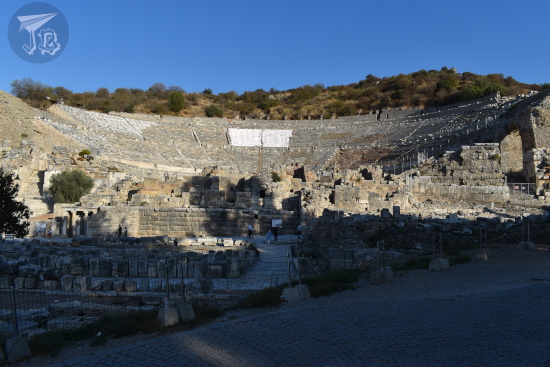
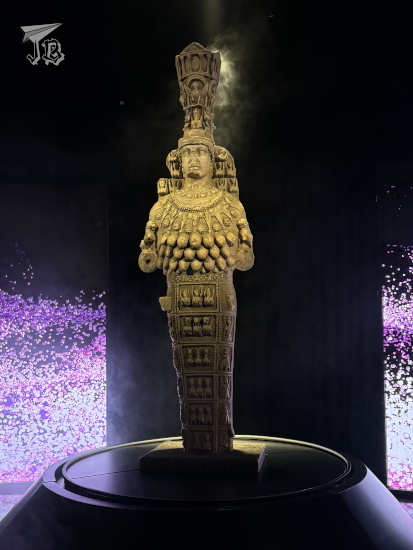
I left for breakfast having vacated the room, suitcase ready at the open door, and hoped for the best. I settled my drink tab, which rounded up to 235 EGP; however, with the same smirk I had been given the previous day, I reminded the person at reception that they owed me ten pounds. The debt was honoured and I left with a giggle – yes, it was not that much money and I could have let it slip, but nope. Not this time. After that, our luggage was loaded onto the bus (luckily) and we drove off to a tourist dock to board the boat to Agilika island, which we reached after a few minutes. We landed and climbed up towards the archaeological site.

The Temple of Isis holds the general structure of an Ancient Egyptian Temple, with a pylon, a court, a hall and finally the inner sanctuary of Isis. An obelisk stands before the pylon, in the outer court that has been preserved.

Collage. View of the outer wall of Philae, with the colonnade and the pylon; entrance to the sanctuary, richly engraved with deities and hyerogyphs; a cat sitting in front of the columns.

When looking carefully at the pylon, it shows the different water marks from the time the temple was submerged – at two different levels, depending on whether it was flood season or dry season. During the rescue, a cofferdam was built around the original constructions to dry the area out. Then, between 1977 and 1980, the whole complex was dismantled into 40,000 blocks, moved and rebuilt. The old position can still be spotted 500 m away, marked by the remains of the metal anchors for the cranes.

Close up of the pylon showing carvings of Hathor and Horus. Two water lines can be appreciated above and below them

Another structure in the island is the unfinished Kiosk of Trajan. I even managed to be alone in there for a heartbeat.

A cube-like structure built from columns, with the river behind them.

The final building is the Temple of Hathor, Horus’ wife.

Collage. A ruined building with derelict walls and a few standing columns - from land and from the river.

Next in the plan was shopping (joy -.-“) and we went to an essence shop. The lady claimed that Egyptian essences were the base of many brand-famous perfumes. I have no idea, but I was irked by the rigid sex separation of scents, and I developed a rash from one of the testers… While some people in the group shopped, someone else found the adjacent papyrus shop, and a small number of us went to snoop there.

After being spared a second shop – this one for spices – we were shuttled to the airport to take our charter to Cairo. It was a surreal experience through which I was patted down twice. The airport segregated by sex because you got the pat down even if you cleared the metal detector, which was weird. Also, it turned out that we had an extra suitcase in the bus! Creepy!
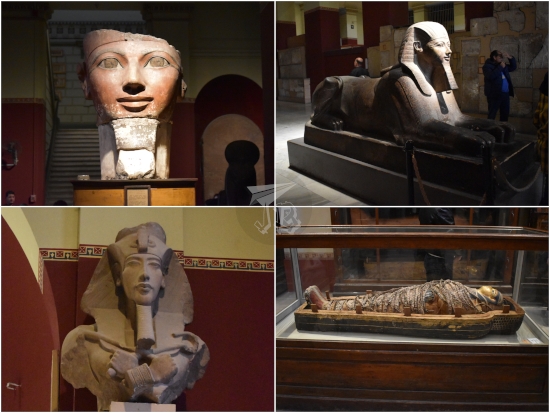
Our tour guide did not fly with us. When we landed in Cairo [أسوان], we were taken to the hotel by another representative, who assigned rooms and called our names in the bus, before we even arrived, but did not hand the cards until we were there and had handed in our passports for check-in. It was of course too late to try and go to the Pyramids light show – seriously, everything would have been so much easier with a “sorry, no time”, especially considering the crazy Cairo traffic. At this point we were already planning to try it on our own – I had found out that the hotel had a mini travel’s agent that we could use.

A traffic jam heading to the Cairo airport traffic control. The green neon on top reads Welcome to Cairo

We met up for planning – and paying for the Night Cairo Walk, which was to take place the following day – and I sat down to catch up on everything that had happened in the days when I had been internet-less (have I mentioned that it was not such a bad experience?).

The whole trip was a New Year’s special and came with an optional 190 € dinner that I had not booked because… no. I had packed some cereal and chocolate bars just in case, and it turned out that only one couple out of our eighteen-people group had reserved it. There had been a tiny riff-raff when I asked my travel agent about dinner that day, and she received an email about the “Gala Dinner” being compulsory (demanding the extra money), and I asked her to reply that nope, I would not be attending.

Well, that night we were told that the local agency was treating us to the dinner – my theory? The restaurant they had agreed for the Night Walk would not take us for New Year’s Eve, the walk would be impossible due to people celebrating. Thus, they found themselves in a tough spot – so they used the spare from the overpriced optional trips to pay for it. Then, the night walk was bumped to the first of January. Looking back, I believe that they had completely overlooked the NYE factor.

Also, the hotel not only had free Wi-Fi, it also had complimentary water in the rooms, and free mineral water during dinner. And a bed that did not vibrate. It was a good night’s sleep. But before that I took a shower so long and so hotm, that I almost glowed in the dark afterwards.