
22nd May 2026: Airports and libraries {Vienna & day trips, May 2026}

Of course, when the drive to the airport is smooth and you avoid the worst of the daily traffic jam, something else happens. This time around, it was a security-check screw-up. The lady had decided that every item needed a different tray – it was unthinkable that a backpack and a fanny pack could coexist in the same space. Unfortunately, the tray system had broken down and was not moving. Travellers got stuck explaining “there are no trays” while she yelled “one item per tray” in a never-ending cycle that took at least five minutes to break.

My plane left at 8:40 and I landed in Viena a few minutes ahead of schedule, around 11:30. That gave me enough time to reach the train station and take the 12:19 S7 train to Rennweg, which was the very convenient station next to the hotel (I had booked something near a transport hub; the fact that it had a direct connection to the airport was direct was a plus we discovered later). I got myself a snack, and walked to the hotel to check in and meet D****e, who had arrived a few hours earlier. After she had freshened up, we headed towards the Austrian National Library Österreichische Nationalbibliothek while she told me that she had come on the same flight as Hyde, and gave me updates on all her Japanese friends’ status as they converged onto Austria.

As we walked, we entered the Unesco Heritage Site Historic Centre of Vienna, recognised in 2001 and placed in the List of World Heritage in Danger in 2017, due to urbanistic pressure. One of the main elements in the Viennese architecture is the Hofburg, the main imperial palace of the Habsburgs in Austria. At the end of WWI in 1918, the Austria-Hungary Empire came to an end, and since then the palace has been repurposed – different parts of it may be visited, such as Sisi’s quarters, the Riding School, or the library itself (and all its branches).

The seed of Austrian National Library Österreichische Nationalbibliothek dates back to Emperor Karl VI (Charles VI), who established the court library around 1739. The building was erected in the Baroque style, designed by Johann Fischer von Erlach. Its main feature is the State Hall Prunksall, which houses the book collection amassed by the Habsburgs, particularly some 15,000 books belonging to Prince Eugene of Savoy. The library hosts around 200,000 volumes in dark walnut cases that reach the ceilings, decorated with frescoes. The floors are marble, and here and there stand world globes and sculptures by Lorenzo Mattielli. Oh, and there are secret doors within the shelves that lead to hidden rooms. We only visited the State Hall that day, but I would come back to the Papyrus Museum on Monday.
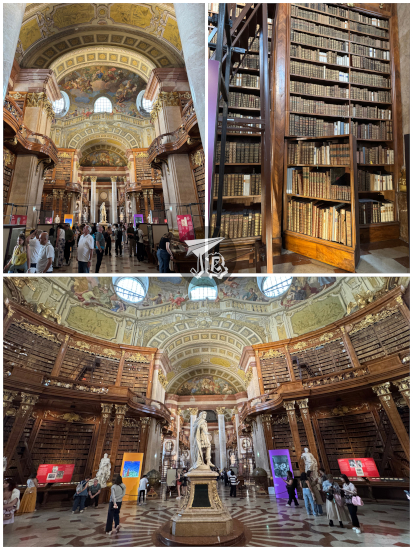
Classical library

A couple of days prior to our arrival, Hyde had tweeted (or whatever) that there were posters of his show throughout Vienna. One of them was easy to find – it had the Neogothic Votive Church Votivkirche in the background. D****e wanted to find them all, and I wanted to see the church, which was unfortunately closed. Also unfortunately, it seemed that all the weather forecasts for the few days I’d be in town had been… wrong. Despite announcing mild spring temperatures, we got hit by a heatwave. I am okay with heat but… I did not have appropriate clothes for it so… whoops. Despite the weather, we walked a lot, and did a lot of checking for the posters as we did. We may have spotted around 20 or so (and only after the concert checked if we could unglue one).

I was getting a bit dizzy, so I suggested stopping for a snack. We sat at a McDonald’s Hyde ordered food from once, so it fit our theme. D****e had a map of locations that were more or less related to Hyde’s activities in town. Following that, we stumbled around the church Kirche Maria am Gestade. In front of it stood a figure of Minerva, holding a little owl in one hand, a crown in the other. I thought it was a street art installation, and I wondered about the placement, but it turns out to be something for the… European Congress of Radiology, which took place in March, and had a Classical gods and goddesses theme, maybe because there was a very important person there called Minerva Becker.

Kirche Maria am Gestade (Mary at the Riverbank) is a catholic church built in the Gothic style between 1394 and 1414. It is one of the few actual Gothic buildings in town, and was popular amongst sailors on the Danube – it stands on the former fluvial terrace of one of the now disappeared flows of the river. It is not a big church, with a narrow nave and a 56-metre tower slightly newer than the body of the church. It was a very pretty structure that I enjoyed a lot.
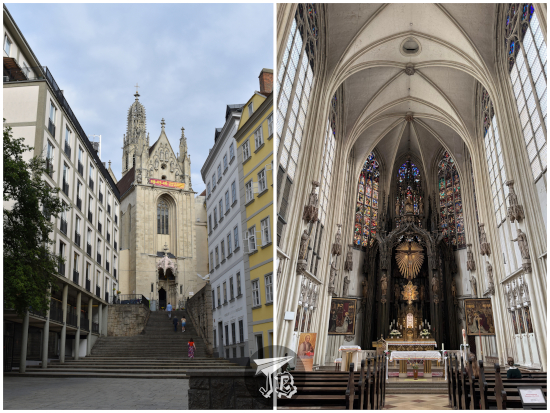
Gothic church on top of some stairs

We walked a little towards the town centre and ended up at Kohlmarkt, from where I got a view of Michaelerplatz and the Hofburg palace. We turned towards Graben to find the Column of Pest Wiener Pestsäule, a High Baroque column built to commemorate the victims of the plague epidemic of 1679. It was designed by Paul Strudel, but many other sculptors had a hand in it, apparently. Erected in white stone and gold, it represents from the highest level down, the Holy Trinity, the angels, King Leopold I, and his citizens.
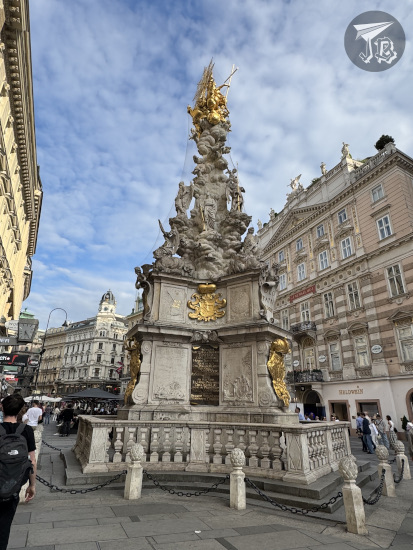
Baroque commemorative column in marble and gold

Next, we visited the Baroque church Peterskirche (St. Peter’s church), built in the first third of the 18th century to replace and earlier Romanesque one. After two failed designs, the main architect was Francesco Martinelli, who drew inspiration from St Peter’s in the Vatican. Hence, it was the first domed building in Vienna. It is however very… small, erected in a very confined space in a crossroads, it feels cramped.
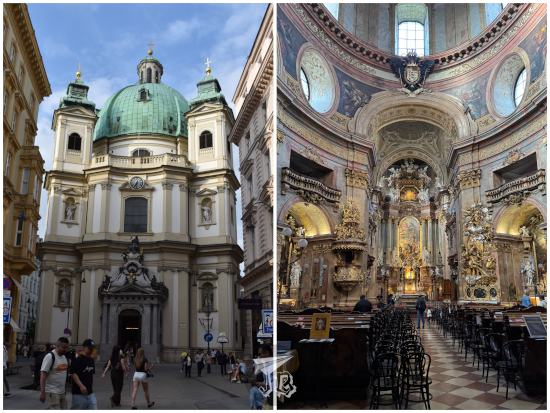
Baroque church

Eventually, we made our way towards Café Landtmann, which calls itself “Vienna’s most sophisticated coffee house” to have dinner with some of D****e’s friends who had also come from Japan. Though it is one of the iconic places in town (and also held a connection to Hyde, hence why they wanted to go), dinner was a mess. Five of us were crammed into a tiny booth, the eatery was bustling and there was barely any space. And jet-lagged excited Japanese is no way near understandable by my poor language skills. They decided they wanted to share everything, which I thought was a mistake – very little space, large plates difficult to share… But I’m not going to raise a ruckus out of food of all things. I’m just going to order an alcohol-free cocktail (actually a raspberry-lemon lemonade) that matches in price all the beer and alcohol they are going to order.

We shared „The Legend“ („Die Legende“: Viennese Schnitzel made from the finest cut of breaded veal, parsley potatoes, leaf salad, cranberry jam and a lemon wedge); Viennese Beef Goulash (Wiener Rindsgulasch, with bread dumpling, goulash crunch and pickled cucumber); White Asparagus (Spargel with beurre blanc, chives and buttered panko crumbs); Landtmann Sausages “à la bonne heure” (Landtmannwürstel à la bonne heure, boiled sausages in goulash jus with mustard mayo, horseradish, goulash crunch and a hand roll).
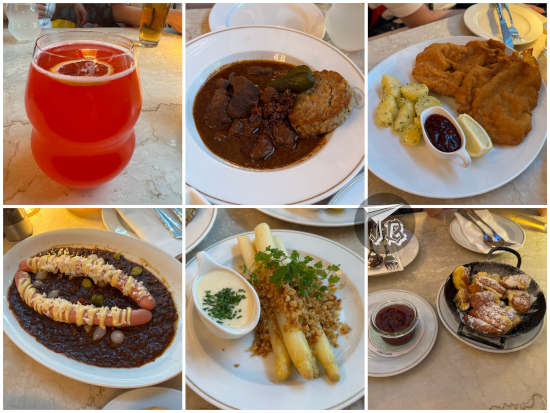
Different Austrian dishes

I ended up mostly eating the bread with the Schnitzel lemon and the salad. I had not realised the goulash would have so much garlic on it. Finally, they ordered coffee and Kaissermarn (shredded pancakes) as dessert. In the end, it was 40 bucks per person for a cramped mediocre experience. The staff was nice and people-watching interesting, from people super dolled-up because they were coming from / going to the opera, to ripped jeans.

We left and walked back to the hotel. After a long shower, we went to bed, but I did not sleep much and was definitely up at sunrise. That helped with the following day’s insane plans, which included breakfast…

29th December 2024: Arrival, Karlskirche & Prater {Vienna, Silvesterkonzert 2024}

With our plane boarding at 8:10, we aimed to be at the airport around 6:30, which was a successful endeavour. We had our boarding passes but we needed to drop off some luggage. As we needed formal wear, neither of us could just make do with a simple backpack or trolley. We had decided to bring a carry on each, and two large suitcases – one per room – for coats, jackets, dresses and so on. The travel agency had checked us in the day before, and we had separate seats, but that was not important since it is just a short trip early in the morning.

Once in the terminal, it turned out that Iberia did not have a drop-off counter as my parent was expecting, so we had to queue with the people who needed to check in, including non-Schengen and intercontinental travellers. We decided that two of us would line while the other two could sit down and wait for us. We stepped into the cordoned area, and suddenly… one of the attendants directed half of the queue out and into another area of check-in counters. All in all, it took us around 35 minutes to drop the luggage off. Not efficient, Iberia. Not efficient.

Luggage successfully checked in, we went past security, found our gate, and sat down for breakfast. We went to the gate early, and queued to be the first in our group because… I’m not even sure why, but it was too early in the morning to fight. I napped about half of the journey, and also took pictures of the landscape from above. Once we left Spain behind, the mountaintops were covered in snow, and the valleys in fog. This was a clue of how cold it would be when we landed in Vienna. We had a maximum temperature of around +3ºC throughout the trip.

From the plane window Flight Madrid - Vienna

We disembarked and made our way to baggage claim, where our suitcases were among the first few to come up, which is always a great feeling. Afterwards, we went out and found the people responsible for picking us up – the representatives from Blaguss DMC, the local agency which manages Viajes El Corte Inglés and Tourmundial in Austria and Hungary. First, they handed us our our hotel voucher, schedule, and tickets!! Upon opening the envelope to check that everything was correct, we found out schedule with a Vienna tour the following day that my parents swear they had never heard about – the truth is that it appears in the documentation as optional. The driver in charge of taking us to the hotel was… a character. My biggest regret though is that I did not run for a Costa Coffee while we were waiting for the other travellers to come out, but I only saw the sign when he had started moving.

We arrived at the hotel Elaya Hotel Vienna City West around 13:00. It was a four-star hotel that felt like it had dropped at least one and a half, and it was not any of the ones listed in the original documentation. There was neither a bar nor a restaurant, and the staff was not exactly friendly. I know it’s not nice to work during the holidays, but come on. I don’t think requesting two keys for a two-people room was that outrageous. At first, neither card worked to open my door, but after trying three times each card, both sides, I managed to get it open. And more importantly, though the warm option of the air-conditioning did not work, I figured out how to turn on the radiators.

The hotel room was… sad. It had a little terrace overlooking the interior yard, and two windows – the blinds were unmoveable on one and broken on the other. We unpacked, got freshened up, and went back down to find a place to grab a bite to eat. I approached reception to ask for a recommendation, and there was a Spanish lady trying to get the check-in attendant to help her with her card – she seemed to have the same problem I had had. She had no English at all, so I tried to help her out. The attendant just huffed and left to check the room herself, and I guess she managed to get the card working. When she came back, I asked for any restaurants around, and she pointed us up the street. We found a Greek place seemed okay, and that is where we ended up – at restaurant Mythos, which had very friendly staff, and decent food.

Afterwards, I would have gone towards the city centre. However, my parents needed a break and wanted to move as a group. Thus, I stayed in the room – we did not leave the hotel until 16:30, and by that time it was already getting dark. We walked to the underground stop Pilgramgasse. It was supposed to be just ten minutes away, but was a bit longer, I think we took a wrong turn.

The Pilgramgasse station dates back to the original 1899 Valley line, before electricity and all. The entrance was cast in iron, and it looked very cool. There, we bought seventy-two-hour tickets, which are awesome because you only have to validate them once, and then you can use all the transportation options in the city for 72 hours. The price of the pass was 17.10 €, so not that expensive – one trip is 2.20 €, so aside from the convenience, it is value for money if you plan more than seven trips. Though we did take more than that, the best thing is just being able to waltz down to the platforms without having to validate each time. It was also great that the frequency of the underground service was 8 minutes at the longest, and that was on Sunday evening!

We used the underground to find our stop next to Musikverein Wien (Vienna Music Society), where the concert would take place on the 31st. This was to gauge the time to get to the station and the underground system. Once we familiarised ourselves with the transport though, we realised that there was a better route. It included a change, but the station was much closer to the hotel, and the total time was around the same if you accounted for walking times. The Musikverein stands next to Karlsplatz, so once there we just had to cross the street to find ourselves in front of the church Rektoratskirche St. Karl Borromäus or Karlskirche, dedicated to Saint Charles Borromeo.

The cathedral was originally designed in 1713 by Johann Bernhard Fischer von Erlach. When he died, his son took over directing construction and altered some of the plans. Though the building is Baroque, it displays a mixture of elements – the dome, a Greek temple portico façade, monumental columns based on Rome’s Trajan Columns… The altarpiece was erected by Ferdinand Maximilian Brokoff after the elder Fischer’s design. It portrays the Assumption of Saint Charles Borromeo, the nominal saint, into Heaven. There were Christmas trees on both sides of the altar, which I found strange – I had always thought that the Christian church was not a fan of them.

Karlskirche Vienna

The dome is frescoed with a scene featuring Charles Borromeo, the Virgin Mary, and the Cardinal Virtues, by Johann Michael Rottmayr. Hanging from it, there was a modern art installation by artist Cerith Wyn Evans called Forms through folds (ascending)…. This sculpture is part of the Karlskirche Contemporary Arts Program, started in 2018. That was… weird, and really out of place amongst the Baroque frescoes.

We climbed to the upper levels. The first floor hosts a choir model and the organ, built between 1739 and 1847. Technically you can also access the treasury, but it was locked away. We continued up and stepped into the terrace, which yields to a bit… underwhelming… panoramic view of Karlsplatz and the city. Vienna is a great city, but the Karlskirche is not really looking at the scenery from above.

We should have tried the Vienna Museum next to the church then, but instead took the underground to the classical amusement park Prater, where we had dinner reservations a couple of hours later. Originally a hunting ground, Prater was the area where the 1873 World Exhibition was held. Some of the current buildings were erected at that time. In 1897, the first rides, attractions and puppet theatres were established – including the Ferris wheel Wiener Riesenrad, which is the current symbol of the park. Prater was severely damaged throughout World War II, due to bombings, trenches and fire, but it was eventually reconstructed using records from local artists who had drawn or photographed the area in all its glory. Nowadays, it is considered an actual park, which just happens to have rides on it, and part of it is protected as “green land”. The actual amusement park is called Wurstelprater. There are tons of attractions, rides, snack stalls, and there were even some musical activities going on.

Viena: Prater

But of course, it was Vienna, in a late December evening. It was late and cold. And dinner reservation was hours away. We almost decided to give it up and go back to the hotel, but we found somewhere to have a drink and warm up instead. Finally, we made our way to the Rollercoaster Restaurant, the place where we had – thankfully – reserved in November. It was packed. There were around 50 people waiting to come in, and most of them did not have a booking, and were turned away – there was even a group of people checking every 15 minutes if there was an opening. We took ten minutes to get to the front of the mob to finally get our table, but we were sat around 20:15. I was so happy I had pushed for the reservation! It made me further convinced that anything in the city centre or near a tourist spot might need a reservation, which in turn made me worried about the 31st “winging it” decision.

The Rollercoaster Restaurant works with a system of rails that hang from the ceiling and connect the kitchen to the different tables. The food is prepared by human chefs and distributed by two huge robotic arms. Once placed on the rails, it rolls and slides and gets to the right table – much like suitcases inside an airport distribution system. We were also on time for one of the robot shows, where they turn off all the lights and play music while the robot arms “dance”, and it was surreally fun. One of my parents was horrified, because they are more on the traditional side of things, but the rest of us had a lot of fun! The food was all right, too. I ordered baked schnitzel fingers served with potato salad, Gebackene Schnitzel mit Erdäpfelsalat, and we shared some baked Emmental with cranberry sauce Gebackener Emmentaler mit Preiselbeeren. I kind of wanted some apple strudel, but my portion was good enough, so I decided not to get any.

Vienna Rollercoaster Restaurant

We left around 21:30, and headed back to the hotel using the underground system. This time, we came out at a stop much closer to the hotel, Zieglergasse, which was neither pretty nor classical, but nearby and functional. Afterwards, there was just a shower and bed. I could not sleep right away though, because my mind was latching onto the group trip the following day. My parent had decided that we would just not show up – we had tried to warn the representative, but the driver said it was not his responsibility. I kept thinking that if we were not there, everyone else would wait for us and that was not a nice thing to do. It did not feel right. Maybe I’d meet the lady with the key problem, I thought, and warn her that we would not be tagging along. Hopefully.

Yes, I know. I worry too much.