24th May 2026: Semmering and back {Vienna & day trips, May 2026}

When planning the weekend in Vienna, D****e and I had a discussion. She wanted to be “free” on Sunday in case Hyde did something unexpected, but I didn’t want to spend the day waiting around without anything to do. In the end, we reached an agreement to… go somewhere and back before the singer would even get out of bed. And that is how we found ourselves on the 6:24 train to Semmering, within the Austrian Alps.

Technically, Semmering is a dignified ski resort, remanent of the time in the 19th century when the sport was all the rage amongst the upper classes, who would take the train to get there. The Semmering Railway Semmeringbahn runs 41 kilometres through the Alps. Built between 1848 and 1854, it is considered one of the greatest feats in early railway engineering, with bridges, viaducts, tunnels, charming mountain stations, reaching over 895 metres above sea level. It was declared World Heritage by UNESCO in 1998 with the name Semmering Railway.

Thus, a big thing about Semmering is the journey itself, not only the destination. Especially because in late spring the mountain village is in the middle of low season and most everything is closed. The idea was to find a window seat on the train to enjoy the trip until we got to the area. Once there, we would wander around for a couple of hours, take in a few views, maybe have breakfast at a fancy café, and finally head back.

The train ride was spectacular once we reached the Alps. This Central Europe mountain range stretches between France and Slovakia (around 10,000 km), and is in part responsible for the continent’s climate. The Alps were formed during the aptly-named Alpine Orogeny that started in the Late Mesozoic, when Africa began pressing against the Eurasian tectonic plate in the north – of course, this took tens of millions of years. Aside from over 80 peaks higher than 4,000 m, there are lakes, glaciers (some of which used to be permanent and not any more) and several of Europe’s most important rivers, along with their tributaries. There is evidence of human presence in the mountain range since the Palaeolithic period, along with prehistoric treading of both man-made and natural ways and paths – passes – to cross them on foot. Semmering is one of them.

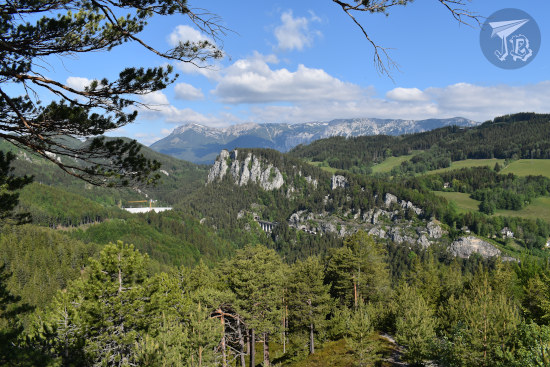
The train route was extremely beautiful, both due to the landscape itself and the fourteen engineered tunnels along the tracks. We reached Semmering a bit after 7:30. As no cute café was open, we just went on a short hike. We strolled down the Semmering-Kurort neighbourhood, walked by a modern art garden called Skulpturenpark and finally reached the tree line. Our first stop was the so-called 20-schilling view 20-Schilling-Blick, which overlooks the historic train line (part of it, as the viaduct is currently under construction). The he area was featured in the 20-schilling note, before the euro, hence the name. You can actually take the exact same picture that was printed on the bills using a conveniently-placed box – except for some works going on that has one of the bridges covered in scaffolding.
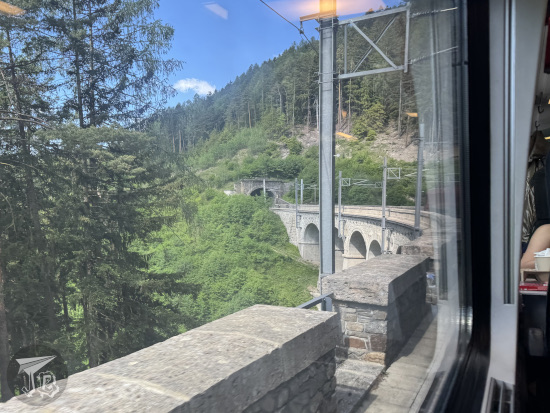
Tunnel and stone bridge on the Semmering train line, taken from inside the train

The Alps, with train lines running across

On our walks we found other spots and views, including the observation deck Aussichtsturm auf der Doppelreiterwarte. We walked by the Kurhaus Semmering Hotel, a grand hotel dating back from 1909, which now is closed for renovation so it can be restored to its former glory. We got a bit lost on the way back, because the way we wanted to take was closed down, but made it back to the station with ten minutes to spare. Once back in Vienna, D****e and I had different plans for a few hours.
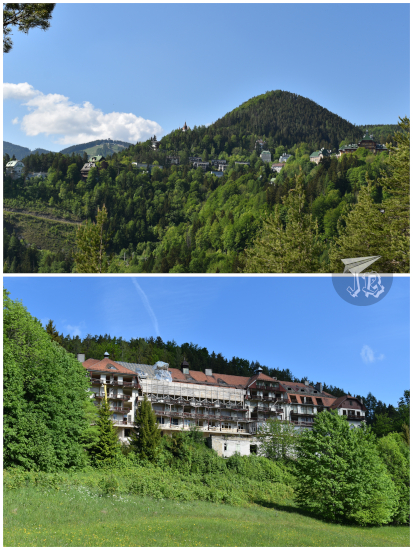
Mountain landscape sprinkled with buildings

The train ride back was all right, but upon entering Vienna, we got stranded due to a “firefighting emergency”. We had to find alternative our alternative way to the city centre. It is a good thing that I am paranoid enough that I had chosen my next visit with almost an hour and a half’s margin, so I got there with ample time. I had booked at 13:00 to take a tour of the Spanish Riding School Spanische Hofreitschule. The shop was packed with people so it was hard to see anything, but the tours themselves were rather empty.

The Spanish Riding School takes its name from the main horse bloodline that was used to create the breed it showcases, the Lipizzaner. Breeding traditions of these animals are considered Intangible Cultural Heritage by UNESCO. Contrary to what is usually thought, the horses are not white, but grey. Their skin is grey, and they are born with a dark coat which turns white in age. The school is one of the “Big Four” riding academies, along the Royal Andalusian School. It focuses on “classical dressage”, and its roots are in military horsemanship, which shows in their performances. The building itself, in the Baroque style, was erected in the 1730s, commissioned to Joseph Emanuel Fischer von Erlach by Emperor Charles VI.

Within the School, we got to visit the summer arena – which has individual “stalls” for each horse to exercise in – the winter arena, the courtyard and the stables. We got to hear how the horses are born and raised in Piber, and that the actual reason why only stallions are used in the work is because the pirouettes, cabriolets and jumps imitate how they behave in the wild. The guide actually said that mares would not understand or care about learning the steps. We also learnt that each horse has two names – the first one is the name of the father and the second is the name of the mother. Pictures were not allowed in the stables, and I am not sure why – maybe so there is no proof where each horse is so nobody can lure them using their names? For the record, 13:00 is not a good time to take a tour, because the horses have just been fed, and you get to see lots of horse butts, but not enough faces.
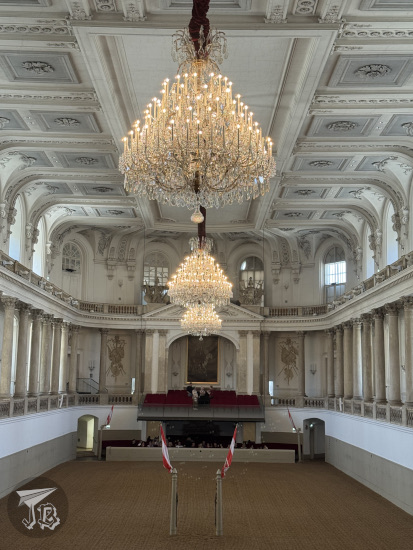
Spanish riding school: inside arena with large chandeliers hanging above

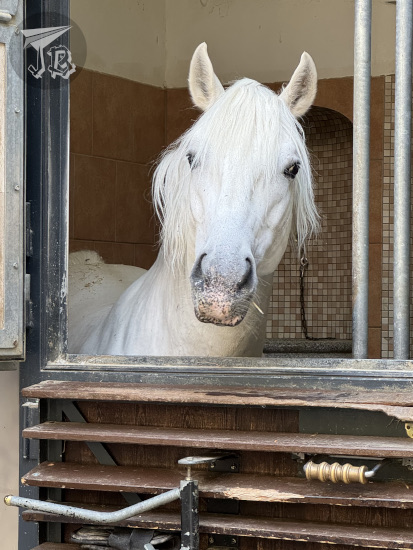
White horse looking at the camera

My next tour was at 14:30 at the Vienna State Opera Wiener Staatsoper. That was chaotic. We had to queue outside to be let in and be directed to either buy tickets or get ours checked out. Once inside the hall, there were mobs of people waiting for different language tours. As a matter of fact, an Australian gentleman decided he had to push to the front of the English-speaking group, and was sent back to the end of the line. Once the tour started, the whole thing was surreal. I learnt next to nothing about the place, as the only thing that our guide did was complain about people with money, either from the past or the present. One thing I did realise is that the actual music hall is extremely small – no wonder it fills out so quickly.

The main hall seats around 1,700 people per show. The Renaissance Revival building was erected in the 1860, and there were two architects involved in its construction: August Sicard von Sicardsburg, Eduard van der Nüll, along with contractor Josef Hlávka. At the time, it was considered “not grand enough”. The interior and stage were destroyed during WWII, in a modernised version of the original. Nowadays, it is home to the opera and ballet companies of the city.
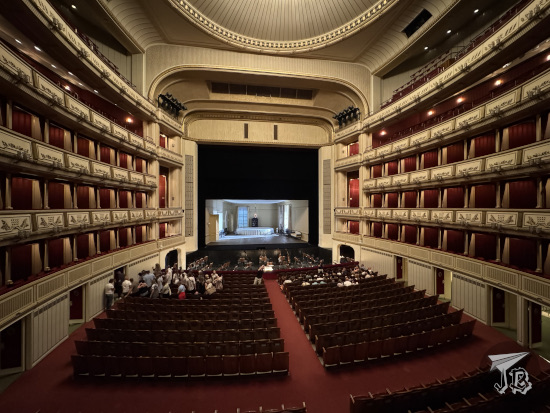
Interior of an opera theatre

Once done, I walked by the Starbucks to grab a cold drink – cookies-and-cream frappuchino was not the best option – and headed to Stadtpark to meet with D****e again. I stopped by Johann Strauss monument Johann-Strauss-Denkmal, which depicts a golden sculpture of the musician playing his violin.
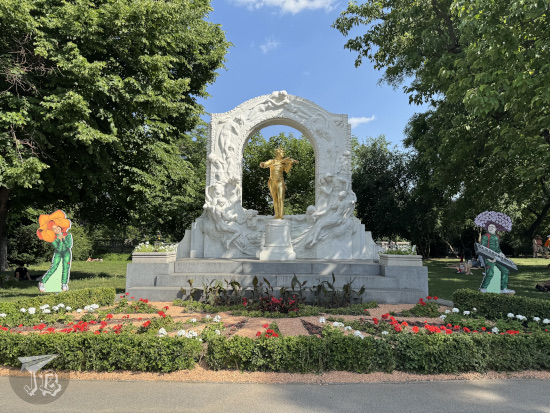
Statue of Strauss playing violin

We did not do much for the rest of the afternoon until we headed off for dinner. On our way, we came across something called the Ankeruhr or Anchor Clock, a mechanical clock built in 1914, commissioned by an insurance company. We did not see it in action, but it looked cool.

Dinner had been booked at the rooftop terrace Organics Sky Garden, and I have to say it was one of the worst dinner experiences of my life, and I’m not too much of a demanding customer. When we arrived, the responsible / managing person apologised because there had been an event and they were a bit overwhelmed. Fine, stuff happens. We get shown to our table and to our surprise, food and drink have different order / payment systems. All right, weird. What sold it, though, was not the bland food or the tasteless drinks – our waiter was drunk. Absolutely wasted. It took her four times to get the card-reader working, and in the end she had to call someone else to charge us.

The drink price was ridiculous for something that was mostly tasteless. My Organics Purple Berry drink was not even pale pink. The waiter managed to spill D****e’s Organics Simply Cola and she did not even offer a replacement, but laughed stupidly. The one food I found appealing was the Margherita pizza and that was not even that good. The only good thing about the place were the views of Domkirche St. Stephan (St. Stephen’s Cathedral).
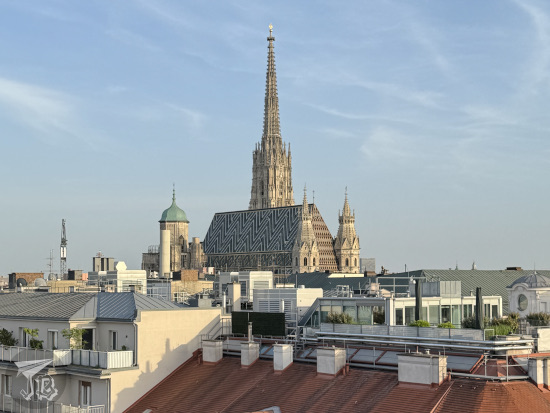
Tiled roof of a gothic cathedral above the normal rooftops

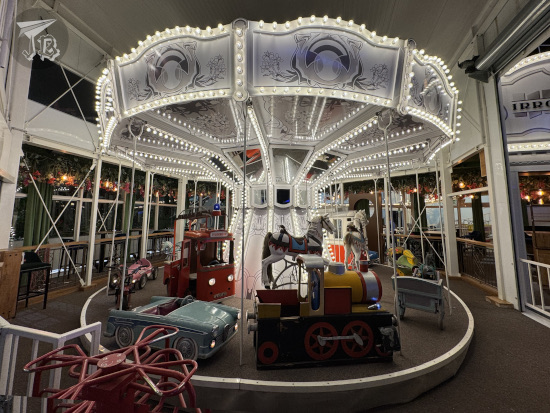
After that experience, we headed off to Prater. The area, originally a hunting ground, was cleared out to set up the 1873 World Exhibition. Today, it is an urban green and an amusement park. Though some of the rides are obviously very modern, some of them were established in 1897, including the Ferris wheel and symbol of the park Wiener Riesenrad. D****e wanted to find the spots where Hyde had taken photographs, and I wanted to see the nostalgia carousel Familie Karussell, because I like merry-go-rounds, the older and more kitsch, the better, I guess. It was palate-cleansing.
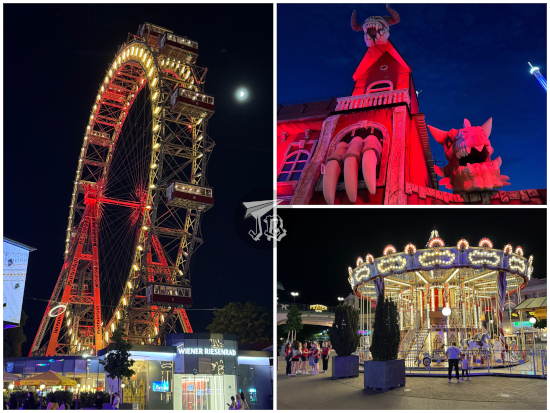
Prater amusement park: Ferris wheel, dragon peering over a building, carrousel

Traditional carrousel in white

And when we eventually made it back to the hotel, I was tired enough that I actually slept through the night.

29th December 2024: Arrival, Karlskirche & Prater {Vienna, Silvesterkonzert 2024}

With our plane boarding at 8:10, we aimed to be at the airport around 6:30, which was a successful endeavour. We had our boarding passes but we needed to drop off some luggage. As we needed formal wear, neither of us could just make do with a simple backpack or trolley. We had decided to bring a carry on each, and two large suitcases – one per room – for coats, jackets, dresses and so on. The travel agency had checked us in the day before, and we had separate seats, but that was not important since it is just a short trip early in the morning.

Once in the terminal, it turned out that Iberia did not have a drop-off counter as my parent was expecting, so we had to queue with the people who needed to check in, including non-Schengen and intercontinental travellers. We decided that two of us would line while the other two could sit down and wait for us. We stepped into the cordoned area, and suddenly… one of the attendants directed half of the queue out and into another area of check-in counters. All in all, it took us around 35 minutes to drop the luggage off. Not efficient, Iberia. Not efficient.

Luggage successfully checked in, we went past security, found our gate, and sat down for breakfast. We went to the gate early, and queued to be the first in our group because… I’m not even sure why, but it was too early in the morning to fight. I napped about half of the journey, and also took pictures of the landscape from above. Once we left Spain behind, the mountaintops were covered in snow, and the valleys in fog. This was a clue of how cold it would be when we landed in Vienna. We had a maximum temperature of around +3ºC throughout the trip.

From the plane window Flight Madrid - Vienna

We disembarked and made our way to baggage claim, where our suitcases were among the first few to come up, which is always a great feeling. Afterwards, we went out and found the people responsible for picking us up – the representatives from Blaguss DMC, the local agency which manages Viajes El Corte Inglés and Tourmundial in Austria and Hungary. First, they handed us our our hotel voucher, schedule, and tickets!! Upon opening the envelope to check that everything was correct, we found out schedule with a Vienna tour the following day that my parents swear they had never heard about – the truth is that it appears in the documentation as optional. The driver in charge of taking us to the hotel was… a character. My biggest regret though is that I did not run for a Costa Coffee while we were waiting for the other travellers to come out, but I only saw the sign when he had started moving.

We arrived at the hotel Elaya Hotel Vienna City West around 13:00. It was a four-star hotel that felt like it had dropped at least one and a half, and it was not any of the ones listed in the original documentation. There was neither a bar nor a restaurant, and the staff was not exactly friendly. I know it’s not nice to work during the holidays, but come on. I don’t think requesting two keys for a two-people room was that outrageous. At first, neither card worked to open my door, but after trying three times each card, both sides, I managed to get it open. And more importantly, though the warm option of the air-conditioning did not work, I figured out how to turn on the radiators.

The hotel room was… sad. It had a little terrace overlooking the interior yard, and two windows – the blinds were unmoveable on one and broken on the other. We unpacked, got freshened up, and went back down to find a place to grab a bite to eat. I approached reception to ask for a recommendation, and there was a Spanish lady trying to get the check-in attendant to help her with her card – she seemed to have the same problem I had had. She had no English at all, so I tried to help her out. The attendant just huffed and left to check the room herself, and I guess she managed to get the card working. When she came back, I asked for any restaurants around, and she pointed us up the street. We found a Greek place seemed okay, and that is where we ended up – at restaurant Mythos, which had very friendly staff, and decent food.

Afterwards, I would have gone towards the city centre. However, my parents needed a break and wanted to move as a group. Thus, I stayed in the room – we did not leave the hotel until 16:30, and by that time it was already getting dark. We walked to the underground stop Pilgramgasse. It was supposed to be just ten minutes away, but was a bit longer, I think we took a wrong turn.

The Pilgramgasse station dates back to the original 1899 Valley line, before electricity and all. The entrance was cast in iron, and it looked very cool. There, we bought seventy-two-hour tickets, which are awesome because you only have to validate them once, and then you can use all the transportation options in the city for 72 hours. The price of the pass was 17.10 €, so not that expensive – one trip is 2.20 €, so aside from the convenience, it is value for money if you plan more than seven trips. Though we did take more than that, the best thing is just being able to waltz down to the platforms without having to validate each time. It was also great that the frequency of the underground service was 8 minutes at the longest, and that was on Sunday evening!

We used the underground to find our stop next to Musikverein Wien (Vienna Music Society), where the concert would take place on the 31st. This was to gauge the time to get to the station and the underground system. Once we familiarised ourselves with the transport though, we realised that there was a better route. It included a change, but the station was much closer to the hotel, and the total time was around the same if you accounted for walking times. The Musikverein stands next to Karlsplatz, so once there we just had to cross the street to find ourselves in front of the church Rektoratskirche St. Karl Borromäus or Karlskirche, dedicated to Saint Charles Borromeo.

The cathedral was originally designed in 1713 by Johann Bernhard Fischer von Erlach. When he died, his son took over directing construction and altered some of the plans. Though the building is Baroque, it displays a mixture of elements – the dome, a Greek temple portico façade, monumental columns based on Rome’s Trajan Columns… The altarpiece was erected by Ferdinand Maximilian Brokoff after the elder Fischer’s design. It portrays the Assumption of Saint Charles Borromeo, the nominal saint, into Heaven. There were Christmas trees on both sides of the altar, which I found strange – I had always thought that the Christian church was not a fan of them.

Karlskirche Vienna

The dome is frescoed with a scene featuring Charles Borromeo, the Virgin Mary, and the Cardinal Virtues, by Johann Michael Rottmayr. Hanging from it, there was a modern art installation by artist Cerith Wyn Evans called Forms through folds (ascending)…. This sculpture is part of the Karlskirche Contemporary Arts Program, started in 2018. That was… weird, and really out of place amongst the Baroque frescoes.

We climbed to the upper levels. The first floor hosts a choir model and the organ, built between 1739 and 1847. Technically you can also access the treasury, but it was locked away. We continued up and stepped into the terrace, which yields to a bit… underwhelming… panoramic view of Karlsplatz and the city. Vienna is a great city, but the Karlskirche is not really looking at the scenery from above.

We should have tried the Vienna Museum next to the church then, but instead took the underground to the classical amusement park Prater, where we had dinner reservations a couple of hours later. Originally a hunting ground, Prater was the area where the 1873 World Exhibition was held. Some of the current buildings were erected at that time. In 1897, the first rides, attractions and puppet theatres were established – including the Ferris wheel Wiener Riesenrad, which is the current symbol of the park. Prater was severely damaged throughout World War II, due to bombings, trenches and fire, but it was eventually reconstructed using records from local artists who had drawn or photographed the area in all its glory. Nowadays, it is considered an actual park, which just happens to have rides on it, and part of it is protected as “green land”. The actual amusement park is called Wurstelprater. There are tons of attractions, rides, snack stalls, and there were even some musical activities going on.

Viena: Prater

But of course, it was Vienna, in a late December evening. It was late and cold. And dinner reservation was hours away. We almost decided to give it up and go back to the hotel, but we found somewhere to have a drink and warm up instead. Finally, we made our way to the Rollercoaster Restaurant, the place where we had – thankfully – reserved in November. It was packed. There were around 50 people waiting to come in, and most of them did not have a booking, and were turned away – there was even a group of people checking every 15 minutes if there was an opening. We took ten minutes to get to the front of the mob to finally get our table, but we were sat around 20:15. I was so happy I had pushed for the reservation! It made me further convinced that anything in the city centre or near a tourist spot might need a reservation, which in turn made me worried about the 31st “winging it” decision.

The Rollercoaster Restaurant works with a system of rails that hang from the ceiling and connect the kitchen to the different tables. The food is prepared by human chefs and distributed by two huge robotic arms. Once placed on the rails, it rolls and slides and gets to the right table – much like suitcases inside an airport distribution system. We were also on time for one of the robot shows, where they turn off all the lights and play music while the robot arms “dance”, and it was surreally fun. One of my parents was horrified, because they are more on the traditional side of things, but the rest of us had a lot of fun! The food was all right, too. I ordered baked schnitzel fingers served with potato salad, Gebackene Schnitzel mit Erdäpfelsalat, and we shared some baked Emmental with cranberry sauce Gebackener Emmentaler mit Preiselbeeren. I kind of wanted some apple strudel, but my portion was good enough, so I decided not to get any.

Vienna Rollercoaster Restaurant

We left around 21:30, and headed back to the hotel using the underground system. This time, we came out at a stop much closer to the hotel, Zieglergasse, which was neither pretty nor classical, but nearby and functional. Afterwards, there was just a shower and bed. I could not sleep right away though, because my mind was latching onto the group trip the following day. My parent had decided that we would just not show up – we had tried to warn the representative, but the driver said it was not his responsibility. I kept thinking that if we were not there, everyone else would wait for us and that was not a nice thing to do. It did not feel right. Maybe I’d meet the lady with the key problem, I thought, and warn her that we would not be tagging along. Hopefully.

Yes, I know. I worry too much.