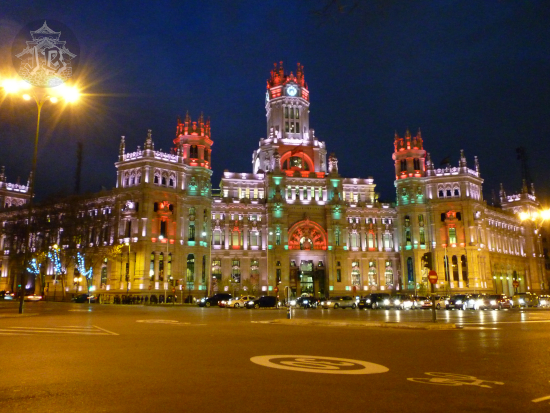
11th December 2024: CBA, hotpot and lights (Madrid, Spain)

Since I was meeting my sibling for the yearly event of Naturaleza Encendida in Madrid in the evening, I decided get there early and make the most out of the day. As I arrived, I headed to the Círculo de Bellas Artes (literally “Fine Arts Circle”). The CBA is a sort of NGO dedicated to culture and the arts. Its headquarters host many activities such as exhibitions, theatre plays, concerts, lectures… The building was designed by Antonio Palacios, one of my favourite architects. It has seven floors, some of them used for events, others for offices. There is even a small theatre.

The CBA was running an exhibition called “Messenger Species” Especies Mensajeras, by artist Álvaro Soler-Arpa. It is a collection of pieces created from animal bones and items found in dumps. Born in Gerona in 1974, Soler-Arpa is a multifaceted artist who does publicity illustration and creates distressing sculptures using animal bones as its medium to make the viewer to think about waste and pollution. This exhibition of modern art is described as “ecological art for reflection”. I thought that it could be either really good or a holier-than-thou approach, but my curiosity was piqued.

The exhibit collects selected pieces from four series of sculptures: “Toxic Evolution” (Evolución tóxica), “Devastated Nature” (Naturaleza devastada), “Design-methastasis” (Diseño-metástasis) and “Sculptures from the End of the World” (Esculturas del fin del mundo). It was… disturbing, but in a good way. It did not feel preachy. The idea is that nature is affected by the consumerism in current society, but not dying – adapting to it. The imagined futuristic animals are a warning sent through time – nature is resilient and it will survive. Us humans? Maybe not if we do not get any better.

Álvaro Soler-Arpa's Especies Mensajeras

There was another exhibition in the building about the consequences of war, but I decided I could not stomach that one. However, I had the access ticket, so I could take the glass lift to the famous terrace of the building – the one that kicked off a trend of opening terraces in Madrid to watch the skyline while having a drink. It was too cold and too closed to have anything, but I did get a nice view, especially of the Palacio de Telecomunicaciones and the Spanish language Institute Instituto Cervantes, both designed by Antonio Palacios too. The terrace is mostly flat, with a bar and an impressive sculpture of Minerva made in bronze by Juan Luis Vassallo. Minerva – Roman goddess of wisdom and art – is the symbol of the CBA. There is also a smaller and higher structure that looks like it could hold an even better view, but that was closed off.

Skyline from Azotea Círculo Bellas Artes

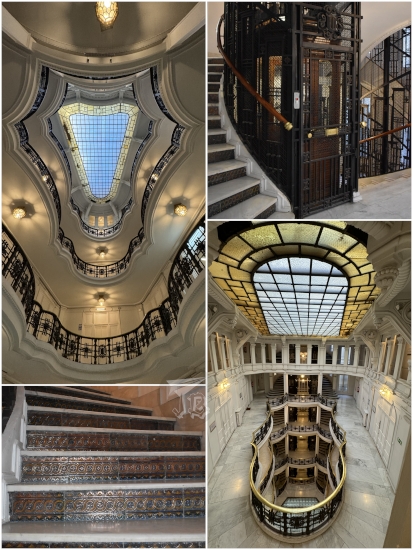
The CBA building has many cool spaces, such as the ball room (Salón de Baile) or the colonnade room (Sala de Columnas). However, my favourite part of the building are.. the stairs. They are designed as a double staircase with mirrors at the landings, and coloured windows alongside the steps. One of the sides is less bright now, because a building was erected and blocks the sun. I still find the staircase superb, so I hung around there for a while until the security guard gave me a weird look.
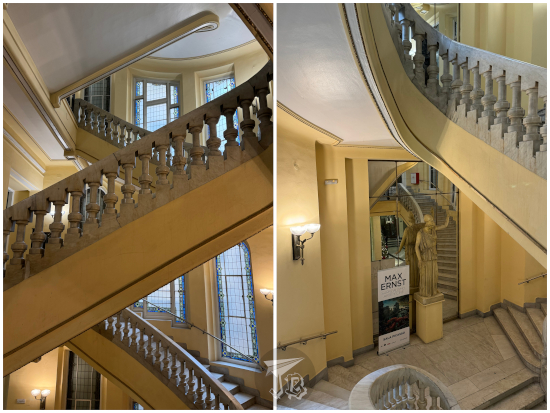
Stairs Círculo Bellas Artes

I left the CBA and walked down the street Calle Alcalá and stopped at Galerías Canalejas just to see what kind of decorations they had. It turned out to nutcrackers and elves inside and a huge Christmas tree outside. I still cannot afford anything they sell there.
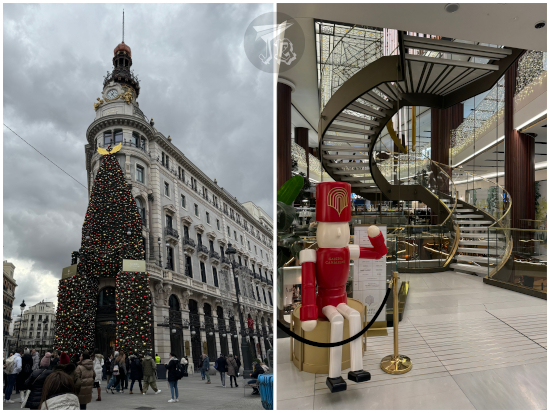
Chrismas at Galerías Canalejas

I continued down towards the square Plaza de Oriente, where there was a classic merry-go-round – empty and ready to be ridden. Thus, since I have no shame, I went on it. The salesperson was incredibly kind, since I was the only rider – and an adult at that – and yet they directed me to a horse which moved up and down and showed me how to climb on it.

Then, I backtracked to the shop Turrones Casa 1880 in the street Calle Arenal, which hosts a small Museo del Turrón. Turrón is a typical Spanish confectionery eaten mostly at Christmas. It is mainly made out of processed almonds, and 1880 is probably the most famous brand – and it prides itself on the most expensive one. I am not a fan of turrón, to be honest, but it was almost Christmas, and if I was ever going to do it, that was the right time frame. The museum is mostly an audiovisual in a decorated cellar, with a photo-op, but the staff was really nice.

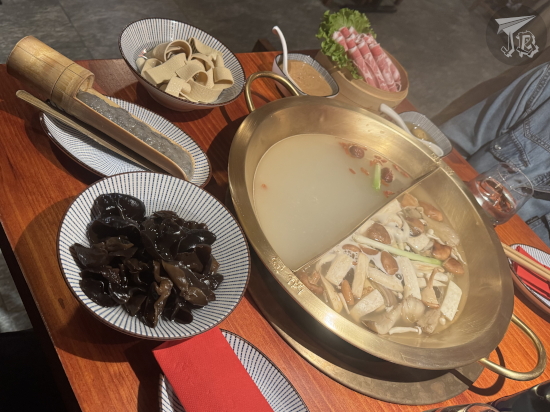
At 14:30 sharp, I met up with my sibling for a restaurant that I’ve been wanting to try for a while 壹锅火锅 Hotpot de Sichuan. Hotpot [火锅, huǒguō] is a Chinese type of stew based on a stock or soup that is kept simmering in the table itself, and you just grab the raw ingredients and dip them in the broth to cook them – imagine a fondue with broth instead of cheese. We ordered a menu for two, a pot with two broths, one mushroom-based and one meat-based. The dips were spring onion, coriander (which was not used, because I hid it), shrimp mince, thin beef slices, tofu stripes, Chinese black mushrooms, cabbage, and rice noodles, along with two sauces – one slightly spicy, and my beloved sesame and peanut sauce. The food was great, but at 15:40, the waiters popped up to tell us that they wanted to close the restaurant, and then stood up next to us until we finished and left. It was more than a bit awkward, so we hurried up to do so. While the food was great, the situation spoilt our experience a little, I think. We were still eating, not slouching around. I am not sure I would want to go back…
Afterwards, my sibling had to do some shopping, so we spent a while going up and down some shops and a department store, before we headed out to Naturaleza Encendida in the park Parque Enrique Tierno Galván. This is a yearly light show organised in Madrid parks – it used to take place in the Botanical Gardens, before it was moved to a larger area. The 2024 edition is titled Naturaleza Encendida: Life.

Naturaleza Encendida Life

To be fair, I was a little bit disappointed, as “Life” turned out to have mostly figures reused from the last few events. Though the organisers tried to build a narrative of water, land and air topics, the novelty had worn off. It was not bad, but the show keeps getting more and more expensive every year, with fewer and fewer perks for the VIP tiers. Furthermore, the new larger location does not imply more light sculptures – they’re just spread farther apart so they can fit more people without it feeling crowded, so it simply takes longer to walk it through. This has its advantages and disadvantages – it was good last year when we had to go on a weekend but this time around it just felt… colder. They also tried to give the whole thing an ecologist spin, and this time it did come out preachy… I mean, it is a show of lights, which technically could count as light pollution, without any actual… purpose… but charging you to watch pretty lights.
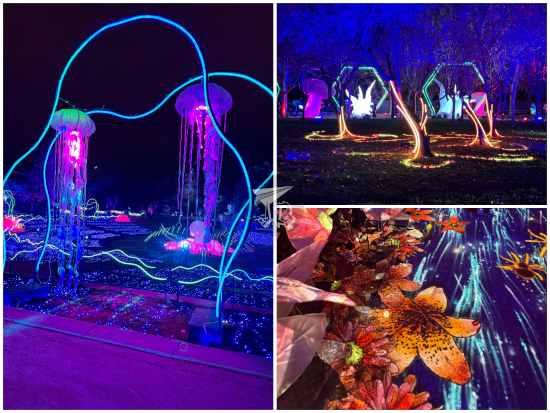
Naturaleza Encendida Life

Naturaleza Encendida Life

That was the end of the day, and we just headed home afterwards, but aside having to wait for the train for over half an hour, nothing to report on that end.

29th December 2023: Parque Mágicas Navidades, Torrejón de Ardoz (Spain)

For the last escapade of the year, I organised an outing with the family. I had thought that after our annual Christmas / New Year’s lunch gathering, the younger squad could go on for a while while older relatives caught a break from us. For a few years, the town of Torrejón de Ardoz has been organising a bigger and bigger “Christmas park” called Magical Christmas Park Parque Mágicas Navidades. During the last decade, the display has grown to be a massive event which runs throughout December to after Epiphany day. It has become so popular that they started charging people from outside town for entry.

The park is huge by any standard. This year there is a small amusement area with winter-themed rides, an ice-skating rink, a Christmas market, a small house for Father Christmas / the Three Wise Men (depending on the date), and several displays: the “Ice Festival”, the “Frozen Mountain” and the “Asian Lantern Festival”. There are smaller decorations sprinkled all over the park

Unless you are a local, entrance is 6€ / person. Once inside, you can buy tickets for the rides and the Ice Festival, but if you get your tickets in advance, it’s a tiny bit cheaper. In our case, I bought an entrance + Ice Festival combo that was 16€ – buying tickets inside would have been 11 €, so we saved one whole euro!

We reached the station by 19:45, and it took just a few minutes to reach the park entrance and go in. We found ourselves in a path with some food stalls, the Christmas house (sold out when I bought the tickets), some light sculptures and a few meninas. I noticed similar statues when I was in Madrid back in December, but I did not pay much attention to them. It turns out that they are part of an art project by artist Antonio Azzato collaborating with other creators and some of the city’s schools, and a pretty big deal – a modern art project. The word menina refers to a young girl from a noble family who enters the court to serve the queen or her children. Probably painter Diego Velazquez’s depiction of them is the most famous, and is the inspiration for Azzato’s figures.

Parque Magicas Navidades Torrejon Access from Train station

Since we had a timeslot to enter the Ice Festival at 20:30, we decided to find that first to make sure we did not miss our entry; once we located it, we would see what to do. On our way, we crossed a literal starry field – sorry, starry forest Bosque de Estrellas. We walked by a giant snowman, a huge teddy bear, Cinderella’s carriage and Father Christmas’ sleigh, all made of lights. Then, we found the Magical Gate Puerta Mágica – this is a huge structure made of thousands of small light bulbs that looks a bit like the façade of a gothic cathedral. Every hour o’clock there is a show, and we had a three-song disco show that we stayed for, as I had just spotted the destination.

Parque Magicas Navidades Torrejon Magical Gate

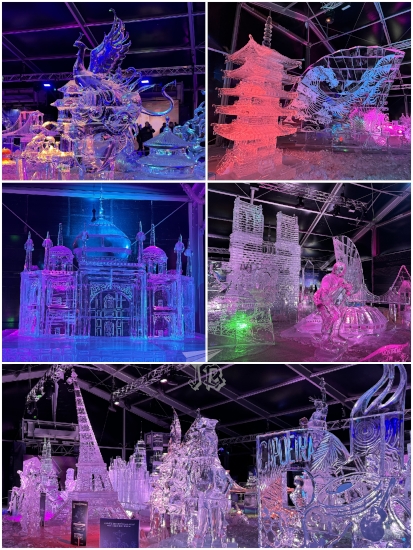
After the show, we headed off to the Ice Festival, a giant tent kept at -6 ºC – we were let in early, it was barely 20:15, so I’m thinking timing is… a suggestion. During the first week of the festival, ten two-person teams compete to build an ice sculpture from 25 ice blocks, according to the theme of the contest. This year, the topic was “freezing up the world”, so each piece tried to represent a city or area. Unfortunately, after almost a month of competition, some pieces were damaged or… slightly melted. Such as the… let’s say the “leaning tower of Paris” a.k.a. the Eiffel Tower. In all seriousness though, there was Las Vegas, Rio, Kyoto, New York, Kuala Lumpur… Did I mention the below-zero temperature? I think I lost sensitivity on my right pinky, and by the time we were out some of my fingertips were actually blue…

Parque Magicas Navidades Torrejon Ice Festival

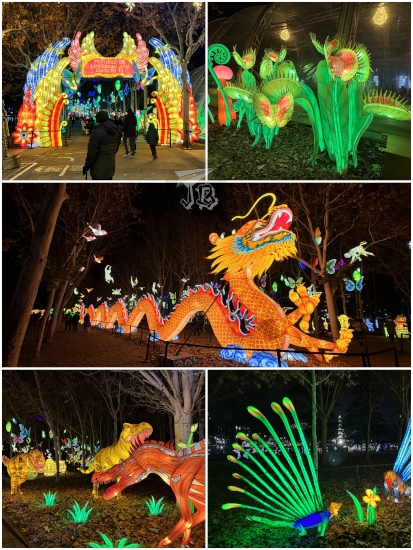
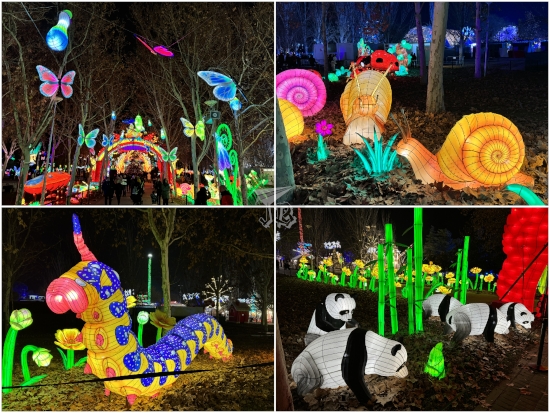
Next, we decided to see the Asian Lantern Festival Festival de las Linternas Asiáticas – a number of figures made out of fabric with light inside, similar to Brilla Zoo, and just as Christmassy, I guess. We actually started on the Second Space, which was dedicated mostly to dinosaurs. There was also a dragon (as 2024 is the Chinese year of the Dragon), some contemporary animals – elephants, flamingoes, lions, red pandas… oh, and lots of Venus flytraps.

Parque Magicas Navidades Torrejon Asian Lanterns 2

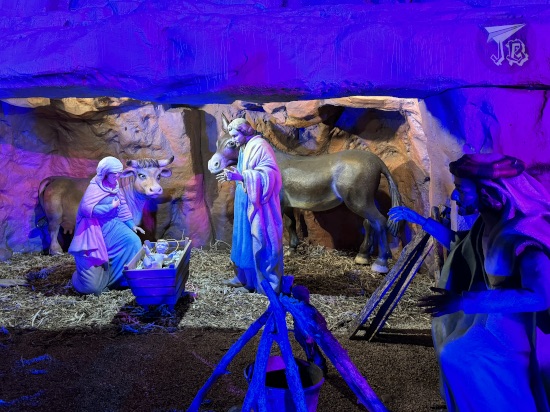
Our following spot was the “Way to Bethlehem” Camino de Belén, which recreates the Biblical story of the Nativity, from Joseph and Mary heading off to the census, to the stable and the adoration by the Three Wise Men. It is described as the largest Nativity in Spain – the figures were actual-size, but not too well made, and the whole thing was a bit creepy. Furthermore, they had the same two songs on a never-ending loop.

Parque Magicas Navidades life-sized Nativity

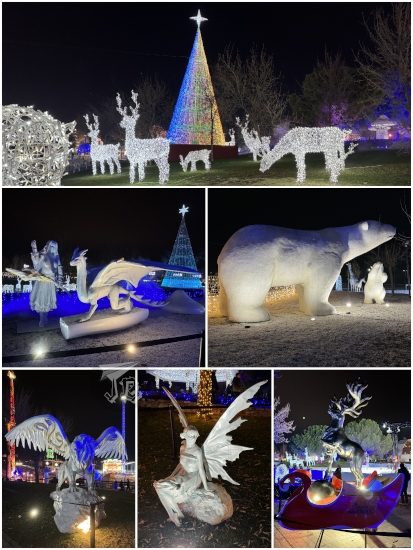
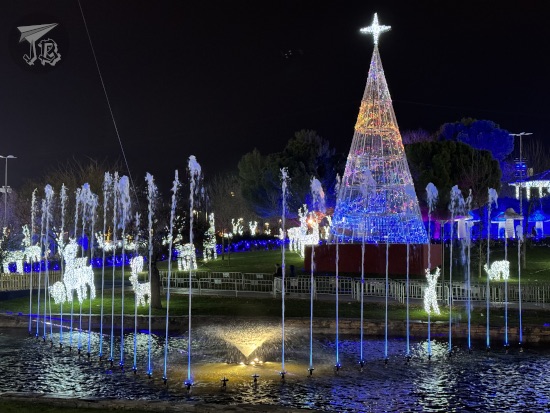
Afterwards, we decided to “climb” the Ice Mountain Montaña Helada, which has a ton of light-reindeers and some white sculptures of creatures of Scandinavian mythology – I think. There were faeries, elves, a winged lion, dragons, horses, a pegasus, trolls… and two very non-mythological polar bears. There was finally a sculpture of a reindeer standing on a sleigh. I’ve recently learnt that a reindeer that keeps its antlers in winter is a pregnant female, so there’s a lot to say about Father Christmas’ sleigh… There is also a light Christmas tree Árbol de Luz in amongst all the reindeer, and you get a glimpse at the ice rink Pista de Hielo, designed by former figure skater Javier Fernández.

Parque Magicas Navidades Torrejon Frozen mountain

There was a bit of a photocall area and we fooled around there for a few minutes. Next, we went back towards the Asian Lantern Festival Festival de las Linternas Asiáticas, to see the First Space, which we walked backwards, apparently. It was mostly about bugs and creepy-crawlers – even bigger than the Naturaleza Encendida ones. There were ladybugs, a praying mantis, butterflies, bees, a scorpion for some reason, flowers and… pandas. Because something is not Asian if there is not a panda?

Parque Magicas Navidades Torrejon Asian Lanterns 1

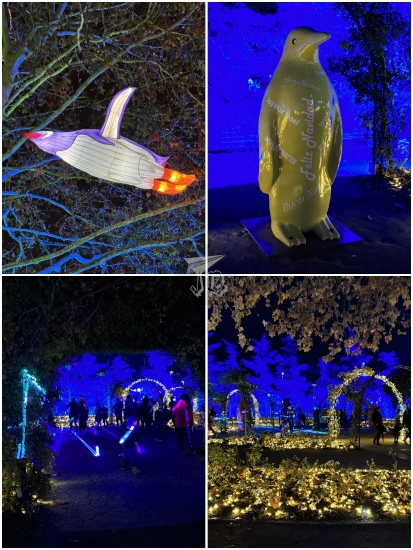
Once we were out of the area, there were some pink and purple flying penguins which gave way to a small garden with a lot of laser lights and other standing penguins, reading “Merry Christmas” in several languages. We headed back towards the train station then, passing by the Christmas market Mercado Navideño and Christmas Village, though it was hard to know when one ended and the other began. We did not go into any of the rides, not even the carousel, because they were extremely expensive… Neither did we try any food, but I am willing to be the prices were on the same range.

Parque Magicas Navidades Torrejon penguins

We walked out of the park, and we saw a train leave as we were approaching the station. We settled to wait for the next one, which – surprise, surprise – was delayed, so although we were at the station before 23:00, we did not make it home until almost half past midnight, despite the ride being just under 35 minutes. However, I think I’m going to start the family tradition of a mini-adventure after the yearly big-family meet-up, we had a lot of fun.

Parque Magicas Navidades Torrejon Light Christmas tree, reindeers and fountain

20th December 2023: Brilla Madrid Zoo (Madrid, Spain)

After an unwarranted amount of stress in the morning, I decided to take a little escapade in the evening to see some lights. The city of Torrejón is known as one of the local “Christmas hubs”, but it was “family day” and tickets were free, so there was no way to get a same-day entrance. I was a bit bummed, because that was convenient to reach by public transport. Instead, I resolved to go to Madrid instead – there was a light show on the topic of animals which had a small same-day discount – with it, I could get the skip the queue “upgrade”, the ticket itself, and the processing fees for the price of a nominal ticket. The downside was that I had to drive there. I booked entrance for the 18:40 timeslot, and left about 17:15, anticipating the traffic jams on my way to the park Parque Juan Carlos I. Traffic on the motorway was rather aggressive and all the exits were jammed. Thus, instead of driving to the main entrance to the park, I decided to drop the car off near one of the side entrances, and walk the last couple of kilometres instead of driving them. When I strolled by the parking lot, I saw that it was full and there were emergency vehicles there – I would have had to go to the inner parking lot, which means walking almost as much, and I saved one merging into the highway and one exit. I don’t mind driving, but I’m not a fan of other drivers.

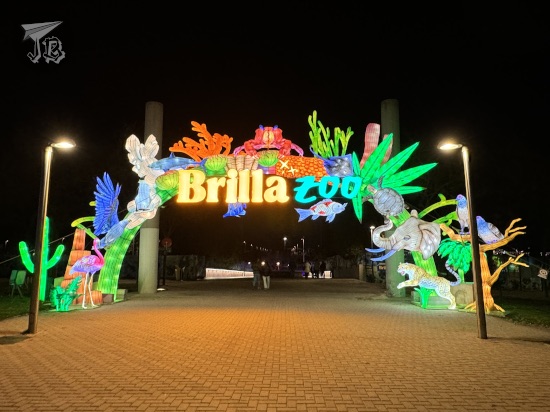
As I walked into the park, I ran into the first sign reading Brilla Madrid Zoo (Madrid Shining Zoo). They had placed signs all along my path – rather convenient. I walked for about 15 minutes and I was at the gate just past the 18:20 timeslot. Since it was a schoolday, and quite cold, it was almost empty and the staff had no problem letting me through. Brilla Madrid Zoo is a project by Brilla Events, who claim that there are over 500 light figures – I did not count – in a path that takes about 1.3 kilometres.

Brilla Madrid Zoo entryway

After the entrance arch, you go down to the actual ticket control. I had bought the skip-the-queue ticket which allowed me to see an “extra” exhibit in a tent, called Pollinators (Polinizadores). The whole Brilla Madrid Zoo exhibit has a “take care of the earth” kind of message, but it gets old really quickly as each “animal” repeats the same few words every couple of minutes. The Pollinators area had giant displays of a hummingbird, a bee, a butterfly, a bloom, and a bat for some reason. There was a screen with “Gaia” addressing the crowd, and it would have been creepy if not for the kiddos running and screaming around.

Brilla Madrid Zoo Giant hummingbird

As I went in, I was greeted by giant giraffe necks, then I moved into the Savannah (Sabana), with lions, leopards, zebras, hyenas, antelopes and elephants. Afterwards, there was the Jungle (Jungla) with gorillas, capybaras, jaguars… From there, after a turn, there was Australia, with echidnas, koalas, dingos, kangaroos.

Brilla Madrid Zoo Giraffes, Jungle, Australia, Whale

The entrance to the Ocean area (Océanos) could be done through a whale. Along the fountains / ponds of the park stood sharks (great whites and hammerheads), lionfish, turtles, clown fish (a.k.a. Nemo), blue tangs (a.k.a Dori), barracudas, koi carps, corals… There were also two real geese who seemed to be enjoying the exhibit too. It was really hard to take straight pictures as there was very little reference outside the actual animal.

Brilla Madrid Zoo Ocean

As I got close to the River areas (Ríos), there were otters and frogs. The coastal biomes were represented by the Swamp (Pantanos) and the Mangroves (Manglares). There were crocodiles, anacondas, Venus flytraps… for the first, and a flock of birds for the latter – flamingoes, pelicans, herons…

Brilla Madrid Zoo Rivers, Mangroves, Swamps

Then there was a bit of an avenue flanked by Flamingoes (Flamencos) to reach the Butterfly zone (Mariposas) and the Peacocks (Pavos reales). After another turn, there was the area dedicated to Nocturnal Animals (Nocturnos), with lemurs, bats, owls, and a wolf howling at the moon, perched on a dolmen.

Brilla Madrid Zoo flamingoes, butterflies, peacocks and wolf

After the dolmen, I found the Reptiles (Reptiles), with more frogs, iguanas, chameleons, a cute Komodo dragon… The path lead to what I guess is China by any other name: the Tiger (Tigre) and Pandas (Pandas). The Extinct Animal section (Extintos) was sad – with a dodo, a Tasmanian tiger, a white rhino, a Yangtze dolphin, a species of emu…

Brilla Madrid Zoo Reptiles, Panda, Tiger, Extinct animals

But then came the fantastical animals: Griffon (Grifo), Dragon (Dragón), Alicorns (Alicornios) – winged unicorns – and a Phoenix (Fénix).

Brilla Madrid Zoo griffon, dragon, alicorn and phoenix

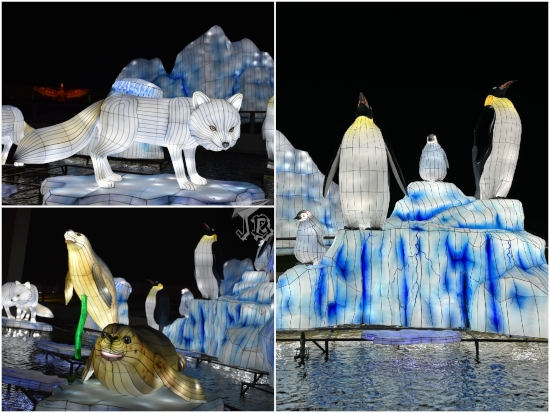
Once outside the area, you find the Ice figures (Hielo), with seals, Arctic foxes and penguins. There was a tent with a souvenir shop and some food stalls, but I did not go inside. I thought I would just walk back through the park before it became too late – and colder.

Brilla Madrid Zoo Ice

I liked Brilla much better than this year’s Naturaleza Encendida, to be honest. It was quite cold though, and a bit windy. I ran into another jam on the way back, this time caused by an accident. I have a theory regarding signals in this country – half of the drivers don’t use them, and out of the ones who do, yet another half think that signalling gives them immediate preference, even when what they are doing is illegal…

16th December 2023: A day out of ExpoGema (Madrid, Spain)

Since the mineral expo ExpoMinerales back in February was all cool and fun, I decided to attend its shinier (and unbeknownst to me, way more unaffordable) sibling, the gem expo ExpoGema, and make a day out of it. Thus, I headed out for Madrid on the 9:00 train with temperatures below zero – I was not made for winter. It was not much better when I arrived, but for once the train ride was uneventful, I actually made my connection, and it seems that after a chaotic year, the underground train tunnels are finally open. Everything going smoothly gave me some unexpected 45 minutes to wander around as the square Puerta del Sol slowly became fuller and fuller with people.

I had booked a guided visit through the company Madrid en Ruta, who has the exclusive concession to show the business centre Casa Comercial Palazuelo. Located in downtown Madrid, it was designed by architect Antonio Palacios. The promoter, Demetrio Palazuelo, bought the lot left behind by a fire, and commissioned the building with the goal of renting it out to shops and professionals – it was thus the first office building in Spain conceived as such, and not repurposed from a manor or an apartment building. Palacios drew inspiration from the Chicago School commercial architecture and used iron to stabilise the building, which allowed him for bright interiors using lots of glass. The office building was erected between 1919 and 1921, and the offices are still rented out today, with the only caveat that the beautiful interior translucent-glass doors have been painted white – to either protect privacy or hide the fact that today the house seems to be almost empty – at least according to the building’s own directory.

The exterior façade could be considered eclectic – the main frame tends to neoclassicism with huge glass windows framed in black iron. The interior tends towards Art Deco and modernism. The offices are distributed around a central indoor patio, with curved balconies that overlook it and lots of lights mainly due to the skylight. There are two classical lifts which are the original ones, in peartree wood. When we went up, I took the stairs, which have white treads, and the riser is made out dark green ceramics. I have seen these in other works by Antonio Palacios.. The interior, with the iron balustrades and its curvy design, was really cool, but I think it is really a pity they painted over the glass.
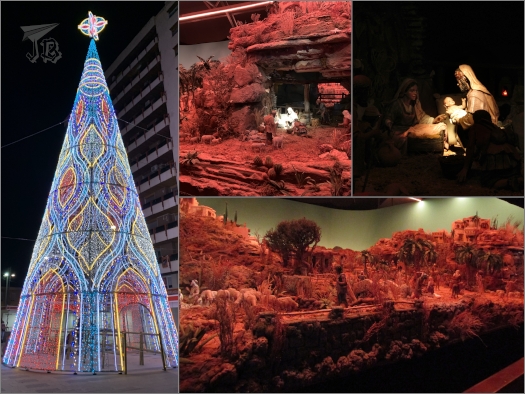
Interior of Casa Palazuelo

The visit started at 11:00. We spent the first fifteen minutes outside getting context, roughly half an hour inside, and the last twenty minutes on the roof of the building, waiting for the clock of the Puerta del Sol to strike 12:00, then we were ushered out. I really wish we could have wandered the house a little bit, even if we could not go into the offices. The ten euro we paid surely did not feel like we were paying customers, but more like we were sneaking around like unwanted guests – which we probably were anyway.

Puerta del Sol from the roof of Casa Palazuelo

I grabbed a quick snack then and headed off towards the engineering school Escuela Técnica Superior de Ingenieros de Minas y Energía (ETSIME) for the sixth edition of the gem fair ExpoGema. The fair itself was neat, but most everything was way above my budget range. I was there at the typical Spanish lunchtime, there were few people, and most were at the stands. Thus, I had the museum Museo Histórico-Minero Don Felipe de Borbón y Grecia almost completely to myself. I really like old-style museums, and this one has a huge amount of specimens, most of them are minerals, but there are also fossils and a collection of cave bear skulls and bones. I had decided not to book any guided visit or activity as none happened within the couple of hours of lunch downtime.

Geology Museum at Etsime

I bought an ammonite pendant, a small pyrite with almost perfect right angles, and another pendant made with a small meteorite from Campo del Cielo, along with a tiny extra piece. Campo del Cielo is an area in Argentina where four or five thousand years ago an iron meteorite fell. The meteorite shattered upon entering the atmosphere and, when it impacted the surface, the different created up to 26 craters. About 100 short tonnes of a fragmented iron meteorite have been recovered to date, and I now own around four grammes of it – yay me. I did not buy any precious stone though since the pretty shiny rocks were way out of my budget.

Expogema 2023

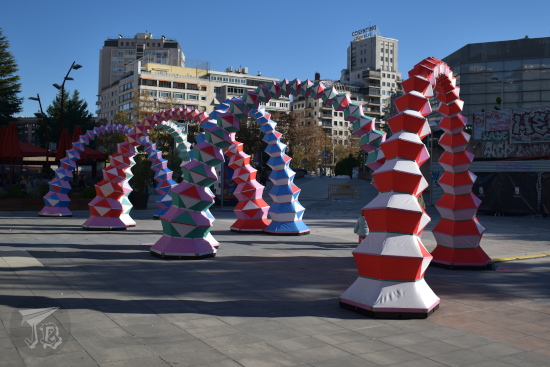
I left the ETSIME and I walked towards the square Plaza Pablo Ruiz Picasso, where there is a temporary art installation called El Regalo (The present) by Amigo&Amigo, a studio specialising in art installations. The artwork comprises a few arches that end in pads that can be stepped on – when they are, music sounds. The day was still bright, so the artwork was not shining, but a bunch of kids jumped on the pads to keep the music playing.

El Regalo artwork

Afterwards, I took a train and headed off towards central Madrid again. I had a reservation for an afternoon tea at NuBel, an “avant-garde gastronomy space” in the modern art museum Museo Reina Sofía. I had been drawn to the place due to the “freshly-baked scones” they advertised.

The experience was beyond disappointing. First, I had to wait to get seated, but then the person who checked me in forgot to notify that I was there – this is what I assume happened, I was literally told that “the kitchen had forgotten about me”. The set menu took 40 minutes to come out, and the scone was cold anyway, so not even freshly-made. I had got a decaf latte that was also cold when the food came.

The menu, 16€ as I don’t drink alcohol, consisted of: two mini-sandwiches – the two of them had been made from the same bread slice, so you can imagine the size, with some kind of mayonnaise filling which was not bad but rather unidentifiable; one shot-sized glass of (pre-made) gazpacho; one scone; a piece of red velvet cake; a piece of carrot cake; one chocolate brownie; a side of cheese cream, butter and jam; and in my case the already-stone cold decaf latte.

Nubel afternoon Tea

The scone was cold – so much for freshly-made, the only thing that had kept me waiting. Furthermore, the cheese cream, albeit nice, did not fit it like at all, so I had to use butter on it. I laughed to myself thinking about “the horror!” while I clutched my metaphorical pearls. The red velvet was probably the best, but in general the cakes were too sweet – good thing the menu included free tap water. Afterwards, I was comped another free decaf as an “apology for the delay”. However, when I tried to pay, more drama ensued. First the card-reading machine was not working, then they could not take cash because they were balancing the register, then they could bring the machine to the table. All in all, I spent almost hour and a half there – about five minutes waiting to be seated, forty minutes waiting for the tea set, and twenty minutes trying to pay. I’m sorry to say I did not tip, nor do I plan to ever come back.

I missed my train due to the paying delay, and I had to wait almost half an hour for another one. I hung out the Christmas market for a bit, and looked at the lights around Puerta de Atocha station. As it was cold, I walked in and went to check out the original train station, now turned botanical garden. I had never stopped to look at the iron ceiling, just at the plants – and the tortoises people used to dump there – but there had been an old photograph during the Casa Palazuelo visit that made me want to look at the building itself, and I recognised that old station in today’s building, with its wrung iron columns. Funny, how you can look at the same old things and recognise them.

3rd December 2023: Sushi, I“k”ons, Goddesses and Light Bugs (Madrid, Spain)

I had evening plans in Madrid with my sibling, and they wanted to have lunch in town and make a day trip out of it. Since I had previously ascertained that the Running Sushi franchise was all right and fun, I proposed to check out another of the locations. They agreed and I had booked a 13:00 slot at Running Sushi in Akihabara, near Plaza de España. It was even more fun than the one I had checked out before, with Godzilla, Taito Station signs, Pacman, neon, anime graffiti in the toilets, and Japanese music playing. From the outside, the restaurant is shaped like a train carriage, and the sliding doors relay the same message they do when Tokyo JR stops at the station at Akihabara. In general, Running Sushi Akihabara offered the same food as the In Market restaurant, but this time there was tuna. I don’t know if it is because of the location, or because it was a weekend – and thus more expensive. Reservation was a great idea, because though I had no problem booking for 13:00, there were plenty other people with and without bookings, and when 14:00 – standard Spain lunch time – approached, the place became almost crowded. We stayed for the whole hour since we had a late start due to missing chopsticks and napkins, and I own up that the last takoyaki might have been excessive. This time, I remembered to ask for the membership card – you get a reward if you visit all the restaurants in the holding, something I’m considering to aim for.

Running Sushi Akihabara

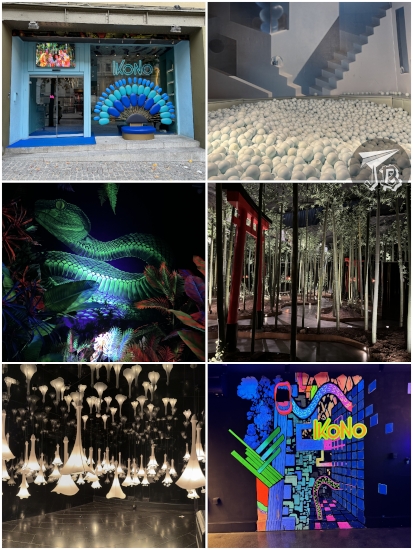
After lunch, we had a 14:50 ticket for a place called IKONO. I have to say I’m warming up more and more to these Instagrammable places – I’ve recently read one of them described as a “fun house” and I think it’s a more than accurate idea. I like them because they’re silly places for, quite literally, kicks and giggles. According to themselves, IKONO was born as a leisure option alternative to “restaurants, shopping and clubbing” for young people – I disagree with the “young people” take though. Out of the permanent establishments of its kind in Madrid, it is probably my favourite.

The IKONO mood kicks off even before you go in, with a peacock-like armchair just outside the main entrance. Spread over three floors, the venue has 15 different experiences / things to do. Once your tickets have been checked, the first “door” you go through is a thick wall of foil fringe curtains in a gradient of shiny colours,which felt like going through the Stargate! (I know, I know, niche comment). All through the place, there is bouncy music playing.

Once you have crossed the curtain – I somehow ended up in a weird inner space instead of where I was supposed to reach, but that’s just me – the first room is a ball pit, and a deep one at that. It was quite hard to move there. There are quite fewer rules than in other ball pits too – you can jump in, and throw balls up. Once you manage to drag yourself out of the ball pit, you get to go upstairs, what I’ve mentally named the “paper floor”. It has three rooms – the landing one has a pretty origami tree and some wings for you to take pictures with. There is a “psychedelic” ward with black-and-white décor and a blue-and-pink confetti cannon. The third one is a dark “jungle scenery” with glow-in-the dark colourings and paintings that I really loved – the frogs were adorable, and the serpent god quite impressive.

Back on the ground floor, the following room is a Japanese-style bamboo forest with wooden lanterns and a torii [鳥居], the traditional entryway to a Shinto shrine. As you may imagine, this was my favourite area. The room walls are covered in mirror, so it looks like a long path, that ends in the following room, a “bamboo forest” which a felt a little underwhelming in comparison. According to the website, the idea of IKONO cemented while visiting the Japanese Arashiyama bamboo grove, and these two rooms are a homage to that place.

Then we walked downstairs, to the “lights area”, with a few more rooms, including some hanging bellflower-shaped lamps, and another with lights made with marbles that went on and off to the music, some modern art inspired by The Last Supper, and a cube of infinite light dots. Back upstairs, there were a couple more panels for photo-ops, and a small souvenir shop. The staff offered a small present if we left a Google review, so we did. Oh, and they had a cloak option for coats, which was amazing.

IKONO Madrid highlights

We walked outside towards our following spot Caixa Forum Madrid, where there are two exhibitions at the moment. The one I really wanted to see was Veneradas y Temidas: el poder femenino en el arte y las creencias, “Worshipped and Feared: Feminine power in art and beliefs”, an exhibit on the female presence in the religion and spirituality of different cultures. The other one was Horizonte y Límite: Visiones del Paisaje. Colección de Arte contemporáneo, “Horizon and Limits: Views / visions of Landscape. Collection of Contemporary Art”, which I had not read about beforehand – because I am biased.

Veneradas y Temidas: el poder femenino en el arte y las creencias is a British Museum’s touring exhibition, Feminine power: the divine to the demonic (which I feel is a more appropriate name, but that’s just me and my problem with translations). It is a collection of artefacts (most of them not exhibited anywhere else) originating from different cultures, trying to convey the “female spiritual power”, though it also has snippets of erotism and homosexuality. One of the most important and impressive pieces include a copy of the Campo Iemini Venus, a “modest Venus”, halfway though covering herself – a copy of the Capitoline Venus, it was found in an Italian Roman villa in 1792. Aphrodite / Venus was the Greek / Roman goddess of Goddess of beauty, love, lust, passion, pleasure, and sexuality. Other Ancient Greece and Rome pieces include Hecate / Trivia (goddess of boundaries, crossroads, ghosts, magic, necromancy, transitions, and the New Moon), Athena / Minerva (Goddess of handicraft, warfare, and wisdom) or Eros / Cupid (God of desire, love, lust, and sex). There are several pieces of pottery, both red and black, depicting different scenes of various… degrees of erotism.

Halfway between Athena and Aphrodite, the goddess Ishtar, Queen of Heaven, and goddess of love and sexuality was worshipped in Mesopotamia (modern Iraq). Though according to the mythology, she had many lovers and was responsible for creation, she was not considered a “mother goddess”, and one of her advocations is the goddess of war.

The Divine to the Demonic: Greece and Mesopotamia

The first thing we saw from Asia were three masks. There was Taraka [Tāṭakā], a Hindu spirit, whose rage upon the murder of her husband turned her turned into a man-eating ogre (ogress?). From Bali, there was Rangda, the demon queen, antagonist of the forces of good, leader of an army of evil witches, and child-eater. From Japan there was a hannya [般若], the jealous vengeful spirit of a scorned woman.

Also from Hinduism, there is a creepily fantastic (or fantastically creepy?) devotional icon (murti [मूर्ति]) of Kali [काली], goddess of death, doomsday and time. The sculpture is the advocation Dakshina Kali – depicted with four arms, a scimitar, a collar made of heads of her slain enemies, and Shiva at her feet. The murti represents a passage in which Kali goes on a rampage after fighting demons, having lost control, and her consort Shiva throws himself at her feet hoping to calm her down.

Theatre masks and Indian Goddess Kali

Among the Egyptian representations, there was Sekhmet, the warrior goddess, represented as a lioness, who was also the goddess of medicine and one of the sun deities. There were also Bastet, who started off similar to Sekhmet but became more of a protector figure, represented as a cat. There were also references to the cosmic goddess Nut, who symbolises the sky, stars, astronomy, the universe, and mothers.

From China, there was a gorgeous Guanyin [觀音] as the Goddess of Compassion, a very different style from the one I had seen in either the British Museum and the Victoria and Albert Museum. There was also a Shiva porcelain which was astonishing.

Egyptian Sekhmet and Chinese Guaiying

From Meso- and South America, there was a beautiful sandstone of Toci, the “mother of the gods” who is depicted with bare breasts and her hands on her belly. There was also a statue of a Mexican cihuateotl. The cihuateteo were spirits of women who died in childbirth, and received the same honours as the warriors who died in combat. There were other references, such as the Hawai’ian goddess of the sea Na-maka-o-Kaha’i, talismans of sex and love (because the Victorians were a bunch of perverts), references to the Mesopotamian demon Lamashtu, Egyptian protection sculptures, funerary steles… and some modern art kind of thing, like a lady sitting down with a ball python slithering on her because… yeah? I really enjoyed the exhibition, though I have to admit I ignored the interactive art a little, to focus on the mythological aspect.

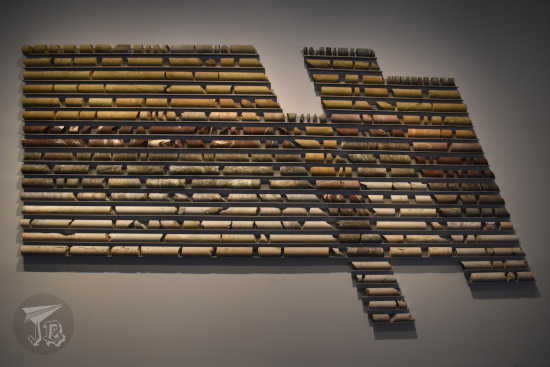
Afterwards, we visited the contemporary art exhibition Horizonte y Límite, which focuses on different… I’m not sure because I know squat about contemporary art (see above comment about the lady and the snake). There were paintings, imaginary photographs, a piece made from different geological cores representing a fault, a panel with postcards, a glass box filled with smoke to represent climate change… Pleasant, but not really my thing. Except the geology cores, they were cool.

Art piece fromthe exhibition Horizonte y Límite: Visiones del Paisaje

After seeing both exhibitions, we headed off towards our next stop. We took a break and sat down for a while to have a great banana-and-strawberry smoothie of all things. Then we walked towards the park Parque Enrique Tierno Galván, where we had tickets for the light show Naturaleza Encendida: Insectos “Lit-up nature: Insects”. The Naturaleza Encendida show used to take place in the Botanical Garden, which is smaller. This year, it has been relocated this year for “reasons unknown” and it feels a bit too long and almost unconnected. All that without taking into account that the idea of a larger-than-me butterfly and giant spiders is a bit creepy to be honest. We had premium tickets which gave us access to the enclosure at any time between 18:00 and 19:00 without queueing, and decided to arrive there around 18:30 as it would already be dark. We had also ordered a cute “magic lantern” – a bunch of sparkling LED filaments – for the giggles.

After an entrance of archways and carpets of light, there is a swarm of dragonflies as a centrepiece. You walk around it, and enter the zig-zagging path. Along the route, you encounter butterflies of different kinds, a line of hard-working ants, bees, grasshoppers, more bees, mosquitoes and flies, more bees, eggs, more grasshoppers, disco balls, larvae (I think? If I had to hazard a guess I’d call them anemones), beetles, ladybugs, spiders and a row of differently-coloured Christmas trees. There were “light corridors” in-between, hive-like hexagons projected onto the trees, and lots of artificial smoke. There are supposed to be some praying mantises somewhere but… I did not see those?

Naturaleza Encendida Insectos figures

All in all, Naturaleza Encendida: Insectos felt too spread out, as if trying to justify the bigger space. Though we had a premium ticket, there was no special premium-only area, and the only benefit was having an hour to go in, without having to queue – which is already enough in my books. I think you really have to be into the topic – we came across a lady who was very freaked out and mostly running so she could get away from the bugs. I have been to three editions of Naturaleza Encendida, and the only one I really enjoyed was the sea-creatures one, Explorium. I thought that the bad weather last year had damped the experience – literally – but I’m going to stop holding my hopes high.

Finally, we headed back to the train station. My morning train had had a five-minute delay, which by the early evening had progressed to the upper 40s. Joy. I’m hoping that when free ticketing is over, service will improve, but I’m not holding my hopes too high…

20th November 2022: Naturaleza Encendida – Origen (Real Jardín Botánico, Madrid, Spain)

It seems that the Madrid exhibits in the month of December are not being the most successful ones – this time, the weather did not help. After ten day’s worth of rain, it cleared out, but then, on Tuesday, the skies opened yet again. It was raining like there was no tomorrow by the time my train got to Madrid. Boo.

Just after sunset, my sibling and I went to the botanical garden Real Jardín Botánico to see the light show Naturaleza Encendida: Origen (Lit-up Nature: Origins). There had been some issues about the promoter cancelling the activity due to rain with little advance notice, so they decided not to close it. They instead resorted to close parts of the exhibit at random, and herding all the visitors in the same corridors, despite the puddles forming on the uneven ground. After two weeks of rain, something should have been done about it. Moreover, a few of the exhibits were turned off – not sure if just off or high wired. I wish I had some good boots, because I ended up pretty soaked, despite the raincoat and the umbrella. At least I did not ended up in a random puddle.

In 2021, the topic was sea life, and in 2022 the topic is… mushrooms. So there were spores, moulds and… mushrooms. Big mushrooms with lights, or made with small lights, or… just blown with hot air. Lots of mushrooms. The music was a bit creepy though, even if the mushrooms lit up and down with the beat. There is also an exhibit about moulds, with huge screens showing pictures of spores and microorganisms under the microscope.

Most people were antsy and cranky in the rain, and everybody wanted you to move out of the way – in different directions at the same time. A really good thing about it was the cup of hot chocolate that we had booked with the ticket. It was really nice to get in the middle of the cold and rain because it was warm and sweet. We drank it on our way out to the train, and just as we stepped out of the botanical garden… it just stopped raining.

Light display collage: on the upper left, giant red spores; on the lower left a wavy line of lights. On the right, a giant bunch mushrooms illuminated in green from inside the umbrella

Collage of lights display. A mushroom made of little yellow and white lights; a bunch of name mushrooms in red; a hanging mould-like string of lights between two dark trees

All in all, I was not too impressed. I really think that the organisers should have figured out something about the cancellations and the pathways, since they obviously could not do anything about the weather. My favourite display were the “Baymax mushrooms”, even if most of them had lost their illumination, which was actually kind of the point…

A blow-up mushroom made from plastic, looking like it's floating. The  lights inside make it glow green and pink. In the background there is a building gate in red, and a pond between the two.

14th December 2021: Navilandia (Guadalajara, Spain)

Back when I visited Torrejón de Ardoz in November, they were already preparing their Christmas display, which is famous in the area. In a smart way to curve attendance though, this year the town hall decided to charge non-locals to enter. Towns around quickly noted this and decided to organise their own magnificent displays, and in the case of Guadalajara, give a hand to the people who live off the carnivals and fairs, as most regional summer festivals have been cancelled for the last two years. They called it Navilandia (Christmasland), the biggest “Christmas Theme Park” in the region.

The “theme park” is divided in several areas. The first one is the palace Palacio del Infantado, its gardens and the adjacent square. The Palace features the same Christmas tree as last year, and the gardens have been decorated with lights, Disney characters, a Zeus sculpture, music and… dinosaurs. I have no idea what dinosaurs have got to do with Christmas, but you won’t hear me complaining about dinosaurs. They are called the magical gardens Jardines Mágicos del Infantado. There is also a small flea market.

A gothic façade with a Christmas Tree made out of green and gold lights in front, along with some more decorations: Felices Fiestas, another tree, a reindeer made out of light

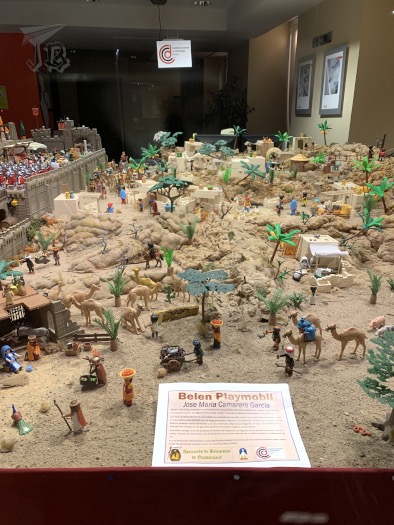
As I walked up Main Street I saw the traditional Playmobil Nativity they always set in one of the shops. However… I’ve never been able to spot the actual Nativity scene here. It is rather cool, though.

A Nativity made out of Playobil figurines, the stable is on the left and a bunch of toys are coming towards it through the desert. There a lots of dromedaries.

The second “Christmas hotspot” is the town hall square Plaza Mayor had a tasteful light decoration, a childish representation of the Three Wise Men, and a very beautiful – and lit up – carousel. I really wanted to ride it, but there were too many toddlers. It would have looked… weird. I need to find out when it closes so I sneak in after the kiddies have gone home (≧▽≦).

A caroussel with bright lights on in a square. Hanging above the square there are lots of lights and stars in gold colours. There are also four Christmas trees

Third spot was half-closed but that is okay. The square Plaza de Santo Domingo hosts another flea market, that was not open – they are setting three rotating markets there, basically one each weekend, and we were between them. There was a big walk-in Christmas tree and the “monumental Nativity” there.

Collage: A Christmas tree made out of eye-shaped lights in blue, purple, red and yellow. A picture of the classical nativity with realistic figures. The Holy Family is illuminated in white - Joseph is placing the Child on a crib that Mary is holding.

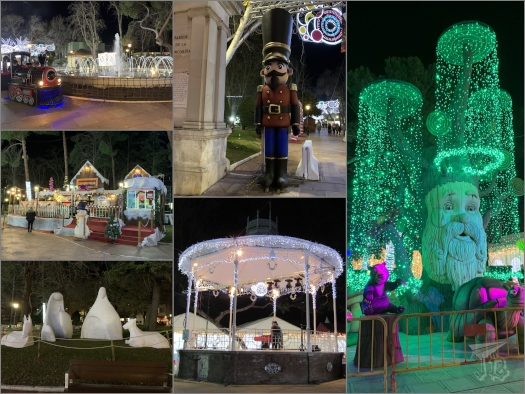
The final area extends along the parks Parque de la Concordia and Parque de las Adoratrices. The entrance is flanked by two nutcrackers; it hosts a talking tree, lights, food trucks, yet another flea market, and rides that again… are only Christmassy by name. There is another Nativity, this time an “abstract one”, a cute train and a “Polar Express” ride, some lights and… a “talking tree”, which broke into telling some tales out all of a sudden. Then, there was a bunch of rides, but they looked like your average travelling carnival rides, and I was not going to go onto any of those, so I made my way back. Also, I was strong and did not buy any cotton candy nor similar treats, though I was tempted to get some roasted chestnuts.

Bizarre Christmas decorations and motifs in the park: A giant nutcracker / soldier, an abstract nativity, some gingerbread-house-shaped shops, a Polar Express mini train, and a... something that looks like a tree with a face on the trunk and leaves made from green lights.

It was weird because for the second time in a couple of months I’ve been asked if I’m an actual photographer. True, this time it was a drunk guy who then proceeded to yell fascist slogans. I decided it was the right time to call it an evening and go home for the day…

30th November 2021: Naturaleza Encendida – Explorium. Royal Botanical Garden in Madrid (Spain)

After being in semi-lock down last year, my sibling, who loves Christmas lights, asked me to accompany them to the Real Jardín Botánico, the botanical garden in Madrid. The Botanical garden was founded in 1755, adjacent to the planned museum of Natural Science, which would later become the art gallery Prado Museum. Today, it is a research centre. The garden is divided into four terraces, a main building (Edificio Villanueva), and a back terrace, and it serves as museum of live plants of sorts.

For the last few years (at least three that I’m aware), the botanical garden has spiced up its winter downtime with light shows and displays. This year, the display is called “Lit Nature: Explorium”: Naturaleza Encendida: Explorium by the company Let’s go. The topic is ocean explorers and exploration, spread throughout the three main terraces and an extra exhibit in the building.

In order to have flexibility, I got us Premium tickets in case we needed to cancel last minute, which had the extra advantage that spared us from any queues, as we had full-access between 18:00 and 19:00. We also got to see the extra exhibit without paying extra. I drove up to a mid-way train station that allowed me better schedule flexibility – and my sibling lives close-by so it gave us the option to have dinner afterwards. I took the first train and we met at the botanical garden station at 17:30. We wandered around for a little while we waited until twilight faded, and we got in, avoiding all the lines – I did a bit of astronomy maths when planning this, regarding latest sunset and shortest twilight.

The exhibit is organised so you are free to wander around each terrace, but you can only cross from the lower to the upper terraces upwards, you cannot backtrack, in order to control capacity and people in each area. It only felt a bit crowded at a couple of points, mostly around the checkpoints, as it was very difficult to hear the staff.

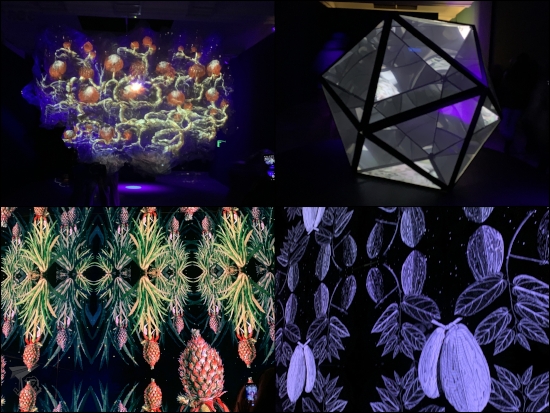
The whole display has thousands of little blue LEDs to get you on the ‘ocean’ scenery. The first terrace sets the mood – there are Christmas-tree looking build-ups and different types of colour-changing sculptures: turtles, pufferfish, and sea horses. The second focuses on laser and smoke, and reflection displays, and some serious-looking grouper. On the third, where the building stands, there is a little pond from where a few gigantic tentacles rise, and jellyfish hanging from the trees. The exhibit in the building itself is similar to the projections done by Team Lab.

Collage. A garden lit up at night, with different shapes: pufferfish, seahorses, a turtle... The trees and bushes are decorated with thousands of tiny blue leds

Collage. Light flashes in a dark garden, along with a colour gouper fish

Collage. Huge tentacles coming out of a pond, illuminated in red and blue; and blue jellyfish lamps hanging from trees

Collage. Light effects repeating the same patterns: a pineapple, a thisle, a khaki

We wandered around for a couple of hours, and believe me or not… the lights went out at some point! This was like climbing up (rope-way-ing up, to be honest) aaall the way up to see Nagasaki’s lights from Inasayama and getting caught in the clouds, but fortunately shorter (≧▽≦).

We left the botanical garden and took a train back. There were a few places to grab a bite around the station, so we ended up at a cosy Italian place and shared some stuff – too much to then grab some dessert though. When we left it was so cold that my car gave me the first heart attack of the winter by bleeping and showing me an orange alarm in the dashboard that means “the roads might be frosty” but scares me to death whenever I see it for the first time in the winter season. I drove off home, had a shower, went straight into work at 23:00 because how was I going to manage a free Tuesday evening without consequences?

Final waking distance: 8.50 km (though I really think that the wristband confuses my stress-driving with activity.

1st January 2017: Hatsumode {Japan, winter 16/17}

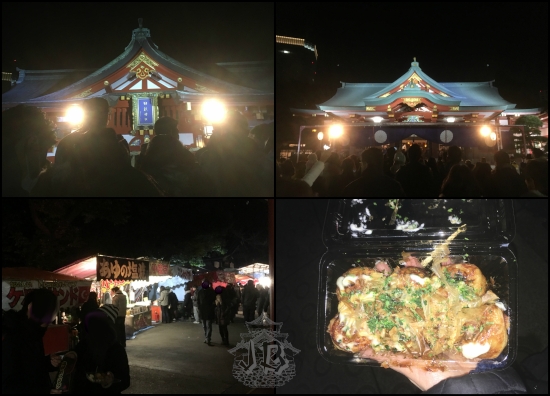
Hatsumode [初詣] is the Japanese custom of visiting a shrine or temple within the first three days of the year. Some people – like we did – actually wait the New Year to roll in the temple grounds. After the 108 (fast!) gongs that signal the entrance of the New Year, you are allowed into the shrine grounds to say the first prayer of the year in Hie Jinja [日枝神社].

After the prayer you can buy good luck charms, arrows which are ammunition for the kami to protect you (or something alike), enjoy some sacred sake, get your shuin, and once you’re outside, buy food and drinks. In my case I got some fresh takoyaki and ate them alone because apparently they’re stinky 。゚( ゚^∀^゚)゚。

Then we headed off home, and I got up at 8 am to have 12 grapes with Spanish TV as it has been my custom all my life. Then I went back to bed.

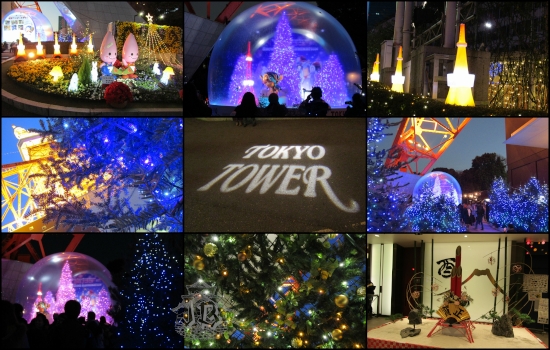
In the evening I headed off to Minato [港] to see Tokyo Tower [東京タワー]. Zojo-ji [増上寺] and Shiba Kōen [芝公園] were packed with Hatsumode parishioners and I had never seen such a line to go up Tokyo Tower. Thus I did not climb up, but I did take pictures of all the illumination around.

Afterwards I met with D****e and K***n. to go to Yokohama [横浜], to have dinner in Yokohama Chinatown, as Chinese people have their own New Year, they would be open to business as usual. It was my first time in Chinatown at night, too, so it was interesting seeing places like Kanteibyō / Kuan Ti Miao Temple [関帝廟 / 中華会館] in a new light.

On our way back we tried to see Shiodome [汐留]’s Winter Illuminations but they were off. We’re not completely sure of why…

30th December 2016: Water & lights {Japan, winter 16/17}

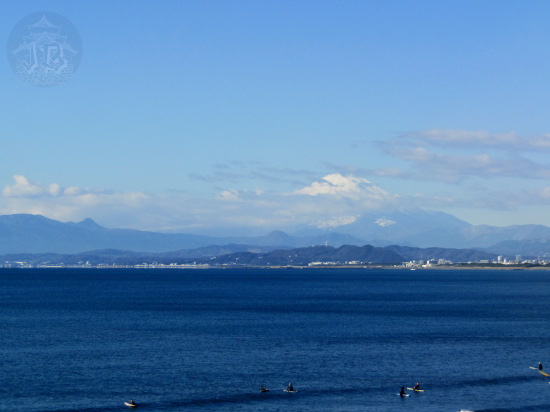
I headed off to Enoshima [江の島] to meet with my friend Mk-san, whom I met in Gackt’s birthday party in July. By pure chance, I caught a glance of Mount Fuji Fuji-san [富士山] again.

Together (with Mk-san, not with Fuji-san ~ヾ(^∇^)) we went into Enoshima Aquarium – Enoshima Suizokukan [新江ノ島水族館], which was one of the few I had left in the Tokyo Metropolitan area. The highlight was the focus on algae and seagrass, because the jumping fish did not seem to be in the mood for jumping. Oh, and kira-kira jellyfish!

After the aquarium and lunch, I headed back to Tokyo [東京] and I stumbled upon one of the L’Arc-en-Ciel’s “Don’t be afraid” billboards.

Then I met up with K. and D****e in Nakano Broadway [中野ブロードウェイ] for a bit of shopping before we headed out to Tokyo Dome [東京ドーム] to watch some Winter Illumination.

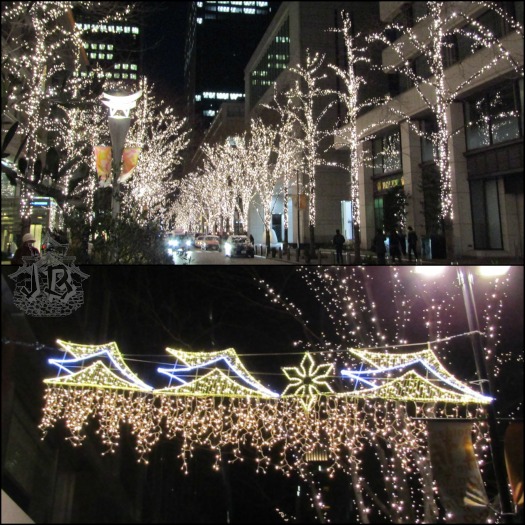
Later we went to Tokyo Station to see the lights in the Marunouchi [丸の内] side and had some avocado burger in a random Freshness we came across. And it was cold. Very cold. Awfully cold. Finger-ouchy cold.

28th December 2016: Find all the things ( ・`ω・´)! {Japan, winter 16/17}

One of the items in my calendar this time was visiting the three Dragon Gates of Tokyo. These are three torii gates that have been carved in stone and have an ascending and a descending dragon on each one of the pillars. The legend says that touching the dragons will bring you good luck.

Two torii are located in Suginami [杉並]. The first torii I went off to visit was in the grounds of Shukuhōzan Kōenji [宿鳳山高円寺]. The gate is a bit to the side, in a small adjoined shrine to the left of the main building.

The second gate I visited is in Mabashi Inari Jinja [馬橋稲荷神社], about 15 minutes walking from the previous one (which I chose to hit first because it is closer to the station). As this is indeed a shrine, the torii is pointedly displayed, as it is the second one on the main entrance.

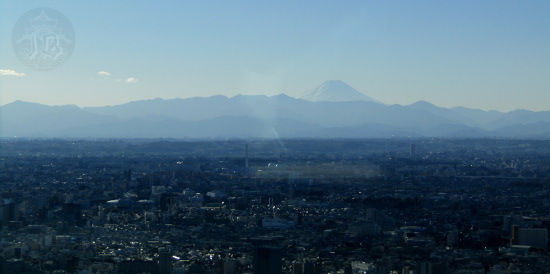
Although I would have wanted to hit the three gates on one day, going back and forth between the first two and the third was not a good idea. Thus, I headed off to Shinjuku [新宿] to check out the Tōkyō Tochō [東京都庁], the Tokyo Metropolitan Government Building, as the day was very clear. And bingo, it worked, and I managed to see Mount Fuji Fuji-san [富士山] in the background. Being a little bit of a geek, and since both observatories were open, I decided to climb both this time (just in case the stamp was different, of course!). Then (also of course) I was doing some shopping around…

And since I was in the area, I decided to go back to Isetan, having devised a plan to get some images of the kimono. Which succeeded. Then I saw other people taking pictures, so I shielded myself with them and took some, too.

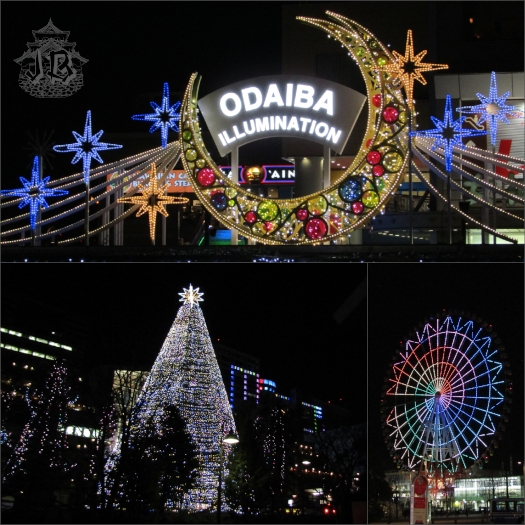
After that I met with D****e and we went off to find some of Gackt’s Gakucchi and Hyde’s Chupacabra crane games and UFO Catchers. For this we headed off to Odaiba [お台場], where we had a chance to look at the Winter Illumination, especially the Rainbow Bridge [レインボーブリッジ] looking… well, rainbow-coloured.

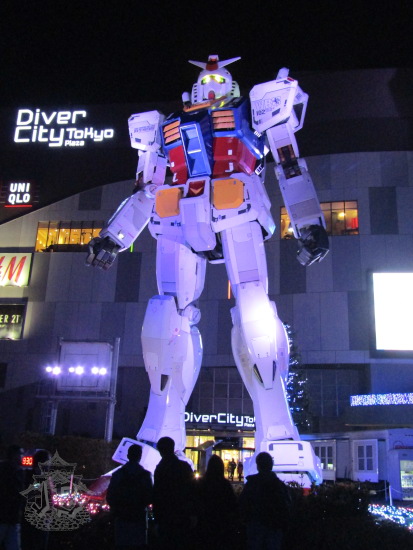
Then we went to say bye-bye to the Gundam in front the DiverCity and had some food inside. Somehow I feel like I’m talking about food all the time (*´∀`*)ノ… This was very yummy and the writing on the algae cracked me up.

As we did not find the Gakucchi nor Chupacabra in Odaiba’s Venus Front, where we had read they would be, we backtracked to Shinjuku [新宿] to search for them. We did not manage to get the stuff out of the crane games but we got the bags that you got with putting 500 ¥ into the UFO Catchers…

26th December 2016: Japan can be cold! {Japan, winter 16/17}

This was a discovery. Yes, I knew for a fact that Japan could be a cold country. I’ve seen he pictures and the snow, but it was the first time ever I was in winter Japan.

First of all, regarding the flight, Iberia is now flying Madrid Tokyo in a direct route, which is amazing. However, they charge you about 30 bucks for choosing a seat and the personnel is not the most helpful ever (^_^)”

After arriving in Narita, the first goal was setting the Internet on the phone. I was using Free Wifi at Narita and several stations among my route to meet D. for lunch and to get the keys to her apartment, because I keep forgetting that you have to go onto your browser and “register”.

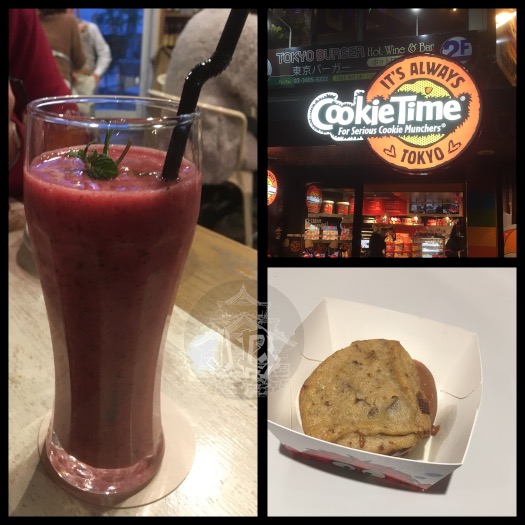
Anyway, I met with D****e first for yakiniku in Roppongi [六本木], and I got the keys to her apartment as I was crashing with her. I was hungry and forgot to take pictures, so have a look at the ベリベリ (“very berry”) smoothy I got in Harajuku [原宿] with B****. later on (*^◇^)_旦. And after that we went to a place called “Cookie Time” which was amazing.

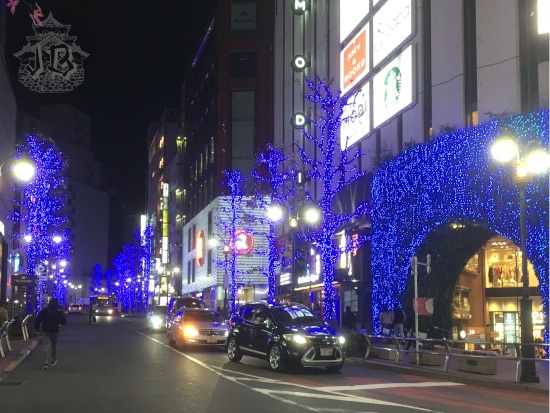
We also got to look at the winter illuminations between Harajuku and Shibuya [渋谷].

Finally, we went to eat sushi (*・∀・)_Ω. It is a common misconception that there can not be too much sushi, but it is actually a mistake. There is such a thing as too much sushi, but you won’t realise that until it is too late (*゚ー゚)ゞ.

26th December 2013: Japanese Exhibitions & Christmas Lights in Madrid (Spain)

Over the Christmas break, there were many activities related to the celebration of the establishment of diplomacy between Spain and Japan, so-called Año Dual España Japón. We decided to kick off the day going to a Japanese restaurant, my favourite in Madrid, the Nagoya (believe it or not, this is the daily menu).

There was a Calligraphy exhibit in the national library, Biblioteca Nacional. On the way, we also found that there was an exhibition about the Chinese terracotta warriors, but the queue was insane! We decided to try to get tickets online for another day.

We went to Caixa Forum to see a Japonism (19th-century European art influenced by Japanese concepts and aesthetics). Honestly, pictures were forbidden, but I snuck one because I really loved the painting.

We also took a walk to see the Christmas lights. Here’s the Postal Service building, Edificio de Correos.

And a view of Gran Vía, one of the main arteries of Madrid, all lit up.

Flashback to 28th December 2010 – 2nd January 2011: New Year’s in London

  • Hyde Park
  • Piccadilly Circus
  • Sherlock Holmes Museum
  • London Eye
  • Houses of Parliament
  • Big Ben
  • River Thames
  • Tower Bridge
  • Tower of London
  • St Paul’s Cathedral
  • Globe Theatre
  • London Aquarium
  • British Museum
  • London Natural History Museum
  • Buckingham Palace

Note: This is a flashback post, which means it is just a collage regarding a trip I took before I started the blog in 2012. Tags may be incomplete or slightly off.