21st & 22nd July 2018: Swan Lake in Madrid (Spain)

21st July: The housefront

This Saturday/Sunday getaway was a birthday present, and I have to admit that I was super excited about it – the main part of the present was a hotel night in Madrid and tickets to watch the (British) Royal Ballet in the Spanish Royal theatre, the Teatro Real. And I mean stall tickets, I was over the moon.

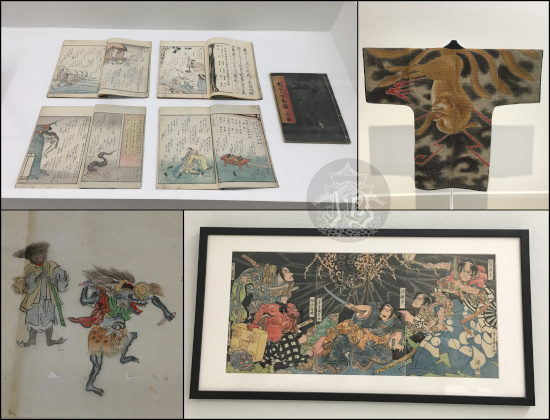
The day started at the Museo de la Real Academia de Bellas Artes de San Fernando, where there was an exhibition about yokai, the Yumoto Koichi Collection (Miyoshi, Hiroshima). It was called Yokai: Iconografía de lo Fantástico (Iconography of the fantastical), and it was rather interesting. It holds a collection of different items related to mythological creatures of Japan, yokai [妖怪] – there are scrolls, woodprints, games, pottery, even clothes and accessories. This was an interesting exhibition, and having seen it would later save me a trip to Miyoshi, allowing me to discover Takehara instead.

Rolls of paper, kimojo jacket and blookwood painting, showing different scenes and beings from Japanese mythology

After the exhibition, we went to the Green Tea Sushi Bar & Cocktail Room, which turned out to have the most overpriced mediocre sushi ever. The place was ridiculously expensive but fortunately we had booked with a special 50% discount, which made it bearable. However, fair is fair, and the tataki was delicious, and the chocolate coulant turned out to be amazing.

Lunch. Sushi boat, sald, tuna tataki, edamame, and an ice cream scoop

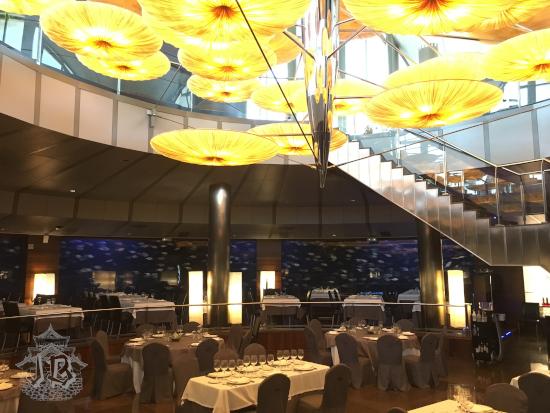
The hotel was in the right smack of Madrid, a short walk away from the “royal theatre” Teatro Real and we had tickets for 17:00 – to watch Swan Lake performed by British The Royal Ballet. Before sitting down we took a small exploration walk through the different rooms, including the ball room. I really loved the whole building and in particular the blue room and the ball room.

Royal theatre snippets - the main hall, the stage, the stands. Most curtains are a rich burgundy colour.

Swan Lake happens to be my favourite ballet – I love Tchaikovsky in general, though the stars have always aligned against me watching Sleeping Beauty. In Swan Lake, the evil sorcerer Rothbart turns maidens into a swan during the day, and they turn back to women at night as long as they are near the enchanted lake. The ballet officially opens with Prince Siegfried celebrating his birthday. He receives a crossbow as present, and he is later told by his mother that he needs to choose a bride the next night. As he becomes upset his friend suggest going hunting. In the forest, Siegfried becomes separated from the group and meets Odette, one of the swans. She explains of her predicament, and they eventually fall in love, and Siegfried invites her to the ball in which he needs to choose his bride. The next night, however, Rothbart sends Odette’s magical doppelgänger, to whom Siegfried swears love. Witnessing this in swan-form breaks Odette’s heart. As he realises his mistake, Siegfried makes it back to the lake.

The ending of the ballet changes. Sometimes it is a happy one when the spell is broken. The original ending has both Siegfried and Odette dying together to break the spell. Another alternative is that only Odette dies, but Siegfried manages to kill Rothbart and break the spell – this was the one that the Royal ballet played, and it managed to make me a puddle of happy goo. As Siegfried raises Odette’s inert body over his head, I shuddered all over. It was magnificent.

Snapshot of the credits, Showing Akane Takada as Odette and Odile, William Bracewell as Prince Siegfried, and Thomas Whitehead as Rothbart

The cast after the play taking their bows.

After the performance was over, we had dinner in the Plaza Mayor and then walked towards Puerta del Sol, then back went to the hotel to catch some sleep.

Square Plaza del Sol lit by night

22nd July: The backhouse

On Sunday we went back to the Teatro Real because we had booked one of the visits they offer, the technical one. During this visit you walk through the inner areas of the theatre, and even more interestingly, the upper area.

We saw the main hall, and afterwards we went first onto the backstage, then the backstage, and finally onto the stage where the Swan Lake props still stood, so that was really cool. The visit finished climbing up to the upper area of the theatre to see the views and the theatrical rigging system.

Empty royal theatre, showing the stalls from the stage, the backstage, and the view of the cathedral and the royal palace from the upper windows.

Finally, we had a bite to eat and we headed home for the weekend, and I have to say, I was happy as a skunk.

30th June 2018: Spanish breakfast, Japanese entertainment (Madrid, Spain)

30th June 2018: Spanish breakfast, Japanese entertainment (Madrid, Spain)

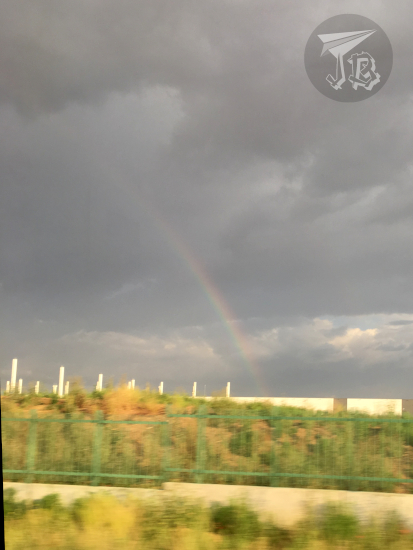
My friend C***** came over to Madrid for one of those crazy crazy things that we do – a crazy Saturday. She took a bus overnight and I went to meet her up for breakfast. The day started with a good omen, because I caught a rainbow around 7:30.

To celebrate that we had met up for the first time in a long while, we went to the most famous chocolaterie in Madrid, Chocolatería San Ginés for chocolate and churros. As her bus arrived in the early morning, I think we were there around 8:30 as I took the first train available.

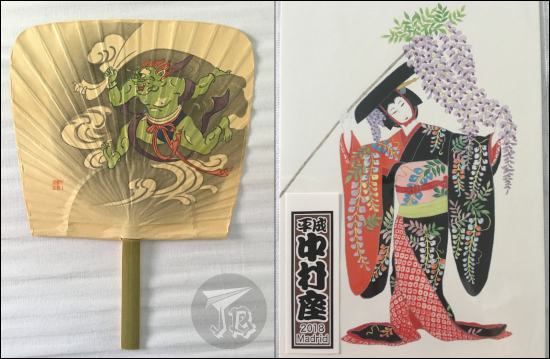
After breakfast, we head over to the area of the theatre, Teatros del Canal, for the main event at noon – a piece of Kabuki [歌舞伎], a piece of classical Japanese dance. In this case we were going to see an adaptation of Fuji Musume and Renjishi. First, we checked out the little market of Japanese craftsmanship and decided that we wanted everything, because of course we did.

Then we walked into the theatre. The company Heisei Nakamuraza was bringing two key pieces in the history of kabuki. The first was Fuji Musume [藤娘] “The Wisteria Lady”. It is a representation of unrequited love, dancing under the wisteria tree that represents femininity, and the pine that represents masculinity. During the dance there are several kimono dances and it is visually stunning. The second piece, Renjishi [検索結果], “The Two Lions”, is a very spectacular dance, in many ways mirrored between two dancers. The first part represents a parent lion-dog and its cub, then there is a small comical interlude and finally the lion dogs come out again in celebration. No pictures allowed of the performance, but have some of the theatre:

The show was over much too quickly, sadly. We went out of the theatre and raided the matsuri / market.

Then we walked a few minutes to the Japanese restaurant Hayama, where we had some sushi, gyoza, takoyaki, curry and ramen to share.

As C***** had an early-evening train to get back (I did mention that this was a crazy escapade specially for her), I tagged along to the station and I saw her off. Awesome way to spend a Saturday, though I wish we could have hung out for longer!

7th – 9th April 2018: 8º Salón del Manga y Cultura Japonesa. Alicante (Spain)

This was a crazy, crazy weekend in Alicante that I planned on the go with my friend C*****. It all started when guitarist Inoran, from Luna Sea, was announced as guest in the local “Manga and Japanese Culture Convention” Salón del Manga y Cultura Japonesa de Alicante. She was on the fence as to whether she wanted to come, but after musician Kenichi Yoshida was also announced, she was sold. I had already bought my tickets and booked a room, but it was fine for two people, so we could bunk together.

I finished work on Friday at around 19:00, made a dash for the local train station and jumped onto a commuting train to Madrid, where I took the long-distance train to Alicante. I arrived at around 22:30. C***** came to pick me up at the station, as she had arrived and already checked in. That was good, because she had time to walk around the area, and that would be handy later on.

Saturday, 8th April 2018

The next morning, we went to the bus station. After attaining victory over the ticketing machine, we found the correct bus. We knew we were at the right platform judging by the amount of cosplayers on the benches. The bus driver refused to sell tickets on board, so he sent everybody to battle the ticket machine. The bus set off late, but we eventually made it to IFA the, convention venue. Once we had a schedule, we started planning around it. At the very least, the Saturday plan was:

  • 13:30 – 14:30: Inoran’s presentation (which was supposed to have an autograph session afterwards)
  • 19:00 – 20:00: Inoran’s concert (which actually had the autograph session)
  • Walk around for a little, and check out the traditional area
  • C***** wanted to check out the artists’ alley to find some people she follows online

Inoran (Inoue Kiyonobu [井上 清信]) is one the founders and a guitarists of Luna Sea, one of the big names in the Japanese visual kei scene – now officially turned “alternative rock”. Inoran has also collaborated with different artists in different endeavours such as MAS*S with X Japan’s Hide, Fake? with Oblivion Dust’s Ken Lloyd, among others. Inoran has also established a solid career on his own as a solo artist. Someone (from the producer agency Here comes the Sound) fooled – or bribed with food – him into going to Alicante, Spain. Therefore, we decided to go and see him.

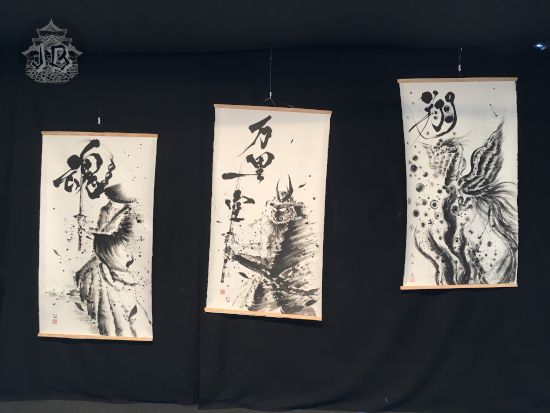
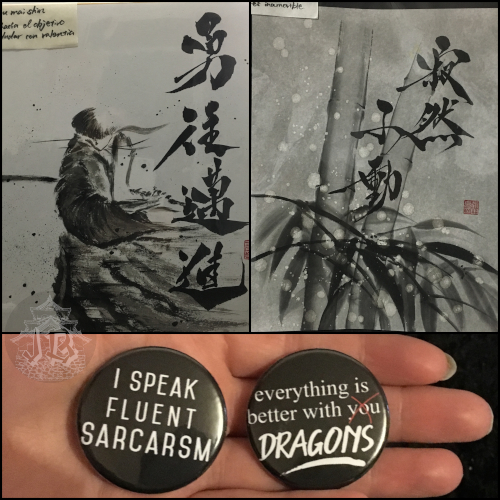
When we entered IFA, we walked around the space to get our bearings. The convention was divided in several areas: the commercial stands, the non-commercial ones (artists’ alley), and a small matsuri [祭り] “festival”, with more traditional decorations and shops. There, we came across artist Mitsuru Nagata, a man who makes the almost impossible way of Japanese calligraphy shōdo [書道] actually look easy. He he also creates sumi-e [水墨画] prints. Sumi-e stands for “ink wash painting”. It is the art of using calligraphy ink in various degrees of dilution with water to produce images. One of the characteristics of sumi-e is that no retouches are allowed, every stroke is definite. It is so difficult that the peak of the art is the ability to create a perfect circle in one precise stroke.

Mitsuru Nagata was born in Kyoto, but he resides in Barcelona these days. He started studying calligraphy when he was six years old and holds a Master Calligraphy degree. He sells his prints online and on different events around Spain, where he travels to promote Japanese culture. His stand at the convention had fantastic paintings.

Several hanging rolls of Japanese ink paintings, with samurai and a phoenix

After about an hour of walking around (probably even less) we decided to join the “queue” to enter the small hall where Inoran’s “presentation” was to take place. We got talking to a bunch of people, including a group of Japanese girls, including one, E**chan, who was studying Spanish! I think I met a Japanese version of myself…

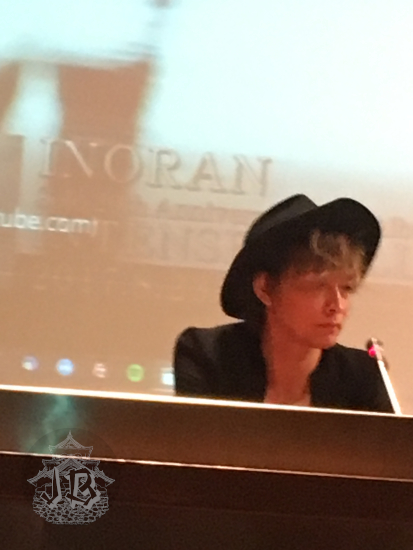
According to the description, the presentation was a short introduction of the artist, an explanation of who he was, a summary of his musical career and some videos, followed by an autograph session, and lasted an hour. In the end, it was ten-minute event. There was a tiny summary of Inoran’s career and basically we just got to see him say “hola”, and we watched the MV of his newest song. There was no real “summary of his career” nor signing.

Inoran talking into a microphone

In general, I have to say that the organisation of the event was horrid. Out of the three scheduled signing sessions, only one took place, with no explanation as of why during the whole convention. The following week, it was mentioned that Inoran had requested two signing sessions to be scrapped. Instead of saying that, the autograph sessions just disappeared from the webpage schedule, so early print-outs had them, others did not. It was a bit chaotic.

After the presentation, around 14:00 we… had no plans until the concert at 19:00, so we decided to just… wait at the stage, and believe me, we were not the first to think about it,.We ended up sharing “first row” with a bunch of other Spanish and Japanese fans. We killed time snacking, we watched the cosplay contest, and got all pumped up for the whole thing. I mean, we could sit on the floor, against the barrier, with access to food and water. Best queueing conditions ever. We witnessed the preparation of the stage, including setting an iPad for Inoran to look at his lyrics, guitar checking and so on.

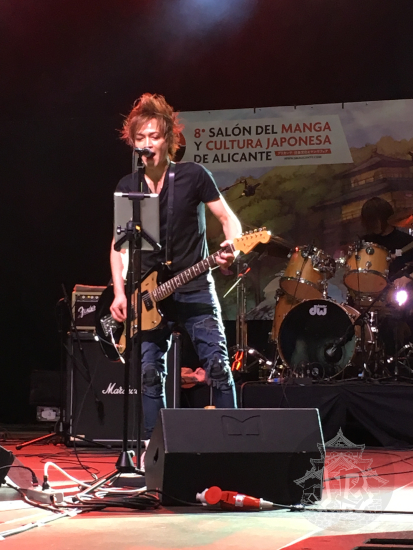
Inoran is the guitarist of Luna Sea, a musician at his core. Truth be told, he is not the best vocalist in the world. Other members of the group were u:zo on bass, Yukio Murata on second guitar and Ryo Yamagata on drums. The concert was really fun (and it elevated the number of members of Luna Sea I have seen to three out of five). I think it’s great when singers try the local language, or at least mangle it. Inoran did so with a very well-rehearsed “¿lo estáis pasando bien?” (are you having fun?). He also had some English prompts such as “scream” and “jump”, but most of what he said was in Japanese. Understandable Japanese at that.

Inoran on the stage, playing guitar and looking at the iPad to remember the lyrics

Setlist:

  1. Come away with me
  2. Get a feeling
  3. Awaking myself
  4. 2 Limes
  5. Beautiful Now
  6. No options
  7. D&B
  8. One Big Blue
  9. Rightway
  10. grace & glory
  11. Tonight
  12. Get Laid

The whole affair was even better than expected. Murata was utterly fun, and even if we had u:zo on the other side of the stage we still got to see a great deal of his. At some point they got the Here comes the Sound (producer) guy up to play some Luna Sea songs. The background noise was so great at that moment that it took me a long while to actually recognise the actual song…

As we had waited at the stage for hours, we had “first row”, against the barrier. A few minutes before the concert, the organisation brought a number of people to sit between the barrier and the stage – volunteers”, “workers” and “VIPs” who did not care at all, to the point that Inoran himself called them out at a point. The official pictures show them playing with their phones and not even looking at the stage. What’s the point of being there if you don’t care? Behind the fans there were the curious onlookers. I do wonder what Inoran found himself thinking about the convention.

The only actual autograph session and M&G happened after the concert. When we formed the queue, we were told (screamed at) that we needed to purchase a postcard for Inoran to sign. This postcard had the cost of 1<e, and it had been printed by the convention from an internet image,it was not even something the artist himself had brought. I told the volunteer that some of us had official material, and he shrugged, saying that only postcards could be signed. I subsequently asked if he could just enquire if Inoran was willing to sign anything else. The volunteer shrugged again with “I don’t speak Japanese” – tough luck, buddy, I do. Badly, but enough to ask for an autograph.

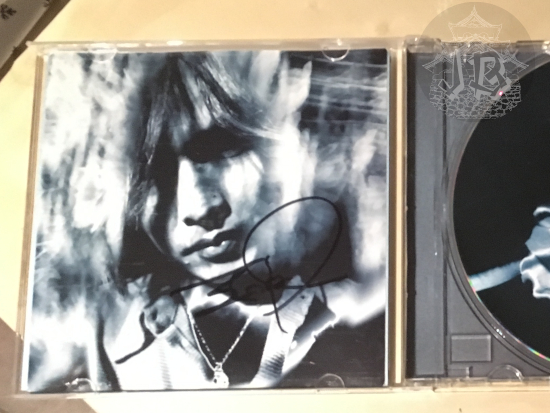
I paid my euro for the postcard and when Inoran reached out for it, I pulled out one of the CDs I had brought, and asked him to sign that instead. There was an uproar from the volunteers, but he had literally zero issues signing my CD. I mean, it was his original material after all (Note to the organisation: you fools, if I pay you the 1€ and don’t use your postcard, you can sell that postcard to someone else who will pay another euro. Seriously). We got selfies (with smile), handshake and signature, so it was all pretty great. At the same time, my friend C***** was recording everything, and Inoran’s staff were laughing in the background. As I was leaving, I asked Inoran to also sign C*****’s CD instead of a postcard too, and he smirked at me. I’m sure that the organisation hated me a lot that evening, as I started a trend.

Inoran's autograph

After the autographs, we left the area and walked towards the Matsuri. We bought some sumi-e art from Mitsuru Nagata, and then headed off to the artists’ alley. C***** bought herself a bunch of things (and some pins for me!). We also saw the Mary Poppins cosplayer who we thought should have won the cosplay contest, and we talked to her for a while, and took some pictures – according to the contest rules, she should have won the price, but the organisation chose something more anime-oriented. Finally, we headed off to take a bus downtown and walked towards the hotel.

Two Japanese ink drawings. One is a samurai drawing his sword, the other one some bamboo. Also two badges: one reads I speak fluent sarcasm, the other one everything is better with dragons

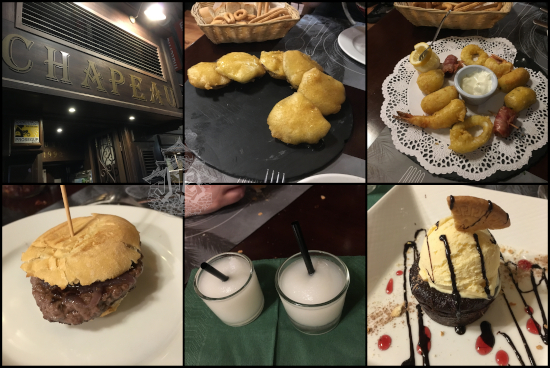
As we had had a small on-the-go lunch waiting by the stage, we decided to go for a serious dinner. The fun part was that we ended up finding Taberna El Chapeau, the restaurant where Inoran and the band had been the previous night. To be honest, it was very near our hotel, and we checked the menu for kicks and giggles as we were heading for something fast-food. It turned out the place was not expensive at all, so we decided to eat there! We tried the palm-honey eggplant, a mixture of fried seafoods, a mini-burger, and a very sinful brownie for dessert – the lemon sherbet was on the house.

Dinner. Some fried snacks and a mini hamburger, a pair of lemon shots, and an ice cream scoop

Sunday, 9th April 2018

Our must-do schedule for the day included:

  • 12:00 – 13:00: Kenichi Yoshida’s concert (unclear if there would be any signing afterwards. Spoiler: there was.)
  • 13:30 – 14:30: Q&A with Inoran (which was supposed to have a signing session afterwards)

Sunday morning started pretty much the same as Saturday’s had. We took the bus to the convention centre IFA, and walked around. We got to meet with Mitsuru Nagata, and we asked him to take a picture with us in front of his works. Aside from super-talented, he was extremely nice. He was very surprised when he found out that we did not work in the convention and we were so interested in his art – he seemed flattered / embarrassed. Nagata invited us to attend his sumi-e demonstration, but unfortunately it was at the same time as Kenichi Yoshida’s concert. When we told him that, he said that we absolutely had to go and see Yoshida, as the musician is not around as often.

Thus, we went to queue to enter the hall. We actually arranged to queue twice in one go, since Kenichi Yoshida’s concert happened in the same hall as the Q&A with Inoran. We had made some nice acquaintances at the Inoran queue the day before, and they agreed to “save our spots” for Inoran while we went to Yoshida’s concert, as long as we stepped out and took back the place (and did not stay in the hall). We thought it was fair. Besides, the convention rules said that the hall had to empty between acts to prevent people from just hogging the seats, or saving them for friends.

When doors opened for Kenichi Yoshida’s concert, it was clear though, that those rules did not apply to “friends with the organisers”, who could just step out and then jump back, dodging the queue as they had technically “vacated the hall”. When called out, they were indignant. One of them had been asked to translate last minute, so he and all his pals, of course, had immediate priority.

Furthermore, after queueing for couple of hours in order to get a good spot in first or second row, we were not allowed to sit down in the middle (again, saved for VIPs), and sent to the corner just behind cameras and tripods, joy. Thus, we migrated to third row to be in the middle. Fortunately, most press was restricted and we did not have to “enjoy” extra cameras rather than the ones used for the official recording. Before the concert started, we were told that there would be a signing session afterwards, Yoshida would be signing postcards – just like Inoran the evening before – but that there were only twenty of them. We were very annoyed at that because, yet again, C***** and I had brought our own original material.

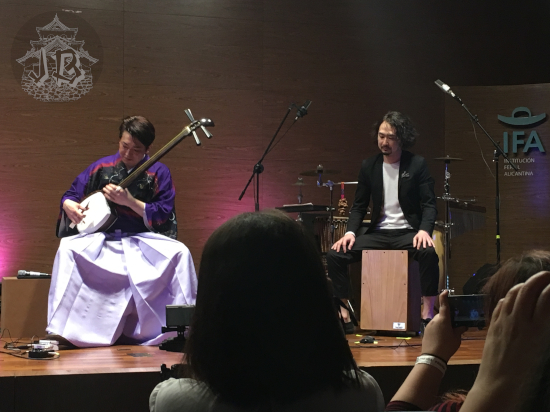
Kenichi Yoshida had been brought to Spain in a joint project by the Japanese Consulate in Barcelona, the Music museum and the Japan Foundation for a concert and a few activities in Barcelona. Alicante was a welcome bonus. He came along with percussionist Yuki Tsuchida, leader of the band Cross Groove Premium.

Kenichi Yoshida is a skilful tsugaru shamisen interpreter, who debuted in 1999 along his older brother as Yoshida Kyodai (Yoshida Brothers). The shamisen [三味線] is a traditional three-string guitar like instrument from Japan, based on a previous Chinese one. It is played with a pick. The tsugaru shamisen is a particular variant of the regular shamisen, larger and with thicker strings, which is plucked as well as hit with the pick.

The concert was spectacular, as much as the one I had watched in Madrid in 2016. Between songs, Yoshida explained a little bit about himself, his instrument, and some of its history. He gave a few notions about how the shamisen appeared in Japan, evolving from a traditional Chinese instrument that entered the country through Okinawa and it gained popularity as it was moved up north. It changed through time and one of the variants that appeared was the tsugaru shamisen.

Kenichi Yoshida playing shamisen, with his percussionist on the right

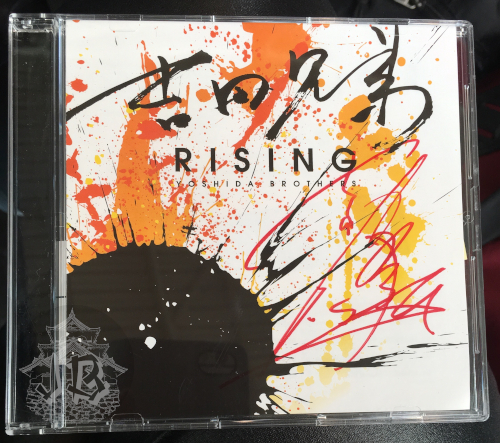
At the end of the concert, as C***** and I thought the postcards would not be enough, we decided to try our luck asking Yoshida directly if he would sign our CDs. And thus, instead of going into “Battle Royale” for the postcards we… took after him. As Yoshida was climbing up the stairs along the drummer and the manager, I caught up with him. I… very respectfully… tried to tell him in Japanese that there were too few postcards and that my friend and I had brought the original CDs, and if he would mind signing those for us. Thinking back,maybe we could have just stood in line without the postcards, but I was not sure they would even allow us to queue.

To my eternal surprise, Yoshida smiled and said yes. The manager ushered me up to the second floor as C***** went to hold the place in the queue, and I got the CDs signed, along with a complimentary sticker. Shaking like a leaf, I went back to the queue. In the end, it turned out that there were enough postcards for all the fans, so we tried again! Yoshida was nice enough to take a picture with us and sign postcards again.

Yoshida's autograph

Then we went to the hall again to see Inoran’s last appearance, the Q&A session, which did not have a signing either. The event was carried out in Spanish, English, and Japanese. After watching the MV, the questions came. They focused on Inoran’s thought on Spain, and whether he knew about how popular he is in Spain. Some fans and “press” asked interesting questions about his career, experience and collaborations with different artists and bands – Hide, Tsuchiya Anna, Luna Sea, Fake? and so on. He was asked how to become “big in Japan” particularly as a musician, and he said “working hard”. And then I lost it when he called us fans “young”. That almost made me roll on the floor laughing.

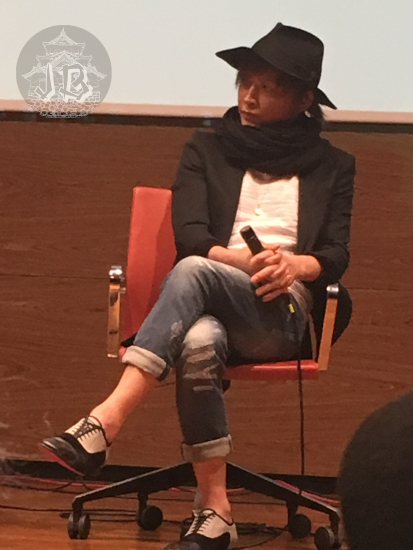
Inoran sitting on a chair with a hat, a scarf, and his jeans rolled up

After the Q&A, Inoran left, and C***** and I headed back towards Alicante. In the bus, I exchanged information with E**chan to stay in contact. C***** and I picked our things up from the hotel and walked to the train station, where he had a super-late lunch.

Burger, fries, and a glass of coke

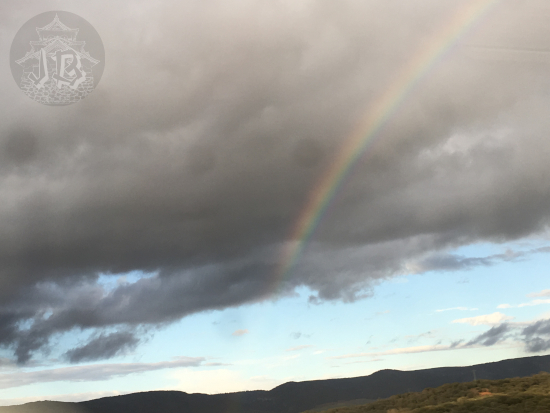
We had a shared train-ride to Madrid, and we spent most of it in the cafeteria, chatting up. We also got to see a pretty rainbow as it rained on the way. After we made it to Madrid, we separated for the last leg of our journeys, happy to have met up once more for yet another fun adventure.

Dark clouds and a rainbow

27th March 2018: Turiasaurus riodevensis {Dinosaurs in Teruel, 2018}

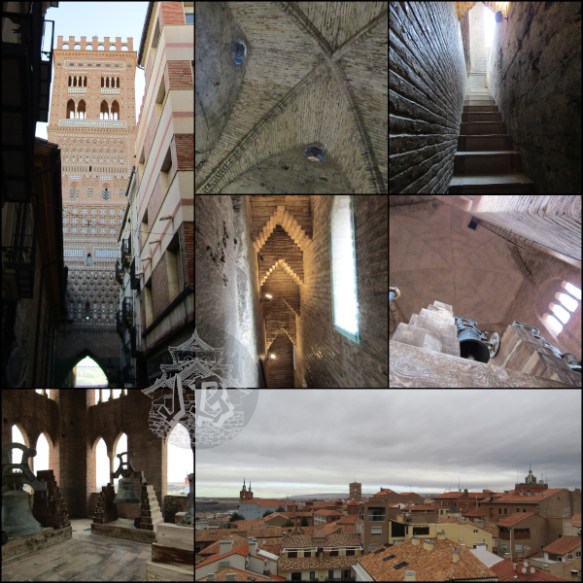
In the morning we walked back to the Torre del Salvador because we had learnt that you could climb it up.

Inner structure of the tower + views of the city

Then we dropped by the Museo de Arte Sacro de Teruel (Christian Art Museum).

Former cloister with a glass roof

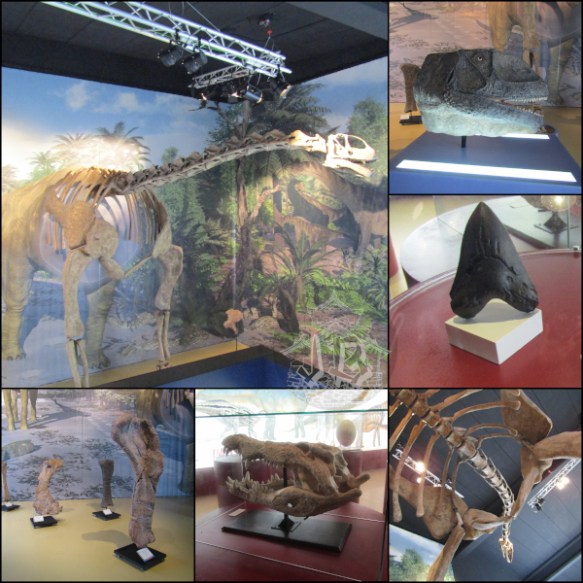
After having lunch we drove off to Riodeva to visit the Dinópolis mini-museum, called Titania. Riodeva is a tiny village in the middle of nowhere, but in the palaeontological site there scientists discovered the biggest European sauropod, the Turiasaurus riodevensis. It is believed that the Turiasaurus, which lived in the Jurassic period, could be almost 40 metres long and just under 50 tonnes.

The guide here was nice, but horribly misinformed, claiming unscientific facts – such as scientists believing that Megalodon still prowls the ocean, and I might have got into a small discussion with her. Don’t get me wrong, aside from being #TeamTRex, I love megs from the bottom of my heart, but there should be a limit on how many urban legends you can claim as true in an educational facility, and that limit is zero.

Turiasaurus fossil pieces + head reproduction; crocodile head; megalodon tooth

Finally we drove back to Teruel and the next day (28th) we were off home first thing in the morning as I had a medical appointment that had come up after the trip was booked.

26th March 2018: Dinosaur bones and Lover mummies {Dinosaurs in Teruel, 2018}

We got to Dinópolis so we could be there when they opened in hopes to ditch the families-with-kids crowds, but to our confusion, we were told that even if the park was open, the palaeontology museum would not be for another hour. Furthermore, the only option to see the museum was with a guided tour. We did not care much about the 3D cinema, but there was literally nothing else we could do until they opened the museum part. We spent the morning in the park. We had to watch the first film, and somehow ended up doing two rides (Viaje en el tiempo & Último Minuto) and a show (the T-rex one), but the big things we cared about were the museum and the so called “Tierra Magna”, where the 1:1 reproduction stand.

The museum has a direct view to the lab, and while it has very few original and unique exhibits, is really good and informative. The big problem was, in my opinion, that it was only guided-access and those stress me out. Why can’t I just roam to my heart’s content and have to listen to a poorly-trained guide? We somehow managed to ditch the tour when the second and third groups came in and a bunch of people mingled around.

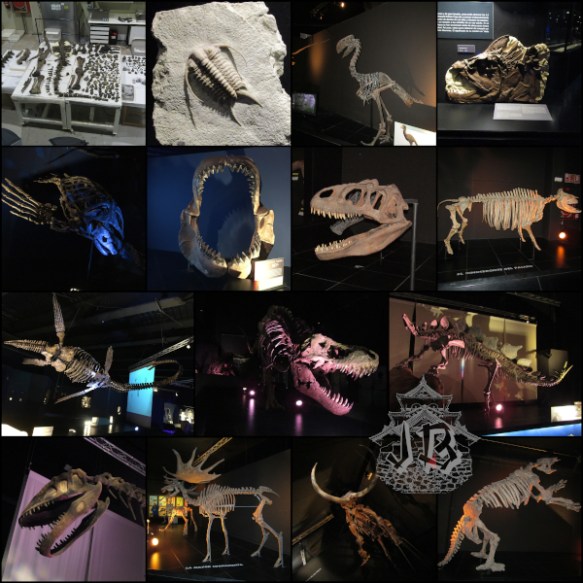
A collage showing different fossils and replicas from Dinopolis

It was cold outside, so we only had a quick stroll around “Tierra Magna”. We had lunch and decided we were done. If I had to rate this, I’d say it is a decent palaeontology museum with a lot of kid-friendly stuff around it – the latter is completely skippable, too, but I guess it brings money.

Life-size reproductions of dinosaurs outside Dinópolis Teruel

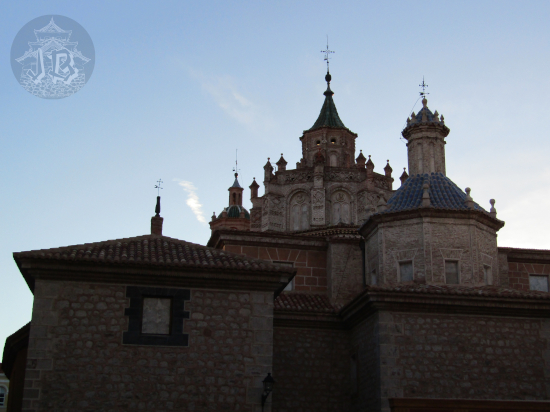
In the afternoon we headed off to see the cathedral, Cathedral of Santa María de Mediavilla, but I did not manage to sneak a picture of the famous wooden ceilings.

Outside view of the Cathedral

Later, we had a reservation to see the Complex of the Lovers of Teruel, which included the Iglesia de San Pedro (Church of St. Peter), its cloister, and the gardens.

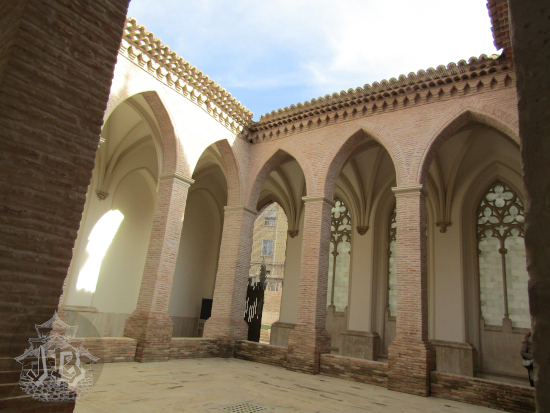
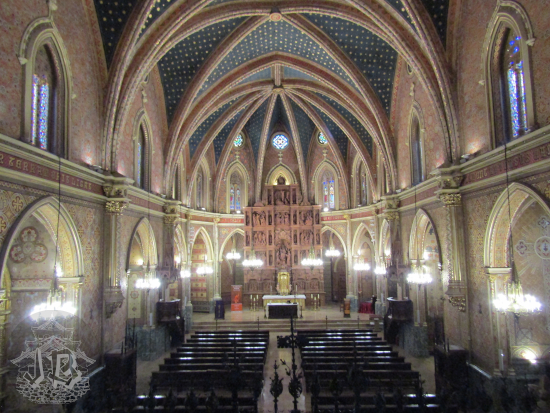
Nave in Saint Peter church

Cloister in Saint Peter Church

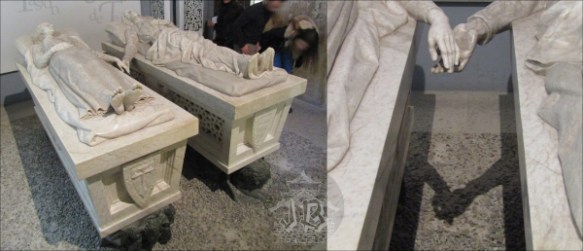
Finally we got to the Mausoleum, el Mausoleo de los Amantes. The story tells that she was a rich heiress and he was a poor man, so he left to gain riches. While he was away, she was given off to another man and married, and when he came back she could not be with him because she was loyal to her husband. He died of a broken heart after she refused him a kiss, and she died after kissing his dead body. The bodies of the lovers were buried together afterwards. The two mummified bodies were found in the church of St. Peter, and they were thought to be the lovers, so the tombs were sculpted – if you crouch, which by the way I didn’t, you can see the mummies through the marble. The tombs were designed so that the lovers’ hands are very close, but they don’t really touch, albeit their shadows superimpose, as if they did.

Mausoleum of the lovers - they lie next to each other, hands reaching for the other one, but only the shadows touch

After this, we walked around town for a while and found the third tower, the Torre del Salvador.

Salvador Tower

We finished the tourist day at the monumental Escalinata de Teruel (the Grand Staircase).

Monumental Staircase

As we walked back to the hotel, we saw a beautiful sunset.

Golden sunset

25th March 2018: Main roads that feel like secondary {Dinosaurs in Teruel, 2018}

We arrived in the Albarracín area after driving for about three hours. Some of the roads were horrid and I was secretly glad my offer to drive had been rejected. We arrived in Albarracín around 11:00 and our first stop was the first Dinópolis mini museum, called the Mar Nummus (Nummus Sea).

As this mountain range used to be sea bead (like 150 million years ago), a bunch of marine fossils can be found in the area. Dozens of ammonites fill up the museum, along with the skull of a Liopleurodon, a marine reptile of the order of the family Pliosauridae, quite obviously a carnivorous one judging by the teeth. As a matter of fact, it was the apex predator of the Middle and Late Jurassic oceans.

Mar Nummus building, featuring a life-size liopleurodon + the skull of the liopleurodon + a lot of ammonite fossils

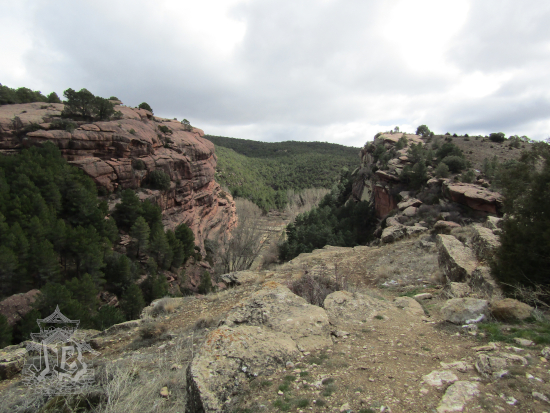
The visit did not take long, and then we moved on to drive to the Mirador de la Escombrera (Slagheap Viewpoint, don’t ask me) to watch the pineforest Pinares de Rodeno. We decided against walking through the forest because the shortest route was a couple of hours already.

Sandstone cliffs + pine trees

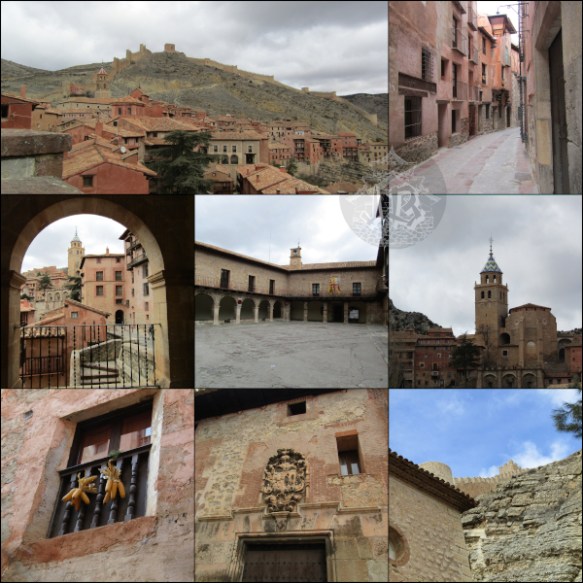
Instead, we drove back to Albarracín and walked throughout the historical centre, a medieval nucleus of streets and houses dedicated to shops and restaurants catering to tourists.

Albarracín, a Medieval city in reddish tones. It is surrounded by a wall

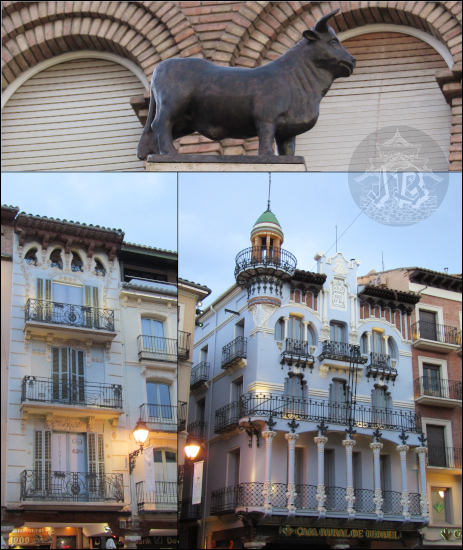
We had lunch, then drove the short 40 minutes to Teruel, where we found our hotel. After dropping our things off, we walked to the centre of the town – which was barely a ten-minute stroll away. Carlos Castel Square is widely known as the “little bull square”, Plaza del Torico.

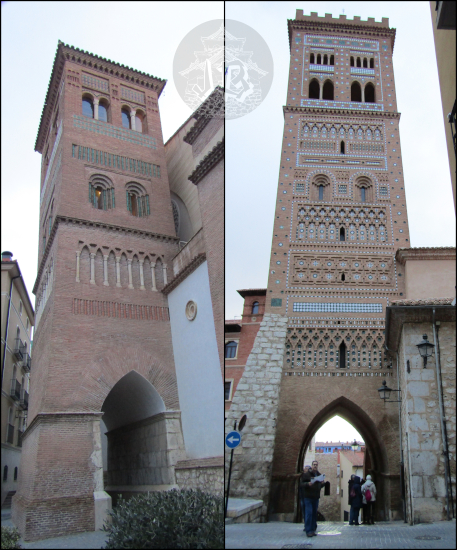
Teruel is known, aside from dinosaurs, from its Mudéjar style buildings, such as the Towers or the Cathedral. Mudéjar style was used by Iberian Christians between the 13th and 15th Century. It incorporates motifs, decorative elements and construction techniques that were common in Muslim Al-Andalus (such as archways, porcelains, bricks, and so on…). On the first day we saw two of the Towers: Torre de San Pedro (left) and Torre de San Martín (right).

Mudéjar Towers

The second architectural characteristic of Teruel are the Modernist houses, built in the 1910s, such as the ones in the Plaza del Torico – Casa La Madrileña (left) and Casa del Torico (right).

Plaza del Torico: a little bull standing on top of a column. Behind it stand two Modernist Houses at dusk

After this we had dinner and we headed back to the hotel.

25th – 27th March 2018: Dinosaurs in Teruel (Spain)

This was a palaeontology-inspired trip. Teruel has been building a reputation and a tourist industry based on the fossils and dinosaur-related remains that have been found in the area. I’m into dinosaurs as much as your average seven-year-old, even if I don’t have the memory for all the names as they do.

Dinópolis consists on a big palaeontology park in the town of Teruel and seven smaller centres in different villages in the province. We planned to base up in Teruel and visit Albarracín and Riodeva.

24th March 2018: The day I saw Hatsune Miku (Madrid, Spain)

“Vocaloid Opera – The End” is an opera for an in the digital world. It was written by Keiichiro Shibuya and performed by Hatsune Miku. Hatsune Miku [初音ミク] is a vocaloid idol. In case you’ve never heard of vocaloids, the idea is a bit complicated. A voicaloid is a singing voice synthesizer software product, basically a computer-generated singing voice. The software was released in 2004 and it exploded with popularity in Japan. Hatsune Miku was given a humanoid shape when it was released in 2017 – and it was definitely a she. So, in a way, Hatsune Miku is a voice synthesiser with a cartoon-female-human form.

Yeah, weird. I have always thought so too. But it was dirt-cheap (8 quid), and there was a session at 18:00 on Saturday that I could attend without a late train back. So I dyed my hair purple (because no, I’m not showing up to a blue-haired character’s show in blue hair), got out my thick faux-fur-neck coat and off I went.

The show was being held at Naves Matadero is a former slaughterhouse turned arts centre. It has turned the buildings into theatres, showrooms and so on. As I walked around the area, looking for my theatre I saw a hell of a lot of families with kids under ten, there to see “the doll” or “the cartoons”. I’m not kidding, during the first ten to fifteen minutes of the show, about twenty families left (≧▽≦).

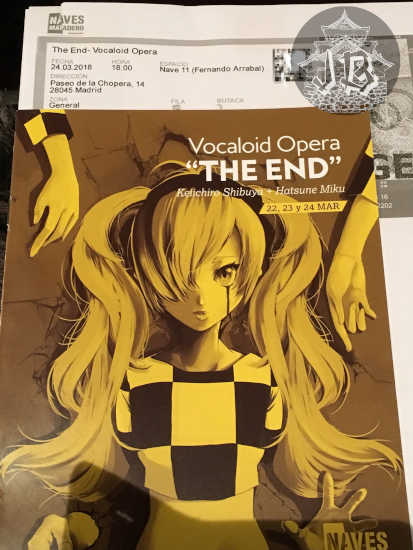
Entrance to the venue, showing the sign of Naves Matadero Nave 11 and Vocaloid Opera the end

“Vocaloid Opera – The End”, composed by Keiichiro Shibuya [渋谷慶一郎], explores the concept of an artificial being obsessing about death. The whole show is digital, just like Miku, as she wanders the world wondering about “the end”. She seems trapped in a surreal nightmare, with several scenarios that don’t make that much sense. Miku is followed in her trip by a plush rabbit (Alice much?), she talks on the phone and there is a multiple-eye monster around.

Booklet and ticket. Both read Vocalod Opera the end, with the dates. The booklet shows an image of Hatsune Miku, crying blood, the whole booklet is tinted yellow

The music has an electronic flavour, and at times repetitive. It’s loud and you feel it more than hear it. There warnings about bright and strobe lights all around and I understood why – the whole thing relied heavily on CGI and lighting. The chosen topic, along the images were claustrophobic, and I think that was on purpose – there are different “dying” options: drowning, gas masks, withering off.

The climatic “aria” peaks with Miku asking the spectator “Am I dead? Or just asleep? You decide. It makes little difference to me.” In the end, she is a human creation so, like humans, she will “die” sometime too (aaaaand I have opinions about this because I believe that some human creations transcend their authors). And a final downside: knickers. Seriously, what’s with Japanese people and knickers?! She’s a CGI doll – true, wearing CGI clothes designed by the former artistic director of Louis Vuitton, Marc Jacobs, but a CGI doll!

That was all that I did, but here are some pictures I managed to snatch a few pictures, including of the actual 3D rendering of Miku.

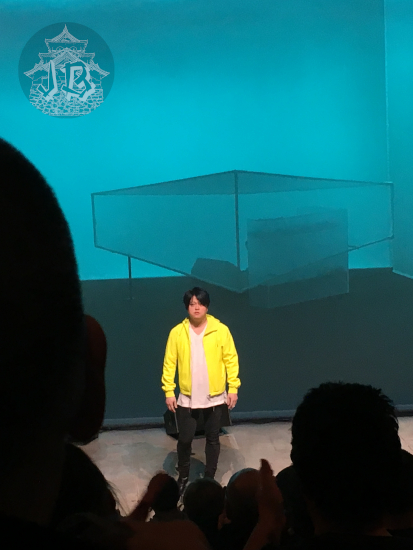
Picture of the composer, dressed in yellow

Life-sized sculpture of Hatsune Miku, wearing a chequered dress that shows her waist, and heels. Her hair is flying as she turns.

11th March 2018: An old-fashioned museum and a strike in Madrid (Spain)

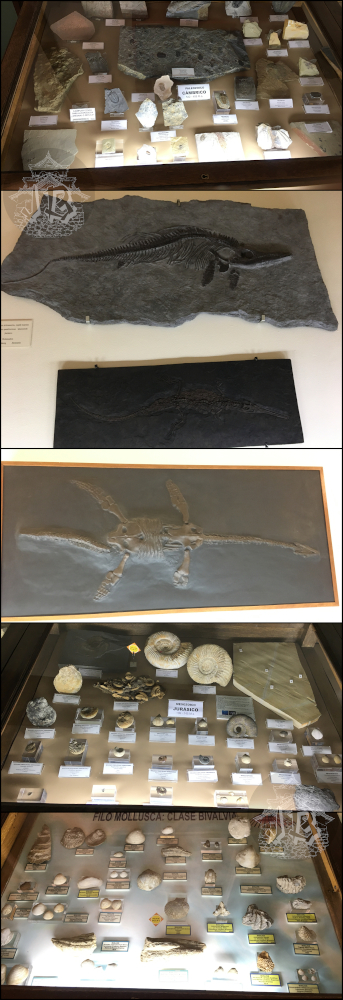
I was looking at a work-related trip and wanted to use up Sunday morning to visit “a couple” of museums, then meet some relatives for lunch. Unfortunately, I was caught in the middle of a public transportation strike, so in the end I had to walk for a long while instead of doing what I wanted! Anyway, what I managed to do was getting to the Museo Geominero Nacional, the “Geomineral Museum” in Madrid. It is located in the headquarters of the Geological and Mining Institute of Spain, in a classical-looking building finished in 1925. It was designed by Franciso Javier de Luue. It is a classical-looking museum with wooden cases and an impressive stained glass ceiling, comprised by a central room and three surrounding balconies.

The access is through a marble staircase and the first corridor is already packed with display cases, even before you get to the main area. These cases show small and not-so-small fossils and replicas, displaying the first taste of the evolution of life on earth.

Once in the main room, most of the floor is taken up by the standing cases holding minerals, fossils and meteorites.

In the centre of the room lie the remains of a mastodon, located in the area of Ciudad Real in the 20th century, one of the crown jewels of the museum.

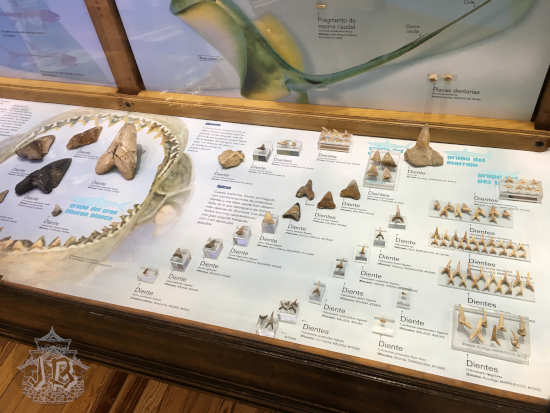
Of course I have been able to locate the collection of megalodon and shark teeth that are on display on the balcony.

Other displays on the upper floors include Spanish mountain goats, cave bears, and a human-evolution collection. Unfortunately, those did not photograph well due to the sun reflection.

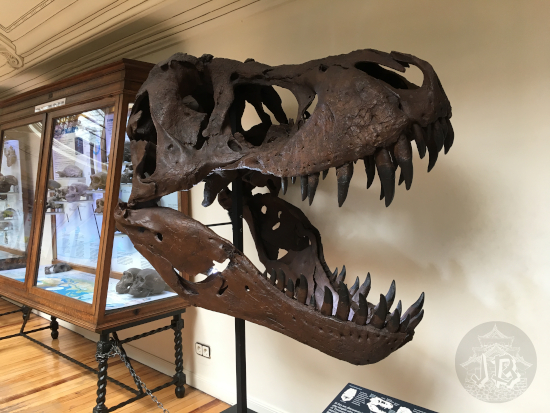
And finally, my favourite piece of the collection is the Tyrannosaurus rex skull replica that presides the museum for the second floor.

When I came out, public transport was not running any more, so I had to walk through the Madrid backstreets until I got to the area where we had arranged to meet, and we went to a restaurant called El Escarpín, where I had an awesome pan of… wait for it… gratin meatballs with molten cheese on a bed of potatoes (Albóndigas gratinadas con queso de tetilla sobre cama de patatas). Amazing! Either that, or I was really ravenous after my hour and a half walking. Serves me right for not keeping up with the news! I learnt my lesson!

28th January 2018: Amusement Park in Madrid (Spain)

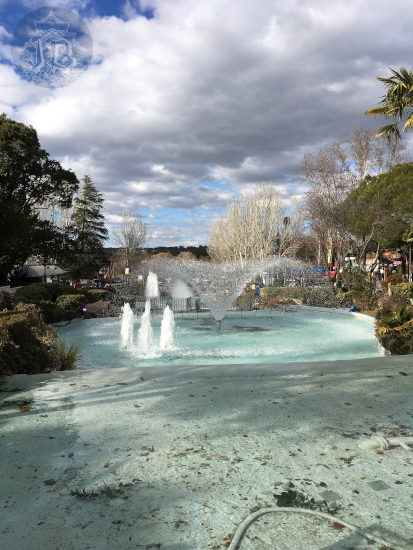
I had a friend over for the weekend and she wanted to “do something” so I got thinking. She is adcenturous, so I thought that the Madrid amusement park could be a good idea. The Parque de Atracciones de Madrid was established in 1969. I’ve never been much of a rides person, for two reasons. One, it is one of those things that you take up when you’re young, and when I was young my parents were rather opposed to funfairs and rides and so on (with good reason, to be honest, but that’s another story). Two, I tend to be worried that random rides are going to trigger my headaches, especially when I have to take my glasses off.

For this trip, I decided to wear my contacts, so I actually got to go on a few of the rides. I was mostly happy staying back and letting my friend do the roller coasters though.

I was all good with the ride called “The Jungle”, which turned out not only to have animals, but… different cultural approaches.

I enjoyed the “Zeppelin”, and the sights…

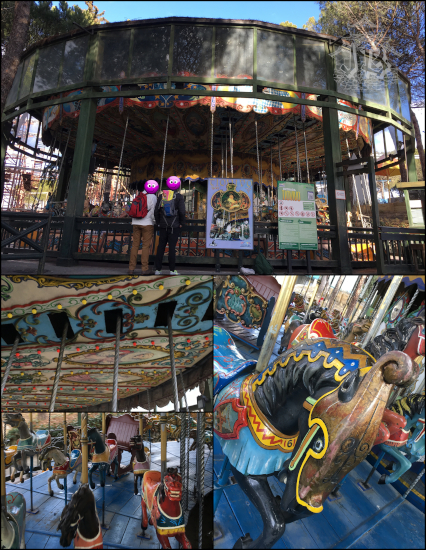
And, of course, I rode the carousel “Tiovivo”. Several times to be honest.

It was low season, so the price was much cheaper than normally. Unfortunately, it also meant that a few of the rides were closed. Then again, I wouldn’t have wanted to go onto anything with water in January…

21st January 2018: Zoology at the Zoo (Guadalajara, Spain)

This was just a stroll down the Zoológico Municipal de Guadalajara, the local town zoo. I just thought I could look up some of the animals I came across and see if I learn any interesting facts. It was not as easy as I thought!

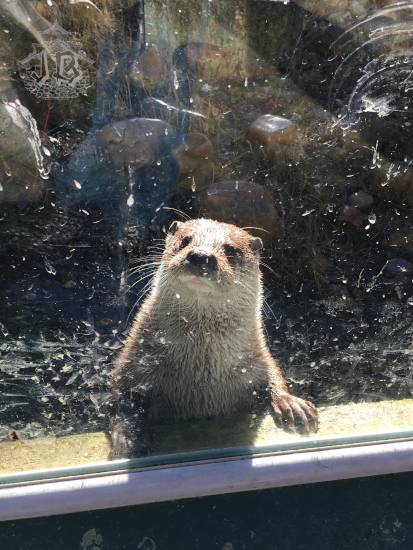
Eurasian otter (Lutra lutra): it is a semiaquatic mamal that is fortunately not threatened. It lives near rivers and coasts in Europe and Asia. It mainly eats fish. They are pretty smart and playful, but they are also very territorial, so they usually live alone. They have webbed claws for swimming and catching fish. Mother otters teach the kits to fish by a game of “catch and release” the fish.

Peafowl (Pavo cristatus ): technically “peacock” is the male (colourful) and “peahen” is the female (brown). The male has long tail feathers that he displays when he wants to impress a female or another male. In India, it was used as ‘guardian animal’ as it screams when tigers approach and it can eat young cobra snakes. Now, that’s pretty cool, and here I thought he was just a pretty tail!

Fallow deer (Dama dama): Fallow deer are native to Europe, and have been introduced to many other places. The bucks (males) are very aggressive and competitive during mating season, and they use their horns to fight. The does (females) do not have horns.

Iberian red deer (Cervus elaphus): The imagery of the red deer has been so powerful in the human psyche that some it can be found in paintings dating 40,000 years back. Normally the males and the young create big family groups. Males create smaller groups that cooperate.

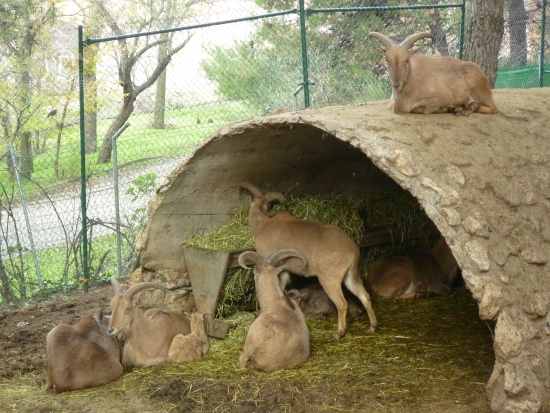
Barbary sheep (Ammotragus lervia). Also called arrui, it is an African mountain goat which lives in arid mountains and canyons and graze grass, bushes and lichens. They were artificially introduced in Southern Europe and became a bit of an invasive species. However, the truth is that they look super chill and zen.

European mouflon (Ovis orientalis musimon): It was originally a mountain creature but it moved to the forest when humans started bothering them. They thrive in rocky areas, though. They tend to live in herds with a lead female.

Wild boar (Sus scrofa): This is the omnivore animal by its own right. It can and will eat anything – from fruit to berries to even baby deer (O_O)!. Many old Indo-European cultures considered the boar a symbol of warrior virtues. In Greek mythology, the hero Herakles had to capture a boar as one of his Labours. In the east, it is considered a symbol of determination and even recklessness.

Iberian wolf (Canis lupus signatus): Unfortunately, the Iberian wolf is a vulnerable species and culling is still legal in Spain (•̀ω•́ ). The Iberian wolf is brown-grey and had a characteristic white area around its mouth. They also have black vertical lines along the front legs, and other dark marks on the leg and the tail. They are predators and prefer hunting big animals, especially deer. Wolves are social creatures, they live and hunt in groups.

Something really cool about wolves in general is that when they run, they place their hind legs on the footprint created by the front paw. Talk about coordination. Wolves have a very bad reputation in Spain, but there have not been confirmed attacks on cattle, much less on people, in recent years. Pictograms of the Iberian wolf have been found in archaeological artefacts from the tribes that lived in Spain before the Romans.

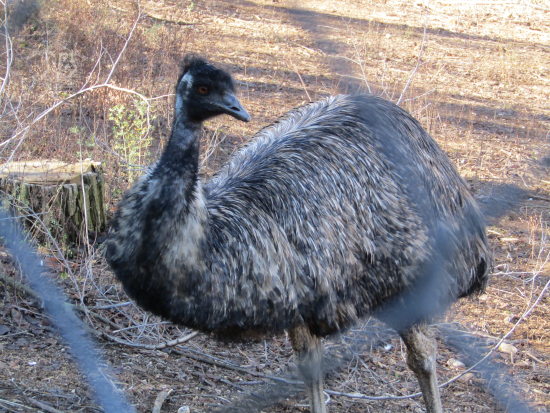
Emu (Dromaius novaehollandiae): Yay for another non-threatened animal. Emu originated in Australia, and are the second-biggest bird in existence after the ostrich. They are flightless, and they eat plants, grasses, insect and arthropods, depending the seasonal availability. Because females can lay several clutches of egg in one season after mating with different males, the male takes care of the incubation, and the chick-rearing. According the mythology of some aboriginal tribes of what now is called New South Wales, the sun had been created by throwing an emu egg into the sky.

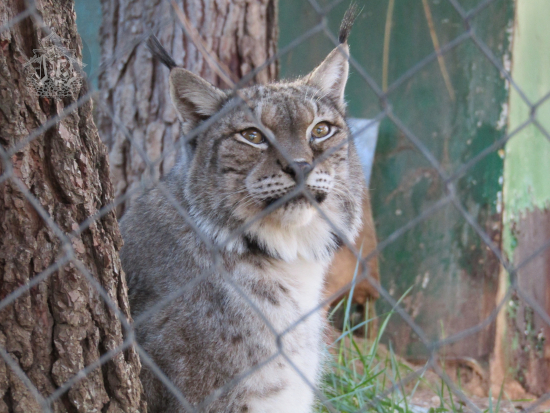
Eurasian lynx (Lynx lynx): Native of Europe and Asia, it is widely distributed, which lowers its conservation concerns. The Eurasian lynx is mainly a nocturnal predator, and tends to live solitarily as an adult, although hunting areas may overlap for several individuals. They can hunt small animals, but they are known to prefer bigger prey, such as roe deer and common deer. Conversely, they may be hunted by wolves.

Red fox (Vulpes vulpes): The red fox is one of the animals with the widest habitat range in the whole world. It can be found almost everywhere in the northern Hemisphere, including many cities in Europe. It is an invasive species in Australia, where it was introduced in the 19th century. In European mythology it’s considered symbol of deceit. In Asian mythology it has two-faces, some of them are messengers of the gods, some are tricksters and dangerous. Arab folklore considers the fox cowardly and weak. Native American mythology considers it a crafty creature that steals the coyote’s food – in all cultures however, it seems to be intellingent and able to trick other animals or people. Interesting.

Griffon vulture (Gyps fulvus): A scavenger bird of prey, it feeds mostly off the carcasses of dead animals. It tends to live in flocks or colonies and makes nests on rocky walls. Even if they have a bad rep, they are very cool animals.

White stork (Ciconia ciconia): Credited with bringing babies from Paris, storks used to be long-distance migrants, which lived in North Africa in winter and returned to Europe in summer to breed. For the last twenty years or so, the storks have stayed, at least in Spain. They are also famous for making nests on belfries and other man-made structures, and because they are considered a good omen they have rarely been chased away – until the weight of the nest has made belltowers collapse!

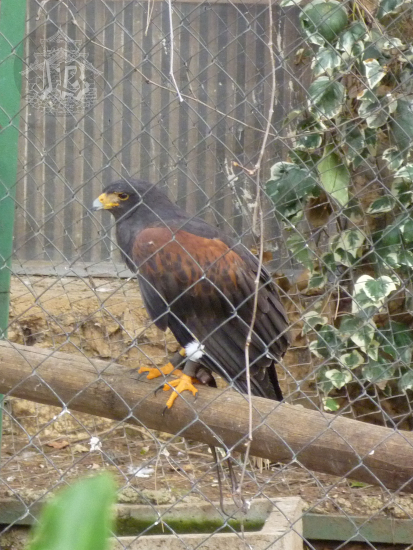
Common kestrel (Falco tinnunculus), I think. Feel free to correct me if I’m wrong. The best thing about the small zoo is the work they carry out recovering injured birds of prey. The birds are nursed back to health and if everything works out they are released into the wild. I really hope this little guy can leave soon! ⋛⋋( ‘◇’)⋌⋚

8th December 2017: Ferrari in Guadalajara (Spain)

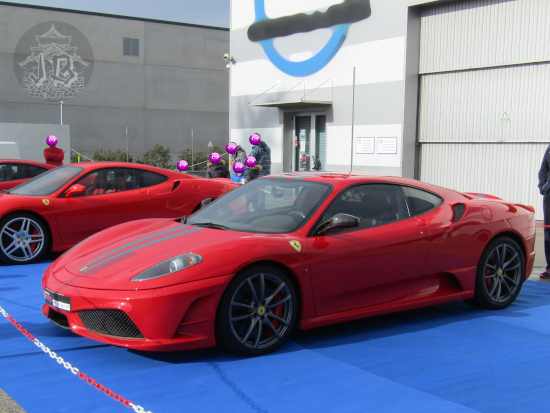
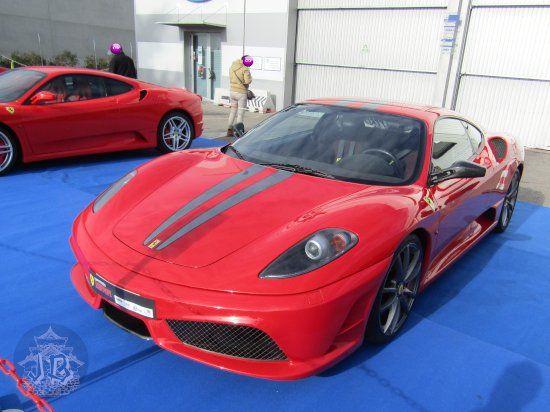
There was a tiny (five) Ferrari sport cars exhibition in Guadalajara, Spain, so I thought I would drop by, just to be able to appreciate what they call “Ferrari red”. I loved the cars, but I don’t think that I would ever be able to get in and out of them. You could not sit down at the wheel though, so I can’t say if I would be able to drive them (≧▽≦).

Ferrari was established in 1939 by Enrico Ferrari out of the racing car division of Alfa Romeo. In 1947, the first Ferrari-branded car was completed – there had been a racing car in 1940, but WWII stopped most competitions at the time. After the war, the racing team, called Scuderia Ferrari, was rebuilt, and went on to become the most successful Formula One Team.

Ferrari produced its first road car in 1949. the original road cars were two-seaters and usually customised. Throughout the 50s and 60s, customers used to personalise their cars, which would eventually become one of the brand’s selling points. Since 2011 clients have been able to work directly with designers so the cars are completely personalised.

The exhibition was organised by the car-maintenance watchdog, and the cars shown were recent models, such as the Ferrari F430 Scuderia (2007), the Ferrari 458 Speciale (2014), or the Ferrari 355 berlinetta (1994).

23rd & 24th September 2017: San Sebastián Film Festival (Spain)

23rd September 2017: Let’s go!

Overnight, I headed off to San Sebastián as a Weekend Escapade to the Festival de Cine de San Sebastián International Film Festival that is held over there because they were projecting a Japanese film and the main actor and the director were coming over to present it. The film was “Sandome no Satsujin” [三度目の殺人], the director is Hirozaku Kore-eda and the actor in question was Fukuyama Masaharu, of whom I am a big fan.

I started off at 22:00 on Friday as I had to take a bus to go to Intercambiador de Avenida de América, which is one of the bus hubs in Madrid. My bus to San Sebastián left at 00:30, so in the end I had to wait for almost two hours until I could board. I was dozing for most of the trip so it did not feel too long. I arrived in San Sebastián bus station at around 6:50 in the morning and I had decided that I would go to the so-called Shell Beach, Playa de la Concha, to watch sunrise. I had been told that cafeterias would be open at that time, but not even the one in the bus station was ready.

A beach at night. The sea is calm and it reflects the city lights

My plan of watching a sea sunrise was trumped by the fact that the sea is towards the west, but I still could take a couple of nice pictures.

The sun rising, tinting the sky and the sea blue and orange

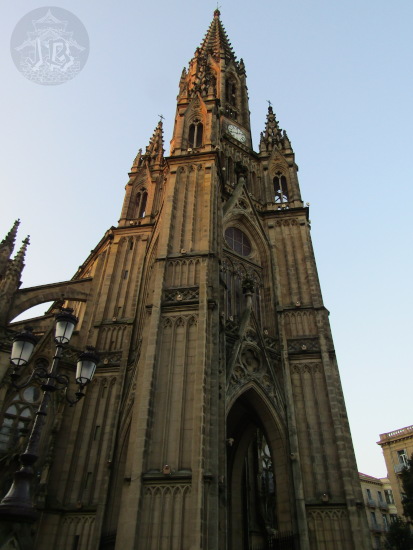
Among them were the beach itself, the “skyline” and the Catedral del Buen Pastor (Good Shepherd Cathedral).

A gothic or neogothic church clock tower, spiky with pointy arches

I wandered around, found the theatre where the film was going to be projected and as the sun started warming up, I started feeling less like a homeless dog.

The sun rising along a promenade

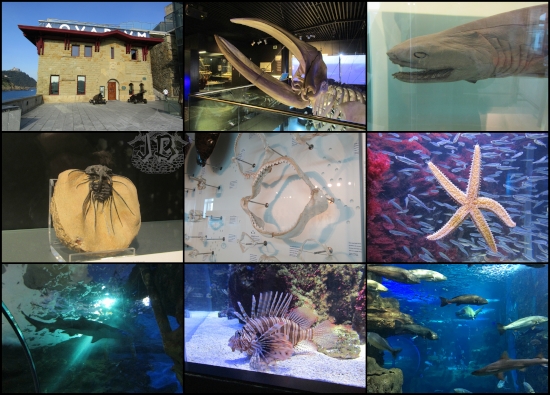
I found the local Starbucks at around 9:00 to get some rest, a coffee, and a cookie before I went to the Aquarium, which opened at 10:00. The Aquarium de San Sebastián is a bit more of a museum than anything else. The first part (second floor) is dedicated to the history of ocean commerce, with different types of ships, and rooms focused on the local harbour, companies, traditional boat racing and whaling. This includes an actual right whale skeleton and several sperm whale teeth and some baleens. The second part (first floor) is dedicated to general fishing and the local oceanography society, including machinery and live specimens.

Finally, after all this, you get to the actual aquarium (yay). There are several small tanks and then a big tank with a walk-through tunnels. The inhabitants are pretty standard, with lots of small fish and several magnifying-glass tanks to make the animals look bigger than they are. The third floor hosts the tropical fish including the piranha and the clown fish. All in all it is a nice place, however, it was under construction and some tanks were covered by dark plastic. After that I left the aquarium and I decided to go up Mount Urquil, which hosts a castle and quite nice views of the city and the ocean.

A small building entrance which yields to the aquarium. Collage showing different exhibits inside: a whale skeleton, a seven-grilled shark in alcohol, a trilobites fossil, a shark jaw, a starfish, a shark swimming above through an aquarium tunnel, a lionfish, sarks swimming in the aquarium

I walked by John Malkovich while heading there, but he did not look like he was in the mood (or the clothes) to be recognised, so I did not bug him. Then I started my climb up the mount towards the the local castle, Castillo de La Mota, along the batteries of cannons. The castle has a small history museum, and a look-out balcony, and the top has been transformed into a church, with a giant Christ overlooking. The truth is I was mostly improvising on my visits as the week was hell between work and the death of a family member.

Views from and of the ruins of the castle - the sea, the wall, and the old cannons

After that I had lunch and headed off to the theatre to check out the coming out of people. At this point I planned to wait for the actor and the director to come into the theatre, but for some reason I checked out the schedule, and the name of the actor had been taken out of the presentation! That made me sad for a little while, but I decided that I was okay with it, that it would not be a drama. I had taken my chance, and at least I had gotten some air after all the pain and drama throughout the week. I guess that helped relativise the sadness. I went to a park near the beach to get some sun and enjoy the last days of summer.

A 19th century building with large windows. A banner on the façade reads Festival de San Sebastián 65

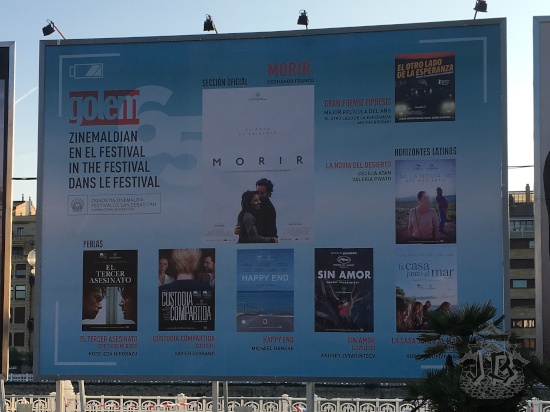
A banner for the cinema festival, showing posters for different films. The third murder is on the bottom left

Around 15:00 I returned to the theatre, Teatro Victoria Eugenia to start lining as I wanted a seat close enough to see the subtitles- and I found a place on sixth row which was pretty good. As this was a special people’s vote session, we got a ballot to give our opinions. Then I settled to wait, and eventually at 16:00 the presenter came in, and to my surprise, she announced Kore-eda and Fukuyama. That made me so happy I could have died right there and then, and the best was still to come. Kore-eda told us about the film. Apparently several people consider that he has changed genre, but he told us that he disagrees and that he still tried to make a human drama. However, he thought that we should judge. Then Fukuyama told us that he enjoyed San Sebastián and that they had been having pinchos and that he was happy to have returned. I was shaking so hard I could barely hold the phone as I recorded.
The stage inside the theatre

Director Kore-eda and actor Fukuyama Masaharu on stage

Promo of the film The Third Murder from the Festival Webpage

All this would have made me very happy already, but there is more. “Sandome no Satsujin”, or “The third murder” tells the story of a lawyer whose job is to defend a man accused of murder. As this would be the defendant’s third murder, if found guilty he will be handed the death penalty. The film is a complex story, completely unpredictable – or I was too enthralled to see the ending coming – but when everything fell into place I felt like gawking.

Furthermore, there was more to come – at the end of the film both Kore-eda and Fukuyama had stayed behind. as I was coming out I looked up and told them “otsukaresama deshita”, and both of them bowed and replied “arigatou”. Then we waited for them to come down from the second floor, from where they had taken the ovation. I dropped my vote and rushed through the red carpet. As other people talked to the director I made a beedive towards Fukuyama. It was then or never, and it turned out to be then.

Director Kore-eda and actor Fukuyama Masaharu waving for a picture on the street after the film

I was shaking inside but I managed to tell them that I had been a fan of his since Galileo times and I asked for his autograph. He told me thank you (at some point the interpreter tried to help, but I was busy dying and trying to get my meaning across). He signed my Galileo booklet and I asked him to take a picture with me, to which he also agreed. And thus I fulfilled my wildest dreams (and look horrible in the picture). After Fukuyama had continued on the red carpet I managed to sit down on a curb and I was on the phone with my friend C*****, who prevented me from going completely hysterical in fanby bliss.

After I told her everything, I was pretty dead so I headed off to he hotel (pension) that I had booked for the night, and pretty much giggled and crashed, and uncrashed and giggled some more. At 23:00 I was completely zonked out, not without realising that I had headed to get some rest without grabbing my freebies and some merchandising I wanted from the festival.

Fukuyama Masaharu's autograph on a DVD booklet

24th September 2017: And back

I left the hotel early, around 8:30 to head towards the cinema area and buy the short Festival guide (not the big one for 22€ but the little one for 1.5€) and get the free newspaper. I bought a coffee to go and headed back to the bus station, when my bus was at 10:00. I could not sleep and the Wi-Fi was not working, but I could watch Youtube videos on the seat screen. I managed to get home around 17:00 after a couple of buses, and I was pretty much dead. However, it was totally worth it. I think this is why I was hyper enough to decide to go to Vienna next month…

6th & 7th May 2017: Cuenca (Spain)

If I ever go missing, especially with my car, don’t go around looking for me in Cuenca . I would have a nervous breakdown trying to drive through the streets and slopes. I’m not sure what time we arrived, maybe mid-morning. We had a reservation to have lunch at the Parador. However, to get there we had to drive up a horrible, horrible hill with a terrible paving and park too close to the cliff so #no.

Cuenca is considered a World Heritage City. It has a classical, mostly Medieval area, and a normal / standard area surrounding that. The inner cluster is virtually carless as the streets are narrow and steep. It is perched on the Huécar Gorge and as you can see, a vertical rock wall.

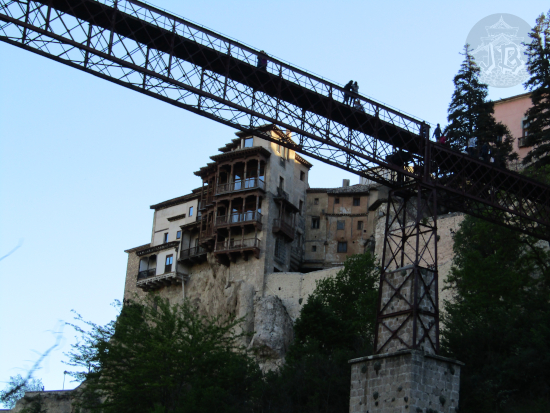
We had some time before we had to go for lunch, so the first thing we did was go have a look at the Casas Colgadas, the hanging houses that overlook the Huécar Gorge. Inside there is a contemporary art museum that I visited once already so there was no incentive to look again – you know, the kind of abstract art that showcases a plus-symbol and you’re supposed to interpret.

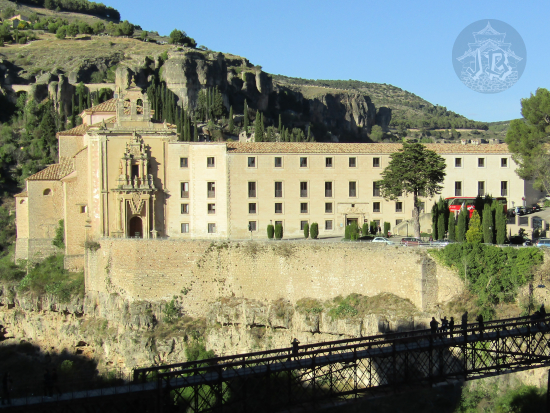
We had lunch at the Parador de Cuenca. A Parador is a high-end state-owned hotel usually with a good restaurant. More often than not, a Parador is located in a renovated historical building. This one is a former monastery, and the restaurant is located, if I remember correctly, where the original dining room would have been.

Main dishes were forgettable (and not photogenic) but the curd or “cuajada” for dessert was to die for – and it came with a lot of extra goodies.

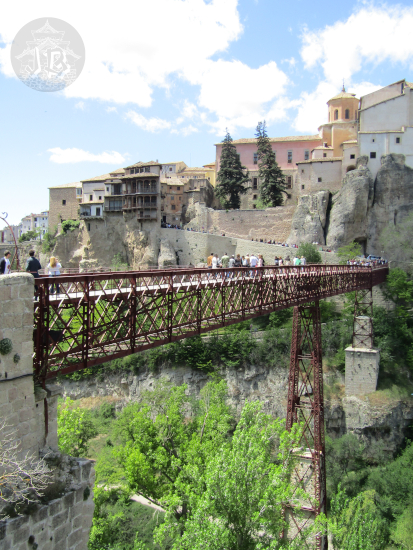
In order to get to the town centre you have to cross the scary, scary bridge aka the Puente de San Pablo, St Paul’s Bridge, over the gorge, but I survived – without a freak-out (≧▽≦) and you might be aware that I am not a fan of heights.

We had lunch, then moved (over the scary scary bridge) on to see the Museo de las Ciencias de Castilla la Mancha, the Science Museum of Castilla La Mancha – unfortunately the dinosaur area was closed, so we “only” got to see the super steampunk clock and the energy wards, and the tornado simulator, along to some kind of reproduction of the International Space Station.

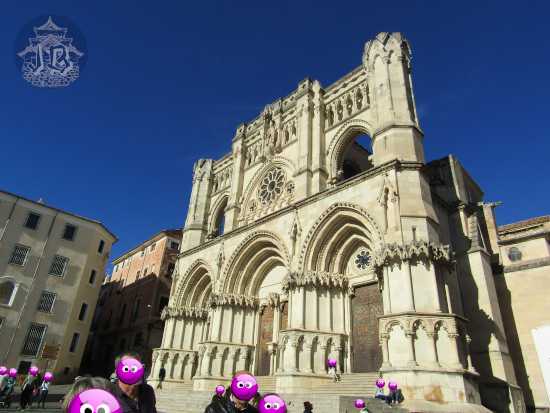
After the museum we walked a little around the town. We went to the cathedral, Catedral de Santa María y San Julián de Cuenca, but it was closed due to some religious service or another. I mean… that’s its main purpose I guess? (≧▽≦)

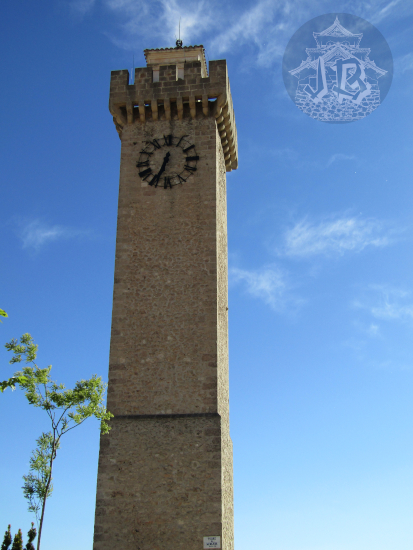
Then we found the Torre de Mangana, Mangana Tower, a clock tower dating from the Sixteenth Century. From underneath the tower there is quite an impressive sight of the area surrounding the city.

We went back to the car and we had a drive around the city. Cuenca is located in the middle of a karst area. Karst is a type of landscape formed by the dissolution of soluble rocks e.g. limestone or gypsum. You can see how the rock seems to be “molten” among all the pines.

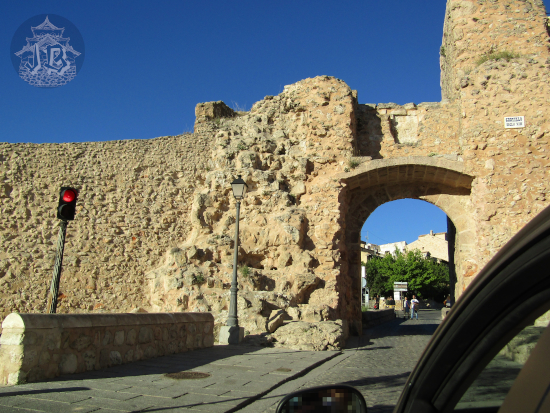
We reached the Castillo and Murallas (castle and walls) on the other side of town but we had to drive back due to the streets being cut for the same religious event we had run into before.

Thus, on our way back, we drove at the bottom of the Huécar Gorge and headed back to the hotel.

This was about six or seven in the evening, and we did not go out again because we were way outside town. We had dinner in the hotel and called it a day eventually. I ordered the kids’ menu because everything else was too fancy and abundant.

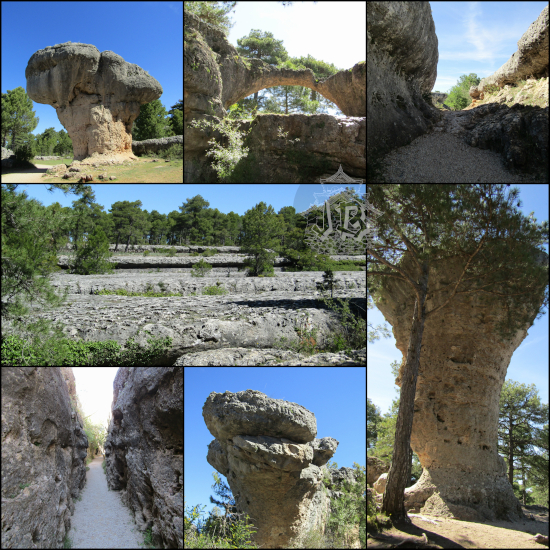
The next morning we woke up early to visit the Ciudad Encantada / Enchanted City. This is another karst topography which has somehow become very famous. Some of the rocks have interesting forms, and have been given names. It is a sort of geological park formed by rain falling on the rocks and dissolving them for millions of years. The original rocks were a mix of of limestone and dolomite in different proportions, which ended up dissolving in different shapes.

After walking around for a couple of hours we went on our return trip.

11th March 2017: “TAO: The Samurai of the Drum” show in Guadalajara (Spain)

More than a trip, this one is focused on an event I attended. There was a Drum Tao performance in Guadalajara, to which I was invited. The fun part the person who had invited me used to work at the theatre. As he still had “contacts”, I was allowed to peek a little into the backstage, so I could take a few special pictures.

There is not much of a description that you can write of a percussion performance, to be honest. TAO focuses on drumming, the Japanese taiko style, with bigger and smaller drums, but they also play traditional flutes, koto and samishen (traditional harp and three-string guitar). The show also displays a few acrobatics. It was pretty fun. In the end you could take pictures and get autographs from some of the staff members.

Aaand I own up that I did a little bit of trolling by speaking Japanese to random staff in the merchandise area…

Collage: the big drum, the back curtain reading Tao, and a CD with the booklet autographied

5th & 6th of November 2016: Barcelona (Spain) for We are X

I was supposed to have travelled to London in March 2016 to see X Japan’s concert, where they were also going to project the We Are X documentary premiere. Unfortunately, that was postponed to 2017 due to PATA’s health issues. I really hope it works out next year. However, the decision was made to start premiering the documentary in different music festivals, and the second I heard that it would be shown at the Beefeater In-Edit festival in Barcelona I got a ticket for it. Furthermore, I actually won two more tickets in a giveaway.

These two tickets I got I gave to a couple-friend of mine who had been so nice as to let me stay over at their place. I took a train around 8 am and was in Barcelona mid-morning. I went directly to their place and we just hung out until it was time to go to the Multicines Sala 5, where the documentary was going to be shown. We were actually the first and, press aside, we were the first ones in. We sat dead in the middle of the cinema and a group that walked in ten minutes later wanted us to move. And sorry, random person, but the answer is not. We were not really a “queue” but we were waiting for a couple of hours, so I was not going to give my chosen “best seat” out of the whole theatre for a group of ten people.

This was a Saturday evening, and there had already been a premier on the 1st of November so there might be more fans there, but in general I was a bit taken down by how few fans there were, most felt like people who had a whole-festival ticket.

The documentary tells the story of X JAPAN, one of my favourite Japanese bands, from the point of view of its founder, drummer and pianist Yoshiki. The band crumbled at the height of its popularity when guitarist Hide died by hanging, and the singer ended up brainwashed by a cult. Everything is told from Yoshiki’s own point of view, which makes the film biased, but still poignant.

After the film we went back to my friends’ place and had dinner. The next morning, they wanted to show me their little orchard in the outskirts, and I was treated to the best paella (Spanish rice) that I have ever had in my life – so awesome I even forgot about taking pictures! It was sad that I had to leave by 8pm, so I was only in Barcelona for about 32 hours, but it was so well worth it.

Collage showing the entrance to Multicines 5 and the Beefeater In-Edit screen before the film started

16th September 2016: Some Madrid (Spain) Museums

I woke up one morning, a silly weekday that I did not have to work for some reason and I decided to wander off and take a day trip to Madrid to see some museums, just because I could.

My first stop was the Museo Nacional de Ciencias Naturales, the museum of natural science. The museum is divided into several buildings. The first building holds the “Biodiversity” collection. This includes preserved specimens – in better or worse shape, mostly stuffed, and some skeletons.

Then I walked over to the palaeontology and mineral museum, where at the moment most of the collection is composed of replica, sometimes it feels that you see the same diplodocus or arsinoitherium (two-horned rhino) skull everywhere. Of course, however, I hunted down every megalodon tooth on site and sight.

After this, I walked around the mineral collection and walked down Castellana Avenue until Colón Square, where I had lunch somewhere before I walked around to see the Museo Arqueológico Nacional – National Archaeological Museum. There were a few things that interested me there.

My first goal was to study the Iberian stelæ . Nobody really knows what they are or what their meaning is, but it is thought that they were funerary monuments, maybe of fallen warriors.

An interesting thing to see in this museum is the sculpture of La Dama de Elche, the Lady of Elche, the limestone bust of an Iberian lady dated back to the 4th century BC. It is supposed to be a woman who belonged to the aristocracy that was later revered as a goddess, or maybe a reinterpretation of the Goddess Tanit of Cathage. The back part has an opening, which suggests that it could have been a funerary urn. It was originally polychromated, but it has lost its colours. I really like her expression, and probably due to the Hellenistic influence. I have a thing for Greek sculpture, after all.

A second “lady”, the Dama de Baza (Lady of Baza), stands next to the first. This one still keeps some of its colours. This one is full-body, also carved out of limestone, and it traces back to the fourth century too. This lady seems to have been designed in pure Iberian style, without Hellenistic influences.

The last key pieces of Iberian sculpture in this museum are the verracos – sort-of headless boars, pigs or bulls (depending on the interpretation), but it is commonly accepted that they are symbols of protection of cattle routes. Most of them are… visibly male.

Once I had seen what I really wanted to see I wandered over the rest of the museum, stumbling upon the currency exhibition, which was strangely interesting.

I walked past the Medieval rooms and then I found the Egyptian area, which is humble, but has some interesting things like the X-rays of a mummified falcon. Finally, I checked out the classical Greek area before calling it a day and making it back home.