27th August 2024: Arganzuela Greenhouse, British Cemetery and a ‘palaeontological site’, Madrid (Spain)

I have been feeling dizzy on and off these last few months, so I’m avoiding long drives – that has left me dependent on public transport, which is not too reliable. Thus, instead of all the hikes I wanted to take, I’ve been doing day trips to Madrid.

My first stop was in the district of Arganzuela. Although I’ve been to Matadero a few times before, I had never wandered to the side, where a boring-looking metal roof peeked over some trees. I recently discovered that I should have ventured beyond the brick walls that close the Matadero area. This building is called Arganzuela Crystal Palace Palacio de Cristal de la Arganzuela, and is an example of the wrought iron functional architecture of the early 20th century.

Invernadero de Arganzuela - structure

The building was designed by Luis Bellido y González and erected between 1908 and 1928 as a vegetable warehouse. In 1992, the building was remodelled – the wrought iron structure was consolidated and the original fibre cement panels were substituted by glass ones. The warehouse, 7,100 square metres, was divided into different sections, each one transformed into a different greenhouse: two for tropical plants, one for subtropical species, and the last one for desert plats and cacti. The centre has four long fountains with tiny sprouts and waterfalls. I expected a few plants to be in second bloom, but apparently that does not work for tropical or desert species?

Invernadero de Arganzuela - inside

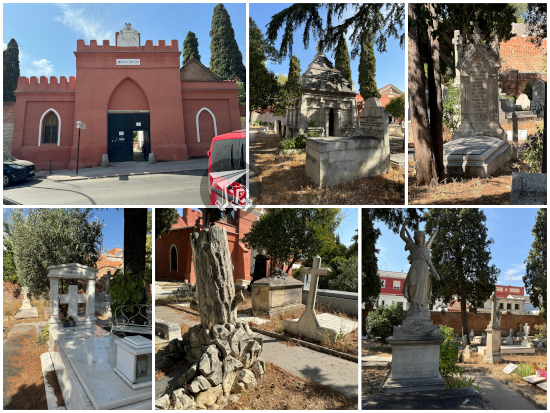
I then hopped onto the underground towards the district of Carabanchel, where I could visit an unusual place – the British Cemetery Cementerio Británico de Madrid. Around 1854, the British government bought the terrain with the intention to turn it into a cemetery, since during that time Catholic cemeteries did not accept interments from other denominations.

The burial ground hosts about 600 graves and about 1,000 tombs, most of them British citizens – but there are also Americans, Germans, Swiss and French, even some Spanish. Though it is now closed to new burials, in the 20th century it was open to non-Christians. Inscriptions on the markers are in Latin, English, French, German, Hebrew, Cyrillic and Spanish. Some of the people buried here include part of the Georgian royal family, historian Alice Bache Gould y Quincy, members of the fashion family Loewe, photographer Charles Clifford… There is also a memorial to the American soldiers who died in a plane accident. There is only one pantheon, belonging to the Bauer family – owners of an important commercial emporium in the 19th century.

British Cemetery Madrid

I have to say that the charm of a Victorian cemetery fades more than a little in the middle of the Spanish plateau’s scorching summer. Though there are several artistic markers – ever-present angels, a couple of tree trunks, and a very gothic grave – most of them are simple headstones with a cross or just a name. One of the graves asked a good question: If good things lasted forever, would we appreciate how precious they are? All in all, it was a quaint little cemetery that felt slightly out of place in the middle of Madrid.

Afterwards, I went back into the underground. The cemetery is a couple of stops away from Carpetana. On the connection, I got checked for a ticket, sort of – they were controlling that passengers had a valid ticket, and just as the train was arriving they waved me through, maybe not complaining about it and just looking for the card made me trustworthy or something? (For the record, I did have a ticket). Anyway, I reached my destination in about 10 minutes or so. When they were working on the Carpetana underground station, they found a few fossilised bones and jaws, and they have turned it into another of the spots of Museos de Metro de Madrid – palaeontological site Yacimiento Paleontológico de Carpetana. I saw reproductions a few mammal jaws and took a picture. Good thing I was close, this would not have warranted a trip from further away.

Reproduction of the prehistorical habitat of Carpetana

I had a reservation for late lunch, but I decided to cancel it. I wanted to check a shop for something I needed, and that would take me in the complete opposite direction from the restaurant. Instead, after the shop, I grabbed a Matcha Frappuchino and headed back to the train station to return home.

Starbucks Matcha Frapuccino with a lot of whipped cream

20th August 2024: The VIP treatment in Tendilla (Spain)

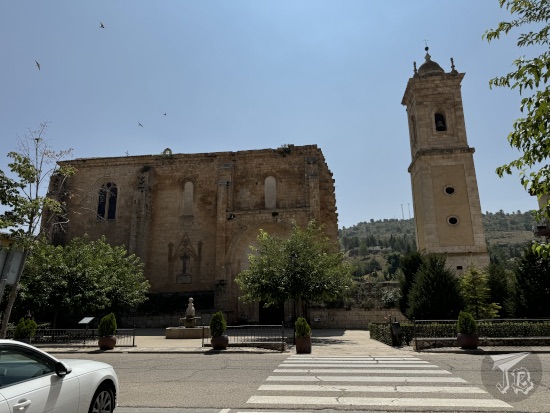
The catholic church in Tendilla is dedicated to the Assumption of Mary, thus the name Iglesia de la Asunción. It was designed in the 14th century CE, financed with money from the Mendoza family, one of the most important clans at the moment. It was projected as a great work, possibly the biggest church in the area – though Tendilla is a tiny hamlet now, it was an important villa during the Middle Ages, and the counts that ruled the enclave were very invested in it.

Church of the Assumption of Mary in Tendilla

The church was never finished – construction went on and off until the 19th century, when it was finally given up. Only one tower was erected, though two were projected, and this bell tower is separated from the building by a patio. The open area is actually a part of the nave that was not built in the end. The interior was decorated with a Baroque altarpiece, which still stands today.

Though still in use, the church has been gravely affected by time. The façade has greatly deteriorated in the last thirty years or so. The false floors have started collapsing and the roof is in dire need of repairs. The village is working on raising funds for a renovation.

A couple of relatives are very involved in the process, and at some point they offered to show me the inner areas of the church. I accepted, and was given the real VIP tour – they opened the church just for me too!

The temple is mostly Romanesque in style, aside from the Baroque altarpiece. The modern altar has been refurbished in marble. The altarpiece is golden wood, Baroque with columns, paintings and sculptures. To both sides of the altar, there are small rooms, connected to each other underneath the altar stairs. One of them has been transformed into the sacristy, the other one used to be an office, but now it is not in use because the floor is collapsing. Behind the altar, these two rooms give way to spiral staircases that ascend to the upper spaces, called La Gloria – Glory – and El Infierno – Hell – both of them unfortunately very abandoned and covered with pigeon excrement, feathers, rest of nests, and even dead pigeons. We climbed up to the Glory, but the Hell staircase is a bit unstable and crumbly, so we did not get far on that one. I scared the hell out of a pigeon though – it was mutual.

Church of the Assumption of Mary in Tendilla

Church of the Assumption of Mary in Tendilla

I climbed to the choir for a couple of pictures, and then we went up the bell tower together. It was a bit thrilling to do so, because I’ve seen that tower very often, but never gone up. It was all in all really cool – especially being alone and allowed complete freedom of pictures, including lightning and flash.

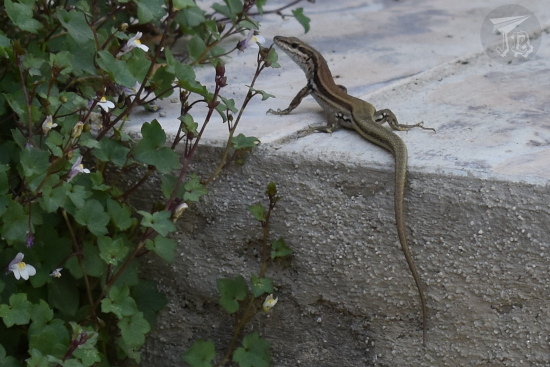
Afterwards, we went to the family home and had lunch. Later, in the yard, we “hunted” for the local fauna, including wasps, damselflies and wall lizards.

Wall lizard

Damselfly

11th August 2024: A road trip with three stops around Madrid (Spain)

Just like I kept trying to book a visit to the hall at Pacífico, I had been after a Burrolandia timeslot for a while. Burrolandia reservations are free, and the “tickets” are released around 9:00 on Monday mornings. I did not want to go in the middle of the winter as it is an open place, but when the weather became nicer, I was never around to book a spot before they ran out. Nevertheless, the Madrid area gets rather empty in August, so I could finally secure a visit. Once that was taken care of, I found myself facing another issue – after the pandemic, I developed a literal hay-fever, and straw makes me feel rather miserable. I’ve got tablets for that, but I should not drive after taking one.

Thus, I roped my sibling into driving for the day, because they are a fan of everything equine.

The non-profit Burrolandia – “Donkeyland” – is an animal protection organisation. It was founded in 1996 as a sanctuary / rescue for retired donkeys, mules (offspring of a donkey stallion and a horse mare) and hinnies (offspring of a horse stallion and a donkey mare, or jenny). Donkeys (Equus asinus) were domesticated from the African wild ass some 6, 000 years ago. There are millions of donkeys in the world, most of them kept as working animals in developing countries – however, as machinery substituted them, the number of donkeys in Europe plummeted. Burrolandia is involved in maintaining the species and the different Spanish sub-breeds.

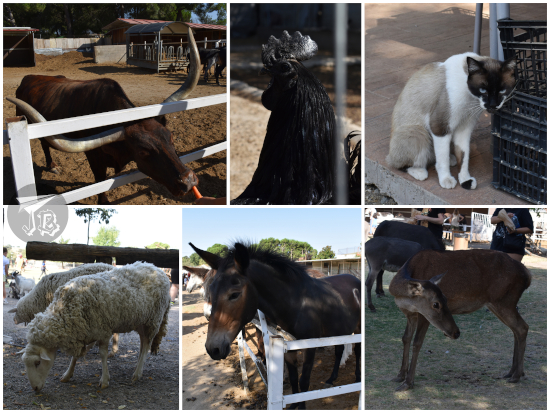
The rescue is located at the end of a pretty run-down road in Tres Cantos, a municipality so close to Madrid that it could be a neighbourhood. The venue itself is mostly an open area where the resident animals get to interact with visitors, many of them freely. Besides the donkeys, mules and hinnies that the association has taken in, there are horses, a pony, goats, sheep, pot-bellied pigs, hens, geese, ducks, peafowl, helmeted guinea fowl, a deer doe, an ankole-watusi cow, a few dogs and a cat. Burrolandia is open to the public on Sundays, usually in two two-hour turns, one at 10:00 and the other at 12:30. Visitors can buy a bag of goodies to feed the animals for a nominal price to support the non-profit, get merchandise, or directly donate.

Donkey, goat, hinneys and mules, horse

Cow, black rooster, cat, sheep, hinney, deer

There are fewer visitors in August and it was easier to get tickets and for the day, there was only one long timeslot from 10:00 to 14:00. We arrived a few minutes after opening time, and I was surprised at how high “low demand” actually was. There were maybe twenty to thirty cars already there, with a ton of families with toddlers and kids going nuts about… the dogs, in most cases. Most kids were terrified of donkeys, though they were smaller than I had imagined. I would have expected them to be closer to a horse size, so I think that most of what I grew up considering “donkeys” were mules. Live and learn…

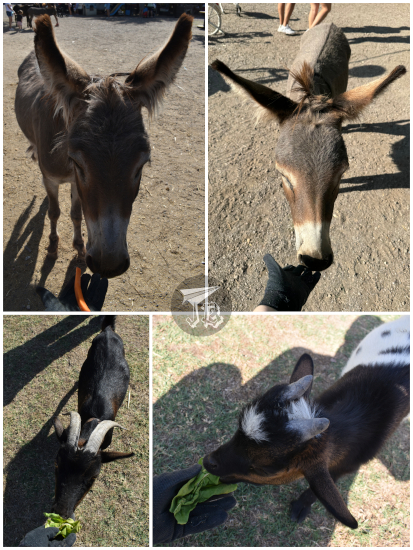
Burrolandia bans bringing food for the animals – both to control what the animals are fed, and as fundraising tool. We bought a bag of veggies, which contained mostly carrot, celery, some lettuce and a piece of dry bread. The donkeys, goats and sheep were all ambling outside, but most the mules, hinnies and horses were in “donkey jail” behind the fences. You could still feed them though, but they are bigger and possibly less docile than the smaller donkeys which roamed free. They were all very acquainted with the brown paper bags with the treats though, which made them very friendly. In general, I was reminded more of the Okunoshima bunnies than the Nara deer, even if one of the mules did get a bite out of my finger, and the baby goats kept trying to climb onto us. My sibling had the great idea to use some of their riding gloves to pet and feed the animals.

Feeding donkeys and goats

We stayed for about an hour and a half, and then moved on to Las Rozas de Madrid, another village in the area known for nothing except for the high-end “open shopping mall”, a street full of outlet brand-fashion boutiques selling discounted items. I had heard on and on how fantastic Las Rozas Village was. There are specific bus tours from Madrid that take tourists to the mall and back.

We parked the car in another shopping centre, Heron City Las Rozas, where we changed clothes and shoes because… we did not trust ourselves with the barn smell. We walked into the Village, and I don’t know what I was expecting, but for sure something with a big more… grandiose I guess. To my surprise, the shops were almost empty (both of produce, and customers) and every second shop was a Scalpers… I have to say I was quite underwhelmed. We did not even find a nice place to grab a bite to eat. Furthermore, I heard at least three other people commenting the same thing – they had heard a lot about the mall and it was disappointed.

Entrance to Las Rozas Village

We ended up having lunch back in Heron City Las Rozas. We found a Japanese chain restaurant named Sumo, a sort of buffet with a flat rate for a number of dishes. Since it was still quite early – and again, August – the place was mostly empty – we had sushi, takoyaki, wakame salad, and some gyoza. As dessert was not included, afterwards we went to Starbucks to have a matcha drink, named after a House of Dragon character for some publicity stunt – Dracarys Matcha Frappuccino. It was a cold matcha latte with white chocolate cream on top, to which I added some vanilla, just because I could, and it was a great idea. I think the matcha with strawberry cream on top was a better combination, but apparently that one was only available in spring. I guess I’ll have to try the standard Matcha Frappuccino at some point.

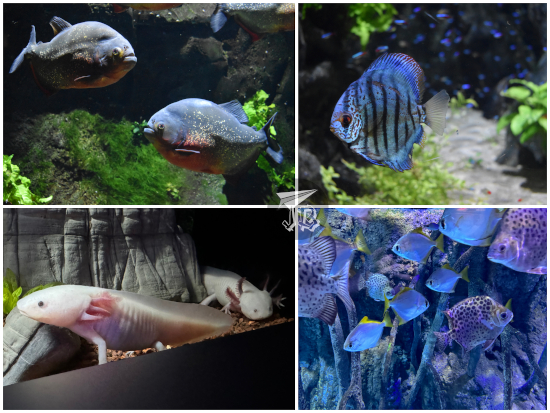
We went on to our last stop for the day. Xanadú is a shopping mall in Arroyomolinos, home to Atlantis Aquarium Madrid, a smallish oceanarium. Upon entering, you go down some stairs, and the first area are Rivers and Mangroves, with some mudskippers, and cute shiny fish. Actually, the first tank the visitor encounters hosts a shoal of red-bellied piranhas (Pygocentrus nattereri). Of course, there are a few axolotls (Ambystoma mexicanum) too.

Piranhas, discfish, axolotl, mangrove fish

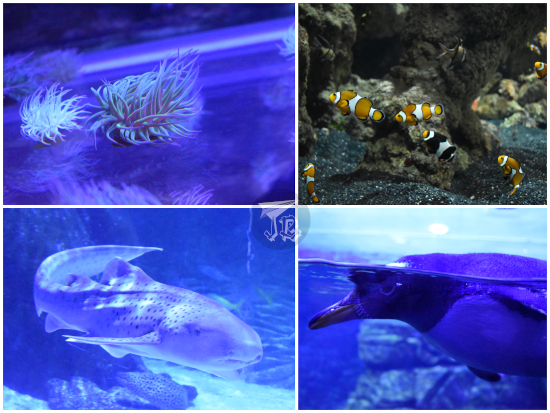
Then come the Mediterranean anemones, jellyfish, starfish… Afterwards are the Tropical Reefs with the usual suspects – who does not try to find Nemo among the clownfish? There are also butterflyfish, surgeonfish, and of course all the corals. The Open Sea area, a typical central tank, has few species of sharks – blacktip sharks, grey reef sharks, bonnetheads, longtail carpet sharks… There are also rays and loggerhead sea turtles. In between the different views of the central tank are the penguins, which were pretty photogenic! The last area had a few small tanks with Coastal Ecosystems – anemones, sea cucumbers and hermit crabs mostly. Staff had put out some glass shells for the latter to move into, which was fun.

Anemones, clownfish, shark and penguins

Atlantis: hermit crab and sharks

The gift shop had a lot of cute souvenirs, and afterwards we walked around the rest of the mall for a while, had a smoothie, and eventually drove off. It was a good day, with lots of cute animals, some of which I even got to pat. Not the sharks, sadly, but I made a lot of donkey friends, even if they only liked me for my vegetables and stale bread.

8th August 2024: The Museums in Moncloa (Madrid, Spain)

It’s quite hot out there, but I decided to hit a couple of museums in Madrid. A few months back, I got a card for the national museums, thinking I was getting a better deal than I did. Though it is true that you can get enter (most of) the national museums for free, you have to ID yourself, so you still have to queue, which is what I was expecting to avoid. However, it has at least pushed me to try and see a couple of museums I would not really visit (or even be aware of!) otherwise.

There are two museums in the district of Moncloa-Aravaca, an area I’m not usually around. One, I was curious about. The other is one I would not have even considered without the card: the Costume or Fashion Museum and Ethnographic Heritage Research Centre Museo del traje. Centro de Investigación del Patrimonio Etnológico (CIPE). It is a collection of pieces of clothing, textiles and accessories from the 17th century onwards, and I’m sure it is amazing if you know anything about fashion… which I don’t. The museum is organised chronologically, with a few pieces from the Middle Ages, then fabrics, costumes and complements since they became a thing.

There is also a collection of traditional outfits from different regions throughout Spain. The visit finishes with some of the big names in fashion, including Coco Chanel, Balenciaga, or Christian Dior. There was also an area for visually-impaired visitors, which allowed them to touch mannequins and fabrics from different style periods in history.

Costume and Fashion Museum Madrid

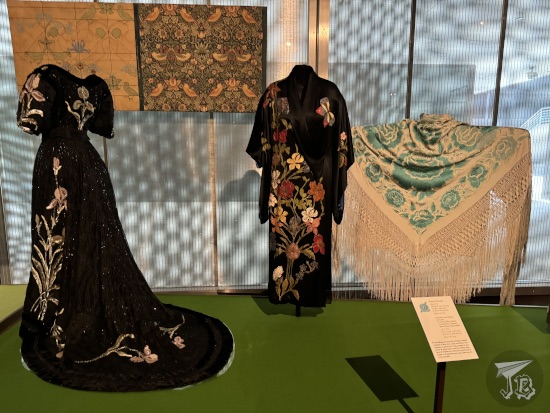
They were running a temporary exhibition called Vistiendo un jardín (Wearing a garden). It deals with the nature and flowers in fabric and costumes from the Baroque period onwards. They were in the middle of a guided visit so there was a big group, and I could only have a quick walk.

Wearing a garden Temporary exhibition

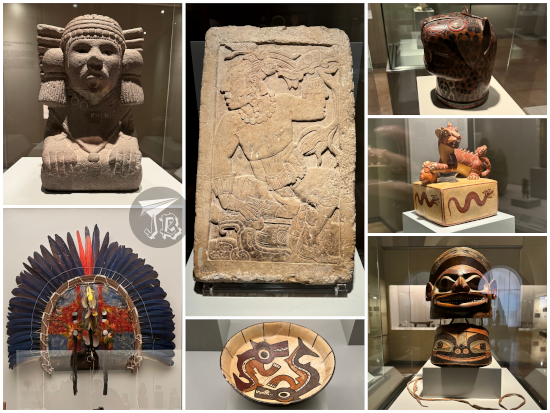
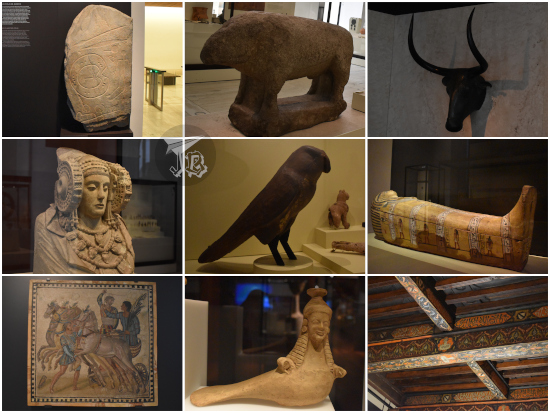
I walked over to the museum of the Americas Museo de América. The institution exhibits archaeological and ethnographical artefacts from the Americas, alongside art from the Palaeolithic period to the present, with a strong presence of Colonial art.

The origin of the collection was the Royal Cabinet of Natural history that Charles III had established in 1771. The collection increased with objects brought from discovery expeditions and Spanish colonies in America, especially those unearthed during archaeological excavations. In 1815, the science artefacts from the cabinet were integrated into what became the National Museum of Natural Sciences, and in 1868 the antiquities, ethnography, and art were transferred to the Museum of Archaeology. In 1941, the American artefacts were transferred to the newly formed museum. A more recent source has been that of donation and legacies.

Nowadays, the collection comprises around 25,000 artefacts and about 2,500 of them are exhibited – though the most important ones are copies due to “conservation issues”. The archaeological artefacts include Mayan, Inca, Aztec, Nazca, Amazonian, and even from North American native cultures who lived in what we now call the Great Plains or Alaska. The Colonial art pieces mostly include religious art and what is called pintura de castas, which tries to represent the appearance and daily life of the peoples of mixed race, descendants of European, African and Indigenous inhabitants of the colonies. There is also a ward dedicated to modern art and social criticism against colonisation. I found the organisation of the museum a bit strange, by theme areas instead of time-and-place.

Artefacts from the Museum of the Americas

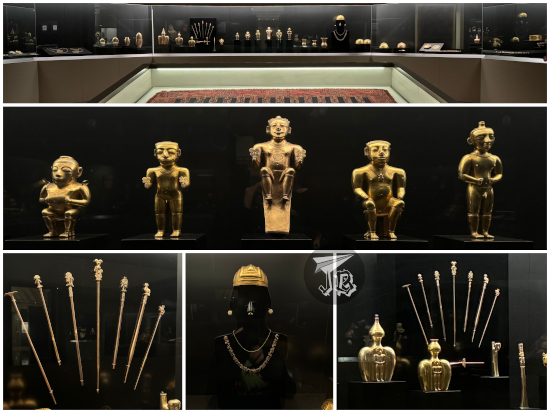
Arguably, the most important group of pieces that the museum exhibits is the so-called Tesoro de los Quimbayas (Quimbaya Treasure). The Quimbayas were a small indigenous group from precolonial America, who lived south of what is now Medellín, Colombia. They were known for their works in gold and an alloy of copper and gold called tumbaga. The treasure comprises 122 pieces, which represent about one fifth of the original findings. It is believed that the belonged to two sets of grave goods, and dates from the 5th or 6th centuries CE. The treasure was dug up during the Colombian gold fever, when archaeological items were sold for their weight in gold. The artefacts include figures, crowns, jewellery (nose- and ear-ornament, necklace beads, pins, pendants), containers, ceremonial vessels and poporos (used to keep coca leaves for religious ceremonies), and musical items such as bells.

Quimbaya treasure

I actually had been thinking about staying in Madrid and do something else, like the observatory known as Faro de Moncloa, which is literally next to the Museum of the Americas. Or a nice themed restaurant or something. But it was ridiculously hot and I just did not feel like it. It was early for lunch too, but by the time I got anywhere cool, it would be right in the middle of the rush. So I just went back into the transport system. Of course, the train was delayed. I need to stop planning around the official train schedules, especially around food times…

27th July 2024: Staying inside in Madrid’s heat (Spain)

I was so excited when I found tickets for the historical hall at Pacífico station that I did not stop to think I had booked for late July, at 16:00, in Madrid. The heat wave was an extra, but even without it, the Spanish central plateau is not precisely known for its mild summers. However, the hall only opens once a month, and not every month, and I had never been able to find a ticket on a weekend I could go, so honestly – when I saw these tickets, I did not think about the weather, just… that I could come.

The day came, and Madrid had a heat alert. It was around 37 ºC, and I thought I would stay inside, and just head out for the visit. Unfortunately, since trains are being horrible, I needed to take one with at least an hour’s berth to make sure I reached the underground station Estación de Pacífico. When I arrived, I looked around to finally realise that the hall was at the actual platform, warded off by a very modern nondescript door. I had brought a book to pass the time, because I knew I would either have a lot of time, or I would be stressed because the train was late. I found a bench and settled down to wait somewhere I could keep an eye on the door. Visitors are not directly admitted into the hall, but they are cleared at ticket control on the other side of the platform, then go back all the way to the entrance. In our case, we waited for a bit, and the guide decided to head through the platform right as a train arrived, so everything was full. Spanish logic.

The former hall Vestíbulo de Pacífico is part of the network of Underground museums Museos de Metro de Madrid. Until it was walled off in 1966, it was the entrance to the station Estación de Pacífico, built in 1923 when the underground Line 1 was extended towards the south-west. The passengers climbed down a now-disappeared staircase and crossed the hall, which still had natural light. On the other side, there was some sort of metallic bridge with another set of stairs to access the platforms.

The station used to be part of a huge complex owned by Metro, which also comprised offices, control rooms, and the warehouse that housed the engines that created energy for the trains to run on. At the time, it was an unpopulated area, so land was cheaper. Today, most everything has been replaced by apartment buildings and only the station and the nearby Nave de Motores remain.

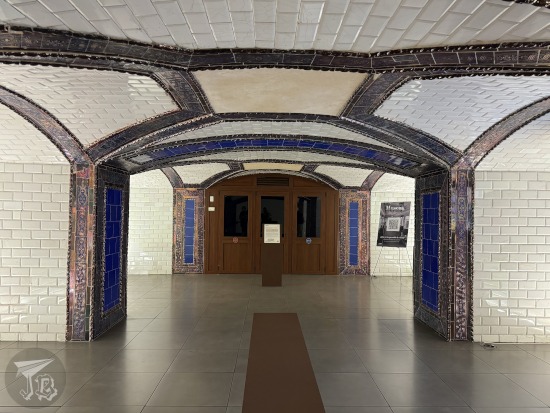
The whole complex was designed by architect Antonio Palacios, and the hall was built in white tiles with blue decoration – a homage to the Pacific Ocean, which gives the station its name. The hall is tiny by today’s standards, barely 119 square metres. It has three vaults that used to have skylights for the sun to light up the hall – now those are closed off as the street above them is busy. The station was renovated in the 60s so it could accommodate the longer trains, new accesses were built, and the hall closed down. That renovation was the same that made the station Estación de Chamberí close, and apparently another hall that has been uncovered in Ventas.

The hall was bricked away for almost half a century, until restoration work started in 2007. It took ten years, as budget was low and the process was labour intense – 60% of the hall had to be rebuilt. However, the final product is really good, you can see the newer tiles if you look for them, but the whole thing feels extremely well preserved. Even the staircase, which was built to access the hall after the iron bridge was destroyed, feels time-appropriate. A replica of the original doors was put up.

Pacífico Booking Hall

And right when I have seen all the five Underground museums that require appointment… I find out there is a passport of them – Pasaporte de Pasaporte de los Museos de Metro. Just my luck! Then again, maybe Metro will take these articles as proof of visit and backstamp me for them?

The visit took about one hour, then I rode the underground back towards Atocha, and bypassed it to the next station. I had decided to try my luck with the queue at modern art museum Museo Nacional Centro de Arte Reina Sofía, part of the national network of museums covered by my card. To be honest, I do not enjoy modern art that much, so I have been putting off this one visit. However, the museum holds a piece by Pablo Picasso that has become quite socially loaded – Picasso’s Guernica, which I have always thought I ought to see at least once.

Pablo Picasso (1881 – 1973) is considered one of the most important artists of the 20th century. He was co-inventor of collage, co-founder of Cubism, and inventor of the assemblage (basically, collage in 3D). He painted, sculpted, and made prints, ceramics and theatre sets. I have never connected much, if at all, with the kind of art he was making. I do not really understand the limits he broke, nor whatever he wanted to express. That is why I wanted to see this artwork in particular – to try to understand.

Arguably Picasso’s most famous painting is Guernica (1937). During the Spanish Civil War, German planes bombed the Basque town of Guernica, in the north of Spain, to aid the Nationalist army. The town was destroyed, and up to 300 people lost their lives – the raid opened the northern front for Franco to reach Bilbao. British reporter George Steer wrote a scoop on the event after he witnessed the destruction, and his reports made waves internationally. Picasso, who lived in France at the time, had been commissioned a piece of artwork for the Paris World’s Fair by the Republicans (at the time the rightful government of Spain). Upon reading the news, he scrapped his original idea and painted the Guernica instead.

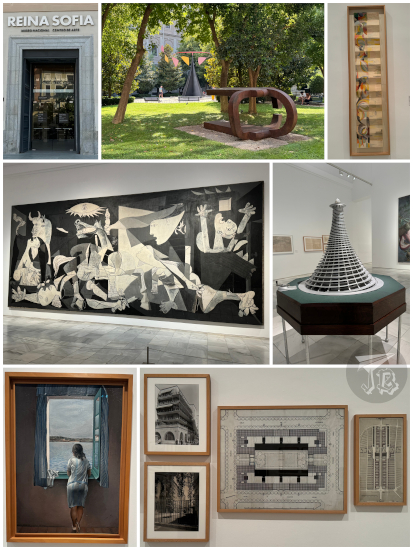
The painting is one of the most important artworks that the museum has. It is a huge piece, in black and white, showing the carnage. As most men were out in the battleground, the majority of victims were women and children – along with a dead soldier, a horse and a bull, most of the figures in the pairing represent women and horror. I honestly find the description of the painting more chilly that the artwork itself.

One kind of feels that the museum itself as built as a huge sarcophagus for the Guernica, and other pieces are there just to fill up the space. A sculpture by Eduardo Chillida is exhibited in the gardens. There is also a space about architecture, with blueprints and photographs, including artwork by Le Corbusier. Other artists whose work is shown include Salvador Dalí, Joan Miró, Alexander Calder… Actually, I enjoyed the museum more than I thought, as I expected only abstract art that I would not understand. I enjoyed the blueprints and photographs of buildings, and the actual building too.

Exhibits at Museum Reina Sofía

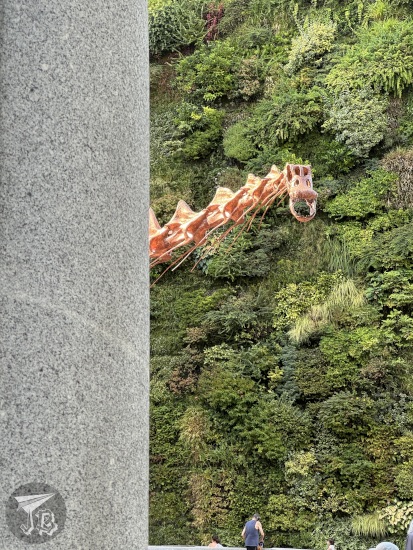
I then headed up Paseo del Prado to find one of the local cultural centres. I was ridiculously amused when I reached the corner where CaixaForum stands. I was on my phone, and when I looked up, I saw the Patagotitan “looking” at me. It gave me a laugh.

Patagotiatan at Caixaforum

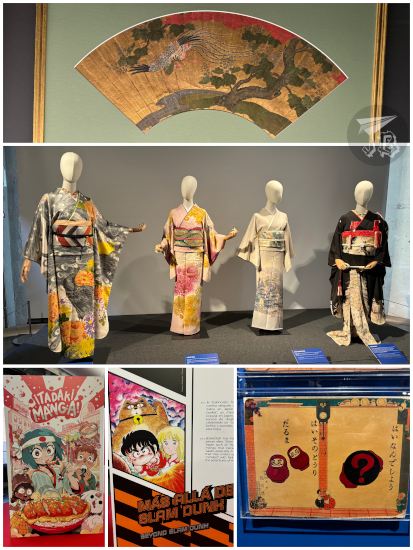
The cultural centre Serrería Belga is running a Japan-themed exhibit, divided in parts:

  • Kinpaku. Naturaleza, poder e imaginación en el arte japonés (Kinpaku: Nature, power and imagination in Japanese art): Kinpaku [金箔] refers to gold leaf artwork, often used in decoration in classical Japanese culture. A private collector has lent their items to exhibit – windscreens and fans, all painted in gold, so they can be enjoyed by everyone.
  • Kimono, identidad cambiante: un siglo a pie de calle (Kimono, changing identities: a century on the streets): Kimono [着物] is the traditional Japanese clothing – one that unlike many others is still common wear. There were twenty of these, including accessories.
  • Expokon: A series of panels discussing different hits in sports manga and derivatives.
  • Japan International Manga Award: Panels drawn by the Spanish artists who have won the awards in different years.
  • Kamishibai: Kamishibai [紙芝居] is (was) a form of Japanese street theatre using a small paper theatre with pictures to tell the stories. There were several sets of stories, some classical, some more modern.
  • Manga Kids Academy: A few panels showing Japanese school life through manga and anime.
  • Itadakimanga!: A series of panels showing different foods popular in manga and anime.
  • Gêmu: cultura visual y videojuego japonés (Gēmu: visual culture and Japanese video games): Some items regarding video games, and even a few arcade machines for playing.

Japanese exhibits at Serrería Belga

The exhibits were part of Madrid’s summer cultural program, which has named Japan “Guest Country”. They were a few cute little exhibits, and they were free too, so a good way to complete half a day trip. I headed back to the station afterwards, to wait for whichever train came, and I was lucky enough that one was there in a couple of minutes – I even found a good seat on my way back.

And I have finally seen the hall at Pacífico, which has been a goal since April 2023. Now I just have to figure out a way to obtain the passport and have it stamped…

21st July 2024: From the Sea to the Butterfly (Madrid, Spain)

When planning for the day, the one thing I did not count on was the heat wave. I did take into account problems with trains, but apparently a half-hour delay is a non-issue by now and not worth mentioning. I reached Madrid around 12:30, and I had a reservation at 13:00 for a themed restaurant which had caught my eye when I saw it online. It was honestly a big disappointment, though I refused to let it ruin my day.

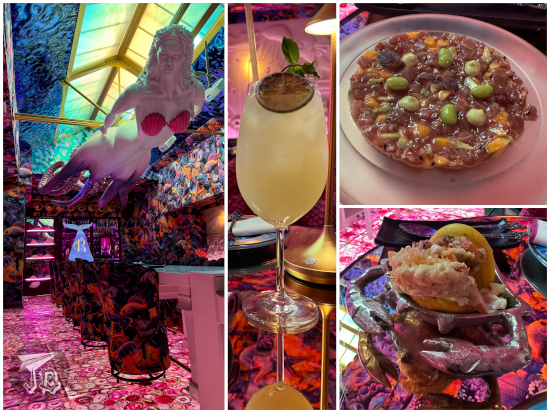
The restaurant is called Bestial, and it is ocean-themed. The pictures were awesome, it looked super cool, and I was pretty excited to go there. However, the experience was mediocre at best – I guess solo travellers are not their target audience, and it showed. As I was mainly ignored, I could watch how the restaurant worked. The waiters got the tables mixed up a few times, and they allowed others to take pictures with cocktails that were not theirs – that was weird, and I am pretty sure that against health code. I ordered a lemonade – the best thing – a tuna tartar and a crab bao without coriander, after checking that the coriander could be taken out. The tuna was tasteless, and the bao did have taste… coriander. All in all, I was not impressed by the food, even less by the service. Between the two dishes there were about 35 minutes waiting, and after an hour I just gave up and asked for the check, which was brought in a little book… and dropped halfway, then picked up from the floor… I just paid – the meal was not cheap – and left without dessert. A pity, really, but I really did not care any more.

Restaurante Bestial by Rosi La Loca

It was ridiculously early for my 16:00 visit, but I wanted to try my luck. I had chosen that day because CaixaForum Madrid was running two exhibitions that I wanted to see – Patagonian dinosaurs (which had just opened) and The Science of Pixar (which would end soon). The exhibition centre was booked out, so I could not sneak in before my time slot, but I managed to get my most burning question answered – how on earth were they going to fit a Patagotitan inside CaixaForum? Answer: they did not. They placed it outside, which was a fun surprise!

Patagotitan skeleton in front of CaixaForum Madrid

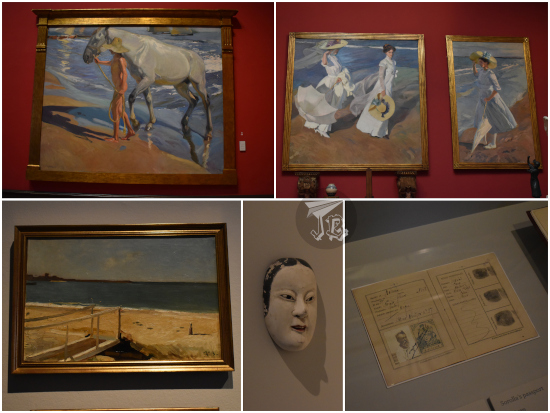
Since I had about an hour and a half, I decided to trot over to the painting museum Museo del Prado, part of the national network of museums, which I can access with my one-year card. I thought I might be luckier and the queue to enter without a reservation would work better. Indeed, I did not have to wait indeed, and I could have a look at a few of the masterpieces the collection holds (though not take photographs) – Francisco de Goya, Joaquín Sorolla, Diego Velázquez, Esteban Murillo, Fra Angelico, Hieronymus Bosch… Of course, not all the masters, because El Prado is enormous. It is also air-conditioned, and surprisingly, not as full as I half-expected. There was a queue when I came out, so I guess it worked out well!

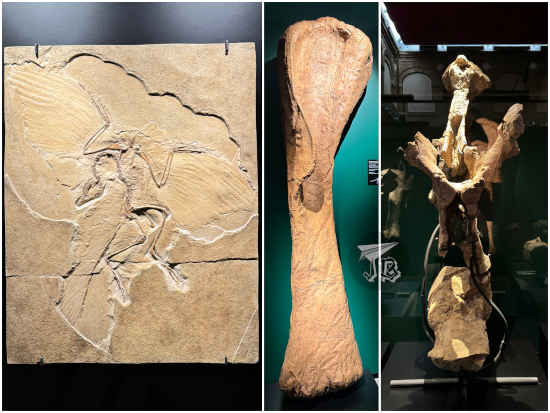
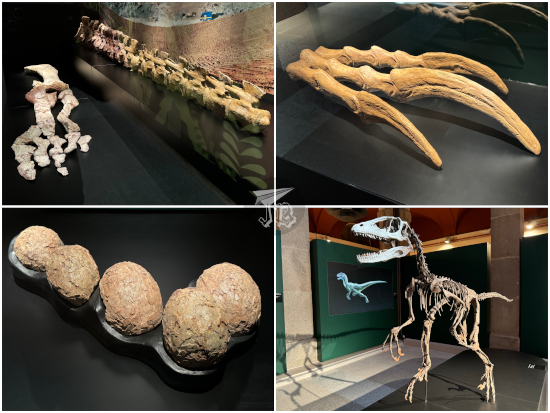
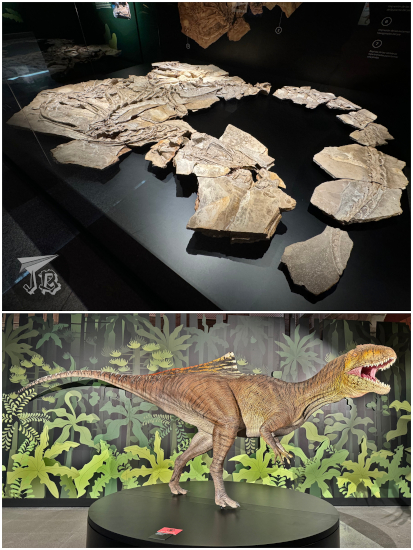
I walked back to CaixaForum Madrid to see the two exhibitions I had booked. It was a bit before 16:00, but this time I did not ask, and just walked into the first exhibition – “Patagonian Dinosaurs”: Dinosaurios de la Patagonia, which had very little new information, and even fewer actual fossils, but a lot of dinosaur reconstructions. Those were cool. Aside from the Patagotitan mayorum placed outside, there were full skeleton replicas of Herrerasaurus ischigualastensis, Eoabelisaurus mefi, Leonerasaurus taquetrensis, Eoraptor lunensis, Condorraptor currumili, Brachytrachelopan mesai, Amargasaurus cazaui, Tyrannotitan chubutensis, Neuquensaurus australis, Carnotaurus sastrei, Gasparinisaura cincosaltensis and Manidens condorensis. There was also a Giganotosaurus carolinii skull. As for the real thing, a femur, a shoulder plate and a forelimb of Patagotitan, some teeth and vertebrae and a few invertebrates and leaves. It was really cool, and not extremely crowded for a dinosaur exhibit in summer. It was only the third day of the exhibit, so maybe it was not that well publicised yet? Out of the new species I discovered, Amargasaurus was my favourite – with the neck spikes it looked exactly like I would have imagined a dragon.

Patagonian Dinosaurs

Patagotitan front and back legs, along with a huge shoulderblade

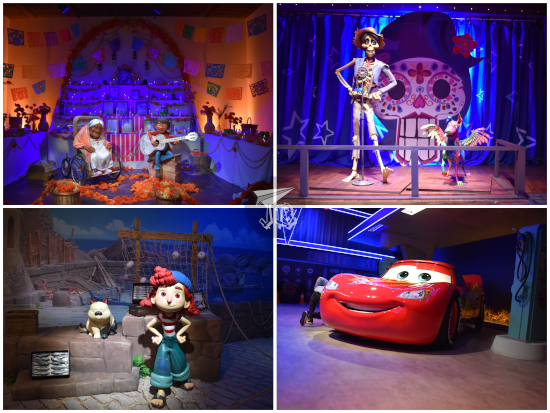
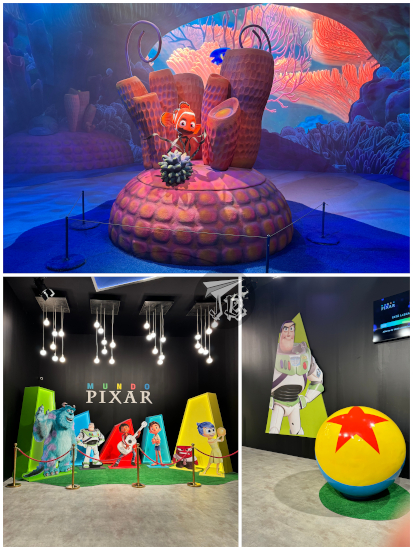
The other exhibition that ran at the time was “The Science of Pixar”: La Ciencia de Pixar. It felt like a nerdy companion to Mundo Pixar, focusing on the maths and the process to create a Pixar film. Unfortunately, it was bustling with kids who – understandably – just wanted to smash buttons and make things light up. The exhibition had a lot of cool machines which simulate the different steps of creating a computer-animated film – rigging, modelling, lighting, rendering… The most interesting was an analysis called “What colour is this pixel?” taking into account movement, lights, shadows… It must be amazing to be able to visit the exhibit alone and be able to play with all the computers. I did find one where you get to simulate crowds using shoals of fish (from Finding Nemo) and I played with that for a while. There were also a few life-sized models from several films, miniatures and 3D mini-sculptures.

La Ciencia de Pixar

I left the venue after browsing the shop, and I walked down towards the theatre. It was still early, and I wanted to hit a couple of shops. Actually, I wanted to go to what is commonly known as the Primark flagship shop. The building Edificio Gran Vía 32 was originally erected in the 1920s to host the first department store in Madrid, Almacenes Madrid-París. It was designed by architect Teodoro de Anasagasti and used the most modern technology and materials at the time – reinforced concrete in the avant-garde style. The whole interior is built around an octagonal lightwell with a central staircase, and today the lowest four floors have been turned into the Primark shop, which has fitted screens and lightings while keeping the previous structures and railings. The modernisation project was undertaken by architectural studio RCCyP and it took three years until the shop opened in 2015.

Interior of Edificio Gran Vía 32

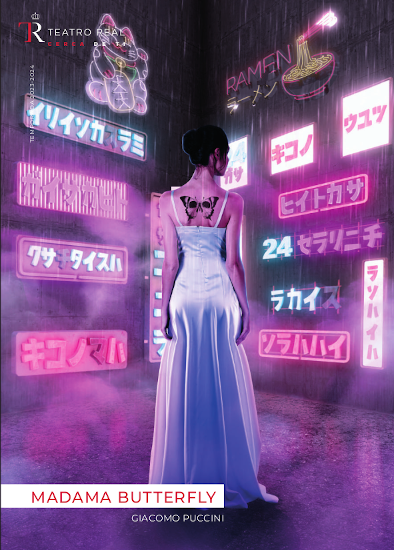
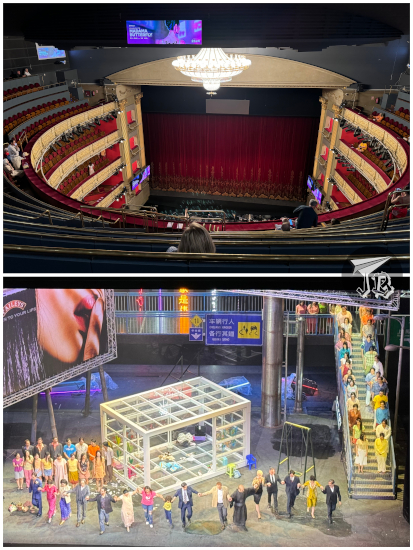
I continued off towards the theatre Teatro Real. I had a bit of time and some unspent calorie budget, so I decided to splurge at Starbucks with a whipped-cream Frappe for my pre-show snack. For the same price I had awesome third floor for Carmina Burana, I had a fifth-floor-in-the-back paradise ticket now. However, it was a lone seat with a great view, so I am not going to complain. I was going to watch the opera Madama Butterfly by Italian composer Giacomo Puccini – and sometimes I think that the better the singers are, the worse time I have with this show.

Madama Butterfly Promo

The main character is Cio-cio, a name that when pronounced in Italian sounds similar to 蝶々, [Choucho], butterfly in Japanese. When she is 15 years old, in 1904, Cio-cio marries an American navy man, Pinkerton, who intends to leave her and find a ‘decent’ American wife. Cio-cio is repudiated by her whole family when she converts to Christianity for her marriage. Three years later, she is alone, almost bankrupt, the mother of Pinkerton’s child, and a marriage broker is trying to sell her off to another prospective husband. Pinkerton returns to Japan with his American wife, who agrees to raise the child, but he cannot face Cio-cio because he is a coward. She (spoiler alert) prepares their son to go with him, then commits seppuku.

And even a bigger spoiler alert, I hate Pinkerton. Viscerally. My parents tried to start me into opera way too young to understand plots, I feel, and I did not want to do anything to do with it for a long time. However, at one point I wanted to see Madama Butterfly due to it taking place in Japan – being older helps, and I slowly learnt to appreciate the musical genre. Basically, by hating on Pinkerton.

Apparently, Teatro Real is known for its alternative settings and takes on classical operas. In this case, they let go of the old Japanese cottage in order to use… a modern-ish undisclosed Asian country. There was an overpass with Chinese signage, a billboard with McDonald’s and Bailey’s spoofs in Japanese (that did not make any sense), and the traditional cottage was exchanged for a greenhouse of sorts. There is a scene in the traditional opera in which the characters fill the house with flowers. In this case, they coloured the glass panes with hand paint. It was a great show.

Cast:

  • Cio-Cio-san: Ailyn Pérez
  • Suzuki: Nino Surguladze
  • F.B. Pinkerton: Charles Castronovo
  • Sharpless: Lucas Meachem
  • Goro: Moisés Marín

Artistic team:

  • Musical conductor: Nicola Luisotti
  • Stage direction: Damiano Michieletto
  • Set design: Paolo Fantin

Madama Butterfly Teatro Real

The show finished around 22:20. I walked up Arenal Street towards Sol. While I missed my first train because some people love to take up space while walking slowly, I made it for a good connection at Atocha, and I was actually home before midnight.

6th July 2024: O fortuna! (Madrid, Spain)

A couple of days before going to London to see Kamijo, I found out that a local music non-profit was staging Carmina Burana by Carl Orff in Madrid. Buying tickets (for that, and the upcoming opera Madama Butterfly) broke havoc with my credit cards, but everything was eventually fixed – I think. It had me stressed at the beginning of that trip, but it seems to be finally fixed. Again. I did have to miss Swan Lake in London because the credit cards would not go through.

Anyway, I had my ticket and though I would have loved to spend the day out, I was too ridiculously tired to take a whole day of sightseeing. Furthermore, the place I wanted to have lunch out was not taking reservations since they broadcast sports, and there was some big match or another. Yes, I want to go somewhere that defines itself as a sports bar, but that’s a story for another day (like the time I thought I could go to a sports bar during the Olympics because “Oh, well, there’s nothing sporty going on, right?”).

I thus decided to head off with a small pre-show plan, which turned out to be a great idea. When I alighted from the train station, the streets were clear for the Pride parade – I do not think I have ever seen the area surrounding Estación de Atocha so empty. I walked towards the theatre Teatro Real, but my first stop was the underground station of Opera, home to one of the Underground museums Museos de Metro de Madrid. Unlike the others, this is only tangentially related to the underground system itself – it is an archaeological museum, hosting an ancient fountain, part of an aqueduct, and the remains of a sewer.

King Felipe II made Madrid the capital of Spain in 1561, and aside of some brief periods of strife, it remains so to the present day. That has implied a lot of changes through history – among them, the destruction of the city walls, and the construction of an aqueduct to provide the city with water. When the court moved there, the villa of Madrid was little more than a village whose population skyrocketed in a couple of years. The new city needed services as it grew.

One of these was the fountain called Caños del Peral (literally something like “Peartree faucets”). The fountain was 34 metres long and it channelled water from the stream that ran down what is now Arenal Street. It was built in local limestone, had six faucets, and it probably was the largest fountain in the area where it was built in the late 1500s – the outskirts. Ironically, today it is quite close to the centre of the city, even the middle of Spain, the so-called “Zero Kilometre” in the square Puerta del Sol.

Fountain Caños del Peral

The fountain was destroyed during the reign of José I (Joseph Bonaparte, Napoleon’s brother, who was installed as king of Spain between 1808 and 1813). Caños del Peral, along with the buildings around the square, were demolished and used to fill the gorge that until then had separated Madrid in two. And in that filled gorge it was discovered in the early 2000s during works to refurbish the underground station of Ópera. Further works uncovered the sewer from the same period, a structure that channelled black waters away from the drinking streams for sanitation.

Sewer at el Arenal

The aqueduct Viaje de Amaniel was built around 1615 century to bring clean water to the Royal Palace, and with time it also supplied other properties. The infrastructure was heavily remodelled in the 18th century, after the Royal Palace was rebuilt into its current form after the fire that destroyed the original alcázar.

Section: Viaje de Amaniel

As I was coming out from the little museum and the underground system, I noticed a display reading that the underground / train station that I needed after the show was closed “until end of service”. Which was good to know beforehand, since I had time to replan my route – the trains were a mess in the evening due to Pride, and a few stations being closed off for crowd control. I grabbed a snack at the local Starbucks and headed into the theatre.

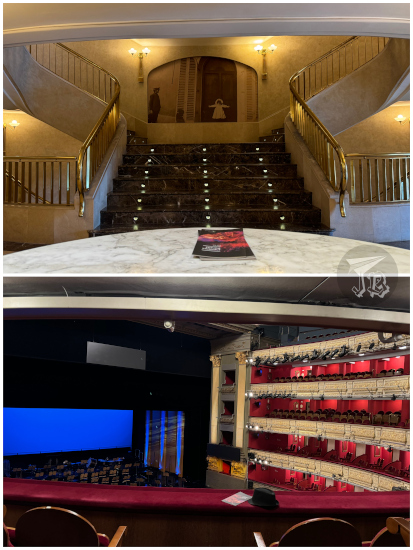
The Royal Opera of Madrid Teatro Real opened in 1850. It was originally designed by José Manuel González-Valcárcel, though it has been widely renovated, with the latest iteration dating from 1997. It is considered the most important venue for performing and musical arts in Spain – despite having been closed for decades at a time. Curiously, the theatre has the shape of a coffin – at first, I really thought that was my imagination, but apparently it is not only real but intentional.

Teatro Real: stairs and interior

I had found really good tickets, first floor next to the Royal Booth – for the same price, I would later get a fifth / sixth floor ticket for Madama Butterfly. The repertory had been put together by Fundación Excelentia, a non-profit foundation dedicated to promote and divulge lyrical heritage and musical values.

Carmina Burana Promo

Programme:
  First part:
  1. Beethoven: Egmont. Overture: Sostenuto, ma non troppo – Allegro
  2. Beethoven: Symphony No. 8 in F major, Op. 93
  Second Part:
  3. Carl Orff: Carmina Burana

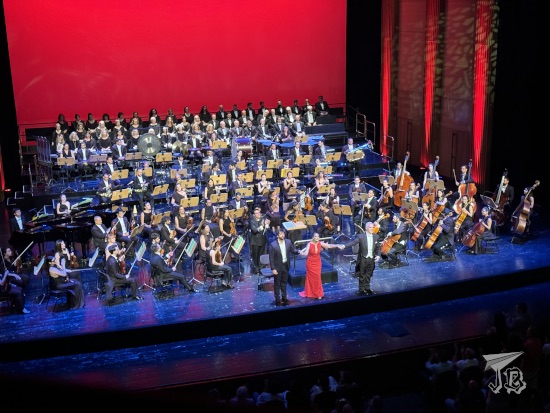
The show was conducted by Juan Pablo Valencia and interpreted by the orchestra Orquesta Clásica Santa Cecilia, the choir Sociedad Coral Excelentia de Madrid, soprano Rocío Martínez, baritone Manuel Mas and countertenor David Miranda.

Ludwig van Beethoven (1770? – 1827) is considered one of the most important figures in Western music. Born in Germany, his works bridged the classical and romantic periods in classical music. His works are amongst the most performed in the world, even though he began losing his hearing halfway through his career. He composed Egmont around 1810 for a full symphonic orchestra, and Symphony No. 8 in F major, Op. 93 in 1812. The Symphony has four movements: Allegro vivace e con brio (F major), Allegretto scherzando (B flat major), Tempo di menuetto (F major), and Allegro vivace (F major). I am not the biggest Beethoven fan, to be honest, but it was good. The conductor had a great time.

My main reason to be there was the second part of the show: Carmina Burana (Officially Carmina Burana: Cantiones profanae cantoribus et choris cantandae comitantibus instrumentis atque imaginibus magicis which translates from Latin as “Songs of Beuern: Secular songs for singers and choruses to be sung together with instruments and magical images”, quite a mouthful). German author Carl Orff (1895 – 1982) composed the cantata between 1935 and 1936. Most of the lyrics are in Latin, though there is a bit of old German and even old French. The cantata has 25 movements based on 24 Medieval poems, with the first and last movements being the same: O fortuna, which happens to be one of my favourite choir pieces ever. There is one instrumental-only piece, and all the others have vocals – for choir, soprano, baritone and countertenor.

The twenty-five movements are organised in sections, which are officially five, but divided as:

  • Fortuna Imperatrix Mundi (Fortune, empress of the world): 1. O fortuna (Oh, fortune), as I mentioned, I love this choir; 2. Fortune plango vulnera (Regret for the wounds of fortune).
  • I. Primo vere (In spring): 3. Veris leta facies (The joyous face of Spring); 4. Omnia Sol temperat (All the things are warmed by the sun); 5. Ecce gratum (Behold the welcome)
  • Uf dem anger (In the meadow): 6. Tanz (Dance), the only instrumental movement in the cantata; 7. Floret silva nobilis (The noble woods bloom); 8. Chramer, gip die varwe mir (Monger, give me a coloured paint); 9a Reie (Round dance); 9b Swaz hie gat umbe (Those who dance around); 9c Chume, chum, geselle min (Come my dear companion); 9d: Swaz hie gat umbe reprise; 10. Were diu werlt alle min (If the whole world were mine)
  • II. In taberna (In the tavern): 11. Estuans interius (Seething internally); 12. Olim lacus colueram (I once swam in lakes) – this is the piece the countertenor sang, and I am not completely sure the guy was drunk, or playing drunk. 13. Ego sum abbas (I am the abbot); 14. In taberna quando sumus (When we are in the tavern)
  • III. Cour d’amour: 15. Amor volat undique (Love flies everywhere) I have to admit that I did not love the soprano, who sang for the first time at this piece – she sang well, but too low, it was difficult to hear her at times; 16. Dies, nox et omnia (Day, night and everything); 17. Stetit puella (There stood a girl); 18. Circa mea pectora (Inside my chest). 19. Si puer cum puellula (If a boy with a girl). 20. Veni, veni, venias (Come, come, please come) – these are the same lyrics that Final Fantasy VII’s theme for Sephiroth, One-Winged Angel has, and looking at the translation, now I understand why it was never intended to be the psychotic mass-murderer theme… 21. In trutina (On the scales); 22. Tempus est iocundum (Time to jest); 23. Dulcissime (Sweetest lad)
  • Blanziflor et Helena (Blancheflour and Helen); this refers to the romance story of Blancheflour and to Helen of Troy. 24. Ave formosissima (Hail to the loveliest)
  • Fortuna Imperatrix Mundi: 25. O fortuna (Oh, fortune)

All in all, it was a great experience, and I had a privileged seat. I really enjoyed the show, as it was expected from something at the Teatro Real. The gentleman next to me slept through the first part and hummed along the second, which was weird. The soprano’s voice was too faint and she tended to sing towards the other side of the theatre, making it hard to hear her, but the baritone was good. The choir was fantastic, and the percussion musicians had a perfectly choreographed exchange of positions to play all the small parts which was really amusing to watch. Especially one who hugged the gong to quiet down the reverberations.

Artists after the Carmina Burana Show

When I came out the theatre, I headed off towards the underground system and reached the train station, which took over 20 minutes – normally, I would have just walked to Sol and take the first train there to connect faster, and stay within the same system. As Sol was closed, this was not an option. When I arrived at Atocha, the platform was almost overflowing as the trains were running with long delays. I think I took a train that should have passed through around 22:30… at 23:00. I was not sure everyone would fit in the train, to be honest. Good thing that they announced a second one for a few minutes later. I made it home past midnight, took a shower and crashed because it was hot – Spain in July. What else is new?

30th June 2024: Engines, illusions, history and tea (Madrid, Spain)

Since finding about my tea time outings, my sibling had been wanting to tag along to one. I was asked to organise something for the weekend that involved either Chinese hotpot or afternoon tea in Madrid. The hotpot place was booked out both days, but I found an afternoon tea opening on Sunday the 30th. I am too lazy to move out just for tea, so I organised a bit of a day out.

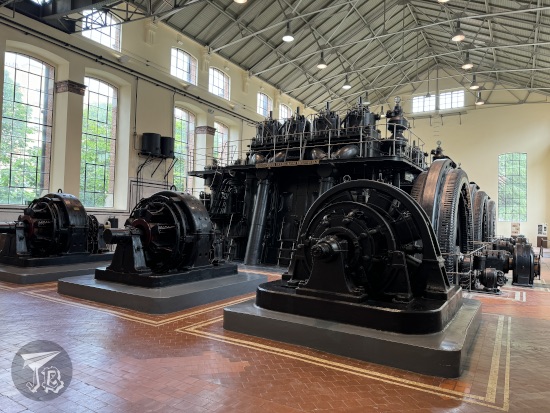
After an uneventful train ride, our first stop was at noon: Nave de Motores de Pacífico, the former energy centre that fed electricity to the original underground lines. Today, it is not in use and it has become part of the network of museums Museos Metro de Madrid. The warehouse was built by Antonio Palacios between 1922 and 1923 to home the diesel engines, transformers and fuel that single-handedly powered the underground system before the Spanish Civil War. The system was actually in place until 1972.

Warehouse containing the old underground engines

The building was erected in red brick, with white tiles inside, decorated with Palacio’s typical metallic green. The floors are ceramic tiles, and the engines are three monstrous vessel-powering pieces of engineering. These diesel engines created electricity, which then entered the transformers, and was sent to the power lines to feed the trains. At night, the excess was sold to the local street-light network.

Since we were going for afternoon tea to El Jardín de Orfila, where I have been before, I knew lunch was out of the question. However, we needed a snack. I planned that at Yatai Market, an… Asian food court of sorts. A number of stands come together to offer different cuisines and snacks, even full-sized meals. We tried a Chinese bao each and a couple of dim sums. I ordered a hoisin duck bao which was extremely yummy. I will definitely come back to try other stuff.

HotBao Yatai Market Cortezo

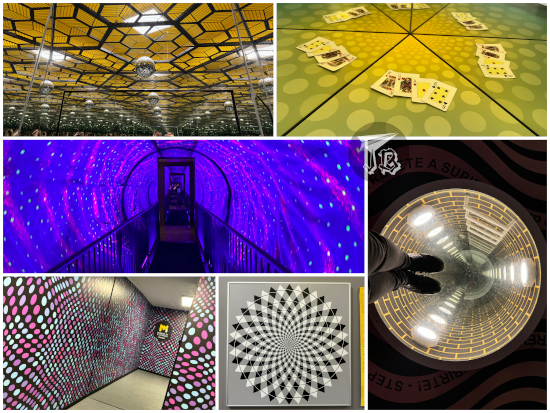
Afterwards, we headed off to the so-called Museum of Illusions. This museum is a compendium of optical illusion and installations designed to fool the brain into believing things that are either wrong or just not there: a distorted room so you look big in one corner but small in the other (Ames room), a vortex where you seem unable to walk straight, a rotated room, a room full of mirrors – there were a lot of illusions with mirrors actually – stereograms with hidden images, turntables, holograms…

We had a reservation for 14:00, and I was surprised at how chaotic entry was. I mean, they’ve been running the thing for a while now, someone should have figured out how to do crowd management, but no. Then, there were kids running and screeching all around, but it calmed down after a while. I had really hoped that the museum would be calm and half-empty at lunch time, but it was not so, not by a long shot. It was interesting though, and pretty fun.

Museum of Illusions Madrid

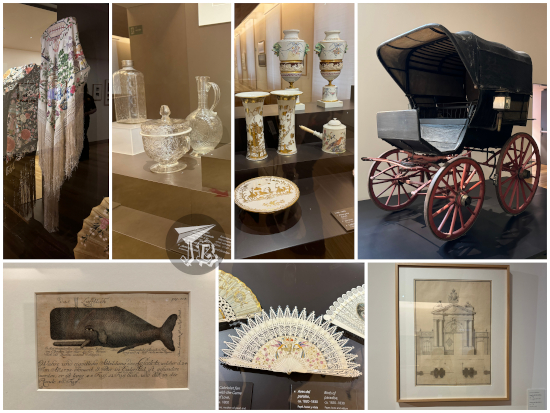
However, the experience was shorter than I had calculated, so I had to improvise an extra stop. Thus, we entered the local history museum Museo de Historia de Madrid, which tells the city’s history since Madrid became the capital of Spain. There are paintings, models, typical costumes, plans, maps, and Playmobil sets depicting of the uprising against the French in 1808. The museum is hosted in a former palace-like building which was actually built as a hospice. To the side stands the original Baroque chapel. It also has a lovely garden with a monumental fountain, which was relocated from its original place for conservation.

Museo de Madrid exhibits

Museo de Madrid - chapel and fountain

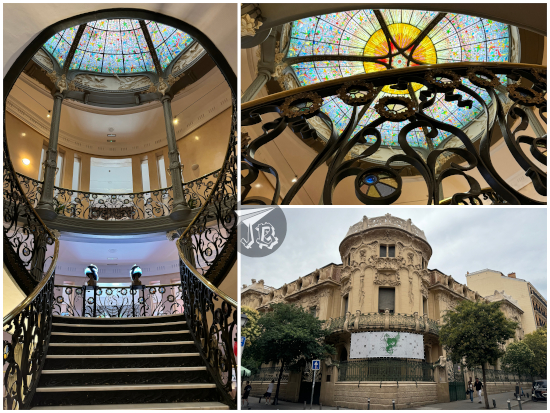
We spent some time there and then headed off to the building that now holds the office of the Copyright Owners’ association, a manor known as Palacio de Longoria. It was designed by José Grases Riera and built between 1902 and 1904. It is one of the few actual Art Nouveau buildings in Madrid, possibly the most important one. The façades were made in artificial stone, with sculptures and shapes resembling vegetation. I’ve wanted to visit it for a long time, but it is only open when there is an exhibition, and the stars had never aligned – until this time. There was an exhibition about urban music, and I was not going to let go of the chance to see the monumental staircase and the skylight.

Longoria Palace

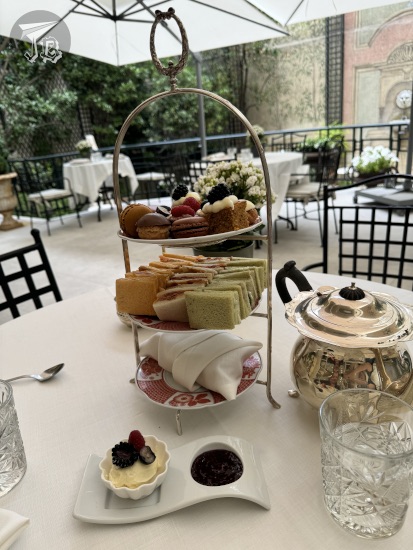
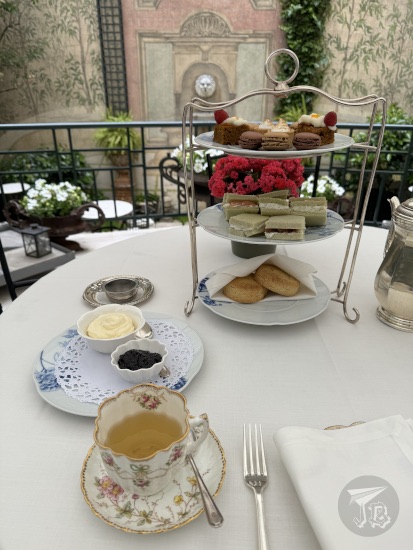
We finally set off for afternoon tea at El Jardín de Orfila. Out of the several places I’ve tried afternoon tea in Madrid, this has been my favourite to date. The outside garden is lovely, but mostly, their scones are the best around.

We ordered green tea, and the snacks were finger sandwiches – smoked salmon and cheese cream, classic cucumber and cheese, pastrami – pastries – carrot cake, macarons, lemon curd – and the scones. This time round, I decided to eat the scones after the sandwiches in order not to be full when it was their time. The afternoon was pleasant, but we shared the terrace with another table, and later a loud lady who wanted a smoke. That broke the magic a little, but the tea was fantastic and the scones were great.

El Jardínde Orfila: tea serving for two

Afterwards, we just headed for the train station to get back to our places. Of course we missed the correct one since they run whenever they like. What else is new? But the fun part was being able to pull a fun day out from my sleeve, and it was not stupidly expensive either, so good fun, all in all!

22nd June 2024: Roman ruins in the Cuenca region (Spain)

This was actually the second try for this road trip. We (read: my parents) chickened out the first time because there was a slight storm chance. Since they were organising the day, I did not complain either time. I just stayed home when it was cancelled, and happily tagged along when it was carried out.

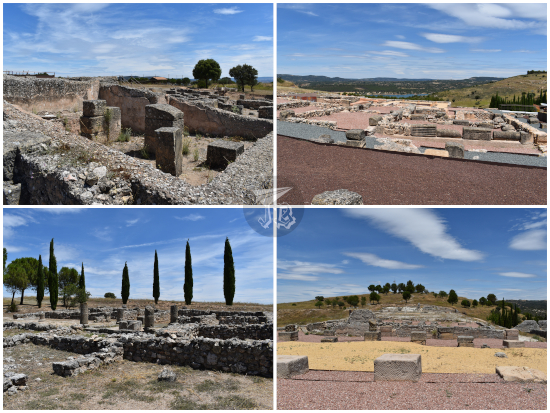
My parent’s curiosity was piqued upon learning that a bunch of archaeological sites were free until the end of 2024. I might have been responsible for that information, but to be honest I thought nothing of it at first. They randomly asked if I knew Recópolis, and I mentioned having visited it as it was free for the year. Thus, on the 22nd of June – a few weeks later, and on the second try – with a forecast temperature at noon of 31 °C and sunny, we set off around 7:30 towards the Roman villa Villa Romana de Noheda. The villa belongs to the hamlet Villar de Domingo García, and it was discovered in agricultural land by sheer chance, as it often happens. The complex was a farm and noble residence in use between the 1st century BCE and the 4th century CE, but it had been abandoned by the 6th. While most of the villa is gone, and not even half-excavated, the floor of the main house has been dug-up. It is covered by what is said to be the largest figurative Roman mosaic in the world, and it can only be visited with a guided tour.

The mosaic would have been in the room used to receive guests, the atrium. Right in front of the main door, the mosaic tells the story of Pelops and Hippodamia. In this mythological tale, the oracle told King Oenomaus that he would be killed by his son-in-law. Thus, whenever a suitor came to ask for his daughter Hippodamia’s hand in marriage, he would challenge them to a chariot race. If they lost, they would die – this happened 18 times until Pelops came along and Hippodamia fell in love with him. For his race, Pelops received a chariot drawn by winged horses from the god Poseidon. He then offered Oenomaus’ charioteer, Myrtilus, half of the kingdom, and a night with the princess, in exchange for his help to win the challenge. Myrtilus sabotaged Oenomaus’ chariot, and the king was killed during the race. When Myrtilus tried to collect, Pelops threw him off a cliff, and before dying, Myrtilus cursed the couple’s lineage. Several of their descendants were protagonists in myths of disgrace, madness and war – such as Agamemnon, Menelaus and Orestes.

Noheda mosaic

In the middle of the room there would have been a fountain or a pool, and the mosaic surrounding it has water fauna motifs. To the sides, there are representations of male and female actors of charades. On the final side there’s a double mosaic, meaning there was a refurbishing project and a new layer of tiles was laid over a previous one, both showing different geometrical designs. There is also a parade of gods and goddesses, and the representation of the myth of Paris. Paris was chosen to judge who among the goddesses Hera, Aphrodite or Athena was the most beautiful by giving her the Apple of Discord. Each goddess promised him a reward, and he chose Aphrodite, who offered him the most beautiful mortal woman: Helen of Sparta, King Menelaus’s wife. Paris and Helen ran away, Menelaus tried to recover his wife, and the whole episode lead to the Trojan War – Menelaus was one of Pelops and Hippodamia’s descendants, so one could say that Myrtilus’ curse was at work, and the mosaic was in continuity.

Noheda Mosaic

The villa really has nothing to see besides the mosaic, so we moved on. The trip to the next spot should have been around 20 minutes, but I do not know whether we got lost, or the Sat-Nav really, really overestimated the quality of the roads. Almost an hour later, we finally made it to Ercávica, a former Roman city in the tiny municipality of Cañaveruelas that overlooks the reservoir Pantano de Buendía. It clicked then that I had been thinking about getting there before but eventually dropped it in favour of other plans.

Before the tour through the ruins, we were shown a cave where a hermit-abbot, Donato ‘The African’, lived and died, and some graves excavated in the rock. The abbot lived in the 6th century, and after he died, his followers wanted to be buried around him. He actually managed to build a monastery, but everything is gone – and excavations cannot be carried out as it is in private property.

Ercavica cemetery

The Roman city of Ercávica was built around the year 179 BCE, as a new settlement after the Romans defeated the Celtiberian tribes in the area. The new dwellers were granted citizenship of the Empire, which made the city grow as neighbouring towns were abandoned and people moved there. The city reached its greatest splendour during the 1st and 2nd centuries CE, but it declined after the 3rd until it was abandoned in the 5th century CE.

There is not much left of the city but its foundations, a few centimetres of wall above ground, and some of the underground structures, such as cisterns and a small sauna – where a number of bats had made its home. The guided visit took about two hours, from noon to 14:00. It was hot and sunny, and besides the layout of the town, there was not much to appreciate – or did I get too picky after Pompeii? There were some remains of painting left, which was cool until the guide said they were printed reproductions glued on top the real ones. Bummer.

Snapshots of Ercávica ruins

There is what they call a volumetric reconstruction of one of the houses, to give you an idea of how big it would have been, and a lot of walking around up and down the hill. There are also some good views of the reservoir. Nice seeing the whole thing at least once, but I would not put it on my to-repeat-when-possible list. I could have done without the sunburn though.

Buendía Reservoir from Ercavica forum

However, my parent had planned the road trip this way because it could be combined with lunch in a famous restaurant, Casa Goyo in the village of Alcocer. It is not a particularly good place, but it has made a name for itself by serving enormous portions. The most famous dish is the sanjacobo – a type of schnitzel cordon bleu with two fillets of pork wrapped around slices of cheese and Spanish ham, then breaded and fried. It is actually better than it sounds. Casa Goyo’s sanjacobo is 2.5 kg of meat. Quite a lot. I tried to tell my parent that combining it with a salad was too much, but they did not want to listen – which in the end it meant that I came back home with about half of the sanjacobo to consume at a later time. Unfortunately, that meant cutting the time to explore Alcocer short – to none. It was probably too hot anyway.

Sanjacobo at Casa Goyo

All in all, three experiences unlocked that I don’t think I ever need to repeat again. The best one was the mosaic, but I do not think Ercávica was worth the heat nor the roads. Nevertheless, I am glad that I could see both Roman ruins at least once. I however stand behind the idea that the cloudy day would have been better…

31st May 2024: Santa María de Huerta & Medinaceli (Spain)

For the last few years, I’ve tried to do (or visit) something cool on my birthday, especially when it fell on a long weekend. In 2024 I could not plan anything big despite the long weekend,. Instead, I broke it off into a small outing with my sibling and a little road trip. There are a couple of places not too far away that I wanted to see, but the roads are not so great. One of my parents is keen on driving anyway, so they were happy to oblige, and I could get away with not driving the curves myself.

Our first stop was the Cistercian monastery Monasterio de Santa María de Huerta. The Order of Cistercians are a Catholic religious order. A group of Benedictine monks founded the new order in 1098, as they wanted to strictly adhere to Rule of St. Benedict, and felt that the other had “relaxed” too much. Cistercian monks are credited with creating very “pure” churches as they believed that ornamentation was superfluous and distracting from prayer.

The monastery is located in the village of Santa María de Huerta, which actually grew around its walls at the side of Jalón River. The building dates back from 1162, though the order had been in Spain for two decades at the time. Most of the building was erected halfway between Romanesque and Gothic styles, with some add-ons from more recent times, mostly the Herrerian cloister and a Baroque altarpiece – which distorts a little the idea of the “pure Cistercian lines” and no extra decoration. But then again, I am not a fan of Baroque decoration.

Entry is from the side of the church to the Gothic cloister Claustro de los Caballeros, around which all the dependences can be accessed. The first one is the church, the first area to be built. There are still some of the original paintings, and a baroque organ. The monks’ refectory is the most important room, built from 1215. It has large pointed-arched windows which allow light to come in, and it is communicated with the kitchen. There is a second refectory, more Romanesque, for the lay brothers who took religious vows but were not actual monks. The last cloister, in the Herrerian style, is severe and impressive. As we were leaving, there was a black out, not sure what that could have meant…

Santa María de Huerta Monastery

We went back to the car and we drove towards the town of Medinaceli, which has a couple of monuments I wanted to see. Reputed for dating back to Roman times, it has a free-standing arch Arco Romano de Medinaceli, the only one in Spain with three arches. It is a triumphal arch built in reddish sandstone during the first century, at an altitude of 1200 m, where it rains, snows, and so. It feels like a miracle that a small structure (around 13 metres long, eight metres high and two metres wide) has withstood two thousand years.

Medinaceli: Roman triumphal arch

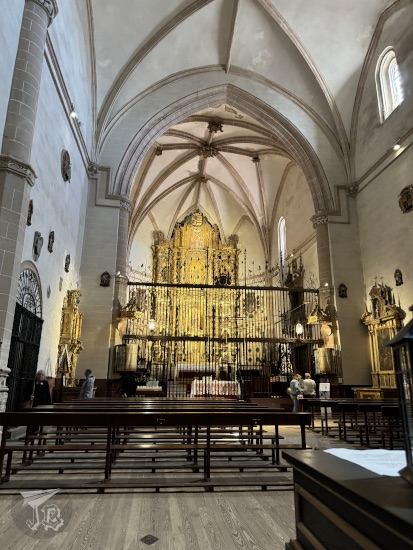
We saw the collegiate church Colegiata de Santa María de la Asunción, built in a late Gothic style. Artistically, the most important item is the iron grating in front of the altar. Religiously, there is a figure of Christ, which is called Cristo de Medinaceli, a wooden sculpture from the 16th century (though the most famous sculpture with that name is in Madrid). It was a little underwhelming, and most of the sculptures were not pretty.

Medinaceli: Collegiate Church

Afterwards we visited the main square of the village Plaza Mayor de Medinaceli. To one side stands a 16th-century building called La Alhóndiga, current town hall and former prison, with rounded arches on the ground floor and a balcony all along the façade on the first floor.

16th Century commercial building turned into town hall

To another side, the palace of the former dukes Palacio de los Duques de Medinaceli, which was saved from the ruin turning it into a semi-private art gallery. Inside, the most important part is the Roman mosaic. The palace was built around 1430, and today only the Renaissance yard stays undisturbed. I am not a big fan of modern art, so I just can say that some of it was colourful and pretty. The entry ticket included entrance to a rural-house-turned-erotic-art-exhibition which… was weird. The whole house was painted pink, and the works were neither interesting and nor felt artistic at all. So 10 bucks to in the end see a Roman mosaic was a bit steep.

Medinaceli Duchate Palace

We decided not to stay in town for lunch, but – almost in a bit of a joke – we drove off to have lunch at what is probably the most iconic roadside restaurant in the centre of Spain – Área 103, a brasserie that is over 125 years old. It includes a small hermit-church built for truckers, Capilla de los Conductores.

Drivers' chapel, Area 103

It might have not been a glamorous birthday, but hey, along with the escapade on Tuesday, I guess I spent it doing what I like – discovering new things.

28th May 2024: Architecture and a niche restaurant (Madrid, Spain)

I was talking to an acquaintance whose child likes superheroes – so does the acquaintance, actually – about Comic Planet. After exchanging experiences, they mentioned that their spouse also enjoyed another thematic restaurant, and I decided that it could be a fun thing to do – and since they don’t take reservations for one, I roped my sibling into tagging along. And of course, since we were braving the horribly-working trains, I felt we should fill the day out. We could not leave early in the morning as I would have liked because I had this stupid bureaucracy appointment I had to get out of the way first.

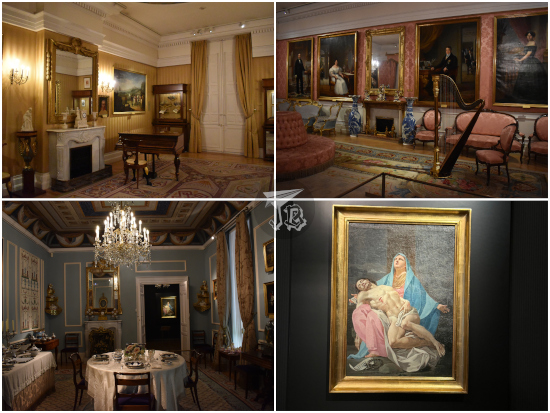
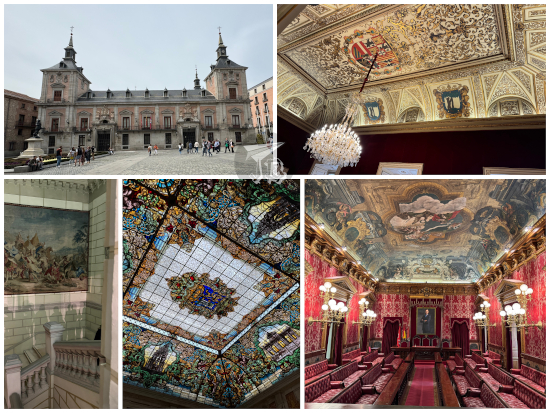
We arrived in Madrid around 12:30, and our first stop was the Casa de Correos, an iconic building in the middle of the square Puerta del Sol. I did not even know you could just visit that building, nor that they ran exhibitions. It was a cool opportunity to check it out. Furthermore, the exhibition was actually something that I was quite keen on – the architect Antonio Palacios, commemorating the 150th anniversary of his birth. The exhibition, called “the Metro architect” Antonio Palacios, el arquitecto de Metro, is part of the network of museums managed by the underground company Metro. It consists mostly of photographs, a few of them by photographer Luis Lladó, an original model of Palacio’s project to renovate Puerta del Sol, and a modern model of a now-lost station, including lifts. It was a bit underwhelming, but still worth it – and free, so it was good either way.

Exhibition Antonio Palacios El Arquitecto de Metro

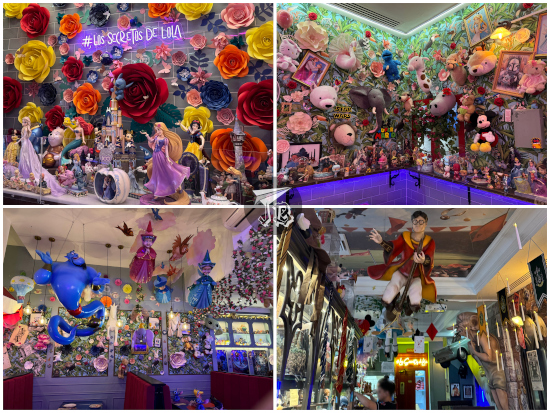
Afterwards, we headed out to the restaurant for our 13:30 reservation. The place is called Los Secretos de Lola (Lola’s Secrets ). It used to be just another bistro-grill in a street full of them, but some time after the pandemic, it reinvented itself. The restaurant has slowly turned into a Mecca of childhood mementos – Disney princesses, teddy bears, Harry Potter, Funko Pops… and crazy fun references like a Möet&Chandon spray to clean the tables. A lot of the food comes in a special piece of dishware – most of it Disney, but I can’t tell whether it’s actually licenced or a bunch of knock-offs. It was hilarious anyway. Though I am not much of a Disney person (my sibling is), my favourite film of theirs would be Mulan, and I just about lost it laughing when I checked the menu beforehand – I saw that they served gyoza in a Mushu-like dish, and decided we needed to order that. I was open to negotiation about anything else, really, but not the gyoza. The pasta in the Lady and the Tramp dish was also hysterical, but I could do without.

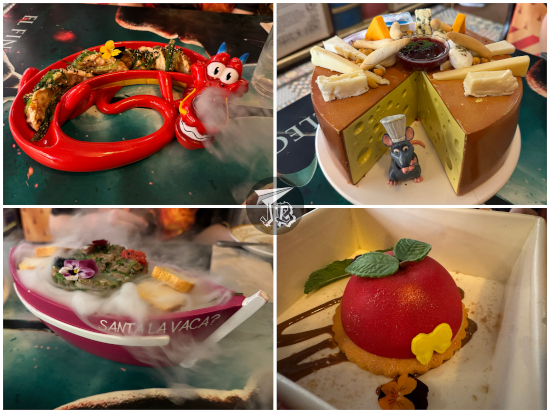
We reached the restaurant on point, and the owner directed us inside. We got a really cute Stitch table, but my sibling was not comfortable on high chairs, so we were accommodated at a Harry Potter one. We shared the non-negotiable teriyaki prawn-and-vegetable gyoza with wakame and bean sprouts, served on a Mushu-plate: Gyozas de gambas y vegetables al teriyaki, a plate of cheese Tabla de quesos variados (Blue cheese, Havarti, Mimolette, Emmental, Basilio, butter and breadsticks, on a Ratatouille’s Remy plate, which I had also found adorable) and a bluefin tuna tartar Tartar De Atún Rojo (on a little boat – I asked for no mango, and it was honoured; this was probably the weakest dish though). Finally, I tricked my sibling into a dessert called “Snowhite magic apple” Manzana Encantada Blanca Nieves: red chocolate capsule with white Kinder and a heart of caramel sauce, which came in an adorable “present box”.

Decoration: Los Secretos de Lola

Food Los Secretos de Lola

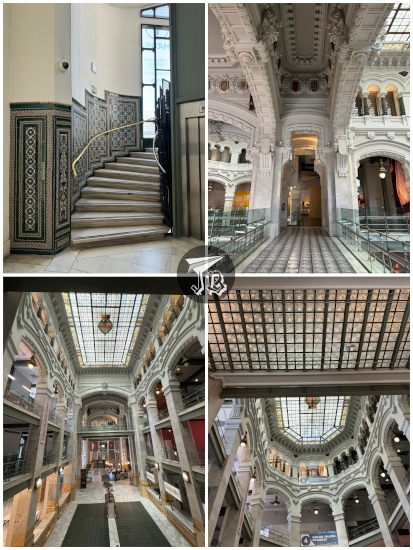
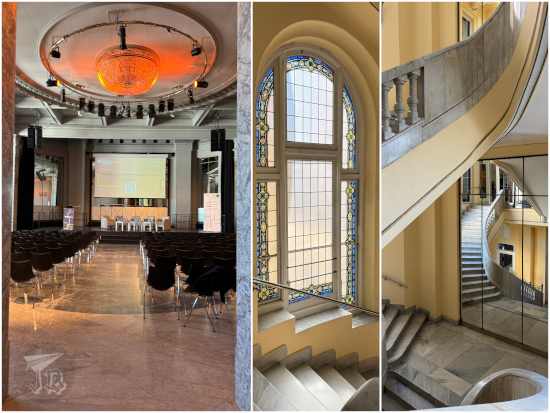
The food was good, and I really like themed restaurants, I guess, even if they are not “my” theme. We did not stay for the two hours, I think we were on our way after an hour and a half – and when we asked for the check, it came in a Frozen music box. Then, we left towards Palacio de Cibeles, the old “communication palace” of Madrid, designed by Antonio Palacios and Joaquín Otamendi, and erected between 1907 and 1919. It is considered one of the first and most important Modernist buildings in Spain, constructed in biocalcarenite, with three stained-glass skylights, catwalks on the third floor, and a magnificent lookout on the rooftop. Part of the building is being used by the town hall, the other by the public entity CentroCentro, which runs cultural activities in the open spaces – mostly conferences and exhibitions.

Palacio de Cibeles

We arrived a bit before 16:00. Since we had a ticket for one of the exhibitions at 17:30, we checked whether we could find a ticket for the rooftop. We found available slots at 16:30, which was great. Before the viewpoint access, we had time to wander around. Most of the free exhibitions were of modern art, and not that interesting, and I was more focused on the building itself. There is one dedicated to the World Heritage site Paisaje de la Luz, explaining why the area deserves its UNESCO place.

We found the staircase to one of the towers and we used it to move it through the different floors. It is a spiral staircase around the lift, with Palacios’ typical green tiles similar to the ones he used at Maudes hospital and Chamberí station. The catwalks were paved with glass tiles, and it was quite impressive above all. I loved the building, but after all, Palacios is one of my favourite architects, so it was to be expected.

Inside Palacio de Cibeles

Then, we went up to the rooftop, where we could have a view of all of Madrid around us, most interestingly one of the main arteries of the city – Gran Vía. The weather was great, maybe a bit too bright. The turns were 30 minutes, but we were done in about half the time, after taking two walks around the middle tower.

Lookout on the rooftop of Palacio Cibeles

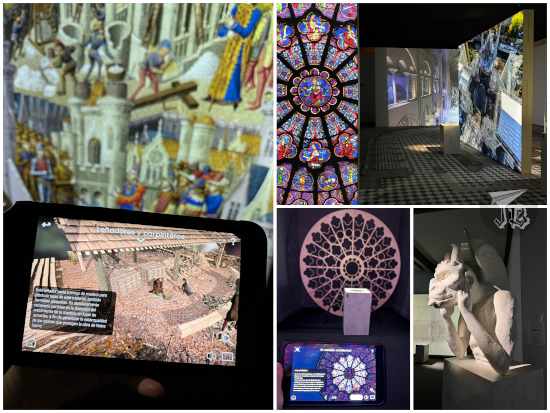
We went down and sat for a little before we headed down to the basement to see “Notre-Dame of Paris: The Augmented Exhibition” Notre-Dame de Paris: l’Exposition Augmentée. It was only 3€, so I was not expecting much, but it actually blew my mind.

The experience was created by the company Histovery, which specialises in “virtual exhibitions” through an interactive tablet called “HistoPad”. The Public Entity in Charge of the Conservation and Restoration of Notre-Dame de Paris cooperates with the event, and the beauty company l’Oreal is a sponsor. The exhibition (which is simultaneously running in several parts of the world) follows the history of the Parisian cathedral Notre-Dame de Paris – it starts with the 2019 fire, which is a bit heart-wrenching, and then it covers a few key moments in the history of the cathedral, using a mixture of written information, videographs and a “treasure hunt” where you have to find pieces of a puzzle hidden within the virtual information. This is done using the tablet to scan 21 “time portals” that take you to a particular point in history.

Around 1160. The Dream of a Builder. At that time, Bishop Maurice de Sully came up with the idea to build a new, better, cathedral in Paris. The previous one was a smaller, Romanesque building, but the goal was a larger, architecturally impressive building. In this room (the second, actually, but the first chronologically), you find out about the “treasure hunt” – you need to find a number of hidden “light spots” to build a “stained glass window”.

Around 1180. The Gothic choir. This makes a small overview of the kinds of workers that helped in the construction, the kinds of stones, building materials – quarries, forests. I was extremely disappointed at this point when I came across a dog in the virtual quarry, but the program did not let you pet it.

1241. The Holy Relics: Louis IX, the future Saint Louis, bought the Crown of Thrones in Jerusalem and brought it to Paris. There was a great procession into Notre-Dame, where the relics were to be kept. Here there’s a spectacular recreation of the gates with the original polychrome sculptures and decoration.

1645. The Royal Promise: Widowed Queen of France explained to her son, future Louis XIV, that he was to renovate the choir of the cathedral and build a new altar, dedicated to the virgin Mary. This was the original splendour of Notre-Dame, before the French revolution broke out – the church was one of the targets of the revolutionaries, and a lot of the art was damaged and / or destroyed.

1804. The Imperial Coronation. After the French Revolution, Napoleon crowned himself “Emperor”, but a very “equal and revolutionary” Emperor. He held a ceremony for himself in Notre-Dame, with the presence of the Pope and everyone who was anyone in the totally equal new society.

1857. The Spire. Enter Viollet-Le-Duc, a major architect and restorer in France’s 19th century, whose theories influenced countless others. He revalorised gothic style in the country, managing to turn it into a “national style”. The man had the goal to restore and create buildings in “the gothic style that would have been if the Medieval workers had had the technology he had access to”. Historians have not been kind to him, accusing him of “inventing” stuff instead of “restoring” but kudos to him, he managed to make a lot of buildings survive to our time. In Notre-Dame, he is responsible for putting back a lot of the sculptures that were destroyed during the French Revolution. He also built the spire that famously collapsed in the 2019 fire.

2019-2021 (first and last rooms). A description of the restoration works that have been happening in and outside the cathedral since the fire, with special attention to the Paris firefighters who worked the incident. There is a very interesting part about safely removing debris and the original scaffolding, and the fact that there was a lot of lead in the cathedral that the workers had to be safe around. They also homage the “vertical workers” who had to remove collapsed pieces from the ground… hanging from ropes.

Notre-Dame the Augmented Exhibition

We completed the stained-glass window and signed up to get a diploma. The fun part is that most of the exhibition was not really… even physical. There were a few posters, a reproduction of one of the chimaeras, some small models… Nevertheless, it was extremely interesting – possibly the best “virtual exhibition” I’ve seen to date. The length of the experience is said to be 60-90 minutes… we stayed from 17:30 to 19:45, much longer than I had anticipated! Thus, we had to forfeit the last plan of the day to go back to the train system – which of course was experimenting delays. It took forever to get home. Because what else is new?

Time-traveller diploma after completing the treasure hunt in Notre-Dame the Augmented Exhibition

14th May 2024: Three Museums and Tea, Madrid (Spain)

On a whim, I put together a plan for Tuesday, as it is currently my free day. I was too lazy to drive, so I decided to catch a train to Madrid. There was a temporary exhibition I wanted to check out, and it was close to several museums and eateries.

My first idea – breakfast at a French crêperie – went bust, because the place was still closed when I arrived in town – I swear, this is like the fourth time I try to have something there, and it just won’t work. Instead, I ended up at a Starbucks for breakfast, before heading out to my first destination – the exhibition The Art of Manga, held in the Architecture Bar Association building Colegio Oficial de Arquitectos de Madrid, COAM. The Art of Manga is a small exhibit that runs through the history of manga – Japanese comics – with a few snippets of what it was and what it has become, especially in Spain.

The entrance was a sort of tunnel with manga sheets hanging from the ceiling. It ended at a traditional scroll with animals acting like people – Chōjū-jinbutsu-giga 鳥獣人物戯画, which translates to “Animal-person Caricatures”. Some people consider that this is the origin of manga (note the “ga” at the end), though if there is one thing that the exhibition makes clear, it’s that nobody knows when manga actually started. Thus, it just runs through all the possible theories and important names. From the Edo Period, there were a few wood prints (ukiyo-e) – which are claimed to be original – among them two by Katsushika Hokusai [葛飾 北斎], The Great Wave off Kanagawa [神奈川沖浪裏, Kanagawa oki nami-ura] and Fine Wind, Clear Morning [凱風快晴, Gaifū kaisei]. Hokusai is another of the supposed starts (“the father”) of manga. There were also a few toba-e [鳥羽絵], similar to the first scrolls – for the first time in the evolution of drawings, there was text alongside the art. Then came the books, where texts dominated – though there were still drawings – and they became extremely popular during the period.

With the end of the isolation of Japan, Western influences – mainly comics – influenced local artists, and “speech bubbles” appeared. In the late 19th and early 20th centuries, Kitazawa Rakuten [北澤 楽天]’s works were published in newspapers. He is (also) considered the father of modern manga, and several of his works are displayed. There are also early 20th-century scrolls, painted in a style similar to toba-e depicting the Tokaido Road, which separated Edo (old Tokyo) and Kyoto, and its checkpoints. There were also kamishibai [紙芝居] cards – kamishibai is a traditional form of theatre involving telling a story using a narrator and different “postcards” with images drawn on it.

In the middle, the exhibit had a rock garden, and a torii gate with a lot of lanterns gave way to the second part – modern manga. Here there were pieces and mementos from famous artists and works – Osamu Tezuka [手塚 治虫], known as “The god of manga”, and one of the driving forces of anime. According to the exhibition, they were showing all of his works. There was a bit about Shigeru Mizuki [水木 しげる], and big international hits like Sailor Moon, Naruto, Dragon Ball and One Piece. After a screen showing a video about a cosplayer – which I did not care much about – there was a section on manga magazines, some of the early manga published in Spain, and a stand where you could get some stamps.

Snaps from The Art of Manga Madrid

Finally, there was a bit on merchandising and figurines. The shop did not even have a catalogue, which I would have bought. All in all, it was all right, smaller than I had expected.

Then, I went to the nearby museum of the Romantic period, where I got a national museums card – I’ve been wanting one for a while, but unfortunately you still have to queue to use it. I had hoped you could just walk into museums with it, but I guess crowd control is a thing since Covid. Anyway. The Romanticism museum, Museo del Romanticismo is a small palatial residence which tries to recreate the ambience and atmosphere of the dwellings of the bourgeois families at the time. It had a lot of nice furniture, similar to the one in Riofrío, but I found it lacked on the landscape paintings I like. The museum is currently exhibiting an early painting by painter Francisco de Goya, a Pietà.

Museo del Romanticismo Madrid

Afterwards, I headed out to line for the Sorolla Museum Museo Sorolla. I had to queue for nearly 40 minutes, but I was finally admitted in. Joaquín Sorolla (1863 – 1923) was a generally-impresionist painter (impressionist, post-impressionist and luminist) from Valencia. The museum was built in the artist’s own house, completed with some of his iconic artworks, including Paseo a orillas del mar, Walk on the Beach, and El baño del caballo, The Horse’s Bath. Sorolla excelled in portraits and landscapes, especially the sea side, and social criticism. He was a master depicting light, water, and the combination of both. He became one of the most important Spanish artists of his time – and probably the most famous. He participated in the Paris Universal Exposition of 1900, and was invited to exhibit his art in New York City.

Furthermore, there was a current exhibition called Sorolla in 100 objetos – Sorolla in one hundred objects – which had just opened to the public. It included personal items the artist collected, – some a bit bizarre–, photographies, his passport, the last painting he worked on, the medal he received from the US president, a photograph of his studio in Italy…

Snaps from Museo Sorolla

I then went off towards the archaeological museum Museo Arqueológico Nacional. I used to love this museum – when they remodelled it and they made it all modern and aseptic, it lost most of its allure. Of course, I still enjoy it, as the important items are the exhibits, and the museum has a lot of important items from the Celtiberian cultures – Celts and Iberians inhabited Spain before the Roman conquest, which started in the 2nd century BCE. Iberians were prevalent in the east and south of Spain before their arrival. The north and west were populated by the Celts, and there was a vague area in-between whose people have been called Celtiberian. the Talaiotic culture flourished in the Balearic Islands, and it has recently been declared World Heritage. These cultures were eventually assimilate by Romans, but Celts lived on elsewhere. Iberian and Talaiotic cultures, however, diffused with time. Today, there is little known about it, and most is just interpretation from archaeologists, even less about the more ancient tribes that lived in the areas during the Bronze Age.

Among the objects from pre-Roman Spain, there are mysterious steles from the late Prehistory. However, it is the Iberian funerary art which stands out the most – such as the bust called the Lady of Elche, La Dama de Elche, found in the town of the same name, and the full sculpture named the Lady of Baza La Dama de Baza. Both are fantastic, to the point that it was thought they were Hellenic for some time. Other items include bulls – both metal cattle heads with wide eyes, and vaguely-shaped stone sculptures, verracos. I remember going to the museum when I was little, and the importance of these bulls, called “Bulls from Guisando” Toros de Guisando was drilled into my head, to the point that I thought that the ones exhibited there were the only ones – it also made me sad that they were in the museum and not in the field where they had been found. I was petrified when I learnt, years later, that there are a bunch more…

The museum also hosts a nice collection of Moorish art, and what apparently is a special Egyptian exhibit, as Spain worked with Egypt during the 20th century, and got a lot of objects from that excavation from the Egyptians “in the split of the new discoveries”. I am not sure whether that’s accurate, or the story has a lot of make-up on. I had to leave around 16:15, but as this museum is also covered by the national museums card, I can come back any time within the year for free. I skipped most of the Medieval period.

Museo Arqueologico Nacional Madrid

I had a reservation for afternoon tea a few minutes away from the museum, at 16:30 – I might be doing a bit of a rally around all the places in Madrid which have it. This time around, I went to El Jardín de Orfila – and good thing I had decided to only have breakfast and skip lunch and go straight from breakfast to tea. I was seated in a lovely outward area and I chose a delicious green tea with cherry. The food was plenty – finger sandwiches: pastrami, salmon and cucumber and cheese cream; macarons, carrot cake, meringue, and scones, along with clotted cream and berries jam. It has probably been the best afternoon tea I’ve had in Madrid up to date. The scones were a bit under-baked though.

Afternoon tea at El Jardín de Orfila

I was alone in the outer area for most of the experience, the waiter checked on me once after bringing my tea. It was actually so calm and quiet that I had a visitor – a little house sparrow (Passer domesticus) was very interested on the remains of my scone, so I shared with her. She was happy after two crumbs, and left – or maybe it was because another couple walked into the area.

Sparrow hopping towards a scone crumb

I left a bit before the two-hour timeslot was up so I could catch a timely train home – and because the couple came in, talking loudly, and kind of broke the spell.

7th May 2024: “Dragon Hunters” in Alcalá de Henares (Spain)

The Archaeology and Palaeontology museum in Alcalá de Henares is running a temporary exhibition on the history of digging dinosaur bones, called “Dragon Hunters”. I was drawn to it because well… dinosaurs. Driving in the city centre is a nightmare, so I left the car in an easy-to-park area a bit away, and walked downtown.

I had been trying to see the cathedral of the Magistral Cathedral of Saint Justus and Saint Pastor Santa e Insigne Catedral-Magistral de los Santos Justo y Pastor, but it was always either locked, booked for events, or “closed to visitors”. This time around, I was able to finally see it – and it was honestly a bit underwhelming. Though I generally enjoy Gothic buildings, I guess I was so hyped after trying so many times, that reality did not live up to expectations. Furthermore, I dislike when places do not advertise that part of the visit is closed / unavailable, so I guess I’m still pretty out of luck with this one cathedral. I missed the chance to climb up the tower and see the views of the town due to construction, but oh well.

Legend has it that catholic Saints Justus and Pastor were martyrized in the year 304, near the Roman city of Complutum. In the year 414, a chapel was built to keep their remains in the place where the martyrdom happened. The current building was erected by architects Antón Egas and Enrique Egas in late Gothic and Renaissance styles around 1446. The tower, by Rodrigo Gil de Hontañón and Rodrigo Argüello, is Herrerian. The interior has three naves with pointed arches, and to one side stands the cloister, with access to the museum, and – when it is open – the tower. It was a bit of a bummer not to even be able to step into the open part of the cloister. Underneath the altar there is a crypt with a gold-and-silver urn with the remains of the Saints, and the stone where they were killed.

Afterwards, I continued on towards my real destination, the local Archaeology and Palaeontology museum Museo Arqueológico y Paleontológico de la Comunidad de Madrid, MARPA. They are currently running the exhibition Cazadores de Dragones (Dragon Hunters). The exhibit summarises the historical hits of palaeontology, starting with prehistoric and classical references and theories about them, such as a the phoenix having been inspired by Protoceratops skeletons, or the bones of giants being actually dinosaur fossils. This area has a few replicas and small statuettes – running from the originally-made ones to the newest reconstructions.

Exhibit entrance, protoceratops, corridor

The exhibit name-drops a few of the big figures in dinosaur-digging history such as William Buckland, the man who described Megalosaurus as an antediluvian creature; Gideon Mantell, who tried to reconstruct an Iguanodon from a tooth (now in the Natural History Museum in London); Georges Cuvier, who proposed the idea of extinction, and named animals such as Megatherium, Pterodactyl or Mosasaurus; and Richard Owen, who “invented” the word “dinosaur”, meaning “terrible lizard” – though today we know that a lot of dinosaurs had more in common with birds than with reptiles, down to protofeathers and even feathers.

Archaeopteryx, titanosaur

The following section follows the “Bone Wars” – Charles Marsh and Edward Cope were two palaeontologists who raced through the Morrison Formation (Montana, USA) to discover up to 30 species of dinosaurs – they were not always honest in their competition, and it did not help that Cope messed up a reconstruction of an Elasmosaurus, placing the skull at the end of the tail. The Morrison formation was (is) in the middle of nowhere, and digging during the 19th century had its risks. This concept ties with the idea of “the adventurer” à la Indiana Jones, mentioning Roy Chapman Andrews and Barnum Brown, the man who excavated the first Tyrannosaurus. And then you turn a corner and are greeted by a replica of a T-Rex. Of course, I stayed a while here – trying to take pictures without the security guard in them.

Tyrannosaurus rex replica

After World War II, palaeontology hits moved from the USA to Mongolia and the Gobi desert, with new species being discovered every so often. Later, in the last years of the 20th century, the idea of “the avian dinosaur” arrived, and there is a replica of a Deinonychus, with screens showing recreations of the creature looking “like a lizard” and looking “like a bird”, feathered and all.

Titanosaur, therizinosaurus, eggs, deinonychus

Finally, there are the local dinosaurs: a tail and part of a foot from Qunkasaura pintiquiniestra, a nest from the Poyos Site (Guadalajara), and the star of the show – the original fossil holotype of Concavenator (Concavenator corcovatus), a theropod found in Cuenca. The fun part? The museum which holds the holotype, Museo de Paleontología de Castilla-La Mancha, bans pictures – so I took my sweet time with this. There is also a life-size reproduction, with colours tuned down to more realistic than the originally proposed blue and red.

Concavenator fossil and reproduction

Afterwards, I wandered around MARPA, mostly to go to the palaeontology room, as I have explored the museum extensively before. The palaeontology ward is relatively new, and it has quite a few nice reproductions and… even if I have explored that one too. I also dropped by the shop to get the exhibition book. Finally, I went back to run through the Dinosaur exhibit again, just because I could, before I headed home. I had thought I’d look for a nice restaurant for lunch, but nothing drew my attention.

22nd March 2024: Trail of the 1808 Uprising, Comic Planet and Genesis (Madrid, Spain)

Among the activities organised by the Pasea Madrid program (Walk Madrid), there was one about painter Francisco de Goya. Goya was probably the most important painter towards the end of the 18th century. He was born in 1746 and died in 1828, having lived through four Bourbon Kings, the Peninsular War, the postwar and the Bourbon restoration.

Goya started his career in Madrid drawing bucolic cartons to be woven into tapestries. He eventually became popular painting portraits for the aristocracy first, the royal family later, until he was appointed court painter. Sometime along his career he contracted an illness that left him deaf, and his character soured. He started experimenting with other media besides canvas and mural paintings, and started creating prints, which are darker and fantastical. During the Peninsular War against Napoleon’s forces, he created paintings about the uprising, and prints showing the most awful part of human condition during armed conflict – the horrors of war. He did not become any more cheerful after the conflict, depicting famine and illness. His last set of art pieces are called the black paintings, black-and-ocre coloured nightmarish pieces which contrast with the life of his initial bucolic scenes and one of his most famous painted – the naked lady La maja desnuda.

In 1807, Napoleon tricked the Spanish king into abdicating and allowing his troops to march towards Portugal. Instead, the French just… stayed in Spain. Madrid was occupied on the 23rd of March 1808. On the 2nd of May, there was an uprising in town, carried out by plain citizens and a very small percentage of the Spanish soldiers. The rebellion was squashed and the rebels shot to death – where “rebel” meant “everyone caught with a weapon”, and weapons had been stones, knives and even plant pots. While the uprising was unsuccessful, it sparkled the Peninsular War, known in Spanish as the War of Independence. Goya, originally open to the French ideas of Illustration, painted two canvasses about the events. The first was “The charge of the Mamelukes” El dos de mayo de 1808 o La carga de los Mamelucos depicting one of the French units charging Madrid’s people; the second was “The third of May Shootings” El tres de mayo de 1808 o Los fusilamientos del tres de mayo, showing the executions in central Madrid.

After I arrived in Madrid, I started off the day with a Starbucks’ Iced Strawberry Matcha Tea Latte, a new flavour introduced this month. I had plans for a nicer breakfast, but my train was delayed so I had to get something to go, so it was this and a cookie. I really liked the drink, I hope it stays. I grabbed both and went towards the meeting point.

Starbucks' Iced Strawberry Matcha Tea Latte

The visit I attended was called “Goya and La Florida” (La Florida being a small hermit church the painter did murals for), but it was more of an exaltation of the May 1808 uprising. We met the guide next to the Royal Palace, where she summarised Goya’s life. Then, we moved on to a placard next to the palace that memorialises the uprising, and she described the event. We continued on towards the area of Príncipe Pío, saw yet another memorial to the uprising Monumento al Pueblo del dos de Mayo de 1808 and the archaeological remains of one of the forts.
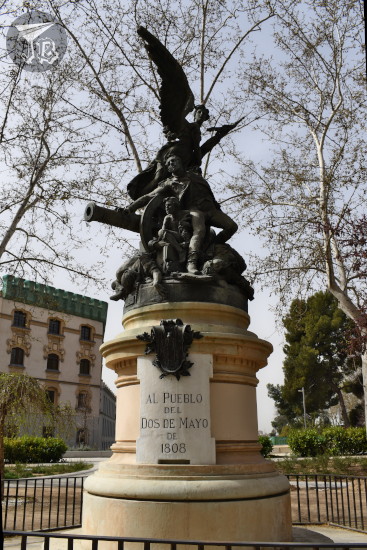
Monument to the second of May

We went up the park Príncipe Pío – next to the Temple of Debod – and the guide explained the military shootings, and read a document. We continued towards the graveyard where the rebels were buried Cementerio de La Florida, next to which stands a monument to Goya Monumento a Goya: four stones, each one with a letter to form the word “Goya.”
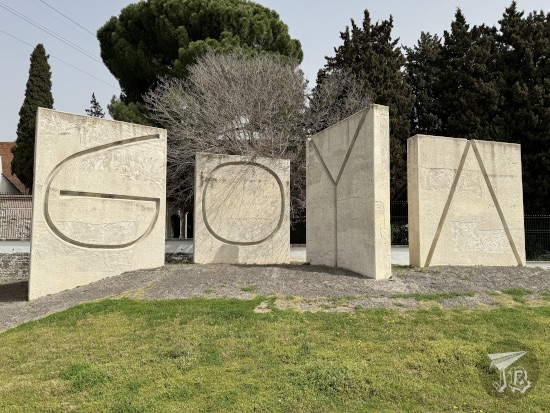
Monument to Goya

We finally reached the hermit church Ermita de San Antonio de la Florida, where Goya painted the ceiling frescoes. Over time, they became so degraded that an identical second hermit was built to be used religiously, and the original one kept as a museum and the painter’s pantheon. The ceiling has a dome in which the artist painted St. Anthony’s miracle – as his father had been accused of murder, he resurrected the victim, who could identify the real criminal. The murals are done in al fresco technique, painted on fresh plaster, directly on the walls.

Hermit church of St Anthony

After I left the hermit church, I headed off towards Príncipe Pío station, where I met my relative. There’s this restaurant that I’d been wanting to try for a while, but I needed two other people to tag along in order to get the table I wanted – yes, I wanted a specific table in the restaurant, more on that later. We had a reservation for a late lunch at 15:00, since my guided visit finished at 13:00. We took the underground and alighted at the area of Cuzco, with still some time left.

While checking out how to get to the restaurant, I had came across an Asian supermarket nearby – and that led me to discover Calle General Margallo, a little cluster of Asian supermarkets and stores. We went into Ibero China Madrid and I was happy to buy a bunch of things at a very decent price, mostly Japanese (curry and miso), but I also bought some Filipino Sky Flakes Crackers that I used to get from an acquaintance and had not found for years. Afterwards, we headed to the restaurant.

Comic Planet is an American-food eatery set around the superhero theme – murals on the walls, actual-size figures from DC and Marvel films, and even some prop reproductions. The dishes are “inspired by” superheroes and villains, with a lot of colourful additions.

When making the reservation, I was luckily able to book the table I wanted – and lacking any John Constantine decoration, who is my favourite “almost mainstream” comic character, the table I aimed for was the Aquaman one; I liked Aquaman before Jason Momoa made him officially cool. To be honest, even if I really wanted to check the restaurant out, I was a bit limited on what I could order – way too much coriander. I wanted a burger and a dessert – and a coke chilled with vanilla ice-cream (Coke & Vainilla Ice 1923). Unfortunately, our third party member was almost forty minutes late, so in order to keep the table we needed to exchange desserts for a starter. When the three of us were there, we ordered our mains.

Our starter (for two) was the “Infinity Gauntlet”: cheese sticks wrapped in dough (tequeños) with five sauces – tartar, spicy, mango, BBQ and comic special “cocktail”. The name of the dish refers a weapon created by Thanos, villain in the Marvel comics Avengers, made famous by the films.

My main was a Cat Burger (a reference to Batman’s Catwoman) – a “snobbish” beef patty with caramelised onion, duck foie gras and melted Brie cheese, with regular chips. My relatives ordered a Super Comic Burger (Grilled beef with egg, Oldenburger cheese, fried plantain, guanciale and “kryptonite” – whatever that is. The bread was… blue, and the chips red) and a Hellboy brioche (smoked and spiced pork, natural tomato, Edam cheese, egg, red onion pickled in lime, coriander, mustard and sugar), a reference to Dark Horse Comics’ Hellboy, one of the few creator-owned characters out there.

Comic Planet Madrid Food

One of the greatest things of the restaurant is that you get to hang around and take pictures with and of everything. The restaurant has two floors, and you are free to explore them. Aside from the murals and real-life figures, there are busts of bad guys, and even a homage to one of the most prolific comic-creators in history, Stan Lee. They also have a store with a bunch of merch (surprisingly… no actual… comics).

Comic Planet Madrid decoration

Afterwards, because the weather was nice and the forecast was rain all the following week, we walked down to the Comunidad Evangélica de Habla Alemana – Friedenskirche (German-Speaking Evangelical Community – Church of Peace), who were running a video mapping show in their church, Genesis.

The show follows the first three days described in the Christian Bible’s Book of Genesis, as God creates the earth. On the first day, God separated light from darkness; on the second day, God created Heaven (the sky in some versions), and on the third, he created the lands, seas and vegetation (nature in some translations). The church is a Neoromanesque building with mosaics which helps the otherworldly aura of the experience.

The show, designed by the company Enoarium has five parts: First Day: Light; Second Day: Sky; Third Day, first part: Water and Land; Third Day, second part: Nature; Meditation. When we went in, there were already lights on, a pretty universe-like lighting. There were pouffes to sit / lean on the floors and chairs. I chose a pouffe, thinking that it would be hard to stand up later, but oh well. I had about an hour to get round to it. It was a really good idea, because watching the ceiling was much more comfortable than having to look up.

It was a bit difficult to notice when the one day became the next, because the lights flowed really nicely and one theme faded into another. First, the whole church went dark, and there was a bit of light in the centre of the ceiling that became wider and wider. The white light started mixing with blue, which first was the sky and eventually turned into the sea. Gold / brown bits after a while represented the land, then more blue / purple as more sea, and when it turned green we had reached the creation of vegetation, which exploded in tons of colourful flowers. Eventually, everything dissolved into candles and lamps. The music was nice, too, mostly coral in Latin, I think.
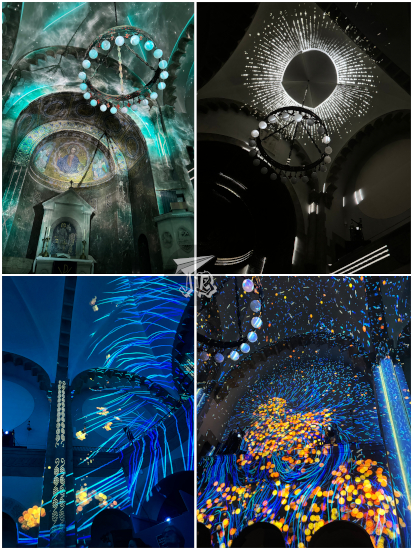
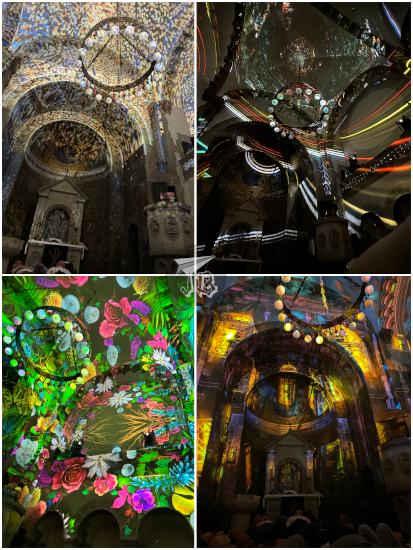
Genesis Madrid stills

Genesis Madrid stills

Afterwards, we separated and I headed off to the train which – what else is new – was stupidly delayed, so I was stuck at the station for almost 40 minutes until my train came. The only good thing was that another in the same general direction came three minutes before, so most people got onto that, and mine was pretty empty.

20th March 2024: Mundo Pixar (Madrid, Spain)

Due to some kind of weird… extended family thing, we ended up with some vouchers for Pixar World Spain Mundo Pixar, happening in IFEMA in Madrid. It would have been a pity to waste all of the tickets, so there we went, on a Wednesday morning, to at least redeem a couple of them. This immersive exhibit comprises several rooms with life-sized scenarios and characters based on Pixar films.

Mundo Pixar Madrid - outside

Pixar is an American animation studio which started off as part of the Lucasfilm computer division back in 1979. For over a decade, the group collaborated with graphic design and CGIas a third-party, until it was properly founded as an independent company in 1986. Pixar collaborated with Disney creating computer animations, and kept developing the technology, until it was finally able to pitch its first feature film to Disney – Toy Story, which was also the first-ever completely computer-animated film. Released for the 1995 Christmas season, it was a world-wide hit. Pixar became part of Disney in 2006.

The studio’s films have received 23 Academy Awards, eleven times for Best Animated Feature (a category added in 2001). One of the characteristics of Pixar films is their layering – though they are marketed as children’s entertainment, they tend to have a deeper, more adult-oriented subtext that… kids don’t even grasp. Something weird is that despite its successes, Pixar always seems on the brink of bankruptcy…

We had tickets for 11:00, and thought we had plenty of time until we got caught in a huge traffic jam due to a fair in another part of IFEMA. We had over 45 minutes of leeway, and ended up taking half an hour just to be able to get into the parking lot from the roundabout 650 metres away. That was wild.

We finally got into the queue around 10:50, and it took a while to get in. Mundo Pixar is organised in a U-shaped circuit, so that you can get round to the shop before or after seeing the exhibit. For a weekday, it was packed – not only by families, a bunch of random friend groups and tourists, too. Interesting.

We accessed through a tunnel to the first space, which is a bit of a self-promotion video mixed with the rules of the game – mostly, the one that people seemed unable to follow: do not touch. The immersive experience takes you to recreated scenarios from several films by the studio, to the slightest detail. The rooms are supposed to have different smells, but we only perceived a few. And of course, people kept touching.

Rooms 1 & 2: Up. This films tells the story of an old widower who goes on a last “adventure” to Paradise Falls, where his late wife would have loved to live. To do this he… floats his house away with thousands of balloons. He meets kid Russel and dog Dug. The rooms include a view of the whole house, and one of the interior. The living room is a perfect reconstruction of the one in the film, down to the pictures and the armchairs where Ellie and Carl sit, and the device Carl builds to steer the house while it flies.

Room 3: Monsters Inc.. This is a take on a widespread childhood obsession, the monster in the closet. In another dimension, energy is powered by the screams of frightened children from our world – thus, monsters sneak into kids’ rooms using magic doors to their wardrobes. Sully and Mike are the top-scary team until they run into a toddler who turns their lives upside down. The room has different bits from the film, including the scream factory doors and the two main characters waving awkwardly, recreating a scene where Mike and Sully are made to pose for a picture – I kinda expected them to move.

Pixar World Spain: Entrance, Up, Monster Inc.

Room 4: Toy Story. A bunch of toys which / who become sentient when they are not being played with get a new companion, who does not know he’s actually a toy. Enter a house-move, a bully neighbour, and a nasty dog. Chaos (and a trio of sequels) ensues. The fun part of this room is that it’s built so you see the room from one of the toys’ perspective, everything is high up, and the toys themselves are scaled.

Room 5: Elemental. This is a coming-of-age romantic comedy which focuses on overcoming differences. You walk into a train car with the two characters – a water element and a fire element, awkwardly sitting next to each other.

Room 6: Inside Out. In this coming-of-age comedy-drama, every person (and cat) has five basic feelings: Joy, Sadness, Anger, Disgust and Fear. They control a person’s life using a big console, and they collect “core memories” to help with their job. A young girl’s Joy and Sadness must learn to work together to overcome moving to another city. The room shows a perfect life-size reproduction of Sadness and Joy at the console and all the core memories.

Room 7: Ratatouille. This films follows the adventures and misadventures of the rat Remy, struggling to become a chef – to do this he hides in the hat of a young man and “guides” his cooking. The title is a pun between the word rat and a French recipe. The room is a huge kitchen, and you see Remy cooking inside a huge chef hat.

Pixar World Spain: Toy Story, Elemental, Inside Out, Ratatouille

Room 8 & 9: Coco. Set around Mexico’s Day of the Dead (Día de los Muertos), this film sees a young boy, Miguel, explore his family roots and his love of music. The first room shows Miguel and his grandmother, and the second area holds skeleton Héctor, a dead musician who accompanies Miguel in his adventures.

Room 10: Luca. This film tells the story of two sea-monster children (Luca and Alberto) and a human child (Giulia), and deals with friendship and acceptance in the Italian Riviera in 1959. The room hosts the size-appropriate children, with Giulia – and her cat – getting the most prominent set.

Room 11: Cars. The film is set in a world populated only by anthropomorphic vehicles. Arrogant young racing car Lightning McQueen learns about humility, sportsmanship and friendship. There was a nice staff member taking pictures of visitors in this room, with the film’s main character.

Pixar World Spain: Coco, Luca and Cars

Room 12: Finding Nemo. Nemo is a little clownfish, the only survivor from a barracuda attack in which his overprotective father, Marlin, lost his wife and all their other fertilised eggs. When Nemo gets “fished”, Marlin embarks on a crazy journey to find him, meeting amnesic surgeon fish Dory, wannabe-vegetarian shark Bruce, and surfer turtle Crush. To be honest, finding Nemo in this room was easy. He was in the middle of it, surrounded by marine mist, with jellyfish and the rest of the characters on a screen behind him. I was severely disappointed there was no Bruce whatsoever in the room.
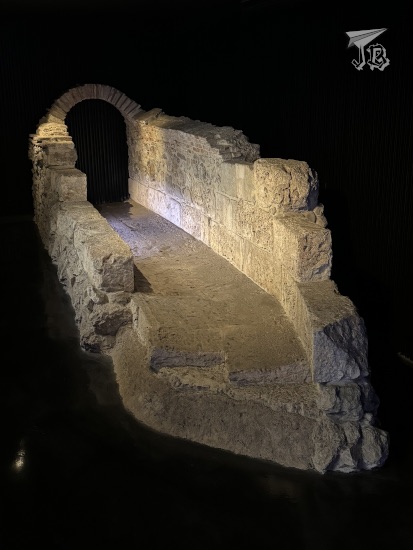
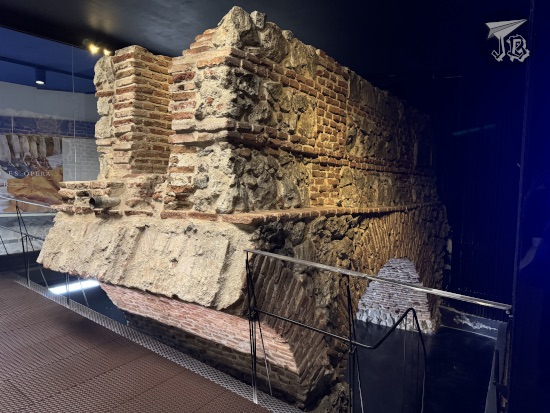
This was the last room; afterwards there was the shop, and a small photocall with a giant Luxo (a yellow bouncing ball with a blue band and a red star), back at the beginning. I am not sure this area actually counted as a room, because we were told there were thirteen rooms? No clue.

Pixar World Spain: Finding Nemo, photocall, Pixar ball

Fortunately, when we left, the traffic jam had dissipated. Unfortunately, I had to go work in the evening, which did not feel great. I obviously enjoyed the rooms dedicated of films I had watched (and liked) more than the others – I personally find the first ten minutes of Up heart-wrenching, but Finding Nemo was my favourite (both as a film and a room). I still uphold my protests about shark discrimination though!

17th March 2024: Council Houses & Royal Collections (Madrid, Spain)

Madrid’s town hall opened a new season of their “walking Madrid” Pasea Madrid to show off some of the usually closed-off monuments in the greater area of the city. I’ve signed up for a few before (also under the name of open for restoration); while I am not a fan of guided visits, the program grants access to otherwise closed off places. This time I was lucky enough to get a spot for the old town hall Casas Consistoriales.

The original council house was built around 1645, following the plans by Juan Gómez de Mora, in the Herrerian style – the exterior is sober and barely decorated, erected in bare brick, with towers in the corners. The interior used to host a square courtyard, around which the whole dependences were designed. Subsequent remodellings closed off that patio, gave the construction a balcony overlooking Main Street, and exchanged the wooden roof for black slate. Even later, the structure was connected to the nearby palace Casa de Cisneros, a Plateresque palace built round 1537, by a passageway on the second floor. The two buildings were the main site of the town hall until 2011. Nowadays, the complex hosts some offices and is used for special events.

After going through the metal detector / X ray machine, we gathered at the entrance. The visit took one hour, and we were shown some of the most important points in both buildings, permanently followed by an armed security guard. In the actual Casa Consistorial, we saw the monumental staircase, the “royal room” with a fantastic glass lamp and frescoed ceilings, the so-called “crystal courtyard”, whose ceilings is a stained glass window, and the room where the council meetings used to take place, now used for formal events.

Old council Houses, Madrid

We crossed over to the palace Casa de Cisneros, where we saw the library, several meeting rooms and the “Andalusian staircase” with ceramic tiles, until we finally reached the actual yard, built in brick, but with some original decorations similar to those found in the palaces of Guadalajara (Infantado and Condesa de la Vega del Pozo).

Old council houses, Madrid

The whole thing took about 50 minutes, including checking in, security and introductory explanation. It was extremely rushed, and I still find being followed by a guard a bit unnerving. However, I got to see the two buildings, which is what I wanted.

Afterwards, I went to a new museum recently opened by the Spanish Heritage service Patrimonio Nacional, called the “Royal Galleries” – Galería de las Colecciones Reales. The massive space was built into the ground of the terraces that separate the upper area of the Royal palace from its gardens (Jardines del Campo del Moro), and consists of three floors. The building is completely accessible by wheelchair, having ramps instead of stairs. The collection comprises part of the art pieces owned by the State that were originally purchased by the Royal Families before the 1975 Constitution and the 1982 Law. The uppermost floor contains the pieces collected by the early monarchs, especially the Catholic Monarchs and the Habsburg Dynasty. There are a lot of tapestries, armours and so on, as we are talking the Middle Ages. I also found some Last Wills and Testaments, and the first ever Spanish Grammar, by Antonio de Nebrija (1492). During construction of the building, the archaeological remains of the foundations of the first Royal Palace in Madrid were found, so those have been incorporated into the exhibit.
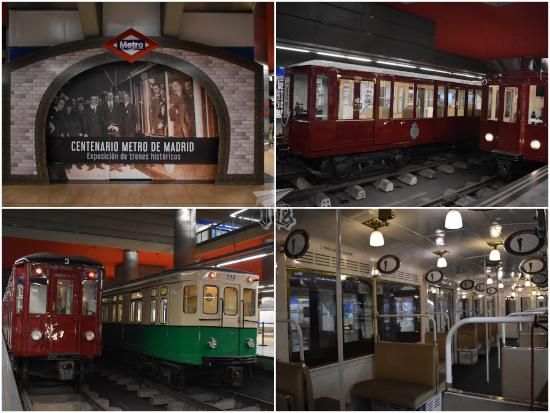
Royal Collection Galleries - Hausburg collection

The second underground floor, deeper below, holds the Bourbon collection, from Felipe V (king 1700 – 1746, he abdicated on his son, who died, and he had to go back to the throne) to Alfonso XIII (king 1886 – 1931, when went into exile upon the start of the Second Republic). This is more… French-style, of course, with paintings, decorative items, chariots, and actual objects of everyday use. Here are exhibited works by Goya and Velázquez, musical instruments, and the first photographs.

Royal Collection Galleries - Bourbon collection

The third floor is a temporary exhibition of royal chariots and cars, including a Rolls Royce, a couple of sleighs, and a sedan chair. It kind of looks that it’s going to be a forever temporary exhibitions though…

Royal Collection Galleries - chariots and cars

The Galleries were rather… underwhelming. After all, there are quite a few royal palaces and sites in Spain, all lavishly decorated, and most of the paintings are in the museum Museo del Prado, one of the largest painting galleries in the world. This felt a bit of a haphazard collection of “stuff we did not know where to host”. I really struggled to find any link or logic beyond “this king bought this”. And even if it was chaotic of sorts, it felt quite short of other places like the Victoria & Albert museum in London. I am not sure they will “fill it up” eventually, or if the main items will remain in their dedicated locations.

Oh, and in case you are wondering why I did not check out St. Patrick’s parade… It was the day before…

12th March 2024: A free afternoon – the bullring & Pompeii Exhibition (Madrid, Spain)

Due to life being weird sometimes, I was summoned to a work-related event in Madrid on the morning of the 12th. The event took place in one of the buildings erected by Antonio Palacios, the cultural centre Círculo de Bellas Artes (CBA). The centre hires out its facilities for conventions, gatherings and theatre plays. In our case, we were there for the presentation of a new product in the Column Hall Sala de Columnas on the fourth floor.

Interior of the Círculo de Bellas Artes

After all the necessary chatting, networking, and a disappointing (and rather questionable) choice of canapés, the event was over at 14:30. I ditched my companion then and headed out to Plaza de Toros de Las Ventas, the local bullring. I am not a bullfighting fan – my personal view is that it is not an art, nor a “fair fight” as it is presented, and I hope we humans evolve to phase it out. And while I would not attend an event, I was curious to get to know the building and its architecture.

Las Ventas bullring, outside

The ring is the largest of its kind in Spain. It was designed by José Espelius in the neo-mudéjar style and erected between 1919 and 1931. The central ring is just over 60 m in diameter, with a metallic structure holding the stands around it, and a façade of reddish brick and porcelain tiles. Aside from bullfighting, it is also used for concerts and other events.

I took a self-guided tour with an audio-guide Las Ventas Tour Experience, because I actually know nothing about bullfighting – I learnt that it actually has “rules”, I thought it was just taunting and hurting the bull. The passes have names, and there is a whole colour code of handkerchiefs – I had no idea. The tour takes you past the “Great Gate” through which bullfighters come out through when they are deemed to have done a great job. Then you climb up to the first floor balconies, and you can even go up to the highest point to have a panoramic view. You see the outside of the Royal Box, the gate through which the dead bull is brought out through, and then you walk down to the ring itself. There you can stand in the areas where the bullfighters and their helpers wait, and peer towards the stables, the closed door to the infirmity and finally the chapel. There are two VR experiences too that I did not care for, so instead of the expected 75 minutes, I took a bit less than an hour to do the whole tour.

Inside the bullring of LasVentas

Afterwards, I was curious to check out an immersive exhibition regarding Pompeii called “the last days of Pompeii” Los Últimos Días de Pompeya in the cultural hub Matadero Madrid. It was designed by Madrid Artes Digitales, the same company which organised the Tutankhamun one. At first I was not overly interested in it, but when I went to Recópolis the guide mentioned an actual VR tour, and I became curious (read: it was totally FOMO in the end).

The exhibit has a couple of replicas of archaeological artefacts, but it’s mostly a digital display. The first time I went to the Madrid Artes Digitales building I thought they had rented the place, but now I saw that they might actually own the warehouse and design the exhibits into it. There is a huge room where they project a sort-of film on the walls, a small circuit that you walk doing different activities, and a sitting VR ward, where you get to see a fictional world in 3D.

Of course, there were replicas of the Pompeii casts, and a copy of the novel The Last Days of Pompeii, written by Edward Bulwer-Lytton, which has inspired the exhibit. The novel, in turn, was sparkled by the painting The Last Day of Pompeii. The projection recreated a few passages from the book, then Mount Vesuvius erupted and you were taken “into” the crater, seeing lava bubbling and lightning bolts. Then one was back in the city as the pyroclastic cloud rolled into the city, along with volcanic bombs falling into buildings.

Last Days of Pompeii exhibition

The circuit was a VR walk-through that took you though a house, both in ruins and reconstructed, as a woman led you through it. Walking with the VR glasses was a new experience, I have to admit, but going through doors was strange. Unfortunately, my set had a finger print in one of the lenses which spoiled the view a little. In the final ward, there was a representation of a circus fight with gladiators and tigers that turned into a naumachia (ship games in the amphitheatre) while Mount Vesuvius erupted in the background. All in all, it was a bit weird, and maybe… a tad on the morbid side, if you ask me.

Afterwards I just headed off, and I was lucky to make it into the train, it was so full! The car emptied out enough to sit down after a few stops, but just wow.

9th March 2024: Minerals, fossils & trains (Madrid, Spain)

I might not be the most people-person ever, but if there is something that makes conventions extra fun, it is seeing attendees unapologetically geek out about what they love – in the case of Expominerales, that would be… rocks. Of course, this is an over-simplification. Expominerales is held yearly in the mine and energy engineering school Escuela Técnica Superior de Ingenieros de Minas y Energía (ETSIME) in Madrid. The year 2024 marks the 43rd edition of the event, which is considered one of the most important fairs in Spain in the topic of Earth Sciences – minerals, fossils, gems, and meteorites are widely available to the public. Aside from the small historical museum Museo Histórico-Minero Don Felipe de Borbón y Grecia, there were dozens of exhibitors with all kinds of items for sale, ranging from a few euro to several thousands. These year there were a few lectures, too, and coincidentally, the two of them I was most interested in happened on Saturday, one after the other.

I arrived at the ETSIME around 11:00, and I walked around the stands a couple of times. I have to say that I wanted everything, but I set a budget and I was able to stay around it, after shopping and lunch. At noon, I settled to listen to the lectures – one about the rehabilitation of an ancient gypsum mine in a hamlet called Hornillos de Cerrato, in the area of León. The other one versed about the uses of an already-rehabilitated one in the south of Spain, home to a huge geode. Both of them were pretty interesting, though the conference room was freezing. Someone had forgotten to turn on the heater there, it seemed…

Expominerales 2024 at ETSIME

After the two conferences, I had a last round to buy a last thing, so in the end I bought an iron-meteorite pendant, a fossilised shark tooth pendant, a plesiosaur tooth, and a soil sample of the K–T boundary. A plesiosaur was a marine reptile with flippers, a short tail and a long neck. The K–T boundary (now named the Cretaceous–Palaeogene (K–Pg) boundary) is the theoretical layer of iridium-rich black sand that was formed by the meteorite that caused the extinction of non-avian dinosaurs – and basically most life at the time, in one of the great world-wide extinctions in the history of Earth.

Shopping from Expominerales

At 14:30, I had a reservation for lunch at a Japanese franchise called Ramen Shifu. While I had originally been looking forward to trying the ramen (and I got my hopes pumped up when I read that they were Hakata ramen style), the noodles were rather disappointing. Fortunately, the okonomiyaki – Japanese pizza of sorts, made with a base of cabbage and topped with sauce and bonito flakes, was all right. On top of everything, paying was stupidly difficult because they did not have change.

Shifu Ramen ponzano - okonomiyaki and ramen

When I came out of the restaurant though, it was raining like crazy. I pulled out my umbrella and hopped towards the closest underground station, as my next destination was inside the metro system – one of the Underground’s museum network Museos de Metro de Madrid the collection of classic trains Estación de Chamartín: Exposición trenes históricos, inside the Chamartín stop. The exhibition displays four historical trains, restored from among the first ones that ran under the city, and some memorabilia. It was a bit underwhelming – more like false advertisement. I hoped I would be able to snoop inside the trains, since that was the photograph that opened the webpage, but unfortunately they were cordoned off. There was however a map with the works by Antonio Palacios in Madrid, which will become handy eventually.

Classical Train Exhibition Madrid

Afterwards, I just headed off towards the train station and got back home.

24th February 2024: Feria de las Mercaderías de San Matías 2024 (Tendilla, Spain)

Going to the Medieval Fair in Tendilla around the festivities of Saint Matthew’s Feria de las Mercaderías de San Matías seems to have become a tradition. Though they close off the village to traffic, I know the area well enough to know where to ditch the car so I can get in and out easily. Since last year, I’ve been driving in early on Saturday, before the scheduled events start so I can help out with the shopping for the day – there’s the tradition of cooking breadcrumbs, migas at my relatives’, and it’s a big meal, so we usually need to get some last-minute stuff.

The weather forecast was miserable – and there was the risk of a huge storm like the previous day, so this year there were fewer stands and visitors. That, in turn, meant I ran into many more acquaintances than usual, as it was harder to blend in…

After getting everything ready, we left the house around 11:30 to walk around the already-set stands and look at the communal migas. There was not much of interest on display. We walked into the women’s association ladies, giving out confectionery items, and we tried those. A bit after noon, the opening parade set off, with musicians, dancers and giant puppets.

Opening parade

Then we found a place at the edge of Main Square Plaza de la Constitución, to watch the equestrian show by the group Caballeros del Alarde, called Privilegio de Juan II de Castilla. It was very similar to the one they did in 2023 – they make sure that the square is covered in sand and prepare two U-shaped courses and they do different activities on the horses, trying to emulate a joust. At the end, they brought out a small hawk – which they called “fat” – so it got used to people. During the show there was a few minutes’ worth of hail, nothing serious. It was chilly all through the day, though.

Stuntment doing horseriding exercises

Afterwards, we went home to make lunch and we happily ate our migas – breadcrumbs seasoned with paprika and fried with garlic and minced chorizo, with a sunny-side-up fried egg on top. Some people like eating them with grapes or orange bits, but I just like them “plain”, so I ate the fruit later.

Once fed, family needed to entertain some guests and I made myself scarce. I headed out on my own, and I went to see the animals at the exhibit at Plaza de Vicente Mariño. It was still early and bright, so I decided to climb up to the ruined monastery Monasterio de Santa Ana. As spring was nearly upon the village, the almond trees were in bloom despite the cold, and it was really pretty.

Animals at the farm exhibit - A rabbit, a horse, an ox, a goat, two geese, a pig and a herd of sheep

Saint Anne's Monastery with flowers in the foreground

I went back home and we decided to show up to the “guided visit” that the town hall organised. Right now, this is the only way to see the recreation of a traditional house that has been built in the ethnography museum Museo etnográfico. It made me feel old, because there were a lot of things that I was used to seeing – and using – when I was a kid. However, the guide was… not too good. She even said things like “oh, I’m not rural, I wouldn’t know what that is” about some items.

Afterwards, we tried to find a good spot to watch the parade-show by the cultural group Asociación Gentes de Guadalajara, which started after dusk. They played the funeral parade for the Count of Tendilla Cortejo fúnebre con el catafalco de D. Íñigo López de Mendoza, I Conde de Tendilla. Born in the Mendoza family, one of the most powerful clans during the Castilian Middle Ages, he was a politician and warrior. The Count participated in the power struggle before Isabel I was proclaimed Queen of Castile. He died in 1479, and was originally buried in the monastery Monasterio de Santa Ana. Later, his tomb was relocated to Guadalajara, and eventually destroyed during the Civil War. The whole thing was very solemn, and we ended up catching the parade at three or four points. We even could catch part of it from the balcony at home as they turned to “bury” the Count in the church.

Burial of the Count of Tendilla

We went back to the square Plaza de la Constitución to watch the last show of the day – by now dark night. It was supposed to involve the Knights Templar arriving, and then dancers and jugglers, but apparently the Templars got lost. A lady danced with fire, and there was a scuffle with fire swords, but no knights. That was a bit of a bummer.

Jesters at the Medieval fair

Afterwards, I went to find my car and drive back before all the Sunday drivers finished having their dinner and left. I hoped that would mean fewer idiots on the road. Unfortunately though, I still could not avoid the stereotypical idiot using full-beam headlights behind me. It seems there is always one of those when I drive at night.

23rd February 2024: Zorita de Los Canes & Recópolis (Spain)

Zorita de los Canes is a hamlet at the bank of River Tagus, in the middle of nowhere in the Spanish Central Plateau. It was founded as an Almoravid dynasty fortress (alcazaba), however the stones that erected the castle are much, much older. The fortress was built around the 12th – 13th centuries, and although ruined, it used to be visitable – not at the moment though. The stones to build the castle were quarried from an even older settlement, which today is known as the archaeological site of Recópolis.

During the Middle Ages, Zorita was extremely disputed. After the Moors built the alcazaba, the town was taken over by the Christians, then recovered by the Almoravid dynasty, until it was conquered by Christian king Alfonso VII. The village was entrusted to the Order of Calatrava, the first military order to be founded in the Kingdom of Castile, who were to defend it against the Almohad Caliphate.

I’d been wanting to go to Recópolis for a while, and I found out that the archaeological sites in the area are free until the end of the year, so I thought it would make a nice mini-trip. I booked the ticket a few days in advance as it seemed that the weather would be cold but dry, albeit windy. I thought it could be a good chance before fuel prices go up again.

I had an early lunch and drove off with the idea to get to the archaeological site around quarter to three, as I was booked for three o’clock and the ticket said to arrive ten minutes in advance. The drive was a bit faster than I thought, but the Sat-Nav sent me on a completely different route than Google had, which made me a bit insecure about timings. That’s why, even if I saw a couple of villages that looked interesting, I decided not to stop and explore them, I could do it on my way back. Suddenly, the ruined castle came into view. I pulled over in a safe place to admire it and checked the time – I was good. Thus, I drove into Zorita de Los Canes and stopped at a small parking lot at the entrance of the village. I parked next to the river Tagus Río Tajo, which gave me a couple of nice views.

Castle in Zorita de los Canes, atop a hill

Part of the Medieval wall still stands, and access to hamlet’s core is done through an ancient gate, which I was happy to cross on foot. There was a small church, and at the summit of the peak stands the derelict castle Castillo de Zorita de los Canes. I decided not to climb as I knew it was closed, and after a few minutes, I got back into the car and drove off.

River Tagus and Castle in Zorita de los Canes

All in all, I was in town for about a quarter of an hour, and did not drive for longer than three or four minutes before I parked at the entrance of the archaeological site Parque Arqueológico de Recópolis. The interpretation centre was empty and locked, and I was the only car in the parking lot. The time was around 14:30 at that point and I decided to wander around for a bit, as there was what looked like a hiking trail amongst the fields. I found a nice lookout of the castle, but not the ruins themselves.

Zorita de los Canes from far away

The discovery of Recópolis is credited to Juan Catalina García López in 1893. Juan Cabré Aguiló started the excavation in 1945, and found a “little treasure” (tesorillo) of coins from looting (one of them fake). Of Visigoth origin, it predates the Moorish town by a few centuries. It was erected around the year 578 by king Leovigildo in honour of his son Recaredo, who would go on to become the first of the Christian kings of Spain.

The city followed the byzantine pattern. There were two perpendicular streets, one of which lead to the palatial area, with shops to the side. Recópolis became important enough to mint its own coins, but the crisis of the Visigoth state lead to it conquest by the Moors in the 8th century. The city was slowly abandoned and became a quarry for the nearby settlement of Zorita. Later, in the 11th century, Christian settlers built a church and a small village, which had been abandoned by the 15th century.

The whole archaeological area spreads 30 hectares, out of which eight have been excavated. The interpretation centre has a few replicas of artefacts that have been found – due to security concerns, no originals are kept on site. To be honest, I was not surprised – I could have walked into the site and left without anyone stopping or even seeing me. When I arrived, it was me and the vultures, and I had a bit of a flashback to that time at the cave Cueva de los Casares, and even fantasised a little about being alone to explore the site. The guide arrived on time and opened the centre, and I was still the only one there, which was weird – I know for a fact that there were a bunch of reservations for 15:00, but only I showed up. Maybe the others became discouraged because of the weather?

The nice tour guide suggested waiting for a few minutes to give time for others to arrive, and offered me the VR experience. I accepted, of course – I’m not going to turn down such a thing. It was really fun, because you could pick up objects as the local goddess and a little child showed you around a reconstruction of the town, the palace and a glass workshop.

Afterwards, we headed off towards the ruins – nobody else had shown up. The guide offered to let me stay after the tour to take all my pictures so I decided to just listen to him as he explained and pointed to some very interesting details – a bit giddy inside. Would I really be alone eventually? He showed me the church, the palace and the grain silos in the ground, where grain was stored. He also took me to the palace and pointed out the main streets, and taught me how to differentiate the Moorish construction (criss-crossed materials) from the original Visigoth one (parallel architectural stones).

We also chatted a little and I mentioned I hoped it did not rain – he said that it had been threatening rain all week, but it would be all right. I eyed the black cloud approaching and hoped he was right.

Spoiler alert: he was not.

After finishing the guided visit, I was left alone indeed. I went around the main area of the archaeological site, and when I was in the church, the storm broke out. I had an umbrella, but I still got drenched. Interestingly though, even if it was raining and windy, it was suddenly not as cold as before. However, I had to give up eventually, since taking pictures was too difficult. As I decided to return to the visitor centre, the cloud finally moved through, and rain slowed down. I was heading down the hill towards the visitors’ centre when it finally cleared completely. I stopped, wondering whether to leave or come back, and when I looked up I saw a rainbow, sprouting right out of the castle. There were even vultures flying against the retreating cloud. It was really cool.

Rainbow hitting the castle, and a vulture flying

I felt motivated again, so I went back to the ruins of the city to take a few more pictures – after all, it was really cool to be all alone in the archaeological site. I wandered among the houses where it was allowed, and went to the edge of the site to take it all in, then I walked back. As I was in the middle of the street, a griffon vulture circled me a couple of times, maybe wondering if I was food – I think staying where I was taking pictures did not help? It eventually left, and I headed back to the centre, where I arrived just in time to watch the little video documentary about the Visigoth town.

Ruins of Recópolis

Recopolis ruins

Griffon vulture mid-flight

I left afterwards, and I got caught in the storm again – thus I did not stop in any village on the way. The first half of the drive was miserable in the rain, but then it cleared out, and the rest of it was all right. Fortunately, I did not run into too many other cars either. I got home around sunset and went to bed early since I had to wake up early the following day.

Nevertheless, now I’ve got a VIP (VOP? Very only person?) experience, alone in an archaeological site, which is added value to the whole thing and I loved every second of it, even with the rain.