13th – 15th May 2022: Paris (France) & Saint Seiya Symphonic Adventure

This has been a weird ride in more ways than one. Back when we did not know what kind of hell was breaking loose in Wuhan, I went to Paris for a couple of concerts with the idea of coming back in a few week’s time. Instead of that, Covid turned the world upside down. Four postponements later, and a stupid amount of money I am not even going to calculate, I finally set off to Paris, France, once more, to watch the Saint Seiya Symphonic Adventure. The concert that was supposed to happen on the 18th of April, 2020 finally took place on the 14th of May, 2022, and the promoter handled the postponements pretty badly, which led to a lot of people returning their tickets at some point.
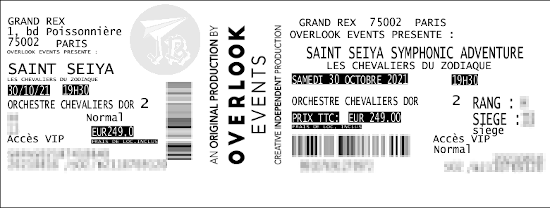
Ticket. Frand Rex 75002 Paris, Overlook Events Presente: Saint Seiya Symphonic Adventure. Les Chevaliers du Zodiaque. Samedi 30 Octobre 2021, 19:30 h. Orchestre Chevaliers Dor. Eur 240,00. Accès VIP. The rest of the information is blurred.

Corny and problematic as it may be, Saint Seiya [聖闘士星矢] was my favourite anime as a child – it was exciting and my parents heavily disapproved of it, the perfect mixture for a pre-teen finding their place in the world. In December 2019, I do not even remember how, I came across the information about the event, described as a fully-immersive live-to-picture symphonic concert with the music from pop-culture […] synchronized to cutting edge video screen, lighting and special sound effects. Similarly to the recent Final Fantasy Remake concert, the idea is an orchestra concert with the original singers for some of the musical pieces, along with projections of the original cartoon. Overlook announced an afternoon and an evening concerts. However, by the time I found out that the event had been planned, tickets had been on sale for a while. I managed to get a fairly decent ticket for the afternoon concert, but and a very bad one for the evening concert as part of Christmas sales (which meant I got both tickets for the price of the normal “good” afternoon ticket). At the time, I was ecstatic, as you may guess, though a tiny bit bummed I had not learnt about the whole thing in time to get some VIP tickets.

Enter Covid-19. One postponement led to another, and then another. At some point in late summer 2021 I entered the ticket page for something, and I could not believe my eyes – someone had returned one of the second-tier VIP tickets, and… I got that one. I seriously could not believe it. One of twelve (with the name of one of twelve characters of the show), it came with goodies, access to the rehearsal, and the autograph session after the show. So I now had a good ticket and a fantastic ticket!

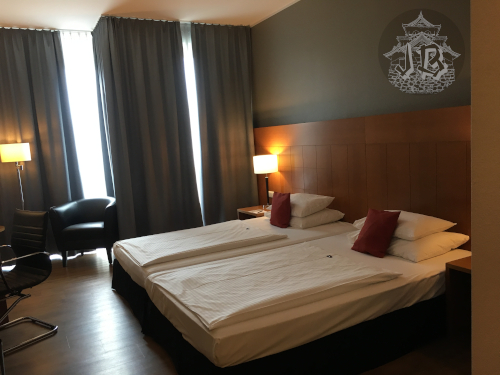
Then the event got postponed again, barely three weeks before. I was… miffed. Eventually though, the promoter got in touch with me and I was assigned a character, I bought plane tickets (again), booked a hotel (again – in this case I booked two, one at the airport and one near the theatre), and… held my breath.

When the Japanese singers arrived in Paris, I realised that it was finally happening. And thus, I booked my airport parking ticket and… held my breath again. Iberia’s check in gave me trouble, but I eventually managed to get my boarding pass (I could check in on the webpage, but only get my boarding pass from the app), and fill in the passenger form to get into France.

The plane left late on Friday evening, and it was a long weekend in Madrid, so I left with time – a lot of time. I learnt two things: one, my planning skills are awesome, and two, my car has run out of air-con gas, as I got caught in a bad traffic jam, and yet somehow I arrived within five minutes of my expected entrance time. The flight to Paris was stupidly uneventful and I was surprised at how nicely the security personnel actually behaved.

Upon arriving in Charles de Gaulle I walked out of the plane into the bus and then to the terminal. There was no kind of health check whatsoever, so I could just walk up to my hotel, which was strangely bustling for it being near midnight.

14th May 2022: Paris & Grand Rex

The organisers had sent me an email that I had to be at the Grand Rex theatre at 10 a.m. in order to pick up my goodie bag. It turned out that the email was wrong, and I was not to be there till 11 a.m. The Grand Rex is an art decó building which, like a bunch of things I saw, was under renovation.
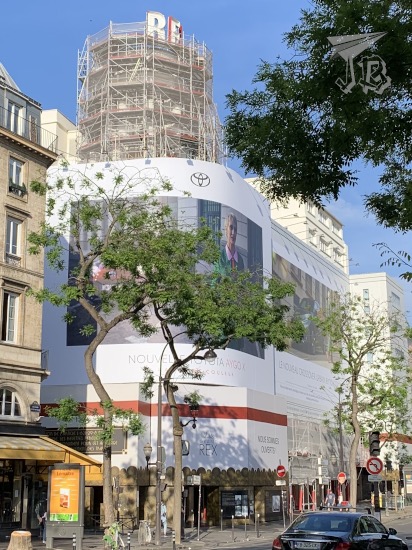
Outside the Grand Rex. It is only a huge scaffolding as the façade is being renovated.

Throughout all the waiting for the different sessions I took a few strolls around the area of Grand Boulevards after dropping off my luggage at the hotel. I ambled round and saw two smallish triumph arcs – Porte Saint-Denis and Porte Saint-Martin.

Two monumental gates in the middle of crossroads. The traffic is horrible.

Also around the area are Mairie du 10e arrondissement, a Renaissance Revival public building, Église Saint-Laurent (Church of Saint Lawrence), a gothic chapel which was also under reconstruction, Église Saint-Vincent-de-Paul (Saint-Vincent de Paul Catholic Church). A bit further away stands Gare de l’Est, one of the six large stations in Paris.
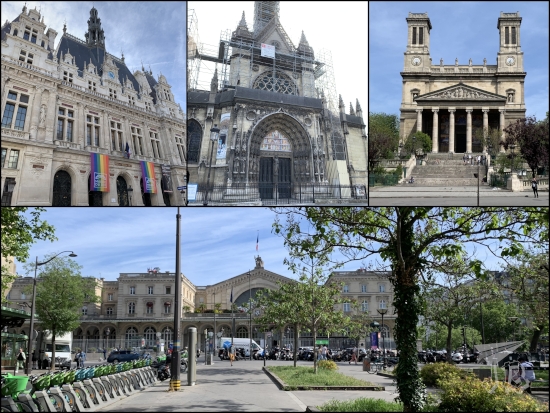
Some buildings, including a gothic church, a neoclassical one, and a 19th century train station.

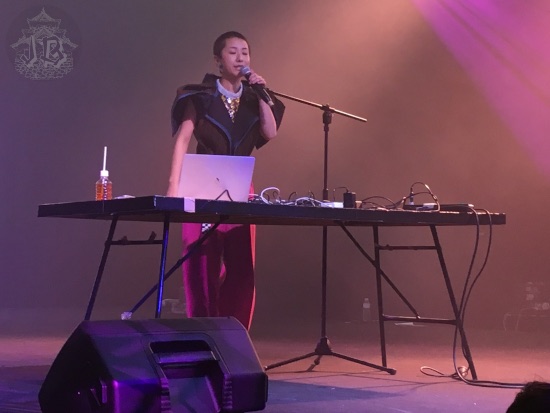
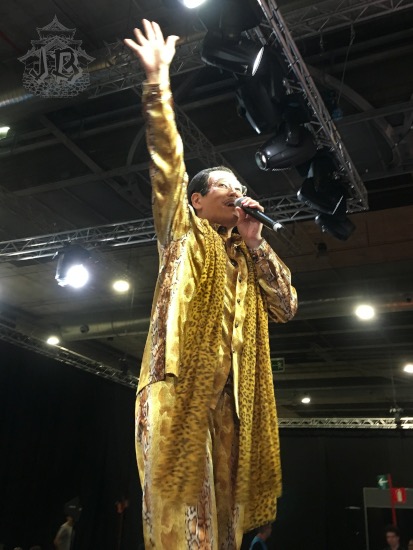
At 11:00, I finally got into the Grand Rex to watch the rehearsal, which lasted about an hour. I had been lucky to find a staff member who spoke English as I was apparently the only non-French-speaker in the VIP group, and he told me that the artists would come to say hello after the rehearsal. He added that as everything would be French and Japanese I’d be lost. I replied that I had better Japanese than French anyway. After the rehearsal we got to wave hello to the two Japanese special guests – popster NoB (Nobuo Yamada) and soprano Kazuko Ishikawa.

The staff member was very proud to point out the “Spanish person who had come from Spain” to the Japanese staff. Nob said “gracias” to which I replied in Japanese – the standard “we are looking forward to the act today”, which I guess threw everybody off a little, and got me an also standard “nihongo joozu” (you are good at Japanese” that the Japanese tell you when you’ve thrown the curveball of talking to them in their language. At this point, I became noticed.

I left the theatre for a while and came back for the first concert, which started late. The venue was rather empty, and during the break a bunch of people tried to parachute into better seats. I saw some other VIPs who had gotten a complimentary seat. As the lights went out the only thing that went through my head was “I can’t believe this is finally happening” again and again and again.

The inside of Grand Rex. The stage is a great arch with the words Saint Seiya Symphonic Adventure projected on a screen

But it was happening. The recital was divided in two acts – the first one aligned with the first arc of the anime, and the second with arcs two and three, what is call the “classical anime” as the final act was not animated up until a couple of decades later.

ACT 1
Opening
Pegasus Fantasy
The Galaxian Wars
Hyoga and Crystal Saint
Silver and Gold Saints
Zodiac Temples Part I
Ikki’s Wrath
Zodiac Temples Part II
Victory of the Heroes
Eien Blue

ACT 2
Saint Sinwa ~Soldier Dream
The Seven God Warriors
The Fury of Asgard
The Odin Sapphires
Yume Tabibito
Poseidon’s Lair

ENCORE: Pegasus Fantasy

Bluntly put, I loved it, but mostly because of nostalgia. The first one was better than the second, but there were issues with the sound, and the microphones, and at times the orchestra complete swallowed the vocals. The conductor was hilariously into it, bouncing in his platform. The harp was fantastic, and the soprano spectacular. NoB, the pop singer… is showing his age, but did a decent job of getting the audience hyped-up.

The orchestra on the stage. Images from the anime are projected on the screen.

Another of the guests was the voice actor who played the main character in the original French anime version, and boy did he bring down the walls. People absolutely loved him. To be honest, I was rather surprised at the audience’s attitude towards the whole thing, with clapping and yelling and – among everything – parachuting to better seats. I wonder whether this last thing is usual or just due to the stalls being rather empty (after all there was “free seating” in the first-floor paradise).

I went to the hotel between the first and second concert to retrieve my things and get some rest, but eventually I got back to the theatre. There were more people this time around, and my seat was undoubtedly better. It was there when I got “adopted” by the high-class VIPs, who had been very amused at my having been “lost” and then surprised at the fact that yes, I could speak some Japanese. Thanks to them I found my way to the signing session and got my programme signed by both NoB and Kazuko Kawashima. I did trip over my Japanese there, but I should have known I don’t do well trying to learn new words just before post-concert signing sessions.

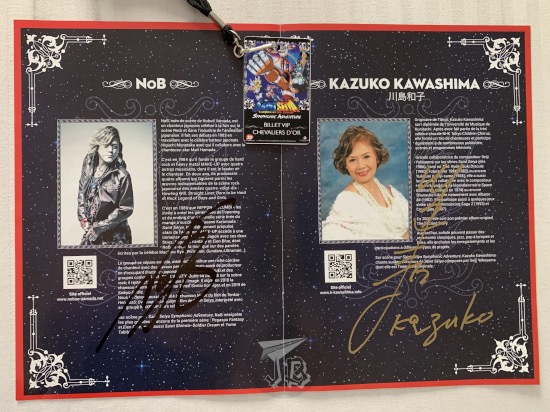
Merchandise included in the VIP ticket: mug, t-shirt, posters and booklet, all with images from the Saint Seiya anime

A close up of the booklet - showing the signatures of the singer and the soprano, and the VIP badge.

15th May 2022: Angels, Unicorns and Organ Music

I checked in early in the morning and I fought the Paris Metro system to a) find an entrance where I could buy tickets and b) make the machine work so I could buy those tickets. My first destination was the largest cemetery in Paris – Cimetière du Père-Lachaise. This early 19th century cemetery holds the remains of personalities such as Oscar Wilde, whose grave is protected by a glass wall as it became a fad to put lipstick on and kiss it, which was damaging it; the grave looks like a Babylonian bull or angel. Another grave I wanted to visit was that for Jean-François Champollion – the man who discovered the Rosetta stone, whose tomb looks like an obelisk. And after some wrong turns I also found Frédéric Chopin (minus his preserved heart, which was taken to Poland); this tomb features Euterpe, the muse of music, crying over a broken lyre.
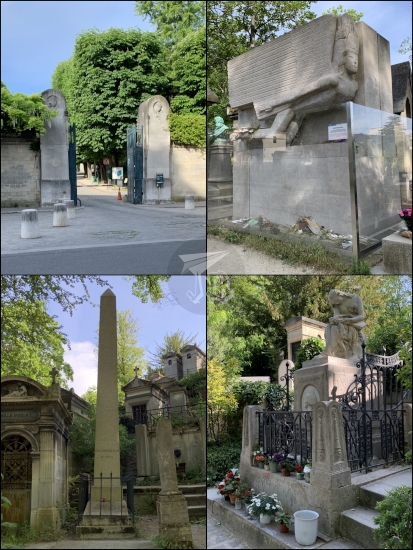
Graves at Père-Lachaise: a flying Babylonian angel (Wilde), an obelisk (Champollion), a muse weeping on her lyre (Chopin).

The cemetery was not as well laid-out as I had hoped so after a while wandering around I decided to move on. On Friday I had read that the museum of Medieval History and the old Therms of Paris had been reopened after a long closure. Thus, I decided to skip looking for more “celebrity graves” and headed towards central Paris. The Musée de Cluny – Musée national du Moyen Âge is built in a 1485 “town house” (more like a palace though, usually called a château) that was erected right on the the old Roman Baths that date the city of Paris back into the Roman period. Today it has been refurbished and holds artefacts and artworks from the Upper and Lower Middle Ages that have been brought from over different churches, including Notre Dame and the Sainte-Chapelle.

The most important piece in the museum is a collection of six tapestries, called “The Lady and the Unicorn”, dated from the late 15th / early 16th century. Five of them represent the sentences, and the sixth is a mystery (theories include “love” and “free will” – I’m a fan of the latter). They all feature the same medieval dame in a red background, accompanied by a golden lion and a white unicorn, and they are marvellous.
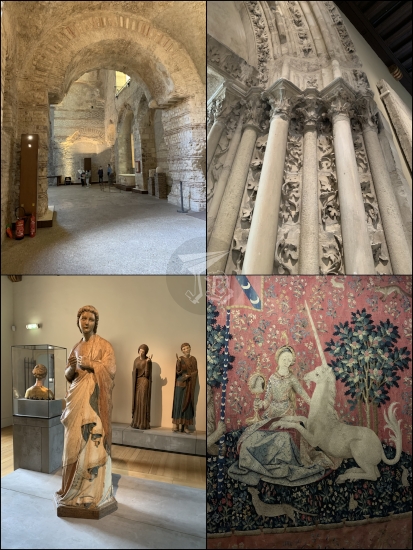
Collage: The foundations of the manor; an ornate church entryway, carved on the stone; a Virgin Mary statue; the tapestry of the lady petting the unicorn, with plants and a red background

A piece of art in its own right is the chapel of the town house. It was built around the same time of the house in the Flamboyant Gothic style. It contrast with the stark outside of the house, with its sever walls.
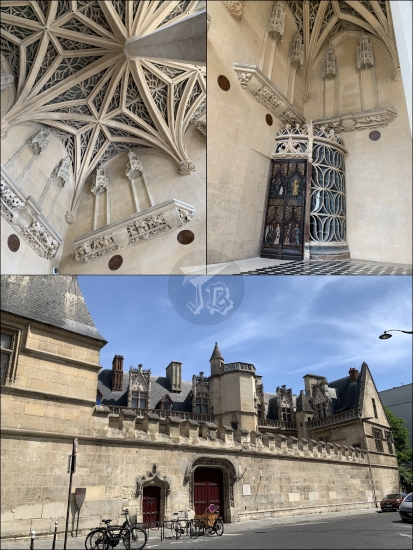
The ceiling of the chapel, which looks like a star fractal, and a view of the whole manor

I still had some time, so I decided to head over to the church Église de la Madeleine, a catholic church that looks like a classical temple (believe it or not to hail the Napoleonic army). It is built in the Neoclassical style, and it is enormous. However, it was also being renovated, so the outside was covered in hideous publicity panels.

Church of La Madeleine, it looks like a Greek temple, all columns with a triangular front, and the inside, showing Mary surrounded by the saints and the angels.

Finally, I went back to the hotel to pick up my things and walked back to the station – I did not want to carry my luggage around because I worried it would damage the posters I had got at the concert. I actually arrived and left from different airports, so I had to head to Orly this time. However, RER B joins both airports, so the closest station for arrival, Châtelet–Les Halles, was also the closest to leave. Upon coming out on Saturday I had caught eye of a small gothic church, and as I walked past this time I noticed that there was an open door and people went in and out. It was the church of St. Eustache, Église Saint-Eustache. The structure is Flamboyant Gothic, and the decorations are Renaissance and classical. It has one of the largest organs in France, and I was lucky enough that it was being played when I was there. It felt pretty magical, to be honest.

Top: A gothic church from the outside, with lots of windows. Bottom: the same church inside - high columns look like a forest, and the light filters through all the windows outsde, like water from a fall.

Afterwards, I hopped onto the train and headed for the airport. I got there earlier than expected, too, as I had planned according to some traffic restrictions that did not happen in the end. I debated some food, but everything was so expensive! The return flight was plagued with turbulence, and I got home exhausted and with a migraine, but it was well worth it! Also, travelling through Covid-19 was… weird. While I kept my facemask on most of the time, including the plane rides, the concerts, and whenever I was inside, most people would not – even the still-compulsory places. I was also happy to skip the “health checks” because I swear, the way I was feeling after landing, I don’t know if I had been running a temperature, and that would have been… awkward.

A view of Paris from the plane, also showing the wing

18th – 20th February 2022: Extremadura, the not-at-all-wild west of Spain

With everything that keeps going on in the world, my little travel gig seems insignificant. Here it is, anyway, for the sake of completion.

18th February 2022: Jam and Ham

After a crazy crazy period, and within a just-slightly-less-crazy period, we made space for a mini escapade – just under 48 hours, but it was an interesting mental reset. We took the car and drove off to Cáceres after I finished work in the afternoon. The trip should have taken a little over 3 hours and 15 minutes, but we spent about 70 minutes caught in several traffic jams – or just a very long jam with different instalments.

Sunset from the road. The orange light zigzags through the grey and blue clouds

Cáceres is located in the autonomous community of Extremadura, which is famous because of its particular grassland with dwarf trees called a dehesa. The typical animal farmed in the area is the native Black Iberian pig – a traditional breed of the domestic pig (Sus scrofa domesticus). Through breeding with wild boars and millennia of adaptation, the Iberian pig has grown accustomed to eating oak acorns, and thus it has become a key part of the ecosystem. Furthermore, the breed has great tendency to accumulate intra-muscular fat. This means that its meat is delicious, especially as sausage. The most famous treat is the “Black label” (Etiqueta Negra or Dehesa de Extremadura) ham: a pig raised in the dehesa, fed acorns and natural grass, and whose meat has been cured for at least 20 months.

The area of Cáceres is also known for its sheep-milk cheese, Torta del Casar. It is a strong-flavoured creamy cheese that comes from controlled sheep, also raised in the dehesa. The cheese is especially curded with rennet made from cardoon (Cynara cardunculus). Another typical food from the area is the local paprika Pimentón de la Vera, which is made from smoked local red peppers. All three – ham, cheese and paprika – hold European Protected Designation of Origin certificates.

Of course, not everything is food in Cáceres. After we checked into our hotel near the historical centre, we headed off to the Main Square Plaza Mayor de Cáceres, which features the town hall, the former wall gate called Arco de la Estrella (Star Arch), and one of the watch towers Torre de Bujaco.

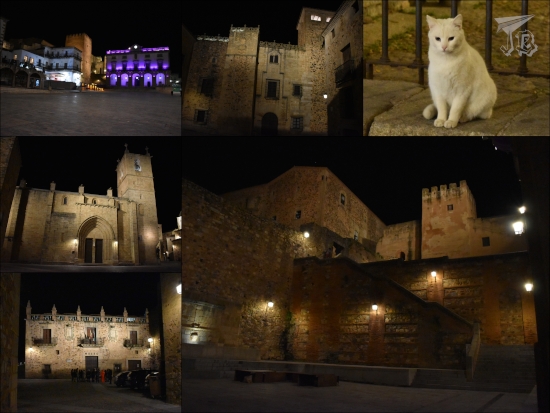
The medieval square of Caceres by night. It looks like a castle, with arches, battlements. The sky is completely black.

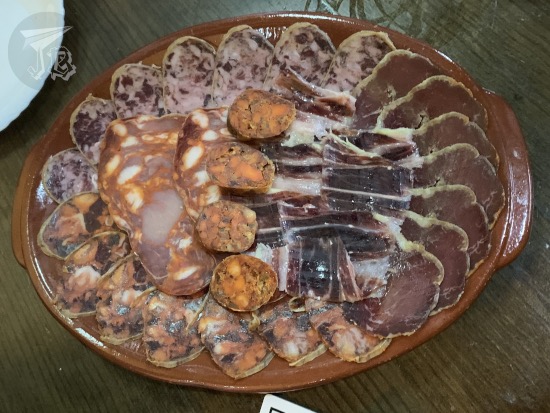
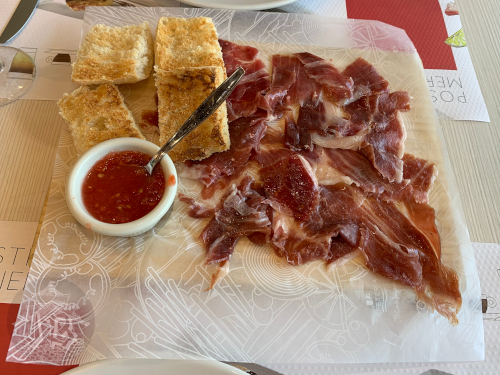
We found a place inside to grab a bite, and we tried the sausages for dinner before turning in – acorn-fed pork ham, loin, chorizo, morcón (similar to chorizo), salchichón, and patatera (pork mixed with potato and paprika in sausage form).

A plate of sausage slices and ham

Walked distance: 1.79 km (2838 steps)

19th February 2022: The Old Town of Cáceres

The Old or Walled Town of Cáceres, Ciudad Vieja de Cáceres was declared a Unesco World Heritage Site in 1986, and it is easy to see why. It is a small knot of streets between the ancient city walls and the gorge where cars can barely drive, sprinkled with Medieval and Renaissance palaces and manors. After finding an open café, we had breakfast, then headed off to explore that. Since it was a bit before 9 am, most everything was closed – but it was also empty, which was good. We crossed the Arco de la Estrella next to the Torre de Bujaco and walked into the walled area.

The medieval square of Caceres by daylight. It looks like a castle, with arches, battlements, and irregular bricks making up the walls.

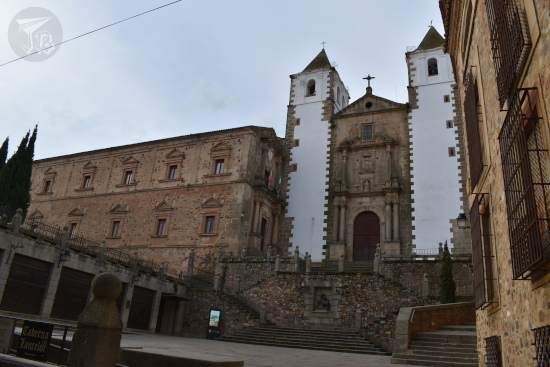
We walked past the co-cathedral – to which we would come back later and several palaces, and we ended up at a two-level square called Plaza de San Jorge (St. George Square), towered over by the peculiar-looking church Iglesia de San Francisco Javier – note the white-painted towers.

A church with two twin bell towers, both in white. Between them, the body of the church, in grey rock. In order to access it, you have to climb a staircase, which has a small sculpture of St George attacking the dragon

There was a small palace to the left, and while the building was closed off, the gardens Jardines de Doña Cristina de Ulloa were open, albeit as it was early February, still in winter mode but for some berries and roses.

Wintery garden with bare tree. There are also evergreen bushes and trees, stairs, and benches.

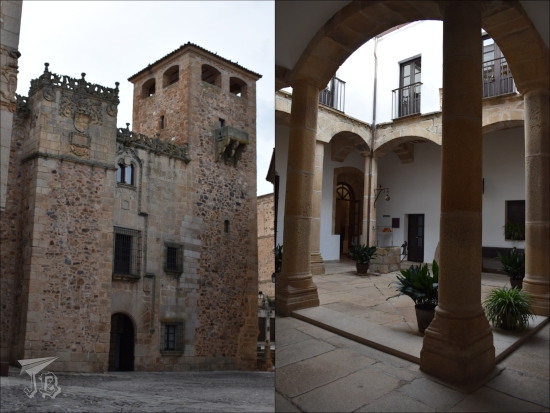
We wandered around for a while, the headed off to a visit we had booked in advance – the manor / palace of the Lower Golfines Palacio de los Golfines de Abajo, which has nothing to do with their position in the social scale, but literally the position within the city hill – in the lower part. The family is known to have owned the palace from the time of the Catholic Monarchs, in the 15th century, till the death of the last descendant in 2012. This woman willed all the heirloom to a foundation that today manages the palace. The foundation got the palace renovated and brought some of the furniture from other properties belonging to the family – among them a glass lamp way too big for the room it was set in, and a sofa which was identical to the one that used to be in my great-aunt’s living room… The lower floor holds the recreated rooms – with more or less success and taste – and a smaller area decorated with Medieval paintings which were discovered by accident. The upper floor holds a small ethnography museum and some documents from the family’s library. Unfortunately, the foundation takes itself a little too seriously and won’t allow you to roam freely in the palace or take pictures, except for the inner Castilian patio.

Gothic palace, with an ornate roof and a small cloister or patio.

After the palace, we walked a whole minute and a half for the co-cathedral Santa Iglesia Concatedral de Santa María. It is the oldest church in town, built around the 15th century, in a Romanesque-going-Gothic style. Outside the church, at the base of the tower, there is a sculpture of Saint Peter of Alcántara. Inside, the altarpiece was carved between 1547 and 1551, in unpainted pine and cedar. The tower can be climbed, and I decided that I wanted to do that, despite not being what I usually do. It was empty enough that I felt comfortable doing so, and I was treated to some nice views.

Collage: a gothic church with a bell tower; the inside showing a bare-wood altarpiece; the sea of columns from above, and a view from the belltower, showing another church and the roofs of some low houses.

By the time we went out, the city had already been taken over by walking tours and guided visits. There were so many companies that the guides put stickers on their tourists so they could herd them round. We backtracked to the Baroque church with the white towers Iglesia de San Francisco Javier (also known as Iglesia de la Preciosa Sangre), where there is no worship today. Instead, there is a huge collection of nativities (hundreds of them, literally). In order to visit the nativities you have to go up a perilous metal staircase. Once on the second floor – after having survived the peril – I decided to continue on the relatively safer stone staircase to one of the towers – only one, I did not climb up both of them. The lower floor holds two last nativities, a classical one and a hilarious set up made out of Playmobil, a German company that makes plastic figure toys.

Collage: The interior of a church with a baroque golden altarpiece, and a collection of Nativities.

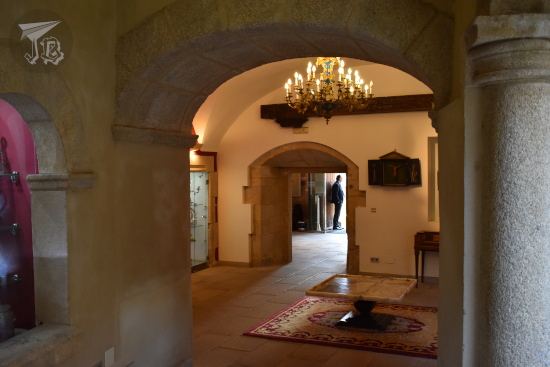
We moved onto the following manor, to the side of the square, Casa Palacio Becerra, which shows some antique elements, and the house structure.

Inside a Renaissance palace, with a low arch, a glass lamp and a red carpet that try to look eclectic and end up looking bizarre

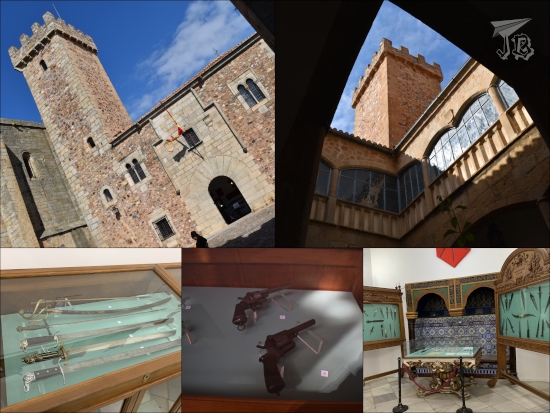
Later, we walked to Stork Square Plaza de las Cigüeñas. European white storks (Ciconia ciconia ciconia) are typical birds in Extremadura, and one wonders how they have not decided to make food out of them. In the tower stands one of the few towers that has kept its merlons, as the Catholic Monarchs were very into tearing tower tops down when they conquered a site. The adjacent manor, Casa de las Cigüeñas, hosts the military museum Museo de Armas Aula Militar.

A building with a tower. The inside is a museum, and there are some swords, firearms and Moorish decoration

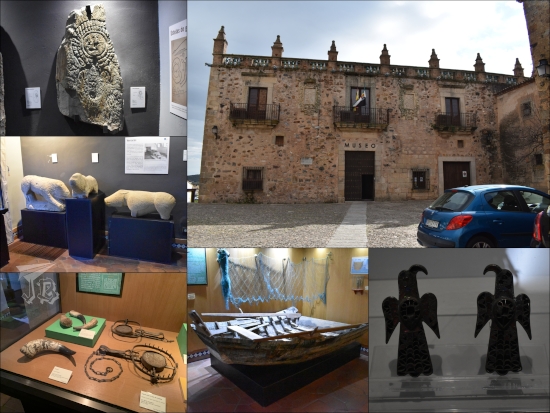
At the end of the square, in yet another palace – two of them, actually – lies the Museo de Cáceres, the local museum. The part in the Casa de Las Veletasis a regular archaeological museum, with the kind of things you would expect – prehistoric, Roman and Celtic remains, more modern artefacts. The other area, Casa de Los Caballos, hosts the modern art gallery.

Gothic building turned into a museum. The pieces shown are funerary stelae, prehistoric animal representations - bulls or pigs - and jewells, a boat, and Roman emblems

However, the palace was erected on top of the local Arab cistern or aljibe. It is the best preserved in Spain and it has been gathering the rainfall water since the 10th century. Pretty impressive piece of engineering if you ask me.

The aljibe: a moorish basement filled with water. The columns sustain horseshoe shaped arches

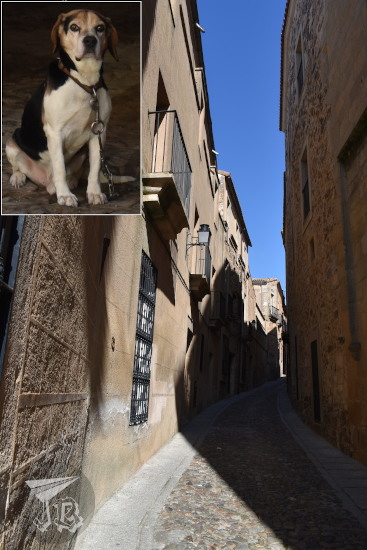
Afterwards we still had some time to kill until it was time for lunch, so we wandered around the area of the Jewish quarters or Judería, under the watchful gaze of the local Cerberus.

Narrow streets, and a guarding dog looking suspicious

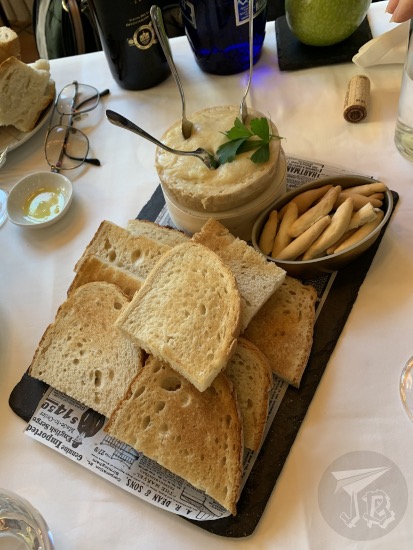
We had lunch in the local Parador de Cáceres, so I of course got my stamp. As a started we ordered the famous local cheese Torta del Casar cheese.

A tray with bread slices and breadsticks, and a cream cheese with spoons to be spread on the bread

In the afternoon we had a look at another church Iglesia de Santiago de los Caballeros. The church of St. James of the Knights was built in the 14th century over an older temple dating back from the 12th century. The altarpiece was carved and coloured by one of the most important sculptors of the Spanish Mannerism, Alonso Berruguete (1490 – 1561). This time I did not climb the tower – which had been happily colonised by a couple of storks.

Gothic church with a golden altarpiece. A stork snoozes on one of the towers.

After a little while, after sunset, I decided to skid around and have a walk through the old city at night. The artificial light made it look eery and romantic in the most… historical sense of the word. I came across some cats begging for food from a bunch of schoolgirls, and one of them very indignant because the girls would not beg it to take the food!

Different buildings of Cáceres at night. The are lit wit strategic lamps to give a mysterious feeling. There is also a white fluffy cat sitting and expecting food

Walked distance: 9.04 km (14766 steps)

20th February 2022: Trujillo & Oropesa (Toledo)

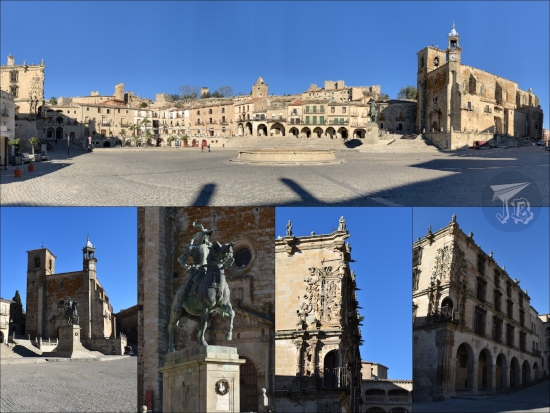
On this day I managed two more Paradores stamps. Trujillo is a town a meagre 30 minutes away from Cáceres. It also has a traditional / Medieval city centre, set around the main Square Plaza Mayor de Trujillo. It was the birthplace of one of the so-called conquerors during the colonisation of South America, Francisco Pizarro, whose equestrian statue, Estatua ecuestre de Francisco Pizarro (by American sculptor Charles Cary Rumsey). Other highlights in main square include the corner balcony in the “Conquest Manor” Palacio de la Conquista.

The large Reinassance square of Trujillo with decorated palaces and a sculpture of Hernan Cortez on his horse

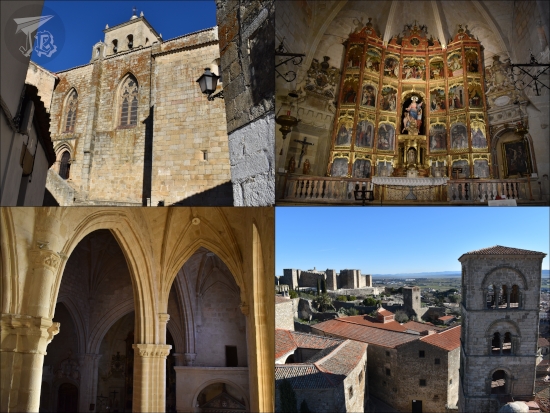
One of the most interesting churches in the area is Iglesia de Santa María la Mayor. Its tower dates back from the 13th century, but was almost completely rebuilt in the 16th century. Inside the richly painted altarpiece was erected around 1490. Apparently, my newly-discovered activity of climbing towers yielded to a new adventure, as for a few minutes I ended up locked down in the bell tower – I guess I’m a Disney Princess now (≧▽≦).

Gothic church with gothic golden altarpiece.

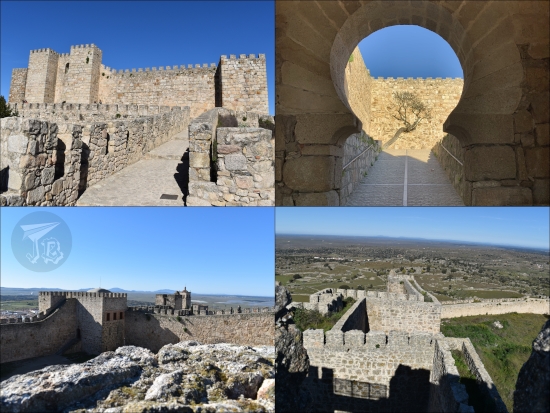
I got an hour and a little to wander round the town, so I climbed up to see the Muslim fortress Alcazaba de Trujillo (also called castle). Built between the 9th and the 12th century, it is a huge building with a defensive wall, an aljibe or cistern, several towers and a Christian chapel.

Moorish castle, from the outside and the inside. The walls and the battlements are amazingly well-preserved. It seems that the castle is built around the natural rocks defending the area

Then I hurried towards the other edge of the city to get my Parador de Trujillo stamp (only cheating slightly. I was there, after all). On my way I happened upon the Torre del Alfiler, with a family of storks happily clattering away the late morning.

Storks on top of a bell tower

I backtracked to the Plaza Mayor and I had twenty minutes before our rendezvous time, so I decked into the church Iglesia de San Martín. Its origins date from the 14th century, but it was not finished till the 16th century – which makes it so that the thick Romanesque walls are mixed with Gothic and Renaissance elements. No tower this time, but the second floor holds a religious museum.

Romanesque turning Gothic church. The inside is plastered in white and the celing above the altar and the nave retains the original decorated stone ceilings

After getting a general idea of the Medieval town of Trujillo, but it being a “working Sunday”, we moved on rather quickly, and drove off until we made it for lunch in Oropesa (Toledo) which also holds a Parador – Parador Museo de Oropesa, the first monumental Parador opened in 1930. That makes three stamps in two days, I’m almost impressed with myself!

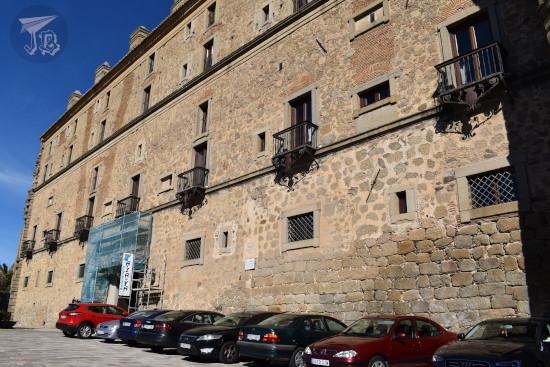
Plain building with ornate balconies, and cars parked on a row in front of it.

The Parador is adjoined to the castle Castillo de Oropesa, which was unfortunately closed, but I shall put in on my list of “to re-explore”. It was built by the Arabs during the 12th – 13th century, probably on a former Roman fortress. Today, the Old Castle is joined to the New Palace and both belong to Paradores.

Classical Romanesque castle with towers and turrets. It looks heavily restored.

After that, we drove back home, and as we got a couple of wrong turns, we ended up avoiding the traffic jam we had found on our way to Extremadura, which was convenient!

Walked distance: 5.57 km (8836 steps)

11th & 12th December 2021: Final Fantasy Remake Orchestra World Tour, Barcelona (Spain)

11th December 2021: El Triángulo Friki

When the tickets for the FINAL FANTASY VII REMAKE Orchestra World Tour first came out, 2020 promised to be an amazing year. True, we all know how that turned out, but the point was that I did not have enough fun funds at that moment. So I just looked at the Barcelona dates, sighed, and never bought tickets because I decided that it was a low-priority event for me. Then, what happened happened and the tour was pushed forward to 2021. By chance, back in summer this year, I saw that it would take place on a Saturday, the 11th of December 2021. My sibling overheard me mulling whether I wanted to try to go or not this time over, since I had not done much on the nerdsphere for a while, and the low priotity was conflagrating with higher priortity and the still lacking fun budget. They didn’t know about this, though, and they proposed we went together. I thought it was a good opportunity for a weekend out, so I did some checking. We found some tickets that had been turned back, in an amazing place, actually – row #5 on the stalls. We booked a hotel and trains, and just went on with our lives.

The train left around 8:00 and arrived in Barcelona short from 11:00 – both of us had been in town before and were looking for an “alternative” plan. I had been checking out different options, and by pure chance, on Thursday, I found out that there is an area in Barcelona called Triángulo Friki, something akin to “the nerd triangle”. It is an area near Arc de Triomph that holds a bunch stores which specialise in comics, manga, figures, merchandising and so on. I thought it could be a fun thing to see, as Japanese stuff a hobby I share to some extent with my sibling.

We took the commuter train to the area (commuter train tickets are complementary with long-distance ones, which helps, as the Barcelona public transport is very expensive) and wandered around a bunch of shops, under the agreement not to spend too much money nor to buy anything that did not fit in our backpacks. We… failed the mission successfully. On the sixth or so shop I got myself a Christmas present that sure as hell did not fit in the backpack.

A collage showing the entrance to a bunch of comic and gaming stores. Most of them have a window showing Funko pops

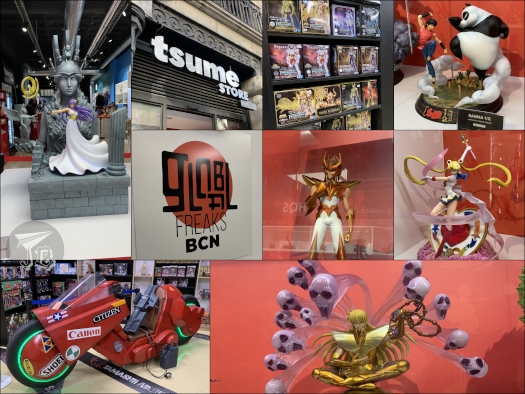
One of the shops we visited was Tsume Store, in association with Global Freaks. Tsume is a business that 3D-prints statuettes from anime designs, and Global Freaks is a merchandise shop. They have a partnership and Tsume is selling some of its statuettes through Global Freaks – we saw one of them, priced at 1400€. Most of the figures were just for show. On the other hand, Global Freaks had several things we bought (remember the “mission failed successfully” comment? We spent way too much money on stuff that did not fit in the backpacks). Furthermore, they had a reproduction of a motorbike from Akira (アキラ), a famous manga / anime – a cyberpunk action story whose main character, Shōtarō Kaneda, rides it through Neo-Tokyo.

Tsume / Global freaks store in Barcelona. There are different pictures of resine statues of different sizes (and prices), and a reproduction of an anime motorbike.

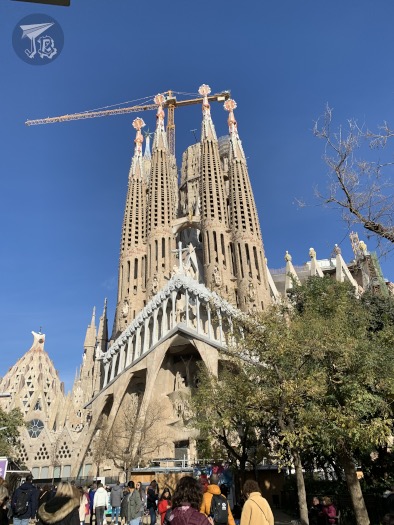
We walked towards the area where the basilica designed by Gaudí, and consecrated to the Holy Family, Basílica de la Sagrada Família, which had been decorated with a new twelve-point 7.5-metre 5.5-tonne star. As there was a Christmas market around the basilica, I thought that the start was just for Christmas, but it turns out that it is there for good.

A modernist cathedral. It looks a bit like it's melting. It has four towers, plus one with a star, and a triangular façade

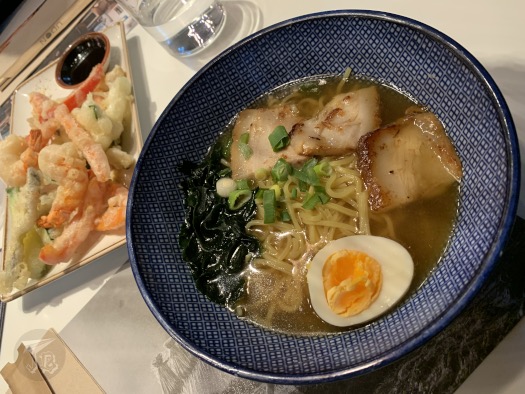
We took an underground train to the area where the venue was, and we were there around half an hour before hotel was open to check ins so we decided to have lunch first in the adjoining shopping centre. We ended up at an Udon, a wannabe fancy noodle bar chain. This was our first time getting our Covid passport checked as it’s not necessary where we’re from. The whole process was fast – open the PDF, zoom in, get it read with a device, and a green light with our names on it lit up (eventually I just screenshot the zoomed-in QR). I still felt a little uncomfortable due to the amount of people in the restaurant, so we ate as quick as possible before heading off to the hotel.

A bowl of ramen and a peek of a tempura plate in the background

It was the worst check-in experience ever. First of all, I think it’s stupid to demand a payment deposit on an already-paid booking. Second, they tried to charge me for the room again, we were given one card key for two people which didn’t even work, and we were “upgraded” to a room with a city view (16 € more expensive than our booking), but that only had amenities for one guest. We needed to get off the lift to request another card in order to get to the 21st floor, and we finally got two working cards. Oh, and the hotel was hosting a bunch of teams for some kind of handball championship who thought masks were for lesser beings and got away with it, despite the super-strict Covid-policy the hotel claimed to have, and with the obvious blessings of the clerks, despite other guests’ complaints.

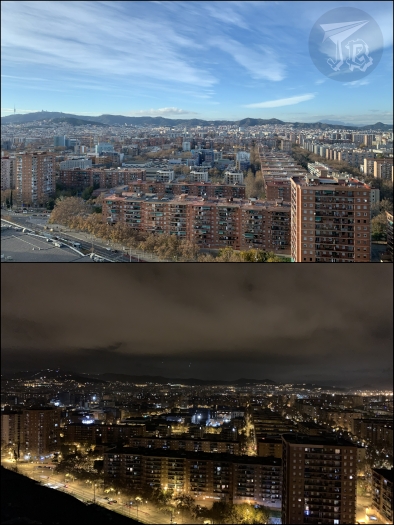
Two views of Barcelona from above, one with daylight, the other one at night. The buildings are apartment blocks, rather regular, and you can guess the long streets that separate the different areas

We stayed in the room, just chatting and taking in the astonishing views (nah, I’m not being sarcastic (≧▽≦).) The FINAL FANTASY VII REMAKE Orchestra World Tour concert was to start at 20:00, but doors were at 18:30. It took place in the convention centre CCIB – Centre de Convencions Internacional de Barcelona, which… actually turned up to be the auditorium of the local Natural Science Museum. That was confusing for a minute.

We were quite literally across the square so we just had to go down. It took just a few minutes to enter, and then we went into the goods queue, because my sibling absolutely needed a chokobo plush. We were in line for about half an hour, as we debated how expensive everything was! They decided that I needed a chokobo too, so I’m the proud owner of a Chokobo Black Mage now.

An adorable chokobo plush with a mage cape sitting on the leaflets we got from the concert.

After we had all our goods, we headed off to our seats – which had been occupied by two different people who had bought row five on the dress floor – but had tried the main floor stands, never mind that a lady told you which door you had to use when you went in, in order to avoid these “mistakes” . I decided that I did not care about causing a scene, so I just grabbed an usher and had her clear our seats. The guy on mine took my flyer too, but I found some more when the concert was over. I’m amused though that someone would buy a ticket on the first floor and then happily stroll down to the fifth row on the stalls – more than double the price.

Let me start by saying that I’m not a video-game player, that’s why this event was originally a low-priority one. When my wrist problems started, I was recommended not to play them any more. But I love video-game graphs and Final Fantasy VII designs more than any. I mean, I own the Advent Children DVD just because it’s pretty. I have to admit though that the concert blew my mind. The stage was full with a complete orchestra indeed, and a choir – the Ensemble Symphony Orchestra & Chorus. At the back of stage there was a screen that projected scenes from the game, both animations and gameplay. In the little emcees by conductor – and producer – Arnie Roth we also got messages from composers and producers from Japan. Furthermore, the composer Hamauzu Masashi was in attendance. We did not get Yosh Morita, from The Prophets, as it was originally announced, but singer Ricardo Afonso did a very decent job out of the power ballad Hollow.

Empty stage with chairs for the orchestra. There is a screen in the background reading Final Fantasy VII Remake Orchestra World Tour in front of a futuristic cityscape

    Part 1

  1. Prelude – Reunion –
  2. Opening medley
  3. Mako Reactor 1
  4. Flowers Blooming in the Church
  5. The Turks’ Theme
  6. Tight rope
  7. Stand up
  8. Words left unheard
  9. Tifa’s Theme – Seventh Heaven –
  10. Those who fight – Battle Medley –

    Part 2

  11. Anxious Heart
  12. Hurry!
  13. Jessie’s Theme
  14. Shinra’s Theme
  15. The Arsenal
  16. Those chosen by the Planet – Fate’s Calling –
  17. Arbiters of Fate – Singularity –
  18. Hollow
  19. Final Fantasy VII Main Theme

    Encore

  20. Aerith’s Theme
  21. One Winged Angel

I loved the Those who fight – Battle Medley –, and I’d say that one of the highlights was the song Hurry Up. Apparently, during a specific part of the game you have to put the rather-uptight main character in a dress and teach him to dance in a night club. I also really liked the choir interventions. The concert ended on a hype – for a second I thought it would end in the slow song, but no, we got the fantastic theme for the bad guy Sephiroth, One-winged angel.

The stage again, this time it is full with the orchestra and the director. The screen shows the main character of the game, Cloud, with blond spiky hair and a ridiculously big sword, holding a bright ball in his hand.

The concert lasted for two hours and a half, including the intermission – in which I got to see (and hug!) friends. After the ending, we tried to go and grab some sushi at the shopping centre, but they were already closing down – so in the end we just got a salad and some chips at McDonald’s and took it to the hotel – then we showered, rearranged luggage and purchases, and went to bed.

12th December 2021: Walk by the ocean

Our original plan after breakfast was to take a walk by the beach, then check out and ride the underground, but we realised that we had a train station about 20 minutes away, and we could get a detour by the seaside and make it a bit longer – and if we took the train, we had a free ride.

When we checked out we got the same person who had checked us in. They still had to charge us for the tourist tax, and I had that ready in cash. They insisted that they had to deduct that from the deposit and give us the change, they could not give us a fifty-buck note. They had to give us the change. With lots of coins. They did not even check the room for damage, so what was even the point of the deposit?

We left the hotel, and walked towards the station. We spent a little time at the beach Platja del Fòrum and the mouth of the river Río Besòs before we reached the station – lots of people walking their dogs, and lots of happy dogs playing on the beach and with the waves. In the background, the former thermal station with three chimneys looming over the sand – Central Tèrmica de Sant Adrià de Besòs. Had we had more time, we would have taken the time to try and get to it, but due to external reasons we had tickets for the noon train and it was already 10:45 – and I am paranoid about schedules.

A sandy beach with a factory building in the background, it has three chimneys made of brick. The waves are coming in gently.

We took the commuter train, then the long distance train. When we arrived, before going home, we made a short stop to have some make-up sushi for the one we could not get the previous night. And some side Chinese dumplings.

Sushi and bao plate

Walking distance Saturday: 9.05 km
Walking distance Sunday: 5.54 km

22nd & 23rd October 2021: Zaragoza Getaway (Spain)

We had a silly day-and-a-half and it turned out that for some reason a commuting train to Madrid took about as long as a high-speed train to Zaragoza, a town in the area of Aragón that we scratched off our summer route because there are lots of curves in the Pyrenees and time was limited.

22nd October 2021: Churches, Museums and a Palace

The train to Zaragoza arrives at the Delicias station, which is a bit away from the centre of the town, so we took a taxi to the hotel. This was around 9 am so we were of course not expecting any room, what with check-in being 2 pm – we just wanted to drop off the overnight bag. Not being able to give us a room seemed to upset the receptionist quite worried, and he promised to call as soon as a room was available. Honestly, I just set my phone to flight mode because we were starting to visit monuments right away, as the hotel was just by the most important square in town Plaza del Pilar.

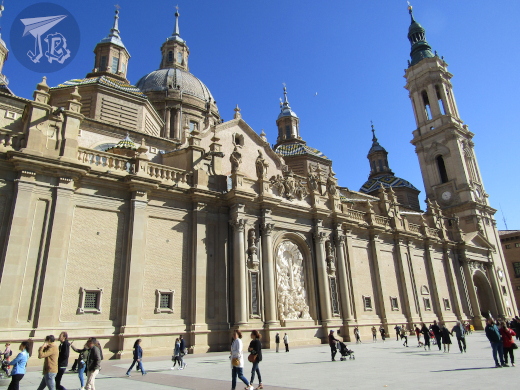
Zaragoza is home to one of the most important Christian icons in Spain, the Virgin Mary of the Pillar, Virgen del Pilar. The image is hosted in Catedral-Basílica de Nuestra Señora del Pilar. The bulk of the current cathedral-basilica was built between 1681 and 1686 in the Baroque style, but was later modified quite a few times and it was finalised in 1872. Interesting items in the church include, aside from the virgin image, some frescoes painted by Goya, the main altarpiece, and two bombs that fell within the church during the Spanish Civil War (1936-1939). Zaragoza is very anti pictures inside so I had to sneak them in. Sorry, not sorry.

A collage showing the Baroque Basilica, including unexploded bombs, and two of the altars

Virgin of the Pillar, wearing a mantle

After a small detour to say good morning to the river, Río Ebro, and the Puente de Piedra (stone river), the second building we visited was the Old Market Exchange building – Lonja de Zaragoza. This was the first Renaissance building erected in Zaragoza, dedicated to commerce, with an amazing Gothic-imitation ceiling. Today it is used for exhibits, such as paintings or sculptures.

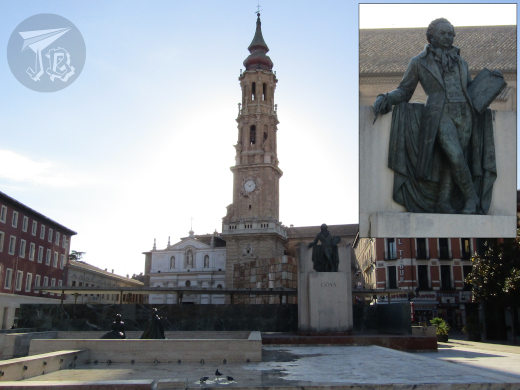
Coming out, we almost walked into one of the fountains in the square, Monumento a Francisco de Goya, featuring the artist – a brilliant Spanish painter from the Romantic times. He was as brilliant as bad-tempered though. Behind the fountain stands the cathedral, for which we had tickets for 11 am, and it was still early for that.

Thus, we started the route of the Caesaraugusta Museums. Zaragoza was founded in Roman times under this name (where an Iberian dwelling used to be) and in the latest decades, this Roman past has started being dug up. We first visit the museum focused on the original forum, Museo del Foro de Caesaraugusta where we could see the foundations of the old city and walk into the sewers (yeah, it’s cooler than it sounds). The Roman ruins date back from emperors Augustus and his successor Tiberius’ reigns.

After that it was almost time for our reservation to visit the Catedral del Salvador also known as La Seo de Zaragoza, the other cathedral of the town, literally at the end of the same square as the other one. The cathedral mixes several architectonic styles: Romanesque, Gothic and Mudéjar, these last tow being among my favourite styles, so a total win – Renaissance and Baroque elements were added, including the towers. The cathedral has a tapestry museum with a lot of works, not exactly “pretty” but rather impressive.

Following the cathedral we walked towards the rest of the Roman museums, but we made a small detour to look at the Mudéjar tower of the church of Mary Magdalene, Iglesia de Santa Magdalena.

Then we reached the museum of the Bathhouse, which was open but closed – let me explain. They run an “Audiovisual” and close the museum door for as long as it runs. It runs every half hour so finding the thing open seems to be hard. Thus, we moved onto the next archaeological site, related to the old Roman Theatre Museo del Teatro de Caesaraugusta. The theatre was apparently discovered by accident in the early 1970s, and it is apparently one of the biggest Roman theatres in Spain.
We tried our luck with the Bathhouse Museum again Museo de las Termas Públicas de Caesaraugusta. Unfortunately, just like before, we walked up to it while the audiovisual was running, and the concierge made a very studious effort not to see us – so we just peered over the glass roof to see what is left of the main bath.

More impressive was the river port museum Museo del Puerto Fluvial de Caesaraugusta, which keeps the foundations and some of the clay amphorae that were used for import / export.

And believe it or not, we did all that before lunch!! Therefore, we decided it was the right time for a break. We headed back to the hotel to see if we could wash our hands (and take off our facemasks for a while). To our surprise, the hotel had given us an upgrade to a junior suite, so we had a sitting room, a full bathroom and a bedroom – and a balcony that went all along the three. When I opened the window I could hear people playing the piano on the street, as there was some kind of festival going round. Believe it or not… I got to listen to Queen’s Bohemian Rhapsody and Rufus Wainwright’s Hallelujah.

We had lunch outside in a place that my companion enjoyed called La Lobera de Martín – not a cheap place, honestly! However, we splurged a little. We shared a smoked fish salad and I had a side of fresh Foie. As a main, ordered steak tartare, which to my surprise, was prepared for me next to the table! For dessert I tried the home-made berry yoghurt. I have to admit that I was totally planning on having a tiny dinner (or completely skip it!) at that time.

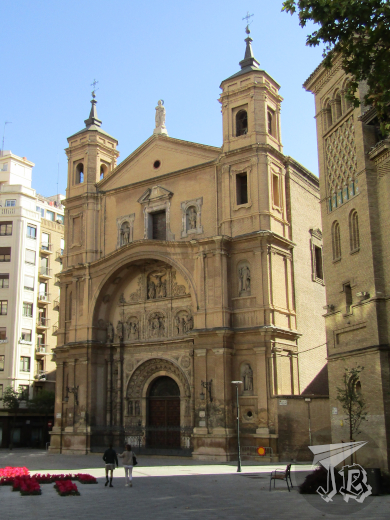
After lunch we walked along one of the main arteries of the town, Paseo de la Independencia, to find the Basílica Menor Parroquia de Santa Engracia, to at least see the outside, since we could not fit visiting the interior and the crypt with our tight schedule. One of the most interesting things about this church is how its façade is built like an altarpiece.

Next to the church stands the neo-Mudéjar post office, built in typical bricks from the area – Oficina de Correos de Zaragoza.

And finally, we looked at the current Science Museum, Museo de Ciencias Naturales, the former Medicine University. Why? Because that’s where my parents met *cue romantic music*!

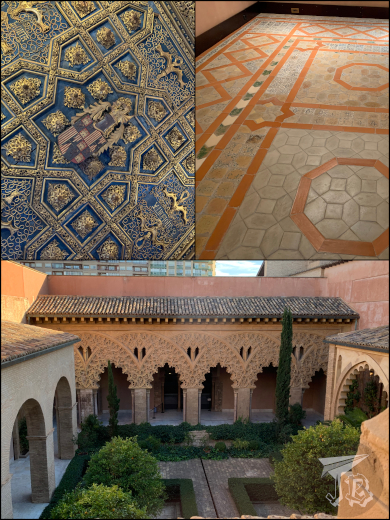
We did not go in though, because we needed a break and had booked a ticket for 5pm somewhere else, so we decided to raise our feet a little for a while in the hotel room – the sitting area was nice though unfortunately there was no more sun on the balcony, else I would have totally impersonated a lizard there (I did scare a pigeon away though, even if the startle was mutual). Our next target was the Medieval palace called Palacio de la Aljafería – a fortress that combines Islamic architecture and ulterior Christian elements. The Moorish palace was built around 1065 – 1081, and it holds a magnificent garden called the Golden Hall with a portico made out of interlocking mixtilinear arches (I totally looked the word up, and will forget it promptly). The palace was taken over by the Christians 1118 and became a palace for the monarchs of Aragón. It was not modified until the 14th century, and in the 15th Century the Catholic Monarchs extended it further into the Mudéjar Palace. Today it is the meeting site for the local government. I adored it, to be honest, I loved the Golden Hall most of all, but the original ceilings in the Christian palace were also really cool.

We walked back towards the Plaza del Pilar (probably through some streets we probably shouldn’t have, hindsight is 20/20 they say), and we reached the church of St. Paul Iglesia Parroquial de San Pablo. The restored interior leaves a bit to be desired, but the exterior, built between the 13th and 14th centuries in the Mudéjar style – it has an octagonal tower in dark tones, with the upper roof added in the 17th century with richly decorated with tiles and windows. It is worth mentioning here that several Mudéjar buildings in Zaragoza, along with others of singular architecture, are declared Unesco World Heritage Site.

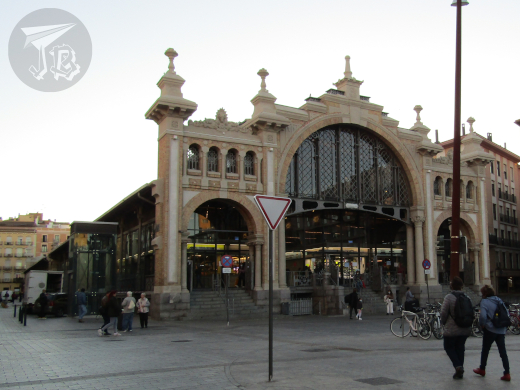
Between the church and the square we walked by the central marketplace Mercado Central de Zaragoza in the late 19th and early 20th century, in a combination of stone and iron-and-glass architecture.

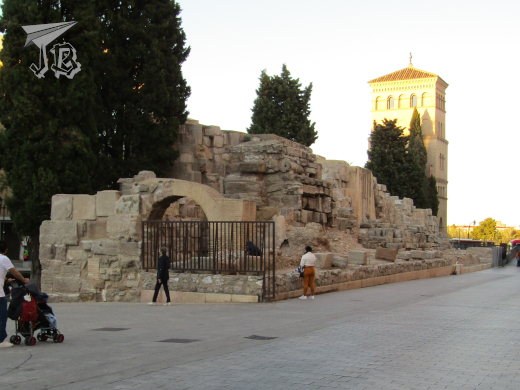
Close to it we could see some of the ruins of the original Roman walls Antiguas Murallas de Romanas de Zaragoza, which are actually sprinkled all through the town and mixed with the Medieval ones at points. There, a lady was happily chatting on the phone while her child climbed the walls – so in case it is not evident, here’s a social clue: if there is any kind of barrier / signage around something, it should not be climbed on.

To finish off the day we visited the Museum dedicated to Goya Museo Goya. Goya, whose complete name was Francisco José de Goya y Lucientes (1746 – 1828) was a painter and printmaker from the Romantic age. He is probably one of the most important artists in Spanish history. He was a royal portraitist, fresco decorator, and also painted and printed many critical and fantasy works. To be honest, the museum was a bit underwhelming – with few of the minor works, and one of the least impressive major works, the Christ portrait. There was however a whole room full of prints.

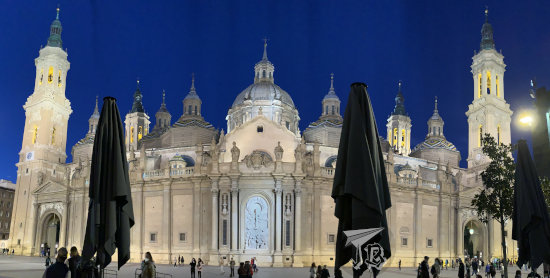
After one more visit to the square, where I managed my only complete picture of the whole (night-lit) Basílica del Pilar from that angle, we just headed to the hotel. There was a sandwich shop at the entrance, so we took one each and had a late light dinner as we watched Night at the Museum in the hotel bathrobes – because it was cozier than turning up the heating. I did not sleep too well as the fire alarm was right on top of the bed and it kept flashing – at one point I thought that an electric storm had hit, but it was just the alarm…

23rd October 2021: Papercraft and walks

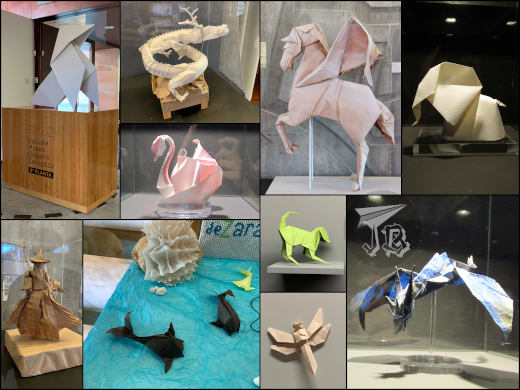
The next morning we had breakfast and headed off to the origami museum and workshop EMOZ: Escuela Museo Origami Zaragoza, located in the “Stories Museum” Centro de Historias. I remembered the exhibition from a few years back in Museo Cerralbo in Madrid, with an actual-size hippo, so I have to admit this time I was a little… underwhelmed, probably because the temporary exhibit ended up being “abstract” paper folding…

However, in the very same building there was a very fun exhibition about the evolution of household appliances throughout the 20th century. That was cute!

As we got ready to draw a close to our day-and-a-half getaway we went to say goodbye to the river Río Ebro. We walked by the modern Puente de Zaragoza bridge, and crossed over the Puente de Piedra, the traditional stone river of the town. The current one dates back (although reconstructed) from 1440, but there are records that a previous Roman one stood in its place and was destroyed in the 9th Century. Between the two bridges a flock of cormorant seemed to be sunbathing.

From Puente de Piedra I took my last picture of the Basílica del Pilar before we had a nice milkshake, then headed back to the station to take our train back. By the way – I find it ridiculous that the stations have blocked 60% of the seats while they’re filling up the platforms and the trains as normal…

Total walked distance: 8.69 km

8th – 12th July 2021: Beach weekend (El Campello & Elche, Spain)

The sea is far, far away and due to a number of situations coming together, we rented an apartment near the ocean for a couple of days. Our usual summer destination was not a good option this year due to – as everything that is going less than great these days – to Covid, so we gave a try to the town of El Campello. The town likes boasting itself as a beach paradise-resort, while it’s barely a standard Mediterranean village eaten which boomed along other, bigger resorts such as Benidorm. The apartment was not anything marvellous, but it was extremely close to the ocean – just beyond the waterfront promenade, Paseo Marítimo.

8th July 2021: The arrival

We arrived in El Campello at around 4pm, did a fast sweep of the apartment in order to feel safer Covid-wise and I decided to go for a walk at the beach, jeans and all. There were surprisingly fewer people than expected, and not as hot as I thought it would be – all in all we were pretty lucky, weather-wise.

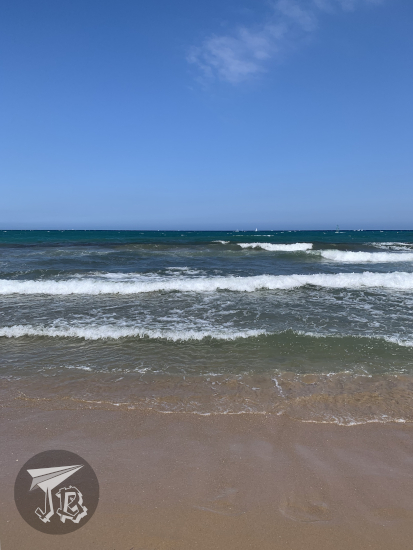
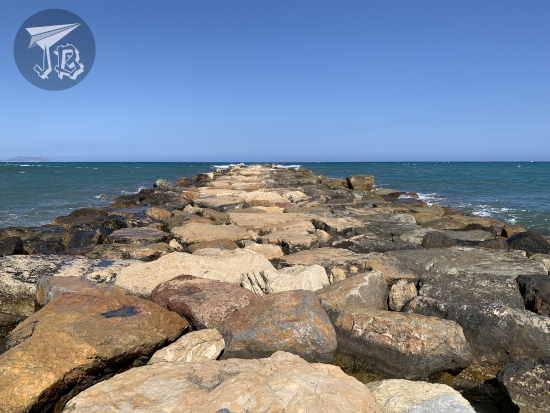
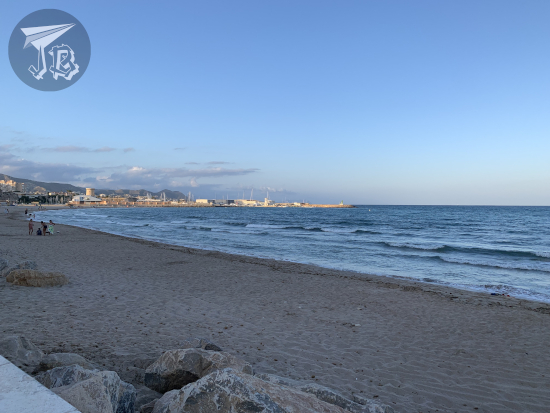
El Campello is built parallel to the coastline. The more traditional area has a small marina Puerto de El Campello to the north, and then a sand beach that extends towards the south divided into Platja de la Illeta and Platja del Carrer de la Mar. Though the beach has a couple of breakwaters, they are for protecting the beach against erosion and not to separate the different areas – the east of Spain has a reputation for building quite close to the beaches. Over the years, that caused the winds and waves to shift and the once amazing and long beaches started being washed away – now all those groins are necessary to keep the sand in place, and are liberally built along the Mediterranean coast.

I climbed on one, of course, more than once – and more than one too (≧▽≦).

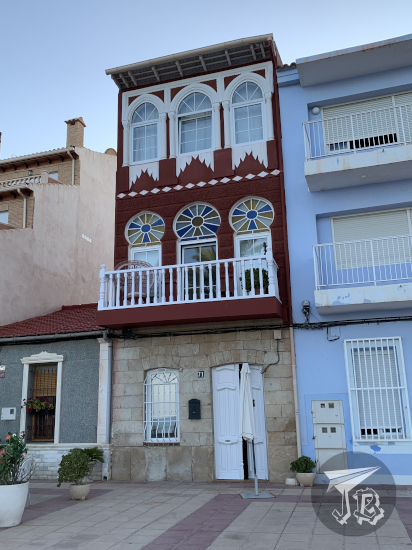
In the evening we walked along the waterfront promenade. While most of it is fronted by restaurants and souvenir shops, I did see this cute little house.

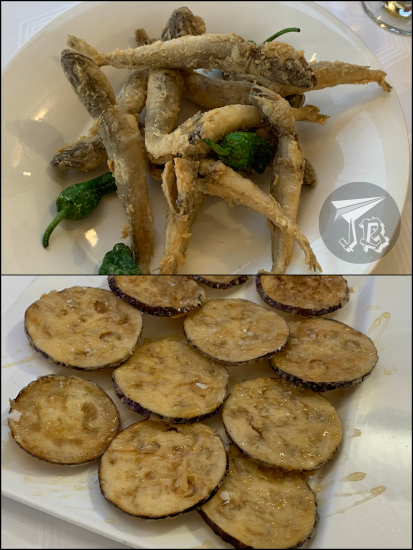
Eventually, we chose a place to have dinner – some fish and the area speciality: honey-soaked aubergine (berenjenas con miel), which is not actually made with honey, but a type of molasses – which actually makes this a vegan dish, as bees are not involved in making the “honey”, what do you know? The first time I tried this I was not too convinced, but if prepared well, this dish is absolutely delicious.

9th July 2021: The lady’s town

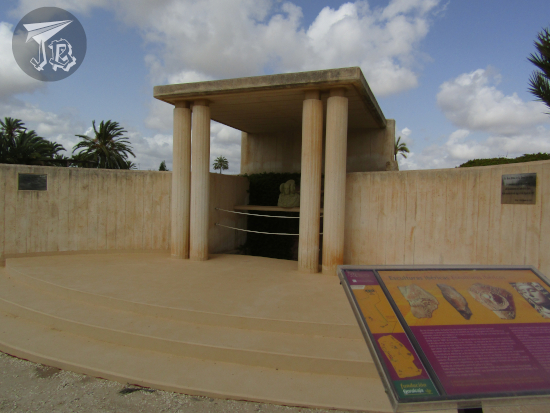
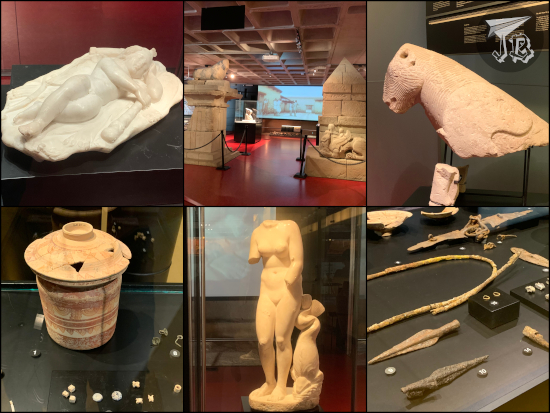
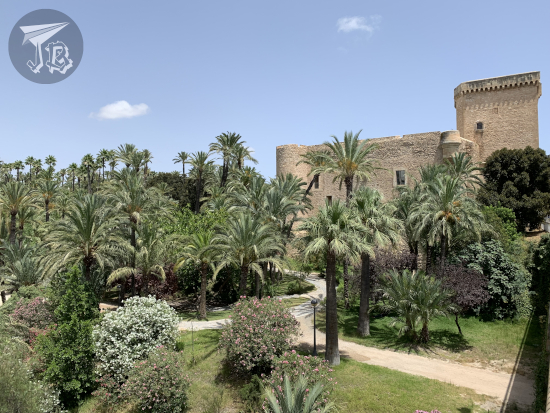
Elche is a nearby town a bit inland, and the third most populated in the area. It is famous due to the Iberian sculpture bust found nearby and because of its palm grove. The history of the town can be traced back to the current archaeological site Yacimiento Arqueológico de La Alcudia, whose stratigraphic sequence dates to the Bronze Age. There are ruins and artefacts, mostly from the Iberian and Roman ages, though there are findings until the Islamic era.

In 1897, a young farmer found the bust named La Dama de Elche, the Lady of Elche, which can be seen in Madrid’s archaeological museum Museo Arqueológico Nacional – it is the limestone bust of an Iberian woman, probably with funerary purposes, what was carved around the fourth century BCE. Since that time, a great deal of work has been carried out in the area of La Alcudia, and today is a full-fledged archaeological site with a Roman wall, several Iberian and Roman houses, a Roman temple and an Iberian one, a basilica, and hundreds of sculptorical and clay artefacts.

We visited the site in the morning, hoping to finish the stroll before it became too hot. There are still works carried out in the site, but you can visit and walk around the area – as long as you don’t step on the red ground. There are two museums on site, aside from the outer ruins. In one of them there is a reproduction of the lady, which yields to easier pictures than the glass protection in the National museum. There are also interpretations and reconstructions about what the Lady may have looked like when she had her colours. Unfortunately, reaching the site is hard, and probably not worth the detour unless you’re an expert in archaeology, but it turned out interesting to see.

… Except for the “commemorative site” of where they found the Lady. That was hideous.

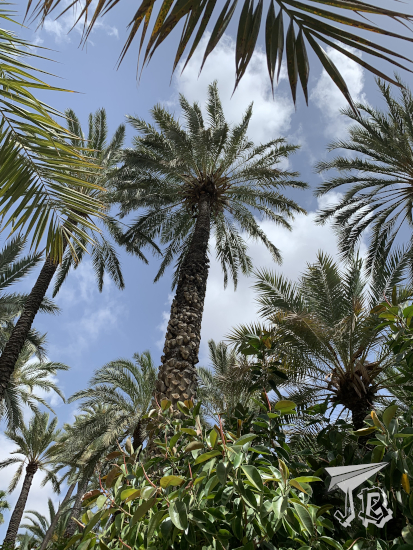
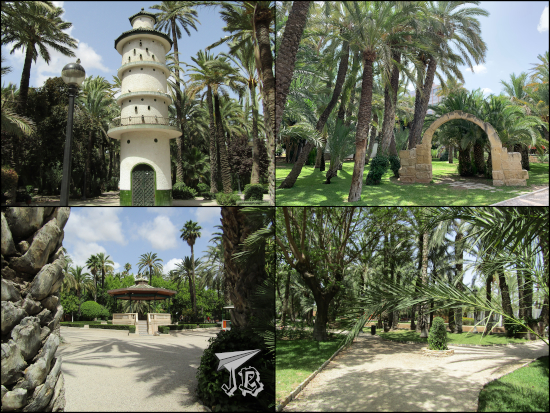
After La Alcudia, we drove off to the town centre to walk around Palmeral de Elche, the biggest palm grove in Europe, with around 200,000 – 300,000 trees, most of the date palm species, Phoenix dactylifera. The palm tree grove originates in the 10th century CE (planted by the Caliphate of Cordoba conquerors), and it has been a Unesco World Heritage Site since the year 2000. The most important palm grove is in the centre of the town (and we missed the dragon that stands on one of the trees 。゚(゚´Д`゚)゚。).

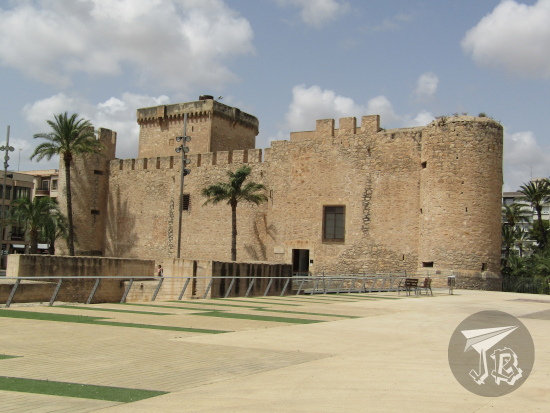
Close to the grove stands the local archaeological museum, Museo Arqueológico y de Historia de Elche, divided between the new building and the old Moorish castle or alcázar, Palacio de Altamira, which drinks from La Alcudia and other findings from the area.

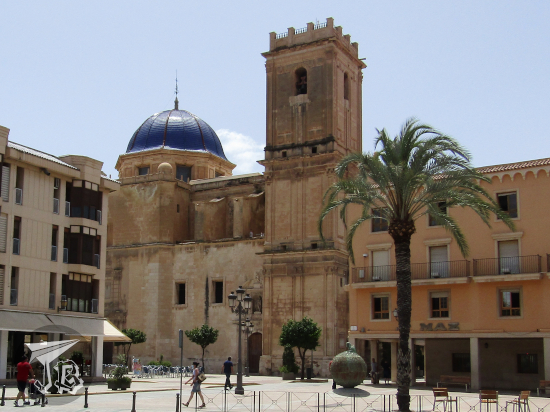
After the museum, we headed off to see the main church Basílica de Santa María, but we had just missed opening times. It stands on the place of the original mosque, and the current building – the third church that has been built – is Baroque. The bold blue dome is typical of the area, found all over the region on towers and churches.

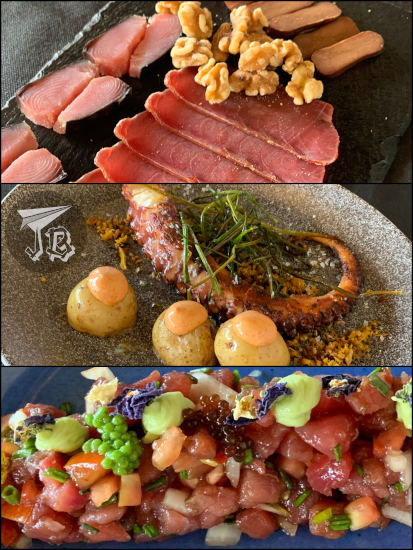
As we could not see the basilica, we just had lunch! After a bit of a banter with an over-friendly waiter we had some fish-based lunch to share – salt-preserved fish bits, grilled octopus and tuna tataki.

On the way back we got to see a different view from the palm grove and the castle and the palm grove – maybe it looked like this in the old Arab times?

It was too hot to stick around and wait for the museums and church to open up again, so we drove back and after a while I headed back to the beach. This time I reached the end of the sand beach and got to the boulder one at the end of the waterfront promenade.

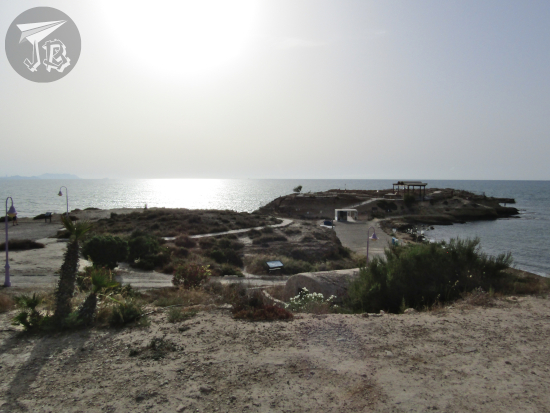
We had a quiet dinner at the apartment, then went out for ice-cream. We ended up walking to the marina, Port d’El Campello and caught sight of the Torre Vigía De La Illeta in the background.

10th July 2021: Not much to report

Just some pizza and a night-time walk along the waterfront promenade yielding tries to take artistic pictures without much success.

11th July 2021: The Tower

I woke up with a lovely reaction to the sun – not a sunburn, more like an allergy flare-up (here’s the plausible explanation for that), so we went out rather early for a walk, to then shield from the sun.

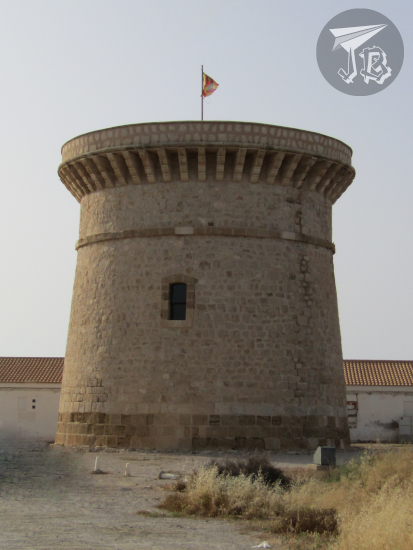
From the Roman times, a number of watchtowers were build along the Mediterranean coast to be on the lookout for pirates. The tower in El Campello, Torre Vigía de la Illeta was built between 1554 and 1557 (and restored in the 1990s), was part of a watch system commissioned by the Viceroy of Valencia at the time. The tower was manned by two infantry and two mounted soldiers – in case a pirate ship was spotted, the former would make smoke signals and the latter would ride to raise alarm in town.

The tower overlooks the marina, the town, and the archaeological site Yacimiento Arqueológico La Illeta dels Banyets, with ruins and artefacts dating from the Iberian and Roman times, but we did not walk to them as it was early in the morning and it was not even open.

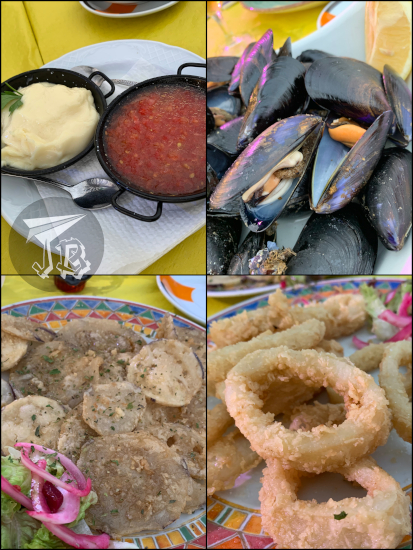
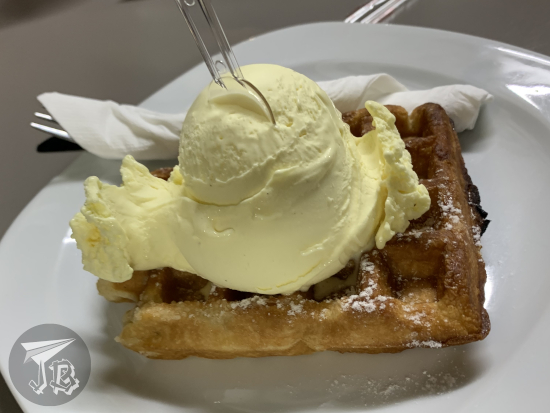
It was hot, so most of the day was spent under the air-con, to later have dinner out – some mussels, more aubergine with honey (not so good this time), and squid rings. But the highlight of the night was the final ice-cream waffle, which is a great, great idea.

And that was it, as we left early in the morning the following day, as soon as we could check out, as the trip is – as mentioned – long.

29th & 30th May 2021: The Walls (and churches) of Ávila (Spain)

There was a little-talked about consequence of the Industrial Revolution in Spain. While it is widely known that it drew a large number of people to the cities and towns, few stop to think of the subsequent steps that had to be adopted. More people in town required housing, and thus a number of projects denominated ensanches or “widenings” were projected and carried out. Even though such a thing makes sense, here lies the problem – in order to enlarge the urban area, many Spanish cities and towns tore down their Roman and Medieval walls, leaving either bare traces or nothing at all.

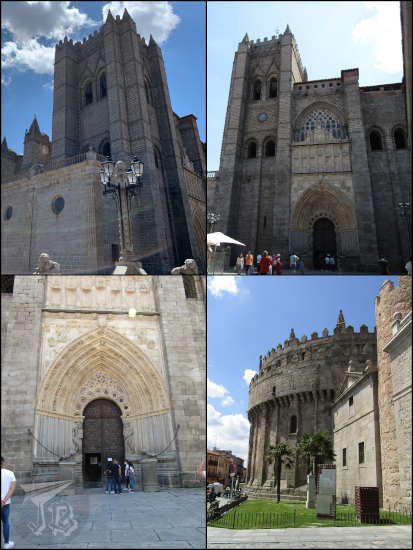
Legend has it that the town of Ávila lacked the money to demolish the wall. In retrospect, that was a good thing, because today, the walls that surround Ávila, Murallas de Ávila are among the most impressive Europe, some say that even better preserved than Carcassonne (France).

Ávila is a couple of hours away by car, so we drove off on Saturday morning at around 8 am and were there just before 10 am. We entered the city through one of the city wall gates, Puerta del Carmen.

Approach to the walls

We parked (100% ditched the car) at the hotel and checked in – even if it was quite early, they told us that one of the rooms was already prepared and gave us the keys. Unfortunately, it was not, and since the blunder was a Covid-protcol blunder, they upgraded us as an apology. The hotel, Parador de Ávila, belongs to the Spanish network of Paradores, and it is located in a 16th century palace, Palacio de Piedras Albas. We booked late-check-out for the following day, which can be done “for free” booking lunch in the restaurant (which is obviously not free).

Parador

Our first stop was the tourist office, but not the one that is clearly signalled in the middle of the town – the one that is located outside the wall and you have to turn around and around to find. But we needed it to buy the 48-hour pass to the monuments. Then we stuck around to wait for the nearby church to open, which gave way to observing the wall for the first time.

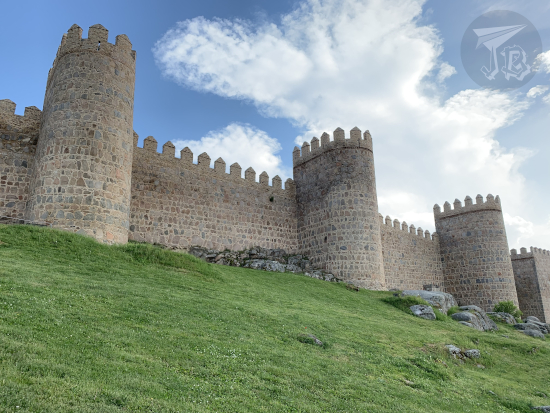
The Muralla de Ávila has been a Unesco World Heritage site since 1985. The structure is clearly defensive and it was built towards the end of the 11th century, quite probably as extension or reinforcement of a previous one, either Roman or Arab – though the Roman theory is the most credible as some pieces used in the original wall seem to come from a now-lost Roman cemetery, and there are documents about a Roman camp with similar shape. The wall has been restored in several occasions, and after surviving the ensanche risk, it was declared national monument and cleared of attached houses. Today most of the wall belongs to the Spanish government, and it is managed by the town hall, though there are some private parts, such as the ones that are part of the cathedral. The walls close off all the historical centre. They have a perimeter of 2,515 metres, with around 2,500 merlons, almost 90 turrets, and nine gates. Our second gate was Puerta de San Vicente.

Puerta de San Vicente

The first monument we stopped by, as soon as it opened since we were already there, was the basilica church Basílica de San Vicente (officially Basílica de los Santos Hermanos Mártires, Vicente, Sabina y Cristeta, three Christian siblings who were martyred nearby). It is one of the most important Romanesque buildings in the whole country, built between the 12th and the 14th century. It is protected as part of the World Heritage Site declaration. One of its characteristics is the golden rock in which it is built – sandstone-looking granite.

Iglesia de San Vicente

The inside of the basilica is, in the typical way, a mix of more modern styles. The grave of the martyr siblings is Pre-gothic, and the large altarpiece is Baroque. In the crypt there are proto-Christian pieces and a Romanesque Virgin which we did not get to see and which is the patron of the town.

Iglesia de San Vicente

Afterwards we headed off to the cathedral Catedral de Cristo Salvador, which is considered the first gothic cathedral in Spain (something that other people say about Cuenca), with clear French influences. It was designed as a fortress church as its abse dubs as one of the turrets of the city wall.

Catedral de Cristo Salvador

In later years, a choir was added, along with a Baroque altarpiece. The walls are also sandstone-looking granite, but some elements inside are limestone and wood.

Catedral de Cristo Salvador

To the side of the cathedral stands the cloister, which holds the grave to the first modern president of Spain, Adolfo Suárez, and the entrance to the cathedral’s museum. It yields to views of the tower and… the storks that squat there.

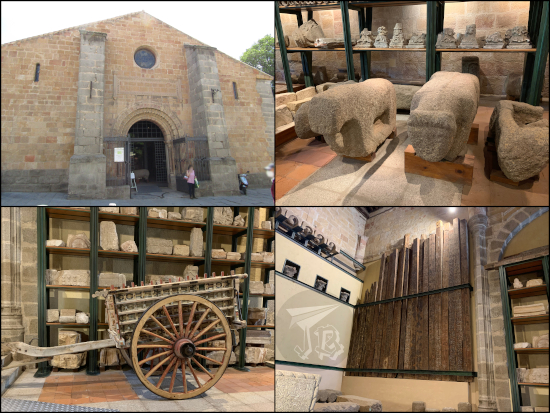
We headed off towards the Museum of Ávila. First we stopped at the former church Iglesia de Santo Tomé, which today is a warehouse for the museum, but can be visited anyway. When I was young, I studied the statues / sculptures called verracos, built around the 5th century BCE by the Vettones, a Celtic pre-Roman civilisation that faded upon the arrival of the Romans. The verracos are crude statues that represent four-legged animals – bulls, boars or pigs. At the time, I had only heard about a number of them, and was somehow under the impression that there were two or three around. I was quite wrong, apparently they pop up from the snow like daisies or something. In the church-turned-warehouse there were like twenty, one outside, there was one at the hotel garden… so no, apparently they are quite common. Other artefacts in the building include some carriages, Roman sculptures and mosaic, Muslim funerary artefacts and roof boards…

Iglesia de Santo Tomé

Then we moved onto the museum itself, Museo de Ávila, with a beautiful patio and a number of archaeological and ethnological items which represent the history and folklore of the town.

Museo de Ávila

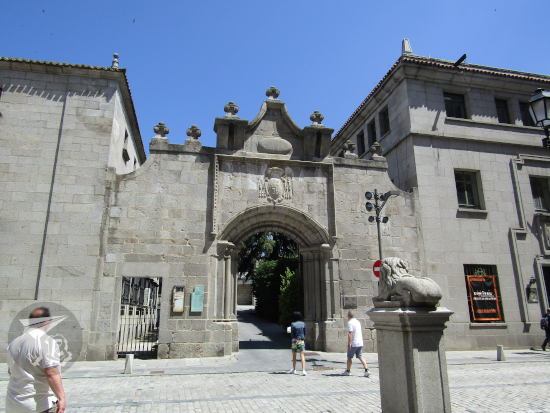
It was almost time for lunch, so we headed off towards the restaurant where we had booked. Before, we made a small stop at an old palace Palacio del Rey Niño, built in the 12th century, today turned into the Post office and the public library, with a patio closed off by the Walls themselves.

Palacio del Rey Niño

Then we walked by the modern marketplace.

mercado

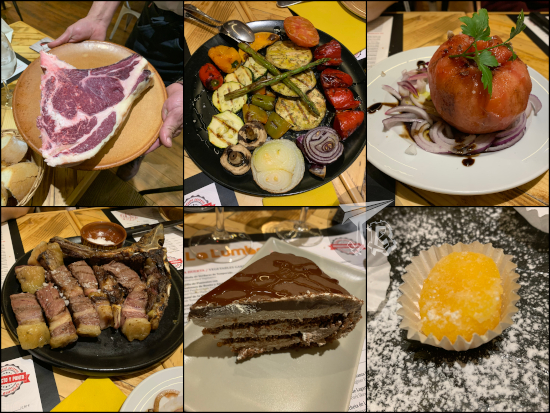
Which happened to be right in front of the restaurant, named La Lumbre. Aside from its walls, Ávila is famous for its cattle, a particular breed called Raza Avileña – Negra Ibérica, and of course the meat the animals produce, especially the matured and grilled meat from older oxen. After the animal has been sacrificed, the meat is matured in a traditional process called “dry maturation” for six weeks before it is grilled. We ordered the rib steak, chuletón to share, along with some grilled vegetables, a “tomato salad” that was a… one-tomato with dressing. And then there were desserts, aside from chocolate cake, we ordered yemas de Ávila – a typical confectionery made with egg yolks, lemon juice, cinnamon, and caster sugar. Lots of typical stuff, as you can see!

lunch

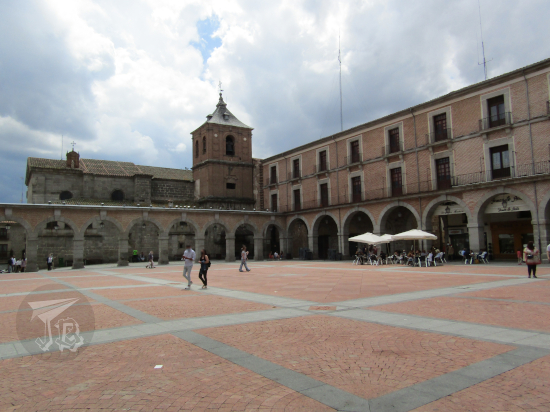
Our next stop was the main square, called “little market square”, Plaza del Mercado Chico, along with the town hall or Ayuntamiento. The square was rebuilt in the 19th century and is flanked by arcades. The town hall was built in 1862.

Plaza del Mercado Chico

Plaza del Mercado Chico: Ayuntamiento

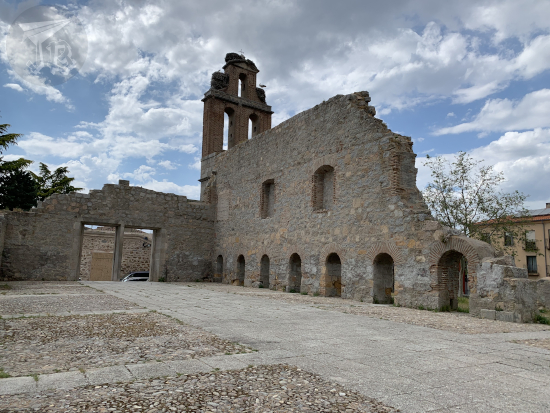
After a brief stop at the Parador for some rest, we headed off to find a convent / monastery on the other side of town. On the way we came across some ruins that I assume are the church Iglesia de San Jerónimo, as they sit in the square of the same name.

Ruinas de San Jerónimo

We reached the convent Convento de San José, a reconstruction of a previous monastery and church, the first founded by Santa Teresa de Jesús (Saint Teresa of Ávila), a Christian “doctor of the church” and mystic Carmelite nun, known for her ‘raptures’, her reforms, and her literature work. More on her later though. The convent and church were a little… underwhelming, even if is a World Heritage building.

Contento de San José

Then we walked back towards the historical centre, and walked past the church Iglesia de San Pedro, a 13th-century building with a great rose window, but which was closed (reforms).

Iglesia de San Pedro

On the other side of the square, Plaza del Mercado Grande (Big Market Square) stands another of the wall gates, Puerta del Alcázar, and a monument to Saint Teresa Monumento a Santa Teresa: La Palomilla.

Puerta del Alcázar

Next we separated and I went off to climb the walls Murallas de Ávila. Well, to walk on the parapet. Due to Covid, there is only one access, next to the Cathedral and its gate Puerta de la Catedral. The walkable area is around 1.4 km, including walking over some of the gates and up and down more than a few turrets. It allows for some amazing views of the town and its outskirts…

Views from the walls

… but also of the wall itself, both the original walls and the add-ons from later eras (and a magpie).

When I reached the end of the walk, I went down and crossed the bridge gate Puerta del Puente, named that way because it overlooks the bridge over the Adaja river. I could not take a picture of it because the traffic police was checking cars at the roundabout in front of the gate. Thus, I headed off to the pedestrian bridge to cross over towards the tiny hermit popularly known as “the four posts”, Los Cuatro Postes, which yield to an impressive view of the town and its walls.

Cuatro Postes

Views on the wall

Avila and View

I walked back to see the walls from the base. Then I crossed the gate we had driven through in the morning, Puerta del Carmen, and I headed back to the hotel for a drink.

At the feet of the walls

Puerta del Carmen

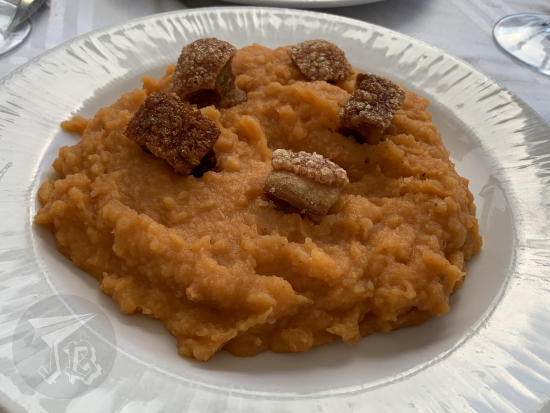
After a while we headed off for dinner and tried another of the typical dishes in Ávila, patatas revolconas – mashed potatoes with paprika and pork rashers, and waited for the sun to go down so the city lit up.

Patatas revolconas

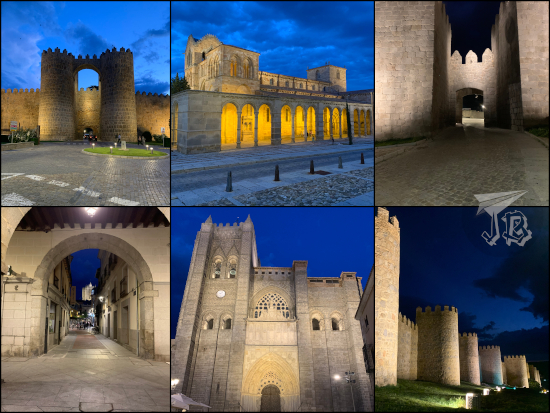
A walk around the town yielded to views of the Iglesia de San Vicente and Puerta de San Vicente, some of the inner streets leading to the town hall Ayuntamiento, the longer area of the Muralla and the Puerta del Carmen.

Night view

And then I had a very, very long shower and went to bed.

In the morning, breakfast was had – not a fan of the “we can’t have a buffet so we prepared this and this is what you get” plate, but whatever. I mentioned Santa Teresa before, let’s get into that a bit further. She was a 16th-century nun born near Ávila, canonized in the 17th century, and elevated to doctor of the church in the 20th century. She is conisdered one of the great mystics and religious women in the Roman Catholic church, author of a number of spiritual classics, and the reformer of the Carmelite nun order into the Discalced Carmelites. She founded convents all over Spain and was known for her mystics raptures which may have been messages from God or epileptic attacks. She is one of Ávila’s most important historical figures and wherever you go there are traces of her. In the place where her house stood now there is a convent, a church, a reliquary room and an interpretation museum, with really strange hours on Sundays. We could see the convent / church Convento de Santa Teresa de Jesús / Iglesia de la Santa and the reliquary room where no pictures were allowed Sala de Reliquias between services.

Iglesia de la Santa

On the way, however, I found some interesting ruins – the gate to the former hospital Hospital de Santa Escolástica, and we walked past a bunch of palaces.

Portada de Santa Eulalia

Then we moved onto a long walk to the 16th- century Gothic monastery Real Monasterio de Santo Tomás, which we could see due to lucky timing as there was a First Holy Communion Mass happening and the local little old ladies were not to keen on cultural visits of the church.

The monastery has a church, three cloisters and two adjacent museums. The church has an impressive Gothic altarpiece (by Pedro Berrugete, one of the key painters riding the wave between Gothic and Renaissance arts), and hosts the grave to the Catholic Monarch’s only male son.

Santo Tomás

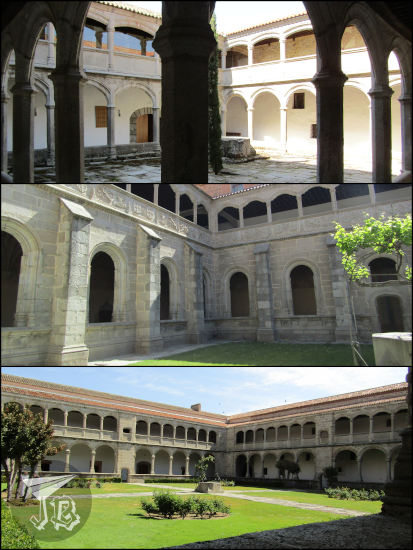
The three cloisters: Claustro del Noviciado, Claustro del Silencio, and Claustro de los Reyes Católicos (Novitiate, Silence and Catholic Monarchs).

Santo Tomás Cloisters

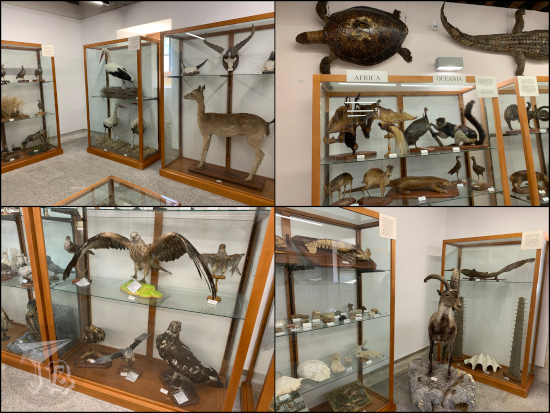
The Museum of Natural Sciences Museo de Ciencias Naturales, an occupational therapy project could… be better, and sets the expectation bar rather low for the next one.

Museo de Ciencias Naturales

However, the Museum of Eastern Arts Museo de Arte Oriental is pretty impressive. It contains pieces and artefacts that the Dominican missioners brought from China, Japan, Vietnam and the Philippines.

Museo de Arte Oriental

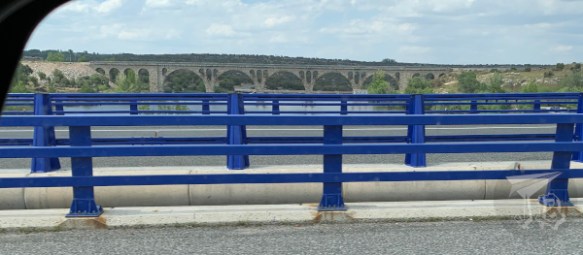
And in the end, that was it for the weekend. We walked back, decided to give the museum of Saint Teresa a miss, had a drink, had lunch and went back on our merry way – with a a view of the train tracks over the dam of the reservoir Embalse de Fuentes Claras.

Train tracks over Embalse de Fuentes Claras

Walked distance (Saturday): around 12.5 km
Walked distance (Sunday): around 6 km
Total distance driven (both days): around 340 km

23rd & 24th April 2021: Mental Reset Half-weekend: Cuenca (Spain)

With everything going on, travelling is almost impossible, but the stars aligned for a tiinny bit longer than day trip – from Friday to early Sunday morning, with every precaution possible, of course. We ran away to Cuenca for a day and a fifth. As days are becoming a bit longer, when we arrived there were still a couple of hours of light left. We checked in and dropped off the car at the Parador de Cuenca. The Parador hotel chain might be more expensive than standard accommodation, but truth be told, it is upholding the strictest hygiene protocols, even though their hand disinfectants give me allergies. Truth be told, it was spectacular.

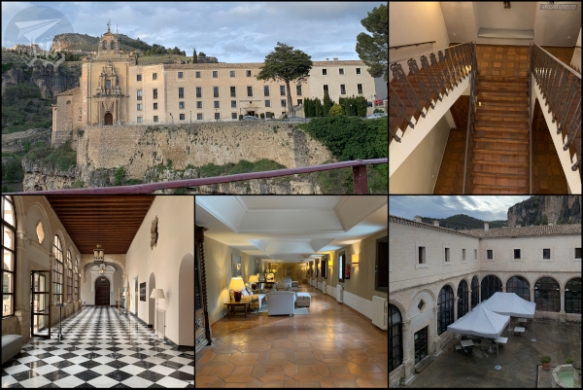
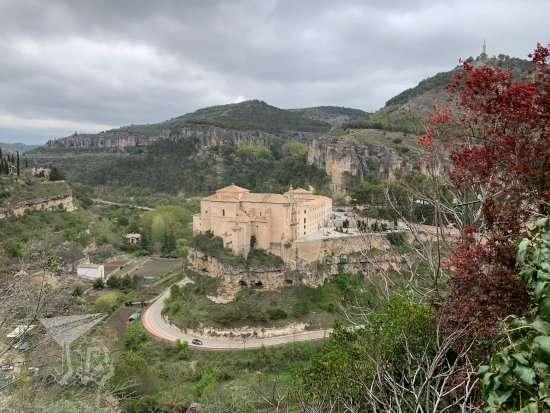
The Parador stands in a repurposed monastery, the old convent of Saint Paul, just at the edge of the historical centre of Cuenca. The hotel has a covered cloister and a newer building, and the adjoint church has been turned into an art centre.

Parador

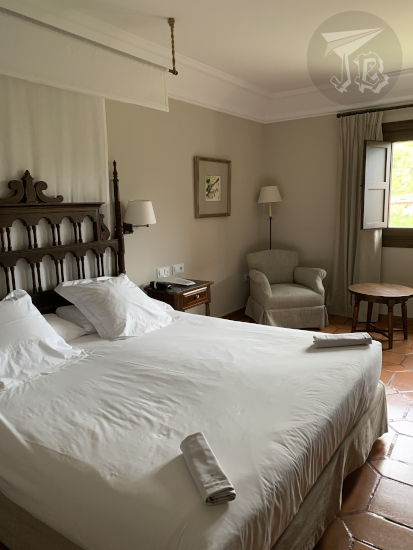
Room

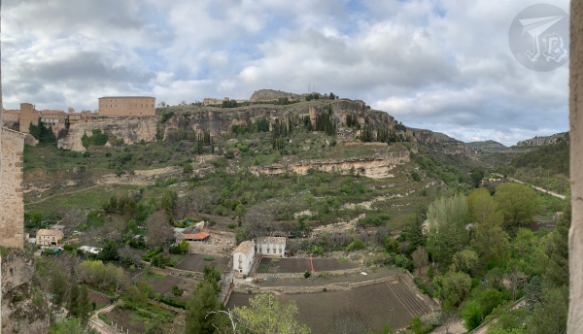
Gorge

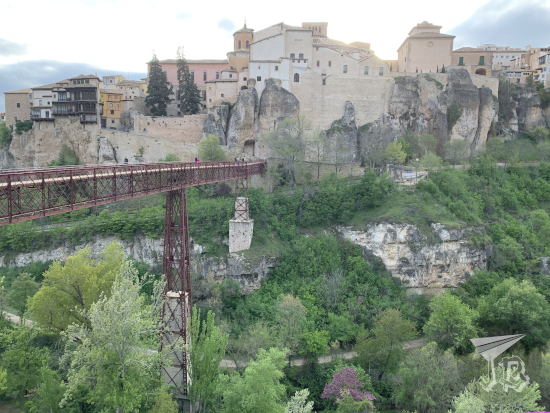
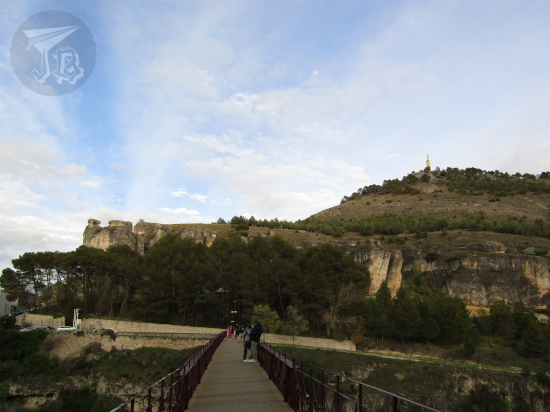
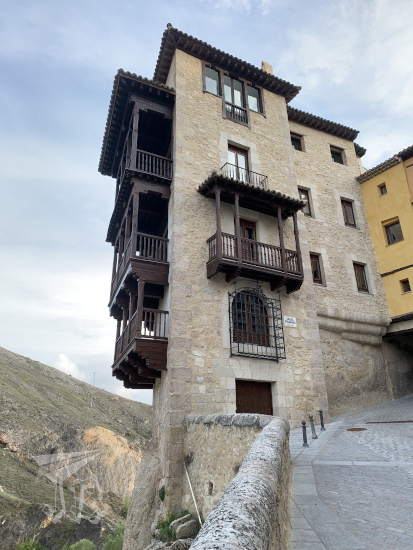
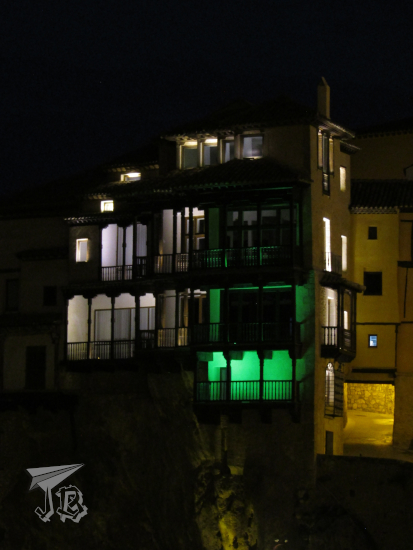
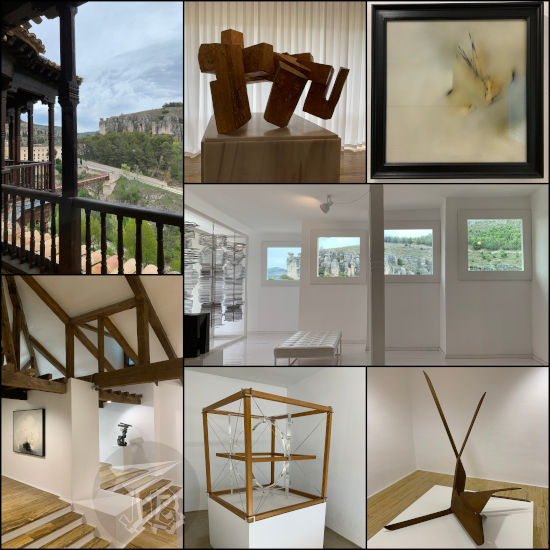
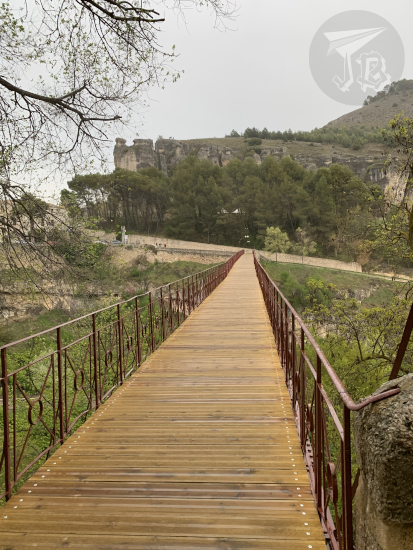
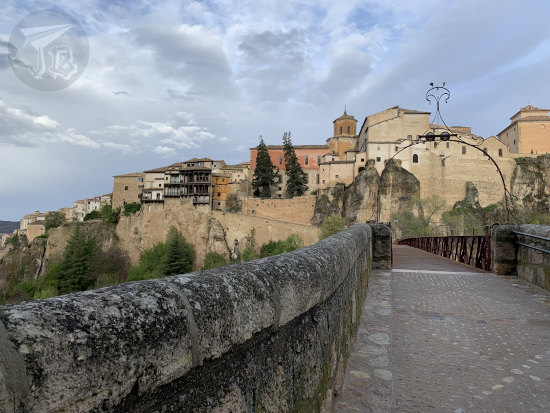
The core of the town stands between two rivers, River Júcar and River Huécar. As the area is rich in karst – calcite rocks, which dissolve in water – the rivers have dug parallel gorges around the historical dwellings. The walled city has been declared a Unesco World Heritage Site and one of the keymost point is the hanging houses, Casas Colgadas (now home to the Museum of Abstract Art). While the houses are now rather unique, they used to be the norm in the 15th century. In order to cross the Huécar gorge Hoz del Huécar, there is a(n also) hanging bridge. The bridge of Saint Paul, Puente de San Pablo, was built at the beginning of the 20th century in the typical cast-iron architecture of the time.

Puente de San Pablo

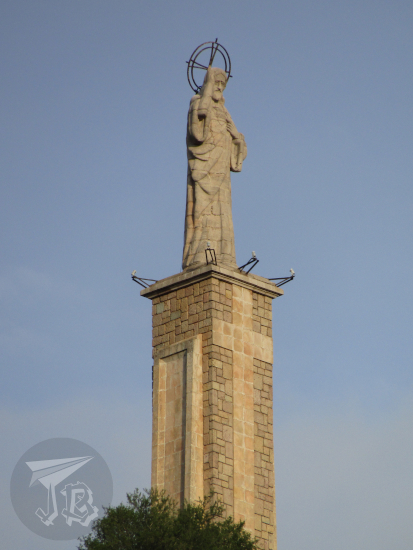
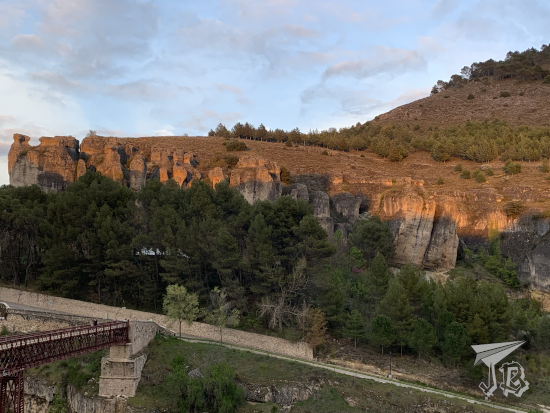
Looking back to the other side of the bridge, you see deceivingly high hill, Cerro del Socorro, carved out of karst. I say deceiving because when you actually look at it, you’re half-way up, and you can look down to the bottom of the gorge. At the top of the hill stands a religious pillar to the Catholic Sacred Heart, Monumento al Sagrado Corazón.

Cerro del Socorro

Monumento al Sagrado Corazón

Casas Colgadas

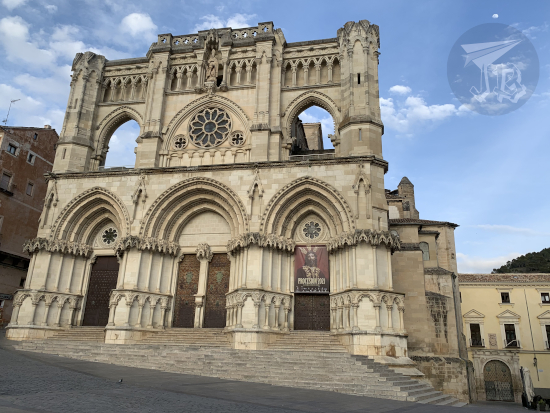
We went on walking towards Main Square and the Cathedral of Our Lady of Grace and Saint Julian – Catedral de Santa María y San Julián de Cuenca. The cathedral is one of the earliest Gothic buildings in Spain (although the main façade has been rebuilt in style). However, it is not the typical Spanish Gothic style, but it is more similar to the Norman buildings in the north of Europe. It was unfortunately not open for visiting though (it’s the third time I’ve been to Cuenca and I’ve never been able to walk in (≧▽≦) ).

Catedral de Cuenca

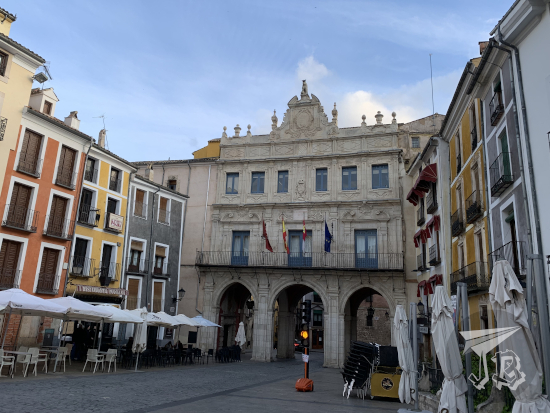
There also stands the Ayuntamiento de Cuenca or town hall, a three-arched Baroque building erected around 1760 after the designs of the architect Jaime Bort. The building closes off the square and is the gateway to a maze of chaotic traffic of one-way streets and directing traffic lights.

Ayuntamiento de Cuenca

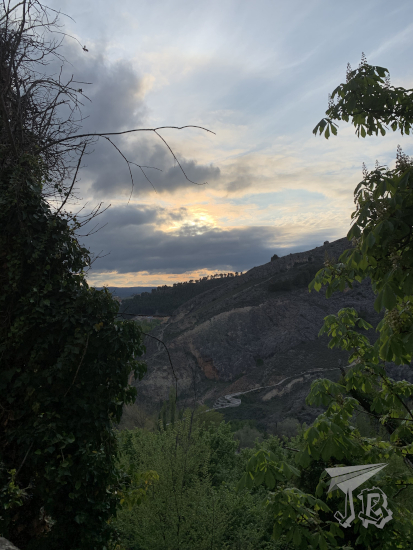
We turned towards the gorge, Hoz del Júcar on the other side of the town for a view of the sunset, but the clouds seemed to be hiding it.

Hoz del Jucar

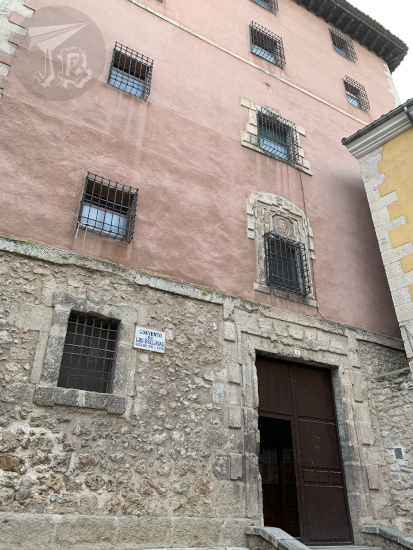
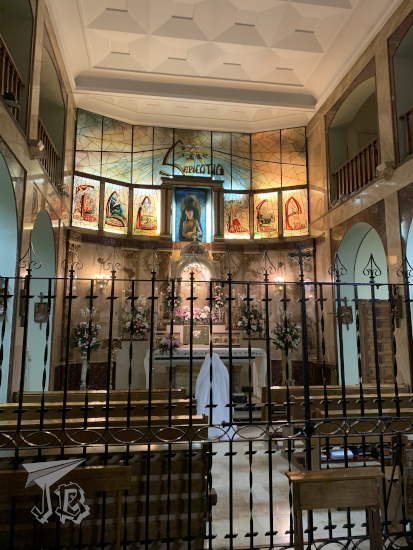
As we continued on, we stopped by a nun convent Convento de las Esclavas. This Catholic nun congregation leads a contemplative life and they are perpetually praying to the Eucharist – at least some of them, as apparently they bake and sell confectionery to sustain themselves. You can see a nun praying in the church, and to be honest for a second I did not realise she was there, it felt like there was a ghost all of a sudden. The building was erected between the 15th and 16th centuries.

Convento de las Esclavas

Convento de las Esclavas

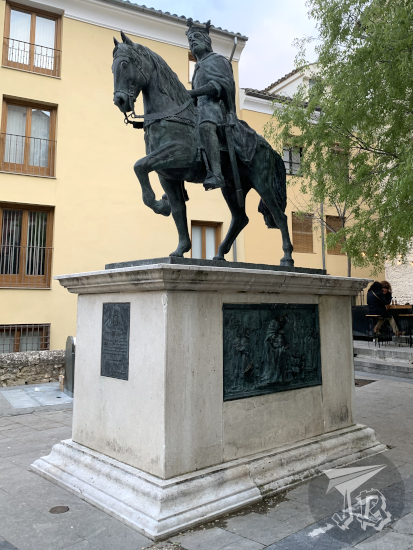
We found the monument to a medieval king Monumento a Alfonso VIII. During the Christian and Muslim wars, the king was the one to conquer Cuenca for the Christians, and assimilated it into the Castilla crown.

Monumento a Alfonso VIII

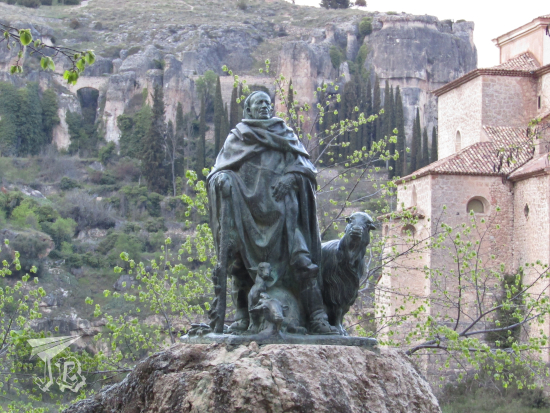
Another sculpture we found was, conversely, erected to honour the traditional shepherd from one of the old streets in town, a bronze statue named Monumento al pastor de las Huesas del Vasallo and located next to the bridge.

Monumento al Pastor

We also got treated to some nice views as the sun came out the second we turned out backs on it.

Sunset

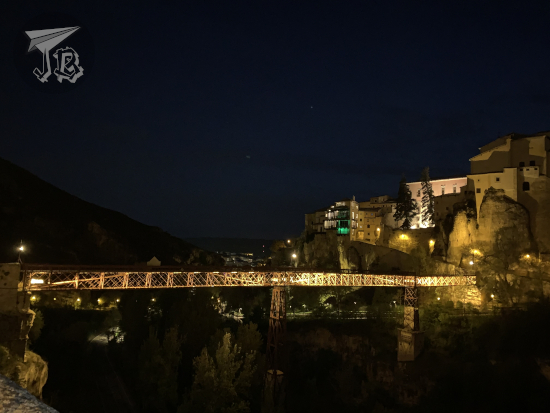
After dinner – a really good club sandwich in my case, I walked out to take some pictures of the bridge and the hanging houses after dark, expecting them to be lit up… Which they were. I mean, I was really not expecting the green colours.

Night

Casas Colgadas

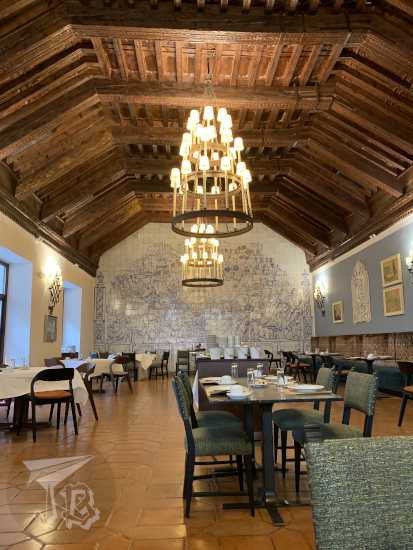
In the morning we had breakfast at the old dining room of the convent, the refrectorium, which still keeps its old allure.

Refrectorium

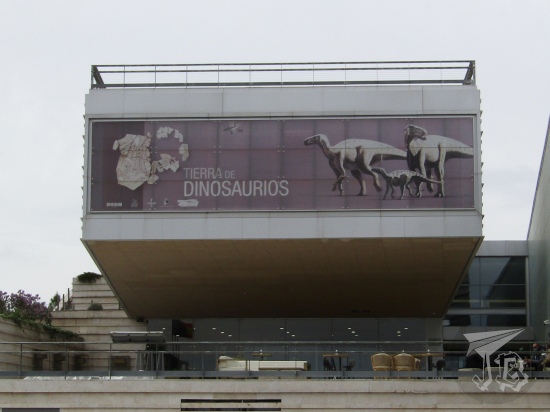
Later, we headed out to the local palaeontological museum Museo de Paleontología de Castilla-La Mancha. The museum was inaugurated in 2005, recycling, so to speak, a previous building that overlooks the city of Cuenca. The museum has an inner area with some reproductions and pieces from the different palaeontological sites around the area, and several models of the animals, organised in eras.

MUPA

MUPA

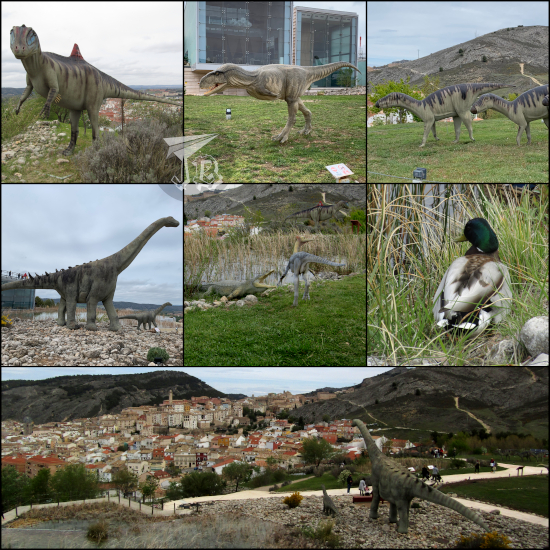
The outer part also holds replicas, and it gives a very Jurassic World feeling for a second, when you take the view with the dinosaurs. We had booked first thing in the morning, so we were leaving when the kid-crowd started to arrive, in order to see both the extinct and the extant dinosaurs (a.m., we found a mallard minding his own business at one of the ponds).

MUPA

We drove back, and unfortunately the Sat-Nav got us lost. However, we dropped the car safely off a the hotel and decided to take the plunge and walk into the museum of Spanish abstract art Museo de arte abstracto Español, home to a number of… works… by Spanish artists from the 1950s and 60s in the Hanging Houses / Casas Colgadas. I… have to admit I am not the biggest fan of abstract art, so I was not terribly impressed – I mean I had been there before and it had not imprinted on me, like at all (≧▽≦).

Museo arte abstracto

After the museum we headed back to the Parador for lunch and some rest – and I have to say that the curd I had tried the last time was nowhere to be found any more. Sad.

cuajada

But not to be deterred, we soon moved to the city museum Museo de Cuenca, which highlights the Roman origins of the city. There are displays from Prehistory to the Middle Ages, but there is either a surprising lack of Muslim artefacts, or they were in the closed-off rooms.

Museo de Cuenca

After this, we wanted to check out one of the churches, and on the way we passed by a viewpoint towards the gorge Hoz del Huécar.

Hoz del Huécar

We also came across the “Christ in the Alleyway” or Cristo del Pasadizo, which is related to the legend of two lovers – he went to war, she stayed behind and moved on, and then everything ended in tears because how dare a woman in Christian Middle-Ages Spain try to be happy. Anyway, here’s the alleyway and the Christ figure.

Cristo del Pasadizo

After that we ended up at another museum of contemporary art, Fundación Antonio Pérez, located in another former convent built in the 17th century. Honestly? It was slightly interesting but mostly claustrophobic. The majority of rooms do not have windows whatsoever and the fact that there is a one-way itinerary due to Covid, and how dry the air was, made it stressing to an almost ridiculous level.

Arte contemporáneo

It was early evening when we came out, and the second we put a foot outside it started pouring, so we headed back – it also made for a few spectacular pictures.

Rain

Rain

Some cool ones were also taken on Sunday morning just before we drove off early because there was stuff to be done throughout the day.

Casas Colgadas + Puente de San Pablo

7th – 10th February 2020: Paris (France) for DIR EN GREY & BABYMETAL

I organised a weekend in Paris because two concerts conveniently aligned on Saturday and Sunday, and I had Friday free, as well as Monday morning. It was a great mental break that I needed badly. ETA: There were rumours about a flu from China, and some of the airport workers were wearing masks. We had no idea what was about to hit us…

7th February 2020: Through the Strikes

I had found quite a convenient flight that left at 9:00 on Friday for 35 €, which was a great deal. At first, I did not understand why it was so cheap. It turned out, the plane came from South America and it was on a Madrid stopover – so it was pretty much full already. It was a huge aircraft with on-board entertainment. That came in handy when the pilot informed us that we were going to have to wait something between one and two hours to be able to take off due to the air controllers’ strikes in France. But at least we were flying and I had films to watch.

We took off at about 10:00 and our big plane made the jump in just one hour, as opposed to the 2h10 minutes of estimated travel, which meant we were almost on time! Of course, this did not sit well with the strikers, who had us wait first for the parking spot, and then for the stairs to deplane. I finally managed to leave the airport and get onto the train so I reached downtown Paris around 13:00. I wanted to inspect the damage caused to the cathedral Cathédrale Notre-Dame de Paris by the 2019 fire. My first impression, looking at the main façade and towers, was optimistic, but as I walked round the building, I could see the real damage and reconstruction efforts. Furthermore, it still reeked of burnt wood, probably because they were still pulling out debris. My optimism did not linger long, I’m afraid.

Collage of Notre Dame showing the cranes and scaffoldings in the repairs

As it was sunny, I decided to walk to the Sainte-Chapelle (Holy Chapel) and see its windows in good weather. The Sainte-Chapelle is a small two-level chapel inside the Justice Palace Palais de Justice de Paris in the Île de la Cité, smack in the middle of Paris and not far from Notre Dame – actually, both of them belong to the same Unesco World Heritage Site, Paris, Banks of the Seine. The chapel has a lower early Gothic level, and an upper level with impressive stained-glass windows which I love. As the sun was shining outside, the views were stunning.

Collage. Sainte-Chapelle: outside showing the spire, inside with some colourful windows and pointed arches

Collage of the upper floor of the Sainte-Chapelle. It shows different angles of the long gothic windows, covered in colourful glass

The weather was great – especially considering February in Paris, which is always more to the north than I mentally place it. Unfortunately, the forecast for the following day was quite miserable, and thus I decided to just walk along from the Île de la Cité towards the Arc de Triomphe (some 5 km away). On my way, I walked by the Louvre, Les Tulleries, the Grand Palais, the Petit Palais, the Alexander III Bridge, and into the Avenue des Champs-Élysées – the Banks of the Seine that the Unesco declared World Heritage.

Collage with different landmarks of Paris - the river, neoclassic palaces, Luxor obelisk, Champs-Élysées.

Finally I reached the Arc de Triomphe, which honours the fallen in the French Revolutionary and Napoleonic Wars. It was commissioned by Emperor Napoleon in 1806, and completed in 1836, and you can actually climb it, which I might do some day. From there, I took a train towards Montmartre, where I had booked my hotel. I dropped off my luggage and walked up Square Louise Michel, a sort of urban park which leads up to the church Basilique du Sacré-Cœur (222 steps). There was a pretty carousel Carrousel de Saint-Pierre, and from the square, I could watch the Eiffel Tower Tour Eiffel against the sunset from the lookout Vue de Paris.

A view of the Sacre Coeur with a classical carousel in front of it

A profile of the Eiffel Tower in a blurry sunset in orange tones

I went back to the hotel for a while during twilight. On the way, I bought a snack in a nearby supermarket for dinner as I waited for the evening to get dark and the lights to come up. When it did, I took my last adventure for the day, and walked off to see the Moulin Rouge while I listened to KAMIJO’s song of the same name. It was a few minutes’ walk away from my hotel, and Moulin Rouge [ムーランルージュ] is one of my favourite songs of his. Since the man is obsessed with France, he has a few songs that fit my weekend. Truth be told, I did consider dinner and a show there, it is after all the most famous cabaret in the world. However, it was a bit expensive and I had read quite a few reviews about bad seats if you are alone. I did not want to waste money, and I did not know how tired I would be that evening in the end – and to be brutally honest,I really had not felt like packing fancy clothes for the evening.

The Moulin Rouge cabaret, all lit up in bright red for the night

8th February 2020: Louvre and DIR EN GREY

The weather forecast was accurate, and despite the lovely weather on Friday, Saturday dawned stormy and dark. I decided to go to the Louvre Museum Musée du Louvre, even if I had been there before. It is after all one of the greatest museums in the world.

The Louvre holds so many pieces (over 600,000) that it would be impossible to describe them all, but for me, its core is the Winged Victory of Samothrace, a Greek sculpture from the Hellenistic period, around the 2nd century BCE, and my favourite piece of art. The Louvre is a national art museum, which opened in the post-revolutionary France in 1793. It exhibits around 35,000 items – Egyptian antiquities, Sumer and Assyrian pieces, Greek, Etruscan and Roman items, Islamic art, neoclassical and Baroque sculptures, a collection of objets d’art (Decorative arts), paintings, prints, drawings… It is located in the former French Royal Palace of the same name.

A collage with several Louvre pieces of art - Winged Victory, sitting scribe, the three graces, Diane washing her hair, Hermaphroditus sleeping, Psyche and Eros kissing, Liberty guiding the people, Venus de Milo

I wandered there for a few hours and I might have lost my way in the galleries a few times. In the end, I managed to (re)visit all the artefacts and artworks that I wanted. Because there are hundreds of thousands of items, but I must always see the Sitting Scribe, the Borghese Hermaphroditus, Canovas’ Eros and Psyche, and the remains of the Gates of Istar. I had a bit of a headache, so I eventually went back to the hotel to get some rest and prepare for the DIR EN GREY concert and VIP experience in the Élysée Montmartre live house. DIR EN GREY or “Diru” is a Japanese heavy metal band known for its dark themes and scenography that I thought I needed to check at least once (the final verdict was that I don’t need to repeat the experience, but it made for a nice mental break). The band has remained stable since its formation in 1997, and it is composed by Kyo [京] (lead vocals), Kaoru [薫] (rhythm guitar, backing vocals), Die (lead guitar, backing vocals), Shinya (drums) and Toshiya (bass, backing vocals).

A dark stage with a drum set. Letters projected on the screen behind the stage read Dir en Grey Tour 20 This Way to Self-Destruction

Setlist:

    1. 絶縁体 [Zetsuentai]
    2. 人間を被る [Ningen wo Kaburu]
    3. Rubbish Heap
    4. Devote My Life
    5. 軽蔑と始まり [Keibetsu to Hajimari]
    6. Celebrate Empty Howls
    7. 赫 [Aka]
    8. Merciless Cult
    9. Downfall
    10. Values of Madness
    11. 谿壑の欲 [Keigaku no Yoku]
    12. Ranunculus
    13. The World of Mercy
First encore:
    14. Followers
    15. THE DEEPER VILENESS
    16. 詩踏み [Utafumi]
Second encore:
    17. Sustain the untruth

Listing of all the concerts in the Dir en Grey 2020 tour

The concert was the final of DIRU’s 2020 European Tour TOUR20: This way to Self-Destruction. When I walked by the venue on Friday evening, around 18:00, there was a small number of people queueing already. I did not care enough to queue all day, and I had a VIP ticket with early entry, so I just headed to the line about 15:00. When the queues were separated and organised, around 16:30, I was VIP number 42. The weather was miserable, and I could have totally skipped the downpour while waiting, but I was lucky enough to be against the live house and not in the middle of the boulevard, where the General Admittance queue was. Doors opened at 19:30 for GA, and the VIP experience was held beforehand. The VIP queue started getting in around 17:30. As present we got a VIP pass and an “exclusive VIP only merchandise item” which turned out to be a scarf – very appropriate with the weather. The experience itself was a group photo with the band. There were five cushioned chairs for the fans, and the band stood behind. They did not say a word, nor interacted with fans in any way, not even acknowledging a hello or a thank you.

Afterwards, I headed for the hall, and I found an almost-barrier spot in the left area, on the second row. The people in front of me let me grab the barrier between them so I had something to hold on while I waited. The special guest was a DJ, who was more focused on getting recorded by his buddy on the phone than mixing music. The main show started a little after 20:30.

DIR EN GREY’s music is quite powerful, with a heavy focus on strings and drums. They also have a huge flare for theatricality and they enjoy the shock factor as part of the aesthetics. The singer, Kyo, donned a Joker-like make-up appearance, with a fake-suicidal attitude on stage, using the microphone to mimic stabbing his chest, or the wires to hang himself. It became a bit disturbing because it was repeated more than once. The act also felt rather distanced, there was very little interaction with the fans. At some point, a pick flew in my direction and the person behind me actually felt me up to try and find it in the folds of the coat I had tied around my waist. That was probably even creepier than the act.

The guitars and bass were tremendously powerful, and the drumming was amazing. The crowd was extremely loud, and the singer, Kyo, later confessed that he had been pretty exhausted and burnt out from the tour, which maybe explained why the concert felt so distanced. The encores were the probably best part of the concert, the part that felt more real and relaxed. After the concert was over, I headed off to the hotel to catch some sleep. Since I remembered that the area had felt a bit rough when I was there in 2014, this time over I wanted close accommodation so I could get back quickly without needing to use the underground.

9th February 2020: Destroy the Bastille!

Sunday morning was around 2 ºC, and it was windy. I lingered in bed for a while to recover from the previous evening, and then I headed out – I should have brought the merchandise-scarf with me! I saw the Place de la Bastille, where the revolutionary prison used to stand. In the middle of the square stands the “July column” Colonne de Juillet, which commemorates the Revolution of 1830 (which is not the “famous” French Revolution, which happened between 1789 and 1799). A few minutes away, in the Square Henri-Galli, I came across the base of the tower Tour de la Liberté (Freedom Tower), which was unearthed while building the first metro line. There are only a few stones remaining from the foundations, but I’ll take my fun wherever I can – so I stopped and used my music player to find another KAMIJO song, Bastille, just because I could.

Monument to the French Revolution

A few brick stones forming a circle, considered the last remains of the Bastille

It was too cold to wander, but I had a great plan. I headed off to the science museum Galerie de Paléontologie et d’Anatomie comparée (Palaeontology and Comparative Anatomy Gallery), which was a short walk away. I had read about it and was curious. To be honest, I’m still trying to decide whether it was amazing, or the materials nightmares are made of.

The museum was founded in the 19th century, and it keeps the atmosphere – and the charm – of the old exhibitions. There are stands and wooden cases, and the smell of dust and old paper. The first floor holds a “Cavalcade of Skeletons” – the whole floor is occupied by preserved skeletons of mammals and birds. In the glass cases along the walls, there are taxidermy specimens, preserved animals and dissected specimens. In the far corner, there is “gallery of monsters” with natural oddities. It was enchanting, but at the same time deeply disturbing – especially the male human figure displaying muscles and blood vessels, with a vine leaf on his groin.

The second floor hosts the dinosaurs and other fossils, including a very cool toothed whale, giant crocodiles, a Bernissart iguanodon, a diplodocus, shark teeth… Most of the fossils are either casts or reconstructions – I swear I’ve seen that Irish elk at least three times before. Also, the T-Rex skull was adorably flawed, as it was imagined to be in the 19th century.

The third floor is… ammonite-land. There were cases upon cases of ammonites in different shapes, colours, rocks and materials.

Shots of the museum. Skeletons of animals - fish, oxen, crocodiles, elephants, whale. Fossils: Dinosaurs, fish, toothed whale, shark teeth, snails

After I was done with the museum, I decided it was too cold to wander the neighbouring Botanical Garden. Instead, I headed off to yet another one, the Musée national des arts asiatiques Guimet – the National Museum of Eastern Arts or Museum Guimet, which holds pieces of art from Cambodia, India, China, Japan, Korea and so on. There was a gorgeous dancing Shiva sculpture, collections of religious artefacts, calligraphy, samurai armours, even modern art and clothes inspired by the Far East. It was a really cool museum I had recently found about and was happy to visit.

Different pieces in the museum: Dancing Shiva, sitting Buddha, Calligraphy in the shape of a dragon, elaborate kimono, samurai armour, Indian goddess

After leaving the museum, I walked towards Trocadero to take the underground. I made a small detour to have a look at the Eiffel Tower Tour Eiffel, and saw a bunch of peddlers playing shell games with tourists. Someone lost about 400 €, I really hope they were in on the game.

The Eiffel Tower in front of a cloudy sky

Since it was too cold to continue walking around to find something to eat, I decided to get take-out, and I headed back to the hotel to get ready for the BABYMETAL concert. I had never listened to them before, but they are a sensation, the basic ticket was not expensive, and two concerts in as many days seemed convenient. They actually played in the same venue as DIR EN GREY on Saturday, so I found out by sheer coincidence on the live house’s website. At that time, I thought “why the hell not?”. Afterwards, they added Madrid to their Europe tour, so if I had known that beforehand, I might have acted differently. BABYMETAL is one of those insanely-profitable Japanese marketing stunts involving cute girls that had never really been in my radar more than in passing.

Notice with the date of Babymetal's concert

BABYMETAL is a product of the “Japanese idol factory”. It was created artificially to fill a market gap. Three girls were chosen to form an act that would mix the idealised cute idea of girl idols with the heavy metal genre. When they debuted in 2010, the term “Kawaii Metal” was coined. One of the girls left in 2018, so there are two main members and and support dancer on rotation. The members are Nakamoto Suzuka, “Su-metal”, the main vocalist, and Kikuchi Moa aka “Moametal” on back-up vocals and screams. The supporting musicians are called the “Kami Band”.

BABYMETAL’s long-awaited European tour is officially called Metal Galaxy World Tour. The VIP tickets sold for around 170€, and did not even entail a M&G, so even if I had had the chance, I would have not even considered them. Despite that, they sold out, along with the show itself.

When I left the hotel at 9:00, the queue had started organising, and the tour buses were already there. I had no intention to queue or try for a barrier. I had decided to sit back and relax, so I reached the venue around 18:45 for the 19:30 concert. There were tons of people waiting to buy merchandise, but I was good. Thus, I just headed to the floor, and found a spot in the back. Since the venue has sort a bit of an arena and some upper stands, there was a wall I could lean against and it was not the end of the room.

The crowd was quite different from DIRU’s, ranging from good ol’ metalheads to families with little girls between five and ten years old with a bizarre range of in-between: people with fox masks, goth and loli dresses, explicit heavy-metal t-shirts (a bunch of those T-shirts were much less kid-friendly than the show… everything you could imagine. I… don’t think most parents knew what they were getting into, and a few of the kids ended up crying.

At 19:30 sharp, the support act started – a German band called SKYND. Their sound was really good, but their lyrics are based on true crime, which makes them a bit on the disturbing side (and very much not kid-friendly). The name of the songs are all serial killers or similar criminals.

Setlist:

    1. Richard Ramirez
    2. Elisa Lam
    3. Katherine Knight
    4. Jim Jones
    5. Tyler Hadley
    6. Gary Heidnik

At 20:30, the BABYMETAL show kicked off with the projection of the Future Metal video as an introduction of sorts. The musical act relied heavily on the Kami Band, and Su-metal carried the weight of the vocals. She spent the whole one-hour concert jumping and dancing while singing, and her voice did not break even once. If she is not lip-synching, she has the most impressive lungs ever. Both she and Moametal encouraged the crowd, making a lot of eye-contact. Su-metal addressed the audience a lot, even – I think – trying French. The concert was non-stop, and it ended up feeling a bit short, but much better than I had expected. The one annoying thing were the daddies putting their babes up on their shoulders in the middle of the floor, when the kids gave clear signs of not caring or were distressed. But it was fun. Not sure I would repeat unless I made it a thing with friends or something, but I enjoyed the act, and had a good time.

Setlist:

    1. DA DA DANCE
    2. Gimme Chocolate!!
    3. Shanti Shanti Shanti
    4. BxMxC
    5. Kagerou
    6. Oh! MAJINAI
    7. メギツネ [Megitsune]
    8. PA PA YA!!
    9. Distortion
    10. KARATE
    11. Headbangeeeeerrrrr!!!!!
    12. Road of Resistance

A group of girls dressed in black dancing in front of a logo that reads Babymetal

I was back at the hotel before 22:00. Thus, I got a good night’s sleep before I left, once again happy that I had taken nearby accommodation.

10th February 2020: No bells of Notre Dame

My plane boarded at 10:00 so I had to leave early for the airport. The weather was rainy again, so I took the underground to Gare du Nord, and then the train to Orly. As I was riding the train, I had a nice view of the Paris at dawn, but the bells of Notre Dame were not tolling, and my inner child was sad about that. Despite issues with the airport security staff, the stupidly-expensive food, and the general unpleasantness of early-morning public transportation, I made it to my plane without actual problems. As it was a big plane again, I settled down to watch Jurassic World during the flight, because I’m a nerd. Going straight into work from the airport was not fun, but it a small price to pay

I only had three days, but this trip was a very welcome getaway, and even if the weather did not help, I got to do a lot of stuff. I had to discard a few plans and improvise due to the weather. However, there is that film quote, “We’ll always have Paris”. After all, I’ll be coming back for the Saint Seiya Symphonic Adventure. ETA: Or so I thought, at the time of writing the article…

9th – 11th October 2019: Flash Barcelona (Spain) for Miyavi (and friends)

This was another of those flash trips, and it worked miraculously somehow. Miyavi’s concert was on the 11th, which was a Thursday. It’s not normally something I can do, but I managed to get away from Wednesday at noon to Friday at noon. So I worked on Wednesday morning, and in the late evening I took a train to Barcelona, where I met my friend C***** and we headed out to the hotel, which… turned out to be pretty bad. It was the closest we found in the general area of the venue for a different price but I draw the line at cockroaches, no matter how small they are. The bed was too soft, it was too hot and in the end we were both up at 6:00 to the point that we decided that we could get to the queue already.

Our tickets were VIP so they included a Meet & greet and a picture before the concert, which is one of the most fun I’ve attended lately. However, the road leading to it, and the organisation, was a bit of a chaos – there was a late-announcement of an opening act, the M&G time was changed and nobody really know what time it really was… It added a lot of unnecessary stress, as bad planning usually does. But in the end, Miyavi is an amazing human being and made up for it all. He greeted us when he came in, and when he left, and he gave his best on stage.

Miyavi kneeling on the floor playing guitar. He is wearing white trousers and a sleeveless black t shirt that reads No sleep till Tokyo

The concert was held in Barcelona’s Sala Salamandra as part of Miyavi’s European Tour No Sleep Till Tokyo. Miyavi, whose real name is Ishihara Takamasa [石原 崇雅], was born in 1981, and has been active in the Japanese musical scene since 1999. He started off as the guitarist of the visual rock band Dué le quartz, and went on a solo career after its disbandment. His first album Gagaku was released in October 2002.

Miyavi is known to fans as “the Samurai guitarist”. He has a very particular guitar-playing style, and does not often use picks – he calls this style “finger slapping”. He used to have a very characteristic style, with crazy visuals, piercings, and wildly-coloured hair, but he it tuned after he and his wife Melody had their first child in 2009.

Miyavi can compose, write lyrics, arrange, sing, and rap. However, he considers himself a (samurai) guitarist, and he has collaborated with some top-notch artists and vocalists. Back in 2007 he was part of the “ghost” supergroup S.K.I.N., along with Yoshiki, Gackt and Sugizo. Although the band had an official “debut”, they never got any further than a presentation concert at an American convention. Miyavi has also collaborated with a wide range of artists such as Hyde, Seann Bowe or Samuel L. Jackson on his most recent albums. As of recent years, he has started acting, both in American films (Angelina Jolie’s Unbroken or Maleficent: Mistress of Evil) and Japanese productions (Bleach or Gangoose). He moved to the US with his family in 2014. Aside from his musical work, Miyavi is also known for being a Goodwill ambassador with the United Nations, working against the Refugee Crisis. He regularly participates in events and visits refugee camps to try and help in whatever way he can – usually with his guitar and some footballs.

After three collaboration albums, Miyavi switched from his own company to a larger distributor and announced the release of No Sleep Till Tokyo in July 2019. Soon after, dates were set for a Japan Tour, North-American Tour, Eastern Europe Tour and Europe Tour..

Tickets went on sale on the 28th of June through the venue’s website. There were two types – General admission and VIP, which included early entry, laminated lanyard, Meet & Greet and picture with Miyavi, using your own phone. Though C***** and I were considering either Barcelona or London, we ended up with VIP tickets for Barcelona.

The week before the concert, the Spanish promoter announced a change of schedule and a Spanish support band. In the days leading to the concert, the Meet & Greet also changed times, along with entry and concert start. VIP ticket holders were worried that GA would come in before the pictures were done and they would lose part of the advantage they had paid for, and thus the Meet & Greet was set to after the concert, only to be rescheduled to before the concert again barely 24 hours before.

The day of the concert, the black tour bus arrived around 12:30, and Miyavi came out a little over an hour later. He was nice enough to come greet the fans who were waiting, and asked how to say “hello” in Spanish. He talked to some people for a little longer and shook hands with everyone waiting before walking into the venue.

Doors opened at 18:40. The Meet & Greet consisted on basically that, you could exchange a few words with him and the manager would take the pictures. Afterwards, we got positioned at the barrier for the concert. The support act Suzy & Los Quattro did not fit much into the mood. The lead singer was all right but she screamed too much for my taste. I am sure that she has her audience, especially considering how much underwear she showed. Finally the main event started – Miyavi brought a DJ and a drummer along, but he took all the weight of the music himself. Clad in a two-piece white suit, flashing his tattoos and sweating like there was no tomorrow, he did not stop for a second – good thing he had plenty of ice water to cool down.

As much as his guitar-playing style, Miyavi has a very powerful stage presence, based on being everywhere at the same time – he jumps and stands and stares and plays the guitar, without a stop, without a breather except for his ice-water.

Throughout the concert, he showed off some Spanish – very well practised, to be honest, but mostly spoke English. Through different emcees he talked about coming back to Spain after eight years, and how he knew the word “eight” is “ococho” because it’s his favourite tequila. He mentioned Maleficent: Mistress of Evil, and brought up that he has been shooting films, and how he finally got to play a non villain character – although killing people in films is so much fun. He also talked about his work at the United Nations, and that there were UN representatives and refugees in the venue.

Setlist:

1. Stars
2. Flashback
3. In Crowd
4. Rain Dance
5. No Sleep Till Tokyo
6. Tears on Fire
7. Other side
8. Secrets
9. Guard you
10. Wonderful World
11. Under the same sky
12. Ha!
13. Fire Bird
14. Day 1
Encore:
15. Fragile
16. Señor, Señora, Señorita
17. Long Nights
18. The others
19. What’s my name?

The concert lasted about two hours, in one long act and a short encore. The setlist was a combination of songs from the new album No Sleep Till Tokyo and older albums and singles, . There were very high-energy moments and some heart-wrenching ones. Tears on Fire and Long Nights are excellent pieces of music, but they have a poignant underscore.

Some of the highlights of the night included the rendition of No Sleep Till Tokyo or Under the Same Sky. There was a hilarious moment when some of the crowd asked for Señor, Señora, Señorita and he claimed to have forgotten – then proceeded to google it in order to “sing it if we helped”. Furthermore, The Others was fantastic – but that is one of my favourite songs of his, so I don’t think I’m objective. The final What’s my name with the quip “me llamo Miyavi” in Spanish couldn’t have been more powerful.

After the concert was over, Miyavi came back to stage to high five fans to the very last minute before the venue emptied. Even after a couple of hours, he shook hands with every fan who was waiting on the way to the bus. We waved him goodbye and left, exhausted and happy. My general feeling after this event is that Miyavi is adorable (and huge, I had not realised how much when I saw him in London) and I would love a hug from him. The M&G was over super quickly but he had a smile for everyone and that’s a super nice detail.

We went back to the hotel to catch some sleep and the next morning we met our other friend E****, who had not attended the concert, for breakfast. I took the early afternoon train and I was home for the afternoon-evening shift, so it worked.

Cup of coffee with fern art.

22nd – 26th August 2019: Food at San Juan and Alicante

This was a quick three-day trip for my father to have some diving time, and even if I had just landed from Japan I tagged along to make sure that my mother was not alone. I was understandable a little beaten from the big exiting trip, so there was not much that I was up to visiting. However, somehow we had a bit of a gastronomy splurge at the hotel and around.

For example, one day we had some awesome arroz caldoso con bogavante , Spanish rice with lobster for lunch:

For another lunch, I discovered that I could actually eat poke bowls in Spain – behold the Poke bowl de atún rojo de Almadraba , almadraba-caught tuna poke bowl. An almadraba is an ancient Mediterranean fishing technique in which nets are suspended mid-water that lead the fish to a central trap from where they are caught – as a curiosity, let me tell you that somehow orcas in the Strait of Gibraltar have learnt to use the almadraba to fish too! Anyway, the poke bowl had a rice base with avocado, spring onion, red onion, wakame, poached egg, and tuna marinated with sesame oil and soy sauce.

We shared some Spanish ham with that.

And finished the meal with a latte with vanilla ice-cream and a caramel biscuit because… yes, I needed something to prevent me going into a food coma.

We had granizados mid-afternoon – behold my lemon almost shaved-ice.

And one of my desserts was whiskey-cake ice-cream.

Not that much of an exciting trip, but there were some nice things to take from it.

15th – 17th June 2019: Cologne (Germany) for the Gazette

Getting from Madrid to Cologne [Köln] was stupidly difficult and expensive so in the end I took an early Saturday-morning flight to Frankfurt and then I booked train tickets (an ICE and a suburban train) to the hotel area in Cologne. My plane took off at dawn (literally) and landed at 9:40, so I thought about booking the train at 10:30.

Sunrise from the still-grounded plane

On a whim of distrustfulness, I decided to book the train for 11:00, which was lucky. While we did land on time, it tookan eternity to reach the terminal, and in the end I arrived in the station just past 10:30. Since I had a bit of time, I grabbed a coffee and a bagel for some ridiculous price, but that kept me going until the evening.

Bagel and coffee

The European plain from the train window

I reached Cologne and went on to the commuter to the venue area, where my hotel was, a short walk away from the station. After checking in, I dropped my things off in an amazing room, and had to do a double take – for a second I was not sure they had given me the right room, because it was way too nice for the price I was paying.

Huge bedroom at the hotel

After changing clothes, I grabbed my bottle of water and off I took a train towards the city centre to visit the Cologne Cathedral Kölner Dom –it took a bit to figure out how to validate the train tickets, but I think I did everything legally. The cathedral has been a World Heritage site since 1996. Its construction started in 1248, but was halted in 1473. The building remained unfinished until the 1840s, when work was picked up again, following the original Medieval plans, and the church was finally completed in 1880. While it was badly damaged in WWII, it withstood the bombings and ever since then, it has been in a constant state of small and not-so-small restorations and repairs.

Cologne Dome

From the Cathedral I walked towards Cologne Zoo or Kölner Zoo. Although it had been drizzling before, at that point it was sunny again, and the walk was nice.

A typical Cologne Street

I decided to go to the zoo because it was the only thing that seemed to be open for long enough to mean value for money. The weather had warmed up and the bunnies were roasted coughs. I got to see some animals I had never seen before, such as Przewalski’s horses, snipes, or a grizzly bear. The zoo has a huge enclosure area, a petting zoo with domestic animals (and cheeky cows), an aquarium and a terrarium with both reptiles and creepy-crawlers shudders.

Some of the animals in the zoo

Then, I walked back to the hotel, stopping by the supermarket on my way – and here I discovered my undoing. The triple chocolate cookies which wrecked my trying to eat healthy stroll. I shall try to find them again in my next Germany trip though. However, I have to say that I had learnt from my being stupid for MIYAVI in London and not eating well through the weekend, so I bought snacks to have the following day.

Cookies

I was exhausted, so I think I was out at 22:00, which helped being awake at 7:00 the next morning. Thus, I just headed off for the venue E-Werk, and settled to queue for the concert. Japanese Visual kei (V系) rock band the GazettE [ガゼット (Gazetto)] was formed in 2002 and achieved its current configuration in 2003. It is formed by members: Ruki (ルキ) on lead vocals; Uruha (麗) on lead guitar; Aoi (葵) on an insane amount of support guitars (two on the same song, almost at the same time); Reita (れいた) on bass, keyboards / piano; and Kai (戒) on drums. Though they are signed with Sony Records, they claim to be completely self-produced.

In December 2018, the Gazette announced that they would continue their Japanese Tour abroad as Live Tour 19 THE NINTH: PHASE #04 -99.999-. It originally spanned North and South America, and Europe, and later in April some Asian dates were added. I originally planned to go to Munich (travelling was easier and cheaper), but I could not get VIP tickets, so switched to Cologne instead. General Admission was reasonably priced (45€) with crazy shipping costs (+4.50€, since they were all printed out and pretty). VIP Tickets (300 per concert), included early entry (one hour before GA and two hours before the show), a VIP present, and a handshake with the band for 170€ (+4.50€ in shipping costs), exclusively distributed through ME-shop, which was a pain and not easy at all.

The Gazette World Tour dates

The Cologne concert at E-Werk would be held at 20:00, which placed entry at 19:00 and VIP entry at 18:00. I reached the queue around 8:00. The venue is a repurposed industrial building with a capacity for 2,000 people in a lower-floor arena and a sort of balcony around it which also allows for visibility. There were already staff walking around, and the venue even had portable toilets outside for queuing fans. At that time, there were maybe 60-70 people waiting in three queues – VIP, GA, and something called “regulars” who went in last.

Everything ran smoothly, with the three lines in front of the doors, up until 16:00 when security arrived. They decided to rearrange the queues, and created chaos. Fortunately, since most of the fans were German, and they enjoy order, at least the VIP queue was reorganised neatly and quickly – respecting the arrival numbers. Around 16:30, the VIP tickets were checked and switched for bracelets, and the holders ushered to a secondary waiting area where we were not even allowed to sit down until doors opened around 18:15. Due to this, I had to stand for two hours straight without leaning on anything, my back was killing me. I decided that I either made it to the barrier, or I would head upstairs for a good view. When I came in, I received the VIP present – a banner with the band logo on it– and I was find a first-row spot to the left of the stage, in front of Aoi (guitar). The concert ran about 15 minutes late due to a technical problem with a wire / monitor. Good thing I found a barrier spot indeed.

The concert was very high energy. The music was so loud my ears were still ringing three days later. Most of the setlist was from The Ninth album, which makes sense. My personal favourite live song was The Suicide Circus .

Setlist:

  1. 99.999
  2. Falling
  3. Ninth Odd Smell
  4. Gush
  5. Agony
  6. The Suicide Circus
  7. 虚 蜩 [Utsu Semi]
  8. その声は脆く [Sono Koe wa Moroku]
  9. Babylon’s Taboo
  10. Dogma
  11. Incubus
  12. Ugly
  13. Abhor God
  14. Filth in the Beauty
  15. Inside Beast
  16. Cockroach
  17. Tomorrow Never Dies

I was very impressed by Reita’s stage persona / antics, how he stood on stage and moved. I almost caught a pick that he threw, but by that time my right arm was completely useless as the person behind me kept trying to push me away from the barrier to take my spot. My wrist brace is actually broken due to having to hang on from her shoving. But she was not successful

Aoi was muchbetter than I expected, and at some point he was playing two guitars for the same song, the acoustic and the electric, without any apparent effort – he hung both from his neck and played whichever one he needed. I could not see much of Kai, and Uruha was most of the time too far away. And unfortunately Ruki favoured going to the right, but he has a very powerful body language.

After the concert, the VIPs were pushed– literally – to an area in the back of the venue to wait for the meet and greet in a different room. I got handshake with both hands from all of them, if memory serves me correctly the order was Kai, Uruha, Ruki, Reita and finally Aoi. I told them that it had been very fun, that they had done a good job and none of them batted an eye at my Japanese. They were really nice though, in a high contrast from stage personas.

Afterwards, I just headed off back to the hotel, and directly into the shower, because I was sore all over. Good thing I still had snacks from my supermarket run. I think this was the first time I have actually though “I’m getting too old for this”.

On Monday morning, my paranoia had me early at the station, and that was good because apparently my suburban had been cancelled. Being early, I was lucky enough to be able to catch a completely different one – not sure if legally. I did not get caught if it wasn’t, but I made it to Cologne central station and caught my ICE without any further stress. As the station is located next to the Dome, I was able to say good-bye.

Cologne Dome from the train

As I had a window seat again, I also had quite a few nice views from the plane, and made it home without any issue.

An aerial view of a reservoir with turquoise water

18th & 19th May 2019: Madrid (Spain) for Jupiter (and fesFE[M]!)

The weekend started extremely early on Saturday, when I took the first bus out to Madrid, and I think I was there around 7:30 to meet my friend C*****. She had been having a rough time and she had asked me to “keep her head off things”. Up until a couple of days before, we did not even know whether she would be able to come to the concert, so I had a whole plan up my sleeve. Unfortunately, a couple of steps backfired slightly. The main event – which we had been planned since the previous December – was Jupiter’s concert for the ZEUS Europe Tour on Sunday the 19th, but we made a whole weekend out of it. I was not actively following Jupiter at the time of the announcement, but C***** and I decided to attend because Madrid is easy and convenient, well-communicated and an opportunity to spend a weekend decompressing somewhere. As the time drew near and we could access more material, the excitement built up – I also managed to find the album they were promoting and it sounded really well, actually.

Her bus arrived earlier on Saturday than mine, and when we met, we decided to have breakfast at the coach station, to catch up and to give shops and so on the time to open up. When it was a reasonable time, we took the underground to drop our luggage at the hotel – the lovely EXE Moncloa. I had selected it because it was near the concert venue, and I hoped that we could hang out the terrace and the swimming pool, which unfortunately did not open until June. After getting rid of the luggage, we rode the underground towards the neighbourhood of Chueca, where I had looked up a bunch of Goth apparel shop which were right up her alley and… did not open at 10:00 as the internet said, but at 12:00.

Fortunately, other shops were already open and we were able to pass the time amicably. We were actually close to the Telefonica building, so I suggested we headed up there for the TeamLab exhibit, which I had already seen, and I thought she might like the digital art.

Teamlab logo and digital art: Waves, butterflies in red and green, and a dripping circle as if it were painted with a brush. All of them are light or bright colours on black.

Afterwards, we moved onto Callao Gourmet Experience for a snack. I wanted to introduce C***** to the Niji Mochi shop, and we also shared a chocolate ice-cream shake.

Mochi and coffee with whipped cream

Afterwards, we were shopping for a little longer before we moved on to have lunch. I had a surprise for her. While I care little to nothing about Korean food, she is a fan of everything Korean. Thus, we hit one of the best Korean restaurants in Madrid, called Seoul. I gave her free reign to order for both of us and we shared, though being honest, the only thing I enjoyed was the green tea at the end.

Lunch: fried dumplings, roasted meat, rice with vegetables, and green tea.

After lunch, we went on and found an underground station. We rode towards the Museo Arqueológico Nacional, National Archaeological Museum, although we had not realised that it was museum day so instead of a quiet exhibition I was used to, we had to deal with a ton of families! On the bright side, it was free, though. The museum, which shares a building with the national library Biblioteca Nacional, was founded in 1867, at a time when creating national museums had become popular among European governments. It was the start of the development of archaeology in Spain. I remembered it from the time I was a kid, dark and with wooden floors, but it was recently renovated with wide spaces and modern interiors.

Exhibits at the archaeological museum: bones from a mastodon, boar statue, lady statue, Neanderthal skull, Roman mosaic of an octopus, Horus statue, Iberian stelae, primitive animal that looks like a boar or a bull carved out of stone, Grecian vase

C***** was tired from spending all night in the bus, so we left the museum and headed back to the hotel to finish our check in process and then catch a break. On the way, we stopped and bought a few snacks for the following day because you always have to be ready for a post-concert low.

We had to look for a place to have dinner, and I found a few interesting places. There were not one, but three Japanese restaurants in the area where we were staying. One of them required queueing and sounded quite self-important, so we were left with two options. We decided to try one in the evening and the next for lunch the following day. Thus, I booked a table at the nearby Naniwa. We had some decent sushi, chicken, and takoyaki… then ordered takoyaki seconds because we had a discount (and I was hungry because I barely picked on lunch).

Dinner: sushi, fried chicken, octopus balls, chicken skewers

The next morning, we headed to the venue Sala Copérnico door around 9:00 and upon seeing nobody queueing yet, we went to have breakfast at a nearby café. Then, we walked around the Moncloa park area, mostly chatting, until we went back to the venue – no queue. And later went back to the venue – no queue. And afterwards, we went back to the venue again, just to find there were still no people in the queue.

Coffee and bread breakfast

In the end we ran into the supporting bands went to have lunch to the second Japanese restaurant in the block, Morikaen. It was around 13:30 as we were heading there, and I said something along the lines of “I feel sorry that they’ll arrive and there’s nobody here to greet them”, and as we turned the corner we almost literally ran into the whole crew coming out of the bus. Talk about timing. They looked tired so we just walked by, but we were rather sure that we had been noticed. On our way to the restaurant, we walked past a family all clad in “Sunday church clothes”, and their small girl wearing aaaall white just stared at us – in rock-goth black clothing – with pure envy in her eyes. Here’s to you, little one. You’ll get there too.

Lunch was all right – tuna tataki, tonkatsu, takoyaki. A bit more expensive than the previous day’s dinner, but we also ordered higher-class ingredients and more complicated dishes.

Lunch. Tuna tataki, rice and chicken, breaded pork, octopus dumplings

Jupiter is a Japanese band who define themselves as “melodic metal band”. It could be said that it is a visual kei symphonic power metal, which means they combine a very particular image (or a bunch of images, the most iconic being Hizaki’s Baroque-inspired dresses) with a subgenre of metal that combines hard drumming, metal guitars, and elements of classical music. On the 22th November 2018, Jupiter announced their new album, a Japanese Tour, and a European Tour, ZEUS Europe Tour. Bassist Rucy left between the announcement and the album release due to creative differences, and I really thought they would cancel the tours, but luckily everything went ahead. The remaining members – guitars Hizaki and Teru, current vocal Kuze, and drummer Daisuke were joined by support bassist Shoyo.

Schedule for the tour

There were two promoters involved for this concert. The local promoter, which in Spain was Madness Live, sold general admission tickets – they have a clean and neat webpage and buying from them is easy; I got ours on the 12th of December. The other, Editions Hikari, was in charge of coordination of the European tour, general information, and ticket upgrades. I think they are one of the worst organisers I have ever come across.

Hikari announced those upgrades in January. There would be VIP experiences, on sale on the 14th of February. Besides that there would be two kinds of upgrades, there was no real information about them until a few days before the sale. The best tickets were called “Venus Premium” (40€ face value + 5€ reservation costs) included autographs + handshake + backstage access before or after the show or soundcheck access (if possible) + photo with 1 member taken by a professional photographer (sent by e-mail later after the tour) + priority access to the merchandise, and there were five per show. The “Venus” upgrade (25€ VIP + 3€ reservation costs) comprised autographs + handshake + priority to the merchandise, there were 20 available per show. Getting the tickets was chaotic, but in the end, C***** managed to buy the two Venus Premium tickets we wanted – luckily. A lot of people did not even find out about the option to upgrade. In the end, the backstage pass / soundcheck was not available for any concert in the tour, and the priority access to the merchandise was impossible in Madrid due to the two independent promoters. Either of the VIP upgrades granted the option to buy an “Instax” (Polarid) photograph with the whole band at extra cost.

Hikari’s Facebook instructions were that Venus and Venus Premium ticket holders had to go to the merch booth – to which they supposedly had priority access – at the beginning of the concert. However, as the access to the actual venue was controlled by the local promoter ticket, there was no way they would access the merch booth with any kind of priority unless the managed to somehow skip the queue. Any kind of communication with Hikari was impossible as “they could not check emails, Facebook messaging, nor reply to comments.” However, they still made posts, and that is how we found that the CDs which Jupiter brought to sell at the merchandise booth were confiscated by customs’ officers before the first concert!

On the 10th of May, we received an email form the local promoter, Madness Live, informing us that the door timing had been changed and they were nice enough to send us the following schedule: Doors at 19:00, VII ARC (German support band) at 19:15; fesFE[M] (Japanese support group) at 20:20; Jupiter at 21:30. There was no information on the upgrades, because they had no clue about those, as Hikari was in charge. The day of the concert thus arrived and we had no actual about that, except for rumours and comments of what had happened in previous concerts. That was why, even if there was no queue, we had decided to stick around Sala Copérnico instead of heading into the city centre.

Eventually, after lunch, I decided that I was too tired to keep going up and down the streets, so around 16:00 we settled at the venue doors until they opened so we could get into the chaos that was the concert. At 16:30, other people arrived, so we got talking – that was how we found out that many people had never even heard about the upgrades. Doors opened around 19:00 – without any kind of priority access to the merchandise, nor separating VIPs and GA. C***** and I decided to divide and conquer – she went to secure a spot on the first row, while myself checked in at the merch booth to get the Instax tickets with the whole band.

That is when I saw the lousy, half sheet of paper taped there saying “Venus and Venus Premium ticket holders, gather at the merchandise booth at 20:00”. That placed the “Venus experience” in the middle of the support act, which meant either having very good friends who saved you the first row spot, or sacrificing it. We decided to give the place up and find somewhere more convenient so we could move about. Without holding spots for the VIPs, this was totally unacceptable in my opinion, especially since there had been no early entry, or priority merchandise. A bunch of people who did not want to buy anything missed out on what they had paid for.

The first support band was VII ARC. They were okay, a bit of stereotypical German heavy metal. I can see how they might appeal to the general metalhead crowd, but it feels that they were chosen because “they dress up sometimes”, and Hikari thought they would fit. It is formed by Kay (vocals), Fū (lead guitar), Bena (guitar, screaming), Grazel (Bass) and Z’ev (drums), and they could probably fit a bit on the “visual” style, but they did not bring any distinctive gear.

VII Arc playing in Madrid

At 20:00, as fesFE[M] prepared to take the stage, the Venus Premium and Venus ticket holders gathered around the merch booth and we were ushered past a barrier, towards the bar. There, we had to wait for about 10 minutes while the second support act started. A Japanese staff lady with little to no English came to “check” the Premium tickets and “sort of explain” to us the whole thing. First the Venus Premium would be shown backstage one by one for the one-on-one photograph – there were four of us, we never knew if the fifth was never sold, they did not come, or they missed the whole experience. Afterwards, we would come out again and joined the regular Venus for the autographs and handshake, then the Polaroid would be taken for the ones who had bought it. We were ushered past a curtain and the backstage door towards the mess room where the remains of the lunch buffet were.

As I entered, I caught sight of Shoyo, the support bassist, who was sitting down on a low mattress in a room to the left, looking bored. I greeted him in Japanese, and he greeted back. C***** turned to see whom I was talking to and her eyes were wide. I asked Shoyo if he felt lonely, he said a little. Another attendee who also spoke Japanese asked for a picture (beating me to it, actually) but he said he was not allowed.

The conversation died out when it was time to go into the private band area for my picture with one of the members. As I walked in, there was Kuze to my left, Daisuke to my right and Teru and Hizaki in front of me, Teru dead centre and Hizaki a little to the right. I was asked whom I wanted my picture with and chose Teru, as I had long ago decided that I would if I could. He smiled and posed with me, then he shook my hand. I have got to learn to look into Japanese musician’s eyes when I talk to them.

We said good-bye to Shoyo on the way out, and almost left, but it was now time for autographs, handshakes and Instax. I pulled out the CDs I had brought for C***** and myself, and I got to shake hands with all four of them and receive the band’s autographs. Since the CDs the band brought had been seized, we might have very well been the only ones in the whole country that produced some official material for signing. Then, we took the Instax and the staff would ask with a thumbs up sign “okay?” to check the picture was good, before we left.

CDs signed by Jupiter members

All in all, the band was very friendly and amazing, but the timing and organisation was horrid. We lost out first row – despite having “priority access”, and we missed half of the fesFE[M] concert. As Copérnico has two levels though, we found a nice spot at the stairs that connect both, and I could lean against the handrail to watch the rest of the act.

fesFE[M] is a relatively new visual kei band where all the members take up “doll” personas. Their career in 2017 and released their first mini-album in May 2019, just in time to come over to Europe for Jupiter’s tour. For each album / season, the band dons a doll theme, and they were currently on the “horror genre” dolls. The members and their doll types are: Lion [リオン], vocal, Distress Coppelia doll (from the namesake ballet, dressed as a bloody bride); Aito [アイト], guitar, Apathetic Prince doll; Zeno P [ゼノP], guitar, Bloodthirsty Child Killer doll; Toru [徹], bass, Emotional Princess doll; Rensa [蓮沙], drums, Psycho Butler doll; and Jun, keyboards, Scalded Dollmaster doll (dressed as a nun because… reasons?).

The first time I heard a song by fesFE[M], I was not extremely impressed – the PV was a bit too creepy. However, they are really good in person, even with the bad sound quality and reverberation in the venue – and the fact that we missed about half of their act. They were really engaging. The whole visual part was amazing, and the coordination was great! Their music was much more powerful live. The band played some songs from their mini-album enseMble autoMata: Doll in blueberry jam [Doll in ブルーベリィジャム], Arachne ni haitoku wo [アラクネに背徳を], Psychological stolen heart, and Freiya [フレイヤ].

Fesfem live in Madrid

The Jupiter concert was as expected, very energetic and fun – it actually went beyond expectations. Our spot was really good in he end, a bit raised, without getting pushed, and we actually watched the concert next to fesFe[M]’s bass Toru. Sometimes he smiled and waved at us, and we waved back without fail.

Kuze, Jupiter’s vocalist held his ground better than I thought he would be able to. I was kind of impressed when I listened to the Jupiter single Theory of Evolution and later to the album Zeus: Legends never die. While we were expecting the guitar and metal power, Kuze’s voice range in the recording was rather wild, and I did not think that he would be able to keep it up live, especially on a final concert after touring both Japan and Europe. He proved me wring, and he held all his notes and his vocal range, just like the recording. He had practised his English a lot and learnt the MCs, but he switched to Japanese quite often, and he spoke too fast for me to get! He did a great job even with songs that had been released in the previous vocalist’s time.

Daisuke was pretty much hidden by his own drums from where we were, but we did see him bounce a couple of times. Hizaki was on the other side of the stage from us, and he looked divine in his Baroque dress. I don’t understand how he can even move in those clothes, much less play guitar or crouch, which he did so a few times in order to interact to first-row fans. A couple of times I did fear for his safety as someone grabbed either him or the guitar. Most of the songs that were played were his. It’s fun to imagine what he would be thinking when writing “die, die, die, go fuck yourself”, when he presents as such a beautiful and innocent lady, but it surely was fun to yell.

And finally, Teru had a blast. He kept twirling around as he played, his stud-leather coat swirling around him. He played with a huge smile on his face all the time and he gave off the vibes that he was having a lot of fun. He also interacted with fans a lot.

Jupiter Live in Madrid

Setlist:

  1. Arcadia
  2. Last Moment
  3. Angel’s wings
  4. Drastic Night
  5. Bring me out
  6. Show Must Go On
  7. No cry no more
  8. The spirit within me
  9. Tears Of The Sun
  10. Memories of you
  11. B.L.A.S.T
  12. Blessing of the Future
  13. Zeus: I. Legends Never Die / II. Conversations with God
  14. Symmetry Breaking [Encore 1]
  15. Theory of Evolution [Encore 2]

While the concerts were a lot of fun, the whole event was stressful due to the abysmal organisation. I actually feel a bit ripped off, because they did not deliver a lot of what they had sold in the upgrades. At least C***** and I are lucky enough that we managed to get our pictures, autographs, and saw the concert from a relatively good place. All in all, Jupiter are amazing, they were super nice, and so were the guys from fesFE[M]. The concert was great, and we don’t regret going for a second.

After the event, waved at Toru for what we thought was the last time. When lights went on, we also saw Rensa, who stopped for us when we told him he had done a good job. C***** and I decided to pool our money together to buy the CDs fesFe[M] had brought – and not got seized. Apparently, it is typical that the entry-level bands hang around merchandise booths after concerts, and we were lucky enough that they agreed to sign the CDs and take a photo with us. Lion was extremely surprised and nice – or acted so. He complimented me on my poor attempt of Japanese and complied with what we requested.

CD signed by Fesfem members

Finally, C***** and I headed back to the hotel, and we went home the next day – fortunately we left from the same bus station so we could maximise our time together.

Hikari took a few days to send out the VIP pictures, but they eventually arrived on the 1st of June. Getting them was also hard, and amateurish – they wanted to put them in a Google Drive link and post that on Facebook. At least we got them to send them via email, citing European Data protection laws at them… I really, really hope to avoid this promoter in the future, but if I do, I’ll be on the lookout in order not to miss anything.

23rd & 24th April 2019: El Escorial, Vizmalo & Lerma (Spain)

23 April 2019: El Escorial

The Royal Site of San Lorenzo de El Escorial aka Monasterio y Sitio de El Escorial is located a shy hour away from Madrid. It is most known for the Monastery that used to be an official residence of the King of Spain. The Monastery was built between 1563 and 1584. It is the masterpiece of the Spanish architect Juan de Herrera, after whom the Herrerian style, a sub-style in the Spanish Renaissance, was named. The building is a sober building made of a granite, and it is the burial place of most of the Spanish kings and queens. Some urban legends say that it was based off the descriptions of the Temple of Solomon.

We drove in around 9:00, dropped off the luggage, and went out, as we had tickets for 10:00 – although the hotel did not want to let us in. Contrary to the nice weather that we had been enjoying, it was cold as hell. The whole town felt grey and sober, and the cloudiness helped the mood – we had breakfast at a nearby bar (the only one open) and headed off to the monastery. The building hosts many artworks, along with a chapel, the royal pantheon and the most amazing library ever. Pictures in the inner areas are forbidden, unfortunately. The Monastery is a Unesco World Heritage site.

At lunchtime we walked out of the Monastery and headed off to the Royal Carriage House / Cocheras del Rey, a museum / restaurant. We had lunch, then visited the museum as the entry was free with lunch. It was raining like mad by then so we headed to the hotel to finalise the check in.

After an hour or so the rain had stopped so we decided to walk to the Prince’s House and Parks / Parque y jardines de la Casita del Príncipe. By the time we arrived it had started raining again – pictures were not allowed inside of the house either, but OMG was the inside Baroque, with flashy wallpapers.

On the way back, we could catch a glimpse of the monastery through the park. By now it was raining like crazy, so we spent the rest of the evening indoors.

24 April 2019: Vizmalo & Lerma

We left El Escorial early in the morning and we headed north for lunch. Yeah, well, let me explain. We had a reservation for lunch some two-and-a-half hours away, in Vizmalo (Burgos). This was a bit of a silly whim, but we were going to visit an estate / farm and have lunch there – the St. Rosalia Estate / Finca Santa Rosalía breeds wagyu for meat, and holy are they yummy. We had a booking to see the estate first.

While it was still cold, the weather was slowly improving, and in evening we had some sun. We saw the orchards, the grapevines, the cattle, the trees and so on. Then we moved into the wine cellars and saw the barrels, before we tried the wine and some of the meat-dishes that they prepare and sell. The selling point of Finca Santa Rosalía are the wagyu, cattle of Japanese origin. Wagyu meat is completely different from any other beef because it is soft and tender, and in general delicious.

Lunch was brilliant, based, of course on the wagyu meat. The T-bone was scrumptious and even if it was on the “a lot of money” side, it did not feel too expensive for a once-in-a-lifetime experience considering the amazing quality.

After lunch we drove off towards Lerma, a city which was revamped by the Duke of Lerma back in the 17th century. After finding our hotel and dropping our stuff off, we walked to the Duke’s Palace turned luxury hotel: Palacio Ducal & Parador de Lerma.

We walked around and came across the Mirador de los Arcos / Archway Viewpoint.

Then we saw Colegiata de San Pedro / St. Peter’s Collegiate church, where there was a religious exhibition being held (“Las Edades del Hombre”), with the topic of angels. Pictures were not allowed, or we would have shown you a few… interesting representation.

Sunset crawled upon us and it was nice view. We had dinner somewhere around the town centre, and called it a night before we drove home the following day.

29th & 30th September 2018: The Pikotaro Affair at Japan Weekend Madrid (Spain)

The “Japanese culture convention” Japan Weekend was held in IFEMA, Madrid, over the weekend. The big problem with conventions tend to be the organisers. At some point they bestow upon themselves an importance they lack, and decide to either micromanage everything, or act as if they were the reason why people visit. It’s amusing looking back, but annoying when you have to deal with them –such as the mini riff-raff at the Salón del Manga de Alicante and INORAN’s autograph. Japan Weekend in Madrid is not an exception to this trend. The event spanned over the whole weekend. I attended both days, and on Saturday I brought my sibling over. The acts and activities we attended were:

Mitsuru Nagata’s sumi-e show

Mitsuru Nagata is a Japanese-born, Barcelona-living artist who creates pieces of art and calligraphy using traditional Japanese ink techniques of sumi-e [水墨画], “Ink wash painting”. He did a performance and demonstration on both Saturday and Sunday at 11:00. I really like his style, and own a couple of his works..

Ink wash painting of a samurai in attacking pose

Wa–suta: The World Standard Concerts

Wa–suta: The World Standard [わーすた: The World Standard] is girl band formed by five cute bouncy girls who aim to “spread kawaii culture around the world”. Kawaii [可愛い] stands for “cute” or “adorable” in Japanese, but aside from the adjective, the word is also used to define the Japanese “cuteness culture”, very prominent in certain circles – think Hello Kitty or basically anything else Sanryo puts out.

I am not sure that is the aim, but unfortunately kawaii acts tend to attract a not-so-kawaii spectators. Artists are supposed to carter to their fantasies, and be always perfect in appearance and behaviour – singing well is secondary. At the concert, Wa–suta put up a very good effort on being approachable and trying Spanish. They were also very cute, full of energy, and even in synch when they moved – which not all bands can do nor even bother to try. They did a cover of Evangelion’s song Zankoku na Tenshi no Tēze, which I would have preferred that they skipped, but in general they were all right – if girl bands are your thing.

Five girls in short white dresses and cat ears on stage

ITSUKA (Charisma.com) Concerts

ITSUKA (Charisma.com) is a lady-rapper and techno artist with a really powerful presence whom I really liked. Charisma.com was a two-woman “electro-rap” / hip-hop band which went into hiatus early in 2018. ITSUKA continued her career solo, and was invited to the Japan Weekend. She used a computer, a mixing table and her own voice to deliver two very impressive performances. She can rap crazy fast, too, and she has a very strong attitude.

Woman rapping behind a mixing table

Pikotaro Concerts and Meet & Greets

The reason why I wanted to attend this event was the presence of a Japanese comedian Kazuhito Kosaka characterised as his persona Pikotaro [ピコ太郎], a “singer” known for his histrionic personality and a flashy leopard-print clothing. He became famous around the world with Pen-Pineapple-Apple-Pen (PPAP), a silly song which parodies English teaching in Japan. I have heard so much about bad English teaching in the country from my friend B**** that I am actually… not so sure about how much parody and how much “fiction imitating reality” there is.

When I met with my friends E**** and K***** in Barcelona after the Kamijo concert at the beginning of the month, we talked about events and such. They basically dared me to “go to Japan Weekend and troll Pikotaro”. I already had tickets for Saturday, but after that, I decided to actually get myself the Meet & Greet “extra” – for both days.

The concerts were amusing to say the least, and not precisely due to the musical quality. The whole act was hilarious, done with the YouTube videos projected on the screen and the guy jumping and bouncing up and down the stage. At some point there was a blackout, so he started again, taking everything in stride.

There were paper masks handed out, that could (should? must?) be used during the M&G for autographs. There were four or five songs – among them Neo Sunglasses (which I personally found hysterical, as he sings “dark, dark, dark”, all the time until he takes off the sunglasses and grins “bright!”), and Can you see? I’m sushi. He of course sang Pen-pineapple-apple-pen to open and close the act. For the closing song he had prepared a line in Spanish and a “Japan Weekend” version that had people screaming.

There was a Q&A after the Saturday concert. They prepared a table and for him, all star-like, and in the end he just grabbed the chair to sit in front of the table, completely throwing the organisers off. He gave hugs and signed stuff, and he did really look like he was having a lot of fun.

The M&G tickets were 5 € each and I bought them for both days – they included a handshake, an autograph and a picture. Again, it was very fun. On Saturday, I put some sushi badges and pins on my neck scarf so I could quote “can you see? I’m sushi!” at him. He found it hysterical, and signed the cardboard mask for me before we took a photograph.

When I arrived home, I printed that so I could take it on Sunday. I signed one copy for him, and at the M&G, I asked him to dedicate the other one to me. Even if the Japan Weekend staff kept barking around the chaos they had turned the queue into that he would only sign the provided material, he signed whatever you asked of him, with the interpreter’s blessings (who by the way remembers me from other endeavours, so she basically left me to my own devices). Convention staff micromanaging everything again…

Japanese man in a Leopard print suit singing

Pikotaro autograph

Going to the Pikotaro M&Gs meant I missed Wa-suta and ITSUKA’s signatures, but oh, boy, was it worth it for the laughter.

21st & 22nd September 2018: The Vampire Rockstar in Barcelona (Spain)

I first heard about KAMIJO when someone handed me a flyer for his Paris concert when I was there to see Yoshiki Classical, back in 2014. I did not give that much more thought as I obviously don’t live in Paris. However, tickets for KAMIJO’s Sang Project Act III Europe Tour came out around my birthday this year, and I decided to get them as a present for myself – there was a concert in Barcelona, on a Friday. I had a good connection there, it was the weekend, and the tickets were not expensive. Thus, I bought the ticket, the VIP upgrade (early entrance and Meet and Greet) and the memorial photo ticket (individual Polaroid with him), a grand total of 68 €.

KAMIJO is a Japanese “visual kei” singer, both solo and with the band Versailles. Visual kei (V-kei) is musically similar to rock, though sometimes it leans closer to heavy metal. Singers and bands often don a particular style, the “visuals”, usually associated with some kind of fictional backstory (however, most of them tone “the look” down as they become older). KAMIJO has adopted the persona of an 18th-century French vampire which fits both his solo activities and the ones with Versailles. However, the illusion shatters as his French is worse than his English, despite how hard he tries.

Kamijo Sang Europe tour dates and venues

Between getting the tickets in May and the concert in September, I ordered and listened to the album KAMIJO was promoting, Sang. I recognised influences from older V-kei  bands Malice Mizer and Moi dix Moix – both of which have the same vocalist, singer MANA. However, there was something more up-beaty to it that took a couple of listening sessions to fully embrace. In the end, I decided that I liked it pretty well.

Although the original reason why I decided to go to the concert was convenience, the whole thing was a pleasant surprise. I also took the chance to meet with my friends E**** and K*****, who live there. Thus, on the 21st, I took the first train to Barcelona, and I arrived a bit before 10:00. I went over to the queue at Sala Apolo, a venue in the centre of town and I was the sixth person there. I made some nice acquaintances at the queue who held my spot when I ran to the hotel to check in, around 15:00 (with 15 – 20 people at the queue).

Apolo venue façade

As I arrived at the hotel, a man walked in behind me. I did my check-in and the person behind the desk asked me for “the gentleman’s ID too”. I blinked – I had a single room, a reservation for one and he thought we were together? Weird. The guy was actually looking for a hotel for the night without a reservation, and I sure as hell was not going to share my nice, soft bed.

I went back to the queue to wait the evening away. We did not see the tour truck nor the band come in – nor out afterwards – but the venue has an underground car park, so they probably just drove in there VIP doors were scheduled for 18:00, but did not open until around half-past. I think this was one of the nicest queues I’ve ever been in. By the time the venue opened, we had already sorted ourselves into a VIP and a GA line, everything ran very smoothly. However, we were very few – probably not even 300, and most of the tickets had VIP upgrades.

After doors opened, we were shown into the actual hall, the smallest of the three the Apolo has. There was no separation between the actual floor and the low stage – there was no barrier, and we were going to be close. We had to wait in the queue for the Meet & Greet, and after we were done, we would be able to either go to the goods or take our places at the stage.

Once all the VIP ticket holders were inside the hall, KAMIJO appeared to say hi. One by one, we went to him, shook his hand and talked to him for a few seconds. He was very kind and smiled a lot, and he mostly answered “yes” to whatever he was told in any language.

I took on first row, a bit to the left. My spot was kept when I went to buy some merchandise, and we were so few that even when the concert started there was no push (unfortunately, that might mean he will not come back…). The stage was all set, including a perfect glass of water, formal tableware style, he’s above utilitarian water bottles, apparently.

Kamijo Barcelona stage

The fun part was that I was close enough that I had to be careful not to actually hit KAMIJO when he wanted us to reach out to him. The tour story revolves about the Émigré, an innovative energy system that transforms human blood into energy. This system was created by “Louis”, who is over 200 years old, and is exploited by the Count of Saint-Germain during the French Revolution. I am not completely sure how this makes sense, but I’m sure it does for people who have been following him for longer.

The live interweaves narration with recorded and actual songs, building on that outline. At times the instruments and reverberations were a bit too loud. However, most of the concert was okay. After all, this is KAMIJO’s solo project, designed so his voice is the most important thing. There were four of us in the middle of first row who had to wave and cheer with caution or we would literally smack the artist. When he twirled and turned, his velvet coat flew around and we had to be careful he did not hit us on the face with it. I had never been so near a performing artist in my whole life – I could also take a photograph of the setlist.

Setlist:
[Recording] SE あらすじ Scenario narration
  1. Theme of Sang
  2. Nosferatu
  3. Émigré
  [Recording] SE Blood Cast セリフshort narration
  4. Vampire Rock Star
  5. Bastille
  6. Symphony of The Vampire 第五楽章「Sonata」
  7. 闇夜のライオン instrumental
  [Recording] SE Delta with narration
  8. Castrato
  [Recording] SE Ambition
  9 Sang I
  10. Sang II
  [Recording] Intro as narration
  11. Sang III
  [Recording] SE mademoiselle
Encore 1
  12. 私たちは戦う、昨日までの自分と
  MC
  13. Mademoiselle
Encore 2
  [Recording] Emblem narration (guillotine)
  14. Moulin Rouge
  15. 第四楽章「Dying-Table」
  16. Vampire Rock Star

Kamijo Barcelona 2018 setlist

For the first, and I don’t think this will ever repeat, so quite probably the only time in my life, I got to experience a singer singing to me. He reached out during Mademoiselle. And next thing I know, he’s cupping my face, pulling my chin up and looking into my eyes to the verse do you want to be a princess reaching out to me into les affairs d’amour?. I also got a high-five later, and he was gentle when he noticed my wrist brace, while other people told me he was high-fiving hard at that point – or maybe he just brushed me because he miscalculated.

One of the funniest moments of the concert was the MC. Apparently, last time he was in Europe with Versailles, KAMIJO fell and twisted his ankle in the concert before Barcelona. Instead of cancelling, he continued the tour, and sang in Barcelona with crutches spray-painted in gold, or sitting down. This time he was very adamant to tell us “I can sing on my feet! No need for…” and he forgot the word “crutches” and proceeded to mimic those. Then, he hopped all around the stage like a very fabulous kangaroo.

After the show, we had some time at the hall, without being herded or anything, before we lined up for the photograph with the artist. As you reached the head of the queue, they checked your tickets – and kept them – and took your personal stuff. We could shake his hand again and get the Polaroid taken. I reached out for the handshake saying thank you, and he pulled on me so he could wrap his other arm around my waist for the picture. I think because I was just the right size for this, compared to him and his platforms.

A few of us stayed behind for a while after the pictures were done, but we did not see anyone leave. I walked back to the hotel before it got too late, and headed straight for the shower, then the bed. All in all, the concert was extremely – and unexpectedly – fun, even if (or because?) we were few. I really expected him to be much more stuck-up due to the “vampire persona” act. People at the queue were very nice, too.

The following morning, I went out to meet my friends E**** and K*****. We went to an Asian restaurant and ate some really great food, with very good conversation until I had to go back to the station to take a train home.

28th July – 3rd ‎August ‎2018: The Spanish “Levante”

My parents sometimes vacation in this tourist-like complex in a little town called San Juan de Alicante in the east of Spain (the “Levante”). My father uses it as a base for diving trips, and sometimes I tag along to keep my mother company. When we arrived this year we found out that there was a new resident family in the garden – a family of squirrels that had apparently shown up travelling in trees that were going to be planted. The complex management decided to make squirrel-nurturing the local sport. Guests were encouraged to watch out for them, and leave them nuts. Also, there were educational signs about what was safe or unsafe to feed the little critters. I caught sight of them at some point or another.

One of the selling points of the complex – aside, of course, from the swimming pool and the great room service – are the big gardens, with lots of trees and plants, and the rescue bunnies. Now the squirrels came over to complete the scene.

Collage. A hotel room. Red flowers. A garden. A tiny rabbit. A tree and a close-up of that tree focusing on the squirrel on one of the branches.

31st July 2018: Chocolate & Lobster. Not together.

A meagre 20-minute-drive away from this little town stands the village of Villajoyosa, which translates into something akin to “The joyous village”. If you’ve never heard of it, I’ll just have you known that it has a chocolate factory, the Fábrica de Chocolates Valor, and the chocolate museum (and of course the shop). As it is a working factory, the visit is of course guided. We were told that there was usually a long queue, so we were there before 9:30 for the 10:00 visit, and we were quite literally the first to arrive. Once inside, you get to see what they call the museum, with a short video about how they used to and still make the chocolate, and you visit some of the old equipment. Then, there is a short trip around the factory using some hanging planks – when we were there, the production was halted due to pre-Christmas-campaign holidays. So FYI Christmas chocolate is made in August. The visit was done in one hour, and then we splurged in the shop.

Chocolate factory from outside

Inside the chocolate factory shop. A painting on the wall says we heart chocolate, another, in the backfround of several chocolate bars packaged as presents, it says All you need is chocolate, with the word love scratched out

After the visit we went back to the complex, where we had booked a made-to-order lobster “paella” (traditional rice dish) for lunch, and boy was it awesome. I totally sinned with the apple pie afterwards, too.

Collage. Rice pan with lobster pieces, and a piece of apple pie

1st August 2018: Alicante

The day started awesomely with coffee and pancakes, and that alone worked to make me happy.

Pancakes with chocolate syprup, a glass of milk, and a cup of coffee

Besides, twenty minutes in the opposite direction from Villajoyosa we had Alicante. And we could also be lazy and not take the car out, we could just take the bus. We wanted to see the archaeological museum, Museo Arqueológico Provincial MARQ de Alicante, and that was out first stop. However, for some reason a bunch of pictures got lost – and I can only show you this of the library, where pictures were not allowed anyway. It was a… photography accident.

A former chapel, with gothic windows. A glass lamp hangs from the ceiling and there are dark shelves full of books in the foreground

After the museum, we walked around the base of Monte Benacantil, the mount in the middle of Alicante – again, literally – until we were exactly on the opposite side to find the entrance to the Castillo de Santa Bárbara, Santa Bárbara’s castle. The castle is of Arab origin, it may have been built the 8th century. However, there are archaeological remains in the mount dating from prehistoric times. The castle gave the city of Alicante a vantage point towards any kind of threat, whether it originated on land or the ocean. The castle was reconstructed in the 16th century, and later, in the 18th century, it played a part in the war against the French.

Castle ruins and views of the sea underneath. It looks hot.

After this we walked over to have lunch at a restaurant we had read over in the tourist complex magazine, a prime Japanese restaurant called Nigo, which has the best sushi I’ve ever tried outside Japan.

Lunch - Japanese salad, fried chicken, sushi and tuna tartar

After that we headed back to the complex and planned our next move.

2nd August 2018: Valencia Diversion

My father was unable to go on his two planned diving outings, so we decided to head home early. However, he was feeling a little disappointed over the cancellation, and I suggested that maybe we could take a detour somewhere else instead. In the end, we decided to book a hotel in Valencia and use the time to visit the Oceanogràfic over there. This is a large aquarium complex. We also reserved a table at the “Submarine Restaurant” and had lunch there.

The aquarium opened in 2003 as part of a big project called “the city of art and science” in Valencia. It has a double layout, over- and underground. The underground area is the big aquariums are built, while the upper enclosures hold most the mammals and the birds.

An empty restaurant surrounded by an aquarium where fish swim

Collage of different marine animals: octopus, sea urchin, anemone, clownfish, surgeon fish, rockfish, seal, jellyfish, seastar, sea dragon, turtle, reef shark

Collage of different animals, and general view of the park. Penguins, crocodiles, seal, pelicans, snipes, ibises, tortoises, carps, crane

Once we were done, we said goodbye to the sharks and hi to the nice sunset. Next morning we drove back home.

Sunset above an unremarkable city skyline

21st & 22nd July 2018: Swan Lake in Madrid (Spain)

21st July: The housefront

This Saturday/Sunday getaway was a birthday present, and I have to admit that I was super excited about it – the main part of the present was a hotel night in Madrid and tickets to watch the (British) Royal Ballet in the Spanish Royal theatre, the Teatro Real. And I mean stall tickets, I was over the moon.

The day started at the Museo de la Real Academia de Bellas Artes de San Fernando, where there was an exhibition about yokai, the Yumoto Koichi Collection (Miyoshi, Hiroshima). It was called Yokai: Iconografía de lo Fantástico (Iconography of the fantastical), and it was rather interesting. It holds a collection of different items related to mythological creatures of Japan, yokai [妖怪] – there are scrolls, woodprints, games, pottery, even clothes and accessories. This was an interesting exhibition, and having seen it would later save me a trip to Miyoshi, allowing me to discover Takehara instead.

Rolls of paper, kimojo jacket and blookwood painting, showing different scenes and beings from Japanese mythology

After the exhibition, we went to the Green Tea Sushi Bar & Cocktail Room, which turned out to have the most overpriced mediocre sushi ever. The place was ridiculously expensive but fortunately we had booked with a special 50% discount, which made it bearable. However, fair is fair, and the tataki was delicious, and the chocolate coulant turned out to be amazing.

Lunch. Sushi boat, sald, tuna tataki, edamame, and an ice cream scoop

The hotel was in the right smack of Madrid, a short walk away from the “royal theatre” Teatro Real and we had tickets for 17:00 – to watch Swan Lake performed by British The Royal Ballet. Before sitting down we took a small exploration walk through the different rooms, including the ball room. I really loved the whole building and in particular the blue room and the ball room.

Royal theatre snippets - the main hall, the stage, the stands. Most curtains are a rich burgundy colour.

Swan Lake happens to be my favourite ballet – I love Tchaikovsky in general, though the stars have always aligned against me watching Sleeping Beauty. In Swan Lake, the evil sorcerer Rothbart turns maidens into a swan during the day, and they turn back to women at night as long as they are near the enchanted lake. The ballet officially opens with Prince Siegfried celebrating his birthday. He receives a crossbow as present, and he is later told by his mother that he needs to choose a bride the next night. As he becomes upset his friend suggest going hunting. In the forest, Siegfried becomes separated from the group and meets Odette, one of the swans. She explains of her predicament, and they eventually fall in love, and Siegfried invites her to the ball in which he needs to choose his bride. The next night, however, Rothbart sends Odette’s magical doppelgänger, to whom Siegfried swears love. Witnessing this in swan-form breaks Odette’s heart. As he realises his mistake, Siegfried makes it back to the lake.

The ending of the ballet changes. Sometimes it is a happy one when the spell is broken. The original ending has both Siegfried and Odette dying together to break the spell. Another alternative is that only Odette dies, but Siegfried manages to kill Rothbart and break the spell – this was the one that the Royal ballet played, and it managed to make me a puddle of happy goo. As Siegfried raises Odette’s inert body over his head, I shuddered all over. It was magnificent.

Snapshot of the credits, Showing Akane Takada as Odette and Odile, William Bracewell as Prince Siegfried, and Thomas Whitehead as Rothbart

The cast after the play taking their bows.

After the performance was over, we had dinner in the Plaza Mayor and then walked towards Puerta del Sol, then back went to the hotel to catch some sleep.

Square Plaza del Sol lit by night

22nd July: The backhouse

On Sunday we went back to the Teatro Real because we had booked one of the visits they offer, the technical one. During this visit you walk through the inner areas of the theatre, and even more interestingly, the upper area.

We saw the main hall, and afterwards we went first onto the backstage, then the backstage, and finally onto the stage where the Swan Lake props still stood, so that was really cool. The visit finished climbing up to the upper area of the theatre to see the views and the theatrical rigging system.

Empty royal theatre, showing the stalls from the stage, the backstage, and the view of the cathedral and the royal palace from the upper windows.

Finally, we had a bite to eat and we headed home for the weekend, and I have to say, I was happy as a skunk.

23rd & 24th June 2018: London Express (England, Great Britain)

I took some family members over to London for the weekend, and they asked me to organise something so they could see a lot of things. We took the red-eye flight so we were downtown London something around 8:30. Our first visit had tickets for 10:00, so first spot was a Costa Coffee for breakfast! (≧▽≦)

Afterwards we saw the Tower Bridge over the Thames.

Then, at the right time, we walked into the Tower of London, where we wandered around visiting all the areas, including the White Tower, the dungeons, the Crown Jewels vault and the raven nests.

Once we were done, we took the underground to the British Museum for a quick visit through the most important collections, along with a few of the less known but interesting things – in the end we saw the Babylonian, Grecian, Egyptian collections, and had a glimpse at a few of the Chinese artefacts and the Hoa Hakananai’a from Easter Island.

We had lunch in-between and then went to the hotel to drop our things off. After that, we took off again and, via underground, we reached Trafalgar Square. We walked towards Piccadilly and on the way we stopped at Legoland and M&Ms shop. Then had dinner in an Angus steakhouse in Leicester square, and to end the day, we had a look at the lit Piccadilly Circus.

We got back to the hotel, and honestly, I had not realised how close to the centre we actually were until I looked out of the window.

The next morning we woke up early and headed off to have breakfast on the go – actually the weather was super nice so we got ourselves some Nero coffee and sandwiches and ate them in front of Westminster’s Abby. As it was Sunday we could not visit the Abby, but we saw the scaffolded Big-Ben, and walked around the Houses of Parliament.

We went to visit the Monument to Emmeline Pankhurst because the youngest person in the group needed to be told about a period in history in which she would not have been as free as she is today.

After that, we crossed over the Thames, then moved on to the London Eye. Half of the group wanting to go up, the other half being not fans of heights, we divided and conquered – two of us went to the London Aquarium while the other three enjoyed their VIP ride in the London Eye. I know you are not surprised I picked the side with the sharks instead of going up.

This guy judged us, very hard:

After our riverbank separation, we regrouped and headed off towards the Natural History Museum where we first saw the Butterfly carp that was installed outside it – they were extremely pretty and beyond friendly, because we were landed on quite often.

When we had finished the walk, we stepped into the Natural History Museum itself to wander through the dinosaur area for a bit, and then around the animal collection.

We decided to head out to the restaurant to have a bite to eat, and as we were walking through the marine invertebrate area (the room with all the crabs and so on), there was a nice lady showing items. And that’s how I ended up holding a megalodon tooth and fanbying like there was no tomorrow. Don’t judge me. Or do so, I don’t care ☆⌒(ゝ。∂)

As they walked into the insect / general creepy-crawler gallery, I walked around the gallery that held “less impressive” fossils, including the ones discovered by Anne Manning. We had lunch in the NHM, then moved on.

A short underground ride later, we were at St James’s Park, where we took a bit of a walk towards Buckingham Palace. As the weather was nice, we got to see a lot of the local fauna, even the local swans.

We hung around for a while as we saw Buckingham Palace, then headed off back towards the airport. Although we had a couple-of-hours delay, we made it home without further complication.

9th & 10th June 2018: Wicked London (England, Great Britain)

This will be the last work-trip, at least for a while. I might change my mind later, but for now I’m done with them (although there’s an upcoming family trip rather soon…). Again, we flew in early Saturday morning, and we went to walk around the Tower of London and the Tower Bridge.

Then we went to the British Museum. I left them for a couple of hours there and I went to visit some of the lesser-seen galleries.

We had booked tickets for the musical “Wicked” in the Apollo Victoria Theatre at 14:30, so we headed over there. Wicked is a parallel story to “The Wizard of Oz”, focusing on the story of the Wicked Witch of the West, who becomes a social outcast due to her tendency to speak her mind and the strength of her magic. I had really wanted to watch this for a long time, so I used this chance and convinced the group to get there. I absolutely loved it ♥.

After the show, we dropped our things at the hotel. The group wanted to get some rest, so we stayed there for a while, then got out again. We took the underground towards London central and we were in Trafalgar Square for a while.

Then, we went to Chinatown for dinner.

Later, we walked around Piccadilly Circus, checking out some shops and so. We even stopped for cake.

On Sunday morning we went to Saint James’s Park, where we got to meet the local fauna, especially a very adventurous squirrel.

Then we dropped by Buckingham Palace. Although we did not watch the Guard Change, we did see one of the relief marches.

We walked from there to Westminster, saw the Houses of Parliament and the Big Ben, along the outside of Westminster Abby.

We visited the Monument to Emmeline Pankhurst and stayed for a while in the Victoria Tower Gardens.

As a final visit, we went to the Natural History Museum.

Finally, we headed off to the airport, and the icing of the cake was that we got caught in a controllers’ strike, so we had like a three-hour delay on our flight and it took forever to get home (;¬_¬). All in all, this was a very… strange trip, and without a doubt the highlight was going to see Wicked, which is something I had wanted to do for a long time, and gave me a couple of hours of enjoyment to myself.

21st & 22nd April 2018: MIYAVI & London (England, Great Britain)

On Saturday the 21st I caught a red-eye flight and I landed in London Stansted around 7:00. After clearing security (aka a security guard very interested on WHY I was there and WHOSE was the concert again?) I got myself on the train and headed off directly towards ULU London to attend MIYAVI’s “DAY 2” World Tour in Europe 2018. I spent the whole day at the queue / venue, so I tell you much of what I did, except that I was an idiot and did not really eat much solid food, if at all. A cookie, I seem to remember, and a cereal bar, which in the end caused a bad stomachache. Lesson learnt. Also! Heatwave in London. How do I manage to always catch the heatwaves in London?

MIYAVI is a Japanese guitarists I’ve listened on and off for a while. I lost a bit of track of him when he got married and had a baby, but every excuse is good for a little getaway. And I have to say that he blew my mind.

I set off at around 4am on Saturday and arrived in the queue around 10 am. The line was incredibly well organised, and the venue staff was super-friendly and efficient (which is a welcome change from most). Often, when an artist comes in, you can hope for a wave, maybe an autograph or sneak up a picture – not with this man, who goes out of the way to shake your hand and thank you for coming.

Well, I did have a VIP ticket that included a handshake and a picture, so I got two handshakes out of him! The concert itself was fantastic, fast-paced and MIYAVI is a guitar master. He was supported by a number of musicians and singers and they all were bustling with energy.

MIYAVI's instagram story reading well done London you guys were hot tonight

Before heading to the airport, the following morning I headed off to the British Museum, which was halfway between the venue and the hotel. I spent a couple of hours there, mostly in the Korea and China areas. There I fell in love with the Bodhisattva Guanyin.

Collage. British museum façcade and some exhibit from the Asia ward - Shiva, Buddha, a green-faced priest, dragon, a Korean dress... The main piece is Guanyin, sitting with a knee up, their hand resting on the knee, the other leg hanging down

From the British Museum I directly went to the airport, and I grabbed some food at Itsu, which is not my favourite Japanese brand due to the price, but my stomach was acting up (my own fault though (≧▽≦)) and I needed something to appease it. So sushi, miso soup and Coke it was.

Sushi and miso soup