7th November 2023: A Jurassic amount of Lego (Madrid, Spain)

The fact that I like dinosaurs would come to no one’s surprise by now. To be honest, the older I turn, the more I think of them in the mind frame of the xkcd comic “Grownups”. Dinosaurs are silly fun, and it’s not like I’ve got a few million dollars lying around to buy a whole T-Rex skeleton anyway. What I do have is a silly knack to find things to do that are related to them – selective perception, if you wish. On this occasion, I heard that Madrid would be hosting the European Premiere of Jurassic World Exhibition by Brickman.

It is widely known that Jurassic Park and Jurassic World are part of a widely successful franchise. However, what or who is Brickman? In order to answer that question, we need to find out what a LEGO Certified Professional is: a person whose business model is working with LEGO blocks, making stuff for publicity, for example, and they are so good at it that they actually become LEGO-affiliates. The Brickman is a team of people who are led by Australian LPC Ryan ‘The Brickman’ McNaught – basically, they get paid to play with LEGO all day, and are commissioned things to build (which I think is awesome, in case you had any doubt). The Brickman Team have under their collective belt six exhibitions touring the world, and some of the largest and more detailed LEGO models ever built.

I came across the Jurassic World LEGO exhibition by pure chance, but once I knew about it, I worked on timing. The exhibition kicked off on the 30th of September and it will be there until the 14th of January – and it turned out that Tuesdays are cheaper. I bought a ticket for the opening timeslot at 11:00, and planned my day. I had to go to Madrid’s IFEMA Espacio 5.1, where I had already seen The Dino World Expo. It took 25 minutes to drive there and 35 to find a parking spot at the end of the world, then walk to the venue. Only when I was right by IFEMA, I saw that the paid parking lot was open – it is usually not when I am at IFEMA. Since it was a schoolday, I hoped to see the exhibition without many people – and kids – around so I could have fun with pictures.

As the name hints, the whole exhibition is based around LEGO-built Jurassic World items and scenes. Most of the rooms have brick buckets for you to put together whatever you want, freely or with instructions / missions. I did not build anything, but I had a lot of fun, once I managed to get in. When I arrived at 11:05, the ticket reader was not working, but the person at the door let people in anyway. He even offered to take your picture with the doors to Isla Nublar, which are already made from LEGO and actually really open. They recreate the gates shown in the first Jurassic Park films, but they read “Jurassic World” instead. Once inside, I asked a staff member if they had any stamps for the LEGO passport, and she had absolutely no clue what I was talking about – I think she thought I was weird, but oh well. The first room has “smaller” exhibits in comparison with others. There is a working monorail, a few aircraft and a life-sized 3D map of the island. It was weird to hear the Spanish dub from the films when a lot of the screens were still in English.

Jurassic World by Brickman entrance

The second room has a DNA strand and an amber collection site, and a shelf with lots of “hybrid” creatures. Some of them were cool, others just made me giggle – you were encouraged to build your own hybrid. The third room was “baby dinosaurs” under a huge brachiosaurus (171,150 bricks; apparently is one of the largest models in the world). There were some hatching eggs, too. In this room there were bigger LEGO bricks for the youngest kids to play and build stuff with.

Jurassic World by Brickman - LEGO baby dinosaurs

Then came a sort of control room – where visitors can track the escaped dinosaurs while some flying reptiles lurk from the ceiling, somehow recreating the alert in the first Jurassic World instalment. After that, there is a set up of the JW velociraptors, Blue and Delta having escaped and Echo and Charlie still in their pens. I had seen a LEGO Blue before, for the Jurassic World: Fallen Kingdom promotion in the Natural History Museum in London, but this one was much cooler, and scaled 1:1 to the film – 58,227 bricks.

Jurassic World by Brickman - LEGO Velociraptors

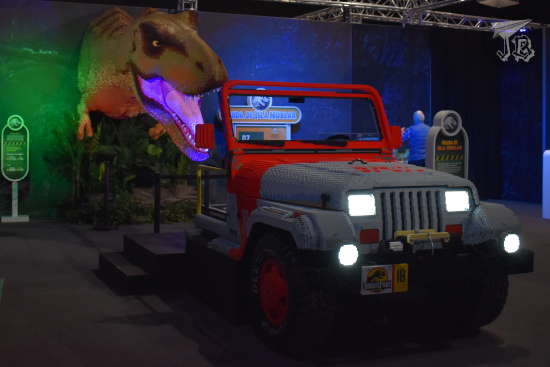
Despite all the promotion and toys she gets, Blue is probably not the fan-favourite dinosaur from the films. She is not mine for sure – that would be Rexy, the T-Rex. And after a mural of the mosasaur (number two on my list) hunting down a great white shark, Rexy finally comes into view, in one of her most glorious scenes from the original Jurassic Park: chasing the Jeep after Dr Sattler and Muldoon have just rescued Ian Malcolm. The Jeep was built using 227,098 bricks (which makes it even more complex than the brachiosaurus), and Rexy 128,763. One thing I noticed was that they had changed the jeep’s number, from 10 to 18, I’m guessing there is some inside joke there. They even recreated her reflection on the rear-view mirrors, which was pretty neat.

Jurassic World by Brickman - LEGO jeep being chased by the T-rex

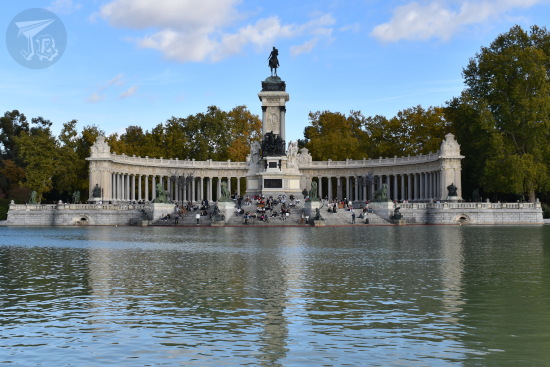
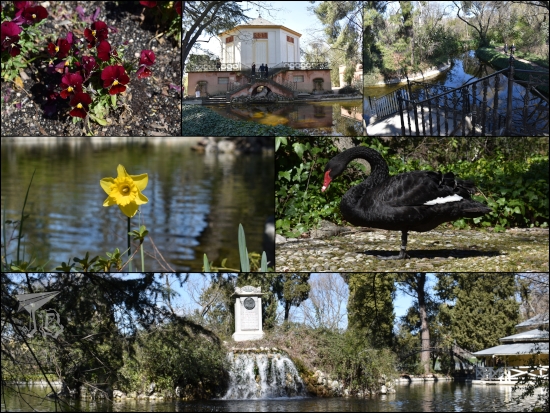
The exhibit was fun for the discounted price, but the shop was crazy expensive. When I finished, I walked back to the parking spot. I had to walk through part of the park Parque Juan Carlos I. In the middle of the so-called Southern Pond Estanque Sur there is a hideous sculpture made of wrought iron, which is called “Walk between two trees” Paseo entre dos árboles by sculptor Jorge Castillo . As I was staring at it trying to figure out what it meant (and even after reading up on the symbolism, I don’t get it), I approached the edge of the water. A flock of mallard ducks swam over to see if I had any food, and I noticed something that was neither a duck nor a goose – a great cormorant (Phalacrocorax carbo). I had never seen cormorants in Madrid before. Seagulls, yes, but not cormorants, and I actually saw three of them.

Juan Carlos I Park, Southern Pond

I headed off for lunch at La Vaguada, a shopping centre not far away from IFEMA, though the Sat-Nav went weird and I took forever. I actually had a couple of things to do in that area, not least of all drop by the LEGO Store La Vaguada to actually get a small stamp – or three – for the rally. I mean, I had already been to the exhibition, I was going to be there, I had taken the LEGO passport just in case…

La Vaguada LEGO shop

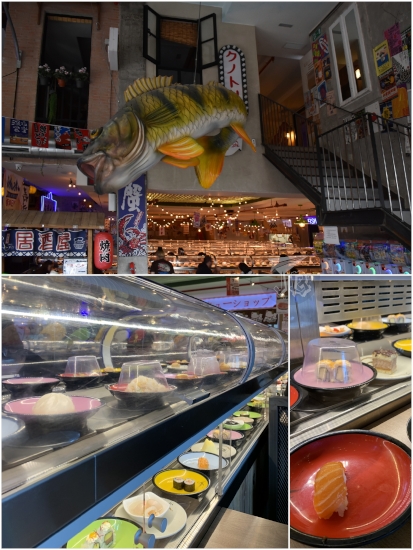
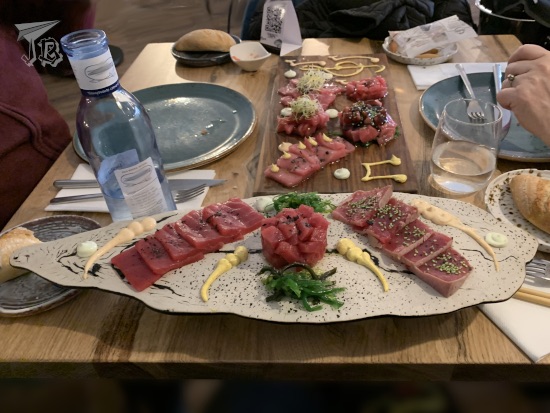
Serious things taken care of, I looked for the restaurant Running Sushi In Market, a call-back to a kaizensushi – small-plates of sushi on a conveyor belt – in an all-you-can-eat business model part of a franchise. It is more of an “Asian” place than a sushi restaurant and you have a range of recipes, from actual sushi to baos, skewers, noodles, dumplings, sausages… You are given a table for one hour to eat as much as you want, and pay a fixed rate plus drinks. It was not bad at all, though for the cheap price, tuna was too much to ask for. The decoration is extremely kitsch, but they had absolutely no problem giving me a five-people table for myself, and I stayed about 25 minutes, plus some pictures. But I forgot to sign up for the loyalty program…

Running Sushi In Market restaurant

The shopping centre has a ticketless parking lot that you can use for free for two hours, and when you are going to pay you just have to type your licence plate. I was there for 1 hour and 58 minutes in the end, so I did not have to pay anything, which was great. Then, unfortunately, I ran into a huge traffic jam, as it was get-out-of-work time, and there had been an accident on the motorway. Even though, I made it home before tea-time. However, I did not eat anything else that day. I might have overdone it with the last small dish of lichee fruit…

23rd October 2023: Happiness Museum and a former hospital, Madrid (Spain)

At the beginning of the year, I found out about an old hospital building turned office building that looked pretty interesting to visit in Madrid had opened up. It is a governmental office, so the visits are guided and supervised. Unfortunately, I was working an afternoon shift and they only run the visits on Mondays at 16:00. I signed up for the waiting list hoping for a summer visit, but they don’t run them in July and August. The September and early October visits did not work out either because I was in London. I finally managed a spot for the visit on the 16th of October, which was rescheduled for the 23rd. It’s not hardcore work season yet, so I was easy to rearrange meetings to have the day off.

Of course, it was a Monday, and Mondays are not Madrid’s best day, especially when the weather is not nice – most things are closed, and even though there are many neat parks, they usually close in the event of storms or winds. However, I almost accidentally discovered something potentially-fun and open, and I made plans with my sibling and nibling, who had a free morning.

I took a train with an hour’s berth of time, but then, because what else is new, there were train issues, and we were all delayed. I was stuck on my line for almost 40 minutes, and decided to walk instead of taking the connection, and they were waiting at their station for almost 30. If you are wondering why I keep taking the train, it is because during 2023 I can get a four-month unlimited pass for 10€, which beats any other transportation mode.

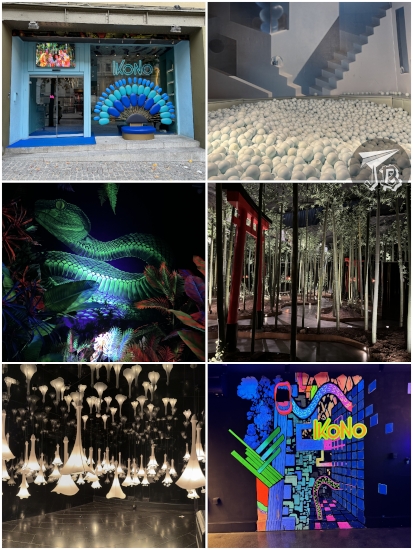
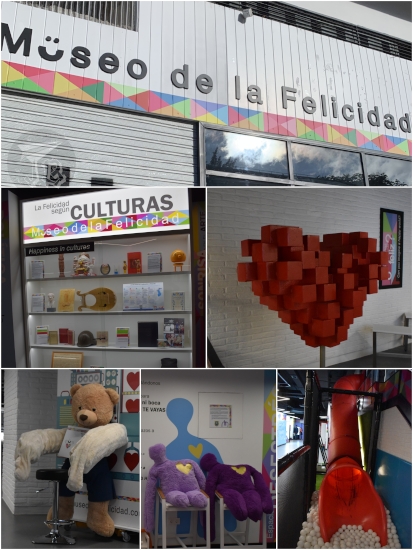
In the end, we luckily made it on time to a new photo-op place, which calls itself the Museum of Happiness Museo de la Felicidad MüF, with a little happy face on the u. It is a two-storey… silly-fun kind of place. Out of all the “instagrammable” places I’ve visited, I think this has been the weakest, as there were actually few things to actually do (too many touchscreens), and it kind of looked a bit… plain. Probably because it was Monday morning and there was no animation. I mean, it was fun, don’t get me wrong.

The first thing you see when you come in are two individual trampolines and a slide that ends in a ball pit. As I can’t jump, I skipped the trampoline. There is a small exhibition on lucky symbols, and another on things that make people happy. There is a small soundproof capsule where you are coached on how to laugh – weird – and a “team good people” that you can stand behind for a picture (the message being “kindness brings happiness”). As I was taking a photograph of my nibling, someone – who had just seen me show my ticket – decided I was the official museum photographer. I turned her down as nicely as I could. It was a day with a lot of comments about my camera.

The MüF has some screens and a VR experience, a “magic” trick on a screen, a big heart made of blocks and a hugging machine – apparently made to comfort autistic kids who benefit from deep pressure, but can’t deal with actual people hugging them. To go down from the second floor back to the first one, you can use the slide into the ball pit or the plain old stairs. That slide is steeper than it looks…

The basement has a few more things that you can touch, a ward with headphones and uppy songs, and the abrazadores (huggers), big plushies that are apparently designed to simulate hugs and grow people’s confidence. They were fuzzy and warm, but I am not sure how they can improve your mental health… There are a few confidence boosters, and a “five-senses happiness booth” where you get to eat chocolate, which is always good. In the end there were lots of silly giggling, because in the end that is why you go to places like that. There is also a “closet of truth” which you should not spoil for other people and helps you discover who is the most important person in your life.

Happiness Museum Madrid

After the museum we headed off for an early lunch. Despite being 300 km from the nearest port in the Mediterranean Sea, one of Madrid’s most famous meals is the calamari sandwich – bocadillo de calamares. A lot has been speculated about how this came to happen, though no one is really sure how the sandwich made its way into the local gastronomy throughout the 20th century. The squid is cut in rings, battered, and served within a small loaf of rustic bread similar to a baguette (pan de barra), an interesting combination at the very least.

The most famous joint to eat a calamari sandwich is Bar El Brillante. It might not be the best, and it quite surely is not the friendliest, but it is the iconic place for it, which actually makes it a tourist spot. The bar was established in the 1950s and it is a family company, the current owner being the third generation. They do not care much about customer loyalty as their business is based on the “novelty” and the “being a must do in Madrid” since the 90s – or maybe they’re just nice to regulars? I for one I’m open to try thebocadillo de calamares again, but not the place. The staff was unhelpful and took forever to clear the tables, which led to a lot of… hm… “birdwatching” as pigeons and sparrows helped themselves to leftovers.

Calamari Sandwich at El Brillante

We separated after lunch and ice-cream, and I continued alone towards the Chamberí district, which at the beginning of the 20th century was the outskirts of Madrid. There, philanthropist Dolores Romero Arano commissioned architect Antonio Palacios to build a hospital for labourers: Hospital de Jornaleros, known today as Hospital de Maudes. During that time, it was typical that a hospital had a “target patient”. In this case, it was male workers from the newly industrialised city who were not infectious or incurable – sort of a trauma unit, early-20th-century style. They took in labourers that could be cured, nursed them back to health, and released in “perfect working conditions”. Considering, of course, that the hospital opened in 1916.

For the building, Antonio Palacios chose a cross layout with a hall on one side and a church on the opposite one and two smaller buildings to complete the symmetry. He used Francisco Zuloaga’s ceramics for decoration until money ran out, and aimed for lots of light and open spaces. There are two types of decorative ceramics on the outside: water drops which imitate waves, and broken tile mosaics (Trencadís, a technique favoured by Antoni Gaudí). Palacios even built lifts of sorts to take patients to the roofs of the wards. The hospital worked for its intended purpose until the Civil War broke out and it became a military one. It was eventually abandoned and derelict during the following years until it was bought and restored by the local government in the late 20th century.

All this was explained to us during a 45 minute talk for an hour-and-a-half visit, as we stood in the hallway – which is actually in the basement floor. I arrived about 15:50 for the 16:00 visit, gave my name and ID and sat to wait. We had to go through metal detector and X-ray before the visit started – there is a volunteer guide from a retiree association and an actual worker to chaperone (governmental workers do not work afternoons in summer, which explained then why there had not been visits during that period as I had hoped for). Once the “introduction” was over, we finally got to see what I wanted to see – the building itself. Unfortunately, as the guide prattled on and on inside, it had started raining, so we could not go out to the patio, nor barely see the outside. That was disappointing – I mean, I’m all in for introductions and historical contexts but this is my problem with guided visits, it is just too much talking and too little visiting.

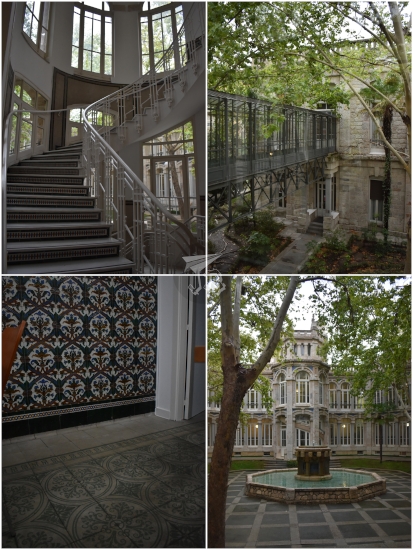
As we walked into the inside of the building, we were pointed out to the ceramics on the walls. Then, the tunnel that connected the hospital with the morgue – which was one of the outer minor buildings. We went up using one of the decorative stairs and we finally arrived at the ground floor of the crossing point of the wards. The centre of the structure is the octagonal patio with the fountain in the middle. As people saw me taking photographs with the camera – I had asked for permission beforehand – they decided I was either a journalist or the official photographer. It got annoying at the fourth or fifth time I was asked or someone made a comment / joke about me photographing them. Which I was very careful not to, even if they keep walking into my field of view.

Maudes Laborers Hospital exterior

The main material of the building is white limestone, which both contributes to the building’s luminosity and it’s common in Palacio’s design. His likings are also shown in the green colour of the interior tiles, which are very similar to the ones in the ghost station of Chamberí. The tiles all along the corridors are decorated and some of them feature heraldic symbols. We got to snoop around the cafeteria, one of the few areas that still features the original floor, since most of the flooring was too damaged to be restored.

The central area surrounding the patio is also octagonal, full of ground-to-ceiling windows. From one side of the corridor to the other and through the patio you can even seethe main staircase that we used to access the second floor behind the windows. Once on the second floor, we crossed the metal bridge that separates the main building from one of the accessory constructions, where the external consultation rooms used to be. Finally, we went downstairs again, walked around the patio and crossed over to the former operating theatres (the above-ground area of the morgue), which are now being transformed into an exhibition room.

Maudes Laborers Hospital interior

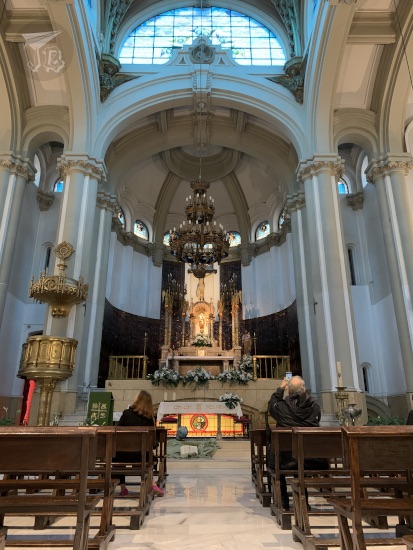
By the time the visit was over, it was raining heavily, but I still had the time to visit the in-hospital church Santa María del Silencio, Our Lady of Silence, which is the parish of the Madrid deaf and hard-of-hearing community. Lots of the architecture details are Modernist in style, including the iron fence and coloured glass ceiling.

Altarpiece in Our Lady of Silence

It was still raining cats and dogs when I left, so I forsook the idea of walking around the building to take pictures of the main hospital entrance, I just crossed the street to head to the train station. After aquaplaning on the square to get in, I had to wait about 50 minutes for a train, as the morning breakdown was still causing delays. And of course, when the train came it had already stopped raining.

Maudes Laborers Hospital and Our Lady of Silence from the outside

It was a nice day out, with great company and lots of laughs. Food was okay, the hospital building was amazing, the guide not so much. And the weather… very… autumn-ly.

7th October 2023: The historical centre of Valencia (Spain)

I had the chance to spend a few hours – seven, to be exact – in Valencia | València (first name in Spanish, second one in local dialect) due to unforeseen circumstances. I’ve been there before, but it was to visit the Oceanogràfic, and I had not entered the historical area.

Valencia is the third-largest city in Spain. It is known for its love of pyrotechnia – Las Fallas – and its famous paella rice dish. The city dates back to the Roman period, in the 2nd century BCE. During the Middle Ages, it was one of the most disputed areas between the Christian and the Moor troops, changing hands a few times. The city flourished in the Late Medieval Period under Christian ruling. It played an important role during the Napoleonic war, and during the 20th century it became a great importer of wine and citrus, especially oranges. During the Civil War, it was the Republican capital, so it was heavily bombarded. With the advent of democracy, the city invested in development and tourism.

I arrived at the station Joaquín Sorolla around 11:30, which is not far from the centre. It was pretty hot, even if it was October, so I was ready for a few weekend-tourists. One detail that I had not planned on, nor thought about, was that it was a long weekend over there, Monday the 9th was a holiday, and there were way more than “a few” weekend-tourists. Also, I walked into a lot of preparations forfor institutional acts, which got in the way of photographs – the city hall square was cordoned off and it was really hard to get a good view. On one side of the closed-off area stands the town hall Ayuntamiento de Valencia | Ajuntament de València, on the other, the old central postal office Palacio de las Comunicaciones de Valencia | Palau de les Comunicacions de València. The town hall is actually a mash-up of two different buildings, one from the late 19th century, and another – the façade – from the 1930s, with Renaissance and Baroque inspirations.

Valencia town hall

I continued off towards the main market – Mercado Central | Mercat Central. This is an impressive Modernist building designed by architects Alejandro Soler March and Francisco Guardia Vial. Construction started in 1914 and finished in 1928 – the building was erected in iron, glass and ceramic tiles, the central dome is 30 metres high. This is one of those places I wish I were a VIP and could see closed, because it was fantastic. Unfortunately, though it is the largest market of fresh produce in Europe, it was extremely full, and it was hard to even stand to the side and take a photograph or two.

Central Market Valencia

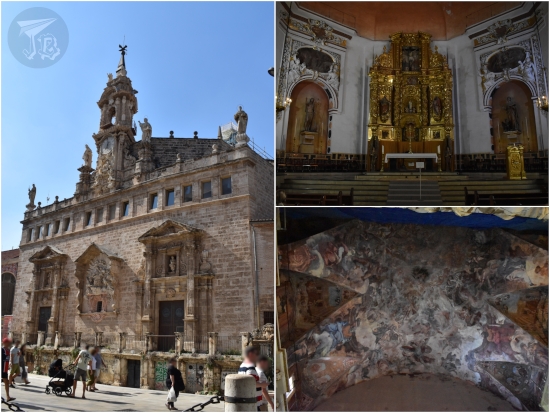
Next to the market stands the church Royal Parish of the St Johns Real Parroquia de los Santos Juanes | Església dels Sants Joans also known as St John of the Market. When checking if the city tourist card was a good choice for me – it was not – I bought a combined ticket that included this church and two other buildings for 12 € (considering that each on its own was at least 7 €, it was a sweet deal.

Church of the Saint Johns Valencia

Most of the original Gothic building has been destroyed, and its appearance today is mostly Baroque. It seems that the church is prone to fire accidents, and burnt down totally or partially at least three times. It is undergoing inner restoration at the moment, which takes away from the fresco decoration of the vaulted nave. The frescoes were carried out by Antonio Palomino in the 16th century, and the Baroque altarpiece was brought from another church in the north of Spain. An add-on to the church is the Capilla de la Comunión, the chapel of the Holy Communion was added in the 18th century. The church reminded me of the Italian Baroque I saw in Naples.

In front of the church, on the other side of the square, stands what I consider the most important building in the city – the Silk Exchange, or Lonja de la Seda | Llotja de la Seda, also called Lonja de los Mercaderes | Llotja de Mercaders. In Spanish, a lonja is a type of public building where merchants would negotiate and auction their produce, traditionally fish. In this case, instead, it was used for trading in silk during the Middle Ages. Silk was important for Valencia, and the city is considered part of the Silk Route. The Arabs introduced it in the 14th century, planting mulberry trees to produce it, and the trade became so important that it required its own building.

Lonja de la Seda Valencia

The Exchange was originally designed by Francesc Baldomar in the late 15th century, though he died before completing it. His disciples Joan Ivarra and Pere Compte finished the building according to Baldomar’s original plans and drawings. The building has four distinct areas: the Tower, the orange garden (Patio de los Naranjos), the Contract or Trading Hall (Sala de Contratación) – which were the original ones – and the Sea Consulate Hall (Sala del Consulado del Mar ). There is also a small basement.

The building is considered the masterpiece of the civil Valencian Gothic, a style that flourished in the east of Spain towards the end of the Gothic period. It is characterised by a heavy reliance of traditional Roman architecture and a little Mudejar influence. Wide open halls are typical, with decoration and sculpture influenced by Flaming Gothic. The Exchange is decorated with tiny gargoyles sprinkled all around the outside of the building towards the garden.

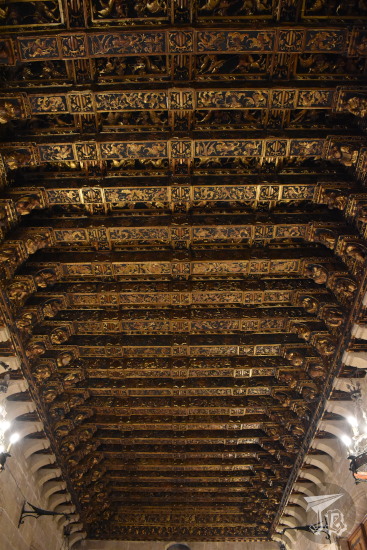
The Trading Hall has three naves which rest on eight helical columns and 16 pilasters that hold the vaults, eleven metres above ground. Further ribbing extends from the the columns, creating a net that spreads all over the ceiling. The combination of columns and ribbing tries to represent heaven – the palm tree trunks and the celestial sphere. Another ceiling that deserves admiration is the painted wooden one in the first hall of the Sea Consulate.

Lonja de la Seda Valencia

Wooden roof of the Consulado de Mar in Valencia

I loved the Exchange, but it is not as if I have ever scorned anything Gothic. However, I could not stay forever, so I pushed myself to leave. I went around the building once and then, after a short stop at a cute little round square, Plaza Redonda, I found my way to the large square Plaza de La Reina, where the cathedral stands.

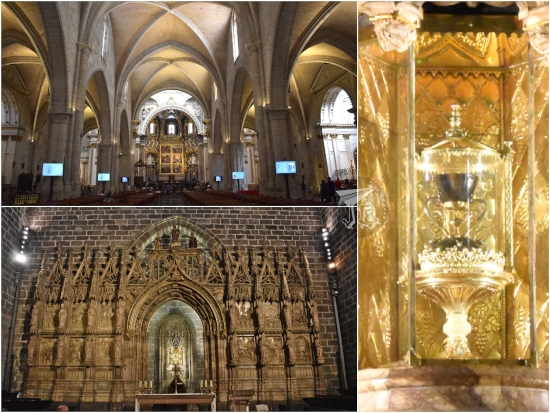
The Iglesia catedral-basílica Metropolitana de la Asunción de Nuestra Señora de Valencia | La Seu is also built in Valencian Gothic on Romanesque foundations. It was erected over a Roman Temple, and part of the Roman remains can be visited in the “archaeological area” of the museum, underneath the current church. The main building that stands today was erected between the 13th and 15th centuries, thus the prevalence of Gothic, but there are earlier and later styles – as recent as Neoclassical.

Valencia Cathedral

In a side chapel, in the middle of an alabaster Gothic altarpiece (1777), the cathedral holds and exhibits its most important treasure – the Holy Chalice (Santo Cáliz), sometimes called Holy Grail. According to the Christian tradition, the Holy Chalice is the vessel used by Jesus Christ during the last supper. If we follow the Spanish legend, when the Virgin Mary died, Jesus’ disciples gathered everything that belonged to him, and Saint Peter took it to Rome. During the persecution of Christians in the Roman Empire, the Chalice was entrusted to Saint Lawrence, who brought it to one of the former Spanish realms. It was eventually presented to the monarch in 1399. In 1437, King Alfonso V of Aragón donated it to the Cathedral of Valencia.

According to other legends, there was this King called Arthur, and something about a knights and a round table. In the Arthurian legend, there was a mystical object called the “Grail.” which was originally a Celtic cauldron with magic powers. However, the concept became mixed up with the Chalice when the story was “Christianised” – the chieftain on whom Arthur is based on, and his legend, originates in the 5th century BCE, so there is no way that Arthur looked for the Chalice anyway.

The Valencia Chalice itself is a stemless cup made of carnelian (dark red agate) – and that is the relic itself. It was most likely produced in Syria, Palestine or Egypt, and it has been dated between the 2nd century BCE and the 1st century CE. There is an Arab Kufic inscription on its base. I am not sure it fits what Indiana Jones would have called “the cup of a carpenter”. The cup is mounted on a gold stem embellished with gold, pearls and emeralds, with a foot and two handles, which were added in Medieval times. Now, the cathedral claims that it cannot be proven that it is not the Holy Chalice, and the translation of the Kufic script is supposed to be “Allah Josua”, translated as “Jesus God”.

Valencia Cathedral and Holy Chalice Chapel

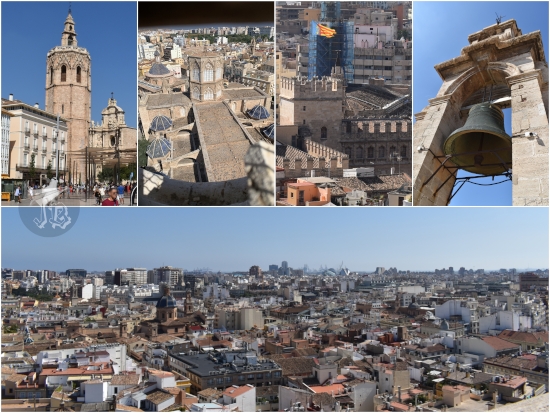
The cathedral also has a museum and the previously-mentioned archaeological areas, with a Roman road and human remains. The museum has sculptures and paintings from the cathedral itself and religious artefacts. The bell tower is famous in its own right. Erected between 1381 and 1429, it is called Miguelete | Micalet – “Little Michael”, which is actually the name of the bell at the top. . The tower has eight sides on the outside, and is circular in the inside, with 207 steps up to the terrace. The bell-gable was added in the 18th century, but the tower itself is Valencian Gothic just like the cathedral. The views are not as impressive as expected as the whole thing is netted off and it is hard to see anything unobstructed.

Views from Miguelete

The cathedral is connected to the Episcopal palace on the other side of the street by a sort-of bridge called Arco sobre la calle de la Barchilla | Arc del Carrer de la Barcella that I saw when I went round the cathedral. I also saw the Tribunal de Aguas de Valencia | Tribunal de les Aigües de València and Palacio de la Generalidad Valenciana | Palau de la Generalitat Valenciana on my way to the church of Saint Nicholas and Saint Peter Martyr (part of my combined ticket).

San Nicolás de Bari y San Pedro Mártir | Sant Nicolau de Bari I Sant Pere Martir stands at the end of an alleyway that comes from one of the main arteries of the city. It quite humbly calls itself “The Valencian Sistine Chapel”. It is a single-nave church, built in the 15th century on top of a Mosque which was in turn built on top of a Visigoth palaeo-Christian temple. During the Baroque period, the whole vault was decorated with frescoes, to the point that. And when I mean “whole” I mean… whole. There was no space for an extra soul, saint, angel or whatever. It was so full I could not process the painting as individual items, just as a whole.

Frescoed Vault of Saint Nicholas church in Valencia

Afterwards, I went into the small streets that led into the Arab Quarter, marked by the archway Portal de Valldigna. I also spotted an Islamic tower Torre islámica | Torre islàmica in side a private parking lot, and the remains of the Arab walls Muralla Árabe de Valencia | Muralla àrab de València.

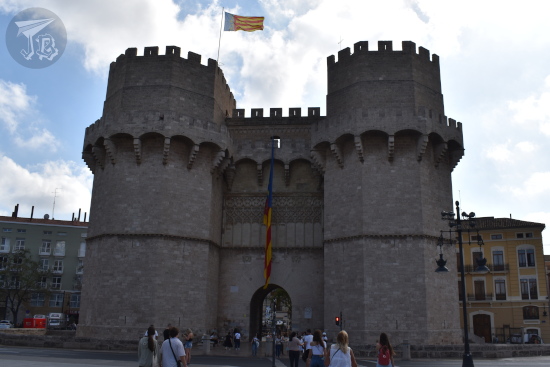
I finally reached one of the gates of the Medieval city walls – Torres de Serranos | Portal dels Serrans. The gate was flanked by two polygonal defensive towers built in the Gothic style and finished in 1398. They survived the destruction of the wall ordered in the 19th century as they were used as prison. Today, they can be climbed and hold a small museum, but I had already gone up the bell tower, so I decided I was good with heights for the day.

Serranos Towers Valencia

I headed back to the historical centre and reached the area of the cathedral. I decided to buy a stupidly expensive typical drink of the area, horchata de chufa | orxata de xufa, made from sweetened tiger nuts, usually with a severe quality control. I remembered trying it as a kid and that I did not like it much, but I decided to try it anyway – I had riskier culinary adventures in Egypt after all. It was not bad, but decided that I am still not a fan – and it was chilly, which helped against the heat.

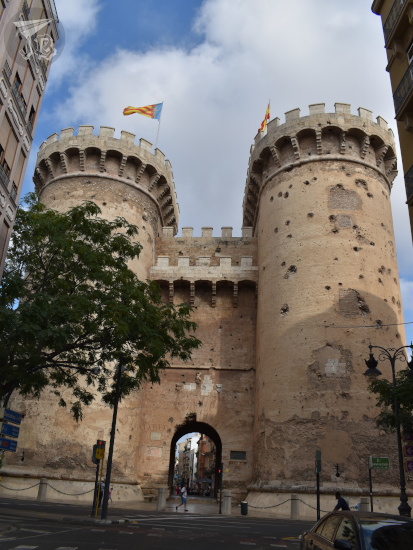
There is another surviving gate structure of the Medieval wall, the Torres de Quart | Portal de Quart. They were a bit out of my way, so I left them for the time when I started retreating back towards the station. Unlike the Serrano ones, the Quart towers are cylindrical, but they share the Valencian Gothic style. They were built between 1441 and 1460 have been damaged in the different wars that the city has survived, and holes from shelling are clearly visible on the stone.

Quart Towers Valencia

Taking a small detour from my way to the station, my next stop was the silk museum – Museo y Colegio del Arte Mayor de la Seda | Museu I Collegi d’Art Major de la Seda. I only went here because it was the “extra” museum my triple ticket had it, and I had the time to do. I was not impressed though, as more than on silk it focused on the local re-enactment of the Medieval battles in Valencia and the costumes.

Just next block over however, I found the park Jardines del Hospital | Jardins de l’Antic Hospital, where the 15th-century hospital used to be until it was demolished in 1974. The park was reorganised between 2009 and 2012, and an “archaeological garden” has been prepared next to the skate park, with free-standing columns, and a shelf with chapitels and the remains of sculptures that have been found in the area.

Archaeological Garden Valencia

Unexpectedly, I walked by the monument to Spanish Medieval warlord El Cid Monumento a Rodrigo Díaz de Vivar | Monument a Rodrigo Díaz de Vivar, a copy of the original sculpture of Anna Hyatt Huntington, which is in the Spanish Society of America in New York.Rodrigo Díaz de Vivar, El Cid, became Lord of Valencia. He besieged the Moorish city between 1092 and 1094, until the city surrendered. Having proclaimed himself Prince-Lord, he died in 1099 – the legend says that after he died, he was placed on his horse and just catching sight of him made his enemies run away.

Monument to El Cid in Valencia

My final stop was the gastronomic experience Mercado de la Imprenta | Mercat de la Imprenta. Aside from horchata, Valencia is known for its ice-cream, and I was hoping to find one. There were none, unfortunately, so I just walked the last bit towards the train station – and had a sundae there, because why not?

All in all, I think I spent as much time on trains / at stations as roaming and visiting monuments, but I reckon I did a good job out of getting a feeling off the old town of Valencia. Lots of pretty Gothic buildings to see, which was enjoyable. It probably warrants a whole weekend to see the dozen or so small public museums. It was bit too hot, especially for October, but it did not feel as humid as I imagined it might be.

24th September 2023: Hiking to the Castle of Zafra (Spain)

An association in my town organises monthly hiking outings. I decided to give it a try – if it worked out, I could go out every month at least once for a cool day trip, and I would not have to be alone for a bunch of difficult trails. And if I got to make some friends, even better. I signed up for the first hike: Sierra de Caldereros, Pico Lituero y Castillo de Zafra. It was described as a moderate route of roughly 17.5 km and an altitude gradient of 916 metres. The main reference points were: Cubillejo del Sitio (drop-off) → Pico del Águila → Pico Lituero → Castillo de Zafra (highlight) → Hombrados (pick-up).

The group met on Sunday the 24th at 8:00, and we got on the coach. It took two hours to get to the drop-off point. I quickly realised that the group was already established and not too open to first-time newcomers. That did not deter me though, and I found my pace between the faster and the slower walkers. What I did not like was that a good deal of the route was not through a track. The description mentioned a path, which I did not see. It was a bit riskier than what I enjoy on a hike, for more experienced adventurers.

Ridge Sierra de Cubilleros track

I found the hike too energy-demanding to be able to enjoy the landscape, except when the walking stopped so we could regroup. I was able to spot a few animal tracks and some cool karst and sandstone structures. Underneath our route, the never-ending Castilian plains got lost in the distance. There were a lot of insects, especially horseflies, trying to suck us dry. We reached Pico del Águila in a bit over an hour.

The climb to Pico Lituero was hard because it was done off track, but once on top the first part of the group could catch a breather. There was a bird of prey circling over head, so I might have sneered a little about it hoping for lunch. I sat down at the summit for a little while and snacked on a cereal bar while waiting for the second part of the group.

Castilian plain from Sierra de Caldereros

The highlight of the hike was the castle Castillo de Zafra. It is believed that the original fortress was erected by the Visigoths in the 8th century. It was built upon by the Moors, and eventually taken by the Kingdom of Aragón. The castle itself was built in the late 12th or the early 13th century and today it is part of the municipality of Campillo de Dueñas. The castle was built and integrated on a sandstone outcrop in the ridge Sierra de Caldereros. It was a key defensive outpost which was never conquered, neither by the Moors nor the Castilians. However, it lost importance when the marriage between the Catholic Monarchs joined both the Castile and Aragón Kingdoms, and eventually it became derelict. It was bought and restored in the 20th century by a descendant of the last castellan on duty before the castle was given to the Catholic Monarchs. It was used as the Tower of Joy in the sixth season of Game of Thrones. We stopped there for a while to have lunch, but we could not visit the fortress as it is private property.

Castle of Zafra

After the break, we continued off to the village of Hombrados. We were back on a track, flat enough even for cars. There was not a shadow, and it was very hot – I got a sunburn, and most of the walkers ran out of water – which made find a small fountain joyful. On both of our sides, barley and wheat had been harvested. Around 16:00 we reached the village bar, which opened for us. We had a drink and a toilet break and left around 17:00. While in the coach, my nose started dripping and I realised that between the little straw in Puy du Fou a few days before, and the freshly-reaped fields, my allergies were playing up. It was a miserable couple of hours, to be honest.

In the end, I decided that these day-trips are too demanding for me, and that I had not enjoyed myself as much as I hoped. Glad I went, though, so I could judge instead of wondering.

21st September 2023: Puy du Fou España (Toledo, Spain)

Puy du Fou is a project which started in France in 1977, when Philippe de Villiers decided to create a show in the ruins of a Renaissance castle in Les Epesses, a village about an hour away from Nantes. Initially, the show, named Cinéscénie was not too successful, but it increased in popularity as spectacular elements with horse riding and sword fighting acrobatics were added. A theme park was built around the show in 1989, and the venture went on to become one of the most popular parks in France, after Disneyland and Parc Astérix. Between 2019 and 2021, the French project was exported to Spain and turned into Puy du Fou España, located in the central city of Toledo, one of Spain’s most historical towns. Toledo is close enough to Madrid that the park can be visited on a day trip from there, and the land around it were probably on the cheap side.

Regardless of the logistics, Puy du Fou España markets itself as a historical theme park. It does not have rides, and instead, it focuses on shows, restaurants and shops. There is a day-ticket and a night-show ticket and we combined both on the same day. We reached the parking lot about twenty or thirty minutes after the park opened and had to walk for about ten minutes until we reached the entrance. We had booked a “fast pass” called Pase Emoción, which guaranteed access to all the shows at specific times, and the walk-throughs without having to queue. We had also reserved lunch, though by the time we bought tickets, the lunch-show was already sold out – we knew we risked this, but the weather had been unpredictable, and we did not want to be caught in a bad storm so we waited until the previous week to decide. While we did have some drizzle during our visit, it mostly found us indoors, so aside from the hassle of putting the camera out and having to pull it out again (and again, and again), it was not a real problem.

Summary of bookings (times three; four tickets per person):

  • Experience 1 day: Park + Night show: Parque + El Sueño de Toledo Ubicación Plata – Entrada 1 día Adulto, 68.00 € (non-weekend, non-high-season price) separated into:
    • Park ticket: Parque 1 día Adulto, 27.20 €.
    • Night show: Espectáculo Nocturno “El Sueño de Toledo” (best seating available), 40.80 €.
  • Fast pass: Pase Emoción, 20.00 €.
  • Lunch: Menú Hospedería de Santiago – Adulto (first course, second course, dessert and drink, saving a couple of bucks from the on-site price): 22.05 €. We decided to book lunch because we thought it would be harder to find a spot, and that for dinner we could grab a sandwich or something. In the end, we had a snack and a drink in the evening, which came up to around 11 € / person, bringing the total spent in the park to 121.05 € (no souvenirs, no extras).

We visited the park on a September Thursday, so we were not expecting many people. The first surprise was the number of buses in the parking lot – yes, there were quite a few people, though not “crowds” as no doubt they have during summer season. We were directed to the private-car parking lot, on the other side of the area and closer to the entrance, but we were “late” enough so that eight double-lines of cars had already been filled. We walked the kinda-long road to the park and picked up our fast passes, which were already prepared on a lanyard, and we were given times for four shows, along with the two others to do “whenever”, which turned out to be walk-throughs.

Thus, according to the bookings and the pass, we had the following schedule and in theory no queues:

  • 12:45, show: A pluma y espada.
  • 14:00, lunch at Hospedería de Santiago.
  • 15:45, show:El Último Cantar.
  • 16:30, show: Cetrería de Reyes.
  • 17:30, show: El misterio de Sorbaces.

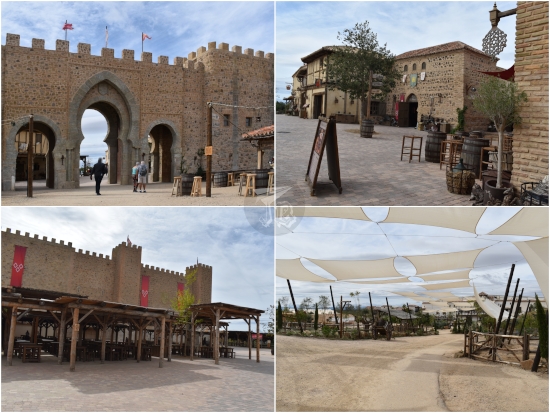
Puy du Fou España Historical Village Puebla Real

The park is organised to look like a Medieval village – castle included – with both Christian and Moor flavours (using the word “Moor” to refer to the different Muslim groups that populated Al-Andalus in the Middle Ages). the different shows are scattered throughout the park and there are small clusters of shops, restaurants or activities. The distances are long and though there is some protection, it would not protect from rain nor sun / heat. There were “watering points” but no fountains at them? I think that’s where people selling water bottles stand in summer. I probably should have done more research on the whole thing, but I was just tagging along someone who really was curious about it and I was happy to let them take over the organisation. Instead of wandering around a little, they decided to go inside the theatre that hosted the first show almost at the time doors opened to let people without the fast pass in. Thus, we waited for about half an hour until the show started.

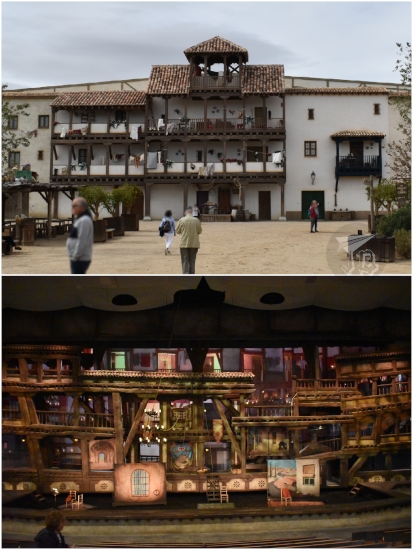
A pluma y espada, “With quill and sword” is an adaptation of one of the French shows, about Musketeers. That makes more sense than the Spanish version – which follows 16th-century playwright Lope de Vega as he tries to foil a conspiracy to kill the king. The stage changes from an open theatre to a prison, to a ship, to the roofs of Toledo as scenes follow one another. After the happy ending, there is a pretty ballet / flamenco dance on the water, along horse riding, which was really cool.

Theatre exterior and stage

We went out and our designated guide got lost, getting us into the complete opposite direction from where he wanted to go. We finally turned around and found our way, though it started raining. We decided to try our luck in the restaurant to see if we could grab lunch early, and we were lucky enough to do so. Actually, we had to be in the restaurant 10 minutes before the reservation, but we had to queue because a bunch of groups before us had issues ordering and understanding how the restaurant worked – never mind that it was easy: flat rate with a choice each from three first courses, three second courses, three desserts, and one drink. Finally, we reached the front of the line and found our table, got our lunch, and sat down.

The food was okay, though value-for-money was a little on the low side (captive audience and all. Though you can take your own food into the park, it might just not a good idea to carry a heavy backpack considering distance and queueing). I had a goat-cheese salad with honey-mustard sauce, a vegetable parmentier – which had pepper instead of the announced mushrooms and upset my stomach for a while – and rice pudding.

In general, the park feels too big, probably with the idea of filling it up as the park generates revenue (though I’m sure that when it’s crowded during summer season it does not feel as empty). My impression that I had was that as long as you were lucky and everything ran smoothly, it would be okay, but anything going wrong could ruin your experience. Just a couple of weeks earlier, the park had to be evacuated due to torrential rains, and people complained about being denied refunds. We would have a little inconvenience later.

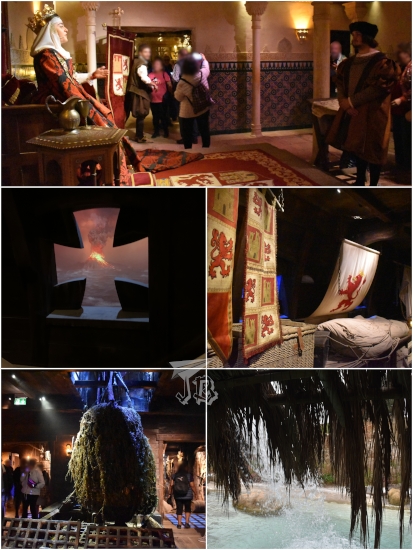
After lunch it had almost cleared, and we headed off to Allende la Mar Océana, “Beyond the Ocean Seas”, which is a walk-through. You “enter” a medieval palace to see Queen Isabel I of Castile (Isabella the Catholic) meeting with Christopher Columbus, as the latter convinces her to fund his expedition to the Indies. Then you get to see different stages of Columbus’ trip with a fictionalised voice diary, with the most important stages: setting sail, navigating near Tenerife, where one of the volcanos had erupted, losing hope in the Sargassum Seas, and finally reaching America – complete with Amerigo Vespucci crying “land ahoy” and walking out to a paradise beach with white sand and palm trees. Some of the areas have live actors interpreting scenes. Not too impressive, and too many people decided to get in the way of my pictures, However, the queen smiled at me.

Puy du Fou España Allende La Mar Océana

We had time to check out the other walk-through De tal palo…. The Spanish expression de tal palo, tal astilla means “like parent like child” or “the apple does not fall far from the tree”, literally “from this stick, that splinter”. The idea is to stop to listen to different generations of the same family which have partaken in key episodes in the history of Spain: the resistance in Numancia against the Romans, Medieval clashes between Christians and Moors, and so on. It was probably the weakest show, but truth be told my companions were not really in the mood for it, and we ended up seeing only two complete tales, and two halves. The rain stopped around this time, too.

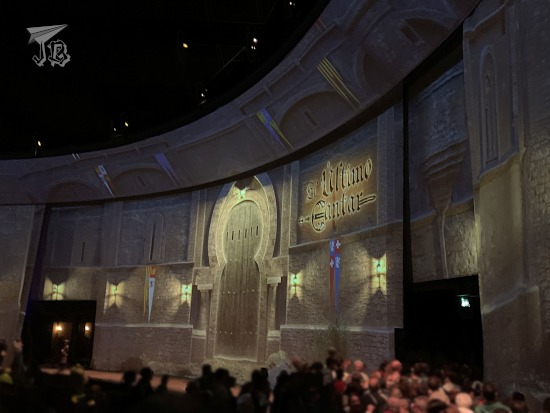
Afterwards, we backtracked to El Último Cantar “The last Song” or “The last Romance” which tells an extremely sanitised story of one of the warlords of Medieval Spain. Rodrigo Díaz de Vivar, El Cid, was a 10th-century mercenary whose life was later composed into a book-long romance. He’s sort of the classical hero of Spain, with an extremely idealised view – imagine, this is the first compulsory book to read in school when you’re around 10. The show was even more romanticised. It was held inside, in a circular stage, and the stands turned to face the different scenes. It had work with horses, and even sort of a just. The problem was that this show finished past 16:15, and we had to be at the exact opposite side of the park before 16:30 (16:25, as they closed the doors). My companions told me to make a run for it, because they knew it was the show I’d be more keen on. I literally ran halfway through the park and made it just before doors closed – the person managing entrance was extremely rude, too.

Puy du Fou España El último cantar stage

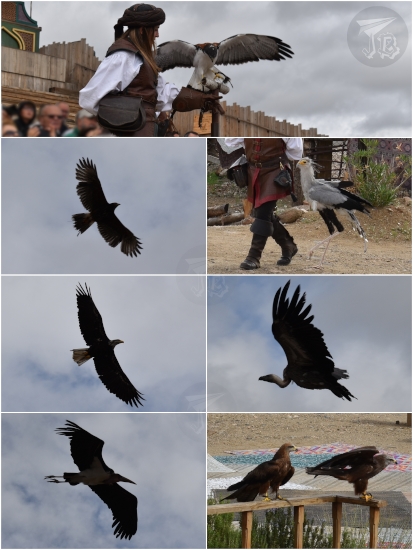
This show was Cetrería de Reyes, “Kings’ falconry”. I did not follow the plot much, to be honest, I was focused on the birds. It is supposed to be an encounter between a Muslim king and a Christian knight during the Middle ages, and they decide to… measure each other up by showing off their birds of prey. There are barn owls, sparrowhawks, caracaras, falcons, eagles and griffin vultures trained to attack on command, fly to specific places, and “hunt” mid-air. More exotic species include a secretary bird (Sagittarius serpentarius) and a marabou stork (Leptoptilos crumenifer) which were cool just for being there. At the end of the show, they let out a lot of the flying birds that flock all over the show. It was really cool.

Puy du Fou España falcorny show

I got to see the whole show since I sprinted. The other two people were lead in later, as most of the fast pass holders did not make it. They were admitted in small groups around one third into the show. It felt like really bad organisation, to sell something that is almost impossible for most of the pass holders. Furthermore, at the end, we were ushered out through different gates, and could not meet up amidst the crowd. We reunited at the final show.

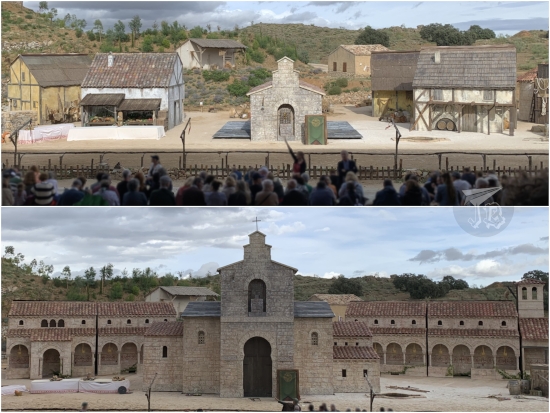
El misterio de Sorbaces, “Mystery in Sorbaces”, tells a fictionalised tale of how the king Recaredo I, the first Visigothic King in Hispania who converted into Roman Christianity in 587. His brother marries a Roman girl in a Christian ceremony, and the festivities include a lot of horse riding acrobatics. Then the goths come to destroy the village, but they are stopped by the “miracle” of a chalice turning a pond into fire. Recaredo converts and the whole stage is turned into a monastery. Besides the horse riding, the background moving and changing, and the fire special effects are the more impressive thing of this show.

Puy du Fou España El Misterio de Sorbaces initial and final stages

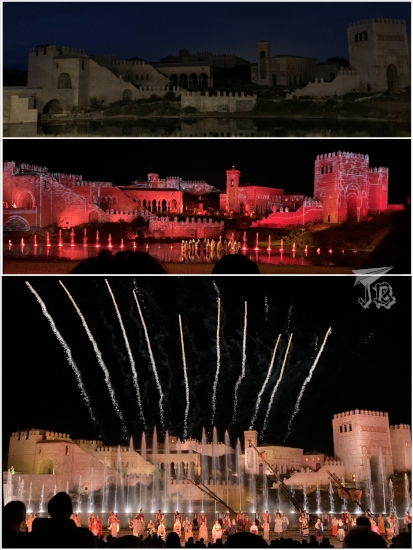
We just hung around the park a bit longer for a while after that. The shops were pretty expensive, and though the eagle plushies were adorable, they cost too much money. So were the handwritten scrolls, even though they were fantastic. We grabbed supper in one of the fast food restaurants – a toast and a drink, a bit on the unremarkable side. Finally, we set off towards the outdoor theatre for the night show El Sueño de Toledo, “Toledo Dream”. It was getting cold so people were waiting in the corridors of the theatre, then the staff kicked us out to line, and they created a bit of chaos – despite assigned seating. They wanted guests to be there with an hour’s time, and in the end we had to wait around 50 minutes until the show started, in front of a backdrop of the city of Toledo. We had paid extra for “silver” tickets, and I was very surprised how they were spaces that I found much better, but were not considered “silver”.

As the sun sets, the story starts with an old water bearer coming in – he represents the memory of Toledo as a metaphor of the history of Spain. He comes and talks to a young lady at the gate of the walled town, and together they reminisce about the key episodes of Spanish and Toledo’s history. The first stage is the Moors leaving town to battle the Christians in Al-Andalus (though Toledo probably existed before as a Roman encampment, it was the Umayyad civilisation who made it great). The Christians attack the town and conquer it, then lose it again. When they once more enter the town, one of the churches has kept a candle burning in front of a walled-off crucifix (famous Toledo legend). The show is presented with lots of light, acrobatics, horse riding, and dancing, even on the shallow water that forms the stage. The sultan’s glass palace comes out of the water, and the cathedral is created with water spurts and light effects.

Time passes. The Catholic monarchs receive Columbus back from America and his ship also emerges from the water. The revolt of the Comuneros comes and goes. Toledo loses its importance and becomes a town of farmers. Then the Napoleonic armies ride in on white horses – the men walk into war and are killed, and the women take over from them. Peace comes, prosperity: the 20th century, the train, the Roaring Twenties – and then the Civil War in the 1930s. The singing girl cries out that her brothers killed each other in battle. In a final dance of hope and healing women dressed with the traditional attire of the different autonomous communities come and dance with her (a bit… dismissive… considering recent events and tensions). Then instead of ending in a happy note, everything goes downhill as the water bearer claims that he is a dream and he’s fading away and the children won’t hear of him and the stories he has to tell, as the whole cast comes to wave goodbye – and it’s about 200 of them, not counting horses, sheep, goats, oxen…

Puy du Fou España night show El Sueño de Toledo

When it was over, we walked back to the parking lot and drove off. It was a bit chaotic and we ended up going in the opposite direction we wanted to – because there was nowhere to turn around until we reached the motorway. We drove to the hotel and crashed in the rooms. If we had been just one floor or two higher, I would have had awesome views of Toledo, but most of it was hidden behind trees.

All in all, the experience was okay – for one time. The price was steep, not even counting petrol and accommodation. I have read online that people go back four or five times, I don’t get the need to do so, even if I know that we missed most of the street shows. We were pretty lucky with the weather, because the park is not prepared for either heat nor heavy rain – and Castille is known for its scorching summers and its temperamental thunderstorms.

The next morning, we had breakfast – hotel was good, but the breakfast there was quite expensive, so I had brought some canned coffee and pastries. We drove back without much traffic, making this a 24-hour-ish adventure. Maybe it would have been cool to try the spa at the hotel, but driving back later would have meant running into the heavy traffic around Madrid at the start of the weekend, and we preferred not to do so.

5th August 2023: Prints, Sharks, Mice and Neon (Madrid, Spain)

I won’t say that the Southern Italy trip was a bad one, but due to the planning blunder, the heatwave and the general not-so-relaxing atmosphere, I kind of needed a low-stakes day out. And what can be lower-stakes than a silly giant shark film? I got myself a ticket to watch Meg 2: The Trench at noon – I’ve found out that my non-dubbed cinema has started doing matinée shows at a reduced price – and planned my day in Madrid around that.

I took the train and arrived in Madrid on time for my ideal connection. Unfortunately the local public transport is chaotic this summer, with both the train system and the underground going through construction, outages and closed stations. As fortunately the city was between heat waves, I decided to walk for 20 minutes instead of waiting for 17 for a train that might or might not come to take me to where I wanted to go.

My first stop was Imprenta Municipal – Artes del Libro, a local free museum dedicated to the history of book printing and binding. The exhibition is hosted in a dedicated building with two levels. The ground floor focuses on the invention and development of the print, both for text and images, and the art of binding and decorating books. There are printing “machines” from the 16th century on, for copying books and texts, and the whole thing gives off a retro feeling – a video actually shows how the machines work even today.

Collage Imprenta Municipal Artes del Libro

The second floor held an exhibition about “Asian Writings” Trazos de Oriente: imágenes, objetos y caligrafías de Asia. It hosts Arabic documents, Mongolian drawings, Chinese writing instruments and Myanma and Hindu praying books, along with items like ex libris and schoolbooks. All very cool.

Exhibition about writing in Asia

I had a little bit of time before the film, so I got a snack, then headed to the nearby Yelmo Cines Ideal to watch my film. Something I’ve learnt is that matinées attract a weird crowd – when I went to watch Jurassic World: Fallen Kingdom, I sat next to someone who narrated the whole film, and this time there was a lady who would tut whenever any of the sharks was on screen. I read the Meg: a novel of deep terror by Steve Alten a lifetime ago, and I enjoyed its albeit-very-liberal adaptation to film, especially because it did have a self-parody tone. It was fun because it was implausible, and it knew it was so. The second and current film, Meg 2: The Trench, has tried to become more of an action-like blockbuster and it takes itself way too seriously in my opinion. But there are three giant prehistoric sharks on screen at times, and I’m simple in that regard. Bigger and more teeth, I’m all for that.

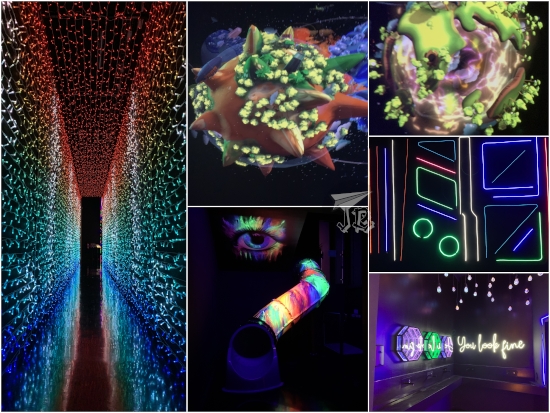
The film finished around 14:00. I was not hungry, so I just grabbed myself a drink at Starbucks. I had a ticket at 15:00 at the Nomad Museo Inmersivo (and it was bad timing I guess, because just a couple of days later they opened a new exhibit). When I first read about it, the idea reminded me of Mori TeamLab Museum, since the art is all digital. The museum is staged in two floors. The lower one hosts the immersive projection ward and the shop. The upper one hosts the entrance and the “activities”. I thought that I’d ask if I could come in early, and they had absolutely no problem with that, so I entered around 14:35.

As you climb down the stairs, you have a very cool corridor with mirrors and lights that lead to the projection area. I had a ticket with entrance and “iris picture”, so an employee took me to get that one (I guess because the photographer was about to go on a break). We had to try a couple of times as it was hard to force my eyelid open under the bright light of the flash. The photographer was very patient with me and we were done in a few minutes.

Interactive Museum Nomad access corridor

I found my way back to the beginning – the museum is surprisingly small. The immersive projection is shown on the four walls and the floor. The projection I watched was called Utopia 1.0, where millions of digital blocks work as a tridimensional Lego set that sort of “build” a surreal world with dragons, deer, sculptures, whales, high rises, dinosaurs… The whole thing takes around 20 minutes and you can watch sprawled on the floor, or sitting up on a pouf – I chose this last option as it allowed me to turn around.

Interative Museum Nomad: Utopia projection

Following the projection, I went upstairs to do the activities. There’s a virtual reality experience where you get to travel the cosmos and see a lot of “space cetaceans”. I wonder why digital artists are so keen on whales… Another of the activities consists on “painting” planets with a giant brush as they float on a wall, and when you colour them all, you get to see penguins on a rocket or something… I did not catch it well because a bunch of kids burst in and took over. On another wall, there is a bunch of neons that you can play with using an app that you download on your phone, and blast music so they pulsate with that. Finally, the nice attendant is at the ready to take your picture at some stairs photo call (I think it is the glorified emergency exit), and you can go back down using a spiral slide.

There is finally a last corridor with lights and you end up at the shop, where you can start all over again, as there is no limit about how long you can stay in the museum. I really liked the first corridor, so I went back there for a while. Then I walked into the projection area again just in time to watch the dinosaurs roam once more. A fun detail is that even the toilets are “in character” with neon and messages.

Interactive Museum Nomad exhibits

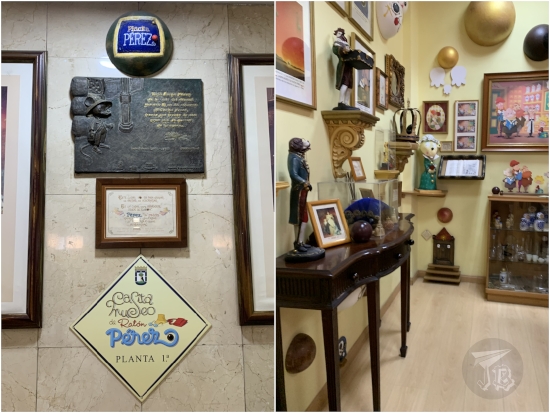
On my way out, I bought myself a shark glass at the shop. There was also a very fun pufferfish cocktail glass, but I thought it would be awful to clean after use – not that the shark one is going to be much easier though… I left and headed off to a place I’ve always tangentially felt curious about, even if I’m not really the target public for it – it’s called Casita-Museo del Ratón Pérez.

Ratón Pérez or Mouse Pérez (also called Ratoncito Pérez, Little Mouse Pérez) is the equivalent of the Tooth Fairy in Spanish-speaking tradition. In 1894, writer Luis Coloma was commissioned with writing a tale for the future King Alfonso XIII, who had lost his first tooth. This tale penned the folklore mouse into print. According to the story, Mouse Pérez lived in central Madrid, in a biscuit box in the patisserie Prast, situated in number 8 of Madrid’s Calle Arenal. The town hall installed a plaque to commemorate the place and when the shopping centre in that building became almost empty, someone came up with the idea of building a “museum-house” dedicated to the mouse.

Museum-House of Mouse Pérez

The kids had a blast for sure, the visit is a forty-minute activity 100% dedicated to them . The guide has them running round looking for stuff and going into small doors. I snooped around and found it an interesting business model – though it falters when you pay a bit of attention to detail: books like 1984 or anatomy guides may very well be interesting, but a bit out of place in a children’s museum. At the end of the visit, the guided asked me what I was doing there and I told him I… wanted to see what the fuss was about, what kind of things they did in such “alternative” museums. We chatted away for a bit before I left.

To end the day, I did some shopping and I headed back home – the trains were delayed, but I eventually made it home and had a pizza dinner, because I suck at staying fed on day trips. Truth be told, I wanted to step by a famous bar to eat a calamari sandwich, but it… was complicated, with lots of signage on where to stand and wait to be seated, but there was nobody around, so in the end I decided I did not care enough for the calamari. Some other day – I’ve been saying that for months now though…

15th April 2023: Madrid for Sweet Space Museum (Spain)

My friend D****e and I met for a fast day packed with activities. We reached Madrid at 10:40 and had tickets to visit an interactive museum called Sweet Space. It markets itself as a “colourful experience which mixes sweets and modern art”. I just thought it would be a fun thing to do with a friend that would give into quirky pictures and a couple of hours of giggles. It actually fulfilled both. If you take the place seriously, it’s plainly not worth the visit – modern art in general is questionable at best, and this could be seen like a bit on the childish side – and regular tickets are 18 €. The place’s best-selling point is “get cool pics for your social media”, and we had decided to just be silly about it and enjoy ourselves.

The “museum”, located in the ABC Serrano shopping centre, gives the vibes of an oversized (maybe overpriced) playground, and just like Monasterio de Piedra, the number of people you encounter weighs a hugely in your experience. Although we had an 11:30 ticket, we were lucky enough to be admitted at 11:15 with a family that lost us on the third room, so we had quite a lot of time on our own, until the group that came afterwards caught up. We did take a lot of pictures, to be honest, and missed no opportunity to fool around – which was the mindset we had.

Since the museum’s flagship idea is mixing sweets and modern art, when you enter some of the rooms you are given a treat – a gummy or a piece of chocolate or a tiny bit of ice-cream. You cannot backtrack, so the route gets a bit weird at points – you go up to the second floor on stairs, but down using a slide… The museum has nine different rooms and a few of them are refurbished over time. Unfortunately, I forgot to track down the artists because it was stupidly fun – I mean, at one point I got to ride a carousel-style flamingo. Back in the day in the day, I would have never dared do such a thing, but I guess I’ve changed a little in the last ten years.

  • Room 1: Palm trees with marshmallow trunks (Antonyo Marest). This was a fun way to start the whole thing and set the mood. It is literally a room with tree trunks that look like colourful marshmallows, with leaves on top.
  •  
  • Room 2 (corridor): Flowers in the dark – a dark room with bright plastic flowers. It was pretty, but probably the less surprising room.
  •  
  • Room 3: Mirrors and hanging pink balloons, inspired by Tokyo’s TeamLab. It was hard to take a good picture that did not catch anyone’s reflection!
  •  
  • Room 4 (corridor): Mirrors and neon graffiti (Álvaro Linares) with Star Wars inspired references. This was one of the coolest areas (though I’m not sure how… legal that Darth Vader painting would be). One of the sides had a throne-like chair you could sit on and feel like an evil mastermind.

Collage. Sweet Space museum. Palm trees whose trunks resemble marshmellows, neon-coloured flowers and grafitti, pink balloon-like lamps hanging in a mirror-wall room

  • Room 5: Ice-cream parlour “Töto Ice Cream”, including little kart and refrigerator you can step into, giving off a strong 1950’s aura. A lot of pink, I’d say – I did not dare walk into the fridge (for some reason it gave me the creeps), but D****e did; I “drove” the little kart instead. We took silly pictures there with the installed iPad camera, just for the hell of it.
  •  
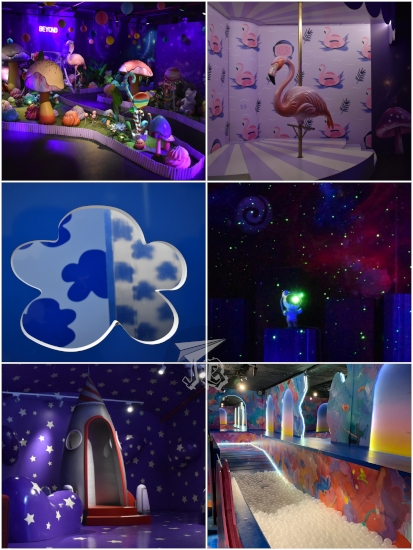
  • Room 6: Fairytale landscape (Christian Escribá and Patricia Schmidt), a-la Hansel and Gretel or Alice in Wonderland (though it was officially inspired by Wizard of Oz), with a swing and flamingo that you can ride. When I saw that one online, I really, really hoped that it was not only one of those things that only influencers get to do. I got to ride the flamingo. I don’t know why it drew me so much, maybe it was the pure surrealism of it all, but it made me giddy. The rest of the room was fun too – oversized mushrooms, teddy-bears, and colourful decoration.
  •  
  • Room 7 (upstairs): Sky with clouds (Agatha Ruiz de la Prada) painted and carved into sliding doors, a starry rocket (Ivanna Gautier), a bouncing area, a mural where you could take a 3D video for TikTok, and a “planetarium”, with tiny lamp-robots and tons of stars made from light dots. I liked this last one a lot, too. In order to leave the floor and go back to the lower floor, you have to go down a spiral slide, which I was not a fan of – it was difficult to get into it without putting weight on my bad wrist. However, I managed to go down unscathed.
  •  
  • Room 8 (Misterpiro): It held a ball pit with a “staircase to heaven” (or to nowhere). We did not go into the pit, but we climbed the stairs for pictures too.

Collage - fantasy worlds from Sweet Space museum. Overgrown mushrooms, a flamingo, a cloud, a universe made out of green neon dots with a little robot peering out, a cartoonish rocket in front of a starry background, a colourful ballpit full of white balls.

Finally, we reached the shop, where we purchased the pictures we had taken at the ice parlour (8 € for two magnets with four photographs, the downloadable version, and a gif). We were supposed to get a sweet in each room, and we ended up with three or four gummies, a chocolate, and a tiny scoop of ice cream. My favourite was the skull-shaped sweet&sour gummy we got upstairs, but they did not have it at the shop (though it is advertised online). The whole experience was a bit on the expensive side, but I had a discount that helped knock 10 € off the official price. The recommended time I had seen recommended for the museum was an hour and a half, but even if we took a long time, we were done in about an hour.

I had reserved lunch at 14:30 based on the time I expected us to be in the museum (and the availability of the restaurant), so we had some time to kill. We walked by the open-air museum of modern sculpture Museo de Escultura al Aire Libre de La Castellana, but it did not catch our fancy. Too much modern art in one day?

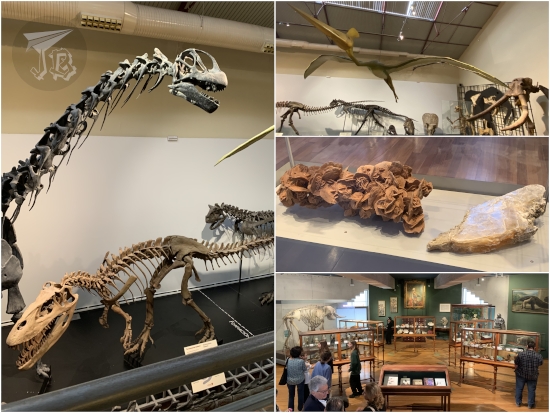
The place we would invest most of that extra time was the museum of Natural History Museo Nacional de Ciencias Naturales to see some dinosaurs and the gabinete de curiosidades, the 18th and 19th century collection of taxidermy specimens. I’d been there before, and it mostly has replicas (and holy molly, prices have gone up). This time there was an exhibit on the Moon landing, and the gardens had been open. The taxidermy collection is not as good as other museums, but at least it got us out of the heat.

Collage. Dinosaur fossil casts and reconstructions, both carnivores and long-neck herbivores. A flying reptile with some mammooth fossils in the background. Rocks. The old collection dating from the 19th century - a number of glass cases with people looking at them and a painting of king Carlos III overlooking the place.

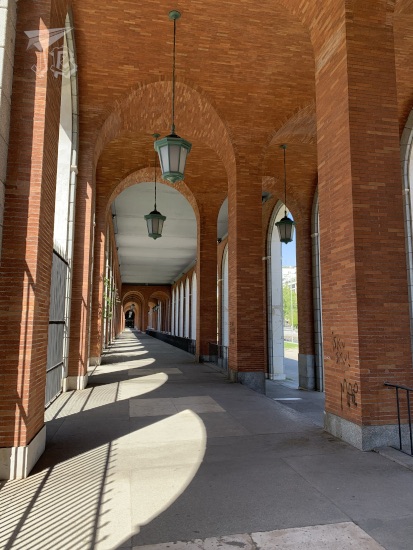
We left the museum and headed for lunch at one of the franchised establishments of New York Burger, which markets itself as a “gourmet burger” place. It was all right, and the servings were huge. After lunch, we hung around the area known as Nuevos Ministerios, a complex originally designed by Secundino Zuazo Ugalde around 1930. We hung out under the eastern archway for a while.

The archway in Nuevos Ministerios, built in reddish brick and white plaster

Afterwards, we took the train to Alcalá de Henares. We stopped at one of the shopping centres just outside town, Quadernillos, where the comic event Krunch! 2023 was taking place. We did not stay for long as most stands sold bootleg and plagiarised stuff, and I did not find any legit shop, but we had ice cream and D****e did take the chance to do some shopping in the mall before we headed home for the evening.

4th April 2023: La Granja and Riofrío (Spain)

King Felipe V of Spain was born Philippe, Duke of Anjou, in France. He was appointed successor to the throne by his great-uncle Carlos II, who died childless. He was never very interested in being a monarch, or at least King of Spain, which he became in 1700. Around 1718, he fell in love with a hunting area and decided to buy it. Today, this area has become the municipality of Real Sitio de San Ildenfonso (Spain), the Royal Site of Saint Ildephonse. He ordered a palace be built “without disturbing what was already built”. The result was the palace known as Palacio de La Granja de San Ildefonso (The Farm at San Ildefonso), in honour of the hermit church and farm that were there when the King bought the hunting grounds.

Legend has it that the palace is extremely uneven because the King ordered that no parts of the church were demolished, so the walls were built around the old construction – however, it is such a massive building that seeing the irregularities from the inside is hard. The palace, built between 1721 and 1724, was commissioned to Spanish architect Teodoro Ardemans. Later, the garden façade was remodelled by Italians Filippo Juvarra and Giambattista Sacchetti. A fire destroyed part of the building in the 20th century and a lot of the paintings were lost. The gardens – the most famours feature of the site – were designed by Frenchman René Carlier in 1721 and finished by Étienne Boutelou when the former died in 1722.

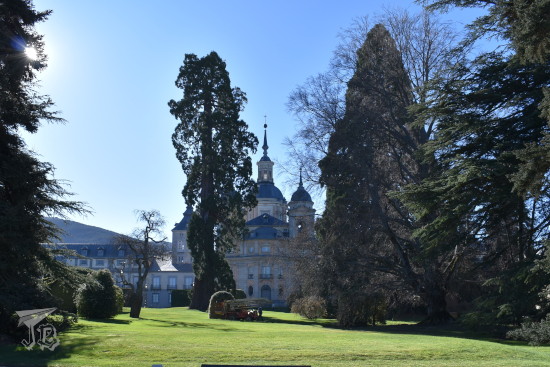
Today, the palace is managed by the Spanish Heritage Network Patrimonio Nacional – which means that photography is not permitted inside. It is technically one of the royal residences, so of course you have to go through security and X-rays and whatnot. We headed there on what was technically a working day before Easter break, so we were not sure how much traffic we would find, or how many visitors there would be. Thus, we had booked our tickets online for 11:00, anticipating a two-hour-and-a-half drive. In the end, we were in front of the palace around 10:15 and were able to enter at 10:30. Before that, we saw some impressive trees, including a sequoia, which I don’t think I had ever seen before.

Baroque Palace of La Granja peering behind a few large trees

The palace is Baroque, showing the likings of the time in which it was built. A monumental staircase gives access to the first ward, rebuilt after the fire into an area to display part of the royal tapestry collection – Museo de Tapices. The oldest tapestries date from the 16th century, before the Spanish tapestry school was founded. Tapestries are not my favourite form of art, but these were pretty impressive. A collection of nine pieces allegorise some of the virtues, mixing classical mythology with Christianity and historical figures.

The interior of the palace displays the private rooms of the monarchs, on the first floor, and the different ballrooms and social rooms on the ground floor. The private areas are decorated with paintings, and the public ones try to emulate the Palace of Versailles (France). They are furnished with marble and mirrors, and decorated with sculptures and statues.

La Granja: Dizzingly-decorated large hall in golden and white marble, with large open wooden doors

The ground floor opens to the well-known gardens Jardines de La Granja. These are considered the best “French gardens” in Spain. They cover almost twenty thousand square metres. Sprinkled throughout paths, hedges, parterres and trees, there are 21 fountains, most inspired by characters taken from classic mythology. The fountains are made out of lead, painted in bronze colour, and even if built 300 years ago, they still work and are indeed turned on during the summer season, fed from local reservoirs. They were not running during our visit – except for one dragon which leaked a bit. Spring seemed not to have arrived in the gardens yet, and it looked strangely like autumn.

La Granja: Italaian façade of the pakace from the top of the waterfall fountain, which was turned off. A number of bronze statues representing mythology characters line the waterfall

From the top of one of the fountains, called “the waterfall” Fuente de la Cascada Nueva, there is a good view of the Italian façade of the palace. Other fountains include “The Fame” Fuente de la Fama and “Diana’s bath” Fuente de los Baños de Diana. One of the most complex fountains is Fuente de las Ocho Calles (Fountain of the Eight Streets), a complex of eight fountains in a sort of “square” created by the intersection of eight garden paths. The fountains were built to only run when the King approached them, and today they are turned on in a rolling schedule, and very rarely all at the same time. This is to take care of the pipe system, still the original one, and because some of them need a lot of water to function.

La Granja, outside. Two large fountains crammed with bronze figures representing mythological beings. Both are turned off.

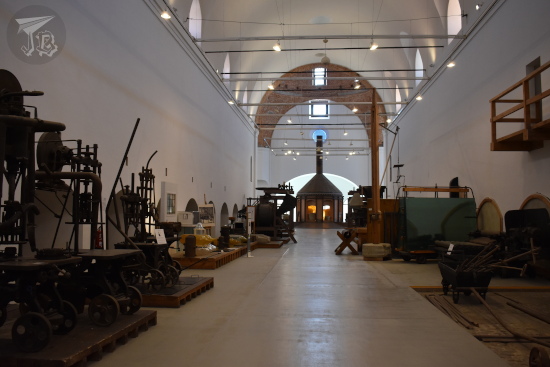
After we were done with the palace, we continued off to what I found the highlight of the day, the Royal Factory of Glass and Crystal of La Granja Real Fábrica de Cristales de La Granja. It was also established by Felipe V in 1727, and even today people use the old techniques to make glass items there! Even though it is called a “factory”, the process is completely artisan. The place also doubles as a museum to explain the how glass is (and was) made, exhibiting different traditional instruments. Of course, it has a shop. However, the coolest thing is that you can visit the furnace workshop to see how glass is blown, and the decoration workshop to see the engraving process. We hung around the furnace area and the experts can make a whole goblet in three minutes and a half, from incandescent blob to ready-to-engrave product.

Glass museum: diferent machines used to process glass in the 20th century, and a reproduction of the original glass furnace

Workers at the Glass factory: making and engraving a glass

After the factory, we headed towards the Parador de La Granja, a mix of a modern and historical building where we were to have lunch. We shared some cured beef cecina de León, and I tried the local speciality judiones de La Granja, a hearty bean-and-pork stew.

Collage of the inner patio of the Parador building + lunch: dried meat and a bean stew

When we finished lunch, we took the car to the secondary palace in the area, called Palacio Real de Riofrío, a hunting pavilion also managed by Patrimonio Nacional (though apparently, pictures are okay here, which is cool). The building is surrounded by 600 hectares of forest and hunting grounds. It was originally commissioned by Felipe V’s wife Isabel de Farnesio, who actually never got to live there since when she became “queen mother”, her son Carlos III had her move to Madrid.

We drove past the forest, where some storks were happily wandering around. The SatNav flipped on us because it could not find the correct gate, but we managed to make it on time to spend an hour or so there. Also, the entrance was weird – it is actually closed, and there is a guard inside. If we had not arrived just as another car was exiting, we would have thought it was closed and left.
Baroque palace of Riofrío. It's large and pink, with lots of archeways

The palace is also Baroque, and the areas which can be visited include some bedrooms, dining rooms, and the areas where the servants waited to be called. The palace has been organised as a Romantic museum Museo Alfonsino, that honours King Alfonso XII, who mourned his first wife there. It was actually decorated by his father, King Consort Francisco, Isabel II’s husband, and later “enriched” with paintings from other Royal Sites. The most interesting item was the billiard room, because it actually felt rather unexpected.

Another area of the palace has been transformed into a “hunting museum” Museo de la Caza, to honour the fact that these were the King’s hunting grounds. It mostly hosts taxidermy representations and a collection of pelts and skulls. To be honest, some exhibits were a bit unsettling.

Collage showing the inside of Riofrío: the hyper-decorated rooms, the staircase and taxidermy of local deer

As we left, the SatNav warned us of a 40-minute jam on the way back, so we forgave its previous flop. The warning allowed us to take a detour to avoid it – we had to pay the toll but it shaved off almost an hour.

11th March 2023: Rocks from the land and fish from the sea (Madrid, Spain)

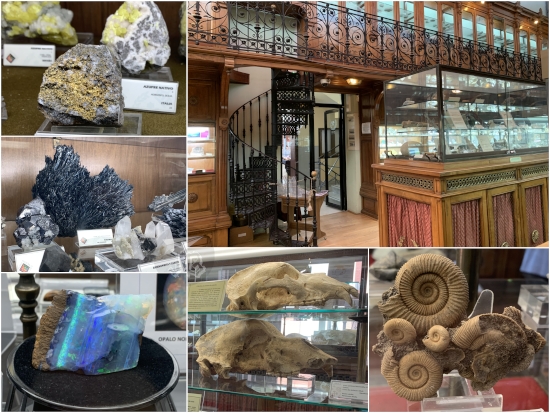
Back in 2018, when going to Madrid’s Geomineral Museum (Museo Geominero), I stumbled upon an event in the Mining Engineering University – something called Expominerales. At the time, I did not have time to explore it, and only later did I realise what I had missed – an international fair for the trade of minerals, rocks and fossils. I made a mental note to check the event out the following year, but something came up and I completely forgot about the whole thing. In 2020 the pandemic struck, and finally in 2023, almost five years to the day, I went back to this event held in Madrid.

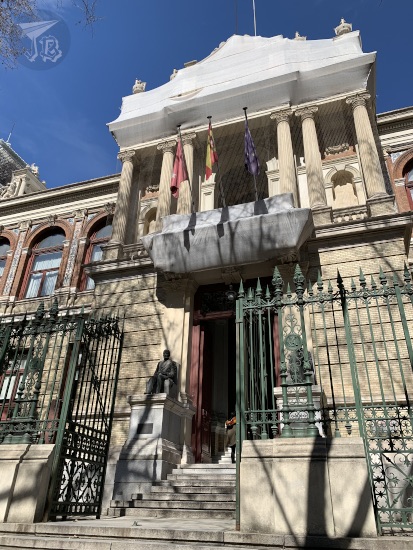
Expominerales is held yearly at the working engineering school Escuela Técnica Superior de Ingenieros de Minas y Energía (ETSIME), which offers the bachelor’s degree in Mining Engineering, and the one in Energy Engineering (whatever this last one is). The first weekend of every month, the school organises a “mineral-world flea market”, and the second weekend of March, it hosts an international mineral, gem and fossil fair, with shopping stands and different workshops and activities. After a few cancellations due to Covid, it returned in 2022 and it’s back to its former glory in 2023 – Expominerales XLII, the 42th edition of the fair.

The ETSIME in Madrid. Pink-and-white building from the 19th century, accessible through stairs, with flags hanging over the door

Mining Engineering became a formal education path in Spain in 1777, originally in the town of Almadén, a mercury hub. The school was moved to Madrid in 1835 and a two-building campus was ordered. The historical building in the ETSIME (M1) was designed by architect Ricardo Velázquez Bosco, and decorated by ceramist Daniel Zuloaga between 1884 and 1893. The second building (M2) was damaged during the Civil War, and has suffered several modifications to accommodate classrooms and laboratories. The premises also include a reproduction of a mine, Mina Museo Marcelo Jorissen, however this one is closed for renovation – a lot of that seems to be going on around the university, since part of the decorations of the buildings are also covered.

The M1 historical building has a central cloister with an ironwork colonnade. The building is rectangular, and on the short sides there are two symmetrical wards. One holds the historical mining museum, the other one the historical library. The central cloister is the main area where Expominerales is held, on the ground and first floor. On Saturday, the exhibit opened at 10:00, and we were there a bit later in order to sign up for the first guided visit at 11:00 (3€) – we wanted to take it so we had access to several rooms that would otherwise be closed to us. The idea was being there before families with kids started arriving and the activities became overcrowded – it turned out in the end that most the activities were indeed organised for children, so it did not really make a difference. Furthermore, the visit we feared full only had 6 attendees.

We had one hour before the guided visit that we spent looking at the stands on the ground floor on the M1 building. The guide was a student who might have been partying the previous night, because he sounded a little out of it – forgetting info and words, even things related to his own degree.

First, we went to see the mineral collection, the origin of the historical museum in the M1 building, Museo Histórico-Minero Don Felipe de Borbón y Grecia. The mineral collection was started in 1831, and throughout the years it was increased with new minerals donated by different institutions. It was later expanded to cover palaeontology and historical artefacts related to mining and other earth sciences. Though a lot of the displays are scattered throughout he building, the original museum dates from the 19th century, and it has four sections: the mineral collection, the fossil collection, the cave bear collection and the mining archaeology section, totalling over 10,000 items.

The historical mining museum at ETSIME Madrid. It is a large ward with cedar wood shelves from floor to ceiling, filled with rocks and fossils. The picture also shows some close-ups of rocks, two cave bear skulls, and a cluster of fossilised snail-like animals

Today, the museum is named after King Felipe VI, who visited the museum in the late 1980s after the university reached out to him to propose the name. The then prince came to visit then, and the name “the king’s stairs” was given to the set of side stairs he used – Escaleras del Rey.

We also visited the small hall where candidates read their theses, a little hall with spectacular ceramic tiles by Zuloaga, and finally the historical library, with obsolete but cool volumes. The library also dates back from the 19th century, with the walls covered in wooden shelves, with a small metal staircase to access the upper balcony. Unfortunately both this one and the one in the museum were cordoned off.

Library in ETSIME. It is a large room with cedar wood shelves from floor to ceiling, and a spiral staircase.

The visit ended at the lecture hall on building M2, one of the few remaining areas of the original design. It is a marble room with wooden benches and decorated windows that represent the original subjects taught to Mining Engineers. After we were left off, we sat down at the cafeteria for a drink.

Lecture hall in ETSIME (Madrid). It's a marble room, rather dark, with smoked windows representing different subjects of the Mining Engineering Degree

We recharged batteries, and then we had a look at the stands on the first floor of the M1 building, alongside the collection of apparatus that they had. Afterwards, we decided to separate in order to do shopping. Expominerales hosted over 30 stands, national and international.

Expominerales. A view of the ETSIME cloister from the second floor, showing different stands and lots of people peering curiously

I, being the nerd that I am, got myself a tiny slice of iron meteorite (from Geoterra Minerals), a mosasaur fossilised tooth (from Carlos Hammann, who also had amazing megalodon teeth that I will never be able to afford), a decent-sized of recrystallised bismuth (from Rossell Minerals), and a small piece of black tourmaline (from The MineralShop) – all for 51€.

Collage: a fossilised tooth, a bit of mineral in metallic colours, a slice of meteorite with silver orthogonal markings, and a bit of shiny black rock

When we met again, it was a bit past 13:30. There were too many people by then – families had started arriving, so we decided to leave. We had booked at a nearby restaurant for lunch, and they did not mind accommodating us a little earlier. The restaurant, called DeAtún Ponzano specialises in tuna dishes – particularly Atlantic bluefin tuna (Thunnus thynnus), sustainably caught in the Straight of Gibraltar.

Before overfishing was even a thing, Phoenicians settled in the south-west of Spain somewhere between the 9th and 7th centuries BCE – the city of Cádiz, credited as being the longest-standing city in Europe, may have been the first port. The Phoenicians observed that the bluefin tuna migrated from the Atlantic to the Mediterranean every year around the same dates, and later they came back to the ocean. These guys came up with a very simple technique – that was later developed further by the Romans and perfected in the Islamic period: the almadraba.

An almadraba is a portable but complex net which is lowered for the migration period. The bigger fish are funnelled into a box-like construction, and the smaller ones swim right through it. Once the almadraba is full, a number of fishing boats lift it in a process called levantada (raising). Expert fishermen walk onto the nets, discard any small specimen that might have been trapped, and choose the tuna that will be sold, generally individuals heavier than 200 kg.

Since the fish are selected on a case by case basis, the amount of both the catch and by-catch is small in comparison to other fishing methods. Both the seasonality and craftsmanship of the whole process make it much more sustainable than others – of course, this also causes fewer pieces in the market, which in turn increases the price. Furthermore, all the fish are wild, hand-picked, and only bled out when they are loaded onto the ship. Thus, the quality is extremely high. Another factor that makes almadraba-caught tuna more expensive is the fact that walking onto the levantada is dangerous. Fishermen have been seriously hurt by struggling tuna, as some of the fish might weigh up to 500 kg.

Working almost exclusively high-quality tuna means that DeAtún is not a restaurant on the cheap side of things. I’ve actually traced down their tuna provider and the prices are rather cost-adjusted for almadraba-caught tuna. There’s another thing to consider, too, which is that the Spanish law forces restaurants to freeze fish that is going to be served either raw or quasi-raw, at least for 24 hours at a temperature under -20 ºC – this is done to destroy a fish parasite called Anisakis, which can cause stomach distress and serious allergic reactions. Apparently, the perfect temperature to keep the tuna properties is -60 ºC. So yay Anisakis-safe almadraba-caught tuna all year round (though it’s true that the freezing law makes it impossible to eat fresh tuna raw).

We got a welcome tapa of boiled potatoes with olive oil and herbs (“papas aliñás”), a favourite from southwestern of Spain, the same area where the almadraba tuna are caught. We shared some European anchovies (Engraulis encrasicolus) “anchoas del Cantábrico” with tomato and toasted bread. These anchovies are salted for at least six months, cleaned, and stored in olive oil. They have a strong flavour, and are not everyone’s cup of tea, but I adore them. We also shared a portion of “ortiguillas” (Mediterranean snakelocks sea anemone Anemonia sulcata, battered and fried), also typical of the south-west – I’ve never been much of a fan though.

Lunch at DeAtún. Collage with a potato salad, anchovies and battered seafood balls

Finally, as my tuna preference is raw, I was wondering whether I wanted sashimi or tartar. In the end, I decided to try a combo (“trio DeAtún”): tuna sashimi (slices), tuna tartar (dice) and tuna tataki (heat-sealed slices), with a side taste of different sauce emulsions – wasabi, kimchi and curry. The tuna cuts used for these preparations (descargamento and tarantelo) would be the otoro or toro Japanese cuts, which are appropriate for raw preparations – technically the best ones, fatty or very fatty meat. I don’t love tataki, thus my original reticence to try this combo, but it was good. My favourite bit was the sashimi though, the tartar was missing a bit of spice.

I was offered chopsticks to eat the dish, and I accepted – easier to handle the fish. That apparently made the maître think that I had been the one choosing the restaurant, because in his words I “seemed to be an expert, chopsticks and all”. That was hilarious – I mean, why offer chopsticks if you don’t expect them to be accepted? For the record, although I booked the table, I did not choose the restaurant – it would have been a little on the “too fancy” side for me. The truth is, there were a bunch of very-elaborated dishes that we decided to give a miss, and we went for the raw tuna.

Lunch at DeAtún. A plate with three tuna cuts. The centre is round, and rose-like, and the sides are extended on a line. The fish is uncooked and it looks dark red. There's a similar dish in the background, with more cuts

Desserts were okay, but not the reason we had chosen this place. The point was eating tuna – raw tuna in my case – and the restaurant delivered. I was however amused by tables around us refusing the raw options even when the chef himself came out to greet them and recommend the dishes (someone over there must have been an acquittance, I don’t really know). Finally, we set back home to compare treasures and plot going back to Expominerales in its 2024 edition – at a time where we can snatch some discounted rocks.

25th February 2023: Feria de las Mercaderías de San Matías 2023 (Tendilla, Spain)

In 2022, some relatives who spend the weekends there talked me into visiting the Medieval fair in TendillaFeria de las Mercaderías de San Matías. It recovers the tradition of the cattle fair around St. Matthew’s day, and today it is one of the yearly highlights of the village. The historical roots of the municipality as an important villa in Medieval times can be traced to the Second Count of Tendilla, Don Íñigo López de Mendoza (1442 – 1515). He accompanied the Catholic Monarchs in their conquest of Andalusia and was later named “governor” (of sorts) of Granada once it was won for the Kingdom of Castile.

I once more arranged to attend the fair in 2023, and I drove off early in order to secure a decent parking spot as the core of the village gets closed off to traffic. Tendilla is laid out along a former main road, which used to work as a separating axis. Today, traffic has been diverted and circumvents the whole village, and the axis has been renamed as two streets: Calle del General Muñoz y Muñoz from the beginning of the village to the town hall square, Plaza de la Constitución, and Calle del Alférez Agudo to the end of the village and the “former fair square”, today the square Plaza de Vicente Mariño. Along this axis, rows of stands on both sides of the street, selling crafts, trinkets, traditional products and foods, and so on. Tendilla is known for its torreznos, processed pork lard snacks, so there are many of them on offer.

The typical food at the fair is migas, a dish made out of toasted breadcrumbs and several toppings. Traditionally, migas were made from stale bread by semi-nomadic shepherds back when it was common to move livestocks from one area of Spain to the other according to the season (transhumance). The town hall organises a collective cook-out of a simplified version for the attendants, just the fried breadcrumbs with paprika and garlic, topped with the famous torreznos. Though there are endless variations of the dish, the local tradition calls for breadcrumbs, paprika, garlic, and minced pork, topped with a fried egg, and sometimes some fruit.

We were going to prepare our own complete version of the migas, so the first goal was securing some minced chorizo, called picadillo from the butcher’s. We also bought some torreznos for later. Then, we started wandering the village – literally up and down from one square to the other – to see the stands and catch all the events. Although it was rather cold, it was sunny and not windy, quite pleasant once you were wearing enough layers – I had actually brought some extra ones that I did not end up needing.

At 11:00 the “farm” opened at Plaza de Vicente Mariño – this is the closest activity related to the origin of the fair, a cattle trade event. There were horses, ponies, donkeys, cows, goats, sheep, piglets, and fowls… I might have remembered a little too late that hay causes an allergic reaction these days. Across the street from the farm stood a huge BBQ grill and some watering holes – I guess that to place the roasting pork just in front of the living piglets is part of the village’s twisted sense of humour. Desensitising kids, or what? One of the funniest things around this area is hearing people squealing at the animals, especially at the piglets – there are a lot of “urban people” in the fairs wanting to “experience country life”, who have never really seen a farm animal in their life and are thoroughly impressed – and end up saying hilarious things.

Farm animals - pony, rabbits, white-and-brown cow, small piglets, sheep, a cheeky goat

At 11:10, we caught the Opening Parade took place, described as musicians, jugglers and knights walking along the streets. It featured a dancer, a small group of musicians, and the members of the horse riding school Caballeros del Alarde.

Collage showing a female dancer followed by three Medieval musicians; two horse riders, one in full armour and the other one dressed as a nobleman from the Middle ages.

After the parade ended at Plaza de Vicente Mariño, we went to check on the communal migas, and say hi to the guys preparing them. They had prepared a bonfire and a huge pot to toast the breadcrumbs, and fought off the cold with beer and wine.

A huge pot with orange breadcrumbs being cooked

There was a second parade at 12:10, this time the official inauguration one. Aside from the musicians, dancers and horse riders, walkers included the authorities, ladies in Medieval clothing, and giants. They walked from the town hall square Plaza de la Constitución to the migas cook-out. With this, the festival officially kicked off.

Parade. Three musicians playing Medieval instruments. Three giant puppet-like giant costumes; men and women dressed as Medieval nobles. A moorish-like kight on a white horse.

I followed the horse riders Caballeros del Alarde back to Plaza de la Constitución where they started practising for their later show. They are part of a horse riding school which carries out several activities, Medieval riding is one of them, along with horse training, archery, and shows in Medieval fairs and markets. For this event in particular, there were six riders – five men and one woman – with two bay and two white horses. One of the bay horses was not in the mood to cooperate though, and got easily spooked.

The show happened from 13:30 to 14:30. It was an exhibition of Medieval horse-riding – while horses galloped through, different different tests carried out – spearing a bale of hay, hitting a metal shield, catching a metal loop with the sword, then cutting off a carrot… There was also a bit of a staged scuffle, swashbuckler-style. The emcee made it sound like the whole show was an exhibit to train for an upcoming jousting contest (in the evening) and the riders would later compete for a pouch full of gold maravedis – Medieval Spanish coins. The show itself was pretty fun and impressive to be honest – the riders had to control the horse in a crowded and small area, full of bystanders and noise, and do the activities with a very high level of success.

Shots from the horse riding exhibit - one of the riders galloping, another spearing the bale of hay, two riders sword-fighting; The female rider, wearing bright blue, with a long spear.

After the horse show, we went home to prepare the traditional version of migas – we fried some minced chorizo, garlic and paprika, then worked the bread on the stove. Finally, we fried the eggs (sunny side up) and the food was ready! Not that we stayed down for long, soon after finishing our late lunch we went out again to find a good spot to watch the jousting at Plaza de la Constitución.

Preparing the migas - frying mincedmeat, then the garlic, then the paprika. Breadcrumbs just poured, still white, then cooked and looking bright orange. Finally, a dish with a sunny-side-up egg on top of the migas.

We walked around the square and realised that there was not really a good spot though because the square was too small and set in a way that anything the riders did, their right hand would be towards the inner area of the square. So whatever they did, the view would be obstructed by flags and décor. And the best viewpoint was actually taken by the sound equipment – which ended up malfunctioning anyway…

Before the tournament started, a sword was brought in as a present to the village. Because the sound was so horrible, I did not completely get the significance of it – it was supposed to have been donated by Queen Isabel of Castile to the village. The program said that there was going to be a forged sword at some point, so I thought it was that one.

A woman parading a Medieval sword, and a group of horsement behind her

This time there were only five riders, apparently one of them had been hurt at a previous exhibition and was not ready for the whole competition. The show itself was all right though – the emcee presented the best rider as a bit (or a lot) of a cheater, and he hyped a lot of “girl power” vibe around the female rider. The riders competed on tests in pairs, again spearing, loop catching and carrot-cutting. The “cheater” won in the end and the maravedis were distributed among attending children, as apparently the coins were not legal Medieval currency but plain old chocolate. They tried to do an archery exhibition too, but the square was too small.

Scenes from the jousting, showing horses and riders as they take the different tests with swords, spears and the to-be-cut carrot.

There were much fewer people for this exhibition since it was later in the evening (17:00) and because the evil-looking storm cloud just above our heads. Thus, this time, when the riders offered if someone wanted to take a picture on one of the horses, I got myself up a white Pure Spanish Breed warhorse, which was really cool. Then, the group asked if someone would take a picture of them, and I offered to do so.

All the horse-riding school performers, in character, both on horses and on foot, pose for the picture. They are all dressed in Medieval clothes and smiling.

We went to see the campsite afterwards, with different things that could have existed in Medieval times. One of the most interesting things was the forge, with the blacksmith at the ready. I hung out around the smithy for a while and as night fell, the sword started to take shape. I realised later that this was the sword that was going to be forged for the village, and not the one I had seen before the jousting.

A blacksmith hammering down metal to forge a sword and a guard.

I don’t know whatever happened to it, because I eventually moved away to find the final parade, in which a group of villagers dressed up as Moors from Granada, either friends or foes of the Count. The parade was lit with torches, and ended at main square Plaza de la Constitución again. There were also jugglers, fire-dancers, and some more swashbuckling. They also made a queimada, a distilled spirit with “magical powers” flavoured with herbs, cinnamon, sugar, herbs and coffee beans. A spell is usually requires an extra spell as it is prepared. While I would have wanted to try it, I did not dare do so before driving…

Collage of the final parade. A group of people wearing flashy red and gold clothes carrying torches. A woman dancing with fire torches in her hands. A man and a woman fighting with swords on fire. Two men dressed in Medieval attire on war horses.

A bit after 21:00, after roughly 12 hours of “fairing”, I got back on the car to drive home with a basketful of food and good memories to drive home before the temperature went below zero again. Only when I was home I realised I had not even taken my scarf off, and that it still had straw on it from the farm – which quite probably did not help with the allergies.

24th September 2022: Manzanares el Real & Alcalá de Henares (Spain)

My friend, whom I had not seen since January 2020 as the pandemic kept us apart, dropped by for a visit as she was in the area. Since the weather forecasting had not been promising, I had not booked anything, but given her a bunch of options to do. She was particularly taken by the castle in Manzanares El Real, a town in the Madrid area, so we drove there.

The palace-castle Castillo Nuevo de Manzanares El Real was built in the late 15th century as a replacement of the previous one by the House of Mendoza. The noble family was given control over the area the previous century, and after a hundred years living in the older castle, the new one was commissioned to Juan Guas, who designed the building in a on a Romanesque-Mudejar style. It was built in granite stone, with Isabelline Gothic decoration, mixing defensive / military, palatial and religious architecture. It was inhabited for about a century before it was abandoned. The castle was declared a Cultural Monument in 1931, and it has undergone several restorations. In 1961, it was used as shooting location for Charlton Heston and Sophia Loren’s “El Cid” film.

Considered one of the best-preserved castles in the Madrid area, the building it has four towers, six floors, and a central patio. It holds a collection of tapestries, and most of it can be walked. Unfortunately, the towers cannot be climbed, but you can walk around the walls, both in the terraced gallery and outside. It was a bit overpriced, but well-worth the visit.

Collage showing the castle. It is reddish with hard corners and rounded towers. The decoration is white and ornate.

We made a pause for lunch and tried the best wild asparagus (Asparagus acutifolius) that I have had in ages – just grilled with salt and lemon. We had some croquettes too.

Plate of perfectly-round croquettes and some crisps in the middle + plate of roasted green wild asparagus

As we had walked into the village for lunch, we only had to walk a little further to find the ruins of the original castle Castillo Viejo de Manzanares el Real. At the moment, only the foundations can be seen, though it is similar to the new one. The archaeological excavation started in the year 2022, but nothing much is known of it, except this one was an actual military fortress that predates the new castle. From there, the views of the new castle and the local church make a nice skyline of sorts.

Foundations of the old castle. Not much is seen, there is a sign reading "Old Castle Archaeological Excavation"

View of Manzanares el Real, showing modern roofs, the church tower, and the castle in the furthest background

It was still early in the afternoon, so I suggested stopping by Alcalá de Henares. I wanted to make a stop at a shop to check for something, but after a quick visit to the shopping centre, we moved on to what is, in my opinion, one of the most interesting buildings in town – the small palace house Palacete Laredo. Built in the Neo-Mudejar style, it is a bizarre combination of mosaics, moorish-like decorations, and vibrantly-coloured windows that somehow work, somehow. Though only about half of the building can be visited, I just find it bizarrely alluring. My friend loved it. Furthermore, the building has a few Complutensian Polyglot Bibles in display – the first polyglot edition of the Christian Holy book, published in the 16th century under the patronage of the Cardinal Cisneros, a key figure in local history.

Palacete Laredo: exterior and interior decorations + close up of the open bible, in Latin and Hebrew

We continued on, and walked round the city. We saw two back-to-back weddings at the cathedral Santa e Insigne Catedral-Magistral de los Santos Justo y Pastor – that meant we could not snoop into the cathedral, but we did see one of the brides arrive in a Rolls Royce.

Finally, we dropped by the archaeological museum Museo Arqueológico Regional, which has opened a very interesting new palaeontology ward – holding reproductions and real fossils of animals that used to live in the Madrid area, with a few coming from the palaeontological site of Cerro de los Batallones – most interestingly a Tetralophodon longirostris and a Machairodus aphanistus sabretooth cat.

Skeletons and skulls: mastodon, giant prehistoric giraffe that looks similar to a humongous goat, and sabretooth cat

We did a little more shopping afterwards, and eventually we drove off into the sunset… and the traffic. We ended up walking for 12.47 km (19078 steps), and driving for a good three hours, though M40 was so busy it actually felt like much much longer.

27th June 2022: One unexpected Aquarium visit. Zaragoza (Spain)

Because life is strange sometimes, I found myself travelling to Zaragoza in a super-slow train that took three and a half hours (while the high-speed train takes around one hour). It was somewhat of an emergency so we had to leave on Sunday in the late afternoon, and came back on Monday. We booked a hotel next to the station, one that had been built for the Expo 2008, and it goes without saying that the hotel had indeed seen better times.

My company was not required on Monday morning, so I walked towards the area that had been the Expo’08. I crossed river Ebro using the bridge Puente del Tercer Milenio, the longest concrete bow-string bridge in the world, designed by architect Juan José Arenas de Pablo.

Several views of Zaragoza's Millenium Bridge. It is white, arched in form, and the middle is held by a zigzag of wiring.

The north wind was blowing and it was a bit uncomfortable. Furthermore, the area where the Expo used to be was creepy. A lot of it was abandoned and / or fenced off, and even if they had tried to make it a park it just looked derelict and forsaken.

A collage of the parks, buildings and decorations from the former Expo 98. Everything looks derelict, with dry weeds growing where there used to be fountains. Interestingly, no windows are broken.

I looked over at the river Río Ebro. To both sides there were bridges – Pasarela del Voluntariado to the downstream to the left, and Pabellón Puente upstream to the right.

A panoramic from the river bank. There is a bird flying, the sky is blue and there are several clouds

Then I went to the river aquarium Acuario de Zaragoza, which prides itself in being the largest freshwater aquarium in Europe.

The aquarium is divided in five areas or rivers, organised surrounding a central freshwater tank called “World River”, where there are no sharks, but there are several arapaima (Arapaima gigas), one of the largest freshwater species of fish, up to 2 metres long.

Huge Amazonian fish swimming about.

The first river is the Nile (Egypt). It included (obviously) a bunch of fish, a couple of Nile crocodiles (Crocodylus niloticus), a Nile monitor lizard (Varanus niloticus, which had somehow by the way figured out that it lived in an enclosure with a sliding door and… was trying to get it open), a couple of lungfish, perches…

Collage: a Nile monitor lizard, Nile crocodiles chilling, and colourful fish.

The second river is the Mekong (China), which is known for its giant fish – as a matter of fact, the largest freshwater fish ever was recently found there. There are also an insane amount of catfish – in the river, the aquarium has them under control. The most interesting thing about the Mekong is the freshwater rays.

Collage: Big orange-and-red fish, and a freshwater ray, which is black with white spots. It looks a bit like a pan.

The third river is the Amazon (Brazil), which is the largest river ever, so there are three separate areas – the blackwater-flooded forest or Igapó, the forest itself, and the mangrove. The displays included Knysna turaco (Tauraco corythaix), which is the “only true red and green bird”, green iguana (Iguana iguana), catfish, red-bellied piranha (Pygocentrus nattereri), electric eels (Electrophorus electricus), anaconda (Eunectes notaeus).

Collage: black and white fish with whiskers, a green and blue bird silendly judging the photographer, brightly-coloured fish and something that looks like a rock but it's actually a weird turtle.

Then there is the Darling-Murray river (Australia), which must be saltier than I had expected, because apparently clownfish (Amphiprion ocellaris) and anemone (Entacmaea quadricolor) packs, and seahorses, along Pearl arowanas (Scleropages jardinii), tree frogs (Litoria caerulea), and the supercute (I think it was a) nobbi dragon (Diporiphora nobbi)…

Collage: A lizard, quite unamused; a clown fish hiding behind an anemone

Finally, there’s the Ebro river, the local one. There are the endemic barbs (“barbo de Graells” Luciobarbus graellsii), the local otter (Lutra lutra) and sturgeons (Acipenser sp.).

Collage: a turtle, an edible fish, and a blurry otter that would not stay still for a picture

Throughout the whole run there are hundreds of turtles – the aquarium runs a turtle rescue scheme in order to get abandoned pet turtles out from the rivers, mostly the pond slider (Trachemys scripta).

I saw some of the old Expo’08 mascot, and some people diving in the central tank – I don’t think I’d go into a tank with the arapaima, even if they were swimming near when I was feeding the manatee in Faunia. There were also some animals that had been rescued from illegal trade and donated to the aquarium.

After the aquarium, there was only coming back in yet another train that took over three hours. It was the weirdest trip I have ever taken…

13th March 2022: The outskirts of Madrid (Spain)

I’m usually rather enthusiastic when I visit new places, but if there is a place that I’ve found kind of over-hyped, that has been the park Parque del Capricho, in Madrid. “Capricho”, which means whim or folly – in its architectural meaning of an often extravagant picturesque building erected to suit a fanciful taste, or building erected for decoration, typical of the French and English decorative gardens from the 18th century. The park is located in Madrid, and the only romantic garden that remains in Madrid. It was promoted by the 12th Duchess of Osuna between 1787 and 1839, and became a recreational area for the nobility of the time. Some of the most important gardeners and landscapers of the time worked on its design. It was declared Historical Garden in 1934 and restored in 1999.

So it is a garden, with some plants, some flowers, and a bunch of weird-looking decorative items, that takes itself a bit too seriously. It won’t accept pets and you can’t bring any food inside (it has some cage-looking “lockers” were you can leave your stuff). There is a strict capacity control which does nothing for it not to feel ridiculously crowded on a regular nice-weather Sunday. Maybe it improves in spring / summer, and with fewer people, but I had some stuff to do in the area and that is why I made time to visit today.

It had been raining all week, so I had mostly scrapped my plans. It was a great sunny day though so in the end I decided to get there. Parking the car was ridiculously easy – though the parking spot was maxed out, I found a very easy one in the avenue next to the park – good, it was close as I would not put my sandwich in the crappy-looking lockers and preferred taking it back to the car. Then I walked in, and explored for a couple of hours – and don’t tell anyone, but I ate a piece of candy, just to be rebellious (≧▽≦) (and to make sure I did not sugar crash without any food around, but that does not really make for a good story).

While I of course did not expect everything to be blooming and colourful and green… I hoped that it would have at least maintained through winter. No such luck. A bunch of areas were fenced off, the footpaths were swamped with puddles, and the water in the ponds was not as clean as it should have been. Exploring the 14 hectares took me about an hour and a half, considering that I did go into all the little paths, but all the buildings were closed and / or under constructions. There is a Civil War bunker in the park too, but that is only open through pre-booked guided visit and I did not know I was going to do this 30 minutes before I jumped on the car. The few flowers that had already bloomed included the garden pansies (Viola × wittrockiana, which are after all winter flowers), and the yellow and white daffodils (narcissus, maybe the subspecies jonquil Narcissus jonquilla). There were a couple of black swans (Cygnus atratus) at the main pond, and mallards (Anas platyrhynchos) on every second water body, including fountains.

Pond in the park. There are some flowers and buildings around it, and a black swan sunbathing.

Collage of different park decoration: a bush labyrinth, a fountain, and some decoration reminding of Greek temples.

Afterwards, I took a small detour to see if any of the Japanese cherry trees in the park opposite the street Parque Juan Carlos I had started blossoming. The answer was not at all. But the point was heading to the restored castle Castillo de la Alameda. The castle dates back to the 15th century, though there are older remains underneath, and it is thought that its presence is the one that got all the aristocrats to flock to the area, as it switched from defensive castle to palace.

The remains of the castle feature an irregular moat with lobe-like structures in the corners, and the restored keep, which stands up to the first floor, though it must have been much higher. An interesting characteristic of the castle is that it was built using a kind of mortar made from flint. I have to say it was a nice surprise, free to visit.

A clover-shaped castle ruins, all white. There is not much of the castle left, but the moat is almost intact, though empty

To the side of the castle there is a casemate – a fortified machine gun emplacement from the Spanish Civil War, called Nido de Ametralladoras (Machine gun nest), a semi buried cement block for snipers of sorts to defend the position.

Concrete block that was used as a machine-gun base

Then I moved onto Mejorada del Campo a little town near Madrid that only has one tourist attraction – a… handmade cathedral. Of sorts – Catedral de Justo Gallego .

Justo Gallego was born in 1925. Deeply Catholic, he became a young monk-in-training but had to leave the monastery when he contracted tuberculosis. He made a vow to erect a cathedral to the Virgin Mary in her “Lady of the Pillar” avocation, and he sort of did. Throughout the next 60 years he worked on building the cathedral, using recycled material, and on his own. His work came to fame when a soft-drink company made him the star of an advertising campaign, which made him and his work famous.

The cathedral has 12 towers, a crypt, two cloisters, a baptistery, and the main nave is 20×50 metres, with a 35 metres high dome. Most of it was done by hand, using discarded items such as tubes and bicycle wheels. It is garish and childish in its decoration, but I found it to have some strange allure. The cathedral has drawn the attention of international artists and institutions, and apparently Gallego built it without any blueprints or knowledge of construction. Upon his death, an architectural studio started working on “legalising” the cathedral (from an urbanistic point of view; it is not an official Christian building) and is it is now under management from an NGO. It was just a bizarre thing to see, but interesting since I was in the area (sort of. Construction made the route stupidly long), glad I’ve visited it at least once. I did catch a European white stork (Ciconia ciconia ciconia) coming home to one of the towers.

Cathedral made out of recycled items: pipes, plastic bottles, irons... there is a dome and a nave, in bizarre colours.

A stork approaches one of the towers of the cathedral

I drove off afterwards, and I have to say the weather that day was amazing – just in-between two piss-poor ones, so yay spring escapade.

Walking distance: 11.18 km (16916 steps)

26th February 2022: A Medieval Fair in Tendilla (Spain)

Tendilla is a tiny village in the area of Guadalajara, Spain. It was declared a town – by Medieval standards at least in 1394. About a century later, the County of Tendilla was founded. By that time, the local cattle fair, around the festivity of St. Matthew, was considered one of the best in the Kingdom of Castile, with the Catholic Monarchs bestowing their blessings on the town. Among the most interesting areas are the long covered arcades, and the unfinished church dating back from the 16th century, Iglesia de la Asunción.

The cattle fair was rekindled in the 1990s, and today it is called Feria de Mercaderías de San Matías. The closest weekend to the 24th of February, St. Matthew’s day, a Medieval market is laid along Main Street, with edibles, trinkets and artisan items. The village becomes decorated with flags, pennons showing off real and assumed heraldry items.

This year, I decided to get there as some family members were going to be in the house they own in the village. I arrived at around 10 am, and by that time most the village was already full. I got deviated, but it was not hard to find a parking spot. Unfortunately the weather had not decided to accompany and it was rainy and freezing all day.

The fair stalls had begun to open, but first we made a run for the local grocery stores to grab some ingredients for lunch. The typical thing to eat in this time are migas, which are basically fried breadcrumbs with paprika, pork, garlic and a fried egg on top. We also bought sweets and confectioneries, just because we could.

At noon, we walked along Main Street Calle Mayor. The stalls were already open, and even in the bad weather there were quite a few people. Some were even in costume, dressed in Medieval outfits, as dames, knights or noblemen.

A wide street. There are flags hanging above and from the balconies, and shopping stands on the right. the sky is dark and heavy, as in all the pictures taken

A wide street. There are flags hanging above, and shopping stands on the both sides, selling hand-made jewellry and trinkets.

A Romanesque church with a bell tower. The church is unfinished.

Main square. It has a pole in the middle, and colourful ribbons run from it to the buildings around the square. The floor has been covered in sand, and the houses are decorated with flags. Lots of people walk around.

To the end of the village, a small “farm” had been installed – oxen, horses, cows, goats, donkies, sheep, rabbits, piglets… Due to the ‘health situation’ which for once was not Covid but avian flu, there were no ducks or hens or any kind of bird. You could hold the bunnies, but I really really wanted to hug the huge draft horses.

Farm animals: a donkey, two piglets, cows, rabbits, a sheep trying to eat the camera, a working horse.

Farm animals: goats trying to escape the pen, oxen ignoring the camera, a black-and-white cow wanting pets, and a working horse looking tired.

Someone had not really thought positioning carefully though, and right in front of the farm – and the piglets – stood the food stalls, especially a roaster, whose cooked pork was… suspiciously similar to the piglets in the farm *coughs*.

On the other side of the farm, the locals had started preparing the communal migas – every visitor is entitled to a plate of them, but it was way too cold to queue. Instead of being topped with an egg, though, they are sprinkled with torreznos, pork lard fried and preserved.

A huge barbecue with pork roasting and sausages. The barbeque itself is round, and it's big enough to fit at least a dozen ribcages, ten pork legs, and twenty or thirty sausages.

A person using a shovel to stir a huge pot of breadcrumbs being cooked, and a close up of the severd plate: orange-looking breadcrumbs with dried fried pork lard on top.

On our way back we ran into the horse parade and show, which was held in front of the town hall. The riders of El Duque Espectáulos, dressed in Medieval and Templar costumes, trotted and galloped along the music.

A group of medieval-looking horse riders making their way through the crowds

An older man making a golden horse trot and gallop on command, the horse is photographed mid-hop

Riders in medieval clothing galloping on the Main square

We stopped to buy some torreznos to take home, and we got given the tourist treat – a cloth bag with a huge box of fried pork skin. It is tastier than it sounds, honest!

A tote bag reading Tendi (the rest of the writing is obscured), with a box of torreznos inside

We had lunch at home, and not to show off, but I do think our breadcrumbs looked much better. We made them ourselves, with chorizo meat and eggs sunny side up! They looked so much better than the communal ones, right?!

A plate of migas. The breadcrumbs look golden, and there are pieces of pancetta and chorizo mixed with the bread. On top, there is a fried egg, sunny-side up

Finally, after lunch, we took another stroll, but the weather was miserable, raining and cold – which was so mean because the following day when I had to work it was nice and sunny, and there was a bird of prey exhibit.

Romanesque and Baroque buildings, deserted in the rain. One of them is a tiny hermit church, the other a column, and the third a palace that has seen better times

But all in all I spent a nice time with family and got to pat horses and goats. I guess there are much worse ways to spend a Saturday.

Walked distance: 6.20 km (9866 steps)

1st January 2022: Barranco de la Hoz & some towns around (Spain)

I found myself socially free on the first so I decided to kick off the year by improvising a hike – and when I arrived at the parking lot I realised I was crazy person #3 to have the same plan. To be honest I kind of went along the flow for half of the day trip, with just a faint idea of what to do.

My first stop was an area in the natural park Parque Natural del Alto Tajo. One of the tributaries, the River Gallo, has eroded a deep valley in the sandstone and calcareous rockbed – Barranco de la Hoz, which translates to something akin to “Gorge Ravine” (though technically it could also be “Sickle Ravine”). The gorge is located in the north of the province of Guadalajara. Two hundred million years ago (Early Triassic period), the area was covered by the same sea that gave way to all the fossils that can be found in Albarracín and reached the muddy areas where dinosaurs left their footprints in Enciso.

When the sea level receded, it left behind different layers of rock, that have been painstakingly excavated by the river Río Gallo for the last two million years or so (Quaternary period). There are conglomerates at the very base of the gorge, and red sandstone, calcite and dolomite in the upper parts. The vertical wall is around 115 metres high. At the base there is also a small hermit church. According to the legend, during the Middle Ages, the Virgin Mary appeared to one of the shepherds in the area – that is the reason why the area is also called Barranco de la Virgen de la Hoz. Next to the sanctuary there is a restaurant / hotel, and a parking lot. Along the river bank there are several tables for picnics and so.

Being the insomniac I am, waking up after the New Year celebration was not excessively hard. As mentioned though, as I was not sure I would be free until the previous evening, I just went along the flow of the day. I drove off and reached the gorge at around 11:00. The the car measured a temperature of -1 ºC. I was wearing five layers anyway so I was all right. Just before reaching the parking area, I had to yield to a sounder of wild boars.

The sanctuary is the starting point of a path of around 400 steps carved and sculpted onto the vertical wall, ascending over 110 metres. The climb was not as hard as I expected, especially as the sun shone on the steps. I reached the mid-viewpoint in less than 15 minutes and sprawled on the stone ground for a little to bask in the sun. As I continued upwards, I encountered a small lizard doing the same sun-basking routine – Iberian wall lizard Podarcis hispanicus (maybe?). I finally reached the top of the gorge and I was the first on the upper viewpoint area for a while. Throughout the hike up, the strata can be clearly seen, along with fossilised ripples, fracture lines and the hints of some folds. The steps and viewpoints are protected by markers and verandas (helpful at points).

Halfway up a reddish sandstone wall. The picture faces the rising sun, and at the bottom of the ravine is the river, with the evergreen trees around.

Close up of a lizard hidden amonng leaves

Although you are technically supposed to stay on the trail, I honestly wanted to explore the upper edge of the gorge, so I went towards the rocky cliffs to the east. I came across marks caused by of boars, and European wildcat (Felis silvestris) paw prints, I also saw some birds of prey (very maybe a golden eagle, Aquila chrysaetos) , but not the right time to see much fauna – probably because around noon people started arriving with dogs. Also, it was stupidly warm for a first of January… Good thing I was using the good-old technique of having a lot of layers and shedding / putting them on as I felt warmer or colder.

A panoramic view of a rabine, with the river at the bottom.

A panoramic view of the top of a ravine, with the cut-off walls dropping from sight

A view of the vertical sandstone walls that create the ravine

A flying bird of prey and some animal tracks: a paw print and removed ground from a boar digging for acorns.

After an hour or so, I made my way downwards and I visited the church now that it was empty and walked into the area where the legend says the Virgin appared.

A hermit church built against / into the vertical wall of the ravine

Then I walked around the river bed for a while. The river bank was covered in frosted leaves, and the water was quite cold. I layered up again…

The wall of the ravine from the riverbank

Ivy and fallen leaves on the ground. The rims are white with frost and ice

At around 13:15 I decided to head over to Molina de Aragón. It was New Year’s Day, so I did not expect anything to be open, so I just wanted to wander round for a while. Though the town is considered one of the coldest places in the area, when I parked it was warm. I found the castle Castillo de Molina and wandered around for a bit. The castle has three distinctive parts – the walled fortress, the lone watchtower Torre de Aragón, and the back area, which was cordoned off, but not walled, Prao de los Judíos. The first Arab castle or alcázar was built the 10th century, over an older Celtiberian hill fort. In the 12th century, it was conquered by the Christians and rebuilt in the Romanesque style. Out of the eight towers that the castle had, four of them have survived, along the ruins of two more.

A rectangular castle with quite a few towers and battlements on top. Around half of it is reconstructed, the rest is in ruins

Afterwards, I took a stroll down the town. There are many churches dating to the Medieval times, most of them Romanesque style, some already showing hints of Gothic: Parroquia de San Felipe, Iglesia de Santa Clara, Iglesia de San Pedro, Iglesia de San Martín, Iglesia de Santa María la Mayor de San Gil. There were also some mansions and palaces.

Buildings in Molina. They all look reddish due to the characteristic rocks used to build them

I tried to locate a bridge I had seen trying to find a parking spot, and it only took a couple of wrong turns to do so. The bridge is Puente Viejo, the old Romanesque bridge, built in the reddish calcites that are characteristic of the area. From there I also peeked onto Monasterio de San Francisco, originally from the 13th Century, though the current building dates from the 18th century.

A reddish stone bridge over the river. It has three arches, but today only the left arch is over the river, the other two are over grass.

A church with an angel on top of the belltower

It was already late afternoon, and I had a couple of options. In the end I decided to head back in order not to drive through the sunset – at this time of the year, the sun’s glare would hit me square in the eyes in the highway. However, on my way towards the gorge, I had driven through a tiny village, Rillo de Gallo, where, for some reason, there is a Modernist-style house, called, more or less formally, El Capricho Rillano (The Folly in Rillo), as a lot of Modernist buildings have the “whim” name in them. It was apparently erected by a builder who apparently liked the aesthetics, without an architect being involved. It was… interesting, though the village was tiny and it was difficult to get into it and find a place to leave the car without blocking a street.

Bizarre modernist house. The construction looks wavy, with snakes and twisted columns. The balcony is held out by gigantic hands.

That was the whole day in the end, I drove back home, and did not have much trouble with sunset. As a whole, I drove around 300 km, and walked just a little over 10 km. And it was way warmer than expected for a first of January! Here’s to hoping that it was a promising start to 2022…

12th November 2021: Beech Unplugged – Hayedo de la Tejera Negra (Spain)

One of the Unesco World Heritage Sites is “Ancient and Primeval Beech Forests of the Carpathians and Other Regions of Europe”. The “other regions of Europe” actually makes the site expand into 94 forests in 18 European countries – three of these forest are in Spain. A primeval forest, in layman’s terms “old-growth forest” is one that has been allowed to thrive without significant alteration from humans. Most of Europe’s temperate forests have been altered by human activities, so the protected areas are patched throughout the continent.

One of the protected areas is the beech forest Hayedo de la Tejera Negra. The European beech (Fagus sylvatica) is a deciduous tree from the same family as oaks. The trees usually measure up to around 30 m, tend to have a slim trunk and grow branches high on the tree. The leaves are simple, though they are toothed, the shape is soft. They change colour in autumn from green to gold and tend not to be shed but stay in the tree unless the weather brings them down. They grow in humid areas, but they require a well-drained soil. Forests tend to be thick and dark, with few other species as the beech canopy takes up all the light.

The forest is located in the centre of Spain, and it is part of the natural park Parque Natural de la Sierra Norte de Guadalajara, some 30 km away from the Aljibe Waterfalls. Beech forests tend to grow in colder climates, so this one is a relict forest from times when Spain was cooler and wetter (maybe what is called the Little Ice Age between 1300 and 1850). The fact that it remains is due to a very precise location – low valleys with a lot of shades and shadow where fog and mist are common and it rains rather often. Furthermore, the calcite-rich area makes the soil ideal for beeches. The reality of it being a Primeval forest is thrown has doubts cast as the forest was actually cut down twice – 1860 and 1960.

The beech forest technically belongs to Cantalojas, in the north of the province of Guadalajara, Spain. There is an inner parking lot that has to be reserved in advance for just under 5€ (access between 10:00 and 13:00), and a free-access parking lot at the edge of it. In order to get there, the first step is to arrive in Cantalojas. There, a bumpy rail gets to the beginning of the park, where the checkpoint stands, you can either leave your car here and walk the longer trail (Senda del Robledal), or if you have an inner parking reservation, you will get waved through the longer driving path, 8 km long. Once in the parking lot, you may walk the inner trail.

After my first try to visit the park was fouled by the driving path being closed on weekdays and the parking lot full, and my second by the bad weather, I was finally on my way on Friday the 12th of November – took long enough! The roughly 100 km took a bit more than expected due to a good part of the road having a lower speed-limit than normal, as it is considered a “dangerous mountain road”. There is also loose cattle around the roads, and I came across a few cows having a field day. In the end, I drove for an hour and forty-five minutes, and started walking around 11:30. I took the shorter, inner trail, called Senda de Carretas, which is around 6 km long. Depending on which resource you look at, between two and three hours are expected to hike it.

The trail starts in the lower valley, between the creek Río Lillas and the lower pine forest, whose trees won’t lose their leaves anyway. Thus, even if the weather is turning cold this area is still very green. The name of the trail translates into “Trail of Carts” as it was used in the past to transport coal that was produced in the beech forest. As the trail turns to the left, it starts ascending, leaving behind the valley and the pines. First, there is an area of low bushes and trees, where pieces of calcite rock are abundant, then it delves first into the oak forest, which has already turned brown.

A sign reading Senda de Carretas. Behind it, a small valley. A creek runs at the bottom, and the sides are covered in pines and other evergreen trees.

A rock formation, with vertical cracks, and bushes in the background

Beech trees, looking brown / orange / golden in the autumn weather.

There were way more people than I had been expecting for a weekday – a lot of them were hiking in groups and unfortunately loud, which made catching a glimpse of any animal impossible. The forest was beautiful though. Around one-third in I came across the sculpture that recreates the old coal-ovens, La Carbonera.

A hut made out of thin trunks. The autumn leaves have accumulted against

I continued hiking up, and after a pretty wooden bridge, the steep slope started. This was a bit harder than I had anticipated, and made the mistake of taking a break in-between, so I lost my pace. At the end of the slope I found the open prairie Pradera de la Mata Redonda, which looks down on the valley and up onto the multi-coloured mountain.

The valley from above. There are no trees, but a high plane with bushes and scattered grey rocks covered in lynchen

After a short look-around, I continued on the hiking path. Here I could actually see something unexpected… snow! Do you remember that my second attempt had been thwarted by the weather? Well, there were the remainders of so… This was in my opinion the most beautiful part of the forest, as the descend starts. The beech forest was completely golden at this point, and the ground was also covered on leaves. This is the part that gives the forest its fame, and it is well-deserved, at least in autumn.

Grey path into the forest. On the sides there are brown / gold trees, green bushes, and even a bit of snow.

A whole forest of beeches in gold, brown and golden colours; the ground is covered in leaves.

When I reached a fork on the road, I continued for a little on the Senda del Robledal (Oak forest trail), then took the path down towards the parking lot. The forest opened up and I eventually got to the parking lot, where I got on the car and drove away at around 14:45. I took a little over three hours in total and walked 7.46 km.

A whole forest of beeches in gold, brown and golden colours; the ground is covered in leaves

On my way back I drove past more cows chilling out – the complete drive was a bit under 200 km. And I did not have signal for the whole day, which was a nice change for a while.

A black cow chilling at the side of the road - they actually have the right of way in this area

6th November 2021: Torrejón de Ardoz & Guadalajara (Spain)

No matter how much some people demonise it, one true thing is that a great chunk of the Spanish general income is dependent on tourism. That’s why when the 2008 recession hit the country, many areas or municipalities tried to fabricate tourist attractions where there used to be none. Torrejón de Ardoz is one of these places – despite shouldering a huge debt, it gambled a couple of tourist lure. One is a huge winter lights (Christmas) display, which runs from November through January. The other is a huge park in a former slum, called Parque Europa, Europe Park.

Parque Europa was described as “Pharaonic” upon its inauguration in 2010. It covers a whooping 23 hectares of trees, bushes, ponds, rides for kids and replicas of different European monuments and landmarks, both real and art depictions. I can’t be sure if in the end the park managed to break a profit, but the reviews online do sound like it did.

In winter, the park opens at 9.00 am, and I thought that if I managed to get there relatively early in the morning, I might find a free parking spot around the area. Online reviews do talk about limited parking space aimed to fill the pay-per-car parking lot close to the entrances, so I thought I’d try to leave the park in the streets of the industrial complex nearby. After a couple of Sat-Nav mishaps – human-caused aka I forgot the adapter for it to work in the car (≧▽≦) – I was on my way and I reached the neighbourhood a bit before 10.00 am. As I was driving towards my intended parking spot I caught a glimpse of the Eiffel Tower, so when I turned and found a random parking spot, I decided to just ditch the car. There were many double-parked cars ahead so I thought the rest of the street would be packed. At that time in the morning, I could have just parked in front of one of the access gates without problems, apparently. So I had to walk two whole extra minutes!! In the end though, that parking spot was even closer than the ones I planned to look for – so it was all good.

I wanted something to do in the morning outside the house so I did not have a plan per se (to be honest, I had long made the afternoon plans and I wanted something to do in the morning to make the most out of the disposable contacts). However, as the fountains were turned on at noon, I wanted to leave them for last. Fortunately, most of them are in the same area of the park – which is shaped like a ham of sorts. At that time most of the children rides were closed, and I was mostly alone except for people jogging or walking their dogs, and it was rather chilly. But I wanted to see the replicas, so that was all right.

These are the monument replicas that are hosted in the park, in the order I saw them, turning clockwise from the entrance I used:

  • Puerta de Alcalá (Gate to Alcalá), Madrid, Spain. Neoclassical gate to the former walls in Madrid. Today it is considered World Heritage as part of the “Paisaje de la Luz”.
  • Torre de Belém (Belém Tower), Lisbon, Portugal. Officially named Torre de São Vicente (Tower of Saint Vincent), a 16th-century port fortification for Portuguese explorers, with high symbolism and ceremony.
  • Tower Bridge, London, United Kingdom. Crossing the River Thames, it is one of the most iconic London landmarks.
  • Kinderdijkse molens, the Windmills of Kinderdijk, Netherlands. The original windmills were designed as part of water drainage to drain the excess water in the Alblasserwaard polder.
  • Brandenburger Tor (Brandenburg Gate), Berlin, Germany. It is one of the most characteristic landmarks in the country, a monument built in the place of a former wall gate in the 18th century.
  • Den lille Havfrue (The Little Mermaid), Copenhagen, Denmark. This small sculpture is displayed on a rock in the a promenade in Copenhagen, and depicts the mermaid in Hans Christian Andersen’s tale becoming human.
  • La tour Eiffel (The Eiffel Tower), Paris, France, built for the entrance to the 1889 World’s fair and one of the most visited monuments of the world.
  • Michelangelo’s David, Florence, Italy. One of the masterpieces of the Renaissance sculpture, standing 5.17 m of white marble. This replica I didn’t get to see because it had been either stolen or taken away for restoration.
  • Fontana di Trevi (Trevi Fountain), Rome, Italy. Dating back from 1762, the fountain is a “more dramatic” version of a previous one at the end of one of the Roman aqueducts. The fountain was turned on at noon and it had just a little water.
  • Manneken Pis (“Little Pissing Man”), Brussels, Belgium. It is a bronze fountain sculpture depicting a naked little boy peeing into the basin, dating back from the 17th century.
  • Atomium, Brussels, Belgium. This stainless steel building was constructed for the 1958 Brussels World’s Fair, and renovated between 2004 – 2006. It stands 102 metres high and some of the spheres are open to the public and hosts exhibitions.

There are also “adaptations” or monuments that you can “sort of” identify but have been more freely reproduced.

  • Greek Theatre, based on the Athens one, with the Winged Victory of Samothrace watching over in a bit of an artistic license move I guess, considering it was a ship figurehead. The actual one is in the Louvre Museum in Paris. The theatre is built into the slope of the central pond of the park so visitors can see the light and sound show in said pond when they are held.
  • Plaza de España (Square of Spain). The centre of the square is the famous “Puerta del Sol” in Madrid and the older Post office. Its back represents the Main Square of the city. Other houses represent different regional buildings throughout Spain that I was unable to recognise.
  • Viking Ship fountain. There is not much I can say about this. It was one of the fountains, and this one was turned before any of the others.

Inspired by paintings, there are two other monuments.

  • The Three Graces. While the park’s webpage claims that the sculpture is a copy of the one that Antonio Canova created, it looks like it was sculptured using Ruben’s painting as inspiration. This one was the first monument I saw.
  • Van Gogh’s bridge”, a wooden bridge inspired by Vincent van Gogh’s painting “The Langlois Bridge at Arles”. I missed it at first so I had to backtrack and I did not find a good angle to see it from the side.

An original piece is the fountain called Plaza de Europa, Europe Square, a circular square with stars forming little fountains. This was one of the fountains I had to wait till noon to see and to be honest, I was… underwhelmed, expecting way more by the pictures on the website. I’m not sure if it was just “winter fountain” or whether the sprouts were set on low because it was a bit windy.

What was interestingly impressive was the original piece of the Berliner Mauer, the Berlin Wall. During the Cold War, after WWII, Berlin was partitioned into West Germany and East Germany with the erection of the wall in 1961 (in what was called the Berlin Crisis of 1961). It was all built within the eastern border as it was the USSR who decided to put it up. The Wall separated the city halves for decades, there were even deaths as people from the east tried to defect to the west. The wall officially but metaphorically fell in November 1989 as the political powers who had driven its building agonised. The piece that stands in Parque Europa originally stood in Postdamer Platz and was ceded to Torrejón by the city of Berlin and it stands behind the Brandenburg Gate.

There are many other areas and activities for kids. A number of them were already opening up by the time I left, others seemed to be on hold due to pandemic concerns. The park has different things to draw attention too, such a giant bird cage (mostly full of parakeets), three life-sized elephants made out of bush, gardens, or an artificial waterfall – which did not get turned on. I saw a lot of birds too – magpies, swans, mallards and some very territorial Egyptian geese (I think that they were Egyptian geese. I’m absolutely sure they were territorial).

I left Torrejón at around 12:30, I think. I took care of some errands on the way, had lunch, and then I headed off to the second part of my self-imposed day off. A late-Halloween activity that ran throughout the month of November: Arquitectura y escultura funeraria in Guadalajara: a walking tour with a focus on the funerary architecture and sculpture in town. Well, at least with a stop at those places that are directly controlled by the town hall, missing those that are not. Yes, I voluntarily signed up for a guided visit! Unfortunately, information on Guadalajara is rather difficult to find, so I thought there might be interesting knowledge to be gathered (Narrator’s voice: there wasn’t).

The tour started at the local cemetery Cementerio Municipal Virgen De La Antigua, where we saw several tombs and pantheons dating from the 19th century and the early 20th century. These included:

  • Panteón de la Tropa, the “Troop mausoleum”, a communal grave for soldiers who died in the African campaigns, where supposedly some of the Civil Wars victims were buried. It actually is not the place, but legends are legends, I guess.
  • Panteón de los Marqueses de Villamejor – a neoclassical mausoleum where a noble family was interred.
  • Monumento funerario de la Familia Cuesta Sanz, a creepy obelisk-looking tomb.
  • Some smaller mausoleums (or big graves) Panteón de María Luisa García Gamboa, Panteón de la Familia Chavarri, Panteón de Josefa Corrido de Gaona, and Panteón de la familia de Ripollés Calvo. All these are stone tombs with a rounded roof that drains off rainwater.
  • Panteón de los Condes de Romanones, the place of eternal rest of another noble family, whose head was the son of the previous one.
  • Kittens

We then walked off towards the chapel Capilla de Luis de Lucena. Luis de Lucena was a doctor and a priest who was born in the 15th century. He died in Rome as he worked as a doctor for the Pope, but he expected to be buried in this chapel, adjacent to a now-disappeared church. The outer area is built in brick, and the inner ceilings have several frescoes, even if they are rather deteriorated as the town had no money to take care of the art during the 90s and the early 2000s. The chapel was never used as a burial place, and now it is a tiny museum that keeps rests of other disappeared churches in town, especially the funerary sculptures.

The final spot was the crypt of the church of St. Francis – Cripta de la Iglesia de San Francisco, built in dark marble and similar to the one in El Escorial. This is where the Mendoza duchy family members were buried, but the area was ransacked by the French during the Napoleonic wars and the remains were taken to Pastrana afterwards, so the crypt is currently empty. Which is good considering the way some of the tombs are shattered…

This concluded the tour so I was free to go. I saved up the entry fee on the chapel and the crypt as the tour was free. Most of the tour was just crawling from one point to the other and there was not that much new information to be learnt. Maybe there is jut not enough information to be found…

Driven distance: around 83 km.
Walking distance: 13.14 km

1st July 2021: Manatees are Zen (Faunia, Madrid, Spain)

Madrid has two zoos, the traditional one which can be traced back to 1770, and a second one which opened in 2001. They actually belong to the same business group anyway so probably the whole point is just to charge more – and to expand the installations. They operate as independent entities. On the first of July, due to a number of circumstances coming together, I visited Faunia, the newer installation. The standard price for a ticket is around 28€ – but there are plenty of different discounts. I paid 18.90€ for a random Thursday discount that they’ve got.

Though it promotes itself as a “Nature Theme park”, Faunia is little more than a modern standard zoo. Of course, it is much better than the old zoos, and the animals are well-kept, an organisation in ecosystems or areas is not that much of a novelty any more. There are different areas: farm / petting zoo, night, lake, jungle, temperate forest, African forest, Australia…

Komodo dragon (Varanus komodoensis), the largest lizard in the world, endemic to some Indonesian islands. They are venomous.
Tufted capuchin (Sapajus apella), an omnivorous primate from South America.
Red panda (Ailurus fulgens), an animal that is so different from everything else that it has its own family name all by itself. It is native to the Himalayas and the south west of China.
American flamingoes (Phoenicopterus ruber), long-legged wading birds famous for their pink colour that tend to live in flocks.
Ring-tailed lemurs (Lemur catta), a group-forming species endemic to Madagascar. They are attitude-laden and fear-lacking little fellas who love to sunbathe.

Fennec fox (Vulpes zerda): a small fox with large ears which lives in the Sahara and the Sinai Peninsula.
Southern tamandua or lesser anteater (Tamandua tetradactyla), a species of anteater from the forests of South America and the Caribbean, which feeds on ants, termites and bees.
Kangaroo Rat (genus Dipodomys), tiny nocturnal rodents from North America that can jump over two metres
Butterflies – don’t expect me to be able to ID them, but my money is on Antiochus Longwing, a south American small butterfly
Nile crocodile (Crocodylus niloticus), a found in marshes, rivers and lakes in throughout sub-Saharan Africa. They are opportunistic and aggressive predators which ambush their prey in or near the water. And they can gallop. Look that up.

Arapaima (Sudis gigas), a giant fish native to the Amazon. They eat smaller fish, crustaceans, fruits, seeds, insects and any small land animal that they can catch on shore. Furthermore, this is an air-breather. It is a top predator that can become invasive if placed somewhere else.
Redtail catfish (Phractocephalus hemioliopterus), another carnivorous fish from the Amazon. Never trust a catfish, they can literally eat you by accident (or on purpose).
Caiman (family Alligatoridae), reptile predators originating in South America. They are large and aggressive, but they tend to hut fish. Did you know that
Penguins (family Spheniscidae) are a group of aquatic flightless birds. Most live in the Southern Hemisphere, and they feed on krill, fish, squid and so on that they catch underwater. Contrary to the myth, not all penguins live in the cold, a lot of them live in temperate climates.
Coral reef, with clownfish (family Pomacentridae) and sea anemones (order Actiniaria) living in symbiosis.

Meerkat (Suricata suricatta) aka Timon from the Lion King.
Red-necked wallaby (Macropus rufogriseus), similar to but smaller than a kangaroo, and also friendlier. They, of course, originate from Australia. The Faunia webpage says that you can go into the pen and walk among them, but I didn’t try.
Yellow-banded poison dart frog (Dendrobates leucomelas). It is an amphibian which lives in the humid areas in the north of South American. They secrete toxins from their skin. Do not pet, much less lick.
Blue viper of the white-lipped island pit viper (Trimeresurus insularis). Beautiful, venomous, aggressive and feisty, this snake is originary from Indonesian islands.
Gaboon viper (Bitis gabonica), it is really there. It is another venomous snake, and it has the longest fangs among snakes. And yes, it is really there.

White-cheeked turaco (Menelikornis leucotis), originary from forest in the highland regions of Eastern Africa.
Grey crowned crane (Balearica regulorum), a large bird from Sub-Saharan Africa.
Roseate spoonbill (Platalea ajaja), a wading bird from South America, with a very characteristic beak, hence the name
Macaws (genus Ara), endemic to Central and South America. They are “seed predators” which means they destroy the seeds to eat them
Scarlet ibises (Eudocimus ruber), another colourful bird whose original habitat is the coastal areas of South America. They use their long beaks to prove for food in mud or under plants – they eat a lot of small crustaceans, which gives them their particular colour

I guess it is worth a visit, but that’s just about it, if you consider it from a shallow point of view – because when you start getting deep into things, everything gets ridiculously expensive. Because the thing that does differentiate Faunia from other zoos is the fact that it offers “hands-on experiences.” Some of these are about 5 or 6€ and include a short talk inside one of the pens – such as “meeting” the pelicans or the penguins.

For example, the Pelican interaction consists in walking into the pen and seeing the birds from afar sitting on a bench while one caretaker explains basic biology facts and the other tries to get a pelican to eat trouts for a bit of a close-up “feeling”. Pelicans are large water birds spread all through the world but Antarctica. Their most important characteristic is the large throat pouch under their long beak, that they use to “fish” – they fill their pouch with a billful of water and keep whatever they can digest. Faunia has pink-backed pelicans (Pelecanus rufescens) great white pelicans (Pelecanus onocrotalus)

There are however other more expensive interactions, on the range of 40 to 50€, and one of them is the one I did – the interaction with the Manatees. Faunia has three West Indian manatees of the Antillean subspecies (Trichechus manatus manatus). Manatees are aquatic mammals – they breathe air and they spend all of their lives in the water, either salt or freshwater in South America. They don’t have natural predators, so they lack predator-avoidance responses, which makes them very tame and friendly. Unfortunately, they are critically endangered in the wild, mostly due to human-related deaths: hunting, habitat destruction and collision with ships. As they are herbivorous, they eat fresh and saltwater algae and plants, they are sometimes called “sea cows”, and eat plants and algae – males are called bulls, females cows and babies calves. They are sturdy and they can weigh between 400 and 550 kg, measuring up to 3 m in length. They have a long spine with pectoral flippers that have five fingers, but no rear flippers. Their body ends in a paddle-shaped tail. The neck is not visible and the head is stocky. They don’t have ears, their eyes are small and their snout is short, with nostrils that can be closed when they are underwater. They have a prehensile lip that they use to gather food and for social communication and interaction.

And they are adorable.

The manatees in Faunia are named Bruno, Fiona and Pelusa (“Dustbunny”), with the latter being the two-year-old daughter of the other two, born in the park. They live in the tank located in “The Jungle” area (La Jungla), sharing their space with catfish, arapaima and pirapitinga (the good-rep fish in the piranha family). For the interaction, you are asked to bring your bathing suit, towel and pool flip-flops. I arrived at the meeting point early and waited eagerly for the staff to come pick me up. Then I was guided into the inner area of the Jungle building, up a metal staircase and I changed into the neoprene suit.

As we waited for the other people to be collected, I saw the manatees swimming around, already anticipating the food. They had mulberry leaves, endives, and banana pieces for treats, and lettuce of different kinds as their main meals. The interaction itself is a kind of training for the animals. The trainers go in with an acoustic signal, and the animals recognise their own names, and each goes to the trainer assigned to them – you also get assigned a trainer so you don’t mess up.

There are two parts of the interaction. First, you get to feed “your” manatee whatever you are given. Normally, there are two people per manatee, but as this was in the middle of the week, even if in summer, we were lucky enough to only be three visitors – which meant your own personal manatee. Mine was Pelusa, the baby, and she was way more interested in the mulberry than the endives. During this part you keep your FFP mask on.

For the second part you “go down” with a snorkelling mask and even if you’re still on the platform you get to feed “whomever comes to you”, seeing the interaction from within the water. To finish up, you give your manatee a small branch for them to eat and play with, and they are released, you change back into your clothes and leave. My interaction took about one hour, and I was lucky enough that I had an “infiltrate” who took pictures from the “underwater tunnel” that crosses the tank. I also bought myself one of the official pictures that the resident photographer takes, because I really, really wanted a good picture.

All in all, it was awesome, and it even felt that the manatees came to wave bye-bye as I left through the tunnel.

As a zoo, as I mentioned, Faunia is a very standard one, with very few things that would make it special if not for the interactions. It could do with some more shades, because just after lunchtime it became really hot. Most food kiosk were closed due to COVID measures, and there were several vending machines. There were a lot of kids doing “urban camp” activities, and I got ran over twice – one of them pretty painfully to be honest.

Aside from the animals, there is a roller-coaster, also down due to COVID and a “dinosaur canyon” with dummies and animatronics that have really seen better days.

T-rex skeleton reconstruction

Furthermore, queuing to go in because the VIP entrance is blocked for… no really VIPs as there were none, and waiting forever at the entrance kiosk to get the Experience passes and then for the photos, were a drag. As a conclusion, going once in your lifetime, getting to do an interaction or two might be a good idea, but this is not somewhere I’m dying to come back to – though I am open to explore other parks from the same owner, such as the traditional zoo or the aquarium.

I mean, some of animals, such as this goose, had a very clear opinion about the park, too.

Goose attacking one of the Faunia signs

Walked distance: 12954 steps / 8.06 km

Pricing: Ticket: 18.90€ + Manatee experience 38.90€ + Pelican experience 5€ + Professional picture 11.90€ + digital upgrade (three-month access) 1€ = 75.70€. Way too much to plan another expedition any time soon.
Saved: We parked outside so we saved up the 5.50 € for the parking lot, and we took our own food.

8th & 9th January 2021: Guadalajara & Filomena (Spain)

Since 2017, Spain (alongside Portugal and France) has taken up the custom of naming bad storms, and this season we are up to ‘F’, the 6th bad storm. In this case, the storm, named Filomena, entered Spain from the south west and collided with a polar air mass that happened to be coming from the north. The result – snow. Lot’s of it, with low temperatures and snow-heights not seen in a very long time. Some call it “the snowfall of a lifetime”.

As Covid-19 has made travelling impossible – or at least pretty unsafe / irresponsible (choose your pick), plans have been pushed back again, and plain cancelled. While truth be told I still hold tickets for the Saint Seiya event in Paris in late May, I have no hope I will be able to attend. Even if the Covid crisis fades away, there’s the extra issue of the economic blow 2020 caused.

Anyway, back to Filomena – it brought something that is rarely seen in these parts. Snow. Lots of it. So before everything went to hell, I just decided to ignore the stay at home recommendation and took a couple of walks around Guadalajara for a rare sight – the monuments covered with snow. Furthermore, as the snow is expected to freeze into ice plates, I had to go out when the snow was still fresh.

I took two different walks. On the eight of January, Friday, as soon as I got out of wok I put on my snow boots (perks from the time living in Scotland) and winter coat, then threw my raincoat over it – it was a tricky movement, but I managed not to dislocate my shoulder doing so. By this time there was a coverage of a few centimetres, and I decided to head out to the outer area of town where I could sneakily take my mask off if my glasses fogged too much, which I had to do when I crossed the road, because there’s no actual crossing.

There was a surprising amount of people around! Fortunately I was able to keep my distance, especially at the times when I tried to breathe – even if I went out with the smaller glasses, at points I had to take them and the mask off to be able to breathe and see anything.

I walked up to the Toro de Osborne a winery-billboard-turned-item-of-cultural-and-visual-interest which as you can see is shaped as a bull – representing the species used in bred for bullfighting, because the Osborne winery is located in an area also famous for the livestock. It is made of metal and measures around 14 metres high, one of the 91 that remain around Spain. It stands in an area that was supposed to become urbanised but never did, so it has several unfinished alleys and corners. There has been a statue there since 1975, called El Abrazo, (The Hug), which has always reminded me of a decomposing DNA strand. It was erected by Francisco Sobrino, the most famous sculptor from the town.

I went back right before sundown, and the roads were already difficult. It continued snowing throughout the night, and when I woke up on Saturday morning, no cars could run, there were no buses, trains had been stopped and some trees had collapsed under the weight of the strongest snowfall in decades. But… temptation won. I only wanted to peek around the corner a little, but then I decided that as there was a good chance I would run into people, I could not cheat on mask policy – so I put my contacts on. That warranted for a longer walk as those are disposable, and… not cheap (≧▽≦).

First I walked down the Avenida del Ejército, one of the main arteries in town, which had already been somewhat cleaned of snow, which was good, because… well, there was a bit more of a cover than the day before

I reached the park built after the ancient Arab structure, Parque de la Huerta de San Antonio. To the left stands one of the towers of the old walls, Torreón de Alvar Fáñez.

I saw the snowed Palacio del Infantado. This palace was built in the late Renaissance style, designed by Juan Guas and commissioned by the Marquis of Santillana. Although the main construction happened between 1480 and 1497 but has been reformed in several occasions, even recently as it was turned from public library into monument and museum. Infantado is a name related to the concepts of infante or infanta, which are the Spanish terms that designate the children of monarchs who are not the direct heirs (so no the crown prince or princess). The most important feature is the main façade built with sand-coloured rocks and diamond protuberances as decoration. It was suspected to have suffered from aluminosis concrete a couple of years back, but after a small political struggle, it the palace was deemed healthy again. Magic, I guess.

Up the central street of the old town, I took a small detour to check the Iglesia de Santiago Apóstol to the left. The church, built in bricks, used to belong to a now-gone convent.

In front of the church stands the convent-turned-palace-turned-high-school Convento de la Piedad / Palacio de Antonio de Mendoza. The convent-palace represents the start of the Renaissance influence in Spain, especially the former grand entrance.

At the end of the street stands the main square and Ayuntamiento, the town hall, and main square, where the street turns into the main street, Calle Mayor. The town hall, built at the beginning of the 20th century, sports an interesting bell tower in iron.

The square Plaza del Jardinillo (square of the little garden) where the Baroque church Iglesia de San Nicolás el Real stands. You can’t really recognise him under all the snow, but there is a Neptune standing in the middle of the fountain in the square.

Main Street continues until the square Plaza de Santo Domingo. The square is half park-like, half built, and one of the trees that died in the park area was carved into a book-stash sculpture.

On the other side of the road stands another church, Iglesia de San Ginés, built in the 17th century with two towers and a Romanesque-looking entrance.

The police tape around the main town park, Parque de la Concordia, had been partially taken down and I interpreted (wrongly) by the sheer number of people inside that it was allowed to walk in. Only when I reached the other side I realised that the park was considered unsafe, and of course I did not risk any other trespassing. The park dates to mid-19th century, and hosts a gazebo-like structure built in brick and iron by Francisco Checa in 1915.

I went on to the Paseo de San Roque, only on the street area, as the more park-like one was taped off. This is one of the most diverse parks in town, and some say that it could / should have been considered a botanical garden.

I walked alongside, peeked into the park Parque de las Adoratrices, but it was packed, so I continued on. Although this park is rather recent, opened in 2009, the walls and fences were built a century earlier. The town festival used to be celebrated here, but it was moved away to the outskirts as the town grew.

At the end of the street stands the chapel Ermita de San Roque , which originally was outside the town when it was built in the 17th century, in the typical brick of the area.

I walked around the walled area of the Colegio de las Adoratrices, with some really cool views of the pantheon that stands there, Panteón de la Duquesa de Sevillano, the school building and the church Iglesia de Santa María Micaela. This whole area used to belong to the Duchess, who commissioned the architectural complex in the 19th century. The pantheon is a particular example of the eclectic architecture, with a purple dome. The church is a mixture of different styles, out of which maybe neo-Gothic would be the most prominent one.

The street I wanted to go along next was a) taped off and b) waaaay too steep for a safe climb-up, so I decided to turn towards another of the important squares in town, Plaza de Bejanque. You can guess the old fortress Fuerte de San Francisco behind it, but it was also full of people, so I walked fast.

One of the features of the square is the old gate from the walls, Puerta de Bejanque, one of the access gates through the 14th century wall. This used to be part of a house that was built around it, and it was unearthed, so to speak, in the 90s.

I went down towards the co-cathedral Concatedral de Santa María. Originally built in the 13th century, this catholic church has been redesigned and rebuilt in several styles. It is best characterised by the horse-shoe arches in the main façade.

And sneaked up towards the chapel Capilla de Luis de Lucena, a small and compact chapel built like a tiny fortress that used to be an oratory part of a larger church.

I walked past the old palatial house Palacio de la Cotilla, a palatial house from the 15th century.

The convent Convento de las Carmelitas de San José. This convent, where cloistered nuns still live (tradition says that couples that are going to marry should bring them eggs for sun on the day of the wedding) was built in 1625, and the inside is decorated in the Baroque style.

And finally reached the lookout over the park built within the old torrent, Parque del Barranco del Alamín.

I finally saw the former church Iglesia de los Remedios. Today it is used as the grand hall for the nearby university, but it was originally a Renaissance temple, with three characteristic arches guarding the entrance.

And turned back towards the Palacio del Infantado from the square Plaza de España.

It had started snowing more heavily by then and my legs were getting tired. The sloshy snow on the roads had become frozen so it was slippery, and when I was walking on the actual snow, it was up to my mid-shins, so I was feeling the strain in my legs and my back. Thus, I decided to go back home and not to return in the afternoon again because the trees had lost more and more branches under the weight of the snow. The temperature going down also meant that the snow was going to freeze and it would be more slippery as it became ice…

I mean, this is the tree that used to stand in front of my balcony… So better safe than sorry. But all in all, the snowfall of a lifetime in these latitudes!

12th September 2020: Sigüenza (Spain)

We took a drive to Sigüenza, in Spain. This medieval town? big village? had a big relevance through the Middle Ages, and the historical centre reflects that. The most prominent point is the castle on top of a hill. The Castillo de los Obispos is a fortress that can be traced to Roman times. However, the actual castle was a Moorish alcazaba. After the Christians took it over in the 12th century, it was remodelled and enlarged. Due to its vantage point, the castle was a key element in different wars and strife, including the Napoleonic invasion and the Civil War, thus resulting pretty damaged. In the late 20th century it was decided to restore it turn it into a Parador with around 50 rooms.

During our planning stage we called and tried to book a restaurant for lunch, and we were told they were not taking them, we had to call on the same day. Of course, when we got there, it was impossible to book – there was a course and the celebration of a communion (seriously, people, learn to say no so others can get organised). Unfortunately, you could not see the interior or even the yard if you had no reservations, so I can only share a picture from the parking lot, where we left the car.

We walked down the main street Calle Mayor, a clobbered slope that ends (well, technically begins) at the town’s main square.

Main Square or Plaza Mayor is home to the Town Hall or Ayuntamiento de Sigüenza, an old palace with a typical Castillian inner yard or patio.

Opposite the town hall stands the cathedral Catedral de Santa María La Mayor de Sigüenza. The Gothic building was built upon a previous Romanesque one and it had some Neoclassical and Baroque additions. Thus, the façade sports Romanesque doors and rose window, and the main body is Gothic. The altar and the choir are awfully Baroque too, and some of the chapels sport Cisneros, Plateresque and Renaissance decorations. All in all, an interesting pout-pourri of architectural and decoration styles.

The most important piece of art of the cathedral, however, is a funerary piece to the right of the altar. It is the sepulchre of Martín Vázquez de Arce “El Doncel” (“The Young Man”). The chapel holds him, his parents and grandparents, but the sculpture on his sepulchre is the most impressive one. The Vázquez de Arce family were vassals of the Mendoza family, the most important family in the area during the Middle Ages. During the war to conquer Al-Andalus, the Vázquez de Arce males followed the Mendoza to the war in Granada, where Martín died in a trap set by the Arabs, which consisted on damming the River Genil to a creek, and then releasing the dam so the water took over the enemies crossing (which… kinda sounds like something out of the Lord of the Rings, doesn’t it? At least, it makes me think of Arwen and Treebeard). The sepulchre, commissioned by Martín’s brother, presents him taking a break during training and reading a book. He even has pupils, so if you could climb up, you’d see what he’s reading!

The cloister is also Gothic, as the previous Romanesque one was torn down. It holds a central garden and a number of side rooms where there is a collection of mythology-themed tapestries. In one of the chapels, there is also a painting by El Greco, a Greek painter rooted in Spain who was one of the key artists during the Spanish Renaissance.

The cathedral ticket also allows a visit to the Diocesan Museum Museo Diocesano, which holds many pieces of religious art, along with a few models of the cathedral in its different construction stages. These days I’m trying to learn some hagiography, which means how to identify religious figures by how they’re presented. Getting there, three out of ten times or so, because half the time they cheat.

After the cathedral we climbed up towards the castle, and we stopped at the former church Iglesia de Santiago, now transformed into a mini-introduction centre for all the “hidden” or “unknown” Romanesque in the area. The church itself had some beautiful paintings, but it was destroyed during the Civil War.

Continuing our way up, we turned a little to see the house where the Vázquez de Arce family used to live, now turned in a museum, Museo Casa del Doncel. There is a little paintings exhibition and a guitar museum, along with some ancient artefacts such as vases or looms. The most interesting part are the Moorish “Mozárabe” decoration. Here is a bit of historic trolling: when the Christian “conquerors” hired Arab craftsmen to do decoration, one of the things the Arabs did was decorate using Quran verses.

Then we saw the outside of the church Iglesia de San Vicente Mártir, Romanesque to boot.

Afterwards, we ended up at the square Plazuela de la Cárcel, where the old gaol jail stood.

Finally, we headed over to the restaurant where we had booked a lunch table, a traditional grill called La Taberna Seguntina where I chose to have a “summer menu” with salmorejo (a thick soup or purée made with tomato, oil, and bread and sprinkled with boiled egg and cured ham) and roasted cochinillo (suckling pig, roasted whole) with potatoes and herbs. For dessert I had a pudding!

And that was it, really – Medieval Sigüenza has nothing else to see. As the façade of the castle was being restored, we did not even take pictures of it as we drove away.