27th July 2024: Staying inside in Madrid’s heat (Spain)

I was so excited when I found tickets for the historical hall at Pacífico station that I did not stop to think I had booked for late July, at 16:00, in Madrid. The heat wave was an extra, but even without it, the Spanish central plateau is not precisely known for its mild summers. However, the hall only opens once a month, and not every month, and I had never been able to find a ticket on a weekend I could go, so honestly – when I saw these tickets, I did not think about the weather, just… that I could come.

The day came, and Madrid had a heat alert. It was around 37 ºC, and I thought I would stay inside, and just head out for the visit. Unfortunately, since trains are being horrible, I needed to take one with at least an hour’s berth to make sure I reached the underground station Estación de Pacífico. When I arrived, I looked around to finally realise that the hall was at the actual platform, warded off by a very modern nondescript door. I had brought a book to pass the time, because I knew I would either have a lot of time, or I would be stressed because the train was late. I found a bench and settled down to wait somewhere I could keep an eye on the door. Visitors are not directly admitted into the hall, but they are cleared at ticket control on the other side of the platform, then go back all the way to the entrance. In our case, we waited for a bit, and the guide decided to head through the platform right as a train arrived, so everything was full. Spanish logic.

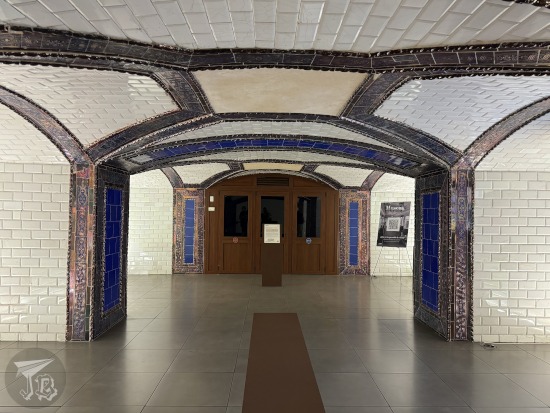
The former hall Vestíbulo de Pacífico is part of the network of Underground museums Museos de Metro de Madrid. Until it was walled off in 1966, it was the entrance to the station Estación de Pacífico, built in 1923 when the underground Line 1 was extended towards the south-west. The passengers climbed down a now-disappeared staircase and crossed the hall, which still had natural light. On the other side, there was some sort of metallic bridge with another set of stairs to access the platforms.

The station used to be part of a huge complex owned by Metro, which also comprised offices, control rooms, and the warehouse that housed the engines that created energy for the trains to run on. At the time, it was an unpopulated area, so land was cheaper. Today, most everything has been replaced by apartment buildings and only the station and the nearby Nave de Motores remain.

The whole complex was designed by architect Antonio Palacios, and the hall was built in white tiles with blue decoration – a homage to the Pacific Ocean, which gives the station its name. The hall is tiny by today’s standards, barely 119 square metres. It has three vaults that used to have skylights for the sun to light up the hall – now those are closed off as the street above them is busy. The station was renovated in the 60s so it could accommodate the longer trains, new accesses were built, and the hall closed down. That renovation was the same that made the station Estación de Chamberí close, and apparently another hall that has been uncovered in Ventas.

The hall was bricked away for almost half a century, until restoration work started in 2007. It took ten years, as budget was low and the process was labour intense – 60% of the hall had to be rebuilt. However, the final product is really good, you can see the newer tiles if you look for them, but the whole thing feels extremely well preserved. Even the staircase, which was built to access the hall after the iron bridge was destroyed, feels time-appropriate. A replica of the original doors was put up.

Pacífico Booking Hall

And right when I have seen all the five Underground museums that require appointment… I find out there is a passport of them – Pasaporte de Pasaporte de los Museos de Metro. Just my luck! Then again, maybe Metro will take these articles as proof of visit and backstamp me for them?

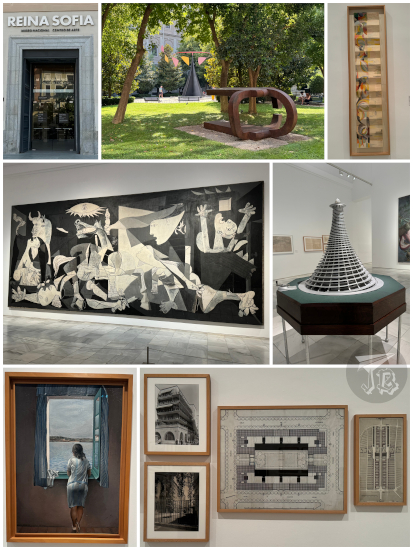
The visit took about one hour, then I rode the underground back towards Atocha, and bypassed it to the next station. I had decided to try my luck with the queue at modern art museum Museo Nacional Centro de Arte Reina Sofía, part of the national network of museums covered by my card. To be honest, I do not enjoy modern art that much, so I have been putting off this one visit. However, the museum holds a piece by Pablo Picasso that has become quite socially loaded – Picasso’s Guernica, which I have always thought I ought to see at least once.

Pablo Picasso (1881 – 1973) is considered one of the most important artists of the 20th century. He was co-inventor of collage, co-founder of Cubism, and inventor of the assemblage (basically, collage in 3D). He painted, sculpted, and made prints, ceramics and theatre sets. I have never connected much, if at all, with the kind of art he was making. I do not really understand the limits he broke, nor whatever he wanted to express. That is why I wanted to see this artwork in particular – to try to understand.

Arguably Picasso’s most famous painting is Guernica (1937). During the Spanish Civil War, German planes bombed the Basque town of Guernica, in the north of Spain, to aid the Nationalist army. The town was destroyed, and up to 300 people lost their lives – the raid opened the northern front for Franco to reach Bilbao. British reporter George Steer wrote a scoop on the event after he witnessed the destruction, and his reports made waves internationally. Picasso, who lived in France at the time, had been commissioned a piece of artwork for the Paris World’s Fair by the Republicans (at the time the rightful government of Spain). Upon reading the news, he scrapped his original idea and painted the Guernica instead.

The painting is one of the most important artworks that the museum has. It is a huge piece, in black and white, showing the carnage. As most men were out in the battleground, the majority of victims were women and children – along with a dead soldier, a horse and a bull, most of the figures in the pairing represent women and horror. I honestly find the description of the painting more chilly that the artwork itself.

One kind of feels that the museum itself as built as a huge sarcophagus for the Guernica, and other pieces are there just to fill up the space. A sculpture by Eduardo Chillida is exhibited in the gardens. There is also a space about architecture, with blueprints and photographs, including artwork by Le Corbusier. Other artists whose work is shown include Salvador Dalí, Joan Miró, Alexander Calder… Actually, I enjoyed the museum more than I thought, as I expected only abstract art that I would not understand. I enjoyed the blueprints and photographs of buildings, and the actual building too.

Exhibits at Museum Reina Sofía

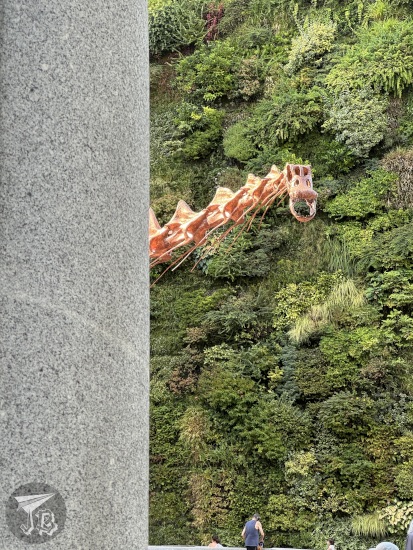
I then headed up Paseo del Prado to find one of the local cultural centres. I was ridiculously amused when I reached the corner where CaixaForum stands. I was on my phone, and when I looked up, I saw the Patagotitan “looking” at me. It gave me a laugh.

Patagotiatan at Caixaforum

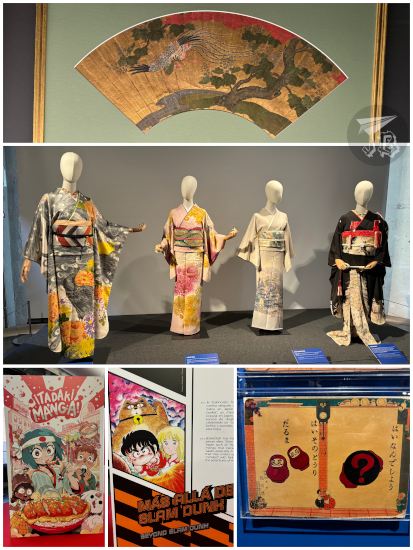
The cultural centre Serrería Belga is running a Japan-themed exhibit, divided in parts:

  • Kinpaku. Naturaleza, poder e imaginación en el arte japonés (Kinpaku: Nature, power and imagination in Japanese art): Kinpaku [金箔] refers to gold leaf artwork, often used in decoration in classical Japanese culture. A private collector has lent their items to exhibit – windscreens and fans, all painted in gold, so they can be enjoyed by everyone.
  • Kimono, identidad cambiante: un siglo a pie de calle (Kimono, changing identities: a century on the streets): Kimono [着物] is the traditional Japanese clothing – one that unlike many others is still common wear. There were twenty of these, including accessories.
  • Expokon: A series of panels discussing different hits in sports manga and derivatives.
  • Japan International Manga Award: Panels drawn by the Spanish artists who have won the awards in different years.
  • Kamishibai: Kamishibai [紙芝居] is (was) a form of Japanese street theatre using a small paper theatre with pictures to tell the stories. There were several sets of stories, some classical, some more modern.
  • Manga Kids Academy: A few panels showing Japanese school life through manga and anime.
  • Itadakimanga!: A series of panels showing different foods popular in manga and anime.
  • Gêmu: cultura visual y videojuego japonés (Gēmu: visual culture and Japanese video games): Some items regarding video games, and even a few arcade machines for playing.

Japanese exhibits at Serrería Belga

The exhibits were part of Madrid’s summer cultural program, which has named Japan “Guest Country”. They were a few cute little exhibits, and they were free too, so a good way to complete half a day trip. I headed back to the station afterwards, to wait for whichever train came, and I was lucky enough that one was there in a couple of minutes – I even found a good seat on my way back.

And I have finally seen the hall at Pacífico, which has been a goal since April 2023. Now I just have to figure out a way to obtain the passport and have it stamped…

30th June 2024: Engines, illusions, history and tea (Madrid, Spain)

Since finding about my tea time outings, my sibling had been wanting to tag along to one. I was asked to organise something for the weekend that involved either Chinese hotpot or afternoon tea in Madrid. The hotpot place was booked out both days, but I found an afternoon tea opening on Sunday the 30th. I am too lazy to move out just for tea, so I organised a bit of a day out.

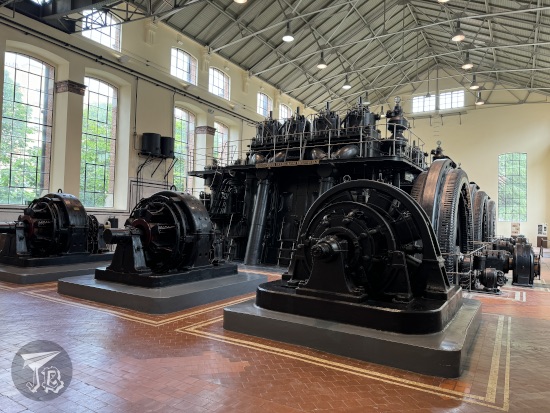
After an uneventful train ride, our first stop was at noon: Nave de Motores de Pacífico, the former energy centre that fed electricity to the original underground lines. Today, it is not in use and it has become part of the network of museums Museos Metro de Madrid. The warehouse was built by Antonio Palacios between 1922 and 1923 to home the diesel engines, transformers and fuel that single-handedly powered the underground system before the Spanish Civil War. The system was actually in place until 1972.

Warehouse containing the old underground engines

The building was erected in red brick, with white tiles inside, decorated with Palacio’s typical metallic green. The floors are ceramic tiles, and the engines are three monstrous vessel-powering pieces of engineering. These diesel engines created electricity, which then entered the transformers, and was sent to the power lines to feed the trains. At night, the excess was sold to the local street-light network.

Since we were going for afternoon tea to El Jardín de Orfila, where I have been before, I knew lunch was out of the question. However, we needed a snack. I planned that at Yatai Market, an… Asian food court of sorts. A number of stands come together to offer different cuisines and snacks, even full-sized meals. We tried a Chinese bao each and a couple of dim sums. I ordered a hoisin duck bao which was extremely yummy. I will definitely come back to try other stuff.

HotBao Yatai Market Cortezo

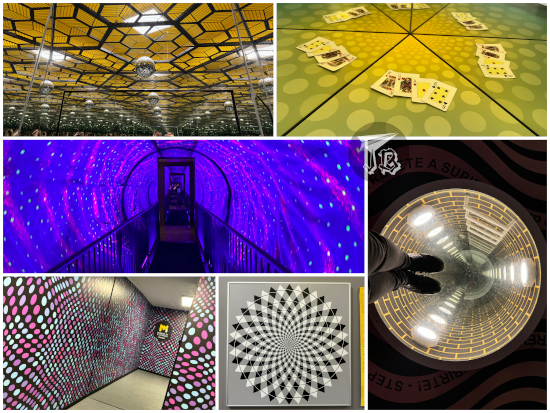
Afterwards, we headed off to the so-called Museum of Illusions. This museum is a compendium of optical illusion and installations designed to fool the brain into believing things that are either wrong or just not there: a distorted room so you look big in one corner but small in the other (Ames room), a vortex where you seem unable to walk straight, a rotated room, a room full of mirrors – there were a lot of illusions with mirrors actually – stereograms with hidden images, turntables, holograms…

We had a reservation for 14:00, and I was surprised at how chaotic entry was. I mean, they’ve been running the thing for a while now, someone should have figured out how to do crowd management, but no. Then, there were kids running and screeching all around, but it calmed down after a while. I had really hoped that the museum would be calm and half-empty at lunch time, but it was not so, not by a long shot. It was interesting though, and pretty fun.

Museum of Illusions Madrid

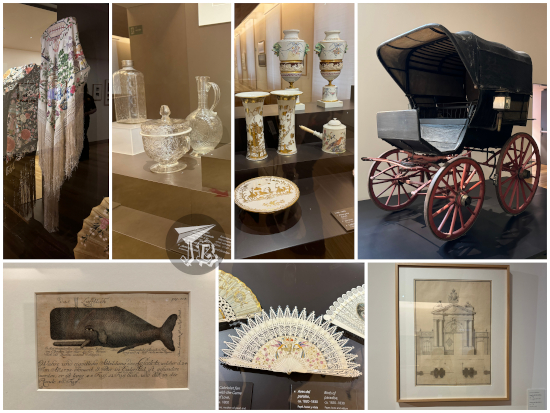
However, the experience was shorter than I had calculated, so I had to improvise an extra stop. Thus, we entered the local history museum Museo de Historia de Madrid, which tells the city’s history since Madrid became the capital of Spain. There are paintings, models, typical costumes, plans, maps, and Playmobil sets depicting of the uprising against the French in 1808. The museum is hosted in a former palace-like building which was actually built as a hospice. To the side stands the original Baroque chapel. It also has a lovely garden with a monumental fountain, which was relocated from its original place for conservation.

Museo de Madrid exhibits

Museo de Madrid - chapel and fountain

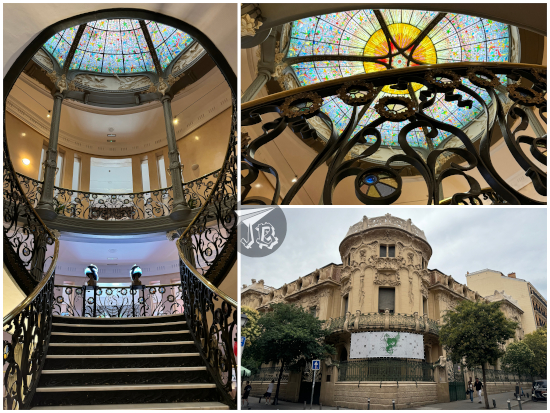
We spent some time there and then headed off to the building that now holds the office of the Copyright Owners’ association, a manor known as Palacio de Longoria. It was designed by José Grases Riera and built between 1902 and 1904. It is one of the few actual Art Nouveau buildings in Madrid, possibly the most important one. The façades were made in artificial stone, with sculptures and shapes resembling vegetation. I’ve wanted to visit it for a long time, but it is only open when there is an exhibition, and the stars had never aligned – until this time. There was an exhibition about urban music, and I was not going to let go of the chance to see the monumental staircase and the skylight.

Longoria Palace

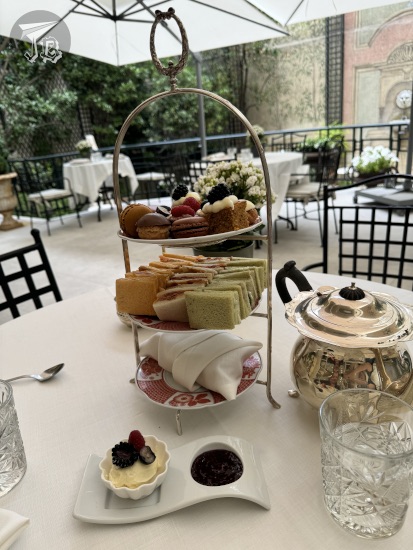
We finally set off for afternoon tea at El Jardín de Orfila. Out of the several places I’ve tried afternoon tea in Madrid, this has been my favourite to date. The outside garden is lovely, but mostly, their scones are the best around.

We ordered green tea, and the snacks were finger sandwiches – smoked salmon and cheese cream, classic cucumber and cheese, pastrami – pastries – carrot cake, macarons, lemon curd – and the scones. This time round, I decided to eat the scones after the sandwiches in order not to be full when it was their time. The afternoon was pleasant, but we shared the terrace with another table, and later a loud lady who wanted a smoke. That broke the magic a little, but the tea was fantastic and the scones were great.

El Jardínde Orfila: tea serving for two

Afterwards, we just headed for the train station to get back to our places. Of course we missed the correct one since they run whenever they like. What else is new? But the fun part was being able to pull a fun day out from my sleeve, and it was not stupidly expensive either, so good fun, all in all!

15th June 2024: The Old Naval College, and a mishap {London, England, June 2024}

I am getting weirdly used to 5:00 wake-up calls. I drove to the airport and arrived at the long-stay parking lot just before 6:00, with the exact time to catch the bus at the nearest stop. I might be getting too comfortable with timings – either that, or the flights have started taking off a bit later, because I remember having to leave by 3:45 for the first Ryanair flight a few years back. Anyway, security was nice and smooth, but passport control was maddeningly slow – the shiny brand-new machines the airport has spent a fortune on were not working, and there were only two agents, and three flights leaving around the same time.

We left on time and landed on time too, and since works at London Stansted have been finished, I was fast out of immigration. I considered going to the hotel first thing in the morning in order to make sure the credit card went through – and have time to find an exchange office if it did not. When I was able to buy my usual breakfast in the Costa at the arrival area without an issue, I decided I should be all right. Thus, I just headed off towards the centre, reached Liverpool Street station, and transferred to the TfL system. I got a bit confused at the DLR. London’s railway is divided in the Underground, the Overground and the Docklands Light Railway or DLR, which are mostly automatic trains which involve more transfers than I had expected. I needed to backtrack a station or two before I got to my final destination, the area know as Isle of Dogs in the borough of Tower Hamlets. I’ve recently found out that there is a footpath under River Thames which connects the Isle of Dogs with Greenwich. The footpath, the Greenwich foot tunnel, was built from 1899 onwards, and it opened in 1902. You can literally walk from one bank of the Thames to the other in just a few minutes!

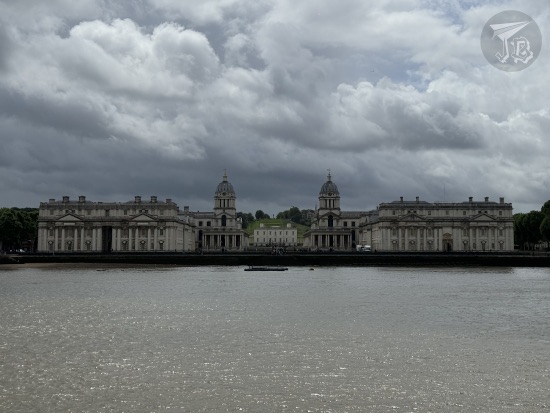
Old Royal Naval College from across River Thames

The tunnel was damaged during World War II, and there is a section which is held together by an inner steel lining. The whole tunnel is lit and either painted or tiled in white, so it does not give off any kind of claustrophobic feeling. Something cool that happened to me was that I could actually feel the water running above me, similarly to how I feel when I’m standing on a bridge and look at the river underneath. That was unexpected. Though there are lifts – the original ones were installed in 1904, but there are new ones from 2012 – I took the stairs.

Greenwich foot tunnel

I stepped out of the tunnel and into Greenwich, next to the Cutty Sark. I have already visited the museum inside the ship. This time around, I was going to try to see the Old Royal Naval College, which has been closed whenever I’ve tried to see it – they film rather often there. This time it was actually open to visitors.
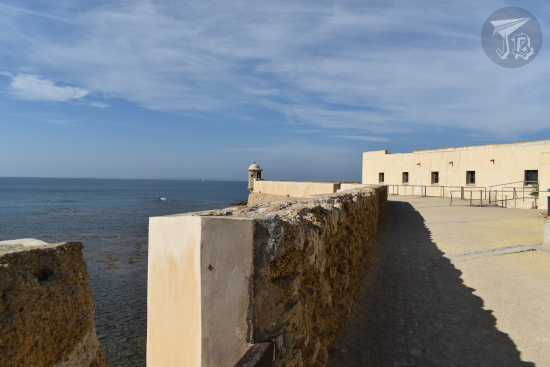
The Old Royal Naval College, today part of the Maritime Greenwich UNESCO World Heritage Site, was originally designed as a veteran home and hospital. The current iteration of the building was designed by Christopher Wren – also responsible for St Paul’s Cathedral. The complex has two complexes or courts, Queen Mary Court on the left from the river, King William Court on the right. William III (reigned 1689 – 1702) and Mary II (reigned 1689 – 1694) were offered the throne as joint monarchs when their predecessor James VII and II was declared unfit because he became a Catholic. The building served as hospital and hospice until 1869; later, in 1873 it became a training academy for the Royal Nay until 1998.

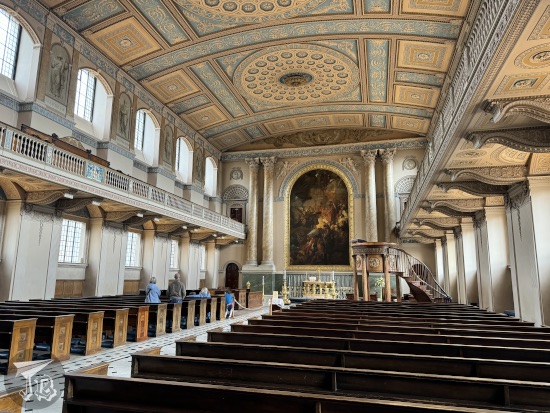
I first went into the Chapel of St Peter & St Paul in Queen Mary Court. It was reconstructed after a fire by James ‘Athenian’ Stuart in the neoclassical style. It has one nave, and a wood ceiling decorated with naval themes. The altar piece was painted by Benjamin West. I found the chapel quite beautiful, it gave off a warm feeling. The security personnel were also very nice.

Old Royal Naval College chapel

Then, I headed off to King William Court, to the pièce de résistance of the building. The Painted Hall is a huge ward decorated with Baroque paintings by Sir James Thornhill. The ceiling and walls are painted to honour the kings and queens who gave their patronage to the “Royal Hospital for Seamen at Greenwich”, depicting them surrounded by mythological and allegoric figures. The art was impressive, and the volunteer who explained it was a former teacher who made the whole tour really informative. While I usually avoid guided visits as much as I can, I found the painting too complex to interpret on my own.

Old Royal Naval College - Painted hall

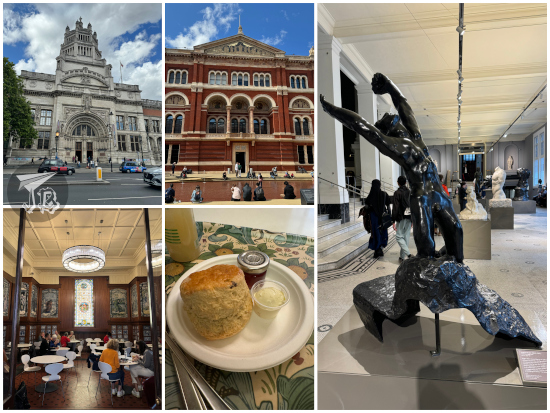
I backtracked through the Greenwich foot tunnel and took the Underground towards the Victoria & Albert Museum. Last time I was over they were running an exhibition I wanted to see… only this time around they had moved to another of their sites. I shrugged it off and decided to have a scone instead – any scone. I mention this because the couple before me wanted two particular scones from the basket. Afterwards, I went to see a gallery within the museum which I missed in 2023, which turned out to have bronze sculptures by French artist Auguste Rodin, considered the initiator of modern sculpture.

Snapshots at the V&A museum

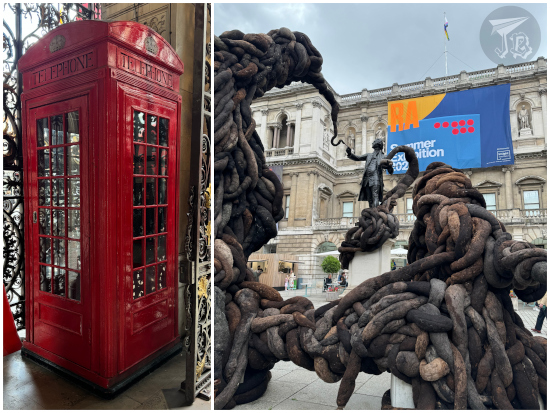
After that, I hopped back onto the Underground and headed off towards the Royal Academy of Arts, located in Burlington House. I was… surprised, to say the least, about the current display in the courtyard, but I was there to see oldest surviving red telephone box – Sir Giles Gilbert-Scott’s original prototype “K2” kiosk, made in wood in 1924.

Burlington house

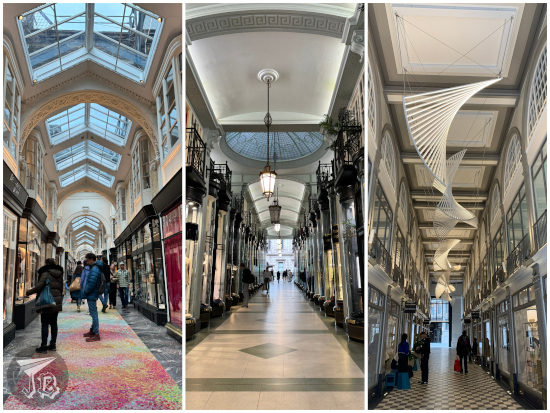
I then snooped around three of the high-class shopping centres along the Oxford Street area, all of them out of my price range, of course – Burlington Arcade, Piccadilly Arcade and Quadrant Arcade. I walked past Piccadilly Circus and Leicester Square, and headed off to Forbidden Planet to check out if they by any chance had a copy of a comic I’ve been looking for (Alligator Loki, if you ever find it, give me a shout?). I did not find the comic but I did see some stuff by Stjepan Šejić in the wild.

High-end London shopping arcades

Finally, I headed off towards the hotel / venue area, I found the venue – just outside the station. I bought some snacks for dinner and breakfast, then headed off to get to my hotel. The credit card thankfully went through and I got my room. I spent the rest of the evening watching films and snacking on salt and vinegar crisps. Truth be told, the weather was not that nice, but most of the rain happened when I was inside the buildings in the Old Royal Navy College. It’s been a long time since I was in London and there was not a heat wave, so I am not going to complain.