26th May 2025: Sliema & the return {Malta, May 2025}

It was my last day in Malta. My return plane was mid-afternoon, so I had to head towards the airport at noon the latest. For that morning, I had planned a leisure stroll along the beaches towards the east of Saint Julian’s | San Ġiljan and Sliema. I had breakfast, grabbed my backpack, and set out along Ballutta Bay, Exiles Bay and St Julian’s Bay.

Balluta bay - a tiny sand beach with buildings on both sides

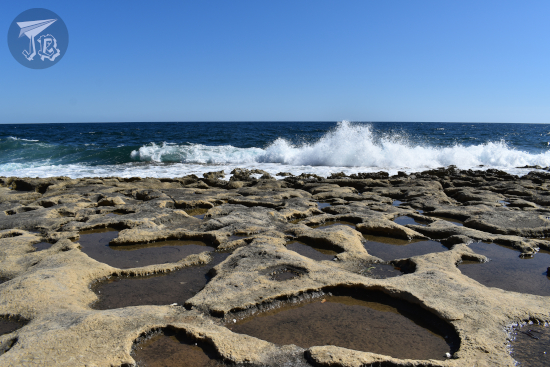
Limestone beach with waves breaking against it

There is a watch tower at the edge between both towns Saint Julian’s Tower | Torri ta’ San Ġiljan, built to protect the bay in 1658, though today it is a restaurant. After looking at the waves for a while, I walked along the coastline until I found the Roman Baths, which to my disappointment, are not Roman but Victorian artificial pools, from the time Malta was a British colony – they were upfront about this though, unlike the Birżebbuġa ones.

Sliema Roman baths - rectangular pools carved into the limestone

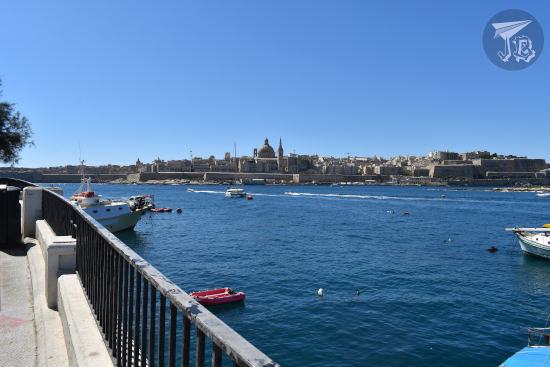
I can look at waves for hours, and that’s exactly what I did. I passed by Sliema Point Battery (now also a restaurant; I would have liked to try it to be honest, just because it looked cool) and eventually reached the Sliema Promenade. There, the scenic ferries leave to take tourists around the bay, and the actual ferries sail off to Valletta, which can be seen across the water from the Panoramic View Of Valletta point. There is a cute little building, the Sea water distilling monument, the remains of Malta’s oldest water distillation plant, used after its construction in 1881 to provide drinking water to the population. Fresh water was obtained by boiling sea water to separate the actual water from the salt.

Views of Valletta across the bay

I still had a little bit of time, but I was next to the correct bus stop, and it was almost time for it to pass. Thus, I decided to take it, get to the airport, grab a coffee, and visit the Observation deck.

As I stopped by the airport’s Costa Coffee I got talking to a couple who had just landed and were figuring their way out after a change of plans. When they heard I was going home, they immediately asked where my next adventure was. I found it both endearing and hilarious – do I look that travel-minded? I should have told them that I planned to go dig dinosaur eggs or something…

I drank my vanilla latte at the Observation deck, then I went through Security and checked the book shops for a copy of The Little Prince in Maltese for my parent. I found a quiet place to sit – and damn it was freezing, so I ended up wearing all my layers until I boarded the plane.

In the end, I carried my bathing suit for nothing, but I have to admit that despite the inconveniences on Saturday, I had a blast in Malta. While it had never been on my radar as a potential destination beforehand, I am really glad I chose it. I did not miss having a car, because the public transport was convenient enough, and the weather was superb. Gozo was not as spectacular as I expected, but I wouldn’t mind coming back to the country to explore the rest of the temples – especially the Ħal Saflieni Hypogeum – and the one main city I did not visit – Mdina. Next time around though, I don’t think I’ll book any tours and organise everything myself. Given some time, I think I can make a great itinerary for a second visit. Oh, and I will try to find a hotel in a non-party area or destination.

23rd May 2025: Valletta {Malta, May 2025}

Around 5:00, I was woken up by a group of guys singing, and I thought they were outside, drunk and going back to their hotel. It turns out that Saint Julian’s | San Ġiljan is a party area. I had absolutely no idea – I would like to chalk that up to the improvisation again, but to be honest the concept of a “party town” is one that had not even crossed my mind till then. I did not sleep much afterwards, so a bit after 7:30, when breakfast opened, I headed there, then I took the bus towards the capital, Valletta.

My first stop was a compulsory one – the City Gate | Bieb il-Belt which I had to cross to walk into the city. The capital of Malta was declared a Unesco World Heritage in 1980 under the name City of Valletta because with 320 monuments in 55 hectares, it is one of the most concentrated historic areas in the world. The city was erected by the Knights Hospitaller around a watch tower that was demolished to create a large defensive fort. After said fort fell during the Great Siege of 1565, the Grand Master of the Knights Hospitaller Jean de Valette decided to build a grand fortified city with plans by Francesco Laparelli. Neither Valette nor Laparelli saw the city complete, which happened in the 1570s, when it became the capital. The Gate is the entrance to the fortification itself, separating Valletta from the city of Floriana. Protected by its the walls, Valletta thrived and though 17th the century it became filled with manors and palaces, some of which have now been repurposed as hotels or museums.

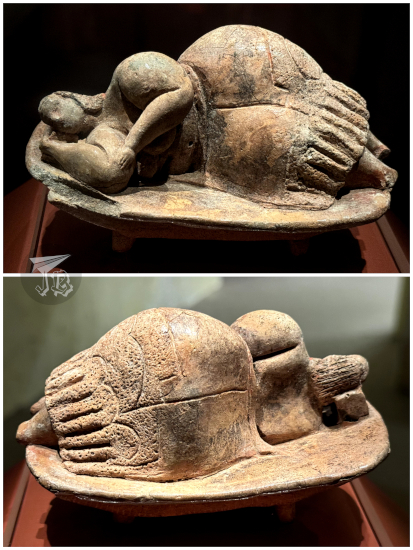
One of such buildings is the National Museum of Archaeology, which hosts artefacts from the Neolithic (around 5900 BCE) to the Phoenician period (circa the 6th century CE). On the ground floor they have all the items that have been removed from the Neolithic temples for protection, including some of the carvings from Ħal Tarxien Prehistoric Complex. A tiny clay figuring called The Sleeping Lady captured my attention. It was a lovely detailed little representation from the so called Temple Period of Maltese history (4000 – 2500 BCE), which was recovered from the Ħal Saflieni Hypogeum. There are also headless bodies and bodiless heads found at other temples.

Archaeological Museum Valletta: pieces taken from the Temples in order to protect them: carved rocks, statues (most of them of bodies without heads), trilithons...

Archaeological Museum Valletta: Sleeping lady. A small figurine of a woman sleeping made in clay

I proceeded upstairs, where there is a small exhibit on “cart ruts”, a network of tracks in the rock. The analysis seems to show that they were made by carts with wooden wheels eroding the limestone. However, there are no… traces of whatever pulled on them – no tracks, no trails, nothing but the wheels. There is another room displaying Phoenician civilisation, and one showing some amphorae from a shipwreck off Xlendi Bay in the island of Gozo, at a depth of 110 m. The ship sank in 700 BC, it was discovered in 2007 and it was finally excavated between 2018 and 2021.

The final room I saw hosts a few skulls from the Ħal Saflieni Hypogeum. I might have to return to Malta just to finish exploring all the prehistoric sites – aside from that, there is sea, the food is delicious and when you open the tap, the water is warm. I felt right at home, really. Anyway, some of these skulls are described as “elongated” and for a while there was even a conspiracy theory about them being alien… They are not. The elongation was not artificially created, like in some Mesoamerican cultures. They belonged to a few individuals who had… long heads. Which is a bit anticlimactic, but only a few remains have been recovered from the calculated thousands, so there is very little that can be inferred from whomever was interred in the burial chamber.

Archaeological Museum Valletta: Phoenician pottery, skulls from the Hypogeum, anforae from the shipwreck

There was actually a last-last area, a ball room from the Baroque palace, but that was under construction and I could barely have a bit of a look. Afterwards, I walked towards the St. John’s Co-Cathedral | Kon-Katidral ta’ San Ġwan. The Catholic co-cathedral shares responsibilities with the one in Mdina, and was built between 1573 and 1578 in a Mannerist style. The interior was redecorated in the 17th century in a very Baroque style and lots – and I mean lots – of gold and golden decoration. Downstairs, there is a crypt where some Grand Masters of the Knights Hospitaller are buried. On the main floor, the nave is surrounded by nine chapels, eight of which are dedicated to the different chapters of the Order and their patron Saint, and the last one is dedicated to and one to the Virgin Mary. .

Though you can get tickets online, there is no chance to buy same-day tickets but on site. I queued for a while, maybe 20 minutes or so, before I was scanned for… guns and explosives… then I was allowed in. There were small restoration works being carried out. Not a Baroque person in general, but I have to admit it was impressive. I declined climbing to the dome because the fun views are from across the harbour, not from inside the city itself.

The co-cathedral holds two pieces of art by Caravaggio – The Beheading of Saint John the Baptist and Saint Jerome Writing, both in the chiaroscuro style – with high contrasts of light and dark. Michelangelo Merisi da Caravaggio (1571 – 1610) was one of the maximum representatives of chiaroscuro, with usually violent and gruesome topics, usually disguised as hagiography.

Baroque interior of the cathedral, with dark walls decorated with frescoes and golden wood

After I exited the cathedral, I headed down a small alley opposite for something that is not a monument but… made me happy anyway. Malta has Costa Coffee – something which, unlike the plugs, I had thought of checking beforehand. I actually had a shop near my hotel. Had I known that, I might have skipped booking breakfast. What I did worked really well though, so no big deal. I managed to balance breakfast and dinner, which made my moving around more convenient, not needing to find a place for lunch. Of course, a medium vanilla latte from Costa does not count…

My next stop was the Grand Master’s Palace | Il-Palazz tal-Granmastru. It was the first building erected by the Knights Hospitaller around 1574, and it is considered the seed of both Valletta and the country of Malta itself. The building was first the residence of the eponymous Grand Master of the Knights of Malta until the 18th century, then the residence of British Governors, the Seat of the Parliament, and it currently houses the Office of the President of Malta. That explains why the security is tight enough you’re not even allowed a bottle of water in.

The building was designed by Gerolamo Cassar. The exterior is Mannerist, severe and simple, but the interior is richly decorated with paintings and frescoes. Some of the rooms have coffered ceilings and tapestries on the walls. There is a huge armoury, organised chronologically, and a throne room, which felt a bit out of place for a republic. The building has two courtyards – the so-called Prince Alfred’s Courtyard has a clock tower which is claimed to date from the 1530s. Oh, and apparently, it’s haunted? I did not feel anything out of the ordinary, not even a temperature drop. That would have been handy.

Grand Master's Palace - clock tower, throne room and corridors decorated with frescoes

After the Palace, I walked down Valletta’s narrow streets and until I reached St Paul’s Pro-Cathedral | Il-Pro-Katridral ta’ San Pawl, the Anglican “temporary” cathedral, established in 1839 – and still in use. It is a Neoclassical building with a very characteristic steeple and an organ imported from England.

Interior of the cathedral, with corinth columns and a small altar.

I then took a walk towards what is called Lower Valletta, at sea level. I walked around Elmo Bay and reached Fort Saint Elmo | Forti Sant’Iermu. The origin of the star-shaped fort was defence against the Ottoman Empire (which would eventually yield to Türkiye), and it is a large structure in limestone. It was key in the 1565 Great Siege of Malta and the Maltese victory. However, the interior is a War Museum, and I did not quite feel like that. Instead, I walked around and went down to the beach to enjoy the waves and the views of Fort Ricasoli | Forti Rikażli across the bay.

Fort St Elmo - a sea-side fortification made in golden limestone

Later, I found the Lower Barrakka Gardens | Il-Barrakka t’Isfel, a green terraced with trees, monuments and fountains, along with a nice view. I was heading upwards again, towards Upper Valletta.

Lower Barrrakka Park: Mediterranean plants, a temple-like building and a pond.

I thought I ought to get some food as I passed by the Valletta Food Market | Is-Suq Tal-Belt, but I did not find anything I fancied. I bought a soda in a small market in the basement, where I was charged 10 cents for the “reusable cap” (fair) and 10 extra cents for buying a chilled drink (LOL). The soda gave me calories and hydration enough to continue on, so I found the Upper Barrakka Gardens | Il-Barrakka ta’ Fuq. Aside from a nice mixture of architecture and nature, the gardens are linked to the Saluting Battery | Batterija tas-Salut, which stands under the terraced area of the gardens as part of the St. Peter & Paul Bastion. It was constructed in the 16th century for ceremonial gun salutes. Today it hosts cannon replicas that are fired at 12:00 and 16:00. I was there for the Evening Salute, with the firm plan to watch from above.

Then a nice gentleman in a nifty uniform said something akin to “for just 3 € be the closest to a firing cannon you can be in Europe” and there went all my restraint. I mean it was only 3 € and being the closest to a firing cannon you can be in Europe. Yes, I’m easily distracted. Yes, I paid the 3 €.

Entry included a brief explanation, including what a “smooth-bore breech loading 32-pounder gun” is: basically, a cannon designed in the 1880s with a smooth barrel, which can be loaded from the breech end of the barrel and… can fire shells weighing 55 pounds (24.95 kg). They were made modifying guns that could only shoot 32-pound shells though. The soldier-actor explained about cannons, how to load them, what the process was and the security protocols. Oh, and that the weapons were anything but accurate in real life. That was cooler than I thought it would be, so I was happy I had decided to get the ticket.

Saluting Battery: cannons and still of the shooting

 
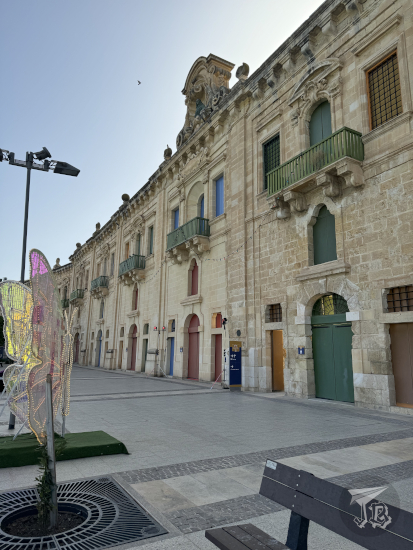
When the demonstration was over, I left the gardens. I walked past the Tower Port and The Lascaris War Rooms, another war museum, on my way to the Herbert Ganado Gardens and the Kalkara Steps. Doing this, I temporarily left Valletta and stepped into Floriana, then walked back into Valletta until I found The Valletta Waterfront, a group harbour warehouses from the 1700s which have been converted into restaurants, bars and souvenir shops. Since it was that silly time when the restaurants have closed after lunch time and are not yet open for dinner, it was almost empty, so it was nice to see all the buildings.

Valletta Waterfront: a line of neoclassical warehouses and buildings turned into shops and eateries

I had two options then – one was walking back towards the city centre to see two churches that I had missed, or head back to Saint Julian’s | San Ġiljan. Since I was quite closer to the bus station than to any of the churches (Shrine of Our Lady of Mount Carmel | Bażilika Santwarju tal-Madonna tal-Karmnu and The Collegiate Matrix Parish church of Saint Paul | Il-Knisja Kolleġġjata Arċipretali u Matriċi ta’ San Pawl), I decided to return.

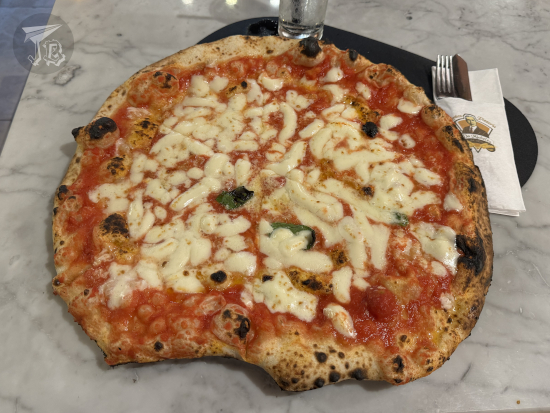
Once in Saint Julian’s | San Ġiljan, I had the largest pizza I’ve ever had the pleasure or disgrace to be served. I mean, good thing that I ordered a plain Margherita (in all honesty, it was the house special with extra cheese) because I would not have been able to eat anything with toppings, even after having basically skipped lunch. I somehow made space for ice-cream afterwards…

Huge Margheritta pizza

15th & 16th March 2025: Canterbury (England, UK) for “The Shark Is Broken”

I’ve travelled for – or with the excuse of – concerts (take your pick) and documentaries (at least thrice, even twice for the same one), but this was my first time travelling for a theatre play. Don’t get me wrong, I like theatre – I’ve even squeezed Wicked into a London trip a couple of times – but it had never been a main driving force. Until I stumbled upon the information that The Shark is Broken was heading towards the UK and Ireland. There were no shows in London, and my connection to everywhere else – including Dublin – was not good, especially due to work schedules. However, there was one date which was, if not convenient, at least doableCanterbury, in the county of Kent. Unfortunately, neither the Gods of Trains nor the Gods of Buses were as willing to smile upon me as the Gods of Air Travel.

Once I secured a ticket for the play (£55.00, dead centre of the stalls), a hotel in Canterbury, and the plane ride, I checked out what to see in town. This was back in December 2024. I also booked my parking spot at the airport, and since it was so long out, I could reserve Terminal Parking for just a couple of quids more than long-distance parking. That’s an extra 20 minute snooze! However, as I’d been hearing about train disruptions in England, I decided to wait a little before buying the Stansted-London and London-Canterbury trains. And sure enough, when a couple of weeks before the trip I went to check on the trains, the Stansted Express was indeed not running. There were ticket sales, at normal prices, but the trip would be by bus – taking as long as a bus usually takes. Thus, I decided to buy a coach trip at coach prices instead. That added a couple of hours of travel / waiting to the whole journey. Then, I went on to the South Western Rail website, which claimed that purchasing tickets would be easy. My definition of easy is… different, but, I was able to secure tickets. I was supposed to download the app to use them – but the app cannot be downloaded outside the UK. Fortunately, I was able to download a copy of the tickets from the confirmation email and use those.

When the day came, I left home a bit after 3:00 for my 5:45 flight. It was extremely cold, but at least it was not raining. I had some time at the airport before take-off, but of course everything was closed. It felt a bit weird, knowing it was the last time I could fly to the UK “for free”, considering that all countries are implementing the stupid Visa fees everywhere. We landed in London’s Stansted Airport on time, so I made it to the 08:10 coach I had booked – despite the utter chaos that Stansted coach station has become. The nice 40 minutes by train to London Liverpool turned into an over-two-hour coach obstacle course through London’s construction work.

Since I had been forced to buy a bus ticket, I got a direct one to King’s Cross – St Pancras International, where my train to Canterbury was due to depart. I had calculated for a safe train at 10:40, and I reached the stop around 10:05, which gave me enough time to find the nearest Costa Coffee before I went to Platform 13 to board my train. I chose the carriage poorly, as I ended up in the midst of a boisterous hiking group, but the trip was less than an hour, and I reached Canterbury West at 11:34. This was a bit over an hour later than what I had originally hoped for, due to the train-bus adjustment. Looking back, maybe it had not been necessary to buy that ticket in advance.

The city of Canterbury is a Unesco World Heritage Site in the county of Kent, in the south-east of England. The area has been inhabited since the Lower Palaeolithic, through the Iron Age, and Roman times on. The town saw the first Christian conversions in the British Isles, and the foundations of the cathedral were set in 596. Canterbury survived the Viking raids around the year 1000, but it fell into William the Conqueror’s hands in 1066.

In 1170, Archbishop Thomas Becket was murdered in the cathedral, an event which triggered massive pilgrimages from all the Christian countries. Between 1387 and 1400, author Geoffrey Chaucer wrote The Canterbury Tales, one of the key works in English literature, a fictional compendium of stories told by pilgrims towards the cathedral. During the early Middle Ages, Canterbury became one of the most populated towns in England, until the Black Death decimated its people. In the 16th century, there was an influx of French protestants (Huguenots) who fled mainland Europe to resettle, revitalising the economy and introducing the silk-weaving industry that flourished for over a century.

After the 17th century, things changed. Canterbury became an agricultural hub spot, so the Industrial Revolution only affected it with the construction of railways. The historical centre was damaged during WWII bombings, after which the historical area was pedestrianised and a ring road built around it. Today, Canterbury lives off tourism, retail, and higher education, with a large floating population of university students.

And it was cold that weekend. A climate topsy-turvy seemed to have exchanged the Spanish winter anticyclone and the British rains, so it was storming in Spain and crispy in Britain those days. But at least, it was not raining, which allowed for freedom and seeing a lot of things. Upon leaving the station, my first contact with Medieval Canterbury were the Westgate Towers Museum & Viewpoint, the largest Medieval gateway surviving in the UK. It was erected around 1380 to substitute the Roman ones. Even before that, there were other hits like “the oldest brewer in Britain.”

Westgate tower, former gate to the Medieval city

I reached the pedestrian St. Peter Street, which merges into High Street, the town’s spine. My first real stop was the Cathedral and Metropolitical Church of Christ, Canterbury (Canterbury Cathedral for short). The cathedral is the seat of the Archbishop of Canterbury, the symbolic leader of the Anglican church, and the spiritual leader of the Church of England – whose official residence is actually in London though, for some reason. I wanted to get to the cathedral first just in case it closed at any time for a service, and so I did not pay much attention to the main street for the time being.

The cathedral precinct is accessed by the Christchurch Gate, completed around 1520 in the Tudor Gothic style. It features restored colours on the decoration, restored between 2018 and 2022. In the square in front of it stands the Canterbury War Memorial, to honour the victims of WWI, which was damaged during WWII, along with most the historic area, due to bombings.

The cathedral was established in the year 597 after the arrival of St Augustine to Kent. During its first period of existence, it was a Roman Catholic place of worship. The building burnt down and was completely re-erected towards the end of the 11th century, and a lot of construction and reconstruction went on until the end of the 16th century – around the time of the English Reformation, when the Catholic monasteries were disbanded and the cathedral turned Anglican. Most of it has remained in the 12th-century Gothic style, except the crypt, which is Romanesque. The west front – under conservation work – hosts statues of people who are considered influential in the life of the cathedral and the church of England, from Augustine of Canterbury to Kings and Queens including Elisabeth II. During the Roman Catholic period there was a Benedictine Abby attached to the cathedral. Today, only the cloister and the ruins of the infirmary remain from that time.

I bought my ticket and headed to the entrance of the cathedral. There was a trail, and I decided to follow it. That led me to see the West façade, with the statue of the Saints, Kings and Queens, and then down a corridor towards the cloister, which might have been the most beautiful one I’ve ever seen, with gothic arches and family crests painted on them. After the cloister, I found the herb garden and the water tower, and I got to see the ruins of the infirmary.

I went down to the crypt, and then up to the cathedral. The building already looks big from the outside, but the inside feels huge, with columns and pointed arches soaring up to the ceiling, and paned glass windows letting the light in. I first toured the quire (choir), where the Shrine to Thomas Becket used to be. Thomas Becket (Saint Thomas of Canterbury) was King Henry II’s friend and chancellor when he was appointed Archbishop of Canterbury in 1162. He clashed with the King regarding the rights of the crown and the church, and even if the Pope tried to mediate, in the end Becket was murdered in the atrium of the cathedral in December 1170, which propelled him to martyrdom first and sainthood a couple of years later. His body was hidden for decades until he was buried in a shrine under the quire in 1220. The shrine became a pilgrimage destination in the Middle Ages known as The Pilgrims’ Way, from either Winchester or Southwark Cathedral in London. During the Reformation, in 1538, King Henry VIII ordered the destruction of the shrine and Becket’s remains. Today, there is a candle burning where that shrine stood, and the Pilgrimage is still encouraged by the cathedral.
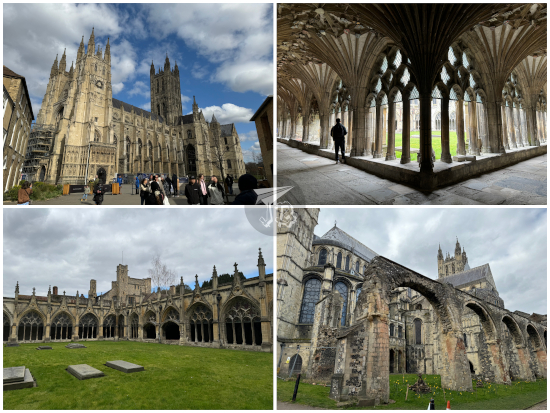
Canterbury cathedral - exterior

Canterbury cathedral - interior

I saw the place of the murder, called the martyrdom, on the way to the main nave, where a concert was being rehearsed. It sounded beautiful, but I could not stay forever, because there were many more things to see in town. Outside the cathedral itself there is a memorial garden and the six-metre sculpture War Horse (named Joey), in honour of all the animals that have died in war.

I had to move on, as it was windy and cold out in the open, and I still had more places to visit. I went on towards the Canterbury Roman Museum. The British are always extremely proud of their Roman ruins, though sometimes these are just a few objects. This time, however, the museum lives up to its hype. Even if the artefacts are not that impressive, it hosts the only in-situ Roman pavement mosaic in the UK. Unfortunately, nobody thought about building an overpass viewing platform…

Roman mosaic on the ground

I then headed back towards the main artery of the historical area, High Street and the local museum, The Beaney House of Art & Knowledge, which also doubles as Tourist Information Centre. I broke the worker’s brain when I asked for advice considering that I’d already seen the cathedral and the Roman Museum. What I actually wanted was an estimate of how long the trail around town would take, and confirmation of opening times. I was not too successful as they gave me some schedules which were not accurate. Anyway, I snooped around the place.

The Beaney House of Art & Knowledge was designed by A.H. Campbell in 1897 in the Tudor Revival style. It is named after James George Beaney, a Canterbury-born medical doctor who left money to the city to create a cultural hub. Today, the house hosts the Tourist Information Centre, an art gallery, an auction gallery, the local library, and a museum with collections about different aspects of the town’s history, including a lot of worldwide items that seemed brought by aristocrat’s Grand Tour.

The Beaney House of Art & Knowledge

I decided to do the walking trail around the town then. Now that I was not bee-lining any more, I could take in the statues, houses and buildings in High Street. The statues include Aphra Behn and Geoffrey Chaucer. Behn was a 17th century writer, one of the first English women to earn her living from her art, and possibly even a spy in the colonies and Antwerp. Along the street, I located my hotel, the Great Stour Canal, the theatre and the restaurant where I wanted to have lunch. I exited the centre through the Westgate Towers again, and ended up in the Westgate Gardens. I had started exploring, but then I got dizzy, and my legs shook a little. I had been on the go for almost 12 hours, on four hours of sleep, so it was time for a break. Thus, I backtracked to the Old Weavers Restaurant. I have to admit that I almost got sidetracked to have an authentic afternoon tea, but I had come across this place during my planning, and I was glad I went.

It is true that British food has a horrible reputation around the world. But honestly, it is not that bad – it’s just not such an important social event as it could be for example in Italy or Greece. Furthermore, there is a theory that most “traditional” recipes diluted away with industrialisation, when people worked too much to bother with cooking – the Industrial Revolution was something so new, nobody really knew how to deal with so many changes. Then, WWII food rationing and post war pre-made foods prevented a whole generation from learning how to cook. And thus, Chicken Tika Masala became the staple of English cuisine. In reality, however, this is not accurate. The British gave us scones, bangers n’ mash, roasts and pies, all of which are delicious.

Pies were what grabbed my attention from the Old Weavers Restaurant menu. The eatery is located next to the canal, in a house which dates from the 1500s, with foundations from the 1200s, and the original interior structure. The building was originally a weaving centre in the 16th century by the Huguenot refugees, which then became a weaving school – hence the name. When the school closed, the restaurant was established. moreover, almost all the “nice” restaurants in the area were offering a 15% discount with theatre tickets too.

The place was warm and a hot meal was a nice break to have. I was seated at a small table on the ground floor and ordered a Chicken, ham & leek pie in a hot skilled with a puff pastry lid, and a side of chips. I like British pies. Conversely, the first recipe of British pie on record was also written by Chaucer in 1381.

Pie and chips

Since I was quite literally outside my hotel, I decided to check in so I could drop my backpack and relieve the weight on my shoulders. I was not carrying much at all, but the hours were getting heavier, I guess. The hotel turned out to be an old refurbished house, with narrow stairs, and my room was on the upper floor. It turned out to be tiny, and weirdly distributed – I had to open the bathroom door in order to take off my coat. But it had a working bathroom, a radiator, and it was warm, so I was all right with it. The price was cheaper than anything I would have found in London and it would save me a lot of stress when I left the theatre. While taking the train back to London was doable, it’s not like I felt like one hour on the train, and then a commute in the Tube in the middle of the night.

I left again, and tried to pick up where I had stopped before lunch – this was my mistake. I should have done my walk clockwise, but I thought I had a bit of time. I had not counted on admission ending up an hour beforehand – but it was all right, and my plan ended at a local supermarket to buy snacks, dinner, and something I wanted to bring back with me. Thus, I went to the Westgate Gardens again, and I took a bit of time with the buildings and the ruins there.
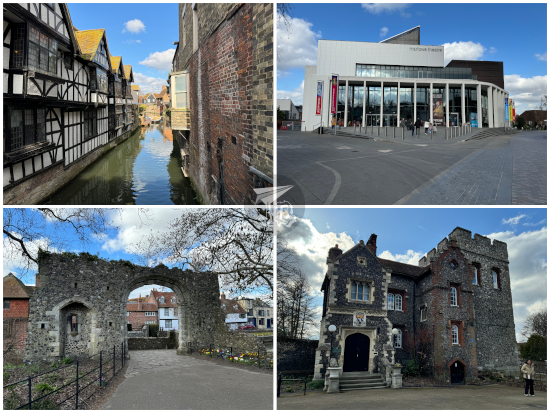
Canterbury - Marlow theatre and Medieval buildings

Canterbury is located on the River Stour, usually known as Great Stour to distinguish it from its tributaries. There are at least three main waterways through town, and even businesses that give boat rides to tourists. The Westgate Gardens are built along the Stour. They host The Guildhall (town hall) and Tower House, a narrow Victorian house built around a bastion of the city walls. I strolled along the riverside, mindful of the mallards and the seagulls who owned the place, until I crossed the Rheims Way Underpass – Canterbury really likes its underpasses, and they’re all right when you get used to them – full of graffiti and contemporary art (graffiti). I eventually veered back towards town, towards an area called Tannery Field and I came across the Canterbury Bull Sculpture, by local artist Steven Portchmouth, an artwork which honours the agricultural and industrial history of the area.

Canterbury Great Stout & Westgate park

I found St. Mildred’s church, an 11th-century stone church with a small graveyard, and totally missed Canterbury Castle for a minute there. I knew it was closed, but it turned out it was completely covered in scaffolding. The castle dates back to 1066, when Canterbury surrendered go William the Conqueror, who proceeded to commission a motte-and-bailey structure, with the motte being what remains today, though underneath the protective scaffolding.

A few minutes away, I got distracted by something which had not been in my plans – Dane John Gardens. Dane John was not a person as I originally thought – the name comes from the corruption of the Norman word for “fortified mound”, donjon, and there is actually a theory that the mound that still stands in the middle of the park is a former defensive motte, though during the Roman times it might have also been a burial mound, on top of which stands the Simmons Memorial – Simmons was the local alderman who built the gardens between 1970 and 1803. The park ends at the reconstructed Roman wall, with rebuilt defensive towers, and it hosts small attractions like fountains, a giant sundial, a Band Stand…

I went along the Canterbury City Walls until I reached ground level again – and then I went underground to cross the wide roads. When I emerged, I finally made my way to St. Augustine’s Abbey. The abbey was originally dedicated to other saints, but it was repurposed after St. Augustine, who had established the cathedral, died. It was a Benedictine monastery from the year 598 on, until the English Reformation forced its dissolution in 1538. Afterwards, it became a royal residence, which was then rented out to noble families. Most of it was eventually dismantled to build new houses, until it was bought in 1844 by a religious Member of Parliament who established a missionary college. During the 20th century, the abbey ruins and the college were separated for classrooms and boarding houses. The British Government took charge of the ruins in 1940, and the abbey is part of the Unesco Heritage Site.
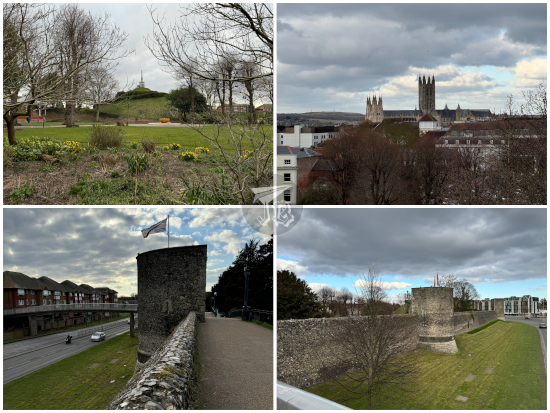
Dane John Gardens and Medieval walls of Canterbury

It was a little past 16:00, and I assume the ticket booth had just closed, though opening times were listed until 17:00 and there were people – a dogs – inside. I first saw the Fyndon Gate, the original gate to the abbey, built in the early 1300s, with two octagonal towers on the side, and a chamber above the entrance arch, which has an overlooking arcade. Though I could not enter the abbey, I was able see to the main ruins through a convenient lookout to the side of the locked-down area.

St Augustine Abbey Canterbury

I saw a signpost regarding the pilgrims’ route that lead me to both Rome and St. Martin’s church. Rome was a little far away to be back on time for the theatre, so I decided to settle for the church, which had been the plan all along anyway, as it was the third key point in the Unesco Heritage Site. The church recognised as the “oldest parish church in use” in the English-speaking world. It was used by Queen Bertha of Kent as her private chapel even before St. Augustine arrived from Rome in 597. Though her husband, Æthelberht of Kent, was originally a Pagan, he allowed her to continue practising her Christian Faith and he himself eventually converted. The building was erected reusing a lot of Roman bricks and tiles, along later stone. It has a small graveyard where many notable families have been laid to rest. The sun was setting, and the wind had calmed down, so it was nice. I did have a moment of slight worry when I glimpsed someone and I heard a bang – I thought maybe they had closed the gate and I would have to jump over the wall. Luckily, it was not.
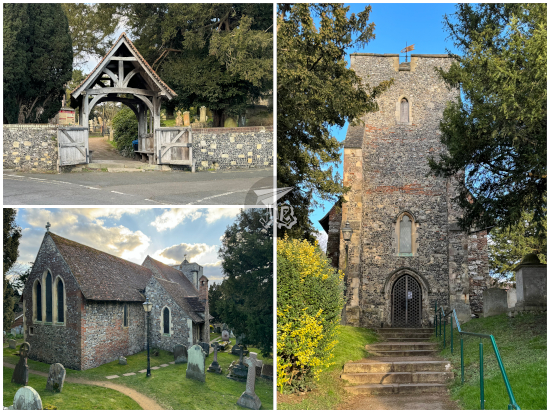
Canterbury St Martin chuch

I headed back towards the centre. In front of the abbey’s Fyndon Gate I found the statues of King Æthelberht and Queen Bertha of Kent. King Æthelberht was eventually considered a saint for his role spreading Christianity among Anglo-Saxons, but his main contributions were more earthly. He created the earliest written Law code in any Germanic Language, and minted the first coins which circulated in Kent.

Still heading downtown, I walked by St. Paul’s church without the Walls, which could’ve been built in Roman times as a cemetery chapel. A bit further along, there was the St. Thomas of Canterbury Roman Catholic Church, the only Catholic church in town, built in the late 1800s in the Gothic Revival Style. Adjacent to the church stands the tower Tower of St. Mary Magdalene, which belonged to Medieval parish that was demolished to build St. Thomas. There is a memorial inside the tower, protected by glass.

Back in the High Street, most shops were closed or closing down, and I did not come across any bookshops, where I would have purchased a copy of Chaucer’s The Canterbury Tales just to have a copy from the town. What I did find was a Sainsbury’s Local supermarket. There, I bought a sandwich for a late supper after the theatre, some Cadbury Eggs, and a can of Bisto Gravy granules. Cadbury Eggs are a confection made of chocolate with a yellow-and-white sugary filling. Gravy is a cooking sauce I can’t recreate to save my life so I enjoy having the ready-to-make at hand, it’s just small granules that you dissolve in boiling water to create the sauce. Neither – I reasoned – should be a problem at the airport.

I went back to the hotel to have an hour or so of rest before I headed out to the theatre. Marlowe Theatre was obviously named after one of the most famous Canterbury locals: Christopher Marlowe, the 16th century playwright, poet, translator, alleged spy and reportedly atheist, whose work is reported to have influenced Shakespeare himself. His plays were extremely successful, and they include The Tragedy of Dido, Queen of Carthage, The Tragedy of Jew of Malta, and the first dramatised version of the Faust legend, The Tragical History of the Life and Death of Doctor Faustus. The Marlowe Memorial, depicting The Muse of Poetry (either Calliope or Erato, one guesses).

There have been at least three “Marlowe Theatres” in Canterbury. The current one was rebuilt from a previous one between 2009 and 2011, as a stainless steel and aluminium building with a colonnade, and at night it glows electric blue, pink and purple. It is not a pretty building on the outside, but the inside is all right. It seats 1,200 spectators, it has a bar and a tiny merchandise stall.

Canterbury cathedral and Marlowe Theatre at night

Before I went into the theatre, where I bought the programme, I headed towards the cathedral to take a few pictures the building at night. On the way back, I must have taken a wrong turn somewhere, because I was disoriented for a minute before I found the bluish glow of the theatre. Back in December, when I booked the tickets, I also got “ticket protection” (insurance, basically), but I was ecstatic that I did not need a refund. I had managed to get there, and I could finally enter the theatre. I did not feel even a bit tired, even if I had been on the go for over 16 hours.

The Shark is Broken is a ninety-five-minute play written by Ian Shaw and Joseph Nixon, based on actor’s Robert Shaw’s diary of filming the 1975 film Jaws, directed by a young Steven Spielberg in 1975. It follows three very different men who try to hunt down (fish down?) a great white shark which has found the perfect feeding ground off Amity Island, a small beach community in Long Island. Jaws is often credited as the first summertime blockbuster, and it went on to win three Academy Awards – Best Original Score for John William’s music, Best Film Editing and Best Sound.

Canterbury Marlowe Theatre - The Shark is Broken

It is a commonplace piece of trivia that working on Jaws was a nightmare for everyone involved, as the mechanical sharks used for filming kept breaking down, which caused delays and going over budget again and again and again. Main actors Roy Scheider (Chief Brody), Robert Shaw (Quint) and Richard Dreyfuss (Hooper) were stuck on the little ship set for days on end while the film crew worked on “Bruce”, the shark. On top of authoring the script, Shaw plays his father. Dan Fredenburgh plays Roy Scheider, and Ashley Margolis plays Richard Dreyfuss. The stage play was originally directed by Guy Masterson in its Broadway run, and Martha Geelan is acting touring director.

The play is a number of connected, sequential scenes depicting different conversations over several days, showing the rising tensions amongst the actors. There are plenty of rather uncensored references to Robert Shaw’s rampant alcoholism, which his son, Ian Shaw, has not tried to hide or dilute. The set is just the ship, and only the three actors are on stage, you only ‘hear’ about the shark off-scene.

Was it a comedy? No. Was it funny at points? Extremely. Did I enjoy it? Immensely. I’ve read reviews saying that it is not worth it unless you are a huge Jaws, which I am. It includes known trivia, obscure facts and several hilarious meta references, including “It’s a thriller, do you think people will be talking about it in 50 years?”, which delivered on the 50th anniversary of the film is hilarious. Another one, referring to how Spielberg bailed on the last day of filming fearing the crowd would dunk him in revenge for all the inconveniences, and his upcoming career, is “Sharks? Aliens? What’s next, dinosaurs?” The scenes were chronological towards the end of filming, until the last one. Another known piece of trivia is that Robert Shaw was extremely drunk trying to do one of his scenes, the so-called “Indianapolis Speech” – and he screwed it up every time until he sobered up and delivered it in one go. The speech is referred to a few times throughout the play, and the very last scene is its re-enactment. It was glorious.

The Marlow Theatre was just a minute away from my hotel, and I could use the back door to get back in. I climbed up to the room and took a shower to warm up. Unfortunately, the bathroom had one of those fixed nozzles and the shower screen was… way too short for it. I might have caused a teeny-tiny flooding – good thing that I had extra towels to contain it. Afterwards, I had my sandwich, and a Cadbury Egg, even if it should have been too late for chocolate. Predator was running on TV, so I watched that while I charged the phone. Finally, I set my alarm and went to sleep, thinking that maybe being able to be on the go for twenty-something hours straight is my superpower.

My train back to London was at 7:24 – I had to miss my breakfast at the hotel, which started at 7:30, but that’s life. Fortunately, there was a kettle with some instant coffee and creamers in the room, along with biscuits. I woke up around 6:15, got ready, and hurried to Canterbury West station not because I was late, but because it was extremely cold. The train was on time and I was back in London St Pancras International just before 8:20. The train ride was uneventful, and once there I crossed over to Kings’ Cross Station to get breakfast from Costa Coffee. Since I was there, I peered over at Harry Potter’s Platform 9⅓, and I discovered that they actually take out the cart when the “attraction” is closed. I knew they charged for pictures, but I did not know that the cart was detachable. Which… I guess makes sense… considering that people would take free pictures with it if it was there. I just thought there would be a screen or something…

Anyway, not my thing. I headed out to explore St Pancras International Station. The original station was constructed in the Gothic Revival style (or Victorian gothic) in the 19th century, opening in 1868. The exterior was made out of dark red bricks, while the interior displays a complex roof in wrought iron and glass. The overall station layout was commissioned to engineers William Henry Barlow and Rowland Mason Ordish, and the adjacent hotel was designed by architect George Gilbert Scott. It is a magnificent building only slightly defiled by the contemporary expansion tracks. St Pancras was all but abandoned around 1960 until the 1990s, with extensive reconstruction, renovation and restoration in the 2000s. In 2007, it became the “international” station as it became terminus for the Eurostar train which covers the route between London and Paris in 2h 16 mins.
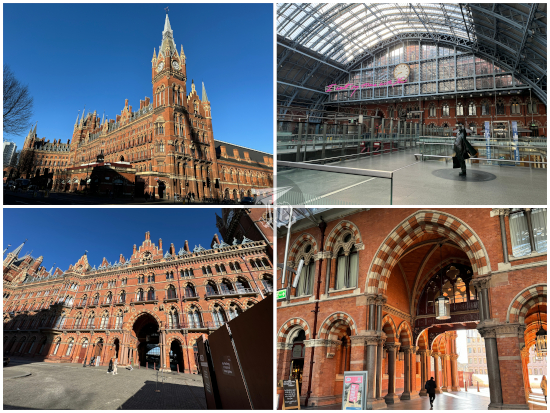
St Pancras international train station

I had to sit down for a few minutes because I made a wrong movement and my back cramped, but it passed soon. I was able to do a little bit of shopping in the station. A lifetime ago, I bought an umbrella in a franchise called Boots, and they had the same style and brand in the shop at the station. Considering that said umbrella served me well between 2012 and 2024, I had decided to buy another one if I ever saw it. I also got a book, because books in the UK are comparatively very cheap.

I found the coach stop, where I had to be at 15 minutes in advance. It was cold and windy, and it felt long. Apparently, the bus before had not come either, so there were a lot of people waiting. However, my ticket and seat were guaranteed. The only problem was, again, that the traffic was horrible due to construction. We took 43 minutes to cover something that should have been done in 10. Despite it all, the coach arrived at London Stansted Airport on time and without issues.

I went straight to security. Stansted is implementing new security protocols, which is great if you don’t get stopped. I got through two times ago, but last time my keyring created a problem – I have since changed that. This time around, the security lady was opening playing-card boxes to check for chemicals (not even kidding) and had to swipe my gravy granules for drugs, or explosives or who-knows-what. When I said “I didn’t even realise that could be a problem” her – rather sheepish – answer was “it isn’t.” Then… why did it get flagged? I’ll never understand airport security.

After 20 minutes waiting at security, I had some sushi at the airport, and bought a Playmobil Royal Guard, because they have always drawn my attention, and I thought that today was the day. Then, it was just waiting. My plane back was at 14:10, landing before 18:00, because I needed to get to a hard week of work on Monday. Part of me wishes I could have stayed until a later flight, but I needed to be reasonable. I did not get emergency exit seats either flight, so there was no issue with the cabin crew. However, when I tried to get my car out of the parking lot, the plate-recognition system would not work, so I had go down all the way back to find a person to talk to – good thing, then, that my plane had not arrived at 23:00.

The truth is, everything would have been more efficient had the Stansted Express been running, but at least I waited to book tickets so I could make the most out of the commuting issues. I did not pay train prices for coach transit, and I did not have to wait much between transportation choices. Furthermore, I could fill the time I had with things to do – and stuff to buy. And the most important thing, I saw The Shark is Broken, along with getting to know a new city.

17th June 2024: Horniman Museum and Gardens {London, England, June 2024}

I woke up early-ish and got ready to leave. I stopped by the local supermarket to grab a coffee and got on my way towards the closest Overground station – this being London, it was not far. This was an easy commute since there were no changes, and I could just relax on the train. I got off on Forest Hill and walked up the… well, the aforementioned hill, until I reached the Horniman Museum and Gardens, in the Borough of Lewisham around 9:00 – passing a Costa Coffee on the way. I filed this information for later reference.
Normally, I would not have gone to a museum which had a Natural History Gallery closed for renovations, but they were running a dinosaur exhibit that created the perfect excuse to go there, even if it was a bit out of the way. Frederick Horniman was the heir to his family’s tea emporium in the 19th century. He started travelling the world around 1860, collecting artefacts from his travels, and developed the museum to exhibit them. The original museum opened in 1890, and the gardens in 1895.
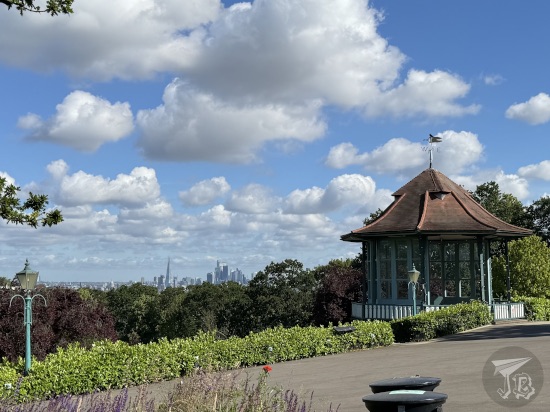
The gardens are almost 6.5 hectares (16 acres), divided in different areas, including a bee garden, a sound garden where you can make music with metal tubes, a grassland garden, a prehistoric garden, a grassland garden… I wandered around a little and was surprised to catch a glimpse of City of London by the 1903 bandstand. I knew the gardens were a bit far out, but I had not realised how much.

Horniman Gardens with the City in the background

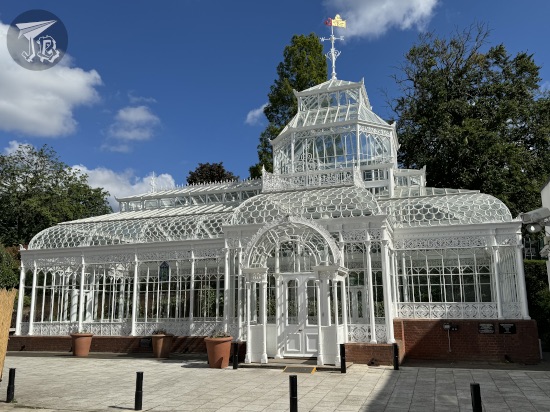
I explored for about an hour, then I headed towards the Victorian Conservatory, built in 1894 in Horniman’s private residence. A century later, it was transported to the gardens and restored by British Heritage. It is a quaint little greenhouse in white iron and glass, with pressed tiles on the floor. Next to it stands a little café that I would have stayed at if I had not wanted to see some of the themed flowerbeds.

The Horniman Conservatory

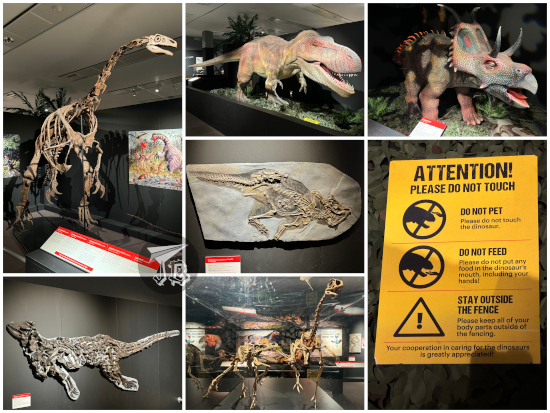
At 10:00, when the museum opened, I entered to see the exhibition Dinosaur rEvolution, which looked at the evolution of Dinosauria into birds. The travelling exhibition has five animatronics, a couple dozen cast fossils, several plushies and beautiful palaeoart. The T-Rex animatronic had some feathers, and the information notice asked the reader if they would find the Jurassic Park tyrannosaur less scary with them. I honestly would find a feathered Rexy even more terrifying. The exhibition was all right, with plenty of information, but there was nothing real, which was a bit of a bummer. But since it is a travelling exhibition, it makes sense they would not be moving around the real thing. However, given the ticket price, I expected something a bit larger.

Dinosaur revolution

After I was done, I decided to check out the rest of the museum. First, I saw the anthropological galleries, which had the most bizarre array of artefacts – from an Egyptian mummy to a Spanish inquisition chair, along Inuit costumes, European masks, African religious items, Indian masks, Easter eggs, prehistoric items from all around the UK… There was a wish tree, where you can write something on a colourful paper and hang it from the branches.

Horniman athropology museum

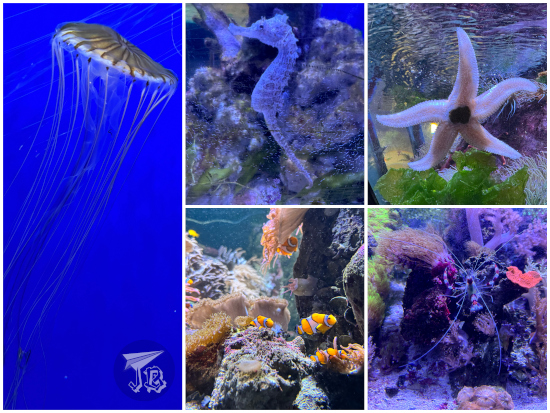
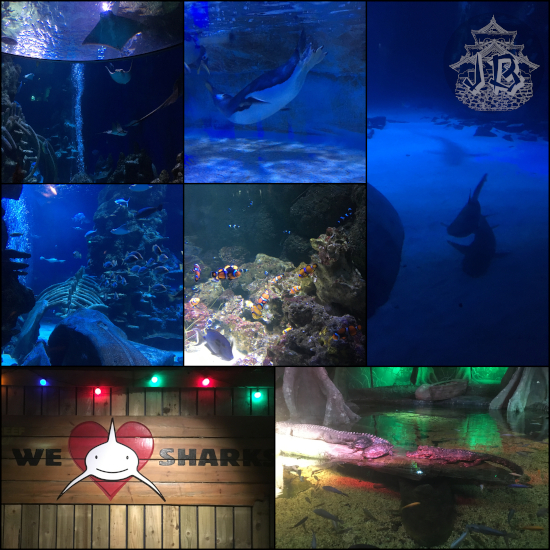
In the basement of the museum there is a small aquarium, which was full of schoolchildren on a day trip. I could have got the tickets online for that. However, I did not know how big the dinosaur exhibition would be, and I did not want to rush over. When I seemed to have the time, I decided to go down to the aquarium. It had a handful of tanks – jellyfish, coral reefs, Amazon rainforests, a lot of clownfish and a handful of poisonous frogs, mostly colourful stuff to grab attention. I managed not to get run over by the kids, which was a good thing.

Horniman Aquarium

After I had seen the aquarium, I considered checking out the Butterfly House, because those are always beautiful. However, since I knew I’d want to go back to the museum and gardens in a couple of years, when the natural history gallery reopens, I decided to head towards the train station. I would see the butterflies another time. That way I could be on my way to the airport with some buffer time without rushing my way through and stressed over connection. Instead, I checked the museum’s tea gallery, which summarised the history of tea and how it ties with colonialism, not pulling any punches towards the Horniman tea emporium itself. Funnily enough, the tea brand still exists in some Mediterranean and South American countries, but not in the UK.

On my way back to the station, I stopped at the Costa Coffee I had seen before for a drink and a snack. Unfortunately, the nice barista forgot to put the vanilla syrup into my vanilla latte – oh, the drama. Since the coffee was hot, I did not really notice until I was already on the Overground, and turning around was not worth it.

I had to change at Whitechapel into Hammersmith & City, but since I had the extra time, I decided to walk a little and go down into the Elizabeth Line, which, believe it or not, I had never used before. The commute time was the same anyway. The platforms felt so new and clean, lacking the grit that other stations have – not that they are dirty, really. They’re just… not that new or aseptic.

Even with the little detour, I reached Liverpool Street with time to take an earlier train than I had originally given myself as ideal – which is a couple of trains earlier than the one I would need to be right on time, but since that time the train just did not reach the airport, I’ve lost some faith in the Stansted Express. I went to the end of the platform, and sat down in the first carriage of the train. I was the only person there, even after the conductor announced that “the first carriage was almost empty, please move forward for comfort so the rear of the train is less crowded.” Happy to be an “almost”, I guess – and good that the carriage did not become anything close to full during the trip.

There were no issues reaching the airport, but security was crazy. I don’t think I’ve ever seen as many queues, and so long ever. When my backpack was flagged for secondary inspection I understood why – the person in front of me was told he was carrying “too many contact lenses”, and my tiny handcuffs key chain was apparently extremely threatening. Then they needed to check aaaall the electronics, and my boots. However, the security guard said that he was sorry and that I should not have been pulled over because of the key chain. I’ve never had a security officer apologise to me for pulling me over for secondary inspection – and honestly, that was the key chain I bought for my first apartment… in 2001? I’ve flown with it before countless of times… Hilarious…

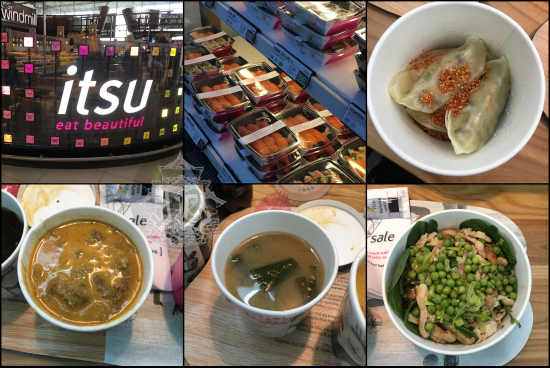
I put on my boots, and headed off to buy some sushi at the Stansted Itsu. Sadly, the quiet area has stopped being so – they have closed the upstairs toilets and now they send everyone downstairs, so it was packed with holidaymakers and people hyping up toddlers, which I find a horrid mistake to make just before jumping on a plane. Thus, I drank my miso soup, ate my sushi, and buggered off to wander the airport – better than the cacophony of kiddos running, squealing and acting up. The airport was full, and while I am usually better at dealing with other travellers, I had been looking forward to the “quiet area”. Either that or I was a bit tired and everyone was rubbing me off the wrong way, I guess.

When it was time to board, queue went extremely slowly. The airline line personnel were being extremely picky with the luggage, measuring every backpack and trolley. Eventually, the slow process made departure late, so the end of the queue was rushed. They barely eyed my backpack, though I was asked to turn around to show it to the check-in agent.

The plane was full and way too many people were not aware of “boarding from the rear door” when their seat number was high, causing a bit of a jam. I found my seat, huddled in, and shut off for a while. I woke up with 40 minutes to land. When we did, we took a bus which conveniently left us right in front of passport control. The only problem on arrival? It was 31 ºC and sunny, and I was wearing clothes chosen for the 13 ºC and rain in London. I guess the order of digits is… important when you’re wearing longs sleeves, layers, and knee-high boots – which by the way I think have seen their last concert trip. RIP. You will be missed, cool concert boots.

1st October 2023: The City and North Greenwich {Miyavi in London 2023}

As I was going to drive myself to the airport, I had a parking reservation at 5:00 for my 7:00 flight – you have to love those wee hours of the morning wake-up calls. I reached the airport around 4:55, just as the shuttle was leaving. I didn’t worry too much because there were people at the bus stop though. I found a nice parking spot under cover, but did not see the number on top, so I tried to memorise where I had parked. The shuttle arrived again around 5:25. Security was not a problem, but then I was sent to the automatic passport control, which did not work, and I had to go through manual control. The plane took off and landed on time, and despite the strike warning, the Stansted Express was only delayed 10 or 15 minutes, so I reached London a little after 9:30 – much earlier than I had expected.

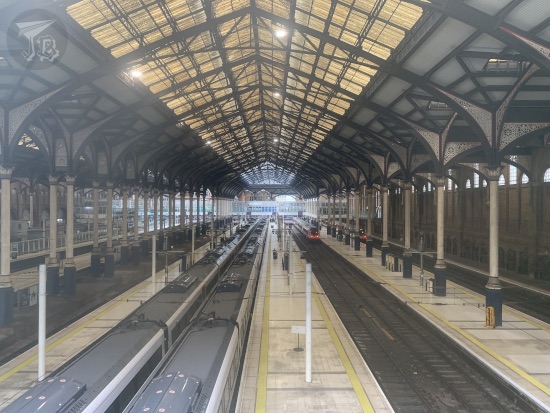
Since I had time – for once – I decided to hang around London Liverpool station, where the Stansted Express terminates. Though I’ve always liked this building, which is actually listed for its historical importance, it is “just” a train station – I somehow have never had the time to explore as I seem to always be in transit. Construction was decided in the early 19th century, and development of the project displaced around 10,000 residents. The station was designed by engineer Edward Wilson, in a Gothic-inspired style in brick and bath stone. He added a trainshed in wrought iron and glass which was restored and expanded in 1894. The Victorian station survived the Blitz, a subsequent renovation in 1975, and it’ll hopefully will make it through the refurbishing proposed in 2022. I went around the station once, and then moved on – they had not cleaned the windows though.

Liverpool street station trainshed ironwork

Well, I went to have a vanilla latte at Costa Coffee, because I love that blasted beverage. I then decided to kill some time around the City of London. I went to Aldgate Square, home to the Church of Saint Botol, a school, and a very fun fountain with lights.

I found The Gherkin and Saint Helen’s Church, which I wanted to visit, but unfortunately they were about to start a service, so in the end I did not go in – I find interrupting religious acts disrespectful, and this was one of those “we welcome you at the door” community services… It would have made it awkward. I realised I had not wandered around The City for a long time (since… 2011), so I checked out some interesting buildings, such as Saint Michael’s Church or The Counting House or the Shanghai Commercial Bank.

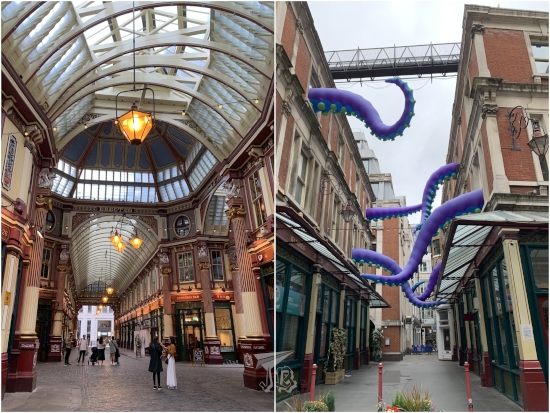
There was a modern-art exhibit going on in the area, but the only work that drew my attention ended up not being even a piece of art. I walked by Leadenhall Market, which was sporting… purple tentacles. It turns out that since 2021 the area has “dressed up” for Hallowe’en! I was not expecting that… Though I have to admit, it’s a fun idea.

Leadenhall market and the purple tentacles

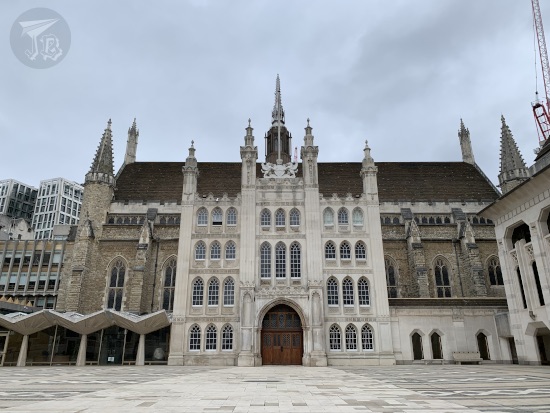
I went towards Bank station, which hosts Mansion House, where the Mayor of London lives, the Royal Bank of Scotland and the Equestrian statue of the Duke of Wellington. I finally reached London’s Guildhall, the old town hall still used for ceremonies and so. It was built between 1410 and 1440, though only part of it remains today. It was damaged in the Great Fire of London, and the façade that can be seen today was added in 1788 in the neo-Gothic style. I did not expect anything to be open, but the Guildhall Art Gallery was. I had less than an hour to my timed ticket somewhere else, so I decided not to go in.

The main façade of the old Guildhall building

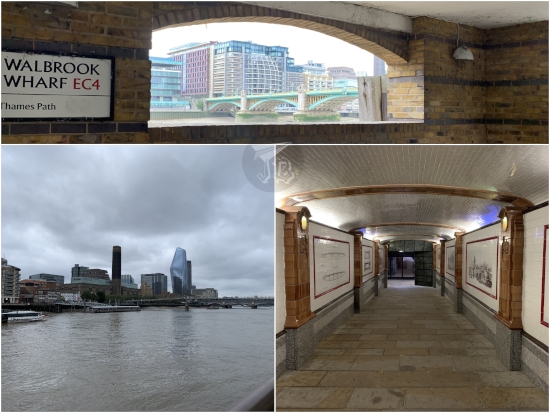
Instead, I walked towards River Thames, passing by Saint Stephen Walbrook church, 1 Queen Victoria building and No 1 Poultry. I reached Walbrook Wharf and the Thames Path / Riverside Walk, including Fruiterers Passage and Millennium Bridge.

Thames Walk in London

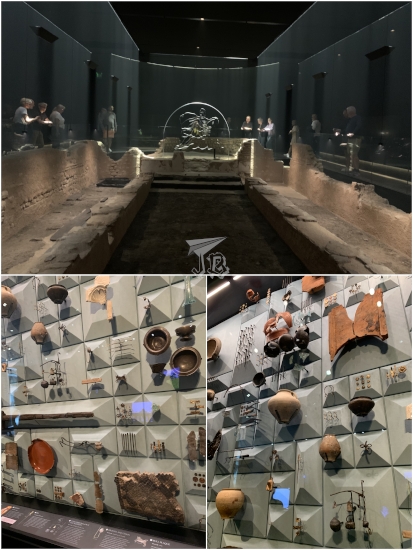
At noon, I had a ticket to London Mithraeum Bloomberg Space. The Roman ruins of a Mithraic temple were found in London. The cult of Mithras flourished throughout the Roman Empire between the 1st and 4th centuries CE. It “recycled” the the Persian god of the sun and justice into the patron of loyalty to the emperor. Mithras is usually representing slaying a bull (tauroctony), though archaeologists are not really sure why. The London temple was discovered in 1952 in a construction area, transported off-site, then brought back to its original position in 2010. Today, it lies in an underground ward in the European HQ of the Bloomerg company. When I connected to the Wi-Fi to read up on the items on display, I received an email that my car had not been detected at the parking lot – and for a second I worried that I had parked in the wrong place, but I knew I had not.

The visit consists on a glass case display with several objects from the Roman era, including sandals, jewels, glassware, even a cabinet. Then there is an audiovisual show that does not make much sense since everybody is walking around wondering what is going on. Finally, you are admitted into the temple, which yields to an “immersive experience”, with a projection of lights and shadows and a few chants in Latin. When the lights go out, you finally get to see the temple. The remains are barely a few foundational stones and a little of the altar. Apparently the actual Mithras sculpture was also dug up, but it is in the Museum of London, closed until 2026. To be honest, it was a bit underwhelming, but after all, I’ve recently done an Italy trip, so I might be hard to impress in that sense at the moment.

London Mithraeum temple and artefacts

I headed to the hotel, but I decided to make a stop at Leicester Square to find two of the Scenes in the Park I had missed last time. I might have also dropped by The LEGO Store Leicester Square because I discovered that there is a Lego Stamp Rally. Of course, I needed to get myself a Lego passport to try and get some stamps. I thought about buying a mug from the M&M’s store, but I decided that I did not want to be carrying it around, and I would get it on my last day if I had the time.

Batman and Laurel & Hardy from LEicester Square Scenes in The park, and a Lego passport

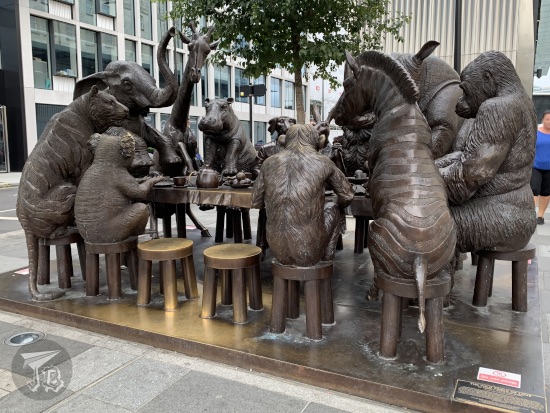
I took the underground to Paddington Station and I stumbled onto the bronze sculpture Wild Table of Love by public art creators Gillie and Marc. Their characters, Rabbitwoman and Dogman, have invited several endangered animals to their table – giraffe, elephant, tiger, koala, chimpanzee, zebra, gorilla, rhino and lion – and there are two free spaces for onlookers to sit and become part of the banquet.

The Wild Table of Love sculpture

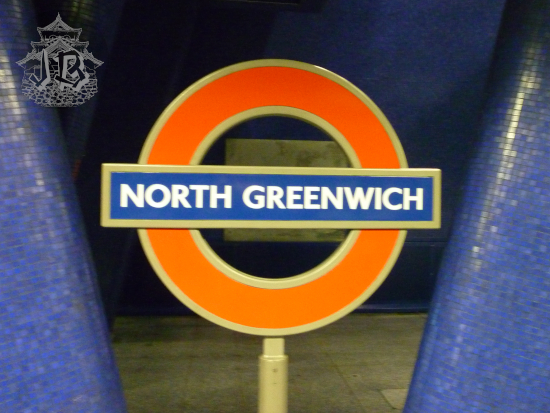
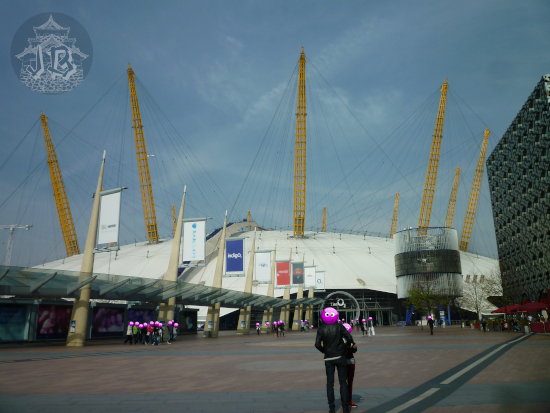
I went to my hotel and took a short break before I set off to catch the Jubilee line towards the Greenwich Peninsula in south-east London. I had been there to attend a L’Arc~en~Ciel concert in the O2 Arena a lifetime ago, and I was surprised how much the area had developed. This time over, I was not going to an event but to the building itself, the Millennium Dome, one of the largest structures of its kind in the world. The exterior of the Dome is a huge tent-like construction that pays tribute to the concept of “time” in its design – 365 metres in diameter (for the year’s days), 52 metres high at its highest point (the weeks) and twelve support towers (the months). It was originally built as an exhibition centre to host a number of shows and activities throughout the year 2000. Eventually, the inner structure was built. Today it has the arena and a smaller concert venue for events and concerts, there is a shopping centre and it offers dozens of activities…

One of the experiences that can be carried out is Up at the O2, which takes you on the marquee to the top of the dome and then back again. You are not allowed any bag or rucksack of any kind, and you can only “carry your phone in a jacket zipped jacket pocket”. I cheated and took my wallet in the other pocket. They have shoes to let, vests and jackets if you are not dressed appropriately. You have to sign a waiver and provide an emergency contact

As instructed, I was there fifteen minutes before my scheduled time, 17:30. I was offered a spot at the 17:15 climb and I shrugged into it. I was okay with that. First, you watch a “preparation” video that is more of a self-promo. Then, you are given a climbing harness and a tether, and told to never ever ever get your phone out during the climb – probably to avoid having to pick any little device up from the tent structure, or risking getting sued if they decline to do so. The harness is easier to put on than I thought, and it holds your upper legs and your torso. The first few metres are ascended on a plain outside staircase and the rest on a PVC catwalk that has a railing for you to get tethered to. The guide pranced up and down providing mostly funny commentary, but you could only hear him if you were close.

The steepest point at the catwalk has a thirty-degree inclination, but it did not feel extremely demanding. From the upper platform there are some cool views, especially of Greenwich and Canary Wharf, along with the Thames. The views were cool, and something very different from what you get from places in the city like the Sky Garden. I think I was expecting a bit of a further thrill / exertion though, so even if it was fun, I did not get as much from the experience as I thought.

Up the O2 experience

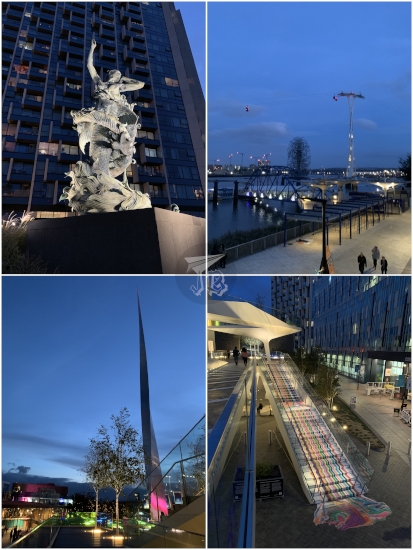
Some staff members take pictures of you that you can buy at the end. You ascend on the front area of the O2 and descend on the rear, so you need to walk all around the inner area to exit – and boy was it crowded with concertgoers (Muse) and dinners. After I walked out, I turned to the side of the O2 Arena where an area called The Tide has been developed. This is a public walkway, sort of an elevated platform with endemic plants sprinkled with public art installation, including The Mermaid by Damien Hirst, or the psychedelic stairs named Poured Staircase by Ian Davenport.

The Tide Greenwhich, showing the Mermaid, the Thames, the Spire and the Melting Staircase

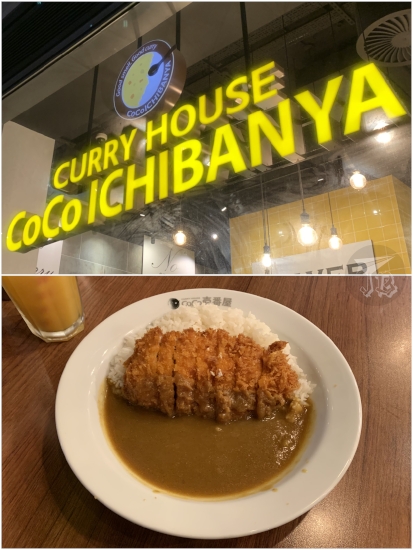
I went back to the underground. I wanted to go to back to Chinatown to try the British version of Curry House CoCo Ichibanya, one of my favourite Japanese chains. Whenever I’ve walked by it around food time, there was a big line. However, when checking online if you can book a table, I discovered that there was another location in Bond Street, which I thought might be less busy. I am not sure it was, or I was lucky with timing, but I did find a spot in that shop within minutes. I was happy to enjoy a hand made chicken katsu curry (手仕込チキンカツカレー), the equivalent to my usual choice in Japan, and be on my way.

London Curry House CoCoICHIBANYA chicken katsu curry

While the hotel bathroom was tiny, it was more than enough for a shower and a change of clothes. Also, despite being so close to the station that one could feel the trains pass by, I slept pretty well until around 7:00.

9th – 11th October 2019: Flash Barcelona (Spain) for Miyavi (and friends)

This was another of those flash trips, and it worked miraculously somehow. Miyavi’s concert was on the 11th, which was a Thursday. It’s not normally something I can do, but I managed to get away from Wednesday at noon to Friday at noon. So I worked on Wednesday morning, and in the late evening I took a train to Barcelona, where I met my friend C***** and we headed out to the hotel, which… turned out to be pretty bad. It was the closest we found in the general area of the venue for a different price but I draw the line at cockroaches, no matter how small they are. The bed was too soft, it was too hot and in the end we were both up at 6:00 to the point that we decided that we could get to the queue already.

Our tickets were VIP so they included a Meet & greet and a picture before the concert, which is one of the most fun I’ve attended lately. However, the road leading to it, and the organisation, was a bit of a chaos – there was a late-announcement of an opening act, the M&G time was changed and nobody really know what time it really was… It added a lot of unnecessary stress, as bad planning usually does. But in the end, Miyavi is an amazing human being and made up for it all. He greeted us when he came in, and when he left, and he gave his best on stage.

Miyavi kneeling on the floor playing guitar. He is wearing white trousers and a sleeveless black t shirt that reads No sleep till Tokyo

The concert was held in Barcelona’s Sala Salamandra as part of Miyavi’s European Tour No Sleep Till Tokyo. Miyavi, whose real name is Ishihara Takamasa [石原 崇雅], was born in 1981, and has been active in the Japanese musical scene since 1999. He started off as the guitarist of the visual rock band Dué le quartz, and went on a solo career after its disbandment. His first album Gagaku was released in October 2002.

Miyavi is known to fans as “the Samurai guitarist”. He has a very particular guitar-playing style, and does not often use picks – he calls this style “finger slapping”. He used to have a very characteristic style, with crazy visuals, piercings, and wildly-coloured hair, but he it tuned after he and his wife Melody had their first child in 2009.

Miyavi can compose, write lyrics, arrange, sing, and rap. However, he considers himself a (samurai) guitarist, and he has collaborated with some top-notch artists and vocalists. Back in 2007 he was part of the “ghost” supergroup S.K.I.N., along with Yoshiki, Gackt and Sugizo. Although the band had an official “debut”, they never got any further than a presentation concert at an American convention. Miyavi has also collaborated with a wide range of artists such as Hyde, Seann Bowe or Samuel L. Jackson on his most recent albums. As of recent years, he has started acting, both in American films (Angelina Jolie’s Unbroken or Maleficent: Mistress of Evil) and Japanese productions (Bleach or Gangoose). He moved to the US with his family in 2014. Aside from his musical work, Miyavi is also known for being a Goodwill ambassador with the United Nations, working against the Refugee Crisis. He regularly participates in events and visits refugee camps to try and help in whatever way he can – usually with his guitar and some footballs.

After three collaboration albums, Miyavi switched from his own company to a larger distributor and announced the release of No Sleep Till Tokyo in July 2019. Soon after, dates were set for a Japan Tour, North-American Tour, Eastern Europe Tour and Europe Tour..

Tickets went on sale on the 28th of June through the venue’s website. There were two types – General admission and VIP, which included early entry, laminated lanyard, Meet & Greet and picture with Miyavi, using your own phone. Though C***** and I were considering either Barcelona or London, we ended up with VIP tickets for Barcelona.

The week before the concert, the Spanish promoter announced a change of schedule and a Spanish support band. In the days leading to the concert, the Meet & Greet also changed times, along with entry and concert start. VIP ticket holders were worried that GA would come in before the pictures were done and they would lose part of the advantage they had paid for, and thus the Meet & Greet was set to after the concert, only to be rescheduled to before the concert again barely 24 hours before.

The day of the concert, the black tour bus arrived around 12:30, and Miyavi came out a little over an hour later. He was nice enough to come greet the fans who were waiting, and asked how to say “hello” in Spanish. He talked to some people for a little longer and shook hands with everyone waiting before walking into the venue.

Doors opened at 18:40. The Meet & Greet consisted on basically that, you could exchange a few words with him and the manager would take the pictures. Afterwards, we got positioned at the barrier for the concert. The support act Suzy & Los Quattro did not fit much into the mood. The lead singer was all right but she screamed too much for my taste. I am sure that she has her audience, especially considering how much underwear she showed. Finally the main event started – Miyavi brought a DJ and a drummer along, but he took all the weight of the music himself. Clad in a two-piece white suit, flashing his tattoos and sweating like there was no tomorrow, he did not stop for a second – good thing he had plenty of ice water to cool down.

As much as his guitar-playing style, Miyavi has a very powerful stage presence, based on being everywhere at the same time – he jumps and stands and stares and plays the guitar, without a stop, without a breather except for his ice-water.

Throughout the concert, he showed off some Spanish – very well practised, to be honest, but mostly spoke English. Through different emcees he talked about coming back to Spain after eight years, and how he knew the word “eight” is “ococho” because it’s his favourite tequila. He mentioned Maleficent: Mistress of Evil, and brought up that he has been shooting films, and how he finally got to play a non villain character – although killing people in films is so much fun. He also talked about his work at the United Nations, and that there were UN representatives and refugees in the venue.

Setlist:

1. Stars
2. Flashback
3. In Crowd
4. Rain Dance
5. No Sleep Till Tokyo
6. Tears on Fire
7. Other side
8. Secrets
9. Guard you
10. Wonderful World
11. Under the same sky
12. Ha!
13. Fire Bird
14. Day 1
Encore:
15. Fragile
16. Señor, Señora, Señorita
17. Long Nights
18. The others
19. What’s my name?

The concert lasted about two hours, in one long act and a short encore. The setlist was a combination of songs from the new album No Sleep Till Tokyo and older albums and singles, . There were very high-energy moments and some heart-wrenching ones. Tears on Fire and Long Nights are excellent pieces of music, but they have a poignant underscore.

Some of the highlights of the night included the rendition of No Sleep Till Tokyo or Under the Same Sky. There was a hilarious moment when some of the crowd asked for Señor, Señora, Señorita and he claimed to have forgotten – then proceeded to google it in order to “sing it if we helped”. Furthermore, The Others was fantastic – but that is one of my favourite songs of his, so I don’t think I’m objective. The final What’s my name with the quip “me llamo Miyavi” in Spanish couldn’t have been more powerful.

After the concert was over, Miyavi came back to stage to high five fans to the very last minute before the venue emptied. Even after a couple of hours, he shook hands with every fan who was waiting on the way to the bus. We waved him goodbye and left, exhausted and happy. My general feeling after this event is that Miyavi is adorable (and huge, I had not realised how much when I saw him in London) and I would love a hug from him. The M&G was over super quickly but he had a smile for everyone and that’s a super nice detail.

We went back to the hotel to catch some sleep and the next morning we met our other friend E****, who had not attended the concert, for breakfast. I took the early afternoon train and I was home for the afternoon-evening shift, so it worked.

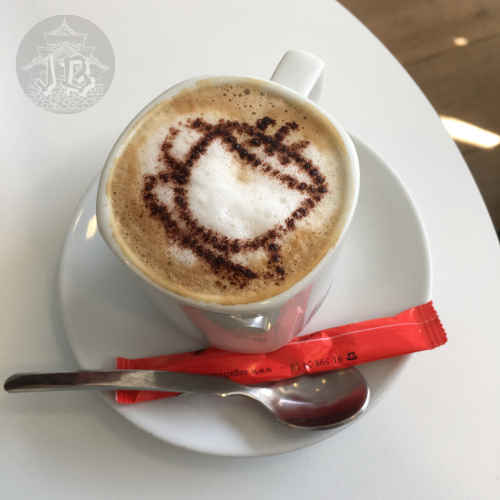
Cup of coffee with fern art.

22nd – 26th August 2019: Food at San Juan and Alicante

This was a quick three-day trip for my father to have some diving time, and even if I had just landed from Japan I tagged along to make sure that my mother was not alone. I was understandable a little beaten from the big exiting trip, so there was not much that I was up to visiting. However, somehow we had a bit of a gastronomy splurge at the hotel and around.

For example, one day we had some awesome arroz caldoso con bogavante , Spanish rice with lobster for lunch:

For another lunch, I discovered that I could actually eat poke bowls in Spain – behold the Poke bowl de atún rojo de Almadraba , almadraba-caught tuna poke bowl. An almadraba is an ancient Mediterranean fishing technique in which nets are suspended mid-water that lead the fish to a central trap from where they are caught – as a curiosity, let me tell you that somehow orcas in the Strait of Gibraltar have learnt to use the almadraba to fish too! Anyway, the poke bowl had a rice base with avocado, spring onion, red onion, wakame, poached egg, and tuna marinated with sesame oil and soy sauce.

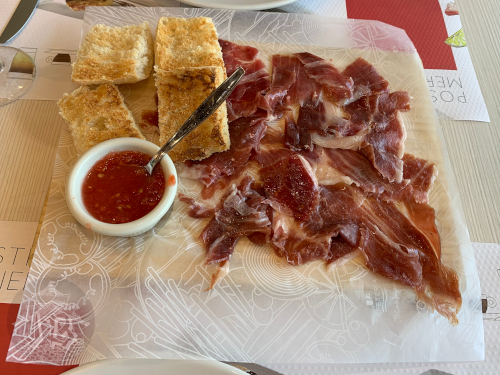
We shared some Spanish ham with that.

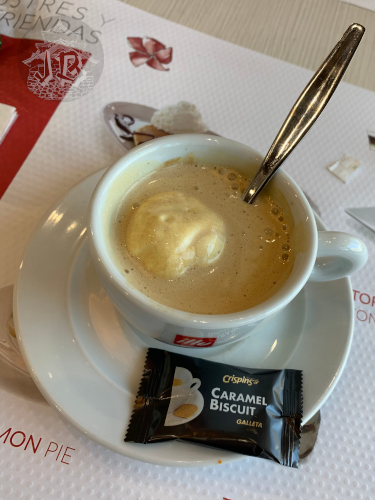
And finished the meal with a latte with vanilla ice-cream and a caramel biscuit because… yes, I needed something to prevent me going into a food coma.

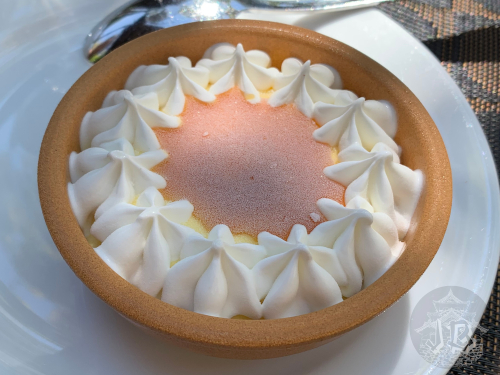
We had granizados mid-afternoon – behold my lemon almost shaved-ice.

And one of my desserts was whiskey-cake ice-cream.

Not that much of an exciting trip, but there were some nice things to take from it.

18th & 19th May 2019: Madrid (Spain) for Jupiter (and fesFE[M]!)

The weekend started extremely early on Saturday, when I took the first bus out to Madrid, and I think I was there around 7:30 to meet my friend C*****. She had been having a rough time and she had asked me to “keep her head off things”. Up until a couple of days before, we did not even know whether she would be able to come to the concert, so I had a whole plan up my sleeve. Unfortunately, a couple of steps backfired slightly. The main event – which we had been planned since the previous December – was Jupiter’s concert for the ZEUS Europe Tour on Sunday the 19th, but we made a whole weekend out of it. I was not actively following Jupiter at the time of the announcement, but C***** and I decided to attend because Madrid is easy and convenient, well-communicated and an opportunity to spend a weekend decompressing somewhere. As the time drew near and we could access more material, the excitement built up – I also managed to find the album they were promoting and it sounded really well, actually.

Her bus arrived earlier on Saturday than mine, and when we met, we decided to have breakfast at the coach station, to catch up and to give shops and so on the time to open up. When it was a reasonable time, we took the underground to drop our luggage at the hotel – the lovely EXE Moncloa. I had selected it because it was near the concert venue, and I hoped that we could hang out the terrace and the swimming pool, which unfortunately did not open until June. After getting rid of the luggage, we rode the underground towards the neighbourhood of Chueca, where I had looked up a bunch of Goth apparel shop which were right up her alley and… did not open at 10:00 as the internet said, but at 12:00.

Fortunately, other shops were already open and we were able to pass the time amicably. We were actually close to the Telefonica building, so I suggested we headed up there for the TeamLab exhibit, which I had already seen, and I thought she might like the digital art.

Teamlab logo and digital art: Waves, butterflies in red and green, and a dripping circle as if it were painted with a brush. All of them are light or bright colours on black.

Afterwards, we moved onto Callao Gourmet Experience for a snack. I wanted to introduce C***** to the Niji Mochi shop, and we also shared a chocolate ice-cream shake.

Mochi and coffee with whipped cream

Afterwards, we were shopping for a little longer before we moved on to have lunch. I had a surprise for her. While I care little to nothing about Korean food, she is a fan of everything Korean. Thus, we hit one of the best Korean restaurants in Madrid, called Seoul. I gave her free reign to order for both of us and we shared, though being honest, the only thing I enjoyed was the green tea at the end.

Lunch: fried dumplings, roasted meat, rice with vegetables, and green tea.

After lunch, we went on and found an underground station. We rode towards the Museo Arqueológico Nacional, National Archaeological Museum, although we had not realised that it was museum day so instead of a quiet exhibition I was used to, we had to deal with a ton of families! On the bright side, it was free, though. The museum, which shares a building with the national library Biblioteca Nacional, was founded in 1867, at a time when creating national museums had become popular among European governments. It was the start of the development of archaeology in Spain. I remembered it from the time I was a kid, dark and with wooden floors, but it was recently renovated with wide spaces and modern interiors.

Exhibits at the archaeological museum: bones from a mastodon, boar statue, lady statue, Neanderthal skull, Roman mosaic of an octopus, Horus statue, Iberian stelae, primitive animal that looks like a boar or a bull carved out of stone, Grecian vase

C***** was tired from spending all night in the bus, so we left the museum and headed back to the hotel to finish our check in process and then catch a break. On the way, we stopped and bought a few snacks for the following day because you always have to be ready for a post-concert low.

We had to look for a place to have dinner, and I found a few interesting places. There were not one, but three Japanese restaurants in the area where we were staying. One of them required queueing and sounded quite self-important, so we were left with two options. We decided to try one in the evening and the next for lunch the following day. Thus, I booked a table at the nearby Naniwa. We had some decent sushi, chicken, and takoyaki… then ordered takoyaki seconds because we had a discount (and I was hungry because I barely picked on lunch).

Dinner: sushi, fried chicken, octopus balls, chicken skewers

The next morning, we headed to the venue Sala Copérnico door around 9:00 and upon seeing nobody queueing yet, we went to have breakfast at a nearby café. Then, we walked around the Moncloa park area, mostly chatting, until we went back to the venue – no queue. And later went back to the venue – no queue. And afterwards, we went back to the venue again, just to find there were still no people in the queue.

Coffee and bread breakfast

In the end we ran into the supporting bands went to have lunch to the second Japanese restaurant in the block, Morikaen. It was around 13:30 as we were heading there, and I said something along the lines of “I feel sorry that they’ll arrive and there’s nobody here to greet them”, and as we turned the corner we almost literally ran into the whole crew coming out of the bus. Talk about timing. They looked tired so we just walked by, but we were rather sure that we had been noticed. On our way to the restaurant, we walked past a family all clad in “Sunday church clothes”, and their small girl wearing aaaall white just stared at us – in rock-goth black clothing – with pure envy in her eyes. Here’s to you, little one. You’ll get there too.

Lunch was all right – tuna tataki, tonkatsu, takoyaki. A bit more expensive than the previous day’s dinner, but we also ordered higher-class ingredients and more complicated dishes.

Lunch. Tuna tataki, rice and chicken, breaded pork, octopus dumplings

Jupiter is a Japanese band who define themselves as “melodic metal band”. It could be said that it is a visual kei symphonic power metal, which means they combine a very particular image (or a bunch of images, the most iconic being Hizaki’s Baroque-inspired dresses) with a subgenre of metal that combines hard drumming, metal guitars, and elements of classical music. On the 22th November 2018, Jupiter announced their new album, a Japanese Tour, and a European Tour, ZEUS Europe Tour. Bassist Rucy left between the announcement and the album release due to creative differences, and I really thought they would cancel the tours, but luckily everything went ahead. The remaining members – guitars Hizaki and Teru, current vocal Kuze, and drummer Daisuke were joined by support bassist Shoyo.

Schedule for the tour

There were two promoters involved for this concert. The local promoter, which in Spain was Madness Live, sold general admission tickets – they have a clean and neat webpage and buying from them is easy; I got ours on the 12th of December. The other, Editions Hikari, was in charge of coordination of the European tour, general information, and ticket upgrades. I think they are one of the worst organisers I have ever come across.

Hikari announced those upgrades in January. There would be VIP experiences, on sale on the 14th of February. Besides that there would be two kinds of upgrades, there was no real information about them until a few days before the sale. The best tickets were called “Venus Premium” (40€ face value + 5€ reservation costs) included autographs + handshake + backstage access before or after the show or soundcheck access (if possible) + photo with 1 member taken by a professional photographer (sent by e-mail later after the tour) + priority access to the merchandise, and there were five per show. The “Venus” upgrade (25€ VIP + 3€ reservation costs) comprised autographs + handshake + priority to the merchandise, there were 20 available per show. Getting the tickets was chaotic, but in the end, C***** managed to buy the two Venus Premium tickets we wanted – luckily. A lot of people did not even find out about the option to upgrade. In the end, the backstage pass / soundcheck was not available for any concert in the tour, and the priority access to the merchandise was impossible in Madrid due to the two independent promoters. Either of the VIP upgrades granted the option to buy an “Instax” (Polarid) photograph with the whole band at extra cost.

Hikari’s Facebook instructions were that Venus and Venus Premium ticket holders had to go to the merch booth – to which they supposedly had priority access – at the beginning of the concert. However, as the access to the actual venue was controlled by the local promoter ticket, there was no way they would access the merch booth with any kind of priority unless the managed to somehow skip the queue. Any kind of communication with Hikari was impossible as “they could not check emails, Facebook messaging, nor reply to comments.” However, they still made posts, and that is how we found that the CDs which Jupiter brought to sell at the merchandise booth were confiscated by customs’ officers before the first concert!

On the 10th of May, we received an email form the local promoter, Madness Live, informing us that the door timing had been changed and they were nice enough to send us the following schedule: Doors at 19:00, VII ARC (German support band) at 19:15; fesFE[M] (Japanese support group) at 20:20; Jupiter at 21:30. There was no information on the upgrades, because they had no clue about those, as Hikari was in charge. The day of the concert thus arrived and we had no actual about that, except for rumours and comments of what had happened in previous concerts. That was why, even if there was no queue, we had decided to stick around Sala Copérnico instead of heading into the city centre.

Eventually, after lunch, I decided that I was too tired to keep going up and down the streets, so around 16:00 we settled at the venue doors until they opened so we could get into the chaos that was the concert. At 16:30, other people arrived, so we got talking – that was how we found out that many people had never even heard about the upgrades. Doors opened around 19:00 – without any kind of priority access to the merchandise, nor separating VIPs and GA. C***** and I decided to divide and conquer – she went to secure a spot on the first row, while myself checked in at the merch booth to get the Instax tickets with the whole band.

That is when I saw the lousy, half sheet of paper taped there saying “Venus and Venus Premium ticket holders, gather at the merchandise booth at 20:00”. That placed the “Venus experience” in the middle of the support act, which meant either having very good friends who saved you the first row spot, or sacrificing it. We decided to give the place up and find somewhere more convenient so we could move about. Without holding spots for the VIPs, this was totally unacceptable in my opinion, especially since there had been no early entry, or priority merchandise. A bunch of people who did not want to buy anything missed out on what they had paid for.

The first support band was VII ARC. They were okay, a bit of stereotypical German heavy metal. I can see how they might appeal to the general metalhead crowd, but it feels that they were chosen because “they dress up sometimes”, and Hikari thought they would fit. It is formed by Kay (vocals), Fū (lead guitar), Bena (guitar, screaming), Grazel (Bass) and Z’ev (drums), and they could probably fit a bit on the “visual” style, but they did not bring any distinctive gear.

VII Arc playing in Madrid

At 20:00, as fesFE[M] prepared to take the stage, the Venus Premium and Venus ticket holders gathered around the merch booth and we were ushered past a barrier, towards the bar. There, we had to wait for about 10 minutes while the second support act started. A Japanese staff lady with little to no English came to “check” the Premium tickets and “sort of explain” to us the whole thing. First the Venus Premium would be shown backstage one by one for the one-on-one photograph – there were four of us, we never knew if the fifth was never sold, they did not come, or they missed the whole experience. Afterwards, we would come out again and joined the regular Venus for the autographs and handshake, then the Polaroid would be taken for the ones who had bought it. We were ushered past a curtain and the backstage door towards the mess room where the remains of the lunch buffet were.

As I entered, I caught sight of Shoyo, the support bassist, who was sitting down on a low mattress in a room to the left, looking bored. I greeted him in Japanese, and he greeted back. C***** turned to see whom I was talking to and her eyes were wide. I asked Shoyo if he felt lonely, he said a little. Another attendee who also spoke Japanese asked for a picture (beating me to it, actually) but he said he was not allowed.

The conversation died out when it was time to go into the private band area for my picture with one of the members. As I walked in, there was Kuze to my left, Daisuke to my right and Teru and Hizaki in front of me, Teru dead centre and Hizaki a little to the right. I was asked whom I wanted my picture with and chose Teru, as I had long ago decided that I would if I could. He smiled and posed with me, then he shook my hand. I have got to learn to look into Japanese musician’s eyes when I talk to them.

We said good-bye to Shoyo on the way out, and almost left, but it was now time for autographs, handshakes and Instax. I pulled out the CDs I had brought for C***** and myself, and I got to shake hands with all four of them and receive the band’s autographs. Since the CDs the band brought had been seized, we might have very well been the only ones in the whole country that produced some official material for signing. Then, we took the Instax and the staff would ask with a thumbs up sign “okay?” to check the picture was good, before we left.

CDs signed by Jupiter members

All in all, the band was very friendly and amazing, but the timing and organisation was horrid. We lost out first row – despite having “priority access”, and we missed half of the fesFE[M] concert. As Copérnico has two levels though, we found a nice spot at the stairs that connect both, and I could lean against the handrail to watch the rest of the act.

fesFE[M] is a relatively new visual kei band where all the members take up “doll” personas. Their career in 2017 and released their first mini-album in May 2019, just in time to come over to Europe for Jupiter’s tour. For each album / season, the band dons a doll theme, and they were currently on the “horror genre” dolls. The members and their doll types are: Lion [リオン], vocal, Distress Coppelia doll (from the namesake ballet, dressed as a bloody bride); Aito [アイト], guitar, Apathetic Prince doll; Zeno P [ゼノP], guitar, Bloodthirsty Child Killer doll; Toru [徹], bass, Emotional Princess doll; Rensa [蓮沙], drums, Psycho Butler doll; and Jun, keyboards, Scalded Dollmaster doll (dressed as a nun because… reasons?).

The first time I heard a song by fesFE[M], I was not extremely impressed – the PV was a bit too creepy. However, they are really good in person, even with the bad sound quality and reverberation in the venue – and the fact that we missed about half of their act. They were really engaging. The whole visual part was amazing, and the coordination was great! Their music was much more powerful live. The band played some songs from their mini-album enseMble autoMata: Doll in blueberry jam [Doll in ブルーベリィジャム], Arachne ni haitoku wo [アラクネに背徳を], Psychological stolen heart, and Freiya [フレイヤ].

Fesfem live in Madrid

The Jupiter concert was as expected, very energetic and fun – it actually went beyond expectations. Our spot was really good in he end, a bit raised, without getting pushed, and we actually watched the concert next to fesFe[M]’s bass Toru. Sometimes he smiled and waved at us, and we waved back without fail.

Kuze, Jupiter’s vocalist held his ground better than I thought he would be able to. I was kind of impressed when I listened to the Jupiter single Theory of Evolution and later to the album Zeus: Legends never die. While we were expecting the guitar and metal power, Kuze’s voice range in the recording was rather wild, and I did not think that he would be able to keep it up live, especially on a final concert after touring both Japan and Europe. He proved me wring, and he held all his notes and his vocal range, just like the recording. He had practised his English a lot and learnt the MCs, but he switched to Japanese quite often, and he spoke too fast for me to get! He did a great job even with songs that had been released in the previous vocalist’s time.

Daisuke was pretty much hidden by his own drums from where we were, but we did see him bounce a couple of times. Hizaki was on the other side of the stage from us, and he looked divine in his Baroque dress. I don’t understand how he can even move in those clothes, much less play guitar or crouch, which he did so a few times in order to interact to first-row fans. A couple of times I did fear for his safety as someone grabbed either him or the guitar. Most of the songs that were played were his. It’s fun to imagine what he would be thinking when writing “die, die, die, go fuck yourself”, when he presents as such a beautiful and innocent lady, but it surely was fun to yell.

And finally, Teru had a blast. He kept twirling around as he played, his stud-leather coat swirling around him. He played with a huge smile on his face all the time and he gave off the vibes that he was having a lot of fun. He also interacted with fans a lot.

Jupiter Live in Madrid

Setlist:

  1. Arcadia
  2. Last Moment
  3. Angel’s wings
  4. Drastic Night
  5. Bring me out
  6. Show Must Go On
  7. No cry no more
  8. The spirit within me
  9. Tears Of The Sun
  10. Memories of you
  11. B.L.A.S.T
  12. Blessing of the Future
  13. Zeus: I. Legends Never Die / II. Conversations with God
  14. Symmetry Breaking [Encore 1]
  15. Theory of Evolution [Encore 2]

While the concerts were a lot of fun, the whole event was stressful due to the abysmal organisation. I actually feel a bit ripped off, because they did not deliver a lot of what they had sold in the upgrades. At least C***** and I are lucky enough that we managed to get our pictures, autographs, and saw the concert from a relatively good place. All in all, Jupiter are amazing, they were super nice, and so were the guys from fesFE[M]. The concert was great, and we don’t regret going for a second.

After the event, waved at Toru for what we thought was the last time. When lights went on, we also saw Rensa, who stopped for us when we told him he had done a good job. C***** and I decided to pool our money together to buy the CDs fesFe[M] had brought – and not got seized. Apparently, it is typical that the entry-level bands hang around merchandise booths after concerts, and we were lucky enough that they agreed to sign the CDs and take a photo with us. Lion was extremely surprised and nice – or acted so. He complimented me on my poor attempt of Japanese and complied with what we requested.

CD signed by Fesfem members

Finally, C***** and I headed back to the hotel, and we went home the next day – fortunately we left from the same bus station so we could maximise our time together.

Hikari took a few days to send out the VIP pictures, but they eventually arrived on the 1st of June. Getting them was also hard, and amateurish – they wanted to put them in a Google Drive link and post that on Facebook. At least we got them to send them via email, citing European Data protection laws at them… I really, really hope to avoid this promoter in the future, but if I do, I’ll be on the lookout in order not to miss anything.

3rd September 2018: More friends, less tourism {Japan, summer 2018}

I walked towards Nakano [中野] again – realising that Nakano Broadway [中野ブロードウェイ] is in walking distance has been a problem – and the Aoyama Daiso where I got some stupid things, basically fake nails, stickers to put them on and blue mascara.

On my way I reaffirmed the existence of Tōkō-ji [東光寺]:

Then I came across Araiyakushi Baishōin [新井薬師梅照院]:

Once in the Nakano Broadway [中野ブロードウェイ] building I checked out the shops and jumped on the train to meet B**** for sushi (not killed in front of us, thankfully), and drinks and talking. This time we were not at Starbucks spending my voucher, but at Tully’s spending hers. Afterwards we were having a look at the make up shops in Shibuya 109 and Super-Donki. It ended up with me buying some red eyeliner.

Four our last dinner B****, D****e and I got shabu-shabu. In all honesty, I wanted curry but it has not sat well on my stomach the last few times, so now I’m afraid to try 。゚(゚´Д`゚)゚。 ← most of the tears are because I had to say goodbye to B**** anyway.

23rd & 24th June 2018: London Express (England, Great Britain)

I took some family members over to London for the weekend, and they asked me to organise something so they could see a lot of things. We took the red-eye flight so we were downtown London something around 8:30. Our first visit had tickets for 10:00, so first spot was a Costa Coffee for breakfast! (≧▽≦)

Afterwards we saw the Tower Bridge over the Thames.

Then, at the right time, we walked into the Tower of London, where we wandered around visiting all the areas, including the White Tower, the dungeons, the Crown Jewels vault and the raven nests.

Once we were done, we took the underground to the British Museum for a quick visit through the most important collections, along with a few of the less known but interesting things – in the end we saw the Babylonian, Grecian, Egyptian collections, and had a glimpse at a few of the Chinese artefacts and the Hoa Hakananai’a from Easter Island.

We had lunch in-between and then went to the hotel to drop our things off. After that, we took off again and, via underground, we reached Trafalgar Square. We walked towards Piccadilly and on the way we stopped at Legoland and M&Ms shop. Then had dinner in an Angus steakhouse in Leicester square, and to end the day, we had a look at the lit Piccadilly Circus.

We got back to the hotel, and honestly, I had not realised how close to the centre we actually were until I looked out of the window.

The next morning we woke up early and headed off to have breakfast on the go – actually the weather was super nice so we got ourselves some Nero coffee and sandwiches and ate them in front of Westminster’s Abby. As it was Sunday we could not visit the Abby, but we saw the scaffolded Big-Ben, and walked around the Houses of Parliament.

We went to visit the Monument to Emmeline Pankhurst because the youngest person in the group needed to be told about a period in history in which she would not have been as free as she is today.

After that, we crossed over the Thames, then moved on to the London Eye. Half of the group wanting to go up, the other half being not fans of heights, we divided and conquered – two of us went to the London Aquarium while the other three enjoyed their VIP ride in the London Eye. I know you are not surprised I picked the side with the sharks instead of going up.

This guy judged us, very hard:

After our riverbank separation, we regrouped and headed off towards the Natural History Museum where we first saw the Butterfly carp that was installed outside it – they were extremely pretty and beyond friendly, because we were landed on quite often.

When we had finished the walk, we stepped into the Natural History Museum itself to wander through the dinosaur area for a bit, and then around the animal collection.

We decided to head out to the restaurant to have a bite to eat, and as we were walking through the marine invertebrate area (the room with all the crabs and so on), there was a nice lady showing items. And that’s how I ended up holding a megalodon tooth and fanbying like there was no tomorrow. Don’t judge me. Or do so, I don’t care ☆⌒(ゝ。∂)

As they walked into the insect / general creepy-crawler gallery, I walked around the gallery that held “less impressive” fossils, including the ones discovered by Anne Manning. We had lunch in the NHM, then moved on.

A short underground ride later, we were at St James’s Park, where we took a bit of a walk towards Buckingham Palace. As the weather was nice, we got to see a lot of the local fauna, even the local swans.

We hung around for a while as we saw Buckingham Palace, then headed off back towards the airport. Although we had a couple-of-hours delay, we made it home without further complication.

3rd – 5th March 2017: #XDAY in London (England, Great Britain)

The X JAPAN concert in Wembley was scheduled for the 12th of March 2016. Unfortunately, on the 15th of January, guitarist PATA was admitted to the ICU in Japan, which set back the date a whole year. For the record, I’m very happy that PATA made a full recovery.

Since January 2016 I had been trying to arrange one of the VIP packs that were being offered and which included transportation, but the promoter ONTOURS had been skittish. The postponement did not come as a surprise. In the end these packages blew up and there was a different kind of VIP upgrade arranged, that my friend C***** and I chose to buy. This included half of the merchandise and access to the sound-check. Later on, it was announced that the band would be signing copies of the “We are X” album at hmv in Oxford street. My friend C***** and I also managed to get tickets for that one, so we were elated.

Friday, 3rd of March 2017: We Nailed It

C***** and I met at the airport on the 3rd of March, Friday, for an early afternoon flight, and everything went smoothly. The only minor bump was that she was carrying a trolley and the lady at the gate decided that there were already more than fifty trolleys being loaded as carry-on – there were not, I had counted them and that she had to check in. She tried to protest (literally, the attendant started tagging the line when she saw us) to no avail. I was not having it, so as soon as we walked past the boarding pass check, I ripped off the “check at gate” tag and produced a copy of the boarding pass (without the check-in sticker), and we were allowed in without problem.

We arrived in London Stansted, went through immigration without any impertinent agent bugging us, and we took the Stansted Express, then changed into the underground. It was all smooth once more, we got to the Oxford Street stop, alit, and found the hmv building. When we reached the queue, sheshe stayed and I went in to buy the CDs for the autographs. I also bought a bottle of water, and the cashier actually got a chuckle out of my face when they gave me a new £5 note, which are sort of plastic-y, and have a transparent part. After this, we settled to wait. It took a long time to finally get to the signing area, but the weather was reasonable and there were no weird people around.

You could take pictures on the approach to the band, but as you arrived at the front, you had to leave all your things. As you approached the band, one of the assistants would take the booklet from you and handed it over to the first artist, guitarist Sugizo, who did not look too awake. Then ToshI, who was smiling all the time. Yoshiki was happy as he tends to be when he is the centre of attention. Patatried to look like nothing had to do with him. Finally Heath handed (what you hoped was) your booklet back to you.

All in all you might be seeing them for 3 or 4 minutes top as the hmv staff kept yelling at you to hurry up. It was however worth every second, although all my pictures ended up being horrible.

hmv building outside, autographied CD and a very blurry image of the band signing

And here is my not-so-little secret: I froze. I had practised so much what I wanted to tell each and every one of them, but I just froze and I couldn’t get the words out except a mumbled thank you to Heath when he gave me my booklet back. I remember looking at Sugizo and Yoshiki thinking “they’re real, they’re here, it’s happening…”

We knew that there would be a crowd after the event, and we wanted to avoid that, as C***** has a bad back, so we decided against waiting for them after the fact. Instead, we headed off for the hotel we had booked just next to Wembley Arena. On the way, we stopped at a Salisbury supermarket to get some stuff that we might need – aka some drinks and snacks for the following day – we needn’t have worried though as when we turned the corner we found a whole shopping centre with restaurants.

We checked in, left our things, had a shower, and headed off for dinner. She had never been in a Wagamama before, so I thought it was a great idea to try it for dinner. I think she enjoyed it – and so did I, I might have eaten a bit too much.

Dinner: dumplings, fried chicken, ramen with a lot of veggies, sweet buns

Saturday, 4th of March 2017: The Actual #XDAY

On Saturday morning, the actual #XDAY, the fourth of March 2017, we had breakfast at a Costa Coffee – I have to say that I really enjoyed introducing her to a bunch of “my favourite British things”.

Tall coffee latte mug

We hung out at the outside of the venue all morning until we could get our VIP accreditations and be admitted. Before everything started, though, we had some burgers for lunch.

Fancy burger with overflowing lettuce and avocado sauce

After lunch, we went to the VIP line. I saved up the space while my friend made a run to the merchandise booth to check if they had the We are X soundtrack CDs – yes, exactly the same one that we had bought the day before, except that this time they had a special cover – blue, red, or purple. And with each CD you got a set of “trading cards”. We were not lucky at this time.

The venue, with lots and lots of windows

The whole experience once within the venue started with watching the rehearsal, at least what we were allowed to – to this day I don’t understand why we were let in late and escorted out early so we only caught about 50% of it. Highlights of this are Yoshiki in pink sweatpants, and ToshI waving his hand at us whenever “nobody” was looking.

The band rehearsing

We were chased out to wait in the halls and I used the time to slither towards the merch booth, where I got the CDs – all three colours (twice, actually, for both myself and C***** as she kept the spot). Eventually, the doors opened again and we took the picture on the stage – unfortunately without the band – as the arena started filling up with people. After this we found our seats. I made a run to the ticket booth again because I had won an extra set of tickets and we needed to check whether by any chance they were better than what we had. Through this process, I ended up having a riff-raff with the security staff at Wembley that lead me to file a complaint letter. Of course, I had to run into my least favourite things about British people.

Late, of course, everything started. First, we were shown the documentary “We are X”, and it hurt every bit as much as the first time in Barcelona. And as the documentary was coming to an end, the music rose up and we got started with the chords of Rusty Nail. The concert was fantastic – we had had to wait for over a year but we were finally there. This was my first real X Japan concert, and my heart was soaring all through the event. Everything was magnificent: all the members, the music, the crowd… It was so amazing I wished it never ended.

Unfortunately, though, everything comes to an end, and so did the concert, though I hope the memories never fade away.

Stills of the concert

Sunday, 5th of March 2017: Excitement Hangover

The next morning, we woke up and went to find the Costa again, because Costa is amazing. It was raining, cold, and I was not feeling too well as I had hit a wall, but coffee revived me a little. We got into the underground to go to the commuting point to the train and kept an eye out for any We Are X posters that we could find (we decided against trying to find the billboards because that would mean a big detour and we did not feel comfortable with the flights timing).

We eventually found some posters at Baker Street and… after a quick Instagram check we realised that we had stumbled upon the very same poster in front of which ToshI had taken his pictures, and we had a laughing flash.

The concert promo in the underground.

When we reached the airport we had some hot food at the Stansted Itsu – not the best but it was warm and it helped me feel a bit better.

Lunch - containers of fast food: gyoza, miso soup, turkey with peas, and meat broth. The logo says itsu eat beautiful

We separated at the airport because C***** had a better connection to her town to return than she had for arriving in London. All in all, this was one of the best weekends of my life and it all worked almost perfectly – all the important things anyway.

Also, I made a promise to myself after this – that I would not freeze again in front of a star. I hope I can keep it.

8th (and 9th) January 2017: The jump back to Tokyo… and then completely back… {Japan, winter 16/17}

At an insane hour in the morning, umbrella-less and in the middle of the rain, I got myself back to the point where buses were finally running to the airport. I dozed away the trip, because else I would have kept tying to read quizzes in Hiroshima-ben, the local dialect, that they were displaying on the bus screen.

I made it to Hiroshima airport and pulled a bunch of things off my backpack to conceal them before I got my boarding pass in case my carry on got checked, but once again the ‘I am a scary gaijin’ thing worked and I was free to go.

I was allowed to get my water bottle in, even with it being half-full, and I had a Calbee crisps breakfast because I could not find a sandwich inside, although in retrospective, maybe I should have gone out and back again as I had time. Then again, I would have had to explain that to security… never mind. So I had coffee and crisps. Not the best option, but what I had available.

When I landed and got back to downtown Tokyo [東京], I met B**** at Shibuya [渋谷] for gyoza, and boy did we eat gyoza. And afterwards she walked me to Shinjuku [新宿]to buy some stuff, and then we went to a cafeteria for cake… well, she had cake, I had a coffee jelly with vanilla which was my new favourite thing in the world. I seriously need to learn to make that.

After that there was a visit to Swallowtail in Ikebukuro [池袋], the butler café, which is as always very fun. We had a bit of a lost butler – he felt kind of new – and not the prettiest one. I noticed that they have uniformed the butlers, too, so now they are all wearing the same thing. After that we dropped by the shop and I got myself a bracelet I can’t wear because my wrist is too thin… and here I thought that I would get away with stuff prepared for Japanese girls… nope.

After that there were goodbyes and thank yous and tears because the only thing that I did the next day was going to the airport, more goodbyes, more tears. Very sad. As always.

Until next time, I guess.

Maybe.

Hopefully.

24th – 27th March 2016: Easter in Barcelona (Spain)

I think this has been the first time I’ve been to Barcelona without a concert. However, one of the first times I did take a long touristing tour, so this time round my friend and I took it rather chilly – in the literal sense. As we were there there was a drop in temperature and I had to run to get myself a long-sleeved T-shirt.

24th March: Gaudí afternoon

Through different means and from different origins, my friend and myself arrived in Barcelona at around the same time mid-afternoon. We met at the station and dropped our things off at the hotel, then we took the underground towards Monte del Carmelo, Carmel Hill, where Parc Güell, the Güell Park, stands. The park, which was supposed to be a urban area originally, was designed by Antonio Gaudí. It became a Unesco World Heritage Site in 1984.

Visiting some areas of the park is charged, but the whole park is accessible starting in the late evening. We decided to climb up first and then visit the paid-but-free area. Thus we got to the summit of Carmel Hill and saw the Turó de les tres creus, the Three-Cross hill, that offers a great view of the city, including the Tibidabo area with the Cathedral and the amusement park.

We went down and we walked into the architectural area. Although there is no artificial lighting in the area, as the sun went down we were treated to a bit of a magical area, also away from the tourist crowds.

We had dinner at Arenas de Barcelona, the old bullfighting ring now turned shopping and dining centre, then we went up to the roof for some night views.

25th March: Gaudí morning & Gaudí night

We woke up and had breakfast – coffee inception!!

Then we headed off to see the Casa Batlló, the Batlló house, one of Gaudí’s Modernist masterpieces. It is also called the “house of bones”, and it’s kind of wobbly and organic. The roof is designed to look like the back of a dragon. An interesting detail is that the building was not really erected on Gaudí’s orders – it was a renovation of a previously-existing building.

After the house, we went to the harbour area. We hung out for a while (with a stop to buy an extra T-shirt because it was cold), had lunch and eventually purchased tickets for the Museu Marítim, the Maritime Museum, located in the former Royal Shipyard.

The sun was setting when we came out, and we headed towards the Basílica de la Sagrada Família, the church of the Holy Family, also designed by Gaudí. Both of us had already seen it, so we were happy to see it from the outside. When they finish it, I would like to come back though.

26th March: No Gaudí!

We had a walk around the Gothic Neighbourhood of Barcelona, and we made a stop at the Iglesia de La Purísima Concepción, the church of the Conception to visit the cloister.

We saw the cathedral Cathedral of the Holy Cross and Saint Eulalia, Catedral de la Santa Creu i Santa Eulàlia.

We also walked under the Bisbe Bridge, Pont del Bisbe, in the street of the same name.

We had lunch in a Japanese restaurant, then walked around the Port area for a while.

As we had visited the Maritime Museum the previous day, we had a free pass to the sailboat Santa Eulàlia.

We ended the day in the L’Aquàrium Barcelona, the local aquarium.

After that, we backtracked to our hotel. The following morning, on the 27th, we met up with another friend who had a free while for breakfast and then everybody went home.

28th & 29th March 2014: London (England, Great Britain) for VAMPS

A friend convinced me to attend this VAMPS concert in London by paying for the VIP upgrade in advance. I took a red-eye flight on Saturday morning to Gatwick and went directly to Camden, where the venue, Koko live house, stood.

The venue, a neoclassical building with a marking reading Koko

Aside from the run to the hotel, I spent most of the day in the queue, which was rewarded when I got an autograph from HYDE himself on the Sex Blood Rock ‘n’ Roll album.

Hyde's autograph on the Sex Blood Rock n' Roll CD

It was probably due to the high of the autograph, but this is one of the best concerts that I’ve ever attended, with lots of amazing songs, and I had a great time. I did not freeze during the Meet and Greet, and I shook hands with both members, mumbled something along the lines of “thanks for the autograph” to Hyde and “thanks for the pick” to K.A.Z, referring to the one I got in Barcelona. Then I bounced off the evening with most of the songs:
  1. Devil side
  2. Redrum
  3. The past
  4. Secret in my heart
  5. Replay
  6. Dolly
  7. Sweet Dreams
  8. Life on Mars?
  9. Hunting II
  10. World’s end
  11. Angel trip
  12. Trouble
  13. Midnight celebration
  14. Revolution II
  15. Memories
  16. Love addict
  17. Sex Blood Rock N’ Roll

The venue at night

The next morning my friend went off to the airport first thing in the morning. I was not travelling back till the evening, so I took the chance to… Well, first things first, I took the chance to get myself to a Costa Coffee and get a vanilla latte.

A Costa coffee dispossable glass

Then I took the underground towards the end of the world, or more precisely the end of the Jubilee line – to North Greenwich. I took the O2 Arena exit, to say hi the IndigO2, where I had been once back in 2012 to attend the L’Arc~en~Ciel World Tour, the first and only time I’ve ever seen them.

North Greenwich undergrond station

The O2, a huge tent with crane-looking structures that reminds one of a giant hedgehog

I left the O2 Arena behind, and walked about 20 minutes towards the Cutty Sark, a tea clipper built in Dumbarton in 1869. It took eight trips to China to trade for tea and other items. Its history involved mutinee, murder, trampling of cargo and travels to Asia and Australia. In the 1880s it was considered one of the fastest ships if not the fastest sailing the ocean.

A landed sailboat

The Cutty Sark’s figurehead is the witch Nannie Dee, created by Robert Burns – in the poem a man falls in… love or lust… with a witch during a coven meeting that he’s spying, and the witch chases him away, getting away with the tail of his horse, that you can see in her hand.

Close up of the ship. It is perched on a glass structure that gives away tot he museum

The steam engines made sail-ships obsolete, but the Cutty Sark was active until the 1950s, when it was rammed by another ship on the Thames. In 1954 it was moved to a custom-dock in Greenwich to become a museum.

I wanted to see the exhibition inside, which turned out out be about Chinese tea and the history of the ship, which was not unexpected. I bought a pet-rat souvenir plush because I found it adorable. In 2007 it was ravaged by a fire, and extensive rebuilding works were undertaken, which included building a new support of glass and steel that would also become the new visitor centre when the museum reopened in 2012 (when I was there in 2012 it was not yet open. I guess this was an itch I had to scratch).

Different objects in the Cutty Sark museum - tea boxes, sailing instruments, the steering wheel, marionettes, one of the original floaters

A small black rat plush with the Cutty Sark tag

Oh, and by the way… here’s the binnacle!

An actual binnacle compass

I walked back towards the underground and by the Thames riverbank.

Thames and riverbank

There stands the Old Royal Naval College, a Unesco World Heritage site build between 1696 and 1712 – it was originally conceived as a hospital and it became the Royal Naval College in 1873.

Naval college. A symmetric Neoclassical building, with columns and a green lawn

Continuing on the riverbank, you can see the floodgates in the background.

Small waves at the walk near the river

I paid my respect to Admiral Lord Nelson Statue and went on.

A sculpture of Nelson, with his right hand

I had to take a bus at Victoria Coach Station to go to the airport, and I got a very nice tour of the city, with the Big Ben and Houses of Parliament

The Big Ben or Elizabeth Tower

… the London Eye

The London Eye, a giant ferris wheel

… and the Tower of London.

The Medieval Fortress Tower of London

Once at the airport, I had some Yo!Sushi dinner – not the best, but hey I take sushi wherever I can find it because yay sushi.

Sushi dinner