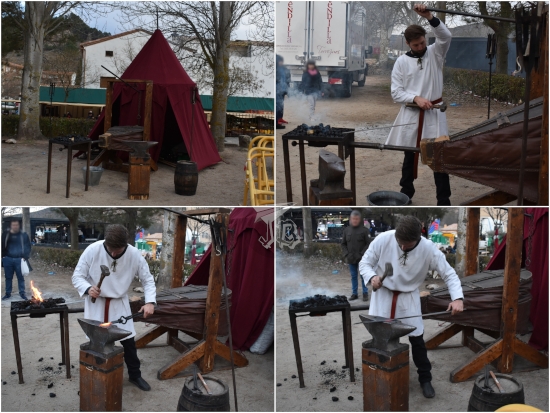
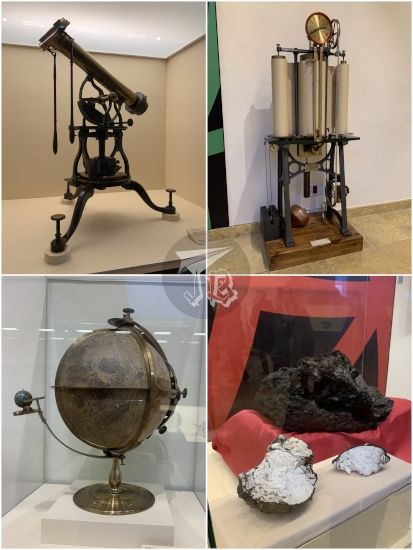
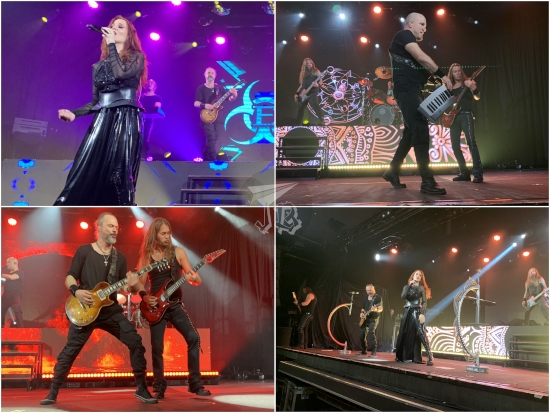
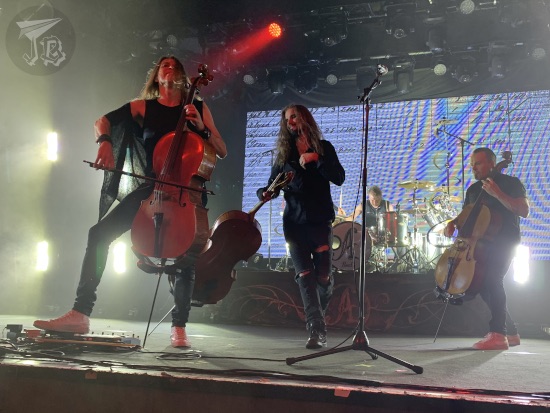
30th May 2025: Retiro Park, Alice’s sushi & Jurassic World (Madrid, Spain)

I had been on the waiting list to buy tickets for Jurassic World: The Exhibition in Madrid since it accepted sign-ups, so I was able to be amongst the first to buy tickets – albeit a few days later than originally scheduled due to the blackout. Thus, I got tickets for the first session on opening day, at 17:00 on the 30th of May. Exciting! And – almost as important – it guaranteed a spoiler-free experience…

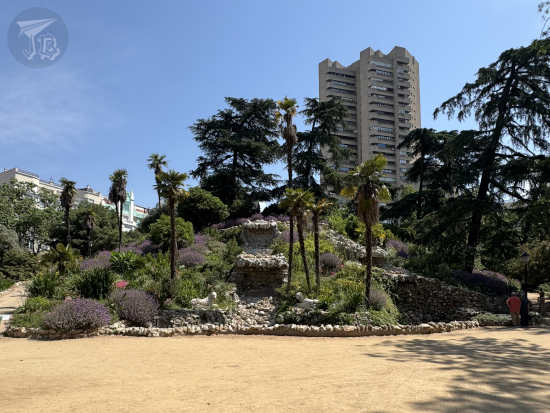
I decided to fill the morning beforehand, and I arranged to meet some relatives at Retiro Park Parque del Retiro north-east corner. There stands one of the Romantic constructions of the park – the artificial mountain known as Montaña de los Gatos. It is a space that can be used as an exhibition venue erected during the 19th century, when follies where all the rage. A folly is a decorative building placed in a garden, usually extravagant or out of context, without a real use save from looking cute for the owner’s amusement.

The artificial mountain is literally a hollow mound covered in flowers, with a waterfall that was turned off, a sad-looking pond with a duck family, and a glass ceiling to illuminate the inside. It was closed so I could not snoop the “archaeological remains” that were found during the recent restoration.

Montaña de Los Gatos in Retiro Park, artificial mound covered in flower

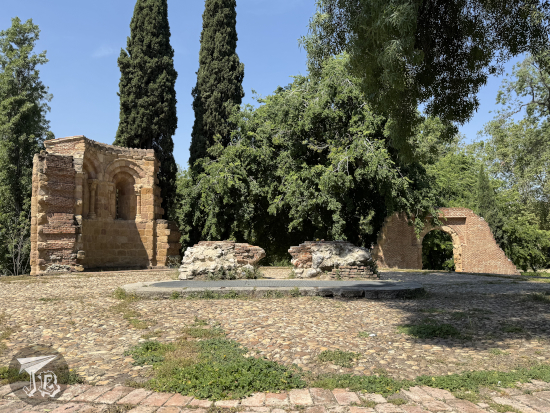
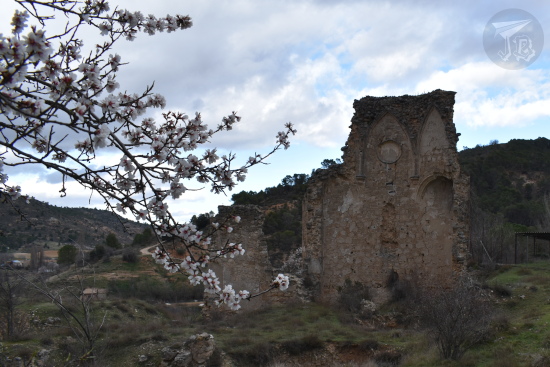
Next to the mountain there is another folly, La Casita del Pescador (Fisherman’s little house). Besides that stand the remains of an old church Ruinas de San Pelayo y San Isidoro. This tiny hermit church was originally erected in Ávila during the mid 1200s. Built in the Romanesque style, it was first dedicated to Pelagius of Córdoba, and then this was changed to Isidore of Seville. During the Spanish confiscation of the Catholic church properties, it was dismantled and eventually rebuilt in Madrid as Romantic decoration in a project directed by Ricardo Velázquez Bosco. It looks weirdly out of place, but rather pretty.

Ruins of the Romanesque church Ruinas de San Pelayo y San Isidoro, in brick

The yearly book fair Feria del Libro de Madrid had started, but as my relatives were late, we could only have a quick walk before we headed off to Wonderland – The Kaiten Lab – , a running sushi restaurant with hot-dish orders on the side, with decoration inspired by Alice in Wonderland, with a twist. According to the restaurant “you step into Alice’s mind, though Alice was a psychiatric patient”. I am not sure how I feel about the mental hospital thing – I think they were just trying to cash on the entrance that was already there when they bought the venue. However, I can state that it’s a pretty mediocre sushi restaurant. With a menu price about 10 € over a Runni sushi, I was expecting something at least as good, not worse. It sells the decoration, and that is the only thing that makes it special.

Wonderland – The Kaiten Lab –. A funky restaurant themed around Alcie in Wonderland which serves sushi

We went somewhere else for dessert, and I had a smoothie. Afterwards we said goodbye and I headed off towards Espacio Ibercaja Delicias for the opening session of Jurassic World: The Exhibition, which was full of parents with children and a bunch of actual fans, some of them being parents too. I was actually the first in line to enter, but they pulled me to the side to wait for a card called “credit photopass”, which was a free perk from having been on the list. Unfortunately, the fact that they did not have that ready put a bunch of families with kids in front of me. I got my photo taken against a green screen and they added digital dinosaurs later.

As we were waiting, the whole “dinosaurs are for kids” thing popped up again. I knew things were not going to be as awesome as expected when one of the “park guides” said that her favourite dinosaur was Mosasaur. Despite what Jurassic World: Rebirth claims, Mosasaurs are not dinosaurs, but marine reptiles, which lived in the Cretaceous period (94 – 66 million years ago).

Like the previous show, the experience starts on the ferry to the island, which then opens to the main gates with a Brachiosaurus peering from overhead. The whole exhibition runs on the story that you’re a VIP visitor to the Jurassic World complex, getting a special tour. A couple of guys and myself stayed a bit behind to take pictures without kids and families, and the “ranger” scolded us because “we were going to miss the explanations” in front of a pachycephalosaurus. At that point I felt that they were herding us like cattle…

The second room is the laboratory, with Mr DNA included. There are reproductions of eggs, amber, and baby parasaurolophus, one of them a puppet brought out for kids to take pictures with. The staff did not seem to keen on catering to anyone older than eight, again…

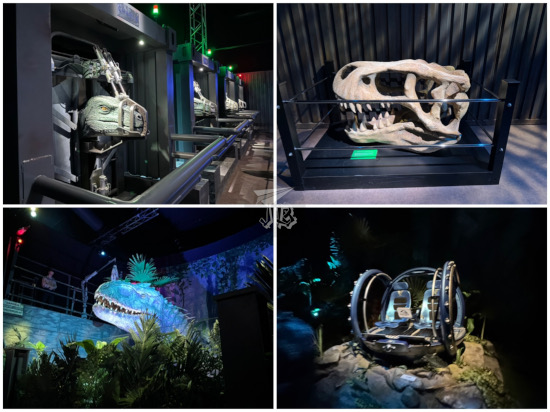
The following two rooms were the Jurassic World movie velociraptors (Deinonychus, in real fossils): Charlie, Delta and Echo were in their confinements and there was a bit of a “training show” with Blue and Owen Grady.

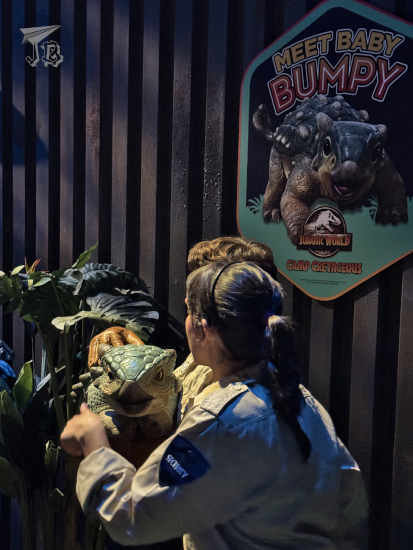
Then there was a bit of a “reprieve” room with fossil replicas and a make-believe excavation, where they brought out a puppet of Bumpy, the baby ankylosaur from Camp Cretaceous. Afterwards came the hybrid Indominus rex jungle, which had a hilarious moment when a kiddo shouted “Hello Indominus, I love you” while the thing was supposedly mangling its food. This was probably the best-made animatronic, it looked a lot like the beast they invented for the movie.

The next room held the Gyrospheres from the Jurassic World film, and a baby velociraptor puppet. This one I could take a picture with after all the kids had had their turn.

Jurassic World The Exhibition. Gate with a Brachiosaurus peering above: Collage showing the velociraptors, a carnivorous dinosaurs skull, the Indominus rex and a Gyrosphere

Jurassic World The Exhibition Baby Bumpy the ankylosaurus

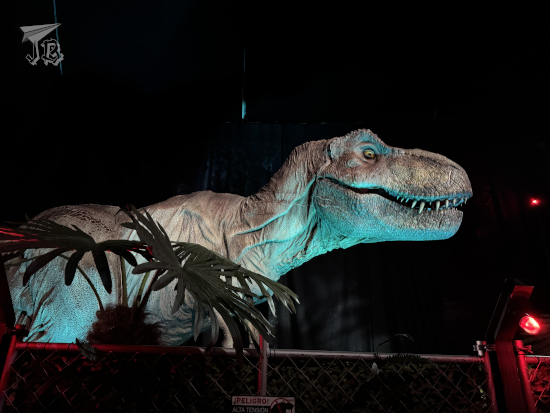
Finally, the last room was Rexy the Tyrannosaur – scars from the first movie and all. In universe, she almost broke containment and almost escaped. There were noises and sparks and roaring, honouring the exhibition’s motto: the closest you’ll ever be to real dinosaurs.

Jurassic World The Exhibition Rexy the T-rex. We know she's the one from the first movie because she has scars down her cheek and neck.

All in all, the dinosaur animatronics were amazing, but the staff had instructions to get everyone in-and-out in one hour, so it felt rushed and, as I said before, herded. And honestly, I am not going to listen to “park rangers” who don’t know their dinosaurs from their reptiles… Which would later be one of my beefs with the upcoming Jurassic World: Rebirth movie anyway…

However, there were dinosaurs, and they felt pretty real, especially the Indominus and Rexy. I missed the mosasaur, though (even if there was a super-cute plush toy in the souvenir shop). All in all, the exhibition was really fun. The animatronics were very lifelike and Bumpy looked exactly like she does in the animation. All in all, it was a good day with ruins, sushi, dinosaurs and geeking out. There’s not much more anyone can ask for…

27th March 2025: The Raven Age at ReviLive (Madrid, Spain)

Sometimes one has to wonder what guides music promoters to make certain decisions. It would be interesting to be aware of factors like costs of renting a venue, fuel, ticketing and so on. Because on occasion, it feels like tour schedules are suboptimal from all angles – acknowledging the lack of information. In the case of The Forsaken Tour by The Raven Age featuring Disconnected, I think that the most important factor that was considered was minimising bus-tour kilometres. Unfortunately, that placed their Madrid show on a Thursday, in a venue which… I’m pretty sure was inconvenient for everyone but myself.

The Raven Age is an English heavy metal band formed in 2009 by guitarists George Harris and Dan Wright – though Wright has since left the band. Current members are Harris and Tommy Gentry on guitars, Matt Cox on bass and backing vocals, Jai Patel on drums, and Matt James (MJ) on lead vocals. They have released three studio albums, and supported Iron Maiden, Anthrax and Apocalyptica during the Apocalyptica Plays Metallica Vol 2 Tour 2024. Though I saw Artics supporting that tour, my friend A****d saw The Raven Age and highly recommended them – actually she was the one who informed me of the upcoming tour and the Madrid date and place.

The Raven Age Tour Schedule

The concert was held in ReviLive, a concert and party venue associated with the musical studio ReviRock, which provides recording equipment, sets, rehearsal spaces… It is located near the Vicálvaro train station and Puerta de Arganda underground stop in Madrid. Unfortunately, it’s pretty far out from most commuting hubs. I had first thought about driving there, but my Sat-Nav has been failing lately. Furthermore, I did not feel comfortable parking and walking around the area – not the best – without knowing my way.

Since Vicálvaro was close and the way was rather straightforward, I decided to drive to a nearby station, then take a high-frequency train. But in the end, that day I had a headache, so I wanted to drive as little as possible. That meant risking it with the trains. I had previously checked finishing times and with doors at 19:00, I should be out at 22:30 latest. I had no intention to queue, so I took a train that arrived at the station around 18:50. That got me to the venue at 19:05. I was all right with staying back, but the crowd was so small that I found a spot at the barrier… And I was not wearing barrier shoes, at all. The good thing of a small side-lined venue is that security is nicer – and you are allowed to do outrageous things like bringing in your water bottle.

Supporting act throughout the tour was the French artists Disconnected, an independent French progressive metal band. Formed in 2016, it features Ivan Pavlakovic on vocals, Adrian Martinot and Florian Merindol on guitars, Romain Laure on Bass and Amaury Pastorelli on drums.

Doors ended up being at 19:30, not at 19:00, which was mean to the poor fans that had been there since early, particularly the meet & greet ones. I have to admit I did check for M&G tickets, but found no way to get them, else I would have. Maybe they were fanclub-only, I don’t know. I was hoping the venue would fill up more – similarly to La Riviera, where the crowd (that I’ve seen) skips the supporting act and drips in without queuing.

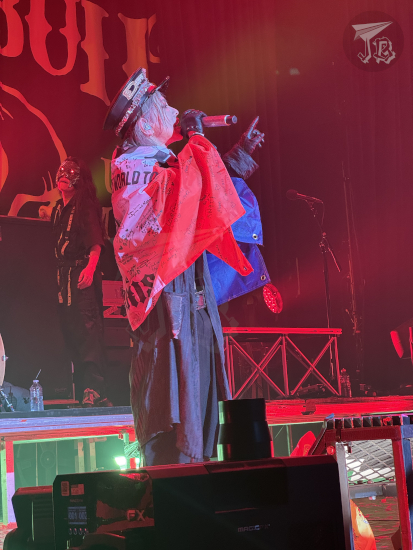
At 19:50, Disconnected started their act, and it was quite all right. What was unfortunately not so good was the sound. For such an empty venue, it was a pity, because it was not as if there was a roar from the attendees. The vocalist had great energy, and he was fun – though painfully aware of how few people there were. They sang in English and French, but the ratty sound made it a bit difficult to follow.

Disconnected’s setlist:
  1. Living incomplete
  2. I Fall Again
  3. The Wish
  4. La Puissance
  5. Unstoppable
  6. A World of Futile Pains
  7. Life Will Always Find Its Way
  8. We Carry On

The Raven Age Madrid Concert: Disconnected

The Raven Age Madrid Concert: Disconnected

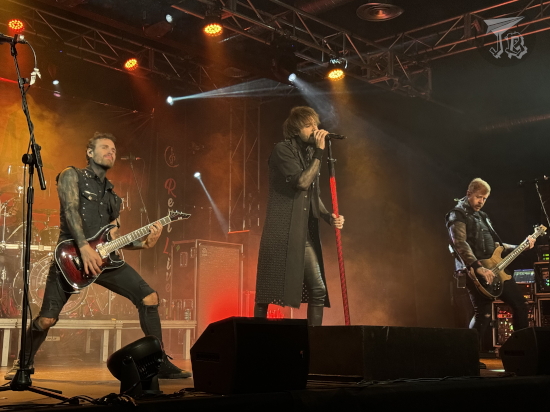
Unfortunately, the venue had not filled up when it was time for the main act, and that was a bit sad. Despite the ongoing sound problems and the small crowd, The Raven Age had a great presence. The music did not sound as powerful as what I had been listening online though, and I am sure that they did not have any tea in their thermos bottles…

The Raven Age’s setlist:
  1. The Guillotine
  2. Promised Land
  3. Forgive & Forget
  4. Nostradamus
  5. Surrogate
  6. The Face That Launched A Thousand Ships
  7. Scimitar
  8. The Day The Earth Stood Still
  9. Essence of Time
  10. The Journey
  11. Seventh Heaven
  12. Angel in Disgrace
  13. Serpent’s Tongue
  14. Grave of the Fireflies
  15. Fleur de Lis

The Raven Age Madrid Concert: The Raven Age

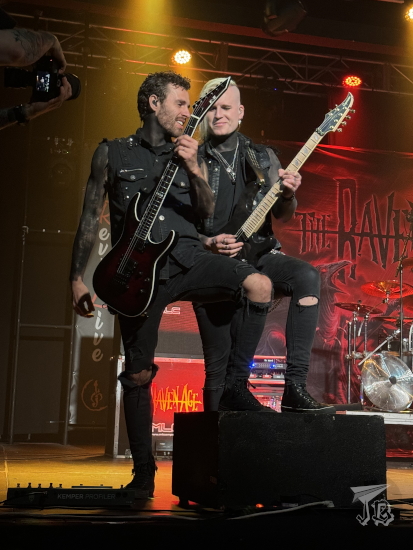
It was extremely amusing to hear a heavy metal singer with such a strong British accent, talking in a natural way and dropping swearwords without sweating them. The members seemed to be quite happy taking over all the stage, and there was a lot of interaction, which is always good and fun. Unfortunately, considering that promoter was giving tickets away, I don’t think I’ll ever have the chance to see them close to home again.

The act was not long. They started at 20:50 and finished at 22:10, so it was a relatively short show, but it went by really fast. There was no real encore, because MJ said “this is the time when we go backstage, you guys yell for more, we come back and sing some more, so we’re going to skip all that and go on.” I approve of that.

The Raven Age Madrid Concert: The Raven Age

The Raven Age Madrid Concert: The Raven Age

The Raven Age Madrid Concert: The Raven Age

The Raven Age Madrid Concert: The Raven Age

The whole event had a weird atmosphere from start to end – the lack of a queue, the… chairs outside so we could wait… The… “hey, hold my spot, I’m going to change into this merch shirt I just got” and “Sure, but then hold mine while I go to the toilet” conversations… And especially, the lack of people. I really hoped that there would be more concertgoers after 20:00, and at least some more enthusiasm. When I saw Kamijo in Barcelona there was a small crowd, but it was loud. Here, it was lukewarm. I felt a bit heartbroken for the bands, because they both did a great job.

The train I was supposed to take back did not pass, so I had to wait almost 45 minutes at the Vicálvaro station. That was not fun because the only seats were in the open platform and my lower back hurt – bad choice of shoes. It was extremely cold, too, so I just huddled on a bench, and it felt good when the train finally came. I got to my car just before midnight, and home soon after. I was so tired I almost hit the kerb on my last curve, so it is good that I did not drive back and forth on the speedway, actually.

All in all, I enjoyed the day, the supporting act, and the concert. Would I travel abroad for The Raven Age? Probably not. Will I buy their CDs when I have money to spare? Probably yes. Although I keep getting sidetracked by activities and places to see and burning through my fun budget… Just you wait until there is a concert somewhere I want to visit, and I’ll be taking this whole “not travelling for The Raven Age” back.

23rd February 2025: The Annual Medieval Fair (Tendilla, Spain)

For the last few years, the Medieval fair Feria de Mercaderíass de San Matías in Tendilla has started on the 25th (2022), 24th (2023) and the 23rd (2024) of February. So it makes perfect sense that my mind placed 2025’s edition start on the… 14th, right? Since the fair celebrates St. Matthew, and the onomastic is the 13th, I unilaterally decided that the fair must be that weekend. Obviously, I was wrong, and the fair was held from the 21st to the 23rd. Due to the date mishap, I had a visit booked on the 22nd, and I amended my plans to head to the fair on Sunday the 23rd instead of on Saturday as I usually do – that way I could see the Palace, the Botarga Parade and the Fair on the same weekend.

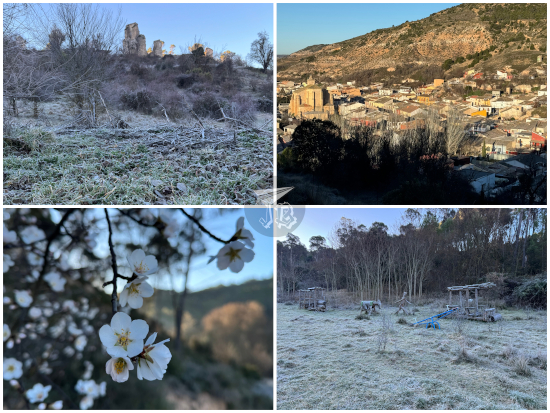
It was a good thing that I decided to go to the Parade instead of trying to make it to the fair on Saturday, because apparently they were blocking cars from entering the village, but not letting them park anywhere close-by which… is a problem. To avoid a similar issue on Sunday, I drove to Tendilla before the fair even opened, so I was there around 8:40. I used the time to climb up the frozen nearby hills to see if there were nice views from above. I also headed into the pine forest, which was covered by a thin layer of frost everywhere. It was pretty.

Tendilla: Landscapes before the fair started

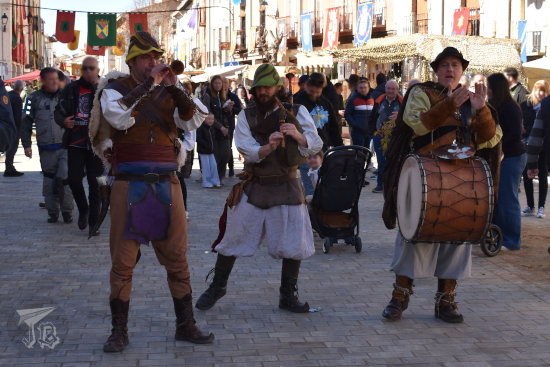
There was a parade scheduled to take place at 11:00, which did not happen until around 13:00 – there was just a trio of musicians going up and down the main street. In the mean time, I wandered up the fair, and stayed around the ox paddock hearing things like “such noble eyes the animal has” from the mouths of city-dwellers. The poor oxen seemed pretty much used to to be stared at, so they just munched on hay with an air of resignation. There were two of them separated from the herd, which would later be yoked to a traditional cart. Looking back, I’m slightly surprised that I did not get any allergy symptom from their straw.

Three musicians in Medieval Clothes

Oxen in the Medieval Fair

I also found the newly-inaugurated statue to honour the fair – a tiny farmer with two donkeys standing atop a column which… was a bit underwhelming, to be honest.

La borriquilla - the little donkey

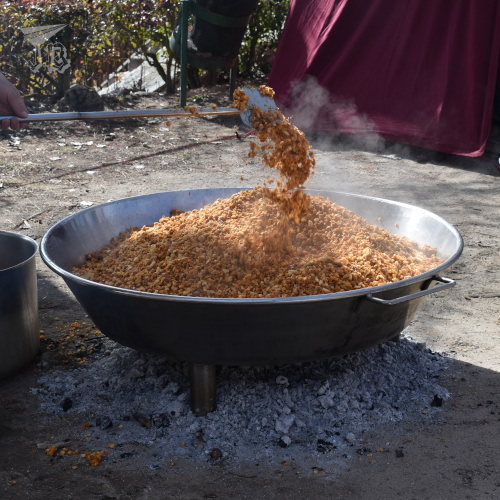
Around noon, a queue started forming for migas. In the mornings during the fair, some of the villagers prepare this typical dish from the area for all passers-by (queuers-by?) to enjoy. The traditional migas are made from fried breadcrumbs, paprika and meat from pig slaughtering. However, Tendilla is famous for its torreznos (processed pork lard snacks), so these communal migas are served with the local dry treats, and accompanied with a glass of wine to be washed down. I had never queued for them, but some family members saw me when they were almost at the front of the line and I was snuck forward in exchange for some photos. I also got to talk to one of the stand owners, and I discovered about a place called Emociones al Vuelo, a bird-of-prey rescue and training centre which organises activities. I may or may not have decided to pay them a visit.

Communal migas being prepared

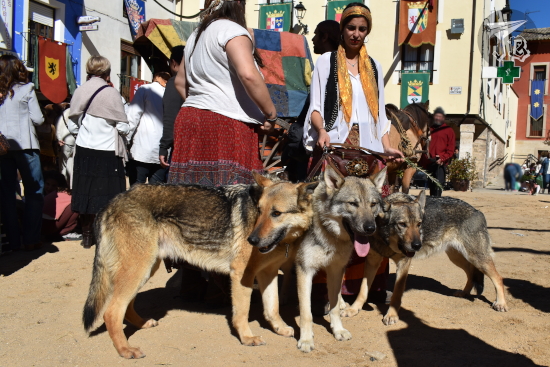
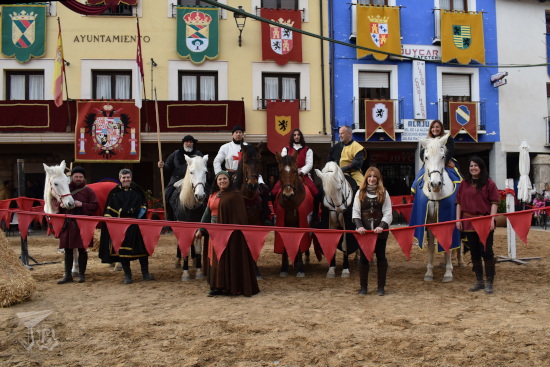
We snacked, and then moved around the village. I was in the middle of Main Street Calle Mayor when the parade came through. The troupe had changed this year, and it was not Christian knights and moors, but gypsies and magicians. They brought horses and “wolfdogs” – not actual wolfdogs but wolf-looking domestic dogs. Enough to fool a lot of people. There was supposed to be a tournament, but apparently the gypsies were not up to it. There was no tournament, and after an hour of waiting, the troupe went back to the Main Square Plaza Mayor, did a couple of horse tricks, and started cutting ham to share with the onlookers. It was a bit disappointing, but I least I got to pet the dogs.

Troupe of horse riders dressed as Medieval gypsies

Dogs from the gypsy troupe

I headed to my relatives’ place and we prepared lunch, though I had some leftover migas that had been saved for me from the previous day, and a fried egg on top. Much better than the communal ones, for real.

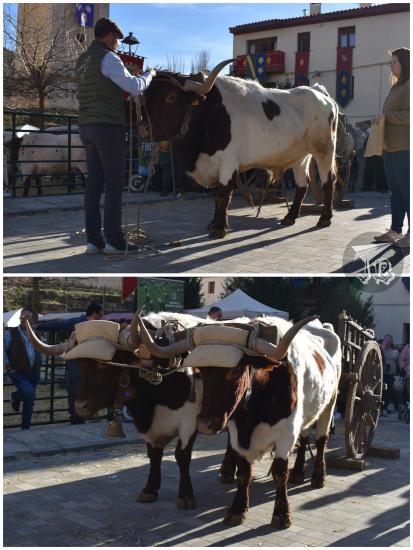
The last activities for the day were related to the long-suffering oxen. First, two of them were yoked to a traditional hay cart and children were given rides through the fair. The two oxen were led to the cart and then tied to the structure. Something that I had never known was that part of this tie went around their horns and forehead, so the owners placed a small pillow on the animals’ foreheads for them to pull more comfortably. However, to do the tie the knots as strong as it was necessary for them to be, he had to use his foot as leverage on the ox’s head… Once the animals were yoked, the cart started moving. One small child who had apparently been asking about the ride all day long was the first to be helped on the cart – even though some others tried to cut the line! At first, they went up and down the village, but apparently some idiot spooked the poor animals and the owners decided to just move around the main square afterwards.

Oxen being yoked

After six or seven rides, the oxen were untied and let into the paddock. A lorry was brought and the owners created a mini stampede for all the oxen to go into the vehicle. That was wickedly cool.

That was the last activity, so I decided to say goodbye to my relatives soon and drive back through the sunset. Most of the stalls were already closing anyway and there was no way I was going to stay for dinner – because that would mean I’d have to actually eat more that day, which was not the plan.

On the way back I drove into a very weird traffic jam. It did not happen around the bottleneck, but much much earlier, and the bottleneck was clear. I’ve never understood traffic jams anyway…

So all in all, I had a very complete weekend, combining Madrid, Guadalajara and Tendilla, I had relatively good weather, and got to check out most of what I wanted. The only downside? Having to go to my day job on Monday without having caught any rest!

28th November 2024: Parallel Universes (Madrid, Spain)

Whenever a Marvel film comes out, my parent always comments on how they used to read the comics when they were young – probably they belonged to the first generation of comic readers in this country (and I have to confess over the years I salvaged quite a few “relics” from the attic at the old house). Thus, when the exhibition Marvel: Universe of Superheroes opened, I thought I would bring them along. I booked us tickets on the 28th of November at 10:00 for the event, which was happening in the convention centre IFEMA in Madrid.

By pure chance, my parents received an invitation to Feriarte, a collectionism fair – that is what we thought at that moment. They were not particularly into it, so I asked if I could have the invitation. When I checked it out, I realised that we could visit Feriarte on the same day as Marvel: Universe of Superheroes, since the dates overlapped, and it was also at IFEMA, just a couple of pavilions down. My parent agreed after some coaxing. Finally, I offered to take them to a “fun place” for lunch, and we had a plan.

Marvel has traditionally been one of the most important comic publishing houses in the US. Its key writer / creator was Stan Lee, who came up with some of the most iconic characters in the medium – Spiderman, Thor, Iron Man… It is true that the first superheroes to succeed on the big screen belonged to Marvel’s competition, DC – Christopher Reeve’s Superman in the 1970s and Michael Keaton’s Batman the following decade. However, Marvel kicked off a golden age of cinema superheroes. While DC festered in the darkest, more depressed Batman, Marvel released Iron Man, which took superhero films in a new direction – they turned from fun-for-fans to funny-for-all (of course, purists would never be satisfied, but what are you going to do?). Robert Downing Jr. had a lot to do with this boom, dominating the scene whether the film carried the name of his character – Iron Man – or not. For about a decade, Marvel dominated the blockbuster season, with explosions, one-liners and good-triumphs-over-evil plots. Eventually the bubble burst, as they always do, and things went downhill. However, companies are still willing to milk out any cash cow, and as long as Marvel makes money, it will be producing stuff.

Less known than the film boom is the fact that with the launching of Marvel Studios, the parent company also became a transmedia master. The idea of transmedia is not new, and refers to tying stories in different publishing methods (Hasbro was doing this with GI Joe back in the 80s already). However, Marvel has it down to an art. Samuel L. Jackson was cast as Nick Fury because a comic artist based the revamped character on him, so now Nick Fury statuettes look like Samuel L. Jackson. Since Disney acquired Marvel Studios, the so-called MCU (Marvel Cinematic Universe) is so interwoven with the Disney+ shows that neither can be followed on its own. Funnily enough, this has not washed over to the comics that much, save for the special Alligator Loki that I kept looking for in London earlier in 2024.

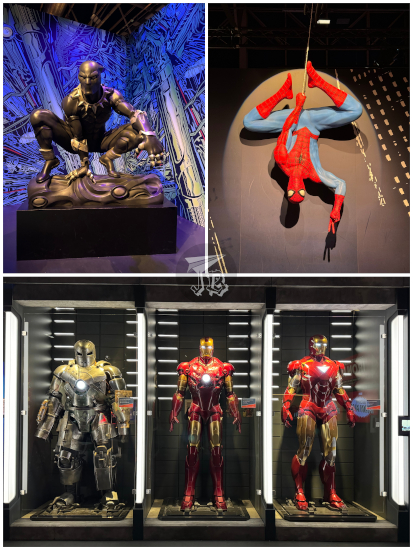
Well, one of the many facets of Marvel’s outreach octopus is organising exhibitions. I suspect that they are all the same under different names though. The one which took place in the IFEMA convention centre in Madrid was Marvel: Universe of Superheroes. The exhibition runs through the history of Marvel from its beginning, hailing the works of Stan Lee and running through the influence of the Comics Code Authority (CCA), which censored the content of the media – and made the evolution of American and European comics diverge forever. The pages from that time are mostly lost, so elements like the first issue of a Marvel comic ever, or original Spiderman and Fantastic Four dating back from the 60s are kind of amazing – and belong to private collectors who have lent (or rented out, one guesses) them to the organisers. Most of the exhibition, however, focuses on the MCU, with quite a few costumes and items from the films and Disney+ series. There were life-sized statues, too – or at least to scale for characters like The Thing or Hulk. There was an interactive game where an on-screen you would wear Iron Man’s suit and practice-shoot with it.

We hilariously ran into a preschool day trip, with the teacher completely made things up as she went and kept trying to keep a bunch of rowdy kids in line – without much success.

The first area ran through the history of American comics and Marvel itself, purely as a comic publisher. Then, it moved into the film area, starting with Black Panther, revindicating his status as the first black superhero. Then there was a room on Spiderman, one of the most beloved characters, even if he was almost not made because editors thought a spider-related superhero would not sell. This was probably the last room focusing heavily on comics. Hulk got a small room to share with She-Hulk. Afterwards, the MCU took over, with film memorabilia of Iron Man, Thor and Captain America. The following area was a bit of a mix, with Wandavision, X-Men, Daredevil, Luke Cage, Moon Knight, Ghost Rider… which ended in a very psychedelic room for Doctor Strange. The final room was “Marvel in Space”, with The Marvels (Captain Marvel, Monica Rambeau and Ms. Marvel) and Guardians of the Galaxy. Considering the huge hit that Agatha All Along was, I was surprised not to find any references to it, but then I realised that the exhibition predates the series.

Marvel Universe of Superheroes

Marvel Universe of Superheroes: Black Panther, Spiderman, Iron Man

Marvel Universe of Superheroes: Doctor Strange, Mighty Thor, Groot

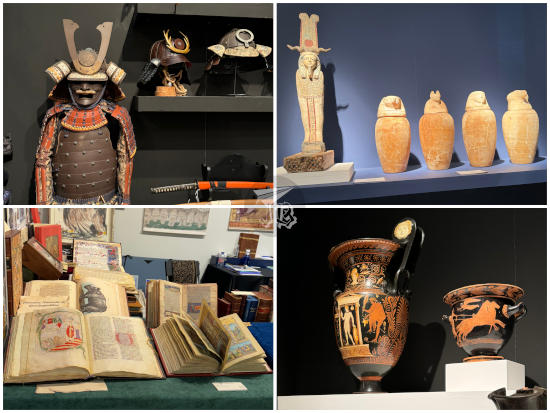
I would have wanted a memento, but none of the items in the shop appealed to me. Besides, everything was too expensive, I thought. I had no idea. We left the exhibit and marched into the inner pavilion where Feriarte took place. Feriarte is way more than the collectionism event I had originally thought – it is an antiques and art fair, with items that range from archaeological artefacts to the most modern pieces. Our minds were blown. There were 64 art galleries and archaeology specialists from all over the world carrying prehistoric items, Egyptian mortuary artefacts (including a whole sarcophagus), Grecian sculptures and vases, Japanese samurai armours and weapons, paintings, contemporary art (Miró, Dalí, Chillida, Sorolla…), furniture, jewellery and watches, reproductions of Medieval manuscripts… And I thought that the Marvel shop was expensive! I could have afforded… a tiny Egyptian scarab smaller than the nail on my little finger. I was shocked when I saw the first three paintings by Miró (a surrealist painter from the beginning of the 20th century), but it turns out they sell like doughnuts among the collectors…

There was a “collectionism for beginners” area, with tips to “start collecting with pieces under 5,000 €”. When thinking about private collections, I’ve often gone with Indiana Jones’ line “it belongs in a museum”, but lately, with the attacks on art by climate activists, and the fact that most of Marvel’s memorabilia was recovered from private collectors… I’m not so sure. I might have started changing my mind. Then again, not really, because when the original fossil of Tyrannosaurus rex Stan was auctioned and I was sad it would end up in private hands and I would never seen it – good news, it was sold to a museum, though I’m not sure I’ll ever make it to the soon-to-open Natural History Museum Abu Dhabi. Needless to say, we left Feriarte empty-handed, and very amused that you go through security and X-ray when you go out, not when you go in. A couple of days after, I read that an organised gang had stolen jewels and watches worth 390,000 €…

Feriarte 2024

Feriarte 2024

We retrieved the car, and got lost trying to get to the shopping centre La Vaguada to have lunch at Runni In Market, the first of the Running Sushi franchise I visited (and got lost trying to get there too, so… maybe it’s just difficult). My parent loved the concept. However, I was peeved that the table before us kept getting all the lychee and mochi when the time came for dessert. Mean!

Runni Sushi In Market

We left afterwards to head home, having caught a glimpse of the secret life of superheroes and what kind of décor rich people have in their houses. Parallel universes indeed…

20th October 2024: Heroes Comic Con & Art Nouveau in Brussels and the Medieval Centre of Bruges {Belgium October 2024}

Just before going to bed to grab a couple of hours’ sleep on the 19th, I did a last check that I had everything ready, and I realised that my parking reservation at the airport had not been processed. It is a good thing that being an Aena member, the price had not gone up outrageously from when I had done it the first time a few months back. I have no idea why it did not work the first time, but I am glad I caught it before I left, because non-reserved parking is three times as much.

I did sleep for a few hours and the alarm clock went off around 3:00 for my 6:20 flight. The drive was uneventful, I found an awesome parking spot, and I had the bus just for myself after a minute of waiting. Security was fast, and it was weird to be in the Schengen side of the terminal for a Ryanair flight. I got on the plane and got some sleep. We landed in Brussels [Bruxelles (French) | Brussel (Dutch)], Belgium [Belgique | België] early, but deplaning took a while. Once outside, I followed the signs for the train and there was one there already. I settled until I got to Brussels Central station, where I bought a coffee, a drink, and a sandwich. I then walked towards the underground station – the coffee was gone even before I was there.

I knew I was in the correct underground line when I started seeing cosplayers and kiddos with superhero merchandise along with their resigned parents. My backpack was not heavy, but I was glad to have a seat both on the train and the underground. I reached the area of Brussels Expo a few minutes before the convention Heroes Comic Con opened for general admission. There was a queue, but instead of getting in line, I walked up to the nearby Atomium.

The Atomium was built as the centrepiece of the Brussels Expo’58. It is credited to architects André Polak and Jean Polak from a project by civil engineer André Waterkeyn. It was designed as a homage to scientific advance, especially nuclear physics, and thus resembles an atom or a molecule. It is 102 metres high, and it comprises nine spheres with a diameter of 18 metres each, joined by tubes and escalators. The Atomium was not designed to survive the Expo it was built for, though. In the mid 2000s, it had to be renovated, and a lot of the original aluminium was replaced by stainless steel.

Brussels Atomium

I contemplated going up the building. However, when I looked at the time, I realised that if I went in, I would be able to get into the first of Misha Collin’s photo shoots. When I decided to buy the tickets, I only bought one picture in the afternoon, because I was not sure what time I would make it to the convention, considering the plane, the train and the underground. But I was there on time so I used my phone to buy an extra ticket for the photo shoot in which Collins would be wearing the outfit from Supernatural’s character Castiel. This also gave me the chance to get the photograph signed during the time between photo shoots. Furthermore, I was still within budget – because I had decided to indulge myself with the money I had originally set aside for a balloon ride in Cappadocia.

I walked into Brussels Expo. The exhibit was huge, but I had a map downloaded on the phone. I was a bit confused when doing my original research, because it turns out that there were actually three conventions going on at the same time – Heroes Comic Con, Made In Asia and Gameforce. However, once there, it was easy to get around. Heroes Comic Con is “a big feast dedicated to pop culture”, so basically a one-size-fits-all big merchandise fair with graphic artists, cosplayers, the whole nine yards, nothing too different from Paris Fan Festival. Heroes Comic Con’s biggest selling point, however, was having invited a number of popular actors – along Misha Collins (real name Dmitri Tippens Krushnic, for the record), other guests were Bob Morley, Eliza Taylor, Ian Somerhalder and Paul Wesley. Some of them… rang a bell. I might even have seen a few of them somewhere – I must have, because I did watch the newer Star Trek. However, I find it great that they had a large following and there were queues for them.

I followed my map towards the photo booths, where they checked my ticket and gave me a bright-coloured chip – they give you a chip per ticket, as you can have two people in one photograph. I was on my own, so no problems there. I actually got two photographs out of the first shoot – so I’ve got three though I paid for two, yay me. I had brought a customised jacket with a pair of angel wings, and the goal was to have them in the photographs, so I would be facing Misha but looking over my shoulder. The first photograph did work out too well, so Misha called me back for a re-shoot. He was very friendly, and much more approachable than my usual Japanese artists. Either that or I was less strung up. The pictures were printed on-site, so I took mine to the autographs area to wait. I had bought an official book beforehand – the lightest thing I had found, to be honest – in case I could not get a photograph signed, but since I this had worked out so well, I had our recent picture – and in the character outfit – to be signed.

Since I had been towards the end of the photograph queue, I did not have to wait long for Misha to come. A staff took my name on a post-it note and attached it to the photograph. When it was your turn, you paid for the autograph (I decided not to get a selfie, because I still had another photograph bought), and I told him about the pure chance I was there. He was “glad I could make it”. As I said, nice and approachable.

By the time I was out of the autograph area it was around 11:40. I decided to wander around. I gravitated towards Made in Asia, and was very strong reminding myself I wanted to keep my luggage light and not pay for any extra. Thus, I managed not to buy anything despite finding a bunch of Saint Seiya merchandise – which I now regret, but that’s FOMO speaking. I had a chuckle or two out of young people complaining about the official good stuff being “too expensive” when I found the shops cheaper than the stands I see in the Spanish counterparts.

Brussels Hero Comic Con

I returned to the photo booth for the second photograph, and I thanked Misha for the chance – I look silly in the picture, but that’s okay. It was great. There was a Q&A with Collins an hour or so later, but I decided to forego that and leave the convention. If I stayed, I would have no time to do anything in Brussels that day. I also wanted to keep on the move because else my body would remember how little slept it had gotten, and I would crash. Thus, I bought an online Art Nouveau pass, and I left the convention.

Brussels’ Art Nouveau Pass is 20 € and it covers entry to three museums, historical places, or exhibitions in a long list, all of them related to – obviously – Art Nouveau. The pass can be value for money even if you only visit two of the “big ones”. Since the pass is valid for nine months, I might be able to use it for a third time in the near future. The original idea was to buy one from the beginning and hit the Comic Museum, the Horta Museum and the Solvay House – things I had not had the time to visit the previous time because in the end I spent a lot of time walking to different spots (read: the Natural History Museum). However, the Solvay House was under renovation, and the Horta Museum was a bit out of the way, so I ended up being flexible

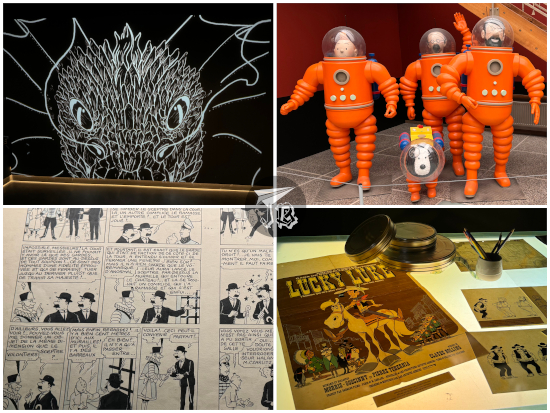
I rode back to Central Station and walked out towards the Cathedral of St. Michael and St. Gudula Cathédrale des Saints Michel et Gudule | Kathedraal van Sint-Michiel en Sint-Goedele, which was beautiful in the flurry of autumn leaves. It was cold, so I hastened towards the Comics Art Museum Musée de la Bande Dessinée | Stripmuseum (Belgian Comic Strip Center). The museum is located in the former textile store Magasins Waucquez, an early 1900s commercial building designed by architect Victor Horta. Horta is considered one of the founders Art Nouveau, with his use of curved forms and use of steel, skylights and open floor plans with abundant decoration.

Brussels cathedral

After the department store closed in the 1970s, the building was listed as a historical site, and it was bought by the Belgian Government to be used in the promotion of comic strips. The museum itself was founded in 1984 as a non-profit, and it opened in 1989. It runs a new permanent exhibition on the history of comics in Belgium and Europe (free from the American Comics Code Authority and censorship – I mention this because I had tickets for a Marvel exhibition the following month, and the CCA had a lot of impact in the development of American comics). The person at reception told me to watch out for a very first-print Tintin which had been recently added to the exhibit. There are items and print issues related to most of the great Belgian comic artists – there were a lot of things I had never even heard about. I found a big lack of Morris’ Lucky Luke though.

Comics Art Museum Brussels

Comics Art Museum Brussels

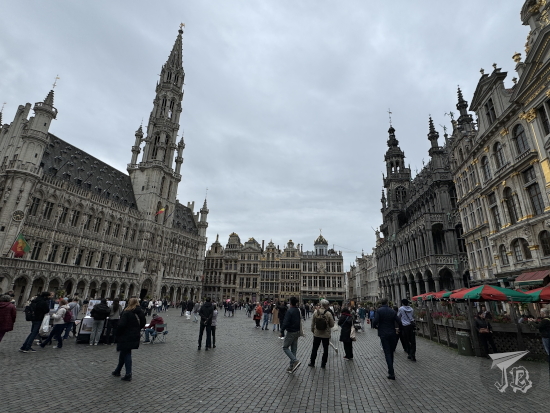
Something I had decided to do in this trip was trying the typical foods, so once out of the museum I headed towards the central square Grand-Place | Grote Markt and Manneken Pis, which was not wearing any costume this time around, even if Brussels is still under a lot of construction (when I saw it in 2023, it was wearing a reflective jacket). I remembered that there were a lot of places that sold local street food – I don’t tend to be much of a foodie, especially with street food or fish. I figured out that Belgium could be a safe place to experiment without risking an upset stomach.

Brussels Grand Place

Manekken Pis

Thus I got some frites, Belgian fries, at a chain called La Friterie. I had seen a few of the establishments with queues outside, so when this one was almost empty, I jumped at the chance. Belgian fries are sourced from local potatoes and cooked in two goes, traditionally in beef fat. I got them with just salt, and they were really good. And warm. That was a great point.

Belgian Frites

It was around 17:00 by this time, and things had started to close down. I headed off towards the station to take a train to Bruges [Bruges | Brugge], in the north west area of West Flanders. The historic city centre is a Unesco World Heritage Site – Historic Centre of Brugge – and it is criss-crossed with canals. The area has been inhabited since Prehistory, but its importance peaked during the Middle Ages, between the 12th and 15th centuries. It became a commercial hub due to its strategic location between Flanders and France, though it later opened to other countries, like the Portuguese. The first stock exchange in the world probably opened there in 1309.

The Medieval architecture and brick Gothic constructions are exceptionally well preserved, including the pattern of streets intertwined with waterways. I was curious about northern Europe canals, which was one of the reasons why I chose the city. The other one was that it is a city to walk and see from the outside, which was great for a Monday morning. Unless it’s raining and about 7 ºC colder than cool – I had prepared for 13 – 17 ºC and drizzle, and got 9 – 13 ºC and rain. Whoops.

I bought some snacks at the station and went down to the platform. The train was late. I knew it was late, and I knew when it was expected, because the board told me. It was refreshing, considering the uncertainty around Madrid’s trains this last couple of years. I had booked a hotel close to the railway station, and I got there around 19:00. It was quite a basic place, with a toilet, and a shower closed off, and a washbasin column in the middle to separate the wet area from the bed area. Functional, and all right. The heating worked and they spoke English, so all good.

I did not rest for long. I ate the snacks, grabbed my umbrella and an extra layer of clothing, and headed out. It was dark outside already, and I hoped to get to see the city centre lit up for the night. My first stop was the Church of Our Lady Onze-Lieve-Vrouwekerk. Mostly built between the 13th and the 15th centuries, it is one of the highest Gothic brick structures in the world.

Our Lady, Bruges

Then I headed towards Saint Salvator’s Cathedral Sint-Salvatorskathedraal, a curious mixture of neo-Romanesque and neo-Gothic, with a bell tower that looks more like a defence tower than anything religious. This tower, however, was the result of a 19th-century modification of the original tower. Of course, both churches were closed at this time, but they would open the next morning.

Bruges cathedral

I continued towards the Market Square Grote Markt, featuring the Gothic Provincial Court Provinciaal Hof, the Historium, and the Belfry of Bruges Belfort van Brugge. The Medieval bell tower is doubly World Heritage – it belongs to the Historical Centre Unesco site, but it is also key in the Unesco Belfries of Belgium and France serial property. And while it is not part of the Manual bell ringing intangible Cultural Heritage, Bruges takes a lot of pride in its carillon and its bell ringing. At the centre of the square stands the statue of Pieter de Coninck and Jan Breydel Pieter de Coninck en Jan Breydel, who participated in the Flemish resistance against the French King in 1302.

Bruges Grotemarkt

I also wanted to explore a large park I had seen on my way. It turned out to be two of them, Poertorenpark and Minnewaterpark – which later I found means “Lake of Love Park” – before it was too late in the evening. There I found the Gunpowder Tower Poertoren – built between 1398 and 1401 by Jan Van Oudenaarde, and used as gunpowder store for almost five centuries. Beyond it, the Lake of Love itself Minnewater, the Lovers’ Bridge Minnewaterbrug, “very romantic” stone bridge. I noticed the part about it being stone. It also yielded to a beautiful night view.

Bruges Love Lake park at night

I did not want to stay out too late. Thus, I crossed the Barge bridge Bargebrug to get back to the busy street area. Bargebrug is a modern construction, barely 20 years old, in bold red curves. On the other side there was a “reception area” in the same style, apparently a sort of bus station, and then there was the main road. Afterwards, I just headed back to the hotel and turned in for the day. I watched some TV, but to be honest, I had woken up before 3:00 am, so I zonked out rather quickly.

Bruges Love Lake park at night

13th October 2024: Mercado Cervantino de Alcalá de Henares (Spain)

Alcalá de Henares was the birthplace of writer Miguel de Cervantes, author of Don Quixote, one if not the most important novel in the Spanish speaking world – often considered the first modern novel in Western literature. Thus, a lot of the town activities are presented in relation to Cervantes, one way or another.

Renaissance Fairs are getting popular in the centre of Spain, and Alcalá has dubbed its own “Cervantine Market” Mercado Cervantino as part of a week-long celebration of Cervantes’ christening Semana Cervantina. I missed most of it since I was in Türkiye, but on the last day I was able to drop for a couple of hours with my sibling.

Mercado Cervantino

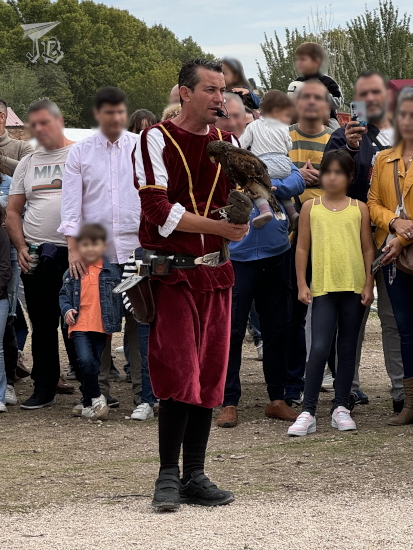
We reached the market around 11:30, too late to hear the cannons. It being a Sunday, everything was packed. We got to see Don Quixote and his sidekick Sancho, a horde of orcs, and a falconry exhibition by Francisco Miranda and his Harris’ hawk.

Don Quixote

An orc

Falconer

Harry's eagle mid-flight

Afterwards, I talked my sibling into dropping by the nearby Archaeology and Palaeontology museum Museo Arqueológico y Paleontológico de la Comunidad de Madrid, MARPA. The exhibition Cazadores de DragonesDragon Hunters – is still on, and I was not going to waste the chance to see the Concavenator (Concavenator corcovatus). I realised they had brought some extra merch for the exhibition, and I decided to drop by in the near future.

Concavenator Skull

We went off for a late lunch afterwards, and later I just drove off.

27th & 28th April 2024: Paris & the Fan Festival (France)

27th April 2024: From the Fan Fest to Les Invalides

My grandmother used to say that nothing good happens before sunrise, and to be honest, when the alarm clock rang at 4:40 on Saturday, I was very tempted to believe so. However, there were planes to catch, and red-eye flights are called so for a reason. My sibling and I had tickets for Paris on a 7:25 flight, which required us to be at the airport with enough time to board ± 30 minutes in case we had to get to the Satellite Terminal. Since I started planning with time – back in January – I had booked a parking spot in the actual terminal parking lot, for just a couple quid more than the long-stay one, and I activated a service the airport has so your card is billed automatically when your licence plate is detected, for convenience.

We reached the terminal with plenty of time (± 30 minutes) but recent problems with French air controllers going on strike, I was anything but calm. However, we took off on time and I just huddled off to nap. Arrival in Orly was early, and we did not taxi much, nor need buses. We just stepped off at the gate, and headed towards the Orlyval. We bought a Paris Visit card each, in order to be able to ride the public transport system as much as we needed for the weekend, and hopped on the shuttle. After a couple of transfers and a short walk, we arrived at the exhibition centre Paris Expo Porte de Versailles, where Paris Fan Festival took place.

Paris Fan Festival is a yearly convention that focuses on everything geek / nerd / niche, whatever you want to call it: video games (and retro video games), Star Wars, TV series, Ghostbusters, manga, comics, K-pop, there’s something just for everyone. I think it’s a bit of what Japan Weekend aims to be, but openly. It felt a little like that Funko slogan “Everyone is a fan of something”.

My reason to be there was European comic, actually. Authors (and married couple) Stjepan Šejić and Linda Lukšić Šejić, whom I’ve been following for a few years now, were in attendance. Stjepan Šejić has worked for DC in works such as Aquaman, Harley Quinn, and Suicide Squad, but he has gone independent, focusing on his own content creation. So has Linda Šejić, who started off at Image Comics and currently works on her own web comics. I’m currently buying his works Sunstone, Fine Print and my favourite Death Vigil, and her Blood Stain and Punderworld, the latter based on the Greek myth of Hades and Persephone. I also have the Aquaman hardcover that compiles all of Stjepan’s issues, and the Batman-character self-conclusive Harleen.

Of course, I wore an appropriate “Velocirapture” T-shirt to the event. The goal was to get an issue of each collection signed, and maybe a commission and some merch. In the end, we could only get a commission from Linda – we almost got one from Stjepan too, but things did not work too well on that front. I hope to get one next time they’re reachable – I actually wanted to go and meet him a while back, but I was in the middle of a weekend in Cuenca back in 2017.

Paris Fan Festival: Stjepan Šejić and Linda Lukšić Šejić

My sibling and I wandered through Paris Fan Festival for a few hours. We had something to eat at a Paul’s bakery, which I had discovered in Toulouse, and whose prices were not stupidly inflated by being inside the convention. Unfortunately though, I had followed the instructions of the venue and I was not carrying any water, and just a small backpack. I could’ve completely ignored the rules though, just like… most everybody else did. I did learn a valiable lesson though – when travelling to conventions for people, you buy tickets for both days. Just in case.
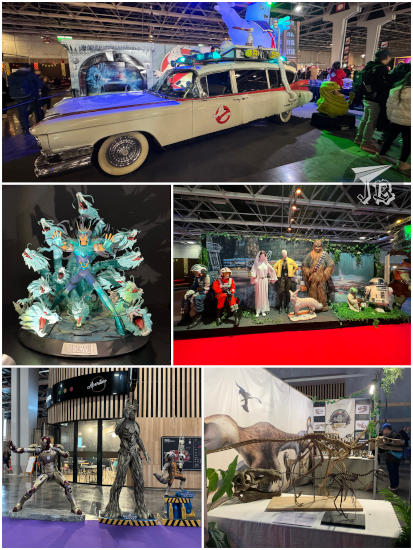
One of the most interesting vendors at Paris Fan Festival was the Lyon Cinema and Miniature Museum Musée Cinéma et Miniature, which had brought many sci-fi props from their permanent exhibition. They had the tip of a pyramid, a hieroglyph stone and a mask from the original Stargate film, ), a compsognathus animatronic, and the velociraptor claws from the Jurassic Park saga (), Loki’s mask from The Mask, a xenomorph head from Alien, suits from one of the older Batman films and Armageddon, prosthetics from X-Men

Samples of the Lyon Cinema and Miniature Museum at the Paris Fan Festival

As every other niche convention, were tons shops with merchandise, books and comics, not all of them legal. They held an exhibit of figures and statuettes. There were also a number of conferences – pity that the one about Jurassic Park was in French, too. Also, I discovered that France has a lot of “replica” culture – there was an actual “Imperial Army” (Star Wars), someone who had customised a car into the Ectomobile from Ghostbusters (2016), even people impersonating Tolkien’s orcs… It goes a little beyond cosplay… Supposedly, there was someone walking around with a dragon, but we did not run into them.

Paris Fan Festival snippets

Eventually, we left the convention to find our way to the hotel and drop the luggage, since comics are heavy, and Paris is on high alert and most places won’t let you through with backpacks. We wasted some time finding the hotel as it was raining cats and dogs – and they were remodelling, so the outer signal was not there. After check-in, we headed out again, and when we reached our next destination, it had literally stopped selling tickets – it was one hour and four minutes to closing time, and the recommended time is one hour and five minutes, so sadly, we could not get in.

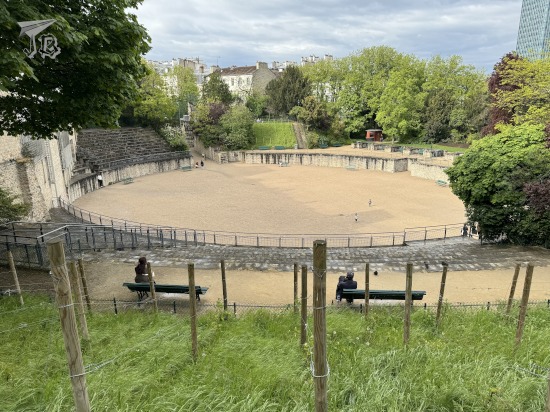
It was a bit disappointing, but we moved on towards Arènes de Lutèce. Lutetia (Lutèce) was the Latin name for Paris when it was part of the Roman Empire, and the amphitheatre is one of the most important remains from that period. Built during the first century CE, it would have seated 15,000 spectators. It was restored and open to the public at the end of the 19th century. Today, it is the centre of a park.

Lutetia Amphitheatre

After that, we took the underground towards the high-end department store Galeries Lafayette Paris Haussmann. In 1894, two Parisian businessmen opened a shop that would eventually become the biggest department store chain in Europe. Through the following decades, the businessmen bought buildings around the shop in order to grow their emporium. In 1907, architect Georges Chedanne carried out the first main renovation in the Art Déco style, and Ferdinand Chanut completed it with a Neo-Byzantine dome, built in 1912. Today, the galleries focus heavily on luxury products, and not that we could afford any, but I wanted to see the dome.

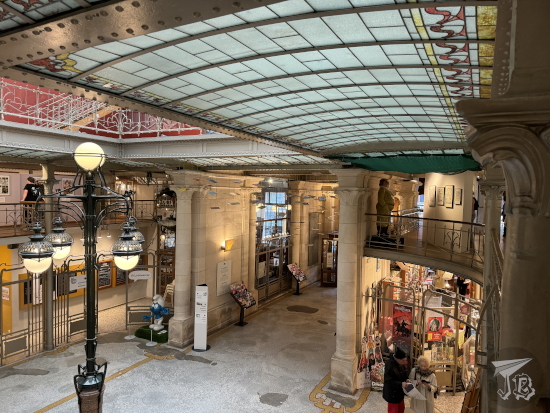
When we arrived, we snooped around – it was packed, full with high-end tourists, mostly Asians. The brands selling their products were the most expensive ones – from Chanel to Cartier. As we were admiring the dome, we saw there was a glass walk hanging from the balcony on the htird floor. Of course, we had to investigate. It was around 17:30. We found the end of the queue, and saw that there was a QR to reserve a spot. I was able to book us in for 19:20 – surprising, considering it was the same day, and access is free – maybe it was a language barrier or something? I’m not going to complain.

There was a nearby gallery I also wanted to see, Passage du Havre, a typical Parisian shopping passage. It was less impressive than the Lafayette, but also surprisingly cosy – as my sibling put it “the other guys have Chanel, they’ve got Sephora”. It had some nice decoration and quite a different crowd. Furthermore, we had been up since 4:00, and ate quite early, so when we found a Pret a Manger, we decided to buy dinner there.

Passage Du Havre escalators

We went back to Galeries Lafayette for our “Glasswalk” experience, and it was really, really cool. The staff were also impressively friendly and we enjoyed ourselves immensely for the whole… five minutes of it. I really loved the dome.

Upper floor of the Galerie Lafayette

We finally headed off towards Napoleon’s tomb, the Dôme des Invalides in the complex Hôtel des Invalides. Hôtel des Invalids was originally commissioned by Louis XIV in 1670 as a hospital for disabled soldiers. The church-and-chapel complex was designed by Jules Hardouin-Mansart in several iterations from 1676 on. The complex is considered one of the most iconic examples of the French absolute monarchy Baroque style. When Napoleon’s remains were repatriated in 1840, a state funeral was held, and a mausoleum projected in the crypt under the Dome. Construction of the grave extended until 1861, when the former Emperor was finally entombed there.

We were going to see the light mapping event Aura Invalides, a spin off of sorts from the display in the Notre-Dame Basilica in Montreal (Canada). The show highlights the history, architecture and meaning of the monument through light and orchestral music. The event lasts about 45 minutes, and it comprises three parts: First Movement: Creation, which focuses on the architecture of the monument; Second Movement: Collective Memory, through which you get to wander, seeing different effects in the chapels; and finally Third Movement: Universal Elevation, more spiritual and ethereal.

Projections inside the Invalides church

Les Invalides church by night

Afterwards, we headed towards the hotel to have a shower and sleep.

28th April 2024: No plans, really

After a nice breakfast at our hotel, we tried our luck at the Paris Fan Festival again. We got our drawings from Linda Šejić, but Stjepan Šejić had brought all the wrong markers and was not doing any more commissions. I offered my own pen, just to test the waters, and it was unfortunate that he did not take the bait.

Oh, well. You can’t win all the time. Instead of wallowing in our bad luck, we decided to get going and do something cool. For me that meant the park known as Jardin des Plantes, to visit two sites of the French Natural History Museum Muséum national d’Histoire naturelle. The day had started weirdly, with my underground ticket not working, but my sibling’s doing so. A lady who did not seem to enjoy being stuck at work Sunday morning waved us through without exchanging it. As the ticket was still not working when we left Paris Expo, another employee exchanged it.

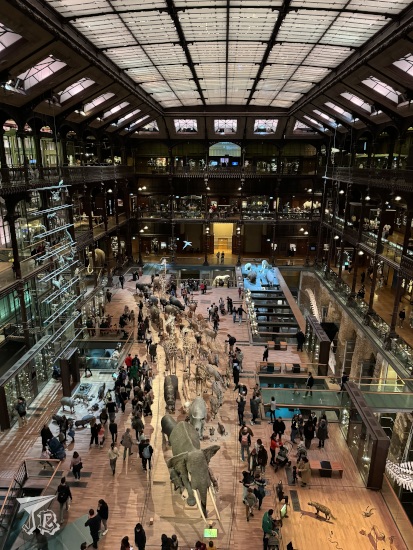
The first site we visited was the Great Gallery of Evolution, Grande Galerie de l’Évolution, the biggest site of the French Natural History Museum. It has four visitable levels – the upper balcony (third floor), focused on “Evolution of life”, the second floor “Impact of man in life”, and the first and ground floors that deal “Diversity of life” (terrestrial on the first, marine on the ground floor). The way it is arranged makes it, in my view, a companion to the Gallery of Compared Anatomy – (which I still like best, to be honest).

The collection finds its core in the disappeared Zoology Gallery, whose building dates back from 1877. Designed by architect Jules André, the interior was a cast-iron structure with a central nave and a skylight. Although the original project was never completed, the Galerie de Zoologie was inaugurated in 1889. It closed down in 1966 for restoration, although works were actually only carried out between 1991 and 1994. During this time, taxidermist also took care of about a thousand animals. Today, the gallery holds a cavalcade of savannah animals on the ground floor, and more conservative vitrines and glass cases on the upper floors. The museum still keeps the 19th century allure and entertaining aura – we did not go into any of the VR experiences, as they were sold out (and, you know, in French), so we did not see the more modern area of the museum.

Great Gallery of Evolution

We started off on the third floor and made our way down to the ground level. There were a ton of taxidermy animals, collections of insects and shells, even a wool one, and some bizarre specimens such as a tiger attacking an elephant with a chair on top… To be honest, though, I think it is more of a regular zoology gallery, just arranged in a surprising way. I found the evolution angle better developed at Brussel’s Natural History Museum. The classical design is extremely cool, though, and it would have given a great feeling had it not for all the free-range kids wildly running around…

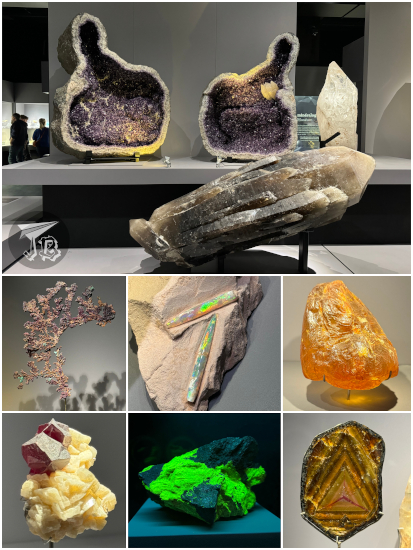
Afterwards, we headed off to the geology and mineralogy gallery, Galerie de Géologie et de Minéralogie, which had a really nice collection of gemstones, crystals and jewellery. And of course, fluorescent rocks which kept my attention for a very long while.

Mineral and geology gallery

It was almost lunchtime and we decided to head out towards a busier area to grab a bite. My Paris Visit ticket was not working again, and I exchanged it yet once more. I went through, but my sibling did not, so they had to wait in queue again to exchange that too. Apparently, I was keeping the tickets too close to my phone – even if it was the one without internet? I deemed my sibling responsible for the tickets from then on.

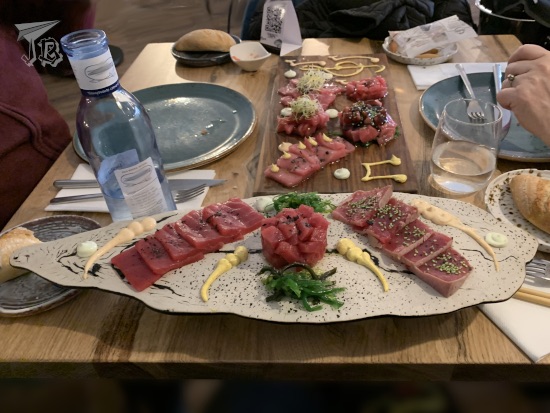
We stepped out at Palais Royal–Musée du Louvre, hoping there were places to eat, and we were right – there were a bunch of them along the street. The one that grabbed our attention was Café Brasserie Ragueneau, a small eatery close to the Louvre. There, I splurged on a Tartare de boeuf poêlé au foie gras (Pan-fried beef tartare with foie gras) just to be a snob. It was delicious. The foie gras version came slightly cooked, though the raw version would have been fantastic. Our waiters were extremely friendly too, and tolerated my poor French with a smile.

Pan-fried beef tartare with foie gras

After lunch, we walked to the last place on my list for the trip – the church Église Saint-Germain l’Auxerrois de Paris, which mixes elements of Romanesque, Flamboyant Gothic, Rayonnant, and Renaissance styles, though the tower – my favourite – was only added in 1860 as part of Baron Haussmann’s plan to reconstruct the city. The base of the church dates from the 12th century, and during the 14th and 15th centuries it was decorated with a balustrade by Jean Gaussel, multiple sculptures, and gargoyles. The interior is lighter than usual gothic churches, and there is a monumental set of carved wooden seats for the royal family. There are multiple windows with stained glass, although not all of them are the original Medieval ones, since they were destroyed during the French Revolution and replaced in the 19th century.

Church of Saint-Germain l’Auxerrois

The Louvre was not selling same-day tickets, so our idea to spend a couple of hours there went bust. Then, we decided to walk towards Île de la Cité to check on the cathedral’s progress, as it is supposed to reopen this year, when reconstruction from the 2019 fire has been completed. I wanted to check something called Tunnel des Tuileries, but I misunderstood – I thought it crossed underneath the Seine to get to the Isle of France; apparently I mixed it with a pedestrian tunnel under the Thames – it turned out to be a place of modern art, and it did not feel too safe. Thus, we continued under the sun, and reached the flower market Marché aux Fleurs Reine Elizabeth II.

We found out that a sort of stage has been built for visitors to sit in front of Notre Dame, and we saw a lot of people taking pictures of the pictures on the wall, which was a bit weird. We sat for a while, but not long because there was a guy singing really badly at the square.

Notre Dame under reconstruction

We went on and saw the park Square René Viviani, where the oldest tree in Paris stands. Next to the park is the church Église Saint-Julien le Pauvre and close to Église Saint-Séverin. We could not enter any of them, so instead we decided to sit down to have a coffee – in my case a “detox smoothie” because the orange-and-carrot blend reminded me of one in Japan I really like.

We finally set off to collect our things, and this is when I usually say I got home without an incident. Not this time. The public-transport tickets worked fine to get to the airport, we bought dinner and settled to wait. There was nothing much too strange, we were late – forty, forty-five minutes? I’m not sure, but not an obscene amount of time – the crew announced connections over the PA system, I thought that was nice of them. When we landed… I had a moment that I did not know where we were, which is strange, because the terminal is pretty straight forward. It turns out that in order for the travellers who had connections to South America to make it, we had landed at the Satellite Terminal, not the main building! Which meant over thirty minutes of “commute” back to the parking lot… I had taken a leeway of around an hour and a half after landing to get out, but we barely made it!!

A nice weekend to break out the routine, a lot of comics signed, and a lovely piece of artwork were achieved. Unfortunately, I caught a stupid, stupid cold, my first since the whole Covid thing started, and my immune system freaked out. It seems it’s back to facemasks on planes for me.

20th March 2024: Mundo Pixar (Madrid, Spain)

Due to some kind of weird… extended family thing, we ended up with some vouchers for Pixar World Spain Mundo Pixar, happening in IFEMA in Madrid. It would have been a pity to waste all of the tickets, so there we went, on a Wednesday morning, to at least redeem a couple of them. This immersive exhibit comprises several rooms with life-sized scenarios and characters based on Pixar films.

Mundo Pixar Madrid - outside

Pixar is an American animation studio which started off as part of the Lucasfilm computer division back in 1979. For over a decade, the group collaborated with graphic design and CGIas a third-party, until it was properly founded as an independent company in 1986. Pixar collaborated with Disney creating computer animations, and kept developing the technology, until it was finally able to pitch its first feature film to Disney – Toy Story, which was also the first-ever completely computer-animated film. Released for the 1995 Christmas season, it was a world-wide hit. Pixar became part of Disney in 2006.

The studio’s films have received 23 Academy Awards, eleven times for Best Animated Feature (a category added in 2001). One of the characteristics of Pixar films is their layering – though they are marketed as children’s entertainment, they tend to have a deeper, more adult-oriented subtext that… kids don’t even grasp. Something weird is that despite its successes, Pixar always seems on the brink of bankruptcy…

We had tickets for 11:00, and thought we had plenty of time until we got caught in a huge traffic jam due to a fair in another part of IFEMA. We had over 45 minutes of leeway, and ended up taking half an hour just to be able to get into the parking lot from the roundabout 650 metres away. That was wild.

We finally got into the queue around 10:50, and it took a while to get in. Mundo Pixar is organised in a U-shaped circuit, so that you can get round to the shop before or after seeing the exhibit. For a weekday, it was packed – not only by families, a bunch of random friend groups and tourists, too. Interesting.

We accessed through a tunnel to the first space, which is a bit of a self-promotion video mixed with the rules of the game – mostly, the one that people seemed unable to follow: do not touch. The immersive experience takes you to recreated scenarios from several films by the studio, to the slightest detail. The rooms are supposed to have different smells, but we only perceived a few. And of course, people kept touching.

Rooms 1 & 2: Up. This films tells the story of an old widower who goes on a last “adventure” to Paradise Falls, where his late wife would have loved to live. To do this he… floats his house away with thousands of balloons. He meets kid Russel and dog Dug. The rooms include a view of the whole house, and one of the interior. The living room is a perfect reconstruction of the one in the film, down to the pictures and the armchairs where Ellie and Carl sit, and the device Carl builds to steer the house while it flies.

Room 3: Monsters Inc.. This is a take on a widespread childhood obsession, the monster in the closet. In another dimension, energy is powered by the screams of frightened children from our world – thus, monsters sneak into kids’ rooms using magic doors to their wardrobes. Sully and Mike are the top-scary team until they run into a toddler who turns their lives upside down. The room has different bits from the film, including the scream factory doors and the two main characters waving awkwardly, recreating a scene where Mike and Sully are made to pose for a picture – I kinda expected them to move.

Pixar World Spain: Entrance, Up, Monster Inc.

Room 4: Toy Story. A bunch of toys which / who become sentient when they are not being played with get a new companion, who does not know he’s actually a toy. Enter a house-move, a bully neighbour, and a nasty dog. Chaos (and a trio of sequels) ensues. The fun part of this room is that it’s built so you see the room from one of the toys’ perspective, everything is high up, and the toys themselves are scaled.

Room 5: Elemental. This is a coming-of-age romantic comedy which focuses on overcoming differences. You walk into a train car with the two characters – a water element and a fire element, awkwardly sitting next to each other.

Room 6: Inside Out. In this coming-of-age comedy-drama, every person (and cat) has five basic feelings: Joy, Sadness, Anger, Disgust and Fear. They control a person’s life using a big console, and they collect “core memories” to help with their job. A young girl’s Joy and Sadness must learn to work together to overcome moving to another city. The room shows a perfect life-size reproduction of Sadness and Joy at the console and all the core memories.

Room 7: Ratatouille. This films follows the adventures and misadventures of the rat Remy, struggling to become a chef – to do this he hides in the hat of a young man and “guides” his cooking. The title is a pun between the word rat and a French recipe. The room is a huge kitchen, and you see Remy cooking inside a huge chef hat.

Pixar World Spain: Toy Story, Elemental, Inside Out, Ratatouille

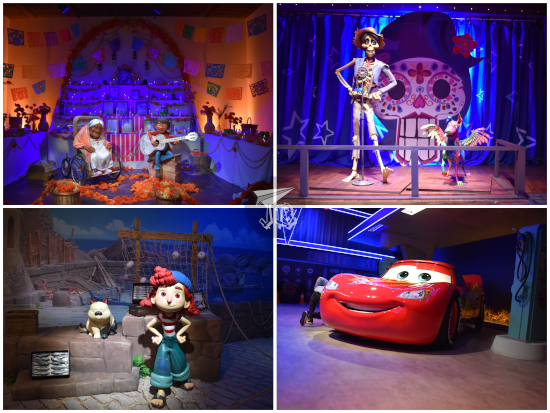
Room 8 & 9: Coco. Set around Mexico’s Day of the Dead (Día de los Muertos), this film sees a young boy, Miguel, explore his family roots and his love of music. The first room shows Miguel and his grandmother, and the second area holds skeleton Héctor, a dead musician who accompanies Miguel in his adventures.

Room 10: Luca. This film tells the story of two sea-monster children (Luca and Alberto) and a human child (Giulia), and deals with friendship and acceptance in the Italian Riviera in 1959. The room hosts the size-appropriate children, with Giulia – and her cat – getting the most prominent set.

Room 11: Cars. The film is set in a world populated only by anthropomorphic vehicles. Arrogant young racing car Lightning McQueen learns about humility, sportsmanship and friendship. There was a nice staff member taking pictures of visitors in this room, with the film’s main character.

Pixar World Spain: Coco, Luca and Cars

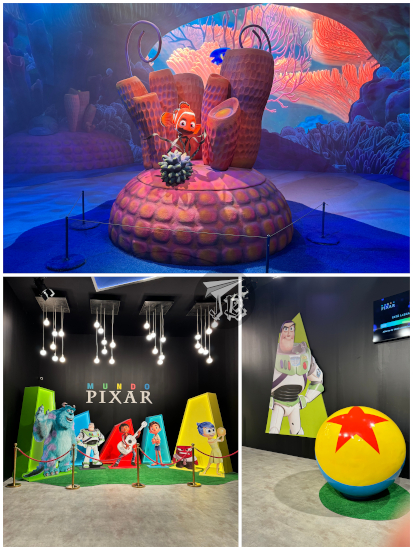
Room 12: Finding Nemo. Nemo is a little clownfish, the only survivor from a barracuda attack in which his overprotective father, Marlin, lost his wife and all their other fertilised eggs. When Nemo gets “fished”, Marlin embarks on a crazy journey to find him, meeting amnesic surgeon fish Dory, wannabe-vegetarian shark Bruce, and surfer turtle Crush. To be honest, finding Nemo in this room was easy. He was in the middle of it, surrounded by marine mist, with jellyfish and the rest of the characters on a screen behind him. I was severely disappointed there was no Bruce whatsoever in the room.

This was the last room; afterwards there was the shop, and a small photocall with a giant Luxo (a yellow bouncing ball with a blue band and a red star), back at the beginning. I am not sure this area actually counted as a room, because we were told there were thirteen rooms? No clue.

Pixar World Spain: Finding Nemo, photocall, Pixar ball

Fortunately, when we left, the traffic jam had dissipated. Unfortunately, I had to go work in the evening, which did not feel great. I obviously enjoyed the rooms dedicated of films I had watched (and liked) more than the others – I personally find the first ten minutes of Up heart-wrenching, but Finding Nemo was my favourite (both as a film and a room). I still uphold my protests about shark discrimination though!

9th March 2024: Minerals, fossils & trains (Madrid, Spain)

I might not be the most people-person ever, but if there is something that makes conventions extra fun, it is seeing attendees unapologetically geek out about what they love – in the case of Expominerales, that would be… rocks. Of course, this is an over-simplification. Expominerales is held yearly in the mine and energy engineering school Escuela Técnica Superior de Ingenieros de Minas y Energía (ETSIME) in Madrid. The year 2024 marks the 43rd edition of the event, which is considered one of the most important fairs in Spain in the topic of Earth Sciences – minerals, fossils, gems, and meteorites are widely available to the public. Aside from the small historical museum Museo Histórico-Minero Don Felipe de Borbón y Grecia, there were dozens of exhibitors with all kinds of items for sale, ranging from a few euro to several thousands. These year there were a few lectures, too, and coincidentally, the two of them I was most interested in happened on Saturday, one after the other.

I arrived at the ETSIME around 11:00, and I walked around the stands a couple of times. I have to say that I wanted everything, but I set a budget and I was able to stay around it, after shopping and lunch. At noon, I settled to listen to the lectures – one about the rehabilitation of an ancient gypsum mine in a hamlet called Hornillos de Cerrato, in the area of León. The other one versed about the uses of an already-rehabilitated one in the south of Spain, home to a huge geode. Both of them were pretty interesting, though the conference room was freezing. Someone had forgotten to turn on the heater there, it seemed…

Expominerales 2024 at ETSIME

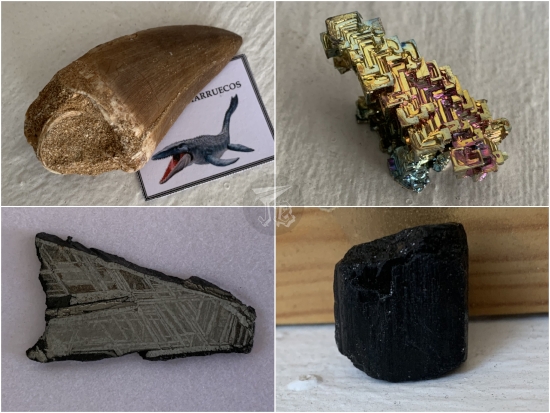
After the two conferences, I had a last round to buy a last thing, so in the end I bought an iron-meteorite pendant, a fossilised shark tooth pendant, a plesiosaur tooth, and a soil sample of the K–T boundary. A plesiosaur was a marine reptile with flippers, a short tail and a long neck. The K–T boundary (now named the Cretaceous–Palaeogene (K–Pg) boundary) is the theoretical layer of iridium-rich black sand that was formed by the meteorite that caused the extinction of non-avian dinosaurs – and basically most life at the time, in one of the great world-wide extinctions in the history of Earth.

Shopping from Expominerales

At 14:30, I had a reservation for lunch at a Japanese franchise called Ramen Shifu. While I had originally been looking forward to trying the ramen (and I got my hopes pumped up when I read that they were Hakata ramen style), the noodles were rather disappointing. Fortunately, the okonomiyaki – Japanese pizza of sorts, made with a base of cabbage and topped with sauce and bonito flakes, was all right. On top of everything, paying was stupidly difficult because they did not have change.

Shifu Ramen ponzano - okonomiyaki and ramen

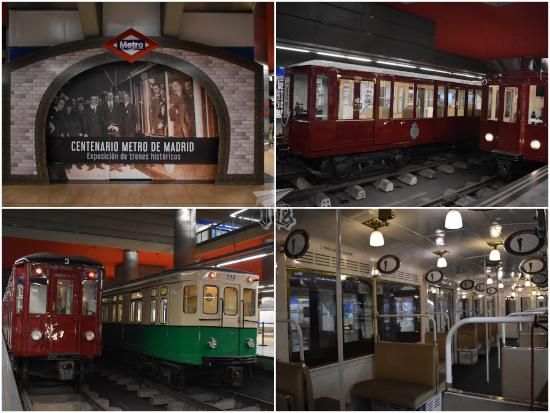
When I came out of the restaurant though, it was raining like crazy. I pulled out my umbrella and hopped towards the closest underground station, as my next destination was inside the metro system – one of the Underground’s museum network Museos de Metro de Madrid the collection of classic trains Estación de Chamartín: Exposición trenes históricos, inside the Chamartín stop. The exhibition displays four historical trains, restored from among the first ones that ran under the city, and some memorabilia. It was a bit underwhelming – more like false advertisement. I hoped I would be able to snoop inside the trains, since that was the photograph that opened the webpage, but unfortunately they were cordoned off. There was however a map with the works by Antonio Palacios in Madrid, which will become handy eventually.

Classical Train Exhibition Madrid

Afterwards, I just headed off towards the train station and got back home.

24th February 2024: Feria de las Mercaderías de San Matías 2024 (Tendilla, Spain)

Going to the Medieval Fair in Tendilla around the festivities of Saint Matthew’s Feria de las Mercaderías de San Matías seems to have become a tradition. Though they close off the village to traffic, I know the area well enough to know where to ditch the car so I can get in and out easily. Since last year, I’ve been driving in early on Saturday, before the scheduled events start so I can help out with the shopping for the day – there’s the tradition of cooking breadcrumbs, migas at my relatives’, and it’s a big meal, so we usually need to get some last-minute stuff.

The weather forecast was miserable – and there was the risk of a huge storm like the previous day, so this year there were fewer stands and visitors. That, in turn, meant I ran into many more acquaintances than usual, as it was harder to blend in…

After getting everything ready, we left the house around 11:30 to walk around the already-set stands and look at the communal migas. There was not much of interest on display. We walked into the women’s association ladies, giving out confectionery items, and we tried those. A bit after noon, the opening parade set off, with musicians, dancers and giant puppets.

Opening parade

Then we found a place at the edge of Main Square Plaza de la Constitución, to watch the equestrian show by the group Caballeros del Alarde, called Privilegio de Juan II de Castilla. It was very similar to the one they did in 2023 – they make sure that the square is covered in sand and prepare two U-shaped courses and they do different activities on the horses, trying to emulate a joust. At the end, they brought out a small hawk – which they called “fat” – so it got used to people. During the show there was a few minutes’ worth of hail, nothing serious. It was chilly all through the day, though.

Stuntment doing horseriding exercises

Afterwards, we went home to make lunch and we happily ate our migas – breadcrumbs seasoned with paprika and fried with garlic and minced chorizo, with a sunny-side-up fried egg on top. Some people like eating them with grapes or orange bits, but I just like them “plain”, so I ate the fruit later.

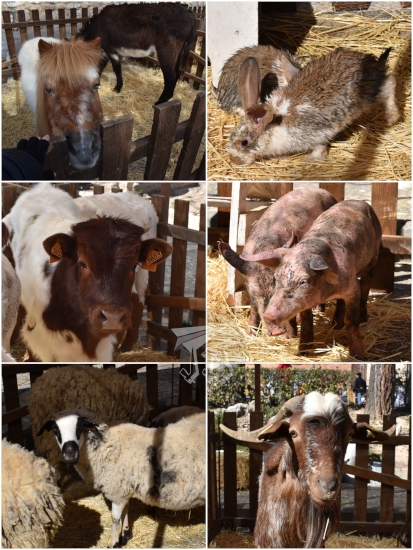
Once fed, family needed to entertain some guests and I made myself scarce. I headed out on my own, and I went to see the animals at the exhibit at Plaza de Vicente Mariño. It was still early and bright, so I decided to climb up to the ruined monastery Monasterio de Santa Ana. As spring was nearly upon the village, the almond trees were in bloom despite the cold, and it was really pretty.

Animals at the farm exhibit - A rabbit, a horse, an ox, a goat, two geese, a pig and a herd of sheep

Saint Anne's Monastery with flowers in the foreground

I went back home and we decided to show up to the “guided visit” that the town hall organised. Right now, this is the only way to see the recreation of a traditional house that has been built in the ethnography museum Museo etnográfico. It made me feel old, because there were a lot of things that I was used to seeing – and using – when I was a kid. However, the guide was… not too good. She even said things like “oh, I’m not rural, I wouldn’t know what that is” about some items.

Afterwards, we tried to find a good spot to watch the parade-show by the cultural group Asociación Gentes de Guadalajara, which started after dusk. They played the funeral parade for the Count of Tendilla Cortejo fúnebre con el catafalco de D. Íñigo López de Mendoza, I Conde de Tendilla. Born in the Mendoza family, one of the most powerful clans during the Castilian Middle Ages, he was a politician and warrior. The Count participated in the power struggle before Isabel I was proclaimed Queen of Castile. He died in 1479, and was originally buried in the monastery Monasterio de Santa Ana. Later, his tomb was relocated to Guadalajara, and eventually destroyed during the Civil War. The whole thing was very solemn, and we ended up catching the parade at three or four points. We even could catch part of it from the balcony at home as they turned to “bury” the Count in the church.

Burial of the Count of Tendilla

We went back to the square Plaza de la Constitución to watch the last show of the day – by now dark night. It was supposed to involve the Knights Templar arriving, and then dancers and jugglers, but apparently the Templars got lost. A lady danced with fire, and there was a scuffle with fire swords, but no knights. That was a bit of a bummer.

Jesters at the Medieval fair

Afterwards, I went to find my car and drive back before all the Sunday drivers finished having their dinner and left. I hoped that would mean fewer idiots on the road. Unfortunately though, I still could not avoid the stereotypical idiot using full-beam headlights behind me. It seems there is always one of those when I drive at night.

11th February 2024: The Parade of the Wood Dragon (Madrid, Spain)

Chinese New Year started on the 10th of February of the Gregorian (solar) calendar. Many East Asian countries follow a lunisolar calendar, in which the New Year falls on the second new moon after the winter solstice. In China, it is usually referred to as the Spring Festival, and outside it as Lunar New Year. For a while now, the Chinese diaspora in Madrid has been celebrating with a parade in the District of Usera, the so-called “Madrid Chinatown”, which will eventually have traditional gates and panda decorations in order to try to be developed as a tourist area. Since the parade was on a Sunday, I decided that I would attend.

The equivalent to 2024 is the Year of the Wood Dragon. The Chinese calendar uses a combination of twelve animals that conform the Zodiac (rat, ox, tiger, rabbit, dragon, snake, horse, goat, monkey, rooster, dog and pig) and the five elements of Feng Shui (wood, fire, earth, metal and water) to name the years. The dragon represents prosperity, authority and good fortune. The Wood Dragon brings abundance and improvident, so it seems to be a promising year!

Announcement of the Chinese New Year festival in Madrid

After keeping an eye on the ever-changing weather and rain predictions, I decided to bite the bullet and go, whatever happened. The parade was due to start at noon, and rain was to come a couple of hours later. I packed an umbrella, a waterproof bag inside my backpack, and my all-you-can-travel train pass. I picked up my sibling on the way.

We reached the district of Usera a bit after 11:00, with plenty of time until the start of the parade at noon. We found a street barrier and set positions, ready to wait out the cold until the parade started. I had read that it would last about three hours, but I thought that meant in total – since the first person went out at the beginning of the parade until the last person reached the end. I had never been to Usera before so I had no idea how long the streets were. In the end, the parade took about an hour and forty-five minutes to pass in front of the point where we were. There are a lot of Chinese associations! I do not really know if they were all based in Madrid, or if the Chinese diaspora of all of Spain had congregated for the occasion. And not only Chinese people marched – a lot of Spanish and Latin Americans did to.

The event was called Great Parade of the Chinese New Year of the Dragon Gran Pasacalle “Año Nuevo Chino Del Dragón”. It opened with a locomotive which “pulled” everyone behind it. There were people dressed as lions, others moving huge dragon puppets, dancers, musicians, martial artists, people in traditional clothing, acrobats, walkers on stilts… women, children, men, everyone seemed to be invited to the party. Each group got their introduction with a red banner, and lots of people carried either Chinese or Spanish flags. Some people handed out “dragon masks” for kids, and quite literally ignoring all the adults wanting one (I might have rescued one from the floor at the end of the parade). People in the parade waved and cheered Xīn nián kuài lè and Feliz Año Nuevo, “happy new year” in Chinese and Spanish. There were some drummers too, but most of the music came from portable little devices. An older lady kept telling everyone to hurry up.

Chinese New Year Parade Usera 2024

About half an hour in, my memory card ran out of space. I had been aware of that being a risk for a while, so I was carrying an extra one, which unfortunately was not compatible – I have no idea why. Luckily, I could use the phone for more pictures. The worst thing about the event was the presence of the “media” – I can understand the ones who were working / recording / interviewing. However, there were also a bunch of accredited people who were just in the way, chatting on their phones or doing nothing in the way of the parade – and of pictures.

Parade of the Chinese New Year 2024

All in all, it was spectacular. I loved the lions and the dragons, and I had to wonder how many dragons come out on a non-dragon year parade. Furthermore, everyone seemed to have such a good time!

Chinese New Year Parade Usera 2024

At the end of the parade there were a few South American organisations who also participated, probably because even if Usera seems to have many Chinese businesses, there are a few Peruvian and Bolivian restaurants. They seemed more Carnival-like anyway.

Chinese New Year Parade Usera 2024

After the parade had finished walking in front of us, we went to try to check the food trucks and the market at the end point of the parade. Unfortunately, everyone seemed to have had the same idea, and it was packed.

Instead, we found our way back to the underground and went off towards the centre. There we had a snack at one of the big malls, where I also bought a new SD card. I asked the assistant if the card would be compatible with my camera, he had to get another assistant, who had a bit of a waiting list. This second assistant said that my camera would not take a 128 GB card. I showed her the 128 GB card I had been using. She then asked to see the card which was not compatible. I showed her that one too. She said that it was not compatible because of the adaptors, but I pointed out that the cards had the same shape. Then she said that it was not compatible because “TDKs are too slow”. The card is a Philips. Anyway, she offered to let me try the new card to check it was compatible before buying it, which guarantees it works. I bought two, just in case.

Afterwards, we headed off to the shopping gallery Galería Canalejas. This is the new luxury shopping hub in town. The complex occupies almost a whole block, having joined as many as seven historical buildings into the same project – a Four Seasons hotel (the first in Spain), a parking lot, some private residences and the shopping gallery.

The original central building was commissioned by an American insurance company and built in 1887 by the architect José Grases Riera, who designed it in. The construction homed the Insurer’s headquarters, private residences, the former casino, and small shops on the street front. It was called Palacio de la Equitativa, uniting the word “Palace” with an approximate translation of the name of the insurer. In the 20th century, the building was bought by a bank company – and Spanish banks merged, re-merged, disappeared, until finally the building was sold to a private investor in 2012. The Neo-Renaissance and Neo-Baroque façade was carefully restored, along with the Art Decó stained-glass window on the ceiling. Also, under the direction of the architectural firm Estudio Lamela, some of the bank safes were recovered for decoration. The first shop in the gallery opened in 2020, and it seems that the Madrid tourism board started promoting the complex in 2023, following a strategy to drag “luxury vacation-makers” into town.

The gallery has three floors. The basement has been used for the food court. The ground and second floor hold a lot of security guards, since there are shops like Cartier, Louis Vuitton or Valentino… There is a café on the ground floor, amongst all the luxury shops. Behind it there is a staircase that connects all three floors (aside from the escalators on the sides).

The café Galería Canalejas Café offered afternoon tea, and I was even willing to try it despite the lack of scones. But it was cold and drizzling, and I had just discovered that they had afternoon tea the day before. We sat down and ordered.

Afternoon Tea at Galería Canalejas Café Madrid

The set included:

  • Café o té Coffee or tea. I chose a Japanese sencha, which was brought quite earlier than the snacks. It was really good, albeit a bit weak. I own up I had finished it almost completely by the time the food came out. I really think they should add some water to the mix.
  • Savoury snacks:
    • Mini sándwich chicken coronation. Coronation Chicken mini-sandwich in a salty waffer, made with a salty waffer.
    • Mini sándwich de mortadela trufada y queso Coloummier. Coloummier cheese and truffled sausage mini-sandwich, also in a salty waffer. I think they forgot the cheese in mine…
    • Quiché de espinacas y salmón. Salmon and spinach quiche with wasabi mayonnaise. This was the best, in my opinion.
    • Crep de hummus con vegetales. Hummus and vegetables crêpe. They actually forgot to bring this one out and did so later on.
  • Sweet snacks:
    • Bizcocho Valentía. A quite-heavy brioche with honey and lemon. It was nice, but I could have used a smaller size.
    • Mini churros con vainilla y chocolate. Tiny churros with vanilla and chocolate. The vanilla was actually whipped cream, but the powdered-sugar on the churros and the bitter chocolate made it a good combination.
  • Petit fours: We got three of these, but I have no idea which ones. According to the publicity, you chose them yourself, but they brought them on their own. They were tiny biscuits that felt really nice to finish off the tea.
    • Bombón Canalejas
    • Diamant Madagascar
    • Florentin aux amandes
    • Noisettine
    • Trufa de turrón

All in all, it felt a little wannabe pretentious, but the staff was extra nice, and allowed us to stay there for as long as we wanted. We left when I noticed that the turn over was slow and a queue had started forming. We snooped up and down the gallery for a while before we headed off. And of course, I totally missed my train connection – what else is new?

3rd February 2024: The Botarga Parade (Guadalajara, Spain)

There is no reason to doubt the folk / pre-Christian origins of Carnival (Shrovetide). Scholars trace it back to Greek Anthesteria to honour Dyonisius and the Roman Saturnalia – Romans liked adapting everything from everyone after all, especially if a party could be had. It might even be related to Imbolc, an ancient Irish festival celebrated halfway between Winter Solstice and Spring Equinox (similar to how Hallowe’en is the night between Autumn Equinox and Winter Solstice). In the European Middle Ages, it was around this time when people consumed all the meat they had from the winter slaughter before it went bad – and then they would have no “good” food for a while. This eventually led to the idea of fasting during Lent, when the Christian church decided to hijack the celebrations.

A lot of what we consider “Carnival” today can be traced back to Medieval Italy – it started the masquerade balls, dressing up, and the carnal parades. The most important event was the Carnival of Venice. From there, it spread into Europe and with the Spanish and Portuguese empires to the Caribbean and Latin America.

Going back to its origins, it seems clear that the celebrations were rooted in nature, especially the coming of spring. Just as Hallowe’en marks the beginning of winter, it is around Imbolc (Christians call it Candlemas, and celebrate it on the 2nd of February) that you start really noticing that the days have grown longer. They are about an hour longer than on the Winter Solstice – at Stonehenge, one of the most natural / mystical points in the world, sunset on the 2nd of February 2024 was at 16:59, while on the Winter Solstice it was 16:02. Like Hallowe’en brings out spirits and monsters, Inbolc starts conjuring spring and nature-related folklore “creatures”.

Looking at Europe, there seem to be a lot of analogous characters in Carnival traditions. The German characters Hooriger Bär (hairy bear) and Strohbär (straw bear) wear a… camouflage / leaves suit covering all its body which looks eerily similar to the English Whittlesea, the Polish niedźwiedź zapustny, the Italian Hermit (tree-man), or even the Slovenian Korant. When one looks at the Korant, it can be seen the “leaves” are actually fur (sheepskin to be precise), which would make it in turn similar to the Hungarian busós, horned and more animal-like. All these appear to represent a connection to nature, only enhanced by the German Hopfennarr, which looks like one would draw a spirit of spring. It would be easy to reach the conclusion that all these characters are indeed related to the advent of spring – both for plants and animals.

As Italy (and especially Venice) made carnival a thing in Medieval Europe, they “exported” the concept of costumes “done right” and “proper” masks. This influenced older characters, giving them a more similar look to the archetypes in the Commedia dell’arte, with colourful clothes and expressive masks. These are more generic, masked, characters as those found in Venice, though in this city every character has its own name and story.

Some of these characters – both newer masked and older nature-linked characters – seem to have their representatives in the current Spanish Carnival folklore. They seem to have been especially important in the centre of the country, more dependent on agriculture and nature cycles than those areas close to the sea. They were popular in the past, and switched from the pagan festival to the Christian one. They were stifled during Franco’s Dictatorship (with the ban on Carnival), and have been recently re-popularised by folklore enthusiasts – some of them have been “rescheduled” to more touristic times than around Carnival. It is considered that the origin of these characters lies in fertility rituals and symbols – such as the orange – and dances from pre-Roman Spain, with some authors daring to call them Neolithic.

I attended the parade Tradicional Desfile de Botargas in Guadalajara which gathered these characters from the town and several other villages in the province. The main and more general name of the characters in this area is botarga. However, there are different characters according to what they look like: botargas, vaquillones, diablos, mascaritas, chocolateros, danzantes, and mascarones. These characters and their recovered traditions were declared Intangible Cultural Asset in 2022. The parade was a big day when most of the characters in the region came together. The parade used to take place on a Thursday before, and it was changed to the Saturday before Carnival so more people could enjoy it.

The term botarga derives from the Italian bottarga, which refers to colourful clothes related to Medieval performances and the Commedia dell’arte (aside from fish roe). The original clothes seem to have taken their name from the 16th-century actor Stefanello Bottarga, who used to wear wide pants, and play one of the archetypical characters, the vecchi (old geezers or masters). Under the name “botarga”, the province has recovered (or reinvented) a few traditions, and up to 36 single characters and groups walked the parade in Guadalajara.

The proper botarga is a usually single character, who wears a mask and garish clothes in bright colours. The masks can be made of many materials, some of them even esparto. The botarga usually carries some kind of staff, and it chases the onlookers, and sometimes pokes them for luck or fertility. Vaquillas (heiferettes) and vaquillones (literally, big male heiferettes) are characters which cover their faces with sackcloth or a similar material; they carry horns, and often cowbells; they represent cattle and are sometimes accompanied by “shepherds” (with staffs – there is a pattern there). The danzantes are dancers, and Diablos means Devils, pretty self-explanatory – some of the latter also wear horns, and a few are covered in black soot, and enjoy “marking” the onlookers with black smudges. Mascaritas and Mascarones both derive from the word mask, and could be translated as “small masks” and “big masks”; the mascaritas are the most common character, usually women in traditional clothes covering their faces with plain white masks.. Finally, the chocolateros or chocolatiers offer the treat (which they… carry in a chamberpot) to whomever they meet – and if they are declined, they use it to “attack” their victim.

There is actually a project called The Botarga Route, with a calendar so one can see each botarga in the original village. Most come out between New Year’s Day and the end of February, but some have been “moved” to the main day of the summer festivals. The great thing about the parade I attended in Guadalajara was that it concentrated a lot of the region’s botargas and further characters, and one “guest” from another region – it was the Desfile de Botargas, Vaquillones, Diablos, Mascaritas, Chocolateros, Danzantes y Mascarones de la Provincia de Guadalajara.

Characters posing in front of Espacio TYCE Guadalajara

The host botarga, Botarga from Guadalajara (Botarga de Guadalajara) is a team of four. They chase teens and and lightly hit them when they catch them. They play a traditional Carnival game similar to bobbing-for-apples, alhiguí. A dry fig is hung from a sort-of fishing pole, and onlookers can try and catch the fruit – the trick is that one has to use their mouth, not their hands hands. Meanwhile the botargas sing “tothefig, tothefig, not with the hands, yes with the mouth” (alhiguí, alhiguí, con las manos, no, con la boca, sí). Originally, there was only one character that came out on the 17th of January and played alhiguí with the children around the church of Santiago – El Manda (the Order-giver). Later, two more were added – Los Mandaneros (the Order-receivers), and since the custom was recovered in 1998, a new character, Botarguilla (Little Botarga) carries the basket with the figs.

First, all the characters met at Espacio TYCE, then they marched down to the Main Square in front of the town hall Plaza Mayor for the Carnival opening speech, and back.

The host botarga opened the parade. Music was provided by three teams of musicians: Grupo Dulzaineros from Guadalajara, Dulzaineros Pico del Lobo (their main instrument being the dulzaina, an instrument similar to an oboe) and Gaiteros from Villaflores (pipers). Although the parade did not take long to devolve into a lot of chaotic fun, it was organised in three bodies – single botargas, couple botargas, and teams. The signs reading “individual”, “couples” and “teams” were carried by characters wearing full-body costumes that made them look like walking grass-made men. Since I know the town a little, could I watched the parade from three spots, short-cutting from the TYCE area to the square Plaza de Bejanque , and then to Main Street Calle Mayor. Then I walked along towards Plaza Mayor Main Square, where the botargas one by one, or group by group, came on stage as the character was explained.

Botargas de Guadalajara

Aside from the music, there was a very distinctive sound – a lot of the botargas carry cowbells on their belts. The local botargas that participated in the parade are (in alphabetical order of the village they come from, and how they were called onto the stage):

  • Botarga de Alarilla: Botarga from Alarilla. It comes out on the 1st of January to greet the new year and send the evil spirits away. When it is not scaring little kids or getting frisky with the single ladies, it gives out little satchels of nuts.
  • Botarga de Aleas: Botarga from Aleas. The character used to come out on the 3rd of January, now it comes out on the 15th of August, for the village’s festival. The botarga and a number of dancers go around asking for money and food – especially sweets and wine.
  • Botargas y Mascaritas de Almiruete: Botargas and Little Masks from Almiruete. They come out on Shrove Saturday. The botargas throw straw and the mascaritas confetti. There are three other characters – the bear, its trainer, and the heiferette.
  • Botarga de Cabanillas del Campo: Botarga from Cabanillas del Campo. The two characters come out on the 3rd of February, sounding bells and cowbells to bother people and summon spring.
  • Chocolateros de Cogolludo: Chocolatiers from Cogolludo. They come out on Ash Wednesday to tempt people to break the religious fast. They carry a chamberpot with creamy chocolate, and sponge cakes dipped in it. If they don’t manage to tempt the onlookers, they smear the chocolate on their faces.
  • Botarga de Fuencemillán: Botarga from Fuencemillán. On the closest Saturday to the 25th of January, it dances in front of the image of Saint Peter, and chases people to get rid of the bad spirits.
  • Vaquillas de Grajanejos: Vaquillas from Grajanejos. They look more like shepherds and farmers than actual cattle.
  • Botarga de Hita: Botarga from Hita. Though today the two characters come out during the town’s Medieval festival in July, they are clearly Carnival characters. They represent the struggles of personified Carnival and Lent – though they dress so similarly, I could not tell who’s who.
  • Botarga de Humanes: Botarga from Humanes. It comes out on the 1st of January and knocks on doors to wish a happy new year. It wears a colourful costume with 31 tinker bells and seven bells. It blocks entry to the church unless it is given a coin.
  • Diablo y Vaquillas de Luzaga: Devil and Heiferettes from Luzaga. Nowadays, they come out on Shrove Saturday. The heiferettes wear red capes, a mask of sackcloths, a hat, and carry bull horns. They toll the cowbells and chase the onlookers. The devil throws straw to symbolise riches and fertility.
  • Diablos y Mascaritas de Luzón: Devils and Little Masks from Luzón. The devils carry horns on their heads and cowbells on their waists. They paint their body black and use a piece of potato to feign huge teeth. They “attack” onlookers with a mixture of ash and oil. They are accompanied by the Little Masks, who are safe from their actions, wearing the typical clothing of the area and white face coverings. They come out on Shrove Saturday.
  • Botarga de Majaelrayo: Botarga from Majaelrayo. This is one of the characters that comes out “off season”, on the first weekend of September, though the original festival was the third Sunday of January. It is one of the few (if not the only) unmasked ones, and it leads traditional dancing on Sunday.
  • Botarga de Casados de Málaga del Fresno: Botarga of Married Couples from Málaga del Fresno. The original botarga came out on the first of January. It stopped for a while and when the tradition was picked up, the festival moved to the 24th of January, and two more masked characters, the mojigangas were added. The botarga carries a staff and a bag of candy and chases people who go and come out from mass.
  • Botarga de Mazuecos: Botarga from Mazuecos. On the 23rd of January, they chase the young and hit them with their poles.
  • Vaquillas de Membrillera: Heiferettes from Membrillera. They wear two tunics in different colours, a collar of bells, and horns on their waists. They come out on Shrove Saturday to chase the youth.
  • Botarga de Mohernando: Botarga from Mohernando. This duo of botarga and buffoon come out on the closest Sunday to the 20th of January. Though they participate on the religious activities in a serious fashion, they chase kids and teens, and play pranks.
  • Botarga de Montarrón: Botarga from Montarrón. It comes out around the 20th of January, and panhandles through the village for food and drink that is later consumed by the inhabitants. It is one of the few botargas to attend mass, leaving its bells and mask outside.
  • Botarga de Muduex: Botarga from Muduex. This botarga has just been recovered, so it is writing its own tradition. It will come out on the local festival in July.
  • Botarga de Peñalver: Botarga from Peñalver. It chases young men and if it caches them, it will ask them a question, and only let them go if it likes the answer. It comes out the first Sunday after the 3rd of February.
  • Botarga de Puebla de Beleña: Botarga from Puebla de Beleña. This horned character takes part in the religious ceremonies to honour Saint Blaise (3rd of January) and chases people to hit them with its staff. He also knocks on doors and makes its cowbells toll to call people to mass.
  • Botarga de Razbona: Botarga from Razbona. Considered a symbol of prosperity and fertility, it comes out on the closest Saturday to the 25th of January. It picks up donations for charity and cultural acts. It used to attack people who did not cooperate with ash, now it gives out candy for those who donate. However, as it is regarded as a pagan character, it won’t step into the church.
  • Botarga de Retiendas: Botarga from Retiendas. It comes out on the closest Sunday to Candlemas. It dances and chases people to the beat of a drum, and takes part in the religious ceremonies.
  • Vaquilla de Riba de Saelices: Heiferette from Riba de Saelices. It comes out on Carnival Saturday (though originally it was Shrove Tuesday), charging people and getting mock-stabbed in return.
  • Vaquilla de Ribarredonda: Heiferette from Ribarredonda. The heiferette comes out on Shrove Sunday, tolling its cowbells. In the village, shepherds who cover their faces with sackcloth masks keep it in check with their staffs – the person playing the heiferette wears a helmet for protection.
  • Botarga de Casados de Robledillo de Mohernando: Botarga of Married Couples from Robledillo de Mohernando. It comes out on the 1st of January and enters the houses to wish a happy new year and wake people up with tolls and chimes from the bells it carries.
  • Botarga Infantil de Robledillo de Mohernando: Child Botarga from Robledillo de Mohernando. The only child group in the area, they come out on the closest Sunday to the 24th of January. There is a child botarga, musicians and basket-carriers. They don’t wear masks and they perform traditional dances.
  • Vaquillones de Robledillo de Mohernando: Big-Male-Usherettes from Robledillo de Mohernando. Completely clad in sackcloths and carrying horns and cowbells, they charge the onlookers on Shrove Saturday.
  • Botarga de Romanones: Botarga from Romanones. They come out on the last Saturday before Carnival (which was technically the day of the parade so… not sure when). The Little Masks throw confetti or flour at the ladies. They are accompanied by a shepherd and a bull – the bull is “fought and killed” a few times, as it can come back to life with a sip of “magic wine”.
  • Botarga de Salmerón: Botarga from Salmerón. A group of Little Masks comes out on Shrove Saturday. They throw confetti as a fertility charm. A botarga, Tío Alhiguí (Uncle Tothefig) comes with them to play the game with children.
  • Botarga de Taracena: Botarga from Taracena. It comes out on the 23rd of January. Alongside musicians, it walks through the town streets, chasing people towards the church.
  • Botarga de Tórtola de Henares: Botarga from Tórtola de Henares. It comes out in the morning of Christmas Eve, knocking on doors for food. It also comes out on the 6th of January and, along the Little Masks, during Carnival.
  • Botarga y Danzantes del Santo Niño de Valdenuño Fernández: Botarga and Danzantes of the Holy Child from Valdenuño Fernández. They come out the first Sunday after the 6th of January. There are records that a child got lost in 1721 everyone in the village looked for him. The botarga and the dancers recreate this event, and dance in exchange of oranges. One of the dances, the paloteo, involves the group of eight dancers clashing batons with each other.
  • Botarga de Valdesaz: Botargas from Valdesaz. This group chases each other and onlookers on Shrove Saturday.
  • Vaquillones de Villares de Jadraque: Big-Male-Usherettes from Villares de Jadraque. They come out on Shrove Saturday, wearing orange capes, horns and a hat, chasing anyone they come across.
  • Botarga de Villaseca de Uceda: Botarga from Villaseca de Uceda. Recovered in 2023, this botarga comes out the first Saturday after the Epiphany. Its design is modern, and it has mane-looking hair.
  • Botarga de Yélamos de Abajo: Botarga from Yélamos de Abajo. It is the only botarga that comes out during Holy Week (Easter) – but it actually looks a bit like a devil. On Spy Wednesday, villagers light a bonfire in front of the church, and summon the botarga with rattles. The botarga uses the bonfire to light its broom, and dances until the broom goes out. On Holy Thursday the botarga is summoned again, and asks for money. The money-giver says a prayer, the botarga kneels and a coin is inserted in the money-box hidden in the botarga’s hump. On Black Saturday, a dummy botarga is burnt in the bonfire.

Botargas from different villages

Vaquillones de Villares de Jadraque

Furthermore, the four botargas from Guadalajara walked (and ran) after the kids and teenagers at the head of the parade. The Mascarones (Big Masks) from Guadalajara – a cultural association which has worked really hard on the recovery of the botargas – were clad in colourful rags – a lot of them were accompanied by their kids and toddlers in marching suits, with the children handing out candy to both enthusiastic and terrified onlooking kids. The botarga from Muduex, just recovered, received a lot of attention. The kids who were part of the parade often went to give child onlookers candy.

Every year there is a “guest botarga” in the parade. In 2024, the guests are the Hamarrachos de Navalacruz, a group of very druidic-like characters, preceded by their very own flagpole. Navalacruz is a village in the Ávila region, and they have a whole party of creatures – three types: the ones covered in oak leaves, the ones covered in a hay sack, and the ones covered in fur. They seem to represent ancient winter spirits (big Hogfather vibes).

Hamarrachos de Navalcruz Characters

Funnily enough, I was “attacked” three times – twice by the Devils from Luzón Diablos de Luzón. They paint their bodies black and carry cowbells on their belts, horns on their heads and big teeth made from potatoes – they painted my forehead and jawline black in two different occasions. Another time, one of the Vaquillones from Robledillo de Mohernando Vaquillones de Robledillo de Mohernando mock-charged at me. I startled and he was mortified. But it was all good. Oh, and at some other point one of the Mascaritas dumped a handful of confetti on me – I had found a great spot to take pictures: right in front of a potted plant on main street. I was not in the way, since they had to ditch the plant, but I could take pictures of the characters up front.

Botargaas Parade, different characters

Once the parade made it to Main Square, they were called by groups onto the stage. The child botarga did a little dance to show off their skills. The most impressive moment on that stage came with the exhibition of the Dancers of the Holy Child Danzantes del Santo Niño de Valdenuño Fernández. They carry batons that they use when they dance, slamming them against the batons that others carry in a very impressive display of coordination.

Botargas on the stage

Danzantes del Santo Niño clashing batons

The speech of the major had nothing of interest, just the usual political stuff. Mementos were handed to the recovered botarga, and the guests, and then came the Proclamation to open up the Carnival period. The speaker was someone I’ve never heard of – Pepe Sanz, president of a local Vespa and Lambretta motorbikes club. I think.

Unfortunately, as I had been following the parade, I had a horrible spot in Main Square, I could not see the stage at all – but I could use my phone above my head for pictures and videos, while the people in front of me blocked the barriers and played with their phones. I can’t even. After all the speeches, welcoming the Carnival and so on, all the botargas and characters headed back to where came from. I did not stay for the backtracking, because it was cold and it was time to get back home.

16th December 2023: A day out of ExpoGema (Madrid, Spain)

Since the mineral expo ExpoMinerales back in February was all cool and fun, I decided to attend its shinier (and unbeknownst to me, way more unaffordable) sibling, the gem expo ExpoGema, and make a day out of it. Thus, I headed out for Madrid on the 9:00 train with temperatures below zero – I was not made for winter. It was not much better when I arrived, but for once the train ride was uneventful, I actually made my connection, and it seems that after a chaotic year, the underground train tunnels are finally open. Everything going smoothly gave me some unexpected 45 minutes to wander around as the square Puerta del Sol slowly became fuller and fuller with people.

I had booked a guided visit through the company Madrid en Ruta, who has the exclusive concession to show the business centre Casa Comercial Palazuelo. Located in downtown Madrid, it was designed by architect Antonio Palacios. The promoter, Demetrio Palazuelo, bought the lot left behind by a fire, and commissioned the building with the goal of renting it out to shops and professionals – it was thus the first office building in Spain conceived as such, and not repurposed from a manor or an apartment building. Palacios drew inspiration from the Chicago School commercial architecture and used iron to stabilise the building, which allowed him for bright interiors using lots of glass. The office building was erected between 1919 and 1921, and the offices are still rented out today, with the only caveat that the beautiful interior translucent-glass doors have been painted white – to either protect privacy or hide the fact that today the house seems to be almost empty – at least according to the building’s own directory.

The exterior façade could be considered eclectic – the main frame tends to neoclassicism with huge glass windows framed in black iron. The interior tends towards Art Deco and modernism. The offices are distributed around a central indoor patio, with curved balconies that overlook it and lots of lights mainly due to the skylight. There are two classical lifts which are the original ones, in peartree wood. When we went up, I took the stairs, which have white treads, and the riser is made out dark green ceramics. I have seen these in other works by Antonio Palacios.. The interior, with the iron balustrades and its curvy design, was really cool, but I think it is really a pity they painted over the glass.

Interior of Casa Palazuelo

The visit started at 11:00. We spent the first fifteen minutes outside getting context, roughly half an hour inside, and the last twenty minutes on the roof of the building, waiting for the clock of the Puerta del Sol to strike 12:00, then we were ushered out. I really wish we could have wandered the house a little bit, even if we could not go into the offices. The ten euro we paid surely did not feel like we were paying customers, but more like we were sneaking around like unwanted guests – which we probably were anyway.

Puerta del Sol from the roof of Casa Palazuelo

I grabbed a quick snack then and headed off towards the engineering school Escuela Técnica Superior de Ingenieros de Minas y Energía (ETSIME) for the sixth edition of the gem fair ExpoGema. The fair itself was neat, but most everything was way above my budget range. I was there at the typical Spanish lunchtime, there were few people, and most were at the stands. Thus, I had the museum Museo Histórico-Minero Don Felipe de Borbón y Grecia almost completely to myself. I really like old-style museums, and this one has a huge amount of specimens, most of them are minerals, but there are also fossils and a collection of cave bear skulls and bones. I had decided not to book any guided visit or activity as none happened within the couple of hours of lunch downtime.

Geology Museum at Etsime

I bought an ammonite pendant, a small pyrite with almost perfect right angles, and another pendant made with a small meteorite from Campo del Cielo, along with a tiny extra piece. Campo del Cielo is an area in Argentina where four or five thousand years ago an iron meteorite fell. The meteorite shattered upon entering the atmosphere and, when it impacted the surface, the different created up to 26 craters. About 100 short tonnes of a fragmented iron meteorite have been recovered to date, and I now own around four grammes of it – yay me. I did not buy any precious stone though since the pretty shiny rocks were way out of my budget.

Expogema 2023

I left the ETSIME and I walked towards the square Plaza Pablo Ruiz Picasso, where there is a temporary art installation called El Regalo (The present) by Amigo&Amigo, a studio specialising in art installations. The artwork comprises a few arches that end in pads that can be stepped on – when they are, music sounds. The day was still bright, so the artwork was not shining, but a bunch of kids jumped on the pads to keep the music playing.

El Regalo artwork

Afterwards, I took a train and headed off towards central Madrid again. I had a reservation for an afternoon tea at NuBel, an “avant-garde gastronomy space” in the modern art museum Museo Reina Sofía. I had been drawn to the place due to the “freshly-baked scones” they advertised.

The experience was beyond disappointing. First, I had to wait to get seated, but then the person who checked me in forgot to notify that I was there – this is what I assume happened, I was literally told that “the kitchen had forgotten about me”. The set menu took 40 minutes to come out, and the scone was cold anyway, so not even freshly-made. I had got a decaf latte that was also cold when the food came.

The menu, 16€ as I don’t drink alcohol, consisted of: two mini-sandwiches – the two of them had been made from the same bread slice, so you can imagine the size, with some kind of mayonnaise filling which was not bad but rather unidentifiable; one shot-sized glass of (pre-made) gazpacho; one scone; a piece of red velvet cake; a piece of carrot cake; one chocolate brownie; a side of cheese cream, butter and jam; and in my case the already-stone cold decaf latte.

Nubel afternoon Tea

The scone was cold – so much for freshly-made, the only thing that had kept me waiting. Furthermore, the cheese cream, albeit nice, did not fit it like at all, so I had to use butter on it. I laughed to myself thinking about “the horror!” while I clutched my metaphorical pearls. The red velvet was probably the best, but in general the cakes were too sweet – good thing the menu included free tap water. Afterwards, I was comped another free decaf as an “apology for the delay”. However, when I tried to pay, more drama ensued. First the card-reading machine was not working, then they could not take cash because they were balancing the register, then they could bring the machine to the table. All in all, I spent almost hour and a half there – about five minutes waiting to be seated, forty minutes waiting for the tea set, and twenty minutes trying to pay. I’m sorry to say I did not tip, nor do I plan to ever come back.

I missed my train due to the paying delay, and I had to wait almost half an hour for another one. I hung out the Christmas market for a bit, and looked at the lights around Puerta de Atocha station. As it was cold, I walked in and went to check out the original train station, now turned botanical garden. I had never stopped to look at the iron ceiling, just at the plants – and the tortoises people used to dump there – but there had been an old photograph during the Casa Palazuelo visit that made me want to look at the building itself, and I recognised that old station in today’s building, with its wrung iron columns. Funny, how you can look at the same old things and recognise them.

11th & 12th September 2023: 23h 45min in London (England) for Yoshiki’s “Under the Sky”

Considering that Japanese musician Yoshiki recently got his hand- and footprints enshrined at the TCL Chinese Theatre in Hollywood, I guess he’s not one of my obscure artists any more. Yoshiki is a Japanese drummer and classically-trained pianist who, alongside vocalist ToshI, founded the band X Japan in 1982. They started as a heavy metal band, and eventually shifted over towards progressive rock. Their flashy looks probably gave way to what is now called Visual Kei (V-kei) [V系], though they had dropped them in the mid 1990s, before they disbanded when vocalist ToshI left the band basically to join a cult. In 2007, X Japan reunited.

Yoshiki, born Hayashi Yoshiki [林 佳樹], is considered one of the most influential Japanese artists of all times. Aside from a musician, he is also a songwriter, composer, producer, and fashion designer. He collaborated with Stan Lee for a special four-issue comic collection called Blood Red Dragon, and with international musicians and bands such as Bono (U2), Roger Taylor and Brian May (Queen), KISS, and Sarah Brightman. He composed the theme of the 2013 Golden Globe Awards, worked on the soundtrack of Saw IV, and has composed music for anime such as Saint Seiya and Attack on Titan. Within Japan, aside from tons of collaborations and solo works, he became “mainstream” when he played a concert to honour former Emperor Akihito upon the tenth anniversary of his enthronement in 1999. He also has a Hello Kitty line named and modelled after him, Yoshikitty. And I’ve been using one of his songs as my alarm clock since roughly 2010 (since 2015 it is Born to be free).

Back in 2017, Yoshiki hosted a Q&A in several cities throughout the world, including Vienna (Austria) for special showings of his documentary film on X Japan. The documentary should have premiered in the scheduled March 2016 concert, but when that was postponed, the film went on to be shown at different events festival. When I went to Vienna, I had already travelled to see it in X Japan concert in London and the Beefeater In-Edit festival in Barcelona (and owned the blu-ray).

In 2020, as the Covid-pandemic lockdowns eased up, Yoshiki organised an online concert on a bunch of rooftops, connecting with different artists and having others over, to celebrate his birthday on the 20th of November . Now, he has made a documentary out of the event, called Yoshiki: Under the Sky, which has “premiered” four times, the third of them in London on 11th September 2023. As the London announcement only came mid-August, it was a challenge to get everything running, but I managed to find doable flights and a hotel near the venue. I was able to buy a second-row seat for the cinema, which was pretty good too.

On the 11th of September, trying not to reflect too much on the date, I left the house around 5:00, and right as I merged into the motorway, it started pouring. There was more traffic than usual because the plane was an hour later, but I managed to make it to the airport a bit before the time I had booked to enter the parking lot – yay accuracy. I went through security and passport control without issues, and had to walk to the end of the terminal for my flight, which was also uneventful. Upon landing at London Stansted Airport, we had to wait for a bus because the escalators were broken or something, but I was outside around 9:30. I bought breakfast at Costa Coffee, and settled to wait for a friend I had met in Vienna, A****d. Her flight was due half an hour after mine, so we had decided to hang out for the day. She agreed to tag along to the Natural History Museum – I wanted to go back to the the Jurassic Park 30th Anniversary #NHMxJURASSIC store before it closes down at the end of the month. I really really wanted the rubber ducky cosplaying as a velociraptor, but I feared that if I got that one, I would end wanting to collect rubber duckies… I bought get a limited-edition “opening weekend ticket”, which had been out of my budget on my previous visit, and a titanosaur coin that I had not seen when I visited the exhibit.

A****d had never been to the museum, so we took a tour of the highlights – dinosaurs (of course) and other fossils, the “journey inside the earth” (escalator that goes into the inner core of the planet), the historical building, and Cadogan gallery… Unfortunately, the hall of mammals had recently closed for renovations, so we could not visit that one.

Natural History Museum London

Afterwards, we took the underground and got off at Leicester Square to have a late lunch in Chinatown. We found a little place for lunch. I ordered some rice and duck, which was nice but the duck had a lot of shattered bones. We looked for a place she had known that sold ice cream taiyaki, but sadly we did not find it.

London Chinatown

We located the cinema where the film was showing, Odeon London Covent Garden, but there was nothing going on yet, there was not even a poster announcing the film. After taking pictures, we continued down the block to snoop around the Forbidden Planet London Megastore, one of the biggest comic, manga and related merchandise shops in the world. Luckily, they had few things I wanted badly, and the ones they did were stupidly expensive, so I was able to get away with all my money, yay me!

A****d had decided that she would go back to the airport after the film, but I had taken a hotel a few minutes away from the cinema, right in front of the university and a few minutes away from the British Museum. I dropped by to check in, then we backtracked to Leicester Square as the museum was already closing for the day at 17:00. As we walked by the cinema, they were setting a poster for Under the Sky outside.

We decided to do something a bit silly and headed off to the The LEGO Store Leicester Square, two stories dedicated to selling LEGOs, either in sets, or just blocks. There are also different decorations – for photo-ops – made with oversized blocks, which include Shakespeare in the park, a Bobby, a Buckingham palace guard, a whole Aston-Martin with a Bond sculpture – you can actually go into the car – and lots and lots of Harry Potter. It was a bit disconcerting that they were already displaying Christmas sets!

Lego Shop London

Then, we crossed the street for the M&M’S Store London, which has four floors. The ground one has a recreation of the Beatles crossing Abbey Road, with M&M’S. There was a logo asking “which M&M’S colour are you?” which I thought was a little silly, until I found the orange M&M’S section, whose motto seems to be “I’m scared of what might happen if I relax”. I connected immediately. Next time over I should totally buy a mug or something. Also, there was no Christmas decoration yet, as they were preparing for Halloween. Oh, and they were looking for staff, offering “London liveable wages”.

M&Ms Shop London

We came out and it was 18:00, the Swiss glockenspiel at Leicester Square was chiming. The glockenspiel is a Swiss-themed clock which was built in the 1960s as part of the Swiss Centre, a ploy to drag rich British tourists to the country. The centre failed, and the clock was taken away, but it was eventually restored to the area in 2011. I could have sworn it was playing Poncelli’s Dance of the Hours?

Swiss Clock Leicester Square

Leicester Square is built around a sculpture of Willian Shakespeare, and the gardens around him hold a number of statues dedicated to cinema, Scenes in the Square. We spotted Mary Poppins, Don Lockwood (Gene Kelly’s character in Singin’ in the Rain), Charles Chaplin, Paddington Bear, Harry Potter, and an Indiana Jones which is supposed to be temporary. Apparently, there are a few more I should be checking out for, but that’s okay because I’ll be coming back to Chinatown eventually, and it’s just a few blocks away.

Statues of cinema figures in Leicester Square + Willian Shakespeare

We headed back towards the Odeon London Covent Garden cinema, and we reached there around 18:20. Another poster had been put up, and some fans were already waiting. We met another friend of hers, M**, who told us she had found a sitting area inside, so we sat and chatted away for about an hour. The staff was extremely friendly and did not peep a word of complain, even if we did not buy anything.

Yoshiki Under The Sky at Odeon Covent Garden London

Finally, we were allowed into Screen 2 and found our seats. I lost count of how many people tried to get away with ignoring the seating numbers. Nobody did. I had a second-row seat, pretty centred. The film was introduced by some film producer who explained what we were going to see as if we had just accidentally wandered into the cinema.

There was supposed to be a trailer for Yoshiki’s upcoming concert in October, which was not shown. We had a few in-house adverts before the documentary started. Through the film, Yoshiki talked a little about the power of music, and how he had come together with all these great musicians to create a world-class event, very Covid-compliant. All the songs featured were either composed by Yoshiki himself, or had been arranged by him in some way. Perched on an LA rooftop, he mostly played piano, but occasionally he donned the drums.

The narrating thread of the whole film is life. Yoshiki was a sickly child, and his father committed suicide when he was ten years old, so he grew up with the idea of death deeply ingrained in his brain. As the film goes on, he speaks about how music can bring people together, and how it is important to find the strength to go on. Halfway through the film, he talks about recently losing his mother and how he cried for days. At some point a voice is introduced. It is a regular John Doe who once reached out to Yoshiki on Twitter as his dying wife had just entered palliative care. The man asked for some encouragement for her, and he got it, from Yoshiki and a lot of the fans, until she passed away. There was a heart-wrenching Zoom call with the man, who spoke about how overwhelmed he was by all the support he received. Unfortunately, she passed away.

The documentary runs for an hour and a half, and it’s a mixture of the Yoshiki’s thoughts, the performances alongside different artists, each in their corner (or rooftop) of the world, and a bit of conversation with them, or a making-of. I was familiar with most of the featured musicians, but not all.

Sarah Brightman: Miracle. Sarah Brightman has had an extremely long career and is an excellent soprano – my first memory of her dates back to the 1992 Olympics. She collaborated with Yoshiki on Miracle in 2018. I was really sorry I was not able to go to any of her performances back then.

Jane Zhang: Hero. The original version of Hero was sung by Katie Fitzgerald for the soundtrack of Saint Seiya: Legend of Sanctuary. Though Saint Seiya was my favourite anime as a kid, I had wandered away from it. The song featured in the film actually made me want to go to see it, and eventually dragged me back into the world. Zhang did a good job, but I personally prefer Fitzgerald’s version.

SixTONES: Imitation Rain. As a music producer, Yoshiki must have realised a bit ago that the Japanese boy-band panorama was dire. For long years, the boy-idol company Johnny’s Entertaining (JE) had dominated the business, with bands as SMAP or Arashi. However, an extremely protectionist policy and the open secret that the director had sexually abused some of the boys, lead to the company losing power. I have no doubt that this is why Yoshiki decided to create and produce a boy-band, and thus looked for the six young men that comprise SixTONES. Having followed some of JE’s bands back in the day, I can see how they would tap into the niche (serious flashbacks to KAT-TUN circa 2005, to be honest).

Scorpions: Wind Of Change. Formed in 1965, Scorpions paved the way for a great deal of the big names in 1980s hard rock such as Guns N’Roses, Mötley Crüe, Helloween, Megadeth… And Yoshiki is a little fanboy of theirs, of course.

Sugizo: La Venus. Sugizo is one of X Japan’s members, who took over guitar duties after they reunited. While the band was separated, original guitarist Hide died in “mysterious circumstances” – either accidentally or by suicide. For a long time, Yoshiki claimed that Hide’s death was an accident, and on this film he for the first time acknowledges otherwise. Thus, Hide was the second person in Yoshiki’s circle to take his own life. Sugizo, who also plays violin and is a member of an insane number of bands, including LunaSea, is credited by Yoshiki as the reason X Japan could come back together, which made him very embarrassed. They played a rendition of La Venus without lyrics, with Sugizo on violin.

Hyde: Red Swan. Hyde is without a doubt one of the best rock vocalists in Japan. He was originally the voice of L’Arc~en~Ciel, when they were still a thing. He worked alone for a few years, then he and KAZ founded VAMPS, and finally he went solo again. Red Swan was a collaboration between Yoshiki and Hyde for the anime Attack on Titan!, released as “Yoshiki feat. Hyde”. Yoshiki explained how the red swan represents rising even covered in blood. After this collaboration, there was a second single, released as “Hyde feat. Yoshiki” with the song Zipang, in English and Japanese, which I personally find even more powerful. The significance of Red Swan in Under the Sky comes from how many versions there are on YouTube, especially as anime songs tend to be translated. Thus, it ties in with the concept of coming together through music.

St. Vincent: New York. St. Vincent is known for her clear voice and her complex arrangements, with lots of instruments playing a part. She is considered one of the best guitarist in the 21st century. Yoshiki arranged her song New York for piano and vocals, which made it extremely powerful. All LA artists were invited to sing on Yoshiki’s rooftop, as it would have reduced the logistics involved.

Nicole Scherzinger: I’ll be your love. Scherzinger was the lead singer of the Pussycat Dolls between 2003 and 2009, but before that she had already performed with Yoshiki with this very same song.

The Chainsmokers: Closer. They are an American electronic DJ pair: Alex Pall and Drew Taggart, whom I honestly know nothing about other than they do electronic remixes. They have some supporting musicians.

Lindsey Stirling: Forever Love. She is a violinist who performs and dances at the same time. I had never heard of her either, but she did feel the music. Regarding her, Yoshiki said that she made him realise that not all songs need lyrics and vocals. She did a great job.

Yoshiki and fans: Endless Rain. In a way, Endless Rain is the emotional ballad that keeps showing up in anything X Japan related – and breaking people’s hearts. A while back, there was a request on social media for fans to send recordings of themselves singing the song, which were used for the film. Hearing a Ukrainian girl singing “endless rain lets me forget all of the pain, all of the sadness” was soul-wrenching. Once more Yoshiki circled back to the idea of music bringing music together, along with living, just keep living.

Yoshiki Q&A in London, 11th September 2023

The Q&A afterwards was awkward. The guy who carried it out – Toby Amies – had done his homework but it was not a Q&A, it was an interview by someone who had just learnt about Yoshiki, and was curious, so he had a ton of questions, most of them absolutely unoriginal, such as hey, I’ve just discovered V-kei, explain that to me! Or “do you prefer piano or drums?” which we hear every time – I could swear that Yoshiki was a bit annoyed at that one. The only input that the audience had, before Yoshiki was even in, was “are the Last Rockstars coming to Europe?” (we know the answer to that: never) and “When is the next X Japan album coming out?” (we know the answer to that, too: also never), but when the interviewer got around to ask those, he messed them up! At some point Yoshiki explained the meaning of the title “Under the Sky” – basically, we’re not in Heaven yet, we are underneath. As he was leaving, he was kind enough to sign autographs and take pictures with fans.

After the film, we took a bunch of selfies with other fans in front of the poster(s), then moved on. I went back to my hotel for a shower and a few hours’ rest. The bathroom was tiny but hot water did its job, and I could not find the cereal bar I had packed for dinner. The bed was extremely soft, and the carpet smelt strongly as England is in the middle of yet another heatwave, and my nose clogged – I need to remember to start packing my allergy pills. I did not sleep much if at all, and I ended up leaving the hotel before 5:00. I had to decide between breakfast at London Liverpool station or catching the Stansted Express at 5:25. I decided to go for the train and have breakfast at the Stansted Costa, so I boarded, found a seat, and settled down for a travel nap.

Ten minutes away from the airport, as we left Harlow Town, the second-to-last stop, there was an announcement. We were informed that the train would terminate at Bishop’s Stortford, the last stop before Stansted Airport. There were technical issues at the terminus platform, and the train could not reach it. Passengers should vacate the train at at Bishop’s Stortford and ask the platform staff for instructions. The instructions were that we had to fend for ourselves to reach the airport as there was no alternative transportation provided. It was chaos for a second, with everybody scrambling for buses, taxies and so. I was near a young woman who was going to Uber and had some extra seats. She asked if anyone wanted to tag along and I said yes. She said it would be free because her company would reimburse her, so I was lucky on that account, and I arrived at the airport a bit after 6:30. I waved my Uber-companions good-bye and headed to Costa Coffee for breakfast, feeling relieved that I had decided against waiting for the 5:40 train in London Liverpool.

After a sandwich and a vanilla latte, I passed security, where I had to go through secondary screening because… no idea. There was like no metal on me whatsoever. Then the scanner complained about me having something in my pocket – my damn handkerchief! Seriously, now. This has happened a few times. Where do people keep their hankies / tissues if not a pocket??

A****d had not yet departed when I was through, so we could hang out for a little longer – it’s fun that we had only met in person for a few hours in 2017 and we hit off so well. We even had gates in the same area of the airport, so it was cool. This is the first time that I have done the “going to the airport early in the morning” in London, but to be honest there was a 100 € difference between that flight and the next up, since the whole thing was announced and happened so fast. I asked for a refund from the Stansted Express, and now I’m wondering whether to cancel the train for my next trip to London as they’re threatening with strikes on those days… (ETA: I received a full refund, and there was no major incident during the following trip).

The trip back was uneventful except the road was stupidly full when I drove off the parking lot. I napped most of the plane ride, and I had a Coke before 9:00. Talk about living wildly, especially considering how all this happened in 32 hours, and I was in London for less than 24! My only regret was not taking the camera, but I was trying to pack extra-light this time around.

11th March 2023: Rocks from the land and fish from the sea (Madrid, Spain)

Back in 2018, when going to Madrid’s Geomineral Museum (Museo Geominero), I stumbled upon an event in the Mining Engineering University – something called Expominerales. At the time, I did not have time to explore it, and only later did I realise what I had missed – an international fair for the trade of minerals, rocks and fossils. I made a mental note to check the event out the following year, but something came up and I completely forgot about the whole thing. In 2020 the pandemic struck, and finally in 2023, almost five years to the day, I went back to this event held in Madrid.

Expominerales is held yearly at the working engineering school Escuela Técnica Superior de Ingenieros de Minas y Energía (ETSIME), which offers the bachelor’s degree in Mining Engineering, and the one in Energy Engineering (whatever this last one is). The first weekend of every month, the school organises a “mineral-world flea market”, and the second weekend of March, it hosts an international mineral, gem and fossil fair, with shopping stands and different workshops and activities. After a few cancellations due to Covid, it returned in 2022 and it’s back to its former glory in 2023 – Expominerales XLII, the 42th edition of the fair.

The ETSIME in Madrid. Pink-and-white building from the 19th century, accessible through stairs, with flags hanging over the door

Mining Engineering became a formal education path in Spain in 1777, originally in the town of Almadén, a mercury hub. The school was moved to Madrid in 1835 and a two-building campus was ordered. The historical building in the ETSIME (M1) was designed by architect Ricardo Velázquez Bosco, and decorated by ceramist Daniel Zuloaga between 1884 and 1893. The second building (M2) was damaged during the Civil War, and has suffered several modifications to accommodate classrooms and laboratories. The premises also include a reproduction of a mine, Mina Museo Marcelo Jorissen, however this one is closed for renovation – a lot of that seems to be going on around the university, since part of the decorations of the buildings are also covered.

The M1 historical building has a central cloister with an ironwork colonnade. The building is rectangular, and on the short sides there are two symmetrical wards. One holds the historical mining museum, the other one the historical library. The central cloister is the main area where Expominerales is held, on the ground and first floor. On Saturday, the exhibit opened at 10:00, and we were there a bit later in order to sign up for the first guided visit at 11:00 (3€) – we wanted to take it so we had access to several rooms that would otherwise be closed to us. The idea was being there before families with kids started arriving and the activities became overcrowded – it turned out in the end that most the activities were indeed organised for children, so it did not really make a difference. Furthermore, the visit we feared full only had 6 attendees.

We had one hour before the guided visit that we spent looking at the stands on the ground floor on the M1 building. The guide was a student who might have been partying the previous night, because he sounded a little out of it – forgetting info and words, even things related to his own degree.

First, we went to see the mineral collection, the origin of the historical museum in the M1 building, Museo Histórico-Minero Don Felipe de Borbón y Grecia. The mineral collection was started in 1831, and throughout the years it was increased with new minerals donated by different institutions. It was later expanded to cover palaeontology and historical artefacts related to mining and other earth sciences. Though a lot of the displays are scattered throughout he building, the original museum dates from the 19th century, and it has four sections: the mineral collection, the fossil collection, the cave bear collection and the mining archaeology section, totalling over 10,000 items.

The historical mining museum at ETSIME Madrid. It is a large ward with cedar wood shelves from floor to ceiling, filled with rocks and fossils. The picture also shows some close-ups of rocks, two cave bear skulls, and a cluster of fossilised snail-like animals

Today, the museum is named after King Felipe VI, who visited the museum in the late 1980s after the university reached out to him to propose the name. The then prince came to visit then, and the name “the king’s stairs” was given to the set of side stairs he used – Escaleras del Rey.

We also visited the small hall where candidates read their theses, a little hall with spectacular ceramic tiles by Zuloaga, and finally the historical library, with obsolete but cool volumes. The library also dates back from the 19th century, with the walls covered in wooden shelves, with a small metal staircase to access the upper balcony. Unfortunately both this one and the one in the museum were cordoned off.

Library in ETSIME. It is a large room with cedar wood shelves from floor to ceiling, and a spiral staircase.

The visit ended at the lecture hall on building M2, one of the few remaining areas of the original design. It is a marble room with wooden benches and decorated windows that represent the original subjects taught to Mining Engineers. After we were left off, we sat down at the cafeteria for a drink.

Lecture hall in ETSIME (Madrid). It's a marble room, rather dark, with smoked windows representing different subjects of the Mining Engineering Degree

We recharged batteries, and then we had a look at the stands on the first floor of the M1 building, alongside the collection of apparatus that they had. Afterwards, we decided to separate in order to do shopping. Expominerales hosted over 30 stands, national and international.

Expominerales. A view of the ETSIME cloister from the second floor, showing different stands and lots of people peering curiously

I, being the nerd that I am, got myself a tiny slice of iron meteorite (from Geoterra Minerals), a mosasaur fossilised tooth (from Carlos Hammann, who also had amazing megalodon teeth that I will never be able to afford), a decent-sized of recrystallised bismuth (from Rossell Minerals), and a small piece of black tourmaline (from The MineralShop) – all for 51€.

Collage: a fossilised tooth, a bit of mineral in metallic colours, a slice of meteorite with silver orthogonal markings, and a bit of shiny black rock

When we met again, it was a bit past 13:30. There were too many people by then – families had started arriving, so we decided to leave. We had booked at a nearby restaurant for lunch, and they did not mind accommodating us a little earlier. The restaurant, called DeAtún Ponzano specialises in tuna dishes – particularly Atlantic bluefin tuna (Thunnus thynnus), sustainably caught in the Straight of Gibraltar.

Before overfishing was even a thing, Phoenicians settled in the south-west of Spain somewhere between the 9th and 7th centuries BCE – the city of Cádiz, credited as being the longest-standing city in Europe, may have been the first port. The Phoenicians observed that the bluefin tuna migrated from the Atlantic to the Mediterranean every year around the same dates, and later they came back to the ocean. These guys came up with a very simple technique – that was later developed further by the Romans and perfected in the Islamic period: the almadraba.

An almadraba is a portable but complex net which is lowered for the migration period. The bigger fish are funnelled into a box-like construction, and the smaller ones swim right through it. Once the almadraba is full, a number of fishing boats lift it in a process called levantada (raising). Expert fishermen walk onto the nets, discard any small specimen that might have been trapped, and choose the tuna that will be sold, generally individuals heavier than 200 kg.

Since the fish are selected on a case by case basis, the amount of both the catch and by-catch is small in comparison to other fishing methods. Both the seasonality and craftsmanship of the whole process make it much more sustainable than others – of course, this also causes fewer pieces in the market, which in turn increases the price. Furthermore, all the fish are wild, hand-picked, and only bled out when they are loaded onto the ship. Thus, the quality is extremely high. Another factor that makes almadraba-caught tuna more expensive is the fact that walking onto the levantada is dangerous. Fishermen have been seriously hurt by struggling tuna, as some of the fish might weigh up to 500 kg.

Working almost exclusively high-quality tuna means that DeAtún is not a restaurant on the cheap side of things. I’ve actually traced down their tuna provider and the prices are rather cost-adjusted for almadraba-caught tuna. There’s another thing to consider, too, which is that the Spanish law forces restaurants to freeze fish that is going to be served either raw or quasi-raw, at least for 24 hours at a temperature under -20 ºC – this is done to destroy a fish parasite called Anisakis, which can cause stomach distress and serious allergic reactions. Apparently, the perfect temperature to keep the tuna properties is -60 ºC. So yay Anisakis-safe almadraba-caught tuna all year round (though it’s true that the freezing law makes it impossible to eat fresh tuna raw).

We got a welcome tapa of boiled potatoes with olive oil and herbs (“papas aliñás”), a favourite from southwestern of Spain, the same area where the almadraba tuna are caught. We shared some European anchovies (Engraulis encrasicolus) “anchoas del Cantábrico” with tomato and toasted bread. These anchovies are salted for at least six months, cleaned, and stored in olive oil. They have a strong flavour, and are not everyone’s cup of tea, but I adore them. We also shared a portion of “ortiguillas” (Mediterranean snakelocks sea anemone Anemonia sulcata, battered and fried), also typical of the south-west – I’ve never been much of a fan though.

Lunch at DeAtún. Collage with a potato salad, anchovies and battered seafood balls

Finally, as my tuna preference is raw, I was wondering whether I wanted sashimi or tartar. In the end, I decided to try a combo (“trio DeAtún”): tuna sashimi (slices), tuna tartar (dice) and tuna tataki (heat-sealed slices), with a side taste of different sauce emulsions – wasabi, kimchi and curry. The tuna cuts used for these preparations (descargamento and tarantelo) would be the otoro or toro Japanese cuts, which are appropriate for raw preparations – technically the best ones, fatty or very fatty meat. I don’t love tataki, thus my original reticence to try this combo, but it was good. My favourite bit was the sashimi though, the tartar was missing a bit of spice.

I was offered chopsticks to eat the dish, and I accepted – easier to handle the fish. That apparently made the maître think that I had been the one choosing the restaurant, because in his words I “seemed to be an expert, chopsticks and all”. That was hilarious – I mean, why offer chopsticks if you don’t expect them to be accepted? For the record, although I booked the table, I did not choose the restaurant – it would have been a little on the “too fancy” side for me. The truth is, there were a bunch of very-elaborated dishes that we decided to give a miss, and we went for the raw tuna.

Lunch at DeAtún. A plate with three tuna cuts. The centre is round, and rose-like, and the sides are extended on a line. The fish is uncooked and it looks dark red. There's a similar dish in the background, with more cuts

Desserts were okay, but not the reason we had chosen this place. The point was eating tuna – raw tuna in my case – and the restaurant delivered. I was however amused by tables around us refusing the raw options even when the chef himself came out to greet them and recommend the dishes (someone over there must have been an acquittance, I don’t really know). Finally, we set back home to compare treasures and plot going back to Expominerales in its 2024 edition – at a time where we can snatch some discounted rocks.

25th February 2023: Feria de las Mercaderías de San Matías 2023 (Tendilla, Spain)

In 2022, some relatives who spend the weekends there talked me into visiting the Medieval fair in TendillaFeria de las Mercaderías de San Matías. It recovers the tradition of the cattle fair around St. Matthew’s day, and today it is one of the yearly highlights of the village. The historical roots of the municipality as an important villa in Medieval times can be traced to the Second Count of Tendilla, Don Íñigo López de Mendoza (1442 – 1515). He accompanied the Catholic Monarchs in their conquest of Andalusia and was later named “governor” (of sorts) of Granada once it was won for the Kingdom of Castile.

I once more arranged to attend the fair in 2023, and I drove off early in order to secure a decent parking spot as the core of the village gets closed off to traffic. Tendilla is laid out along a former main road, which used to work as a separating axis. Today, traffic has been diverted and circumvents the whole village, and the axis has been renamed as two streets: Calle del General Muñoz y Muñoz from the beginning of the village to the town hall square, Plaza de la Constitución, and Calle del Alférez Agudo to the end of the village and the “former fair square”, today the square Plaza de Vicente Mariño. Along this axis, rows of stands on both sides of the street, selling crafts, trinkets, traditional products and foods, and so on. Tendilla is known for its torreznos, processed pork lard snacks, so there are many of them on offer.

The typical food at the fair is migas, a dish made out of toasted breadcrumbs and several toppings. Traditionally, migas were made from stale bread by semi-nomadic shepherds back when it was common to move livestocks from one area of Spain to the other according to the season (transhumance). The town hall organises a collective cook-out of a simplified version for the attendants, just the fried breadcrumbs with paprika and garlic, topped with the famous torreznos. Though there are endless variations of the dish, the local tradition calls for breadcrumbs, paprika, garlic, and minced pork, topped with a fried egg, and sometimes some fruit.

We were going to prepare our own complete version of the migas, so the first goal was securing some minced chorizo, called picadillo from the butcher’s. We also bought some torreznos for later. Then, we started wandering the village – literally up and down from one square to the other – to see the stands and catch all the events. Although it was rather cold, it was sunny and not windy, quite pleasant once you were wearing enough layers – I had actually brought some extra ones that I did not end up needing.

At 11:00 the “farm” opened at Plaza de Vicente Mariño – this is the closest activity related to the origin of the fair, a cattle trade event. There were horses, ponies, donkeys, cows, goats, sheep, piglets, and fowls… I might have remembered a little too late that hay causes an allergic reaction these days. Across the street from the farm stood a huge BBQ grill and some watering holes – I guess that to place the roasting pork just in front of the living piglets is part of the village’s twisted sense of humour. Desensitising kids, or what? One of the funniest things around this area is hearing people squealing at the animals, especially at the piglets – there are a lot of “urban people” in the fairs wanting to “experience country life”, who have never really seen a farm animal in their life and are thoroughly impressed – and end up saying hilarious things.

Farm animals - pony, rabbits, white-and-brown cow, small piglets, sheep, a cheeky goat

At 11:10, we caught the Opening Parade took place, described as musicians, jugglers and knights walking along the streets. It featured a dancer, a small group of musicians, and the members of the horse riding school Caballeros del Alarde.

Collage showing a female dancer followed by three Medieval musicians; two horse riders, one in full armour and the other one dressed as a nobleman from the Middle ages.

After the parade ended at Plaza de Vicente Mariño, we went to check on the communal migas, and say hi to the guys preparing them. They had prepared a bonfire and a huge pot to toast the breadcrumbs, and fought off the cold with beer and wine.

A huge pot with orange breadcrumbs being cooked

There was a second parade at 12:10, this time the official inauguration one. Aside from the musicians, dancers and horse riders, walkers included the authorities, ladies in Medieval clothing, and giants. They walked from the town hall square Plaza de la Constitución to the migas cook-out. With this, the festival officially kicked off.

Parade. Three musicians playing Medieval instruments. Three giant puppet-like giant costumes; men and women dressed as Medieval nobles. A moorish-like kight on a white horse.

I followed the horse riders Caballeros del Alarde back to Plaza de la Constitución where they started practising for their later show. They are part of a horse riding school which carries out several activities, Medieval riding is one of them, along with horse training, archery, and shows in Medieval fairs and markets. For this event in particular, there were six riders – five men and one woman – with two bay and two white horses. One of the bay horses was not in the mood to cooperate though, and got easily spooked.

The show happened from 13:30 to 14:30. It was an exhibition of Medieval horse-riding – while horses galloped through, different different tests carried out – spearing a bale of hay, hitting a metal shield, catching a metal loop with the sword, then cutting off a carrot… There was also a bit of a staged scuffle, swashbuckler-style. The emcee made it sound like the whole show was an exhibit to train for an upcoming jousting contest (in the evening) and the riders would later compete for a pouch full of gold maravedis – Medieval Spanish coins. The show itself was pretty fun and impressive to be honest – the riders had to control the horse in a crowded and small area, full of bystanders and noise, and do the activities with a very high level of success.

Shots from the horse riding exhibit - one of the riders galloping, another spearing the bale of hay, two riders sword-fighting; The female rider, wearing bright blue, with a long spear.

After the horse show, we went home to prepare the traditional version of migas – we fried some minced chorizo, garlic and paprika, then worked the bread on the stove. Finally, we fried the eggs (sunny side up) and the food was ready! Not that we stayed down for long, soon after finishing our late lunch we went out again to find a good spot to watch the jousting at Plaza de la Constitución.

Preparing the migas - frying mincedmeat, then the garlic, then the paprika. Breadcrumbs just poured, still white, then cooked and looking bright orange. Finally, a dish with a sunny-side-up egg on top of the migas.

We walked around the square and realised that there was not really a good spot though because the square was too small and set in a way that anything the riders did, their right hand would be towards the inner area of the square. So whatever they did, the view would be obstructed by flags and décor. And the best viewpoint was actually taken by the sound equipment – which ended up malfunctioning anyway…

Before the tournament started, a sword was brought in as a present to the village. Because the sound was so horrible, I did not completely get the significance of it – it was supposed to have been donated by Queen Isabel of Castile to the village. The program said that there was going to be a forged sword at some point, so I thought it was that one.

A woman parading a Medieval sword, and a group of horsement behind her

This time there were only five riders, apparently one of them had been hurt at a previous exhibition and was not ready for the whole competition. The show itself was all right though – the emcee presented the best rider as a bit (or a lot) of a cheater, and he hyped a lot of “girl power” vibe around the female rider. The riders competed on tests in pairs, again spearing, loop catching and carrot-cutting. The “cheater” won in the end and the maravedis were distributed among attending children, as apparently the coins were not legal Medieval currency but plain old chocolate. They tried to do an archery exhibition too, but the square was too small.

Scenes from the jousting, showing horses and riders as they take the different tests with swords, spears and the to-be-cut carrot.

There were much fewer people for this exhibition since it was later in the evening (17:00) and because the evil-looking storm cloud just above our heads. Thus, this time, when the riders offered if someone wanted to take a picture on one of the horses, I got myself up a white Pure Spanish Breed warhorse, which was really cool. Then, the group asked if someone would take a picture of them, and I offered to do so.

All the horse-riding school performers, in character, both on horses and on foot, pose for the picture. They are all dressed in Medieval clothes and smiling.

We went to see the campsite afterwards, with different things that could have existed in Medieval times. One of the most interesting things was the forge, with the blacksmith at the ready. I hung out around the smithy for a while and as night fell, the sword started to take shape. I realised later that this was the sword that was going to be forged for the village, and not the one I had seen before the jousting.

A blacksmith hammering down metal to forge a sword and a guard.

I don’t know whatever happened to it, because I eventually moved away to find the final parade, in which a group of villagers dressed up as Moors from Granada, either friends or foes of the Count. The parade was lit with torches, and ended at main square Plaza de la Constitución again. There were also jugglers, fire-dancers, and some more swashbuckling. They also made a queimada, a distilled spirit with “magical powers” flavoured with herbs, cinnamon, sugar, herbs and coffee beans. A spell is usually requires an extra spell as it is prepared. While I would have wanted to try it, I did not dare do so before driving…

Collage of the final parade. A group of people wearing flashy red and gold clothes carrying torches. A woman dancing with fire torches in her hands. A man and a woman fighting with swords on fire. Two men dressed in Medieval attire on war horses.

A bit after 21:00, after roughly 12 hours of “fairing”, I got back on the car to drive home with a basketful of food and good memories to drive home before the temperature went below zero again. Only when I was home I realised I had not even taken my scarf off, and that it still had straw on it from the farm – which quite probably did not help with the allergies.

12th & 13th February 2023. The Epic Apocalypse Tour in Madrid (Spain)

The year 2020 was going to be so amazing that I actually would have had to choose the things I wanted to do and sacrifice others. It didn’t turn out that great in the end, with lots of rescheduling and cancellations. I was eventually able to budget time and money for one of those rescheduled events – the joint concert by the metal bands Epica and Apocalyptica in their Epic Apocalypse Tour. For a while, however, there was a bit of uncertainty with dates, as they bounced between Sunday 12th and Monday 13th of February, so I needed to juggle work dates in order to make sure I’d be free on Monday. In the end, I was all clear, all the concert-related activities were set for Sunday evening, and I decided to make a two-day trip out of it – I needed to take a hotel for Sunday anyway.

I arrived in Madrid around 9:30 in the morning. I had some time before my first appointment so I walked into one of the large parks of the city Parque del Buen Retiro, which is part of the Unesco World Heritage Site Paisaje de la Luz (Light Landscape), officially called Paseo del Prado y el Buen Retiro, paisaje de las artes y las ciencias, declared in 2021.

Parque del Buen Retiro was built in the 17th century for one of Felipe IV’s palaces, and it was opened in the late 18th century as public park. The park was almost destroyed during the war against Napoleon’s troops in the early 19th century, so most of it has been rebuilt. Aside from the obvious flora, it features sculptures, fountains, buildings… It is home to a lot of birds, and unfortunately a large number of invasive and fearless monk parakeets (Myiopsitta monachus), whose culling has been controversial in recent years. I got to see common blackbirds (Turdus merula), a European green woodpecker (Picus viridis) and a European robin (Erithacus rubecula).

One of the most important features of the park is the sculpture Monumento al Ángel Caído, which represents an angel falling from grace. It was originally designed by Ricardo Bellber, who made it in plaster in 1877. It was later cast in bronze and the original plaster destroyed, and eventually the sculpture was made into a part of a fountain in 1885. Around the area, there is also an ancient water mill, and to my surprise, the almond trees (Prunus amygdalus) had started blossoming.

Retiro Park collage: a pathway with trees and bushes on both sides, ducks, and a robin.

Retiro Park collage: a water mill, blossoming almond trees, and the fallen angel fountain

At 10:15 I had a guided visit to the Real Observatorio de Madrid (ROM), commissioned around 1785 by Carlos III, as an centre to develop and study astronomy, geodesy, geophysics and cartography. The main building is the astronomical observatory, built by Juan de Villanueva in what then was the outskirts of the city. Today, ROM belongs to the National Geographical Institute (IGN), and it is home to the National Astronomical Observatory, the Central Geophysics Observatory, and the data gathering division of the National Volcanic Service, though no measurements are taken there. The main astronomy measurements are carried out in the Centro Astronómico de Yebes, in a town around 80 km north-west of Madrid. The observatory is also part of the Unesco World Heritage Site.

The visit comprises three stops. The first one is the main building, called Edificio Villanueva, which has three rooms – the main rotunda with a Foucault pendulum, the library, with the spot where gravity was first measured in Spain, and the “Time room”, where the sun used to be traced to determine the hour.

ROM collage. A small Neoclassical building, an inner room with a pendulum and telescopes, a telescope and a 19th century library.

The second stop is the Great Telescope, a replica of one that William Herschel built in the 18th century – Hershchel was one of the greatest telescope makers of the time, and is credited with discovering the planet Uranus, two of its moons, and two moons of Saturn. The telescope was destroyed during the war against the French, but later rebuilt thanks to the number of laminates that had been preserved – the original had a focal distance of 7.6 m and a 61-cm diameter mirror (which is displayed in the main building), and Herschel himself considered it the best he ever built.

Herschel grand telescope: a wooden scaffolding structure keeping a huge black tube pointing at the stas

The final stop, the little museum of “Earth and Universe Sciences” has a small collection of ancient instruments used for astronomy, navigation, and geophysics. There are also a couple of seismographs – one of them new, which is up and running – and material retrieved from the volcanic eruptions of El Hierro in 2011 and La Palma in 2021.

Collage. Ancient telescope, old tide measuring device, an old globe, and lava bombs

I had planned for a typical sandwich at an iconic bar afterwards, but I ran into a political demonstration. Thus, I scratched that idea and took the underground westwards. When I was in Egypt, one of the places I visited was Lake Nasser, created by the Aswan High dam. The lake swallowed a lot of villages and monuments, but a few of them, such as Abu Simbel and the Temple of Philae were saved by Unesco. Between 1960 and 1980, a total of 24 monuments were saved, and five out of these were presented as “grants-in-return” to five countries which had offered exceptional technical and financial assistance to the campaign – Germany, Italy, Netherlands, the United States and Spain, the latter being impressive as Spain was in the middle of the dictatorship, and pretty shunned by the international community at the time.

The monument was a small and ruined temple in the now-flooded town of Debod, to which it owns its name Templo de Debod (Temple of Debod). Dedicated to the god Amun, it was built around the location of the First Cataract of the Nile, some 15 km south of Aswan, about 2200 years ago, though the core of the building may have been older. The monument was actually affected by the original dam at the beginning of the 20th century, and it was covered in water for most of the year, which destroyed its colours and damaged the reliefs.

During the Unesco salvage mission, it was dismantled, and eventually granted and taken to Spain, and “freely” reconstructed – a lot of information had been lost, and there were missing blocks. National stone was used to fill in the gaps, and the gates (remains of the pylons) were built in the wrong order, according to some old pictures. The restorers built an air-conditioning system, a wooden roof, and the main hall was closed off with a glass door and window panes. Today, the temple is open to the public at weekends, but unprotected from the Spanish weather – rather different from the Egyptian one – and pollution, it is rapidly deteriorating.

I went inside the temple once when I was a child, and I had a clear memory of it that kept surfacing when I was in Egypt – so I wanted to go back. The entry is free, but capacity is reduced, so I had to queue for almost an hour to enter. I finally matched my memory to reality. The interior of the sanctuary has a small chapel and some carved stones had been taken to a makeshift second floor to display them as a little museum.

A collage of a small Egyptian temple - it has two floating gates that lead up to the main building, which is small with four columns. One picture shows a tiny and dark inside room with an altar.

After the temple, I got lunch on the go, then walked towards the hotel to check in and change clothes. Around 16:15, I set off to La Riviera for the concert. I had a Meet and Greet ticket and had to be there before 17:00. Personnel from the venue were extremely nice, and there was no chaos at all, even if things had been a little disorganised and some fans were lacking M&G confirmation emails. Everything was well-handed and everyone who had paid for an upgrade got through. There were about 30 people to meet and greet Epica and we were ten for Apocalyptica.

Apocalyptica is a Finnish four-man band – Eicca Toppinen, Perttu Kivilaakso, Paavo Lötjönen and Mikko Sirén – founded in 1993. They are “semi-officially” a symphonic metal band, but they’ve ventured into everything from Metallica covers (which was their origin) to pure classical works. They have a very specific style heavily using classical cellos and combining them with modern drums. They currently collaborate with American – self-identified as Cuban in the concert – singer Franky Perez for vocals.

Meeting the four of them was really fun. I got autographs and took the most epic picture I’ve ever taken with a band or artist before. As we were only ten, after it was over, I had time to buy some merchandising and still be the second person to settle on first row – despite having decided that I was going to sit back and relax.

Apocalyptica white and black poster, signed by the four members

General admission started at 18:00, and the crowd was surprisingly tame throughout the whole thing. The venue filled up and the supporting band, Wheel, came up at 18:30. Wheel is a Finnish progressive metal band that consists of James Lascelles (Vocals/Guitar), Santeri Saksala (Drums), Aki ‘Conan’ Virta (Bass) and Jussi Turunen (Lead Guitar).

Wheel Setlist

  1. Hyperion
  2. Blood drinker
  3. Movement
  4. Vultures
  5. Wheel

Wheel playing, each member at his insturment: bass, guitar, singer and drummer

The second band was Epica, which I remember having listening to back when the world was young. They are a Dutch symphonic metal band currently composed by Simone Simons (lead vocals), Mark Jansen (rhythm guitar, vocals), Coen Janssen (keyboards, synthesizer), Ariën van Weesenbeek (drums), Isaac Delahaye (lead guitar) and Rob van der Loo (bass). Simone can go insanely high with her voice, and she has an amazing presence on stage, and the whole band has an immense amount of energy – she also reminded me of a comic character. The keyboardist had a lot of personality too, and he was extremely fun.

Epica Setlist

  1. Abyss of Time – Countdown to Singularity (recording)
  2. The essence of silence
  3. Victims of contingency
  4. Unleashed
  5. The final lullaby
  6. The obsessive devotion
  7. The skeleton key
  8. Rivers
  9. Code of life
  10. Cry for the moon
  11. Beyond the Matrix
  12. Consign to oblivion

Collage of Epica playing, showing different members at their choice of insturment - singer, bassist, guitarist, and keyboardist with a portable keyboard

Finally Apocalyptica came on stage, and it was extremely fun. The things those guys do to their classical cellos would make some classical musicians cry, but the sound is super-powerful. We had Franky Perez for vocals, and a very fun moment regarding “listen to our classical music album at home, because we still feel like death metal”. They interacted a lot with the public, and it felt somehow very friendly / warm – yes, I’m talking about metal here. It was really that fantastically weird.

Apocalyptica Setlist

  1. Ashes of the Modern World
  2. Grace
  3. I’m not Jesus
  4. Not strong enough
  5. Rise
  6. En route to mayhem
  7. Shadowmaker
  8. I don’t care
  9. Nothing else matters
  10. Inquisition Symphony
  11. Seek & Destroy
  12. Farewell
  13. In the Hall of the Mountain King

Apocalyptica playing with Franky Perez. Perez is in the foreground, dressed in black. The thee cello-playing members are in the frame, playing. The drums peek behind them, but you can't spot the drummer

Apocalyptica playing at La Riviera. They have classical cellos. Two of the members stand on the sides, playing their cellos. Another one is walking swinging his as if it weighed nothing, The final one is slamming drums in the background.

We finished off just short of 23:00, I bought off some fast food for dinner, and headed back to the hotel to have a shower and get some sleep. I was woken up early in the morning due to the cleaning crew and the garbage mini-vans noises, but I did not leave bed until 9:00, then set off at 9:30. I bought some cold coffee on the way and walked into the former royal palace gardens, now public park Jardines del Campo del Moro.

Though I’d seen the gardens a few times before, this was the first time I actually walked into them. Despite the frost covering everything, I got a nice view of the palace and different fountains and buildings sprinkled throughout the green – Chalet de Corcho, is a small hut with coloured windows; and Chalecito de la Reina a wooden house that is currently closed. I was insanely amused by a little grass-cutting robot.

Jardines del Campo del Moro. Collage. It's winter and most trees are grey and bare. At the end of the walkway stands the Neoclassical Royal Palace. Two smaller buildings - one of them is white with brown beams, reminscing of German architecture; another one is a small kiosk with colourful windows - red, green...

I wandered around for an hour or so, then headed off via underground to the National library of Spain Biblioteca Nacional de España for the absolutely worst guided visit of my life. Like… it’s true that it’s free, but tickets run out within hours of coming out – on the 20th of the month, for the following month. I’d actually been trying to do this since Covid lockdowns ended… It turns out, we did not see any real books, we could not even peer into the reading area, the book and reading museum is closed and the only information we got was… that the guide did not like the Library. We did not get to see anything interesting or that we could not see on our own, and we did not get to learn anything, so this was a huge blunder. Live and learn – but it was one of the few things that was open on a Monday. The library is a huge Neoclassical building with a fantastic marble staircase inside. The doors and gates are protected by intrincate ironwork fences.

Biblioteca Nacional de España. A Neoclassical building in white and grey tones. The exterior has columns and statues of writers. The interior showcases a pair of twin staircases with the statue of one of the most important library directors between both.

I met with family for a quick lunch and then we went for a walk. We had thought about going to one of the terraces to see the cityscape, but it was closed because it was a Monday. We ended up at the Parque del Retiro park again to make some time and walk. We sat in the sun for a while, then went to see the Palacio de Velázquez there. Currently, it’s part of the modern art museum Museo de Arte Reina Sofía, and I did not really care much about the exhibits, but I like the building. Architect Ricardo Velázquez Bosco built it in brick (with ceramic tiles by Daniel Zuloaga) for the Mining Exhibit in 1883, inspired by London’s Crystal Palace, now gone. The interior is pristine white with hints of iron architecture, but the building’s official style is “neorenaissance historicism” whatever that means.

Palacio de Velazquez: A brick building with large windows and tile decoration. The inside is all white with bits of iron architecture.

Velázquez Bosco and Zuloaga also came together when they designed another building I really like, the glass-and-iron greenhouse Palacio de Cristal, which was built to home tropical flora and fauna from the Philippines in an exhibit in 1887. In front of the palace, there’s a small pond home to some cheeky ducks and geese.

Palacio de cristal. A huge greenhouse with a dome, and two wings. A white duck wanders in the foreground. Between the greenhouse and the duck there's a small pond.

Then, we went to have a snack. Trying to find something on the map before the trip, I’d come across a place called La Mejor Tarta de Chocolate del Mundo, which translates to “The best chocolate cake in the world” and that had to be tried! It was really nice, even if the place was pretty small and felt a bit cramped.

A slice of chocolate cake in front of mugs and teapots

We finally took a stroll down towards the sunset, and I took the train back without much of a hitch, then drove home

3rd & 4th February 2023: Final Fantasy Distant Worlds 35th Anniversary – Coral – in Barcelona (Spain)

3rd February 2023: Mummies, fish, and music

Though I would not have minded to become a gamer back in the day, my joint issues discouraged this. Thus, my relation with the Final Fantasy saga is tangential. However, my sibling is a big fan of one of the instalments, and last year I accompanied them to Final Fantasy VII Remake Orchestra World Tour in Barcelona in 2021. Having had more time to prepare for this one, we got VIP tickets, and I planned a two-day outing.

Our arrival in Barcelona happened right on schedule, and we walked from the station to Caixa Forum Barcelona to see the exhibit Momias de Egipto. Redescubriendo seis vidasEgyptian mummies; Rediscovering six lives, in collaboration with the British Museum. I am not sure whether the items are part of the actual collection over there or are in the archives, because I don’t really remember seeing any of the mummies. The Barcelona exhibits focus around six mummies and how they lives could have been before their deaths. Aside from the actual mummies and their sarcophagi or coffins, there are objects that they may have used in life, and images of what the bodies look like inside the wrappings.

It was at the very same time interesting and creepy, everything we can get to know through technology about these poor souls who passed away millennia ago. There was information about their age, illnesses, and objects they had been buried with – god statuettes, jewellery, funerary miniatures… One of the mummies in display was that of a small child with his face painted on the wrapping, that was more than a bit creepy, to be honest.

A collage showing a a mummy and a turquoise wrapping; a sarcophagus; four canope jars; three statuettes: Horus, an ibis, Thoth; close-up of a sarcophagus, with bright colours; a mummy and a plain wooden casket.

We took the underground towards the waterfront to visit L’Aquàrium de Barcelona, located in the harbour. With more than 11,000 animals and 450 species, it is the largest aquarium dedicated to the Mediterranean Sea. It was inaugurated in 1995 and it holds 35 aquariums, including an oceanarium with capacity for almost four million litres of water (36 metres diameter, five metres high) with two tunnels at the bottom. Species-wise, the aquarium does not have anything out of the ordinary, but the size of the tiger sand sharks is impressive. There are a few sharks, some tropical fish, axolotls, frogs… and a very fun sperm-whale room to keep the jellyfish in darkness.

A collage of the aquarium. Seahorse; swimming sharks; anaemone; baby dogfish shark; tiny crustacean similar to a prawn; sand tiger shark; octopus trying to eat the viewers; penguin showing off; fabulous tiny jellyfish

We grabbed an expensive-but-convenient bite to eat at the aquarium itself during some of the feeding events to make sure the cafeteria was empty. AFter we had finished viewing all the exhibits, we went on towards the hotel, which was well-placed between the auditorium and the shopping centre. Since check in had been so bad when we went to the previous Final Fantasy concert, this time we had booked different accommodation, and it was a total 180 – everyone in the hotel was super friendly, and we had zero issues. We procured some sandwiches for dinner, then got ready for the concert.

The Final Fantasy Distant Worlds 35th Anniversary – Coral – directed by Arnie Roth is a compilation of the background pieces from all the Final Fantasy games, from the first (1987) to the latest to date not counting the remakes (Final Fantasy XV, 2016). The concert was held at the CCIB – Centre de Convencions Internacional de Barcelona. We had no idea what time doors would open, but I calculated that an hour should be good for queuing for merch and then get to our seats.

By the time we got to the queue, the concert booklet had already been sold out. When we reached the front, my favourite plush toys were also gone. I decided to get the previous year’s CD in order to get it signed later at the meet & greet event that was included in the ticket we had bought. Looking back, maybe I should have asked for the autographs on the tote bag we got for the spending.

The concert had two halves and an encore, and was… strangely not very coral, for something called so. The choir was placed over to one side, and only did three or four songs – they actually did not show up for the whole first half. The set list was accompanied by projected images on the screen and it was super-impessive to see the first 8-bit games at first compared to what the technology of the latest Advent Children (movie from Final Fantasy VII) managed to create.

    First half

  1. Final Fantasy I~III: Medley 2002
  2. Final Fantasy III: Eternal Wind
  3. Final Fantasy IV: The Red Wings ~ Kingdom of Baron
  4. Final Fantasy IV: Main Theme of Final Fantasy IV
  5. Final Fantasy V: Home, Sweet Home ~ Music Box
  6. Final Fantasy V: A New World
  7. Final Fantasy VI: Phantom Forest ~ Phantom Train ~ The Veldt
  8. Final Fantasy VI: Kids Run Through the City
  9. Final Fantasy I~VI: Battle Medley 2022

    Second half

  10. Final Fantasy VIII: Liberi Fatali
  11. Final Fantasy XI: Ragnarok
  12. Final Fantasy XII: Flash of Steel
  13. Final Fantasy VII: Aerith’s Theme
  14. Final Fantasy XIV: Torn from the Heavens
  15. Final Fantasy XV: Apocalypsis Noctis
  16. Final Fantasy IX: Not Alone
  17. Final Fantasy X: 素敵だね [Suteki da ne] (Isn’t it wonderful?)
  18. Final Fantasy Main Theme with Choir ~ The Definitive Orchestral Arrangement ~

    Encore

  19. Final Fantasy X: Zanarkand
  20. Final Fantasy VII: One-Winged Angel

The concert was all right. I did not feel the general chill I had through the previous one. I really liked Liberi Fatali and One-Winged Angel, but I guess I don’t have enough of an emotional connection with most of the games. Aside from the conductor Arnie Roth, we had composer Yoko Shimomura present, and vocalist RIKKI, who is the original singer of 素敵だね in Japanese, and did the live version.

Collage. Three pictures show a classical orchestra with different things projected on the screen behind them - the logo of Distant worlds, several 8-bit screenshots of games, a very realistic depiction of a blond man with a very unrealistic sword. The last picture shows singer RIKKI, composer Yoko Shimomura and conductor Arnie Roth

The M&G was fun, and I got to tell Roth that when I grow up I want to have as much fun as he does at work. They signed autographs and took pictures with people – it was much less stiff than the usual, too. We headed off afterwards for a sandwich, a shower and a good night’s sleep. In general though, not much value for money considering how much more expensive the VIP tickets were, even though the seats were good. Also, the fact that most merchandising sold out showed poor planning.

Collage. The ticket reading the name of the concert, the autographs of the three main artists, and a plush of a Final Fantasy imaginary being, it looks like a white teddy bear with a huge pink nose, a red ball on top of it and cute wings

4th February 2023: Ramen with Friends

We had bed and breakfast at the hotel, and the latter was fantastic. The buffet had both a juice bar and a milk bar – both of which I sampled, of course. I overdid it with the fried egg, I fear, but they were just cooked and it looked just too appetizing not to fall for one. After breakfast, we packed up, vacated the room, and asked the hotel to keep our bags for a couple of hours. We went to the science museum Museu de Ciències Naturals NAT, where we spent a couple of hours. This is the only place where they refused to speak Spanish to us.
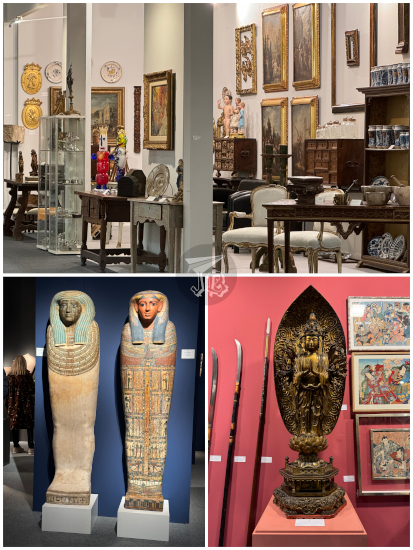
The museum is divided in several areas. The first one is “history of the Earth”, where you can see a few interactive exhibits, fossils and reproductions. The second one is the collection of living animals, most of the stuffed, some of them just skeletons. There was another one about fungi – with the edible ones exhibited in tins. Then there was one on plants, and finally rocks and minerals. Not a bad place to spend a couple of hours, but it is just one of those places that takes itself much more seriously than it should, to the point that it felt pretentious. Some items were exhibited over and over again, as if they just wanted to use up the room – I counted at least eight elbaite specimens in different locations, and there were a bunch of reproductions taking up important spaces, you would believe they were originals if not paying lots of attention to the writing, and the blue light made for horrid photographs.
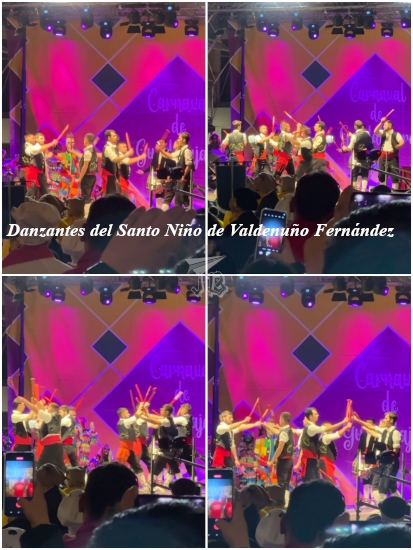
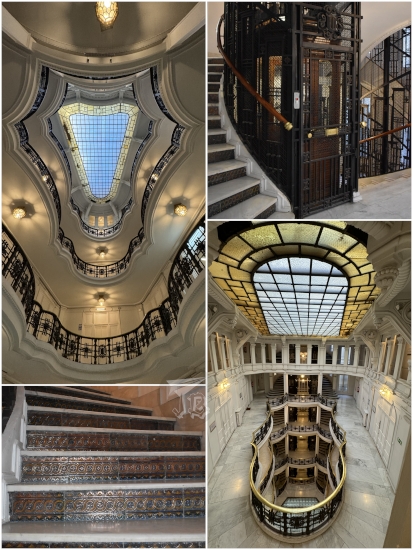
Collage. Four pictures show prehistoric animals in blue light, stuffed animals, a tin of mushrooms along real specimens, a red algae and some shiny rocks.

We transited to Sants train station to drop off my sibling’s bag at the cloakroom there and went on to meet my Barcelona friends E**** and P***o who had offered to take us to eat really-real Japanese ramen. Since I had a feeling that the restaurant would be on the small-ish side, and my sibling’s luggage was a bit oversized since they had cosplayed for the concert, I decided on the Sants detour for convenience.

The restaurant is called KOBUTA ramen i més (Kobuta Ramen and More) and I was amused when all of us made the same choice – tonkotsu miso ramen with an extra of half an egg, and water; then we shared some gyoza (dumplings) and karaage (fried chicken). The restaurant is not cheap, but the food makes up for that, it is very authentic Japanese food.

Collage. A dish of breaded fried chicken, some dumplings, and a bowl of ramen, with the ingredients floating - algae, half an egg, noodles, pork meat and spring onion

Though P***o had to leave early, the rest of us headed off towards the bullfighting-ring-turned shopping centre Arenas de Barcelona. There, we climbed up the terrace for views, then sat down for drinks and a long chat. We also popped into the local comic store, since it was convenient, and eventually we headed off to the station.

Collage. Shopping centre las Arenas, a round building that used to be a bullfighting ring, there are two pictures, one by daylight and another one at night, lit up. There's a picture of the views- two clock towers leading to a palace; finally three glasses together showing brightly coloured drinks - yellow, orange and dark pink

The train ride home was surreal. People playing music on their phones, yelling, talking loudly and making the footrests squeak – apparently there had been some kind of sporting event for kids and a lot of families were coming back home. All in all, not a bad couple of days, lots of laughs, I got to see dear friends and eat nice food, and listen to cool music – in the CCIB, not on the train.

20th November 2022: Naturaleza Encendida – Origen (Real Jardín Botánico, Madrid, Spain)

It seems that the Madrid exhibits in the month of December are not being the most successful ones – this time, the weather did not help. After ten day’s worth of rain, it cleared out, but then, on Tuesday, the skies opened yet again. It was raining like there was no tomorrow by the time my train got to Madrid. Boo.

Just after sunset, my sibling and I went to the botanical garden Real Jardín Botánico to see the light show Naturaleza Encendida: Origen (Lit-up Nature: Origins). There had been some issues about the promoter cancelling the activity due to rain with little advance notice, so they decided not to close it. They instead resorted to close parts of the exhibit at random, and herding all the visitors in the same corridors, despite the puddles forming on the uneven ground. After two weeks of rain, something should have been done about it. Moreover, a few of the exhibits were turned off – not sure if just off or high wired. I wish I had some good boots, because I ended up pretty soaked, despite the raincoat and the umbrella. At least I did not ended up in a random puddle.

In 2021, the topic was sea life, and in 2022 the topic is… mushrooms. So there were spores, moulds and… mushrooms. Big mushrooms with lights, or made with small lights, or… just blown with hot air. Lots of mushrooms. The music was a bit creepy though, even if the mushrooms lit up and down with the beat. There is also an exhibit about moulds, with huge screens showing pictures of spores and microorganisms under the microscope.

Most people were antsy and cranky in the rain, and everybody wanted you to move out of the way – in different directions at the same time. A really good thing about it was the cup of hot chocolate that we had booked with the ticket. It was really nice to get in the middle of the cold and rain because it was warm and sweet. We drank it on our way out to the train, and just as we stepped out of the botanical garden… it just stopped raining.

Light display collage: on the upper left, giant red spores; on the lower left a wavy line of lights. On the right, a giant bunch mushrooms illuminated in green from inside the umbrella

Collage of lights display. A mushroom made of little yellow and white lights; a bunch of name mushrooms in red; a hanging mould-like string of lights between two dark trees

All in all, I was not too impressed. I really think that the organisers should have figured out something about the cancellations and the pathways, since they obviously could not do anything about the weather. My favourite display were the “Baymax mushrooms”, even if most of them had lost their illumination, which was actually kind of the point…

A blow-up mushroom made from plastic, looking like it's floating. The  lights inside make it glow green and pink. In the background there is a building gate in red, and a pond between the two.

13th October 2022: Serrat in Zaragoza {Aragón & Navarra Oct. 2022}

Joan Manuel Serrat was born in Barcelona in 1943. He is a singer, songwriter, composer, actor, writer, poet and musician, whose long career started in 1965. Since then, he has sung first in Catalan, then in Spanish, and finally in both languages. In 1968, he was involved in a Eurovision controversy as there was a strife about singing in Catalan or Spanish, and in the end he was replaced by another artist – who ended up winning.

Throughout Franco’s Dictatorship, Serrat lived an unstable balance between the media veto caused by the Eurovision scandal, the censorship of some of his lyrics, and his growing popularity both in Spain and Latin America. During the 70s, he became a vocal protestor against the Dictatorship, with his songs, actions and words, which ended up with another veto and an exile to Mexico. In a way, he became the symbol of the discontent of the twenty- and thirty-somethings that had grown in the Spanish post–Civil War, who were then wading into adulthood. Serrat’s song Mediterráneo (Mediterranean Sea) has been repeatedly called the best song in the history of Spanish pop music. The album stayed as number 1 in Spain for weeks despite the censorship – since then, he has collected innumerable accolades and homages.

My parents… I don’t think I can call them fans, but they have listened to Joan Manuel Serrat for a long time – as a matter of fact, my father used to translate songs into Spanish for my mother back when they were young, as he spoke Catalan and she did not. But they are not concert people, so I was slightly surprised when back in April my mother commented in passing that, had tickets not been sold out, she would have liked to attend the Madrid concerts of Serrat’s goodbye tour El Vicio de Cantar. Serrat 1965 – 2022 (Singing is a vice. Serrat 1965 – 2022). I put the Internet machinery to work, and I found tickets for Zaragoza on the 13th of October. At that time, my parents asked if I would be interested, and I said yes, as he is indeed one of the most important singer–songwriter of the 20th century in Spain.

Ticket: Serrat, el vicio de cantar

The problems started when I could not get the day off, so that meant driving there as I left work. I could have got away with leaving half an hour earlier to get to the train as they drove off earlier, but they refused, so we ended up getting to Zaragoza around 17:00. Checking into the hotel took 40 minutes due to the slow check-in process, and luckily we were on the third floor. Funnily enough, it seemed that everyone in the hotel was there for the concert, so a lot of older people not used to travelling nor hotels.

The concert was due to start at 21:30 in the local sports centre Pabellón Príncipe Felipe, and there was a delay of about 15 minutes. To be honest, I did not expect it to be such a powerful experience – I mean, we’re talking about a 79-year-old man here, I did not think he would still have such a powerful voice nor presence on stage. There were a lot of songs I did not know, but the ones I had heard before still retained the vitality of records as old as the 80s! The set list was a remix of his most iconic songs in Spanish, with a couple of them in Catalan language:

  1. Dale que dale – “Go on and on”.
  2. Mi niñez – “My childhood”.
  3. El carrusel del Furo – “Furo’s carrousel”.
  4. Romance de Curro el Palmo – “The romance of Curro el Palmo”.
  5. Señora – “Lady”.
  6. Lucía
  7. No hago otra cosa que pensar en ti – “I keep thinking about you and nothing else”.
  8. Algo personal – “Something personal”.
  9. Nanas de la cebolla – “Onion lullaby”, with lyrics from a famous Spanish poet who wrote the poem in prison, when his wife wrote to him that there were only bread and onions at home, and she had to breastfeed their baby.
  10. Para la libertad – “For freedom”.
  11. Cançó de bressol / Canción de cuna – “Lullaby”.
  12. Hoy por ti, mañana por mí – “Today it’s you, tomorrow it’s me”.
  13. Tu nombre me sabe a yerba – “Your name tastes like herbs” – grass, actually, but it sounds horrid in English.
  14. Los recuerdos – “Memories”.
  15. Es caprichoso el azar – “Fate is whimsical”.
  16. Hoy puede ser un gran día – “Today can be a great day” – I keep telling myself this.
  17. Pare – “Father”.
  18. Mediterráneo – “Mediterranean Sea”, I can totally understand how this is considered one of the best songs ever in Spanish.
  19. Aquellas pequeñas cosas – “It’s the little things”, started the encore
  20. Cantares – “Songs or Poems”, with lyrics by Antonio Machado, one of the greatest Spanish poets in the Spanish 20th century.
  21. Paraules d’amor – “Words of Love”.
  22. Penélope – though I knew this song, the lyrics were different from the ones I was used to.
  23. Fiesta – “Festival”, a bit of a high-inducing song to finish the concert way past midnight!

Serat concert: Stage with signature decoration, and two shots of the concert

It was hilarious to see all these sixty- and seventy- year-olds get out from the pavilion and walk to the hotel, all pumped up and way beyond their bedtime. By the time we arrived at the hotel, there was a queue at the lifts! All these exhausted boomers, hyped up and at the same time with no more energy left. That is when we were so happy to be on the third floor and not something like the seventh or eight (≧▽≦). The bed was comfortable but I did not sleep much.