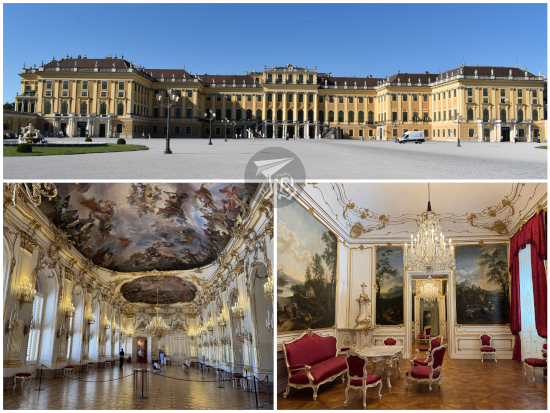
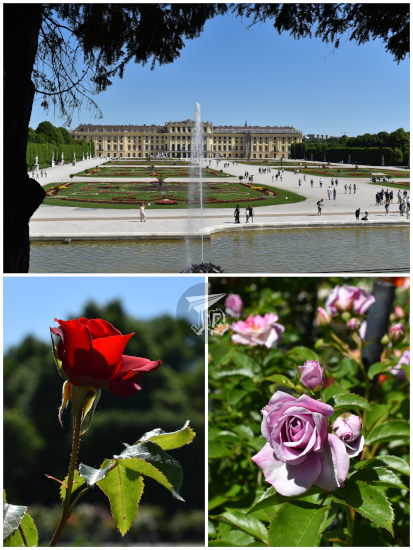
As neither D****e nor I left Vienna until the evening, we had almost half a day to do anything we felt like. We decided to head out to Schloss Schönbrunn, the Schönbrunn (Beautiful Spring) Palace, or the “summer palace” of the Habsburgs. It is a Unesco World Heritage Site established in 1996, Palace and Gardens of Schönbrunn, independent from the Viena Historic Centre. The current complex comprises a massive Baroque Palace (who needs over 1,400 rooms??), the world’s oldest zoo, a large garden, a secondary palace (now a restaurant), several conservatories or greenhouses, a monumental fountain and way too many squirrels to count (not as part of the zoo).
We checked out and left the luggage at reception. I grabbed a coffee on the way and we rode the underground towards the palace. It took a bit, but we were at the entrance a few minutes before they opened, beating the buses and the ticket-buying queues. I stayed at the shop for a bit and found a nice Lipizzaner Christmas ornament. We got our tickets and went towards the entry, where we did have to wait a few minutes, until they opened.
Most of the palace is either Baroque or Rococo, so after a while the rooms feel a bit heavy. If the Hofburg is all about Sissi, however, the Schönbrunn is for Empress Maria Theresa of Habsburg (1717 – 1780). This makes the timeline a bit confusing, as wherever you are, you get a name, and then their relationship with her. It also makes sense as it was during her reign that the palace took its present form. It is important to note that she was Empress in her own right after her father died. Maria Theresa was Archduchess of Austria, Queen of Hungary, Croatia and Slovenia, Queen of Bohemia (which at the time included Slovakia and Bratislava), Queen of Galicia and Lodomeria, Holy Roman Empress, and a couple of more Consort-titles at different times during her life between 1736 and her death in 1780.
The history of the palace becomes intertwined with the park that surrounds it, which was originally conceived as hunting grounds in 1569. The first residence was established in 1637. During Maria Theresa’s reign, everything was expanded and a lot of it remodelled – the palace, the court, the gardens, the decoration… After the downfall of the Habsburgs in 1918, the Palace became a museum owned by the Austrian Republic, and so it remains today.
We purchased Palace Tickets, which cover most of the palace. It starts with a computerised presentation when the palace itself talks to you, and then you move onto the main floor, including the bedrooms and the state rooms. The huge Great Gallery was my favourite ward of them all, along with the so-called Millions Room (though living in it might have been a little claustrophobic). There were also some rooms with interesting Chinois motifs – the two Chinese Cabinets and the Vieux Laque Room, with lacquer panels literally brought from China. The Porcelain Room was a little creepy though, and so was the Rich Room, which just displayed Maria Theresa’s state bed.
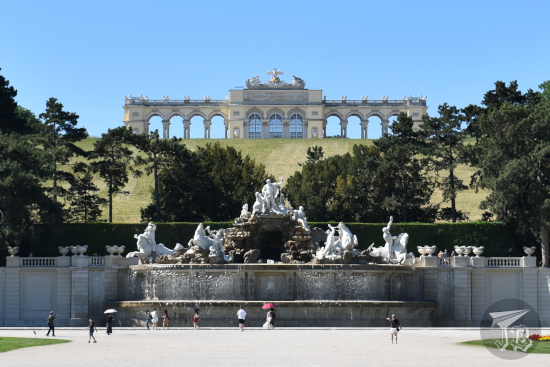
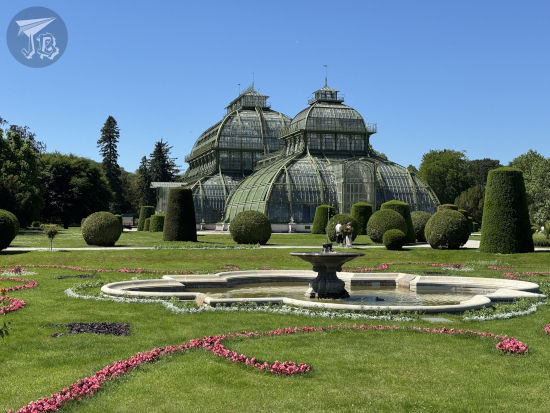
It was way too scorching for the garden, but still we braved the sun though the Great Parterre until we reached the Neptune Fountain, a large decorative sculpture group centred around the Roman god of the ocean and his chariot. Afterwards, we continued through the wooded area until we reached the Gloriette, now a cosy café, and cooped up with people. On our way down, we took a small detour to the Rose Garden and the iron-and-glass Palm House – and if you know me, you’d guess I loved that one the most. We did not have time to explore if our tickets allowed us to go in, though. Furthermore, I am not sure going into a greenhouse at that point would have been wise…
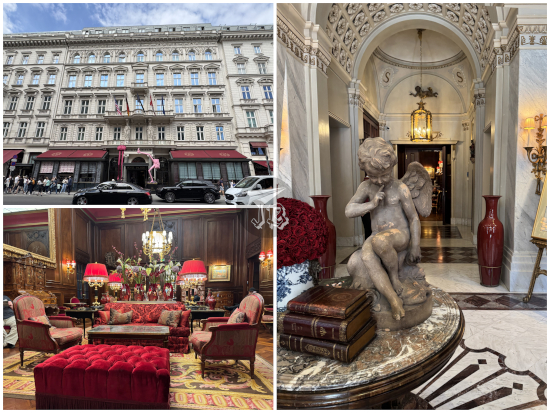
We headed towards the Historic Centre of Vienna, because D****e had made reservations at the Blaue Bar (Blue Bar), one of the inner spaces at Hotel Sacher, at noon. We were there a bit early (entered past 11:50) and the bar was not open yet. Therefore, to apologise because we had arrived before the bar was due to open, and hence it was not open yet, we were treated to an apology carton of mineral water and got to wait at the lounge with all the rich people. It was bizarre!
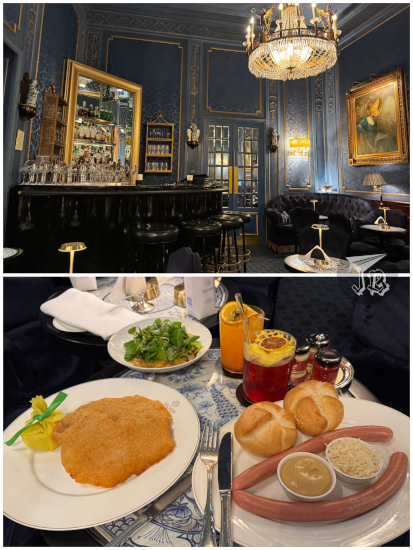
As the name hints, the Blue Bar is decorated with blue fabric on the wall. It has small tables – maybe six, which makes for an intimate ambience. It features chandeliers and a small bar where Hyde had posed for pictures, which was the reason why D****e wanted to go there.
Once the it opened, we had the room for ourselves for about 40 minutes, which was amazing. We were taken care of by the manager himself, Stephan Plessl, who did an outstanding job. I felt like royalty, to be honest. There is a rumour that workers at Hotel Sacher will never say no to a guest, but we were just two random people popping in for a drink (and probably not even adhering to the dress code). And I stand witness that we were not told no at any point.
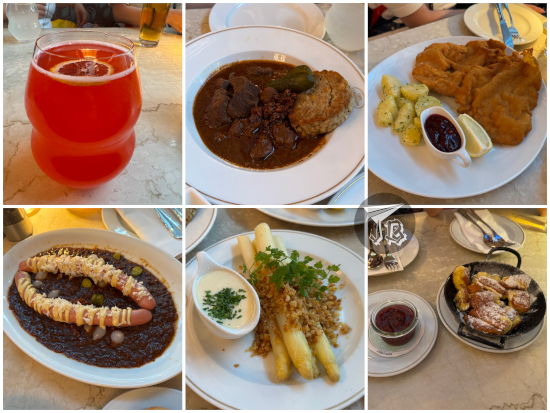
We decided to start with a mocktail each, since it felt appropriate to have a toast with something cool but neither of us drinks alcohol. I went with the Sunrise (red fruit tea, thyme, lemon, elderflower and orange espuma). Then we shared an Original Wiener Schnitzel (breaded suckling veal cut with potato, lettuce salad and pumpkin seed oil. For some reason there is a… vegan option available?), Original Sacher Sausages (Original Sacher Würstel, with horseradish, mustard and a bread roll), and ended with a piece of Sacher-torte. The manager also let us take photos to our hearts’ contents, took pictures of us, and let us take all the disposable mementos along – such as the coaster and mayo / ketchup jars. When D****e asked him if she could check out another room to find a portrait of Hyde there, he offered to come and “search together” (it had been in one area, but then got moved). We suspected the manager knew who Hyde was because he had been staying there. Our suspicions were later corroborated – not only did the singer eventually tweet about it, hotel itself ran a special interview with him.
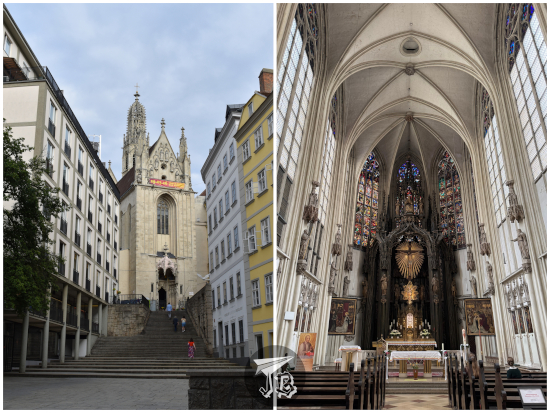
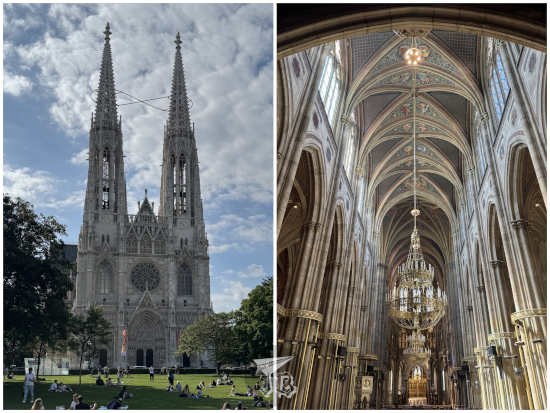
We still had a couple of hours before I had to head for the airport. After a stop at Buggarten, we ended up back at the outer ring, walked by the Parliament Parlament Österreich and the Athena fountain Pallas-Athene-Brunnen and ended up at the Neogothic Votive Church Votivkirche, which was open! As the sun was shining, the coloured glass windows made it for a very beautiful effect. On our way back to the hotel, we passed by Kirche Maria am Gestade (Mary at the Riverbank). Then we headed towards the station, where each of us had a train within 20 minutes’ time of the other to take us to our next destination. In my case, it was the airport.
I was so focused on electronics and the carton of water from the Sacher that I was extra careful when putting my things out for security. The carton was empty, the camera was out, so were the phones… and then my luggage got flagged. A very unfriendly lady with her hand on her weapon demanded that I took out the device at the bottom of my backpack. I was flabbergasted – there was literally no device in my backpack, but that is the word she kept using. In the 15 seconds or so it took me to realise what it was, two other guards came to flank her, and I wondered in a mini-panic if someone could have snuck something in my luggage. Then I saw the X-Ray – whatever had them worried was a very reflective vaguely cubical box – and I had an epiphany. What was at the bottom of my backpack? A box of very shiny and reflective Swarovski crystals. I always do my best not to antagonise security, but I said something along the lines of “I cannot be the first person to take Swarovski crystals out of the country!” and “Those are not forbidden!” I mean, I was baffled. I was eventually let through (with my crystals) and it took me a bit to reorganise all my stuff back into the backpack.
I had the last of the sandwiches I had bought the day before for dinner, and got myself another Christmas bauble. The plane ride was uneventful and my parent had come to pick me up, so the ride home should have been smooth. Unfortunately, someone had thought it would be a great idea to close off the highway, without actually announcing it. Instead, they tried to funnel out of the same exit, which caused a huge traffic jam. Once we cleared that one out though, the rest of the drive went fine. A bit of an anticlimactic ending, don’t you think? All in all, it was a great trip. I did feel a couple of times that I was not “as much of a fan” as I ought to be, especially when surrounded by people who had made the trip from Japan. I got to eat a lot of good schnitzels, too, and Sacher-torte. I did miss a couple of things I would have liked to do, but there will be another chance, I hope. I enjoyed the concert, got to see cool stuff, and had fun.
I can only hope I’ve reached my quota of stupid airport security issues by now…