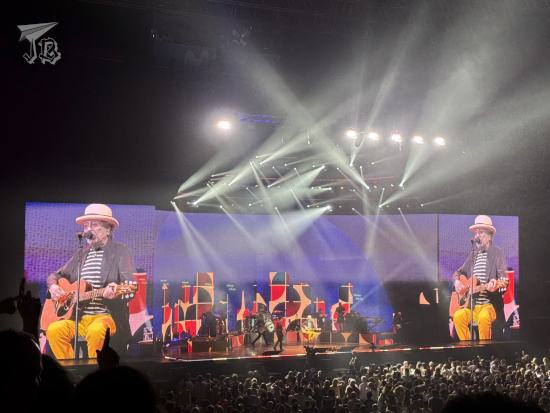
5th September 2025: Ara Malikian. Conciertos de la Muralla, Alcalá de Henares (Spain)

The “Wall Concerts” Conciertos de La Muralla is a late-summer music festival that takes place in Alcalá de Henares. As far as I have learnt, it has been going on for almost a decade, with “artists of the highest level”. I’ve only heard about a handful of the musicians that have played there, but I’m not much into the Spanish music scene. A while back, I read that violinist Ara Malikian would be making a stop in town as part of his promotional tour Intruso.

When checking for tickets, I found a lonely fifth-row empty seat in the arena, too good not to be bought. The show was to be held in the outdoors area known as Huerta del Obispo, where Alcalá de Henares also carries out its RenFair. Since tickets and seats were numbered, there was no need to queue or be there early. Though the show was outside and I was prepared for chill, it turned out to be just a bit windy so I did not need the extra layers of clothing I had brought with me.

Born in Lebanon to an Armenian family, Ara Malikian started playing violin in early childhood. He was good enough to give his first concert and 12 and be invited to study in Germany at 14. He went on to play with and for the best orchestras in the world. He has published 30 albums, composes, and covers classical and modern pieces.

His stage persona is outlandish, with crazy hair and clothing. He tells stories on stage that are a little real and very embellished with fantastic details, to the point that you’re not even sure if the outrageous titles he’s quoting for the setlist are even the actual ones beyond the covers of famous composers and musicians.

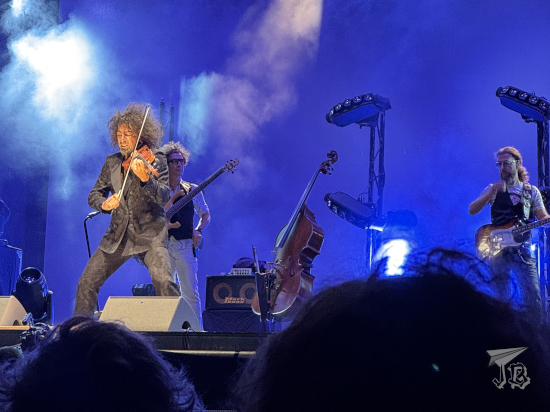
Ara Malikian playing violin

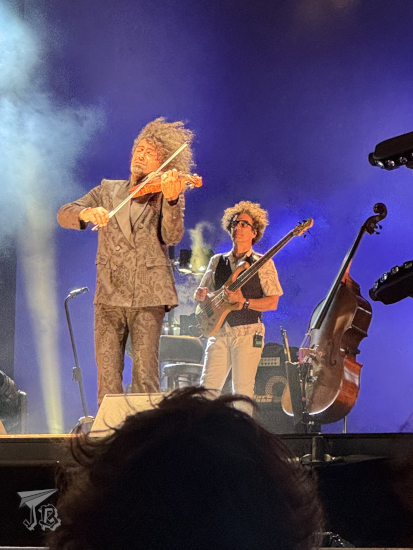
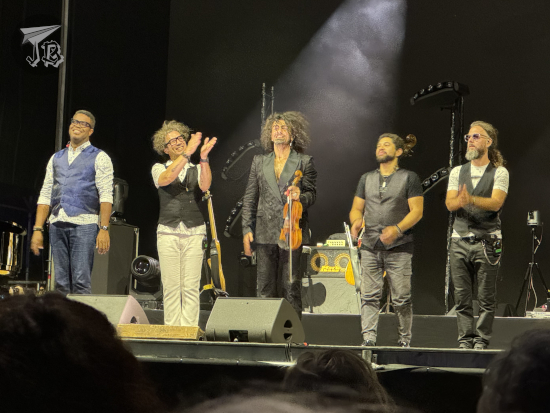
For this gig, Malikian was accompanied by drums, piano, guitar / bass and cello. He played alongside a quartet of Cuban musicians, whom he claims met in Havana 30 years ago. After he received a scholarship to go to Cuba to play a “contemporary piece” he did not prepare, he met these young artists who had not rehearsed either. Together, they decided to improvise while the composer yelled “imposters” and “pigs” at them, thus the piece being now called “Concert of Pigs and Imposters” Concierto para cerdos e impostores. The ensemble comprised Iván “Melon” Lewis on piano, who almost died a couple of times choking on his own laughter due to the bizarre stories that the violinist told; Ivan Ruiz Machado on classical double bass and regular bass; Georvis Pico, specialised on jazz, on drums; and finally Dayán Abad García on guitar.

Ara Malikian playing violin

Thus, Ara Malikian claims such titles as the aforementioned “Concert for Pigs and Imposters” or “Ratboy” (Niño Rata) or “Rhapsody of not doing anything” (Concierto Rapsódico de No Hacer Nada). The first comes with a tale of a quartet of musicians improvising with him on stage in spite of the composer of the piece they were supposed to play hurled insults at them. The second derives from a crazy story about being hired to stand in a bar and not doing anything to create curiosity amongst the patrons.

Ara Malikian playing violin

There were covers of famous composers, both classical – such as variations of Niccolò Paganini’s Caprice No. 24 in A minor – and more modern, like Paco de Lucía’s Zyryab. The concert ended with a beautiful song called Nana Arrugada (Wrinkled Cradle Song). All in all, I enjoyed the concert very much – though I could not find a believable setlist to compare my information anywhere.

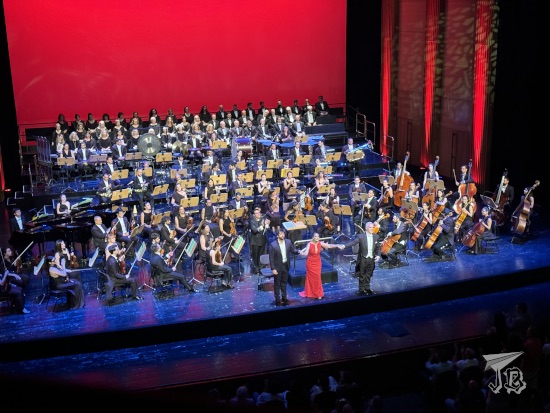
Ara Malikian and his support musicians performing

My seat was honestly fantastic, and not even the wind could spoil the sound or the ambience. If any complaints, the fact that people seem not to understand that if they enter the area at 20:00 and drink a huge glass of beer, they are going to need a toilet before the concert is over – making everyone around them stand. Also, a concert might not be the best place for random people to yell political slogans…

Ara Malikian and his support musicians waving at the audience after the concert

I had a good time, and when the show was over, I walked around the city centre to see if there were any monuments lit up. There were some, and the main street was packed with people enjoying the last days of summer. I thought I would get some frozen yoghurt, but there was a queue. Thus, I decided to wait until I got to the ice-cream parlour a bit further up the street. Even a longer queue. And at the last parlour, it was even longer than both of the other two combined.

Façade of the classical University of Alcalá de Henares under a full moon

It became less crowded when I left the pedestrian area, but there were enough people so it did not feel dangerous to walk to the car – despite the town having been on the news due to violence a few times in the few previous weeks.

I was home before midnight, not even extremely tired. Since I had to do some shopping before the concert, I decided not to combine it with any visits or anything. And as there had been no ice-cream for me, I ended up having some home-grown watermelon I had been gifted…

2nd July 2025: Sabina’s Hello & Goodbye (Madrid, Spain)

Lots of things came together on the 2nd of July. First of all, due to weird work schedules that I had no control over, I had a day off in the middle of the week. Second, I had a doctor appointment in the morning – lucky how I could fit it there. Third, Jurassic World: Rebirth, the new film in the Jurassic Park franchise came out. Finally, back in January, I had bought tickets to watch a concert in the goodbye tour by the singer who composed the soundtrack of my teenage-angst years.

So it was just a stroke a luck that work just happened to give me the day off because of unrelated reasons. It would have been luckier to have the following day off too but what can one do? Actually, I propose an unpaid leave called “I had a concert yesterday and it’s not that I’m tired or sore or anything, but I don’t want to go back to reality just yet, I deserve to bask in post concert ‘the world is okay’ bliss.” Think about it, it’s a great idea.

Since I had the doctor’s appointment, I could not plan a whole day out. Once I was done there, I changed clothes and then drove off to the train. Of course, there were delays, what else is new? Halfway, one of the doors got stuck open and we could not start until that got closed manually. But instead of blocking it, they allowed it to keep opening at subsequent stations – so it got stuck again and again.

I reached Atocha just in time to change trains and get to Sol using the same system without a wait, so in a few minutes later I was out in the heat. The original idea had been a light lunch at Yatai Market, but the air conditioning in Kawaii Café was stronger. I had been to another of their shops before, and the food was all right, so I thought why not? I ordered a strawberry frappé and a “sleepyhead bunny” Conejito Dormilón – a Red Velvet crêpe filled with strawberry compote and decorated with cheese cream and blueberries, along with a vanilla-jello bunny mascot. Adorable and delicious. Quite pink, too, due to all the strawberry…

A collage of pink café and a meal - a strawberry frappe with a cute koala face drawn on it. and a crepe which looks like a bedding with a sleeping rabbit on top

When I finished, I headed towards the nearby Yelmo Cines Ideal to watch Jurassic World: Rebirth, a monster movie with a homage to the Jurassic Park book. I guess the film is better if Scarlett Johansson is your type. The film retcons the whole “Jurassic World” premise: now the dinosaurs are dying (and nobody cares about them any more!) and only surviving on an island near the Equator. It turns out that they somehow hold the key to cure heart disease. And then the palaeontologist says that they need to collect samples from the three biggest dinosaurs: Patagotitan (okay, it’s famous now), Mosasaur and Quetzalcoatlus, both of which have already been featured in previous films and are not dinosaurs. Then there are mutated freaks and a Tyrannosaurus with the head of a xenomorph and some extra arms, because the dinosaurs can’t survive, but the “mutated experiments gone wrong” are alive and well? The best from the film was a scene taken from the book, with a Tyrannosaurus and a raft. Unfortunately, this new Tyrannosaurus was not Rexy. Furthermore, the special effects are… not good. Too much bad CGI makes the creatures less believable than those in the 90s instalments, which is… a huge faux pas.

I am glad I saw it on opening day, though – I was able to avoid most spoilers and went in with an open mind. It was not a good film but I didn’t hate it. I will just probably ignore it exists (until the next film comes out, we all know that). Points for the pro-planet message, but it falls a bit flat when you know that Michael Crichton, the original author, was pretty much anti-science…

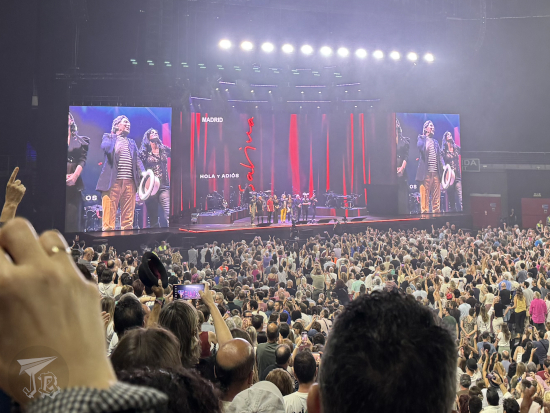
The film was around 133 minutes long, but oh god, the previews were long. Thus, I left the cinema around 19:30. I had to take the underground, and I knew that some stops would be closed due to Pride. However, last year I had learnt that you’re still allowed to transfer even if you cannot enter or exit the station. I used that knowledge to get myself to Movistar Arena Madrid for Joaquín Sabina’s final tour Hola y Adiós (Hello and Goodbye). I am happy I bought the tickets when I first saw them, because most concerts have sold out, and I got quite a good seat considering the event and the venue.

Joaquín Sabina is a Spanish singer and songwriter born in 1949 in Jaén, in the south of Spain. When he finished his studies, his father offered him a present, and he asked for a guitar. Due to his leftist ideas he had to exile himself in London for a few years during Franco’s dictatorship. When he came back, he lived a life of debauchery, mostly in Madrid, and he probably was not the best role model. But between 1994 and 2000, when I was an angtsy teen, his music was important to me, though I eventually moved away from it. When I heard he was retiring (again) early in the year, I thought I wanted to see him at least once, despite the fact I have not consistently listened to his music much in a couple of decades – there are a few hits in my car playlist. And then there is ¿Quién me ha robado el mes de abril?, Who stole the month of April from me?, which hit me very hard during Covid lockdown and I’ve skipped since then, but never had the heart to delete from the playlists.

Security let me in with my tiny water bottle, thankfully, and I found my seat about 45 minutes before the show was due to start, and 15 minutes after doors – it was weird, I had expected a larger crowd, and I had been a bit stressed leaving the cinema 20 minutes later than what I had calculated. I was on the side stalls, on a ninety-nine-euro spot. There is a whole etiquette about concerts with seats, and while I am quite happy to stand up when it is appropriate, and in this case, I decided I would stand up when people in front of me stood up. Pretty easy.

Sabina Hola y Adiós Madrid: empty stage

Setlist:
 Un último vals (One last waltz; recording and MV)
  1. Yo me bajo en Atocha (I’ll alight in Atocha)
  2. Lágrimas de mármol (Marble tears)
  3. Lo niego todo (I deny everything)
  4. Mentiras piadosas (White lies)
  5. Ahora que… (Now that…)
  6. Calle Melancolía (Melancholy Street)
  7. 19 días y 500 noches (19 days and 500 nights)
  8. ¿Quién me ha robado el mes de abril? (Who stole the month of April from me?)
  9. Más de cien mentiras (Over a hundred lies; band intros)
  10. Camas vacías (Empty Beds; vocals: Mara Barros)
  11. Pacto entre caballeros (Pact amongst gentlemen; vocals: Jaime Asúa)
  12. Donde habita el olvido (Where oblivion dwells)
  13. Peces de ciudad (City fish)
  14. Una canción para la Magdalena (A song for Magdalene)
  15. Por el bulevar de los sueños rotos (Through the Broken Dreams Boulevard)
  16. Y sin embargo te quiero (And yet I love you; folk copla song; vocals: Mara Barros) + Y sin embargo (And yet)
  17. Noches de boda (Wedding nights) + Y nos dieron las diez (And the clock struck ten on us)
 Encore:
  18. La canción más hermosa del mundo (The most beautiful song in the world; vocals: Antonio García de Diego)
  19. Tan joven y tan viejo (So young and so old)
  20. Contigo (With you)
  21. Princesa (Princess)
 La canción de los buenos borrachos (The good drunkards’ song; recording)

Well, what can I say? Sabina has got old since I was a teenager. His voice has cracked – after all, he is a smoker – and he has swollen up. But his concert made me feel 30 years younger, and I enjoyed it immensely. I’ll freely admit that I bought the ticket back in January purely out of FOMO. However, I am happy I did. I did not get any of my personal favourites, and I am okay with that. Most of what he sang was part of those times.

Sabina Hola y Adiós Madrid: musican ensemble

The concert started with Yo me bajo en Atocha (I’ll alight in Atocha), a description and homage to the city of Madrid, which the singer holds particularly dear – despite the fact that he has a bad record with concerts in the city – he once had a panic attack and another time he literally fell of the stage and ended up in hospital. He started sobbing right at the end of the song. Figures.

The venue, of course, cheered and applauded, and stood up to bounce to Lágrimas de mármol (Marble tears), which has too dark lyrics for how… perky the music is, but I guess the message of “survivor, yes, damn it” is what matters. It was during Calle Melancolía (Melancholy Street) when the old guard took over, so Sabina turned the microphone towards the attendees, which did not only sing chorus but brought down the dome with their voices. He was visibly moved.

Good thing that next came 19 días y 500 noches (19 days and 500 nights) a getting-over-a-break-up song during which people can yell, and broke the spell. That made me strong enough for ¿Quién me ha robado el mes de abril? (Who stole the month of April from me?), the first time I’ve actually listened to the song since 2020 – “who stole the month of April from me? I kept it in the drawer where I keep my heart” did not sound so threatening surrounded by hundreds of other people.

Sabina Hola y Adiós Madrid: playing guitar

During Más de cien mentiras (Over a hundred lies), which is a list of all the good things in life and “over a hundred lies that are worth it”, we got the band introductions. Sabina sang himself, and played the guitar for some songs – he stayed sitting down on a tall stool. Safer for him. Antonio García de Diego played guitar, bass, and harmonica; Jaime Asúa Abasolo and Borja Montenegro also played guitar; Josemi Sagaste played sax and non-drums percussions; Pedro Barceló played drums; Laura Gómez Palma played the bass; and Mara Barros did the choruses and had some solo vocals.

Sabina retired to rest for two songs, alleging that it had always been a dream of his to have a song of his sung by a beautiful woman – Camas vacías (Empty Beds), performed by Mara Barros – and by an actual “rocker man” – Pacto entre caballeros (Pact amongst gentlemen) with Jaime Asúa on vocals. Soon after Sabina’s return came a song which holds one of the song lines that has impacted me the most in my whole life: Noches de boda (Wedding nights) hopes that “the end of the world finds you dancing”. I really hope it does.

I guess part of the fun of a concert is that you feel special. Of course that the singer has a speech for every city, and holds each one close to their hearts, or are the best or whatever. But this one did hit differently. I guess my inner child enjoyed it immensely, and even if neither of the songs of the encore did much for me in terms of nostalgia, I was incredibly grateful and happy that I had been able to attend. If it is the last tour indeed, I will have said my hello and goodbye, even if it has been 30 years after the time Joaquín Sabina’s was the only music that played in my room.

Sabina Hola y Adiós Madrid: waving goodbye to the public

Also, another extremely convenient thing: though I went by train, I had a ride home, as my parents were in town and driving back around the same time. Which was great, considering that a storm was brewing, and that there were many underground and train stations still closed due to Pride…

31st March 2025: More Modernisme and the way back {FFVII Barcelona 2025}

For our final day in Barcelona, I had planned some more architectural visits. I had adjusted my planning considering the underground issues the previous day, but it turned out, it had been a Sunday-only thing. We had breakfast and on check-out, the manager asked how the stay had been. To his merit, when we told him about the issue with the air-conditioning, he apologised and offered us free breakfast in compensation. After we declined – timed entry visit – he advised us to write a complaint letter for a discount next time. I didn’t think it was necessary.

Since the station we had to change at was open, there was no issue with the underground, so we were half an hour early. I had booked a locker for the luggage in the centre of town, as the hotel is very convenient for attending a concert at CCIB, but quite far from… everything else, really. The locker system was convenient: you book online and get a code which opens both the place and your assigned locker. I found it more trustworthy than leaving the bags in a random shop which “looks after luggage”. However, about a month later, there was a complete outage in Spain, which made me second-guess the convenience of these things, as I heard about a lady who could not go home because her luggage was inside one of those lockers. We’ll see whether I dare use them again.

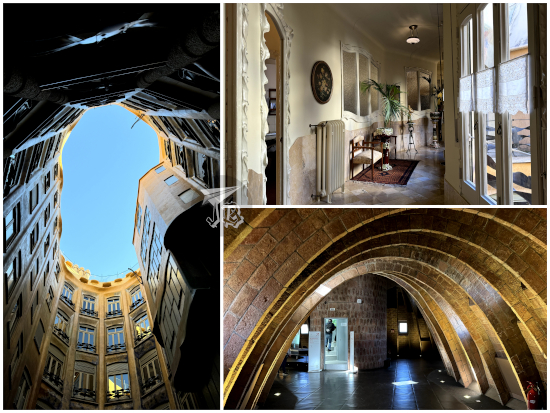
We were to continue on my Modernisme route, visiting one of the works of Antoni Gaudí (1852 – 1926), considered the peak representative of the style – to the point that some of his works have been declared Unesco Heritage by themselves as Works of Antoni Gaudí. Gaudí originally found inspiration in orientalism and Neo-Gothic, but as he became more and more established, he turned to nature forms – seeds, branches, bones, catenary shapes… The UNESCO work we wanted to see was Casa Milà, a building commissioned to Gaudí by lawyer Pere Milà in 1906. The building itself was erected between 1906 and 1910, and it was nicknamed “The Quarry” La Pedrera. It is an eight-floor apartment building with a self-supporting façade, electricity, running and hot water. The building was designed around a central patio, and it has a very particular roof-terrace. Some people claim that Casa Milà does not even fit into the Modernisme category, but it should be classified as “organic naturalism”, or even “expressionism” all by itself.

La Pedrera, exterior

I found the building… underwhelming. We had a combined ticket for Sant Pau and Casa Milà at 39 €, but the normal ticket price for the building is 40 €, and this is only for one of the floors with a “recreated apartment”, the attic, and the terrace. At least you get to see the patio as you have to walk past it so you reach the tiny lift in which they cram you to take you to the 7th floor. The experience felt… like… not enough. I was for sure expecting something more.

La Pedrera, Interior

Do not get me wrong, the house is extremely cool, but you get to see really little in comparison to how big the place is. So even if it is pretty, it feels crowded and small, with way too many gift shops crammed in. The terrace is fun, with chimneys that look like ancient warriors – some people say they represent chess pieces, others that they hide religious undertones – Gaudí was very spiritual. Reportedly, they also inspired the stormtroopers’ helmets in Star Wars.

La Pedrera, terrace

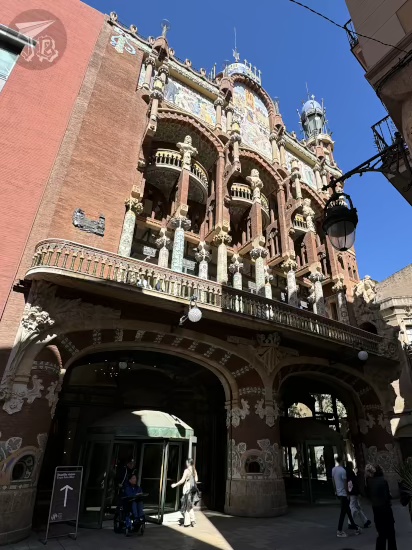
Afterwards, we walked to the music hall Palau de la Música Catalana part of the Unesco Heritage Site Palau de la Música Catalana and Hospital de Sant Pau, Barcelona. The so-called Palace of Music was designed by Lluís Domènech i Montaner a couple of years after projecting the hospital.

Palau de la Música Catalana

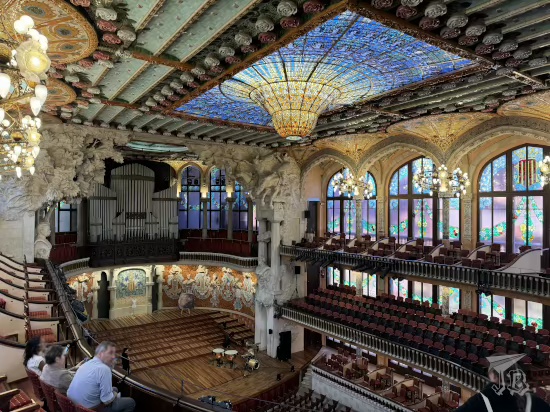
Everything that Casa Milá came short, the Palace passed with full marks. The building has an original entrance designed by Domènech, in dark brick with extensive decoration. The interior is laced with tiles and glass, and tinted-glass windows. The concert hall is amazing. At first, we could not access it, because there was an educative concert for children going on, but we were later allowed to sit at the paradise. There is a huge skylight / lamp in coloured glass, pegasus statues. The concert was incredible too, with four to six musicians playing classical music and… running around the stage too. Lady trotting up the stairs while playing the cello, you have my admiration. I loved everything about the palace, to be honest, except the creaky chairs.

Palau Música Catalana

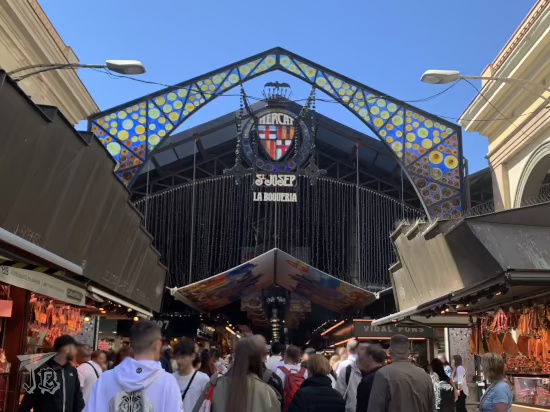
Once we were done in the Palau, we walked to the market Mercat de Sant Josep (St. Joseph’s market), known as La Boquería (The Butcher’s). It used to be a regular marketplace, but now it has turned a touristic attraction. The main entrance is also part of the Modernisme route, designed by architect Antoni de Falguera, who also created the inner metal cover. Though I had half a mind about eating there, the prices were ridiculous, so we ended up at an Asian place a couple of streets down. On the way, I had been excited about the “Barcelona Aqueduct”, but it turns out it’s a modern construction with old ashlars, nothing historical in it at all.

Market La Boquería

After lunch, we had about an hour to kill, and we decided to try our luck in the hobby-shops area. The Norma Comics shop was open, and we spent a while looking at the books there. Then, we headed back to pick up our luggage and commute to the station.

We had to change trains, and there was an announcement that any passengers with a connection shorter than 30 minutes would be escorted to their train. Of course, that’s only PA, and you’re on your own – I asked a worker, who tried to divert us to the suburban trains, not our connection. From that conversation, I think that we were supposed to go out of the system and get our tickets scanned again, but we found our train before that. There was no one else to consult with, so I decided that we would get on it. My sibling was mortified, but we were not doing anything wrong. If anyone checked on us, we had a valid ticket. They had not lived up to their part of the agreement anyway – and I would have told them exactly that, had anyone even thought of scolding us.

But we made it, as I predicted nobody gave us any grief, and the drive from the train station was uneventful. All in all, it was an intense weekend – though I feel I could have squeezed in a monument or two more had we skipped the sit-down meals, but my sibling can’t handle that. All in all, I think everything worked out rather well.

30th March 2025: Sant Pau, Verne & a chocobo {FFVII Barcelona 2025}

The Barcelona hotel charged 20 € per day and person or breakfast, and I was not willing to pay for that, and so I told my sibling. They had no option but to accept since they had decided to delegate all planning and credit-card’ing on me. Instead of booking with breakfast, I brought cold latte bottles and snacks – good for taking headache medicine, which I did. After a quick breakfast, we set off. As we left, I asked at reception if they could do something about the air conditioning.

We headed towards the underground. It should have been an easy twenty-five-minute commute, but one of the stations was half-closed. We had to go outside and walk towards the other entrance to change lines, which was strange and consumed a ridiculous amount of time. We had to be at the ticket booth of our booked visit ten minutes before the allotted time, and we barely made it – though they did not seem to care. When I was looking at tickets, I found a combined ticket that saved us 10 € for two iconic buildings in town that I had not visited before. That however implied exchanging vouchers for tickets, thus the extra time.

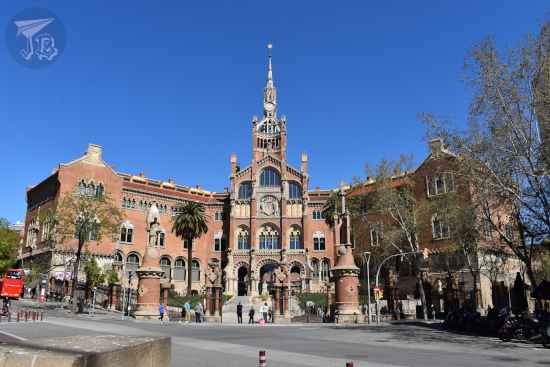
We reached the former hospital of Saint Paul Sant Pau Recinte Modernista ten minutes after I had anticipated, right at the time we had to be there. Sant Pau is a huge hospital complex erected between 1901 and 1930 by architect Lluís Domènech i Montaner (1849 – 1923). Domènech favoured Modernisme, and is considered one of the most influential architects in shaping it. He designed buildings which balanced functionality and decoration, with lots of mosaics and polychrome. Though the precinct had been a hospital since the Middle Ages, it was completely redeveloped for the early 20th century project. Today, it is half of the Unesco Heritage Site Palau de la Música Catalana and Hospital de Sant Pau, Barcelona.

Hospital San Pau from the street

The hospital is considered one of the most important, and largest, complexes in the local Modernisme style. The complex was designed with 26 buildings, 12 of them pavilions for patients, separated by sexes and kind of disease. The pavilions were connected by underground tunnels, leaving space for gardens and open spaces between structures. It was originally conceived to be self-sufficient, closed off to protect the rest of the city.

Hospital San Pau, outside

The buildings are erected in brick, and decorated with ceramics both inside and outside, some of them forming complex mosaics on the roofs and ceilings. After a new hospital was built next to the original one in 2009, the complex was recovered as a museum in 2014. We could visit the pavilions, the tunnels, and the administrative building. The whole enclosure is magnificent, and incredibly large. It took over two hours to see everything we were allowed to visit and I loved every second of it. Well, except the pavilion with political propaganda.

Hospital San Pau, interior

Afterwards, we headed out towards a fun restaurant I had found online – Verne Barcelona, decorated simulating Captain Nemo’s Nautilus from the novel Twenty Thousand Leagues Under the Sea by French writer Jules Verne. We shared a cone of tempura vegetables and I ordered a “Submarine” – a sandwich made from toasted brioche bread – called Turtle, with battered squid, sauce and salsa (I just don’t understand how they are supposed to resemble a submarine…).

Verne Barcelona

We headed back towards the hotel, stopping at a Starbucks for a coffee – a matcha in my case – because I helped my sibling dress up for the concert. We had been carrying the cosplay after all, of course they were going to wear it!

We were in Barcelona to attend the Final Fantasy VII Rebirth Orchestra World Tour, to be held in the CCIB – Centre de Convencions Internacional de Barcelona. Final Fantasy is an expanded video game anthology which set off in 1987. Since then, it has spawned 16 main games and countless spin-offs, media, plushies, and remakes. One of the most famous games is the seventh instalment, Final Fantasy VII, released in 1997. The game is set in a cyberpunk dystopia where energy is obtained by draining the Planet’s life-force. Gameplay follows the adventures of a party which opposes the system, embodied by the electric company Shinra, while at the same time trying to stop the main antagonist – mad soldier Sephiroth – from destroying the Planet itself.

Since 2015, Final Fantasy VII has been under redevelopment into a trilogy using modern graphics. The first game was Final Fantasy VII Remake, released in 2020, whose music had its very own World Tour in 2021. The second instalment, Final Fantasy VII Rebirth came out in 2024, and its music event – Final Fantasy VII Rebirth Orchestra World Tour – began almost immediately, ending precisely with our concert.

We were at the queue already when doors opened, but not early enough, so we needed to line again for the merchandise booth, almost an hour. It was in that queue where something amazing happened. When we attended the previous concert Final Fantasy Distant Worlds 35th Anniversary – Coral –, we were stuck at the merchandise queue for about an hour too and by the time we reached the front, they had ran out of most of the items. That included what I wanted the most – the chocobo plushies. Chocobo are a recurring species in the Final Fantasy franchise, large birds that can be ridden in-game, and in real life be sewn into cutesy toys.

It turned out that in 2023 the last chocobo plush had been bought by the guy who was sitting behind me. I might have made some jokes about stealing it and running away, and he promised to get me one for the next concert. I of course filed that under “one encounter silliness” and forgot all about it.

Well, he did not.

In that queue, two years later, he found me, and he gave me a chocobo plush. He actually found my sibling, who was easier to identify due to the cosplay. I was absolutely flabbergasted. Gobsmacked. Never in a million years would I have expected something like that to happen. Just… figure that everything that went on afterwards was coloured by a feeling of puzzlement and amazement at this stranger’s kindness over a silly plush I wasn’t able to buy two years before.

Chocobo!

We got to the front of the line over an hour later, almost at the time of start. I only wanted a programme, and we were seated around 20:50. I am good at choosing seats, by the way. We were dead centre at a great distance from the stage.

Setlist:
  First part:
  1. The Unknown Journey Continues
  2. FFVII Rebirth Opening
  3. Main Theme of FFVII – Battle Edit
  4. A New Journey Begins: Grasslands / Junon / Mt. Corel
  5. Crossing the Planet: Corel Desert / Gongaga / Nibel
  6. Queen’s Blood
  7. Stamp – Rebirth Medley
  8. Rufus’s Welcoming Ceremony – A New Leader
  9. Costa del Sol – Fun in the Sun
  10. Custom Valkyrie
  11. End of the World Medley
  12. Cosmo Canyon – Sanctum of Planetology
  13. Bare Your Soul
  14. Welcome to the Gold Saucer
  Second part:
  15. Loveless Symphonic Suite – Gift of the Goddess
  16. No Promises to Keep – Loveless Ver.
  17. Galian Beast
  18. J-E-N-O-V-A Lifeclinger
  19. Sephiroth Reborn Symphony
  Encore:
  20. One-Winged Angel – Rebirth Medley
  21. Aerith’s Theme – Return to the Planet Medley

Final Fantasy VII Rebirth orchestra playing

The orchestra was directed by Eric Roth. It was all right, I enjoyed it. However, I don’t think it was as powerful as the first one I saw, but that one was the first post-Covid event so it was emotional in other ways. Then again, I am not a gamer. I just watch gameplays on the Internet… I was a bit disappointed by the arrangement of One-Winged Angel, it felt… too elegant. What I love about the song is the pure chaos it represents, after all.

In attendance was composer Masashi Hamauzu [浜渦 正志 | Hamauzu Masashi]. He started working for Square Enix in 1996 under Nobuo Umematsu, the main composer of Final Fantasy VII music. Hamauzu’s first direct work related to the saga was the Chocobo’s Mysterious Dungeon soundtrack in 1997. He was in charge music for the Final Fantasy VII spin-off Dirge of Cerberus and alongside Mitsuto Suzuki, he has worked in both Final Fantasy VII Remake and Final Fantasy VII Rebirth.

After the concert, we joined the VIP queue for pictures and autographs. Though I had brought the CD from the time before – when I did not get the pamphlet – I was equipped this time. And I even managed the Spanish – English – Japanese cacophony without messing up either of them. That’s a first for me, I think. I got my programme autographed on the setlist page, and then my sibling and myself headed back to the hotel. For 179 €, I keep thinking the VIPs should at least get their own merch queue, or an item to get signed. I guess there are lots of people to get paid…

Eric Roth and Masashi Hamauzu signing autographs

Something that surprises me a lot about this area of Barcelona is that not even the McDonald’s at the shopping centre is open after 23:00, so I always make sure we buy something to snack after the concerts. The room was at least not freezing, though not particularly welcoming either. I had a hot shower, and that finally got rid of my headache, just in time for bed…

27th March 2025: The Raven Age at ReviLive (Madrid, Spain)

Sometimes one has to wonder what guides music promoters to make certain decisions. It would be interesting to be aware of factors like costs of renting a venue, fuel, ticketing and so on. Because on occasion, it feels like tour schedules are suboptimal from all angles – acknowledging the lack of information. In the case of The Forsaken Tour by The Raven Age featuring Disconnected, I think that the most important factor that was considered was minimising bus-tour kilometres. Unfortunately, that placed their Madrid show on a Thursday, in a venue which… I’m pretty sure was inconvenient for everyone but myself.

The Raven Age is an English heavy metal band formed in 2009 by guitarists George Harris and Dan Wright – though Wright has since left the band. Current members are Harris and Tommy Gentry on guitars, Matt Cox on bass and backing vocals, Jai Patel on drums, and Matt James (MJ) on lead vocals. They have released three studio albums, and supported Iron Maiden, Anthrax and Apocalyptica during the Apocalyptica Plays Metallica Vol 2 Tour 2024. Though I saw Artics supporting that tour, my friend A****d saw The Raven Age and highly recommended them – actually she was the one who informed me of the upcoming tour and the Madrid date and place.

The Raven Age Tour Schedule

The concert was held in ReviLive, a concert and party venue associated with the musical studio ReviRock, which provides recording equipment, sets, rehearsal spaces… It is located near the Vicálvaro train station and Puerta de Arganda underground stop in Madrid. Unfortunately, it’s pretty far out from most commuting hubs. I had first thought about driving there, but my Sat-Nav has been failing lately. Furthermore, I did not feel comfortable parking and walking around the area – not the best – without knowing my way.

Since Vicálvaro was close and the way was rather straightforward, I decided to drive to a nearby station, then take a high-frequency train. But in the end, that day I had a headache, so I wanted to drive as little as possible. That meant risking it with the trains. I had previously checked finishing times and with doors at 19:00, I should be out at 22:30 latest. I had no intention to queue, so I took a train that arrived at the station around 18:50. That got me to the venue at 19:05. I was all right with staying back, but the crowd was so small that I found a spot at the barrier… And I was not wearing barrier shoes, at all. The good thing of a small side-lined venue is that security is nicer – and you are allowed to do outrageous things like bringing in your water bottle.

Supporting act throughout the tour was the French artists Disconnected, an independent French progressive metal band. Formed in 2016, it features Ivan Pavlakovic on vocals, Adrian Martinot and Florian Merindol on guitars, Romain Laure on Bass and Amaury Pastorelli on drums.

Doors ended up being at 19:30, not at 19:00, which was mean to the poor fans that had been there since early, particularly the meet & greet ones. I have to admit I did check for M&G tickets, but found no way to get them, else I would have. Maybe they were fanclub-only, I don’t know. I was hoping the venue would fill up more – similarly to La Riviera, where the crowd (that I’ve seen) skips the supporting act and drips in without queuing.

At 19:50, Disconnected started their act, and it was quite all right. What was unfortunately not so good was the sound. For such an empty venue, it was a pity, because it was not as if there was a roar from the attendees. The vocalist had great energy, and he was fun – though painfully aware of how few people there were. They sang in English and French, but the ratty sound made it a bit difficult to follow.

Disconnected’s setlist:
  1. Living incomplete
  2. I Fall Again
  3. The Wish
  4. La Puissance
  5. Unstoppable
  6. A World of Futile Pains
  7. Life Will Always Find Its Way
  8. We Carry On

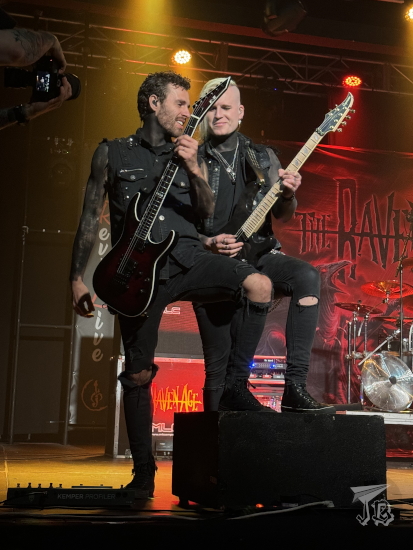
The Raven Age Madrid Concert: Disconnected

The Raven Age Madrid Concert: Disconnected

Unfortunately, the venue had not filled up when it was time for the main act, and that was a bit sad. Despite the ongoing sound problems and the small crowd, The Raven Age had a great presence. The music did not sound as powerful as what I had been listening online though, and I am sure that they did not have any tea in their thermos bottles…

The Raven Age’s setlist:
  1. The Guillotine
  2. Promised Land
  3. Forgive & Forget
  4. Nostradamus
  5. Surrogate
  6. The Face That Launched A Thousand Ships
  7. Scimitar
  8. The Day The Earth Stood Still
  9. Essence of Time
  10. The Journey
  11. Seventh Heaven
  12. Angel in Disgrace
  13. Serpent’s Tongue
  14. Grave of the Fireflies
  15. Fleur de Lis

The Raven Age Madrid Concert: The Raven Age

It was extremely amusing to hear a heavy metal singer with such a strong British accent, talking in a natural way and dropping swearwords without sweating them. The members seemed to be quite happy taking over all the stage, and there was a lot of interaction, which is always good and fun. Unfortunately, considering that promoter was giving tickets away, I don’t think I’ll ever have the chance to see them close to home again.

The act was not long. They started at 20:50 and finished at 22:10, so it was a relatively short show, but it went by really fast. There was no real encore, because MJ said “this is the time when we go backstage, you guys yell for more, we come back and sing some more, so we’re going to skip all that and go on.” I approve of that.

The Raven Age Madrid Concert: The Raven Age

The Raven Age Madrid Concert: The Raven Age

The Raven Age Madrid Concert: The Raven Age

The Raven Age Madrid Concert: The Raven Age

The whole event had a weird atmosphere from start to end – the lack of a queue, the… chairs outside so we could wait… The… “hey, hold my spot, I’m going to change into this merch shirt I just got” and “Sure, but then hold mine while I go to the toilet” conversations… And especially, the lack of people. I really hoped that there would be more concertgoers after 20:00, and at least some more enthusiasm. When I saw Kamijo in Barcelona there was a small crowd, but it was loud. Here, it was lukewarm. I felt a bit heartbroken for the bands, because they both did a great job.

The train I was supposed to take back did not pass, so I had to wait almost 45 minutes at the Vicálvaro station. That was not fun because the only seats were in the open platform and my lower back hurt – bad choice of shoes. It was extremely cold, too, so I just huddled on a bench, and it felt good when the train finally came. I got to my car just before midnight, and home soon after. I was so tired I almost hit the kerb on my last curve, so it is good that I did not drive back and forth on the speedway, actually.

All in all, I enjoyed the day, the supporting act, and the concert. Would I travel abroad for The Raven Age? Probably not. Will I buy their CDs when I have money to spare? Probably yes. Although I keep getting sidetracked by activities and places to see and burning through my fun budget… Just you wait until there is a concert somewhere I want to visit, and I’ll be taking this whole “not travelling for The Raven Age” back.

8th March 2025: Wiener Sängerknaben Spain Tour, half of a weekend’s plan (Madrid, Spain)

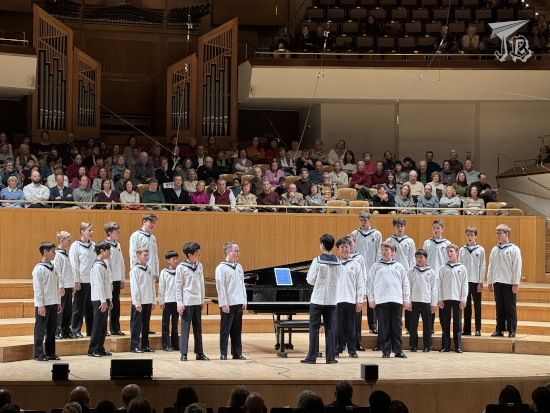
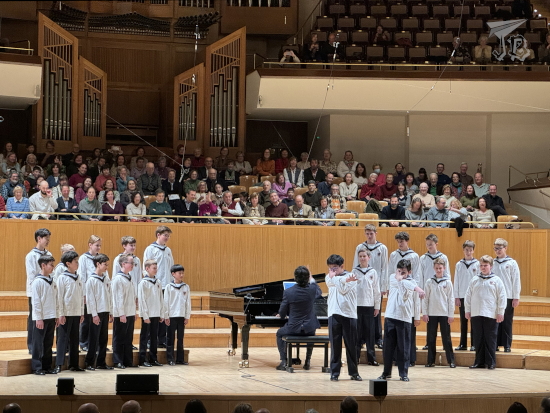
Where should I get to see the Vienna Boy’s choir Wiener Sängerknaben? Vienna? Of course not! Madrid, of course. We did try to see them in their home town, but it did not work out, because they sang before we arrived, and while we were on our way to the airport on the day we left. However, chance wanted that their Schubert Choir Schubertchor would be touring Spain in March, and Madrid would be their first stop. We got good tickets by a hair’s breadth, because my parents do not believe in booking in advance – nor in me booking for everyone – but we got them, literally last row of stalls.

Nobody knows exactly when the historical Wiener Sängerknaben was established, but there are records of boys singing at the Imperial Chapel back in 1296, even before the chapel was in Vienna. The Boys Choir just performed for the Court until 1918, when the Austria-Hungary Empire collapsed. In 1924, the institution was re-established as a private non-profit. It remained boys-only until 2004, when the Girls Choir Wiener Chormädchen was founded.

The boys attend their own campus from primary to senior high school. There are 100 choristers divided in four choirs (Bruckner, Haydn, Mozart and Schubert), each of which tours for around 10 weeks per school year. They perform High Mass in the chapel of the Imperial Palace every Sunday as part of an ensemble called Hofmusikkapelle (Court Music Orchestra), formed by the boys and members of the choir and orchestra of the Vienna State Opera (Wiener Staatsope).

As part of those ten-week tours, it was announced that in 2025 the Schubert Choir would tour South Korea, Spain, Switzerland and Italy. In Spain, they were to perform four special concerts in Madrid, Seville, Alicante and Valencia. The Madrid show took place at 11:00 in the national auditorium Auditorio Nacional de Música. The auditorium was designed by architect José María García de Paredes and it opened in 1988. The largest music hall can host over 2400 spectators.

Auditorio Nacional, inside and out

The Schubertchor has 22 members from all over the world – though most are Austrian, others come from China, Croatia, the Czech Republic, England, Germany, Hungary, Japan, South Korea and Ukraine. The boys’ names are not released, but they were touring with Peruvian conductor Andy Icochea Icochea, who had previously worked in the Wiener Sängerknaben between 2005 and 2011. Icochea seems to have specialised in training young choristers, and has had a long career with different choirs and orchestras, even with a music charity. He has collaborated with other directors such as Riccardo Muti, who conducted the 2024 Silvesterkontzert / 2025 New Year’s concert in Vienna.

The day of the concert started raining buckets, but we had decided to try public transport instead of driving to the area where the Auditorio Nacional de Música stands. Afterwards, we wanted to have lunch and head to Expominerales, which was held that same weekend. We arrived with plenty of time, and we had to find a café to pass the time until doors opened. Once that happened, it was a bit of a chaos of umbrellas and everybody trying to push in at the same time. If you think young people get excited before a concert, they’ve got nothing on senior citizens.

At 11:00 sharp, even before the hall had completely filled up – doors had opened kind of late in my opinion, less than half hour in advance – the children and the director came out. People were still being admitted during for the first couple of songs, and the auditorium staff were harassing patrons about where they had placed their jackets, or whether they were in their correct seats, well into the show. It was weird, and a bit disrespectful, those details should have been sorted beforehand. However, the concert itself were amazing. Most of it was sung a capella, and only a piano was used for accompanying the choristers in several songs, played by Icochea himself.

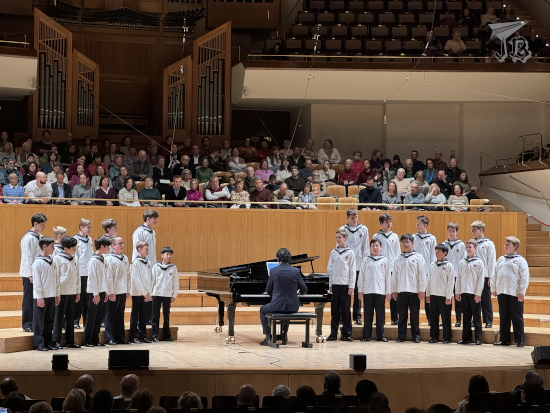
Vienna Boys' Choir Madrid

Setlist:
  First part:
    1. Kaiser-Walzer, Op. 437 (Emperor Waltz), composed by Johan Strauß II, with lyrics by Victor Gombocz and arranged by Gerald Wirth.
    2. Der Wassermann (The Water Genie), composed by Robert Schumann, with lyrics by Justinus Kerner.
    3. Hebe deine Augen auf zu den Bergen (Lift thine eyes), trio from Elias, Op. 70 (The Prophet Elijah), composed by Felix Mendelssohn from the lyrics of Psalm 121:1-4.
    4. Die Meere, Op. 20 No. 3 (The Seas), composed by Johannes Brahms
    5. Psalm 23, D.706, composed by Franz Schubert with Germany lyrics by Moses Mendelssohn.
    6a. Nun stehen die Rosen in Blüte (Now the roses have bloomed) from Der Jungbrunnen, Op. 44 (The Fountain of Youth) composed by Johannes Brahms with lyrics by Paul Heyse.
    6b. Die Berge sind spitz (The mountains are pointed) from Der Jungbrunnen, Op. 44 (The Fountain of Youth) composed by Johannes Brahms with lyrics by Paul Heyse.
    6c. Am Wildbach die Weiden (The willows beside the stream) from Der Jungbrunnen, Op. 44 (The Fountain of Youth) composed by Johannes Brahms with lyrics by Paul Heyse.
    6d. Und gehst du über den Kirchhof (And if you walk across the churchyard) from Der Jungbrunnen, Op. 44 (The Fountain of Youth) composed by Johannes Brahms with lyrics by Paul Heyse.
    7. Inclina Domine aurem tuam ad me, Op. 118 (Incline your ear, Lord, to me), Josef Gabriel Rheinberger (Psalm 86).
    8. Erlkonig (The Elven King) composed by Franz Schubert, with lyrics by Johann Wolfgang von Goethe, arranged by Oliver Gies.
    9. Sängerslust, Polka française, Op. 328 (Singer’s Joy, French Polka), composed by Johann Strauß II with lyrics by Joseph Weil.
    10. Wiener Blut, Walzer Op. 354 (Viennese Spirit), composed by Johann Strauß II, arranged by Helmuth Froschauer.
  Second part:
    11. 아리랑 [Arirang] (impossible to translate, but it might have meant “My beloved one” in Ancient Korean), arranged by Gerald Wirth, a traditional Korean love song from the Kyonggi Do province, with over 60 variations.
    12. Vreneli abem Guggisberg (Vreneli from Guggisberg), Swiss folk song arranged by Gerald Wirth.
    13. Müsle gang ga schlofa (Go to sleep, little mouse). Cradle song from Vorarlberg, Austria with lyrics by Walter Weinzierl, arranged by Gerald Wirth.
    14. Unz Wättr isch winti (Until the weather is windy), written by Luis Stefan Stecher like an Italian folk song, with music by by Ernst Thoma.
    15. O more duboko (Oh, deep sea), Croatian folk song, arranged by Gerald Wirth.
    16. La Paloma (The Dove), Spanish habanera by Sebastián Yradier, arranged by Gerald Wirth.
    17. Chim Chim Cher-ee from Mary Poppins (1964 film), by Richard M. Sherman and Robert B. Sherman, arranged by Christi Cary Miller.
    18. What Was I Made For? from Barbie (2023 film), by Billie Eilish O’Connell and Finneas O’Connell, arranged by Jennifer Lucy Cook.
    19. Under the Sea from The Little Mermaid (1989 film), by Alan Menken and Howard Ashman, arranged by Kirby Shaw.
    20. For ever, Polka schnell, Op. 193 (Forever, Fast Polka) by Josef Strauß, arranged by Gerald Wirth with English lyrics by Tina Breckwoldt.
    21. An der schönen blauen Donau, Op. 314 (The Blue Danube), composed by Johann Strauß II, with lyrics by Franz von Gernerth (1821-1900) and arranged Gerald Wirth.
  Encore
    22. Radetzky-Marsch, Op. 228 (Radetzky March), by Johann Strauß I, arranged by Gerald Wirth.
    23. Un Elefante Se Balanceaba (An elephant swung), Spanish children counting song, probably arranged by Icochea.

Charming does not even come close to describing the show. I’d never understood the concept of “angelic voices” until now, and I found it really unfair that you can’t actually find out the names of the boys. I don’t know whether it is to protect their privacy as they are minors, but it would have been great to at least know the names of the soloists, because the powerful voices from those little bodies was amazing.

The children were organised by tone of voice, which was similar to size, with the highest voices (smallest boys) on the front left and the lowest voices (biggest kids) on the back right. They sang most of their numbers towards the stalls, but for one song they turned to the people behind them, to both sides of the organ. Highlights included any time a child sang a solo – particularly the first one during the Emperor Waltz, as people were still coming in. During another song, Icochea left the stage for another boy to direct.

Vienna Boys' Choir Madrid

The oldest boy was in charge of having the audience clap during the Radetzky March, just like in the New Year’s Concert – and he looked right at that age when teens are all knees and elbows and awkwardness, but he seemed to be extremely proud of himself (well deserved!).

The last song of the encore was a total surprise. Before it started, the director invited us to “sing along if we were familiar with it”. This unexpected performance was a Spanish counting song, Un Elefante Se Balanceaba (An elephant swung), which goes “one elephant swung on a spiderweb – as it saw it did not fall down, it went to call another elephant. Two elephants swung on a spiderweb – as they saw they did not fall down, they went to call another elephant. Three elephants…” you get the idea – not precisely a philosophical song, but way less traumatic than say Hush little baby. One of the boys walked to the front and made a sort of trunk with one of his arms as he “swung” to the music. One by one, the others joined him until the proverbial spiderweb snapped and down to the floor all the children went. It was absolutely hilarious, and adorable.

Vienna Boys' Choir Madrid

Vienna Boys' Choir Madrid singing the elephant song

It was still raining heavily when we left the auditorium. It was 13:15, so no real time to get to Expominerales before it closed between 14:00 and 16:00. Had the weather been nicer (decent, at the very least), I would have found something else to do before it re-opened. But it was still raining cats and dogs – and maybe some ice – so we just decided to call it a (half) day.

31st December 2024: A clumsy morning yielded to an unbelievable evening {Vienna, Silvesterkonzert 2024}

When we walked out of the rooms to go down and have breakfast, my parent’s alarmed face made me worried. They informed my sibling and myself that “it had snowed”. That was spooky for a second – until I ran to the window and saw that the “snow” was just a very thin layer of scattered white powder. It was safe to go out, even with my senior parents. We had breakfast and we got ready to go out.

Snow in Vienna

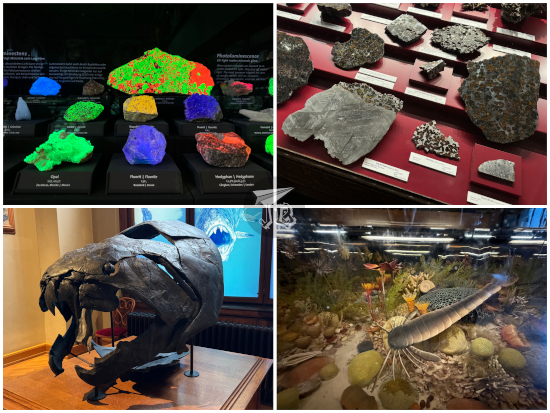
At some point, my family “caught” that I like Natural History museums, so they really, really thought I wanted to go to Vienna’s Natural History Museum – Naturhistorisches Museum Wien, and just wouldn’t listen to “No need, I’ve been there already, Their reasoning is that I had mentioned it before, which I actually had, to inform them that the Venus von Willendorf was there. That is where we ended up, and I was happy to oblige – the museum has rocks, meteorites, fossils and dinosaur animatronics. All right up my alley.

The museum’s oldest collection 250 years. In 1750, the Holy Roman Emperor Francis I bought what at the time was the largest collection of natural history objects at the time – around 30,000 objects. That same decade, the Emperor founded the Schönbrunn Zoo and the botanical garden, and he ordered the first scientific exhibition to be held. Upon his death, the collections were donated to the state, and the first museum according to the Enlightenment principles was founded – and soon expanded.

The museum building was also commissioned by the Emperor. It was designed by architects Gottfried Semper and Carl Hasenauer, with an identical exterior to the nearby Museum of Fine Arts. Works began in 1871, and the institution officially opened in 1889. Though it was indeed originally designed as a museum, it feels more like a repurposed palace, with decorated ceilings and monumental staircases. It has 39 halls with almost 9,000 square metres of exhibits, still keeping the 19th century outline. We just did halls 1 to 13: mineralogy, petrography, meteorites, palaeontology and prehistory galleries, including the Venus von Willendorf. The 11-centimetre figurine was made in limestone around back to 30,000 years ago. It is a nude woman of large proportions, and even if she does not have a face, she is mostly anatomically correct and has plaited hair.

My family was fascinated by the collections, and I guess I felt a teeny bit smug about that – considering how much fun they poke at me because natural history museums are very high on my priorities when I visit a new place (see: my first time in Brussels).

Natural History Museum Vienna

Natural History Museum Vienna

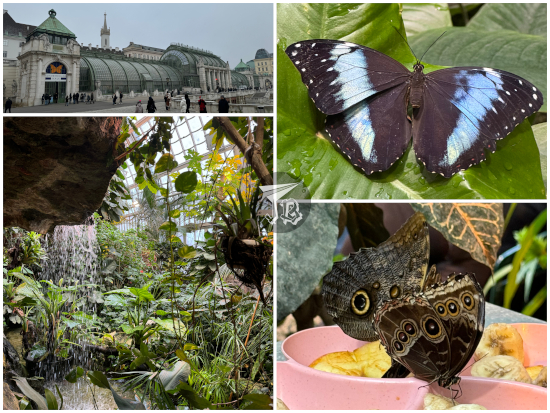
We left the museum after a couple of hours, around noon. We did not stay at the Silvestermarket at the square, but headed out towards the Imperial Butterfly House Schmetterlinghaus. It comprises half of an Art Nouveau greenhouse turned tropical botanical garden and butterfly zoo of sorts. I really love the iron-and-glass architecture of the building – and I would have loved to have had lunch in the brasserie that fills the other half of the greenhouse. The building was designed by architect Friedrich Ohmann and erected in 1901 as part of the Hofburg Palace and is, next to the Burggarten palace.

Most of the butterflies we saw, if not all, were forest giant owls Caligo eurilochus, very large butterflies originating from the Americas – they can live from Mexico to the Amazon basin. They have marks like big eyes in its back wings (hence the commmon name), and the inner wings are blue. They are pretty, and they seem to like fruit, as they gathered around the feeders to snack on it. The sad part is that they only live around 24 days.

Schmetterlinghaus

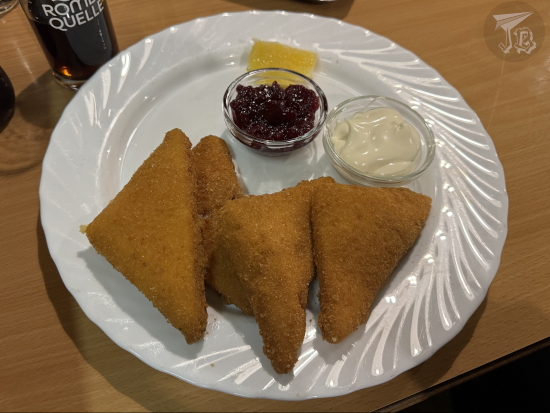
We then headed to the restaurant Centimeter, near the Rathouse (town hall) to have lunch. It is a place that has a lot of things measured – you can order sausages by the metre. I was somehow was not feeling hungry, so I decided to get Gebackener Emmentaler mit Sauce Tartare und Preiselbeeren, breaded and baked Emmental cheese with tartare sauce and cranberries. After lunch, we expected the Silvestermarket next to the Rathaus to be open, as it was one of the places to be for New Year’s Eve. We were wrong! That was a bummer, because in hindsight we could have cancelled the reservation and just stayed at the market in front of the Natural History Museum. That was a bummer, but at least we were warm.

Gebackener Emmentaler

We headed back towards the hotel, and we stopped by the supermarket next door to buy something for dinner. I grabbed myself some pre-emptive sushi, because I was pretty sure that my family was not going to find what they wanted – basically stuff like they would get at home. After half an hour of going back and forth, they decided to settle down with sandwiches and more sushi. We also picked up some chocolate thingies that would end up being more coconut than anything else. Not that I have anything against coconut, but I do not appreciate it replacing chocolate unannounced.

We took the groceries to the hotel, and had a bit of downtime before got ready for the main event. During that time, I went on the online airline webpage to make sure that the travel agent at El Corte Inglés had checked us in. The check-in was done, but someone had made a typo on my parent’s email address so we had not received the boarding passes. I retrieved them and downloaded onto my phone to distribute later.

A bit past 18:00, we left for the Wiener Musikverein, the Viennese Music Association, home to the Vienna Philharmonic Wiener Philharmoniker, where we would attend the 2024 Silvesterkonzert. It was a bit strange to head to such an event using the underground, but that was the most efficient means of transport, to be honest. We ran into the Spanish lady and her husband again – and that was great because that way we could take pictures of each other without having to get a stranger to do so.

Vienna Musikverein

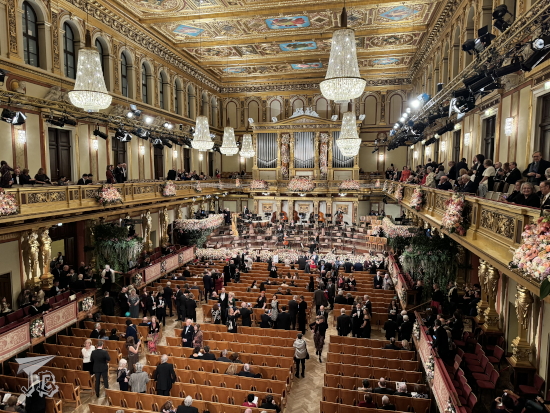
The Musikverein was designed to resemble an Ancient Greek Temple in a Neoclassical style, following plans by architect Theophil Hansen. The building was inaugurated in 1870, and it has a small decorated entrance, very underwhelming staircases, a small chamber music hall, and the main music hall, the Großer Musikvereinssaal or Golden Hall. Walking in there was… surreal. It’s a hall I’d seen so often on TV, and it actually felt… I don’t know, a bit… pale. Less bright than on the screen. Maybe it was that the flowers were white and pink, so they did not pop. And it’s not like I know anything about flowers, anyway. I was just happy they were artificial enough not to trigger my allergies, it would have been awkward to sneeze all throughout the concert…

Vienna Musikverein Golden Hall

Though the “New Year Concert” is the one that everyone knows, there are actually three concerts with the same set list – the Preview Voraufführung on the 30th, the Silvesterconcert Silvesterkonzert on the 31st, and the New Year’s Concert Neujahrskonzert on the 1st. I honestly would have thought that it would be full of wealthy people and they would be all cool as cucumbers, but it turns out, a whole bunch of us were just excited noobs taking pictures of every and anything. My family’s seats were on the second floor balcony. I just couldn’t believe everything that was going around around me, nor where I was. I bought the programme, because I really wanted something physical from the soirée, aside from the ticket.

The Vienna Philharmonic was founded in 1842. It is formed by the best musicians from the Vienna State Opera. It is actually run by the musicians themselves. Every year, a conductor is chosen to direct the concerts, and for the 2025, it was Italian Riccardo Muti. Maestro Muti was born in Naples in 1941, and studied in the Classical Lyceum. He proceeded to move onto studying Piano, then Composition and Conducting. He began his career in 1968 as the music director of the opera festival Maggio Musical Fiorentino. He conducted the New Year’s Concert in Vienna in 1993, 1997, 2000, 2004 and 2018 before this year. In 2011, the Philharmonic awarded him Honorary Membership. He is also a bit of a troll.

The concert had two parts, including the encore:

First part:
  1. Johann Strauß I. Freiheits-Marsch, op. 226 – Freedom March
  2. Josef Strauß Dorfschwalben aus Österreich. Walzer, op. 164 – Village Swallows from Austria, waltz
  3. Johann Strauß II. Demolirer-Polka. Polka française, op. 269 – Demolition Men’s Polka, French Polka
  4. Johann Strauß II. Lagunen-Walzer, op. 411 – Of friends, Waltz
  5. Eduard Strauß Luftig und duftig. Polka schnell, op. 206 – Airy and fragrant, fast Polka

Second part:
  6. Johann Strauß II. Ouvertüre zur Operette “Der Zigeunerbaron” – Overture to the operetta “The Gypsy Baron”
  7. Johann Strauß II. Accelerationen. Walzer, op. 234 – The Acceleration, Waltz
  8. Josef Hellmesberger (Sohn) Fidele Brüder. Marsch aus der Operette “Das Veilchenmädl” – Fidel brothers. March from the operetta “The violet girl”
  9. Constanze Geiger Ferdinandus-Walzer, op. 10 [Arr. W. Dörner] Ferdinandus, Waltz
  10. Johann Strauß II. Entweder – oder! Polka schnell, op. 403 – Either … or! Fast Polka
  11. Josef Strauß Transactionen. Walzer, op. 184 – Transaction, Waltz
  12. Johann Strauß II. Annen-Polka, op. 117 – Polka Ana
  13. Johann Strauß II. Tritsch-Tratsch. Polka schnell, op. 214 – Chit-chat, fast Polka
  14. Johann Strauß II. Wein, Weib und Gesang. Walzer, op. 333 – Wine, Woman, and Song

Encore:
  15. Johann Strauß II. Die Bajadere, Polka schnell, Op. 351 – The Bajadere, fast Polka
  16. Neujahrsgruß (New Year’s Address)
  17. Johann Strauß II. An der schönen blauen Donau, Walzer, Op. 314 – The Blue Danube
  18. Johann Strauß I. Radetzky-Marsch, Op. 228 – Radetzky March

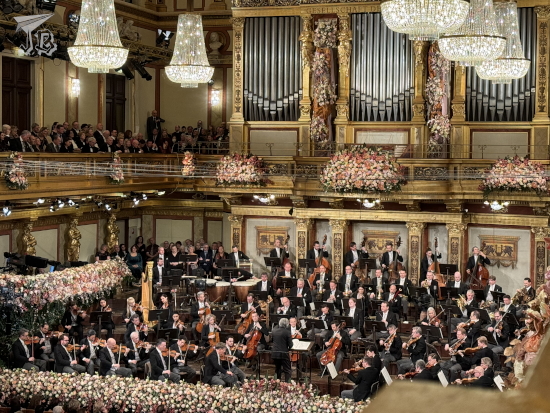
Vienna Silvesterkonzert 2024

Honestly, what can I say? It’s nothing and everything like what you watch on TV. The music was fantastic, but somehow it felt like the conductor did not do much, the orchestra did whatever they wanted, not in a bad way. They knew exactly what to do and just did it. I know next to nothing regarding classical music, but they made it feel absolutely effortless. I am not sure how much work they do on their own and how much they do with the conductor, but I can tell had Riccardo Muti a blast. At some point, when he was coming in and out, he knocked over some of the viola or bassoon’s music sheets all over – he was very apologetic about it. Also, although neither photographs or videos are not permitted (mine are totally… sneaky, you see), one of the ladies in the first row was shamelessly filming, and he winked and waved at her. Furthermore, he would just… jump during some of the polkas, which is a feat considering the man is 83 years old.

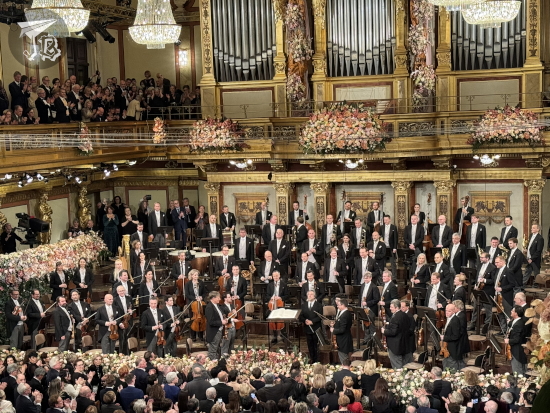
The concert always ends with Strauß’s Radetzky-Marsch, and the public is invited to clap along. Muti completely had the concertgoers in his pocket, controlling them (us) with a finger and a look. It was amazing to watch. All in all, he was absolutely… not careless but carefree. It was great to see, somewhat magical in a way.

Vienna Silvesterkonzert 2024

The concert felt much much shorter than the two and a half hours it lasted. We went down to the first floor for pictures during the intermission, and we were not the only ones. However, I think we kind of… snuck past the intern or something, not sure we were supposed to be allowed on that floor. People were having champagne but I only cared about seeing everything. I might be a bit… weird. I make no apologies. I really loved the experience. They say it is a once-in-a-lifetime experience, but to be honest, I would just try the lottery every year from now on. I mean, I now have the right clothing for it…

After the concert, we went back to the hotel where we had our dinner. To be completely fair, there was a part of me that would have totally wanted to go out to watch fireworks and Vienna’s way to celebrate the New Year – and then be an absolute wuss, freeze my butt off and need to come back to the hotel. But the grass is always greener on the other side of the fence, and since I did not get to see it… It must have been the most interesting thing ever! It’s okay though, because I got to see the concert, and it was already my once in a lifetime most interesting thing ever… But it took me hours to get to sleep, so maybe I could have explored some, because in the end I’m greedy and I want it all.

18 & 19th November 2024: Apocalyptica Played Metallica in Madrid (Spain), so there I went

Planning for this short getaway started on the 23rd of February, when I bought my ticket for the Apocalyptica Plays Metallica Vol. 2 Tour 2024 stop in La Riviera in Madrid (50.50 €). Almost immediately, I headed off to Apocalyptica’s website to buy the VIP Tour 2024 Upgrade (58,90 €). The upgrade consisted on early access, photograph / meet & greet / autograph session (the important part), VIP lanyard, fabric patch, pin and tote bag. Honestly, all that for barely 100 € was a sweet deal. Back in Antwerp for Starset, someone I was queueing with complained that VIP tickets were too expensive for “a broke uni student”, but for me, meeting with the artist, albeit briefly is usually worth it – early entry is a plus, too, because for some concerts I either find a barrier spot or I just have to go to the back. The bundle was dispatched on the 9th of June (according to the email. Do Finnish post offices open on Sunday?) and it arrived on the 18th.

I originally booked a cheap hotel about half an hour’s walk from the venue. Later, I decided that I preferred the more expensive one less than 10 minutes away, so I changed my booking a week before the concert. I did not book there originally because it required prepayment, and my card was playing up..

On Friday the 4th of November I received an email with instructions for the Meet & Greet, which was to start at 18:30, and I should be there at 18:15. All right, I could do that. It was only a matter of waiting.

On Monday, 17th of November, I took a morning train to head out to Madrid with some leeway for time because I needed to do some small item shopping. I had to dodge some guys trying to get people to sign up for an NGO, but at 11:40 I made it to my first stop of the day – the light museum Museo de la Luz. I had been putting this visit off to go with someone who had expressed interest. However, I also waited for another exhibit and I missed my chance as it turned out to be only temporal. Thus, I decided to head to the Light Museum on my own – it was also one of the few exhibitions open on a Monday morning.

The Light Museum is a modest exhibition with interactive artworks that are mainly made out of lamps, lasers and lights. When you come in, you are given covers for your shoes and a key for a locker – all for free. Then you wait until an attendant takes you in and shows you how to interact with the first artwork “The birdcage” (La Pajarera), a box made out of light and metal that you make change colours with the movement of your arms. Once you know how to “play” with the art, you are left on your own to wander for an hour. At first I thought it would be tight, but the place was small – a bit too small for the price, I thought. I was there for around 40 minutes in total.

There were few people and I was able to check out most of the artwork uninterrupted. The next exhibit is made out of a number of old music festival lights – those that gave a lot of heat from the 90s, which are supposed to be a reference to climate change. Then there is a giant kaleidoscope you can walk in – this one became my favourite. Other rooms or works include a wall of lights that follow you as you move or dance, something with lasers (that I think was broken), some light illusions, a room full of hanging lights, a cube of mirrors and light… At the end there is a wall reading “light museum” in differently coloured lights. When I left, the lady at reception gave me a badge for booking with the official website.

Light Museum Madrid

Light Museum Madrid

I walked out and headed towards the restaurant where I wanted to cheat the system. I crossed the square Puerta del Sol, where they were setting up the Christmas tree – it was about 45% Christmas. On my way, I walked by the underground stop Metro Banco de España which has a tiny door for Little Mouse Pérez – Ratoncito Pérez, the Spanish equivalent to the tooth fairy. I never remember to check it out when I am around, but I made the connection this time.

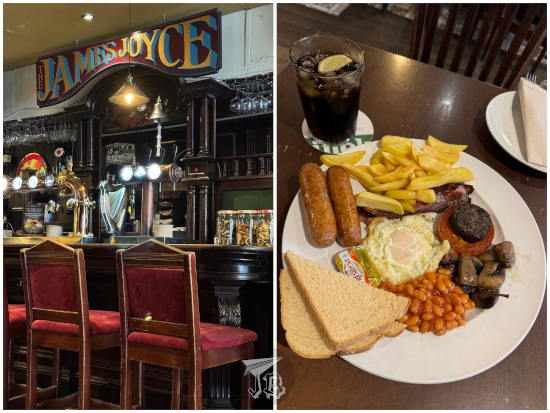
I finally made it to the James Joyce Pub – which is technically a sports bar. I was not there for the TVs though. I had a while back found the place looking up places which served English breakfasts in Madrid. The James Joyce prides itself in being an Irish pub and offers Irish All-Day Breakfast (12.00 €) – two pork sausages, two rashers of bacon, baked beans, fried egg, sautéed mushrooms, grilled tomato, blood pudding, chips, two half-toasts and butter. No, I would not survive that for breakfast, so I ordered it for lunch (and dinner), thus tricking the system indeed. Unfortunately, it was really good and authentic, so now I’ve got to come back for the sausages and the shepherd’s pie, so at least twice.

James Joyce Irish breakfast

After lunch, I headed out towards the park known as Madrid Río. The park runs along the banks of the river Manzanares. It covers 121 hectares, and it was designed after to cover the space emptied when the belt road M-30 was rebuilt as an underground tunnel. The original project was created by a team of architectural studios and landscapers, with strong ecological consideration – aiming to help the area recover from the degradation and pollution caused by years of road traffic. The project was carried out between 2006 and 2012. In 2015, a second project was carried out to “renaturalise” the river, opening the dams to allow the water to flow freely, which in turn caused the recovery of many plant and animal species (to the detriment of… the local rowing team).

There are also bridges that connect both banks of the river. One of them is the one I crossed – just because I could. It is the pedestrian bridge Puente Monumental de Arganzuela, designed by Dominique Perrault. It is a bridge in two parts – one crosses the river, the other overlooks the park and connects to the urban area, and a total length of 278 metres. It is a tube made out of steel and wood that I’ve been wanting to check out for a while.

Arganzuela bridge

Another important bridge is the completely different Puente de Toledo, a baroque bridge built by Pedro de Ribera. It was erected in granite between 1717 and 1732 as the previous ones had been taken down by torrential floods. This one was made to stay, with nine solid arches opened to allow for the river floods. It was… ready for Christmas.

Madrid Río and bridges

It was weirdly warm for a November afternoon, so when I went to my hotel I opened the window while I had a shower. Around 17:00 I headed out to the venue, where there was a small group of people waiting already. La Riviera is a 1,500 people venue, with really good acoustics – and very dedicated staff. The place was originally a cinema, which was turned into a disco, and then into a music venue and nightclub. It is the same place I saw Epica and Apocalyptica in 2023, and I was surprised how many people came for the M&G considering that last year we were… six. We were around 30 this time around.

At first we were chatting in front of the main door, but soon a queue started forming. A little later, the nice security guy (who last year told me “I looked the part of an Apocalyptica fan”) took us to a secondary door, and the queue was properly organised. Surprisingly, bags were not checked – while last year they even took markers from people.

Apocalyptica is a Finnish symphonic metal band. It was formed in 1993 as a tribute to Metallica with a classical touch – playing with cellos. Their debut album Apocalyptica plays Metallica by Four Cellos was released in 1993. They slowly moved from covering other bands in a neoclassical style to their very own repertoire. Today, the members are Eicca Toppinen, Paavo Lötjönen and Perttu Kivilaakso, three classically-trained musicians with a deep love for metal. In 2024, they have gone full circle with the album and tour Apocalyptica Plays Metallica Vol. 2, performing with drummer Mikko Kaakkuriniemi.

Apocalyptica Tour 24/25

We were ushered into a queue for signatures, and afterwards we would go at the end of the line to wait for photographs. I had brought a print-out of the picture from the previous year, and I told them that whenever they came to Madrid, I would come see them. I got a smile for that. It was an awesome photograph, after all. After everyone had their stuff signed we had the photographs. I asked for “a big metal hug” and got trolled instead. Fun times though!

After the photograph, I found a spot at the barrier. Last time I got on the right, this time I went left. Just a little. I did not want to go dead centre in case anyone decided to moshpit, but I might next time as there was no issue – everyone was too entranced for anything like that, I’d say.

The opening act was the Finnish band Arctis, a baby band who has just debuted with their first CD. They were pretty fun, maybe… a bit… too happy bouncy for metal? I’ve read their act described as metal-pop. It might be. I liked them okay, and they were nice.

Setlist:
 1. I’ll Give You Hell
 2. Remedy
 3. Tell Me Why
 4. WWM
 5. Bimbo (Lambretta Cover)
 6. Fire
 7. Frozen Swan
 8. When The Lights Go Out
 9. Theater of Tragedy

Arctis at La Riviera 2024

Arctis at La Riviera 2024

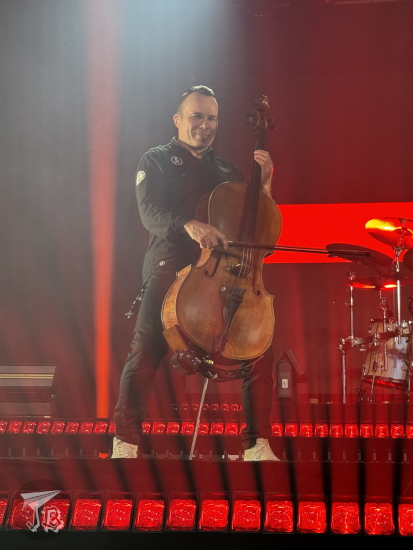
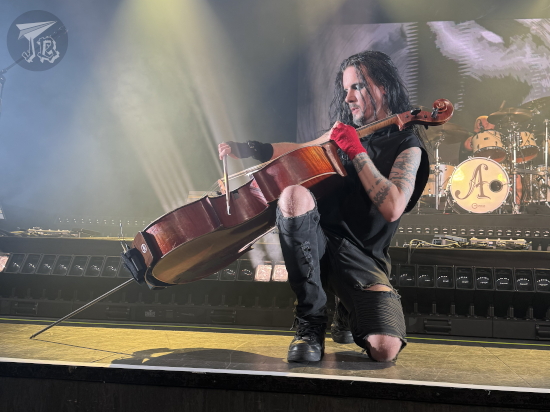
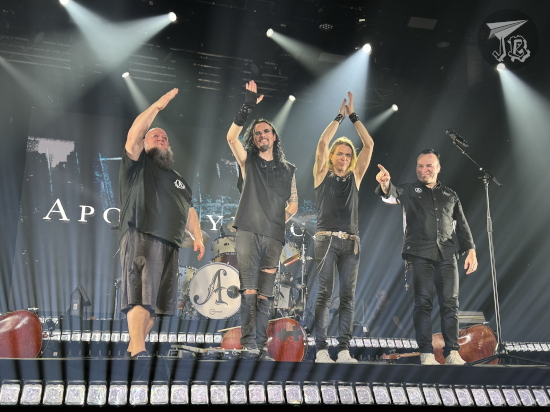
Apocalyptica came on stage at 21:00 sharp, and the live was glorious. All the songs were Metallica covers, from the new album, the first one, or the remastered version of Plays Metallica released in 2016. Despite that, one would not even have to be a Metallica fan to enjoy the concert, because the three men that compose Apocalyptica have an amazing magnetism. Perttu reminds me of the Duracell Bunny, he just did not stop for a second throughout the whole concert, which lasted a good two hours. Paavo seemed to be in his own little world, as he usually does. Eicca is the one doing most of the talking, and he is hilarious when he delivers his puns with a total deadpan voice and face.

Setlist:
 1. Ride the Lightning
 2. Enter Sandman
 3. Creeping Death
 4. For Whom the Bell Tolls
 5. Battery
 6. The Call of Ktulu
 7. St. Anger
 8. The Four Horsemen
 9. Blackened
 10. Master of Puppets
 11. Nothing Else Matters
 12. Seek & Destroy
 13. One

The audience was mostly moved by Nothing Else Matters, I’d say, judging by how they chorused it. Perttu was all in for that. Personally, I found Seek & Destroy and One, particularly, to be extremely powerful. Also, knowing that they dug up the original bass track from deceased Metallica member Cliff Burton for The Call of Ktulu was half-amazing and half-chilling. All in all, it was a fantastic concert, no matter how one looked at it.

Apocalyptica La Riviera 2024

Eicca Toppinen . Apocalyptica La Riviera 2024

Paavo Lötjönen. Apocalyptica La Riviera 2024

Perttu Kivilaakso. Apocalyptica La Riviera 2024

Apocalyptica La Riviera 2024

Afterwards, Arctis was hanging out by the merch. I got their CD, they signed it, we took a photo. It was fun!

I left the venue and I brought an ice-cream and a sports drink for “dinner” of sorts, because I was thirsty. I had both in the hotel room before my shower – the second of the day – and collapsing onto the king-sized bed. I had to wait for the phone to finish charging before I slept though, so I watched a movie before I zonked out.

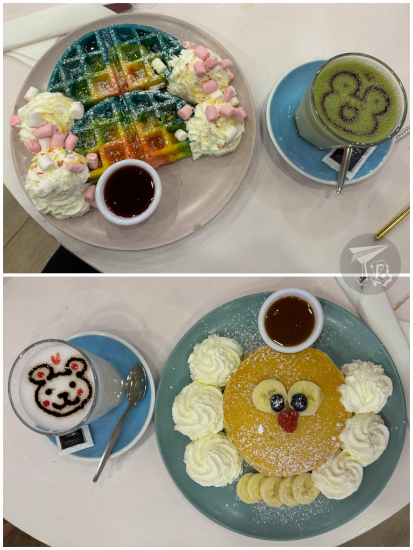
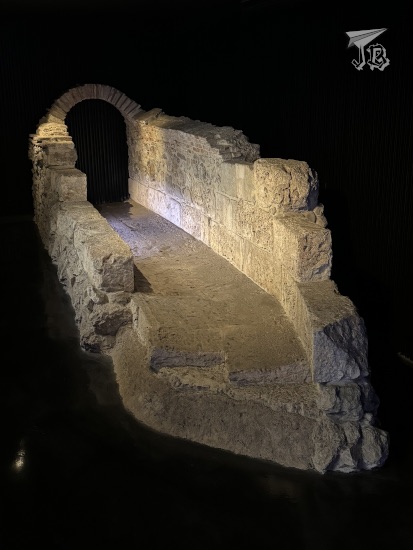
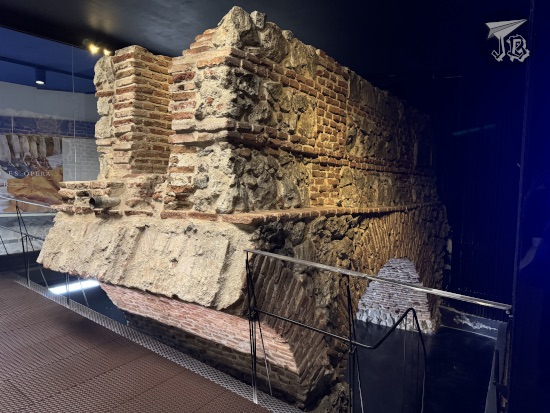
I woke up on Tuesday, 18th of November and drank my coffee before I set out. It was freezing out there, with frost on the grass, in spite of the warm afternoon the day before. On my way, I found the ancient walls of the city, remains from the old Moorish fortress alcázar, which stand to the side of the Royal Palace and the Almudena cathedral. I walked towards the centre of Madrid – The Sol Christmas tree was about 60% ready – to meet up with my relative for breakfast at a new place called Kawaii Cafe. Inspired by the Japanese kawaii [可愛い]. Kawaii means pretty, childlike, cute, and the Kawaii Cafe has taken the idea to heart, maybe not not in a complete accurate manner though. Everything is pink, full of fluffy and glitter. The food is not only tasty, also pretty. However, the wait staff is dressed as “maids” [マイド], which I tend to associate more to the… hm… more risqué side of hospitality. When food is brought out, you are offered to chant a spell for it to be even tastier.

I found the place existed by chance, and I was instantly smitten by the rainbow waffles, because they were adorable, and very, very rainbow-like. Thus, I ordered them, along a matcha latte. My relative tried the pancakes with a cocoa. She was ecstatic at the quirkiness of the place.

Kawaii Cafe Madrid order

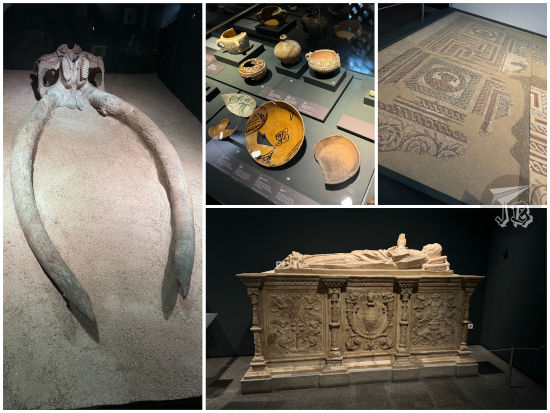
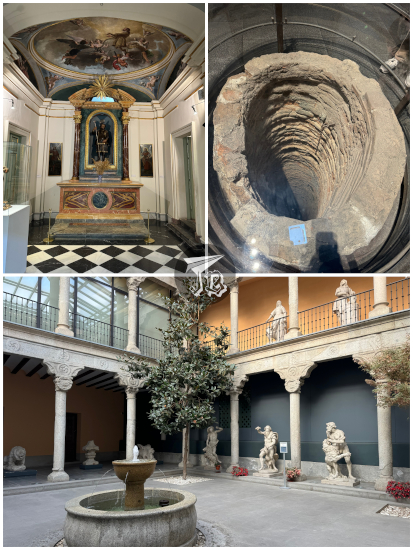
We stayed for well over an hour, and then headed out to one of the local museums Museo de San Isidro – Museum of Saint Isidore the Labourer. Isidore is the patron saint of Madrid. He is credited with several miracles – multiplying wheat and food, having his oxen plough on their own, and rescuing a child from a well making the waters inside rise. According to tradition, the museum is housed where he used to work, and legend has it that the old well is the one he pulled the child from.

Today the museum hosts some palaeontological and archaeological exhibits, from a mastodon and ancient rhinos to Medieval artefacts, running through the Roman occupation and the Muslim period. The place is a complement to the Museo de Historia de Madrid, or maybe its competition, though I think both belong to the same institution – and both are free. As the building is a historical place, it offers the chance to enjoy its small but beautiful Renaissance courtyard, with sculptures of mythological heroes, and of course St. Isidore and his wife. There is also a tiny Baroque chapel.

San Isidro Museum

San Isidro Museum: chapel, well, and courtyard

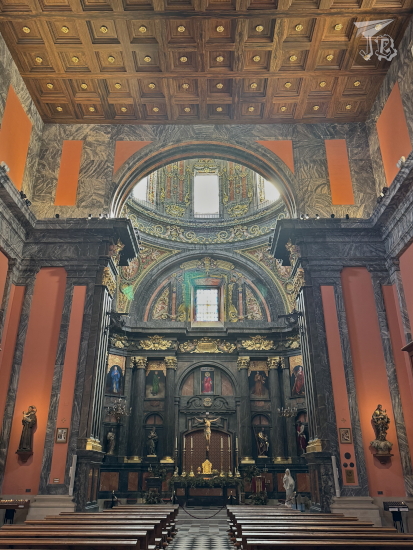
Right next to the museum stands the Baroque church of Saint Andrew the Apostle Iglesia de San Andrés Apóstol , which was getting ready for Christmas. The church is one of the oldest in town, though it was rebuilt after its destruction during the Civil War, and it has been recently restored. It hosts a number of religious sculptures and a painted vault above the altar.

Saint Andrew church Madrid

We took the underground at the station Tirso de Molina, which can still be accessed through the historical entrance hall, which is similar to the one that was closed off in Pacífico. It was beautiful, though of course busier than the museum one. Over the entrance to the platform there is a tile mosaic with the old shield of Madrid, dating back from the original station. It was installed in 1921, and it is the oldest artistic item in the underground network.

Access Hall at undeground station Tirso de Molina

From there we commuted to Nuevos Ministerios, where they had just kick-started the Christmas market. It seemed to be the “brands” market, with Lego, Disney, and so on. There was also a food truck by a famous chef selling basically chicken sandwiches at outrageous prices. I had been vaguely curious but not going to break the bank for a chicken sandwich, especially after such a breakfast!

I took a train from there back home, with no incidents whatsoever (because by now I’m desensitised to trains being late…)

17th November 2024: Ha·Ya·To Drum Masters in Guadalajara (Spain)

A while back, I read on Keita Kanazashi’s Instagram that Ha·Ya·To Project was going to come back to Spain for a small tour with their show Ha·Ya·To: Drum Masters. The most convenient place for me to see them was Teatro Buero Vallejo in Guadalajara. I got tickets as soon as I realised they were out, and still I did not beat the local crowd who buy tickets for any and everything.

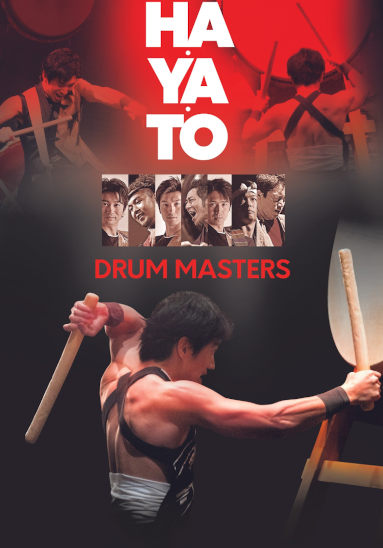
Ha·Ya·To Drum Masters promo

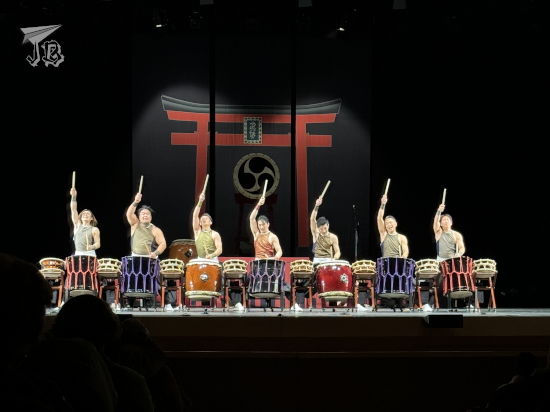
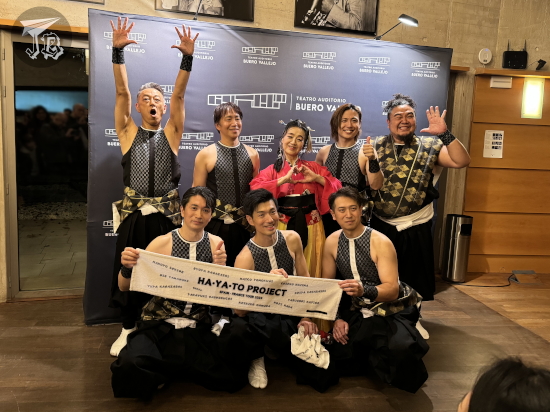
Ha·Ya·To: Drum Masters is a Japanese percussion show wadaiko [和太鼓]. While Ha·Ya·To is officially formed by the three Kanazashi brothers, Keita Kanazashi, Ryota Kanazashi, and Yuta Kanazashi, for Drum Masters they are joined by Koji Hada, Takayuki Hashiguchi, Makoto Sekine and Shunichiro Kamiya, along with special guest stars Chieko Kojima (first female wadaiko master) and Masato Shibata (Japanese guitar shamisen world champion).

The show depicts the seasons of the year. It starts in Spring, with flowering cherry blossoms and a slow build up that yields to a super-energetic Summer, full of bouncing and strong beats. Then there comes the break and afterwards there is Autumn, where Chieko Kojima really shines, though the rhythm is a bit lower and more melancholic. Finally, energy picks up again for Winter – because it’s cold and one needs to warm up.

Ha·Ya·To Drum Masters

Ha·Ya·To Drum Masters

Ha·Ya·To Drum Masters

Ha·Ya·To Drum Masters

The show was absolutely fantastic. Afterwards, there was a “collective M&G” with pictures with the musicians. I did not get any autographs, though Ms Kojima did notice that I was carrying the DVD I bought in 2018. That lead to her, Keita and myself talking a little. I also had a photograph with Keita from an event in 2019. Their manager is very strict, and once she decides picture time is over, she really ushers them away. I did manage to sneak a selfie with Makoto Sekine after the rest of the group had left though.

Ha·Ya·To Project

I love taiko. It really energises me, and it was a great way to spend the evening. I could’ve combined it with something else, but I had plans for the next couple of days. I was off to see Apocalyptica the following day.

23rd October 2024: Brussels & Charleroi Terminal 1 {Belgium October 2024}

Whilst part of me wanted to stay in Antwerp [Anvers | Antwerpen] and visit the chocolate museum Chocolate Factory, it opened too late for me to be comfortable with the later flight schedule. Beside, I had my Art Nouveau Pass. Thus, I headed off back to Brussels [Bruxelles | Brussel], to visit the Musical Instruments Museum Musée des instruments de musique | Muziekinstrumentenmuseum. The museum is located in the former Old England department store, built by Paul Saintenoy in 1899 in the Art Nouveau style, mostly out of glass and girded steel. The building itself was pretty interesting and I found the idea of an “audioguide” with the sounds of each instrument endearing. I spent longer than I thought I would there.

Musical Instrument Museum building

Musical Instrument Museum Brussels

I then headed off towards the central square Grand-Place | Grote Markt to find the third of the typical Belgian foods I wanted to try – moules frites. This dish comes in two servings: one of Belgian fries and another one of boiled mussels. I chose a restaurant called Brasserie Le Cerf that I had checked online the previous night. Since it was still early, I was alone in the place. The mussels can be prepared with a number of add-ons and sauces, but ordered mine plain. I thought it was adequate for the first time. The mussels came boiled with a little celery and leek, and I really liked them. I passed on the Belgian beer, because I’m not a drinker of alcohol. As an appetiser, the restaurant provided bread and butter and everything was lovely.

Moules frites

I wandered a little around the area and I found the shopping area Galeries Royales Saint Hubert, where I saw some lovely chocolate in a cute little Art Nouveau shop – but way out of my budget. I also saw a giant smurf, and considered a second comic exhibition in Horta Gallery. However, I was weary of the fact that my bus had to go around Brussels at the after work rush, so I decided to give myself a wide berth of time to get to the airport Brussels Charleroi. After all, I had been there before and there were plenty of shops and things to do. Unfortunately, that was Terminal 2. This time around my flight left from Terminal 1, which lacks even decent seating space. Whoops. At least there was a toilet and a fountain to get some water.

Around the Grand Place

The flight was on time, but once again I had been assigned an emergency exit seat. I approached the flight attendant to explain that I have reduced mobility on my right arm, and she found someone to exchange seats with me – the biggest guy on the plane, it seemed. He probably enjoyed the extra room and empty seat next to him, and I did not have to stress. Not that I actually expected anything to go wrong, but just in case…

Since I had no checked luggage, once we landed I was out of the terminal quite quickly. I had to wait for the bus to the parking lot for a while, but I was on my merry way and home without issues and with having had great experiences, talked to great people, and met fun artists. And I’ve got a new guitar pick for my very modest collection of (now three) picks!

22nd October 2024: Antwerp & Starset’s Immersion {Belgium October 2024}

The weather was clear but crisp in Antwerp [Anvers | Antwerpen] when I left the hotel to grab a coffee at a small supermarket at the station. I walked right up to the Cathedral of Our Lady Onze-Lieve-Vrouwekathedraal. The interior was spacious, with a feeling of light and openness, with pointed arches. One of the key features of the cathedral is the art it houses, particularly the four paintings by Peter Paul Rubens (1577 – 1640), the most important Flemish Baroque artist, known for his nude characters, whether mythological or biblical. There are four of his works in the cathedral – The Elevation of the Cross, The Descent from the Cross, The Assumption of the Virgin Mary and The Resurrection of Christ. The cathedral boasts that it contains more “masterpieces”, both classical and contemporary, but they pale in comparison.

The cathedral is 123 metres long, and its tower is 123 metres high, giving it a special proportionality – which would have been even more spectacular if the second tower had ever been completed. The nave has a “secret” skylight that can only be seen if you are standing right underneath – this is supposed to represent the presence of God. The building is considered late Brabant Gothic, with some Baroque decorations. The stained glass windows are mainly Neo-Gothic, since the originals were destroyed. Underneath the nave there is a Medieval crypt.

Antwerp Cathedral interior

Art in Antwerp Cathedral

Afterwards, I headed out for the Plantin-Moretus Museum Plantin-Moretusmuseum, a Unesco Heritage Site. It is a museum on the history of book printing, especially from the 16th century printers Christophe Plantin (founder) and Jan Moretus (heir and son-in-law), located in their former house and workshop. The collection includes original printing presses and typesetter letters, drawings and paintings by Rubens, and hundreds (thousands?) of books printed throughout the centuries, and even some manuscript codexes. There were Bibles, atlases, medicine books… It was absolutely fantastic – though taking pictures was hard due to the lightning (so forgive the strange angles).

Plantin-Moretus Museum

Plantin-Moretus Museum books

I was feeling a bit woozy, probably because I had not eaten anything solid in 24 hours. Thus, I found a supermarket and bought a few items to have lunch, dinner, and breakfast the following day. I was heading back to the hotel, but I became distracted as I walked by the Stadsfeestzaal. Now a shopping centre, it used to be an exhibition hall, built at the end of the 19th century. It burnt down in 2000, and in 2007, it reopened after restoration as a shopping centre… which was celebrating Hallowe’en.
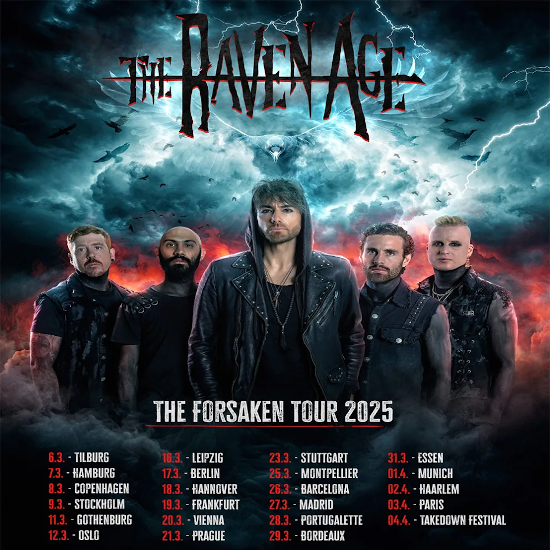
Antwerp festival hall

I ate a sort of pizza bread, warm from the supermarket, on the way, and some sushi when I got to the hotel. It was an unorthodox combination, but it made me feel fine again. I saved a salad for later, and I got some rest and got ready for Starset’s concert Immersion: The Final Chapter. I reached the venue Trix Zaal around 16:20, and I was… second in the VIP queue. The VIP passes were issued around 18:30, with a staff member taking our names and checking IDs. Doors opened at 19:00 and the curtain literally fell at 20:15.

Starset Inmersion poster

I once had to describe Starset and I did it as “weird”. Not in a bad way. They have a futuristic image, with an emphasis on a future rather terrifying technocratic dystopia. The concerts carry out a narrative – the New East is a sort of mental empire that controls everything through a device implanted in your mind. Their music videos are independent though. Their music style is hard rock or alternative metal, I’d say.

When I first saw them in Japan, they were officially four members: Dustin Bates (lead vocals, keyboards, soundboard, guitar), Ron DeChant (bass, keyboards, backing vocals), Brock Richards (guitars, backing vocals) and Adam Gilbert (drums, percussion) – those were the ones I met for the sainkai. They are currently touring with Zuzana Engererova (cello), Siobhán Richards (violin, keyboards), and Cory Juba (guitar, synth). I am very happy to report that the touring members are – at least for the two concerts I’ve attended in Belgium are present for photographs and meet and greets.

I enjoy Starset concerts a lot, I kind of feel the music. Besides, there are a bunch of songs that hit my soul really hard. Out of this concert’s setlist, I particularly love Carnivore and TokSik. However, Trials, Monster and My Demons are the ones that touch me really deep.

The stage was set with a bunch of rotors between the musicians and the audience, and there was a lot of neon and smoke to help with the visuals. The concert took about two hours, with a break in between to take down the rotors (in a matter of minutes). The “final chapter” the tour title refers to turns out to close down the futuristic plot and kickstart a present one with… time travel. And it makes total sense!

Setlist:
  1. Unbecoming
  2. Carnivore
  3. Manifest
  4. Perfect Machine
  5. Frequency
  6. Trials
  7. It Has Begun
  8. Waiting on the Sky to Change (Downplay cover)
  9. Devolution
  10. Infected
  11. Telekinetic
  12. Brave New World
  13. Faultline
  14. Monster
  15. Degenerate
  16. Echo
  17. Die For You
  18. Halo
  19. My Demons
  20. TokSik

Starset concert snapshot

Starset concert snapshot

Starset concert snapshot

Starset concert snapshot

Starset concert snapshot

During the concert, the person who had been first at the VIP queue had a bucket with a glow in the dark message asking for guitar picks. They caught an extra one and gave it to me afterwards! I was extremely grateful! After the encore, VIP pass holders could stay behind to take the official photograph and get some items signed.

I had brought a printed copy from my photograph from the VIP event at the previous concert. Whilst last year the VIP experience was a pre-concert acoustic, this time around it was afterwards, and it consisted on “hanging out with the band”. I had heard about it before, but I could not imagine how that went. First, we lined up for the official photograph. They built up a backdrop for the. After the picture was taken you got a signed poster and the QR to download it, and off you went back to the floor. I was talking to the people I had queued with when I suddenly looked up and saw Cory within the crowd. How can these guys be so tall and at the same time so sneaky? Because I swear, Dustin is 2.5 times me and I never saw him coming.

I asked each member to find themselves in the photograph and they signed it for me. Some asked when it was from, and I explain the one from the previous year. Though technically they could sign two things, I forewent the CD I had because the photograph was easier to hold on its own. I praised Zuzana on the girl-power vibe she and Siobhán had going on for the tour and she was happy “someone noticed”. Trust me, it is very noticeable. It was extremely weird and fun to be chatting with all the members like that. I am not sure it makes sense, but I am a bit intimidated by the interactions with Japanese stars – I would blame it in Japanese being my third language, but both Miyavi and Yoshiki are fluent in English. I could blame it on all rules being broken after the stint on the floor of the Royal Albert Hall, I guess. Or maybe it is just different with American artists, since I had the same feeling with Misha Collins – “approachable and human”.

Though the manager had said “no selfies”, towards the end, when he was the last around and a bunch of people had left already, Dustin (vocals) took a few with the fans who remained. I was one of the lucky ones. Then we ran into Andy (drums) at the bar and we were chatting for a while longer. We also took a selfie, yay us.

Afterwards, I undid the way towards the hotel. I walked because it was actually shorter than taking public transport. It was after 23:00, and the streets were mainly deserted as it was cold, but I had no incidents. I had to walk fast to keep myself warm, so that helped reduce the time out. I was also glad I had bought myself dinner, as I thus I did not have to look for a fast food place open at the time and I could head directly into the shower.

All in all, the whole experience was fantastic and I had a blast, or two. Thank you, Starset, for such an awesome event, and all the nice fans who had zero issues with switching to English whenever I was around, and especially to the person who gave me the pick.

16th October 2024: San Francisco Ballet’s Swan Lake at Teatro Real (Madrid, Spain)

While heavy metal and hard rock concerts are my form of meditation, there is something magical about ballet in general and Swan Lake in particular. Also, in my defence, I’ve loved Swan Lake since before I first saw Yoshiki play part of it on piano. Swan Lake is a three-act ballet written by Pyotr Ilyich Tchaikovsky in 1876. The story is widely known – Evil sorcerer Von Rothbart curses princess Odette to live as a swan during the day and only return to her human self at night. Nearby, prince Siegfried is trying to avoid all his obligations, and goes hunting. The two meet and fall in love, and Siegfried invites Odette to a ball where he will propose and both will live happily ever after since obviously love is stronger than black magic. Except, at the ball Von Rothbart shows up with another lady, Odile, the black swan, who seduces Siegfried, and he proposes to her, thinking she is Odette. Drama ensues. Siegfried realises that he has the wrong girl, and runs to the lake where he first met Odette.

Now, depending on the version, after Siegfried and Rothbart fight, the ending can go several ways, and I’ve seen a few. There is a standard happy ending – true love conquers all, Von Rothbart is defeated, and Siegfried and Odette get their happily ever after. In another version, Odette commits suicide as Siegfried’s mistake has made the curse unbreakable. Another option is that she dies of heartbreak. Her death yields to a very epic ending image of Siegfried lifting Odette’s body into the air, and Von Rothbart is defeated by Siegfried’s grief and true love. Finally, there is the option of both Odette and Siegfried dying, and the power of their loving sacrifice defeats Von Rothbart. Note how the evil sorcerer “loses” every time. However, in the original script – which I’ve actually never seen on stage – both Siegfried and Odette drown in the lake and Von Rothbart sort of wins. I’ve always found that interesting. 

Anyway, I really enjoy watching Swan Lake and trying to anticipate which ending the choreographer has chosen. I have to admit that I’m personally partial to the ending where Odette dies of heartbreak, because while I love the ballet – and the black swan – Siegfried is an idiot and with this ending he gets to live with the knowledge that he proposed to the wrong girl.

Back in March I read that the San Francisco Ballet was taking their version of Swan Lake to Madrid. I asked my parents if they wanted to tag along and since I had not received an answer by August, I checked for tickets. Whilst Teatro Real tends to be a bit on the expensive side, it is rather easy to find an unoccupied single seat in a good location just searching a bit. I could not really afford floor seats but there was a very nice single seat on the first row of the third floor that I soon got my clutches on.

I had planned to take the train to Madrid to be there around 16:00. I wanted to go see an exhibition in the manor Palacio de Longoria, since that is the only way to enter it and last time I could not climb any of the stairs to get a good look at the skylight. Unfortunately, there were issues with the previous train, which got stuck in Atocha. My own train could not enter the station, and we were just a few metres away. It is illegal to walk on the tracks, so the train driver, of course, would not open the doors. We were stopped there for over an hour. I was sitting in the first carriage, and some people lost their nerves – they started banging on the driver’s door, and one of them even grabbed the emergency hammer and tried to break the glass on the doors. Thus, I decided to just get off the train when we finally reached Atocha and walk towards the theatre.

Swan Lake promo

I had arranged to meet with a friend for a quick coffee around 18:00 near the theatre. There is a Starbucks within the same building, and it is easy to find a sitting space. At 19:15, we said goodbyes and I entered the theatre Teatro Real and found my seat. What I was not able to find was a brochure.

San Francisco Ballet artists:
  Orchestra director: Martin West
  Odette / Odile: Wona Park
  Prince Siegfried: Wei Wang
  Von Rothbart: Jakub Groot
  Choreography: Helgi Tomasson
  Artistic Director: Tamara Rojo

The show was fantastic. Wei Wang as Siegfried had a lot of weight in the first act – sometimes a lot of his work is given to another character. In this ballet, the ballerina dances two different roles, which sometimes feel like three – First-act Odette, who is nice and falling in love with Siegfried, Odile in the second act, the Black Swan seductress, and the Last-act Odette, who is dying… Wona Park did a fantastic job with her body language in order to show both Odette and Odile.

The corps de ballet was so numerous that I actually don’t think I’ve ever seen so many swans on stage. The set-up was beautiful and the coordination was incredible. At some point there were 32 swan-dancers there. It was fantastic, and I enjoyed every second of it. The ballet lasted 2 hours 40 minutes with a twenty-five minute intermission.

During the break, I went off to find a brochure – not because I did not know the plot, but because I wanted the names of the artists. I thought that one day I needed to try the intermission dinner at Teatro Real, but since they have the “to share” dishes, I don’t think they’ll take bookings for one.

Main dancers accepting the ovation

Swan dancers accepting the ovation

Dancers accepting the ovation and musical director accepting the ovation

The show was over before 22:00, and the waters had calmed down on the train front. They were still running late, but there were no aggressively frustrated passengers on the platform nor the train. I made it home just before midnight.

21st July 2024: From the Sea to the Butterfly (Madrid, Spain)

When planning for the day, the one thing I did not count on was the heat wave. I did take into account problems with trains, but apparently a half-hour delay is a non-issue by now and not worth mentioning. I reached Madrid around 12:30, and I had a reservation at 13:00 for a themed restaurant which had caught my eye when I saw it online. It was honestly a big disappointment, though I refused to let it ruin my day.

The restaurant is called Bestial, and it is ocean-themed. The pictures were awesome, it looked super cool, and I was pretty excited to go there. However, the experience was mediocre at best – I guess solo travellers are not their target audience, and it showed. As I was mainly ignored, I could watch how the restaurant worked. The waiters got the tables mixed up a few times, and they allowed others to take pictures with cocktails that were not theirs – that was weird, and I am pretty sure that against health code. I ordered a lemonade – the best thing – a tuna tartar and a crab bao without coriander, after checking that the coriander could be taken out. The tuna was tasteless, and the bao did have taste… coriander. All in all, I was not impressed by the food, even less by the service. Between the two dishes there were about 35 minutes waiting, and after an hour I just gave up and asked for the check, which was brought in a little book… and dropped halfway, then picked up from the floor… I just paid – the meal was not cheap – and left without dessert. A pity, really, but I really did not care any more.

Restaurante Bestial by Rosi La Loca

It was ridiculously early for my 16:00 visit, but I wanted to try my luck. I had chosen that day because CaixaForum Madrid was running two exhibitions that I wanted to see – Patagonian dinosaurs (which had just opened) and The Science of Pixar (which would end soon). The exhibition centre was booked out, so I could not sneak in before my time slot, but I managed to get my most burning question answered – how on earth were they going to fit a Patagotitan inside CaixaForum? Answer: they did not. They placed it outside, which was a fun surprise!

Patagotitan skeleton in front of CaixaForum Madrid

Since I had about an hour and a half, I decided to trot over to the painting museum Museo del Prado, part of the national network of museums, which I can access with my one-year card. I thought I might be luckier and the queue to enter without a reservation would work better. Indeed, I did not have to wait indeed, and I could have a look at a few of the masterpieces the collection holds (though not take photographs) – Francisco de Goya, Joaquín Sorolla, Diego Velázquez, Esteban Murillo, Fra Angelico, Hieronymus Bosch… Of course, not all the masters, because El Prado is enormous. It is also air-conditioned, and surprisingly, not as full as I half-expected. There was a queue when I came out, so I guess it worked out well!

I walked back to CaixaForum Madrid to see the two exhibitions I had booked. It was a bit before 16:00, but this time I did not ask, and just walked into the first exhibition – “Patagonian Dinosaurs”: Dinosaurios de la Patagonia, which had very little new information, and even fewer actual fossils, but a lot of dinosaur reconstructions. Those were cool. Aside from the Patagotitan mayorum placed outside, there were full skeleton replicas of Herrerasaurus ischigualastensis, Eoabelisaurus mefi, Leonerasaurus taquetrensis, Eoraptor lunensis, Condorraptor currumili, Brachytrachelopan mesai, Amargasaurus cazaui, Tyrannotitan chubutensis, Neuquensaurus australis, Carnotaurus sastrei, Gasparinisaura cincosaltensis and Manidens condorensis. There was also a Giganotosaurus carolinii skull. As for the real thing, a femur, a shoulder plate and a forelimb of Patagotitan, some teeth and vertebrae and a few invertebrates and leaves. It was really cool, and not extremely crowded for a dinosaur exhibit in summer. It was only the third day of the exhibit, so maybe it was not that well publicised yet? Out of the new species I discovered, Amargasaurus was my favourite – with the neck spikes it looked exactly like I would have imagined a dragon.

Patagonian Dinosaurs

Patagotitan front and back legs, along with a huge shoulderblade

The other exhibition that ran at the time was “The Science of Pixar”: La Ciencia de Pixar. It felt like a nerdy companion to Mundo Pixar, focusing on the maths and the process to create a Pixar film. Unfortunately, it was bustling with kids who – understandably – just wanted to smash buttons and make things light up. The exhibition had a lot of cool machines which simulate the different steps of creating a computer-animated film – rigging, modelling, lighting, rendering… The most interesting was an analysis called “What colour is this pixel?” taking into account movement, lights, shadows… It must be amazing to be able to visit the exhibit alone and be able to play with all the computers. I did find one where you get to simulate crowds using shoals of fish (from Finding Nemo) and I played with that for a while. There were also a few life-sized models from several films, miniatures and 3D mini-sculptures.

La Ciencia de Pixar

I left the venue after browsing the shop, and I walked down towards the theatre. It was still early, and I wanted to hit a couple of shops. Actually, I wanted to go to what is commonly known as the Primark flagship shop. The building Edificio Gran Vía 32 was originally erected in the 1920s to host the first department store in Madrid, Almacenes Madrid-París. It was designed by architect Teodoro de Anasagasti and used the most modern technology and materials at the time – reinforced concrete in the avant-garde style. The whole interior is built around an octagonal lightwell with a central staircase, and today the lowest four floors have been turned into the Primark shop, which has fitted screens and lightings while keeping the previous structures and railings. The modernisation project was undertaken by architectural studio RCCyP and it took three years until the shop opened in 2015.

Interior of Edificio Gran Vía 32

I continued off towards the theatre Teatro Real. I had a bit of time and some unspent calorie budget, so I decided to splurge at Starbucks with a whipped-cream Frappe for my pre-show snack. For the same price I had awesome third floor for Carmina Burana, I had a fifth-floor-in-the-back paradise ticket now. However, it was a lone seat with a great view, so I am not going to complain. I was going to watch the opera Madama Butterfly by Italian composer Giacomo Puccini – and sometimes I think that the better the singers are, the worse time I have with this show.

Madama Butterfly Promo

The main character is Cio-cio, a name that when pronounced in Italian sounds similar to 蝶々, [Choucho], butterfly in Japanese. When she is 15 years old, in 1904, Cio-cio marries an American navy man, Pinkerton, who intends to leave her and find a ‘decent’ American wife. Cio-cio is repudiated by her whole family when she converts to Christianity for her marriage. Three years later, she is alone, almost bankrupt, the mother of Pinkerton’s child, and a marriage broker is trying to sell her off to another prospective husband. Pinkerton returns to Japan with his American wife, who agrees to raise the child, but he cannot face Cio-cio because he is a coward. She (spoiler alert) prepares their son to go with him, then commits seppuku.

And even a bigger spoiler alert, I hate Pinkerton. Viscerally. My parents tried to start me into opera way too young to understand plots, I feel, and I did not want to do anything to do with it for a long time. However, at one point I wanted to see Madama Butterfly due to it taking place in Japan – being older helps, and I slowly learnt to appreciate the musical genre. Basically, by hating on Pinkerton.

Apparently, Teatro Real is known for its alternative settings and takes on classical operas. In this case, they let go of the old Japanese cottage in order to use… a modern-ish undisclosed Asian country. There was an overpass with Chinese signage, a billboard with McDonald’s and Bailey’s spoofs in Japanese (that did not make any sense), and the traditional cottage was exchanged for a greenhouse of sorts. There is a scene in the traditional opera in which the characters fill the house with flowers. In this case, they coloured the glass panes with hand paint. It was a great show.

Cast:

  • Cio-Cio-san: Ailyn Pérez
  • Suzuki: Nino Surguladze
  • F.B. Pinkerton: Charles Castronovo
  • Sharpless: Lucas Meachem
  • Goro: Moisés Marín

Artistic team:

  • Musical conductor: Nicola Luisotti
  • Stage direction: Damiano Michieletto
  • Set design: Paolo Fantin

Madama Butterfly Teatro Real

The show finished around 22:20. I walked up Arenal Street towards Sol. While I missed my first train because some people love to take up space while walking slowly, I made it for a good connection at Atocha, and I was actually home before midnight.

6th July 2024: O fortuna! (Madrid, Spain)

A couple of days before going to London to see Kamijo, I found out that a local music non-profit was staging Carmina Burana by Carl Orff in Madrid. Buying tickets (for that, and the upcoming opera Madama Butterfly) broke havoc with my credit cards, but everything was eventually fixed – I think. It had me stressed at the beginning of that trip, but it seems to be finally fixed. Again. I did have to miss Swan Lake in London because the credit cards would not go through.

Anyway, I had my ticket and though I would have loved to spend the day out, I was too ridiculously tired to take a whole day of sightseeing. Furthermore, the place I wanted to have lunch out was not taking reservations since they broadcast sports, and there was some big match or another. Yes, I want to go somewhere that defines itself as a sports bar, but that’s a story for another day (like the time I thought I could go to a sports bar during the Olympics because “Oh, well, there’s nothing sporty going on, right?”).

I thus decided to head off with a small pre-show plan, which turned out to be a great idea. When I alighted from the train station, the streets were clear for the Pride parade – I do not think I have ever seen the area surrounding Estación de Atocha so empty. I walked towards the theatre Teatro Real, but my first stop was the underground station of Opera, home to one of the Underground museums Museos de Metro de Madrid. Unlike the others, this is only tangentially related to the underground system itself – it is an archaeological museum, hosting an ancient fountain, part of an aqueduct, and the remains of a sewer.

King Felipe II made Madrid the capital of Spain in 1561, and aside of some brief periods of strife, it remains so to the present day. That has implied a lot of changes through history – among them, the destruction of the city walls, and the construction of an aqueduct to provide the city with water. When the court moved there, the villa of Madrid was little more than a village whose population skyrocketed in a couple of years. The new city needed services as it grew.

One of these was the fountain called Caños del Peral (literally something like “Peartree faucets”). The fountain was 34 metres long and it channelled water from the stream that ran down what is now Arenal Street. It was built in local limestone, had six faucets, and it probably was the largest fountain in the area where it was built in the late 1500s – the outskirts. Ironically, today it is quite close to the centre of the city, even the middle of Spain, the so-called “Zero Kilometre” in the square Puerta del Sol.

Fountain Caños del Peral

The fountain was destroyed during the reign of José I (Joseph Bonaparte, Napoleon’s brother, who was installed as king of Spain between 1808 and 1813). Caños del Peral, along with the buildings around the square, were demolished and used to fill the gorge that until then had separated Madrid in two. And in that filled gorge it was discovered in the early 2000s during works to refurbish the underground station of Ópera. Further works uncovered the sewer from the same period, a structure that channelled black waters away from the drinking streams for sanitation.

Sewer at el Arenal

The aqueduct Viaje de Amaniel was built around 1615 century to bring clean water to the Royal Palace, and with time it also supplied other properties. The infrastructure was heavily remodelled in the 18th century, after the Royal Palace was rebuilt into its current form after the fire that destroyed the original alcázar.

Section: Viaje de Amaniel

As I was coming out from the little museum and the underground system, I noticed a display reading that the underground / train station that I needed after the show was closed “until end of service”. Which was good to know beforehand, since I had time to replan my route – the trains were a mess in the evening due to Pride, and a few stations being closed off for crowd control. I grabbed a snack at the local Starbucks and headed into the theatre.

The Royal Opera of Madrid Teatro Real opened in 1850. It was originally designed by José Manuel González-Valcárcel, though it has been widely renovated, with the latest iteration dating from 1997. It is considered the most important venue for performing and musical arts in Spain – despite having been closed for decades at a time. Curiously, the theatre has the shape of a coffin – at first, I really thought that was my imagination, but apparently it is not only real but intentional.

Teatro Real: stairs and interior

I had found really good tickets, first floor next to the Royal Booth – for the same price, I would later get a fifth / sixth floor ticket for Madama Butterfly. The repertory had been put together by Fundación Excelentia, a non-profit foundation dedicated to promote and divulge lyrical heritage and musical values.

Carmina Burana Promo

Programme:
  First part:
  1. Beethoven: Egmont. Overture: Sostenuto, ma non troppo – Allegro
  2. Beethoven: Symphony No. 8 in F major, Op. 93
  Second Part:
  3. Carl Orff: Carmina Burana

The show was conducted by Juan Pablo Valencia and interpreted by the orchestra Orquesta Clásica Santa Cecilia, the choir Sociedad Coral Excelentia de Madrid, soprano Rocío Martínez, baritone Manuel Mas and countertenor David Miranda.

Ludwig van Beethoven (1770? – 1827) is considered one of the most important figures in Western music. Born in Germany, his works bridged the classical and romantic periods in classical music. His works are amongst the most performed in the world, even though he began losing his hearing halfway through his career. He composed Egmont around 1810 for a full symphonic orchestra, and Symphony No. 8 in F major, Op. 93 in 1812. The Symphony has four movements: Allegro vivace e con brio (F major), Allegretto scherzando (B flat major), Tempo di menuetto (F major), and Allegro vivace (F major). I am not the biggest Beethoven fan, to be honest, but it was good. The conductor had a great time.

My main reason to be there was the second part of the show: Carmina Burana (Officially Carmina Burana: Cantiones profanae cantoribus et choris cantandae comitantibus instrumentis atque imaginibus magicis which translates from Latin as “Songs of Beuern: Secular songs for singers and choruses to be sung together with instruments and magical images”, quite a mouthful). German author Carl Orff (1895 – 1982) composed the cantata between 1935 and 1936. Most of the lyrics are in Latin, though there is a bit of old German and even old French. The cantata has 25 movements based on 24 Medieval poems, with the first and last movements being the same: O fortuna, which happens to be one of my favourite choir pieces ever. There is one instrumental-only piece, and all the others have vocals – for choir, soprano, baritone and countertenor.

The twenty-five movements are organised in sections, which are officially five, but divided as:

  • Fortuna Imperatrix Mundi (Fortune, empress of the world): 1. O fortuna (Oh, fortune), as I mentioned, I love this choir; 2. Fortune plango vulnera (Regret for the wounds of fortune).
  • I. Primo vere (In spring): 3. Veris leta facies (The joyous face of Spring); 4. Omnia Sol temperat (All the things are warmed by the sun); 5. Ecce gratum (Behold the welcome)
  • Uf dem anger (In the meadow): 6. Tanz (Dance), the only instrumental movement in the cantata; 7. Floret silva nobilis (The noble woods bloom); 8. Chramer, gip die varwe mir (Monger, give me a coloured paint); 9a Reie (Round dance); 9b Swaz hie gat umbe (Those who dance around); 9c Chume, chum, geselle min (Come my dear companion); 9d: Swaz hie gat umbe reprise; 10. Were diu werlt alle min (If the whole world were mine)
  • II. In taberna (In the tavern): 11. Estuans interius (Seething internally); 12. Olim lacus colueram (I once swam in lakes) – this is the piece the countertenor sang, and I am not completely sure the guy was drunk, or playing drunk. 13. Ego sum abbas (I am the abbot); 14. In taberna quando sumus (When we are in the tavern)
  • III. Cour d’amour: 15. Amor volat undique (Love flies everywhere) I have to admit that I did not love the soprano, who sang for the first time at this piece – she sang well, but too low, it was difficult to hear her at times; 16. Dies, nox et omnia (Day, night and everything); 17. Stetit puella (There stood a girl); 18. Circa mea pectora (Inside my chest). 19. Si puer cum puellula (If a boy with a girl). 20. Veni, veni, venias (Come, come, please come) – these are the same lyrics that Final Fantasy VII’s theme for Sephiroth, One-Winged Angel has, and looking at the translation, now I understand why it was never intended to be the psychotic mass-murderer theme… 21. In trutina (On the scales); 22. Tempus est iocundum (Time to jest); 23. Dulcissime (Sweetest lad)
  • Blanziflor et Helena (Blancheflour and Helen); this refers to the romance story of Blancheflour and to Helen of Troy. 24. Ave formosissima (Hail to the loveliest)
  • Fortuna Imperatrix Mundi: 25. O fortuna (Oh, fortune)

All in all, it was a great experience, and I had a privileged seat. I really enjoyed the show, as it was expected from something at the Teatro Real. The gentleman next to me slept through the first part and hummed along the second, which was weird. The soprano’s voice was too faint and she tended to sing towards the other side of the theatre, making it hard to hear her, but the baritone was good. The choir was fantastic, and the percussion musicians had a perfectly choreographed exchange of positions to play all the small parts which was really amusing to watch. Especially one who hugged the gong to quiet down the reverberations.

Artists after the Carmina Burana Show

When I came out the theatre, I headed off towards the underground system and reached the train station, which took over 20 minutes – normally, I would have just walked to Sol and take the first train there to connect faster, and stay within the same system. As Sol was closed, this was not an option. When I arrived at Atocha, the platform was almost overflowing as the trains were running with long delays. I think I took a train that should have passed through around 22:30… at 23:00. I was not sure everyone would fit in the train, to be honest. Good thing that they announced a second one for a few minutes later. I made it home past midnight, took a shower and crashed because it was hot – Spain in July. What else is new?

16th June 2024: Southwark, the National Gallery and Kamijo at The Garage {London, England, June 2024}

According to the weather forecast, there was a chance of rain in London in the morning. When I got up and drew the curtains open, it was actually pouring, so I decided to wait the rain out. When I left the hotel around 9:00 to head to the queue, there was still a bit of drizzle which cleared as I was walking. However, when I reached the venue, I was surprised to find a notice on the door “We reserve the right to refuse entry. Anyone queueing before 16:00 will be refused entry.” Ho-kay, that sign had not been there the evening before – or I would have planned accordingly. I shrugged it off and resolved to make the most out of the morning and early afternoon, and be back at 16:00 sharp. I mean, what else could I do, mope at the hotel?

I took the Underground to the London Bridge stop, in Southwark. The first thing I came across was Borough Market, which had never even been in my radar before – I tend to stay on the other bank of the Thames. The market is an Art Decó building designed by Henry Rose in 1851. As a business, it had been in operation for centuries at the time though, and the building would get many refurbishments in the following years. Borough Market claims to be place for sustainable products with a short supply chain. There were wholesalers, coffee brewers, tapas bars and for some reason a bunch of guys yelling that everyone should try their mushroom risotto. The area was packed, and it was almost impossible to get a good picture.

Borough Market

Next to the market, stands Southwark Cathedral, officially Cathedral and Collegiate Church of St Saviour and St Mary Overie. London has four cathedrals: St. Paul and Southwark are Anglican, and Westminster and St. George are Catholic. Southwark Cathedral has stood in place for at least a thousand years. However, there is a legend that places its foundation in the early 600s, and there is archaeological evidence of a Roman road dating even further in time. The current structure is gothic, erected after the previous building was damaged in an area-wide fire in 1212, then transformed with the passing centuries. In the 19th century it was “remedievalised”, and in the 20th it became damaged by the Blitz and requited restoration. Today, it prides itself in being LGTB-friendly and having a resident cat, Hodge. It is also common that a fox, nicknamed Richard, visits the garden. Not sure either keeps the cathedral mouse- or rat-free, or they are too full with treats from the congregation.

Southwark cathedral - outside and nave

Southwark Cathedral details

After the cathedral, I headed to the actual reason I was in Southwark, The Old Operating Theatre Museum and Herb Garret. The museum is located in the attic of a former church – in other to access it, you have to climb up a spiral staircase with 52 steps, up the bell tower. The church was attached to a medieval hospital, in whose attic (or garret) the apothecaries dried medicinal herbs and stored medicines. In 1822, this garret became an operating theatre, with a huge skylight built in order to let light in – we are talking about a time when surgery was performed without anaesthetics, painkillers or antibiotics. The hospital was abandoned some 40 years later, and the theatre was lost to time, until it was rediscovered in 1952 – it is considered the oldest surviving operating theatre in Europe.

The museum has a small collection of pathology specimens, a bigger one of nightmarish medical tools, and a reconstruction of an apothecary shop, with a counter and a lot of herbs, and informative panels. Funnily enough, it also runs through the history of medicine, and the great London epidemics using… rubber duckies. Not collecting rubber duckies is becoming more and more difficult… Anyway, these particular rubber duckies have been painted and modelled over, and next to them there is a list of symptoms. From those, you need to diagnose the duckie with “silent killers of the past” – measles, tuberculosis, cholera…

The duckies were a good comic relief of sorts from the pathology collection and specimens, the pre-science artefacts, and the history underlying at the theatre itself. The theatre had several rows of stands where people watched / learnt from the operation while the patients were awake – allowing the procedures to be public was the only way poor people had access to medical treatment and the good surgeons. Honestly, the idea of surgery is scary enough, but just thinking about amputation without anaesthetics makes me shiver. Especially when you see what was used for it – basically a handsaw – with spectators.

The Old Operating Theatre and apothecary

It was still early afternoon, so I hopped onto the Underground towards Charing Cross and Trafalgar Square. I had not seen The National Gallery London since I was a child, and I remembered next to nothing of it, so I wanted to revisit it. The National Gallery, in the City of Westminster borough, dates back from 1824, when the government bought 38 paintings from a private collector – and it has been continuously expanding since then. The current building was designed by William Wilkings in 1832, and opened in 1838. the collection comprises over 2,000 paintings by 750 artists, among them Giotto, Leonardo da Vinci, Dürer, Michelangelo, Raphael, Tintoretto, Veronesse, El Greco, Caravaggio, Velázquez, van Dyck, Rembrandt, Vermeer, Canaletto, Goya, Constable, Delacroix, Degas, Monet, van Gogh…

Here’s the fun thing, I always thought I liked the impressionists, but it turns out that seeing Monet’s Water Lilies myself was rather underwhelming. Conversely, I found myself enjoying British landscapers a lot, especially Constable. I spent a few hours in here, looking for the masterpieces, but a lot of them were on loan to other sites.

National Gallery London

At one point I was taking a photograph and a gentleman thought he was on my way. When I reassured him he was not bothering me, he said something akin to “That’s because you’re a professional”. I wonder, a professional what? I was not carrying a camera or anything, just the phone…

I did a run throughout the whole gallery, and I was considering staying at the café for a bite, but… I was rather close to Leicester Square… so I thought I could walk there and check if I could have lunch at Coco Curry or somewhere in Chinatown. The line at Coco was rather short – surprisingly, since the Chinatown Coco is always pretty full. Thus, I decided to wait it out and have lunch there – after all, it is the “iconic” one, and the previous time I had only visited the Bond Street shop. I’m not sure when Coco became the feeling of a taste of Japan, but it is one of my favourite food places.

Coco Curry Leicester Square

I had a bit of extra time. Not much for exploring, too long to just stay at the restaurant. I wandered Chinatown a little, and then got to Leicester Square. I’ve been to the Lego store, and the M&Ms place, but there is also a tea boutique, the TWG Tea Shop which I had never stepped into. I did it this time, and I was really tempted by a few of the green teas in pretty tins. I however talked myself out of buying any, since it would be silly to take them to the concert, and if a water bottle is a hazard, I cannot imagine what would be thought of a metal box.

Instead, I headed back to Trafalgar Square and stepped into the church Saint Martin-in-the-Fields. This ancient church was rebuilt in the 1720s by James Gibbs – though it was originally “in the fields”, in the outskirts, by this time it was already part of the city. It is a simple rectangular nave with Corinthian columns and a vaulted ceiling. The church holds choir concerts every Sunday afternoon, and I sat there listening to the music for a bit. I then I headed off to Charing Cross to take the underground towards the venue and the surprise of my life.

The church of St Martin in the Fields

I arrived at The Garage for Kamijo’s Europa Tour 2024 “The Anthem” at 16:00 sharp thinking the queue would be assembling, but no. Apparently there was some “secret parallel queue” going on somewhere – there were between 40 and 50 people there already, so I only got the 18th place due to my type of ticket. I was a bit disappointed, but oh well, what can you do? Nothing any more, so I did not dwell on it. The promoter had actually sent a schedule in advance, saying that doors would be at 19:00 for the VVIPs and showtime at 20:30. Of course, it would not be followed, but it was good having an approximate timetable.

Queuing was okay, not extremely long since we actually went in around 18:30. There was a lady organising the line and giving out the numbers, and the venue staff were willing to go along that, so even if there was a “secondary queue”, there were no issues that I know of. The venue was a bit weird. There were a couple of stairs and a small hall before the actual concert hall. In that tiny hall, all painted black and stuck between the two fire doors, and under horrible lighting, stood Kamijo and his dazzling smile, ready for the meet and greets and pictures for the VVIPs and handshakes for the VIPs.

Kamijo The Anthem poster

I walked in, he gave me a warm smile, and said ‘bonjour’. I smiled back. I don’t know whether I’m getting old, or that sitting on the floor with Yoshiki was a game changer for my brain. And despite the fact that I’ve been neglecting my Japanese, I was able to convey my message. He was adorable. I said something like “There is no ‘I’ve missed you’ in Japanese, but it’s really been a long time.” A staff took our picture, he said thank you again, I said thank you back, then walked into the venue. I received my signed poster – a grey A4 signed in black. Apparently, gold or silver markers were out of the budget…

The barrier was almost completely full, but I was able to squeeze on the left, amongst the people I had queued with, closer to the centre of the stage than I had even hoped. Truth is that Kamijo tends to go to the right more often than to the left than the right, but since he holds his microphone with the left hand, you don’t see his face, so I was happy with my place. However, the hour and a half until concert started felt pretty long, since I was quite squeezed in. Maybe I should have sat, I don’t know. The concert started around 20:00, and it was no pictures of videos allowed.

The supporting musicians were Hiro on guitar – Hiro was also the guitar in La’cryma Christi, one of the most important V-kei bands in the 90s. Also on guitar came Yohio, a Swedish artist who managed to break into the Japanese scene a few years back – he actually got a lot of hate at the beginning, so good that he received some love. On bass came Ikuo (Bykk Zeichen 88, Rayflower), and on drums Ushi (Vorchaos). I’m not sure who the sound tech was, but he or she deserves to be yelled at – for about the first third of the concert Kamijo’s microphone was powerless, to the point that his voices was inaudible at times. There were a few songs I did not know (or was unable to identify due to the noise), amongst them the song that gives the tour its name: The Anthem.

Sound was so bad that at times I could not hear what Kamijo was saying, much less understand it. However, he sang two of my favourite songs, Moulin Rouge and Eye of Providence, and I was lucky enough that he repeated my favourite line twice. Despite my being amused by his idealisation of Napoleon, there is a line in Sang I (it took me stupidly long to realise that sang is French for ‘blood’) that resonates a lot with me: ‘Just like flying with the wind: no pain, only gain’. He started the song and interrupted himself halfway to make the musicians greet the audience in English. He either forgot he was going to do an emcee, or since he said it was his favourite song, he wanted to sing it twice.

He had fun, and unlike other times I’ve seen him, he indulged in a lot of “fan service” with the musicians, which sent the crowd screaming. Aside from the sound issue, there was one other hiccup during the concert. At one point Kamijo tripped over a wire, stumbled and ended up almost sitting down on the drums, but he did not fall, which was good.

Setlist:
  1. 闇夜のライオン (Yamiyo no lion)
  2. Conspiracy
emcee, with Kamijo saying he was glad to be back in London, and inviting the audience to go to Paris with him.
  3. Moulin Rouge
  4. The Anthem
  5. Louis 〜艶血のラヴィアンローズ〜 (Louis ~Enketsu no la vie en rose)
  6. 運命 (Unmei)
  7. Eye of Providence
  8. Habsburg
  9. mademoiselle
  10. CRIMSON FAMILY
  11. Castrato
  12. Beautiful Rock’n Roll
  13. 薔薇は美しく散る (Bara wa Utsukushiku Chiru; song by Lareine, Kamijo’s first band)
  14. Sang I & emcee, where the musicians said what the tour had meant for them
  15. Sang II
  16. Nosferatu
emcee
  17. Avec toi〜君と共に〜
  18. NOBLESS OBLIGE part 1
  19. Throne
  20. NOBLESS OBLIGE part 2
  21. Vampire Rock Star

During the emcees Kamijo said that he was glad to be back to Europe / the UK, and that he was especially happy to be in London. He talked about how great the tour had been, and how amazing an audience we were – though he tells that to everyone anyway. All in all, I had a lot of fun, enjoyed myself, clapped during mademoiselle and even jumped (once, I’m not that crazy) during Vampire Rockstar. Whenever his musicians or himself sing / yell the chorus, the words ‘vampire rockstar’ come out as ‘vampire lobster’. This time, he made the audience yell them all, so considering this was London, it sounded correctly for once.

Snippets pre and post Kamijo's The Anthem concert

After the concert, which lasted a bit over two hours, I bought a sandwich at the open-late supermarket next to The Garage, and headed to the hotel for a shower and sleep. I kind of… forgot to go to bed though. God, I love concert highs, as short as they are. It is always hard to come back to reality, but there was still half a day before that.

24th January 2024: Williams & Zimmer by the Hollywood Symphony Orchestra (Guadalajara, Spain)

I had a good day planned, but it turns out that life sometimes does not go as one wants, so in the end the fun part of it was reduced to attending a concert in the theatre Auditorio Buero Vallejo in Guadalajara. The Hollywood Symphony Orchestra was touring Spain with a repertoire of film soundtracks by Hans Zimmer and John Williams.

Williams And Zimmer promo

The Hollywood Symphony Orchestra (HSO), from Los Angeles, comprises some musicians who record original soundtracks for films. Originally just a recording orchestra with works dating back to 1953, from 2006 they hold concerts and radio broadcasts. Today it is dedicated to perform “live to picture” concerts, playing live music in synch with the original material from the film. I think it would be really cool to watch a whole film with them playing the score!

However, this is not what they brought this time. It was more “snippets” of films with a remix of the main themes. The “Best Cinema Music” La mejor música de cine comprised several pieces by probably two of the most famous composers ever.

John Williams was born in 1932 and is still considered “an active composer and conductor”. Since his career started in 1954, he has been nominated for an Oscar 54 times, and he won five times – Fiddler on the Roof, Jaws, Star Wars, E.T. the Extra-Terrestrial and Schindler’s List. Hans Zimmer, a German film score composer and music producer, has been “only” nominated twelve times, with two wins – one for The Lion King and another for Dune. But he is more than 30 years younger than Williams, so I guess there is still time. Both of them have written film music I enjoy a lot (along with Howard Shore and Jerry Goldsmith), so I really wanted to go. I was even ready to brave the awful Guadalajara crowds and head to the theatre there.

The whole concert lasted about two hours, in two parts with one interlude, and two pieces of encore – a total of 15 songs. The director was not introduced, but he looked nothing like the main director that the HSO webpage introduces. As set up, the orchestra was on stage and behind them, a screen showed scenes from the films whose soundtracks they were playing. They were not too well planned, though, because most of them had to run a time and a half before the music piece ended. I like this set up though, because it gives me something visual to look at while the music plays. For me, it is perfect – it is the same thing they’ve done before at the Final Fantasy live concerts.

Setlist:

Part 1
  1. Main Title from Star Wars (Williams, 1977)
  2. The Lion King soundtrack medley (Zimmer, 1994)
  3. Superman Main Title Theme (Williams, 1978)
  4. Schindler’s List Theme (Williams, 1993)
  5. Pearl Harbor Suite (Zimmer, 2001)
  6. Now We Are Free, Gladiator main theme (Zimmer, 2000)
  7. The Raiders March, Main theme of the Indiana Jones films (Williams, 1982)
Part 2
  8. E.T. the Extra-terrestrial main theme (Williams, 1982)
  9. Main Theme from Jurassic Park (Williams, 1993)
  10. Molossus, Batman Begins main theme (Zimmer, 2005)
  11. Hymn to the Fallen, Saving Private Ryan main theme (Williams, 1998)
  12. Harry Potter Main Theme (Williams, 2001)
  13. He’s a Pirate, Pirates of the Caribbean main theme (Zimmer, 2003)
Encore
  14. Imperial March from Star Wars: Episode V – The Empire Strikes Back (Williams, 1980)
  15. The Raiders March, Main theme of the Indiana Jones films (Williams, 1982).

Hollywood Symphony Orchestra standing in front of an Indiana Jones photogram

All in all, the day did not pan out as I had planned it, but it did have a bit of an epic ending, and I was glad that I managed to squeeze the outing. I did miss hearing the theme of Jaws, but I got Jurassic Park, Pirates of the Caribbean and Indiana Jones. I have to admit that The Lion King was way intense (hello, inner child!). And I did not like the Gladiator film, but the rendition was epic. Most of it was. Except for E.T., which felt a bit too long, I thoroughly enjoyed the performance. A great way to end a not-so-good day.

Hollywood Symphony Orchestra in front of a Star Wars poster

Edit in January 2025. It seems this was not the Hollywood Symphony Orchestra at all, but a group of musicians impersonating them. During the 24/25 tour, the performance so bad that there were complaints and musicians got sacked and quit left and right. This rendition was good, to be honest, but I feel ripped off. Isn’t this fraud, technically? The reports of what happened in 2025 are surreal, with the ensemble impersonating two different orchestras for different repertories. Note to self: never trust promotor NK Prodarte.

26th October 2023: Groove& in Guadalajara (Spain)

This was a short-enough trip that I could just fit in within half a day. Not that Guadalajara has many things that interest me, but it is close enough to Madrid that now and then there is a good show or artist coming. This time around, the South Korea Cultural Centre Centro Cultural Coreano, sponsored a small tour by the Korean percussion group Groove&, as part of its Korea Sound Festival. One of the stops was the Centro Ibercaja Guadalajara.

Korea Sound Festival poster

Based in Seoul, Groove& defines itself as a female percussion ensemble team based on traditional music. It is formed by three women: Sang-kyung Lee [이상경], Min-ju Sohn [손민주] and Ha-gyeong Kim [김하경]. All of them play the janggu [장구], which is the most traditional Korean drum – it has two heads (each with a different pitch) made from animal skin and the body is hourglass-shaped.

Sang-kyung Lee also plays the yanggeum [양금], a percussion instrument similar to a hammered dulcimer, but with metal strings which are hit with a bamboo stick to produce the music. Min-ju Sohn plays the ulla [운라], a set of ten small gongs hanging vertically from a wooden frame, the gongs are struck with a small beater. Finally, Ha-gyeong Kim plays the kkwaenggwari [꽹과리] a small brass gong which is held from a string with one hand and struck with a hard stick with the other. There were also cymbals and gongs.

Groove&'s Korean percussion instruments

I arrived at the cultural centre about half an hour before the show. There were a few people waiting, and it was a very weird crowd. Entry was free, and the act was sponsored by a local cultural association, which attracted a number of people who had absolutely no idea about what they were going to see. When doors opened, I found a seat on the third row, behind the authorities and the associates, but rather in the centre. The introduction was a little bit embarrassing though. The person introducing the band could not pronounce their name, and she sneered that “Korea is more than we know from the films and series that are a fad”. Well, of course. I’ve never been to Seoul, but I am rather sure people do not squid-game through life.

The concert lasted for about an hour and it was very interesting. Unfortunately, the venue was extremely small and the metal instruments reverberated a lot. For the first song, Kim walked out dressed in a folk costume and played around the audience, I think in a bit of a recreation of a pungmul [풍물] – a Korean folk music tradition that includes drumming, dancing, and singing, with performers wearing bright colours. Lee did all the talking, and she tried some Spanish along with English. The Korean she spoke was translated into Spanish by someone from the Korean Embassy I think. There were eight songs, a few emcees, during one of which Lee introduced the instruments. This was extremely funny, especially the ulla, as Sohn offered us a rendition of Under the sea from The Little Mermaid.

Groove& playing in Guadalajara

Setlist:

   1. Groove&
   2. Get!
   3. Wave
   4. Chaser
   5. Dodang-gut [도당굿]. Dodang-gut is a shamanic festival / ritual to call the spirits so they bring welfare, and well-being to the village, with a special importance given to female shamans.
   6. Pray
   7. Dusk
   8. Matt-Jang-Gu [맞장구]. This is a word that means agreement or listening to the other person, and also the position of two people playing the janggu drum face-to-face.

The show was extremely energetic considering these three women barely even move from their siting points on the floor. I had a lot of fun, despite the weird public – and the fact that apparently people in Guadalajara just love talking during shows, providing commentary.

Despite the metallic sounds being extremely high and echoing, the drumming was fantastic, you could feel it in your belly, and I really enjoyed it. I had never thought I would end up in a traditional Korean drumming show, but the opportunity presented itself and I took it up. A while back I participated in a Japanese drumming (taiko) workshop, and had a blast. I did not expect this to be similar – different countries and all – but I’m starting to suspect I like folk percussion in general.

20231026 Groove& greeting after the concert in Guadalajara

After the concert, the three drummers met with attendees. They took pictures with people and had some merchandising on sale. I bought a signed CD for 10€, said “thank you” in Korean (literally the only thing I can say that is not a food… and I don’t even like Korean food) and we took a picture together.

Groove& posing in Guadalajara

I headed off after that, just in time to get caught in the rain, because what is a concert without a little adventure?

12th – 14th October 2023: Yoshiki Classical World Tour “REQUIEM”, London (England, Great Britain)

This was my third and last trip to London in these five crazy weeks, and it was again to see Yoshiki. Someone once told me that I love Yoshiki because he appeals to both my wild and posh sides – it is partially true, I guess. It has a lot to do with how many of his lyrics resonate with me, more deeply than I am comfortable admitting sometimes.

I don’t think I would have travelled twice so close in time for any other artist. And believe me, organising this trip was a logistics nightmare. In other circumstances I would have flown out the same day of the event, which was Friday the 13th, but I don’t think that airports in the UK have completely recovered from the Covid chaos, and there are still a bunch of issues – just the previous week to my arrival, a good number of flights were cancelled in Gatwick. Second, the 12th is a holiday where I live, and since it was a Thursday, it kickstarted a long weekend. And last but not least, the 12th is also my parent’s birthday, and they were excited for a big celebratory lunch.

Taking all this into account, I tried to coordinate everything the best I could without breaking the bank. I found the last plane leaving on Thursday the 12th, at 21:50. That gave me time to have lunch at my parents’, then drive off past 19:00 – there should not be too much traffic. I booked the parking lot – the shuttle runs every 15 minutes in the evenings. In the worst case scenario, if my flight was cancelled or too delayed, there was space to manoeuvre on Friday morning. The plane was scheduled to arrive in London Gatwick close to midnight, but I was quite sure it would be delayed, and in order to avoid late-night trains and stress, I reserved a hotel next to the airport terminal – I did not have to worry about dinner as my parents make food to feed a small army. For the following night, I found a “boutique hotel” next to the venue. I booked my return flight on Saturday the 14th in order to avoid the end-of-weekend traffic that would concentrate on Sunday.

Great plan. In the end, something happened and the celebration had to be postponed, so I spent the evening watching the clock, and checking and rechecking both the weather forecast and my luggage – finding something to wear that was nice and still weather-appropriate was difficult. I changed my mind regarding footwear about six times.

Around 19:00 on the 12th, I finally drove to the airport. Considering that the forecast was rain both at home and at London, I took boots in the end, but more comfy shoes for driving. I reached the parking lot and airport a bit earlier than expected, and I found a nice covered spot for the car – which I had to check that it was not reserved a few times. As I entered the international terminal, I was disoriented for a second – since I usually take planes before 7:00, I had not seen the shops open for a long time! It turns out there is a Duty Free just after passport control which I had not even realised before, and that threw me off track for a heartbeat or two.

I had some dinner at one of the fast food stands, and as expected, the plane was delayed. Then it needed an engineer. Then it taxied forever. And after almost two hours of delay, the two-hour-and-a-bit flight to Gatwick was cut short – we landed not even ten minutes late, so we flew the route in a little over an hour. I never knew you could step on it so bad on a plane! I went through passport control and found my hotel – just outside the North Terminal, and much closer than I had calculated. Gatwick was also crazy busy even if it was nearly midnight.

I checked in, and I was surprised that even though it was the same chain I had stayed at next to the O2 Academy Islington, the procedure was completely different. But it went without a hitch, and I was in bed within thirty minutes. I even caught some sleep. For some reason they gave me a room with a sofa-bed aside the regular one.

Leaving in the morning was a bit more complicated. After a much-needed caffeine boost at Costa Coffee, I took the inner airport shuttle from the North to the South Terminal, where the train station is. From there, I found my connection to central London. The good thing is that Gatwick trains belong to a regular line, so they do not require a special ticket, you can use the Oyster card, which I did. The shuttle and train went through awful weather, but when I reached London, rain and wind had calmed down a little. I wanted to leave my things at the hotel because of the bad weather and not to go into any museums with the backpack – just in case. The nice person doing my check in was very stressed that I might want my room – it was before 10:00 for a 15:00 hour check-in. I really just wanted them to hold my luggage. After that was successful, my next step was finding a bank that would exchange a handful of old pounds for new ones. In the end, train, underground, hotel and bank took a bit longer than I had expected and I was running a bit behind my self-imposed schedule.

My first stop was Sir John Soane’s Museum. Sir John Soane was a neoclassical architect – he worked in the remodelling of the Palace of Westminster, but his most prominent legacy is his house-museum. He bought a couple of attached houses in the centre of London, and combined them both as an architecture experiment and to host his collection of antiquities, copies, paintings, and pieces of architectural interest. There was a special Act of Parliament to establish the museum while Soane was still alive, stating that after his death the houses should be kept as they were, to avoid his son selling the collection, as some of pieces were / are worth a fortune. For reference, one of the most important artefacts hosted there is the sarcophagus of Egyptian Pharaoh Seti I (Second Dynasty). Adventurer Giovanni Battista Belzoni tried to sell the piece to the British Museum after taking it from the Valley of the Kings in Thebes. The Museum was not willing to pay what today would equate to almost £200,000, but Soane bought it in 1817 to exhibit it in the basement “sepulchral chamber”, where it still stands today.

Entry to the museum is free, but you are requested to purchase the guide for £3, which I did. The first area you visit is the lovely library, and then you step into the real treasure – the area comprised by “the dome”, “the colonnade” and “the corridors”, where literally hundreds of sculptures, friezes, amphorae, decorative pieces… pile up on one another to the point that everything is overwhelming and fantastically chaotic. Wherever you look, there is something else to notice – whether it is Apollo, a copy of the Farnese Hercules, a pegasus… Then you go down to the basement, and both the “catacombs” and the “sepulchral chamber” are equally cluttered – a pair of Chinese guardian lion-dogs, Aphrodite bathing, a Poseidon head, and of course Seti I’s alabaster sarcophagus, encased in glass, which sucks for pictures but protects it in the super-tight space.

Artefacts at Sir Soane Museum

Sarcophagus of Seti I in Sir Soane Museum

Other spaces include the kitchen – which feels strangely empty in comparison– the drawing rooms on the first floor, and the picture room on the ground floor – with some of Canaletto’s Venetian landscapes, and drawings of ancient monuments. All in all, whenever you blinked, you missed a detail. It was almost stressful, but an amazing place to visit.

Afterwards, I met up with fellow Yoshiki fans A****d and A**i, at the British Museum. They were going there first thing, and we had arranged to get together around noon, but I ran a bit late and only reached them around 12:20. Through that time, they went through the must-dos. We met at the Ancient Middle East and saw a few exhibits about the history of money, one on clocks, Roman Britain, the library… They asked me if there was anything I recommended, and we went past the Moai so I could show them one of my favourite sculptures ever – the Bodhisattva Guanyin [觀音 in Chinese], associated with compassion, in the Chinese Art Gallery. Guanyin sits with one leg up in a very relaxed and informal position compared to other Buddhist imagery, and I just adore this wooden representation.

Artefacts in the British Museum

Around 14:00, we went out for lunch. We tried an okonomiyaki place near the British Museum, but it was unfortunately full, and both my friends had had CoCo Curry the previous night. We walked into Chinatown and we found a self-proclaimed izakaya Japanese restaurant called Oita (Soho). I ordered sushi bento for £16.95, which at first felt a bit expensive, but I had forgotten British-sized servings. It was actually very proportionate size-wise, and came with complimentary miso soup. The bento (“boxed lunch”) itself comprised a small salad, seven pieces of assorted raw fish on sushi rice (tuna, salmon, butterfish, mackerel, squid, prawn and octopus – these last two were no raw, actually), four assorted nigiri (tuna, salmon, butterfish, mackerel), three salmon sashimi, two tuna sashimi, three avocado hosomaki, and some garnishing including cucumber, radish and alfalfa, along with pickled ginger and wasabi. It was really good.

Oita Soho sushi bento

The three of us separated after lunch to go to our hotels and get ready. On my way, I bought a sandwich and a bottle of water from a supermarket to have for the night, and decided to take a shower before changing into concert gear. When I reached my hotel, they showed me around, and told me my luggage was in the room – which it was not. I had to come down again to get it, which embarrassed the staff a lot. The room was posh to the max – I even had a bed with a canopy! Apparently, boutique hotels are “small hotels with a personality” that try to “tailor the experience to the customer”. For me, a hotel is just a place to sleep in, so I’m just happy with them being safe and clean. I can do without the personality, the steeper price, and the surprise extra service charge.

I reserved the hotel through Booking, and they got in touch that they wanted payment outside the page. I dislike this, but it is not unheard from. I needed to demand my payment receipt, too, because the page did not generate any. Later, they tried to charge me through Booking again (though in their “defence” this might have been a Booking issue, as it has been hacked). In the end, the image I got from them was that of an overpriced wannabe high-end hotel, but there were too many blunders to consider coming back if I can help it.

At least, the hotel fulfilled the one reason I had chosen it – it was a short walk from the Royal Albert Hall. Considering how badly I felt after the Miyavi concert a couple of weeks before, I was a bit apprehensive this was going to be too much. It was, but not in the worse sense of the word. The recital was emotionally hard on me, as I tend to connect a bit too much with Yoshiki’s music, but fortunately I did not take ill this time around.

I was deeply moved when I attended the first Yoshiki Classical concert in Paris in 2014, but this time my mind was absolutely blown. Back in May, in a moment of fanby weakness, I decided to buy RAH membership (£55) in order to get access to the presale. Despite that, I only managed a sixth-row seat to the side – Arena F – Row 6, Seat 27 (£60). These were sent by post and arrived in physical form in late July. I decided on this delivery method because even if the tickets did not arrive on time, or got lost, I still had the option of “will call” with my ID and the card used for purchase (of course, my bank decided to cancel my cards meanwhile and get me new ones, so I’ve been running around with both working and not-working cards in my wallet for the last couple of months).

Having a RAH account also meant that I was notified about a “Yoshiki meet and greet VIP package” within minutes of its release, which included an exclusive opportunity to meet Yoshiki after the concert in the 1871 Bar, a photo opportunity with Yoshiki, and a piece of merchandise for signing (£150) – I booked it as soon as the email came through, and I think I was the 10th person to buy the upgrade. These tickets were supposed to arrive by post, too, but the venue changed them to e-tickets the week before the show – when I was already antsy about them arriving – “will call” was still an option, but I was restless.

Around 18:15 I left the hotel to walk to the venue to meet A****d and A**i. The Royal Albert Hall is one of the most famous concert venues in the United Kingdom. It was world’s first domed amphitheatre, designed by two civil engineers, Francis Fowke and Henry Y.D. Scott, and inaugurated by Queen Victoria in 1871. The outer structure is built in Fareham Red brick with a mosaic frieze that represents the arts and sciences, and the roof is a glass and wrought-iron dome. It has several halls and a corridor surrounding the amphitheatre, with several bars and other hospitality offerings.

The three of us walked around and found the merch stand, which was a bit underwhelming – two short-sleeve T-shirt models, and a tote bag. I kind of regret not getting the tote now, but I felt I had already spent too much money. A****d was sitting next to me, and A**i just a couple of rows behind. However, upon being shown to the amphitheatre when doors opened around 18:45 for the 19:30 concert, my brain shortcut. Rows 1 to 5 were inexistent. My row 6 ticket was a first row ticket. I was first row for a Yoshiki concert!

Fine, to the side and with some camera equipment in between, but I was first row for a Yoshiki concert. In particular, for Yoshiki’s Yoshiki Classical 10th Anniversary World Tour with Orchestra 2023 “REQUIEM” on the 13th of October 2023.

Yoshiki Requiem Poster 2023

Most seats had a small booklet, and since mine did not, I decided to “steal” it from a still-empty seat – I’m selfish, sue me. Once my brain settled down enough to take everything in, there were two things I noticed – one, that the grand piano in the centre of the stage was not Yoshiki’s trademark glass piano, and two, that his drum set was there. This was not a huge surprise as he had hinted it during the Q&A in September that he wanted to do something with it. We passed the time looking at people come in, being impressed at how fancy some people dressed, meeting other friends, and taking photographs in front of the stage.

Inside the Royal Albert Hall

The concert / recital was intense. Most of the music played had been composed by Yoshiki himself either for his different collaborations or for X Japan. Vocals were entrusted to pop singer Beverly [ビバリー] and soprano Ai Ichihara [市原 愛]. Special guests St.Vincent and Ellie Goulding sang their own songs. The Royal Philharmonic Concert Orchestra was conducted by Ward Stare. Ballet dancers from Jlee Productions performed on stage during Forever Love and Swan Lake..

Setlist:

Part 1
   1. Amethyst (orchestra alone)
   2. Tears
   3. Angel
   4. Miracle with Ai Ichihara
   5. Forever Love
   6. Kiss the Sky with Beverly
   7. Anniversary
Part 2:
   8. Drum improvisation while the orchestra played Serenade for Strings (by Pyotr Ilyich Tchaikovsky) and Symphony No. 3 (by Henryk Gorecki) and Ai Ichihara on vocals
   9. Say anything
   10. Swan Lake (by Pyotr Ilyich Tchaikovsky)
   11. New York by and with St.Vincent
   12. Love me like you do by and with Ellie Goulding
   13. Red Swan with Beverly
   14. Requiem
   15. Without you
   16. OPUS 13 in A-minor (by Felix Mendelssohn)
   17. Art of Life (second and third movements)
   18. Endless Rain

Although the auditorium opened later than it was supposed to, the concert started almost punctual, a bit past 19:30 – which for Yoshiki is a miracle of ontimeness. He had probably done all his interviews the month before. Director Ward Stare came on stage and the orchestra played Amethyst as warm-up – this is the song that was usually heard at the start X Japan’s concerts, before members came in. Yoshiki walked on stage to play piano from the second song on, Tears. The tour title Requiem comes from the song Yoshiki wrote to honour his mother after she passed – he was understandably devastated, and it made sense to start the show with Tears.
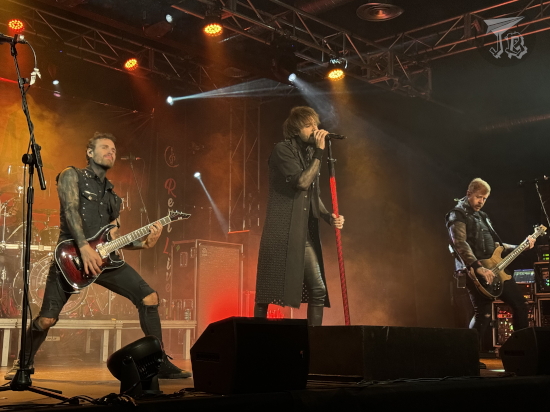
Yoshiki playing piano at Royal Albert Hall

Throughout the concert, he alternated piano-playing and talking – most of the talks we had heard before, but a few were new to me. He told us that when he felt that he had managed a great achievement his mother used to bring him back to earth with questions like “have you eaten?” or “did you sleep?”. He explained that she really praised him when he composed Anniversary for former Emperor Akihito. We also had some promotion of the Under the Sky film, and Yoshiki’s champagne line, along with a recap of him being honoured in LA’s Chinese Theatre. There was also some “thank you to my sponsors” talk, and he might have said “amazing” around a thousand and three times.

The first part went more or less as expected – except for the ballet dancers. I did not think we would get them, but I am not going to complain. I did miss Hero, because I really enjoy listening to that one live, but something had to be taken out to accommodate the songs by the special guests. Some people say that he talks too much, but I think that he’s just trying to catch a breather – both physical and emotional. At one point he spoke about an “X Japan song that we would never really hear”, which was heartbreaking. There is a difference between knowing that there won’t ever be any X Japan ever again, and having it confirmed. Both in September and now, we’ve heard him openly say things that usually went only implied, which I think means that we are in a new stage of his artistic career / life.
Yoshiki Royal Albert Hall with orchestra and ballet dancers

For the second act, he pushed himself even harder with a drum solo to start off. He always smashes the drums as if he were trying to get a confession out of them – it is like he has so much anger inside him and the drums are his only way to release it. In a way, it probably is – he always says that he turned to drumming to deal with his father’s suicide, and that is how he expresses himself. But then he goes back to the piano, and it feels that the keys are crying with him.

The acts with St.Vincent and Ellie Goulding, in my opinion, were more promotional than anything else. Both are well-known and established in their own niches – and Yoshiki likes female singing voices because they can hit high notes better, I think – though I miss Katie Fitzgerald and Ashley Knight, to be honest. St.Vincent was okay, Ellie Goulding left me wondering… what she was doing there. Apparently the pinnacle of her career until now has been composing Love me like you do for the film Fifty shades of grey… And I hate to be that person, but both of them could have chosen way better outfits.

The titular song, Requiem, was extremely poignant. It was the piece Yoshiki wrote to deal with his feelings for his dead mother, in his own words, the means he found to stop crying for her loss. Just like he took to drumming after his father’s death, he took to composing after his mother passed. Later, he explained again how the song Red Swan symbolises standing up through the pain and the blood. The original version of this song is sung by vocalist Hyde, and since he was bringing in people from all around the globe, I would have been extremely happy if he had flown him in for it, and I was hopeful for about one tenth of a heartbeat. Unfortunately, you cannot have everything.

Throughout the recital there were sad moments and happy moments, to thank fans, and to remember those who are gone, moments with ballet dancers and with the torch on the phone on, moments to sing and to laugh, and to feel your heart shrink. In the end, Endless Rain with all the audience was extremely special – it never feels that it is going to be, I keep thinking “this time it’s not going to affect me this much”, but it gets me every time.

Yoshiki talking at the Royal Albert Hall

In the end, the show lasted for about three hours, plus a twenty-minute intermission. He thanked the conductor, the orchestra and dancers and the guests, and received lots of flower bouquets. Next to me, A****d managed to give him a Union Jack with a small EU flag sewn into it, which he proudly wore around his shoulders. It’s fun how he is such a huge super star and then he becomes all shy and embarrassed. Or he just… crashes.

Yoshiki with the Union Jack flag, Royal Albert Hall

After the concert was over, we said goodbye to A**i and, A****d and I made our way to the 1871 Bar, where the Post Show Meet & Greet Experience was to take place. We went to one of the doors, but of course then we needed to go to the other one. Eventually we got in, and rather quickly – I was the 20th person in the queue, and got to wait inside the bar. It was upholstered in blue, turquoise and green tones, with the most garish decoration I’ve seen in my life, including mirrors, golden wallpaper, bright plastic deer heads (better than real ones but still gaudy), lava lamps… There were about… four or five sofas, and the whole floor was carpeted in reddish and green / grey tones.

I was a bit nervous – waiting to meet an artist is actually the worst moment of queueing, I feel. To be honest, the first time I saw Yoshiki in person in 2017, my brain went 404 on me and I was not able to utter a word, though in Vienna I did a bit better and got a selfie. I was shaking so badly it came out horrible and moved.

As we were waiting, a staff member came to tell us that we could talk to Yoshiki a little, and that they would take our pictures with him and email the link to us. He explained that Yoshiki had just played a three-hour show and that he was bound to be tired – and how amazing he was. We smirked that we knew that already – most of us were not local, after all. Meanwhile, lights were set up, and signed posters brought out.

Yoshiki arriving for the M&G in the 1871 Bar at the Royal Albert Hall

Once he came in, we clapped and then everything went very fast and very slow at the same time. Everyone got to talk to him a little indeed, ask for an autograph or give him a present. Some people conjure amazing gifts for artists, but I never bring anything for them, because I feel it’s imposing and they don’t need any junk I could get them. However, I was clutching my bad selfie print-out, running through my head what to say. It was finally my turn, and then something I could have never prepared for happened – he declared that he was tired and just sat down on the floor. Not one of sofas. Yoshiki, superstar, just plopped down on the garish carpet of the bar at the Royal Albert Hall.

I have no idea how or why but my brain kicked into gear at that point. Before the staff could react in any way, I asked Yoshiki if it was all right to sit down on the carpet with him – I really did not know if he wanted to have his picture taken on the floor. I’m not sure if the staff and the aides knew what to do, but when he said it was all right, I approached and sat – A****d had stayed behind and was able to document the whole thing, apparently I sat in the proper traditional Japanese way for the conversation.

I thanked him for his music, and told him how his lyrics helped me feel better after a bad situation. Then I asked him to sign the “horrible selfie” – I actually said this – from Vienna. He thanked me for coming back, and I said “no, thank you for coming back”. The whole thing was absolutely surreal. There we were, sitting on the carpet of the Royal Albert Hall, surrounded by dumbfounded staff and… sofas. Photographer Andy Paradise took our picture, and what I saw when I looked at the camera was the photographer crouching, the video-camera person kneeling, someone else also crouching down, and a fourth person coming in with a chair (despite… sofas). I said thank you again, and dragged myself away – the guy whose turn it was behind me also sat down on the floor.

A****d and I got our signed posters, while I clutched to my now autographed bad Vienna selfie, and left the venue. Some people asked questions on the way out, and we explained how it went. When we came out, it was cold, so damn cold. My hotel was a block over, so I asked reception to order a taxi for A****d, and we parted ways, hoping to see each other soon.

I went up to my room to take my third shower of the day, and have my snack. I was so overwhelmed, it was hard to sleep. It was also stupidly cold because unbeknownst to me, I had not closed the window well, and there was an open crack. I burrowed under the bed covers, a towel and a bathrobe, and got some rest.

The next morning, I made myself a hot instant coffee to start off the day, but it did not do much to get my blood pressure up. I vacated the room around 9:00 after asking the hotel to keep my luggage – but considering what had happened the previous day, I made sure I had all the important things with me. I had a nice plan for the day, but I decided to discard it last minute because underground disruptions had escalated – it was not worth it to get stressed due to commuting issues having alternative things to do. Seeing the first red phone cabin will have to wait for another time.

It was still extremely cold when I stepped out. First, I went to see the Albert Memorial in Kensington Gardens, and I crossed to Hyde Park. I also found the Monument to Livingstone. I went around the Royal Albert Hall, and a bit before 10:00, I joined the queue to enter the Victoria and Albert Museum. Whenever I am in Kensington, I always get distracted by the Natural History Museum, so I had forfeited the V&A for a while now. Today was the day to finally explore it.

The Albert Memorial

Royal Albert Hall from the outside

Founded in 1852, the V&A is one of the largest museums in the world – it’s actually the largest museum of applied arts, decorative arts and design. It covers 51,000 square metres, with 145 galleries and almost three million individual items in its permanent collection. It is a chaotic museum, and yet, it makes sense. The museum is organised by “themes” such as Buddhism, England Middle Ages, metalwork, porcelain, glass, Baroque sculpture… I tried to see things in some kind of logical order, but it was pretty much impossible. Apparently they tried to rearrange it a while back and they just… gave up, as it would diffuse expert knowledge. I found this very interesting, but since this was my plan B, I did not really have time to plan the visit very thoroughly.

Before diving into the galleries, I headed over to the museum café for a gigantic tea-infused scone with jam and proper clotted cream, and a mug of coffee, and sat down at the Gamble Room. When it opened in 1868, it was the first museum café in the world. It is decorated with tiles imitating the Italian Renaissance majolica tiles, columns, golden ceilings, and weirdly modern lamps. After breakfast, I felt a bit more grounded, though I felt a bit off all day.

Scone and coffee at the Gambler Room in the V&A museum

I roamed around the museum for a few hours, and I know that I missed some important areas. I found it difficult to keep track of where I was and where I wanted to go, but I got a bit of a taste of all. I was very impressed by the Cast Courts, where copies of some of the most iconic pieces of architecture and sculpture are kept. These were made in the 19th century, and represent “the truest spirit of the Victorian museum.”

Artefacts at the Victoria and Albert Museum

On the ground floor, I wandered the Korea, Japan, China and Buddhism galleries, and I came across another depiction of Bodhisattva Guanyin, in the same pose but a completely different artistic style. I saw the largest Middle East and Islamic Art collection in Europe, and the adjacent galleries –South Asia (especially India) and South East Asia had a lot of interesting artefacts, too. The sculpture galleries are tantalising.

Other areas I visited included Medieval and Renaissance, Britain though history, ironwork, metalware, gold, silver, ceramics, glassware, jewellery, stained glass, architecture, and I could have gone on and on. But alas, I had a plane to catch.

Artefacts at the Victoria and Albert Museum

Victoria & Albert Museum

Around 13:00, I left the museum, collected my luggage, and made my way to South Kensington Station amidst the Tube closures of the lines that would take me directly to Victoria. A while back, I had to take a similar alternative route from Earl’s Court due to the wires overheating when I was going to the Apollo Victoria Theatre to watch Wicked. The South Kensington station runs the same Tube lines, so I was able to reach Victoria railroad station at the desired time – even with a line change and more than double stops. I was off towards Gatwick airport on the expected train.

Once there, I went through security without a hitch. I had a snack in the most expensive and unfriendly Wagamama in history – give me Stansted’s Itsu anytime. I wanted something warm because my body gets weird after emotional highs, and I was freezing. I even wondered if I was taking ill again, but no. I was just cold. I did not let either the restaurant nor the chill spoil my mood though, and I might even have had a nap on the plane. By the time I got off, I had warmed up. I cleared passport control, found my shuttle to the parking lot and – aside from the inevitable idiot on the road – there was not even that much traffic, which is good. You know the routine – shower, snack, bed.

I was not ill in the end, just stupidly exhausted. Going back to normal was quite difficult, especially as I still had Sunday free. I did not ever dare look at my phone to see if the photographs were real. A few days later, on the 18th, we received the email with the meet & greet professional photos. I look ridiculously happy, sitting on the carpet ,with a sofa behind me, with who is probably my favourite artist. I feel a bit guilty that I burdened him with my problems – I really hope he forgot quickly. Nevertheless, I am mostly glad that I was able to take these three crazy trips to London without incident. I feel extremely lucky that all three of them worked out, if not flawlessly, without any huge mishap. There is actually another Yoshiki event announced for December, but as much as I would love to go, it is just not in the budget, and I am a bit sad about that. But then I think “I sat with Yoshiki on the carpet of the Royal Albert Hall” and smile.

2nd October 2023: Miyavi’s “Return of the Samurai Guitarist: 20th & Beyond European Tour 2023” {Miyavi in London 2023}

When planning this London trip, I booked two hotels – a bed and breakfast for a lower price for the first night, and a more expensive one next to the venue for the night after the concert – I like staying as close to venues as possible, and the second hotel was literally next building over. I woke up on Monday around 7:00, and it took me 20 to 30 minutes to pack all my things. Since breakfast was included, I accepted the challenge of a full English breakfast. I drew my line at tea though. I love tea but I’m a caffeine addict anyway. I need my boost in the morning.

Though London’s public transport was going through a strike period, I was very lucky with both trains and underground – actions and closures were planned for both the day before I arrived, and the day after I left. I took the Northern Line, and headed off to the O2 Academy Islington to wait for the start of the concert. The venue is part of a shopping arcade, so there were readily available toilets and even better, we could wait under cover. This was great as , as there was a forecast of thunderstorms – which ended up breaking around 17:00. The queue was nothing out of the ordinary, I was the fourth VIP to arrive, and the fifth person overall when I reached the area around 9:15.

Miyavi [雅] was born Ishihara Takamasa [石原 崇雅] is, above all, a guitarist. He was born in 1981 and debuted in 1999, going solo in 2002, aside from doing collaborations with some of the musicians I follow – Yoshiki and Hyde. Miyavi’s concerts are extremely fun, he is full of energy and he sometimes greets fans one by one when he arrives at venues. He is in general a good person, and a volunteer at UNHCR. He has had small roles in American blockbusters such as Kong: Skull Island and Angelina Jolie’s Unbroken. He is really kind during M&Gs too, and one of the few Japanese artists who actually means “world tour” when he announces a world tour. This time he toured Europe and China tour, a continuation of his 2022 North America tour – this leg was called Return of the Samurai Guitarist: 20th & Beyond European Tour 2023.

Miyavi Return of the Samurai Guitarist European Tour poster

After around 500 bus manoeuvres and 90 minutes of waiting, we saw him come into the venue around 13:30. The staff filmed, and he waved and said “thanks for coming.” Other times he has shaken hands and stayed for a chat, but I guess he was tired. He was coming directly from Paris after the concert there the evening before. I’m getting too old for queuing all day though, because even if it did not feel extremely long, I was a bit queasy and headachy all day – there would be a full-blown migraine coming at night but, oh well.

Miyavi Return of the Samurai Guitarist London arrival

Around 15:00, the venue’s crowd management staff decided to rearrange the queue. I had a VIP ticket with included a picture, a pass and a “special present” – which turned out to be a wristband. When buying the ticket, the 25 first purchases had an extra autographed picture, but my Ticketmaster decided to freak out and I did not get that one. Oh well. Anyway, security decided to break the queue into two – one for VIP and Early Entry, the other one for General Audience. This caused a bit of a problem when the VIP tickets had to be read, but at that point I was already safely checked in. The worst was the way the placed the barriers, so sitting down on their supporting structure was awkward. Better that than standing though, as that would have to happen later, once in the venue.

Once the queue was rearranged, around 16:00, I snuck out to go to the hotel and check in. They gave me a “superior” room which was nice and had pretty views, but the bathroom smelled of sewer – as bathrooms near tidal areas sometimes do. I ate a snack and went back to the queue.

VIPs were admitted a bit after 18:00, with disabled VIP ticket-holders coming in first. There was a lot of trouble with the merch shop as they would not take card and they had no change. I did not want to buy anything, so I went straight to the M&G. After the people around me realised that if they stayed back, they would lose their spot, they quickly rearranged themselves back in the queue. I was happy to let the people who had waited in front of me pass – all three of them.

When it was my turn to see Miyavi, I told him a secret – that he reminds me that good things exist in the world. He said thank you. I am horrible at selfies, so I handed my phone to the staff, and they were happy to take two of them. Afterwards, I went into the venue and found my spot at the barrier, centre but a bit to the right – which was apparently an amazing place for pictures, considering that I had the photographers in front of me through most of the concert. Early Entry came in after all the M&Gs were done, and GA were let in at 19:00. The concert started at 20:00 sharp.

Miyavi Return of the Samurai Guitarist London Rocking out

Setlist:

   1. Selfish Love
   2. WHAT’S MY NAME?
   3. SURVIVE
   4. Ahead of the Light
   5. So On It
   6. In Crowd
   7. Secret
   8. Cry Like This
   9. Tears on Fire
   10. Long Nights
   11. Under the Same Sky (Unplugged)
   12. 君に願いを [Kimi ni Negai wo] (Unplugged)
   13. Girls, be ambitious
   14. 陽の光さえ届かないこの場所で [Hi no Hikari Sae Todokanai Kono Basho de]
   15. 咲き誇る華のように -Neo Visualizm- [Sakihokoru Hana no You Ni -Neo Visualizm-]
   16. Fire Bird
   17. New Gravity
   18. Bang!
   19. No Sleep Till Tokyo
   20. Horizon
Encore:
   21. 愛しい人 [Itoshii Hito]
   22. Under the Same Sky
   23. The Others
   24. DAY 1

The concert was extremely fun, as it usually is with Miyavi. As the tour is a bit of an anniversary celebration, he sang a lot of his older songs, along with newer ones. He jumped and twirled and rolled on the floor. He also had moments to sit down and a give us acoustics. At some point, one of his guitars malfunctioned and he went “I guess we’re chilling now.” He spoke about his work with refugees and how he does not understand the British accent to save his life – despite having lived in the US for years. He said that he enjoys being in the country where rock was born. He also said that he had played the venue before – his phone remembered the Wi-Fi password.

Miyavi Return of the Samurai Guitarist London, sitting down and talking

We had an improvised song at the beginning of the encore, since the audience requested Itoshii Hito. He remembered it, unlike when he was forced to google Señor Señora Señorita in Barcelona (2019). Despite being visibly tired when he arrived – and according to the Instagram story getting lost in the venue – he gave his all in the concert, and I am grateful for that. He indeed reminds me that there are good things in the world. At the end of the concert, he was given a Union Jack that he wrapped around his shoulders.

20231002 Miyavi Return of the Samurai Guitarist London with the Union Jack bowing

Exit was chaotic due to the problems with merchandising continuing. I would have liked to stay to stay and say goodbye, but I crashed after the concert was over – my headache got worse, and I was really nauseous. I bought some food to take to the room and headed back to the hotel to eat it, take my medication, have a shower, and get rid of the contact lenses. I went to bed as soon as I had finished and, and slept from midnight to around 5:00, when I woke up, vomited dinner – I hope not too much of the medication – and tried to get some more rest. I think I did sleep a bit further, but I’m not sure.

11th & 12th September 2023: 23h 45min in London (England) for Yoshiki’s “Under the Sky”

Considering that Japanese musician Yoshiki recently got his hand- and footprints enshrined at the TCL Chinese Theatre in Hollywood, I guess he’s not one of my obscure artists any more. Yoshiki is a Japanese drummer and classically-trained pianist who, alongside vocalist ToshI, founded the band X Japan in 1982. They started as a heavy metal band, and eventually shifted over towards progressive rock. Their flashy looks probably gave way to what is now called Visual Kei (V-kei) [V系], though they had dropped them in the mid 1990s, before they disbanded when vocalist ToshI left the band basically to join a cult. In 2007, X Japan reunited.

Yoshiki, born Hayashi Yoshiki [林 佳樹], is considered one of the most influential Japanese artists of all times. Aside from a musician, he is also a songwriter, composer, producer, and fashion designer. He collaborated with Stan Lee for a special four-issue comic collection called Blood Red Dragon, and with international musicians and bands such as Bono (U2), Roger Taylor and Brian May (Queen), KISS, and Sarah Brightman. He composed the theme of the 2013 Golden Globe Awards, worked on the soundtrack of Saw IV, and has composed music for anime such as Saint Seiya and Attack on Titan. Within Japan, aside from tons of collaborations and solo works, he became “mainstream” when he played a concert to honour former Emperor Akihito upon the tenth anniversary of his enthronement in 1999. He also has a Hello Kitty line named and modelled after him, Yoshikitty. And I’ve been using one of his songs as my alarm clock since roughly 2010 (since 2015 it is Born to be free).

Back in 2017, Yoshiki hosted a Q&A in several cities throughout the world, including Vienna (Austria) for special showings of his documentary film on X Japan. The documentary should have premiered in the scheduled March 2016 concert, but when that was postponed, the film went on to be shown at different events festival. When I went to Vienna, I had already travelled to see it in X Japan concert in London and the Beefeater In-Edit festival in Barcelona (and owned the blu-ray).

In 2020, as the Covid-pandemic lockdowns eased up, Yoshiki organised an online concert on a bunch of rooftops, connecting with different artists and having others over, to celebrate his birthday on the 20th of November . Now, he has made a documentary out of the event, called Yoshiki: Under the Sky, which has “premiered” four times, the third of them in London on 11th September 2023. As the London announcement only came mid-August, it was a challenge to get everything running, but I managed to find doable flights and a hotel near the venue. I was able to buy a second-row seat for the cinema, which was pretty good too.

On the 11th of September, trying not to reflect too much on the date, I left the house around 5:00, and right as I merged into the motorway, it started pouring. There was more traffic than usual because the plane was an hour later, but I managed to make it to the airport a bit before the time I had booked to enter the parking lot – yay accuracy. I went through security and passport control without issues, and had to walk to the end of the terminal for my flight, which was also uneventful. Upon landing at London Stansted Airport, we had to wait for a bus because the escalators were broken or something, but I was outside around 9:30. I bought breakfast at Costa Coffee, and settled to wait for a friend I had met in Vienna, A****d. Her flight was due half an hour after mine, so we had decided to hang out for the day. She agreed to tag along to the Natural History Museum – I wanted to go back to the the Jurassic Park 30th Anniversary #NHMxJURASSIC store before it closes down at the end of the month. I really really wanted the rubber ducky cosplaying as a velociraptor, but I feared that if I got that one, I would end wanting to collect rubber duckies… I bought get a limited-edition “opening weekend ticket”, which had been out of my budget on my previous visit, and a titanosaur coin that I had not seen when I visited the exhibit.

A****d had never been to the museum, so we took a tour of the highlights – dinosaurs (of course) and other fossils, the “journey inside the earth” (escalator that goes into the inner core of the planet), the historical building, and Cadogan gallery… Unfortunately, the hall of mammals had recently closed for renovations, so we could not visit that one.

Natural History Museum London

Afterwards, we took the underground and got off at Leicester Square to have a late lunch in Chinatown. We found a little place for lunch. I ordered some rice and duck, which was nice but the duck had a lot of shattered bones. We looked for a place she had known that sold ice cream taiyaki, but sadly we did not find it.

London Chinatown

We located the cinema where the film was showing, Odeon London Covent Garden, but there was nothing going on yet, there was not even a poster announcing the film. After taking pictures, we continued down the block to snoop around the Forbidden Planet London Megastore, one of the biggest comic, manga and related merchandise shops in the world. Luckily, they had few things I wanted badly, and the ones they did were stupidly expensive, so I was able to get away with all my money, yay me!

A****d had decided that she would go back to the airport after the film, but I had taken a hotel a few minutes away from the cinema, right in front of the university and a few minutes away from the British Museum. I dropped by to check in, then we backtracked to Leicester Square as the museum was already closing for the day at 17:00. As we walked by the cinema, they were setting a poster for Under the Sky outside.

We decided to do something a bit silly and headed off to the The LEGO Store Leicester Square, two stories dedicated to selling LEGOs, either in sets, or just blocks. There are also different decorations – for photo-ops – made with oversized blocks, which include Shakespeare in the park, a Bobby, a Buckingham palace guard, a whole Aston-Martin with a Bond sculpture – you can actually go into the car – and lots and lots of Harry Potter. It was a bit disconcerting that they were already displaying Christmas sets!

Lego Shop London

Then, we crossed the street for the M&M’S Store London, which has four floors. The ground one has a recreation of the Beatles crossing Abbey Road, with M&M’S. There was a logo asking “which M&M’S colour are you?” which I thought was a little silly, until I found the orange M&M’S section, whose motto seems to be “I’m scared of what might happen if I relax”. I connected immediately. Next time over I should totally buy a mug or something. Also, there was no Christmas decoration yet, as they were preparing for Halloween. Oh, and they were looking for staff, offering “London liveable wages”.

M&Ms Shop London

We came out and it was 18:00, the Swiss glockenspiel at Leicester Square was chiming. The glockenspiel is a Swiss-themed clock which was built in the 1960s as part of the Swiss Centre, a ploy to drag rich British tourists to the country. The centre failed, and the clock was taken away, but it was eventually restored to the area in 2011. I could have sworn it was playing Poncelli’s Dance of the Hours?

Swiss Clock Leicester Square

Leicester Square is built around a sculpture of Willian Shakespeare, and the gardens around him hold a number of statues dedicated to cinema, Scenes in the Square. We spotted Mary Poppins, Don Lockwood (Gene Kelly’s character in Singin’ in the Rain), Charles Chaplin, Paddington Bear, Harry Potter, and an Indiana Jones which is supposed to be temporary. Apparently, there are a few more I should be checking out for, but that’s okay because I’ll be coming back to Chinatown eventually, and it’s just a few blocks away.

Statues of cinema figures in Leicester Square + Willian Shakespeare

We headed back towards the Odeon London Covent Garden cinema, and we reached there around 18:20. Another poster had been put up, and some fans were already waiting. We met another friend of hers, M**, who told us she had found a sitting area inside, so we sat and chatted away for about an hour. The staff was extremely friendly and did not peep a word of complain, even if we did not buy anything.

Yoshiki Under The Sky at Odeon Covent Garden London

Finally, we were allowed into Screen 2 and found our seats. I lost count of how many people tried to get away with ignoring the seating numbers. Nobody did. I had a second-row seat, pretty centred. The film was introduced by some film producer who explained what we were going to see as if we had just accidentally wandered into the cinema.

There was supposed to be a trailer for Yoshiki’s upcoming concert in October, which was not shown. We had a few in-house adverts before the documentary started. Through the film, Yoshiki talked a little about the power of music, and how he had come together with all these great musicians to create a world-class event, very Covid-compliant. All the songs featured were either composed by Yoshiki himself, or had been arranged by him in some way. Perched on an LA rooftop, he mostly played piano, but occasionally he donned the drums.

The narrating thread of the whole film is life. Yoshiki was a sickly child, and his father committed suicide when he was ten years old, so he grew up with the idea of death deeply ingrained in his brain. As the film goes on, he speaks about how music can bring people together, and how it is important to find the strength to go on. Halfway through the film, he talks about recently losing his mother and how he cried for days. At some point a voice is introduced. It is a regular John Doe who once reached out to Yoshiki on Twitter as his dying wife had just entered palliative care. The man asked for some encouragement for her, and he got it, from Yoshiki and a lot of the fans, until she passed away. There was a heart-wrenching Zoom call with the man, who spoke about how overwhelmed he was by all the support he received. Unfortunately, she passed away.

The documentary runs for an hour and a half, and it’s a mixture of the Yoshiki’s thoughts, the performances alongside different artists, each in their corner (or rooftop) of the world, and a bit of conversation with them, or a making-of. I was familiar with most of the featured musicians, but not all.

Sarah Brightman: Miracle. Sarah Brightman has had an extremely long career and is an excellent soprano – my first memory of her dates back to the 1992 Olympics. She collaborated with Yoshiki on Miracle in 2018. I was really sorry I was not able to go to any of her performances back then.

Jane Zhang: Hero. The original version of Hero was sung by Katie Fitzgerald for the soundtrack of Saint Seiya: Legend of Sanctuary. Though Saint Seiya was my favourite anime as a kid, I had wandered away from it. The song featured in the film actually made me want to go to see it, and eventually dragged me back into the world. Zhang did a good job, but I personally prefer Fitzgerald’s version.

SixTONES: Imitation Rain. As a music producer, Yoshiki must have realised a bit ago that the Japanese boy-band panorama was dire. For long years, the boy-idol company Johnny’s Entertaining (JE) had dominated the business, with bands as SMAP or Arashi. However, an extremely protectionist policy and the open secret that the director had sexually abused some of the boys, lead to the company losing power. I have no doubt that this is why Yoshiki decided to create and produce a boy-band, and thus looked for the six young men that comprise SixTONES. Having followed some of JE’s bands back in the day, I can see how they would tap into the niche (serious flashbacks to KAT-TUN circa 2005, to be honest).

Scorpions: Wind Of Change. Formed in 1965, Scorpions paved the way for a great deal of the big names in 1980s hard rock such as Guns N’Roses, Mötley Crüe, Helloween, Megadeth… And Yoshiki is a little fanboy of theirs, of course.

Sugizo: La Venus. Sugizo is one of X Japan’s members, who took over guitar duties after they reunited. While the band was separated, original guitarist Hide died in “mysterious circumstances” – either accidentally or by suicide. For a long time, Yoshiki claimed that Hide’s death was an accident, and on this film he for the first time acknowledges otherwise. Thus, Hide was the second person in Yoshiki’s circle to take his own life. Sugizo, who also plays violin and is a member of an insane number of bands, including LunaSea, is credited by Yoshiki as the reason X Japan could come back together, which made him very embarrassed. They played a rendition of La Venus without lyrics, with Sugizo on violin.

Hyde: Red Swan. Hyde is without a doubt one of the best rock vocalists in Japan. He was originally the voice of L’Arc~en~Ciel, when they were still a thing. He worked alone for a few years, then he and KAZ founded VAMPS, and finally he went solo again. Red Swan was a collaboration between Yoshiki and Hyde for the anime Attack on Titan!, released as “Yoshiki feat. Hyde”. Yoshiki explained how the red swan represents rising even covered in blood. After this collaboration, there was a second single, released as “Hyde feat. Yoshiki” with the song Zipang, in English and Japanese, which I personally find even more powerful. The significance of Red Swan in Under the Sky comes from how many versions there are on YouTube, especially as anime songs tend to be translated. Thus, it ties in with the concept of coming together through music.

St. Vincent: New York. St. Vincent is known for her clear voice and her complex arrangements, with lots of instruments playing a part. She is considered one of the best guitarist in the 21st century. Yoshiki arranged her song New York for piano and vocals, which made it extremely powerful. All LA artists were invited to sing on Yoshiki’s rooftop, as it would have reduced the logistics involved.

Nicole Scherzinger: I’ll be your love. Scherzinger was the lead singer of the Pussycat Dolls between 2003 and 2009, but before that she had already performed with Yoshiki with this very same song.

The Chainsmokers: Closer. They are an American electronic DJ pair: Alex Pall and Drew Taggart, whom I honestly know nothing about other than they do electronic remixes. They have some supporting musicians.

Lindsey Stirling: Forever Love. She is a violinist who performs and dances at the same time. I had never heard of her either, but she did feel the music. Regarding her, Yoshiki said that she made him realise that not all songs need lyrics and vocals. She did a great job.

Yoshiki and fans: Endless Rain. In a way, Endless Rain is the emotional ballad that keeps showing up in anything X Japan related – and breaking people’s hearts. A while back, there was a request on social media for fans to send recordings of themselves singing the song, which were used for the film. Hearing a Ukrainian girl singing “endless rain lets me forget all of the pain, all of the sadness” was soul-wrenching. Once more Yoshiki circled back to the idea of music bringing music together, along with living, just keep living.

Yoshiki Q&A in London, 11th September 2023

The Q&A afterwards was awkward. The guy who carried it out – Toby Amies – had done his homework but it was not a Q&A, it was an interview by someone who had just learnt about Yoshiki, and was curious, so he had a ton of questions, most of them absolutely unoriginal, such as hey, I’ve just discovered V-kei, explain that to me! Or “do you prefer piano or drums?” which we hear every time – I could swear that Yoshiki was a bit annoyed at that one. The only input that the audience had, before Yoshiki was even in, was “are the Last Rockstars coming to Europe?” (we know the answer to that: never) and “When is the next X Japan album coming out?” (we know the answer to that, too: also never), but when the interviewer got around to ask those, he messed them up! At some point Yoshiki explained the meaning of the title “Under the Sky” – basically, we’re not in Heaven yet, we are underneath. As he was leaving, he was kind enough to sign autographs and take pictures with fans.

After the film, we took a bunch of selfies with other fans in front of the poster(s), then moved on. I went back to my hotel for a shower and a few hours’ rest. The bathroom was tiny but hot water did its job, and I could not find the cereal bar I had packed for dinner. The bed was extremely soft, and the carpet smelt strongly as England is in the middle of yet another heatwave, and my nose clogged – I need to remember to start packing my allergy pills. I did not sleep much if at all, and I ended up leaving the hotel before 5:00. I had to decide between breakfast at London Liverpool station or catching the Stansted Express at 5:25. I decided to go for the train and have breakfast at the Stansted Costa, so I boarded, found a seat, and settled down for a travel nap.

Ten minutes away from the airport, as we left Harlow Town, the second-to-last stop, there was an announcement. We were informed that the train would terminate at Bishop’s Stortford, the last stop before Stansted Airport. There were technical issues at the terminus platform, and the train could not reach it. Passengers should vacate the train at at Bishop’s Stortford and ask the platform staff for instructions. The instructions were that we had to fend for ourselves to reach the airport as there was no alternative transportation provided. It was chaos for a second, with everybody scrambling for buses, taxies and so. I was near a young woman who was going to Uber and had some extra seats. She asked if anyone wanted to tag along and I said yes. She said it would be free because her company would reimburse her, so I was lucky on that account, and I arrived at the airport a bit after 6:30. I waved my Uber-companions good-bye and headed to Costa Coffee for breakfast, feeling relieved that I had decided against waiting for the 5:40 train in London Liverpool.

After a sandwich and a vanilla latte, I passed security, where I had to go through secondary screening because… no idea. There was like no metal on me whatsoever. Then the scanner complained about me having something in my pocket – my damn handkerchief! Seriously, now. This has happened a few times. Where do people keep their hankies / tissues if not a pocket??

A****d had not yet departed when I was through, so we could hang out for a little longer – it’s fun that we had only met in person for a few hours in 2017 and we hit off so well. We even had gates in the same area of the airport, so it was cool. This is the first time that I have done the “going to the airport early in the morning” in London, but to be honest there was a 100 € difference between that flight and the next up, since the whole thing was announced and happened so fast. I asked for a refund from the Stansted Express, and now I’m wondering whether to cancel the train for my next trip to London as they’re threatening with strikes on those days… (ETA: I received a full refund, and there was no major incident during the following trip).

The trip back was uneventful except the road was stupidly full when I drove off the parking lot. I napped most of the plane ride, and I had a Coke before 9:00. Talk about living wildly, especially considering how all this happened in 32 hours, and I was in London for less than 24! My only regret was not taking the camera, but I was trying to pack extra-light this time around.