24th May 2025: Megalithic (self-guided) Tour {Malta, May 2025}

The group of drunk people was back again, at 5:00 once more. Joy. However, this time I could not get an early start because I had booked a Megalithic Tour with a company called Visit Malta, as at first it had felt more convenient than navigating the buses. They confirmed and sent me a ticket saying that pick up was at my hotel, and a Google Maps link that did not work. Thus, I assumed that they would pick me up at the hotel. I tried to contact them via email previously, but I had no reply, so I told myself not to be paranoid, and trust them.

Twenty minutes after the pick up time, I called them. They yelled at me that I was in the wrong place. I informed them that my ticket read “pick up at the hotel”. They told me there was nothing they could do for me. So I was upset for about 3 minutes – that was 50 € down the drain. However, it was only 9:30 in the morning, so I had time to take matters in my own hands and go see the temples on my own. And I could even squeeze an extra one! I felt… I don’t know… gleefully spiteful. I was going to see the temples out of revenge! I know it sounds strange, but it took me back to what happened in Cappadoccia, when there was nothing I could do to fix the issue. This time around, I had lost some money, but I would not miss on the experience.

Of course, this would have been much more efficient if I had organised the visits originally on my own, since the Ħaġar Qim and Mnajdra Archaeological Park | Il-Park Arkeoloġiku Ta’ Ħaġar Qim u L-Imnajdra is in Qrendi | Il-Qrendi, quite close to the Blue Grotto. Conversely, that also made it easy for me to get there, since I knew the bus route already. But I decided not to dwell on the inconvenience and just “save back” the lost 50 € back not buying whims or mementos.

The Megalithic Temples of Malta are a World Heritage site, and it still blows my mind that they are older than either Stonehenge or the Giza Pyramids. The Ħaġar Qim and Mnajdra Archaeological Park | Il-Park Arkeoloġiku Ta’ Ħaġar Qim u L-Imnajdra might be the most well-known complex, or at least it was the one with most tourists.

The temples Ħaġar Qim and Mnajdra are located very close to one another, and they share an entrance with a small museum, thus forming one archaeological park. Both were first officially described by officer J.G. Vance of the Royal Engineers (British Army) in the 1840s. Unlike Ħal Tarxien on Thursday evening, these two were packed with visitors – more than a few of them happily touching the stones out of curiosity or for support as they walked. I got there in bus 201 and reached the entrance just before a big tour bus entered. The guide lady tried to go past me, but my face must have told her that I was not in the mood to be messed up with, and my turn was respected. The museum mostly had information about the environment, and pieces of pottery that had been recovered from the sites – similar to what the Archaeological Museum in Valletta.

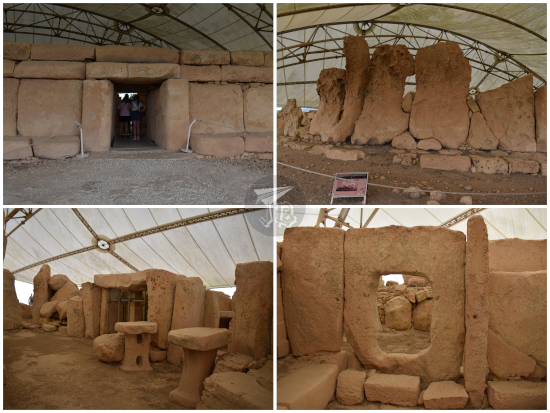
Ħaġar Qim was erected using the ever-present globigerina limestone, a soft sedimentary rock, golden in colour, formed around 23 – 14 million years ago. As this and other temples have weathered out, they have taken a more reddish or brown colour. To protect the remains from deterioration, many have been covered with protective tents.

The temple has several inner chambers within a retaining wall that can be crossed through a trilithon. The whole site has a keyhole shape, and it has been associated with fertility rituals. The main temple was built between 3600 and 3200 BCE, with remains of older ruins. As construction went on, the shape became distorted. It holds the largest stone in any of the Maltese temples, and an altar probably for animal sacrifices. It was hard to get into the magnificence of the temples with so many people swarming them after the Ħal Tarxien experience. However, the structure is quite impressive in itself.

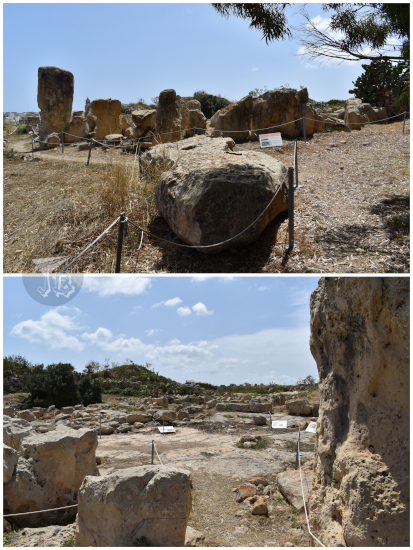
Hagar Quim Neolithic temple: a roundish construction surrounded by a wall made out of limestone. Inside there are chambers and open holes working as doors, along a thriliton as main gate.

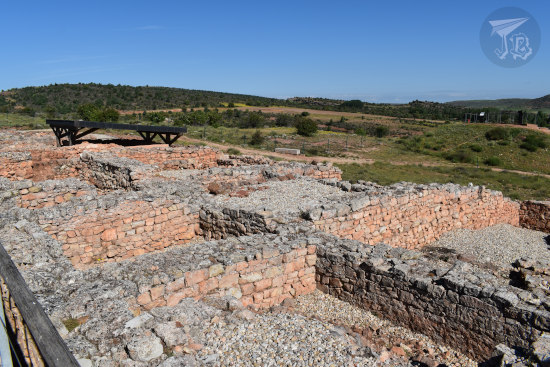
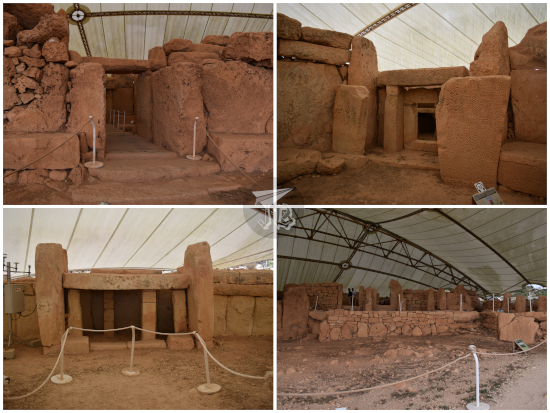
Mnajdra | L-Imnajdra is made from coralline limestone, a harder kind of stone, so as a construction material, it can be used in smaller blocks. Mnajdra might be the most representative temple in the archipelago, as its altar is depicted in Malta’s 1, 2 and 5-cent coins – though it is not the one which kickstarted the Unesco protection. Mnajdra consists on three temples arranged in a clover-leaf disposition. The structures are joined but not connected. They were erected between 3600 and 2500 BCE – so they could be over 5,600 years old. Even with the sheer amount of people around, there was something special about the complex. The temple plays light tricks on the equinoxes and solstices, and the decoration of one of the stones could be interpreted as a lunar calendar (with a lot of imagination, if you ask me). Probably, out of all the temples I visited, this one was the one I found more impressive – even if the first one I saw will forever remain my emotional-favourite.

Mnajdra Neolithic temple: a reddish limestonestructure with trilitons and low walls made out of brick-like structures

I was done before schedule, so I went back towards the bus stop. I returned to the airport and then took another bus (119) to Birżebbuġa. There I could see the Għar Dalam Cave and its museum. The Cave is home to some of the oldest evidence of human presence in Malta, around 7,400 years ago (the oldest comes from Mellieħa Cave, dated as 8,500 years old). Għar Dalam Cave is about 144 metres in length, and it also contains remains of animals that have been long extinct in the island, found in distinct layers of sediment at the bottom of the cave.

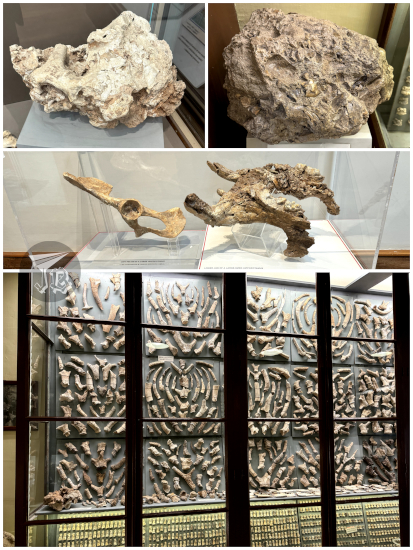
There is a base layer of clay, older than 167,000 years. Over that lies the “Hippopotamus layer”, showing remains of two extinct species of hippopotamus, deer, dwarf elephants… One of the hippos, Hippopotamus melitensis, was a “dwarf” hippo (only 900 kg) endemic to the island. The remains are very mineralised (almost fossils) and worn down. This is also called the “Breccia layer”. Breccia is a rock composed large angular fragments of minerals cemented by a fine-grained matrix, only in this case the fragments are ancient hippo bone.

Covering the “Hippopotamus Layer”, there is a band of pebbles, without any remains. Over that one lies the “Carnivora Layer”, with remains of several of the previous animals along with foxes, wolves, bears, and smaller creatures such as voles, shrews, bats, turtles… These range from around 167,3000 to 151,200 years ago, and are less mineralised and worn down, just like the following band: the “Deer Layer”. Here there are remains of three different species of deer, some bovines, equines, and small animals. The two upper layers, starting 7,200 years ago, hold remains of small wild animals, domestic animals – sheep, goats, pigs, cows and cats – pottery and other human artefacts, and human remains.

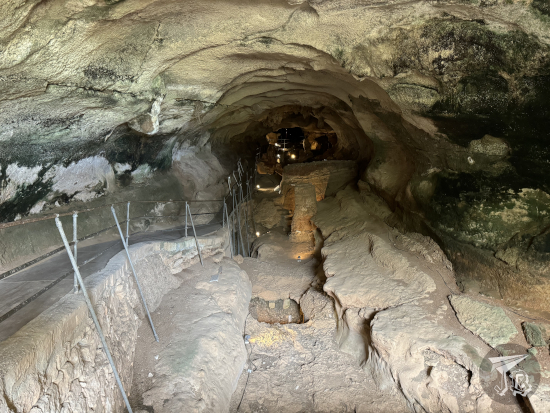
Għar Dalam was first investigated in 1865 by palaeontologist Arturo Issel. Subsequent researchers expanded the excavation and knowledge, identified an all-new species of dwarf hippopotamus, and systematised the museum adjacent to the Cave. Said museum, called the George Zammit Maempel Hall presents hundreds (thousands, maybe) of the remains dug up from the cave. However, the most important ones, amongst them the skull of a Neolithic child, were stolen in 1980. The Cave itself is creepy and damp, and the excavation shows the different layers for the spectator to see. One wonders what lies beneath the end of the visitable area… I would believe the cave be haunted much easily than the Grand Master’s Palace.

Ghar Dalam museum: samples of rock with bones, and cleaned bones and hundreds of small bones in display cabinets.

Ghar Dalam cave - deep cave with excavated ground where you can guess the layers of bones and remains.

Across the valley from the Cave, you can see the remains of a ruined Roman villa Ta’ Kaċċatura, but it cannot be reached, and it’s hard to distinguish rocks from the actual ruins.

By now, I had seen all the temples included in the original tour, so I had a bit of a victory moment. And yet, I had more to do. I loaded up on sun lotion, then headed towards the nearby Borġ In-Nadur, barely ten minutes away on foot – plus some extra to cross the street so you are on something similar to a pavement to walk on. Borġ In-Nadur is another small megalithic structure, with a cemetery, and the remains of a Bronze Age village, with remains ranging from the years 3000 to 700 BCE. Entrance to the Megalithic site was included with the visit of Għar Dalam. The temple was first excavated in the 1920s by archaeologist Margaret Murray. It is the most dilapidated site I visited, but I was again alone – except for a couple of chickens from an adjacent farm. You are allowed to go into the niche or stone circle, and unlike the other temples, it is not covered (yet?).

Borg in Nadur, a roundish collection of megaliths vaguely disposed in a circle

 
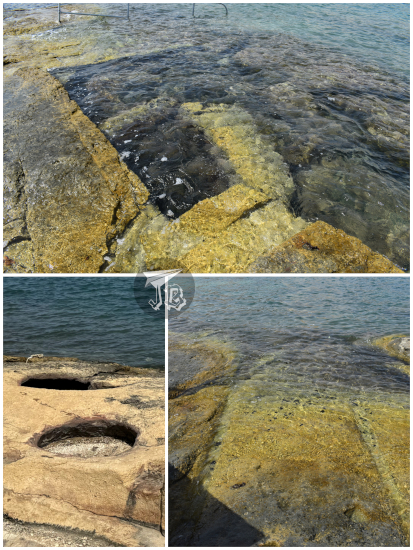
Near the temple, at the limestone beach of St George’s Bay | Il-Bajja ta’ San Ġorġ, I found silos and cart ruts, also thought to date from the Bronze Age, and Roman Baths directly carved into the limestone. They are not really Roman baths, as in dating from Ancient Rome, these are artificial pools were excavated into the rock during Victorian times. And yet modern people think they’ve invented something

Different constructions near the sea shore: cart ruts, round silos and square artificial pools

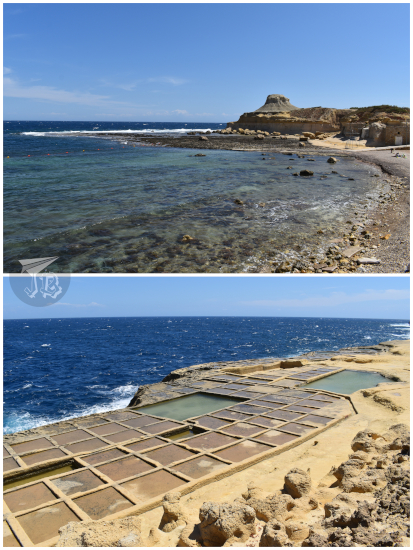
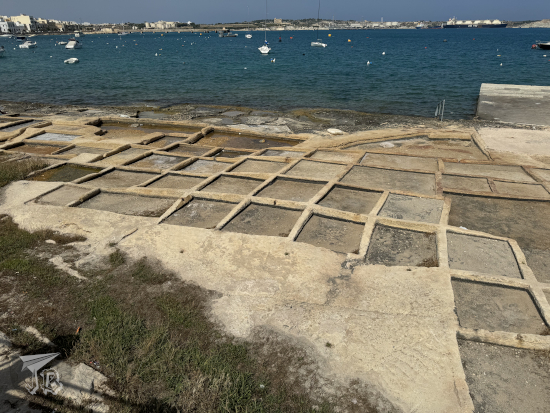
Not far from there, I found the bathing beaches, the commercial harbour and the salt pans, a traditional way to produce salt letting sea water evaporate from shallow pools in order to harvest the salt crystals. They did not seem in use though as they were either full of litter or used as sunbathing spots.

Rows of rectangular salt pans - shallow tidal pools - near the ocean

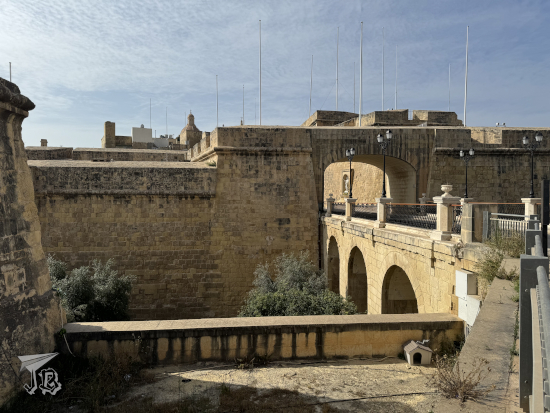
I still had some time and energy, and decided to invest them on getting to Birgu. This Medieval city is located across the Grand Harbour from Valletta, and it was the first place where the Knights Hospitaller settled. It has a bunch of historical palaces and museums. I would not get there before closing times, but at least I could see the town layout and some buildings from the outside. These included the Gate of Provence, the Inquisitor Palace, the Birgu Waterfront and Maritime Museum, and finally Fort Saint Angelo, a key fortress during the Siege of Malta. Today, use of the fort has been granted to the modern version of the Knights. There was a sign reading “Jurassic World: Dominion” was filmed here, but I did not recognise the backdrop.

Walled entrance to Birgu

Ruins of the Birgu Waterfront overlooking the ocean and Valletta

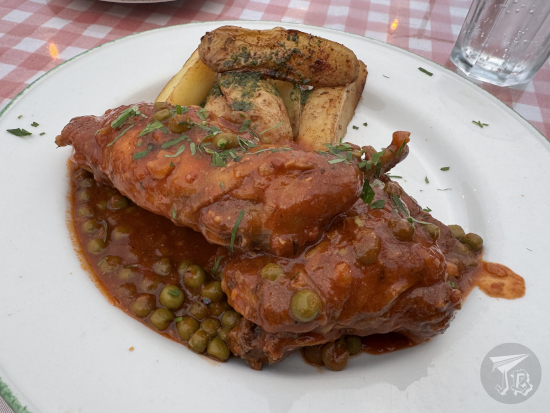
I found a convenient bus to head back to Saint Julian’s | San Ġiljan. I freshened up and headed for dinner. At first, I tried to get a table at a restaurant right at the entrance of the hotel. Since they decided to ignore me and give the table to someone else, I moved along. I found Salt & Pepper, a nice grill with an ocean view and an outdoor sitting area. There, I was able to try Stuffat tal-Fenek (fried rabbit in garlic), a typical Maltese recipe (considered the national dish, actually) – pan fried rabbit, simmered in wine, tomato paste, garlic, peas and olive oil, served with roasted potatoes. I wanted to try it, but at the same time I was a bit reluctant, as I am not a big fan of neither garlic nor wine. In the end, I have to say I enjoyed it more than I thought (as long as I kept my mind away from it being actually… rabbit).

Rabbit cooked in tomato sauce with peas and herbs, and wedged potatoes on the side.

Afterwards, I walked around Spinola Bay for some nice views before I turned in for a shower and some sleep… only to be woken up at 5:00. Again. But hey, this time it was a group of girls.

23rd May 2025: Valletta {Malta, May 2025}

Around 5:00, I was woken up by a group of guys singing, and I thought they were outside, drunk and going back to their hotel. It turns out that Saint Julian’s | San Ġiljan is a party area. I had absolutely no idea – I would like to chalk that up to the improvisation again, but to be honest the concept of a “party town” is one that had not even crossed my mind till then. I did not sleep much afterwards, so a bit after 7:30, when breakfast opened, I headed there, then I took the bus towards the capital, Valletta.

My first stop was a compulsory one – the City Gate | Bieb il-Belt which I had to cross to walk into the city. The capital of Malta was declared a Unesco World Heritage in 1980 under the name City of Valletta because with 320 monuments in 55 hectares, it is one of the most concentrated historic areas in the world. The city was erected by the Knights Hospitaller around a watch tower that was demolished to create a large defensive fort. After said fort fell during the Great Siege of 1565, the Grand Master of the Knights Hospitaller Jean de Valette decided to build a grand fortified city with plans by Francesco Laparelli. Neither Valette nor Laparelli saw the city complete, which happened in the 1570s, when it became the capital. The Gate is the entrance to the fortification itself, separating Valletta from the city of Floriana. Protected by its the walls, Valletta thrived and though 17th the century it became filled with manors and palaces, some of which have now been repurposed as hotels or museums.

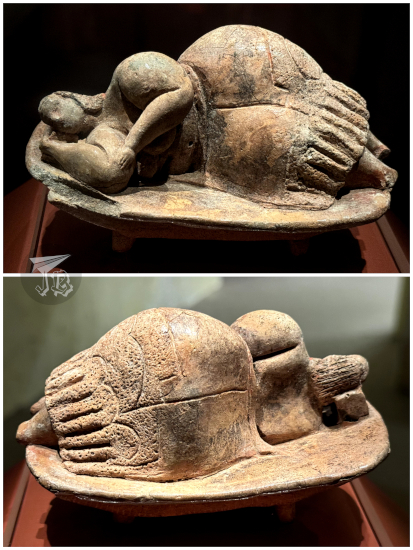
One of such buildings is the National Museum of Archaeology, which hosts artefacts from the Neolithic (around 5900 BCE) to the Phoenician period (circa the 6th century CE). On the ground floor they have all the items that have been removed from the Neolithic temples for protection, including some of the carvings from Ħal Tarxien Prehistoric Complex. A tiny clay figuring called The Sleeping Lady captured my attention. It was a lovely detailed little representation from the so called Temple Period of Maltese history (4000 – 2500 BCE), which was recovered from the Ħal Saflieni Hypogeum. There are also headless bodies and bodiless heads found at other temples.

Archaeological Museum Valletta: pieces taken from the Temples in order to protect them: carved rocks, statues (most of them of bodies without heads), trilithons...

Archaeological Museum Valletta: Sleeping lady. A small figurine of a woman sleeping made in clay

I proceeded upstairs, where there is a small exhibit on “cart ruts”, a network of tracks in the rock. The analysis seems to show that they were made by carts with wooden wheels eroding the limestone. However, there are no… traces of whatever pulled on them – no tracks, no trails, nothing but the wheels. There is another room displaying Phoenician civilisation, and one showing some amphorae from a shipwreck off Xlendi Bay in the island of Gozo, at a depth of 110 m. The ship sank in 700 BC, it was discovered in 2007 and it was finally excavated between 2018 and 2021.

The final room I saw hosts a few skulls from the Ħal Saflieni Hypogeum. I might have to return to Malta just to finish exploring all the prehistoric sites – aside from that, there is sea, the food is delicious and when you open the tap, the water is warm. I felt right at home, really. Anyway, some of these skulls are described as “elongated” and for a while there was even a conspiracy theory about them being alien… They are not. The elongation was not artificially created, like in some Mesoamerican cultures. They belonged to a few individuals who had… long heads. Which is a bit anticlimactic, but only a few remains have been recovered from the calculated thousands, so there is very little that can be inferred from whomever was interred in the burial chamber.

Archaeological Museum Valletta: Phoenician pottery, skulls from the Hypogeum, anforae from the shipwreck

There was actually a last-last area, a ball room from the Baroque palace, but that was under construction and I could barely have a bit of a look. Afterwards, I walked towards the St. John’s Co-Cathedral | Kon-Katidral ta’ San Ġwan. The Catholic co-cathedral shares responsibilities with the one in Mdina, and was built between 1573 and 1578 in a Mannerist style. The interior was redecorated in the 17th century in a very Baroque style and lots – and I mean lots – of gold and golden decoration. Downstairs, there is a crypt where some Grand Masters of the Knights Hospitaller are buried. On the main floor, the nave is surrounded by nine chapels, eight of which are dedicated to the different chapters of the Order and their patron Saint, and the last one is dedicated to and one to the Virgin Mary. .

Though you can get tickets online, there is no chance to buy same-day tickets but on site. I queued for a while, maybe 20 minutes or so, before I was scanned for… guns and explosives… then I was allowed in. There were small restoration works being carried out. Not a Baroque person in general, but I have to admit it was impressive. I declined climbing to the dome because the fun views are from across the harbour, not from inside the city itself.

The co-cathedral holds two pieces of art by Caravaggio – The Beheading of Saint John the Baptist and Saint Jerome Writing, both in the chiaroscuro style – with high contrasts of light and dark. Michelangelo Merisi da Caravaggio (1571 – 1610) was one of the maximum representatives of chiaroscuro, with usually violent and gruesome topics, usually disguised as hagiography.

Baroque interior of the cathedral, with dark walls decorated with frescoes and golden wood

After I exited the cathedral, I headed down a small alley opposite for something that is not a monument but… made me happy anyway. Malta has Costa Coffee – something which, unlike the plugs, I had thought of checking beforehand. I actually had a shop near my hotel. Had I known that, I might have skipped booking breakfast. What I did worked really well though, so no big deal. I managed to balance breakfast and dinner, which made my moving around more convenient, not needing to find a place for lunch. Of course, a medium vanilla latte from Costa does not count…

My next stop was the Grand Master’s Palace | Il-Palazz tal-Granmastru. It was the first building erected by the Knights Hospitaller around 1574, and it is considered the seed of both Valletta and the country of Malta itself. The building was first the residence of the eponymous Grand Master of the Knights of Malta until the 18th century, then the residence of British Governors, the Seat of the Parliament, and it currently houses the Office of the President of Malta. That explains why the security is tight enough you’re not even allowed a bottle of water in.

The building was designed by Gerolamo Cassar. The exterior is Mannerist, severe and simple, but the interior is richly decorated with paintings and frescoes. Some of the rooms have coffered ceilings and tapestries on the walls. There is a huge armoury, organised chronologically, and a throne room, which felt a bit out of place for a republic. The building has two courtyards – the so-called Prince Alfred’s Courtyard has a clock tower which is claimed to date from the 1530s. Oh, and apparently, it’s haunted? I did not feel anything out of the ordinary, not even a temperature drop. That would have been handy.

Grand Master's Palace - clock tower, throne room and corridors decorated with frescoes

After the Palace, I walked down Valletta’s narrow streets and until I reached St Paul’s Pro-Cathedral | Il-Pro-Katridral ta’ San Pawl, the Anglican “temporary” cathedral, established in 1839 – and still in use. It is a Neoclassical building with a very characteristic steeple and an organ imported from England.

Interior of the cathedral, with corinth columns and a small altar.

I then took a walk towards what is called Lower Valletta, at sea level. I walked around Elmo Bay and reached Fort Saint Elmo | Forti Sant’Iermu. The origin of the star-shaped fort was defence against the Ottoman Empire (which would eventually yield to Türkiye), and it is a large structure in limestone. It was key in the 1565 Great Siege of Malta and the Maltese victory. However, the interior is a War Museum, and I did not quite feel like that. Instead, I walked around and went down to the beach to enjoy the waves and the views of Fort Ricasoli | Forti Rikażli across the bay.

Fort St Elmo - a sea-side fortification made in golden limestone

Later, I found the Lower Barrakka Gardens | Il-Barrakka t’Isfel, a green terraced with trees, monuments and fountains, along with a nice view. I was heading upwards again, towards Upper Valletta.

Lower Barrrakka Park: Mediterranean plants, a temple-like building and a pond.

I thought I ought to get some food as I passed by the Valletta Food Market | Is-Suq Tal-Belt, but I did not find anything I fancied. I bought a soda in a small market in the basement, where I was charged 10 cents for the “reusable cap” (fair) and 10 extra cents for buying a chilled drink (LOL). The soda gave me calories and hydration enough to continue on, so I found the Upper Barrakka Gardens | Il-Barrakka ta’ Fuq. Aside from a nice mixture of architecture and nature, the gardens are linked to the Saluting Battery | Batterija tas-Salut, which stands under the terraced area of the gardens as part of the St. Peter & Paul Bastion. It was constructed in the 16th century for ceremonial gun salutes. Today it hosts cannon replicas that are fired at 12:00 and 16:00. I was there for the Evening Salute, with the firm plan to watch from above.

Then a nice gentleman in a nifty uniform said something akin to “for just 3 € be the closest to a firing cannon you can be in Europe” and there went all my restraint. I mean it was only 3 € and being the closest to a firing cannon you can be in Europe. Yes, I’m easily distracted. Yes, I paid the 3 €.

Entry included a brief explanation, including what a “smooth-bore breech loading 32-pounder gun” is: basically, a cannon designed in the 1880s with a smooth barrel, which can be loaded from the breech end of the barrel and… can fire shells weighing 55 pounds (24.95 kg). They were made modifying guns that could only shoot 32-pound shells though. The soldier-actor explained about cannons, how to load them, what the process was and the security protocols. Oh, and that the weapons were anything but accurate in real life. That was cooler than I thought it would be, so I was happy I had decided to get the ticket.

Saluting Battery: cannons and still of the shooting

 
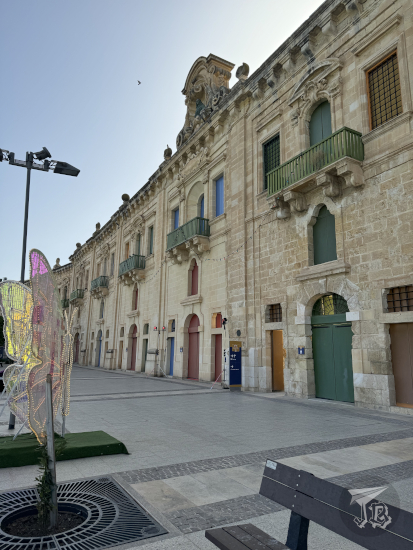
When the demonstration was over, I left the gardens. I walked past the Tower Port and The Lascaris War Rooms, another war museum, on my way to the Herbert Ganado Gardens and the Kalkara Steps. Doing this, I temporarily left Valletta and stepped into Floriana, then walked back into Valletta until I found The Valletta Waterfront, a group harbour warehouses from the 1700s which have been converted into restaurants, bars and souvenir shops. Since it was that silly time when the restaurants have closed after lunch time and are not yet open for dinner, it was almost empty, so it was nice to see all the buildings.

Valletta Waterfront: a line of neoclassical warehouses and buildings turned into shops and eateries

I had two options then – one was walking back towards the city centre to see two churches that I had missed, or head back to Saint Julian’s | San Ġiljan. Since I was quite closer to the bus station than to any of the churches (Shrine of Our Lady of Mount Carmel | Bażilika Santwarju tal-Madonna tal-Karmnu and The Collegiate Matrix Parish church of Saint Paul | Il-Knisja Kolleġġjata Arċipretali u Matriċi ta’ San Pawl), I decided to return.

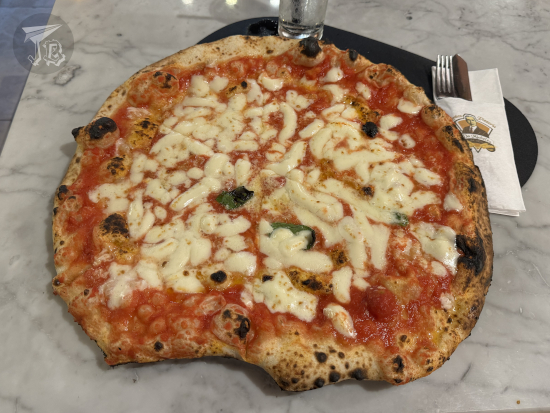
Once in Saint Julian’s | San Ġiljan, I had the largest pizza I’ve ever had the pleasure or disgrace to be served. I mean, good thing that I ordered a plain Margherita (in all honesty, it was the house special with extra cheese) because I would not have been able to eat anything with toppings, even after having basically skipped lunch. I somehow made space for ice-cream afterwards…

Huge Margheritta pizza

22nd May 2025: Blue Grotto, Tarxien & Saint Julian’s / Sliema {Malta, May 2025}

My flight departed at 9:55 from Madrid-Barajas, which is actually a very bad time for a flight, as you have to drive to the airport through the daily rush-hour traffic jam. However, for a change, I was given a lift there instead of driving myself – my car failed a few days before and I was not feeling too trusting. The inbound plane was delayed, and we ended up landing at Malta International Airport around an hour late.

It turns out that Malta has done a smart thing – the airport is also a coach hub, and there was a bus which went directly where I wanted to go first 20 minutes afterwards – that was lucky because the bus only comes every hour. It did not take long to reach the Blue Grotto | Taħt il-Ħnejja in the village of Qrendi | Il-Qrendi.

I got off in an aptly-named bus stopped called Grotto, next to which stands Xutu Tower | Torri Xutu. The history of Malta cannot really be understood without mentioning the Order of Knights of the Hospital of Saint John of Jerusalem, the Knights Hospitaller, today also known as the Sovereign Order of Malta. This Catholic military order was founded during the Crusades in the 12th century and the knights were established in Malta between 1530 and 1798, acquiring the name. They fortified the island and created the city and defences of Valletta, so-named after Grand Master La Valette. The knights built hospitals – along with medicine schools – and turned Valletta into a centre of art and culture with a university, a school of navigation, and a school of mathematics. Through the centuries, the order transitioned from a warring and defensive army to an organisation centred in humanitarian, medial and social assistance.

Xutu Tower | Torri Xutu was one of the towers built during the operation to fortify the coastline of Malta, probably around 1650. It is a two-story tower with a square ground plan and vaulted ceilings inside, setting the example of the towers that would be built afterwards. As many buildings in the island, the tower was erected using limestone, and restored in 2014 using the same type of material. It also yields to impressive sights – even without climbing it – of the ocean and the islet of Filfla, uninhabited and turned a bird sanctuary.

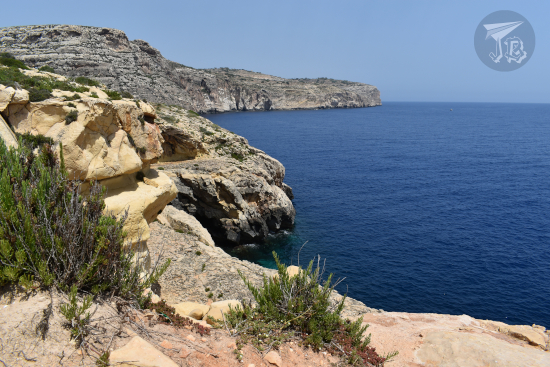
Qrendi cliffs, made if whiteish - grey rock, over a calm dark-blue ocean

I bought a ten-euro ticket to sail to the Blue Grotto | Taħt il-Ħnejja from the Blue Grotto Boat Service. This is just a way to amalgamate all the captains and boats who do trips to the caves, I think, and not a bad one. It is a quick trip that does not even take half an hour and charters you to snoop the different caves, created by the erosion of sea water and waves against the cliffs. Each has its name: Blue Window Cave, Circle Cave, Calscave, Honeymoon Cave, Cat’s Cave, Reflection Cave and the main archway which gives the name to the whole area, the Blue Grotto. The water is very clear and since the sun was out, there were extremely beautiful reflections. I stuck my hand in the ocean a few times when I was not taking pictures.

Blue Grotto: Sea level caves with bright blue water

Afterwards, I decided to stop for food. I was not really hungry, but I wanted to tackle the walk to the viewpoint, which was 15 minutes. I thought it would be more efficient to have a late lunch first. There were a couple of restaurants and I chose Step in Malta. It had a terrace, was less than half full, and most importantly: offered calamari fritti. When I researched Maltese food, I read about this dish – fried squid with garlic and parsley mayonnaise , and I really wanted to try them.. I think I broke the poor waiter’s brain when I told him I did not need the menu and ordered directly. They were delicious.

Calamari fritti: a plate of breaded and fried squid

I then did the short walk to the Blue Grotto Viewpoint – and though I won’t be mentioning it much, just assume I just used a lot of sun lotion all the time. It did not take as long as I expected, even if the shortcut was closed down. It yield to pretty views, but not as impressive as expected.

Blue Grotto viewpoint, showing the cliffs from above

I was about to go back towards the original spot to wait for the 201 bus again, when a Valletta-bound bus stopped by. I hopped onto that one to use the Wi-Fi and replan the rest of my evening. An idea had been to head towards Valletta indeed, but instead I decided to try my luck to reach my first Megalithic temple in Tarxien | Ħal Tarxien. The Blue Grotto is actually quite near another archaeological complex, but that one was covered by the tour I had booked on Saturday.

The trip to Tarxien turned out to be a great idea. When I arrived, I was surprised by the sheer amount of Christian images that were in the streets. That weekend the Catholics celebrated the Feast of the Annunciation. Malta is officially a Catholic country with over 80% of the population adhering to the religion, so while it was slightly surprising to see so much decoration, it is not shocking. I wanted to get to the Ħal Tarxien Prehistoric Complex | Il-kumpless Preistoriku ta’ Ħal Tarxien because it had a closing time.

A street crossing in Tarxien, with a movable Catholic altar brought out. The houses on the corners have flags with religious motives, and the altar is guarded by angels carved in wood

The Megalithic Temples of Malta are considered amongst the oldest free-standing structures in the world. They were erected between 4100 and 2500 BCE (making them older than Stonehenge, whose rocks were placed between 2600 and 2400 BCE), though the remaining structures probably date from the 3600 – 2200 BCE. In 1980, the UNESCO created the Heritage protection for one of the temples, and in 1992, the Site expanded to six temples / structures in total.

The Ħal Tarxien Prehistoric Complex | Il-kumpless Preistoriku ta’ Ħal Tarxien has been dated between 3000 – 2500 BCE, and it is considered the greatest example of the Temple Period (4100 – 2500 BCE). It was first excavated by Maltese archaeologist Themistocles Zammit around 1913 following complaints of a local farmer that he kept hitting stone while ploughing. The main excavation and restoration took place between 1915 and 1920, and some of the most delicate structures were moved to the Malta Museum of Archaeology to protect them from weathering. The site is covered by a protective tent that makes it look a bit alien, and being alone made it even more magical.

The temple is built in limestone, showcasing three constructions which are independent but attached to one another. The rooms are round, and there is evidence that they had a roofing. There are several chambers, and in some of them there are spiral decorations and domestic animals carved into the rock. There is even a small hearth where fire could be lit. I spent about an hour there, nearing closing time, which meant I was almost alone. I was extremely happy to be there.

Hal Tarxien temples - ruins of Neolithic temples with round rooms and trilithon entrances, from outside

Hal Tarxien temples - ruins of Neolithic temples with round rooms and trilithon entrances, from inside, showing spiral decorations and areas that have been restored, such as a hearth

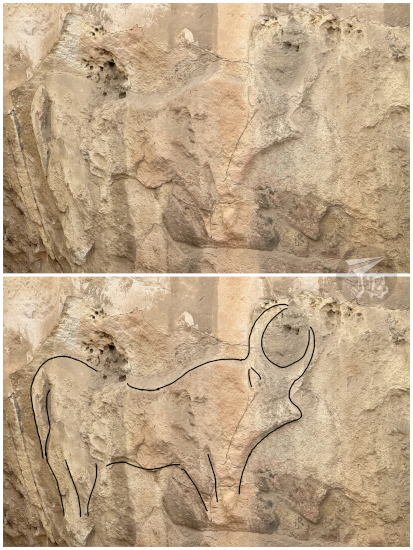
Relief of a bull on a limestone wall

I could not visit the related Hypogeum of Ħal-Saflieni because tickets are released – and sold – months in advance, and this whole trip was planned in a couple of weeks. But I could explore around.

Due to the festivities, some of the bus stops were out of order, so I followed the bust route until I found one that was in use. At some point there I crossed my first “invisible frontier” between the village of Tarxien and Paola. Still in Tarxien, I stopped to look at the Catholic sculptures, and in Paola, I came across the Minor Basilica of Christ the King | Il-Bażilika ta’ Kristu Re. The church was erected at the beginning of the 20th century and, compared to the buildings around it, it feels huge – over 80 metres long, 40 metres wide and 60 metres high. It was full, which I found strange for a weekday at 18:00, but then I thought it might be part of the Feast of the Annunciation programme.

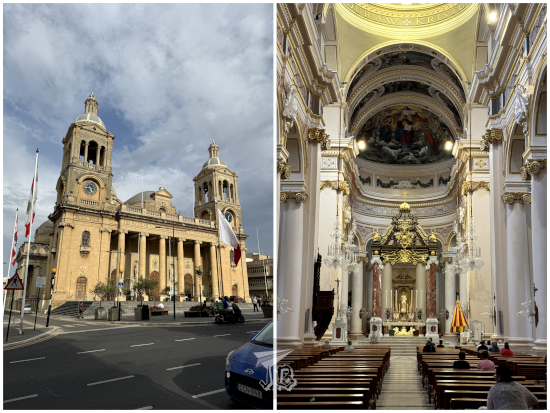
Minor Basilica of Christ the King: a Neoclassical basilica with two towers on the outside, and a sober interior design

I took a bus again and after a few changes I reached my hotel in the town of Saint Julian’s | San Ġiljan. Though I was driven through a few towns, it felt like a huge stride of buildings one after the other, with no real break. It was weird, that the whole area is just one big urban sprawl. I found changing buses easier than I expected, even not knowing the layout of the area. I got to my stop, Ballutta and checked into my hotel.

Aaand at that point I realised that there was a consequence of “British colonisation” that had not even crossed my mind – Malta has Type G plugs. So on my supermarket run I had to add an adaptor (despite having a few at home) to my bottled water and sandwich shopping list. I dropped the groceries at the room and then I went off to explore the coastline. That way, I inadvertently crossed to Sliema. I walked along Ballutta Bay and Exiles Bay, two of the three lobes that make up the larger St Julian’s Bay. I was a bit surprised when all the beaches were made of rock and limestone, which made them great to walk on. I had a lovely walk – except at one point, when I slipped and realised that my totally-sensible-for-airport shoes were not the best choice for limestone beaches. Eventually, I went back to the hotel to eat my supermarket-bought dinner.

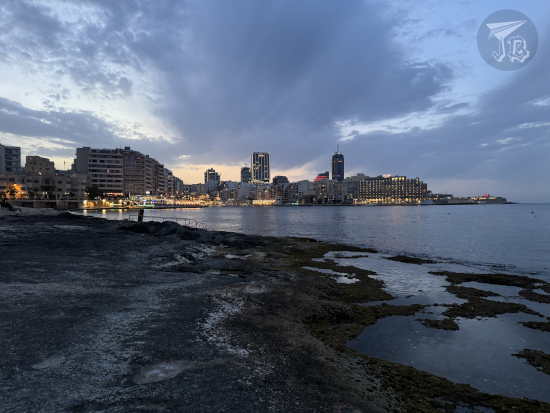
Balluta Bay at dusk. The ocean is calm, and the buildings at the other side of the water have started turning on their lights

22nd – 26th May 2025: A taste of Malta {Malta, May 2025}

Last-minute trips are weird. You start looking at an Ireland itinerary, but for some reason hotels are 200€ a night. You check for alternatives and end up booking at a place you had never considered before. In my case, it was the tiny country of Malta, an archipelago with eight islands: Malta, Gozo | Għawdex, Comino | Kemmuna, Manoel Island | Il-Gżira Manoel, Cominotto | Kemmunett, Saint Paul’s Island | Il-Gżejjer ta’ San Pawl, Filfla and Filfoletta. It turns out that Malta is both the country and the main island. Only Malta, Gozo and Comino, that is inhabited – and there are just two people living in the latter.

Malta is located in the Mediterranean Sea, a handful of kilometres south of Sicily. It is one of the smallest, and most densely-populated countries in the world – actually, in the island of Malta you literally cannot tell where one city ends and the next begins. The inhabitants speak English and Maltese (I will use this order for bilingual references, English | Maltese, as I did above with the island names). Malta as an independent country was established in 1964, when it gained independence from the United Kingdom.

Humans first reached Malta during the Mesolithic, around the year 6500 BCE. Due to the island’s geostrategic location in the middle of the Mediterranean, it has been lusted after by many powers and alliances – from the Phoenicians, Greeks and Romans to the British Empire and everyone involved in WWII. The successive populations have heavily influenced the islands and its architecture.

My original plan was to stay in Valletta, a fortified city mostly from the 16th century and the capital of the country. However, I only found apartments in basements for a decent price. I finally found a hotel in Saint Julian’s | San Ġiljan. Once that was booked, I focused on what to do and see in Valletta, but the more I read about the island, the more intrigued I grew.

In the end, I decided to balance some landscape watching (22nd and 26th) with historical Valletta (23rd), prehistoric ruins (24th) and a guided tour through the smaller island of Gozo (25th). There were a few things that did not work out as intended, but all in all it was a good trip with lots of new experiences, but a tad of necessary improvisation made it less efficient than it could’ve been. Fortunately, everything that went wrong could be fixed.

13th May 2025: Three free niche exhibitions (Madrid, Spain)

I planned a little escapade to Madrid. There was nothing really special going on, it was just going to be a sunny day with no rain forecast and I could go to a museum and have lunch. When I say nothing special was going on, I mean there were a couple of exhibits I wanted to see, but it would have been just as easy to visit them the previous or following day. I just timed it for the best weather forecast of the week.

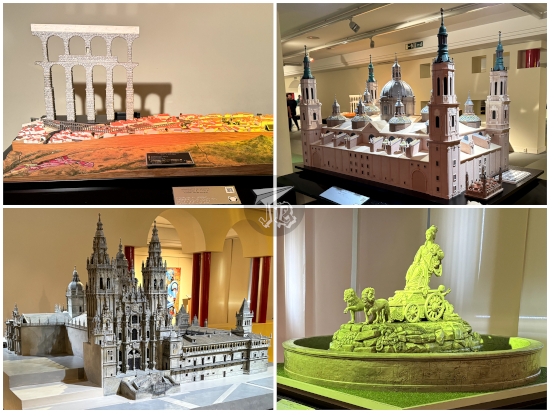
I had a small work-related thing early in the morning so I ended up leaving the house half an hour later than I would have liked. The trains were around 10 minutes late and the underground was packed, but none of that is news. I reached my first stop, the Museum for the Blind Museo Tiflológico de la ONCE, around 11:30. This museum hosts models or miniatures of famous monuments in Spain and around the world, designed to be seen with one’s hands. That way, people with low or no vision can get an idea of how they are. It is part of the ONCE inclusion program for the blind, and I think it is a brilliant idea.

ONCE stands for Spanish National Organisation of the Blind in the local language, Organización Nacional de Ciegos Españoles. Its history and works are a bit convoluted, but keeping it short, the Organisation was established in 1938 with the goal of providing equal opportunities for the blind and people with visual impairments. One of its main income sources is the lottery known as El Cupón de la ONCE.

While the museum itself is free to enter and very relaxed, when you arrive at the building you have to fill out a questionnaire, for statistical purposes, I guess. I did find it a bit off putting that I was outright asked why I wanted to see the exhibition. Because I’m curious, all right?

The museum has three distinct sections – one with the reproductions of the monuments, one with works by low vision, blind, or artists with other disabilities, and a historical area. In turn, the monuments are divided in national (Spanish) and international landmarks. The models are faithful to their smallest detail, and just like the Eiffel Tower is made out of metal, the Taj Mahal is made out of marble! Some of the monuments were reproduced in different scales, such as the Alhambra in Granada or the Aqueduct in Segovia. This should give an idea of both scale and detail. However, I don’t think I would ever be able to imagine something like that without being able to see it.

There were lots of sculptures by artists with disabilities, with a disturbing amount of naked ladies, but whatever. I also saw paintings and a homage to Braille that was sort of abstract but was really cool. The historical section hosted a number of items to learn and write Braille through the years, general studying tools such a 3D map of Spain, and a few historical runs of the lottery ran by ONCE. In general, it was a fascinating visit.

Museum for the Blind - national monuments

Museum for the Blind - international monuments

I did some shopping afterwards, and while the sales lady was really nice, she worked rather leisurely- That, and all the pedestrian lights being red on the fifteen-minute walk, put me seven minutes behind for my lunch reservation – and I swear, they phoned me. I was reaching the door of Comic Planet at 13:07 and they were already calling to check I was coming. People wonder why I’m paranoid about reservation times with them… They decided to change my table to “a more private one” to keep me away from a family with toddlers, and I had no problem.

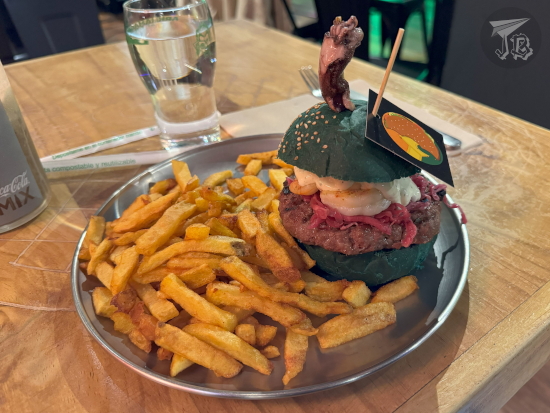
I got to try the last item that I wanted to try from their menu – the Aquaman Burger, which had caused me some morbid fascination when I first read about it– Beef and king prawns? Garlic and pickles mayonnaise? It could be… either really good or really bad, I thought, and I really wanted to check it out. It was all right, I guess. There was much less of a flavour contrast than I expected, so it was most of a normal burger with a bit of an edge. And the edge was that the buns were blue. I also ordered a Vanilla Coke just because I could, and the waiter was nice enough to offer me tap water when I asked for some too. Cool.

Comic Planet Aquaman Burger

After lunch, I took the underground towards Fundación Telefónica which is running an exhibition called “Echoes of the ocean”, Ecos del Océano. I liked the idea better when I did not know that half of it was done using AI. It was – or tried to be – an exhibit centred around cetacean vocalisations. The first room was a mindfulness thingy in which a lady told you to become one with the ocean and then called you fat – “your body enlarges. You’re huge. You’re a humpback whale”. It made me laugh as it broke all the concentration thing. I also cackled when the voice told me that I went “deeeeep” as a sperm whale and met leopard seals there.

Then there were several huge screens with computer-generated graphs that imitated a sea prairie, dolphins and whales. That was the part that was made using AI, and it could have been a CGI or an actual video just as easily. The important part was that the images on the screen moved along the sounds of actual cetacean vocalisations. A room at the end hosted two actual underwater microphones, and headphones to listen to recordings of different creatures – sperm whales, seals, humpback whales – and ice sliding (this is important because for a long time, the sound of ice on the ocean was unidentified and it yielded to a lot of wild explanations / conspirancy theories).

Echoes of the Ocean screens

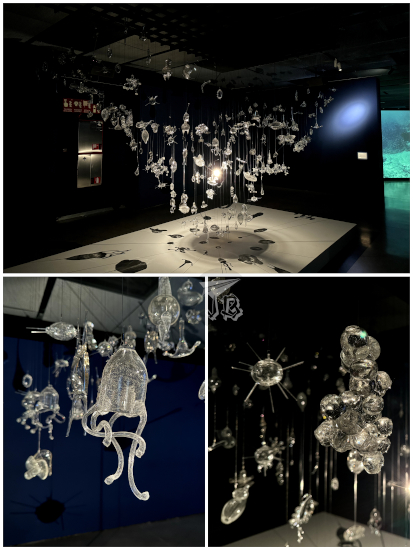
On the way out, there was a sculpture with glass reproductions of different microorganisms that love in the ocean: diatoms, anabaena, coccolithophores, dinoflagellates… Yes, this was totally me geeking out and identifying all the tiny little critters. The final room had to do with some photograph and schematics of a particular blue whale that had been tracked by the organisers.

Echoes of the Ocean plankton

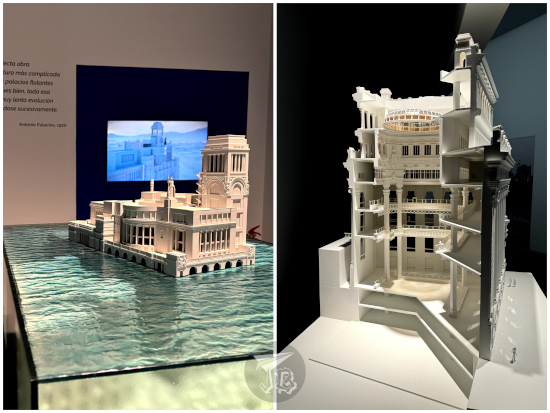
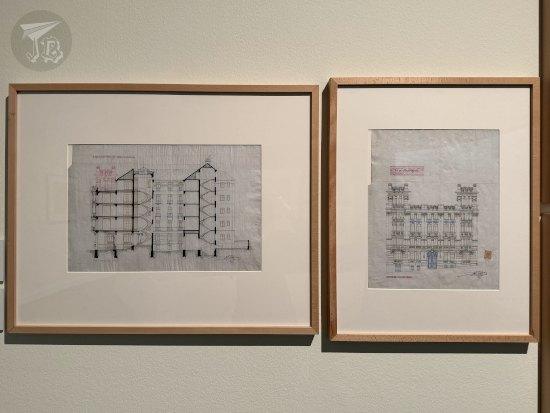
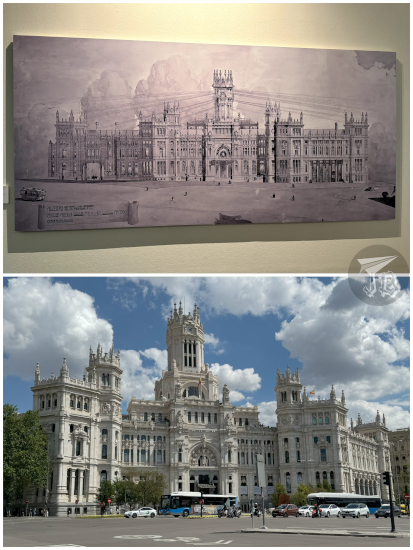
I left the building and headed towards Palacio de Cibeles, which this time, was running an exhibit on its own architect Antonio Palacios. The exhibition is aptly named “An architect’s dream: Madrid as a metropolis” Madrid metrópoli. El sueño de Antonio Palacios. It uses photographs, designs, and models to present the works Palacios projected for Madrid – the ones that were built, the ones that were not, and the ones that have disappeared. It was an interesting collection, and the visit was free! Of course, I wandered the building a little before heading to the train station.

Antonio Palacios exhibit - models of buildings

Antonio Palacios exhibit - framed façade designs

Antonio Palacios exhibit - façade design and photograph of the actual Palacio de Comunicaciones building

On the way, there was a classic book fair Feria del Libro Antiguo y de Ocasión, but everything was way too expensive for me. I guess that in general it was a very budget-friendly day – three free exhibitions – if you do not count tiny shopping spree in-between, and it was around 20 €.

11th May 2025: Ruta SPG-24: Bosque de Valdenazar in Spring (Yebes, Spain)

After the rainiest spring in ages, I had a couple of hours in a free morning – or actually, I just needed to do something for a little bit before I could become productive again. And the Internet helped supplying the information of this little route that could be done in under a couple of hours.

The route inches into the oak forest Bosque de Valdenazar, mainly composed of Portuguese oaks (Quercus faginea) and holly oak (Quercus ilex). The track was designed and is maintained by the municipality of Yebes. It delves into the forest and runs parallel to a small stream with bulrushes (Scirpus holoschoenus), rubuses and black poplars (Populus nigra). The area is home to roe deer, small raptors, and foxes, but none of them were around to be found – probably due to screaming kids. I did see some deer tracks.

It felt a bit silly to drive somewhere for a walk, but it was the only way to get there. Google maps was missing three roundabouts, but my Sat-Nav got me there without a hiccup – and considering that I’ve needed to MacGyver a stand for it because the wire keeps coming loose, I think that’s a feat. I parked at the entrance and set onto the hike.

The first stage was a small picnic area, after which came a bit of a steep slope with makeshift stairs. The route is mostly circular and I thought following the arrows was the way to go. At first I was alone, but then I started running into other walkers. The problem was that of course, they were chatting – and the families being a bit loud – and that made any possible fauna sighting impossible.

Valdenazar forest pathway

Valdenazar forest, start of the route

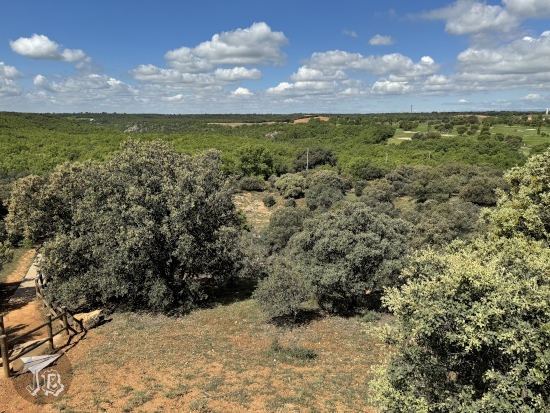
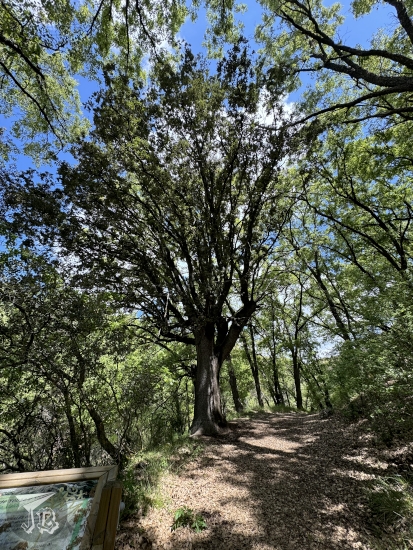
I had a look at what they call the carboneras, a bunch of oak trees that were repeatedly cut and slow-burnt to create carbon. That caused the living trees so they had strange-looking trunks, with several thick branches growing from the stumps. I found the viewpoint to look at the whole valley for a bit, before I walked into the actual forest. There is a wide track that feels a bit like the forest near The Shire in The Lord of The Rings, with the light sweeping through the leaves and the light breeze.

Valdenazar forest trail

Valdenazar forest

Valdenazar forest trail

I reached the stream and deviated to a sub-track known as Senda de la Fuente (Fountain Trail), parallel to the water flow. I expected an actual fountain at some point, but there was just a small waterspout. After that, it was just a bit of an uphill walk to get to the picnic area again.

Valdenazar forest trail

All in all, I was there for about an hour and a half. It was pretty but not the spectacular walk I had read about. I’ve read that it is incredible in autumn, so I might have to check it out again by then, but the truth is that the weather has been crazy in 2025, so I’m not sure we will even have an actual autumn… But all in all, the hike was nice and it cleared my head, which was exactly what I needed at that point.

15th April 2025: Kinetic art and Egyptian replicas (Guadalajara, Spain)

Rain and school holidays having thwarted my hiking plans yet again, I decided to make the most of half a non rainy morning when I was going to be around Guadalajara to check out a free exhibition and the museum of a local artist.

Francisco Sobrino (1932 – 2014) was a conceptual artist whose sculpture can be framed into the kinetic art and constructivism styles. The museum Museo Francisco Sobrino hosts some of his smaller works, mostly in colourful vinyls and experiments with materials, textures and light. Pretty colours and shapes, but I guess you need more knowledge of art than I have to appreciate the works and see… something different from pretty colours and shapes. But the museum is free and it is hosted in a historical building, the former slaughterhouse, built in traditional brick and stone. Though I’ve been around a few times, I’d never visited it before…

Francisco Sobrino Museum Guadalajara

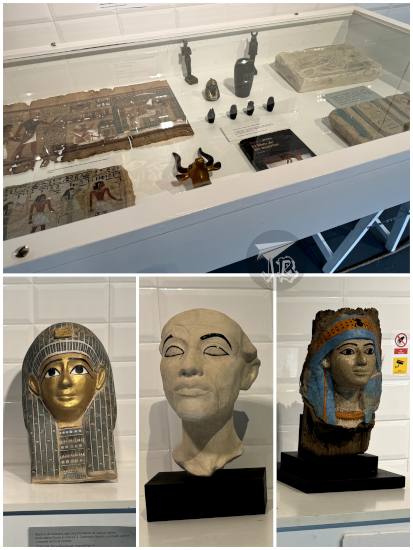
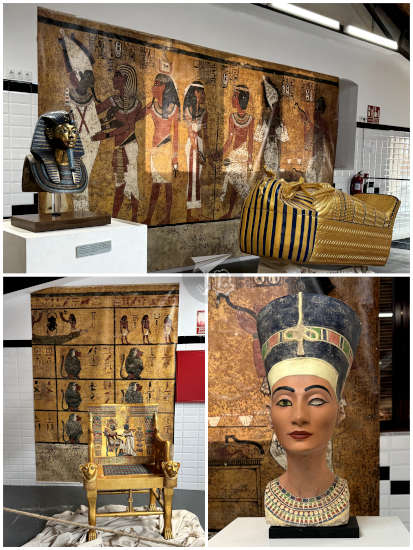
The exhibition on Ancient Egypt and King Tutankhamen’s tomb Tutankamón Secretos Revelados: La Exposición (Tutankhamen Secrets Revealed: The Exhibition) was endearing but lacking. It was located in another historical building, the traditional market Mercado de Abastos. It used to be a very successful local market, but the vendors lost most their clientele when it was closed for a few years to turn the place into a culture and bar hub. It was not successful at all, and now it’s a sad-looking place. The top floor hosted the exhibition, with a few posters with information and pictures, one of them being a very buff Anubis from the video-game franchise Assassin’s Creed. There were a few display cases with reproductions of Egyptian antiquated from private collections and books on Egypt. The largest part of the exhibition was a reproduction of several items found in Tutankhamen’s tomb: the wall paintings, a golden chair and the gold-plated sarcophagus. There were also a reproduction of the funerary mask, a brass tray and anything golden the curators seemed to have at hand, including a scarf. And the bust of Nefertiti for some reason.

Tutankhamun Exhibit Guadalajara

Tutankhamun Exhibit Guadalajara

I’m not going to say I was disappointed or that I expected more, it was a cute little exhibition that tried to do its best. Unfortunately, some of the information was inaccurate or outdated – they were showing a video from the 1980s, and archaeology has evolved a little since then.

However, I am still cackling at the low-resolution buff Anubis…

11th April 2025: Extant, extinct and extrastormy (Madrid, Spain)

Since March was extremely rainy, I hoped that April would not be so. No such luck. However, there was a dinosaur exhibit in Madrid that I was keen on seeing, and I wanted to do it before Easter, because it would be packed during the holidays and I could not get there in May due to personal stuff. And since getting to the Casa de Campo area takes so long by train, I looked at combining it with something else around (it’s a four-hour roundtrip from where I am). What other thing was close? Somewhere else I never go because it’s far away by public transport and a nightmare to park around – the local zoo Zoo Aquarium de Madrid. There was after all only a 10% chance of rain…

Spoiler alert: while I was getting drenched (I’m being dramatic, of course. I had an umbrella) in the zoo, and later in the exhibit, the weather app said “partly cloudy” and there was no mention of storms nor rain. But the skies opened. Ask the peafowl…

I took the train and changed to the underground until I got to the Casa de Campo stop. There were not many people around since it was a weekday. There’s a bus that takes you to the zoo, but I found it more efficient to walk, since there is a pedestrian way alongside the road. I reached the zoo a bit after it opened at 11:00, and just as my ticket was getting scanned the first few raindrops fell. At first, it seemed like a small drizzle, but soon it started to rain in earnest. By that time, I had managed to get to the pandas, about 40 metres into the zoo.

I’d been to the Zoo Aquarium de Madrid twice in my life before. The first one I was very small. I have no memory of it, but there is a home video of three-year-old me chasing a peacock and a voice warning “come back, it’s going to bite you!”. The second time I was in third grade, and had my first camera. I remember that I was devastated because the pandas were very far away and I could only take a picture of a distant, tiny, black-and-white blur. That was decades ago, and I had never been back, though I had a recurring dream for years that involved one of the pools there.

The zoo opened in 1972 as an alternative to the “Beast House” or Casa de Fieras that used to be hosted in the Retiro Park, a few sad and crammed-looking cages that must have been horrible for the animals. As every animal park, Zoo Aquarium de Madrid is not free of controversy, especially related to the ethics of keeping great apes and cetaceans in captivity. They used to have dolphins, but those were surrendered and sent away earlier in 2025. Conversely, the zoo participates in over 60 conservation and breeding programs for endangered animals – they have breeding couples of owls, whose chicks are routinely released into the wild, and have succeeded in breeding pandas (they claim to be the most successful institution at breeding panda outside China) and white rhinos. They have non-breeding animals as ambassadors, such as a family of Iberian lynx.

The zoo is vaguely organised per continent – Europe, Australia, Asia, Africa and the Americas, and the home of actual wild animals such as storks and rabbits.

As I went into the zoo, the first thing I spotted was a small lake with flamingoes, pelicans and (squatting) storks. The storks are free to come and go, but they like to be in the zoo because they get free food, I guess. My idea had been to walk a spiral and try to see everything, but I got distracted by “Panda Land”, signalled by a big red gate – after all, they are the main attraction. I thought the pandas might be visible, and they were – much closer than I remembered indeed. I did get to see both the male and the female, who live apart within the same installation. I had time to take a few pictures before it started to rain in earnest. And no, they were not distant, tiny black-and-white blobs this time, and not only because I had borrowed a really good lens for the day. I had to put the camera away when the rain became too heavy.

Zoo Madrid - stork, flamingoes, panda

It rained for a couple of hours, and that impacted me a little. I ended up sharing shelter with a band of peafowl, and had to go from covered exhibit to covered exhibit at first. I found the orang-utan territory very sad, and I did not catch a glimpse of any gorilla. In the aquarium, I got stuck with all the school visits, but there were quite a few sharks and big fish in the ocean tank.

Zoo Madrid: peacocks and peahens sheltering from the rain

Zoo Madrid: Sea lion, small blue jellyfish, sharks

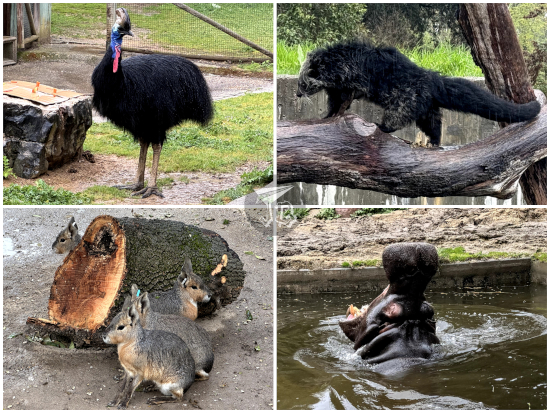
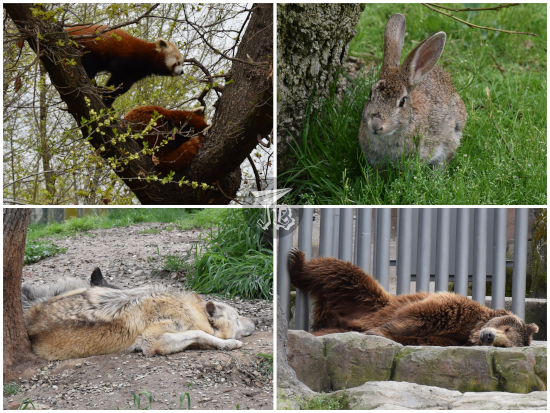
I ambled around the Australian area, where most of the animals were unfazed – especially the cassowary, which by the way is apparently the most dangerous bird in existence, even if I’m way more crept out (and fascinated) by emus. I did not see the koalas, and I walked past a tree which seemed fenced off just because. As rain cleared out, some of the animals started playing around, such as the binturong (Arctictis binturong), a distant relative of civets. At around 13:20, I had reached Africa, and I was in front of the hippos when it stopped raining. Awesome!

Zoo Madrid: Cassowari, binturong, Patagonian mara, and hippo yawning

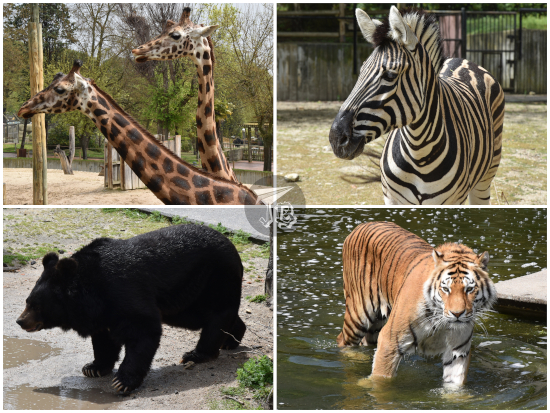
Since I had borrowed a camera lens which is better – but heavier – than mine, I really wanted to try it out. Carrying it around without being able to use the camera due to the rain, at all, would have been a bummer. After the rain stopped, I was able to take quite a few good pictures though. Those included the Siberian tiger (Panthera tigris tigris), and its relative the domestic cat (Felis catus), whom I’m not sure is a resident or a squatter in the “farm” section of the zoo alongside the sheep, goats, and a very large pig.

Zoo Madrid: Jiraffes, zebra, black bear and Siberian tiger

Since I’d been to Emociones al Vuelo a few days earlier, I did not mind the lack of Raptor Flight exhibit due to rain. I did miss the Exotic Birds one, but I caught the Sea Lion exercise (hello, swimming pool from years of recurring dreams). Around 14:30, it had stopped raining, the animals had eaten, and I caught many of them. Unfortunately, most – especially the carnivores – were napping. I did however saw a very active red panda (Ailurus fulgens) around the tree that I previously thought was fenced off for no reason.

Zoo Madrid: Red panda, common rabbit, grey wolves, brown bear

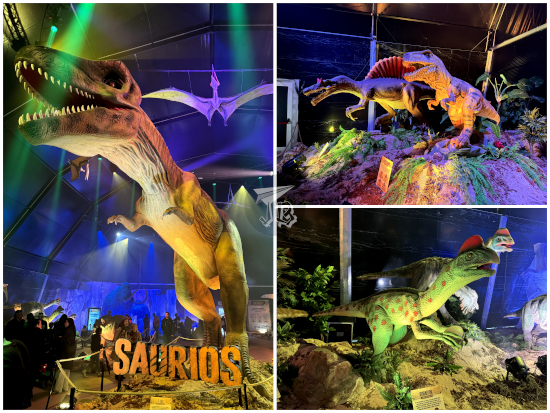
By the time I left, the workers had also dropped off a few Easter Eggs throughout the zoo as the holidays were about to start. At 17:00 I had to be at Escenario Puerta de Ángel to see Saurios, a dinosaur exhibit, which turned out to be a bit of a disappointment. Most of the animatronics I had already seen as “Dino Expo XXL” – I recognised it because of the broken neck on one of the brachiosaurus. The exhibit had a first part with a few skeleton replicas – the coolest thing, as I had never managed to see a complete cast of a Spinosaurus before. Then there was an open area with some life-sized replicas and photo-ops, but it was completely made for kids. There were actors and activities for them, which I guess were extremely fun if you’re younger than five. Yet another “dinosaurs are for kids” activity.
Saurios Madrid - skeleton replicas

Saurios Madrid - models

And then it started storming again. A black cloud, a clap of thunder, and the skies opened. Thus, we all had to hurry to the last section, which was most of what I’d seen in “Dino Expo XXL”. I was really not impressed by the whole thing – remember folks, “for all the family” means “designed for kids”. I guess I would be more gracious had the weather been nice, but… having seen most of the exhibit before for half the price, I was not impressed. Fortunately or unfortunately, there is a Jurassic World Exhibition coming up soon…

Saurios Madrid - models

27th March 2025: The Raven Age at ReviLive (Madrid, Spain)

Sometimes one has to wonder what guides music promoters to make certain decisions. It would be interesting to be aware of factors like costs of renting a venue, fuel, ticketing and so on. Because on occasion, it feels like tour schedules are suboptimal from all angles – acknowledging the lack of information. In the case of The Forsaken Tour by The Raven Age featuring Disconnected, I think that the most important factor that was considered was minimising bus-tour kilometres. Unfortunately, that placed their Madrid show on a Thursday, in a venue which… I’m pretty sure was inconvenient for everyone but myself.

The Raven Age is an English heavy metal band formed in 2009 by guitarists George Harris and Dan Wright – though Wright has since left the band. Current members are Harris and Tommy Gentry on guitars, Matt Cox on bass and backing vocals, Jai Patel on drums, and Matt James (MJ) on lead vocals. They have released three studio albums, and supported Iron Maiden, Anthrax and Apocalyptica during the Apocalyptica Plays Metallica Vol 2 Tour 2024. Though I saw Artics supporting that tour, my friend A****d saw The Raven Age and highly recommended them – actually she was the one who informed me of the upcoming tour and the Madrid date and place.

The Raven Age Tour Schedule

The concert was held in ReviLive, a concert and party venue associated with the musical studio ReviRock, which provides recording equipment, sets, rehearsal spaces… It is located near the Vicálvaro train station and Puerta de Arganda underground stop in Madrid. Unfortunately, it’s pretty far out from most commuting hubs. I had first thought about driving there, but my Sat-Nav has been failing lately. Furthermore, I did not feel comfortable parking and walking around the area – not the best – without knowing my way.

Since Vicálvaro was close and the way was rather straightforward, I decided to drive to a nearby station, then take a high-frequency train. But in the end, that day I had a headache, so I wanted to drive as little as possible. That meant risking it with the trains. I had previously checked finishing times and with doors at 19:00, I should be out at 22:30 latest. I had no intention to queue, so I took a train that arrived at the station around 18:50. That got me to the venue at 19:05. I was all right with staying back, but the crowd was so small that I found a spot at the barrier… And I was not wearing barrier shoes, at all. The good thing of a small side-lined venue is that security is nicer – and you are allowed to do outrageous things like bringing in your water bottle.

Supporting act throughout the tour was the French artists Disconnected, an independent French progressive metal band. Formed in 2016, it features Ivan Pavlakovic on vocals, Adrian Martinot and Florian Merindol on guitars, Romain Laure on Bass and Amaury Pastorelli on drums.

Doors ended up being at 19:30, not at 19:00, which was mean to the poor fans that had been there since early, particularly the meet & greet ones. I have to admit I did check for M&G tickets, but found no way to get them, else I would have. Maybe they were fanclub-only, I don’t know. I was hoping the venue would fill up more – similarly to La Riviera, where the crowd (that I’ve seen) skips the supporting act and drips in without queuing.

At 19:50, Disconnected started their act, and it was quite all right. What was unfortunately not so good was the sound. For such an empty venue, it was a pity, because it was not as if there was a roar from the attendees. The vocalist had great energy, and he was fun – though painfully aware of how few people there were. They sang in English and French, but the ratty sound made it a bit difficult to follow.

Disconnected’s setlist:
  1. Living incomplete
  2. I Fall Again
  3. The Wish
  4. La Puissance
  5. Unstoppable
  6. A World of Futile Pains
  7. Life Will Always Find Its Way
  8. We Carry On

The Raven Age Madrid Concert: Disconnected

The Raven Age Madrid Concert: Disconnected

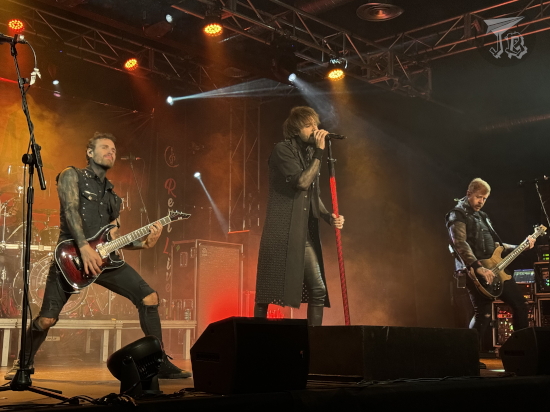
Unfortunately, the venue had not filled up when it was time for the main act, and that was a bit sad. Despite the ongoing sound problems and the small crowd, The Raven Age had a great presence. The music did not sound as powerful as what I had been listening online though, and I am sure that they did not have any tea in their thermos bottles…

The Raven Age’s setlist:
  1. The Guillotine
  2. Promised Land
  3. Forgive & Forget
  4. Nostradamus
  5. Surrogate
  6. The Face That Launched A Thousand Ships
  7. Scimitar
  8. The Day The Earth Stood Still
  9. Essence of Time
  10. The Journey
  11. Seventh Heaven
  12. Angel in Disgrace
  13. Serpent’s Tongue
  14. Grave of the Fireflies
  15. Fleur de Lis

The Raven Age Madrid Concert: The Raven Age

It was extremely amusing to hear a heavy metal singer with such a strong British accent, talking in a natural way and dropping swearwords without sweating them. The members seemed to be quite happy taking over all the stage, and there was a lot of interaction, which is always good and fun. Unfortunately, considering that promoter was giving tickets away, I don’t think I’ll ever have the chance to see them close to home again.

The act was not long. They started at 20:50 and finished at 22:10, so it was a relatively short show, but it went by really fast. There was no real encore, because MJ said “this is the time when we go backstage, you guys yell for more, we come back and sing some more, so we’re going to skip all that and go on.” I approve of that.

The Raven Age Madrid Concert: The Raven Age

The Raven Age Madrid Concert: The Raven Age

The Raven Age Madrid Concert: The Raven Age

The Raven Age Madrid Concert: The Raven Age

The whole event had a weird atmosphere from start to end – the lack of a queue, the… chairs outside so we could wait… The… “hey, hold my spot, I’m going to change into this merch shirt I just got” and “Sure, but then hold mine while I go to the toilet” conversations… And especially, the lack of people. I really hoped that there would be more concertgoers after 20:00, and at least some more enthusiasm. When I saw Kamijo in Barcelona there was a small crowd, but it was loud. Here, it was lukewarm. I felt a bit heartbroken for the bands, because they both did a great job.

The train I was supposed to take back did not pass, so I had to wait almost 45 minutes at the Vicálvaro station. That was not fun because the only seats were in the open platform and my lower back hurt – bad choice of shoes. It was extremely cold, too, so I just huddled on a bench, and it felt good when the train finally came. I got to my car just before midnight, and home soon after. I was so tired I almost hit the kerb on my last curve, so it is good that I did not drive back and forth on the speedway, actually.

All in all, I enjoyed the day, the supporting act, and the concert. Would I travel abroad for The Raven Age? Probably not. Will I buy their CDs when I have money to spare? Probably yes. Although I keep getting sidetracked by activities and places to see and burning through my fun budget… Just you wait until there is a concert somewhere I want to visit, and I’ll be taking this whole “not travelling for The Raven Age” back.

22nd March 2025: The Historical Flow of River Henares (Guadalajara, Spain)

The presence of the anticyclone over Great Britain created an unusual rainy March in the centre of Spain, with four storms hitting almost back to back. An average March in Guadalajara sees 4.9 days of rain. Between the 1st and 25th of March 2025, it rained for 21 days. Storms Jana, Konrad, Laurence and Martinho delivered rainfall not seen in the area for 30 years or so.

Rain is measured using gauges and in a unit of “millimetres” – one millimetre of rain is equivalent to one litre of water per square metre. The average rainfall in the Guadalajara area is around 46 litres per square metre for the whole month of March. This four-storm period left over 150 litres per square metre. That’s a lot of rain on rain – dark clouds, soaked soil, wind blowing off the cherry plum blossoms (Prunus cerasifera).

Prune flowers in the storm

Guadalajara was built on the river Río Henares a tributary of a tributary of river Tagus. The Henares sprouts out of the mountain range Sierra Minsitra and runs about 160 km with a variable average flow between 10 and 40 cubic metres per second. The flow of the river and its tributaries is heavily regulated by the presence of a network of reservoirs in the area, designed to fight the cyclical droughts in central Spain, an arid plateau known as La Meseta (The Plateau). There are sixteen reservoirs in the province of Guadalajara, ten of them actively monitored. In March 2025, it rained so much that six of them (Alcorlo, Atance, Beleña, El Vado, La Tajera and Pálmaces) reached critical capacity and their floodgates had to be open, which dumped more water into the already “fattened” river. Furthermore, it was already thawing season, and the little snow that was on the peaks had started melting…

The result? The flow was up to over 300 cubic metres per second. That… is a lot. Official sources say that the water level increased by 40 cm, which of course caused the river to jump its usual banks. Along Guadalajara, this was mostly seen around the 10th century bridge Puente Califal (though other rivers were scary to cross). The structure was originally an Arab bridge, probably dating to the times of Abd al-Rahman III (Abd al-Rahmán ibn Muhámmad [عبد الرحمن بن محمد‎], 891 – 961 CE), though it was repeatedly damaged and repaired later on, particularly during the reign of Carlos III in the 18th century.

The bridge was built in ashlar masonry using a common technique from Al-Andalus architecture, stretcher and header soga y tizón, which means laying a layer of ashlar so the long side is outwards, then a layer so the short side is outwards, with the widest area always horizontal. The structure is almost 120 metres long, with five arches and four pillars, so thick that one of them allows for a spillway. Normally, only three of these arches are above water, allowing for most of the arch to be seen. This is a 2021 photograph which shows the usual situation underneath the bridge.

The normal state of the bridge - the low areas are dry, and only three arches have water running underneath

The humble bridge became the city’s most important tourist attraction during the storms period, as the river swelled and the water rose. Since I was in the area for work, I decided that I had to take a look. It was impressive. The water roared, and it had jumped the banks around the “park” area that has been built, along the footpaths.

Stone structure alongside the bridge, with water covering everything

Puente Califal Guadalajara during the March 2025 floods

River Henares underneath the Arab bridge

River Henares underneath the Arab bridge

Wideview of the Bridge, banks burst

15th & 16th March 2025: Canterbury (England, UK) for “The Shark Is Broken”

I’ve travelled for – or with the excuse of – concerts (take your pick) and documentaries (at least thrice, even twice for the same one), but this was my first time travelling for a theatre play. Don’t get me wrong, I like theatre – I’ve even squeezed Wicked into a London trip a couple of times – but it had never been a main driving force. Until I stumbled upon the information that The Shark is Broken was heading towards the UK and Ireland. There were no shows in London, and my connection to everywhere else – including Dublin – was not good, especially due to work schedules. However, there was one date which was, if not convenient, at least doableCanterbury, in the county of Kent. Unfortunately, neither the Gods of Trains nor the Gods of Buses were as willing to smile upon me as the Gods of Air Travel.

Once I secured a ticket for the play (£55.00, dead centre of the stalls), a hotel in Canterbury, and the plane ride, I checked out what to see in town. This was back in December 2024. I also booked my parking spot at the airport, and since it was so long out, I could reserve Terminal Parking for just a couple of quids more than long-distance parking. That’s an extra 20 minute snooze! However, as I’d been hearing about train disruptions in England, I decided to wait a little before buying the Stansted-London and London-Canterbury trains. And sure enough, when a couple of weeks before the trip I went to check on the trains, the Stansted Express was indeed not running. There were ticket sales, at normal prices, but the trip would be by bus – taking as long as a bus usually takes. Thus, I decided to buy a coach trip at coach prices instead. That added a couple of hours of travel / waiting to the whole journey. Then, I went on to the South Western Rail website, which claimed that purchasing tickets would be easy. My definition of easy is… different, but, I was able to secure tickets. I was supposed to download the app to use them – but the app cannot be downloaded outside the UK. Fortunately, I was able to download a copy of the tickets from the confirmation email and use those.

When the day came, I left home a bit after 3:00 for my 5:45 flight. It was extremely cold, but at least it was not raining. I had some time at the airport before take-off, but of course everything was closed. It felt a bit weird, knowing it was the last time I could fly to the UK “for free”, considering that all countries are implementing the stupid Visa fees everywhere. We landed in London’s Stansted Airport on time, so I made it to the 08:10 coach I had booked – despite the utter chaos that Stansted coach station has become. The nice 40 minutes by train to London Liverpool turned into an over-two-hour coach obstacle course through London’s construction work.

Since I had been forced to buy a bus ticket, I got a direct one to King’s Cross – St Pancras International, where my train to Canterbury was due to depart. I had calculated for a safe train at 10:40, and I reached the stop around 10:05, which gave me enough time to find the nearest Costa Coffee before I went to Platform 13 to board my train. I chose the carriage poorly, as I ended up in the midst of a boisterous hiking group, but the trip was less than an hour, and I reached Canterbury West at 11:34. This was a bit over an hour later than what I had originally hoped for, due to the train-bus adjustment. Looking back, maybe it had not been necessary to buy that ticket in advance.

The city of Canterbury is a Unesco World Heritage Site in the county of Kent, in the south-east of England. The area has been inhabited since the Lower Palaeolithic, through the Iron Age, and Roman times on. The town saw the first Christian conversions in the British Isles, and the foundations of the cathedral were set in 596. Canterbury survived the Viking raids around the year 1000, but it fell into William the Conqueror’s hands in 1066.

In 1170, Archbishop Thomas Becket was murdered in the cathedral, an event which triggered massive pilgrimages from all the Christian countries. Between 1387 and 1400, author Geoffrey Chaucer wrote The Canterbury Tales, one of the key works in English literature, a fictional compendium of stories told by pilgrims towards the cathedral. During the early Middle Ages, Canterbury became one of the most populated towns in England, until the Black Death decimated its people. In the 16th century, there was an influx of French protestants (Huguenots) who fled mainland Europe to resettle, revitalising the economy and introducing the silk-weaving industry that flourished for over a century.

After the 17th century, things changed. Canterbury became an agricultural hub spot, so the Industrial Revolution only affected it with the construction of railways. The historical centre was damaged during WWII bombings, after which the historical area was pedestrianised and a ring road built around it. Today, Canterbury lives off tourism, retail, and higher education, with a large floating population of university students.

And it was cold that weekend. A climate topsy-turvy seemed to have exchanged the Spanish winter anticyclone and the British rains, so it was storming in Spain and crispy in Britain those days. But at least, it was not raining, which allowed for freedom and seeing a lot of things. Upon leaving the station, my first contact with Medieval Canterbury were the Westgate Towers Museum & Viewpoint, the largest Medieval gateway surviving in the UK. It was erected around 1380 to substitute the Roman ones. Even before that, there were other hits like “the oldest brewer in Britain.”

Westgate tower, former gate to the Medieval city

I reached the pedestrian St. Peter Street, which merges into High Street, the town’s spine. My first real stop was the Cathedral and Metropolitical Church of Christ, Canterbury (Canterbury Cathedral for short). The cathedral is the seat of the Archbishop of Canterbury, the symbolic leader of the Anglican church, and the spiritual leader of the Church of England – whose official residence is actually in London though, for some reason. I wanted to get to the cathedral first just in case it closed at any time for a service, and so I did not pay much attention to the main street for the time being.

The cathedral precinct is accessed by the Christchurch Gate, completed around 1520 in the Tudor Gothic style. It features restored colours on the decoration, restored between 2018 and 2022. In the square in front of it stands the Canterbury War Memorial, to honour the victims of WWI, which was damaged during WWII, along with most the historic area, due to bombings.

The cathedral was established in the year 597 after the arrival of St Augustine to Kent. During its first period of existence, it was a Roman Catholic place of worship. The building burnt down and was completely re-erected towards the end of the 11th century, and a lot of construction and reconstruction went on until the end of the 16th century – around the time of the English Reformation, when the Catholic monasteries were disbanded and the cathedral turned Anglican. Most of it has remained in the 12th-century Gothic style, except the crypt, which is Romanesque. The west front – under conservation work – hosts statues of people who are considered influential in the life of the cathedral and the church of England, from Augustine of Canterbury to Kings and Queens including Elisabeth II. During the Roman Catholic period there was a Benedictine Abby attached to the cathedral. Today, only the cloister and the ruins of the infirmary remain from that time.

I bought my ticket and headed to the entrance of the cathedral. There was a trail, and I decided to follow it. That led me to see the West façade, with the statue of the Saints, Kings and Queens, and then down a corridor towards the cloister, which might have been the most beautiful one I’ve ever seen, with gothic arches and family crests painted on them. After the cloister, I found the herb garden and the water tower, and I got to see the ruins of the infirmary.

I went down to the crypt, and then up to the cathedral. The building already looks big from the outside, but the inside feels huge, with columns and pointed arches soaring up to the ceiling, and paned glass windows letting the light in. I first toured the quire (choir), where the Shrine to Thomas Becket used to be. Thomas Becket (Saint Thomas of Canterbury) was King Henry II’s friend and chancellor when he was appointed Archbishop of Canterbury in 1162. He clashed with the King regarding the rights of the crown and the church, and even if the Pope tried to mediate, in the end Becket was murdered in the atrium of the cathedral in December 1170, which propelled him to martyrdom first and sainthood a couple of years later. His body was hidden for decades until he was buried in a shrine under the quire in 1220. The shrine became a pilgrimage destination in the Middle Ages known as The Pilgrims’ Way, from either Winchester or Southwark Cathedral in London. During the Reformation, in 1538, King Henry VIII ordered the destruction of the shrine and Becket’s remains. Today, there is a candle burning where that shrine stood, and the Pilgrimage is still encouraged by the cathedral.

Canterbury cathedral - exterior

Canterbury cathedral - interior

I saw the place of the murder, called the martyrdom, on the way to the main nave, where a concert was being rehearsed. It sounded beautiful, but I could not stay forever, because there were many more things to see in town. Outside the cathedral itself there is a memorial garden and the six-metre sculpture War Horse (named Joey), in honour of all the animals that have died in war.

I had to move on, as it was windy and cold out in the open, and I still had more places to visit. I went on towards the Canterbury Roman Museum. The British are always extremely proud of their Roman ruins, though sometimes these are just a few objects. This time, however, the museum lives up to its hype. Even if the artefacts are not that impressive, it hosts the only in-situ Roman pavement mosaic in the UK. Unfortunately, nobody thought about building an overpass viewing platform…

Roman mosaic on the ground

I then headed back towards the main artery of the historical area, High Street and the local museum, The Beaney House of Art & Knowledge, which also doubles as Tourist Information Centre. I broke the worker’s brain when I asked for advice considering that I’d already seen the cathedral and the Roman Museum. What I actually wanted was an estimate of how long the trail around town would take, and confirmation of opening times. I was not too successful as they gave me some schedules which were not accurate. Anyway, I snooped around the place.

The Beaney House of Art & Knowledge was designed by A.H. Campbell in 1897 in the Tudor Revival style. It is named after James George Beaney, a Canterbury-born medical doctor who left money to the city to create a cultural hub. Today, the house hosts the Tourist Information Centre, an art gallery, an auction gallery, the local library, and a museum with collections about different aspects of the town’s history, including a lot of worldwide items that seemed brought by aristocrat’s Grand Tour.

The Beaney House of Art & Knowledge

I decided to do the walking trail around the town then. Now that I was not bee-lining any more, I could take in the statues, houses and buildings in High Street. The statues include Aphra Behn and Geoffrey Chaucer. Behn was a 17th century writer, one of the first English women to earn her living from her art, and possibly even a spy in the colonies and Antwerp. Along the street, I located my hotel, the Great Stour Canal, the theatre and the restaurant where I wanted to have lunch. I exited the centre through the Westgate Towers again, and ended up in the Westgate Gardens. I had started exploring, but then I got dizzy, and my legs shook a little. I had been on the go for almost 12 hours, on four hours of sleep, so it was time for a break. Thus, I backtracked to the Old Weavers Restaurant. I have to admit that I almost got sidetracked to have an authentic afternoon tea, but I had come across this place during my planning, and I was glad I went.

It is true that British food has a horrible reputation around the world. But honestly, it is not that bad – it’s just not such an important social event as it could be for example in Italy or Greece. Furthermore, there is a theory that most “traditional” recipes diluted away with industrialisation, when people worked too much to bother with cooking – the Industrial Revolution was something so new, nobody really knew how to deal with so many changes. Then, WWII food rationing and post war pre-made foods prevented a whole generation from learning how to cook. And thus, Chicken Tika Masala became the staple of English cuisine. In reality, however, this is not accurate. The British gave us scones, bangers n’ mash, roasts and pies, all of which are delicious.

Pies were what grabbed my attention from the Old Weavers Restaurant menu. The eatery is located next to the canal, in a house which dates from the 1500s, with foundations from the 1200s, and the original interior structure. The building was originally a weaving centre in the 16th century by the Huguenot refugees, which then became a weaving school – hence the name. When the school closed, the restaurant was established. moreover, almost all the “nice” restaurants in the area were offering a 15% discount with theatre tickets too.

The place was warm and a hot meal was a nice break to have. I was seated at a small table on the ground floor and ordered a Chicken, ham & leek pie in a hot skilled with a puff pastry lid, and a side of chips. I like British pies. Conversely, the first recipe of British pie on record was also written by Chaucer in 1381.

Pie and chips

Since I was quite literally outside my hotel, I decided to check in so I could drop my backpack and relieve the weight on my shoulders. I was not carrying much at all, but the hours were getting heavier, I guess. The hotel turned out to be an old refurbished house, with narrow stairs, and my room was on the upper floor. It turned out to be tiny, and weirdly distributed – I had to open the bathroom door in order to take off my coat. But it had a working bathroom, a radiator, and it was warm, so I was all right with it. The price was cheaper than anything I would have found in London and it would save me a lot of stress when I left the theatre. While taking the train back to London was doable, it’s not like I felt like one hour on the train, and then a commute in the Tube in the middle of the night.

I left again, and tried to pick up where I had stopped before lunch – this was my mistake. I should have done my walk clockwise, but I thought I had a bit of time. I had not counted on admission ending up an hour beforehand – but it was all right, and my plan ended at a local supermarket to buy snacks, dinner, and something I wanted to bring back with me. Thus, I went to the Westgate Gardens again, and I took a bit of time with the buildings and the ruins there.

Canterbury - Marlow theatre and Medieval buildings

Canterbury is located on the River Stour, usually known as Great Stour to distinguish it from its tributaries. There are at least three main waterways through town, and even businesses that give boat rides to tourists. The Westgate Gardens are built along the Stour. They host The Guildhall (town hall) and Tower House, a narrow Victorian house built around a bastion of the city walls. I strolled along the riverside, mindful of the mallards and the seagulls who owned the place, until I crossed the Rheims Way Underpass – Canterbury really likes its underpasses, and they’re all right when you get used to them – full of graffiti and contemporary art (graffiti). I eventually veered back towards town, towards an area called Tannery Field and I came across the Canterbury Bull Sculpture, by local artist Steven Portchmouth, an artwork which honours the agricultural and industrial history of the area.

Canterbury Great Stout & Westgate park

I found St. Mildred’s church, an 11th-century stone church with a small graveyard, and totally missed Canterbury Castle for a minute there. I knew it was closed, but it turned out it was completely covered in scaffolding. The castle dates back to 1066, when Canterbury surrendered go William the Conqueror, who proceeded to commission a motte-and-bailey structure, with the motte being what remains today, though underneath the protective scaffolding.

A few minutes away, I got distracted by something which had not been in my plans – Dane John Gardens. Dane John was not a person as I originally thought – the name comes from the corruption of the Norman word for “fortified mound”, donjon, and there is actually a theory that the mound that still stands in the middle of the park is a former defensive motte, though during the Roman times it might have also been a burial mound, on top of which stands the Simmons Memorial – Simmons was the local alderman who built the gardens between 1970 and 1803. The park ends at the reconstructed Roman wall, with rebuilt defensive towers, and it hosts small attractions like fountains, a giant sundial, a Band Stand…

I went along the Canterbury City Walls until I reached ground level again – and then I went underground to cross the wide roads. When I emerged, I finally made my way to St. Augustine’s Abbey. The abbey was originally dedicated to other saints, but it was repurposed after St. Augustine, who had established the cathedral, died. It was a Benedictine monastery from the year 598 on, until the English Reformation forced its dissolution in 1538. Afterwards, it became a royal residence, which was then rented out to noble families. Most of it was eventually dismantled to build new houses, until it was bought in 1844 by a religious Member of Parliament who established a missionary college. During the 20th century, the abbey ruins and the college were separated for classrooms and boarding houses. The British Government took charge of the ruins in 1940, and the abbey is part of the Unesco Heritage Site.

Dane John Gardens and Medieval walls of Canterbury

It was a little past 16:00, and I assume the ticket booth had just closed, though opening times were listed until 17:00 and there were people – a dogs – inside. I first saw the Fyndon Gate, the original gate to the abbey, built in the early 1300s, with two octagonal towers on the side, and a chamber above the entrance arch, which has an overlooking arcade. Though I could not enter the abbey, I was able see to the main ruins through a convenient lookout to the side of the locked-down area.

St Augustine Abbey Canterbury

I saw a signpost regarding the pilgrims’ route that lead me to both Rome and St. Martin’s church. Rome was a little far away to be back on time for the theatre, so I decided to settle for the church, which had been the plan all along anyway, as it was the third key point in the Unesco Heritage Site. The church recognised as the “oldest parish church in use” in the English-speaking world. It was used by Queen Bertha of Kent as her private chapel even before St. Augustine arrived from Rome in 597. Though her husband, Æthelberht of Kent, was originally a Pagan, he allowed her to continue practising her Christian Faith and he himself eventually converted. The building was erected reusing a lot of Roman bricks and tiles, along later stone. It has a small graveyard where many notable families have been laid to rest. The sun was setting, and the wind had calmed down, so it was nice. I did have a moment of slight worry when I glimpsed someone and I heard a bang – I thought maybe they had closed the gate and I would have to jump over the wall. Luckily, it was not.

Canterbury St Martin chuch

I headed back towards the centre. In front of the abbey’s Fyndon Gate I found the statues of King Æthelberht and Queen Bertha of Kent. King Æthelberht was eventually considered a saint for his role spreading Christianity among Anglo-Saxons, but his main contributions were more earthly. He created the earliest written Law code in any Germanic Language, and minted the first coins which circulated in Kent.

Still heading downtown, I walked by St. Paul’s church without the Walls, which could’ve been built in Roman times as a cemetery chapel. A bit further along, there was the St. Thomas of Canterbury Roman Catholic Church, the only Catholic church in town, built in the late 1800s in the Gothic Revival Style. Adjacent to the church stands the tower Tower of St. Mary Magdalene, which belonged to Medieval parish that was demolished to build St. Thomas. There is a memorial inside the tower, protected by glass.

Back in the High Street, most shops were closed or closing down, and I did not come across any bookshops, where I would have purchased a copy of Chaucer’s The Canterbury Tales just to have a copy from the town. What I did find was a Sainsbury’s Local supermarket. There, I bought a sandwich for a late supper after the theatre, some Cadbury Eggs, and a can of Bisto Gravy granules. Cadbury Eggs are a confection made of chocolate with a yellow-and-white sugary filling. Gravy is a cooking sauce I can’t recreate to save my life so I enjoy having the ready-to-make at hand, it’s just small granules that you dissolve in boiling water to create the sauce. Neither – I reasoned – should be a problem at the airport.

I went back to the hotel to have an hour or so of rest before I headed out to the theatre. Marlowe Theatre was obviously named after one of the most famous Canterbury locals: Christopher Marlowe, the 16th century playwright, poet, translator, alleged spy and reportedly atheist, whose work is reported to have influenced Shakespeare himself. His plays were extremely successful, and they include The Tragedy of Dido, Queen of Carthage, The Tragedy of Jew of Malta, and the first dramatised version of the Faust legend, The Tragical History of the Life and Death of Doctor Faustus. The Marlowe Memorial, depicting The Muse of Poetry (either Calliope or Erato, one guesses).

There have been at least three “Marlowe Theatres” in Canterbury. The current one was rebuilt from a previous one between 2009 and 2011, as a stainless steel and aluminium building with a colonnade, and at night it glows electric blue, pink and purple. It is not a pretty building on the outside, but the inside is all right. It seats 1,200 spectators, it has a bar and a tiny merchandise stall.

Canterbury cathedral and Marlowe Theatre at night

Before I went into the theatre, where I bought the programme, I headed towards the cathedral to take a few pictures the building at night. On the way back, I must have taken a wrong turn somewhere, because I was disoriented for a minute before I found the bluish glow of the theatre. Back in December, when I booked the tickets, I also got “ticket protection” (insurance, basically), but I was ecstatic that I did not need a refund. I had managed to get there, and I could finally enter the theatre. I did not feel even a bit tired, even if I had been on the go for over 16 hours.

The Shark is Broken is a ninety-five-minute play written by Ian Shaw and Joseph Nixon, based on actor’s Robert Shaw’s diary of filming the 1975 film Jaws, directed by a young Steven Spielberg in 1975. It follows three very different men who try to hunt down (fish down?) a great white shark which has found the perfect feeding ground off Amity Island, a small beach community in Long Island. Jaws is often credited as the first summertime blockbuster, and it went on to win three Academy Awards – Best Original Score for John William’s music, Best Film Editing and Best Sound.

Canterbury Marlowe Theatre - The Shark is Broken

It is a commonplace piece of trivia that working on Jaws was a nightmare for everyone involved, as the mechanical sharks used for filming kept breaking down, which caused delays and going over budget again and again and again. Main actors Roy Scheider (Chief Brody), Robert Shaw (Quint) and Richard Dreyfuss (Hooper) were stuck on the little ship set for days on end while the film crew worked on “Bruce”, the shark. On top of authoring the script, Shaw plays his father. Dan Fredenburgh plays Roy Scheider, and Ashley Margolis plays Richard Dreyfuss. The stage play was originally directed by Guy Masterson in its Broadway run, and Martha Geelan is acting touring director.

The play is a number of connected, sequential scenes depicting different conversations over several days, showing the rising tensions amongst the actors. There are plenty of rather uncensored references to Robert Shaw’s rampant alcoholism, which his son, Ian Shaw, has not tried to hide or dilute. The set is just the ship, and only the three actors are on stage, you only ‘hear’ about the shark off-scene.

Was it a comedy? No. Was it funny at points? Extremely. Did I enjoy it? Immensely. I’ve read reviews saying that it is not worth it unless you are a huge Jaws, which I am. It includes known trivia, obscure facts and several hilarious meta references, including “It’s a thriller, do you think people will be talking about it in 50 years?”, which delivered on the 50th anniversary of the film is hilarious. Another one, referring to how Spielberg bailed on the last day of filming fearing the crowd would dunk him in revenge for all the inconveniences, and his upcoming career, is “Sharks? Aliens? What’s next, dinosaurs?” The scenes were chronological towards the end of filming, until the last one. Another known piece of trivia is that Robert Shaw was extremely drunk trying to do one of his scenes, the so-called “Indianapolis Speech” – and he screwed it up every time until he sobered up and delivered it in one go. The speech is referred to a few times throughout the play, and the very last scene is its re-enactment. It was glorious.

The Marlow Theatre was just a minute away from my hotel, and I could use the back door to get back in. I climbed up to the room and took a shower to warm up. Unfortunately, the bathroom had one of those fixed nozzles and the shower screen was… way too short for it. I might have caused a teeny-tiny flooding – good thing that I had extra towels to contain it. Afterwards, I had my sandwich, and a Cadbury Egg, even if it should have been too late for chocolate. Predator was running on TV, so I watched that while I charged the phone. Finally, I set my alarm and went to sleep, thinking that maybe being able to be on the go for twenty-something hours straight is my superpower.

My train back to London was at 7:24 – I had to miss my breakfast at the hotel, which started at 7:30, but that’s life. Fortunately, there was a kettle with some instant coffee and creamers in the room, along with biscuits. I woke up around 6:15, got ready, and hurried to Canterbury West station not because I was late, but because it was extremely cold. The train was on time and I was back in London St Pancras International just before 8:20. The train ride was uneventful, and once there I crossed over to Kings’ Cross Station to get breakfast from Costa Coffee. Since I was there, I peered over at Harry Potter’s Platform 9⅓, and I discovered that they actually take out the cart when the “attraction” is closed. I knew they charged for pictures, but I did not know that the cart was detachable. Which… I guess makes sense… considering that people would take free pictures with it if it was there. I just thought there would be a screen or something…

Anyway, not my thing. I headed out to explore St Pancras International Station. The original station was constructed in the Gothic Revival style (or Victorian gothic) in the 19th century, opening in 1868. The exterior was made out of dark red bricks, while the interior displays a complex roof in wrought iron and glass. The overall station layout was commissioned to engineers William Henry Barlow and Rowland Mason Ordish, and the adjacent hotel was designed by architect George Gilbert Scott. It is a magnificent building only slightly defiled by the contemporary expansion tracks. St Pancras was all but abandoned around 1960 until the 1990s, with extensive reconstruction, renovation and restoration in the 2000s. In 2007, it became the “international” station as it became terminus for the Eurostar train which covers the route between London and Paris in 2h 16 mins.

St Pancras international train station

I had to sit down for a few minutes because I made a wrong movement and my back cramped, but it passed soon. I was able to do a little bit of shopping in the station. A lifetime ago, I bought an umbrella in a franchise called Boots, and they had the same style and brand in the shop at the station. Considering that said umbrella served me well between 2012 and 2024, I had decided to buy another one if I ever saw it. I also got a book, because books in the UK are comparatively very cheap.

I found the coach stop, where I had to be at 15 minutes in advance. It was cold and windy, and it felt long. Apparently, the bus before had not come either, so there were a lot of people waiting. However, my ticket and seat were guaranteed. The only problem was, again, that the traffic was horrible due to construction. We took 43 minutes to cover something that should have been done in 10. Despite it all, the coach arrived at London Stansted Airport on time and without issues.

I went straight to security. Stansted is implementing new security protocols, which is great if you don’t get stopped. I got through two times ago, but last time my keyring created a problem – I have since changed that. This time around, the security lady was opening playing-card boxes to check for chemicals (not even kidding) and had to swipe my gravy granules for drugs, or explosives or who-knows-what. When I said “I didn’t even realise that could be a problem” her – rather sheepish – answer was “it isn’t.” Then… why did it get flagged? I’ll never understand airport security.

After 20 minutes waiting at security, I had some sushi at the airport, and bought a Playmobil Royal Guard, because they have always drawn my attention, and I thought that today was the day. Then, it was just waiting. My plane back was at 14:10, landing before 18:00, because I needed to get to a hard week of work on Monday. Part of me wishes I could have stayed until a later flight, but I needed to be reasonable. I did not get emergency exit seats either flight, so there was no issue with the cabin crew. However, when I tried to get my car out of the parking lot, the plate-recognition system would not work, so I had go down all the way back to find a person to talk to – good thing, then, that my plane had not arrived at 23:00.

The truth is, everything would have been more efficient had the Stansted Express been running, but at least I waited to book tickets so I could make the most out of the commuting issues. I did not pay train prices for coach transit, and I did not have to wait much between transportation choices. Furthermore, I could fill the time I had with things to do – and stuff to buy. And the most important thing, I saw The Shark is Broken, along with getting to know a new city.
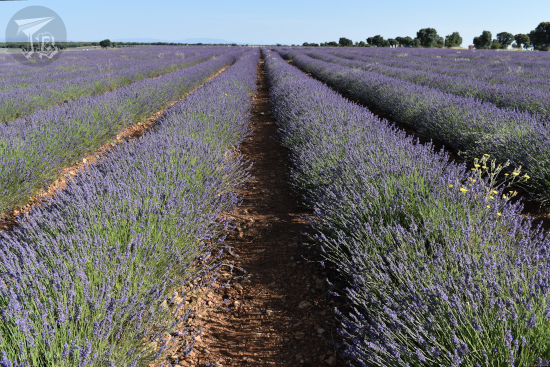
9th March 2025: Expominerales 2025, the other half of the weekend’s plans (Madrid, Spain)

Since I had to be in Madrid to watch the fantastic concert by the Wiener Sängerknaben, the plan had been to attend the yearly Expominerales mineral fair in the Mine and Energy Engineering School Escuela Técnica Superior de Ingenieros de Minas y Energía (ETSIME) that same day. However, the fair closes on Saturdays between 14:00 and 16:00 for a lunch break, so since the weather was so horrid, I decided not to wait. On Sunday, the weather forecast was slightly less miserable, and in the end I was lucky with only some gentle rain as I walked between the train station and the Engineering School, nothing like the sleet deluge the previous day.

Expominerales fills the ETSIME with stalls selling minerals, fossils and crystals offered by reputable sellers. Here I’ve seen the biggest megalodon teeth in my life, held a plesiosaur vertebra – which I regret not buying when I had the chance – and discovered that moldavite exists – and which I regret not buying when I had the chance… do you spot a pattern here? I did not break it anyway, because in the end I cannot afford most of what is sold, and I already own most of what I can…

Overlook of ETSIME during Expominerales

I arrived at the School shortly after the exhibit opened around 10:00, and the area was still pretty empty. There were fewer stands than the previous years I’ve been there, and the moldavite stand was not there. Actually, there were very few meteorite-related stands this time around. I did see amazing modern-times frog fossils from Owens Lake. Owens Lake is called Patsiata in the Mono Native American language. In 1913, the lake dried out when the water from the Owens River was redirected and with years it has become a deadly salt flat, a source of alkali sand storms with a side of carcinogen materials. One of the minerals found in Owens Lake is trona, a crystal formed by the precipitation of sodium carbonate, making it a type of evaporite. In 2023, an atmospheric river caused floods in California, filling the lake up for the first time in over a century. The floods damaged infrastructure and created a surge of floodwater to the lake, which eroded surfaces and dragged a lot of small hibernating animals towards the lake, where they were killed instantly. Their soft tissues were quickly replaced by trona salt before the bodies even decomposed, creating a perfect cast of the poor critters. There were two on display at Expominerales and they were creepy!

Something else that caught my eye (and was actually within my doable price range) was a polished abalone shell. The Korean abalone (Haliotis discus) has been used for centuries in the art of najeonchilgi [나전칠기], which refers to decorating items with mother of pearl. The abalone can be polished in full, creating a whole iridescent body of nacre. These mollusks used to be collected by haenyeo [해녀], traditional female divers from the Jeju province, but most of them are farmed for food today. A small polished abalone came home with me.

Items from Expominerales

The School opens its classic museum during the exhibit, and I always enjoy visiting it. However, after wandering around for a bit (and spending some money), I moved onto what basically is the next building over to the ETSIME, the Spanish Mining and Geology Institute IGME – Instituto Geológico y Minero de España, which hosts the Geomineral Museum Museo Geominero. The original design of the building was conceived by Francisco Javier de Luque, and work started in 1921. Though a congress was held there in 1925, construction went on until 1941. The building has not been extensively restored, but it presents deviations from the original plans, and even from subsequent ones.

The museum is hosted in the former hall, and to get there, first you have to go through a very bored security guard – who first asked if I was sure I wanted to be there. Once inside the building, one goes up the main staircase towards the gallery underneath a glass-and-iron skylight with the logo of the Mining Institute. It was designed by Luque himself and created by the Madrid workshop La Veneciana, a glassware shop dating from 1876 and which, under a different name, still exists today.

Entrance staircase to the Geomineralogical museum

The museum is an open area, located underneath another incredible skylight. The displays are hosted in wooden cabinets in the main floor. The upper balconies can be accessed through spiral staircases and are protected by metalwork railings. One of the details I absolutely adore are the glassworks displaying geological sample cores of different surveys. I’ve never seen the library, but I was once part of a group which was allowed to play with some of the “lesser value” items they have as part of a training session, and that was super fun. The museum is probably one of my favourite spots in town.

The Geomineralogical Museum

From the architecture point of view, I like the building and the skylights. However, there are way more things to love in the museum, such as the wooden cabinets, full with samples of minerals, fossils and meteorites. The museum’s collection are divided into “Mineralogy and Petrology”, “Flora and Invertebrate fossils from Spain”, “Vertebrate fossils from Spain”, “Foreign fossils”, “Systematic invertebrate palaeontology”, “Micro-palaeontology”, “Fossil resin”, “Fossil tracks”, “Stromatolites”, and the “special exhibits”. One of these is a complete cavern bear (Ursus spelaeus), another one is an Ibex (Capra ibex). The last two have honour spots, with their own display.

When you come into the museum, one of the first things that you see, in front of the door, up on the first-floor balcony, is the cast of the most complete Tyrannosaurus rex skull ever found – Stan. Specimen BHI 3033, Stan, was found in 1987 and excavated in 1992, in South Dakota’s Hell Creek Formation. Stan lived around 65 million years ago, in the Cretaceous period. We know he fought for his life more than once – his ribs were broken and healed, two vertebrae were fused together, and he suffered a bite to his snout. Stan remains one of the most complete skeletons ever found, and probably the most-often cast. The skeleton made mainstream news when it was auctioned at Christie’s in New York due to money disputes among partners of the original owner-firm, Black Hills Institute. An anonymous buyer paid $31.8 million for it in October 2020. In 2022 it was disclosed that the Department of Culture and Tourism of Abu Dhabi had bought Stan for their projected new Natural History Museum.

On the ground floor there is a mastodon fossil Anancus arvernensis found in the 1990s. These animals related to modern elephants lived throughout the Miocene and went extinct in the Early Pliocene (two million years ago). The could have been around the size of a modern African bush elephants, but their tusks were mostly straight. They would have lived in steppe with dry and warm climate, but close to water. The fossilised bones were recovered are dated around 3.2 million years ago, and were dug from the Las Higueruelas site between 1948 and 1991.

Exhibits at the Museo Geominero

After I wandered the museum for a while, I left towards my train which was delayed… 43 minutes. Fortunately, so were the ones that had to pass before, so I ended catching one in the right direction after only a twenty-minute wait. And then I got junk food, because some days have to end in junk food…

22nd February 2025: Architecture in Madrid, and folklore in Guadalajara (Spain)

By now, reaching Madrid by train without anything remarkable to comment on is actually remarkable all by itself – there were actually no problems for once. I had booked a spot for a visit at noon, but since I don’t trust the rail service, I hopped on a train to be at Atocha Station around 10:00, and for once I was there right on time, maybe even a minute early!

As I walked up the street Paseo del Prado, I passed by the exhibition centre CaixaForum, where the Patagotitan still stands. Since it was still winter, the trees on both sides had little to no leaves, and I could see it from the opposite side. I of course said hi.

Patagotitan skeleton

My first stop was the church Iglesia de San Jerónimo el Real, dedicated to St. Jerome, a late Gothic – early Renaissance building erected between 1502 and 1505. It belonged to a monkhood whose original monastery stood near the river. The stagnant waters caused illnesses among the brethren, who asked the Catholic Monarchs for a new location. The church for the new community was created from brick and masonry, and towers were added in the 17th century. The interior is decorated with two gothic altars to the sides, but no main altarpiece, as the original one has been lost to time. Instead, there is a painting by Rafael Tegeo La última comunión de San Jerónimo – Saint Jerome’s last communion – created in 1829.

Monastery Monasterio de Jerónimos

Afterwards, I headed towards the National Museum of Anthropology Museo Nacional de Antropología, a small museum dedicated to the diversity of cultures in the world, particularly the Americas, Philippines, Africa and the “Far East”, focusing on traditions, culture and religion. It is covered by my national museum card.

At the moment, the museum is running a temporal exhibit on art based on myths, legends, and sacred texts from India, Caminos místicos. Tradiciones vivas del arte de la India – Mystic Paths. Living Traditions of art from India. I was curious about it, but not expecting how much I liked it in the end. The pieces of the exhibit were mostly based on Hinduism (Sanātana Dharma, सनातन धर्म), the oldest religion in the world. According to Hindu tradition, the Supreme Being Brahma exists as themself, but also as the manifestation of the deities Brahma the Creator, Vishnu the Sustainer and Shiva the Destroyer, all of who at the same time have different avatars (avatāra, अवतार) or incarnations. One of the core principles of Hinduism is the concept of cosmic cause-and-effect justice, karma [कर्म]. Another is reincarnation (saṃsāra, संसार), an eternal cycle of life and death until the individual is liberated from it through self realisation or illumination. The religion is based on values like righteousness, truth, love, peace, and ethical conduct, and it is quite open to other beliefs and ethics.

Religious Indian Art pieces

The Museum of Anthropology’s permanent exhibition has a lot of items from the Philippines on the ground floor, probably due to how long(1565–1898) the islands were a Spanish colony. There are clothes, tobacco items, ritual objects, and a small sample of how the local culture was throughout the 1800s. To the back, there is a room dedicated to the religions of Asia and the Middle East – Hinduism, Buddhism and Islam. The first floor is dedicated to Africa, combining a number of traditional exhibits with modern photographs of the traditional people’s way of life – baskets, pottery, leather and wooden objects, ritual masks… The second floor holds items from the Americas, especially from South America. Some of them include a Mexican Día de los Muertos (Day of the Dead) altar, Andean Carnival masks, Sioux-Lakota clothes, Inuit coats…

Religious icons and traditional masks

I remember visiting the museum when I was a child, and then feeling disappointed in it when I returned as an adult. This time around, I found the permanent and temporal exhibitions quite interesting, so it’s a good thing I headed there. It also helped make time until noon, when my next visit was due, to the only Ministry that can be visited – albeit not freely, by appointment and paying a fee – as it is a historical building.

The current Agriculture Ministry is housed in the historical building known as Palacio de Fomento – Palace of Development. Its plans were originally drawn by architect Mariano  Belmás y Estrada, aiming for an Arts and Craftwork School. Later, Eduardo Saavedra y Moragas took over to turn the design into a university. Finally, the project ended in the hands of architect Ricardo Velázquez Bosco, who erected the building between 1893 and 1897 to house the then Ministry of Development.
The Palace is an impressive construction. The original design had three floors, which have now been turned into five. From the outside, the building looks white and orange-brown, but a more focused look reveals decorative tiles by Daniel Zuloaga, who also collaborated with Velázquez Bosco in the ETSIME. The entrance is flanked by two caryatids and roof above there is a sculpture group – Glory and Pegasi La Gloria y los Pegasos, a bronze copy of an original marble by Agustín Querol.

Palacio de Fomento, outside

Once you enter, you find yourself in a huge majestic hall, where we had to check in, since the building is a working Ministry. The email said to be there at 11:45 to go through security. I got there at 11:40 and went in at 11:44. They took my name (they did not care about the ticket) and they put my stuff in the X-ray machine. I had to go through the metal detector and when I asked whether I had to remove my belt, I was just told to put my hand over the buckle… So much for security, I thought, because I did not beep. Then I realised that I must look quite non-threatening as quite a few people were thoroughly searched as they set off the machine.

Beyond the hall where we were checked in, there is an imperial staircase in marble, and a vaulted frescoed ceiling. From there, we visited some offices and meeting rooms, and the portrait gallery – from which the ministers who held office during the Franco dictatorship had been removed. Finally, we visited one of the side inner courtyards, covered in a skylight with some ironwork.

Palacio de Fomento, inside

After the visit was over, the security guards saw us out and locked the doors. I walked around the building, because I had honestly never realised it was square. As the place was next to the Retiro Park, I had been considering looking for some archaeological spot they had opened. However, there were more ideas – Guadalajara was having the Botarga parade, and it was the fair weekend in Tendilla, though, a phone call informed me that traffic was horrid and that it was not a good idea to head there so late in the afternoon.

Eventually, I decided on the Parade. I bought some sandwiches and headed for the train. Though I got rained upon, it cleared up, and at 18:00 I was in Guadalajara to have a look at the traditional Parade of Carnival characters Desfile de Botargas – “creatures” from the whole area which meet up in the capital the Saturday before carnival, despite each character having its own schedule wherever it is rooted. The parade was a bit late, so I could talk the local botarga group – El Manda (the Order-giver), Los Mandaneros (the Order-receivers), and the Botarguilla (Little Botarga) – into posing for me. I watched and took pictures from two spots, but the parade moved really fast because they only had thirty minutes to do the route – last year they took well over an hour for that. I decided I did not want to run for it that much… I have to remember to find myself a vantage point next year, instead of trying to get the beginning of the parade…

Guadalajara Botargas

Heifferette from Riba de Saelices

Botarga Parade 2025

I got “attacked” a few times, and ended up with soot all over my face, but at least I avoided the guy painting people with mustard… The botargas seemed to zoom in on children and cameras, and so did the devils Diablos (from Luzón) and the heiferettes Vaquillas and Vaquillones (Villares de Jadraque, Robledillo de Mohernando, Luzaga, Riba de Saelices). It was fun. One of these days I might have to try to follow the botargas in their own villages…

4th January 2025: Bye Bye, Murderbird. MARPA, Alcalá de Henares (Spain)

While it was great to have the Concavenator fossil (a.k.a. Murderbird in my headspace) in the Dragon Hunters exhibit in Alcalá de Henares close enough to visit at will, the time had come to see it move on. Just in case there was any information I was missing, I decided to book a guided visit to the exhibit. As it was scheduled for 12:00, I decided to look for something to do beforehand, and I found guided visits to the monastery Monasterio de San Bernardo at 10:00. I had seen the building before, as it stands next to the MARPA, I just had never given it much of a thought.

The monastery was established under the patronage of Cardinal Bernardo Sandoval y Rojas around 1620. He bought land cheap because it was near the Moorish quarter. The church was erected in brick with decoration in stone on the outside. The inside has an elliptical dome, and it was heavily damaged in a fire during the Civil War, so it had to be restored – the work on it was a Rehabilitation prize in 2019. Most of the decoration of the church was lost and today walls and roof are just white and gold. The building is attributed to architect Juan Gómez de Mora.

There is a free-standing ciborium in gold, with a number of sculptures of Saints instead of an altarpiece. Behind the altar and ciborium, there are a number of paintings – they were created by Italian artist Angelo Nardi. Nardi was born in the late 16th century, and studied in Venice before moving to Madrid, where he became a Court Painter. His style evolved from late-Renaissance (mannerism) to Baroque, and he is known for his expressive faces. He was friends with Velázquez, and famous for being quite kind, though his style eventually fell out of grace. He painted most of the pictures in the church, although some of them are now out of order as they were moved during the Civil War.

The visit was interesting albeit a little underwhelming. It felt a bit weird to be the only visitor and having the whole thing explained to me – that has only happened once before, in Recópolis. However, that was epic, because I ended up getting the whole archaeological place for myself. The monastery was more of a serious experience – and it did not rain on me. But still it felt… colder. And like being in an exam, the guide kept asking me questions about history, architecture and hagiography.
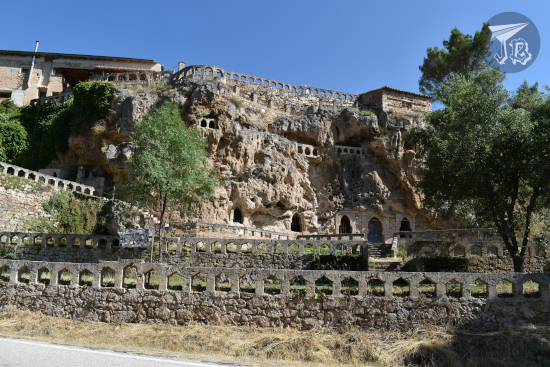
Monastery of San Bernardo in Alcalá de Henares

I had a bit of time before my following visit, so I decided to run to the Sala Museográfica de la BRIPAC, a tiny museum about the history of the Army’s Parachuting Brigade. The Brigade was created in 1953, and the parachuters participated in combat for the first time in 1957. In its origin, it was established in Alcalá, so there is a historical connection there. The hall hosts uniforms, flags, medals, and reports about the peace missions in the 1990s. I am not much of a fan of Armed Forces museums, but today the BRIPAC is considered a peace corps. The museum opened in February 2023, on the 70th anniversary of the foundation.
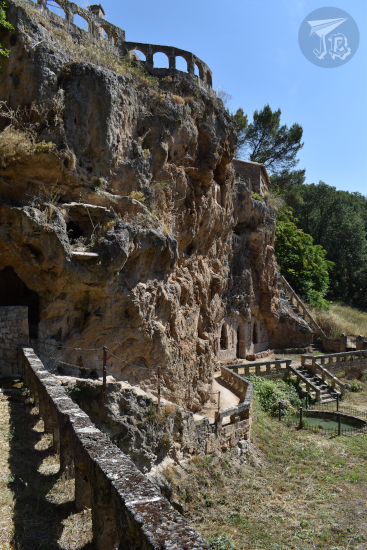
BRIPAC exhibit

I still had a bit of time, so I dropped by Plaza Cervantes, which was full with Christmas lights and shoppers at the small market. There were food stalls, a small bookshop, some rock shops… Nothing really caught my eye though.

Plaza de Cervantes Christmas

I finally headed back towards the Archaeology and Palaeontology museum MARPA Museo Arqueológico y Paleontológico de la Comunidad de Madrid. It was one of the last chances to see the exhibition on the history of palaeontology “Dragon Hunters” Cazadores de Dragones with a guided visit, and I figured out that maybe I could learn anything new – despite the fact that I’ve been there a few times and bought the book. We had a nice fun guide who relied a lot on asking questions to her audience. Apparently I was the only one with… some knowledge of… anything she asked – what’s with guides in Alcalá de Henares trying to have you do their job? I felt a bit sorry for her so I answered her questions – with a higher success rate than the ones from the Monastery, to be honest. She did not impress me with the depth of her knowledge, to be honest. She actually looked at me a bit panicky when I asked her t confirm that the T-Rex replica was a cast of the famous Stan.

Cazadores de Dragones entry in the cloister of the MARPA

I stayed back for a bit longer after the visit ended. I’ve ranted on and on about the Concavenator before, both the fossil slab and the actual-size reconstruction. I just loved having both so at hand. When I was young, the scientific community came to the conclusion that “birds descend from dinosaurs” but today it is actually believed that birds are actual dinosaurs. And since the poor beast has such a ridiculous name, I’ve just been calling it “Murderbird” or “Murderchicken”, for kicks and giggles.

There were these two little kids who kept grilling their dad about the skeletons, and the poor man was a bit overwhelmed. I decided to give him a hand with the questions and explained a little. I thought that was it, but the smallest child pointed at the Concavenator and blurted out “can you tell us more things about that one??” He was so eager that I just took the family to see it and told them a few things further. The family was on their merry way in five minutes – four-year-olds only have so much attention span. The kids were happy, the parents were relieved and I got to geek out about dinosaurs with appreciative public. I think the interaction was an all-around win.

Murderbirds: T-rex and Concavenator

At first I had thought that I would be staying in Alcalá for an exotic lunch, but I was not really feeling up to it. With great sadness, I said goodbye to the Concavenator and moved on to drive home.

26th November 2024: Another Concavenator visit (Alcalá de Henares, Spain)

I had to run some errands in Alcalá de Henares in the afternoon, so I decided I would get there in the morning, and walk to the Archaeology and Palaeontology museum Museo Arqueológico y Paleontológico de la Comunidad de Madrid, MARPA. The exhibition “Dragon HuntersCazadores de Dragones was still running and since it was a random weekday morning, I thought it would be empty.

I was right, it was deserted enough that the security guard looked at me weirdly. Yes, I’ve been there before. Twice. I hope to be back at least once more before the exhibit closes in January 2025. The security guard should not be remembering me, I did nothing weird. Taking a few hundred photographs of a fossil is completely normal.

Why am I so obsessed about the Concavenator? Well, one does not always have such a unique fossil so handy, and for free. Furthermore, the usual home of the Concavenator does not allow pictures. And lastly, I’m a nerd. The species Concavenator corcovatus was described in 2010 by Francisco Ortega, Fernando Escaso, and José Luis Sanz from a single skeleton found at Las Hoyas site in 2003. The specimen was officially catalogued as MCCM-LH 6666. The animal was a medium-sized carcharodontosaurid. Carcharodontosauria, which included the likes of Giganotosaurus, Mapusaurus or Carcharodontosaurus, were a group of large theropods from the Cretaceous period. The skeleton was almost complete, with the tail and neck contorted in rigor mortis. The fossil shows two things that make it special – a hump or sail created by the spines of the back vertebrae, and the fact that some pigments were found on the fossil. Not unique but rare enough findings include impressions of skin and scales, and smaller bones in the belly area, rests of undigested dinner. On the arm bones there are insertions for ligaments similar to those that modern birds have at the insertion of feathers.

Concavenator corcovatus

The Concavenator lived around 125 million years ago, in an area of wetlands. Its teeth, general shape (it walked on its two hindlegs and had small-ish arms), along with the remains of animals that it had eaten, tell us it was a carnivore, and its placement in the carcharodontosaurid family, that it was a predator. However, no large predator is known for rejecting a good scavenging feed. The spikes or hump on its back, above the hips, can be clearly seen on the fossil, but nobody has any idea of what it was for – speculations have been made for communication means, fat deposits and thermoregulation. When alive, the animal would have been around 5 metres long, two metres tall, and 450 kilograms heavy.

Concavenator corcovatus details

All that to end up being dug up and named… Pepito, which is the diminutive of the diminutive of the Spanish version of Joseph. The equivalent of Joseph would be José, nicknamed Pepe, and changing the last “e” into “ito” – the suffix for small – would yield to something like Joey. So this magnificent predator was either named after a mini-mini-Joseph, or a small meat sandwich, which is also referred to as a pepito. Seriously, what happened to the illustrious tradition of Boaty McBoatface? This would have been a glorious Toothy McToothface (“Spanishised” as Dientito Caradientez or something).

Anyway, after the visit I dropped by the museum shop to buy myself some Concavenator-related merchandise. When was there the first time, I bought the exhibition catalogue, but since then they had received some silly cute items – I bought a pin, a badge, and a magnet, just because I could. Maybe as the exhibit draws closer to the end there will be discounts on other things…

I left the museum and decided that since it was way past 14:00, I should grab a bite to eat. As I had parked my car next to a shopping centre, I headed there with the idea of some Asian food. However, there is a burger joint that usually has a long queue and that some friends had told me was really good – as good as fast food can be, I guess. It is called TGB – The Good Burger. It is supposed to serve “NYC style gourmet hamburgers”. The place was empty, so I decided to give it a try.

I ordered a “Cheese Lovers” burger, which consisted of a beef patty, American cheese, goat cheese, Gorgonzola, sautéed onions, arugula and honey mustard sauce. It was… very cheesy. It was nice, but nothing I feel I must try again, especially when there are cheaper options in the shopping centre. And sushi. But at least, I satisfied my curiosity before I went off towards all my dull, grown-up errands which I shall not bore you with…

The Cheese Lovers burger

22nd November 2024: “Wicked” (film) on opening day (Madrid, Spain)

There was a time when you could mute words on social media to avoid spoilers. Since the algorithms have taken over and you can’t curate what you see any more, I decided that the best way to avoid Wicked spoilers was trying to see it as early as possible, preferably on opening day. Ideally, on the first screening on opening day, an English version.

For a change, “ideally” worked. At least, I found a screening at 15:45 on the day the film came out. It was a cinema with Spanish subtitles but I can live with that. I have seen the musical twice in the Apollo Victoria Theatre in London and I’ve loved it both times. Not only I’m a firm believer in the message of Defying Gravity, I also give regular thought to Dancing Through Life. Sometimes I also listen to No One Mourns the Wicked and get all philosophical…

Anyway, I headed off to Madrid with next-to-no information and no expectations, hoping to enjoy the film. I had been slightly surprised that so many tickets were already booked when I bought my own, but I gave it no more than a couple of seconds’ worth of attention, I just thought I was running late since I made the decision the previous weekend before heading out to see Ha·Ya·To . Since the film was rather early in the afternoon, I had to get to Madrid with time for a bite. One of my options was Yatai Market but in the end I decided to grab brunch at Toby’s Brunch Club, where they run an all-day brunch (here I went, cheating the system again, just like I did at the James Joyce – twice in one week, too). I tried to book online but the system only took reservations for two or more. Since the Internet said that it was usually quite busy, just thought I still had Yatai as a backup plan…

I arrived at Atocha Station and walked towards the brunch place. As I did, I had to walk past Caixa Forum, which is still running the exhibit on Patagonian dinosaurs, and the Patagotitan smiled at me. I, of course, smiled back.

Patagotitan mayorum

The very-busy brunch place was empty – weekday “crowds” I guess. I was the only customer there for the duration. Usually, not being able to book for myself on my own discourages me from a place, but I’ve been wanting a “typical” brunch for a while now. The brunch consisted of a cold drink, coffee or tea and two courses (22€). For my cold drink, I ordered orange juice, and for the hot one a coffee latte. The first course was a basket of breads with butter, jams and tomato paste, and a yoghurt with fresh fruit. As my second course, I ordered eggs Benedict with smoked salmon. Because I really wanted eggs Benedict and I can’t cook them to save my life. Everything was delicious, especially the yoghurt. The eggs were perfect. I think this would kill me before noon though, so glad I used it as lunch.

Toby's breakfast club brunch

After my brunch / lunch I still had some time so I dropped by the art gallery Museo del Prado. I used my museum card Tarjeta de Museos Estatales and the lady at the ticket booth told me she had never seen a card like that before. She took it to the back shop, and when she came back, it turned out that the card had stuck to another card, which explained why she was confused. I finally managed to get in, and spent about an hour there. There was a small exhibit called El Taller de Rubens (Rubens’ workshop) which analysed the master’s works and that of his apprentices which was very interesting.

Afterwards, I walked towards Yelmo Cines Ideal (passing by and waving at the Patagotitan again) to watch Wicked. When I got there, the cinema was still closed, but as soon as I turned away to snoop into a shop across the street, the doors opened. I found my seat and I found myself seated between two groups of high school and university students, who were complaining that their life was very hard, and that they had barely had the time to eat lunch before getting to the cinema. And a few of them were threatening to cry. And they were telling each other not to sing along. I had not realised there was such a big following of Wicked from the younger crowd…

After a few minutes of hearing them babble excitedly, I realised that all of them had listened to the songs on the Internet, or something, but they had never had the chance to seen the musical themselves – it’s debuting in Spain in autumn 2025. It made me realise how lucky I am to be able to jump onto a red-eye flight at a random weekend and go to London, and be there for the 14:30 performance at the Apollo Victoria Theatre.

Wicked film poster

In general, I enjoyed the film. More than I believed I would, because I went with zero expectations and I had managed to avoid any kind of spoiler and previous knowledge, except that Jeff Goldblum was the Wizard. The main cast includes Cynthia Erivo as Elphaba, Ariana Grande as Glinda, Jonathan Bailey as Fiyero, Michelle Yeoh as Madame Morrible, Marissa Bode as Nessa (kudos for an actual disabled actor playing a disabled character!), Ethan Slater as Boq, Jeff Goldblum as The Wonderful Wizard of Oz; and Peter Dinklage as Dr. Dillamond (voice).

I do not believe what I am going to say – but I thought Goldblum was the weakest character. I mean, he keeps playing himself, and Jeff Goldblum is not the Wizard (I had the same feeling when I watched Jurassic World: Dominion; he played himself, not Ian Malcolm). On the contrary, Michelle Yeoh was fantastic, her sole presence in a take stole the whole screen. I enjoyed seeing the animal characters a lot, as it is the bit of the musical that always feels a bit off. The logistics of landscaping Oz was a bit awkward at points, but I guess that’s theatrics and not… geography.

I found the music decent. As for me the most important thing was for the story to be faithful to the musical – which is more up my alley than the novel – I was rather satisfied. The best song, in my opinion was What is this feeling?, the camerawork was stunning. It was also great to see the cameo of the actors who portrayed Glinda and Elphaba on Broadway for the first time, Kristin Chenoweth and Idina Menzel – known worldwide today for Frozen’s anthem Let it go. The library scene and choreography for Dancing through life was also impressive.

What I saw of the subtitles was not a good sign though, because the message of No One Mourns the Wicked loses most of its meaning if you translate it as “she’s finally dead”. However, I am rather good at ignoring subtitles anyway. I am not sold on Glinda being all pink either. Too many Legally Blonde vibes there, I prefer ice-blue.

The film ended at the end of the first act of the musical, with the “main event” of sorts – Defying Gravity. Very showy, okay music-wise. It was more visually impacting than musically, and my mind was dubbing it with Kristin Chenoweth’s version anyway. At this point, half the theatre was sobbing, which I found slightly amusing.

All in all, I enjoyed the day and the film. I am looking forward to the second part, and having affordable Wicked merchandise I don’t have to save for special occasions. After leaving the cinema, I walked back, and since it was cold, I got there in record time – and then I had to wait 40 minutes for the train because of course I did.

18 & 19th November 2024: Apocalyptica Played Metallica in Madrid (Spain), so there I went

Planning for this short getaway started on the 23rd of February, when I bought my ticket for the Apocalyptica Plays Metallica Vol. 2 Tour 2024 stop in La Riviera in Madrid (50.50 €). Almost immediately, I headed off to Apocalyptica’s website to buy the VIP Tour 2024 Upgrade (58,90 €). The upgrade consisted on early access, photograph / meet & greet / autograph session (the important part), VIP lanyard, fabric patch, pin and tote bag. Honestly, all that for barely 100 € was a sweet deal. Back in Antwerp for Starset, someone I was queueing with complained that VIP tickets were too expensive for “a broke uni student”, but for me, meeting with the artist, albeit briefly is usually worth it – early entry is a plus, too, because for some concerts I either find a barrier spot or I just have to go to the back. The bundle was dispatched on the 9th of June (according to the email. Do Finnish post offices open on Sunday?) and it arrived on the 18th.

I originally booked a cheap hotel about half an hour’s walk from the venue. Later, I decided that I preferred the more expensive one less than 10 minutes away, so I changed my booking a week before the concert. I did not book there originally because it required prepayment, and my card was playing up..

On Friday the 4th of November I received an email with instructions for the Meet & Greet, which was to start at 18:30, and I should be there at 18:15. All right, I could do that. It was only a matter of waiting.

On Monday, 17th of November, I took a morning train to head out to Madrid with some leeway for time because I needed to do some small item shopping. I had to dodge some guys trying to get people to sign up for an NGO, but at 11:40 I made it to my first stop of the day – the light museum Museo de la Luz. I had been putting this visit off to go with someone who had expressed interest. However, I also waited for another exhibit and I missed my chance as it turned out to be only temporal. Thus, I decided to head to the Light Museum on my own – it was also one of the few exhibitions open on a Monday morning.

The Light Museum is a modest exhibition with interactive artworks that are mainly made out of lamps, lasers and lights. When you come in, you are given covers for your shoes and a key for a locker – all for free. Then you wait until an attendant takes you in and shows you how to interact with the first artwork “The birdcage” (La Pajarera), a box made out of light and metal that you make change colours with the movement of your arms. Once you know how to “play” with the art, you are left on your own to wander for an hour. At first I thought it would be tight, but the place was small – a bit too small for the price, I thought. I was there for around 40 minutes in total.

There were few people and I was able to check out most of the artwork uninterrupted. The next exhibit is made out of a number of old music festival lights – those that gave a lot of heat from the 90s, which are supposed to be a reference to climate change. Then there is a giant kaleidoscope you can walk in – this one became my favourite. Other rooms or works include a wall of lights that follow you as you move or dance, something with lasers (that I think was broken), some light illusions, a room full of hanging lights, a cube of mirrors and light… At the end there is a wall reading “light museum” in differently coloured lights. When I left, the lady at reception gave me a badge for booking with the official website.

Light Museum Madrid

Light Museum Madrid

I walked out and headed towards the restaurant where I wanted to cheat the system. I crossed the square Puerta del Sol, where they were setting up the Christmas tree – it was about 45% Christmas. On my way, I walked by the underground stop Metro Banco de España which has a tiny door for Little Mouse Pérez – Ratoncito Pérez, the Spanish equivalent to the tooth fairy. I never remember to check it out when I am around, but I made the connection this time.

I finally made it to the James Joyce Pub – which is technically a sports bar. I was not there for the TVs though. I had a while back found the place looking up places which served English breakfasts in Madrid. The James Joyce prides itself in being an Irish pub and offers Irish All-Day Breakfast (12.00 €) – two pork sausages, two rashers of bacon, baked beans, fried egg, sautéed mushrooms, grilled tomato, blood pudding, chips, two half-toasts and butter. No, I would not survive that for breakfast, so I ordered it for lunch (and dinner), thus tricking the system indeed. Unfortunately, it was really good and authentic, so now I’ve got to come back for the sausages and the shepherd’s pie, so at least twice.

James Joyce Irish breakfast

After lunch, I headed out towards the park known as Madrid Río. The park runs along the banks of the river Manzanares. It covers 121 hectares, and it was designed after to cover the space emptied when the belt road M-30 was rebuilt as an underground tunnel. The original project was created by a team of architectural studios and landscapers, with strong ecological consideration – aiming to help the area recover from the degradation and pollution caused by years of road traffic. The project was carried out between 2006 and 2012. In 2015, a second project was carried out to “renaturalise” the river, opening the dams to allow the water to flow freely, which in turn caused the recovery of many plant and animal species (to the detriment of… the local rowing team).

There are also bridges that connect both banks of the river. One of them is the one I crossed – just because I could. It is the pedestrian bridge Puente Monumental de Arganzuela, designed by Dominique Perrault. It is a bridge in two parts – one crosses the river, the other overlooks the park and connects to the urban area, and a total length of 278 metres. It is a tube made out of steel and wood that I’ve been wanting to check out for a while.

Arganzuela bridge

Another important bridge is the completely different Puente de Toledo, a baroque bridge built by Pedro de Ribera. It was erected in granite between 1717 and 1732 as the previous ones had been taken down by torrential floods. This one was made to stay, with nine solid arches opened to allow for the river floods. It was… ready for Christmas.

Madrid Río and bridges

It was weirdly warm for a November afternoon, so when I went to my hotel I opened the window while I had a shower. Around 17:00 I headed out to the venue, where there was a small group of people waiting already. La Riviera is a 1,500 people venue, with really good acoustics – and very dedicated staff. The place was originally a cinema, which was turned into a disco, and then into a music venue and nightclub. It is the same place I saw Epica and Apocalyptica in 2023, and I was surprised how many people came for the M&G considering that last year we were… six. We were around 30 this time around.

At first we were chatting in front of the main door, but soon a queue started forming. A little later, the nice security guy (who last year told me “I looked the part of an Apocalyptica fan”) took us to a secondary door, and the queue was properly organised. Surprisingly, bags were not checked – while last year they even took markers from people.

Apocalyptica is a Finnish symphonic metal band. It was formed in 1993 as a tribute to Metallica with a classical touch – playing with cellos. Their debut album Apocalyptica plays Metallica by Four Cellos was released in 1993. They slowly moved from covering other bands in a neoclassical style to their very own repertoire. Today, the members are Eicca Toppinen, Paavo Lötjönen and Perttu Kivilaakso, three classically-trained musicians with a deep love for metal. In 2024, they have gone full circle with the album and tour Apocalyptica Plays Metallica Vol. 2, performing with drummer Mikko Kaakkuriniemi.

Apocalyptica Tour 24/25

We were ushered into a queue for signatures, and afterwards we would go at the end of the line to wait for photographs. I had brought a print-out of the picture from the previous year, and I told them that whenever they came to Madrid, I would come see them. I got a smile for that. It was an awesome photograph, after all. After everyone had their stuff signed we had the photographs. I asked for “a big metal hug” and got trolled instead. Fun times though!

After the photograph, I found a spot at the barrier. Last time I got on the right, this time I went left. Just a little. I did not want to go dead centre in case anyone decided to moshpit, but I might next time as there was no issue – everyone was too entranced for anything like that, I’d say.

The opening act was the Finnish band Arctis, a baby band who has just debuted with their first CD. They were pretty fun, maybe… a bit… too happy bouncy for metal? I’ve read their act described as metal-pop. It might be. I liked them okay, and they were nice.

Setlist:
 1. I’ll Give You Hell
 2. Remedy
 3. Tell Me Why
 4. WWM
 5. Bimbo (Lambretta Cover)
 6. Fire
 7. Frozen Swan
 8. When The Lights Go Out
 9. Theater of Tragedy

Arctis at La Riviera 2024

Arctis at La Riviera 2024

Apocalyptica came on stage at 21:00 sharp, and the live was glorious. All the songs were Metallica covers, from the new album, the first one, or the remastered version of Plays Metallica released in 2016. Despite that, one would not even have to be a Metallica fan to enjoy the concert, because the three men that compose Apocalyptica have an amazing magnetism. Perttu reminds me of the Duracell Bunny, he just did not stop for a second throughout the whole concert, which lasted a good two hours. Paavo seemed to be in his own little world, as he usually does. Eicca is the one doing most of the talking, and he is hilarious when he delivers his puns with a total deadpan voice and face.

Setlist:
 1. Ride the Lightning
 2. Enter Sandman
 3. Creeping Death
 4. For Whom the Bell Tolls
 5. Battery
 6. The Call of Ktulu
 7. St. Anger
 8. The Four Horsemen
 9. Blackened
 10. Master of Puppets
 11. Nothing Else Matters
 12. Seek & Destroy
 13. One

The audience was mostly moved by Nothing Else Matters, I’d say, judging by how they chorused it. Perttu was all in for that. Personally, I found Seek & Destroy and One, particularly, to be extremely powerful. Also, knowing that they dug up the original bass track from deceased Metallica member Cliff Burton for The Call of Ktulu was half-amazing and half-chilling. All in all, it was a fantastic concert, no matter how one looked at it.

Apocalyptica La Riviera 2024

Eicca Toppinen . Apocalyptica La Riviera 2024

Paavo Lötjönen. Apocalyptica La Riviera 2024

Perttu Kivilaakso. Apocalyptica La Riviera 2024

Apocalyptica La Riviera 2024

Afterwards, Arctis was hanging out by the merch. I got their CD, they signed it, we took a photo. It was fun!

I left the venue and I brought an ice-cream and a sports drink for “dinner” of sorts, because I was thirsty. I had both in the hotel room before my shower – the second of the day – and collapsing onto the king-sized bed. I had to wait for the phone to finish charging before I slept though, so I watched a movie before I zonked out.

I woke up on Tuesday, 18th of November and drank my coffee before I set out. It was freezing out there, with frost on the grass, in spite of the warm afternoon the day before. On my way, I found the ancient walls of the city, remains from the old Moorish fortress alcázar, which stand to the side of the Royal Palace and the Almudena cathedral. I walked towards the centre of Madrid – The Sol Christmas tree was about 60% ready – to meet up with my relative for breakfast at a new place called Kawaii Cafe. Inspired by the Japanese kawaii [可愛い]. Kawaii means pretty, childlike, cute, and the Kawaii Cafe has taken the idea to heart, maybe not not in a complete accurate manner though. Everything is pink, full of fluffy and glitter. The food is not only tasty, also pretty. However, the wait staff is dressed as “maids” [マイド], which I tend to associate more to the… hm… more risqué side of hospitality. When food is brought out, you are offered to chant a spell for it to be even tastier.

I found the place existed by chance, and I was instantly smitten by the rainbow waffles, because they were adorable, and very, very rainbow-like. Thus, I ordered them, along a matcha latte. My relative tried the pancakes with a cocoa. She was ecstatic at the quirkiness of the place.

Kawaii Cafe Madrid order

We stayed for well over an hour, and then headed out to one of the local museums Museo de San Isidro – Museum of Saint Isidore the Labourer. Isidore is the patron saint of Madrid. He is credited with several miracles – multiplying wheat and food, having his oxen plough on their own, and rescuing a child from a well making the waters inside rise. According to tradition, the museum is housed where he used to work, and legend has it that the old well is the one he pulled the child from.

Today the museum hosts some palaeontological and archaeological exhibits, from a mastodon and ancient rhinos to Medieval artefacts, running through the Roman occupation and the Muslim period. The place is a complement to the Museo de Historia de Madrid, or maybe its competition, though I think both belong to the same institution – and both are free. As the building is a historical place, it offers the chance to enjoy its small but beautiful Renaissance courtyard, with sculptures of mythological heroes, and of course St. Isidore and his wife. There is also a tiny Baroque chapel.

San Isidro Museum

San Isidro Museum: chapel, well, and courtyard

Right next to the museum stands the Baroque church of Saint Andrew the Apostle Iglesia de San Andrés Apóstol , which was getting ready for Christmas. The church is one of the oldest in town, though it was rebuilt after its destruction during the Civil War, and it has been recently restored. It hosts a number of religious sculptures and a painted vault above the altar.

Saint Andrew church Madrid

We took the underground at the station Tirso de Molina, which can still be accessed through the historical entrance hall, which is similar to the one that was closed off in Pacífico. It was beautiful, though of course busier than the museum one. Over the entrance to the platform there is a tile mosaic with the old shield of Madrid, dating back from the original station. It was installed in 1921, and it is the oldest artistic item in the underground network.

Access Hall at undeground station Tirso de Molina

From there we commuted to Nuevos Ministerios, where they had just kick-started the Christmas market. It seemed to be the “brands” market, with Lego, Disney, and so on. There was also a food truck by a famous chef selling basically chicken sandwiches at outrageous prices. I had been vaguely curious but not going to break the bank for a chicken sandwich, especially after such a breakfast!

I took a train from there back home, with no incidents whatsoever (because by now I’m desensitised to trains being late…)

7th November 2024: The Spanish Cultural Heritage Institute (Madrid, Spain)

I know you do not believe me when I say I don’t like guided visits, but they are the only way to do some stuff – such as stepping into the Stonehenge circle, or basically anything managed by the Madrid city hall. The Spanish Cultural Heritage Institute Instituto del Patrimonio Cultural de España IPCE is a governmental organisation whose functions are preservation and conservation of cultural items, research, communication, and safekeeping of the documents in its archive. It can only be visited on certain dates, by appointment, and with a guided visit. I managed to secure a free Thursday visit at noon, so I headed out to Madrid. Surprisingly, neither trains nor underground had issues, so I was over an hour early on site. The IPCE is located in its own building in the area known as “University City” (Ciudad Universitaria), close to the Fine Arts faculty – by design – and the President’s official residence – by chance.

The headquarters building was commissioned in 1965 to architects Fernando Higueras and Antonio Miró. The architects’ original project had to be severely modified, but it became a very different structure. Construction was stalled for years, and the building was not usable until 1985 – when new remodelling was tackled. The building is circular, nicknamed the “Crown of Thorns” (La Corona de Espinas) because at the top there are “spikes” of sorts. Top-view, the structure is divided in 30 sectors, with 56 semi-sectors and four empty ones for the main access staircase and gate. It has four floors and at least one basement. It was built in concrete and glass, with some cork floors, but lacking plaster or any kind of concealment for the structural items. The centre of the building is an open space with a glass dome, and serves as reception. Unlike the original project, this space is covered with a glass vault. The interior has a lot of plants, even three small “gardens” mainly with hanging plants. The building is considered an important cultural asset BIC (Bien de Interés Cultural), and these plants are protected along with the structure.

Spanish Cultural Heritage Institute building

The visit consisted of an introduction to the building and the work which is carried out there. We saw the model of the original project – the only similarity is that it was also vaguely circular. We climbed the stairs to the upper floors to snoop at the rooftop and the “thorns”, and then rode the lifts down to the basements to see some X-rays of paintings and sculptures. Back on the main floor, we were shown into painting restoration workshop – they were working on Maerten de Vos’ Abundance, having repaired the work and erased some extra (puritan) clothing to make the goddess Ceres look less… naked. Finally, we were invited into the library, which is round and has three levels. It has natural light due to its own skylight, a decorative glass dome in the middle of the main open area.

Spanish Cultural Heritage Institute inside

The visit started at noon, and it lasted two hours. Heading out to the centre of Madrid would take around half an hour of walking and underground. Thus, it gave me the opportunity to book a late 15:00 lunch. Since I was lucky with my connections, I was in the Cuzco neighbourhood almost half an hour in advance.

It was the perfect opportunity to go get some groceries at the Chinese supermarket Ibero China Madrid in the street Calle General Margallo. While I needed some items, I was distracted as I walked the “geek” fizzy drink aisle. There is a company called Ocean Bomb which makes sodas – sparking water, yoghurt drinks and bubble milk tea with “creative packaging”. I was aware of them because a friend collects the Sailor Moon ones and we checked for them in London in 2023. Well, now I went and found myself some Saint Seiya sodas – Gemini Saga (grape yoghurt flavour) Aries Mu (apple yoghurt flavour) and Virgo Shaka (peach yoghurt flavour). They were out in 2023, but I had not heard about them, it is the first time I saw them. And of course, I bought them (I have no idea if they are official or not, but the publicity I found afterwards has the Toei stamp on it, so I’m hoping they are).

For lunch, I had a reservation at Comic Planet. Last time I was there, a member of the party was late, so in order to keep the table, we ordered appetizers. They were great, but afterwards there was no stomach-space for dessert. And dammit, I wanted some dessert – particularly, I wanted pancakes. I had been looking at coming back to Comic Planet for a while just to have them, but it never worked out. This was finally my moment. I had a lemonade, some nachos – which were delicious – and I finally got to eat my pancakes – which are green and called Hulkcakes, and come with whipped cream, brownie and shortcake crumbles , and around ¾ of a strawberry. I ended up extremely full, but happy.

Comic Planet lunch

Oh, and I was confused because it was early November but… already Christmas in Comic Planet!

Comic Planet Christmas decoration

I left the restaurant and headed towards the archaeological museum Museo Arqueológico Nacional, which is running a temporal exhibit regarding Nature in Ancient Greece “Between Chaos and Cosmos: Nature in Ancient Greece” Entre Caos y Cosmos. Naturaleza en la Antigua Grecia. It hosts over one hundred pieces of classical Grecian art. Most belong to the museum’s own collection, acquired from the 19th century collector Marquis of Salamanca, and some are national and international loans. Since a large percentage of items were original and not replicas, it was really cool. Then again, I have to admit I have a thing for Grecian vases, especially with mythological motifs.

Entre Caos y Cosmos. Naturaleza en la Antigua Grecia

The exhibition was not big, so later I used my National Museums card Tarjeta de Museos Estatales to go and take a walk around the permanent exhibition. There is a loaned exhibit from the Mont’e Prama archaeological site in Sardinia, Italy. Mont’e Prama was discovered in 1974, unearthing remains from the Nuragic culture (1800 – 700 BC). This Bronze Age civilisation created large sculptures called the Giants if Mont’e Parma (Giganti di Mont’e Prama), depicting wrestlers, archers, warriors and boxers. One of these colossi Il Pugilatore (The Boxer) has been brought to the MAN for display for a few months. Boxers were characterised for having a glove with metal reinforcements on their right hands. Il Pugilatore is the largest sculpture, two metres tall and 300 kilograms heavy – which has been travelling across the world to promote the archaeological site. There was… something imposing about the whole thing, and not even its size. Some kind of… presence there. It made me want to visit Sardinia, to be honest (and it is much, much affordable than Easter Island…), so I guess the promotion… worked?

Il Pugilatore

I took a stroll through the permanent collection afterwards, especially the Iberian and Talayotic areas, because I am fascinated with them these days – and I shall make the most out of my pass for as long as I can. It was getting dark though, and the commute to the IPCE had taken long, so I headed back.

Museo Arqueológico Nacional

23rd October 2024: Brussels & Charleroi Terminal 1 {Belgium October 2024}

Whilst part of me wanted to stay in Antwerp [Anvers | Antwerpen] and visit the chocolate museum Chocolate Factory, it opened too late for me to be comfortable with the later flight schedule. Beside, I had my Art Nouveau Pass. Thus, I headed off back to Brussels [Bruxelles | Brussel], to visit the Musical Instruments Museum Musée des instruments de musique | Muziekinstrumentenmuseum. The museum is located in the former Old England department store, built by Paul Saintenoy in 1899 in the Art Nouveau style, mostly out of glass and girded steel. The building itself was pretty interesting and I found the idea of an “audioguide” with the sounds of each instrument endearing. I spent longer than I thought I would there.

Musical Instrument Museum building

Musical Instrument Museum Brussels

I then headed off towards the central square Grand-Place | Grote Markt to find the third of the typical Belgian foods I wanted to try – moules frites. This dish comes in two servings: one of Belgian fries and another one of boiled mussels. I chose a restaurant called Brasserie Le Cerf that I had checked online the previous night. Since it was still early, I was alone in the place. The mussels can be prepared with a number of add-ons and sauces, but ordered mine plain. I thought it was adequate for the first time. The mussels came boiled with a little celery and leek, and I really liked them. I passed on the Belgian beer, because I’m not a drinker of alcohol. As an appetiser, the restaurant provided bread and butter and everything was lovely.

Moules frites

I wandered a little around the area and I found the shopping area Galeries Royales Saint Hubert, where I saw some lovely chocolate in a cute little Art Nouveau shop – but way out of my budget. I also saw a giant smurf, and considered a second comic exhibition in Horta Gallery. However, I was weary of the fact that my bus had to go around Brussels at the after work rush, so I decided to give myself a wide berth of time to get to the airport Brussels Charleroi. After all, I had been there before and there were plenty of shops and things to do. Unfortunately, that was Terminal 2. This time around my flight left from Terminal 1, which lacks even decent seating space. Whoops. At least there was a toilet and a fountain to get some water.

Around the Grand Place

The flight was on time, but once again I had been assigned an emergency exit seat. I approached the flight attendant to explain that I have reduced mobility on my right arm, and she found someone to exchange seats with me – the biggest guy on the plane, it seemed. He probably enjoyed the extra room and empty seat next to him, and I did not have to stress. Not that I actually expected anything to go wrong, but just in case…

Since I had no checked luggage, once we landed I was out of the terminal quite quickly. I had to wait for the bus to the parking lot for a while, but I was on my merry way and home without issues and with having had great experiences, talked to great people, and met fun artists. And I’ve got a new guitar pick for my very modest collection of (now three) picks!

22nd October 2024: Antwerp & Starset’s Immersion {Belgium October 2024}

The weather was clear but crisp in Antwerp [Anvers | Antwerpen] when I left the hotel to grab a coffee at a small supermarket at the station. I walked right up to the Cathedral of Our Lady Onze-Lieve-Vrouwekathedraal. The interior was spacious, with a feeling of light and openness, with pointed arches. One of the key features of the cathedral is the art it houses, particularly the four paintings by Peter Paul Rubens (1577 – 1640), the most important Flemish Baroque artist, known for his nude characters, whether mythological or biblical. There are four of his works in the cathedral – The Elevation of the Cross, The Descent from the Cross, The Assumption of the Virgin Mary and The Resurrection of Christ. The cathedral boasts that it contains more “masterpieces”, both classical and contemporary, but they pale in comparison.

The cathedral is 123 metres long, and its tower is 123 metres high, giving it a special proportionality – which would have been even more spectacular if the second tower had ever been completed. The nave has a “secret” skylight that can only be seen if you are standing right underneath – this is supposed to represent the presence of God. The building is considered late Brabant Gothic, with some Baroque decorations. The stained glass windows are mainly Neo-Gothic, since the originals were destroyed. Underneath the nave there is a Medieval crypt.

Antwerp Cathedral interior

Art in Antwerp Cathedral

Afterwards, I headed out for the Plantin-Moretus Museum Plantin-Moretusmuseum, a Unesco Heritage Site. It is a museum on the history of book printing, especially from the 16th century printers Christophe Plantin (founder) and Jan Moretus (heir and son-in-law), located in their former house and workshop. The collection includes original printing presses and typesetter letters, drawings and paintings by Rubens, and hundreds (thousands?) of books printed throughout the centuries, and even some manuscript codexes. There were Bibles, atlases, medicine books… It was absolutely fantastic – though taking pictures was hard due to the lightning (so forgive the strange angles).

Plantin-Moretus Museum

Plantin-Moretus Museum books

I was feeling a bit woozy, probably because I had not eaten anything solid in 24 hours. Thus, I found a supermarket and bought a few items to have lunch, dinner, and breakfast the following day. I was heading back to the hotel, but I became distracted as I walked by the Stadsfeestzaal. Now a shopping centre, it used to be an exhibition hall, built at the end of the 19th century. It burnt down in 2000, and in 2007, it reopened after restoration as a shopping centre… which was celebrating Hallowe’en.

Antwerp festival hall

I ate a sort of pizza bread, warm from the supermarket, on the way, and some sushi when I got to the hotel. It was an unorthodox combination, but it made me feel fine again. I saved a salad for later, and I got some rest and got ready for Starset’s concert Immersion: The Final Chapter. I reached the venue Trix Zaal around 16:20, and I was… second in the VIP queue. The VIP passes were issued around 18:30, with a staff member taking our names and checking IDs. Doors opened at 19:00 and the curtain literally fell at 20:15.

Starset Inmersion poster

I once had to describe Starset and I did it as “weird”. Not in a bad way. They have a futuristic image, with an emphasis on a future rather terrifying technocratic dystopia. The concerts carry out a narrative – the New East is a sort of mental empire that controls everything through a device implanted in your mind. Their music videos are independent though. Their music style is hard rock or alternative metal, I’d say.

When I first saw them in Japan, they were officially four members: Dustin Bates (lead vocals, keyboards, soundboard, guitar), Ron DeChant (bass, keyboards, backing vocals), Brock Richards (guitars, backing vocals) and Adam Gilbert (drums, percussion) – those were the ones I met for the sainkai. They are currently touring with Zuzana Engererova (cello), Siobhán Richards (violin, keyboards), and Cory Juba (guitar, synth). I am very happy to report that the touring members are – at least for the two concerts I’ve attended in Belgium are present for photographs and meet and greets.

I enjoy Starset concerts a lot, I kind of feel the music. Besides, there are a bunch of songs that hit my soul really hard. Out of this concert’s setlist, I particularly love Carnivore and TokSik. However, Trials, Monster and My Demons are the ones that touch me really deep.

The stage was set with a bunch of rotors between the musicians and the audience, and there was a lot of neon and smoke to help with the visuals. The concert took about two hours, with a break in between to take down the rotors (in a matter of minutes). The “final chapter” the tour title refers to turns out to close down the futuristic plot and kickstart a present one with… time travel. And it makes total sense!

Setlist:
  1. Unbecoming
  2. Carnivore
  3. Manifest
  4. Perfect Machine
  5. Frequency
  6. Trials
  7. It Has Begun
  8. Waiting on the Sky to Change (Downplay cover)
  9. Devolution
  10. Infected
  11. Telekinetic
  12. Brave New World
  13. Faultline
  14. Monster
  15. Degenerate
  16. Echo
  17. Die For You
  18. Halo
  19. My Demons
  20. TokSik

Starset concert snapshot

Starset concert snapshot

Starset concert snapshot

Starset concert snapshot

Starset concert snapshot

During the concert, the person who had been first at the VIP queue had a bucket with a glow in the dark message asking for guitar picks. They caught an extra one and gave it to me afterwards! I was extremely grateful! After the encore, VIP pass holders could stay behind to take the official photograph and get some items signed.

I had brought a printed copy from my photograph from the VIP event at the previous concert. Whilst last year the VIP experience was a pre-concert acoustic, this time around it was afterwards, and it consisted on “hanging out with the band”. I had heard about it before, but I could not imagine how that went. First, we lined up for the official photograph. They built up a backdrop for the. After the picture was taken you got a signed poster and the QR to download it, and off you went back to the floor. I was talking to the people I had queued with when I suddenly looked up and saw Cory within the crowd. How can these guys be so tall and at the same time so sneaky? Because I swear, Dustin is 2.5 times me and I never saw him coming.

I asked each member to find themselves in the photograph and they signed it for me. Some asked when it was from, and I explain the one from the previous year. Though technically they could sign two things, I forewent the CD I had because the photograph was easier to hold on its own. I praised Zuzana on the girl-power vibe she and Siobhán had going on for the tour and she was happy “someone noticed”. Trust me, it is very noticeable. It was extremely weird and fun to be chatting with all the members like that. I am not sure it makes sense, but I am a bit intimidated by the interactions with Japanese stars – I would blame it in Japanese being my third language, but both Miyavi and Yoshiki are fluent in English. I could blame it on all rules being broken after the stint on the floor of the Royal Albert Hall, I guess. Or maybe it is just different with American artists, since I had the same feeling with Misha Collins – “approachable and human”.

Though the manager had said “no selfies”, towards the end, when he was the last around and a bunch of people had left already, Dustin (vocals) took a few with the fans who remained. I was one of the lucky ones. Then we ran into Andy (drums) at the bar and we were chatting for a while longer. We also took a selfie, yay us.

Afterwards, I undid the way towards the hotel. I walked because it was actually shorter than taking public transport. It was after 23:00, and the streets were mainly deserted as it was cold, but I had no incidents. I had to walk fast to keep myself warm, so that helped reduce the time out. I was also glad I had bought myself dinner, as I thus I did not have to look for a fast food place open at the time and I could head directly into the shower.

All in all, the whole experience was fantastic and I had a blast, or two. Thank you, Starset, for such an awesome event, and all the nice fans who had zero issues with switching to English whenever I was around, and especially to the person who gave me the pick.