22nd July 2023: Half a morning in Naples {Southern Italy, July 2023}

For my last half-day in Naples, I had free entrance to the catacombs Catacombe di San Gaudioso, one of the monuments in the Catacombe di Napoli (Catacombs of Naples) network. These are in a really bad part of town that the cooperative is trying to revive – and they say they’re being successful. San Gaudioso – Saint Gaudiosus of Napoli – was a North African Christian bishop who fled persecution into Naples. His relics were buried in the Catacombs of San Gennaro and then transferred to his own around the 6th century. The Catacombs of San Gaudioso were “popular” at first, but they became abandoned, until eventually they were rediscovered and entrusted to the Dominicans in the 17th century. The Dominicans took over and developed a rather morbid interment tradition for the nobles and clergy. The body was drained, then buried. A wall would be built in front of the tomb, and the deceased person’s skull placed on it, with the frontal bones facing forwards. The body was fresco-painted as a skeleton underneath, with symbols and writings around it. Today you can see those frescoes, but the front part of the skull has been smashed away. There is also the actual tomb of Saint Gaudiosus and other 17th century paintings left. If you ask me, the guide went a bit into… excessive graphic detail about the body preparation.

Catacombs of San Gaudioso

The catacombs were restored and open to the public in 2017. They are accessible though Basilica di Santa Maria della Sanità (Basilica of Saint Mary of Healthcare), the Baroque church that was built by the Dominicans once they were entrusted the catacombs – with the money they had from the noble family’s interments. The church connected directly with the catacombs through a hole under the back area of the altar. There was a wedding, so we could not snoop around much. In the sacristy, there is a presepe which, aside from the standard Nativity scene, has scenes from everyday life, legends of Napoli and mythology touches.

Baroque church Santa Maria de la Sanita

I walked back towards the Historic Centre of Naples Centro storico di Napoli thinking that maybe I could get an early lunch, but the nice places were not open yet, and the smell was a bit on the overwhelming side. I went into Via San Gregorio Armeno – the Christmas alley – again. It was Saturday morning so the “good” shops had brought out what they offered and I finally got to see what makes the area famous.

Neapolitan nativiy figures

I finally decided to go towards the station, grab a bite to eat there, and head off to the airport. I had seen a huge bookshop near the food court, and I found something to entertain myself. I tried another piece of typical Italian food – a focaccia stuffed with cheese and greens. And then I realised that I had not had any real Italian ice cream! That was easily solved though…

focaccia and ice cream

The flight back was uneventful except I got emergency exit seat again, so I had to negotiate an exchange seat. The flight attendant this time was not as efficient as the one I had last time this happened. He had me wait until boarding was complete to find me another seat, which almost ended up with him having a riot in his hands. And here I had tried to board a bit earlier than usual to help the crew out… I will go back to boarding late-ish from now on.

Balance: Pompeii and Herculaneum are fantastic. Some people need to learn some respect and be civil – “no smoking” includes marijuana, don’t prance around with your shirt off in what is basically a ghost town, and for the love of that is holy, don’t poke the buildings. At least I did not run into anyone writing their name anywhere. Naples is not the best city, but it’s not as dangerous as I had worried about beforehand. However, maybe I should have done my planning a bit more carefully. Then again, not being too efficient allowed for downtime and resting, which I might have needed. I recently read that you should relax when you go on holiday?

21st July 2023: Naples, from the hills to the port {Southern Italy, July 2023}

Due to poor planning on my side – that happens sometimes – Friday was a weird day. Part of me keeps thinking that I should have taken a train or a boat somewhere, but I actually managed to do most of the key sights in Naples. Acting on a recommendation, I had booked a 10:00 visit to the Catacombs of San Gennaro Catacombe di San Gennaro, part of the Catacombe di Napoli (Catacombs of Naples) network.

I bought a multiple-trip public transit ticket and I set off around 8:00. The underground-bus commute was to take 45 minutes, but the underground alone took that long. Thus, I decided to do the second leg of the trip on foot, up the hill Collina di Capodimonte. The bus trip was to take 20 minutes, and the walk 22 – I took less than 20 and I did not even see any bus going where I wanted to be… then again I was stupidly early in the end…

The cult to San Gennaro (Saint Januarius) is deeply felt in Naples – the miracle of his blood turning liquid three times a year is just one of the signs. They buried, exhumed, and reburied the man up to seven times if I understand correctly, and he is not even in the catacombs any more, but in the cathedral. The catacombs are excavated into the volcanic tuff that conforms the hill, and they date back to the 2nd century CE. They were located outside the city walls, as were all the graveyards at the time. The original tomb was expanded to accommodate palaeo-Christian burials. The first patron of Naples, Saint Agrippinus, was buried here and a basilica was constructed in his honour. After his burial in the 4th century CE, the catacombs became… popular. Eventually, San Gennaro was buried there in the 5th century and the place became a pilgrimage site until his body was moved to Benevento.

The catacombs have two levels, and can only be visited in a guided tour. They were restored in 2006, and are currently managed, by a cooperative which tries to promote Naples heritage and improve the city, providing working opportunities for young people. They tackled the restoration of the catacombs in 2006. Our guide asked if anyone had visited any catacombs before, I said that I had visited the Catacombs of Paris, but she did not make any… further comment about anything. There are no bodies in the Catacombs of San Gennaro, which is almost weird considering how morbid Neapolitans are.

Catacombs of San Gennaro

What you can find in the catacombs is a powerful example of underground architecture. Everything is directly carved into the rock, except for a few bricks here and there (and some scaffolding). There are three types of tombs: fossa (ground burial, vaguely body-shaped), loculo (stacked tombs built against the walls) and arcosolium (a carved tomb carved into the wall and a protective arch surrounding it). Some of the walls and tombs still have frescoes, a few of them with recycled symbolism from the pagan times, such as the god of wine Bacus’ vines being reinterpreted as a Christian theme of Jesus as the ‘true vine’, God as the husbandman, and the disciples as the branches.

The visit ended at the basilica San Gennaro Extra Moenia or St Januarius Beyond the Wall – due to it being outside the city’s protective walls, even if these walls are long gone. As the reception area had a small cafeteria, I headed there for a late breakfast (second breakfast? super early lunch?). It was around 11:00 and I ordered a mini-pizza and got myself a cold coke. I felt much more alive after that.

Neapolitan mini pizza

I went uphill for Museo e Real Bosco di Capodimonte, one of the former royal palaces Reggia di Capodimonte, and the forest that surround it. The palace was built in the Italian Baroque and Neoclassical styles between 1738 and 1840. A cohort of architects worked on it, the most credited being Giovanni Antonio Medrano. Although today the palace is technically a museum, the ‘good’ paintings have been moved for restoration, so I decided not to go in. But I might have got sunburnt on the walk.

Royal Palace of Capodimonti

I went back down Capodimonte Hill towards Central Naples, and I made a stop at Galleria Principe di Napoli, a commercial gallery dating back from the 19th century. It was originally built in brick, with a cover of iron and glass. Today it is almost unused as most of the shops have closed or moved, and there have been recent mini-collapses which worry local authorities.

Commercial gallery in Naples

I walked into the underground system – which does not have air-con and was crowded. I stopped at Stazione Toledo, one of the stations belonging to the project Stazioni dell’Arte (Art Stations), a city project to beautify Naples’ transport hubs. Óscar Tusquets designed Stazione Toledo, and it has earned the reputation of being the most beautiful underground station in Europe.

Escalator in Toledo underground station Naples

Afterwards I went back to the platform to wait for a train to head to the harbour – the frequency is 15 minutes, but at least I was sitting down. I should have eaten something , but it was too hot – I bought a bottle of water and an ice cream (which was not even actual Italian ice cream) and continued off. I saw the outward of Castel Nuovo, a medieval castle dating back from 1279, commissioned by Charles I of Anjou. Had it had an open ticket office, I would have come in, but you could only book online and I really did not want to go around entering my bank data in the middle of Napoli.

Outside of Castle Nuovo, Naples

Thus I walked past the theatre Teatro di San Carlo and headed off towards the square Piazza del Plebiscito. On one side stands the church Basilica Reale Pontificia San Francesco da Paola, which was getting prepared for a wedding. On the other side, the other Naples Royal Palace Palazzo Reale di Napoli. The palace was one of the Bourbon residences during the time of the Kingdom of Naples and the Kingdom of Two Sicilies. Like the Capodimonte one, it is built in a mixture of Italian Baroque and Neoclassical styles, and it is attributed to Domenico Fontana. I snooped around the free areas of the palace.

Basilica of San Francisco de Padua, Naples

Royal Palace, Naples

There is another shopping gallery next to the palace, the Galleria Umberto I, a little more alive than the Prince of Naples if only because there were tourists groups using it as a meeting point. I crossed it on my way to the underground stop. I took the train again and alighted at the square Piazza Dante, with the monument to the famous poet Monumento a Dante Alighieri and the school Convitto Nazionale Vittorio Emanuele II, whose tower is called the Equation of Time Orologio Equazione Del Tempo, with a double clock to reflect both solar hours (apparent solar time vs mean solar time) simultaneously.

Dante Square, Naples

I headed out to the chapel-museum Museo Cappella Sansevero, which is reported to always have long lines. I wanted to check if there were advanced tickets. Upon arrival around 15:15, I managed to get a slot for 15:30, and I was admitted a bit after 15:20. Pictures are not allowed and the guards patrol like eagles, so I could not even a sneak one. The chapel is home to a number of incredible Baroque and Rococo sculptures. The most important one is the masterpiece known as the Veiled Christ Cristo velato by Neapolitan sculptor Giuseppe Sanmartino (1720 – 1793). The sculpture was commissioned by Raimondo di Sangro and completed in 1753. It is so impressive that a legend says that an alchemist transformed the veil from a real one into marble.

Other incredible sculptures are Release from Deception and the veiled Modesty. When you go out, you are forced to cross a small cabinet which holds something called Le Macchine AnatomicheAnatomical Machines” (Giuseppe Salerno) which are real-life skeletons with a reproduction of the vascular and circulatory system.

My final stop for the the day was Complesso Monumentale di Santa Chiara, a monumental complex comprising a church Chiesa di Gesù Redentore e San Ludovico d’Angiò, a cloister Chiostro maiolicato, a museum Museo Di Santa Chiara and a Roman archaeological excavation Scavi archeologici Santa Chiara.

This religious complex started off as a Clarisse monastery built between 1313 and 1340. The cloister is square, and the arcades are covered in frescoes. The cloister itself is considered unique, as in 1742, Domenico Antonio Vaccaro built two avenues of octagonal columns. These pillars, along with the benches that join them, are decorated in the Rococo style, covered with majolica tiles in floral and everyday-life themes. A bit too fancy for a Poor Clares convent… though I really liked the columns and the cloister.

20230721 Santa Chiara Cloister Naples

The library contains codexes. The Roman ruins are from a Roman bath, but with Pompeii and Herculaneum so recent in my mind, they were not that impressive, I guess. The museum holds pieces from the baths, religious artefacts from the church before it was burnt, and other religious paraphernalia.

Altar. Santa Chiara, Naples

The church was originally erected in the Angevin Gothic style, with some original Romanesque left, and it was redecorated in Baroque style in the 17th century. After being damaged during the WWII bombings, it was restored “in style” – meaning, how it was supposed to have been before the Baroque decorations.

After the church, I went back to the hotel and I decided to try one of the McDonald’s item that is typically Italian – not found anywhere else, a Tasty Basket: McNuggets (found everywhere), chicken wings (found in more places), and panzerotti con pomodoro (typical Italian, a panzerotto is a small calzone with the same dough and seasoned tomato as pizza). It was either strangely good or I was hungry.

panzerotti con pomodoro

20th July 2023: Herculaneum and the Naples National Archaeological Museum {Southern Italy, July 2023}

Knowing my way to the station of Napoli Porta Nolana, this time I only had to buy the ticket and wait for the 8:14 Circumvesuviana Line 4 to Poggiomarino, which was supposed to reach Ercolano Scavi in the town of Herculaneum [Ercolano] by 8:33. It took longer than that because there were a lot of stops. Then again, my strategy of the first station in order to travel sitting down was successful once more.

Unlike the modern city of Pompeii, the modern Ercolano was built before the ancient town was discovered. It was originally called Resina, but the name was changed in 1969. Despite the legend saying that the Greek hero Heracles (Hercules in Latin) founded the original Herculaneum, the early history of this city is parallel to that of Pompeii. It was first an Oscan settlement, then Etruscan, then Greek, and it eventually became a Roman municipium in the first century BCE. It was a small vacationing town for people from the north, apparently.

Much like Pompeii, the ancient city of Herculaneum – what today is the Parco Archeologico di Ercolano or Herculaneum Archaeological Park – was buried by the 79 CE eruption of Mount Vesuvius, and it belongs to the Archaeological Areas of Pompei, Herculaneum and Torre Annunziata Unesco World Heritage Site. However, the different location of the town changed how it fared during the eruption.

The 79 eruption lasted two days (thought to be 24th and 25th October 79 CE). The citizens of Pompeii and Herculaneum who fled and survived were the ones who escaped during the first 12 hours – during these, heavy pumice and ash came down on Pompeii, destroying buildings. At this time, Pliny the Elder was commander of the Roman fleet at a nearby town, and he sent galleys to help the evacuation of the coast. We know this because his nephew, Pliny the Younger – a teenager at the time who would grow into a lawyer and magistrate – left in writing what he had seen in two letters. Those letters are now lost, but Medieval copies of them survived.

At the time of the eruption, Herculaneum stood right by the shore. Most of the bodies found were at the coastline, probably trying to escape by sea or reach Pliny’s ships. A boat was actually found carbonised in the vicinity. As wind blew pyroclastic flows towards Pompeii, burying it in volcanic ash and pumice, only a few centimetres of ash fell onto Herculaneum. These, however, rightfully freaked people out, and caused most of the population to flee during the first day.

As Herculaneum lies closer to the volcano, when the cloud of volcanic material (called a “volcanic surge”, composed by gas, ashes and pumice) collapsed in the middle of the night, it hit the town at over 400 ºC. Everyone who had stayed behind was instantly killed by the heat, leaving behind the skeletons of around 330 people. There were no casts made of them – unlike the thousand unfortunate Pompeiians.

Pliny the Elder died in the early morning of the second day. During the second day, the second pyroclastic cloud collapsed on top of Pompeii, but at this time, not a soul remained alive in Herculaneum. Subsequent volcanic clouds and pyroclastic surges (not lava) buried the towns until excavations started in the 18th century – barring some grave robbers, apparently.

About one fourth of Herculaneum has been unburied, even if it was the first city to be discovered. There is a bit of a paradox here – although it is in better condition and it suffered less structural damage, it is worse preserved. It still holds a lot of mosaics in situ, despite many frescoes taken to the Archaeological Museum. Unfortunately, its current condition has deteriorated terribly.

Herculaneum is less famous than Pompeii. A much smaller area can be visited, and the unexcavated part is underneath the modern cities of Ercolano and Portici. There are many buildings closed and a lot of scaffolding is needed due to a period or abandonment at the end of the 1990s. One of the telltales that it expects fewer tourists is that the webpage is only in Italian.

I reached the station Ercolano Scavi around 8:45, and ten minutes later I was at the entrance of Parco Archeologico di Ercolano. The park was already open and there was a line to buy tickets, and people struggling with their phone passes. I had printed mine out, so it was stupidly easy to wave it, get it scanned, and go through. Most people who went in before me decided to stay at the museums because that is the first thing you reach, but I reasoned that the earliest I went into the archaeological area, the less time I’d be under the sun when it became scorching. Again, this helped to be alone in a couple of houses.

Herculaneum general view

Restoration is a race against time in Herculaneum and as you walk you can see the scaffoldings and workers going on their daily lives – archaeologists, restorers, gardeners. Here, the effect of the volcanic activity are seen extremely clearly, on the floors and the walls – bulging mosaics and cracked frescoes and tiles. There is no doubt, however, that the damage was less. There are columns that still stand, covered in their original paint, and the bathhouses could just be used today with some refurbishing – and of course running water.

Another phenomenon that happened in Herculaneum was that a lot of wood became instantly charcoal when the pyroclastic surge collapsed onto the town. That means that some of the beams that are still in the buildings are the original ones, which is unbelievable. There are even surviving stairs and furniture. I wandered the streets for a few hours, going into anything that was open and in general feeling in awe at the mosaics and the frescoes. I was also astonished as how people felt comfortable poking the slabs and the paint – as there were fewer caretakers than in Pompeii.

Some highlights included:

Terme Maschili or Male Baths, where you can see the wavy mosaic on the floors.
Herculaneum mosaic - Merfolk

– The mosaics in Casa di Nettuno e Anfitrite or House of Neptune and Amphitrite.
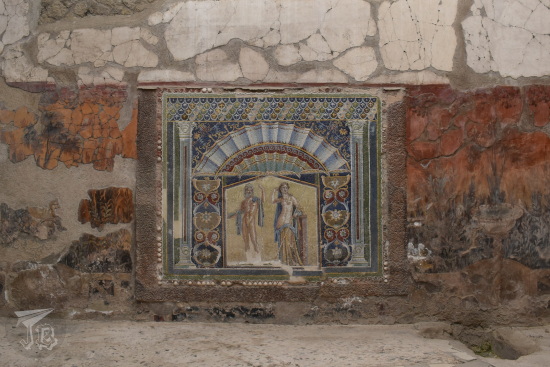
Mosaic covering a foutnain in Herculaneum

Casa del Rilievo di Telefo or House of the Relief of Telephus, one of the best preserved structures with a lot of paintings, even on the columns.
Herculaneum: House of the Relief of Telephus

Terrazza, statua e altare di Marco Nonio Balbo or Terrace, statue and altar of Marcus Nonius Balbus.
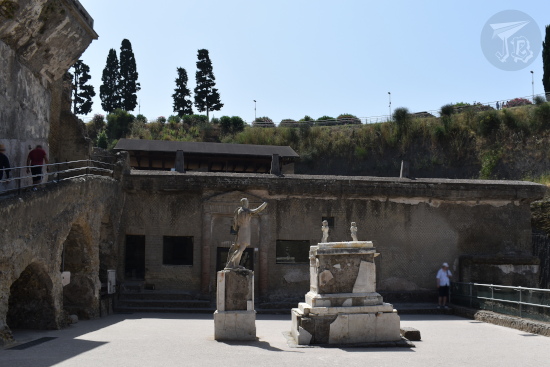
Terrace, statue and altar of Marcus Nonius Balbus

It was noon when I decided to retreat towards the museums, which hold only small trinkets and some jewellery. Just as I was thinking that the Herculaneum inhabitants could rest in peace instead of being on display, I reached the Boat Pavilion Padiglione della Barca, which holds a carbonised boat where some of the residents tried to escape. There are panels which explain that they are planning to make copies of the three hundred something skeletons they found at the coastline and place them in the same spot they were found. So much for resting in peace.

I went back towards the station and took a train back to Napoli, where I transferred to the underground and headed off to the National Archaeological Museum – Museo Archeologico Nazionale di Napoli (MANN). I had read online that the ticket was valid for two days, so the plan was to grab a leisure lunch there, wander around for a while in the air-conditioned areas of the museum, then come back the following day. Unfortunately, the ticket read that it was only valid for one admission that day. I had to reconsider my plan then. It was barely 13:30, so I decided to go right into it. Also… there was no air-con.

The roots of the MANN are the so-called Collezione Farnese, or Farnese Collection, one of the first collections of the Greco-Roman Antiquity. The original collector was Pope Paul III when he was still Cardinal Alessandro Farnese (1568 – 1549). In the 18th century, the marbles were inherited by Elizabeth Farnese. Her son Charles would become King of Naples, Sicily and Spain, and was the great sponsor of the excavations in Herculaneum and Pompeii. The mosaics and frescoes taken from these two cities are the second core conforming the museum.

The Farnese Marbles are fantastic. It’s been a while since a work of art took my breath away, but some of these did. The collection preserved a lot of Roman copies of Greek original sculptures, and although a lot of them were restored during the Renaissance, I enjoyed the gallery a lot. Some favourites were the Resting Hercules, Atlas, Apollo playing the lire, and of course the Farnese Bull.

Farnese Marbles: Farnese Hercules, Farnese Bull, Farnese Apollo, and Eros with a fish

The Hercules sculpture shows the hero leaning on his club after having finished the last of his tasks – the apples of the Hesperides garden, which he holds behind his back. Atlas kneels, holding the world. The Farnese Bull is the biggest surviving sculptural group from antiquity – the twin brothers who founded Thebes, Zethus and Amphion, tie their stepmother Dirce to the horns of a wild bull as revenge for how she tormented their mother. The original is attributed to Appollonius of Tralles. Apollo playing the lire is sculpted in two marbles, one darker for the tunic and a white one for skin and the lire – and one of the few sculptures I can share on social media as he is totally clothed…

After the Farnese marbles, I explored the rest of the classical sculptures. Then I moved onto the second floor to the collection of mosaics from Pompeii and Herculaneum. When I was little I saw a mosaic of fish in my history book, and I had always wanted to see it. I finally did, along with one that implies “beware of the dog”. I did not get to see the Alexander the Great mosaic because it was being restored (though I did see the in-situ reproduction in the Casa del Fauno / House of the Faun). There was even a whole fountain with columns that were almost completely covered in mosaics.

Mosaics from Pompeii and Herculaneum

At the end of this area stands the “Secret Cabinet”, which holds the images and sculptures from Pompeii and Herculaneum that were over the centuries considered “too pornographic to be seen” – including penis amulets and a sculpture of “Pan making love to a goat”.

I continued on to the second floor, to “Archaeological Naples”. In this area there also were sculptures, a lot of bronzes too – including a beautiful Athena and a Drunk Faun. The central hall of this floor held an exhibit about Alexander the Great and his influence in the Mediterranean. It hosted the Farnese Atlas and the Artemis of Ephesus. Afterwards, I went to the Protohistory and Prehistory area – which did not hold many attention-grabbing artefacts, especially consider how spectacular everything else was.

Sculptures in the Napoli Archaeological Museum

By this time, I needed a break. It was a bit later than 15:00 so the café was practicable. I got myself a lemon sorbet and… fried pasta pasta frittata, a typical street food bite. Which is basically a croquette made out of pasta. It was surprisingly good, actually.

Pasta fritatta

I went back upstairs – I was tired by now, and if I had had the chance to do the museum in two days, I would have left now. But I did not, so I continued towards the exhibitions of “everyday life” and frescoes of Pompeii and Herculaneum. These include dishware, glassware, decoration, mirrors, jewellery… and of course the frescoes, including the Portrait of Terentius Neo and his Wife, that were taken down from the walls of the houses during the 18th century in order to preserve them. They feel weird as they hang on the blank walls – framed, far away from the place they used to be. I know it can’t be, but it would be cool to see them all on site. While I could really imagine how some of the houses would have looked 2,000 years ago when I was in Pompeii, I could not imagine the perfectly-framed frescoes on the walls. It was a bit unsettling.

Pompeii and Herculaneum frescoes

I bought the extra ticket to see the Magna Graecia Collection. At first I was not convinced because after a while all the Greek pottery starts looking the same to me. You get to wear shoe coverings in order to walk in there, at first I thought it was not to upset the marble floors, but then I walked onto the mosaics and wow. Just wow. I mean… after a bit you don’t even realise that you’re supposed to be looking at pottery and just keep staring at the floors…

Magna Graecia Mosaic

I ended the visit with the Egyptian collection, where – on top of it being the only area of the museum with air conditioning – I saw one of the crocodile mummies that I might have seen at Kom Ombo.Finally, after basically snooping round the whole museum including the gardens, I headed back to the station area to buy some food and go get some rest in the hotel.


For the sake of completion, here is a relation of all the spots I visited in Parco Archeologico di Ercolano or Archaeological Park of Herculaneum:
Boathouse and shoreline
Access bridge
Casa dello Scheletro or House of the Skeleton
Casa dei Galba or House of Galba
Terme Maschili or Male Baths
Casa dei Due Atri or House of the two atriums
Sede degli Augustali or Hall of the Augustales
Casa dei Salone Nero or House of the black salon
Bottega del Plumbarius or Shop of a plumbarius (metal worker, welder or blacksmith)
Casa del Bel Cortile or House of the Beautiful Courtyard
Casa di Nettuno e Anfitrite or House of Neptune and Amphitrite
Terme Femminili or Female Baths
Casa Sannitica or Samnite House
Casa del Tramezzo di Legno or House of the Wooden Screen
Casa del Papiro Dipinto or House with the painted papyrus roll
Casa dell’Alcova or House of the Alcove
Casa dell’Erma di Bronzo or House of the Bronze Herm
Casa dell’Ara Laterizia or House of the Brick Altar
Casa dell’Atrio a Mosaico or House of Mosaic atrium
Casa dell’Albergo or House of the Inn
Casa del Telaio or House of the Tailor
Casa del Mobilio Carbonizato or House of the Wooden Furniture
Casa dell’Apollo Citaredo or House of Apollo the Lyre-player
Casa del Bicentenario or House of the Bicentenary
Pistrinum di Sextus Patulcius Felix or Bakery of Sextus Patulcius Felix
Taberna di Priapo or Bar of Priapus
Casa della Stoffa or House of the Cloth
Casa dei Cervi or House of the Deer
Palaestra
Casa del Rilievo di Telefo or House of the Relief of Telephus
Terrazza, statua e altare di Marco Nonio Balbo or Terrace, statue and altar of Marcus Nonius Balbus
Terme Suburbane or Suburban baths
Area Sacra or Holy Area
Sacello di Venere or Shrine of Venus
Grande Taberna or Large bar
Casa del Gran Portale or House of Large Portal
Thermopolium (food shop)
Casa di Aristide or House of Aristides
Antiquarium (museum)
Padiglione della Barca or Boat Pavillion
19th July 2023: Pompeii {Southern Italy, July 2023}

Pompeii [Pompei] is a town belonging to the greater Napoli Metropolitan Area. There is not much there “except” for the ruins of the ancient city that names the area. Pompeii Scavi (ruins of Pompei) or Parco Archeologico di Pompei (Archaeological Park of Pompeii) is the name given to the ruins nowadays, which belongs to the Unesco Heritage Site Archaeological Areas of Pompei, Herculaneum and Torre Annunziata.

The ancient city of Pompeii dates (dated?) back to an Oscan settlement in the 8th century BCE. The Etruscans arrived around 524 BCE, and the Greeks in 450 BCE. From the year 340 BCE, Pompeii was controlled by the Romans, first tacitly, then as a confederate, with its own administration and language. After it tried to rebel, it was forcefully conquered and made a colony in the first century BCE. The different civilisations expanded the city according to their own tastes.

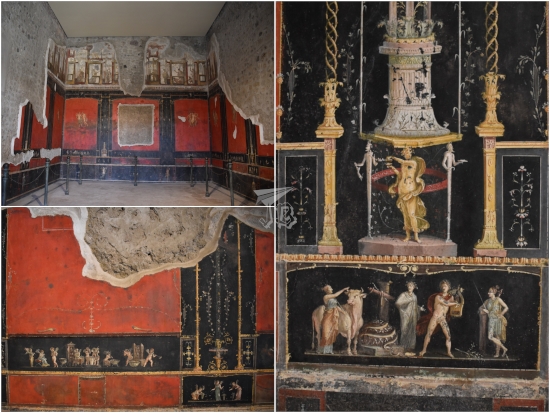
The preservation of Pompeii makes it possible to appreciate the different styles in decoration, in mosaics, but chiefly on the frescoes in the houses. The first decoration style was called “incrustation” and it made the wall look like it was composed of actual marble bricks when it was in reality flat. The second style was the “architectural” one – areas of the wall were painted to look in relief, with or without decoration, such as a brick with a still life decoration on top, an open door, a window or a garden. The third style was the “ornamental” – there was a central element and all around it, linear separations and smaller motifs occupying whole walls and even rooms. The fourth and final style was called “Intricate” because it just fills the walls with ‘main’ motifs – the more the merrier, with as many colours and decoration as possible.

In the year 62 CE, there was an earthquake that heavily damaged the city. The citizens were not too worried, because quakes were common in the area. Reconstruction started. By the year 79 CE, the city had thousands of inhabitants. In October, Il Vesuvio, the volcano known as Mount Vesuvius, erupted. The eruption happened in the early afternoon, which caused most of the population to flee during the first hours. The ones that stayed behind were killed instantly when a cloud of volcanic gas with a temperature higher than 300 ºC collapsed onto the city. By the end of the eruption, Pompeii had been buried by 20 m of volcanic ash, whose weight caused most roofs to collapse.

Romans never came back to Pompeii, though after the eruption some valuables were salvaged, some excavations were made and building materials were taken. Subsequent eruptions covered the city completely, until the first walls were excavated in 1693. When Herculaneum was discovered in 1738 while building the Royal palace for the King of Naples (later Spain’s Charles III), the king was greatly interested and he sponsored excavations, which continue even today. The archaeological importance of Pompeii resides on the fact that this was not a fancy town, but an everyday one, which can teach us a lot about how Romans really lived.

Nowadays, about two thirds of the city have been uncovered and most areas that are not being actively worked on can be visited. Scientists and experts say that the primary goal at the moment is conservation rather than uncovering the rest of the site. Pompeii was not destroyed by lava, it was only covered in pumice and ash – lava would have disintegrated the whole city. As it became buried, time stopped. Unfortunately, as soon as anything is unearthed, the clock starts again. Furthermore, there are problems with conservation, bad restoration techniques, vandalism, theft and overtourism.

Another thing that makes Pompeii special was that “remains” of the victims were found – skeletons encased in a “hollow” where the body decomposed. Giuseppe Fiorelli came up with the idea of making casts out of those moulds in 1863 – though many of these casts were destroyed or damaged during WWII bombings. Some of them, or their copies are displayed through the site. I personally find it a bit morbid, but they are useful for archaeologists, apparently. It is calculated that around a thousand people perished in the eruption, but 90% of the population survived.

I woke up early to take the train to Pompeii – the modern town next to the ruins has taken the name of the ancient city. While most people take the train at Napoli Garibaldi (the easiest train station to reach on public transport), I was coming on foot. The terminus, Napoli Porta Nolana, was just three minutes further and the ticket price was the same, so I went there to hopefully be able to sit. I was successful and I rode the Circumvesuviana Line 1 8:09 train to Sorrento, which reached the station Pompei Scavi-Villa dei Misteri a bit after 8:30. After a couple of minutes, I was in line to get into Pompeii Scavi. As I had an entry ticket booked (and printed), once gates were open at 9:00 I was inside the archaeological park in a couple of minutes (my first picture is timestamped at 9:04).

I spent in Pompeii from 9:00 to 15:30, most of it walking, though I made a stop around noon for a snack, and I also had multiple breaks to apply sun lotion. The strada (streets) have little shade, and the few trees are planted on recreated orchards and gardens, and you can not sit under them. Also, there is a system of rotation on houses – not all of them are open, and none are open all the time. A few are the “house of the day”, which in my case (Wednesday) was the Terme del Foro (Forum Baths). There are also a lot of fountains throughout the site, and the water is drinkable.

A typical Roman house – where most people lived – were called insulae. They were “apartment blocks” with up to seven floors. The ground floor usually had a shop, and the owners lived right above, with windows and balconies. The higher the floor, the worse the apartment was – smaller and with fewer to no windows.

Rich people, in contrast, lived in a type of house called domus (villa for extremely wealthy individuals). A domus was a single-storey house built around an wide area, the atrium which had an opening in the celling with a small pool underneath to gather rainwater. This was the most important place of the house and it hosted a place to worship the ancestors or the household gods. Most of the rooms in the house led to the central atrium – the bedrooms (cubicula), dining room (triclinium), the study (tablinum) and the kitchen (culina). At the rear of the house there was an orchard or garden (hortus) and at the front, the shops (tabernae ). The domus was accessed through the fauces, a small decorated corridor. Bigger houses had a second building with a sort of patio (peristylum) similar to a cloister, with columns, plants, and a pond in the middle (piscina). At the very end there was a resting area (exedra).

The walls were decorated with frescoes, and the floors with mosaics. In Pompeii, both are damaged in most houses due to the earthquakes and the weight of volcanic ash and pumice, but they are still the best examples we have of Roman domestic frescoes. A lot of them have been removed and are in the Naples Archaeological Museum – only the most recently-unearthed ones are still at their original place. It is an interesting debate though – should they have been removed? If they had not, they might have got destroyed by decay and insufficient protection. But now they hang in the museum, devoid of all context, and it is weird.

A problem with Pompeii is the sheer amount of people that visit it – another paradox: maybe fewer visitors should be allowed, but it is visitor revenue is what keeps the place working and pays for conservation, research and further excavations. The best was the first 30 to 40 minutes, when I even had the Santuario di Apollo and the Casa dei Mosaici Geometrici all for myself.

All in all, the city is awe-inspiring. It’s not only that it has a huge architectural and archaeological value. It also shows the will of humanity to learn and discover, and at the same time, how small we are in comparison to nature – some of the originally-flat mosaics are now wavy due to the volcanic earthquakes, and the mosaics are cracked.

The streets are wide and the pavements are raised. There are raised crossings that would have slowed down the chariots and allowed people to cross without getting wet when it rained, or hm… when people… dumped… stuff there. Today, aside from tourists, there are lizards – absolutely indifferent to tourists – and cats – absolutely adored by tourists.

Some highlights of the visit included:

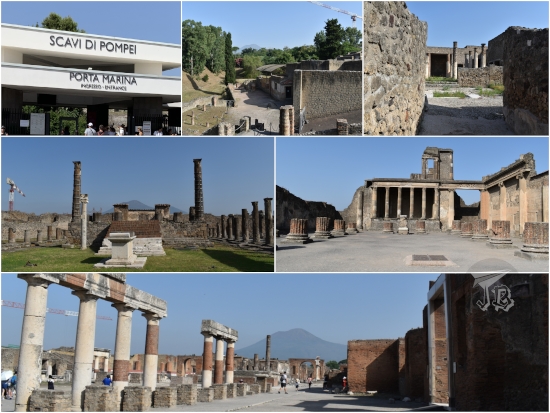
Casa di Romolo e Remo or House of Romulus & Remus; Santuario di Apollo or Temple of Apollo; Basilica (building where politics were discussed); Foro or Forum. Some sights even have Il Vesuvio looming about.
Collage showing some buildings of Pompeii

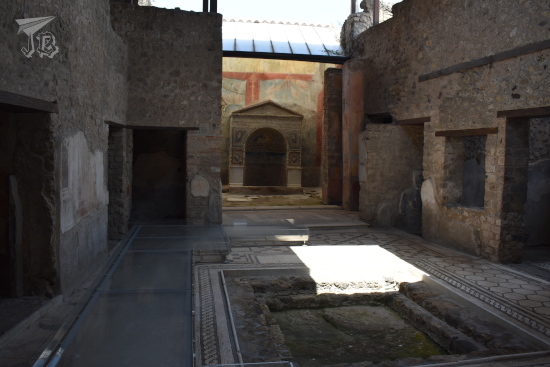
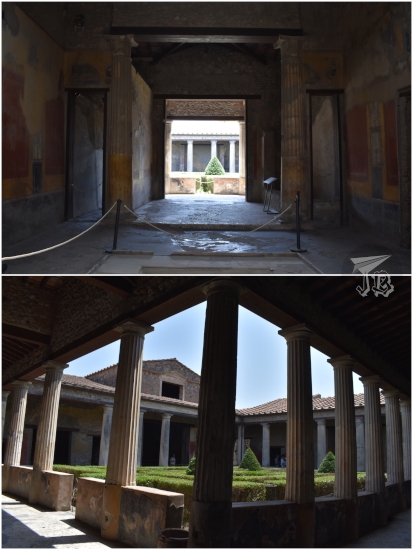
Casa del Menandro or House of Menander, with an almost completed atrium and peristylum, with great frescoes in situ.
Pompeii Casa del Menandro - hall and garden

Casa dell’Orso Ferito or House of the Wounded Bear, with incredible mosaics (closed, unfortunately)
Pompeii House of the Wounded Bear

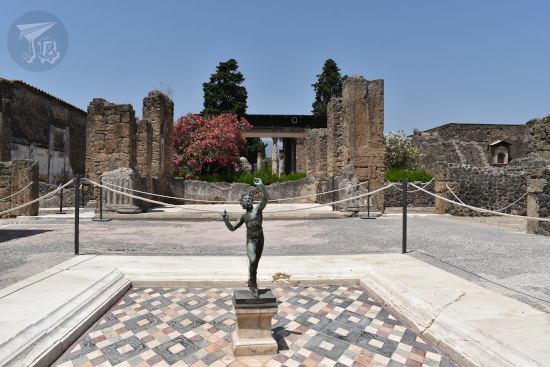
Casa del Fauno or House of the Faun, one of the most famous houses, and original home to a mosaic depicting Alexander the Great in battle.
Pompeii House of the Faun

Casa delle Nozze d’Argento or House of the Silver Wedding, with fantastic frescoes, and tiny details, extremely detailed.
Pompeii House of the Silver Wedding

Casa dei Dioscuri or House of Castor & Pollux, in which the columns still keep some of the painting.
Pompeii House of Caxtor and Pollux

I visited around 75 buildings, and entered as many as I could. Towards 15:00, I again had a few buildings for myself, or with fewer people, and I wish I had had the energy to continue on. Unfortunately, the inner restaurant was super-full whenever I checked – which I did repeatedly between 12:00 and 15:00. However, by 14:00 I knew that I was overdoing it, so I started my retreat. I still had to see the Antiquarium or Pompeii Museum.

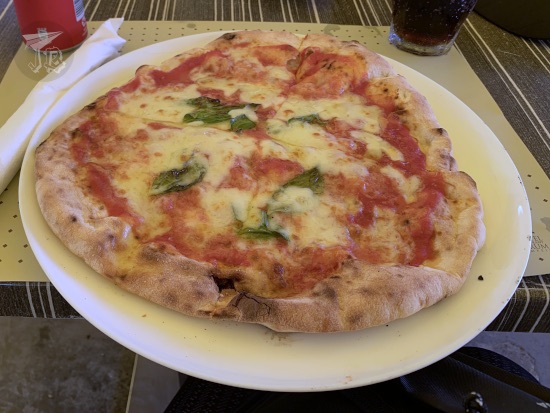
After I left the site, I stopped for a very late lunch (or a very early dinner) at a restaurant just outside the ruins. One of the waiters did not want to give me a table – or actually acknowledge me at all, I think this is the first time that I have actually felt the whole “solo travellers not welcome” echo, However, another one sat me, and I ordered the famous pizza Margherita, which is the big pizza in the Naples area. Not the Napoletana one, go figure.

A whole pizza Margherita

I took the train back, and I was in Naples with time to do something else. I had eaten and I was feeling better, but I thought that I had overdone it, and was worried about crashing the following day if I was not careful. Thus, I took a trip to another supermarket and went back to the hotel for a shower.


For the sake of completion, here is a relation of all the spots I visited in Parco Archeologico di Pompei or Archaeological Park of Pompeii:
Casa di Romolo e Remo or House of Romulus & Remus
Santuario di Venere or Temple of Venus
Casa di Trittolemo or House of Tryptolemus
Basilica (building where politics were discussed)
Santuario di Apollo or Temple of Apollo
Comitium ed Edifici Municipali or Hall of the Elections and Municipal buildings
Foro or Forum
Casa dei Mosaici Geometrici or House of the Geometric Mosaics
Palestra Degli Iuvenes or Gymnasium of the Iuvenes
Casa dei Cinghiale or House of Vesbinus
Terme Repubblicane or Republican Baths
Foro Triangolare or Triangular Forum
Santuario di Atena ed Eracle or Temple of Athena and Heracles (Greek Doric Temple)
Teatro Grande or Large Theatre
Quadriportico dei teatri / Caserma dei Gladiator or Quadriporticus of the theatre / Gladiator Barracks
Ingesso al Teatro Piccolo od Odeon or Entrance to Little Theatre or Odeon
Domus Cornelia or House of Cornelius Rufus
Tempio di Asclepio or Temple of Aesculapius
Casa degli Epidii or Casa de Marco Epidio Rufo or House of Epidio Rufo
Casa del Citarista or House of the Citharist
Casa de Casca Longus or House of Casca Longus
Fullonica di Stephanus or Fullery of Stephanus
Casa del Larario di Achille or House of the Lararium of Achilles
Casa del Criptoportico or House of Cryptoporticus
Casa di Paquius Proculus or House of Cuspius Pansa
Casa di Fabius Amandio or House of Fabius Amandus
Casa del Sacerdos Amandus or House of the Priest Amandus
Casa dei Casti Amanti or House of the Chaste Lovers
Casa e Thermopolium di Vetutius Placidus or House and Thermopolium of Vetutius Placidus
Casa di Giulio Polibio or House of Julius Polybius
Casa del Frutteto or House of the Orchard
Casa di Trebio Valente or House of Trebius Valens
Taberna di Sotericus or Tavern of Sotericus
Casa di Octavius Quartio or House of Octavius Quartio
Casa della Venere in conchiglia or House of Venus in the Shell
Anfiteatro or Amphitheatre
Palestra grande (Exhibition: “Arte e Sensualità nelle case di Pompei” Art / Sensuality in the Houses of Pompeii)
Pradeia di Guiulia Felice or Farms of Julia Felix
Casa del Triclinio all’aperto or House of Summer Triclinium
Casa del Larario Fiorito or House of the Floral Lararium
Osteria del Gladiatore or Inn of the Gladiators
Porta Nocera (gate)
Necropoli di Porta Nocera or Necropolis of Nocera Gate
Casa del Menandro or House of Menander
Casa dell’Efebo or House of the Ephebus
Casa del Criptoportico or House of Cryptoporticus (again)
Casa dei Ceii or House of Fabia and Tyrannus
Casa di Sirico or House of Siricus
Casa di Marte e Venere or House of Mars and Venus
Casa dell’Orso Ferito or House of the Wounded Bear
Casa dei Cornelii or House of the Cornelii
Terme Stabiane or Stabian Baths
Lupanare or Brothel
Arco di Nerone or Arch of Nero
Portico Della Concordia Augusta (Edificio di Eumachia) or Portico of Concordia Augusta (Building of Eumachia)
Tempio del Genio di Augusto or Temple of the Genius of Augustus
Arco di Caligola or Arch of Caligula
Terme del Foro or Forum Baths (this was the “house of the day”).
Casa del Fauno or House of the Faun
Casa della Caccia Antica or House of the Ancient Hunt
Casa di Arianna or House of Arianna
Casa della Fontana Grande or House of the Large Fountain
Casa della Fontana Piccola or House of the Small Fountain
Casa dei Vettii or House of the Vettii
Casa delle Nozze d’Argento or House of the Silver Wedding
Thermopolium (food shop)
Casa di Paquius Proculus or House of Cuspius Pansa.
Porta Ercolano (gate)
Necropoli di Porta Ercolano or Necropolis of the Ercolano Gate
Casa del Poeta Tragico or House of the Tragic Poet
Casa dell’Ancora or House of the Anchor
Casa di C.N. Caetroni Eutychi or House of C.N. Caetroni Eutychi
Torre di Mercurio XI or Tower of Mercury XI
Casa dei Dioscuri or House of Castor & Pollux
Tempio di Giove or Temple of Jupiter
Macellum (food market)
Antiquarium (museum)

18th July 2023: Naples from below and above {Southern Italy, July 2023}

Naples [Napoli] was waking up when I walked out into the heat. It was a bit after 8:00 because I was… not really planning, just expecting to get lost. My hotel was right next to the Porta Capuana and Castel Capuano, remains of the Medieval times and ancient walls. There is where I took my first wrong turn – the nice receptionist at the hotel had tried to explain to me how to get there, and I tried to follow his instructions – which meant I did not follow my original route and I got disoriented. Fortunately, phone GPS came to my aid and I eventually made my way to the Historic Centre of Naples Centro storico di Napoli. While on principle I understand the protection of a Unesco Heritage Site, it did not feel like one, mostly due to the smell – a mixture of human urine, cooked flour and raw fish – and the crazy traffic. I don’t think “pedestrian” means the same thing in Italian as in any language I speak.

I was around the area I wanted to be about 9:30 for my 10:00 visit, and I took the time to wander up and down Via del Tribunali. Off to one side stands the metal sculpture Busto de Pulcinella – a character of the early theatre school called Commedia dell’arte, where different characters wear masks to be identified as an archetype. Pulcinella is an opportunistic anti-hero from the lowest social strata recognised by the black mask. Italians like rubbing body parts of different statues for luck, that’s why his nose is polished off.

Napoli Storico - the centre of Naples

I had a booked guided tour at 10:00 for a place called Napoli Sotterranea – Underground Naples. It is just one of the companies that give tours through the hundred of kilometres of tunnels that cross the Historic Centre. The city of Naples was built on and out of tuff, a volcanic rock made out of compacted ash, with a yellowish colour in this area. Tuff is easy to dig and excavate, and the Greeks used it to build an aqueduct to serve the city – that later the Romans expanded – 40 metres under the ground. When I arrived at the gate, there was a crowd – and even if I had a “skip the line” reservation, my English tour did not start till 10:20. The whole thing was a bit chaotic, and I later realised that as convenient as online pre-booking is, it is not covered by the Naples Tourist Card, so a lot of people had no option but to call at the attractions to get their discounted tickets – I decided not to get the card because I had booked or planned to book most things in advance so it was not value for money for me.

Napoli Sotterranea starts off going down over 150 steps into the excavated tuff to visit the aqueduct. There are a number of galleries where the water used to run, and at some points you can even glimpse the original paint to help prevent the water filtering into the rock. Then the guide explains that during the WWII bombings, the tunnels were used as air raid shelters and you are shown the “showers” and “latrines”, followed by a morbid recall of the stench and the conditions, and some art exhibits and objects from the time. It was at this point I started thinking that the Neapolitans had a thing for the macabre.

Fortunately, we moved over soon, to a tiny garden that is not watered nor lit by sun, and yet it thrives in the tunnels due to humidity and artificial lamps. Then we went further into the earth – you have to walk along a very narrow tunnel, sometimes only practicable sideways. They used to give you a candle for it, but now they tell you to use your phone torch. It was a bit claustrophobic, but at least you did not need to crouch like in the pyramids. At the end of the tunnels there are several underwater ponds and fountains.

Napoli Sotterranea: tunnels and underground water reservoir

As you come out from the tunnels, there is a small “museum of war” with some uniforms and so on, and then they take you to see “the Roman Theatre”. Here’s the thing – the theatre is kind of there. Throughout the centuries, it has been incorporated into the rest of the architecture of the city, so only bits and pieces are visible, mostly those that remain underground, like the actors’ tunnels, and a hall which holds a collection of Neapolitan nativity scenes or presepe.

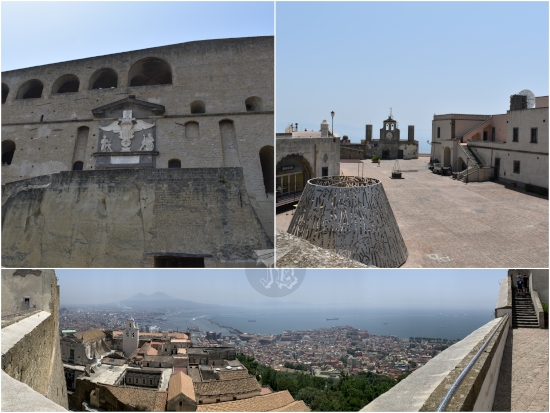
After the guide set us loose, I walked towards the Montesanto funicolare cable car station. Naples’ rope way is a tourist attraction in its on right, some people say. I’m not a fan, but I really did not want to climb up Vomero Hill Collina del Vomero in the sun and heat. The ride did not take longer than a few minutes, and after a short stroll I reached one of the city’s castles – Castel Sant’Elmo.

This fortress and former prison dates from the late 13th century. It was built in volcanic tuff, and the structure was mostly developed throughout the 14th century, though it was severely damaged in an earthquake in 1456. Construction continued, and then in 1587 lightning struck the ammunition depot and the explosion destroyed several parts of the castle, including the church. Throughout Naples’ convoluted history, Castel Sant’Elmo has been a stronghold for war, and a prison. Today, it’s a monument, a museum, and a viewpoint of the port and Mount Vesuvius Il Vesuvio in the distance.

Naples Castel San Telmo

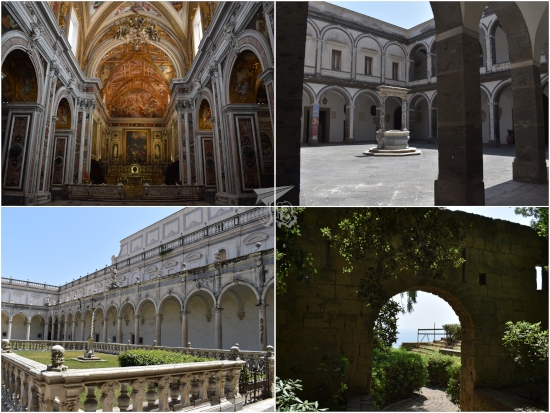
Next to the the castle stands the monastery-museum Certosa e Museo di San Martino. It originally was a Carthusian monastery inaugurated in 1368 and dedicated to St. Martin of Tours. The monks were expelled by French soldiers in 1799, and they were never allowed back. In 1866, it was taken over by the state. The monastery has a Baroque church – Naples is after all the birthplace of the style, but in a different way from the Spanish one, so I don’t dislike it as much. The monastery also has two cloisters – one of which with a cemetery in the middle. There are also hanging gardens and orchards and the different rooms of the building host religious artefacts, items from the Bourbon times, and one of the best presepe in the world.

Naples Monastery of San Martino, showing the church, the cloisters, and the entrance to the hanging gardens

Then I went back downhill, again using the funiculare. My next spot was Naples Cathedral, dedicated to the Assumption of Mary, known as Cattedrale di Santa Maria Assunta, Cattedrale di San Gennaro in honour of Saint Januarius, the patron saint of Naples. However, the most common name it receives is simple Duomo di Napoli. The current building was built in the Angevin Gothic style (gotico angioino) back in the 13th century, over palaeo-Christian buildings. The interior is strongly Baroque, though there are still some 14th century frescoes.

Collage. Duomo the Napoli: façade and main nave

For reference, Italian churches claim that walking into them showing shoulders or knees is disrespectful – so they encourage visitors to show “decorum and modesty” because “it demonstrates respect in the house of god”. I think their obsession with joints is exaggerated (especially considering the heat), and there was a certain event that highlighted the hypocrisy of it all. I visited the palaeo-Christian baptistery, one of the parts of the cathedral that you need to pay in order to access – and all tickets in Italy have been increased 1 € as part of the recovery plan of the area of Emilia Romagna, affected by heavy floods in May 2023.

The Baptistery of San Giovanni Battistero di San Giovanni in Fonte is a basic round pool on the ground, but the mosaic above it is super-detailed. It dates back from probably the late 4th century. The centre has the Chi-Rho symbol, and it is surrounded by scenes from the Bible, animals and plants, and allegories. Well, while I was admiring the art, the guy from the ticket booth came over, pulled his zipper down and urinated into the remains of the original wall. Talk about Catholics and respect in the house of God…

Next I went to the side chapel Reale cappella del Tesoro di San Gennaro (Royal Chapel of the Treasure of St. Januarius) and the Museo del Tesoro di San Gennaro (Museum of the Treasure of St. Januarius). San Gennaro / Saint Januarius is the patron saint of Naples. He was a Catholic martyr in the 3rd century, who died during the persecution of Christians by Emperor Diocletian. After his beheading, his blood was saved and it is said that the blood liquefies three times a year. The chapel holds a reliquary, and the museum some religious artefacts, including the “treasure” – reliquaries, jewels and other religious paraphernalia in noble metals and gems.

Collage: Baptistery of San Giovanni and Royal Chapel of the Treasure of St. Januarius

After the cathedral, I found Via San Gregorio Armeno, an alley that is famous because it concentrates the sells of handmade figurines for the nativity scenes presepe. However, as I walked I could only find cheaply-made expensively-sold figures of politicians, footballers and so on. I have to say that I know or understand nothing about football, but apparently Naples’ city team has won the national championship, and that’s a big thing? Everything was full of football references, posters, banners… and the alleyway was not an exception. It felt a bit… disappointing as I had heard so much about it, and I saw very few things that were “classical” there – I would come back another day and found the real thing though.

I made a visit to a local supermarket to find something to drink, dinner, breakfast and snacking the following day – because I had packed some, but I had forgotten that I had. Italian people don’t believe in either sandwiches or refrigerated coffee, which was a bit of a bummer. They have a lot of stands to grab something on the go, and they are keen on cafés, but I really did not feel comfortable sitting around in the city.

I went back to the hotel with my “groceries” because I did not want to be walking around after sunset, and I spent the rest of the evening watching British Museum’s documentaries about Pompeii and Ercolano to get ready for the following day. One of the things that drew my attention was how the documentaries kept emphasising the “importance” of the archaeological sites, and that it was important to respect them. I did not understand why, as I felt that is quite obvious. I would later discover… yes, people need to understand their importance.

17th – 22nd July 2023: Southern Italy

Back in May, I booked myself a small trip to the south of Italy. A long time ago, I was in the ancient city of Pompeii (and climbed Mount Vesuvius), and for a few years now, I’ve wanted to come back. I had not really looked seriously into it because affordable flights felt either too short (two nights) or too long (five nights). In the end, I made the calculation that maybe one day for Pompeii, one for Ercolano (Herculaneum) and two and a half for Napoli (Naples) might work out – arriving Monday evening and leaving Saturday late afternoon. I found an reasonably-priced hotel close to the station for the five nights, and then life happened as it usually does. This meant that I ended up without a definite plan – just a few basic bookings – and I seriously miscalculated how rough around the edges Naples really is. Despite it being an area with a “bad rep”, I wanted a hotel near the station to facilitate getting to both Pompeii and Ercolano by train, and because I did not want to connect to a second means of transport when I arrived in town at night.

My flight was due on the 17th of July at 18:30, but it was delayed. Right as I was boarding around 18:45, I got an email stating that my credit card had been denied at the hotel, so unless I provided another one within two hours, the booking would be cancelled. I would be in the air, so I needed to do it on the plane itself. Truth be told, my credit card is due to expire in August, so I don’t know if the error was on the hotel or my bank’s part. Fortunately, upon landing there were no further messages, and as I waited to disembark I tried to access my banking app – to no avail. That made me a tad bit stressed – even if I had cash, I wouldn’t want to get stuck abroad without a working credit card again. My bank has this thing for making all my cards stop working at the same time.

I had booked a ticket for the airport bus, that took merely 15 minutes to get to town. The line, however, was stupidly long. As we waited, taxis and gypsy cabs offered rides, but I did not trust those. The first bus left, and the second one arrived shortly after. It filled up, and there were two groups in front of me. The driver claimed that he only had space for one, so I gleefully claimed “one!” and went ahead. People on board called me lucky, people off board probably hated me.

As we drove off into the road, the first thing I saw was a rat, and that should have been a hint. We stopped off at Plaza Garibaldi in Naples around 22:20, and I did not take 10 minutes to get to the hotel – but boy, they felt long. The city smelt like urine and fishmonger ice, and there were lots of people hanging out who looked up to no good. I finally reached the hotel, the debit card worked, and I had bought a sandwich at the airport so I could have a snack. The air-con worked, and I managed to get the shower working. Things were looking up.

I’ve seen Naples described as charming and chaotic. In principle, I agree with the chaotic part. It has nice things, but it did not feel like a nice “welcoming” city – I would not really call it dangerous, but maybe dodgy or sketchy, and always on the lookout for a naïve tourist to scam or pickpocket. I was not really scared, but uncomfortable more than a few times, which made the whole trip a bit tiring. I decided not to wear headphones to pay more attention to my surroundings. In general, the plan was to start off early in the mornings and be back at the hotel with dinner and drinks in the late afternoon, which turned out to be a good idea. The hotel was small and noisy, but clean, with nice staff, and it became a little refuge, because this is not a town I wanted to go out to take pictures at night of.

Side note – on top of everything, I got caught in the middle of a heat wave – so just assume that from the beginning to the end, it was hot, and I was dripping sweat, unless I was underground. I mean, not even the Archaeological Museum has air conditioning in all the wards… but it does in the basement, which holds… the Egyptian collection. Go figure.

The city of Naples – Napoli in Italian – dates back to a settlement-port established in the 8th century BCE. It was refounded by Greek settlers in 470 BCE and it has been continuously inhabited since then, despite the constant threat of looming volcano Il Vesuvio – Mount Vesuvius – and its temperamental eruptions. There are records of about 50 eruptions, the most famous being the one that buried down Pompeii in 79 CE, though the volcano has been quiet since 1944.

Originally part of Magna Graecia (a network of Greek colonies in in Italy), Naples quickly became one of its most important cities. It became an ally of the Roman Republic against Carthage and it eventually became a Roman colony and part of the empire. Emperor Nero performed in its theatre in 64 CE, it is said that an earthquake hit as he did – he explained that it was the gods clapping at his act – it was in reality a precursor of the year 79 eruption.

After the fall of Roman Empire, the city was captured by the Ostrogoths, and later by the Byzantine Empire. In the year 661, the Byzantine Emperor granted Naples the right to be self-governed by a local Duke, which yielded to the Duchy of Naples and its eventual independence. In the year 1137, the Duchy was annexed to the Kingdom of Sicily, of which it became capital in 1266. In 1282, the Kingdom of Naples was created, though at that time there was a dependency of the Kingdom or Aragón and the city eventually became a part of the Spanish Empire. In the 17th century, Naples was the second-largest city in Europe, and it became the epicentre of the Baroque style.

In 1714, the Spanish “lost” Naples, and for a while it was ruled by Austria. After the French Revolution and the Napoleonic wars, Naples and Sicily combined to become the Kingdom of the Two Sicilies. After 1861, Naples became part of the Kingdom of Italy as part of the Italian unification. This marked the beginning of the decline of the city. Naples was the most bombed city in Italy during WWII, and the first to rise against German occupation. In recent years, it has had issues with waste management, Camorra organised crime, corruption, poverty and high unemployment.

In 1995, the Historic Centre of Naples was declared Unesco World Heritage Site, due to the great number of historical monuments of standing importance – archaeological sites, churches, palaces, castles… Naples has turned to tourism as a source of income, both legit and not so much. Different attractions are managed by cooperatives that employ local people at the same time they open historical sites for visits – which is of course good, but the downside is a lot of guided visits and places you can’t see on your own.

I arrived late on Monday, and I had decided not to book Pompeii for my first day, just in case there were delays. I decided to dedicate Tuesday 18th to Naples (which lead to discover that the Archaeological Museum closed on Tuesdays), Wednesday 19th to Pompeii, Thursday 20th for a half-day trip to Ercolano, and the rest of the time to Naples itself. If I had done a bit more research and timed things better, I could have fit another half-day trip. However, on the bright side, this meant I did not become too tired.

7th July 2023: Balloon Museum “Pop Air” in Madrid (Spain)

Part of this summer’s plans involved a three-week French course-and-stay in Montpellier, but I ended up changing my mind – too many hidden costs on top of the already-steep price, and a generalised bad feeling that I could not really define. I decided to take a course in Madrid and use up the evenings to do some exploring in town.

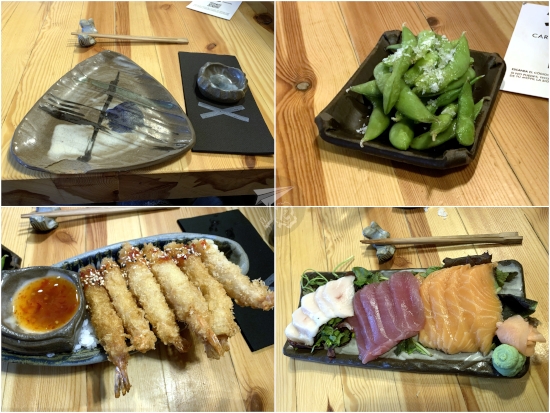
After class, I booked a table at the Chueca shop of the Japanese restaurant chain Sibuya Sushi Bar, which claims to offer a new concept of sushi. Most of what they offer felt pretty normal to me, except some random baos and the desserts. I browsed the website before booking, so when I arrived I had a pretty good idea of what I wanted. Somehow, the waiter did not expect that and was thrown off track. I ordered some ebi furai and a sashimi mix – I have to admit that the size of the sashimi portion did surprise me a little, as I did not expect such a generous serving. Luckily, I had hold on ordering dessert, because the two dishes were more than enough.

Lunch at Sibuya Madrid

There were two temporary exhibits I wanted to check out, and I chose the one that closed down earlier. I checked as I had lunch, and there were tickets available online. I decided to take the underground and buy the tickets in person instead of stressing about making it on time for a particular timeslot. I reached the Balloon Museum on time for the 15:45 entry. The exhibition Pop Air runs from March to July 2023 in the Escenario Puerta del Ángel in Madrid’s Casa de Campo.

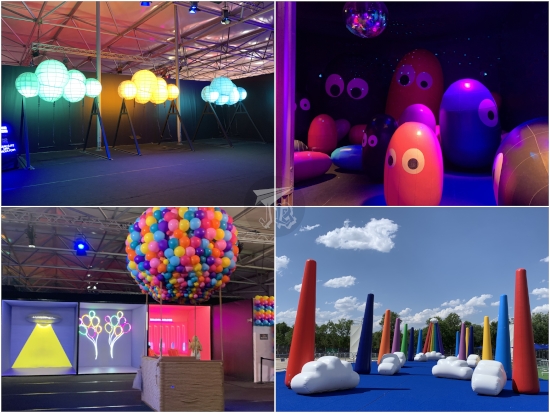
Still considered a noon slot, the exhibition was not too crowded at the time I entered, I even had a couple of rooms for myself before I reached a point in which you had to be admitted because the performance was timed. The Ballon Museum‘s Pop Air exhibit is a collection of art pieces that use air and light as their main vehicle.

Artworks:

  • The Goof by Filthy Luker (2021). They are a bunch of “friendly monsters” that observer the world feeding off surprise and happiness. They look… just adorable, as if they were made of giant inflated latex gloves in different colours with huge eyes.
  • Aria, The Breath Immersive Experience by Pepper’s Ghost (2022). A room full of mirrors and digitally-created colourful spheres that spreads to infinite and beyond.
  • Airship Orchestra by Eness (2020). More adorable creatures made out of air, some resembling Japanese peaches, other bunnies, or cacti.
  • Ballon Museum exhibits. The Goof, Aria, Airship orchestra

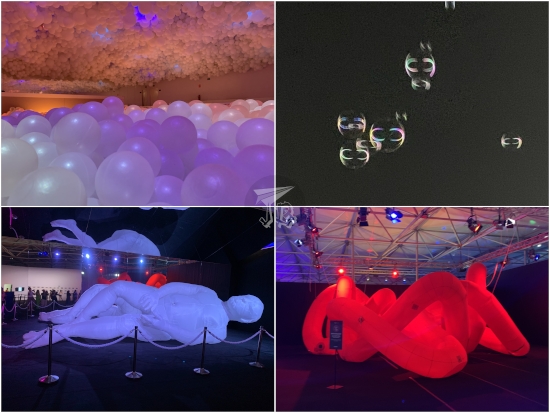
  • Hypercosmo by Hyperstudio (2021), which is basically a huge ball pit with a show of music and lights.
  • A Quiet Storm by Quiet Ensemble (2022). A dark room where cannons shoot bubbles.
  • Silenus by Max Streicher (2002). A giant, breathing… person… sleeping. It’s a bit creepy, to be honest.
  • Knot by Cyril Lancelin (2017). It is an inflatable… knot, literally a 3D knot made out of a tube.
  • Balloon Museum exhibits: Hypercosmo, A quiet storm, Silenis, Knot

  • Polyheadra by Karina Smigla-Bobinski (2022). It is a room full of balloons with small magnets which you can stick to the wall and the ceiling, and even to each other.
  • Never Ending Story by Motorefisico (2021). Music: Gentle Music by Plume (Netlabel). A lot of decorative balls in a small room full of mirrors and light.
  • Tholos by Plastique Fantastique (2022). A giant black ball surrounded by a plastic structure that imitates the archaeological tholos tombs.
  • Canopy by Pneuhaus & Bike Powered Events (2019). Four palm-tree-like structures that open up and glow if you bike them into life.
  • Balloon Museum Exhibits. Polyheadra, Never ending story, Tholos, Canopy

  • Cloud Swing by Lindsay Glatz with Curious Form (2019). Cute swings held by colourful “clouds” of light.
  • The GINJOS by Rub Kandy (2022). They’re blobs of air with eyes. When I saw them my first impression was “they’re squishy and unstable. I have found my people”. I also found the song hilarious, especially the reference that “GINJOS are not Barbapapa”.
  • Into the Rainbow by Ultravioletto. A VR experience out of which one cannot really take pictures. A white sphere travels through the colours of the rainbow and its symbols – orange candy, yellow rubber duckies, green trees, blue whales, purple… cows(?) and amethyst crystals
  • A number of cute photo booths for picture opportunities, without credit to any particular artist.
  • Parcobaleno by Stefano Rossetti (2020), is a large “inflatable park” for “all the family” (i.e. for kids), which was empty as it was way too hot for any playing.

Ballon Museum exhibits. The swings, the Ginjos, Parcobaleno

All in all, it was a really silly but fun experience. I headed back home afterwards, because even if exploring Casa de Campo is on my list, it was way too hot and I did not have any cold drinks on me. I made an amazing underground-train connection though, which was great because the Casa de Campo stop is pretty far away by public transport – and rather horrible to drive to.

24th June 2023: Abierto por Restauración. La Puerta de Alcalá (Madrid, Spain)

There is a Spanish adage that calls King Carlos III (1716 – 1788) “the best mayor Madrid ever had”. The truth is that when Fernando VI died, his brother, King of Naples and Sicily ascended the Spanish throne. He started a number of reforms in the Spanish capital that today conform the so-called “Way of the Light” – Unesco Heritage Site Paisaje de la Luz since 2021.

Madrid had at the time a surrounding wall for administrative reasons, in order to control trade. The different gates were named according to the main city they lead to. Carlos III decided to remodel one of the gates, the one that lead north-west – first to Alcalá de Henares and then to the rest of Europe. To carry out the task he called for a contest, which was “coincidentally” won by the Court’s architect Francesco Sabatini. It took ten years (from 1769 to 1779) to be completed, in typical Neoclassical style.

Today, this gate is still known as Puerta de Alcalá, and it stands in the central district of Salamanca in Madrid. The wall, however, long gone so the structure remains as a triumph arch more than a gate, in the middle of a roundabout in the Square Plaza de la Independencia.

The gate measures almost 24 metres high, 43 metres wide and 12 metres deep. It was built in solid stone with five arches, and decorated with sculptures depicting the cardinal virtues (Prudence, Justice, Fortitude and Temperance) and allegories of war victories.

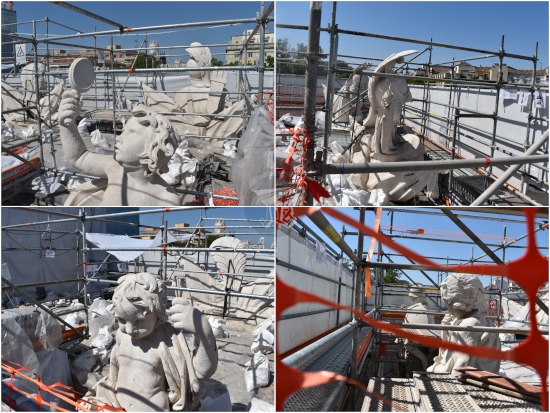
Puerta de Alcalá under the protective cover

Restoration studies started in 2022, and the works began in 2023. In March 2023, it was announced that the gate would be “open for restoration” Abierto por Restauración, and that about 6,500 tickets would be offered for guided visits to the monument throughout summer. I had a free morning when the tickets went live and I managed to secure one, despite them being “sold out” in minutes. The Abierto for Restauración project, financed by the Madrid Town Hall, aims to raise awareness of the heritage that Madrid holds.

Though I had originally planned for a day out, I was not feeling too well . Nevertheless, I really did not want to give up the chance and I decided to just head over, attend the visit. and just take the train back home, making it a half-day out.

The gate is covered with a huge billboard showing a hyper-realistic photograph, which also hides part of the scaffolding and protective messes that cover the structure. The restoration aims to repair the mistakes of previous attempts at conservation, counteract the effects of pollution and weather, and secure the sculptures at the top of the gate.

We were supposed to meet at 10:45 at the gate of the park on one side of the square, for the 11:00 visit. The guide arrived at 11:00 sharp and started “taking attendance” – since the gate is technically a “construction site” you are insured, and you have to wear a security helmet and all. Then she took us to the base of the gate and told us the history of the construction. The previous group started coming down at 11:00 and we climbed at 11:15. By noon, we were down.

We climbed the inner scaffolding to the top of the gate, where we got to see the work first-hand. Not that there was much to see, because the works cover most everything. There are giant staples that have been taken off the sculptures in order to repair the damage and secure their placement.

Scaffolding supporting the Puerta de Alcalá

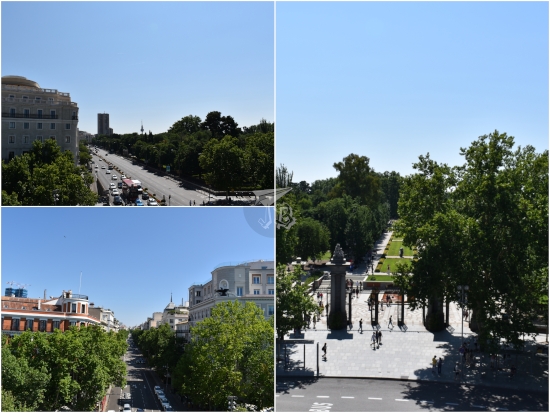
The upper platform allowed for snooping along the sculptures there and the views around the gate, along with a bit of the work being done – huge metal supports for the sculptures, filling up cracks, insulation…

Sculptures at the top of Puerta de Alcalá

Views from the top of Puerta de Alcalá

Though the experience was short, and I did not see as much as I hoped, I was lucky to grab a ticket – 6,500 of them, with 13,000 in the waiting list – but it looks like the reforms won’t be over for a while, so it might still be open next summer. It might be an interesting experience to try again and compare the progress.

27th May 2023: Mammoths and Knights in Madrid (Spain)

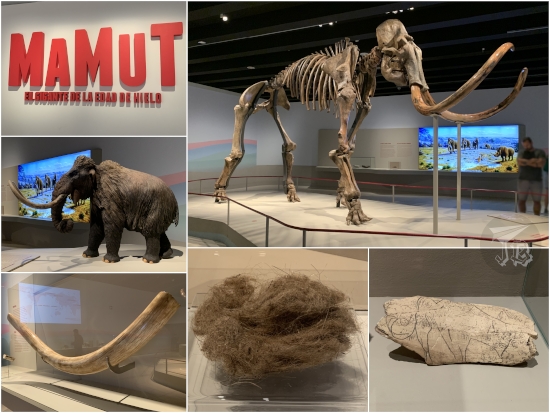
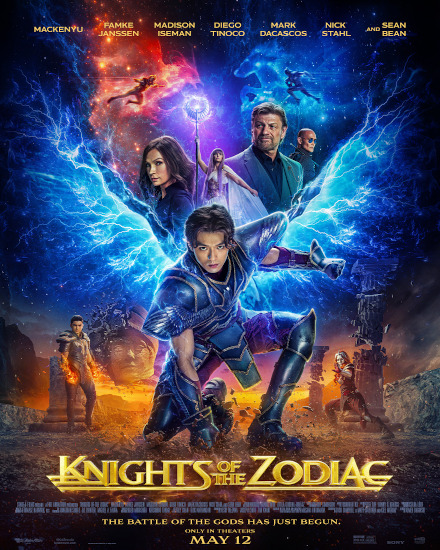
I headed off to Madrid to watch the Knights of the Zodiac film, the Hollywood remake of the 80s anime Saint Seiya – I’m not making any excuses (I mean, I still went to the Symphonic Adventure after it got cancelled trice), I just wanted to see it, even if I did not have much faith in it. I wanted to combine it with another activity, and I thought I lucked out when I found that Caixa Forum Madrid was running an exhibition on mammoths – Mamut, el Gigante de la Edad del Hielo (Mammoth, the Ice-Age Giant). I allocated about an hour and a half for the exhibition, which hosted an almost-complete fossilised skeleton and a hyperrealist sculpture “among other pieces”. Truth be told, there was not much else to see.

The exhibit has some molars from different species, some fur, a tusk and a few pieces of prehistoric art. There was also an evolutionary timeline and little models comparing the sizes of different mammoth species to the average human size. The pièce de résistance is indeed the complete mammoth skeleton that was the literal centre of the exhibit – hugely-tusked specimen of wholly mammoth (Mammuthus primigenius). It was a truly magnificent piece, but I was a little disappointed by how few pieces were actually on display. It’s not like there is not any material around – there used to be a Mammoth Museum in Barcelona that had actual tusks for sale. I had also seen another one in Muséum des sciences naturelles de Belgique in Belgium a couple of months back, which diminished the awe factor a little.

Mammoth - The Ice Age Giant exhibit featuring the giant skeleton with huge curved tusks, the smaller sculpture, a lone tusk, some hair and a piece of Paleolithic art engraved on the ivory of a tusk.

I was done in a bit over 30 minutes, so I had time to walk to the cinema – there was another exhibition in the same floor, but I had already seen it in Barcelona, and the Museum shop did not have anything interesting. I had planned to walk to the cinema, as public transit was only slightly shorter. The weather was not so nice, and there was a small storm. I did duck into a couple of shops but to be honest I ended up at the cinema 40 minutes before the session started while it poured outside. I found myself a seat to wait – I had got my ticket online the day the release was announced. This was my first time in a cinema since Jurassic World: Fallen Kingdom in 2018, and it was a weird feeling, being so close to strangers again. It was also extremely cold, and the previews were felt eternal.

The reason I sometimes choose Yelmo Cines Ideal is that some of their films are shown in their original language, and I tend to enjoy subs more than the dubbed versions. The Knights of the Zodiac film was… a choice, I guess. It is based on the newest remake – which I have not seen because I’m not a streaming-service person – and it changed a lot of the lore. Except for the main character (Seiya in the original material), all the names had been changed, but I noticed that the subs stuck to the original ones.

Knights of The Zodiac movie poster

It was not a bad film, all things considered. Entertaining, wannabe Marvel-like, tapping a little into mixing the cosmic magic and newer technology that was unimaginable in the 80s when the manga was made. It lacked on the music department though – considering how powerful the anime music is, that was disappointing, though here and there there are a few chords of the original song Pegasus Fantasy. That was cool.

But then again, I was half-expecting a disaster, so anything was an improvement, and the film made itself watchable. Sean Bean’s character died, but considering that in the original material his character is already dead at the end, I guess it could be considered some kind of record…

7th April 2023: Monasterio de Piedra (Nuévalos, Spain)

There are many things to consider when visiting the so-called Monasterio de Piedra, a tourist complex in Nuévalos, in the area of Aragón. One of the most important ones is the weather – as most of the complex is outside. The second is probably people. Just the online bookings are 2,000 tickets in a day – and some more go on sale throughout the day as visitors leave, or it is calculated that they do. A third factor is getting there, because it is literally in the middle of nowhere. This year, Easter break has peaked at an almost 100% occupancy rate since it seems that Covid is dwindling down, and the weather is superb – these facts have implied crazy traffic, too.

I had been mulling the trip for a while, checking weather and traffic warnings, and considering all the driving around that would be take place. I thought that the 7th would be a good date for a day trip – fewer cars out within the break period, and I was busy on the 8th, the other calm day. When I finally decided that the 170-km-each-way drive was going to be worth it and safe as the traffic authority had not updated its warning on the late-afternoon of the 6th of April, there were around 30 left for the 7th, and it was already sold out for the 8th. I got worried about traffic again, decided to leave the tickets for later, and by the time I definitely made up my mind, the day had been sold out!

I was disappointed, but I noticed that some tickets had become available for the 8th when previously there had been none. Thus, I kept checking throughout the evening, and finally around 23:00, I was able to purchase the 2000th ticket for the complex. Good thing that while I was wondering whether to go or not, I had prepared a backpack with whatever I might need, because if I wanted to beat the crowds, I had to leave by 7:30.

I did, and I made it to the complex around 9:10, after driving on almost-empty roads. I had planed to park in the outer lot, but as I reached the area, there were a number of workers directing cars and I ended up in the inner area. All the visitors who were already there – maybe I was the 30th car or so – stepped out of their vehicles commenting “oh, I thought there would not be so many people so early”. I thought the same… I had no idea of what “many people” meant in this place yet.

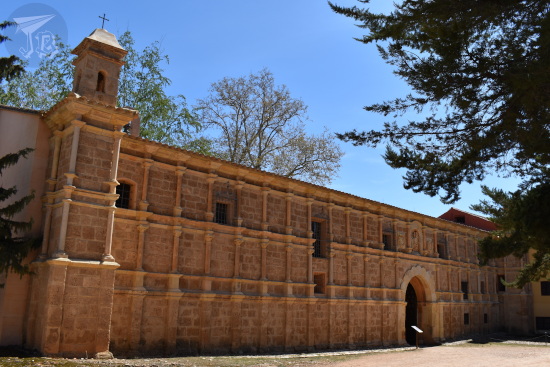
The Monasterio de Piedra complex has two distinct parts – the historical garden Parque-Jardín Histórico del Monasterio de Piedra and the monastery-turned-hotel. I decided to visit the park first, which would later be proven a good idea.

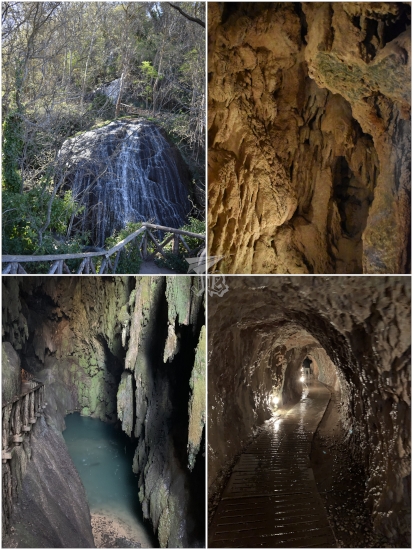
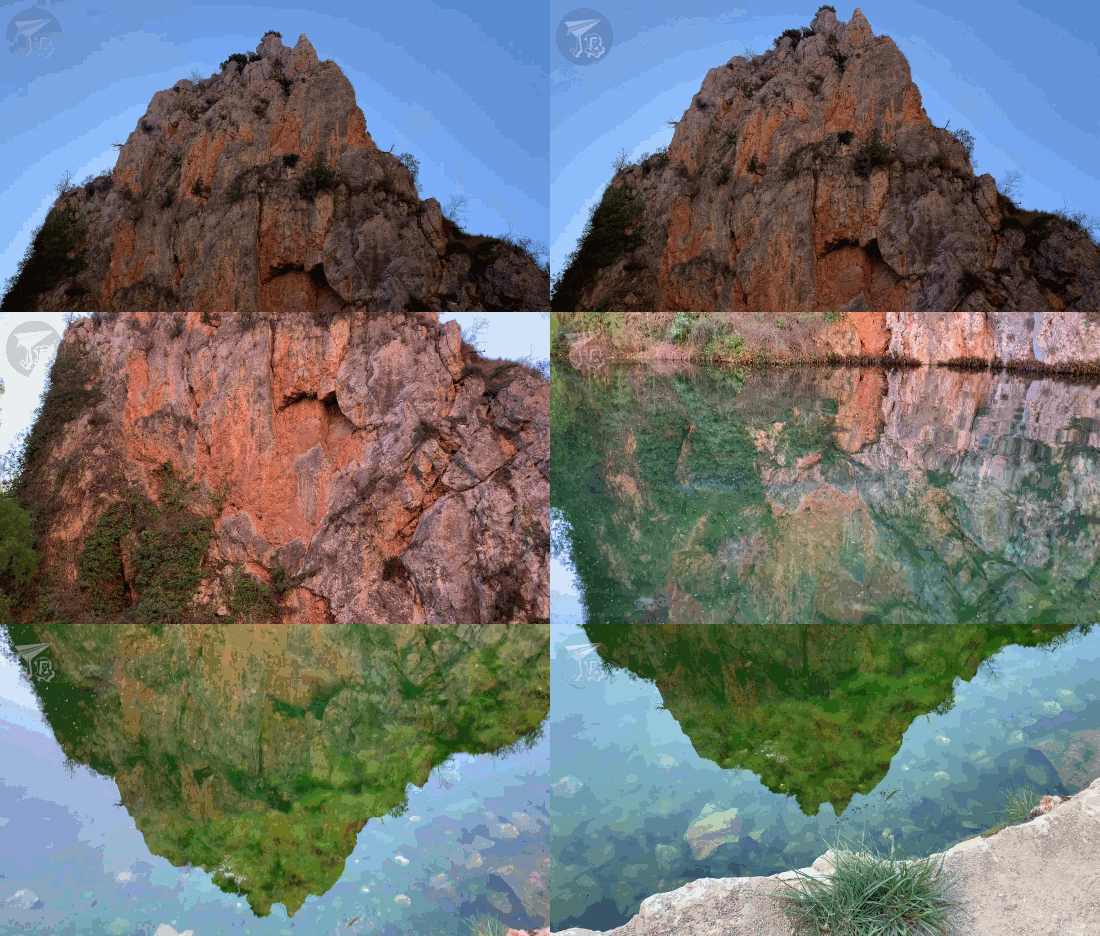
Río Piedra is mainly a pluvial-regime river (a fancy term to say that its flow depends on rain), also fed by various underground springs. The water has a high concentration of calcium carbonate, which for centuries has been key in creating the landscape that characterises the park, with a large number of waterfalls and caves – calcium carbonate dissolves and precipitates depending on how much water the river carries at any given time. Along the fertile soil from the river banks, the precipitates feed a very green landscape which in turns yields to a rich and varied fauna that lives there.

The park was established as a Romantic garden during the 19th century by Juan Federico Muntadas when he inherited the area. He also built the first Spanish fish farm there to breed river trouts. The garden is organised in two trails, a main one and an “extra” one – I decided to take the main trail, which runs around 5 km. The park prohibits food inside, but it does not really enforce it. I took a bottle of water, and an energy bar just in case, without the intention to eat it unless it was an emergency.

I walked in, got my print-at-home ticket scanned, and I was surprised that a few steps in, someone was holding an owl for people to take pictures with it. At 9:00. That was bizarre – I knew that the park used to hold birds of prey shows, but I thought it was a thing of the past. I got to my first intersection, and a park employee directed me towards the route. I was a bit disoriented for a minute or two, and I later realised that they were flushing the first visitors towards the big bottleneck area in order to try to control people, capacity, and waiting times. In this garden, the amount of people you run into can indeed make or break your experience – and I am happy to say that I made the right choices most of the time. The biggest problem I ran into were families with small children being loud, which was annoying but bearable.

Because of the redirection, I started off at what would have been number 16 on the route – the most famous waterfall, called the “ponytail”, Cascada de la Cola de Caballo. From there, you walk into one of the karstic caves (Gruta Iris) and pass under another waterfall, which even creates a small underground lake. It was cool, but I was really not prepared for how splashy it was! I continued off, I saw the and walked around a backwater called “mirror lake” Lago del Espejo for obvious reasons – it reflects absolutely everything. Although the route is only 5 km, it goes through areas that feel and look completely different, and it feels much, much longer without being tiring.

Monasterio de Piedra garden - waterfalls, karstic caves and the underground lake. Everything looks green with the vegetation and reddish with the karst deposits.

A 15-metre waterall, water splashing, flows into a river. The land around it is reddish-grey

A reddish hill perfectly reflects on a lake.

As I “finished” the route, I got to the intersection where the bottleneck is created and I saw all the people waiting – hundreds, probably. That was unexpected, because it had not felt that it was so crowded – it turned out, arriving early had been a great idea. The amount of people waiting was shocking, but understandable as most of the cave passages are only wide enough for one person – now I understood the reviews that claimed hours to see the waterfall and the cave.

I got a bit disoriented at this point – as I said, the route feels long since the landscape is so varied. However, instead of going for the exit, I decided to continue exploring a bit more – that is how I arrived at the lower numbers of the route again – number four, that was a bit more on the crowded side. I did the first part of the route, climbing up the hill slopes to see a dozen or so more waterfalls. Then had to backtrack again, until I finally saw everything that there was to see, even if in a strange order (on the map: sixteen to end, four to fifteen, then three to one. Not confusing at all, I know).

Monasterio de Piedra garden - fountain, and waterfalls and a cave. Everything looks green with the vegetation and reddish with the karst deposits.

Unfortunately, loud people scared most of the wildlife away, so aside from a few fish, there was nothing around in that respect. There were dogs around, but well-trained, so they did not cause a problem. The area is really nice, the waterfalls and caves are beautiful, but I can see how the number of people you visit it with might make it a good or bad experience. I am sure that I would have quit had I needed to wait hours to cross a cave and see one of the waterfalls.

When I left, there was a huge queue to get a picture with the owl. Furthermore, there were several huts with more birds of prey or other animals, and the pictures were sold at the exit. I’m not sure I approve of that, no matter how trained the animals are – there actually used to be exhibitions with the birds of prey, which is not happening these days. After I left the historical garden, I went into the former monastery. Today, most of the building has been turned into a hotel, but part of the historical site can be visited.

The monastery Monasterio de Piedra was established in the 12th century by Cistercian monks sponsored by king Alfonso II of Aragón. The building was erected in the years when Romanesque was turning into Gothic, so it mixes both styles along with some extra Baroque. Between the late 18th century and the early 20th century, the Spanish government carried out several programs to seize and sale property deemed “unproductive” – mostly belonging to religious orders and municipalities. These properties were auctioned to convert them into cash so the government could pay off its debt. The whole process is known as the Spanish confiscation (desamortizaciones).

In the 19th century, Monasterio de Piedra was confiscated. Everything it contained was auctioned in the 1840s and 1850s. In 1843, the buildings were also sold and acquired by the Muntadas family. It was soon afterwards that Juan Federico Muntadas became the owner. He turned the orchards into the now historical garden, and the convent itself into a hotel and… what today would be called a “wellness spa”. He also established the fish farm.

I would have really liked to stay at the hotel, but it’s a bit on the expensive side and there is really nothing else around, so you have to pay for meals on top of the stay. But it would have been cool to wander the monastery building at night. Not being a hotel guest, the ticket includes access to the cloister and the old church. Some rooms around the cloister have been dedicated to host exhibits about regional or historical products and items: carriages, wine, and even chocolate – the monastery was reportedly pioneer in the preparation of chocolate in Spain. The cloister itself has a few chapels, the early-Gothic chapter house with decorated columns and ambience music, and a small garden-like centre. You can also visit a monk’s cell, and there are mannequins spread through the different rooms – startling if you are not paying attention and suddenly see one.

I am not a wine person, so the museum on the topic did not impress me much despite having a bunch of traditional wine-making artefacts. The chocolate exhibit was just a succession of panels with pictures, and thus a bit underwhelming. Within the monastery, what I enjoyed the most was the architecture itself I guess. I loved the cloister and the chapter house most.

I also visited the adjacent ruined church. Like the cloister, it’s early Gothic. It has a Baroque chapel to the side which keeps the wall paintings. Although most of the ceiling is gone, the church still looks pretty – then again we all know that I like the architectural style anyway. It’s nice how the building is somehow ruined but at the same time it’s not, as it has been restored and preserved. However, underneath the altar, there is a small crypt, where a small window has been made to peer at someone’s bones – that was… huh… unnecessary. The nave is now open to the sky and covered with grass, all the figures have gone, and only one of the sides holds a few architectonic remains and capitals.

Inside the monastery - the cloister and the ruined gothic church

I left the inner area and I walked around the outside of the building – what has become the picnic area since you can’t eat inside the garden. Once I left that behind, the area was deserted. I reached the former main square, where the Baroque façade of the monastery still stands. I walked a bit further and found the walls that used to enclose the area, along with a small tower that is called the keep, but it looks more like a defensive tower.

The baroque main entrance to the monastery

Finally, I checked out the gift shop, bought a book and some chocolate. I headed back a bit after 13:00, but instead of driving directly home, I made a stop at a couple of viewpoints over the reservoir Embalse La Tranquera. On the way out, I had crossed several tunnels and seen viewpoints, so since I had time and I was not hungry yet, I decided to snoop around. After a while, I just drove back – though I might just have made a stop for a late fast food lunch, because guilty pleasures happen sometimes. And by 15:00 I was hungry indeed.

A reservoir with turquoise water, nestled in a reddish gorge

5th April 2023: The ghost station of Chamberí (Madrid, Spain)

Perusing the web for something – I can’t even remember what – I came across one of those things that I had discovered a long time ago, then forgotten because life is hectic and so (read: Covid happened). In Madrid, there an underground ghost station, one that has not changed since the 1960s. Well, sort of – it was closed, then restored, and finally turned into a museum. Anyway, somehow accidentally, I ended up securing a free ticket to visit it during Easter break, so there I went. I decided to round up the trip with a fancy lunch in a place I also wanted to visit.

The Madrid underground system Metro de Madrid was the third underground line to open in Europe, after Moscow and London. It ran a little short of 3.5 km, with eight stations, when King Alfonso XIII inaugurated it in October 1919. Subsequent ampliations and renovations of the line were carried out until it reached its current 24 km and 33 stations (plus twelve more lines). The city expanded, its population increased, and underground trains grew with both, going from four to six carriages in the 1960s. The stations were renovated to fit the new, longer trains. Most of them. The ampliations of the stations of Bilbao and Iglesia made it inefficient to do the same with the stop that lay in-between – Chamberí. Thus, this station was locked down – and bricked off – in 1966.

The city forgot about the station’s existence for decades, until in the early 2000s, it was turned into part of the Underground’s museum network Museos de Metro de Madrid or Andén 0. Today, Estación de Chamberí can be visited for free, but only under reservation. Pre-pandemic, I looked into it a few times, and never found a spot, then the whole thing slipped my mind, until I relearnt about it, and lucked out.

I took the train to Madrid and walked from Recoletos to the square where the station was built Plaza de Chamberí. The original entrance has long disappeared, so the underground area is accessed through an ugly metal kiosk and a spiral staircase. However, the original station looks completely different. It was designed by Antonio Palacios (1878 – 1945), a Spanish urbanist and architect with a very recognisable style, whose most important works still stand in Madrid (such as the Círculo de Bellas Artes and Palacio de Comunicaciones). My entry slot was 11:30, and I arrived with plenty of time – trains have been unreliable lately so I gave myself a wide margin. When most of the group had arrived, we went down the modern stairs that yields to the old hall. Characteristic white tiles are laid along the access tunnel that leads to the original ticketing stands and the exit control. The station used to have a skylight, now closed off. The original stairs and maps still stand, along the Metro logo – though everything has been adapted for wheelchair-users.

Ghost Station of Chamberí. Entrance corridor and old ticketing booths

The group comprised 25 people, with a surprising amount of non-Spanish speakers – at least seven, who of course did not care about the guide’s explanation, which was little more than the Wikipedia page (so I guess anyone can take the visit. Print out the wiki and read along). There were families with kids who tried to yell over anything the guide said. Furthermore, underground trains still run through the station, which make for cool pictures, but their six-minute frequency drowns all the given explanations. It was hard to actually get into the “ghost station” mood.

Estación de Chamberí does look really cool though. Unfortunately, glass panels separate the platform from the tracks – they are dirty and get in the way of pictures of the other side of the platform. However, it was interesting to see the old advertisement mosaics – they used to be painted on tiles, and built into the walls themselves, and surrounded by very cool darker slabs with metallic tint. The visit takes about 40 minutes, and on the way out, you get to go through the old ticket gates, which have a very ingenious way of opening – you step on the little platform in front of them, which triggers a latch, and you can push the gate open. Really fun.

Ghost Station of Chamberí. Collage showing details - the name of the station on the old logo, tiles, the platform, and a train coming through

Truth be told, I had booked another free visit before lunch, but I realised I had messed up the location. I cancelled that one before entering the ghost station so the ticket would be available for someone else to use. And thus, I had a bit of time before my lunch reservation at 14:00. Since the weather was nice, I decided to walk to my next spot, and I spent the extra time – and some not-extra money – in one of the big bookshops in the centre of Madrid. At 13:50, I arrived at the back entrance of the hotel Hotel Riu Plaza España. This hotel opened in 2019 in a mid-20th century skyscraper (Edificio España) designed and engineered by brothers Julián and Jose María Otamendi. It is a 26-floor tower which was the highest building in the city at the time of its construction. Situated in the square called Plaza de España, it is close to the Royal Palace and Main Square.

Edificio España - tower like building in reddish and white brick, spanning 26 floors. It is the Riu hotel now.

The hotel has a large terrace on what would be the 27th floor, a rooftop bar and a restaurant or “gastro bar”, whatever the current buzz word means. Entry to the terrace is 10 € (5 € on a weekday), and food is not on the cheap side (everything around that area is stupidly expensive), but I found a deal at their Edén Gastro Bar: one-course lunch + drink + entry to the rooftop terrace for 30€ which allowed me to skip the queue.

I did skip the “ticket-buying” line, but there is only one lift to go to the rooftop, so that queue I had to wait. I ended up reaching the restaurant around 14:10 or 14:15, and snagged a counter-with-a-view seat. I ordered a salmon poké and a drink, and got a few complimentary snacks and breadsticks to complete the meal.

Rooftop picture showing Madrid's Plaza de España and Royal Palace. Blurred in the foreground, lunch

Afterwards, I climbed the stairs to the terrace, officially called 360º Rooftop Bar, on the 27th floor. Music was blaring and there were tons of people drinking overpriced cocktails. The views were cool, sort of a once-in-a-lifetime thing that I don’t think I’d need again. The terrace has a small all-glass balcony that I did not wait the queue for, and a glass platform that would probably impress a bit more if the glass under your feet were clean(er). The terrace was completed by a tacky bull sculpture with metallic-gold testicles.

Madrid rooftop view - low houses with red brick roofs, and in the very background a few highrises

I walked around a couple of times, and then I headed back to the train station after calling it a day. I killed time reading one of the books I had just got, and time flew on the train. It was a nice little outing, but I did mess up with one of the locations, so it could have been more efficient. I guess not every little trip can work flawlessly…

25th March 2023: Brussels, Antwerp, and Starset {Belgium, March 2023}

As my companion D****e was caught in the French air controllers’ strike, she did not make it to our hotel until the wee hours of the morning. I let her sleep, and headed out to explore another area of Brussels. My first stop was again Mont des Arts, because it was on the way to Anneessenstoren, remains of the old city walls – which were being renovated, so I could not see a thing.

I had decided not to take the umbrella because the wind made it useless anyway, so I had to take cover a couple of times. I continued off to the Romanesque-evolved-into-Gothic Church of Our Lady of the Chapel Église Notre-Dame-de-la-Chapelle | Onze-Lieve-Vrouw-ter-Kapellekerk. It was closed, but I hung out around the area for a bit. There is a skate park, a Memorial to Pieter Bruegel the Elder (who is buried in the church) and an obelisk Obelisk Kapellekerk sculpture.

I decided to come back when the church was open, and continued walking towards another church in the area, the Church of Our Blessed Lady of the Sablon Église Notre-Dame du Sablon | Onze-Lieve-Vrouw ter Zavelkerk. It was built in the 15th century, in late Brabantine Gothic. It does not have towers, but a deep portal in the main façade. It is richly decorated inside and out, in light coloured stone from the nearby Gobertange quarry. In the beginning, the church was a parish for the noble and wealthy citizens of the city, but it slowly lost lustre over the centuries. In the late 19th century and beginning of the 20th century, it was “restored” according to the principle of unity of style. The whole building is laden with ogival windows, and the light inside is very beautiful. When I was there, the choir was rehearsing, and there was a “do not visit beyond this point” notice which I abided by.

Gothic church: exterior + nave, flanked with long windows

I went out again, and crossed the street to the garden Square du Petit Sablon | Kleine Zavelsquare , which features statues depicting some of the great humanists of the Belgian 16th centuries, and a fountain in the honour of two noblemen who were executed by the Spanish regime in the same century. The fences are decorated with sculptures that depict the different guilds of the city. It was designed by romantic architect Henri Beyaert in the Flemish no-renaissance style in the 19th century as a flower garden.

I saw the Palace of Justice of Brussels Palais de Justice de Bruxelles, a massive building built between 1866 and 1883 in an eclectic Greco-Roman-inspired style, designed by architect Joseph Poelaert. When it was erected, it was the largest building in the world, and it is currently… being renovated, as part of the ceiling collapsed in 2018.

I had to take cover again as another shower hit, but it went away eventually. I walked further until I reached a former medieval city gate Porte de Hal | Hallepoort, which looks like a tiny French château – it was transformed into a a Neogothic castle in the 19th century, by Henri Beyaert. Today it is a museum, but I decided not to go in and head back towards the city centre.

Decorated medieval-like tower

I backtracked towards the Church of Our Lady of the Chapel Église Notre-Dame-de-la-Chapelle | Onze-Lieve-Vrouw-ter-Kapellekerk which had been closed in the morning, and it had fortunately opened. I walked in. The church has an early 13th century Romanesque base, and the building was erected or reconstructed later in Brabantine gothic in the late 13th century. The nave was reconstructed in the 16th century and is Flamboyant Gothic. It leads to a dark-wood painted altar which contrasts with the wide, light nave. All in all, I guess I can say I was a fan of the gothic style in Brussels.

A gothic church with a dark wood altar and altarpiece, with coloured windows behind

When I was in the church, I received a text from D****e, who had finally woken up. I walked back to meet her and we decided to take the train to Antwerp [Anvers | Antwerpen], where we had plans for the evening. We got off at the central station Antwerpen-Centraal railway station Gare d’Anvers-Central | Station Antwerpen-Centraal. Designed by architect Louis Delacenserie, it was built in eclectic style at the turn of the 20th century. It has two underground levels in modern tunnels, and the original station stands at level +1 (a total of four levels), with an extended train hall in iron and glass designed by the engineer Clément Van Bogaert. The station is sometimes called a “railroad cathedral” with domes, glass windows, an ornate clock, and marble floors.

Antwerp Centraal Station - a red iron tunnel-like structure with a decorated front with a clock at the end

The idea was to look for a place to have lunch near the main square, but the weather did not agree. We ate at a Wagamama chain restaurant instead, to wait out the storm, then headed to see the Bourse of Antwerp Handelsbeurs. It was the first building ever erected with the idea of being a commodity exchange place, but burnt down and was reconstructed in the 19th century by architect Joseph Schadde, who mixed Neogothic and iron architecture elements. The building was abandoned in 1997, but it was later recovered as a cultural and event centre. I absolutely loved it.

The Handelsbeurs inside - lots of gothic details supported by decorated iron beams

We had a look at the Cathedral of Our Lady Onze-Lieve-Vrouwekathedraal, but we were pressed for time and did not want to pay to have to rush through the building (a future visit, maybe), so we just peered inside. The cathedral is included in the Unesco World Heritage Site of “Belfries of Belgium and France”.

The cathedral of Antwerp

Outside the cathedral there’s a sculpture of a boy and his dog, from a sad novella about an orphan boy who wants to be a painter, and although written by an English author (Marie Louise de la Ramée) it sounds like the Belgian version of “The Little Match-Seller” tale. It’s called the Nello & Patrasche Statue Nello & Patrasche beeld and it was created by Batist Vermeulen.

A sculpture of a boy sleeping on his dog. The bricks on the road seem to tuck them.

Eyeing the weather, we decided to head out to our destination for the evening, the Trix concert hall – though this meant sacrificing seeing the main square, we were happy that we were under cover when it started hailing at around 16:15. On the way, we saw a mouse happily hopping the main streets, some sculptures, including the Monument to Rubens and the entrance to Chinatown. We had purchased VIP tickets to see the American band Starset, who toured with Japanese singer Hyde in 2018.

Starset is an American alternative rock band formed in 2013 by vocalist Dustin Bates. Aside from Bates (lead vocals, keyboards, soundboard, guitar), the core of the band is formed by Ron DeChant (bass, keyboards, backing vocals), Brock Richards (guitars, backing vocals) and Adam Gilbert (drums, percussion). Touring members currently are Siobhán Richards (violin, keyboards), Zuzana Engererova (cello) and Cory Juba (guitar, synth), and I guess they’ve got an honorary member in Ernie (Dustin’s French bulldog, who apparently attends pizza parties with VIPs when the band tours the US). One could say that Starset is a “concept band” revolving around sci-fi – the band’s fictional backstory refers to The Starset Society, who aims to alert the public about a “Message” they obtained from an outer-space signal. The fact that Bates holds a Master’s in electrical engineering and worked for the US Air Force and the International Space University might have something to do with the theme.

Starset released their fourth album, Horizons, in 2021. After Covid, cancellations and rescheduling, the Horizons Tour finally took place. Since we had a VIP ticket, we had early access and we had to be at the venue at 17:00. We got there a bit after 16:00 – and it was a good place with a hall, so we were under cover when it started hailing. In the end, we were not admitted till 17:20-ish, when a nice lady came and took our names to let us in. The first part of the experience was a short acoustic concert with some games and Q&A. For the games, you were given a raffle number, and if it was picked, you got to spin a wheel and maybe get a price – or a hug.

During the acoustic, we stood next to violinist Siobhán, who is not only beautiful, she is also super elegant. Dustin looked a bit like a hobo, to be honest, and he’s taller than I remembered him. We noticed that Ron’s arm was on a sling – apparently he had hurt himself and was unable to play during the tour, but he still tagged along. Afterwards, we had the chance to take a picture with the band, pick up the free goods that we had a right to – a CD and a signed poster. As we did, we moved into the actual concert hall, where we got the last available spot on the first row barrier.

Starset during the accoustic

The supporting artist was Smash into Pieces, a Swedish rock band composed by Chris Adam Hedman Sörbye (vocals), Benjmain Jennebo (guitar), The Apocalypse DJ (drums) and Per Bergquist (guitar). They were very good, and they fit really well with Starset, I thought. They started playing when the hall was full – it has a capacity of about 1100 people, and maybe they started around 19:30.

Setlist:

  1. Wake Up
  2. Glow in the Dark
  3. Big Bang
  4. Let Me Be Your Superhero
  5. Sleepwalking
  6. Running Away from Home
  7. Vanguard
  8. Boomerang

Smash into Pices front men.

This made the event run faster than expected. Starset were scheduled for 21:00 but came out at around 20:20, and the whole thing started with a bang – almost literally. A big curtain was pulled up and then let down when the band was on stage.

Setlist:

  1. Unveiling The Architecture (recording)
  2. Carnivore
  3. Manifest
  4. Echo
  5. Trials
  6. Icarus
  7. Unbecoming
  8. Monster
  9. It Has Begun
  10. Interlude. BMI ad (video recording)
  11. Satellite
  12. Ricochet
  13. Infected
  14. The Breach
  15. Die For You
  16. Devolution
  17. For Whom The Bell Tolls (Metallica Cover)
  18. Earthrise
  19. My Demons
  20. Boomerang

Dustin (vocals) and Brock (guitar; dressed as an astronaut) from Starset in the middle of the concert

My mind was blown because somewhat this setlist comprises all my favourite songs from the band: Carnivore, Monster, Ricochet and My Demons. The concert was full of little visuals and cool ambience tricks – I mean, Brock actually plays in astronaut suit. There was a lot of smoke and the lights were not good, but the concert itself was amazing. I was very grateful for the barrier, I would not have made it standing for the whole event – probably not even half of it. All in all, I had a lot of fun. I love that Dustin sings with his geek glasses, too.

After the concert, we managed to take the 23:09 train back to Brussels and even get a snack on the way – the one previous to the train I had wanted. That was lucky, because the last train was delayed over an hour and a half, and was a slow one.

24th March 2023: Brussels {Belgium, March 2023}

I woke up stupidly early to catch a short red-eye flight that was in the end delayed by the French air controller’s strike. Crossing security at the airport was a bit of an issue – I got stuck behind a class of teens going somewhere, and kudos to the teacher for not losing it when about 50% of the kids were sent back because they had not taken out their tablets / liquids / bottles of water and so on. Once inside, I had to head towards the Schengen area transit lounges, which were considerably fuller than beyond passport control in the early morning.

I landed in Brussels [Bruxelles (French) | Brussel (Dutch)], Belgium [Belgique | België] around 9:00. At the airport arrival lounge, I was welcomed by a rocket taken out from The Adventures of Tintin, and some fake flowering trees. I found the station – I had booked all my tickets online beforehand – and after a short train ride I reached the centre of Brussels. From the train I caught a glimpse of the famous atom-like building, the Atomium. I found my way to the hotel throughout a chaos of construction, and dropped off my luggage. Then, I set off to explore the city, which is called the comic capital of Europe: up to 50 comic character murals are painted on walls around the city, to the point that there is even a route dedicated to seeing them all – the Brussels’ Comic Book Route. I had not walked 200 m from the hotel when I saw my first mural, Le Scorpion.

I headed towards the Cathedral of St. Michael and St. Gudula Cathédrale des Saints Michel et Gudule | Kathedraal van Sint-Michiel en Sint-Goedele. The current building was erected in the 13th century in Brabantine Gothic, which is a deviation from the French Gothic style that developed in the Low Countries (Belgium, the Netherlands, and Luxembourg). It features the use of sandstone or limestone in light colours (unfortunately, these materials are very susceptible to erosion), pointed arches, round columns with decorated “cabbage” capitals, and a very clear cruciform floor plan on churches. Unlike the Spanish cathedrals, there is no choir built in-between, so the perspective of the churches built in this style is fantastic.

The cathedral has two symmetrical front towers with tolling bells. It is accessed from the monumental staircase (built in the 18th century) on the western façade, by one of the gates under the bell towers. It does not feature a round or wheel window, but an ogival one. The nave is wide and lit from all the colourful side windows representing biblical scenes. The pulpit on the side is Baroque, carved in dark wood by the sculptor Hendrik Frans Verbrugge. A lot of the sculptures inside the cathedral are also Baroque, as the originals were destroyed by iconoclast movements (Beeldenstorm) in 1566 – this is a feature along most of the monuments I visited. Along with the Chapel Church and Our Lady of the Sablon, the cathedral is considered one of the three traditionally listed gothic churches in the city of Brussels. The organist was rehearsing, along with a cellist and a female singer, which was cool to hear as I explored. Underneath the cathedral, the archaeological site can be accessed to explore the Romanesque origins of the chapel of St. Michael.

The cathedral of Brussels

After the cathedral, my path took me through the park Parc de Bruxelles | Warandepark, featuring a pretty kiosk in metalwork and a bunch of trees striving to blossom. Along one of the axes of the park, 22 sculptures have been erected for a temporary exhibition “Le Chat déambule” Expo (9th March – 30th June 2023). They feature Le Chat, an anthropomorphic obese cat from a comic strip created by Belgian artist Philippe Geluck. Le Chat ran from 1983 to 2013, comically tackling everyday situations or presenting absurd conclusions.

An obese, anthropomorfic cat on a tutu raising a leg while a mouse uses a jack to keep the cat's leg up.

I continued walking for a bit of a long walk that led me past the Royal Palace of Brussels Palais royal de Bruxelles | Koninklijk Paleis van Brussel and the Monument to Leopold II. I went on until I reached something I felt that I could not have missed – the Museum of Natural Sciences of Belgium Muséum des sciences naturelles de Belgique | Museum voor Natuurwetenschappen van België, part of the Royal Belgian Institute of Natural Sciences. This was on my to-visit map long before this little trip came into plan. The museum’s Dinosaur Gallery is the largest room dedicated to dinosaurs in Europe. It holds a replica of Stan the T-rex (the original one was auctioned a while back and bought into private hands for 32 million USD), a piece of the Mont-Dieu meteorite, similar to the one which might have caused the extinction of dinosaurs, along with a bit of the boundary K-T (Cretaceous-Tertiary) or K-Pg (Cretaceous-Palaeogene) – this is a sedimentary layer of black rock with a lot of iridium that separates the “age of reptiles” and the “age of mammals” in the fossil registry.

There is also a room completely dedicated to mosasaur findings, and a lone Allosaurus fossil called Arkhane, which is considered the only discovered specimen of its species. Allosaurus was a Jurassic carnivore and this skeleton, clocking at almost 9 metres long, comes from Wyoming (US) and is 70% complete. However, this was tucked away in a completely different area of the museum. I also saw a Dunkleosteus head. This one was behind glass and I did not find the information to read if it was a cast, so maybe I found an original one?

Fossils at the Belgian Museum of Natural History: dinosaurs, mosasaurs, the Allosaurus Arkhane, and a massive fish head

The most important feature of the Dinosaur Gallery though is the collection of iguanodon fossils – the Bernissart iguanodons. Iguanodon (meaning “iguana tooth”) was the second dinosaur to receive a name. This herbivore lived from the late Jurassic to the early Cretaceous, and it is thought to have been able to on either two or four legs. In 1878, as many as 38 iguanodon fossils were found in the Bernissart coal mine. Nine are displayed in “wrong” standing positions – what was believed at the time to be correct, called the “kangaroo standing” – and nineteen can be seen partly covered in plaster just as they were found in the mine. The standing skeletons are too fragile to be dismantled now – though early palaeopathologists did the best they could, the skeletons contain a lot of pyrite, which disintegrates in contact with air, so they are extremely brittle. Thus, they are exhibited in a protective chamber as historical testimony. These fossils were the most abundant and complete ever found of the species. They unseated the previous English hegemony on iguanodon knowledge at the time, and one of them became the Iguanodon bernissartensis holotype. Today, one of the skeletons stands outside the case, posed in the modern interpretation of how iguanodon would have moved.

Collage: The iguanodons. The upper picture shows a modern interpretation of the iguanodon on four legs standing in front of the older "kangroo posed" reconstructions. On the bottom, the iguanodons as they were found in the mine.

Other exhibits in the museum include a gallery of evolution (which I saw backwards as it was full of high school kids), a mineral collection, a gallery on humans and human evolution, and a biodiversity collection. They have the preserved body of the last captive Tasmanian tiger that lived, and a small ward about the history of the museum and urban flora and fauna.

Collage. The centre is the mascot of the museum. Around it, a tasmanian tiger, a mammoth skeleton, some rocks and taxidermed animals.

I had lunch halfway through the museum visit, and then set off to the centre of the town, undoing my previous way. By now I had got a hold of the construction detours, and I reached the city centre more easily. I walked past Mont des Arts | Kunstberg next to Central Station, with a very fun clock, and eventually reached the central square Grand-Place | Grote Markt. This central square, declared Unesco Heritage site in 1998, is surrounded by monumental buildings dating from the 15th to the 19th century, forming a particularly recognisable unit: the Town Hall Hôtel de Ville | Stadhuis, a Brabantine gothic building with a spire or tower; the Maison du Roi | Broodhuis in Neogothic style; and the so-called guildhalls and private houses, traditionally built buildings, either crammed together and cutely thin, or almost palatial – including the house where Victor Hugo, the writer, used to live in the city.

Grand Place. The buildings are light coloured or grey with a lot of gold decoration

I went down one of the side streets, debating a typical Belgian waffle, but I was not brave enough to try and eat one on my own. I saw the Adventures of Tintin mural (by Belgian cartoonist Hergé) painted on a wall (art by Oreopoulos and Vandegeerde). About five minutes away from the square, one of the corners hosts the fountain known as Manneken Pis, which depicts a naked little boy urinating into the basin. The current fountain features a replica of the boy, the original (sculpted by Jérôme Duquesnoy the Elder) is in the Brussels City Museum. The one on the fountain is often dressed up, and this time round, it was characterised as a construction worker – I can understand why. One of the many legends about the design tells of a young boy who put out an explosive charge fuse by peeing on it.

Collage. Tintin and Captain Haddock climb down some stairs. Manekken Pis fountain boy dressed in yellow reflective clothing.

I walked on to find another comic mural I was extremely interested in – actually two, but the Astérix mural (by Goscinny and Uderzo) was covered by construction. After a quarter of an hour I found the Lucky Luke mural (by Belgian cartoonist Morris, painted by Oreopoulos and Vandegeerde). When I was a child, I absolutely loved the Lucky Luke animated series, and especially his white horse Jolly Jumper and dog Rantanplan, so this was a bit of a tribute visit, rather than tackling the whole comic route.

Lucky Luke mural. The Daltons have robbed a bank and Luke prepares to arrest them (again)

On my way back towards the city centre, I stopped by a number of points of interest – the Baroque church and convent Église Notre Dame aux Riches-Claires; a mural by artist Mr.Doodle called Mr. Doodle Artwork; the late 19th century market Halles Saint-Géry; the 12th century church Église Saint-Nicolas; a “parody” of the Manneken Pis depicting a dog doing the same Zinneke Pis; and the Brussels Stock Exchange Bourse de Bruxelles (under renovation).

Collage showing different buildings in Brussels, and a bronze medium-sized dog peeing on a bollard

As I was making my way back towards the Grand-Place, the weather, which had been behaving most of the day – there had been some rain while I was inside the museum – took a turn for the worse, and there was a bit of a shower. The problem was not the rain itself, but the wind that made it come sideways. I had packed my umbrella, though it was not too helpful. When rain subsided down, I continued walking, and I got to see a rainbow over the Grand-Place. Great timing!

Rainbow peering through buildings at the end of the street in Brussels

It was only round 18:00 but I decided to go back to the hotel, check in, and get some food and rest. En route, I crossed through the classy shopping gallery Galeries Royales Saint Hubert. At first I had considered grabbing a bite here, but prices made me decide on a supermarket dinner, which was all right. I ate a sandwich and lots of berries.

After checking in, and warning the hotel staff that my companion would arrive late during the night, I got some rest, warmed the room, and when it was dark, I went out to see the illumination on the cathedral Cathédrale des Saints Michel et Gudule | Kathedraal van Sint-Michiel en Sint-Goedele, the square Grand-Place | Grote Markt, the fountain Manneken Pis and the shopping centre Galeries Royales Saint Hubert.

Cathedral and Grand Place at night, illuminated in warm light

I finally returned to the hotel and fumbled a bit with the shower until I found the nice massage mode.

2nd January 2023: Lies or oblivion? {Egypt, Winter 2022-2023}

I was awake at 6:40 to be ready for a half-day trip. However, the phone call that the tour guide had promised the day before never came. I was distressed because this gave way to two options. Either the tour guide had lied to me, or someone had forgotten that I existed. Neither was a happy thought. I tried to cheer myself up with a cup of Espresso from the room complimentary bar, and around 8:30 I went to have a quick breakfast. I was not hungry and to be honest quite upset. I had insisted five times about this beforehand.

A bit after 9:00 I tried to call the ground agency, Galaxia Tours, and I texted them through the website. But around 9:20 I said screw it. The hotel had a mini travel agency – I had noticed this because we had made an attempt to go see the light and sound show at Giza on the 30th, which the tour guide had walked around. Instead of telling us “you won’t have the time” he had deflected every question we asked about it.

Had I had more time to organise things, I would have hired the mini-agency to take me back to the Egyptian Museum, the Museum of Egyptian Civilisation, or even the Valley of the Whales. However, since the tour guide had mislead me, I was out of time. Then again, the hotel was not in actual Cairo, but in Giza [الجيزة], and a nominal 20 minutes away from the Giza Plateau and thus the pyramids, so I hired a tour over there. And, believe it or not, I ended up… on a “camel” – actually a dromedary – for a few hours.

I had been resisting doing a dromedary ride of any kind out of concern for animal welfare, especially after seeing how they were treated at the Petra site in Jordan. However, this time it looked like it was the best option to spend my three hours around the pyramids, introducing Moses the dromedary (Camelus dromedarius).

Moses the dromedary kneels looking at the camera over his shoulder. He exudes personality

I checked out at the hotel, left my luggage at reception, and was driven towards the The Pyramids of Giza Archaeological Site [مجمع أهرامات الجيزة]. My driver was a bit creepy, so I tried to keep it light. We arrived at a backstreet next to the Great Sphinx [أبو الهول] entrance, from where I had a great view. This entrance was a bit different from the one we had used on the 31st next to the tourist bus parking lot. Most people using this entrance were Egyptians, and they were thoroughly patted down. Upon entry though, the view was astonishing – the Sphinx, and Pyramid of Khafre standing right behind it, the Pyramid of Khufu [هرم خفرع], the Pyramid of Menkaure, with the Pyramids of the Queens peeking to the side.

A front view of the sphinx, with three pyramids behind it. The pyramids decrease in size from right to left

Riding the dromedary was easier than I thought. The trickiest part was managing his kneeling down and standing back up – I did get a cramp on the very first standing up – but it was mostly a matter of leaning forward and backwards. Through this new walk around the Giza Plateau I got to see the modern cemetery on the left, then we moved onto the archaeological site itself. From this side, I saw the path that joins the Great Sphinx with the Funerary Temple of Khafre and the Pyramid of Khafre. I also got to see the Tomb of Queen Khentkawes I [مقبرة الملکه خنتکاوس] and the Central Field of Mastabas and rock-cut tombs. It was weird, having such a vantage point of view! I got used to the rocking very quickly, so I got a few good pictures.

Two views of the archaeological area of Giza, with pyramids in the background and low, excavated tombs in the foreground.

My guide – and Moses – took me to a a different Panoramic Point of the Pyramids, the picture perfect one, a few metres south of where we had been the previous day – this spot is not reachable from the bus, but I honestly cannot calculate if I would have had the time to get there and back the previous time – it’s hard to estimate distances in the desert, and the pyramids are too big to gauge good references.

A general view of the area of Giza. All the big three pyramids and the small six are visible.

We rode around the Pyramid of Menkaure, and actually passed between two of the Pyramids of the Queens.

A collage showing the approach to the Pyramid of Menkaure. The smaller pyramids of the Queens are in the foreground, and the camera seems to go through them until it focuses on the bigger pyramid.

Then we moved on towards the Pyramid of Khafre. Coming closer was really cool, as I could see the granite blocks that would have made the pyramid smooth back in the day, along with the rest of some columns. Also, two sides of the pyramid are actually somewhat sunk in the ground, with a vertical wall of rock-cut tombs. I know I was paying for it, but being able to walk around the pyramid felt special, and allowed me to feel awed at the size and technology again, considering these were built about 4500 years ago.

The pyramid of Khafre. The top is still smooth as granite blocks have not fallen. At its foot, you can see the granite blocks that have fallen, some aligned next to the pyramid so you can guess how it would be smoothed. Another picture shows the moat like structure around the pyramid - it is the back-wall of some tombs

The Pyramid of Khufu stood to the left, and we continued our ride towards the Central Field of Mastabas and rock-cut tombs and the Tomb of Queen Khentkawes I.

A view of the Great Pyramid from behind.

A number of basement-like structures excavated in the desert. They are the tombs of the nobles and the pyramid builders.

I dismounted again and walked into the Valley Temple of Khafre [معبد الوادي لخفرع]. This time, not running and with fewer people, I got to see the megalithic structures for real. I also could go to see the rump area of the Great Sphinx of Giza.

Collage showing the sphinx with the pyramid of Khafre behind it; the megalithic temple through which you access it; then a lateral view of the sphinx and a view from the rump.

Afterwards, there was an “essence shop” experience, but as I told the lady I would not be buying anything, she dispatched me really fast. My driver got only creepier in the way back, so I tipped him and ran off to the reception of the hotel, where I sat down to wonder whether someone would pick me up from the hotel, or they would forget me like they had for the dray trip. Fortunately, I spotted some people I had seen during the New Year’s Eve party, and it turns out that they had the same pick up. That was good, because handling the transfer for Cairo Airport – and the airport itself – would have been more stress than I was willing to deal with. I actually think I was forgotten indeed, but this family was not – I did approach the representative they pointed out, and made him aware of my existence. Firmly.

At 14:05, we were off on the mini bus towards the airport, and it took a bit over an hour. Meanwhile, they gave me a questionnaire to fill in – I tried not to get personal, nor attack anyone, but I was very sincere about the things that had gone wrong. Being forgotten is not a nice feeling.

We reached the airport past 15:00. There were two security controls for luggage, and one pat down. In the second control, the guards got money to let a group go before me, and the guard actually gestured that money would make things go faster. However, waiting had an interesting consequence… I met the people who went on the day trip, to Saqqara again, and they entered other pyramids there. So there had been another day trip – and again, lied to, or forgotten about?

But I had had my own fun, so I did not let that rile me up. I checked in, dropped my luggage, got my exit visa and settled down to wait – I was now just destined to have to listen to We wish you a Merry Christmas on loop for as long as it took to board. I got myself a cheese sandwich for lunch – this was past 16:00 by now, I was a bit hungry after only a fast breakfast. Cairo Airport is anything but traveller-friendly. Half the shops were closed, but without signs, so they just yelled at you if you walked in. There are no sitting areas next to the gates, just the shops, and I did not want to sit on another floor and rely on their English to know when boarding was ready, so I just walked up and down “a few” times. I was lucky enough to be next to the gate when boarding started – with yet another X-ray control, getting separated by sex, and being frisked. And yet, you have to take off your shoes, but you are allowed water bottles on the plane… Weird.

We finally took off around 19:30 for very uneventful five-hour flight. We got dinner on the way, which was unexpectedly nice, and I had a window seat, extra water, and got to see Cairo goodbye.

An aereal view of a city at night. The streets are lit, and light pollution diffuminates in the background. There is a black line in the middle, north to south - the Nile.

Overall balance: things were left unseen, and maybe one day I’d go back to see the rest of the Valley of the Kings, the Valley of the Queens, and the new Grand Egyptian Museum. Possibly the Valley of the Whales. But I don’t really feel I must come back any time soon. It was the adventure of a lifetime, and I am very grateful I got to live it. I do admit, however, that I dropped by my travel agent’s to make it known that someone had either forgotten me, or lied to me, and that I was not happy – similarly to what I had done with the questionnaire. I don’t know if I’ll ever get a reply, but I have to say the experience has left me not feeling up to trusting anyone with my travelling for a little while. Though I had to admit, my first solo experience with a group was all right… nice people all around, so I’ve been lucky in that department.

1st January 2023: The Lotus Flower {Egypt, Winter 2022-2023}

I read somewhere once that you should start the year doing what you love, that is why I decided to go out on the 1st January 2022. I could have never imagined 2023 would start as it did, in Cairo [القاهرة] of all places. As a settlement, Cairo can be traced to the Babylon Fortress, built around the 1st century BCE, but its real foundations were laid in the second half of the 7th century by the Fatimid dynasty. The city survived the Caliphate and kept spreading. Today, it is the largest metropolitan area in Africa, and the 12th in the world with 22 million people.
After waking up around 7:00, I was the first in my group to go down to have breakfast, and when I did, I saw that the breakfast buffet had added a ‘hangover’ buffet – Ibuprofen, Strepsils, painkillers in general… I thought it was hysterical. To be honest, I was tired and sore from the pyramid climbs, and probably a bit hungry since dinner had been… strange. One out of three was dealt with after some coffee and a very… British breakfast somehow – scrambled eggs, potato wedges, roasted tomato, a sausage… this gave me energy for the day, which we were to spend in the Unesco World Heritage Site Historic Cairo.

Departure was scheduled for 9:00 – too late, in my opinion. First, we got caught up in the horrible traffic. Then, when we arrived at our first destination, we had to turn around because the bus parking lot was full. On the way we caught a glimpse of the City of the Dead (Cairo Necropolis, or Qarafa [القرافة]). In this area, tombs, mausoleums and houses cramp together, up and down. Some people have made their houses out of the mausoleums due to Cairo’s crazy urbanisation. The City of the Dead was created almost at the same time as the city of the living.

Cairo, City of the Dead from the moving bus. A bunch of low constructions with flat celings or domes, with some trees sprinkled inbetween.

We also saw the ending of the Cairo Citadel Aqueduct [سور مجرى العيون]. Though originally designed during the Ayyubid period between the 12th and 13th century, it was later reworked by several Mamluk sultans (13th – 16th century) to expand water provision to the city. Today, it does not carry water, and it is under ‘redevelopment’ in order to display it as a heritage monument.

Aqueduct. Built in dark grey bricks, it has been buried by the sands of time so only the upper part shows.

Finally, after way too many scares with the bus, we reached the area called Coptic Cairo. It is located in what used to be the fortress of Bayblon, and in order to access it you have to go down a flight of stairs that feels way too long due to the pyramid climb. I do know a thing or two about soreness, and as I was hopping down the stairs as fast as I could, someone complained that it was unfair that I was ‘fresh like a lotus flowers’ while they were sore. That made me laugh – I guess I’m more used to being in pain than others.

The Coptic Catholic Church is the main branch of Christianity in Egypt. The Coptic Church seceded from Catholicism in the 5th century due to disagreements about the “nature of Christ”. Coptic Catholics believe the same general things as other Christian faiths, and fast a lot – 40 days before Christmas (7th of January), and 55 before Easter. They have a different Pope and rules for priests. Copts are a minority in mostly Muslim Egypt.

Our first stop there was the Church of Saints Sergius and Bacchus [ϯⲉⲕⲕⲗⲏⲥⲓⲁ ⲛ̀ⲧⲉ ⲛⲓ⳥ ⲥⲉⲣⲅⲓⲟⲥ ⲛⲉⲙ ⲃⲁⲭⲟⲥ ϧⲉⲛ ⲡⲓⲥⲡⲉⲗⲉⲱⲛ]. Christian traditions tell that the Holy Family fled the Massacre of the Innocents. In the nativity narrative, Herod, King of Judea, ordered the killing of all male children under two years near Bethlehem, in order to get rid of the “King of the Jews”. Having been alerted by an angel, Joseph took Mary and infant Jesus to Egypt. According to the tradition, they rested in the cave underneath the church, now turned into a crypt. The church is dedicated to the two martyrs, who died for their faith in Syria in the 3rd century CE. The building, erected in the 4th century, has a central nave and two side aisles, with 12 columns, probably quarried from Ancient Egyptian monuments and temples.

Collage. The upper part shows the Coptic chruch. The walls are made out of red brick, and the altar is hidden by a wooden structure. The lower picture shows a crypt with a small wooden altar, brick ceilings, and white columns

We then made a small stop at a Roman Tower, one of the Roman emperor Trajan’s addition to the original Fortress of Babylon (not that Babylon, the name was probably corrupted from the Pharaonic name). Trajan also created a quay back to the Nile, which has now dried out.

Ruins of a rounded tower built in white and red bricks. The colours alternate to create horizontal patterns.

We had a small stop at a bazaar shop, then we went into the so-called Hanging Church [الكنيسة المعلقة or ϯⲉⲕⲕⲗⲏⲥⲓⲁ ⲉⲥⲓϣⲓ], officially Saint Virgin Mary’s Coptic Orthodox Church [ϯⲉⲕⲕⲗⲏⲥⲓⲁ ⲛ̀ⲧⲉⲑⲉⲟⲇⲟⲕⲟⲥ ϯⲁⲅⲓⲁ ⲙⲁⲣⲓⲁ ϧⲉⲛ ⲃⲁⲃⲩⲗⲟⲛ ⲛ̀ⲭⲏⲙⲓ]. It is called the Hanging Church because it would have been suspended over the water gate of the Roman Babylon fortress – though today the ground is higher and the view is less impressive. It was built somewhere between the 7th and 9th centuries, and holds over a hundred icons. It is built in a basilica style, with 13 pillars representing the apostles and either Christ or Judas – depending on where you read. The rich decoration, with mosaics and reliefs, especially on the outside, mixes Arabic and Coptic motifs.

Collage of the Hanging church. The façade is sandstone, carved with Coptic and Arabic designs. Then there is a courtyard with a staircase that yields to a white building with two bell towers and a wooden porch. The lower picture shoes the interior, with the altar behind a wooden structure, very decorated ceilings and bare stone columns

That was all for Coptic Cairo, as we moved on towards what should have been our first stop – the Citadel of Saladin | Qalaʿat Salāḥ ad-Dīn [قلعة صلاح الدين الأيوبي]. There was going to be a high price to pay for all that time in the bus that morning, we just didn’t know yet. The Citadel was built by Saladin in the 12th century CE. Saladin was the founder of the Ayyubid dynasty. He became Sultan of Egypt in 1171, fought the Christian Crusaders, and conquered Syria. He was considered smart and noble, even by his enemies.

A sand-coloured wall with two minarets peering from the background

In the Citadel, we visited the Mosque of Muhammad Ali [مسجد محمد علي] in the Southern Enclosure, also called the Alabaster Mosque. It was built in the first half of the 19th century in the Ottoman style, and had to be completely restored in the 1930s due to cracking. It has two minarets, and a metal clock tower – the Cairo Citadel Clock, which apparently was a gift in return for the Luxor Obelisk that currently sits in Paris. The mosque has a courtyard for ablutions, and although the interior is usually carpeted, the carpets were out for cleaning, which created an interesting effect. It was my first time in a mosque, and I was pretty impressed by the huge glass lamps. Most of the courtyard and the interior are covered by alabaster – the upper part of the interior is only wood – and the mausoleum of Muhammad Ali is built in Carrara marble.

Muhammad Ali Mosque collage: from the outside, it has two domes and two minarets. It is built in stone, brick and slate. The inside courtyard is built in white-grey alabaster, with an ablution fountain in the middle and a metal clock tower that feels out of place. The interior of the mosque is also built in alabaster, and the lights reflect on the floor, creating a dizzying effect. Everything inside is carved and decorated with tiny motifs

Before leaving, the Citadel, we went towards the wall to catch a view of what is modern Cairo, in what we were told is called the Wall of Saladin, which is basically the limit of the Citadel. Looking very carefully, one could spot the pyramids in the background, among the high rises.

A ruined medieval wall, with a view of Historic and modern Cairo in the background. A floating image superimposed shows a high-contrast close-up of the skyline, making the pyramids visible through the haze

Afterwards, we went back to the bus to find the restaurant we were supposed to have lunch at – a “luxury boat” on the Nile that tried to short-change two of us – a travel-mate for 20 EGP and me for almost 60 EGP. We had nothing of it, though I had to be a bit more forceful than he did. We finally got into the most interesting part of the day at 15:17 – The Egyptian Museum in Cairo [المتحف المصري]. Considering that the museum closed at 17:00, this was outrageous. We had to run through the museum, with the tour guide complaining that we were not fast enough – he actually grunted that I was not there when I was. Considering how many people there were, we spent time trotting behind the guy, trying not to lose him.

We saw – thankfully – the Tutankhamun Galleries, with his sarcophagus and mask. I say thankfully because at this time, the treasures were scheduled to move onto the Grand Egyptian Museum next to the pyramids within the same month – and the tour guide could not even tell us where exactly the treasure was. We also saw most of the masterpieces:

  • Galleries of Yuya and Tuya (18th Dynasty), containing most everything regarding this couple, including the Book of the Dead
  • Statuette of Khufu (Cheops) in ivory, a tiny representation of the pharaoh, the only sculpture of his in existence
  • Scribe statue CG 36 (Fifth Dynasty)
  • Menkaure triads, in alabaster (Fourth Dynasty). Statues of deified Menkaure.
  • Narmer Palette, a cosmetic palette considered the “first historical document in the world”, documenting the union of Lower and Upper Egypt by Narmer (Dynasty 0, 3000 BCE) with the first hieroglyphs
  • Bust of Akhenaten, Amonhotep IV
  • Sphinx statue of Queen Hatshepsut
  • Small wood sculpture compositions from different tombs
  • Sarcophagi from several pharaohs and noblemen
  • Rahotep and Nofret (26th century BCE)
  • Statue of Seneb and his Family (25th century BCE)
  • Face of Queen Hatshepsut

Cairo Museum Collage: a view of the building, striking pink; the first gallery showing the top of a few pyramids and some colossal statues; sarcophagi.

Cairo Museum Collage: Close up of a black basalt sarcophagus, showing colourful hieroglyphs; canopi jars; a sitting scribe; a spynx.

Cairo Museum Collage: Face and Sphynx of Queen Hatshepsut; bust of Akhenaten; mummy

By the time he actually cut us loose, it was almost closing time, 16:40. I managed to wander a little on my own, and at least catch a glimpse of some colossal statues and the exhibited pyramidia (tops of the pyramids). I am not going to lie, I was miffed. We should have gone out of the hotel earlier, and if the bus could not enter the Citadel, we could have walked for ten minutes rather than waste an extra hour driving around Cairo. The best, though, was still to come. My travel-mates had come later than me, but they left earlier than me – almost 12 hours earlier. Back in Aswan I had tried to organise a day trip for myself for the second, and throughout the bus rides, I insisted thrice about organising something, but was just told that my pick-up was 14:00.

We were driven around Cairo for a little while after the museum until we reached the area known as Islamic Cairo | Al-Mu’izz’s Cairo [قاهرة المعز], the heart of the Unesco Heritage Site – it is also known as Historic Cairo or Medieval Cairo, and it existed before the current city expansion, built throughout the Middle Ages around the Citadel. It is surrounded by a wall, that can be crossed through a number of monumental gates. We had a walk down Al-Muizz li-Din Allah al-Fatimi Street [شارع المعز لدين الله الفاطمي], the most important artery of the historical city, with a number of historical buildings, such as the Qalawun complex [مجمع قلاون] and the Mosque-Madrasa of Sultan Barquq [مسجد ومدرسة وخانقاه الظاهر برقوق]. At the end, there is a tourist market that we were told was Khan al-Khalili, but I was not able to find the historical part of this famous souk, and to be honest, I did not feel too comfortable hanging out alone – we were given an hour of time to ‘do shopping’ here. Though the street itself was quite neat, and the buildings were nicely lit, again, I was not in too much agreement with the timing, and the shopping area was not welcoming at all – at one point I was sent a child to beg me for a pound, and she kept crying around me. One should never give money to beggar children, as it encourages the practice, but it was hard to force myself to ignore her.

A collage of Medieval Arabic buildings at night, lit in pink and green lights. The decoration is rich and ellaborate. The street is full of people.

When we came back to the bus, we got on route towards Al-Azhar Park [حديقة الأزهر], and a supposedly famous restaurant with views. Though it has very neat views from the terrace, the set menu was weird. The barbecued meat was okay, but it came after way too much rice and fries. I’m not sure how much the restaurant got from the extra trip price (60€ per person) though.

A collage. The biggest picture shows the Mosque of Muhammad Ali in the background, lit in purple for the night, with a darkened garden leading up to it. Two other pictures show the entrance to the restaurant, and a small Arabic fountain. The other two picrures show Cairo skyline, and the food we were served: Egyptian bread, hummus, and a barbecue of chicken and lamb meat

Most of the group was exhausted and they had to leave at 3:00, so we just bailed out on the rest of whatever was planned. I insisted on the following day and I was told I’d receive a call to my room the following morning. We said goodbyes to the tour guide, and I said my goodbyes to the rest of the group.

I went to bed wondering what time I would get that call. I set my alarm clock for 7:00 just in case.

31st December 2022: So high! {Egypt, Winter 2022-2023}

The breakfast buffet at the Cairo hotel was definitely better-stocked than the one on the motorboat, but we did not have time to linger. I was more than a bit giddy because today was the great day. The traffic was horrible, but as we were stuck there, we caught our first sight at the pyramids! The haze and smoke over Cairo [القاهرة] are thick in the morning, so instead of heading directly to Giza, we turned our back from it and drove off towards Saqqara [سقارة]. Both Saqqara and Giza are part of the Unesco World Heritage site Memphis and its Necropolis – the Pyramid Fields from Giza to Dahshur.

Two pyramids in the background through the window of a moving bus. The quality is not that great as the glass is somewhat tinted and the weather is hazy

Memphis was the capital of Ancient Egypt during the Old Kingdom, for eight dynasties. It flourished during the Sixth Dynasty (24th – 22nd centuries BCE), but started a decline at the beginning of the Eighteenth Dynasty (16th – 13th centuries BCE), first in favour of Alexandria, then of Thebes (Luxor). If Memphis was the city of the living, Saqqara was its city of the dead, the cemetery.

The Necropolis of Saqqara [أهرامات سقارة] starts off right at the end of the area where the fertile land from the Nile ends, so you cross from a date palm forest to a scorching dry desert. The burials there predate the Old Kingdom, and the oldest tombs belong to the Second Dynasty, and here the first pyramid was built. The timeline for burials was Abydos (which we did not get to see) → Saqqara → Giza (both of which we would see that day) → Valley of the Kings.

A garden or forest of palm trees from the bus. There's a low stone fence in the foreground.

Our first stop was the Necropolis of Teti. Teti was the first king of the Sixth Dynasty (24th century BCE) in the Old Kingdom, back in the time when the Egyptians had started working on elaborate burial sites. Thus, he had a pyramid complex for himself, his queens and officials.

Teti’s vizier (and probably son-in-law) Kagemni was buried in the necropolis. The type of funerary monument built for him was a mastaba. A mastaba [مصطبة] is type of burial, maybe a precursor of the pyramids – it is a rectangular structure with inward sloping walls built using mud bricks. They remained common among non-royals for over a thousand years after Kings were buried in pyramids.

Thus, we went into the Mastaba of Kagemni, vizier to King Teti of the Old Kingdom. The inner walls of the mastaba are decorated with coloured carvings of every day’s life, and mourning scenes for the deceased. There are lots of fishing scenes, featuring hippopotamuses, crocodiles, catfish… and cattle rearing work.

Mastaba of Kagenmi. Collage showing the narrow entrance, flanked by two carved warriors. A view of the walls of a reddish building. Carving on walls, some of them coloured, showing fish, a cow being milked, and Ancient Egyptian people carrying offerings

After the vizier’s tomb, we went into our first pyramid, the Pyramid of Teti [هرم تتي] himself. The pyramid today looks just like a hill from the outside – under all the rubble there is a big pyramid, along with three smaller ones, and a funerary temple. The pyramid was opened in 1882, and despite the poor condition of the above-ground area, the corridors and chambers inside very are well-preserved. This pyramid is one of the first ones with carved funerary texts – a number of rituals and spells called the Pyramid Texts. The entrance to the structure is downwards. A ramp leads into a narrow and low corridor which ends in a vestibule that in turns opens into three small chambers to the left, and the mortuary chamber to the right. The King’s sarcophagus remains at the pyramid, with carvings inside – the first carved sarcophagus ever found.

A rubble-like pyramid and shots of the inside. A very narrow and low passgeway, a sarcophagus in a pentagon-shaped room, and the decoration inside the sarcophagus.

I am not sure I can describe the high that I felt when I went inside the pyramid. It was like breathing history. Unfortunately, we had to move on too quickly. Fortunately, there were more things to discover! We got out of the bus to see the line of three pyramids – Pyramid of Unas, the Step Pyramid of Djoser, and the Pyramid of Userkaf.

A view of three pyramids. The one in the foreground right is little more than rubble. The one in the middle is not smooth, but it has five steps. The one in the background left is mostly hidden and only a flat tip can be seen.

Djoser was either first or second king of the Third Dynasty of the Old Kingdom, sometime around the early 27th century BCE. His architect Imhotep is credited with the design of what possibly was the first ever pyramid. Djoser Mortuary Complex comprises the enclosure wall with a colonnaded entrance, a number of Heb Sed chapels, where dedicated priests honoured the different gods of Ancient Egypt. The roofed chapel area opens into a large patio, which used to be surrounded by a mud brick wall – today only the entrance stands, having been recently restored. In the middle of the open court, stands the Step Pyramid of Djoser [الهرم المدرج للملك زوسر].

Complex of Djoser, collage. The first picture shows the reconstructed wall, made of mudbrick, and the pyramid. Two other pictures show the inner columns of the hall, and the final picture shoes the pyramid again, it has five steps and it is not symmetrical.

The Pyramid of Userkaf [هرم أوسركاف] was built for the founding pharaoh of the Fifth Dynasty (25th century BCE, Old Kingdom). The pyramid and all the surrounding funerary structures were pillaged in antiquity, and time has taken its toll – the structure is a core of rubble that looks like a huge anthill.

The pyramid of Userkaf, mostly collapsed, with a ruined stone path leading to it

The Pyramid of Unas [هرم أوناس] is even more decayed. Unas was the last king of the Fifth Dynasty (24th century, Old Kingdom), and his is the smallest pyramid of the Old Kingdom, but the first ever in which funerary texts were inscribed. Some of the outer casing is still visible, and there are also some remains of the mortuary temple in front of the pyramid, but most of the complex it is unstable rubble. Nevertheless, I’m a bit sad we did not get to go in and see the texts.

Pyramid of Ulnas. The upper part is mostly sand and debris, and the bottom shows blocks of stones collapsed

We overlooked the New Kingdom Tombs and the Persian Shafts, tombs of the high officials in Persian Egypt between the 6th and 5th centuries BCE. The tombs are connected together underground, but again, we only saw them from the outside.

Several funerary structures made out og mudbrick, and a deep square pit

We went back to the coach and were shown to a carpet / tapestry “school” which was a bit unsettling as it felt like a cover for children’s work. Then we drove off back towards Cairo and Giza [الجيزة], where we ran into a ten-lane traffic jam. However, we eventually made it to The Pyramids of Giza Archaeological Site [مجمع أهرامات الجيزة].

The tour guide had been trying to talk us out of stepping into any Giza pyramid claiming that “all of them are the same”, and we had already been inside one in Saqqara. This time, however, we did not buy into his “recommendation”. Part of the group wanted to go in, and of course I was among them – I might have been a bit worried about claustrophobia, but I did not want to miss the experience. All of us chose to enter the Great Pyramid of Giza [الهرم الأكبر], attributed to the pharaoh Khufu, aka Cheops, the second pharaoh of the Fourth Dynasty (26th century BCE, Old Kingdom). The pyramid stands 137 m high, nine lower than when it was built, due to 46 centuries’ worth of wind erosion. At the time of construction, it was the highest man-made structure, and it remained so for almost 4,000 years, until in 1647, it had eroded to 139 m, slightly lower than the Strasbourg Cathedral in France (142 m, built in 1439). Ancient Egyptians used 2.3 million large blocks that total to 6 million tonnes in weight.
The Great Pyramid of Giza from afar and from its very foot, a wall upwards.

We were lucky enough to start queuing for entry during “lunch break” so we did all our little climb without sharing the space with anyone climbing down in the opposite direction. First, we went up the outside of the pyramid towards the entrance, then we went inside. There was a narrow, tear-shaped corridor, then you start the actual climb through a 1 m x 1.3 m passageway that ascends 40 m to the Great Gallery, which is also narrow, an extra 47 m upwards and 8.5 m high. And finally, we reached the King’s Chamber with the sarcophagus, dead in the middle of the pyramid. For a few minutes, we had the chamber for our little group, which was even better. When we were ready to leave we went our way down and did not cross many people either. The emotions I felt being there, inside the Great Pyramid, were amazing. I know it is not reasonable, but the feeling was exhilarating. It was being inside history, 46 centuries of it. It was just awesome, in the literal sense of the word.

Inside the Great pyramid: a very long narrow and low passage that feels claustrophobic, two shots of the Great Gallery, A-shaped; a picture of the mortuary chamber, with the naked pharaoh's sarcophagus inside.

Afterwards, we went back to the coach, which drove us around the complex so we had a view of the pyramids from one of the Panoramic View of the Pyramids points. There, we got to hang out for about 20 minutes as part of the group took a dromedary trip. From the view point we could see the Great Pyramid, the Pyramid of Khafre [هرم خفرع], the Pyramid of Menkaure [هرم منقرع], and the Pyramids of the Queens [أهرامات الملكات]. The Pyramid of Khafre (aka Chefren, Khufu’s son; Fourth Dynasty, 26th century BCE) measures 136 m, and it still has part of the original limestone casing at the tip. The Pyramid of Menkaure (aka Mycerinus; possibly Khafre’s son; Fourth Dynasty, 26th century BCE) is the smallest one, “merely” 62 m high, and rather unfinished because the pharaoh died prematurely. In the background, stood the modern city of Cairo.

The three main pyramids of Giza stand in the middle of the desert. Three small in comparison pyramids stand on the right. There are tiny modern buildings in the background. The image is repeated, with the names of the pyramids written on the second one: Khufu on the left, Khafre in the middle, and Menkaure on the right, next to the small Pyramids of the Queens
And just like that, it was over, except it was not, because we still had a little while to see the Great Sphinx of Giza [أبو الهول], which is a reclining lion with a human head, made out of limestone. It measures 73 m long and is 20 m high. It is part of the mortuary temple of Khafre, so it is probably his face the Sphinx bears, dating from the 26th century BCE. The Sphinx is currently missing its nose and beard. To access the Sphinx, first we went by the dried up Nile dock and we crossed the Valley Temple of Khafre [معبد الوادي لخفرع]. The temple was built out of megalithic rocks of red granite. The Sphinx was… pretty in a weird way, he had a very pleasant head, despite all the pidgeons.
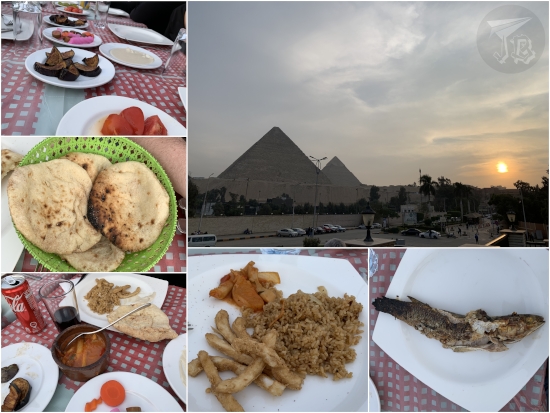
A view of the sphinx with two pyramids in the background. The dried Nile dock, and a megalyth-temple.

The sphinx, looking right.  There are lots of pidgeons on his head.

Then, we were driven back into the Cairo chaos to a restaurant for lunch. By this time it was around 15:00, and the menu was fixed. I was highly amused by the fact that the tour guide had tried to up-sell this place as a high-scale seafood restaurant. We were served rice with squid in different ways – breaded and in tomato sauce – three prawns, and fish. The best thing, honestly, was the Egyptian flatbread Aish Baladi [عش بالدي], and the view – after all the name of the restaurant was “Chestro Restaurant Pyramid View” for a reason.

A view of two pyramids with the sun setting to their right. The picture is surrounded by smaller pictures of Egyptian food - pickled vegetables, Egyptian bread, calamari with tomato sauce, rice with calamari, a roasted seabass

After our very late lunch, we headed off to the last visit of the day – yet another shop. Finally something I was interested in, a place where they had papyruses. Papyruses are made out of the papyrus plant (Nile grass, Cyperus papyrus), a type of flowering sedge. Here, someone explained the process of making the papyrus paper. I found something I liked, a reproduction of Tutankhamun’s jewellery box with a guarding Anubis (currently at the Egyptian Museum in Cairo).

A painting on a papyrus. It shows Anubis in jackal form sitting on a box. The lower part shows a man holding a papyrus plant, next to it different utensils to make the papyrus paper. On the left, the real box showing the jackal on top.

It was around 19:00 when we got back to the hotel, where the tour guide informed us that (the now free) dinner gala would be held from 20:00 to 00:00. We had a bit of a laugh about being so not ready – since nobody had brought any kind of formal clothes as most of us had not booked the dinner – and we arranged to meet at 21:15, since we had finished lunch late. I had a shower, then went downstairs. We met at the agreed time, and spent some time taking pictures, and in the end… we were almost late for dinner! By the time we sat down it was 21:30… and the buffet only ran till 21:45…

Food was not so great, and even less worth 190 €. The singer was terrible, the exotic dancer… was more like a stripper, and I ended up defending all our grapes to the death against overzealous waiters who wanted to clear the table asap. To be fair, it was a nice detail that the tour company got us twelve grapes each to celebrate the New Year’s. Despite the time and quality hiccups, we had a lot of fun. We counted-down to the New Year with the Egyptian time, and one hour later connected to the Spanish TV in order to listen to the bell tolls for midnight and eat our grapes. After saying good night, I had another shower and went to bed, though I could not sleep till the other hotel party finished at 2:30.

Shots of the New Year's Eve party at the hotel: two Christmas trees, a napkin folded like a tuxedo, some food, table decoration and a screen reading Happy 2023

It didn’t matter too much though, as the buzz and the high from the pyramid experience kept me content until there was enough silence to zonk out.

30th December 2022: Philae and the Aswan – Cairo jump {Egypt, Winter 2022-2023}

Belonging to the city of Aswan [أسوان], the Philae Temple [فيلة] complex is currently part of the Unesco World Heritage Site Nubian Monuments from Abu Simbel to Philae. When the first Aswan Dam was built in 1902, the monument became semi-submerged, and it would have completely disappeared after the completion of the High Dam. Between 1972 and 1980, through the International Campaign to Save the Monuments of Nubia, it was dismantled and reconstructed over at Agilika Island, 20 m higher.

The main feature in Philae is the Temple of Isis. Isis was the major goddess from the Old Kingdom to the Roman period. Isis was the spouse of Osiris, and is considered a mother and protector goddess, divine mother to the pharaoh, and mourner of her husband. In the Osiris myth, after he was killed and dismembered by Seth, Isis looked up and down Egypt to gather all the pieces. After she did, she breathed upon him to resurrect him, they conceived Horus (there are more or less gory versions of this), and Osiris went back to the Underworld, where he became lord of the Afterlife. Isis was the longest-revered goddess of the Ancient Egyptian religion – her cult survived in Philae until 550 CE, when Christians took over, defacing the gods and carving the Coptic cross all around.

I left for breakfast having vacated the room, suitcase ready at the open door, and hoped for the best. I settled my drink tab, which rounded up to 235 EGP; however, with the same smirk I had been given the previous day, I reminded the person at reception that they owed me ten pounds. The debt was honoured and I left with a giggle – yes, it was not that much money and I could have let it slip, but nope. Not this time. After that, our luggage was loaded onto the bus (luckily) and we drove off to a tourist dock to board the boat to Agilika island, which we reached after a few minutes. We landed and climbed up towards the archaeological site.

The Temple of Isis holds the general structure of an Ancient Egyptian Temple, with a pylon, a court, a hall and finally the inner sanctuary of Isis. An obelisk stands before the pylon, in the outer court that has been preserved.

Collage. View of the outer wall of Philae, with the colonnade and the pylon; entrance to the sanctuary, richly engraved with deities and hyerogyphs; a cat sitting in front of the columns.

When looking carefully at the pylon, it shows the different water marks from the time the temple was submerged – at two different levels, depending on whether it was flood season or dry season. During the rescue, a cofferdam was built around the original constructions to dry the area out. Then, between 1977 and 1980, the whole complex was dismantled into 40,000 blocks, moved and rebuilt. The old position can still be spotted 500 m away, marked by the remains of the metal anchors for the cranes.

Close up of the pylon showing carvings of Hathor and Horus. Two water lines can be appreciated above and below them

Another structure in the island is the unfinished Kiosk of Trajan. I even managed to be alone in there for a heartbeat.

A cube-like structure built from columns, with the river behind them.

The final building is the Temple of Hathor, Horus’ wife.

Collage. A ruined building with derelict walls and a few standing columns - from land and from the river.

Next in the plan was shopping (joy -.-“) and we went to an essence shop. The lady claimed that Egyptian essences were the base of many brand-famous perfumes. I have no idea, but I was irked by the rigid sex separation of scents, and I developed a rash from one of the testers… While some people in the group shopped, someone else found the adjacent papyrus shop, and a small number of us went to snoop there.

After being spared a second shop – this one for spices – we were shuttled to the airport to take our charter to Cairo. It was a surreal experience through which I was patted down twice. The airport segregated by sex because you got the pat down even if you cleared the metal detector, which was weird. Also, it turned out that we had an extra suitcase in the bus! Creepy!

Our tour guide did not fly with us. When we landed in Cairo [أسوان], we were taken to the hotel by another representative, who assigned rooms and called our names in the bus, before we even arrived, but did not hand the cards until we were there and had handed in our passports for check-in. It was of course too late to try and go to the Pyramids light show – seriously, everything would have been so much easier with a “sorry, no time”, especially considering the crazy Cairo traffic. At this point we were already planning to try it on our own – I had found out that the hotel had a mini travel’s agent that we could use.

A traffic jam heading to the Cairo airport traffic control. The green neon on top reads Welcome to Cairo

We met up for planning – and paying for the Night Cairo Walk, which was to take place the following day – and I sat down to catch up on everything that had happened in the days when I had been internet-less (have I mentioned that it was not such a bad experience?).

The whole trip was a New Year’s special and came with an optional 190 € dinner that I had not booked because… no. I had packed some cereal and chocolate bars just in case, and it turned out that only one couple out of our eighteen-people group had reserved it. There had been a tiny riff-raff when I asked my travel agent about dinner that day, and she received an email about the “Gala Dinner” being compulsory (demanding the extra money), and I asked her to reply that nope, I would not be attending.

Well, that night we were told that the local agency was treating us to the dinner – my theory? The restaurant they had agreed for the Night Walk would not take us for New Year’s Eve, the walk would be impossible due to people celebrating. Thus, they found themselves in a tough spot – so they used the spare from the overpriced optional trips to pay for it. Then, the night walk was bumped to the first of January. Looking back, I believe that they had completely overlooked the NYE factor.

Also, the hotel not only had free Wi-Fi, it also had complimentary water in the rooms, and free mineral water during dinner. And a bed that did not vibrate. It was a good night’s sleep. But before that I took a shower so long and so hotm, that I almost glowed in the dark afterwards.

29th December 2022: Abu Simbel and Nubia {Egypt, Winter 2022-2023}

Modern eras have brought lots of different needs and technologies, and both become one when we think about harnessing nature. The Aswan dam is one of such examples. There are actually two of them. The Old Aswan Dam was built in the wake of the 20th century (1899 – 1902), and the newer, Aswan High Dam was completed in 1970, creating Lake Nasser. The rationale was securing fresh water for Egypt and stopping the dependence on the Nile floodings; however there have been associated problems – not only environmental such as the habitat of the Nile crocodile and the loss of fertility in the delta; thousands of people were displaced from the to-be-flooded area, and houses and whole villages were swallowed by water. A lot of these villages had their own cultural heritage, which was to disappear forever. Thus started Unesco’s International Campaign to Save the Monuments of Nubia between 1960 and 1980. This effort relocated as many as 24 monuments (one of them, the Temple of Debod, ended up in Madrid, Spain) to safer grounds. The temples of Abu Simbel are probably the star of the rescue efforts.

The Abu Simbel [أبو سمبل] Complex is part of the Unesco World Heritage Site Nubian Monuments from Abu Simbel to Philae. It comprises two buildings – the Great Temple of Ramesses II and the Small Temple of Hathor and Nefertari. Both of them were carved out and into a sandstone cliff on the West Bank of the Nile during the reign of Ramesses II or Ramesses the Great (14th-13th Century BCE, Nineteenth Dynasty of the New Kingdom), considered one of the most powerful Pharaohs in the New Kingdom, who reigned for many years. It was lost to time, and only rediscovered in 1813 and excavated in 1817. The Complex was relocated to higher ground between 1964 and 1968 to prevent its sinking in Lake Nasser. In order to do so, the mountain and the temples were cut into huge blocks and built 65 m higher and 200 m back from the river. The relocation managed to keep the relative position to the sun, but shifted it by one day – the temple was designed so the first ray of sun hit Ramesses’ face in the sanctuary on the 21st of October and February, and now that happens on the 22nd.

At some point one has to wonder what was more impressive – building the complex, or relocating it so you can’t really tell. The mountain itself is hollow in order to reduce the stress on the temple after the move, but wow. Just, wow.

As far as I understand, buses are not supposed to stay longer than a couple of hours in the complex. Our disembark time was 2:30, and even if I went to bed ridiculously early, I did not get much sleep because my cabin was above the motorboat rotors, and my cabin vibrated like hell. Before we left, we had a choice of coffee or tea, and we were given a “picnic” consisting on some sweet bread with… buffet leftovers, a piece of fruit and a small juice – that was traded often.

The trip each way was 3.5 hours, so we wanted more than the 30 minutes the tour guide wanted to give us, and we were there between 6:30 (though we did not enter the site until a bit later) and 9:00. Fine, I own up – I was late coming back and only made it to the bus at 9:08. The tour guide was so not amused by that.

Arriving at the Abu Simbel site, you approach from behind the mountain, and as you surround it, you’re greeted by Lake Nasser [بحيرة ناصر], the reservoir created by the dam. The sun was climbing up slowly when we arrived, still with sunrise colour.

Sunrise over a lake. There is a lonely palm tree on the left

You keep turning and you are greeted by the four colossi that flank the entrance to the Great Temple of Ramesses II. The colossi represent deified Ramesses II, to whom the temple was dedicated along the gods Amun, Ra (in his Ra-Horakhty advocation) and Ptah (creator of the world and patron of craftsmen). The inside features a hypostyle hall with columns carved in the shape of Ramesses colossi, a colonnade hall and the inner sanctuary, where the venerated gods were revered.

Panorama of both Abu Simbel temples: Ramesses II to the left, Nefertari and Hathor to the right. The sky is blue, the monuments are orange-gold, and a lot of people gather at the entrances.

Collage of the Great Temple of Ramesses II: façade with four sitting colossi; inner hall, with colossi against the columns; an carving of Ramesses in a war position; inner sanctuary with the gods and Ramesses sitting, the light hitting their faces.

To the right stands the Temple of Hathor and Nefertari. Here, Queen Nefertari is represented as big as Ramesses and shown with the horns of the goddess Hathor, both signs of her importance (consorts were usually represented knee-high of their kings). The inner area has a hall with rectangular columns carved and painted, and the sanctuary features Hathor as a cow emerging from the mountain rock.

Small Temple of Abu Simbel colllage: Entryway with the colossi; inner hall with the face of Hathor carved into the columns; carving of Nefertari with the goddess' crown; inner sanctuary with the image of a woman with a cow head coming out from the wall, the light hitting her face

Despite really, really not wanting to leave, I made my way back and ran into two other people from the group. We had to leave through the tourist bazaar and were just slightly late. On the way back, slightly more awake than when we had left, we did not get to see any mirages, but we crossed the old Aswan Low Dam [خزان أسوان]. We had a view of the power plant on one side, and on the other side the First Cataract of the Nile, a series of rapids that have been slowed down by the building of the dam. In ancient times, it was believed that the Nile sprouted here and flowed both north and south. The main part of the cataract is now under the dam, and the remaining rapids have been turned into a nature reserve. There are Ancient Egypt remains and engravings in some ruins on the islands.

Views from the low Aswan Dam: southern side calm waters and power plant; northern side rapids

We were back on board the motorboat at 12:35 for lunch, and met again around 16:15 for a felucca sail on the Nile [نهر النيل] around the Aswan [أسوان] area. Before leaving, I decided to exchange 20 € into Egyptian pounds in order to have some change for the couple of meals we had outside, just in case I needed pounds to buy drinks. For convenience I chose the reception of the motorboat. They short-changed me, twice. First, they used a 23 EGP / 1 € exchange rate, while the official rate is 25 EGP / 1 €. Then, the guy at reception calculated 460 EGP and gave me 450, smirking “I owe you 10 pounds.” Stay tuned for the conclusion of the story.

The felucca sailing had been rescheduled from the following day so it could be tied to the trip through the Nature reserve and the Nubian village (and possibly to accomodate the charter flight times). A felucca [فلوكة ] is a traditional sailing boat, usually with one sail. Feluccas are still used for transportation through and across the Nile, and from ours, we caught some interesting views.

A sailboat docked with a precariously narrow plank to board it

A view of a sailboat on the Nile from another sailboat. The knots and ropes of the boarded felucca are visible in the foreground.

We got to see the Tombs of the Nobles | Qubbet el-Hawa [قبة الهوا] (Dome of the Wind), which I wish we could have visited. The tombs date back from the Old and Middle Kingdom with dignitaries and governors from the Fourth Dynasty to the Roman period buried here. The site is still being excavated, and also part of the Unesco World Heritage Site Nubian Monuments from Abu Simbel to Philae, even if it is neither Nubian nor between them.

A ruined structure perched on a bare mountain or dune. On the left there is a building, and on the right some open façades in stone.

We also sailed by the Mausoleum of Aga Khan [قبر اغاخان] and the family house beneath it. Sultan Muhammad Shah, Aga Khan III, was a religious leader among the Nizari Isma’ilism, a branch of Islam, and he was buried in Aswan after his death in 1957.

A building perched on the top of a mountain. It has a dome and several towers. A similar building stands at its feet, painted white, in the middle of a garden

Apparently I missed some dancing as I was taking pictures of the site. Then, the people from the felucca sold us some trinkets, and finally we transferred to a different kind of engine boat, from where we sailed off towards Salouga and Ghazal Nature Reserve [محمية سالوجا وغزال الطبيعية] (the rapids formed by the First Cataract), around Seheyl Island [جزيرة سهيل], and a great sand dune. The Aswan area is famous among birdwatchers for its diversity. We got to see some glossy ibises (Plegadis falcinellus), little egrets (Egretta garzetta), reed cormorant (Microcarbo africanus), maybe an osprey or two (Pandion haliaetus), some corvids and stilts… Up the dune we made port at, we also caught sight of a couple of Egyptian beetles (Scarabaeus sacer).

Collage: a rocky island surrounded by rapidly-running water, and several birds wadding and mid-flight

Collage. Two views of a huge sand dune: the buildings look tiny against it. A picture of a scarab walking on sand and leaving its print. It is a bit biger than a 5cent coin

The Nubian village, Gharb Seheyl [غرب سهيل], which is little more than a big bazaar. We were invited to the house of a man who claimed to have been a dancer for the Spanish Teatro Real. We hung out there for an hour or so, and eventually were let off to walk around the village, a succession of shops selling the same trinkets as everywhere else, plus women trying to sell “Nubian dolls”. The house we were at kept live Nile crocodiles (Crocodylus niloticus), and at a lot of places we saw some mounted ones, I guess for tourist’s entertainment, but that did not feel quite right.

Collage of the Nubian village: a view from a rooftop, showing the houses painted in sand and blue colours; a shop with colourful trinkets, flowers, and statuetes; a Nile crocodile staring up; a dromedary passing by a souvenir shop.

After sunset, we sailed off back to the motorboat, without stopping anywhere, even if the whole city was lit. The boats were also shiny with neons and bright colours.

Collage: boats at night, docking and navigating the Nile. Two views of Aswan: lit ruins of the tombs of the Nobles, a mosque and a hotel

At the motorboat, we just had dinner and I went to bed early to catch some sleep. When I arrived at the cabin, I discovered that the staff had taken one of my beds away. I guess they got tired of making both of them as I used both bed covers? I was amused, just like I had been by all the figures they made out of towels (I got swans, a crocodile, and a monkey) though I wish the cleaning had been a bit more… thorough.

28th December 2022: A winning change {Egypt, Winter 2022-2023}

When the Aswan Dams were built, the natural flow of the Nile was altered, and a number of floodgates were built. In order to travel south towards Aswan, we had to cross one of those floodgates, the Floodgate at Esna. I was up watching sunrise when we started moving – as we were in line for a very long time in order to do so, our itinerary had to be altered – as we only crossed the dam at 7:40 instead, and would not have made it to our second stop before it closed. So instead of seeing the Temple of Kom Ombo, dedicated to Sobek and Haroeris / Horus, we would stop at Esna. This was truly off-schedule, as we actually witnessed the guide purchasing the tickets on spot, while he usually had them ready beforehand. I do think, however, this was a good change.

Collage: Sun rising behind the floodgate at Esna. The motorboat entering the floodfate: a mass of white iron coming close to a cement wall on water

Animation of the porthole just above water, showing how the ship moves up and forward at the same time

We made port at Esna [إسنا], at a quay within walking distance of the Temple of Khnum [معبد إسنا], the ram-headed god who created life. This temple was started by Ptolemy VI Philometor (2nd century BCE, Ptolemaic or Graeco-Roman period). Today, only the first hall has been excavated, as most of the temple is buried under the sand – and the houses! In order to access the vestibule, you have to climb down stairs into a nine-metre pitch. As the temple was buried in sand for centuries, it has kept its polychromy, and the columns are richly decorated. It was a beautiful temple, but it seems that unearthing the rest is going to be hard, if not impossible (though they managed to relocate everyone who lived on top of the Avenue of Sphinxes in Luxor, so who knows?)

Collage. A temple stands in a deep pit of sand. It is rectangular in shape, and the façade shows six columns to each side of the gate, all complete and opening in a compound capital. The other two images show the columns inside: they are decorated with reliefs and painted in bright colours (golds, greens, blues...)

We went back on board and continued off until Edfu [إدفو ], where we visited the most completely preserved Egyptian temple ever – the Temple of Horus [معبد إدفو] (3rd century BCE, Ptolemaic or Graeco-Roman period). It was one of the most impressive sights I’d ever seen (and there were more to come anyway). Horus, the god with the falcon head, was the son of Isis (primordial goddess of Magic and protecting mother) and Osiris (God of Death, fertility and resurrection). Osiris was betrayed by his brother Seth (god of chaos and confusion), killed and dismembered, with his body parts spread throughout Egypt. Horus avenged him and became the ruling god, with the Pharaoh being his representative on earth, giving Pharaohs a direct connection as figurative “children of the gods”.

The temple was also buried by sand, and that is how it has survived relatively intact, with all the outer walls surrounding the main temple structure. The pylon gates are flanked by falcon statues, and the columns still keep their colouring. We got to see a reproduction of the wooden boat that was used to bring the god out in procession, the original is in Paris’ Louvre museum these days. Here I found a “secret passage” to the side which was really cool to explore (albeit not really secret, just empty of other tourists (≧▽≦).)

The temple of Edfu, collage: The pylon; the main hall from the outside with six columns and a huge entrygate flanked by falcon statues; the inside columns, blackened by smoke; and a boat-like structure with a falcon statuette from the inner sanctuary.

After we were back on board, we were summoned to the sun deck to ‘discuss’ the following day/s, and offered some extra outings. We tried to negotiate an outing to see the light show at Giza, but the tour guide refused to organise it (turns out, we would not have the time, but he did not want to tell us that for some weird reason); I also tried to arrange a morning trip for myself on the 2nd, unsuccessfully (more on that later). Instead, he sold us a trip to a Nubian village, sailing through the Nile nature reserve, and a night walk through Cairo with dinner. Oh, and informed us that wake-up call for Abu-Simbel the following day was… 2:00.

27th December 2022: Early start and late delays {Egypt, Winter 2022-2023}

Not that 5:00 is a nice hour for anything, but it’s definitely a nicer hour to get up than to take a plane. Leaving was scheduled for 6:00 (with sail-off at 14:00), and I would not have minded had it been earlier to be honest. However, given that most of my group had arrived at midnight, there might have been a riot…

Breakfast was not too well stocked, but there was coffee and eggs for energy through the morning as we were going to be out from 6:00 to 14:00 – a full eight hours. We started late because the tour guide was late… not a good sign. The group had 18 people plus him, and he really did not sound either enthusiastic nor particularly knowledgeable to be blunt. We had a coach booked for us and we set off to visit the main elements in the city of Luxor [الأقصر] and its surroundings, the Unesco World Heritage Site Ancient Thebes with its Necropolis. We started towards the West Bank of the Nile, the bank of the dead, where the ruins of the Necropolis are.

Our first stop was Medinet Habu [مدينة هابو] a Pharaonic complex, whose most important building is the Mortuary Temple of Ramesses III. It was the last monument built in the area, during the pharaoh’s reign (12th century BCE, Twentieth Dynasty of the New Kingdom). The basic structure of an Ancient Egyptian or Pharaonic temple is the pylon – court – hall. The pylon is a massive wall separated in two parts in which a narrow passage acts as gate. The court is a colonnade, and the hall is the area where the sacred spots can be found, covered and darker.

In the case of the Mortuary Temple of Ramesses III, the complex is surrounded by a mud brick wall with an extra pylon. The temple is decorated with carvings that depict the pharaoh as a great warrior smiting all his enemies. The structure used to be connected to the Nile to the point that there was a so-called Nilometre. In Ancient Egypt, taxation was determined by how high the Nile floods were – or were not.

Collage of the Mortuary temple of Ramesses III: The pylon, the columns, a bare gate and one decorated with rows of hieroglyphs

After the temple, we continued off to the Valley of the Kings | Wādī al-Mulūk [وادي الملوك]. Between the 16th and 11th centuries BCE, after the pyramids had been proven easy to find and pillage, the pharaohs from the Eighteenth to the Twentieth dynasties were laid to rest here. The tombs are excavated into the rock and here was where Howard Carter found Tutankhamun’s grave in 1922. The ticket grants admission to three “standard” tombs, and the most emblematic ones require a separate fee. Our guide pressed us not to buy a ticket for Tutankhamun, and did not even mention other tickets – at this point I decided that I had to read beforehand about what we were going to do the following days in order to be prepared for his attitude.

A scorching valley opening to both sides with grey-white hills going up. Everything looks sandy and dusty,

The first grave we visited was the Tomb of Ramesses IV (KV2) (12th century BCE, Twentieth Dynasty of the New Kingdom). It consists of a long and richly-decorated corridor that ends in a mortuary chamber where the sarcophagus still stands. It has been open to visits from antiquity.

Tomb: a long corridor with painted and carved hieroglyphs. In the background stands a bare sarcophagus in pink granite

The second tomb was the Tomb of Ramesses IX (KV6) (12th century BCE, Twentieth Dynasty of the New Kingdom), which was unfinished at the time of his death. The entrance corridor is wide, with the walls covered with glass. In this case, the burial chamber was unreachable.

Tomb collage: a long corridor decorated with hieroglyphs and a close up of a painted boat taking the deceased to the underworld. The corridor ends in stairs that go down towards the mortuary chamber

Our final grave was the Tomb of Ramesses III (KV11), whose temple we had seen before. The interesting thing about this tomb was that it ran into another one as it was being built, so the corridor actually has corners before reaching the empty burial chamber.

Tomb collage. Details of the different engravings and hieroglyphs. The burial chamber has thick columns and it has a downwards slope. The columns are decorated with further hieroglyphs and images of the gods

After the Valley of the Kings, we headed back to the Eastern Bank and made a stop at the Colossi of Memnon [تمثالا ممنون]. Each of the four statues was carved from one huge block of rock, and they signal the entrance to the funerary temple of Amenhotep III (14th century BCE, Eighteenth Dynasty of the New Kingdom). The temple is currently being excavated, and it would have been the largest in the West Bank.

The four colossi. There are two in the foreground, sitting down. They don't have faces. Two others can be guessed in the background, though one is just a block of rock

Afterwards, we got stuck for a stupid amount of time at an “artisan stonework” shop – a tourist trap to buy souvenirs. Boy, was I miffed, especially when this took out time from temples in Luxor. The first stop in the Eastern bank the was Karnak Temples Complex [الكرنك]. Karnak is a succession of temples, pylons and chapels that started around 2000 BCE, during the reign of Senusret I (20th century BCE, Twelfth Dynasty of the Middle Kingdom) and continued for 2000 further years, with more Pharaohs adding their own structures. The most impressive area in Karnak is the Hypostyle Hall, open to the sky now with a number of columns ending on an open papyrus capital. Other features are the obelisks of Hatshepsut, one standing, the other fallen.

The complex was dedicated to the Theban triad: the god Amun, the goddess Mut (the “mother” goddess with the head of a vulture) and their son Khonsu (god of the moon). Amun was the creator of the universe, and later his cult was merged with that of Ra, the god of sun and light, thus the appearance of the god Amun-Ra, to whom the main temple was dedicated. The huge complex expands right and left, but unfortunately we had little time to explore due to time constraints.

Karnak complex: the entrance pylon, the columns in the hall, decorated with scenes from Ancient Egypt's daily life, and an Obelisk

We moved on to Luxor Temple and the Avenue of Sphinxes, also called Rams Road [طريق الكباش]. The Avenue joined Karnak and Luxor, and was flanked by ram-faced sphinxes all along its three kilometres – though the four best preserved ones were taken to Cairo to create a monument in one of the squares. The avenue has actually been walkable since 2021, and you can go from one temple to the other on foot.

A long line of sphinxes with human faces and lion paws

Luxor Temple [معبد الأقصر ] was dedicated to the rejuvenation of the monarchy, and many pharaohs were crowned there. It was founded around 1400 BCE, and throughout the centuries has come to host a mosque. In front of it, stands an obelisk, whose twin is in Paris. Behind the obelisk stands the pylon, the court, the colonnade, and a final court before the sanctuary chamber.

Luxor temple: The pylon with an obelisk in front, two sitting colossi and two parallel rows of columns from the hall

We were back on the boat just a few minutes after 14:00 for lunch, and then I found my way to the sun deck to see the sail off… which did not happen till 16:00! All that running through the temples for… nothing. I was not pleased, but I refused to get angry. Instead, I read up on what was to come, did some bird watching – I caught a flock of ibises – and watched the sunset.

A flock of birds flying against a bright blue sky. The curved-down beak suggests that they're ibises

Sunset over the nile. The sky is orange, the suni s almost white, and there is a trail of light on the water

In the late evening we reached the floodgate at Esna, which we should have crossed around dinnertime. We got stuck waiting for our turn behind a large LNG ship and a lot of other motorboats. In the middle of nowhere, I was able to see the stars very clearly, and that was pretty.